EP1569040B1 - Ladungstransportierende Verbindungen enthaltender organischer Photorezeptor - Google Patents
Ladungstransportierende Verbindungen enthaltender organischer Photorezeptor Download PDFInfo
- Publication number
- EP1569040B1 EP1569040B1 EP05251084A EP05251084A EP1569040B1 EP 1569040 B1 EP1569040 B1 EP 1569040B1 EP 05251084 A EP05251084 A EP 05251084A EP 05251084 A EP05251084 A EP 05251084A EP 1569040 B1 EP1569040 B1 EP 1569040B1
- Authority
- EP
- European Patent Office
- Prior art keywords
- group
- independently
- aromatic
- heterocyclic
- charge transport
- Prior art date
- Legal status (The legal status is an assumption and is not a legal conclusion. Google has not performed a legal analysis and makes no representation as to the accuracy of the status listed.)
- Expired - Lifetime
Links
- 0 CC(C)(*[*@](*=C(C)*)N*(*C(C)(C)N)*=C(N)I)N Chemical compound CC(C)(*[*@](*=C(C)*)N*(*C(C)(C)N)*=C(N)I)N 0.000 description 3
- ILBZSNOGPTUKHC-UHFFFAOYSA-N CC1CN(C)C1 Chemical compound CC1CN(C)C1 ILBZSNOGPTUKHC-UHFFFAOYSA-N 0.000 description 1
- VLRAYRFSTHDSHK-UHFFFAOYSA-N CCc(cc1)ccc1[NH2+2] Chemical compound CCc(cc1)ccc1[NH2+2] VLRAYRFSTHDSHK-UHFFFAOYSA-N 0.000 description 1
Classifications
-
- G—PHYSICS
- G03—PHOTOGRAPHY; CINEMATOGRAPHY; ANALOGOUS TECHNIQUES USING WAVES OTHER THAN OPTICAL WAVES; ELECTROGRAPHY; HOLOGRAPHY
- G03G—ELECTROGRAPHY; ELECTROPHOTOGRAPHY; MAGNETOGRAPHY
- G03G5/00—Recording-members for original recording by exposure, e.g. to light, to heat or to electrons; Manufacture thereof; Selection of materials therefor
- G03G5/02—Charge-receiving layers
- G03G5/04—Photoconductive layers; Charge-generation layers or charge-transporting layers; Additives therefor; Binders therefor
- G03G5/06—Photoconductive layers; Charge-generation layers or charge-transporting layers; Additives therefor; Binders therefor characterised by the photoconductive material being organic
- G03G5/0601—Acyclic or carbocyclic compounds
- G03G5/0612—Acyclic or carbocyclic compounds containing nitrogen
- G03G5/0614—Amines
- G03G5/06142—Amines arylamine
-
- C—CHEMISTRY; METALLURGY
- C07—ORGANIC CHEMISTRY
- C07C—ACYCLIC OR CARBOCYCLIC COMPOUNDS
- C07C323/00—Thiols, sulfides, hydropolysulfides or polysulfides substituted by halogen, oxygen or nitrogen atoms, or by sulfur atoms not being part of thio groups
- C07C323/23—Thiols, sulfides, hydropolysulfides or polysulfides substituted by halogen, oxygen or nitrogen atoms, or by sulfur atoms not being part of thio groups containing thio groups and nitrogen atoms, not being part of nitro or nitroso groups, bound to the same carbon skeleton
- C07C323/46—Thiols, sulfides, hydropolysulfides or polysulfides substituted by halogen, oxygen or nitrogen atoms, or by sulfur atoms not being part of thio groups containing thio groups and nitrogen atoms, not being part of nitro or nitroso groups, bound to the same carbon skeleton having at least one of the nitrogen atoms, not being part of nitro or nitroso groups, further bound to other hetero atoms
- C07C323/48—Thiols, sulfides, hydropolysulfides or polysulfides substituted by halogen, oxygen or nitrogen atoms, or by sulfur atoms not being part of thio groups containing thio groups and nitrogen atoms, not being part of nitro or nitroso groups, bound to the same carbon skeleton having at least one of the nitrogen atoms, not being part of nitro or nitroso groups, further bound to other hetero atoms to nitrogen atoms
-
- C—CHEMISTRY; METALLURGY
- C07—ORGANIC CHEMISTRY
- C07D—HETEROCYCLIC COMPOUNDS
- C07D209/00—Heterocyclic compounds containing five-membered rings, condensed with other rings, with one nitrogen atom as the only ring hetero atom
- C07D209/56—Ring systems containing three or more rings
- C07D209/80—[b, c]- or [b, d]-condensed
- C07D209/82—Carbazoles; Hydrogenated carbazoles
- C07D209/86—Carbazoles; Hydrogenated carbazoles with only hydrogen atoms, hydrocarbon or substituted hydrocarbon radicals, directly attached to carbon atoms of the ring system
-
- C—CHEMISTRY; METALLURGY
- C07—ORGANIC CHEMISTRY
- C07D—HETEROCYCLIC COMPOUNDS
- C07D285/00—Heterocyclic compounds containing rings having nitrogen and sulfur atoms as the only ring hetero atoms, not provided for by groups C07D275/00 - C07D283/00
- C07D285/01—Five-membered rings
- C07D285/02—Thiadiazoles; Hydrogenated thiadiazoles
- C07D285/04—Thiadiazoles; Hydrogenated thiadiazoles not condensed with other rings
- C07D285/12—1,3,4-Thiadiazoles; Hydrogenated 1,3,4-thiadiazoles
- C07D285/125—1,3,4-Thiadiazoles; Hydrogenated 1,3,4-thiadiazoles with oxygen, sulfur or nitrogen atoms, directly attached to ring carbon atoms, the nitrogen atoms not forming part of a nitro radical
-
- C—CHEMISTRY; METALLURGY
- C07—ORGANIC CHEMISTRY
- C07D—HETEROCYCLIC COMPOUNDS
- C07D417/00—Heterocyclic compounds containing two or more hetero rings, at least one ring having nitrogen and sulfur atoms as the only ring hetero atoms, not provided for by group C07D415/00
- C07D417/14—Heterocyclic compounds containing two or more hetero rings, at least one ring having nitrogen and sulfur atoms as the only ring hetero atoms, not provided for by group C07D415/00 containing three or more hetero rings
-
- C—CHEMISTRY; METALLURGY
- C08—ORGANIC MACROMOLECULAR COMPOUNDS; THEIR PREPARATION OR CHEMICAL WORKING-UP; COMPOSITIONS BASED THEREON
- C08G—MACROMOLECULAR COMPOUNDS OBTAINED OTHERWISE THAN BY REACTIONS ONLY INVOLVING UNSATURATED CARBON-TO-CARBON BONDS
- C08G61/00—Macromolecular compounds obtained by reactions forming a carbon-to-carbon link in the main chain of the macromolecule
- C08G61/12—Macromolecular compounds containing atoms other than carbon in the main chain of the macromolecule
- C08G61/122—Macromolecular compounds containing atoms other than carbon in the main chain of the macromolecule derived from five- or six-membered heterocyclic compounds, other than imides
-
- C—CHEMISTRY; METALLURGY
- C08—ORGANIC MACROMOLECULAR COMPOUNDS; THEIR PREPARATION OR CHEMICAL WORKING-UP; COMPOSITIONS BASED THEREON
- C08G—MACROMOLECULAR COMPOUNDS OBTAINED OTHERWISE THAN BY REACTIONS ONLY INVOLVING UNSATURATED CARBON-TO-CARBON BONDS
- C08G61/00—Macromolecular compounds obtained by reactions forming a carbon-to-carbon link in the main chain of the macromolecule
- C08G61/12—Macromolecular compounds containing atoms other than carbon in the main chain of the macromolecule
- C08G61/122—Macromolecular compounds containing atoms other than carbon in the main chain of the macromolecule derived from five- or six-membered heterocyclic compounds, other than imides
- C08G61/123—Macromolecular compounds containing atoms other than carbon in the main chain of the macromolecule derived from five- or six-membered heterocyclic compounds, other than imides derived from five-membered heterocyclic compounds
-
- C—CHEMISTRY; METALLURGY
- C08—ORGANIC MACROMOLECULAR COMPOUNDS; THEIR PREPARATION OR CHEMICAL WORKING-UP; COMPOSITIONS BASED THEREON
- C08G—MACROMOLECULAR COMPOUNDS OBTAINED OTHERWISE THAN BY REACTIONS ONLY INVOLVING UNSATURATED CARBON-TO-CARBON BONDS
- C08G61/00—Macromolecular compounds obtained by reactions forming a carbon-to-carbon link in the main chain of the macromolecule
- C08G61/12—Macromolecular compounds containing atoms other than carbon in the main chain of the macromolecule
- C08G61/122—Macromolecular compounds containing atoms other than carbon in the main chain of the macromolecule derived from five- or six-membered heterocyclic compounds, other than imides
- C08G61/123—Macromolecular compounds containing atoms other than carbon in the main chain of the macromolecule derived from five- or six-membered heterocyclic compounds, other than imides derived from five-membered heterocyclic compounds
- C08G61/126—Macromolecular compounds containing atoms other than carbon in the main chain of the macromolecule derived from five- or six-membered heterocyclic compounds, other than imides derived from five-membered heterocyclic compounds with a five-membered ring containing one sulfur atom in the ring
-
- C—CHEMISTRY; METALLURGY
- C08—ORGANIC MACROMOLECULAR COMPOUNDS; THEIR PREPARATION OR CHEMICAL WORKING-UP; COMPOSITIONS BASED THEREON
- C08G—MACROMOLECULAR COMPOUNDS OBTAINED OTHERWISE THAN BY REACTIONS ONLY INVOLVING UNSATURATED CARBON-TO-CARBON BONDS
- C08G73/00—Macromolecular compounds obtained by reactions forming a linkage containing nitrogen with or without oxygen or carbon in the main chain of the macromolecule, not provided for in groups C08G12/00 - C08G71/00
- C08G73/02—Polyamines
- C08G73/0246—Polyamines containing other atoms than carbon, hydrogen, nitrogen or oxygen in the main chain
- C08G73/0253—Polyamines containing sulfur in the main chain
-
- C—CHEMISTRY; METALLURGY
- C08—ORGANIC MACROMOLECULAR COMPOUNDS; THEIR PREPARATION OR CHEMICAL WORKING-UP; COMPOSITIONS BASED THEREON
- C08G—MACROMOLECULAR COMPOUNDS OBTAINED OTHERWISE THAN BY REACTIONS ONLY INVOLVING UNSATURATED CARBON-TO-CARBON BONDS
- C08G73/00—Macromolecular compounds obtained by reactions forming a linkage containing nitrogen with or without oxygen or carbon in the main chain of the macromolecule, not provided for in groups C08G12/00 - C08G71/00
- C08G73/02—Polyamines
- C08G73/0273—Polyamines containing heterocyclic moieties in the main chain
-
- G—PHYSICS
- G03—PHOTOGRAPHY; CINEMATOGRAPHY; ANALOGOUS TECHNIQUES USING WAVES OTHER THAN OPTICAL WAVES; ELECTROGRAPHY; HOLOGRAPHY
- G03G—ELECTROGRAPHY; ELECTROPHOTOGRAPHY; MAGNETOGRAPHY
- G03G5/00—Recording-members for original recording by exposure, e.g. to light, to heat or to electrons; Manufacture thereof; Selection of materials therefor
- G03G5/02—Charge-receiving layers
- G03G5/04—Photoconductive layers; Charge-generation layers or charge-transporting layers; Additives therefor; Binders therefor
- G03G5/06—Photoconductive layers; Charge-generation layers or charge-transporting layers; Additives therefor; Binders therefor characterised by the photoconductive material being organic
- G03G5/0601—Acyclic or carbocyclic compounds
- G03G5/0612—Acyclic or carbocyclic compounds containing nitrogen
- G03G5/0616—Hydrazines; Hydrazones
-
- G—PHYSICS
- G03—PHOTOGRAPHY; CINEMATOGRAPHY; ANALOGOUS TECHNIQUES USING WAVES OTHER THAN OPTICAL WAVES; ELECTROGRAPHY; HOLOGRAPHY
- G03G—ELECTROGRAPHY; ELECTROPHOTOGRAPHY; MAGNETOGRAPHY
- G03G5/00—Recording-members for original recording by exposure, e.g. to light, to heat or to electrons; Manufacture thereof; Selection of materials therefor
- G03G5/02—Charge-receiving layers
- G03G5/04—Photoconductive layers; Charge-generation layers or charge-transporting layers; Additives therefor; Binders therefor
- G03G5/06—Photoconductive layers; Charge-generation layers or charge-transporting layers; Additives therefor; Binders therefor characterised by the photoconductive material being organic
- G03G5/0601—Acyclic or carbocyclic compounds
- G03G5/062—Acyclic or carbocyclic compounds containing non-metal elements other than hydrogen, halogen, oxygen or nitrogen
-
- G—PHYSICS
- G03—PHOTOGRAPHY; CINEMATOGRAPHY; ANALOGOUS TECHNIQUES USING WAVES OTHER THAN OPTICAL WAVES; ELECTROGRAPHY; HOLOGRAPHY
- G03G—ELECTROGRAPHY; ELECTROPHOTOGRAPHY; MAGNETOGRAPHY
- G03G5/00—Recording-members for original recording by exposure, e.g. to light, to heat or to electrons; Manufacture thereof; Selection of materials therefor
- G03G5/02—Charge-receiving layers
- G03G5/04—Photoconductive layers; Charge-generation layers or charge-transporting layers; Additives therefor; Binders therefor
- G03G5/06—Photoconductive layers; Charge-generation layers or charge-transporting layers; Additives therefor; Binders therefor characterised by the photoconductive material being organic
- G03G5/0622—Heterocyclic compounds
- G03G5/0624—Heterocyclic compounds containing one hetero ring
- G03G5/0627—Heterocyclic compounds containing one hetero ring being five-membered
- G03G5/0629—Heterocyclic compounds containing one hetero ring being five-membered containing one hetero atom
-
- G—PHYSICS
- G03—PHOTOGRAPHY; CINEMATOGRAPHY; ANALOGOUS TECHNIQUES USING WAVES OTHER THAN OPTICAL WAVES; ELECTROGRAPHY; HOLOGRAPHY
- G03G—ELECTROGRAPHY; ELECTROPHOTOGRAPHY; MAGNETOGRAPHY
- G03G5/00—Recording-members for original recording by exposure, e.g. to light, to heat or to electrons; Manufacture thereof; Selection of materials therefor
- G03G5/02—Charge-receiving layers
- G03G5/04—Photoconductive layers; Charge-generation layers or charge-transporting layers; Additives therefor; Binders therefor
- G03G5/06—Photoconductive layers; Charge-generation layers or charge-transporting layers; Additives therefor; Binders therefor characterised by the photoconductive material being organic
- G03G5/0622—Heterocyclic compounds
- G03G5/0624—Heterocyclic compounds containing one hetero ring
- G03G5/0627—Heterocyclic compounds containing one hetero ring being five-membered
- G03G5/0633—Heterocyclic compounds containing one hetero ring being five-membered containing three hetero atoms
-
- G—PHYSICS
- G03—PHOTOGRAPHY; CINEMATOGRAPHY; ANALOGOUS TECHNIQUES USING WAVES OTHER THAN OPTICAL WAVES; ELECTROGRAPHY; HOLOGRAPHY
- G03G—ELECTROGRAPHY; ELECTROPHOTOGRAPHY; MAGNETOGRAPHY
- G03G5/00—Recording-members for original recording by exposure, e.g. to light, to heat or to electrons; Manufacture thereof; Selection of materials therefor
- G03G5/02—Charge-receiving layers
- G03G5/04—Photoconductive layers; Charge-generation layers or charge-transporting layers; Additives therefor; Binders therefor
- G03G5/06—Photoconductive layers; Charge-generation layers or charge-transporting layers; Additives therefor; Binders therefor characterised by the photoconductive material being organic
- G03G5/07—Polymeric photoconductive materials
- G03G5/071—Polymeric photoconductive materials obtained by reactions only involving carbon-to-carbon unsaturated bonds
- G03G5/072—Polymeric photoconductive materials obtained by reactions only involving carbon-to-carbon unsaturated bonds comprising pending monoamine groups
- G03G5/073—Polymeric photoconductive materials obtained by reactions only involving carbon-to-carbon unsaturated bonds comprising pending monoamine groups comprising pending carbazole groups
-
- G—PHYSICS
- G03—PHOTOGRAPHY; CINEMATOGRAPHY; ANALOGOUS TECHNIQUES USING WAVES OTHER THAN OPTICAL WAVES; ELECTROGRAPHY; HOLOGRAPHY
- G03G—ELECTROGRAPHY; ELECTROPHOTOGRAPHY; MAGNETOGRAPHY
- G03G5/00—Recording-members for original recording by exposure, e.g. to light, to heat or to electrons; Manufacture thereof; Selection of materials therefor
- G03G5/02—Charge-receiving layers
- G03G5/04—Photoconductive layers; Charge-generation layers or charge-transporting layers; Additives therefor; Binders therefor
- G03G5/06—Photoconductive layers; Charge-generation layers or charge-transporting layers; Additives therefor; Binders therefor characterised by the photoconductive material being organic
- G03G5/07—Polymeric photoconductive materials
- G03G5/075—Polymeric photoconductive materials obtained otherwise than by reactions only involving carbon-to-carbon unsaturated bonds
-
- G—PHYSICS
- G03—PHOTOGRAPHY; CINEMATOGRAPHY; ANALOGOUS TECHNIQUES USING WAVES OTHER THAN OPTICAL WAVES; ELECTROGRAPHY; HOLOGRAPHY
- G03G—ELECTROGRAPHY; ELECTROPHOTOGRAPHY; MAGNETOGRAPHY
- G03G5/00—Recording-members for original recording by exposure, e.g. to light, to heat or to electrons; Manufacture thereof; Selection of materials therefor
- G03G5/02—Charge-receiving layers
- G03G5/04—Photoconductive layers; Charge-generation layers or charge-transporting layers; Additives therefor; Binders therefor
- G03G5/06—Photoconductive layers; Charge-generation layers or charge-transporting layers; Additives therefor; Binders therefor characterised by the photoconductive material being organic
- G03G5/07—Polymeric photoconductive materials
- G03G5/075—Polymeric photoconductive materials obtained otherwise than by reactions only involving carbon-to-carbon unsaturated bonds
- G03G5/076—Polymeric photoconductive materials obtained otherwise than by reactions only involving carbon-to-carbon unsaturated bonds having a photoconductive moiety in the polymer backbone
- G03G5/0763—Polymeric photoconductive materials obtained otherwise than by reactions only involving carbon-to-carbon unsaturated bonds having a photoconductive moiety in the polymer backbone comprising arylamine moiety
- G03G5/0764—Polymeric photoconductive materials obtained otherwise than by reactions only involving carbon-to-carbon unsaturated bonds having a photoconductive moiety in the polymer backbone comprising arylamine moiety triarylamine
-
- G—PHYSICS
- G03—PHOTOGRAPHY; CINEMATOGRAPHY; ANALOGOUS TECHNIQUES USING WAVES OTHER THAN OPTICAL WAVES; ELECTROGRAPHY; HOLOGRAPHY
- G03G—ELECTROGRAPHY; ELECTROPHOTOGRAPHY; MAGNETOGRAPHY
- G03G5/00—Recording-members for original recording by exposure, e.g. to light, to heat or to electrons; Manufacture thereof; Selection of materials therefor
- G03G5/02—Charge-receiving layers
- G03G5/04—Photoconductive layers; Charge-generation layers or charge-transporting layers; Additives therefor; Binders therefor
- G03G5/06—Photoconductive layers; Charge-generation layers or charge-transporting layers; Additives therefor; Binders therefor characterised by the photoconductive material being organic
- G03G5/07—Polymeric photoconductive materials
- G03G5/075—Polymeric photoconductive materials obtained otherwise than by reactions only involving carbon-to-carbon unsaturated bonds
- G03G5/076—Polymeric photoconductive materials obtained otherwise than by reactions only involving carbon-to-carbon unsaturated bonds having a photoconductive moiety in the polymer backbone
- G03G5/0767—Polymeric photoconductive materials obtained otherwise than by reactions only involving carbon-to-carbon unsaturated bonds having a photoconductive moiety in the polymer backbone comprising hydrazone moiety
Definitions
- This invention relates to organophotoreceptors suitable for use in electrophotography and, more specifically, to organophotoreceptors having a charge transport composition or a polymeric charge transport material comprising a polymer having repeating units comprising two hydrazone groups bonded together through a bridging group.
- an organophotoreceptor in the form of a plate, disk, sheet, belt, drum or the like having an electrically insulating photoconductive element on an electrically conductive substrate is imaged by first uniformly electrostatically charging the surface of the photoconductive layer, and then exposing the charged surface to a pattern of light.
- the light exposure selectively dissipates the charge in the illuminated areas where light strikes the surface, thereby forming a pattern of charged and uncharged areas, referred to as a latent image.
- a liquid or dry toner is then provided in the vicinity of the latent image, and toner droplets or particles deposit in the vicinity of either the charged or uncharged areas to create a toned image on the surface of the photoconductive layer.
- the resulting toned image can be transferred to a suitable ultimate or intermediate receiving surface, such as paper, or the photoconductive layer can operate as an ultimate receptor for the image.
- the imaging process can be repeated many times to complete a single image, for example, by overlaying images of distinct color components or effect shadow images, such as overlaying images of distinct colors to form a full color final image, and/or to reproduce additional images.
- a charge transport composition and charge generating material are combined with a polymeric binder and then deposited on the electrically conductive substrate.
- the charge transport material and charge generating material are present in the element in separate layers, each of which can optionally be combined with a polymeric binder, deposited on the electrically conductive substrate.
- Two arrangements are possible for a two-layer photoconductive element. In one two-layer arrangement (the “dual layer” arrangement), the charge-generating layer is deposited on the electrically conductive substrate and the charge transport layer is deposited on top of the charge generating layer. In an alternate two-layer arrangement (the "inverted dual layer” arrangement), the order of the charge transport layer and charge generating layer is reversed.
- the purpose of the charge generating material is to generate charge carriers (i.e., holes and/or electrons) upon exposure to light.
- the purpose of the charge transport material is to accept at least one type of these charge carriers and transport them through the charge transport layer in order to facilitate discharge of a surface charge on the photoconductive element.
- the charge transport material can be a charge transport compound, an electron transport compound, or a combination of both. When a charge transport compound is used, the charge transport compound accepts the hole carriers and transports them through the layer with the charge transport compound. When an electron transport compound is used, the electron transport compound accepts the electron carriers and transports them through the layer with the electron transport compound.
- Organophotoreceptors may be used for both dry and liquid electrophotography. There are many differences between dry and liquid electrophotography. A significant difference is that a dry toner is used in dry electrophotography, whereas a liquid toner is used in liquid electrophotography. A potential advantage of liquid electrophotography is that it can provide a higher resolution and thus sharper images than dry electrophotography because liquid toner particles can be generally significantly smaller than dry toner particles. As a result of their smaller size, liquid toners are able to provide images of higher optical density than dry toners.
- the charge transport material used for the organophotoreceptor should be compatible with the polymeric binder in the photoconductive element.
- the selection of a suitable polymeric binder for a particular charge transport material can place constraints on the formation of the photoconductive element. If the charge transport material is not compatible with the polymeric binder, the charge transport material may phase-separate or crystallize in the polymeric binder matrix, or may diffuse onto the surface of the layer containing the charge transport material. If such incompatibility occurs, the organophotoreceptor can cease to transport charges.
- liquid electrophotography faces an additional issue.
- the organophotoreceptor for liquid electrophotography is in contact with the liquid carrier of a liquid toner while the toner dries or pending transfer to a receiving surface.
- the charge transport material in the photoconductive element may be removed by extraction by the liquid carrier. Over a long period of operation, the amount of the charge transport material removed by extraction may be significant and, therefore, detrimental to the performance of the organophotoreceptor.
- the charge transport materials To produce high quality images, particularly after multiple cycles, it is desirable for the charge transport materials to form a homogeneous solution with the polymeric binder and remain approximately homogeneously distributed through the organophotoreceptor material during the cycling of the material. In addition, it is desirable to increase the amount of charge that the charge transport material can accept (indicated by a parameter known as the acceptance voltage or "V acc "), and to reduce retention of that charge upon discharge (indicated by a parameter known as the discharge voltage or "V dis ").
- An aim of the present invention is thus to provide organophotoreceptors, electrophotographic imaging apparatus, electrophotographic imaging processes, and charge transport compositions, typically generally featuring (a) good, and/or beneficial, and/or useful propert(y)ies, or combinations of such properties, and typically preferably addressing at least one or some of the problems and limitations in the art.
- charge transport materials available for electrophotography, including, for example, pyrazoline derivatives, fluorene derivatives, oxadiazole derivatives, stilbene derivatives, hydrazone derivatives, carbazole hydrazone derivatives, triaryl amines, polyvinyl carbazole, polyvinyl pyrene, and polyacenaphthylene.
- charge transport materials including, for example, pyrazoline derivatives, fluorene derivatives, oxadiazole derivatives, stilbene derivatives, hydrazone derivatives, carbazole hydrazone derivatives, triaryl amines, polyvinyl carbazole, polyvinyl pyrene, and polyacenaphthylene.
- a preferred aim of the present invention is to provide organophotoreceptors having good electrostatic properties.
- a further preferred aim of the present invention or embodiments thereof is to provide improved organophotoreceptors, preferably having improved properties, such as improved electrostatic properties, particularly compared with known organophotoreceptors.
- a further preferred aim of the present invention or embodiments thereof is to provide charge transport materials for organophotoreceptors featuring good mechanical and/or chemical and/or electrostatic properties, and/or a combination of good mechanical and electrostatic properties.
- a further aim of embodiments of the present invention is to provide organophotoreceptors and electrophotographic imaging apparatus which can be used to provide high quality of images, even after repeated cycling, electrophotographic apparatus employing the organophotoreceptors and electrophotographic imaging methods using the organophotoreceptors/charge transport materials.
- this invention suitably seeks to provide organophotoreceptors having good electrostatic properties such as high V acc and low V dis .
- This invention also suitably seeks to provide polymeric charge transport compositions having reduced extraction by liquid carriers and reducing the need for a polymeric binder.
- an organophotoreceptor an electrophotographic imaging apparatus, an electrophotographic imaging process, a charge transport composition, and a charge transport composition prepared by co-polymerizing a multi-functional compound, as set forth in the appended claims.
- Preferred features of the invention will be apparent from the dependent claims, and the description which follows.
- an organophotoreceptor comprising an electrically conductive substrate and a photoconductive element on the electrically conductive substrate, the photoconductive element comprising
- the asterisks (*) indicate terminal groups on the polymer, which may vary between different polymer units depending on the state of the particular polymerization process at the end of the polymerization step.
- Y 1 and Y 2 each independently, comprise an (N,N-disubstituted)arylamine group, a julolidine group, or a carbazole group.
- At least one of the methylene groups is replaced by a heterocyclic group, an aromatic group, a CHOH group, O, or S.
- the charge transport composition has the following formula:
- Z has the formulae:
- Z has the formula:
- the photoconductive element further comprises a second charge transport material.
- the second charge transport material comprises an electron transport compound.
- the photoconductive element further comprises a polymer binder.
- the organophotoreceptor may be provided in the form of a plate, a flexible belt, a flexible disk, a sheet, a rigid drum, or a sheet around a rigid or compliant drum.
- the organophotoreceptor includes: (a) a photoconductive element comprising the charge transport composition, the charge generating compound, a second charge transport material, and a polymeric binder; and (b) the electrically conductive substrate.
- an electrophotographic imaging apparatus that includes (a) a light imaging component; and (b) the organophotoreceptor described herein oriented to receive light from the light imaging component.
- the apparatus preferably further includes a toner dispenser, such as liquid toner dispenser.
- a toner dispenser such as liquid toner dispenser.
- an electrophotographic imaging process that includes (a) applying an electrical charge to a surface of the organophotoreceptor described herein; (b) imagewise exposing the surface of the organophotoreceptor to radiation to dissipate charge in selected areas and thereby form a pattern of at least relatively charged and uncharged areas on the surface; (c) contacting the surface with a toner, such as a liquid toner that includes a dispersion of colorant particles in an organic liquid, to create a toned image; and (d) transferring the toned image to a substrate.
- a toner such as a liquid toner that includes a dispersion of colorant particles in an organic liquid
- charge transport compositions prepared by co-polymerizing a multi-functional compound comprising at least 2 active hydrogens selected form the group consisting of hydroxyl hydrogen, amino hydrogen, carboxyl hydrogen, and thiol hydrogen with a reactive-ring compound having the following formula
- a process for the preparation of a charge transport composition comprising copolymerizing a multi-functional compound comprising at least 2 active hydrogens selected form the group consisting of hydroxyl hydrogen, amino hydrogen, carboxyl hydrogen, and thiol hydrogen with a reactive-ring compound having the following formula
- these photoreceptors can be used successfully with toners, such as liquid and dry toners, to produce high quality images.
- toners such as liquid and dry toners
- the high quality of the imaging system is maintained after repeated cycling.
- the invention and/or embodiments thereof provides organophotoreceptors having good electrostatic properties such as high V acc and low V dis .
- the invention and/or embodiments thereof also provides polymeric charge transport compositions having reduced extraction by liquid carriers and reducing the need for a polymeric binder.
- An organophotoreceptor as described herein has an electrically conductive substrate and a photoconductive element comprising a charge generating compound and a charge transport composition or a polymeric charge transport material having repeating units comprising two hydrazone groups bonded together through a bridging group.
- the charge transport composition can have desirable properties for use within organophotoreceptors for electrophotography.
- the charge transport composition of this invention can have low solubility in carrier liquid and good compatibility with various binder materials, can be incorporated in both the single and multilayer photoconductive elements, and can possess excellent electrophotographic properties.
- the organophotoreceptors according to this invention generally can have a high photosensitivity, a low residual potential, and a high stability with respect to cycle testing, crystallization, and organophotoreceptor bending and stretching.
- the organophotoreceptors are particularly useful in laser printers and the like as well as photocopiers, scanners and other electronic devices based on electrophotography.
- the use of these polymeric charge transport materials is described in more detail below in the context of laser printer use, although their application in other devices operating by electrophotography can be generalized from the discussion below.
- the charge transport materials to form a homogeneous solution with the polymeric binder and remain approximately homogeneously distributed through the organophotoreceptor material during the cycling of the material.
- the charge transport materials can be classified as charge transport compound or electron transport compound.
- charge transport compounds and electron transport compounds known in the art for electrophotography.
- Non-limiting examples of charge transport compounds include, for example, pyrazoline derivatives, fluorene derivatives, oxadiazole derivatives, stilbene derivatives, enamine derivatives, enamine stilbene derivatives, hydrazone derivatives, carbazole hydrazone derivatives, triaryl amines, polyvinyl carbazole, polyvinyl pyrene, polyacenaphthylene, or multi-hydrazone compounds comprising at least two hydrazone groups and at least two groups selected from the group consisting of arylamines such as (N,N-disubstituted)arylamines and heterocycles such as carbazole, julolidine, phenothiazine, phenazine, phenoxazine, phenoxathiin, thiazole, oxazole, is
- an electron transport compound has an electron affinity that is large relative to potential electron traps while yielding an appropriate electron mobility in a composite with a polymer.
- the electron transport compound has a reduction potential less than O 2 .
- electron transport compounds are easy to reduce and difficult to oxidize while charge transport compounds generally are easy to oxidize and difficult to reduce.
- the electron transport compounds have a room temperature, zero field electron mobility of at least about 1 x 10 -13 cm 2 /Vs, in further embodiments at least about 1 x 10 -10 cm 2 /Vs, in additional embodiments at least about 1 x 10 -8 cm 2 /Vs, and in other embodiments at least about 1 x 10 -6 cm 2 /Vs.
- a person of ordinary skill in the art will recognize that other ranges of electron mobility within the explicit ranges are contemplated and are within the present disclosure.
- Non-limiting examples of electron transport compounds include, for example, bromoaniline, tetracyanoethylene, tetracyanoquinodimethane, 2,4,7-trinitro-9-fluorenone, 2,4,5,7-tetranitro-9-fluorenone, 2,4,5,7-tetranitroxanthone, 2,4,8-trinitrothioxanthone, 2,6,8-trinitro-indeno4H-indeno[1,2-b]thiophene-4-one, and 1,3,7-trinitrodibenzo thiophene-5,5-dioxide, (2,3-diphenyl-1-indenylidene)malononitrile, 4H-thiopyran-1,1-dioxide and its derivatives such as 4-dicyanomethylene-2,6-diphenyl-4H-thiopyran-1,1-dioxide, 4-dicyanomethylene-2,6-di-m-tolyl-4H-thiopyran-1,1-di
- the electron transport compound comprises an (alkoxycarbonyl-9-fluorenylidene)malononitrile derivative, such as (4-n-butoxycarbonyl-9-fluorenylidene)malononitrile, and 1,4,5,8-naphthalene bis-dicarboximide derivatives.
- Polymeric charge transport materials have the potential advantage of being less physically mobile within a polymer binder.
- the polymers can entangle with each other such that the polymeric charge transport material is much less susceptible to extraction by a liquid carrier associated with a liquid toner or the like.
- a charge-generating compound within an organophotoreceptor absorbs light to form electron-hole pairs. These electrons and holes can be transported over an appropriate time frame under a large electric field to discharge locally a surface charge that is generating the field. The discharge of the field at a particular location results in a surface charge pattern that essentially matches the pattern drawn with the light. This charge pattern then can be used to guide toner deposition.
- the polymeric charge transport materials described herein can be effective at transporting charge, holes and/or electrons, from the electron-hole pairs formed by the charge generating compound. In some embodiments, a specific electron transport compound or charge transport compound can also be used along with the polymeric charge transport material of this invention.
- the layer or layers of materials containing the charge generating compound and the charge transport materials are within an organophotoreceptor.
- the organophotoreceptor has a two dimensional surface for forming at least a portion of the image.
- the imaging process then continues by cycling the organophotoreceptor to complete the formation of the entire image and/or for the processing of subsequent images.
- the organophotoreceptor may be provided in the form of a plate, a flexible belt, a disk, a rigid drum, a sheet around a rigid or compliant drum, or the like.
- the charge transport material can be in the same layer as the charge generating compound and/or in a different layer from the charge generating compound. Additional layers can be used also, as described further below.
- the organophotoreceptor material comprises, for example: (a) a charge transport layer comprising the polymeric charge transport material and a polymeric binder; (b) a charge generating layer comprising the charge generating compound and a polymeric binder; and (c) the electrically conductive substrate.
- the charge transport layer may be intermediate between the charge generating layer and the electrically conductive substrate.
- the charge generating layer may be intermediate between the charge transport layer and the electrically conductive substrate.
- the organophotoreceptor material has a single layer with both a charge transport material and a charge generating compound within a polymeric binder.
- the organophotoreceptors can be incorporated into an electrophotographic imaging apparatus, such as laser printers.
- an image is formed from physical embodiments and converted to a light image that is scanned onto the organophotoreceptor to form a surface latent image.
- the surface latent image can be used to attract toner onto the surface of the organophotoreceptor, in which the toner image is the same or the negative of the light image projected onto the organophotoreceptor.
- the toner can be a liquid toner or a dry toner.
- the toner is subsequently transferred, from the surface of the organophotoreceptor, to a receiving surface, such as a sheet of paper. After the transfer of the toner, the entire surface is discharged, and the material is ready to cycle again.
- the imaging apparatus can further comprise, for example, a plurality of support rollers for transporting a paper receiving medium and/or for movement of the photoreceptor, a light imaging component with suitable optics to form the light image, a light source, such as a laser, a toner source and delivery system and an appropriate control system.
- a light source such as a laser, a toner source and delivery system and an appropriate control system.
- An electrophotographic imaging process generally can comprise (a) applying an electrical charge to a surface of the above-described organophotoreceptor; (b) imagewise exposing the surface of the organophotoreceptor to radiation to dissipate charge in selected areas and thereby form a pattern of charged and uncharged areas on the surface; (c) exposing the surface with a toner, such as a liquid toner that includes a dispersion of colorant particles in an organic liquid to create a toner image, to attract toner to the charged or discharged regions of the organophotoreceptor; and (d) transferring the toner image to a substrate.
- a toner such as a liquid toner that includes a dispersion of colorant particles in an organic liquid to create a toner image
- an organophotoreceptor comprises a charge transport composition comprising molecules having the formula
- Y 1 and Y 2 each independently, comprise an (N,N-disubstituted)arylamine group, a julolidine group, or a carbazole group.
- At least one of the methylene groups is replaced by a heterocyclic group, an aromatic group, a CHOH group, O, or S.
- the charge transport composition has the following formula:
- Z has the formulae:
- Z has the formula:
- the photoconductive element of the organophotoreceptor further comprises a second charge transport material.
- the second charge transport material comprises an electron transport compound.
- the photoconductive element of the organophotoreceptor further comprises a polymer binder.
- Y 1 and Y 2 are the same. In other embodiments, Y 1 and Y 2 are different.
- Y 1 and Y 2 each independently, comprise an (N,N-disubstituted)arylamine group or a carbazole group.
- X 1 and X 2 are the same. In other embodiments, X 1 and X 2 are different.
- X 1 or X 2 is a -(CH 2 ) m - group, where m is 3 and one of the methylene groups is replaced by CR c R d where R c is H and R d is a hydroxyl group.
- X 1 or X 2 is a -(CH 2 ) m -T- group, where m is 3, one of the methylene groups is replaced by CR c R d where R c is H and R d is a hydroxyl group, and T has one of the following formulae:
- R 1 and R 2 are the same. In other embodiments, R 1 and R 2 are different.
- R 1 and R 2 are, each independently, H.
- Z has the formulae:
- the arylamine group includes, but is not limited to, an (N,N-disubstituted)arylamine group (e.g., triarylamine group, alkyldiarylamine group, and dialkylarylamine group), a julolidine group, and a carbazole group.
- the heterocyclic group includes any monocyclic or polycyclic (e.g., bicyclic, tricyclic, etc.) ring compound having at least a heteroatom (e.g., O, S, N, P, B, Si, etc.) in the ring.
- a heteroatom e.g., O, S, N, P, B, Si, etc.
- An aromatic group can be any conjugated ring system containing 4n + 2 pi-electrons. There are many criteria available for determining aromaticity. A widely employed criterion for the quantitative assessment of aromaticity is the resonance energy. Specifically, an aromatic group has a resonance energy. In some embodiments, the resonance energy of the aromatic group is at least 10 KJ/mol. In further embodiments, the resonance energy of the aromatic group is greater than 0.1 KJ/mol. Aromatic groups may be classified as an aromatic heterocyclic group which contains at least a heteroatom in the 4n + 2 pi-electron ring, or as an aryl group which does not contain a heteroatom in the 4n + 2 pi-electron ring. The aromatic group may comprise a combination of aromatic heterocyclic group and aryl group.
- either the aromatic heterocyclic or the aryl group may have at least one heteroatom in a substituent attached to the 4n + 2 pi-electron ring.
- either the aromatic heterocyclic or the aryl group may comprise a monocyclic or polycyclic (such as bicyclic, tricyclic, etc.) ring.
- Non-limiting examples of the aromatic heterocyclic group are furanyl, thiophenyl, pyrrolyl, indolyl, carbazolyl, benzofuranyl, benzothiophenyl, dibenzofuranyl, dibenzothiophenyl, pyridinyl, pyridazinyl, pyrimidinyl, pyrazinyl, triazinyl, tetrazinyl, petazinyl, quinolinyl, isoquinolinyl, cinnolinyl, phthalazinyl, quinazolinyl, quinoxalinyl, naphthyridinyl, pteridinyl, acridinyl, phenanthridinyl, phenanthrolinyl, anthyridinyl, purinyl, pteridinyl, alloxazinyl, phenazinyl, phenothiazinyl, pheno
- the aromatic heterocyclic group may also include any combination of the above aromatic heterocyclic groups bonded together either by a bond (as in bicarbazolyl) or by a linking group (as in 1,6 di(10H-10-phenothiazinyl)hexane).
- the linking group may include an aliphatic group, an aromatic group, a heterocyclic group, or a combination thereof.
- either an aliphatic group or an aromatic group within a linking group may comprise at least one heteroatom such as O, S, Si, and N.
- Non-limiting examples of the aryl group are phenyl, naphthyl, benzyl, or tolanyl group, sexiphenylene, phenanthrenyl, anthracenyl, coronenyl, and tolanylphenyl.
- the aryl group may also include any combination of the above aryl groups bonded together either by a bond (as in biphenyl group) or a linking group (as in stilbenyl, diphenyl sulfone, an arylamine group).
- the linking group may include an aliphatic group, an aromatic group, a heterocyclic group, or a combination thereof.
- either an aliphatic group or an aromatic group within a linking group may comprise at least one heteroatom such as O, S, Si, and N.
- substitution is liberally allowed on the chemical groups to affect various physical effects on the properties of the compounds, such as mobility, sensitivity, solubility, stability, and the like, as is known generally in the art.
- chemical substituents there are certain practices common to the art that are reflected in the use of language.
- the terms groups, central nucleus, and moiety have defined meanings.
- the term group indicates that the generically recited chemical entity (e.g., alkyl group, phenyl group, aromatic group, heterocyclic ring group, epoxy group, thiiranyl group, and aziridinyl group, etc.) may have any substituent thereon which is consistent with the bond structure of that group.
- alkyl group' that term would not only include unsubstituted linear, branched and cyclic alkyls, such as methyl, ethyl, isopropyl, tert-butyl, cyclohexyl, dodecyl and the like, but also substituents having heteroatom, such as 3-ethoxylpropyl, 4-(N,N-diethylamino)butyl, 3-hydroxypentyl, 2-thiolhexyl, 1,2,3-tribromoopropyl, and the like, and aromatic group, such as phenyl, naphthyl, carbazolyl, pyrrole, and the like.
- substitution such as 2- or 4-aminophenyl, 2- or 4-(N,N-disubstituted)aminophenyl, 2,4-dihydroxyphenyl, 2,4,6-trithiophenyl, 2,4,6-trimethoxyphenyl and the like would be acceptable within the terminology, while substitution of 1,1,2,2,3,3-hexamethylphenyl would not be acceptable as that substitution would require the ring bond structure of the phenyl group to be altered to a non-aromatic form.
- the compound or substituent cited includes any substitution that does not substantively alter the chemical nature of the epoxy ring in the formula.
- an (N,N-disubstituted)arylamine group the two substituents attached to the nitrogen may be any group that will not substantively alter the chemical nature of the amine group.
- moiety such as alkyl moiety or phenyl moiety, that terminology indicates that the chemical material is not substituted.
- alkyl moiety that term represents only an unsubstituted alkyl hydrocarbon group, whether branched, straight chain, or cyclic.
- alkyl (or alk-, as in, for example, alkoxy) groups are C 1-24 alkyl, especially C 1-16 alkyl, especially C 1-12 alkyl, more especially C 1-8 alkyl, even more especially C 1-6 alkyl, yet even more especially C 1-4 alkyl, either substituted or unsubstituted, either linear, branched or cyclic (where applicable), especially linear or branched.
- Preferred alkenyl groups are C 2-20 alkenyl, especially C 2-16 alkenyl, especially C 2-12 alkenyl, more especially C 2-8 alkenyl, even more especially C 2-6 alkenyl, yet even more especially C 2-4 alkenyl, either substituted or unsubstituted, either linear, branched, or cyclic (where applicable), especially linear or branched.
- Preferred alkynyl groups are C 2-20 alkynyl, especially C 2-16 alkynyl, especially C 2-12 alkynyl, more especially C 2-8 alkynyl, even more especially C 2-6 alkynyl, yet even more especially C 2-4 alkynyl, either substituted or unsubstituted, either linear, branched, or cyclic (where applicable), especially linear or branched. More preferred cycloalkyl are C 5-20 cycloalkyl, especially C 5-10 cycloalkyl. Preferred amino is -NH 2 .
- the organophotoreceptor may be, for example, in the form of a plate, a sheet, a flexible belt, a disk, a rigid drum, or a sheet around a rigid or compliant drum, with flexible belts and rigid drums generally being used in commercial embodiments.
- the organophotoreceptor may comprise, for example, an electrically conductive substrate and on the electrically conductive substrate a photoconductive element in the form of one or more layers.
- the photoconductive element can comprise both a charge transport material and a charge generating compound in a polymeric binder, which may or may not be in the same layer, as well as a second charge transport material such as a charge transport compound or an electron transport compound in some embodiments.
- the charge transport material and the charge generating compound can be in a single layer.
- the photoconductive element comprises a bilayer construction featuring a charge generating layer and a separate charge transport layer.
- the charge generating layer may be located intermediate between the electrically conductive substrate and the charge transport layer.
- the photoconductive element may have a structure in which the charge transport layer is intermediate between the electrically conductive substrate and the charge generating layer.
- the electrically conductive substrate may be flexible, for example in the form of a flexible web or a belt, or inflexible, for example in the form of a drum.
- a drum can have a hollow cylindrical structure that provides for attachment of the drum to a drive that rotates the drum during the imaging process.
- a flexible electrically conductive substrate comprises an electrically insulating substrate and a thin layer of electrically conductive material onto which the photoconductive material is applied.
- the electrically insulating substrate may be paper or a film forming polymer such as polyester (e.g., polyethylene terephthalate or polyethylene naphthalate), polyimide, polysulfone, polypropylene, nylon, polyester, polycarbonate, polyvinyl resin, polyvinyl fluoride, polystyrene and the like.
- polyester e.g., polyethylene terephthalate or polyethylene naphthalate
- polyimide e.g., polysulfone, polypropylene, nylon, polyester, polycarbonate, polyvinyl resin, polyvinyl fluoride, polystyrene and the like.
- polymers for supporting substrates included, for example, polyethersulfone (STABAR TM S-100, available from ICI), polyvinyl fluoride (Tedlar ® , available from E.I.
- the electrically conductive materials may be graphite, dispersed carbon black, iodine, conductive polymers such as polypyrroles and Calgon ® conductive polymer 261 (commercially available from Calgon Corporation, Inc., Pittsburgh, Pa.), metals such as aluminum, titanium, chromium, brass, gold, copper, palladium, nickel, or stainless steel, or metal oxide such as tin oxide or indium oxide.
- the electrically conductive material is aluminum.
- the photoconductor substrate has a thickness adequate to provide the required mechanical stability.
- flexible web substrates generally have a thickness from about 0.01 to about 1 mm
- drum substrates generally have a thickness from about 0.5 mm to about 2 mm.
- the charge generating compound is a material that is capable of absorbing light to generate charge carriers, such as a dye or pigment.
- suitable charge generating compounds include, for example, metal-free phthalocyanines (e.g., ELA 8034 metal-free phthalocyanine available from H.W. Sands, Inc.
- metal phthalocyanines such as titanium phthalocyanine, copper phthalocyanine, oxytitanium phthalocyanine (also referred to as titanyl oxyphthalocyanine, and including any crystalline phase or mixtures of crystalline phases that can act as a charge generating compound), hydroxygallium phthalocyanine, squarylium dyes and pigments, hydroxy-substituted squarylium pigments, perylimides, polynuclear quinones available from Allied Chemical Corporation under the trade name INDOFAST TM Double Scarlet, INDOFAST TM Violet Lake B, INDOFAST TM Brilliant Scarlet and INDOFAST TM Orange, quinacridones available from DuPont under the trade name MONASTRAL TM Red, MONASTRAL TM Violet and MONASTRAL TM Red Y, naphthalene 1,4,5,8-tetracarboxylic acid derived pigments including the perin
- the photoconductive layer of this invention may optionally contain a second charge transport material which may be a charge transport compound, an electron transport compound, or a combination of both.
- a second charge transport material which may be a charge transport compound, an electron transport compound, or a combination of both.
- any charge transport compound or electron transport compound known in the art can be used as the second charge transport material.
- An electron transport compound and a UV light stabilizer can have a synergistic relationship for providing desired electron flow within the photoconductor.
- the presence of the UV light stabilizers alters the electron transport properties of the electron transport compounds to improve the electron transporting properties of the composite.
- UV light stabilizers can be ultraviolet light absorbers or ultraviolet light inhibitors that trap free radicals.
- UV light absorbers can absorb ultraviolet radiation and dissipate it as heat. UV light inhibitors are thought to trap free radicals generated by the ultraviolet light and after trapping of the free radicals, subsequently to regenerate active stabilizer moieties with energy dissipation.
- the particular advantages of the UV stabilizers may not be their UV stabilizing abilities, although the UV stabilizing ability may be further advantageous in reducing degradation of the organophotoreceptor over time.
- the improved synergistic performance of organophotoreceptors with layers comprising both an electron transport compound and a UV stabilizer are described further in copending U.S. Patent Application Serial Number 10/425,333 filed on April 28, 2003 to Zhu , entitled "Organophotoreceptor With A Light Stabilizer,” published as US 2003/0228534 A1 .
- Non-limiting examples of suitable light stabilizer include, for example, hindered trialkylamines such as Tinuvin 144 and Tinuvin 292 (from Ciba Specialty Chemicals, Terrytown, NY), hindered alkoxydialkylamines such as Tinuvin 123 (from Ciba Specialty Chemicals), benzotriazoles such as Tinuvan 328, Tinuvin 900 and Tinuvin 928 (from Ciba Specialty Chemicals), benzophenones such as Sanduvor 3041 (from Clariant Corp., Charlotte, N.C.), nickel compounds such as Arbestab (from Robinson Brothers Ltd, West Midlands, Great Britain), salicylates, cyanocinnamates, benzylidene malonates, benzoates, oxanilides such as Sanduvor VSU (from Clariant Corp., Charlotte, N.C.), triazines such as Cyagard UV-1164 (from Cytec Industries Inc., N.J.), polymeric sterically hindered amines
- the photoconductive layer may comprise a crosslinking agent linking the charge transport compound and the binder.
- the crosslinking agent comprises a plurality of functional groups or at least one functional group with the ability to exhibit multiple functionality.
- a suitable crosslinking agent generally comprises at least one functional group that reacts with an epoxy group and at least one functional group that reacts with a functional group of the polymeric binder.
- suitable functional groups for reacting with the epoxy group include hydroxyl, thiol, an amino group, carboxyl group, or a combination thereof.
- the functional group of the crosslinking agent for reacting with the polymeric binder does not react significantly with the epoxy group.
- a person of ordinary skill in the art can select the appropriate functional group of the crosslinking agent to react with the polymeric binder, or similarly, a person of ordinary skill in the art can select appropriate functional groups of the polymeric binder to react with the functional group of the crosslinking agent.
- Suitable functional groups of the crosslinking agent that do not react significantly with the epoxy group, at least under selected conditions, include, for example, epoxy groups, aldehydes and ketones.
- Suitable reactive binder functional groups for reacting with the aldehydes and ketones include, for example, amines.
- the crosslinking agent is a cyclic acid anhydride, which effectively is at least bifunctional.
- suitable cyclic acid anhydrides include, for example, 1,8-naphthalene dicarboxylic acid anhydride, itaconic anhydride, glutaric anhydride and citraconic anhydride, fumaric anhydride, phthalic anhydride, isophthalic anhydride, and terephthalic anhydride with maleic anhydride and phthalic anhydride being of particular interest.
- the binder generally is capable of dispersing or dissolving the charge transport material (in the case of the charge transport layer or a single layer construction), the charge generating compound (in the case of the charge generating layer or a single layer construction) and/or an electron transport compound for appropriate embodiments.
- Suitable binders for both the charge generating layer and charge transport layer generally include, for example, polystyrene-co-butadiene, polystyrene-co- acrylonitrile, modified acrylic polymers, polyvinyl acetate, styrene-alkyd resins, soya-alkyl resins, polyvinylchloride, polyvinylidene chloride, polyacrylonitrile, polycarbonates, polyacrylic acid, polyacrylates, polymethacrylates, styrene polymers, polyvinyl butyral, alkyd resins, polyamides, polyurethanes, polyesters, polysulfones, polyethers, polyketones, phenoxy resins, epoxy resins, silicone resins, polysiloxanes, poly(hydroxyether) resins, polyhydroxystyrene resins, novolak, poly(phenylglycidyl ether)-co-dicyclopentadiene, copolymers of
- binders include, for example, polyvinyl butyral, polycarbonate, and polyester.
- polyvinyl butyral include BX-1 and BX-5 from Sekisui Chemical Co. Ltd., Japan.
- suitable polycarbonate include polycarbonate A which is derived from bisphenol-A (e.g. Iupilon-A from Mitsubishi Engineering Plastics, or Lexan 145 from General Electric); polycarbonate Z which is derived from cyclohexylidene bisphenol (e.g. Iupilon-Z from Mitsubishi Engineering Plastics Corp, White Plain, New York); and polycarbonate C which is derived from methylbisphenol A (from Mitsubishi Chemical Corporation).
- suitable polyester binders include ortho-polyethylene terephthalate (e.g. OPET TR-4 from Kanebo Ltd., Yamaguchi, Japan).
- Suitable optional additives for any one or more of the layers include, for example, antioxidants, coupling agents, dispersing agents, curing agents, surfactants, and combinations thereof.
- the photoconductive element overall typically has a thickness from about 10 microns to about 45 microns.
- charge generation layer generally has a thickness form about 0.5 microns to about 2 microns
- the charge transport layer typically, in embodiments, has a thickness from about 5 microns to about 35 microns.
- the layer with the charge generating compound and the charge transport composition generally has a thickness from about 7 microns to about 30 microns.
- the electron transport layer typically, in embodiments, has an average thickness from about 0.5 microns to about 10 microns and in further embodiments from about 1 micron to about 3 microns.
- an electron transport overcoat layer can increase mechanical abrasion resistance, increases resistance to carrier liquid and atmospheric moisture, and decreases degradation of the photoreceptor by corona gases.
- the charge generation compound is in an amount from about 0.5 to about 25 weight percent, in further embodiments in an amount from about 1 to about 15 weight percent, and in other embodiments in an amount from about 2 to about 10 weight percent, based on the weight of the photoconductive layer.
- the charge transport material is in an amount from about 10 to about 80 weight percent, based on the weight of the photoconductive layer, in further embodiments in an amount from about 35 to about 60 weight percent, and in other embodiments from about 45 to about 55 weight percent, based on the weight of the photoconductive layer.
- the optional second charge transport material when present, can be in an amount of at least about 2 weight percent, in other embodiments from about 2.5 to about 25 weight percent, based on the weight of the photoconductive layer, and in further embodiments in an amount from about 4 to about 20 weight percent, based on the weight of the photoconductive layer.
- the binder is in an amount from about 15 to about 80 weight percent, based on the weight of the photoconductive layer, and in further embodiments in an amount from about 20 to about 75 weight percent, based on the weight of the photoconductive layer.
- the charge generation layer generally comprises a binder in an amount from about 10 to about 90 weight percent, in further embodiments from about 15 to about 80 weight percent and in some embodiments in an amount from about 20 to about 75 weight percent, based on the weight of the charge generation layer.
- the optional charge transport material in the charge generating layer generally can be in an amount of at least about 2.5 weight percent, in further embodiments from about 4 to about 30 weight percent and in other embodiments in an amount from about 10 to about 25 weight percent, based on the weight of the charge generating layer.
- the charge transport layer generally comprises a binder in an amount from about 20 weight percent to about 70 weight percent and in further embodiments in an amount from about 30 weight percent to about 50 weight percent.
- a binder in an amount from about 20 weight percent to about 70 weight percent and in further embodiments in an amount from about 30 weight percent to about 50 weight percent.
- the photoconductive layer generally comprises a binder, a charge transport material, and a charge generation compound.
- the charge generation compound can be in an amount from about 0.05 to about 25 weight percent and in further embodiment in an amount from about 2 to about 15 weight percent, based on the weight of the photoconductive layer.
- the charge transport material can be in an amount from about 10 to about 80 weight percent, in other embodiments from about 25 to about 65 weight percent, in additional embodiments from about 30 to about 60 weight percent and in further embodiments in an amount from about 35 to about 55 weight percent, based on the weight of the photoconductive layer, with the remainder of the photoconductive layer comprising the binder, and optional additives, such as any conventional additives.
- a single layer with a charge transport composition and a charge generating compound generally comprises a binder in an amount from about 10 weight percent to about 75 weight percent, in other embodiments from about 20 weight percent to about 60 weight percent, and in further embodiments from about 25 weight percent to about 50 weight percent.
- the layer with the charge generating compound and the charge transport material may comprise a second charge transport material.
- the optional second charge transport material if present, generally can be in an amount of at least about 2.5 weight percent, in further embodiments from about 4 to about 30 weight percent and in other embodiments in an amount from about 10 to about 25 weight percent, based on the weight of the photoconductive layer.
- any layer with an electron transport compound can advantageously further include a UV light stabilizer.
- the electron transport layer generally can comprise an electron transport compound, a binder, and an optional UV light stabilizer.
- An overcoat layer comprising an electron transport compound is described further in copending U.S. Patent Application Serial No. 10/396,536 to Zhu et al. entitled, "Organophotoreceptor With An Electron Transport Layer,” published as US 2003/0194626 A1 .
- an electron transport compound as described above may be used in the release layer of the photoconductors described herein.
- the electron transport compound in an electron transport layer can be in an amount from about 10 to about 50 weight percent, and in other embodiments in an amount from about 20 to about 40 weight percent, based on the weight of the electron transport layer.
- a person of ordinary skill in the art will recognize that additional ranges of compositions within the explicit ranges are contemplated and are within the present disclosure.
- the UV light stabilizer if present, in any one or more appropriate layers of the photoconductor generally is in an amount from about 0.5 to about 25 weight percent and in some embodiments in an amount from about 1 to about 10 weight percent, based on the weight of the particular layer.
- a person of ordinary skill in the art will recognize that additional ranges of compositions within the explicit ranges are contemplated and are within the present disclosure.
- the photoconductive layer may be formed by dispersing or dissolving the components, such as one or more of a charge generating compound, the polymeric charge transport material of this invention, a second charge transport material such as a charge transport compound or an electron transport compound, a UV light stabilizer, and a polymeric binder in organic solvent, coating the dispersion and/or solution on the respective underlying layer and drying the coating.
- the components can be dispersed by high shear homogenization, ball-milling, attritor milling, high energy bead (sand) milling or other size reduction processes or mixing means known in the art for effecting particle size reduction in forming a dispersion.
- the photoreceptor may optionally have one or more additional layers as well.
- An additional layer can be, for example, a sub-layer or an overcoat layer, such as a barrier layer, a release layer, a protective layer, or an adhesive layer.
- a release layer or a protective layer may form the uppermost layer of the photoconductor element.
- a barrier layer may be sandwiched between the release layer and the photoconductive element or used to overcoat the photoconductive element. The barrier layer provides protection from abrasion to the underlayers.
- An adhesive layer locates and improves the adhesion between a photoconductive element, a barrier layer and a release layer, or any combination thereof.
- a sub-layer is a charge blocking layer and locates between the electrically conductive substrate and the photoconductive element. The sub-layer may also improve the adhesion between the electrically conductive substrate and the photoconductive element.
- Suitable barrier layers include, for example, coatings such as crosslinkable siloxanol-colloidal silica coating and hydroxylated silsesquioxane-colloidal silica coating, and organic binders such as polyvinyl alcohol, methyl vinyl ether/maleic anhydride copolymer, casein, polyvinyl pyrrolidone, polyacrylic acid, gelatin, starch, polyurethanes, polyimides, polyesters, polyamides, polyvinyl acetate, polyvinyl chloride, polyvinylidene chloride, polycarbonates, polyvinyl butyral, polyvinyl acetoacetal, polyvinyl formal, polyacrylonitrile, polymethyl methacrylate, polyacrylates, polyvinyl carbazoles, copolymers of monomers used in the above-mentioned polymers, vinyl chloride/vinyl acetate/vinyl alcohol terpolymers, vinyl chloride/vinyl acetate/maleic acid
- the above barrier layer polymers optionally may contain small inorganic particles such as fumed silica, silica, titania, alumina, zirconia, or a combination thereof.
- Barrier layers are described further in U.S. Patent 6,001,522 to Woo et al. , entitled “Barrier Layer For Photoconductor Elements Comprising An Organic Polymer And Silica,".
- the release layer topcoat may comprise any release layer composition known in the art.
- the release layer is a fluorinated polymer, siloxane polymer, fluorosilicone polymer, silane, polyethylene, polypropylene, polyacrylate, or a combination thereof.
- the release layers can comprise crosslinked polymers.
- the release layer may comprise, for example, any release layer composition known in the art.
- the release layer comprises a fluorinated polymer, siloxane polymer, fluorosilicone polymer, polysilane, polyethylene, polypropylene, polyacrylate, poly(methyl methacrylate-co-methacrylic acid), urethane resins, urethane-epoxy resins, acrylated-urethane resins, urethane-acrylic resins, or a combination thereof.
- the release layers comprise crosslinked polymers.
- the protective layer can protect the organophotoreceptor from chemical and mechanical degradation.
- the protective layer may comprise any protective layer composition known in the art.
- the protective layer is a fluorinated polymer, siloxane polymer, fluorosilicone polymer, polysilane, polyethylene, polypropylene, polyacrylate, poly(methyl methacrylate-co-methacrylic acid), urethane resins, urethane-epoxy resins, acrylated-urethane resins, urethane-acrylic resins, or a combination thereof.
- the release layers are crosslinked polymers.
- An overcoat layer may comprise an electron transport compound as described further in copending U.S. Patent Application Serial No. 10/396,536, filed on March 25, 2003 to Zhu et al. entitled, "Organoreceptor With An Electron Transport Layer,” published as US 2003/0194626 A1 .
- an electron transport compound as described above, may be used in the release layer of this invention.
- the electron transport compound in the overcoat layer can be in an amount from about 2 to about 50 weight percent, and in other embodiments in an amount from about 10 to about 40 weight percent, based on the weight of the release layer.
- a person of ordinary skill in the art will recognize that additional ranges of composition within the explicit ranges are contemplated and are within the present disclosure.
- adhesive layers comprise a film forming polymer, such as polyester, polyvinylbutyral, polyvinylpyrrolidone, polyurethane, polymethyl methacrylate, poly(hydroxy amino ether) and the like.
- Barrier and adhesive layers are described further in U.S. Patent 6,180,305 to Ackley et al. , entitled “Organic Photoreceptors for Liquid Electrophotography,”.
- Sub-layers can comprise, for example, polyvinylbutyral, organosilanes, hydrolyzable silanes, epoxy resins, polyesters, polyamides, polyurethanes, cellulosics and the like.
- the sub-layer has a dry thickness between about 20 Angstroms and about 20,000 Angstroms.
- Sublayers containing metal oxide conductive particles can be between about 1 and about 25 microns thick.
- the polymeric charge transport materials as described herein, and photoreceptors including these compounds, are suitable for use in an imaging process with either dry or liquid toner development.
- any dry toners and liquid toners known in the art may be used in the process and the apparatus of this invention.
- Liquid toner development can be desirable because it offers the advantages of providing higher resolution images and requiring lower energy for image fixing compared to dry toners.
- suitable liquid toners are known in the art.
- Liquid toners generally comprise toner particles dispersed in a carrier liquid.
- the toner particles can comprise a colorant/pigment, a resin binder, and/or a charge director.
- a resin to pigment ratio can be from 1:1 to 10:1, and in other embodiments, from 4:1 to 8:1.
- Liquid toners are described further in Published U.S. Patent Applications 2002/0128349 , entitled “Liquid Inks Comprising A Stable Organosol,” and 2002/0086916, entitled “Liquid Inks Comprising Treated Colorant Particles,” and U.S. Patent No. 6,649,316 , entitled “Phase Change Developer For Liquid Electrophotography,”.
- the organophotoreceptor described herein comprise a charge transport composition having the formula:
- Y 1 and Y 2 each independently, comprise an (N,N-disubstituted)arylamine group, a julolidine group, or a carbazole group.
- At least one of the methylene groups is replaced by a heterocyclic group, an aromatic group, a CHOH group, O, or S.
- the charge transport composition has the following formula:
- Z has the formulae:
- Z has the formula:
- the photoconductive element of the organophotoreceptor further comprises a second charge transport material.
- the second charge transport material comprises an electron transport compound.
- the photoconductive element of the organophotoreceptor further comprises a polymer binder.
- Y 1 and Y 2 are the same. In other embodiments, Y 1 and Y 2 are different.
- Y 1 and Y 2 each independently, comprise an (N,N-disubstituted)arylamine group or a carbazole group.
- X 1 and X 2 are the same. In other embodiments, X 1 and X 2 are different.
- X 1 or X 2 is a -(CH 2 ) m - group, where m is 3 and one of the methylene groups is replaced by CR c R d where R c is H and R d is a hydroxyl group.
- X 1 or X 2 is a -(CH 2 ) m -T- group, where m is 3, one of the methylene groups is replaced by CR c R d where R c is H and R d is a hydroxyl group, and T has one of the following formulae:
- R 1 and R 2 are the same. In other embodiments, R 1 and R 2 are different.
- R 1 and R 2 are, each independently, H.
- Z has the formulae:
- n values depends on the polymerization conditions.
- the presence of the polymer of formula (I) does not preclude the presence of unreacted monomer and dimers within the organophotoreceptor, although the concentrations of monomers and dimers would generally be small if not extremely small or undetectable.
- the extent of polymerization, as specified with n can affect the properties of the resulting polymer.
- an average value of n can be in the hundreds or thousands, although the average value of n may be any value of 3 or greater and in some embodiments any value of 5 or greater and in further embodiments the average value of n is 10 or greater.
- a person of ordinary skill in the art will recognize that additional ranges of average n values are contemplated and are within the present disclosure.
- the bridging group Z may comprise an alkylene group, an alkenylene group, a heterocyclic group, or an aromatic group.
- an aromatic Z group can contribute in desirable ways to the function of the charge transport composition.
- the charge transport composition has the following formula:
- the charge transport composition of this invention may be prepared by the reaction of a multi-functional compound comprising at least 2 active hydrogens, for example, selected from the group consisting of hydroxyl hydrogen, amino hydrogen, carboxyl hydrogen, and thiol hydrogen with a reactive-ring compound having the following formula
- the bridging group Z may comprise an alkylene group, an alkenylene group, a heterocyclic group, or an aromatic group.
- an aromatic Z group can contribute in desirable ways to the function of the charge transport composition.
- suitable aromatic groups include the following formulae:
- the reactive ring groups, E 1 and E 2 are selected from the group consisting of heterocyclic ring groups which have a higher strain energy than its corresponding open-ring structure.
- strain energy is that it represents the difference in energy between the actual molecule and a completely strain-free molecule of the same constitution. More information about the origin of strain energy can be found in the article by Wiberg et al., "A Theoretical Analysis of Hydrocarbon Properties: II Additivity of Group Properties and the Origin of Strain Energy," J. Am. Chem. Soc. 109, 985 (1987 ).
- the heterocyclic ring group may have 3, 4, 5, 7, 8, 9, 10, 11, or 12 members, in further embodiments 3, 4, 5, 7, or 8 members, in some embodiment 3, 4, or 8 members, and in additional embodiments 3 or 4 members.
- Non-limiting examples of such heterocyclic ring are cyclic ethers (e.g., epoxides and oxetane), cyclic amines (e.g., aziridine), cyclic sulfides (e.g., thiirane), cyclic amides (e.g., 2-azetidinone, 2-pyrrolidone, 2-piperidone, caprolactam, enantholactam, and capryllactam), N-carboxy- ⁇ -amino acid anhydrides, lactones, and cyclosiloxanes.
- the chemistry of the above heterocyclic rings is described in George Odian, "Principle of Polymerization," second edition, Chapter 7, p. 508-552 (1981)
- the reactive ring group is an epoxy group.
- Some epoxy groups may have the following formula:
- the di-epoxy-ring compound may be prepared by the following multi-step synthetic procedure, although other suitable procedures can be used by a person of ordinary skill in the art based on the disclosure herein.
- the first step is a nucleophilic substitution reaction between a linking organic compound having two halogen groups (i.e. dibromoalkanes or 4,4'-dichlorodiphenyl sulfone) and hydrazine hydrate.
- the linking organic compound may or may not be symmetric with respect to the two halogen groups.
- the reaction mixture may be refluxed for 24 hours.
- the product of the nucleophilic substitution is the corresponding aromatic compound having two hydrazine groups, such as 4,4'-dihydrazinodiphenyl sulfone.
- the aromatic compound having two hydrazine groups may react with an arylamine having an aldehyde or a keto group to form the corresponding aromatic compound having two hydrazone groups.
- two different arylamine compounds can be reacted with the di-hydrazine compound.
- the use of one or two arylamine reactants with keto groups result in a charge transport material with R 1 and/or R 2 groups that differ from H. While the use of two different arylamine compounds may result in a mixture of products, a person of ordinary skill in the art can reduce the synthesis of undesired forms of product through either sequential or simultaneous reactions, and the different product compounds can be separated from each other through appropriate purification approaches.
- the two NH groups of the aromatic compound having two hydrazone groups may react with an organic halide comprising an epoxy group in the presence of an alkaline to form a charge transport material having two epoxidated-hydrazone groups bonded together through a linking group.
- suitable organic halide comprising an epoxy group for this invention are epihalohydrins, such as epichlorohydrin.
- the organic halide comprising an epoxy group may also be prepared by the epoxidation reaction of the corresponding organic halide having an olefin group. The epoxidation reaction is described in Carey et al., "Advanced Organic Chemistry, Part B: Reactions and Synthesis," New York, 1983, pp.
- the organic halide having an olefin group may be prepared by the Wittig reaction between a suitable organic halide having an aldehyde or keto group and a suitable Wittig reagent.
- the Wittig and related reactions are described in Carey et al., "Advanced Organic Chemistry, Part B: Reactions and Synthesis," New York, 1983, pp. 69-77 . Depending on the particular reactivities of the groups, the order of some of the reactions may be changed.
- the E group is a thiiranyl group.
- An epoxy compound such as those described above, can be converted into the corresponding thiiranyl compound by refluxing the epoxy compound and ammonium thiocyanate in tetrahydrofuran.
- the corresponding thiiranyl compound may be obtained by passing a solution of the above-described epoxy compound through 3-(thiocyano)propyl-functionalized silica gel (commercially available form Aldrich, Milwaukee, WI).
- a thiiranyl compound may be obtained by the thia-Payne rearrangement of a corresponding epoxy compound. The thia-Payne rearrangement is described in Rayner, C. M.
- X' groups can be formed, for example, using a bifunctional group with a halogen and with a thiiranyl group.
- the halide group can be replaced by a bond to the secondary amine group of the hydrazone by a nucleophilic substitution.
- the E group is an aziridinyl group.
- An aziridine compound may be obtained by the aza-Payne rearrangement of a corresponding epoxy compound, such as one of those epoxy compounds described above. The aza-Payne rearrangement is described in Rayner, C. M. Synlett 1997, 11 ; Liu, Q. Y.; Marchington, A. P.; Rayner, C. M. Tetrahedron 1997, 53, 15729 ; and Ibuka, T. Chem. Soc. Rev. 1998, 27, 145 .
- an aziridine compound may be prepared by the addition reaction between a suitable nitrene compound and a suitable alkene.
- X' groups can be formed, for example, using a bifunctional group with a halogen and with an aziridinyl group.
- the halide group can be replaced by a bond to the secondary amine group of the hydrazone by a nucleophilic substitution.
- the E group is an oxetanyl group.
- An oxetane compound may be prepared by the Paterno-Buchi reaction between a suitable carbonyl compound and a suitable alkene. The Paterno-Buchi reaction is described in Carey et al., "Advanced Organic Chemistry, Part B: Reactions and Synthesis," New York, 1983, pp. 335-336 .
- X' groups can be formed, for example, using a bifunctional group with a halogen and with an oxetanyl group.
- the halide group can be replaced by a bond to the secondary amine group of the hydrazone by a nucleophilic substitution.
- the multi-functional compounds may have two or more active hydrogen atoms, such as hydroxyl hydrogen, thiol hydrogen, amino hydrogen, and carboxyl hydrogen.
- the active hydrogen atoms in any of the multi-functional compounds may be the same or different.
- Non-limiting examples of tetra-functional compounds include tetra-hydroxyl compounds, tetra-thiol compounds, tetra-amino compounds, and tetra-carboxylic acids.
- Non-limiting examples of tri-functional compounds include tri-hydroxyl compounds, tri-thiol compounds, tri-amino compounds, and tri-carboxylic acids.
- the di-functional compound may be ammonia, a primary amine, a diol, a dithiol, a diamine, a dicarboxylic acid, a hydroxylamine, an amino acid, a hydroxyl acid, a thiol acid, a hydroxythiol, or a thioamine.
- Non-limiting examples of suitable dithiol are 4,4'-thiobisbenzenethiol, 1,4-benzenedithiol, 1,3-benzenedithiol, sulfonyl-bis(benzenethiol), 2,5-dimecapto-1,3,4-thiadiazole, 1,2-ethanedithiol, 1,3-propanedithiol, 1,4-butanedithiol, 1,5-pentanedithiol, and 1,6-hexanedithiol.
- Non-limiting examples of suitable diols are 2,2'-bi-7-naphtol, 1,4-dihydroxybenzene, 1,3-dihydroxybenzene, 10,10-bis(4-hydroxyphenyl)anthrone, 4,4'-sulfonyldiphenol, bisphenol, 4,4'-(9-fluorenylidene)diphenol, 1,10-decanediol, 1,5-pentanediol, diethylene glycol, 4.4'-(9-fluorenylidene)-bis(2-phenoxyethanol), bis(2-hydroxyethyl) terephthalate, bis[4-(2-hydroxyethoxy)phenyl] sulfone, hydroquinone-bis (2-hydroxyethyl)ether, and bis(2-hydroxyethyl) piperazine.
- Non-limiting examples of suitable diamine are diaminoarenes, and diaminoalkanes.
- suitable dicarboxylic acid are phthalic acid, terephthalic acid, adipic acid, and 4,4'-biphenyldicarboxylic acid.
- suitable hydroxylamine are p-aminophenol and fluoresceinamine.
- suitable amino acid are 4-aminobutyric acid, phenylalanine, and 4-aminobenzoic acid.
- suitable hydroxyl acid are salicylic acid, 4-hydroxybutyric acid, and 4-hydroxybenzoic acid.
- Non-limiting examples of suitable hydroxythiol are monothiohydroquinone and 4-mercapto-1-butanol.
- Non-limiting example of suitable thioamine is p-aminobenzenethiol.
- Non-limiting example of suitable thiol acid are 4-mercaptobenzoic acid and 4-mercaptobutyric acid. Almost all of the above di-functional compounds are available commercially from Aldrich Chemical Co. and other chemical suppliers.
- the di-functional compound may comprise two functional groups attached to an alkylene group, an alkenylene group, a heterocyclic group, or an aromatic group.
- suitable aromatic group include the groups having the following formulae:
- Chemical bonding between the reactive-ring compound and the di-functional compound may be promoted by using a crossing linking agent or an elevated reaction temperature.
- the reaction temperature may be from 20 °C to 200 °C.
- the reaction temperature is between 30 °C to 100 °C.
- Any conventional crosslinking agent for the reaction between a reactive ring groups, such as epoxy group, and a functional group, such as hydroxyl, thiol, carboxyl, and an amino group, known in the art may be used for this invention.
- suitable crosslinking agent include acid anhydrides and primary or secondary amines.
- suitable acid anhydride include 1,8-naphthalene dicarboxylic acid anhydride, itaconic anhydride, glutaric anhydride and citraconic anhydride, fumaric anhydride, phthalic anhydride, isophthalic anhydride, and terephthalic anhydride with maleic anhydride and phthalic anhydride being most preferred.
- suitable primary or secondary amines include diethylene triamine, triethylene tetramine, m-phenylenediamine.
- the degree of polymerization i.e., the average value and/or distribution of n
- concentrations of the reactants the concentrations of the reactants, the reaction conditions and the reaction time.
- reaction parameters can be adjusted by a person of ordinary skill in the art, based on the present disclosure, to obtain desired values of the extent of reaction.
- the charge transport compositions tends to comprise molecules with both a reactive-ring end group and a functional group. A slight excess of reactive-ring compound tends to result in a greater percentage of the reactive-ring end group. Similarly, a slight excess of the di-functional compound tends to result in a greater percentage of the functional end group.
- the reactive-ring compound and the di-functional compound react to form small molecules with more than one repeating unit as shown in Formula (I).
- the monomer composition effectively can be formed.
- small molecules can further react with other monomer units, the reactive-ring compound and/or di-functional compound to form larger molecules that can further react.
- This reaction process continues until the reaction is stopped.
- the resulting product generally can be characterized by an average molecular weight and a distribution of molecular weights as well as the amount of each end group.
- Various techniques used for characterizing polymers generally can be used to characterize correspondingly the polymers described herein.
- crosslinking agent it may be desirable to react the crosslinking agent first with either the charge transport compound or with the polymer binder before combining the other ingredients.
- a person of ordinary skill in the art can evaluate the appropriate reaction order, such as combining all of the components at one time or sequentially, for forming the layer with desired properties.
- linking groups Y of Formula (I) above can be formed using other additive reactions that do not involve reactive ring groups.
- various nucleophilic substitutions can be used.
- Some non-limiting examples of appropriate reactions include esterification reactions and amidization reactions.
- a person of ordinary skill in the art will recognize suitable reactive functional groups for polymerization.
- the di-epoxide was purified by column chromatography (silica gel, grade 62, 60-200 mesh, 150 ⁇ , Aldrich) using a mixture of acetone and hexane in a ratio of 1:4 by volume as the eluant. The fractions containing the di-epoxide (the Composition (1) monomer precursor) were collected, and the solvents were evaporated. The di-epoxide was recrystallized from a mixture of acetone and hexane in a ratio of 1:4 by volume and dried at 50 °C in a vacuum oven for 6 hours.
- the yield of the di-epoxide of 4,4'-dihydrazondiphenyl sulfone triphenylaminohydrazone was 19.3 g (56 %).
- the product had a melting point of 223-225 °C.
- the reaction mixture was cooled to room temperature and filtered through a 3-4 cm layer of silica gel (grade 62, 60-200 mesh, 150 A).
- the silica gel was washed with THF.
- the solution was concentrated to 15-20 ml by evaporation and then poured into a 20-fold excess of methanol with intensive stirring.
- the resulted precipitate was filtered off and washed repeatedly with methanol and dried under a vacuum at 50 °C.
- the yield of Composition (1) was 1.08 g (84.7%).
- Composition (2) may be prepared according to the procedure for Composition (1) except that 9-ethyl-3-carbazolecarboxaldehyde (0.09 mol) replaces 4-(diphenylamino)benzaldehyde (0.09 mol).
- Composition (3) was prepared according to the procedure for Composition (1) except that 2,5-dimercapto-1,3,4-thiadiazole (0.165 g, 1.1 mmol) replaced thiobisbenzenethiol (0.275 g, 1.1 mmol). The yield of Composition (3) was 1.01 g (86.6%).
- Composition (4) may be prepared according to the procedure for Composition (2) except that 2,5-dimercapto-1,3,4-thiadiazole (0.165 g, 1.1 mmol) replaces thiobisbenzenethiol (0.275 g, 1.1 mmol).
- This example describes the measurement of charge mobility for samples formed with Compositions (1) and (3) described in Example 1.
- a mixture of 0.1 g of the Composition (1) was dissolved in 2 ml of THF.
- the solution was coated on the methyl cellulose coated polyester film with conductive Al layer by the dip roller method. After drying for 1 h at 80 °C, a clear 7 ⁇ m thick layer was formed.
- the hole mobility of the sample was measured and the results are presented in Table 1.
- Sample 2 was prepared and tested similarly as Sample 1, except Composition (1) was replaced with Composition (3) and the thickness of the coating was 4 ⁇ m.
- Each sample was corona charged positively up to a surface potential U and illuminated with 2 ns long nitrogen laser light pulse.
- the hole mobility ⁇ was determined as described in Kalade et al., "Investigation of charge carrier transfer in electrophotographic layers of chalkogenide glasses," Proceeding IPCS 1994: The Physics and Chemistry of Imaging Systems, Rochester, NY, pp. 747-752 .
- This example describes the measurement of the ionization potential for the 2 polymeric charge transport materials described in Example 1.
- a thin layer of polymeric charge transport material about 0.5 ⁇ m thickness was coated from a solution of 2 mg of polymeric charge transport material in 0.2 ml of tetrahydrofuran on a 20 cm 2 substrate surface.
- the substrate was polyester film with an aluminum layer over a methylcellulose sublayer of about 0.4 ⁇ m thickness.
- Ionization potential was measured as described in Grigalevicius et al., "3,6-Di(N-diphenylamino)-9-phenylcarbazole and its methyl-substituted derivative as novel hole-transporting amorphous molecular materials," Synthetic Metals 128 (2002), p. 127-131 .
- each sample was illuminated with monochromatic light from the quartz monochromator with a deuterium lamp source. The power of the incident light beam was 2-5 ⁇ 10 -8 W. A negative voltage of - 300 V was supplied to the sample substrate.
- a counter-electrode with the 4.5 ⁇ 15 mm 2 slit for illumination was placed at 8 mm distance from the sample surface.
- the counter-electrode was connected to the input of a BK2-16 type electrometer, working in the open input regime, for the photocurrent measurement.
- a 10 -15 - 10 -12 amp photocurrent was flowing in the circuit under illumination.
- the photocurrent, I was strongly dependent on the incident light photon energy hv.
- the I 0.5 f(h ⁇ ) dependence was plotted.
- the dependence of the square root of photocurrent on incident light quanta energy is well described by linear relationship near the threshold (see references " Ionization Potential of Organic Pigment Film by Atmospheric Photoelectron Emission Analysis," Electrophotography, 28, Nr. 4, p. 364 (1989) by E. Miyamoto, Y. Yamaguchi, and M.
Landscapes
- Chemical & Material Sciences (AREA)
- Organic Chemistry (AREA)
- Physics & Mathematics (AREA)
- General Physics & Mathematics (AREA)
- Chemical Kinetics & Catalysis (AREA)
- Health & Medical Sciences (AREA)
- Medicinal Chemistry (AREA)
- Polymers & Plastics (AREA)
- Photoreceptors In Electrophotography (AREA)
Claims (41)
- Ein Organophotorezeptor, der ein elektrisch leitendes Substrat und ein photoleitendes Element auf dem elektrisch leitenden Substrat umfasst, wobei das photoleitende Element das Folgende umfasst:(a) eine Ladungstransportzusammensetzung mit der Formel:
 worin Y1 und Y2 jeweils unabhängig voneinander eine Arylamingruppe sind;X1 und X2 jeweils unabhängig voneinander eine Verbindungsgruppe sind;R1 und R2 jeweils unabhängig voneinander ein Wasserstoff, eine Alkylgruppe, eine Alkenylgruppe, eine heterocyclische Gruppe, eine aromatische Gruppe sind;Z eine verbrückende Gruppe ist; undn eine Verteilung ganzer Zahlen zwischen 1 und 100000 mit einem Durchschnittswert größer als 1 ist; und(b) eine ladungsgenerierende Verbindung.
 - Ein Organophotorezeptor gemäß Anspruch 1, wobei Y1 und Y2 jeweils unabhängig voneinander eine (N,N-disubstituierte) Arylamingruppe, eine Julolidingruppe oder eine Carbazolgruppe umfassen.
- Ein Organophotorezeptor gemäß einem der Ansprüche 1 und 2, wobei X1 und X2 jeweils unabhängig voneinander eine -(CH2)m-Gruppe umfassen, worin m eine ganze Zahl zwischen und einschließlich 1 und 30 ist und eine oder mehrere der Methylengruppen optional durch O, S, N, C, B, Si, P, C=O, O=S=O, eine heterocyclische Gruppe, eine aromatische Gruppe, eine NRa-Gruppe, eine CRb-Gruppe, eine CRcRd-Gruppe oder eine SiReRf-Gruppe ersetzt ist, worin Ra, Rb, Rc, Rd, Re und Rf jeweils unabhängig voneinander eine Bindung, H, eine Hydroxylgruppe, eine Thiolgruppe, eine Carboxylgruppe, eine Aminogruppe, eine Alkylgruppe, eine Alkoxygruppe, eine Alkenylgruppe, eine heterocyclische Gruppe, eine aromatische Gruppe oder ein Teil einer Ringgruppe sind.
- Ein Organophotorezeptor gemäß Anspruch 3, wobei wenigstens eine der Methylengruppen durch eine heterocyclische Gruppe, eine aromatische Gruppe, eine CHOH-Gruppe, O oder S ersetzt ist.
- Ein Organophotorezeptor gemäß Anspruch 3, wobei die Ladungstransportzusammensetzung die folgende Formel aufweist:
 worin n eine Verteilung ganzer Zahlen zwischen 1 und 100000 ist; Y1 und Y2 jeweils unabhängig voneinander eine Arylamingruppe sind; und T eine der folgenden Formeln aufweist:
 worin T1, T2, T3, T4 und T5 jeweils unabhängig voneinander O, S, O=S=O oder C=O sind.
 - Ein Organophotorezeptor gemäß Anspruch 1, wobei Z eine -(CH2)k-Gruppe umfasst, worin k eine ganze Zahl zwischen und einschließlich 1 und 30 ist und eine oder mehrere der Methylengruppen optional durch O, S, N, C, B, Si, P, C=O, O=S=O, eine heterocyclische Gruppe, eine aromatische Gruppe, eine NRg-Gruppe, eine CRh-Gruppe, eine CRjRj-Gruppe oder eine SiRkRl-Gruppe ersetzt ist, worin Rg, Rh, Ri, Rj, Rk und Rl jeweils unabhängig voneinander eine Bindung, H, eine Hydroxylgruppe, eine Thiolgruppe, eine Carboxylgruppe, eine Aminogruppe, eine Alkylgruppe, eine Alkoxygruppe, eine Alkenylgruppe, eine heterocyclische Gruppe, eine aromatische Gruppe oder ein Teil einer Ringgruppe sind.
- Ein Organophotorezeptor gemäß Anspruch 6, wobei Z die folgenden Formeln aufweist:
 worin Q eine Bindung, O, S, O=S=O, C=O, eine Arylgruppe, eine NR3-Gruppe oder eine CR4R5-Gruppe ist, worin R3, R4 und R5 jeweils unabhängig voneinander H, eine Alkylgruppe, eine Alkenylgruppe, eine heterocyclische Gruppe, eine aromatische Gruppe oder ein Teil einer Ringgruppe sind; undZ1, Z2, Z3 und Z4 jeweils unabhängig voneinander eine Bindung oder eine -(CH2)n-Gruppe sind, worin n eine ganze Zahl zwischen und einschließlich 1 und 20 ist und eine oder mehrere der Methylengruppen optional durch O, S, N, C, B, Si, P, C=O, O=S=O, eine heterocyclische Gruppe, eine aromatische Gruppe, Urethan, Harnstoff, eine Estergruppe, eine NR6-Gruppe, eine CR7-Gruppe, eine CR8R9-Gruppe oder eine SiR10R11-Gruppe ersetzt ist, worin R6, R7, R8, R9, R10 und R11 jeweils unabhängig voneinander eine Bindung, H, eine Hydroxylgruppe, eine Thiolgruppe, eine Carboxylgruppe, eine Aminogruppe, eine Alkylgruppe, eine Alkoxygruppe, eine Alkenylgruppe, eine heterocyclische Gruppe, eine aromatische Gruppe oder ein Teil einer Ringgruppe sind.
 - Ein Organophotorezeptor gemäß einem der Ansprüche 6 und 7, wobei Z die folgende Formel aufweist:
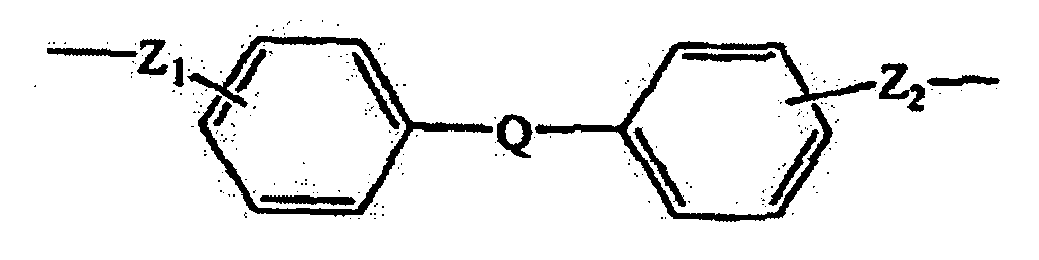 worin Q gleich O=S=O ist und Z1 und Z2 jeweils unabhängig voneinander eine Bindung sind.
 - Ein Organophotorezeptor gemäß einem der vorangegangenen Ansprüche, wobei das photoleitende Element zusätzlich ein zweites Ladungstransportmaterial umfasst.
- Ein Organophotorezeptor gemäß Anspruch 9, wobei das zweite Ladungstransportmaterial eine Elektronentransportverbindung umfasst.
- Ein Organophotorezeptor gemäß einem der vorangegangenen Ansprüche, wobei das photoleitende Element zusätzlich ein Polymerbindemittel umfasst.
- Eine elektrophotografische, bildgebende Vorrichtung, umfassend:(a) eine lichtbildgebende Komponente; und(b) einen Organophotorezeptor, der so orientiert ist, um Licht von der lichtbildgebenden Komponente aufzunehmen, wobei der Organophotorezeptor ein elektrisch leitendes Substrat und ein photoleitendes Element auf dem elektrisch leitenden Substrat umfasst, wobei das photoleitende Element das Folgende umfasst:(i) eine Ladungstransportzusammensetzung mit der Formel:
 worin Y1 und Y2 jeweils unabhängig voneinander eine Arylamingruppe sind;X1 und X2 jeweils unabhängig voneinander eine Verbindungsgruppe sind;R1 und R2 jeweils unabhängig voneinander ein Wasserstoff, eine Alkylgruppe, eine Alkenylgruppe, eine heterocyclische Gruppe, eine aromatische Gruppe sind;Z eine verbrückende Gruppe ist; undn eine Verteilung ganzer Zahlen zwischen 1 und 100000 mit einem Durchschnittswert größer als 1 ist; und(b) eine ladungsgenerierende Verbindung.
 - Eine elektrophotografische, bildgebende Vorrichtung gemäß Anspruch 12, wobei Y1 und Y2 jeweils unabhängig voneinander eine (N,N-disubstituierte) Arylamingruppe, eine Julolidingruppe oder eine Carbazolgruppe umfassen.
- Eine elektrophotografische, bildgebende Vorrichtung gemäß einem der Ansprüche 12 und 13, wobei X1 und X2 jeweils unabhängig voneinander eine -(CH2)m-Gruppe umfassen, worin m eine ganze Zahl zwischen und einschließlich 1 und 30 ist und eine oder mehrere der Methylengruppen optional durch O, S, N, C, B, Si, P, C=O, O=S=O, eine heterocyclische Gruppe, eine aromatische Gruppe, eine NRa-Gruppe, eine CRb-Gruppe, eine CRcRd-Gruppe oder eine SiReRf-Gruppe ersetzt ist, worin Ra, Rb, Rc, Rd, Re und Rf jeweils unabhängig voneinander eine Bindung, H, eine Hydroxylgruppe, eine Thiolgruppe, eine Carboxylgruppe, eine Aminogruppe, eine Alkylgruppe, eine Alkoxygruppe, eine Alkenylgruppe, eine heterocyclische Gruppe, eine aromatische Gruppe oder ein Teil einer Ringgruppe sind.
- Eine elektrophotografische, bildgebende Vorrichtung gemäß Anspruch 14, wobei wenigstens eine der Methylengruppen durch eine heterocyclische Gruppe, eine aromatische Gruppe, eine CHOH-Gruppe, O oder S ersetzt ist.
- Eine elektrophotografische, bildgebende Vorrichtung gemäß einem der Ansprüche 12 bis 15, wobei Z eine -(CH2)k-Gruppe umfasst, worin k eine ganze Zahl zwischen und einschließlich 1 und 30 ist und eine oder mehrere der Methylengruppen optional durch O, S, N, C, B, Si, P, C=O, O=S=O, eine heterocyclische Gruppe, eine aromatische Gruppe, eine NRg-Gruppe, eine CRh-Gruppe, eine CRiRj-Gruppe oder eine SiRkRl-Gruppe ersetzt ist, worin Rg, Rh, Ri, Rj, Rk und Rl jeweils unabhängig voneinander eine Bindung, H, eine Hydroxylgruppe, eine Thiolgruppe, eine Carboxylgruppe, eine Aminogruppe, eine Alkylgruppe, eine Alkoxygruppe, eine Alkenylgruppe, eine heterocyclische Gruppe, eine aromatische Gruppe oder ein Teil einer Ringgruppe sind.
- Eine elektrophotografische, bildgebende Vorrichtung gemäß Anspruch 16, wobei Z die folgenden Formeln aufweist:
 worin Q eine Bindung, O, S, O=S=O, C=O, eine Arylgruppe, eine NR3-Gruppe oder eine CR4R5-Gruppe ist, worin R3, R4 und R5 jeweils unabhängig voneinander H, eine Alkylgruppe, eine Alkenylgruppe, eine heterocyclische Gruppe, eine aromatische Gruppe oder ein Teil einer Ringgruppe sind; undZ1, Z2, Z3 und Z4 jeweils unabhängig voneinander eine Bindung oder eine -(CH2)n-Gruppe sind, worin n eine ganze Zahl zwischen und einschließlich 1 und 20 ist und eine oder mehrere der Methylengruppen optional durch O, S, N, C, B, Si, P, C=O, O=S=O, eine heterocyclische Gruppe, eine aromatische Gruppe, Urethan, Harnstoff, eine Estergruppe, eine NR6-Gruppe, eine CR7-Gruppe, eine CR8R9-Gruppe oder eine SiR10R11-Gruppe ersetzt ist, worin R6, R7, R8, R9, R10 und R11 jeweils unabhängig voneinander eine Bindung, H, eine Hydroxylgruppe, eine Thiolgruppe, eine Carboxylgruppe, eine Aminogruppe, eine Alkylgruppe, eine Alkoxygruppe, eine Alkenylgruppe, eine heterocyclische Gruppe, eine aromatische Gruppe oder ein Teil einer Ringgruppe sind.
 - Eine elektrophotografische, bildgebende Vorrichtung gemäß einem der Ansprüche 16 und 17, wobei Z die folgende Formel aufweist:
 worin Q gleich O=S=O ist und Z1 und Z2 jeweils unabhängig voneinander eine Bindung sind.
 - Eine elektrophotografische, bildgebende Vorrichtung gemäß einem der Ansprüche 12 bis 18, wobei das photoleitende Element zusätzlich eine Elektronentransportverbindung umfasst.
- Eine elektrophotografische, bildgebende Vorrichtung gemäß einem der Ansprüche 12 bis 19, wobei das photoleitende Element zusätzlich ein Bindemittel umfasst.
- Eine elektrophotografische, bildgebende Vorrichtung gemäß einem der Ansprüche 12 bis 20, die zusätzlich eine Dispensiervorrichtung für Toner umfasst.
- Ein elektrophotografisches, bildgebendes Verfahren, umfassend:(a) das Auftragen einer elektrischen Ladung auf eine Oberfläche eines Organophotorezeptors, der ein elektrisch leitendes Substrat und ein photoleitendes Element auf dem elektrisch leitenden Substrat umfasst, wobei das photoleitende Element das Folgende umfasst:(i) eine Ladungstransportzusammensetzung mit der Formel:
 worin Y1 und Y2 jeweils unabhängig voneinander eine Arylamingruppe sind;X1 und X2 jeweils unabhängig voneinander eine Verbindungsgruppe sind;R1 und R2 jeweils unabhängig voneinander ein Wasserstoff, eine Alkylgruppe, eine Alkenylgruppe, eine heterocyclische Gruppe, eine aromatische Gruppe sind;Z eine verbrückende Gruppe ist; undn eine Verteilung ganzer Zahlen zwischen 1 und 100000 mit einem Durchschnittswert größer als 1 ist; und(ii) eine ladungsgenerierende Verbindung;(b) das bildweise Bestrahlen der Oberfläche des Organophotorezeptors mit Strahlung zum Dissipieren der Ladung in ausgewählten Bereichen und dadurch das Bilden eines Musters aus geladenen und ungeladenen Bereichen auf der Oberfläche;(c) das in Kontaktbringen der Oberfläche mit einem Toner zur Herstellung eines getönten Bildes; und(d) das Übertragen des getönten Bildes auf ein Substrat.
 - Ein elektrophotografisches, bildgebendes Verfahren gemäß Anspruch 22, wobei Y1 und Y2 jeweils unabhängig voneinander eine (N,N-disubstituierte) Arylamingruppe, eine Julolidingruppe oder eine Carbazolgruppe umfassen.
- Ein elektrophotografisches, bildgebendes Verfahren gemäß einem der Ansprüche 22 und 23, wobei X1 und X2 jeweils unabhängig voneinander eine -(CH2)m-Gruppe umfassen, worin m eine ganze Zahl zwischen und einschließlich 1 und 30 ist und eine oder mehrere der Methylengruppen optional durch O, S, N, C, B, Si, P, C=O, O=S=O, eine heterocyclische Gruppe, eine aromatische Gruppe, eine NRa-Gruppe, eine CRb-Gruppe, eine CRcRd-Gruppe oder eine SiReRf-Gruppe ersetzt ist, worin Ra, Rb, Rc, Rd, Re und Rf jeweils unabhängig voneinander eine Bindung, H, eine Hydroxylgruppe, eine Thiolgruppe, eine Carboxylgruppe, eine Aminogruppe, eine Alkylgruppe, eine Alkoxygruppe, eine Alkenylgruppe, eine heterocyclische Gruppe, eine aromatische Gruppe oder ein Teil einer Ringgruppe sind.
- Ein elektrophotografisches, bildgebendes Verfahren gemäß einem der Ansprüche 22 bis 24, wobei Z eine -(CH2)k-Gruppe umfasst, worin k eine ganze Zahl zwischen und einschließlich 1 und 30 ist und eine oder mehrere der Methylengruppen optional durch O, S, N, C, B, Si, P, C=O, O=S=O, eine heterocyclische Gruppe, eine aromatische Gruppe, eine NRg-Gruppe, eine CRh-Gruppe, eine CRiRj-Gruppe oder eine SiRkRl-Gruppe ersetzt ist, worin Rg, Rh, Ri, Rj, Rk und Rl jeweils unabhängig voneinander eine Bindung, H, eine Hydroxylgruppe, eine Thiolgruppe, eine Carboxylgruppe, eine Aminogruppe, eine Alkylgruppe, eine Alkoxygruppe, eine Alkenylgruppe, eine heterocyclische Gruppe, eine aromatische Gruppe oder ein Teil einer Ringgruppe sind.
- Ein elektrophotografisches, bildgebendes Verfahren gemäß einem der Ansprüche 22 bis 25, wobei das photoleitende Element zusätzlich eine Elektronentransportverbindung umfasst.
- Ein elektrophotografisches, bildgebendes Verfahren gemäß einem der Ansprüche 22 bis 26, wobei der Toner einen Toner umfasst, der Farbstoff partikel enthält.
- Eine Ladungstransportzusammensetzung mit der Formel:
 worin Y1 und Y2 jeweils unabhängig voneinander eine Arylamingruppe sind;X1 und X2 jeweils unabhängig voneinander eine Verbindungsgruppe sind;R1 und R2 jeweils unabhängig voneinander ein Wasserstoff, eine Alkylgruppe, eine Alkenylgruppe, eine heterocyclische Gruppe, eine aromatische Gruppe sind;Z eine verbrückende Gruppe ist; undn eine Verteilung ganzer Zahlen mit einem Durchschnittswert von mehr als 2 ist.
 - Eine Ladungstransportzusammensetzung gemäß Anspruch 28, wobei Y1 und Y2 jeweils unabhängig voneinander eine (N,N-disubstituierte) Arylamingruppe, eine Julolidingruppe oder eine Carbazolgruppe umfassen.
- Eine Ladungstransportzusammensetzung gemäß einem der Ansprüche 28 und 29, wobei X1 und X2 jeweils unabhängig voneinander eine -(CH2)m-Gruppe umfassen, worin m eine ganze Zahl zwischen und einschließlich 1 und 30 ist und eine oder mehrere der Methylengruppen optional durch O, S, N, C, B, Si, P, C=O, O=S=O, eine heterocyclische Gruppe, eine aromatische Gruppe, eine NRa-Gruppe, eine CRb-Gruppe, eine CRcRd-Gruppe oder eine SiReRf-Gruppe ersetzt ist, worin Ra, Rb, Rc, Rd, Re und Rf jeweils unabhängig voneinander eine Bindung, H, eine Hydroxylgruppe, eine Thiolgruppe, eine Carboxylgruppe, eine Aminogruppe, eine Alkylgruppe, eine Alkoxygruppe, eine Alkenylgruppe, eine heterocyclische Gruppe, eine aromatische Gruppe oder ein Teil einer Ringgruppe sind.
- Eine Ladungstransportzusammensetzung gemäß Anspruch 30, wobei wenigstens eine der Methylengruppen durch eine heterocyclische Gruppe, eine aromatische Gruppe, eine CHOH-Gruppe, O oder S ersetzt ist.
- Eine Ladungstransportzusammensetzung gemäß Anspruch 30, wobei die Ladungstransportzusammensetzung die folgende Formel aufweist:
 worin n eine Verteilung ganzer Zahlen zwischen 1 und 100000 mit einem Durchschnittswert von mehr als 1 ist; Y1 und Y2 jeweils unabhängig voneinander eine Arylamingruppe sind; und T eine der folgenden Formeln aufweist:
 worin T1, T2, T3, T4 und T5 jeweils unabhängig voneinander O, S, O=S=O oder C=O sind.
 - Eine Ladungstransportzusammensetzung gemäß Anspruch 28, wobei Z eine -(CH2)k-Gruppe umfasst, worin k eine ganze Zahl zwischen und einschließlich 1 und 30 ist und eine oder mehrere der Methylengruppen optional durch O, S, N, C, B, Si, P, C=O, O=S=O, eine heterocyclische Gruppe, eine aromatische Gruppe, eine NRg-Gruppe, eine CRh-Gruppe, eine CRiRj-Gruppe oder eine SiRkRl-Gruppe ersetzt ist, worin Rg, Rh, Ri, Rj, Rk und Rl jeweils unabhängig voneinander eine Bindung, H, eine Hydroxylgruppe, eine Thiolgruppe, eine Carboxylgruppe, eine Aminogruppe, eine Alkylgruppe, eine Alkoxygruppe, eine Alkenylgruppe, eine heterocyclische Gruppe, eine aromatische Gruppe oder ein Teil einer Ringgruppe sind.
- Eine Ladungstransportzusammensetzung gemäß Anspruch 33, wobei Z die folgende Formel aufweist:
 worin Q eine Bindung, O, S, O=S=O, C=O, eine Arylgruppe, eine NR3-Gruppe oder eine CR4R5-Gruppe ist, worin R3, R4 und R5 jeweils unabhängig voneinander H, eine Alkylgruppe, eine Alkenylgruppe, eine heterocyclische Gruppe, eine aromatische Gruppe oder ein Teil einer Ringgruppe sind; undZ1, Z2, Z3 und Z4 jeweils unabhängig voneinander eine Bindung oder eine -(CH2)n-Gruppe sind, worin n eine ganze Zahl zwischen und einschließlich 1 und 20 ist und eine oder mehrere der Methylengruppen optional durch O, S, N, C, B, Si, P, C=O, O=S=O, eine heterocyclische Gruppe, eine aromatische Gruppe, Urethan, Harnstoff, eine Estergruppe, eine NR6-Gruppe, eine CR7-Gruppe, eine CR8R9-Gruppe oder eine SiR10R11-Gruppe ersetzt ist, worin R6, R7, R8, R9, R10 und R11 jeweils unabhängig voneinander eine Bindung, H, eine Hydroxylgruppe, eine Thiolgruppe, eine Carboxylgruppe, eine Aminogruppe, eine Alkylgruppe, eine Alkoxygruppe, eine Alkenylgruppe, eine heterocyclische Gruppe, eine aromatische Gruppe oder ein Teil einer Ringgruppe sind.
 - Eine Ladungstransportzusammensetzung gemäß einem der Ansprüche 33 und 34, wobei Z die folgende Formel aufweist:
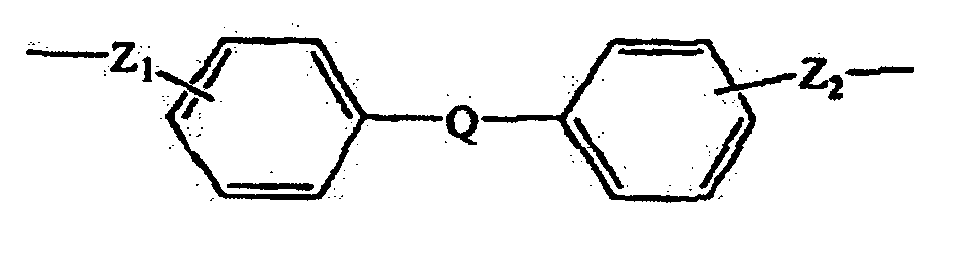 worin Q gleich O=S=O ist und Z1 und Z2 unabhängig voneinander eine Bindung sind.
 - Eine Ladungstransportzusammensetzung, die durch das Copolymerisieren einer multifunktionellen Verbindung, die wenigstens zwei aktive Wasserstoffe enthält, die aus der Gruppe ausgewählt sind, die aus Hydroxylwasserstoff, Aminowasserstoff, Carboxylwasserstoff und Thiolwasserstoff besteht, mit einer reaktiven Ringverbindung mit der folgenden Formel hergestellt wird:
 worin Y1 und Y2 jeweils unabhängig voneinander eine Arylamingruppe sind;X3 und X4 jeweils unabhängig voneinander eine -(CH2)p-Gruppe umfassen, worin p eine ganze Zahl zwischen und einschließlich 1 und 20 ist und eine oder mehrere der Methylengruppen optional durch O, S, N, C, B, Si, P, C=O, O=S=O, eine heterocyclische Gruppe, eine aromatische Gruppe, eine NRm-Gruppe, eine CRn-Gruppe, eine CRoRp-Gruppe oder eine SiRqRr-Gruppe ersetzt ist, worin Rm, Rn, Ro, Rp, Rq und Rr jeweils unabhängig voneinander eine Bindung, H, eine Hydroxylgruppe, eine Thiolgruppe, eine Carboxylgruppe, eine Aminogruppe, eine Alkylgruppe, eine Alkoxygruppe, eine Alkenylgruppe, eine heterocyclische Gruppe, eine aromatische Gruppe oder ein Teil einer Ringgruppe sind;R1 und R2 jeweils unabhängig voneinander ein Wasserstoff, eine Alkylgruppe, eine Alkenylgruppe, eine heterocyclische Gruppe, eine aromatische Gruppe sind:Z eine -(CH2)k-Gruppe umfasst, worin k eine ganze Zahl zwischen und einschließlich 1 und 30 ist und eine oder mehrere der Methylengruppen optional durch O, S, N, C, B, Si, P, C=O, O=S=O, eine heterocyclische Gruppe, eine aromatische Gruppe, eine NRg-Gruppe, eine CRh-Gruppe, eine CRiRj-Gruppe oder eine SiRkRl - Gruppe ersetzt ist, worin Rg, Rh, Ri, Rj, Rk und Rl jeweils unabhängig voneinander eine Bindung, H, eine Hydroxylgruppe, eine Thiolgruppe, eine Carboxylgruppe, eine Aminogruppe, eine Alkylgruppe, eine Alkoxygruppe, eine Alkenylgruppe, eine heterocyclische Gruppe, eine aromatische Gruppe oder ein Teil einer Ringgruppe sind;und E1 und E2 jeweils unabhängig voneinander eine reaktive Ringgruppe unter der Voraussetzung sind, dass E1 und E2 nicht beide eine Epoxygruppe sind.
 - Eine Ladungstransportzusammensetzung gemäß Anspruch 36, wobei E1 und E2 jeweils unabhängig voneinander aus der Gruppe ausgewählt sind, die aus 3-, 4-, 5-, 7-, 8-, 9-, 10-, 11- und 12-gliedrigen heterozyklischen Ringgruppen besteht.
- Eine Ladungstransportzusammensetzung gemäß Anspruch 36, wobei E1 und E2 jeweils unabhängig voneinander aus der Gruppe ausgewählt sind, die aus 3-, 4-, 5-, 7-, 8-, 9-, 10-, 11- und 1,2-gliedrigen zyklischen Ethern, zyklischen Aminen, zyklischen Sulfiden, zyklischen Amiden, N-Carboxy-α-aminosäureanhydriden, Lactonen und Cyclosiloxanen besteht.
- Eine Ladungstransportzusammensetzung gemäß Anspruch 36, wobei E1 und E2 jeweils unabhängig voneinander aus der Gruppe ausgewählt sind, die aus Epoxiden, Oxetanen, Aziridinen, Thiiranen, 2-Azetidinon, 2-Pyrrolidon, 2-Piperidon, Caprolactam, Enantholactam und Capryllactam besteht.
- Eine Ladungstransportzusammensetzung gemäß einem der Ansprüche 36 bis 39, wobei die multifunktionelle Verbindung aus der Gruppe ausgewählt ist, die aus Triolen, Triaminen, Trithiolen, Diolen, Dithiolen, Diaminen, Dicarbonsäuren, Hydroxylaminen, Aminosäuren, Hydroxylsäuren, Thiolsäuren, Hydroxythiolen und Thioaminen besteht.
- Ein Verfahren zur Herstellung einer Ladungstransportzusammensetzung, umfassend das Copolymerisieren einer multifunktionellen Verbindung, die wenigstens zwei aktive Wasserstoffe enthält, die aus der Gruppe ausgewählt sind, die aus Hydroxylwasserstoff, Aminowasserstoff, Carboxylwasserstoff und Thiolwasserstoff besteht, mit einer reaktiven Ringverbindung mit der folgenden Formel
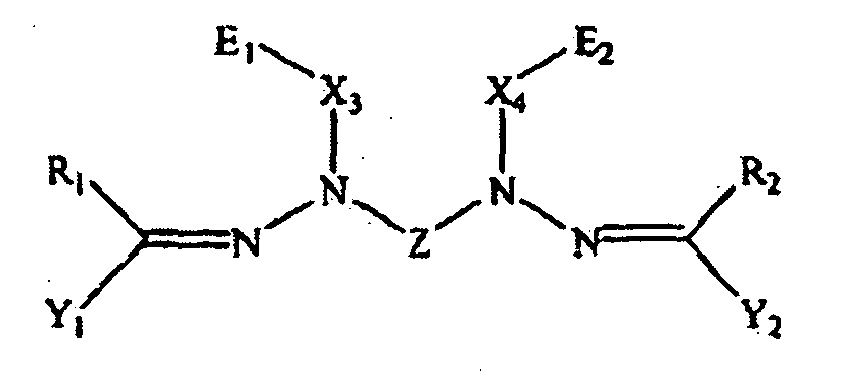 worin Y1 und Y2 jeweils unabhängig voneinander eine Arylamingruppe sind;X3 und X4 jeweils unabhängig voneinander eine -(CH2)p- Gruppe umfassen, worin p eine ganze Zahl zwischen und einschließlich 1 und 20 ist und eine oder mehrere der Methylengruppen optional durch O, S, N, C, B, Si, P, C=O, O=S=O, eine heterocyclische Gruppe, eine aromatische Gruppe, eine NRm-Gruppe, eine CRn-Gruppe, eine CRoRp-Gruppe oder eine SiRqRr-Gruppe ersetzt ist, worin Rm, Rn, Ro, Rp, Rq und Rr jeweils unabhängig voneinander eine Bindung, H, eine Hydroxylgruppe, eine Thiolgruppe, eine Carboxylgruppe, eine Aminogruppe, eine Alkylgruppe, eine Alkoxygruppe, eine Alkenylgruppe, eine heterocyclische Gruppe, eine aromatische Gruppe oder ein Teil einer Ringgruppe sind;R1 und R2 jeweils unabhängig voneinander ein Wasserstoff, eine Alkylgruppe, eine Alkenylgruppe, eine heterocyclische Gruppe, eine aromatische Gruppe sind;Z eine -(CH2)k- Gruppe umfasst, worin k eine ganze Zahl zwischen und einschließlich 1 und 30 ist und eine oder mehrere der Methylengruppen optional durch O, S, N, C, B, Si, P, C=O, O=S=O, eine heterocyclische Gruppe, eine aromatische Gruppe, eine NRg-Gruppe, eine CRh-Gruppe, eine CRiRj-Gruppe oder eine SiRkRl-Gruppe ersetzt ist, worin Rg, Rh, Ri, Rj, Rk und Rl jeweils unabhängig voneinander eine Bindung, H, eine Hydroxylgruppe, eine Thiolgruppe, eine Carboxylgruppe, eine Aminogruppe, eine Alkylgruppe, eine Alkoxygruppe, eine Alkenylgruppe, eine heterocyclische Gruppe, eine aromatische Gruppe oder ein Teil einer Ringgruppe sind; undE1 und E2 jeweils unabhängig voneinander eine reaktive Ringgruppe unter der Voraussetzung sind, dass E1 und E2 nicht beide eine Epoxygruppe sind.
Applications Claiming Priority (2)
| Application Number | Priority Date | Filing Date | Title |
|---|---|---|---|
| US10/789,077 US7108948B2 (en) | 2004-02-27 | 2004-02-27 | Organophotoreceptor with charge transport compositions |
| US789077 | 2004-02-27 |
Publications (3)
| Publication Number | Publication Date |
|---|---|
| EP1569040A2 EP1569040A2 (de) | 2005-08-31 |
| EP1569040A3 EP1569040A3 (de) | 2005-11-16 |
| EP1569040B1 true EP1569040B1 (de) | 2007-06-27 |
Family
ID=34750548
Family Applications (1)
| Application Number | Title | Priority Date | Filing Date |
|---|---|---|---|
| EP05251084A Expired - Lifetime EP1569040B1 (de) | 2004-02-27 | 2005-02-24 | Ladungstransportierende Verbindungen enthaltender organischer Photorezeptor |
Country Status (6)
| Country | Link |
|---|---|
| US (1) | US7108948B2 (de) |
| EP (1) | EP1569040B1 (de) |
| JP (1) | JP2005242367A (de) |
| KR (1) | KR100619015B1 (de) |
| CN (1) | CN1661483A (de) |
| DE (1) | DE602005001457T2 (de) |
Families Citing this family (1)
| Publication number | Priority date | Publication date | Assignee | Title |
|---|---|---|---|---|
| CN104672175B (zh) * | 2015-03-05 | 2017-03-01 | 合肥工业大学 | 含二苯砜噻二唑硫醚的二巯基高折射率单体及合成方法 |
Family Cites Families (22)
| Publication number | Priority date | Publication date | Assignee | Title |
|---|---|---|---|---|
| GB657649A (en) | 1949-02-08 | 1951-09-26 | Horstman Ltd | Improvements in or relating to driving mechanism for reciprocating cultivators |
| US4297426A (en) * | 1979-05-28 | 1981-10-27 | Ricoh Co., Ltd. | Electrophotographic element with carbazole hydrazone or anile charge transport compounds |
| US4420548A (en) | 1980-11-28 | 1983-12-13 | Canon Kabushiki Kaisha | Electrophotographic member with hydrazone or ketazine compounds |
| JPH0693127B2 (ja) * | 1986-05-20 | 1994-11-16 | ミノルタ株式会社 | 感光体 |
| JPH1059952A (ja) * | 1996-08-14 | 1998-03-03 | Takasago Internatl Corp | フェノチアジン誘導体、フェノキサジン誘導体、それを用いた電荷輸送材料及び電子写真感光体 |
| US6066426A (en) * | 1998-10-14 | 2000-05-23 | Imation Corp. | Organophotoreceptors for electrophotography featuring novel charge transport compounds |
| JP4115056B2 (ja) | 1999-12-13 | 2008-07-09 | キヤノン株式会社 | 電子写真感光体、プロセスカートリッジ及び電子写真装置 |
| US6214503B1 (en) * | 1999-12-21 | 2001-04-10 | Imation Corp. | Organophotoreceptors for electrophotography featuring novel charge transport compounds based upon hydroxy-functional compounds |
| US6340548B1 (en) * | 2000-03-16 | 2002-01-22 | Imation Corp. | Organophotoreceptors for electrophotography featuring novel charge transport compounds |
| EP1202120A3 (de) | 2000-10-23 | 2003-05-02 | Samsung Electronics Co., Ltd. | Ladungstransportmittel, elektrophotographischer organischer Photorezeptor, elektrophotographische Vorrichtung und Verfahren |
| DE60229695D1 (de) * | 2001-08-10 | 2008-12-18 | Samsung Electronics Co Ltd | Elektrophotographischer organischer Photorezeptor mit Ladungsübertragungsmitteln |
| DE60229192D1 (de) * | 2001-09-14 | 2008-11-20 | Samsung Electronics Co Ltd | Elektrophotographischer organischer Photorezeptor |
| US6749978B2 (en) * | 2001-09-24 | 2004-06-15 | Samsung Electronics Co., Ltd. | Electrophotographic organophotoreceptors with novel charge transport compounds |
| US6670085B2 (en) * | 2001-09-24 | 2003-12-30 | Samsung Electronics Co. Ltd | Electrophotographic organophotoreceptors with novel charge transport compounds |
| US7118839B2 (en) * | 2001-09-28 | 2006-10-10 | Samsung Electronics Co., Ltd. | Electrophotographic organophotoreceptors with novel charge transport materials |
| US6689523B2 (en) * | 2001-11-02 | 2004-02-10 | Samsung Electronics Co., Ltd. | Electrophotographic organophotoreceptors with novel charge transport compounds |
| EP1310483B9 (de) * | 2001-11-09 | 2006-07-05 | Samsung Electronics Co., Ltd. | Elektrophotografischer organischer Photorezeptor mit Ladungstransportverbindungen |
| US6905804B2 (en) * | 2002-02-08 | 2005-06-14 | Samsung Electronics Co., Ltd. | Electrophotographic organophotoreceptors with novel charge transport materials |
| US6864025B2 (en) * | 2002-03-28 | 2005-03-08 | Samsung Electronics Co., Ltd. | Sulfonyldiphenylene-based charge transport compositions |
| US6815133B2 (en) * | 2002-04-12 | 2004-11-09 | Samsung Electronics Co., Ltd. | Sulfonyldiphenylene based charge transport compositions |
| US7014968B2 (en) * | 2003-12-30 | 2006-03-21 | Samsung Electronics Co., Ltd. | Organophotoreceptor with charge transport material having a thiiranyl group |
| US7320849B2 (en) * | 2003-12-31 | 2008-01-22 | Samsung Electronics Co., Ltd. | Organophotoreceptor with a charge transport material having two epoxidated-hydrazone groups |
-
2004
- 2004-02-27 US US10/789,077 patent/US7108948B2/en not_active Expired - Fee Related
- 2004-04-29 KR KR1020040029846A patent/KR100619015B1/ko not_active Expired - Fee Related
-
2005
- 2005-02-24 DE DE602005001457T patent/DE602005001457T2/de not_active Expired - Fee Related
- 2005-02-24 EP EP05251084A patent/EP1569040B1/de not_active Expired - Lifetime
- 2005-02-28 JP JP2005055003A patent/JP2005242367A/ja not_active Withdrawn
- 2005-02-28 CN CN2005100525388A patent/CN1661483A/zh active Pending
Also Published As
| Publication number | Publication date |
|---|---|
| KR100619015B1 (ko) | 2006-08-31 |
| DE602005001457T2 (de) | 2008-03-13 |
| US20050191570A1 (en) | 2005-09-01 |
| US7108948B2 (en) | 2006-09-19 |
| KR20050087695A (ko) | 2005-08-31 |
| CN1661483A (zh) | 2005-08-31 |
| EP1569040A3 (de) | 2005-11-16 |
| JP2005242367A (ja) | 2005-09-08 |
| EP1569040A2 (de) | 2005-08-31 |
| DE602005001457D1 (de) | 2007-08-09 |
Similar Documents
| Publication | Publication Date | Title |
|---|---|---|
| EP1591836B1 (de) | Ladungstransportmaterialien mit Hydrazongruppe | |
| EP1494080B1 (de) | Auf Azin basierende dimere Ladungstransportmaterialien | |
| EP1471391B1 (de) | Polymerzusammensetzungen enthaltendes Ladungstransportmaterial | |
| US7348116B2 (en) | Aromatic heterocyclic-based charge transport materials having two amino groups | |
| US20040170910A1 (en) | Organophotoreceptor with a charge transport material having two hydrazone groups | |
| EP1591837B1 (de) | Ladungstransportmaterialien mit Hydrazongruppe | |
| US20060210897A1 (en) | Charge transport materials having at least a metallocene group | |
| EP1584986B1 (de) | Polyazine-basierende Ladungstransportverbindungen | |
| EP1550914A1 (de) | Organischer Photorezeptor mit einem Ladungstransport -Material enthaltend zwei Epoxy-Hydrazon Gruppen | |
| US7108948B2 (en) | Organophotoreceptor with charge transport compositions | |
| US7014968B2 (en) | Organophotoreceptor with charge transport material having a thiiranyl group | |
| US7261988B2 (en) | Azine-based charge transport materials | |
| US7364825B2 (en) | Charge transport materials having a nitrogen-containing-heterocycle hydrazone group | |
| EP1584987B1 (de) | Polyhydrazonbasierende Ladungstransportverbindungen | |
| EP1591835B1 (de) | Azin-basierte Ladungtransportmaterialien mit zwei reaktiven Ringen | |
| US7534541B2 (en) | Heterocycle-hydrazone based charge transport materials |
Legal Events
| Date | Code | Title | Description |
|---|---|---|---|
| PUAI | Public reference made under article 153(3) epc to a published international application that has entered the european phase |
Free format text: ORIGINAL CODE: 0009012 |
|
| 17P | Request for examination filed |
Effective date: 20050308 |
|
| AK | Designated contracting states |
Kind code of ref document: A2 Designated state(s): AT BE BG CH CY CZ DE DK EE ES FI FR GB GR HU IE IS IT LI LT LU MC NL PL PT RO SE SI SK TR |
|
| AX | Request for extension of the european patent |
Extension state: AL BA HR LV MK YU |
|
| PUAL | Search report despatched |
Free format text: ORIGINAL CODE: 0009013 |
|
| AK | Designated contracting states |
Kind code of ref document: A3 Designated state(s): AT BE BG CH CY CZ DE DK EE ES FI FR GB GR HU IE IS IT LI LT LU MC NL PL PT RO SE SI SK TR |
|
| AX | Request for extension of the european patent |
Extension state: AL BA HR LV MK YU |
|
| RIC1 | Information provided on ipc code assigned before grant |
Ipc: 7C 08G 61/12 B Ipc: 7G 03G 5/06 B Ipc: 7C 07D 285/12 B Ipc: 7C 08G 75/02 B Ipc: 7G 03G 5/07 A Ipc: 7C 08G 73/02 B Ipc: 7C 07D 209/86 B Ipc: 7C 07C 323/48 B Ipc: 7C 07D 417/14 B |
|
| AKX | Designation fees paid |
Designated state(s): DE FR GB NL |
|
| GRAP | Despatch of communication of intention to grant a patent |
Free format text: ORIGINAL CODE: EPIDOSNIGR1 |
|
| GRAS | Grant fee paid |
Free format text: ORIGINAL CODE: EPIDOSNIGR3 |
|
| GRAA | (expected) grant |
Free format text: ORIGINAL CODE: 0009210 |
|
| AK | Designated contracting states |
Kind code of ref document: B1 Designated state(s): DE FR GB NL |
|
| REG | Reference to a national code |
Ref country code: GB Ref legal event code: FG4D |
|
| REF | Corresponds to: |
Ref document number: 602005001457 Country of ref document: DE Date of ref document: 20070809 Kind code of ref document: P |
|
| ET | Fr: translation filed | ||
| PLBE | No opposition filed within time limit |
Free format text: ORIGINAL CODE: 0009261 |
|
| STAA | Information on the status of an ep patent application or granted ep patent |
Free format text: STATUS: NO OPPOSITION FILED WITHIN TIME LIMIT |
|
| 26N | No opposition filed |
Effective date: 20080328 |
|
| PGFP | Annual fee paid to national office [announced via postgrant information from national office to epo] |
Ref country code: DE Payment date: 20090123 Year of fee payment: 5 Ref country code: NL Payment date: 20090203 Year of fee payment: 5 |
|
| PGFP | Annual fee paid to national office [announced via postgrant information from national office to epo] |
Ref country code: GB Payment date: 20090217 Year of fee payment: 5 |
|
| PGFP | Annual fee paid to national office [announced via postgrant information from national office to epo] |
Ref country code: FR Payment date: 20090213 Year of fee payment: 5 |
|
| REG | Reference to a national code |
Ref country code: NL Ref legal event code: V1 Effective date: 20100901 |
|
| GBPC | Gb: european patent ceased through non-payment of renewal fee |
Effective date: 20100224 |
|
| REG | Reference to a national code |
Ref country code: FR Ref legal event code: ST Effective date: 20101029 |
|
| PG25 | Lapsed in a contracting state [announced via postgrant information from national office to epo] |
Ref country code: NL Free format text: LAPSE BECAUSE OF NON-PAYMENT OF DUE FEES Effective date: 20100901 Ref country code: FR Free format text: LAPSE BECAUSE OF NON-PAYMENT OF DUE FEES Effective date: 20100301 |
|
| PG25 | Lapsed in a contracting state [announced via postgrant information from national office to epo] |
Ref country code: DE Free format text: LAPSE BECAUSE OF NON-PAYMENT OF DUE FEES Effective date: 20100901 |
|
| PG25 | Lapsed in a contracting state [announced via postgrant information from national office to epo] |
Ref country code: GB Free format text: LAPSE BECAUSE OF NON-PAYMENT OF DUE FEES Effective date: 20100224 |
|
| REG | Reference to a national code |
Ref country code: GB Ref legal event code: 732E Free format text: REGISTERED BETWEEN 20170406 AND 20170412 |
|
| REG | Reference to a national code |
Ref country code: FR Ref legal event code: TP Owner name: S-PRINTING SOLUTION CO., LTD., KR Effective date: 20170912 |