EP1568713A1 - Natural rubber latex, natural rubber, rubber composition containing the same, and tire - Google Patents
Natural rubber latex, natural rubber, rubber composition containing the same, and tire Download PDFInfo
- Publication number
- EP1568713A1 EP1568713A1 EP03777350A EP03777350A EP1568713A1 EP 1568713 A1 EP1568713 A1 EP 1568713A1 EP 03777350 A EP03777350 A EP 03777350A EP 03777350 A EP03777350 A EP 03777350A EP 1568713 A1 EP1568713 A1 EP 1568713A1
- Authority
- EP
- European Patent Office
- Prior art keywords
- natural rubber
- latex
- enzyme treatment
- rubber
- lipase
- Prior art date
- Legal status (The legal status is an assumption and is not a legal conclusion. Google has not performed a legal analysis and makes no representation as to the accuracy of the status listed.)
- Granted
Links
Classifications
-
- C—CHEMISTRY; METALLURGY
- C08—ORGANIC MACROMOLECULAR COMPOUNDS; THEIR PREPARATION OR CHEMICAL WORKING-UP; COMPOSITIONS BASED THEREON
- C08L—COMPOSITIONS OF MACROMOLECULAR COMPOUNDS
- C08L7/00—Compositions of natural rubber
-
- B—PERFORMING OPERATIONS; TRANSPORTING
- B60—VEHICLES IN GENERAL
- B60C—VEHICLE TYRES; TYRE INFLATION; TYRE CHANGING; CONNECTING VALVES TO INFLATABLE ELASTIC BODIES IN GENERAL; DEVICES OR ARRANGEMENTS RELATED TO TYRES
- B60C1/00—Tyres characterised by the chemical composition or the physical arrangement or mixture of the composition
-
- C—CHEMISTRY; METALLURGY
- C08—ORGANIC MACROMOLECULAR COMPOUNDS; THEIR PREPARATION OR CHEMICAL WORKING-UP; COMPOSITIONS BASED THEREON
- C08C—TREATMENT OR CHEMICAL MODIFICATION OF RUBBERS
- C08C1/00—Treatment of rubber latex
- C08C1/02—Chemical or physical treatment of rubber latex before or during concentration
- C08C1/04—Purifying; Deproteinising
-
- C—CHEMISTRY; METALLURGY
- C08—ORGANIC MACROMOLECULAR COMPOUNDS; THEIR PREPARATION OR CHEMICAL WORKING-UP; COMPOSITIONS BASED THEREON
- C08L—COMPOSITIONS OF MACROMOLECULAR COMPOUNDS
- C08L7/00—Compositions of natural rubber
- C08L7/02—Latex
-
- C—CHEMISTRY; METALLURGY
- C08—ORGANIC MACROMOLECULAR COMPOUNDS; THEIR PREPARATION OR CHEMICAL WORKING-UP; COMPOSITIONS BASED THEREON
- C08L—COMPOSITIONS OF MACROMOLECULAR COMPOUNDS
- C08L89/00—Compositions of proteins; Compositions of derivatives thereof
Definitions
- the present invention relates to natural rubber latex, natural rubber, a rubber composition thereof and a tire using the same, and it further relates to a production process for such natural rubber.
- natural rubber is frequently used in many fields including industrial products such as tires, rubber belts, rubber rolls, bladders and fenders and sporting goods such as tennis balls, basket balls, soccer balls and volley balls.
- industrial products such as tires, rubber belts, rubber rolls, bladders and fenders and sporting goods such as tennis balls, basket balls, soccer balls and volley balls.
- a tire it is used as a material for various components constituting rubber tires, such as treads, side walls, ply coating rubbers and bead fillers.
- Natural rubber is more excellent in mechanical characteristics than synthetic rubber and has low so-called tan ⁇ (dynamic loss factor). Accordingly, natural rubber is excellent in a low hysteresis loss property, but it is desired to be improved in a gripping property in a wet state. Further, crude natural rubber (rubber used as a raw material) is inferior in processability and a productivity in the production. This is because protein and phospholipid are bonded to a molecular end of natural rubber, so that proteins themselves and phospholipids themselves are further bonded and associated to form a higher order branched structure.
- anionic surfactants and/or nonionic surfactants can be used as a surfactant for deprotenizing treatment.
- the anionic surfactants include, for example, surfactants of a carboxylic acid base, a sulfonic acid base, a sulfate base and a phosphate base.
- An object of the present invention is to provide a natural rubber latex having an excellent processability, natural rubber which is sufficiently maintained in physical properties such as an aging resistance, a tensile force and an abrasion resistance, a production process for the same and a rubber composition and a tire using such natural rubber.
- the present inventors decomposed a prescribed bond and an associated part of a branch end, that is, a phospholipid in a higher-order branched structure of natural rubber latex.
- lipase and/or phospholipase enzyme treatment was carried out to try modification of natural rubber such as shortening in stress relaxation time to find that natural rubber was improved in a processability without bringing about a reduction in the physical properties of the natural rubber, and they have come to reach the present invention.
- the natural rubber latex, the natural rubber and the rubber composition and the tire using the same according to the present invention are characterized by comprising the constitutions and the processes of the following items (1) to (15) and thus solve the problems described above.
- phospholipid is partially or selectively decomposed at a branched part of natural rubber latex, and the non-rubber component can be allowed to remain.
- One of mechanisms for improving the processability includes shortening in stress relaxation time of natural rubber.
- Selective phospholipid decomposition of natural rubber latex in the present invention shortens stress relaxation time of natural rubber. Accordingly, the natural rubber and the rubber composition using the same are improved in a processability thereof (a shrinking property and a dimensional stability) and can sufficiently maintain an anti-aging property, a tensile strength and an abrasion resistance.
- the stress relaxation time referred to herein is substituted with T 80 in contrast with ML 1+4 of Mooney viscosity measurement, and this value has to satisfy the range described in the item (8).
- Natural rubber latex used as the raw material means field latex obtained from natural rubber tree, and either of an ammonia-treated latex which is commercially available and a fresh field latex can be used for the latex.
- protein and phospholipid are bonded to a molecular end of such natural rubber, and it is estimated that proteins themselves and phospholipids themselves at the end thereof are further bonded and associated to form a higher-order branched structure. It is estimated, however, that in natural rubber latex in which phospholipid is decomposed, the phospholipid is decomposed in a branch point of such higher-order branched structure, whereby the branch degree is reduced. If the branch degree is reduced, processability of natural rubber is sufficiently improved. If the higher-order branched structure is completely decomposed, that is, protein is completely removed, a large part of non-rubber components including protein is removed, and the aging resistance and the abrasion resistance are reduced. In contrast with this, a rubber obtained by using natural rubber latex in which phospholipid forming the branch described above is convergently decomposed is not observed to be reduced in anti-aging property and abrasion resistance to a large extent.
- Natural rubber latex which is subjected to enzyme treatment with lipase and/or phospholipase can be given as the natural rubber latex in which phospholipid is decomposed according to the present invention.
- Lipase and/or phospholipase described above shall not specifically be restricted, and any of those originating in bacteria, hyphomycetes and yeast can be used.
- Enzyme activity of Lipase and phospholipase is 100 (U/g) or more, preferably 1000 (U/g) or more, more preferably 10000 (U/g) or more and further preferably 100000 (U/g) or more.
- Lipase M "Amano" 10 product manufactured by Amano Enzyme Co., Ltd.
- Lipase OF product manufactured by Meito Co., Ltd.
- Phospholipase A1 product manufactured by Sankyo Co., Ltd.
- An addition amount of the lipase and phospholipase described above in such enzyme treatment falls in a range of preferably 0.005 to 0.5 mass part, particularly preferably 0.01 to 0.2 mass part per 100 mass parts of the solid component contained in the natural rubber latex. If the addition amount falls in the range described above, phospholipid contained in the natural rubber latex is suitably decomposed, and the processability and the good physical properties which are the objects are maintained.
- an addition amount (total amount) of the lipase and/or the phospholipase described above is less than 0.005 mass part, the decomposition reaction of phospholipid is unsatisfactory, and the improving effect of the processability is not sufficiently obtained. If an addition amount (total amount) of the lipase and/or the phospholipase described above exceeds 0.5 mass part, almost all of fatty acids contained in the natural rubber is decomposed, and the strain induced crystallinity is reduced, so that the tensile strength and the abrasion resistance are reduced.
- the natural rubber latex according to the present invention may further be subjected to enzyme treatment with protease in addition to lipase and/or phospholipase.
- protease described above shall not specifically be restricted as is the case with lipase and phospholipase, and any of those originating in bacteria, hyphomycetes and yeast can be used.
- Enzyme activity of protease is 100 (U/g) or more, preferably 1000 (U/g) or more, more preferably 10000 (U/g) or more and further preferably 100000 (U/g) or more.
- Alkalase 2.5L-type DX manufactured by Novozymes Co., Ltd.
- Proleather FG-F manufactured by Amano Enzyme Co., Ltd.
- An addition amount of the protease in such enzyme treatment falls in a range of preferably 0.005 to 0.5 mass part, particularly preferably 0.01 to 0.2 mass part per 100 mass parts of the solid component contained in the natural rubber latex.
- addition amount falls in the range described above, protein contained in the natural rubber latex is suitably decomposed, and the processability which is the object is further improved. Further, the good physical properties are maintained. If an addition amount of the protease is less than the range described above, the decomposition reaction of the protein is unsatisfactory, and therefore it is not preferred. On the other hand, if the addition amount exceeds the range described above, the decomposition reaction of the protein proceeds too much, and the targeted processability is not balanced with the physical properties.
- peptidase, cellulase, pectinase, esterase and amylase in addition to the enzymes described above can be used in combination.
- phosphates such as monopotassium phosphate, dipotassium phosphate and sodium phosphate
- acetates such as potassium acetate and sodium acetate
- acids such as sulfuric acid, acetic acid, hydrochloric acid, citric acid and succinic acid or salts thereof, ammonia, sodium hydroxide, potassium hydroxide, sodium carbonate and sodium hydrogencarbonate.
- the enzyme treatment described above is carried out at a temperature of 70°C or lower, preferably 60°C or lower and more preferably 50°C or lower.
- the enzyme treatment temperature described above exceeds 70°C, the natural rubber latex is reduced in a stability and coagulated during the enzyme treatment. After coagulation, the decomposing effect with the enzyme is reduced. This makes it difficult to produce the natural rubber.
- the natural rubber latex according to the present invention is preferably treated while using a surfactant in combination with the enzyme treatment described above.
- a surfactant in combination with the enzyme treatment described above.
- Nonionic surfactants, anionic surfactants, cationic surfactants and amphoteric surfactants can be used as the surfactant, and nonionic surfactants and anionic surfactants are particularly preferably used.
- nonionic surfactants are, for example, polyoxyalkylene ether base, polyoxyalkylene ester base, polyhydric alcohol fatty acid ester base, saccharide fatty acid ester base and alkylpolyglycoside base.
- anionic surfactants are, for example, carboxylic acid base, sulfonic acid base, sulfate base and phosphate base.
- the carboxylic acid base surfactants include, for example, fatty acid salts, polyvalent carboxylic acid salts, rosin acid salts, dimer acid salts, polymer acid salts and tall oil fatty acid salts.
- the sulfonic acid base surfactants include, for example, alkylbenzenesulfonates, alkylsulfonates, alkylnaphthalenesulfonates, naphthalenesulfonates and diphenylethersulfonates.
- the sulfate base surfactants include, for example, alkylsulfate salts, polyoxyalkylenealkylsulfate salts, polyoxyalkylenealkylphenylethersulfates, tristyrenated phenol sulfate salts and polyoxyalkylenedistyrenated phenol sulfate salts.
- the phosphate base surfactants include alkylphosphate salts and polyoxyalkylenephosphate salts.
- the natural rubber latex subjected to the enzyme treatment in the manner described above is coagulated without completely separating the non-rubber components. If separating the non-rubber components, the anti-aging property is inferior.
- a rubber component obtained by coagulating the treated latex described above is washed and then dried by means of a conventional dryer such as a vacuum dryer, an air dryer and a drum dryer, whereby the natural rubber according to the present invention can be obtained.
- a Mooney viscosity (ML 1+4 ) and a stress relaxation time T 80 satisfy the relation of T 80 ⁇ 0.0035exp(ML 1+4 /8.2) + 20 in a range of 40 ⁇ ML 1+4 ⁇ 100
- ML 1+4 is a measured value at a temperature of 100°C
- T 80 is time (second) spent until the value of ML 1+4 is reduced by 80 % since rotation of a rotor is stopped immediately after measurement of ML 1+4 .
- the natural rubber latex in which T 80 and ML 1+4 described above fall in the ranges described above is sufficiently small in a Mooney viscosity and a stress relaxation time, and therefore the processability is enhanced.
- the rubber composition using such natural rubber according to the present invention at least 5 mass % of the natural rubber described above based on the whole rubber components is preferably contained therein. If this amount is less than 5 mass %, the rubber composition having the desired physical properties is not obtained in a certain case.
- the preferred content of this natural rubber is 10 mass % or more.
- the rubber component used in combination with the natural rubber described above includes conventional natural rubbers and diene base synthetic rubbers
- the diene base synthetic rubber includes, for example, a styrene-butadiene copolymer (SBR), polybutadiene (BR), polyisoprene (IR), a butyl rubber (IIR), an ethylenepropylene copolymer and mixtures thereof.
- a filler blended in the rubber component of the present invention shall not specifically be restricted, and capable of being used are compounds usually used in the rubber industry such as carbon black, silica, alumina, aluminum hydroxide, clay and calcium carbonate. Capable of being used as carbon black are, for example, carbon blacks of various grades such as SAF, HAF, ISAF, FEF and GPF. Further, silica shall not specifically be restricted, and wet silica, dry silica and colloidal silica are preferred. Such fillers can be used alone or in a mixture of two or more kinds thereof.
- the total blending amount of such fillers falls in a range of preferably 30 to 120 mass parts, more preferably 40 to 80 mass parts per 100 mass parts of the rubber component.
- the rubber component of the present invention can contain, if desired, various chemicals usually used in the rubber industry, for example, vulcanizing agents, vulcanization accelerator, process oils, antioxidants, scorching retarder, zinc oxide and stearic acid as long as the objects of the present invention are not damaged.
- various chemicals usually used in the rubber industry for example, vulcanizing agents, vulcanization accelerator, process oils, antioxidants, scorching retarder, zinc oxide and stearic acid as long as the objects of the present invention are not damaged.
- the rubber composition of the present invention can be used as well for uses in industrial products such rubber cushions, belts, hoses and others.
- it can suitably be used as a rubber for tires and can be applied to every tire member such as, for example, a tread rubber (including a cap rubber and a base rubber), a side wall, a ply coating rubber and a bead filler rubber.
- Levenol WX sodium polyoxyethylenealkylethersulfate: manufactured by Kao Corporation
- Levenol WX sodium polyoxyethylenealkylethersulfate: manufactured by Kao Corporation
- 1.5 g as a surfactant was added to 1000 g of latex obtained by adding water to natural rubber latex treated with clonal specie GT-1 and 0.4 wt % of NH 3 to control a solid content to 15 wt %, and the latex was stirred and dispersed.
- 0.15 g of lipase Lipase M "Amamo" 10: manufactured by Amano Enzyme Co., Ltd.
- Lipase OF (manufactured by Meito Co., Ltd.) 0.15 g was added in Production Example 2 instead of adding Lipase M "Amamo" 10 described above in Production Example 1 to produce natural rubber.
- the natural rubber thus obtained was designated as B.
- Phospholipase A1 (manufactured by Sankyo Co., Ltd.) 0.15 g was added instead of adding Lipase M "Amamo" 10 to produce a natural rubber.
- the natural rubber thus obtained was designated as C.
- In Production Example 4 0.03 g of Lipase M "Amamo" 10 was added to produce a natural rubber.
- the natural rubber thus obtained was designated as D.
- the Mooney viscosity (ML 1+4 /100°C) was measured at 100°C according to JIS K6300-1994.
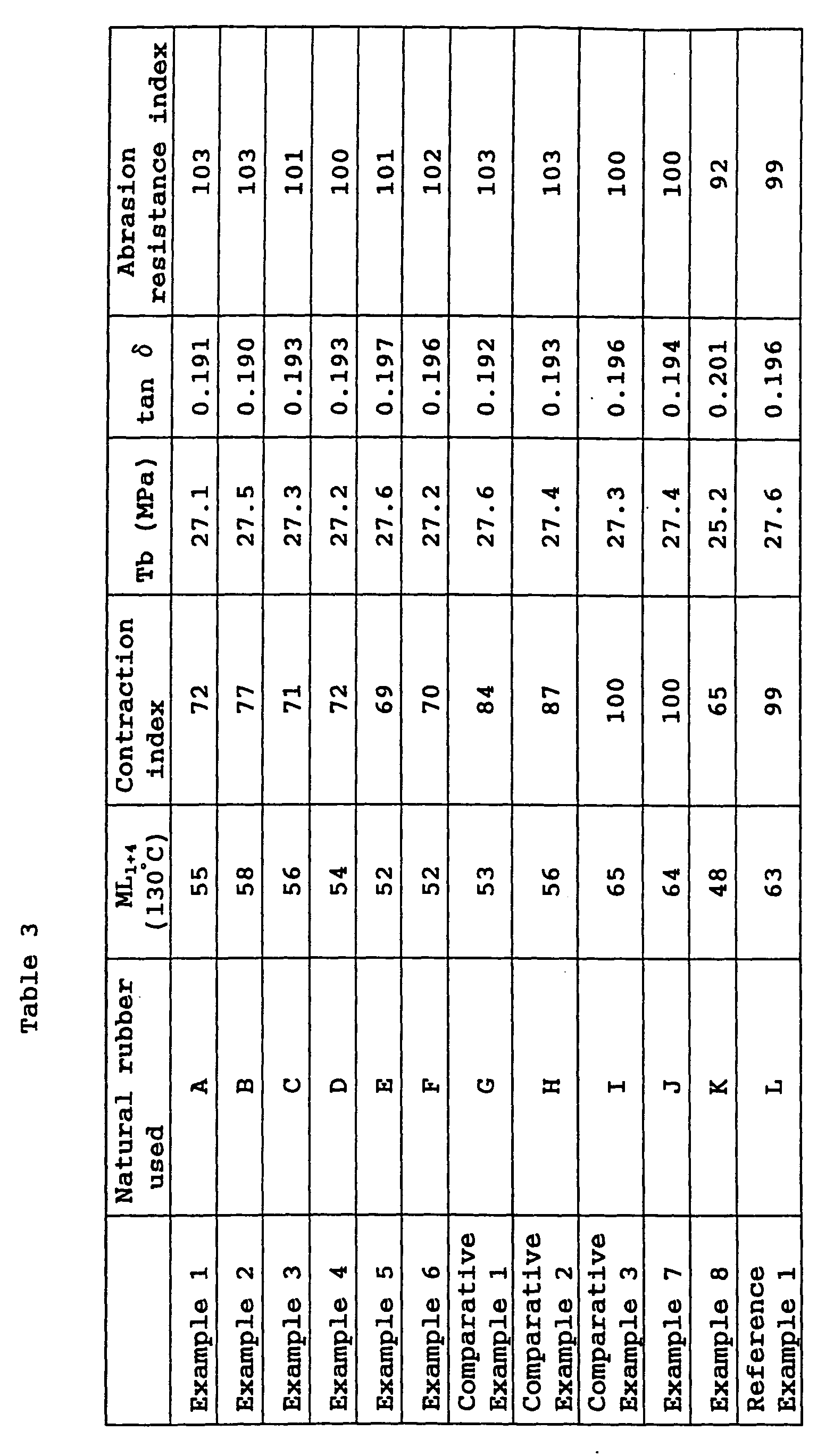
- the Mooney viscosity (ML 1+4 /130°C) was measured at 130°C according to JIS K6300-1994. The smaller this value is, the more excellent the processability is.
- a uncured rubber was wound on a 3 inch roll of roll temperature of 70°C at a roll interval of 2 mm to rotate the roll for 2 minutes. Then, the roll was stopped rotating and left standing for one minute, and a line of 6 cm was cut thereon. After left standing for 3 minutes, a shrinking degree of the line of 6 cm was measured and shown by an index, wherein Comparative Production Example 3 was a control (100). The smaller the numerical value is, the better the shrinking property is.
- the strength (Tb) in breaking was measured according to JIS K6301-1995.
- a viscoelasticity-measuring apparatus (manufactured by Rheometrix Co., Ltd.) was used to measure tan ⁇ (50°C) at a temperature of 50°C, a distortion of 5 % and a frequency of 15 Hz. The smaller the tan ⁇ (50°C) is, the lower the hysteresis loss property is.
- a Lambourn type abrasion tester was used to measure an abrading amount at a slipping rate of 60 % at room temperature and shown by an index, wherein Comparative Production Example 3 was control (100). The smaller the numerical value is, the better the abrasion resistance is.
- the abrasion resistance indices are excellent as compared with those in Comparative Examples 1 to 3 without reducing the breaking physical property, the low heat-generating property and the abrasion resistance.
- the natural rubber latex and the natural rubber according to the present invention are shortened in a stress relaxation time and improved in a processability because phospholipid is decomposed. Further, in a rubber composition using such natural rubber, for example, a tire, the physical properties such as an aging resistant characteristic, a tensile strength and an abrasion resistance are sufficiently maintained, and the industrial applicability thereof is enhanced.
Landscapes
- Chemical & Material Sciences (AREA)
- Health & Medical Sciences (AREA)
- Chemical Kinetics & Catalysis (AREA)
- Medicinal Chemistry (AREA)
- Polymers & Plastics (AREA)
- Organic Chemistry (AREA)
- General Chemical & Material Sciences (AREA)
- Engineering & Computer Science (AREA)
- Mechanical Engineering (AREA)
- Compositions Of Macromolecular Compounds (AREA)
- Tires In General (AREA)
- Addition Polymer Or Copolymer, Post-Treatments, Or Chemical Modifications (AREA)
- Preparation Of Compounds By Using Micro-Organisms (AREA)
Abstract
Description

| Respective components of rubber compositions | Mass part |
| Natural rubber (respective examples) | 100 |
| Carbon black N339 | 50 |
| Aromatic oil | 5 |
| Stearic acid | 2 |
| Antioxidant 6C | 1 |
| Zinc oxide | 3 |
| Vulcanization accelerator DZ | 0.8 |
| Sulfur | 1 |
Claims (15)
- A natural rubber latex in which phospholipid contained in the latex is decomposed.
- The natural rubber latex as described in claim 1, wherein enzyme treatment with lipase and/or phospholipase is carried out in the decomposition.
- The natural rubber latex as described in claim 2, wherein an addition amount of the lipase and/or the phospholipase falls in a range of 0.005 to 0.5 mass part per 100 mass parts of the latex solid component.
- The natural rubber latex as described in claim 2 or 3, wherein enzyme treatment with protease is carried out.
- The natural rubber latex as described in any of any of claims 2 to 4, wherein the enzyme treatment is carried out at a temperature of 70°C or lower.
- The natural rubber latex as described in any of claims 2 to 5, wherein treatment with a surfactant is carried out in addition to the enzyme treatment.
- A natural rubber obtained from the natural rubber latex as described in any of claims 1 to 6.
- The natural rubber as described in claim 7, wherein a Mooney viscosity (ML1+4) and a stress relaxation time T80 of the above rubber satisfy the relation of T80<0.0035exp(ML1+4/8.2) + 20 in a range of 40<ML1+4<100 (provided that ML1+4 is a measured value at a temperature of 100°C, and T80 is time (second) spent until the value of ML1+4 is reduced by 80 % since rotation of a rotor is stopped immediately after measurement of ML1+4).
- A rubber composition using the natural rubber as described in claim 7 or 8.
- A tire characterized by using the rubber composition as described in claim 9.
- A production process for a natural rubber, wherein it is produced by subjecting a natural rubber latex to enzyme treatment with lipase and/or phospholipase.
- The production process for a natural rubber as described in claim 11, wherein the enzyme treatment is carried out by adding lipase and/or phospholipase in an amount falling in a range of 0.005 to 0.5 mass part per 100 mass parts of the latex solid component.
- The production process for a natural rubber as described in claim 11 or 12, wherein enzyme treatment with protease is carried out in addition to the enzyme treatment described above.
- The production process for a natural rubber as described in any of claims 11 to 13, wherein the enzyme treatment is carried out at a temperature of 70°C or lower.
- The production process for a natural rubber as described in any of claims 11 to 14, wherein treatment with a surfactant is carried out in addition to the enzyme treatment.
Applications Claiming Priority (3)
| Application Number | Priority Date | Filing Date | Title |
|---|---|---|---|
| JP2002355796 | 2002-12-06 | ||
| JP2002355796 | 2002-12-06 | ||
| PCT/JP2003/015673 WO2004052935A1 (en) | 2002-12-06 | 2003-12-08 | Natural rubber latex, natural rubber, rubber composition containing the same, and tire |
Publications (3)
| Publication Number | Publication Date |
|---|---|
| EP1568713A1 true EP1568713A1 (en) | 2005-08-31 |
| EP1568713A4 EP1568713A4 (en) | 2006-06-07 |
| EP1568713B1 EP1568713B1 (en) | 2007-08-08 |
Family
ID=32500799
Family Applications (1)
| Application Number | Title | Priority Date | Filing Date |
|---|---|---|---|
| EP03777350A Expired - Lifetime EP1568713B1 (en) | 2002-12-06 | 2003-12-08 | Natural rubber latex, natural rubber, rubber composition containing the same, and tire |
Country Status (7)
| Country | Link |
|---|---|
| US (1) | US7825175B2 (en) |
| EP (1) | EP1568713B1 (en) |
| JP (1) | JP4726490B2 (en) |
| CN (1) | CN1324053C (en) |
| DE (1) | DE60315504T2 (en) |
| ES (1) | ES2291712T3 (en) |
| WO (1) | WO2004052935A1 (en) |
Cited By (16)
| Publication number | Priority date | Publication date | Assignee | Title |
|---|---|---|---|---|
| EP2351789A1 (en) * | 2010-01-27 | 2011-08-03 | Sumitomo Rubber Industries, Ltd. | Rubber composition for sidewall, insulation or breaker cushion, production method thereof, and pneumatic tire |
| WO2011068846A3 (en) * | 2009-12-01 | 2011-09-15 | Bridgestone Corporation | Modified rubber compositions and methods of preparation |
| EP2366558A1 (en) * | 2010-03-17 | 2011-09-21 | Sumitomo Rubber Industries, Ltd. | Tire rubber composition and heavy-load tire |
| EP2390088A3 (en) * | 2010-05-28 | 2012-05-02 | Sumitomo Rubber Industries, Ltd. | Rubber composition for breaker and pneumatic tire |
| EP2377892A4 (en) * | 2008-12-15 | 2012-05-23 | Sumitomo Rubber Ind | NATURAL RUBBER AND MANUFACTURING METHOD THEREOF, RUBBER COMPOSITION AND TIRE USING THE SAME, MODIFIED NATURAL RUBBER AND METHOD FOR MANUFACTURING SAME, AND RUBBER COMPOSITE FOR COVERING CARCASS WIRES OR CABLES AND TIRE USING THE SAME |
| EP2348055A4 (en) * | 2008-11-10 | 2012-08-22 | Bridgestone Corp | Modified natural rubber and method for producing modified natural rubber, and rubber composition and tire using the same |
| EP2581390A4 (en) * | 2010-06-10 | 2013-10-30 | Sumitomo Rubber Ind | MODIFIED NATURAL RUBBER, METHOD FOR PRODUCING THE SAME, RUBBER COMPOSITION, AND PNEUMATIC |
| US8875765B2 (en) | 2011-10-25 | 2014-11-04 | Sumitomo Rubber Industries, Ltd. | Rubber composition for clinch apex and pneumatic tire |
| US8952091B2 (en) | 2010-01-18 | 2015-02-10 | Sumitomo Rubber Industries, Ltd. | Rubber composition for inner liner and pneumatic tire |
| US9068060B2 (en) | 2013-01-10 | 2015-06-30 | Sumitomo Rubber Industries, Ltd. | Composite and method for producing the same, rubber composition, and pneumatic tire |
| US9217075B2 (en) | 2012-01-24 | 2015-12-22 | Sumitomo Rubber Industries, Ltd. | Rubber composition for tire, and pneumatic tire |
| EP2896633A4 (en) * | 2013-02-15 | 2016-07-20 | Sumitomo Rubber Ind | MODIFIED NATURAL RUBBER, PROCESS FOR PRODUCING THE SAME, RUBBER COMPOSITION FOR TIRE AND TIRE |
| EP3015283A3 (en) * | 2014-10-08 | 2016-08-03 | Sumitomo Rubber Industries Limited | Rubber composition for tires and pneumatic tire |
| US9410033B2 (en) | 2011-11-11 | 2016-08-09 | Sumitomo Rubber Industries, Ltd. | Rubber composition for undertread, and pneumatic tire |
| US10336890B2 (en) | 2014-03-17 | 2019-07-02 | Sumitomo Rubber Industries, Ltd. | Rubber composition for studless winter tires, and studless winter tire |
| EP4361181A1 (en) * | 2022-10-26 | 2024-05-01 | Vibracoustic SE | Rubber composition containing bioengineered rubber particles |
Families Citing this family (27)
| Publication number | Priority date | Publication date | Assignee | Title |
|---|---|---|---|---|
| US20040147661A1 (en) * | 2003-01-27 | 2004-07-29 | Anuar Yaakub | Natural rubber composites containing smectite clay and uses thereof |
| JP4726509B2 (en) * | 2005-02-07 | 2011-07-20 | 株式会社ブリヂストン | Natural rubber masterbatch and method for producing the same, and rubber composition and tire using the same |
| CA2614945A1 (en) * | 2005-07-14 | 2007-01-25 | Travis Honeycutt | Decreasing allergenicity of natural latex rubber prior to vulcanization |
| US20070072701A1 (en) * | 2005-09-26 | 2007-03-29 | Bridgestone Sports Co., Ltd. | Golf ball |
| US7250010B1 (en) * | 2006-01-17 | 2007-07-31 | Bridgestone Sports Co., Ltd. | Golf ball |
| US8846794B2 (en) * | 2006-01-23 | 2014-09-30 | Bridgestone Sports Co., Ltd. | Golf ball |
| US7534835B2 (en) * | 2006-01-23 | 2009-05-19 | Bridgestone Sports Co., Ltd. | Golf ball |
| US7557165B2 (en) * | 2006-02-14 | 2009-07-07 | Bridgestone Sports Co., Ltd. | Rubber molding product for golf ball, its making method and golf ball |
| JP5156255B2 (en) * | 2007-04-17 | 2013-03-06 | 株式会社ブリヂストン | Enzyme-treated latex, enzyme-treated natural rubber, enzyme-treated natural rubber composition, and method for producing enzyme-treated latex |
| KR101000593B1 (en) * | 2007-11-29 | 2010-12-10 | 기아자동차주식회사 | Antivibration Rubber Composition for Engine Mount |
| JP4810568B2 (en) * | 2008-12-15 | 2011-11-09 | 住友ゴム工業株式会社 | Modified natural rubber and method for producing the same |
| JP4603615B2 (en) * | 2009-01-30 | 2010-12-22 | 住友ゴム工業株式会社 | Rubber composition and tire for covering tread or carcass cord |
| JP4598853B2 (en) * | 2008-12-15 | 2010-12-15 | 住友ゴム工業株式会社 | Natural rubber, method for producing the same, rubber composition, and pneumatic tire using the same |
| JP4609598B1 (en) * | 2009-06-22 | 2011-01-12 | 横浜ゴム株式会社 | Tire puncture sealant |
| CN102115554B (en) * | 2010-01-04 | 2014-09-10 | 住友橡胶工业株式会社 | Rubber composition for tire and studless tire |
| JP5503310B2 (en) * | 2010-01-27 | 2014-05-28 | 住友ゴム工業株式会社 | Run-flat tire rubber composition and run-flat tire |
| JP5587658B2 (en) * | 2010-04-16 | 2014-09-10 | 住友ゴム工業株式会社 | Rubber composition for tire and pneumatic tire |
| JP5503396B2 (en) * | 2010-04-27 | 2014-05-28 | 住友ゴム工業株式会社 | Rubber composition for clinch apex or bead apex, production method thereof and pneumatic tire |
| JP5503395B2 (en) * | 2010-04-27 | 2014-05-28 | 住友ゴム工業株式会社 | Heavy duty vehicle tread rubber composition and heavy duty vehicle tire |
| CN101851302B (en) * | 2010-05-20 | 2013-02-20 | 中国热带农业科学院农产品加工研究所 | Method for improving oxygen aging resistance of protein-removed natural rubber |
| JP5503413B2 (en) * | 2010-05-28 | 2014-05-28 | 住友ゴム工業株式会社 | Rubber composition for tire and pneumatic tire |
| JP5551972B2 (en) * | 2010-06-10 | 2014-07-16 | 住友ゴム工業株式会社 | Rubber composition for sidewall, production method and pneumatic tire |
| JP5394993B2 (en) * | 2010-06-14 | 2014-01-22 | 住友ゴム工業株式会社 | COMPOSITE MANUFACTURING METHOD, RUBBER COMPOSITION, AND PNEUMATIC TIRE |
| JP5411214B2 (en) | 2011-07-28 | 2014-02-12 | 住友ゴム工業株式会社 | Rubber composition for tread, method for producing the same, and tire for heavy load |
| CN102268106B (en) * | 2011-08-26 | 2013-05-01 | 中国热带农业科学院农产品加工研究所 | Preparation method of high-purity natural rubber |
| JP5948118B2 (en) * | 2012-04-16 | 2016-07-06 | 株式会社ブリヂストン | Method for producing natural rubber, method for producing rubber composition containing natural rubber, and method for producing tire |
| CN122122267A (en) * | 2023-11-09 | 2026-05-29 | 积水化学工业株式会社 | Adhesive tape |
Family Cites Families (13)
| Publication number | Priority date | Publication date | Assignee | Title |
|---|---|---|---|---|
| JP3150434B2 (en) | 1992-08-05 | 2001-03-26 | 住友ゴム工業株式会社 | Deproteinizing agent for natural rubber |
| JP2905005B2 (en) | 1992-08-05 | 1999-06-14 | 住友ゴム工業株式会社 | Deproteinized natural rubber |
| MY137284A (en) | 1992-08-05 | 2009-01-30 | Kao Corp | Deproteinized natural rubber and process for producing the same |
| JP3294901B2 (en) | 1993-05-20 | 2002-06-24 | 花王株式会社 | Rubber composition |
| JP2897199B2 (en) * | 1995-08-31 | 1999-05-31 | オカモト株式会社 | Method for deproteinizing natural rubber molded vulcanizate and natural rubber product produced by the method |
| US5998512A (en) * | 1998-07-20 | 1999-12-07 | The University Of Akron | Reduced-lipid natural rubber latex |
| WO2000061711A1 (en) | 1999-04-07 | 2000-10-19 | Takara Shuzo Co., Ltd. | Composition for decomposing protein |
| JP2001081107A (en) | 1999-09-10 | 2001-03-27 | Sumitomo Rubber Ind Ltd | Deproteinizing agent and method for producing cationic deproteinized natural rubber latex using the same |
| JP2002028936A (en) * | 2000-05-12 | 2002-01-29 | Sumitomo Rubber Ind Ltd | Method for producing rubber product using deproteinized natural rubber latex |
| CN1152054C (en) | 2000-04-28 | 2004-06-02 | 住友橡胶工业株式会社 | Deprotenizing treating agent and process for producing deproteinizing natural rubber pores and products |
| JP2001310902A (en) * | 2000-04-28 | 2001-11-06 | Sumitomo Rubber Ind Ltd | Deproteinizing agent, deproteinized natural rubber latex using the same, and method for producing the same |
| MY129747A (en) * | 2001-02-26 | 2007-04-30 | Sumitomo Rubber Ind | Deproteinized natural rubber latex, method of preparing the same, rubber product using the same, and proteolytic agent for deproteinized natural rubber latex. |
| JP2002348409A (en) | 2001-05-28 | 2002-12-04 | Fuji Latex Kk | Rubber latex composition |
-
2003
- 2003-12-08 US US10/513,431 patent/US7825175B2/en not_active Expired - Fee Related
- 2003-12-08 EP EP03777350A patent/EP1568713B1/en not_active Expired - Lifetime
- 2003-12-08 DE DE60315504T patent/DE60315504T2/en not_active Expired - Lifetime
- 2003-12-08 CN CNB2003801005290A patent/CN1324053C/en not_active Expired - Fee Related
- 2003-12-08 JP JP2004558436A patent/JP4726490B2/en not_active Expired - Fee Related
- 2003-12-08 WO PCT/JP2003/015673 patent/WO2004052935A1/en not_active Ceased
- 2003-12-08 ES ES03777350T patent/ES2291712T3/en not_active Expired - Lifetime
Cited By (22)
| Publication number | Priority date | Publication date | Assignee | Title |
|---|---|---|---|---|
| EP2348055A4 (en) * | 2008-11-10 | 2012-08-22 | Bridgestone Corp | Modified natural rubber and method for producing modified natural rubber, and rubber composition and tire using the same |
| US8815998B2 (en) | 2008-11-10 | 2014-08-26 | Bridgestone Corporation | Modified natural rubber, production process for the same and rubber composition and tire prepared by using the same |
| EP2377892A4 (en) * | 2008-12-15 | 2012-05-23 | Sumitomo Rubber Ind | NATURAL RUBBER AND MANUFACTURING METHOD THEREOF, RUBBER COMPOSITION AND TIRE USING THE SAME, MODIFIED NATURAL RUBBER AND METHOD FOR MANUFACTURING SAME, AND RUBBER COMPOSITE FOR COVERING CARCASS WIRES OR CABLES AND TIRE USING THE SAME |
| EP2666815A1 (en) * | 2008-12-15 | 2013-11-27 | Sumitomo Rubber Industries, Ltd. | Natural rubber and method for producing the same, rubber composition and pneumatic tire using the same, modified natural rubber and method for producing the same, and rubber composition for tread or for covering carcass cord and pneumatic tire using the same |
| US8658728B2 (en) | 2008-12-15 | 2014-02-25 | Sumitomo Rubber Industries, Ltd. | Natural rubber and method for producing the same, rubber composition and pneumatic tire using the same, modified natural rubber and method for producing the same, and rubber composition for tread or for covering carcass cord and pneumatic tire using the same |
| WO2011068846A3 (en) * | 2009-12-01 | 2011-09-15 | Bridgestone Corporation | Modified rubber compositions and methods of preparation |
| US8969450B2 (en) | 2009-12-01 | 2015-03-03 | Bridgestone Corporation | Modified rubber compositions and methods of preparation |
| US8952091B2 (en) | 2010-01-18 | 2015-02-10 | Sumitomo Rubber Industries, Ltd. | Rubber composition for inner liner and pneumatic tire |
| EP2351789A1 (en) * | 2010-01-27 | 2011-08-03 | Sumitomo Rubber Industries, Ltd. | Rubber composition for sidewall, insulation or breaker cushion, production method thereof, and pneumatic tire |
| EP2366558A1 (en) * | 2010-03-17 | 2011-09-21 | Sumitomo Rubber Industries, Ltd. | Tire rubber composition and heavy-load tire |
| EP2390088A3 (en) * | 2010-05-28 | 2012-05-02 | Sumitomo Rubber Industries, Ltd. | Rubber composition for breaker and pneumatic tire |
| EP2581390A4 (en) * | 2010-06-10 | 2013-10-30 | Sumitomo Rubber Ind | MODIFIED NATURAL RUBBER, METHOD FOR PRODUCING THE SAME, RUBBER COMPOSITION, AND PNEUMATIC |
| US9181355B2 (en) | 2010-06-10 | 2015-11-10 | Sumitomo Rubber Industries, Ltd. | Modified natural rubber, method for producing same, rubber composition, and pneumatic tire |
| US8875765B2 (en) | 2011-10-25 | 2014-11-04 | Sumitomo Rubber Industries, Ltd. | Rubber composition for clinch apex and pneumatic tire |
| US9410033B2 (en) | 2011-11-11 | 2016-08-09 | Sumitomo Rubber Industries, Ltd. | Rubber composition for undertread, and pneumatic tire |
| US9217075B2 (en) | 2012-01-24 | 2015-12-22 | Sumitomo Rubber Industries, Ltd. | Rubber composition for tire, and pneumatic tire |
| US9068060B2 (en) | 2013-01-10 | 2015-06-30 | Sumitomo Rubber Industries, Ltd. | Composite and method for producing the same, rubber composition, and pneumatic tire |
| EP2896633A4 (en) * | 2013-02-15 | 2016-07-20 | Sumitomo Rubber Ind | MODIFIED NATURAL RUBBER, PROCESS FOR PRODUCING THE SAME, RUBBER COMPOSITION FOR TIRE AND TIRE |
| US10131763B2 (en) | 2013-02-15 | 2018-11-20 | Sumitomo Rubber Industries, Ltd. | Modified natural rubber, process for producing same, rubber composition for tire, and pneumatic tire |
| US10336890B2 (en) | 2014-03-17 | 2019-07-02 | Sumitomo Rubber Industries, Ltd. | Rubber composition for studless winter tires, and studless winter tire |
| EP3015283A3 (en) * | 2014-10-08 | 2016-08-03 | Sumitomo Rubber Industries Limited | Rubber composition for tires and pneumatic tire |
| EP4361181A1 (en) * | 2022-10-26 | 2024-05-01 | Vibracoustic SE | Rubber composition containing bioengineered rubber particles |
Also Published As
| Publication number | Publication date |
|---|---|
| ES2291712T3 (en) | 2008-03-01 |
| EP1568713B1 (en) | 2007-08-08 |
| US7825175B2 (en) | 2010-11-02 |
| DE60315504T2 (en) | 2008-04-30 |
| WO2004052935A1 (en) | 2004-06-24 |
| US20050234186A1 (en) | 2005-10-20 |
| CN1324053C (en) | 2007-07-04 |
| EP1568713A4 (en) | 2006-06-07 |
| DE60315504D1 (en) | 2007-09-20 |
| JPWO2004052935A1 (en) | 2006-04-13 |
| JP4726490B2 (en) | 2011-07-20 |
| CN1692128A (en) | 2005-11-02 |
Similar Documents
| Publication | Publication Date | Title |
|---|---|---|
| US7825175B2 (en) | Natural rubber latex, natural rubber, rubber composition and tire using the same | |
| JP3732496B2 (en) | Natural rubber, rubber composition and pneumatic tire | |
| JP3294901B2 (en) | Rubber composition | |
| JP4679312B2 (en) | Natural rubber, rubber composition and pneumatic tire | |
| RU2535681C2 (en) | Natural rubber and method of obtaining thereof, rubber mixture and pneumatic tyre, made with application of said mixture, modified and natural rubber and method of obtaining thereof and rubber mixture for protector or covering framework cord, and pneumatic tyre, made with application of said material | |
| CN105504100B (en) | Rubber composition for tire and pneumatic tire | |
| CN1832967B (en) | Natural rubber from which protein has been removed, its composition and use | |
| JP2005047993A (en) | Rubber composition for tire tread and pneumatic tire using the rubber composition | |
| JP5650796B2 (en) | Rubber composition for studless tire and studless tire | |
| JP2004262973A (en) | Natural rubber and rubber composition using the same | |
| JP6199733B2 (en) | Rubber composition for tire and pneumatic tire | |
| US7825185B2 (en) | Natural rubber latex, natural rubber, rubber composition, and tire using the same | |
| JP4721614B2 (en) | Natural rubber, rubber composition and tire using the same | |
| JP4721613B2 (en) | Natural rubber, composition using the same, and tire | |
| JP5156255B2 (en) | Enzyme-treated latex, enzyme-treated natural rubber, enzyme-treated natural rubber composition, and method for producing enzyme-treated latex | |
| JP5108313B2 (en) | Rubber composition containing powder rubber | |
| JP5650795B2 (en) | Rubber composition for pneumatic tread and pneumatic tire | |
| JP6006171B2 (en) | Cap tread rubber composition and heavy duty tire | |
| RU2575273C2 (en) | Modified natural caoutchouc, method for thereof obtaining, rubber mixture and pneumatic tyre | |
| JP6006168B2 (en) | Base tread rubber composition and heavy duty tire | |
| WO2014188992A1 (en) | Heavy-load tire and method for manufacturing heavy-load tire |
Legal Events
| Date | Code | Title | Description |
|---|---|---|---|
| PUAI | Public reference made under article 153(3) epc to a published international application that has entered the european phase |
Free format text: ORIGINAL CODE: 0009012 |
|
| 17P | Request for examination filed |
Effective date: 20041104 |
|
| AK | Designated contracting states |
Kind code of ref document: A1 Designated state(s): AT BE BG CH CY CZ DE DK EE ES FI FR GB GR HU IE IT LI LU MC NL PT RO SE SI SK TR |
|
| RBV | Designated contracting states (corrected) |
Designated state(s): DE ES FR GB IT |
|
| A4 | Supplementary search report drawn up and despatched |
Effective date: 20060426 |
|
| 17Q | First examination report despatched |
Effective date: 20060919 |
|
| GRAP | Despatch of communication of intention to grant a patent |
Free format text: ORIGINAL CODE: EPIDOSNIGR1 |
|
| GRAS | Grant fee paid |
Free format text: ORIGINAL CODE: EPIDOSNIGR3 |
|
| GRAA | (expected) grant |
Free format text: ORIGINAL CODE: 0009210 |
|
| AK | Designated contracting states |
Kind code of ref document: B1 Designated state(s): DE ES FR GB IT |
|
| REG | Reference to a national code |
Ref country code: GB Ref legal event code: FG4D |
|
| REF | Corresponds to: |
Ref document number: 60315504 Country of ref document: DE Date of ref document: 20070920 Kind code of ref document: P |
|
| REG | Reference to a national code |
Ref country code: ES Ref legal event code: FG2A Ref document number: 2291712 Country of ref document: ES Kind code of ref document: T3 |
|
| ET | Fr: translation filed | ||
| PLBE | No opposition filed within time limit |
Free format text: ORIGINAL CODE: 0009261 |
|
| STAA | Information on the status of an ep patent application or granted ep patent |
Free format text: STATUS: NO OPPOSITION FILED WITHIN TIME LIMIT |
|
| 26N | No opposition filed |
Effective date: 20080509 |
|
| REG | Reference to a national code |
Ref country code: FR Ref legal event code: CA Effective date: 20140812 |
|
| REG | Reference to a national code |
Ref country code: DE Ref legal event code: R081 Ref document number: 60315504 Country of ref document: DE Owner name: BRIDGESTONE CORPORATION, JP Free format text: FORMER OWNER: BRIDGESTONE CORP., TOKIO/TOKYO, JP Effective date: 20140828 |
|
| REG | Reference to a national code |
Ref country code: FR Ref legal event code: PLFP Year of fee payment: 13 |
|
| REG | Reference to a national code |
Ref country code: FR Ref legal event code: PLFP Year of fee payment: 14 |
|
| PGFP | Annual fee paid to national office [announced via postgrant information from national office to epo] |
Ref country code: GB Payment date: 20161222 Year of fee payment: 14 |
|
| PGFP | Annual fee paid to national office [announced via postgrant information from national office to epo] |
Ref country code: ES Payment date: 20161213 Year of fee payment: 14 |
|
| PGFP | Annual fee paid to national office [announced via postgrant information from national office to epo] |
Ref country code: IT Payment date: 20161223 Year of fee payment: 14 |
|
| REG | Reference to a national code |
Ref country code: FR Ref legal event code: PLFP Year of fee payment: 15 |
|
| GBPC | Gb: european patent ceased through non-payment of renewal fee |
Effective date: 20171208 |
|
| PG25 | Lapsed in a contracting state [announced via postgrant information from national office to epo] |
Ref country code: IT Free format text: LAPSE BECAUSE OF NON-PAYMENT OF DUE FEES Effective date: 20171208 |
|
| PG25 | Lapsed in a contracting state [announced via postgrant information from national office to epo] |
Ref country code: GB Free format text: LAPSE BECAUSE OF NON-PAYMENT OF DUE FEES Effective date: 20171208 |
|
| REG | Reference to a national code |
Ref country code: ES Ref legal event code: FD2A Effective date: 20190702 |
|
| PG25 | Lapsed in a contracting state [announced via postgrant information from national office to epo] |
Ref country code: ES Free format text: LAPSE BECAUSE OF NON-PAYMENT OF DUE FEES Effective date: 20171209 |
|
| PGFP | Annual fee paid to national office [announced via postgrant information from national office to epo] |
Ref country code: DE Payment date: 20191210 Year of fee payment: 17 |
|
| PGFP | Annual fee paid to national office [announced via postgrant information from national office to epo] |
Ref country code: FR Payment date: 20191219 Year of fee payment: 17 |
|
| REG | Reference to a national code |
Ref country code: DE Ref legal event code: R119 Ref document number: 60315504 Country of ref document: DE |
|
| PG25 | Lapsed in a contracting state [announced via postgrant information from national office to epo] |
Ref country code: FR Free format text: LAPSE BECAUSE OF NON-PAYMENT OF DUE FEES Effective date: 20201231 |
|
| PG25 | Lapsed in a contracting state [announced via postgrant information from national office to epo] |
Ref country code: DE Free format text: LAPSE BECAUSE OF NON-PAYMENT OF DUE FEES Effective date: 20210701 |