Technical Field
The present invention concerns a cold rolled steel sheet
for a gasket material used as a sealing material for each of
opening portions including cylinders in internal combustion
engines, a method for producing thereof and a gasket material
produced by the method.
Background Art
Various gaskets including a cylinder head gasket have
been used being concerned with an automobile engine. As the
material for the gasket, asbestos have been used so far but
non-asbestos materials have been sought in order to cope with
environmental problems, improvement for the performance of
engines, etc.
As the substitute material for asbestos, those using
aramid fibers or graphite and put to composite fabrication with
soft steel sheets have been used. Further, as those quite
different from the existent gasket structure, stainless steels
coated with rubber coating materials have also been used.
Heretofore, as a casing of using a cold rolled steel sheet
for the gasket material, JP-A No. Hei 9-194935, for example,
discloses a method of heating to a recrystallization
temperature or higher followed by quenching. In this case,
because of quenching, warps occur in the cold rolled steel sheet
after quenching to result in a problem in view of the flatness.
Further, JP-A No. 2000-109957 discloses an example of
providing a stainless steel sheet. However, since the
stainless steel sheet is expensive, this is not economical.
However, since those of using the aramid fibers or
graphite or stainless steels coated with rubber coating
materials require composite fabrication with other materials,
they involve a problem of increasing the cost.
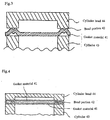
Fig. 3 is a schematic cross sectional view showing the
manner of using a gasket material in an application use for
springs requiring spring property and application use of
fabrication requiring fabricability. As shown in Fig. 3, a
gasket material 41 interposed between a cylinder 43 and a
cylinder head 44 is formed with a bead portion 42 for improving
the sealability. Accordingly, the characteristics as the
gasket material 41 requiring the spring property include bead
fabricability and the spring property. The bead fabricability
and the spring property are properties contrary to each other
in a metallurgical point of view.
Generally, for improving the fabricability, it is
preferred to soften a steel material, whereas it is preferred
to harden the steel material in order to improve the spring
property.
Accordingly, it is an object of the present invention to
provide a cold rolled steel sheet for a gasket material having
excellent gas sealing property which is inexpensive and while
has good balance between the bead fabricability and the spring
property, as well as a method of producing the same.
Further, it is another object of the present invention
to provide a gasket material having particularly excellent
spring property required for the sealing performance for the
opening of the cylinder, well conforming also with various kinds
of openings such as an opening for cooling water, an opening
for lubricant and a bolt hole, and also capable of obtaining
good sealing performance with preferred spring property.
Disclosure of the Invention
For attaining the foregoing object, a cold rolled steel
sheet for a gasket material according to claim 1 is
characterized by comprising, on the weight % base, from 0.08
to 0.60% of C, from 1.0 to 3.0% of Si, from 0.5 to 3.0% of Mn,
0.06% or more of P, 0.06% or less of S, 0. 1% or less of Al, from
0.0010 to 0.0150% of N and the balance of Fe and inevitable
impurities. According to this, the cold rolled steel sheet for
a gasket material of the invention is inexpensive, and having
excellent gas sealing property with good balance between the
bead fabricability and the spring property. Further, the cold
rolled steel sheet for a gasket material according to the
invention is inexpensive and has a gas sealing property with
excellent bendability capable of being bent by 180°C.
A method of producing a cold rolled steel plate for a
gasket material according to claim 2 is characterized by hot
rolling a continuously cast piece comprising on the weight %
base, from 0.08 to 0.60% of C, from 1.0 to 3.0% of Si, from 0.5
to 3.0% of Mn, 0.06% or more of P, 0.06% or less of S, 0.1% or
less of Al, from 0.0010 to 0.0150% of N and the balance of Fe
and inevitable impurities, conducting pickling, applying cold
rolling at a draft of from 50 to 90%.
A method of producing a cold rolled steel plate for a
gasket material according to claim 3 is characterized by hot
rolling a continuously cast piece comprising, on the weight %
base, from 0.08 to 0.60% of C, from 1.0 to of 3.0% Si, from 0.5
to 3.0% of Mn, 0.06% or more of P, 0.06% or less of S, 0.1% or
less of Al, from 0.0010 to 0.0150% of N and the balance of Fe
and inevitable impurities, conducting pickling, applying cold
rolling at a draft of from 50 to 90%, and further applying Zn
or Ni plating on the surface.
A method of producing a cold rolled steel plate for a
gasket material according to claim 4 is characterized by hot
rolling a continuously cast piece comprising, on the weight %
base, from 0.08 to 0.60% of C, from 1.0 to 3.0% of Si, from 0.5
to 3.0% of Mn, 0.06% or more of P, 0.06% or less of S, 0.1% or
less of Al, from 0.0010 to 0.0150% of N and the balance of Fe
and inevitable impurities, conducting pickling, applying cold
rolling at a draft of from 50 to 90%, applying annealing at 630
to 870°C or higher by continuous annealing or at 500 to 750°C
or higher by batchwise annealing and, subsequently, applying
secondary rolling at a draft of 30% or more.
A method of producing a cold rolled steel plate for a
gasket material according to claim 5 is characterized by hot
rolling a continuously cast piece comprising, on the weight %
base, from 0.08 to 0.60% of C, from 1.0 to 3.0% of Si, from 0.5
to 3.0% of Mn, 0.06% or more of P, 0.06% or less of S, 0.1% or
less of Al, from 0.0010 to 0.0150% of N and the balance of Fe
and inevitable impurities, conducting pickling, applying cold
rolling at a draft of from 50 to 90%, applying annealing at 630
to 870°C or higher by continuous annealing or at 500 to 750°C
or higher by batchwise annealing and, subsequently, applying
secondary rolling at a draft of 7% or less.
A method of producing a cold rolled steel plate for a
gasket material according to claim 6 is characterized by hot
rolling a continuously cast piece comprising, on the weight %
base, from 0.08 to 0.60% of C, from 1.0 to 3.0% of Si, from 0.5
to 3.0% of Mn, 0.06% or more of P, 0.06% or less of S, 0. 1% or
less of Al, from 0.0010 to 0.0150% of N and the balance of Fe
and inevitable impurities, conducting pickling, applying a cold
rolling at a draft of from 50 to 90%, applying annealing at 630
to 870°C or higher by continuous annealing or at 500 to 750°C
or higher by batchwise annealing, subsequently, applying
secondary rolling at a draft of 30% or more and, further,
applying Zn or Ni plating on the surface.
A method of producing a cold rolled steel plate for a
gasket material according to claim 7 is characterized by hot
rolling a continuously cast piece comprising, on the weight %
base, from 0.08 to 0.60% of C, from 1.0 to 3.0% of Si, from 0.5
to 3.0% of Mn, 0.06% or more of P, 0.06% or less of S, 0.1% or
less of Al, from 0.0010 to 0.0150% of N and the balance of Fe
and inevitable impurities, conducting pickling, applying cold
rolling at a draft of from 50 to 90%, applying annealing at 630
to 870°C or higher by continuous annealing or at 500 to 750°C
or higher by batch annealing, subsequently, applying secondary
rolling at a draft of 7% or less and, further, applying Zn or
Ni plating on the surface.
In the present invention, according to claims 2 to 4 and
6, a cold rolled steel sheet for a gasket material which is
inexpensive and has excellent gas sealing property with good
balance between the bead fabricability and the spring property
can be produced.
According to the present invention in claims 2, 3, 5 and
7, a cold rolled steel sheet for a gasket material which is
inexpensive and having gas sealing property of excellent
bendability can be produced.
A gasket material according to claim 8 is produced by
using the cold rolled steel sheet for a gasket material
according to claim 1.
A gasket material according to claim 9 is produced by
using the cold rolled steel sheet for a gasket material
according to any one of claim 2 to 7.
Thus, the gasket material of the present invention is
particularly preferred in view of the spring property which is
necessary as the sealing performance for the cylinder opening,
well conforms also to various types of openings such as the
opening for cooling water, the opening for lubricant and bolt
holes, and can provide sealing performance with good spring
property.
It is necessary that the gasket material has a strength
of 1000 MPa or more, preferably, 1200 MPa or more in view of
the tensile strength according to JIS No. 5 (tensile strength:
hereinafter referred to as "T. S."). Further, it is necessary
that the gasket material has an elongation of 3% or more (total
elongation: hereinafter referred to as "T. EL."), more
preferably, 5% or more for the fabrication of the bead portion
as described above.
Further, in addition to the application use for springs
requiring the spring property, the gasket material also
includes a fabrication application use requiring bending
fabrication as shown in Fig. 4. In this case, it is necessary
that the strength is 500 MPa or more, preferably, 600 MPa or
more as the T. S. according to JIS No. 5 piece and requires 15%
or more and, preferably, 20% or more of T. EL.
Brief Description of the Drawings
Fig. 1 is a schematic view showing an evaluation method
for the fabricability of a gasket. Fig. 2 is a schematic view
showing a test method for evaluation of the spring property.
Fig. 3 is a schematic cross sectional view showing the mode of
using a gasket material for spring application. Fig. 4 is a
schematic cross sectional view showing the mode of using the
gasket material applied with a vending fabrication.
Best Mode for Practicing the Invention
Preferred embodiments of the present invention are to be
described in details.
Steel ingredients of a cold rolled steel sheet for a gasket
material as a starting plate
The steel ingredients in the cold rolled steel sheet for
a gasket material according to the present invention comprises,
on the weight % base, from 0. 008 to 0.60% of C, from 1.0 to 3.0%
of Si, from 0.5 to 3.0% of Mn, 0.06% or more of P, 0.06% or less
of S, 0.1% or less of Al, from 0.0010 to 0.0150% of N and the
balance of Fe and inevitable impurities.
C is preferably 0.08% by weight or more in order to provide
a high degree of fineness to a cold rolled steel sheet for a
gasket material. On the other hand, in a case where the
ingredient C exceeds 0.60% by weight, the precipitation amount
of carbides increases to deteriorate the fabricability of the
cold rolled steel sheet for the gasket material and, at the same
time, causes lowering of the productivity such as increase of
the load for cold rolling, deterioration of the shape,
inhibition for sheet passing in a continuous annealing step,
etc. Accordingly, the upper limit value for the ingredient C
is defined as 0.60% by weight in the invention.
Since Mn is an essential ingredient for preventing
embrittlement under red heating during hot rolling due to
impurity S and, at the same time, providing high fineness to
the cold rolled steel sheet for the gasket material like C
described above, the Mn ingredient is defined as 0.5% by weight
or more. However, also in the same manner as C, if it is
excessive, it causes lowering of the productivity such as
increase of the load for cold rolling, occurrence of crack
during slab rolling, deterioration of the shape and inhibition
for sheet passing in a continuous annealing step, etc., so that
the upper limit value is defined as 3.0% by weight.
Since P is a crystal grain refining ingredient and also
it improves the strength of the cold rolled steel sheet for the
gasket, it is added at a predetermined ratio but, on the other
hand, it hinders the corrosion resistance. In a case where P
exceeds 0.06% by weight, the corrosion resistance, particularly,
pit resistance is remarkably deteriorated for the application
use of the invention, so that the upper limit value is defined
as 0.06% by weight.
S is an impurity ingredient causing embrittleness under
red heating during hot rolling and it is desirably as less as
possible. However, since intrusion from iron ores, etc. can
not be prevented completely and desulfurization during the step
is difficult, it may inevitably remain to some extent. Since
the embrittleness under red heating due to small amount of
remained S can be moderated with Mn, the upper limit value for
the S ingredient is defined as 0.06% by weight.
Al is added in a steel bath as a deoxidant upon steel making.
However, if it is 0.10% by weight or more, excess Al reacts with
an oxidation suppressor and oxygen in a casting mold powder used
as an anti-scorching agent to a casting die in the continuous
casting during continuous casting to hinder the intended powder
effect. Accordingly, the amount of Al is controlled to 0.10%
by weight or less.
N, like C and Mn, provides a high fineness to the cold
rolled steel sheet for the gasket. While this is an essential
ingredient for improving the proof stress, reduction to less
than 0.01% by weight results in the difficulty in view of steel
making. On the other hand, addition in excess of 0.0150% by
weight remarkably lowers the yield of ferro nitrides added
during steel making lacks in stability and also remarkably
deteriorates the anisotropy during press molding. Further,
since this results in cracks at the surface of a continuous cast
piece to form casting defects, the range for the N ingredient
is defined in the invention as from 0.001 to 0.0150% by weight.
More preferably, it is defined as from 0.0021 to 0.0150%.
Si provides a main feature of the invention. Si has a
significant solid solubilization strengthening performance in
the steel and it is an effective element for obtaining a spring
property. Accordingly, it is necessary by 1.0% by weight or
more. Further, while more content is preferred in view of
strengthening the material, since increase of load in the cold
rolling and deterioration of the shape are caused when it
exceeds 3.0% by weight, the upper limit value is defined as 3.0%
by weight.
Hot rolling
The heating temperature for the steel piece in the hot
rolling step is not specified in the present invention but it
is preferably 1100°C or higher in view of positive decomposition
and solid-solubilization of N and stable insurance of the hot
finishing rolling temperature. Since the crystal tissue in a
hot steel sheet gives a grain mixture and grain growth failing
to obtain an aimed strength in a case where the hot rolling
finishing temperature is below the Ar3 point, the hot rolling
finishing temperature is preferably Ar3 point or higher. The
take-up temperature is defined as 450°C to 650°C. 450°C is
defined as the lower limit while considering the quality
stability in the lateral direction and the longitudinal
direction of the coil during hot rolling. Further, in a case
where the take-up temperature exceeds 650°C, since the crystal
grain size increases during hot rolling and continuous
annealing thereby causing failure during fabrication of gasket
beads, the take-up temperature is preferably 650°C or lower.
The steel sheet subjected to hot rolling with the
ingredient system as described above is cold rolled, and the
cold draft is an important strength factor together with the
ingredients in the invention and it is conducted at 50 to 90%
in order to obtain an aimed strength.
As described above, the material applied with cold
rolling at 50 to 90% is degreased in a cleaning step and then
applied with continuous annealing at 630 to 870°C or higher and,
preferably, at 680 to 870°C. Alternatively, batchwise
annealing is applied at 500 to 750°C or, preferably, 600 to 750°C.
The annealing time may be within such a range as the material
is recrystallized.
In the case of use for the spring application, secondary
cold rolling is applied at a draft of 30% or more, preferably,
60% or more to introduce strains. Subsequently, surface
roughness is optionally applied by temper rolling.
On the other hand, in a case of use for the fabrication
application with excellent bending property, a secondary
rolling at a draft of 7% or less or temper rolling is applied
after annealing. Subsequently, the surface roughness is
applied optionally by temper rolling.
Then, the cold rolled steel sheet for the gasket material
according to the invention prepared as described above includes
sheet-like and coil-like steel sheets, steel foils, or those
formed by applying a surface treatment to the steel sheets
described above. Particularly, electrolytic chromate treated
steel sheets having a two-layered structure comprising a lower
layer of a metallic chromium and an upper layer of chromium
hydrate oxide, or extremely thin tin-plated steel sheets,
nickel plated steel sheets, zinc plated steel sheets and those
formed by applying a surface treatment with chromium hydrate
oxide, or a surface treatment having a two-layered structure
comprising an upper layer of chromium hydrate oxide and a lower
layer of a metallic chromium layer to the plated steel sheets
described above are excellent in view of the corrosion
resistance.
Example
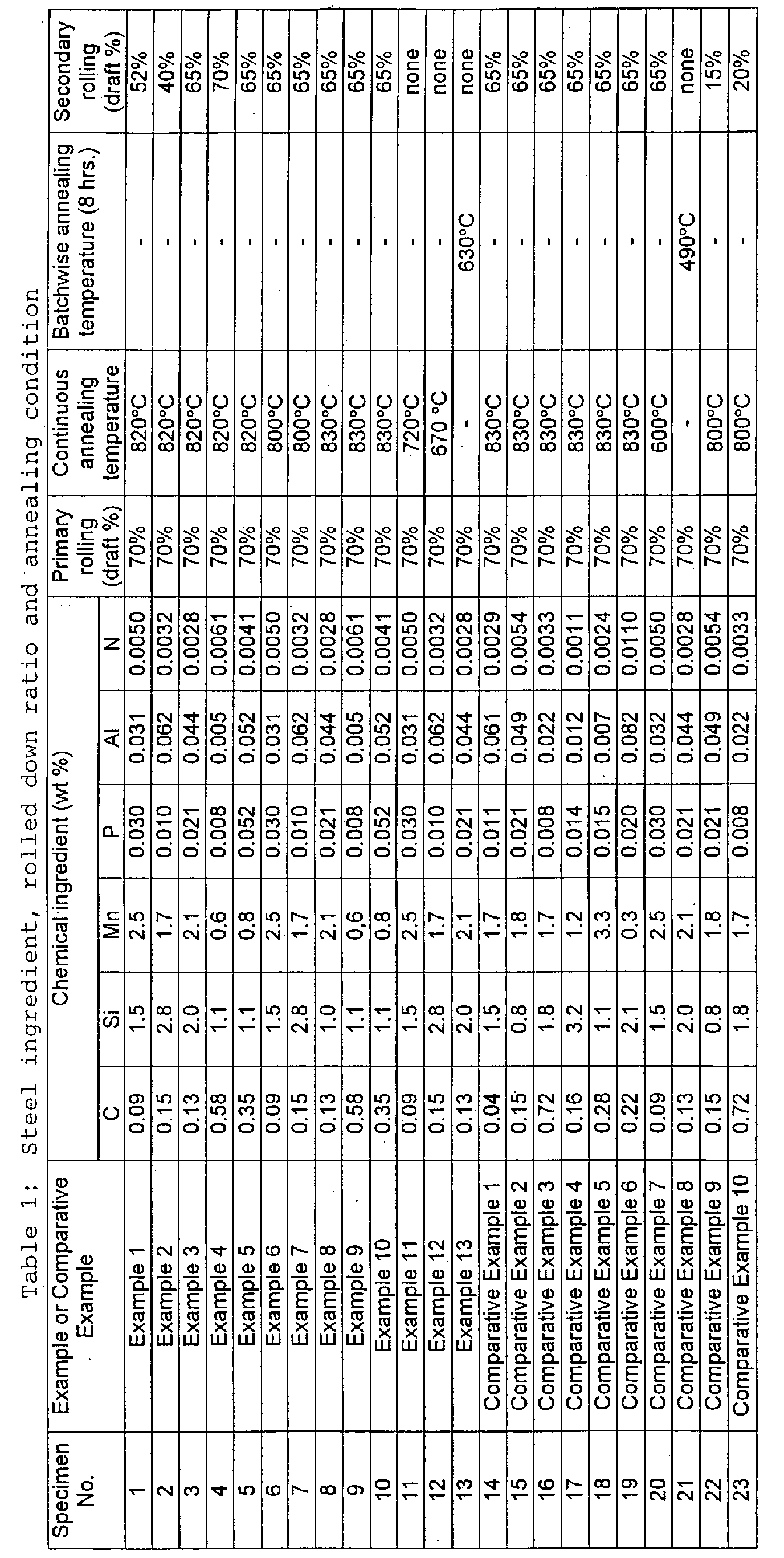
For examples of the invention and comparative examples,
steel ingredients and manufacturing conditions such as a draft
are shown in Table 1 and the results of evaluation for the
characteristics thereof are shown in Table 2.
In view of Table 1 and Table 2, specimens Nos. 1 to 10
as the examples can be used for the spring application of high
strength and showing high spring property, while specimens Nos.
11 to 13 can be used for fabrication of excellent bendability.
In Table 2, specimens Nos. 1 to 10 used for spring application
are indicated by symbols "O" in the columns for the spring
evaluation and bead fabrication and favorable therefor, the
bendability is indicated by "×" to which they can not be applied.
Further, while the specimen Nos. 11 to 13 used for fabrication
application are indicated by "×" in the column for the spring
property and are not applicable to the spring application, they
are indicated by "O" in the column for bending fabricability
and show good bendability.
On the other hand, specimens Nos. 14 to 31 as comparative
examples do not satisfy the characteristics for the spring
property for the bead fabricability and can not be applied to
the spring application (symbol "×" is indicated the column for
the spring property or the bead fabricability in Table 2).
Further, the bendability is poor in each of the cases being
indicated by "×".
| Result for the Evaluation of Characteristic |
| Specimen No. | Example or Comparative Example | T. S. (MPa) | T.EL. (%) | Spring property | Bead fabricability | Bendability |
| 1 | Example 1 | 1,080 | 5.2% | ○ | ○ | × |
| 2 | Example 2 | 1,180 | 5.0% | ○ | ○ | × |
| 3 | Example 3 | 1,145 | 5.1% | ○ | ○ | × |
| 4 | Example 4 | 1,250 | 3.9% | ○ | ○ | × |
| 5 | Example 5 | 1,210 | 4.2% | ○ | ○ | × |
| 6 | Example 6 | 1,080 | 8.2% | ○ | ○ | × |
| 7 | Example 7 | 1,280 | 8.0% | ○ | ○ | × |
| 8 | Example 8 | 1,220 | 7.2% | ○ | ○ | × |
| 9 | Example 9 | 1,320 | 4.2% | ○ | ○ | × |
| 10 | Example 10 | 1,290 | 4.9% | ○ | ○ | × |
| 11 | Example 11 | 560 | 25.0% | × | ○ | ○ |
| 12 | Example 12 | 595 | 17.0% | × | ○ | ○ |
| 13 | Example 13 | 600 | 20.0% | × | ○ | ○ |
| 14 | Comp. Example 1 | 980 | 8.0% | × | ○ | × |
| 15 | Comp. Example 2 | 990 | 8.2% | × | ○ | × |
| 16 | Comp. Example 3 | 1,320 | 0.8% | ○ | × | × |
| 17 | Comp. Example 4 | 1,290 | 0.9% | ○ | × | × |
| 18 | Comp. Example 5 | 1290 | 0.9% | ○ | × | × |
| 19 | Comp. Example 6 | 940 | 7.8% | × | ○ | × |
| 20 | Comp. Example 7 | 1.080 | 0.8% | × | × | × |
| 21 | Comp. Example 8 | 1,290 | 0.7% | ○ | × | × |
| 22 | Comp. Example 9 | 880 | 12.0% | × | ○ | × |
| 23 | Comp. Example 10 | 990 | 7.8% | × | ○ | × |
For bead fabricability and the spring property for the
gasket of the present invention were evaluated as described
below. At first, a steel sheet was pressed into a cross
sectional shape as shown in Fig. 1 (fabrication of flanged bead
groove), to form a bead portion of width w and height t. During
bead fabrication, those where no cracks were generated in the
bead portion were indicated by "O" and evaluated as satisfactory,
whereas those where cracks were generated were judged as failed
for the bead fabricability and evaluated as "×".
Fig. 2 shows a step of a compression test as a test method
for the evaluation of the spring property. In Fig. 2, (a) shows
a state of the fabricated bead portion before compression, (b)
shows a state of applying a compressive load and (c) shows the
state of removing the compressive load.
As shown in Fig. 2, a compressive load was applied from
above to the bead portion by a compression tester. After
removing the load, those in which the recovery amount (T1)
exceeded 40% relative to the compression amount (T) were
regarded as satisfactory for the spring property and indicated
by "O". On the other hand, those of 40% or less were judged
as failed with the spring property being indicated by "×".
Evaluation for the bendability.
The bendability was evaluated by subjecting specimens to
180°C bending fabrication at 0T (sheet not interposed in the
bent portion) and was evaluated depending on whether cracks
occurred or not in the specimen. Those with generation of
cracks were indicated as "×" and evaluated as failed. On the
contrary, those with no generation of cracks were indicated as
"O" and evaluated as satisfactory. Specimens showing
elongation of 15% or more were favorable in view of the
bendability.
Industrial Applicability
Since the cold rolled steel sheet for the gasket material
and the production method thereof according to the present
invention are constituted and function as described above, a
cold rolled steel sheet for the gasket material having excellent
gas sealing property while being inexpensive and with good
balance between the bead fabricability and the spring property
can be obtained.
The gasket material according to the present invention
has excellent gas sealing property both for the spring
application with good balance between the fabricability and the
spring property, and for the fabrication application being
excellent in the OT bendability, by changing the production
method slightly.
Further, the gasket material applied with the surface
treatment shows excellent corrosion resistance and shows gas
sealing property for a long period of time even when it is exposed
to the state of high temperature. Further, the gasket material
according to the present invention has particularly preferred
spring property required for the sealing performance for
openings of the cylinder in the spring application and can be
used suitably also to various kinds of openings such as the
opening for cooling water, opening for lubricant and bolt holes.
For the fabrication application. Although it can not be applied
to the use for spring application, it can be used suitably also
for various kinds of openings such as the opening for cooling
water, the opening for lubricant and bolt holes.