EP1566376A1 - Preparation of amino acid amides - Google Patents
Preparation of amino acid amides Download PDFInfo
- Publication number
- EP1566376A1 EP1566376A1 EP05250901A EP05250901A EP1566376A1 EP 1566376 A1 EP1566376 A1 EP 1566376A1 EP 05250901 A EP05250901 A EP 05250901A EP 05250901 A EP05250901 A EP 05250901A EP 1566376 A1 EP1566376 A1 EP 1566376A1
- Authority
- EP
- European Patent Office
- Prior art keywords
- amino acid
- reacting
- preparing
- group
- carbon atoms
- Prior art date
- Legal status (The legal status is an assumption and is not a legal conclusion. Google has not performed a legal analysis and makes no representation as to the accuracy of the status listed.)
- Withdrawn
Links
- 150000001413 amino acids Chemical class 0.000 title claims abstract description 31
- 238000002360 preparation method Methods 0.000 title description 2
- QGZKDVFQNNGYKY-UHFFFAOYSA-N Ammonia Chemical compound N QGZKDVFQNNGYKY-UHFFFAOYSA-N 0.000 claims abstract description 24
- 238000000034 method Methods 0.000 claims abstract description 17
- 150000003839 salts Chemical class 0.000 claims abstract description 14
- 239000002253 acid Chemical class 0.000 claims abstract description 13
- 229910021529 ammonia Inorganic materials 0.000 claims abstract description 11
- 239000003795 chemical substances by application Substances 0.000 claims abstract description 10
- 230000002140 halogenating effect Effects 0.000 claims abstract description 10
- 150000001408 amides Chemical class 0.000 claims abstract description 7
- 239000000126 substance Substances 0.000 claims abstract description 7
- 150000001735 carboxylic acids Chemical class 0.000 claims abstract description 6
- FYSNRJHAOHDILO-UHFFFAOYSA-N thionyl chloride Chemical group ClS(Cl)=O FYSNRJHAOHDILO-UHFFFAOYSA-N 0.000 claims description 16
- 125000004432 carbon atom Chemical group C* 0.000 claims description 14
- HPHUVLMMVZITSG-LURJTMIESA-N levetiracetam Chemical compound CC[C@@H](C(N)=O)N1CCCC1=O HPHUVLMMVZITSG-LURJTMIESA-N 0.000 claims description 13
- 238000004519 manufacturing process Methods 0.000 claims description 12
- HDBMIDJFXOYCGK-DFWYDOINSA-N (2s)-2-aminobutanamide;hydrochloride Chemical compound Cl.CC[C@H](N)C(N)=O HDBMIDJFXOYCGK-DFWYDOINSA-N 0.000 claims description 10
- 125000000217 alkyl group Chemical group 0.000 claims description 8
- 150000001875 compounds Chemical class 0.000 claims description 8
- 125000000623 heterocyclic group Chemical group 0.000 claims description 7
- 229910052794 bromium Inorganic materials 0.000 claims description 6
- 229910052801 chlorine Inorganic materials 0.000 claims description 6
- CTSLXHKWHWQRSH-UHFFFAOYSA-N oxalyl chloride Chemical compound ClC(=O)C(Cl)=O CTSLXHKWHWQRSH-UHFFFAOYSA-N 0.000 claims description 6
- 230000003213 activating effect Effects 0.000 claims description 5
- 229910052740 iodine Inorganic materials 0.000 claims description 5
- AMMBUJFMJOQABC-UHFFFAOYSA-N 1-carboxypropylazanium;chloride Chemical compound Cl.CCC(N)C(O)=O AMMBUJFMJOQABC-UHFFFAOYSA-N 0.000 claims description 4
- CDIIZULDSLKBKV-UHFFFAOYSA-N 4-chlorobutanoyl chloride Chemical compound ClCCCC(Cl)=O CDIIZULDSLKBKV-UHFFFAOYSA-N 0.000 claims description 4
- 229910052739 hydrogen Inorganic materials 0.000 claims description 4
- 239000001257 hydrogen Substances 0.000 claims description 4
- UFHFLCQGNIYNRP-UHFFFAOYSA-N Hydrogen Chemical compound [H][H] UFHFLCQGNIYNRP-UHFFFAOYSA-N 0.000 claims description 3
- 229910052736 halogen Inorganic materials 0.000 claims description 3
- 150000002367 halogens Chemical class 0.000 claims description 3
- 125000004170 methylsulfonyl group Chemical group [H]C([H])([H])S(*)(=O)=O 0.000 claims description 3
- 125000004433 nitrogen atom Chemical group N* 0.000 claims description 3
- UHZYTMXLRWXGPK-UHFFFAOYSA-N phosphorus pentachloride Chemical compound ClP(Cl)(Cl)(Cl)Cl UHZYTMXLRWXGPK-UHFFFAOYSA-N 0.000 claims description 3
- 125000002088 tosyl group Chemical group [H]C1=C([H])C(=C([H])C([H])=C1C([H])([H])[H])S(*)(=O)=O 0.000 claims description 3
- 229960004002 levetiracetam Drugs 0.000 abstract description 8
- HPHUVLMMVZITSG-ZCFIWIBFSA-N levetiracetam Chemical compound CC[C@H](C(N)=O)N1CCCC1=O HPHUVLMMVZITSG-ZCFIWIBFSA-N 0.000 abstract 1
- 229940024606 amino acid Drugs 0.000 description 22
- 238000006243 chemical reaction Methods 0.000 description 14
- KFZMGEQAYNKOFK-UHFFFAOYSA-N Isopropanol Chemical compound CC(C)O KFZMGEQAYNKOFK-UHFFFAOYSA-N 0.000 description 10
- XEKOWRVHYACXOJ-UHFFFAOYSA-N Ethyl acetate Chemical compound CCOC(C)=O XEKOWRVHYACXOJ-UHFFFAOYSA-N 0.000 description 9
- OKKJLVBELUTLKV-UHFFFAOYSA-N Methanol Chemical compound OC OKKJLVBELUTLKV-UHFFFAOYSA-N 0.000 description 9
- IAZDPXIOMUYVGZ-WFGJKAKNSA-N Dimethyl sulfoxide Chemical compound [2H]C([2H])([2H])S(=O)C([2H])([2H])[2H] IAZDPXIOMUYVGZ-WFGJKAKNSA-N 0.000 description 8
- YMWUJEATGCHHMB-UHFFFAOYSA-N Dichloromethane Chemical compound ClCCl YMWUJEATGCHHMB-UHFFFAOYSA-N 0.000 description 6
- 239000000047 product Substances 0.000 description 6
- 150000001732 carboxylic acid derivatives Chemical class 0.000 description 5
- 238000001914 filtration Methods 0.000 description 5
- 238000005160 1H NMR spectroscopy Methods 0.000 description 4
- -1 amino acid salt Chemical class 0.000 description 4
- 239000000203 mixture Substances 0.000 description 4
- QTBSBXVTEAMEQO-UHFFFAOYSA-N Acetic acid Chemical compound CC(O)=O QTBSBXVTEAMEQO-UHFFFAOYSA-N 0.000 description 3
- KWYUFKZDYYNOTN-UHFFFAOYSA-M Potassium hydroxide Chemical compound [OH-].[K+] KWYUFKZDYYNOTN-UHFFFAOYSA-M 0.000 description 3
- 229940079593 drug Drugs 0.000 description 3
- 239000003814 drug Substances 0.000 description 3
- 239000011541 reaction mixture Substances 0.000 description 3
- 239000007787 solid Substances 0.000 description 3
- CSCPPACGZOOCGX-UHFFFAOYSA-N Acetone Chemical compound CC(C)=O CSCPPACGZOOCGX-UHFFFAOYSA-N 0.000 description 2
- NLXLAEXVIDQMFP-UHFFFAOYSA-N Ammonia chloride Chemical compound [NH4+].[Cl-] NLXLAEXVIDQMFP-UHFFFAOYSA-N 0.000 description 2
- AYFVYJQAPQTCCC-GBXIJSLDSA-N L-threonine Chemical compound C[C@@H](O)[C@H](N)C(O)=O AYFVYJQAPQTCCC-GBXIJSLDSA-N 0.000 description 2
- 238000004458 analytical method Methods 0.000 description 2
- 150000008064 anhydrides Chemical class 0.000 description 2
- 125000003118 aryl group Chemical group 0.000 description 2
- 150000002148 esters Chemical class 0.000 description 2
- AKPUJVVHYUHGKY-UHFFFAOYSA-N hydron;propan-2-ol;chloride Chemical compound Cl.CC(C)O AKPUJVVHYUHGKY-UHFFFAOYSA-N 0.000 description 2
- 229910052757 nitrogen Inorganic materials 0.000 description 2
- 239000012265 solid product Substances 0.000 description 2
- 239000002904 solvent Substances 0.000 description 2
- 238000003756 stirring Methods 0.000 description 2
- OICPVUAPEGFLSK-LXNQBTANSA-N (2s)-4-hydroxypyrrolidine-2-carboxamide;hydrochloride Chemical compound Cl.NC(=O)[C@@H]1CC(O)CN1 OICPVUAPEGFLSK-LXNQBTANSA-N 0.000 description 1
- CSKSDAVTCKIENY-WCCKRBBISA-N (2s)-pyrrolidine-2-carboxamide;hydrochloride Chemical compound Cl.NC(=O)[C@@H]1CCCN1 CSKSDAVTCKIENY-WCCKRBBISA-N 0.000 description 1
- LZQCOMULTLYITH-MUWMCQJSSA-N (2s,3r)-2-amino-3-hydroxybutanamide;hydrochloride Chemical compound Cl.C[C@@H](O)[C@H](N)C(N)=O LZQCOMULTLYITH-MUWMCQJSSA-N 0.000 description 1
- XBNGYFFABRKICK-UHFFFAOYSA-N 2,3,4,5,6-pentafluorophenol Chemical compound OC1=C(F)C(F)=C(F)C(F)=C1F XBNGYFFABRKICK-UHFFFAOYSA-N 0.000 description 1
- YOETUEMZNOLGDB-UHFFFAOYSA-N 2-methylpropyl carbonochloridate Chemical compound CC(C)COC(Cl)=O YOETUEMZNOLGDB-UHFFFAOYSA-N 0.000 description 1
- BTJIUGUIPKRLHP-UHFFFAOYSA-N 4-nitrophenol Chemical compound OC1=CC=C([N+]([O-])=O)C=C1 BTJIUGUIPKRLHP-UHFFFAOYSA-N 0.000 description 1
- QOSSAOTZNIDXMA-UHFFFAOYSA-N Dicylcohexylcarbodiimide Chemical compound C1CCCCC1N=C=NC1CCCCC1 QOSSAOTZNIDXMA-UHFFFAOYSA-N 0.000 description 1
- HPHUVLMMVZITSG-UHFFFAOYSA-N Etiracetam Chemical compound CCC(C(N)=O)N1CCCC1=O HPHUVLMMVZITSG-UHFFFAOYSA-N 0.000 description 1
- PMMYEEVYMWASQN-DMTCNVIQSA-N Hydroxyproline Chemical compound O[C@H]1CN[C@H](C(O)=O)C1 PMMYEEVYMWASQN-DMTCNVIQSA-N 0.000 description 1
- ONIBWKKTOPOVIA-BYPYZUCNSA-N L-Proline Chemical compound OC(=O)[C@@H]1CCCN1 ONIBWKKTOPOVIA-BYPYZUCNSA-N 0.000 description 1
- 229930182821 L-proline Natural products 0.000 description 1
- 239000004473 Threonine Substances 0.000 description 1
- 230000004913 activation Effects 0.000 description 1
- 235000019270 ammonium chloride Nutrition 0.000 description 1
- 125000003710 aryl alkyl group Chemical group 0.000 description 1
- 238000006664 bond formation reaction Methods 0.000 description 1
- 150000001718 carbodiimides Chemical class 0.000 description 1
- 239000003153 chemical reaction reagent Substances 0.000 description 1
- 238000001816 cooling Methods 0.000 description 1
- 125000004122 cyclic group Chemical group 0.000 description 1
- 125000000753 cycloalkyl group Chemical group 0.000 description 1
- 208000037265 diseases, disorders, signs and symptoms Diseases 0.000 description 1
- 206010015037 epilepsy Diseases 0.000 description 1
- RIFGWPKJUGCATF-UHFFFAOYSA-N ethyl chloroformate Chemical compound CCOC(Cl)=O RIFGWPKJUGCATF-UHFFFAOYSA-N 0.000 description 1
- 239000012467 final product Substances 0.000 description 1
- 150000004820 halides Chemical class 0.000 description 1
- 238000010438 heat treatment Methods 0.000 description 1
- 125000005842 heteroatom Chemical group 0.000 description 1
- 238000004128 high performance liquid chromatography Methods 0.000 description 1
- 150000002431 hydrogen Chemical group 0.000 description 1
- 238000002955 isolation Methods 0.000 description 1
- 229940062717 keppra Drugs 0.000 description 1
- 239000007788 liquid Substances 0.000 description 1
- AHAQQEGUPULIOZ-UHFFFAOYSA-N methyl 2-aminobutanoate;hydrochloride Chemical compound Cl.CCC(N)C(=O)OC AHAQQEGUPULIOZ-UHFFFAOYSA-N 0.000 description 1
- 210000000653 nervous system Anatomy 0.000 description 1
- 229910052760 oxygen Inorganic materials 0.000 description 1
- IZUPBVBPLAPZRR-UHFFFAOYSA-N pentachloro-phenol Natural products OC1=C(Cl)C(Cl)=C(Cl)C(Cl)=C1Cl IZUPBVBPLAPZRR-UHFFFAOYSA-N 0.000 description 1
- 230000000737 periodic effect Effects 0.000 description 1
- 239000000825 pharmaceutical preparation Substances 0.000 description 1
- 229940127557 pharmaceutical product Drugs 0.000 description 1
- 239000002243 precursor Substances 0.000 description 1
- 229960002429 proline Drugs 0.000 description 1
- 238000001953 recrystallisation Methods 0.000 description 1
- 238000010992 reflux Methods 0.000 description 1
- 229920006395 saturated elastomer Polymers 0.000 description 1
- 239000007858 starting material Substances 0.000 description 1
- 125000001424 substituent group Chemical group 0.000 description 1
- JRMUNVKIHCOMHV-UHFFFAOYSA-M tetrabutylammonium bromide Chemical compound [Br-].CCCC[N+](CCCC)(CCCC)CCCC JRMUNVKIHCOMHV-UHFFFAOYSA-M 0.000 description 1
- 229960002898 threonine Drugs 0.000 description 1
Images

Classifications
-
- C—CHEMISTRY; METALLURGY
- C07—ORGANIC CHEMISTRY
- C07C—ACYCLIC OR CARBOCYCLIC COMPOUNDS
- C07C231/00—Preparation of carboxylic acid amides
- C07C231/02—Preparation of carboxylic acid amides from carboxylic acids or from esters, anhydrides, or halides thereof by reaction with ammonia or amines
-
- C—CHEMISTRY; METALLURGY
- C07—ORGANIC CHEMISTRY
- C07D—HETEROCYCLIC COMPOUNDS
- C07D207/00—Heterocyclic compounds containing five-membered rings not condensed with other rings, with one nitrogen atom as the only ring hetero atom
- C07D207/02—Heterocyclic compounds containing five-membered rings not condensed with other rings, with one nitrogen atom as the only ring hetero atom with only hydrogen or carbon atoms directly attached to the ring nitrogen atom
- C07D207/04—Heterocyclic compounds containing five-membered rings not condensed with other rings, with one nitrogen atom as the only ring hetero atom with only hydrogen or carbon atoms directly attached to the ring nitrogen atom having no double bonds between ring members or between ring members and non-ring members
- C07D207/10—Heterocyclic compounds containing five-membered rings not condensed with other rings, with one nitrogen atom as the only ring hetero atom with only hydrogen or carbon atoms directly attached to the ring nitrogen atom having no double bonds between ring members or between ring members and non-ring members with hetero atoms or with carbon atoms having three bonds to hetero atoms with at the most one bond to halogen, e.g. ester or nitrile radicals, directly attached to ring carbon atoms
- C07D207/16—Carbon atoms having three bonds to hetero atoms with at the most one bond to halogen, e.g. ester or nitrile radicals
-
- C—CHEMISTRY; METALLURGY
- C07—ORGANIC CHEMISTRY
- C07D—HETEROCYCLIC COMPOUNDS
- C07D207/00—Heterocyclic compounds containing five-membered rings not condensed with other rings, with one nitrogen atom as the only ring hetero atom
- C07D207/02—Heterocyclic compounds containing five-membered rings not condensed with other rings, with one nitrogen atom as the only ring hetero atom with only hydrogen or carbon atoms directly attached to the ring nitrogen atom
- C07D207/18—Heterocyclic compounds containing five-membered rings not condensed with other rings, with one nitrogen atom as the only ring hetero atom with only hydrogen or carbon atoms directly attached to the ring nitrogen atom having one double bond between ring members or between a ring member and a non-ring member
- C07D207/22—Heterocyclic compounds containing five-membered rings not condensed with other rings, with one nitrogen atom as the only ring hetero atom with only hydrogen or carbon atoms directly attached to the ring nitrogen atom having one double bond between ring members or between a ring member and a non-ring member with hetero atoms or with carbon atoms having three bonds to hetero atoms with at the most one bond to halogen, e.g. ester or nitrile radicals, directly attached to ring carbon atoms
- C07D207/24—Oxygen or sulfur atoms
- C07D207/26—2-Pyrrolidones
- C07D207/263—2-Pyrrolidones with only hydrogen atoms or radicals containing only hydrogen and carbon atoms directly attached to other ring carbon atoms
- C07D207/27—2-Pyrrolidones with only hydrogen atoms or radicals containing only hydrogen and carbon atoms directly attached to other ring carbon atoms with substituted hydrocarbon radicals directly attached to the ring nitrogen atom
Definitions
- the present invention relates in one aspect to a process for preparing amino acid amides, a representative of which is useful as an intermediate for preparing the drug compound levetiracetam.
- Levetiracetam is a drug that is useful for treating disorders of the nervous system, such as epilepsy, and has the chemical name (-)-(S)-a-ethyl-2-oxo-1-pyrrolidine acetamide, the formula C 8 H 14 N 2 O 2 , and the molecular weight 170.21.
- the current pharmaceutical products containing this drug are sold by UCB Pharma using the tradename KEPPRA, in the forms of tablets and a flavored liquid.
- the invention includes a process for making amino acid amides, comprising reacting an amino acid, or acid salt of an amino acid, with a halogenating agent, or with a substance that reacts with carboxylic acids to form a leaving group, to form an intermediate, then reacting the intermediate with ammonia.
- the amino acid or acid salt is enantiomerically pure, the amide will be a stereoisomer.
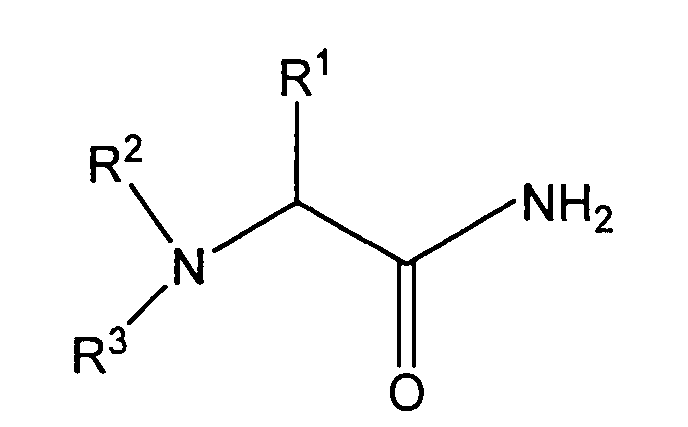
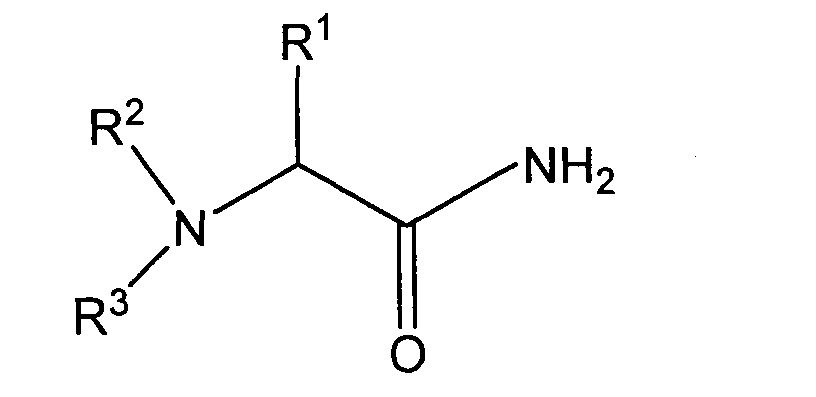
- the invention provides a process for preparing a stereoisomer of an amino acid amide having the structure: wherein R 1 is a normal or branched alkyl group having 1 to 10 carbon atoms, and R 2 and R 3 independently are hydrogen or a substituted or unsubstituted normal or branched alkyl group having 1 to 6 carbon atoms, or R 1 and R 2 , or R 2 and R 3 , and the nitrogen atom are members of a heterocyclic group having three to seven carbon atoms, the individual carbon atoms of the heterocyclic group independently being substituted or unsubstituted, comprising reacting an amino acid having the structure: wherein R 1 , R 2 , and R 3 are as described above, or an acid salt of the amino acid, with a halogenating agent or with a substance that reacts with carboxylic acids to form a leaving group to form an intermediate, and subsequently reacting the intermediate with ammonia.
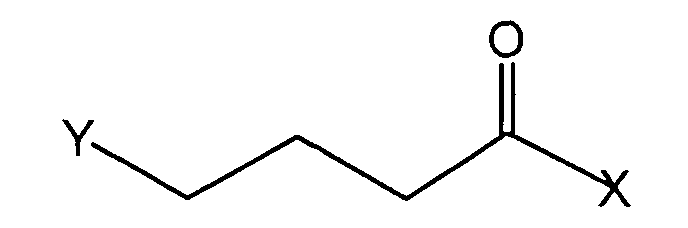
- the invention provides a process for preparing (-)-(S)- ⁇ -ethyl-2-oxo-1-pyrrolidineacetamide, comprising reacting (S)-2-aminobutyramide hydrochloride with a compound having the structure: wherein X is Cl, Br, I, or another carboxylic acid activating group and Y is Cl, Br, I, mesyl, tosyl, and the like.
- the invention provides a process for preparing (-)-(S)- ⁇ -ethyl-2-oxo-1-pyrrolidineacetamide, comprising reacting (S)-2-aminobutyric acid hydrochloride with thionyl chloride to form an intermediate, reacting the intermediate with ammonia to form (S)-2-aminobutyramide hydrochloride, and reacting the (S)-2-aminobutyramide hydrochloride with 4-chlorobutyryl chloride.
- the present invention includes a process for preparing amino acid amides, or amides of acid salts of amino acids, comprising reacting an amino acid or acid salt with a halogenating agent, or with a substance that reacts with carboxylic acids to form a leaving group, to form an intermediate, then reacting the intermediate with ammonia.
- the amino acid or amino acid salt is enantiomerically pure, the amide is a stereoisomer.
- the invention includes a process for preparing amino acid amides having the structure: where: R 1 represents a normal or branched alkyl group having 1 to 10 carbon atoms, a substituted or unsubstituted aryl or cycloalkyl group, or a saturated or unsaturated cyclic group having a heteroatom which is N, O, or S in the ring; and R 2 and R 3 independently represent hydrogen or a substituted or unsubstituted normal or branched alkyl group having 1 to 10 carbon atoms, or R 1 and R 2 , or R 2 and R 3 , and the nitrogen atom are members of a heterocyclic group having three to seven carbon atoms, the individual carbon atoms of the heterocyclic group independently being substituted or unsubstituted.
- R 1 , R 2 , and R 3 groups independently include, without limitation thereto, alkyl groups having 1 to about 6 carbon atoms, halogen, and the like, or either -OR or -OCOR, where R is hydrogen, alkyl having 1 to 10 carbon atoms, aryl, arylalkyl, or heteraromatic.
- the amino acid amides are prepared by reacting an amino acid having the structure: wherein R 1 , R 2 , and R 3 are as described above, or an acid salt of the amino acid, with a halogenating agent such as thionyl chloride, phosphorus pentachloride, or oxalyl chloride, or by forming a leaving group on the carboxylic acid function of the amino acid such as by forming an anhydride or ester derivative by known methods, to form an intermediate, then reacting the intermediate with ammonia.
- a halogenating agent such as thionyl chloride, phosphorus pentachloride, or oxalyl chloride
- Amine hydrochlorides or other acid salts can also be used as starting materials for the reaction.
- the reactions can prepare (S)-2-aminobutyramide hydrochloride, an intermediate in the process discussed below for preparing levetiracetam.
- the intermediate that forms from the reaction of the amino acid or amino acid salt with the halogenating agent or leaving group precursor does not always have to be isolated before commencing the subsequent reaction with ammonia, providing a processing advantage.
- the invention includes a process for preparing levetiracetam, comprising reacting (S)-2-aminobutyramide hydrochloride with a compound having the structure: where X is a carboxylic acid activating group, and Y is Cl, Br, I, mesyl, tosyl, and the like.
- This process is exemplified by the scheme depicted in Fig. 1, where levetiracetam is formed from the reaction between (S)-2-aminobutyramide hydrochloride and 4-chlorobutyryl chloride.
- the isolation of 2-Aminobutyric acid methyl ester hydrochloride is optional, prior to its further reaction with ammonia.
- carboxylic acid activating group includes, in addition to the halides Cl, Br, and I, a mixed anhydride formed by reaction with reagents such as ethyl chloroformate, isobutylchloroformate, etc., an activated ester such as is formed by reaction with p -nitrophenol, pentafluorophenol, etc., or an adduct with a carbodiimide derivative such as dicyclohexylcarbodiimide, etc.
- This carboxylic acid activation is the same as is commonly used for peptide bond formation.
- the compound (S)-2-aminobutyramide hydrochloride is prepared by dissolving 50 grams of (S)-2-aminobutyric acid hydrochloride in 100 mL of methanol, and adding 28.7 mL of thionyl chloride while maintaining the reaction mixture temperature below about 55°C, then stirring until the reaction is complete. A vacuum is applied and maintained until the methanol has been distilled from the mixture. Isopropanol is then added, followed by the introduction of ammonia gas at a pressure about 60 psi (413 kPa) until the reaction is complete. After filtering to remove formed ammonium chloride, the solvent is partially evaporated and isopropanol hydrochloride is added. The mixture is stirred while solid product forms, then the solid is separated by filtration and washed with isopropanol.
- L-threonine amide hydrochloride is prepared by the dropwise addition of 1.5 equivalents of thionyl chloride to a solution of 50 grams L-threonine in methanol, then heating the mixture to reflux. When reaction is complete, as shown by periodic TLC analysis, the reaction mixture is cooled and concentrated under vacuum. Isopropanol is added and the solvent is evaporated under vacuum to remove residual thionyl chloride, then additional isopropanol is added to increase the volume about two to four times.
- the reaction mixture is placed into an autoclave and stirred as ammonia gas is introduced to a final pressure of 50-60 psi (345-415 kPa), and stirring continues as the reaction progresses.
- the mixture is removed from the autoclave and filtered to remove solids, then concentrated under vacuum to about 100 mL.
- About 1.5 equivalents of isopropanol hydrochloride are added dropwise at room temperature, then the solid product is separated by filtration, washed with isopropanol and dried.
- the product is characterized by the following 1 H NMR data (200 MHz, DMSO-d 6 ): 1.1-1.2(d,3H), 3.3-3.4(s.OH), 3.5-3.6(d,1H), 3.9-4.1(sextet, 1H), 5.5-5.7(d,NH 2 ), 7.6-7.8(s,1 NH), 8.0-8.1(s,1 NH).
- L-prolinamide hydrochloride is prepared, starting with L-proline.
- the product is characterized by the following 1 H NMR data (200 MHz, DMSO-d 6 ): 1.9-2.0(quintet,2H), 2.1-2.3(pentet,2H), 3.1-3.3(t,2H), 4.1-4.2(dd,1H), 7.6-7.8(Br,NH), 8.0-8.1(Br,NH), 8.9-9.8(Br,NH 2 ).
- L-4-hydroxy-prolinamide hydrochloride is prepared, starting with L-4-hydroxyproline.
- the product is characterized by the following 1 H NMR data (200 MHz, DMSO-d 6 ): 2.1-2.2(dd,2H), 2.6-2.7(d,2H), 3.5-3.7(t,1 H), 4.2-4.4(m.1H), 5.7-5.8(s,OH), 7.6-7.7(s,NH), 8.1-8.2(s,NH), 9.1-9.6(Br,NH).
- the compound (-)-(S)- ⁇ -ethyl-2-oxo-1-pyrrolidineacetamide is prepared by suspending 50 grams of (S)-2-aminobutyramide hydrochloride in 500 mL of dichloromethane at room temperature, then cooling to temperatures between -5 and 0°C and adding 81.2 grams of potassium hydroxide and 23.3 grams of tetrabutylammonium bromide at those temperatures. A 66.4 gram amount of 4-chlorobutyryl chloride is added at the same temperatures. After completion of the reaction, solids are removed by filtration, the solution is adjusted to pH 7-7.5 with acetic acid, and dichloromethane is partially evaporated by the application of a vacuum.
Landscapes
- Chemical & Material Sciences (AREA)
- Organic Chemistry (AREA)
- Chemical Kinetics & Catalysis (AREA)
- Pharmaceuticals Containing Other Organic And Inorganic Compounds (AREA)
- Pyrrole Compounds (AREA)
Abstract
Description
- The present invention relates in one aspect to a process for preparing amino acid amides, a representative of which is useful as an intermediate for preparing the drug compound levetiracetam.
- Levetiracetam is a drug that is useful for treating disorders of the nervous system, such as epilepsy, and has the chemical name (-)-(S)-a-ethyl-2-oxo-1-pyrrolidine acetamide, the formula C8H14N2O2, and the molecular weight 170.21. The current pharmaceutical products containing this drug are sold by UCB Pharma using the tradename KEPPRA, in the forms of tablets and a flavored liquid.
- A preparation of levetiracetam is described in examples of U.S. Patents 4,696,943, 4,837,223 and 4,943,639 to Gobert et al. These examples all begin with racemic a-ethyl-2-oxo-1-pyrrolidine acetamide that was described in British Patent No. 1,309,692 as 2-(2-oxo-pyrrolidino)-butyramide; this patent provides methods for preparing several related compounds.
- There is a need for an improved process to prepare amino acid amide compounds, particularly processes that directly synthesize desired stereoisomers of the compounds.
- The invention includes a process for making amino acid amides, comprising reacting an amino acid, or acid salt of an amino acid, with a halogenating agent, or with a substance that reacts with carboxylic acids to form a leaving group, to form an intermediate, then reacting the intermediate with ammonia. When the amino acid or acid salt is enantiomerically pure, the amide will be a stereoisomer.
- In one aspect, the invention provides a process for preparing a stereoisomer of an amino acid amide having the structure:wherein R1 is a normal or branched alkyl group having 1 to 10 carbon atoms, and R2 and R3 independently are hydrogen or a substituted or unsubstituted normal or branched alkyl group having 1 to 6 carbon atoms, or R1 and R2, or R2 and R3, and the nitrogen atom are members of a heterocyclic group having three to seven carbon atoms, the individual carbon atoms of the heterocyclic group independently being substituted or unsubstituted, comprising reacting an amino acid having the structure:
 wherein R1, R2, and R3 are as described above, or an acid salt of the amino acid, with a halogenating agent or with a substance that reacts with carboxylic acids to form a leaving group to form an intermediate, and subsequently reacting the intermediate with ammonia.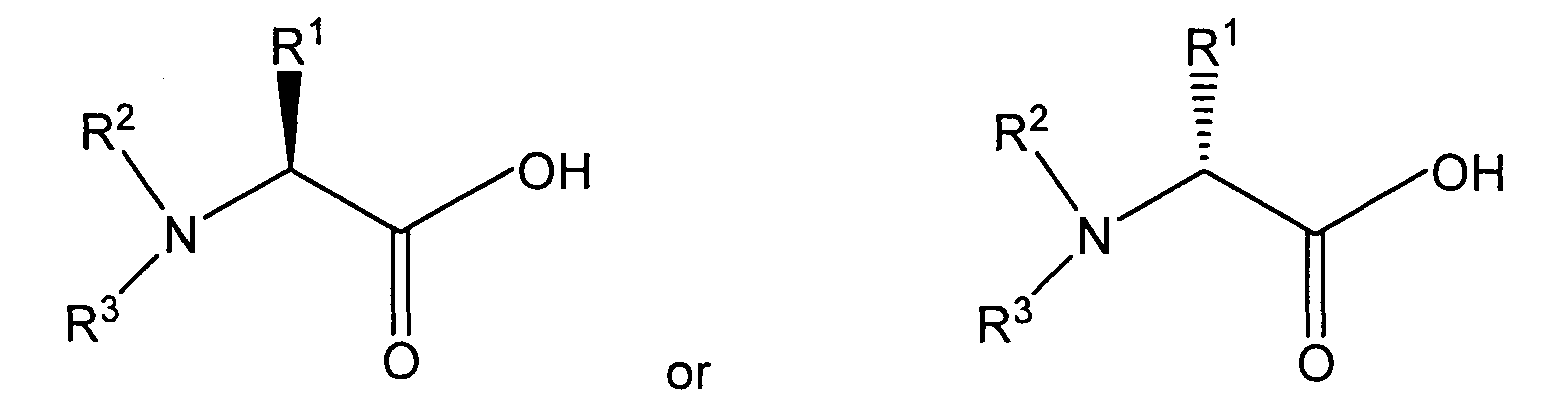
- In another aspect, the invention provides a process for preparing (-)-(S)-α-ethyl-2-oxo-1-pyrrolidineacetamide, comprising reacting (S)-2-aminobutyramide hydrochloride with a compound having the structure:wherein X is Cl, Br, I, or another carboxylic acid activating group and Y is Cl, Br, I, mesyl, tosyl, and the like.
- In a further aspect, the invention provides a process for preparing (-)-(S)-α-ethyl-2-oxo-1-pyrrolidineacetamide, comprising reacting (S)-2-aminobutyric acid hydrochloride with thionyl chloride to form an intermediate, reacting the intermediate with ammonia to form (S)-2-aminobutyramide hydrochloride, and reacting the (S)-2-aminobutyramide hydrochloride with 4-chlorobutyryl chloride.
-
- Fig. 1 is a schematic representation of a process for preparing levetiracetam.
-
- The present invention includes a process for preparing amino acid amides, or amides of acid salts of amino acids, comprising reacting an amino acid or acid salt with a halogenating agent, or with a substance that reacts with carboxylic acids to form a leaving group, to form an intermediate, then reacting the intermediate with ammonia. When the amino acid or amino acid salt is enantiomerically pure, the amide is a stereoisomer.
- In one aspect, the invention includes a process for preparing amino acid amides having the structure:where: R1 represents a normal or branched alkyl group having 1 to 10 carbon atoms, a substituted or unsubstituted aryl or cycloalkyl group, or a saturated or unsaturated cyclic group having a heteroatom which is N, O, or S in the ring; and R2 and R3 independently represent hydrogen or a substituted or unsubstituted normal or branched alkyl group having 1 to 10 carbon atoms, or R1 and R2, or R2 and R3, and the nitrogen atom are members of a heterocyclic group having three to seven carbon atoms, the individual carbon atoms of the heterocyclic group independently being substituted or unsubstituted. Substituents on the R1, R2, and R3 groups, or a heterocyclic group of which they are included, independently include, without limitation thereto, alkyl groups having 1 to about 6 carbon atoms, halogen, and the like, or either -OR or -OCOR, where R is hydrogen, alkyl having 1 to 10 carbon atoms, aryl, arylalkyl, or heteraromatic.

- The amino acid amides are prepared by reacting an amino acid having the structure:wherein R1, R2, and R3 are as described above, or an acid salt of the amino acid, with a halogenating agent such as thionyl chloride, phosphorus pentachloride, or oxalyl chloride, or by forming a leaving group on the carboxylic acid function of the amino acid such as by forming an anhydride or ester derivative by known methods, to form an intermediate, then reacting the intermediate with ammonia.

- Amine hydrochlorides or other acid salts can also be used as starting materials for the reaction. Starting with the amino acid salt (S)-2-aminobutyric acid hydrochloride, the reactions can prepare (S)-2-aminobutyramide hydrochloride, an intermediate in the process discussed below for preparing levetiracetam.
- The intermediate that forms from the reaction of the amino acid or amino acid salt with the halogenating agent or leaving group precursor does not always have to be isolated before commencing the subsequent reaction with ammonia, providing a processing advantage.
- In another aspect, the invention includes a process for preparing levetiracetam, comprising reacting (S)-2-aminobutyramide hydrochloride with a compound having the structure:where X is a carboxylic acid activating group, and Y is Cl, Br, I, mesyl, tosyl, and the like. This process is exemplified by the scheme depicted in Fig. 1, where levetiracetam is formed from the reaction between (S)-2-aminobutyramide hydrochloride and 4-chlorobutyryl chloride. In this scheme, the isolation of 2-Aminobutyric acid methyl ester hydrochloride is optional, prior to its further reaction with ammonia.
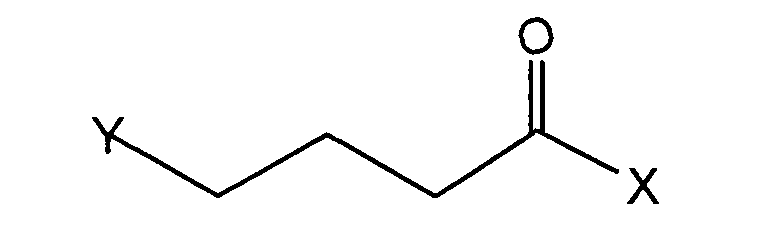
- The term "carboxylic acid activating group" includes, in addition to the halides Cl, Br, and I, a mixed anhydride formed by reaction with reagents such as ethyl chloroformate, isobutylchloroformate, etc., an activated ester such as is formed by reaction with p-nitrophenol, pentafluorophenol, etc., or an adduct with a carbodiimide derivative such as dicyclohexylcarbodiimide, etc. This carboxylic acid activation is the same as is commonly used for peptide bond formation.
- The invention is further illustrated by the following examples, which show only certain aspects and are not to be construed as limiting the invention defined by the appended claims.
- The compound (S)-2-aminobutyramide hydrochloride is prepared by dissolving 50 grams of (S)-2-aminobutyric acid hydrochloride in 100 mL of methanol, and adding 28.7 mL of thionyl chloride while maintaining the reaction mixture temperature below about 55°C, then stirring until the reaction is complete. A vacuum is applied and maintained until the methanol has been distilled from the mixture. Isopropanol is then added, followed by the introduction of ammonia gas at a pressure about 60 psi (413 kPa) until the reaction is complete. After filtering to remove formed ammonium chloride, the solvent is partially evaporated and isopropanol hydrochloride is added. The mixture is stirred while solid product forms, then the solid is separated by filtration and washed with isopropanol.
- The product was characterized by the following 1H NMR data (200 MHz, DMSO-d6): 0.9-1.0(t,3H), 1.8-1.9(Q,2H), 3.7-3.8(t, 1H), 7.5-7.7(Br,NH2), 8.0-8.2(Br,NH2)
- L-threonine amide hydrochloride is prepared by the dropwise addition of 1.5 equivalents of thionyl chloride to a solution of 50 grams L-threonine in methanol, then heating the mixture to reflux. When reaction is complete, as shown by periodic TLC analysis, the reaction mixture is cooled and concentrated under vacuum. Isopropanol is added and the solvent is evaporated under vacuum to remove residual thionyl chloride, then additional isopropanol is added to increase the volume about two to four times.
- The reaction mixture is placed into an autoclave and stirred as ammonia gas is introduced to a final pressure of 50-60 psi (345-415 kPa), and stirring continues as the reaction progresses. After completion of the reaction, as shown by TLC analysis, the mixture is removed from the autoclave and filtered to remove solids, then concentrated under vacuum to about 100 mL. About 1.5 equivalents of isopropanol hydrochloride are added dropwise at room temperature, then the solid product is separated by filtration, washed with isopropanol and dried.
- The product is characterized by the following 1H NMR data (200 MHz, DMSO-d6): 1.1-1.2(d,3H), 3.3-3.4(s.OH), 3.5-3.6(d,1H), 3.9-4.1(sextet, 1H), 5.5-5.7(d,NH2), 7.6-7.8(s,1 NH), 8.0-8.1(s,1 NH).
- Using the general procedure of preceding Example 2, L-prolinamide hydrochloride is prepared, starting with L-proline. The product is characterized by the following 1H NMR data (200 MHz, DMSO-d6): 1.9-2.0(quintet,2H), 2.1-2.3(pentet,2H), 3.1-3.3(t,2H), 4.1-4.2(dd,1H), 7.6-7.8(Br,NH), 8.0-8.1(Br,NH), 8.9-9.8(Br,NH2).
- Using the general procedure of preceding Example 2, L-4-hydroxy-prolinamide hydrochloride is prepared, starting with L-4-hydroxyproline. The product is characterized by the following 1H NMR data (200 MHz, DMSO-d6): 2.1-2.2(dd,2H), 2.6-2.7(d,2H), 3.5-3.7(t,1 H), 4.2-4.4(m.1H), 5.7-5.8(s,OH), 7.6-7.7(s,NH), 8.1-8.2(s,NH), 9.1-9.6(Br,NH).
- The compound (-)-(S)-α-ethyl-2-oxo-1-pyrrolidineacetamide is prepared by suspending 50 grams of (S)-2-aminobutyramide hydrochloride in 500 mL of dichloromethane at room temperature, then cooling to temperatures between -5 and 0°C and adding 81.2 grams of potassium hydroxide and 23.3 grams of tetrabutylammonium bromide at those temperatures. A 66.4 gram amount of 4-chlorobutyryl chloride is added at the same temperatures. After completion of the reaction, solids are removed by filtration, the solution is adjusted to pH 7-7.5 with acetic acid, and dichloromethane is partially evaporated by the application of a vacuum. 150 mL of ethyl acetate are added to precipitate the product, which is isolated by filtration and washed with ethyl acetate and then with acetone; the product has a chiral purity of 99.8 percent by high performance liquid chromatography. The final product is purified by recrystallization from ethyl acetate, giving a yield of 60-65 percent.
Claims (10)
- A process for preparing an amino acid amide or an amide of an acid salt of an amino acid, comprising reacting an amino acid or acid salt with a halogenating agent, or with a substance that reacts with carboxylic acids to form a leaving group, to form an intermediate, then reacting the intermediate with ammonia.
- The process of claim 1, wherein the amino acid or acid salt is enantiomerically pure, and the amide is a stereoisomer.
- The process of either of claims 1 or 2, wherein the leaving group is a halogen.
- The process of either of claims 1 or 2, wherein the halogenating agent is thionyl chloride, phosphorus pentachloride, or oxalyl chloride.
- A process for preparing a stereoisomer of an amino acid amide having the structure:wherein R1 is a normal or branched alkyl group having 1 to 10 carbon atoms, and R2 and R3 independently are hydrogen or a substituted or unsubstituted normal or branched alkyl group having 1 to 6 carbon atoms, or R1 and R2, or R2 and R3, and the nitrogen atom form a heterocyclic group having three to seven carbon atoms, the individual carbon atoms of the heterocyclic group independently being substituted or unsubstituted, comprising reacting an amino acid having the structure:
 wherein R1, R2, and R3 are as described above, or an acid salt thereof, with a halogenating agent or with a substance that reacts with carboxylic acids to form a leaving group to form an intermediate, and subsequently reacting the intermediate with ammonia.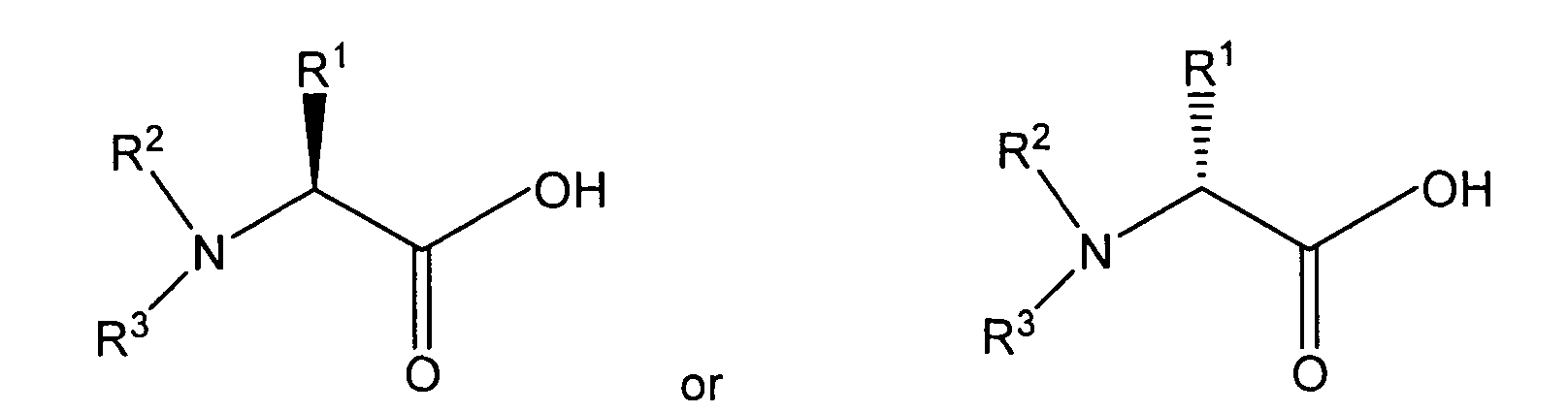
- The process of claim 5, wherein the leaving group is a halogen.
- The process of either of claims 5 or 6, wherein the halogenating agent is thionyl chloride, phosphorus pentachloride, or oxalyl chloride.
- A process for preparing (-)-(S)-α-ethyl-2-oxo-1-pyrrolidineacetamide, comprising reacting (S)-2-aminobutyramide hydrochloride with a compound having the structure:wherein X is a carboxylic activating group and Y is Cl, Br, I, mesyl, or tosyl.

- The process of claim 8, wherein the carboxylic activating group is Cl, Br, or I.
- A process for preparing (-)-(S)-α-ethyl-2-oxo-1-pyrrolidineacetamide, comprising reacting (S)-2-aminobutyric acid hydrochloride with thionyl chloride to form an intermediate, reacting the intermediate with ammonia to form (S)-2-aminobutyramide hydrochloride, and reacting the (S)-2-aminobutyramide hydrochloride with 4-chlorobutyryl chloride.
Applications Claiming Priority (2)
| Application Number | Priority Date | Filing Date | Title |
|---|---|---|---|
| US54542804P | 2004-02-18 | 2004-02-18 | |
| US545428P | 2004-02-18 |
Publications (1)
| Publication Number | Publication Date |
|---|---|
| EP1566376A1 true EP1566376A1 (en) | 2005-08-24 |
Family
ID=34710270
Family Applications (1)
| Application Number | Title | Priority Date | Filing Date |
|---|---|---|---|
| EP05250901A Withdrawn EP1566376A1 (en) | 2004-02-18 | 2005-02-17 | Preparation of amino acid amides |
Country Status (3)
| Country | Link |
|---|---|
| US (1) | US7531673B2 (en) |
| EP (1) | EP1566376A1 (en) |
| CA (1) | CA2497062A1 (en) |
Cited By (13)
| Publication number | Priority date | Publication date | Assignee | Title |
|---|---|---|---|---|
| WO2006090265A3 (en) * | 2005-02-28 | 2006-10-19 | Ranbaxy Lab Ltd | Processes for the preparation of levetiracetam, its intermediate and the use of levetiracetam in pharmaceutical compositions |
| EP2147911A1 (en) | 2008-07-24 | 2010-01-27 | ZaCh System S.p.A. | Process for the preparation of levetiracetam |
| US7939676B2 (en) | 2009-09-17 | 2011-05-10 | Zach System S.P.A. | Process for the preparation of levetiracetam |
| CN102180823A (en) * | 2011-03-12 | 2011-09-14 | 浙江华海药业股份有限公司 | Method for refining prolinamide |
| CN102633675A (en) * | 2012-04-10 | 2012-08-15 | 南京大学 | Method for preparing DL-2-amino butyrylamide |
| CN102898324A (en) * | 2012-10-19 | 2013-01-30 | 阜新龙瑞化工有限责任公司 | Method for preparing (S)-2-aminobutanamide hydrochloride |
| CN103012190A (en) * | 2012-12-05 | 2013-04-03 | 江苏拜克新材料有限公司 | Synthesis method of S-2-aminobutanamide hydrochloride |
| CN104860863A (en) * | 2015-04-10 | 2015-08-26 | 惠州信立泰药业有限公司 | High-purity levetiracetam and pharmaceutical composition comprising high-purity levetiracetam |
| CN105272898A (en) * | 2014-06-09 | 2016-01-27 | 重庆圣华曦药业股份有限公司 | Novel method for preparing levetiracetam |
| CN105646265A (en) * | 2016-01-25 | 2016-06-08 | 江苏中邦制药有限公司 | Method for synthesizing (S)-2-aminobutanamide |
| CN106187801A (en) * | 2016-07-20 | 2016-12-07 | 南通雅本化学有限公司 | A kind of processing technique of L 2 amino-butanamide hydrochloride |
| CN109134341A (en) * | 2018-09-19 | 2019-01-04 | 黑龙江珍宝岛药业股份有限公司 | A kind of preparation method of Levetiracetam |
| CN112195203A (en) * | 2020-11-10 | 2021-01-08 | 江苏八巨药业有限公司 | Method for synthesizing (S) -2-aminobutanamide by enzyme method |
Families Citing this family (9)
| Publication number | Priority date | Publication date | Assignee | Title |
|---|---|---|---|---|
| EP2051696A2 (en) * | 2006-08-18 | 2009-04-29 | Morton Grove Pharmaceuticals, Inc. | Stable liquid levetiracetam compositions and methods |
| WO2008077035A2 (en) * | 2006-12-18 | 2008-06-26 | Dr. Reddy's Laboratories Ltd. | Processes for the preparation of levetiracetam |
| WO2009050735A1 (en) * | 2007-10-15 | 2009-04-23 | Lupin Limited | A novel polymorph of levetiracetam and a process for its preparation |
| CN102884179A (en) | 2010-02-26 | 2013-01-16 | 加利福尼亚大学董事会 | Compositions and methods for preparing L-homoalanine |
| CN102675181B (en) * | 2012-06-07 | 2013-11-20 | 北京师宏药物研制中心 | Preparation method of levetiracetam |
| CN103045667A (en) * | 2012-11-19 | 2013-04-17 | 姚强 | Preparation method of S-(+)-2-aminobutanamide hydrochloride |
| CN103896820B (en) * | 2014-03-21 | 2019-03-01 | 浙江华海药业股份有限公司 | A method of purifying L- prolineamide |
| CN106187809A (en) * | 2016-07-20 | 2016-12-07 | 南通雅本化学有限公司 | A kind of synthesis technique of levetiracetam intermediate |
| CN112321476A (en) * | 2020-11-10 | 2021-02-05 | 江苏八巨药业有限公司 | Preparation method of levetiracetam |
Citations (4)
| Publication number | Priority date | Publication date | Assignee | Title |
|---|---|---|---|---|
| GB1246141A (en) * | 1967-09-14 | 1971-09-15 | Paul Coirre | Improvements in or relating to -hydroxylproline derivatives |
| GB1309692A (en) | 1970-02-13 | 1973-03-14 | Ucb Sa | N-substituted lactams |
| GB1555890A (en) * | 1976-08-05 | 1979-11-14 | Synthelabo | Optically active n substituted pyrrolidines |
| EP0162036A1 (en) | 1984-05-15 | 1985-11-21 | U C B, S.A. | (S)-alpha-ethyl-2-oxo-1-pyrrolidinacetamide |
Family Cites Families (1)
| Publication number | Priority date | Publication date | Assignee | Title |
|---|---|---|---|---|
| CN1802352A (en) * | 2003-02-03 | 2006-07-12 | 特瓦制药工业有限公司 | Process for preparing levetiracetam |
-
2005
- 2005-02-16 CA CA002497062A patent/CA2497062A1/en not_active Abandoned
- 2005-02-16 US US11/058,835 patent/US7531673B2/en not_active Expired - Fee Related
- 2005-02-17 EP EP05250901A patent/EP1566376A1/en not_active Withdrawn
Patent Citations (7)
| Publication number | Priority date | Publication date | Assignee | Title |
|---|---|---|---|---|
| GB1246141A (en) * | 1967-09-14 | 1971-09-15 | Paul Coirre | Improvements in or relating to -hydroxylproline derivatives |
| GB1309692A (en) | 1970-02-13 | 1973-03-14 | Ucb Sa | N-substituted lactams |
| GB1555890A (en) * | 1976-08-05 | 1979-11-14 | Synthelabo | Optically active n substituted pyrrolidines |
| EP0162036A1 (en) | 1984-05-15 | 1985-11-21 | U C B, S.A. | (S)-alpha-ethyl-2-oxo-1-pyrrolidinacetamide |
| US4696943A (en) | 1984-05-15 | 1987-09-29 | U C B Societe Anonyme | (S)-alpha-ethyl-2-oxo-1-pyrrolidineacetamide |
| US4837223A (en) | 1984-05-15 | 1989-06-06 | Ucb Societe Anonyme | (S)-alpha-ethyl-2-oxo-1-pyrrolidineacetamide compositions |
| US4943639A (en) | 1984-05-15 | 1990-07-24 | U C B Societe Anonyme | (S)-alpha-ethyl-2-oxo-1-pyrrolidineacetamide |
Non-Patent Citations (5)
| Title |
|---|
| ANGIER R.B. ET AL.: "Pteroic acid derivatives. VI. Unequivocal syntheses of some isomeric glutamic acid peptides.", JOURNAL OF THE AMERICAN CHEMICAL SOCIETY., vol. 72, no. 1, 1950, USAMERICAN CHEMICAL SOCIETY, WASHINGTON, DC., pages 74 - 77, XP002329817 * |
| APPEL R. ET AL.: "Dichlortris(dimethylamino)phosphoran als Dehydratisierungsreagenz zur Darstellung von N-geschützten Aminosäureamiden", CHEMISCHE BERICHTE., vol. 116, no. 5, 1983, DEVERLAG CHEMIE GMBH. WEINHEIM., pages 2037 - 2040, XP002329816 * |
| HARTKE K ET AL: "Dithio and thiono esters. Part 61. Synthesis of.alpha.-amino dithioesters and endothiodipeptides", JOURNAL FUR PRAKTISCHE CHEMIE, CHEMIKER ZEITUNG, WILEY VCH, WEINHEIM, DE, vol. 338, no. 3, 1996, pages 251 - 256, XP002109908, ISSN: 1436-9966 * |
| LOOKER J H ET AL: "1,2,3-Thiadiazoles as potential antineoplastic agents. I. Synthesis of novel 4-monosubstituted and 4,5-disubstituted derivatives (1,2)", JOURNAL OF HETEROCYCLIC CHEMISTRY, HETEROCORPORATION. PROVO, US, vol. 2, no. 4, 1965, pages 348 - 354, XP002314287, ISSN: 0022-152X * |
| SCHNELL S. ET AL.: "Die Konfiguration der optisch aktiven Propylendiamine, 2-Methyl-4,5-diaminopentane und alpha-Pyrrolidyl-methylamine", HELVETICA CHIMICA ACTA., vol. 38, no. 7, 1955, CHVERLAG HELVETICA CHIMICA ACTA. BASEL., pages 2036 - 2037, XP002329818 * |
Cited By (18)
| Publication number | Priority date | Publication date | Assignee | Title |
|---|---|---|---|---|
| WO2006090265A3 (en) * | 2005-02-28 | 2006-10-19 | Ranbaxy Lab Ltd | Processes for the preparation of levetiracetam, its intermediate and the use of levetiracetam in pharmaceutical compositions |
| EP2147911A1 (en) | 2008-07-24 | 2010-01-27 | ZaCh System S.p.A. | Process for the preparation of levetiracetam |
| US7939676B2 (en) | 2009-09-17 | 2011-05-10 | Zach System S.P.A. | Process for the preparation of levetiracetam |
| CN102180823A (en) * | 2011-03-12 | 2011-09-14 | 浙江华海药业股份有限公司 | Method for refining prolinamide |
| CN102180823B (en) * | 2011-03-12 | 2016-03-02 | 浙江华海药业股份有限公司 | A kind of method of refining prolinamide |
| CN102633675A (en) * | 2012-04-10 | 2012-08-15 | 南京大学 | Method for preparing DL-2-amino butyrylamide |
| CN102898324A (en) * | 2012-10-19 | 2013-01-30 | 阜新龙瑞化工有限责任公司 | Method for preparing (S)-2-aminobutanamide hydrochloride |
| CN103012190A (en) * | 2012-12-05 | 2013-04-03 | 江苏拜克新材料有限公司 | Synthesis method of S-2-aminobutanamide hydrochloride |
| CN103012190B (en) * | 2012-12-05 | 2015-03-18 | 江苏拜克新材料有限公司 | Synthesis method of S-2-aminobutanamide hydrochloride |
| CN105272898B (en) * | 2014-06-09 | 2018-01-19 | 重庆圣华曦药业股份有限公司 | A kind of method for preparing Levetiracetam |
| CN105272898A (en) * | 2014-06-09 | 2016-01-27 | 重庆圣华曦药业股份有限公司 | Novel method for preparing levetiracetam |
| CN104860863A (en) * | 2015-04-10 | 2015-08-26 | 惠州信立泰药业有限公司 | High-purity levetiracetam and pharmaceutical composition comprising high-purity levetiracetam |
| CN104860863B (en) * | 2015-04-10 | 2017-06-20 | 惠州信立泰药业有限公司 | Levetiracetam and the pharmaceutical composition containing it |
| CN105646265A (en) * | 2016-01-25 | 2016-06-08 | 江苏中邦制药有限公司 | Method for synthesizing (S)-2-aminobutanamide |
| CN106187801A (en) * | 2016-07-20 | 2016-12-07 | 南通雅本化学有限公司 | A kind of processing technique of L 2 amino-butanamide hydrochloride |
| CN109134341A (en) * | 2018-09-19 | 2019-01-04 | 黑龙江珍宝岛药业股份有限公司 | A kind of preparation method of Levetiracetam |
| CN112195203A (en) * | 2020-11-10 | 2021-01-08 | 江苏八巨药业有限公司 | Method for synthesizing (S) -2-aminobutanamide by enzyme method |
| CN112195203B (en) * | 2020-11-10 | 2022-07-26 | 江苏八巨药业有限公司 | Method for synthesizing (S) -2-aminobutanamide by enzyme method |
Also Published As
| Publication number | Publication date |
|---|---|
| US20050182262A1 (en) | 2005-08-18 |
| CA2497062A1 (en) | 2005-08-18 |
| US7531673B2 (en) | 2009-05-12 |
Similar Documents
| Publication | Publication Date | Title |
|---|---|---|
| US7531673B2 (en) | Preparation of amino acid amides | |
| US20240383920A1 (en) | Synthesis of ras inhibitors | |
| CN110590635A (en) | Preparation method of levetiracetam and intermediate thereof | |
| CN1020604C (en) | Process for preparation of (s)-alpha-ethyl-2-oxo-1-pyrrolidineacetamide | |
| AU761721B2 (en) | Method for producing enantiomer-free N-methyl-N- ((1S)-1-phenyl- 2-((3S)- 3-hydroxypyrrolidine- 1-yl)ethyl)- 2,2-diphenyl acetamide | |
| AU2014220865A1 (en) | Asymmetric synthesis of a substituted pyrrolidine-2-carboxamide | |
| US6797828B1 (en) | Processes for the preparation of 4(5)-amino-5(4)-carboxamidoimidazoles and intermediates thereof | |
| JPH0346460B2 (en) | ||
| JP3470902B2 (en) | Synthetic method of lysoferrin | |
| ZA200601262B (en) | Cycloakylaminoacid compounds, processes for making and uses thereof | |
| EP0331988A1 (en) | Sulfonium compounds, as well as process for producing active esters and amides used for the production of amides | |
| CN1143077A (en) | Method for preparing halogen acetamide derivative | |
| US5929242A (en) | Manufacture of levobupivacaine and analogues thereof from L-lysine | |
| JPH09124595A (en) | Optical resolving agent and method for producing optically active 3-aminopyrrolidine derivative using the same | |
| KR100743617B1 (en) | Process for the preparation of chiral 3-hydroxy pyrrolidine compound and derivatives thereof having high optical purity | |
| CN113582902B (en) | Preparation method of brivaracetam and its intermediates | |
| WO2006090265A2 (en) | Processes for the preparation of levetiracetam, its intermediate and the use of levetiracetam in pharmaceutical compositions | |
| JPH08245530A (en) | Production of optically active t-leucinol, production of 4-t-butyl-2-oxazolidinone, oxazoline, bicyclic lactam, mercaptophenyloxazoline, bis-oxacholine or bis(oxazolinyl) pyridine, method of asymmetrically synthesizing and producing medicine or active ingredient in plant protection,and novel compounds | |
| JPWO1998054132A1 (en) | Method for producing 3-(7-amidino-2-naphthyl)-2-phenylpropionic acid derivatives | |
| CN110835319B (en) | A kind of synthetic method of benazepril intermediate and benazepril hydrochloride | |
| RU2190597C2 (en) | Method of synthesis of antagonists of nmda (n-methyl-d-aspartate) | |
| WO1998035934A1 (en) | η-OXO-HOMOPHENYLALANINE DERIVATIVES AND PROCESS FOR PRODUCING HOMOPHENYLALANINE DERIVATIVES BY REDUCING THE SAME | |
| AU5479700A (en) | Process for preparing (-)-(1s,4r) n-protected 4-amino-2-cyclopentene-1-carboxylate esters | |
| CA2201779C (en) | The manufacture of levobupivacaine and analogues thereof from l-lysine | |
| JP3395594B2 (en) | Method for producing 2-piperazinecarboxylate |
Legal Events
| Date | Code | Title | Description |
|---|---|---|---|
| PUAI | Public reference made under article 153(3) epc to a published international application that has entered the european phase |
Free format text: ORIGINAL CODE: 0009012 |
|
| AK | Designated contracting states |
Kind code of ref document: A1 Designated state(s): AT BE BG CH CY CZ DE DK EE ES FI FR GB GR HU IE IS IT LI LT LU MC NL PL PT RO SE SI SK TR |
|
| AX | Request for extension of the european patent |
Extension state: AL BA HR LV MK YU |
|
| 17P | Request for examination filed |
Effective date: 20060223 |
|
| AKX | Designation fees paid |
Designated state(s): AT BE BG CH CY CZ DE DK EE ES FI FR GB GR HU IE IS IT LI LT LU MC NL PL PT RO SE SI SK TR |
|
| 17Q | First examination report despatched |
Effective date: 20060804 |
|
| 17Q | First examination report despatched |
Effective date: 20060804 |
|
| GRAP | Despatch of communication of intention to grant a patent |
Free format text: ORIGINAL CODE: EPIDOSNIGR1 |
|
| GRAC | Information related to communication of intention to grant a patent modified |
Free format text: ORIGINAL CODE: EPIDOSCIGR1 |
|
| STAA | Information on the status of an ep patent application or granted ep patent |
Free format text: STATUS: THE APPLICATION IS DEEMED TO BE WITHDRAWN |
|
| 18D | Application deemed to be withdrawn |
Effective date: 20111209 |