EP1565839B1 - Index server unterstützung für file sharing anwendungen - Google Patents
Index server unterstützung für file sharing anwendungen Download PDFInfo
- Publication number
- EP1565839B1 EP1565839B1 EP03769821.4A EP03769821A EP1565839B1 EP 1565839 B1 EP1565839 B1 EP 1565839B1 EP 03769821 A EP03769821 A EP 03769821A EP 1565839 B1 EP1565839 B1 EP 1565839B1
- Authority
- EP
- European Patent Office
- Prior art keywords
- index server
- index
- server
- originator
- request
- Prior art date
- Legal status (The legal status is an assumption and is not a legal conclusion. Google has not performed a legal analysis and makes no representation as to the accuracy of the status listed.)
- Expired - Lifetime
Links
Images

Classifications
-
- G—PHYSICS
- G06—COMPUTING OR CALCULATING; COUNTING
- G06F—ELECTRIC DIGITAL DATA PROCESSING
- G06F16/00—Information retrieval; Database structures therefor; File system structures therefor
- G06F16/10—File systems; File servers
- G06F16/18—File system types
- G06F16/182—Distributed file systems
- G06F16/1834—Distributed file systems implemented based on peer-to-peer networks, e.g. gnutella
Definitions
- the present invention relates to a method of providing index server support to a file sharing application, to an index server, to a method for retrieving an index server, to a client computer for performing a file sharing application, and to corresponding computer program products.
- File sharing is the means by end-users can pool storage in order to create a very large repository.
- An end-user computer device - i.e. in general an electronic device that provides storing capacity and network access - can serve as data server with all or part of its stored data to other end-user computer devices when performing a file sharing application. Simultaneously, such computer device can query for files from other end-user computer devices and therefore obtain access to a large data repository that is stored across the connected end-user computer devices.
- This file sharing architecture is therefore different to common client/server systems where only dedicated server computers provide data for access to computer clients.
- File sharing applications in general vary in the means by which users / computer devices learn of the location of a file and request its copy.
- a central index is kept on a central index server. This index indicates which users are currently active and what files they currently possess. The economies of scale that a file sharing application with such central index engenders are huge with regard to storage and bandwidth that have to be provided.
- an index can be distributed across multiple servers. Each server maintains an index that is part of the overall index. Sometimes, such index server has a reference which other index server to address to when it does not possess the relevant part of information itself.
- Such a link from one index server to another index server is not necessarily serving a quick file transfer since the known index server to address to for further information might be an index server located far away from the requesting index server and might provide information on clients that are also physically located in another part of the world than the requesting client. Even when such far remote index server might provide the requested information and provide a far remote client address that offers the queried file for download, such download would then a take long time and claim lots of network resources since requesting and serving client are located far from each other.
- US 5,941,956 discloses a network system, in which a plurality of computers are connected to a network at a plurality of connectors, and a plurality of address conversion devices are provided in correspondence to the connectors.
- each address conversion device a fixed address on the network corresponding to each address conversion device is stored while a computer address of one computer connected at one connector corresponding to each address conversion device is acquired and stored. Then, a source address contained in a message transmitted from that one computer to the network given in terms of the computer address is converted into the stored fixed address, while a destination address contained in a message transmitted from the network to that one computer given in terms of the fixed address is converted into the stored computer address.
- US Patent Application 2002/0133621 A1 discloses a method and system for accelerating receipt of data in a client network.
- the method includes the steps of intercepting queries and responses, storing the intercepted queries and responses in an acceleration server and transmitting the intercepted responses to clients submitting intercepted queries.
- the system includes at least one acceleration server designed and configured to perform the steps included in the method.
- Product announcement retrieved on the Internet http://www.itmcenter.com/vendors/radware.htm and accessed November 26, 2002 shows a Web server that manages intelligent load balancing and proximity-based geographic redirection for classical client/server network topologies. Network traffic might be redirected between sites according to network proximity and actual load.
- "Content delivery networks” by Mont Francisco retrieved on the Internet http://www.newarchitectmag.com/archives/2001/03/francisco/ and accessed November 26, 2002, describes a wide area traffic manager that directs content requests to the most appropriate location.
- a method of providing index server support to a file sharing application according to claim 1.
- Requests for investigating a hierarchical structure of index servers in a network are handled.
- An investigation request that is directed to a remote index server is intercepted.
- An originator of the investigation request is notified of the intercepting index server identity.
- File sharing applications typically enable computer devices to act as data or even services server and client.
- a computer device that is connected to other computer devices via a network offers a selection of files to other remote computer devices for download.
- this computer device is enabled to ask other computer devices for availability and download of files.
- clients of file sharing applications can now access data stored on other active clients without necessarily retrieving data from known data servers.
- Such file sharing is managed by an application.
- Known file sharing applications are for example Gnutella, etc..
- index servers installed across the network providing support for file querying clients.
- An index server typically maintains an index that provides information as to which information service or file can be retrieved on which client.
- An index might map one or more files to a file sharing client. It might map only files that are currently available for download.
- Currently available preferably indicates that a computer device not only has a file stored in its repository and grants access to this file, but is also currently active in order to have the respective file downloaded immediately.
- an index might also prepared to map file sharing clients to files or services.
- the index may generally provide information on "where to look for what". This kind of information may be structured or defined in a different way than the ones proposed.
- Different index servers might contain overlapping or partly redundant information. Indexes of different index server represent together an overall index including all information available
- index server typically provides only a selection of information in its index, for example which data files are available on a limited number of computer devices the index server is responsible for.
- Originator of such requests are preferably end-user computer devices that prefereably would like to investigate which index server to address to for further information when looking for a file.
- the index servers itself may establish smart support for future requests, for example by way of having all client's requests redirected to itself, even when they are addressed elsewhere.
- Originator of such a request may also be index servers that are looking for other index servers within the hierarchy of index servers, in particular for a child or for a parent index server.
- this index server forwards this client's request to another index server that possibly can provide the requested information.
- Destination of such initial investigation requests might be a well-known root index server that builds the top of an index server hierarchy, or might be another known index server, preferably a known central index server that is a high level index server in the index server hierarchy.
- An index server monitors network traffic it has access to. Whenever an investigation request is monitored that is not addressed to the monitoring index server but directed to another index server, this request is intercepted. Whenever such a message is detected it is a strong hint that the intercepting index server location is closer in terms of network hops to the request's originator than the destination of the investigation request, since in general messages such as the investigation request are transferred to the destination taking the shortest path across the network via routers, gateways and other network equipment.
- the originator of the intercepted request is extracted and a note is sent to this originator, thereby disclosing the identity of the intercepting index server. So, the originator of the investigation request is notified that there is another index server arranged between the originator and the destination.
- the intercepting index server discloses its identity to the originator of the investigation request preferably by way of communicating its own address.
- this address is connected to an index server name or other additional index server feature in order to make this index server unique and distinguishable from all other index servers the request's originator is aware of.
- the address of the intercepting index server is communicated to the request's originator but linked to the destination of the investigation request, e.g. to the name of a root index server. This process is called "masquerading". This enables the message's originator participating under this new communication protocol without having its software changed since future investigation requests as well as query or other requests can still be sent to the once determined root index server identity, which identity now is linked to the intercepting index server.
- the intercepted request is dropped by the intermediary index server and thus not forwarded to its destination.
- the intercepted request may be dropped before or after notifying the originator in response to the intercepted investigation request.
- a file sharing client can provoke a notification from a nearby index server that was not familiar to the client so far, but that might be an index server that is located closer or closest to the client and thus might be attractive to direct further request to in order to save file transfer time and network resources.
- the invention supports a very flexible installation or removal of index servers within a network at different locations since the hierarchical structure of index servers can be investigated whenever it is desired and requires little resources in form of a protocol implemented on an index server.
- the invention adds autonomy to file sharing applications since clients and index servers can self-organize which index server to best address. Index servers can self-manage to adapt to new network topology.
- the intercepted request is dropped and thus not forwarded to its destination. Then, the intercepting index server takes full control over the investigation message. Alternatively, the intercepted request might be forwarded to its destination. Then, requesting client could receive multiple replies to the investigation request when there are more index servers on the request's path to the destination. After having received identification messages from different index servers, the client can use other means to determine which is closest and / or can choose one of these fur further communication.
- not only the originator of the investigation request is notified of the intercepting index server identity but also the remote index server the investigation request is originally addressed to. This helps to make the remote index server become aware of the intercepting index server being a child index server.
- children index servers are at least one level below a parent index server.
- the intercepting index server's identity is preferably stored on the remote index server, e.g. for having further requests directed to the intercepting index server as a child index server.
- the remote index server may preferably send an investigation request to the intercepting index server in response to the notification. Such investigation request might help to disclose additional index servers that are located between the intercepting and the remote index server.
- the index server itself shows the behaviour described above for parent index servers.
- the index server registers a remote index server as child index server, when a note from the remote index server is received that discloses its identity as intercepting index server. This feature helps an index server become aware of the hierarchical level in its environment. In response to such notification, the index server prefers sending or forwarding future query requests or other requests to this registered child index server.
- investigation requests directed to remote index servers are intercepted, but also investigation requests are accepted that are directed "regularly" to the present index server as recipient. Since a most close index server is not always unknown to its clients or children or parent index servers, an investigation request does not necessarily provoke interception but might be transmitted to its destination regularly. In return, the receiving index server notifies the originator accordingly.
- the index server takes steps to investigate a parent index server. Accordingly, the index server sends an investigation request to a known index server and receives a notification in response to the request.
- the known index server is registered as a parent index server when the known index server is the originator of the received note.
- the originator of the received note can also be registered as parent index server when the originator of the received note is not the known index server, but an intercepting index server.
- a new investigation request is sent, now directed to the originator of the received note.
- a further notification is expected in response to this new investigation message and this further notification is evaluated.
- the originator of this further notification is registered as parent index server.
- the originator of this further note is not the addressee of the new investigation request but another intercepting index server, a new investigation request might be sent to this intercepting index server, and so on, as long as the most close index server is detected.
- the proposed way of investigating parental index server structures can also be applied in order to investigate child index server structures.
- An investigation request might then be addressed to a known low level index server or a known client in order to be intercepted by an index server that is passed if any one exists.
- Parent or child index server investigation is preferred to be started periodically - e.g. On a daily basis - since network topology might change and index servers may be added or removed.
- the proposed method and / or the corresponding index server preferably handles requests for querying a file as part of a file sharing application.
- an index of the index server is searched in order to find a registered client that can provide the queried file.
- this client address is returned to the querying client.
- the query is forwarded to a registered child index server.
- a corresponding request is transmitted to a registered child index server. This could satisfy the requesting client and provide a file from a nearby client that is registered with the addressed child index server since child index servers largely indicate proximity to the parent index server.
- the queried file When the queried file is not allocated to a client registered in the index the query is forwarded to a registered parent index server. Alternatively, a corresponding request is transmitted to a registered parent index server. This embodiment is preferred when the queried index server is not aware of any child index servers or when the search in child index servers failed.
- control logic is sending messages in order to manage requests. This has to be interpreted such that the control logic primarily decides on sending messages, while the physical transmission of messages is initiated by an interface that is controlled by the control logic or that is receiving messages from the control logic for forwarding.
- the index server can be implemented as a stand alone electronic device in one preferred embodiment.
- the index server has means to access a particular network line in order to intercept investigation requests in form of data packets.
- a filter unit as part of the index server could handle interception.
- the filter unit filters messages that indicate in one way or another that they are file sharing application related, for example by checking port fields of TCP messages.
- the filter unit might be embodied as packet filtering logic implemented on a network processor.
- the control unit might extract investigation requests of all filtered file sharing messages. The detection of investigation requests among other file sharing requests can also be implemented by the filter unit. Alternatively, investigation requests might be detected by means of the filter unit.
- the index server associated to a router can be a separate unit that receives or diverts network traffic - or even already filtered network traffic - from the router.
- the index server uses the router for access and low level communication (packet) handling.
- the functions of the index server indicated above can also be implemented together with router functions into one single index server / router unit. Connecting the index server to a router is advantageous since quick access is granted and packets are guided via routers from the originator to the destination largely on the shortest path, such that allocating the index server to a router is at least roughly determining index server's location between a client and another index server.
- FIG. 1 shows a schematic diagram of a network including index servers according to an embodiment of the present invention.
- FIG. 1 shows the established network including clients and index servers that are aware of hierarchical structures. The hierarchical structures are investigated according to FIG. 2 to 4 and corresponding specification.
- Clients C10 - C12, C20 - C22, C30 - C32 that can be realized as computer devices including mobile phones, PDAs, laptops, or other devices, are located "at the edge" of a network as it is typical for file sharing devices. They have access to the network but not only for retrieving data from Web servers but also for running file sharing applications that make files stored on other clients available and in return makes files stored on the depicted clients available to other clients "at the edge" of the network.
- Routers RT1 - RT6 are configured for forwarding traffic over the network to its destination.
- a root server R is introduced that hosts for example core information of the particular file sharing application.
- the root server address might be stored at a clients when a client accesses the root server for the first time, e.g. for downloading file sharing software in order to participate in the file sharing application.
- index servers I1 - I4 are provided, each of them coupled to a particular router RT2 to RT5. However, not every router - RT1 and RT6 - is coupled to an index server because index servers usually do not show router's density across a network.
- index server I1 the closest index server to clients C10, C11, C12 according to FIG. 1 is index server I1
- index server I2 the closest index server to clients C20, C21, C22 is index server I2
- an index server provides preferably information on clients and their sharable files that are most close.
- index server I1 for example preferably maintains an index including information on clients C10 - C12. Hence, the distribution of the index is strongly associated with the location where the corresponding files are resident.
- Index servers themselves are grouped into a hierarchy such that relative closeness within the hierarchy corresponds to network closeness.
- index server I1 If client C10 asks for a file in the network according to FIG. 1 , then first index server I1 is asked since client C10 is aware of index server I1 being the closest index server. If index server I1 does not find this file in its index - which means that none of the clients C11 or C12 provides this file - it will ask all its children index severs, that is index server I2 according to FIG. 1 . If the file is not found in the index of index server I2, then index server I1 asks its parent index server I4, which might forward the request to all its children index servers except I1 as requesting index server. This continues until the file is found, or the file is determined not to exist. When the file is found, the closest instance of the file is returned to client C10.
- FIG. 1 The way of self-organizing such closeness related hierarchy according to FIG. 1 is explained by means of FIG. 2 to 4 .
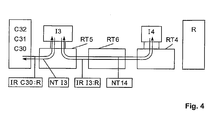
- FIG. 2, 3 , 4 each show a diagram showing a way of investigating hierarchical structures of index servers in the network according to FIG. 1 , in accordance with an embodiment of the present invention.
- Arrows used in these figures indicate messages that are sent across the network. Each arrow is labeled with a tag, indicating the type of message, followed by the originator of the message, and - after the colon - the addressee of a message.
- index server When a client is activated it tries to investigate the index server that is closest to its own location. Such index server can be detected by an investigation request that is directed to a known index server. An index server that is passed with this investigation request is probably at least closer to the client than the known index server.
- all index servers I1 - I4 according to FIG 1 . are provided with a control logic according to one aspect of the invention in order to intercept such investigation requests when being monitored.
- Client C10 is activated and sends an investigation request IR to root server R, which address is known to client C10.
- This investigation request IR is to provoke exclamations of index servers on the path to root index server R, and thus can be interpreted as message with the investigating content: "Who do I have to talk to when talking to root server R ?" or "How should I reach root server R ?”.
- This investigation request IR from client C10 is directed from router RT1 to router RT2 and transferred to index server I1 since traffic is diverted from router RT2 to index server I1.
- Index server I1 was not known to client C10 before.
- Index server I1 is intercepting the investigation request IR directed to root server R and drops the request.
- index server I1 sends a note NT to client C10, disclosing its identity.
- This note NT can also be interpreted having content: "In order to talk to root server R you have to talk to index server I1".
- Client C10 is storing this identity as index server to address to when looking for a file under this file sharing application.
- client C10 may issue a new investigation request to index server I1 in order to check if there are other index servers located between client C10 and index server I1. This might be the case when the investigation message to root client R took initially another path than a message addressed to a more local destination would do.
- Every client C10, C11, C12 is supposed to transmit an investigation request IR that is handled accordingly.
- Index server I1 investigates its parental index servers the same way.
- An investigation request IR is directed from index server I1 to known root index server R and intercepted by index server I4.
- Index server I4 drops the intercepted request and notifies index server I1 on its identity.
- Index server I1 might then direct a new separate investigation request to index server I4 for reasons mentioned above or might register index server I4 immediately as parent index server.
- FIG. 2 indicates a table in connection with index server I1, showing parent index servers Px listed - this is index server I4 - and showing no children index servers Cx listed since there are no children index servers so far.
- Index server I4 investigates its parental index servers the same way.
- An investigation request IR is directed from index server I4 to known root index server R. Since there is no intermediary index server between index server I4 and root index server R, index server R receives the investigation request without intercepting any network traffic but as regular addressee and sends back a notification NT to index server I4 approving its identity. Thus, index server I4 registers root index server R as parent index server in the corresponding index.
- Index server I4 is additionally aware of child index server I1, either from intercepting the investigation request sent by index server I1 or by a separate note from I1, indicated with an dotted line arrow in FIG. 2 . Index server I1 might also indicate its child index server presence to root index server R.
- the index servers will first investigate hierarchical structures, preferably on a periodical basis in order to take into account any modifications in the network state. Clients will investigate the most close index server after the client itself is activated or the file sharing application is activated on the client.
- FIG. 3 illustrates the way, clients C20 - C22 investigate their parent index server I2, while index server I2 detects index server I1 as parent index server.
- Index server I1 is already aware of parent index server I4 ( FIG. 2 ). Therefore there is no actual need to take further investigation steps for index server I1.
- FIG. 4 illustrates the way, clients C30 - C32 investigate their parent index server I3, while index server I3 is detecting index server I4 as parent index server.
- Index server I4 is already aware of root index server R ( FIG. 2 ). Therefore there is no actual need to take further investigation steps for index server I4.
- Redirection commands can be implemented using standard protocols such as OSPF or SNMP.
- OSPF operating protocol
- SNMP Network Address Translation
- the index server can itself forward all data packets and extract those that are relevant.
- the initialization protocol is preferred to be performed using UDP.
- the investigation request and the corresponding reply note are sent as UDP datagrams.
- index server may use HTTP/TCP, in which case an index server according to the present invention can intercept the TCP SYN message and create a TCP connection masquerading as the root index server to the client and then redirect the client, using a HTTP redirect to the index server's own address.
Landscapes
- Engineering & Computer Science (AREA)
- Theoretical Computer Science (AREA)
- Data Mining & Analysis (AREA)
- Databases & Information Systems (AREA)
- Physics & Mathematics (AREA)
- General Engineering & Computer Science (AREA)
- General Physics & Mathematics (AREA)
- Information Retrieval, Db Structures And Fs Structures Therefor (AREA)
- Computer And Data Communications (AREA)
Claims (13)
- Verfahren zum Bereitstellen von Index-Server-Unterstützung für eine Filesharing-Anwendung, wobei das Verfahren umfasst:• Verwalten von Anforderungen zum Ermitteln einer hierarchischen Struktur von Index-Servern (I1 bis 14) in einem Netzwerk zum Ermitteln des Index-Servers, der sich am nahesten zum Standort des Ausstellers einer Ermittlungsanforderung befindet, wobei das Verwalten beinhaltet• Abfangen der Ermittlungsanforderung, die an einen bekannten Index-Server gerichtet ist, wobei der Schritt des Abfangens von einem Router (RT2 bis RT 5) ausgeführt wird, der mit einem Index-Server (I1 bis I 4) verbunden ist,• Benachrichtigen eines Ausstellers der Ermittlungsanforderung von der Identität des Index-Servers (I1 bis 14), der mit dem abfangenden Router (RT2 bis RT5) verbunden ist, wobei der Schritt des Benachrichtigens von dem Index-Server ausgeführt wird.
- Verfahren nach Anspruch 1, das umfasst
Benachrichtigen des bekannten Index-Servers von der Identität des Index-Servers (I1 bis 14), der mit dem abfangenden Router (RT2 bis RT5) verbunden ist. - Verfahren nach Anspruch 1 oder 2, das umfasst• Annehmen einer Ermittlungsanforderung als Empfänger,• Benachrichtigen eines Ausstellers der Ermittlungsanforderung in Reaktion auf die Ermittlungsanforderung.
- Verfahren nach einem der vorhergehenden Ansprüche, das umfasst• Empfangen einer Nachricht von einem entfernten Index-Server (I1 -bis 14), der mit einem abfangenden Router (RT2 bis RT5) verbunden ist, wobei der Index-Server seine Identität offenlegt,• Registrieren des entfernten Index-Servers als Kind-Index-Server (I1 bis 14).
- Verfahren nach einem der vorhergehenden Ansprüche, das umfasst• Senden einer Ermittlungsanforderung an einen bekannten Index-Server (I1 bis 14),• Empfangen einer Benachrichtigung in Reaktion auf die Anforderung.
- Verfahren nach Anspruch 5, das umfasst
Registrieren des bekannten Index-Servers als ein Eltern-Index-Server, wenn es sich bei dem Aussteller der empfangenen Nachricht um den bekannten Index-Server (I1 bis 14) handelt. - Verfahren nach Anspruch 5 oder 6, das umfasst
Registrieren des Ausstellers der empfangenen Nachricht als ein Eltern-Index-Server (I1 bis 14), wenn es sich bei dem Aussteller der empfangenen Nachricht nicht um den bekannten Index-Server handelt. - Verfahren nach Anspruch 5 oder 6, das umfasst• Senden einer Ermittlungsanforderung an den Aussteller der Antwort, wenn es sich bei dem Aussteller der empfangenen Nachricht nicht um den bekannten Index-Server (I1 bis 14), sondern um einen anderen Index-Server handelt,• Empfangen einer weiteren Benachrichtigung in Reaktion auf diese weitere Ermittlungsnachricht.
- Verfahren nach Anspruch 8, das umfasst
Registrieren des Ausstellers der weiteren Benachrichtigung als ein Eltern-Index-Server (I1 bis 14). - Verfahren nach einem der vorhergehenden Ansprüche, das umfasst• Verwalten von Anforderungen zum Abrufen einer Datei als Teil einer Filesharing-Anwendung, wobei das Verwalten beinhaltet• Suchen eines Index des Index-Servers (I1 bis 14) nach einem registrierten Client (C10 bis C32), der die abgerufene Datei bereitstellen kann.
- Verfahren nach Anspruch 10, das umfasst
Weiterleiten der Abfrage an einen registrierten Kind-Index-Server, wenn die abgerufene Datei nicht an einen Client (C10 bis C32) zugeordnet wurde, der in dem Index registriert ist. - Verfahren nach Anspruch 10 oder 11, das umfasst
Weiterleiten der Abfrage an einen registrierten Eltern-Index-Server (I1 bis 14), wenn die angerufene Datei nicht an einen Client (C10 bis C32) zugeordnet wurde, der in dem Index registriert ist. - Verfahren zum Abrufen eines Index-Servers (I1 bis 14), wobei• eine Anforderung zum Ermitteln einer hierarchischen Struktur der Index-Server (I1 bis 14) in einem Netzwerk an einen bekannten Index-Server zum Ermitteln des Index-Servers gesendet wird, der sich am nahesten zum Standort des Ausstellers einer Ermittlungsanforderung befindet,• die Ermittlungsanforderung von einem Router (RT2 bis RT5) abgefangen wird, der mit dem Index-Server verbunden ist, der als erster von der Ermittlungsanforderung Kenntnis bekommt,• einem Aussteller der Ermittlungsanforderung von dem ersten Index-Server die Identität des Index-Servers (I1 bis 14) mitgeteilt wird, der mit dem abfangenden Router (RT2 bis RT5) verbunden ist,• die abgefangene Anforderung von dem ersten Index-Server verworfen wird, ohne sie an ihr Ziel weiterzuleiten, und• der Aussteller der Ermittlungsanforderung den ersten Index-Server als Adressat für Dateiabruf-Anforderungen registriert.
Priority Applications (1)
| Application Number | Priority Date | Filing Date | Title |
|---|---|---|---|
| EP03769821.4A EP1565839B1 (de) | 2002-11-29 | 2003-11-12 | Index server unterstützung für file sharing anwendungen |
Applications Claiming Priority (4)
| Application Number | Priority Date | Filing Date | Title |
|---|---|---|---|
| EP02026673 | 2002-11-29 | ||
| EP02026673 | 2002-11-29 | ||
| EP03769821.4A EP1565839B1 (de) | 2002-11-29 | 2003-11-12 | Index server unterstützung für file sharing anwendungen |
| PCT/IB2003/005137 WO2004051511A2 (en) | 2002-11-29 | 2003-11-12 | Index server support to file sharing applications |
Publications (2)
| Publication Number | Publication Date |
|---|---|
| EP1565839A2 EP1565839A2 (de) | 2005-08-24 |
| EP1565839B1 true EP1565839B1 (de) | 2015-03-25 |
Family
ID=32405683
Family Applications (1)
| Application Number | Title | Priority Date | Filing Date |
|---|---|---|---|
| EP03769821.4A Expired - Lifetime EP1565839B1 (de) | 2002-11-29 | 2003-11-12 | Index server unterstützung für file sharing anwendungen |
Country Status (6)
| Country | Link |
|---|---|
| US (2) | US20060149826A1 (de) |
| EP (1) | EP1565839B1 (de) |
| JP (1) | JP4437956B2 (de) |
| CN (1) | CN100580665C (de) |
| AU (1) | AU2003278521A1 (de) |
| WO (1) | WO2004051511A2 (de) |
Families Citing this family (16)
| Publication number | Priority date | Publication date | Assignee | Title |
|---|---|---|---|---|
| GB0414415D0 (en) * | 2004-06-28 | 2004-07-28 | Jeftel Ltd | Improvements relating to secure telecommunications |
| JP2006140790A (ja) * | 2004-11-12 | 2006-06-01 | Matsushita Electric Ind Co Ltd | 携帯電話装置及びそのファイル共有方法 |
| CN100561474C (zh) * | 2006-01-17 | 2009-11-18 | 鸿富锦精密工业(深圳)有限公司 | 远程多点文件索引同步系统及方法 |
| US8335776B2 (en) | 2008-07-02 | 2012-12-18 | Commvault Systems, Inc. | Distributed indexing system for data storage |
| US8304033B2 (en) * | 2009-02-04 | 2012-11-06 | Tel Epion Inc. | Method of irradiating substrate with gas cluster ion beam formed from multiple gas nozzles |
| US9158767B2 (en) | 2011-04-08 | 2015-10-13 | Microsoft Technology Licensing, Llc | Lock-free indexing of documents |
| US9185163B2 (en) | 2011-04-08 | 2015-11-10 | Microsoft Technology Licensing, Llc | Receiving individual documents to serve |
| US8990612B2 (en) | 2011-04-08 | 2015-03-24 | Microsoft Technology Licensing, Llc | Recovery of a document serving environment |
| US11983233B2 (en) | 2011-04-11 | 2024-05-14 | Viasat, Inc. | Browser based feedback for optimized web browsing |
| US9912718B1 (en) | 2011-04-11 | 2018-03-06 | Viasat, Inc. | Progressive prefetching |
| US8787570B2 (en) * | 2011-08-31 | 2014-07-22 | Sonic Ip, Inc. | Systems and methods for automatically genenrating top level index files |
| JP5863615B2 (ja) * | 2012-09-28 | 2016-02-16 | ジーイー・メディカル・システムズ・グローバル・テクノロジー・カンパニー・エルエルシー | 画像表示システム及び画像表示装置 |
| US10855797B2 (en) | 2014-06-03 | 2020-12-01 | Viasat, Inc. | Server-machine-driven hint generation for improved web page loading using client-machine-driven feedback |
| KR102012682B1 (ko) | 2015-01-06 | 2019-08-22 | 디브이엑스, 엘엘씨 | 디바이스들간에 콘텐트를 인코딩 및 공유하기 위한 시스템들 및 방법들 |
| WO2017069735A1 (en) * | 2015-10-20 | 2017-04-27 | Viasat, Inc. | Hint model updating using automated browsing clusters |
| US12360942B2 (en) | 2023-01-19 | 2025-07-15 | Commvault Systems, Inc. | Selection of a simulated archiving plan for a desired dataset |
Family Cites Families (15)
| Publication number | Priority date | Publication date | Assignee | Title |
|---|---|---|---|---|
| JPH07235929A (ja) | 1994-02-25 | 1995-09-05 | Nippon Telegr & Teleph Corp <Ntt> | 経路確認方法 |
| JP3454931B2 (ja) | 1994-08-30 | 2003-10-06 | 株式会社東芝 | ネットワークシステム |
| US6181867B1 (en) * | 1995-06-07 | 2001-01-30 | Intervu, Inc. | Video storage and retrieval system |
| US6205481B1 (en) * | 1998-03-17 | 2001-03-20 | Infolibria, Inc. | Protocol for distributing fresh content among networked cache servers |
| US6498795B1 (en) | 1998-11-18 | 2002-12-24 | Nec Usa Inc. | Method and apparatus for active information discovery and retrieval |
| US6374253B1 (en) * | 1998-12-30 | 2002-04-16 | Microsoft Corporation | System and method for generating hierarchical forward knowledge |
| US6983313B1 (en) | 1999-06-10 | 2006-01-03 | Nokia Corporation | Collaborative location server/system |
| US6567857B1 (en) * | 1999-07-29 | 2003-05-20 | Sun Microsystems, Inc. | Method and apparatus for dynamic proxy insertion in network traffic flow |
| WO2001075652A2 (en) * | 2000-03-31 | 2001-10-11 | Centerspan Communications Corp. | Media exchange system and process |
| JP2002073651A (ja) * | 2000-06-13 | 2002-03-12 | Canon Inc | データ管理システム、サーバ、データ管理方法 |
| US7725526B1 (en) * | 2000-06-23 | 2010-05-25 | International Business Machines Corporation | System and method for web based sharing of search engine queries |
| US7089301B1 (en) * | 2000-08-11 | 2006-08-08 | Napster, Inc. | System and method for searching peer-to-peer computer networks by selecting a computer based on at least a number of files shared by the computer |
| JP2002118568A (ja) | 2000-10-10 | 2002-04-19 | Kddi Research & Development Laboratories Inc | 分散サーバシステム |
| US7203741B2 (en) * | 2000-10-12 | 2007-04-10 | Peerapp Ltd. | Method and system for accelerating receipt of data in a client-to-client network |
| US20020062336A1 (en) * | 2000-11-22 | 2002-05-23 | Dan Teodosiu | Resource coherency among resources cached in a peer to peer environment |
-
2003
- 2003-11-12 EP EP03769821.4A patent/EP1565839B1/de not_active Expired - Lifetime
- 2003-11-12 WO PCT/IB2003/005137 patent/WO2004051511A2/en not_active Ceased
- 2003-11-12 JP JP2004556608A patent/JP4437956B2/ja not_active Expired - Fee Related
- 2003-11-12 CN CN200380100978A patent/CN100580665C/zh not_active Expired - Fee Related
- 2003-11-12 US US10/536,718 patent/US20060149826A1/en not_active Abandoned
- 2003-11-12 AU AU2003278521A patent/AU2003278521A1/en not_active Abandoned
-
2008
- 2008-07-01 US US12/166,068 patent/US8140645B2/en not_active Expired - Fee Related
Also Published As
| Publication number | Publication date |
|---|---|
| WO2004051511A3 (en) | 2004-12-16 |
| US20080275885A1 (en) | 2008-11-06 |
| WO2004051511A2 (en) | 2004-06-17 |
| AU2003278521A1 (en) | 2004-06-23 |
| US20060149826A1 (en) | 2006-07-06 |
| JP4437956B2 (ja) | 2010-03-24 |
| EP1565839A2 (de) | 2005-08-24 |
| JP2006508465A (ja) | 2006-03-09 |
| US8140645B2 (en) | 2012-03-20 |
| CN100580665C (zh) | 2010-01-13 |
| CN1703702A (zh) | 2005-11-30 |
Similar Documents
| Publication | Publication Date | Title |
|---|---|---|
| US8140645B2 (en) | Index server support to file sharing applications | |
| EP1561333B1 (de) | Steuerung von netzwerkverkehr in einer peer-to-peer umgebung | |
| Ramanathan et al. | Finding good peers in peer-to-peer networks | |
| JP4938074B2 (ja) | リソースの位置情報の要求方法、当該方法のためのユーザノードおよびサーバ | |
| CA2645274C (en) | Peer to peer gateway | |
| US20020004816A1 (en) | System and method for on-network storage services | |
| US20030101267A1 (en) | Peer-to-peer caching network | |
| US20090327312A1 (en) | Organizing resources into collections to facilitate more efficient and reliable resource access | |
| KR20020017926A (ko) | 주변 네트워크 인식 인터넷 컨텐츠 분산 배포 시스템 및그 제어 방법 | |
| US20060224670A1 (en) | File distribution method and client terminal implementing the same | |
| US20060007942A1 (en) | Method for finding resource and service in network and relay node apparatus | |
| AU5756000A (en) | Distributed virtual web cache implemented entirely in software | |
| EP1277327B1 (de) | Vorrichtung und verfahren mit url leitweglenkung in der netzwerkebene zur lokalisierung des nächstgelegenen servers mit spezifischen informationen | |
| Singh et al. | Resource-cardinality based scheme to reduce resource lookup cost in structured P2P networks | |
| JP2003036216A (ja) | Webシステム、ノード装置、ロケータ装置及びプログラム | |
| KR20040055502A (ko) | 커드 시스템을 이용한 분산 처리 환경에서의 검색 방법 |
Legal Events
| Date | Code | Title | Description |
|---|---|---|---|
| PUAI | Public reference made under article 153(3) epc to a published international application that has entered the european phase |
Free format text: ORIGINAL CODE: 0009012 |
|
| 17P | Request for examination filed |
Effective date: 20050520 |
|
| AK | Designated contracting states |
Kind code of ref document: A2 Designated state(s): AT BE BG CH CY CZ DE DK EE ES FI FR GB GR HU IE IT LI LU MC NL PT RO SE SI SK TR |
|
| AX | Request for extension of the european patent |
Extension state: AL LT LV MK |
|
| DAX | Request for extension of the european patent (deleted) | ||
| GRAP | Despatch of communication of intention to grant a patent |
Free format text: ORIGINAL CODE: EPIDOSNIGR1 |
|
| INTG | Intention to grant announced |
Effective date: 20141016 |
|
| GRAS | Grant fee paid |
Free format text: ORIGINAL CODE: EPIDOSNIGR3 |
|
| GRAA | (expected) grant |
Free format text: ORIGINAL CODE: 0009210 |
|
| AK | Designated contracting states |
Kind code of ref document: B1 Designated state(s): AT BE BG CH CY CZ DE DK EE ES FI FR GB GR HU IE IT LI LU MC NL PT RO SE SI SK TR |
|
| REG | Reference to a national code |
Ref country code: GB Ref legal event code: FG4D |
|
| REG | Reference to a national code |
Ref country code: CH Ref legal event code: EP |
|
| REG | Reference to a national code |
Ref country code: DE Ref legal event code: R084 Ref document number: 60347433 Country of ref document: DE |
|
| REG | Reference to a national code |
Ref country code: CH Ref legal event code: NV Representative=s name: IBM RESEARCH GMBH ZURICH RESEARCH LABORATORY I, CH |
|
| REG | Reference to a national code |
Ref country code: IE Ref legal event code: FG4D |
|
| REG | Reference to a national code |
Ref country code: DE Ref legal event code: R096 Ref document number: 60347433 Country of ref document: DE Effective date: 20150507 |
|
| REG | Reference to a national code |
Ref country code: AT Ref legal event code: REF Ref document number: 718237 Country of ref document: AT Kind code of ref document: T Effective date: 20150515 |
|
| REG | Reference to a national code |
Ref country code: GB Ref legal event code: 746 Effective date: 20150424 |
|
| REG | Reference to a national code |
Ref country code: DE Ref legal event code: R084 Ref document number: 60347433 Country of ref document: DE Effective date: 20150402 |
|
| PG25 | Lapsed in a contracting state [announced via postgrant information from national office to epo] |
Ref country code: FI Free format text: LAPSE BECAUSE OF FAILURE TO SUBMIT A TRANSLATION OF THE DESCRIPTION OR TO PAY THE FEE WITHIN THE PRESCRIBED TIME-LIMIT Effective date: 20150325 Ref country code: SE Free format text: LAPSE BECAUSE OF FAILURE TO SUBMIT A TRANSLATION OF THE DESCRIPTION OR TO PAY THE FEE WITHIN THE PRESCRIBED TIME-LIMIT Effective date: 20150325 |
|
| REG | Reference to a national code |
Ref country code: AT Ref legal event code: MK05 Ref document number: 718237 Country of ref document: AT Kind code of ref document: T Effective date: 20150325 |
|
| PG25 | Lapsed in a contracting state [announced via postgrant information from national office to epo] |
Ref country code: GR Free format text: LAPSE BECAUSE OF FAILURE TO SUBMIT A TRANSLATION OF THE DESCRIPTION OR TO PAY THE FEE WITHIN THE PRESCRIBED TIME-LIMIT Effective date: 20150626 |
|
| PG25 | Lapsed in a contracting state [announced via postgrant information from national office to epo] |
Ref country code: NL Free format text: LAPSE BECAUSE OF FAILURE TO SUBMIT A TRANSLATION OF THE DESCRIPTION OR TO PAY THE FEE WITHIN THE PRESCRIBED TIME-LIMIT Effective date: 20150325 |
|
| PG25 | Lapsed in a contracting state [announced via postgrant information from national office to epo] |
Ref country code: SK Free format text: LAPSE BECAUSE OF FAILURE TO SUBMIT A TRANSLATION OF THE DESCRIPTION OR TO PAY THE FEE WITHIN THE PRESCRIBED TIME-LIMIT Effective date: 20150325 Ref country code: EE Free format text: LAPSE BECAUSE OF FAILURE TO SUBMIT A TRANSLATION OF THE DESCRIPTION OR TO PAY THE FEE WITHIN THE PRESCRIBED TIME-LIMIT Effective date: 20150325 Ref country code: PT Free format text: LAPSE BECAUSE OF FAILURE TO SUBMIT A TRANSLATION OF THE DESCRIPTION OR TO PAY THE FEE WITHIN THE PRESCRIBED TIME-LIMIT Effective date: 20150727 Ref country code: ES Free format text: LAPSE BECAUSE OF FAILURE TO SUBMIT A TRANSLATION OF THE DESCRIPTION OR TO PAY THE FEE WITHIN THE PRESCRIBED TIME-LIMIT Effective date: 20150325 Ref country code: RO Free format text: LAPSE BECAUSE OF FAILURE TO SUBMIT A TRANSLATION OF THE DESCRIPTION OR TO PAY THE FEE WITHIN THE PRESCRIBED TIME-LIMIT Effective date: 20150325 Ref country code: CZ Free format text: LAPSE BECAUSE OF FAILURE TO SUBMIT A TRANSLATION OF THE DESCRIPTION OR TO PAY THE FEE WITHIN THE PRESCRIBED TIME-LIMIT Effective date: 20150325 |
|
| PG25 | Lapsed in a contracting state [announced via postgrant information from national office to epo] |
Ref country code: AT Free format text: LAPSE BECAUSE OF FAILURE TO SUBMIT A TRANSLATION OF THE DESCRIPTION OR TO PAY THE FEE WITHIN THE PRESCRIBED TIME-LIMIT Effective date: 20150325 |
|
| REG | Reference to a national code |
Ref country code: DE Ref legal event code: R097 Ref document number: 60347433 Country of ref document: DE |
|
| PG25 | Lapsed in a contracting state [announced via postgrant information from national office to epo] |
Ref country code: DK Free format text: LAPSE BECAUSE OF FAILURE TO SUBMIT A TRANSLATION OF THE DESCRIPTION OR TO PAY THE FEE WITHIN THE PRESCRIBED TIME-LIMIT Effective date: 20150325 |
|
| PLBE | No opposition filed within time limit |
Free format text: ORIGINAL CODE: 0009261 |
|
| STAA | Information on the status of an ep patent application or granted ep patent |
Free format text: STATUS: NO OPPOSITION FILED WITHIN TIME LIMIT |
|
| 26N | No opposition filed |
Effective date: 20160105 |
|
| PG25 | Lapsed in a contracting state [announced via postgrant information from national office to epo] |
Ref country code: IT Free format text: LAPSE BECAUSE OF FAILURE TO SUBMIT A TRANSLATION OF THE DESCRIPTION OR TO PAY THE FEE WITHIN THE PRESCRIBED TIME-LIMIT Effective date: 20150325 |
|
| PG25 | Lapsed in a contracting state [announced via postgrant information from national office to epo] |
Ref country code: SI Free format text: LAPSE BECAUSE OF FAILURE TO SUBMIT A TRANSLATION OF THE DESCRIPTION OR TO PAY THE FEE WITHIN THE PRESCRIBED TIME-LIMIT Effective date: 20150325 |
|
| PG25 | Lapsed in a contracting state [announced via postgrant information from national office to epo] |
Ref country code: MC Free format text: LAPSE BECAUSE OF FAILURE TO SUBMIT A TRANSLATION OF THE DESCRIPTION OR TO PAY THE FEE WITHIN THE PRESCRIBED TIME-LIMIT Effective date: 20150325 Ref country code: LU Free format text: LAPSE BECAUSE OF FAILURE TO SUBMIT A TRANSLATION OF THE DESCRIPTION OR TO PAY THE FEE WITHIN THE PRESCRIBED TIME-LIMIT Effective date: 20151112 |
|
| REG | Reference to a national code |
Ref country code: CH Ref legal event code: PL |
|
| PG25 | Lapsed in a contracting state [announced via postgrant information from national office to epo] |
Ref country code: CH Free format text: LAPSE BECAUSE OF NON-PAYMENT OF DUE FEES Effective date: 20151130 Ref country code: LI Free format text: LAPSE BECAUSE OF NON-PAYMENT OF DUE FEES Effective date: 20151130 |
|
| REG | Reference to a national code |
Ref country code: IE Ref legal event code: MM4A |
|
| REG | Reference to a national code |
Ref country code: FR Ref legal event code: ST Effective date: 20160729 |
|
| PG25 | Lapsed in a contracting state [announced via postgrant information from national office to epo] |
Ref country code: BE Free format text: LAPSE BECAUSE OF FAILURE TO SUBMIT A TRANSLATION OF THE DESCRIPTION OR TO PAY THE FEE WITHIN THE PRESCRIBED TIME-LIMIT Effective date: 20150325 |
|
| PG25 | Lapsed in a contracting state [announced via postgrant information from national office to epo] |
Ref country code: IE Free format text: LAPSE BECAUSE OF NON-PAYMENT OF DUE FEES Effective date: 20151112 |
|
| PG25 | Lapsed in a contracting state [announced via postgrant information from national office to epo] |
Ref country code: FR Free format text: LAPSE BECAUSE OF NON-PAYMENT OF DUE FEES Effective date: 20151130 |
|
| PG25 | Lapsed in a contracting state [announced via postgrant information from national office to epo] |
Ref country code: HU Free format text: LAPSE BECAUSE OF FAILURE TO SUBMIT A TRANSLATION OF THE DESCRIPTION OR TO PAY THE FEE WITHIN THE PRESCRIBED TIME-LIMIT; INVALID AB INITIO Effective date: 20031112 Ref country code: BG Free format text: LAPSE BECAUSE OF FAILURE TO SUBMIT A TRANSLATION OF THE DESCRIPTION OR TO PAY THE FEE WITHIN THE PRESCRIBED TIME-LIMIT Effective date: 20150325 |
|
| PG25 | Lapsed in a contracting state [announced via postgrant information from national office to epo] |
Ref country code: CY Free format text: LAPSE BECAUSE OF FAILURE TO SUBMIT A TRANSLATION OF THE DESCRIPTION OR TO PAY THE FEE WITHIN THE PRESCRIBED TIME-LIMIT Effective date: 20150325 |
|
| PG25 | Lapsed in a contracting state [announced via postgrant information from national office to epo] |
Ref country code: TR Free format text: LAPSE BECAUSE OF FAILURE TO SUBMIT A TRANSLATION OF THE DESCRIPTION OR TO PAY THE FEE WITHIN THE PRESCRIBED TIME-LIMIT Effective date: 20150325 |
|
| REG | Reference to a national code |
Ref country code: DE Ref legal event code: R079 Ref document number: 60347433 Country of ref document: DE Free format text: PREVIOUS MAIN CLASS: G06F0017300000 Ipc: G06F0016000000 |
|
| PGFP | Annual fee paid to national office [announced via postgrant information from national office to epo] |
Ref country code: DE Payment date: 20191108 Year of fee payment: 17 |
|
| REG | Reference to a national code |
Ref country code: DE Ref legal event code: R119 Ref document number: 60347433 Country of ref document: DE |
|
| PG25 | Lapsed in a contracting state [announced via postgrant information from national office to epo] |
Ref country code: DE Free format text: LAPSE BECAUSE OF NON-PAYMENT OF DUE FEES Effective date: 20210601 |
|
| PGFP | Annual fee paid to national office [announced via postgrant information from national office to epo] |
Ref country code: GB Payment date: 20221125 Year of fee payment: 20 |
|
| REG | Reference to a national code |
Ref country code: GB Ref legal event code: PE20 Expiry date: 20231111 |
|
| PG25 | Lapsed in a contracting state [announced via postgrant information from national office to epo] |
Ref country code: GB Free format text: LAPSE BECAUSE OF EXPIRATION OF PROTECTION Effective date: 20231111 |
|
| PG25 | Lapsed in a contracting state [announced via postgrant information from national office to epo] |
Ref country code: GB Free format text: LAPSE BECAUSE OF EXPIRATION OF PROTECTION Effective date: 20231111 |