EP1564937A2 - Rundfunkverfahren in einem WPAN Netzwerk - Google Patents
Rundfunkverfahren in einem WPAN Netzwerk Download PDFInfo
- Publication number
- EP1564937A2 EP1564937A2 EP05002173A EP05002173A EP1564937A2 EP 1564937 A2 EP1564937 A2 EP 1564937A2 EP 05002173 A EP05002173 A EP 05002173A EP 05002173 A EP05002173 A EP 05002173A EP 1564937 A2 EP1564937 A2 EP 1564937A2
- Authority
- EP
- European Patent Office
- Prior art keywords
- broadcast
- packet
- broadcast packet
- received
- neighbor nodes
- Prior art date
- Legal status (The legal status is an assumption and is not a legal conclusion. Google has not performed a legal analysis and makes no representation as to the accuracy of the status listed.)
- Granted
Links
Images


Classifications
-
- H—ELECTRICITY
- H04—ELECTRIC COMMUNICATION TECHNIQUE
- H04W—WIRELESS COMMUNICATION NETWORKS
- H04W88/00—Devices specially adapted for wireless communication networks, e.g. terminals, base stations or access point devices
- H04W88/02—Terminal devices
- H04W88/04—Terminal devices adapted for relaying to or from another terminal or user
-
- H—ELECTRICITY
- H04—ELECTRIC COMMUNICATION TECHNIQUE
- H04W—WIRELESS COMMUNICATION NETWORKS
- H04W28/00—Network traffic management; Network resource management
- H04W28/02—Traffic management, e.g. flow control or congestion control
- H04W28/06—Optimizing the usage of the radio link, e.g. header compression, information sizing, discarding information
-
- H—ELECTRICITY
- H04—ELECTRIC COMMUNICATION TECHNIQUE
- H04W—WIRELESS COMMUNICATION NETWORKS
- H04W28/00—Network traffic management; Network resource management
- H04W28/02—Traffic management, e.g. flow control or congestion control
- H04W28/10—Flow control between communication endpoints
- H04W28/14—Flow control between communication endpoints using intermediate storage
-
- H—ELECTRICITY
- H04—ELECTRIC COMMUNICATION TECHNIQUE
- H04W—WIRELESS COMMUNICATION NETWORKS
- H04W4/00—Services specially adapted for wireless communication networks; Facilities therefor
- H04W4/06—Selective distribution of broadcast services, e.g. multimedia broadcast multicast service [MBMS]; Services to user groups; One-way selective calling services
-
- H—ELECTRICITY
- H04—ELECTRIC COMMUNICATION TECHNIQUE
- H04W—WIRELESS COMMUNICATION NETWORKS
- H04W84/00—Network topologies
- H04W84/02—Hierarchically pre-organised networks, e.g. paging networks, cellular networks, WLAN [Wireless Local Area Network] or WLL [Wireless Local Loop]
- H04W84/10—Small scale networks; Flat hierarchical networks
Definitions
- the present invention generally relates to a broadcast method in a wireless network and a communication apparatus using the broadcast method. More particularly, the present invention relates to a broadcast method in a wireless network and a communication apparatus using the broadcast method, which are capable of efficiently broadcasting data by a link-based broadcast in a ZigBee network compliant to the IEEE 802.15.4 standard.
- a Personal Area Network In contrast to a Local Area Network (LAN) or a Wide Area Network (WAN), a Personal Area Network (PAN) is a network owned by an individual. Devices owned by the individual are interconnected to construct a network in order to provide convenience for the owner.
- the Institute of Electrical and Electronics Engineers, Inc. (IEEE) 802.15 Working Group developed the WPAN for short distance wireless networks to standardize and implement the PAN.
- the IEEE 802.15 standard has four Task Groups. More particularly, IEEE 802.15.1 standardizes the well-known Bluetooth technology, whereas IEEE 802.15.3 and IEEE 802.15.3a standardizes the high rate WPAN. Additionally, IEEE 802.15.4, alias ZigBee, standardizes low rate WPAN which corresponds to data rates less than 250 kbps.
- ZigBee One of the goals of ZigBee is to standardize the protocol stacks above a media access control (MAC) layer for wireless sensor networks. To this end, the current ZigBee specification supports reliable data broadcast at a network layer.
- a broadcast method specified in the ZigBee specification consists of three major parts, which include a network-wide broadcast, a local broadcast repair, and a limited radius broadcast.
- FIGS. 1 through 4 illustrate conventional broadcast methods according to the ZigBee specification. Referring now to FIGS. 1 through 4, the conventional broadcast methods of the ZigBee specification and drawbacks associated with the conventional broadcast methods are described below.
- FIG. 1 illustrates the network-wide broadcast mechanism in the ZigBee network which is specified in the ZigBee specification.
- the network-wide broadcast mechanism is a tree-based broadcast in which broadcast packets are only forwarded via a tree structure.
- the broadcast packet must be transmitted through its parent node in order to reach neighbor nodes because the broadcast packet is delivered only following the tree structure.
- transmission of the broadcast packet from node A to node B or node C, as shown in FIG. 1 requires six transmissions and relays following the tree structure.
- the broadcast packet can be delivered to node B or node C (of FIG. 1) via three or four nodes along links indicated as dotted lines in FIG. 1. Therefore, the transmission of the broadcast packets following the tree structure according to the ZigBee specification delays the delivery of the broadcast packets unnecessarily.
- FIG. 2 illustrates the local broadcast repair mechanism in the ZigBee network.
- the broadcast method of the ZigBee specification utilizes a parent and child relationship based on the tree structure. If a node loses contact with its parent node, a broadcast packet is not delivered farther. The local broadcast repair mechanism is used to repair the lost link in such a situation.
- the ZigBee specification specifies that a child node, which loses contact with its parent node, performs a local broadcast repair using a 'Lost Parent' bit in a packet control field included in a packet header.
- node F can receive a packet from a node, such as node G, via another branch of node C.
- the packet received from node G is not delivered from its parent or child node, the packet is discarded. As a result, the sub-tree under node B is not covered.
- FIG. 3 illustrates the limited radius broadcast mechanism used in a ZigBee network.
- a range to which a broadcast packet reaches can be set using a radius counter (RC) value.
- RC radius counter
- the RC value decreases by 1 every time the broadcast packet is retransmitted from each node. The broadcast packet is not retransmitted farther when the RC value becomes zero.
- an aspect of the present invention provides a link-based broadcast method in a wireless network.
- the broadcast method in a wireless network comprises the steps of receiving a broadcast packet, determining whether the broadcast packet is first received, storing the broadcast packet and rebroadcasting the broadcast packet to neighbor nodes when the broadcast packet is first received, and destroying the broadcast packet when the broadcast packet is not first received.
- the wireless network is a ZigBee network compliant to the IEEE 802.15.4 standard.
- the broadcast method further comprises marking a node, among the neighbor nodes, from which the broadcast packet is received as 'relayed', checking whether all of the neighbor nodes are marked as 'relayed' after a predetermined time, and rebroadcasting the broadcast packet when all of the neighbor nodes from which the broadcast packet is received are not marked as 'relayed'.
- the broadcast method further comprises the step of destroying the broadcast packet when all of the neighbor nodes from which the broadcast packet is received are marked as 'relayed'.
- a rebroadcast timer counts the predetermined time, thereby setting a rebroadcast time.
- the predetermined time may be set based on a link quality indicator (LQI) value of the received broadcast packet.
- LQI link quality indicator
- the rebroadcast step is repeated a number of times corresponding to a predetermined value at intervals of the predetermined time until all of the neighbor nodes relay the broadcast packet. Thus, unrestricted rebroadcast is prevented.
- the marking step sets a neighbor list corresponding to information relative to the neighbor nodes, and marks nodes listed in the neighbor list.
- the neighbor list is set using a bitmap based on an index of the listed neighbor nodes.
- the listed neighbor nodes are located within one hop from a broadcast source.
- the listed neighbor nodes are grouped based on a ZigBee address. and the grouped neighbor nodes are checked to determine whether the grouped neighbor nodes are marked as 'relayed'.
- a broadcast method in a wireless network comprises receiving a broadcast packet, determining whether a designated field in a header of the broadcast packet is set, rebroadcasting the broadcast packet according to a reliable broadcast method when the designated field is not set, and rebroadcasting the broadcast packet according to an unreliable broadcast method when the designated field is set.
- the wireless network mentioned above is a ZigBee network compliant to the IEEE 802.15.4 standard.
- the reliable broadcast method rebroadcasts the broadcast packet if the broadcast packet is first received, and rebroadcasts the broadcast packet after a predetermined time if there is a node, among the neighbor nodes, which does not relay the broadcast packet. If the packet is not first received, the reliable broadcast method destroys the broadcast packet.
- the unreliable broadcast method rebroadcasts the broadcast packet if the broadcast packet is first received, and destroys the broadcast packet if the broadcast packet is not first received.
- the designated field is a 'Lost Parent' field in a packet control field included in the header of the broadcast packet.
- a communication apparatus using a broadcast method in a wireless network comprises a means for receiving a broadcast packet, a means for determining whether the broadcast packet is first received, a means for storing and rebroadcasting the broadcast packet to neighbor nodes if the broadcast packet is first received, and a means for destroying the broadcast packet if the broadcast packet is not first received.
- the communication method further comprises a means for marking a node, among the neighbor nodes, from which the broadcast packet is received, as 'relayed', a means for checking whether all of the neighbor nodes are marked as 'relayed' after a predetermined time, and a means for rebroadcasting the broadcast packet if all of the neighbor nodes are not marked as 'relayed'.
- the communication apparatus further comprises a means for destroying the broadcast packet if all of the neighbor nodes are marked as 'relayed'.
- FIGS. 1 through 4 are diagrams of conventional broadcast methods according to a ZigBee specification
- FIGS. 5A and 5B are flowcharts of a broadcast method according to a first embodiment of the present invention.
- FIG. 6 is a diagram of an exemplary embodiment of a neighbor list
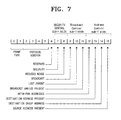
- FIG. 7 is a diagram of an exemplary embodiment of a packet control field.
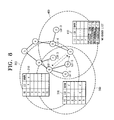
- FIG. 8 is a diagram illustrating that a neighbor list is built by grouping neighbor nodes.
- a broadcast method in a wireless network utilizes a link-based broadcast rather than a parent node and child node relationship which is based on a tree-based broadcast. Accordingly, the parent node and the child node relationship which is based on the tree structure are not the only nodes that can participate in the delivery of broadcast packets. In other words, all nodes can participate in the delivery of broadcast packets according to the broadcast method of the present invention.
- the broadcast method in the wireless network according to the present invention is primarily applied to a ZigBee network compliant to the IEEE 802.15.4 standard However, the broadcast method according the present invention is not limited to the ZigBee network. For instance, any network meeting the criteria corresponding to embodiments of the present invention may be employed.
- FIGS. 5A and 5B are flowcharts of the broadcast method in the wireless network according to a first embodiment of the present invention.
- a node linked to the wireless network receives a broadcast packet (S100), and the node determines whether the received packet is first received (S105).
- the first received packet denotes that the received packet is not the same as a previously received packet.
- a determination is made as to whether the packet is first received by checking the presence of packet information corresponding to the received packet in a broadcast transaction record (BTR) of a broadcast transaction table (BTT).
- BTR broadcast transaction record
- BTT broadcast transaction table
- a BTR corresponding to the received packet is created and stored in the BTT (S110).
- the BTR created corresponding to the received packet contains a source address and a broadcast sequence number (BCSN) of the packet.
- the received broadcast packet is stored in a buffer and a rebroadcast timer is set (S115).
- the rebroadcast timer is used to determine a rebroadcast time. Subsequently, the received packet is rebroadcast at step S120.
- each of the neighbor nodes in the neighbor list from which the broadcast packet is received are checked and marked as 'relayed', as shown in FIG. 6.
- the neighbor list organizes information relating to neighbor nodes within one hop from a broadcast source.
- a bitmap based on an index of each node is utilized. The length of the bitmap equals the number of neighbor nodes in the neighbor list.
- each of the neighbor nodes in the neighbor list from which the broadcast packet is received are checked and marked as 'relayed' when the source address of the received packet corresponds to the neighbor nodes in the neighbor list (S130). After the neighbor nodes in the neighbor list are marked as 'relayed' in step S130, the received packet is destroyed in step S140. As a result, the received broadcast packet is processed.
- the set rebroadcast timer expires after a predetermined time (S150)
- a Maximum Retransmission Limit parameter to count the number of times rebroadcast has occurred is increased (S180). If the Maximum Retransmission Limit parameter is below a predetermined value (S195), steps S150 through S180 are repeated. Accordingly, the number of the times rebroadcast may occur is limited to the predetermined value. As a result, unrestricted rebroadcast is not allowed.
- the packet stored in the buffer is cleared (S160) and the BTR is cleared (S165). In other words, the packet is destroyed when all of the neighbor nodes from which the packet is received are marked as 'relayed'. As a result, it is guaranteed that all the neighbor nodes receive the broadcast packet according to the link-based broadcast.
- a broadcast method selectively utilizes a reliable broadcast method and an unreliable and best-effort broadcast.
- an 'Unreliable Broadcast' field is newly defined, and the broadcast method is selected depending on whether the 'Unreliable Broadcast' field is set. For example, if the 'Unreliable Broadcast' field is not set, the broadcast method using the neighbor list according to the first embodiment of the present invention is used.
- the reliable broadcast method when the 'Unreliable Broadcast' field is not set, the reliable broadcast method rebroadcasts the broadcast packet if the broadcast packet is first received, and rebroadcasts the broadcast packet after a predetermined time if there is a node, among the neighbor nodes listed in the neighbor list, which does not relay the broadcast packet. If the packet is not first received, the reliable broadcast method destroys the broadcast packet On the contrary, if the 'Unreliable Broadcast' field is set, the broadcast packet is not forwarded according to the reliable method as in the first embodiment of the present invention. Instead, according to the unreliable broadcast method, the broadcast packet is forwarded if the packet is first received and the broadcast packet is destroyed if the broadcast packet is not first received. Additionally, when the 'Unreliable Broadcast' field is set, the creation of the BTR is maintained. However, marking of the corresponding neighbor node in the neighbor list as 'relayed' is not utilized.
- the 'Unreliable Broadcast' field can use a 'Lost Parent' field in a packet control field which is added into a header at a network layer.
- a 'Broadcast' bit, a 'Lost Parent' bit, and a 'Broadcast Radius Present' bit in the packet control field respectively relate to the network-wide broadcast, the local broadcast repair, and the limited radius broadcast of the ZigBee specification.
- broadcast method according to the exemplary embodiments of the present invention allows all nodes to participate in the forwarding of the broadcast packet. Thus, there is no need to utilize the local broadcast repair to find the link to the parent node. Accordingly, the 'Lost Parent' field can be used as the 'Unreliable Broadcast' field.
- a broadcast method selectively utilizes tree-based and link-based limited radius broadcasts.
- a 'Tree-based Broadcast' sub-field is added in the header of a packet control field.
- the 'Tree-based Broadcast' sub-field is not set, and the link-based limited radius broadcast according to the first embodiment of the present invention is utilized.
- the 'Tree-based Broadcast' sub-field is set, the tree-based limited radius broadcast is utilized according to the conventional broadcast methods of the ZigBee specification.
- FIG. 8 illustrates that a neighbor list is built by grouping neighbor nodes.
- the first to third neighbor lists 210, 310 and 410 are built for the first to third areas 200, 300 and 400, respectively.
- Nodes 6 and 7 are in the parent and child relationship in the first and second neighbor lists 210 and 310.
- Nodes 8, 9, and 10 are in the parent and child relationship in the third neighbor list 410.
- the received broadcast packet may be rebroadcast to nodes in an order corresponding to the distance away from the source node by setting a backoff value in proportion to a link quality indicator (LQI) value of the received broadcast packet.
- LQI link quality indicator
- each of the nodes linked to a wireless network can participate in the forwarding of the broadcast packet according to the link-based broadcast.
- the broadcast packet is delivered along the links, the broadcast packet is performed faster than the tree-based broadcast.
- the tree structure is not utilized according to the embodiments of the present invention, and therefore, the local broadcast repair mechanism to repair the tree structure is not needed.
- the link-based limited radius broadcast Since the link-based limited radius broadcast is utilized, it is possible to efficiently set the transmission range of the broadcast packet, and the RC value represents the actual limited hop.
- the rebroadcast time can be efficiently set by grouping the neighbor list by use of the ZigBee address, or, according to the LQI value.
Landscapes
- Engineering & Computer Science (AREA)
- Computer Networks & Wireless Communication (AREA)
- Signal Processing (AREA)
- Mobile Radio Communication Systems (AREA)
- Data Exchanges In Wide-Area Networks (AREA)
- Small-Scale Networks (AREA)
Applications Claiming Priority (4)
| Application Number | Priority Date | Filing Date | Title |
|---|---|---|---|
| US54422604P | 2004-02-13 | 2004-02-13 | |
| US544226P | 2004-02-13 | ||
| KR1020040084309A KR100645431B1 (ko) | 2004-02-13 | 2004-10-21 | 무선네트워크에서 브로드캐스트 방법 및 그 방법을사용하는 통신장치 |
| KR2004084309 | 2004-10-21 |
Publications (3)
| Publication Number | Publication Date |
|---|---|
| EP1564937A2 true EP1564937A2 (de) | 2005-08-17 |
| EP1564937A3 EP1564937A3 (de) | 2007-05-23 |
| EP1564937B1 EP1564937B1 (de) | 2012-12-12 |
Family
ID=34703465
Family Applications (1)
| Application Number | Title | Priority Date | Filing Date |
|---|---|---|---|
| EP20050002173 Expired - Lifetime EP1564937B1 (de) | 2004-02-13 | 2005-02-02 | Rundfunkverfahren in einem WPAN Netzwerk |
Country Status (2)
| Country | Link |
|---|---|
| EP (1) | EP1564937B1 (de) |
| JP (3) | JP3996930B2 (de) |
Cited By (2)
| Publication number | Priority date | Publication date | Assignee | Title |
|---|---|---|---|---|
| EP1978670A3 (de) * | 2007-04-03 | 2010-03-31 | Itt Manufacturing Enterprises, Inc. | Verfahren und Vorrichtung zum verlässlichen Rundsenden |
| EP2202942A1 (de) * | 2008-12-24 | 2010-06-30 | France Telecom | Verfahren zur Gruppenüberwachung |
Families Citing this family (4)
| Publication number | Priority date | Publication date | Assignee | Title |
|---|---|---|---|---|
| EP1564937B1 (de) * | 2004-02-13 | 2012-12-12 | Samsung Electronics Co., Ltd. | Rundfunkverfahren in einem WPAN Netzwerk |
| JP6256343B2 (ja) * | 2012-09-27 | 2018-01-10 | 日本電気株式会社 | ネットワーク、ネットワークノード、配信方法及びネットワークノード用プログラム |
| JP6325008B2 (ja) * | 2014-02-05 | 2018-05-16 | 株式会社日立製作所 | マルチホップ無線通信方法 |
| WO2018055685A1 (ja) * | 2016-09-21 | 2018-03-29 | 三菱電機株式会社 | 路側通信装置および車載通信装置 |
Citations (1)
| Publication number | Priority date | Publication date | Assignee | Title |
|---|---|---|---|---|
| EP1107508A1 (de) | 1999-12-06 | 2001-06-13 | Telefonaktiebolaget Lm Ericsson | System, Verfahren und Rechnerprogrammprodukt zum Empfangen von Rundschreibnachrichten |
Family Cites Families (9)
| Publication number | Priority date | Publication date | Assignee | Title |
|---|---|---|---|---|
| JPH02182050A (ja) * | 1989-01-06 | 1990-07-16 | Nec Corp | 複合ローカルエリアネットワークシステム |
| JPH0897821A (ja) * | 1994-09-21 | 1996-04-12 | Hitachi Ltd | 無線データ通信方法および装置ならびに無線データ通信システム |
| JPH10257074A (ja) * | 1997-01-10 | 1998-09-25 | Nippon Telegr & Teleph Corp <Ntt> | パケット通信方法及びその装置 |
| JP2001016264A (ja) * | 1999-06-30 | 2001-01-19 | Toshiba Corp | 無線通信システム、無線通信装置及び同報送信方法 |
| GB0124884D0 (en) * | 2001-03-20 | 2001-12-05 | Koninkl Philips Electronics Nv | Information system for travellers |
| WO2002076039A2 (en) * | 2001-03-20 | 2002-09-26 | Koninklijke Philips Electronics N.V. | Beacon update mechanism |
| JP4258698B2 (ja) * | 2001-03-21 | 2009-04-30 | 日本電気株式会社 | ブロードキャストシステムとそのブロードキャスト方法、及びブロードキャストプログラム |
| JP4281264B2 (ja) * | 2001-06-26 | 2009-06-17 | 富士電機システムズ株式会社 | ブロードキャスト通信方法、ブロードキャスト通信端末およびブロードキャスト通信システム |
| EP1564937B1 (de) * | 2004-02-13 | 2012-12-12 | Samsung Electronics Co., Ltd. | Rundfunkverfahren in einem WPAN Netzwerk |
-
2005
- 2005-02-02 EP EP20050002173 patent/EP1564937B1/de not_active Expired - Lifetime
- 2005-02-14 JP JP2005036611A patent/JP3996930B2/ja not_active Expired - Fee Related
-
2007
- 2007-05-11 JP JP2007126458A patent/JP4842207B2/ja not_active Expired - Fee Related
- 2007-05-11 JP JP2007126459A patent/JP2007288793A/ja active Pending
Patent Citations (1)
| Publication number | Priority date | Publication date | Assignee | Title |
|---|---|---|---|---|
| EP1107508A1 (de) | 1999-12-06 | 2001-06-13 | Telefonaktiebolaget Lm Ericsson | System, Verfahren und Rechnerprogrammprodukt zum Empfangen von Rundschreibnachrichten |
Non-Patent Citations (4)
| Title |
|---|
| CHUNHUI ZHU ET AL.: "A border-aware broadcast scheme for wireless ad hoc network", CONSUMER COMMUNICATIONS AND NETWORKING CONFERENCE; 2004. CCNC 2004. FIRST IEEE LAS VEGAS, NV, USA 5-8 JAN. 2004, PISCATAWAY, NJ, USA, IEEE, 5 January 2004 (2004-01-05), pages 134 - 139, XP032165196, DOI: doi:10.1109/CCNC.2004.1286846 |
| NI S-Y ET AL.: "THE BROADCAST STORM PROBLEM IN A MOBILE AD HOC NETWORK", MOBICOM '99. PROCEEDINGS OF THE 5 TH ANNUAL ACM/IEEE INTERNATIONAL CONFERENCE ON MOBILE COMPUTING AND NETWORKING. SEATTLE, WA, AUG. 15-20, 1999, ANNUAL ACM/IEEE INTERNATIONAL CONFERENCE ON MOBILE COMPUTING AND NETWORKING; NEW YORK, NY: AMC, US, vol. CONF. 5, 15 August 1999 (1999-08-15), pages 151 - 162 |
| TSENG Y-C ET AL.: "Adaptive Approaches to Relieving Broadcast Storms in a Wireless Multihop Mobile Ad Hoc Network", IEEE TRANSACTIONS ON COMPUTERS; IEEE SERVICE CENTER; LOS ALAMITOS; CA US, vol. 52, May 2003 (2003-05-01), pages 545 - 557, XP002349202, DOI: doi:10.1109/TC.2003.1197122 |
| WILLIAMS B ET AL.: "COMPARISON OF BROADCASTING TECHNIQUES FOR MOBILE AD HOC NETWORKS", MOBIHOC 2002. PROCEEDINGS OF THE 3RD. ACM INTERNATIONAL SYMPOSIUM ON MOBILE AD HOC NETWORKING AND COMPUTING: LAUSANNE; SWITZERLAND; JUNE, 9 June 2002 (2002-06-09), pages 194 - 205, XP002408065, DOI: doi:10.1145/513800.513825 |
Cited By (3)
| Publication number | Priority date | Publication date | Assignee | Title |
|---|---|---|---|---|
| EP1978670A3 (de) * | 2007-04-03 | 2010-03-31 | Itt Manufacturing Enterprises, Inc. | Verfahren und Vorrichtung zum verlässlichen Rundsenden |
| US7916666B2 (en) | 2007-04-03 | 2011-03-29 | Itt Manufacturing Enterprises, Inc. | Reliable broadcast protocol and apparatus for sensor networks |
| EP2202942A1 (de) * | 2008-12-24 | 2010-06-30 | France Telecom | Verfahren zur Gruppenüberwachung |
Also Published As
| Publication number | Publication date |
|---|---|
| JP2005229625A (ja) | 2005-08-25 |
| EP1564937A3 (de) | 2007-05-23 |
| JP2007288793A (ja) | 2007-11-01 |
| EP1564937B1 (de) | 2012-12-12 |
| JP2007295583A (ja) | 2007-11-08 |
| JP3996930B2 (ja) | 2007-10-24 |
| JP4842207B2 (ja) | 2011-12-21 |
Similar Documents
| Publication | Publication Date | Title |
|---|---|---|
| RU2449483C2 (ru) | Способ нахождения ad-нос маршрута вектора расстояния по требованию, имеющего, по меньшей мере, минимальный набор доступных ресурсов в распределенной сети беспроводной связи | |
| US7428232B2 (en) | Broadcast method in wireless network and communication apparatus using the same | |
| US8855115B2 (en) | Methods for reliable multicasting in local peer group (LPG) based vehicle ad hoc networks | |
| US7269147B2 (en) | Relaying broadcast packet in a mobile Ad-hoc network including flushing buffer if broadcast count number exceed buffer size | |
| US6928061B1 (en) | Transmission-scheduling coordination among collocated internet radios | |
| JP2004531971A5 (de) | ||
| US7310761B2 (en) | Apparatus and method for retransmitting data packets in mobile ad hoc network environment | |
| KR100664953B1 (ko) | 모바일 애드 혹 네트워크 환경에서의 멀티캐스트 라우팅방법 | |
| JP2007520924A (ja) | 多局ネットワーク用データ・トランスポート・プロトコル | |
| JP4264451B2 (ja) | 通信システム内でのルート発見の方法および装置 | |
| WO2005046137A1 (en) | Method and apparatus for route discovery within a communication system | |
| JP4842207B2 (ja) | 無線ネットワークにおけるブロードキャスト方法およびその方法を使用した通信装置 | |
| US20040105414A1 (en) | Multi-hop wireless network data forwarding | |
| KR20140075977A (ko) | 토폴로지 정보를 이용한 브로드캐스트 전송 방법 | |
| KR20080067253A (ko) | 무선 네트워크에서 통신방법, 스테이션의 통신방법 및스테이션 |
Legal Events
| Date | Code | Title | Description |
|---|---|---|---|
| PUAI | Public reference made under article 153(3) epc to a published international application that has entered the european phase |
Free format text: ORIGINAL CODE: 0009012 |
|
| 17P | Request for examination filed |
Effective date: 20050202 |
|
| AK | Designated contracting states |
Kind code of ref document: A2 Designated state(s): AT BE BG CH CY CZ DE DK EE ES FI FR GB GR HU IE IS IT LI LT LU MC NL PL PT RO SE SI SK TR |
|
| AX | Request for extension of the european patent |
Extension state: AL BA HR LV MK YU |
|
| PUAL | Search report despatched |
Free format text: ORIGINAL CODE: 0009013 |
|
| AK | Designated contracting states |
Kind code of ref document: A3 Designated state(s): AT BE BG CH CY CZ DE DK EE ES FI FR GB GR HU IE IS IT LI LT LU MC NL PL PT RO SE SI SK TR |
|
| AX | Request for extension of the european patent |
Extension state: AL BA HR LV MK YU |
|
| AKX | Designation fees paid |
Designated state(s): DE FR GB |
|
| 17Q | First examination report despatched |
Effective date: 20080702 |
|
| GRAP | Despatch of communication of intention to grant a patent |
Free format text: ORIGINAL CODE: EPIDOSNIGR1 |
|
| RAP1 | Party data changed (applicant data changed or rights of an application transferred) |
Owner name: SAMSUNG ELECTRONICS CO., LTD. Owner name: CITY UNIVERSITY OF NEW YORK (CUNY) |
|
| GRAS | Grant fee paid |
Free format text: ORIGINAL CODE: EPIDOSNIGR3 |
|
| GRAA | (expected) grant |
Free format text: ORIGINAL CODE: 0009210 |
|
| AK | Designated contracting states |
Kind code of ref document: B1 Designated state(s): DE FR GB |
|
| REG | Reference to a national code |
Ref country code: GB Ref legal event code: FG4D |
|
| REG | Reference to a national code |
Ref country code: DE Ref legal event code: R096 Ref document number: 602005037363 Country of ref document: DE Effective date: 20130207 |
|
| PLBE | No opposition filed within time limit |
Free format text: ORIGINAL CODE: 0009261 |
|
| STAA | Information on the status of an ep patent application or granted ep patent |
Free format text: STATUS: NO OPPOSITION FILED WITHIN TIME LIMIT |
|
| 26N | No opposition filed |
Effective date: 20130913 |
|
| REG | Reference to a national code |
Ref country code: FR Ref legal event code: ST Effective date: 20131031 |
|
| GBPC | Gb: european patent ceased through non-payment of renewal fee |
Effective date: 20130312 |
|
| REG | Reference to a national code |
Ref country code: DE Ref legal event code: R097 Ref document number: 602005037363 Country of ref document: DE Effective date: 20130913 |
|
| PG25 | Lapsed in a contracting state [announced via postgrant information from national office to epo] |
Ref country code: GB Free format text: LAPSE BECAUSE OF NON-PAYMENT OF DUE FEES Effective date: 20130312 Ref country code: FR Free format text: LAPSE BECAUSE OF NON-PAYMENT OF DUE FEES Effective date: 20130228 |
|
| PGFP | Annual fee paid to national office [announced via postgrant information from national office to epo] |
Ref country code: DE Payment date: 20231228 Year of fee payment: 20 |
|
| REG | Reference to a national code |
Ref country code: DE Ref legal event code: R071 Ref document number: 602005037363 Country of ref document: DE |