EP1564686A1 - Kollator und register - Google Patents
Kollator und register Download PDFInfo
- Publication number
- EP1564686A1 EP1564686A1 EP03715662A EP03715662A EP1564686A1 EP 1564686 A1 EP1564686 A1 EP 1564686A1 EP 03715662 A EP03715662 A EP 03715662A EP 03715662 A EP03715662 A EP 03715662A EP 1564686 A1 EP1564686 A1 EP 1564686A1
- Authority
- EP
- European Patent Office
- Prior art keywords
- personal information
- unit
- collation
- divided
- storage
- Prior art date
- Legal status (The legal status is an assumption and is not a legal conclusion. Google has not performed a legal analysis and makes no representation as to the accuracy of the status listed.)
- Withdrawn
Links
Images








Classifications
-
- G—PHYSICS
- G06—COMPUTING OR CALCULATING; COUNTING
- G06V—IMAGE OR VIDEO RECOGNITION OR UNDERSTANDING
- G06V40/00—Recognition of biometric, human-related or animal-related patterns in image or video data
- G06V40/10—Human or animal bodies, e.g. vehicle occupants or pedestrians; Body parts, e.g. hands
-
- G—PHYSICS
- G06—COMPUTING OR CALCULATING; COUNTING
- G06V—IMAGE OR VIDEO RECOGNITION OR UNDERSTANDING
- G06V10/00—Arrangements for image or video recognition or understanding
- G06V10/94—Hardware or software architectures specially adapted for image or video understanding
- G06V10/95—Hardware or software architectures specially adapted for image or video understanding structured as a network, e.g. client-server architectures
Definitions
- the present invention relates to a collator for collating submitted personal information with stored information in a storage apparatus in advance for confirming a person or persons.
- Collating techniques have been in development utilizing information for confirming a person, that is, multimedia information belonging to the person in an attempt to protect security and improve convenience of the user in diverse aspects of the information society.
- an identification collation is performed by registering multimedia information belonging to persons in a storage apparatus in advance, acquiring multimedia information belonging to a person as a subj ect of collation ("collation subject" hereinafter) at the time of such a need arising, and comparing with the registered multimedia information.
- Patent document 1 Japanese patent laid-open application publication 2001-67137
- the patent document 1 divides multimedia information belonging to a person into two parts by division ratio M and stores the divided information in different storage apparatuses.
- the patent document 1 offers a technique to store the divided information in two storage places only and limit the storage method such as a portable storage media on one hand and a storage apparatus equipped within a collator on the other. Furthermore, the technique requires merging the divided information at the time of using the divided information, hence consuming an extraneous time before a collation processing.
- a high precision collation needs to accompany a high processing speed.
- a 1:N collation for selecting a person from among many registrants consumes time in collation processing for collating with the multimedia information belonging to all the registrants.
- the data transmission volume in the information transmission path of a server-client type system configuration becomes large, hence imposing a heavy load on the network.
- the present invention provides an improvement of security, a high speed collation processing and a collator capable of alleviating load on the communication path for transmitting information for confirming a person or persons.
- a collator comprising at least one of a plurality of storage units divisionally storing personal information for confirming a person; an acquisition unit for acquiring personal information of a confirmation subject which is personal information belonging to the confirmation subject; and a collation unit for collating personal information of a confirmation subject acquired by the acquisition unit with the stored divided personal information acquired at a first storage unit from among the plurality of storage units, judging whether or not the next stage of collation will be performed based on the collation result and collating in the next stage by using the personal information acquired at a second storage unit from among the plurality of storage units, if the judgment calls for the next stage of collation.
- Such a configuration that is, by repeating collation stepwise with divisionally stored personal information for confirming a person in respective storage units, makes it difficult to restore pre-divided information for confirming a person from the divided information therefor.
- the above problem is also successfully challenged by providing a collator wherein the collation unit collates a characteristic of personal information of a confirmation subject acquired by the acquisition unit with a characteristic of the stored divided personal information acquired at a first storage unit from among the plurality of storage units and sets a degree of similarity for indicating a degree of accord in the characteristic.
- Such a configuration enables a judgment as to whether or not a collation processing in the next stage is called for based on the degree of similarity, and therefore the average time required for collation processing for confirming a person to be shorter than the conventional method.
- a register comprising an acquisition unit for acquiring personal information for confirming a person; a division unit for dividing the personal information; and a storage control unit for storing divided personal information, which is the personal information divided into a plurality thereof by the division unit, respectively in the plurality of storage units equipped in the collator.
- Such a configuration enables information for confirming a person to be stored separately in storage units, hence diversifying a risk associated with the storage apparatus being stolen for instance.
- the above mentioned problem is also effectively challenged by providing a register wherein the division unit divides the personal information stepwise ranging from divided personal information having a large volume of information to divided personal information having a small volume thereof and the storage control unit stores the divided personal information in the respectively different storage units.
- Such a configuration enables the average time required for collation processing for confirming a person to be shorter than the conventional method, while taking the load off a network.
- a register further comprising an encryption unit for encrypting divided personal information divided by the division unit and stored in the storage unit.
- Fig. 1 illustrates a collator system according to the present embodiment.
- the present embodiment shows an example of storing multimedia information belonging to a person in three separately located storage units divisionally, the number of storage units is not limited as such.
- a storage apparatuses storing multimedia information are distributedly located in a hard disk (i.e., first storage apparatus 23) being equipped in a personnel collator 2, a portable storage media (i.e., portable storage media 3 comprising a second storage unit 31) 3 such as a common memory card, a security-protected IC card, et cetera, and a storage apparatus (i.e., third storage unit 41) equipped in a server 4 which is connected by a network.
- a storage apparatus i.e., third storage unit 41 equipped in a server 4 which is connected by a network.
- the configuration of the distributed location for the storage apparatuses according to the present invention is not limited as exemplified by Fig. 1, and rather the number of storage units or the respective locations can be determined discretionarily.
- the collator 2 comprises a multimedia information acquisition unit 21, and a multimedia information collation unit 22 which performs collation processing P1, P2 ad P3.
- a processing for collating a person subjected to collation (“collation subject” hereinafter) 1 first, the multimedia information acquisition unit 21 acquires multimedia information A1 which is the information for confirming the collation subject 1 from and sends the acquired multimedia information A1 to the multimedia information collation unit 22.
- the multimedia information A1 sent to the multimedia information collation unit 22 is collated with the multimedia information for collation being stored in the storage units 23, 31 and 41, which are distributedly located in a plurality of places, one after another through the collation processing P1, P2 and P3, respectively.
- the multimedia information collation unit 22 performs the collation processing P1, P2 and P3 for the multimedia information A1 in one stage after another, and outputs a respective result, either successful or failed collation, in accordance with a predefined condition respectively for the each stage.
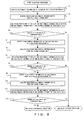
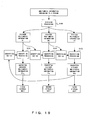
- Fig 2 shows a detailed flow chart (example 1) of a collation processing by a multimedia information collation unit 22 according to the present embodiment.
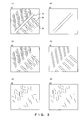
- Fig. 3 shows an example of certain multimedia image information used for a collation.
- the A1 is made up of, differently sized, three kinds of branches Aa, Ab and Ac.
- the branches Aa, Ab and Ac, which are the components of the A1 are broken down (i.e., divided) to D1, D2 and D3 (Fig. 3: (4), (5) and (6), respectively) according to the kinds of branches.
- D1, D2 and D3 (Fig. 3 (4), (5) and (6), respectively) are stored in the first storage unit 23, the second storage unit 31 and the third storage unit 41, respectively.
- the flow chart shown by Fig. 2 will be described while referring to Fig. 3.
- the multimedia information collation unit 22 acquires multimedia information A1 (refer to Fig. 3 (1)) of the collation subject 1 being sent from the multimedia information acquisition unit 21 (step S1. "step” is symbolized by “S” hereinafter). Next acquires registered multimedia information D1 (Refer to Fig. 3 (4)) from the first storage unit 23 (S2).
- the degree of similarity R1 is set according to whether or not the characteristic is in accord with each other between the multimedia information A1 and multimedia information D1 as a result of a collation method such as the pattern matching. For example, if the accord of the characteristic is higher, a "5" is set for the degree of similarity R1, while if the accord thereof is lower, then a "1" is set therefor.
- the collation processing P2 which collates the multimedia information A2 with the multimedia information D2 and sets a degree of similarity R2 based on the collation result (S7).
- the collation method is the same as S3.
- the collation processing P3 which collates the multimedia information A3 with the multimedia information D3 and sets a degree of similarity R3 based on the collation result (S11).
- the collation method is the same as S3.
- a collation processing by a multimedia information collation unit is not limited to the above described flow as shown by Fig. 2, but may be a processing flow as shown by Fig. 4.
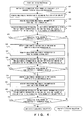
- Fig. 4 shows a detailed flow chart (example 2) of a collation processing by the multimedia information collation unit 22 according to the present embodiment.
- the multimedia information collation unit 22 acquires multimedia information A1 belonging to the collation subject 1 sent out from the multimedia information acquisition unit 21 (S22), followed by acquiring registered multimedia information D1 from the first storage apparatus 23 (S23).
- a collation processing P1 which collates the multimedia information A1 with the multimedia information D1 and calculate a degree of similarity R1 in the same way as S3 shown by Fig. 2 (S24). And stores the calculated degree of similarity R1 in the cumulative total degree of similarities X (i.e., stores a value of the degree of similarity R1 being added to the cumulative total degree of similarities X in the cumulative total degree of similarities X).
- condition for a successful collation through the collation processing P1, P2 and P3 is that the each output from the processing P1, P2 and P3, i.e., a degree of similarity of multimedia information, exceeds a predetermined threshold value for the respective processing P1, P2 and P3 in each and every step thereon as shown by Fig. 2. Also, a cumulative total of the degree of similarity of multimedia information respectively outputted from the collation processing P1, P2 and P3 exceeding a predetermined threshold value may be applied to a condition for successful collation as shown by Fig. 4.
- a collation method for confirming who the collation subject is from among a plurality of registrants the above described collation processing are performed repeatedly with multimedia information belonging to all the registrants for outputting the information about a person whom the most similar multimedia information belongs to.
- a plurality of storage units for storing divided multimedia information can be located in separate apparatuses as shown by the present embodiment. And it is possible to diversify a risk such as a stolen apparatus by locating them distributedly as such.
- multimedia information handed over to the next stage of collation processing by each collation processing can be one modified by the multimedia information taken out of the respective storage unit and used for the collation. It is possible to speed up the collation processing in the next step by eliminating a piece of information already processed by the prior collation.
- a configuration storing multimedia information dividedly in a plurality of storage apparatuses makes it impossible to pass a collation processing by using a stolen multimedia information part if the part is stolen from a storage unit among the plurality thereof as long as a multimedia information part stored in the remainder of storage units is safe, thereby enhancing the security.
- a configuration repeating a plurality of collation processing for each of divided multimedia informationstepwise,instead ofcollating after merging together the multimedia information which is divided into a plurality of parts makes it difficult to restore the original multimedia information by using the divided one. Even in case a plurality of multimedia information parts are stolen at the same time, it is difficult to pass the collation processing by using the stolen parts as long as restoring the original multimedia information is very difficult, hence enhancing the security.
- the method of collating after merging the divisionally stored multimedia information is highly risky, because once the merging method has been figured out, restoring the multimedia information aiming at illegitimately passing the collation processing becomes possible.
- the descriptions are given for distribution and storage of multimedia information.
- information belonging to a collation subject i.e., legitimate user
- the storage units e.g., the first, second and third storage units
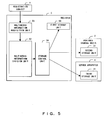
- Fig. 5 illustrates the interior of a register according to the present embodiment.
- a multimedia information acquisition unit 51 acquires multimedia information B belonging to a person to be registered ("registration subject" hereinafter) and sends it to a multimedia information division unit 52.
- the multimedia information division unit 52 divides the received multimedia information B into a plurality of parts (N.B.
- the present embodiment divides into three parts, but it is not limited as such; also, the terminology, "part (s) " of divided multimedia information is sometimes used for a convenience or easy understanding of description herein while there is no material difference from the "divided multimedia information"), and a storage control unit 54 stores a respective divided information part in a first storage unit 53, a second storage unit 31 and a third storage unit 41.
- Fig. 6 illustrates how three-part division of multimedia information divided by the multimedia information division unit 52 is stored in respective storage units by the storage control unit 54.
- the multimedia information respectively stored in the first storage unit 23, the second storage unit 31 and the third storage unit 41 on one hand is now divided into ones ranging from rough multimedia information having a small volume of information to detailed multimedia information having a large volume thereof as shown by Fig. 6.
- the divided multimedia information parts are respectively stored in each storage unit.
- Such division methods include the one dividing by the height of frequency in image data for instance, in which case an abstracted image having a low frequency component corresponds to the rough division multimedia information D1, an abstracted image having a high frequency component corresponds to the detailed division multimedia information D3, and an abstracted image having the intermediate frequency component corresponds to the division multimedia information D2.
- making divided multimedia information to be subjected to collation first that is, in the collation processing P1, the more rough information, and making divided multimedia information to be subjected to collation later the more detailed information, enable the collation processing in the earlier stages to be processed by a smaller volume of information and the non-accord data to be screened out in high speed, thereby shortening the average collation processing time.
- a divided multimedia information part is stored in the first storage unit 53 equipped in the register 5 in the present embodiment, it may be stored in the first storage unit 23 of the collator 2 by way of a network, et cetera. Or, it is also possible to store the information, which is stored in the first storage unit 53 of the register 5, temporarily in a portable storage media, et cetera, have the collator 2 read out of the portable storage media and then store the information, which is stored in the portable storage media, in the first storage unit 23 of the collator 2. Furthermore, while the collator 2 and the register 5 are installed separately from each other in the first and second embodiments, the configuration is not limited as such and, rather, a collator and a register may be made co-resident in a single apparatus.
- a rough collation processing by using a small volume of information is relatively faster than a detailed collation by using a large volume thereof. Accordingly, when the multimedia information belonging to a person is divided in the first embodiment, dividing it stepwise ranging from the information for a rough collation processing to the information for a detailed collation processing and, when collation processing is performed, starting with a rough collation processing and then gradually moving to a more detailed processing stepwise will eliminate cases which do not match in the more rough collation before moving to the more detailed collation processing, not requiring all collation processing to the end. This will enable the average time required for collation processing of multimedia information belonging to a person to be shorter than the conventional technique.
- the patent document 1 offers the technique of simply dividing multimedia information belonging to a person into two parts by the division ratio M, the technique is hopeless in improving the processing speed because a collation processing has to follow merging the divided information. On the contrary, the time for merging the divided multimedia information is an additional time to waste.
- storing a detailed multimedia information belonging to a specific person in a portable storage media and rough multimedia information in a server make it possible to perform a low precision collation without the portable storage media, while a high precision collation therewith, that is, a different service can be provided depending on the presence or absence of the portable storage media.
- storing rough multimedia information belonging to a specific person in a portable storage media or a storage unit equipped in a collator and detailed multimedia information in a server make it possible to perform a low precision collation just by using the multimedia information stored either in a portable storage media or a storage unit equipped in a collator, while a high precision collation when connected with a server, thus providing different levels of service between usages in local and in connection with the server.
- multimedia information divided stepwise ranging from rough information to detailed information as described in the second embodiment is further divided into a plurality of parts, and stored in a plurality of different storage units by combining the further divided parts arbitrarily.
- Fig. 7 shows a concept for division and combination according to the present embodiment.
- the multimedia information divided into three parts D1, D2 and D3 are further divided into three parts ((D11, D12 and D13), (D21, D22, and D23) and (D31, D32 and D33)), the further divided nine parts are combined into three in a group (i.e., E1, E2 and E3) and the new groups E1, E2 and E3 are stored in the first storage unit 53, the second storage unit 31 and the third storage unit 41, respectively.
- the register 5 is the same as the register shown by Fig. 5 in which the above described division and combination are performed by the multimedia information division unit 52.
- the multimedia information belonging to a registration subject acquired by the multimedia information acquisition unit 51 is sent out to the multimedia information division unit 52 in which the multimedia information is divided and further divided by the procedure as described above and the storage control unit 54 stores them in the respective storage units 53, 31 and 41.
- Fig. 8 shows how the multimedia information further divided and combined in Fig. 7 is collated.
- the collation processing is the same as with the first embodiment.
- E1, E2 and E3 are acquired from the first storage unit 23, the second storage unit 31 and the third storage unit 41, respectively.
- a multimedia information merger unit 25 takes D11, D12 and D13 out of E1, E2 and E3, respectively, and reconstructs D1 from the aforementioned three.
- the multimedia information D2 and D3 are acquired in the same manner.
- the configuration according to the second embodiment has had a risk of passing the first stage of collation if the rough multimedia information used for the first stage of thereof is stolen and illegitimately used.
- further dividing the multimedia information divided stepwise ranging from the information for a rough collation processing to the information for a detailed collation processing, combining and storing in different storage units make it impossible to pass even one stage of collation processing just by using a stolen multimedia information if one of the divided multimedia information stored in any of the storage units is stolen.
- the configuration is such that when using divisionally stored multimedia information for a collation processing, selects and uses a required storage unit in compliance with the requirement of the collator.
- the collator is the same as the first embodiment.
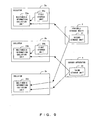
- Fig. 9 shows an example pattern of collator comprising a selection of the required storage units according to the present embodiment.
- a collator 2a is configured to obtain multimedia information used for a collation processing performed by a multimedia information collation unit 22a from a first storage unit 23a and a second storage unit 31 equipped in a portable storage media 3.
- a collator 2b is configured to obtain multimedia information used for a collation processing performed by a multimedia information collation unit 22b from a first storage unit 23b and a third storage unit 41 equipped in a server apparatus 4.
- a collator 2c is configured to obtain multimedia information used for a collation processing performed by a multimedia information collation unit 22c from the second storage unit 31 equipped in the portable storage media 3 and the third storage unit 41 equipped in the server apparatus 4.
- This configuration of selective use of storage units is also capable of controlling the security.
- the security is generally less tight on the outside of the server (that is, the closer to the client apparatuses).
- the highest security is existent with the collator 2c which does not obtain information from the storage unit equipped in a client apparatus; the next highest is existent with the collator 2b; and the lowest security is existent with the collator 2a which does not obtain information from the storage unit equipped in a server apparatus.
- the acquisition time is shorter for acquiring information from a user terminal, that is, a storage unit closer to a client apparatus as compared to a storage unit equipped in a server apparatus inevitably by way of a network.
- a collator by selecting storage units for acquiring multimedia information depending on the various usage priority such as the security first or the data acquisition time first (i.e., shortening collation processing time).
- a high precision collation is accomplished by performing a collation by using information acquired from a large number of storage units or using storage units storing more detailed information.
- the present embodiment changes divided multimedia information to be processed in higher priority from among the information stored in storage units. That is, discretionarily changes a sequence of acquisition when acquiring multimedia information from respective storage units.
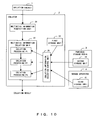
- Fig. 10 shows the collator 2 equipped with a collation information selection control unit 26 according to the present embodiment.
- the collator is the same as the first embodiment.
- a control by the collation information selection control unit 26 is capable of changing acquisition sequence when acquiring multimedia information from the first storage unit 23, the second storage unit 31 and the third storage unit 41 for processing in correspondence with S2, S6 and S10, respectively, all of which are shown in Fig. 2.
- it is capable of acquiring multimedia information in the sequence of the third storage unit 41, the first storage unit 23 followed by the second storage unit 31 for a certain occasion; or in the sequence of the second storage unit 31, the third storage unit 41 followed by the first storage unit 23 for another.
- the advantage of such changing the sequence of acquisition includes a priority collation of a certain attribute from among the stored information having the different attributes for respective storage units. For instance, if voice information in the first storage unit, facial image information in the second storage unit and finger print information in the third storage unit are respectively stored, a finger print collation can be done first. Similar example is, the same kind of information and yet in different parts (e.g., finger prints, and yet the thumb and the middle finger) may be stored in respective storage unit so as to perform a finger print collation for the thumb in a higher priority.
- Such configuration enables a changeable collation sequence in response to the situation of a collation subject or the collation environment, and in turn a highly flexible collation processing.
- a prioritized or flexible application of the divided multimedia information in response to the collation subject or the environment enables an improvement in processing speed and convenience.
- the present embodiment encrypts respectively each divided multimedia information part which has been described in the second embodiment, and stores decryption keys for decrypting the encryption in a separate storage unit from the encrypted divided multimedia information.
- Fig. 11 illustrates a register 5 according to the present embodiment.
- a multimedia information acquisition unit 51 acquires multimedia information B belonging to a registration subject and sends the multimedia information B to a multimedia information division unit 52 which divides the received multimedia information B and sends out a group of the divided multimedia information to an encrypting unit 55 which in turn encrypts the received group of the divided multimedia information.
- the storage control unit 54 respectively stores the encrypted group of the divided multimedia information in each of the storage units 23, 31 and 41.
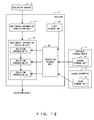
- Fig. 12 illustrates a collator according to the present embodiment.
- a multimedia information acquisition unit 21 acquires multimedia information A belonging to a collation subject 1 and sends out the multimedia information A to a multimedia information collation unit 22 which performs collation processing P1, P2 and P3 in each of which the multimedia information for collating with the multimedia information A is acquired from the respective storage units.
- the encrypted divided group of multimedia information parts taken out of the respective storage units 23, 31 and 41 are decrypted by a decrypting unit 27 to be used for the respective collation processing P1, P2 and P3.
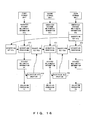
- Fig. 13 shows a flow chart of encryption when storing the multimedia information B in storage units according to the present embodiment.
- a division and combination unit divides the multimedia information B (S40), making divided multimedia information D1, D2 and D3 which are then encrypted by the encrypting unit 55 in the procedure as described in the following.
- the divided multimedia information D1 is encrypted through the encryption key K1 (S41), becoming an encrypted divided multimedia information D1a.
- the divided multimedia information D2 is encrypted through the encryption key K2 (S42), becoming an encrypted divided multimedia information D2a.
- the divided multimedia information D3 is encrypted through the encryption key K3 (S43), becoming an encrypted divided multimediainformation D3a.
- the encryption adopts the common key system, and therefore the encryption and decryption keys are the same.
- the encrypted divided multimedia information D1a is stored in the first storage unit 53 along with the decryption key K2a (i.e., the encryption key K2); the encrypted divided multimedia information D2a is stored in the second storage unit 31 along with the decryption key K3a (i.e., the encryption key K3); and the encrypted divided multimedia information D3a is stored in the third storage unit 41 along with the decryption key K1a (i.e., the encryption key K1).
- each divided multimedia information part is respectively encrypted and stored in a storage unit being different from the one storing the decryption key for decrypting the encryption.
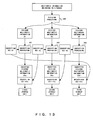
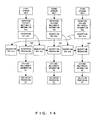
- Fig. 14 shows a flow chart of decrypting the encrypted divided multimedia information according to the present embodiment.
- the decrypting unit 27 acquires the encrypted divided multimedia information D1a and the decryption key K2a from the first storage unit 23; and the encrypted divided multimedia information D3a and the decryption key K1a from the third storage unit 41. Then the encrypted divided multimedia information D1a is decrypted by using the decryption key K1a (550), gaining the divided multimedia information D1 which will be used for the collation processing P1.
- the decrypting unit 27 acquires the encrypted divided multimedia information D2a and the decryption key K3a from the second storage unit 31. As it has already acquired the decryption key K2a for decrypting the encrypted divided multimedia information D2a during the collation processing P1, the encrypted divided multimedia information D2a is decrypted by using the decryption key K2a (S51), gaining the divided multimedia information D2 which will be used for the collation processing P2.
- the decrypting unit 27 likewise above decrypts the encrypted divided multimedia information D3a by using the decryption key K3a, both already acquired during the collation processing P1 and P2 (S52), gaining the divided multimedia information D3 which will be used for the collation processing P3.
- the encrypted information is decrypted by using the decryption key being stored in a different storage unit at the time of collation processing, followed by the collation processing according to the first embodiment.
- Such configuration makes it possible to acquire simultaneously the decryption key for decrypting the divided multimedia information to be used in the next stage of collation processing when performing each collation processing, decrypt quickly the divided multimedia information to be used in the next stage of collation processing and therefore perform the collation processing efficiently.
- encrypting the dividedly stored multimedia information enhances the security.
- Storing the key information for decrypting the encrypted multimedia information in a storage unit separately from the one storing the encrypted multimedia information itself in the process prevents an illegitimate decrypting if the encrypted multimedia information is stolen, since the key for decrypting the encryption is stored in a different storage unit.
- the present embodiment encrypts each divided multimedia information part being described in the second embodiment by using a respective encryption key which is generated based on a different divided multimedia information part.
- the present embodiment uses the same register as shown by Fig. 11 and the same collator as shown by Fig. 12.
- the collation processing itself is the same as the first embodiment.
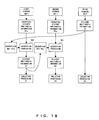
- Fig. 15 shows a flow chart of encryption when storing multimedia information in the storage units according to the present embodiment.
- the multimedia information acquisition unit 51 acquires multimedia information B belonging to a registration subject, and the multimedia information division unit 52 divides the multimedia information (S60), making the divided multimedia information D1, D2 and D3.
- the multimedia information division unit 52 divides the multimedia information (S60), making the divided multimedia information D1, D2 and D3.
- an encryption function e.g., hash function
- the dividedmultimedia information D1 is encrypted by the encryption key K1 (S64), becoming the encrypted divided multimedia information D1a.
- the divided multimedia information D2 is encrypted by the encryption key K2 (S65), becoming the encrypted divided multimedia information D2a.
- the divided multimedia information D3 is encrypted by the encryption key K3 (S66), becoming the encrypteddividedmultimedia information D3a.
- the encryption adopts the common key system, and therefore the encryption and decryption keys are the same.
- the storage control unit 54 stores the divided multimedia information D1a in the first storage 53, and the divided multimedia information D2a in the second storage unit 31. And stores the divided multimedia information D3a in the third storage unit 41 along with a decryption key K1a (that is, the encryption key K1) .
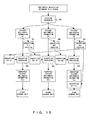
- Fig. 16 shows a flow chart of decrypting the encrypted divided multimedia information according to the present embodiment.
- the decrypting unit 27 acquires the encrypted divided multimedia information D1a from the first storage unit 23, and the encrypted divided multimedia information D3a and the decryption key K1a from the third storage unit, followed by decrypting the encrypted divided multimedia information D1a by using the decryption key K1a (S70), gaining the divided multimedia information D1 which will be used for the collation processing P1.
- the decrypting unit 27 acquires the encrypted divided multimedia information D2a from the second storage unit 31. And acquire a decryption key K2a from the divided multimedia information D1 acquired during the collation processing P1 by using an encryption function. Then decrypts the encrypted divided multimedia information D2a by using the decryption key K2a (S71), gaining the divided multimedia information D2 which will be used for the collation processing P2.
- the decrypting unit 27 acquires a decryption key K3a from the divided multimedia information D2 acquired during the collation processing P2 by using an encryption function. Then decrypts the encrypted divided multimedia information D3a acquired during the collation processing P1 by using the decryption key K3a (S72), gaining the divided multimedia information D3 which will be used for the collation processing P3.
- the configuration is storing the decryption key for decrypting the encrypted divided multimedia information D3a without an encryption in the third storage unit 41. This configuration also prevents an illegitimate decrypting of the encrypted multimedia information unless the stored information in the first and third storage units are simultaneously stolen, hence maintaining the security level high.
- encrypting the divisionally stored multimedia information improves the security as with the sixth embodiment.
- creating the key information for decrypting the encrypted multimedia information based on different multimedia information being stored in a different storage unit from the one which the former information is stored in will not allow an illegitimate decrypting if the encrypted multimedia information is stolen because the decryption key therefore is based on the multimedia information being stored in a different storage unit.
- the present embodiment encrypts each divided multimedia information part being described in the second embodiment respectively by using a respective encryption key which is generated based on a different divided multimedia information part.
- the present embodiment uses the same register as shown by Fig. 11 and the same collator as shown by Fig. 12.
- the collation processing itself is the same as the first embodiment.
- Fig. 17 shows a flow chart (example 1) of encryption when storing multimedia information in storage units according to the present embodiment.
- the multimedia information acquisition unit 51 acquires multimedia information B belonging to a registration subject
- the multimedia information division unit 52 divides the multimedia information (S80), making the divided multimedia information D1, D2 and D3.
- the encrypting unit 55 encrypts divided multimedia information D1 by the divided multimedia information D3 (S81), gaining the encrypted divided multimedia information D1a.
- the encrypting processing here is a logic operation (e.g., AND operation, OR operation, EXCLUSIVE-OR operation) between the bit information constituting the divided multimedia information D1 and the bit information constituting the divided multimedia information D3.
- the storage control unit 54 stores the encrypted divided multimedia information D1a gained by S81 in the first storage unit 53.
- the divided multimedia information D2 is encrypted by the divided multimedia information D1 (S82), gaining the encrypted divided multimedia information D2a which will be stored in the second storage unit 31.
- the divided multimedia information D3 will be stored in the third storage unit 41 as is, instead of being encrypted.
- each divided multimedia information part is respectively encrypted by an encryption key by using a divided multimedia information part different from the one being encrypted.
- Fig. 18 shows a flowchart (example 1) of decrypting encrypted divided multimedia information according to the present embodiment.
- the decrypting unit 27 acquires the encrypted divided multimedia information D1a from the first storage unit 23 and the divided multimedia information D3 from the third storage unit 41.
- the encrypted divided multimedia information D1a is decrypted by using the divided multimedia information D3 as the decryption key K1a (S90), gaining the divided multimedia information D1.
- the decrypting unit 27 acquires the encrypted divided multimedia information D2a from the second storage unit 31.
- the encrypted divided multimedia information D2a is decrypted by using the divided multimedia information D1 as the decryption key K2a (S91), gaining the divided multimedia information D2.
- the decrypting unit 27 hands the already acquired divided multimedia information D3 over to the collation processing P3.
- Such configuration makes it possible to create simultaneously the decryption key for decrypting the divided multimedia information to be used in the next stage of collation processing during each of the current collation processing, decrypt immediately the divided multimedia information to be used for the next collation processing and perform the collation processing in a high efficiency.
- the present embodiment is configured to store the divided multimedia information D3 to be stored in the third storage unit un-encrypted. This configuration also does not allow an illegitimate decrypting of the encrypted multimedia information unless the information stored in the first and third storage units is simultaneously stolen, hence maintaining the security level high.
- processing flow of the present embodiment may be modified as shown by Figs. 19 or 20.
- Fig. 19 shows a flowchart (example 2) of encryption when storing the multimedia information in storage units according to the present embodiment.
- the multimedia information division unit 52 divides the multimedia information B belonging to a registration subject (S100), making divided multimedia information D1, D2 and D3 .
- the encrypting unit 55 encrypts the divided multimedia information D2 by using the divided multimedia information D1 (S102), gaining the encrypted divided multimedia information D2a, in which the encryption processing is the same as the description for Fig. 18.
- the encrypted divided multimedia information D2a gained by S102 is stored in the second storage unit 31.
- the divided multimedia information D3 is encrypted by using the divided multimedia information D2 (S103), gaining the encrypted divided multimedia information D3a which will be stored in the third storage unit 41.
- the divided multimedia information D1 is encrypted by using the encrypted divided multimedia information D3a which has been encrypted in S103 as the encryption key K1 (S101), gaining the encrypted divided multimedia information D1a. And the encrypted divided multimedia information D1a will be stored in the first storage unit 53.
- Fig. 20 shows a flow chart (example 2) of decrypting encrypted divided multimedia information according to the present embodiment.
- the decrypting unit 27 acquires the encrypted divided multimedia information D1a from the first storage unit 23 and the encrypted dividedmultimedia information D3a from the third storage unit 41, followed by decrypting the encrypted divided multimedia information D1a by using the encrypted divided multimedia information D3a as the decryption key K1a (S110), gaining the divided multimedia information D1.
- the decrypting unit 27 acquires the encrypted divided multimedia information D2a from the second storage unit 31 and decrypts the encrypted divided multimedia information D2a by using the divided multimedia information D1 as the decryption key K2a (S111), gaining the divided multimedia information D2.
- the decrypting unit 27 decrypts the encrypted divided multimedia information D3a by using the divided multimedia information D2 as the decryption key K3a (S112), gaining the divided multimedia information D3.
- encrypting the divisionally stored multimedia information enhances security as with the sixth embodiment.
- making the key information for decrypting the encrypted multimedia information the different multimedia information being stored in a different storage unit from the one in which the former information is stored will not allow an illegitimate decrypting if the encrypted multimedia information is stolen, because the decryption key therefore is multimedia information stored in a different storage unit.
- the present embodiment combines divided multimedia information belonging to a plurality of persons and stores in a plurality of storage units.
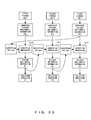
- Fig. 21 illustrates how divided multimedia information belonging to a plurality of persons is combined through combination according to the present embodiment.
- D1-1a, D2-1a and D3-1a are divided parts of multimedia information A1a belonging to a registration subject 1a
- D1-1b, D2-1b and D3-1b are divided parts of multimedia information A1b belonging to a registration subject 1b
- D1-1c, D2-1c and D3-1c are divided parts of multimedia information A1c belonging to a registration subject 1c.
- the general overview of the register according to the present embodiment is the same as Fig. 5 in which the multimedia information belonging to a plurality of registration subjects acquired by the multimedia information acquisition unit 51 is sent out to the multimedia information division unit 52 by which the multimedia information is divided and combined as described above, and then stored in the respective storage units.
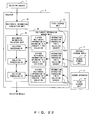
- Fig. 22 shows a process for collating the multimedia information divided and combined as shown by Fig. 21.
- the collation processing itself is the same as the first embodiment.
- the collation processing P1 needs to acquire the multimedia information D1-1a belonging to the collation subject 1a.
- the multimedia information merger unit 25 acquires the combined information G1 (D1-1a, D1-1b and D1-1c) stored in the first storage unit 23, takes D1-1a out of the combined information G1 through an information extraction processing P251 and hands it over to the collation processing P1.
- the multimedia information merger unit 25 acquires the combined information G2 (D2-1a, D2-1b and D2-1c) stored in the second storage unit 31, takes D2-1a out of the combined information G2 through an information extraction processing P252 and hands it over to the collation processing P2. And the multimedia information merger unit 25 acquires the combined information G3 stored in the third storage unit 41, takes D3-1a out of the combined information G3 through an information extraction processing P253 and hands it over to the collation processing P3.
- the present embodiment changes the number of registration subjects for respective storage units as shown by Fig. 23.
- the division processing is the same as the ninth embodiment, whereas the difference from the ninth embodiment is storing not only the divided multimedia information in combinations, but also in various patterns of combinations.
- the divided information parts D1-1a, D1-1b, D1-1c and D2-1c are respectively stored in the storage unit 31a of a portable media 3a, the storage unit 31b of a portable media 3b, the storage unit 31c of a portable media 3c and the storage unit 23b equipped inacollator2b, singularly.
- D2-1a and D2-1b are combined as combined information G4 and stored in the storage unit 23a equipped in a collator 2a.
- D3-1a, D3-1b and D3-1c are combined as combined information G5 and stored in the storage unit 41 equipped in a server apparatus 4.
- Fig. 24 illustrates processing as to which storage unit the information is to be drawn from at the time of performing collation according to the present embodiment.
- a collation subject 1a acquires multimedia information belonging to him from the storage unit 31a of the portable media 3a, the storage unit 23a equipped in the collator 2a and the storage unit 41 equipped in the server apparatus 4.
- a collation subject 1b acquires multimedia information belonging to him from the storage unit 31b of the portable media 3b, the storage unit 23a equipped in the collator 2a and the storage unit 41 equipped in the server apparatus 4.
- For collating a collation subject 1c acquires multimedia information belonging to him from the storage unit 31c of the portable media 3b, the storage unit 23b equipped in the collator 2b and the storage unit 41 equipped in the server apparatus 4.
- Such configuration storing a divided multimedia information part belonging to a person in a portable storage media so that the portable storage media is stored with information belonging to the person in possession of the aforementioned portable storage media, for instance, make it possible to save storage volume in a portable storage media. It is also possible to save storage volume for the storage unit equipped in a collator by storing only information belonging to persons intending to be collated by the aforementioned collator.
- the collator can naturally be configured as a common computer.
- Fig. 25 is a structural block diagram of such a computer, i.e., hardware environment, according to the present invention.
- a computer system comprises a central processing unit (CPU) 62, a read only memory (ROM) 63, a random access memory (RAM) 66, a communication interface (I/F) 64, a storage apparatus 67, an output I/F 61, an input I/F 65, a read-out apparatus 68 for portable storage media, a bus 69 interconnecting the above components, an output apparatus 70 connected with the output I/F 61 and an input apparatus 71 connected with the input I/F 65.
- CPU central processing unit
- ROM read only memory
- RAM random access memory
- I/F communication interface
- a various types of storage apparatuses such as hard disk, magnetic disk can be adopted for the storage apparatus 67 which, or ROM 63, can be stored with the programs (representing the multimedia information collation unit 22) illustrated by the flow charts as shown by Figs. 2 and 4, the program for the multimedia information division unit 52, the program for the multimedia information merger unit 25, the program for the collation information selection control unit 26, and the programs for the encrypting unit 55 and the decrypting unit 27.
- the CPU 62 executing the above programs enables a collation with multimedia information for confirming a person, a division processing for pre-storing the multimedia information for collating a person, and encryption and decryption of such information in accordance with the present embodiments.
- the program provider may provide the above described programs by having them transmit themselves through the network 72, via the communication I/F 64 to the storage apparatus 67, or through a commercially available portable storage media to be read out by the read-out apparatus 68, so as to be executed by the CPU 62.
- a various types of storage media such as CD-ROM, flexible disk, optical disk, magneto optical disk, IC card are available for the portable storage media 3 so that the stored programs is read out by the read-out apparatus 68.
- the input apparatus 71 which corresponds to the multimedia information acquisition unit 21, can adopt keyboard, mouse, or camera, microphone, scanner, tablet, et cetera for taking multimedia information in.
- the output apparatus 70 can use display, printer, speaker, et cetera.
- the network 72 may be the Internet, LAN, WAN, a dedicated line, or a wired or wireless communication networks.
- a use of the present invention enables an enhanced security, a high speed collation processing and a reduced load on the communication paths for transmitting multimedia information.
Landscapes
- Engineering & Computer Science (AREA)
- Physics & Mathematics (AREA)
- General Physics & Mathematics (AREA)
- Multimedia (AREA)
- Theoretical Computer Science (AREA)
- Human Computer Interaction (AREA)
- Software Systems (AREA)
- Storage Device Security (AREA)
- Collating Specific Patterns (AREA)
- Image Analysis (AREA)
Applications Claiming Priority (1)
| Application Number | Priority Date | Filing Date | Title |
|---|---|---|---|
| PCT/JP2003/004096 WO2004088591A1 (ja) | 2003-03-31 | 2003-03-31 | 照合装置及び登録装置 |
Publications (1)
| Publication Number | Publication Date |
|---|---|
| EP1564686A1 true EP1564686A1 (de) | 2005-08-17 |
Family
ID=33105346
Family Applications (1)
| Application Number | Title | Priority Date | Filing Date |
|---|---|---|---|
| EP03715662A Withdrawn EP1564686A1 (de) | 2003-03-31 | 2003-03-31 | Kollator und register |
Country Status (5)
| Country | Link |
|---|---|
| EP (1) | EP1564686A1 (de) |
| JP (1) | JPWO2004088591A1 (de) |
| CN (1) | CN1326063C (de) |
| AU (1) | AU2003221049A1 (de) |
| WO (1) | WO2004088591A1 (de) |
Cited By (5)
| Publication number | Priority date | Publication date | Assignee | Title |
|---|---|---|---|---|
| WO2022010338A1 (en) * | 2020-07-08 | 2022-01-13 | Mimos Berhad | System and method for biometric authentication |
| US12381857B2 (en) | 2004-10-25 | 2025-08-05 | Security First Innovations, Llc | Secure data parser method and system |
| US12517661B2 (en) | 2014-11-21 | 2026-01-06 | Security First Innovations, Llc | Gateway for cloud-based secure storage |
| US12518048B2 (en) | 2013-02-13 | 2026-01-06 | Security First Innovations, Llc | Systems and methods for a cryptographic file system layer |
| US12591698B2 (en) | 2005-11-18 | 2026-03-31 | Security First Innovations, Llc | Secure data parser method and system |
Families Citing this family (7)
| Publication number | Priority date | Publication date | Assignee | Title |
|---|---|---|---|---|
| JP4744180B2 (ja) * | 2005-04-11 | 2011-08-10 | グローリー株式会社 | 個人認証システム、制御サーバ及び個人認証方法 |
| JP2007018169A (ja) * | 2005-07-06 | 2007-01-25 | Murata Mach Ltd | 生体認証装置及び画像処理装置 |
| JP2008065446A (ja) * | 2006-09-05 | 2008-03-21 | Mitsubishi Electric Corp | 指紋センサユニット及び該指紋センサユニットを適用した指紋照合装置 |
| JP5353147B2 (ja) * | 2008-09-22 | 2013-11-27 | オムロン株式会社 | 顔照合システム |
| WO2012068713A1 (zh) * | 2010-11-22 | 2012-05-31 | Guan Jun | 改变上下文以屏蔽数字内容敏感度的处理方法 |
| CN110557361B (zh) * | 2019-03-14 | 2022-04-26 | 深圳市丰浩达工程项目管理有限公司 | 一种全过程造价动态管理方法及系统 |
| WO2021240757A1 (ja) | 2020-05-29 | 2021-12-02 | 日本電気株式会社 | 照合システム、クライアント端末、サーバ装置、照合方法、およびプログラム |
Family Cites Families (3)
| Publication number | Priority date | Publication date | Assignee | Title |
|---|---|---|---|---|
| US5513272A (en) * | 1994-12-05 | 1996-04-30 | Wizards, Llc | System for verifying use of a credit/identification card including recording of physical attributes of unauthorized users |
| JP3112076B2 (ja) * | 1998-05-21 | 2000-11-27 | 豊 保倉 | ユーザ認証システム |
| JP2000020727A (ja) * | 1998-07-07 | 2000-01-21 | Nippon Lsi Card Co Ltd | 指紋照合システム及びそれに用いるメモリカード |
-
2003
- 2003-03-31 JP JP2004570164A patent/JPWO2004088591A1/ja active Pending
- 2003-03-31 AU AU2003221049A patent/AU2003221049A1/en not_active Abandoned
- 2003-03-31 WO PCT/JP2003/004096 patent/WO2004088591A1/ja not_active Ceased
- 2003-03-31 EP EP03715662A patent/EP1564686A1/de not_active Withdrawn
- 2003-03-31 CN CNB038238446A patent/CN1326063C/zh not_active Expired - Fee Related
Non-Patent Citations (1)
| Title |
|---|
| See references of WO2004088591A1 * |
Cited By (5)
| Publication number | Priority date | Publication date | Assignee | Title |
|---|---|---|---|---|
| US12381857B2 (en) | 2004-10-25 | 2025-08-05 | Security First Innovations, Llc | Secure data parser method and system |
| US12591698B2 (en) | 2005-11-18 | 2026-03-31 | Security First Innovations, Llc | Secure data parser method and system |
| US12518048B2 (en) | 2013-02-13 | 2026-01-06 | Security First Innovations, Llc | Systems and methods for a cryptographic file system layer |
| US12517661B2 (en) | 2014-11-21 | 2026-01-06 | Security First Innovations, Llc | Gateway for cloud-based secure storage |
| WO2022010338A1 (en) * | 2020-07-08 | 2022-01-13 | Mimos Berhad | System and method for biometric authentication |
Also Published As
| Publication number | Publication date |
|---|---|
| CN1689040A (zh) | 2005-10-26 |
| WO2004088591A1 (ja) | 2004-10-14 |
| AU2003221049A1 (en) | 2004-10-25 |
| JPWO2004088591A1 (ja) | 2006-07-06 |
| CN1326063C (zh) | 2007-07-11 |
Similar Documents
| Publication | Publication Date | Title |
|---|---|---|
| JP7095140B2 (ja) | 特徴抽出に基くマルチモデルトレーニング方法及び装置、電子機器と媒体 | |
| US7996683B2 (en) | System, portable device and method for digital authenticating, crypting and signing by generating short-lived cryptokeys | |
| US8550339B1 (en) | Utilization of digit sequences for biometric authentication | |
| EP1564686A1 (de) | Kollator und register | |
| US11227037B2 (en) | Computer system, verification method of confidential information, and computer | |
| KR101604539B1 (ko) | 은닉 데이터 대조 장치, 은닉 데이터 대조 방법 및 기록 매체 | |
| Ali et al. | Cancelable biometrics technique for iris recognition | |
| US11184163B2 (en) | Value comparison server, value comparison encryption system, and value comparison method | |
| JP4744180B2 (ja) | 個人認証システム、制御サーバ及び個人認証方法 | |
| CN110612563B (zh) | 检索装置、隐匿检索系统以及计算机能读取的存储介质 | |
| CN111475690A (zh) | 字符串的匹配方法和装置、数据检测方法、服务器 | |
| CN116776365A (zh) | 数据查询方法、装置及存储介质 | |
| Chen et al. | Reversible privacy preserving data mining: a combination of difference expansion and privacy preserving | |
| JP4594078B2 (ja) | 個人情報管理システムおよび個人情報管理プログラム | |
| CN113378214A (zh) | 一种基于区块链技术的连续数据保护方法及装置 | |
| You et al. | A novel fuzzy vault scheme based on fingerprint and finger vein feature fusion | |
| JP4746004B2 (ja) | 登録装置 | |
| US20050223003A1 (en) | Collator and register | |
| US9294510B2 (en) | System and method for automatic control of security policies based on available software licenses | |
| CN116450745B (zh) | 基于多设备的笔记文件操作方法、系统和可读存储介质 | |
| KR101977539B1 (ko) | 지문등록 및 지문인증 제어장치 및 그 구동방법 | |
| CN111339562A (zh) | 保序/揭序密文恢复方法及装置 | |
| KR100738297B1 (ko) | 대조 장치 및 등록 장치 | |
| JP7033778B2 (ja) | 生体認証システム、生体認証プログラムおよび生体認証方法 | |
| CN116644721A (zh) | 用户信息的数据处理方法、装置和服务器 |
Legal Events
| Date | Code | Title | Description |
|---|---|---|---|
| PUAI | Public reference made under article 153(3) epc to a published international application that has entered the european phase |
Free format text: ORIGINAL CODE: 0009012 |
|
| 17P | Request for examination filed |
Effective date: 20050406 |
|
| AK | Designated contracting states |
Kind code of ref document: A1 Designated state(s): AT BE BG CH CY CZ DE DK EE ES FI FR GB GR HU IE IT LI LU MC NL PT RO SE SI SK TR |
|
| AX | Request for extension of the european patent |
Extension state: AL LT LV MK |
|
| DAX | Request for extension of the european patent (deleted) | ||
| RBV | Designated contracting states (corrected) |
Designated state(s): DE FR GB |
|
| STAA | Information on the status of an ep patent application or granted ep patent |
Free format text: STATUS: THE APPLICATION HAS BEEN WITHDRAWN |
|
| 18W | Application withdrawn |
Effective date: 20101101 |