EP1564396A2 - Zylinder einer Brennkraftmaschine mit Einlass- und Auslassöffnungen - Google Patents
Zylinder einer Brennkraftmaschine mit Einlass- und Auslassöffnungen Download PDFInfo
- Publication number
- EP1564396A2 EP1564396A2 EP05002244A EP05002244A EP1564396A2 EP 1564396 A2 EP1564396 A2 EP 1564396A2 EP 05002244 A EP05002244 A EP 05002244A EP 05002244 A EP05002244 A EP 05002244A EP 1564396 A2 EP1564396 A2 EP 1564396A2
- Authority
- EP
- European Patent Office
- Prior art keywords
- cylinder
- ramp
- port
- design
- previous
- Prior art date
- Legal status (The legal status is an assumption and is not a legal conclusion. Google has not performed a legal analysis and makes no representation as to the accuracy of the status listed.)
- Withdrawn
Links
Images





Classifications
-
- F—MECHANICAL ENGINEERING; LIGHTING; HEATING; WEAPONS; BLASTING
- F02—COMBUSTION ENGINES; HOT-GAS OR COMBUSTION-PRODUCT ENGINE PLANTS
- F02F—CYLINDERS, PISTONS OR CASINGS, FOR COMBUSTION ENGINES; ARRANGEMENTS OF SEALINGS IN COMBUSTION ENGINES
- F02F1/00—Cylinders; Cylinder heads
- F02F1/18—Other cylinders
- F02F1/22—Other cylinders characterised by having ports in cylinder wall for scavenging or charging
Definitions
- the present Invention relates to a cylinder having intake and/or exhaust ports for engines or machines, such as two-stroke engines, two-stroke diesel engines, rotating piston machines, compressors or the like, and a process for the design and production thereof.
- This aspect also includes the problem of reducing interference of the piston rings (mounted on the piston) with the cylinder walls and in particular with the intake and exhaust ports.
- ports open onto the inner surface of the cylinders of said engines or machines, usually at least two ports, one for intake and the other for exhaust.
- the exhaust port in two-stroke engines is usually larger than the intake port as it has the job of conveying the exhaust gases out of the cylinder, said exhaust gases having high specific volumes at high temperatures.
- the piston during vertical movement thereof inside the cylinder, alternately intercepts the intake port and the exhaust port. Consequently, the portion of each piston ring that covers a port, for a brief instant is positioned facing the inlet and outlet ducts defined by said ports. Due to their tangential pressure, the piston rings tend to penetrate the ports which open onto the cylinder barrel and, therefore, are subject to interference with the edges of said ports.
- the extent of penetration of the piston ring in a port is hereinafter referred to as "entrance" of the piston ring.
- the greater the entrance of the piston ring in a port is, the greater the Interference of the ring with the edge of said port will be in the instant in which the piston closes or opens the port completely.
- Entrance of a piston ring depends on various factors, such as the type of material with which the piston ring is produced, the shape of the port and of the piston ring itself, the operating temperatures and pressures of the engine, etc.. Typically, the entrance values of the piston rings in the ports vary from a few microns to a few tens of microns.
- piston rings in which the outer surface, against which relative sliding of the cylinder takes place, is rounded, have been marketed for some time now.
- This type of piston ring is subject to less interference with the edges of the cylinder ports with respect to conventional piston rings. Nonetheless, they are costly and do not solve the problem completely.
- a further measure customarily used to lessen interference of the piston rings with the cylinder ports is to bevel the edges of the ports to facilitate transit of the piston rings, that is, to create a macro-bevel.
- the macro-bevel is produced manually and in any case, even if machined automatically, causes an increase in times and production costs of the cylinder.
- the presence of this type of bevel makes the surface finish of the cylinder barrel more difficult to obtain. From the viewpoint of engine operation, the presence of the macro-bevel on the edges of ports can in some cases cause incorrect opening/closing of the port or a decrease in the degree of seal against exhaust gases at the various rotation speeds of the engine.
- the object of the present invention is to provide a cylinder for engines or machines of the type mentioned, functionally associable with a piston, which allows elimination of the problem of interference of the piston rings with the cylinder ports and increases the life of said piston rings.
- a further object of the present invention is to provide a process to design and produce the cylinders of the aforesaid engines or machines which allows the production of a cylinder capable of functionally coupling with a piston without interference occurring between the cylinder ports and the piston rings or the ends (tail) of said piston, in order to increase the life of the rings and of the piston.
- Another object of the present invention is to provide a cylinder with ports for engines or machines and a process for the design and production thereof which makes it possible to obtain engines with high performances, which are economical and able to easily satisfy anti-pollution regulations.
- Yet another object of the present invention is to provide a cylinder for engines or machines and a process for the design and production thereof which makes it possible to obtain maximum performances and/or maximum reduction in consumption and/or maximum reduction in polluting emissions of the assembled engine, releasing the designer from the functional problem of interference between the cylinder ports and the piston rings.
- One more object of the present invention is to provide a cylinder with ports for engines or machines and a process for the design and production thereof which makes it possible to assemble economical and silent engines or machines, which require minimum quantities of lubricants and are subject to low vibrations.
- a cylinder with ports for engines or machines functionally associated with a piston provided with at least one piston ring, characterized by having, on the inner surface thereof, at the level of at least one of the ports thereof, a guide ramp of said piston ring.
- the ramp may be provided at the level of all the channels which open onto the inner surface of the cylinder, for example suction ports, exhaust ports, transfer ports, etc..
- the guide ramp of the piston ring extends over the upper edge of the port and/or under the lower edge thereof. If the cylinder is also provided with a suction port regulated by said piston, the guide ramp may extend below said port to guide the lower end of the piston (tail).
- the maximum depth of the ramp is at the level of the edge of said port and said maximum depth is less than or equal to the maximum penetration of the piston ring in said port.
- a process according to the present invention to design and produce a cylinder with ports for engines or machines, characterized in that, at the level of at least one of said intake and exhaust ports of the cylinder, at least one guide ramp of the piston ring is created through the steps of: determining, for at least one port of the cylinder and in the operating conditions of said engine, maximum penetration, with respect to the inner surface of the cylinder, of the piston ring in said port; choosing the inclination of said ramp with respect to a generatrix of the inner surface of said cylinder; bevelling the inner surface of said cylinder in order to produce said ramp, so that said ramp has the maximum depth thereof at the edge of said port, said maximum depth being greater than or equal to said maximum penetration, and so that said ramp extends vertically with said inclination.
- Figure 1 shows two section views of a typical cylinder 1 of a two-stroke engine.
- the cylinder according to the invention and the process for the design and production thereof are obviously not limited, respectively in production and application, only to the cylinder shown, but can in general be used for all types of cylinders for two-stroke engines.
- the intake ports, the exhaust ports and the transfer ports open onto the inner surface 2 of the cylinder 1.
- the number of ports varies according to the type of engine for which the cylinder is intended.
- the specific cylinder 1 shown has one intake port 3 for the mixture formed of air, fuel and lubricant and one exhaust port 4 for the exhaust gases.
- the cylinder 1 is also provided with transfer ports 5.
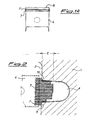
- the cylinder 1 is functionally associated with a piston 6 ( Figure 1A), on which at least one piston ring 7 is housed near the crown 8 of the piston.
- Figure 1A the piston 6 slides inside the cylinder 1, with an alternate vertical movement, between the bottom dead centre and the top dead centre (not shown). Consequently, the piston intercepts, at different times, the intake port 3 and the exhaust port 4, determining the opening/closing thereof.
- piston 6 is provided with two piston rings 7, the upper one is subject to a greater degree of penetration with respect to the lower one, as the pressure exerted by the exhaust gases is added to the tangential pressure thereof.
- Figure 2 schematically shows, for discrete intervals of time, the phenomenon of penetration of a piston ring 7 in the exhaust port 4 of a conventional cylinder 1. It is assumed that the piston is moving from the bottom to the top. Initially, when the piston 6 moves upwards, the ring 7 slides on the inner surface 2 of the cylinder 1. At the moment in which the piston goes beyond the lower edge 9 of the port 4, the ring 7 penetrates the inner volume of the port 4. The depth of penetration of the ring increases as the width of the port 4 increases. Therefore, maximum penetration of the ring 7 occurs at the level of the portion of the port 4 having the maximum width.
- the ports are shaped as shown in Figure 3 and therefore the piston 6, during upward movement thereof, intercepts portions of the port 4 having different widths, said width increasing from the lower edge 9 to a maximum value and which becomes zero at the upper edge 10.
- Figures 4-6 show a possible embodiment of a cylinder 1A according to the present invention.
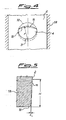
- the cylinder 1A is provided, on the inner surface 2 thereof, with a guide ramp 11 of the piston ring 7 above the upper edge 10 of the exhaust port 4.
- the cylinder 1A can have more than one ramp, for example above the upper edge of all the ports or, anyway, on the upper and/or lower edge of at least one port, one transfer port, etc..
- port is intended, in general, as any opening which opens in the cylinder, on the inner surface thereof. Therefore, the invention contemplates ports of different shapes, for example provided with one or more dividing plates, or ports with multiple openings in the cylinder, such as those shown in Figures 4A and 4B.
- the maximum depth of the ramp 11, with respect to the inner surface 2 of the cylinder 1A, is at the level of the lower and/or upper edge of the port. This maximum depth depends principally on the maximum penetration (maximum entrance) of the piston ring 7 in the port and secondarily on the shape of said port. In general, the maximum depth of the ramp 11 is lower than or equal to the maximum entrance of the piston ring 7.
- the maximum depth of the ramp 11, measured with respect to the inner surface 2 of the cylinder 1A, is indicated with E ( Figures 2 and 5) and corresponds to the maximum entrance of the piston ring 7 in the port 4 of the cylinder 1 ( Figure 2).
- the maximum entrance of the piston ring 7 in a port is measured experimentally on the conventional cylinder 1.
- the maximum entrance can be calculated by suitable mathematical formulas.
- the ramp 11 is produced on the surface of the cylinder 1, obtaining the cylinder 1A according to the invention.
- the ramp 11 has an inclination, with respect to the inner surface 2 of the cylinder 1A, ranging from 0.01 to 10 degrees, for example between 5° and 10°.
- the degree of inclination must guarantee, in all operating conditions of the engine, seal of the piston rings 7 against the inner surface 2 of the cylinder 1A.
- the height H of the ramp 11 therefore depends on the maximum depth E thereof and on the inclination.
- the ramp is connected to the edge of the port 3 or 4 by means of curved surfaces.
- the ramp 11 can have more than one inclination, for example, in the case in which it is obtained by a series of surfaces having different inclinations.
- the ramp 11 can even have a curved profile.
- the ramp 11 can be included in the ideal circumference circumscribed to the port on which said ramp is provided. In the embodiment shown in Figure 4, the ramp 11 extends over the port 4, within the ideal circumference 12.
- the port can also be included in ideal geometrical shapes that differ from the circumference 12 such as ellipses, parabolas or series of curves.
- the ramp 11 can also be produced around multiple adjacent ports or ports having a dividing wall.
- the ramp 11 can be produced in many different known ways. Preferably, it is obtained by bevelling the inner surface 2 of the cylinder 1, said bevelling being produced by numerically controlled automatic machines.
- the cylinder 1A can be, in the same way as conventional cylinders, subjected to processes to treat the inner surface, such as zinc coating, plasma coating, or more generically coatings that make the inner surface of the cylinder resistant to wear and facilitate sliding of the piston.
- the cylinder 1A thanks to the presence of the ramp 11 on at least one of the ports 3 or 4 thereof, allows the problem of interference between the piston rings 7 and the port 3 or 4 to be solved.
- the ramp 11 is configured as a guide surface of the piston rings 7 when they slide on the inner surface 2 of the cylinder at the level of the port.
- the ramp 11 prevents the piston ring 7 of the piston 6 from knocking against the edge of the port.
- the ramp 11 makes it possible to greatly reduce the vibrations to which the engine is subject during operation and, therefore, reduces the noise thereof.
- the ramp 11 makes it possible to obtain an increase in the life of the piston rings. This has a positive effect on engine maintenance costs, which are greatly reduced.
- the ramp 11 also has the advantage of offering the designer of the cylinder ample freedom of choice with regard to the shape of the ports. In fact, the designer is not obliged to choose a specific shape for a port in order to take into account wear of the piston rings, as instead occurs with conventional cylinders.
- the ramp 11 allows high precision to be obtained with regard to the opening and closing phases of the ports and a considerable reduction, with respect to conventional cylinders, in the amount of lubricant to be used in the engine together with the fuel.
- the ramp 11 according to the invention allows the assembly of engines in which opening of the ports 4 by the piston is surprisingly rapid and precise with respect to conventional engines.
- opening of the port 4 does not cause the losses of pressure which instead characterize conventional engines provided with macro-bevels on the cylinder, as the ramp 11 guides the piston rings and guarantees in any case the seal thereof.
- the cylinder according to the invention thus allows the assembly of two-stroke engines capable of operating in accordance with the strictest anti-pollution regulations, thanks also to the small amounts of lubricant required for the operation thereof.
- the designer can size the exhaust, suction, transfer ports, etc., to find the best functional compromise between performances, consumptions and emissions of the assembled engine, without having to worry about problems relative to the aforesaid interference of the piston rings, as instead has been the case with conventional cylinders. Therefore, the designer has fewer constructional constraints, and can use many different shapes for the ports, transfer ports, etc..
- the presence of the ramp 11 can also allow cylinders with macro-bevels of smaller dimensions to be produced with respect to those conventionally produced, or even cylinders without macro-bevels, with evident positive reflections on the operation of the finished engine.
- Figure 7 shows a conventional cylinder provided with macro-bevels and highlights how a macro-bevel delays closing of the port 4, allowing gases to enter the port.
- Figure 7A shows the positive effect of the ramp 11 according to the invention on the precision of both closing and opening of the port 4. In fact, in this case, when the piston ring 7 intercepts the edge 10 of the port 4. closing of the port 4 is immediate and precise.
- Figures 7B and 7C respectively show the influence of a macro-bevel and of a ramp 11 according to the invention on the time-area diagram of a cylinder, said diagram indicating the area of a port intercepted by the piston rings as the crank angle of the assembled engine varies. It can be seen that, due to the presence of the macro-bevels ( Figure 7B), the initial and the final slopes of the time-area curve are small, and therefore the opening instant of the port is brought forward, that is, it takes place several crank degrees prior to the intended crank degrees, while the closing instant is delayed. Consequently, during the opening phase of the port, there is an early loss of pressure particularly penalizing for the performances of the engine.
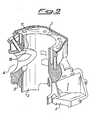
- Figures 8 and 9 each show, perspectively, a cylinder according to the invention.
- the port provided with the ramp 11 is the exhaust port 4.
- the ramp 11 in Figure 8 has a greater extension than the ramp 11 in Figure 9.
- this ratio is preferably referred to the radius of curvature of the circumference 12 circumscribed to the port and the radius of curvature of the ramp, at the outermost edge thereof.
- this ratio is preferably referred to the radius of curvature of the circumference 12 circumscribed to the port and the radius of curvature of the ramp, at the outermost edge thereof.
- the aforesaid ratio is equal to approximately 0.82, that is, the "weight" of the ramp 11 with respect to the port 4 is approximately 82%.
Landscapes
- Engineering & Computer Science (AREA)
- Chemical & Material Sciences (AREA)
- Combustion & Propulsion (AREA)
- Mechanical Engineering (AREA)
- General Engineering & Computer Science (AREA)
- Cylinder Crankcases Of Internal Combustion Engines (AREA)
- Pistons, Piston Rings, And Cylinders (AREA)
Applications Claiming Priority (2)
| Application Number | Priority Date | Filing Date | Title |
|---|---|---|---|
| ITMI20040234 | 2004-02-12 | ||
| ITMI20040234 ITMI20040234A1 (it) | 2004-02-12 | 2004-02-12 | Cilindro per motori o macchine con luci di ammissione e-o scarico e procedimento per la sua progettazione e realizzazione dotato di rampa di guida dei segmenti elastici |
Publications (2)
| Publication Number | Publication Date |
|---|---|
| EP1564396A2 true EP1564396A2 (de) | 2005-08-17 |
| EP1564396A3 EP1564396A3 (de) | 2005-12-28 |
Family
ID=34685634
Family Applications (1)
| Application Number | Title | Priority Date | Filing Date |
|---|---|---|---|
| EP05002244A Withdrawn EP1564396A3 (de) | 2004-02-12 | 2005-02-03 | Zylinder einer Brennkraftmaschine mit Einlass- und Auslassöffnungen |
Country Status (2)
| Country | Link |
|---|---|
| EP (1) | EP1564396A3 (de) |
| IT (1) | ITMI20040234A1 (de) |
Cited By (1)
| Publication number | Priority date | Publication date | Assignee | Title |
|---|---|---|---|---|
| US10036471B2 (en) | 2009-11-18 | 2018-07-31 | Achates Power, Inc. | Ported engine constructions with low-tension compression seals |
Family Cites Families (3)
| Publication number | Priority date | Publication date | Assignee | Title |
|---|---|---|---|---|
| JPH03199654A (ja) * | 1989-12-26 | 1991-08-30 | Suzuki Motor Corp | 2サイクルエンジン |
| US5348425A (en) * | 1992-11-10 | 1994-09-20 | Heiliger Robert W | Piston cylinder device with a protective coating and method of producing such a coating |
| JPH06167244A (ja) * | 1992-11-30 | 1994-06-14 | Mitsubishi Heavy Ind Ltd | エンジンシリンダとその製造方法 |
-
2004
- 2004-02-12 IT ITMI20040234 patent/ITMI20040234A1/it unknown
-
2005
- 2005-02-03 EP EP05002244A patent/EP1564396A3/de not_active Withdrawn
Cited By (2)
| Publication number | Priority date | Publication date | Assignee | Title |
|---|---|---|---|---|
| US10036471B2 (en) | 2009-11-18 | 2018-07-31 | Achates Power, Inc. | Ported engine constructions with low-tension compression seals |
| US10935134B2 (en) | 2009-11-18 | 2021-03-02 | Achates Power, Inc. | Ported engine constructions with low-tension compression seals |
Also Published As
| Publication number | Publication date |
|---|---|
| ITMI20040234A1 (it) | 2004-05-12 |
| EP1564396A3 (de) | 2005-12-28 |
Similar Documents
| Publication | Publication Date | Title |
|---|---|---|
| US4848212A (en) | Internal combustion engine piston with two compression rings having reduced oil consumption | |
| US6718917B2 (en) | Two-stroke internal combustion engine | |
| US20070261658A1 (en) | Piston For Internal-Combustion Engine And Combination Of Piston And Piston Ring For Internal-Combustion Engine | |
| EP0216477B1 (de) | Brennkraftmaschine mit Zylindereinlasskanal | |
| EP1524414A2 (de) | Ölabscheider in einem Zylinderkopfdeckel | |
| JPH11511541A (ja) | 内燃機関内のピストン用のピストンリング | |
| RU2153089C2 (ru) | Двигатель внутреннего сгорания, имеющий нагаросъемное кольцо в цилиндре (варианты) | |
| CN107762657B (zh) | 以吹扫预储存量工作的二冲程马达的活塞和二冲程马达 | |
| CN107762656B (zh) | 以吹扫预储存量工作的二冲程马达的活塞和二冲程马达 | |
| US4651686A (en) | High-speed, port-controlled, two-stroke internal combustion engine with crankcase scavenging | |
| EP1564396A2 (de) | Zylinder einer Brennkraftmaschine mit Einlass- und Auslassöffnungen | |
| EP0212857B1 (de) | Vorrichtung zur Steuerung der Auslasszeit einer Brennkraftmaschine | |
| JP2009281387A (ja) | 内燃機関用エンジンのピストン及び内燃機関用エンジンのピストンとピストンリングの組合せ | |
| CN100398783C (zh) | 内燃机活塞 | |
| US6874455B2 (en) | Two-cycle engine | |
| CN1294370C (zh) | 往复活塞式发动机 | |
| CN102996239B (zh) | 二冲程发动机以及用于其运行的方法 | |
| JP4361899B2 (ja) | 往復式機関およびピストンリング | |
| US7331276B2 (en) | Piston for a two-cycle engine | |
| US4184816A (en) | Angled-edge controlled fuel injection pump for internal combustion engines | |
| CN107013279B (zh) | 二冲程发动机 | |
| EP0094084B1 (de) | Spiralförmiger Ansaugschlitz einer Brennkraftmaschine mit innerer Verbrennung | |
| TW558600B (en) | Method of manufacturing cylinder for two-cycle engine | |
| EA007478B1 (ru) | Поршневая машина | |
| EP0346675B1 (de) | Dekompressionsvorrichtung für Zweitaktbrennkraftmaschine |
Legal Events
| Date | Code | Title | Description |
|---|---|---|---|
| PUAI | Public reference made under article 153(3) epc to a published international application that has entered the european phase |
Free format text: ORIGINAL CODE: 0009012 |
|
| AK | Designated contracting states |
Kind code of ref document: A2 Designated state(s): AT BE BG CH CY CZ DE DK EE ES FI FR GB GR HU IE IS IT LI LT LU MC NL PL PT RO SE SI SK TR |
|
| AX | Request for extension of the european patent |
Extension state: AL BA HR LV MK YU |
|
| PUAL | Search report despatched |
Free format text: ORIGINAL CODE: 0009013 |
|
| AK | Designated contracting states |
Kind code of ref document: A3 Designated state(s): AT BE BG CH CY CZ DE DK EE ES FI FR GB GR HU IE IS IT LI LT LU MC NL PL PT RO SE SI SK TR |
|
| AX | Request for extension of the european patent |
Extension state: AL BA HR LV MK YU |
|
| 17P | Request for examination filed |
Effective date: 20060621 |
|
| AKX | Designation fees paid |
Designated state(s): AT BE BG CH CY CZ DE DK EE ES FI FR GB GR HU IE IS IT LI LT LU MC NL PL PT RO SE SI SK TR |
|
| 17Q | First examination report despatched |
Effective date: 20060926 |
|
| STAA | Information on the status of an ep patent application or granted ep patent |
Free format text: STATUS: THE APPLICATION IS DEEMED TO BE WITHDRAWN |
|
| 18D | Application deemed to be withdrawn |
Effective date: 20090820 |