EP1560397B1 - Changement d'adresse d'extrémité dans un réseau de paquets - Google Patents
Changement d'adresse d'extrémité dans un réseau de paquets Download PDFInfo
- Publication number
- EP1560397B1 EP1560397B1 EP05250067A EP05250067A EP1560397B1 EP 1560397 B1 EP1560397 B1 EP 1560397B1 EP 05250067 A EP05250067 A EP 05250067A EP 05250067 A EP05250067 A EP 05250067A EP 1560397 B1 EP1560397 B1 EP 1560397B1
- Authority
- EP
- European Patent Office
- Prior art keywords
- migrator
- address
- new
- endpoint
- endpoint address
- Prior art date
- Legal status (The legal status is an assumption and is not a legal conclusion. Google has not performed a legal analysis and makes no representation as to the accuracy of the status listed.)
- Expired - Lifetime
Links
Images


Classifications
-
- H—ELECTRICITY
- H04—ELECTRIC COMMUNICATION TECHNIQUE
- H04L—TRANSMISSION OF DIGITAL INFORMATION, e.g. TELEGRAPHIC COMMUNICATION
- H04L61/00—Network arrangements, protocols or services for addressing or naming
- H04L61/50—Address allocation
- H04L61/5007—Internet protocol [IP] addresses
-
- H—ELECTRICITY
- H04—ELECTRIC COMMUNICATION TECHNIQUE
- H04L—TRANSMISSION OF DIGITAL INFORMATION, e.g. TELEGRAPHIC COMMUNICATION
- H04L69/00—Network arrangements, protocols or services independent of the application payload and not provided for in the other groups of this subclass
- H04L69/16—Implementation or adaptation of Internet protocol [IP], of transmission control protocol [TCP] or of user datagram protocol [UDP]
-
- H—ELECTRICITY
- H04—ELECTRIC COMMUNICATION TECHNIQUE
- H04L—TRANSMISSION OF DIGITAL INFORMATION, e.g. TELEGRAPHIC COMMUNICATION
- H04L61/00—Network arrangements, protocols or services for addressing or naming
- H04L61/09—Mapping addresses
- H04L61/25—Mapping addresses of the same type
- H04L61/2503—Translation of Internet protocol [IP] addresses
-
- H—ELECTRICITY
- H04—ELECTRIC COMMUNICATION TECHNIQUE
- H04L—TRANSMISSION OF DIGITAL INFORMATION, e.g. TELEGRAPHIC COMMUNICATION
- H04L63/00—Network architectures or network communication protocols for network security
- H04L63/02—Network architectures or network communication protocols for network security for separating internal from external traffic, e.g. firewalls
- H04L63/0227—Filtering policies
- H04L63/0236—Filtering by address, protocol, port number or service, e.g. IP-address or URL
-
- H—ELECTRICITY
- H04—ELECTRIC COMMUNICATION TECHNIQUE
- H04L—TRANSMISSION OF DIGITAL INFORMATION, e.g. TELEGRAPHIC COMMUNICATION
- H04L69/00—Network arrangements, protocols or services independent of the application payload and not provided for in the other groups of this subclass
- H04L69/16—Implementation or adaptation of Internet protocol [IP], of transmission control protocol [TCP] or of user datagram protocol [UDP]
- H04L69/161—Implementation details of TCP/IP or UDP/IP stack architecture; Specification of modified or new header fields
-
- H—ELECTRICITY
- H04—ELECTRIC COMMUNICATION TECHNIQUE
- H04L—TRANSMISSION OF DIGITAL INFORMATION, e.g. TELEGRAPHIC COMMUNICATION
- H04L69/00—Network arrangements, protocols or services independent of the application payload and not provided for in the other groups of this subclass
- H04L69/16—Implementation or adaptation of Internet protocol [IP], of transmission control protocol [TCP] or of user datagram protocol [UDP]
- H04L69/161—Implementation details of TCP/IP or UDP/IP stack architecture; Specification of modified or new header fields
- H04L69/162—Implementation details of TCP/IP or UDP/IP stack architecture; Specification of modified or new header fields involving adaptations of sockets based mechanisms
-
- H—ELECTRICITY
- H04—ELECTRIC COMMUNICATION TECHNIQUE
- H04L—TRANSMISSION OF DIGITAL INFORMATION, e.g. TELEGRAPHIC COMMUNICATION
- H04L2101/00—Indexing scheme associated with group H04L61/00
- H04L2101/60—Types of network addresses
- H04L2101/618—Details of network addresses
- H04L2101/663—Transport layer addresses, e.g. aspects of transmission control protocol [TCP] or user datagram protocol [UDP] ports
-
- H—ELECTRICITY
- H04—ELECTRIC COMMUNICATION TECHNIQUE
- H04W—WIRELESS COMMUNICATION NETWORKS
- H04W36/00—Hand-off or reselection arrangements
- H04W36/0005—Control or signalling for completing the hand-off
- H04W36/0011—Control or signalling for completing the hand-off for data sessions of end-to-end connection
- H04W36/0019—Control or signalling for completing the hand-off for data sessions of end-to-end connection adapted for mobile IP [MIP]
-
- H—ELECTRICITY
- H04—ELECTRIC COMMUNICATION TECHNIQUE
- H04W—WIRELESS COMMUNICATION NETWORKS
- H04W80/00—Wireless network protocols or protocol adaptations to wireless operation
- H04W80/06—Transport layer protocols, e.g. TCP [Transport Control Protocol] over wireless
Definitions
- the present invention relates to migrating transport connections in a communications network, and, more particularly, to migration of existing sessions across addresses in a packet network.
- IP internet protocol
- subnets subnetworks
- DHCP dynamic host configuration protocol
- Normal network communication between two entities includes specifying a unique endpoint identifier, such as an IP address, that does not change during the communication period.
- a typical transmission control protocol (TCP) connection establishment procedure between two endpoints begins with the applications using a socket application programming interface (API) packet.
- Each socket API is explicitly bound to a given 5-tuple comprising the following five elements.
- the first element is the "Protocol” element identifying the particular communication protocol for the packet.
- the second element is the "Source IP address” element identifying the IP address of the source node originating the packet.
- the third element is the "Source Transport Port” element indicating the port of the source node originating the packet.
- the fourth element is the "Destination IP Address” element identifying the IP address of the destination node to receive the packet.
- the fifth element is the "Destination Transport Port” element indicating the port of the destination node receiving the packet. Any changes to any of these 5-tuple elements during a session will cause a session failure and typically initiates connection re-establishment.
- a TCP engine's connection establishment procedure involves a sequence of message exchanges between a client (first endpoint) and a server (second endpoint).
- the client begins by sending a SYN message to the server, and the client receives a SYN-ACK message from the server in response.
- the client responds back to the server with an ACK message in acknowledgment, and the connection between the client and the server is then open and fully functional.
- the TCP engine on both ends of the connection goes into the ESTABLISHED state with the state information being maintained in the TCP Control Block (TCB) within the operating system kernel.
- TCP Control Block TCP Control Block
- the TCP session is now uniquely identifiable in the network by the 5-tuple contained in the IP datagrams (packet header portions) traversing the network. From the application's and the operating system kernel's perspective, this session can be uniquely identified by the socket associated with this session. Any change to even one of the elements of the 5-tuple leads to session failure.
- a TCP session failure occurs when TCP aborts the connection and closes the associated socket bindings.
- TCP aborts a connection and closes the associated socket bindings.
- reasons for the TCP to abort a connection include: 1) receiving a TCP RST (reset) packet from the remote end; 2) exceeding the number of retransmission attempts defined by the protocol; 3) too many unacknowledged "Keep-Alive” probes; 4) a request by the application; and 5) an abnormal external condition.
- TCP reset conditions routinely occur in normal operation of a packet network, and may arise from changes to the interface IP address, extended periods of connectivity loss, host crashes/reboots, or similar contributions to TCP connection failure.
- IP layer e.g., IP layer
- transport layer e.g., TCP/UDP (User Datagram Protocol)
- higher layers e.g., the socket or application layer
- Mobile IP attempts to solve host mobility problems at the network layer by using a level of routing indirection or triangular routing of all packets from a correspondent host to a mobile node. This routing indirection is accomplished through the use of "Home Agents” and “Foreign Agents” that are proxies providing services to the mobile node.
- Mobile IP handles host mobility and reachability problems well, it does not handle transport connection failures (e.g., any changes to the transport endpoints leads to a session failure). Typically, applications depending on transport session connectivity need to be restarted and a new transport connection has to be established.
- Methods that attempt to solve the problem of end-to-end host mobility at the transport or higher layers typically either 1) split the connection into multiple segments, 2) modify a standard TCP implementation by adding new messages and states to the TCP state machine, or 3) trick the application into believing that the connection still exists while an attempt is made to re-establish the connection as for example disclosed in Su, G. and Nieh, J.: "Mobile Communication with Virtual Network Address Translation, Febr. 2002 , TR CUCS-003-02, Department of Computer Science, Columbia University, XP002286437.
- MSOCKS Mobile Sockets
- MSOCKS uses a split-connection proxy for connection redirection.
- MSOCKS inserts a proxy in the communication path between the mobile node and its correspondent hosts and uses a TCP splice mechanism to break the connection into multiple segments and thus hide the mobility issues of the mobile node from the correspondent hosts.
- adding a communication path proxy might significantly degrade service.
- Some techniques include introducing a library between the application and the socket API that preserves the illusion of a single, unbroken connection over successive connection instances. All these approaches require linking the application with their respective (specific) libraries. The illusion of an unbroken connection is obtained by tricking the application into believing that the transport session is still active, even though the transport session has closed. The intermediate library then attempts to re-establish the (new) transport connection and maps the new transport connection to the application using it.
- the implementation of, and operational difficulties involved with, such solutions include virtualizing mechanisms like I/O polling, asynchronous and non-blocking I/O processes, the need for timers and signal handlers, and the need for additional process control interfaces such as "wait", "kill”, and "exec”.
- Another technique provides a mechanism to achieve end-to-end host mobility by modifying the transport layer protocol and end applications.
- the modification adds new states and semantics to the TCP finite state machine and defines new TCP options to negotiate the migration of the connection.
- Other techniques exist that involve either changing the TCP header, packet format, protocol semantics, or adding additional headers in the packets.
- the disadvantage of these techniques is that the end-user applications have to be aware of the new feature to make use of it, implying required changes to those existing applications.
- the present invention provides a method of migrating from a current migrator endpoint address to a new migrator endpoint address during a session between a migrator and a non-migrator in a packet-based communication system.
- the migrator is an endpoint having an address that changes during the session from the current migrator endpoint address to the new migrator endpoint address
- the non-migrator is an endpoint having an address that does not change during the session.
- the method includes the step of a) changing, in the migrator, the current migrator endpoint address to the new migrator endpoint address by the steps of a1) sending a registration request control message to the non-migrator through an out-of-band channel to register the migrator with the non-migrator, a2) receiving a registration reply control message from the non-migrator through the out-of-band channel as an acknowledgment of registration by the non-migrator, a3) after steps a1) and a2) are performed, logically changing to the new migrator endpoint address by changing from a current 5-tuple comprising the current migrator endpoint address to a new 5-tuple comprising the new migrator endpoint address, and a4) updating a kernel structure of the migrator by modifying a socket with the current 5-tuple to reflect the new 5-tuple, the socket being associated with the session.
- the method further includes the steps of b) suspending transmission to the non-migrator of packets with the new migrator endpoint address, and c) informing the non-migrator, via the out-of-band channel separate from the channel of the session between the migrator and the non-migrator, of the change to the new migrator endpoint address by the steps of c1) sending a control message to the non-migrator informing the non-migrator of the change to the new migrator endpoint address, and c2) receiving a confirmation from the non-migrator that the non-migrator has changed to the new migrator endpoint address.
- the method further includes the step of d) resuming transmission to the non-migrator of packets with the new migrator endpoint address.
- a “migrator” or “migrating endpoint” is an end system that is currently in the process of changing or has already changed its Internet protocol (IP) address.
- IP Internet protocol
- the migrator is the end system that initiates a control message to a remote endpoint identifying its new IP address.
- a “non-migrator” or “non-migrating endpoint” or “fixed endpoint” is the remote endpoint system that does not change its IP address.
- the non-migrator accepts the control message sent by the migrator and responds back to the migrator with acknowledgment messages.
- a one-to-one relationship between migrator/non-migrator and client/server does not necessarily exist.
- a client is a system that initiates a TCP connection to another system, while the server is that system which provides a service, such as file transport protocol (FTP), Telnet, or secure shell (SSH), to the client.
- FTP file transport protocol
- Telnet Telnet
- SSH secure shell
- the migrator/non-migrator might be either a client or a server.
- a node maintains existing communication with other nodes while changing its IP address or interface. All messages needed to migrate the connection to the new IP address might optionally be authenticated in order to provide protection against breaches in security of the session, such as various redirection and replay attack techniques.
- the node obtains an IP address through, for example, dynamic host configuration protocol (DHCP), manual configuration, or other available network mechanism.
- DHCP dynamic host configuration protocol
- the IP address (or the point of attachment) does not change rapidly.
- the rate at which IP addresses might change, while still maintaining the corresponding transport-layer connection depends on the speed with which the nodes can communicate with each other and update their kernel data structures after authentication. Both end systems of the connection preferably have relatively symmetric code implementing an embodiment of the present invention.
- a seamless transport endpoint mobility (STEM) architecture dynamically changes a 5-tuple association for an established session (connection) kept in the migrator's kernel data structure and informs the non-migrator to perform the same IP address modification to its kernel data structure.
- a dynamic, loadable kernel module and a control information communication daemon are employed in each of the endpoints to change the source and destination IP addresses in packets of both endpoints.
- all IP packets transmitted to the non-migrator include the new IP address as the source address, while all packets received from the non-migrator include the new IP address as the destination address. From the non-migrator's perspective, all IP packets received from the migrator should contain the new IP address as the source address, while all packets transmitted to the migrator should contain the new IP address as the destination address.
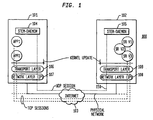
- FIG. 1 shows STEM system 100 for nodes 101 and 102 communicating through Internet 103.
- Node 101 comprises two user applications APP1 and APP2 generating data processed by transport-layer module 106 and network-layer module 107 prior to transmission as packets through Internet 103.
- Node 102 comprises network-layer module 108 and transport-layer module 109 to process packets received from Internet 103 to provide the data to applications servers SRV1, SRV2, and SRV3.
- Transport-layer modules 106 and 109 communicate based on, for example, transmission control protocol (TCP), and network-layer modules 107 and 108 communicate based on, for example, IP.
- TCP/IP communication is well known in the art and may be found in, for example, Andrew S. Tannenbaum, Computer Networks, second edition, Prentice Hall, 1988 .
- STEM daemons 104 and 105 coordinate data exchange and control, such as identifying 5-tuple information including source and destination IP addresses, for nodes 101 and 102, respectively.
- STEM daemons 104 and 105 might be in communication through an out-of-band channel (channel separate from the TCP session channel), shown as a user datagram protocol (UDP) session passing through Internet 103.
- UDP user datagram protocol
- Each STEM daemon is implemented with a dynamically loadable kernel module (not shown in FIG. 1 ).
- a daemon is a program that runs continuously and exists for the purpose of handling periodic service requests that a computer system expects to receive. The daemon program forwards the requests to other programs (or processes) as specified by a given communication protocol.
- the kernel modules of STEM daemons 104 and 105 modify their kernel data structures that store 5-tuple information. The 5-tuple uniquely identifies a kernel socket descriptor (descriptor identifying the TCP/IP session in the application).
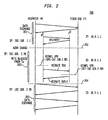
- FIG. 2 shows an exemplary migration event sequence between a migrator and fixed end (the non-migrator). Normal data transfer takes place between the two endpoints during the period 201 using IP address 192.168.1.1 for the migrator.
- messages through the TCP session are shown under (M) for data from the migrator and (F) for data from the fixed end, while control messages through the out-of-band channel (e.g., UDP session) are shown under (M D ) for messages from the migrator and (F D ) for messages from the fixed end.
- the migrator optionally registers with the fixed end using a registration request for which the fixed end acknowledges with a reply through the out-of-band channel.
- the migrator optionally registers with the fixed end for security and to inform the fixed end that the migrator is about to move or change its IP address.
- the migrator might obtain the new IP address for its interface with a number of different methods.
- the migrator may itself request the address from a higher level network manager or DHCP server, which will then assign and provide the address.
- the interface may be manually reconfigured to a new IP address.
- the migrator begins to change to IP address 192.168.2.99.
- the kernel module of the migrator e.g., node 101 updates the IP address in the 5-tuple data structure associated with the socket descriptor.
- Each socket descriptor is uniquely associated with a 5-tuple.
- the kernel data structure update begins by searching all open socket descriptors and matching them against the specified 5-tuple (containing the old IP address as one of the tuples). Once a valid match is identified, the appropriate change is made to this data structure to reflect the new IP (endpoint) address.
- packet transmission to the destination node is suspended. TCP data segments are buffered in the node's send queue (TCP send-Q) until a valid route is established.
- the changes to the kernel are transparent, since the application is still bound to the same socket descriptor.
- the application employs the same socket descriptor and continues to operate normally.
- Data sent on the modified socket descriptor yields a valid route/interface during the route lookup process.
- the migrator informs the remote- (fixed-) end of the change to the new endpoint IP address through out-of-band communication (shown as control message "migrate req"). Based on this information, the fixed end applies similar changes to its kernel data structures such that the destination address in the IP header of the data packets sent out by the fixed-end reflects the new value.
- the fixed end acknowledges the modification of its kernel (shown as control message "migrate reply") to the migrator, and the two end-points resume communication as a normal TCP session in period 205 using the new IP address for the migrator.
- TCP data segments buffered in the TCP send-Q are sent out of the interface towards the destination, since there is a valid route, and the IP address of all packets transmitted contain the appropriate new address in the IP header.
- Controlling the migration process in a smooth and systematic manner prevents conditions, called race conditions, which may generate TCP reset messages that would terminate the connection.
- preferred embodiments might prevent these conditions by ensuring 1) that the migrator's kernel changes are always applied first before the non-migrator is informed of these changes and 2) that the migrator does not send any data on that session during the control message exchange period.
- Such prevention might be achieved, for example, by using firewall rules on the system (e.g. output chain rules of iptables in a Linux operating system) to prevent any session data from leaving the system until the migration process is complete.
- the rules are dynamically added to the kernel to explicitly prevent transmission of packets on this session to the remote-end.
- the rules are withdrawn to resume normal operation.
- preferred embodiments might delay the reassignment of the old endpoint IP address for a certain time period. This ensures that two different sessions do not concurrently employ the same IP address.
- FIG. 3 shows an exemplary method employed for the migrator during the event sequence of FIG. 2 .
- the migrator is currently participating in an existing session with the non-migrator using a current endpoint IP address.
- the migrator sends a Registration Request control message to the non-migrator through an out-of-band channel (e.g., a UDP channel) to register the migrator with the non-migrator.
- the migrator receives a Registration Reply control message from the non-migrator through the out-of-band channel as an acknowledgment of registration by the non-migrator.
- the migrator begins to change its current endpoint IP address to a newly acquired endpoint IP address ("new endpoint IP address).
- the migrator suspends transmission of packets, and enqueues the packets in the TCP send-Q.
- the migrator begins dropping packets received from the non-migrator that contain the old endpoint IP address.
- the migrator updates the migrator's kernel data structure of the STEM daemon to include the new endpoint IP address.
- the migrator sends an Endpoint Address Change control message to the non-migrator through the out-of-band channel to indicate that the migrator has changed to the new endpoint IP address. During this period, the migrator continues to enqueue packets in the TCP send-Q.
- the migrator receives an Endpoint Address Change Acknowledgment control message from the non-migrator through the out-of-band channel indicating that the non-migrator has changed its kernel data structure to include the new endpoint IP address.
- the migrator continues the session with the new endpoint IP address by releasing packets from the TCP send-Q.
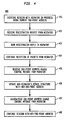
- FIG. 4 shows an exemplary method employed by the non-migrator during the event sequence of FIG. 2 .
- the non-migrator is currently participating in an existing session with the migrator using a current Endpoint IP address.
- the non-migrator receives a registration request from the migrator through an out-of-band channel to register the migrator with the non-migrator.
- the non-migrator registers the migrator and sends a registration reply control message to the migrator through the out-of-band channel as an acknowledgment of registration by the non-migrator.
- the non-migrator continues reception of packets from the migrator that contain the old endpoint IP address.
- the non-migrator receives an Endpoint Address Change control message from the migrator through the out-of-band channel to indicate that the migrator has changed to the new endpoint IP address.
- the non-migrator updates the non-migrator's kernel data structure of the STEM daemon to include the new endpoint IP address.
- the non-migrator sends an Endpoint Address Change Acknowledgment control message to the migrator through the out-of-band channel indicating that the non-migrator has changed its kernel data structure to include the new endpoint IP address.
- the non-migrator continues the session with the new Endpoint IP address.
- STEM system 100 employs an out-of-band control channel, shown as UDP channel 150, to communicate between peers such as STEM daemon modules 104 and 105.
- UDP channel 150 an out-of-band control channel
- FIGs. 5 through 8 show formats for exemplary control messages for the migrator and non-migrator that may be exchanged through UDP channel 150. A common header is used in all control messages, which might conform to a UDP format having non-zero checksum.
- FIG. 5 shows an exemplary format of a STEM system control message common control header.
- “Version” identifies to the version number of the protocol
- “Sequence #” identifies the 16-bit message count in the data message sequence
- "Identifier cookie” is 48-bit identifier uniquely identifying a node
- “Replay Protect ID” is a 64-bit unique identifier based on a timestamp or a random value to protect against replay attacks.
- Type identifies the packet as a control message type and might take on four values: a "1" indicates the message is a registration request, a "2" indicates the message is a registration reply, a "3" indicates the message is a migration request, and a "4" indicates that the message is a migration reply.
- “Flags/Codes” identifies the flags and return codes used in the migration registration control message, where a "1" indicates the registration request is accepted. Other values of "Flags/Codes” may indicate that the registration request is denied for a given reason.
- the registration process begins with the migrator sending a Registration Request control message indicating its capabilities to the non-migrator. After authentication and validation, the non-migrator responds with the Registration Reply control message with the appropriate reply code set which indicates the status of the request.
- the "identifier cookie" field is used to uniquely identify a node. Many methods by which this cookie can be generated are known in the art. For example, cookie generation methods used in SCTP or TCP (e.g., SYN cookie generation) may be employed. Typically, the cookie is a function of an invariant that identifies the node. For example, since the IP address is continuously changing, a fully qualified domain name with a one-way hash function applied to the domain name yields a unique 48-bit entry cookie.
- the Replay Protection ID field constructed by the migrator, is used for matching the registration requests and reply messages to thwart playback/replay attacks.
- a replay attack is an attack on a security protocol using replay of messages from a different context into the original context, thereby fooling the honest participant(s) into believing they have successfully completed the protocol run.
- the registration reply message from the non-migrator sets this field to a value computed based on the Replay Protection ID field received in the request message and the style of the replay protection mechanism used (e.g., timestamp or nonces (random values) given by the node's security association).
- FIG. 6 shows an exemplary format of a STEM system control message extension header for authentication.
- “Type” identifies the packet as an authentication header type
- “Length” is the length of the packet
- "SPI” is a security parameter index that identifies a security context between two peers
- "Authentication” is a variable length authentication field.
- the authentication mechanism employed by the exemplary STEM system might be similar to that used in Mobile IP.
- Each node supports a security association indexed by the opaque security parameter index (SPI) and the identifier cookie.
- SPI opaque security parameter index
- the SPI within the authentication extension header defines the security context which is used to compute the authentication value and is used by a receiver to check that value.
- the receiver selects the authentication algorithm (e.g. cipher algorithms HMAC-MD5 (Hashed Message Authentication Code-Message Digest version 5) and SHA (Secure Hash Algorithm)), algorithm mode (e.g., prefix + suffix) and the secret (shared key or public/private key pair) used in computing the authentication based on this SPI.
- the authentication value computed protects the UDP channel packet's payload (Registration Request/Reply control messages), other extensions (Migrate Request/Reply control messages) and the initial part of the packet header (type, length, and the SPI).
- FIG. 7 shows an exemplary format of a STEM system control message extension header for migration.
- “Type” identifies the packet as a migration header type
- “Length” is the length of the data
- "Old IP addr” is the IP address before migration
- “New IP addr” is the IP address after migration
- “Old Port” is the old port number before migration
- “New Port” is the new port number after migration.
- the migration process involves exchanging migration request/reply control messages between the peers.
- the control message includes one or more migration headers.
- Each migration header contains information on mapping the old 5-tuple to a new 5-tuple, for one or many sessions between the peers.
- Each bit in the "protocol flags" field indicates a predefined protocol. More than one bit might be sent simultaneously to indicate migration of multiple protocols of interest. Setting the field to a null value indicates migration for all protocols.
- the "Old IP” and "New IP” fields provide the specified mapping from the old IP address to the new IP address of the migrating endpoint, while the "Old Port” and “New Port” fields provide the equivalent mappings for the ports used in each session.
- the port fields might also be set to a null value to indicate that the migrator desires to migrate all sessions between the two endpoints, such as when the mobile node moves across IP subnets and the mobile node desires to migrate all open sessions simultaneously.
- FIG. 8 shows an exemplary format of a STEM system control message extension header for opaque data.
- Type identifies the packet as an opaque header type
- Length identifies the length of the "Sub-Type” and “Opaque Data” fields
- Sub-Type indicates the type of update information included in the opaque data (e.g., location update information)
- Flags/Codes are flags or codes used to facilitate opaque data exchange
- Opaque Data is the variable-length opaque data of the packet.
- the present invention may allow for the following advantages.
- Endpoints operating in accordance with one or more embodiments of the STEM system neither break the end-to-end TCP connection nor assign any code/proxy in the communication path between the endpoints. No new code is added in the data path, and the application is not tricked into believing that the connection still exists.
- One or more embodiments of the STEM system migrate the same TCP connection over to the new address or new point of attachment (i.e., the endpoint TCP state machine continues to be in an "ESTABLISHED" state during the migration process).
- the present invention has been described with respect to a packet network operating in accordance with a TCP-IP communication process, the present invention is not so limited.
- One skilled in the art may readily extend the teachings herein to other packet networks in which one node transfers it's connection to another node.
- the present invention may be preferred for use in wireless, radio, cellular or other non-wired applications (collectively termed “wireless” applications), but the present invention is not so limited and may be employed in wired or optical networks supporting packet-based communications.
- the present invention can be embodied in the form of methods and apparatuses for practicing those methods.
- the present invention can also be embodied in the form of program code embodied in tangible media, such as floppy diskettes, CD-ROMs, hard drives, or any other machine-readable storage medium, wherein, when the program code is loaded into and executed by a machine, such as a computer, the machine becomes an apparatus for practicing the invention.
- the present invention can also be embodied in the form of programme code, for example, whether stored in a storage medium, loated into and/or executed by a machine, or transmitted over some transmission medium, such as over electrical wiring or cabling, through fiber optics, or via electromagnetic radiation, wherein, when the program code is loaded into and executed by a machine, such as a computer, the machine becomes an apparatus for practicing the invention.
- programme code for example, whether stored in a storage medium, loated into and/or executed by a machine, or transmitted over some transmission medium, such as over electrical wiring or cabling, through fiber optics, or via electromagnetic radiation, wherein, when the program code is loaded into and executed by a machine, such as a computer, the machine becomes an apparatus for practicing the invention.
- the program code segments combine with the processor to provide a unique device that operates analogously to specific logic circuits.
Landscapes
- Engineering & Computer Science (AREA)
- Computer Networks & Wireless Communication (AREA)
- Signal Processing (AREA)
- Computer Security & Cryptography (AREA)
- Computer Hardware Design (AREA)
- Computing Systems (AREA)
- General Engineering & Computer Science (AREA)
- Data Exchanges In Wide-Area Networks (AREA)
- Computer And Data Communications (AREA)
- Mobile Radio Communication Systems (AREA)
Claims (3)
- Procédé permettant de migrer d'une adresse d'extrémité courante du dispositif de migration vers une nouvelle adresse d'extrémité du dispositif de migration pendant une session entre un dispositif de migration et un dispositif de non migration dans un système de communication basé sur les paquets, dans lequel le dispositif de migration est une extrémité ayant une adresse qui passe pendant la session de l'adresse d'extrémité courante de l'adresse d'extrémité courante du dispositif de migration à la nouvelle adresse d'extrémité du dispositif de migration, et le dispositif de non migration est une extrémité ayant une adresse qui ne change pas pendant la session, dans lequel le procédé comprend les étapes suivantes :a) changer (304), dans le dispositif de migration, l'adresse d'extrémité courante du dispositif de migration en nouvelle adresse d'extrémité du dispositif de migration par les étapes suivantes :a1) envoyer un message de contrôle de la demande d'enregistrement (302, 303) au dispositif de non migration par l'intermédiaire d'un canal hors bande pour enregistrer le dispositif de migration avec le dispositif de non migration,a2) recevoir un message de contrôle de la réponse d'enregistrement du dispositif de non migration par l'intermédiaire du canal hors bande en tant qu'accusé de réception d'enregistrement par le dispositif de non migration,a3) une fois que les étapes a1) et a2) ont été réalisées, passer logiquement à la nouvelle adresse d'extrémité du dispositif de migration en passant (307) d'un quintuplet courant comprenant l'adresse d'extrémité courante du dispositif de migration à un nouveau quintuplet comprenant la nouvelle adresse d'extrémité du dispositif de migration, eta4) mettre à jour une structure de noyau du dispositif de migration en modifiant une interface de connexion avec le quintuplet courant pour refléter le nouveau quintuplet, l'interface de connexion associée à la session ;b) suspendre la transmission (305) vers le dispositif de non migration des paquets avec la nouvelle adresse d'extrémité du dispositif de migration ;c) informer (308) le dispositif de non migration, via le canal hors bande séparé du canal de la session entre le dispositif de migration et le dispositif de non migration, du passage à la nouvelle adresse d'extrémité du dispositif de migration par les étapes suivantes :c1) envoyer (308) un message de contrôle au dispositif de non migration informant le dispositif de non migration du passage à la nouvelle adresse d'extrémité du dispositif de migration, etc2) recevoir (309) une confirmation du dispositif de non migration que le dispositif de non migration est passé à la nouvelle adresse d'extrémité du dispositif de migration ; etd) reprendre la transmission (310) vers le dispositif de non migration des paquets avec la nouvelle adresse d'extrémité du dispositif de migration.
- Procédé selon la revendication 1, dans lequel l'étape b) comprend les étapes de rejet (306) des paquets provenant du dispositif de non migration reçus au niveau de la couche réseau et de suspension de la transmission (308) des paquets vers le dispositif de non migration au niveau de la couche transport, et dans lequel l'étape de suspension de la transmission des paquets vers le dispositif de non migration au niveau de la couche transport suspend la transmission des paquets pendant un état de concurrence avec les règles de filtrage de pare-feu.
- Procédé selon l'une quelconque des revendications 1 et 2, dans lequel la session est conforme à un protocole de contrôle de transmission et un Protocole Internet.
Applications Claiming Priority (2)
| Application Number | Priority Date | Filing Date | Title |
|---|---|---|---|
| US766164 | 1996-12-12 | ||
| US10/766,164 US8195835B2 (en) | 2004-01-28 | 2004-01-28 | Endpoint address change in a packet network |
Publications (2)
| Publication Number | Publication Date |
|---|---|
| EP1560397A1 EP1560397A1 (fr) | 2005-08-03 |
| EP1560397B1 true EP1560397B1 (fr) | 2008-04-02 |
Family
ID=34654327
Family Applications (1)
| Application Number | Title | Priority Date | Filing Date |
|---|---|---|---|
| EP05250067A Expired - Lifetime EP1560397B1 (fr) | 2004-01-28 | 2005-01-07 | Changement d'adresse d'extrémité dans un réseau de paquets |
Country Status (6)
| Country | Link |
|---|---|
| US (1) | US8195835B2 (fr) |
| EP (1) | EP1560397B1 (fr) |
| JP (1) | JP4672382B2 (fr) |
| KR (1) | KR101099382B1 (fr) |
| CN (1) | CN1649351B (fr) |
| DE (1) | DE602005005724T2 (fr) |
Families Citing this family (49)
| Publication number | Priority date | Publication date | Assignee | Title |
|---|---|---|---|---|
| US7895648B1 (en) * | 2004-03-01 | 2011-02-22 | Cisco Technology, Inc. | Reliably continuing a secure connection when the address of a machine at one end of the connection changes |
| US20050246346A1 (en) * | 2004-04-30 | 2005-11-03 | Gerdes Reiner J | Secured authentication in a dynamic IP environment |
| US20060101090A1 (en) * | 2004-11-08 | 2006-05-11 | Eliezer Aloni | Method and system for reliable datagram tunnels for clusters |
| US7908286B2 (en) * | 2004-12-08 | 2011-03-15 | Oracle International Corporation | Techniques for providing XQuery access using web services |
| WO2007069095A2 (fr) * | 2005-07-18 | 2007-06-21 | Broadcom Israel R & D | Procede et systeme pour charge a vide tcp transparent |
| US20070233822A1 (en) * | 2006-04-03 | 2007-10-04 | International Business Machines Corporation | Decrease recovery time of remote TCP client applications after a server failure |
| US8122492B2 (en) * | 2006-04-21 | 2012-02-21 | Microsoft Corporation | Integration of social network information and network firewalls |
| US20080219271A1 (en) * | 2006-04-25 | 2008-09-11 | Nokia Corporation | IP multicast based systems, apparatuses and methods for TCP connection migration |
| US8079073B2 (en) * | 2006-05-05 | 2011-12-13 | Microsoft Corporation | Distributed firewall implementation and control |
| US8176157B2 (en) * | 2006-05-18 | 2012-05-08 | Microsoft Corporation | Exceptions grouping |
| BRPI0622098A2 (pt) | 2006-10-31 | 2011-12-27 | Telecom Italia Spa | terminais de modo duplo e de modo énico, sistema de comunicaÇço, e, produto de software |
| US8412207B2 (en) | 2006-12-21 | 2013-04-02 | Core Wireless Licensing S.A.R.L. | Method of providing a mobility service |
| JP5034495B2 (ja) * | 2006-12-27 | 2012-09-26 | 日本電気株式会社 | ストレージシステムとプログラム並びに方法 |
| CN101047716B (zh) * | 2007-01-04 | 2011-05-04 | 华为技术有限公司 | 一种ip传输会话迁移的方法和装置 |
| US7983218B2 (en) * | 2007-03-29 | 2011-07-19 | Intel Corporation | Techniques to support seamless mobility of electronic devices engaged in a session initiation protocol (SIP) session |
| US8788682B2 (en) * | 2007-09-28 | 2014-07-22 | Telefonaktiebolaget L M Ericsson (Publ) | Communication device, and method, in an internet protocol network, of controlling a communication device |
| KR100925493B1 (ko) * | 2007-12-20 | 2009-11-05 | 한국전자통신연구원 | Ip주소에 기반한 네트워킹에서의 통신 세션 관리 방법 및시스템 |
| WO2009080649A2 (fr) * | 2007-12-21 | 2009-07-02 | Telefonaktiebolaget Lm Ericsson (Publ) | Améliorations apportées à une mobilité sans fil ou s'y rapportant |
| JP4623177B2 (ja) * | 2008-09-17 | 2011-02-02 | 富士ゼロックス株式会社 | 情報処理システム |
| US8443109B2 (en) * | 2009-05-22 | 2013-05-14 | Sprint Communications Company L.P. | Selection of a communication device for a user by a base station in response to receiving a communication session hand-off |
| US20100311401A1 (en) * | 2009-06-09 | 2010-12-09 | Sprint Communications Company L.P. | Communication session transfer from one communication device to another based on location correlated to time |
| MX2013004112A (es) * | 2010-10-12 | 2013-12-02 | Xg Technology Inc | Metodo para soportar transferencias de interestacion base en redes inalambricas basadas en ip. |
| US9262229B2 (en) | 2011-01-28 | 2016-02-16 | Oracle International Corporation | System and method for supporting service level quorum in a data grid cluster |
| US9164806B2 (en) | 2011-01-28 | 2015-10-20 | Oracle International Corporation | Processing pattern framework for dispatching and executing tasks in a distributed computing grid |
| US9063852B2 (en) * | 2011-01-28 | 2015-06-23 | Oracle International Corporation | System and method for use with a data grid cluster to support death detection |
| US9081839B2 (en) | 2011-01-28 | 2015-07-14 | Oracle International Corporation | Push replication for use with a distributed data grid |
| CN102223307B (zh) * | 2011-06-29 | 2017-02-15 | 中兴通讯股份有限公司 | 一种处理套接字的方法、分组数据传输的方法及装置 |
| US8868710B2 (en) * | 2011-11-18 | 2014-10-21 | Amazon Technologies, Inc. | Virtual network interface objects |
| KR20130097358A (ko) * | 2012-02-24 | 2013-09-03 | 삼성전자주식회사 | 다이렉트 푸시 이메일 서비스 제공 방법과 그를 위한 이메일 클라이언트 및 이메일 서버 |
| US9916545B1 (en) | 2012-02-29 | 2018-03-13 | Amazon Technologies, Inc. | Portable network interfaces for authentication and license enforcement |
| US8813225B1 (en) | 2012-06-15 | 2014-08-19 | Amazon Technologies, Inc. | Provider-arbitrated mandatory access control policies in cloud computing environments |
| US9160497B2 (en) * | 2012-07-02 | 2015-10-13 | Intel Corporation | Application continuity with reroute and reset in a wireless communication network |
| US9075953B2 (en) * | 2012-07-31 | 2015-07-07 | At&T Intellectual Property I, L.P. | Method and apparatus for providing notification of detected error conditions in a network |
| US9614918B2 (en) * | 2013-03-14 | 2017-04-04 | International Business Machines Corporation | Migration of network connection under mobility |
| US9345060B1 (en) | 2013-03-21 | 2016-05-17 | Sprint Spectrum L.P. | Invoking circuit switched fallback in response to VoIP call setup failure |
| US9021157B2 (en) * | 2013-03-28 | 2015-04-28 | Microsoft Technology Licensing, Llc | Reliable socket transfer based on initializing and re-initializing a communication link and retaining a connected state |
| US9635114B2 (en) * | 2014-01-24 | 2017-04-25 | Netapp, Inc. | Externally initiated application session endpoint migration |
| US20150236904A1 (en) * | 2014-06-02 | 2015-08-20 | Hsiaokuei Tsui | Internet Device Architecture to Save Power And Cost |
| US9787499B2 (en) | 2014-09-19 | 2017-10-10 | Amazon Technologies, Inc. | Private alias endpoints for isolated virtual networks |
| US10664495B2 (en) | 2014-09-25 | 2020-05-26 | Oracle International Corporation | System and method for supporting data grid snapshot and federation |
| US10021196B1 (en) | 2015-06-22 | 2018-07-10 | Amazon Technologies, Inc. | Private service endpoints in isolated virtual networks |
| US10585599B2 (en) | 2015-07-01 | 2020-03-10 | Oracle International Corporation | System and method for distributed persistent store archival and retrieval in a distributed computing environment |
| US10860378B2 (en) | 2015-07-01 | 2020-12-08 | Oracle International Corporation | System and method for association aware executor service in a distributed computing environment |
| US10798146B2 (en) | 2015-07-01 | 2020-10-06 | Oracle International Corporation | System and method for universal timeout in a distributed computing environment |
| US11163498B2 (en) | 2015-07-01 | 2021-11-02 | Oracle International Corporation | System and method for rare copy-on-write in a distributed computing environment |
| DE112016007007T5 (de) | 2016-06-22 | 2019-03-07 | Intel Corporation | Kommunikationsvorrichtung und verfahren für vollduplex-disposition |
| US10038639B2 (en) * | 2016-09-16 | 2018-07-31 | Alcatel Lucent | Congestion control based on flow control |
| WO2020167506A1 (fr) * | 2019-02-13 | 2020-08-20 | Mediatek Singapore Pte. Ltd. | Sélection de protocole de transport entre un équipement utilisateur et une fonction de localisation distribuée |
| US11611501B2 (en) | 2019-08-16 | 2023-03-21 | Nokia Technologies Oy | Apparatus, method, and computer program |
Family Cites Families (9)
| Publication number | Priority date | Publication date | Assignee | Title |
|---|---|---|---|---|
| US6072942A (en) * | 1996-09-18 | 2000-06-06 | Secure Computing Corporation | System and method of electronic mail filtering using interconnected nodes |
| US6018659A (en) * | 1996-10-17 | 2000-01-25 | The Boeing Company | Airborne broadband communication network |
| JP3442257B2 (ja) | 1997-05-06 | 2003-09-02 | 日本電信電話株式会社 | パケット通信方法 |
| US6332163B1 (en) * | 1999-09-01 | 2001-12-18 | Accenture, Llp | Method for providing communication services over a computer network system |
| US8077679B2 (en) * | 2001-03-28 | 2011-12-13 | Qualcomm Incorporated | Method and apparatus for providing protocol options in a wireless communication system |
| US6781963B2 (en) * | 2002-02-14 | 2004-08-24 | Qualcomm Inc | Method and an apparatus for terminating a user from a group call in a group communication network |
| US6721907B2 (en) * | 2002-06-12 | 2004-04-13 | Zambeel, Inc. | System and method for monitoring the state and operability of components in distributed computing systems |
| US20040151158A1 (en) * | 2002-11-08 | 2004-08-05 | Ecrio, Inc. | Method and apparatus for exchanging voice over data channels in near real time |
| US7058052B2 (en) * | 2003-04-11 | 2006-06-06 | Nokia Corporation | System and method for using a mobile router tunneling protocol to locate functionality in a distributed architecture |
-
2004
- 2004-01-28 US US10/766,164 patent/US8195835B2/en active Active
-
2005
- 2005-01-07 EP EP05250067A patent/EP1560397B1/fr not_active Expired - Lifetime
- 2005-01-07 DE DE602005005724T patent/DE602005005724T2/de not_active Expired - Lifetime
- 2005-01-21 KR KR1020050005793A patent/KR101099382B1/ko not_active Expired - Fee Related
- 2005-01-26 CN CN2005100047865A patent/CN1649351B/zh not_active Expired - Fee Related
- 2005-01-28 JP JP2005020844A patent/JP4672382B2/ja not_active Expired - Fee Related
Non-Patent Citations (2)
| Title |
|---|
| JOHNSON RICE UNIVERSITY ET AL: "Mobility Support in IPv6 draft-ietf-mobileip-ipv6-24.txt; draft-ietf-mobileip-ipv6-24.txt", IETF STANDARD-WORKING-DRAFT, vol. MOBILEIP, no. 24, 30 June 2003 (2003-06-30), INTERNET ENGINEERING TASK FORCE, IETF, CH, pages 1 - 173, XP015002681 * |
| WEDLUND E.; SCHULZRINNE H.: "MOBILITY SUPPORT USING SI", ACM/IEEE INTERNATIONAL CONFERENCE ON WIRELESS AND MOBILE MULTIMEDIA, 1999, pages 76 - 82, XP002942550 * |
Also Published As
| Publication number | Publication date |
|---|---|
| KR101099382B1 (ko) | 2011-12-29 |
| CN1649351A (zh) | 2005-08-03 |
| KR20050077740A (ko) | 2005-08-03 |
| US8195835B2 (en) | 2012-06-05 |
| EP1560397A1 (fr) | 2005-08-03 |
| DE602005005724D1 (de) | 2008-05-15 |
| CN1649351B (zh) | 2010-10-13 |
| JP4672382B2 (ja) | 2011-04-20 |
| US20050198384A1 (en) | 2005-09-08 |
| JP2005218111A (ja) | 2005-08-11 |
| DE602005005724T2 (de) | 2009-06-04 |
Similar Documents
| Publication | Publication Date | Title |
|---|---|---|
| US8195835B2 (en) | Endpoint address change in a packet network | |
| EP3635939B1 (fr) | Continuité de session et de mobilité sans interruption avec option de mobilité tcp | |
| Nordmark et al. | Shim6: Level 3 multihoming shim protocol for IPv6 | |
| USRE46113E1 (en) | Technique for maintaining secure network connections | |
| US7028335B1 (en) | Method and system for controlling attacks on distributed network address translation enabled networks | |
| US8032641B2 (en) | Assymmetric traffic flow detection | |
| US20020080752A1 (en) | Route optimization technique for mobile IP | |
| CN101204071A (zh) | 移动设备网络地址更改的方法及装置 | |
| KR20030085484A (ko) | 네트워크 스택으로 오프로딩된 네트워크 스택 연결을 동기및 업로딩하는 방법 | |
| Qu et al. | A mobile TCP socket | |
| Henderson et al. | Experience with the host identity protocol for secure host mobility and multihoming | |
| US20210203763A1 (en) | Method and system for reliable application layer data transmission through unreliable transport layer connections in a network | |
| Barré | Implementation and assessment of modern host-based multipath solutions | |
| US8819790B2 (en) | Cooperation method and system between send mechanism and IPSec protocol in IPV6 environment | |
| EP1421746B1 (fr) | Dispositif, procede et systeme pour l'acheminement ameliore dans le reseautage ip mobile | |
| RU2373654C1 (ru) | Способ установления однорангового соединения и предназначенная для этого система | |
| Bhagwat et al. | MSOCKS+: an architecture for transport layer mobility | |
| CN110381007A (zh) | Tcp加速方法及装置 | |
| Tilak et al. | A concurrent migration extension to an end-to-end host mobility architecture | |
| Ansari et al. | STEM: seamless transport endpoint mobility | |
| Rikitake et al. | T/TCP for DNS: A performance and security analysis | |
| Schütz | Network Support for Intermittently Connected Mobile Nodes | |
| Duchêne | Helping the Internet scale by leveraging path diversity | |
| Komu et al. | An implementation of HIP for Linux | |
| Thothadri | Design and implementation of the mobile internet protocol on the linux kernel to support internet mobility |
Legal Events
| Date | Code | Title | Description |
|---|---|---|---|
| PUAI | Public reference made under article 153(3) epc to a published international application that has entered the european phase |
Free format text: ORIGINAL CODE: 0009012 |
|
| 17P | Request for examination filed |
Effective date: 20050127 |
|
| AK | Designated contracting states |
Kind code of ref document: A1 Designated state(s): AT BE BG CH CY CZ DE DK EE ES FI FR GB GR HU IE IS IT LI LT LU MC NL PL PT RO SE SI SK TR |
|
| AX | Request for extension of the european patent |
Extension state: AL BA HR LV MK YU |
|
| AKX | Designation fees paid |
Designated state(s): DE FR GB |
|
| 17Q | First examination report despatched |
Effective date: 20060222 |
|
| 17Q | First examination report despatched |
Effective date: 20060222 |
|
| GRAP | Despatch of communication of intention to grant a patent |
Free format text: ORIGINAL CODE: EPIDOSNIGR1 |
|
| GRAS | Grant fee paid |
Free format text: ORIGINAL CODE: EPIDOSNIGR3 |
|
| GRAA | (expected) grant |
Free format text: ORIGINAL CODE: 0009210 |
|
| AK | Designated contracting states |
Kind code of ref document: B1 Designated state(s): DE FR GB |
|
| REG | Reference to a national code |
Ref country code: GB Ref legal event code: FG4D |
|
| REF | Corresponds to: |
Ref document number: 602005005724 Country of ref document: DE Date of ref document: 20080515 Kind code of ref document: P |
|
| ET | Fr: translation filed | ||
| PLBE | No opposition filed within time limit |
Free format text: ORIGINAL CODE: 0009261 |
|
| STAA | Information on the status of an ep patent application or granted ep patent |
Free format text: STATUS: NO OPPOSITION FILED WITHIN TIME LIMIT |
|
| 26N | No opposition filed |
Effective date: 20090106 |
|
| REG | Reference to a national code |
Ref country code: GB Ref legal event code: 732E Free format text: REGISTERED BETWEEN 20131107 AND 20131113 |
|
| REG | Reference to a national code |
Ref country code: FR Ref legal event code: CD Owner name: ALCATEL-LUCENT USA INC. Effective date: 20131122 |
|
| REG | Reference to a national code |
Ref country code: FR Ref legal event code: GC Effective date: 20140410 |
|
| REG | Reference to a national code |
Ref country code: FR Ref legal event code: RG Effective date: 20141015 |
|
| REG | Reference to a national code |
Ref country code: FR Ref legal event code: PLFP Year of fee payment: 11 |
|
| REG | Reference to a national code |
Ref country code: FR Ref legal event code: PLFP Year of fee payment: 12 |
|
| REG | Reference to a national code |
Ref country code: FR Ref legal event code: PLFP Year of fee payment: 13 |
|
| REG | Reference to a national code |
Ref country code: FR Ref legal event code: PLFP Year of fee payment: 14 |
|
| REG | Reference to a national code |
Ref country code: DE Ref legal event code: R079 Ref document number: 602005005724 Country of ref document: DE Free format text: PREVIOUS MAIN CLASS: H04L0029060000 Ipc: H04L0065000000 |
|
| PGFP | Annual fee paid to national office [announced via postgrant information from national office to epo] |
Ref country code: FR Payment date: 20221208 Year of fee payment: 19 |
|
| PGFP | Annual fee paid to national office [announced via postgrant information from national office to epo] |
Ref country code: DE Payment date: 20221130 Year of fee payment: 19 |
|
| PGFP | Annual fee paid to national office [announced via postgrant information from national office to epo] |
Ref country code: GB Payment date: 20231130 Year of fee payment: 20 |
|
| REG | Reference to a national code |
Ref country code: DE Ref legal event code: R119 Ref document number: 602005005724 Country of ref document: DE |
|
| PG25 | Lapsed in a contracting state [announced via postgrant information from national office to epo] |
Ref country code: DE Free format text: LAPSE BECAUSE OF NON-PAYMENT OF DUE FEES Effective date: 20240801 |
|
| PG25 | Lapsed in a contracting state [announced via postgrant information from national office to epo] |
Ref country code: FR Free format text: LAPSE BECAUSE OF NON-PAYMENT OF DUE FEES Effective date: 20240131 |
|
| PG25 | Lapsed in a contracting state [announced via postgrant information from national office to epo] |
Ref country code: FR Free format text: LAPSE BECAUSE OF NON-PAYMENT OF DUE FEES Effective date: 20240131 Ref country code: DE Free format text: LAPSE BECAUSE OF NON-PAYMENT OF DUE FEES Effective date: 20240801 |
|
| REG | Reference to a national code |
Ref country code: GB Ref legal event code: PE20 Expiry date: 20250106 |
|
| PG25 | Lapsed in a contracting state [announced via postgrant information from national office to epo] |
Ref country code: GB Free format text: LAPSE BECAUSE OF EXPIRATION OF PROTECTION Effective date: 20250106 |