EP1560146A2 - Dreidimensionaler Punktcode - Google Patents
Dreidimensionaler Punktcode Download PDFInfo
- Publication number
- EP1560146A2 EP1560146A2 EP04027558A EP04027558A EP1560146A2 EP 1560146 A2 EP1560146 A2 EP 1560146A2 EP 04027558 A EP04027558 A EP 04027558A EP 04027558 A EP04027558 A EP 04027558A EP 1560146 A2 EP1560146 A2 EP 1560146A2
- Authority
- EP
- European Patent Office
- Prior art keywords
- dot code
- extractor
- bleed
- embedded
- dots
- Prior art date
- Legal status (The legal status is an assumption and is not a legal conclusion. Google has not performed a legal analysis and makes no representation as to the accuracy of the status listed.)
- Withdrawn
Links
Images




Classifications
-
- G—PHYSICS
- G06—COMPUTING OR CALCULATING; COUNTING
- G06K—GRAPHICAL DATA READING; PRESENTATION OF DATA; RECORD CARRIERS; HANDLING RECORD CARRIERS
- G06K15/00—Arrangements for producing a permanent visual presentation of the output data, e.g. computer output printers
-
- G—PHYSICS
- G06—COMPUTING OR CALCULATING; COUNTING
- G06K—GRAPHICAL DATA READING; PRESENTATION OF DATA; RECORD CARRIERS; HANDLING RECORD CARRIERS
- G06K1/00—Methods or arrangements for marking the record carrier in digital fashion
- G06K1/12—Methods or arrangements for marking the record carrier in digital fashion otherwise than by punching
- G06K1/121—Methods or arrangements for marking the record carrier in digital fashion otherwise than by punching by printing code marks
-
- G—PHYSICS
- G06—COMPUTING OR CALCULATING; COUNTING
- G06K—GRAPHICAL DATA READING; PRESENTATION OF DATA; RECORD CARRIERS; HANDLING RECORD CARRIERS
- G06K7/00—Methods or arrangements for sensing record carriers, e.g. for reading patterns
- G06K7/10—Methods or arrangements for sensing record carriers, e.g. for reading patterns by electromagnetic radiation, e.g. optical sensing; by corpuscular radiation
- G06K7/14—Methods or arrangements for sensing record carriers, e.g. for reading patterns by electromagnetic radiation, e.g. optical sensing; by corpuscular radiation using light without selection of wavelength, e.g. sensing reflected white light
Definitions
- the present invention relates to data embedding, and more particularly to techniques for embedding a relatively large number of bits on a printout, e.g., regular paper.
- the techniques may be realized as methods, various steps/aspects of which may be performed by an appropriately configured apparatus (e.g., printer, copier, computer, etc.), or may be embodied as a program of instructions, e.g., in the form of software on a device-readable medium.
- Applications of the techniques include document management, fraud prevention, inventory tracking, ID cards, parts marking, and product tagging.
- Data embedding on regular paper is known, but thus far has been limited to relatively simple, lower capacity data embedding.
- Xerox's dataglyph can record about 8 kbits per square inch assuming a 600 dpi print-scan scheme for data embedding and data recovery
- a 2-D barcode referred to as PDF417 can record only 2160 bits per square inch assuming a 400 dpi print-scan system.
- An object of this invention is to provide a technique that achieves high-density and robust data embedding on a printout.
- Another object of this invention is to provide 3-D dot code technology that enables the embedding of a relatively large amount of information on the opposite side of printout.
- a dot code system that includes both an embedder and an extractor.
- the embedder is configured to embed data in dots organized in blocks on a print medium, each block being embedded in two different colors, e.g., yellow and magenta
- the extractor is configured to convert the blocks of dots on the printed medium to a digital signal.
- the extractor also includes a bleed-through elimination module configured to reduce or eliminate effects of bleed-through on extraction of the blocks of dots caused by matter printed on one side of the printed medium bleeding through to the other side on which the blocks of dots are embedded.
- the dots are the halftone dots generated during processing of print data to be printed on the print medium.
- the dot code system as described above preferably further comprises an interleaver configured to interleave the data-to-be-embedded before it is embedded, and a de-interleaver configured to perform an inverse operation of the interleaver.
- the dot code system may be implemented as a program of instructions and graphical user interface, with the instructions being embodied in a printer driver.
- the invention involves a dot code embedder comprising an embedder configured to embed data in dots organized in blocks on a print medium, each block being embedded in two different colors, e.g., yellow and magenta, and an interleaver configured to interleave the data-to-be-embedded before it is embedded.
- a dot code embedder comprising an embedder configured to embed data in dots organized in blocks on a print medium, each block being embedded in two different colors, e.g., yellow and magenta, and an interleaver configured to interleave the data-to-be-embedded before it is embedded.
- the dot code embedder may be implemented as a program of instructions and graphical user interface, with the instructions being embodied in a printer driver.
- the invention involves a dot code extractor comprising an extractor configured to convert blocks of dots embedded on a printed medium to a digital signal, the extractor including a bleed-through elimination module configured to reduce or eliminate effects of bleed-through on extraction of the blocks of dots caused by matter printed on one side of the printed medium bleeding through to the other side on which the blocks of dots are embedded.
- the bleed-through elimination module comprises a black bleed-through elimination module configured to reduce or eliminate effects of bleed-through on extraction of the blocks of dots caused by black-colored matter printed on one side of the printed medium bleeding through to the other side on which the blocks of dots are embedded.
- the bleed-through elimination module further comprises a non-black bleed-through elimination module configured to operate in cooperation with the black bleed-through elimination module to reduce or eliminate effects of bleed-through on extraction of the blocks of dots caused by non-black-colored matter printed on one side of the printed medium bleeding through to the other side on which the blocks of dots are embedded.
- a non-black bleed-through elimination module configured to operate in cooperation with the black bleed-through elimination module to reduce or eliminate effects of bleed-through on extraction of the blocks of dots caused by non-black-colored matter printed on one side of the printed medium bleeding through to the other side on which the blocks of dots are embedded.
- each block of dots is embedded in two different colors, and the extractor is configured to extract each block from one of the colors.
- One of the colors is considered to be the primary extraction color (e.g., yellow) and the other color is considered to be secondary extraction color (e.g., magenta), and the extractor is configured to attempt to extract each block from the primary extraction color first and to attempt to extract that block from the secondary extraction color only if the attempted extraction of that block from the primary extraction color was unsuccessful.
- the primary extraction color e.g., yellow
- secondary extraction color e.g., magenta
- the dot code extractor is further preferably configured to automatically detect and correct rotation, translation, or both of the printed medium.
- the dot code extractor may be implemented as a program of instructions and graphical user interface, with the instructions being embodied in a printer driver.
- the data embedding techniques of the present invention include 3-D dot code technology whereby data is embedded on a printout based on the color and the ( x, y ) spatial locations of the dot on the printout.
- Such technology can be embodied in a printing scheme that enables the embedding of a relatively large amount of information on the opposite side of a printout, which may be in the form of regular paper.
- the embedding capacity of the present invention exceeds the data embedding capacities of other well-known techniques such as those mentioned above.
- the data embedding scheme of this invention can embed about 12 kbits per square inch.
- the 3-D dot code of this invention can embed up to about 150k bytes (in the one band case). This is sufficient for recording various digital data, including about 10 pages of Microsoft Excel, several minutes of compressed audio or an 800 x 600 JPEG image.
- the capacity can be reduced depending on the robustness of the settings.
- the 3-D code may have redundant embedding in several colors at the expense of the capacity.
- the embedding, as well as the extracting, techniques of this invention may be implemented with a 3-D dot code system generally comprising: (i) an embedder that allows the user to select a data file and then embeds the data directly into the halftone dots ready for printing; and (ii) an extractor that extracts the embedded bits from a scanned copy of the printed paper sheet.
- the embedder and extractor are each able to perform multiple functions and preferably include sub-components or modules for carrying out these functions.
- the scanned input of the embedded data may suffer from bleed-through from the printed backside.
- a bleed-through elimination module is provided in the extractor to overcome this problem.
- the 3-D dot code system also preferably includes a module that compensates for a scanned input that is not well positioned. Such a module automatically detects the rotation and translation, and then registers the image so that the upper-left corner is located in a certain position. This operation expedites the following data retrieval, in which data is read by block matching.
- a block diagram of a 3-D dot code system 11 configured in accordance with embodiments of the invention is shown.
- a binary data file is input into the embedder 12, encoded with error code correction (ECC) in ECC block 13, and interleaved in interleaver 14 to protect against random and burst errors.
- ECC error code correction
- the interleaved data is then embedded in blocks of dots, preferably 23 x 23 sized blocks.
- a printer driver is modified to generate blocks of dots in half-tone space. The blocks can be embedded in raster scan order on a paper sheet.
- the data can be embedded in any color of the output device color space, e.g., in any of the colors Cyan (C), Magenta (M), Yellow (Y) or Black (K) in the CMYK color space, which is the color space of most printers.
- C Cyan
- M Magenta
- Y Yellow
- K Black
- yellow dots are preferred since they do not affect the opposite side of the paper sheet when that side contains some printed matter.
- the extraction process is the inverse of embedding.
- a printout e.g., regular paper with printed matter and embedded data
- is input into the extractor 16 where data extraction, de-interleaving and ECC occur in a data extractor 17, de-interleaver 18 and ECC 19, respectively. Further details of these components as well as other features of 3-D dot code system 11 are described below in connection with the embedding and extracting algorithm performed by the system.
- FEC forward error correction
- the information to be transmitted is segmented into blocks of k bits.
- r n - k bits of redundancy are added to k bits to make an n-bit code word.
- the redundancy or parity symbols are computed for each block.
- cr k / n .
- the k information bits are not altered and r bits are simply appended to the payload bits.
- the error correction capability of a ( n,k ) code is primarily influenced by the minimum hamming distance d min , which should be as large as possible.
- the hamming distance of two binary code words is the number of bits in which they differ.
- Bose, Chaudhuri, Hocquengham (BCH) code is used, although other suitable linear block codes may be used.
- the error correction functions are performed by ECC blocks 13 and 19 in the illustrated embodiment.
- Interleaver 14 accepts the coded symbols in blocks from the FEC encoder, permutes the symbols, and then feeds the rearranged symbols to the data embedder 15.
- the usual permutation of the block is accomplished by filling the rows of a ⁇ -row-by- n -column ( ⁇ ⁇ n ) array with the encoded sequence, where ⁇ represents the Interleaving Degree or Interleaving Depth. After the array is completely filled, the symbols are read by columns and transmitted over the channel.
- the schematic illustration of the interleaving process is shown in Fig. 2.
- de-interleaver 18 performs the inverse operation. Symbols are written into the de-interleaver by columns and read by rows.
- BCH error-correction bits
- a print file containing the 3-D dot code i.e., the embedded information
- a print medium such as regular paper
- an ink-jet printer such as an Epson Stylus Color 740.
- the 3-D dot code can be generated in half-tone space in the printer driver.
- the extraction process begins by scanning a medium containing 3-D dot code using a scanner 41 or other suitable data capturing and digitizing device. Scanning should be done at > 360 dpi and at an optical resolution supported by the scanner (typically 600 dpi). In one embodiment, the setting for scanning is -40 for brightness and +40 for contrast to achieve good scan quality.
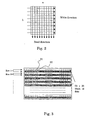
- the scanned input of 3-D dot code embedded sheet may suffer from the bleed-through from the printed backside as shown in Fig. 5. Multi-color bleed-through may also occur as shown in Fig. 6. Since extracting blocks may be hindered by bleed-through, a black bleed-through elimination module 42 is provided.
- the common bleed-through color is black.
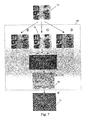
- a scanned 3-D dot code color image 71 is split into red (R), green (G) and blue (B) channels, identified by the reference numerals 72, 73 and 74 respectively, all three channels are evenly affected by the bleed-through, which means that only the brightness channel Y is affected when the image is viewed in YUV color space.
- black bleed-through elimination module 42 transforms the image from RGB to YUV color space and sets all of the pixels in the Y channel to the same value, as indicated in functional block 75 of Fig. 7. From the re-transformed RGB (R'G'B') image 76, which is free of bleed-through, B' data 77 is extracted in the case of yellow dot code. G' data is extracted in the case of magenta dot code.
- the degradation function is obtained from the degraded channel(s), and the function is applied to the unaffected channel(s) to affect (darken) all of the R,G,B channels.
- This process which is performed in module 43, turns the problem into the black ink bleed-through case.
- the affected 3-D dot codes are restored by using black bleed-through elimination module 42 to extract the blue channel data (yellow dot code) or the green channel data (magenta dot code), thereby yielding 3-D dot code that is free of bleed-through.
- bleed-through is in multiple colors, they are first modified to exhibit the effect of black bleed-through, and then the black bleed-through is removed.
- the additional processing for the green and red bleed-through cases are illustrated in Figs. 8 and 9 respectively.
- scanned 3-D dot code color image 81 is separated into its three color components R, G and B 82 and the degradation function from the R channel is used to modify the G channel.
- red bleed-through after separating scanned 3-D dot code color image 91 into its R, G and B components 92, the degradation function from the G channel is used to modify the R channel.
- image 71a/71b is input to black bleed-through elimination module 42 which performs the transformation/re-transformation operations described above in connection with the black bleed-through case to generate an R"B"G".
- Yellow 3-D dot code free from bleed-through is extracted from the yellow band of the B" data 87/97, as shown in the segmented image in Fig. 10(a).
- 3-D dot code can handle the bleed-through of all colors except yellow, blue and cyan
- magenta dot code can handle bleed-through of all colors except magenta, green and red.
- yellow dots can handle red, green and magenta bleed-through
- magenta dots can handle the bleed-through of blue, yellow and cyan.
- the scanned and segmented input image may not be well positioned.
- the 3-D code system 11 automatically detects the rotation and translation, and then registers the image so that the upper-left corner is located in a certain position. This step expedites the following data retrieval, in which data is processed by block matching.
- the invention includes a registration algorithm, which automatically detects rotation of the scanned image, and re-rotates and shifts it so that its upper left point is located at (20,20).
- the algorithm detects the upper-most points of the 3-D dot code along the code's upper boundary. From this set of upper-most dots, the line equation of the upper border line is computed by using linear regression.
- the leftmost dot along the line becomes the upper-left corner of the 3-D dot code, which is also used as a center point for rotating the scanned image.
- the center point is shifted so that the rotated dot code has its upper-left corner at (20,20).
- each block contains 41 bits (or dots) for synchronization. Since the positions of the synch bits in a block are known, this positional information is exploited for matching. If 40 or more dots are matched, the task is to read two codewords in the block. If both codewords are well decoded by an error control technique, block retrieval is finished. If block retrieval failed, the search position is changed and new matching is started. For each search position, rotation is also applied. Due to the registration described above, the angle range for rotation is very small, which means faster matching speed. The registration also makes the system easily locate the top-left block, which contains information about embedded data size and images size.
- the block retrieval is performed on blocks embedded in Y, i.e., yellow strips. If matching for a particular block in the Y strip fails, the system looks down for the block in the corresponding position in the M, i.e., magenta strip. When matching is done for a particular block in an M strip, the next block is searched for in Y strips. That is, yellow is the primary extraction color and magenta is the secondary extraction color. Matching for a particular block may fail in both Y and M strips, but only rarely. However, if that is the case, then the extractor declares a failure on that block, and skips it. This failure becomes a burst error, but by performing de-interleaving, they become random errors, which can be fixed by a decoder having error control.
- the 3-D dot code is preferably generated in half-tone space in the printer driver of a printer, preferably an ink-jet printer.
- a user can print the 3-D dot code using the printer, e.g., an Epson color printer.
- embedder 12 and extractor 16 can be conveniently implemented as command-line executable programs in the printer driver.
- a menu labeled "Data Embedding" contains tools of embedder 12 can be presented as a graphical user interface (GUI), as shown in Fig. 11.
- GUI graphical user interface
- the same screen of the GUI may also present a "Data Extracting" menu of tools for extractor 16.
- the embedder 12 is implemented in three steps: select input data file to embed in 3-D dot code format; select output print file name to be printed out; and embed to create the print file.
- the GUI of Fig. 11 shows the status after embedding is finished.
- extractor 16 from the GUI is straightforward. In most cases, the image would have been scanned at 600 dpi; therefore, no changes are needed in the default settings in the extractor.
- the input image is segmented into a Y channel image and an M channel image. Then the 600 dpi scaled image is re-sampled to 360 dpi.
- the extraction algorithm first looks for the top-left block in an area around the top-left corner of the image, as specified in the GUI. The defaults should be fine most of the time.
- a reduced resolution version of the image is displayed in the GUI window on the right, as shown in Fig. 12.
- Fig. 13 shows the segmented image with the 3-D dot code in the yellow band.
- Fig. 14 shows the messages when entire block reading is successful.
- the present invention provides a 3-D dot code embedding/extracting algorithm that enables high-density and robust data embedding on a printout.
- the algorithm has a variety of applications, including document management, fraud prevention, inventory tracking, ID cards, parts marking, and product tagging.
- One application scenario envisaged is embedding Excel data on the backside of a printout to give a recipient would have more control to modify and process the Excel data after scanning the embedded 3-D dot code data.
Landscapes
- Engineering & Computer Science (AREA)
- Physics & Mathematics (AREA)
- General Physics & Mathematics (AREA)
- Theoretical Computer Science (AREA)
- General Health & Medical Sciences (AREA)
- Electromagnetism (AREA)
- Health & Medical Sciences (AREA)
- Toxicology (AREA)
- Artificial Intelligence (AREA)
- Computer Vision & Pattern Recognition (AREA)
- General Engineering & Computer Science (AREA)
- Editing Of Facsimile Originals (AREA)
- Image Processing (AREA)
- Image Analysis (AREA)
Applications Claiming Priority (4)
| Application Number | Priority Date | Filing Date | Title |
|---|---|---|---|
| US53993104P | 2004-01-29 | 2004-01-29 | |
| US539931P | 2004-01-29 | ||
| US932193 | 2004-09-01 | ||
| US10/932,193 US7460278B2 (en) | 2004-01-29 | 2004-09-01 | 3-Dimensional dot code for paper storage |
Publications (2)
| Publication Number | Publication Date |
|---|---|
| EP1560146A2 true EP1560146A2 (de) | 2005-08-03 |
| EP1560146A3 EP1560146A3 (de) | 2007-02-21 |
Family
ID=34657362
Family Applications (1)
| Application Number | Title | Priority Date | Filing Date |
|---|---|---|---|
| EP04027558A Withdrawn EP1560146A3 (de) | 2004-01-29 | 2004-11-19 | Dreidimensionaler Punktcode |
Country Status (3)
| Country | Link |
|---|---|
| US (1) | US7460278B2 (de) |
| EP (1) | EP1560146A3 (de) |
| JP (1) | JP2005218084A (de) |
Families Citing this family (15)
| Publication number | Priority date | Publication date | Assignee | Title |
|---|---|---|---|---|
| US7227671B2 (en) * | 2004-03-23 | 2007-06-05 | Eastman Kodak Company | Motion picture watermarking using two color planes |
| DE202006021238U1 (de) * | 2006-08-25 | 2014-01-29 | Baumer Hhs Gmbh | Heißleimauftragssystem |
| US10496862B1 (en) | 2019-03-18 | 2019-12-03 | Capital One Services, Llc | Detection of images in relation to targets based on colorspace transformation techniques and utilizing ultraviolet light |
| US10509991B1 (en) | 2019-03-18 | 2019-12-17 | Capital One Services, Llc | Detection of images in relation to targets based on colorspace transformation techniques and utilizing infrared light |
| US10534948B1 (en) | 2019-03-18 | 2020-01-14 | Capital One Services, Llc | Optimizing detection of images in relation to targets based on colorspace transformation techniques |
| US10496911B1 (en) | 2019-03-18 | 2019-12-03 | Capital One Services, Llc | Detection of images in relation to targets based on colorspace transformation techniques and utilizing ultraviolet and infrared light |
| US10523420B1 (en) | 2019-04-18 | 2019-12-31 | Capital One Services, Llc | Transmitting encoded data along transmission mediums based on colorspace schemes |
| US10504013B1 (en) * | 2019-04-24 | 2019-12-10 | Capital One Services, Llc | Colorspace encoding multimedia data on a physical page |
| US10529300B1 (en) | 2019-06-20 | 2020-01-07 | Capital One Services, Llc | Adaptive image display based on colorspace conversions |
| US10614635B1 (en) | 2019-07-25 | 2020-04-07 | Capital One Services, Llc | Augmented reality system with color-based fiducial marker |
| US10833852B1 (en) | 2019-10-03 | 2020-11-10 | Capital One Services, Llc | Encoded data along tape based on colorspace schemes |
| US10715183B1 (en) | 2019-10-25 | 2020-07-14 | Capital One Services, Llc | Data encoding with error-correcting code pursuant to colorspace schemes |
| US10867226B1 (en) | 2019-11-04 | 2020-12-15 | Capital One Services, Llc | Programmable logic array and colorspace conversions |
| US10878600B1 (en) | 2019-12-10 | 2020-12-29 | Capital One Services, Llc | Augmented reality system with color-based fiducial marker utilizing local adaptive technology |
| US11302036B2 (en) | 2020-08-19 | 2022-04-12 | Capital One Services, Llc | Color conversion between color spaces using reduced dimension embeddings |
Family Cites Families (10)
| Publication number | Priority date | Publication date | Assignee | Title |
|---|---|---|---|---|
| CA2039652C (en) | 1990-05-30 | 1996-12-24 | Frank Zdybel, Jr. | Hardcopy lossless data storage and communications for electronic document processing systems |
| CA2044404C (en) | 1990-07-31 | 1998-06-23 | Dan S. Bloomberg | Self-clocking glyph shape codes |
| EP0996083B1 (de) * | 1992-09-28 | 2003-03-26 | Olympus Optical Co., Ltd. | System zur Informationswiedergabe für optische Punktcode-Ablesung von einem Aufzeichnungsmedium |
| US5337362A (en) | 1993-04-15 | 1994-08-09 | Ricoh Corporation | Method and apparatus for placing data onto plain paper |
| JPH0830977A (ja) | 1994-07-19 | 1996-02-02 | Olympus Optical Co Ltd | 情報記録媒体及び情報記録再生システム |
| US5659726A (en) * | 1995-02-23 | 1997-08-19 | Sandford, Ii; Maxwell T. | Data embedding |
| JPH0981711A (ja) | 1995-09-20 | 1997-03-28 | Olympus Optical Co Ltd | 情報記録媒体、情報再生システム、及び情報記録システム |
| US6473516B1 (en) | 1998-05-22 | 2002-10-29 | Asa Systems, Inc. | Large capacity steganography |
| US6839151B1 (en) * | 2000-02-02 | 2005-01-04 | Zoran Corporation | System and method for color copy image processing |
| US6650773B1 (en) | 2000-09-29 | 2003-11-18 | Hewlett-Packard Development Company, L.P. | Method including lossless compression of luminance channel and lossy compression of chrominance channels |
-
2004
- 2004-09-01 US US10/932,193 patent/US7460278B2/en not_active Expired - Fee Related
- 2004-11-19 EP EP04027558A patent/EP1560146A3/de not_active Withdrawn
-
2005
- 2005-01-14 JP JP2005007146A patent/JP2005218084A/ja not_active Withdrawn
Also Published As
| Publication number | Publication date |
|---|---|
| US20050167505A1 (en) | 2005-08-04 |
| US7460278B2 (en) | 2008-12-02 |
| JP2005218084A (ja) | 2005-08-11 |
| EP1560146A3 (de) | 2007-02-21 |
Similar Documents
| Publication | Publication Date | Title |
|---|---|---|
| US7460278B2 (en) | 3-Dimensional dot code for paper storage | |
| US5862270A (en) | Clock free two-dimensional barcode and method for printing and reading the same | |
| US7543748B2 (en) | Method and system for creating and using redundant and high capacity barcodes | |
| US5337362A (en) | Method and apparatus for placing data onto plain paper | |
| US7857405B2 (en) | Method of mapping error-detection and redundant encoded data to an image | |
| US7900846B2 (en) | Infra-red data structure printed on a photograph | |
| KR100505267B1 (ko) | 사진 상에 내오류성 데이터를 저장하기 위한 장치 및 방법 | |
| AU2002210250A1 (en) | Fault tolerant data storage on photographs | |
| CN118761430A (zh) | 一种多帧矩阵式二维码的编码方法及译码方法 | |
| JPH0675795A (ja) | ハードエラー発生度を低下させるためのグリフコードの論理的に独立した部分配列タイリング | |
| JP4128307B2 (ja) | コードイメージ読取装置 | |
| JPH06103390A (ja) | 多重バーストエラーパターンからの二次元コードの保護 | |
| JP2002512482A (ja) | 情報を伝送、受信、および/または記憶するためのプロセス | |
| AU2007254663A1 (en) | Efficient shuffling | |
| AU2004202957B2 (en) | Data storage on photographs | |
| AU2004203185B2 (en) | Method and apparatus for fault tolerant program and data storage on photographs |
Legal Events
| Date | Code | Title | Description |
|---|---|---|---|
| PUAI | Public reference made under article 153(3) epc to a published international application that has entered the european phase |
Free format text: ORIGINAL CODE: 0009012 |
|
| AK | Designated contracting states |
Kind code of ref document: A2 Designated state(s): AT BE BG CH CY CZ DE DK EE ES FI FR GB GR HU IE IS IT LI LU MC NL PL PT RO SE SI SK TR |
|
| AX | Request for extension of the european patent |
Extension state: AL HR LT LV MK YU |
|
| PUAL | Search report despatched |
Free format text: ORIGINAL CODE: 0009013 |
|
| AK | Designated contracting states |
Kind code of ref document: A3 Designated state(s): AT BE BG CH CY CZ DE DK EE ES FI FR GB GR HU IE IS IT LI LU MC NL PL PT RO SE SI SK TR |
|
| AX | Request for extension of the european patent |
Extension state: AL HR LT LV MK YU |
|
| 17P | Request for examination filed |
Effective date: 20070316 |
|
| 17Q | First examination report despatched |
Effective date: 20070713 |
|
| AKX | Designation fees paid |
Designated state(s): DE GB |
|
| STAA | Information on the status of an ep patent application or granted ep patent |
Free format text: STATUS: THE APPLICATION IS DEEMED TO BE WITHDRAWN |
|
| 18D | Application deemed to be withdrawn |
Effective date: 20100601 |