EP1559893A1 - Control apparatus and process for internal combustion engine - Google Patents
Control apparatus and process for internal combustion engine Download PDFInfo
- Publication number
- EP1559893A1 EP1559893A1 EP05001811A EP05001811A EP1559893A1 EP 1559893 A1 EP1559893 A1 EP 1559893A1 EP 05001811 A EP05001811 A EP 05001811A EP 05001811 A EP05001811 A EP 05001811A EP 1559893 A1 EP1559893 A1 EP 1559893A1
- Authority
- EP
- European Patent Office
- Prior art keywords
- engine
- control apparatus
- margin
- driver
- control
- Prior art date
- Legal status (The legal status is an assumption and is not a legal conclusion. Google has not performed a legal analysis and makes no representation as to the accuracy of the status listed.)
- Granted
Links
- 238000002485 combustion reaction Methods 0.000 title claims abstract description 15
- 238000000034 method Methods 0.000 title claims description 11
- 230000008569 process Effects 0.000 title claims description 8
- 239000000446 fuel Substances 0.000 claims abstract description 136
- 230000001133 acceleration Effects 0.000 claims abstract description 105
- 230000006866 deterioration Effects 0.000 claims abstract description 22
- 238000001514 detection method Methods 0.000 claims abstract description 14
- 230000007423 decrease Effects 0.000 claims description 68
- 230000005540 biological transmission Effects 0.000 claims description 55
- 230000003247 decreasing effect Effects 0.000 claims description 28
- 230000004044 response Effects 0.000 claims description 11
- 230000003111 delayed effect Effects 0.000 claims description 8
- 239000012530 fluid Substances 0.000 claims description 8
- 238000012544 monitoring process Methods 0.000 claims description 3
- 241000237519 Bivalvia Species 0.000 claims 2
- 235000020639 clam Nutrition 0.000 claims 2
- 239000007789 gas Substances 0.000 description 84
- 101100055841 Danio rerio apoa1 gene Proteins 0.000 description 18
- 230000001934 delay Effects 0.000 description 6
- 238000002347 injection Methods 0.000 description 6
- 239000007924 injection Substances 0.000 description 6
- 230000007246 mechanism Effects 0.000 description 4
- 230000004048 modification Effects 0.000 description 4
- 238000012986 modification Methods 0.000 description 4
- 238000005086 pumping Methods 0.000 description 4
- 102100021717 Early growth response protein 3 Human genes 0.000 description 3
- 101000896450 Homo sapiens Early growth response protein 3 Proteins 0.000 description 3
- 230000000052 comparative effect Effects 0.000 description 3
- 238000011144 upstream manufacturing Methods 0.000 description 3
- 102100030760 Apolipoprotein F Human genes 0.000 description 2
- 102100030802 Beta-2-glycoprotein 1 Human genes 0.000 description 2
- 102100023226 Early growth response protein 1 Human genes 0.000 description 2
- 101000793431 Homo sapiens Apolipoprotein F Proteins 0.000 description 2
- 101000793425 Homo sapiens Beta-2-glycoprotein 1 Proteins 0.000 description 2
- 101001049697 Homo sapiens Early growth response protein 1 Proteins 0.000 description 2
- 230000003197 catalytic effect Effects 0.000 description 2
- 230000008859 change Effects 0.000 description 2
- 230000000994 depressogenic effect Effects 0.000 description 2
- 230000002542 deteriorative effect Effects 0.000 description 2
- 230000001627 detrimental effect Effects 0.000 description 2
- 230000009467 reduction Effects 0.000 description 2
- 230000002441 reversible effect Effects 0.000 description 2
- 230000001052 transient effect Effects 0.000 description 2
- 102100023227 E3 SUMO-protein ligase EGR2 Human genes 0.000 description 1
- 101150000195 EGR3 gene Proteins 0.000 description 1
- 101001049692 Homo sapiens E3 SUMO-protein ligase EGR2 Proteins 0.000 description 1
- 230000009471 action Effects 0.000 description 1
- 230000000881 depressing effect Effects 0.000 description 1
- 230000000694 effects Effects 0.000 description 1
- 239000002184 metal Substances 0.000 description 1
- 239000000203 mixture Substances 0.000 description 1
- 230000003134 recirculating effect Effects 0.000 description 1
- 230000035807 sensation Effects 0.000 description 1
Images


Classifications
-
- B—PERFORMING OPERATIONS; TRANSPORTING
- B60—VEHICLES IN GENERAL
- B60W—CONJOINT CONTROL OF VEHICLE SUB-UNITS OF DIFFERENT TYPE OR DIFFERENT FUNCTION; CONTROL SYSTEMS SPECIALLY ADAPTED FOR HYBRID VEHICLES; ROAD VEHICLE DRIVE CONTROL SYSTEMS FOR PURPOSES NOT RELATED TO THE CONTROL OF A PARTICULAR SUB-UNIT
- B60W10/00—Conjoint control of vehicle sub-units of different type or different function
- B60W10/04—Conjoint control of vehicle sub-units of different type or different function including control of propulsion units
- B60W10/06—Conjoint control of vehicle sub-units of different type or different function including control of propulsion units including control of combustion engines
-
- B—PERFORMING OPERATIONS; TRANSPORTING
- B60—VEHICLES IN GENERAL
- B60W—CONJOINT CONTROL OF VEHICLE SUB-UNITS OF DIFFERENT TYPE OR DIFFERENT FUNCTION; CONTROL SYSTEMS SPECIALLY ADAPTED FOR HYBRID VEHICLES; ROAD VEHICLE DRIVE CONTROL SYSTEMS FOR PURPOSES NOT RELATED TO THE CONTROL OF A PARTICULAR SUB-UNIT
- B60W10/00—Conjoint control of vehicle sub-units of different type or different function
- B60W10/04—Conjoint control of vehicle sub-units of different type or different function including control of propulsion units
-
- B—PERFORMING OPERATIONS; TRANSPORTING
- B60—VEHICLES IN GENERAL
- B60W—CONJOINT CONTROL OF VEHICLE SUB-UNITS OF DIFFERENT TYPE OR DIFFERENT FUNCTION; CONTROL SYSTEMS SPECIALLY ADAPTED FOR HYBRID VEHICLES; ROAD VEHICLE DRIVE CONTROL SYSTEMS FOR PURPOSES NOT RELATED TO THE CONTROL OF A PARTICULAR SUB-UNIT
- B60W10/00—Conjoint control of vehicle sub-units of different type or different function
- B60W10/10—Conjoint control of vehicle sub-units of different type or different function including control of change-speed gearings
- B60W10/101—Infinitely variable gearings
-
- B—PERFORMING OPERATIONS; TRANSPORTING
- B60—VEHICLES IN GENERAL
- B60W—CONJOINT CONTROL OF VEHICLE SUB-UNITS OF DIFFERENT TYPE OR DIFFERENT FUNCTION; CONTROL SYSTEMS SPECIALLY ADAPTED FOR HYBRID VEHICLES; ROAD VEHICLE DRIVE CONTROL SYSTEMS FOR PURPOSES NOT RELATED TO THE CONTROL OF A PARTICULAR SUB-UNIT
- B60W10/00—Conjoint control of vehicle sub-units of different type or different function
- B60W10/10—Conjoint control of vehicle sub-units of different type or different function including control of change-speed gearings
- B60W10/101—Infinitely variable gearings
- B60W10/107—Infinitely variable gearings with endless flexible members
-
- B—PERFORMING OPERATIONS; TRANSPORTING
- B60—VEHICLES IN GENERAL
- B60W—CONJOINT CONTROL OF VEHICLE SUB-UNITS OF DIFFERENT TYPE OR DIFFERENT FUNCTION; CONTROL SYSTEMS SPECIALLY ADAPTED FOR HYBRID VEHICLES; ROAD VEHICLE DRIVE CONTROL SYSTEMS FOR PURPOSES NOT RELATED TO THE CONTROL OF A PARTICULAR SUB-UNIT
- B60W30/00—Purposes of road vehicle drive control systems not related to the control of a particular sub-unit, e.g. of systems using conjoint control of vehicle sub-units
- B60W30/18—Propelling the vehicle
- B60W30/1819—Propulsion control with control means using analogue circuits, relays or mechanical links
-
- B—PERFORMING OPERATIONS; TRANSPORTING
- B60—VEHICLES IN GENERAL
- B60W—CONJOINT CONTROL OF VEHICLE SUB-UNITS OF DIFFERENT TYPE OR DIFFERENT FUNCTION; CONTROL SYSTEMS SPECIALLY ADAPTED FOR HYBRID VEHICLES; ROAD VEHICLE DRIVE CONTROL SYSTEMS FOR PURPOSES NOT RELATED TO THE CONTROL OF A PARTICULAR SUB-UNIT
- B60W30/00—Purposes of road vehicle drive control systems not related to the control of a particular sub-unit, e.g. of systems using conjoint control of vehicle sub-units
- B60W30/18—Propelling the vehicle
- B60W30/188—Controlling power parameters of the driveline, e.g. determining the required power
- B60W30/1882—Controlling power parameters of the driveline, e.g. determining the required power characterised by the working point of the engine, e.g. by using engine output chart
-
- F—MECHANICAL ENGINEERING; LIGHTING; HEATING; WEAPONS; BLASTING
- F02—COMBUSTION ENGINES; HOT-GAS OR COMBUSTION-PRODUCT ENGINE PLANTS
- F02D—CONTROLLING COMBUSTION ENGINES
- F02D21/00—Controlling engines characterised by their being supplied with non-airborne oxygen or other non-fuel gas
- F02D21/06—Controlling engines characterised by their being supplied with non-airborne oxygen or other non-fuel gas peculiar to engines having other non-fuel gas added to combustion air
- F02D21/08—Controlling engines characterised by their being supplied with non-airborne oxygen or other non-fuel gas peculiar to engines having other non-fuel gas added to combustion air the other gas being the exhaust gas of engine
-
- F—MECHANICAL ENGINEERING; LIGHTING; HEATING; WEAPONS; BLASTING
- F02—COMBUSTION ENGINES; HOT-GAS OR COMBUSTION-PRODUCT ENGINE PLANTS
- F02D—CONTROLLING COMBUSTION ENGINES
- F02D41/00—Electrical control of supply of combustible mixture or its constituents
- F02D41/0025—Controlling engines characterised by use of non-liquid fuels, pluralities of fuels, or non-fuel substances added to the combustible mixtures
- F02D41/0047—Controlling exhaust gas recirculation [EGR]
- F02D41/005—Controlling exhaust gas recirculation [EGR] according to engine operating conditions
-
- F—MECHANICAL ENGINEERING; LIGHTING; HEATING; WEAPONS; BLASTING
- F02—COMBUSTION ENGINES; HOT-GAS OR COMBUSTION-PRODUCT ENGINE PLANTS
- F02D—CONTROLLING COMBUSTION ENGINES
- F02D41/00—Electrical control of supply of combustible mixture or its constituents
- F02D41/02—Circuit arrangements for generating control signals
- F02D41/04—Introducing corrections for particular operating conditions
- F02D41/10—Introducing corrections for particular operating conditions for acceleration
-
- F—MECHANICAL ENGINEERING; LIGHTING; HEATING; WEAPONS; BLASTING
- F16—ENGINEERING ELEMENTS AND UNITS; GENERAL MEASURES FOR PRODUCING AND MAINTAINING EFFECTIVE FUNCTIONING OF MACHINES OR INSTALLATIONS; THERMAL INSULATION IN GENERAL
- F16H—GEARING
- F16H61/00—Control functions within control units of change-speed- or reversing-gearings for conveying rotary motion ; Control of exclusively fluid gearing, friction gearing, gearings with endless flexible members or other particular types of gearing
- F16H61/66—Control functions within control units of change-speed- or reversing-gearings for conveying rotary motion ; Control of exclusively fluid gearing, friction gearing, gearings with endless flexible members or other particular types of gearing specially adapted for continuously variable gearings
-
- F—MECHANICAL ENGINEERING; LIGHTING; HEATING; WEAPONS; BLASTING
- F16—ENGINEERING ELEMENTS AND UNITS; GENERAL MEASURES FOR PRODUCING AND MAINTAINING EFFECTIVE FUNCTIONING OF MACHINES OR INSTALLATIONS; THERMAL INSULATION IN GENERAL
- F16H—GEARING
- F16H61/00—Control functions within control units of change-speed- or reversing-gearings for conveying rotary motion ; Control of exclusively fluid gearing, friction gearing, gearings with endless flexible members or other particular types of gearing
- F16H2061/0015—Transmission control for optimising fuel consumptions
-
- Y—GENERAL TAGGING OF NEW TECHNOLOGICAL DEVELOPMENTS; GENERAL TAGGING OF CROSS-SECTIONAL TECHNOLOGIES SPANNING OVER SEVERAL SECTIONS OF THE IPC; TECHNICAL SUBJECTS COVERED BY FORMER USPC CROSS-REFERENCE ART COLLECTIONS [XRACs] AND DIGESTS
- Y02—TECHNOLOGIES OR APPLICATIONS FOR MITIGATION OR ADAPTATION AGAINST CLIMATE CHANGE
- Y02T—CLIMATE CHANGE MITIGATION TECHNOLOGIES RELATED TO TRANSPORTATION
- Y02T10/00—Road transport of goods or passengers
- Y02T10/10—Internal combustion engine [ICE] based vehicles
- Y02T10/40—Engine management systems
Definitions
- the present invention relates to control technique for an internal combustion engine with an exhaust gas recirculation system or for an internal combustion engine combined with a continuously variable transmission.
- An exhaust gas recirculation (EGR) system is apparatus for recirculating part of exhaust gases discharged from an engine, to the intake side of the engine, to reduce the emission of NOx.
- EGR exhaust gas recirculation
- the exhaust gas recirculation is used not only for the emission control, but also as one of techniques for improving the fuel consumption by reduction of pumping loss with a greater amount of EGR in a wider engine operation range.
- Patent document D1 JP 2000-205004A shows an engine control system arranged to decrease an exhaust gas recirculation quantity during vehicle acceleration with depression of an accelerator pedal, to improve the vehicle acceleration response.
- Patent document D2 JP H03(1991)-172666 shows a control system which delays a shift operation of a continuously variable transmission in the case of vehicle acceleration.
- the limitation of the exhaust gas recirculation during acceleration reduces the effect of exhaust gas recirculation significantly if the exhaust gas recirculation is limited without regard to the engine operating point at that time.
- the exhaust gas recirculation is performed during acceleration in the same manner as in the steady state, the exhaust gas recirculation tends to deteriorate the acceleration response of the vehicle, and even deteriorates the fuel consumption. If the exhaust gas recirculation is continued in a normal mode at the time of driver's depression of the accelerator pedal, the rise of engine torque is slow, and the driver is liable to further depress the accelerator pedal unconsciously, so that the engine operating point enters a high load region detrimental to the fuel economy.
- a control apparatus comprises: an internal combustion engine; an exhaust recirculation system arranged to recirculate part of exhaust from the engine, into intake stream to the engine; an acceleration request sensing section arranged to sense a driver's acceleration request; an engine operating condition sensing section arranged to sense a current engine operation condition at the time of detection of the driver's acceleration request; and a controlling section configured to estimate a margin from the engine operating condition at the time of detection of the driver's acceleration request, to a fuel economy deterioration region in a high engine load region, and to control an EGR quantity of the exhaust recirculation system in accordance with the margin.
- a control process for an internal combustion engine equipped with an exhaust recirculation system comprises: monitoring a driver's accelerator input to detect a driver's acceleration request; sensing an engine operating condition to determine a margin from an engine operating point at the time of detection of the driver's acceleration request, to a fuel economy deterioration region; and controlling an EGR quantity of the exhaust recirculation system in an decreased mode in accordance with the margin.
- a control apparatus for an internal combustion engine equipped with an exhaust recirculation system comprises: means for detecting a driver's accelerator input by monitoring a driver's accelerator request; means for checking a margin from an engine operating point at the time of detection of the driver's acceleration request, to a fuel economy deterioration region; and means for controlling an EGR quantity of the exhaust recirculation system in an decreased mode in accordance with a result of check of the margin.
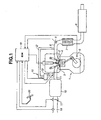
- FIG. 1 is a schematic view showing a control system or apparatus according to a first embodiment of the present invention.
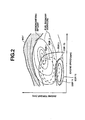
- FIG. 2 is a characteristic view showing a fuel enrichment region, and a target exhaust gas recirculation map used in the control system according to the first embodiment.
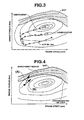
- FIG. 3 is a characteristic view showing a transmission control characteristic used in the control system according to the first embodiment.
- FIG. 4 is a characteristic view illustrating shift of an engine operating point in the control system according to the first embodiment in the case of rapid acceleration.
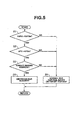
- FIG. 5 is a flowchart showing a control process performed by the control system of the first embodiment.
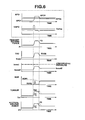
- FIG. 6 is a time chart showing variation of various parameters during a rapid acceleration to illustrate operations of the control system according to the first embodiment.
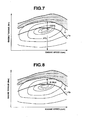
- FIG. 7 is a characteristic view for illustrating the examination of torque margin in a first practical example which can be used in the control system of the first embodiment.
- FIG. 8 is a characteristic view for illustrating the examination of torque margin in a second practical example which can be used in the control system of the first embodiment.
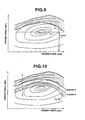
- FIG. 9 is a characteristic view for illustrating the examination of torque margin in a third practical example which can be used in the control system of the first embodiment.
- FIG. 10 is a characteristic view for illustrating the decrease correction of exhaust gas recirculation in a first practical example which can be used in the control system of the first embodiment.
- FIG. 11 is a characteristic view between target EGR rate and engine torque to illustrate the first practical example of FIG. 10.
- FIG. 12 is a characteristic view between the request torque and accelerator opening degree, for illustrating the decrease correction of exhaust gas recirculation in a second practical example which can be used in the control system of the first embodiment.
- FIG. 13 is a characteristic view between a target EGR rate decrease ratio and accelerator opening degree to illustrate the second practical example of FIG. 12.
- FIG. 14 is a characteristic view between the request torque and accelerator opening degree, for illustrating the decrease correction of exhaust gas recirculation in a third practical example which can be used in the control system of the first embodiment.
- FIG. 15 is a characteristic view between a target EGR rate decrease quantity and accelerator opening degree to illustrate the third practical example of FIG. 14.
- FIG. 16 is a schematic view showing a vehicle drive system employed in a control system according to a second embodiment of the present invention.
- FIG. 17 is a characteristic view illustrating shift of an engine operating point in the control system according to the second embodiment in the case of rapid acceleration.
- FIG. 18 is a flowchart showing a control process performed by the control system of the second embodiment.
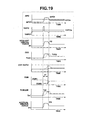
- FIG. 19 is a time chart showing variation of various parameters during a rapid acceleration to illustrate operations of the control system according to the second embodiment.
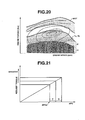
- FIG. 20 is a characteristic view for illustrating the determination of a delay time ⁇ T in a first practical example which can be used in the control system of the second embodiment.
- FIG. 21 is a characteristic view for illustrating the determination of the delay time ⁇ T in a second practical example which can be used in the control system of the second embodiment.
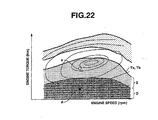
- FIG. 22 is a characteristic view for illustrating the decrease correction of exhaust gas recirculation in a first practical example which can be used in the control system of the second embodiment, in place of FIG. 10.
- Fig. 1 shows a control apparatus or system according to a first embodiment of the present invention.
- An internal combustion engine 1 of this example is a spark ignition engine having a spark plug 2 located at the center of a combustion chamber, and intake and exhaust valves 3 and 4 for each cylinder.
- a crank angle sensor 5 is arranged to sense the rotation of a crankshaft of the engine.
- an exhaust passage 6 there are provided a catalytic converter 7 and a muffler 8. At a position upstream of catalytic converter 7, there is provided an air fuel ratio sensor 9 for sensing an exhaust air fuel ratio.
- An exhaust gas recirculation system or apparatus 10 of this example includes an exhaust gas recirculation passage (EGR passage) 12 extending from exhaust passage 6 to an intake passage 11, and an exhaust gas recirculation control valve (EGR control valve) 13 disposed in exhaust recirculation passage 12, and arranged to regulate an exhaust gas recirculation (EGR) quantity.
- exhaust recirculation control valve is a step motor type valve including a step motor.
- a fuel injector 15 is provided in an intake port for each cylinder, and arranged to inject fuel into the intake port of each cylinder of engine 1.
- Intake passage 11 includes an intake collector section 16 and branch passages extending from collector section 16, respectively, to the cylinders of engine 1.
- a throttle valve 17 is provided in intake passage 11 on the upstream side of collector section 16.
- the throttle valve 17 is an electronically controlled throttle valve including an electric actuator having an electric motor.
- An engine control module (ECM)(or engine control unit) 19 controls the opening degree of throttle valve 17 by sending a control signal.
- the electronically controlled throttle valve 17 includes a throttle position sensor for sensing the actual opening degree of throttle valve 17.
- Engine control module 19 controls the actual throttle opening to a desired target throttle opening by a closed loop control based on the signal from the throttle position sensor.
- An accelerator position (or opening) sensor 20 is arranged to sense a driver's accelerator input.
- accelerator position sensor 20 senses the depression degree of an accelerator pedal (that is, an accelerator opening degree APO).
- the sensor signal of this accelerator position sensor 20 is inputted, together with the sensor signals of the above-mentioned crank angle sensor 5, air fuel ratio sensor 9 and airflow meter 18, into the engine control module 19.
- the engine control module 19 controls the fuel injection quantity, the fuel injection timing of each fuel injector 15, the ignition timing of each spark plug 2, and the throttle valve opening degree of throttle valve 17.
- engine 1 is combined with a continuously variable transmission (CVT).
- CVT continuously variable transmission
- Drive wheels of a vehicle are driven by engine 1 through the continuously variable transmission.
- the transmission ratio (or speed ratio) of the continuously variable transmission is controlled continuously in accordance with vehicle operating conditions, mainly in accordance with the accelerator opening degree APO and a vehicle speed.
- FIGS. 2-15 show an exhaust gas recirculation control performed by the control system according to the first embodiment.
- FIG. 2 shows engine operating characteristics using engine torque and engine speed (rpm) as parameters.
- An upper most line WOT is a characteristic line for a wide open throttle state in which throttle valve 17 is fully open.
- the air fuel ratio of engine 1 is controlled in the following manner.
- the engine 1 is operated at a rich air fuel ratio richer than the stoichiometric ratio in a higher engine load region (or a fuel enrichment region) shown by shading in FIG. 2. This region is bounded between the WOT line and a stoichiometric air fuel ratio limit line (or a lower boundary).
- the engine 1 In a low and medium load region or stoichiometric air fuel ratio region under the stoichiometric air fuel ratio limit line, the engine 1 is operated so that the target air fuel ratio is set equal to the stoichiometric ratio.
- the control system controls the fuel injection quantity of each injector 15 in the feedback control mode based on the air fuel ratio sensed by air fuel ratio sensor 9 so as to control the actual air fuel ratio to the theoretical air fuel ratio.
- the control system quits the feedback air fuel ratio control and instead increases the fuel injection quantity so as to achieve a desired target air fuel ratio on the rich side of the stoichiometry.
- fuel economy contours are depicted in the form of contour lines.
- a center region (of medium speed and medium load) surrounded by the fuel economy contours is an optimum fuel consumption region in which the fuel consumption is optimized.
- the fuel consumption becomes worse gradually as the engine operating point moves away from the central optimum fuel consumption region to the higher load side and to the lower load side.
- the fuel consumption becomes worse gradually as the engine operating point moves away from the central optimum fuel consumption region to the higher speed side and to the lower speed side.
- the fuel consumption becomes worse significantly because of the fuel enrichment to control the air fuel ratio to the rich side.
- the fuel enrichment region shown by shading is defined as a fuel economy deterioration region, in this example.
- the fuel consumption is influenced by the ignition timing and other engine operating conditions. Therefore, the stoichiometric air fuel ratio limit line is slightly deviated from the characteristic of the fuel economy contours.
- FIG. 2 characteristics of a target exhaust gas recirculation rate in the exhaust gas recirculation control are shown by lines EGR1, EGR2 and EGR3 in the form of contours.
- the exhaust gas recirculation rate is greatest in a central region surrounded by the line EGR1.
- the exhaust gas recirculation rate is set equal to zero, and the exhaust gas recirculation is stopped outside the outermost line EGR3.
- the control system according to this embodiment performs the exhaust gas recirculation at relatively high EGR rates in a wider engine operating region, as compared to an ordinary exhaust gas recirculation system which performs the exhaust gas recirculation only in a relatively narrow regions shown by lines EGR11 ⁇ EGR13 at relatively low EGR rates.
- the control system according to this embodiment performs the exhaust gas recirculation as much as possible at higher rates in most of the low and medium load region below the stoichiometric ratio limit, to reduce the pumping loss and hence to improve the fuel economy. Therefore, in the control system according to the embodiment, the frequency of occurrences of driver's acceleration request during the exhaust gas recirculation is higher.
- FIG. 3 shows a CVT speed ratio control performed by the control system according to the embodiment.
- FIG. 3 shows road load characteristic lines together with the fuel economy contours similar to those of FIG. 2.
- the road load lines represent characteristics of engine torque and engine speed against a running resistance of a vehicle running on a level road.
- the control system according to this embodiment is arranged to control the transmission speed ratio of the continuously variable transmission so that the road load characteristic line passes through the optimum fuel consumption point or the central optimum fuel consumption region defined by the fuel economy contours, to improve the fuel consumption.
- the R/L line is located on the lower load side of the optimum fuel consumption region.
- the control system according to the embodiment is arranged to operate the engine 1 at relative high engine loads to improve the fuel economy. Therefore, in the case of acceleration during travel on a level road, for example, a margin of torque up to the fuel enrichment region is relatively narrow, and hence the frequency of engine operation in the fuel enrichment region tends to become high. In order to improve the actual fuel consumption, it is important to avoid unwanted engine operation in the fuel enrichment region.
- an engine operating point j shown in FIG. 4 is located within the region in which the exhaust gas recirculation is performed, and near the fuel enrichment region so that the margin (or distance) of torque from the point j to the stoichiometric ratio limit line bounding the fuel enrichment region is narrow.
- the control system decreases the exhaust gas recirculation rate as compared to the normal EGR control mode when an acceleration request requesting a rapid acceleration is produced in the state in which the margin of torque is small to the enrichment region.
- the EGR rate is decreased in this way, the quantity of the fresh air entering the combustion chamber is increased smoothly, and the engine torque is increased rapidly with increase in the opening degree of throttle valve 17. The driver does not further depress the acceleration pedal uselessly. As a result, the engine operating point moves from the point j, as shown by an arrow (B) in FIG. 4, instead of entering the enrichment region.
- the control system When the acceleration request is not for rapid acceleration but for gradual acceleration, or when the margin of torque is large at the time of occurrence of the acceleration request, the control system according to the first embodiment performs the exhaust gas recirculation in the normal mode based on the target EGR control map (including EGRi1 ⁇ EGR3) as shown in FIG. 2, without correcting the EGR rate. Therefore, the control system can reduce the pumping loss and thereby fully improve the fuel consumption.
- FIG. 5 is a flowchart showing a main portion of an exhaust gas recirculation control performed by the control system according to the first embodiment.
- Steps S1 and S2 are for examining whether rapid acceleration is requested by the driver.
- Step S1 determines whether or not a variation speed (or a time rate of change or accelerator opening speed) VAPO of the accelerator opening degree APO is greater than a predetermined speed value VAPOa.
- Step S2 determines whether the accelerator opening degree APO is greater than a predetermined degree value APOa.
- ECM 19 determines that a driver's rapid acceleration request is produced when the driver depresses the accelerator pedal rapidly and deeply. If the answer of S1 or S2 is NO, then the program proceeds to step S4 for normal EGR control based on the target EGR map of FIG. 2. Therefore, at S4, the exhaust gas recirculation is performed in accordance with the engine operating conditions. In the engine operating region in which the target EGR rate is set equal to zero (outside EGR 3 in FIG. 2, for example), the exhaust gas recirculation is not performed.
- step S3 determines a margin of torque to the fuel enrichment region in accordance with the engine operating condition at that time, and to determine whether the margin is narrow or not. The way to determine whether the margin is narrow will be explained later.
- the program proceeds from S3 to S4, and the system performs the exhaust gas recirculation in the normal control mode based on the target EGR map.
- the program proceeds from S3 to step S5 to decrease the EGR rate as compared to the normal EGR control mode of S4.
- ECM 19 determines a corrected target EGR rate by decreasing the normal target EGR rate based on the target EGR map of FIG. 2, and performs the exhaust gas recirculation by using the corrected target EGR rate.
- the way to decrease the normal target EGR rate will be explained later.
- FIG. 6 shows, in the form of time chart, operations of the control system according to the first embodiment in the case of rapid acceleration.
- FIG. 6 shows variation with time of the accelerator opening degree APO, accelerator opening speed VAPO, a request driving torque P, a throttle valve opening degree TVO, an intake negative pressure (manifold pressure) boost in the collector section 16, exhaust gas recirculation rate EGR, engine torque Te, and actual driving force.
- the accelerator opening degree APO exceeds the predetermined value APOa
- the accelerator opening speed VAPO exceeds the predetermined value VAPOa. Therefore, the control system concludes that there is a rapid acceleration request.
- the request driving force P is a driving force (a product of torque and rotational speed) required by the driver's acceleration request.
- the request driving torque P is regarded as being substantially equal to the accelerator opening degree APO.
- the throttle valve opening degree TVO is controlled in accordance with this request driving torque P.
- Intake negative pressure (boost) varies in accordance with variation of throttle opening degree TVO.
- a broken line shows a characteristic of the ordinary system and a solid line shows a characteristic according to this embodiment.
- the exhaust gas recirculation rate EGR is held at the level of the target EGR map during the acceleration as shown by the broken line, and the exhaust gas mixture is recirculated in a large amount. Therefore, the engine torque Te rises so slowly that the rise of the actual driving force is delayed with respect to the rise of request driving force P, and the driver is liable to depress the accelerator pedal deeper.
- the exhaust gas recirculation rate EGR is decreased as shown by the solid line at the time of rapid acceleration request, and the amount of exhaust gas recirculation is limited to a lower level. Therefore, engine torque Te rises rapidly as shown by the solid line, and the actual driving force is produced in conformity with the request driving force.
- the exhaust gas recirculation rate EGR is held low from the occurrence of the rapid acceleration request until the accelerator opening degree APO becomes lower than or equal to predetermined value APOa.
- the check of the margin of torque at S3 can be performed in one of the following examples shown in FIGS. 7, 8 and 9.
- FIG. 7 shows a first practical example.
- the control system judges that the margin is wide when the torque at the time of occurrence of a rapid acceleration request is smaller than the threshold Ta; and judges that the margin is narrow when the torque at the time of occurrence of the rapid acceleration request is greater than or equal to the threshold Ta.
- the answer of S3 is affirmative when the percentage of the engine torque to the torque Tr of the lower boundary of the fuel economy deteriorating region is greater than A (%).
- FIG. 8 shows a second practical example.
- the control system judges that the margin is wide when the torque at the time of occurrence of a rapid acceleration request is smaller than the threshold Tb; and judges that the margin is narrow when the torque at the time of occurrence of the rapid acceleration request is greater than or equal to the threshold Tb.
- the answer of S3 is affirmative when the torque difference obtained by subtracting the engine torque from the torque Tr of the lower boundary of the fuel economy deteriorating region is smaller than B (Nm).
- FIG. 9 shows a third practical example.
- a threshold Tc (Nm) of this example is a predetermined constant value which is invariable irrespective of the engine speed.
- the control system judges that the margin is wide when the torque at the time of occurrence of a rapid acceleration request is smaller than the threshold Tc; and judges that the margin is narrow when the torque at the time of occurrence of the rapid acceleration request is greater than or equal to the threshold Tc.
- the threshold Tc is set equal to the smallest value of the torque Tr of the stoichiometric air fuel ratio limit varying with the engine speed.
- a parameter representing the engine torque, such as the intake air quantity of the engine, the fuel injection pulse width, the throttle valve opening degree TVO and the intake negative pressure boost.
- the exhaust gas recirculation rate can be decreased at step S5 in one of the following examples shown in FIGS. 10 and 11, FIGS. 12 and 13 and FIGS. 14 and 15.
- FIGS. 10 and 11 show a first practical example.
- the region bounded between the stoichiometric air fuel ratio limit line (Tr) and the threshold line of the threshold is divided into a plurality of regions.
- the region between the limit line and the threshold line is divided into a lower (lower load) region D and an upper (higher load) region E by a line extending between the stoichiometric air fuel ratio limit line and the threshold line, as shown in FIG. 10.
- a decreased target EGR rate EGRd is set for a torque value of a middle point d in the lower region D
- a decreased target EGR rate EGRe is set for a torque value of a middle point e in the upper region E.
- Each of the decreased target EGR rates EGRd and EGRe is a target EGR rate decreased as compared to the target EGR rate of the normal target EGR map.
- the target EGR rate is determined by interpolation by using the decreased target EGR rates EGRd and EGRe, in accordance with the engine torque at the time of rapid acceleration request, as shown in FIG. 11.
- the target EGR torque EGRe of the upper region E where the margin is narrower is smaller than the target EGR rate EGRd of the lower region D where the margin is wider.
- the target EGR rate is decreased as the margin becomes narrower.
- FIGS. 12 and 13 show a second practical example in which the decrease ratio or percentage (%) of the target EGR rate is determined in accordance with the accelerator opening degree APO.
- the decrease ratio is a ratio of a decrease to the value of the normal target EGR map.
- the normal target EGR rate is used without modification if the decrease ratio is equal to 0 (%). If the decrease ratio is equal to 100%, the final target EGR rate becomes equal to 0.
- the decrease ratio is zero.
- the decrease ratio is increased as the accelerator opening degree APO increases from APOa.
- the decrease ratio becomes equal to 100% when the accelerator opening degree APO becomes equal to a value at or near the fully open state of the accelerator.
- the region of the accelerator opening degree APO greater than APOa is divided into at least two regions F and G. Then, by using a value f (%) of the decrease ratio corresponding to a center value APOF of the region F, and a value g (%) of the decrease ratio corresponding to a center value APOG of the region G, the control system determines a value of the decrease ratio corresponding to the accelerator opening degree APO.
- the request torque requested by the driver is approximately proportional to the accelerator opening degree APO, as shown in FIG. 12. Accordingly, the target EGR rate is decreased in accordance with the request torque.
- the control system can avoid operation in the fuel enrichment region caused by deeper depression of the accelerator pedal, and further improve the fuel consumption with the maximum exhaust gas recirculation, as in the first practical example of FIGS. 10 and 11.
- FIGS. 14 and 15 show a third practical example in which an EGR rate decrease quantity is determined in accordance with the accelerator opening degree APO, and the final EGR rate is determined by subtracting this EGR rate decrease quantity from the value determined by the normal target EGR map.
- the EGR rate decrease quantity is equal to zero.
- the EGR rate decrease quantity is increased as the accelerator opening degree APO increases from APOa.
- the region of the accelerator opening degree APO greater than APOa is divided into at least two regions H and I.
- the control system determines a value of the decrease quantity corresponding to the accelerator opening degree APO.
- the request torque requested by the driver is approximately proportional to the accelerator opening degree APO, as shown in FIG. 14. Accordingly, the target EGR rate is decreased in accordance with the request torque as in the second practical example of FIGS. 12 and 13.
- the control system can avoid operation in the fuel enrichment region caused by deeper depression of the accelerator pedal, and further improve the fuel consumption with the maximum exhaust gas recirculation, as in the first and second practical examples.
- the fuel enrichment region is regarded as a fuel economy deterioration region.
- the fuel economy deterioration region is a high engine load region where the fuel economy becomes significantly worse. It is possible to define the fuel economy deterioration region adequately according to the need.
- the fuel consumption is influenced by the ignition timing, too. Accordingly, it is optional to define the fuel economy deterioration region on the basis of actual characteristics of the fuel consumption in consideration of the ignition timing and other factors. It is preferable to vary the amount of decrease of the EGR rate in accordance with the magnitude of the above-mentioned margin, or the magnitude of request torque.
- the control system limits the exhaust gas recirculation to a smaller quantity, and thereby prevent deterioration of the fuel consumption by accelerator pedal depression by the driver.
- FIGS. 16 ⁇ 22 are views for illustrating a second embodiment of the present invention.
- the control system of the before-mentioned patent document D2 delays a shift operation of a continuously variable transmission having a lockup mechanism. In the case of vehicle acceleration in a lockup region, this control system releases the lockup mechanism and delays the shift operation, to improve the acceleration response.)
- the transmission ratio is held fixed, and the load of the engine is increased significantly, to the disadvantage of the fuel economy especially when the acceleration is requested at a relatively high load region.
- the engine system To produce the vehicle driving force requested by the driver without varying the transmission ratio, the engine system must increase the engine load as compared to the engine operation with variation of the transmission. Therefore, the engine operating point readily enters the fuel economy deterioration region.
- the control system according to the second embodiment is arranged to delay a shift operation of the continuously variable transmission in accordance with the margin from the engine operating point at the time of detection of the driver's acceleration request, to the fuel economy deterioration region, and to decrease the exhaust gas recirculation during the delay time of the shift operation.
- FIG. 16 schematically shows a belt type continuously variable transmission 21 through which the driving force of an internal combustion engine 1 is transmitted to drive wheels 22 (only one wheel is shown in FIG. 16 for simplification).
- This continuously variable transmission 21 includes a primary pulley 23 on the driving side, a secondary pulley 24 on the driven side, and a metal belt 25 drivingly connecting both pulleys.
- One of the pulleys 23 and 24 is a first pulley and the other is a second pulley.
- the pulley width of primary pulley 23 is varied by the hydraulic pressure in a hydraulic pressure chamber 26, and the secondary pulley 24 varies its own pulley width in accordance with the width of primary pulley 23. In this way, continuously variable transmission 21 can vary the transmission speed ratio continuously.
- the hydraulic pressure chamber 26 can be regarded as a pressure chamber of a hydraulic actuator.
- the rotation shaft of primary pulley 23, that is a transmission input shaft, is connected with the crankshaft of engine 1 through a forward reverse changeover mechanism 27 including a planetary gear system, and a torque converter 28.
- the rotation shaft of secondary pulley 4, that is a transmission output shaft, is connected with an axle shaft of drive wheel 22, through a final gear 29 and a differential gear 30.
- an oil pump 32 for producing a control fluid pressure to control CVT 21, there is provided, on the output side of the forward reverse changeover mechanism 27, an oil pump 32 of a mechanical type which, in this example, a gear pump.
- the oil pressure produced by oil pump 32 is supplied to a hydraulic control section 33 including a pressure regulator valve and a pressure control valve.
- This hydraulic control section 33 receives the oil pressure from oil pump 32, and produces the control pressure supplied to hydraulic pressure chamber 26, to control the transmission ratio of CVT 21 under the control of a CVT control unit 59 in accordance with one or more vehicle operating conditions.
- the CVT transmission ratio is basically varied by the action of the control pressure in hydraulic pressure chamber 26 for actuating the primary pulley 23.
- secondary pulley 24 also have a similar pressure chamber arranged to produce an adequate belt tension by receiving a fluid pressure for secondary pulley 24.
- the continuously variable transmission 21 requires a relatively high fluid pressure to prevent slippage of belt 25, as compared to the period of the steady state. Therefore, the driving torque of oil pump 32 is increased, and the friction in various parts is increased during the transient period, so that the loss in the engine torque becomes greater.
- engine 1 is arranged in an engine system as shown in FIG. 1; and controlled as shown in FIG. 2 in the same manner as in the first embodiment.
- the control system according to the second embodiment controls the transmission speed ratio of continuously variable transmission 21 as shown by the line "EMBODIMENT" in FIG. 3 of in the first embodiment.
- CVT control unit 59 shown in FIG. 16, basically in accordance with accelerator opening degree APO and vehicle speed.
- CVT control unit 59 is connected with engine control unit 19 by a network enabling exchange of various signals and information between the engine control unit 19 and CVT control unit 59.
- a controller for controlling the engine and transmission is composed of two different control units 19 and 59.
- the control system In the case of vehicle acceleration requested by depression of the accelerator pedal by the driver, the control system according to the second embodiment checks the margin of torque to the fuel enrichment region, and determines whether the transmission shift operation is delayed or not.
- the accelerator pedal When, for example, the accelerator pedal is depressed by the driver for rapid vehicle acceleration while the engine is operated at an operating point e shown in FIG. 17, the engine operating point determined by the engine torque and engine speed moves as shown by an arrow (A) in FIG. 17 if a shift operation of CVT 21 is performed simultaneously and the engine speed is increased due to variation of the speed ratio.
- the CVT shift operation is performed at the early stage of the vehicle acceleration, part of the engine torque is consumed for increasing the CVT control fluid pressure for the shift operation, and the engine torque actually used for the vehicle acceleration is decreased so that the acceleration response becomes worse.
- the control system delays the transmission shift operation for a predetermined delay time in the case of acceleration at the engine operating point where the margin to the fuel enrichment region is sufficiently wide.
- the control system accelerates the vehicle with the increase in torque of engine 1 without varying the speed ratio of CVT 21.
- the control system can restrain the consumption of engine torque to increase the fluid pressure for the transmission shift operation, and thereby improve the vehicle response to the driver's accelerator input.
- the engine torque is increased greatly without no substantial variation of the engine speed, and hence the engine operating point moves as shown by an arrow (B) in FIG. 17.
- the control system does not perform the correction of the exhaust gas recirculation rate, and perform the exhaust gas recirculation by using the target EGR map of FIG. 2 without modification. Therefore, the control system can improve the fuel economy fully by reduction of pumping loss.
- the exhaust gas recirculation in a large amount decreases the amount of fresh air flowing into the combustion chamber and hence the engine torque is not increased quickly by opening of the throttle valve. Therefore, the driver tends to depress the accelerator pedal further unconsciously wanting rapid acceleration, and the engine operating point tends to move to the high load side into the fuel enrichment region.
- the control system according to the second embodiment therefore, decreases the exhaust gas recirculation quantity to zero or a smaller level, simultaneously with the delay of the CVT shift operation. By limiting the exhaust gas recirculation in this way, the control system increases the quantity of fresh air flowing into the engine, and increases the engine torque quickly in response to an increase in the throttle opening degree, so that the driver feels no need to depress the accelerator pedal further.
- the control system of the second embodiment controls CVT 21 in a normal shift control mode without performing a delay operation to delay the transmission shift operation. Moreover, the control system controls the exhaust gas recirculation in the normal EGR control mode without correction.
- FIG. 18 is a flowchart showing a main portion of a control process for an exhaust gas recirculation control and a shift delay control performed by the control system according to the second embodiment.
- Steps S21 and S22 are for examining whether rapid acceleration is requested by the driver.
- Step S21 determines whether or not a variation speed (or a time rate of change or accelerator opening speed) VAPO of the accelerator opening degree APO is greater than a predetermined speed value VAPOa.
- Step S22 determines whether the accelerator opening degree APO is greater than a predetermined degree value APOa.
- the control system determines that a driver's rapid acceleration request is produced when the driver depresses the accelerator pedal rapidly and deeply. If the answer of S21 or S22 is NO, then the program proceeds to step S26 for normal EGR control based on the target EGR map of FIG. 2.
- the exhaust gas recirculation is performed in the normal EGR control mode based on the target EGR map of FIG. 2.
- the control system controls the transmission ratio of CVT 21 in a normal shift control mode in accordance with the vehicle operating conditions without delay.
- step S23 determines a margin of torque to the fuel enrichment region in accordance with the engine operating condition at that time, and to determine whether the margin is wide or not.
- the control system determines whether the margin is wide or not by using one of the before-mentioned first, second and third practical examples shown in FIGS. 7, 8 and 9.
- the program of FIG. 18 proceeds from S23 to S26, and the control system performs the exhaust gas recirculation in the normal control mode based on the target EGR map, and the normal CVT shift control. Therefore, the EGR control is continued in the normal mode in accordance with the operating conditions, and the transmission ratio of CVT 21 is controlled immediately without delay to a desired ratio determined mainly by the vehicle speed and accelerator opening degree APO.
- step S24 the program proceeds from S23 to step S24 to perform an EGR control operation to control the EGR rate by using a corrected (or decreased) target EGR rate which decreased as compared to the normal EGR control mode of S26, for a delay time of the CVT shift operation.
- the control system of the second embodiment decreases the EGR rate as compared to the EGR rate in the steady state.
- the control system decreases the target EGR rate by one of later-mentioned practical examples similar to the examples shown in FIGS. 10 and 11, FIGS. 12 and 13, and FIGS. 14 and 15.
- the control system proceeds to step 525, and delays the transmission shift operation by holding the transmission speed ratio of CVT 21 unchanged for a predetermined delay time ( ⁇ T).
- FIG. 19 is a time chart similar to FIG. 6 of the first embodiment, but showing operations of the control system according to the second embodiment in the case of rapid acceleration at the engine operating point having a wide margin to the fuel enrichment region.
- FIG. 19 shows variation with time of the accelerator opening degree APO, accelerator opening speed VAPO, request driving torque P, throttle valve opening degree TVO, a CVT transmission ratio, exhaust gas recirculation rate EGR, engine torque Te, and actual driving force.
- the accelerator opening degree APO exceeds the predetermined value APOa
- the accelerator opening speed VAPO exceeds the predetermined value VAPOa. Therefore, the control system concludes that there is a rapid acceleration request.
- the request driving force P is a driving force (a product of torque and rotational speed) required in conformity with the driver's acceleration request.
- the request driving torque P is regarded as being substantially equal to the accelerator opening degree APO.
- the throttle valve opening degree TVO is controlled in accordance with request driving torque P, and the engine torque Te is varied basically in conformity with throttle opening degree TVO.
- FIG. 19 broken lines show characteristics resulting when the CVT shift operation is performed immediately at the time of rapid acceleration.
- throttle opening degree TVO is controlled on the basis of variation of the CVT transmission ratio shown by the broken line, so that the engine torque rises only gradually as shown by the broken line.
- the rise of the finally obtained actual driving force is delayed after the rise of the request driving force, as shown by the broken line, by the increase in torque loss by the shift operation of CVT 21.
- the continuation of the exhaust gas recirculation during the acceleration as shown by the broken line with a large quantity further delays the rise of engine torque Te, and increases the tendency of further depression of the accelerator pedal.
- the control system according to the second embodiment holds the CVT transmission ratio unchanged as shown by a solid line in FIG. 19 for a predetermined delay time (interval) ⁇ T from the time of occurrence of the acceleration request, and starts the shift operation at the expiration of the delay time ⁇ T.
- the control system can avoid an increase in the torque loss due to the shift operation of CVT 21.
- Throttle opening degree TVO is increased largely as shown by a solid line to produce the request driving force without varying the transmission ratio, and the engine torque Te increases quickly.
- the exhaust gas recirculation rate is controlled at a lower level during the delay time ⁇ T of the shift operation, and the quantity of the exhaust gas recirculation is limited to the low level. Therefore, the engine torque Te rises earlier in response to an increase in TVO, and the response to the accelerator input is improved significantly.
- CVT 21 After the expiration of the delay time ⁇ T, CVT 21 starts the shift operation, and the EGR rate is increased to the level of the normal control mode simultaneously. In this way, the control system varies the transmission ratio and the EGR rate simultaneously, and thereby prevents an undesired torque step causing unpleasant sensation.
- the delay time ⁇ T may be a constant, or may be varied in accordance with one or more operating conditions.
- the region where the margin is regarded as wide is divided into a plurality of regions.
- the region under the threshold line of the threshold Ta of FIG. 7 or Tb of FIG. 8 for example is divided into a lower region D (where the margin is greater) and an upper region E (where the margin is smaller).
- the delay time ⁇ T is set to a first (greater) value ⁇ Td when the engine operating point at the time of an acceleration request is in the lower region D where the margin is greater; and set to a second (smaller) value ⁇ Te smaller than ⁇ Td ( ⁇ Td> ⁇ Te) when the engine operating point at the time of an acceleration request is in the upper region E closer to the fuel enrichment region.
- the delay time ⁇ T is made shorter as the margin becomes smaller.
- FIG. 21 show another example in which the delay time ⁇ T is adjusted in accordance with the request torque requested by the driver.
- the delay time ⁇ T is determined in accordance with accelerator opening degree APO related to the request torque as shown in FIG. 21.
- the APO region greater than the predetermined value APOa of S22 is divided into a first (smaller APO) region F and a second (larger APO) region G.
- the delay time ⁇ T is set to a first (smaller) value ⁇ Tf when the accelerator opening degree APO at the time of an acceleration request is in the first (smaller APO) region F; and set to a second (greater) value ⁇ Tg greater than ⁇ Tf ( ⁇ Tf ⁇ Tg) when the accelerator opening degree APO at the time of an acceleration request is in the second (greater APO) region G.
- the delay time ⁇ T is made greater when the driver request a more rapid acceleration, and the request torque is greater.
- the response to the accelerator input is improved more when the requested acceleration is rapid.
- the check of the margin of torque at S23 according to the second embodiment can be performed in one of the three practical examples shown in FIGS. 7, 8 and 9 for the first embodiment.
- the control system according to the second embodiment can decrease the exhaust gas recirculation rate can be decreased at step S24 in one of the following examples similar to the methods shown in FIGS. 10 and 11, FIGS. 12 and 13 and FIGS. 14 and 15.
- FIG. 22 shows a first practical example which can be used in the second embodiment.
- the region under the threshold line of the threshold (such as Ta of FIG. 7 or Tb of FIG. 8, for example) where the margin is judges to be wide, is divided into a plurality of regions.
- this region under the threshold line is divided into a lower (lower load) region D and an upper (higher load) region E.
- a decreased target EGR rate EGRd is set for a torque value of a middle point d in the lower region D
- a decreased target EGR rate EGRe is set for a torque value of a middle point e in the upper region E.
- Each of the decreased target EGR rates EGRd and EGRe is a target EGR rate decreased as compared to the target EGR rate of the normal target EGR map. Then, the target EGR rate is determined by interpolation by using the decreased target EGR rates EGRd and EGRe, in accordance with the engine torque at the time of rapid acceleration request, in a similar manner as shown in FIG. 11.
- the target EGR torque EGRe of the upper region E where the margin is narrower is smaller than the target EGR rate EGRd of the lower region D where the margin is wider. Therefore, the target EGR rate is decreased as the margin becomes narrower.
- control system can avoid operation in the fuel enrichment region caused by deeper depression of the accelerator pedal, and further improve the fuel consumption with the maximum exhaust gas recirculation.
- the decrease ratio or percentage (%) of the target EGR rate is determined in accordance with the accelerator opening degree APO in the same manner as shown in FIGS. 12 and 13.
- the decrease ratio is a ratio of a decrease to the value of the normal target EGR map.
- the normal target EGR rate is used without modification if the decrease ratio is equal to 0 (%). If the decrease ratio is equal to 100%, the final target EGR rate becomes equal to 0.
- the decrease ratio is zero.
- the decrease ratio is increased as the accelerator opening degree APO increases from APOa.
- the decrease ratio becomes equal to 100% when the accelerator opening degree APO becomes equal to a value at or near the fully open state of the accelerator.
- the region of the accelerator opening degree APO greater than APOa is divided into at least two regions F and G. Then, by using a value f (%) of the decrease ratio corresponding to a center value APOF of the region F, and a value g (%) of the decrease ratio corresponding to a center value APOG of the region G, the control system according to the second embodiment determines a value of the decrease ratio corresponding to the accelerator opening degree APO.
- the request torque requested by the driver is approximately proportional to the accelerator opening degree APO, as shown in FIG. 12.
- the target EGR rate is decreased in accordance with the request torque.
- the control system according to the second embodiment can avoid operation in the fuel enrichment region caused by deeper depression of the accelerator pedal, and further improve the fuel consumption with the maximum exhaust gas recirculation, as in the first practical example of FIGS. 22 and 11.
- an EGR rate decrease quantity is determined in accordance with the accelerator opening degree APO, and the final EGR rate is determined by subtracting this EGR rate decrease quantity from the value determined by the normal target EGR map in the same manner as shown in FIGS. 14 and 15.
- the EGR rate decrease quantity is equal to zero.
- the EGR rate decrease quantity is increased as the accelerator opening degree APO increases from APOa.
- the region of the accelerator opening degree APO greater than APOa is divided into at least two regions H and I.
- the control system determines a value of the decrease quantity corresponding to the accelerator opening degree APO.
- the request torque requested by the driver is approximately proportional to the accelerator opening degree APO, as shown in FIG. 14. Accordingly, the target EGR rate is decreased in accordance with the request torque as in the second practical example of FIGS. 12 and 13.
- control system can avoid operation in the fuel enrichment region caused by deeper depression of the accelerator pedal, and further improve the fuel consumption with the maximum exhaust gas recirculation, as in the preceding practical examples.
Landscapes
- Engineering & Computer Science (AREA)
- Chemical & Material Sciences (AREA)
- Combustion & Propulsion (AREA)
- Mechanical Engineering (AREA)
- Transportation (AREA)
- General Engineering & Computer Science (AREA)
- Automation & Control Theory (AREA)
- Exhaust-Gas Circulating Devices (AREA)
- Output Control And Ontrol Of Special Type Engine (AREA)
Abstract
Description
- The present invention relates to control technique for an internal combustion engine with an exhaust gas recirculation system or for an internal combustion engine combined with a continuously variable transmission.
- An exhaust gas recirculation (EGR) system is apparatus for recirculating part of exhaust gases discharged from an engine, to the intake side of the engine, to reduce the emission of NOx. Recently, the exhaust gas recirculation is used not only for the emission control, but also as one of techniques for improving the fuel consumption by reduction of pumping loss with a greater amount of EGR in a wider engine operation range.
- Patent document D1 (JP 2000-205004A) shows an engine control system arranged to decrease an exhaust gas recirculation quantity during vehicle acceleration with depression of an accelerator pedal, to improve the vehicle acceleration response. Patent document D2 (JP H03(1991)-172666) shows a control system which delays a shift operation of a continuously variable transmission in the case of vehicle acceleration.
- However, the limitation of the exhaust gas recirculation during acceleration reduces the effect of exhaust gas recirculation significantly if the exhaust gas recirculation is limited without regard to the engine operating point at that time. In order to improve the fuel consumption, it is desirable to perform the exhaust gas recirculation as much as possible even during acceleration.
- If, on the other hand, the exhaust gas recirculation is performed during acceleration in the same manner as in the steady state, the exhaust gas recirculation tends to deteriorate the acceleration response of the vehicle, and even deteriorates the fuel consumption. If the exhaust gas recirculation is continued in a normal mode at the time of driver's depression of the accelerator pedal, the rise of engine torque is slow, and the driver is liable to further depress the accelerator pedal unconsciously, so that the engine operating point enters a high load region detrimental to the fuel economy.
- It is an object of the present invention to provide control apparatus or process to decrease the exhaust gas recirculation more effectively in accordance with an engine operating condition.
- According to one aspect of the present invention, a control apparatus, comprises: an internal combustion engine; an exhaust recirculation system arranged to recirculate part of exhaust from the engine, into intake stream to the engine; an acceleration request sensing section arranged to sense a driver's acceleration request; an engine operating condition sensing section arranged to sense a current engine operation condition at the time of detection of the driver's acceleration request; and a controlling section configured to estimate a margin from the engine operating condition at the time of detection of the driver's acceleration request, to a fuel economy deterioration region in a high engine load region, and to control an EGR quantity of the exhaust recirculation system in accordance with the margin.
- According to another aspect of the invention, a control process for an internal combustion engine equipped with an exhaust recirculation system, comprises: monitoring a driver's accelerator input to detect a driver's acceleration request; sensing an engine operating condition to determine a margin from an engine operating point at the time of detection of the driver's acceleration request, to a fuel economy deterioration region; and controlling an EGR quantity of the exhaust recirculation system in an decreased mode in accordance with the margin.
- According to still another aspect of the present invention, a control apparatus for an internal combustion engine equipped with an exhaust recirculation system, the control apparatus comprises: means for detecting a driver's accelerator input by monitoring a driver's accelerator request; means for checking a margin from an engine operating point at the time of detection of the driver's acceleration request, to a fuel economy deterioration region; and means for controlling an EGR quantity of the exhaust recirculation system in an decreased mode in accordance with a result of check of the margin.
- FIG. 1 is a schematic view showing a control system or apparatus according to a first embodiment of the present invention.
- FIG. 2 is a characteristic view showing a fuel enrichment region, and a target exhaust gas recirculation map used in the control system according to the first embodiment.
- FIG. 3 is a characteristic view showing a transmission control characteristic used in the control system according to the first embodiment.
- FIG. 4 is a characteristic view illustrating shift of an engine operating point in the control system according to the first embodiment in the case of rapid acceleration.
- FIG. 5 is a flowchart showing a control process performed by the control system of the first embodiment.
- FIG. 6 is a time chart showing variation of various parameters during a rapid acceleration to illustrate operations of the control system according to the first embodiment.
- FIG. 7 is a characteristic view for illustrating the examination of torque margin in a first practical example which can be used in the control system of the first embodiment.
- FIG. 8 is a characteristic view for illustrating the examination of torque margin in a second practical example which can be used in the control system of the first embodiment.
- FIG. 9 is a characteristic view for illustrating the examination of torque margin in a third practical example which can be used in the control system of the first embodiment.
- FIG. 10 is a characteristic view for illustrating the decrease correction of exhaust gas recirculation in a first practical example which can be used in the control system of the first embodiment.
- FIG. 11 is a characteristic view between target EGR rate and engine torque to illustrate the first practical example of FIG. 10.
- FIG. 12 is a characteristic view between the request torque and accelerator opening degree, for illustrating the decrease correction of exhaust gas recirculation in a second practical example which can be used in the control system of the first embodiment.
- FIG. 13 is a characteristic view between a target EGR rate decrease ratio and accelerator opening degree to illustrate the second practical example of FIG. 12.
- FIG. 14 is a characteristic view between the request torque and accelerator opening degree, for illustrating the decrease correction of exhaust gas recirculation in a third practical example which can be used in the control system of the first embodiment.
- FIG. 15 is a characteristic view between a target EGR rate decrease quantity and accelerator opening degree to illustrate the third practical example of FIG. 14.
- FIG. 16 is a schematic view showing a vehicle drive system employed in a control system according to a second embodiment of the present invention.
- FIG. 17 is a characteristic view illustrating shift of an engine operating point in the control system according to the second embodiment in the case of rapid acceleration.
- FIG. 18 is a flowchart showing a control process performed by the control system of the second embodiment.
- FIG. 19 is a time chart showing variation of various parameters during a rapid acceleration to illustrate operations of the control system according to the second embodiment.
- FIG. 20 is a characteristic view for illustrating the determination of a delay time ΔT in a first practical example which can be used in the control system of the second embodiment.
- FIG. 21 is a characteristic view for illustrating the determination of the delay time ΔT in a second practical example which can be used in the control system of the second embodiment.
- FIG. 22 is a characteristic view for illustrating the decrease correction of exhaust gas recirculation in a first practical example which can be used in the control system of the second embodiment, in place of FIG. 10.
- Fig. 1 shows a control apparatus or system according to a first embodiment of the present invention. An
internal combustion engine 1 of this example is a spark ignition engine having aspark plug 2 located at the center of a combustion chamber, and intake andexhaust valves 3 and 4 for each cylinder. A crank angle sensor 5 is arranged to sense the rotation of a crankshaft of the engine. - In an
exhaust passage 6, there are provided acatalytic converter 7 and amuffler 8. At a position upstream ofcatalytic converter 7, there is provided an airfuel ratio sensor 9 for sensing an exhaust air fuel ratio. - An exhaust gas recirculation system or
apparatus 10 of this example includes an exhaust gas recirculation passage (EGR passage) 12 extending fromexhaust passage 6 to anintake passage 11, and an exhaust gas recirculation control valve (EGR control valve) 13 disposed inexhaust recirculation passage 12, and arranged to regulate an exhaust gas recirculation (EGR) quantity. In this example, exhaust recirculation control valve is a step motor type valve including a step motor. - A
fuel injector 15 is provided in an intake port for each cylinder, and arranged to inject fuel into the intake port of each cylinder ofengine 1.Intake passage 11 includes anintake collector section 16 and branch passages extending fromcollector section 16, respectively, to the cylinders ofengine 1. Athrottle valve 17 is provided inintake passage 11 on the upstream side ofcollector section 16. In this example, thethrottle valve 17 is an electronically controlled throttle valve including an electric actuator having an electric motor. An engine control module (ECM)(or engine control unit) 19 controls the opening degree ofthrottle valve 17 by sending a control signal. The electronically controlledthrottle valve 17 includes a throttle position sensor for sensing the actual opening degree ofthrottle valve 17.Engine control module 19 controls the actual throttle opening to a desired target throttle opening by a closed loop control based on the signal from the throttle position sensor. On the upstream side ofthrottle valve 17, there is provided an airflow meter orsensor 18 for sensing an intake air flow quantity. - An accelerator position (or opening)
sensor 20 is arranged to sense a driver's accelerator input. In this example,accelerator position sensor 20 senses the depression degree of an accelerator pedal (that is, an accelerator opening degree APO). The sensor signal of thisaccelerator position sensor 20 is inputted, together with the sensor signals of the above-mentioned crank angle sensor 5, airfuel ratio sensor 9 andairflow meter 18, into theengine control module 19. In accordance with input information on engine operating conditions sensed by these sensors, theengine control module 19 controls the fuel injection quantity, the fuel injection timing of eachfuel injector 15, the ignition timing of eachspark plug 2, and the throttle valve opening degree ofthrottle valve 17. - In this example,
engine 1 is combined with a continuously variable transmission (CVT). Drive wheels of a vehicle are driven byengine 1 through the continuously variable transmission. The transmission ratio (or speed ratio) of the continuously variable transmission is controlled continuously in accordance with vehicle operating conditions, mainly in accordance with the accelerator opening degree APO and a vehicle speed. - FIGS. 2-15 show an exhaust gas recirculation control performed by the control system according to the first embodiment.
- First, explanation is directed to basic exhaust recirculation control, air fuel ratio control and fuel economy. FIG. 2 shows engine operating characteristics using engine torque and engine speed (rpm) as parameters. An upper most line WOT is a characteristic line for a wide open throttle state in which
throttle valve 17 is fully open. The air fuel ratio ofengine 1 is controlled in the following manner. Theengine 1 is operated at a rich air fuel ratio richer than the stoichiometric ratio in a higher engine load region (or a fuel enrichment region) shown by shading in FIG. 2. This region is bounded between the WOT line and a stoichiometric air fuel ratio limit line (or a lower boundary). In a low and medium load region or stoichiometric air fuel ratio region under the stoichiometric air fuel ratio limit line, theengine 1 is operated so that the target air fuel ratio is set equal to the stoichiometric ratio. In this low and medium load region, the control system controls the fuel injection quantity of eachinjector 15 in the feedback control mode based on the air fuel ratio sensed by airfuel ratio sensor 9 so as to control the actual air fuel ratio to the theoretical air fuel ratio. In the higher load region above the stoichiometric air fuel ratio limit line, by contrast, the control system quits the feedback air fuel ratio control and instead increases the fuel injection quantity so as to achieve a desired target air fuel ratio on the rich side of the stoichiometry. - In FIG. 2, fuel economy contours are depicted in the form of contour lines. A center region (of medium speed and medium load) surrounded by the fuel economy contours is an optimum fuel consumption region in which the fuel consumption is optimized. The fuel consumption becomes worse gradually as the engine operating point moves away from the central optimum fuel consumption region to the higher load side and to the lower load side. Similarly, the fuel consumption becomes worse gradually as the engine operating point moves away from the central optimum fuel consumption region to the higher speed side and to the lower speed side. Especially in the fuel enrichment region above the stoichiometric air fuel ratio limit line, the fuel consumption becomes worse significantly because of the fuel enrichment to control the air fuel ratio to the rich side. Accordingly, the fuel enrichment region shown by shading is defined as a fuel economy deterioration region, in this example. The fuel consumption is influenced by the ignition timing and other engine operating conditions. Therefore, the stoichiometric air fuel ratio limit line is slightly deviated from the characteristic of the fuel economy contours.
- In FIG. 2, characteristics of a target exhaust gas recirculation rate in the exhaust gas recirculation control are shown by lines EGR1, EGR2 and EGR3 in the form of contours. The exhaust gas recirculation rate is greatest in a central region surrounded by the line EGR1. The exhaust gas recirculation rate is set equal to zero, and the exhaust gas recirculation is stopped outside the outermost line EGR3. As shown in FIG. 2, the control system according to this embodiment performs the exhaust gas recirculation at relatively high EGR rates in a wider engine operating region, as compared to an ordinary exhaust gas recirculation system which performs the exhaust gas recirculation only in a relatively narrow regions shown by lines EGR11 ~ EGR13 at relatively low EGR rates. The control system according to this embodiment performs the exhaust gas recirculation as much as possible at higher rates in most of the low and medium load region below the stoichiometric ratio limit, to reduce the pumping loss and hence to improve the fuel economy. Therefore, in the control system according to the embodiment, the frequency of occurrences of driver's acceleration request during the exhaust gas recirculation is higher. j1
- FIG. 3 shows a CVT speed ratio control performed by the control system according to the embodiment. FIG. 3 shows road load characteristic lines together with the fuel economy contours similar to those of FIG. 2. The road load lines represent characteristics of engine torque and engine speed against a running resistance of a vehicle running on a level road. As shown by a line "EMBODIMENT" in FIG. 3, the control system according to this embodiment is arranged to control the transmission speed ratio of the continuously variable transmission so that the road load characteristic line passes through the optimum fuel consumption point or the central optimum fuel consumption region defined by the fuel economy contours, to improve the fuel consumption. In an ordinary CVT control system as a comparative example shown by "COMPARATIVE" in FIG. 3, the R/L line is located on the lower load side of the optimum fuel consumption region. In the case of a non-continuous multi-speed automatic transmission, as shown by ΔT's R/L line in FIG. 3, the R/L line extends further below the R/L line of the comparative example. Thus, the control system according to the embodiment is arranged to operate the
engine 1 at relative high engine loads to improve the fuel economy. Therefore, in the case of acceleration during travel on a level road, for example, a margin of torque up to the fuel enrichment region is relatively narrow, and hence the frequency of engine operation in the fuel enrichment region tends to become high. In order to improve the actual fuel consumption, it is important to avoid unwanted engine operation in the fuel enrichment region. - When the accelerator pedal is depressed at an engine operating point in a region in which the exhaust recirculation is performed, the operation of the engine readily enters the fuel enrichment region if the margin of torque from the engine operating point to the enrichment region is small, as shown in FIG. 4. An engine operating point j shown in FIG. 4 is located within the region in which the exhaust gas recirculation is performed, and near the fuel enrichment region so that the margin (or distance) of torque from the point j to the stoichiometric ratio limit line bounding the fuel enrichment region is narrow. When the driver requests an acceleration by depressing the accelerator pedal in the state in which the
engine 1 is operated at the operating point j, the torque does not rise rapidly in response to opening of thethrottle valve 17 because the quantity of fresh air entering the combustion chamber is small in the state in which the exhaust gas recirculation quantity is large. As a result, the driver tends to depress the accelerator pedal further unconsciously especially when the driver wants a rapid acceleration. As a result, the engine operating point moves as shown by an arrow (A) shown in FIG. 4, into the fuel enrichment region. - By contrast, the control system according to the first embodiment decreases the exhaust gas recirculation rate as compared to the normal EGR control mode when an acceleration request requesting a rapid acceleration is produced in the state in which the margin of torque is small to the enrichment region. When the EGR rate is decreased in this way, the quantity of the fresh air entering the combustion chamber is increased smoothly, and the engine torque is increased rapidly with increase in the opening degree of
throttle valve 17. The driver does not further depress the acceleration pedal uselessly. As a result, the engine operating point moves from the point j, as shown by an arrow (B) in FIG. 4, instead of entering the enrichment region. - When the acceleration request is not for rapid acceleration but for gradual acceleration, or when the margin of torque is large at the time of occurrence of the acceleration request, the control system according to the first embodiment performs the exhaust gas recirculation in the normal mode based on the target EGR control map (including EGRi1~EGR3) as shown in FIG. 2, without correcting the EGR rate. Therefore, the control system can reduce the pumping loss and thereby fully improve the fuel consumption.
- FIG. 5 is a flowchart showing a main portion of an exhaust gas recirculation control performed by the control system according to the first embodiment.
- Steps S1 and S2 are for examining whether rapid acceleration is requested by the driver. Step S1 determines whether or not a variation speed (or a time rate of change or accelerator opening speed) VAPO of the accelerator opening degree APO is greater than a predetermined speed value VAPOa. Step S2 determines whether the accelerator opening degree APO is greater than a predetermined degree value APOa. Thus,
ECM 19 determines that a driver's rapid acceleration request is produced when the driver depresses the accelerator pedal rapidly and deeply. If the answer of S1 or S2 is NO, then the program proceeds to step S4 for normal EGR control based on the target EGR map of FIG. 2. Therefore, at S4, the exhaust gas recirculation is performed in accordance with the engine operating conditions. In the engine operating region in which the target EGR rate is set equal to zero (outsideEGR 3 in FIG. 2, for example), the exhaust gas recirculation is not performed. - When a rapid acceleration request is present and the answers of S1 and S2 are both YES, then the program proceeds to step S3 to determine a margin of torque to the fuel enrichment region in accordance with the engine operating condition at that time, and to determine whether the margin is narrow or not. The way to determine whether the margin is narrow will be explained later. When the margin is wide or sufficient, then the program proceeds from S3 to S4, and the system performs the exhaust gas recirculation in the normal control mode based on the target EGR map. When, on the other hand, the conclusion of S3 is that the margin is narrow or insufficient, then the program proceeds from S3 to step S5 to decrease the EGR rate as compared to the normal EGR control mode of S4. Thus, at S5,
ECM 19 determines a corrected target EGR rate by decreasing the normal target EGR rate based on the target EGR map of FIG. 2, and performs the exhaust gas recirculation by using the corrected target EGR rate. The way to decrease the normal target EGR rate will be explained later. - FIG. 6 shows, in the form of time chart, operations of the control system according to the first embodiment in the case of rapid acceleration. FIG. 6 shows variation with time of the accelerator opening degree APO, accelerator opening speed VAPO, a request driving torque P, a throttle valve opening degree TVO, an intake negative pressure (manifold pressure) boost in the
collector section 16, exhaust gas recirculation rate EGR, engine torque Te, and actual driving force. In this example, the accelerator opening degree APO exceeds the predetermined value APOa, and at the same time, the accelerator opening speed VAPO exceeds the predetermined value VAPOa. Therefore, the control system concludes that there is a rapid acceleration request. The request driving force P is a driving force (a product of torque and rotational speed) required by the driver's acceleration request. In this example, the request driving torque P is regarded as being substantially equal to the accelerator opening degree APO. The throttle valve opening degree TVO is controlled in accordance with this request driving torque P. Intake negative pressure (boost) varies in accordance with variation of throttle opening degree TVO. - As to each of the exhaust gas recirculation rate EGR, engine torque Te, and actual driving force, a broken line shows a characteristic of the ordinary system and a solid line shows a characteristic according to this embodiment. In the ordinary system, the exhaust gas recirculation rate EGR is held at the level of the target EGR map during the acceleration as shown by the broken line, and the exhaust gas mixture is recirculated in a large amount. Therefore, the engine torque Te rises so slowly that the rise of the actual driving force is delayed with respect to the rise of request driving force P, and the driver is liable to depress the accelerator pedal deeper. In the embodiment, by contrast, the exhaust gas recirculation rate EGR is decreased as shown by the solid line at the time of rapid acceleration request, and the amount of exhaust gas recirculation is limited to a lower level. Therefore, engine torque Te rises rapidly as shown by the solid line, and the actual driving force is produced in conformity with the request driving force. In the example shown in FIG. 6, the exhaust gas recirculation rate EGR is held low from the occurrence of the rapid acceleration request until the accelerator opening degree APO becomes lower than or equal to predetermined value APOa. However, it is important to limit the exhaust gas recirculation at the early stage of acceleration. Therefore, it is optional to hold the exhaust gas recirculation rate at a decreased level for a predetermined time from the occurrence of a rapid acceleration request, and to restore the exhaust gas recirculation rate to a normal level after the expiration of the predetermined time.
- The check of the margin of torque at S3 can be performed in one of the following examples shown in FIGS. 7, 8 and 9.
- FIG. 7 shows a first practical example. A threshold Ta of this example is a predetermined percentage (A%) of the torque Tr of the stoichiometric air fuel ratio limit line at each value of the engine speed. That is, Ta is set equal to the product resulting from multiplication of A/100 and a value of the torque Tr of the stoichiometric air fuel limit corresponding to a value of the engine speed at the time of a rapid acceleration request (Ta=Tr × A/100). The control system judges that the margin is wide when the torque at the time of occurrence of a rapid acceleration request is smaller than the threshold Ta; and judges that the margin is narrow when the torque at the time of occurrence of the rapid acceleration request is greater than or equal to the threshold Ta. Thus, in this practical example, the answer of S3 is affirmative when the percentage of the engine torque to the torque Tr of the lower boundary of the fuel economy deteriorating region is greater than A (%).
- FIG. 8 shows a second practical example. A threshold Tb of this example is determined by subtracting a predetermined torque value B (Nm) from the torque Tr of the stoichiometric air fuel ratio limit line at each value of the engine speed (Tb=Tr - B). The control system judges that the margin is wide when the torque at the time of occurrence of a rapid acceleration request is smaller than the threshold Tb; and judges that the margin is narrow when the torque at the time of occurrence of the rapid acceleration request is greater than or equal to the threshold Tb. Thus, in this practical example, the answer of S3 is affirmative when the torque difference obtained by subtracting the engine torque from the torque Tr of the lower boundary of the fuel economy deteriorating region is smaller than B (Nm).
- FIG. 9 shows a third practical example. A threshold Tc (Nm) of this example is a predetermined constant value which is invariable irrespective of the engine speed. The control system judges that the margin is wide when the torque at the time of occurrence of a rapid acceleration request is smaller than the threshold Tc; and judges that the margin is narrow when the torque at the time of occurrence of the rapid acceleration request is greater than or equal to the threshold Tc. In the example of FIG. 9, the threshold Tc is set equal to the smallest value of the torque Tr of the stoichiometric air fuel ratio limit varying with the engine speed.
- In checking the margin of torque to the stoichiometric air fuel limit bounding the fuel enrichment region, it is possible to use, in place of the engine torque at the time of detection of a driver's acceleration request, a parameter (torque parameter or load parameter) representing the engine torque, such as the intake air quantity of the engine, the fuel injection pulse width, the throttle valve opening degree TVO and the intake negative pressure boost.
- The exhaust gas recirculation rate can be decreased at step S5 in one of the following examples shown in FIGS. 10 and 11, FIGS. 12 and 13 and FIGS. 14 and 15.
- FIGS. 10 and 11 show a first practical example. In this example, the region bounded between the stoichiometric air fuel ratio limit line (Tr) and the threshold line of the threshold (Ta of FIG. 7 or Tb of FIG. 8, for example) is divided into a plurality of regions. In the example of FIG. 10, the region between the limit line and the threshold line is divided into a lower (lower load) region D and an upper (higher load) region E by a line extending between the stoichiometric air fuel ratio limit line and the threshold line, as shown in FIG. 10. A decreased target EGR rate EGRd is set for a torque value of a middle point d in the lower region D, and a decreased target EGR rate EGRe is set for a torque value of a middle point e in the upper region E. Each of the decreased target EGR rates EGRd and EGRe is a target EGR rate decreased as compared to the target EGR rate of the normal target EGR map. Then, the target EGR rate is determined by interpolation by using the decreased target EGR rates EGRd and EGRe, in accordance with the engine torque at the time of rapid acceleration request, as shown in FIG. 11. The target EGR torque EGRe of the upper region E where the margin is narrower is smaller than the target EGR rate EGRd of the lower region D where the margin is wider. Therefore, the target EGR rate is decreased as the margin becomes narrower. By varying the decrease quantity of the exhaust gas recirculation in accordance with the magnitude of the margin of torque in this way, the control system can avoid operation in the fuel enrichment region caused by deeper depression of the accelerator pedal, and further improve the fuel consumption with the maximum exhaust gas recirculation.
- FIGS. 12 and 13 show a second practical example
in which the decrease ratio or percentage (%) of the target EGR rate is determined in accordance with the accelerator opening degree APO. The decrease ratio is a ratio of a decrease to the value of the normal target EGR map. The normal target EGR rate is used without modification if the decrease ratio is equal to 0 (%). If the decrease ratio is equal to 100%, the final target EGR rate becomes equal to 0. As shown in FIG. 13, in the region in which the accelerator opening degree APO is equal to or smaller than the predetermined value APOa used at S2, the decrease ratio is zero. The decrease ratio is increased as the accelerator opening degree APO increases from APOa. The decrease ratio becomes equal to 100% when the accelerator opening degree APO becomes equal to a value at or near the fully open state of the accelerator. In this example, as shown in FIG. 12, the region of the accelerator opening degree APO greater than APOa is divided into at least two regions F and G. Then, by using a value f (%) of the decrease ratio corresponding to a center value APOF of the region F, and a value g (%) of the decrease ratio corresponding to a center value APOG of the region G, the control system determines a value of the decrease ratio corresponding to the accelerator opening degree APO. The request torque requested by the driver is approximately proportional to the accelerator opening degree APO, as shown in FIG. 12. Accordingly, the target EGR rate is decreased in accordance with the request torque. By varying the decrease quantity of the exhaust gas recirculation rate in accordance with the request torque at the time of acceleration in this way, the control system can avoid operation in the fuel enrichment region caused by deeper depression of the accelerator pedal, and further improve the fuel consumption with the maximum exhaust gas recirculation, as in the first practical example of FIGS. 10 and 11. - FIGS. 14 and 15 show a third practical example
in which an EGR rate decrease quantity is determined in accordance with the accelerator opening degree APO, and the final EGR rate is determined by subtracting this EGR rate decrease quantity from the value determined by the normal target EGR map. As shown in FIG. 15, in the region of the accelerator opening degree APO smaller than or equal to APOa used at step 52, the EGR rate decrease quantity is equal to zero. The EGR rate decrease quantity is increased as the accelerator opening degree APO increases from APOa. In this example, as shown in FIG. 14, the region of the accelerator opening degree APO greater than APOa is divided into at least two regions H and I. Then, by using a value EGRH (h) (%) of the decrease quantity corresponding to a center value APOH of the region H, and a value EGRI (i) (%) of the decrease quantity corresponding to a center value APOI of the region I, the control system determines a value of the decrease quantity corresponding to the accelerator opening degree APO. The request torque requested by the driver is approximately proportional to the accelerator opening degree APO, as shown in FIG. 14. Accordingly, the target EGR rate is decreased in accordance with the request torque as in the second practical example of FIGS. 12 and 13. By varying the decrease quantity of the exhaust gas recirculation rate in accordance with the request torque at the time of acceleration in this way, the control system can avoid operation in the fuel enrichment region caused by deeper depression of the accelerator pedal, and further improve the fuel consumption with the maximum exhaust gas recirculation, as in the first and second practical examples. - In the first embodiment, the fuel enrichment region is regarded as a fuel economy deterioration region. The fuel economy deterioration region is a high engine load region where the fuel economy becomes significantly worse. It is possible to define the fuel economy deterioration region adequately according to the need. The fuel consumption is influenced by the ignition timing, too. Accordingly, it is optional to define the fuel economy deterioration region on the basis of actual characteristics of the fuel consumption in consideration of the ignition timing and other factors. It is preferable to vary the amount of decrease of the EGR rate in accordance with the magnitude of the above-mentioned margin, or the magnitude of request torque. According to the first embodiment, when the torque margin is large, the control system allows the exhaust gas recirculation in a larger quantity, and thereby fully improve the fuel consumption. When the margin is small, the control system limits the exhaust gas recirculation to a smaller quantity, and thereby prevent deterioration of the fuel consumption by accelerator pedal depression by the driver.
- FIGS. 16~22 are views for illustrating a second embodiment of the present invention.
- The control system of the before-mentioned patent document D2 (JP H03(1991)-172666) delays a shift operation of a continuously variable transmission having a lockup mechanism. In the case of vehicle acceleration in a lockup region, this control system releases the lockup mechanism and delays the shift operation, to improve the acceleration response.) However, during the delay of the shift operation, the transmission ratio is held fixed, and the load of the engine is increased significantly, to the disadvantage of the fuel economy especially when the acceleration is requested at a relatively high load region. To produce the vehicle driving force requested by the driver without varying the transmission ratio, the engine system must increase the engine load as compared to the engine operation with variation of the transmission. Therefore, the engine operating point readily enters the fuel economy deterioration region. Specifically when the exhaust gas recirculation is continued after a driver's request of acceleration, the rise of torque is slow and hence the driver tends to depress the accelerator pedal deeper, into the fuel economy deterioration region. If the decrease of the exhaust gas recirculation and a delay of the transmission shift operation are performed independently of each other, the vehicle driving force is varied unnaturally, and the vehicle maneuverability and ride comfort tend to become poorer. The control system according to the second embodiment is arranged to delay a shift operation of the continuously variable transmission in accordance with the margin from the engine operating point at the time of detection of the driver's acceleration request, to the fuel economy deterioration region, and to decrease the exhaust gas recirculation during the delay time of the shift operation.
- FIG. 16 schematically shows a belt type continuously
variable transmission 21 through which the driving force of aninternal combustion engine 1 is transmitted to drive wheels 22 (only one wheel is shown in FIG. 16 for simplification). - This continuously
variable transmission 21 includes aprimary pulley 23 on the driving side, asecondary pulley 24 on the driven side, and ametal belt 25 drivingly connecting both pulleys. One of thepulleys primary pulley 23 is varied by the hydraulic pressure in ahydraulic pressure chamber 26, and thesecondary pulley 24 varies its own pulley width in accordance with the width ofprimary pulley 23. In this way, continuouslyvariable transmission 21 can vary the transmission speed ratio continuously. Thehydraulic pressure chamber 26 can be regarded as a pressure chamber of a hydraulic actuator. - The rotation shaft of
primary pulley 23, that is a transmission input shaft, is connected with the crankshaft ofengine 1 through a forwardreverse changeover mechanism 27 including a planetary gear system, and atorque converter 28. The rotation shaft of secondary pulley 4, that is a transmission output shaft, is connected with an axle shaft ofdrive wheel 22, through afinal gear 29 and adifferential gear 30. - For producing a control fluid pressure to control
CVT 21, there is provided, on the output side of the forwardreverse changeover mechanism 27, anoil pump 32 of a mechanical type which, in this example, a gear pump. The oil pressure produced byoil pump 32 is supplied to ahydraulic control section 33 including a pressure regulator valve and a pressure control valve. Thishydraulic control section 33 receives the oil pressure fromoil pump 32, and produces the control pressure supplied tohydraulic pressure chamber 26, to control the transmission ratio ofCVT 21 under the control of aCVT control unit 59 in accordance with one or more vehicle operating conditions. The CVT transmission ratio is basically varied by the action of the control pressure inhydraulic pressure chamber 26 for actuating theprimary pulley 23. In this example,secondary pulley 24 also have a similar pressure chamber arranged to produce an adequate belt tension by receiving a fluid pressure forsecondary pulley 24. During a transient period during which the pulley width is adjusted for a shift operation, the continuouslyvariable transmission 21 requires a relatively high fluid pressure to prevent slippage ofbelt 25, as compared to the period of the steady state. Therefore, the driving torque ofoil pump 32 is increased, and the friction in various parts is increased during the transient period, so that the loss in the engine torque becomes greater. - In the second embodiment, too,
engine 1 is arranged in an engine system as shown in FIG. 1; and controlled as shown in FIG. 2 in the same manner as in the first embodiment. The control system according to the second embodiment controls the transmission speed ratio of continuouslyvariable transmission 21 as shown by the line "EMBODIMENT" in FIG. 3 of in the first embodiment. - The transmission ratio of
CVT 21 is controlled continuously byCVT control unit 59 shown in FIG. 16, basically in accordance with accelerator opening degree APO and vehicle speed.CVT control unit 59 is connected withengine control unit 19 by a network enabling exchange of various signals and information between theengine control unit 19 andCVT control unit 59. In the illustrated embodiment, a controller for controlling the engine and transmission is composed of twodifferent control units engine 1 andtransmission 21, in place ofengine control unit 19 andCVT control unit 59. - In the case of vehicle acceleration requested by depression of the accelerator pedal by the driver, the control system according to the second embodiment checks the margin of torque to the fuel enrichment region, and determines whether the transmission shift operation is delayed or not.
- When, for example, the accelerator pedal is depressed by the driver for rapid vehicle acceleration while the engine is operated at an operating point e shown in FIG. 17, the engine operating point determined by the engine torque and engine speed moves as shown by an arrow (A) in FIG. 17 if a shift operation of
CVT 21 is performed simultaneously and the engine speed is increased due to variation of the speed ratio. However, in this case, if the CVT shift operation is performed at the early stage of the vehicle acceleration, part of the engine torque is consumed for increasing the CVT control fluid pressure for the shift operation, and the engine torque actually used for the vehicle acceleration is decreased so that the acceleration response becomes worse. In view of this, the control system according to the second embodiment delays the transmission shift operation for a predetermined delay time in the case of acceleration at the engine operating point where the margin to the fuel enrichment region is sufficiently wide. Thus, in the early stage of the acceleration, the control system accelerates the vehicle with the increase in torque ofengine 1 without varying the speed ratio ofCVT 21. By delaying the shift operation in this way, the control system can restrain the consumption of engine torque to increase the fluid pressure for the transmission shift operation, and thereby improve the vehicle response to the driver's accelerator input. In this case, the engine torque is increased greatly without no substantial variation of the engine speed, and hence the engine operating point moves as shown by an arrow (B) in FIG. 17. - When, on the other hand, a rapid acceleration is requested at an engine operating point, such as a point f in FIG. 17, where the margin between the engine operating point and the lower boundary of the fuel enrichment region is narrow, a delay of the CVT shift operation causes the engine operating point to move upward as shown by an arrow (C) in FIG. 17 into the fuel enrichment region detrimental to the fuel economy since the engine torque increases without substantial increase in the engine speed. Therefore, the control system according to the second embodiment starts the shift operation of
CVT 21 immediately without delay when an acceleration request is produced at an engine operating point near the lower boundary of the fuel enrichment region where the margin is narrow. As a result, the engine torque increases nonexcessively together with an increase in the engine speed, and the engine operating point moves as shown by an arrow (D) in FIG. 17 without entering the fuel enrichment region. Moreover, in this case, the control system does not perform the correction of the exhaust gas recirculation rate, and perform the exhaust gas recirculation by using the target EGR map of FIG. 2 without modification. Therefore, the control system can improve the fuel economy fully by reduction of pumping loss. - When the margin is wide and the operating point is shifted as shown by the arrow (B) in FIG. 17 by a delay in the CVT shift operation, the exhaust gas recirculation in a large amount decreases the amount of fresh air flowing into the combustion chamber and hence the engine torque is not increased quickly by opening of the throttle valve. Therefore, the driver tends to depress the accelerator pedal further unconsciously wanting rapid acceleration, and the engine operating point tends to move to the high load side into the fuel enrichment region. The control system according to the second embodiment, therefore, decreases the exhaust gas recirculation quantity to zero or a smaller level, simultaneously with the delay of the CVT shift operation. By limiting the exhaust gas recirculation in this way, the control system increases the quantity of fresh air flowing into the engine, and increases the engine torque quickly in response to an increase in the throttle opening degree, so that the driver feels no need to depress the accelerator pedal further.
- When the driver's request is not an acceleration request for rapid request, but gradual acceleration is request, the control system of the second embodiment controls
CVT 21 in a normal shift control mode without performing a delay operation to delay the transmission shift operation. Moreover, the control system controls the exhaust gas recirculation in the normal EGR control mode without correction. - FIG. 18 is a flowchart showing a main portion of a control process for an exhaust gas recirculation control and a shift delay control performed by the control system according to the second embodiment.
- Steps S21 and S22 are for examining whether rapid acceleration is requested by the driver. Step S21 determines whether or not a variation speed (or a time rate of change or accelerator opening speed) VAPO of the accelerator opening degree APO is greater than a predetermined speed value VAPOa. Step S22 determines whether the accelerator opening degree APO is greater than a predetermined degree value APOa. Thus, the control system determines that a driver's rapid acceleration request is produced when the driver depresses the accelerator pedal rapidly and deeply. If the answer of S21 or S22 is NO, then the program proceeds to step S26 for normal EGR control based on the target EGR map of FIG. 2. Therefore, at S26, the exhaust gas recirculation is performed in the normal EGR control mode based on the target EGR map of FIG. 2. At a next step S27 following 526, the control system controls the transmission ratio of
CVT 21 in a normal shift control mode in accordance with the vehicle operating conditions without delay. - When a rapid acceleration request is present and the answers of S21 and S22 are both YES, then the program proceeds to step S23 to determine a margin of torque to the fuel enrichment region in accordance with the engine operating condition at that time, and to determine whether the margin is wide or not. The control system according to the second embodiment determines whether the margin is wide or not by using one of the before-mentioned first, second and third practical examples shown in FIGS. 7, 8 and 9. When the margin is narrow, then the program of FIG. 18 proceeds from S23 to S26, and the control system performs the exhaust gas recirculation in the normal control mode based on the target EGR map, and the normal CVT shift control. Therefore, the EGR control is continued in the normal mode in accordance with the operating conditions, and the transmission ratio of
CVT 21 is controlled immediately without delay to a desired ratio determined mainly by the vehicle speed and accelerator opening degree APO. - When, on the other hand, the conclusion of S23 is that the margin is wide or sufficient, then the program proceeds from S23 to step S24 to perform an EGR control operation to control the EGR rate by using a corrected (or decreased) target EGR rate which decreased as compared to the normal EGR control mode of S26, for a delay time of the CVT shift operation. Thus, the control system of the second embodiment decreases the EGR rate as compared to the EGR rate in the steady state. In the second embodiment, the control system decreases the target EGR rate by one of later-mentioned practical examples similar to the examples shown in FIGS. 10 and 11, FIGS. 12 and 13, and FIGS. 14 and 15. After S24, the control system proceeds to step 525, and delays the transmission shift operation by holding the transmission speed ratio of
CVT 21 unchanged for a predetermined delay time (ΔT). - FIG. 19 is a time chart similar to FIG. 6 of the first embodiment, but showing operations of the control system according to the second embodiment in the case of rapid acceleration at the engine operating point having a wide margin to the fuel enrichment region. FIG. 19 shows variation with time of the accelerator opening degree APO, accelerator opening speed VAPO, request driving torque P, throttle valve opening degree TVO, a CVT transmission ratio, exhaust gas recirculation rate EGR, engine torque Te, and actual driving force. In this example, the accelerator opening degree APO exceeds the predetermined value APOa, and at the same time, the accelerator opening speed VAPO exceeds the predetermined value VAPOa. Therefore, the control system concludes that there is a rapid acceleration request. The request driving force P is a driving force (a product of torque and rotational speed) required in conformity with the driver's acceleration request. In this example, the request driving torque P is regarded as being substantially equal to the accelerator opening degree APO. The throttle valve opening degree TVO is controlled in accordance with request driving torque P, and the engine torque Te is varied basically in conformity with throttle opening degree TVO.
- In FIG. 19, broken lines show characteristics resulting when the CVT shift operation is performed immediately at the time of rapid acceleration. In this case, throttle opening degree TVO is controlled on the basis of variation of the CVT transmission ratio shown by the broken line, so that the engine torque rises only gradually as shown by the broken line. The rise of the finally obtained actual driving force is delayed after the rise of the request driving force, as shown by the broken line, by the increase in torque loss by the shift operation of
CVT 21. Furthermore, the continuation of the exhaust gas recirculation during the acceleration as shown by the broken line with a large quantity further delays the rise of engine torque Te, and increases the tendency of further depression of the accelerator pedal. - By contrast, the control system according to the second embodiment holds the CVT transmission ratio unchanged as shown by a solid line in FIG. 19 for a predetermined delay time (interval) ΔT from the time of occurrence of the acceleration request, and starts the shift operation at the expiration of the delay time ΔT. By so doing, the control system can avoid an increase in the torque loss due to the shift operation of
CVT 21. Throttle opening degree TVO is increased largely as shown by a solid line to produce the request driving force without varying the transmission ratio, and the engine torque Te increases quickly. The exhaust gas recirculation rate is controlled at a lower level during the delay time ΔT of the shift operation, and the quantity of the exhaust gas recirculation is limited to the low level. Therefore, the engine torque Te rises earlier in response to an increase in TVO, and the response to the accelerator input is improved significantly. - After the expiration of the delay time ΔT,
CVT 21 starts the shift operation, and the EGR rate is increased to the level of the normal control mode simultaneously. In this way, the control system varies the transmission ratio and the EGR rate simultaneously, and thereby prevents an undesired torque step causing unpleasant sensation. - The delay time ΔT may be a constant, or may be varied in accordance with one or more operating conditions. For example, the region where the margin is regarded as wide is divided into a plurality of regions. In an example shown in FIG. 20, the region under the threshold line of the threshold Ta of FIG. 7 or Tb of FIG. 8, for example is divided into a lower region D (where the margin is greater) and an upper region E (where the margin is smaller). The delay time ΔT is set to a first (greater) value ΔTd when the engine operating point at the time of an acceleration request is in the lower region D where the margin is greater; and set to a second (smaller) value ΔTe smaller than ΔTd (ΔTd>ΔTe) when the engine operating point at the time of an acceleration request is in the upper region E closer to the fuel enrichment region. In the example of FIG. 20, the delay time ΔT is made shorter as the margin becomes smaller. Thus, the shift operation starts earlier in the upper region E, and the control system can reliably prevent an entry into the fuel enrichment region by an increase in the engine torque.
- FIG. 21 show another example in which the delay time ΔT is adjusted in accordance with the request torque requested by the driver. In this example, the delay time ΔT is determined in accordance with accelerator opening degree APO related to the request torque as shown in FIG. 21. The APO region greater than the predetermined value APOa of S22 is divided into a first (smaller APO) region F and a second (larger APO) region G. The delay time ΔT is set to a first (smaller) value ΔTf when the accelerator opening degree APO at the time of an acceleration request is in the first (smaller APO) region F; and set to a second (greater) value ΔTg greater than ΔTf (ΔTf<ΔTg) when the accelerator opening degree APO at the time of an acceleration request is in the second (greater APO) region G. In the example of FIG. 21, the delay time ΔT is made greater when the driver request a more rapid acceleration, and the request torque is greater. Thus, the response to the accelerator input is improved more when the requested acceleration is rapid.
- The check of the margin of torque at S23 according to the second embodiment can be performed in one of the three practical examples shown in FIGS. 7, 8 and 9 for the first embodiment.
- In determining whether the torque is greater than to the threshold to check the margin of torque to the stoichiometric air fuel limit bounding the fuel enrichment region, it is possible to use, in place of the engine torque at the time of detection of a driver's acceleration request, one of the intake air quantity of the engine, the fuel injection pulse width, the throttle valve opening degree TVO and the intake negative pressure, as a parameter (torque parameter or load parameter) representing the engine torque.
- The control system according to the second embodiment can decrease the exhaust gas recirculation rate can be decreased at step S24 in one of the following examples similar to the methods shown in FIGS. 10 and 11, FIGS. 12 and 13 and FIGS. 14 and 15.
- FIG. 22 shows a first practical example which can be used in the second embodiment. In this example, the region under the threshold line of the threshold (such as Ta of FIG. 7 or Tb of FIG. 8, for example) where the margin is judges to be wide, is divided into a plurality of regions. In the example of FIG. 22, this region under the threshold line is divided into a lower (lower load) region D and an upper (higher load) region E. A decreased target EGR rate EGRd is set for a torque value of a middle point d in the lower region D, and a decreased target EGR rate EGRe is set for a torque value of a middle point e in the upper region E.
Each of the decreased target EGR rates EGRd and EGRe is a target EGR rate decreased as compared to the target EGR rate of the normal target EGR map. Then, the target EGR rate is determined by interpolation by using the decreased target EGR rates EGRd and EGRe, in accordance with the engine torque at the time of rapid acceleration request, in a similar manner as shown in FIG. 11. The target EGR torque EGRe of the upper region E where the margin is narrower is smaller than the target EGR rate EGRd of the lower region D where the margin is wider. Therefore, the target EGR rate is decreased as the margin becomes narrower. By varying the decrease quantity of the exhaust gas recirculation in accordance with the magnitude of the margin of torque in this way, the control system according to the second embodiment can avoid operation in the fuel enrichment region caused by deeper depression of the accelerator pedal, and further improve the fuel consumption with the maximum exhaust gas recirculation. - In a second practical example, the decrease ratio or percentage (%) of the target EGR rate is determined in accordance with the accelerator opening degree APO in the same manner as shown in FIGS. 12 and 13. The decrease ratio is a ratio of a decrease to the value of the normal target EGR map. The normal target EGR rate is used without modification if the decrease ratio is equal to 0 (%). If the decrease ratio is equal to 100%, the final target EGR rate becomes equal to 0. As shown in FIG. 13, in the region in which the accelerator opening degree APO is equal to or smaller than the predetermined value APOa used at S22, the decrease ratio is zero. The decrease ratio is increased as the accelerator opening degree APO increases from APOa. The decrease ratio becomes equal to 100% when the accelerator opening degree APO becomes equal to a value at or near the fully open state of the accelerator. In this example, as shown in FIG. 12, the region of the accelerator opening degree APO greater than APOa is divided into at least two regions F and G. Then, by using a value f (%) of the decrease ratio corresponding to a center value APOF of the region F, and a value g (%) of the decrease ratio corresponding to a center value APOG of the region G, the control system according to the second embodiment determines a value of the decrease ratio corresponding to the accelerator opening degree APO. The request torque requested by the driver is approximately proportional to the accelerator opening degree APO, as shown in FIG. 12. Accordingly, the target EGR rate is decreased in accordance with the request torque. By varying the decrease quantity of the exhaust gas recirculation rate in accordance with the request torque at the time of acceleration in this way, the control system according to the second embodiment can avoid operation in the fuel enrichment region caused by deeper depression of the accelerator pedal, and further improve the fuel consumption with the maximum exhaust gas recirculation, as in the first practical example of FIGS. 22 and 11.
- In a third practical example, an EGR rate decrease quantity is determined in accordance with the accelerator opening degree APO, and the final EGR rate is determined by subtracting this EGR rate decrease quantity from the value determined by the normal target EGR map in the same manner as shown in FIGS. 14 and 15. As shown in FIG. 15, in the region of the accelerator opening degree APO smaller than or equal to APOa used at step S22, the EGR rate decrease quantity is equal to zero. The EGR rate decrease quantity is increased as the accelerator opening degree APO increases from APOa. In this example, as shown in FIG. 14, the region of the accelerator opening degree APO greater than APOa is divided into at least two regions H and I. Then, by using a value EGRH (h) (%) of the decrease quantity corresponding to a center value APOH of the region H, and a value EGRI (i) (%) of the decrease quantity corresponding to a center value APOI of the region I, the control system according to the second embodiment determines a value of the decrease quantity corresponding to the accelerator opening degree APO. The request torque requested by the driver is approximately proportional to the accelerator opening degree APO, as shown in FIG. 14. Accordingly, the target EGR rate is decreased in accordance with the request torque as in the second practical example of FIGS. 12 and 13. By varying the decrease quantity of the exhaust gas recirculation rate in accordance with the request torque at the time of acceleration in this way, the control system according to the second embodiment can avoid operation in the fuel enrichment region caused by deeper depression of the accelerator pedal, and further improve the fuel consumption with the maximum exhaust gas recirculation, as in the preceding practical examples.
- This application is based on a prior Japanese Patent Application No. 2004-22351 filed on January 30, 2004, and a prior Japanese Patent Application No. 2004-22350 filed on January 30, 2004. The entire contents of these Japanese Patent Applications Nos. 2004-22351 and 2004-22350 are hereby incorporated by reference.
- Although the invention has been described above by reference to certain embodiments of the invention, the invention is not limited to the embodiments described above. Modifications and variations of the embodiments described above will occur to those skilled in the art in light of the above teachings. The scope of the invention is defined with reference to the following claims.
Claims (23)
- A control apparatus, comprising:an internal combustion engine (1);an exhaust recirculation system (10, 12, 13) arranged to recirculate part of exhaust from the engine, into intake stream to the engine;an acceleration request sensing section (20) arranged to sense a drivers acceleration request;an engine operating condition sensing section (5, 18) arranged to sense a current engine operation condition at the time of detection of the driver's acceleration request; anda controlling section (19, 59) configured to estimate a margin from the engine operating condition at the time of detection of the driver's acceleration request, to a fuel economy deterioration region in a high engine load region, and to control an EGR quantity of the exhaust recirculation system in accordance with the margin.
- The control apparatus as claimed in Claim 1, wherein the controlling section is configured to normally control the EGR quantity at a normal level, and to decrease the EGR quantity as compared to the normal level when the margin to the fuel economy deterioration region is smaller than a predetermined threshold.
- The control apparatus as claimed in Claim 2, wherein the controlling section is configured to decrease the EGR quantity as the margin decreases.
- The control apparatus as claimed in Claim 2 or 3, wherein the controlling section is configured to decrease the EGR quantity as a request torque requested by a driver of a vehicle at the time of detection of the driver's acceleration request is greater.
- The control apparatus as claimed in Claim 2, 3 or 4, wherein the control apparatus further comprises a continuously variable transmission connected with the engine.
- The control apparatus as claimed in Claim 1 or 2, wherein the control apparatus further comprises a continuously variable transmission (21) connected with the engine; and the controlling section (59, 19) is configured to delay a shift operation of the continuously variable transmission in accordance with the margin from the engine operating condition at the time of detection of the driver's acceleration request, to the fuel economy deterioration region.
- The control apparatus as claimed in Claim 6, wherein the controlling section is configured to delay the shift operation of the continuously variable transmission when the margin increases, and to decrease the EGR quantity during a delay time during which the shift operation is delayed.
- The control apparatus as claimed in Claim 7, wherein the control apparatus further comprises an oil pump (32) which is driven by the engine, and which is arranged to supply a control fluid pressure to the continuously variable transmission.
- The control apparatus as claimed in Claim 8, wherein the continuously variable transmission comprises a first pulley (23, 24), a second pulley (24, 23), a belt (25) connecting the first and second pulleys, and a hydraulic actuator (26) arranged to receive the fluid pressure from the oil pump (32), and to vary a pulley width of at least one of the first and second pulleys to continuously vary a transmission ratio of the continuously variable transmission; and the control fluid pressure is increased during the shift operation of the continuously variable transmission to prevent slippage of the belt.
- The control apparatus as claimed in Claim 7, wherein the controlling section (59, 19) is configured to normally perform a normal control operation to perform the shift operation without delay and to control the EGR quantity at a normal level; to delay the shift operation of the continuously variable transmission when the margin is greater than a predetermined threshold; and to hold the EGR quantity at a lower level lower than the normal level during the delay time during which the shift operation is delayed.
- The control apparatus as claimed in Claim 10, wherein the controlling section decreases the EGR quantity to zero during the delay time during which the shift operation is delayed.
- The control apparatus as claimed in one of Clams 6~11, wherein the controlling section is configured to determine a delay time during which the shift operation of the continuously variable transmission is delayed, in accordance with the margin.
- The control apparatus as claimed in one of Clams 6~11, wherein the controlling section is configured to determine a delay time during which the shift operation of the continuously variable transmission is delayed, in accordance a request torque determined by the driver's accelerator request.
- The control apparatus as claimed in one of Claims 1~13, wherein the fuel economy deterioration region is a fuel enrichment region in which a target air fuel ratio for controlling the engine is set smaller than a stoichiometric air fuel ratio.
- The control apparatus as claimed in one of Claims 1-10, wherein the EGR quantity is an EGR rate, and the controlling section determines the margin by using a load parameter representing an engine load of the engine, and a speed parameter representing an engine speed of the engine.
- The control apparatus as claimed in one of Claims 1-14, wherein the controlling section determines the margin by using an engine operating condition representing an engine torque of the engine at the time of occurrence of the driver's acceleration request.
- The control apparatus as claimed in one of Claims 1-14, wherein the controlling section compares an engine torque of the engine at the time of occurrence of the driver's acceleration request with a predetermined threshold (Ta, Tb, Tc), and controls the EGR quantity of the exhaust recirculation system in accordance with a result of comparison between the engine torque with the threshold.
- The control apparatus as claimed in Claim 17, wherein the controlling section determines the threshold (Ta, Tb) in accordance with an engine speed.
- The control apparatus as claimed in Claim 18, wherein the threshold (Ta) is set equal to a predetermined percentage of an engine torque value of a boundary of the fuel economy deterioration region corresponding to a speed value of the engine speed at the time of occurrence of the driver's acceleration request.
- The control apparatus as claimed in Claim 18, wherein the threshold (Tb) is set equal to a difference obtained by subtracting a predetermined value from an engine torque value of a boundary of the fuel economy deterioration region corresponding to a speed value of the engine speed at the time of occurrence of the driver's acceleration request.
- The control apparatus as claimed in Claim 17, wherein the threshold (Tc) is a constant set equal to a minimum value of an engine torque of a boundary of the fuel economy deterioration region.
- The control apparatus as claimed in one of Claims 1-21, wherein the controlling section is configured to produce a first condition signal in response to the driver's acceleration request requesting a rapid acceleration of the vehicle; to produce a second condition signal in accordance with the margin to the fuel economy deterioration region; to control the EGR quantity in a normal control mode when at least one of the first and second condition signals is absent; and to control the EGR quantity in a modified control mode to decrease the EGR quantity when the first and second condition signals are both present.
- A control process for an internal combustion engine equipped with an exhaust recirculation system, the control process comprising:monitoring a driver's accelerator input to detect a driver's acceleration request;sensing an engine operating condition to determine a margin from an engine operating point at the time of detection of the driver's acceleration request, to a fuel economy deterioration region; andcontrolling an EGR quantity of the exhaust recirculation system in an decreased mode in accordance with the margin.
Applications Claiming Priority (4)
| Application Number | Priority Date | Filing Date | Title |
|---|---|---|---|
| JP2004022351A JP4367146B2 (en) | 2004-01-30 | 2004-01-30 | Control device for internal combustion engine |
| JP2004022351 | 2004-01-30 | ||
| JP2004022350A JP4269956B2 (en) | 2004-01-30 | 2004-01-30 | Control device for internal combustion engine with continuously variable transmission |
| JP2004022350 | 2004-01-30 |
Publications (2)
| Publication Number | Publication Date |
|---|---|
| EP1559893A1 true EP1559893A1 (en) | 2005-08-03 |
| EP1559893B1 EP1559893B1 (en) | 2006-09-13 |
Family
ID=34656292
Family Applications (1)
| Application Number | Title | Priority Date | Filing Date |
|---|---|---|---|
| EP05001811A Ceased EP1559893B1 (en) | 2004-01-30 | 2005-01-28 | Control apparatus and process for internal combustion engine |
Country Status (3)
| Country | Link |
|---|---|
| US (1) | US7356403B2 (en) |
| EP (1) | EP1559893B1 (en) |
| DE (1) | DE602005000113T2 (en) |
Cited By (4)
| Publication number | Priority date | Publication date | Assignee | Title |
|---|---|---|---|---|
| FR2940357A1 (en) * | 2008-12-18 | 2010-06-25 | Valeo Sys Controle Moteur Sas | THERMAL MOTOR WITH INTERNAL COMBUSTION, REGULATION SYSTEM, SIZING METHOD FOR MOTOR AND MOTOR VEHICLE WITH ENGINE |
| CN103993967A (en) * | 2014-04-09 | 2014-08-20 | 潍柴动力股份有限公司 | Vehicle and quick acceleration control method and device for vehicle |
| EP2241790A3 (en) * | 2009-04-14 | 2014-12-24 | Nissan Motor Co., Ltd. | Engine rotational speed control apparatus |
| US9028367B2 (en) | 2011-05-30 | 2015-05-12 | Volvo Lastvagnar Ab | Method for optimised launch of a vehicle |
Families Citing this family (47)
| Publication number | Priority date | Publication date | Assignee | Title |
|---|---|---|---|---|
| US7467614B2 (en) * | 2004-12-29 | 2008-12-23 | Honeywell International Inc. | Pedal position and/or pedal change rate for use in control of an engine |
| DE102005057809A1 (en) * | 2005-12-03 | 2007-06-06 | Zf Friedrichshafen Ag | Method for switching control of an automated motor vehicle manual transmission |
| US9429082B2 (en) * | 2006-07-24 | 2016-08-30 | Deere & Company | Method and system for operating an internal combustion engine with multiple torque curves |
| JP2008215112A (en) * | 2007-02-28 | 2008-09-18 | Mitsubishi Heavy Ind Ltd | Diesel engine system and its control method |
| WO2009054757A1 (en) * | 2007-10-26 | 2009-04-30 | Volvo Lastvagnar Ab | A method for a more efficient use of a combustion engine in a vehicle |
| US8437943B2 (en) * | 2010-01-28 | 2013-05-07 | Deere & Company | NOx control during load increases |
| US9441554B2 (en) * | 2011-03-28 | 2016-09-13 | Honda Motor Co., Ltd. | Control system for internal combustion engine |
| US9051901B2 (en) | 2011-06-07 | 2015-06-09 | Ford Global Technologies, Llc | Exhaust gas recirculation (EGR) system |
| US9534547B2 (en) * | 2012-09-13 | 2017-01-03 | GM Global Technology Operations LLC | Airflow control systems and methods |
| US9014947B2 (en) | 2012-10-25 | 2015-04-21 | Ford Global Technologies, Llc | Exhaust-gas regeneration under rich conditions to improve fuel economy |
| US9765703B2 (en) | 2013-04-23 | 2017-09-19 | GM Global Technology Operations LLC | Airflow control systems and methods using model predictive control |
| US9863345B2 (en) | 2012-11-27 | 2018-01-09 | GM Global Technology Operations LLC | System and method for adjusting weighting values assigned to errors in target actuator values of an engine when controlling the engine using model predictive control |
| US9528453B2 (en) | 2014-11-07 | 2016-12-27 | GM Global Technologies Operations LLC | Throttle control systems and methods based on pressure ratio |
| US9797318B2 (en) | 2013-08-02 | 2017-10-24 | GM Global Technology Operations LLC | Calibration systems and methods for model predictive controllers |
| US9714616B2 (en) | 2014-03-26 | 2017-07-25 | GM Global Technology Operations LLC | Non-model predictive control to model predictive control transitions |
| US9587573B2 (en) | 2014-03-26 | 2017-03-07 | GM Global Technology Operations LLC | Catalyst light off transitions in a gasoline engine using model predictive control |
| US9605615B2 (en) | 2015-02-12 | 2017-03-28 | GM Global Technology Operations LLC | Model Predictive control systems and methods for increasing computational efficiency |
| US9435274B2 (en) | 2014-03-26 | 2016-09-06 | GM Global Technology Operations LLC | System and method for managing the period of a control loop for controlling an engine using model predictive control |
| US9399959B2 (en) | 2014-03-26 | 2016-07-26 | GM Global Technology Operations LLC | System and method for adjusting a torque capacity of an engine using model predictive control |
| US9784198B2 (en) | 2015-02-12 | 2017-10-10 | GM Global Technology Operations LLC | Model predictive control systems and methods for increasing computational efficiency |
| US9599049B2 (en) | 2014-06-19 | 2017-03-21 | GM Global Technology Operations LLC | Engine speed control systems and methods |
| US9388758B2 (en) | 2014-03-26 | 2016-07-12 | GM Global Technology Operations LLC | Model predictive control systems and methods for future torque changes |
| US9334815B2 (en) | 2014-03-26 | 2016-05-10 | GM Global Technology Operations LLC | System and method for improving the response time of an engine using model predictive control |
| US9599053B2 (en) | 2014-03-26 | 2017-03-21 | GM Global Technology Operations LLC | Model predictive control systems and methods for internal combustion engines |
| US9388754B2 (en) | 2014-03-26 | 2016-07-12 | GM Global Technology Operations LLC | Artificial output reference for model predictive control |
| US9732688B2 (en) | 2014-03-26 | 2017-08-15 | GM Global Technology Operations LLC | System and method for increasing the temperature of a catalyst when an engine is started using model predictive control |
| US9429085B2 (en) | 2013-04-23 | 2016-08-30 | GM Global Technology Operations LLC | Airflow control systems and methods using model predictive control |
| US9920697B2 (en) | 2014-03-26 | 2018-03-20 | GM Global Technology Operations LLC | Engine control systems and methods for future torque request increases |
| US9376965B2 (en) | 2013-04-23 | 2016-06-28 | GM Global Technology Operations LLC | Airflow control systems and methods using model predictive control |
| US9541019B2 (en) | 2014-03-26 | 2017-01-10 | GM Global Technology Operations LLC | Estimation systems and methods with model predictive control |
| US9378594B2 (en) | 2014-03-26 | 2016-06-28 | GM Global Technology Operations LLC | Fault diagnostic systems and methods for model predictive control |
| DE102014216399B4 (en) | 2014-08-19 | 2024-05-29 | Robert Bosch Gmbh | Method and device for operating an internal combustion engine with exhaust gas recirculation and corresponding engine system, computer program and storage medium |
| RU2670343C1 (en) * | 2015-07-02 | 2018-10-22 | Ниссан Мотор Ко., Лтд. | Controlling method and control device for internal combustion engine |
| US9938908B2 (en) | 2016-06-14 | 2018-04-10 | GM Global Technology Operations LLC | System and method for predicting a pedal position based on driver behavior and controlling one or more engine actuators based on the predicted pedal position |
| US9789876B1 (en) | 2016-06-16 | 2017-10-17 | GM Global Technology Operations LLC | Axle torque control system for a motor vehicle |
| US10125712B2 (en) | 2017-02-17 | 2018-11-13 | GM Global Technology Operations LLC | Torque security of MPC-based powertrain control |
| US10119481B2 (en) | 2017-03-22 | 2018-11-06 | GM Global Technology Operations LLC | Coordination of torque interventions in MPC-based powertrain control |
| US10399574B2 (en) | 2017-09-07 | 2019-09-03 | GM Global Technology Operations LLC | Fuel economy optimization using air-per-cylinder (APC) in MPC-based powertrain control |
| US10358140B2 (en) | 2017-09-29 | 2019-07-23 | GM Global Technology Operations LLC | Linearized model based powertrain MPC |
| US10619586B2 (en) | 2018-03-27 | 2020-04-14 | GM Global Technology Operations LLC | Consolidation of constraints in model predictive control |
| US10661804B2 (en) | 2018-04-10 | 2020-05-26 | GM Global Technology Operations LLC | Shift management in model predictive based propulsion system control |
| US10859159B2 (en) | 2019-02-11 | 2020-12-08 | GM Global Technology Operations LLC | Model predictive control of torque converter clutch slip |
| US11312208B2 (en) | 2019-08-26 | 2022-04-26 | GM Global Technology Operations LLC | Active thermal management system and method for flow control |
| US11187168B2 (en) * | 2019-09-03 | 2021-11-30 | Ford Global Technologies, Llc | Systems and methods for increasing engine power output under globally stoichiometric operation |
| US11187176B2 (en) * | 2019-09-03 | 2021-11-30 | Ford Global Technologies, Llc | Systems and methods for increasing engine power output under globally stoichiometric operation |
| US11248554B2 (en) * | 2019-09-03 | 2022-02-15 | Ford Global Technologies, Llc | Systems and methods for increasing engine power output under globally stoichiometric operation |
| US11008921B1 (en) | 2019-11-06 | 2021-05-18 | GM Global Technology Operations LLC | Selective catalytic reduction device control |
Citations (3)
| Publication number | Priority date | Publication date | Assignee | Title |
|---|---|---|---|---|
| JPS60192870A (en) * | 1984-03-13 | 1985-10-01 | Toyota Motor Corp | Exhaust-gas recirculation control in diesel engine |
| EP0641925A2 (en) * | 1993-09-07 | 1995-03-08 | Zexel Corporation | Smoke reducing device and method for diesel engine |
| EP0967377A2 (en) * | 1998-06-26 | 1999-12-29 | Toyota Jidosha Kabushiki Kaisha | Actuator control apparatus for internal combustion engine |
Family Cites Families (9)
| Publication number | Priority date | Publication date | Assignee | Title |
|---|---|---|---|---|
| JPS5489125A (en) * | 1977-12-26 | 1979-07-14 | Nissan Motor Co Ltd | Exhaust reflux controller of internal combustion engine |
| JPS58222962A (en) * | 1982-06-18 | 1983-12-24 | Honda Motor Co Ltd | Exhaust reflux controlling method of internal- combustion engine for vehicle |
| JP2813670B2 (en) | 1989-11-30 | 1998-10-22 | 富士重工業株式会社 | Control device for continuously variable transmission with lock-up torque converter |
| USRE37269E1 (en) * | 1992-08-31 | 2001-07-10 | Hitachi, Ltd. | Air intake arrangement for internal combustion engine |
| JP3680500B2 (en) * | 1997-07-02 | 2005-08-10 | 日産自動車株式会社 | Control device for internal combustion engine |
| DE19734494C1 (en) * | 1997-08-08 | 1998-10-08 | Daimler Benz Ag | Management of combustion engines to give minimal emissions |
| JP4018786B2 (en) * | 1998-01-09 | 2007-12-05 | 本田技研工業株式会社 | Vehicle driving force control device |
| JP2000205004A (en) | 1999-01-12 | 2000-07-25 | Mazda Motor Corp | Control device for in-cylinder injection engine |
| JP2002180860A (en) * | 2000-10-02 | 2002-06-26 | Denso Corp | Vehicle integrated control system |
-
2005
- 2005-01-28 EP EP05001811A patent/EP1559893B1/en not_active Ceased
- 2005-01-28 DE DE602005000113T patent/DE602005000113T2/en not_active Expired - Lifetime
- 2005-01-31 US US11/045,350 patent/US7356403B2/en active Active
Patent Citations (3)
| Publication number | Priority date | Publication date | Assignee | Title |
|---|---|---|---|---|
| JPS60192870A (en) * | 1984-03-13 | 1985-10-01 | Toyota Motor Corp | Exhaust-gas recirculation control in diesel engine |
| EP0641925A2 (en) * | 1993-09-07 | 1995-03-08 | Zexel Corporation | Smoke reducing device and method for diesel engine |
| EP0967377A2 (en) * | 1998-06-26 | 1999-12-29 | Toyota Jidosha Kabushiki Kaisha | Actuator control apparatus for internal combustion engine |
Non-Patent Citations (1)
| Title |
|---|
| PATENT ABSTRACTS OF JAPAN vol. 010, no. 040 (M - 454) 18 February 1986 (1986-02-18) * |
Cited By (9)
| Publication number | Priority date | Publication date | Assignee | Title |
|---|---|---|---|---|
| FR2940357A1 (en) * | 2008-12-18 | 2010-06-25 | Valeo Sys Controle Moteur Sas | THERMAL MOTOR WITH INTERNAL COMBUSTION, REGULATION SYSTEM, SIZING METHOD FOR MOTOR AND MOTOR VEHICLE WITH ENGINE |
| WO2010076430A1 (en) * | 2008-12-18 | 2010-07-08 | Valeo Systemes De Controle Moteur | Internal combustion heat engine, control system, method for dimensioning the engine, and automobile with said engine |
| CN102257261A (en) * | 2008-12-18 | 2011-11-23 | 法雷奥电机控制系统公司 | Internal combustion heat engine, control system, method for dimensioning the engine, and automobile with said engine |
| US8720422B2 (en) | 2008-12-18 | 2014-05-13 | Valco Systemes de Controle Moteur | Internal combustion heat engine, control system, method for dimensioning the engine, and automobile with said engine |
| RU2521529C2 (en) * | 2008-12-18 | 2014-06-27 | Валео Систем Де Контроль Мотёр | Heat ice, adjustment procedure, method for definition of engine dimension and vehicle with engine |
| CN102257261B (en) * | 2008-12-18 | 2014-07-02 | 法雷奥电机控制系统公司 | Internal combustion heat engine, control system, method for dimensioning the engine, and automobile with said engine |
| EP2241790A3 (en) * | 2009-04-14 | 2014-12-24 | Nissan Motor Co., Ltd. | Engine rotational speed control apparatus |
| US9028367B2 (en) | 2011-05-30 | 2015-05-12 | Volvo Lastvagnar Ab | Method for optimised launch of a vehicle |
| CN103993967A (en) * | 2014-04-09 | 2014-08-20 | 潍柴动力股份有限公司 | Vehicle and quick acceleration control method and device for vehicle |
Also Published As
| Publication number | Publication date |
|---|---|
| DE602005000113T2 (en) | 2006-12-21 |
| DE602005000113D1 (en) | 2006-10-26 |
| EP1559893B1 (en) | 2006-09-13 |
| US20050171670A1 (en) | 2005-08-04 |
| US7356403B2 (en) | 2008-04-08 |
Similar Documents
| Publication | Publication Date | Title |
|---|---|---|
| EP1559893B1 (en) | Control apparatus and process for internal combustion engine | |
| JP4186438B2 (en) | Vehicle control apparatus equipped with continuously variable transmission | |
| US6817965B2 (en) | Apparatus for controlling vehicle drive system including engine with turbocharger, and lock-up clutch | |
| US6157885A (en) | Vehicle motive force control system | |
| GB2338939A (en) | Hybrid powertrain | |
| US10442436B2 (en) | Vehicle driving device | |
| US8909441B2 (en) | Driving power source rotational speed control device and driving power source rotational speed control method | |
| JP3991600B2 (en) | Fuel injection amount control device for diesel engine | |
| JP2005240576A (en) | Vehicle control device | |
| JP2011017320A (en) | Control device for vehicle | |
| JP4269956B2 (en) | Control device for internal combustion engine with continuously variable transmission | |
| JP4367146B2 (en) | Control device for internal combustion engine | |
| JP3741096B2 (en) | Control device for in-vehicle internal combustion engine | |
| JP4367147B2 (en) | Control device for internal combustion engine | |
| JP5679186B2 (en) | Control device | |
| JP3149724B2 (en) | Valve timing control device for internal combustion engine | |
| JP4367145B2 (en) | Control device for internal combustion engine | |
| JP7297395B2 (en) | Control device for internal combustion engine | |
| JP2000120472A (en) | Vehicle driving force control device | |
| JP4774870B2 (en) | Vehicle control device | |
| KR100412849B1 (en) | Smoke a gradual decrease method for diesel engine using variable geometric turbo charger | |
| JP2005214311A (en) | Control device for internal combustion engine with continuously variable transmission | |
| JPH0427420B2 (en) | ||
| JPH04258563A (en) | Continuously-variable-transmission control device for vehicle equipped with constant speed traveling control device | |
| JPH0427421B2 (en) |
Legal Events
| Date | Code | Title | Description |
|---|---|---|---|
| PUAI | Public reference made under article 153(3) epc to a published international application that has entered the european phase |
Free format text: ORIGINAL CODE: 0009012 |
|
| 17P | Request for examination filed |
Effective date: 20050128 |
|
| AK | Designated contracting states |
Kind code of ref document: A1 Designated state(s): AT BE BG CH CY CZ DE DK EE ES FI FR GB GR HU IE IS IT LI LT LU MC NL PL PT RO SE SI SK TR |
|
| AX | Request for extension of the european patent |
Extension state: AL BA HR LV MK YU |
|
| GRAP | Despatch of communication of intention to grant a patent |
Free format text: ORIGINAL CODE: EPIDOSNIGR1 |
|
| AKX | Designation fees paid |
Designated state(s): DE FR GB |
|
| GRAS | Grant fee paid |
Free format text: ORIGINAL CODE: EPIDOSNIGR3 |
|
| GRAA | (expected) grant |
Free format text: ORIGINAL CODE: 0009210 |
|
| AK | Designated contracting states |
Kind code of ref document: B1 Designated state(s): DE FR GB |
|
| REG | Reference to a national code |
Ref country code: GB Ref legal event code: FG4D |
|
| REF | Corresponds to: |
Ref document number: 602005000113 Country of ref document: DE Date of ref document: 20061026 Kind code of ref document: P |
|
| ET | Fr: translation filed | ||
| PLBE | No opposition filed within time limit |
Free format text: ORIGINAL CODE: 0009261 |
|
| STAA | Information on the status of an ep patent application or granted ep patent |
Free format text: STATUS: NO OPPOSITION FILED WITHIN TIME LIMIT |
|
| 26N | No opposition filed |
Effective date: 20070614 |
|
| REG | Reference to a national code |
Ref country code: FR Ref legal event code: PLFP Year of fee payment: 12 |
|
| REG | Reference to a national code |
Ref country code: FR Ref legal event code: PLFP Year of fee payment: 13 |
|
| REG | Reference to a national code |
Ref country code: FR Ref legal event code: PLFP Year of fee payment: 14 |
|
| PGFP | Annual fee paid to national office [announced via postgrant information from national office to epo] |
Ref country code: GB Payment date: 20211209 Year of fee payment: 18 Ref country code: FR Payment date: 20211216 Year of fee payment: 18 |
|
| PGFP | Annual fee paid to national office [announced via postgrant information from national office to epo] |
Ref country code: DE Payment date: 20211207 Year of fee payment: 18 |
|
| REG | Reference to a national code |
Ref country code: DE Ref legal event code: R119 Ref document number: 602005000113 Country of ref document: DE |
|
| GBPC | Gb: european patent ceased through non-payment of renewal fee |
Effective date: 20230128 |
|
| PG25 | Lapsed in a contracting state [announced via postgrant information from national office to epo] |
Ref country code: GB Free format text: LAPSE BECAUSE OF NON-PAYMENT OF DUE FEES Effective date: 20230128 Ref country code: DE Free format text: LAPSE BECAUSE OF NON-PAYMENT OF DUE FEES Effective date: 20230801 |
|
| PG25 | Lapsed in a contracting state [announced via postgrant information from national office to epo] |
Ref country code: FR Free format text: LAPSE BECAUSE OF NON-PAYMENT OF DUE FEES Effective date: 20230131 |