EP1559766A1 - Verfahren zur Stabilisierung carotinoidhaltiger Biomasse - Google Patents
Verfahren zur Stabilisierung carotinoidhaltiger Biomasse Download PDFInfo
- Publication number
- EP1559766A1 EP1559766A1 EP04030410A EP04030410A EP1559766A1 EP 1559766 A1 EP1559766 A1 EP 1559766A1 EP 04030410 A EP04030410 A EP 04030410A EP 04030410 A EP04030410 A EP 04030410A EP 1559766 A1 EP1559766 A1 EP 1559766A1
- Authority
- EP
- European Patent Office
- Prior art keywords
- biomass
- tocopherol
- carotenoid
- astaxanthin
- weight
- Prior art date
- Legal status (The legal status is an assumption and is not a legal conclusion. Google has not performed a legal analysis and makes no representation as to the accuracy of the status listed.)
- Withdrawn
Links
- 239000002028 Biomass Substances 0.000 title claims abstract description 39
- 235000021466 carotenoid Nutrition 0.000 title claims abstract description 25
- 150000001747 carotenoids Chemical class 0.000 title claims abstract description 25
- 230000000087 stabilizing effect Effects 0.000 title claims abstract description 8
- 238000000034 method Methods 0.000 title claims description 6
- 229930003799 tocopherol Natural products 0.000 claims abstract description 24
- 239000011732 tocopherol Substances 0.000 claims abstract description 24
- GVJHHUAWPYXKBD-IEOSBIPESA-N α-tocopherol Chemical compound OC1=C(C)C(C)=C2O[C@@](CCC[C@H](C)CCC[C@H](C)CCCC(C)C)(C)CCC2=C1C GVJHHUAWPYXKBD-IEOSBIPESA-N 0.000 claims abstract description 23
- 239000000203 mixture Substances 0.000 claims abstract description 21
- GVJHHUAWPYXKBD-UHFFFAOYSA-N d-alpha-tocopherol Natural products OC1=C(C)C(C)=C2OC(CCCC(C)CCCC(C)CCCC(C)C)(C)CCC2=C1C GVJHHUAWPYXKBD-UHFFFAOYSA-N 0.000 claims abstract description 19
- 235000010384 tocopherol Nutrition 0.000 claims abstract description 19
- 229960001295 tocopherol Drugs 0.000 claims abstract description 19
- JEBFVOLFMLUKLF-IFPLVEIFSA-N Astaxanthin Natural products CC(=C/C=C/C(=C/C=C/C1=C(C)C(=O)C(O)CC1(C)C)/C)C=CC=C(/C)C=CC=C(/C)C=CC2=C(C)C(=O)C(O)CC2(C)C JEBFVOLFMLUKLF-IFPLVEIFSA-N 0.000 claims description 18
- 235000013793 astaxanthin Nutrition 0.000 claims description 18
- 239000001168 astaxanthin Substances 0.000 claims description 18
- MQZIGYBFDRPAKN-ZWAPEEGVSA-N astaxanthin Chemical compound C([C@H](O)C(=O)C=1C)C(C)(C)C=1/C=C/C(/C)=C/C=C/C(/C)=C/C=C/C=C(C)C=CC=C(C)C=CC1=C(C)C(=O)[C@@H](O)CC1(C)C MQZIGYBFDRPAKN-ZWAPEEGVSA-N 0.000 claims description 18
- 229940022405 astaxanthin Drugs 0.000 claims description 18
- GZIFEOYASATJEH-VHFRWLAGSA-N δ-tocopherol Chemical compound OC1=CC(C)=C2O[C@@](CCC[C@H](C)CCC[C@H](C)CCCC(C)C)(C)CCC2=C1 GZIFEOYASATJEH-VHFRWLAGSA-N 0.000 claims description 11
- 238000002360 preparation method Methods 0.000 claims description 8
- 241000168517 Haematococcus lacustris Species 0.000 claims description 6
- QUEDXNHFTDJVIY-DQCZWYHMSA-N γ-tocopherol Chemical compound OC1=C(C)C(C)=C2O[C@@](CCC[C@H](C)CCC[C@H](C)CCCC(C)C)(C)CCC2=C1 QUEDXNHFTDJVIY-DQCZWYHMSA-N 0.000 claims description 6
- GZIFEOYASATJEH-UHFFFAOYSA-N D-delta tocopherol Natural products OC1=CC(C)=C2OC(CCCC(C)CCCC(C)CCCC(C)C)(C)CCC2=C1 GZIFEOYASATJEH-UHFFFAOYSA-N 0.000 claims description 5
- 235000010389 delta-tocopherol Nutrition 0.000 claims description 5
- 235000010382 gamma-tocopherol Nutrition 0.000 claims description 5
- WIGCFUFOHFEKBI-UHFFFAOYSA-N gamma-tocopherol Natural products CC(C)CCCC(C)CCCC(C)CCCC1CCC2C(C)C(O)C(C)C(C)C2O1 WIGCFUFOHFEKBI-UHFFFAOYSA-N 0.000 claims description 5
- 239000002478 γ-tocopherol Substances 0.000 claims description 5
- 239000002446 δ-tocopherol Substances 0.000 claims description 5
- 238000009472 formulation Methods 0.000 abstract description 2
- 239000003381 stabilizer Substances 0.000 description 9
- 238000003860 storage Methods 0.000 description 8
- KRKNYBCHXYNGOX-UHFFFAOYSA-N citric acid Chemical compound OC(=O)CC(O)(C(O)=O)CC(O)=O KRKNYBCHXYNGOX-UHFFFAOYSA-N 0.000 description 6
- 235000013305 food Nutrition 0.000 description 5
- 230000006641 stabilisation Effects 0.000 description 5
- 238000011105 stabilization Methods 0.000 description 5
- 235000019149 tocopherols Nutrition 0.000 description 5
- QUEDXNHFTDJVIY-UHFFFAOYSA-N γ-tocopherol Chemical class OC1=C(C)C(C)=C2OC(CCCC(C)CCCC(C)CCCC(C)C)(C)CCC2=C1 QUEDXNHFTDJVIY-UHFFFAOYSA-N 0.000 description 5
- 239000003963 antioxidant agent Substances 0.000 description 4
- 235000006708 antioxidants Nutrition 0.000 description 4
- 239000002537 cosmetic Substances 0.000 description 4
- 238000010348 incorporation Methods 0.000 description 4
- 239000000126 substance Substances 0.000 description 4
- 241000195493 Cryptophyta Species 0.000 description 3
- 230000015556 catabolic process Effects 0.000 description 3
- 238000006731 degradation reaction Methods 0.000 description 3
- 239000000825 pharmaceutical preparation Substances 0.000 description 3
- WGVKWNUPNGFDFJ-DQCZWYHMSA-N β-tocopherol Chemical compound OC1=CC(C)=C2O[C@@](CCC[C@H](C)CCC[C@H](C)CCCC(C)C)(C)CCC2=C1C WGVKWNUPNGFDFJ-DQCZWYHMSA-N 0.000 description 3
- 241000972773 Aulopiformes Species 0.000 description 2
- NLZUEZXRPGMBCV-UHFFFAOYSA-N Butylhydroxytoluene Chemical compound CC1=CC(C(C)(C)C)=C(O)C(C(C)(C)C)=C1 NLZUEZXRPGMBCV-UHFFFAOYSA-N 0.000 description 2
- 230000003078 antioxidant effect Effects 0.000 description 2
- 238000001035 drying Methods 0.000 description 2
- 239000003995 emulsifying agent Substances 0.000 description 2
- DECIPOUIJURFOJ-UHFFFAOYSA-N ethoxyquin Chemical compound N1C(C)(C)C=C(C)C2=CC(OCC)=CC=C21 DECIPOUIJURFOJ-UHFFFAOYSA-N 0.000 description 2
- 238000004519 manufacturing process Methods 0.000 description 2
- 239000011159 matrix material Substances 0.000 description 2
- 239000000725 suspension Substances 0.000 description 2
- XLYOFNOQVPJJNP-UHFFFAOYSA-N water Substances O XLYOFNOQVPJJNP-UHFFFAOYSA-N 0.000 description 2
- 125000000985 2-methyl-1,4-naphthoquinonyl group Chemical class CC=1C(C2=CC=CC=C2C(C1*)=O)=O 0.000 description 1
- 241000251468 Actinopterygii Species 0.000 description 1
- 206010013786 Dry skin Diseases 0.000 description 1
- 239000004258 Ethoxyquin Substances 0.000 description 1
- UFHFLCQGNIYNRP-UHFFFAOYSA-N Hydrogen Chemical compound [H][H] UFHFLCQGNIYNRP-UHFFFAOYSA-N 0.000 description 1
- 206010020751 Hypersensitivity Diseases 0.000 description 1
- QAQJMLQRFWZOBN-LAUBAEHRSA-N L-ascorbyl-6-palmitate Chemical compound CCCCCCCCCCCCCCCC(=O)OC[C@H](O)[C@H]1OC(=O)C(O)=C1O QAQJMLQRFWZOBN-LAUBAEHRSA-N 0.000 description 1
- 239000011786 L-ascorbyl-6-palmitate Substances 0.000 description 1
- 241000277331 Salmonidae Species 0.000 description 1
- XSQUKJJJFZCRTK-UHFFFAOYSA-N Urea Chemical compound NC(N)=O XSQUKJJJFZCRTK-UHFFFAOYSA-N 0.000 description 1
- 239000013543 active substance Substances 0.000 description 1
- 239000000654 additive Substances 0.000 description 1
- 230000000996 additive effect Effects 0.000 description 1
- OENHQHLEOONYIE-UKMVMLAPSA-N all-trans beta-carotene Natural products CC=1CCCC(C)(C)C=1/C=C/C(/C)=C/C=C/C(/C)=C/C=C/C=C(C)C=CC=C(C)C=CC1=C(C)CCCC1(C)C OENHQHLEOONYIE-UKMVMLAPSA-N 0.000 description 1
- 229940087168 alpha tocopherol Drugs 0.000 description 1
- 150000001408 amides Chemical class 0.000 description 1
- 150000001412 amines Chemical class 0.000 description 1
- 238000009360 aquaculture Methods 0.000 description 1
- 244000144974 aquaculture Species 0.000 description 1
- 239000007900 aqueous suspension Substances 0.000 description 1
- 235000019463 artificial additive Nutrition 0.000 description 1
- 235000010385 ascorbyl palmitate Nutrition 0.000 description 1
- QVGXLLKOCUKJST-UHFFFAOYSA-N atomic oxygen Chemical compound [O] QVGXLLKOCUKJST-UHFFFAOYSA-N 0.000 description 1
- 229940066595 beta tocopherol Drugs 0.000 description 1
- 235000013734 beta-carotene Nutrition 0.000 description 1
- TUPZEYHYWIEDIH-WAIFQNFQSA-N beta-carotene Natural products CC(=C/C=C/C=C(C)/C=C/C=C(C)/C=C/C1=C(C)CCCC1(C)C)C=CC=C(/C)C=CC2=CCCCC2(C)C TUPZEYHYWIEDIH-WAIFQNFQSA-N 0.000 description 1
- 239000011648 beta-carotene Substances 0.000 description 1
- 229960002747 betacarotene Drugs 0.000 description 1
- 239000004202 carbamide Substances 0.000 description 1
- GZCJJOLJSBCUNR-UHFFFAOYSA-N chroman-6-ol Chemical class O1CCCC2=CC(O)=CC=C21 GZCJJOLJSBCUNR-UHFFFAOYSA-N 0.000 description 1
- 235000017471 coenzyme Q10 Nutrition 0.000 description 1
- 238000004040 coloring Methods 0.000 description 1
- 238000000354 decomposition reaction Methods 0.000 description 1
- 230000029087 digestion Effects 0.000 description 1
- 239000003814 drug Substances 0.000 description 1
- 230000037336 dry skin Effects 0.000 description 1
- 230000000694 effects Effects 0.000 description 1
- 235000019285 ethoxyquin Nutrition 0.000 description 1
- 229940093500 ethoxyquin Drugs 0.000 description 1
- 239000000284 extract Substances 0.000 description 1
- 235000019688 fish Nutrition 0.000 description 1
- 239000011521 glass Substances 0.000 description 1
- 239000007952 growth promoter Substances 0.000 description 1
- 238000004128 high performance liquid chromatography Methods 0.000 description 1
- 239000005556 hormone Substances 0.000 description 1
- 229940088597 hormone Drugs 0.000 description 1
- 239000001257 hydrogen Substances 0.000 description 1
- 229910052739 hydrogen Inorganic materials 0.000 description 1
- 229960001438 immunostimulant agent Drugs 0.000 description 1
- 150000002632 lipids Chemical class 0.000 description 1
- 239000000463 material Substances 0.000 description 1
- 235000013372 meat Nutrition 0.000 description 1
- 125000000695 menaquinone group Chemical group 0.000 description 1
- 125000002496 methyl group Chemical group [H]C([H])([H])* 0.000 description 1
- 229930014626 natural product Natural products 0.000 description 1
- 230000003647 oxidation Effects 0.000 description 1
- 238000007254 oxidation reaction Methods 0.000 description 1
- 238000010525 oxidative degradation reaction Methods 0.000 description 1
- 239000001301 oxygen Substances 0.000 description 1
- 229910052760 oxygen Inorganic materials 0.000 description 1
- DOIRQSBPFJWKBE-UHFFFAOYSA-N phthalic acid di-n-butyl ester Natural products CCCCOC(=O)C1=CC=CC=C1C(=O)OCCCC DOIRQSBPFJWKBE-UHFFFAOYSA-N 0.000 description 1
- 239000002243 precursor Substances 0.000 description 1
- 125000001844 prenyl group Chemical group [H]C([*])([H])C([H])=C(C([H])([H])[H])C([H])([H])[H] 0.000 description 1
- 102000004169 proteins and genes Human genes 0.000 description 1
- 108090000623 proteins and genes Proteins 0.000 description 1
- 150000004053 quinones Chemical class 0.000 description 1
- 239000002516 radical scavenger Substances 0.000 description 1
- 235000019515 salmon Nutrition 0.000 description 1
- 230000035945 sensitivity Effects 0.000 description 1
- 239000007787 solid Substances 0.000 description 1
- 238000000638 solvent extraction Methods 0.000 description 1
- 229960000984 tocofersolan Drugs 0.000 description 1
- 150000003669 ubiquinones Chemical class 0.000 description 1
- 229940088594 vitamin Drugs 0.000 description 1
- 239000011782 vitamin Substances 0.000 description 1
- 150000003712 vitamin E derivatives Chemical class 0.000 description 1
- 239000011728 vitamin K2 Substances 0.000 description 1
- 235000019143 vitamin K2 Nutrition 0.000 description 1
- 235000004835 α-tocopherol Nutrition 0.000 description 1
- 239000002076 α-tocopherol Substances 0.000 description 1
- OENHQHLEOONYIE-JLTXGRSLSA-N β-Carotene Chemical compound CC=1CCCC(C)(C)C=1\C=C\C(\C)=C\C=C\C(\C)=C\C=C\C=C(/C)\C=C\C=C(/C)\C=C\C1=C(C)CCCC1(C)C OENHQHLEOONYIE-JLTXGRSLSA-N 0.000 description 1
- 235000007680 β-tocopherol Nutrition 0.000 description 1
- 239000011590 β-tocopherol Substances 0.000 description 1
- FGYKUFVNYVMTAM-WAZJVIJMSA-N β-tocotrienol Chemical compound OC1=CC(C)=C2O[C@@](CC/C=C(C)/CC/C=C(C)/CCC=C(C)C)(C)CCC2=C1C FGYKUFVNYVMTAM-WAZJVIJMSA-N 0.000 description 1
Classifications
-
- A—HUMAN NECESSITIES
- A23—FOODS OR FOODSTUFFS; TREATMENT THEREOF, NOT COVERED BY OTHER CLASSES
- A23L—FOODS, FOODSTUFFS OR NON-ALCOHOLIC BEVERAGES, NOT OTHERWISE PROVIDED FOR; PREPARATION OR TREATMENT THEREOF
- A23L5/00—Preparation or treatment of foods or foodstuffs, in general; Food or foodstuffs obtained thereby; Materials therefor
- A23L5/40—Colouring or decolouring of foods
- A23L5/42—Addition of dyes or pigments, e.g. in combination with optical brighteners
- A23L5/43—Addition of dyes or pigments, e.g. in combination with optical brighteners using naturally occurring organic dyes or pigments, their artificial duplicates or their derivatives
- A23L5/44—Addition of dyes or pigments, e.g. in combination with optical brighteners using naturally occurring organic dyes or pigments, their artificial duplicates or their derivatives using carotenoids or xanthophylls
Definitions
- the invention is in the field of cosmetic, pharmaceutical preparations, feed and food. It relates to the use of tocopherol mixtures for stabilizing carotenoid-containing biomass, a method for stabilization carotenoid-containing biomass, as well as the stabilized biomass containing Tocopherolgemische.
- Carotenoids and carotenoid derivatives are substances which are sensitive to oxidation and are used, inter alia, for coloring foods and in cosmetic or pharmaceutical preparations.
- the carotenoid astaxanthin added in the food sector to salmon the characteristic pink color to give the fish food.
- Astaxanthin is a carotenoid that can be obtained from microalgae, which has become known in recent years, as it has been increasingly used in aquaculture to dye trout and salmon fish meat.
- This carotenoid has numerous other uses, it is used, inter alia, as radical scavenger, hormone precursor, growth promoter, photoprotector or immune stimulant.
- one of its most important functions is as an antioxidant, because it has 10 times more antioxidant capacity than other carotenoids, such as ⁇ -carotene. Due to their high sensitivity to oxygen, heat and light, carotenoids such as astaxanthin can easily be destroyed during storage. Degradation can also occur when the carotenoid in a matrix of other materials such. B. lipids and proteins embedded. In order to avoid degradation, the addition and incorporation of antioxidants in the carotenoid-containing preparation is required.
- the object of the present patent application has therefore been carotenoid-containing Biomass in a physiologically and toxicologically well tolerated form against Degradation of the carotenoid to stabilize storage at room temperature or elevated Allow temperature.
- the invention relates to the use of tocopherol mixtures for stabilization carotenoid-containing biomass and biomass preparations, in particular for stabilization astaxanthin-containing biomass.
- tocopherol mixtures are also suitable in dry systems for the stabilization of carotenoid-containing biomass and biosynthetically produced with the green alga Haematococcus pluvialis astaxanthin and Astaxanthinestem.
- the incorporation of the tocopherol mixtures allows the storage time of solid carotenoid biomass and biomass preparations to extend significantly even at room temperature and elevated temperatures.
- the gentle incorporation of the antioxidants into the algae biomass suspended in water in a combination process with the cell disruption results in a product which is completely free of synthetic additives and can be stored much better than unstabilized dry biomass.
- cosmetics and pharmaceutical preparations is thus a very bioavailable product free of synthetic stabilizers available.
- Tocopherol mixtures are characterized by a very good compatibility.
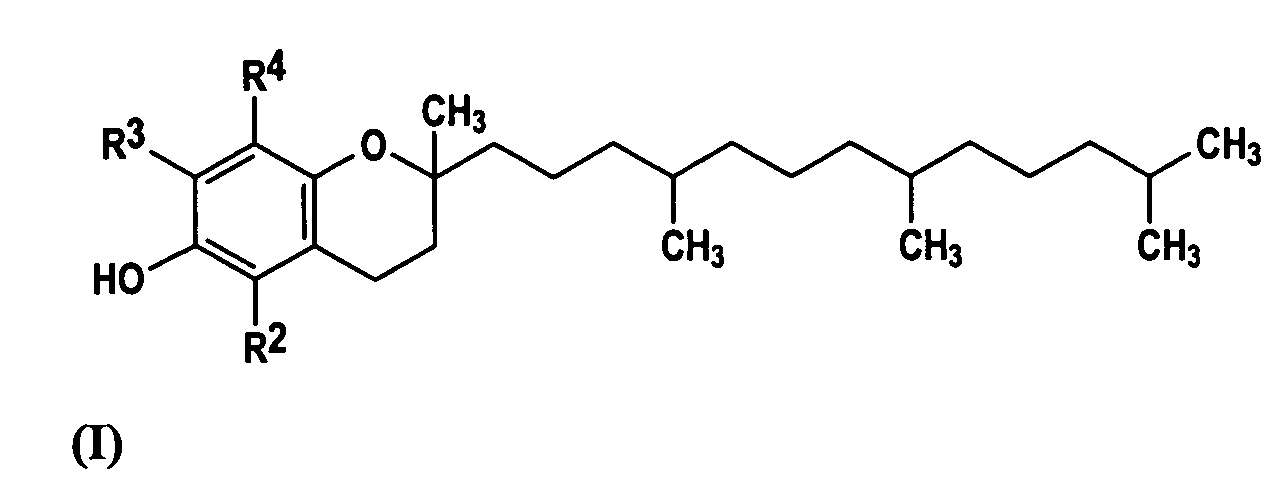
- Tocopherols are chroman-6-ols (3,4-dihydro-2- H -1-benzopyran-6-ols) which are substituted in the 2-position by 4,8,12-trimethyltridecyl radicals and which follow the formula (I) , in which R 2 , R 3 and R 4 independently of one another represent hydrogen or a methyl group.
- Tocopherols are also referred to as biochinones. Typical examples are the plastichinones, tocopherolquinones, ubiquinones, bovichinones, K-vitamins and menaquinones (eg 2-methyl-1,4-naphthoquinones).
- the particularly preferred use of the tocopherol mixtures contains ⁇ -, and ⁇ -, and ⁇ - and ⁇ -tocopherol, optionally in combination with emulsifiers.
- the natural mixture comprising 5 to 20 wt.%, Preferably 12 to 17 wt.% ⁇ -tocopherol, 0.01 to 2 wt.%, Preferably 0.1 to 0.5 wt.% ⁇ Tocopherol, 30 to 80% by weight, preferably 50 to 70% by weight of ⁇ -tocopherol and 10 to 40% by weight, preferably 20 to 30% by weight of ⁇ -tocopherol (available under the trade name Covi-ox®, Cognis Germany GmbH & Co. KG, Dusseldorf) has the best stabilizing effectiveness.
- the carotenoid-containing biomass is preferably obtained from algae, with Haematococcus pluvialis preferably serving as the main source of production of aquatic origin since it has a high content of astaxanthin.
- Carotenoids such as astaxanthin are stabilized in the digested algal biomass as matrix substance by the addition of the tocopherol mixtures against oxidative degradation. From 0.1 to 10% by weight of the tocopherol mixtures, preferably from 0.2 to 5% by weight, more preferably from 0.3 to 2% by weight, based on the weight of the dry biomass, are used.
- additional emulsifiers can be added to the system for improving the effectiveness.
- incorporation takes place in the aqueous biomass suspension in a combination process parallel to the cell disruption or in a second stage immediately after digestion. If mechanical pre-dewatering of the biomass suspension takes place before drying, it must be ensured that no stabilizer is removed with the water.
- Controx® KS contains 80 wt% mixed tocopherols and 20 wt% citric acid mono- and diglycerides
- Controx® VP contains 25 wt% mixed tocopherols, 10% citric acid mono- and diglycerides, 25 wt% ascorbyl palmitate and 40 wt% Lecitin (in percentage by mass).
- the samples with 10% by weight of one of the two mixed tocopherol preparations, or as a reference without stabilizer, in aqueous suspension were intensively dispersed and then freeze-dried.
- the dry samples were incubated in non-sealed glasses at a temperature of -20, 20 and 40 ° C for 38 days to simulate the storage process.
- the determination of astaxanthin levels by solvent extraction and high performance liquid chromatography leads to the results given in Table 1 below. It can be seen from this that the storage in the frozen state is also possible without stabilizer, but at room and elevated temperature, the astaxanthin in the unstabilized samples is completely degraded within the storage time.
Landscapes
- Health & Medical Sciences (AREA)
- Nutrition Science (AREA)
- Life Sciences & Earth Sciences (AREA)
- Chemical & Material Sciences (AREA)
- Engineering & Computer Science (AREA)
- Food Science & Technology (AREA)
- Polymers & Plastics (AREA)
- Coloring Foods And Improving Nutritive Qualities (AREA)
- Fodder In General (AREA)
- Cosmetics (AREA)
- Pharmaceuticals Containing Other Organic And Inorganic Compounds (AREA)
- Acyclic And Carbocyclic Compounds In Medicinal Compositions (AREA)
Abstract
Description
Dieses kann entweder synthetischen Ursprungs sein oder aus natürlichen Quellen gewonnen werden (Cyanotech, Mera Pharmaceuticals). Astaxanthin ist ein Carotinoid, das aus Mikroalgen gewonnen werden kann, welches in den letzten Jahren bekannt geworden, dadurch dass es zunehmend in der Aquakultur zum Färben des Fischfleisches von Forellen und Lachsen eingesetzt wurde. Dieses Carotinoid hat zahlreiche weitere Einsatzgebiete, so wird es unter anderem als Radikalfänger, Hormonvorläufer, Wachtumsförderer, Photoprotektor oder Immunstimulans eingesetzt. Daneben ist eine seiner wichtigsten Funktionen die als Antioxidans, denn es hat eine 10fach stärkere antioxidative Kapazität als andere Carotinoide, beispielsweise β-Carotin.
Aufgrund ihrer hohen Empfindlichkeit gegenüber Sauerstoff, Wärme und Licht können Carotinoide wie Astaxanthin bei der Lagerung leicht zerstört werden. Der Abbau kann auch eintreten, wenn das Carotinoid in einer Matrix aus anderen Stoffen wie z. B. Lipiden und Proteinen eingebettet vorliegt. Um den Abbau zu vermeiden ist der Zusatz und die Einarbeitung von Antioxidantien in die carotinoidhaltige Zubereitung erforderlich.
95 % des derzeit auf dem Markt eingesetzten Astaxanthins kommt aus synthetischer Herstellung. Da die Nachfrage nach natürlichen Produkten und deren Einsatz in Nahrungsmitteln, pharmazeutischen und kosmetischen Zubereitungen ständig wächst, wird in letzter Zeit vermehrt Astaxanthin aus aquatischem Urspung gewonnen, wobei die Microalge Haematococcus pluvialis die natürliche Quelle darstellt, die den höchsten Gehalt an Astaxanthin aufweist. Diese Microalge kann als trockene Biomasse eingesetzt werden. So wurden in der Internationalen Patentanmeldung WO 99/13855 Formulierungen mit Extrakten von Haematococcus pluvialis zur Behandlung von rauher, trockener Haut offenbart.
Auch in Form der carotinoidhaltigen trockenen Biomasse unterliegt Astaxanthin der Zersetzung insbesondere bei erhöhter Temperaturbelastung, so dass die Lagerzeit trotz der Trocknung sehr begrenzt ist.
Durch die schonende Einarbeitung der Antioxidantien in die in Wasser suspendierte Algenbiomasse in einem Kombinationsprozess mit dem Zellaufschluss wird ein Produkt gewonnen, das vollständig frei von synthetischen Zusatzstoffen und wesentlich besser lagerfähig ist als unstabilisierte Trockenbiomasse. Zur Verwendung in Futtermitteln, Kosmetika und pharmazeutischen Zubereitungen steht damit ein sehr gut bioverfügbares Produkt frei von synthetischen Stabilisatoren zur Verfügung. Tocopherolgemische zeichnen sich durch eine sehr gute Verträglichkeit aus.
Unter Tocopherolen werden in 2-Stellung mit 4,8,12-Trimethyltridecyl-Resten substituierte Chroman-6-ole (3,4-Dihydro-2-H-1benzopyran-6-ole) verstanden, die der Formel (I) folgen, in der R2, R3 und R4 unabhängig voneinander für Wasserstoff oder eine Methylgruppe stehen. Tocopherole werden auch als Biochinone bezeichnet. Typische Beispiele sind die Plastichinone, Tocopherolchinone, Ubichinone, Bovichinone, K-Vitamine und Menachinone (z.B. 2-Methyl-1,4-naphthochinone). Vorzugsweise werden die Chinone aus der Vitamin-E-Reihe, d.h. α-, β-, γ-, δ- und ε-Tocopherol eingesetzt, wobei letzteres noch über die ursprüngliche ungesättigte Prenylseitenkette verfügt.
Untersuchungen mit unterschiedlichen Tocopherolen haben gezeigt, dass die natürlichen Mischung umfassend 5 bis 20 Gew. % bevorzugt 12 bis 17 Gew.% α-Tocopherol, 0,01 bis 2 Gew. %, bevorzugt 0,1 bis 0,5 Gew. % β-Tocopherol, 30 bis 80 Gew. %, bevorzugt 50 bis 70 Gew. % γ-Tocopherol und 10 bis 40 Gew. %, bevorzugt 20 bis 30 Gew. % δ-Tocopherol (erhältlich unter dem Handelsnamen Covi-ox® , Cognis Deutschland GmbH & Co. KG, Düsseldorf) die beste stabilisierende Wirksamkeit aufweist.
Carotinoide wie Astaxanthin werden in der aufgeschlossenen Algenbiomasse als Matrixsubstanz durch den Zusatz der Tocopherolgemische gegen oxidativen Abbau stabilisiert. Zum Einsatz kommen 0,1 bis 10 Gew. % der Tocopherolgemische, bevorzugt 0,2 bis 5 Gew. % besonders bevorzugt 0,3 bis 2 Gew. % bezogen auf das Gewicht der Biotrockenmasse.
Neben den in den Algen natürlich vorkommenden oberflächenaktiven Substanzen können dem System zur Verbesserung der Wirksamkeit noch zusätzliche Emulgatoren zugesetzt werden.
Die Einarbeitung erfolgt in die wässrige Biomassesuspension in einem Kombinationsverfahren parallel zum Zellaufschluss oder in einer zweiten Stufe unmittelbar nach dem Aufschluss. Sofern vor der Trocknung eine mechanische Vorentwässerung der Biomassesuspension erfolgt, ist darauf zu achten, dass kein Stabilisator mit dem Wasser abgetrennt wird.
Bezogen auf die Trockensubstanz sind die Proben mit 10 Gew. % von einem der beiden Misch-Tocopherol-Zubereitungen, bzw. als Referenz ohne Stabilisator, in wässriger Suspension intensiv dispergiert und anschließend gefriergetrocknet worden.
Die trockenen Proben sind in nicht gasdicht verschlossenen Gläsern bei einer Temperatur von -20, 20 und 40°C über 38 Tage inkubiert worden um den Lagerprozess zu simulieren.
Die Bestimmung der Astaxanthingehalte über Lösemittelextraktion und Hochleistungs-Flüssigkeitschromatographie führt zu dem in der u.a. Tabelle 1 wiedergegebenen Ergebnissen.
Es ist hieraus ersichtlich, dass die Lagerung in gefrorenem Zustand auch ohne Stabilisator möglich ist, das aber bei Raum- und erhöhter Temperatur das Astaxanthin in den unstabilisierten Proben innerhalb der Lagerzeit vollständig abgebaut wird. Während die Stabilisatoren bei Raumtemperatur eine vergleichbare Wirksamkeit zeigen ist das Produkt mit dem höheren Tocopherolgehalt bei erhöhter Temperatur klar überlegen.
| Astaxanthingehalt unterschiedlich stabilisierter Biomasse nach 38 Tagen Lagerung | ||
| Temperatur | Zusatz | Astaxanthingehalt |
| [°C] | [Gew. %] | |
| -20 | ohne | 4,5 |
| -20 | Controx® KS | 4,4 |
| -20 | Controx® VP | 4,5 |
| 20 | ohne | 0,0 |
| 20 | Controx® KS | 3,5 |
| 20 | Controx® VP | 3,4 |
| 40 | ohne | 0,0 |
| 40 | Controx® KS | 2,3 |
| 40 | Controx® VP | 1,7 |
Claims (9)
- Verwendung von Tocopherolgemischen zur Stabilisierung carotinoidhaltiger Biomasse und Biomassezubereitungen.
- Verwendung von Tocopherolgemischen zur Stabilisierung astaxanthinhaltiger Biomasse und Biomassezubereitungen.
- Verwendung gemäß Anspruch 1 und/oder 2, dadurch gekennzeichnet, dass die Tocopherolgemische α-, und β-, und γ- und δ- Tocopherol enthalten.
- Verwendung gemäß den Ansprüchen 1 bis 3, dadurch gekennzeichnet, dass man ein Tocopherolgemisch in einer Menge von 0,1 bis 10 Gew. % bezogen auf das Gewicht der Biotrockenmasse einsetzt.
- Verfahren zur Stabilisierung carotinoidhaltiger Biomassen und Biomassezubereitungen, bei dem man ein Tocopherolgemisch enthaltend α-, und β-, und γ- und δ- Tocopherol in einer Menge von 0,1 bis 10 Gew. % bezogen auf das Gewicht der Biotrockenmasse zusetzt..
- Carotinoidhaltige Biomasse enthaltend 0,1 bis 10 Gew. % - bezogen auf das Gewicht der Biotrockenmasse - eines Tocopherolgemisches.
- Carotinoidhaltige Biomasse umfassend 0,1 bis 10 Gew. % - bezogen auf das Gewicht der Biotrockenmasse - eines α-, und β-, und γ- und δ- Tocopherol enthaltenden Tocopherolgemisches.
- Astaxanthinhaltige Biomasse enthaltend 0,1 bis 10 Gew. % - bezogen auf das Gewicht der Biotrockenmasse - eines Tocopherolgemisches.
- Biomasse gemäß den Ansprüchen 6 bis 8, dadurch gekennzeichnet, dass sie aus Haematococcus pluvialis gewonnen wurde.
Applications Claiming Priority (2)
| Application Number | Priority Date | Filing Date | Title |
|---|---|---|---|
| DE102004004925 | 2004-01-31 | ||
| DE102004004925A DE102004004925A1 (de) | 2004-01-31 | 2004-01-31 | Verfahren zur Stabilisierung carotinoidhaltiger Biomasse |
Publications (1)
| Publication Number | Publication Date |
|---|---|
| EP1559766A1 true EP1559766A1 (de) | 2005-08-03 |
Family
ID=34638821
Family Applications (1)
| Application Number | Title | Priority Date | Filing Date |
|---|---|---|---|
| EP04030410A Withdrawn EP1559766A1 (de) | 2004-01-31 | 2004-12-22 | Verfahren zur Stabilisierung carotinoidhaltiger Biomasse |
Country Status (4)
| Country | Link |
|---|---|
| US (1) | US20050186298A1 (de) |
| EP (1) | EP1559766A1 (de) |
| AU (1) | AU2005200341A1 (de) |
| DE (1) | DE102004004925A1 (de) |
Cited By (1)
| Publication number | Priority date | Publication date | Assignee | Title |
|---|---|---|---|---|
| WO2009112506A1 (en) * | 2008-03-11 | 2009-09-17 | Dsm Ip Assets B.V. | Novel use of carotenoid (ester)s |
Families Citing this family (3)
| Publication number | Priority date | Publication date | Assignee | Title |
|---|---|---|---|---|
| JP5459939B2 (ja) * | 2006-06-09 | 2014-04-02 | 富士フイルム株式会社 | カロチノイド含有エマルジョン組成物、その製造方法、それを含む食品及び化粧品 |
| US20080131515A1 (en) * | 2006-12-01 | 2008-06-05 | Fujifilm Corporation | Emulsion composition, and foods and cosmetics containing the emulsion composition |
| FR3003872B1 (fr) | 2013-03-29 | 2017-02-10 | Roquette Freres | Procede de stabilisation des metabolites sensibles a l'oxydation produits par les microalgues du genre chlorella |
Citations (3)
| Publication number | Priority date | Publication date | Assignee | Title |
|---|---|---|---|---|
| WO1989006910A1 (en) * | 1988-02-08 | 1989-08-10 | Microbio Resources, Inc. | Pigmentation supplements for animal feed compositions |
| EP0641790A1 (de) * | 1993-09-03 | 1995-03-08 | Scotia Holdings Plc | Tocopherolen |
| WO1997028274A1 (en) * | 1996-02-01 | 1997-08-07 | Ben-Gurion University Of The Negev | A procedure for large-scale production of astaxanthin from haematococcus |
Family Cites Families (1)
| Publication number | Priority date | Publication date | Assignee | Title |
|---|---|---|---|---|
| WO2002077105A1 (en) * | 2001-03-22 | 2002-10-03 | Fuji Chemical Industry Co., Ltd. | Stable astaxanthin-containing powdery compositions and process for producing the same |
-
2004
- 2004-01-31 DE DE102004004925A patent/DE102004004925A1/de not_active Withdrawn
- 2004-12-22 EP EP04030410A patent/EP1559766A1/de not_active Withdrawn
-
2005
- 2005-01-28 AU AU2005200341A patent/AU2005200341A1/en not_active Abandoned
- 2005-01-31 US US11/047,170 patent/US20050186298A1/en not_active Abandoned
Patent Citations (3)
| Publication number | Priority date | Publication date | Assignee | Title |
|---|---|---|---|---|
| WO1989006910A1 (en) * | 1988-02-08 | 1989-08-10 | Microbio Resources, Inc. | Pigmentation supplements for animal feed compositions |
| EP0641790A1 (de) * | 1993-09-03 | 1995-03-08 | Scotia Holdings Plc | Tocopherolen |
| WO1997028274A1 (en) * | 1996-02-01 | 1997-08-07 | Ben-Gurion University Of The Negev | A procedure for large-scale production of astaxanthin from haematococcus |
Non-Patent Citations (1)
| Title |
|---|
| Y.M.A. NAGUIB ET AL, J. NUTR. SCI. VITAMINOL., vol. 49, no. 4, 2003, pages 217 - 220, XP001152166 * |
Cited By (2)
| Publication number | Priority date | Publication date | Assignee | Title |
|---|---|---|---|---|
| WO2009112506A1 (en) * | 2008-03-11 | 2009-09-17 | Dsm Ip Assets B.V. | Novel use of carotenoid (ester)s |
| US8709110B2 (en) | 2008-03-11 | 2014-04-29 | Dsm Ip Assets B.V. | Use of carotenoid (ester)s |
Also Published As
| Publication number | Publication date |
|---|---|
| AU2005200341A1 (en) | 2005-08-18 |
| US20050186298A1 (en) | 2005-08-25 |
| DE102004004925A1 (de) | 2005-08-18 |
Similar Documents
| Publication | Publication Date | Title |
|---|---|---|
| EP0981969B1 (de) | Carotinoid-Formulierungen, enthaltend ein Gemisch aus Beta-Carotin, Lycopin und Lutein | |
| EP0845503B1 (de) | Flüssige, mit Öl mischbare Carotinoid-Zubereitungen | |
| EP1173521B1 (de) | Stabile, wassrige dispersionen und stabile, wasserdispergierbare trockenpulver von xanthophyllen, deren herstellung und verwendung | |
| DE69231521T2 (de) | Suspensionen von ascorbinsäure-partikeln im mikrometer-bereich und ihre verwendung als antioxidantien | |
| EP0986963B1 (de) | Stabile, pulverförmige Lycopin-Formulierungen, enthaltend Lycopin mit einem Kristallinitätsgrad von grösser 20% | |
| DE69110045T2 (de) | Aktivierte ascorbinsäure antioxidationzusammensetzungen und damit stabilisierte carotinoiden, fette und nahrungsmittel. | |
| EP0944675B1 (de) | Stabile, wässrige dispersionen und stabile, wasserdispergierbare trockenpulver von xanthophyllen, deren herstellung und verwendung | |
| EP2343986B2 (de) | Gebrauchfertige, stabile emulsion | |
| EP1228705B1 (de) | Verfahren zur Herstellung von Trockenpulvern eines oder mehrerer Carotinoide | |
| DE69103414T2 (de) | Farbstabilisierte zusammensetzungen eines carotenoidpigments und damit gefärbte lebensmittel. | |
| EP2111125B1 (de) | Flüssige formulierungen enthaltend carotinoide | |
| DE69524369T2 (de) | Verfahren zur Extraktion von Karotenoiden aus Bakterienzellen | |
| EP2188250A2 (de) | Verfahren zur herstellung von öligen lösungen von astaxanthin-derivaten | |
| EP2403362B1 (de) | Pulverförmige zusammensetzungen von astaxanthin-derivaten ii | |
| DE2535963B2 (de) | Hühnerfutter | |
| EP2124615A1 (de) | Ölige formulierungen | |
| EP1875814A1 (de) | Zubereitung für Lebensmittel | |
| EP2403364B1 (de) | Verfahren zur herstellung von lösungen von astaxanthin-derivaten | |
| DE69111234T2 (de) | Farbstabilisierte zusammenstellungen von paprikapigment und damit gefärbte nahrungsmittel. | |
| EP1186292B1 (de) | Carotinoidtrockenpulver mit einer Multi-Kern Struktur | |
| EP1559766A1 (de) | Verfahren zur Stabilisierung carotinoidhaltiger Biomasse | |
| EP0972454B1 (de) | Verwendung von Schwefel-organischen Verbindungen als Mittel zur bathochromen Verschiebung der UV/Vis-Absorptionsbande von Carotinoiden | |
| EP2792246A1 (de) | Verfahren zur Herstellung einer Astaxanthin-Suspension | |
| DE29522015U1 (de) | Pharmazeutische Zusammensetzungen, die Lycopin umfassen |
Legal Events
| Date | Code | Title | Description |
|---|---|---|---|
| PUAI | Public reference made under article 153(3) epc to a published international application that has entered the european phase |
Free format text: ORIGINAL CODE: 0009012 |
|
| 17P | Request for examination filed |
Effective date: 20041222 |
|
| AK | Designated contracting states |
Kind code of ref document: A1 Designated state(s): AT BE BG CH CY CZ DE DK EE ES FI FR GB GR HU IE IS IT LI LT LU MC NL PL PT RO SE SI SK TR |
|
| AX | Request for extension of the european patent |
Extension state: AL BA HR LV MK YU |
|
| AKX | Designation fees paid |
Designated state(s): AT BE BG CH CY CZ DE DK EE ES FI FR GB GR HU IE IS IT LI LT LU MC NL PL PT RO SE SI SK TR |
|
| 17Q | First examination report despatched |
Effective date: 20061206 |
|
| STAA | Information on the status of an ep patent application or granted ep patent |
Free format text: STATUS: THE APPLICATION IS DEEMED TO BE WITHDRAWN |
|
| 18D | Application deemed to be withdrawn |
Effective date: 20070619 |