EP1558379B1 - Improved oxygen storage component - Google Patents
Improved oxygen storage component Download PDFInfo
- Publication number
- EP1558379B1 EP1558379B1 EP03756586.8A EP03756586A EP1558379B1 EP 1558379 B1 EP1558379 B1 EP 1558379B1 EP 03756586 A EP03756586 A EP 03756586A EP 1558379 B1 EP1558379 B1 EP 1558379B1
- Authority
- EP
- European Patent Office
- Prior art keywords
- ceria
- max
- containing material
- hydrogen peroxide
- oxygen storage
- Prior art date
- Legal status (The legal status is an assumption and is not a legal conclusion. Google has not performed a legal analysis and makes no representation as to the accuracy of the status listed.)
- Expired - Lifetime
Links
Images



Classifications
-
- B—PERFORMING OPERATIONS; TRANSPORTING
- B01—PHYSICAL OR CHEMICAL PROCESSES OR APPARATUS IN GENERAL
- B01D—SEPARATION
- B01D53/00—Separation of gases or vapours; Recovering vapours of volatile solvents from gases; Chemical or biological purification of waste gases, e.g. engine exhaust gases, smoke, fumes, flue gases, aerosols
- B01D53/02—Separation of gases or vapours; Recovering vapours of volatile solvents from gases; Chemical or biological purification of waste gases, e.g. engine exhaust gases, smoke, fumes, flue gases, aerosols by adsorption, e.g. preparative gas chromatography
-
- B—PERFORMING OPERATIONS; TRANSPORTING
- B01—PHYSICAL OR CHEMICAL PROCESSES OR APPARATUS IN GENERAL
- B01J—CHEMICAL OR PHYSICAL PROCESSES, e.g. CATALYSIS OR COLLOID CHEMISTRY; THEIR RELEVANT APPARATUS
- B01J20/00—Solid sorbent compositions or filter aid compositions; Sorbents for chromatography; Processes for preparing, regenerating or reactivating thereof
- B01J20/02—Solid sorbent compositions or filter aid compositions; Sorbents for chromatography; Processes for preparing, regenerating or reactivating thereof comprising inorganic material
- B01J20/0203—Solid sorbent compositions or filter aid compositions; Sorbents for chromatography; Processes for preparing, regenerating or reactivating thereof comprising inorganic material comprising compounds of metals not provided for in B01J20/04
- B01J20/0207—Compounds of Sc, Y or Lanthanides
-
- B—PERFORMING OPERATIONS; TRANSPORTING
- B01—PHYSICAL OR CHEMICAL PROCESSES OR APPARATUS IN GENERAL
- B01J—CHEMICAL OR PHYSICAL PROCESSES, e.g. CATALYSIS OR COLLOID CHEMISTRY; THEIR RELEVANT APPARATUS
- B01J20/00—Solid sorbent compositions or filter aid compositions; Sorbents for chromatography; Processes for preparing, regenerating or reactivating thereof
- B01J20/02—Solid sorbent compositions or filter aid compositions; Sorbents for chromatography; Processes for preparing, regenerating or reactivating thereof comprising inorganic material
- B01J20/0203—Solid sorbent compositions or filter aid compositions; Sorbents for chromatography; Processes for preparing, regenerating or reactivating thereof comprising inorganic material comprising compounds of metals not provided for in B01J20/04
- B01J20/0211—Compounds of Ti, Zr, Hf
-
- B—PERFORMING OPERATIONS; TRANSPORTING
- B01—PHYSICAL OR CHEMICAL PROCESSES OR APPARATUS IN GENERAL
- B01J—CHEMICAL OR PHYSICAL PROCESSES, e.g. CATALYSIS OR COLLOID CHEMISTRY; THEIR RELEVANT APPARATUS
- B01J20/00—Solid sorbent compositions or filter aid compositions; Sorbents for chromatography; Processes for preparing, regenerating or reactivating thereof
- B01J20/02—Solid sorbent compositions or filter aid compositions; Sorbents for chromatography; Processes for preparing, regenerating or reactivating thereof comprising inorganic material
- B01J20/06—Solid sorbent compositions or filter aid compositions; Sorbents for chromatography; Processes for preparing, regenerating or reactivating thereof comprising inorganic material comprising oxides or hydroxides of metals not provided for in group B01J20/04
-
- B—PERFORMING OPERATIONS; TRANSPORTING
- B01—PHYSICAL OR CHEMICAL PROCESSES OR APPARATUS IN GENERAL
- B01J—CHEMICAL OR PHYSICAL PROCESSES, e.g. CATALYSIS OR COLLOID CHEMISTRY; THEIR RELEVANT APPARATUS
- B01J23/00—Catalysts comprising metals or metal oxides or hydroxides, not provided for in group B01J21/00
- B01J23/10—Catalysts comprising metals or metal oxides or hydroxides, not provided for in group B01J21/00 of rare earths
-
- B—PERFORMING OPERATIONS; TRANSPORTING
- B01—PHYSICAL OR CHEMICAL PROCESSES OR APPARATUS IN GENERAL
- B01J—CHEMICAL OR PHYSICAL PROCESSES, e.g. CATALYSIS OR COLLOID CHEMISTRY; THEIR RELEVANT APPARATUS
- B01J37/00—Processes, in general, for preparing catalysts; Processes, in general, for activation of catalysts
- B01J37/02—Impregnation, coating or precipitation
- B01J37/0201—Impregnation
- B01J37/0207—Pretreatment of the support
-
- B—PERFORMING OPERATIONS; TRANSPORTING
- B01—PHYSICAL OR CHEMICAL PROCESSES OR APPARATUS IN GENERAL
- B01J—CHEMICAL OR PHYSICAL PROCESSES, e.g. CATALYSIS OR COLLOID CHEMISTRY; THEIR RELEVANT APPARATUS
- B01J37/00—Processes, in general, for preparing catalysts; Processes, in general, for activation of catalysts
- B01J37/02—Impregnation, coating or precipitation
- B01J37/0215—Coating
- B01J37/0217—Pretreatment of the substrate before coating
-
- B—PERFORMING OPERATIONS; TRANSPORTING
- B01—PHYSICAL OR CHEMICAL PROCESSES OR APPARATUS IN GENERAL
- B01J—CHEMICAL OR PHYSICAL PROCESSES, e.g. CATALYSIS OR COLLOID CHEMISTRY; THEIR RELEVANT APPARATUS
- B01J37/00—Processes, in general, for preparing catalysts; Processes, in general, for activation of catalysts
- B01J37/12—Oxidising
-
- B—PERFORMING OPERATIONS; TRANSPORTING
- B01—PHYSICAL OR CHEMICAL PROCESSES OR APPARATUS IN GENERAL
- B01D—SEPARATION
- B01D2256/00—Main component in the product gas stream after treatment
- B01D2256/12—Oxygen
-
- B—PERFORMING OPERATIONS; TRANSPORTING
- B01—PHYSICAL OR CHEMICAL PROCESSES OR APPARATUS IN GENERAL
- B01D—SEPARATION
- B01D2258/00—Sources of waste gases
- B01D2258/01—Engine exhaust gases
- B01D2258/014—Stoichiometric gasoline engines
-
- B—PERFORMING OPERATIONS; TRANSPORTING
- B01—PHYSICAL OR CHEMICAL PROCESSES OR APPARATUS IN GENERAL
- B01D—SEPARATION
- B01D2259/00—Type of treatment
- B01D2259/45—Gas separation or purification devices adapted for specific applications
- B01D2259/4525—Gas separation or purification devices adapted for specific applications for storage and dispensing systems
-
- B—PERFORMING OPERATIONS; TRANSPORTING
- B01—PHYSICAL OR CHEMICAL PROCESSES OR APPARATUS IN GENERAL
- B01D—SEPARATION
- B01D2259/00—Type of treatment
- B01D2259/45—Gas separation or purification devices adapted for specific applications
- B01D2259/455—Gas separation or purification devices adapted for specific applications for transportable use
-
- B—PERFORMING OPERATIONS; TRANSPORTING
- B01—PHYSICAL OR CHEMICAL PROCESSES OR APPARATUS IN GENERAL
- B01J—CHEMICAL OR PHYSICAL PROCESSES, e.g. CATALYSIS OR COLLOID CHEMISTRY; THEIR RELEVANT APPARATUS
- B01J2220/00—Aspects relating to sorbent materials
- B01J2220/40—Aspects relating to the composition of sorbent or filter aid materials
- B01J2220/42—Materials comprising a mixture of inorganic materials
-
- B—PERFORMING OPERATIONS; TRANSPORTING
- B01—PHYSICAL OR CHEMICAL PROCESSES OR APPARATUS IN GENERAL
- B01J—CHEMICAL OR PHYSICAL PROCESSES, e.g. CATALYSIS OR COLLOID CHEMISTRY; THEIR RELEVANT APPARATUS
- B01J35/00—Catalysts, in general, characterised by their form or physical properties
- B01J35/50—Catalysts, in general, characterised by their form or physical properties characterised by their shape or configuration
- B01J35/56—Foraminous structures having flow-through passages or channels, e.g. grids or three-dimensional [3D] monoliths
Definitions
- the present invention relates to oxygen storage components for catalytic converters for automobile exhaust system particularly for those with petrol-driven engines.
- an oxygen storage component is incorporated in such systems to extend the range of conditions of effective operation of the catalyst.
- the gases of a car exhaust vary from being “rich” (i.e. reducing conditions) to "lean” (i.e. oxidising conditions).
- rich conditions the oxygen required to oxidise the CO and HC components is provided by the OSC.
- the OSC is oxidised by the gases so that it can again provide oxygen when rich conditions are encountered.
- OSCs generally contain ceria and are commonly formed from a solid solution of ceria and zirconia with at least one other component, the ceria content being between 10% and 60% by weight.
- the OSC's performance under these oxidation and reduction conditions are often measured by Temperature Programmed Reduction (TPR) whereby a sample of OSC material is heated at a constant rate in a stream of reducing gas, such as hydrogen, and the amount of reaction effected by the sample monitored as a function of the gas stream composition.
- TPR Temperature Programmed Reduction
- a high TCD value correlates with a high rate of consumption of hydrogen and thus a high rate of oxidation of the gas stream by the OSC.
- the main features of this TPR measurement are the temperature reached at the peak maximum of the reaction (T max ) and the area under the trace, which is proportional to the amount of the OSC that is reduced.
- T max peak maximum of the reaction
- the typical value of T max for conventional OSCs is about 450-600°C.
- the exact value of T max for a given OSC is dependent on the exact composition of the OSC and the particular protocol of TPR used.
- EP 0 310 398A describes the preparation of a ceria-containing material where nitric acid is used for pH adjustment.
- WO 02/072256A describes the preparation of a ceria-containing material where hydrogen peroxide is added before calcination.
- the light-off temperature is the temperature at which 50% of the incoming gases are converted to the more acceptable products. This can be achieved by altering the support and the dispersion of the PGM's (platinum group metals), which are generally the active catalysts. However this temperature is different for the three main pollutants being treated, and so it is difficult to find a good compromise combination of support and catalyst.
- An alternative approach is to try to reduce the T max of the OSC since this would also be useful in meeting the cold start regulations.
- T max of an OSC varies with its composition
- An example of such modification of a ceria-zirconia OSC is described in JP-A-2000281343 where chemical vapour-phase transportation of the surface material after the reaction with a halide is used.
- a sophisticated surface attack is not necessary and that a relatively simple chemical treatment of the surface can result in a significant lowering of T max .
- a T max of as low as 250°C can be obtained which is substantially lower than any values of T max which have previously been reported for a ceria-zirconia OSC.
- the present invention provides a method of treating a ceria-zirconia mixed oxide composed of 90-10% by weight of zirconia (ZrO 2 ) and 10-60% by weight of ceria (CeO 2 ) in order to improve its performance as an oxygen storage component of an exhaust gas purification system, which method comprises modifying at least some of the surface of the material by contact with an aqueous solution of hydrogen peroxide, wherein the mole ratio of hydrogen peroxide to ceria-zirconia mixed oxide is about 3:1, and the concentration of the aqueous solution and the length of time of its contact are such that temperature reached at the peak maximum of the reaction as measured by temperature programmed reduction, known as T max , of the treated material is lower than the T max of equivalent untreated material by at least 50°C.
- the ceria- zirconia mixed oxide is optionally doped with up to 50% by weight of a third component comprising the oxide of one or more of the rare earth metals, especially Pr, La, Nd and Y, alkaline earth metals consisting of Mg, Ca and Ba, and Al and Si.
- the material can be treated in accordance with the present invention either before or after admixture with the exhaust catalyst material, either before or after calcination, and either before or after incorporation into the exhaust system of an automobile, since the active sites of the material which enable it to operate as an OSC appear to be distinct from its other structural and chemical characteristics.
- the treatment of the present invention can be carried out to the wash coat which contains the ceria-containing material and optionally alumina which is applied to the monolith forming the structure of a catalytic converter.
- the treatment should be such as to modify at least some of the surface of the material to an extent sufficient to cause a significant lowering of the T max temperature of the material, e.g. at least 50°C.
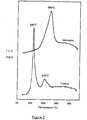
- a comparison between untreated and treated material is shown in accompanying Figure 2 .
- the surface modification effected by the method of the present invention is not of the nature of an etching treatment since it was found that there was effectively no loss of surface material by dissolution and there was no change in the overall chemical composition of the material.
- An examination of the differences between the untreated and treated materials with normal and lower values of T max has shown that the treated materials often possess some anisotropy in their crystallite sizes.
- X-ray line broadening can be used to measure crystallite size. The precise size measured has been found to depend up on the peak chosen and hence the crystallographic direction of the measurement.
- the purity of the treatment solution is important.
- the additives present such as stabilisers, have been found adversely to affect the performance of those solutions as treatment agents in accordance with the present invention.
- the present invention also provides a novel material containing ceria whose surface has been modified by chemical treatment whereby the material possesses a T max of less than 500°C, preferably less than 400°C and more preferably less than 300°C, optionally with at least some anisotropy in its crystallite size.
- the present invention will now be exemplified by the following Examples which refer to the accompanying drawings, in which the TCD signal axis is graduated in arbitrary units or is left ungraduated since it is the shape of the TCD temperature profile which is significant.
- a zirconia-based mixed oxide containing ceria was prepared with the composition: 72% by weight ZrO 2 , 20% by weight CeO 2 , 4% by weight La 2 O 3 and 4% by weight NdO 2 .
- 1g of the doped mixed oxide was surface treated with nitric acid by immersing it in 30ml of an aqueous solution of 20% nitric acid at 35°C and leaving it to stand for one hour.
- the nitric acid used was a concentrated commercial grade manufactured by C. Erba under the grade identification "RPE" diluted to 20% by weight. The treated solid was then filtered off, dried at 120°C for two hours and then calcined at 500°C for five hours.
- the mixed oxide was prepared with the composition: 77% by weight ZrO 2 , 15% by weight CeO 2 , 5% by weight La 2 0 3 and 3% by weight Nd 2 O 3 .
- a separate aqueous solution was prepared and added to the stirred sample suspension at a rate of 0.05 ml/min. The mixture was allowed to react for 20 hours and then filtered and washed with 10ml of water. The filtrate was then dried at 120°C for two hours and then calcined at 700°C for five hours using a ramp of 3°C/min up to the calcination temperature and a cooling ramp of 4.5°C/min back to room temperature.
- compositions of the various treatment solutions are set out in Table 1 and the conditions of treatment are set out in Table 2. It will be noted that the treatment solution of the first sample contained no hydrogen peroxide and is therefore a Comparative Sample.
- the other samples all used as the source of hydrogen peroxide the commercially available reagent sold by the company Sigma Aldrich under the name "Fluka - Hydrogen Peroxide Purum - grade 95302". This reagent has a concentration of 30% by volume H 2 0 2 .
- TCD signal measurements for the seven samples are shown in the seven accompanying corresponding Figures 3A to 3G , from which it will be noted that the values of T max were lowered successively from about 550°C to about 250°C by means of the increasing strength of the hydrogen peroxide treatment solution.
- T max values for the treated samples are set out in accompanying six corresponding Figures 4A to 4F , from which it will be noted that too fast an addition rate should be avoided for achieving an optimum lowering of T max .
- the addition of 4% H 2 0 2 is equivalent to a H 2 0 2 /mixed oxide molar ratio of 2.8:1.
- the sample was prepared for its TCD measurement by being heated in a 20% by volume oxygen/80% by volume helium gas mixture at 500°C. The temperature was ramped at 10°C/min up to 500°C, held at that temperature for 30 minutes, and then cooled down to 150°C. The surrounding gas mixture was then changed to a mixture of 5% by volume hydrogen/95% by volume argon, and the sample heated to 900°C. The temperature was ramped from 150° at 10°C/min up to 900°C, held at that temperature for 30 minutes, and then cooled to ambient temperature.
- Example 2 Two grams of alumina were slurried with ten grams of the mixed oxide of Example 1 with an amount of water to obtain a loading of approximately 50% by weight of the mixed oxide on alumina in 100 ml of water. A solution of 0.5% by volume ammonia was added to the slurry to precipitate the mixed oxide on the alumina, and the final pH of the slurry was 8.0 to 8.5. After slurrying for a further one hour the solid formed was filtered and dried at 120°C for two hours. It was then calcined as for the samples of Example 2.
- a sample of ceria having a BET surface area of 100m 2 /g was formed into a suspension with vigorous stirring by the addition of two grams of ceria to 10 ml of 10% by volume ammonia.
- the suspension was held at 25°C and had a pH of 11.7.
- 80ml of a solution of 30% by volume hydrogen peroxide of the commercial grade used in Example 2 was added at a rate of 0.25ml/min.
- the reaction was allowed to continue for 20 hours before filtering.
- the filtrate was washed, dried and calcined as for the samples of Example 2 and the standard TPR protocol carried out.
Landscapes
- Chemical & Material Sciences (AREA)
- Chemical Kinetics & Catalysis (AREA)
- Organic Chemistry (AREA)
- Engineering & Computer Science (AREA)
- Analytical Chemistry (AREA)
- Materials Engineering (AREA)
- Inorganic Chemistry (AREA)
- General Chemical & Material Sciences (AREA)
- Oil, Petroleum & Natural Gas (AREA)
- Catalysts (AREA)
Description
- The present invention relates to oxygen storage components for catalytic converters for automobile exhaust system particularly for those with petrol-driven engines.
- In exhaust systems catalysts are required to remove by chemical reaction the main pollutants of carbon monoxide (CO), unburnt hydrocarbons (HC) and nitrogen oxides (NOx) from car exhaust gases, and an oxygen storage component (OSC) is incorporated in such systems to extend the range of conditions of effective operation of the catalyst. The gases of a car exhaust vary from being "rich" (i.e. reducing conditions) to "lean" (i.e. oxidising conditions). Under rich conditions the oxygen required to oxidise the CO and HC components is provided by the OSC. When the system changes to lean conditions the OSC is oxidised by the gases so that it can again provide oxygen when rich conditions are encountered.
- OSCs generally contain ceria and are commonly formed from a solid solution of ceria and zirconia with at least one other component, the ceria content being between 10% and 60% by weight. The OSC's performance under these oxidation and reduction conditions are often measured by Temperature Programmed Reduction (TPR) whereby a sample of OSC material is heated at a constant rate in a stream of reducing gas, such as hydrogen, and the amount of reaction effected by the sample monitored as a function of the gas stream composition. A typical result is shown in accompanying
Figure 1 in which the TCD signal is a measure of the electrical current passing through the Thermal Conductivity Detector held in the gas stream. A high TCD value correlates with a high rate of consumption of hydrogen and thus a high rate of oxidation of the gas stream by the OSC. The main features of this TPR measurement are the temperature reached at the peak maximum of the reaction (Tmax) and the area under the trace, which is proportional to the amount of the OSC that is reduced. There are other ways of measuring OSC performance, but we have found that when using TPR the typical value of Tmax for conventional OSCs is about 450-600°C. The exact value of Tmax for a given OSC is dependent on the exact composition of the OSC and the particular protocol of TPR used. -
EP 0 310 398AWO 02/072256A - Temperatures of the order of 450° - 600°C are reached by the OSC during the normal operation of the exhaust catalyst, during which the OSC performs its required function of coping with changes in the exhaust gas composition from rich to lean and back again. However when a car engine is started from cold it takes some time for the catalyst to reach its normal operating temperature, and during this time the exhaust gases are not fully reacted by the catalyst before being discharged to the atmosphere. Recent legislation at least in the UK has changed the protocols for the testing of car emissions to include cold start conditions. As a result a number of ways to prevent the discharge of these partially unreacted emissions have been investigated. One option is to position the catalyst very near to the engine so that it heats up quickly. Another is electrically to heat the catalyst, whilst a third is to try to lower the light-off temperature of the catalyst. The light-off temperature is the temperature at which 50% of the incoming gases are converted to the more acceptable products. This can be achieved by altering the support and the dispersion of the PGM's (platinum group metals), which are generally the active catalysts. However this temperature is different for the three main pollutants being treated, and so it is difficult to find a good compromise combination of support and catalyst. An alternative approach is to try to reduce the Tmax of the OSC since this would also be useful in meeting the cold start regulations.
- As part of our investigations into why the Tmax of an OSC varies with its composition we examined the effect of modifying its surface. An example of such modification of a ceria-zirconia OSC is described in
JP-A-2000281343 - The present invention provides a method of treating a ceria-zirconia mixed oxide composed of 90-10% by weight of zirconia (ZrO2) and 10-60% by weight of ceria (CeO2) in order to improve its performance as an oxygen storage component of an exhaust gas purification system, which method comprises modifying at least some of the surface of the material by contact with an aqueous solution of hydrogen peroxide, wherein the mole ratio of hydrogen peroxide to ceria-zirconia mixed oxide is about 3:1, and the concentration of the aqueous solution and the length of time of its contact are such that temperature reached at the peak maximum of the reaction as measured by temperature programmed reduction, known as Tmax, of the treated material is lower than the Tmax of equivalent untreated material by at least 50°C.
- The ceria- zirconia mixed oxide is optionally doped with up to 50% by weight of a third component comprising the oxide of one or more of the rare earth metals, especially Pr, La, Nd and Y, alkaline earth metals consisting of Mg, Ca and Ba, and Al and Si. The material can be treated in accordance with the present invention either before or after admixture with the exhaust catalyst material, either before or after calcination, and either before or after incorporation into the exhaust system of an automobile, since the active sites of the material which enable it to operate as an OSC appear to be distinct from its other structural and chemical characteristics. In particular the treatment of the present invention can be carried out to the wash coat which contains the ceria-containing material and optionally alumina which is applied to the monolith forming the structure of a catalytic converter.
- An investigation into this chemical treatment has shown that the conditions of treatment of the material and the nature of the treating reagent are important, as known ceria etching reagents such as sulphuric acid have been found to have no beneficial effect on its Tmax. Potentially suitable treatment agents such as hydrochloric acid are undesirable because of the contamination they leave on its surface after the material has been calcined. Surprisingly and for reasons at present unknown it has been found that only hydrogen peroxide and nitric acid (nitric acid not being part of the invention) are effective in achieving a significant lowering of the Tmax of ceria-containing material suitable for use as an OSC. The conditions that have been found to be important are the temperature and
time of treatment, and the concentration of the treatment agent. The treatment should be such as to modify at least some of the surface of the material to an extent sufficient to cause a significant lowering of the Tmax temperature of the material, e.g. at least 50°C. A comparison between untreated and treated material is shown in accompanyingFigure 2 . - It has been found that the surface modification effected by the method of the present invention is not of the nature of an etching treatment since it was found that there was effectively no loss of surface material by dissolution and there was no change in the overall chemical composition of the material. An examination of the differences between the untreated and treated materials with normal and lower values of Tmax has shown that the treated materials often possess some anisotropy in their crystallite sizes. X-ray line broadening can be used to measure crystallite size. The precise size measured has been found to depend up on the peak chosen and hence the crystallographic direction of the measurement. All treated samples which show the enhanced TPR also show at least some anisotropy in their crystallite size measurements (D<002>/D<200> ∼0.8), although the extent of anisotropy has been found to be dependent on the way in which the OSC was prepared.
- With both nitric acid and hydrogen peroxide it has been found that the time required to treat the surface of the material sufficiently is dependent upon the concentration of the aqueous solution used, viz. the stronger the solution the shorter the treatment time needed. There must also be sufficient of the treatment solution since there appears to be a direct interaction between individual molecules of the treatment agent and the active sites on the surface of the material. For example, when the material is first contacted by a solution of hydrogen peroxide there is evolution of oxygen which ceases after about one hour at room temperature. Prolonged immersion of the material in the solution after the cessation of oxygen evolution does not lead to any further lowering of Tmax indicating that the modification of the surface only takes place during the decomposition of the hydrogen peroxide to water.
- Furthermore, it has been found that the purity of the treatment solution is important. For some commercially available hydrogen peroxide solutions the additives present, such as stabilisers, have been found adversely to affect the performance of those solutions as treatment agents in accordance with the present invention. Paradoxically it has been found that some higher purity commercial hydrogen peroxide solutions perform less well than lower grade solutions, possibly because the stabilisers used to try to maintain the solution's high purity are detrimental to the mechanism by which that solution modifies the surface of ceria-containing material. Similar difficulties can be encountered with different grades of nitric acid.
- Since the theoretical maximum concentration of hydrogen peroxide solution is about 35% by volume, the preferred commercially available solutions of highest strength of about 30% are preferably used.
- The present invention also provides a novel material containing ceria whose surface has been modified by chemical treatment whereby the material possesses a Tmax of less than 500°C, preferably less than 400°C and more preferably less than 300°C, optionally with at least some anisotropy in its crystallite size.
- The present invention will now be exemplified by the following Examples which refer to the accompanying drawings, in which the TCD signal axis is graduated in arbitrary units or is left ungraduated since it is the shape of the TCD temperature profile which is significant.
- A zirconia-based mixed oxide containing ceria was prepared with the composition: 72% by weight ZrO2, 20% by weight CeO2, 4% by weight La2O3 and 4% by weight NdO2. 1g of the doped mixed oxide was surface treated with nitric acid by immersing it in 30ml of an aqueous solution of 20% nitric acid at 35°C and leaving it to stand for one hour. The nitric acid used was a concentrated commercial grade manufactured by C. Erba under the grade identification "RPE" diluted to 20% by weight. The treated solid was then filtered off, dried at 120°C for two hours and then calcined at 500°C for five hours.
- For comparison a sample of the same mixed oxide was prepared without surface treatment, i.e. the solution only contained water, and was dried and calcined under the same conditions. Samples of both treated and untreated material were subjected to TPR under the same regime and their respective values of Tmax were determined. The Tmax of the treated material was found to be significantly lower than that of the un-treated material, viz. 300°C vs. 550°C, as shown in accompanying
Figure 2 . - A series of experiments was carried out to examine the effect of the concentration of hydrogen peroxide in the treatment solution on the Tmax of a zirconia-based oxide containing ceria.
- The mixed oxide was prepared with the composition: 77% by weight ZrO2, 15% by weight CeO2, 5% by
weight La 203 and 3% by weight Nd2O3. For each experiment 2 grams of a sample of this mixed oxide, which is approximately 0.015 molar, were used and a suspension of the sample was prepared by the addition of a mixture of 75ml of water and 10ml of 10% ammonia. This suspension had a pH of 11.6 and was held at 25°C and vigorously stirred. For each experiment a separate aqueous solution was prepared and added to the stirred sample suspension at a rate of 0.05 ml/min. The mixture was allowed to react for 20 hours and then filtered and washed with 10ml of water. The filtrate was then dried at 120°C for two hours and then calcined at 700°C for five hours using a ramp of 3°C/min up to the calcination temperature and a cooling ramp of 4.5°C/min back to room temperature. - The compositions of the various treatment solutions are set out in Table 1 and the conditions of treatment are set out in Table 2. It will be noted that the treatment solution of the first sample contained no hydrogen peroxide and is therefore a Comparative Sample. The other samples all used as the source of hydrogen peroxide the commercially available reagent sold by the company Sigma Aldrich under the name "Fluka - Hydrogen Peroxide Purum - grade 95302". This reagent has a concentration of 30% by
volume H 202. - The TCD signal measurements for the seven samples are shown in the seven accompanying corresponding
Figures 3A to 3G , from which it will be noted that the values of Tmax were lowered successively from about 550°C to about 250°C by means of the increasing strength of the hydrogen peroxide treatment solution. - A similar set of experiments was carried out to examine the effect of different addition rates of the treatment solution to the sample suspension at two
different H 202 concentrations. The compositions of the treatment solutions tested are set out in Table 3 and the treatment conditions for the samples are set out in Table 4. - The Tmax values for the treated samples are set out in accompanying six corresponding
Figures 4A to 4F , from which it will be noted that too fast an addition rate should be avoided for achieving an optimum lowering of Tmax. For Samples 7 to 9 the addition of 4% H 202 is equivalent to aH 202/mixed oxide molar ratio of 2.8:1. - For all measurement of Tmax the following standard protocol was adopted:
The sample was prepared for its TCD measurement by being heated in a 20% by volume oxygen/80% by volume helium gas mixture at 500°C. The temperature was ramped at 10°C/min up to 500°C, held at that temperature for 30 minutes, and then cooled down to 150°C. The surrounding gas mixture was then changed to a mixture of 5% by volume hydrogen/95% by volume argon, and the sample heated to 900°C. The temperature was ramped from 150° at 10°C/min up to 900°C, held at that temperature for 30 minutes, and then cooled to ambient temperature. - An experiment was carried out to assess the effect of the surface treatment by hydrogen peroxide of ceria in the presence of alumina, thereby simulating the treatment of a wash coat of the type applied to the monolith forming the structure of a catalytic converter for an automobile exhaust system.
- Two grams of alumina were slurried with ten grams of the mixed oxide of Example 1 with an amount of water to obtain a loading of approximately 50% by weight of the mixed oxide on alumina in 100 ml of water. A solution of 0.5% by volume ammonia was added to the slurry to precipitate the mixed oxide on the alumina, and the final pH of the slurry was 8.0 to 8.5. After slurrying for a further one hour the solid formed was filtered and dried at 120°C for two hours. It was then calcined as for the samples of Example 2.
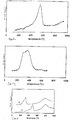
- This untreated sample was subjected to TPR under the standard protocol and the results are shown in accompanying
Figure 5a . It will be noted that the Tmax of this sample is about 550°C. - For comparison a similar sample was prepared but this time treated in accordance with the present invention with 30% hydrogen peroxide in the same manner as for Sample 10 of Example 3, and again a TPR measurement under the same protocol was carried out. The results are set out in
Figure 5b showing the lowering of Tmax to about 300°C. - An experiment was carried out to examine the surface treatment by hydrogen peroxide on ceria on its own.
- A sample of ceria having a BET surface area of 100m2/g was formed into a suspension with vigorous stirring by the addition of two grams of ceria to 10 ml of 10% by volume ammonia. The suspension was held at 25°C and had a pH of 11.7. 80ml of a solution of 30% by volume hydrogen peroxide of the commercial grade used in Example 2 was added at a rate of 0.25ml/min. The reaction was allowed to continue for 20 hours before filtering. The filtrate was washed, dried and calcined as for the samples of Example 2 and the standard TPR protocol carried out.
- For comparison an identical sample of ceria was prepared and treated with a solution, except that the solution only contained water and not hydrogen peroxide.
- The TPR results for the treated and untreated ceria samples are shown in accompanying
Figure 6 , in which trace A refers to the untreated sample and trace B refers to the treated sample. Again the lowering of the Tmax peak (left hand peak) is evident.TABLE 1 Treatment Solution Sample No. Vol H20 (ml) Vol H202 (ml) pH Comparative 33.0 0.0 7.0 1 31.9 1.1 4.0 2 30.8 2.2 3.7 3 28.6 4.4 3.2 4 24.2 8.8 3.2 5 15.4 17.6 2.9 6 0.0 33.0 2.6 TABLE 2 Sample No. % by Vol H 202pH of Solution (start) pH of Solution (end) Solution addition rate (ml/min) Comparative 0 11.5 11.2 0.047 1 1 11.6 11.0 0.050 2 2 11.6 10.9 0.050 3 4 11.4 10.9 0.050 4 8 11.6 10.9 0.049 5 19 11.4 10.9 0.049 6 30 11.2 10.9 0.049 TABLE 3 Treatment Solution Sample No. Vol H20 (ml) Vol H202 (ml) pH 7 28.6 4.4 3.6 8 28.6 4.4 3.2 9 28.6 4.4 3.6 10 0.0 33.0 2.1 11 0.0 33.0 2.6 12 0.0 33.0 2.0 TABLE 4 Sample No. % by Vol H 202pH of Solution (start) pH of Solution (end) Solution addition rate (ml/min) 7 4 11.7 11.2 0.199 8 4 11.4 10.9 0.050 9 4 11.5 10.8 0.024 10 30 11.5 11.1 0.200 11 30 11.2 10.9 0.049 12 30 11.3 10.6 0.025
Claims (9)
- A method of treating a ceria-zirconia mixed oxide composed of 90-10% by weight of zirconia (ZrO2) and 10-60% by weight of ceria (CeO2) in order to improve its performance as an oxygen storage component of an exhaust gas purification system, which method comprises modifying at least some of the surface of the material by contact with an aqueous solution of hydrogen peroxide, wherein the mole ratio of hydrogen peroxide to ceria-zirconia mixed oxide is 3:1, and the concentration of the aqueous solution and the length of time of its contact are such that temperature reached at the peak maximum of the reaction as measured by temperature programmed reduction, known as Tmax, of the treated material is lower than the Tmax of equivalent untreated material by at least 50°C, as measured using the standard protocol described in example 3 of the description.
- A method as claimed in claim 1 wherein the ceria-containing material is doped with up to 50% by weight of a third component comprising the oxide of one or more of the rare earth metals, especially Pr, La, Nd and Y, alkaline earth metals consisting of Mg, Ca and Ba, and Al and Si.
- Ceria-containing material when treated by a method as claimed in any one of the preceding claims having a Tmax of less than 500°C.
- Ceria-containing material as claimed in claim 3 having a Tmax of less than 400°C.
- Ceria-containing material as claimed in claim 4 having a Tmax of less than 300°C.
- Ceria-containing material as claimed in any one of claims 3 to 5 having at least some anisotropy in its crystallite size.
- An oxygen storage component comprising a ceria-containing material as claimed in any one of claims 3 to 6.
- A wash coat containing a ceria containing material as claimed in any one of claims 3 to 6, optionally with alumina, suitable for application to the monolith forming the structure of a catalytic converter of an automobile exhaust system.
- An automobile exhaust system incorporating an oxygen storage component as claimed in claim 7.
Applications Claiming Priority (3)
| Application Number | Priority Date | Filing Date | Title |
|---|---|---|---|
| GBGB0224180.0A GB0224180D0 (en) | 2002-10-17 | 2002-10-17 | Improved oxygen storage component |
| GB0224180 | 2002-10-17 | ||
| PCT/GB2003/004495 WO2004035202A1 (en) | 2002-10-17 | 2003-10-17 | Improved oxygen storage component |
Publications (2)
| Publication Number | Publication Date |
|---|---|
| EP1558379A1 EP1558379A1 (en) | 2005-08-03 |
| EP1558379B1 true EP1558379B1 (en) | 2018-07-04 |
Family
ID=9946093
Family Applications (1)
| Application Number | Title | Priority Date | Filing Date |
|---|---|---|---|
| EP03756586.8A Expired - Lifetime EP1558379B1 (en) | 2002-10-17 | 2003-10-17 | Improved oxygen storage component |
Country Status (4)
| Country | Link |
|---|---|
| EP (1) | EP1558379B1 (en) |
| AU (1) | AU2003301288A1 (en) |
| GB (1) | GB0224180D0 (en) |
| WO (1) | WO2004035202A1 (en) |
Families Citing this family (2)
| Publication number | Priority date | Publication date | Assignee | Title |
|---|---|---|---|---|
| GB0428557D0 (en) * | 2004-12-30 | 2005-02-09 | Magnesium Elektron Ltd | Thermally stable doped and undoped porous aluminium oxides and nanocomposite CeO -ZrO and A1 O containing mixed oxides |
| GB0609783D0 (en) * | 2006-05-17 | 2006-06-28 | Magnesium Elektron Ltd | Improved oxygen storage component |
Family Cites Families (3)
| Publication number | Priority date | Publication date | Assignee | Title |
|---|---|---|---|---|
| US4791091A (en) | 1987-09-30 | 1988-12-13 | Allied-Signal Inc. | Catalyst for treatment of exhaust gases from internal combustion engines and method of manufacturing the catalyst |
| FR2774927B1 (en) * | 1998-02-16 | 2000-05-05 | Rhodia Chimie Sa | PROCESS FOR TREATING A COMPOSITION BASED ON CERIUM OXIDE TO INCREASE THE OXYGEN STORAGE CAPACITY OF THIS COMPOSITION |
| US6528451B2 (en) | 2001-03-13 | 2003-03-04 | W.R. Grace & Co.-Conn. | Catalyst support material having high oxygen storage capacity and method of preparation thereof |
-
2002
- 2002-10-17 GB GBGB0224180.0A patent/GB0224180D0/en not_active Ceased
-
2003
- 2003-10-17 EP EP03756586.8A patent/EP1558379B1/en not_active Expired - Lifetime
- 2003-10-17 AU AU2003301288A patent/AU2003301288A1/en not_active Abandoned
- 2003-10-17 WO PCT/GB2003/004495 patent/WO2004035202A1/en not_active Ceased
Non-Patent Citations (1)
| Title |
|---|
| None * |
Also Published As
| Publication number | Publication date |
|---|---|
| GB0224180D0 (en) | 2002-11-27 |
| EP1558379A1 (en) | 2005-08-03 |
| WO2004035202A1 (en) | 2004-04-29 |
| AU2003301288A1 (en) | 2004-05-04 |
Similar Documents
| Publication | Publication Date | Title |
|---|---|---|
| EP1666127B2 (en) | Catalyst for lowering the amount of nitrogen oxides in the exhaust gas from lean burn engines | |
| US7919429B2 (en) | Zirconia-ceria-yttria-based mixed oxide and process for producing the same | |
| JP4567120B2 (en) | Nitric oxide-accumulating substance and nitric oxide-accumulating catalyst produced therefrom | |
| US5837642A (en) | Heat-resistant oxide | |
| US6813884B2 (en) | Method of treating diesel exhaust gases | |
| EP1464622A1 (en) | An oxygen storage material, comprising Cerium oxide and at least one other oxide of a metal, process for its preparation and its application in a catalyst | |
| CZ20024184A3 (en) | Catalyst for decomposition of dinitrogen oxide and method for carrying out a process comprising generation of dinitrogen oxide | |
| JPH11322339A (en) | Cerium-zirconium-based composite oxide, method for producing the same, and catalyst material for purifying exhaust gas | |
| EP2353713A1 (en) | Composite oxide for exhaust-gas purification catalyst, process for producing same, coating material for exhaust-gas purification catalyst, and filter for diesel exhaust-gas purification | |
| EP1570903B1 (en) | EXHAUST GAS PURIFYING CATALYST, METHOD FOR PURIFYING EXHAUST GAS and use of catalyst component for suppressing oxidation of sulphur dioxide in exhaust gases | |
| EP0306944A1 (en) | Catalytic oxidation of carbon monoxide on Pt and/or Pd/MgO catalysts | |
| JP2004337840A (en) | Oxygen occluding material, manufacturing method of the oxygen occluding material and catalyst for clarifying exhaust gas of internal combustion engine | |
| JPH11169712A (en) | Catalyst for purification of exhaust gas | |
| US11964255B2 (en) | Mixed oxide with improved reducibility | |
| EP2018220B1 (en) | Improved oxygen storage component | |
| JP4655436B2 (en) | Method for treating exhaust gas purification catalyst | |
| EP1006081A1 (en) | Catalytic converter for automotive pollution control, and oxygen-storing cerium complex oxide used therefor | |
| EP1850948B1 (en) | Exhaust gas purifying three-way catalyst | |
| EP1558379A1 (en) | Improved oxygen storage component | |
| JPH06378A (en) | Catalyst for purification of exhaust gas | |
| WO2021165748A1 (en) | Compositions containing cerium and zirconium and methods for preparing same using oxalic acid | |
| KR20080022215A (en) | Reactivation Method of Heat Aged Nitric Oxide Storage Catalytic Converter | |
| JP2001508360A (en) | Reduction of nitrogen oxides | |
| WO2021161108A1 (en) | Process for making cerium and zirconium containing compositions using mesitylene and composition made by same | |
| RU2832847C1 (en) | Soot oxidation catalyst |
Legal Events
| Date | Code | Title | Description |
|---|---|---|---|
| PUAI | Public reference made under article 153(3) epc to a published international application that has entered the european phase |
Free format text: ORIGINAL CODE: 0009012 |
|
| 17P | Request for examination filed |
Effective date: 20050511 |
|
| AK | Designated contracting states |
Kind code of ref document: A1 Designated state(s): AT BE BG CH CY CZ DE DK EE ES FI FR GB GR HU IE IT LI LU MC NL PT RO SE SI SK TR |
|
| AX | Request for extension of the european patent |
Extension state: AL LT LV MK |
|
| DAX | Request for extension of the european patent (deleted) | ||
| 17Q | First examination report despatched |
Effective date: 20091217 |
|
| RAP1 | Party data changed (applicant data changed or rights of an application transferred) |
Owner name: MAGNESIUM ELEKTRON LIMITED |
|
| GRAP | Despatch of communication of intention to grant a patent |
Free format text: ORIGINAL CODE: EPIDOSNIGR1 |
|
| STAA | Information on the status of an ep patent application or granted ep patent |
Free format text: STATUS: GRANT OF PATENT IS INTENDED |
|
| INTG | Intention to grant announced |
Effective date: 20180321 |
|
| RIN1 | Information on inventor provided before grant (corrected) |
Inventor name: BRADSHAW, HEATHER Inventor name: DI MONTE, ROBERTA Inventor name: KASPAR, JAN, Inventor name: NORMAN, COLIN |
|
| RAP1 | Party data changed (applicant data changed or rights of an application transferred) |
Owner name: MAGNESIUM ELEKTRON LIMITED |
|
| GRAS | Grant fee paid |
Free format text: ORIGINAL CODE: EPIDOSNIGR3 |
|
| GRAA | (expected) grant |
Free format text: ORIGINAL CODE: 0009210 |
|
| STAA | Information on the status of an ep patent application or granted ep patent |
Free format text: STATUS: THE PATENT HAS BEEN GRANTED |
|
| AK | Designated contracting states |
Kind code of ref document: B1 Designated state(s): AT BE BG CH CY CZ DE DK EE ES FI FR GB GR HU IE IT LI LU MC NL PT RO SE SI SK TR |
|
| REG | Reference to a national code |
Ref country code: GB Ref legal event code: FG4D |
|
| REG | Reference to a national code |
Ref country code: CH Ref legal event code: EP |
|
| REG | Reference to a national code |
Ref country code: AT Ref legal event code: REF Ref document number: 1013907 Country of ref document: AT Kind code of ref document: T Effective date: 20180715 |
|
| REG | Reference to a national code |
Ref country code: IE Ref legal event code: FG4D |
|
| REG | Reference to a national code |
Ref country code: DE Ref legal event code: R096 Ref document number: 60351297 Country of ref document: DE |
|
| REG | Reference to a national code |
Ref country code: NL Ref legal event code: MP Effective date: 20180704 |
|
| REG | Reference to a national code |
Ref country code: AT Ref legal event code: MK05 Ref document number: 1013907 Country of ref document: AT Kind code of ref document: T Effective date: 20180704 |
|
| PG25 | Lapsed in a contracting state [announced via postgrant information from national office to epo] |
Ref country code: NL Free format text: LAPSE BECAUSE OF FAILURE TO SUBMIT A TRANSLATION OF THE DESCRIPTION OR TO PAY THE FEE WITHIN THE PRESCRIBED TIME-LIMIT Effective date: 20180704 |
|
| PG25 | Lapsed in a contracting state [announced via postgrant information from national office to epo] |
Ref country code: GR Free format text: LAPSE BECAUSE OF FAILURE TO SUBMIT A TRANSLATION OF THE DESCRIPTION OR TO PAY THE FEE WITHIN THE PRESCRIBED TIME-LIMIT Effective date: 20181005 Ref country code: BG Free format text: LAPSE BECAUSE OF FAILURE TO SUBMIT A TRANSLATION OF THE DESCRIPTION OR TO PAY THE FEE WITHIN THE PRESCRIBED TIME-LIMIT Effective date: 20181004 Ref country code: AT Free format text: LAPSE BECAUSE OF FAILURE TO SUBMIT A TRANSLATION OF THE DESCRIPTION OR TO PAY THE FEE WITHIN THE PRESCRIBED TIME-LIMIT Effective date: 20180704 Ref country code: CZ Free format text: LAPSE BECAUSE OF FAILURE TO SUBMIT A TRANSLATION OF THE DESCRIPTION OR TO PAY THE FEE WITHIN THE PRESCRIBED TIME-LIMIT Effective date: 20180704 Ref country code: FI Free format text: LAPSE BECAUSE OF FAILURE TO SUBMIT A TRANSLATION OF THE DESCRIPTION OR TO PAY THE FEE WITHIN THE PRESCRIBED TIME-LIMIT Effective date: 20180704 Ref country code: SE Free format text: LAPSE BECAUSE OF FAILURE TO SUBMIT A TRANSLATION OF THE DESCRIPTION OR TO PAY THE FEE WITHIN THE PRESCRIBED TIME-LIMIT Effective date: 20180704 |
|
| REG | Reference to a national code |
Ref country code: CH Ref legal event code: PK Free format text: BERICHTIGUNGEN |
|
| RIC2 | Information provided on ipc code assigned after grant |
Ipc: B01J 37/02 20060101ALI20040506BHEP Ipc: B01J 21/06 20060101ALI20040506BHEP Ipc: B01J 23/10 20060101AFI20040506BHEP Ipc: B01J 35/04 20060101ALI20040506BHEP Ipc: B01J 20/06 20060101ALI20040506BHEP Ipc: B01D 53/00 20060101ALI20040506BHEP |
|
| PG25 | Lapsed in a contracting state [announced via postgrant information from national office to epo] |
Ref country code: ES Free format text: LAPSE BECAUSE OF FAILURE TO SUBMIT A TRANSLATION OF THE DESCRIPTION OR TO PAY THE FEE WITHIN THE PRESCRIBED TIME-LIMIT Effective date: 20180704 |
|
| REG | Reference to a national code |
Ref country code: DE Ref legal event code: R097 Ref document number: 60351297 Country of ref document: DE |
|
| PG25 | Lapsed in a contracting state [announced via postgrant information from national office to epo] |
Ref country code: RO Free format text: LAPSE BECAUSE OF FAILURE TO SUBMIT A TRANSLATION OF THE DESCRIPTION OR TO PAY THE FEE WITHIN THE PRESCRIBED TIME-LIMIT Effective date: 20180704 Ref country code: EE Free format text: LAPSE BECAUSE OF FAILURE TO SUBMIT A TRANSLATION OF THE DESCRIPTION OR TO PAY THE FEE WITHIN THE PRESCRIBED TIME-LIMIT Effective date: 20180704 |
|
| REG | Reference to a national code |
Ref country code: DE Ref legal event code: R119 Ref document number: 60351297 Country of ref document: DE |
|
| PLBE | No opposition filed within time limit |
Free format text: ORIGINAL CODE: 0009261 |
|
| STAA | Information on the status of an ep patent application or granted ep patent |
Free format text: STATUS: NO OPPOSITION FILED WITHIN TIME LIMIT |
|
| PG25 | Lapsed in a contracting state [announced via postgrant information from national office to epo] |
Ref country code: DK Free format text: LAPSE BECAUSE OF FAILURE TO SUBMIT A TRANSLATION OF THE DESCRIPTION OR TO PAY THE FEE WITHIN THE PRESCRIBED TIME-LIMIT Effective date: 20180704 Ref country code: SK Free format text: LAPSE BECAUSE OF FAILURE TO SUBMIT A TRANSLATION OF THE DESCRIPTION OR TO PAY THE FEE WITHIN THE PRESCRIBED TIME-LIMIT Effective date: 20180704 |
|
| REG | Reference to a national code |
Ref country code: CH Ref legal event code: PL |
|
| 26N | No opposition filed |
Effective date: 20190405 |
|
| REG | Reference to a national code |
Ref country code: BE Ref legal event code: MM Effective date: 20181031 |
|
| PG25 | Lapsed in a contracting state [announced via postgrant information from national office to epo] |
Ref country code: MC Free format text: LAPSE BECAUSE OF FAILURE TO SUBMIT A TRANSLATION OF THE DESCRIPTION OR TO PAY THE FEE WITHIN THE PRESCRIBED TIME-LIMIT Effective date: 20180704 Ref country code: LU Free format text: LAPSE BECAUSE OF NON-PAYMENT OF DUE FEES Effective date: 20181017 |
|
| REG | Reference to a national code |
Ref country code: IE Ref legal event code: MM4A |
|
| PG25 | Lapsed in a contracting state [announced via postgrant information from national office to epo] |
Ref country code: DE Free format text: LAPSE BECAUSE OF NON-PAYMENT OF DUE FEES Effective date: 20190501 |
|
| PG25 | Lapsed in a contracting state [announced via postgrant information from national office to epo] |
Ref country code: CH Free format text: LAPSE BECAUSE OF NON-PAYMENT OF DUE FEES Effective date: 20181031 Ref country code: FR Free format text: LAPSE BECAUSE OF NON-PAYMENT OF DUE FEES Effective date: 20181031 Ref country code: BE Free format text: LAPSE BECAUSE OF NON-PAYMENT OF DUE FEES Effective date: 20181031 Ref country code: SI Free format text: LAPSE BECAUSE OF FAILURE TO SUBMIT A TRANSLATION OF THE DESCRIPTION OR TO PAY THE FEE WITHIN THE PRESCRIBED TIME-LIMIT Effective date: 20180704 Ref country code: LI Free format text: LAPSE BECAUSE OF NON-PAYMENT OF DUE FEES Effective date: 20181031 |
|
| PG25 | Lapsed in a contracting state [announced via postgrant information from national office to epo] |
Ref country code: IE Free format text: LAPSE BECAUSE OF NON-PAYMENT OF DUE FEES Effective date: 20181017 Ref country code: IT Free format text: LAPSE BECAUSE OF NON-PAYMENT OF DUE FEES Effective date: 20181017 |
|
| PG25 | Lapsed in a contracting state [announced via postgrant information from national office to epo] |
Ref country code: TR Free format text: LAPSE BECAUSE OF FAILURE TO SUBMIT A TRANSLATION OF THE DESCRIPTION OR TO PAY THE FEE WITHIN THE PRESCRIBED TIME-LIMIT Effective date: 20180704 |
|
| PG25 | Lapsed in a contracting state [announced via postgrant information from national office to epo] |
Ref country code: PT Free format text: LAPSE BECAUSE OF FAILURE TO SUBMIT A TRANSLATION OF THE DESCRIPTION OR TO PAY THE FEE WITHIN THE PRESCRIBED TIME-LIMIT Effective date: 20180704 |
|
| PG25 | Lapsed in a contracting state [announced via postgrant information from national office to epo] |
Ref country code: CY Free format text: LAPSE BECAUSE OF FAILURE TO SUBMIT A TRANSLATION OF THE DESCRIPTION OR TO PAY THE FEE WITHIN THE PRESCRIBED TIME-LIMIT Effective date: 20180704 Ref country code: HU Free format text: LAPSE BECAUSE OF FAILURE TO SUBMIT A TRANSLATION OF THE DESCRIPTION OR TO PAY THE FEE WITHIN THE PRESCRIBED TIME-LIMIT; INVALID AB INITIO Effective date: 20031017 |
|
| PGFP | Annual fee paid to national office [announced via postgrant information from national office to epo] |
Ref country code: GB Payment date: 20221026 Year of fee payment: 20 |
|
| REG | Reference to a national code |
Ref country code: GB Ref legal event code: PE20 Expiry date: 20231016 |
|
| PG25 | Lapsed in a contracting state [announced via postgrant information from national office to epo] |
Ref country code: GB Free format text: LAPSE BECAUSE OF EXPIRATION OF PROTECTION Effective date: 20231016 |
|
| PG25 | Lapsed in a contracting state [announced via postgrant information from national office to epo] |
Ref country code: GB Free format text: LAPSE BECAUSE OF EXPIRATION OF PROTECTION Effective date: 20231016 |