EP1557979B1 - Verfahren und Vorrichtung zur Feststellung der Sprachlatenzzeit durch ein Netzwerkelement eines Kommunikationsnetzwerkes - Google Patents
Verfahren und Vorrichtung zur Feststellung der Sprachlatenzzeit durch ein Netzwerkelement eines Kommunikationsnetzwerkes Download PDFInfo
- Publication number
- EP1557979B1 EP1557979B1 EP04001231A EP04001231A EP1557979B1 EP 1557979 B1 EP1557979 B1 EP 1557979B1 EP 04001231 A EP04001231 A EP 04001231A EP 04001231 A EP04001231 A EP 04001231A EP 1557979 B1 EP1557979 B1 EP 1557979B1
- Authority
- EP
- European Patent Office
- Prior art keywords
- speech
- network element
- determining
- timestamp
- packet
- Prior art date
- Legal status (The legal status is an assumption and is not a legal conclusion. Google has not performed a legal analysis and makes no representation as to the accuracy of the status listed.)
- Expired - Lifetime
Links
- 238000000034 method Methods 0.000 title claims description 31
- 238000004891 communication Methods 0.000 title claims description 8
- 238000004458 analytical method Methods 0.000 claims description 6
- 230000005540 biological transmission Effects 0.000 claims description 5
- 230000006735 deficit Effects 0.000 claims description 3
- FGUUSXIOTUKUDN-IBGZPJMESA-N C1(=CC=CC=C1)N1C2=C(NC([C@H](C1)NC=1OC(=NN=1)C1=CC=CC=C1)=O)C=CC=C2 Chemical compound C1(=CC=CC=C1)N1C2=C(NC([C@H](C1)NC=1OC(=NN=1)C1=CC=CC=C1)=O)C=CC=C2 FGUUSXIOTUKUDN-IBGZPJMESA-N 0.000 claims description 2
- 230000003111 delayed effect Effects 0.000 claims description 2
- 230000002085 persistent effect Effects 0.000 claims description 2
- 230000001131 transforming effect Effects 0.000 claims description 2
- 239000000872 buffer Substances 0.000 description 10
- 238000001514 detection method Methods 0.000 description 7
- 230000000694 effects Effects 0.000 description 7
- 238000013459 approach Methods 0.000 description 5
- 238000011156 evaluation Methods 0.000 description 3
- 238000005259 measurement Methods 0.000 description 3
- 230000007246 mechanism Effects 0.000 description 3
- 238000012360 testing method Methods 0.000 description 3
- 230000003044 adaptive effect Effects 0.000 description 2
- 230000006835 compression Effects 0.000 description 2
- 238000007906 compression Methods 0.000 description 2
- 238000010586 diagram Methods 0.000 description 2
- 238000001914 filtration Methods 0.000 description 2
- YTAHJIFKAKIKAV-XNMGPUDCSA-N [(1R)-3-morpholin-4-yl-1-phenylpropyl] N-[(3S)-2-oxo-5-phenyl-1,3-dihydro-1,4-benzodiazepin-3-yl]carbamate Chemical compound O=C1[C@H](N=C(C2=C(N1)C=CC=C2)C1=CC=CC=C1)NC(O[C@H](CCN1CCOCC1)C1=CC=CC=C1)=O YTAHJIFKAKIKAV-XNMGPUDCSA-N 0.000 description 1
- 230000002238 attenuated effect Effects 0.000 description 1
- 238000009414 blockwork Methods 0.000 description 1
- 230000003139 buffering effect Effects 0.000 description 1
- 230000001934 delay Effects 0.000 description 1
- 230000001419 dependent effect Effects 0.000 description 1
- 238000013461 design Methods 0.000 description 1
- 238000011161 development Methods 0.000 description 1
- 230000006870 function Effects 0.000 description 1
- 238000009533 lab test Methods 0.000 description 1
- 238000012544 monitoring process Methods 0.000 description 1
- 238000012545 processing Methods 0.000 description 1
- 238000013441 quality evaluation Methods 0.000 description 1
- 230000011664 signaling Effects 0.000 description 1
- 238000010200 validation analysis Methods 0.000 description 1
Images

Classifications
-
- H—ELECTRICITY
- H04—ELECTRIC COMMUNICATION TECHNIQUE
- H04M—TELEPHONIC COMMUNICATION
- H04M3/00—Automatic or semi-automatic exchanges
- H04M3/22—Arrangements for supervision, monitoring or testing
- H04M3/2236—Quality of speech transmission monitoring
-
- H—ELECTRICITY
- H04—ELECTRIC COMMUNICATION TECHNIQUE
- H04L—TRANSMISSION OF DIGITAL INFORMATION, e.g. TELEGRAPHIC COMMUNICATION
- H04L41/00—Arrangements for maintenance, administration or management of data switching networks, e.g. of packet switching networks
-
- H—ELECTRICITY
- H04—ELECTRIC COMMUNICATION TECHNIQUE
- H04M—TELEPHONIC COMMUNICATION
- H04M7/00—Arrangements for interconnection between switching centres
- H04M7/006—Networks other than PSTN/ISDN providing telephone service, e.g. Voice over Internet Protocol (VoIP), including next generation networks with a packet-switched transport layer
Definitions
- the present invention relates to a method and a device for determining the speech latency across a network element of a communication network which is able to transmit a speech signal encoded in digital data packets either in a circuit switched or in a packet-oriented way wherein at the input of the network element is arranged a first interface and at the output of the network element a second interface.
- Packet based networks permit an optimised use of band resources, adopting Adaptive Multi Rate (AMR) codecs for speech compression and Discontinuous Transmission (DTX) techniques to meet customer satisfaction as a trade-off between Quality of Service (QoS) and costs.
- AMR Adaptive Multi Rate
- DTX Discontinuous Transmission
- QoS Quality of Service
- the QoS provided by such telecommunication networks depends upon a number of factors among which the major roles are played by the overall end-to-end speech latency and the distortion introduced using low bit rate codecs.
- the speech latency is the time delay between the speech signal at the input of a network device and the same signal at its output, e.g. across the two sides of a media gateway in the UMTS architecture. This delay depends on propagation time of the signals through the network device, on buffering mechanism used by codecs (typically more than one buffer of 20 ms has to be collected before starting the encoding algorithm) and on processing time spent by transcoding equipment for encoding/decoding and forward packets.
- the speech latency over UMTS interfaces is effected by typical phenomena occurring in "packet based" networks such as jitter and packet loss.
- Jitter is the packet delay variation due to a non-constant time arrival of packets.
- the effect of this phenomenon can be attenuated using the so-called de-jitter buffers that, however, introduce further end-to-end delay.
- Adaptive de-jitter buffers can also be employed with variable length modified as a function of the monitored jitter during speech pauses. Nevertheless, they introduce a variable speech latency that may impact the overall quality perceived by customers.
- packet loss and packet duplication influence QoS in terms of distortion and speech latency, especially in presence of burst packet loss when consecutive packets are not received at the network end points.
- ad-hoc packet loss concealment techniques are used, which reduce the distortion perceived by listeners and allow the correct reconstruction of the speech signal envelope in the time domain.
- the disadvantage of these techniques is the requirement of a precise packet loss evaluation, i.e. check of frame number field of consecutive packets, that cannot be guaranteed in the early stage of design of 3G network elements.
- the task of the present invention therefore consists in further developing the method according to the preamble in such a way that evaluation of speech latency across each relevant network element is facilitated. Further the task exists to provide a corresponding device.
- the present invention referring to an UMTS network as an example, is based on the understanding that instead of analysing the reconstructed language signal at the two terminating handsets to analyse the signals which are present at the UMTS interfaces which are positioned at the input and the output of the network element in question. Instead of the end-to-end approach the present invention starts from a device-to-device approach which directly processes speech packets on the mentioned UMTS interfaces thereby minimising unpredictable jitter or packet loss effects and providing accurate measures across the digital equipment under test. Laboratory tests in a simulated environment with tunable packet loss percentage have provided the following results:
- the invention allows an inventor to determine how a certain device, e.g. more recent version of a given device, affects the overall performance.
- the present invention represents a possibility to tune a buffer, i.e. to determine an optimum middle size of the storage.
- the method comprises further step e) which consists in performing a signal analysis, especially a protocol analysis, before step b) for determining whether speech transmission is taking place at the moment.
- step e) which consists in performing a signal analysis, especially a protocol analysis, before step b) for determining whether speech transmission is taking place at the moment.
- a further preferred embodiment is characterised by the following step f) which is performed prior to step a) and consists in synchronising the data packets recorded at both interfaces.
- the following step is carried out: Determining the timestamp difference and transforming the timestamp difference into a number of samples wherein the timestamp differences are preferably calculated as follows: First, the first speech packet in the output direction of the network element (step f1)) is recorded, then the succeeding speech packet in the input direction of the network (step f2)) element is recorded. After this step the succeeding speech packet in the output direction (step f3)) of the network element is recorded and then the timestamp difference between the packets of the third and the second step (step f3) and step f2)) is determined (step f4)).
- step f5 Resynchronising input and output signals (step f5)) in case of persistent and unrecoverable network impairments and restarting the procedure from step f1).
- the calculated timestamp difference is considered in step c).
- the output signal of the network element is delayed by the timestamp difference determined in step f4). Then a synchronisation of the two packet flows at the input and the output of the network element under test is induced in a reliable way.
- the situation can be considered where the input and output are set up at different times.
- step b) involves decoding the speech packets and reconstructing the speech signal envelope in the time domain.
- step c) separating the speech signals and noise signals and proceeding with step c) only when the presence of a speech signal has been detected.
- step c) and step d) the following step may be performed: i) comparing the peak computed for the cross-correlation with a predeterminable threshold and performing step d) only when the calculated peak is larger than the predeterminable threshold.
- the peak with male and female speakers may be of different pitch and for the case that the peak remains below the predetermined threshold value the method according to the invention should be repeated.
- step j) is preferably conducted in which after step d) the determined value for a speech latency is compared with predeterminable values and the determined value for the speech latency is only issued when it is within a predeterminable range of the predeterminable values.
- the predeterminable values are preferably the neighbouring determined values, i.e. the speech latency values determined for the preceding and the subsequent speech samples.
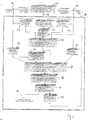
- the reference numeral 10 designates the network element the speech latency of which is to be determined.
- the network element may comprise one or several network elements and concerns, e.g. in an UMTS network which serves as an example for representing the following invention for the sake of a better understanding, in particular digital transcoding equipment, e.g. a media gateway.
- This equipment generally referred to as network element 10 is arranged in a communication network (only suggested in Fig. 1) and which is designed to transmit a speech signal encoded in digital data either in a circuit switched or a packet-oriented way.
- Packet-based herein means that several users share one channel whilst circuit switched based means that a channel is reserved for one user.
- a change of the transmission rate may be performed, also the format may be changed.
- an input interface 12 e.g. a lu-UP
- an output interface 14 e.g. an Nb-UP
- these two interfaces 12, 14 the data are present in digital form.
- These interfaces 12, 14 serve as monitoring points and deliver the input signals of a device 16 according to the invention for determining the speech latency across the network element 10.
- the arrow 18 represents an optional interface which on the control plane may provide info via call start/stop, which, however, as set out in the following, is not necessary.
- Input and output packets are processed in the same way except for the Voice Activity Detection (VAD). They are recorded with their timestamp, decoded and cross-correlated each other obtaining a first "raw” measure. A statistical approach and a mobile window filtering is then used for providing more accurate results. For more details, reference is made to Fig. 2.
- VAD Voice Activity Detection
- signalling information e.g. call start and stop
- ITU-TH.248 Megaco protocol usually, however, e.g. lu-UP and Nb-UP
- the algorithm retrieves all needed information directly from the User Plan layer of each interface 12, 14.
- Blocks 20, 22 serve the timestamp recording, on the input side, block 20, of the network element 10 and then on the output side, block 22, of the network element 10.
- each packet is recorded with its arrival time (timestamp), with a precision better than 100 ⁇ s.
- timestamp precision may affect algorithm resolution (which is intended to be 1 ms), since AMR codecs deal with speech signals sampled at 8 kHz, i.e. one sample every 125 ⁇ s.
- a signal analysis and a start/stop detection takes place. Preferably it is namely intended to trigger the measurement start/stop to the call begin/end point.
- the information is provided by the Megaco protocol or by the User Plan layer.
- This block 24 also drives switch block 26 that enables the timestamp difference compensation, as will be described in more detail with reference to block 28, only one time when a call is in progress and the timestamp of the first speech packets in input and output of the network element 10 are available.
- the purpose of the timestamp difference compensation block 28 is to synchronise two packet flows in input and output of a network element 10 computing a timestamp difference, in order to care of the situation in which the input and output channel are set up not at the same time.
- the block works as follows: First, it records the first speech package (A) in the output direction, then the succeeding speech package (B) in the input direction and finally the succeeding speech packet (C) in the output direction.
- the timestamp difference is computed between packets C and B, converted in number of samples (each sample 125 ⁇ s) and sent to the cross-correlation algorithm block 30 which will be referred to in more detail further down in the description.
- a decoder 32, 34 is allocated to the input and the output, respectively, serving for decoding the compressed speech packets and reconstructing the speech signal envelope in the time domain.
- a dejittering buffer and some known packet loss concealment (PLC) techniques can be inserted for simulating a sort of "end-to-end" scenario where the only element present in the network is the network element 10.
- PLC packet loss concealment
- the input speech signal is processed with a VAD (Voice Activity Detection) algorithm in block 36 that separates speech signals and voice pauses. Only when the VAD algorithm recognises the presence of a voice signal, the cross-correlation starts.
- the already mentioned block 30 performs the cross-correlation between input and output speech samples using the "overlap-safe" method with a buffer size equal to 2048.
- the cross-correlation algorithm delays the output signal with the computed difference filling the buffer with zero values. This permits to compute the actual delay between speech samples, even if packets have not been sampled synchronously or the two channels have not been set up at the same time.
- Each correlation is 1s long and starts when all the eight (2048/256) input subblocks of 32ms have been classified as voice by the Voice Activity Detection block 36. Since in the preferred embodiment each packet contains 160 speech samples (each 20 ms) and correlation is performed on 2048 samples an adaption circular buffer also has to be used.
- a peak validation and speech latency assessment is provided. The aim of this block 38 is to validate the cross-correlation peak and provide a "raw" speech latency measure. For each cross-correlation (1s long) the peak is computed and compared with the cross-correlation standard deviation following this rule: if the peak is greater than the product from threshold and standard deviation, the peak is validated and a "raw" measure is computed, otherwise the peak is rejected.
- the threshold is equal to 7 and has been tuned using ad-hoc databases containing male and female speech samples ITU-T P.800 standard, all are in AMR codecs, VAD enabled and disabled.
- moving window and filtering mechanisms are provided. Each "raw” measure is hereby inserted in a moving window "buffer” containing the preferred five elementary measures.
- the measure to be processed is saved together with the two previous and the two consecutive ones and it is validated when there is at least one value equal to it in the "moving window" (default values are used for the first two and the last two measures).
- Such mechanism is used to filter spurious measures and provides the assessment of the speech latency with high accuracy.
- the timeout detection block 42 takes into account the fact that in some cases the technique for evaluating the packet loss generated along the network, i.e. because a network element involved in the past does not work correctly, may need an on-fly adjustment to ensure the speech signal is correctly reconstructed. To face this event the timeout detection block 42 has been inserted which when the timeout expires drives the switch 26 that enables another timestamp difference computation, resynchronises input and output signals and resets the cross-correlation during the ongoing call. Via output 44 the block 40 in the case of a positive comparison provides the result of the speech latency measurement.
Landscapes
- Engineering & Computer Science (AREA)
- Signal Processing (AREA)
- Computer Networks & Wireless Communication (AREA)
- Health & Medical Sciences (AREA)
- Audiology, Speech & Language Pathology (AREA)
- Data Exchanges In Wide-Area Networks (AREA)
Claims (13)
- Verfahren zum Bestimmen der Sprachwartezeit über einem Netzwerkelement (10) eines Kommunikationsnetzwerks, das ein in digitalen Datenpaketen codiertes Sprachsignal entweder in einer leitungsvermittelten oder einer paketorientierten Weise übertragen kann, wobei am Eingang des Netzwerkelements eine erste Schnittstelle (12) und am Ausgang des Netzwerkelements eine zweite Schnittstelle (14) angeordnet ist, wobei das Verfahren die folgenden Schritte umfasst:a) an beiden Schnittstellen (12, 14): für einen Abtastwert von Datenpaketen Zuordnen eines Zeitstempels zu jedem Datenpaket und Aufzeichnen von jedem Datenpaket zusammen mit seinem Zeitstempel;b) an beiden Schnittstellen (12, 14): Decodieren der aufgezeichneten Datenpakete und Erzeugen einer Sprachsignalhüllkurve im Zeitbereich;c) Durchführen einer Kreuzkorrelation zwischen beiden Sprachsignalhüllkurven zum Bestimmen von Korrelationsbereichen der ersten und der zweiten Sprachsignalhüllkurve;d) aus den zugehörigen Zeitstempeln der Korrelationsbereiche des ersten und des zweiten Zeitstempels: Bestimmen eines Werts für die Sprachwartezeit zwischen der ersten und der zweiten Schnittstelle.
- Verfahren nach Anspruch 1,
welches den folgenden weiteren Schritt umfasst:e) vor Schritt b) Durchführen einer Signalanalyse, insbesondere einer Protokollanalyse, zum Bestimmen, ob eine Sprachübertragung in dem Moment stattfindet. - Verfahren nach Anspruch 1 oder 2,
welches den folgenden weiteren Schritt umfasst:f) vor Schritt a) Synchronisieren der an beiden Schnittstellen aufzuzeichnenden Datenpakete. - Verfahren nach Anspruch 3,
wobei Schritt f) den folgenden Schritt umfasst:Bestimmen der Zeitstempeldifferenz und Transformieren der Zeitstempeldifferenz in eine Anzahl von Abtastwerten, wobei die Zeitstempeldifferenz vorzugsweise folgendermaßen berechnet wird:f1) Aufzeichnen des ersten Sprachpakets in der Ausgangsrichtung des Netzwerkelements;f2) Aufzeichnen des nachfolgenden Sprachpakets in der Eingangsrichtung des Netzwerkelements;f3) Aufzeichnen des nachfolgenden Sprachpakets in der Ausgangsrichtung des Netzwerkelements;f4) Bestimmen der Zeitstempeldifferenz zwischen den Paketen von Schritt f3) und Schritt f2). - Verfahren nach Anspruch 4,
welches den folgenden weiteren Schritt umfasst:f5) erneutes Synchronisieren von Eingangs- und Ausgangssignalen im Fall von dauerhaften und nicht wiederherstellbaren Netzwerkbeeinträchtigungen und erneutes Starten der Prozedur von Schritt f1). - Verfahren nach Anspruch 4 oder 5,
welches den folgenden weiteren Schritt umfasst:g) Betrachten der Zeitstempeldifferenz in Schritt c). - Verfahren nach Anspruch 6,
wobei in Schritt c) das Ausgangssignal des Netzwerkelements um die in Schritt f4) bestimmte Zeitstempeldifferenz verzögert wird. - Verfahren nach einem der vorangehenden Ansprüche,
wobei Schritt b) das Decodieren der Sprachpakete und Rekonstruieren der Sprachsignalhüllkurve im Zeitbereich beinhaltet. - Verfahren nach einem der vorangehenden Ansprüche,
wobei vor Schritt c) der folgende Schritt durchgeführt wird:h) Trennen von Sprachsignalen und Rauschsignalen und Fortfahren mit Schritt c) nur dann, wenn die Anwesenheit eines Sprachsignals erfasst wurde. - Verfahren nach einem der vorangehenden Ansprüche,
wobei zwischen Schritt c) und Schritt d) der folgende Schritt durchgeführt wird:i) Vergleichen der für die Kreuzkorrelation berechneten Spitze mit einer vorbestimmbaren Schwelle und Durchführen von Schritt d) nur dann, wenn die berechnete Spitze größer ist als die vorbestimmbare Schwelle. - Verfahren nach einem der vorangehenden Ansprüche,
welches ferner den folgenden Schritt umfasst:j) nach Schritt d) Vergleichen des bestimmten Werts für die Sprachwartezeit mit vorbestimmbaren Werten und Ausgeben des bestimmten Werts für die Sprachwartezeit nur dann, wenn er innerhalb des vorbestimmbaren Bereichs der vorbestimmbaren Werte liegt. - Verfahren nach Anspruch 11,
wobei die vorbestimmbaren Werte benachbarte bestimmte Werte sind. - Vorrichtung zum Bestimmen der Sprachwartezeit über einem Netzwerkelement (10) eines Kommunikationsnetzwerks, das dazu ausgelegt ist, ein in digitalen Datenpaketen codiertes Sprachsignal entweder in einer leitungsvermittelten oder in einer paketorientierten Weise zu übertragen, wobei am Eingang des Netzwerkelements (10) eine erste Schnittstelle (12) und am Ausgang des Netzwerkelements (10) eine zweite Schnittstelle (14) angeordnet ist, wobei die Vorrichtung folgendes umfasst:- eine Einrichtung zum Zuordnen eines Zeitstempels zu den Datenpaketen eines Abtastwerts von Datenpaketen an den zwei Schnittstellen (12, 14);- eine Einrichtung (20, 22) zum Aufzeichnen der zugeordneten Zeitstempel zusammen mit den entsprechenden Datenpaketen;- eine Einrichtung (32, 34) zum Decodieren der aufgezeichneten Datenpakete an beiden Schnittstellen zum Erzeugen einer jeweiligen Sprachsignalhüllkurve im Zeitbereich;- eine Einrichtung (30) zum Durchführen einer Kreuzkorrelation zwischen beiden Sprachsignalhüllkurven zum Bestimmen von Korrelationsbereichen der ersten und der zweiten Sprachsignalhüllkurve; und- eine Einrichtung (38, 40) zum Bestimmen eines Werts für die Sprachwartezeit zwischen der ersten und der zweiten Schnittstelle (12, 14) aus den zugehörigen Zeitstempeln der Korrelationsbereiche der ersten und der zweiten Hüllkurve.
Priority Applications (3)
| Application Number | Priority Date | Filing Date | Title |
|---|---|---|---|
| EP04001231A EP1557979B1 (de) | 2004-01-21 | 2004-01-21 | Verfahren und Vorrichtung zur Feststellung der Sprachlatenzzeit durch ein Netzwerkelement eines Kommunikationsnetzwerkes |
| DE602004004577T DE602004004577T2 (de) | 2004-01-21 | 2004-01-21 | Verfahren und Vorrichtung zur Feststellung der Sprachlatenzzeit durch ein Netzwerkelement eines Kommunikationsnetzwerkes |
| US11/030,775 US7583610B2 (en) | 2004-01-21 | 2005-01-05 | Determination of speech latency across a telecommunication network element |
Applications Claiming Priority (1)
| Application Number | Priority Date | Filing Date | Title |
|---|---|---|---|
| EP04001231A EP1557979B1 (de) | 2004-01-21 | 2004-01-21 | Verfahren und Vorrichtung zur Feststellung der Sprachlatenzzeit durch ein Netzwerkelement eines Kommunikationsnetzwerkes |
Publications (2)
| Publication Number | Publication Date |
|---|---|
| EP1557979A1 EP1557979A1 (de) | 2005-07-27 |
| EP1557979B1 true EP1557979B1 (de) | 2007-01-31 |
Family
ID=34626477
Family Applications (1)
| Application Number | Title | Priority Date | Filing Date |
|---|---|---|---|
| EP04001231A Expired - Lifetime EP1557979B1 (de) | 2004-01-21 | 2004-01-21 | Verfahren und Vorrichtung zur Feststellung der Sprachlatenzzeit durch ein Netzwerkelement eines Kommunikationsnetzwerkes |
Country Status (3)
| Country | Link |
|---|---|
| US (1) | US7583610B2 (de) |
| EP (1) | EP1557979B1 (de) |
| DE (1) | DE602004004577T2 (de) |
Cited By (1)
| Publication number | Priority date | Publication date | Assignee | Title |
|---|---|---|---|---|
| CN101110654B (zh) * | 2007-08-17 | 2011-03-02 | 中兴通讯股份有限公司 | 一种网络时延测试方法与装置 |
Families Citing this family (7)
| Publication number | Priority date | Publication date | Assignee | Title |
|---|---|---|---|---|
| FR2857540A1 (fr) * | 2003-07-11 | 2005-01-14 | France Telecom | Procedes et dispositifs d'evaluation de delais de transmission et de traitement d'un signal de parole recu dans un terminal relie a un reseau de paquets |
| KR100902112B1 (ko) | 2006-11-13 | 2009-06-09 | 한국전자통신연구원 | 키 재동기 구간의 음성 데이터를 예측하기 위한 벡터 정보삽입 방법, 전송 방법 및 벡터 정보를 이용한 키 재동기구간의 음성 데이터 예측 방법 |
| KR100906766B1 (ko) | 2007-06-18 | 2009-07-09 | 한국전자통신연구원 | 키 재동기 구간의 음성 데이터 예측을 위한 음성 데이터송수신 장치 및 방법 |
| FI120284B (fi) * | 2007-07-20 | 2009-08-31 | Tellabs Oy | Huojuntapuskurin täyttöasteen säätö |
| US8228923B1 (en) * | 2008-01-09 | 2012-07-24 | Tellabs Operations, Inc. | Method and apparatus for measuring system latency using global time stamp |
| US8665733B2 (en) * | 2011-09-30 | 2014-03-04 | Alcatel Lucent | Method and apparatus for round trip delay KPI monitoring in live network using user plane probe session |
| US9847922B2 (en) * | 2015-03-18 | 2017-12-19 | Arista Networks, Inc. | System and method for continuous measurement of transit latency in individual data switches and multi-device topologies |
Family Cites Families (8)
| Publication number | Priority date | Publication date | Assignee | Title |
|---|---|---|---|---|
| US6307868B1 (en) * | 1995-08-25 | 2001-10-23 | Terayon Communication Systems, Inc. | Apparatus and method for SCDMA digital data transmission using orthogonal codes and a head end modem with no tracking loops |
| US6335927B1 (en) * | 1996-11-18 | 2002-01-01 | Mci Communications Corporation | System and method for providing requested quality of service in a hybrid network |
| US7515583B2 (en) * | 1998-06-19 | 2009-04-07 | Nortel Networks Limited | Method and apparatus for providing a configurable quality of service threshold for voice over internet protocol |
| US6321264B1 (en) * | 1998-08-28 | 2001-11-20 | 3Com Corporation | Network-performance statistics using end-node computer systems |
| US6545979B1 (en) * | 1998-11-27 | 2003-04-08 | Alcatel Canada Inc. | Round trip delay measurement |
| US6646604B2 (en) * | 1999-01-08 | 2003-11-11 | Trueposition, Inc. | Automatic synchronous tuning of narrowband receivers of a wireless location system for voice/traffic channel tracking |
| US6356146B1 (en) * | 1999-07-13 | 2002-03-12 | Pmc-Sierra, Inc. | Amplifier measurement and modeling processes for use in generating predistortion parameters |
| US6868069B2 (en) * | 2001-01-16 | 2005-03-15 | Networks Associates Technology, Inc. | Method and apparatus for passively calculating latency for a network appliance |
-
2004
- 2004-01-21 EP EP04001231A patent/EP1557979B1/de not_active Expired - Lifetime
- 2004-01-21 DE DE602004004577T patent/DE602004004577T2/de not_active Expired - Lifetime
-
2005
- 2005-01-05 US US11/030,775 patent/US7583610B2/en not_active Expired - Fee Related
Cited By (1)
| Publication number | Priority date | Publication date | Assignee | Title |
|---|---|---|---|---|
| CN101110654B (zh) * | 2007-08-17 | 2011-03-02 | 中兴通讯股份有限公司 | 一种网络时延测试方法与装置 |
Also Published As
| Publication number | Publication date |
|---|---|
| EP1557979A1 (de) | 2005-07-27 |
| US7583610B2 (en) | 2009-09-01 |
| DE602004004577D1 (de) | 2007-03-22 |
| DE602004004577T2 (de) | 2007-05-31 |
| US20050157705A1 (en) | 2005-07-21 |
Similar Documents
| Publication | Publication Date | Title |
|---|---|---|
| US7680655B2 (en) | Method and apparatus for measuring the quality of speech transmissions that use speech compression | |
| US11748643B2 (en) | System and method for machine learning based QoE prediction of voice/video services in wireless networks | |
| US7376132B2 (en) | Passive system and method for measuring and monitoring the quality of service in a communications network | |
| Jelassi et al. | Quality of experience of VoIP service: A survey of assessment approaches and open issues | |
| EP1763173A2 (de) | Übertragungsqualitätsüberwachung für Multimediadatenströme | |
| US7865361B2 (en) | Voice quality analysis technique | |
| US7408884B2 (en) | Methods and devices for correlating audio sample comparisons and network performance statistics | |
| JP5668687B2 (ja) | 音声品質解析装置、音声品質解析方法およびプログラム | |
| US7583613B2 (en) | Method of monitoring the quality of a realtime communication | |
| CN109889398B (zh) | 一种检测媒体流业务质量的方法及装置、设备、存储介质 | |
| US7099281B1 (en) | Passive system and method for measuring the subjective quality of real-time media streams in a packet-switching network | |
| US20040193974A1 (en) | Systems and methods for voice quality testing in a packet-switched network | |
| US20060277051A1 (en) | Method and devices for evaluating transmission times and for procesing a vioce singnal received in a terminal connected to a packet network | |
| Conway | A passive method for monitoring voice-over-IP call quality with ITU-T objective speech quality measurement methods | |
| US6834040B2 (en) | Measurement synchronization method for voice over packet communication systems | |
| US7583610B2 (en) | Determination of speech latency across a telecommunication network element | |
| US20040190494A1 (en) | Systems and methods for voice quality testing in a non-real-time operating system environment | |
| Ding et al. | Non-intrusive single-ended speech quality assessment in VoIP | |
| EP1938496B1 (de) | Verfahren und vorrichtung zur schätzung der sprachqualität | |
| Conway | Output-based method of applying PESQ to measure the perceptual quality of framed speech signals | |
| Beuran et al. | User-perceived quality assessment for VoIP applications | |
| Hammer et al. | Where packet traces meet speech samples: an instrumental approach to perceptual QoS evaluation of VoIP | |
| Gambhir | Objective measurement of speech quality in VoIP over wireless LAN during handoff | |
| Rodrıguez et al. | VoIP quality improvement with a rate-determination algorithm | |
| Matousek et al. | On-line monitoring of VoIP quality using IPFIX |
Legal Events
| Date | Code | Title | Description |
|---|---|---|---|
| PUAI | Public reference made under article 153(3) epc to a published international application that has entered the european phase |
Free format text: ORIGINAL CODE: 0009012 |
|
| AK | Designated contracting states |
Kind code of ref document: A1 Designated state(s): AT BE BG CH CY CZ DE DK EE ES FI FR GB GR HU IE IT LI LU MC NL PT RO SE SI SK TR |
|
| AX | Request for extension of the european patent |
Extension state: AL LT LV MK |
|
| 17P | Request for examination filed |
Effective date: 20050805 |
|
| AKX | Designation fees paid |
Designated state(s): DE FR GB IT |
|
| GRAP | Despatch of communication of intention to grant a patent |
Free format text: ORIGINAL CODE: EPIDOSNIGR1 |
|
| GRAS | Grant fee paid |
Free format text: ORIGINAL CODE: EPIDOSNIGR3 |
|
| GRAA | (expected) grant |
Free format text: ORIGINAL CODE: 0009210 |
|
| AK | Designated contracting states |
Kind code of ref document: B1 Designated state(s): DE FR GB IT |
|
| REG | Reference to a national code |
Ref country code: GB Ref legal event code: FG4D |
|
| REF | Corresponds to: |
Ref document number: 602004004577 Country of ref document: DE Date of ref document: 20070322 Kind code of ref document: P |
|
| ET | Fr: translation filed | ||
| PLBE | No opposition filed within time limit |
Free format text: ORIGINAL CODE: 0009261 |
|
| STAA | Information on the status of an ep patent application or granted ep patent |
Free format text: STATUS: NO OPPOSITION FILED WITHIN TIME LIMIT |
|
| 26N | No opposition filed |
Effective date: 20071101 |
|
| PGFP | Annual fee paid to national office [announced via postgrant information from national office to epo] |
Ref country code: FR Payment date: 20120206 Year of fee payment: 9 |
|
| PGFP | Annual fee paid to national office [announced via postgrant information from national office to epo] |
Ref country code: DE Payment date: 20120123 Year of fee payment: 9 |
|
| PGFP | Annual fee paid to national office [announced via postgrant information from national office to epo] |
Ref country code: GB Payment date: 20120120 Year of fee payment: 9 Ref country code: IT Payment date: 20120127 Year of fee payment: 9 |
|
| GBPC | Gb: european patent ceased through non-payment of renewal fee |
Effective date: 20130121 |
|
| REG | Reference to a national code |
Ref country code: FR Ref legal event code: ST Effective date: 20130930 |
|
| PG25 | Lapsed in a contracting state [announced via postgrant information from national office to epo] |
Ref country code: DE Free format text: LAPSE BECAUSE OF NON-PAYMENT OF DUE FEES Effective date: 20130801 |
|
| REG | Reference to a national code |
Ref country code: DE Ref legal event code: R119 Ref document number: 602004004577 Country of ref document: DE Effective date: 20130801 |
|
| PG25 | Lapsed in a contracting state [announced via postgrant information from national office to epo] |
Ref country code: GB Free format text: LAPSE BECAUSE OF NON-PAYMENT OF DUE FEES Effective date: 20130121 Ref country code: FR Free format text: LAPSE BECAUSE OF NON-PAYMENT OF DUE FEES Effective date: 20130131 |
|
| PG25 | Lapsed in a contracting state [announced via postgrant information from national office to epo] |
Ref country code: IT Free format text: LAPSE BECAUSE OF NON-PAYMENT OF DUE FEES Effective date: 20140121 |