EP1555497A1 - Refrigerator door construction - Google Patents
Refrigerator door construction Download PDFInfo
- Publication number
- EP1555497A1 EP1555497A1 EP04100127A EP04100127A EP1555497A1 EP 1555497 A1 EP1555497 A1 EP 1555497A1 EP 04100127 A EP04100127 A EP 04100127A EP 04100127 A EP04100127 A EP 04100127A EP 1555497 A1 EP1555497 A1 EP 1555497A1
- Authority
- EP
- European Patent Office
- Prior art keywords
- door
- rims
- panels
- edges
- inner liner
- Prior art date
- Legal status (The legal status is an assumption and is not a legal conclusion. Google has not performed a legal analysis and makes no representation as to the accuracy of the status listed.)
- Withdrawn
Links
- 238000010276 construction Methods 0.000 title abstract description 8
- 238000009413 insulation Methods 0.000 claims abstract description 9
- 238000007789 sealing Methods 0.000 claims abstract description 9
- 239000006260 foam Substances 0.000 claims abstract description 6
- 238000005187 foaming Methods 0.000 claims abstract description 5
- 238000000034 method Methods 0.000 claims abstract description 4
- 238000005057 refrigeration Methods 0.000 claims description 5
- 238000004519 manufacturing process Methods 0.000 claims description 3
- 239000012774 insulation material Substances 0.000 description 3
- 239000002184 metal Substances 0.000 description 3
- 229920005830 Polyurethane Foam Polymers 0.000 description 2
- 238000004140 cleaning Methods 0.000 description 2
- 239000004033 plastic Substances 0.000 description 2
- 229920003023 plastic Polymers 0.000 description 2
- 239000011496 polyurethane foam Substances 0.000 description 2
- 238000013459 approach Methods 0.000 description 1
- 239000000463 material Substances 0.000 description 1
- 229920002635 polyurethane Polymers 0.000 description 1
- 239000004814 polyurethane Substances 0.000 description 1
Images


Classifications
-
- F—MECHANICAL ENGINEERING; LIGHTING; HEATING; WEAPONS; BLASTING
- F25—REFRIGERATION OR COOLING; COMBINED HEATING AND REFRIGERATION SYSTEMS; HEAT PUMP SYSTEMS; MANUFACTURE OR STORAGE OF ICE; LIQUEFACTION SOLIDIFICATION OF GASES
- F25D—REFRIGERATORS; COLD ROOMS; ICE-BOXES; COOLING OR FREEZING APPARATUS NOT OTHERWISE PROVIDED FOR
- F25D23/00—General constructional features
- F25D23/02—Doors; Covers
Definitions
- the present invention refers to a new method for producing a door for a refrigerating apparatus, in particular a household refrigerators.
- Refrigerators, freezers and similar apparatuses are typically provided with insulated doors. These doors are usually constructed of an outer panel and an inner liner with a foam insulation between them. Different types of materials are used for the door panels, so as different methods are used to assemble them. The most typical construction involves a metal fabricated exterior door shell that is formed with a rear flanges on the back side to support and possibly attach a thermoformed plastic interior panel.
- the typical insulation material is a polyurethane foam which is introduced into the door by means of three basic approaches: laminated in the exterior shell up to the rear flanges, injected into a small opening of a preassembled door, or poured into one half of the door assembly and foamed in place when the outer door half is clamped down before the foam begins to expand and cure.
- Examples of refrigeration door construction are disclosed in US 5,520,453, US 5,588,731, and US 5,909,937.
- a main problem in the construction of refrigeration doors is the sealing of the space between the external shell and the inner liner which is to be filled up by the insulation material.
- metal or plastic rims engage the edges of the panels, both at top and at bottom thereof, respectively.
- Said rims are suitably shaped, e.g. C-shaped, to cover and enclose the panel edges, as they are applied to the panels from outside of the same.
- This solution involves some drawbacks. Firstly, rims should be firmly attached to the panels to avoid a possible detachment under the foaming pressure which is produced during the filling up of the insulation material. Moreover, the free ends of the rims project from the surface of the door panels, so causing problems to the users for the cleaning of the refrigerators. Another problem may arise when non-coated metal panels are used for the construction of the refrigerating door. Indeed, protruding ribs on surfaces to be painted create an additional problem both for the technical production and from the aesthetic point of view of the finished apparatus.
- a new refrigerator or freezer door construction which comprises an outer panel and an inner liner so as a top rim and a bottom rim, said components being assembled in an innovative way to close the internal space of the door wherein a foam insulation must be produced.
- Another object of the present invention is to provide a new refrigerator or freezer door having an external surface fully smooth in order to improve the door fmishing both from the technical and aesthetic point of view.
- Yet another object of the present invention is to provide a new refrigerator or freezer door which facilitates cleaning operation and makes it more safe too.
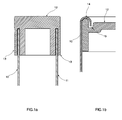
- Figure 1a represents a partial sectional view, on enlarged scale, of a refrigerator door according to the prior art
- FIG. 1a shows a particular of a known refrigeration or freezer door in a schematic partial section.
- the door comprises an outer panel 10 and an inner liner 11, the top edges of which are connected and closed by means of a top sealing rim 12.
- a rim similar to the rim 12 is also provided to connect the bottom edges of the panels, so as the space delimited between said panels is closed before introducing in it the foaming polyurethane which forms the door insulation.
- Rims 12 are generally so shaped that their ends 13 enclose the corresponding edges of the door panels. As a consequence, the external rim ends 13 are protruding from the surface of the outer panel 10 of the door with the drawbacks already mentioned.
- Figure 1b shows, according to the present invention, a schematic partial section similar to that of Figure 1a of a refrigeration or freezer door. Numeric references are the same for similar pieces in the two figures.
- the outer panel 10 shows its edge 14 which is bent toward the inside thereof and is engaged into a corresponding groove 15 of the rim 12. It is apparent that the rim 12 is substantially contained within the door thickness and no projections result on the external surface of the door itself. This feature ensures also a better tightness during the insulation foaming inside the space between the outer panel and the inner liner of the door, as the rim 12 abuts against the edge 14 of the outer panel 10 and does not need special sealing means.
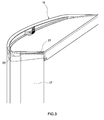
- Figures 2-4 represent, in a schematic way, respective subsequent steps for the construction of the door according to the present invention.
- the operation starts from an outer panel 10 which comprises a front surface 16 and lateral extensions 17. Upper and lower edges of the panel are bent toward the inside of the door body.
- the rim 12 is introduced under the bent edge of the outer panel 10 by slanting the rim itself and pushing it to slide along the edge of the panel 10 (as shown by the arrow, Fig. 2).
- the rim 12 is fully positioned under the edge of the panel, the rim is rotated in order that its groove 15 enters in engagement with the bent edge of the panel 10 (as shown by the arrow, Fig. 3).
- a bottom rim is applied to the opposite end of the door panel.
- the door body is completed through the application of the inner liner 11 by engaging the respective edges of panels and rim (Fig. 4). Then, the polyurethane foam is let to enter into the space delimited by the panels 10, 11 and the top and bottom rims 12, and to expand within said space, in a conventional way.
- the lateral edges of the rim 12 are conveniently shaped in order to facilitate the operation of sliding the rim and mutual engaging between rim and panel.
- the lateral edges of the rim 12 are provided with an undercut 20 and a sloped part 21 (Fig. 2-4).
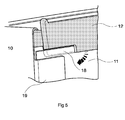
- Figure 5 shows a partial perspective view of a particular feature concerning the assembly of the top rim 12 with the inner liner 11 to close internally the door body during the last part of the introduction phase for the rim 12 under the edge of the inner liner 11.
- the back edge of the rim 12 is provided on each side with a recess 18 which allows the rim to take over the edge of a rear extension 19 of the outer panel 10 and to engage the inner liner 11 against it.
- the features disclosed may be modified without departing from the scope of the invention.
- the shape of the rims 12 may be changed depending on a different profile of the panels, which can be linear or curved along their sides.
- the reciprocal engagement on the back side of rim 12, outer panel 10 and inner liner 11 may be obtained with a geometry different from that before disclosed.
Landscapes
- Engineering & Computer Science (AREA)
- Chemical & Material Sciences (AREA)
- Combustion & Propulsion (AREA)
- Physics & Mathematics (AREA)
- Mechanical Engineering (AREA)
- Thermal Sciences (AREA)
- General Engineering & Computer Science (AREA)
- Refrigerator Housings (AREA)
Abstract
The sealing rims (12) are provided with grooves (15) adapted to engage with the corresponding edges (14) of the door panels (10, 11).
Description
- The present invention refers to a new method for producing a door for a refrigerating apparatus, in particular a household refrigerators.
- Refrigerators, freezers and similar apparatuses are typically provided with insulated doors. These doors are usually constructed of an outer panel and an inner liner with a foam insulation between them. Different types of materials are used for the door panels, so as different methods are used to assemble them. The most typical construction involves a metal fabricated exterior door shell that is formed with a rear flanges on the back side to support and possibly attach a thermoformed plastic interior panel. The typical insulation material is a polyurethane foam which is introduced into the door by means of three basic approaches: laminated in the exterior shell up to the rear flanges, injected into a small opening of a preassembled door, or poured into one half of the door assembly and foamed in place when the outer door half is clamped down before the foam begins to expand and cure. Examples of refrigeration door construction are disclosed in US 5,520,453, US 5,588,731, and US 5,909,937.
- A main problem in the construction of refrigeration doors is the sealing of the space between the external shell and the inner liner which is to be filled up by the insulation material. Normally, metal or plastic rims engage the edges of the panels, both at top and at bottom thereof, respectively. Said rims are suitably shaped, e.g. C-shaped, to cover and enclose the panel edges, as they are applied to the panels from outside of the same. This solution involves some drawbacks. Firstly, rims should be firmly attached to the panels to avoid a possible detachment under the foaming pressure which is produced during the filling up of the insulation material. Moreover, the free ends of the rims project from the surface of the door panels, so causing problems to the users for the cleaning of the refrigerators.
Another problem may arise when non-coated metal panels are used for the construction of the refrigerating door. Indeed, protruding ribs on surfaces to be painted create an additional problem both for the technical production and from the aesthetic point of view of the finished apparatus. - Therefore, it is an object of the present invention to provide a new refrigerator or freezer door construction which comprises an outer panel and an inner liner so as a top rim and a bottom rim, said components being assembled in an innovative way to close the internal space of the door wherein a foam insulation must be produced.
Another object of the present invention is to provide a new refrigerator or freezer door having an external surface fully smooth in order to improve the door fmishing both from the technical and aesthetic point of view. Yet another object of the present invention is to provide a new refrigerator or freezer door which facilitates cleaning operation and makes it more safe too. - The features of the invention are pointed out in the appended claims. Features and advantages of the invention will be better understood by the following description with reference to the accompanying figures. It should also be understood that the particular embodiment hereinafter disclosed is exemplary only and not to be regarded as a limitation of the present invention.
- Figure 1a represents a partial sectional view, on enlarged scale, of a refrigerator door according to the prior art;
- Figure 1b represents, similarly to Figure 1a, a partial sectional view of a refrigerator door according to the present invention;
- Figure 2 represents a partial perspective view of the refrigerator door of Figure 1b in a first step of assembling;
- Figure 3 represents a partial perspective view of the refrigerator door of Figure 1b in a second step of assembling;
- Figure 4 represents a partial perspective view of the refrigerator door of Figure 1b in a third step of assembling.
- Figure 5 represents a partial perspective view of a particular of the refrigerator door of Figures 2- 4.
-
- Figure 1a shows a particular of a known refrigeration or freezer door in a schematic partial section. The door comprises an
outer panel 10 and aninner liner 11, the top edges of which are connected and closed by means of atop sealing rim 12. It should be understood that a rim similar to therim 12 is also provided to connect the bottom edges of the panels, so as the space delimited between said panels is closed before introducing in it the foaming polyurethane which forms the door insulation.Rims 12 are generally so shaped that theirends 13 enclose the corresponding edges of the door panels. As a consequence, theexternal rim ends 13 are protruding from the surface of theouter panel 10 of the door with the drawbacks already mentioned. - Figure 1b shows, according to the present invention, a schematic partial section similar to that of Figure 1a of a refrigeration or freezer door. Numeric references are the same for similar pieces in the two figures. In the new technical solution, the
outer panel 10 shows itsedge 14 which is bent toward the inside thereof and is engaged into acorresponding groove 15 of therim 12. It is apparent that therim 12 is substantially contained within the door thickness and no projections result on the external surface of the door itself. This feature ensures also a better tightness during the insulation foaming inside the space between the outer panel and the inner liner of the door, as therim 12 abuts against theedge 14 of theouter panel 10 and does not need special sealing means. - Figures 2-4 represent, in a schematic way, respective subsequent steps for the construction of the door according to the present invention. The operation starts from an
outer panel 10 which comprises afront surface 16 andlateral extensions 17. Upper and lower edges of the panel are bent toward the inside of the door body. Considering the door top, therim 12 is introduced under the bent edge of theouter panel 10 by slanting the rim itself and pushing it to slide along the edge of the panel 10 (as shown by the arrow, Fig. 2). When therim 12 is fully positioned under the edge of the panel, the rim is rotated in order that itsgroove 15 enters in engagement with the bent edge of the panel 10 (as shown by the arrow, Fig. 3). Similarly, a bottom rim is applied to the opposite end of the door panel. At the end of these operative steps, the door body is completed through the application of theinner liner 11 by engaging the respective edges of panels and rim (Fig. 4). Then, the polyurethane foam is let to enter into the space delimited by thepanels bottom rims 12, and to expand within said space, in a conventional way.
It is worth noting that the lateral edges of therim 12 are conveniently shaped in order to facilitate the operation of sliding the rim and mutual engaging between rim and panel. For this purpose, the lateral edges of therim 12 are provided with an undercut 20 and a sloped part 21 (Fig. 2-4).
Figure 5 shows a partial perspective view of a particular feature concerning the assembly of thetop rim 12 with theinner liner 11 to close internally the door body during the last part of the introduction phase for therim 12 under the edge of theinner liner 11. For this purpose, the back edge of therim 12 is provided on each side with arecess 18 which allows the rim to take over the edge of arear extension 19 of theouter panel 10 and to engage theinner liner 11 against it.
It is apparent that the features disclosed may be modified without departing from the scope of the invention. For instance, the shape of therims 12 may be changed depending on a different profile of the panels, which can be linear or curved along their sides. Still in the same connection, the reciprocal engagement on the back side ofrim 12,outer panel 10 andinner liner 11 may be obtained with a geometry different from that before disclosed.
Claims (6)
- Method for producing a door for a refrigeration apparatus by using an outer panel (10) and an inner liner (11) with a foam insulation which is introduced and let to expand between them, suitable rims (12) being used to seal the space between the outer panel and the inner liner, characterised in that the method comprises a first step in which the top and bottom edges of the panels (10, 11) are bent toward the inside thereof , and a second step in which the sealing rims (12) are engaged with the edges of the panels from the inside thereof, said steps being carried out before producing the foaming insulation.
- Method according to claim 1, characterised in that the rims (12) are introduced under the bent edges of the panels (10, 11) by slanting the rims themselves, pushing them to slide along the edges of the panels (10, 11), and rotating them to engage the edges of the panels.
- A door for a refrigerating apparatus, in particular a household refrigerator or freezer, the door being usually constructed of an outer panel (10) and an inner liner (11) with a foam insulation between them, suitable rims (12) sealing of the space between the outer panel and the inner liner, characterised in that the top and bottom edges (14) of said panels (10, 11) are bent toward the inside thereof , and the sealing rims (12) are suitably shaped to engage said panel edges from the inside thereof.
- A door according to claim 3, characterised in that the sealing rims (12) are provided with grooves (15) adapted to engage with the corresponding edges (14) of the door panels (10, 11).
- A door according to claim 3, characterised in that the lateral edges of rims (12) are provided with an undercut (20) and a sloped part (21).
- A door according to claim 3, characterised in that the back edge of the rims (12) is provided on each side with a recess (18) which allows the rim to take over the edge of a rear extension (19) of the outer panel (10) and to engage the inner liner (11) against it.
Priority Applications (3)
| Application Number | Priority Date | Filing Date | Title |
|---|---|---|---|
| EP04100127A EP1555497A1 (en) | 2004-01-16 | 2004-01-16 | Refrigerator door construction |
| PCT/EP2004/053681 WO2005068922A1 (en) | 2004-01-16 | 2004-12-22 | Refrigerator door construction |
| BRPI0418406-8A BRPI0418406A (en) | 2004-01-16 | 2004-12-22 | method for producing a door for a refrigerating appliance and a door for a refrigerating appliance |
Applications Claiming Priority (1)
| Application Number | Priority Date | Filing Date | Title |
|---|---|---|---|
| EP04100127A EP1555497A1 (en) | 2004-01-16 | 2004-01-16 | Refrigerator door construction |
Publications (1)
| Publication Number | Publication Date |
|---|---|
| EP1555497A1 true EP1555497A1 (en) | 2005-07-20 |
Family
ID=34610217
Family Applications (1)
| Application Number | Title | Priority Date | Filing Date |
|---|---|---|---|
| EP04100127A Withdrawn EP1555497A1 (en) | 2004-01-16 | 2004-01-16 | Refrigerator door construction |
Country Status (3)
| Country | Link |
|---|---|
| EP (1) | EP1555497A1 (en) |
| BR (1) | BRPI0418406A (en) |
| WO (1) | WO2005068922A1 (en) |
Cited By (3)
| Publication number | Priority date | Publication date | Assignee | Title |
|---|---|---|---|---|
| EP2108906A1 (en) * | 2008-04-09 | 2009-10-14 | BSH Bosch und Siemens Hausgeräte GmbH | Cooler with a door closing band with integrated seal |
| WO2011064078A1 (en) * | 2009-11-24 | 2011-06-03 | BSH Bosch und Siemens Hausgeräte GmbH | Refrigeration appliance |
| US9339993B2 (en) | 2010-09-14 | 2016-05-17 | Corning Incorporated | Appliance fascia and mounting therefore |
Citations (7)
| Publication number | Priority date | Publication date | Assignee | Title |
|---|---|---|---|---|
| GB495326A (en) * | 1937-05-10 | 1938-11-10 | Percival Flavel | Improvements in or relating to doors for heat retaining cabinets such as stoves and refrigerators |
| GB2109277A (en) * | 1981-11-13 | 1983-06-02 | Tokyo Shibaura Electric Co | A method and device for manufacturing a box-shaped door |
| EP0280306A1 (en) * | 1987-02-25 | 1988-08-31 | N.V. Hörmann-Belgie | Door leaf |
| US5520453A (en) | 1991-11-07 | 1996-05-28 | Matsushita Refrigeration Company | Heat insulating door wall structure |
| US5588731A (en) | 1995-07-17 | 1996-12-31 | Whirlpool Corporation | Refrigerator door construction |
| US5909937A (en) | 1995-03-27 | 1999-06-08 | General Electric Company | Refrigerator door assembly |
| DE29916169U1 (en) * | 1998-10-06 | 1999-12-09 | Electrolux Zanussi Grandi Impianti S.P.A., Pordenone | Improved arched doors for refrigerators |
-
2004
- 2004-01-16 EP EP04100127A patent/EP1555497A1/en not_active Withdrawn
- 2004-12-22 WO PCT/EP2004/053681 patent/WO2005068922A1/en not_active Ceased
- 2004-12-22 BR BRPI0418406-8A patent/BRPI0418406A/en not_active IP Right Cessation
Patent Citations (7)
| Publication number | Priority date | Publication date | Assignee | Title |
|---|---|---|---|---|
| GB495326A (en) * | 1937-05-10 | 1938-11-10 | Percival Flavel | Improvements in or relating to doors for heat retaining cabinets such as stoves and refrigerators |
| GB2109277A (en) * | 1981-11-13 | 1983-06-02 | Tokyo Shibaura Electric Co | A method and device for manufacturing a box-shaped door |
| EP0280306A1 (en) * | 1987-02-25 | 1988-08-31 | N.V. Hörmann-Belgie | Door leaf |
| US5520453A (en) | 1991-11-07 | 1996-05-28 | Matsushita Refrigeration Company | Heat insulating door wall structure |
| US5909937A (en) | 1995-03-27 | 1999-06-08 | General Electric Company | Refrigerator door assembly |
| US5588731A (en) | 1995-07-17 | 1996-12-31 | Whirlpool Corporation | Refrigerator door construction |
| DE29916169U1 (en) * | 1998-10-06 | 1999-12-09 | Electrolux Zanussi Grandi Impianti S.P.A., Pordenone | Improved arched doors for refrigerators |
Cited By (4)
| Publication number | Priority date | Publication date | Assignee | Title |
|---|---|---|---|---|
| EP2108906A1 (en) * | 2008-04-09 | 2009-10-14 | BSH Bosch und Siemens Hausgeräte GmbH | Cooler with a door closing band with integrated seal |
| WO2011064078A1 (en) * | 2009-11-24 | 2011-06-03 | BSH Bosch und Siemens Hausgeräte GmbH | Refrigeration appliance |
| CN102667375A (en) * | 2009-11-24 | 2012-09-12 | Bsh博世和西门子家用电器有限公司 | Refrigeration appliance |
| US9339993B2 (en) | 2010-09-14 | 2016-05-17 | Corning Incorporated | Appliance fascia and mounting therefore |
Also Published As
| Publication number | Publication date |
|---|---|
| WO2005068922B1 (en) | 2005-09-29 |
| WO2005068922A1 (en) | 2005-07-28 |
| BRPI0418406A (en) | 2007-05-15 |
Similar Documents
| Publication | Publication Date | Title |
|---|---|---|
| US8943770B2 (en) | Insulated panel and method of assembly | |
| US5704107A (en) | Refrigerator door construction | |
| US11479021B2 (en) | Structural panel for an appliance having stamped components and method therefor | |
| US4050145A (en) | Method of making refrigeration apparatus enclosure structure | |
| US8881466B2 (en) | Insulated door and method of assembling an insulated door | |
| US20120326587A1 (en) | Refrigerator | |
| US20130257256A1 (en) | Vacuum panel cabinet structure for a refrigerator | |
| CN101868682B (en) | Door for a refrigerating appliance | |
| EP2660545A2 (en) | Refrigerator and method of manufacturing door thereof | |
| US20040194253A1 (en) | Side panel of refrigerator door and coupling structure thereof | |
| US10422569B2 (en) | Vacuum insulated door construction | |
| US8490333B2 (en) | Sealing gaskets | |
| KR20070095419A (en) | Refrigerator and / or Freezer | |
| JP2010168820A (en) | Connection structure of heat insulating panel | |
| US2693009A (en) | Refrigerator door gasket | |
| JPH11159947A (en) | Profile of plastic material for refrigerator having hard and deformable base unit | |
| WO2005068922A1 (en) | Refrigerator door construction | |
| JP2009192108A (en) | Thermal insulation panel | |
| US2659940A (en) | Refrigerator gasket | |
| JP2000097550A (en) | Refrigerator | |
| JP2011237118A (en) | Refrigerator and method for manufacturing the same | |
| JP3869809B2 (en) | Door structure for double door refrigerator door | |
| US2659941A (en) | Refrigerator gasket | |
| JP3319873B2 (en) | Manufacturing method of heat insulation box | |
| KR102384024B1 (en) | Disinfector manufacturing method |
Legal Events
| Date | Code | Title | Description |
|---|---|---|---|
| PUAI | Public reference made under article 153(3) epc to a published international application that has entered the european phase |
Free format text: ORIGINAL CODE: 0009012 |
|
| AK | Designated contracting states |
Kind code of ref document: A1 Designated state(s): AT BE BG CH CY CZ DE DK EE ES FI FR GB GR HU IE IT LI LU MC NL PT RO SE SI SK TR |
|
| AX | Request for extension of the european patent |
Extension state: AL LT LV MK |
|
| 17P | Request for examination filed |
Effective date: 20060104 |
|
| AKX | Designation fees paid |
Designated state(s): AT BE BG CH CY CZ DE DK EE ES FI FR GB GR HU IE IT LI LU MC NL PT RO SE SI SK TR |
|
| RAP1 | Party data changed (applicant data changed or rights of an application transferred) |
Owner name: ELECTROLUX HOME PRODUCTS CORPORATION N.V. |
|
| RAP1 | Party data changed (applicant data changed or rights of an application transferred) |
Owner name: ELECTROLUX HOME PRODUCTS CORPORATION N.V. |
|
| STAA | Information on the status of an ep patent application or granted ep patent |
Free format text: STATUS: THE APPLICATION IS DEEMED TO BE WITHDRAWN |
|
| 18D | Application deemed to be withdrawn |
Effective date: 20160802 |