EP1555275A2 - Polyetherester als Flammschutzadditive für Polyurethanweichschaumstoffe - Google Patents
Polyetherester als Flammschutzadditive für Polyurethanweichschaumstoffe Download PDFInfo
- Publication number
- EP1555275A2 EP1555275A2 EP05000040A EP05000040A EP1555275A2 EP 1555275 A2 EP1555275 A2 EP 1555275A2 EP 05000040 A EP05000040 A EP 05000040A EP 05000040 A EP05000040 A EP 05000040A EP 1555275 A2 EP1555275 A2 EP 1555275A2
- Authority
- EP
- European Patent Office
- Prior art keywords
- weight
- parts
- foams
- flame retardant
- foam according
- Prior art date
- Legal status (The legal status is an assumption and is not a legal conclusion. Google has not performed a legal analysis and makes no representation as to the accuracy of the status listed.)
- Granted
Links
Classifications
-
- C—CHEMISTRY; METALLURGY
- C08—ORGANIC MACROMOLECULAR COMPOUNDS; THEIR PREPARATION OR CHEMICAL WORKING-UP; COMPOSITIONS BASED THEREON
- C08J—WORKING-UP; GENERAL PROCESSES OF COMPOUNDING; AFTER-TREATMENT NOT COVERED BY SUBCLASSES C08B, C08C, C08F, C08G or C08H
- C08J9/00—Working-up of macromolecular substances to porous or cellular articles or materials; After-treatment thereof
- C08J9/0014—Use of organic additives
- C08J9/0038—Use of organic additives containing phosphorus
-
- C—CHEMISTRY; METALLURGY
- C08—ORGANIC MACROMOLECULAR COMPOUNDS; THEIR PREPARATION OR CHEMICAL WORKING-UP; COMPOSITIONS BASED THEREON
- C08G—MACROMOLECULAR COMPOUNDS OBTAINED OTHERWISE THAN BY REACTIONS ONLY INVOLVING UNSATURATED CARBON-TO-CARBON BONDS
- C08G18/00—Polymeric products of isocyanates or isothiocyanates
- C08G18/06—Polymeric products of isocyanates or isothiocyanates with compounds having active hydrogen
- C08G18/28—Polymeric products of isocyanates or isothiocyanates with compounds having active hydrogen characterised by the compounds used containing active hydrogen
- C08G18/30—Low-molecular-weight compounds
- C08G18/38—Low-molecular-weight compounds having heteroatoms other than oxygen
- C08G18/3878—Low-molecular-weight compounds having heteroatoms other than oxygen having phosphorus
- C08G18/3882—Low-molecular-weight compounds having heteroatoms other than oxygen having phosphorus having phosphorus bound to oxygen only
- C08G18/3885—Phosphate compounds
-
- C—CHEMISTRY; METALLURGY
- C08—ORGANIC MACROMOLECULAR COMPOUNDS; THEIR PREPARATION OR CHEMICAL WORKING-UP; COMPOSITIONS BASED THEREON
- C08G—MACROMOLECULAR COMPOUNDS OBTAINED OTHERWISE THAN BY REACTIONS ONLY INVOLVING UNSATURATED CARBON-TO-CARBON BONDS
- C08G18/00—Polymeric products of isocyanates or isothiocyanates
- C08G18/06—Polymeric products of isocyanates or isothiocyanates with compounds having active hydrogen
- C08G18/28—Polymeric products of isocyanates or isothiocyanates with compounds having active hydrogen characterised by the compounds used containing active hydrogen
- C08G18/40—High-molecular-weight compounds
- C08G18/4009—Two or more macromolecular compounds not provided for in one single group of groups C08G18/42 - C08G18/64
- C08G18/4018—Mixtures of compounds of group C08G18/42 with compounds of group C08G18/48
-
- C—CHEMISTRY; METALLURGY
- C08—ORGANIC MACROMOLECULAR COMPOUNDS; THEIR PREPARATION OR CHEMICAL WORKING-UP; COMPOSITIONS BASED THEREON
- C08J—WORKING-UP; GENERAL PROCESSES OF COMPOUNDING; AFTER-TREATMENT NOT COVERED BY SUBCLASSES C08B, C08C, C08F, C08G or C08H
- C08J9/00—Working-up of macromolecular substances to porous or cellular articles or materials; After-treatment thereof
- C08J9/04—Working-up of macromolecular substances to porous or cellular articles or materials; After-treatment thereof using blowing gases generated by a previously added blowing agent
- C08J9/12—Working-up of macromolecular substances to porous or cellular articles or materials; After-treatment thereof using blowing gases generated by a previously added blowing agent by a physical blowing agent
- C08J9/14—Working-up of macromolecular substances to porous or cellular articles or materials; After-treatment thereof using blowing gases generated by a previously added blowing agent by a physical blowing agent organic
-
- C—CHEMISTRY; METALLURGY
- C08—ORGANIC MACROMOLECULAR COMPOUNDS; THEIR PREPARATION OR CHEMICAL WORKING-UP; COMPOSITIONS BASED THEREON
- C08K—Use of inorganic or non-macromolecular organic substances as compounding ingredients
- C08K5/00—Use of organic ingredients
- C08K5/49—Phosphorus-containing compounds
- C08K5/51—Phosphorus bound to oxygen
- C08K5/52—Phosphorus bound to oxygen only
- C08K5/521—Esters of phosphoric acids, e.g. of H3PO4
- C08K5/523—Esters of phosphoric acids, e.g. of H3PO4 with hydroxyaryl compounds
-
- C—CHEMISTRY; METALLURGY
- C08—ORGANIC MACROMOLECULAR COMPOUNDS; THEIR PREPARATION OR CHEMICAL WORKING-UP; COMPOSITIONS BASED THEREON
- C08G—MACROMOLECULAR COMPOUNDS OBTAINED OTHERWISE THAN BY REACTIONS ONLY INVOLVING UNSATURATED CARBON-TO-CARBON BONDS
- C08G2110/00—Foam properties
- C08G2110/0008—Foam properties flexible
-
- C—CHEMISTRY; METALLURGY
- C08—ORGANIC MACROMOLECULAR COMPOUNDS; THEIR PREPARATION OR CHEMICAL WORKING-UP; COMPOSITIONS BASED THEREON
- C08J—WORKING-UP; GENERAL PROCESSES OF COMPOUNDING; AFTER-TREATMENT NOT COVERED BY SUBCLASSES C08B, C08C, C08F, C08G or C08H
- C08J2375/00—Characterised by the use of polyureas or polyurethanes; Derivatives of such polymers
- C08J2375/04—Polyurethanes
Definitions
- the invention relates to flexible polyurethane foams meeting the requirements of FMVSS 302 comply, a process for their preparation and their use.
- Flexible polyurethane foams are prepared by reacting polyols with organic polyisocyanates in the presence. made of blowing agents and catalysts. These foams are used in a variety of fields, such as carpet underlays, interlining, mattresses, pillows, upholstery, Isoliermatrial, etc. Foams, which are prepared from polyisocyanates and polyester polyols using suitable auxiliaries and additives, meet at a gross density of about 35 kg / m 3, the requirements of the Federal motor Vehicle Safety standard (FMVSS) 302. Such esters-PUR foams are but in a number of properties inferior to the known ether-PUR foams. For example, the porosity of the ester PUR foams is inferior, their elasticity is lower and their resistance to moisture and heat is lower.
- FMVSS Federal motor Vehicle Safety standard
- polyisocyanates e.g. the 2,4- and 2,6-toluene diisocyanate and any mixtures of these isomeric (“TDI”), polyphenylpolymethylene polyisocyanates, as determined by aniline-formaldehyde condensation and subsequent Phosgenation (“crude MDI”) and carbodiimide groups, Urethane groups, allophanate groups, isocyanate groups, urea groups or biuret groups having polyisocyanates (“modified isocyanates”), in particular those modified Isocyanates derived from 2,4- and / or 2,6-toluene diisocyanate or from 4,4'- and / or 2,4'-diphenylmethane diisocyanate derived.
- TDI 2,4- and 2,6-toluene diisocyanate and any mixtures of these isomeric
- CAMDI aniline-formaldehyde condensation and subsequent Phosgenation
- carbodiimide groups Ure
- tolylene diisocyanate with a content of 80 Wt .-% of 2,4- and 20 wt .-% of 2,6-isomers (TDI-80) and toluene diisocyanate with a Content of 65 wt .-% of 2,4- and 35 wt .-% of 2,6-isomers (TDI-65).
- Suitable polyether polyols b1) have an OH number range of usually 20 to 200, preferably 42 to 60, and a functionality of 2 to 4, preferably 2 to 3 on. Preferred are Polyether polyols with predominantly secondary OH groups.
- starter components are compounds with reactive hydrogen atoms such as water, alcohols, ammonia or Amines, e.g. Ethylene glycol, propylene glycol- (1,3) or - (1,2), trimethylolpropane, glycerol, 4,4'-dihydroxydiphenylpropane, Aniline, ethanolamine or ethylenediamine. To be favoured used as starting components trimethylolpropane and / or glycerol.
- those polyether polyols are preferred which are predominantly or predominantly (over 85 wt .-% based on all OH groups present in the polyether polyol) have secondary OH groups.
- polymer polyols Also suitable are dispersions of Reaction products of polyisocyanates and alkanolamines in polyethers and dispersions of Homo- and copolymers of unsaturated monomers such as styrene or acrylonitrile in polyethers (so-called "polymer polyols").
- Suitable polyetherester polyols b2) are preferably alkoxylation products of oligo- and Polyesters of aromatic and aliphatic dicarboxylic acids and dicarboxylic acid derivatives such as e.g. Anhydrides with isocyanate-reactive end groups.
- Polyetheresterpolyole (or Polyester ether polyols) can be prepared by targeted construction, e.g. by Alkoxylation of carboxylic acids or carboxylic anhydrides or polyesters, or by molecule-doubling Condensation of OH-terminated polyesters. These connections can also be reacted with the known methods with epoxides.
- the polyetherester polyols b2) used can be used as starter molecules, e.g. adipic acid, Maleic acid, fumaric acid, phthalic acid, terephthalic acid, isophthalic acid, tetrahydrophthalic acid, halogenated phthalic and tetrahydrophthalic acids and the like.
- preferred Carboxylic acids are adipic acid, maleic acid, fumaric acid or their derivatives, Particularly preferred are phthalic acid, terephthalic acid and isophthalic acid or their Derivatives.
- Starter molecules are secondary products of ethylene oxide and propylene oxide such as e.g.
- Ethylene glycol Diethylene glycol, triethylene glycol, 1,2-propylene glycol, dipropylene glycol or the diprimers Akohole such as 1,4-butanediol, 1,6-hexanediol, neopentyl glycol, 1,3-butanediol or branching Triol components such as e.g. Trimethylolpropane, trimethylolethane, glycerin as well longer chain trihydroxyl compounds.
- the polyetherester polyols b2) have an OH number of 150 to 450 mg KOH / g and a functionality of 2 to 3 on.
- the polyetherester polyols b2) are the polyol component b) in an amount of 1 to 10 Parts by weight, preferably 2 to 7 parts by weight, more preferably 3 to 5 parts by weight, based on the total weight of component b) added.
- the blowing agent c) used is water or other chemical or physical blowing agents known to the person skilled in the art, for example methylene chloride, diethyl ether, acetone or alkanes such as pentane, i-pentane or cyclopentane or inorganic blowing agents such as air, CO 2 . If water is used as blowing agent, it is preferably used in an amount of 1 to 6 parts by weight, based on the total weight of component b).
- Suitable flame retardants f) are known in the art and e.g. in "Kunststoffhandbuch", Volume 7 "Polyurethanes", Chapter 5.1 described.
- flame retardants f) are preferred halogen-free phosphorus compounds such as e.g. Triaryl and Trialkylphosphate and triaryl and Trialkylphosphonates or Tetraalkyldiphosphonattagenen used.
- Especially preferred Flame retardants are reactive phosphopolyols, as they are, for example, under the trade names Exolit® OP 550 and Exolit® OP 560 from Clariant International Ltd, CH-4132 Muttenz to be expelled.
- the flame retardant f) is preferably used in an amount of 2 to 8 parts by weight, especially preferably 3 to 6 parts by weight, based on the total weight of component b) used.
- Catalysts d), stabilizers e), and other auxiliaries and additives g) for the preparation polyurethane flexible foams are known to those skilled in principle and, for example, in “Kunststoffhandbuch”, Volume 7 “Polyurethane”, chapter 5.1.
- catalysts are preferably amine compounds and / or metal compounds, in particular Heavy metal salts and / or organometallic compounds used. Especially are known as catalysts tertiary amines and / or with organic metal compounds used.
- organic metal compounds e.g. Tin compounds in question, like for example, tin (II) salts of organic carboxylic acids, e.g. Tin (II) acetate, tin (II) octoate, Tin (II) ethylhexanoate and tin (II) laurate and the dialkyltin (IV) salts of organic carboxylic acids, e.g.
- Dibutyltin diacetate, dibutyltin dilaurate, dibutyltin maleate and Dioctyltin diacetate organic amines are exemplified: Triethylamine, 1,4-diazabicyclo [2,2,2] octane, tributylamine, dimethylbenzylamine, N, N, N ', N'-tetramethylethylenediamine, N, N, N ', N'-tetramethylbutanediamine, N, N, N', N'-tetramethylhexane-1,6-diamine, Dimethylcyclohexylamine.
- the catalysts can be used individually or in the form of Mixtures are used.
- foam stabilizers are mainly polyether siloxanes, especially water-insoluble representatives, in question. These compounds are generally designed to be a copolymer of Ethylene oxide and propylene oxide is connected to a Polydimethylsiloxanrest.
- water-soluble Foam stabilizers are e.g. in U.S. Patents 2,834,748, 2,917,480 and 3,629,308; you are but not suitable for the production of highly elastic (HR) foams.
- the foams used in the process according to the invention are usually prepared by intensively mixing the di- or polyisocyanate a) as one component and the remaining constituents in a mixture as the other component by means of a suitable, usually mechanical device.
- the production of the foams can be carried out both continuously, for example on a conveyor belt system as well as discontinuously.
- the production of flexible foams is known in the art in principle and described for example in G. Oertel (ed.) "Plastics Handbook", Volume VII, Carl Hanser Verlag, 3rd edition, Kunststoff 1993, pp. 193-220.
- the index, a term used very frequently in the production of polyurethane foams says something about the degree of crosslinking of a foam.
- the production of the foams is carried out so that the index is 80 to 120, more preferably 90 to 115.
- the density of the resulting foams is preferably 15 kg / m 3 to 55 kg / m 3 , particularly preferably 20 kg / m 3 to 50 kg / m 3 .
- the flexible polyurethane foams according to the invention are particularly suitable for use as lying, seat and cushioning material as well as for the interior of automobiles.
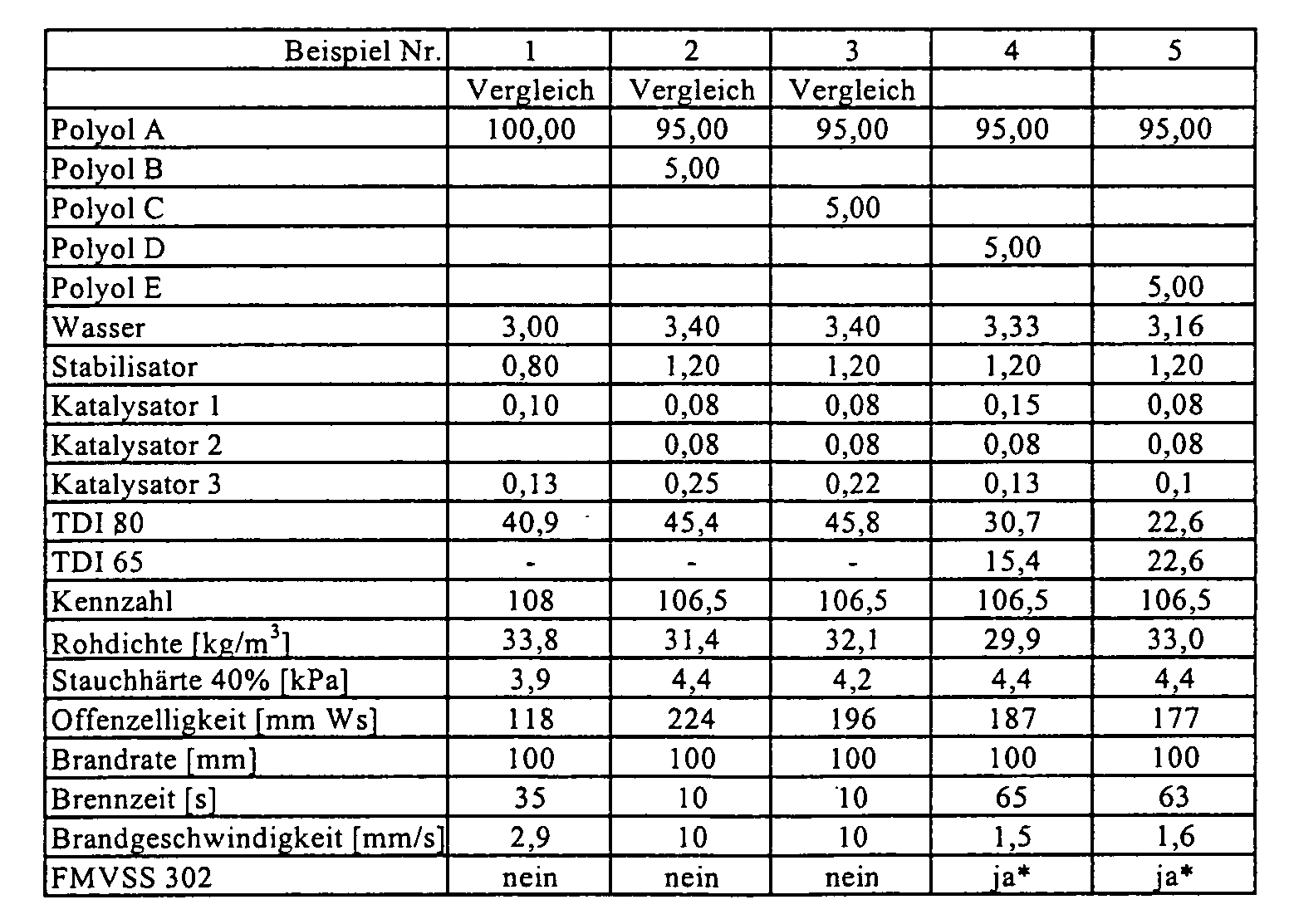
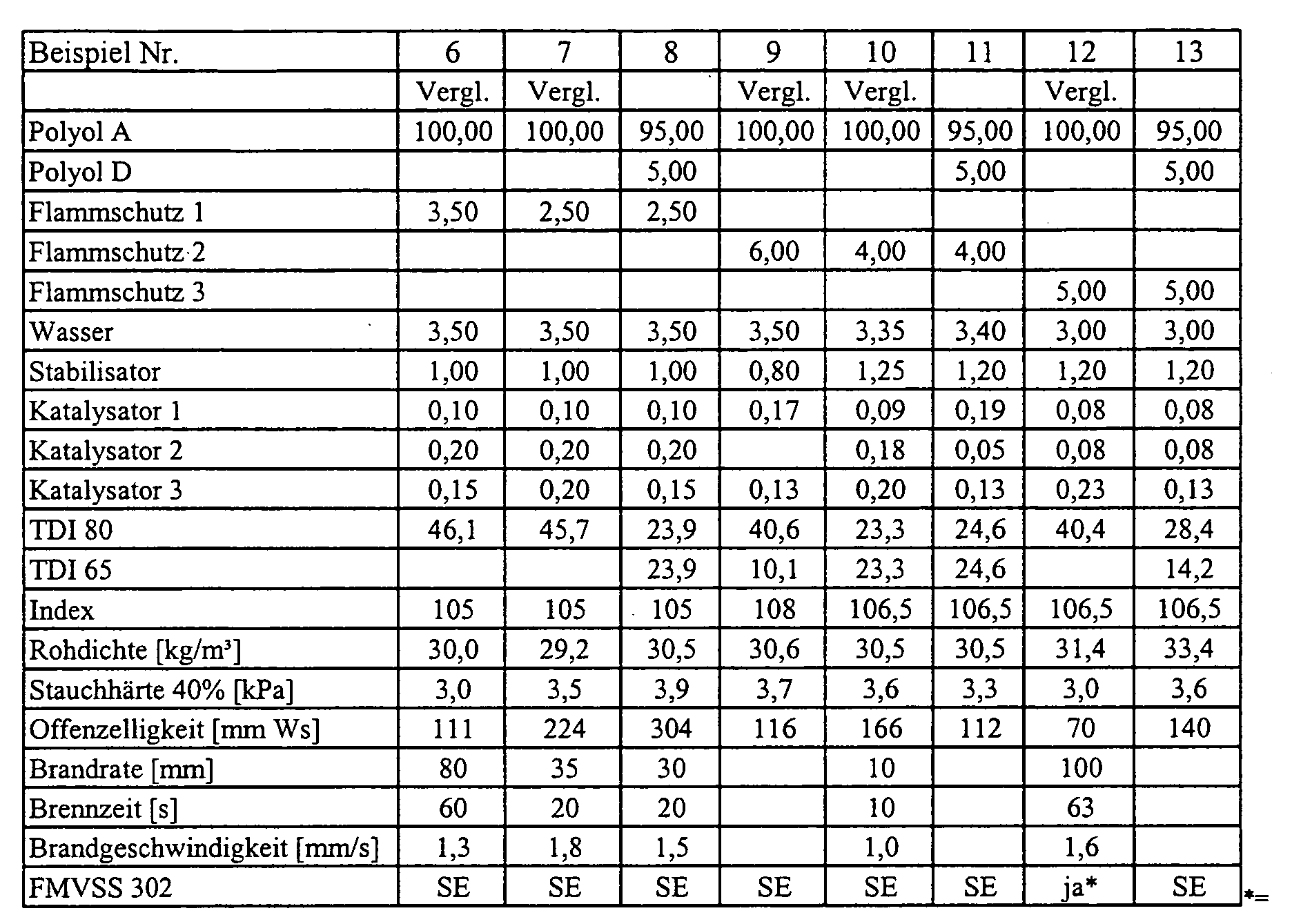
- the polyols were placed in a paper cup with aluminum bottom. One after another to the polyols water, stabilizer, optionally flame retardant and the catalysts 1 and 2 weighed. Subsequently, the mixture was stirred for 25 seconds at 1200 rpm. Activator 3 was weighed and mixed for 5 seconds at the same stirrer speed. In The amount of TDI was added to one cast and mixed for a further 7 seconds. After that The reaction mixture was poured into a cardboard mold with a volume of 20x20x14 cm and foams. The respective resulting properties of flexible polyurethane foams are listed in the table.
Landscapes
- Chemical & Material Sciences (AREA)
- Health & Medical Sciences (AREA)
- Chemical Kinetics & Catalysis (AREA)
- Medicinal Chemistry (AREA)
- Polymers & Plastics (AREA)
- Organic Chemistry (AREA)
- Engineering & Computer Science (AREA)
- Materials Engineering (AREA)
- Polyurethanes Or Polyureas (AREA)
- Compositions Of Macromolecular Compounds (AREA)
- Manufacture Of Porous Articles, And Recovery And Treatment Of Waste Products (AREA)
- Organic Low-Molecular-Weight Compounds And Preparation Thereof (AREA)
Abstract
Description
- Polyol A:
- PO/EO-Addukt an eine Mischung aus Glycerin und Propylenglykol, OH-Zahl 56 (Arcol® 1105, Bayer AG)
- Polyol B:
- Polyesterpolyol auf Basis Adipinsäure, Phthalsäureanhydrid und Ethylenglykol, OH-Zahl 64 (Desmophen® PEP 175 A, Bayer AG)
- Polyol C:
- Polyesterpolyol auf Basis Adipinsäure, Isophthalsäure und Diethylenglykol, OH-Zahl 112 (Desmophen® VP.LS 2782, Bayer AG)
- Polyol D:
- EO-Addukt an eine Mischung aus Phthalsäureanhydrid, Diethylenglycol und Ethylendiamin, OH-Zahl 310, Funktionalität 2 (Desmophen® VP.PU 1431, Bayer AG)
- Polyol E:
- PO-Addukt an eine Mischung aus Phthalsäureanhydrid, Diethylenglycol, Sorbit und Ethylendiamin OH-Zahl 435, Funktionalität 2,8 (Desmophen® VP.PU 20AP74)
- FS 1:
- reaktives Phosphorpolyol, Funktionalität ca. 2
(Exolit® OP550, Clariant International Ltd.) - FS 2:
- reaktives Phosphorpolyol, Funktionalität ca. 2
(Exolit® OP560, Clariant International Ltd.) - FS 3:
- Triphenylphosphat
- Kat 1:
- Mischung aus BDMAEE/DPG im Verhältnis 70/30
(Niax® Al, Osi Specialties) - Kat 2:
- Mischung aus Triethylendiamin/DPG im Verhältnis 33/67
(Dabco® 33LV, Air Products) - Kat 3:
- Zinn(II)octoat
- Stabilisator:
- Silikonstabilisator (Tegostab® B 8232, Goldschmidt AG)
*= Die Anforderungen nach FMVSS 302 wurden über die Brandrate erfüllt

Claims (6)
- Die Anforderungen nach FMVSS 302 erfüllender Polyurethan-Weichschaumstoff, erhältlich durch Umsetzung vona) organischen und/oder modifizierten Polyisocyanaten mitb) einer Polyolkomponente, diein Gegenwart vonb1) 90 bis 99 Gewichtsteile eines Polyetherpolyols mit einer OH-Zahl von 20 bis 200 mg KOH/g und einer Funktionalität von 2 bis 4 undb2) 1 bis 10 Gewichtsteile eines Polyetheresterpolyols mit einer OH-Zahl von 150 bis 450 mg KOH/g und einer Funktionalität von 2 bis 3 enthält,c) Wasser und/oder anderen Treibmitteln,d) Katalysatoren,e) Stabilisatoren, gegebenenfallsf) Flammschutzmitteln und gegebenenfallsg) weiteren Hilfs- und Zusatzstoffen.
- Polyurethan-Weichschaumstoff gemäß Anspruch 1, bei dem als Flammschutzmittel f) eine reaktive oder unreaktive halogenfreie Phosphorverbindung eingesetzt wird, die eine Phos, phorsäuretriaryl- und/oder Phosphorsäuretrialkyl- und/ oder Tetraalkyldiphosphonatverbindung enthält.
- Polyurethan-Weichschaumstoff gemäß Anspruch 2, bei dem das Flammschutzmittel f) in einer Menge von 2 bis 8 Gewichtsteilen, bezogen auf des Gesamtgewicht der Komponenten b) bis g), eingesetzt wird.
- Polyurethan-Weichschaumstoff gemäß einem der Ansprüche 1 bis 3, bei dem als organisches Polyisocyanat a) Toluylendiisocyanat eingesetzt wird.
- Polyurethan-Weichschaumstoff gemäß einem der Ansprüche 1 bis 4, bei dem als Treibmittel c) Wasser in einer Menge von 1 bis 6 Gew.-Teilen, bezogen auf das Gesamtgewicht der Komponenten b) bis g), eingesetzt wird.
- Verwendung eines Polyurethan-Weichschaumstoffs gemäß einem der Ansprüche 1 bis 5 als Liege-, Sitz- und Polstermaterial sowie zur Innenausstattung von Automobilen.
Priority Applications (1)
| Application Number | Priority Date | Filing Date | Title |
|---|---|---|---|
| PL05000040T PL1555275T3 (pl) | 2004-01-13 | 2005-01-04 | Polieteroester jako dodatek ognioochronny dla miękkich pianek poliuretanowych |
Applications Claiming Priority (2)
| Application Number | Priority Date | Filing Date | Title |
|---|---|---|---|
| DE102004001746 | 2004-01-13 | ||
| DE102004001746A DE102004001746A1 (de) | 2004-01-13 | 2004-01-13 | Polyetherester als Flammschutzmittel für Polyurethanweichschaumstoffe |
Publications (4)
| Publication Number | Publication Date |
|---|---|
| EP1555275A2 true EP1555275A2 (de) | 2005-07-20 |
| EP1555275A3 EP1555275A3 (de) | 2006-08-16 |
| EP1555275B1 EP1555275B1 (de) | 2008-05-07 |
| EP1555275B9 EP1555275B9 (de) | 2008-10-08 |
Family
ID=34609526
Family Applications (1)
| Application Number | Title | Priority Date | Filing Date |
|---|---|---|---|
| EP05000040A Expired - Lifetime EP1555275B9 (de) | 2004-01-13 | 2005-01-04 | Polyetherester als Flammschutzadditive für Polyurethanweichschaumstoffe |
Country Status (12)
| Country | Link |
|---|---|
| US (1) | US20050159500A1 (de) |
| EP (1) | EP1555275B9 (de) |
| JP (1) | JP2005200649A (de) |
| CN (1) | CN1648146B (de) |
| AT (1) | ATE394438T1 (de) |
| BR (1) | BRPI0500066A (de) |
| CA (1) | CA2491978C (de) |
| DE (2) | DE102004001746A1 (de) |
| ES (1) | ES2305910T3 (de) |
| MX (1) | MXPA05000515A (de) |
| PL (1) | PL1555275T3 (de) |
| RU (1) | RU2005100197A (de) |
Cited By (5)
| Publication number | Priority date | Publication date | Assignee | Title |
|---|---|---|---|---|
| EP1964880A1 (de) | 2007-03-02 | 2008-09-03 | Lanxess Deutschland GmbH | Halogenfreie, flammgeschützte Polyurethanschaumstoffe |
| EP2154185A1 (de) | 2008-08-16 | 2010-02-17 | Lanxess Deutschland GmbH | Halogenfreie, flammgeschützte Polyurethanschaumstoffe mit geringem Scorch |
| EP2985336A1 (de) | 2014-08-15 | 2016-02-17 | LANXESS Deutschland GmbH | Flammwidrige polyurethanschaumstoffe mit geringer kernverfärbung |
| EP3050890A1 (de) | 2015-01-27 | 2016-08-03 | LANXESS Deutschland GmbH | Hydroxylgruppen-haltige Poly(alkylenphosphate) |
| WO2018046586A1 (de) * | 2016-09-09 | 2018-03-15 | Covestro Deutschland Ag | Poröse materialien auf polyurethan/polyisocyanuratbasis und deren herstellung und verwendung |
Families Citing this family (21)
| Publication number | Priority date | Publication date | Assignee | Title |
|---|---|---|---|---|
| DE102007009126A1 (de) * | 2007-02-24 | 2008-08-28 | Bayer Materialscience Ag | Verfahren zur Herstellung Polyurethan-Weichschaumstoffen mit niedriger Rohdichte |
| DE102007061883A1 (de) * | 2007-12-20 | 2009-06-25 | Bayer Materialscience Ag | Viskoelastischer Polyurethanschaumstoff |
| DE102009047846A1 (de) * | 2009-09-30 | 2011-03-31 | Bayer Materialscience Ag | Verfahren zur Erniedrigung von Emissionen eines Polyurethanschaumstoffes |
| JP5644116B2 (ja) * | 2010-01-21 | 2014-12-24 | 株式会社ブリヂストン | 高難燃性ポリウレタンフォーム |
| JP5644189B2 (ja) * | 2010-06-03 | 2014-12-24 | 株式会社ブリヂストン | 高難燃性ポリウレタンフォーム |
| KR101257628B1 (ko) | 2011-03-24 | 2013-04-29 | (주)아모레퍼시픽 | 화장료 조성물이 함침된 발포 우레탄 폼을 포함하는 화장품 |
| TWI658837B (zh) | 2012-04-12 | 2019-05-11 | 愛茉莉太平洋股份有限公司 | 具有改進的使用感覺之發泡體 |
| US20140066532A1 (en) * | 2012-09-06 | 2014-03-06 | Bayer Materialscience Llc | Rigid foams suitable for wall insulation |
| US9522973B2 (en) | 2012-10-02 | 2016-12-20 | Covestro Llc | Polyurethane and polyisocyanurate rigid foams for roofing insulation |
| CN103275293A (zh) * | 2013-06-05 | 2013-09-04 | 昆山中海工贸有限公司 | 防火海绵及其制备方法 |
| CN104672427B (zh) * | 2014-12-31 | 2018-02-13 | 上海馨源新材料科技有限公司 | 一种用于汽车内饰件的高硬度聚氨酯软泡及其制备方法 |
| CA3168221C (en) | 2015-12-08 | 2026-05-19 | Amrize Technology Switzerland Llc | Process for producing isocyanate-based foam construction boards |
| CA3034242C (en) | 2016-08-19 | 2021-04-06 | Firestone Building Products Company, Llc | Process for producing isocyanate-based foam construction boards |
| JP7017575B2 (ja) * | 2016-10-25 | 2022-02-08 | エル・コーポレイション | 低粘度リン酸ポリオール |
| CN106828820B (zh) * | 2016-12-18 | 2023-12-15 | 湖州港口船业有限公司 | 一种船舶防沉系统 |
| US10870987B1 (en) | 2017-12-04 | 2020-12-22 | Firestone Building Products Company, Llc | Isocyanate-based foam construction boards |
| US12291620B2 (en) | 2017-12-04 | 2025-05-06 | Holcim Technology Ltd | Isocyanate-based foam construction boards |
| CN108219100A (zh) * | 2017-12-21 | 2018-06-29 | 苏州浩洋聚氨酯科技有限公司 | 一种基于聚氨酯泡沫的密封材料 |
| CN110003440A (zh) * | 2019-04-24 | 2019-07-12 | 东莞市腾崴塑胶制品有限公司 | 一种聚酯醚海绵及制备方法 |
| CN111647125B (zh) * | 2020-06-15 | 2022-04-05 | 浙江华峰新材料有限公司 | 一种聚氨酯组合物及其海绵制品的制备 |
| CN115181239B (zh) * | 2022-08-02 | 2023-06-02 | 湖北世丰新材料有限公司 | 一种高亲水低膨胀率聚氨酯软泡、制备方法及应用 |
Family Cites Families (18)
| Publication number | Priority date | Publication date | Assignee | Title |
|---|---|---|---|---|
| JPS4630309B1 (de) * | 1967-03-16 | 1971-09-03 | ||
| US3639542A (en) * | 1968-05-13 | 1972-02-01 | Basf Wyandotte Corp | Ester-containing polyols having halogen and phosphorus atoms therein |
| JPS59196312A (ja) * | 1983-04-22 | 1984-11-07 | Asahi Glass Co Ltd | ポリイソシアヌレ−トフオ−ムの製造方法 |
| US4481309A (en) * | 1984-04-09 | 1984-11-06 | Basf Aktiengesellschaft | Process for the preparation of cellular and non-cellular polyurethanes |
| JPS614718A (ja) * | 1984-06-19 | 1986-01-10 | Dainippon Ink & Chem Inc | 難燃性軟質ウレタンフオ−ム用組成物 |
| JPS61141722A (ja) * | 1984-12-14 | 1986-06-28 | Achilles Corp | フレ−ムラミネ−シヨン可能な難燃性軟質ポリウレタンフオ−ムの製造方法 |
| JPS61157514A (ja) * | 1984-12-28 | 1986-07-17 | Achilles Corp | フレ−ムラミネ−シヨン可能な難燃性ポリウレタンフオ−ムの製造方法 |
| JPH0610238B2 (ja) * | 1984-12-28 | 1994-02-09 | アキレス株式会社 | フレ−ムラミネ−シヨン可能な難燃性ポリウレタンフオ−ムの製造方法 |
| JPH0774258B2 (ja) * | 1985-10-02 | 1995-08-09 | アキレス株式会社 | 難燃性ポリウレタンフォームの製造方法 |
| US4797428A (en) * | 1987-06-22 | 1989-01-10 | Mobay Corporation | Foam systems and ASTM E-84 class 1 rated foams produced therefrom |
| CA2066503A1 (en) * | 1991-04-22 | 1992-10-23 | Joseph S. Sollers | Polyurethane foam based on combination of polyester resin and polyether polyol |
| US5177116A (en) * | 1991-11-25 | 1993-01-05 | Basf Corporation | Flexible polyurethane foams with reduced dripping during burning |
| JP3482263B2 (ja) * | 1995-01-12 | 2003-12-22 | 株式会社イノアックコーポレーション | 難燃性表皮材 |
| DE19521798A1 (de) * | 1995-06-16 | 1996-12-19 | Bayer Ag | Polyurethanelastomere aus aliphatischen Polyisocyanaten und Polyesteretherpolyolen |
| DE19601410B4 (de) * | 1996-01-17 | 2004-12-09 | Basf Ag | Verfahren zur Herstellung von Polyurethanweichschaumstoffen |
| AU7264798A (en) * | 1997-05-06 | 1998-11-27 | Magla World-Wide L.L.C. | Flexible, substantially open celled polyurethane foam and method of making same |
| DE19924804C5 (de) * | 1999-05-29 | 2009-02-12 | Basf Se | Verfahren zur Herstellung von schallabsorbierenden Polyurethanschäumen mit adhäsiver Oberfläche |
| JP3546033B2 (ja) * | 2001-09-27 | 2004-07-21 | 東海ゴム工業株式会社 | 車両用難燃性防音・防振材及びその製造方法 |
-
2004
- 2004-01-13 DE DE102004001746A patent/DE102004001746A1/de not_active Withdrawn
-
2005
- 2005-01-04 EP EP05000040A patent/EP1555275B9/de not_active Expired - Lifetime
- 2005-01-04 PL PL05000040T patent/PL1555275T3/pl unknown
- 2005-01-04 ES ES05000040T patent/ES2305910T3/es not_active Expired - Lifetime
- 2005-01-04 DE DE502005003929T patent/DE502005003929D1/de not_active Expired - Lifetime
- 2005-01-04 AT AT05000040T patent/ATE394438T1/de not_active IP Right Cessation
- 2005-01-07 CA CA2491978A patent/CA2491978C/en not_active Expired - Fee Related
- 2005-01-10 US US11/032,434 patent/US20050159500A1/en not_active Abandoned
- 2005-01-11 MX MXPA05000515A patent/MXPA05000515A/es active IP Right Grant
- 2005-01-12 JP JP2005004862A patent/JP2005200649A/ja active Pending
- 2005-01-12 BR BR0500066-1A patent/BRPI0500066A/pt not_active IP Right Cessation
- 2005-01-12 RU RU2005100197/04A patent/RU2005100197A/ru not_active Application Discontinuation
- 2005-01-13 CN CN2005100057142A patent/CN1648146B/zh not_active Expired - Fee Related
Cited By (9)
| Publication number | Priority date | Publication date | Assignee | Title |
|---|---|---|---|---|
| EP1964880A1 (de) | 2007-03-02 | 2008-09-03 | Lanxess Deutschland GmbH | Halogenfreie, flammgeschützte Polyurethanschaumstoffe |
| DE102007010160A1 (de) | 2007-03-02 | 2008-09-04 | Lanxess Deutschland Gmbh | Halogenfreie, flammgeschützte Polyurethanschaumstoffe |
| EP2154185A1 (de) | 2008-08-16 | 2010-02-17 | Lanxess Deutschland GmbH | Halogenfreie, flammgeschützte Polyurethanschaumstoffe mit geringem Scorch |
| DE102008038054A1 (de) | 2008-08-16 | 2010-02-18 | Lanxess Deutschland Gmbh | Halogenfreie, flammgeschützte Polyurethanschaumstoffe mit geringem Scorch |
| EP2985336A1 (de) | 2014-08-15 | 2016-02-17 | LANXESS Deutschland GmbH | Flammwidrige polyurethanschaumstoffe mit geringer kernverfärbung |
| EP2985335A1 (de) | 2014-08-15 | 2016-02-17 | LANXESS Deutschland GmbH | Flammwidrige Polyurethanschaumstoffe mit geringer Kernverfärbung |
| EP3050890A1 (de) | 2015-01-27 | 2016-08-03 | LANXESS Deutschland GmbH | Hydroxylgruppen-haltige Poly(alkylenphosphate) |
| EP3050891A1 (de) | 2015-01-27 | 2016-08-03 | LANXESS Deutschland GmbH | Hydroxylgruppen-haltige poly(alkylenphosphate) |
| WO2018046586A1 (de) * | 2016-09-09 | 2018-03-15 | Covestro Deutschland Ag | Poröse materialien auf polyurethan/polyisocyanuratbasis und deren herstellung und verwendung |
Also Published As
| Publication number | Publication date |
|---|---|
| CN1648146B (zh) | 2011-12-21 |
| EP1555275A3 (de) | 2006-08-16 |
| MXPA05000515A (es) | 2005-08-16 |
| PL1555275T3 (pl) | 2008-07-31 |
| BRPI0500066A (pt) | 2005-09-06 |
| CN1648146A (zh) | 2005-08-03 |
| JP2005200649A (ja) | 2005-07-28 |
| EP1555275B9 (de) | 2008-10-08 |
| ES2305910T3 (es) | 2008-11-01 |
| EP1555275B1 (de) | 2008-05-07 |
| CA2491978A1 (en) | 2005-07-13 |
| CA2491978C (en) | 2012-05-01 |
| ATE394438T1 (de) | 2008-05-15 |
| DE102004001746A1 (de) | 2005-08-04 |
| US20050159500A1 (en) | 2005-07-21 |
| RU2005100197A (ru) | 2006-06-20 |
| DE502005003929D1 (de) | 2008-06-19 |
Similar Documents
| Publication | Publication Date | Title |
|---|---|---|
| EP1555275B1 (de) | Polyetherester als Flammschutzadditive für Polyurethanweichschaumstoffe | |
| EP0482507B1 (de) | Verfahren zur Herstellung von flammwidrigen Polyurethan-Weichschaumstoffen mit verminderter Rauchgasdichte und Melamin-Blähgraphit-Polyether-polyol-dispersionen hierfür | |
| EP0624611B1 (de) | Verfahren zur Herstellung von Polyurethan-Schaumstoffen | |
| EP1142941B1 (de) | Halogenfreier, flammwidriger Polyurethanhartschaum und ein Verfahren zu seiner Herstellung | |
| EP1108736B1 (de) | Flammkaschierbare Polyurethanschaumstoffe | |
| EP2451856A2 (de) | Verfahren zur herstellung von flammgeschützten polyurethanschaumstoffen mit guten dauergebrauchseigenschaften | |
| DE3402310A1 (de) | Harte, geschlossenzellige, flammfeste polyurethanschaumstoffe | |
| EP2557101B1 (de) | Formulierung enthaltend Zinn- und/oder Zink-Salze der Ricinolsäure, Harnstoff, Polyethylenglykol und Zuckeralkohol und Verwendung der Formulierung bei der Herstellung von Polyurethansystemen | |
| DE3819940A1 (de) | Verfahren zur herstellung von polyurethan-weichblockschaumstoffen | |
| EP1173495B1 (de) | Offenzellige polyurethanhartschaumstoffe | |
| EP3660065B1 (de) | Zubereitungen mit verbesserter wirksamkeit als flammschutzmittel | |
| EP0472080B1 (de) | Verfahren zur Herstellung von harten Polyurethanschaumstoffen | |
| EP1746129B1 (de) | Halogenfreie, flammwidrige Polyurethanschaumstoffe | |
| KR940005647B1 (ko) | 내화성 폴리우레탄 포옴 및 그것을 제조하기 위한 폴리올 조성물 | |
| CN101351486B (zh) | 多元醇组合物及低回弹性聚氨酯泡沫体 | |
| EP1246858B1 (de) | Flammwidriger hr-kaltformschaum mit reduzierter rauchgasintensität und -toxizität | |
| EP1142939B1 (de) | Halogenfreier, wassergetriebener flammwidriger Polyurethanhartschaum und ein Verfahren zu seiner Herstellung | |
| EP0377891A2 (de) | Verfahren zur Herstellung von flammwidrigen, elastischen Polyurethan-Weichschaumstoffen und niedrigviskose Melamin-Polyether-polyoldispersionen hierfür | |
| DE2513741B2 (de) | Verfahren zur Herstellung eines flaminfesten rauchbeständigen Polyurethan-Weichschaumstoffs | |
| EP3608347A1 (de) | Weichschaumstoff mit halogenfreiem flammschutz | |
| EP1741738A1 (de) | PUR-Polyesterweichschaumstoffe auf Basis von Polyetheresterpolyolen | |
| DE4005373C2 (de) | Verfahren zur Herstellung von flammwidrigen Polyurethan-Schaumstoffen mit einer gegebenenfalls im wesentlichen zellfreien Randzone und niedrigviskose Flammschutzmittelgemisch-Polyether-polyoldispersionen hierfür | |
| EP0535358B1 (de) | Verfahren zur Herstellung von flammgeschützten Urethangruppen aufweisenden Hartschaumstoffen | |
| WO2001036509A1 (de) | Flammwidriger hr-kaltformschaum mit reduzierter rauchgasdichte und -toxizität | |
| DE3844048A1 (de) | Verfahren zur herstellung von flammwidrigen, elastischen polyurethan-weichschaumstoffen unter mitverwendung mindestens eines polyoxyalkylenpolyamins und melamin |
Legal Events
| Date | Code | Title | Description |
|---|---|---|---|
| PUAI | Public reference made under article 153(3) epc to a published international application that has entered the european phase |
Free format text: ORIGINAL CODE: 0009012 |
|
| AK | Designated contracting states |
Kind code of ref document: A2 Designated state(s): AT BE BG CH CY CZ DE DK EE ES FI FR GB GR HU IE IS IT LI LT LU MC NL PL PT RO SE SI SK TR |
|
| AX | Request for extension of the european patent |
Extension state: AL BA HR LV MK YU |
|
| PUAL | Search report despatched |
Free format text: ORIGINAL CODE: 0009013 |
|
| AK | Designated contracting states |
Kind code of ref document: A3 Designated state(s): AT BE BG CH CY CZ DE DK EE ES FI FR GB GR HU IE IS IT LI LT LU MC NL PL PT RO SE SI SK TR |
|
| AX | Request for extension of the european patent |
Extension state: AL BA HR LV MK YU |
|
| 17P | Request for examination filed |
Effective date: 20070216 |
|
| AKX | Designation fees paid |
Designated state(s): AT BE BG CH CY CZ DE DK EE ES FI FR GB GR HU IE IS IT LI LT LU MC NL PL PT RO SE SI SK TR |
|
| 17Q | First examination report despatched |
Effective date: 20070621 |
|
| GRAP | Despatch of communication of intention to grant a patent |
Free format text: ORIGINAL CODE: EPIDOSNIGR1 |
|
| GRAS | Grant fee paid |
Free format text: ORIGINAL CODE: EPIDOSNIGR3 |
|
| GRAA | (expected) grant |
Free format text: ORIGINAL CODE: 0009210 |
|
| AK | Designated contracting states |
Kind code of ref document: B1 Designated state(s): AT BE BG CH CY CZ DE DK EE ES FI FR GB GR HU IE IS IT LI LT LU MC NL PL PT RO SE SI SK TR |
|
| REG | Reference to a national code |
Ref country code: GB Ref legal event code: FG4D Free format text: NOT ENGLISH |
|
| REG | Reference to a national code |
Ref country code: CH Ref legal event code: EP |
|
| REG | Reference to a national code |
Ref country code: IE Ref legal event code: FG4D Free format text: LANGUAGE OF EP DOCUMENT: GERMAN |
|
| REF | Corresponds to: |
Ref document number: 502005003929 Country of ref document: DE Date of ref document: 20080619 Kind code of ref document: P |
|
| REG | Reference to a national code |
Ref country code: RO Ref legal event code: EPE |
|
| REG | Reference to a national code |
Ref country code: PL Ref legal event code: T3 |
|
| PG25 | Lapsed in a contracting state [announced via postgrant information from national office to epo] |
Ref country code: SI Free format text: LAPSE BECAUSE OF FAILURE TO SUBMIT A TRANSLATION OF THE DESCRIPTION OR TO PAY THE FEE WITHIN THE PRESCRIBED TIME-LIMIT Effective date: 20080507 |
|
| REG | Reference to a national code |
Ref country code: HU Ref legal event code: AG4A Ref document number: E003681 Country of ref document: HU |
|
| PG25 | Lapsed in a contracting state [announced via postgrant information from national office to epo] |
Ref country code: FI Free format text: LAPSE BECAUSE OF FAILURE TO SUBMIT A TRANSLATION OF THE DESCRIPTION OR TO PAY THE FEE WITHIN THE PRESCRIBED TIME-LIMIT Effective date: 20080507 |
|
| REG | Reference to a national code |
Ref country code: ES Ref legal event code: FG2A Ref document number: 2305910 Country of ref document: ES Kind code of ref document: T3 |
|
| REG | Reference to a national code |
Ref country code: IE Ref legal event code: FD4D |
|
| PG25 | Lapsed in a contracting state [announced via postgrant information from national office to epo] |
Ref country code: IS Free format text: LAPSE BECAUSE OF FAILURE TO SUBMIT A TRANSLATION OF THE DESCRIPTION OR TO PAY THE FEE WITHIN THE PRESCRIBED TIME-LIMIT Effective date: 20080907 |
|
| PG25 | Lapsed in a contracting state [announced via postgrant information from national office to epo] |
Ref country code: SE Free format text: LAPSE BECAUSE OF FAILURE TO SUBMIT A TRANSLATION OF THE DESCRIPTION OR TO PAY THE FEE WITHIN THE PRESCRIBED TIME-LIMIT Effective date: 20080807 Ref country code: PT Free format text: LAPSE BECAUSE OF FAILURE TO SUBMIT A TRANSLATION OF THE DESCRIPTION OR TO PAY THE FEE WITHIN THE PRESCRIBED TIME-LIMIT Effective date: 20081007 Ref country code: LT Free format text: LAPSE BECAUSE OF FAILURE TO SUBMIT A TRANSLATION OF THE DESCRIPTION OR TO PAY THE FEE WITHIN THE PRESCRIBED TIME-LIMIT Effective date: 20080507 Ref country code: IE Free format text: LAPSE BECAUSE OF FAILURE TO SUBMIT A TRANSLATION OF THE DESCRIPTION OR TO PAY THE FEE WITHIN THE PRESCRIBED TIME-LIMIT Effective date: 20080507 Ref country code: DK Free format text: LAPSE BECAUSE OF FAILURE TO SUBMIT A TRANSLATION OF THE DESCRIPTION OR TO PAY THE FEE WITHIN THE PRESCRIBED TIME-LIMIT Effective date: 20080507 Ref country code: CZ Free format text: LAPSE BECAUSE OF FAILURE TO SUBMIT A TRANSLATION OF THE DESCRIPTION OR TO PAY THE FEE WITHIN THE PRESCRIBED TIME-LIMIT Effective date: 20080507 |
|
| PG25 | Lapsed in a contracting state [announced via postgrant information from national office to epo] |
Ref country code: SK Free format text: LAPSE BECAUSE OF FAILURE TO SUBMIT A TRANSLATION OF THE DESCRIPTION OR TO PAY THE FEE WITHIN THE PRESCRIBED TIME-LIMIT Effective date: 20080507 |
|
| PGFP | Annual fee paid to national office [announced via postgrant information from national office to epo] |
Ref country code: PL Payment date: 20081229 Year of fee payment: 5 Ref country code: RO Payment date: 20081222 Year of fee payment: 5 |
|
| PLBE | No opposition filed within time limit |
Free format text: ORIGINAL CODE: 0009261 |
|
| STAA | Information on the status of an ep patent application or granted ep patent |
Free format text: STATUS: NO OPPOSITION FILED WITHIN TIME LIMIT |
|
| 26N | No opposition filed |
Effective date: 20090210 |
|
| PG25 | Lapsed in a contracting state [announced via postgrant information from national office to epo] |
Ref country code: BG Free format text: LAPSE BECAUSE OF FAILURE TO SUBMIT A TRANSLATION OF THE DESCRIPTION OR TO PAY THE FEE WITHIN THE PRESCRIBED TIME-LIMIT Effective date: 20080807 Ref country code: EE Free format text: LAPSE BECAUSE OF FAILURE TO SUBMIT A TRANSLATION OF THE DESCRIPTION OR TO PAY THE FEE WITHIN THE PRESCRIBED TIME-LIMIT Effective date: 20080507 |
|
| PGFP | Annual fee paid to national office [announced via postgrant information from national office to epo] |
Ref country code: HU Payment date: 20090113 Year of fee payment: 5 |
|
| PGFP | Annual fee paid to national office [announced via postgrant information from national office to epo] |
Ref country code: NL Payment date: 20090104 Year of fee payment: 5 |
|
| PGFP | Annual fee paid to national office [announced via postgrant information from national office to epo] |
Ref country code: BE Payment date: 20090216 Year of fee payment: 5 |
|
| PG25 | Lapsed in a contracting state [announced via postgrant information from national office to epo] |
Ref country code: MC Free format text: LAPSE BECAUSE OF NON-PAYMENT OF DUE FEES Effective date: 20090131 |
|
| REG | Reference to a national code |
Ref country code: CH Ref legal event code: PL |
|
| PG25 | Lapsed in a contracting state [announced via postgrant information from national office to epo] |
Ref country code: CH Free format text: LAPSE BECAUSE OF NON-PAYMENT OF DUE FEES Effective date: 20090131 Ref country code: LI Free format text: LAPSE BECAUSE OF NON-PAYMENT OF DUE FEES Effective date: 20090131 |
|
| PG25 | Lapsed in a contracting state [announced via postgrant information from national office to epo] |
Ref country code: AT Free format text: LAPSE BECAUSE OF NON-PAYMENT OF DUE FEES Effective date: 20090104 |
|
| BERE | Be: lapsed |
Owner name: BAYER MATERIALSCIENCE A.G. Effective date: 20100131 |
|
| REG | Reference to a national code |
Ref country code: NL Ref legal event code: V1 Effective date: 20100801 |
|
| PG25 | Lapsed in a contracting state [announced via postgrant information from national office to epo] |
Ref country code: HU Free format text: LAPSE BECAUSE OF NON-PAYMENT OF DUE FEES Effective date: 20100105 Ref country code: NL Free format text: LAPSE BECAUSE OF NON-PAYMENT OF DUE FEES Effective date: 20100801 Ref country code: GR Free format text: LAPSE BECAUSE OF FAILURE TO SUBMIT A TRANSLATION OF THE DESCRIPTION OR TO PAY THE FEE WITHIN THE PRESCRIBED TIME-LIMIT Effective date: 20080808 |
|
| PG25 | Lapsed in a contracting state [announced via postgrant information from national office to epo] |
Ref country code: RO Free format text: LAPSE BECAUSE OF NON-PAYMENT OF DUE FEES Effective date: 20100104 Ref country code: BE Free format text: LAPSE BECAUSE OF NON-PAYMENT OF DUE FEES Effective date: 20100131 |
|
| PG25 | Lapsed in a contracting state [announced via postgrant information from national office to epo] |
Ref country code: LU Free format text: LAPSE BECAUSE OF NON-PAYMENT OF DUE FEES Effective date: 20090104 |
|
| PG25 | Lapsed in a contracting state [announced via postgrant information from national office to epo] |
Ref country code: CY Free format text: LAPSE BECAUSE OF FAILURE TO SUBMIT A TRANSLATION OF THE DESCRIPTION OR TO PAY THE FEE WITHIN THE PRESCRIBED TIME-LIMIT Effective date: 20080507 |
|
| PGFP | Annual fee paid to national office [announced via postgrant information from national office to epo] |
Ref country code: TR Payment date: 20081217 Year of fee payment: 5 |
|
| REG | Reference to a national code |
Ref country code: PL Ref legal event code: LAPE |
|
| PG25 | Lapsed in a contracting state [announced via postgrant information from national office to epo] |
Ref country code: PL Free format text: LAPSE BECAUSE OF NON-PAYMENT OF DUE FEES Effective date: 20100104 |
|
| PGFP | Annual fee paid to national office [announced via postgrant information from national office to epo] |
Ref country code: IT Payment date: 20111223 Year of fee payment: 8 |
|
| PG25 | Lapsed in a contracting state [announced via postgrant information from national office to epo] |
Ref country code: TR Free format text: LAPSE BECAUSE OF NON-PAYMENT OF DUE FEES Effective date: 20100104 |
|
| PGFP | Annual fee paid to national office [announced via postgrant information from national office to epo] |
Ref country code: GB Payment date: 20130102 Year of fee payment: 9 Ref country code: ES Payment date: 20130123 Year of fee payment: 9 Ref country code: FR Payment date: 20130204 Year of fee payment: 9 Ref country code: DE Payment date: 20130103 Year of fee payment: 9 |
|
| REG | Reference to a national code |
Ref country code: DE Ref legal event code: R081 Ref document number: 502005003929 Country of ref document: DE Owner name: BAYER INTELLECTUAL PROPERTY GMBH, DE Free format text: FORMER OWNER: BAYER MATERIALSCIENCE AKTIENGESELLSCHAFT, 51373 LEVERKUSEN, DE Effective date: 20140317 |
|
| REG | Reference to a national code |
Ref country code: DE Ref legal event code: R119 Ref document number: 502005003929 Country of ref document: DE |
|
| GBPC | Gb: european patent ceased through non-payment of renewal fee |
Effective date: 20140104 |
|
| PG25 | Lapsed in a contracting state [announced via postgrant information from national office to epo] |
Ref country code: DE Free format text: LAPSE BECAUSE OF NON-PAYMENT OF DUE FEES Effective date: 20140801 |
|
| REG | Reference to a national code |
Ref country code: FR Ref legal event code: ST Effective date: 20140930 |
|
| REG | Reference to a national code |
Ref country code: DE Ref legal event code: R119 Ref document number: 502005003929 Country of ref document: DE Effective date: 20140801 |
|
| PG25 | Lapsed in a contracting state [announced via postgrant information from national office to epo] |
Ref country code: FR Free format text: LAPSE BECAUSE OF NON-PAYMENT OF DUE FEES Effective date: 20140131 Ref country code: GB Free format text: LAPSE BECAUSE OF NON-PAYMENT OF DUE FEES Effective date: 20140104 |
|
| REG | Reference to a national code |
Ref country code: ES Ref legal event code: FD2A Effective date: 20150529 |
|
| PG25 | Lapsed in a contracting state [announced via postgrant information from national office to epo] |
Ref country code: ES Free format text: LAPSE BECAUSE OF NON-PAYMENT OF DUE FEES Effective date: 20140105 |
|
| PG25 | Lapsed in a contracting state [announced via postgrant information from national office to epo] |
Ref country code: IT Free format text: LAPSE BECAUSE OF NON-PAYMENT OF DUE FEES Effective date: 20140104 |