EP1555259B1 - Malononitrilverbindungen als Pestizide - Google Patents
Malononitrilverbindungen als Pestizide Download PDFInfo
- Publication number
- EP1555259B1 EP1555259B1 EP05000594A EP05000594A EP1555259B1 EP 1555259 B1 EP1555259 B1 EP 1555259B1 EP 05000594 A EP05000594 A EP 05000594A EP 05000594 A EP05000594 A EP 05000594A EP 1555259 B1 EP1555259 B1 EP 1555259B1
- Authority
- EP
- European Patent Office
- Prior art keywords
- optionally substituted
- halogen atoms
- group optionally
- group
- hydrogen atom
- Prior art date
- Legal status (The legal status is an assumption and is not a legal conclusion. Google has not performed a legal analysis and makes no representation as to the accuracy of the status listed.)
- Expired - Lifetime
Links
Classifications
-
- C—CHEMISTRY; METALLURGY
- C07—ORGANIC CHEMISTRY
- C07D—HETEROCYCLIC COMPOUNDS
- C07D239/00—Heterocyclic compounds containing 1,3-diazine or hydrogenated 1,3-diazine rings
- C07D239/02—Heterocyclic compounds containing 1,3-diazine or hydrogenated 1,3-diazine rings not condensed with other rings
- C07D239/24—Heterocyclic compounds containing 1,3-diazine or hydrogenated 1,3-diazine rings not condensed with other rings having three or more double bonds between ring members or between ring members and non-ring members
- C07D239/26—Heterocyclic compounds containing 1,3-diazine or hydrogenated 1,3-diazine rings not condensed with other rings having three or more double bonds between ring members or between ring members and non-ring members with only hydrogen atoms, hydrocarbon or substituted hydrocarbon radicals, directly attached to ring carbon atoms
-
- A—HUMAN NECESSITIES
- A01—AGRICULTURE; FORESTRY; ANIMAL HUSBANDRY; HUNTING; TRAPPING; FISHING
- A01N—PRESERVATION OF BODIES OF HUMANS OR ANIMALS OR PLANTS OR PARTS THEREOF; BIOCIDES, e.g. AS DISINFECTANTS, AS PESTICIDES OR AS HERBICIDES; PEST REPELLANTS OR ATTRACTANTS; PLANT GROWTH REGULATORS
- A01N43/00—Biocides, pest repellants or attractants, or plant growth regulators containing heterocyclic compounds
- A01N43/34—Biocides, pest repellants or attractants, or plant growth regulators containing heterocyclic compounds having rings with one nitrogen atom as the only ring hetero atom
- A01N43/40—Biocides, pest repellants or attractants, or plant growth regulators containing heterocyclic compounds having rings with one nitrogen atom as the only ring hetero atom six-membered rings
-
- A—HUMAN NECESSITIES
- A01—AGRICULTURE; FORESTRY; ANIMAL HUSBANDRY; HUNTING; TRAPPING; FISHING
- A01N—PRESERVATION OF BODIES OF HUMANS OR ANIMALS OR PLANTS OR PARTS THEREOF; BIOCIDES, e.g. AS DISINFECTANTS, AS PESTICIDES OR AS HERBICIDES; PEST REPELLANTS OR ATTRACTANTS; PLANT GROWTH REGULATORS
- A01N43/00—Biocides, pest repellants or attractants, or plant growth regulators containing heterocyclic compounds
- A01N43/34—Biocides, pest repellants or attractants, or plant growth regulators containing heterocyclic compounds having rings with one nitrogen atom as the only ring hetero atom
- A01N43/40—Biocides, pest repellants or attractants, or plant growth regulators containing heterocyclic compounds having rings with one nitrogen atom as the only ring hetero atom six-membered rings
- A01N43/42—Biocides, pest repellants or attractants, or plant growth regulators containing heterocyclic compounds having rings with one nitrogen atom as the only ring hetero atom six-membered rings condensed with carbocyclic rings
-
- A—HUMAN NECESSITIES
- A01—AGRICULTURE; FORESTRY; ANIMAL HUSBANDRY; HUNTING; TRAPPING; FISHING
- A01N—PRESERVATION OF BODIES OF HUMANS OR ANIMALS OR PLANTS OR PARTS THEREOF; BIOCIDES, e.g. AS DISINFECTANTS, AS PESTICIDES OR AS HERBICIDES; PEST REPELLANTS OR ATTRACTANTS; PLANT GROWTH REGULATORS
- A01N43/00—Biocides, pest repellants or attractants, or plant growth regulators containing heterocyclic compounds
- A01N43/48—Biocides, pest repellants or attractants, or plant growth regulators containing heterocyclic compounds having rings with two nitrogen atoms as the only ring hetero atoms
- A01N43/54—1,3-Diazines; Hydrogenated 1,3-diazines
-
- C—CHEMISTRY; METALLURGY
- C07—ORGANIC CHEMISTRY
- C07D—HETEROCYCLIC COMPOUNDS
- C07D237/00—Heterocyclic compounds containing 1,2-diazine or hydrogenated 1,2-diazine rings
- C07D237/02—Heterocyclic compounds containing 1,2-diazine or hydrogenated 1,2-diazine rings not condensed with other rings
- C07D237/06—Heterocyclic compounds containing 1,2-diazine or hydrogenated 1,2-diazine rings not condensed with other rings having three double bonds between ring members or between ring members and non-ring members
- C07D237/08—Heterocyclic compounds containing 1,2-diazine or hydrogenated 1,2-diazine rings not condensed with other rings having three double bonds between ring members or between ring members and non-ring members with only hydrogen atoms, hydrocarbon or substituted hydrocarbon radicals, directly attached to ring carbon atoms
-
- C—CHEMISTRY; METALLURGY
- C07—ORGANIC CHEMISTRY
- C07D—HETEROCYCLIC COMPOUNDS
- C07D237/00—Heterocyclic compounds containing 1,2-diazine or hydrogenated 1,2-diazine rings
- C07D237/02—Heterocyclic compounds containing 1,2-diazine or hydrogenated 1,2-diazine rings not condensed with other rings
- C07D237/06—Heterocyclic compounds containing 1,2-diazine or hydrogenated 1,2-diazine rings not condensed with other rings having three double bonds between ring members or between ring members and non-ring members
- C07D237/10—Heterocyclic compounds containing 1,2-diazine or hydrogenated 1,2-diazine rings not condensed with other rings having three double bonds between ring members or between ring members and non-ring members with hetero atoms or with carbon atoms having three bonds to hetero atoms with at the most one bond to halogen, e.g. ester or nitrile radicals, directly attached to ring carbon atoms
- C07D237/12—Halogen atoms or nitro radicals
-
- C—CHEMISTRY; METALLURGY
- C07—ORGANIC CHEMISTRY
- C07D—HETEROCYCLIC COMPOUNDS
- C07D237/00—Heterocyclic compounds containing 1,2-diazine or hydrogenated 1,2-diazine rings
- C07D237/02—Heterocyclic compounds containing 1,2-diazine or hydrogenated 1,2-diazine rings not condensed with other rings
- C07D237/06—Heterocyclic compounds containing 1,2-diazine or hydrogenated 1,2-diazine rings not condensed with other rings having three double bonds between ring members or between ring members and non-ring members
- C07D237/10—Heterocyclic compounds containing 1,2-diazine or hydrogenated 1,2-diazine rings not condensed with other rings having three double bonds between ring members or between ring members and non-ring members with hetero atoms or with carbon atoms having three bonds to hetero atoms with at the most one bond to halogen, e.g. ester or nitrile radicals, directly attached to ring carbon atoms
- C07D237/18—Sulfur atoms
-
- C—CHEMISTRY; METALLURGY
- C07—ORGANIC CHEMISTRY
- C07D—HETEROCYCLIC COMPOUNDS
- C07D239/00—Heterocyclic compounds containing 1,3-diazine or hydrogenated 1,3-diazine rings
- C07D239/02—Heterocyclic compounds containing 1,3-diazine or hydrogenated 1,3-diazine rings not condensed with other rings
- C07D239/24—Heterocyclic compounds containing 1,3-diazine or hydrogenated 1,3-diazine rings not condensed with other rings having three or more double bonds between ring members or between ring members and non-ring members
- C07D239/28—Heterocyclic compounds containing 1,3-diazine or hydrogenated 1,3-diazine rings not condensed with other rings having three or more double bonds between ring members or between ring members and non-ring members with hetero atoms or with carbon atoms having three bonds to hetero atoms with at the most one bond to halogen, directly attached to ring carbon atoms
-
- C—CHEMISTRY; METALLURGY
- C07—ORGANIC CHEMISTRY
- C07D—HETEROCYCLIC COMPOUNDS
- C07D239/00—Heterocyclic compounds containing 1,3-diazine or hydrogenated 1,3-diazine rings
- C07D239/02—Heterocyclic compounds containing 1,3-diazine or hydrogenated 1,3-diazine rings not condensed with other rings
- C07D239/24—Heterocyclic compounds containing 1,3-diazine or hydrogenated 1,3-diazine rings not condensed with other rings having three or more double bonds between ring members or between ring members and non-ring members
- C07D239/28—Heterocyclic compounds containing 1,3-diazine or hydrogenated 1,3-diazine rings not condensed with other rings having three or more double bonds between ring members or between ring members and non-ring members with hetero atoms or with carbon atoms having three bonds to hetero atoms with at the most one bond to halogen, directly attached to ring carbon atoms
- C07D239/32—One oxygen, sulfur or nitrogen atom
- C07D239/34—One oxygen atom
-
- C—CHEMISTRY; METALLURGY
- C07—ORGANIC CHEMISTRY
- C07D—HETEROCYCLIC COMPOUNDS
- C07D239/00—Heterocyclic compounds containing 1,3-diazine or hydrogenated 1,3-diazine rings
- C07D239/02—Heterocyclic compounds containing 1,3-diazine or hydrogenated 1,3-diazine rings not condensed with other rings
- C07D239/24—Heterocyclic compounds containing 1,3-diazine or hydrogenated 1,3-diazine rings not condensed with other rings having three or more double bonds between ring members or between ring members and non-ring members
- C07D239/28—Heterocyclic compounds containing 1,3-diazine or hydrogenated 1,3-diazine rings not condensed with other rings having three or more double bonds between ring members or between ring members and non-ring members with hetero atoms or with carbon atoms having three bonds to hetero atoms with at the most one bond to halogen, directly attached to ring carbon atoms
- C07D239/32—One oxygen, sulfur or nitrogen atom
- C07D239/38—One sulfur atom
-
- C—CHEMISTRY; METALLURGY
- C07—ORGANIC CHEMISTRY
- C07D—HETEROCYCLIC COMPOUNDS
- C07D241/00—Heterocyclic compounds containing 1,4-diazine or hydrogenated 1,4-diazine rings
- C07D241/02—Heterocyclic compounds containing 1,4-diazine or hydrogenated 1,4-diazine rings not condensed with other rings
- C07D241/10—Heterocyclic compounds containing 1,4-diazine or hydrogenated 1,4-diazine rings not condensed with other rings having three double bonds between ring members or between ring members and non-ring members
- C07D241/12—Heterocyclic compounds containing 1,4-diazine or hydrogenated 1,4-diazine rings not condensed with other rings having three double bonds between ring members or between ring members and non-ring members with only hydrogen atoms, hydrocarbon or substituted hydrocarbon radicals, directly attached to ring carbon atoms
-
- C—CHEMISTRY; METALLURGY
- C07—ORGANIC CHEMISTRY
- C07D—HETEROCYCLIC COMPOUNDS
- C07D241/00—Heterocyclic compounds containing 1,4-diazine or hydrogenated 1,4-diazine rings
- C07D241/02—Heterocyclic compounds containing 1,4-diazine or hydrogenated 1,4-diazine rings not condensed with other rings
- C07D241/10—Heterocyclic compounds containing 1,4-diazine or hydrogenated 1,4-diazine rings not condensed with other rings having three double bonds between ring members or between ring members and non-ring members
- C07D241/14—Heterocyclic compounds containing 1,4-diazine or hydrogenated 1,4-diazine rings not condensed with other rings having three double bonds between ring members or between ring members and non-ring members with hetero atoms or with carbon atoms having three bonds to hetero atoms with at the most one bond to halogen, e.g. ester or nitrile radicals, directly attached to ring carbon atoms
- C07D241/16—Halogen atoms; Nitro radicals
-
- C—CHEMISTRY; METALLURGY
- C07—ORGANIC CHEMISTRY
- C07D—HETEROCYCLIC COMPOUNDS
- C07D241/00—Heterocyclic compounds containing 1,4-diazine or hydrogenated 1,4-diazine rings
- C07D241/02—Heterocyclic compounds containing 1,4-diazine or hydrogenated 1,4-diazine rings not condensed with other rings
- C07D241/10—Heterocyclic compounds containing 1,4-diazine or hydrogenated 1,4-diazine rings not condensed with other rings having three double bonds between ring members or between ring members and non-ring members
- C07D241/14—Heterocyclic compounds containing 1,4-diazine or hydrogenated 1,4-diazine rings not condensed with other rings having three double bonds between ring members or between ring members and non-ring members with hetero atoms or with carbon atoms having three bonds to hetero atoms with at the most one bond to halogen, e.g. ester or nitrile radicals, directly attached to ring carbon atoms
- C07D241/18—Oxygen or sulfur atoms
-
- C—CHEMISTRY; METALLURGY
- C07—ORGANIC CHEMISTRY
- C07D—HETEROCYCLIC COMPOUNDS
- C07D253/00—Heterocyclic compounds containing six-membered rings having three nitrogen atoms as the only ring hetero atoms, not provided for by group C07D251/00
- C07D253/02—Heterocyclic compounds containing six-membered rings having three nitrogen atoms as the only ring hetero atoms, not provided for by group C07D251/00 not condensed with other rings
- C07D253/06—1,2,4-Triazines
- C07D253/065—1,2,4-Triazines having three double bonds between ring members or between ring members and non-ring members
- C07D253/07—1,2,4-Triazines having three double bonds between ring members or between ring members and non-ring members with hetero atoms, or with carbon atoms having three bonds to hetero atoms with at the most one bond to halogen, e.g. ester or nitrile radicals, directly attached to ring carbon atoms
Definitions
- the present invention relates a malononitrile compound having a six-membered ring containing nitrogen atoms and a use thereof.
- malononitrile derivatives as compounds having pesticidal activity are disclosed in WO 02/089579 and in WO 2004/006677 .
- Malononitrile derivatives having herbicidal activity are disclosed in JP 10-029966 .
- the object of the present invention is to provide a compound having excellent pesticidal activity, a pesticide composition comprising said compound as an active ingredient and a method for controlling pests by applying said compound.
- the present invention is a malononitrile compound represented by the formula (I) : wherein, in the formula, R 1 represents a C1-C5 alkyl group optionally substituted by one or more halogen atoms, a C2-C5 alkenyl group optionally substituted by one or more halogen atoms, a C2-C5 alkynyl group optionally substituted by one or more halogen atoms or a hydrogen atom; R 2 represents a C1-C5 alkyl group optionally substituted by one or more halogen atoms, a C1-C5 alkoxy group optionally substituted by one or more halogen atoms, a C2-C5 alkenyl group optionally substituted by one or more halogen atoms, a C2-C5 alkynyl group optionally substituted by one or more halogen atoms, a cyano group or a hydrogen atom; each of R 3 and R 4 represents a C1-C5 alky
- each of R 10 and R 11 represents a C1-C5 alkyl group optionally substituted by one or more halogen atoms, a C3-C5 alkenyl group optionally substituted by one or more halogen atoms, a
- the present invention further provides a pesticide composition comprising the compound of the present invention as an active ingredient, a method for controlling pests comprising applying an effective amount of the compound of the present invention to pests or at a habitat of pests and use of the compound of the present invention for pest control.
- alkanediyl group represents a group having a free valency on two different carbon atoms contained in a saturated hydrocarbon chain
- alkenediyl group represents a group having a free valency on two different carbon atoms contained in a hydrocarbon chain having one or two double bonds.
- the compound of the present invention can be produced, for example, according to the following (Production Method 1) to (Production Method 3).
- R 1 , R 2 , R 3 , R 4 , R 5 , X 1 , X 2 and X 5 have the same meaning as described above, and Z represents a halogen atom, a methanesulfonyloxy group, a trifluoromethanesulfonyloxy group or a toluenesulfonyloxy group.
- the reaction is usually carried out in a solvent under the presence of a base.
- the solvent used for the reaction includes, for example, amides such as N,N-dimethylformamide and the like, ethers such as diethylether, tetrahydrofuran and the like, organic sulfurs such as dimethylsulfoxide, sulfolane and the like, halogenated hydrocarbons such as 1,2-dichloroethane, chlorobenzene and the like, aromatic hydrocarbons such as toluene, xylene and the like, and mixtures thereof.
- the base used for the reaction includes, for example, inorganic bases such as sodium hydride, sodium carbonate, potassium carbonate and the like, alkali metal alkoxides such as potassium-t-butoxide and the like, and organic bases such as 4-(dimethylamino)pyridine, 1,4-diazabicyclo[2.2.2]octane, 1,8-diazabicyclo[5.4.0]-7-undecene and the like.
- inorganic bases such as sodium hydride, sodium carbonate, potassium carbonate and the like
- alkali metal alkoxides such as potassium-t-butoxide and the like
- organic bases such as 4-(dimethylamino)pyridine, 1,4-diazabicyclo[2.2.2]octane, 1,8-diazabicyclo[5.4.0]-7-undecene and the like.
- the amount of the base used for the reaction is usually 1 to 10 moles per 1 mole of the compound (a).
- the amount of the compound (b) used for the reaction is usually 1 to 10 moles per 1 mole of the compound (a).
- the reaction temperature of the reaction is usually in the range of -20 to 100 °C, and the reaction time is usually in the range of 1 to 24 hours.
- the compound of the present invention represented by the formula (I) can be isolated by subjecting the reaction mixture to ordinary post-treatment such as pouring the reaction mixture into water, extracting with an organic solvent, followed by concentrating the extract.
- the isolated compound represented by the formula (I) of the present invention may be, if required, purified by chromatography, recrystallization and the like.
- R 1 , R 2 , R 3 , R 4 , R 5 , X 1 , X 2 and X 5 have the same meaning as described above, and Z represents a halogen atom, a methanesulfonyloxy group, a trifluoromethanesulfonyloxy group or a toluenesulfonyloxy group.
- the reaction is usually carried out in a solvent under the presence of a base.
- the solvent used for the reaction includes, for example, amides such as N,N-dimethylformamide and the like, ethers such as diethylether, tetrahydrofuran and the like, organic sulfurs such as dimethylsulfoxide, sulfolane and the like, halogenated hydrocarbons such as 1,2-dichloroethane, chlorobenzene and the like, aromatic hydrocarbons such as toluene, xylene and the like, and mixtures thereof.
- the base used for the reaction includes, for example, inorganic bases such as sodium hydride, sodium carbonate, potassium carbonate and the like, alkali metal alkoxides such as potassium-t-butoxide and the like, and organic bases such as 4-(dimethylamino)pyridine, 1,4-diazabicyclo[2.2.2]octane, 1,8-diazabicyclo[5.4.0]-7-undecene and the like.
- inorganic bases such as sodium hydride, sodium carbonate, potassium carbonate and the like
- alkali metal alkoxides such as potassium-t-butoxide and the like
- organic bases such as 4-(dimethylamino)pyridine, 1,4-diazabicyclo[2.2.2]octane, 1,8-diazabicyclo[5.4.0]-7-undecene and the like.
- the amount of the base used for the reaction is usually 1 to 10 moles per 1 mole of the compound (q).
- the amount of the compound (r) used for the reaction is usually 1 to 10 moles per 1 mole of the compound (q).
- the reaction temperature of the reaction is usually in the range of -20 to 100 °C, and the reaction time is usually in the range of 1 to 24 hours.
- the compound of the present invention represented by the formula (I) can be isolated by subjecting the reaction mixture to ordinary post-treatment such as pouring the reaction mixture into water, extracting with an organic solvent, followed by concentrating the extract.
- the isolated compound represented by the formula (I) of the present invention may be, if required, purified by chromatography, recrystallization and the like.
- the compound (I-a) may be also produced by the following method.
- R 1 , R 2 , R 3 , R 4 , X 1 , X 2 , X 3 and Z have the same meaning as described above;
- R 5-1 represents a cyano group, a C1-C5 alkoxy group optionally substituted by one or more halogen atoms, a C3-C5 alkenyloxy group optionally substituted by one or more halogen atoms, a C3-C5 alkynyloxy group optionally substituted by one or more halogen atoms, a C1-C5 alkylthio group optionally substituted by one or more halogen atoms, a C3-C5 alkenylthio group optionally substituted by one or more halogen atoms, a C3-C5 alkynylthio group optionally substituted by one or more halogen atoms or a group represented by
- the reaction is usually carried out in a solvent with or without the presence of a base.
- the solvent used for the reaction includes, for example, amides such as N,N-dimethylformamide and the like, ethers such as diethylether, tetrahydrofuran and the like, organic sulfurs such as dimethylsulfoxide, sulfolane and the like, halogenated hydrocarbons such as 1, 2-dichloroethane , chlorobenzene and the like, aromatic hydrocarbons such as toluene, xylene and the like, and the mixture thereof.
- amides such as N,N-dimethylformamide and the like
- ethers such as diethylether, tetrahydrofuran and the like
- organic sulfurs such as dimethylsulfoxide, sulfolane and the like
- halogenated hydrocarbons such as 1, 2-dichloroethane , chlorobenzene and the like
- aromatic hydrocarbons such as toluene, xylene and the like, and the mixture thereof.
- the base used for the reaction includes, for example, inorganic bases such as sodium hydride, sodium carbonate, potassium carbonate and the like, alkali metal alkoxides such as potassium-t-butoxide and the like, and organic bases such as 4-(dimethylamino)pyridine, 1,4 - diazabicyclo[2.2.2]octane, 1,8-diazabicyclo[5.4.0]-7-undecene and the like.
- the amount of the base used for the reaction is usually 1 to 10 moles per 1 mole of the compound (I-b).
- the amount of R 5-1 -H or R 5-1 -M 1 used for the reaction is usually 1 to 10 moles per 1 mole of the compound (I-b).
- the reaction temperature of the reaction is usually in the range of -20 to 100 °C, and the reaction time is usually in the range of 1 to 24 hours.
- the compound of the present invention represented by the formula (I-a) can be isolated by subjecting the reaction mixture to ordinary post-treatment such as pouring the reaction mixture into water, extracting with an organic solvent, followed by concentrating the extract.
- the isolated compound (I-a) may be, if required, purified by chromatography, recrystallization and the like.
- the compound (a) can be produced, for example, by the following method.
- R 1 , R 2 , R 5 , X 1 , X 2 , X 3 and m have the same meaning as described above, and M represents MgI, MgBr, MgCl, Li, K, Na or Cu.]
- the compound (d) can be produced by subjecting the compound (c) to reaction with malononitrile.
- the reaction is usually carried out in a solvent.
- the solvent used for the reaction includes, for example, amides such as N,N-dimethylformamide and the like, ethers such as diethylether, tetrahydrofuran and the like, halogenated hydrocarbons such as chloroform, 1,2-dichloroethane, chlorobenzene and the like, aromatic hydrocarbons such as toluene, xylene and the like, alcohols such as methanol, ethanol, isopropanol and like, and the mixture thereof.
- the reaction is, if required, carried out under the presence of a base, and the base used includes, for example, tetrabutyl ammonium hydroxide and the like.
- the amount of the base used for the reaction is usually 0.01 to 0.5 moles per 1 mole of the compound (c).
- the amount of the malononitrile used for the reaction is usually 1 to 10 moles per 1 mole of the compound (c).
- the reaction temperature of the reaction is usually in the range of -20 to 200 °C, and the reaction time is usually in the range of 1 to 24 hours.
- the reaction may be, if required, performed along with removing the water generated by the reaction out of the reaction system.
- the compound (d) can be isolated by subjecting the reaction mixture to ordinary post-treatment such as pouring the reaction mixture into water, extracting with an organic solvent, followed by concentrating the extract.
- the isolated compound (d) may be, if required, purified by chromatography, recrystallization and the like.
- the compound (a) can be produced by subjecting the compound (d) to reaction with a metal cyanide compound.
- the reaction is usually carried out in a solvent.
- the solvent used for the reaction includes, for example, ethers such as diethylether, tetrahydrofuran and the like, aromatic hydrocarbons such as toluene, xylene and the like, and the mixture thereof.
- the metal cyanide compound used for the reaction includes, for example, sodium cyanide, potassium cyanide and copper cyanide.
- the amount of the metal cyanide compound used for the reaction is usually 1 to 10 moles per 1 mole of the compound (d).
- the reaction temperature of the reaction is usually in the range of -20 to 100 °C, and the reaction time is usually in the range of 1 to 24 hours.
- the compound (a) can be isolated by subjecting the reaction mixture to ordinary post-treatment such as pouring the reaction mixture into water, extracting with an organic solvent, followed by concentrating the extract.
- the isolated compound (a) may be, if required, purified by chromatography, recrystallization and the like.
- R 1 , R 5 , X 1 , X 2 , X 3 , M and m have the same meaning as described above, and R 21 represents a methyl group or an ethyl group.
- the compound (c) can be produced, for example, by subjecting the compound (e) to reaction with an organometallic compound (R 1 - M : wherein M represents MgI, MgBr, MgCl or Li) or with a reducing agent.
- organometallic compound R 1 - M : wherein M represents MgI, MgBr, MgCl or Li
- the organometallic compound represented by R 1 -M used for the reaction includes,for example,an organic magnesium compound such as methyl magnesium iodide, ethyl magnesium bromide, isopropyl magnesium bromide, vinyl magnesium bromide, ethynyl magnesium bromide, dimethyl magnesium and the like, and an organic lithium compound such as methyl lithium and the like.
- an organic magnesium compound such as methyl magnesium iodide, ethyl magnesium bromide, isopropyl magnesium bromide, vinyl magnesium bromide, ethynyl magnesium bromide, dimethyl magnesium and the like
- an organic lithium compound such as methyl lithium and the like.
- the amount of R 1 - M used for the reaction is usually 1 to 10 moles per 1 mole of the compound (e).
- the solvent used for the reaction includes, for example, ethers such as diethylether, tetrahydrofuran and the like, aromatic hydrocarbons such as toluene, xylene and the like, and mixtures thereof.
- the reaction temperature of the reaction is usually in the range of -20 to 100 °C, and the reaction time is usually in the range of the instant to 24 hours.
- the compound (c) can be isolated by subjecting the reaction mixture to ordinary post-treatment such as pouring the reaction mixture into water, extracting with an organic solvent, followed by concentrating the extract.
- the isolated compound (c) may be, if required, purified by chromatography, recrystallization and the like.
- the reducing agent used for the reaction includes lithium aluminum hydride, diisobutyl aluminum hydride and the like.
- the amount of the reducing agent used for the reaction is usually 0.25 to 5 moles per 1 mole of the compound (e).
- the solvent used for the reaction includes, for example, ethers such as diethylether, tetrahydrofuran and the like, aromatic hydrocarbons such as toluene, xylene and the like, and the mixture thereof.
- the reaction temperature of the reaction is usually in the range of 0 to 50 °C, and the reaction time is usually in the range of 1 to 24 hours.
- the compound (c) can be isolated by subjecting the reaction mixture to ordinary post-treatment such as pouring the reaction mixture into water, extracting with an organic solvent, followed by concentrating the extract.
- the isolated compound (c) may be, if required, purified by chromatography, recrystallization and the like.
- the compound (e-4) among the compound (e) can be produced, for example, according to the method for synthesizing 5-pyrimidinecarboxylates disclosed in Synthesis, 2002, p.720-722 .
- R 21 , m and n have the same meaning as described above;
- R 5-1 represents a hydroxyl group, a mercapto group, a C1-C5 alkyl group optionally substituted by one or more halogen atoms, a C3-C5 cycloalkyl group optionally substituted by one or more halogen atoms, a C2-C5 alkenyl group optionally substituted by one or more halogen atoms, a C2-C5 alkynyl group optionally substituted by one or more halogen atoms, a C1-C5 alkoxy group optionally substituted by one or more halogen atoms, a C1-C5 alkylthio group optionally substituted by one or more halogen atoms,
- the compound (e-7) among the compound (e) can be produced, for example, by subjecting a compound (1) obtained according to the method disclosed in Eur. J. Med. Chem, Vol. 15, p.157-163 to esterification.
- R 21 and m have the same meaning as described above, and R 52 represents a C1-C5 alkyl group optionally substituted by one or more halogen atoms.
- the reaction of Step (6-2) can be carried out, for example, by subjecting the compound (1) to dissolution in an alcohol compound represented by R 21 OH, and then addition of an acid (sulfuric acid and the like), followed by heating under reflux.
- the compound (e-8) among the compound (e) can be produced, for example, by the following method.
- R 5-3 and R 21 and m have the same meaning as described above, and R 5-4 represents a C1-C5 alkyl group optionally substituted by one or more halogen atoms, a C3-C5 cycloalkyl group optionally substituted by one or more halogen atoms, a C2-C5 alkenyl group optionally substituted by one or more halogen atoms, a C2-C5 alkynyl group optionally substituted by one or more halogen atoms, a hydroxyl group or a hydrogen atom.
- the compound shown by the formula (e-9) among the compound (e) can be produced, for example, according to the following method, using the compound (n) produced according to the method disclosed in J. Med. Chem, Vol. 30, p.239-249 .
- R 21 , R 52 and m have the same meaning as described above.
- the compound (c-1) among the compound (c) can be produced, for example, according to the method disclosed in Chem. Ber., Vol. 97, p.3407-3417 . [In the formula, R 5-1 , R 5-3 and R 21 have the same meaning described above.]
- the compound (q) can be produced, for example, by the following method. [In the formula, R 3 , R 4 and Z have the same meaning as described above.]
- the reaction is usually carried out in a solvent under the presence of a base.
- the solvent used for the reaction includes, for example, amides such as N,N-dimethylformamide and the like, ethers such as diethylether, tetrahydrofuran and the like, organic sulfurs such as dimethylsulfoxide, sulfolane and the like, halogenated hydrocarbons such as 1,2-dichloroethane, chlorobenzene and the like, aromatic hydrocarbons such as toluene, xylene and the like, and mixtures thereof.
- amides such as N,N-dimethylformamide and the like
- ethers such as diethylether, tetrahydrofuran and the like
- organic sulfurs such as dimethylsulfoxide, sulfolane and the like
- halogenated hydrocarbons such as 1,2-dichloroethane, chlorobenzene and the like
- aromatic hydrocarbons such as toluene, xylene and the like, and mixtures thereof.
- the base used for the reaction includes, for example, inorganic bases such as sodium hydride, sodium carbonate, potassium carbonate and the like, alkali metal alkoxides such as potassium-t-butoxide and the like, and organic bases such as 4-(dimethylamino)pyridine, 1,4-diazabicyclo[2.2.2]octane, 1,8-diazabicyclo[5.4:0]-7-undecene and the like.
- inorganic bases such as sodium hydride, sodium carbonate, potassium carbonate and the like
- alkali metal alkoxides such as potassium-t-butoxide and the like
- organic bases such as 4-(dimethylamino)pyridine, 1,4-diazabicyclo[2.2.2]octane, 1,8-diazabicyclo[5.4:0]-7-undecene and the like.
- the amount of the base used for the reaction is usually 1 to 10 moles per 1 mole of the compound (b).
- the amount of the malononitrile used for the reaction is usually 1 to 10 moles per 1 mole of the compound (b).
- the reaction temperature of the reaction is usually in the range of -20 to 100 °C, and the reaction time is usually in the range of 1 to 24 hours.
- the compound (q) can be isolated by subjecting the reaction mixture to ordinary post-treatment such as pouring the reaction mixture into water, extracting with an organic solvent, followed by concentrating the extract.
- the isolated compound (q) may be, if required, purified by chromatography, recrystallization and the like.
- the compound in which R 4 is a C1-C5 alkyl group optionally substituted by one or more halogen atoms, a C2-C5 alkenyl group optionally substituted by one or more halogen atoms or a C2-C5 alkynyl group optionally substituted by one or more halogen atoms may be produced according to the method disclosed in J. Chem. Soc. PERKIN. TRANS. 1, 1991, p.2589-2592 .
- the compound (r) can be produced, for example, from the compound (c) or the compound (e) according the scheme described below. Namely, the compound (s) which is produced by subjecting the compound (c) or the compound (e) to reaction with an organometallic compound represented by R 2 -M (illustrated as example are Grignard reagent and an organolithium compound) or a reducing agent (illustrated as example are aluminum lithium hydride and diisobutyl aluminum hydride), is subjected to reaction with halogenating agent (illustrated as example are thionyl chloride and phosphorus oxychloride), or the compound (s) is subjected to reaction with a trifluoromethanesulfonic anhydride, a methanesulfonyl chloride or a toluenesulfonyl chloride under the presence of a base.
- the compound (r-1) may be also produced by subjecting the compound (t) to reaction with a halogenating agent.
- the halogenating agent used for the reaction includes, for example, N-bromosuccinimide and N-chlorosuccinimide.
- R 5 , m, X 1 , X 1 and X 3 have the same meaning as described above, each of R 1-1 and R 2-1 represents a C1-C5 alkyl group optionally substituted by one or more halogen atoms or a hydrogen atom, and Z 1 represents a chlorine atom or a bromine atom.
- the embodiment of the compound of the present invention includes, for example, the following compounds:
- the pests against which the present invention compound has control activity may include, for example, arthropods such as insect pests and acarine pests and the like, and nematode pests. Specific examples are listed below:
- the pesticide composition of the present invention contains the compound according to the present invention and an inert carrier.
- an inert carrier is a formulation obtained by mixing the compound according to the present invention and a carrier such as a solid carrier, a liquid carrier and a gaseous carrier, and if necessary, adding a surfactant and other adjuvant for formulation.
- the formulation includes, for example, an emulsifiable concentrate, an oil solution, a shampoo formulation, a flowable , a dust, a wettable powder, a granule, a paste formulation, a microcapsule, a foam, an aerosol, a carbon dioxide gas formulation, a tablet, a resin preparation and the like. These formulations can be converted for use into a poison bait, a mosqito coil, an electric mosquito mat, a smoking agent, a fumigant or sheet.
- the compound according to the present invention is usually contained in an amount of 0.1% to 95% by weight.
- the solid carrier for formulation includes, for example, a fine power and a granule of clays (e.g. , kaolin clay, diatomite, bentonite, Fubasami clay, acid clay, etc.), synthetic hydrated silicon oxide, talc, ceramic, other inorganic minerals (e.g., sericite, quartz, sulfur, activated carbon, calcium carbonate, hydrated silica) or chemical fertilizers (e.g., ammonium sulfate, ammonium phosphate, ammonium nitrate, ammonium chloride, urea).
- clays e.g. , kaolin clay, diatomite, bentonite, Fubasami clay, acid clay, etc.
- synthetic hydrated silicon oxide talc
- ceramic other inorganic minerals
- other inorganic minerals e.g., sericite, quartz, sulfur, activated carbon, calcium carbonate, hydrated silica
- chemical fertilizers e.g., ammonium sulfate,
- the liquid carrier for formulation includes, for example, aromatic or aliphatic hydrocarbons (e.g., xylene, toluene, alkylnaphthalene, phenylxylylethane, kerosine, light oil, hexane, cyclohexane), halogenated hydrocarbons (e.g., chlorobenzene, dichloromethane, dichloroethane, trichloroethane), alcohols (e.g., methanol, ethanol, isopropyl alcohol, butanol, hexanol, ethylene glycol), ethers (e.g., diethyl ether, ethylene glycol dimethyl ether, diethylene glycol monomethyl ether, diethylene glycol monoethyl ether, propylene glycol monomethyl ether, tetrahydrofuran, dioxane), esters (e.g., ethyl acetate, butyl acetate), keto
- the gaseous carrier for formulation includes, for example, butane gas, chlorofluorocarbons, liquefied petroleum gas (LPG), dimethyl ether, carbon dioxide and the like.
- LPG liquefied petroleum gas
- the surfactant for formulation includes, for example, alkyl sulfate salts, alkylsulfonic acid salts, alkylarylsulfonic acid salts, alkyl aryl ethers and their polyoxyethylene derivatives, polyethylene glycol ethers, polyhydric alcohol esters, and sugar alcohol derivatives.
- the other adjuvant for formulation includes, for example, binders, dispersants and stabilizers, and specifically, for example, casein, gelatin, polysaccharides (e.g., starch, gum arabic, cellulose derivatives, alginic acid), lignin derivatives, bentonite, sugars, synthetic water-soluble polymers (e.g., polyvinyl alcohol, polyvinylpyrrolidone, polyacrylic acid), PAP (isopropyl acid phosphate), BHT (2,6-di-t-butyl-4-methylphenol), BHA (a mixture of 2-t-butyl-4-methoxyphenol and 3-t-butyl-4-methoxyphenol), vegetable oils, mineral oils, fatty acids, and fatty acid esters.
- binders e.g., casein, gelatin, polysaccharides (e.g., starch, gum arabic, cellulose derivatives, alginic acid), lignin derivatives, bentonite, sugars
- the base for resin formulation includes, for example, polyvinyl chloride, polyurethane and the like.
- a plasticizer such as phthalate (e.g., dimethyl phthalate, dioctylphthalate), adipate and stearate may be added.
- the resin formulation can be obtained by kneading the compound into the base using a known kneader and then formulating by injectionmolding, extrusionmolding, pressmoldingandthelike, and further, if necessary, via a process for molding, cutting and the like, the resin formulation can be converted into a resin preparation such as board, film, tape, net, string and the like. These resin preparations can be converted into, for example, an animal collar, an animal ear tag, a sheet formulation, an attraction string, a gardening stick.
- a base for the poison bait includes, for example, grain powders, vegetable oils, sugars, and crystalline cellulose, and further, if necessary, antioxidants such as dibutylhydroxytoluene and nordihydroguaiaretic acid, preservatives such as dehydroacetic acid, agents for preventing children and pets from erroneously eating such as hot pepper powder, and pest-attractive flavors such as cheese flavor, onion flavor and peanut oil may be added to the base.
- antioxidants such as dibutylhydroxytoluene and nordihydroguaiaretic acid
- preservatives such as dehydroacetic acid
- agents for preventing children and pets from erroneously eating such as hot pepper powder
- pest-attractive flavors such as cheese flavor, onion flavor and peanut oil
- Pests can be controlled by applying an effective amount of the present invention compound to pests directly and/or habitats of pests (e.g., plant, animal, soil).
- pests e.g., plant, animal, soil.
- the formulation of the pesticide composition of the present invention is used for the compound according to the present invention.
- the application amount is usually 1 to 10,000 g/ha, preferably 10 to 1,000 g/ha, as an active ingredient.
- the emulsifiable concentrates, wettable powders, flowables, and microcapsule formulations are usually applied after dilution with water to have an active ingredient concentration of 1 to 10,000 ppm, while dusts and granules are usually applied as such.
- These formulations may be sprayed directly to the plant to be protected from pests.
- the pests living in the soil can be controlled by treating the soil with these formulations, and the formulations can also be applied to treat seedbeds prior to the planting plants or to treat planting holes or plant bottoms in the planting.
- the sheet formulation of the pesticide composition of the present invention can be applied by a method such as winding around plants, stretching in the vicinity of plants and laying on the soil surface at the plant bottom.
- the application amount is usually 0.001 to 10 mg/m 3 as an active ingredient in case of application for open space, and 0.001 to 100 mg/m 2 as an active ingredient in case of application for plane surface.
- the emulsifiable conscentrate, wettable powders, flowables, and microcapsule formulations are usually applied after dilution with water to have an active ingredient concentration of 0.01 to 10,000 ppm, while oil solutions, aerosols, smoking agents and poison baits are usually applied as such.
- the pesticide composition of the present invention When used for a control of parasite living outside of a livestock such as caw, horse, pig, sheep, goat and chicken, and a small animal such as dog, cat, rat and mouse, the pesticide composition can be applied to said animal by a veterinarily known method.
- a livestock such as caw, horse, pig, sheep, goat and chicken
- a small animal such as dog, cat, rat and mouse
- the pesticide composition is administered by means of, for example, a tablet, a mixture with feed, a suppository or an injection (e.g., intramuscular, subcutaneous, intravenous, intraperitoneal), and for non-systemic control, it is applied by a method such as spraying an oil solution or an aqueous liquid formulation, carrying out pour-on treatment or spot-on treatment, washing said animal with a shampoo formulation, attaching the resin formulation on said animal as a collar or an ear-tag, and the like.
- the present invention compound is administered to an animal, its amount is usually in the range of 0.1 to 1,000 mg/kg body weight of the animal.
- the pesticide composition of the present invention can also be used in admixture or combination with other insecticides, nematocides, acaricides, fungicides, herbicides, plant growth regulators, synergists, fertilizers, soil conditioners, animal feeds, and the like.
- the active ingredients of such other insecticide and acaricide include, for example, pyrethroid compounds such as allethrin, tetramethrin, prallethrin, phenothrin, resmethrin, cyphenothrin, permethrin, cypermethrin, alpha-cypermethrin, zeta-cypermethrin, deltamethrin, tralomethrin, cyfluthrin, beta-cyfluthrin, cyhalothrin, lambda-cyhalothrin, flumethrin, imiprothrin, etofenprox, fenvalerate, esfenvalerate, fenpropathrin, silafluofen, bifenthrin, transfluthrin, flucythrinate, tau-fluvalinate, acrinathrin and tefluthrin; organo
- the active ingredients of such other fungicide include, for example, strobilurin compounds such as azoxystrobin; organophosphorus compounds such as tolclofos-methyl; azole compounds such as triflumizole, pefurazoate and difenoconazole; phthalide; flutolanil; validamycin; probenazole; diclomezine; pencycuron; dazomet; kasugamycin; IBP; pyroquilon; oxolinic acid; tricyclazole; f erimzone; mepronil; EDDP; isoprothiolane; carpropamid;diclocymet;furametpyr;fludioxonil;procymidone; and diethofencarb.
- strobilurin compounds such as azoxystrobin
- organophosphorus compounds such as tolclofos-methyl
- azole compounds such as triflumizole, pefurazoate and difenoconazole
- the present invention is construed in more detail by production examples, formulation examples and test examples, but should not be limited thereto. Firstly, production examples of the compound of the present invention are illustrated.
- bonding site as above described in (Table 1) to (Table 13) means the position of the carbon atom on the ring at which the group of the formula is coupled.
- each of the remarks of "4,5-(CH 2 ) 3 -" and "4,5-(CH 3 ) 2 (CH 2 ) 2 -" designates a group bound at the position (left end) of the carbon atom represented by ⁇ 4 ⁇ and at the position (right end) of the carbon atom represented by ⁇ 5 ⁇ in the formula (I).
- the above compound can be produced by the method described in Synthesis, 2002, p.720-722 .
- the above compound can be produced by the method described in Aust. J. Chem., Vol. 26, p.443-447 .
- each of the compounds according to the present invention (1) to (28) is added 5 parts of synthetic hydrated silicon oxide fine powder, 5 parts of sodium dodecylbenzenesulfonate, 30 parts of bentonite, and 57 parts of clay, followed by stirring and mixing well. Then an appropriate amount of water is added to this mixture, followed by further stirring, granulating with a granulator, and air drying, to give a granule for each compound.
- a polyethylene cup was seeded with cucumber and a plant was grown until the first true leaf was developed, on which about twenty Aphis gossypii are allowed to be parasitic.
- the above pesticidal solution for test was sprayed at a ratio of 20 ml/cup to the cucumber plant.
- the number of Aphis gossypii was examined.
- Pests can be controlled by using the pesticide composition containing the compound of the present invention as an active ingredient.
Landscapes
- Chemical & Material Sciences (AREA)
- Organic Chemistry (AREA)
- Life Sciences & Earth Sciences (AREA)
- Agronomy & Crop Science (AREA)
- Pest Control & Pesticides (AREA)
- Plant Pathology (AREA)
- Health & Medical Sciences (AREA)
- Engineering & Computer Science (AREA)
- Dentistry (AREA)
- General Health & Medical Sciences (AREA)
- Wood Science & Technology (AREA)
- Zoology (AREA)
- Environmental Sciences (AREA)
- Agricultural Chemicals And Associated Chemicals (AREA)
- Organic Low-Molecular-Weight Compounds And Preparation Thereof (AREA)
Claims (11)
- Malonsäuredinitrilverbindung der Formel (I):
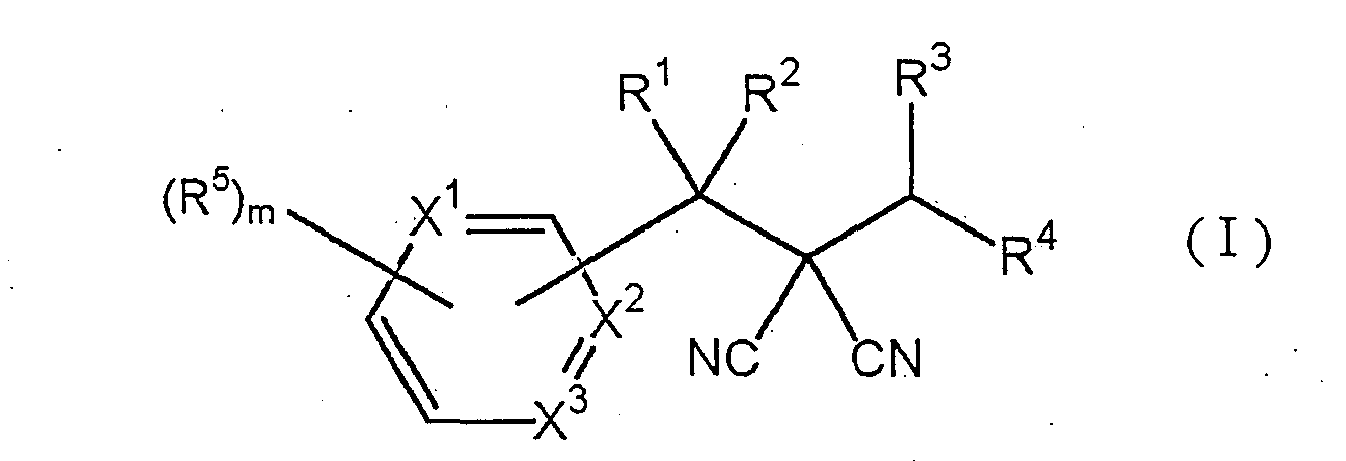 wobei in der FormelR1 einen gegebenenfalls mit einem oder mehreren Halogenatomen substituierten C1-C5-Alkylrest, einen gegebenenfalls mit einem oder mehreren Halogenatomen substituierten C2-C5-Alkenylrest, einen gegebenenfalls mit einem oder mehreren Halogenatomen substituierten C2-C5-Alkinylrest oder ein Wasserstoffatom darstellt;R2 einen gegebenenfalls mit einem oder mehreren Halogenatomen substituierten C1-C5-Alkylrest, einen gegebenenfalls mit einem oder mehreren Halogenatomen substituierten C1-C5-Alkoxyrest, einen gegebenenfalls mit einem oder mehreren Halogenatomen substituierten C2-C5-Alkenylrest, einen gegebenenfalls mit einem oder mehreren Halogenatomen substituierten C2-C5-Alkinylrest, eine Cyanogruppe oder ein Wasserstoffatom darstellt;R3 und R4 jeweils einen gegebenenfalls mit einem oder mehreren Halogenatomen substituierten C1-C5-Alkylrest, einen gegebenenfalls mit einem oder mehreren Halogenatomen substituierten C2-C5-Alkenylrest, einen gegebenenfalls mit einem oder mehreren Halogenatomen substituierten C2-C5-Alkinylrest, einen gegebenenfalls mit einem oder mehreren Halogenatomen substituierten C3-CS-Cycloalkylrest, einen gegebenenfalls mit einem oder mehreren Halogenatomen substituierten C5-C6-Cycloalkenylrest oder ein Wasserstoffatom darstellen,oder einen gegebenenfalls mit einem oder mehreren Halogenatomen substituierten C2-C6-Alkandiylrest oder einen gegebenenfalls mit einem oder mehreren Halogenatomen substituierten C4-C6-Alkendiylrest darstellen, wobei R3 und R4 jeweils an ihren Enden miteinander verknüpft sind;X1, X2 und X3 jeweils ein Stickstoffatom oder CR6 darstellen, mit der Maßgabe, dass zwei oder drei von X1, X2 und X3 ein Stickstoffatom darstellen;R6 ein Wasserstoffatom oder R5 darstellt;jedes R5 ein Halogenatom, eine Cyanogruppe, eine Nitrogruppe, eine Hydroxylgruppe, eine Mercaptogruppe, eine Formylgruppe, eine SF5-Gruppe, eine Carboxylgruppe, einen gegebenenfalls mit einem oder mehreren Halogenatomen substituierten C1-C5-Alkylrest, einen gegebenenfalls mit einem oder mehreren Halogenatomen substituierten C2-C5-Alkenylrest, einen gegebenenfalls mit einem oder mehreren Halogenatomen substituierten C2-C5-Alkinylrest, einen gegebenenfalls mit einem oder mehreren Halogenatomen substituierten C3-C5-Cycloalkylrest, einen gegebenenfalls mit einem oder mehreren Halogenatomen substituierten C1-C5-Alkoxyrest, einen gegebenenfalls mit einem oder mehreren Halogenatomen substituierten C3-C6-Alkenyloxyrest, einen gegebenenfalls mit einem oder mehreren Halogenatomen substituierten C3-C6-Alkinyloxyrest, einen gegebenenfalls mit einem oder mehreren Halogenatomen substituierten C1-C5-Alkylthiorest, einen gegebenenfalls mit einem oder mehreren Halogenatomen substituierten C3-C5-Alkenylthiorest, einen gegebenenfalls mit einem oder mehreren Halogenatomen substituierten C3-C5-Alkinylthiorest, einen gegebenenfalls mit einem oder mehreren Halogenatomen substituierten C1-C5-Alkylsulfinylrest, einen gegebenenfalls mit einem oder mehreren Halogenatomen substituierten C1-C5-Alkylsulfonylrest, einen gegebenenfalls mit einem oder mehreren Halogenatomen substituierten C2-C6-Alkylcarbonylrest, einen gegebenenfalls mit einem oder mehreren Halogenatomen substituierten C2-C5-Alkoxycarbonylrest, einen als -NR10R11 bezeichneten Rest, einen als -C(=X5)NR12R13 bezeichneten Rest oder einen als -C(=NOR14)R15 bezeichneten Rest darstellt, oderwenn m 2 ist und zwei R5 an benachbarte Kohlenstoffatome gebunden sind, diese einen C3-C6-Alkandiylrest oder einen C3-C6-Alkendiylrest darstellen können, der durch Verknüpfung der zwei R5 an ihren Enden gebildet wird, weiterhin unter dieser Bedingung eine in dem C3-C6-Alkandiylrest oder dem C3-C6-Alkendiylrest enthaltene Methylengruppe durch O, S(O)r oder N-R16 ersetzt sein kann und ein in dem C3-C6-Alkandiylrest oder dem C3-C6-Alkendiylrest enthaltenes Kohlenstoffatom mit einem Halogenatom oder einem gegebenenfalls mit einem oder mehreren Halogenatomen substituierten C1-C3-Alkoxyrest anstelle von (einem) Wasserstoffatom(en) verbunden sein kann;R10 und R11 jeweils einen gegebenenfalls mit einem oder mehreren Halogenatomen substituierten C1-C5-Alkylrest, einen gegebenenfalls mit einem oder mehreren Halogenatomen substituierten C3-C5-Alkenylrest, einen gegebenenfalls mit einem oder mehreren Halogenatomen substituierten C3-C5-Alkinylrest, einen gegebenenfalls mit einem oder mehreren Halogenatomen substituierten C3-C5-Cycloalkylrest, einen (gegebenenfalls mit einem oder mehreren Halogenatomen substituierten C1-C5-Alkoxy-)C1-C3-Alkylrest, einen gegebenenfalls mit einem oder mehreren Halogenatomen substituierten C1-C5-Alkylsulfonylrest, einen gegebenenfalls mit einem oder mehreren Halogenatomen substituierten C2-C6-Alkylcarbonylrest, einen gegebenenfalls mit einem oder mehreren Halogenatomen substituierten C2-C5-Alkoxycarbonylrest oder ein Wasserstoffatom darstellen,oder einen gegebenenfalls mit einem oder mehreren Halogenatomen substituierten C2-C6-Alkandiylrest oder einen gegebenenfalls mit einem oder mehreren Halogenatomen substituierten C4-C6-Alkendiylrest darstellen, wobei R10 und R11 jeweils an ihren Enden miteinander verknüpft sind;R12 und R13 jeweils einen gegebenenfalls mit einem oder mehreren Halogenatomen substituierten C1-C5-Alkylrest, einen gegebenenfalls mit einem oder mehreren Halogenatomen substituierten C3-C5-Alkenylrest, einen gegebenenfalls mit einem oder mehreren Halogenatomen substituierten C3-C5-Alkinylrest, einen gegebenenfalls mit einem oder mehreren Halogenatomen substituierten C3-C5-Cycloalkylrest, einen als -(CH2)nQ1 bezeichneten Rest oder ein Wasserstoffatom darstellen,oder einen gegebenenfalls mit einem oder mehreren Halogenatomen substituierten C2-C6-Alkandiylrest oder einen gegebenenfalls mit einem oder mehreren Halogenatomen substituierten C4-C6-Alkendiylrest darstellen, wobei R12 und R13 jeweils an ihren Enden miteinander verknüpft sind;R14 und R15 jeweils einen gegebenenfalls mit einem oder mehreren Halogenatomen substituierten C1-C5-Alkylrest, einen gegebenenfalls mit einem oder mehreren Halogenatomen substituierten C3-C5-Alkenylrest, einen gegebenenfalls mit einem oder mehreren Halogenatomen substituierten C3-C5-Alkinylrest, einen gegebenenfalls mit einem oder mehreren Halogenatomen substituierten C3-C5-Cycloalkylrest, einen als -(CH2)nQ2 bezeichneten Rest oder ein Wasserstoffatom darstellen;Q1 und Q2 jeweils eine Phenylgruppe darstellen, welche mit einem Rest ausgewählt aus einem gegebenenfalls mit einem oder mehreren Halogenatomen substituierten C1-C5-Alkylrest, einem gegebenenfalls mit einem oder mehreren Halogenatomen substituierten C1-C5-Alkoxyrest, einem gegebenenfalls mit einem oder mehreren Halogenatomen substituierten C1-C5-Alkylthiorest und einem Halogenatom substituiert sein kann;R16 einen C1-C3-Alkylrest darstellt; m eine ganze Zahl von 0 bis 2 darstellt; n eine ganze Zahl von 0 bis 3 darstellt; r eine ganze Zahl von 0 bis 2 darstellt; undX5 ein Sauerstoffatom oder ein Schwefelatom darstellt.
 - Malonsäuredinitrilverbindung gemäß Anspruch 1, wobei R3 ein Wasserstoffatom ist und R4 ein gegebenenfalls mit einem oder mehreren Halogenatomen substituierter C1-C5-Alkylrest, ein gegebenenfalls mit einem oder mehreren Halogenatomen substituierter C2-C5-Alkenylrest, ein gegebenenfalls mit einem oder mehreren Halogenatomen substituierter C2-C5-Alkinylrest, ein gegebenenfalls mit einem oder mehreren Halogenatomen substituierter C3-C5-Cycloalkylrest oder ein gegebenenfalls mit einem oder mehreren Halogenatomen substituierter C5-C6-Cycloalkenylrest ist.
- Malonsäuredinitrilverbindung gemäß Anspruch 1 der Formel (XI):
 wobei R1 einen gegebenenfalls mit einem oder mehreren Halogenatomen substituierten C1-C5-Alkylrest, einen gegebenenfalls mit einem oder mehreren Halogenatomen substituierten C2-C5-Alkenylrest, einen gegebenenfalls mit einem oder mehreren Halogenatomen substituierten C2-C5-Alkinylrest oder ein Wasserstoffatom darstellt;R2 einen gegebenenfalls mit einem oder mehreren Halogenatomen substituierten C1-C5-Alkylrest, einen gegebenenfalls mit einem oder mehreren Halogenatomen substituierten C1-C5-Alkoxyrest, einen gegebenenfalls mit einem oder mehreren Halogenatomen substituierten C2-C5-Alkenylrest, einen gegebenenfalls mit einem oder mehreren Halogenatomen substituierten C2-C5-Alkinylrest, eine Cyanogruppe oder ein Wasserstoffatom darstellt;R3 und R4 jeweils einen gegebenenfalls mit einem oder mehreren Halogenatomen substituierten C1-C5-Alkylrest, einen gegebenenfalls mit einem oder mehreren Halogenatomen substituierten C2-C5-Alkenylrest, einen gegebenenfalls mit einem oder mehreren Halogenatomen substituierten C2-C5-Alkinylrest, einen gegebenenfalls mit einem oder mehreren Halogenatomen substituierten C3-C5-Cycloalkylrest, einen gegebenenfalls mit einem oder mehreren Halogenatomen substituierten C5-C6-Cycloalkenylrest oder ein Wasserstoffatom darstellen,oder einen gegebenenfalls mit einem oder mehreren Halogenatomen substituierten C2-C6-Alkandiylrest oder einen gegebenenfalls mit einem oder mehreren Halogenatomen substituierten C4-C6-Alkendiylrest darstellen, wobei R3 und R4 jeweils an ihren Enden miteinander verknüpft sind;R5a ein Wasserstoffatom, Halogenatom, eine Cyanogruppe, eine Nitrogruppe, eine Hydroxylgruppe, eine Mercaptogruppe, eine Formylgruppe, eine SF5-Gruppe, eine Carboxylgruppe, einen gegebenenfalls mit einem oder mehreren Halogenatomen substituierten C1-C5-Alkylrest, einen gegebenenfalls mit einem oder mehreren Halogenatomen substituierten C2-C5-Alkenylrest, einen gegebenenfalls mit einem oder mehreren Halogenatomen substituierten C2-C5-Alkinylrest, einen gegebenenfalls mit einem oder mehreren Halogenatomen substituierten C3-C5-Cycloalkylrest, einen gegebenenfalls mit einem oder mehreren Halogenatomen substituierten C1-C5-Alkoxyrest, einen gegebenenfalls mit einem oder mehreren Halogenatomen substituierten C3-C6-Alkenyloxyrest, einen gegebenenfalls mit einem oder mehreren Halogenatomen substituierten C3-C6-Alkinyloxyrest, einen gegebenenfalls mit einem oder mehreren Halogenatomen substituierten C1-C5-Alkylthiorest, einen gegebenenfalls mit einem oder mehreren Halogenatomen substituierten C3-C5-Alkenylthiorest, einen gegebenenfalls mit einem oder mehreren Halogenatomen substituierten C3-C5-Alkinylthiorest, einen gegebenenfalls mit einem oder mehreren Halogenatomen substituierten C1-C5-Alkylsulfinylrest, einen gegebenenfalls mit einem oder mehreren Halogenatomen substituierten C1-C5-Alkylsulfonylrest, einen gegebenenfalls mit einem oder mehreren Halogenatomen substituierten C2-C6-Alkylcarbonylrest, einen gegebenenfalls mit einem oder mehreren Halogenatomen substituierten C2-C5-Alkoxycarbonylrest, einen als -NR10R11 bezeichneten Rest, einen als -C(=X5)NR12R13 bezeichneten Rest oder einen als -C(=NOR14)R15 bezeichneten Rest darstellt;R10 und R11 jeweils einen gegebenenfalls mit einem oder mehreren Halogenatomen substituierten C1-C5-Alkylrest, einen gegebenenfalls mit einem oder mehreren Halogenatomen substituierten C3-C5-Alkenylrest, einen gegebenenfalls mit einem oder mehreren Halogenatomen substituierten C3-C5-Alkinylrest, einen gegebenenfalls mit einem oder mehreren Halogenatomen substituierten C3-C5-Cycloalkylrest, einen (gegebenenfalls mit einem oder mehreren Halogenatomen substituierten C1-C5-Alkoxy-)C1-C3-Alkylrest, einen gegebenenfalls mit einem oder mehreren Halogenatomen substituierten C1-C5-Alkylsulfonylrest, einen gegebenenfalls mit einem oder mehreren Halogenatomen substituierten C2-C6-Alkylcarbonylrest, einen gegebenenfalls mit einem oder mehreren Halogenatomen substituierten C2-C5-Alkoxycarbonylrest oder ein Wasserstoffatom darstellen,oder einen gegebenenfalls mit einem oder mehreren Halogenatomen substituierten C2-C6-Alkandiylrest oder einen gegebenenfalls mit einem oder mehreren Halogenatomen substituierten C4-C6-Alkendiylrest darstellen, wobei R10 und R11 jeweils an ihren Enden miteinander verknüpft sind;R12 und R13 jeweils einen gegebenenfalls mit einem oder mehreren Halogenatomen substituierten C1-C5-Alkylrest, einen gegebenenfalls mit einem oder mehreren Halogenatomen substituierten C3-C5-Alkenylrest, einen gegebenenfalls mit einem oder mehreren Halogenatomen substituierten C3-C5-Alkinylrest, einen gegebenenfalls mit einem oder mehreren Halogenatomen substituierten C3-C5-Cycloalkylrest, einen als -(CH2)nQ1 bezeichneten Rest oder ein Wasserstoffatom darstellen,oder einen gegebenenfalls mit einem oder mehreren Halogenatomen substituierten C2-C6-Alkandiylrest oder einen gegebenenfalls mit einem oder mehreren Halogenatomen substituierten C4-C6-Alkendiylrest darstellen, wobei R12 und R13 jeweils an ihren Enden miteinander verknüpft sind;R14 und R15 jeweils einen gegebenenfalls mit einem oder mehreren Halogenatomen substituierten C1-C5-Alkylrest, einen gegebenenfalls mit einem oder mehreren Halogenatomen substituierten C3-C5-Alkenylrest, einen gegebenenfalls mit einem oder mehreren Halogenatomen substituierten C3-C5-Alkinylrest, einen gegebenenfalls mit einem oder mehreren Halogenatomen substituierten C3-C5-Cycloalkylrest, einen als -(CH2)nQ2 bezeichneten Rest oder ein Wasserstoffatom darstellen;Q1 und Q2 jeweils eine Phenylgruppe darstellen, welche mit einem Rest, ausgewählt aus einem gegebenenfalls mit einem oder mehreren Halogenatomen substituierten C1-C5-Alkylrest, einem gegebenenfalls mit einem oder mehreren Halogenatomen substituierten C1-C5-Alkoxyrest, einem gegebenenfalls mit einem oder mehreren Halogenatomen substituierten C1-C5-Alkylthiorest und einem Halogenatom, substituiert sein kann; und X5 ein Sauerstoffatom oder ein Schwefelatom darstellt.
 - Malonsäuredinitrilverbindung gemäß Anspruch 1 der Formel (XII):
 wobei R1 einen gegebenenfalls mit einem oder mehreren Halogenatomen substituierten C1-C5-Alkylrest, einen gegebenenfalls mit einem oder mehreren Halogenatomen substituierten C2-C5-Alkenylrest, einen gegebenenfalls mit einem oder mehreren Halogenatomen substituierten C2-C5-Alkinylrest oder ein Wasserstoffatom darstellt;R2 einen gegebenenfalls mit einem oder mehreren Halogenatomen substituierten C1-C5-Alkylrest, einen gegebenenfalls mit einem oder mehreren Halogenatomen substituierten C1-C5-Alkoxyrest, einen gegebenenfalls mit einem oder mehreren Halogenatomen substituierten C2-C5-Alkenylrest, einen gegebenenfalls mit einem oder mehreren Halogenatomen substituierten C2-C5-Alkinylrest, eine Cyanogruppe oder ein Wasserstoffatom darstellt;R3 und R4 jeweils einen gegebenenfalls mit einem oder mehreren Halogenatomen substituierten C1-C5-Alkylrest, einen gegebenenfalls mit einem oder mehreren Halogenatomen substituierten C2-C5-Alkenylrest, einen gegebenenfalls mit einem oder mehreren Halogenatomen substituierten C2-C5-Alkinylrest, einen gegebenenfalls mit einem oder mehreren Halogenatomen substituierten C3-C5-Cycloalkylrest, einen gegebenenfalls mit einem oder mehreren Halogenatomen substituierten C5-C6-Cycloalkenylrest oder ein Wasserstoffatom darstellen,oder einen gegebenenfalls mit einem oder mehreren Halogenatomen substituierten C2-C6-Alkandiylrest oder einen gegebenenfalls mit einem oder mehreren Halogenatomen substituierten C4-C6-Alkendiylrest darstellen, wobei R3 und R4 jeweils an ihren Enden miteinander verknüpft sind;R5 ein Halogenatom, eine Cyanogruppe, eine Nitrogruppe, eine Hydroxylgruppe, eine Mercaptogruppe, eine Formylgruppe, einen SF5-Gruppe, eine Carboxylgruppe, einen gegebenenfalls mit einem oder mehreren Halogenatomen substituierten C1-C5-Alkylrest, einen gegebenenfalls mit einem oder mehreren Halogenatomen substituierten C2-C5-Alkenylrest, einen gegebenenfalls mit einem oder mehreren Halogenatomen substituierten C2-C5-Alkinylrest, einen gegebenenfalls mit einem oder mehreren Halogenatomen substituierten C3-C5-Cycloalkylrest, einen gegebenenfalls mit einem oder mehreren Halogenatomen substituierten C1-C5-Alkoxyrest, einen gegebenenfalls mit einem oder mehreren Halogenatomen substituierten C3-C6-Alkenyloxyrest, einen gegebenenfalls mit einem oder mehreren Halogenatomen substituierten C3-C6-Alkinyloxyrest, einen gegebenenfalls mit einem oder mehreren Halogenatomen substituierten C1-C5-Alkylthiorest, einen gegebenenfalls mit einem oder mehreren Halogenatomen substituierten C3-C5-Alkenylthiorest, einen gegebenenfalls mit einem oder mehreren Halogenatomen substituierten C3-C5-Alkinylthiorest, einen gegebenenfalls mit einem oder mehreren Halogenatomen substituierten C1-C5-Alkylsulfinylrest, einen gegebenenfalls mit einem oder mehreren Halogenatomen substituierten C1-C5-Alkylsulfonylrest, einen gegebenenfalls mit einem oder mehreren Halogenatomen substituierten C2-C6-Alkylcarbonylrest, einen gegebenenfalls mit einem oder mehreren Halogenatomen substituierten C2-C5-Alkoxycarbonylrest, einen als -NR10R11 bezeichneten Rest, einen als -C(=X5)NR12R13 bezeichneten Rest oder einen als -C(=NOR14)R15 bezeichneten Rest darstellt;R10 und R11 jeweils einen gegebenenfalls mit einem oder mehreren Halogenatomen substituierten C1-C5-Alkylrest, einen gegebenenfalls mit einem oder mehreren Halogenatomen substituierten C3-C5-Alkenylrest, einen gegebenenfalls mit einem oder mehreren Halogenatomen substituierten C3-C5-Alkinylrest, einen gegebenenfalls mit einem oder mehreren Halogenatomen substituierten C3-C5-Cycloalkylrest, einen (gegebenenfalls mit einem oder mehreren Halogenatomen substituierten C1-C5-Alkoxy-)C1-C3-Alkylrest, einen gegebenenfalls mit einem oder mehreren Halogenatomen substituierten C1-C5-Alkylsulfonylrest, einen gegebenenfalls mit einem oder mehreren Halogenatomen substituierten C2-C6-Alkylcarbonylrest, einen gegebenenfalls mit einem oder mehreren Halogenatomen substituierten C2-C5-Alkoxycarbonylrest oder ein Wasserstoffatom darstellen,oder einen gegebenenfalls mit einem oder mehreren Halogenatomen substituierten C2-C6-Alkandiylrest oder einen gegebenenfalls mit einem oder mehreren Halogenatomen substituierten C4-C6-Alkendiylrest darstellen, wobei R10 und R11 jeweils an ihren Enden miteinander verknüpft sind;R12 und R13 jeweils einen gegebenenfalls mit einem oder mehreren Halogenatomen substituierten C1-C5-Alkylrest, einen gegebenenfalls mit einem oder mehreren Halogenatomen substituierten C3-C5-Alkenylrest, einen gegebenenfalls mit einem oder mehreren Halogenatomen substituierten C3-C5-Alkinylrest, einen gegebenenfalls mit einem oder mehreren Halogenatomen substituierten C3-C5-Cycloalkylrest, einen als -(CH2)nQ1 bezeichneten Rest oder ein Wasserstoffatom darstellen,oder einen gegebenenfalls mit einem oder mehreren Halogenatomen substituierten C2-C6-Alkandiylrest oder einen gegebenenfalls mit einem oder mehreren Halogenatomen substituierten C4-C6-Alkendiylrest darstellen, wobei R12 und R13 jeweils an ihren Enden miteinander verknüpft sind;R14 und R15 jeweils einen gegebenenfalls mit einem oder mehreren Halogenatomen substituierten C1-C5-Alkylrest, einen gegebenenfalls mit einem oder mehreren Halogenatomen substituierten C3-C5-Alkenylrest, einen gegebenenfalls mit einem oder mehreren Halogenatomen substituierten C3-C5-Alkinylrest, einen gegebenenfalls mit einem oder mehreren Halogenatomen substituierten C3-C5-Cycloalkylrest, einen als -(CH2)nQ2 bezeichneten Rest oder ein Wasserstoffatom darstellen;Q1 und Q2 jeweils eine Phenylgruppe darstellen, welche mit einem Rest, ausgewählt aus einem gegebenenfalls mit einem oder mehreren Halogenatomen substituierten C1-C5-Alkylrest, einem gegebenenfalls mit einem oder mehreren Halogenatomen substituierten Cl-C5-Alkoxyrest, einem gegebenenfalls mit einem oder mehreren Halogenatomen substituierten C1-C5-Alkylthiorest und einem Halogenatom, substituiert sein kann;X5 ein Sauerstoffatom oder ein Schwefelatom darstellt; und m eine ganze Zahl von 0 bis 2 darstellt.
 - Malonsäuredinitrilverbindung gemäß Anspruch 1 der Formel (XIII):
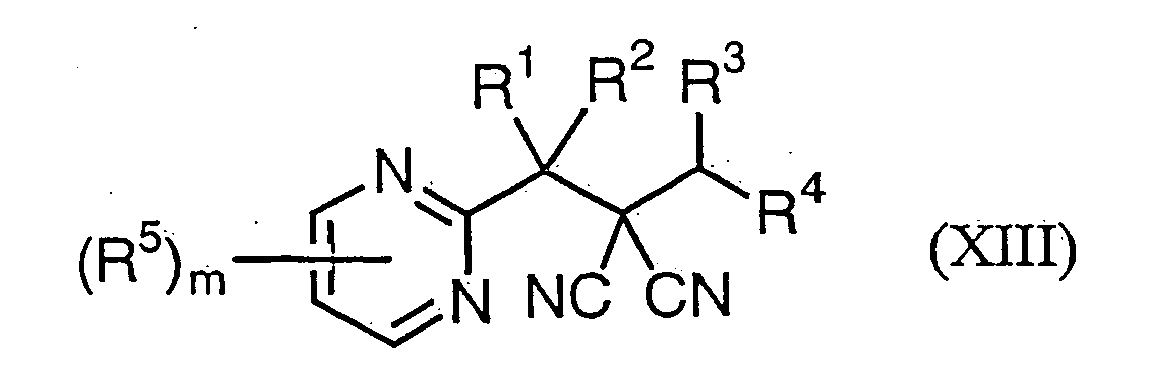 wobei R1, R2, R3, R4 und R5 die gleiche Bedeutung wie in Anspruch 4 haben, und m eine ganze Zahl von 0 to 3 darstellt.
 - Malonsäuredinitrilverbindung gemäß Anspruch 1 der Formel (XIV):

- Malonsäuredinitrilverbindung gemäß Anspruch 1 der Formel (XV):

- Pestizidzusammensetzung umfassend die Malonsäuredinitrilverbindung gemäß einem der Ansprüche 1 bis 7 als aktiven Bestandteil und einen inerten Träger.
- Verfahren zur Schädlingsbekämpfung, wobei Verfahren zur therapeutischen Behandlung des menschlichen oder tierischen Körpers ausgeschlossen sind, umfassend das Anwenden einer wirksamen Menge der Malonsäuredinitrilverbindung gemäß einem der Ansprüche 1 bis 7 auf Schädlinge oder den Lebensraum von Schädlingen.
- Verwendung der Malonsäuredinitrilverbindung gemäß einem der Ansprüche 1 bis 7 zur Herstellung eines Tierheilmittels für die systemische oder nicht-systemische Kontrolle von Parasiten.
- Malonsäuredinitrilverbindung gemäß einem der Ansprüche 1 bis 7 zur Verwendung in der Therapie von mit Schädlingen befallenen Tieren.
Applications Claiming Priority (2)
| Application Number | Priority Date | Filing Date | Title |
|---|---|---|---|
| JP2004009151 | 2004-01-16 | ||
| JP2004009151 | 2004-01-16 |
Publications (3)
| Publication Number | Publication Date |
|---|---|
| EP1555259A1 EP1555259A1 (de) | 2005-07-20 |
| EP1555259B1 true EP1555259B1 (de) | 2008-01-02 |
| EP1555259B8 EP1555259B8 (de) | 2008-05-28 |
Family
ID=34616905
Family Applications (1)
| Application Number | Title | Priority Date | Filing Date |
|---|---|---|---|
| EP05000594A Expired - Lifetime EP1555259B8 (de) | 2004-01-16 | 2005-01-13 | Malononitrilverbindungen als Pestizide |
Country Status (4)
| Country | Link |
|---|---|
| EP (1) | EP1555259B8 (de) |
| CN (1) | CN100412064C (de) |
| AT (1) | ATE382609T1 (de) |
| DE (1) | DE602005004040T2 (de) |
Families Citing this family (11)
| Publication number | Priority date | Publication date | Assignee | Title |
|---|---|---|---|---|
| US20090136551A1 (en) * | 2005-08-05 | 2009-05-28 | Basf Aktiengesellschaft | Substituted Dicyanoalkanes For Combating Animal Pests |
| AU2006328521A1 (en) * | 2005-12-22 | 2007-06-28 | Basf Se | Malononitrile compounds |
| MX2008016215A (es) | 2006-06-22 | 2009-01-19 | Basf Se | Compuestos de malononitrilo. |
| CN101638390B (zh) * | 2008-07-29 | 2012-12-05 | 上海合全药业有限公司 | 6-甲基-3-氨基哒嗪的工业化制备方法 |
| WO2010013849A1 (ja) | 2008-08-01 | 2010-02-04 | 日本ケミファ株式会社 | Gpr119作動薬 |
| RU2542988C2 (ru) | 2009-07-31 | 2015-02-27 | Глоубал Элаенс Фор Тб Драг Дивелопмент | Нитроимидазооксазины и их применения при противотуберкулезной терапии |
| EP2474540A4 (de) | 2009-08-31 | 2013-03-13 | Nippon Chemiphar Co | Gpr119-agonist |
| JP2016501264A (ja) | 2012-12-14 | 2016-01-18 | ビーエーエスエフ ソシエタス・ヨーロピアBasf Se | 動物有害生物を防除するためのマロノニトリル化合物 |
| BR112016013795B1 (pt) * | 2013-12-20 | 2021-01-12 | Basf Se | usos de um composto de fórmula (i), método para combater pragas invertebradas que atacam plantas, método para proteger culturas do ataque ou infestação por pragas invertebradas que atacam plantas, método para proteger sementes, sementes, método para tratar ou proteger animais contra infestação ou infecção por parasitas, método para preparar uma composição, compostos de fórmula (i), composição agrícola e/ou veterinária e método para preparar um composto de fórmula (i) |
| WO2015158603A1 (en) * | 2014-04-16 | 2015-10-22 | Basf Se | Malononitrile oxime compounds |
| JP6682719B2 (ja) | 2014-04-17 | 2020-04-15 | ベーリンガー インゲルハイム アニマル ヘルス ユーエスエイ インコーポレイテッド | 寄生生物から動物を保護するためのマロノニトリル化合物の使用 |
Family Cites Families (3)
| Publication number | Priority date | Publication date | Assignee | Title |
|---|---|---|---|---|
| JPH1029966A (ja) * | 1996-07-17 | 1998-02-03 | Mitsubishi Chem Corp | マロノニトリル誘導体およびこれを有効成分とする除草剤 |
| JP4269574B2 (ja) * | 2001-05-09 | 2009-05-27 | 住友化学株式会社 | マロノニトリル化合物及びその用途 |
| ATE345683T1 (de) * | 2002-07-17 | 2006-12-15 | Sumitomo Chemical Co | Malonsäuerenitril-verbindungen und ihre verwendung als pestizide |
-
2005
- 2005-01-13 DE DE602005004040T patent/DE602005004040T2/de not_active Expired - Lifetime
- 2005-01-13 AT AT05000594T patent/ATE382609T1/de not_active IP Right Cessation
- 2005-01-13 EP EP05000594A patent/EP1555259B8/de not_active Expired - Lifetime
- 2005-01-14 CN CNB2005100043281A patent/CN100412064C/zh not_active Expired - Fee Related
Also Published As
| Publication number | Publication date |
|---|---|
| CN1648122A (zh) | 2005-08-03 |
| DE602005004040T2 (de) | 2008-12-11 |
| EP1555259A1 (de) | 2005-07-20 |
| ATE382609T1 (de) | 2008-01-15 |
| CN100412064C (zh) | 2008-08-20 |
| EP1555259B8 (de) | 2008-05-28 |
| DE602005004040D1 (de) | 2008-02-14 |
Similar Documents
| Publication | Publication Date | Title |
|---|---|---|
| EP1521528B1 (de) | Malonsäuerenitril-verbindungen und ihre verwendung als pestizide | |
| US7541374B2 (en) | Malononitrile compounds and use thereof | |
| EP1704143B1 (de) | Malonsäuredinitrilverbindung als pestizide | |
| US7439266B2 (en) | Malononitrile compound and use thereof | |
| AU2006317486B9 (en) | Organic sulfur compounds and use thereof as arthropodicides | |
| EP1392647A1 (de) | Malonsäuredinitrilverbindungen und deren verwendung als pestizide | |
| DE602005004040T2 (de) | Malononitrilverbindungen als Pestizide | |
| JP4670355B2 (ja) | 含窒素6員環を有するマロノニトリル化合物とその用途 | |
| KR100967333B1 (ko) | 말로노니트릴 화합물 및 이의 살충제로서의 용도 |
Legal Events
| Date | Code | Title | Description |
|---|---|---|---|
| PUAI | Public reference made under article 153(3) epc to a published international application that has entered the european phase |
Free format text: ORIGINAL CODE: 0009012 |
|
| AK | Designated contracting states |
Kind code of ref document: A1 Designated state(s): AT BE BG CH CY CZ DE DK EE ES FI FR GB GR HU IE IS IT LI LT LU MC NL PL PT RO SE SI SK TR |
|
| AX | Request for extension of the european patent |
Extension state: AL BA HR LV MK YU |
|
| 17P | Request for examination filed |
Effective date: 20050824 |
|
| AKX | Designation fees paid |
Designated state(s): AT BE BG CH CY CZ DE DK EE ES FI FR GB GR HU IE IS IT LI LT LU MC NL PL PT RO SE SI SK TR |
|
| GRAP | Despatch of communication of intention to grant a patent |
Free format text: ORIGINAL CODE: EPIDOSNIGR1 |
|
| GRAS | Grant fee paid |
Free format text: ORIGINAL CODE: EPIDOSNIGR3 |
|
| GRAA | (expected) grant |
Free format text: ORIGINAL CODE: 0009210 |
|
| AK | Designated contracting states |
Kind code of ref document: B1 Designated state(s): AT BE BG CH CY CZ DE DK EE ES FI FR GB GR HU IE IS IT LI LT LU MC NL PL PT RO SE SI SK TR |
|
| REG | Reference to a national code |
Ref country code: GB Ref legal event code: FG4D |
|
| REG | Reference to a national code |
Ref country code: IE Ref legal event code: FG4D |
|
| REG | Reference to a national code |
Ref country code: CH Ref legal event code: EP |
|
| REF | Corresponds to: |
Ref document number: 602005004040 Country of ref document: DE Date of ref document: 20080214 Kind code of ref document: P |
|
| PG25 | Lapsed in a contracting state [announced via postgrant information from national office to epo] |
Ref country code: NL Free format text: LAPSE BECAUSE OF FAILURE TO SUBMIT A TRANSLATION OF THE DESCRIPTION OR TO PAY THE FEE WITHIN THE PRESCRIBED TIME-LIMIT Effective date: 20080102 Ref country code: SI Free format text: LAPSE BECAUSE OF FAILURE TO SUBMIT A TRANSLATION OF THE DESCRIPTION OR TO PAY THE FEE WITHIN THE PRESCRIBED TIME-LIMIT Effective date: 20080102 |
|
| NLV1 | Nl: lapsed or annulled due to failure to fulfill the requirements of art. 29p and 29m of the patents act | ||
| PG25 | Lapsed in a contracting state [announced via postgrant information from national office to epo] |
Ref country code: IS Free format text: LAPSE BECAUSE OF FAILURE TO SUBMIT A TRANSLATION OF THE DESCRIPTION OR TO PAY THE FEE WITHIN THE PRESCRIBED TIME-LIMIT Effective date: 20080502 Ref country code: LI Free format text: LAPSE BECAUSE OF FAILURE TO SUBMIT A TRANSLATION OF THE DESCRIPTION OR TO PAY THE FEE WITHIN THE PRESCRIBED TIME-LIMIT Effective date: 20080102 Ref country code: FI Free format text: LAPSE BECAUSE OF FAILURE TO SUBMIT A TRANSLATION OF THE DESCRIPTION OR TO PAY THE FEE WITHIN THE PRESCRIBED TIME-LIMIT Effective date: 20080102 Ref country code: ES Free format text: LAPSE BECAUSE OF FAILURE TO SUBMIT A TRANSLATION OF THE DESCRIPTION OR TO PAY THE FEE WITHIN THE PRESCRIBED TIME-LIMIT Effective date: 20080413 Ref country code: CH Free format text: LAPSE BECAUSE OF FAILURE TO SUBMIT A TRANSLATION OF THE DESCRIPTION OR TO PAY THE FEE WITHIN THE PRESCRIBED TIME-LIMIT Effective date: 20080102 Ref country code: LT Free format text: LAPSE BECAUSE OF FAILURE TO SUBMIT A TRANSLATION OF THE DESCRIPTION OR TO PAY THE FEE WITHIN THE PRESCRIBED TIME-LIMIT Effective date: 20080102 |
|
| REG | Reference to a national code |
Ref country code: CH Ref legal event code: PL |
|
| REG | Reference to a national code |
Ref country code: HU Ref legal event code: AG4A Ref document number: E003200 Country of ref document: HU |
|
| PG25 | Lapsed in a contracting state [announced via postgrant information from national office to epo] |
Ref country code: MC Free format text: LAPSE BECAUSE OF NON-PAYMENT OF DUE FEES Effective date: 20080131 Ref country code: AT Free format text: LAPSE BECAUSE OF FAILURE TO SUBMIT A TRANSLATION OF THE DESCRIPTION OR TO PAY THE FEE WITHIN THE PRESCRIBED TIME-LIMIT Effective date: 20080102 Ref country code: BG Free format text: LAPSE BECAUSE OF FAILURE TO SUBMIT A TRANSLATION OF THE DESCRIPTION OR TO PAY THE FEE WITHIN THE PRESCRIBED TIME-LIMIT Effective date: 20080402 |
|
| PG25 | Lapsed in a contracting state [announced via postgrant information from national office to epo] |
Ref country code: BE Free format text: LAPSE BECAUSE OF FAILURE TO SUBMIT A TRANSLATION OF THE DESCRIPTION OR TO PAY THE FEE WITHIN THE PRESCRIBED TIME-LIMIT Effective date: 20080102 Ref country code: PT Free format text: LAPSE BECAUSE OF FAILURE TO SUBMIT A TRANSLATION OF THE DESCRIPTION OR TO PAY THE FEE WITHIN THE PRESCRIBED TIME-LIMIT Effective date: 20080602 Ref country code: PL Free format text: LAPSE BECAUSE OF FAILURE TO SUBMIT A TRANSLATION OF THE DESCRIPTION OR TO PAY THE FEE WITHIN THE PRESCRIBED TIME-LIMIT Effective date: 20080102 |
|
| EN | Fr: translation not filed | ||
| REG | Reference to a national code |
Ref country code: IE Ref legal event code: MM4A |
|
| PG25 | Lapsed in a contracting state [announced via postgrant information from national office to epo] |
Ref country code: SK Free format text: LAPSE BECAUSE OF FAILURE TO SUBMIT A TRANSLATION OF THE DESCRIPTION OR TO PAY THE FEE WITHIN THE PRESCRIBED TIME-LIMIT Effective date: 20080102 Ref country code: CZ Free format text: LAPSE BECAUSE OF FAILURE TO SUBMIT A TRANSLATION OF THE DESCRIPTION OR TO PAY THE FEE WITHIN THE PRESCRIBED TIME-LIMIT Effective date: 20080102 Ref country code: DK Free format text: LAPSE BECAUSE OF FAILURE TO SUBMIT A TRANSLATION OF THE DESCRIPTION OR TO PAY THE FEE WITHIN THE PRESCRIBED TIME-LIMIT Effective date: 20080102 Ref country code: SE Free format text: LAPSE BECAUSE OF FAILURE TO SUBMIT A TRANSLATION OF THE DESCRIPTION OR TO PAY THE FEE WITHIN THE PRESCRIBED TIME-LIMIT Effective date: 20080402 |
|
| PLBE | No opposition filed within time limit |
Free format text: ORIGINAL CODE: 0009261 |
|
| STAA | Information on the status of an ep patent application or granted ep patent |
Free format text: STATUS: NO OPPOSITION FILED WITHIN TIME LIMIT |
|
| PG25 | Lapsed in a contracting state [announced via postgrant information from national office to epo] |
Ref country code: RO Free format text: LAPSE BECAUSE OF FAILURE TO SUBMIT A TRANSLATION OF THE DESCRIPTION OR TO PAY THE FEE WITHIN THE PRESCRIBED TIME-LIMIT Effective date: 20080102 |
|
| 26N | No opposition filed |
Effective date: 20081003 |
|
| PG25 | Lapsed in a contracting state [announced via postgrant information from national office to epo] |
Ref country code: IE Free format text: LAPSE BECAUSE OF NON-PAYMENT OF DUE FEES Effective date: 20080114 Ref country code: EE Free format text: LAPSE BECAUSE OF FAILURE TO SUBMIT A TRANSLATION OF THE DESCRIPTION OR TO PAY THE FEE WITHIN THE PRESCRIBED TIME-LIMIT Effective date: 20080102 |
|
| PG25 | Lapsed in a contracting state [announced via postgrant information from national office to epo] |
Ref country code: FR Free format text: LAPSE BECAUSE OF FAILURE TO SUBMIT A TRANSLATION OF THE DESCRIPTION OR TO PAY THE FEE WITHIN THE PRESCRIBED TIME-LIMIT Effective date: 20081024 |
|
| PG25 | Lapsed in a contracting state [announced via postgrant information from national office to epo] |
Ref country code: CY Free format text: LAPSE BECAUSE OF FAILURE TO SUBMIT A TRANSLATION OF THE DESCRIPTION OR TO PAY THE FEE WITHIN THE PRESCRIBED TIME-LIMIT Effective date: 20080102 |
|
| GBPC | Gb: european patent ceased through non-payment of renewal fee |
Effective date: 20090113 |
|
| PG25 | Lapsed in a contracting state [announced via postgrant information from national office to epo] |
Ref country code: GB Free format text: LAPSE BECAUSE OF NON-PAYMENT OF DUE FEES Effective date: 20090113 |
|
| PG25 | Lapsed in a contracting state [announced via postgrant information from national office to epo] |
Ref country code: LU Free format text: LAPSE BECAUSE OF NON-PAYMENT OF DUE FEES Effective date: 20080113 |
|
| PG25 | Lapsed in a contracting state [announced via postgrant information from national office to epo] |
Ref country code: TR Free format text: LAPSE BECAUSE OF FAILURE TO SUBMIT A TRANSLATION OF THE DESCRIPTION OR TO PAY THE FEE WITHIN THE PRESCRIBED TIME-LIMIT Effective date: 20080102 |
|
| PG25 | Lapsed in a contracting state [announced via postgrant information from national office to epo] |
Ref country code: GR Free format text: LAPSE BECAUSE OF FAILURE TO SUBMIT A TRANSLATION OF THE DESCRIPTION OR TO PAY THE FEE WITHIN THE PRESCRIBED TIME-LIMIT Effective date: 20080403 |
|
| PGFP | Annual fee paid to national office [announced via postgrant information from national office to epo] |
Ref country code: IT Payment date: 20120118 Year of fee payment: 8 |
|
| PGFP | Annual fee paid to national office [announced via postgrant information from national office to epo] |
Ref country code: DE Payment date: 20130109 Year of fee payment: 9 Ref country code: HU Payment date: 20121221 Year of fee payment: 9 |
|
| REG | Reference to a national code |
Ref country code: DE Ref legal event code: R119 Ref document number: 602005004040 Country of ref document: DE |
|
| PG25 | Lapsed in a contracting state [announced via postgrant information from national office to epo] |
Ref country code: DE Free format text: LAPSE BECAUSE OF NON-PAYMENT OF DUE FEES Effective date: 20140801 |
|
| REG | Reference to a national code |
Ref country code: DE Ref legal event code: R119 Ref document number: 602005004040 Country of ref document: DE Effective date: 20140801 |
|
| PG25 | Lapsed in a contracting state [announced via postgrant information from national office to epo] |
Ref country code: HU Free format text: LAPSE BECAUSE OF NON-PAYMENT OF DUE FEES Effective date: 20140114 |
|
| PG25 | Lapsed in a contracting state [announced via postgrant information from national office to epo] |
Ref country code: IT Free format text: LAPSE BECAUSE OF NON-PAYMENT OF DUE FEES Effective date: 20140113 |