EP1554924A1 - Heat-insulating material for agricultural or horticultural facility - Google Patents
Heat-insulating material for agricultural or horticultural facility Download PDFInfo
- Publication number
- EP1554924A1 EP1554924A1 EP03809431A EP03809431A EP1554924A1 EP 1554924 A1 EP1554924 A1 EP 1554924A1 EP 03809431 A EP03809431 A EP 03809431A EP 03809431 A EP03809431 A EP 03809431A EP 1554924 A1 EP1554924 A1 EP 1554924A1
- Authority
- EP
- European Patent Office
- Prior art keywords
- resin
- heat shield
- heat shielding
- heat
- agricultural
- Prior art date
- Legal status (The legal status is an assumption and is not a legal conclusion. Google has not performed a legal analysis and makes no representation as to the accuracy of the status listed.)
- Withdrawn
Links
- 239000011810 insulating material Substances 0.000 title 1
- 238000002834 transmittance Methods 0.000 claims abstract description 83
- 229920005989 resin Polymers 0.000 claims abstract description 81
- 239000011347 resin Substances 0.000 claims abstract description 81
- 239000000463 material Substances 0.000 claims abstract description 77
- 239000010419 fine particle Substances 0.000 claims abstract description 47
- 230000005855 radiation Effects 0.000 claims abstract description 31
- 239000000945 filler Substances 0.000 claims abstract description 27
- 239000000758 substrate Substances 0.000 claims abstract description 18
- -1 polyethylene Polymers 0.000 claims abstract description 12
- XOLBLPGZBRYERU-UHFFFAOYSA-N tin dioxide Chemical compound O=[Sn]=O XOLBLPGZBRYERU-UHFFFAOYSA-N 0.000 claims abstract description 8
- 239000004743 Polypropylene Substances 0.000 claims abstract description 7
- 229920001155 polypropylene Polymers 0.000 claims abstract description 7
- 229910052746 lanthanum Inorganic materials 0.000 claims abstract description 6
- FZLIPJUXYLNCLC-UHFFFAOYSA-N lanthanum atom Chemical compound [La] FZLIPJUXYLNCLC-UHFFFAOYSA-N 0.000 claims abstract description 6
- 229920000915 polyvinyl chloride Polymers 0.000 claims abstract description 6
- 239000004800 polyvinyl chloride Substances 0.000 claims abstract description 6
- 229910001887 tin oxide Inorganic materials 0.000 claims abstract description 6
- 239000004372 Polyvinyl alcohol Substances 0.000 claims abstract description 4
- 229920001328 Polyvinylidene chloride Polymers 0.000 claims abstract description 4
- 239000005038 ethylene vinyl acetate Substances 0.000 claims abstract description 4
- 229920001200 poly(ethylene-vinyl acetate) Polymers 0.000 claims abstract description 4
- 229920002451 polyvinyl alcohol Polymers 0.000 claims abstract description 4
- 239000005033 polyvinylidene chloride Substances 0.000 claims abstract description 4
- 239000011159 matrix material Substances 0.000 claims description 16
- 229920013716 polyethylene resin Polymers 0.000 claims description 6
- 229920001225 polyester resin Polymers 0.000 claims description 3
- 239000004645 polyester resin Substances 0.000 claims description 3
- 229920005990 polystyrene resin Polymers 0.000 claims description 3
- 239000004698 Polyethylene Substances 0.000 abstract 1
- 239000004793 Polystyrene Substances 0.000 abstract 1
- 229920000728 polyester Polymers 0.000 abstract 1
- 229920000573 polyethylene Polymers 0.000 abstract 1
- 229920002223 polystyrene Polymers 0.000 abstract 1
- 230000000694 effects Effects 0.000 description 22
- 238000012216 screening Methods 0.000 description 17
- 239000002245 particle Substances 0.000 description 13
- 238000000576 coating method Methods 0.000 description 11
- 238000010521 absorption reaction Methods 0.000 description 10
- 229920001684 low density polyethylene Polymers 0.000 description 10
- 239000004702 low-density polyethylene Substances 0.000 description 10
- 239000011248 coating agent Substances 0.000 description 9
- 239000006185 dispersion Substances 0.000 description 9
- 238000000034 method Methods 0.000 description 7
- 238000002156 mixing Methods 0.000 description 7
- 239000008188 pellet Substances 0.000 description 7
- 241000238631 Hexapoda Species 0.000 description 6
- YXFVVABEGXRONW-UHFFFAOYSA-N Toluene Chemical compound CC1=CC=CC=C1 YXFVVABEGXRONW-UHFFFAOYSA-N 0.000 description 6
- 239000000203 mixture Substances 0.000 description 6
- 239000000843 powder Substances 0.000 description 6
- 238000004040 coloring Methods 0.000 description 5
- 238000002844 melting Methods 0.000 description 5
- 230000008018 melting Effects 0.000 description 5
- 230000008635 plant growth Effects 0.000 description 5
- 230000010152 pollination Effects 0.000 description 5
- 241000256837 Apidae Species 0.000 description 4
- 208000037265 diseases, disorders, signs and symptoms Diseases 0.000 description 4
- 239000011521 glass Substances 0.000 description 4
- 238000005259 measurement Methods 0.000 description 4
- 230000003287 optical effect Effects 0.000 description 4
- 239000002904 solvent Substances 0.000 description 4
- 238000000411 transmission spectrum Methods 0.000 description 4
- MQIUGAXCHLFZKX-UHFFFAOYSA-N Di-n-octyl phthalate Natural products CCCCCCCCOC(=O)C1=CC=CC=C1C(=O)OCCCCCCCC MQIUGAXCHLFZKX-UHFFFAOYSA-N 0.000 description 3
- 239000006096 absorbing agent Substances 0.000 description 3
- BJQHLKABXJIVAM-UHFFFAOYSA-N bis(2-ethylhexyl) phthalate Chemical compound CCCCC(CC)COC(=O)C1=CC=CC=C1C(=O)OCC(CC)CCCC BJQHLKABXJIVAM-UHFFFAOYSA-N 0.000 description 3
- 238000003490 calendering Methods 0.000 description 3
- 230000000052 comparative effect Effects 0.000 description 3
- 239000002270 dispersing agent Substances 0.000 description 3
- 229910010272 inorganic material Inorganic materials 0.000 description 3
- 239000011147 inorganic material Substances 0.000 description 3
- 238000004898 kneading Methods 0.000 description 3
- 239000007788 liquid Substances 0.000 description 3
- 239000011368 organic material Substances 0.000 description 3
- 239000004014 plasticizer Substances 0.000 description 3
- 238000001228 spectrum Methods 0.000 description 3
- RYGMFSIKBFXOCR-UHFFFAOYSA-N Copper Chemical compound [Cu] RYGMFSIKBFXOCR-UHFFFAOYSA-N 0.000 description 2
- JPVYNHNXODAKFH-UHFFFAOYSA-N Cu2+ Chemical compound [Cu+2] JPVYNHNXODAKFH-UHFFFAOYSA-N 0.000 description 2
- VYPSYNLAJGMNEJ-UHFFFAOYSA-N Silicium dioxide Chemical compound O=[Si]=O VYPSYNLAJGMNEJ-UHFFFAOYSA-N 0.000 description 2
- XLOMVQKBTHCTTD-UHFFFAOYSA-N Zinc monoxide Chemical compound [Zn]=O XLOMVQKBTHCTTD-UHFFFAOYSA-N 0.000 description 2
- 238000005299 abrasion Methods 0.000 description 2
- 230000002411 adverse Effects 0.000 description 2
- 239000011230 binding agent Substances 0.000 description 2
- 230000005540 biological transmission Effects 0.000 description 2
- 230000000903 blocking effect Effects 0.000 description 2
- 229910052802 copper Inorganic materials 0.000 description 2
- 239000010949 copper Substances 0.000 description 2
- 229910001431 copper ion Inorganic materials 0.000 description 2
- 239000007822 coupling agent Substances 0.000 description 2
- 201000010099 disease Diseases 0.000 description 2
- 230000014759 maintenance of location Effects 0.000 description 2
- 241001074085 Scophthalmus aquosus Species 0.000 description 1
- GWEVSGVZZGPLCZ-UHFFFAOYSA-N Titan oxide Chemical compound O=[Ti]=O GWEVSGVZZGPLCZ-UHFFFAOYSA-N 0.000 description 1
- 239000000654 additive Substances 0.000 description 1
- XAGFODPZIPBFFR-UHFFFAOYSA-N aluminium Chemical compound [Al] XAGFODPZIPBFFR-UHFFFAOYSA-N 0.000 description 1
- LJCFOYOSGPHIOO-UHFFFAOYSA-N antimony pentoxide Inorganic materials O=[Sb](=O)O[Sb](=O)=O LJCFOYOSGPHIOO-UHFFFAOYSA-N 0.000 description 1
- 239000003963 antioxidant agent Substances 0.000 description 1
- RWCCWEUUXYIKHB-UHFFFAOYSA-N benzophenone Chemical compound C=1C=CC=CC=1C(=O)C1=CC=CC=C1 RWCCWEUUXYIKHB-UHFFFAOYSA-N 0.000 description 1
- 239000012965 benzophenone Substances 0.000 description 1
- 230000015572 biosynthetic process Effects 0.000 description 1
- 230000000740 bleeding effect Effects 0.000 description 1
- 239000006229 carbon black Substances 0.000 description 1
- 238000005266 casting Methods 0.000 description 1
- 230000015556 catabolic process Effects 0.000 description 1
- 229910000420 cerium oxide Inorganic materials 0.000 description 1
- 229910052681 coesite Inorganic materials 0.000 description 1
- 239000002131 composite material Substances 0.000 description 1
- 229920001577 copolymer Polymers 0.000 description 1
- 150000004699 copper complex Chemical class 0.000 description 1
- 238000003851 corona treatment Methods 0.000 description 1
- 229910052906 cristobalite Inorganic materials 0.000 description 1
- 230000003247 decreasing effect Effects 0.000 description 1
- 238000006731 degradation reaction Methods 0.000 description 1
- 230000001627 detrimental effect Effects 0.000 description 1
- 238000003618 dip coating Methods 0.000 description 1
- 238000001035 drying Methods 0.000 description 1
- 239000000428 dust Substances 0.000 description 1
- 238000002296 dynamic light scattering Methods 0.000 description 1
- 238000001125 extrusion Methods 0.000 description 1
- 238000007756 gravure coating Methods 0.000 description 1
- 235000021384 green leafy vegetables Nutrition 0.000 description 1
- 238000003306 harvesting Methods 0.000 description 1
- 238000010438 heat treatment Methods 0.000 description 1
- 230000002401 inhibitory effect Effects 0.000 description 1
- 229910003471 inorganic composite material Inorganic materials 0.000 description 1
- 238000010030 laminating Methods 0.000 description 1
- 238000003475 lamination Methods 0.000 description 1
- 239000000314 lubricant Substances 0.000 description 1
- QSHDDOUJBYECFT-UHFFFAOYSA-N mercury Chemical compound [Hg] QSHDDOUJBYECFT-UHFFFAOYSA-N 0.000 description 1
- 229910052753 mercury Inorganic materials 0.000 description 1
- 238000003801 milling Methods 0.000 description 1
- 238000000465 moulding Methods 0.000 description 1
- 230000001473 noxious effect Effects 0.000 description 1
- BMMGVYCKOGBVEV-UHFFFAOYSA-N oxo(oxoceriooxy)cerium Chemical compound [Ce]=O.O=[Ce]=O BMMGVYCKOGBVEV-UHFFFAOYSA-N 0.000 description 1
- RVTZCBVAJQQJTK-UHFFFAOYSA-N oxygen(2-);zirconium(4+) Chemical compound [O-2].[O-2].[Zr+4] RVTZCBVAJQQJTK-UHFFFAOYSA-N 0.000 description 1
- 229920005672 polyolefin resin Polymers 0.000 description 1
- 239000002987 primer (paints) Substances 0.000 description 1
- 230000002035 prolonged effect Effects 0.000 description 1
- 238000010298 pulverizing process Methods 0.000 description 1
- 230000001846 repelling effect Effects 0.000 description 1
- 238000006748 scratching Methods 0.000 description 1
- 230000002393 scratching effect Effects 0.000 description 1
- 150000004760 silicates Chemical class 0.000 description 1
- 239000000377 silicon dioxide Substances 0.000 description 1
- 239000002689 soil Substances 0.000 description 1
- 239000007787 solid Substances 0.000 description 1
- 241000894007 species Species 0.000 description 1
- 238000005507 spraying Methods 0.000 description 1
- 239000003381 stabilizer Substances 0.000 description 1
- 230000000087 stabilizing effect Effects 0.000 description 1
- 238000003756 stirring Methods 0.000 description 1
- 229910052682 stishovite Inorganic materials 0.000 description 1
- 238000004381 surface treatment Methods 0.000 description 1
- 239000004094 surface-active agent Substances 0.000 description 1
- 238000009210 therapy by ultrasound Methods 0.000 description 1
- 229920005992 thermoplastic resin Polymers 0.000 description 1
- OGIDPMRJRNCKJF-UHFFFAOYSA-N titanium oxide Inorganic materials [Ti]=O OGIDPMRJRNCKJF-UHFFFAOYSA-N 0.000 description 1
- 229910052905 tridymite Inorganic materials 0.000 description 1
- 238000009736 wetting Methods 0.000 description 1
- 239000012463 white pigment Substances 0.000 description 1
- 230000002087 whitening effect Effects 0.000 description 1
- 239000011787 zinc oxide Substances 0.000 description 1
- 229910001928 zirconium oxide Inorganic materials 0.000 description 1
Images
Classifications
-
- A—HUMAN NECESSITIES
- A01—AGRICULTURE; FORESTRY; ANIMAL HUSBANDRY; HUNTING; TRAPPING; FISHING
- A01G—HORTICULTURE; CULTIVATION OF VEGETABLES, FLOWERS, RICE, FRUIT, VINES, HOPS OR SEAWEED; FORESTRY; WATERING
- A01G9/00—Cultivation in receptacles, forcing-frames or greenhouses; Edging for beds, lawn or the like
- A01G9/14—Greenhouses
- A01G9/1438—Covering materials therefor; Materials for protective coverings used for soil and plants, e.g. films, canopies, tunnels or cloches
-
- Y—GENERAL TAGGING OF NEW TECHNOLOGICAL DEVELOPMENTS; GENERAL TAGGING OF CROSS-SECTIONAL TECHNOLOGIES SPANNING OVER SEVERAL SECTIONS OF THE IPC; TECHNICAL SUBJECTS COVERED BY FORMER USPC CROSS-REFERENCE ART COLLECTIONS [XRACs] AND DIGESTS
- Y02—TECHNOLOGIES OR APPLICATIONS FOR MITIGATION OR ADAPTATION AGAINST CLIMATE CHANGE
- Y02A—TECHNOLOGIES FOR ADAPTATION TO CLIMATE CHANGE
- Y02A40/00—Adaptation technologies in agriculture, forestry, livestock or agroalimentary production
- Y02A40/10—Adaptation technologies in agriculture, forestry, livestock or agroalimentary production in agriculture
- Y02A40/25—Greenhouse technology, e.g. cooling systems therefor
-
- Y—GENERAL TAGGING OF NEW TECHNOLOGICAL DEVELOPMENTS; GENERAL TAGGING OF CROSS-SECTIONAL TECHNOLOGIES SPANNING OVER SEVERAL SECTIONS OF THE IPC; TECHNICAL SUBJECTS COVERED BY FORMER USPC CROSS-REFERENCE ART COLLECTIONS [XRACs] AND DIGESTS
- Y10—TECHNICAL SUBJECTS COVERED BY FORMER USPC
- Y10T—TECHNICAL SUBJECTS COVERED BY FORMER US CLASSIFICATION
- Y10T428/00—Stock material or miscellaneous articles
- Y10T428/25—Web or sheet containing structurally defined element or component and including a second component containing structurally defined particles
- Y10T428/256—Heavy metal or aluminum or compound thereof
-
- Y—GENERAL TAGGING OF NEW TECHNOLOGICAL DEVELOPMENTS; GENERAL TAGGING OF CROSS-SECTIONAL TECHNOLOGIES SPANNING OVER SEVERAL SECTIONS OF THE IPC; TECHNICAL SUBJECTS COVERED BY FORMER USPC CROSS-REFERENCE ART COLLECTIONS [XRACs] AND DIGESTS
- Y10—TECHNICAL SUBJECTS COVERED BY FORMER USPC
- Y10T—TECHNICAL SUBJECTS COVERED BY FORMER US CLASSIFICATION
- Y10T428/00—Stock material or miscellaneous articles
- Y10T428/31504—Composite [nonstructural laminate]
- Y10T428/31786—Of polyester [e.g., alkyd, etc.]
-
- Y—GENERAL TAGGING OF NEW TECHNOLOGICAL DEVELOPMENTS; GENERAL TAGGING OF CROSS-SECTIONAL TECHNOLOGIES SPANNING OVER SEVERAL SECTIONS OF THE IPC; TECHNICAL SUBJECTS COVERED BY FORMER USPC CROSS-REFERENCE ART COLLECTIONS [XRACs] AND DIGESTS
- Y10—TECHNICAL SUBJECTS COVERED BY FORMER USPC
- Y10T—TECHNICAL SUBJECTS COVERED BY FORMER US CLASSIFICATION
- Y10T428/00—Stock material or miscellaneous articles
- Y10T428/31504—Composite [nonstructural laminate]
- Y10T428/31855—Of addition polymer from unsaturated monomers
-
- Y—GENERAL TAGGING OF NEW TECHNOLOGICAL DEVELOPMENTS; GENERAL TAGGING OF CROSS-SECTIONAL TECHNOLOGIES SPANNING OVER SEVERAL SECTIONS OF THE IPC; TECHNICAL SUBJECTS COVERED BY FORMER USPC CROSS-REFERENCE ART COLLECTIONS [XRACs] AND DIGESTS
- Y10—TECHNICAL SUBJECTS COVERED BY FORMER USPC
- Y10T—TECHNICAL SUBJECTS COVERED BY FORMER US CLASSIFICATION
- Y10T428/00—Stock material or miscellaneous articles
- Y10T428/31504—Composite [nonstructural laminate]
- Y10T428/31855—Of addition polymer from unsaturated monomers
- Y10T428/31935—Ester, halide or nitrile of addition polymer
-
- Y—GENERAL TAGGING OF NEW TECHNOLOGICAL DEVELOPMENTS; GENERAL TAGGING OF CROSS-SECTIONAL TECHNOLOGIES SPANNING OVER SEVERAL SECTIONS OF THE IPC; TECHNICAL SUBJECTS COVERED BY FORMER USPC CROSS-REFERENCE ART COLLECTIONS [XRACs] AND DIGESTS
- Y10—TECHNICAL SUBJECTS COVERED BY FORMER USPC
- Y10T—TECHNICAL SUBJECTS COVERED BY FORMER US CLASSIFICATION
- Y10T428/00—Stock material or miscellaneous articles
- Y10T428/31504—Composite [nonstructural laminate]
- Y10T428/31855—Of addition polymer from unsaturated monomers
- Y10T428/31938—Polymer of monoethylenically unsaturated hydrocarbon
Definitions
- This invention relates to a film- or board-like material useful as a roof material, an outer wall material, etc., in agricultural and horticultural houses. More particularly, it relates to a heat shielding material for an agricultural and horticultural facility, which has the effect of shielding heat.
- Japanese Patent Laid-Open No. 61-111350, etc. propose a light-blocking agricultural film containing aluminum powder, white pigment, carbon black, etc.
- this film is not only great in the light blocking effect, but also remarkably low in the light ray transmittance at a wavelength of 380 to 780 nm which is a wavelength band required for the growth of plants, leaf vegetables in particular are prone to cause unwanted lengthening in the leaves and stems, or physiological disorder.
- Japanese Patent Laid-Open No. 8-277349 describes a thermoplastic resin film for agricultural use, which intends to prevent disorder at elevated temperatures by the use of a copper complex-containing polyolefin resin.
- Japanese Patent Laid-Open No. 9-330612 a member for OA equipment is proposed which is formed from a resin having added thereto a coloring matter capable of absorbing near-infrared light, thereby providing a heat shielding characteristic.
- Japanese Patent Laid-Open No. 6-118228 proposes a heat shielding resin containing copper ions for use in an optical filter.
- a heat shielding material for an agricultural and horticultural facility which is in a film- or board-like form useful as a roof material, an outer wall material, etc., in agricultural and horticultural houses, and which is excellent in weather resistance and capable of screening near-infrared light efficiently, while transmitting visible light to hold brightness as required.
- a heat shielding material for an agricultural and horticultural facility comprises a heat shield layer comprising a substrate resin and a heat shield filler in the form of fine particles dispersed in the substrate resin, wherein the heat shield filler is at least one selected from lanthanum hexaboride and antimony-doped tin oxide, and the substrate resin is at least one selected from polyethylene resin, polyvinyl chloride resin, polyvinylidene chloride resin, polyvinyl alcohol resin, polystyrene resin, polypropylene resin, poly(ethylene-vinyl acetate) resin and polyester resin.
- the heat shielding material for an agricultural and horticultural facility has a visible light transmittance in the range of 30 to 90%, and a solar radiation transmittance in the range of 10 to 80%, wherein the visible light transmittance is set to be larger by 10% or above than the solar radiation transmittance.
- the content of the heat shield filler in the above-described heat shield layer is in the range of 0.01 to 1 g/m 2 in case of the lanthanum hexaboride and in the range of 1.0 to 50 g/m 2 in case of the antimony-doped tin oxide.
- the heat shielding material for an agricultural and horticultural facility according to the invention is in a film- or board-like form consisting of the above-described heat shield layer, or in a form in which the above-described heat shield layer has been laminated on the surface of a film- or board-like matrix material, or has been sandwiched between two of the matrix material.
- each of the above-noted values of light transmittances is one obtained by measurement based on JIS A 5759 (1998) (light source: light A), which is concerned with films for use in building windowpanes, and then by calculation of the measurements.
- samples to be measured were used as they were in a film- or board-like form without attachment to glass.
- the solar radiation transmittance is a transmittance of light in a wavelength band of 350 to 2100 nm, and in the invention, it was employed as a reference index for evaluating the heat shielding properties of a heat shielding material for an agricultural and horticultural facility with respect to sunlight.
- the visible light transmittance is a transmittance of light in a wavelength band of 380 to 780 nm, and it was employed as a reference index for evaluating the brightness with respect to the human eye.
- the heat shielding material for an agricultural and horticultural facility is in a film- or board (plate)-like form useful as a roof material, an outer wall material, etc., in agricultural and horticultural houses, and it comprises a heat shield layer comprising a substrate resin and a heat shield filler in the form of fine particles dispersed in the resin.
- a heat shield filler either one or both of lanthanum hexaboride (LaB 6 ) or antimony-doped tin oxide (SnO 2 + Sb 2 O 5 : hereinafter often called ATO in shorthand) can be used which is capable of screening near-infrared light efficiently and also of imparting a superior heat shielding effect.
- the target for heat to be shielded is the heat energy induced from sunlight.
- the sunlight is said to reach the ground level generally in a wavelength band of about 290 to 2100 nm, and among this band, the light at a wavelength of about 380 to 780 nm in a visible light region is one required to maintain brightness in the facility and to grow plants.
- it is thus preferable to choose a certain material which enables near-infrared light of about 780 to 2100 nm to be selectively efficiently screened, thereby contributing to heat shielding properties.
- optimum cultivation conditions exist depending upon the plants to be cultivated, or the species, etc., of insects to be used for pollination, but a wavelength band of 290 to 320 nm must generally be controlled. To be specific, this is because the screening of a proper quantity of ultraviolet light in this wavelength band is effective in inhibiting damage caused by noxious insects and plant diseases. Many agricultural films so far used in the art may screen ultraviolet light to some extent, and plants bred under such conditions do not need a lot of ultraviolet light. However, it is not desirable to screen a large portion of ultraviolet light because the pollination using insects such as honeybees, etc., is not actively attained, or the growth of plants is adversely affected.
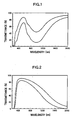
- the transmittance spectrum of each film having the LaB 6 fine particles dispersed therein is large in the light transmittance in a visible light region and has a transmittance peak in the vicinity of a wavelength of 550 nm. Since this transmittance peak is identical to the wavelength to which the eye is most highly sensitive, it is advantageous in holding brightness in the facility. Further, a large absorption is present in the vicinity of a wavelength of 1000 nm, and it is thus possible to screen near-infrared light efficiently, thereby shielding the sunlight-induced heat energy efficiently. In addition, LaB 6 's absorption of ultraviolet light is so small that it does not exert any detrimental effects on the pollinating activities by insects and the growth of plants. Meanwhile, the transmittance of ultraviolet light at a wavelength of 290 to 320 nm can be controlled by adjusting the amount of the LaB 6 fine particles to be added to the substrate resin.
- ultraviolet-screening inorganic materials, organic materials, and inorganic-organic composite materials such as cerium oxide, titanium oxide, zirconium oxide, zinc oxide, benzophenone type ultraviolet absorbers, etc.
- inorganic-organic composite materials such as cerium oxide, titanium oxide, zirconium oxide, zinc oxide, benzophenone type ultraviolet absorbers, etc.
- the above-mentioned ultraviolet absorbers of an inorganic type generate, when absorbing ultraviolet light, electrons and holes on the surfaces, consequently bringing about the possibility of substrate resins that will deteriorate. Desirably, therefore, they have been coat-treated on the surfaces.
- a variety of coupling agents, surface improvers, sol-gel silicates, etc. are typical, but any method is available so long as it is effective in preventing the resin from being deteriorated.
- the heat shielding material of the present invention which contains the LaB 6 fine particles as the heat shield filler, has a heat shielding characteristic by virtue of its efficient screening of sunlight in a near-infrared region, and at the same time, can hold sufficient brightness inside the facility by virtue of its good transmittance characteristic in a visible light region around the vicinity of a wavelength of 550 nm.
- the heat shielding material is characteristic in that it transmits ultraviolet light at a wavelength of 320 nm or below, whereby honeybees, etc., which contribute to the pollination can do active work, and stable harvests can be expected.
- Fig. 2 Also shown in Fig. 2 is the transmittance spectrum of each film having the ATO fine particles dispersed therein. As is understood from Fig. 2, this spectrum indicates a transmittance profile having a large portion at a wavelength of 380 to 780 nm in a visible light region and a flat portion. Because the absorption in a visible light region is almost absent, the interior in the facility can be held bright. Simultaneously, because the absorption at a wavelength of 800 nm or above in a near-infrared region is present, an enhanced heat shielding effect is obtained. Moreover, because the transmittance at a wavelength of 290 to 320 nm in an ultraviolet region is obtained, the pollination by honeybees, etc., is scarcely adversely affected.
- ultraviolet-screening inorganic materials, organic materials, and organic-inorganic composite materials may be added to control the transmittance in an ultraviolet region, and ultraviolet absorbers of an inorganic type may be desirably coat-treated on the surfaces in order to prevent the corresponding substrate resins from being deteriorated. Also preferably, the surfaces of the ATO fine particles may be coat-treated to avoid optical degradation.
- the heat shielding material of the present invention which contains the ATO fine particles as the heat shield filler, is colorless and transparent in a visible light region and thus sufficient to hold interior brightness in the facility.
- the heat shielding material has an enhanced heat shielding effect since it absorbs or screens a near-infrared region, and also has a transmittance in an ultraviolet region.
- a combination of LaB 6 and ATO can be used as the heat shield filler, and in this instance, a heat shielding material is obtained with a more effective heat shielding characteristic.
- LaB 6 has a large absorption in the vicinity of a wavelength of 1000 nm
- ATO has a gradually increasing absorption at wavelengths of 800 nm and above. Therefore, by dispersing the two types of fine particles in the substrate resin, the absorption or screening in a near-infrared region comes to be far larger and more efficient than that in the case of use of either one type, whereby a far higher heat shielding characteristic can be obtained.
- the heat shielding material for an agricultural and horticultural facility according to the present invention which contains the fine particles of LaB 6 and/or ATO as the heat shield fillers, has three characteristics in a masse, i.e., the transmittance in a visible light region that holds desired brightness, the absorption in a near-infrared region that provides an enhanced heat shielding effect, and the transmittance in an ultraviolet region.
- the heat shielding material therefore, is significantly useful as a roof material, an outer wall material, etc., in an agricultural and horticultural facility such as a house, etc.
- these heat shield fillers are of inorganic materials, they provide a higher weather resistance than those of organic materials and are especially excellent as a heat shielding material for an agricultural and horticultural facility usually put to outdoor use.
- the transmittance in a visible light region and the absorption in a near-infrared region should optically be well balanced.
- the visible light transmittance is preferably in the range of 30 to 90%, more preferably 60 to 90%.
- the solar radiation transmittance is preferably in the range of 10 to 80%, more preferably 10 to 70%.
- the particle diameters of the above-described heat shield fillers in the form of fine particles can be optionally chosen according to whether a scattering effect is utilized. For example, if the particle diameter of the heat shield filler dispersed in the substrate resin for the heat shield layer is 200 nm or below, particularly 100 nm or below, sunlight scattering becomes markedly small, and the sunlight comes to arrive directly at the plants and ground level. Moreover, since the light in a visible light region is hardly scattered as well, it is possible to easily observe the indoor conditions in the facility such as a house, etc., from the outside, and it is likewise possible to confirm the outdoor conditions from the interior of the facility.
- the particle diameter of the heat shield filler dispersed in the substrate resin for the heat shield layer exceeds 200 nm, sunlight scatters largely, and the light traveling to arrive at the plants and ground level becomes uniform, whereby the plants are little affected by the shades of the frames in the house, etc. But then, the light in a visible light region scatters simultaneously, and it thus becomes difficult to observe the indoor conditions of the facility from the outside, even though the facility can be held interiorly bright as required.
- the fine particles of LaB 6 and/or ATO as the heat shield fillers can be kneaded into the resin, followed by molding of the resin.
- the particle diameters of the fine particles may be controlled, if necessary, by the above-mentioned methods.
- the fine particles of LaB 6 and ATO are thermally stable and may thus be kneaded at temperatures (approximately 100 to 300°C) in the vicinity of the melting points of various corresponding resins.
- the substrate resin that serves as a matrix for the heat shield layer at least one resin is used which is selected from polyethylene resin, polyvinyl chloride resin, polyvinylidene chloride resin, polyvinyl alcohol resin, polystyrene resin, polypropylene resin, poly(ethylene-vinyl acetate) resin and polyester resin.
- additives such as stabilizers, stabilizing auxiliaries, antioxidants, plasticizers, lubricants, etc., may be added.
- the resin in which the fine particles of LaB 6 and/or ATO have been kneaded, can be molded into a film- or board-like form, e.g., by means of extrusion, inflation, solution casting, calendering, etc.
- the thickness of a film or a board to be formed may be optionally set to suit the target application, it is generally in the range of 10 to 1000 ⁇ m in case of the film, preferably 20 to 500 ⁇ m, and preferably in the range of 2 to 15 mm in case of the board.
- the amount of the fine particles of LaB 6 and/or ATO to be kneaded in the resin is usually 50% by weight or below relative to the resin, when handling, etc., during kneading and formation are considered.
- the content of the heat shield filler uniformly dispersed in the heat shield layer can be varied depending on the thicknesses of heat shield layers to be formed, the thicknesses of matrix materials to be used for lamination where needed, and the optical characteristics and heat shielding characteristics to be targeted.
- LaB 6 has a high heat shielding efficiency per unit weight, and thus in its content of 0.01 g or more per 1 m 2 of a heat shield layer, an effective heat shielding effect is obtained.
- 1 g/m 2 is capable of screening about 90% of sunlight-induced heat energy and thus effective enough to shield heat in summer. In light of the warmth retaining effect in winter, it is not preferable to add a larger amount than this content.
- the content of LaB 6 should be preferably in the range of 0.01 to 1 g/m 2 .
- the heat shield filler is ATO
- a content of about 3 g per 1 m 2 of a heat shield layer is capable of screening approximately 30% of sunlight-induced heat energy.
- the heat shielding effect is not sufficient, whereas a content exceeding 50 g/m 2 is not desirable because it results in cost rise as well as difficult processing into a heat shielding material.
- the content of ATO should be preferably in the range of 1.0 to 50 g/m 2 .
- the heat shielding material for an agricultural and horticultural facility according to the present invention which contains a heat shield layer of a substrate resin having dispersed therein the above-described fine particles of LaB 6 and/or ATO, is in a form as heretofore used in the art for a roof material and an outer wall material in an agricultural house, etc., that is, in a film- or board (plate)-like form.
- the heat shielding material is in a single film- or board-like form consisting of the above-described heat shield layer.
- It also may be of a laminated structure in which the above-described heat shield layer has been laminated on the surface of a film- or board-like matrix material prepared separately and made of resin, glass, etc., or in which at least one of the above-described heat shield layer has been sandwiched between two such matrix materials.
- this can be produced, e.g., by coating a heat shield layer containing the fine particles of LaB 6 and/or ATO on either one or both surfaces of a matrix material made of an existing resin film or board, or a glass plate, etc. Any coating method is available if it can form a uniform film on the matrix surfaces. Bar coating, gravure coating, spray coating, dip coating, etc., for example, may be employed.
- ultraviolet curing resin can preferably be used as a resin or binder for retaining the fine particles. More specifically, it is possible to mix an ultraviolet curing resin and a heat shield filler having a proper particle diameter, thereby preparing a liquid or paste, and then, to coat the liquid or paste on the surface of a matrix material, and to evaporate the solvent, followed by curing of the coat by means of ultraviolet irradiation. Moreover, by using hard coating resin as the ultraviolet curing resin, a heat shield layer can be obtained with an improved surface abrasion strength, whereby a surface characteristic is provided which is resistant to scratching even upon collision of dust, etc. In such an instance, fine particles of SiO 2 , etc., may be added to further improve the abrasion strength.
- the matrix surfaces are preferably pretreated to improve their adhesion to the heat shield layer. Due to this surface treatment, the wetting properties of the matrix surfaces are simultaneously improved to prevent repelling during coating, thereby enabling a uniform coating to be easily obtained.
- the surface-treating method corona treatment, sputter treatment, primer coating treatment, etc., are well known.
- a heat shielding material for an agricultural and horticultural facility is formed by sandwiching a heat shield layer between the above-mentioned two matrix materials
- laminating resin as, e.g., vinyl chloride copolymer, etc.
- a resin or binder for retaining the fine particles of the heat shield filler.
- by mixing the fine particles of the heat shield filler and room temperature-curing resin, and then by coating the mixture over the roof and outer wall materials in an existing agricultural and horticultural facility it is also possible to impart heat shielding characteristics in a post-treated manner. As just described, heat shielding characteristics can be imparted to matrix materials by choosing substrate resins to satisfy the intended objective and application.
- the present invention is illustrated below by referring to its examples.
- Dispersion A 20 Parts by weight of LaB 6 fine particles (specific surface area: 30 m 2 /g), 75 parts by weight of toluene, and 5 parts by weight of a dispersing agent were mixed to obtain Dispersion A in which the fine particles of LaB 6 with an average dispersed particle diameter of 80 nm had been dispersed. From this Dispersion A, solvent components were removed at 50°C with a vacuum dryer to obtain dispersion-treated Powder A of LaB 6 .
- the average particle diameter noted above is an average value obtained by measurement on a measuring device using a dynamic light scattering process (manufactured by Ohtsuka Electronics Co., Ltd.: ELS-800).
- the visible light transmittance of the above-mentioned film-like heat shielding material was 72%, and its solar radiation transmittance was 52%.
- the difference between the visible light transmittance and the solar radiation transmittance was 20%.
- the heat shielding material was sufficient to transmit light in a visible light region, and at the same time, capable of screening 48% of direct incident light arising from sunlight.
- this heat shielding material has been found to have an improved heat shielding effect.
- the haze value was 3.7%, and the transparency is so high that the indoor conditions of the facility can be fully confirmed even from the outside.
- Example 1 without addition of the LaB 6 fine particles as the heat shield filler, the low-density polyethylene resin was extrusion-molded to form a film having a thickness of about 50 ⁇ m.
- the visible light transmittance of the film thus obtained was 91%, and its solar radiation transmittance was 92%.
- the film was sufficient to transmit light in a visible light region, but the solar radiation transmittance was larger than the visible light transmittance.
- the film could only screen at most about 8% of direct incident light arising from sunlight.
- the heat shielding effect of this film has been found to be poor. Meanwhile, the haze value was 3.5%.
- Example 1 0.005 Kg of Powder A of LaB 6 prepared in Example 1 above, and 8.7 kg of low-density polyethylene resin pellets were dry-mixed in a V-blender. Then, as in Example 1, internal mixing was thoroughly carried out at 110°C in the neighborhood of the melting temperature of the low-density polyethylene resin, and this mixture was extrusion-molded at 110°C to form a film having a thickness of about 50 ⁇ m. The content of the LaB 6 fine particles in this film is equivalent to 0.065 g/m 2 .
- the film-like heat shielding material thus obtained was evaluated as in Example 1.
- the visible light transmittance was 82%, and the solar radiation transmittance was 68%.
- the difference between the visible light transmittance and the solar radiation transmittance was 14%.
- the heat shielding material was sufficient to transmit light in a visible light region, and at the same time, capable of screening 32% of direct incident light arising from sunlight.
- this heat shielding material has been found to have an improved heat shielding effect.
- the haze value was 3.6%, and since the transparency is high, the indoor conditions of the facility can be fully confirmed even from the outside.
- Example 2 except that polypropylene resin pellets were used in place of the low-density polyethylene resin pellets, and the heating temperature was changed to a temperature (about 240°C) at which the polypropylene resin became sufficiently softened, a film was formed by the same method as employed in Example 2.
- the content of the LaB 6 fine particles in this film is equivalent to 0.065 g/m 2 , which is equal to that in Example 2.
- the film-like heat shielding material thus obtained was evaluated as in Example 1.
- the visible light transmittance was 80.9%, and the solar radiation transmittance was 65.7%.
- the difference between the visible light transmittance and the solar radiation transmittance was 15.2%.
- the heat shielding material was sufficient to transmit light in a visible light region, and at the same time, capable of screening about 34% of direct incident light arising from sunlight.
- this heat shielding material has been found to have an improved heat shielding effect.
- the haze value was 2.3%, and the transparency has been found to be very high.
- Example 3 without addition of the LaB 6 fine particles as the heat shield filler, the polypropylene resin was extrusion-molded to form a film having a thickness of about 50 ⁇ m.
- the visible light transmittance of the film thus obtained was 90%, which was sufficient to transmit light in a visible light region, but the solar radiation transmittance was likewise 90%.
- the film could only screen at most about 10% of direct incident light arising from sunlight.
- the heat shielding effect of this film has been found to be poor. Meanwhile, the haze value was 2.2%.
- Dispersion B 20 Parts by weight of ATO fine particles (specific surface area: 50 m 2 /g), 75 parts by weight of toluene, and 5 parts by weight of a dispersing agent were mixed, followed by dispersion treatment, thereby obtaining Dispersion B in which the fine particles of ATO with an average particle diameter of 75 nm had been dispersed. From this Dispersion B, solvent components were removed at 50°C with a vacuum dryer to obtain dispersion-treated Powder B of ATO.
- the film-like heat shielding material thus obtained was evaluated as in Example 1.
- the visible light transmittance was 80.8%, and the solar radiation transmittance was 65%.
- the difference between the visible light transmittance and the solar radiation transmittance was 15.7%.
- the heat shielding material was sufficient to transmit light in a visible light region, and at the same time, capable of screening about 35% of direct incident light arising from sunlight.
- this heat shielding material has been found to have an improved heat shielding effect.
- the haze value was 4.0%, and the transparency is at so a level that the indoor conditions of the facility can be fully confirmed even from the outside.
- Example 4 0.2 Kg of ATO Powder B prepared in Example 4, and 8.65 kg of low-density polyethylene pellets were dry-mixed in a V-blender. And then, internal mixing was thoroughly carried out at 110°C in the neighborhood of the melting temperature of the low-density polyethylene resin, and this mixture was extrusion-molded at 110°C to form a film having a thickness of about 50 ⁇ m.
- the content of the ATO fine particles in this film is equivalent to 2.25 g/m 2 .
- the film-like heat shielding material thus obtained was evaluated as in Example 1.
- the visible light transmittance was 86%
- the solar radiation transmittance was 75.5%.
- the difference between the visible light transmittance and the solar radiation transmittance was 10.5%.
- the heat shielding material was sufficient to transmit light in a visible light region, and at the same time, capable of screening about 25% of direct incident light arising from sunlight.
- this heat shielding material has been found to have an improved heat shielding effect.
- the haze value was 3.7%, and the transparency is so high that the indoor conditions of the facility can be fully confirmed even from the outside.
- Dispersion A of the LaB 6 fine particles prepared in Example 1 10 Parts by weight of Dispersion A of the LaB 6 fine particles prepared in Example 1, and 100 parts by weight of hard-coating ultraviolet-curing resin (solid content: 100%) were mixed.
- the resulting liquid was coated, using a bar coater, on a polyethylene resin film (thickness: 50 ⁇ m), the surface of which had been corona-treated in advance.
- the coated layer was dried at 70°C for 30 seconds to evaporate the solvent, followed by curing of the coated layer with a high-pressure mercury lamp, thereby forming a heat shield layer on the polyethylene resin film.
- the film-like heat shielding material thus obtained has a structure including a heat shield layer of a hard-coating ultraviolet-curing resin in which the LaB 6 fine particles have been dispersed, and as a matrix material, a polyethylene resin film on which this heat shield layer has been coated. Further, the heat shield layer of this film has a thickness of about 2 ⁇ m, and the content of the LaB 6 fine particles corresponds to 0.08 g/m 2 .
- the film-like heat shielding material thus obtained was evaluated as in Example 1.
- the visible light transmittance was 78%, and the solar radiation transmittance was 59.5%.
- the difference between the visible light transmittance and the solar radiation transmittance was 18.5%.
- the heat shielding material was sufficient to transmit light in a visible light region, and at the same time, capable of screening about 40% of direct incident light arising from sunlight.
- this heat shielding material has been found to have an improved heat shielding effect.
- the haze value was 3.6%, and the indoor conditions of the facility can be fully confirmed even from the outside.
- the film-like heat shielding material thus obtained was evaluated as in Example 1.
- the visible light transmittance was 79.8%, and the solar radiation transmittance was 66.5%.
- the difference between the visible light transmittance and the solar radiation transmittance was 13.3%.
- the heat shielding material was sufficient to transmit light in a visible light region, and at the same time, capable of screening about 34% of direct incident light arising from sunlight.
- this heat shielding material has been found to have an improved heat shielding effect.
- the haze value was 4.8%, and the indoor conditions of the facility can be fully confirmed even from the outside.
- Example 7 without addition of the LaB 6 fine particles as the heat shield filler, the polyvinyl chloride resin and plasticizer DOP were calendered to form a film having a thickness of about 50 ⁇ m.
- the visible light transmittance of the film thus obtained was 89%, which was sufficient to transmit light in a visible light region, but the solar radiation transmittance was 90%.
- the solar radiation transmittance was larger than the visible light transmittance, and the film could only screen at most about 10% of direct incident light arising from sunlight.
- the heat shielding effect of this film has been found to be poor. Meanwhile, the haze value was 4.5%.
- the heat shielding material for an agricultural and horticultural facility is excellent in weather resistance and sufficient to transmit light in a visible light region, which light is necessary for working and plant growth in the facility. Simultaneously, it achieves efficient absorption or screening of near-infrared light, thereby providing an improved heat shielding effect as well as a moderate transmission of ultraviolet light or possible control of its transmission. It thus inhibits disease and insect damage from occurring and also enables insects such as honeybees, etc., to work fully actively for pollination. Accordingly, this heat shielding material is suitable for use as a roof material, an outer wall material, etc., in an agricultural house and a horticultural house.
Landscapes
- Life Sciences & Earth Sciences (AREA)
- Chemical & Material Sciences (AREA)
- Engineering & Computer Science (AREA)
- Materials Engineering (AREA)
- Soil Sciences (AREA)
- Environmental Sciences (AREA)
- Protection Of Plants (AREA)
- Greenhouses (AREA)
Abstract
Description
Claims (4)
- A heat shielding material for an agricultural and horticultural facility, comprising: a heat shield layer comprising a substrate resin and a heat shield filler in the form of fine particles dispersed in said substrate resin, wherein said heat shield filler is at least one selected from lanthanum hexaboride and antimony-doped tin oxide; and said substrate resin is at least one selected from polyethylene resin, polyvinyl chloride resin, polyvinylidene chloride resin, polyvinyl alcohol resin, polystyrene resin, polypropylene resin, poly(ethylene-vinyl acetate) resin and polyester resin.
- A heat shielding material for an agricultural and horticultural facility according to claim 1, having a visible light transmittance in the range of 30 to 90%, and a solar radiation transmittance in the range of 10 to 80%, wherein said visible light transmittance is set to be larger by 10% or above than said solar radiation transmittance.
- A heat shielding material for an agricultural and horticultural facility according to claim 1 or 2, wherein the content of said heat shield filler in said heat shield layer is in the range of 0.01 to 1 g/m2 in case of the lanthanum hexaboride and in the range of 1.0 to 50 g/m2 in case of the antimony-doped tin oxide. '
- A heat shielding material for an agricultural and horticultural facility according to any of claims 1 to 3, being in a film- or board-like form consisting of said heat shield layer; or in a form in which said heat shield layer has been laminated on the surface of a film- or board-like matrix material, or has been sandwiched between two of said matrix material.
Applications Claiming Priority (3)
| Application Number | Priority Date | Filing Date | Title |
|---|---|---|---|
| JP2002309101 | 2002-10-24 | ||
| JP2002309101A JP3997887B2 (en) | 2002-10-24 | 2002-10-24 | Insulation material for agricultural and horticultural facilities |
| PCT/JP2003/011718 WO2004036978A1 (en) | 2002-10-24 | 2003-09-12 | Heat-insulating material for agricultural or horticultural facility |
Publications (2)
| Publication Number | Publication Date |
|---|---|
| EP1554924A1 true EP1554924A1 (en) | 2005-07-20 |
| EP1554924A4 EP1554924A4 (en) | 2008-05-07 |
Family
ID=32170993
Family Applications (1)
| Application Number | Title | Priority Date | Filing Date |
|---|---|---|---|
| EP03809431A Withdrawn EP1554924A4 (en) | 2002-10-24 | 2003-09-12 | Heat-insulating material for agricultural or horticultural facility |
Country Status (6)
| Country | Link |
|---|---|
| US (1) | US20060008639A1 (en) |
| EP (1) | EP1554924A4 (en) |
| JP (1) | JP3997887B2 (en) |
| CN (1) | CN100464975C (en) |
| IN (1) | IN2005CH00673A (en) |
| WO (1) | WO2004036978A1 (en) |
Cited By (2)
| Publication number | Priority date | Publication date | Assignee | Title |
|---|---|---|---|---|
| WO2010092013A1 (en) | 2009-02-12 | 2010-08-19 | Basf Se | Polymer compositions containing nanoparticulate ir absorbers |
| EP2532224A1 (en) * | 2011-06-10 | 2012-12-12 | Valoya Oy | Method and means for improving plant productivity through enhancing insect pollination success in plant cultivation |
Families Citing this family (15)
| Publication number | Priority date | Publication date | Assignee | Title |
|---|---|---|---|---|
| JP2004244613A (en) * | 2003-01-23 | 2004-09-02 | Sumitomo Metal Mining Co Ltd | Solar radiation shield and dispersion for forming solar radiation shield |
| JP2006055002A (en) * | 2004-08-17 | 2006-03-02 | Diatex Co Ltd | Crop prevention sheet for crops |
| JP2006197924A (en) * | 2004-12-24 | 2006-08-03 | Tokyo Univ Of Science | Light transmissive material for plant growth control, light transmissive material for plant growth control and method for producing the same |
| JP4507993B2 (en) * | 2005-06-10 | 2010-07-21 | 住友金属鉱山株式会社 | Agricultural and horticultural soil covering film |
| JP4724598B2 (en) * | 2006-05-01 | 2011-07-13 | アキレス株式会社 | Agricultural coating |
| US20090130451A1 (en) * | 2007-11-19 | 2009-05-21 | Tony Farrell | Laser-weldable thermoplastics, methods of manufacture, and articles thereof |
| TWI458803B (en) * | 2009-02-16 | 2014-11-01 | Nanya Plastics Corp | A transparent pvc film or sheet for cutting off uv & ir light and its process |
| JP2011050307A (en) * | 2009-09-01 | 2011-03-17 | Sumitomo Metal Mining Co Ltd | Crop sheet for preventing high-temperature injury |
| JP5459118B2 (en) * | 2010-07-13 | 2014-04-02 | 旭硝子株式会社 | Agricultural film |
| EA028627B1 (en) * | 2011-06-23 | 2017-12-29 | Агк Гласс Юроп | Laminated glass |
| TWI531602B (en) | 2012-12-28 | 2016-05-01 | 財團法人工業技術研究院 | Transparent heat shielding composition |
| JP6615636B2 (en) * | 2016-02-24 | 2019-12-04 | 住化積水フィルム株式会社 | Heat shielding and light shielding agricultural film |
| CN105754181A (en) * | 2016-03-31 | 2016-07-13 | 太仓市新华粮食生产专业合作社 | Agricultural film capable of insulating heat and preserving heat |
| CN106142789A (en) * | 2016-06-08 | 2016-11-23 | 韩立 | Film for agricultural use |
| WO2019155996A1 (en) * | 2018-02-08 | 2019-08-15 | 住友金属鉱山株式会社 | Near infrared ray absorption material micro-particle dispersion, near infrared ray absorber, near infrared ray absorption laminate, combined structure for near infrared ray absorption |
Family Cites Families (20)
| Publication number | Priority date | Publication date | Assignee | Title |
|---|---|---|---|---|
| US4564647A (en) * | 1983-11-14 | 1986-01-14 | Idemitsu Kosan Company Limited | Process for the production of polyethylene compositions |
| JPS61111350A (en) | 1984-11-06 | 1986-05-29 | Mitsubishi Monsanto Chem Co | Light-screening agricultural film and production thereof |
| US4704174A (en) * | 1985-12-12 | 1987-11-03 | Ppg Industries, Inc. | Method for manufacturing a laminated window |
| JP2633170B2 (en) | 1992-08-20 | 1997-07-23 | 呉羽化学工業株式会社 | Optical filter |
| KR100214428B1 (en) * | 1993-06-30 | 1999-08-02 | 후지무라 마사지카, 아키모토 유미 | Infrared ray shielding material and infrared ray shielding powder |
| US5593786A (en) * | 1994-11-09 | 1997-01-14 | Libbey-Owens-Ford Company | Self-adhering polyvinyl chloride safety glass interlayer |
| JP3154645B2 (en) * | 1995-01-23 | 2001-04-09 | セントラル硝子株式会社 | Automotive laminated glass |
| JPH08277349A (en) | 1995-04-05 | 1996-10-22 | Sekisui Chem Co Ltd | Agricultural thermoplastic resin film |
| JP2002120339A (en) * | 1995-08-28 | 2002-04-23 | Sumika Plastech Co Ltd | Polyolefin resin coated film |
| JP3746824B2 (en) * | 1996-01-30 | 2006-02-15 | 株式会社クレハ | Visible light absorber |
| JPH09330612A (en) | 1996-06-06 | 1997-12-22 | Kanebo Ltd | Near infrared absorption panel |
| JP4096278B2 (en) * | 1998-12-10 | 2008-06-04 | 住友金属鉱山株式会社 | Solar shading film coating solution and solar shading film using the same |
| JP2001103847A (en) * | 1999-10-05 | 2001-04-17 | Mitsubishi Chem Mkv Co | Agricultural film |
| DE10006208A1 (en) * | 2000-02-11 | 2001-08-16 | Bayer Ag | IR absorbing compositions |
| JP2002065075A (en) * | 2000-09-04 | 2002-03-05 | Chisso Corp | Agricultural multilayer film |
| BR0115342A (en) * | 2000-11-14 | 2003-08-26 | Solutia Inc | Infrared absorption (iv) polyvinyl butyral composition, foil thereof and laminate containing same |
| JP3997728B2 (en) * | 2001-06-15 | 2007-10-24 | 住友金属鉱山株式会社 | Insulation material for agricultural and horticultural facilities |
| ATE370188T1 (en) * | 2001-12-11 | 2007-09-15 | Asahi Glass Co Ltd | HEAT RAY BLOCKING FLUOR RESIN FILM |
| US6827977B2 (en) * | 2002-03-07 | 2004-12-07 | Guardian Industries Corp. | Method of making window unit including diamond-like carbon (DLC) coating |
| US6791065B2 (en) * | 2002-07-24 | 2004-09-14 | Ppg Industries Ohio, Inc. | Edge sealing of a laminated transparency |
-
2002
- 2002-10-24 JP JP2002309101A patent/JP3997887B2/en not_active Expired - Lifetime
-
2003
- 2003-09-12 US US10/531,075 patent/US20060008639A1/en not_active Abandoned
- 2003-09-12 WO PCT/JP2003/011718 patent/WO2004036978A1/en not_active Ceased
- 2003-09-12 CN CNB038227584A patent/CN100464975C/en not_active Expired - Fee Related
- 2003-09-12 EP EP03809431A patent/EP1554924A4/en not_active Withdrawn
-
2006
- 2006-05-31 IN IN673CH2005 patent/IN2005CH00673A/en unknown
Cited By (2)
| Publication number | Priority date | Publication date | Assignee | Title |
|---|---|---|---|---|
| WO2010092013A1 (en) | 2009-02-12 | 2010-08-19 | Basf Se | Polymer compositions containing nanoparticulate ir absorbers |
| EP2532224A1 (en) * | 2011-06-10 | 2012-12-12 | Valoya Oy | Method and means for improving plant productivity through enhancing insect pollination success in plant cultivation |
Also Published As
| Publication number | Publication date |
|---|---|
| CN100464975C (en) | 2009-03-04 |
| IN2005CH00673A (en) | 2007-09-07 |
| CN1684581A (en) | 2005-10-19 |
| JP2004141051A (en) | 2004-05-20 |
| WO2004036978A1 (en) | 2004-05-06 |
| JP3997887B2 (en) | 2007-10-24 |
| US20060008639A1 (en) | 2006-01-12 |
| EP1554924A4 (en) | 2008-05-07 |
Similar Documents
| Publication | Publication Date | Title |
|---|---|---|
| US20060008639A1 (en) | Heat-insulating material for agricultural or horticultural facility | |
| KR100248696B1 (en) | Composite material for the screening of radiation | |
| CN101141874B (en) | Land cover film for agriculture and horticulture | |
| JP3997728B2 (en) | Insulation material for agricultural and horticultural facilities | |
| BE1022168B1 (en) | SPECIFIC USE OF A SPECIFICALLY FINE DIVIDED MATERIAL | |
| CN106661293B (en) | Heat ray shielding films, interlayer transparent substrates for heat ray shielding, automobiles, buildings | |
| DE60221780T2 (en) | Heat rays blocking fluororesin film | |
| EP1541012B1 (en) | Heat insulation material for agricultural and horticultural facility | |
| JP2003325060A (en) | Agricultural polyolefin resin film | |
| AU694050B2 (en) | Greenhouse film having variable light diffusion properties | |
| JP2011254761A (en) | Film for adjusting light quality | |
| JP2006340675A (en) | Agricultural and horticultural soil covering film | |
| WO2012167865A1 (en) | Wavelength-selective reflective coating | |
| JP2004065004A (en) | Insulation materials for agricultural and horticultural facilities | |
| DE102004051354A1 (en) | Thermoplastic products for growth acceleration, yield enhancement and quality improvement of crops in agriculture | |
| KR100881680B1 (en) | Insulation material for farm gardening facility | |
| JPH09174745A (en) | Agricultural sheet | |
| KR102570487B1 (en) | Light scattering coating composition with controlled transparency, a manufacturing method thereof and the light scattering coating layer | |
| JP7458154B2 (en) | heat shield sheet | |
| JP7458219B2 (en) | Heat shielding resin composition and heat shielding film | |
| JPH09275822A (en) | Agricultural thermoplastic resin film | |
| JP2025121411A (en) | Polyolefin multi-layer film for agricultural use | |
| JP2022178562A (en) | heat shield sheet | |
| JPH08228609A (en) | Synthetic resin covering material for agriculture and plastic greenhouse for agriculture | |
| JPH0951722A (en) | Culture of leaf lettuce |
Legal Events
| Date | Code | Title | Description |
|---|---|---|---|
| PUAI | Public reference made under article 153(3) epc to a published international application that has entered the european phase |
Free format text: ORIGINAL CODE: 0009012 |
|
| 17P | Request for examination filed |
Effective date: 20050303 |
|
| AK | Designated contracting states |
Kind code of ref document: A1 Designated state(s): AT BE BG CH CY CZ DE DK EE ES FI FR GB GR HU IE IT LI LU MC NL PT RO SE SI SK TR |
|
| RBV | Designated contracting states (corrected) |
Designated state(s): FR |
|
| REG | Reference to a national code |
Ref country code: DE Ref legal event code: 8566 |
|
| A4 | Supplementary search report drawn up and despatched |
Effective date: 20080404 |
|
| 17Q | First examination report despatched |
Effective date: 20090205 |
|
| STAA | Information on the status of an ep patent application or granted ep patent |
Free format text: STATUS: THE APPLICATION IS DEEMED TO BE WITHDRAWN |
|
| 18D | Application deemed to be withdrawn |
Effective date: 20090616 |