EP1553583A2 - Aufzeichnungsmedium, Aufzeichnungsmediumschreibevorrichtung, Aufzeichnungsmediumlesevorrichtung, Aufzeichnungsmediumschreibeverfahren, und Aufzeichnungsmediumleseverfahren - Google Patents
Aufzeichnungsmedium, Aufzeichnungsmediumschreibevorrichtung, Aufzeichnungsmediumlesevorrichtung, Aufzeichnungsmediumschreibeverfahren, und Aufzeichnungsmediumleseverfahren Download PDFInfo
- Publication number
- EP1553583A2 EP1553583A2 EP04106960A EP04106960A EP1553583A2 EP 1553583 A2 EP1553583 A2 EP 1553583A2 EP 04106960 A EP04106960 A EP 04106960A EP 04106960 A EP04106960 A EP 04106960A EP 1553583 A2 EP1553583 A2 EP 1553583A2
- Authority
- EP
- European Patent Office
- Prior art keywords
- data
- recording medium
- proprietary data
- decoding
- embedded
- Prior art date
- Legal status (The legal status is an assumption and is not a legal conclusion. Google has not performed a legal analysis and makes no representation as to the accuracy of the status listed.)
- Withdrawn
Links
- 238000000034 method Methods 0.000 title claims description 80
- 238000012545 processing Methods 0.000 claims description 92
- 238000012937 correction Methods 0.000 claims description 11
- 230000003287 optical effect Effects 0.000 description 115
- 238000000926 separation method Methods 0.000 description 11
- 238000004519 manufacturing process Methods 0.000 description 9
- 238000013461 design Methods 0.000 description 7
- 230000008520 organization Effects 0.000 description 6
- 230000002265 prevention Effects 0.000 description 3
- 230000004931 aggregating effect Effects 0.000 description 2
- 230000005540 biological transmission Effects 0.000 description 2
- 238000005520 cutting process Methods 0.000 description 2
- 230000001747 exhibiting effect Effects 0.000 description 2
- 238000003860 storage Methods 0.000 description 2
- 230000000007 visual effect Effects 0.000 description 2
- 230000009471 action Effects 0.000 description 1
- 230000008901 benefit Effects 0.000 description 1
- 230000003247 decreasing effect Effects 0.000 description 1
- 238000001514 detection method Methods 0.000 description 1
- 238000010586 diagram Methods 0.000 description 1
- 238000009826 distribution Methods 0.000 description 1
- 230000001678 irradiating effect Effects 0.000 description 1
- 230000008569 process Effects 0.000 description 1
- 238000011160 research Methods 0.000 description 1
- 230000004044 response Effects 0.000 description 1
- 230000003068 static effect Effects 0.000 description 1
Images





Classifications
-
- G—PHYSICS
- G11—INFORMATION STORAGE
- G11B—INFORMATION STORAGE BASED ON RELATIVE MOVEMENT BETWEEN RECORD CARRIER AND TRANSDUCER
- G11B20/00—Signal processing not specific to the method of recording or reproducing; Circuits therefor
- G11B20/00086—Circuits for prevention of unauthorised reproduction or copying, e.g. piracy
- G11B20/0021—Circuits for prevention of unauthorised reproduction or copying, e.g. piracy involving encryption or decryption of contents recorded on or reproduced from a record carrier
-
- G—PHYSICS
- G11—INFORMATION STORAGE
- G11B—INFORMATION STORAGE BASED ON RELATIVE MOVEMENT BETWEEN RECORD CARRIER AND TRANSDUCER
- G11B20/00—Signal processing not specific to the method of recording or reproducing; Circuits therefor
- G11B20/10—Digital recording or reproducing
-
- G—PHYSICS
- G11—INFORMATION STORAGE
- G11B—INFORMATION STORAGE BASED ON RELATIVE MOVEMENT BETWEEN RECORD CARRIER AND TRANSDUCER
- G11B20/00—Signal processing not specific to the method of recording or reproducing; Circuits therefor
- G11B20/00086—Circuits for prevention of unauthorised reproduction or copying, e.g. piracy
-
- G—PHYSICS
- G11—INFORMATION STORAGE
- G11B—INFORMATION STORAGE BASED ON RELATIVE MOVEMENT BETWEEN RECORD CARRIER AND TRANSDUCER
- G11B20/00—Signal processing not specific to the method of recording or reproducing; Circuits therefor
- G11B20/00086—Circuits for prevention of unauthorised reproduction or copying, e.g. piracy
- G11B20/0021—Circuits for prevention of unauthorised reproduction or copying, e.g. piracy involving encryption or decryption of contents recorded on or reproduced from a record carrier
- G11B20/00217—Circuits for prevention of unauthorised reproduction or copying, e.g. piracy involving encryption or decryption of contents recorded on or reproduced from a record carrier the cryptographic key used for encryption and/or decryption of contents recorded on or reproduced from the record carrier being read from a specific source
- G11B20/00253—Circuits for prevention of unauthorised reproduction or copying, e.g. piracy involving encryption or decryption of contents recorded on or reproduced from a record carrier the cryptographic key used for encryption and/or decryption of contents recorded on or reproduced from the record carrier being read from a specific source wherein the key is stored on the record carrier
- G11B20/00282—Circuits for prevention of unauthorised reproduction or copying, e.g. piracy involving encryption or decryption of contents recorded on or reproduced from a record carrier the cryptographic key used for encryption and/or decryption of contents recorded on or reproduced from the record carrier being read from a specific source wherein the key is stored on the record carrier the key being stored in the content area, e.g. program area, data area or user area
- G11B20/00289—Circuits for prevention of unauthorised reproduction or copying, e.g. piracy involving encryption or decryption of contents recorded on or reproduced from a record carrier the cryptographic key used for encryption and/or decryption of contents recorded on or reproduced from the record carrier being read from a specific source wherein the key is stored on the record carrier the key being stored in the content area, e.g. program area, data area or user area wherein the key is stored as a watermark
-
- G—PHYSICS
- G11—INFORMATION STORAGE
- G11B—INFORMATION STORAGE BASED ON RELATIVE MOVEMENT BETWEEN RECORD CARRIER AND TRANSDUCER
- G11B20/00—Signal processing not specific to the method of recording or reproducing; Circuits therefor
- G11B20/00086—Circuits for prevention of unauthorised reproduction or copying, e.g. piracy
- G11B20/0021—Circuits for prevention of unauthorised reproduction or copying, e.g. piracy involving encryption or decryption of contents recorded on or reproduced from a record carrier
- G11B20/00217—Circuits for prevention of unauthorised reproduction or copying, e.g. piracy involving encryption or decryption of contents recorded on or reproduced from a record carrier the cryptographic key used for encryption and/or decryption of contents recorded on or reproduced from the record carrier being read from a specific source
- G11B20/00253—Circuits for prevention of unauthorised reproduction or copying, e.g. piracy involving encryption or decryption of contents recorded on or reproduced from a record carrier the cryptographic key used for encryption and/or decryption of contents recorded on or reproduced from the record carrier being read from a specific source wherein the key is stored on the record carrier
- G11B20/00362—Circuits for prevention of unauthorised reproduction or copying, e.g. piracy involving encryption or decryption of contents recorded on or reproduced from a record carrier the cryptographic key used for encryption and/or decryption of contents recorded on or reproduced from the record carrier being read from a specific source wherein the key is stored on the record carrier the key being obtained from a media key block [MKB]
-
- G—PHYSICS
- G11—INFORMATION STORAGE
- G11B—INFORMATION STORAGE BASED ON RELATIVE MOVEMENT BETWEEN RECORD CARRIER AND TRANSDUCER
- G11B20/00—Signal processing not specific to the method of recording or reproducing; Circuits therefor
- G11B20/10—Digital recording or reproducing
- G11B20/18—Error detection or correction; Testing, e.g. of drop-outs
- G11B20/1833—Error detection or correction; Testing, e.g. of drop-outs by adding special lists or symbols to the coded information
Definitions
- the present invention relates to a recording medium for recording various contents such as images, sounds, and the like, a recording medium writing device, a recording medium reading device, a recording medium writing method, and a recording medium reading method.
- a recording medium such as a CD (Compact Disk), a DVD (Digital Versatile Disk), and the like is used for storage, distribution, or the like of various contents such as images, sounds, texts, and the like. In other words, contents can be recorded on a recording medium to be stored and distributed.
- the contents are generally a copyrighted work which needs to be prevented from being illegally copied, so that a copyright protection technology is used.
- encoding of contents and recording them on a storage medium are generally performed.
- an encryption key is used to decode the encoded contents.
- the contents cannot be reproduced as long as the encryption key is in a confidential state.
- the encryption key itself is encoded and recorded on the recording medium.
- This technique cannot respond to a case that the entire data (including both the encoded contents and the encoded encryption key) recorded on the recording medium is copied to another recording medium.
- an object of the present invention is to provide a recording medium, a recording medium writing device, a recording medium reading device, a recording medium writing method, and a recording medium reading method by which contents can be protected even when the entire data of the recording medium is copied, or moreover, even when the recording medium itself is copied.
- contents can be reproduced from a recording medium on which the embedded proprietary data, which is configured by embedding the decoding key data into the proprietary data, is recorded.
- the recording medium reading method contents can be reproduced from a recording medium on which the embedded proprietary data, which is configured by embedding the decoding key data into the proprietary data, is recorded.
- FIG. 1 is a plan view representing an optical disk 10 for reproduction only that is a recoding medium according a first embodiment of the present invention.
- a clamping area 13 On the optical disk 10 for reproduction only, a clamping area 13, a BCA (Burst Cutting Area) 14, a lead-in (Lead-IN) area 15, a data area 16, and a lead-out (Lead-OUT) area 17 are arranged between an inner circumference 11 and an outer circumference 12.
- the clamping area 13 is an area for retaining the optical disk 10 by a chuck or the like.
- the BCA 14 is an area in which a part of a reflective layer of the optical disk 10 is removed by irradiating a laser light in a pulse form from a high-energy laser light source such as a YAG laser, and data is thus recorded thereon in a stripe form as a kind of barcode. Since writing in this area requires a high-energy laser light source, information written in this area is difficult to be copied by a general user (at least, it cannot be written by a general disk drive).
- the BCA 14 may be constituted by embossed pits.
- the optical disk 10 for reproduction only can be easily mass-produced from a master disk.
- a volume identifier (Volume-ID) is recorded in the BCA 14.
- the volume identifier (Volume-ID) indicates contents recorded on the optical disk 10 by a unit of album (for example, one movie or one tune of music).
- the volume identifier (Volume-ID) can also be referred to as an album identifier (Album-ID).
- the volume identifier constitutes one of decoding keys for decoding encoded contents (Enc-contents).
- the volume identifier (Volume-ID) constitutes one of decoding keys for decoding encoded contents (Enc-contents).
- a reason of recording the volume identifier (Volume-ID) in the BCA 14 in this embodiment is to facilitate mass-production of the optical disk 10 on which the same contents are recorded (on a recording medium of recordable type described in other embodiments, a media identifier (Media-ID) which identifies the recording medium is recorded in the BCA 14).
- Media-ID media identifier
- the lead-in area 15 is an area where management information of the optical disk 10 is recorded. Incidentally, on a later-described recordable optical disk 10a, this area is divided into a reproduction only area (embossed area) constituted by embossed pits and a recordable area in which recording can be performed afterward.
- the media key block (MKB) constitutes one of the decoding keys for decoding the encoded contents (Enc-contents), and is combined with a later-described device key, which is recorded on the reproduction device side or the like, to be used to generate a media key (Km).
- the media key block (MKB) is an aggregate of many keys and is supplied from a CP (Copy Protection) management organization, which is established for preventing illegally copying of contents.
- This media-key block (MKB) is created by reflecting information of a disk drive or the like which is a current target of invalidation due to an exposure of its device key which is supposed to be secret. Therefore, a disk drive or the like which is a target of the invalidation cannot reproduce the optical disk 10 on which the media key block (MKB) corresponding to invalidation of this disk drive is recorded.
- an optimum recording condition (parameter) of the optical disk 10 or information specific to a manufacturing maker of other optical disks 10 can be recorded.
- the data area 16 is an area where contents are recorded. These contents include general data which needs copyright protection, such as image data (including static images and moving images) of a movie or the like, sound data of music or the like, software of a computer, and so on.
- embedded proprietary data RP-Data+MM
- an encoded title key Enc-Kt
- the embedded proprietary data RP-Data+MM
- the encoded title key Enc-Kt
- the encoded title key (Enc-Kt) is one produced by encoding a title key (Kt) for decoding encoded contents (Enc-contents).
- the embedded proprietary data is configured by embedding a media mark (MM) into proprietary data (RP-Data) by a confidential information recording and reproducing method such as an electronic watermark.
- This proprietary data is data to be a subject of ownership of a copyright, a trademark, a well-known name, or the like.
- the proprietary data (RP-Data) is data having a characteristic of copyrighted work, such as data or the like of images and sounds, it becomes a subject of copyright.
- the proprietary data (RP-Data) exhibits a function of trademark, it can be a subject of trademark.
- One case of exhibiting the function of trademark is that a design of the trademark is reproduced when the optical disk 10 is set in a disk drive (reproducing device). This is because the proprietary data will be recognized as a trademark by a customer as a result of performing demonstration in a sales shop for example.
- the manufacturer can be protected.
- the proprietary data (RP-Data) as a property of a manufacturer of the optical disk 10.
- the manufacturer can be protected.
- copying or the like of the proprietary data (RP-Data) can be a subject of pursuing a legal responsibility for an infringement of copyright, an infringement of trademark, or an illegal act based on the Unfair Competition Prevention Law, and thus the recording medium manufacturer can be protected.
- the media mark (MM) constitutes one of the decoding keys for decoding the encoded contents (Enc-contents). Since it is embedded in the proprietary data (RP-Data), the media mark (MM) is difficult to be separated from the embedded proprietary data (RP-Data+MM) by a third person, so that the contents can be prevented from being copied.
- the lead-out area 17 is an area where information representing an end and so on of the data area 16 is recorded.
- FIG. 2 is a view showing a procedure of recording contents on the optical disk 10.
- a disk writing device 40 encodes the contents and writes them as encoded contents (Enc-contents) on the optical disk 10.
- the copyright holder 20 and the CP management organization 30 are an individual or an organization, who himself/herself or which itself is not an object.
- the copyright holder 20 supplies the title key (Kt) and the contents to the recording medium manufacturer.
- the CP management organization 30 supplies the media key (Km) and the media key block (MKB) to the disk manufacturer.
- the media key block (MKB) is generated from a device key group and the media key (Km) by an MKB generation processing unit 31.
- volume identifier (Volume-ID), the proprietary data (RP-Data), and the media mark (MM) are determined appropriately by the disk manufacturer and stored in the disk writing device 40.
- the media key block (MKB) is recorded in the lead-in area 15 of the optical disk 10 by the disk writing device 40.
- volume identifier (Volume-ID) is recorded in the BCA 14 by the disk writing device 40.
- a first specific media key (Kum1) is generated from the media key (Km) and the volume identifier (Volume-ID).
- the generated first specific media key (Kum1) and a media mark (MM) signal are sent to a second key generation processing unit 42 to generate a second specific media key (Kum2).
- the title key (Kt) is encoded with the second specific media key (Kum2) to generate an encoded title key (Enc-Kt).
- the generated encoded title key (Enc-Kt) is recorded in the data area 16 by the disk writing device 40.
- an encoding processing unit 45 the contents are encoded with the not yet encoded title key (Kt) to generate encoded contents (Enc-contents).
- the generated encoded contents (Enc-contents) are recorded in the data area 16 by the disk writing device 40.
- the media mark (MM) is embedded into the proprietary data (RP-Data) to generate an embedded proprietary data (RP-Data+MM).
- the generated embedded proprietary data (RP-Data+MM) is recorded in the data region 16 by the disk writing device 40.
- FIG. 3 is a view showing a procedure of reproducing the optical disk 10 to decode the encoded contents (Enc-contents).
- a configuration of a case that the optical disk 10 is reproduced using a system such as a computer is shown.
- data is read by an optical disk reading device 50, and an AV (Audio Visual) decoder module 60 decodes the encoded contents (Enc-contents).
- AV Audio Visual
- the optical disk reading device 50 is, for example, a DVD drive which performs reading of data from the optical disk 10.
- the AV decoder module 60 is, for example, an AV decoder board used in connection to a computer, and outputs reproduced contents.
- Authentication is performed mutually between respective authentication processing units 51 and 61 of the optical disk reading device 50 and the AV decoder module 60. This authentication is performed for determining encoding and decoding methods in later-described encoding processing units 52 to 54 and decoding processing units 62 to 64.
- These encoding and decoding methods can be determined by mutually exchanging random numbers from each of the authentication processing units 51 and 61.
- the determined encoding and decoding methods are sent from each of the authentication units 51 and 61 to the encoding processing units 52 to 54 and to the decoding processing units 62 to 64, and the key information is encoded and sent from the optical disk reading device 50, thereby enabling decoding in the AV decoder module 60.
- the leakage of the key information or the like can be more strongly prevented.
- use of a device key set or the like stored in the AV decoder module 60 for this authentication is useful for preventing unauthorized use of equipment.
- the optical disk reading device 50 reads out the media key block (MKB) and the volume identifier (Volume-ID) respectively from the lead-in area 15 and the BCA 14 of the optical disk 10, and transmits them to the AV decoder module 60.
- the media key block (MKB) and the volume identifier (Volume-ID) are encoded and outputted by the encoding processing units 52 and 53, and decoded by the decoding processing units 62 and 63. This is for preventing leakage of the media key block (MKB) and the volume identifier (Volume-ID) from the output of the optical disk reading device 50.
- optical disk reading device 50 reads out the embedded proprietary data (RP-Data+MM) from the data area 16 and separates the media mark (MM) in the media mark separation processing unit 55. Incidentally, details of this separation will be described later.
- the separated proprietary data (RP-Data) and media mark (MM) are transmitted from the optical disk reading device 50 to the AV decoder module 60.
- the media mark (MM) is encoded and outputted by the encoding processing unit 54, and decoded in the decoding processing unit 64. This is for preventing leakage of the media mark (MM) from the output of the optical disk reading device 50.
- the optical disk reading device 50 reads out the encoded title key (Enc-Kt) and the encoded contents (Enc-contents) from the data area 16 and transmits them to the AV decoder module 60.
- a media key (Km) is generated from the media key block (MKB) and the device keys which are stored in the AV decode module 60.
- a first key generating unit 66 a first specific media key (Kum1) is generated from the media key (Km) and the volume identifier (Volume-ID).
- a second key generating unit 67 the first specific media key (Kum1) is converted with the media mark (MM) into a second specific media key (Kum2).
- a decoding processing unit 68 the read-out encoded title key (Enc-Kt) is decoded with the second specific media key (Kum2) to generate a title key (Kt).
- the title key (Kt) is used as a decoding key for decoding the encoded contents (Enc-contents) to reproduce contents in plaintexts.
- the proprietary data (RP-Data) outputted from the AV decoder module 60 can be appropriately used in a computer or the like, and can be used, for example, to display a trademark of a disk manufacturer before viewing the actual contents.
- FIG. 4 is a view showing a procedure of embedding the media mark (MM) using an error pattern.
- FIG. 5 to FIG. 8 are schematic views representing states of data during the procedure of FIG. 4.
- the media key block (MKB), the contents and the proprietary data (RP-Data) are sent as main data (M-Data) along with a sector ID, other auxiliary data RSB (Reserve), and so on to an EDC (Error Detection Code) generating unit R02 to generate an EDC.
- EDC Error Detection Code
- FIG. 5 is a schematic view showing a structure of the data sectors.
- a sector identifier which is constituted by a sector number and sector information is arranged, and subsequently there are an ID error detecting code (IED), auxiliary data (RSB), and a main data area of 2 Kbytes thereafter.
- IED ID error detecting code
- RSB auxiliary data
- EDC error detecting code
- a scramble unit R03 the main data (M-Data) is scrambled. This data scrambling is performed even in a case that the main data (M-Data) is "all '0' ", so as to prevent recorded data from becoming a repeat of the same pattern. This is because there is a concern of occurrence of a problem such that a tracking servo error signal cannot be accurately detected due to a cross talk or the like of adjacent tracks on the optical disk 10.
- a media mark error correcting code (MM-Pa) is generated from the media mark (MM).
- a media mark adding unit R12 the media mark (MM) and the media mark error correcting code (MM-Pa) are superposed and added to a part of the proprietary data (RP-Data) in the ECC block. Specifically, by adding a part of the proprietary data (RP-Data) and the media mark (MM), the media mark (MM) is embedded into the proprietary data (RP-Data) to thereby generate embedded proprietary data (RP-Data+MM).
- FIG. 6 is a schematic diagram representing the ECC block in which the media mark (MM) is embedded.
- the outer parities PO of 16 rows (16 bytes) are arranged in such a manner that one row (byte) is dispersed to every 12 rows (each sector).
- the media mark (MM) is dispersed and embedded to thereby improve confidentiality of the media mark (MM). Further, an embedding position of a media mark (MM) signal is indicated by embedding position information, which is arranged at a specific position in the proprietary data (RP-Data).
- the embedding position of the media mark (MM) is determined by a function, and the embedding position information can be used as data to be inputted to the function.
- the embedding position of the media mark (MM) signal differs according to contents of the proprietary data (RP-Data), so that security can be increased.
- the outer parity PO is interleave-processed in a PO interleave unit R06, SYNC (synchronization signal) addition andmodulation processing is performed in a SYNC addition & modulation processing unit R07, and data is recorded on the optical disk 10 in a recording medium writing unit R08.
- SYNC synchronization signal
- FIG. 7 is a schematic view representing a configuration of the ECC block after the PO is interleaved.
- the outer parities PO of 16 rows (16 bytes) are arranged in such a manner that one row (byte) is dispersed to every 12 rows (each sector). A part (one row) of the outer parities PO is added to the sector (12 rows) shown in FIG. 5, which become 12 rows + 1 row to be interleaved.
- FIG. 8 is a schematic view showing how the proprietary data (RP-Data) and the media mark (MM) signal are arranged in the ECC blocks.
- the proprietary data (RP-Data) is divided into plural ECC blocks to be arranged.
- the media mark (MM) is arranged inside one ECC block. However, it is arranged in a dispersed manner to plural physical sectors. Further, the media mark error correcting code (MM-Pa) is arranged in a last physical sector.
- the media mark (MM) By thus arranging the media mark (MM) inside one ECC block, the media mark (MM) can be easily embedded in plural ECC blocks (multiple writing of the media mark (MM)), so that reliability of the media mark (MM) improves.
- the media mark (MM) is separated from the embedded proprietary data (RP-Data+MM) by the media mark separation processing unit 55.
- error correction processing can be used. Specifically, when the error correction processing is performed on the embedded proprietary data (RP-Data+MM), an error pattern is detected during the process. This error pattern corresponds to the media mark (MM), so that the media mark (MM) can be reproduced from the error pattern.
- RP-Data+MM embedded proprietary data
- the media mark (MM) can also be reproduced by comparing the embedded proprietary data (RP-Data+MM) before and after the error correction processing.
- the media mark (MM) is arranged in a dispersed manner, but the embedding position information of FIG. 6 can be used to reproduce the media mark (MM) from the error pattern or the like.
- FIG. 9 is a view showing a procedure of recording contents in an optical disk 10. This view corresponds to FIG. 2.
- a key generation processing unit 411 is arranged.
- first and second encoding processing units 441 and 442 are arranged.
- a specific media key (Kum) is generated from a media key (Km) and a volume identifier (Volume-ID).
- a title key (Kt) is encoded with the specific media key (Kum) and becomes an encoded title key (Enc-Kt). Furthermore, in the second encoding processing unit 442, the encoded title key (Enc-Kt) is encoded in a cascade with a media mark (MM) to generate a multiply encoded title key (Enc.Enc-Kt). The generated multiply encoded title key (Enc. Enc-Kt) is recorded on the optical disk 10.
- MM media mark
- RP-Data proprietary data
- FIG. 10 is a view showing a procedure of reproducing the optical disk 10, which is recorded by the method shown in FIG. 9, to thereby decode the encoded contents (Enc-contents).
- FIG. 10 corresponds to FIG. 3.
- first and second key generation processing units 66 and 67 of FIG. 3 a key generation processing unit 661 is arranged.
- first and second decoding processing units 541 and 681 are arranged.
- an optical disk reading device 50a embedded proprietary data (RP-Data+MM) is read out from the optical disk 10, and the media mark (MM) is separated by a media mark separation processing unit 55.
- RP-Data+MM embedded proprietary data
- the multiply encoded title key (Enc.Enc-Kt) read out by the optical disk reading device 50a from the optical disk 10 is decoded in the first decoding processing unit 541 to generate the encoded title key (Enc-Kt), which is then sent to an AV decoder module 60a.
- a specific media key (Kum) is generated from the media key (Km) and the volume identifier (Volume-ID) in the key generation processing unit 661.
- the encoded title key (Enc-Kt) is decoded by the specific media key (Kum) to generate the title key (Kt).
- Enc-contents are decoded by the title key (Kt) to reproduce contents in plaintexts.
- the media mark (MM) separated from the embedded proprietary data (RP-Data+MM) is used only inside the optical disk reading device 50a, and outputting of which to the AV decoder module 60a is not necessary. Specifically, since the media mark (MM) will not be included in data read out by the optical disk reading device 50a, it becomes possible to prevent reading out of the media mark (MM) and using it to decode the encoded contents (Enc-contents) by a third person.
- a recording/reproducing medium which is an optical disk that is recordable by a user, is used.
- FIG. 11 is a plan view representing a recordable optical disk 10a, which is a recording medium according to the third embodiment of the present invention.
- FIG. 11 corresponds to FIG. 1.
- a clamping area 13 On the optical disk 10a, a clamping area 13, a BCA (Burst Cutting Area) 14, a lead-in (Lead-IN) area 15, a recorded area 161, an unrecorded area 162, and a lead-out (Lead-OUT) area 17 are arranged between an inner circumference 11 and an outer circumference 12. Specifically, instead of the data area 16 of FIG. 1, the recorded area 161 and the unrecorded area 162 are arranged. Incidentally, the recorded area 161 and the unrecorded area 162 are together referred to as a recording area.
- a media identifier (Media-ID) for identifying each optical disk 10a is arranged.
- embedded proprietary data (RP-Data+MM) is recorded.
- the recording area of the embedded proprietary data (RP-Data+MM) is different from FIG. 1 because recording in the recorded area 161 and the unrecorded area 162 of the optical disk 10a is expected to be performed by a user.
- optical disk 10a manufacturing thereof is performed by a manufacturer of recording media, but recording of data is expected to be performed by a general user. Accordingly, manufacturing of the optical disk 10a and recording of the contents will be described separately.
- FIG. 12 is a view showing a procedure of recording data in an optical disk 10a during manufacturing.
- a CP management organization 30 supplies a media key block (MKB) tothediskmanufacturer.
- the media key block (MKB) is generated by an MKB generation processing unit 31 from a device key group and a media key (Km).
- the media identifier (Media-ID), the proprietary data (RP-Data), and the media mark (MM) are determined appropriately by the disk manufacturer and stored in a disk writing device 40b.
- the media key block (MKB) is recorded in the lead-in area 15 of the optical disk 10 by the disk writing device 40b.
- the media identifier (Media-ID) is recorded in the BCA 14 by the disk writing device 40b.
- a media mark embedding processing unit 43 the embedded proprietary data (RP-Data+MM) generated from the proprietary data (RP-Data) and the media mark (MM) is recorded in the lead-in area 15 by the disk writing device 40b.
- FIG. 13 is a view showing a procedure of recording contents on the optical disk 10a.
- the contents are encoded and recorded on the optical disk 10a using an optical disk writing device 70a and an AV encoder module 80a.
- Authentication is performed mutually between authentication processing units 71a and 81a of the optical disk writing device 70a and the AV encoder module 80a, respectively. This authentication is performed for determining encoding and decoding methods in later-described encoding processing units 72a to 74a and decoding processing units 82a to 84a.
- the optical disk writing device 70a reads out the media key block (MKB) and the media identifier (Media-ID) respectively from the lead-in area 15 and the BCA 14 of the optical disk 10, and transmits them to the AV encoder module 80a.
- the media key block (MKB) and the media identifier (Media-ID) are encoded and outputted by the encoding processing units 72a and 73a, and decoded by the decoding processing units 82a and 83a. This is for preventing leakage of the media key block (MKB) and the media identifier (Media-ID).
- the optical disk writing device 70a reads out the embedded proprietary data (RP-Data+MM) from the lead-in area 15 and separates the media mark (MM) in a media mark (MM) separating unit 75a.
- the separated proprietary data (RP-Data) and media mark (MM) are transmitted from the optical disk writing device 70a to the AV encoder module 80a.
- the media mark (MM) is encoded and outputted by the encoding processing unit 71a, and decoded in the decoding processing unit 84a. This is for preventing leakage of the media mark (MM) from the output of the optical disk writing device 70a.
- a media key (Km) is generated from the media key block (MKB) and the device keys which are stored in the AV encoder module 80a.
- a first key generating unit 86a a first specific media key (Kum1) is generated from the media key (Km) and the media identifier (Media-ID).
- a second key generating unit 87a the first specific media key (Kum1) is converted with the media mark (MM) into a second specific media key (Kum2).
- a title key (Kt) is generated and outputted from a title key generating unit 90a.
- a random number generator can be used for this title key generating unit 90a.
- the title key (Kt) is encoded with the second specific media key (Kum2) to generate an encoded title key (Enc-Kt), which is then written in the recording area of the optical disk 10a by the optical disk writing device 70a.
- the contents are encoded with the title key (Kt) to generate encoded contents (Enc-contents), which are then written in the recording area of the optical disk 10a by the optical disk writing device 70a.
- the proprietary data can be appropriately used in a computer or the like, and can be used, for example, to display a trademark of a disk manufacturer when the optical disk 10a is mounted.
- FIG. 14 is a view showing a procedure of reproducing the optical disk 10a to decode the encoded contents (Enc-contents).
- a configuration of a case that the optical disk 10 is reproduced using a system such as a computer is shown.
- data is read by an optical disk reading device 50b, and an AV (Audio Visual) decoder module 60b decodes the encoded contents (Enc-contents).
- AV Audio Visual
- FIG. 14 Contents of processing shown in FIG. 14 are similar to the contents of processing in FIG. 3 except that the volume identifier (Volume-ID) is replaced with the media identifier (Media-ID). Accordingly, a detailed description of FIG. 14 is omitted.
- volume identifier Volume-ID
- Media-ID media identifier
- FIG. 15 is a view showing a procedure of encoding and recording contents on the optical disk 10a.
- FIG. 15 corresponds to FIG. 13.
- first and second key generation processing units 86a and 87a of FIG. 13 a key generation processing unit 86b is arranged.
- first and second encoding processing units 88b and 76b are arranged.
- a specific media key (Kum) is generated from a media key (Km) and a media identifier (Media-ID).
- a title key (Kt) is encoded with the specific media key (Kum) and becomes an encoded title key (Enc-Kt). Furthermore, in the second encoding processing unit 76b, the encoded title key (Enc-Kt) is encoded with the media mark (MM) to generate a multiply encoded title key (Enc.Enc-Kt). The generated multiply encoded title key (Enc.Enc-Kt) is recorded on the optical disk 10a.
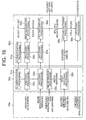
- FIG. 16 is a view showing a procedure of reproducing the optical disk 10, on which the contents are recorded by the method shown in FIG. 15, to thereby decode the encoded contents (Enc-contents) .
- FIG. 16 corresponds to FIG. 14.
- first and second key generation processing units 66b and 67b of FIG. 14 a key generation processing unit 66c is arranged.
- first and second decoding processing units 56c and 68c are arranged.
- RP-Data+MM embedded proprietary data
- MM media mark
- the multiply encoded title key (Enc.Enc-Kt) read out by the optical disk reading device 50c from the optical disk 10a is decoded in the first decoding processing unit 56c to generate the encoded title key (Enc-Kt), which is then sent to an AV decoder module 60c.
- a specific media key (Kum) is generated from the media key (Km) and the volume identifier (Volume-ID) in the key generation processing unit 66c.
- the encoded title key (Enc-Kt) is decoded with the specific media key (Kum) to generate the title key (Kt).
- Enc-contents are decoded by the title key (Kt) to reproduce contents in plaintexts.
- the media mark (MM) separated from the embedded proprietary data (RP-Data+MM) is used only inside the optical disk reading device 50c, and outputting of which to the AV decoder module 60c is not necessary. Specifically, since the media mark (MM) will not be included in data read out by the optical disk reading device 50c, it becomes possible to prevent reading out of the media mark (MM) and using it to decode the encoded contents (Enc-contents) by a third person.
- this embodiment represents a case of performing recording on the optical disk 10, but the optical disk 10a may be used instead.
- FIG. 17 represents a procedure of a case that a special modulating method is introduced as an embedding method of the media mark (MM).
- FIG. 17 corresponds to FIG. 14.
- the procedure up to generating error correcting codes PO (outer parity) /PI (inner parity) and adding the error correcting codes to ECC blocks in a PO/PI generating unit R05 is the same as that in FIG. 4.
- the PO is interleave-processed in a PO interleave unit R06, and SYNC (synchronization signal) addition and modulation processing is performed in a SYNC addition & modulation processing unit R07.
- a media mark error correcting code (MM-Pa) is generated from the media mark (MM), and thereafter modulation processing thereof is performed in a modulating unit R13.
- the proprietary data (RP-Data) and the media mark (MM) are separately modulated.
- the media mark (MM) is modulated by a modulating method that is different from that of general main data (M-Data).
- a part of a modulated recording signal of the proprietary data (RP-Data) is replaced by modulated recording signals of the media mark (MM) and of the media mark error correcting code (MM-Pa) to generate a recording signal, which is then recorded on the optical disk 10.
- obtaining of the media mark (MM) by a third person can be prevented even if an embedding position of the media mark (MM) is found out.
- FIG. 18 is a schematic view showing a physical sector of a case that a media mark (MM) signal is embedded using the special modulating method shown in FIG. 17.
- One row is constituted by a pair of "SYNC frames" of 32 + 1456 channel bits.
- SY0 and SY5 are SYNC frames.
- the physical sector is constituted by aggregating 26 of such rows.
- the media mark (MM) is embedded in a frame SY3.
- the media mark (MM) is modulated by a modulating method that is different from that of general main data (M-Data).
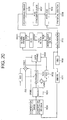
- FIG. 19 represents a procedure of a case that a special modulating method is introduced as an embedding method of the media mark (MM).
- FIG. 19 corresponds to FIG. 17.
- FIG. 20 is a view representing details of steps in FIG. 19, and contents of performed processing thereof are substantially the same, except that the main data (M-data) includes control data (Control-Da), and that a data frame D02 and so on are clearly specified.
- M-data main data
- Control-Da control data
- MM-Pa media mark error correcting code
- RP-Data proprietary data
- M-data main data
- MM media mark
- MM-Pa media mark error correcting code
- MM-Pa media mark error correcting code
- MM-Pa media mark error correcting code
- a watermark (WM) is embedded in design information inside the proprietary data (RP-Data).
- the media mark (MM) which has been described is electronic watermark information that basically will not be outputted from an optical disk reading device, in other words, will not be copied.
- the watermark (WM) is considered as electronic watermark information which is outputted from the optical disk reading device and copied similarly to normal data on the optical disk 10.
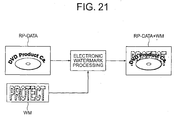
- FIG. 21 represents steps of generating embedded proprietary data (RP-Data+WM) by embedding the watermark (WM) in the design information inside the proprietary data (RP-Data).
- This watermark (WM) iscopiable, but difficult to be recognized when the optical disk 10 is viewed.
- the watermark (WM) described here is basically invisible, and a design of the watermark (WM) does not appear in a visible form on an image of the embedded proprietary data (RP-Data+WM) of FIG. 21.
- the watermark (WM) will be copied unknowingly when the proprietary data (RP-Data) is copied.
- RP-Data proprietary data
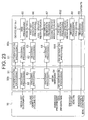
- FIG. 22 and FIG. 23 are views representing procedures of encoding and decoding contents using the media mark (MM) and the watermark (WM) together.
- FIG. 22 and FIG. 23 correspond to FIG. 2 and FIG. 3 respectively.
- the watermark (WM) in this case is used as an encryption key rather than image information such as of FIG. 21.
- a third key generation processing unit 46 and a watermark embedding processing unit 47 are added to FIG. 2.
- the second specific media key (Kum2) is converted with the watermark (WM) into a third specific media key (Kum3), which is then used to encode a title key (Kt).
- the watermark (WM) is further embedded in the embedded proprietary data (RP-Data+MM), which is then recorded as multiply embedded proprietary data (RP-Data+MM+WM) on the optical disk 10.
- a watermark separation processing unit 691 and a third key generation processing unit 692 are added to FIG. 3.
- the media mark (MM) is separated from the multiply embedded proprietary data (RP-Data+MM+WM) in a media mark separation processing unit 55 to generate the embedded proprietary data (RP-Data+WM).
- the watermark (WM) is separated from the embedded proprietary data (RP-Data+WM) by the watermark separation processing unit 691.
- the second specific media key (Kum2) is converted with the watermark (WM) into the third specific media key (Kum3), which is then used to decode the title key (Kt).
- the media mark (MM) when a certain association is established between the media mark (MM) and the watermark (WM) , it becomes possible to judge that the optical disk 10 is a copied item when either of the media mark (MM) or the watermark (or a part of them) is missing.
- the watermark (WM) is copied when data is copied from the optical disk 10, so that the media mark (MM) becomes missing.
- the optical disk 10 on which the media mark (MM) and the watermark (WM) are recorded in a correspondence is copied, a chance for the correspondence to be broken is high.
- Embodiments of the present invention can be expanded/modified without being limited to the above-described embodiments, and such expanded/modified embodiments are also included in the technical scope of the present invention.
Landscapes
- Engineering & Computer Science (AREA)
- Signal Processing (AREA)
- Computer Security & Cryptography (AREA)
- Signal Processing For Digital Recording And Reproducing (AREA)
- Storage Device Security (AREA)
Applications Claiming Priority (2)
| Application Number | Priority Date | Filing Date | Title |
|---|---|---|---|
| JP2004004710 | 2004-01-09 | ||
| JP2004004710A JP2005196926A (ja) | 2004-01-09 | 2004-01-09 | 記録媒体、記録媒体書込装置、記録媒体読取装置、記録媒体書込方法、および記録媒体読取方法 |
Publications (1)
| Publication Number | Publication Date |
|---|---|
| EP1553583A2 true EP1553583A2 (de) | 2005-07-13 |
Family
ID=34587736
Family Applications (1)
| Application Number | Title | Priority Date | Filing Date |
|---|---|---|---|
| EP04106960A Withdrawn EP1553583A2 (de) | 2004-01-09 | 2004-12-23 | Aufzeichnungsmedium, Aufzeichnungsmediumschreibevorrichtung, Aufzeichnungsmediumlesevorrichtung, Aufzeichnungsmediumschreibeverfahren, und Aufzeichnungsmediumleseverfahren |
Country Status (6)
| Country | Link |
|---|---|
| US (1) | US20050154905A1 (de) |
| EP (1) | EP1553583A2 (de) |
| JP (1) | JP2005196926A (de) |
| KR (1) | KR100693008B1 (de) |
| CN (1) | CN100447881C (de) |
| TW (1) | TW200529196A (de) |
Cited By (1)
| Publication number | Priority date | Publication date | Assignee | Title |
|---|---|---|---|---|
| US9026781B2 (en) | 2007-12-29 | 2015-05-05 | Thomson Licensing | System and method for data transmission |
Families Citing this family (12)
| Publication number | Priority date | Publication date | Assignee | Title |
|---|---|---|---|---|
| IE20050277A1 (en) * | 2005-05-04 | 2006-11-29 | Nat Univ Ireland | Method and apparatus for generating error-correcting and error-detecting codes using zero-divisors and units in group rings |
| US20060274617A1 (en) * | 2005-06-03 | 2006-12-07 | Musto James J | Techniques for forming burst cutting area mark |
| MY149346A (en) * | 2005-11-17 | 2013-08-30 | Koninkl Philips Electronics Nv | System for managing proprietary data |
| US8635166B1 (en) | 2006-06-09 | 2014-01-21 | Aol Inc. | Internet content marking |
| JP2008103844A (ja) * | 2006-10-17 | 2008-05-01 | Toshiba Corp | 再生装置および鍵管理方法 |
| JPWO2010001544A1 (ja) * | 2008-07-01 | 2011-12-15 | パナソニック株式会社 | ドライブ装置、コンテンツ再生装置、記録装置、データ読み出し方法、プログラム、記録媒体、および集積回路 |
| WO2010116508A1 (ja) * | 2009-04-09 | 2010-10-14 | 株式会社 東芝 | 保護されたコンテンツの管理コピー方法、この管理コピー方法を用いる装置、及びこの管理コピー方法に用いる情報記録媒体 |
| JP2010268417A (ja) * | 2009-04-16 | 2010-11-25 | Toshiba Corp | 記録装置及びコンテンツデータ再生システム |
| US8369196B1 (en) | 2010-05-04 | 2013-02-05 | Cinram International Inc. | BCA recording on optical recording medium |
| US8526282B1 (en) | 2010-07-07 | 2013-09-03 | Cinram Group, Inc. | Method for replicating media using unique identifiers |
| JP2012204879A (ja) * | 2011-03-23 | 2012-10-22 | Toshiba Corp | コンテンツデータ再生システムおよびその利用履歴の収集システム |
| US10816905B2 (en) * | 2015-04-08 | 2020-10-27 | Cymer, Llc | Wavelength stabilization for an optical source |
Family Cites Families (6)
| Publication number | Priority date | Publication date | Assignee | Title |
|---|---|---|---|---|
| JP3103061B2 (ja) * | 1997-09-12 | 2000-10-23 | インターナショナル・ビジネス・マシーンズ・コーポレ−ション | トークン作成装置および該トークンを用いたデータ制御システム |
| JPH11232779A (ja) * | 1997-11-20 | 1999-08-27 | Toshiba Corp | コピー防止装置 |
| WO2000067257A2 (en) * | 1999-04-28 | 2000-11-09 | Matsushita Electric Industrial Co., Ltd. | Optical disk, optical disk recording and reproducing apparatus, method for recording, reproducing and deleting data on optical disk, and information processing system |
| EP1325497A2 (de) * | 2000-09-22 | 2003-07-09 | Matsushita Electric Industrial Co., Ltd. | Optische platte und wiedergabeverfahren, wiedergabegerät, und aufzeichnungsgerät dafür |
| JP3779580B2 (ja) * | 2001-09-27 | 2006-05-31 | 株式会社東芝 | 信号処理方法及び装置、信号再生方法及び装置、記録媒体 |
| JP2003195759A (ja) * | 2001-12-25 | 2003-07-09 | Hitachi Ltd | 暗号化データの生成方法、記録装置、記録媒体、復号方法、記録媒体再生装置、伝送装置、および、受信装置 |
-
2004
- 2004-01-09 JP JP2004004710A patent/JP2005196926A/ja active Pending
- 2004-06-16 US US10/867,737 patent/US20050154905A1/en not_active Abandoned
- 2004-12-23 EP EP04106960A patent/EP1553583A2/de not_active Withdrawn
- 2004-12-27 TW TW093140825A patent/TW200529196A/zh unknown
-
2005
- 2005-01-07 CN CNB2005100041498A patent/CN100447881C/zh not_active Expired - Fee Related
- 2005-01-10 KR KR1020050002313A patent/KR100693008B1/ko not_active Expired - Fee Related
Cited By (1)
| Publication number | Priority date | Publication date | Assignee | Title |
|---|---|---|---|---|
| US9026781B2 (en) | 2007-12-29 | 2015-05-05 | Thomson Licensing | System and method for data transmission |
Also Published As
| Publication number | Publication date |
|---|---|
| US20050154905A1 (en) | 2005-07-14 |
| JP2005196926A (ja) | 2005-07-21 |
| CN100447881C (zh) | 2008-12-31 |
| TW200529196A (en) | 2005-09-01 |
| CN1637921A (zh) | 2005-07-13 |
| KR100693008B1 (ko) | 2007-03-12 |
| KR20050074305A (ko) | 2005-07-18 |
Similar Documents
| Publication | Publication Date | Title |
|---|---|---|
| US7017100B2 (en) | Signal processing method and apparatus, signal reproducing method and apparatus, and recording medium | |
| EP1058254B1 (de) | Optische Platte, optisches Plattenaufzeichnungs- und wiedergabegerät, und Verfahren zur Aufzeichnung und Wiedergabe | |
| JP3779580B2 (ja) | 信号処理方法及び装置、信号再生方法及び装置、記録媒体 | |
| KR100707807B1 (ko) | 데이터기록매체, 데이터기록장치, 데이터기록방법,데이터재생장치 및 데이터재생방법 | |
| KR100682562B1 (ko) | 정보 기록 장치 및 방법, 정보 재생 장치 및 방법, 및정보 기록 매체 및 프로그램 정보 기록 매체 | |
| US20050154905A1 (en) | Recording medium, recording medium writing device, recording medium reading device, recording medium writing method, and recording medium reading method | |
| EP1355308A1 (de) | Datenwiedergabevorrichtung, Datenaufnahmevorrichtung, Schaltung, Datenwiedergabeverfahren und Datenaufnahmeverfahren | |
| US7624282B2 (en) | Method and apparatus for DVD copy protection with selective data pattern insertion | |
| JP5468555B2 (ja) | 情報記録装置、情報再生装置及び情報記録媒体 | |
| JP3668176B2 (ja) | 秘匿情報を伴う情報記録方法及び装置及び再生方法及び装置及び記録媒体 | |
| JP3965961B2 (ja) | 記録媒体、記録方法、記録装置、再生方法及び再生装置 | |
| JP2004022104A (ja) | 信号処理装置、信号処理方法、及び記憶媒体 | |
| EP0940810A1 (de) | Aufnahmemedium mit Urheberrechtsschutzmassnahmen | |
| JP3828288B2 (ja) | 情報生成方法及び装置、情報再生方法及び装置並びに情報記録媒体 | |
| JP2004095114A (ja) | 情報記録再生用媒体、情報記録再生装置、情報記録再生方法、及び、情報記録再生用媒体のデータ構造 | |
| US20050254387A1 (en) | Recording medium processing device | |
| JPH10106147A (ja) | ディスクの著作権管理情報の記録方法、書き込み方法及びディスク | |
| JP5417341B2 (ja) | 光ディスク、光ディスクの再生装置、光ディスクの製造装置及び製造方法 | |
| JP3709198B1 (ja) | 光ディスク、光ディスク記録装置及び方法、並びに光ディスク再生装置及び方法 | |
| JP2004088540A (ja) | ディジタル情報信号の記録再生方法、記録再生システム、メディアドライブ、メディアドライブの記録再生方法、並びに記録媒体およびプログラム | |
| JP2003198831A (ja) | 信号処理方法及び装置、信号再生処理方法及び装置、記録媒体 | |
| JP2005339740A (ja) | 信号生成装置、信号再生装置、記録媒体処理装置、信号生成方法、信号再生方法、および記録媒体 | |
| JP2006197606A (ja) | 信号処理方法及び装置、信号再生方法及び装置、記録媒体 | |
| JP2004095121A (ja) | ディジタル情報信号の記録および再生方法、ディジタル情報の記録再生装置および記録媒体 |
Legal Events
| Date | Code | Title | Description |
|---|---|---|---|
| PUAI | Public reference made under article 153(3) epc to a published international application that has entered the european phase |
Free format text: ORIGINAL CODE: 0009012 |
|
| 17P | Request for examination filed |
Effective date: 20041230 |
|
| AK | Designated contracting states |
Kind code of ref document: A2 Designated state(s): AT BE BG CH CY CZ DE DK EE ES FI FR GB GR HU IE IS IT LI LT LU MC NL PL PT RO SE SI SK TR |
|
| AX | Request for extension of the european patent |
Extension state: AL BA HR LV MK YU |
|
| STAA | Information on the status of an ep patent application or granted ep patent |
Free format text: STATUS: THE APPLICATION HAS BEEN WITHDRAWN |
|
| 18W | Application withdrawn |
Effective date: 20090202 |