EP1553534A1 - Mechanical security system, control device, remote annunciator, control method and control program, computer-readable recording medium recording control program - Google Patents
Mechanical security system, control device, remote annunciator, control method and control program, computer-readable recording medium recording control program Download PDFInfo
- Publication number
- EP1553534A1 EP1553534A1 EP04745519A EP04745519A EP1553534A1 EP 1553534 A1 EP1553534 A1 EP 1553534A1 EP 04745519 A EP04745519 A EP 04745519A EP 04745519 A EP04745519 A EP 04745519A EP 1553534 A1 EP1553534 A1 EP 1553534A1
- Authority
- EP
- European Patent Office
- Prior art keywords
- mode
- alert mode
- monitored
- monitored person
- detecting
- Prior art date
- Legal status (The legal status is an assumption and is not a legal conclusion. Google has not performed a legal analysis and makes no representation as to the accuracy of the status listed.)
- Withdrawn
Links
Images







Classifications
-
- G—PHYSICS
- G08—SIGNALLING
- G08B—SIGNALLING SYSTEMS, e.g. PERSONAL CALLING SYSTEMS; ORDER TELEGRAPHS; ALARM SYSTEMS
- G08B25/00—Alarm systems in which the location of the alarm condition is signalled to a central station, e.g. fire or police telegraphic systems
- G08B25/008—Alarm setting and unsetting, i.e. arming or disarming of the security system
Definitions
- the present invention relates to a security system, and particularly relates to a security system which prevents the occurrence of absence of security measures caused by a human error, a control device, a remote alarm device, a control method, and a control program, which are for the aforesaid security system, and a computer-readable storage medium storing the control program.
- sensors that detect the existence of a human body, the breakdown of glass, fire, and gas leakage have been in practical use, thanks to sensing media that detect light, sound (including supersonic wave and acoustic pressure), electric waves (especially microwave), images, and others.
- Patent Documents 1-3 Prior art documents related to the present invention are the following Patent Documents 1-3.
- Patent Document 1 Japanese Laid-Open Patent Application No. 8-16963/1996; published on January 19, 1996) discloses an alarm device which prevents the user from making an operation mistake and prevents a security alert from being mistakenly dispatched. More specifically, this alarm device is arranged such that a plurality of intrusion sensors are provided in a monitored area and an alert is automatically sent to a remote security center if an intrusion to the monitored area or an act of vandalism in the monitored area is detected by one of the intrusion sensors, and the alarm device includes: a controller provided in the monitored area; a mode setting device provided outside the monitored area; timer means that starts clocking in response to the operation of the controller, and stops the clocking after a predetermined period of time elapses; and control means. The control means sets the controller to an alert mode if the mode setting device is operated during the clocking of the timer means. If the mode setting device is operated after the clocking finishes, the control device does not set any security modes.
- Patent Document 2 Japanese Laid-Open Patent Application No. 2001-333216; published on November 30, 2001
- a photograph of an intruder is automatically sent to a next-generation mobile phone, rather than an alert is sent to a security company, so that the user can swiftly identify the intruder and contact the police, and as a result the payment to the security company can be reduced.
- this portable remote moving picture transmission system when an alert state is set by a key switch, the illegal intruder is sensed by a miniaturized human sensing light and a connected automatic reporting device is started.
- the automatic reporting device continuously starts connecting plural reporting destinations predetermined to the next generation portable telephone.
- Patent Document 3 Japanese Laid-Open Patent Application No. 2001-288939; published on October 19, 2001 discloses a locking confirmation supporting apparatus which alleviates a fear of the user regarding locking, and is easy to use, inexpensive, and highly versatile. More specifically, the locking confirmation supporting apparatus is comprised of a key holder section for holding a key, and an electronic clock section consisting of a timer circuit, a CPU, a ROM, a RAM, and a display. Then, a locking confirmation signal is generated, and a current time point of locking is stored as a confirmation time point into the RAM of the electronic clock section, based on the locking confirmation signal, and a notice is sent to a liquid crystal display.
- the locking confirmation signal is generated by a key taking/ejecting means inclusive of a key taking/ejection-detecting switch provided in the key holder section, locking sound detecting means inclusive of a locking sound sensor such as a microphone, a manual input switch, etc. After locking, by operating a reconfirmation switch, the confirmation time point stored in the RAM is displayed again on the liquid crystal display.
- a representative example of the human errors is such that the user forgets to set an "alert mode". That is, security systems are typically arranged in such a manner that the user sets the security mode when he/she leaves home and wishes to let the house be watched, and releases the security mode upon the return to the house. In this case, the security system does not turn on if the user forgets to set the security mode or does not set the mode for some reason, so that the security measures do not operate.
- conventional security systems cannot, for instance, gives advise, alarm, or the like to set the security mode to the user, in order to prevent a human error by the user of buildings, houses, and the like.
- the conventional systems cannot cover for human errors without imposing a burden on the user.
- An object of the present invention is to provide a security system which prevents the occurrence of absence of security measures caused by a human error and can significantly improve the level of security, a control device, a remote alarm device, and a control method which are for the aforesaid security system. Also, an object of the present invention includes to provide a control program which realizes the aforesaid security system, and a computer-readable storage medium storing the control program.
- a security system of the present invention is arranged so as to include: a control device for performing a predetermined coping action when an abnormality is detected in a monitored area; an outing motion detection sensor for detecting actions of a non-monitored person when leaving the monitored area; and a non-monitored person detecting sensor for detecting the non-monitored person in the monitored area, the control device including: a mode switching section (mode switching means) for switching between an alert mode with which the coping action is performed if the abnormality is detected in the monitored area and a non-alert mode with which the coping action is not performed; and a mode switching reminder section (mode switching reminder means) for causing a remote alarm device located at a remote place to present mode change reminder information, when the outing motion detection sensor detects that the non-monitored person has left the monitored area, the non-monitored person detecting sensor does not detect any other non-monitored person, and the non-alert mode has been set.
- mode switching section mode switching means
- the outing motion detection sensor detects that a non-monitored person has left the area, the non-monitored person detecting sensor does not detect the presence of any other user, and the non-alert mode has been set, it is possible to advise the user of the security service to switch to the alert mode by causing the remote alarm device to present the mode change reminder information.
- the occurrence of the absence of security measures caused by a human error can be prevented, and this brings about the effect that the level of security can be significantly improved.
- a security system of the present invention is arranged so as to include: a control device for performing a predetermined coping action when an abnormality is detected in a monitored area; an outing motion detection sensor for detecting actions of a non-monitored person when leaving the monitored area; and a plurality of non-monitored person detecting sensors for detecting the non-monitored person in the monitored area, the control device including: a mode switching section (mode switching means) for switching between an alert mode with which the coping action is performed if the abnormality is detected in the monitored area and a non-alert mode with which the coping action is not performed; a storage section for storing initial state data that indicates initial states of the non-monitored person detecting sensors in the alert mode; an initial state detection section (human body sensor confirming section, initial state detection means) for detecting a matching between detection states of the non-monitored person detecting sensors and the initial state data; and a mode switching reminder section (mode switching reminder means) for causing a remote alarm device located at a
- the outing motion detection sensor detects that the non-monitored person has left the area
- the detection states of the non-monitored person detecting sensors are matched with the initial state data, and the non-alert mode has been set, it is possible to advise the user of the security service to switch to the alert mode by causing the remote alarm device to present the mode change reminder information.
- the occurrence of the absence of security measures caused by a human error can be prevented, and this brings about the effect that the level of security can be significantly improved.
- a security system of the present invention is arranged so as to include: a control device for performing a predetermined coping action when an abnormality is detected in a monitored area; and an outing motion detection sensor for detecting actions of a non-monitored person when leaving the monitored area, the control device including: a mode switching section (mode switching means) for switching between an alert mode with which the coping action is performed if the abnormality is detected in the monitored area and a non-alert mode with which the coping action is not performed; and a mode switching reminder section (mode switching reminder means) for causing a remote alarm device located at a remote place to present mode change reminder information, when the outing motion detection sensor detects that the non-monitored person has left the monitored area, and the non-alert mode has been set.
- mode switching section mode switching means
- mode switching reminder section mode switching reminder means
- a security system of the present invention is arranged such that the outing motion detection sensor is provided so as to detect actions of the non-monitored person who passes an exit (for example, front door) of the monitored area from the inside of the monitored area to the outside.
- a security system of the present invention is arranged so as to include: a control device for performing a predetermined coping action when an abnormality is detected in a monitored area; and a non-monitored person detecting sensor for detecting the non-monitored person in the monitored area, the control device including: a mode switching section (mode switching means) for switching between an alert mode with which the coping action is performed if the abnormality is detected in the monitored area and a non-alert mode with which the coping action is not performed; and a mode switching reminder section (mode switching reminder means) for causing a remote alarm device located at a remote place to present mode change reminder information, when the non-monitored person detecting sensor detects no non-monitored person, and the non-alert mode has been set.
- mode switching section mode switching means
- mode switching reminder section mode switching reminder means
- a security system of the present invention is arranged so as to include: a control device for performing a predetermined coping action when an abnormality is detected in a monitored area; and a plurality of non-monitored person detecting sensors for detecting the non-monitored person in the monitored area, the control device including: a mode switching section (mode switching means) for switching between an alert mode with which the coping action is performed if the abnormality is detected in the monitored area and a non-alert mode with which the coping action is not performed; a storage section for storing initial state data that indicates initial states of the non-monitored person detecting sensors in the alert mode; and an initial state detection section (human body sensor confirming section, initial state detection means) for detecting a matching between detection states of the non-monitored person detecting sensors and the initial state data; and a mode switching reminder section (mode switching reminder means) for causing a remote alarm device located at a remote place to present mode change reminder information, when the detection states of the non-monitored person
- a security system of the present invention is arranged such that the control device further includes a sensor state accumulating section (initial state data accumulative storing means) for, when switching to the alert mode is carried out in accordance with an instruction from a user, storing, in the storage section, the initial state data in which the detection states of the non-monitored person detecting sensors at the time of the switching to the alert mode or after a predetermined period has elapsed from the switching to the alert mode are associated with the accumulative frequencies of the detection states, and the initial state detection means (human body sensor confirming section, initial state detection means) compares a pattern of the detection states of the non-monitored person detecting sensors with highest accumulative frequency patterns, the number of which is predetermined, in the initial state data stored in the storage section, so as to detect a matching therebetween.
- a sensor state accumulating section initial state data accumulative storing means for, when switching to the alert mode is carried out in accordance with an instruction from a user, storing, in
- the accumulative frequencies of the patterns of the detection states of the non-monitored person detecting sensors when the user surely sets the alert mode are obtained, and as a result of judgment from the obtained accumulative frequencies, it is possible to certainly recognize whether or not the alert mode has been set from the detection states of the non-monitored person detecting sensors.
- the initial states of the non-monitored person detecting sensors not limited to the initial states in which the non-monitored person detecting sensors are all OFF, can be flexibly detected. This brings about the effect that it is possible to increase the reliability of the decision of whether or not the mode change reminder information should be sent in order to advice the user to switch to the alert mode.
- the security system of the present invention is arranged such that the remote alarm device includes a switching instruction input section (remote-switching instruction input means) for the user inputting a mode switching instruction to the alert mode, and the mode switching section (mode switching means) of the control device switches to the alert mode in accordance with the mode switching instruction received from the remote alarm device.
- a switching instruction input section remote-switching instruction input means
- mode switching section mode switching means
- the security system of the present invention includes: a control device for performing a predetermined coping action when an abnormality is detected in a monitored area; an outing motion detection sensor for detecting actions of a non-monitored person when leaving the monitored area; and a non-monitored person detecting sensor for detecting the non-monitored person in the monitored area
- the control device includes: a mode switching section (mode switching means) for switching between an alert mode with which the coping action is performed if the abnormality is detected in the monitored area and a non-alert mode with which the coping action is not performed, the mode switching means automatically switching to the alert mode when the outing motion detection sensor detects that the non-monitored person has left the monitored area, the non-monitored person detecting sensor does not detect any other non-monitored person, and the non-alert mode has been set.
- mode switching section mode switching means
- the security system can automatically switch to the alert mode without the instruction to switch to the alert mode from the user of the security service.
- a security system of the present invention includes: a control device for performing a predetermined coping action when an abnormality is detected in a monitored area; and an outing motion detection sensor for detecting actions of a non-monitored person when leaving the monitored area; the control device including: a mode switching section (mode switching means) for switching between an alert mode with which the coping action is performed if the abnormality is detected in the monitored area and a non-alert mode with which the coping action is not performed, the mode switching means automatically switching to the alert mode when the outing motion detection sensor detects that the non-monitored person has left the monitored area, and the non-alert mode has been set.
- mode switching section mode switching means
- the security system can automatically switch to the alert mode without the instruction to switch to the alert mode from the user of the security service. With this, the occurrence of the absence of security measures caused by a human error can be prevented, and this brings about the effect that the level of security can be significantly improved.
- a security system of the present invention includes: a control device for performing a predetermined coping action when an abnormality is detected in a monitored area; and a plurality of non-monitored person detecting sensors for detecting the non-monitored person in the monitored area, the control device including: a mode switching section (mode switching means) for switching between an alert mode with which the coping action is performed if the abnormality is detected in the monitored area and a non-alert mode with which the coping action is not performed; a storage section for storing initial state data that indicates initial states of the non-monitored person detecting sensors in the alert mode; and an initial state detection section (human body sensor confirming section, initial state detection means) for detecting a matching between detection states of the non-monitored person detecting sensors and the initial state data, the mode switching means automatically switching to the alert mode, when the detection states of the non-monitored person detecting sensors are matched with the initial state data, and the non-alert mode has been set.
- mode switching section mode switching means
- the security system can automatically switch to the alert mode without the instruction to switch to the alert mode from the user of the security service. With this, the occurrence of the absence of security measures caused by a human error can be prevented, and this brings about the effect that the level of security can be significantly improved.
- the security system of the present invention includes a mode switching reminder section (mode switching report means) for causing a remote alarm device located at a remote place to present mode change report information, when the mode switching section (mode switching means) automatically switches to the alert mode.
- mode switching reminder section mode switching report means
- the foregoing security system may be realized by a computer.
- the invention also includes (i) a control program that realizes on the computer the foregoing security system by causing the computer to function as each of the foregoing means, and (ii) a computer-readable storage medium storing the foregoing control program.
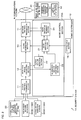
- Fig. 1 is a functional block diagram illustrating in detail a configuration of a security system 1 of the present embodiment.
- Fig. 2 is an explanatory diagram schematically illustrating a configuration of this security system 1.
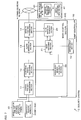
- Figs. 3, 6, 7, and 11 are functional block diagrams illustrating in detail a configuration of an alternative example of the security system 1 illustrated in Fig. 1. Note that members having the same functions are given the same reference numbers, so that the descriptions thereof are omitted for the sake of convenience.
- the present embodiment describes the security system 1, which is a typical home security system, in which detection information detected by security sensors 33 installed in a house is supplied to a mobile phone of the user. It is noted that the security system of the present invention may be widely applied to another system arranged in a different manner, e.g. a system which includes a security center.
- the security system 1 When an abnormality regarding the house is detected in accordance with a detection signal from the security sensor 33, the security system 1 performs a predetermined coping action such as issuing an alert, under the control of the home controller 10. In the security system 1, it is possible through the home controller 10 to switch between (i) an alert mode with which the coping action is performed upon detection of an abnormality regarding the house and (ii) a non-alert mode with which the aforesaid action is not performed.
- the security system 1 detects that the user has left home without setting the alert mode, so as to (1) automatically switch over to the alert mode or (2) provide mode change reminder information to a remote alarm device 40 such as a mobile phone, in order to advice the user to switch the security system to the alert mode.
- a remote alarm device 40 such as a mobile phone
- the user away from home can switch the mode of the security system to the alert mode, by means of the remote alarm device 40.
- the security system 1 (1) detects the outing motion of the user and/or (2) compares detection states of human body sensors in the non-alert mode with initial states in the alert mode to determined if there is a matching.
- the security system 1 is arranged in such a manner that a sensor two-way transmission section 11 of the home controller 10 is connected with the human body sensors 31, outing motion detection sensors 32, and the security sensors 33, while a network two-way transmission section 14 is connected to the remote alarm device 40 via a communications network N.
- these sensors and the home controller 10 of the security system 1 are set up in the house that is a monitored area A, in the following manner: A four-and-a-half-mat Western-style room is provided with a home controller (HC). A six-mat Western-style room, a kitchen, a six-mat Japanese-style room, and a veranda are provided with human body sensors SB1-SB4, respectively.
- a human body sensor SA1 is provided at an entrance, an open-close detection sensor SA2 is provided on a front door D, and a human body sensor SA3 is further provided outside the front door D. These sensors send and receive signals to/from the home controller 10, through wired/wireless communications.
- human body sensors SB1-SB4 correspond to the human body sensors 31 illustrated in Fig. 1.
- human body sensors SA1 and SA3 and the open-close detection sensor SA2 at the front door D correspond to the outing motion detection sensors 32 in Fig. 1.
- the security sensors 33 are also provided in suitable locations in the house.
- the signal transmissions between the security sensors 33 and the home controller 10 are also performed in a manner identical with those between the other sensors and the home controller 10.
- the performances, positions, and numbers of the human body sensors 31, the outing motion detection sensors 32, and the security sensors 33 can be arbitrarily determined in view of the purpose of the security.
- the security sensors 33 detect an abnormality in the monitored area A. These sensors 33 can be provided in line with the purpose of the security. For instance, the security sensors 33 detect the presence of a human body, the break down of glass, fire, gas leakage, a temperature of an air conditioner, turn-off of a breaker, and the like, by means of sensing media such as light, sound (including supersonic wave and acoustic pressure), electric waves (especially microwave), and images.
- sensing media such as light, sound (including supersonic wave and acoustic pressure), electric waves (especially microwave), and images.
- the human body sensors 31 detect a non-monitored person in the monitored area A.
- This non-monitored person is a non-intruder whose presence is not seen as an abnormality, and is an inhabitant of the house (Fig. 2) in a practical sense.
- the non-monitored person and the administrator who can switch between the modes are regarded as an identical person, and both of them are referred to as "user".
- the outing motion detection sensors 32 are provided in such a manner that they can detect the motion of the user leaving the monitored area A.
- the outing motion detection sensors 32 are, for instance, provided so as to detect a sequence of actions of the user who passes the exit (front door D) of the monitored area A, from the inside of the monitored area A to the outside. More specifically, as illustrated in Fig. 2, the human body sensor SA1 is provided at the entrance, the open-close detection sensor SA2 is provided on the front door D, and the human body sensor SA3 is provided outside the front door D. Note that, as the open-close detection sensor SA2 on the front door D, a magnet switch can be adopted.
- Examples of the human body sensors 31, the outing motion detection sensors 32, and the security sensors 33 which are sensors detecting a human body include a pyroelectric human body sensor that detects a body temperature of a person who enters the monitored area and then outputs a signal. Apart from this sensor, a human body can be detected using a Doppler sensor and a photoelectric sensor, or by processing images taken by a video camera.
- the human body sensors 31 and the outing motion detection sensors 32 may function as the security sensors 33 that detect an intrusion in the alert mode. That is to say, the human body sensors 31 and the outing motion detection sensors 32 can be used as the security sensors 33. More specifically, the following arrangement can be realized: in the non-alert mode, the human body sensors SB1-SB4, the human body sensors SA1 and SA3, and the open-close detection sensor SA2 on the front door D, which are illustrated in Fig. 2, are caused to function as the human body sensors 31 and the outing motion detection sensors 32, while, in the alert mode, these sensors SB1-SB4, SA1, SA3, and SA2 are caused to function as the security sensors 33.
- the security sensors 33 may include another human body sensor.
- Figs. 1, 3, 6, 7, and 11 premise on the above-described case.
- human body sensors exclusively for detecting the user may be different from human body sensors exclusively for detecting an intruder.
- the home controller 10 includes: the sensor two-way transmission section 11; a detection signal collecting section 12; an alarm generating section 13; the network two-way transmission section 14; a setting input section 15, and a mode control section 20.
- the home controller 10 is preferably provided with a chargeable secondary battery, in consideration of power failures.
- the sensor two-way transmission section 11 performs communications with the sensors (human body sensors 31, the outing motion detection sensors 32, and the security sensors 33). More specifically, the sensor two-way transmission section 11 may perform wired or wireless communications.
- the detection signal collecting section 12 collects and processes the detection signals supplied from the respective sensors. The detection signal collecting section 12 then supplies the detection signals, which are collected from the security sensors 33, to the alarm generating section 13. Also, the detection signal collecting section 12 supplies, to the human body sensor confirming section 23 and the sensor state accumulating section 25, the detection signals collected from the human body sensors 31. Moreover, the detection signal collecting section 12 supplies, to the outing motion detecting section 22, the detection signals collected from the outing motion detection sensors 32.
- the alarm generating section 13 performs the predetermined coping action when the security sensors 33 detect an abnormality.
- the security system 1 sends an alert to the remote alarm device 40.
- an alert may be suitably supplied to the police, fire station, security center, and the like.
- the alarm generating section 13 sets a mode in accordance with a control signal supplied from a mode switching section 21.
- the network two-way transmission section 14 performs the communications with the communications network N.
- the communications network N is, for example, the Internet.
- the setting input section 15 is a user interface for the user of the security system 1. This setting input section 15 allows the user to set the alert mode and the like and displays various kinds of information.
- the mode control section 20 controls the mode of the alarm generating section 13. To do so, the mode control section 20 includes: the mode switching section 21, the outing motion detecting section 22, the human body sensor confirming section 23, a mode switching reminder section 24, the sensor state accumulating section 25, and a storage section 26. By the way, the sensor state accumulating section 25 and the storage section 26 will be described later.
- the outing motion detecting section 22 detects the motion of the user going out from the monitored area A, in accordance with the detection states of the outing motion detection sensors 32.
- the outing motion detecting section 22 obtains the detection states via the sensor two-way transmission section 11 and the detection signal collecting section 12.
- the outing motion detection sensors 32 include the human body sensors SA1 and SA3 and the open-close detection sensor SA2 on the front door D.
- the human body sensor confirming section 23 judges whether or not the detection states of the human body sensors 31 in the non-alert mode are in predetermined states. These detections states of the human body sensors 31 are obtained via the sensor two-way transmission section 11 and the detection signal collecting section 12. In the simplest case, the human body sensor confirming section 23 confirms that the detection states of the human body sensors 31 are all OFF (Pattern 0), i.e. conforms that no one is in the monitored area A. Also, the human body sensor confirming section 23 compares a pattern of the detection states of the human body sensors 31 with highest accumulative frequency patterns (e.g. Patterns 0-2), the number of which is predetermined, in sensor state accumulative data 26a (Fig. 9) stored in the storage section 26, so as to detect a matching therebetween. This matching will be described later in conjunction with the sensor state accumulating section 25 and the storage section 26.
- accumulative frequency patterns e.g. Patterns 02
- the mode switching section 21 switches between (i) the alert mode with which the coping action is performed if the security sensors 33 detect an abnormality and (ii) the non-alert mode with which the coping action is not performed.
- This mode switching instruction is either inputted using the setting input section 15 or supplied from the remote alarm device 40.
- the mode switching instruction is inputted using the setting input section 15, when the user in the monitored area A switches from the non-alert mode to the alert mode, before leaving home. Meanwhile, the mode switching instruction is supplied from the remote alarm device 40, basically when the user who has received the mode reminder information inputs the instruction from the outside of the monitored area A. As a matter of course, the user outside of the monitored area A can input the mode switching instruction using the remote alarm device 40, before receiving the mode reminder information.
- the mode switching section 21 When the mode switching section 21 in the non-alert mode detects that the user has left home, the mode switching section 21 causes the mode switching reminder section 24 to send the mode change reminder information to the remote alarm device 40.
- the mode switching section 21 performs this action when the non-alert mode is set and one of the following conditions is met: the outing motion detection sensors 32 detect that the user has left home (Situation 1 (Fig. 6)); the human body sensor 31 does not detect the user (Situation 2 (Fig. 7)); the detection states of the human body sensors 31 are matched with the initial state of the alert mode (Situation 3 (Fig. 11)); the outing motion detection sensors 32 detect that the user has left home and the human body sensors 31 do not detect any other users (Situation 4 (Fig. 3)); and the outing motion detection sensors 32 detect that the user has left home and the detection states of the human body sensors 31 are matched with the initial state of the alert mode (Situation 5 (Fig. 1)).
- the mode switching reminder section 24 sends the mode change reminder information to the remote alarm device 40 carried by the user away from home, via the network two-way transmission section 14 and the communications network N.
- the mode change reminder information can be delivered to the user in any manner, as long as the user is informed that the security system 1 is in the non-alert mode and is advised to switch to the alert mode. More specifically, the mode change reminder information may be presented as images and texts, or may be delivered as one of alarm sound, illumination of a lamp, and vibration.
- the mode switching reminder section 24 Upon receiving, from the remote alarm device 40, the instruction to switch to the alert mode in response to the mode change reminder information, the mode switching reminder section 24 supplies, to the mode switching section 21, a control signal indicating the mode change.
- the remote alarm device 40 is a portable communication device that the user can carry around.
- This remote alarm device 40 is provided with a reminder information providing section 41 and a switch instruction input section 42.
- the remote alarm device 40 has user interfaces such as a display panel, a speaker, a vibration motor, a keyboard, a dial and the like, which are suitable for presenting and inputting information.
- the reminder information presenting section 41 presents the mode change reminder information supplied from the home controller 10.
- the switch instruction input section 42 is used by the user to input the instruction to switch to the alert mode.
- the remote alarm device 40 is preferably arranged in such a manner that the user never leaves home without the remote alarm device 40.
- the functions of the remote alarm device 40 may be incorporated into a mobile terminal such as a mobile phone, PHS, and PDA.
- the remote alarm device 40 may be integrated with a key for the exit of the monitored area A or a remote-key to a car.
- FIG. 3 A security system 1A illustrated in Fig. 3 is now discussed.
- This security system 1A is provided with a mode control section 20A that is identical with the mode control section 20 (Fig. 1), except that the sensor state accumulating section 25 and the storage section 26 are not provided.
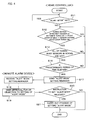
- Fig. 4 is a flowchart illustrating how the security system 1A illustrated in Fig. 3 operates.
- the outing motion detecting section 22 checks the detection state of the outing motion detection sensor 32 provided on the front door D (S12 (outing motion detecting step)). If the outing motion detecting section 22 detects that the user has left home (YES in S12), the human body sensor confirming section 23 judges whether or not all of the human body sensors 31 are OFF (S13 (initial state detecting step)). Note that the steps S12 and S13 may be performed in an inverse order.
- the security system 1A is put on hold for a predetermined period of time in order to confirm that the condition is stable (S16), and then the mode switching reminder section 24 sends the mode change reminder information to the remote alarm device 40 (S17).
- the steps S17 and S18 correspond to the mode switching reminder step.
- the remote alarm device 40 Upon receiving the mode change reminder information, the remote alarm device 40 causes the reminder information presenting section 41 to present the information to the user (S18). The remote alarm device 40 then receives approval for or objection to the setting of the alert mode through the switch instruction input section 42, and transmits the response to the mode change reminder information to the home controller 10 (S19).
- the mode switching reminder section 24 receives the response from the remote alarm device 40. If the response is an instruction to switch to the alert mode (YES in S20), the mode switching reminder section 24 requests the mode switching section 21 to switch the mode (S21 (mode switching step)).
- the security system 1A judges that the user has forgotten to set the alert mode, and sends, to the remote alarm device 40, the mode change reminder information in order to advice the user to set the alert mode.
- the user replies, to the home controller 10, whether or not the alert mode is set.
- the home controller 10 causes the alarm generating section 13 to shift to the alert mode. If the reply from the user indicates that the switching to the alert mode is unnecessary, the home controller 10 finishes the process without the shift to the alert mode.
- Fig. 5 is an explanatory diagram illustrating a concrete example of the detection states of the outing motion detection sensors provided in the security system 1A illustrated in Fig. 3.
- the outing motion detecting section 22 identifies these sequential actions for the outing, on ground of the flow of detection results of the outing motion detection sensors 32. More specifically, as illustrated in Fig. 5, the outing motion detecting section 22 checks whether or not the following sequential changes of the states occur: the human body sensor SA1 at the entrance turns ON ⁇ the front door D "OPEN" (i.e. the open-close detection sensor SA2 turns ON) ⁇ the human body sensor SA3 outside the front door D turns ON.
- the outing motion detecting section 22 stores the detection signals supplied from the outing motion detection sensor 32, each time the states vary. On this account, the times in Fig. 5 are not necessarily at fixed intervals.
- the outing motion detection sensors 32 detect to which direction the user moves.
- the outing motion detection sensors 32 may be composed of any two of the human body sensors SA1 and SA3 and the open-close detection sensor SA2 on the front door D.
- the number of the outing motion detection sensor 32 is preferably three, from the view point of accuracy.
- the monitored area A has more than one exit (e.g. a kitchen door is additionally provided), such an additional exit is also provided with the outing motion detection sensors 32.
- the changes of the detection signals within a predetermined period after the user sets the alert mode by the setting input section 15 of the home controller 10 are set as the sequence corresponding to the outing motion of the user, by the outing motion detecting section 22.
- the user operates the home controller 10 in the four-and-a-half-mat Western-style room so as to set the alert mode, and then moves to the entrance and goes out through the front door D. Accordingly, as illustrated in Fig.
- the outing motion detecting section 22 stores the states of the detection signals that are supplied from the outing motion detection sensors 32 during the aforesaid actions of the user, as reference data for detecting the outing motion of the user. It is noted that the study of the history is helpful for determining the reference data, as in the below-mentioned case of the sensor state accumulating section 25.
- the security system 1 illustrated in Fig. 3 includes (i) the security sensors 33 that detect an abnormality in the monitored area A and (ii) the home controller 10 that performs the predetermined coping action when the security sensors 33 detect the abnormality, and further includes (iii) the outing motion detection sensors 32 that detect the actions of the user at the time of going out from the monitored area A and (iv) the human body sensors 31 that detect the existence of the user in the monitored area A.
- the home controller 10 includes (I) the mode switching section 21 that switches between the alert mode with which the coping action is performed if the security sensors 33 detect the abnormality and the non-alert mode with which the coping action is not performed, and (II) the mode switching reminder section 24 that causes the remote alarm device 40 located at a remote place to present the mode change reminder information indicating the following case: the outing motion detection sensors 32 detect that the user has left home, the human body sensors 31 do not detect the presence of any other users, and the non-alert mode has been set.
- the mode change reminder information is presented by the remote alarm device 40 in the case where the outing motion detection sensors 32 detect that the user has left home, the human body sensors 31 do not detect the presence of any other users, and the non-alert mode has been set. In this manner, the user of the security service is advised to switch to the alert mode. On this account, the absence of security measures caused by a human error can be prevented, and hence the level of security can be significantly improved.
- This security system 1B illustrated in Fig. 6 is provided with a mode control section 20B which is identical with the mode control section 20 (Fig. 1), except that the human body sensor confirming section 23, the sensor state accumulating section 25, and the storage section 26 are not provided therein.
- the security system 1B does not require the human body sensors 31, and the detection of intrusion is performed by the security sensors 33 that also function as human body sensors.
- the security system 1 illustrated in Fig. 6 includes (i) the security sensors 33 that detect an abnormality in the monitored area A, (ii) the home controller 10 that performs a predetermined coping action when the security sensors 33 detect the abnormality, and (iii) the outing motion detection sensors 32 that detect the actions of the user at the time of going out from the monitored area A, and the home controller 10 includes (I) the mode switching section 21 that switches between the alert mode with which the coping action is performed if the security sensors 33 detect the abnormality and the non-alert mode with which the coping action is not performed, and (II) the mode switching reminder section 24 that causes the remote alarm device 40 located at a remote place to present the mode change reminder information in the case when the outing motion detection sensors 32 detect that the user has left home and the non-alert mode has been set.
- the mode change reminder information is presented by the remote alarm device 40, thereby advising the user of the security service to switch to the alert mode.
- the security system 1C illustrated in Fig. 7 will be discussed.
- the security system 1C is provided with a mode control section 20C that is identical with the mode control section 20 (Fig. 1) except that the outing motion detecting section 22, the sensor state accumulating section 25, and the storage section 26 are not provided.
- This security system 1C does not require the outing motion detection sensors 32.
- the detection of the intrusion through the front door D is detected by the security sensors 33 that also function as human body sensors.
- the security system 1 illustrated in Fig. 7 includes (i) the security sensors 33 that detect an abnormality in the monitored area A, (ii) the home controller 10 that performs a predetermined coping action when the security sensors 33 detect the abnormality, and (iii) the human body sensors 31 that detect the existence of the user in the monitored area A, and the home controller 10 includes (I) the mode switching reminder section 24 that switches between the alert mode with which the coping action is performed if the security sensors 33 detects the abnormality and the non-alert mode with which the coping action is not performed, and (II) the mode switching reminder section 24 that causes the remote alarm device 40 located at a remote place to present the mode change reminder information in the case when the human body sensors 31 do not detect the presence of any other users and the non-alert mode has been set.
- the mode change reminder information is presented by the remote alarm device 40, thereby advising the user of the security service to switch to the alert mode.
- the occurrence of the absence of security measures caused by a human error can be prevented, and the level of security can be significantly improved.
- the human body sensor confirming section 23 confirms that all of the human body sensors 31 are OFF, it is confirmed that the user has left the monitored area A.
- the monitored area A is not always unmanned even if the security mode is set. Also, the sensors may be of poor maintenance. By the way, it has generally been said that security systems are often accompanied with false alarm. For these reasons, whether or not the user has left the monitored area may not be properly determined if the determination sorely depends on the check of the (OFF) states of the human body sensors 31.
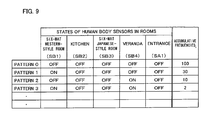
- the security system 1 learns the detection states of the human body sensors 31 at the time of user's setting the alert mode. More specifically, as illustrated in Fig. 9, the security system 1 generates the sensor state accumulative data 26a in which the detection states (initial states) of the human body sensors 31 at the time of switching to the alert mode are associated with the accumulative frequencies of the detection states. With this data, the security system in the non-alert mode judges that the user has left home without setting the alert mode, when a pattern of the detection states of the human body sensors 31 is matched with a high accumulative frequency pattern of the initial states. It is noted that the accumulative frequency of the detection states indicates how often the user set the alert mode in a pattern including those detection states.
- the sensor state accumulating section 25 edits the sensor state accumulative data 26a. In doing so, the detection states of the human body sensors 31, at the time of receiving the instruction or after a predetermined period has elapsed from the arrival of the instruction, are set as the aforesaid initial states. Then, the sensor state accumulating section 25 stores the sensor state accumulative data 26a in the storage section 26. On this occasion, if the aforesaid pattern of the detection states has already been stored in the sensor state accumulative data 26a, the sensor state accumulating section 25 increments by 1 with respect to the accumulative frequency of that pattern of the detection states.
- the mode switching instruction may be inputted through the setting input section 15 or may be supplied from the remote alarm device 40.
- the system is put on hold until the detection states of the human body sensors 31 are stabilized.
- This time is, for instance, a time during which the user is supposed to go through the front door D (exit of the monitored area) and leave the monitored area A, after switching the mode using the home controller 10 provided in the monitored area A.
- the detection states may be stored simultaneously with the switching to the alert mode.
- the storage section 26 is, for instance, a nonvolatile memory, and stores the sensor state accumulative data 26a indicating the initial states of the human body sensors 31 in the alert mode, as described above.
- the human body sensor confirming section 23 compares a pattern of the detection states of the human body sensors 31 with highest accumulative frequency patterns, the number of which is predetermined, registered in the sensor state accumulative data 26a, so as to detect a matching therebetween. Note that the human body sensor confirming section 23 may compare the detection states with all of the patterns registered in the sensor state accumulative data 26a. That is to say, in some cases, if a pattern of the detection states is matched with the pattern with which the alert mode was set for once (i.e. the accumulative frequency is at least 1), it may be judged that there is a possibility that the user has left home without switching to the alert mode.
- Fig. 8 is a flowchart illustrating the sensor state accumulative storing process of the security systems illustrated in Figs. 1 and 11.
- the mode switching section 21 notifies the sensor state accumulating section 25 of the switching to the alert mode. Subsequently, the sensor state accumulating section 25 obtains the detection states of all of the human body sensors 31 in the house via the detection signal collecting section 12, within a predetermined period of time, so that the sensor state accumulating section 25 determines the detection states after the predetermined period of time has elapsed from the setting of the alarm mode (S41 and S42).
- the sensor state accumulating section 25 registers the pattern of the determined detection states to the sensor state accumulative data 26a, increments by 1 with respect to the accumulative frequency of that pattern, and stores the determined detection states to the sensor state accumulative data 26a in the storage section 26 (S43).
- step S42 the system is put on hold in order to allow the user to go out through the front door D after setting the alert mode using the home controller 10. If the non-alert mode is set again during the predetermined time (S32), the process finishes without registering the pattern of the detection states. This step assumes such a case that the user steps outside for a short period of time, for example, to take a delivered newspaper.
- Fig. 9 is an explanatory diagram illustrating a concrete example of the sensor state accumulative data of the security system 1 illustrated in Fig. 1.
- the patterns of the detection states of the human body sensors 31 on occasions that the user sets the alert mode are registered, with the accumulative frequencies of those patterns.
- the detection states of all of the human body sensors 31 are OFF in Pattern 0.
- the human body sensor SA1 at the entrance mainly functions as the outing motion detection sensor 32
- the detection states of the human body sensor SA1 which functions as the human body sensors 31 may be registered as illustrated in Fig. 9.
- the accumulative frequency of Pattern 1 is updated to "31".
- the user typically activates the security system 1 on the occasion of leaving home, so that the user sets the alert mode in such an occasion.
- the detection states of the human body sensor 31 in the alert mode are identical with the detection states when the user surely sets the alert mode.
- a pattern of the detection states of the human body sensors 31 is closely related to the alert mode, on condition that the pattern is identical with the pattern of the detection states at the time of the switch to the alert mode. In other words, a high accumulative frequency pattern of the detection states is likely to be a pattern in the alert mode.
- the accumulative frequencies of the patterns of the detection states of the human body sensors 31 when the user surely sets the alert mode are obtained, and as a result of judgment from the obtained accumulative frequencies, it is possible to certainly recognize whether or not the alert mode has been set, from the detection states of the human body sensors 31.
- Fig. 10 is a flowchart illustrating how the security system 1 illustrated in Fig. 1 operates.
- the steps of checking a matching with high accumulative frequent patterns of the detection states of the human body sensors 31 in the alert mode in the past are added to the steps in the flowchart illustrated in Fig. 4, so that the reliability of the system is further improved. More specifically, the steps of checking the matching with Pattern 1 and Pattern 2 (which are first and second high accumulative frequency patterns except Pattern 0 with which all of the human body sensors are OFF) are added to the flowchart illustrated in Fig. 4 (i.e. S13 and S14 (initial state detecting steps) are added).
- the matching may be checked only with respect to the first high accumulative frequency pattern, or the matching may be checked with respect to all of the accumulative frequency patterns.
- the security system 1 is operated in accordance with the flowchart in Fig. 4 for a start, and after a certain number of the patterns is accumulated, the security system 1 operates in accordance with the flowchart in Fig. 10.
- the security system 1 illustrated in Fig. 1 includes (i) the security sensors 33 that detect an abnormality in the monitored area A, (ii) the home controller 10 that performs a predetermined coping action when the security sensors 33 detect the abnormality, (iii) the outing motion detection sensors 32 that detect the actions of the user at the time of going out from the monitored area A, and (iv) the human body sensors 31 that detect the existence of the user in the monitored area A, and the home controller 10 includes (I) the mode switching section 21 that switches between the alert mode with which the coping action is performed if the security sensors 33 detects the abnormality and the non-alert mode with which the coping action is not performed, (II) the storage section 26 that stores the sensor state accumulative data 26a indicating the initial states of the human body sensors 31 in the alert mode, (III) the human body sensor confirming section 23 that compares the detection states of the human body sensors 31 with the sensor state accumulative data 26a to detect a matching, and (IV) the mode switching reminder section
- the outing motion detection sensors 32 detect that the user of the security service has left home, the detection states of the human body sensors 31 are matched with the sensor state accumulative data 26a, and non-alert mode has been set, the mode change reminder information is presented by the remote alarm device 40 so that the user is advised to switch to the alert mode.
- the occurrence of the absence of security measures caused by a human error can be prevented, and the level of security can be significantly improved.
- This security system 1D includes a mode control section 20D which is identical with the mode control section 20 (illustrated in Fig. 1), except that the outing motion detecting section 22 is not provided. In this security system 1D, the outing motion detection sensor 32 is not required.
- the detection of intrusion through the front door D is performed by the security sensors 33, which function as human body sensors or the like.
- the security system 1 illustrated in Fig. 11 includes (i) the security sensors 33 that detect an abnormality in the monitored area A, (ii) the home controller 10 that performs a predetermined coping action when the security sensors 33 detect the abnormality, and (iii) a plurality of the human body sensors 31 that detect the presence of the user in the monitored area A, and the home controller 10 includes (I) the mode switching section 21 that switches between the alert mode with which the coping action is performed if the security sensors 33 detects the abnormality and the non-alert mode with which the coping action is not performed, (II) the storage section 26 that stores the sensor state accumulative data 26a indicating the initial states of the human body sensors 31 in the alert mode, (III) the human body sensor confirming section 23 that compares the detection states of the human body sensors 31 with the sensor state accumulative data 26a, and (IV) the mode switching reminder section 24 that causes the remote alarm device 40 located at a remote place to present the mode change reminder information in the case when the detection states of the human body sensors
- the mode change reminder information is presented by the remote alarm device 40, thereby advising the user to switch to the alert mode.
- the occurrence of the absence of security measures caused by a human error can be prevented, and the level of security can be significantly improved.
- the security system 1 can decide when the alert mode should be set, in accordance with: (i) the detection of the outing motion of the user by the outing motion detection sensor 32; (ii) confirmation that the detection states of all of the human body sensors 31 are OFF; and (iii) comparison between the current detection states of the human body sensors 31 and the detection states of the human body sensors 31 when the user surely set the alert mode in the past.
- the security system 1 can advise the user to set the alert mode. The reliability of the security system is therefore significantly improved.
- the security system 1 is arranged such that the mode change reminder information is sent to the user so that the system is switched to the alert mode in accordance with the decision and response of the user.
- the system is not switched to the alert mode. In this manner, the system can be flexibly operated.
- the security system 1 can always support the user who forgot to set the alert mode, without imposing a burden on the user. In this manner, in this security system the user and the system complement each other.
- the security system 1 does not require a large number of sensors for sending the mode change reminder information, and the process for sending the information is simple. On this account, the security system 1 is small in size and its manufacturing costs are low.
- the security sensors 33 can be used as the human body sensors 31 and the outing motion detection sensor 32. In other words, the sensors that are not used in the non-alert mode are effectively utilized for another purpose.
- the mode switching section 21 preferably switches automatically to the alert mode, when the mode switching reminder section 24 fails to send the mode change reminder information to the remote alarm device 40, or when the remote alarm device 40 does not reply to the mode switching reminder section 24 within a predetermined period of time after the mode change reminder information was sent to the remote alarm device 40.
- the report of the switch may be supplied from the mode switching reminder section 24 to the remote alarm device 40.
- the mode switching section 21 may automatically switch to the alert mode instead of causing the mode switching reminder section 24 to send the mode change reminder information.
- the mode switching section (mode switching means) 21 in the non-alert mode may automatically switch to the alert mode (automatic switching process), (1) when the outing motion detection sensor 32 detects that the user has left home, (2) when the detection states of the human body sensors 31 are matched with the initial states stored as the sensor state accumulative data 26a in the storage section 26, or (3) when the outing motion detection sensor 32 detects that the user has left home, and the detection states of the human body sensors 31 are matched with the initial states.
- the security system 1 may automatically switch to the alert mode without advising the user to do so.
- the mode switching section 21 may cause the mode switching reminder section 24 to send mode change report information indicating the switching to the alert mode to the remote alarm device 40, so as to cause the remote alarm device 40 to present, to the user, the report of the automatic switch. Moreover, it is possible to adopt such an arrangement that, as a response to the mode change report information, the remote alarm device 40 outputs an approval of or objection to the automatic switch, and the mode switching section 21 controls the mode in line with the response.
- the sensor state accumulating section 25 may register the pattern of the detection states of the human body sensors 31 at the time of the automatic switch to the sensor state accumulative data 26a and stores it in the storage section 26, after incrementing by "1" with respect to the accumulative frequency of that pattern.
- a fixed alarm box may be provided as the remote alarm device 40. If such an alarm box is provided on a path from the entrance to the gate, it is possible to advice the user on the path to set the alarm by means of warning sound and light, even if the user does not carry a mobile phone and the like. Since the alarm box is provided outside of the house, the warning message is preferably encrypted.
- the user may carry a communicator that outputs a registered signal. In this case, the existence of the user is detected by receiving this signal.
- the blocks of the security system 1, i.e. the home controller 10 and the remote alarm device 40, may be realized by hardware logic, or may be realized by software by means of a CPU.
- each of the home controller 10 and the remote alarm device 40 includes: a CPU (Central Processing Unit) executing the order of a control program that is software for realizing the aforesaid functions; a storage device (storage medium) such as a ROM (Read Only Memory) that stores the control program and various types of data; a RAM (Random Access Memory) for spreading out the control program, and the like.
- a storage medium in which program codes (e.g.
- an executable code program, intermediate code program, and source program are stored in a computer-readable manner are supplied to the home controller 10 and the remote alarm device 40, and the computer (or CPU, MPU) reads out the program codes from the storage medium and executes the same.
- the program codes read out from the storage medium realize the aforesaid functions.
- the storage medium for supplying the program codes may be tape based, such as a magnetic tape or cassette tape; disc based, including a magnetic disc such as a floppy® disc or hard disk and an optical disc such as CD-ROM/MO/MD/DVD/CD-R; card based, including an IC card (including a memory card) and an optical card; or a semiconductor memory, such as a mask ROM, EPROM (Erasable Programmable Read Only Memory), EEPROM (Electrically Erasable Programmable Read Only Memory), and a flash ROM.
- tape based such as a magnetic tape or cassette tape
- disc based including a magnetic disc such as a floppy® disc or hard disk and an optical disc such as CD-ROM/MO/MD/DVD/CD-R
- card based including an IC card (including a memory card) and an optical card
- a semiconductor memory such as a mask ROM, EPROM (Erasable Programmable Read Only Memory), EEPROM (Electrically Erasable
- the program codes may be supplied to the home controller 10 and the remote alarm device 40 via the communications network N.
- the communication network includes the Internet, intranet, extranet, LAN, ISDN, VAN, CATV communication network, virtual private network, telephone network, mobile communication network, and satellite communication network.
- Nonexclusive examples of transmission media constituting the communications network N are cables such as IEEE1394, USB, power-line carrier, cable TV lines, telephone lines, ADSL lines, and wireless connections such as IrDA and remote control using infrared light, Bluetooth®, 802.11, HDR, mobile phones, satellite connections, and terrestrial digital broadcasting.
- the security system of the present invention may be arranged so as to include: a control device for performing a predetermined coping action when an abnormality is detected in a monitored area; an outing motion detection sensor for detecting actions of a non-monitored person leaving the monitored area; and a non-monitored person detecting sensor for detecting the non-monitored person in the monitored area, the control device including: mode switching means for switching between an alert mode with which the coping action is performed if the abnormality is detected in the monitored area and a non-alert mode with which the coping action is not performed; and mode switching reminder means for causing a remote alarm device located at a remote place to present mode change reminder information, when the outing motion detection sensor detects that the non-monitored person has left the monitored area, the non-monitored person detecting sensor does not detect any other non-monitored person, and the non-alert mode has been set.
- non-monitored person indicates a non-intruder whose presence is not seen as an abnormality.
- user is a person who switches between the non-alert mode and the alert mode.
- “user” is a sort of an administrator of the security system. If the monitored area is, for instance, a typical house, “non-monitored person” and “user” are both inhabitants of the house, and hence “non-monitored person” and “user” are often the same person. On the contrary, if the monitored area is, for instance, a commercial building having tenants, these tenants as well as the administrator are “non-monitored persons”. On this account, “non-monitored person” is often different from “user”. Furthermore, in the security system of this scale, "user” may not enter the monitored area while the non-alert mode is set.
- the outing motion detection sensor detects that a non-monitored person has left the area, the non-monitored person detecting sensor does not detect the presence of any other user, and the non-alert mode has been set, it is possible to advise the user of the security service to switch to the alert mode by causing the remote alarm device to present the mode change reminder information.
- the occurrence of the absence of security measures caused by a human error can be prevented, and the level of security can be significantly improved.
- the timings at which the mode switching means switches the mode are, for instance, as follows: when the user in the monitored area instructs to switch the non-alert mode to the alert mode, before leaving the area; when the user who is outside the monitored area and has received the mode reminder information instructs to switch the mode by means of, for instance, the remote alarm device; and when the mode switching means automatically switches to the alert mode because a certain condition, such as a reply to the mode reminder information having been sent has not returned, is met.
- a security system of the present invention may be arranged so as to include: a control device for performing a predetermined coping action when an abnormality is detected in a monitored area; an outing motion detection sensor for detecting actions of a non-monitored person when leaving the monitored area; and a plurality of non-monitored person detecting sensors for detecting the non-monitored person in the monitored area, the control device including: mode switching means for switching between an alert mode with which the coping action is performed if the abnormality is detected in the monitored area and a non-alert mode with which the coping action is not performed; a storage section for storing initial state data that indicates initial states of the non-monitored person detecting sensors in the alert mode; initial state detection means for detecting a matching between detection states of the non-monitored person detecting sensors and the initial state data; and mode switching reminder means for causing a remote alarm device located at a remote place to present mode change reminder information, when the outing motion detection sensor detects that the non-monitored person has
- the outing motion detection sensor detects that the non-monitored person has left the area
- the detection states of the non-monitored person detecting sensors are matched with the initial state data, and the non-alert mode has been set, it is possible to advise the user of the security service to switch to the alert mode by causing the remote alarm device to present the mode change reminder information.
- the occurrence of the absence of security measures caused by a human error can be prevented, and the level of security can be significantly improved.
- a security system of the present invention may be arranged so as to include: a control device for performing a predetermined coping action when an abnormality is detected in a monitored area; and an outing motion detection sensor for detecting actions of a non-monitored person when leaving the monitored area, the control device including: mode switching means for switching between an alert mode with which the coping action is performed if the abnormality is detected in the monitored area and a non-alert mode with which the coping action is not performed; and mode switching reminder means for causing a remote alarm device located at a remote place to present mode change reminder information, when the outing motion detection sensor detects that the non-monitored person has left the monitored area, and the non-alert mode has been set.
- the security system of the present invention may be such that the outing motion detection sensor is provided so as to detect actions of the non-monitored person who passes an exit of the monitored area from the inside of the monitored area to the outside.
- the present invention may be arranged such that the human body sensor is provided at the entrance, the open-close detection sensor is provided on the front door, and the human body sensor is provided outside the front door.
- a security system of the present invention may be arranged so as to include: a control device for performing a predetermined coping action when an abnormality is detected in a monitored area; and a non-monitored person detecting sensor for detecting the non-monitored person in the monitored area, the control device including: mode switching means for switching between an alert mode with which the coping action is performed if the abnormality is detected in the monitored area and a non-alert mode with which the coping action is not performed; and mode switching reminder means for causing a remote alarm device located at a remote place to present mode change reminder information, when the non-monitored person detecting sensor detects no non-monitored person, and the non-alert mode has been set.
- a security system of the present invention may be arranged so as to include: a control device for performing a predetermined coping action when an abnormality is detected in a monitored area; and a plurality of non-monitored person detecting sensors for detecting the non-monitored person in the monitored area, the control device including: mode switching means for switching between an alert mode with which the coping action is performed if the abnormality is detected in the monitored area and a non-alert mode with which the coping action is not performed; a storage section for storing initial state data that indicates initial states of the non-monitored person detecting sensors in the alert mode; and initial state detection means for detecting a matching between detection states of the non-monitored person detecting sensors and the initial state data; and mode switching reminder means for causing a remote alarm device located at a remote place to present mode change reminder information, when the detection states of the non-monitored person detecting sensors are matched with the initial state data, and the non-alert mode has been set.
- a security system of the present invention may be arranged such that the control device further includes initial state data accumulative storing means for, when switching to the alert mode is carried out in accordance with an instruction from a user, storing, in the storage section, the initial state data in which the detection states of the non-monitored person detecting sensors at the time of the switching to the alert mode or after a predetermined period has elapsed from the switching to the alert mode are associated with the accumulative frequencies of the detection states, and the initial state detection means compares a pattern of the detection states of the non-monitored person detecting sensors with highest accumulative frequency patterns, the number of which is predetermined, in the initial state data stored in the storage section, so as to detect a matching.
- the detection states of the non-monitored person detecting sensors in the alert mode are identical with the detection states when the user surely sets the alert mode.
- a pattern of the detection states of the non-monitored person detecting sensors is closely related to the alert mode, on condition that the pattern is identical with the pattern of the detection states at the time of the switch to the alert mode. In other words, a high accumulative frequency pattern of the detection states is likely to be those in the alert mode.
- the accumulative frequencies of the patterns of the detection states of the non-monitored person detecting sensors when the user surely sets the alert mode are obtained, and as a result of judgment from the obtained accumulative frequencies, it is possible to certainly recognize whether or not the alert mode has been set, from the detection states of the non-monitored person detecting sensors.
- the system is put on hold until the detection states of the non-monitored person detecting sensors are stabilized.
- This time is, for instance, a time during which the user is supposed to go through the exit of the monitored area and leave the monitored area, after switching the mode using the control device provided in the monitored area.
- the detection states may be stored simultaneously with the switching to the alert mode.
- the instruction to switch to the alert mode by the user may be inputted through either the control device or the remote alarm device.
- the initial states of the non-monitored person detecting sensors can be flexibly detected.
- the security system of the present invention may be arranged such that the remote alarm device includes remote-switching instruction input means for the user inputting a mode switching instruction to the alert mode, and the mode switching means of the control device switches to the alert mode in accordance with the mode switching instruction received from the remote alarm device.
- a security system of the present invention may be arranged so as to include: a control device for performing a predetermined coping action when an abnormality is detected in a monitored area; an outing motion detection sensor for detecting actions of a non-monitored person when leaving the monitored area; and a non-monitored person detecting sensor for detecting the non-monitored person in the monitored area, the control device including: mode switching means for switching between an alert mode with which the coping action is performed if the abnormality is detected in the monitored area and a non-alert mode with which the coping action is not performed, the mode switching means automatically switching to the alert mode when the outing motion detection sensor detects that the non-monitored person has left the monitored area, the non-monitored person detecting sensor does not detect any other non-monitored person, and the non-alert mode has been set.
- the security system can automatically switch to the alert mode without the instruction to switch to the alert mode from the user of the security service. With this, the occurrence of the absence of security measures caused by a human error can be prevented, and the level of security can be significantly improved.
- a security system of the present invention may be arranged so as to include: a control device for performing a predetermined coping action when an abnormality is detected in a monitored area; and an outing motion detection sensor for detecting actions of a non-monitored person when leaving the monitored area; the control device including: mode switching means for switching between an alert mode with which the coping action is performed if the abnormality is detected in the monitored area and a non-alert mode with which the coping action is not performed, the mode switching means automatically switching to the alert mode when the outing motion detection sensor detects that the non-monitored person has left the monitored area, and the non-alert mode has been set.
- the security system can automatically switch to the alert mode without the instruction to switch to the alert mode from the user of the security service. With this, the occurrence of the absence of security measures caused by a human error can be prevented, and the level of security can be significantly improved.
- a security system of the present invention may be arranged so as to include: a control device for performing a predetermined coping action when an abnormality is detected in a monitored area; and a plurality of non-monitored person detecting sensors for detecting the non-monitored person in the monitored area, the control device including: mode switching means for switching between an alert mode with which the coping action is performed if the abnormality is detected in the monitored area and a non-alert mode with which the coping action is not performed; a storage section for storing initial state data that indicates initial states of the non-monitored person detecting sensors in the alert mode; and initial state detection means for detecting a matching between detection states of the non-monitored person detecting sensors and the initial state data, the mode switching means automatically switching to the alert mode, when the detection states of the non-monitored person detecting sensors are matched with the initial state data, and the non-alert mode has been set.
- the security system can automatically switch to the alert mode without the instruction to switch to the alert mode from the user of the security service. With this, the occurrence of the absence of security measures caused by a human error can be prevented, and the level of security can be significantly improved.
- the security system of the present invention may be arranged so as to include mode switching report means for causing a remote alarm device located at a remote place to present mode change report information, when the mode switching means automatically switches to the alert mode.
- control device of the present invention may be a component of the foregoing security system.
- a remote alarm device of the present invention may be a component of the foregoing security system.
- the remote alarm device of the present invention is preferably arranged in such a manner that the user never leaves home without the remote alarm device.
- the remote alarm device of the present invention is characterized in that it is a portable telephone or the like.
- the remote alarm device of the present invention may be a mobile terminal such as a PHS (Personal Handyphone System) or PDA (Personal Digital Assistant).
- the remote alarm device of the present invention may be integrated with a key for the exit of the monitored area or the like.
- the remote alarm device of the present invention may be integrated with a remote-key to a car or the like.
- a control method for a security system of the present invention may be a control method for a security system which can switch between an alert mode with which a predetermined coping action is performed if the abnormality is detected in a monitored area and a non-alert mode with which the coping action is not performed, the method including: an outing motion detecting step of an outing motion detection sensor detecting actions of a non-monitored person when leaving the monitored area; and a mode switching reminder step of causing a remote alarm device located at a remote place to present mode change reminder information, when the outing motion detection sensor detects that the non-monitored person has left the monitored area, and the non-alert mode has been set.
- a control method for a security system of the present invention may be a control method for a security system which can switch between an alert mode with which a predetermined coping action is performed if the abnormality is detected in a monitored area and a non-alert mode with which the coping action is not performed, the method including: an initial state detecting step of detecting a matching between detection states of a plurality of non-monitored person detecting sensors and initial states of the non-monitored person detecting sensors in the alert mode, the non-monitored person detecting sensors each detecting a non-monitored person in the monitored area; and a mode switching reminder step of causing a remote alarm device located at a remote place to present mode change reminder information, when the detection states of the non-monitored person detecting sensors are matched with the initial states, and the non-alert mode has been set.
- a control method for a security system of the present invention may be a control method for a security system which can switch between an alert mode with which a predetermined coping action is performed if the abnormality is detected in a monitored area and a non-alert mode with which the coping action is not performed, the method including: an outing motion detecting step of an outing motion detection sensor detecting actions of a non-monitored person when leaving the monitored area; and an automatic switching step of automatically switching to the alert mode when the outing motion detection sensor detects that the non-monitored person has left the monitored area, and the non-alert mode has been set.
- the security system can automatically switch to the alert mode without the instruction to switch to the alert mode from the user of the security service. With this, the occurrence of the absence of security measures caused by a human error can be prevented, and the level of security can be significantly improved.
- a control method for a security system of the present invention may be a control method for a security system which can switch between an alert mode with which a predetermined coping action is performed if the abnormality is detected in a monitored area and a non-alert mode with which the coping action is not performed, the method including: an initial state detecting step of detecting a matching between detection states of a plurality of non-monitored person detecting sensors and initial states of the non-monitored person detecting sensors in the alert mode, the non-monitored person detecting sensors each detecting a non-monitored person in the monitored area; and an automatic switching step of automatically switching to the alert mode, when the detection states of the non-monitored person detecting sensors are matched with the initial states, and the non-alert mode has been set.
- the security system can automatically switch to the alert mode without the instruction to switch to the alert mode from the user of the security service. With this, the occurrence of the absence of security measures caused by a human error can be prevented, and the level of security can be significantly improved.
- control program of the present invention is a computer program which causes a computer to function as each of the foregoing means.
- a computer-readable storage medium storing therein the control program of the present invention is a computer-readable storage medium storing the control program which operates the foregoing security system by causing a computer to realize each of the foregoing means.
- control program read out from the foregoing storage medium realizes the control device and the remote alarm device of the security system on a computer.
- a security system covers for the occurrence of absence of security measures caused by such a human error that the user leaves home without setting the "alert mode", without imposing a burden on the user. Therefore, the present invention is widely applicable to security systems in which security measures are automated by providing security sensors and the like in houses and buildings. That is, the present invention is available for wide variety of security systems ranging from a large-scale system in which a security center receives a security alert from a sensor via a computer network upon the detection of an intruder and the like by the sensor, so that security guard are sent to the scene, to a simple system in which information detected by a sensor is sent to a mobile terminal such as a mobile phone of the user.
Landscapes
- Engineering & Computer Science (AREA)
- Computer Security & Cryptography (AREA)
- Business, Economics & Management (AREA)
- Emergency Management (AREA)
- Physics & Mathematics (AREA)
- General Physics & Mathematics (AREA)
- Alarm Systems (AREA)
- Telephonic Communication Services (AREA)
- Selective Calling Equipment (AREA)
Abstract
A security system includes: an outing motion detection
sensor for detecting actions of a non-monitored person when
leaving the monitored area; and human body sensors for
detecting the non-monitored person in the monitored area,
and a home controller includes: a mode switching section for
switching between an alert mode and a non-alert mode; a
storage section for storing sensor state accumulative data
that indicates initial states of the human body sensors in the
alert mode; a human body sensor confirming section for
detecting a matching between detection states of the human
body sensors and the sensor state accumulative data; and a
mode switching reminder section for causing a remote alarm
device located at a remote place to present mode change
reminder information, when the outing motion detection
sensor detects that the non-monitored person has left the
monitored area, the detection states of the human body
sensors are matched with the sensor state accumulative data,
and the non-alert mode has been set. With this arrangement,
it is possible to prevent the occurrence of absence of security
measures caused by a human error.
Description
The present invention relates to a security system, and
particularly relates to a security system which prevents the
occurrence of absence of security measures caused by a
human error, a control device, a remote alarm device, a
control method, and a control program, which are for the
aforesaid security system, and a computer-readable storage
medium storing the control program.
Along with rising crime, security systems in which
security measures are automated by providing security
sensors and the like in houses and buildings have become
widely used. Wide variety of security systems have already
been in practical use, e.g. ranging from a large-scale system
in which a security center receives a security alert from a
sensor via a computer network upon the detection of an
intruder and the like by the sensor, so that a security guard
is sent to the scene, to a simple system in which information
detected by a sensor is sent to a mobile terminal such as a
mobile phone of the user. Also, sensors that detect the
existence of a human body, the breakdown of glass, fire, and
gas leakage have been in practical use, thanks to sensing
media that detect light, sound (including supersonic wave and
acoustic pressure), electric waves (especially microwave),
images, and others.
Prior art documents related to the present invention are
the following Patent Documents 1-3.
Patent Document 1 (Japanese Laid-Open Patent
Application No. 8-16963/1996; published on January 19,
1996) discloses an alarm device which prevents the user from
making an operation mistake and prevents a security alert
from being mistakenly dispatched. More specifically, this
alarm device is arranged such that a plurality of intrusion
sensors are provided in a monitored area and an alert is
automatically sent to a remote security center if an intrusion
to the monitored area or an act of vandalism in the monitored
area is detected by one of the intrusion sensors, and the
alarm device includes: a controller provided in the monitored
area; a mode setting device provided outside the monitored
area; timer means that starts clocking in response to the
operation of the controller, and stops the clocking after a
predetermined period of time elapses; and control means. The
control means sets the controller to an alert mode if the mode
setting device is operated during the clocking of the timer
means. If the mode setting device is operated after the
clocking finishes, the control device does not set any security
modes.
According to a portable remote moving picture
transmission system of Patent Document 2 (Japanese
Laid-Open Patent Application No. 2001-333216; published on
November 30, 2001), a photograph of an intruder is
automatically sent to a next-generation mobile phone, rather
than an alert is sent to a security company, so that the user
can swiftly identify the intruder and contact the police, and
as a result the payment to the security company can be
reduced. More specifically, according to this portable remote
moving picture transmission system, when an alert state is
set by a key switch, the illegal intruder is sensed by a
miniaturized human sensing light and a connected automatic
reporting device is started. The automatic reporting device
continuously starts connecting plural reporting destinations
predetermined to the next generation portable telephone. By
setting the next generation portable telephone of a party to
automatic incoming call, when there is a report, an image
automatically appears. Thus, the person concerned, who
receives the image, can instantaneously judge conditions from
the image and can report the movement of the illegal intruder
or features of the face to the police as they are. When an
erroneous report can be judged from the image such as when
a member of company enters the room while forgetting the
cancel of the key switch, for example, such a state can be
judged by the image so that the report to the police is not
required.
Patent Document 3 (Japanese Laid-Open Patent
Application No. 2001-288939; published on October 19, 2001)
discloses a locking confirmation supporting apparatus which
alleviates a fear of the user regarding locking, and is easy to
use, inexpensive, and highly versatile. More specifically, the
locking confirmation supporting apparatus is comprised of a
key holder section for holding a key, and an electronic clock
section consisting of a timer circuit, a CPU, a ROM, a RAM,
and a display. Then, a locking confirmation signal is
generated, and a current time point of locking is stored as a
confirmation time point into the RAM of the electronic clock
section, based on the locking confirmation signal, and a
notice is sent to a liquid crystal display. The locking
confirmation signal is generated by a key taking/ejecting
means inclusive of a key taking/ejection-detecting switch
provided in the key holder section, locking sound detecting
means inclusive of a locking sound sensor such as a
microphone, a manual input switch, etc. After locking, by
operating a reconfirmation switch, the confirmation time
point stored in the RAM is displayed again on the liquid
crystal display.
However, in spite of remarkable development of devices
and systems, human errors made by the users of buildings
and houses invalidate such devices and systems and bring
about absence of security measures, thereby causing a lot of
troubles.
A representative example of the human errors is such
that the user forgets to set an "alert mode". That is, security
systems are typically arranged in such a manner that the
user sets the security mode when he/she leaves home and
wishes to let the house be watched, and releases the security
mode upon the return to the house. In this case, the security
system does not turn on if the user forgets to set the security
mode or does not set the mode for some reason, so that the
security measures do not operate.
There have been no proposals to provide measurements
for spotting such human errors, because it has been difficult
to accurately spot the errors with low costs.
As described above, conventional security systems
cannot, for instance, gives advise, alarm, or the like to set the
security mode to the user, in order to prevent a human error
by the user of buildings, houses, and the like. In other words,
the conventional systems cannot cover for human errors
without imposing a burden on the user.
An object of the present invention is to provide a
security system which prevents the occurrence of absence of
security measures caused by a human error and can
significantly improve the level of security, a control device, a
remote alarm device, and a control method which are for the
aforesaid security system. Also, an object of the present
invention includes to provide a control program which realizes
the aforesaid security system, and a computer-readable
storage medium storing the control program.
In order to achieve the above object, a security system of
the present invention is arranged so as to include: a control
device for performing a predetermined coping action when an
abnormality is detected in a monitored area; an outing motion
detection sensor for detecting actions of a non-monitored
person when leaving the monitored area; and a non-monitored
person detecting sensor for detecting the non-monitored
person in the monitored area, the control device including: a
mode switching section (mode switching means) for switching
between an alert mode with which the coping action is
performed if the abnormality is detected in the monitored area
and a non-alert mode with which the coping action is not
performed; and a mode switching reminder section (mode
switching reminder means) for causing a remote alarm device
located at a remote place to present mode change reminder
information, when the outing motion detection sensor detects
that the non-monitored person has left the monitored area,
the non-monitored person detecting sensor does not detect
any other non-monitored person, and the non-alert mode has
been set.
With this arrangement, when the outing motion
detection sensor detects that a non-monitored person has left
the area, the non-monitored person detecting sensor does not
detect the presence of any other user, and the non-alert mode
has been set, it is possible to advise the user of the security
service to switch to the alert mode by causing the remote
alarm device to present the mode change reminder
information. With this, the occurrence of the absence of
security measures caused by a human error can be prevented,
and this brings about the effect that the level of security can
be significantly improved.
Further, a security system of the present invention is
arranged so as to include: a control device for performing a
predetermined coping action when an abnormality is detected
in a monitored area; an outing motion detection sensor for
detecting actions of a non-monitored person when leaving the
monitored area; and a plurality of non-monitored person
detecting sensors for detecting the non-monitored person in
the monitored area, the control device including: a mode
switching section (mode switching means) for switching
between an alert mode with which the coping action is
performed if the abnormality is detected in the monitored area
and a non-alert mode with which the coping action is not
performed; a storage section for storing initial state data that
indicates initial states of the non-monitored person detecting
sensors in the alert mode; an initial state detection section
(human body sensor confirming section, initial state detection
means) for detecting a matching between detection states of
the non-monitored person detecting sensors and the initial
state data; and a mode switching reminder section (mode
switching reminder means) for causing a remote alarm device
located at a remote place to present mode change reminder
information, when the outing motion detection sensor detects
that the non-monitored person has left the monitored area,
the detection states of the non-monitored person detecting
sensors are matched with the initial state data, and the
non-alert mode has been set.
With this arrangement, when the outing motion
detection sensor detects that the non-monitored person has
left the area, the detection states of the non-monitored person
detecting sensors are matched with the initial state data, and
the non-alert mode has been set, it is possible to advise the
user of the security service to switch to the alert mode by
causing the remote alarm device to present the mode change
reminder information. With this, the occurrence of the
absence of security measures caused by a human error can be
prevented, and this brings about the effect that the level of
security can be significantly improved.
Still further, a security system of the present invention
is arranged so as to include: a control device for performing a
predetermined coping action when an abnormality is detected
in a monitored area; and an outing motion detection sensor
for detecting actions of a non-monitored person when leaving
the monitored area, the control device including: a mode
switching section (mode switching means) for switching
between an alert mode with which the coping action is
performed if the abnormality is detected in the monitored area
and a non-alert mode with which the coping action is not
performed; and a mode switching reminder section (mode
switching reminder means) for causing a remote alarm device
located at a remote place to present mode change reminder
information, when the outing motion detection sensor detects
that the non-monitored person has left the monitored area,
and the non-alert mode has been set.
With this arrangement, when the outing motion
detection sensor detects that the non-monitored person has
left the area, and the non-alert mode has been set, it is
possible to advise the user of the security service to switch to
the alert mode by causing the remote alarm device to present
the mode change reminder information. With this, the
occurrence of the absence of security measures caused by a
human error can be prevented, and this brings about the
effect that the level of security can be significantly improved.
Yet further, a security system of the present invention is
arranged such that the outing motion detection sensor is
provided so as to detect actions of the non-monitored person
who passes an exit (for example, front door) of the monitored
area from the inside of the monitored area to the outside.
Therefore, further, this brings about the effect that it is
possible to reliably detect that the non-monitored person has
left the monitored area.
Further, a security system of the present invention is
arranged so as to include: a control device for performing a
predetermined coping action when an abnormality is detected
in a monitored area; and a non-monitored person detecting
sensor for detecting the non-monitored person in the
monitored area, the control device including: a mode
switching section (mode switching means) for switching
between an alert mode with which the coping action is
performed if the abnormality is detected in the monitored area
and a non-alert mode with which the coping action is not
performed; and a mode switching reminder section (mode
switching reminder means) for causing a remote alarm device
located at a remote place to present mode change reminder
information, when the non-monitored person detecting sensor
detects no non-monitored person, and the non-alert mode has
been set.
With this arrangement, when the non-monitored person
detecting sensor detects no non-monitored person, and the
non-alert mode has been set, it is possible to advise the user
of the security service to switch to the alert mode by causing
the remote alarm device to present the mode change reminder
information. With this, the occurrence of the absence of
security measures caused by a human error can be prevented,
and this brings about the effect of the level of security can be
significantly improved.
Still further, a security system of the present invention
is arranged so as to include: a control device for performing a
predetermined coping action when an abnormality is detected
in a monitored area; and a plurality of non-monitored person
detecting sensors for detecting the non-monitored person in
the monitored area, the control device including: a mode
switching section (mode switching means) for switching
between an alert mode with which the coping action is
performed if the abnormality is detected in the monitored area
and a non-alert mode with which the coping action is not
performed; a storage section for storing initial state data that
indicates initial states of the non-monitored person detecting
sensors in the alert mode; and an initial state detection
section (human body sensor confirming section, initial state
detection means) for detecting a matching between detection
states of the non-monitored person detecting sensors and the
initial state data; and a mode switching reminder section
(mode switching reminder means) for causing a remote alarm
device located at a remote place to present mode change
reminder information, when the detection states of the
non-monitored person detecting sensors are matched with the
initial state data, and the non-alert mode has been set.
With this arrangement, when the detection states of the
non-monitored person detecting sensors are matched with the
initial state data, and the non-alert mode has been set, it is
possible to advise the user of the security service to switch to
the alert mode by causing the remote alarm device to present
the mode change reminder information. With this, the
occurrence of the absence of security measures caused by a
human error can be prevented, and this brings about the
effect that the level of security can be significantly improved.
Yet further, a security system of the present invention is
arranged such that the control device further includes a
sensor state accumulating section (initial state data
accumulative storing means) for, when switching to the alert
mode is carried out in accordance with an instruction from a
user, storing, in the storage section, the initial state data in
which the detection states of the non-monitored person
detecting sensors at the time of the switching to the alert
mode or after a predetermined period has elapsed from the
switching to the alert mode are associated with the
accumulative frequencies of the detection states, and the
initial state detection means (human body sensor confirming
section, initial state detection means) compares a pattern of
the detection states of the non-monitored person detecting
sensors with highest accumulative frequency patterns, the
number of which is predetermined, in the initial state data
stored in the storage section, so as to detect a matching
therebetween.
Therefore, the accumulative frequencies of the patterns
of the detection states of the non-monitored person detecting
sensors when the user surely sets the alert mode are obtained,
and as a result of judgment from the obtained accumulative
frequencies, it is possible to certainly recognize whether or
not the alert mode has been set from the detection states of
the non-monitored person detecting sensors.
With this, the initial states of the non-monitored person
detecting sensors, not limited to the initial states in which
the non-monitored person detecting sensors are all OFF, can
be flexibly detected. This brings about the effect that it is
possible to increase the reliability of the decision of whether
or not the mode change reminder information should be sent
in order to advice the user to switch to the alert mode.
Further, the security system of the present invention is
arranged such that the remote alarm device includes a
switching instruction input section (remote-switching
instruction input means) for the user inputting a mode
switching instruction to the alert mode, and the mode
switching section (mode switching means) of the control
device switches to the alert mode in accordance with the mode
switching instruction received from the remote alarm device.
This further, brings about the effect that even if the user
leaves home without switching to the alert mode, the user
away from home can carry out switching to the alert mode in
response to the presentation of mode change reminder
information through the remote alarm device.
Still further, the security system of the present
invention includes: a control device for performing a
predetermined coping action when an abnormality is detected
in a monitored area; an outing motion detection sensor for
detecting actions of a non-monitored person when leaving the
monitored area; and a non-monitored person detecting sensor
for detecting the non-monitored person in the monitored area,
the control device includes: a mode switching section (mode
switching means) for switching between an alert mode with
which the coping action is performed if the abnormality is
detected in the monitored area and a non-alert mode with
which the coping action is not performed, the mode switching
means automatically switching to the alert mode when the
outing motion detection sensor detects that the
non-monitored person has left the monitored area, the
non-monitored person detecting sensor does not detect any
other non-monitored person, and the non-alert mode has been
set.
With this arrangement, when the outing motion
detection sensor detects that the non-monitored person has
left the monitored area, the non-monitored person detecting
sensor does not detect any other user, and the non-alert mode
has been set, the security system can automatically switch to
the alert mode without the instruction to switch to the alert
mode from the user of the security service. With this, the
occurrence of the absence of security measures caused by a
human error can be prevented, and this brings about the
effect that the level of security can be significantly improved.
Yet further, a security system of the present invention
includes: a control device for performing a predetermined
coping action when an abnormality is detected in a monitored
area; and an outing motion detection sensor for detecting
actions of a non-monitored person when leaving the
monitored area; the control device including: a mode
switching section (mode switching means) for switching
between an alert mode with which the coping action is
performed if the abnormality is detected in the monitored area
and a non-alert mode with which the coping action is not
performed, the mode switching means automatically switching
to the alert mode when the outing motion detection sensor
detects that the non-monitored person has left the monitored
area, and the non-alert mode has been set.
With this arrangement, when the outing motion
detection sensor detects that the non-monitored person has
left the monitored area, and the non-alert mode has been set,
the security system can automatically switch to the alert
mode without the instruction to switch to the alert mode from
the user of the security service. With this, the occurrence of
the absence of security measures caused by a human error
can be prevented, and this brings about the effect that the
level of security can be significantly improved.
Further, a security system of the present invention
includes: a control device for performing a predetermined
coping action when an abnormality is detected in a monitored
area; and a plurality of non-monitored person detecting
sensors for detecting the non-monitored person in the
monitored area, the control device including: a mode
switching section (mode switching means) for switching
between an alert mode with which the coping action is
performed if the abnormality is detected in the monitored area
and a non-alert mode with which the coping action is not
performed; a storage section for storing initial state data that
indicates initial states of the non-monitored person detecting
sensors in the alert mode; and an initial state detection
section (human body sensor confirming section, initial state
detection means) for detecting a matching between detection
states of the non-monitored person detecting sensors and the
initial state data, the mode switching means automatically
switching to the alert mode, when the detection states of the
non-monitored person detecting sensors are matched with the
initial state data, and the non-alert mode has been set.
With this arrangement, when the detection states of the
non-monitored person detecting sensors are matched with the
initial state data, and the non-alert mode has been set, the
security system can automatically switch to the alert mode
without the instruction to switch to the alert mode from the
user of the security service. With this, the occurrence of the
absence of security measures caused by a human error can be
prevented, and this brings about the effect that the level of
security can be significantly improved.
Still further, the security system of the present
invention includes a mode switching reminder section (mode
switching report means) for causing a remote alarm device
located at a remote place to present mode change report
information, when the mode switching section (mode
switching means) automatically switches to the alert mode.
With this arrangement, even if the user leaves home
without switching to the alert mode, it is possible for the user
to receive, through the remote alarm device, the report that
the security system automatically has switched to the alert
mode. This brings about the effect that it is possible to bring
peace of mind to the user.
Note that, the foregoing security system may be realized
by a computer. In this case, the invention also includes (i) a
control program that realizes on the computer the foregoing
security system by causing the computer to function as each
of the foregoing means, and (ii) a computer-readable storage
medium storing the foregoing control program.
For a fuller understanding of the nature and advantages
of the invention, reference should be made to the ensuing
detailed description taken in conjunction with the
accompanying drawings.
One embodiment of the present invention is described
below with reference to Figs. 1-11.
Fig. 1 is a functional block diagram illustrating in detail
a configuration of a security system 1 of the present
embodiment. Fig. 2 is an explanatory diagram schematically
illustrating a configuration of this security system 1. Figs. 3,
6, 7, and 11 are functional block diagrams illustrating in
detail a configuration of an alternative example of the
security system 1 illustrated in Fig. 1. Note that members
having the same functions are given the same reference
numbers, so that the descriptions thereof are omitted for the
sake of convenience.
The present embodiment describes the security system 1,
which is a typical home security system, in which detection
information detected by security sensors 33 installed in a
house is supplied to a mobile phone of the user. It is noted
that the security system of the present invention may be
widely applied to another system arranged in a different
manner, e.g. a system which includes a security center.
When an abnormality regarding the house is detected in
accordance with a detection signal from the security sensor
33, the security system 1 performs a predetermined coping
action such as issuing an alert, under the control of the home
controller 10. In the security system 1, it is possible through
the home controller 10 to switch between (i) an alert mode
with which the coping action is performed upon detection of
an abnormality regarding the house and (ii) a non-alert mode
with which the aforesaid action is not performed. Moreover,
even if the user has left home without setting the alert mode,
the security system 1 detects that the user has left home
without setting the alert mode, so as to (1) automatically
switch over to the alert mode or (2) provide mode change
reminder information to a remote alarm device 40 such as a
mobile phone, in order to advice the user to switch the
security system to the alert mode. The user away from home
can switch the mode of the security system to the alert mode,
by means of the remote alarm device 40. In order to detect
that the user forgot to set the alert mode, the security system
1 (1) detects the outing motion of the user and/or (2)
compares detection states of human body sensors in the
non-alert mode with initial states in the alert mode to
determined if there is a matching.
As illustrated in Fig. 1, the security system 1 is
arranged in such a manner that a sensor two-way
transmission section 11 of the home controller 10 is
connected with the human body sensors 31, outing motion
detection sensors 32, and the security sensors 33, while a
network two-way transmission section 14 is connected to the
remote alarm device 40 via a communications network N.
As illustrated in Fig. 2, these sensors and the home
controller 10 of the security system 1 are set up in the house
that is a monitored area A, in the following manner: A
four-and-a-half-mat Western-style room is provided with a
home controller (HC). A six-mat Western-style room, a kitchen,
a six-mat Japanese-style room, and a veranda are provided
with human body sensors SB1-SB4, respectively. A human
body sensor SA1 is provided at an entrance, an open-close
detection sensor SA2 is provided on a front door D, and a
human body sensor SA3 is further provided outside the front
door D. These sensors send and receive signals to/from the
home controller 10, through wired/wireless communications.
It is noted that the human body sensors SB1-SB4 correspond
to the human body sensors 31 illustrated in Fig. 1. Also, the
human body sensors SA1 and SA3 and the open-close
detection sensor SA2 at the front door D correspond to the
outing motion detection sensors 32 in Fig. 1.
Although not illustrated in Fig. 2 as being identical with
the conventional one, the security sensors 33 are also
provided in suitable locations in the house. The signal
transmissions between the security sensors 33 and the home
controller 10 are also performed in a manner identical with
those between the other sensors and the home controller 10.
Furthermore, the performances, positions, and numbers of
the human body sensors 31, the outing motion detection
sensors 32, and the security sensors 33 can be arbitrarily
determined in view of the purpose of the security.
The security sensors 33 detect an abnormality in the
monitored area A. These sensors 33 can be provided in line
with the purpose of the security. For instance, the security
sensors 33 detect the presence of a human body, the break
down of glass, fire, gas leakage, a temperature of an air
conditioner, turn-off of a breaker, and the like, by means of
sensing media such as light, sound (including supersonic
wave and acoustic pressure), electric waves (especially
microwave), and images.
In non-alert mode, the human body sensors 31 detect a
non-monitored person in the monitored area A. This
non-monitored person is a non-intruder whose presence is not
seen as an abnormality, and is an inhabitant of the house
(Fig. 2) in a practical sense. Hereinafter, the non-monitored
person and the administrator who can switch between the
modes are regarded as an identical person, and both of them
are referred to as "user".
The outing motion detection sensors 32 are provided in
such a manner that they can detect the motion of the user
leaving the monitored area A. The outing motion detection
sensors 32 are, for instance, provided so as to detect a
sequence of actions of the user who passes the exit (front
door D) of the monitored area A, from the inside of the
monitored area A to the outside. More specifically, as
illustrated in Fig. 2, the human body sensor SA1 is provided
at the entrance, the open-close detection sensor SA2 is
provided on the front door D, and the human body sensor SA3
is provided outside the front door D. Note that, as the
open-close detection sensor SA2 on the front door D, a
magnet switch can be adopted.
Examples of the human body sensors 31, the outing
motion detection sensors 32, and the security sensors 33
which are sensors detecting a human body include a
pyroelectric human body sensor that detects a body
temperature of a person who enters the monitored area and
then outputs a signal. Apart from this sensor, a human body
can be detected using a Doppler sensor and a photoelectric
sensor, or by processing images taken by a video camera.
The human body sensors 31 and the outing motion
detection sensors 32 may function as the security sensors 33
that detect an intrusion in the alert mode. That is to say, the
human body sensors 31 and the outing motion detection
sensors 32 can be used as the security sensors 33. More
specifically, the following arrangement can be realized: in the
non-alert mode, the human body sensors SB1-SB4, the
human body sensors SA1 and SA3, and the open-close
detection sensor SA2 on the front door D, which are
illustrated in Fig. 2, are caused to function as the human
body sensors 31 and the outing motion detection sensors 32,
while, in the alert mode, these sensors SB1-SB4, SA1, SA3,
and SA2 are caused to function as the security sensors 33.
Furthermore, apart from the human body sensors SB1-SB4,
SA1, and SA3, the security sensors 33 may include another
human body sensor. Incidentally, it is noted that Figs. 1, 3, 6,
7, and 11 premise on the above-described case. As a matter of
course, human body sensors exclusively for detecting the user
may be different from human body sensors exclusively for
detecting an intruder.
As illustrated in Fig. 1, the home controller 10 includes:
the sensor two-way transmission section 11; a detection
signal collecting section 12; an alarm generating section 13;
the network two-way transmission section 14; a setting input
section 15, and a mode control section 20. By the way, the
home controller 10 is preferably provided with a chargeable
secondary battery, in consideration of power failures.
The sensor two-way transmission section 11 performs
communications with the sensors (human body sensors 31,
the outing motion detection sensors 32, and the security
sensors 33). More specifically, the sensor two-way
transmission section 11 may perform wired or wireless
communications.
The detection signal collecting section 12 collects and
processes the detection signals supplied from the respective
sensors. The detection signal collecting section 12 then
supplies the detection signals, which are collected from the
security sensors 33, to the alarm generating section 13. Also,
the detection signal collecting section 12 supplies, to the
human body sensor confirming section 23 and the sensor
state accumulating section 25, the detection signals collected
from the human body sensors 31. Moreover, the detection
signal collecting section 12 supplies, to the outing motion
detecting section 22, the detection signals collected from the
outing motion detection sensors 32.
In the alert mode, the alarm generating section 13
performs the predetermined coping action when the security
sensors 33 detect an abnormality. As the coping action, the
security system 1 sends an alert to the remote alarm device
40. In addition to this, an alert may be suitably supplied to
the police, fire station, security center, and the like. The
alarm generating section 13 sets a mode in accordance with a
control signal supplied from a mode switching section 21.
The network two-way transmission section 14 performs
the communications with the communications network N. The
communications network N is, for example, the Internet.
The setting input section 15 is a user interface for the
user of the security system 1. This setting input section 15
allows the user to set the alert mode and the like and displays
various kinds of information.
The mode control section 20 controls the mode of the
alarm generating section 13. To do so, the mode control
section 20 includes: the mode switching section 21, the
outing motion detecting section 22, the human body sensor
confirming section 23, a mode switching reminder section 24,
the sensor state accumulating section 25, and a storage
section 26. By the way, the sensor state accumulating section
25 and the storage section 26 will be described later.
The outing motion detecting section 22 detects the
motion of the user going out from the monitored area A, in
accordance with the detection states of the outing motion
detection sensors 32. The outing motion detecting section 22
obtains the detection states via the sensor two-way
transmission section 11 and the detection signal collecting
section 12. As described above, the outing motion detection
sensors 32 include the human body sensors SA1 and SA3 and
the open-close detection sensor SA2 on the front door D.
The human body sensor confirming section 23 judges
whether or not the detection states of the human body
sensors 31 in the non-alert mode are in predetermined states.
These detections states of the human body sensors 31 are
obtained via the sensor two-way transmission section 11 and
the detection signal collecting section 12. In the simplest case,
the human body sensor confirming section 23 confirms that
the detection states of the human body sensors 31 are all OFF
(Pattern 0), i.e. conforms that no one is in the monitored area
A. Also, the human body sensor confirming section 23
compares a pattern of the detection states of the human body
sensors 31 with highest accumulative frequency patterns (e.g.
Patterns 0-2), the number of which is predetermined, in
sensor state accumulative data 26a (Fig. 9) stored in the
storage section 26, so as to detect a matching therebetween.
This matching will be described later in conjunction with the
sensor state accumulating section 25 and the storage section
26.
In accordance with a mode switching instruction
inputted by the user, the mode switching section 21 switches
between (i) the alert mode with which the coping action is
performed if the security sensors 33 detect an abnormality
and (ii) the non-alert mode with which the coping action is
not performed. This mode switching instruction is either
inputted using the setting input section 15 or supplied from
the remote alarm device 40.
The mode switching instruction is inputted using the
setting input section 15, when the user in the monitored area
A switches from the non-alert mode to the alert mode, before
leaving home. Meanwhile, the mode switching instruction is
supplied from the remote alarm device 40, basically when the
user who has received the mode reminder information inputs
the instruction from the outside of the monitored area A. As a
matter of course, the user outside of the monitored area A can
input the mode switching instruction using the remote alarm
device 40, before receiving the mode reminder information.
When the mode switching section 21 in the non-alert
mode detects that the user has left home, the mode switching
section 21 causes the mode switching reminder section 24 to
send the mode change reminder information to the remote
alarm device 40. The mode switching section 21 performs this
action when the non-alert mode is set and one of the following
conditions is met: the outing motion detection sensors 32
detect that the user has left home (Situation 1 (Fig. 6)); the
human body sensor 31 does not detect the user (Situation 2
(Fig. 7)); the detection states of the human body sensors 31
are matched with the initial state of the alert mode (Situation
3 (Fig. 11)); the outing motion detection sensors 32 detect
that the user has left home and the human body sensors 31
do not detect any other users (Situation 4 (Fig. 3)); and the
outing motion detection sensors 32 detect that the user has
left home and the detection states of the human body sensors
31 are matched with the initial state of the alert mode
(Situation 5 (Fig. 1)).
The mode switching reminder section 24 sends the mode
change reminder information to the remote alarm device 40
carried by the user away from home, via the network two-way
transmission section 14 and the communications network N.
The mode change reminder information can be delivered to
the user in any manner, as long as the user is informed that
the security system 1 is in the non-alert mode and is advised
to switch to the alert mode. More specifically, the mode
change reminder information may be presented as images and
texts, or may be delivered as one of alarm sound, illumination
of a lamp, and vibration.
Upon receiving, from the remote alarm device 40, the
instruction to switch to the alert mode in response to the
mode change reminder information, the mode switching
reminder section 24 supplies, to the mode switching section
21, a control signal indicating the mode change.
The remote alarm device 40 is a portable communication
device that the user can carry around. This remote alarm
device 40 is provided with a reminder information providing
section 41 and a switch instruction input section 42. To form
the reminder information presenting section 41 and the
switch instruction input section 42, the remote alarm device
40 has user interfaces such as a display panel, a speaker, a
vibration motor, a keyboard, a dial and the like, which are
suitable for presenting and inputting information.
The reminder information presenting section 41 presents
the mode change reminder information supplied from the
home controller 10. The switch instruction input section 42 is
used by the user to input the instruction to switch to the
alert mode.
The remote alarm device 40 is preferably arranged in
such a manner that the user never leaves home without the
remote alarm device 40. For instance, the functions of the
remote alarm device 40 may be incorporated into a mobile
terminal such as a mobile phone, PHS, and PDA. Alternatively,
the remote alarm device 40 may be integrated with a key for
the exit of the monitored area A or a remote-key to a car.
A security system 1A illustrated in Fig. 3 is now
discussed. This security system 1A is provided with a mode
control section 20A that is identical with the mode control
section 20 (Fig. 1), except that the sensor state accumulating
section 25 and the storage section 26 are not provided.
Fig. 4 is a flowchart illustrating how the security system
1A illustrated in Fig. 3 operates.
When the user has left home without setting the alert
mode, i.e. in the non-alert state (NO in S11), the outing
motion detecting section 22 checks the detection state of the
outing motion detection sensor 32 provided on the front door
D (S12 (outing motion detecting step)). If the outing motion
detecting section 22 detects that the user has left home (YES
in S12), the human body sensor confirming section 23 judges
whether or not all of the human body sensors 31 are OFF
(S13 (initial state detecting step)). Note that the steps S12
and S13 may be performed in an inverse order.
Subsequently, if the human body sensor confirming
section 23 judges that all of the human body sensors 31 are
OFF (YES in S13), the security system 1A is put on hold for a
predetermined period of time in order to confirm that the
condition is stable (S16), and then the mode switching
reminder section 24 sends the mode change reminder
information to the remote alarm device 40 (S17). Incidentally,
the steps S17 and S18 correspond to the mode switching
reminder step.
Upon receiving the mode change reminder information,
the remote alarm device 40 causes the reminder information
presenting section 41 to present the information to the user
(S18). The remote alarm device 40 then receives approval for
or objection to the setting of the alert mode through the
switch instruction input section 42, and transmits the
response to the mode change reminder information to the
home controller 10 (S19).
In the home controller 10, the mode switching reminder
section 24 receives the response from the remote alarm device
40. If the response is an instruction to switch to the alert
mode (YES in S20), the mode switching reminder section 24
requests the mode switching section 21 to switch the mode
(S21 (mode switching step)).
In this manner, when the outing motion detection
sensors 32 detect that the user has left home and the human
body sensors 31 do not detect the presence of any other users,
the security system 1A judges that the user has forgotten to
set the alert mode, and sends, to the remote alarm device 40,
the mode change reminder information in order to advice the
user to set the alert mode. Upon receiving this information,
the user replies, to the home controller 10, whether or not the
alert mode is set.
If the reply from the user indicates that the switching to
the alert mode is necessary, the home controller 10 causes
the alarm generating section 13 to shift to the alert mode. If
the reply from the user indicates that the switching to the
alert mode is unnecessary, the home controller 10 finishes
the process without the shift to the alert mode.
Next, the outing motion detecting step (S 12) of detecting
the outing motion of the user will be specifically discussed in
reference to Fig. 5. Fig. 5 is an explanatory diagram
illustrating a concrete example of the detection states of the
outing motion detection sensors provided in the security
system 1A illustrated in Fig. 3.
In general, the user regularly takes sequential actions at
the time of leaving the house (the monitored area A). Taking
this into account, as the outing motion detecting step, the
outing motion detecting section 22 identifies these sequential
actions for the outing, on ground of the flow of detection
results of the outing motion detection sensors 32. More
specifically, as illustrated in Fig. 5, the outing motion
detecting section 22 checks whether or not the following
sequential changes of the states occur: the human body
sensor SA1 at the entrance turns ON → the front door D
"OPEN" (i.e. the open-close detection sensor SA2 turns ON) →
the human body sensor SA3 outside the front door D turns
ON.
It is noted that the outing motion detecting section 22
stores the detection signals supplied from the outing motion
detection sensor 32, each time the states vary. On this
account, the times in Fig. 5 are not necessarily at fixed
intervals.
As described above, the outing motion detection sensors
32 detect to which direction the user moves. For this reason,
the outing motion detection sensors 32 may be composed of
any two of the human body sensors SA1 and SA3 and the
open-close detection sensor SA2 on the front door D. However,
the number of the outing motion detection sensor 32 is
preferably three, from the view point of accuracy. Incidentally,
if the monitored area A has more than one exit (e.g. a kitchen
door is additionally provided), such an additional exit is also
provided with the outing motion detection sensors 32.
If the sequence of the changes of the detection signals,
which are supplied from the respective outing motion
detection sensors 32 corresponding to the outing motion of
the user, has been unknown, the changes of the detection
signals within a predetermined period after the user sets the
alert mode by the setting input section 15 of the home
controller 10 are set as the sequence corresponding to the
outing motion of the user, by the outing motion detecting
section 22. For instance, in Fig. 2, at the time of leaving home,
the user operates the home controller 10 in the
four-and-a-half-mat Western-style room so as to set the alert
mode, and then moves to the entrance and goes out through
the front door D. Accordingly, as illustrated in Fig. 5 for
example, the outing motion detecting section 22 stores the
states of the detection signals that are supplied from the
outing motion detection sensors 32 during the aforesaid
actions of the user, as reference data for detecting the outing
motion of the user. It is noted that the study of the history is
helpful for determining the reference data, as in the
below-mentioned case of the sensor state accumulating
section 25.
As described above, the security system 1 illustrated in
Fig. 3 includes (i) the security sensors 33 that detect an
abnormality in the monitored area A and (ii) the home
controller 10 that performs the predetermined coping action
when the security sensors 33 detect the abnormality, and
further includes (iii) the outing motion detection sensors 32
that detect the actions of the user at the time of going out
from the monitored area A and (iv) the human body sensors
31 that detect the existence of the user in the monitored area
A. Moreover, the home controller 10 includes (I) the mode
switching section 21 that switches between the alert mode
with which the coping action is performed if the security
sensors 33 detect the abnormality and the non-alert mode
with which the coping action is not performed, and (II) the
mode switching reminder section 24 that causes the remote
alarm device 40 located at a remote place to present the mode
change reminder information indicating the following case:
the outing motion detection sensors 32 detect that the user
has left home, the human body sensors 31 do not detect the
presence of any other users, and the non-alert mode has been
set.
With this arrangement, the mode change reminder
information is presented by the remote alarm device 40 in the
case where the outing motion detection sensors 32 detect that
the user has left home, the human body sensors 31 do not
detect the presence of any other users, and the non-alert
mode has been set. In this manner, the user of the security
service is advised to switch to the alert mode. On this account,
the absence of security measures caused by a human error
can be prevented, and hence the level of security can be
significantly improved.
Now, the security system 1B illustrated in Fig. 6 will be
discussed. This security system 1B is provided with a mode
control section 20B which is identical with the mode control
section 20 (Fig. 1), except that the human body sensor
confirming section 23, the sensor state accumulating section
25, and the storage section 26 are not provided therein. The
security system 1B does not require the human body sensors
31, and the detection of intrusion is performed by the
security sensors 33 that also function as human body
sensors.
The security system 1 illustrated in Fig. 6 includes (i)
the security sensors 33 that detect an abnormality in the
monitored area A, (ii) the home controller 10 that performs a
predetermined coping action when the security sensors 33
detect the abnormality, and (iii) the outing motion detection
sensors 32 that detect the actions of the user at the time of
going out from the monitored area A, and the home controller
10 includes (I) the mode switching section 21 that switches
between the alert mode with which the coping action is
performed if the security sensors 33 detect the abnormality
and the non-alert mode with which the coping action is not
performed, and (II) the mode switching reminder section 24
that causes the remote alarm device 40 located at a remote
place to present the mode change reminder information in the
case when the outing motion detection sensors 32 detect that
the user has left home and the non-alert mode has been set.
With this arrangement, when the outing motion
detection sensors 32 detect that the user has left home and
the non-alert mode has been set, the mode change reminder
information is presented by the remote alarm device 40,
thereby advising the user of the security service to switch to
the alert mode. This makes it possible to prevent the
occurrence of the absence of security measures caused by a
human error, and hence the level of security is significantly
improved.
Now, the security system 1C illustrated in Fig. 7 will be
discussed. The security system 1C is provided with a mode
control section 20C that is identical with the mode control
section 20 (Fig. 1) except that the outing motion detecting
section 22, the sensor state accumulating section 25, and the
storage section 26 are not provided. This security system 1C
does not require the outing motion detection sensors 32. The
detection of the intrusion through the front door D is detected
by the security sensors 33 that also function as human body
sensors.
The security system 1 illustrated in Fig. 7 includes (i)
the security sensors 33 that detect an abnormality in the
monitored area A, (ii) the home controller 10 that performs a
predetermined coping action when the security sensors 33
detect the abnormality, and (iii) the human body sensors 31
that detect the existence of the user in the monitored area A,
and the home controller 10 includes (I) the mode switching
reminder section 24 that switches between the alert mode
with which the coping action is performed if the security
sensors 33 detects the abnormality and the non-alert mode
with which the coping action is not performed, and (II) the
mode switching reminder section 24 that causes the remote
alarm device 40 located at a remote place to present the mode
change reminder information in the case when the human
body sensors 31 do not detect the presence of any other users
and the non-alert mode has been set.
With this arrangement, when the human body sensors
31 do not detect the user and the non-alert mode has been
set, the mode change reminder information is presented by
the remote alarm device 40, thereby advising the user of the
security service to switch to the alert mode. On this account,
the occurrence of the absence of security measures caused by
a human error can be prevented, and the level of security can
be significantly improved.
Next, the sensor state accumulating section 25 and the
storage section 26 of the security system 1, illustrated in Fig.
1, will be discussed.
As already described in relation to the security system
1A (Fig. 3) and the security system 1C (Fig. 7), if the human
body sensor confirming section 23 confirms that all of the
human body sensors 31 are OFF, it is confirmed that the user
has left the monitored area A.
In the security system, however, the monitored area A is
not always unmanned even if the security mode is set. Also,
the sensors may be of poor maintenance. By the way, it has
generally been said that security systems are often
accompanied with false alarm. For these reasons, whether or
not the user has left the monitored area may not be properly
determined if the determination sorely depends on the check
of the (OFF) states of the human body sensors 31.
Therefore, the security system 1 learns the detection
states of the human body sensors 31 at the time of user's
setting the alert mode. More specifically, as illustrated in Fig.
9, the security system 1 generates the sensor state
accumulative data 26a in which the detection states (initial
states) of the human body sensors 31 at the time of switching
to the alert mode are associated with the accumulative
frequencies of the detection states. With this data, the
security system in the non-alert mode judges that the user
has left home without setting the alert mode, when a pattern
of the detection states of the human body sensors 31 is
matched with a high accumulative frequency pattern of the
initial states. It is noted that the accumulative frequency of
the detection states indicates how often the user set the alert
mode in a pattern including those detection states.
The following will specifically describe the sensor state
accumulative storing process.
Upon receiving the instruction to switch to the alert
mode, the sensor state accumulating section 25 edits the
sensor state accumulative data 26a. In doing so, the detection
states of the human body sensors 31, at the time of receiving
the instruction or after a predetermined period has elapsed
from the arrival of the instruction, are set as the aforesaid
initial states. Then, the sensor state accumulating section 25
stores the sensor state accumulative data 26a in the storage
section 26. On this occasion, if the aforesaid pattern of the
detection states has already been stored in the sensor state
accumulative data 26a, the sensor state accumulating section
25 increments by 1 with respect to the accumulative
frequency of that pattern of the detection states. Meanwhile,
if the aforesaid pattern of the detection states is not stored in
the sensor state accumulative data 26a, the aforesaid pattern
is added to the sensor state accumulative data 26a, and the
frequency of this pattern is set to "1". Note that, as described
above, the mode switching instruction may be inputted
through the setting input section 15 or may be supplied from
the remote alarm device 40.
It is also noted that, during the aforesaid predetermined
time, the system is put on hold until the detection states of
the human body sensors 31 are stabilized. This time is, for
instance, a time during which the user is supposed to go
through the front door D (exit of the monitored area) and
leave the monitored area A, after switching the mode using
the home controller 10 provided in the monitored area A. On
this account, depending on the locations of the human body
sensors 31, the detection states may be stored simultaneously
with the switching to the alert mode.
The storage section 26 is, for instance, a nonvolatile
memory, and stores the sensor state accumulative data 26a
indicating the initial states of the human body sensors 31 in
the alert mode, as described above.
The human body sensor confirming section 23 compares
a pattern of the detection states of the human body sensors
31 with highest accumulative frequency patterns, the number
of which is predetermined, registered in the sensor state
accumulative data 26a, so as to detect a matching
therebetween. Note that the human body sensor confirming
section 23 may compare the detection states with all of the
patterns registered in the sensor state accumulative data 26a.
That is to say, in some cases, if a pattern of the detection
states is matched with the pattern with which the alert mode
was set for once (i.e. the accumulative frequency is at least 1),
it may be judged that there is a possibility that the user has
left home without switching to the alert mode.
Fig. 8 is a flowchart illustrating the sensor state
accumulative storing process of the security systems
illustrated in Figs. 1 and 11.
First, when the user sets the alarm mode through the
home controller 10 or the remote alarm device 40 (S31), the
mode switching section 21 notifies the sensor state
accumulating section 25 of the switching to the alert mode.
Subsequently, the sensor state accumulating section 25
obtains the detection states of all of the human body sensors
31 in the house via the detection signal collecting section 12,
within a predetermined period of time, so that the sensor
state accumulating section 25 determines the detection states
after the predetermined period of time has elapsed from the
setting of the alarm mode (S41 and S42). Then the sensor
state accumulating section 25 registers the pattern of the
determined detection states to the sensor state accumulative
data 26a, increments by 1 with respect to the accumulative
frequency of that pattern, and stores the determined detection
states to the sensor state accumulative data 26a in the
storage section 26 (S43).
It is noted that, during the predetermined time in the
step S42, the system is put on hold in order to allow the user
to go out through the front door D after setting the alert mode
using the home controller 10. If the non-alert mode is set
again during the predetermined time (S32), the process
finishes without registering the pattern of the detection states.
This step assumes such a case that the user steps outside for
a short period of time, for example, to take a delivered
newspaper.
Fig. 9 is an explanatory diagram illustrating a concrete
example of the sensor state accumulative data of the security
system 1 illustrated in Fig. 1.
As illustrated in Fig. 9, in the sensor state accumulative
data 26a, the patterns of the detection states of the human
body sensors 31 on occasions that the user sets the alert
mode are registered, with the accumulative frequencies of
those patterns. In the example of Fig. 9, the detection states
of all of the human body sensors 31 are OFF in Pattern 0. It
is noted that, although the human body sensor SA1 at the
entrance mainly functions as the outing motion detection
sensor 32, the detection states of the human body sensor SA1
which functions as the human body sensors 31 may be
registered as illustrated in Fig. 9. In the situation illustrated
in Fig. 9, if the detection states of the human body sensors 31
when the user set the alarm mode correspond to Pattern 1,
the accumulative frequency of Pattern 1 is updated to "31".
The user typically activates the security system 1 on the
occasion of leaving home, so that the user sets the alert mode
in such an occasion. On this account, the detection states of
the human body sensor 31 in the alert mode are identical
with the detection states when the user surely sets the alert
mode. Also, a pattern of the detection states of the human
body sensors 31 is closely related to the alert mode, on
condition that the pattern is identical with the pattern of the
detection states at the time of the switch to the alert mode. In
other words, a high accumulative frequency pattern of the
detection states is likely to be a pattern in the alert mode.
Therefore, the accumulative frequencies of the patterns of the
detection states of the human body sensors 31 when the user
surely sets the alert mode are obtained, and as a result of
judgment from the obtained accumulative frequencies, it is
possible to certainly recognize whether or not the alert mode
has been set, from the detection states of the human body
sensors 31.
Fig. 10 is a flowchart illustrating how the security
system 1 illustrated in Fig. 1 operates. In the flowchart in Fig.
10, the steps of checking a matching with high accumulative
frequent patterns of the detection states of the human body
sensors 31 in the alert mode in the past are added to the
steps in the flowchart illustrated in Fig. 4, so that the
reliability of the system is further improved. More specifically,
the steps of checking the matching with Pattern 1 and Pattern
2 (which are first and second high accumulative frequency
patterns except Pattern 0 with which all of the human body
sensors are OFF) are added to the flowchart illustrated in Fig.
4 (i.e. S13 and S14 (initial state detecting steps) are added).
As a matter of course, one can suitably decide up to what
number-th pattern the matching is checked. For this reason,
the matching may be checked only with respect to the first
high accumulative frequency pattern, or the matching may be
checked with respect to all of the accumulative frequency
patterns.
With this, the initial states of the human body sensors
31, not limited to the initial states in which the human body
sensors 31 are all OFF, can be flexibly detected. On this
account, it is possible to increase the reliability of the
decision of whether or not the mode change reminder
information should be sent in order to advice the user to
switch to the alert mode.
Note that, at the initial use of the security system 1, not
many patterns of the detection states of the human body
sensors 31 are accumulated in the system. For this reason,
the security system 1 is operated in accordance with the
flowchart in Fig. 4 for a start, and after a certain number of
the patterns is accumulated, the security system 1 operates
in accordance with the flowchart in Fig. 10.
As described above, the security system 1 illustrated in
Fig. 1 includes (i) the security sensors 33 that detect an
abnormality in the monitored area A, (ii) the home controller
10 that performs a predetermined coping action when the
security sensors 33 detect the abnormality, (iii) the outing
motion detection sensors 32 that detect the actions of the
user at the time of going out from the monitored area A, and
(iv) the human body sensors 31 that detect the existence of
the user in the monitored area A, and the home controller 10
includes (I) the mode switching section 21 that switches
between the alert mode with which the coping action is
performed if the security sensors 33 detects the abnormality
and the non-alert mode with which the coping action is not
performed, (II) the storage section 26 that stores the sensor
state accumulative data 26a indicating the initial states of
the human body sensors 31 in the alert mode, (III) the human
body sensor confirming section 23 that compares the
detection states of the human body sensors 31 with the
sensor state accumulative data 26a to detect a matching, and
(IV) the mode switching reminder section 24 that causes the
remote alarm device 40 located at a remote place to present
the mode change reminder information in the case when the
outing motion detection sensors 32 detect that the user has
left home, the detection states of the human body sensors 31
are matched with the sensor state accumulative data 26a, and
the non-alert mode has been set.
With this, when the outing motion detection sensors 32
detect that the user of the security service has left home, the
detection states of the human body sensors 31 are matched
with the sensor state accumulative data 26a, and non-alert
mode has been set, the mode change reminder information is
presented by the remote alarm device 40 so that the user is
advised to switch to the alert mode. On this account, the
occurrence of the absence of security measures caused by a
human error can be prevented, and the level of security can
be significantly improved.
Referring to Fig. 11, the security system 1D will be
discussed. This security system 1D includes a mode control
section 20D which is identical with the mode control section
20 (illustrated in Fig. 1), except that the outing motion
detecting section 22 is not provided. In this security system
1D, the outing motion detection sensor 32 is not required.
The detection of intrusion through the front door D is
performed by the security sensors 33, which function as
human body sensors or the like.
The security system 1 illustrated in Fig. 11 includes (i)
the security sensors 33 that detect an abnormality in the
monitored area A, (ii) the home controller 10 that performs a
predetermined coping action when the security sensors 33
detect the abnormality, and (iii) a plurality of the human body
sensors 31 that detect the presence of the user in the
monitored area A, and the home controller 10 includes (I) the
mode switching section 21 that switches between the alert
mode with which the coping action is performed if the
security sensors 33 detects the abnormality and the non-alert
mode with which the coping action is not performed, (II) the
storage section 26 that stores the sensor state accumulative
data 26a indicating the initial states of the human body
sensors 31 in the alert mode, (III) the human body sensor
confirming section 23 that compares the detection states of
the human body sensors 31 with the sensor state
accumulative data 26a, and (IV) the mode switching reminder
section 24 that causes the remote alarm device 40 located at
a remote place to present the mode change reminder
information in the case when the detection states of the
human body sensors 31 are matched with the sensor state
accumulative data 26a, and the non-alert mode has been set.
With this, when the detection states of the human body
sensors 31 are matched with the sensor state accumulative
data 26a and the non-alert mode has been set, the mode
change reminder information is presented by the remote
alarm device 40, thereby advising the user to switch to the
alert mode. On this account, the occurrence of the absence of
security measures caused by a human error can be prevented,
and the level of security can be significantly improved.
As described above, the security system 1 can decide
when the alert mode should be set, in accordance with: (i) the
detection of the outing motion of the user by the outing
motion detection sensor 32; (ii) confirmation that the
detection states of all of the human body sensors 31 are OFF;
and (iii) comparison between the current detection states of
the human body sensors 31 and the detection states of the
human body sensors 31 when the user surely set the alert
mode in the past. On this account, when such a human error
that the user has left home without setting the alert mode
occurs, the security system 1 can advise the user to set the
alert mode. The reliability of the security system is therefore
significantly improved.
Furthermore, the security system 1 is arranged such
that the mode change reminder information is sent to the
user so that the system is switched to the alert mode in
accordance with the decision and response of the user. When
the user does not wish to set the alert mode due to any
particular reasons, the system is not switched to the alert
mode. In this manner, the system can be flexibly operated.
As described above, the security system 1 can always
support the user who forgot to set the alert mode, without
imposing a burden on the user. In this manner, in this
security system the user and the system complement each
other.
Moreover, the security system 1 does not require a large
number of sensors for sending the mode change reminder
information, and the process for sending the information is
simple. On this account, the security system 1 is small in size
and its manufacturing costs are low. Moreover, the security
sensors 33 can be used as the human body sensors 31 and
the outing motion detection sensor 32. In other words, the
sensors that are not used in the non-alert mode are effectively
utilized for another purpose.
The embodiment being thus described does not impose
any limit on the present invention, and it will be obvious that
the same way may be varied in many ways within the scope of
the present invention. For instance, the present invention
may be arranged as follows.
For example, the mode switching section 21 preferably
switches automatically to the alert mode, when the mode
switching reminder section 24 fails to send the mode change
reminder information to the remote alarm device 40, or when
the remote alarm device 40 does not reply to the mode
switching reminder section 24 within a predetermined period
of time after the mode change reminder information was sent
to the remote alarm device 40. In these cases, the report of
the switch may be supplied from the mode switching reminder
section 24 to the remote alarm device 40.
When the conditions on which the mode change
reminder information is sent to the user are met, the mode
switching section 21 may automatically switch to the alert
mode instead of causing the mode switching reminder section
24 to send the mode change reminder information.
More specifically, the mode switching section (mode
switching means) 21 in the non-alert mode may automatically
switch to the alert mode (automatic switching process), (1)
when the outing motion detection sensor 32 detects that the
user has left home, (2) when the detection states of the
human body sensors 31 are matched with the initial states
stored as the sensor state accumulative data 26a in the
storage section 26, or (3) when the outing motion detection
sensor 32 detects that the user has left home, and the
detection states of the human body sensors 31 are matched
with the initial states. In short, the security system 1 may
automatically switch to the alert mode without advising the
user to do so.
If automatically switching to the alert mode as described
above, the mode switching section 21 may cause the mode
switching reminder section 24 to send mode change report
information indicating the switching to the alert mode to the
remote alarm device 40, so as to cause the remote alarm
device 40 to present, to the user, the report of the automatic
switch. Moreover, it is possible to adopt such an arrangement
that, as a response to the mode change report information,
the remote alarm device 40 outputs an approval of or
objection to the automatic switch, and the mode switching
section 21 controls the mode in line with the response.
When the mode switching section 21 receives the
approval of the automatic switch from the user, the sensor
state accumulating section 25 may register the pattern of the
detection states of the human body sensors 31 at the time of
the automatic switch to the sensor state accumulative data
26a and stores it in the storage section 26, after incrementing
by "1" with respect to the accumulative frequency of that
pattern.
Also, as the remote alarm device 40, a fixed alarm box
may be provided. If such an alarm box is provided on a path
from the entrance to the gate, it is possible to advice the user
on the path to set the alarm by means of warning sound and
light, even if the user does not carry a mobile phone and the
like. Since the alarm box is provided outside of the house, the
warning message is preferably encrypted.
Instead of providing the human body sensors, the user
may carry a communicator that outputs a registered signal. In
this case, the existence of the user is detected by receiving
this signal.
The blocks of the security system 1, i.e. the home
controller 10 and the remote alarm device 40, may be realized
by hardware logic, or may be realized by software by means of
a CPU.
That is, each of the home controller 10 and the remote
alarm device 40 includes: a CPU (Central Processing Unit)
executing the order of a control program that is software for
realizing the aforesaid functions; a storage device (storage
medium) such as a ROM (Read Only Memory) that stores the
control program and various types of data; a RAM (Random
Access Memory) for spreading out the control program, and
the like. With this arrangement, the objective of the present
invention is realized in the following manner: a storage
medium in which program codes (e.g. an executable code
program, intermediate code program, and source program) are
stored in a computer-readable manner are supplied to the
home controller 10 and the remote alarm device 40, and the
computer (or CPU, MPU) reads out the program codes from
the storage medium and executes the same. In this case, the
program codes read out from the storage medium realize the
aforesaid functions.
The storage medium for supplying the program codes
may be tape based, such as a magnetic tape or cassette tape;
disc based, including a magnetic disc such as a floppy® disc
or hard disk and an optical disc such as
CD-ROM/MO/MD/DVD/CD-R; card based, including an IC
card (including a memory card) and an optical card; or a
semiconductor memory, such as a mask ROM, EPROM
(Erasable Programmable Read Only Memory), EEPROM
(Electrically Erasable Programmable Read Only Memory), and
a flash ROM.
Alternatively, the program codes may be supplied to the
home controller 10 and the remote alarm device 40 via the
communications network N. Nonexclusive examples of the
communication network includes the Internet, intranet,
extranet, LAN, ISDN, VAN, CATV communication network,
virtual private network, telephone network, mobile
communication network, and satellite communication network.
Nonexclusive examples of transmission media constituting the
communications network N are cables such as IEEE1394,
USB, power-line carrier, cable TV lines, telephone lines, ADSL
lines, and wireless connections such as IrDA and remote
control using infrared light, Bluetooth®, 802.11, HDR, mobile
phones, satellite connections, and terrestrial digital
broadcasting.
As described above, the security system of the present
invention may be arranged so as to include: a control device
for performing a predetermined coping action when an
abnormality is detected in a monitored area; an outing motion
detection sensor for detecting actions of a non-monitored
person leaving the monitored area; and a non-monitored
person detecting sensor for detecting the non-monitored
person in the monitored area, the control device including:
mode switching means for switching between an alert mode
with which the coping action is performed if the abnormality
is detected in the monitored area and a non-alert mode with
which the coping action is not performed; and mode switching
reminder means for causing a remote alarm device located at
a remote place to present mode change reminder information,
when the outing motion detection sensor detects that the
non-monitored person has left the monitored area, the
non-monitored person detecting sensor does not detect any
other non-monitored person, and the non-alert mode has been
set.
In this specification, "non-monitored person" indicates a
non-intruder whose presence is not seen as an abnormality.
Meanwhile, "user" is a person who switches between the
non-alert mode and the alert mode. In short, "user" is a sort
of an administrator of the security system. If the monitored
area is, for instance, a typical house, "non-monitored person"
and "user" are both inhabitants of the house, and hence
"non-monitored person" and "user" are often the same person.
On the contrary, if the monitored area is, for instance, a
commercial building having tenants, these tenants as well as
the administrator are "non-monitored persons". On this
account, "non-monitored person" is often different from "user".
Furthermore, in the security system of this scale, "user" may
not enter the monitored area while the non-alert mode is set.
With this arrangement, when the outing motion
detection sensor detects that a non-monitored person has left
the area, the non-monitored person detecting sensor does not
detect the presence of any other user, and the non-alert mode
has been set, it is possible to advise the user of the security
service to switch to the alert mode by causing the remote
alarm device to present the mode change reminder
information. With this, the occurrence of the absence of
security measures caused by a human error can be prevented,
and the level of security can be significantly improved.
It is noted that the timings at which the mode switching
means switches the mode are, for instance, as follows: when
the user in the monitored area instructs to switch the
non-alert mode to the alert mode, before leaving the area;
when the user who is outside the monitored area and has
received the mode reminder information instructs to switch
the mode by means of, for instance, the remote alarm device;
and when the mode switching means automatically switches
to the alert mode because a certain condition, such as a reply
to the mode reminder information having been sent has not
returned, is met.
Further, a security system of the present invention may
be arranged so as to include: a control device for performing a
predetermined coping action when an abnormality is detected
in a monitored area; an outing motion detection sensor for
detecting actions of a non-monitored person when leaving the
monitored area; and a plurality of non-monitored person
detecting sensors for detecting the non-monitored person in
the monitored area, the control device including: mode
switching means for switching between an alert mode with
which the coping action is performed if the abnormality is
detected in the monitored area and a non-alert mode with
which the coping action is not performed; a storage section
for storing initial state data that indicates initial states of the
non-monitored person detecting sensors in the alert mode;
initial state detection means for detecting a matching between
detection states of the non-monitored person detecting
sensors and the initial state data; and mode switching
reminder means for causing a remote alarm device located at
a remote place to present mode change reminder information,
when the outing motion detection sensor detects that the
non-monitored person has left the monitored area, the
detection states of the non-monitored person detecting
sensors are matched with the initial state data, and the
non-alert mode has been set.
With this arrangement, when the outing motion
detection sensor detects that the non-monitored person has
left the area, the detection states of the non-monitored person
detecting sensors are matched with the initial state data, and
the non-alert mode has been set, it is possible to advise the
user of the security service to switch to the alert mode by
causing the remote alarm device to present the mode change
reminder information. With this, the occurrence of the
absence of security measures caused by a human error can be
prevented, and the level of security can be significantly
improved.
Still further, a security system of the present invention
may be arranged so as to include: a control device for
performing a predetermined coping action when an
abnormality is detected in a monitored area; and an outing
motion detection sensor for detecting actions of a
non-monitored person when leaving the monitored area, the
control device including: mode switching means for switching
between an alert mode with which the coping action is
performed if the abnormality is detected in the monitored area
and a non-alert mode with which the coping action is not
performed; and mode switching reminder means for causing a
remote alarm device located at a remote place to present mode
change reminder information, when the outing motion
detection sensor detects that the non-monitored person has
left the monitored area, and the non-alert mode has been set.
With this arrangement, when the outing motion
detection sensor detects that the non-monitored person has
left the area, and the non-alert mode has been set, it is
possible to advise the user of the security service to switch to
the alert mode by causing the remote alarm device to present
the mode change reminder information. With this, the
occurrence of the absence of security measures caused by a
human error can be prevented, and the level of security can
be significantly improved.
Yet further, the security system of the present invention
may be such that the outing motion detection sensor is
provided so as to detect actions of the non-monitored person
who passes an exit of the monitored area from the inside of
the monitored area to the outside.
With this arrangement, it is further possible to reliably
detect that the non-monitored person has left the monitored
area. For example, the present invention may be arranged
such that the human body sensor is provided at the entrance,
the open-close detection sensor is provided on the front door,
and the human body sensor is provided outside the front
door.
Further, a security system of the present invention may
be arranged so as to include: a control device for performing a
predetermined coping action when an abnormality is detected
in a monitored area; and a non-monitored person detecting
sensor for detecting the non-monitored person in the
monitored area, the control device including: mode switching
means for switching between an alert mode with which the
coping action is performed if the abnormality is detected in
the monitored area and a non-alert mode with which the
coping action is not performed; and mode switching reminder
means for causing a remote alarm device located at a remote
place to present mode change reminder information, when the
non-monitored person detecting sensor detects no
non-monitored person, and the non-alert mode has been set.
With this arrangement, when the non-monitored person
detecting sensor detects no non-monitored person, and the
non-alert mode has been set, it is possible to advise the user
of the security service to switch to the alert mode by causing
the remote alarm device to present the mode change reminder
information. With this, the occurrence of the absence of
security measures caused by a human error can be prevented,
and the level of security can be significantly improved.
Still further, a security system of the present invention
may be arranged so as to include: a control device for
performing a predetermined coping action when an
abnormality is detected in a monitored area; and a plurality
of non-monitored person detecting sensors for detecting the
non-monitored person in the monitored area, the control
device including: mode switching means for switching between
an alert mode with which the coping action is performed if the
abnormality is detected in the monitored area and a non-alert
mode with which the coping action is not performed; a storage
section for storing initial state data that indicates initial
states of the non-monitored person detecting sensors in the
alert mode; and initial state detection means for detecting a
matching between detection states of the non-monitored
person detecting sensors and the initial state data; and mode
switching reminder means for causing a remote alarm device
located at a remote place to present mode change reminder
information, when the detection states of the non-monitored
person detecting sensors are matched with the initial state
data, and the non-alert mode has been set.
With this arrangement, when the detection states of the
non-monitored person detecting sensors are matched with the
initial state data, and the non-alert mode has been set, it is
possible to advise the user of the security service to switch to
the alert mode by causing the remote alarm device to present
the mode change reminder information. With this, the
occurrence of the absence of security measures caused by a
human error can be prevented, and the level of security can
be significantly improved.
Yet further, a security system of the present invention
may be arranged such that the control device further includes
initial state data accumulative storing means for, when
switching to the alert mode is carried out in accordance with
an instruction from a user, storing, in the storage section, the
initial state data in which the detection states of the
non-monitored person detecting sensors at the time of the
switching to the alert mode or after a predetermined period
has elapsed from the switching to the alert mode are
associated with the accumulative frequencies of the detection
states, and the initial state detection means compares a
pattern of the detection states of the non-monitored person
detecting sensors with highest accumulative frequency
patterns, the number of which is predetermined, in the initial
state data stored in the storage section, so as to detect a
matching.
With this arrangement, the detection states of the
non-monitored person detecting sensors in the alert mode are
identical with the detection states when the user surely sets
the alert mode. Also, a pattern of the detection states of the
non-monitored person detecting sensors is closely related to
the alert mode, on condition that the pattern is identical with
the pattern of the detection states at the time of the switch to
the alert mode. In other words, a high accumulative frequency
pattern of the detection states is likely to be those in the alert
mode. Therefore, the accumulative frequencies of the patterns
of the detection states of the non-monitored person detecting
sensors when the user surely sets the alert mode are obtained,
and as a result of judgment from the obtained accumulative
frequencies, it is possible to certainly recognize whether or
not the alert mode has been set, from the detection states of
the non-monitored person detecting sensors.
It is also noted that, during the aforesaid predetermined
time after the switching, the system is put on hold until the
detection states of the non-monitored person detecting
sensors are stabilized. This time is, for instance, a time
during which the user is supposed to go through the exit of
the monitored area and leave the monitored area, after
switching the mode using the control device provided in the
monitored area. On this account, depending on the locations
of the non-monitored person detecting sensors, the detection
states may be stored simultaneously with the switching to the
alert mode. Moreover, the instruction to switch to the alert
mode by the user may be inputted through either the control
device or the remote alarm device.
With this, the initial states of the non-monitored person
detecting sensors, not limited to the initial states in which
the non-monitored person detecting sensors are all OFF, can
be flexibly detected. On this account, it is possible to increase
the reliability of the decision of whether or not the mode
change reminder information should be sent in order to
advice the user to switch to the alert mode.
Further, the security system of the present invention
may be arranged such that the remote alarm device includes
remote-switching instruction input means for the user
inputting a mode switching instruction to the alert mode, and
the mode switching means of the control device switches to
the alert mode in accordance with the mode switching
instruction received from the remote alarm device.
With this arrangement, even if the user leaves home
without switching to the alert mode, the user away from home
can carry out switching to the alert mode in response to the
presentation of mode change reminder information through
the remote alarm device.
Still further, a security system of the present invention
may be arranged so as to include: a control device for
performing a predetermined coping action when an
abnormality is detected in a monitored area; an outing motion
detection sensor for detecting actions of a non-monitored
person when leaving the monitored area; and a non-monitored
person detecting sensor for detecting the non-monitored
person in the monitored area, the control device including:
mode switching means for switching between an alert mode
with which the coping action is performed if the abnormality
is detected in the monitored area and a non-alert mode with
which the coping action is not performed, the mode switching
means automatically switching to the alert mode when the
outing motion detection sensor detects that the
non-monitored person has left the monitored area, the
non-monitored person detecting sensor does not detect any
other non-monitored person, and the non-alert mode has been
set.
With this arrangement, when the outing motion
detection sensor detects that the non-monitored person has
left the monitored area, the non-monitored person detecting
sensor does not detect any other user, and the non-alert mode
has been set, the security system can automatically switch to
the alert mode without the instruction to switch to the alert
mode from the user of the security service. With this, the
occurrence of the absence of security measures caused by a
human error can be prevented, and the level of security can
be significantly improved.
Yet further, a security system of the present invention
may be arranged so as to include: a control device for
performing a predetermined coping action when an
abnormality is detected in a monitored area; and an outing
motion detection sensor for detecting actions of a
non-monitored person when leaving the monitored area; the
control device including: mode switching means for switching
between an alert mode with which the coping action is
performed if the abnormality is detected in the monitored area
and a non-alert mode with which the coping action is not
performed, the mode switching means automatically switching
to the alert mode when the outing motion detection sensor
detects that the non-monitored person has left the monitored
area, and the non-alert mode has been set.
With this arrangement, when the outing motion
detection sensor detects that the non-monitored person has
left the monitored area, and the non-alert mode has been set,
the security system can automatically switch to the alert
mode without the instruction to switch to the alert mode from
the user of the security service. With this, the occurrence of
the absence of security measures caused by a human error
can be prevented, and the level of security can be
significantly improved.
Further, a security system of the present invention may
be arranged so as to include: a control device for performing a
predetermined coping action when an abnormality is detected
in a monitored area; and a plurality of non-monitored person
detecting sensors for detecting the non-monitored person in
the monitored area, the control device including: mode
switching means for switching between an alert mode with
which the coping action is performed if the abnormality is
detected in the monitored area and a non-alert mode with
which the coping action is not performed; a storage section
for storing initial state data that indicates initial states of the
non-monitored person detecting sensors in the alert mode;
and initial state detection means for detecting a matching
between detection states of the non-monitored person
detecting sensors and the initial state data, the mode
switching means automatically switching to the alert mode,
when the detection states of the non-monitored person
detecting sensors are matched with the initial state data, and
the non-alert mode has been set.
With this arrangement, when the detection states of the
non-monitored person detecting sensors are matched with the
initial state data, and the non-alert mode has been set, the
security system can automatically switch to the alert mode
without the instruction to switch to the alert mode from the
user of the security service. With this, the occurrence of the
absence of security measures caused by a human error can be
prevented, and the level of security can be significantly
improved.
Still further, the security system of the present
invention may be arranged so as to include mode switching
report means for causing a remote alarm device located at a
remote place to present mode change report information,
when the mode switching means automatically switches to the
alert mode.
With this arrangement, even if the user leaves home
without switching to the alert mode, it is possible for the user
to receive, through the remote alarm device, the report that
the security system automatically has switched to the alert
mode. This brings peace of mind to the user. Note that, user's
approval for or objection to the automatic switch may be sent
from the remote alert device to the control device.
Further, a control device of the present invention may be
a component of the foregoing security system.
Still further, a remote alarm device of the present
invention may be a component of the foregoing security
system.
The remote alarm device of the present invention is
preferably arranged in such a manner that the user never
leaves home without the remote alarm device. On this account,
the remote alarm device of the present invention is
characterized in that it is a portable telephone or the like.
Note that, the remote alarm device of the present invention
may be a mobile terminal such as a PHS (Personal
Handyphone System) or PDA (Personal Digital Assistant).
Alternatively, the remote alarm device of the present
invention may be integrated with a key for the exit of the
monitored area or the like. Alternatively, the remote alarm
device of the present invention may be integrated with a
remote-key to a car or the like.
A control method for a security system of the present
invention may be a control method for a security system
which can switch between an alert mode with which a
predetermined coping action is performed if the abnormality
is detected in a monitored area and a non-alert mode with
which the coping action is not performed, the method
including: an outing motion detecting step of an outing
motion detection sensor detecting actions of a non-monitored
person when leaving the monitored area; and a mode
switching reminder step of causing a remote alarm device
located at a remote place to present mode change reminder
information, when the outing motion detection sensor detects
that the non-monitored person has left the monitored area,
and the non-alert mode has been set.
With this method, when the outing motion detection
sensor detects that the non-monitored person has left the
area, and the non-alert mode has been set, it is possible to
advise the user of the security service to switch to the alert
mode by causing the remote alarm device to present the mode
change reminder information. With this, the occurrence of the
absence of security measures caused by a human error can be
prevented, and the level of security can be significantly
improved.
Further, a control method for a security system of the
present invention may be a control method for a security
system which can switch between an alert mode with which a
predetermined coping action is performed if the abnormality
is detected in a monitored area and a non-alert mode with
which the coping action is not performed, the method
including: an initial state detecting step of detecting a
matching between detection states of a plurality of
non-monitored person detecting sensors and initial states of
the non-monitored person detecting sensors in the alert mode,
the non-monitored person detecting sensors each detecting a
non-monitored person in the monitored area; and a mode
switching reminder step of causing a remote alarm device
located at a remote place to present mode change reminder
information, when the detection states of the non-monitored
person detecting sensors are matched with the initial states,
and the non-alert mode has been set.
With this method, when the detection states of the
non-monitored person detecting sensors are matched with the
initial state data, and the non-alert mode has been set, it is
possible to advise the user of the security service to switch to
the alert mode by causing the remote alarm device to present
the mode change reminder information. With this, the
occurrence of the absence of security measures caused by a
human error can be prevented, and the level of security can
be significantly improved.
Still further, a control method for a security system of
the present invention may be a control method for a security
system which can switch between an alert mode with which a
predetermined coping action is performed if the abnormality
is detected in a monitored area and a non-alert mode with
which the coping action is not performed, the method
including: an outing motion detecting step of an outing
motion detection sensor detecting actions of a non-monitored
person when leaving the monitored area; and an automatic
switching step of automatically switching to the alert mode
when the outing motion detection sensor detects that the
non-monitored person has left the monitored area, and the
non-alert mode has been set.
With this method, when the outing motion detection
sensor detects that the non-monitored person has left the
monitored area, and the non-alert mode has been set, the
security system can automatically switch to the alert mode
without the instruction to switch to the alert mode from the
user of the security service. With this, the occurrence of the
absence of security measures caused by a human error can be
prevented, and the level of security can be significantly
improved.
Yet further, a control method for a security system of
the present invention may be a control method for a security
system which can switch between an alert mode with which a
predetermined coping action is performed if the abnormality
is detected in a monitored area and a non-alert mode with
which the coping action is not performed, the method
including: an initial state detecting step of detecting a
matching between detection states of a plurality of
non-monitored person detecting sensors and initial states of
the non-monitored person detecting sensors in the alert mode,
the non-monitored person detecting sensors each detecting a
non-monitored person in the monitored area; and an
automatic switching step of automatically switching to the
alert mode, when the detection states of the non-monitored
person detecting sensors are matched with the initial states,
and the non-alert mode has been set.
With this method, when the detection states of the
non-monitored person detecting sensors are matched with the
initial state data, and the non-alert mode has been set, the
security system can automatically switch to the alert mode
without the instruction to switch to the alert mode from the
user of the security service. With this, the occurrence of the
absence of security measures caused by a human error can be
prevented, and the level of security can be significantly
improved.
Further, a control program of the present invention is a
computer program which causes a computer to function as
each of the foregoing means.
With this arrangement, by realizing each of the foregoing
means of the security system on a computer, it is possible to
realize the control device and the remote alarm device of the
security system.
Further, a computer-readable storage medium storing
therein the control program of the present invention is a
computer-readable storage medium storing the control
program which operates the foregoing security system by
causing a computer to realize each of the foregoing means.
With this arrangement, the control program read out
from the foregoing storage medium realizes the control device
and the remote alarm device of the security system on a
computer.
Specific embodiments or examples implemented in the
description of the embodiments only show technical features
of the present invention and are not intended to limit the
scope of the invention. Variations can be effected within the
spirit of the present invention and the scope of the following
claims.
A security system according to the present invention
covers for the occurrence of absence of security measures
caused by such a human error that the user leaves home
without setting the "alert mode", without imposing a burden
on the user. Therefore, the present invention is widely
applicable to security systems in which security measures are
automated by providing security sensors and the like in
houses and buildings. That is, the present invention is
available for wide variety of security systems ranging from a
large-scale system in which a security center receives a
security alert from a sensor via a computer network upon the
detection of an intruder and the like by the sensor, so that
security guard are sent to the scene, to a simple system in
which information detected by a sensor is sent to a mobile
terminal such as a mobile phone of the user.
Claims (23)
- A security system comprising:a control device for performing a predetermined coping action when an abnormality is detected in a monitored area;an outing motion detection sensor for detecting actions of a non-monitored person when leaving the monitored area; anda non-monitored person detecting sensor for detecting the non-monitored person in the monitored area,the control device including:mode switching means for switching between an alert mode with which the coping action is performed if the abnormality is detected in the monitored area and a non-alert mode with which the coping action is not performed; andmode switching reminder means for causing a remote alarm device located at a remote place to present mode change reminder information, when the outing motion detection sensor detects that the non-monitored person has left the monitored area, the non-monitored person detecting sensor does not detect any other non-monitored person, and the non-alert mode has been set.
- A security system comprising:a control device for performing a predetermined coping action when an abnormality is detected in a monitored area;an outing motion detection sensor for detecting actions of a non-monitored person when leaving the monitored area; anda plurality of non-monitored person detecting sensors for detecting the non-monitored person in the monitored area,the control device including:mode switching means for switching between an alert mode with which the coping action is performed if the abnormality is detected in the monitored area and a non-alert mode with which the coping action is not performed;a storage section for storing initial state data that indicates initial states of the non-monitored person detecting sensors in the alert mode;initial state detection means for detecting a matching between detection states of the non-monitored person detecting sensors and the initial state data; andmode switching reminder means for causing a remote alarm device located at a remote place to present mode change reminder information, when the outing motion detection sensor detects that the non-monitored person has left the monitored area, the detection states of the non-monitored person detecting sensors are matched with the initial state data, and the non-alert mode has been set.
- A security system comprising:a control device for performing a predetermined coping action when an abnormality is detected in a monitored area; andan outing motion detection sensor for detecting actions of a non-monitored person when leaving the monitored area,the control device including:mode switching means for switching between an alert mode with which the coping action is performed if the abnormality is detected in the monitored area and a non-alert mode with which the coping action is not performed; andmode switching reminder means for causing a remote alarm device located at a remote place to present mode change reminder information, when the outing motion detection sensor detects that the non-monitored person has left the monitored area, and the non-alert mode has been set.
- The security system according to claim 3, wherein:the outing motion detection sensor is provided so as to detect actions of the non-monitored person who passes an exit of the monitored area from the inside of the monitored area to the outside.
- A security system comprising:a control device for performing a predetermined coping action when an abnormality is detected in a monitored area; anda non-monitored person detecting sensor for detecting the non-monitored person in the monitored area,the control device including:mode switching means for switching between an alert mode with which the coping action is performed if the abnormality is detected in the monitored area and a non-alert mode with which the coping action is not performed; andmode switching reminder means for causing a remote alarm device located at a remote place to present mode change reminder information, when the non-monitored person detecting sensor detects no non-monitored person, and the non-alert mode has been set.
- A security system comprising:a control device for performing a predetermined coping action when an abnormality is detected in a monitored area; anda plurality of non-monitored person detecting sensors for detecting the non-monitored person in the monitored area,the control device including:mode switching means for switching between an alert mode with which the coping action is performed if the abnormality is detected in the monitored area and a non-alert mode with which the coping action is not performed;a storage section for storing initial state data that indicates initial states of the non-monitored person detecting sensors in the alert mode; andinitial state detection means for detecting a matching between detection states of the non-monitored person detecting sensors and the initial state data; andmode switching reminder means for causing a remote alarm device located at a remote place to present mode change reminder information, when the detection states of the non-monitored person detecting sensors are matched with the initial state data, and the non-alert mode has been set.
- The security system according to claim 6, wherein:the control device further includes initial state data accumulative storing means for, when switching to the alert mode is carried out in accordance with an instruction from a user, storing, in the storage section, the initial state data in which the detection states of the non-monitored person detecting sensors at the time of the switching to the alert mode or after a predetermined period has elapsed from the switching to the alert mode are associated with the accumulative frequencies of the detection states, andthe initial state detection means compares a pattern of the detection states of the non-monitored person detecting sensors with highest accumulative frequency patterns, the number of which is predetermined, in the initial state data stored in the storage section, so as to detect a matching therebetween.
- The security system according to any one of claims 1 through 7, wherein:the remote alarm device includes remote-switching instruction input means for the user inputting a mode switching instruction to the alert mode, andthe mode switching means of the control device switches to the alert mode in accordance with the mode switching instruction received from the remote alarm device.
- A security system comprising:a control device for performing a predetermined coping action when an abnormality is detected in a monitored area;an outing motion detection sensor for detecting actions of a non-monitored person when leaving the monitored area; anda non-monitored person detecting sensor for detecting the non-monitored person in the monitored area,the control device including:mode switching means for switching between an alert mode with which the coping action is performed if the abnormality is detected in the monitored area and a non-alert mode with which the coping action is not performed,the mode switching means automatically switching to the alert mode when the outing motion detection sensor detects that the non-monitored person has left the monitored area, the non-monitored person detecting sensor does not detect any other non-monitored person, and the non-alert mode has been set.
- A security system comprising:a control device for performing a predetermined coping action when an abnormality is detected in a monitored area; andan outing motion detection sensor for detecting actions of a non-monitored person when leaving the monitored area;the control device including:mode switching means for switching between an alert mode with which the coping action is performed if the abnormality is detected in the monitored area and a non-alert mode with which the coping action is not performed,the mode switching means automatically switching to the alert mode when the outing motion detection sensor detects that the non-monitored person has left the monitored area, and the non-alert mode has been set.
- A security system comprising:a control device for performing a predetermined coping action when an abnormality is detected in a monitored area; anda plurality of non-monitored person detecting sensors for detecting the non-monitored person in the monitored area,the control device including:mode switching means for switching between an alert mode with which the coping action is performed if the abnormality is detected in the monitored area and a non-alert mode with which the coping action is not performed;a storage section for storing initial state data that indicates initial states of the non-monitored person detecting sensors in the alert mode; andinitial state detection means for detecting a matching between detection states of the non-monitored person detecting sensors and the initial state data,the mode switching means automatically switching to the alert mode, when the detection states of the non-monitored person detecting sensors are matched with the initial state data, and the non-alert mode has been set.
- The security system according to claim 10 or 11, further comprising:mode switching report means for causing a remote alarm device located at a remote place to present mode change report information, when the mode switching means automatically switches to the alert mode.
- A control device being a component of the security system according to any one of claims 1 through 12.
- A remote alarm device being a component of the security system according to any one of claims 1 through 12.
- The remote alarm device according to claim 14 being a portable telephone.
- The remote alarm device according to claim 14 being integrated with a key for the exit of the monitor area.
- The remote alarm device according to claim 14 being integrated with a remote-key to a car.
- A control method for a security system which can switch between an alert mode with which a predetermined coping action is performed if the abnormality is detected in a monitored area and a non-alert mode with which the coping action is not performed,
the method comprising:an outing motion detecting step of an outing motion detection sensor detecting actions of a non-monitored person when leaving the monitored area; anda mode switching reminder step of causing a remote alarm device located at a remote place to present mode change reminder information, when the outing motion detection sensor detects that the non-monitored person has left the monitored area, and the non-alert mode has been set. - A control method for a security system which can switch between an alert mode with which a predetermined coping action is performed if the abnormality is detected in a monitored area and a non-alert mode with which the coping action is not performed,
the method comprising:an initial state detecting step of detecting a matching between detection states of a plurality of non-monitored person detecting sensors and initial states of the non-monitored person detecting sensors in the alert mode, the non-monitored person detecting sensors each detecting a non-monitored person in the monitored area; anda mode switching reminder step of causing a remote alarm device located at a remote place to present mode change reminder information, when the detection states of the non-monitored person detecting sensors are matched with the initial states, and the non-alert mode has been set. - A control method for a security system which can switch between an alert mode with which a predetermined coping action is performed if the abnormality is detected in a monitored area and a non-alert mode with which the coping action is not performed,
the method comprising:an outing motion detecting step of an outing motion detection sensor detecting actions of a non-monitored person when leaving the monitored area; andan automatic switching step of automatically switching to the alert mode when the outing motion detection sensor detects that the non-monitored person has left the monitored area, and the non-alert mode has been set. - A control method for a security system which can switch between an alert mode with which a predetermined coping action is performed if the abnormality is detected in a monitored area and a non-alert mode with which the coping action is not performed,
the method comprising:an initial state detecting step of detecting a matching between detection states of a plurality of non-monitored person detecting sensors and initial states of the non-monitored person detecting sensors in the alert mode, the non-monitored person detecting sensors each detecting a non-monitored person in the monitored area; andan automatic switching step of automatically switching to the alert mode, when the detection states of the non-monitored person detecting sensors are matched with the initial states, and the non-alert mode has been set. - A control program which operates the security system according to any one of claims 1 through 12, for causing a computer to function as each of the foregoing means.
- A computer-readable storage medium storing therein the control program according to claim 22.
Applications Claiming Priority (3)
| Application Number | Priority Date | Filing Date | Title |
|---|---|---|---|
| JP2003159693A JP3709881B2 (en) | 2003-06-04 | 2003-06-04 | Machine security system, control device, remote alarm, control method, control program, and computer-readable recording medium recording the control program |
| JP2003159693 | 2003-06-04 | ||
| PCT/JP2004/007620 WO2004109618A1 (en) | 2003-06-04 | 2004-06-02 | Mechanical security system, control device, remote annunciator, control method and control program, computer-readable recording medium recording control program |
Publications (2)
| Publication Number | Publication Date |
|---|---|
| EP1553534A1 true EP1553534A1 (en) | 2005-07-13 |
| EP1553534A4 EP1553534A4 (en) | 2007-04-04 |
Family
ID=33508530
Family Applications (1)
| Application Number | Title | Priority Date | Filing Date |
|---|---|---|---|
| EP04745519A Withdrawn EP1553534A4 (en) | 2003-06-04 | 2004-06-02 | Mechanical security system, control device, remote annunciator, control method and control program, computer-readable recording medium recording control program |
Country Status (4)
| Country | Link |
|---|---|
| US (1) | US7262691B2 (en) |
| EP (1) | EP1553534A4 (en) |
| JP (1) | JP3709881B2 (en) |
| WO (1) | WO2004109618A1 (en) |
Cited By (2)
| Publication number | Priority date | Publication date | Assignee | Title |
|---|---|---|---|---|
| CN101477703B (en) * | 2008-10-11 | 2011-09-14 | 大连大学 | Human body animation process directly driven by movement capturing data based on semantic model |
| EP3090416B1 (en) | 2014-01-03 | 2020-05-27 | MariCare Oy | Method and system for monitoring |
Families Citing this family (32)
| Publication number | Priority date | Publication date | Assignee | Title |
|---|---|---|---|---|
| DE602005016647D1 (en) * | 2005-01-26 | 2009-10-29 | Alcatel Lucent | Method for issuing an emergency call in a local information network, terminal, gateways and server facility for such a method |
| US10645347B2 (en) * | 2013-08-09 | 2020-05-05 | Icn Acquisition, Llc | System, method and apparatus for remote monitoring |
| US7339607B2 (en) * | 2005-03-25 | 2008-03-04 | Yongyouth Damabhorn | Security camera and monitor system activated by motion sensor and body heat sensor for homes or offices |
| JP2006277394A (en) * | 2005-03-29 | 2006-10-12 | Sogo Keibi Hosho Co Ltd | Security system, security device and security method |
| JP2007133693A (en) * | 2005-11-10 | 2007-05-31 | Sogo Keibi Hosho Co Ltd | Security device, security system, and security method |
| JP4704917B2 (en) * | 2006-01-06 | 2011-06-22 | 中央電子株式会社 | Abnormal temperature detector |
| CN101146217A (en) * | 2006-09-14 | 2008-03-19 | 鸿富锦精密工业(深圳)有限公司 | Camera monitoring system, control device and control method for the system |
| JP5057817B2 (en) * | 2007-03-27 | 2012-10-24 | 綜合警備保障株式会社 | Security control device, security system, and security method |
| JP2009003550A (en) * | 2007-06-19 | 2009-01-08 | Sogo Keibi Hosho Co Ltd | Security device and security status setting method |
| JP2009009273A (en) * | 2007-06-27 | 2009-01-15 | Sogo Keibi Hosho Co Ltd | Guard device, guard method and guard system |
| JP4970208B2 (en) * | 2007-09-28 | 2012-07-04 | セコム株式会社 | Security device and security system |
| CN101527072A (en) * | 2008-03-04 | 2009-09-09 | 英华达(南京)科技有限公司 | Burglarproof system capable of automatically starting and method thereof |
| JP5347590B2 (en) * | 2009-03-10 | 2013-11-20 | 株式会社リコー | Image forming apparatus, data management method, and program |
| JP5495295B2 (en) * | 2009-07-28 | 2014-05-21 | Necインフロンティア株式会社 | Security system, PHS master unit, and security method |
| US8350710B2 (en) * | 2009-09-09 | 2013-01-08 | James W. Foster | Space monitoring system with remote reporting |
| JP2011215890A (en) * | 2010-03-31 | 2011-10-27 | Sogo Keibi Hosho Co Ltd | Security device and security-mode switching method |
| JP2012164035A (en) * | 2011-02-04 | 2012-08-30 | Sekisui Chem Co Ltd | Home security system |
| JP5839654B2 (en) * | 2011-03-31 | 2016-01-06 | 綜合警備保障株式会社 | Security device with entry / exit timer function |
| US10068587B2 (en) * | 2014-06-30 | 2018-09-04 | Rajeev Conrad Nongpiur | Learning algorithm to detect human presence in indoor environments from acoustic signals |
| JP6442184B2 (en) * | 2014-08-08 | 2018-12-19 | セコム株式会社 | Security equipment |
| US9911318B2 (en) | 2015-03-27 | 2018-03-06 | Google Llc | Configuring a smart home controller |
| US9697712B2 (en) * | 2015-06-24 | 2017-07-04 | Vivint, Inc. | Smart detection |
| US11036230B1 (en) * | 2016-03-03 | 2021-06-15 | AI Incorporated | Method for developing navigation plan in a robotic floor-cleaning device |
| US10303137B2 (en) * | 2016-03-09 | 2019-05-28 | Google Llc | Structure modes for controlling various systems in closed environments |
| JP6920653B2 (en) * | 2017-10-30 | 2021-08-18 | パナソニックIpマネジメント株式会社 | Security cooperation system, security integrated system, crime prevention cooperation method and program |
| JP7361269B2 (en) * | 2018-10-02 | 2023-10-16 | パナソニックIpマネジメント株式会社 | Control system and control method |
| JP7128109B2 (en) * | 2018-12-26 | 2022-08-30 | セコム株式会社 | Security system |
| JP7222455B2 (en) * | 2018-12-26 | 2023-02-15 | セコム株式会社 | Security system, security device and dialogue terminal |
| JP7334086B2 (en) * | 2019-08-16 | 2023-08-28 | セコム株式会社 | Security system, mobile terminal and program |
| JP7503752B2 (en) * | 2020-03-05 | 2024-06-21 | パナソニックIpマネジメント株式会社 | Information processing system and information processing method |
| JP2024522625A (en) * | 2021-06-08 | 2024-06-21 | エリプティック ラボラトリーズ エーエスエー | Human Body Detection |
| CN114038164A (en) * | 2021-11-04 | 2022-02-11 | 青岛海尔科技有限公司 | Cipher receiving method and device, storage medium and electronic device |
Family Cites Families (17)
| Publication number | Priority date | Publication date | Assignee | Title |
|---|---|---|---|---|
| US4090182A (en) * | 1976-03-22 | 1978-05-16 | Robert Bruno Young | Security system employing radio transmitter and receiver |
| JP2928359B2 (en) * | 1990-09-07 | 1999-08-03 | 住友金属鉱山株式会社 | Indoor body presence detection device having door |
| JP3388027B2 (en) | 1994-06-24 | 2003-03-17 | セコム株式会社 | Alarm device |
| JP3148926B2 (en) * | 1996-08-27 | 2001-03-26 | 晴行 天野 | Intruder monitoring method |
| SE510532C2 (en) | 1996-10-17 | 1999-05-31 | Telia Ab | Alarms that utilize short messages and a central server to prevent the thief from interrupting the alarm |
| US5801625A (en) | 1997-04-04 | 1998-09-01 | Wang; Randall | Auxiliary control device for security alarm system |
| JP3553332B2 (en) | 1997-09-11 | 2004-08-11 | セコム株式会社 | Wireless security system |
| EP1068599B1 (en) * | 1998-04-09 | 2003-07-02 | IST International Security Technology OY | Automatic control system for security apparatus |
| JP2000076572A (en) | 1998-08-28 | 2000-03-14 | Hitachi Ltd | Home security system |
| JP2000083108A (en) * | 1998-09-07 | 2000-03-21 | Ntt Data Corp | Remote control system using position information of mobile communication terminal |
| JP3312900B2 (en) | 2000-04-06 | 2002-08-12 | 有限会社セルフセキュリティ | Lock confirmation support device |
| JP2001333216A (en) | 2000-05-23 | 2001-11-30 | Rita Security Engineering:Kk | Portable remote video transmission system |
| GB0029292D0 (en) * | 2000-12-01 | 2001-01-17 | Hewlett Packard Co | Audio alerts in physical environments |
| JP3622686B2 (en) * | 2001-04-06 | 2005-02-23 | オムロン株式会社 | Vehicle management device, in-vehicle monitoring device, vehicle management method, vehicle monitoring method, vehicle management program, vehicle monitoring program, recording medium recording vehicle management program, recording medium recording vehicle monitoring program, and vehicle management system |
| US20020158761A1 (en) * | 2001-04-27 | 2002-10-31 | Larry Runyon | Radio frequency personnel alerting security system and method |
| JP2003087179A (en) * | 2001-09-11 | 2003-03-20 | Hitachi Ltd | Wireless remote monitoring system and home station for wireless terminal |
| JP4514404B2 (en) * | 2002-12-26 | 2010-07-28 | 旭化成ホームズ株式会社 | Automatic security switching system |
-
2003
- 2003-06-04 JP JP2003159693A patent/JP3709881B2/en not_active Expired - Fee Related
-
2004
- 2004-06-02 EP EP04745519A patent/EP1553534A4/en not_active Withdrawn
- 2004-06-02 WO PCT/JP2004/007620 patent/WO2004109618A1/en not_active Ceased
- 2004-06-02 US US10/528,182 patent/US7262691B2/en not_active Expired - Fee Related
Cited By (2)
| Publication number | Priority date | Publication date | Assignee | Title |
|---|---|---|---|---|
| CN101477703B (en) * | 2008-10-11 | 2011-09-14 | 大连大学 | Human body animation process directly driven by movement capturing data based on semantic model |
| EP3090416B1 (en) | 2014-01-03 | 2020-05-27 | MariCare Oy | Method and system for monitoring |
Also Published As
| Publication number | Publication date |
|---|---|
| JP3709881B2 (en) | 2005-10-26 |
| JP2004362252A (en) | 2004-12-24 |
| US7262691B2 (en) | 2007-08-28 |
| EP1553534A4 (en) | 2007-04-04 |
| US20050225442A1 (en) | 2005-10-13 |
| WO2004109618A1 (en) | 2004-12-16 |
Similar Documents
| Publication | Publication Date | Title |
|---|---|---|
| US7262691B2 (en) | Mechanical security system, control device, remote annunciator, control method and control program, computer-readable recording medium recording control program | |
| US12236773B2 (en) | Monitoring system control technology using multiple sensors, cameras, lighting devices, and a thermostat | |
| US6975220B1 (en) | Internet based security, fire and emergency identification and communication system | |
| EP2221788B1 (en) | Method and apparatus for interfacing security systems via a remote facility | |
| US10134265B2 (en) | Portable alarm system with self-monitoring sensor | |
| US8552863B2 (en) | Integrated mobile identification system with intrusion system that detects intruder | |
| US9679455B2 (en) | Security monitoring with programmable mapping | |
| US8378808B1 (en) | Dual intercom-interfaced smoke/fire detection system and associated method | |
| US20020005894A1 (en) | Internet based emergency communication system | |
| EP2011093B1 (en) | Security monitoring with programmable mapping | |
| US20100015948A1 (en) | Base station and mobile terminal | |
| WO2016137596A1 (en) | Emergency alert system | |
| KR101466004B1 (en) | An intelligent triplex system integrating crime and disaster prevention and their post treatments and the control method thereof | |
| JP2008178033A (en) | Intercom system | |
| JP4514404B2 (en) | Automatic security switching system | |
| JP2005284861A (en) | Security system and security method | |
| JP2020106953A (en) | Security system | |
| KR200332862Y1 (en) | Apparatus for remote monitor of office using mobile phone | |
| JP2003115085A (en) | Home security system | |
| EP3742415A1 (en) | Event management method and event management device | |
| KR20000074038A (en) | Aaaaa | |
| JP7640778B1 (en) | Security system and security method | |
| Adetoyi | Residential Area Security Network and Remote Home Security System | |
| JP2003178385A (en) | Intruder identification device and its detection method, intruder identification system and its estimation method | |
| CN119580408A (en) | Monitoring method, system, display terminal and chip |
Legal Events
| Date | Code | Title | Description |
|---|---|---|---|
| PUAI | Public reference made under article 153(3) epc to a published international application that has entered the european phase |
Free format text: ORIGINAL CODE: 0009012 |
|
| 17P | Request for examination filed |
Effective date: 20050405 |
|
| AK | Designated contracting states |
Kind code of ref document: A1 Designated state(s): AT BE BG CH CY CZ DE DK EE ES FI FR GB GR HU IE IT LI LU MC NL PL PT RO SE SI SK TR |
|
| AX | Request for extension of the european patent |
Extension state: AL HR LT LV MK |
|
| DAX | Request for extension of the european patent (deleted) | ||
| A4 | Supplementary search report drawn up and despatched |
Effective date: 20070301 |
|
| 17Q | First examination report despatched |
Effective date: 20070824 |
|
| STAA | Information on the status of an ep patent application or granted ep patent |
Free format text: STATUS: THE APPLICATION IS DEEMED TO BE WITHDRAWN |
|
| 18D | Application deemed to be withdrawn |
Effective date: 20100105 |