EP1551932B1 - Bildschirm mit bildverschiebungsmöglichkeiten - Google Patents
Bildschirm mit bildverschiebungsmöglichkeiten Download PDFInfo
- Publication number
- EP1551932B1 EP1551932B1 EP03780218.8A EP03780218A EP1551932B1 EP 1551932 B1 EP1551932 B1 EP 1551932B1 EP 03780218 A EP03780218 A EP 03780218A EP 1551932 B1 EP1551932 B1 EP 1551932B1
- Authority
- EP
- European Patent Office
- Prior art keywords
- document
- pixmaps
- anticipation
- pixels
- visible
- Prior art date
- Legal status (The legal status is an assumption and is not a legal conclusion. Google has not performed a legal analysis and makes no representation as to the accuracy of the status listed.)
- Expired - Lifetime
Links
Images


Classifications
-
- G—PHYSICS
- G09—EDUCATION; CRYPTOGRAPHY; DISPLAY; ADVERTISING; SEALS
- G09G—ARRANGEMENTS OR CIRCUITS FOR CONTROL OF INDICATING DEVICES USING STATIC MEANS TO PRESENT VARIABLE INFORMATION
- G09G5/00—Control arrangements or circuits for visual indicators common to cathode-ray tube indicators and other visual indicators
- G09G5/34—Control arrangements or circuits for visual indicators common to cathode-ray tube indicators and other visual indicators for rolling or scrolling
- G09G5/346—Control arrangements or circuits for visual indicators common to cathode-ray tube indicators and other visual indicators for rolling or scrolling for systems having a bit-mapped display memory
-
- G—PHYSICS
- G06—COMPUTING OR CALCULATING; COUNTING
- G06F—ELECTRIC DIGITAL DATA PROCESSING
- G06F3/00—Input arrangements for transferring data to be processed into a form capable of being handled by the computer; Output arrangements for transferring data from processing unit to output unit, e.g. interface arrangements
- G06F3/14—Digital output to display device ; Cooperation and interconnection of the display device with other functional units
-
- G—PHYSICS
- G09—EDUCATION; CRYPTOGRAPHY; DISPLAY; ADVERTISING; SEALS
- G09G—ARRANGEMENTS OR CIRCUITS FOR CONTROL OF INDICATING DEVICES USING STATIC MEANS TO PRESENT VARIABLE INFORMATION
- G09G5/00—Control arrangements or circuits for visual indicators common to cathode-ray tube indicators and other visual indicators
- G09G5/34—Control arrangements or circuits for visual indicators common to cathode-ray tube indicators and other visual indicators for rolling or scrolling
Definitions
- the present invention relates to a method of displaying a document, for example an HTML page ("Hypertext mark-up language”), on a display screen that can be subjected to a scrolling procedure ("scrolling”), for example on a digital television screen.
- a document for example an HTML page ("Hypertext mark-up language")
- HTML page Hypertext mark-up language
- Scrolling for example on a digital television screen.
- the field of the invention is in particular that of the display of HTML pages, as described in the patent application EP 1 164 499 .
- HTML 4.01 Specification W3C Recommendation 24 December 1999 A version of the HTML standard (“HTML 4.01 Specification W3C Recommendation 24 December 1999") can be found at the following Internet address http://www.w3.org/TR/1999/REC-htmT401-1999 1224
- An HTML page is a document that can be interpreted by a reading program to produce a visual output, and possibly audio, on a computer monitor or on a television screen.
- An HTML page presented on a screen usually consists of a main document and secondary documents that may contain graphic, sound or source code elements.
- these elements are loaded, stored in memory, and processed by an HTML engine.
- the representation of this page is stored in a graphics memory for display.
- An HTML engine is an interactive application for viewing hypertext and multimedia documents accessible over the Internet. It also allows sending and receiving e-mail and consulting so-called "news" servers.
- an interactive application is driven by the user by means of a remote control or using an infrared keyboard.
- the application can, in fact, integrate a substitution interface allowing the user to perform all text input or other with only the remote control.
- the display of documents is done on the screen.
- the retrieval of documents on the Internet is done through queries on particular servers.
- this operation can be asymmetrical.
- the request and the document do not necessarily pass through the same medium:
- the request can be made by the telephone network via a modem, and the document back either by the antenna, that is to say by issuing the satellite, either through the modem.
- the user can then choose the type of return.
- the content of an HTML page may exceed the available space on the monitor or television screen.
- the monitor or TV screen displays only part of the HTML page. The user can then scroll the view to preview the remaining parts of the HTML page.
- the new visible part of the HTML document should be displayed.
- Each graphical element intersecting with the new visible part must be drawn or redrawn.
- Scrolling a document is commonly done in many ways.
- the simplest way is the display without prior preparation in a buffer graphics memory, ie by drawing directly in the window displayed on the screen.
- the contents of the window still visible is moved by a massive copy to its new position in the window.
- the newly created remaining band is displayed by individually redrawing each chart object.
- This method has the disadvantage, when the graphics system is slow, to see progressively compose the drawing of each of the graphic objects.
- a solution used is to prepare the part of the document to be displayed in a buffer graphics memory such as a pixmap and to display at once the content of this pixmap in the visible window.
- a buffer graphics memory such as a pixmap
- two techniques are used. The first is to cover by this buffer only the visible area of the document. In this case, when scrolling is requested the new visible portion of the document is prepared in the buffer memory and when it is ready, it is displayed (technique called "double-buffering"). The second is to cover the entire document with a buffer graphic memory, prepare the entire document and display it as and when needed.
- Such a solution is not, either, suitable for displaying a decoder because it requires a large memory to store the pixmap data that is calculated before the display.
- the memory capacity of a television decoder is limited. It is for example of the order of 2 megabytes of graphics memory. It is therefore much more limited than that of a computer that can be 32 megabytes, or 64 megabytes ...
- the object of the invention is to propose a method managing the display of a document such as an HTML page allowing a smooth scrolling of the document in a context of limited memory.
- the present invention relates to a display method as defined in claim 1.
- the anticipation bands comprise at least one column of pixmaps to the right and to the left of the visible window as well as a line of pixmaps at the bottom and at the top, except in the case where the window visible approaches the edge of the document.
- the pixmaps are cut into rectangles that are drawn successively at each call of a background spot.
- the filling of a pixmap if it is large can be long and block the system the time of the operation.
- the filling of pixmaps by small rectangles dilutes the filling operation among the other treatments of the system, and can respond quickly to the user if necessary.
- the background task also has the function of constructing the anticipation zone.
- the method of the invention uses a synchronization mechanism enabling the possible forcing of the data to be displayed in the pixmaps.
- the method of the invention can be used in particular for displaying an HTML document, and / or for a digital television decoder.
- the method, according to the invention, of displaying a document, for example an HTML page, on a display screen that can be subjected to a scrolling procedure consists of cutting this document into zones that can be covered by pixmaps. whose size depends on the size of the viewing area, and to provide an anticipation area part of the document actually covered by pixmaps.
- This anticipation zone forms a matrix of pixmaps, covering the document, the visible part and the nearest bands around this visible part, so as to prepare the content of the visible part and the zones that will be visible in the event of scrolling. document.
- the purpose of the anticipation zone is to improve the visual rendering of the operations of redrawing a part of the document. Indeed, in most cases, a copy of the anticipation zone in the display window is sufficient.
- the figure 1 represents such an anticipation zone 10, formed here of 18 lines and 12 columns of pixmaps 13, the visible window 11 where the document 12 is displayed.
- the document 12 including the anticipation zone 10, the latter containing the visible window 11 of the document.
- the anticipation zone can very well cover the width or height of the document if there is enough space available, as shown in the illustration. figure 7 .
- the figure 2 shows the evolution of the anticipation zone 10 following a scrolling operation of the display of the document 12 downwards. This scrolling operation causes a displacement of the first line at the bottom of the anticipation zone. This line must then be redrawn.
- the anticipation area has at least one column of pixmap areas to the right and left of the visible window and a line of pixmap areas at the bottom and top, except in the case where the visible window 11 approaches the edge of the document 12. If this rule is not respected after scrolling, the anticipation zone moves in order to restore it.
- the drawing of the anticipation zone is such that a background spot carries out this drawing in several steps: the pixmaps zones are formed into rectangles that are drawn successively at each call of the background spot.
- This background task also has the function of constructing the anticipation zone.
- a synchronization mechanism makes it possible to force the refresh of the data to be displayed in the pixmaps.
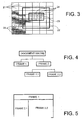
- the first step is to distribute the usable graphics memory in a tree of sub-windows (or "frames" HTML).
- the amount of graphics memory available to create the pixmaps is limited at the decoder. To ensure that other applications running at the same time as the HTML engine run smoothly, only part of that memory is used by the HTML engine to create the anticipation zones. The amount of available memory is set when the HTML engine is started. In the case where several scrolling documents are simultaneously visible on the screen (in the case of HTML frames or "frames"), each document must be able to take advantage of the fluid scrolling mechanism that constitutes the method of the invention. The amount of available memory must therefore be spread over all documents visible simultaneously.
- the method of the invention relates only to scrolling documents.
- Documents declaring HTML sub-windows can never be drop-down. Only the leaf documents of a tree of sub-windows are likely to be drop-down, and are therefore potential users of the method of the invention.
- the sum of the visible parts of the HTML documents that can be scrolled covers exactly the area reserved for displaying the HTML engine. This property is used to ensure use of the method of the invention for each sheet document.
- each box is an HTML document
- a root document for example of 600 x 400 pixels, from which flows a document Frame 1, for example of 600 x 100 pixels
- a document Frame 2 for example of 600 x 300 pixels
- a document Frame 2 -1 for example 200 x 300 pixels
- a Frame 2-2 document for example 400 x 300 pixels.
- the next operation is a problem of determining the granularity of the pixmaps: for a quantity of graphic memory available for a document it is necessary to determine what is the size and the granularity of the pixmaps which will allow the good functioning of the system.
- the objective is to guarantee at least one step of scrolling, of anticipation of the movement on both sides of the visible zone, and to have at least one row of pixmaps that can be moved on one side or the other. other.
- the figure 6 represents a complete HTML document 12 after the layout, the portion covered by the pixmaps 13 and the visible portion 11.
- This document 12 is capable of both a horizontal scroll and a vertical scroll.
- the document 12 can be rolled horizontally and vertically and that the amount of graphics memory is insufficient to cover the entirety of it with pixmaps both horizontally and vertically.
- the memory limitation also imposes a constraint.
- the sum of pixmaps must not exceed the amount of reserved memory: Mf ⁇ nx * ny * wp * hp * T
- Nx ⁇ Nx min For all the values of Nx ⁇ Nx min , the proper operation of the method of the invention is ensured. In the implementation of the HTML engine, it is the value Nx min which is retained for the cutting. Indeed, at the decoder, the number of pixmaps that can be created is limited. This maximizes the possibility of using the method of the invention and thus avoids reaching such a critical value.
- the actual width of a pixmap Wp is obtained by dividing the width of the anticipation area ( WP * Nx ) by (5) by the number of pixmaps retained Nx min rounded down to the whole number.
- the pixmaps created must always have multiple dimensions of 8 pixels. Therefore, after determining the size of each pixmap and the number of pixmaps in one direction, rounding this size to the lower multiple of 8, we verify that equation (1) or (2) according to the first direction processed) is always validated. If this is no longer the case, increase the granularity of the pixmaps by one and recalculate the new size of a pixmap.
Landscapes
- Engineering & Computer Science (AREA)
- Theoretical Computer Science (AREA)
- Physics & Mathematics (AREA)
- General Physics & Mathematics (AREA)
- Computer Hardware Design (AREA)
- Human Computer Interaction (AREA)
- General Engineering & Computer Science (AREA)
- Controls And Circuits For Display Device (AREA)
- Digital Computer Display Output (AREA)
- Document Processing Apparatus (AREA)
Claims (6)
- Verfahren zur Anzeige eines Dokuments (12) auf einem Anzeigebildschirm, der einem Scrollvorgang unterzogen werden kann, wobei das Anzeigeverfahren die folgenden Schritte umfasst:- einen Schritt des Zuteilens einer Grafikspeichermenge für das Dokument, um einen Pufferspeicher für den sichtbaren Teil (11) des Dokuments und Bereiche, die um den sichtbaren Teil des Dokuments am nächsten sind und als Vorschaustreifen (10) bezeichnet werden, zu erzeugen,- einen Schritt des Berechnens und des Aufteilens des Pufferspeichers in Pixmaps (13) in Abhängigkeit von der Größe des sichtbaren Teils in Pixeln und der Größe der Vorschaustreifen in Pixeln,- einen Schritt des relativen Positionierens der Pixmaps (13) in Bezug auf das vollständige Dokument (12) und den sichtbaren Teil des besagten Dokuments,- einen Schritt des Auffüllens des Inhalts der Pixmaps mit dem Inhalt des sichtbaren Teils und in Kürze sichtbaren Bereichen des Dokuments im Fall eines Scrollens des Dokuments,- Erfassen, wenn das Dokument einem Anzeigevorgang oder einem Scrollen unterzogen wird,- wenn das Dokument einem Anzeigevorgang oder einem Scrollen unterzogen wird, einen Schritt des Kopierens des Inhalts der Pixmaps in dem Anzeigefenster, mit zuvor gegebenenfalls einem Schritt, der das Aktualisieren des Inhalts der Pixmaps erzwingt, die von der Anzeige betroffen sind, wenn der vorherige Schritt des Auffüllens nicht abgeschlossen wurde,- und Zurückkehren zum Schritt des relativen Positionierens der Pixmaps in Bezug auf das vollständige Dokument in Abhängigkeit von der neuen Position des sichtbaren Teils,dadurch gekennzeichnet, dass der Schritt des Berechnens und des Aufteilens des Pufferspeichers in Pixmaps die folgenden Schritte beinhaltet:- den Schritt des Durchführens der folgenden Berechnungen:

und
wobei
Wpmax und Hpmax: maximale Breite und maximale Höhe einer Pixmap in Pixeln,
α = eine Konstante der HTML-Maschine, 0 < α < 1,
Wf und Hf: Größe und Breite des sichtbaren Teils des Dokuments in Pixeln,
T: Größe eines Pixels in Oktetten,
Mf: für die mit dem Dokument in Verbindung stehenden Pixmaps verfügbare Grafikspeichermenge, und- einen Schritt, der in dem Auswählen der Breite einer Pixmap in Pixeln Wp und der Höhe einer Pixmap in Pixeln Hp derart besteht, dass Wp ≤ Wpmax und Hp ≤ Hpmax, und- einen Schritt, der in dem Bestimmen von Nx und Ny, nämlich der Anzahl von Bereichen der Pixmaps in Breite und Höhe besteht, indem die folgenden Gleichungen verwendet werden:
und
worin:Wp * Nx der Breite des gebildeten Bereichs des sichtbaren Teils und der Vorschaustreifen in Pixeln entspricht undHp * Ny der Höhe des gebildeten Bereichs des sichtbaren Teils und der Vorschaustreifen in Pixeln entspricht. - Verfahren nach Anspruch 1, wobei die Vorausschaustreifen (10) mindestens eine Spalte von Pixmaps rechts und links des sichtbaren Fensters (11) sowie eine Zeile von Pixmaps unten und oben umfassen, außer wenn das sichtbare Fenster (11) dem Rand des Dokuments (12) näher kommt.
- Verfahren nach Anspruch 1, wobei die Pixmaps (13) in Rechtecke aufgeteilt werden, die nacheinander mit jedem Aufruf einer Hintergrundaufgabe gezeichnet werden.
- Verfahren nach Anspruch 3, wobei die Hintergrundaufgabe außerdem die Funktion des Erstellens der Vorausschaustreifen (10) aufweist.
- Verfahren nach Anspruch 1, das einen Synchronisiermechanismus verwendet, der das etwaige Erzwingen des Anzeigens von Daten in den Pixmaps ermöglicht.
- Verwendung des Verfahrens nach einem der Ansprüche 1 bis 5 in einem Digitalfernsehdecoder.
Applications Claiming Priority (3)
| Application Number | Priority Date | Filing Date | Title |
|---|---|---|---|
| FR0212859 | 2002-10-16 | ||
| FR0212859A FR2846115A1 (fr) | 2002-10-16 | 2002-10-16 | Procede d'affichage d'un document sur un ecran de visualisation susceptible d'etre soumis a une procedure de defilement |
| PCT/FR2003/003012 WO2004035702A2 (fr) | 2002-10-16 | 2003-10-13 | Ecran de visualisation susceptible d'etre soumis a une procedure de defilement. |
Publications (2)
| Publication Number | Publication Date |
|---|---|
| EP1551932A2 EP1551932A2 (de) | 2005-07-13 |
| EP1551932B1 true EP1551932B1 (de) | 2013-06-26 |
Family
ID=32050437
Family Applications (1)
| Application Number | Title | Priority Date | Filing Date |
|---|---|---|---|
| EP03780218.8A Expired - Lifetime EP1551932B1 (de) | 2002-10-16 | 2003-10-13 | Bildschirm mit bildverschiebungsmöglichkeiten |
Country Status (9)
| Country | Link |
|---|---|
| US (1) | US7796142B2 (de) |
| EP (1) | EP1551932B1 (de) |
| JP (1) | JP4759687B2 (de) |
| KR (1) | KR101007315B1 (de) |
| CN (1) | CN1703733B (de) |
| AU (1) | AU2003288317A1 (de) |
| FR (1) | FR2846115A1 (de) |
| MX (1) | MXPA05003648A (de) |
| WO (1) | WO2004035702A2 (de) |
Families Citing this family (9)
| Publication number | Priority date | Publication date | Assignee | Title |
|---|---|---|---|---|
| JP2005338249A (ja) * | 2004-05-25 | 2005-12-08 | Seiko Epson Corp | 表示装置、表示方法及び表示システム |
| CN100392578C (zh) * | 2005-08-05 | 2008-06-04 | 腾讯科技(深圳)有限公司 | 一种自动锁定聊天记录可见页面的方法 |
| EP1958047A2 (de) * | 2005-12-01 | 2008-08-20 | Koninklijke Philips Electronics N.V. | Indikation zur unterstützung eines benutzers bei der vorhersage einer rollratenänderung |
| CN100520907C (zh) * | 2006-06-06 | 2009-07-29 | 腾讯科技(深圳)有限公司 | 一种滚动显示图片的方法及装置 |
| CN102903094B (zh) * | 2011-07-25 | 2015-09-02 | 株式会社理光 | 电子文档栅格化方法和电子文档栅格化装置 |
| KR20130049293A (ko) * | 2011-11-04 | 2013-05-14 | 삼성전자주식회사 | 사용자 디바이스에서 스크롤링 방법 및 장치 |
| JP6834118B2 (ja) * | 2015-02-16 | 2021-02-24 | 富士通株式会社 | 端末装置、画面更新プログラム、画面更新方法及び情報処理システム |
| CN111352598B (zh) * | 2018-12-24 | 2022-08-23 | 浙江宇视科技有限公司 | 一种图像滚动显示方法及装置 |
| US11269479B2 (en) * | 2019-12-31 | 2022-03-08 | Google Llc | Automatic focus detection with relative threshold-aware cell visibility for a scrolling cell collection |
Citations (1)
| Publication number | Priority date | Publication date | Assignee | Title |
|---|---|---|---|---|
| EP0235594A2 (de) * | 1986-02-05 | 1987-09-09 | AlliedSignal Inc. | Einrichtung und Verfahren zur Echtzeit-Rekonstruktion von digitalen Kartendaten |
Family Cites Families (10)
| Publication number | Priority date | Publication date | Assignee | Title |
|---|---|---|---|---|
| JP2531619B2 (ja) * | 1985-09-17 | 1996-09-04 | 日本電気株式会社 | スクロ−ル表示制御方式 |
| US4920504A (en) * | 1985-09-17 | 1990-04-24 | Nec Corporation | Display managing arrangement with a display memory divided into a matrix of memory blocks, each serving as a unit for display management |
| US5053761A (en) * | 1989-06-16 | 1991-10-01 | International Business Machines | Method for smooth bitmap scrolling |
| US5900872A (en) * | 1995-05-05 | 1999-05-04 | Apple Computer, Inc. | Method and apparatus for controlling the tracking of movable control elements in a graphical user interface |
| CN1114190C (zh) * | 1995-07-28 | 2003-07-09 | 北京新兴生物医学工程研究发展中心 | 在显示器上实现文字与图形的静止和滚动叠加显示的方法 |
| US6802061B1 (en) * | 1996-12-12 | 2004-10-05 | Microsoft Corporation | Automatic software downloading from a computer network |
| JPH11184600A (ja) * | 1997-12-22 | 1999-07-09 | Sony Corp | 携帯情報端末装置、画面スクロール方法、記録媒体およびマイクロコンピュータ装置 |
| DE60009203T2 (de) * | 1999-05-13 | 2005-02-17 | Matsushita Electric Industrial Co., Ltd., Kadoma | Kommunikationsendgerät mit intelligenter Bildverschiebung für HTML Dokumente |
| JP3506421B2 (ja) * | 1999-05-13 | 2004-03-15 | 松下電器産業株式会社 | 移動体通信文書処理装置およびその装置が行う画面表示方法 |
| EP1164499A1 (de) | 2000-05-17 | 2001-12-19 | Canal+ Technologies Société Anonyme | Verarbeitung von in einer Markierungssprache kodierten Daten |
-
2002
- 2002-10-16 FR FR0212859A patent/FR2846115A1/fr active Pending
-
2003
- 2003-10-13 KR KR1020057006303A patent/KR101007315B1/ko not_active Expired - Fee Related
- 2003-10-13 US US10/531,217 patent/US7796142B2/en not_active Expired - Fee Related
- 2003-10-13 EP EP03780218.8A patent/EP1551932B1/de not_active Expired - Lifetime
- 2003-10-13 WO PCT/FR2003/003012 patent/WO2004035702A2/fr not_active Ceased
- 2003-10-13 AU AU2003288317A patent/AU2003288317A1/en not_active Abandoned
- 2003-10-13 CN CN2003801010000A patent/CN1703733B/zh not_active Expired - Fee Related
- 2003-10-13 JP JP2004544374A patent/JP4759687B2/ja not_active Expired - Fee Related
- 2003-10-13 MX MXPA05003648A patent/MXPA05003648A/es active IP Right Grant
Patent Citations (1)
| Publication number | Priority date | Publication date | Assignee | Title |
|---|---|---|---|---|
| EP0235594A2 (de) * | 1986-02-05 | 1987-09-09 | AlliedSignal Inc. | Einrichtung und Verfahren zur Echtzeit-Rekonstruktion von digitalen Kartendaten |
Also Published As
| Publication number | Publication date |
|---|---|
| CN1703733A (zh) | 2005-11-30 |
| KR101007315B1 (ko) | 2011-01-13 |
| FR2846115A1 (fr) | 2004-04-23 |
| JP4759687B2 (ja) | 2011-08-31 |
| WO2004035702A3 (fr) | 2004-07-22 |
| KR20050072437A (ko) | 2005-07-11 |
| JP2006503317A (ja) | 2006-01-26 |
| US7796142B2 (en) | 2010-09-14 |
| MXPA05003648A (es) | 2005-06-08 |
| AU2003288317A8 (en) | 2004-05-04 |
| US20070146377A1 (en) | 2007-06-28 |
| EP1551932A2 (de) | 2005-07-13 |
| AU2003288317A1 (en) | 2004-05-04 |
| CN1703733B (zh) | 2010-09-15 |
| WO2004035702A2 (fr) | 2004-04-29 |
Similar Documents
| Publication | Publication Date | Title |
|---|---|---|
| EP1551932B1 (de) | Bildschirm mit bildverschiebungsmöglichkeiten | |
| US8689095B2 (en) | Grid presentation in web-based spreadsheet services | |
| FR2594241A1 (fr) | Processeur d'affichage de donnees sur un ecran d'affichage et procede d'affichage de donnees mettant en oeuvre ce dispositif | |
| FR2544114A1 (fr) | Procede et dispositif pour l'affichage avec un effet de zoom sur un terminal d'ordinateur | |
| US20110083082A1 (en) | Fractional download based on currently presented portions from large content pages | |
| CN102662659A (zh) | 一种图像显示处理方法及系统 | |
| CN114747228A (zh) | 图像纪念物生成 | |
| EP3239826B1 (de) | Verfahren zur durchführung eines screenshots | |
| WO2011128528A1 (fr) | Procede dit hd-web pour contenus internet compatible haute définition et tout écrans | |
| CN115423690B (zh) | 基于图像金字塔的高分辨率肝癌病理图像展示方法及系统 | |
| CN112632921B (zh) | 对多媒体数据的显示处理方法、装置、终端及存储介质 | |
| EP1494116A1 (de) | Verfahren und Vorrichtung zum Erstellen von graphischen Benutzerschnittstellen | |
| FR2842011A1 (fr) | Unite et procede de gestion d'affichage sur un ecran d'une portion courante de document | |
| CN113836452A (zh) | 图片显示优化方法、系统、设备及存储介质 | |
| FR3078180A1 (fr) | Procede de visualisation d'un document structure par un navigateur web et programme associe | |
| FR2980861A1 (fr) | Procede d'affichage d'un contenu numerique sur un ecran | |
| CN117972654A (zh) | 一种基于web实现的水印处理技术 | |
| EP4060468A1 (de) | Verfahren zur durchführung einer grafischen bearbeitung auf einer gruppe von grafischen objekten, it-system zur durchführung dieses verfahrens | |
| CN120374797A (zh) | 信息处理方法、装置、程序产品及电子设备 | |
| HK40042056A (en) | Method and device for displaying and processing multimedia data, terminal and storage medium | |
| HK40042056B (en) | Method and device for displaying and processing multimedia data, terminal and storage medium | |
| FR2798488A1 (fr) | Procede de presentation d'information sur un reseau informatique | |
| FR2900777A1 (fr) | Procede et dispositif de gestion d'un contenu stocke dans des bases de donnees distantes | |
| FR2881602A1 (fr) | Procede et dispositif d'edition de programme audiovisuel | |
| FR2796479A1 (fr) | Creation d'un document hypertexte en dependance d'un autre dans un terminal client |
Legal Events
| Date | Code | Title | Description |
|---|---|---|---|
| PUAI | Public reference made under article 153(3) epc to a published international application that has entered the european phase |
Free format text: ORIGINAL CODE: 0009012 |
|
| 17P | Request for examination filed |
Effective date: 20050414 |
|
| AK | Designated contracting states |
Kind code of ref document: A2 Designated state(s): AT BE BG CH CY CZ DE DK EE ES FI FR GB GR HU IE IT LI LU MC NL PT RO SE SI SK TR |
|
| AX | Request for extension of the european patent |
Extension state: AL LT LV MK |
|
| DAX | Request for extension of the european patent (deleted) | ||
| RBV | Designated contracting states (corrected) |
Designated state(s): DE ES FR GB IT TR |
|
| RAP1 | Party data changed (applicant data changed or rights of an application transferred) |
Owner name: NAGRA THOMSON LICENSING |
|
| RAP1 | Party data changed (applicant data changed or rights of an application transferred) |
Owner name: THOMSON LICENSING S.A. |
|
| 17Q | First examination report despatched |
Effective date: 20090528 |
|
| RAP1 | Party data changed (applicant data changed or rights of an application transferred) |
Owner name: THOMSON LICENSING |
|
| RAP1 | Party data changed (applicant data changed or rights of an application transferred) |
Owner name: THOMSON LICENSING |
|
| GRAP | Despatch of communication of intention to grant a patent |
Free format text: ORIGINAL CODE: EPIDOSNIGR1 |
|
| GRAS | Grant fee paid |
Free format text: ORIGINAL CODE: EPIDOSNIGR3 |
|
| GRAA | (expected) grant |
Free format text: ORIGINAL CODE: 0009210 |
|
| AK | Designated contracting states |
Kind code of ref document: B1 Designated state(s): DE ES FR GB IT TR |
|
| REG | Reference to a national code |
Ref country code: GB Ref legal event code: FG4D Free format text: NOT ENGLISH |
|
| REG | Reference to a national code |
Ref country code: DE Ref legal event code: R096 Ref document number: 60344374 Country of ref document: DE Effective date: 20130822 |
|
| PG25 | Lapsed in a contracting state [announced via postgrant information from national office to epo] |
Ref country code: ES Free format text: LAPSE BECAUSE OF FAILURE TO SUBMIT A TRANSLATION OF THE DESCRIPTION OR TO PAY THE FEE WITHIN THE PRESCRIBED TIME-LIMIT Effective date: 20131007 |
|
| PLBE | No opposition filed within time limit |
Free format text: ORIGINAL CODE: 0009261 |
|
| STAA | Information on the status of an ep patent application or granted ep patent |
Free format text: STATUS: NO OPPOSITION FILED WITHIN TIME LIMIT |
|
| PG25 | Lapsed in a contracting state [announced via postgrant information from national office to epo] |
Ref country code: IT Free format text: LAPSE BECAUSE OF FAILURE TO SUBMIT A TRANSLATION OF THE DESCRIPTION OR TO PAY THE FEE WITHIN THE PRESCRIBED TIME-LIMIT Effective date: 20130626 |
|
| 26N | No opposition filed |
Effective date: 20140327 |
|
| REG | Reference to a national code |
Ref country code: DE Ref legal event code: R097 Ref document number: 60344374 Country of ref document: DE Effective date: 20140327 |
|
| REG | Reference to a national code |
Ref country code: DE Ref legal event code: R119 Ref document number: 60344374 Country of ref document: DE Effective date: 20140501 |
|
| PG25 | Lapsed in a contracting state [announced via postgrant information from national office to epo] |
Ref country code: DE Free format text: LAPSE BECAUSE OF NON-PAYMENT OF DUE FEES Effective date: 20140501 |
|
| PG25 | Lapsed in a contracting state [announced via postgrant information from national office to epo] |
Ref country code: TR Free format text: LAPSE BECAUSE OF FAILURE TO SUBMIT A TRANSLATION OF THE DESCRIPTION OR TO PAY THE FEE WITHIN THE PRESCRIBED TIME-LIMIT Effective date: 20130626 |
|
| REG | Reference to a national code |
Ref country code: FR Ref legal event code: PLFP Year of fee payment: 13 |
|
| REG | Reference to a national code |
Ref country code: FR Ref legal event code: PLFP Year of fee payment: 14 |
|
| PGFP | Annual fee paid to national office [announced via postgrant information from national office to epo] |
Ref country code: GB Payment date: 20161028 Year of fee payment: 14 Ref country code: FR Payment date: 20161027 Year of fee payment: 14 |
|
| GBPC | Gb: european patent ceased through non-payment of renewal fee |
Effective date: 20171013 |
|
| REG | Reference to a national code |
Ref country code: FR Ref legal event code: ST Effective date: 20180629 |
|
| PG25 | Lapsed in a contracting state [announced via postgrant information from national office to epo] |
Ref country code: GB Free format text: LAPSE BECAUSE OF NON-PAYMENT OF DUE FEES Effective date: 20171013 |
|
| PG25 | Lapsed in a contracting state [announced via postgrant information from national office to epo] |
Ref country code: FR Free format text: LAPSE BECAUSE OF NON-PAYMENT OF DUE FEES Effective date: 20171031 |