EP1550718A1 - Method of detecting base mutation - Google Patents
Method of detecting base mutation Download PDFInfo
- Publication number
- EP1550718A1 EP1550718A1 EP03771437A EP03771437A EP1550718A1 EP 1550718 A1 EP1550718 A1 EP 1550718A1 EP 03771437 A EP03771437 A EP 03771437A EP 03771437 A EP03771437 A EP 03771437A EP 1550718 A1 EP1550718 A1 EP 1550718A1
- Authority
- EP
- European Patent Office
- Prior art keywords
- nucleotide
- probe
- target
- detection method
- mutation
- Prior art date
- Legal status (The legal status is an assumption and is not a legal conclusion. Google has not performed a legal analysis and makes no representation as to the accuracy of the status listed.)
- Granted
Links
Images






Classifications
-
- C—CHEMISTRY; METALLURGY
- C12—BIOCHEMISTRY; BEER; SPIRITS; WINE; VINEGAR; MICROBIOLOGY; ENZYMOLOGY; MUTATION OR GENETIC ENGINEERING
- C12Q—MEASURING OR TESTING PROCESSES INVOLVING ENZYMES, NUCLEIC ACIDS OR MICROORGANISMS; COMPOSITIONS OR TEST PAPERS THEREFOR; PROCESSES OF PREPARING SUCH COMPOSITIONS; CONDITION-RESPONSIVE CONTROL IN MICROBIOLOGICAL OR ENZYMOLOGICAL PROCESSES
- C12Q1/00—Measuring or testing processes involving enzymes, nucleic acids or microorganisms; Compositions therefor; Processes of preparing such compositions
- C12Q1/68—Measuring or testing processes involving enzymes, nucleic acids or microorganisms; Compositions therefor; Processes of preparing such compositions involving nucleic acids
- C12Q1/6813—Hybridisation assays
- C12Q1/6827—Hybridisation assays for detection of mutation or polymorphism
-
- C—CHEMISTRY; METALLURGY
- C12—BIOCHEMISTRY; BEER; SPIRITS; WINE; VINEGAR; MICROBIOLOGY; ENZYMOLOGY; MUTATION OR GENETIC ENGINEERING
- C12Q—MEASURING OR TESTING PROCESSES INVOLVING ENZYMES, NUCLEIC ACIDS OR MICROORGANISMS; COMPOSITIONS OR TEST PAPERS THEREFOR; PROCESSES OF PREPARING SUCH COMPOSITIONS; CONDITION-RESPONSIVE CONTROL IN MICROBIOLOGICAL OR ENZYMOLOGICAL PROCESSES
- C12Q1/00—Measuring or testing processes involving enzymes, nucleic acids or microorganisms; Compositions therefor; Processes of preparing such compositions
- C12Q1/68—Measuring or testing processes involving enzymes, nucleic acids or microorganisms; Compositions therefor; Processes of preparing such compositions involving nucleic acids
- C12Q1/6844—Nucleic acid amplification reactions
- C12Q1/6858—Allele-specific amplification
Definitions
- the present invention relates to a technique of rapidly analyzing a variety of mutations including single nucleotide polymorphism, short nucleotide tandem repeat mutations, nucleotide deletion mutations, nucleotide insertion mutations and translocation mutations by determining and quantitating a nucleotide type at a specific location in the nucleotide sequence of DNA, RNA or the like.
- SSCP Single-strand conformation polymorphism
- DNA elongation will progress when dNTP (a constituent of DNA) is incorporated until a ddNTP is incorporated. Because of a hydroxyl group added at the binding site of the next nucleotide, the polymerization reaction is blocked, and the DNA can no longer be elongated. As a result, multiple DNA fragments are produced with specific bases at their ends. In this method, four different samples are produced using four types of ddNTP, and the nucleotide sequence can be analyzed by performing electrophoresis and reading the resulting DNA bands in sequence.
- Dye-labeled oligonucleotide ligation is another method of detecting nucleotide mutations.
- DOL utilizes the binding of two oligonucletides with DNA ligase. Following two types of oligonucleotides are prepared; an oligo probe complementary to a sequence labeled with fluorescein at the 5' end and ending one nucleotide upstream from the SNP site, and an oligo probe fluorescently labeled at the 3' end which includes the SNP region and is complementary to the sequence downstream therefrom. According to the differences in the complementary nucleotide of the SNP region, the second probe is labeled with different fluorescent dye such as ROX or TAMRA.
- Another ligation method which has been developed for detecting nucleotide mutations is Genespector (trade name; Variom Biotechnology AG analysis kit).
- probes are fixed on a solid surface and the detection is achieved by a ligation reaction following a hybridization reaction using the DNA PCR product, a signal probe and an allele-specific detection probe.
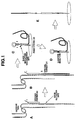
- the basic principles of the detection method of the present invention comprise (A) the preparation of a special primer, (B) an elongation reaction of the special primer, (C) denaturing and hybridization with a fixed probe, (D) a ligation reaction, and (E) washing and detection to detect a nucleotide mutation in genome DNA or other nucleic acids. These steps are described in more detail below.
- One special primer (a) is formed for each nucleotide mutation to be detected, and a target (and multiple replications of the same target by repeated elongations, hereunder sometimes called "special target (b)") is prepared using special primer (a) by the elongation reaction described below.
- This special target includes mutation site and self complementary region, and it can be provided for both hybridization and ligation reaction with a probe.
- the molecular number and nucleotide strand length of the special target can be controlled at will, allowing for greater detection sensitivity and less effect from non-specific binding, thus resulting in greater detection efficiency.
- Appropriate design of the counter-primer makes it possible to control the length of the special target, improve hybridization efficiency, suppress non-specific binding and the like.
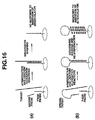
- the special target can be designed so that it forms a loop by self-complementary binding, enabling non-specific binding to be controlled even in the case of long nucleotide chains, and enhancing the specificity of the hybridization reaction. Specifically, great sensitivity can be achieved by increasing the length of the special target. Recognition sensitivity can also be enhanced by adding a new reaction step in which a second target (enhancer target) is applied (enhancing hybridization) to the loop region formed by self-complementary binding on the special target.
- a second target enhancing hybridization
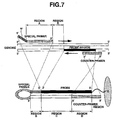
- the special primer should be designed as follows (see Figure 7).
- the counter-primer should be designed, and an elongation reaction performed by PCR or A-PCR as follows (see Figure 7).
- Probes can be obtained by synthesizing oligonucleotides having corresponding nucleotides of individual mutation at its 3' end and complementary sequence to the special target.
- the probes should consist of two or more types so that multiple mutations can be determined and quantified simultaneously. By thus synthesizing multiple types of probes, it is possible to simultaneously determine and assay nucleotide mutations (multiple types) at specific sites with multiple genomes, which is the goal of detection.
- the probe should also contain electrode fixing element so that it can be easily fixed to an electrode. Since this electrode fixing element cannot be located on the side where the ligation reaction will be carried out in the next step, it is formed only to the 5' end of the oligonucleotide.
- the electrode fixing element should be capable of binding to the aforementioned electrode by a reaction.
- Concrete examples of the electrode fixing element include thiol groups, biotin residues, amino groups and groups including any of these, and the element can be selected according to the electrode surface used for fixing the probe.
- a hydrocarbon chain, de-based nucleotide chain or the like is desirable as the linker.
- designing the probe in the following way is particularly desirable from the standpoint of good hybridization efficiency of the special target and binding efficiency with the DNA ligase enzyme.
- Desirable method of utilizing designed probes as described above is fixing single probe on single electrode so that one type of probe corresponds to one electrode. In particular, if several probes are fixed on corresponding electrode and integrated, it is possible to detect multiple mutations in a sample by single operation.
- the mutation is recognized in this step.
- the ligation method uses a linking enzyme solution consisting of a linking enzyme and a buffer.
- a solution containing those salts required for hybridization is used in the first step (hybridization), while in the third step (ligation), salts which do not allow dissociation (denaturing) of the 2-strand DNA formed by hybridization are included along with DNA ligase and the DNA ligase buffer solution.
- the hybridization reaction can also be performed separately from the ligation reaction using a solution containing at least those salts required for hybridization of the nucleic acids.
- the hybridization reaction can also be carried out simultaneously with the ligation reaction using a synthetic enzyme solution containing at least DNA ligase and a DNA ligase buffer solution.
- the nucleotide (see Figure 1C) at the nucleotide mutation recognition site will undergo ligation if it is complementary to the nucleotide of the special target which faces it after hybridization, but will not undergo ligation if it is not complementary.
- the ligation reaction will also not occur if the nucleotide mutation recognition site (3' end of probe) is even one nucleotide short.
- washing is performed with a denature reagent to remove special target, genome and the like bound non-specifically to solid-phase surface or fixed DNA.
- the amount of DNA remaining on the solid-phase surface is measured.
- the method of measuring the amount of DNA can be measured while the DNA is fixed on the solid phase, or by concentration measurement in solution following removal from the solid phase.
- a method such as applying a reagent which bonds chemically to the DNA can be used for measurement on the solid phase.
- an electrode can be used as solid phase, and the amount of fixed DNA is measured as the electrical signal by utilizing an electrochemical reagent.
- the detection method of the present invention can be used for either quantification or qualification.
- the sample DNA contain only one mutation (when the nucleotide mutation sites of all DNA are occupied by the same type of nucleotide)
- only qualification measurement is required.
- steps [C] and [D] above can be combined, and same result as separated steps are obtained.
- a variety of mutations can be analyzed in the detection method of the present invention, and these different mutations can be analyzed simultaneously on the same array.
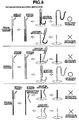
- the ligation reaction occurs only with the mutant probe, resulting in joining of the special target to the probe. As a result, a greater signal is obtained than the signal of the probe before ligation.
- no ligation reaction occurs because the ligation site nucleotide is non-complementary, and the signal is the same as for the original probe. The presence or absence of a single nucleotide mutation can be determined based on this difference in signals.
- the special target contains a normal nucleotide at mutation site
- the absence of a single nucleotide polymorphism can be determined by the opposite reactions.
- the ligation reaction occurs only with the mutant probe, resulting in joining of the special target to the probe. As a result, a greater signal is obtained than the signal of the probe before ligation.
- the number of repeated sequence is less than that of the mutant probe, and no ligation reaction occurs because of the missing nucleotides at the ligation site, and the signal after the ligation is the same as before the ligation.
- the presence or absence of short tandem repeat mutations can be determined based on this difference in signals.
- the special target has a nucleotide deletion mutation
- a ligation reaction occurs only with the mutant probe, resulting in joining of the special target to the probe.
- a greater signal is obtained than the signal of the probe before ligation.
- the probe is longer than the mutant probe by the length of the deleted nucleotide, the nucleotides near the 3' end of the normal probe overlap rather than lining up with the nucleotides near the 5' end of the special target, and no ligation reaction occurs. Mutations can be recognized in this way.
- Nucleotide insertion mutations are recognized according to the same principles: the mutant probe is longer by the length of the inserted nucleotide than the normal probe at the 3' end, and recognition and detection are based on the opposite pattern from that of nucleotide deletion mutations.
- the detection system of the present invention uses the aforementioned detection method for nucleotide mutations, it is capable of determining and quantifying nucleotides at specific positions in a DNA, RNA or other nucleotide sequence, and can analyze a variety of mutations including single nucleotide polymorphism, short nucleotide tandem repeat mutations, nucleotide deletion mutations, nucleotide insertion mutations and translocation mutations rapidly and with high sensitivity.
- electrodes are used as the base for the probes when fixed probes are used, but the base need not be an electrode, and glass (glass plate, glass beads or the like), resin (resin beads, membrane, thread or the like), gel or some other solid phase may also be used.
- glass glass plate, glass beads or the like
- resin resin beads, membrane, thread or the like
- gel or some other solid phase may also be used.
- the linkage on glass or the like may be avidin-streptavidin or carboxyl group-amino group as in the case of a gold electrode, while in the case of a resin or gel, adhesion fixing can be achieved through physical properties even if the DNA lacks a reactive group.
- resin in particular strong fixing with DNA can be achieved with UV light radiation.
- probes can be fixed on solid phases other than electrodes.
- the detection method of the present invention allows for detection and quantification with a fluorescence detector using a fluorescent DNA dye (ethylene bromide or SYBR-Green (trade name)) or the like when detection is performed with a fixed probe. Detection and quantification are also possible using a method in which a fluorescent label is attached to the special probe in advance, or a method in which a substance (such as a fluorescence-emitting adapter substance) which emits light when it binds to a specific substance is attached to the DNA in advance.
- a fluorescent label is attached to the special probe in advance
- a substance such as a fluorescence-emitting adapter substance
- the probe can for example be quantified by electrophoresis isolation. If there is a large amount of DNA to be detected, it can also be quantified by absorbance.
- nucleotide mutations in the genome have been used as an example of subjects for detection, but other subjects of detection are possible in the detection method of the present invention, including for example nucleotide mutations in DNA, RNA and other nucleic acids.
- the following is an embodiment of the detection method of the present invention using a method other than electrochemical detection.
- the target is first hybridized with a fixed probe, followed by a ligation reaction with a second probe.
- Ligation with the second probe results in elongation of the fixed probe, and the denaturing and washing process which removes non-specifically bound target and genome results in dissociation of the target, leaving only the elongated single-strand probe. Consequently, a double-strand specific intercalator (such as a fluorescent modified intercalator or electrochemical intercalator) cannot be used effectively for detection in conventional methods.
- a double-strand specific intercalator such as a fluorescent modified intercalator or electrochemical intercalator
- a double-strand specific intercalator such as a fluorescent modified intercalator or electrochemical intercalator
- the method of detecting nucleotide mutations of the present invention offers the dramatic advantage of highly diverse detection systems.
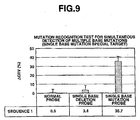
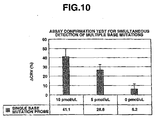
- the nucleotides are entirely complementary during hybridization with the single nucleotide mutation special target, so a good ligation reaction occurs, and a high ligation reaction value of 35.7% is achieved. From these results, it is clear that both non-complementariness and nucleotide deletion at the 3' end of the probe are recognized, and therefore different types of mutations can be detected simultaneously on the same electrode array.
- Example 1 The operation for fixing the probe was the same as in Example 1. Namely, gold array electrodes (15 electrodes in groups A-C of 5 electrodes each) were used, and 1 ⁇ L of a 10 pmol/ ⁇ L single nucleotide mutation probe (the same oligo single nucleotide mutation probe used in Example 1) was applied to the pin tips of all the A-C electrodes, and fixing performed. (2) The array electrodes were dipped and washed in a measurement electrolytic buffer (mixed buffer of potassium acetate and potassium chloride) containing no electrochemical reagents. This served to remove the non-specifically bound DNA. (3) DPV response following probe fixing was measured (i1). (4) A reaction solution was prepared for purposes of hybridization.
- a measurement electrolytic buffer mixed buffer of potassium acetate and potassium chloride
- the reaction solution contained final concentrations of 1XT4 DNA ligase buffer, only those salts required for hybridization, and 10 pmol/ ⁇ L of each special target (normal, mixture of normal and single nucleotide mutation (5 pmol/ ⁇ L each), single nucleotide mutation).
- 1 ⁇ L of the special targets was applied to the pins of electrodes A-C, and hybridization with the fixed probe performed for 1 hour at room temperature.
- the electrode pins were dip washed for 5 minutes at room temperature using the electrolytic buffer of (2) above. This step serves to remove any remaining unhybridized special target.
- a ligation reaction solution was prepared for purposes of the ligation reaction.
- the reaction solution contained a final concentration of 35 units/ ⁇ L T4 ligase, 1XT4 DNA ligase buffer, and just enough salts so that the hybrid (2-strand) DNA formed by hybridization would not dissociate.
- 1 ⁇ L of the ligation reaction solution was applied to each of the electrodes in groups A-C, and ligation performed with the fixed probes. The reaction was performed for 1 hour at room temperature.
- a denaturaant was added to the electrolytic buffer used in (2) above, and dip washing performed.
- DPV response (i2) was measured for the ligation reaction.
- Example 1 The operations for fixing the probes were the same as in Example 1. Namely, gold array electrodes (24 electrodes in groups A-F of 4 electrodes each) were used, with 1 ⁇ L of the normal probe described below applied to each of the pin tips of electrodes A-C at a concentration of 10 pmol/ ⁇ L, and 1 ⁇ L of the single nucleotide mutation probe described below applied to each of the electrodes D-F at the same concentration, and fixing was performed.
- the A-PCR product synthesized under these conditions was purified in a column and used as the A-PCR special target. (4) Residual reaction solution was removed. (5) DPV response following hybridization and ligation reactions was measured (i2).
- the special targets from oligo synthesis were constructed with the products obtained from an elongation reaction of genome DNA (enzyme elongation reaction, PCR reaction, A-PCR reaction) in mind.
- a normal probe, hetero probe (1:1 mixture of normal and single nucleotide mutation probes) and single nucleotide mutation probe were spotted onto the surface of slide glass for purposes of fluorescent micro-array, and the 5' end amino group of the probe fixed to the glass surface. Spotting was performed using 25 ⁇ M of each probe solution, 11 spots per probe, forming round spots 200 ⁇ m in diameter.
- Normal probe :
- the fluorescent-labeled special target used in the detection method of the present invention was prepared. Namely, PCR and Asymmetrical-PCR were performed using template DNA, special primer and counter-primer, aminoallyl dUTP was incorporated into the newly-synthesized oligo DNA, and a mutant target (fluorescent labeled special target) was prepared according to the aminoallyl method of coupling with the fluorescent material Cy3.
- the mutant special target was first prepared by PCR reaction using mutant template DNA, special primer and counter-primer.
- a reaction solution containing 1 X Taq Buffer (for Hot Start), 250 ⁇ M of each dNTP, 1 pmol/ ⁇ l special primer, 1 pmol/ ⁇ l counter-primer, 0.2 pmol/ ⁇ l template DNA and 0.05 unit/ ⁇ l Taq polymerase was reacted for 2.5 minutes at 95°C followed by 40 cycles of 30 seconds at 95°C, 30 seconds at 58°C and 10 seconds at 72°C.
- a reaction solution was prepared for simultaneously performing the hybridization and ligation reactions.
- the reaction solution contained T4 DNA ligase at a final concentration of 35 units/ ⁇ L, 1 X T4 DNA ligase buffer, only those salts required for hybridization, and 0.7 times volume of the fluorescent labeled special target.
- Cover glass was laid over the spots on the micro-array slides, the reaction liquid of (7) was poured in the gaps, and hybridization and ligation reactions were performed with the fixed probe. The reactions were performed for 2 hours at room temperature.
- (9) Following removal of the cover glass in pure water, the slides were washed in flowing ultrapure water, dried with N 2 gas and dip washed for 10 minutes in 0.1M NaOH 1.5M KCl to remove the non-specifically bound DNA.
- a reaction solution was prepared for simultaneously performing the hybridization and ligation reactions.
- the reaction solution contained T4 DNA ligase at a final concentration of 35 units/ ⁇ L, 1 X T4 DNA ligase buffer, salts, and 0.7 times volume of the fluorescent labeled special target.
- Cover glass was laid over the spots on the micro-array slides, the reaction liquid of (7) was poured into the gaps, and hybridization and ligation reactions were performed with the fixed probe. The reactions were performed for 2 hours at room temperature.
- (9) Following removal of the cover glass in pure water, the slides were washed in flowing ultrapure water, dried with N 2 gas and dip washed for 10 minutes in 0.1M NaOH 1.5M KCl to remove the non-specifically bound DNA.
- the translocated special target was first prepared by PCR reaction using translocated template DNA, special primer and counter-primer.
- a reaction solution containing 1 X Taq Buffer (for Hot Start), 250 ⁇ M of each dNTP, 1 pmol/ ⁇ l special primer, 1 pmol/ ⁇ l counter-primer, 0.2 pmol/ ⁇ l template DNA, and 0.05 unit/ ⁇ l Taq polymerase was reacted for 2.5 minutes at 95°C followed by 40 cycles of 30 seconds at 95°C, 30 seconds at 58°C and 10 seconds at 72°C.
- a reaction solution was prepared for simultaneously performing the hybridization and ligation reactions.
- the reaction solution contained T4 DNA ligase at a final concentration of 35 units/ ⁇ L, 1 X T4 DNA ligase buffer, salts, and 0.7 times volume of the fluorescent labeled special buffer.
- Cover glass was laid over the spots on the micro-array slides, the reaction liquid of (7) was poured in the gaps, and hybridization and ligation reactions were performed with the fixed probe. The reactions were performed for 2 hours at room temeprature.
- (9) Following removal of the cover glass in pure water, the slides were washed in running ultrapure water, dried with N 2 gas and dip washed for 10 minutes in 0.1M NaOH 1.5M KCl to remove the non-specifically bound DNA.
- the detection method of the present invention it is possible to detect and assay nucleotides at specific locations in a DNA, RNA or other nucleotide sequence, and to rapidly analyze a variety of nucleotide mutations including single nucleotide mutations, multiple nucleotide mutations, nucleotide deletion mutations, nucleotide insertion mutations and translocation mutations.
Landscapes
- Chemical & Material Sciences (AREA)
- Life Sciences & Earth Sciences (AREA)
- Organic Chemistry (AREA)
- Engineering & Computer Science (AREA)
- Zoology (AREA)
- Wood Science & Technology (AREA)
- Proteomics, Peptides & Aminoacids (AREA)
- Health & Medical Sciences (AREA)
- Biophysics (AREA)
- General Engineering & Computer Science (AREA)
- Immunology (AREA)
- Microbiology (AREA)
- Molecular Biology (AREA)
- Analytical Chemistry (AREA)
- Physics & Mathematics (AREA)
- Genetics & Genomics (AREA)
- Biochemistry (AREA)
- Bioinformatics & Cheminformatics (AREA)
- Biotechnology (AREA)
- General Health & Medical Sciences (AREA)
- Chemical Kinetics & Catalysis (AREA)
- Measuring Or Testing Involving Enzymes Or Micro-Organisms (AREA)
- Apparatus Associated With Microorganisms And Enzymes (AREA)
Abstract
Description
(Electrode fixing element) Includes a thiol group (-SH)
(Electrode fixing element) Includes a biotin residue
(Electrode fixing element) Includes an amino group (-NH2)


(3) The first DPV measurement was performed at this stage to confirm the amount of probe fixed on the gold electrode surfaces. Namely, for the probe fixed on the gold electrodes (as single-strand DNA) the DPV response after fixing of the probe was measured (i1) using a double chain-specific electrochemical reagent solution.
(4) A reaction solution was prepared for the simultaneous hybridization and ligation reactions. The reaction solution contained T4 DNA ligase, 1XT4 DNA ligase buffer, only those salts required for hybridization, and 10 pmol/uL of each of the targets (normal, mixture of normal and single nucleotide mutation (5 pmol/uL each), single nucleotide mutation).


(6) Non-specifically bound DNA was removed by the same washing method used in (2) above.
(7) DPV response (i2) after the hybridization and ligation reactions was measured. (A high DPV is shown with the response value for the hybridized special target added to the response during probe fixing).
(8) In order to remove those of the special targets hybridized in (7) above which did not undergo ligation, a denaturant was added to the electrolytic buffer used in (2) above, and dip washing performed.
(9) DPV response measurements (i3) were performed for the ligation reaction. (Values lower than the response values after hybridization but higher than the response values for probe fixing are obtained).


(3) DPV response was measured (i1) following probe fixing.
(4) A reaction solution was prepared for simultaneously performing the hybridization and ligation reactions. The reaction solution contained T4 DNA ligase at a final concentration of 35 units/µL, 1XT4 DNA ligase buffer, only those salts required for hybridization, and 10 pmol/µL of the single nucleotide mutation special target (the same oligo single nucleotide mutation special target used in Example 1).
(5) 1 µL of the special target was applied to each of electrodes A-C, and hybridization and ligation reactions performed with the fixed probe. The reactions were performed for 2 hours at room temperature.
(6) In order to remove special target which had not undergone the ligation reaction, a denaturant was added to the electrolytic buffer used in (2) above, and dip washing performed.
(7) DPV response (i2) was measured for the ligation reaction.

(2) The array electrodes were dipped and washed in a measurement electrolytic buffer (mixed buffer of potassium acetate and potassium chloride) containing no electrochemical reagents. This served to remove the non-specifically bound DNA.
(3) DPV response following probe fixing was measured (i1).
(4) A reaction solution was prepared for purposes of hybridization. The reaction solution contained final concentrations of 1XT4 DNA ligase buffer, only those salts required for hybridization, and 10 pmol/µL of each special target (normal, mixture of normal and single nucleotide mutation (5 pmol/µL each), single nucleotide mutation).
(5) 1µL of the special targets was applied to the pins of electrodes A-C, and hybridization with the fixed probe performed for 1 hour at room temperature.
(6) The electrode pins were dip washed for 5 minutes at room temperature using the electrolytic buffer of (2) above. This step serves to remove any remaining unhybridized special target.
(7) A ligation reaction solution was prepared for purposes of the ligation reaction. The reaction solution contained a final concentration of 35 units/µL T4 ligase, 1XT4 DNA ligase buffer, and just enough salts so that the hybrid (2-strand) DNA formed by hybridization would not dissociate.
(8) 1µL of the ligation reaction solution was applied to each of the electrodes in groups A-C, and ligation performed with the fixed probes. The reaction was performed for 1 hour at room temperature.
(9) In order to remove special target which had not undergone ligation, a denaturaant was added to the electrolytic buffer used in (2) above, and dip washing performed.
(10) DPV response (i2) was measured for the ligation reaction.

(3) Three types of reaction solution (oligo special target, PCR special target, A-PCR special target) were prepared for purposes of the hybridization and ligation reactions, and the special target from oligo synthesis was applied to electrodes A and D, a special target (column purified) which was a PCR product prepared from a genome sample to electrodes B and E, and a special target (column purified) which was an A-PCR product prepared from a genome sample to electrodes C and F, each in the amount of 1µL per electrode pin, and hybridization and ligation reactions performed with the fixed probes. The reaction solution was prepared from the various targets, T4 DNA ligase at a final concentration of 35 units µL, 1XT4 DNA ligase buffer and only those salts required for hybridization.



(4) Residual reaction solution was removed.
(5) DPV response following hybridization and ligation reactions was measured (i2).



(3) The first DPV measurements were taken at this stage to confirm the amount of probe fixed to the gold electrode surfaces. Namely, DPV response (i1) after probe fixing was measured for the probe fixed on the gold electrodes (as single-strand DNA), using a double-strand specific electrochemical reagent solution.
(4) A reaction solution was prepared for simultaneously performing the hybridization and ligation reactions. The reaction solution contained T4 DNA ligase, 1 X T4 DNA ligase buffer, only those salts required for hybridization, and 10 pmol/µL of each target (10 pmol/µL each of the special target and conventional 1st and 2nd targets).


- i) Structure (conventional 2nd target): (P)-

- ii) Oligonucleotide: sequence length 22 nucleotides
- iii) 5' end nucleotide: phosphoric acid group added
- iv) The 2nd target and the 27th-48th nucleotides counting from the 5' end of the 1st target are regions of complementary sequences which form a double strand during hybridization.
(7) Non-specifically bound DNA was removed by the same washing methods used in (3) above.
(8) DVP response was measured (i2) for the hybridization and ligation reactions. (The response for the hybridized special target is added to the response for the fixed probe, producing a high DPV value.)
| PIN No. | GROUP | i1 (nA) | i2 (nA) | ΔCRV (%) | |
| 1 | N | -23.1 | |||
| 2 | A | MEAN | 477.8 | 589.7 | 23.5 |
| 3 4 | |||||
| STANDARD DEVIATION | 43.2 | 54.4 | 5.4 | ||
| 5 6 | |||||
| COEFFICIENT OF VARIATION | 0.1 | 0.1 | 0.2 | ||
| 7 | |||||
| 8 | B | MEAN | 393.3 | 405.5 | 3.1 |
| 9 10 | |||||
| STANDARD DEVIATION | 24.1 | 29.9 | 4.6 | ||
| 11 12 | |||||
| COEFFICIENT OF VARIATION | 0.1 | 0.1 | 1.5 | ||
| 13 | |||||
| 14 | C | MEAN | 433.5 | 454.5 | 4.6 |
| 15 16 | |||||
| STANDARD DEVIATION | 29.4 | 51.6 | 6.0 | ||
| 17 18 | |||||
| COEFFICIENT OF VARIATION | 0.1 | 0.1 | 1.3 | ||
| 19 | |||||
| 20 | D | MEAN | 296.8 | 294.8 | 1.1 |
| 21 22 | |||||
| STANDARD DEVIATION | 64.8 | 45.1 | 10.1 | ||
| 23 24 | |||||
| COEFFICIENT OF VARIATION | 0.2 | 0.2 | 9.3 | ||
| 25 |
(6) The fluorescent material Cy3 was coupled to the aminoallyl dUTP-labeled target obtained in (5). Namely, Asymmetrical-PCR product which had been desalted and concentrated in a Microcon-10 column was dried in a speed vac, re-dissolved in 0.1M NaHCO3 Buffer (pH 9.0), and mixed with Cy3 which had been dissolved in DMSO and dried in a speed vac, and a Cy3 incorporation reaction performed for 1 hour at room temperature. After the reaction 4M Hydroxylamine was added, the Cy3 was inactivated for 15 minutes at room temperature, and the unreacted dNTP and inactivated Cy3 were removed in a Microcon-10 column and a fluorescent labeled special target produced by concentration.
(8) Cover glass was laid over the spots on the micro-array slides, the reaction liquid of (7) was poured in the gaps, and hybridization and ligation reactions were performed with the fixed probe. The reactions were performed for 2 hours at room temperature.
(9) Following removal of the cover glass in pure water, the slides were washed in flowing ultrapure water, dried with N2 gas and dip washed for 10 minutes in 0.1M NaOH 1.5M KCl to remove the non-specifically bound DNA. They were then again washed in flowing ultrapure water, dried with N2 gas and subjected to array analysis.
(10) The micro-array slides were scanned using a GenePix 2505B micro-array scanner to obtain scan images which were converted to numbers with a GenePix Pro.
(11) (Signal median - background median) was calculated from the numerical data, and mean and standard deviation calculated and used as the test results. (Results show the fluorescent strength of fluorescent-labeled special target ligated to the fixed probe.)
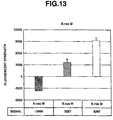
| DETECTION PROBE TYPE | MEAN FLUORESCENCE STRENGTH | STANDARD DEVIATION |
| K-ras W | -3666 | 723 |
| K- | 3587 | 859 |
| K- | 9297 | 680 |
| EXPLANATION OF PROBES: | ||
| K-ras W : NORMAL GENE DETECTION PROBE | ||
| K-ras H : HETERO MUTATION GENE DETECTION PROBE | ||
| K-ras M : HOMO MUTATION GENE DETECTION PROBE |
Spotting was performed using 25 µM of each probe solution, 11 spots per probe, forming


(6) The fluorescent material Cy3 was coupled to the aminoallyl dUTP-labeled target obtained in (5). Namely, Asymmetrical-PCR product which had been desalted and concentrated in a Microcon-10 column was dried in a speed vac, re-dissolved in 0.1M NaHCO3 Buffer (pH 9.0), and mixed with Cy3 which had been dissolved in DMSO and dried in a speed vac, and a Cy3 incorporation reaction performed for 1 hour at room temperature. After the reaction 4M Hydroxylamine was added, the Cy3 was inactivated for 15 minutes at room temperature, and the unreacted dNTP and inactivated Cy3 were removed in a Microcon-10 column and a fluorescent labeled special target produced by concentration.
(8) Cover glass was laid over the spots on the micro-array slides, the reaction liquid of (7) was poured into the gaps, and hybridization and ligation reactions were performed with the fixed probe. The reactions were performed for 2 hours at room temperature.
(9) Following removal of the cover glass in pure water, the slides were washed in flowing ultrapure water, dried with N2 gas and dip washed for 10 minutes in 0.1M NaOH 1.5M KCl to remove the non-specifically bound DNA. They were then again washed in flowing ultrapure water, dried with N2 gas and subjected to array analysis.
(10) The micro-array slides were scanned using a GenePix 2505B micro-array scanner to obtain scan images which were converted to numerical data with a GenePix Pro.
(11) (Signal median - background median) was calculated from the numerical data, and mean and standard deviation calculated and used as the test results. (Results show the fluorescent strength of fluorescent-labeled special target ligated to the fixed probe.)
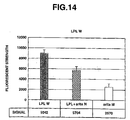
| DETECTION PROBE TYPE | MEAN FLUORESCENT STRENGTH | STANDARD |
| LPL W | ||
| 9042 | 664 | |
| LPL+ | 5704 | 761 |
| | 2570 | 670 |
| EXPLANATION OF PROBES : | ||
| LPL W : NORMAL GENE DETECTION PROBE | ||
| LPL+arita H : HETERO MUTANT GENE DETECTION PROBE | ||
| arita M : HOMO MUTANT GENE DETECTION PROBE |
(6) The fluorescent material Cy3 was coupled to the aminoallyl dUTP-labeled target obtained in (5). Namely, Asymmetrical-PCR product which had been desalted and concentrated in a Microcon-10 column was dried in a speed vac, re-dissolved in 0.1M NaHCO3 Buffer (pH 9.0), and mixed with Cy3 which had been dissolved in DMSO and dried in a speed vac, and a Cy3 incorporation reaction performed for 1 hour at room temperature. After the reaction 4M Hydroxylamine was added, the Cy3 was inactivated for 15 minutes at room temperature, and the unreacted dNTP and inactivated Cy3 were removed in a Microcon-10 column and a fluorescent labeled special target produced by concentration.
(8) Cover glass was laid over the spots on the micro-array slides, the reaction liquid of (7) was poured in the gaps, and hybridization and ligation reactions were performed with the fixed probe. The reactions were performed for 2 hours at room temeprature.
(9) Following removal of the cover glass in pure water, the slides were washed in running ultrapure water, dried with N2 gas and dip washed for 10 minutes in 0.1M NaOH 1.5M KCl to remove the non-specifically bound DNA. They were then again washed in running ultrapure water, dried with N2 gas and subjected to array analysis.
(10) The micro-array slides were scanned using a GenePix 2505B micro-array scanner to obtain scan images which were converted to numerical data with a GenePix Pro.
(11) (Signal median - background median) was calculated from the numerical data, and mean and standard deviation calculated and used as the test results. (Results show the fluorescent strength of fluorescent-labeled special target ligated to the fixed probe.)
| DETECTION PROBE TYPE | MEAN FLUORESCENT STRENGTH | |
| BCRABL | ||
| 16585 | 1364 | |
| ABL | -688 | 202 |
| EXPLANATION OF PROBES: | ||
| BCRABL : TRANSLOCATION MUTATION DETECTION PROBE | ||
| ABL : NORMAL ABL GENE DETECTION PROBE |




Claims (13)
- A method of detecting nucleotide mutations comprising the following steps (A)-(D):(A) a step of producing primers (elongatable primers) having (1) a nucleotide sequence complementary to part of the nucleic acids to be detected, including the mutation site, and (2) a nucleotide sequence added to the 5' end, which is complementary to the nucleotide sequence formed at the 3' end after elongation where is just upstream of the mutation nucleotide, wherein (3) the primers are produced so that the mutation site will be located in the down stream after the elongation;(B) a step of producing the target by subjecting the primers to an elongation reaction using polymerase or Klenow enzyme;(C) a step of then denaturing the target to a single strand, and subjecting this target to a hybridization reaction with a probe that has the complementary sequence which includes the mutation site at the 3' end; and(D) a step of then subjecting the target to a ligation reaction.
- The nucleotide mutation detection method according to Claim 1, wherein the primers are designed so that the oligonucleotide has a total sequence length of 33 nucleotides or more, the length of the complementary part of the sequence to the nucleic acid of above is 20 or more and having a Tm of 60°C or more, and the number of the nucleotides added to the 5' end are 13 or more and a Tm of that is 40-60°C.
- The nucleotide mutation detection method according to Claim 1 or 2, wherein the probes are fixed to solid phases so that one type of probe corresponds to one solid phase.
- The nucleotide mutation detection method according to Claim 3, wherein the probes have a oligonucleotide part with a sequence length of 20 nucleotides or more, a solid phase fixing part comprising a thiol group, and a linker part between the two comprising an alkane chain.
- The nucleotide mutation detection method according to Claim 3 or 4, wherein electrodes are used as the solid phase, and detection is performed by an electrochemical method.
- The nucleotide mutation detection method according to Claim 5, wherein electrochemical reagent is reacted after the ligation reaction, and the resulting electrochemical response is detected.
- The nucleotide mutation detection method according to Claim 6, wherein the electrochemical reagent is an electrochemically active intercalator.
- The nucleotide mutation detection method according to Claim 1, wherein the single-strand target is fluorescent labeled, and the hybridization and ligation reactions are performed using the fluorescent labeled target.
- The nucleotide mutation detection method according to Claim 8, wherein a hetero probe which is a mixture of a normal probe having the normal nucleotide sequence and a probe having the nucleotide mutation is used as the probe.
- The nucleotide mutation detection method according to Claim 1, wherein the hybridization reaction is performed using a solution containing at least those salts required for hybridization of the nucleic acids.
- The nucleotide mutation detection method according to Claim 1, wherein the ligation reaction is performed using at least salts sufficient to prevent dissociation of the double-strand nucleic acids formed by hybridization, DNA ligase, and the corresponding DNA ligase buffer solution,
- The nucleotide mutation detection method according to Claim 1, wherein the hybridization and ligation reactions are performed simultaneously using a synthetic enzyme solution containing at least DNA ligase and the corresponding DNA ligase buffer solution.
- A nucleotide mutation detection system employing the detection method according to Claim 1.
Applications Claiming Priority (3)
| Application Number | Priority Date | Filing Date | Title |
|---|---|---|---|
| JP2002222133 | 2002-07-30 | ||
| JP2002222133 | 2002-07-30 | ||
| PCT/JP2003/009692 WO2004011646A1 (en) | 2002-07-30 | 2003-07-30 | Method of detecting base mutation |
Publications (3)
| Publication Number | Publication Date |
|---|---|
| EP1550718A1 true EP1550718A1 (en) | 2005-07-06 |
| EP1550718A4 EP1550718A4 (en) | 2005-11-30 |
| EP1550718B1 EP1550718B1 (en) | 2011-06-22 |
Family
ID=31184893
Family Applications (1)
| Application Number | Title | Priority Date | Filing Date |
|---|---|---|---|
| EP03771437A Expired - Lifetime EP1550718B1 (en) | 2002-07-30 | 2003-07-30 | Method of detecting base mutation |
Country Status (6)
| Country | Link |
|---|---|
| US (1) | US7491492B2 (en) |
| EP (1) | EP1550718B1 (en) |
| JP (1) | JP3581711B2 (en) |
| AT (1) | ATE513924T1 (en) |
| AU (1) | AU2003252350A1 (en) |
| WO (1) | WO2004011646A1 (en) |
Families Citing this family (5)
| Publication number | Priority date | Publication date | Assignee | Title |
|---|---|---|---|---|
| US7491492B2 (en) | 2002-07-30 | 2009-02-17 | Toppan Printing Co., Ltd. | Method of detecting nucleotide mutations |
| US7488581B2 (en) * | 2006-03-20 | 2009-02-10 | Kabushiki Kaisha Toshiba | Method for detecting a target nucleic acid sequence |
| JP5125082B2 (en) * | 2006-11-30 | 2013-01-23 | 凸版印刷株式会社 | Base mutation detection method and base mutation detection system |
| CN113450875B (en) * | 2021-06-24 | 2024-01-02 | 南京农业大学 | A method for identifying RNA m6A modification sites based on BRNN model and statistical test |
| CN113832144A (en) * | 2021-10-29 | 2021-12-24 | 中山大学附属第一医院 | Method for detecting gene SNV |
Family Cites Families (29)
| Publication number | Priority date | Publication date | Assignee | Title |
|---|---|---|---|---|
| JPS56152958A (en) | 1980-04-30 | 1981-11-26 | Mitsubishi Electric Corp | Electroless gold plating solution |
| US4343684A (en) * | 1980-12-19 | 1982-08-10 | Stanley Lechtzin | Method of electroforming and product |
| US4840893A (en) * | 1983-12-16 | 1989-06-20 | Medisense, Inc. | Electrochemical assay for nucleic acids and nucleic acid probes |
| US4857831A (en) * | 1986-12-29 | 1989-08-15 | Schlumberger Technology Corporation | Borehole casing diagnostic apparatus and method |
| US5108576A (en) * | 1988-06-13 | 1992-04-28 | Ohmicron Corporation | Pyroelectric thermometric device |
| JP3331261B2 (en) * | 1994-08-19 | 2002-10-07 | 日本エレクトロプレイテイング・エンジニヤース株式会社 | Electroless gold plating solution |
| GB9507238D0 (en) | 1995-04-07 | 1995-05-31 | Isis Innovation | Detecting dna sequence variations |
| EP0821745A1 (en) * | 1995-04-17 | 1998-02-04 | The Board Of Trustees Of The University Of Arkansas | Method of electroplating a substrate, and products made thereby |
| JP3764779B2 (en) * | 1996-03-30 | 2006-04-12 | 株式会社東北テクノアーチ | Analysis method using convex regions |
| US5627054A (en) * | 1996-04-05 | 1997-05-06 | The United States Of America As Represented By The Secretary Of The Army | Competitor primer asymmetric polymerase chain reaction |
| JP3233851B2 (en) | 1996-04-24 | 2001-12-04 | 繁織 竹中 | Electrochemical detection method of gene and its device |
| US6312892B1 (en) * | 1996-07-19 | 2001-11-06 | Cornell Research Foundation, Inc. | High fidelity detection of nucleic acid differences by ligase detection reaction |
| JP3891620B2 (en) * | 1996-11-14 | 2007-03-14 | 株式会社アイシン・コスモス研究所 | Nucleic acid probe molecule having a hairpin structure, and nucleic acid detection method using the nucleic acid probe molecule |
| FR2764385B1 (en) * | 1997-06-06 | 1999-07-16 | Commissariat Energie Atomique | MICROSYSTEM FOR ANALYZING LIQUIDS WITH INTEGRATED CUP |
| US6063573A (en) * | 1998-01-27 | 2000-05-16 | Clinical Micro Sensors, Inc. | Cycling probe technology using electron transfer detection |
| US6287776B1 (en) * | 1998-02-02 | 2001-09-11 | Signature Bioscience, Inc. | Method for detecting and classifying nucleic acid hybridization |
| DE19841337C1 (en) * | 1998-05-27 | 1999-09-23 | Micronas Intermetall Gmbh | Intracellular manipulation of biological cell contents, assisting injection or removal of substances or cell components |
| US6093370A (en) * | 1998-06-11 | 2000-07-25 | Hitachi, Ltd. | Polynucleotide separation method and apparatus therefor |
| US20040185462A1 (en) * | 1999-08-06 | 2004-09-23 | Tum Gene, Inc. | Method of and detecting apparatus and detecting chip for single base substitution SNP and point mutation of genes |
| JP2003527087A (en) * | 1999-08-13 | 2003-09-16 | イェール・ユニバーシティ | Binary coded array tags |
| KR100348786B1 (en) * | 1999-10-01 | 2002-08-17 | 엘지전자주식회사 | Method for detecting nucleic acids, detector for nucleic acids and method for producing the same |
| AU7952700A (en) * | 1999-10-20 | 2001-04-30 | Takatoshi Miyahara | Gene detecting chip, detector, and detecting method |
| US20020090649A1 (en) * | 1999-12-15 | 2002-07-11 | Tony Chan | High density column and row addressable electrode arrays |
| JP4505776B2 (en) * | 2001-01-19 | 2010-07-21 | 凸版印刷株式会社 | Gene detection system, gene detection apparatus equipped with the same, detection method, and gene detection chip |
| JP2006170615A (en) * | 2001-01-19 | 2006-06-29 | Shigeori Takenaka | Method of, device for, and chip of detecting gene |
| US6749731B2 (en) * | 2001-01-31 | 2004-06-15 | Kyocera Corporation | Gene detection chip and detection device |
| JP3857928B2 (en) * | 2001-02-08 | 2006-12-13 | 京セラ株式会社 | Surface treatment method and surface-treated product of gold-plated body, method for producing gold-plated body, gold-plated body, and method for immobilizing sulfur-containing molecules |
| US20030119004A1 (en) * | 2001-12-05 | 2003-06-26 | Wenz H. Michael | Methods for quantitating nucleic acids using coupled ligation and amplification |
| US7491492B2 (en) | 2002-07-30 | 2009-02-17 | Toppan Printing Co., Ltd. | Method of detecting nucleotide mutations |
-
2003
- 2003-07-30 US US10/488,312 patent/US7491492B2/en not_active Expired - Fee Related
- 2003-07-30 WO PCT/JP2003/009692 patent/WO2004011646A1/en not_active Ceased
- 2003-07-30 JP JP2004524316A patent/JP3581711B2/en not_active Expired - Fee Related
- 2003-07-30 AU AU2003252350A patent/AU2003252350A1/en not_active Abandoned
- 2003-07-30 AT AT03771437T patent/ATE513924T1/en not_active IP Right Cessation
- 2003-07-30 EP EP03771437A patent/EP1550718B1/en not_active Expired - Lifetime
Also Published As
| Publication number | Publication date |
|---|---|
| AU2003252350A1 (en) | 2004-02-16 |
| US20060003325A1 (en) | 2006-01-05 |
| EP1550718A4 (en) | 2005-11-30 |
| WO2004011646A1 (en) | 2004-02-05 |
| EP1550718B1 (en) | 2011-06-22 |
| ATE513924T1 (en) | 2011-07-15 |
| US7491492B2 (en) | 2009-02-17 |
| JPWO2004011646A1 (en) | 2005-11-24 |
| JP3581711B2 (en) | 2004-10-27 |
Similar Documents
| Publication | Publication Date | Title |
|---|---|---|
| JP5032304B2 (en) | Detection of chromosomal abnormalities | |
| US20050191636A1 (en) | Detection of STRP, such as fragile X syndrome | |
| US8008019B2 (en) | Use of dual-tags for the evaluation of genomic variable repeat regions | |
| EP1241266A1 (en) | Method of detecting nucleotide polymorphism | |
| JP4989493B2 (en) | Method for detecting nucleic acid sequence by intramolecular probe | |
| US20040106108A1 (en) | Solid support assay systems and methods utilizing non-standard bases | |
| CZ20001934A3 (en) | Process for preparing complex DNA of methylation peptide maps | |
| CN109952381A (en) | Method for Multiple detection methylate DNA | |
| JP3752466B2 (en) | Genetic testing method | |
| EP1544309B1 (en) | Assay for detecting methylation status by methylation specific primer extension (MSPE) | |
| JP2003534812A (en) | Detection of nucleotide sequence variation by restriction primer extension | |
| US20080003609A1 (en) | Method of detecting bladder urothelial carcinoma | |
| US20050287553A1 (en) | Method for the quantification of methylated DNA | |
| EP1426448A1 (en) | Method for lowering the effects of sequence variations in a diagnostic hybridization assay, probe for use in the assay and assay | |
| US7491492B2 (en) | Method of detecting nucleotide mutations | |
| US20040132047A1 (en) | Methods for detection of genetic alterations associated with cancer | |
| CN115141886A (en) | Probe primer group for detecting myeloid leukemia gene mutation based on high-throughput sequencing and application thereof | |
| EP3339447B1 (en) | Method for analyzing template nucleic acid, method for analyzing target substance, analysis kit for template nucleic acid or target substance, and analyzer for template nucleic acid or target substance | |
| KR20180053679A (en) | A multi-valued probe with a single nucleotide resolution | |
| JP4395363B2 (en) | Nucleic acid detection method | |
| KR101513276B1 (en) | Method for multiplex determination of copy number variation using modified MLPA | |
| WO2014009007A1 (en) | Microarray-based methods for identifying single nucleotides at specific positions in nucleic acids | |
| JP2004135509A (en) | Gene expression analysis method and probe kit for gene expression analysis | |
| CA2921628A1 (en) | Assays for single molecule detection and use thereof | |
| JP2003135069A (en) | Method for identifying nucleotide polymorphism |
Legal Events
| Date | Code | Title | Description |
|---|---|---|---|
| PUAI | Public reference made under article 153(3) epc to a published international application that has entered the european phase |
Free format text: ORIGINAL CODE: 0009012 |
|
| 17P | Request for examination filed |
Effective date: 20050223 |
|
| AK | Designated contracting states |
Kind code of ref document: A1 Designated state(s): AT BE BG CH CY CZ DE DK EE ES FI FR GB GR HU IE IT LI LU MC NL PT RO SE SI SK TR |
|
| AX | Request for extension of the european patent |
Extension state: AL LT LV MK |
|
| DAX | Request for extension of the european patent (deleted) | ||
| A4 | Supplementary search report drawn up and despatched |
Effective date: 20051018 |
|
| RIC1 | Information provided on ipc code assigned before grant |
Ipc: 7C 12Q 1/68 A |
|
| RAP1 | Party data changed (applicant data changed or rights of an application transferred) |
Owner name: TOPPAN PRINTING CO., LTD. |
|
| 17Q | First examination report despatched |
Effective date: 20070410 |
|
| GRAP | Despatch of communication of intention to grant a patent |
Free format text: ORIGINAL CODE: EPIDOSNIGR1 |
|
| GRAS | Grant fee paid |
Free format text: ORIGINAL CODE: EPIDOSNIGR3 |
|
| GRAA | (expected) grant |
Free format text: ORIGINAL CODE: 0009210 |
|
| AK | Designated contracting states |
Kind code of ref document: B1 Designated state(s): AT BE BG CH CY CZ DE DK EE ES FI FR GB GR HU IE IT LI LU MC NL PT RO SE SI SK TR |
|
| REG | Reference to a national code |
Ref country code: GB Ref legal event code: FG4D |
|
| REG | Reference to a national code |
Ref country code: CH Ref legal event code: NV Representative=s name: BOVARD AG Ref country code: CH Ref legal event code: EP |
|
| REG | Reference to a national code |
Ref country code: IE Ref legal event code: FG4D |
|
| REG | Reference to a national code |
Ref country code: DE Ref legal event code: R096 Ref document number: 60337508 Country of ref document: DE Effective date: 20110811 |
|
| REG | Reference to a national code |
Ref country code: NL Ref legal event code: VDEP Effective date: 20110622 |
|
| PG25 | Lapsed in a contracting state [announced via postgrant information from national office to epo] |
Ref country code: SE Free format text: LAPSE BECAUSE OF FAILURE TO SUBMIT A TRANSLATION OF THE DESCRIPTION OR TO PAY THE FEE WITHIN THE PRESCRIBED TIME-LIMIT Effective date: 20110622 |
|
| PG25 | Lapsed in a contracting state [announced via postgrant information from national office to epo] |
Ref country code: FI Free format text: LAPSE BECAUSE OF FAILURE TO SUBMIT A TRANSLATION OF THE DESCRIPTION OR TO PAY THE FEE WITHIN THE PRESCRIBED TIME-LIMIT Effective date: 20110622 Ref country code: GR Free format text: LAPSE BECAUSE OF FAILURE TO SUBMIT A TRANSLATION OF THE DESCRIPTION OR TO PAY THE FEE WITHIN THE PRESCRIBED TIME-LIMIT Effective date: 20110923 Ref country code: CY Free format text: LAPSE BECAUSE OF FAILURE TO SUBMIT A TRANSLATION OF THE DESCRIPTION OR TO PAY THE FEE WITHIN THE PRESCRIBED TIME-LIMIT Effective date: 20110622 Ref country code: AT Free format text: LAPSE BECAUSE OF FAILURE TO SUBMIT A TRANSLATION OF THE DESCRIPTION OR TO PAY THE FEE WITHIN THE PRESCRIBED TIME-LIMIT Effective date: 20110622 Ref country code: SI Free format text: LAPSE BECAUSE OF FAILURE TO SUBMIT A TRANSLATION OF THE DESCRIPTION OR TO PAY THE FEE WITHIN THE PRESCRIBED TIME-LIMIT Effective date: 20110622 |
|
| PG25 | Lapsed in a contracting state [announced via postgrant information from national office to epo] |
Ref country code: BE Free format text: LAPSE BECAUSE OF FAILURE TO SUBMIT A TRANSLATION OF THE DESCRIPTION OR TO PAY THE FEE WITHIN THE PRESCRIBED TIME-LIMIT Effective date: 20110622 Ref country code: NL Free format text: LAPSE BECAUSE OF FAILURE TO SUBMIT A TRANSLATION OF THE DESCRIPTION OR TO PAY THE FEE WITHIN THE PRESCRIBED TIME-LIMIT Effective date: 20110622 |
|
| PG25 | Lapsed in a contracting state [announced via postgrant information from national office to epo] |
Ref country code: PT Free format text: LAPSE BECAUSE OF FAILURE TO SUBMIT A TRANSLATION OF THE DESCRIPTION OR TO PAY THE FEE WITHIN THE PRESCRIBED TIME-LIMIT Effective date: 20111024 Ref country code: EE Free format text: LAPSE BECAUSE OF FAILURE TO SUBMIT A TRANSLATION OF THE DESCRIPTION OR TO PAY THE FEE WITHIN THE PRESCRIBED TIME-LIMIT Effective date: 20110622 Ref country code: CZ Free format text: LAPSE BECAUSE OF FAILURE TO SUBMIT A TRANSLATION OF THE DESCRIPTION OR TO PAY THE FEE WITHIN THE PRESCRIBED TIME-LIMIT Effective date: 20110622 |
|
| PG25 | Lapsed in a contracting state [announced via postgrant information from national office to epo] |
Ref country code: SK Free format text: LAPSE BECAUSE OF FAILURE TO SUBMIT A TRANSLATION OF THE DESCRIPTION OR TO PAY THE FEE WITHIN THE PRESCRIBED TIME-LIMIT Effective date: 20110622 Ref country code: RO Free format text: LAPSE BECAUSE OF FAILURE TO SUBMIT A TRANSLATION OF THE DESCRIPTION OR TO PAY THE FEE WITHIN THE PRESCRIBED TIME-LIMIT Effective date: 20110622 Ref country code: MC Free format text: LAPSE BECAUSE OF NON-PAYMENT OF DUE FEES Effective date: 20110731 |
|
| REG | Reference to a national code |
Ref country code: IE Ref legal event code: MM4A |
|
| PLBE | No opposition filed within time limit |
Free format text: ORIGINAL CODE: 0009261 |
|
| STAA | Information on the status of an ep patent application or granted ep patent |
Free format text: STATUS: NO OPPOSITION FILED WITHIN TIME LIMIT |
|
| 26N | No opposition filed |
Effective date: 20120323 |
|
| PG25 | Lapsed in a contracting state [announced via postgrant information from national office to epo] |
Ref country code: IT Free format text: LAPSE BECAUSE OF FAILURE TO SUBMIT A TRANSLATION OF THE DESCRIPTION OR TO PAY THE FEE WITHIN THE PRESCRIBED TIME-LIMIT Effective date: 20110622 |
|
| PG25 | Lapsed in a contracting state [announced via postgrant information from national office to epo] |
Ref country code: DK Free format text: LAPSE BECAUSE OF FAILURE TO SUBMIT A TRANSLATION OF THE DESCRIPTION OR TO PAY THE FEE WITHIN THE PRESCRIBED TIME-LIMIT Effective date: 20110622 |
|
| REG | Reference to a national code |
Ref country code: DE Ref legal event code: R097 Ref document number: 60337508 Country of ref document: DE Effective date: 20120323 |
|
| PG25 | Lapsed in a contracting state [announced via postgrant information from national office to epo] |
Ref country code: IE Free format text: LAPSE BECAUSE OF NON-PAYMENT OF DUE FEES Effective date: 20110730 |
|
| PG25 | Lapsed in a contracting state [announced via postgrant information from national office to epo] |
Ref country code: ES Free format text: LAPSE BECAUSE OF FAILURE TO SUBMIT A TRANSLATION OF THE DESCRIPTION OR TO PAY THE FEE WITHIN THE PRESCRIBED TIME-LIMIT Effective date: 20111003 |
|
| PG25 | Lapsed in a contracting state [announced via postgrant information from national office to epo] |
Ref country code: LU Free format text: LAPSE BECAUSE OF NON-PAYMENT OF DUE FEES Effective date: 20110730 |
|
| PG25 | Lapsed in a contracting state [announced via postgrant information from national office to epo] |
Ref country code: BG Free format text: LAPSE BECAUSE OF FAILURE TO SUBMIT A TRANSLATION OF THE DESCRIPTION OR TO PAY THE FEE WITHIN THE PRESCRIBED TIME-LIMIT Effective date: 20110922 |
|
| PG25 | Lapsed in a contracting state [announced via postgrant information from national office to epo] |
Ref country code: TR Free format text: LAPSE BECAUSE OF FAILURE TO SUBMIT A TRANSLATION OF THE DESCRIPTION OR TO PAY THE FEE WITHIN THE PRESCRIBED TIME-LIMIT Effective date: 20110622 |
|
| PG25 | Lapsed in a contracting state [announced via postgrant information from national office to epo] |
Ref country code: HU Free format text: LAPSE BECAUSE OF FAILURE TO SUBMIT A TRANSLATION OF THE DESCRIPTION OR TO PAY THE FEE WITHIN THE PRESCRIBED TIME-LIMIT Effective date: 20110622 |
|
| PGFP | Annual fee paid to national office [announced via postgrant information from national office to epo] |
Ref country code: DE Payment date: 20140724 Year of fee payment: 12 Ref country code: CH Payment date: 20140714 Year of fee payment: 12 |
|
| PGFP | Annual fee paid to national office [announced via postgrant information from national office to epo] |
Ref country code: FR Payment date: 20140708 Year of fee payment: 12 Ref country code: GB Payment date: 20140730 Year of fee payment: 12 |
|
| REG | Reference to a national code |
Ref country code: DE Ref legal event code: R119 Ref document number: 60337508 Country of ref document: DE |
|
| REG | Reference to a national code |
Ref country code: CH Ref legal event code: PL |
|
| GBPC | Gb: european patent ceased through non-payment of renewal fee |
Effective date: 20150730 |
|
| PG25 | Lapsed in a contracting state [announced via postgrant information from national office to epo] |
Ref country code: LI Free format text: LAPSE BECAUSE OF NON-PAYMENT OF DUE FEES Effective date: 20150731 Ref country code: CH Free format text: LAPSE BECAUSE OF NON-PAYMENT OF DUE FEES Effective date: 20150731 Ref country code: DE Free format text: LAPSE BECAUSE OF NON-PAYMENT OF DUE FEES Effective date: 20160202 Ref country code: GB Free format text: LAPSE BECAUSE OF NON-PAYMENT OF DUE FEES Effective date: 20150730 |
|
| REG | Reference to a national code |
Ref country code: FR Ref legal event code: ST Effective date: 20160331 |
|
| PG25 | Lapsed in a contracting state [announced via postgrant information from national office to epo] |
Ref country code: FR Free format text: LAPSE BECAUSE OF NON-PAYMENT OF DUE FEES Effective date: 20150731 |