EP1548645A1 - Method of processing digital image data from motion blurred exposures - Google Patents
Method of processing digital image data from motion blurred exposures Download PDFInfo
- Publication number
- EP1548645A1 EP1548645A1 EP03029392A EP03029392A EP1548645A1 EP 1548645 A1 EP1548645 A1 EP 1548645A1 EP 03029392 A EP03029392 A EP 03029392A EP 03029392 A EP03029392 A EP 03029392A EP 1548645 A1 EP1548645 A1 EP 1548645A1
- Authority
- EP
- European Patent Office
- Prior art keywords
- image data
- image
- blurred
- component
- images
- Prior art date
- Legal status (The legal status is an assumption and is not a legal conclusion. Google has not performed a legal analysis and makes no representation as to the accuracy of the status listed.)
- Granted
Links
Images


Classifications
-
- G—PHYSICS
- G06—COMPUTING OR CALCULATING; COUNTING
- G06T—IMAGE DATA PROCESSING OR GENERATION, IN GENERAL
- G06T5/00—Image enhancement or restoration
- G06T5/73—Deblurring; Sharpening
-
- G—PHYSICS
- G06—COMPUTING OR CALCULATING; COUNTING
- G06T—IMAGE DATA PROCESSING OR GENERATION, IN GENERAL
- G06T5/00—Image enhancement or restoration
- G06T5/10—Image enhancement or restoration using non-spatial domain filtering
-
- H—ELECTRICITY
- H04—ELECTRIC COMMUNICATION TECHNIQUE
- H04N—PICTORIAL COMMUNICATION, e.g. TELEVISION
- H04N1/00—Scanning, transmission or reproduction of documents or the like, e.g. facsimile transmission; Details thereof
- H04N1/46—Colour picture communication systems
- H04N1/56—Processing of colour picture signals
- H04N1/58—Edge or detail enhancement; Noise or error suppression, e.g. colour misregistration correction
-
- G—PHYSICS
- G06—COMPUTING OR CALCULATING; COUNTING
- G06T—IMAGE DATA PROCESSING OR GENERATION, IN GENERAL
- G06T2207/00—Indexing scheme for image analysis or image enhancement
- G06T2207/20—Special algorithmic details
- G06T2207/20172—Image enhancement details
- G06T2207/20201—Motion blur correction
Definitions
- the invention relates to a method for processing digital image data with a photographic camera captured images.
- the object of the invention was therefore to develop a method in which at least a part of the blurred shots can be obtained.
- those are sought among the blurred shots, their blurring of blurring, so from a relative movement of camera and subject during the exposure was caused.
- these blurred shots through targeted corrective action as far as can be restored, that acceptable recordings arise, which are output to a playback or storage medium can.
- This will not make all the blurry shots easier than useless discarded, but a part of it is cleverly modified as far as that gives an acceptable picture.
- the reject rate of images will be so significantly lower, the photographer receives more prints of his often irretrievable Recordings. Especially with one-time shots, this procedure can be great Bring benefits, since it does not necessarily lead to a perfect picture, the Recording but improved so far that the subject is very well recognized and the picture gladly picked up by the photographer as a reminder.
- Blurred shots are identified by moving the image data along at least two of their dimensions, so z. B. in the x and y direction on their sharpness be examined. Due to the relative movement, which during the recording That is, it comes namely in the reproduced image data a directed blur. The blur consists in the direction of the relative movement, along other directions, in particular perpendicular thereto, the Image data, however, be sharp. Shaky shots are thus characterized that they take a different direction along different directions in the picture Have degree of severity. So while blurred shots it be recognized that along all directions to be examined in the picture No sharp structures can be found, blurred shots on it recognized that they are out of focus along one direction, along another, essentially vertical direction, are sharp.
- a Fourier transform is used the image data made.
- the image data is transferred from local to frequency space. In frequency space can then be determined that the image motif disturbing frequency, which was superimposed by the relative movement during recording the image motif.
- the correction according to the invention now aims to remove this interference component from separate actual recorded image portion, so that this noise component can be replaced by a correction component, which also allows easy elimination of the noise component comprises, so that then the originally desired Image component and the correction component can be combined in turn, what results in the corrected image content, which is a relatively undisturbed Representation of the image to be recorded includes.
- the Fourier transform is used logarithms. This achieves a conversion into a sum of Shares, so that the noise component of the image data separate from the actually desired Picture motif, so the image portion is present.
- the mathematical equivalents will be explained more clearly the steps described.
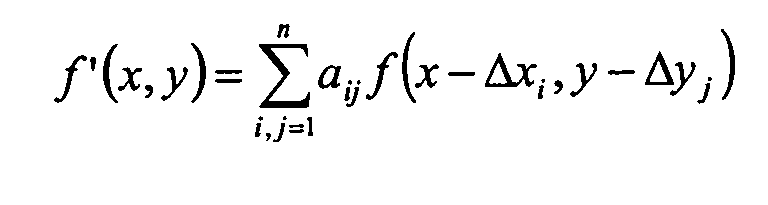
- the blurred image f '( x , y ) can be represented at each pixel ( x , y ) as that is, the sum of the same image information several times shifted by different factors.
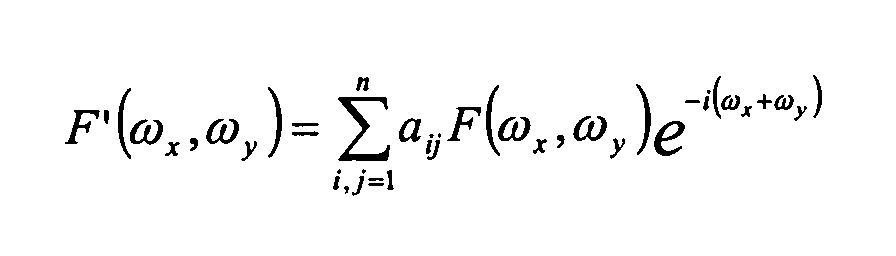
- a Fourier transformation results in the Fourier transform of the blurred image ie a convolution of "pure" image component F ( ⁇ x , ⁇ y ) and a noise component S ( ⁇ x , ⁇ y ).
- the noise component s l ( ⁇ x , ⁇ y ), which is decoupled from the image portion and limited to a defined spatial area, can be replaced by a correction component. This is explained in detail with reference to the description of the figures.
- the identified as blurred shots in the Output of digital pictures marked as blurred.
- This allows the Customer recognize that the image was not captured optimally, by means of the Image editing but was trying to make an acceptable picture of it.
- To give the customer a comparison between his original recording and the corrected image it is still advantageous to use both the original, shake recording as well as output the corrected image data. Although this does not have to be in the form of two actual prints, it makes more sense if both data sets are provided digitally.
- the labeling of blurred shots can advantageously on the Indexprint be made.
- the blurred, corrected shots separately issue. This separate edition allows the finisher to reprint them check to see if you can actually get this recording to the Customers can sell or whether the image quality will continue even after the correction is so bad that she is treated as a committee.
- Fig. 1 shows a blurred black and white recording, which after the invention Procedure should be corrected.
- Fig. 1 illustrated image data in a first correction step Fourierransformiert and logarithmized in a second correction step to decouple image and noise component.
- the result is shown in Fig. 2, for better illustration another Nyquist shift was made.
- Fig. 2 for better illustration another Nyquist shift was made.
- the shift direction of the image data is namely perpendicular to the lines to be seen. Visible is this shake or shift, by one of the image data shown in FIG Fourier transformation is performed.
- the result of this third correction step is shown in Fig.
- the corre- sponding component is the corresponding one Range of other undisturbed quadrants used as this with substantially matches the image characteristics of the other quadrants.
- the correction percentage can, for example, from an average over the data of the Quadrants with a noise component. An example of this is shown in FIG. 4 shown.
Landscapes
- Engineering & Computer Science (AREA)
- Physics & Mathematics (AREA)
- General Physics & Mathematics (AREA)
- Theoretical Computer Science (AREA)
- Multimedia (AREA)
- Signal Processing (AREA)
- Image Processing (AREA)
- Image Analysis (AREA)
Abstract
Description
Die Erfindung betrifft ein Verfahren zum Verarbeiten digitaler Bilddaten von mit einer fotografischen Kamera erfassten Bildern.The invention relates to a method for processing digital image data with a photographic camera captured images.
Bei der Aufnahme von Fotografien kommt es insbesondere bei längeren Belichtungszeiten oftmals dazu, dass der Fotograf die Kamera nicht ruhig halten kann oder das Motiv sich während der Belichtung bewegt, so dass die Aufnahme verwackelt. Das aufgenommene Bild erscheint dann unscharf, das Motiv ist oftmals nur schwer zu erkennen. Da diese Bilder im Allgemeinen als Ausschuss betrachtet werden, ist es nicht gewünscht, von diesen Bildern Abzüge zu machen. Dennoch gelangen diese Bilder über einzuscannende Filme oder direkt von der Digitalkamera ins Fotolabor, wo automatisch von den Bildern Abzüge erstellt werden, denn der Fotograf ist auch bei digitalen Kameras oftmals nicht in der Lage auf den kleinen, niedrig aufgelösten Displays zu erkennen, dass die Aufnahme unscharf ist.When taking photographs, it is especially at longer exposure times often the photographer can not keep his camera steady or the subject moves during exposure, causing the shot to blur. The recorded image then appears blurred, the subject is often difficult to recognize. Because these pictures are generally considered a scrap it is not desirable to make prints from these images. Yet These images are delivered via scanned films or directly from the digital camera to the photo lab, where prints are automatically taken from the pictures, because the photographer is often unable to access digital cameras Small, low-resolution displays recognize that the shot is out of focus is.
So wurden bereits für analoge Kopiergeräte in Fotolaboren Verfahren entwickelt, welche unscharfe Bilder erkennen. Ein Beispiel hierfür ist in der DE 34 08 765 C2 beschrieben. Hier werden die als unscharf erkannten Kopiervorlagen beim Kopieren ausgesondert, von diesen Bildern wird kein Abzug hergestellt. Dies ist für den Fotografen jedoch oftmals unbefriedigend, da er oft gerne besonders von nicht allzu verwackelten Aufnahmen einen Abzug als Erinnerung hätte.For example, procedures have already been developed for analogue photocopiers in photographic laboratories, which recognize blurred images. An example of this is in DE 34 08 765 C2 described. Here, the copy templates identified as out of focus are copied Separated, no prints are made of these images. This is for the Photographers, however, often unsatisfactory, as he likes to be especially of not too blurred shots would have a deduction as a reminder.
Aufgabe der Erfindung war es deshalb, ein Verfahren zu entwickeln, bei dem wenigstens ein Teil der unscharfen Aufnahmen erhalten werden kann.The object of the invention was therefore to develop a method in which at least a part of the blurred shots can be obtained.
Erfindungsgemäß werden diejenigen unter den unscharfen Aufnahmen gesucht, deren Unschärfe vom Verwackeln, also von einer Relativbewegung von Kamera und Motiv während der Belichtung verursacht wurde. Überraschenderweise konnte gezeigt werden, dass diese verwackelten Aufnahmen durch gezielte Korrekturmaßnahmen soweit restauriert werden können, dass akzeptable Aufnahmen entstehen, welche auf ein Wiedergabe- oder Speichermedium ausgegeben werden können. Damit werden nicht mehr alle unscharfen Aufnahmen einfach als unbrauchbar verworfen, sondern ein Teil derselben wird geschickt soweit modifiziert, dass sich ein akzeptables Bild ergibt. Die Ausschussrate der Bilder wird also deutlich geringer, der Fotograf erhält mehr Abzüge seiner oftmals unwiederbringlichen Aufnahmen. Gerade bei einmaligen Aufnahmen kann dieses Verfahren große Vorteile bringen, da es zwar nicht unbedingt zu einem perfekten Bild führt, die Aufnahme aber soweit verbessert wird, dass das Motiv sehr gut zu erkennen ist und das Bild gern vom Fotografen als Erinnerung aufgehoben wird.According to the invention, those are sought among the blurred shots, their blurring of blurring, so from a relative movement of camera and subject during the exposure was caused. Surprisingly could be shown that these blurred shots through targeted corrective action as far as can be restored, that acceptable recordings arise, which are output to a playback or storage medium can. This will not make all the blurry shots easier than useless discarded, but a part of it is cleverly modified as far as that gives an acceptable picture. The reject rate of images will be so significantly lower, the photographer receives more prints of his often irretrievable Recordings. Especially with one-time shots, this procedure can be great Bring benefits, since it does not necessarily lead to a perfect picture, the Recording but improved so far that the subject is very well recognized and the picture gladly picked up by the photographer as a reminder.
Verwackelte Aufnahmen werden identifiziert, indem die Bilddaten entlang wenigstens zweier ihrer Dimensionen, also z. B. in x- und y-Richtung auf ihre Schärfe hin untersucht werden. Durch die Relativbewegung, welche während der Aufnahme stattgefunden hat, kommt es nämlich in den wiedergegebenen Bilddaten zu einer gerichteten Unschärfe. Die Unschärfe besteht in Richtung der Relativbewegung, entlang anderer Richtungen, insbesondere senkrecht dazu, können die Bilddaten dagegen scharf sein. Verwackelte Aufnahmen sind also dadurch gekennzeichnet, dass sie entlang verschiedener Richtungen im Bild einen unterschiedlichen Schärfegrad aufweisen. Während also unscharfe Aufnahmen dadurch erkannt werden, dass entlang aller zu untersuchenden Richtungen im Bild keine scharfen Strukturen zu finden sind, werden verwackelte Aufnahmen daran erkannt, dass sie zwar entlang einer Richtung unscharf sind, entlang einer anderen, im Wesentlichen dazu senkrechten Richtung, scharf sind. Auch wenn dieser theoretische Idealfall nicht immer vorliegt, kann man zumindest davon ausgehen, dass ihr Schärfegrad entlang unterschiedlicher Bildrichtungen unterschiedlich ist. Obwohl es vorteilhaft ist, müssen die zu untersuchenden Richtungen nicht unbedingt senkrecht aufeinander stehen. Es könnte sich auch beispielsweise um eine Parallele zu einer Bildseite und die Bilddiagonale handeln, welche untersucht werden.Blurred shots are identified by moving the image data along at least two of their dimensions, so z. B. in the x and y direction on their sharpness be examined. Due to the relative movement, which during the recording That is, it comes namely in the reproduced image data a directed blur. The blur consists in the direction of the relative movement, along other directions, in particular perpendicular thereto, the Image data, however, be sharp. Shaky shots are thus characterized that they take a different direction along different directions in the picture Have degree of severity. So while blurred shots it be recognized that along all directions to be examined in the picture No sharp structures can be found, blurred shots on it recognized that they are out of focus along one direction, along another, essentially vertical direction, are sharp. Even if this theoretically ideal case is not always present, one can at least assume that their severity is different along different image directions. Although it is beneficial, the directions to be examined do not necessarily have to perpendicular to each other. It could also be, for example, a Parallel to an image page and act the image diagonal, which examines become.
Um verwackelte Aufnahmen zu identifizieren, können alle zu bearbeitenden Aufnahmen untersucht werden. Um Rechenzeit einzusparen ist es allerdings oftmals sinnvoller, die verwackelten Aufnahmen nur unter den Aufnahmen zu suchen, welche bereits als unscharf detektiert wurden.To identify shaky recordings, all recordings can be edited to be examined. To save computing time, however, it is often it makes more sense to search the shaky shots just under the shots, which were already detected as out of focus.
Um die Schärfe einer Aufnahme entlang einer Richtung zu untersuchen, können
beispielsweise scharfe Übergänge, also Kanten in den Bilddaten gesucht werden.
Bei unscharfen Aufnahmen treten nämlich keine derartigen Kanten auf, da hier die
Dichtesprünge verwaschen sind. Derartige Kantendetektionsverfahren sind beispielsweise
aus der Bilddatenverschärfung bekannt. Eines dieser Verfahren ist in
der EP 1 122 689 beschrieben. Es ist aber auch möglich, verwackelte Aufnahmen
dadurch zu erkennen, dass entlang wenigstens zweier Richtungen der Bilddaten
eine Fouriertransformation vorgenommen wird. Man kann davon ausgehen, dass
das Bild verwackelt wurde, wenn in der Fouriertransformierten entlang einer
Richtung viel größere Amplituden der auftretenden höheren Frequenzen beobachtet
werden als entlang einer anderen untersuchten Richtung.To examine the sharpness of a picture taken in one direction, you can
For example, sharp transitions, ie edges are searched in the image data.
In blurred shots namely occur on such edges, since here the
Dense jumps are washed out. Such edge detection methods are, for example
known from image data sharpening. One of these methods is in
Um sicherer feststellen zu können, ob es sich um eine verwackelte oder eine unscharfe Aufnahme handelt, ist es wünschenswert, nicht nur entlang zweier Richtungen zu untersuchen, sondern entlang dreier Richtungen. Hier können sich beispielsweise die Koordinatenachsen und die Bilddiagonale anbieten.To be able to determine with certainty whether it is a blurred or a blurred one Recording is desirable, not just along two directions to investigate, but along three directions. Here, for example, can offer the coordinate axes and the image diagonal.
Um die als verwackelt identifizierten Aufnahmen zu korrigieren wird eine Fouriertransformation der Bilddaten vorgenommen. To correct the pictures identified as blurred, a Fourier transform is used the image data made.
Dabei werden die Bilddaten vom Orts- in den Frequenzraum transferiert. Im Frequenzraum kann dann die das Bildmotiv störende Frequenz ermittelt werden, welche durch die Relativbewegung bei der Aufnahme dem Bildmotiv überlagert wurde. Die erfindungsgemäße Korrektur zielt nun darauf ab, diesen Störanteil vom eigentlichen aufgenommenen Bildanteil zu trennen, so dass dieser Störanteil durch einen Korrekturanteil ersetzt werden kann, was auch ein einfaches Eliminieren des Störanteils umfasst, so dass anschließend der ursprünglich gewünschte Bildanteil und der Korrekturanteil wiederum zusammengefasst werden können, woraus sich der korrigierte Bildinhalt ergibt, welcher eine vergleichsweise ungestörte Darstellung des aufzunehmenden Bildmotivs umfasst.The image data is transferred from local to frequency space. In frequency space can then be determined that the image motif disturbing frequency, which was superimposed by the relative movement during recording the image motif. The correction according to the invention now aims to remove this interference component from separate actual recorded image portion, so that this noise component can be replaced by a correction component, which also allows easy elimination of the noise component comprises, so that then the originally desired Image component and the correction component can be combined in turn, what results in the corrected image content, which is a relatively undisturbed Representation of the image to be recorded includes.
Um Bildanteil und Störanteil der Bilddaten zu entkoppeln wird die Fouriertransformierte logarithmiert. Hierdurch erreicht man eine Umwandlung in eine Summe der Anteile, so dass der Störanteil der Bilddaten getrennt vom eigentlich gewünschten Bildmotiv, also den Bildanteil, vorliegt. Es gibt jedoch auch weitere Möglichkeiten zur Entkopplung von Stör- und Bildanteil. Um dieses Korrekturverfahren etwas transparenter zu erläutern, werden im Folgenden die mathematischen Entsprechungen der beschriebenen Schritte dargestellt.To decouple the image component and the noise component of the image data, the Fourier transform is used logarithms. This achieves a conversion into a sum of Shares, so that the noise component of the image data separate from the actually desired Picture motif, so the image portion is present. However, there are other options for the decoupling of noise and image component. To make this correction something in the following, the mathematical equivalents will be explained more clearly the steps described.
Das verwackelte Bild f'(x,y) lässt sich an jedem Bildpunkt (x,y) darstellen als
Durch eine Fouriertransformation ergibt sich daraus die Fouriertransformierte des
verwackelten Bildes

Eine Möglichkeit, beide Anteile zu trennen besteht nun in einer Quotientenbildung.
Dabei ergibt sich der Bildanteil durch
Dieses Verfahren ist zwar prinzipiell anwendbar, man müsste jedoch die Problematik der Division durch Null vermeiden.Although this method is applicable in principle, one would have the problem avoid dividing by zero.
Ein vorteilhafteres Verfahren zur Entkopplung von Stör- und Bildanteil besteht
deshalb in einer Logarithmierung der Fouriertransformierten, wobei sich
Nach erneuter Fouriertransformation folgt daraus
Nun kann der Störanteil sl (Δ x ,Δ y ), welcher vom Bildanteil entkoppelt und auf einen definierten räumlichen Bereich beschränkt ist, durch einen Korrekturanteil ersetzt werden. Im Einzelnen wird dies anhand der Figurenbeschreibung erläutert.Now, the noise component s l (Δ x , Δ y ), which is decoupled from the image portion and limited to a defined spatial area, can be replaced by a correction component. This is explained in detail with reference to the description of the figures.
Durch folgende Fourier-Rück-Transformationen und Anwendung der Exponentialfunktion wird diese korrigierte Funktion schließlich in korrigierte Bilddaten rückverwandelt.By following Fourier-back transformations and applying the exponential function This corrected function is finally reconverted into corrected image data.
Vorteilhafterweise werden die als verwackelt identifizierten Aufnahmen bei der Ausgabe der digitalen Bilder als verwackelt gekennzeichnet. Dadurch kann der Kunde erkennen, dass das Bildmotiv zwar nicht optimal erfasst wurde, mittels der Bildbearbeitung aber versucht wurde, ein akzeptables Bild daraus zu gestalten. Um dem Kunden einen Vergleich zwischen seiner ursprünglichen Aufnahme und dem korrigierten Bild zu ermöglichen, ist es weiterhin vorteilhaft, sowohl die ursprüngliche, verwackelte Aufnahme als auch die korrigierten Bilddaten auszugeben. Dies muss zwar nicht in Form von zwei tatsächlichen Ausdrucken erfolgen, sinnvoller ist es, wenn beide Datensätze digital zur Verfügung gestellt werden.Advantageously, the identified as blurred shots in the Output of digital pictures marked as blurred. This allows the Customer recognize that the image was not captured optimally, by means of the Image editing but was trying to make an acceptable picture of it. To give the customer a comparison between his original recording and the corrected image, it is still advantageous to use both the original, shake recording as well as output the corrected image data. Although this does not have to be in the form of two actual prints, it makes more sense if both data sets are provided digitally.
Die Kennzeichnung der verwackelten Aufnahmen kann vorteilhafterweise auf dem Indexprint vorgenommen werden.The labeling of blurred shots can advantageously on the Indexprint be made.
Weiterhin ist es vorteilhaft, die verwackelten, korrigierten Aufnahmen gesondert auszugeben. Diese gesonderte Ausgabe ermöglicht es dem Finisher, sie nochmal zu überprüfen, um zu sehen, ob man diese Aufnahme nun tatsächlich an den Kunden verkaufen kann oder ob die Bildqualität weiterhin auch nach der Korrektur so schlecht ist, dass sie als Ausschuss zu behandeln ist.Furthermore, it is advantageous, the blurred, corrected shots separately issue. This separate edition allows the finisher to reprint them check to see if you can actually get this recording to the Customers can sell or whether the image quality will continue even after the correction is so bad that she is treated as a committee.
Weitere Merkmale und Vorteile der Erfindung ergeben sich aus der folgenden Beschreibung bevorzugter Ausführungsformen und Anwendungsbeispiele, wobei Bezug auf die beigefügten Zeichnungen genommen wird. Further features and advantages of the invention will become apparent from the following Description of preferred embodiments and application examples, wherein Reference is made to the accompanying drawings.
Es zeigen:
- Fig. 1
- verwackeltes Originalbild,
- Fig. 2
- logarithmierte Fouriertransformierte des Originalbildes,
- Fig. 3
- Ausschnitt der erneuten Fouriertransformierten, bei der der Störanteil sichtbar wird,
- Fig. 4
- entspricht Fig. 3, jedoch ist der Störanteil durch einen Korrekturanteil ersetzt,
- Fig. 5
- rücktransformiertes, korrigiertes Bild im Fourierraum und
- Fig. 6
- korrigiertes Bild.
- Fig. 1
- blurred original image,
- Fig. 2
- logarithmized Fourier transform of the original image,
- Fig. 3
- Section of the re-Fourier transform, where the noise component becomes visible,
- Fig. 4
- corresponds to FIG. 3, but the noise component is replaced by a correction component,
- Fig. 5
- Inverted, corrected image in Fourier space and
- Fig. 6
- corrected picture.
Fig. 1 zeigt eine verwackelte schwarz-weiß Aufnahme, welche nach dem erfindungsgemäßen Verfahren korrigiert werden soll. Für die Korrektur werden diese in Fig. 1 dargestellten Bilddaten in einem ersten Korrekturschritt Fouriertransformiert und in einem zweiten Korrekturschritt logarithmiert, um Bild- und Störanteil zu entkoppeln. Das Ergebnis ist in Fig. 2 dargestellt, wobei zur besseren Veranschaulichung noch eine Nyquist-Verschiebung vorgenommen wurde. In dieser Darstellung befindet sich im Zentrum der Punkt, der im Originalbild den Frequenzursprung aufweist. Über das im Bild leicht sichtbare Linienmuster kann die Verwacklungsrichtung ermittelt werden. Die Verschiebungsrichtung der Bilddaten liegt nämlich senkrecht auf den zu sehenden Linien. Sichtbar wird diese Verwacklung bzw. Verschiebung, indem von den in Fig. 2 dargestellten Bilddaten eine erneute Fouriertransformation vorgenommen wird. Das Ergebnis dieses dritten Korrekturschrittes ist in Fig. 3 dargestellt, wobei hier nur der mittlere Bildausschnitt vergrößert dargestellt wurde. Dieses Bild zeigt die mehrfach transformierten Bilddaten wiederum in einer räumlichen Darstellung, wobei jedoch jetzt der Verschiebungsoder Störanteil und der Bildanteil entkoppelt sind. Der Störanteil ist schlaufenförmig im Zentrum des Bildes, jeweils an den zusammentreffenden Ecken der Quadranten zu sehen. Die Koordinatenachsen selbst geben die Bildinformation wieder, welche zu den Frequenzen mit der größten Amplitude in den Originalbilddaten gehört. Aufgabe des weiteren Vorgehens ist es nun, den Störanteil der in Fig. 3 im Zentrum schlaufenförmig hell erscheint, zu eliminieren, ohne dadurch die Bilddaten, welche sich auf den Koordinatenachsen aber auch im Hintergrund der gesamten Darstellung befinden, allzu stark zu verfälschen. Da die Störung im Allgemeinen beim Verwackeln der Kamera gerichtet erfolgt, sind, wie hier im Beispiel, zumeist nur zwei gegenüberliegenden Quadranten von der Störung betroffen, nur in zwei der Quadranten überlagert der Störanteil den Bildanteil. Deshalb ist es oftmals ausreichend, den Störanteil in diesen beiden Quadranten durch einen Korrekturanteil zu ersetzen. Idealerweise wird hier als Korrekturanteil der entsprechende Bereich der anderen ungestörten Quadranten verwendet, da dieser mit den Bildeigenschaften der anderen Quadranten im Wesentlichen übereinstimmt. Ein einfacheres Vorgehen bei der Korrektur besteht jedoch darin, einfach den inneren Bereich aller Quadranten durch einen Korrekturanteil zu ersetzen. Der Korrekturanteil kann dabei beispielsweise aus einem Mittelwert über die Daten des Quadranten mit einem Rauschanteil bestehen. Ein Beispiel hierfür ist in Fig. 4 dargestellt. Dabei kann vermieden werden, die Richtung der Störung zu ermitteln, was bei der vorher beschriebenen asymmetrischen Korrekturmaßnahme notwendig wäre. Als Korrekturanteil wird vorteilhafterweise ein für den Rest der Quadranten gemittelter Rauschanteil verwendet. Dass mit dieser Korrekturmaßnahme der Störanteil im Bilddatensatz eliminiert wurde, zeigt sich bei einer Darstellung im Frequenzraum nach einer erneuten Rücktransformation. Dies ist in Fig. 5 dargestellt. Diese Darstellung entspricht der von Fig. 2, wobei es sich jedoch bei Fig. 2 noch um den unkorrigierten Datensatz handelt. Man sieht deutlich, dass in Fig. 5 das Linienmuster, welches von der Bildverschiebung bei der Aufnahme herrührt, verschwunden ist. Der Stör- oder Verschiebungsanteil wurde also erfolgreich aus den Bilddaten eliminiert. So zeigt sich nach einer erneuten Rücktransformation auch das in Fig. 6 dargestellte korrigierte Bild, in welchem das Bildmotiv wesentlich deutlicher unverwackelt wiedergegeben ist. Der Grund dafür, dass es sich hierbei um ein weitaus verbessertes, aber leider nicht perfektes Bild handelt, liegt darin, dass bei der Korrektur des Störanteils leider nicht vermieden werden kann, dass auch ein Teil des eigentlichen Bildinhalts verloren geht. Dennoch handelt es sich bei dem in Fig. 6 dargestellten korrigierten Bild um eine wesentlich bessere Aufnahme als die in Fig. 1 dargestellte Originalaufnahme. Der verwaschene, verschwommene Bildeindruck konnte vollständig beseitigt werden, das eigentliche Bildmotiv tritt viel deutlicher zu Tage.Fig. 1 shows a blurred black and white recording, which after the invention Procedure should be corrected. For the correction these are in Fig. 1 illustrated image data in a first correction step Fourierransformiert and logarithmized in a second correction step to decouple image and noise component. The result is shown in Fig. 2, for better illustration another Nyquist shift was made. In this presentation is located in the center of the point, in the original image the frequency origin having. About the in the picture easily visible line pattern can the blurring direction be determined. The shift direction of the image data is namely perpendicular to the lines to be seen. Visible is this shake or shift, by one of the image data shown in FIG Fourier transformation is performed. The result of this third correction step is shown in Fig. 3, in which case only increases the average image detail was presented. This picture shows the multiply transformed image data again in a spatial representation, but now the shift or Noise component and the image component are decoupled. The noise component is looped in the center of the picture, in each case at the coinciding corners of the quadrants to see. The coordinate axes themselves reproduce the image information, which to the frequencies with the largest amplitude in the original image data belongs. The task of the further procedure, it is now the interference component of in Fig. 3 in Center loops brightly appear to eliminate without thereby affecting the image data, which are on the coordinate axes but also in the background of the entire Representation are too distorted. Because the disorder in general when the camera is shaken, as in this example, mostly only two opposite quadrants affected by the disorder, only in two of the quadrants the noise component superimposes the image portion. That's why it is often sufficient, the noise component in these two quadrants by a Replace correction percentage. Ideally, the corre- sponding component here is the corresponding one Range of other undisturbed quadrants used as this with substantially matches the image characteristics of the other quadrants. However, a simpler approach to correcting is simply to do the inside Area of all quadrants replaced by a correction component. The correction percentage can, for example, from an average over the data of the Quadrants with a noise component. An example of this is shown in FIG. 4 shown. It can be avoided to determine the direction of the fault, which is necessary in the previously described asymmetric corrective action would. As a correction component is advantageously one for the rest of the quadrant averaged noise used. That with this corrective action the noise component in the image data set has been eliminated, is shown by a representation in Frequency space after another inverse transformation. This is shown in FIG. 5. This representation corresponds to that of FIG. 2, but in FIG. 2 is still the uncorrected record. It can be clearly seen that in FIG. 5 the line pattern resulting from the image shift when shooting, disappeared. The disturbance or shift share was thus successful eliminated the image data. This is shown after another inverse transformation also the corrected image shown in FIG. 6, in which the image motif is essential is reproduced clearly unadulterated. The reason that it is This is a much improved, but unfortunately not perfect picture is in that, unfortunately, it can not be avoided when correcting the noise component that a part of the actual image content is lost. Nevertheless it acts in the corrected image shown in Fig. 6 by a much better Recording as the original recording shown in Fig. 1. The washed-out, blurry one Picture impression could be completely eliminated, the actual Picture motif is much clearer.
Claims (16)
Priority Applications (2)
| Application Number | Priority Date | Filing Date | Title |
|---|---|---|---|
| EP03029392A EP1548645B1 (en) | 2003-12-19 | 2003-12-19 | Method of processing digital image data from motion blurred exposures |
| DE50309706T DE50309706D1 (en) | 2003-12-19 | 2003-12-19 | Method of processing digital image data from blurred photographs |
Applications Claiming Priority (1)
| Application Number | Priority Date | Filing Date | Title |
|---|---|---|---|
| EP03029392A EP1548645B1 (en) | 2003-12-19 | 2003-12-19 | Method of processing digital image data from motion blurred exposures |
Publications (2)
| Publication Number | Publication Date |
|---|---|
| EP1548645A1 true EP1548645A1 (en) | 2005-06-29 |
| EP1548645B1 EP1548645B1 (en) | 2008-04-23 |
Family
ID=34530681
Family Applications (1)
| Application Number | Title | Priority Date | Filing Date |
|---|---|---|---|
| EP03029392A Expired - Lifetime EP1548645B1 (en) | 2003-12-19 | 2003-12-19 | Method of processing digital image data from motion blurred exposures |
Country Status (2)
| Country | Link |
|---|---|
| EP (1) | EP1548645B1 (en) |
| DE (1) | DE50309706D1 (en) |
Cited By (1)
| Publication number | Priority date | Publication date | Assignee | Title |
|---|---|---|---|---|
| CN103269636A (en) * | 2010-12-24 | 2013-08-28 | 奥林巴斯株式会社 | Endoscopic devices and procedures |
Citations (6)
| Publication number | Priority date | Publication date | Assignee | Title |
|---|---|---|---|---|
| US3947109A (en) * | 1974-08-08 | 1976-03-30 | Kinder Claude E | Apparatus and method for processing photographic paper strip |
| US5111515A (en) * | 1990-06-29 | 1992-05-05 | The United States Of America As Represented By The Secretary Of The Air Force | Image deconvolution by a logarithmic exponential nonlinear joint transform process |
| US5365303A (en) * | 1992-05-21 | 1994-11-15 | Olympus Optical Co., Ltd. | Shake-free image restoration system |
| JPH11284944A (en) * | 1998-03-31 | 1999-10-15 | Canon Inc | Image processing method and apparatus |
| US20020122133A1 (en) * | 2001-03-01 | 2002-09-05 | Nikon Corporation | Digital camera and image processing system |
| US20030011717A1 (en) * | 2001-05-29 | 2003-01-16 | Mcconica Charles H. | Method for reducing motion blur in a digital image |
-
2003
- 2003-12-19 EP EP03029392A patent/EP1548645B1/en not_active Expired - Lifetime
- 2003-12-19 DE DE50309706T patent/DE50309706D1/en not_active Expired - Fee Related
Patent Citations (6)
| Publication number | Priority date | Publication date | Assignee | Title |
|---|---|---|---|---|
| US3947109A (en) * | 1974-08-08 | 1976-03-30 | Kinder Claude E | Apparatus and method for processing photographic paper strip |
| US5111515A (en) * | 1990-06-29 | 1992-05-05 | The United States Of America As Represented By The Secretary Of The Air Force | Image deconvolution by a logarithmic exponential nonlinear joint transform process |
| US5365303A (en) * | 1992-05-21 | 1994-11-15 | Olympus Optical Co., Ltd. | Shake-free image restoration system |
| JPH11284944A (en) * | 1998-03-31 | 1999-10-15 | Canon Inc | Image processing method and apparatus |
| US20020122133A1 (en) * | 2001-03-01 | 2002-09-05 | Nikon Corporation | Digital camera and image processing system |
| US20030011717A1 (en) * | 2001-05-29 | 2003-01-16 | Mcconica Charles H. | Method for reducing motion blur in a digital image |
Non-Patent Citations (1)
| Title |
|---|
| PATENT ABSTRACTS OF JAPAN vol. 2000, no. 01 31 January 2000 (2000-01-31) * |
Cited By (2)
| Publication number | Priority date | Publication date | Assignee | Title |
|---|---|---|---|---|
| CN103269636A (en) * | 2010-12-24 | 2013-08-28 | 奥林巴斯株式会社 | Endoscopic devices and procedures |
| CN103269636B (en) * | 2010-12-24 | 2015-08-05 | 奥林巴斯株式会社 | Endoscope apparatus and image processing method |
Also Published As
| Publication number | Publication date |
|---|---|
| EP1548645B1 (en) | 2008-04-23 |
| DE50309706D1 (en) | 2008-06-05 |
Similar Documents
| Publication | Publication Date | Title |
|---|---|---|
| DE3751841T2 (en) | Process for smoothing image signals | |
| DE69028946T2 (en) | Process for adaptive sharpening of electronic images | |
| DE19983806B4 (en) | An auto focus algorithm using discrete wavelet transform | |
| DE3876090T4 (en) | APPARATUS AND METHOD FOR LOCALIZING EDGES AND TEMPLATE BORDER LINES IN VIDEO SCAN LINES. | |
| DE68917413T2 (en) | Method and device for image signal processing. | |
| DE69432239T2 (en) | Field detection | |
| DE60309979T2 (en) | Method and apparatus for correcting image data obtained from an original image which is affected by edge drop of the light | |
| DE60012649T2 (en) | ELIMINATION OF CHROMUSES FROM DIGITAL PICTURES BY USING VARIABLE SHAPED PIXEL LIBRARY AREAS | |
| DE3686862T2 (en) | IMAGE PROCESSING PROCESS. | |
| DE4432787A1 (en) | Method and circuit for detecting and masking errors in a video signal | |
| DE19636867C1 (en) | Video signal processing apparatus for noise signal removal | |
| DE19530829C2 (en) | Method for electronically retrieving information added to a document | |
| DE69122421T2 (en) | Method and device for emphasizing the image sharpness | |
| DE4319342C2 (en) | Procedure for reducing interference | |
| EP3555843A1 (en) | Surround view system for a vehicle | |
| DE69209866T2 (en) | Image processing method and scanning / printing system for performing this method | |
| DE69222023T2 (en) | Video motion detectors | |
| DE2652287C3 (en) | Method and device for determining the sharpness of an image | |
| DE69211965T2 (en) | Arrangement and method for processing image signals | |
| DE60023837T2 (en) | DEVICE AND METHOD FOR FILTERING | |
| DE10307941A1 (en) | System and method for automatically descreening digital images | |
| DE69225684T2 (en) | Method and device for performing two-dimensional digital filtering | |
| EP1548645B1 (en) | Method of processing digital image data from motion blurred exposures | |
| EP1404114A1 (en) | Digital image processing method for automatic contrast modification | |
| DE10041750C2 (en) | On-light or transmitted-light scanners and image processing methods for scanned image originals |
Legal Events
| Date | Code | Title | Description |
|---|---|---|---|
| PUAI | Public reference made under article 153(3) epc to a published international application that has entered the european phase |
Free format text: ORIGINAL CODE: 0009012 |
|
| AK | Designated contracting states |
Kind code of ref document: A1 Designated state(s): AT BE BG CH CY CZ DE DK EE ES FI FR GB GR HU IE IT LI LU MC NL PT RO SE SI SK TR |
|
| AX | Request for extension of the european patent |
Extension state: AL LT LV MK |
|
| AKX | Designation fees paid | ||
| 17P | Request for examination filed |
Effective date: 20060215 |
|
| RBV | Designated contracting states (corrected) |
Designated state(s): AT BE BG CH CY CZ DE DK EE ES FI FR GB GR HU IE IT LI LU MC NL PT RO SE SI SK TR |
|
| 19U | Interruption of proceedings before grant |
Effective date: 20060101 |
|
| 19W | Proceedings resumed before grant after interruption of proceedings |
Effective date: 20070502 |
|
| RBV | Designated contracting states (corrected) |
Designated state(s): CH DE FR GB IT LI |
|
| RAP1 | Party data changed (applicant data changed or rights of an application transferred) |
Owner name: IMAGING SOLUTIONS AG |
|
| GRAP | Despatch of communication of intention to grant a patent |
Free format text: ORIGINAL CODE: EPIDOSNIGR1 |
|
| GRAC | Information related to communication of intention to grant a patent modified |
Free format text: ORIGINAL CODE: EPIDOSCIGR1 |
|
| GRAS | Grant fee paid |
Free format text: ORIGINAL CODE: EPIDOSNIGR3 |
|
| GRAA | (expected) grant |
Free format text: ORIGINAL CODE: 0009210 |
|
| AK | Designated contracting states |
Kind code of ref document: B1 Designated state(s): CH DE FR GB IT LI |
|
| REG | Reference to a national code |
Ref country code: GB Ref legal event code: FG4D Free format text: NOT ENGLISH |
|
| REG | Reference to a national code |
Ref country code: CH Ref legal event code: EP |
|
| REF | Corresponds to: |
Ref document number: 50309706 Country of ref document: DE Date of ref document: 20080605 Kind code of ref document: P |
|
| ET | Fr: translation filed | ||
| PGFP | Annual fee paid to national office [announced via postgrant information from national office to epo] |
Ref country code: CH Payment date: 20081215 Year of fee payment: 6 |
|
| PLBE | No opposition filed within time limit |
Free format text: ORIGINAL CODE: 0009261 |
|
| STAA | Information on the status of an ep patent application or granted ep patent |
Free format text: STATUS: NO OPPOSITION FILED WITHIN TIME LIMIT |
|
| PGFP | Annual fee paid to national office [announced via postgrant information from national office to epo] |
Ref country code: IT Payment date: 20081222 Year of fee payment: 6 |
|
| 26N | No opposition filed |
Effective date: 20090126 |
|
| PGFP | Annual fee paid to national office [announced via postgrant information from national office to epo] |
Ref country code: FR Payment date: 20081212 Year of fee payment: 6 |
|
| PGFP | Annual fee paid to national office [announced via postgrant information from national office to epo] |
Ref country code: DE Payment date: 20081219 Year of fee payment: 6 |
|
| PGFP | Annual fee paid to national office [announced via postgrant information from national office to epo] |
Ref country code: GB Payment date: 20081216 Year of fee payment: 6 |
|
| REG | Reference to a national code |
Ref country code: CH Ref legal event code: PL |
|
| GBPC | Gb: european patent ceased through non-payment of renewal fee |
Effective date: 20091219 |
|
| REG | Reference to a national code |
Ref country code: FR Ref legal event code: ST Effective date: 20100831 |
|
| PG25 | Lapsed in a contracting state [announced via postgrant information from national office to epo] |
Ref country code: LI Free format text: LAPSE BECAUSE OF NON-PAYMENT OF DUE FEES Effective date: 20091231 Ref country code: FR Free format text: LAPSE BECAUSE OF NON-PAYMENT OF DUE FEES Effective date: 20091231 Ref country code: CH Free format text: LAPSE BECAUSE OF NON-PAYMENT OF DUE FEES Effective date: 20091231 |
|
| PG25 | Lapsed in a contracting state [announced via postgrant information from national office to epo] |
Ref country code: DE Free format text: LAPSE BECAUSE OF NON-PAYMENT OF DUE FEES Effective date: 20100701 |
|
| PG25 | Lapsed in a contracting state [announced via postgrant information from national office to epo] |
Ref country code: GB Free format text: LAPSE BECAUSE OF NON-PAYMENT OF DUE FEES Effective date: 20091219 |
|
| PG25 | Lapsed in a contracting state [announced via postgrant information from national office to epo] |
Ref country code: IT Free format text: LAPSE BECAUSE OF NON-PAYMENT OF DUE FEES Effective date: 20091219 |