EP1548558B1 - Method to model graphically, behaviourally and three-dimensionally at least two objects - Google Patents
Method to model graphically, behaviourally and three-dimensionally at least two objects Download PDFInfo
- Publication number
- EP1548558B1 EP1548558B1 EP04292853.1A EP04292853A EP1548558B1 EP 1548558 B1 EP1548558 B1 EP 1548558B1 EP 04292853 A EP04292853 A EP 04292853A EP 1548558 B1 EP1548558 B1 EP 1548558B1
- Authority
- EP
- European Patent Office
- Prior art keywords
- virtual
- objects
- real
- relationship
- virtual objects
- Prior art date
- Legal status (The legal status is an assumption and is not a legal conclusion. Google has not performed a legal analysis and makes no representation as to the accuracy of the status listed.)
- Expired - Lifetime
Links
Images


Classifications
-
- G—PHYSICS
- G06—COMPUTING OR CALCULATING; COUNTING
- G06F—ELECTRIC DIGITAL DATA PROCESSING
- G06F3/00—Input arrangements for transferring data to be processed into a form capable of being handled by the computer; Output arrangements for transferring data from processing unit to output unit, e.g. interface arrangements
- G06F3/01—Input arrangements or combined input and output arrangements for interaction between user and computer
- G06F3/011—Arrangements for interaction with the human body, e.g. for user immersion in virtual reality
-
- G—PHYSICS
- G06—COMPUTING OR CALCULATING; COUNTING
- G06F—ELECTRIC DIGITAL DATA PROCESSING
- G06F3/00—Input arrangements for transferring data to be processed into a form capable of being handled by the computer; Output arrangements for transferring data from processing unit to output unit, e.g. interface arrangements
- G06F3/01—Input arrangements or combined input and output arrangements for interaction between user and computer
- G06F3/048—Interaction techniques based on graphical user interfaces [GUI]
- G06F3/0481—Interaction techniques based on graphical user interfaces [GUI] based on specific properties of the displayed interaction object or a metaphor-based environment, e.g. interaction with desktop elements like windows or icons, or assisted by a cursor's changing behaviour or appearance
- G06F3/04815—Interaction with a metaphor-based environment or interaction object displayed as three-dimensional [3D], e.g. changing the user viewpoint with respect to the environment or object
Definitions
- the technical field of the present invention is that of graphical and behavioral modeling methods, three-dimensional, reactive, and interactive still called virtual reality environments.
- Modeling focuses on modeling objects in their intrinsic properties as well as in their own behavior or interaction with other objects. It is also known to allow an operator to enter this virtual world modeled by means of a virtual operator in order to take a place there and to be able to interact with the virtual objects of this world to touch or move .
- the main perception of this world that the operator has is visual. It can be a classic vision, such as a window on the virtual world, represented on a screen, or an immersion where the real operator sees what the virtual operator who represents it in the virtual world would see.
- the manual approach is to define each interaction individually. This can be done by combinatorial programming. Each possible relationship configuration is processed by a dedicated program. The quality of the overall process is directly related to the quality of the expertise the programmer and his ability to understand the complexity of the environment.
- the programmer manually manages the combinatorics of interactions, usually by multiple test chains, which validate the triggering of an action, and then perform that trigger.
- the necessary manual management of combinatorics is a disadvantage per se, which leads to a lack of genericity in the specification of interactions. Each modification or complement, calls into question the whole building, and can lead to total collapse. The stability of the entire process is not guaranteed.
- Another approach makes it possible to manage interactions between several objects. For example, a centralized collision detector is used to test and inform if objects collide. Another centralized simulator will be able to manage an evolution on the inertia of moving objects, in order to simulate these relative movements of virtual objects or to manage mechanical constraints linking virtual objects.
- the approach of these simulators is characterized by a centralized operator with a global vision of the whole environment. These simulators must have sufficient information about the objects involved in the interaction.
- the state of the art mainly has the following drawbacks. Some approaches necessarily distinguish the virtual operator from other virtual objects. This constitutes a particular rather limiting treatment.
- the principle of intelligent objects can be extended by applying not only to a pilot operator, but rather to a pilot object. This, however, causes other specific processing problems, depending on the type of pilot object. Moreover, this technique leads to difficulties of complex description of the interactions.
- the choice of the pilot object remains arbitrary, particularly in the case of a strongly combined interaction.
- the centralized approach or approaches have the advantage of ensuring coherence and of being well applied to mechanical interactions. They have the disadvantage of becoming difficult to describe in most cases and very poorly react to local changes, mainly in situations of emergence of unplanned cases.
- the interaction protocols, (interactor approach) pose the problem of the location of the interaction, when it is strongly combined. It is possible to find it in the protocol, but it is divided between objects.
- the modeling methods thus produced are not very modular, difficult to increase, and not very stable.
- a local modification may call into question the existing one and cause a malfunction. This results in a small capitalization of the acquis during a development.
- the combinatorial interaction exponential as a function of the number of virtual objects by nature, is hardly compatible with effective treatment. These methods too often reveal a particular case by differentiating the human operator from other objects in the environment.
- the present invention addresses these various problems by using a particularly advantageous modeling that unifies the processing of real objects and relationships that are both modeled by hierarchical virtual objects including activities and capabilities.
- a centralized relationship manager ensures the detection and realization of interactions defined by the relationships.
- the operator interacts by means of a virtual object similar to the other virtual objects of the environment.
- the document US2002 / 0163497 describes a virtual reality environment in a therapeutic palpation training application using a computer implementing a graphical representation of the human body.
- a virtual object controlling a cursor in relation to the mouse manipulated by an operator is described.
- No modeling method is described.
- a virtual object comprises at least one capacity, comprising a visible activity located in the body, usable by the other virtual objects, by means of a communication interface. located in the interface defining relationships that the virtual object can establish with other virtual objects.
- a virtual object comprises at least one hidden activity located in the body, defining internal relations to the virtual object.
- one of the virtual objects is hierarchically linked to a higher or parent virtual object, whose activities and capabilities it inherits.
- a virtual relationship establishes a relationship between virtual objects of the environment having associable capabilities, performing an interaction and transmitting to the virtual objects the parameters necessary for the completion of this interaction.
- the method implements a central relationship manager that confronts the virtual objects with each other in order to detect associable capabilities indicative of possible interactions between these virtual objects.
- a real operator is modeled by an avatar or virtual operator, interacting with the virtual objects of the environment and in that this avatar is a virtual object.
- the invention further relates to the application of a modeling method to training for the maintenance of equipment or vehicles.
- An advantage of the method according to the invention is the modularity. All elements of the environment, objects or relationships are modeled by modular objects. They are then combined with each other in a flexible and dynamic way.
- Another advantage of the method according to the invention is that the elements are not fixed.
- the environment is said to be augmentable. New properties can be added in a flexible way, without questioning what already works or the whole architecture. A simple local modification does not cause a problem of stability or dysfunction of the existing.
- Another advantage of the method according to the invention is that the developments are capitalizable. An object or a relationship being modeled in an intrinsic way, independently of the rest of the environment, and having no specific development, becomes easily reusable.
- Another advantage of the method according to the invention is to allow self-information of the system. Describing relationships avoids case-by-case treatment. It makes it possible to obtain a system capable of reasoning alone to manage the combination of interactions itself and thus reduce the combinatorial nature of these interactions.
- Another advantage of the method according to the invention is to increase the genericity of the interaction by assimilating the operator to a standard object and standardizing the object / object relationship.
- the relations retained here are geometric relations of relative positioning. They may also include mechanical type behaviors modeling, for example, contact or mutual efforts between objects. The presentation voluntarily restricts itself to these three relations to remain simple and illustrative. Other relationships or types of relationships could be added at will. The same object can thus be involved in a multitude of relationships, and participate in several interactions.
- the number of relationships used and the quality of the description of the interactions induced increases with the quality of "realistic rendering" of the environment 1. This quality is essential to ensure the realism of the behavioral simulation of the environment 1.
- a minimum level of quality is necessary for such an environment to be of interest. It is necessary that one can recognize behaviors of the real environment in the virtual environment to be able to assimilate the second to the first one. This is necessary so that the actions simulated in the virtual environment are useful to inform on the predictable behavior in the real environment.
- a virtual environment 1 In order to model this real environment, a virtual environment 1 is created. It consists of records 2a, 2b, 2c, 4a, 4b, 4c, 19 in a database 21.
- the virtual objects 2 corresponding to a real object 3a, 3b, 3c, 20 of the real environment have properties geometric. They are representable on a visualization 22.
- the environment 1 comprises three virtual objects 2a, 2b, 2c respectively modeling each of the real objects 3a, 3b, 3c, a virtual object or virtual operator 19 modeling the real operator 20 and three virtual objects or virtual relations 4a, 4b, 4c modeling respectively each of the actual relationships 5a, 5b, 5c.
- One of the essential characteristics according to the invention is to use the same formalism of the virtual object 2, which is detailed below, to represent a real object 3 or a relation 5.
- the virtual operator 19 or avatar is also modeled by one (or more) virtual object (s) 2.
- the interactions of the real operator 20 on the environment 1 are carried out via an avatar 19 or virtual operator which interacts with the virtual objects 2a, 2b, 2c of the environment 1 through virtual relationships 4a, 4b, 4c.
- the interactions between real objects 3 are real relations 5 between these objects 3.
- the modeling of these interactions takes place by means of virtual relations 4 in the virtual environment 1.
- These virtual relations 4 will make it possible to change the environment 1, to modify the virtual objects 2, according to the behavior of the objects modeled by the objects 2 themselves, when they are only concerned or by the virtual relations 4, when several virtual objects 2 interact and according to the interactions initiated by the virtual operator 19 controlled by the operator 20.
- the environment 1 is graphic in that it has a visible representation 22.
- the modeling to represent a three-dimensional real world and its behavior is advantageously three-dimensional. This modeling is advantageously completed by intrinsic properties to virtual objects 2, modeled within the virtual objects themselves and by properties involving several virtual objects 2 interacting, modeled within the virtual relations 4.
- This evolution which takes into account the instantaneous state of each virtual object 2, will make it possible, depending on the applicable virtual relations 4, to modify the state of different objects 2.
- the environment 1 is thus reactive. It is also interactive in that each object 2 reacts according to the solicitations that he undergoes.
- the operator 20 can act through the virtual operator 19, by soliciting one or more virtual objects 2. These objects 2 react according to the stresses and predefined behavior rules.
- the figure 2 is an organization scheme of a virtual object 2 according to the invention.
- a virtual object 2 is a data and program record.
- a virtual object 2 is organized in two parts 6, 7.
- the first part 6 still called body 6 contains all the elements specific to the virtual object 2. It is located inside of the virtual object 2 and nothing and nobody can access its contents.
- the second part 7 still called interface 7 is the only one that derogates from the previous rule. Its role is to enable and ensure the communication of the virtual object 2 with the rest of the environment 1. Any communication to interrogate, to exchange data, to modify the internal state of the virtual object 2 or to use one of its services must necessarily pass through the interface 7.
- Some elements contained in the body 6 may thus remain inaccessible or partially accessible for the other objects or operators of the environment 1.
- the virtual object 2 comprises states or data that can take values and services or activities 9, 11 that can perform actions.
- a private activity 11 present in the body 6 and can not be solicited and therefore do its service to the virtual object 2 itself
- a public activity 9 which through a communication interface 10 located in the interface 7, can also render its service at the request of another virtual object 2 ', 2 "of the environment 1.
- Such public activity 9 accompanied by its communication interface 10 constitutes what is appropriate to call a capacity 8.
- a virtual relationship 4 is, according to a feature of the invention, a virtual object 2. Its form takes the general form of a virtual object 2 as described above. She includes private activities 11 and abilities 8. Its role is to govern an interaction. When two or more virtual objects 2 ', 2 "are brought into interaction, the virtual relation intervenes and ensures the intermediary between these virtual objects The principle of interaction between these virtual objects 2', 2" is expressed in the virtual relation 4.
- the virtual relation 4 contains all the elements, states and actions necessary for the resolution of this interaction. The virtual relation 4 thus makes it possible to indicate the preconditions for an interaction, making it possible to detect it and check its validity.
- the figure 4 illustrates the mode of operation of a virtual relationship between two objects and is an integral part of this description.
- the figure 5 illustrates the principle of inheritance between objects. It is possible for any virtual object 2 to be descendant or child of a higher virtual object 12 still named parent object 12. In this case, the inheritance relationship 23 allows the virtual object 2 to inherit from the virtual object 12. all of its properties. Such a child object then has all the characteristics of the parent object. It takes again the states, the private activities 11 and the capacities 8. It is then possible to particularise the child object by adding to it one or more specific characteristics (states, private activities or capacities). For example, an object A virtual vehicle having been defined and having volume, maximum speed, weight, and travel capacity characteristics, taken as parent 12, can be used to construct, by inheritance, a virtual truck object. This child object has all the characteristics of its parent. In addition, it can be equipped with freight capacity.
- All virtual objects 2 can thus be hierarchically linked to parent virtual objects 12.
- a virtual relationship 4 can control and reason about other relationships, and thus divide its action into specific subcontracting.
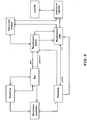
- the figure 6 presents the mode of operation of the relationship manager between two potentially interacting objects and is an integral part of the present description.
- the relationship manager 18 is a centralized process.
- the role of the relationship manager 18 is to detect the interactions between the virtual objects 2 and to follow the realization of this interaction. To do this, the relationship manager 18 uses the interaction characteristics defined in the virtual relations 4. For a given relation, the manager 18 detects whether the initial conditions of an interaction, defined in the virtual relation 4, are met and for which virtual objects 2 they are united. For this, the relationship manager 18 detects, within the potentially interacting objects 2, associable capabilities 14, 15.
- An example of associable capabilities is for a first virtual object to have a screw capacity while a second object has a nut capacity. The detection is carried out by performing for all the virtual objects, the intersection of the capacities common to these objects.
- the relationship manager 18 determines the list of interactions, and associates with each the corresponding virtual relation 4 for each pair of thus associable capabilities 14, 15. In this case the relationship manager 18 identifies these two objects as potentially interacting. He then checks that the interaction is possible, checking that the initial conditions are met. Here, for example, verification is made that the diameter of the screw is compatible with the diameter of the nut and that the two objects are positioned correctly opposite. The interaction is then possible. If it is desirable and effectively controlled, the relationship manager 18 then triggers the interaction. The interaction action 16 corresponding to the fact that the interaction is executed in accordance with the execution information present in the virtual relation 4.
- the present invention relates to object models and relationship models capable of manipulating these objects.
- Such an interactive modeling environment 1 applies to all domains requiring a behavioral simulation of a real environment, this environment not necessarily being available, for reasons as diverse as its dangerousness (battlefield , nuclear power plant, ...) its remoteness (space, surface of a distant planet, ...) or its availability.
- a particularly interesting application is the training and training of maintenance teams, particularly in the case of equipment unavailable or economically difficult to immobilize (battle tank, space station, aircraft carrier, ).
- Such a behavioral and interactive environment 1 if it is sufficiently figurative of the real environment, makes it possible to carry out a number of maintenance tasks in simulation without requiring the immobilization of a hardware.
Landscapes
- Engineering & Computer Science (AREA)
- General Engineering & Computer Science (AREA)
- Theoretical Computer Science (AREA)
- Human Computer Interaction (AREA)
- Physics & Mathematics (AREA)
- General Physics & Mathematics (AREA)
- Processing Or Creating Images (AREA)
Description
Le secteur technique de la présente invention est celui des méthodes de modélisation graphique et comportementale, tridimensionnelle, réactive, et interactive encore nommés environnements de réalité virtuelle.The technical field of the present invention is that of graphical and behavioral modeling methods, three-dimensional, reactive, and interactive still called virtual reality environments.
Il est connu d'utiliser la réalité virtuelle pour modéliser un environnement ou des objets. On s'attache à modéliser les objets du monde réels par des objets virtuels. Ces objets réels présentent des propriétés intrinsèques : position, orientation, matériau, forme, volume, couleur, masse, inertie, dureté... etc. Ces objets peuvent interagir entre eux selon des relations réelles : contact, support, fixation, assemblage vissé... La modélisation s'attache à modéliser les objets dans leurs propriétés intrinsèques ainsi que dans leur comportement propre ou en interaction avec d'autres objets. Il est connu, de même, de permettre à un opérateur de pénétrer dans ce monde virtuel ainsi modélisé, au moyen d'un opérateur virtuel, afin d'y prendre place et de pouvoir interagir avec les objets virtuels de ce monde pour toucher ou déplacer. La perception principale de ce monde dont dispose l'opérateur est visuelle. Il peut s'agir d'une vision classique, telle une fenêtre sur le monde virtuel, représentée sur un écran, ou d'une immersion où l'opérateur réel voit ce que verrait l'opérateur virtuel qui le représente dans le monde virtuel.It is known to use virtual reality to model an environment or objects. We try to model the real world objects with virtual objects. These real objects have intrinsic properties: position, orientation, material, shape, volume, color, mass, inertia, hardness ... etc. These objects can interact with each other in real relationships: contact, support, fixation, screwed assembly ... Modeling focuses on modeling objects in their intrinsic properties as well as in their own behavior or interaction with other objects. It is also known to allow an operator to enter this virtual world modeled by means of a virtual operator in order to take a place there and to be able to interact with the virtual objects of this world to touch or move . The main perception of this world that the operator has is visual. It can be a classic vision, such as a window on the virtual world, represented on a screen, or an immersion where the real operator sees what the virtual operator who represents it in the virtual world would see.
Il est connu de représenter chacun de ces objets réels par un objet virtuel reprenant les caractéristiques et les comportements de l'objet réel. On s'attache tout particulièrement à modéliser les caractéristiques et les comportements physiques (géométrie, aspect, contacts, positionnement relatif, déplacements, gravité...). Lorsqu'on traite de la modélisation des relations ou interactions entre ces objets et de la modélisation de l'opérateur, plusieurs approches existent.It is known to represent each of these real objects by a virtual object containing the characteristics and behaviors of the real object. Particular attention is given to modeling the physical characteristics and behaviors (geometry, appearance, contacts, relative positioning, displacements, gravity ...). When dealing with the modeling of relations or interactions between these objects and the modeling of the operator, several approaches exist.
L'approche manuelle consiste à définir individuellement chaque interaction. Ceci peut être réalisé par programmation combinatoire. Chaque configuration de relation possible est traitée par un programme dédié. La qualité du processus global est alors directement liée à la qualité de l'expertise du programmeur et à sa capacité d'appréhender la complexité de l'environnement. Le programmeur gère manuellement la combinatoire des interactions, généralement par des enchaînements de tests multiples, qui valident le déclenchement d'une action, puis réalisent ce déclenchement. La nécessaire gestion manuelle de la combinatoire constitue un inconvénient per se, qui entraîne un manque de généricité dans la spécification des interactions. Chaque modification ou complément, remet en cause l'ensemble de l'édifice, et peut conduire à l'effondrement total. La stabilité du processus complet n'est aucunement garantie.The manual approach is to define each interaction individually. This can be done by combinatorial programming. Each possible relationship configuration is processed by a dedicated program. The quality of the overall process is directly related to the quality of the expertise the programmer and his ability to understand the complexity of the environment. The programmer manually manages the combinatorics of interactions, usually by multiple test chains, which validate the triggering of an action, and then perform that trigger. The necessary manual management of combinatorics is a disadvantage per se, which leads to a lack of genericity in the specification of interactions. Each modification or complement, calls into question the whole building, and can lead to total collapse. The stability of the entire process is not guaranteed.
Une autre approche, visant à systématiser le traitement des relations entre les objets, est l'utilisation de Représentations d'Actions Paramétriques (RAP ou PAR en anglais) développée par Norman BADLER de l'université de Pennsylvanie (EUA). Dans cette approche, les PAR permettent une description des interactions réalisables entre un agent humanoïde (opérateur) et des objets virtuels. Le système comprend un ensemble de PAR, parmi lequel est recherché celui qui permet de répondre à une commande donnée. Un PAR comprend les caractéristiques suivantes :
- l'« agent » qui va exécuter l'action
- la liste des objets virtuels qui seront concernés par l'action,
- la liste des conditions nécessairement vraies pour réaliser l'action,
- des spécifications préparatoires (Preparatory Specifications), listant des couples (condition, action) qui prépare l'action principale du PAR,
- la description de l'action,
- la liste des conditions pour terminer l'action,
- des assertions postérieures (Post Assertions), décrivant les effets pour mettre à jour la base de données à la fin de l'action.
- the "agent" who will execute the action
- the list of virtual objects that will be affected by the action,
- the list of necessarily true conditions for carrying out the action,
- preparatory specifications, listing pairs (condition, action) that prepares the main RAP action,
- the description of the action,
- the list of conditions to finish the action,
- Post Assertions, describing the effects to update the database at the end of the action.
Cette approche, si elle a le mérite de poser une base de systématisation du traitement des relations entre objets virtuels, présente l'inconvénient majeur de ne traiter que des interactions potentielles entre des objets virtuels et un humanoïde virtuel.This approach, if it has the merit of establishing a systematization base for the processing of virtual object relationships, has the major disadvantage of only dealing with potential interactions between virtual objects and a virtual object. virtual humanoid.
Une autre approche, dite des objets intelligents (Smart Objects en anglais), développée dans la thèse auprès de l'Ecole Polytechnique Fédérale de Lausanne de Marcello Kallmann, propose une manière de décrire les interactions entre un humanoïde et des objets. Le principe fondamental consiste à déporter l'information sur les interactions ou relations dans l'objet virtuel. L'objet comprend alors :
- une description des propriétés de l'objet,
- les informations d'interactions avec l'agent,
- le comportement de l'objet en réaction à chaque interaction,
- le comportement attendu de l'agent pour l' interaction.
- a description of the properties of the object,
- interaction information with the agent,
- the behavior of the object in response to each interaction,
- the expected behavior of the agent for the interaction.
Une autre approche, dite du simulateur mécanique, permet de gérer des interactions entre plusieurs objets. On cite par exemple un détecteur de collision centralisé qui aura pour but de tester et d'informer si des objets sont en collision. Un autre simulateur centralisé permettra de gérer une évolution sur l'inertie des objets en mouvement, afin de simuler ces mouvements relatifs des objets virtuels ou encore de gérer des contraintes mécaniques liants des objets virtuels. L'approche de ces simulateurs se caractérise par un opérateur centralisé ayant une vision globale de l'ensemble de l'environnement. Ces simulateurs doivent disposer des informations suffisantes sur les objets en jeu dans l'interaction.Another approach, called the mechanical simulator, makes it possible to manage interactions between several objects. For example, a centralized collision detector is used to test and inform if objects collide. Another centralized simulator will be able to manage an evolution on the inertia of moving objects, in order to simulate these relative movements of virtual objects or to manage mechanical constraints linking virtual objects. The approach of these simulators is characterized by a centralized operator with a global vision of the whole environment. These simulators must have sufficient information about the objects involved in the interaction.
L'inconvénient majeur de cette approche réside dans le fait que dans un environnement virtuel, la diversité des types d'interaction ne permet pas de les gérer exclusivement par des simulateurs mécaniques centralisés.The major drawback of this approach lies in the fact that in a virtual environment, the diversity of the types of interaction does not make it possible to manage them exclusively. by centralized mechanical simulators.
Une autre approche est celle dite des interacteurs. Cette approche décrite dans les travaux de T. Duval visent à fournir une manière générique de décrire les interactions entre des objets virtuels. L'opérateur interagit avec le monde virtuel uniquement au travers d'un avatar. Ce dernier est traité comme tout objet virtuel. Pour que deux objets puissent interagir entre eux, ils doivent disposer du même protocole de communication. Ce protocole de communication vient entourer un objet sans le modifier. L'interaction est décrite au travers du protocole. Un même objet peut avantageusement cumuler plusieurs protocoles. Ceci offre la possibilité pour un objet de devenir multi-interactif. Cette approche présente l'inconvénient majeur de ne traiter que des interactions potentielles entre des objets virtuels et un humanoïde virtuel.Another approach is that called interactors. This approach described in T. Duval's work aims to provide a generic way of describing the interactions between virtual objects. The operator interacts with the virtual world only through an avatar. The latter is treated like any virtual object. For two objects to interact with each other, they must have the same communication protocol. This communication protocol surrounds an object without modifying it. The interaction is described through the protocol. The same object can advantageously accumulate several protocols. This offers the possibility for an object to become multi-interactive. This approach has the major drawback of only dealing with potential interactions between virtual objects and a virtual humanoid.
L'état de la technique présente principalement les inconvénients suivants. Certaines approches distinguent nécessairement l'opérateur virtuel, des autres objets virtuels. Ceci constitue un traitement particulier plutôt limitatif. Le principe des objets intelligents peut être étendu en ne s'appliquant pas seulement à un opérateur pilote, mais plutôt à un objet pilote. Ceci entraîne cependant d'autres problèmes de traitements spécifiques, selon le type d'objet pilote. De plus, cette technique conduit à des difficultés de description complexe des interactions. Enfin, le choix de l'objet pilote reste arbitraire notamment dans le cas d'une interaction fortement combinée. La ou les approches centralisées présentent l'avantage d'assurer la cohérence et de bien s'appliquer aux interactions mécaniques. Elles présentent l'inconvénient de devenir difficile à décrire dans la plupart des cas et de très mal réagir à des modifications locales, principalement dans les situations d'émergence de cas non prévus. Les protocoles d'interaction, (approche interacteur) posent le problème de la localisation de l'interaction, lorsque celle-ci est fortement combinée. Il est possible de la retrouver dans le protocole, mais celui-ci est réparti entre les objets.The state of the art mainly has the following drawbacks. Some approaches necessarily distinguish the virtual operator from other virtual objects. This constitutes a particular rather limiting treatment. The principle of intelligent objects can be extended by applying not only to a pilot operator, but rather to a pilot object. This, however, causes other specific processing problems, depending on the type of pilot object. Moreover, this technique leads to difficulties of complex description of the interactions. Finally, the choice of the pilot object remains arbitrary, particularly in the case of a strongly combined interaction. The centralized approach or approaches have the advantage of ensuring coherence and of being well applied to mechanical interactions. They have the disadvantage of becoming difficult to describe in most cases and very poorly react to local changes, mainly in situations of emergence of unplanned cases. The interaction protocols, (interactor approach) pose the problem of the location of the interaction, when it is strongly combined. It is possible to find it in the protocol, but it is divided between objects.
Sur un autre plan, les méthodes de modélisation ainsi réalisées sont peu modulaires, difficilement augmentables, peu stables. Une modification locale peut remettre en cause l'existant et entraîner un dysfonctionnement. Il en résulte une faible capitalisation de l'acquis lors d'un développement. La combinatoire des interactions, exponentielle en fonction du nombre d'objets virtuels par nature, est difficilement compatible avec un traitement efficace. Ces méthodes font trop souvent apparaître un cas particulier en différentiant l'humain opérateur des autres objets de l'environnement.On another level, the modeling methods thus produced are not very modular, difficult to increase, and not very stable. A local modification may call into question the existing one and cause a malfunction. This results in a small capitalization of the acquis during a development. The combinatorial interaction, exponential as a function of the number of virtual objects by nature, is hardly compatible with effective treatment. These methods too often reveal a particular case by differentiating the human operator from other objects in the environment.
La présente invention répond à ces différents problèmes en utilisant une modélisation particulièrement avantageuse qui permet d'unifier le traitement des objets réels et des relations qui sont tous deux modélisés par des objets virtuels hiérarchiques comprenant des activités et des capacités. Un gestionnaire centralisé de relation assure la détection et la réalisation des interactions définies par les relations. Enfin, l'opérateur interagit au moyen d'un objet virtuel semblable aux autres objets virtuels de l'environnement.The present invention addresses these various problems by using a particularly advantageous modeling that unifies the processing of real objects and relationships that are both modeled by hierarchical virtual objects including activities and capabilities. A centralized relationship manager ensures the detection and realization of interactions defined by the relationships. Finally, the operator interacts by means of a virtual object similar to the other virtual objects of the environment.
Le document
L'invention a pour objet une méthode de modélisation selon la revendication 1. Selon une caractéristique de l'invention, un objet virtuel comprend au moins une capacité, comprenant une activité visible située dans le corps, utilisable par les autres objets virtuels, au moyen d'une interface de communication située dans l'interface définissant des relations que l'objet virtuel peut établir avec d'autres objets virtuels.The subject of the invention is a modeling method according to
Selon une autre caractéristique de l'invention, un objet virtuel comprend au moins une activité cachée située dans le corps, définissant des relations internes à l'objet virtuel.According to another characteristic of the invention, a virtual object comprises at least one hidden activity located in the body, defining internal relations to the virtual object.
Selon encore une autre caractéristique de l'invention, un des objets virtuels est hiérarchiquement lié à un objet virtuel supérieur ou parent, dont il hérite les activités et capacités.According to yet another characteristic of the invention, one of the virtual objects is hierarchically linked to a higher or parent virtual object, whose activities and capabilities it inherits.
Selon encore une autre caractéristique de l'invention, une relation virtuelle établit une relation entre des objets virtuels de l'environnement possédant des capacités associables, en réalisant une interaction et en transmettant aux objets virtuels les paramètres nécessaires à l'accomplissement de cette interaction.According to yet another characteristic of the invention, a virtual relationship establishes a relationship between virtual objects of the environment having associable capabilities, performing an interaction and transmitting to the virtual objects the parameters necessary for the completion of this interaction.
Selon encore une autre caractéristique de l'invention, la méthode met en oeuvre un gestionnaire central de relations qui confronte les objets virtuels entre eux afin de détecter des capacités associables, indicatives de possibles interactions entre ces objets virtuels.According to yet another characteristic of the invention, the method implements a central relationship manager that confronts the virtual objects with each other in order to detect associable capabilities indicative of possible interactions between these virtual objects.
Selon encore une autre caractéristique de l'invention, on modélise un opérateur réel par un avatar ou opérateur virtuel, interagissant avec les objets virtuels de l'environnement et en ce que cet avatar est un objet virtuel.According to yet another characteristic of the invention, a real operator is modeled by an avatar or virtual operator, interacting with the virtual objects of the environment and in that this avatar is a virtual object.
L'invention concerne de plus l'application d'une méthode de modélisation à la formation pour la maintenance de matériels ou de véhicules.The invention further relates to the application of a modeling method to training for the maintenance of equipment or vehicles.
Un avantage de la méthode selon l'invention est la modularité. Tous les éléments de l'environnement, objets ou relations sont modélisés par des objets modulaires. Ils sont ensuite combinés entre eux de manière souple et dynamique.An advantage of the method according to the invention is the modularity. All elements of the environment, objects or relationships are modeled by modular objects. They are then combined with each other in a flexible and dynamic way.
Un autre avantage de la méthode selon l'invention est que les éléments ne sont pas figés. L'environnement est dit augmentable. De nouvelles propriétés peuvent être ajoutées de manière souple, sans remise en question de ce qui fonctionne déjà ou de l'ensemble de l'architecture. Une simple modification locale n'entraîne pas de problème de stabilité ou de dysfonctionnement de l'existant.Another advantage of the method according to the invention is that the elements are not fixed. The environment is said to be augmentable. New properties can be added in a flexible way, without questioning what already works or the whole architecture. A simple local modification does not cause a problem of stability or dysfunction of the existing.
Un autre avantage de la méthode selon l'invention est que les développements sont capitalisables. Un objet ou une relation étant modélisés de manière intrinsèque, indépendamment du reste de l'environnement, et ne comportant pas de développement spécifique, devient facilement réutilisable.Another advantage of the method according to the invention is that the developments are capitalizable. An object or a relationship being modeled in an intrinsic way, independently of the rest of the environment, and having no specific development, becomes easily reusable.
Un autre avantage de la méthode selon l'invention est de permettre une auto-information du système. Le fait de décrire les relations évite le traitement au cas par cas. Il permet d'obtenir un système capable de raisonner seul pour gérer lui-même la combinaison des interactions et ainsi réduire la combinatoire de ces interactions.Another advantage of the method according to the invention is to allow self-information of the system. Describing relationships avoids case-by-case treatment. It makes it possible to obtain a system capable of reasoning alone to manage the combination of interactions itself and thus reduce the combinatorial nature of these interactions.
Un autre avantage de la méthode selon l'invention est d'augmenter la généricité de l'interaction en assimilant l'opérateur à un objet standard et en standardisant la relation objet/objet.Another advantage of the method according to the invention is to increase the genericity of the interaction by assimilating the operator to a standard object and standardizing the object / object relationship.
D'autres caractéristiques, détails et avantages de l'invention ressortiront plus clairement de la description détaillée donnée ci-après à titre indicatif en relation avec des dessins sur lesquels :
- la
figure 1 représente le principe de modélisation du monde par un environnement virtuel, - la
figure 2 est une représentation schématique d'un objet virtuel, - la
figure 3 illustre le principe d'une relation virtuelle, - la
figure 4 illustre le détail d'une relation virtuelle, - la
figure 5 illustre le principe d'héritage entre objets, et - la
figure 6 présente le mode de fonctionnement du gestionnaire de relations.
- the
figure 1 represents the principle of modeling the world by a virtual environment, - the
figure 2 is a schematic representation of a virtual object, - the
figure 3 illustrates the principle of a virtual relationship, - the
figure 4 illustrates the detail of a virtual relationship, - the
figure 5 illustrates the principle of inheritance between objects, and - the
figure 6 presents the mode of operation of the relationship manager.
Sur la
première relation 5a: l'opérateur réel 20 repose sur l'objet réel 3a,seconde relation 5b : l'objet réel 3' repose sur l'objet réel 3a,troisième relation 5c : l'opérateur réel 20tient l'objet 3c.
-
first relation 5a: thereal operator 20 rests on thereal object 3a, -
second relation 5b: the real object 3 'rests on thereal object 3a, -
third relation 5c: theactual operator 20 holdsobject 3c.
Les relations ici retenues sont des relations géométriques de positionnement relatif. Elles peuvent aussi inclure des comportements de type mécanique modélisant par exemple le contact ou des efforts mutuellement exercés entre les objets. L'exposé se restreint volontairement à ces trois relations pour rester simple et illustratif. D'autres relations ou type de relations pourraient être ajoutées à volonté. Un même objet peut ainsi être impliqué dans une multitude de relations, et participer de plusieurs interactions. Le nombre de relations utilisées et la qualité de description des interactions induites augmente avec la qualité de « rendu réaliste » de l'environnement 1. Cette qualité est essentielle pour assurer le réalisme de la simulation comportementale de l'environnement 1. Un niveau minimum de qualité est nécessaire pour qu'un tel environnement ait de l'intérêt. Il est nécessaire que l'on puisse reconnaître des comportements de l'environnement réel dans l'environnement virtuel pour pouvoir assimiler le second au premier. Ceci est nécessaire pour que les actions simulées dans l'environnement virtuel soient utiles à renseigner sur le comportement prévisible dans l'environnement réel.The relations retained here are geometric relations of relative positioning. They may also include mechanical type behaviors modeling, for example, contact or mutual efforts between objects. The presentation voluntarily restricts itself to these three relations to remain simple and illustrative. Other relationships or types of relationships could be added at will. The same object can thus be involved in a multitude of relationships, and participate in several interactions. The number of relationships used and the quality of the description of the interactions induced increases with the quality of "realistic rendering" of the
Afin de modéliser cet environnement réel, un environnement virtuel 1 est créé. Il est constitué d'enregistrements 2a, 2b, 2c, 4a, 4b, 4c, 19 dans une base de données 21. Les objets virtuels 2 correspondant à un objet réel 3a,3b,3c,20 de l'environnement réel disposent de propriétés géométriques. Ils sont représentables sur une visualisation 22. L'environnement 1 comprend trois objets virtuels 2a, 2b, 2c modélisant respectivement chacun des objets réels 3a, 3b, 3c, un objet virtuel ou opérateur virtuel 19 modélisant l'opérateur réel 20 et trois objets virtuels ou relations virtuelles 4a, 4b, 4c modélisant respectivement chacune des relations réelles 5a, 5b, 5c. Une des caractéristiques essentielles selon l'invention est d'utiliser le même formalisme de l'objet virtuel 2, que l'on détaille plus loin, pour représenter un objet réel 3 ou une relation 5. De plus l'opérateur virtuel 19 ou avatar est lui aussi modélisé par un (ou plusieurs) objet(s) virtuel(s) 2. Ainsi, les interactions de l'opérateur réel 20 sur l'environnement 1 s'effectuent par l'intermédiaire d'un avatar 19 ou opérateur virtuel, qui interagit avec les objets virtuels 2a, 2b, 2c de l'environnement 1 au travers de relations virtuelles 4a, 4b, 4c.In order to model this real environment, a
Les interactions entre des objets réels 3 sont des relations réelles 5 entre ces objets 3. La modélisation de ces interactions s'effectue aux moyens de relations virtuelles 4 dans l'environnement virtuel 1. Ces relations virtuelles 4 vont permettre de faire évoluer l'environnement 1, de modifier les objets virtuels 2, en fonction du comportement des objets modélisés par les objets 2 eux-mêmes, lorsqu'ils sont seuls concernés ou par les relations virtuelles 4, lorsque plusieurs objets virtuels 2 interagissent et en fonction des interactions initiées par l'opérateur virtuel 19 contrôlé par l'opérateur 20. L'environnement 1 est graphique en ce qu'il dispose d'une représentation visible 22. La modélisation visant à représenter un monde réel tridimensionnel et ses comportements est avantageusement tridimensionnelle. Cette modélisation est avantageusement complétée par des propriétés intrinsèques aux objets virtuels 2, modélisées au sein des objets virtuels eux-mêmes et par des propriétés faisant intervenir plusieurs objets virtuels 2 interagissant, modélisés au sein des relations virtuelles 4. Ceci confère à l'environnement 1 une dynamique lui permettant d'évoluer en fonction de règles comportementales déterministes. Cette évolution, qui tient compte de l'état instantané de chaque objet virtuel 2, va permettre en fonction des relations virtuelles 4 applicables de modifier l'état de différents objets 2. L'environnement 1 est ainsi réactif. Il est de plus interactif en ce que chaque objet 2 réagit en fonction des sollicitations qu'il subit. L'opérateur 20 peut agir au travers de l'opérateur virtuel 19, en sollicitant un ou plusieurs objets virtuels 2. Ces objets 2 réagissent en fonction des sollicitations subies et des règles de comportements prédéfinies.The interactions between real objects 3 are real relations 5 between these objects 3. The modeling of these interactions takes place by means of virtual relations 4 in the
La
La
La
La
Tous les objets virtuels 2 peuvent ainsi être hiérarchiquement liés à des objets virtuels parents 12. Une des caractéristiques essentielles de l'invention, consistant à utiliser le formalisme des objets virtuels pour représenter les relations virtuelles, devient ainsi en combinaison avec les possibilités d'héritage, un avantage remarquable. Une relation virtuelle 4 étant un objet virtuel 2, comme ceux qu'elle manipule, possède des propriétés de hiérarchisation et d'héritage. Une relation virtuelle 4 peut contrôler et raisonner sur d'autres relations, et ainsi diviser son action en sous-traitances spécifiques.All virtual objects 2 can thus be hierarchically linked to parent virtual objects 12. One of the essential characteristics of the invention, consisting in using the formalism of virtual objects to represent virtual relations, thus becomes in combination with the possibilities of inheritance. , a remarkable advantage. A virtual relation 4 being a virtual object 2, like those it handles, has hierarchical and inheritance properties. A virtual relationship 4 can control and reason about other relationships, and thus divide its action into specific subcontracting.
Une des caractéristiques importantes selon l'invention est la présence dans l'environnement 1 d'un gestionnaire de relations 18. La
Le gestionnaire de relations 18 est un processus centralisé. Le rôle du gestionnaire de relations 18 est de détecter les interactions entre les objets virtuels 2 et de suivre la réalisation de cette interaction. Pour ce faire, le gestionnaire de relations 18 utilise les caractéristiques d'interaction définies dans les relations virtuelles 4. Pour une relation donnée, le gestionnaire 18 détecte si les conditions initiales d'une interaction, définies dans la relation virtuelle 4, sont réunies et pour quels objets virtuels 2 elles sont réunies. Pour cela, le gestionnaire de relations 18 détecte, au sein des objets 2 potentiellement interagissant, des capacités associables 14, 15. Un exemple de capacités associables est pour un premier objet virtuel de posséder une capacité de vis alors qu'un second objet possède une capacité d'écrou. La détection s'effectue en effectuant pour tous les objets virtuels, l'intersection des capacités communes à ces objets. Le gestionnaire de relations 18 détermine ainsi la liste des interactions, et associe à chacune la relation virtuelle 4 correspondante pour chaque paire de capacités ainsi associables 14, 15. Dans ce cas le gestionnaire de relations 18 identifie ces deux objets comme potentiellement interagissant. Il vérifie alors que l'interaction est possible, en vérifiant que les conditions initiales sont réunies. Ici, par exemple, vérification est faite que le diamètre de la vis est compatible avec le diamètre de l'écrou et que les deux objets sont positionnés correctement en regard. L'interaction est alors possible. Si elle est souhaitable et effectivement commandée, le gestionnaire de relations 18 assure alors le déclenchement de l'interaction. L'action d'interaction 16 correspondant au fait que l'interaction est exécutée conformément aux informations d'exécution présentes dans la relation virtuelle 4.The
A titre illustratif, on va décrire en détail la mise en oeuvre des mécanismes génériques précédemment présentés, au moyen d'un exemple concret d'utilisation. L'exemple illustre une implémentation possible pour visser deux objets virtuels 2 entre eux. On utilise pour ce faire deux relations virtuelles 4 adaptées à cet exemple : une relation de visserie et une relation de positionnement relatif d'objets tridimensionnels.By way of illustration, the implementation of the generic mechanisms previously presented will be described in detail by means of a concrete example of use. The example illustrates a possible implementation to screw two virtual objects 2 between them. Two virtual relations 4 adapted to this example are used for this purpose: a hardware relationship and a relative positioning relation of three-dimensional objects.
On souhaite pouvoir visser ensemble une vis et un écrou dans un environnement tridimensionnel. Les objets, vis et écrou, ne sont connus initialement que par des fichiers décrivant leur forme tridimensionnelle. On veut interagir dans l'environnement tridimensionnel et déclencher le vissage de la vis dans l'écrou. La présente invention concerne les modèles des objets et les modèles des relations capables de manipuler ces objets.It is desired to be able to screw together a screw and a nut in a three-dimensional environment. Objects, screws and nuts, are initially known only by files describing their three-dimensional shape. We want to interact in the three-dimensional environment and trigger the screwing in the nut. The present invention relates to object models and relationship models capable of manipulating these objects.
Il est tout d'abord recherché une relation capable de visser la vis et l'écrou conformément au souhait de l'opérateur virtuel 19. Si cette recherche est positive, alors le gestionnaire de relations 18 est en charge de transmettre cet ordre d'exécution à la relation 4 de vissage trouvée.It is first of all sought a relationship capable of screwing the screw and the nut according to the wish of the virtual operator 19. If this search is positive, then the
La recherche de relation s'effectue comme suit :
- le gestionnaire de relations construit la liste de toutes les actions possibles entre ces deux objets. Il fournit une liste cohérente, c'est à dire que cette liste est dépendante de l'état courant des objets. Elle représente l'ensemble des actions réalisables à l'instant de la demande de vissage, entre la vis et l'écrou,
- dans cette liste est recherchée la présence de l'action que l'on souhaite effectuer et si elle correspond bien au domaine recherché, à savoir le vissage,
- on effectue une vérification de la présence de la capacité vissage qui doit être une des capacités de la relation actuellement retenue,
- on dispose alors d'une relation de vissage capable de réaliser l'action de visser entre l'écrou et la vis. Cette action est bien certifiée valide, elle peut être déclenchée,
- le déclenchement effectue une action indiquée dans l'objet relation virtuelle,
- les états des deux objets sont modifiés en conséquence pour refléter le changement subvenu,
- la relation vissage utilise en préalable une relation de position pour faire bouger les deux objets afin de les placer en bonne condition pour pouvoir être vissés. Ce dernier point illustre l'aspect hiérarchique de la modélisation des relations.
- the relationship manager constructs the list of all possible actions between these two objects. It provides a coherent list, ie this list is dependent on the current state of objects. It represents all the actions that can be performed at the instant of the screwing request, between the screw and the nut,
- in this list is sought the presence of the action that one wishes to perform and if it corresponds to the desired field, namely screwing,
- a check is made of the presence of the screwing capacity which must be one of the capacities of the currently selected relationship,
- it then has a screwing relationship capable of performing the action of screwing between the nut and the screw. This action is certified valid, it can be triggered,
- the trigger performs an action specified in the virtual relation object,
- the states of the two objects are modified accordingly to reflect the change that has been made,
- the screwing relationship uses a prior positional relationship to move the two objects to place them in good condition to be screwed. This last point illustrates the hierarchical aspect of relationship modeling.
L'utilisation d'un tel environnement de modélisation interactif 1 s'applique à tous les domaines nécessitant une simulation comportementale d'un environnement réel, cet environnement n'étant pas nécessairement disponible, pour des raisons aussi diverses que sa dangerosité (champ de bataille, centrale nucléaire,...) son éloignement (espace, surface d'une planète lointaine,...) ou sa disponibilité. Une application particulièrement intéressante est la formation et l'entraînement des équipes de maintenance, notamment dans le cas d'un matériel non disponible ou économiquement difficile à immobiliser (char de combat, station spatiale, porte avion,...). Un tel environnement comportemental et interactif 1, s'il est suffisamment figuratif de l'environnement réel, permet de réaliser un nombre de tâches de maintenance en simulation sans nécessiter l'immobilisation d'un matériel.The use of such an
Claims (8)
- Method for (1) graphic and behavioural, three-dimensional, reactive and interactive modelling of at least two real objects (3) in a real environment (1) as at least two corresponding virtual objects (2) and modelling at least one real relationship (5) between these real objects (3) as a virtual relationship (4), wherein:- the virtual relationship (4) is a virtual object (2),- each virtual object (2) corresponding to one of said real objects (3) or to said real relationship (5) is of the same formalism and comprises a body (6), internal to the virtual object (2), hidden from the other virtual objects (2) and an interface (7) visible to the other virtual objects (2) and enabling them to communicate with each other.
- A modelling method (1) according to Claim 1, wherein each of said virtual objects (2) comprises at least one capacity (8), comprising a visible activity (9) located in the body (6), able to be used by the other virtual objects (2), by means of a communication interface (10) located in the interface (7) defining the relationships which the virtual object (2) may establish with other virtual objects (2).
- A modelling method (1) according to Claim 2, wherein each of said virtual objects (2) comprises at least one hidden activity (11) located in the body (6), defining the relationships internal to the virtual object (2).
- A modelling method (1) according to Claims 2 or 3, wherein each of said virtual objects 2) is hierarchically linked to a superior or parent virtual object (12), whose activities (11) and capacities (8) it inherits.
- A modelling method (1) according to one of Claims 1 to 4, wherein a virtual relationship (4) establishes a relationship (13) between virtual objects (2) of the environment that have associable capacities (14, 15) by forming an interaction (16) and by communicating the parameters (17) necessary to accomplish this interaction to the virtual objects (2).
- A modelling method (1) according to Claim 5, wherein it implements a central system to manage the relationships (18) which oppose the virtual objects (2) so as to detect the associable capacities (14, 15) indicative of possible interactions (13) between these virtual objects (2).
- A modelling method (1) according to any one of the previous Claims, wherein a real operator is modelled as an avatar (19) or a virtual operator (19), interacting with the virtual objects (2) of the environment (1) and wherein this avatar (19) or virtual operator (19) is a virtual object (2) of the same formalism as the virtual objects corresponding to one of said real objects (3) or to said real relationship (5).
- Application of a modelling method (1) according to any one of the above Claims 1 to 7 to equipment or vehicle maintenance training.
Applications Claiming Priority (2)
| Application Number | Priority Date | Filing Date | Title |
|---|---|---|---|
| FR0314480 | 2003-12-10 | ||
| FR0314480A FR2863738B1 (en) | 2003-12-10 | 2003-12-10 | METHOD OF GRAPHIC AND BEHAVIORAL MODELING, THREE-DIMENSIONAL, REACTIVE, AND INTERACTIVE OF AT LEAST TWO OBJECTS |
Publications (2)
| Publication Number | Publication Date |
|---|---|
| EP1548558A1 EP1548558A1 (en) | 2005-06-29 |
| EP1548558B1 true EP1548558B1 (en) | 2017-11-29 |
Family
ID=34531310
Family Applications (1)
| Application Number | Title | Priority Date | Filing Date |
|---|---|---|---|
| EP04292853.1A Expired - Lifetime EP1548558B1 (en) | 2003-12-10 | 2004-12-02 | Method to model graphically, behaviourally and three-dimensionally at least two objects |
Country Status (3)
| Country | Link |
|---|---|
| EP (1) | EP1548558B1 (en) |
| DK (1) | DK1548558T3 (en) |
| FR (1) | FR2863738B1 (en) |
Family Cites Families (5)
| Publication number | Priority date | Publication date | Assignee | Title |
|---|---|---|---|---|
| US5999185A (en) * | 1992-03-30 | 1999-12-07 | Kabushiki Kaisha Toshiba | Virtual reality control using image, model and control data to manipulate interactions |
| US5563988A (en) * | 1994-08-01 | 1996-10-08 | Massachusetts Institute Of Technology | Method and system for facilitating wireless, full-body, real-time user interaction with a digitally represented visual environment |
| EP1037134A2 (en) * | 1999-03-16 | 2000-09-20 | Matsushita Electric Industrial Co., Ltd. | Virtual space control data receiving apparatus and method |
| WO2001095061A2 (en) * | 1999-12-07 | 2001-12-13 | Frauenhofer Institut Fuer Graphische Datenverarbeitung | The extended virtual table: an optical extension for table-like projection systems |
| US7202851B2 (en) * | 2001-05-04 | 2007-04-10 | Immersion Medical Inc. | Haptic interface for palpation simulation |
-
2003
- 2003-12-10 FR FR0314480A patent/FR2863738B1/en not_active Expired - Fee Related
-
2004
- 2004-12-02 EP EP04292853.1A patent/EP1548558B1/en not_active Expired - Lifetime
- 2004-12-02 DK DK04292853.1T patent/DK1548558T3/en active
Non-Patent Citations (1)
| Title |
|---|
| HAY D.C.: "Data Model Views", pages 1 - 11, Retrieved from the Internet <URL:http://www.tdan.com/view-articles/4850/> [retrieved on 20000401] * |
Also Published As
| Publication number | Publication date |
|---|---|
| FR2863738B1 (en) | 2006-03-17 |
| FR2863738A1 (en) | 2005-06-17 |
| DK1548558T3 (en) | 2018-02-26 |
| EP1548558A1 (en) | 2005-06-29 |
Similar Documents
| Publication | Publication Date | Title |
|---|---|---|
| US20040030741A1 (en) | Method and apparatus for search, visual navigation, analysis and retrieval of information from networks with remote notification and content delivery | |
| FR3029662A1 (en) | SIMULATION SYSTEM, DEVICES, METHODS AND PROGRAMS THEREFOR. | |
| CN110599577B (en) | A method, apparatus, device and medium for skin rendering of a virtual character | |
| Fields et al. | Eigenforms, interfaces and holographic encoding | |
| Tamayo et al. | Digital data visualization with interactive and virtual reality tools. review of current state of the art and proposal of a model | |
| Roy et al. | Collaborative product conceptualization tool using web technology | |
| CA2370693C (en) | Process and system for guiding a decision-making process in the pursuit of an overall goal in a field | |
| EP1605420A2 (en) | Learning system for the exploitation, the use or the maintenance of a working framework in a virtual reality environment | |
| Nisiotis et al. | Developing a cyber-physical-social metaverse system for interactive cultural heritage experiences | |
| WO2023247118A1 (en) | Simulating human usage of a user interface | |
| US11660821B2 (en) | Collaboration of three dimensional printing | |
| FR2863738A1 (en) | Real objects and relations modeling method for use in e.g. battlefield, involves comparing virtual relations to virtual objects having body whose contents are concealed and interface permitting communication of object with environment | |
| Müller | “Let’s build an Anscombe box”: assessing Anscombe’s rebuttal of the statistics objection against indeterminism-based free agency | |
| US20210149998A1 (en) | Overarching relationship manager and editor for scaling complex architecture representations | |
| Ridley | Many retrocausal worlds: A foundation for quantum probability | |
| Langan | THE REALITY SELF-SIMULATION PRINCIPLE: REALITY IS A SELF-SIMULATION. | |
| Liu et al. | An agent-based collaborative information processing system for mixed reality applications—Part A: Agent-aware computing | |
| FR2871261A1 (en) | DEVICE FOR SIMULATING THE EVOLUTION OF A MEDIUM BY ASYNCHRONOUS AND CHAOTIC TREATMENT IN THE PRESENCE OF AUTONOMOUS ENTITIES INTERACTING IN A MULTI-AGENT SYSTEM | |
| Sarmiento et al. | CSCW systems in virtual environments: a general development framework | |
| US20240265261A1 (en) | Acoustic machine learning with transparent and interpretable adaptation of acoustic data between environments | |
| EP1706834A2 (en) | Device for simulation of the real world by asynchronous and chaotic processing | |
| Lacoche | Plasticity for user interfaces in mixed reality | |
| Lombeyda et al. | Conceptual design for assembly | |
| Kirshner et al. | Human-computer interaction for space situational awareness (ssa): Towards the ssa integrated sensor viewer (isv) | |
| US9223457B2 (en) | Visualization of information using landmasses |
Legal Events
| Date | Code | Title | Description |
|---|---|---|---|
| PUAI | Public reference made under article 153(3) epc to a published international application that has entered the european phase |
Free format text: ORIGINAL CODE: 0009012 |
|
| AK | Designated contracting states |
Kind code of ref document: A1 Designated state(s): AT BE BG CH CY CZ DE DK EE ES FI FR GB GR HU IE IS IT LI LT LU MC NL PL PT RO SE SI SK TR |
|
| AX | Request for extension of the european patent |
Extension state: AL BA HR LV MK YU |
|
| RIN1 | Information on inventor provided before grant (corrected) |
Inventor name: MAFFRE, ERIC Inventor name: DEVILLERS, FREDERIC Inventor name: MOLLET, NICOLAS Inventor name: TISSEAU, JACQUES Inventor name: ARNALDI, BRUNO Inventor name: CAZEAUX, ERIC |
|
| RIN1 | Information on inventor provided before grant (corrected) |
Inventor name: CAZEAUX, ERIC Inventor name: DEVILLERS, FREDERIC Inventor name: TISSEAU, JACQUES Inventor name: MAFFRE, ERIC Inventor name: MOLLET, NICOLAS Inventor name: ARNALDI, BRUNO |
|
| 17P | Request for examination filed |
Effective date: 20051208 |
|
| AKX | Designation fees paid |
Designated state(s): AT BE BG CH CY CZ DE DK EE ES FI FR GB GR HU IE IS IT LI LT LU MC NL PL PT RO SE SI SK TR |
|
| RAP1 | Party data changed (applicant data changed or rights of an application transferred) |
Owner name: NEXTER SYSTEMS |
|
| RAP1 | Party data changed (applicant data changed or rights of an application transferred) |
Owner name: NEXTER TRAINING |
|
| REG | Reference to a national code |
Ref country code: DE Ref legal event code: R079 Ref document number: 602004052104 Country of ref document: DE Free format text: PREVIOUS MAIN CLASS: G06F0003033000 Ipc: G06F0003010000 |
|
| GRAP | Despatch of communication of intention to grant a patent |
Free format text: ORIGINAL CODE: EPIDOSNIGR1 |
|
| RIC1 | Information provided on ipc code assigned before grant |
Ipc: G06F 3/01 20060101AFI20170615BHEP Ipc: G06F 3/0481 20130101ALI20170615BHEP |
|
| INTG | Intention to grant announced |
Effective date: 20170712 |
|
| GRAS | Grant fee paid |
Free format text: ORIGINAL CODE: EPIDOSNIGR3 |
|
| GRAA | (expected) grant |
Free format text: ORIGINAL CODE: 0009210 |
|
| AK | Designated contracting states |
Kind code of ref document: B1 Designated state(s): AT BE BG CH CY CZ DE DK EE ES FI FR GB GR HU IE IS IT LI LT LU MC NL PL PT RO SE SI SK TR |
|
| REG | Reference to a national code |
Ref country code: GB Ref legal event code: FG4D Free format text: NOT ENGLISH |
|
| REG | Reference to a national code |
Ref country code: CH Ref legal event code: EP |
|
| REG | Reference to a national code |
Ref country code: AT Ref legal event code: REF Ref document number: 950965 Country of ref document: AT Kind code of ref document: T Effective date: 20171215 |
|
| REG | Reference to a national code |
Ref country code: FR Ref legal event code: PLFP Year of fee payment: 14 |
|
| REG | Reference to a national code |
Ref country code: IE Ref legal event code: FG4D Free format text: LANGUAGE OF EP DOCUMENT: FRENCH |
|
| REG | Reference to a national code |
Ref country code: DE Ref legal event code: R096 Ref document number: 602004052104 Country of ref document: DE |
|
| REG | Reference to a national code |
Ref country code: DK Ref legal event code: T3 Effective date: 20180220 |
|
| REG | Reference to a national code |
Ref country code: NL Ref legal event code: MP Effective date: 20171129 |
|
| REG | Reference to a national code |
Ref country code: LT Ref legal event code: MG4D |
|
| REG | Reference to a national code |
Ref country code: AT Ref legal event code: MK05 Ref document number: 950965 Country of ref document: AT Kind code of ref document: T Effective date: 20171129 |
|
| PG25 | Lapsed in a contracting state [announced via postgrant information from national office to epo] |
Ref country code: FI Free format text: LAPSE BECAUSE OF FAILURE TO SUBMIT A TRANSLATION OF THE DESCRIPTION OR TO PAY THE FEE WITHIN THE PRESCRIBED TIME-LIMIT Effective date: 20171129 Ref country code: SE Free format text: LAPSE BECAUSE OF FAILURE TO SUBMIT A TRANSLATION OF THE DESCRIPTION OR TO PAY THE FEE WITHIN THE PRESCRIBED TIME-LIMIT Effective date: 20171129 Ref country code: LT Free format text: LAPSE BECAUSE OF FAILURE TO SUBMIT A TRANSLATION OF THE DESCRIPTION OR TO PAY THE FEE WITHIN THE PRESCRIBED TIME-LIMIT Effective date: 20171129 Ref country code: ES Free format text: LAPSE BECAUSE OF FAILURE TO SUBMIT A TRANSLATION OF THE DESCRIPTION OR TO PAY THE FEE WITHIN THE PRESCRIBED TIME-LIMIT Effective date: 20171129 |
|
| PG25 | Lapsed in a contracting state [announced via postgrant information from national office to epo] |
Ref country code: GR Free format text: LAPSE BECAUSE OF FAILURE TO SUBMIT A TRANSLATION OF THE DESCRIPTION OR TO PAY THE FEE WITHIN THE PRESCRIBED TIME-LIMIT Effective date: 20180301 Ref country code: BG Free format text: LAPSE BECAUSE OF FAILURE TO SUBMIT A TRANSLATION OF THE DESCRIPTION OR TO PAY THE FEE WITHIN THE PRESCRIBED TIME-LIMIT Effective date: 20180228 Ref country code: AT Free format text: LAPSE BECAUSE OF FAILURE TO SUBMIT A TRANSLATION OF THE DESCRIPTION OR TO PAY THE FEE WITHIN THE PRESCRIBED TIME-LIMIT Effective date: 20171129 |
|
| PG25 | Lapsed in a contracting state [announced via postgrant information from national office to epo] |
Ref country code: NL Free format text: LAPSE BECAUSE OF FAILURE TO SUBMIT A TRANSLATION OF THE DESCRIPTION OR TO PAY THE FEE WITHIN THE PRESCRIBED TIME-LIMIT Effective date: 20171129 |
|
| PG25 | Lapsed in a contracting state [announced via postgrant information from national office to epo] |
Ref country code: CZ Free format text: LAPSE BECAUSE OF FAILURE TO SUBMIT A TRANSLATION OF THE DESCRIPTION OR TO PAY THE FEE WITHIN THE PRESCRIBED TIME-LIMIT Effective date: 20171129 Ref country code: SK Free format text: LAPSE BECAUSE OF FAILURE TO SUBMIT A TRANSLATION OF THE DESCRIPTION OR TO PAY THE FEE WITHIN THE PRESCRIBED TIME-LIMIT Effective date: 20171129 Ref country code: EE Free format text: LAPSE BECAUSE OF FAILURE TO SUBMIT A TRANSLATION OF THE DESCRIPTION OR TO PAY THE FEE WITHIN THE PRESCRIBED TIME-LIMIT Effective date: 20171129 Ref country code: CY Free format text: LAPSE BECAUSE OF FAILURE TO SUBMIT A TRANSLATION OF THE DESCRIPTION OR TO PAY THE FEE WITHIN THE PRESCRIBED TIME-LIMIT Effective date: 20171129 |
|
| REG | Reference to a national code |
Ref country code: CH Ref legal event code: PL |
|
| REG | Reference to a national code |
Ref country code: DE Ref legal event code: R097 Ref document number: 602004052104 Country of ref document: DE |
|
| PG25 | Lapsed in a contracting state [announced via postgrant information from national office to epo] |
Ref country code: IT Free format text: LAPSE BECAUSE OF FAILURE TO SUBMIT A TRANSLATION OF THE DESCRIPTION OR TO PAY THE FEE WITHIN THE PRESCRIBED TIME-LIMIT Effective date: 20171129 Ref country code: RO Free format text: LAPSE BECAUSE OF FAILURE TO SUBMIT A TRANSLATION OF THE DESCRIPTION OR TO PAY THE FEE WITHIN THE PRESCRIBED TIME-LIMIT Effective date: 20171129 Ref country code: PL Free format text: LAPSE BECAUSE OF FAILURE TO SUBMIT A TRANSLATION OF THE DESCRIPTION OR TO PAY THE FEE WITHIN THE PRESCRIBED TIME-LIMIT Effective date: 20171129 |
|
| REG | Reference to a national code |
Ref country code: IE Ref legal event code: MM4A |
|
| PG25 | Lapsed in a contracting state [announced via postgrant information from national office to epo] |
Ref country code: LU Free format text: LAPSE BECAUSE OF NON-PAYMENT OF DUE FEES Effective date: 20171202 |
|
| PLBE | No opposition filed within time limit |
Free format text: ORIGINAL CODE: 0009261 |
|
| STAA | Information on the status of an ep patent application or granted ep patent |
Free format text: STATUS: NO OPPOSITION FILED WITHIN TIME LIMIT |
|
| PG25 | Lapsed in a contracting state [announced via postgrant information from national office to epo] |
Ref country code: IE Free format text: LAPSE BECAUSE OF NON-PAYMENT OF DUE FEES Effective date: 20171202 |
|
| 26N | No opposition filed |
Effective date: 20180830 |
|
| PG25 | Lapsed in a contracting state [announced via postgrant information from national office to epo] |
Ref country code: LI Free format text: LAPSE BECAUSE OF NON-PAYMENT OF DUE FEES Effective date: 20171231 Ref country code: CH Free format text: LAPSE BECAUSE OF NON-PAYMENT OF DUE FEES Effective date: 20171231 Ref country code: SI Free format text: LAPSE BECAUSE OF FAILURE TO SUBMIT A TRANSLATION OF THE DESCRIPTION OR TO PAY THE FEE WITHIN THE PRESCRIBED TIME-LIMIT Effective date: 20171129 |
|
| PG25 | Lapsed in a contracting state [announced via postgrant information from national office to epo] |
Ref country code: MC Free format text: LAPSE BECAUSE OF FAILURE TO SUBMIT A TRANSLATION OF THE DESCRIPTION OR TO PAY THE FEE WITHIN THE PRESCRIBED TIME-LIMIT Effective date: 20171129 Ref country code: HU Free format text: LAPSE BECAUSE OF FAILURE TO SUBMIT A TRANSLATION OF THE DESCRIPTION OR TO PAY THE FEE WITHIN THE PRESCRIBED TIME-LIMIT; INVALID AB INITIO Effective date: 20041202 |
|
| PG25 | Lapsed in a contracting state [announced via postgrant information from national office to epo] |
Ref country code: TR Free format text: LAPSE BECAUSE OF FAILURE TO SUBMIT A TRANSLATION OF THE DESCRIPTION OR TO PAY THE FEE WITHIN THE PRESCRIBED TIME-LIMIT Effective date: 20171129 |
|
| PG25 | Lapsed in a contracting state [announced via postgrant information from national office to epo] |
Ref country code: PT Free format text: LAPSE BECAUSE OF FAILURE TO SUBMIT A TRANSLATION OF THE DESCRIPTION OR TO PAY THE FEE WITHIN THE PRESCRIBED TIME-LIMIT Effective date: 20171129 |
|
| PG25 | Lapsed in a contracting state [announced via postgrant information from national office to epo] |
Ref country code: IS Free format text: LAPSE BECAUSE OF FAILURE TO SUBMIT A TRANSLATION OF THE DESCRIPTION OR TO PAY THE FEE WITHIN THE PRESCRIBED TIME-LIMIT Effective date: 20180329 |
|
| PGFP | Annual fee paid to national office [announced via postgrant information from national office to epo] |
Ref country code: GB Payment date: 20231121 Year of fee payment: 20 |
|
| PGFP | Annual fee paid to national office [announced via postgrant information from national office to epo] |
Ref country code: FR Payment date: 20231122 Year of fee payment: 20 Ref country code: DK Payment date: 20231121 Year of fee payment: 20 Ref country code: DE Payment date: 20231121 Year of fee payment: 20 |
|
| PGFP | Annual fee paid to national office [announced via postgrant information from national office to epo] |
Ref country code: BE Payment date: 20231121 Year of fee payment: 20 |
|
| REG | Reference to a national code |
Ref country code: DE Ref legal event code: R071 Ref document number: 602004052104 Country of ref document: DE |
|
| REG | Reference to a national code |
Ref country code: DK Ref legal event code: EUP Expiry date: 20241202 |
|
| REG | Reference to a national code |
Ref country code: GB Ref legal event code: PE20 Expiry date: 20241201 |
|
| REG | Reference to a national code |
Ref country code: BE Ref legal event code: MK Effective date: 20241202 |
|
| PG25 | Lapsed in a contracting state [announced via postgrant information from national office to epo] |
Ref country code: GB Free format text: LAPSE BECAUSE OF EXPIRATION OF PROTECTION Effective date: 20241201 |
|
| PG25 | Lapsed in a contracting state [announced via postgrant information from national office to epo] |
Ref country code: GB Free format text: LAPSE BECAUSE OF EXPIRATION OF PROTECTION Effective date: 20241201 |