EP1548558B1 - Verfahren zur Graphische-, Verhaltens- und Dreidimensionalmodellierung von mindestens zwei Objekten - Google Patents
Verfahren zur Graphische-, Verhaltens- und Dreidimensionalmodellierung von mindestens zwei Objekten Download PDFInfo
- Publication number
- EP1548558B1 EP1548558B1 EP04292853.1A EP04292853A EP1548558B1 EP 1548558 B1 EP1548558 B1 EP 1548558B1 EP 04292853 A EP04292853 A EP 04292853A EP 1548558 B1 EP1548558 B1 EP 1548558B1
- Authority
- EP
- European Patent Office
- Prior art keywords
- virtual
- objects
- real
- relationship
- virtual objects
- Prior art date
- Legal status (The legal status is an assumption and is not a legal conclusion. Google has not performed a legal analysis and makes no representation as to the accuracy of the status listed.)
- Expired - Lifetime
Links
Images


Classifications
-
- G—PHYSICS
- G06—COMPUTING OR CALCULATING; COUNTING
- G06F—ELECTRIC DIGITAL DATA PROCESSING
- G06F3/00—Input arrangements for transferring data to be processed into a form capable of being handled by the computer; Output arrangements for transferring data from processing unit to output unit, e.g. interface arrangements
- G06F3/01—Input arrangements or combined input and output arrangements for interaction between user and computer
- G06F3/011—Arrangements for interaction with the human body, e.g. for user immersion in virtual reality
-
- G—PHYSICS
- G06—COMPUTING OR CALCULATING; COUNTING
- G06F—ELECTRIC DIGITAL DATA PROCESSING
- G06F3/00—Input arrangements for transferring data to be processed into a form capable of being handled by the computer; Output arrangements for transferring data from processing unit to output unit, e.g. interface arrangements
- G06F3/01—Input arrangements or combined input and output arrangements for interaction between user and computer
- G06F3/048—Interaction techniques based on graphical user interfaces [GUI]
- G06F3/0481—Interaction techniques based on graphical user interfaces [GUI] based on specific properties of the displayed interaction object or a metaphor-based environment, e.g. interaction with desktop elements like windows or icons, or assisted by a cursor's changing behaviour or appearance
- G06F3/04815—Interaction with a metaphor-based environment or interaction object displayed as three-dimensional [3D], e.g. changing the user viewpoint with respect to the environment or object
Definitions
- the technical field of the present invention is that of graphical and behavioral modeling methods, three-dimensional, reactive, and interactive still called virtual reality environments.
- Modeling focuses on modeling objects in their intrinsic properties as well as in their own behavior or interaction with other objects. It is also known to allow an operator to enter this virtual world modeled by means of a virtual operator in order to take a place there and to be able to interact with the virtual objects of this world to touch or move .
- the main perception of this world that the operator has is visual. It can be a classic vision, such as a window on the virtual world, represented on a screen, or an immersion where the real operator sees what the virtual operator who represents it in the virtual world would see.
- the manual approach is to define each interaction individually. This can be done by combinatorial programming. Each possible relationship configuration is processed by a dedicated program. The quality of the overall process is directly related to the quality of the expertise the programmer and his ability to understand the complexity of the environment.
- the programmer manually manages the combinatorics of interactions, usually by multiple test chains, which validate the triggering of an action, and then perform that trigger.
- the necessary manual management of combinatorics is a disadvantage per se, which leads to a lack of genericity in the specification of interactions. Each modification or complement, calls into question the whole building, and can lead to total collapse. The stability of the entire process is not guaranteed.
- Another approach makes it possible to manage interactions between several objects. For example, a centralized collision detector is used to test and inform if objects collide. Another centralized simulator will be able to manage an evolution on the inertia of moving objects, in order to simulate these relative movements of virtual objects or to manage mechanical constraints linking virtual objects.
- the approach of these simulators is characterized by a centralized operator with a global vision of the whole environment. These simulators must have sufficient information about the objects involved in the interaction.
- the state of the art mainly has the following drawbacks. Some approaches necessarily distinguish the virtual operator from other virtual objects. This constitutes a particular rather limiting treatment.
- the principle of intelligent objects can be extended by applying not only to a pilot operator, but rather to a pilot object. This, however, causes other specific processing problems, depending on the type of pilot object. Moreover, this technique leads to difficulties of complex description of the interactions.
- the choice of the pilot object remains arbitrary, particularly in the case of a strongly combined interaction.
- the centralized approach or approaches have the advantage of ensuring coherence and of being well applied to mechanical interactions. They have the disadvantage of becoming difficult to describe in most cases and very poorly react to local changes, mainly in situations of emergence of unplanned cases.
- the interaction protocols, (interactor approach) pose the problem of the location of the interaction, when it is strongly combined. It is possible to find it in the protocol, but it is divided between objects.
- the modeling methods thus produced are not very modular, difficult to increase, and not very stable.
- a local modification may call into question the existing one and cause a malfunction. This results in a small capitalization of the acquis during a development.
- the combinatorial interaction exponential as a function of the number of virtual objects by nature, is hardly compatible with effective treatment. These methods too often reveal a particular case by differentiating the human operator from other objects in the environment.
- the present invention addresses these various problems by using a particularly advantageous modeling that unifies the processing of real objects and relationships that are both modeled by hierarchical virtual objects including activities and capabilities.
- a centralized relationship manager ensures the detection and realization of interactions defined by the relationships.
- the operator interacts by means of a virtual object similar to the other virtual objects of the environment.
- the document US2002 / 0163497 describes a virtual reality environment in a therapeutic palpation training application using a computer implementing a graphical representation of the human body.
- a virtual object controlling a cursor in relation to the mouse manipulated by an operator is described.
- No modeling method is described.
- a virtual object comprises at least one capacity, comprising a visible activity located in the body, usable by the other virtual objects, by means of a communication interface. located in the interface defining relationships that the virtual object can establish with other virtual objects.
- a virtual object comprises at least one hidden activity located in the body, defining internal relations to the virtual object.
- one of the virtual objects is hierarchically linked to a higher or parent virtual object, whose activities and capabilities it inherits.
- a virtual relationship establishes a relationship between virtual objects of the environment having associable capabilities, performing an interaction and transmitting to the virtual objects the parameters necessary for the completion of this interaction.
- the method implements a central relationship manager that confronts the virtual objects with each other in order to detect associable capabilities indicative of possible interactions between these virtual objects.
- a real operator is modeled by an avatar or virtual operator, interacting with the virtual objects of the environment and in that this avatar is a virtual object.
- the invention further relates to the application of a modeling method to training for the maintenance of equipment or vehicles.
- An advantage of the method according to the invention is the modularity. All elements of the environment, objects or relationships are modeled by modular objects. They are then combined with each other in a flexible and dynamic way.
- Another advantage of the method according to the invention is that the elements are not fixed.
- the environment is said to be augmentable. New properties can be added in a flexible way, without questioning what already works or the whole architecture. A simple local modification does not cause a problem of stability or dysfunction of the existing.
- Another advantage of the method according to the invention is that the developments are capitalizable. An object or a relationship being modeled in an intrinsic way, independently of the rest of the environment, and having no specific development, becomes easily reusable.
- Another advantage of the method according to the invention is to allow self-information of the system. Describing relationships avoids case-by-case treatment. It makes it possible to obtain a system capable of reasoning alone to manage the combination of interactions itself and thus reduce the combinatorial nature of these interactions.
- Another advantage of the method according to the invention is to increase the genericity of the interaction by assimilating the operator to a standard object and standardizing the object / object relationship.
- the relations retained here are geometric relations of relative positioning. They may also include mechanical type behaviors modeling, for example, contact or mutual efforts between objects. The presentation voluntarily restricts itself to these three relations to remain simple and illustrative. Other relationships or types of relationships could be added at will. The same object can thus be involved in a multitude of relationships, and participate in several interactions.
- the number of relationships used and the quality of the description of the interactions induced increases with the quality of "realistic rendering" of the environment 1. This quality is essential to ensure the realism of the behavioral simulation of the environment 1.
- a minimum level of quality is necessary for such an environment to be of interest. It is necessary that one can recognize behaviors of the real environment in the virtual environment to be able to assimilate the second to the first one. This is necessary so that the actions simulated in the virtual environment are useful to inform on the predictable behavior in the real environment.
- a virtual environment 1 In order to model this real environment, a virtual environment 1 is created. It consists of records 2a, 2b, 2c, 4a, 4b, 4c, 19 in a database 21.
- the virtual objects 2 corresponding to a real object 3a, 3b, 3c, 20 of the real environment have properties geometric. They are representable on a visualization 22.
- the environment 1 comprises three virtual objects 2a, 2b, 2c respectively modeling each of the real objects 3a, 3b, 3c, a virtual object or virtual operator 19 modeling the real operator 20 and three virtual objects or virtual relations 4a, 4b, 4c modeling respectively each of the actual relationships 5a, 5b, 5c.
- One of the essential characteristics according to the invention is to use the same formalism of the virtual object 2, which is detailed below, to represent a real object 3 or a relation 5.
- the virtual operator 19 or avatar is also modeled by one (or more) virtual object (s) 2.
- the interactions of the real operator 20 on the environment 1 are carried out via an avatar 19 or virtual operator which interacts with the virtual objects 2a, 2b, 2c of the environment 1 through virtual relationships 4a, 4b, 4c.
- the interactions between real objects 3 are real relations 5 between these objects 3.
- the modeling of these interactions takes place by means of virtual relations 4 in the virtual environment 1.
- These virtual relations 4 will make it possible to change the environment 1, to modify the virtual objects 2, according to the behavior of the objects modeled by the objects 2 themselves, when they are only concerned or by the virtual relations 4, when several virtual objects 2 interact and according to the interactions initiated by the virtual operator 19 controlled by the operator 20.
- the environment 1 is graphic in that it has a visible representation 22.
- the modeling to represent a three-dimensional real world and its behavior is advantageously three-dimensional. This modeling is advantageously completed by intrinsic properties to virtual objects 2, modeled within the virtual objects themselves and by properties involving several virtual objects 2 interacting, modeled within the virtual relations 4.
- This evolution which takes into account the instantaneous state of each virtual object 2, will make it possible, depending on the applicable virtual relations 4, to modify the state of different objects 2.
- the environment 1 is thus reactive. It is also interactive in that each object 2 reacts according to the solicitations that he undergoes.
- the operator 20 can act through the virtual operator 19, by soliciting one or more virtual objects 2. These objects 2 react according to the stresses and predefined behavior rules.
- the figure 2 is an organization scheme of a virtual object 2 according to the invention.
- a virtual object 2 is a data and program record.
- a virtual object 2 is organized in two parts 6, 7.
- the first part 6 still called body 6 contains all the elements specific to the virtual object 2. It is located inside of the virtual object 2 and nothing and nobody can access its contents.
- the second part 7 still called interface 7 is the only one that derogates from the previous rule. Its role is to enable and ensure the communication of the virtual object 2 with the rest of the environment 1. Any communication to interrogate, to exchange data, to modify the internal state of the virtual object 2 or to use one of its services must necessarily pass through the interface 7.
- Some elements contained in the body 6 may thus remain inaccessible or partially accessible for the other objects or operators of the environment 1.
- the virtual object 2 comprises states or data that can take values and services or activities 9, 11 that can perform actions.
- a private activity 11 present in the body 6 and can not be solicited and therefore do its service to the virtual object 2 itself
- a public activity 9 which through a communication interface 10 located in the interface 7, can also render its service at the request of another virtual object 2 ', 2 "of the environment 1.
- Such public activity 9 accompanied by its communication interface 10 constitutes what is appropriate to call a capacity 8.
- a virtual relationship 4 is, according to a feature of the invention, a virtual object 2. Its form takes the general form of a virtual object 2 as described above. She includes private activities 11 and abilities 8. Its role is to govern an interaction. When two or more virtual objects 2 ', 2 "are brought into interaction, the virtual relation intervenes and ensures the intermediary between these virtual objects The principle of interaction between these virtual objects 2', 2" is expressed in the virtual relation 4.
- the virtual relation 4 contains all the elements, states and actions necessary for the resolution of this interaction. The virtual relation 4 thus makes it possible to indicate the preconditions for an interaction, making it possible to detect it and check its validity.
- the figure 4 illustrates the mode of operation of a virtual relationship between two objects and is an integral part of this description.
- the figure 5 illustrates the principle of inheritance between objects. It is possible for any virtual object 2 to be descendant or child of a higher virtual object 12 still named parent object 12. In this case, the inheritance relationship 23 allows the virtual object 2 to inherit from the virtual object 12. all of its properties. Such a child object then has all the characteristics of the parent object. It takes again the states, the private activities 11 and the capacities 8. It is then possible to particularise the child object by adding to it one or more specific characteristics (states, private activities or capacities). For example, an object A virtual vehicle having been defined and having volume, maximum speed, weight, and travel capacity characteristics, taken as parent 12, can be used to construct, by inheritance, a virtual truck object. This child object has all the characteristics of its parent. In addition, it can be equipped with freight capacity.
- All virtual objects 2 can thus be hierarchically linked to parent virtual objects 12.
- a virtual relationship 4 can control and reason about other relationships, and thus divide its action into specific subcontracting.
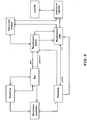
- the figure 6 presents the mode of operation of the relationship manager between two potentially interacting objects and is an integral part of the present description.
- the relationship manager 18 is a centralized process.
- the role of the relationship manager 18 is to detect the interactions between the virtual objects 2 and to follow the realization of this interaction. To do this, the relationship manager 18 uses the interaction characteristics defined in the virtual relations 4. For a given relation, the manager 18 detects whether the initial conditions of an interaction, defined in the virtual relation 4, are met and for which virtual objects 2 they are united. For this, the relationship manager 18 detects, within the potentially interacting objects 2, associable capabilities 14, 15.
- An example of associable capabilities is for a first virtual object to have a screw capacity while a second object has a nut capacity. The detection is carried out by performing for all the virtual objects, the intersection of the capacities common to these objects.
- the relationship manager 18 determines the list of interactions, and associates with each the corresponding virtual relation 4 for each pair of thus associable capabilities 14, 15. In this case the relationship manager 18 identifies these two objects as potentially interacting. He then checks that the interaction is possible, checking that the initial conditions are met. Here, for example, verification is made that the diameter of the screw is compatible with the diameter of the nut and that the two objects are positioned correctly opposite. The interaction is then possible. If it is desirable and effectively controlled, the relationship manager 18 then triggers the interaction. The interaction action 16 corresponding to the fact that the interaction is executed in accordance with the execution information present in the virtual relation 4.
- the present invention relates to object models and relationship models capable of manipulating these objects.
- Such an interactive modeling environment 1 applies to all domains requiring a behavioral simulation of a real environment, this environment not necessarily being available, for reasons as diverse as its dangerousness (battlefield , nuclear power plant, ...) its remoteness (space, surface of a distant planet, ...) or its availability.
- a particularly interesting application is the training and training of maintenance teams, particularly in the case of equipment unavailable or economically difficult to immobilize (battle tank, space station, aircraft carrier, ).
- Such a behavioral and interactive environment 1 if it is sufficiently figurative of the real environment, makes it possible to carry out a number of maintenance tasks in simulation without requiring the immobilization of a hardware.
Landscapes
- Engineering & Computer Science (AREA)
- General Engineering & Computer Science (AREA)
- Theoretical Computer Science (AREA)
- Human Computer Interaction (AREA)
- Physics & Mathematics (AREA)
- General Physics & Mathematics (AREA)
- Processing Or Creating Images (AREA)
Claims (8)
- Verfahren zur graphischen, verhaltensmäßigen, dreidimensionalen reaktiven und interaktiven Modellierung (1) von mindestens zwei realen Objekten (3) in einer realen Umgebung (1) in mindestens zwei entsprechende virtuelle Objekte (2) und wobei mindestens eine reelle Beziehung (5) zwischen diesen realen Objekten (3) in eine virtuelle Beziehung (4) modelliert wird, dadurch gekennzeichnet, dass:- die virtuelle Beziehung (4) ein virtuelles Objekt (2) ist,- jedes virtuelle Objekt (2), welches einem der genannten realen Objekte (3) oder der genannten reellen Beziehung (5) entspricht, vom gleichen Formalismus ist und einen, den anderen virtuellen Objekten (2) verborgenen Körper (6) innerhalb des virtuellen Objekts (2) und eine Schnittstelle (7) aufweist, welche für die anderen virtuellen Objekte (2) sichtbar ist und die Kommunikation mit diesen Letzteren ermöglicht.
- Verfahren zur Modellierung (1) nach Anspruch 1, dadurch gekennzeichnet, dass jedes der genannten virtuellen Objekte (2) mindestens eine Fähigkeit (8) aufweist, welche eine sichtbare, sich in dem Körper (6) befindliche Aktivität (9) aufweist, welche von den anderen virtuellen Objekten (2) mittels einer Kommunikationsschnittstelle (10) verwendbar ist, welche in der Schnittstelle (7) angeordnet ist, die Beziehungen definiert, die das virtuelle Objekt (2) mit anderen virtuellen Objekten (2) herstellen kann.
- Verfahren zur Modellierung (1) nach Anspruch 2, dadurch gekennzeichnet, dass jedes der genannten virtuellen Objekte (2) mindestens eine verborgene, sich in dem Körper (6) befindliche Aktivität (11) aufweist, welche Beziehungen innerhalb des virtuellen Objekts (2) definiert.
- Verfahren zur Modellierung (1) nach Anspruch 2 oder 3, dadurch gekennzeichnet, dass jedes genannten der virtuellen Objekte (2) hierarchisch mit einem virtuellen oberen (12) oder verwandten Objekt verbunden ist, von dem es die Aktivitäten (11) und Fähigkeiten (8) verliehen bekommt.
- Verfahren zur Modellierung (1) nach einem der Ansprüche 1 bis 4, dadurch gekennzeichnet, dass eine virtuelle Beziehung (4) eine Beziehung (13) zwischen virtuellen Objekten (2) der Umgebung herstellt, welche verknüpfbare Eigenschaften (14, 15) besitzen, indem eine Interaktion (16) erzielt wird und den virtuellen Objekten (2) die zur Ausführung dieser Interaktion notwendigen Parameter (17) übertragen werden.
- Verfahren zur Modellierung (1) nach Anspruch 5, dadurch gekennzeichnet, dass es eine zentrale Verwaltung von Beziehungen (18) einsetzt, welche die virtuellen Objekte (2) einander gegenüberstellt, um die verknüpfbaren Eigenschaften (14, 15) zu erfassen, welche für mögliche Interaktionen (13) zwischen diesen virtuellen Objekten (2) hinweisend sind.
- Verfahren zur Modellierung (1) nach irgendeinem der vorhergehenden Ansprüche, dadurch gekennzeichnet, dass eine reale Bedienungsperson (20) durch einen Avatar (19) oder eine virtuelle Bedienungsperson (19) modelliert wird, welche mit den virtuellen Objekten (2) der Umgebung (1) interagiert, und dass dieser Avatar (19) oder virtuelle Bedienungsperson (19) ein virtuelles Objekt (2) von gleichem Formalismus wie das virtuelle Objekt ist, welches einem der genannten realen Objekte (3) oder der genannten reellen Beziehung (5) entspricht.
- Anwendung eines Verfahrens zur Modellierung (1) nach irgendeinem der Ansprüche 1 bis 7 auf die Ausbildung zur Wartung von Materialien oder Fahrzeugen.
Applications Claiming Priority (2)
| Application Number | Priority Date | Filing Date | Title |
|---|---|---|---|
| FR0314480 | 2003-12-10 | ||
| FR0314480A FR2863738B1 (fr) | 2003-12-10 | 2003-12-10 | Methode de modelisation graphique et comportementale, tridimensionnelle, reactive, et interactive d'au moins deux objets |
Publications (2)
| Publication Number | Publication Date |
|---|---|
| EP1548558A1 EP1548558A1 (de) | 2005-06-29 |
| EP1548558B1 true EP1548558B1 (de) | 2017-11-29 |
Family
ID=34531310
Family Applications (1)
| Application Number | Title | Priority Date | Filing Date |
|---|---|---|---|
| EP04292853.1A Expired - Lifetime EP1548558B1 (de) | 2003-12-10 | 2004-12-02 | Verfahren zur Graphische-, Verhaltens- und Dreidimensionalmodellierung von mindestens zwei Objekten |
Country Status (3)
| Country | Link |
|---|---|
| EP (1) | EP1548558B1 (de) |
| DK (1) | DK1548558T3 (de) |
| FR (1) | FR2863738B1 (de) |
Family Cites Families (5)
| Publication number | Priority date | Publication date | Assignee | Title |
|---|---|---|---|---|
| US5999185A (en) * | 1992-03-30 | 1999-12-07 | Kabushiki Kaisha Toshiba | Virtual reality control using image, model and control data to manipulate interactions |
| US5563988A (en) * | 1994-08-01 | 1996-10-08 | Massachusetts Institute Of Technology | Method and system for facilitating wireless, full-body, real-time user interaction with a digitally represented visual environment |
| EP1037134A2 (de) * | 1999-03-16 | 2000-09-20 | Matsushita Electric Industrial Co., Ltd. | Vorrichtung und Verfahren zum Emfang von Steuerungsdaten eines virtuellen Raumes |
| WO2001095061A2 (en) * | 1999-12-07 | 2001-12-13 | Frauenhofer Institut Fuer Graphische Datenverarbeitung | The extended virtual table: an optical extension for table-like projection systems |
| US7202851B2 (en) * | 2001-05-04 | 2007-04-10 | Immersion Medical Inc. | Haptic interface for palpation simulation |
-
2003
- 2003-12-10 FR FR0314480A patent/FR2863738B1/fr not_active Expired - Fee Related
-
2004
- 2004-12-02 EP EP04292853.1A patent/EP1548558B1/de not_active Expired - Lifetime
- 2004-12-02 DK DK04292853.1T patent/DK1548558T3/en active
Non-Patent Citations (1)
| Title |
|---|
| HAY D.C.: "Data Model Views", pages 1 - 11, Retrieved from the Internet <URL:http://www.tdan.com/view-articles/4850/> [retrieved on 20000401] * |
Also Published As
| Publication number | Publication date |
|---|---|
| FR2863738B1 (fr) | 2006-03-17 |
| FR2863738A1 (fr) | 2005-06-17 |
| DK1548558T3 (en) | 2018-02-26 |
| EP1548558A1 (de) | 2005-06-29 |
Similar Documents
| Publication | Publication Date | Title |
|---|---|---|
| US20040030741A1 (en) | Method and apparatus for search, visual navigation, analysis and retrieval of information from networks with remote notification and content delivery | |
| FR3029662A1 (fr) | Systeme de simulation, dispositifs, methodes et programmes correspondants. | |
| CN110599577B (zh) | 一种虚拟角色的皮肤渲染的方法、装置、设备和介质 | |
| Fields et al. | Eigenforms, interfaces and holographic encoding | |
| Tamayo et al. | Digital data visualization with interactive and virtual reality tools. review of current state of the art and proposal of a model | |
| Roy et al. | Collaborative product conceptualization tool using web technology | |
| CA2370693C (fr) | Systeme et methode de pilotage d'un processus decisionnel lors de la poursuite d'un but globale dans un domaine d'application determine | |
| EP1605420A2 (de) | Lernsystem für Betrieb, Benutzung oder Wartung eines Arbeitsplatzes in einer virtuellen Realität Umgebung | |
| Nisiotis et al. | Developing a cyber-physical-social metaverse system for interactive cultural heritage experiences | |
| WO2023247118A1 (en) | Simulating human usage of a user interface | |
| US11660821B2 (en) | Collaboration of three dimensional printing | |
| FR2863738A1 (fr) | Methode de modelisation graphique et comportementale, tridimensionnelle, reactive, et interactive d'au moins deux objets | |
| Müller | “Let’s build an Anscombe box”: assessing Anscombe’s rebuttal of the statistics objection against indeterminism-based free agency | |
| US20210149998A1 (en) | Overarching relationship manager and editor for scaling complex architecture representations | |
| Ridley | Many retrocausal worlds: A foundation for quantum probability | |
| Langan | THE REALITY SELF-SIMULATION PRINCIPLE: REALITY IS A SELF-SIMULATION. | |
| Liu et al. | An agent-based collaborative information processing system for mixed reality applications—Part A: Agent-aware computing | |
| FR2871261A1 (fr) | Dispositif de simulation de l'evolution d'un milieu par traitement asynchrone et chaotique, en presence d'entites autonomes interagissant en un systeme multi-agents | |
| Sarmiento et al. | CSCW systems in virtual environments: a general development framework | |
| US20240265261A1 (en) | Acoustic machine learning with transparent and interpretable adaptation of acoustic data between environments | |
| EP1706834A2 (de) | Einrichtung zur simulation der realen welt durch asynchrone und chaotische verarbeitung | |
| Lacoche | Plasticity for user interfaces in mixed reality | |
| Lombeyda et al. | Conceptual design for assembly | |
| Kirshner et al. | Human-computer interaction for space situational awareness (ssa): Towards the ssa integrated sensor viewer (isv) | |
| US9223457B2 (en) | Visualization of information using landmasses |
Legal Events
| Date | Code | Title | Description |
|---|---|---|---|
| PUAI | Public reference made under article 153(3) epc to a published international application that has entered the european phase |
Free format text: ORIGINAL CODE: 0009012 |
|
| AK | Designated contracting states |
Kind code of ref document: A1 Designated state(s): AT BE BG CH CY CZ DE DK EE ES FI FR GB GR HU IE IS IT LI LT LU MC NL PL PT RO SE SI SK TR |
|
| AX | Request for extension of the european patent |
Extension state: AL BA HR LV MK YU |
|
| RIN1 | Information on inventor provided before grant (corrected) |
Inventor name: MAFFRE, ERIC Inventor name: DEVILLERS, FREDERIC Inventor name: MOLLET, NICOLAS Inventor name: TISSEAU, JACQUES Inventor name: ARNALDI, BRUNO Inventor name: CAZEAUX, ERIC |
|
| RIN1 | Information on inventor provided before grant (corrected) |
Inventor name: CAZEAUX, ERIC Inventor name: DEVILLERS, FREDERIC Inventor name: TISSEAU, JACQUES Inventor name: MAFFRE, ERIC Inventor name: MOLLET, NICOLAS Inventor name: ARNALDI, BRUNO |
|
| 17P | Request for examination filed |
Effective date: 20051208 |
|
| AKX | Designation fees paid |
Designated state(s): AT BE BG CH CY CZ DE DK EE ES FI FR GB GR HU IE IS IT LI LT LU MC NL PL PT RO SE SI SK TR |
|
| RAP1 | Party data changed (applicant data changed or rights of an application transferred) |
Owner name: NEXTER SYSTEMS |
|
| RAP1 | Party data changed (applicant data changed or rights of an application transferred) |
Owner name: NEXTER TRAINING |
|
| REG | Reference to a national code |
Ref country code: DE Ref legal event code: R079 Ref document number: 602004052104 Country of ref document: DE Free format text: PREVIOUS MAIN CLASS: G06F0003033000 Ipc: G06F0003010000 |
|
| GRAP | Despatch of communication of intention to grant a patent |
Free format text: ORIGINAL CODE: EPIDOSNIGR1 |
|
| RIC1 | Information provided on ipc code assigned before grant |
Ipc: G06F 3/01 20060101AFI20170615BHEP Ipc: G06F 3/0481 20130101ALI20170615BHEP |
|
| INTG | Intention to grant announced |
Effective date: 20170712 |
|
| GRAS | Grant fee paid |
Free format text: ORIGINAL CODE: EPIDOSNIGR3 |
|
| GRAA | (expected) grant |
Free format text: ORIGINAL CODE: 0009210 |
|
| AK | Designated contracting states |
Kind code of ref document: B1 Designated state(s): AT BE BG CH CY CZ DE DK EE ES FI FR GB GR HU IE IS IT LI LT LU MC NL PL PT RO SE SI SK TR |
|
| REG | Reference to a national code |
Ref country code: GB Ref legal event code: FG4D Free format text: NOT ENGLISH |
|
| REG | Reference to a national code |
Ref country code: CH Ref legal event code: EP |
|
| REG | Reference to a national code |
Ref country code: AT Ref legal event code: REF Ref document number: 950965 Country of ref document: AT Kind code of ref document: T Effective date: 20171215 |
|
| REG | Reference to a national code |
Ref country code: FR Ref legal event code: PLFP Year of fee payment: 14 |
|
| REG | Reference to a national code |
Ref country code: IE Ref legal event code: FG4D Free format text: LANGUAGE OF EP DOCUMENT: FRENCH |
|
| REG | Reference to a national code |
Ref country code: DE Ref legal event code: R096 Ref document number: 602004052104 Country of ref document: DE |
|
| REG | Reference to a national code |
Ref country code: DK Ref legal event code: T3 Effective date: 20180220 |
|
| REG | Reference to a national code |
Ref country code: NL Ref legal event code: MP Effective date: 20171129 |
|
| REG | Reference to a national code |
Ref country code: LT Ref legal event code: MG4D |
|
| REG | Reference to a national code |
Ref country code: AT Ref legal event code: MK05 Ref document number: 950965 Country of ref document: AT Kind code of ref document: T Effective date: 20171129 |
|
| PG25 | Lapsed in a contracting state [announced via postgrant information from national office to epo] |
Ref country code: FI Free format text: LAPSE BECAUSE OF FAILURE TO SUBMIT A TRANSLATION OF THE DESCRIPTION OR TO PAY THE FEE WITHIN THE PRESCRIBED TIME-LIMIT Effective date: 20171129 Ref country code: SE Free format text: LAPSE BECAUSE OF FAILURE TO SUBMIT A TRANSLATION OF THE DESCRIPTION OR TO PAY THE FEE WITHIN THE PRESCRIBED TIME-LIMIT Effective date: 20171129 Ref country code: LT Free format text: LAPSE BECAUSE OF FAILURE TO SUBMIT A TRANSLATION OF THE DESCRIPTION OR TO PAY THE FEE WITHIN THE PRESCRIBED TIME-LIMIT Effective date: 20171129 Ref country code: ES Free format text: LAPSE BECAUSE OF FAILURE TO SUBMIT A TRANSLATION OF THE DESCRIPTION OR TO PAY THE FEE WITHIN THE PRESCRIBED TIME-LIMIT Effective date: 20171129 |
|
| PG25 | Lapsed in a contracting state [announced via postgrant information from national office to epo] |
Ref country code: GR Free format text: LAPSE BECAUSE OF FAILURE TO SUBMIT A TRANSLATION OF THE DESCRIPTION OR TO PAY THE FEE WITHIN THE PRESCRIBED TIME-LIMIT Effective date: 20180301 Ref country code: BG Free format text: LAPSE BECAUSE OF FAILURE TO SUBMIT A TRANSLATION OF THE DESCRIPTION OR TO PAY THE FEE WITHIN THE PRESCRIBED TIME-LIMIT Effective date: 20180228 Ref country code: AT Free format text: LAPSE BECAUSE OF FAILURE TO SUBMIT A TRANSLATION OF THE DESCRIPTION OR TO PAY THE FEE WITHIN THE PRESCRIBED TIME-LIMIT Effective date: 20171129 |
|
| PG25 | Lapsed in a contracting state [announced via postgrant information from national office to epo] |
Ref country code: NL Free format text: LAPSE BECAUSE OF FAILURE TO SUBMIT A TRANSLATION OF THE DESCRIPTION OR TO PAY THE FEE WITHIN THE PRESCRIBED TIME-LIMIT Effective date: 20171129 |
|
| PG25 | Lapsed in a contracting state [announced via postgrant information from national office to epo] |
Ref country code: CZ Free format text: LAPSE BECAUSE OF FAILURE TO SUBMIT A TRANSLATION OF THE DESCRIPTION OR TO PAY THE FEE WITHIN THE PRESCRIBED TIME-LIMIT Effective date: 20171129 Ref country code: SK Free format text: LAPSE BECAUSE OF FAILURE TO SUBMIT A TRANSLATION OF THE DESCRIPTION OR TO PAY THE FEE WITHIN THE PRESCRIBED TIME-LIMIT Effective date: 20171129 Ref country code: EE Free format text: LAPSE BECAUSE OF FAILURE TO SUBMIT A TRANSLATION OF THE DESCRIPTION OR TO PAY THE FEE WITHIN THE PRESCRIBED TIME-LIMIT Effective date: 20171129 Ref country code: CY Free format text: LAPSE BECAUSE OF FAILURE TO SUBMIT A TRANSLATION OF THE DESCRIPTION OR TO PAY THE FEE WITHIN THE PRESCRIBED TIME-LIMIT Effective date: 20171129 |
|
| REG | Reference to a national code |
Ref country code: CH Ref legal event code: PL |
|
| REG | Reference to a national code |
Ref country code: DE Ref legal event code: R097 Ref document number: 602004052104 Country of ref document: DE |
|
| PG25 | Lapsed in a contracting state [announced via postgrant information from national office to epo] |
Ref country code: IT Free format text: LAPSE BECAUSE OF FAILURE TO SUBMIT A TRANSLATION OF THE DESCRIPTION OR TO PAY THE FEE WITHIN THE PRESCRIBED TIME-LIMIT Effective date: 20171129 Ref country code: RO Free format text: LAPSE BECAUSE OF FAILURE TO SUBMIT A TRANSLATION OF THE DESCRIPTION OR TO PAY THE FEE WITHIN THE PRESCRIBED TIME-LIMIT Effective date: 20171129 Ref country code: PL Free format text: LAPSE BECAUSE OF FAILURE TO SUBMIT A TRANSLATION OF THE DESCRIPTION OR TO PAY THE FEE WITHIN THE PRESCRIBED TIME-LIMIT Effective date: 20171129 |
|
| REG | Reference to a national code |
Ref country code: IE Ref legal event code: MM4A |
|
| PG25 | Lapsed in a contracting state [announced via postgrant information from national office to epo] |
Ref country code: LU Free format text: LAPSE BECAUSE OF NON-PAYMENT OF DUE FEES Effective date: 20171202 |
|
| PLBE | No opposition filed within time limit |
Free format text: ORIGINAL CODE: 0009261 |
|
| STAA | Information on the status of an ep patent application or granted ep patent |
Free format text: STATUS: NO OPPOSITION FILED WITHIN TIME LIMIT |
|
| PG25 | Lapsed in a contracting state [announced via postgrant information from national office to epo] |
Ref country code: IE Free format text: LAPSE BECAUSE OF NON-PAYMENT OF DUE FEES Effective date: 20171202 |
|
| 26N | No opposition filed |
Effective date: 20180830 |
|
| PG25 | Lapsed in a contracting state [announced via postgrant information from national office to epo] |
Ref country code: LI Free format text: LAPSE BECAUSE OF NON-PAYMENT OF DUE FEES Effective date: 20171231 Ref country code: CH Free format text: LAPSE BECAUSE OF NON-PAYMENT OF DUE FEES Effective date: 20171231 Ref country code: SI Free format text: LAPSE BECAUSE OF FAILURE TO SUBMIT A TRANSLATION OF THE DESCRIPTION OR TO PAY THE FEE WITHIN THE PRESCRIBED TIME-LIMIT Effective date: 20171129 |
|
| PG25 | Lapsed in a contracting state [announced via postgrant information from national office to epo] |
Ref country code: MC Free format text: LAPSE BECAUSE OF FAILURE TO SUBMIT A TRANSLATION OF THE DESCRIPTION OR TO PAY THE FEE WITHIN THE PRESCRIBED TIME-LIMIT Effective date: 20171129 Ref country code: HU Free format text: LAPSE BECAUSE OF FAILURE TO SUBMIT A TRANSLATION OF THE DESCRIPTION OR TO PAY THE FEE WITHIN THE PRESCRIBED TIME-LIMIT; INVALID AB INITIO Effective date: 20041202 |
|
| PG25 | Lapsed in a contracting state [announced via postgrant information from national office to epo] |
Ref country code: TR Free format text: LAPSE BECAUSE OF FAILURE TO SUBMIT A TRANSLATION OF THE DESCRIPTION OR TO PAY THE FEE WITHIN THE PRESCRIBED TIME-LIMIT Effective date: 20171129 |
|
| PG25 | Lapsed in a contracting state [announced via postgrant information from national office to epo] |
Ref country code: PT Free format text: LAPSE BECAUSE OF FAILURE TO SUBMIT A TRANSLATION OF THE DESCRIPTION OR TO PAY THE FEE WITHIN THE PRESCRIBED TIME-LIMIT Effective date: 20171129 |
|
| PG25 | Lapsed in a contracting state [announced via postgrant information from national office to epo] |
Ref country code: IS Free format text: LAPSE BECAUSE OF FAILURE TO SUBMIT A TRANSLATION OF THE DESCRIPTION OR TO PAY THE FEE WITHIN THE PRESCRIBED TIME-LIMIT Effective date: 20180329 |
|
| PGFP | Annual fee paid to national office [announced via postgrant information from national office to epo] |
Ref country code: GB Payment date: 20231121 Year of fee payment: 20 |
|
| PGFP | Annual fee paid to national office [announced via postgrant information from national office to epo] |
Ref country code: FR Payment date: 20231122 Year of fee payment: 20 Ref country code: DK Payment date: 20231121 Year of fee payment: 20 Ref country code: DE Payment date: 20231121 Year of fee payment: 20 |
|
| PGFP | Annual fee paid to national office [announced via postgrant information from national office to epo] |
Ref country code: BE Payment date: 20231121 Year of fee payment: 20 |
|
| REG | Reference to a national code |
Ref country code: DE Ref legal event code: R071 Ref document number: 602004052104 Country of ref document: DE |
|
| REG | Reference to a national code |
Ref country code: DK Ref legal event code: EUP Expiry date: 20241202 |
|
| REG | Reference to a national code |
Ref country code: GB Ref legal event code: PE20 Expiry date: 20241201 |
|
| REG | Reference to a national code |
Ref country code: BE Ref legal event code: MK Effective date: 20241202 |
|
| PG25 | Lapsed in a contracting state [announced via postgrant information from national office to epo] |
Ref country code: GB Free format text: LAPSE BECAUSE OF EXPIRATION OF PROTECTION Effective date: 20241201 |
|
| PG25 | Lapsed in a contracting state [announced via postgrant information from national office to epo] |
Ref country code: GB Free format text: LAPSE BECAUSE OF EXPIRATION OF PROTECTION Effective date: 20241201 |