EP1548424A2 - Optical substance analyzer - Google Patents
Optical substance analyzer Download PDFInfo
- Publication number
- EP1548424A2 EP1548424A2 EP04257334A EP04257334A EP1548424A2 EP 1548424 A2 EP1548424 A2 EP 1548424A2 EP 04257334 A EP04257334 A EP 04257334A EP 04257334 A EP04257334 A EP 04257334A EP 1548424 A2 EP1548424 A2 EP 1548424A2
- Authority
- EP
- European Patent Office
- Prior art keywords
- waveguide
- grating
- optical
- functional layer
- analyte
- Prior art date
- Legal status (The legal status is an assumption and is not a legal conclusion. Google has not performed a legal analysis and makes no representation as to the accuracy of the status listed.)
- Withdrawn
Links
Images

Classifications
-
- G—PHYSICS
- G01—MEASURING; TESTING
- G01N—INVESTIGATING OR ANALYSING MATERIALS BY DETERMINING THEIR CHEMICAL OR PHYSICAL PROPERTIES
- G01N33/00—Investigating or analysing materials by specific methods not covered by groups G01N1/00 - G01N31/00
- G01N33/48—Biological material, e.g. blood, urine; Haemocytometers
- G01N33/50—Chemical analysis of biological material, e.g. blood, urine; Testing involving biospecific ligand binding methods; Immunological testing
- G01N33/53—Immunoassay; Biospecific binding assay; Materials therefor
- G01N33/543—Immunoassay; Biospecific binding assay; Materials therefor with an insoluble carrier for immobilising immunochemicals
-
- G—PHYSICS
- G01—MEASURING; TESTING
- G01N—INVESTIGATING OR ANALYSING MATERIALS BY DETERMINING THEIR CHEMICAL OR PHYSICAL PROPERTIES
- G01N21/00—Investigating or analysing materials by the use of optical means, i.e. using sub-millimetre waves, infrared, visible or ultraviolet light
- G01N21/75—Systems in which material is subjected to a chemical reaction, the progress or the result of the reaction being investigated
- G01N21/77—Systems in which material is subjected to a chemical reaction, the progress or the result of the reaction being investigated by observing the effect on a chemical indicator
- G01N21/7703—Systems in which material is subjected to a chemical reaction, the progress or the result of the reaction being investigated by observing the effect on a chemical indicator using reagent-clad optical fibres or optical waveguides
- G01N21/774—Systems in which material is subjected to a chemical reaction, the progress or the result of the reaction being investigated by observing the effect on a chemical indicator using reagent-clad optical fibres or optical waveguides the reagent being on a grating or periodic structure
-
- G—PHYSICS
- G01—MEASURING; TESTING
- G01N—INVESTIGATING OR ANALYSING MATERIALS BY DETERMINING THEIR CHEMICAL OR PHYSICAL PROPERTIES
- G01N21/00—Investigating or analysing materials by the use of optical means, i.e. using sub-millimetre waves, infrared, visible or ultraviolet light
- G01N21/17—Systems in which incident light is modified in accordance with the properties of the material investigated
- G01N21/41—Refractivity; Phase-affecting properties, e.g. optical path length
- G01N21/45—Refractivity; Phase-affecting properties, e.g. optical path length using interferometric methods; using Schlieren methods
-
- G—PHYSICS
- G01—MEASURING; TESTING
- G01N—INVESTIGATING OR ANALYSING MATERIALS BY DETERMINING THEIR CHEMICAL OR PHYSICAL PROPERTIES
- G01N33/00—Investigating or analysing materials by specific methods not covered by groups G01N1/00 - G01N31/00
- G01N33/48—Biological material, e.g. blood, urine; Haemocytometers
- G01N33/50—Chemical analysis of biological material, e.g. blood, urine; Testing involving biospecific ligand binding methods; Immunological testing
- G01N33/53—Immunoassay; Biospecific binding assay; Materials therefor
- G01N33/543—Immunoassay; Biospecific binding assay; Materials therefor with an insoluble carrier for immobilising immunochemicals
- G01N33/54366—Apparatus specially adapted for solid-phase testing
-
- G—PHYSICS
- G01—MEASURING; TESTING
- G01N—INVESTIGATING OR ANALYSING MATERIALS BY DETERMINING THEIR CHEMICAL OR PHYSICAL PROPERTIES
- G01N33/00—Investigating or analysing materials by specific methods not covered by groups G01N1/00 - G01N31/00
- G01N33/48—Biological material, e.g. blood, urine; Haemocytometers
- G01N33/50—Chemical analysis of biological material, e.g. blood, urine; Testing involving biospecific ligand binding methods; Immunological testing
- G01N33/53—Immunoassay; Biospecific binding assay; Materials therefor
- G01N33/569—Immunoassay; Biospecific binding assay; Materials therefor for microorganisms, e.g. protozoa, bacteria, viruses
-
- G—PHYSICS
- G01—MEASURING; TESTING
- G01N—INVESTIGATING OR ANALYSING MATERIALS BY DETERMINING THEIR CHEMICAL OR PHYSICAL PROPERTIES
- G01N21/00—Investigating or analysing materials by the use of optical means, i.e. using sub-millimetre waves, infrared, visible or ultraviolet light
- G01N21/75—Systems in which material is subjected to a chemical reaction, the progress or the result of the reaction being investigated
- G01N21/77—Systems in which material is subjected to a chemical reaction, the progress or the result of the reaction being investigated by observing the effect on a chemical indicator
- G01N21/7703—Systems in which material is subjected to a chemical reaction, the progress or the result of the reaction being investigated by observing the effect on a chemical indicator using reagent-clad optical fibres or optical waveguides
- G01N2021/7706—Reagent provision
- G01N2021/7709—Distributed reagent, e.g. over length of guide
-
- G—PHYSICS
- G01—MEASURING; TESTING
- G01N—INVESTIGATING OR ANALYSING MATERIALS BY DETERMINING THEIR CHEMICAL OR PHYSICAL PROPERTIES
- G01N21/00—Investigating or analysing materials by the use of optical means, i.e. using sub-millimetre waves, infrared, visible or ultraviolet light
- G01N21/75—Systems in which material is subjected to a chemical reaction, the progress or the result of the reaction being investigated
- G01N21/77—Systems in which material is subjected to a chemical reaction, the progress or the result of the reaction being investigated by observing the effect on a chemical indicator
- G01N2021/7769—Measurement method of reaction-produced change in sensor
- G01N2021/7779—Measurement method of reaction-produced change in sensor interferometric
-
- G—PHYSICS
- G01—MEASURING; TESTING
- G01N—INVESTIGATING OR ANALYSING MATERIALS BY DETERMINING THEIR CHEMICAL OR PHYSICAL PROPERTIES
- G01N21/00—Investigating or analysing materials by the use of optical means, i.e. using sub-millimetre waves, infrared, visible or ultraviolet light
- G01N21/75—Systems in which material is subjected to a chemical reaction, the progress or the result of the reaction being investigated
- G01N21/77—Systems in which material is subjected to a chemical reaction, the progress or the result of the reaction being investigated by observing the effect on a chemical indicator
- G01N2021/7793—Sensor comprising plural indicators
-
- G—PHYSICS
- G01—MEASURING; TESTING
- G01N—INVESTIGATING OR ANALYSING MATERIALS BY DETERMINING THEIR CHEMICAL OR PHYSICAL PROPERTIES
- G01N21/00—Investigating or analysing materials by the use of optical means, i.e. using sub-millimetre waves, infrared, visible or ultraviolet light
- G01N21/75—Systems in which material is subjected to a chemical reaction, the progress or the result of the reaction being investigated
- G01N21/77—Systems in which material is subjected to a chemical reaction, the progress or the result of the reaction being investigated by observing the effect on a chemical indicator
- G01N21/7703—Systems in which material is subjected to a chemical reaction, the progress or the result of the reaction being investigated by observing the effect on a chemical indicator using reagent-clad optical fibres or optical waveguides
- G01N21/7746—Systems in which material is subjected to a chemical reaction, the progress or the result of the reaction being investigated by observing the effect on a chemical indicator using reagent-clad optical fibres or optical waveguides the waveguide coupled to a cavity resonator
Definitions
- the present invention relates to sensors and, more specifically, to optical devices for detecting chemical and biological substances.
- Substance analyzers are used in environmental monitoring, industrial process control, and medical, analytical, and military applications.
- biological pathogens such as salmonella are often present in meat and poultry products. Since exposure to these pathogens is a health hazard, low concentrations, typically trace amounts, need to be detected quickly and reliably.
- a portable waveguide sensor having one or more gratings adapted to cause a change in the optical characteristics of the sensor in the presence of a particular substance of interest, e.g., a biological pathogen.
- the sensor has a waveguide, wherein a plurality of grooves imprinted onto the waveguide form a Bragg grating.
- the surface of the grooves has a functional layer adapted to bind the pathogen.
- the binding shifts the spectral reflection band corresponding to the Bragg grating such that a probe light previously reflected by the grating now passes through the grating, thereby indicating the presence of the pathogen.
- the senor has a Mach-Zehnder interferometer (MZI), one arm of which has a resonator formed by two Bragg gratings.
- MZI Mach-Zehnder interferometer
- the surface of the resonator between the gratings has a functional layer whereas the Bragg gratings themselves do not have such a layer. Due to multiple reflections within the resonator, light coupled into the MZI interacts with the bound pathogen over a relatively large effective propagation length, which results in a relatively large differential phase shift and therefore advantageously high sensitivity to the pathogen.
- Fig. 1 shows a perspective three-dimensional view of a prior-art optical sensor 100 disclosed in an article by B. J. Luff, et al., published in J. Lightwave Technology, 1998, Vol. 16, No. 4, p. 583, the teachings of which are incorporated herein by reference.
- Sensor 100 is a planar waveguide device having a Mach-Zehnder interferometer (MZI) 110 formed on a glass substrate 102 .
- An isolation layer 104 that covers MZI 110 has an opening 106 , which exposes one arm of the MZI to the environment, while keeping the other arm protected from such exposure.
- MZI Mach-Zehnder interferometer
- An optical input beam 120 applied to sensor 100 is split into two beam portions as it propagates through MZI 110 , which beam portions then recombine at the output of the MZI to produce an optical output beam 130 .
- the intensity of beam 130 depends on the differential phase shift between the beam portions at the recombination point. For example, when the differential phase shift is about 2 ⁇ k , where k is an integer, the beam portions interfere constructively, which causes beam 130 to have a relatively high intensity. On the other hand, when the differential phase shift is about (2 k +1) ⁇ , the beam portions interfere destructively, which causes beam 130 to have a relatively low intensity.
- the surface of the exposed MZI arm within opening 106 is modified with a functional layer, which facilitates adsorption of the analyte onto the surface.
- the analyte binds to the functional layer, thereby changing the arm's waveguide properties. This change alters the differential phase shift and, as a result, produces a corresponding intensity change of beam 130 , which, upon detection, can be related to the presence of the analyte in the environment.
- one problem with sensor 100 is that its sensitivity may be relatively low.
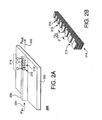
- Figs. 2A-B show an optical sensor 200 according to one embodiment of the present invention. More specifically, Fig. 2A shows a perspective three-dimensional view of sensor 200 , and Fig. 2B is an enlarged view of a grooved portion of that sensor.
- Sensor 200 is a planar waveguide device having a waveguide 208 formed on a substrate 202 . Waveguide 208 has a plurality of grooves 212 , which form an integrated Bragg grating 214 . As known in the art, one property of a Bragg grating is that it can reflect light corresponding to a relatively narrow spectral band while transmitting all other light.
- grating 214 can be fabricated to have a reflection band with a center wavelength of ⁇ 0 and a spectral width of ⁇ , where the spectral width is the wavelength difference between the band points having one half of the reflectivity corresponding to the center wavelength.
- ⁇ 0 and ⁇ are about 1550 nm and 0.1 nm, respectively, and the reflectivity at ⁇ 0 is about 100%.
- the surface of grooves 212 is modified with a functional layer similar to that of sensor 100.
- the functional layer is schematically illustrated by the Y-shaped symbols connected to grooves 212.
- the analyte binds to the functional layer, thereby changing optical properties of grating 214.
- analyte When the analyte binds to the functional layer, it changes n eff and therefore ⁇ 0 .
- an optical input beam 220 coupled into waveguide 208 has wavelength ⁇ ' 0 corresponding to the center wavelength of grating 214 in the absence of the analyte. Then, an optical output beam 230 will have a very low intensity due to the Bragg reflection.
- the analyte binding changes n eff and shifts the center wavelength to ⁇ " 0 . This shift reduces the grating reflectivity at ⁇ ' 0 , which causes the intensity of beam 230 to increase, thereby indicating the presence of the analyte in the environment.
- the sensitivity of sensor 200 is improved compared to the sensitivity of device 100 .
- the improvement is mostly due to the corrugated profile of grating 214 , which increases the interaction cross-section of the probe light with the bound analyte in sensor 200 compared to that in the evanescent-field-limited structure of sensor 100 .
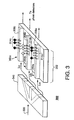
- Fig. 3 shows an optical sensing system 300 according to one embodiment of the present invention.
- System 300 has an arrayed waveguide grating (AWG) 340, whose output ports are coupled to a sensor 352.
- Sensor 352 is an arrayed sensor having three sensors 350a-c, each of which is similar to sensor 200 of Fig. 2. However, sensors 350a -c differ from each other in that (1) each sensor has a different center wavelength (i.e., ⁇ a , ⁇ b , and ⁇ c , respectively) and (2) each sensor has a different functional layer adapted to bind a different analyte.
- AMG arrayed waveguide grating
- system 300 is adapted to detect three different analytes.
- AWG 340 and sensor 352 are implemented in an integrated waveguide circuit.
- a multiplexed optical input beam 320 having wavelengths ⁇ a , ⁇ b , and ⁇ c is applied to AWG 340.
- Each component is then routed to the appropriate output port and coupled into the corresponding waveguide 308, where it impinges upon Bragg grating 314 .
- Light passed through the gratings is measured using an array of photodetectors (not shown) to sense the presence of the different analytes, e.g., as described above for sensor 200 .
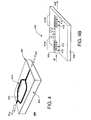
- Figs. 4A-B show an optical sensor 400 according to another embodiment of the present invention. More specifically, Fig. 4A shows a perspective three-dimensional view of sensor 400 , and Fig. 4B shows an enlarged view of an optical resonator 416 of that sensor.
- Sensor 400 has a Mach-Zehnder interferometer (MZI) 410 formed on a substrate 402 and covered by an isolation layer 404 similar to MZI 110 of sensor 100 (Fig. 1).
- MZI 410 and MZI 110 is that the exposed arm of MZI 410 has two Bragg gratings 414a-b, which form resonator 416.
- Each grating 414 is formed with grooves 412 imprinted onto a waveguide 408 as shown in Fig. 4B.
- the reflectivity of each Bragg grating is appropriately chosen to couple light in and out of resonator 416 and to generate multiple round trips of the light within the resonator.
- a section of waveguide 408 between gratings 414a-b has a functional layer indicated in Fig. 4B by the Y-shaped symbols.
- grooves 412 do not have such a layer. This ensures that the resonator's optical properties are not substantially altered by the exposure to the analyte.
- Resonator 416 thus mostly serves to increase the effective interaction length of light within the exposed arm of MZI 410 with the bound analyte (schematically illustrated by diamonds in Fig. 4B). Due to the increased interaction length, the differential phase shift generated in MZI 410 is significantly greater than that in a similarly sized MZI 110 (Fig. 1). Therefore, the sensitivity of sensor 400 is advantageously improved compared to the sensitivity of sensor 100 .
Landscapes
- Health & Medical Sciences (AREA)
- Life Sciences & Earth Sciences (AREA)
- Immunology (AREA)
- Engineering & Computer Science (AREA)
- Chemical & Material Sciences (AREA)
- Physics & Mathematics (AREA)
- Urology & Nephrology (AREA)
- Molecular Biology (AREA)
- Biomedical Technology (AREA)
- Hematology (AREA)
- General Health & Medical Sciences (AREA)
- General Physics & Mathematics (AREA)
- Pathology (AREA)
- Biochemistry (AREA)
- Analytical Chemistry (AREA)
- Medicinal Chemistry (AREA)
- Food Science & Technology (AREA)
- Biotechnology (AREA)
- Microbiology (AREA)
- Cell Biology (AREA)
- Tropical Medicine & Parasitology (AREA)
- Virology (AREA)
- Chemical Kinetics & Catalysis (AREA)
- Plasma & Fusion (AREA)
- Investigating Or Analysing Materials By Optical Means (AREA)
Abstract
Description
Claims (10)
- A device, comprising an optical waveguide having a first grating, wherein:at least a portion of the waveguide has a functional layer adapted to bind an analyte; andwhen the analyte binds to the functional layer, the binding changes optical characteristics of the waveguide.
- The device of claim 1, wherein:a plurality of grooves in the optical waveguide form the first grating; andat least some of the grooves are covered by the functional layer.
- The device of claim 2, wherein:the first grating has an optical reflection band characterized by a center wavelength; andthe binding shifts the center wavelength.
- The device of claim 1, comprising two or more optical waveguides, each having a grating, wherein:each grating has an optical reflection band characterized by a center wavelength; andat least two gratings have different reflection bands.
- The device of claim 4, further comprising an arrayed waveguide grating (AWG) having an input port and two or more output ports coupled to the two or more optical waveguides, wherein:for each optical waveguide, the AWG is adapted to route light having a corresponding center wavelength from the input port to the output port coupled to said optical waveguide; andthe AWG and the two or more optical waveguides are implemented in a single integrated device.
- The device of claim 4, wherein at least two optical waveguides have different functional layers adapted to bind different analytes.
- The device of claim 1, comprising a Mach-Zehnder interferometer (MZI) having two arms, wherein one arm includes the optical waveguide, wherein:the optical waveguide has a second grating;the first and second gratings form an optical resonator;a section of the optical waveguide between the first and second gratings has the functional layer; andthe binding changes a differential phase shift in the MZI.
- The device of claim 1, wherein the first grating is a Bragg grating.
- A method for detecting an analyte, comprising:transmitting light through an optical waveguide having a first grating; andmeasuring the transmitted light using a photo-detector, wherein:at least a portion of the waveguide has a functional layer adapted to bind the analyte; andwhen the analyte binds to the functional layer, the binding changes optical characteristics of the waveguide.
- A method for detecting an analyte, comprising detecting a change in an optical characteristic of an optical waveguide, wherein:at least a portion of the waveguide has a functional layer adapted to bind the analyte; andwhen the analyte binds to the functional layer, the binding changes the optical characteristic.
Priority Applications (1)
| Application Number | Priority Date | Filing Date | Title |
|---|---|---|---|
| EP06014503A EP1710564A3 (en) | 2003-12-22 | 2004-11-25 | Optical substance analyzer |
Applications Claiming Priority (2)
| Application Number | Priority Date | Filing Date | Title |
|---|---|---|---|
| US743253 | 2003-12-22 | ||
| US10/743,253 US7212693B2 (en) | 2003-12-22 | 2003-12-22 | Optical substance analyzer |
Related Child Applications (1)
| Application Number | Title | Priority Date | Filing Date |
|---|---|---|---|
| EP06014503A Division EP1710564A3 (en) | 2003-12-22 | 2004-11-25 | Optical substance analyzer |
Publications (2)
| Publication Number | Publication Date |
|---|---|
| EP1548424A2 true EP1548424A2 (en) | 2005-06-29 |
| EP1548424A3 EP1548424A3 (en) | 2005-10-19 |
Family
ID=34552824
Family Applications (2)
| Application Number | Title | Priority Date | Filing Date |
|---|---|---|---|
| EP04257334A Withdrawn EP1548424A3 (en) | 2003-12-22 | 2004-11-25 | Optical substance analyzer |
| EP06014503A Withdrawn EP1710564A3 (en) | 2003-12-22 | 2004-11-25 | Optical substance analyzer |
Family Applications After (1)
| Application Number | Title | Priority Date | Filing Date |
|---|---|---|---|
| EP06014503A Withdrawn EP1710564A3 (en) | 2003-12-22 | 2004-11-25 | Optical substance analyzer |
Country Status (4)
| Country | Link |
|---|---|
| US (1) | US7212693B2 (en) |
| EP (2) | EP1548424A3 (en) |
| JP (1) | JP2005181334A (en) |
| KR (1) | KR20050063699A (en) |
Cited By (4)
| Publication number | Priority date | Publication date | Assignee | Title |
|---|---|---|---|---|
| WO2006008447A1 (en) * | 2004-07-15 | 2006-01-26 | University Of Southampton | Multiwavelength optical sensors |
| CN102282458A (en) * | 2009-03-12 | 2011-12-14 | 特拉维夫大学未来技术发展有限合伙公司 | Peled asher [il]; nathan menachem [il]; ruschin shlomo [il]; betzalel yifaat [il]; rishpon judith [il] |
| WO2014198409A1 (en) * | 2013-06-12 | 2014-12-18 | Optics Balzers Ag | Integrated optical waveguide sensor system |
| US8958071B2 (en) | 2011-11-15 | 2015-02-17 | Empire Technology Development Llc | Integrated optical sensor |
Families Citing this family (29)
| Publication number | Priority date | Publication date | Assignee | Title |
|---|---|---|---|---|
| US7155076B2 (en) * | 2001-06-15 | 2006-12-26 | The Regents Of The University Of California | Target molecules detection by waveguiding in a photonic silicon membrane |
| WO2005107368A2 (en) * | 2004-05-11 | 2005-11-17 | Tel Aviv University Future Technology Development Ltd. | Planar-resonator based optical chemo- and biosensors |
| US7327908B1 (en) * | 2005-03-07 | 2008-02-05 | Lightsmyth Technologies Inc. | Integrated optical sensor incorporating sets of diffractive elements |
| US7505641B1 (en) * | 2005-08-17 | 2009-03-17 | Polychromix Corporation | Optical biosensor incorporating wavelength encoding of multiple unlabeled analytes |
| JP2009511896A (en) * | 2005-10-12 | 2009-03-19 | コーニンクレッカ フィリップス エレクトロニクス エヌ ヴィ | All-polymer optical waveguide sensor |
| DE102005056225B4 (en) * | 2005-11-25 | 2008-12-18 | Petter, Jürgen | Electro-optical sensor and method for determining physical properties of a target substance via its refractive index |
| EP2137514B1 (en) * | 2007-03-13 | 2018-06-20 | Creoptix AG | Integrated optical sensor |
| WO2010150118A1 (en) * | 2009-06-08 | 2010-12-29 | Ramot At Tel Aviv University Ltd. | Single-waveguide bio-sensor based on propagating modes in a grating waveguide |
| US20110220774A1 (en) * | 2009-11-13 | 2011-09-15 | Z-Image, Llc | Light Beam Detector |
| US8786852B2 (en) | 2009-12-02 | 2014-07-22 | Lawrence Livermore National Security, Llc | Nanoscale array structures suitable for surface enhanced raman scattering and methods related thereto |
| WO2012058716A1 (en) * | 2010-11-02 | 2012-05-10 | Edith Cowan University | An optical sensor for measuring a property of a fluid |
| EP2450693A1 (en) * | 2010-11-08 | 2012-05-09 | Nederlandse Organisatie voor toegepast -natuurwetenschappelijk onderzoek TNO | An arrayed waveguide grating (AWG) |
| SG10201502164TA (en) * | 2011-09-21 | 2015-05-28 | Agency Science Tech & Res | Optical Circuit For Sensing A Biological Entity In A Fluid And Method Of Configuring The Same |
| US9395304B2 (en) | 2012-03-01 | 2016-07-19 | Lawrence Livermore National Security, Llc | Nanoscale structures on optical fiber for surface enhanced Raman scattering and methods related thereto |
| ES2697131T3 (en) * | 2012-12-20 | 2019-01-22 | Univ Gent | Integrated optical sensor circuit |
| EP2757374A1 (en) * | 2013-01-17 | 2014-07-23 | F. Hoffmann-La Roche AG | Method for preparing an outer surface of a planar waveguide to be capable of binding target samples along a plurality of predetermined lines and a planar waveguide |
| US20160146729A1 (en) * | 2013-06-12 | 2016-05-26 | CSEM Centre Suisse d'Electronique et de Microtechnique SA - Recherche et Développement | Measurement method based on an optical waveguide sensor system |
| JP6260950B2 (en) * | 2013-09-10 | 2018-01-17 | 国立大学法人静岡大学 | Refractive index measurement method |
| TWI557408B (en) * | 2015-06-04 | 2016-11-11 | 國立屏東科技大學 | Glass capillary structure and glass capillary processing method thereof |
| EP3321663B1 (en) * | 2015-07-07 | 2021-03-24 | Furuno Electric Co., Ltd. | Measuring chip, measurement device, and measurement method |
| TWI687687B (en) * | 2019-01-11 | 2020-03-11 | 國立中正大學 | Dual grating sensor, detecting method and its manufacturing method |
| FR3105827B1 (en) * | 2019-12-27 | 2024-07-19 | Commissariat Energie Atomique | Photoacoustic or photothermal detector comprising an optical transducer |
| DE102020123800A1 (en) * | 2020-09-11 | 2022-03-17 | Fraunhofer-Gesellschaft zur Förderung der angewandten Forschung eingetragener Verein | Optical sensor, system and method for detecting pathogenic germs |
| US11740177B2 (en) | 2020-09-18 | 2023-08-29 | Salvus, Llc | Interferometric detection and quantification system and methods of use in aquatics |
| US11994504B2 (en) | 2020-09-18 | 2024-05-28 | Salvus, Llc | Interferometric detection and quantification system and methods of use in food processing and food supply chain |
| MX2023002899A (en) * | 2020-09-18 | 2023-04-05 | Salvus Llc | Inteferometric detection and quantification system and methods of use. |
| US12399172B2 (en) | 2020-09-18 | 2025-08-26 | Salvus, Llc | Interferometric detection and quantification system and methods of use in healthcare |
| US11747276B2 (en) | 2020-09-18 | 2023-09-05 | Salvus, Llc | Interferometric detection and quantification system and methods of use in agriculture |
| CN113253403B (en) | 2021-06-17 | 2021-10-29 | 苏州浪潮智能科技有限公司 | An optical device, electronic device and programmable photonic integrated circuit |
Family Cites Families (9)
| Publication number | Priority date | Publication date | Assignee | Title |
|---|---|---|---|---|
| AU5815886A (en) | 1985-05-29 | 1986-12-24 | Kurt Tiefenthaler | Optical sensor for selectively determining the presence of substances and the variation of the refraction index in the measured substances |
| CA2086338C (en) * | 1991-04-26 | 2002-03-26 | Rino E. Kunz | Process and device for determining measured quantities by means of an integrated optical sensor module |
| US5864641A (en) | 1997-04-11 | 1999-01-26 | F&S, Inc. | Optical fiber long period sensor having a reactive coating |
| GB0000896D0 (en) * | 2000-01-14 | 2000-03-08 | Univ Glasgow | Improved analytical chip |
| US6603560B1 (en) * | 2000-03-15 | 2003-08-05 | The Regents Of The University Of Michigan | High sensitivity fiber optic interferometric MEMS |
| EP1272829A1 (en) * | 2000-04-14 | 2003-01-08 | Zeptosens AG | Grid-waveguide structure for reinforcing an excitation field and use thereof |
| US6899849B2 (en) * | 2000-07-28 | 2005-05-31 | The Regents Of The University Of California | Integrated sensor |
| FR2830618B1 (en) * | 2001-10-05 | 2004-07-02 | Tijani Gharbi | OPTICAL SENSOR FOR DETECTION OF AT LEAST ONE CHEMICAL SUBSTANCE AND OPTICAL PROBES COMPRISING SUCH OPTICAL SENSORS |
| US6903815B2 (en) * | 2001-11-22 | 2005-06-07 | Kabushiki Kaisha Toshiba | Optical waveguide sensor, device, system and method for glucose measurement |
-
2003
- 2003-12-22 US US10/743,253 patent/US7212693B2/en not_active Expired - Lifetime
-
2004
- 2004-11-25 EP EP04257334A patent/EP1548424A3/en not_active Withdrawn
- 2004-11-25 EP EP06014503A patent/EP1710564A3/en not_active Withdrawn
- 2004-12-21 KR KR1020040109109A patent/KR20050063699A/en not_active Withdrawn
- 2004-12-21 JP JP2004368616A patent/JP2005181334A/en active Pending
Cited By (6)
| Publication number | Priority date | Publication date | Assignee | Title |
|---|---|---|---|---|
| WO2006008447A1 (en) * | 2004-07-15 | 2006-01-26 | University Of Southampton | Multiwavelength optical sensors |
| US7715005B2 (en) | 2004-07-15 | 2010-05-11 | University Of Southampton | Multiwavelength optical sensors |
| CN102282458A (en) * | 2009-03-12 | 2011-12-14 | 特拉维夫大学未来技术发展有限合伙公司 | Peled asher [il]; nathan menachem [il]; ruschin shlomo [il]; betzalel yifaat [il]; rishpon judith [il] |
| CN102282458B (en) * | 2009-03-12 | 2014-01-22 | 特拉维夫大学未来技术发展有限合伙公司 | Light-emitting intra-cavity interferometric sensors |
| US8958071B2 (en) | 2011-11-15 | 2015-02-17 | Empire Technology Development Llc | Integrated optical sensor |
| WO2014198409A1 (en) * | 2013-06-12 | 2014-12-18 | Optics Balzers Ag | Integrated optical waveguide sensor system |
Also Published As
| Publication number | Publication date |
|---|---|
| EP1710564A3 (en) | 2006-12-20 |
| KR20050063699A (en) | 2005-06-28 |
| US20050135723A1 (en) | 2005-06-23 |
| US7212693B2 (en) | 2007-05-01 |
| EP1548424A3 (en) | 2005-10-19 |
| JP2005181334A (en) | 2005-07-07 |
| EP1710564A2 (en) | 2006-10-11 |
Similar Documents
| Publication | Publication Date | Title |
|---|---|---|
| US7212693B2 (en) | Optical substance analyzer | |
| US5663790A (en) | Method and apparatus for determination of refractive index | |
| EP1066507B1 (en) | Detection of a substance by refractive index change | |
| US8823947B2 (en) | Optical sensor and method for detecting molecules | |
| EP0852715B1 (en) | Integrated optic interferometric sensor | |
| US5210404A (en) | Optical sensor including a bragg grating structure for enhanced sensitivity | |
| CA2573097C (en) | Multiwavelength optical sensors | |
| US7212692B2 (en) | Multiple array surface plasmon resonance biosensor | |
| US20100165351A1 (en) | Silicon photonic waveguide biosensor configurations | |
| WO2010030251A2 (en) | Integrated optical sensors operating in the frequency domain | |
| Gouveia et al. | Refractometric optical fiber platforms for label free sensing | |
| Katiyi et al. | Si nanostrip optical waveguide for on-chip broadband molecular overtone spectroscopy in near-infrared | |
| Martens et al. | Comparison between Vernier-cascade and MZI as transducer for biosensing with on-chip spectral filter | |
| WO2013053930A1 (en) | Resonant biosensor | |
| EP2762858B1 (en) | Integrated interferometric optical sensor circuit | |
| EP1483547B1 (en) | Optical interferometer | |
| JP7658623B2 (en) | Optical sensor chip and optical sensing system | |
| EP4636389A1 (en) | Integrated photonic biosensor with layer discrimination ability and coherent reading system, and device, assembly and methods associated with same | |
| Upadhyay et al. | Estimation of cover sensitivity of a planar polymer waveguide through double path broadband difference interferometeric analysis | |
| WO2018051145A2 (en) | Integrated broad-band young interferometers for simultaneous dual polarization bio-chemical sensing through amplified fringe packet shifts | |
| Slavik et al. | Fiber optic surface plasmon resonance sensor with a Bragg grating | |
| Sanchez-Ramirez et al. | Dual-Polarization Interferometric Sensing for Independent Characterization of Surface and Bulk Layers |
Legal Events
| Date | Code | Title | Description |
|---|---|---|---|
| PUAI | Public reference made under article 153(3) epc to a published international application that has entered the european phase |
Free format text: ORIGINAL CODE: 0009012 |
|
| 17P | Request for examination filed |
Effective date: 20041213 |
|
| AK | Designated contracting states |
Kind code of ref document: A2 Designated state(s): AT BE BG CH CY CZ DE DK EE ES FI FR GB GR HU IE IS IT LI LU MC NL PL PT RO SE SI SK TR |
|
| AX | Request for extension of the european patent |
Extension state: AL HR LT LV MK YU |
|
| PUAL | Search report despatched |
Free format text: ORIGINAL CODE: 0009013 |
|
| AK | Designated contracting states |
Kind code of ref document: A3 Designated state(s): AT BE BG CH CY CZ DE DK EE ES FI FR GB GR HU IE IS IT LI LU MC NL PL PT RO SE SI SK TR |
|
| AX | Request for extension of the european patent |
Extension state: AL HR LT LV MK YU |
|
| AKX | Designation fees paid |
Designated state(s): DE FR GB |
|
| STAA | Information on the status of an ep patent application or granted ep patent |
Free format text: STATUS: THE APPLICATION IS DEEMED TO BE WITHDRAWN |
|
| 18D | Application deemed to be withdrawn |
Effective date: 20060816 |