EP1548360A1 - Apparatus for enhancing combustion efficiency of liquid fuel - Google Patents
Apparatus for enhancing combustion efficiency of liquid fuel Download PDFInfo
- Publication number
- EP1548360A1 EP1548360A1 EP03792644A EP03792644A EP1548360A1 EP 1548360 A1 EP1548360 A1 EP 1548360A1 EP 03792644 A EP03792644 A EP 03792644A EP 03792644 A EP03792644 A EP 03792644A EP 1548360 A1 EP1548360 A1 EP 1548360A1
- Authority
- EP
- European Patent Office
- Prior art keywords
- combustion efficiency
- liquid fuel
- high combustion
- efficiency device
- fuel
- Prior art date
- Legal status (The legal status is an assumption and is not a legal conclusion. Google has not performed a legal analysis and makes no representation as to the accuracy of the status listed.)
- Withdrawn
Links
- 238000002485 combustion reaction Methods 0.000 title claims abstract description 98
- 239000000446 fuel Substances 0.000 title claims abstract description 87
- 239000007788 liquid Substances 0.000 title claims abstract description 64
- 230000002708 enhancing effect Effects 0.000 title 1
- 239000002245 particle Substances 0.000 claims abstract description 40
- 229910052613 tourmaline Inorganic materials 0.000 claims abstract description 35
- 229940070527 tourmaline Drugs 0.000 claims abstract description 35
- 239000011032 tourmaline Substances 0.000 claims abstract description 35
- 239000002828 fuel tank Substances 0.000 claims abstract description 26
- 239000004020 conductor Substances 0.000 claims abstract description 3
- OKTJSMMVPCPJKN-UHFFFAOYSA-N Carbon Chemical compound [C] OKTJSMMVPCPJKN-UHFFFAOYSA-N 0.000 claims description 18
- 239000000126 substance Substances 0.000 claims description 13
- 229910052799 carbon Inorganic materials 0.000 claims description 9
- 229910002804 graphite Inorganic materials 0.000 claims description 9
- 239000010439 graphite Substances 0.000 claims description 9
- 238000001179 sorption measurement Methods 0.000 claims description 6
- MWUXSHHQAYIFBG-UHFFFAOYSA-N Nitric oxide Chemical compound O=[N] MWUXSHHQAYIFBG-UHFFFAOYSA-N 0.000 abstract description 48
- 238000012423 maintenance Methods 0.000 abstract description 5
- 239000007789 gas Substances 0.000 description 16
- 239000003502 gasoline Substances 0.000 description 11
- 229910052782 aluminium Inorganic materials 0.000 description 7
- XAGFODPZIPBFFR-UHFFFAOYSA-N aluminium Chemical compound [Al] XAGFODPZIPBFFR-UHFFFAOYSA-N 0.000 description 7
- 239000004215 Carbon black (E152) Substances 0.000 description 5
- 229910006016 Si6O18 Inorganic materials 0.000 description 5
- 229930195733 hydrocarbon Natural products 0.000 description 5
- 150000002430 hydrocarbons Chemical class 0.000 description 5
- 238000005259 measurement Methods 0.000 description 5
- 239000003921 oil Substances 0.000 description 5
- 230000008878 coupling Effects 0.000 description 4
- 238000010168 coupling process Methods 0.000 description 4
- 238000005859 coupling reaction Methods 0.000 description 4
- 230000005484 gravity Effects 0.000 description 4
- QVGXLLKOCUKJST-UHFFFAOYSA-N atomic oxygen Chemical compound [O] QVGXLLKOCUKJST-UHFFFAOYSA-N 0.000 description 3
- 239000003054 catalyst Substances 0.000 description 3
- 239000006185 dispersion Substances 0.000 description 3
- 239000000463 material Substances 0.000 description 3
- 239000001301 oxygen Substances 0.000 description 3
- 229910052760 oxygen Inorganic materials 0.000 description 3
- 239000004094 surface-active agent Substances 0.000 description 3
- 239000003795 chemical substances by application Substances 0.000 description 2
- 239000011888 foil Substances 0.000 description 2
- WABPQHHGFIMREM-UHFFFAOYSA-N lead(0) Chemical compound [Pb] WABPQHHGFIMREM-UHFFFAOYSA-N 0.000 description 2
- 230000003647 oxidation Effects 0.000 description 2
- 238000007254 oxidation reaction Methods 0.000 description 2
- -1 polyethylene terephthalate Polymers 0.000 description 2
- XLYOFNOQVPJJNP-UHFFFAOYSA-N water Substances O XLYOFNOQVPJJNP-UHFFFAOYSA-N 0.000 description 2
- UGFAIRIUMAVXCW-UHFFFAOYSA-N Carbon monoxide Chemical compound [O+]#[C-] UGFAIRIUMAVXCW-UHFFFAOYSA-N 0.000 description 1
- 239000004698 Polyethylene Substances 0.000 description 1
- 229910002091 carbon monoxide Inorganic materials 0.000 description 1
- 230000015556 catabolic process Effects 0.000 description 1
- 239000000919 ceramic Substances 0.000 description 1
- 230000003247 decreasing effect Effects 0.000 description 1
- 238000006731 degradation reaction Methods 0.000 description 1
- 229910000245 dravite Inorganic materials 0.000 description 1
- 230000009977 dual effect Effects 0.000 description 1
- 229910000244 elbaite Inorganic materials 0.000 description 1
- 230000005611 electricity Effects 0.000 description 1
- 239000003344 environmental pollutant Substances 0.000 description 1
- IDIJOAIHTRIPRC-UHFFFAOYSA-J hexaaluminum;sodium;2,2,4,4,6,6,8,8,10,10,12,12-dodecaoxido-1,3,5,7,9,11-hexaoxa-2,4,6,8,10,12-hexasilacyclododecane;iron(2+);triborate;tetrahydroxide Chemical compound [OH-].[OH-].[OH-].[OH-].[Na+].[Al+3].[Al+3].[Al+3].[Al+3].[Al+3].[Al+3].[Fe+2].[Fe+2].[Fe+2].[O-]B([O-])[O-].[O-]B([O-])[O-].[O-]B([O-])[O-].[O-][Si]1([O-])O[Si]([O-])([O-])O[Si]([O-])([O-])O[Si]([O-])([O-])O[Si]([O-])([O-])O[Si]([O-])([O-])O1 IDIJOAIHTRIPRC-UHFFFAOYSA-J 0.000 description 1
- AMGQUBHHOARCQH-UHFFFAOYSA-N indium;oxotin Chemical compound [In].[Sn]=O AMGQUBHHOARCQH-UHFFFAOYSA-N 0.000 description 1
- 238000003780 insertion Methods 0.000 description 1
- 230000037431 insertion Effects 0.000 description 1
- 229910000241 liddicoatite Inorganic materials 0.000 description 1
- 239000010721 machine oil Substances 0.000 description 1
- 238000004519 manufacturing process Methods 0.000 description 1
- 238000000034 method Methods 0.000 description 1
- 239000000203 mixture Substances 0.000 description 1
- 230000010287 polarization Effects 0.000 description 1
- 229920000573 polyethylene Polymers 0.000 description 1
- 229920000139 polyethylene terephthalate Polymers 0.000 description 1
- 239000005020 polyethylene terephthalate Substances 0.000 description 1
- 239000000843 powder Substances 0.000 description 1
- 238000012545 processing Methods 0.000 description 1
- 230000005855 radiation Effects 0.000 description 1
- 229940027523 schorl tourmaline Drugs 0.000 description 1
- 229920002545 silicone oil Polymers 0.000 description 1
- 229920003002 synthetic resin Polymers 0.000 description 1
- 239000000057 synthetic resin Substances 0.000 description 1
- 229910000242 uvite Inorganic materials 0.000 description 1
- 238000004804 winding Methods 0.000 description 1
Images


Classifications
-
- F—MECHANICAL ENGINEERING; LIGHTING; HEATING; WEAPONS; BLASTING
- F02—COMBUSTION ENGINES; HOT-GAS OR COMBUSTION-PRODUCT ENGINE PLANTS
- F02M—SUPPLYING COMBUSTION ENGINES IN GENERAL WITH COMBUSTIBLE MIXTURES OR CONSTITUENTS THEREOF
- F02M27/00—Apparatus for treating combustion-air, fuel, or fuel-air mixture, by catalysts, electric means, magnetism, rays, sound waves, or the like
- F02M27/04—Apparatus for treating combustion-air, fuel, or fuel-air mixture, by catalysts, electric means, magnetism, rays, sound waves, or the like by electric means, ionisation, polarisation or magnetism
-
- C—CHEMISTRY; METALLURGY
- C10—PETROLEUM, GAS OR COKE INDUSTRIES; TECHNICAL GASES CONTAINING CARBON MONOXIDE; FUELS; LUBRICANTS; PEAT
- C10G—CRACKING HYDROCARBON OILS; PRODUCTION OF LIQUID HYDROCARBON MIXTURES, e.g. BY DESTRUCTIVE HYDROGENATION, OLIGOMERISATION, POLYMERISATION; RECOVERY OF HYDROCARBON OILS FROM OIL-SHALE, OIL-SAND, OR GASES; REFINING MIXTURES MAINLY CONSISTING OF HYDROCARBONS; REFORMING OF NAPHTHA; MINERAL WAXES
- C10G32/00—Refining of hydrocarbon oils by electric or magnetic means, by irradiation, or by using microorganisms
- C10G32/02—Refining of hydrocarbon oils by electric or magnetic means, by irradiation, or by using microorganisms by electric or magnetic means
-
- F—MECHANICAL ENGINEERING; LIGHTING; HEATING; WEAPONS; BLASTING
- F02—COMBUSTION ENGINES; HOT-GAS OR COMBUSTION-PRODUCT ENGINE PLANTS
- F02M—SUPPLYING COMBUSTION ENGINES IN GENERAL WITH COMBUSTIBLE MIXTURES OR CONSTITUENTS THEREOF
- F02M27/00—Apparatus for treating combustion-air, fuel, or fuel-air mixture, by catalysts, electric means, magnetism, rays, sound waves, or the like
- F02M27/04—Apparatus for treating combustion-air, fuel, or fuel-air mixture, by catalysts, electric means, magnetism, rays, sound waves, or the like by electric means, ionisation, polarisation or magnetism
- F02M27/045—Apparatus for treating combustion-air, fuel, or fuel-air mixture, by catalysts, electric means, magnetism, rays, sound waves, or the like by electric means, ionisation, polarisation or magnetism by permanent magnets
-
- F—MECHANICAL ENGINEERING; LIGHTING; HEATING; WEAPONS; BLASTING
- F02—COMBUSTION ENGINES; HOT-GAS OR COMBUSTION-PRODUCT ENGINE PLANTS
- F02M—SUPPLYING COMBUSTION ENGINES IN GENERAL WITH COMBUSTIBLE MIXTURES OR CONSTITUENTS THEREOF
- F02M27/00—Apparatus for treating combustion-air, fuel, or fuel-air mixture, by catalysts, electric means, magnetism, rays, sound waves, or the like
- F02M27/06—Apparatus for treating combustion-air, fuel, or fuel-air mixture, by catalysts, electric means, magnetism, rays, sound waves, or the like by rays, e.g. infrared and ultraviolet
-
- F—MECHANICAL ENGINEERING; LIGHTING; HEATING; WEAPONS; BLASTING
- F02—COMBUSTION ENGINES; HOT-GAS OR COMBUSTION-PRODUCT ENGINE PLANTS
- F02M—SUPPLYING COMBUSTION ENGINES IN GENERAL WITH COMBUSTIBLE MIXTURES OR CONSTITUENTS THEREOF
- F02M27/00—Apparatus for treating combustion-air, fuel, or fuel-air mixture, by catalysts, electric means, magnetism, rays, sound waves, or the like
- F02M27/08—Apparatus for treating combustion-air, fuel, or fuel-air mixture, by catalysts, electric means, magnetism, rays, sound waves, or the like by sonic or ultrasonic waves
-
- F—MECHANICAL ENGINEERING; LIGHTING; HEATING; WEAPONS; BLASTING
- F23—COMBUSTION APPARATUS; COMBUSTION PROCESSES
- F23K—FEEDING FUEL TO COMBUSTION APPARATUS
- F23K5/00—Feeding or distributing other fuel to combustion apparatus
- F23K5/02—Liquid fuel
- F23K5/08—Preparation of fuel
-
- F—MECHANICAL ENGINEERING; LIGHTING; HEATING; WEAPONS; BLASTING
- F23—COMBUSTION APPARATUS; COMBUSTION PROCESSES
- F23K—FEEDING FUEL TO COMBUSTION APPARATUS
- F23K2300/00—Pretreatment and supply of liquid fuel
- F23K2300/10—Pretreatment
- F23K2300/101—Application of magnetism or electricity
Definitions
- the present invention relates to a high combustion efficiency device for liquid fuel.
- the exhaust gas from automobiles contains environmental pollutants including unburned matters such as CO (carbon monoxide) and HC (hydrocarbon), and NOx (nitrogen oxide), or the like.
- environmental pollutants including unburned matters such as CO (carbon monoxide) and HC (hydrocarbon), and NOx (nitrogen oxide), or the like.
- catalysts for removing unburned matters such as CO and HC, and NOx are provided in an exhaust gas conduit for preventing the unburned matters such as CO and HC, and NOx from being discharged into the atmospheric air.
- the catalysts are degraded due to use for a long period of time, and thus, the efficiency for removing the unburned matters such as CO and HC, and NOx is lowered. Therefore, it is not possible to stably remove the unburned matters such as CO and HC, and NOx. Further, since the degraded catalysts need to be replaced periodically, maintenance cost for replacement operation is required.
- the present invention has been made taking the above circumstances into account, and an object of the present invention is to provide a high combustion efficiency device for liquid fuel in which almost no maintenance cost is required, combustion efficiency of liquid fuel in an engine portion is improved, the amount of unburned matters is reduced as much as possible, and generation of nitrogen oxide is suppressed.
- a high combustion efficiency device for liquid fuel according to the present invention (hereinafter referred to as the "high combustion efficiency device") is characterized in that at least tourmaline particles are filled in a hollow member made of electrically conductive material, while the tourmaline particles are electrically connected to the hollow member.
- the high combustion efficiency device may be configured such that the high combustion efficiency device is attachable to at least part of a fuel passage extending from a fuel tank of the liquid fuel to a combustion device of the liquid fuel, the high combustion efficiency device can be formed to surround a fuel pipe, and the high combustion efficiency device comprises adsorption means attached to an inner wall surface of the fuel tank, a device body, and a float which allows the device body to float in the fuel in the fuel tank. Further, the high combustion efficiency device according to the present invention may be configured such that the surface of the hollow member is covered by a far-infrared ray generating substance.
- the electrically conductive substance of the hollow member is preferably, but not particularly limited to, highly electrically conductive, and light material such as aluminum.
- a far-infrared ray reflection layer is provided as the outermost layer.
- the far-infrared ray generating substance is hard alumite.
- the high combustion efficiency device according to the present invention is mounted while the hollow member is grounded.
- the tourmaline is a crystalline body having a propensity to naturally generate plus polarity on one side, and minus polarity on the other side.
- the tourmaline includes, e.g., Schorl tourmaline (NaFe 3 Al 6 (BO 3 ) 3 Si 6 O 18 (OH) 4 ), Dravite tourmaline (NaMg 3 Al 6 (BO 3 ) 3 Si 6 O 18 (OH) 4 ), Elbaite tourmaline (Na (Li,Al) 3 Al 6 (BO 3 ) 3 Si 6 O 18 (OH) 4 ), Liddicoatite tourmaline (Ca(Li,Al) 3 Al 6 (BO 3 ) 3 Si 6 O 18 (O,OH,F) 4 ), and Uvite tourmaline (Ca,Na) (Mg,Fe) 3 Al 5 Mg(BO 3 ) 3 Si 6 O 18 (OH,F) 4 ).
- tourmaline particles are dispersed, and mixed in an electrically conductive solution or electrically conductive gel containing carbon graphite particles.
- the electrically conductive solution or the electrically conductive gel is not particularly limited as long as it is not corrosive to the hollow member, and highly electrically conductive. Further, it is possible to use silicone oil or machine oil as the dispersion liquid.
- a dispersion agent such as a surface active agent may be added into the solution.
- the surface active agent is not particularly limited as long as it allows for uniform dispersion of the tourmaline particles. It is preferable that the surface active agent is an nonionic agent.
- the particle size of the tourmaline particles and the carbon graphite particles is not particularly limited.
- the particle size is 10 ⁇ or less, and more preferably, the particle size is 5 ⁇ or less.
- Proportion of mixing the tourmaline particles and the carbon graphite particles is not particularly limited. It is preferable that the proportion is within a range between about 100:1 and 20:1.
- the far-infrared ray generating substance is not particularly limited.
- ceramic such as hard alumite is chiefly used as the far-infrared ray generating substance.
- the far-infrared ray reflection layer may be provided integrally on the surface of the hollow member.
- the far-infrared ray reflection layer is a far-infrared ray reflection sheet separated from the hollow member, and the far-infrared ray reflection sheet surrounds the hollow member.
- the far-infrared ray reflection sheet is not particularly limited as long as it can reflect the far-infrared ray.
- the far-infrared ray reflection sheet is a metallic foil such as an aluminum foil or a resinous composition sheet comprising polyethylene terephthalate containing ultrafine powder of Indium Tin Oxide (ECOSHADE manufactured by Mitsubishi Material Corporation).
- the adsorption means is not particularly limited.
- a permanent magnet or a sucking disk is used as the adsorption means, and the permanent magnet is preferably used as the adsorption means.
- the float may be formed integrally with the device body. Alternatively, the device body may be hung from the float.
- the high combustion efficiency device for liquid fuel according to the present invention has the structure as described above, almost no maintenance cost is required, combustion efficiency of liquid fuel in an engine portion is improved, the amount of unburned matters is reduced as much as possible, and generation of nitrogen oxide is suppressed.
- the hollow member is used in a grounded condition, or the far-infrared ray reflection layer is provided as the outermost layer, radiation amount of the far-infrared ray is increased, and thus, the high combustion efficiency device is compact, and has a high performance.
- the tourmaline particles are dispersed and mixed in the electrically conductive solution or the electrically conductive gel containing the carbon graphite particles, it is possible to stabilize the amount of the far-infrared ray emitted from the tourmaline.
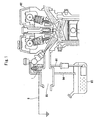
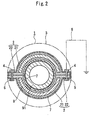
- Fig. 1 and Fig. 2 show a high combustion efficiency device for liquid fuel according to a first embodiment of the present invention.
- the high combustion efficiency device 1 includes two hollow members 2, a far-infrared ray reflection sheet 3 as a far-infrared ray reflection layer, a bolt 4, a nut 5, and a ground wire 6.
- Each of the hollow members 2 is made of aluminum, and includes a semi-cylindrical body 21 and a flange 22 extending on both sides of the body 21.
- the outer circumferential surface and the inner circumferential surface of the body 21 and the outer wall surface of the flange 22 is covered by a hard alumite layer 7 as a far-infrared ray generating substance formed by anodic oxidation.
- the body 21 has a hollow structure having an internal space 23, and electrically conductive solution 8 is filled in the internal space 23. Tourmaline particles and carbon graphite particles are dispersed in the electrically conductive solution 8. The tourmaline particles are electrically conducted to the hollow members 2 via the electrically conductive solution 8.
- the flanges 22 of the two hollow members 2 abut against each other.
- the bolt 4 is inserted through screw insertion holes of the flanges 22 from one of the hollow members 2.
- a tip end of the bolt 4 is screwed into the nut 5 on the side of the other hollow member 2 to combine the two bodies 21 into a single cylindrical high combustion efficiency device body 21 having substantially the same diameter as that of a fuel pipe 91 of an automobile as described later.
- the far-infrared ray reflection sheet 3 is formed into a size that can surround the high combustion efficiency device body 21.
- connection terminal is provided on the other end.
- the high combustion efficiency device body 21 is disassembled in advance, and a portion of the rubber fuel pipe 91 near the engine 92 is set in the cylinder formed by the bodies 21 of the two hollow members 2.
- the two hollow members 2 are combined together by the bolt 4 and the nut 5. That is, the portion of the fuel pipe 91 near the engine 92 is surrounded by the high combustion efficiency device body 21.
- connection terminal of the ground wire 6 is connected to a minus terminal of a battery (not shown) of the automobile, and the hollow members 2 are grounded. Then, the high combustion efficiency device body 21 is surrounded by a far-infrared ray reflection sheet 3. Thus, the high combustion efficiency device body 21 is set in an engine compartment of the automobile.
- the high combustion efficiency device 1 has the structure as described above. Therefore, the electromagnetic waves such as the far-infrared rays generated by the tourmaline particles filled in the hollow members 2 is radiated through the fuel pipe to the liquid fuel such as gasoline or light oil in the fuel pipe.
- the electromagnetic wave affects hydrocarbon molecules so that each of the hydrocarbon molecules is combusted easily (oxygen can attack easily).
- the liquid fuel supplied to the engine 92 is combusted swiftly and completely in the engine 92 in comparison with the case in which the high combustion efficiency device 1 is not mounted. Therefore, the exhaust gas contains almost no CO and HC.
- the liquid fuel is combusted almost completely in the engine 92, the exhaust gas is not further combusted in the exhaust pipe. Therefore, temperature in the exhaust pipe is kept at a low level, and it is possible to suppress generation of NOx which is generated easily at high temperatures.
- the surface of the hollow member 2 is covered by hard alumite which is the far-infrared ray generating substance, in comparison with the case in which only the tourmaline particles are used, the amount of far-infrared rays is increased. Further, since the far-infrared ray reflection layer formed by the surrounding far-infrared ray reflection sheet 3 is provided at the outermost position, the far-infrared rays directed toward the outside are reflected by the far-infrared ray reflection layer, and directed toward the fuel pipe 91. Thus, it is possible to radiate the far-infrared rays efficiently to the liquid fuel.
- the hollow members 2 are connected to the ground via the ground wire 6, polarization of the tourmaline is always placed in a stable condition.
- the far-infrared ray can be generated semi-permanently.
- the tourmaline particles do not directly contact the liquid fuel, it is possible to supply the far-infrared ray semi-permanently without any degradation of the tourmaline particles. Thus, almost no maintenance cost is required. Further, thanks to the simple structure and small fabrication cost, the initial cost is not significant.
- reference numeral 93 denotes a fuel tank
- reference numeral 94 denotes a return pipe
- reference numeral 95 denotes a surge tank.
- Fig. 3 to Fig. 5 show a high combustion efficiency device for liquid fuel according to a second embodiment of the present invention.
- the high combustion efficiency device 100 includes a device body 110 and permanent magnets 120 as adsorption means.
- the device body 110 is composed of a cylindrical hollow member 111, and electrically conductive solution 112 filled in the hollow member 111.
- the hollow member 111 is made of aluminum, and the surface of the hollow member 111 is covered by hard alumite.
- Each of the permanent magnets 120 has a substantially horseshoe-shaped contour.
- the permanent magnets 120 are connected to both sides of the device body 110 to have a saddle shape.
- the tourmaline particles and the carbon graphite particles are dispersed in water, in the electrically conductive solution 112.
- the high combustion efficiency device 100 is inserted into a fuel tank 130 of a truck or the like, from an oil supply port 131 of the fuel tank 130, and the high combustion efficiency device 100 is attached to the inner surface of the fuel tank 130 by the two permanent magnets 120. At this time, the device body 110 is immersed in liquid fuel 140 such as light oil or the like in the fuel tank 130.
- the liquid fuel 140 in the fuel tank 130 is affected by the electromagnetic waves such as the far-infrared rays generated by the tourmaline particles filled in the hollow member 111 of the high combustion efficiency device 100 so that the hydrocarbon molecules in the liquid fuel are combusted easily (oxygen can attack easily).
- the liquid fuel supplied to the engine of a truck or a passenger car is combusted swiftly and completely in the engine 92 in comparison with the case in which the high combustion efficiency device 100 is not mounted. Therefore, the exhaust gas contains almost no CO and HC.
- the surface of the hollow member 111 is covered by hard alumite which is the far-infrared ray generating substance. In comparison with the case in which only the tourmaline particles are used, the amount of far-infrared rays is increased.
- Fig. 6 and Fig. 7 show a high combustion efficiency device for liquid fuel according to a third embodiment of the present invention.
- the high combustion efficiency device 200 includes a device body 210 and a float 220.
- the device body 210 is composed of a hollow member 215 and electrically conductive solution 216 filled in the hollow member 215.
- the hollow member 215 has a dual cylindrical structure including an outer tube 211 and an inner tube 212. Ends of the outer tube 211 and the inner tube 212 are closed by a ring-shaped lid 213.
- the hollow member 215 has an internal space 214 between the outer tube 211 and the outer tube 212.
- the electrically conductive solution 216 is filled in the inner space 214.
- the hollow member 215 is made of aluminum, and the surface of the hollow member 215 exposed to the outside is covered by hard alumite.
- the tourmaline particles and the carbon graphite particles are dispersed in water, in the electrically conductive solution 216.
- the float 220 is made of oil resistant synthetic resin such as polyethylene, and has a hollow structure.
- the float 220 has a disk shape and its cross section is larger than the device body 210.
- the device body 210 and the float 220 are connected via two hanging chains 231 such that the device body 210 is hung under the float 220.
- the device body 210 and the float 210 are supported by a lid 242 of an oil supply port 241 of a fuel tank 240 by a coupling chain 232.
- One end of the coupling chain 232 is fixed to the lid 242.
- the coupling chain 232 is branched from the middle.
- One of the branched ends is fixed to the float 220, and the other of the branched ends is fixed to the device body 210.
- the high combustion efficiency device 200 is held in place while the device body 210 floats in the liquid fuel 250 in the fuel tank 240 by the float 220.
- the liquid fuel 250 in the fuel tank 240 is affected by the electromagnetic waves such as the far-infrared rays generated by the tourmaline particles filled in the hollow member 215 of the high combustion efficiency device 200 so that the hydrocarbon molecules in the liquid fuel 250 are combusted easily (oxygen can attack easily).
- the liquid fuel 250 supplied to the engine of a truck or a passenger car is combusted swiftly and completely in the engine in comparison with the case in which the high combustion efficiency device 200 is not mounted. Therefore, the exhaust gas contains almost no CO and HC.
- the liquid fuel is combusted almost completely in the engine, the exhaust gas is not further combusted in the exhaust pipe. Therefore, temperature in the exhaust pipe is kept at a low level, and it is possible to suppress generation of NOx which is generated easily at high temperatures.
- the surface of the hollow member 215 exposed to the outside i.e. , the surface which contacts the liquid fuel 250 is covered by hard alumite which is the far-infrared ray generating substance, in comparison with the case in which only the tourmaline particles are used, the amount of far-infrared rays is increased.
- the device body 210 is floating in the liquid fuel 250 via the float 220, even if the liquid amount of the liquid fuel 250 is decreased, the device body 210 is always immersed in the liquid fuel 250. Thus, the liquid fuel 250 is always placed in the stable high combustion condition.
- the device body 21 and the float 220 are fixed to the lid 242 via the coupling chain 232, and the float 220 is larger than the device body 210.
- the float 220 is larger than the device body 210.
- the liquid fuel 250 which is processed to be combusted highly efficiently using the high combustion efficiency device 200 has a specific gravity higher than that of the unprocessed liquid fuel. Therefore, the liquid fuel which is processed to be combusted highly efficiently near the device body 210 sinks toward the bottom of the fuel tank 240, and the unprocessed liquid fuel floats upwardly. That is, convection of the liquid fuel occurs. By the convection, the unprocessed liquid fuel is supplied to the position near the device body 210. Thus, the whole liquid fuel in the fuel tank is efficiently processed to be combusted highly efficiently.
- the present invention is not limited to the above embodiments.
- the high combustion efficiency device is attached to the fuel pipe of the automobile, for example, the high combustion efficiency device is also applicable to devices which use the liquid fuel such as aircraft, diesel engines, or boilers.
- the high combustion efficiency device is attached to the fuel pipe.
- the high combustion efficiency device may be attached to a position around the fuel tank.
- the ground wire is connected to the minus terminal of the battery.
- the ground wire may be connected to a body of the automobile or the like.
- the attachment condition of the high combustion efficiency device body is maintained by the bolt and the nut.
- a flat fastener hook and loop fastener
- a cord or a band
- one pair of edge of the two hollow members may be connected together using a hinge, and the other pair of edge of the hollow members may be engaged with a detachable pin or the like using engagement means.
- the number of hollow members is two.
- the number of hollow members may be three or more, or one.
- each of the hollow members has a semi-cylindrical shape.
- the high combustion efficiency device may have a tubular shape, and a large number of tubular high combustion efficiency devices may be used to surround the fuel pipe 91.
- the high combustion efficiency device may comprise one tubular hollow member, and the high combustion efficiency device may be attached to the fuel pipe by spirally winding the high combustion efficiency device around the fuel pipe.
- the permanent magnet has a substantially horseshoe-shape.
- the permanent magnet may have a regular triangular shape or other shapes.
- the high combustion efficiency device is used for the fuel tank of an automobile, a truck, or the like.
- the high combustion efficiency device may be used for a fuel storage tank of a gas station.
- a surface of an aluminum tube having a diameter of 6mm and a thickness of 0.5mm was subjected to an anodic oxidation process to form a hard alumite layer having a thickness of 30 ⁇ m as a far-infrared ray generating substance.
- an electrically conductive solution which is obtained by dispersing and mixing tourmaline particles and carbon graphite particles by 10 weight%, respectively, was filled in the aluminum tube covered by hard alumite. Both ends of the tube were closed to obtain a high combustion efficiency tube having a length of 100mm.
- the high combustion efficiency device body was used for Rafaga produced by Hyundai Motor Co., Ltd.
- the high combustion efficiency device was wound around a fuel pipe as a fuel passage such that the nine tubes surround the fuel pipe. Further, a far-infrared ray reflection sheet (ECOSHADE produced by Mitsubishi Material Corporation) as a far-infrared ray reflection layer was wound around the high combustion efficiency device body. Thereafter, a band was used to tightly attach the high combustion efficiency device around the fuel pipe. Further, a ground wire connected to a lead wire was connected to a minus terminal of a battery.
- the Second Example was carried out in the same manner as with the First Example except that the high combustion efficiency device is attached to the fuel pipe of a Step Wagon produced by Hyundai Motor Co., Ltd.
- the engine was started, and when the engine sound was stabilized, CO, CO 2 , O 2 , HC, and NOx in the exhaust gas at the time of idling (730rpm) and at the time of idling away of the engine were measured using the gas concentration measurement device (Dicom 4000 produced by AVL Corporation). The results are shown in a Table 2 together with measurement results in the case in which the high combustion efficiency device is not mounted.
- the specific gravity of the obtained processed gasoline and the specific gravity of the unprocessed gasoline were measured.
- the processed gasoline and the unprocessed gasoline were individually filled in a fuel tank of a Step Wagon produced by Hyundai Motors Co. , Ltd.
- the high combustion efficiency device according to the present invention is not mounted on the Step Wagon.
- the engine was started, and CO, CO 2 , O 2 , HC, and NOx in the exhaust gas at the time of idling (730rpm) and at the time of idling away of the engine were measured using the gas concentration measurement device (Dicom 4000 produced by AVL Corporation). The results are shown in a table 3.
Landscapes
- Engineering & Computer Science (AREA)
- Chemical & Material Sciences (AREA)
- Combustion & Propulsion (AREA)
- Mechanical Engineering (AREA)
- General Engineering & Computer Science (AREA)
- Chemical Kinetics & Catalysis (AREA)
- Oil, Petroleum & Natural Gas (AREA)
- Microbiology (AREA)
- General Chemical & Material Sciences (AREA)
- Life Sciences & Earth Sciences (AREA)
- Organic Chemistry (AREA)
- Feeding And Controlling Fuel (AREA)
- Production Of Liquid Hydrocarbon Mixture For Refining Petroleum (AREA)
- Exhaust Gas After Treatment (AREA)
Abstract
In order to provide a high combustion efficiency device for liquid fuel in which almost no maintenance cost is required, combustion efficiency of liquid fuel in an engine portion is improved, the amount of unburned matters is reduced as much as possible, and generation of nitrogen oxide is suppressed, at least tourmaline particles are filled in a hollow member made of electrically conductive material, while the tourmaline particles are electrically connected to the hollow member. Further, the high combustion efficiency device is attached to at least part of a tank of liquid fuel and a fuel passage extending from the fuel tank to a combustion device of the liquid fuel. <IMAGE>
Description
The present invention relates to a high combustion
efficiency device for liquid fuel.
The exhaust gas from automobiles contains environmental
pollutants including unburned matters such as CO (carbon
monoxide) and HC (hydrocarbon), and NOx (nitrogen oxide), or
the like.
In an automobile, as disclosed in Japanese Unexamined
Patent Application No. Hei-7-174017, catalysts for removing
unburned matters such as CO and HC, and NOx are provided in an
exhaust gas conduit for preventing the unburned matters such
as CO and HC, and NOx from being discharged into the atmospheric
air.
However, the catalysts are degraded due to use for a long
period of time, and thus, the efficiency for removing the
unburned matters such as CO and HC, and NOx is lowered.
Therefore, it is not possible to stably remove the unburned
matters such as CO and HC, and NOx. Further, since the degraded
catalysts need to be replaced periodically, maintenance cost
for replacement operation is required.
The present invention has been made taking the above
circumstances into account, and an object of the present
invention is to provide a high combustion efficiency device for
liquid fuel in which almost no maintenance cost is required,
combustion efficiency of liquid fuel in an engine portion is
improved, the amount of unburned matters is reduced as much as
possible, and generation of nitrogen oxide is suppressed.
In order to achieve the object, a high combustion
efficiency device for liquid fuel according to the present
invention (hereinafter referred to as the "high combustion
efficiency device") is characterized in that at least
tourmaline particles are filled in a hollow member made of
electrically conductive material, while the tourmaline
particles are electrically connected to the hollow member.
The high combustion efficiency device according to the
present invention may be configured such that the high
combustion efficiency device is attachable to at least part of
a fuel passage extending from a fuel tank of the liquid fuel
to a combustion device of the liquid fuel, the high combustion
efficiency device can be formed to surround a fuel pipe, and
the high combustion efficiency device comprises adsorption
means attached to an inner wall surface of the fuel tank, a device
body, and a float which allows the device body to float in the
fuel in the fuel tank. Further, the high combustion efficiency
device according to the present invention may be configured such
that the surface of the hollow member is covered by a far-infrared
ray generating substance.
In the present invention, the electrically conductive
substance of the hollow member is preferably, but not
particularly limited to, highly electrically conductive, and
light material such as aluminum.
Further, if the high combustion efficiency device can
surround the fuel pipe, it is preferable that a far-infrared
ray reflection layer is provided as the outermost layer.
It is preferable that the far-infrared ray generating
substance is hard alumite.
Further, it is preferable that the high combustion
efficiency device according to the present invention is mounted
while the hollow member is grounded.
The tourmaline is a crystalline body having a propensity
to naturally generate plus polarity on one side, and minus
polarity on the other side. The tourmaline includes, e.g.,
Schorl tourmaline (NaFe3Al6(BO3)3Si6O18(OH)4), Dravite
tourmaline (NaMg3Al6(BO3)3Si6O18(OH)4), Elbaite tourmaline
(Na (Li,Al)3Al6(BO3)3Si6O18(OH)4), Liddicoatite tourmaline
(Ca(Li,Al)3Al6(BO3)3Si6O18(O,OH,F)4), and Uvite tourmaline
(Ca,Na) (Mg,Fe)3Al5Mg(BO3)3Si6O18(OH,F)4).
Though it may be possible to use only tourmaline particles,
for example, it is preferable that the tourmaline particles are
dispersed, and mixed in an electrically conductive solution or
electrically conductive gel containing carbon graphite
particles.
The electrically conductive solution or the electrically
conductive gel is not particularly limited as long as it is not
corrosive to the hollow member, and highly electrically
conductive. Further, it is possible to use silicone oil or
machine oil as the dispersion liquid.
Further, a dispersion agent such as a surface active agent
may be added into the solution. The surface active agent is
not particularly limited as long as it allows for uniform
dispersion of the tourmaline particles. It is preferable that
the surface active agent is an nonionic agent.
The particle size of the tourmaline particles and the
carbon graphite particles is not particularly limited.
Preferably, the particle size is 10µ or less, and more
preferably, the particle size is 5µ or less.
Proportion of mixing the tourmaline particles and the
carbon graphite particles is not particularly limited. It is
preferable that the proportion is within a range between about
100:1 and 20:1.
The far-infrared ray generating substance is not
particularly limited. For example, ceramic such as hard
alumite is chiefly used as the far-infrared ray generating
substance.
The far-infrared ray reflection layer may be provided
integrally on the surface of the hollow member. However,
typically, the far-infrared ray reflection layer is a far-infrared
ray reflection sheet separated from the hollow member,
and the far-infrared ray reflection sheet surrounds the hollow
member.
The far-infrared ray reflection sheet is not particularly
limited as long as it can reflect the far-infrared ray. For
example, the far-infrared ray reflection sheet is a metallic
foil such as an aluminum foil or a resinous composition sheet
comprising polyethylene terephthalate containing ultrafine
powder of Indium Tin Oxide (ECOSHADE manufactured by Mitsubishi
Material Corporation).
The adsorption means is not particularly limited. For
example, a permanent magnet or a sucking disk is used as the
adsorption means, and the permanent magnet is preferably used
as the adsorption means.
The float may be formed integrally with the device body.
Alternatively, the device body may be hung from the float.
Since the high combustion efficiency device for liquid
fuel according to the present invention has the structure as
described above, almost no maintenance cost is required,
combustion efficiency of liquid fuel in an engine portion is
improved, the amount of unburned matters is reduced as much as
possible, and generation of nitrogen oxide is suppressed.
Further, if the surface of the hollow member is covered
by the far-infrared ray generating substance such as hard
alumite, the hollow member is used in a grounded condition, or
the far-infrared ray reflection layer is provided as the
outermost layer, radiation amount of the far-infrared ray is
increased, and thus, the high combustion efficiency device is
compact, and has a high performance.
Further, if the tourmaline particles are dispersed and
mixed in the electrically conductive solution or the
electrically conductive gel containing the carbon graphite
particles, it is possible to stabilize the amount of the
far-infrared ray emitted from the tourmaline.
Hereinafter, the present invention will be described in
detail with reference to the drawings showing embodiments of
the present invention.
Fig. 1 and Fig. 2 show a high combustion efficiency device
for liquid fuel according to a first embodiment of the present
invention.
As shown in Fig. 1 and Fig. 2, the high combustion
efficiency device 1 includes two hollow members 2, a far-infrared
ray reflection sheet 3 as a far-infrared ray reflection
layer, a bolt 4, a nut 5, and a ground wire 6.
Each of the hollow members 2 is made of aluminum, and
includes a semi-cylindrical body 21 and a flange 22 extending
on both sides of the body 21. The outer circumferential surface
and the inner circumferential surface of the body 21 and the
outer wall surface of the flange 22 is covered by a hard alumite
layer 7 as a far-infrared ray generating substance formed by
anodic oxidation.
Further, the body 21 has a hollow structure having an
internal space 23, and electrically conductive solution 8 is
filled in the internal space 23. Tourmaline particles and
carbon graphite particles are dispersed in the electrically
conductive solution 8. The tourmaline particles are
electrically conducted to the hollow members 2 via the
electrically conductive solution 8.
As shown in Fig. 2, the flanges 22 of the two hollow members
2 abut against each other. The bolt 4 is inserted through screw
insertion holes of the flanges 22 from one of the hollow members
2. A tip end of the bolt 4 is screwed into the nut 5 on the
side of the other hollow member 2 to combine the two bodies 21
into a single cylindrical high combustion efficiency device
body 21 having substantially the same diameter as that of a fuel
pipe 91 of an automobile as described later.
The far-infrared ray reflection sheet 3 is formed into a
size that can surround the high combustion efficiency device
body 21.
One end of the ground wire 6 is connected to the bolt 4.
Alhough not shown, a connection terminal is provided on the
other end.
In the high combustion efficiency device 1, first, the high
combustion efficiency device body 21 is disassembled in advance,
and a portion of the rubber fuel pipe 91 near the engine 92 is
set in the cylinder formed by the bodies 21 of the two hollow
members 2. The two hollow members 2 are combined together by
the bolt 4 and the nut 5. That is, the portion of the fuel pipe
91 near the engine 92 is surrounded by the high combustion
efficiency device body 21.
Next, the connection terminal of the ground wire 6 is
connected to a minus terminal of a battery (not shown) of the
automobile, and the hollow members 2 are grounded. Then, the
high combustion efficiency device body 21 is surrounded by a
far-infrared ray reflection sheet 3. Thus, the high combustion
efficiency device body 21 is set in an engine compartment of
the automobile.
The high combustion efficiency device 1 has the structure
as described above. Therefore, the electromagnetic waves such
as the far-infrared rays generated by the tourmaline particles
filled in the hollow members 2 is radiated through the fuel pipe
to the liquid fuel such as gasoline or light oil in the fuel
pipe. The electromagnetic wave affects hydrocarbon molecules
so that each of the hydrocarbon molecules is combusted easily
(oxygen can attack easily).
Therefore, the liquid fuel supplied to the engine 92 is
combusted swiftly and completely in the engine 92 in comparison
with the case in which the high combustion efficiency device
1 is not mounted. Therefore, the exhaust gas contains almost
no CO and HC.
Further, since the liquid fuel is combusted almost
completely in the engine 92, the exhaust gas is not further
combusted in the exhaust pipe. Therefore, temperature in the
exhaust pipe is kept at a low level, and it is possible to
suppress generation of NOx which is generated easily at high
temperatures.
Further, since the surface of the hollow member 2 is
covered by hard alumite which is the far-infrared ray generating
substance, in comparison with the case in which only the
tourmaline particles are used, the amount of far-infrared rays
is increased. Further, since the far-infrared ray reflection
layer formed by the surrounding far-infrared ray reflection
sheet 3 is provided at the outermost position, the far-infrared
rays directed toward the outside are reflected by the far-infrared
ray reflection layer, and directed toward the fuel pipe
91. Thus, it is possible to radiate the far-infrared rays
efficiently to the liquid fuel.
Further, since the hollow members 2 are connected to the
ground via the ground wire 6, polarization of the tourmaline
is always placed in a stable condition. Thus, the far-infrared
ray can be generated semi-permanently.
Further, since the tourmaline particles do not directly
contact the liquid fuel, it is possible to supply the far-infrared
ray semi-permanently without any degradation of the
tourmaline particles. Thus, almost no maintenance cost is
required. Further, thanks to the simple structure and small
fabrication cost, the initial cost is not significant.
In Fig. 1, reference numeral 93 denotes a fuel tank,
reference numeral 94 denotes a return pipe, and reference
numeral 95 denotes a surge tank.
Fig. 3 to Fig. 5 show a high combustion efficiency device
for liquid fuel according to a second embodiment of the present
invention.
As shown in Fig. 3 and Fig. 4, the high combustion
efficiency device 100 includes a device body 110 and permanent
magnets 120 as adsorption means.
As shown in Fig. 5, the device body 110 is composed of a
cylindrical hollow member 111, and electrically conductive
solution 112 filled in the hollow member 111.
The hollow member 111 is made of aluminum, and the surface
of the hollow member 111 is covered by hard alumite.
Each of the permanent magnets 120 has a substantially
horseshoe-shaped contour. The permanent magnets 120 are
connected to both sides of the device body 110 to have a saddle
shape.
The tourmaline particles and the carbon graphite particles
are dispersed in water, in the electrically conductive solution
112.
In use, for example, as shown in Fig. 4, the high combustion
efficiency device 100 is inserted into a fuel tank 130 of a truck
or the like, from an oil supply port 131 of the fuel tank 130,
and the high combustion efficiency device 100 is attached to
the inner surface of the fuel tank 130 by the two permanent
magnets 120. At this time, the device body 110 is immersed in
liquid fuel 140 such as light oil or the like in the fuel tank
130.
That is, the liquid fuel 140 in the fuel tank 130 is affected
by the electromagnetic waves such as the far-infrared rays
generated by the tourmaline particles filled in the hollow
member 111 of the high combustion efficiency device 100 so that
the hydrocarbon molecules in the liquid fuel are combusted
easily (oxygen can attack easily).
Therefore, the liquid fuel supplied to the engine of a
truck or a passenger car is combusted swiftly and completely
in the engine 92 in comparison with the case in which the high
combustion efficiency device 100 is not mounted. Therefore,
the exhaust gas contains almost no CO and HC.
Further, since the gasoline is combusted almost completely
in the engine, the exhaust gas is not further combusted in the
exhaust pipe. Therefore, temperature in the exhaust pipe is
kept at a low level, and it is possible to suppress generation
of NOx which is generated easily at high temperatures.
Further, since the surface of the hollow member 111 is
covered by hard alumite which is the far-infrared ray generating
substance. In comparison with the case in which only the
tourmaline particles are used, the amount of far-infrared rays
is increased.
Fig. 6 and Fig. 7 show a high combustion efficiency device
for liquid fuel according to a third embodiment of the present
invention.
As shown in Fig. 6 and Fig. 7, the high combustion
efficiency device 200 includes a device body 210 and a float
220.
As shown in Fig. 8, the device body 210 is composed of a
hollow member 215 and electrically conductive solution 216
filled in the hollow member 215. The hollow member 215 has a
dual cylindrical structure including an outer tube 211 and an
inner tube 212. Ends of the outer tube 211 and the inner tube
212 are closed by a ring-shaped lid 213. The hollow member 215
has an internal space 214 between the outer tube 211 and the
outer tube 212. The electrically conductive solution 216 is
filled in the inner space 214.
The hollow member 215 is made of aluminum, and the surface
of the hollow member 215 exposed to the outside is covered by
hard alumite.
The tourmaline particles and the carbon graphite particles
are dispersed in water, in the electrically conductive solution
216.
The float 220 is made of oil resistant synthetic resin such
as polyethylene, and has a hollow structure. The float 220 has
a disk shape and its cross section is larger than the device
body 210.
The device body 210 and the float 220 are connected via
two hanging chains 231 such that the device body 210 is hung
under the float 220. The device body 210 and the float 210 are
supported by a lid 242 of an oil supply port 241 of a fuel tank
240 by a coupling chain 232. One end of the coupling chain 232
is fixed to the lid 242. The coupling chain 232 is branched
from the middle. One of the branched ends is fixed to the float
220, and the other of the branched ends is fixed to the device
body 210.
As shown in Fig. 7, the high combustion efficiency device
200 is held in place while the device body 210 floats in the
liquid fuel 250 in the fuel tank 240 by the float 220.
That is, the liquid fuel 250 in the fuel tank 240 is affected
by the electromagnetic waves such as the far-infrared rays
generated by the tourmaline particles filled in the hollow
member 215 of the high combustion efficiency device 200 so that
the hydrocarbon molecules in the liquid fuel 250 are combusted
easily (oxygen can attack easily).
The liquid fuel 250 supplied to the engine of a truck or
a passenger car is combusted swiftly and completely in the
engine in comparison with the case in which the high combustion
efficiency device 200 is not mounted. Therefore, the exhaust
gas contains almost no CO and HC.
Further, since the liquid fuel is combusted almost
completely in the engine, the exhaust gas is not further
combusted in the exhaust pipe. Therefore, temperature in the
exhaust pipe is kept at a low level, and it is possible to
suppress generation of NOx which is generated easily at high
temperatures.
Further, since the surface of the hollow member 215 exposed
to the outside, i.e. , the surface which contacts the liquid fuel
250 is covered by hard alumite which is the far-infrared ray
generating substance, in comparison with the case in which only
the tourmaline particles are used, the amount of far-infrared
rays is increased.
Further, since the device body 210 is floating in the
liquid fuel 250 via the float 220, even if the liquid amount
of the liquid fuel 250 is decreased, the device body 210 is always
immersed in the liquid fuel 250. Thus, the liquid fuel 250 is
always placed in the stable high combustion condition.
Further, the device body 21 and the float 220 are fixed
to the lid 242 via the coupling chain 232, and the float 220
is larger than the device body 210. Thus, it is possible to
prevent the device body 210 from being damaged when the device
body 210 hits the inner surface of the fuel tank 240 due to the
shaking of the fuel tank 240 or the like.
The liquid fuel 250 which is processed to be combusted
highly efficiently using the high combustion efficiency device
200 has a specific gravity higher than that of the unprocessed
liquid fuel. Therefore, the liquid fuel which is processed to
be combusted highly efficiently near the device body 210 sinks
toward the bottom of the fuel tank 240, and the unprocessed
liquid fuel floats upwardly. That is, convection of the liquid
fuel occurs. By the convection, the unprocessed liquid fuel
is supplied to the position near the device body 210. Thus,
the whole liquid fuel in the fuel tank is efficiently processed
to be combusted highly efficiently.
The present invention is not limited to the above
embodiments. In the first embodiment, although the high
combustion efficiency device is attached to the fuel pipe of
the automobile, for example, the high combustion efficiency
device is also applicable to devices which use the liquid fuel
such as aircraft, diesel engines, or boilers.
In the first embodiment, the high combustion efficiency
device is attached to the fuel pipe. Alternatively, the high
combustion efficiency device may be attached to a position
around the fuel tank.
In the first embodiment, the ground wire is connected to
the minus terminal of the battery. Alternatively, the ground
wire may be connected to a body of the automobile or the like.
In the first embodiment, the attachment condition of the
high combustion efficiency device body is maintained by the bolt
and the nut. Alternatively, a flat fastener (hook and loop
fastener), a cord, or a band may be used for tightening. Further,
one pair of edge of the two hollow members may be connected
together using a hinge, and the other pair of edge of the hollow
members may be engaged with a detachable pin or the like using
engagement means.
In the first embodiment, the number of hollow members is
two. Alternatively, the number of hollow members may be three
or more, or one.
In the first embodiment, each of the hollow members has
a semi-cylindrical shape. Alternatively, the high combustion
efficiency device may have a tubular shape, and a large number
of tubular high combustion efficiency devices may be used to
surround the fuel pipe 91. Further, the high combustion
efficiency device may comprise one tubular hollow member, and
the high combustion efficiency device may be attached to the
fuel pipe by spirally winding the high combustion efficiency
device around the fuel pipe.
In the second embodiment, the permanent magnet has a
substantially horseshoe-shape. Alternatively, the permanent
magnet may have a regular triangular shape or other shapes.
In the second and third embodiments, the high combustion
efficiency device is used for the fuel tank of an automobile,
a truck, or the like. Alternatively, the high combustion
efficiency device may be used for a fuel storage tank of a gas
station.
Next, specific examples of the present invention will be
described in detail.
A surface of an aluminum tube having a diameter of 6mm and
a thickness of 0.5mm was subjected to an anodic oxidation
process to form a hard alumite layer having a thickness of 30µm
as a far-infrared ray generating substance.
Then, an electrically conductive solution which is
obtained by dispersing and mixing tourmaline particles and
carbon graphite particles by 10 weight%, respectively, was
filled in the aluminum tube covered by hard alumite. Both ends
of the tube were closed to obtain a high combustion efficiency
tube having a length of 100mm.
Ends of nine high combustion efficiency tubes as obtained
above were connected by a lead wire so that electricity flows
through the hollow member. In this manner, the high combustion
efficiency device body was obtained.
The high combustion efficiency device body was used for
Rafaga produced by Honda Motor Co., Ltd. The high combustion
efficiency device was wound around a fuel pipe as a fuel passage
such that the nine tubes surround the fuel pipe. Further, a
far-infrared ray reflection sheet (ECOSHADE produced by
Mitsubishi Material Corporation) as a far-infrared ray
reflection layer was wound around the high combustion
efficiency device body. Thereafter, a band was used to tightly
attach the high combustion efficiency device around the fuel
pipe. Further, a ground wire connected to a lead wire was
connected to a minus terminal of a battery.
Then, the engine was started. When the engine sound was
stabilized, CO, CO2, O2, HC, and NOx in the exhaust gas at the
time of idling (730rpm) and at the time of idling away of the
engine were measured using a gas concentration measurement
device (Dicom 4000 produced by AVL Corporation). The results
are shown in a Table 1 together with measurement results in the
case in which the high combustion efficiency device is not
mounted.
The Second Example was carried out in the same manner as
with the First Example except that the high combustion
efficiency device is attached to the fuel pipe of a Step Wagon
produced by Honda Motor Co., Ltd. The engine was started, and
when the engine sound was stabilized, CO, CO2, O2, HC, and NOx
in the exhaust gas at the time of idling (730rpm) and at the
time of idling away of the engine were measured using the gas
concentration measurement device (Dicom 4000 produced by AVL
Corporation). The results are shown in a Table 2 together with
measurement results in the case in which the high combustion
efficiency device is not mounted.
As can be seen from the Tables 1 and 2, with the use of
the high combustion efficiency device according to the present
invention, the amounts of CO and HC in the exhaust gas are
significantly reduced, and the combustion efficiency is
improved in comparison to the case in which the high combustion
efficiency device is not used. Further, as can been seen from
Table 1, the amount of NOx is also reduced.
Four high combustion efficiency devices used in the First
Example were placed in 15 liters of unprocessed gasoline in a
polytank. The gasoline was stirred, and left for five minutes
to obtain the processed gasoline.
The specific gravity of the obtained processed gasoline
and the specific gravity of the unprocessed gasoline were
measured. The processed gasoline and the unprocessed gasoline
were individually filled in a fuel tank of a Step Wagon produced
by Honda Motors Co. , Ltd. The high combustion efficiency device
according to the present invention is not mounted on the Step
Wagon. In each of the cases, the engine was started, and CO,
CO2, O2, HC, and NOx in the exhaust gas at the time of idling
(730rpm) and at the time of idling away of the engine were
measured using the gas concentration measurement device (Dicom
4000 produced by AVL Corporation). The results are shown in
a table 3.
As can be seen from Table 3, when the high combustion
efficiency device according to the present invention directly
contacts the liquid fuel, it is also possible to improve the
combustion efficiency of the liquid, and the density of the
liquid fuel is increased by processing the liquid fuel.
| MOUNTED | UNMOUNTED | ||||
| REVOLUTIONS(rpm) | 710 | 2440 | 2400 | 710 | 2550 |
| λ (air-fuel ratio) | 1.001 | 1.000 | 1.000 | 1.011 | 1.003 |
| CO (vol%) | 0.01 | 0.10 | 0.04 | 0.25 | 0.28 |
| CO2 (vol%) | 15.5 | 15.4 | 15.5 | 15.0 | 15.3 |
| O2 (vol%) | 0.07 | 0.09 | 0.04 | 0.52 | 0.29 |
| HC (ppm) | 33 | 25 | 12 | 125 | 48 |
| Nox (ppm) | 2 | 27 | 14 | 119 | 154 |
| MOUNTED | UNMOUNTED | ||
| REVOLUTIONS(rpm) | 730 | 2540 | 730 |
| λ (air-fuel ratio) | 1.04 | 1.000 | 1.017 |
| CO (vol%) | 0.00 | 0.10 | 0.55 |
| CO2 (vol%) | 15.4 | 15.5 | 14.2 |
| O2 (vol%) | 0.09 | 0.09 | 0.91 |
| HC (ppm) | 36 | 29 | 252 |
| PROCESSED GASOLINE | UNPROCESSED GASOLINE | |||
| SPECIFIC GRAVITY | 0.722 | 0.720 | ||
| REVOLUTIONS(rpm) | 730 | 2540 | 730 | 2540 |
| λ (air-fuel ratio) | 1.002 | 1.000 | 1.006 | 1.002 |
| CO (vol%) | 0.01 | 0.11 | 0.10 | 0.22 |
| CO2 (vol%) | 15.5 | 15.4 | 15.1 | 15.2 |
| O2 (vol%) | 0.05 | 0.04 | 0.43 | 0.25 |
| HC (ppm) | 25 | 18 | 110 | 44 |
Claims (11)
- A high combustion efficiency device for liquid fuel, wherein at least tourmaline particles are filled in a hollow member made of electrically conductive material, in a condition that the tourmaline particles are dispersed in liquid.
- The high combustion efficiency device for liquid fuel according to Claim 1, wherein the liquid contains electrically conductive particles.
- The high combustion efficiency device for liquid fuel according to Claim 1 or 2, wherein the high combustion efficiency device is formed to be attachable to at least part of a fuel tank of liquid fuel and a fuel passage extending from the fuel tank to a combustion device of the liquid fuel.
- The high combustion efficiency device for liquid fuel according to Claim 3, wherein the high combustion efficiency device can surround a fuel pipe.
- The high combustion efficiency device for liquid fuel according to Claim 3 or 4, wherein a far-infrared ray reflection layer is provided as an outermost layer.
- The high combustion efficiency device for liquid fuel according to Claim 1 or 2, comprising adsorption means attached to an inner wall surface of the fuel tank.
- The high combustion efficiency device for liquid fuel according to any one of Claims 1 to 3, comprising a device body and a float which allows the device body to float in the fuel in the fuel tank.
- The high combustion efficiency device for liquid fuel according to any one of Claims 1 to 7, wherein a surface of the hollow member is covered by a far-infrared ray generating substance.
- The high combustion efficiency device for liquid fuel according to Claim 8, wherein the far-infrared ray generating substance is hard alumite.
- The high combustion efficiency device for liquid fuel according to Claim 9, wherein the high efficiency combustion device is mounted while the hollow member is grounded.
- The high efficiency combustion device for liquid fuel according to any one of Claims 1 to 10, wherein tourmaline particles are filled in the hollow member, and the tourmaline particles are dispersed and mixed in an electrically conductive solution or electrically conductive gel containing carbon graphite particles.
Applications Claiming Priority (3)
| Application Number | Priority Date | Filing Date | Title |
|---|---|---|---|
| JP2002224887 | 2002-08-01 | ||
| JP2002224887 | 2002-08-01 | ||
| PCT/JP2003/009715 WO2004018938A1 (en) | 2002-08-01 | 2003-07-30 | Apparatus for enhancing combustion efficiency of liquid fuel |
Publications (2)
| Publication Number | Publication Date |
|---|---|
| EP1548360A1 true EP1548360A1 (en) | 2005-06-29 |
| EP1548360A4 EP1548360A4 (en) | 2010-01-27 |
Family
ID=31943809
Family Applications (1)
| Application Number | Title | Priority Date | Filing Date |
|---|---|---|---|
| EP03792644A Withdrawn EP1548360A4 (en) | 2002-08-01 | 2003-07-30 | Apparatus for enhancing combustion efficiency of liquid fuel |
Country Status (7)
| Country | Link |
|---|---|
| US (1) | US7287520B2 (en) |
| EP (1) | EP1548360A4 (en) |
| JP (1) | JP4660191B2 (en) |
| KR (1) | KR100763080B1 (en) |
| CN (1) | CN1328544C (en) |
| AU (1) | AU2003252747A1 (en) |
| WO (1) | WO2004018938A1 (en) |
Cited By (2)
| Publication number | Priority date | Publication date | Assignee | Title |
|---|---|---|---|---|
| EP2158384A4 (en) * | 2007-06-27 | 2011-10-26 | David Wheeler | Fuel apparatus and method |
| CN101737207B (en) * | 2008-11-14 | 2012-09-26 | 王小亮 | System device with co-action of ultrasonic wave and far infrared ray on engine |
Families Citing this family (14)
| Publication number | Priority date | Publication date | Assignee | Title |
|---|---|---|---|---|
| JP2005127138A (en) * | 2003-10-21 | 2005-05-19 | Keiichiro Asaoka | Liquid fuel improving catalyst and liquid fuel improving apparatus containing the catalyst |
| TWM274453U (en) * | 2005-03-23 | 2005-09-01 | Wan-Shiou Huang | Magnetizer |
| US8176899B2 (en) * | 2005-06-14 | 2012-05-15 | Dong Jae Lee | Device for accelerating combustion of liquid fuel and system for accelerating combustion of liquid fuel for internal combustion engine |
| US20070131205A1 (en) * | 2005-12-12 | 2007-06-14 | Jui-Chang Wang | Fuel efficiency enhancing device |
| US20070163553A1 (en) * | 2006-01-19 | 2007-07-19 | Conplux Develop Co., Ltd. | Automobile fuel economizer |
| US7377269B1 (en) * | 2006-12-29 | 2008-05-27 | Pottery Trading Usa, Inc. | Automobile fuel saver |
| WO2008093388A1 (en) * | 2007-01-29 | 2008-08-07 | Kenichi Hashimoto | Liquid fuel combustion efficiency promoting apparatus |
| US7603992B2 (en) * | 2008-01-30 | 2009-10-20 | Edward I-Hua Chen | Fuel-saving apparatus |
| US20100282205A1 (en) * | 2009-05-11 | 2010-11-11 | Chen chun yuan | Infrared complex and a vehicle power improving system using the infrared complex |
| JP6019699B2 (en) * | 2012-04-19 | 2016-11-02 | 日本公営株式会社 | Combustion efficiency improvement device |
| WO2016034985A1 (en) * | 2014-09-02 | 2016-03-10 | Titano S.R.L. | Internal combustion engine with amplified magnetizing effect |
| TWI619688B (en) | 2016-08-31 | 2018-04-01 | Zheng yi fu | Pyroelectric material and fuel economy device therewith |
| US10655573B2 (en) * | 2017-06-27 | 2020-05-19 | Hong Jie Sheng International Co., Ltd. | Environmentally friendly energy saving device |
| US9963111B1 (en) * | 2017-08-29 | 2018-05-08 | Harmoniks, Inc. | Combustion engine electromagnetic energy disruptor |
Family Cites Families (14)
| Publication number | Priority date | Publication date | Assignee | Title |
|---|---|---|---|---|
| US5108618A (en) * | 1990-10-30 | 1992-04-28 | Nobuo Hirasawa | Method of and apparatus for modifying fuel |
| JPH05157220A (en) * | 1991-12-10 | 1993-06-22 | Uzaki Atsuo | Magnetic field passing device for fuel oil |
| KR960008781B1 (en) * | 1993-08-05 | 1996-07-03 | 김하운 | Improvement apparatus for combustion efficiency |
| JP3052710B2 (en) | 1993-12-20 | 2000-06-19 | 日産自動車株式会社 | Exhaust gas purification device |
| CN1118803A (en) * | 1994-05-21 | 1996-03-20 | 山口隆司 | Improving agent increasing combustion effective of liquid mineral fuel and decreasing harmful gas discharge |
| US5632254A (en) * | 1995-07-31 | 1997-05-27 | Kim; Young S. | Device for enhancement of combustion |
| JPH1047173A (en) * | 1996-07-31 | 1998-02-17 | Eewa:Kk | Liquid fuel improving device |
| JPH1046162A (en) * | 1996-08-06 | 1998-02-17 | Eewa:Kk | Pelletized liquid fuel modifier |
| JPH11166705A (en) * | 1997-12-03 | 1999-06-22 | Zenshin Denryoku Engineering:Kk | Method and apparatus for burning water-fossil fuel mixed emulsion |
| IT1302409B1 (en) * | 1998-07-27 | 2000-09-05 | Riccobono Claudio | IMMERSION DEVICE FOR THE REDUCTION OF POLLUTING EMISSIONS FOR ENERGY SAVING IN HYDROCARBON COMBUSTION VEHICLES |
| JP2001221109A (en) * | 2000-02-08 | 2001-08-17 | Niles Parts Co Ltd | Internal combustion engine and automobile |
| CN2463705Y (en) * | 2001-02-12 | 2001-12-05 | 北京晨晓环保科技有限公司 | Boiler fuel activation economizer |
| JP2002263655A (en) * | 2001-03-06 | 2002-09-17 | Toshiaki Tsunematsu | Production apparatus for magnetically treated water and apparatus for magnetically treating liquid fuel |
| JP2003161152A (en) * | 2001-11-28 | 2003-06-06 | Koike:Kk | Radiator cooling water for vehicles, etc. |
-
2003
- 2003-07-30 EP EP03792644A patent/EP1548360A4/en not_active Withdrawn
- 2003-07-30 JP JP2004530542A patent/JP4660191B2/en not_active Expired - Fee Related
- 2003-07-30 CN CNB038183943A patent/CN1328544C/en not_active Expired - Fee Related
- 2003-07-30 AU AU2003252747A patent/AU2003252747A1/en not_active Abandoned
- 2003-07-30 US US10/523,013 patent/US7287520B2/en not_active Expired - Lifetime
- 2003-07-30 KR KR1020057001177A patent/KR100763080B1/en not_active Expired - Fee Related
- 2003-07-30 WO PCT/JP2003/009715 patent/WO2004018938A1/en not_active Ceased
Cited By (2)
| Publication number | Priority date | Publication date | Assignee | Title |
|---|---|---|---|---|
| EP2158384A4 (en) * | 2007-06-27 | 2011-10-26 | David Wheeler | Fuel apparatus and method |
| CN101737207B (en) * | 2008-11-14 | 2012-09-26 | 王小亮 | System device with co-action of ultrasonic wave and far infrared ray on engine |
Also Published As
| Publication number | Publication date |
|---|---|
| WO2004018938A1 (en) | 2004-03-04 |
| AU2003252747A1 (en) | 2004-03-11 |
| CN1328544C (en) | 2007-07-25 |
| CN1671995A (en) | 2005-09-21 |
| US20050241626A1 (en) | 2005-11-03 |
| KR100763080B1 (en) | 2007-10-04 |
| KR20050082443A (en) | 2005-08-23 |
| US7287520B2 (en) | 2007-10-30 |
| JP4660191B2 (en) | 2011-03-30 |
| JPWO2004018938A1 (en) | 2005-12-15 |
| EP1548360A4 (en) | 2010-01-27 |
Similar Documents
| Publication | Publication Date | Title |
|---|---|---|
| US7287520B2 (en) | Apparatus for enhancing combustion efficiency of liquid fuel | |
| US8246823B2 (en) | Device for focusing a magnetic field to treat fluids in conduits | |
| US11096267B2 (en) | Electric discharge device and method for treatment of fluids | |
| US6675778B1 (en) | Fuel sender assembly | |
| US5873353A (en) | Fuel treating apparatus | |
| TW414833B (en) | Apparatus for the treatment of crankcase emissions materials in a positive crankcase ventilation system | |
| US7298070B2 (en) | Compact structure of spark plug designed to ensure desired heat range | |
| US20110271589A1 (en) | Liquid fuel processing device | |
| US5615658A (en) | Combustion air quality improving device for internal combustion engine or general combustion equipment | |
| CN1318131A (en) | Submersed device for reducing polluting emissions and saving energy in hydrocarbon combustion vehicles | |
| US20240093385A1 (en) | Hydrogen-oxygen mixture gas producing and supplying device | |
| JP7242043B2 (en) | Liquid fuel supply system and liquid fuel supply method | |
| JPH08218955A (en) | Combustion promoting device for internal combustion engine | |
| JP3524785B2 (en) | Fuel efficiency improvement device for internal combustion engine | |
| JP2003042016A (en) | Combustion efficiency improving device | |
| JP2011140893A (en) | Combustion promoting device of internal combustion engine | |
| KR100604174B1 (en) | Combustion accelerator | |
| JPH1077916A (en) | Fuel combustion efficiency accelerating device in internal combustion engine | |
| CN220622049U (en) | A kind of fuel tank and engine | |
| WO2022113122A1 (en) | Fuel inlet assembly | |
| HK1034762B (en) | Apparatus for the treatment of crankcase emissions materials in a positive crankcase ventilation system | |
| HK1064723A (en) | Apparatus for the treatment of crankcase emissions materials in a positive crankcase ventilation system | |
| JPH09310644A (en) | Combustion efficiency improving method of internal combustion engine and device therefor | |
| CN112443432A (en) | Emission reduction device for negative ion internal combustion engine | |
| JPH11343936A (en) | Internal combustion engine |
Legal Events
| Date | Code | Title | Description |
|---|---|---|---|
| PUAI | Public reference made under article 153(3) epc to a published international application that has entered the european phase |
Free format text: ORIGINAL CODE: 0009012 |
|
| 17P | Request for examination filed |
Effective date: 20050301 |
|
| AK | Designated contracting states |
Kind code of ref document: A1 Designated state(s): AT BE BG CH CY CZ DE DK EE ES FI FR GB GR HU IE IT LI LU MC NL PT RO SE SI SK TR |
|
| AX | Request for extension of the european patent |
Extension state: AL LT LV MK |
|
| DAX | Request for extension of the european patent (deleted) | ||
| A4 | Supplementary search report drawn up and despatched |
Effective date: 20091229 |
|
| STAA | Information on the status of an ep patent application or granted ep patent |
Free format text: STATUS: THE APPLICATION IS DEEMED TO BE WITHDRAWN |
|
| 18D | Application deemed to be withdrawn |
Effective date: 20100316 |