EP1548006A1 - Synthèse de composés tétraazapentaméthiniques, procédé de coloration de fibres keratiniques mettant en oeuvre cette synthèse - Google Patents
Synthèse de composés tétraazapentaméthiniques, procédé de coloration de fibres keratiniques mettant en oeuvre cette synthèse Download PDFInfo
- Publication number
- EP1548006A1 EP1548006A1 EP04292885A EP04292885A EP1548006A1 EP 1548006 A1 EP1548006 A1 EP 1548006A1 EP 04292885 A EP04292885 A EP 04292885A EP 04292885 A EP04292885 A EP 04292885A EP 1548006 A1 EP1548006 A1 EP 1548006A1
- Authority
- EP
- European Patent Office
- Prior art keywords
- formazano
- chloride
- pyridinylidene
- methyl
- oxidase
- Prior art date
- Legal status (The legal status is an assumption and is not a legal conclusion. Google has not performed a legal analysis and makes no representation as to the accuracy of the status listed.)
- Granted
Links
- 0 CC(C)=*C(N(*)*)=NN=* Chemical compound CC(C)=*C(N(*)*)=NN=* 0.000 description 2
- VVNRZGCLXDYMDP-ZKBGLJFQSA-N C/C=N\N=C1\N(CCO)C=CC=C1 Chemical compound C/C=N\N=C1\N(CCO)C=CC=C1 VVNRZGCLXDYMDP-ZKBGLJFQSA-N 0.000 description 1
Classifications
-
- A—HUMAN NECESSITIES
- A61—MEDICAL OR VETERINARY SCIENCE; HYGIENE
- A61K—PREPARATIONS FOR MEDICAL, DENTAL OR TOILETRY PURPOSES
- A61K8/00—Cosmetics or similar toiletry preparations
- A61K8/18—Cosmetics or similar toiletry preparations characterised by the composition
- A61K8/30—Cosmetics or similar toiletry preparations characterised by the composition containing organic compounds
- A61K8/49—Cosmetics or similar toiletry preparations characterised by the composition containing organic compounds containing heterocyclic compounds
- A61K8/4906—Cosmetics or similar toiletry preparations characterised by the composition containing organic compounds containing heterocyclic compounds with one nitrogen as the only hetero atom
- A61K8/4926—Cosmetics or similar toiletry preparations characterised by the composition containing organic compounds containing heterocyclic compounds with one nitrogen as the only hetero atom having six membered rings
-
- A—HUMAN NECESSITIES
- A61—MEDICAL OR VETERINARY SCIENCE; HYGIENE
- A61Q—SPECIFIC USE OF COSMETICS OR SIMILAR TOILETRY PREPARATIONS
- A61Q5/00—Preparations for care of the hair
- A61Q5/06—Preparations for styling the hair, e.g. by temporary shaping or colouring
- A61Q5/065—Preparations for temporary colouring the hair, e.g. direct dyes
-
- C—CHEMISTRY; METALLURGY
- C09—DYES; PAINTS; POLISHES; NATURAL RESINS; ADHESIVES; COMPOSITIONS NOT OTHERWISE PROVIDED FOR; APPLICATIONS OF MATERIALS NOT OTHERWISE PROVIDED FOR
- C09B—ORGANIC DYES OR CLOSELY-RELATED COMPOUNDS FOR PRODUCING DYES, e.g. PIGMENTS; MORDANTS; LAKES
- C09B26/00—Hydrazone dyes; Triazene dyes
- C09B26/02—Hydrazone dyes
- C09B26/04—Hydrazone dyes cationic
Definitions
- the present invention relates to the field of dyeing keratin fibers, it relates more particularly to a process for the preparation of compounds tetraazapentamethines from the corresponding azines, as well as a dyeing keratin fibers in which the preparation process is carried out of these compounds.
- direct dyes conventionally employed, mention may for example be made of nitrobenzene, anthraquinone, nitropyridine, azo, direct dyes xanthene, acridine, azine or triarylmethane.
- direct dyes makes it possible to obtain particularly chromatic, which are however temporary or semi-permanent, because of the nature of the bonds between the direct dyes and the keratinous fiber. These interactions make that the desorption of the dyes from the surface and / or the core of the fiber is relatively easily.
- the colorations also and in general, a low dye power and resistance to washing or perspiration always considered insufficient.
- the sensitivity of these dyes to light depends on their distribution uniformly or in aggregates in and / or on the keratinous fiber.
- the present invention aims to solve the above problems.
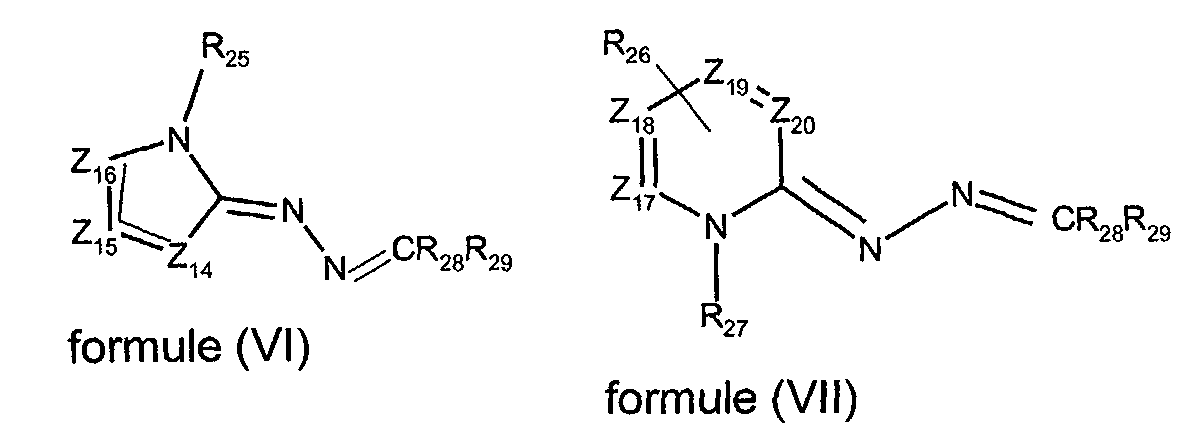
- the subject of the present invention is also a process for dyeing keratin fibers, particularly human, consisting in applying, on dry or moist fibers, a dye composition comprising at least one compound of formula (VI) or (VII) in presence of at least one oxidizing agent, and then to leave for a period of time sufficient to develop the desired color.
- the present invention makes it possible in particular to overcome stability problems direct dye in the dye composition.
- said direct dye is in the form of a precursor whose stability is improved compared to that of the dye itself.
- the dyes are synthesized in a simple way during the application of the dye composition on the fibers, or even shortly before the latter.
- the method of the invention does not require the presence of hydrazone.
- the dyes synthesized according to the process of the invention make it possible to obtain colors very chromatic, not to mention the "fundamental” nuances such as blacks and chestnuts. In addition, they are lightfast and weather resistant and to perspiration.
- an organic or inorganic anion is for example chosen from a halide such as chloride, bromide, fluoride, iodide; a hydroxide; sulphate; a hydrogen sulfate; a (C 1 -C 6 ) alkyl sulphate such as, for example, a methyl sulphate or an ethyl sulphate; an acetate; tartrate; an oxalate; a (C 1 -C 6 ) alkyl sulfonate such as methylsulfonate; an arylsulphonate which is unsubstituted or substituted with a C 1 -C 4 alkyl radical such as, for example, a 4-toluylsulphonate.
- R 0 represents a hydrogen atom; a linear or branched C 1 -C 6 alkyl radical, unsubstituted or substituted with one to three radicals chosen from hydroxyl, C 1 -C 2 alkoxy and (C 2 -C 4 ) poly (C 2 -C 4 ) polyalkylamino, ( di) alkylamino, C 1 -C 2 alkyl, (poly) hydroxyalkylamino C 2 -C 4 alkyl, carboxyl and sulfonic radicals; a phenyl radical which is unsubstituted or substituted with one to three radicals chosen from hydroxyl, C 1 -C 2 alkoxy and (C 2 -C 4 ) (poly) hydroxyalkoxy, amino, (C 1 -C 2 ) alkylamino radicals; , carboxy, sulfonic or a halogen atom such as chlorine, fluorine or bromine, an optionally
- R 0 represents a hydrogen atom; alkyl C 1 -C 3 linear or branched, unsubstituted or substituted with one to two radicals selected from hydroxy, alkoxy C 1 -C 2 alkyl, amino, (di) alkylamino, C 1 -C 2 alkyl, carboxy or sulfonic; a phenyl radical which is unsubstituted or substituted with one to two radicals chosen from hydroxyl, amino, (di) alkylamino (C 1 -C 2 ) radicals or (poly) hydroxyalkylamino (C 2 -C 4) radicals, an optionally cationic heteroaryl radical chosen from pyrazolyl, pyrrolyl, imidazolyl and pyridinyl radicals.
- R 0 represents a hydrogen atom; methyl, ethyl, propyl, butyl, 2-hydroxyethyl, 2-aminoethyl, 1-carboxymethyl, 2-carboxyethyl, 2-sulfonylethyl, 2-methoxyethyl; phenyl unsubstituted or substituted with one to two radicals selected from amino, (di) alkylamino, C 1 -C 2 alkyl, (poly) hydroxyalkylamino C 2 -C 4 alkyl, an optionally cationic heteroaryl radical chosen from the radicals pyrazolyl, pyrrolyl, imidazolyl, pyridinyl.
- R 0 represents a hydrogen atom; a methyl, ethyl, 2-methoxyethyl radical; a phenyl radical which is unsubstituted or substituted by an amino, (di) methylamino, (di) (2-hydroxyethyl) amino radical, an optionally cationic heteroaryl radical chosen from imidazolyl and pyridinyl radicals.
- the radicals R 2 , R 6 , R 10 and R 16 which may be identical or different, represent, a hydrogen atom, a phenyl radical or a C 1 -C 4 alkyl radical. unsubstituted or substituted by one to two radicals selected from hydroxy, amino, (di) alkylamino, C 1 -C 2 , carboxy radicals.
- radicals R 2 , R 6 , R 10 and R 16 represent, identical or different, a hydrogen atom, a methyl radical, phenyl, 2-hydroxymethyl, a carboxy, a phenyl radical.
- radicals R 1 , R 4 , R 5 , R 7 , R 9 , R 15 , R 21 and R 22 which may or may not be identical, more particularly represent a C 1 -C 4 alkyl radical which is unsubstituted or substituted by one to two radicals. radicals selected from hydroxy, alkoxy C 1 -C 2 alkyl, amino, (di) alkylamino, C 1 -C 2 alkyl, carboxyl and sulfonic radicals.
- the radicals R 1 , R 4 , R 5 , R 7 , R 9 , R 15 , R 21 and R 22 which may be identical or different, represent a methyl, ethyl, 2-hydroxyethyl or 1-carboxymethyl radical. carboxyethyl, 2-sulfonylethyl.
- radicals R 3 , R 8 , R 11 , R 12 , R 13 , R 14 , R 17 , R 18 , R 19 and R 20 represent an atom of hydrogen; a linear or branched C 1 -C 4 alkyl radical, unsubstituted or substituted with one to two radicals chosen from hydroxyl, C 1 -C 2 alkoxy and (C 2 -C 4 ) (poly) hydroxyalkoxy, amino radicals, (di) C 1 -C 2 alkylamino, carboxy or sulfonic acid; a phenyl radical which is unsubstituted or substituted by one or two radicals chosen from hydroxyl, C 1 -C 2 alkoxy and (C 2 -C 4 ) poly (C 2 -C 4 ) polyoxyalkyl, amino, (C 1 -C 2 ) di (C 1 -C 2 ) alkylamino radicals;
- R 3 , R 8 , R 11 , R 12 , R 13 , R 14 , R 17 , R 18 , R 19 , and R 20 represent a hydrogen atom or a C 1 -alkyl radical.
- C 1 -C 4 unsubstituted or substituted with one to two radicals selected from hydroxy radicals, a C 1 -C 2 alkoxy radical; an amino radical; a C 1 -C 2 (di) alkylamino radical; a carboxy radical; a (poly) -hydroxyalkylamino C 2 -C 4 radical.
- the radicals R 3 , R 8 , R 11 , R 12 , R 13 , R 14 , R 17 , R 18 , R 19 and R 20 which are identical or different, represent a hydrogen atom, a methyl radical, 2-hydroxymethyl, a carboxy, a methoxy, ethoxy, 2-hydroxyethyloxy radical, an amino, methylamino, dimethylamino, 2-hydroxyethylamino radical.
- a first class of particularly advantageous compounds of formula (I) corresponds to those for which, W 1 is a 2-pyridinium radical and W 2 is a 2-pyridine radical.
- Another class of compounds of formula (I) that are advantageous are those for which W 1 is a 4-pyridinium radical and W 2 is a 4-pyridine radical.
- Another class of compounds of formula (I) that are advantageous are those for which W 1 is a 2-imidazolium radical and W 2 is a 2-imidazole radical.
- Another class of compounds of formula (I) that are advantageous are those for which W 1 is a 5-pyrazolium radical and W 2 is a 5-pyrazole radical.
- Another class of compounds of formula (I) that are advantageous are those for which W 1 is a 2-benzimidazolium radical and W 2 is a 2-pyridine radical.
- Another class of compounds of formula (I) that are advantageous are those for which W 1 is a 2-benzimidazolium radical and W 2 is a 4-pyridine radical.
- Another class of compounds of formula (I) that are advantageous are those for which W 1 is a 2-imidazolium radical and W 2 is a 2-pyridine radical.
- Another class of compounds of formula (I) that are advantageous are those for which W 1 is a 2-imidazolium radical and W 2 is a 4-pyridine radical.
- Another class of compounds of formula (I) that are advantageous are those for which W 1 is a 2-benzimidazolium radical and W 2 is a 2-benzimidazole radical.
- R 28 , R 29 which may be identical or different, preferably represent a hydrogen atom, a methyl radical or a methoxy radical.
- the oxidizing agent work is selected from hydrogen peroxide; urea peroxide; peracids organic such as peracetic acid; persalts such as permanganate, perborate; persulfates; chromates or dichromates; hypochlorites; hypobromites; ferricyanides; manganese or lead oxides, alone or in mixtures.
- the oxidizing agent is hydrogen peroxide.
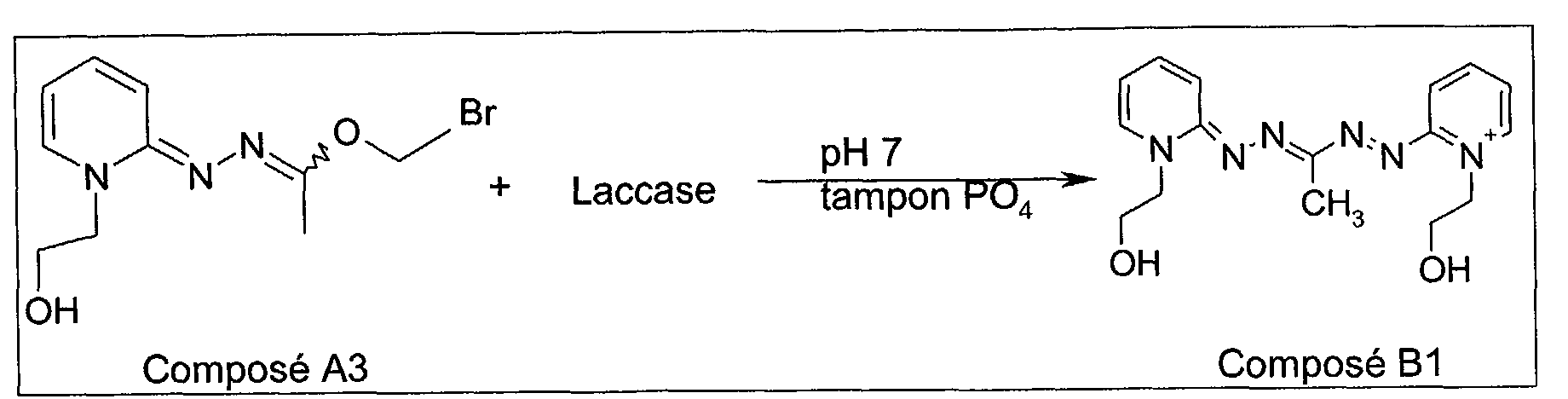
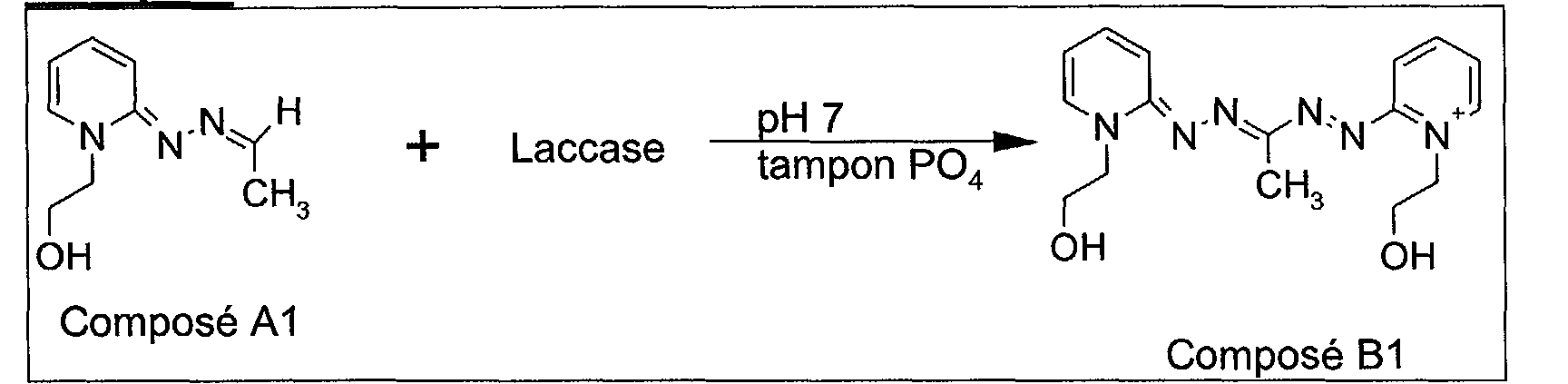
- the method is implemented in using, as an oxidizing agent, enzymes, in the presence of a substrate for said enzyme.
- the enzyme is chosen from oxidases producing hydrogen peroxide in the presence of a suitable substrate for the said enzyme.
- the enzyme is chosen from enzymes 4-electron oxidoreductases.
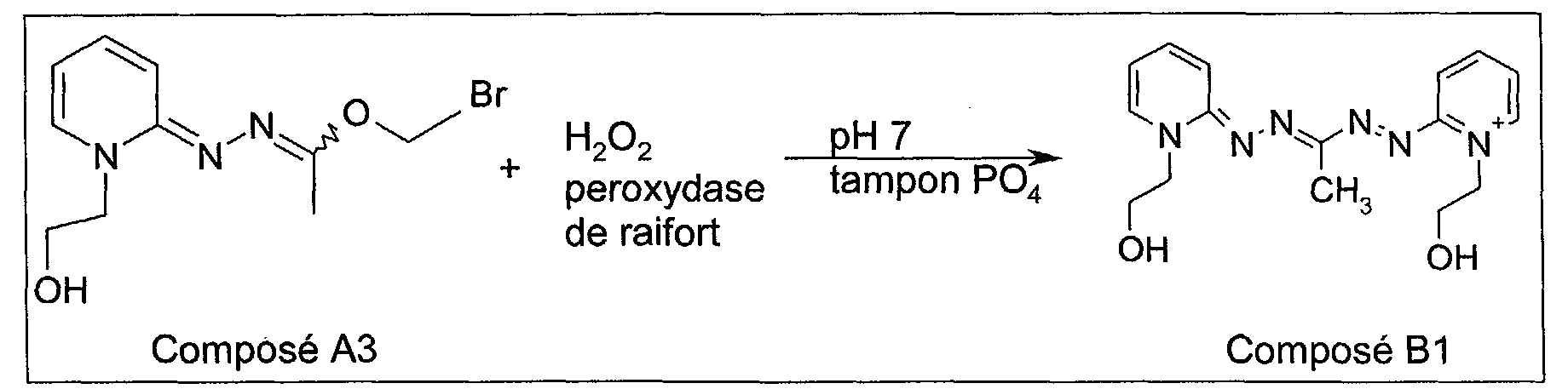
- the enzyme is chosen from the peroxidases.
- NADH peroxidase EC 1.11.1.1 NADPH peroxidase.
- EC 1.11.1.2 Fatty acid peroxidase.
- EC 1.11.1.3 Cytochrome-c peroxidase.
- EC 1.11.1.5 Peroxidase.
- EC 1.11.1.8 Glutathione peroxidase.
- EC 1.11.1.9 Chloride peroxidase.
- EC 1.11.1.11 Phospholipid-hydroperoxide glutathione peroxidase.
- reaction is carried out with or without an oxidizing system, with or without a cofactor for the enzyme, with or without a regeneration system cofactor.
- the reaction is carried out under aerobic conditions at a pH of between 3 and 11 and at a temperature of between 6 ° C and 80 ° C.
- the substrate concentration of the enzyme, whether or not the enzyme is different from azine is usually between 0.001 M and 3 M, preferably between 0.1 M and 1 M.
- the cofactor content for said enzymes can be between 0.01 mM and 1M, preferably 0.1mM and 10mM.
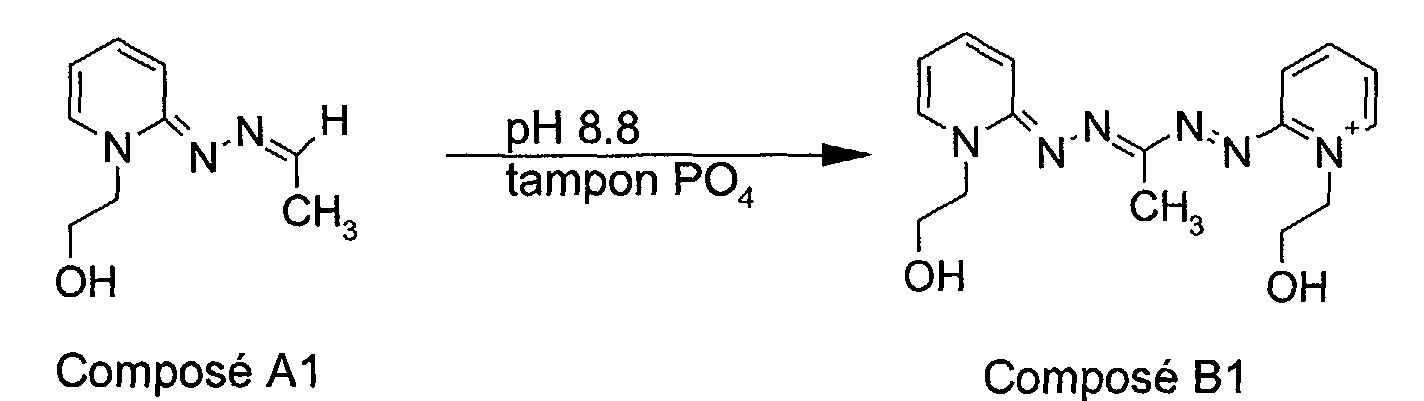
- the reaction can be carried out between pH 3 and pH 11, preferably between pH 5 and pH 9.5.
- reaction is carried out in an aqueous medium and / or in the presence of a protic solvent, preferably alcohols, polyols, polyol ethers.
- a protic solvent preferably alcohols, polyols, polyol ethers.
- the pH is adjusted, or even kept constant if necessary, by means of alkalinizing agent, acidifying, and even more advantageously using a buffer classic.
- the temperature for the reaction can be between 10 ° C. and 80 ° C. preferably between 20 ° C and 65 ° C.
- the reagents namely the azine (s) of formula (VI) and / or (VII); the enzymatic system (the enzyme (s), their substrate, their cofactor, the oxidant and / or where appropriate, the cofactor regeneration system); the oxidant, are mixed, pH and temperature are adjusted.
- the oxidizing agent can be either mixed at the time of use with the composition dye.
- the content of compound (s) of formula (VI) and / or (VII) is such that the composition comprises a content of compound (s) of formula (I) ranging from 0.001 to 10% by weight, preferably from 0.05 to 5% by weight, relative to the total weight of the dye composition.
- the content in the dyeing composition of compound (s) formula (VI) and / or (VII) is between 0.001 and 10% by weight, preferably between 0.05 and 5% by weight, relative to the total weight of the dyeing composition.
- the dye composition used in the process according to the invention may in furthermore include at least one additional direct dye.
- it is chosen from compounds different from the compounds of formula (I) which are synthesized during the reaction (either by the chemical family or by one at least substituents if the chemical family is the same).
- direct dye any type of direct dye conventionally used in the field of the hair coloring.
- nitro direct dyes Neutral, acidic or cationic benzene, neutral azo direct dyes acidic or cationic quinone direct dyes and in particular neutral, acidic or cationic anthraquinones, azine direct dyes, methine direct dyes, triarylmethane direct dyes, dyes indoamines and natural direct dyes.
- the additional direct dye (s), when present, represent more particularly from 0.001 to 20% by weight relative to the total weight of the composition dye, and preferably from 0.005 to 10% by weight relative to the total weight of the dye composition.
- composition may further comprise at least one oxidation base, optionally associated with at least one coupler.
- This oxidation base can be chosen from oxidation bases conventionally used in oxidation dyeing, for example para-phenylenediamines, bis-phenylalkylenediamines, para-aminophenols, ortho-aminophenols and bases heterocyclic.
- the dye composition comprises one or more oxidation bases
- their content is more particularly from 0.001 to 10% by weight relative to the weight total of the dyeing composition, and preferably from 0.005 to 6% by weight relative to total weight of the dye composition.
- couplers that can be used, mention may notably be made of meta-phenylenediamines, meta-aminophenols, meta-diphenols, couplers naphthalenic and heterocyclic couplers.
- the dye composition comprises such compounds
- their content represents advantageously from 0.001 to 10% by weight relative to the total weight of the dyeing composition and preferably from 0.005 to 6% by weight relative to the total weight of the dyeing composition.
- direct dyes, oxidation bases and couplers may be used in the form of an addition salt, in particular with a acid.
- acids are usually chosen from hydrochlorides, hydrobromides, sulphates, citrates, succinates, tartrates, lactates, tosylates, benzenesulfonates, phosphates and acetates.
- the middle of the dye composition also called support, is generally consisting of water or a mixture of water and at least one organic solvent for solubilize compounds that are not sufficiently soluble in water.
- organic solvent there may be mentioned, for example, C 1 -C 4 alcohols such as ethanol and isopropanol, polyols and polyol ethers such as 2-butoxyethanol, propylene glycol, propylene glycol monomethyl ether, monoethyl ether and diethylene glycol monomethyl ether, as well as aromatic alcohols such as benzyl alcohol or phenoxyethanol, and mixtures thereof.
- C 1 -C 4 alcohols such as ethanol and isopropanol
- polyols and polyol ethers such as 2-butoxyethanol
- propylene glycol propylene glycol monomethyl ether
- monoethyl ether monoethyl ether
- diethylene glycol monomethyl ether diethylene glycol monomethyl ether
- aromatic alcohols such as benzyl alcohol or phenoxyethanol
- Organic solvents may be present in preferred proportions between 1 and 40% by weight approximately relative to the total weight of the composition dyestuff, and even more preferably between 5 and 30% by weight relative to to the total weight of the dyeing composition.
- the dyeing composition according to the invention may also contain various adjuvants conventionally used in compositions for dyeing hair, such as that anionic surfactants, cationic, nonionic, amphoteric, zwitterionic or mixtures thereof, anionic, cationic, nonionic polymers, amphoteric, zwitterionic or mixtures thereof, mineral thickeners or organic compounds, and in particular anionic, cationic, nonionic associative polymers ionic and amphoteric agents, antioxidants, penetration agents, sequestering agents, perfumes, buffers, dispersing agents, such as, for example, volatile or nonvolatile silicones, modified unmodified, film-forming agents, ceramides, preservatives, opacifying agents.
- anionic surfactants cationic, nonionic, amphoteric, zwitterionic or mixtures thereof
- anionic, cationic, nonionic polymers amphoteric, zwitterionic or mixtures thereof
- mineral thickeners or organic compounds and
- the adjuvants mentioned above are generally present in an amount each of them between 0.01 and 20% by weight relative to the total weight of the composition.
- the pH of the dye composition applied during the process according to the invention is generally between about 3 and 12, and preferably between 5 and 11 or so. he can be adjusted to the desired value by means of acidifying or basifying agents usually used for dyeing keratinous fibers or else with the aid of conventional buffer systems.
- acidifying agents mention may be made, for example, of mineral acids or such as hydrochloric acid, orthophosphoric acid, sulfuric acid, carboxylic acids such as acetic acid, tartaric acid, citric acid, acid lactic acid, sulfonic acids.
- mineral acids such as hydrochloric acid, orthophosphoric acid, sulfuric acid, carboxylic acids such as acetic acid, tartaric acid, citric acid, acid lactic acid, sulfonic acids.
- alkalinizing agents mention may be made, for example, of ammonia, alkaline carbonates, alkanolamines such as mono-, di- and triethanolamines and their derivatives, sodium and potassium hydroxides and compounds of formula (III) below: in which W is a propylene residue optionally substituted with a hydroxyl group or a C 1 -C 4 alkyl radical, R a , R b , R c and R d , which may be identical or different, represent a hydrogen atom or an alkyl radical; in C 1 -C 4 or hydroxyalkyl in C 1 -C 4 .
- the triethylammonium acetate, triethylammonium formate, phosphate buffers without however, be limited.
- the dye composition may be in various forms, such as liquids, creams, gels or any other form suitable for coloring keratinous fibers, especially human fibers, and preferably the hair.
- the oxidizing composition whether it is mixed with the dye composition before the application or not, can also contain various adjuvants conventionally used in the compositions for dyeing hair and as defined above.
- the pH of the oxidizing composition containing the oxidizing agent is such that after mixture with the dyeing composition, the pH of the resulting composition applied to the keratinous fibers preferably varies between 3 and 12 approximately, and even more preferentially between 5 and 11. It can be adjusted to the desired value by means of agents acidifying, alkalizing agents or buffers, usually used for coloring fibers keratinous and as defined above.
- the exposure time during step b) depends on several criteria, including, among others, the temperature of application and application of the dye composition.
- the durations are in general between 3 and 50 minutes, preferably between 5 and 30 minutes.
- the temperature at which the composition is applied and then left to settle is usually between room temperature and 80 ° C.
- composition which is finally applied to the keratinous fibers can be present in various forms, such as in the form of liquids, creams, gels or in any other form suitable for dyeing fibers keratin, and in particular human hair.
- the reaction is stopped when the desired color is reached.
- the pause time is between 1 to 60 minutes, and preferably between 5 and 45 minutes
- the fibers are optionally rinsed, they are preferably washed with a shampoo and rinsed, then dried or let it dry.
- the reaction takes place at room temperature.
- the synthesis is stopped after 24 hours of reaction.
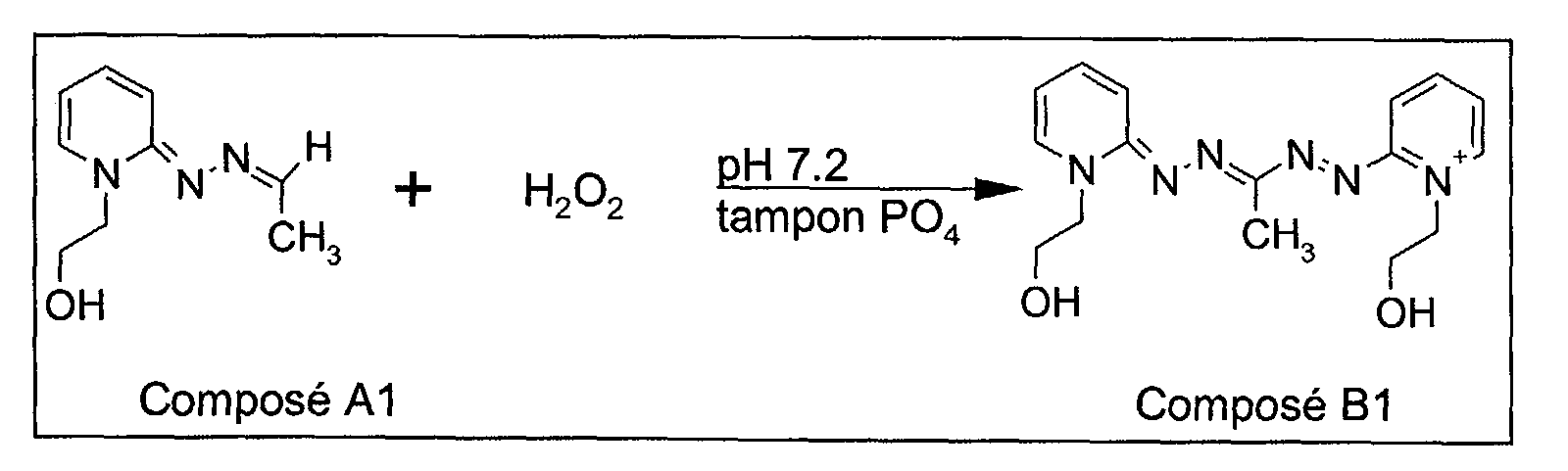
- 0.1 g azine (compound A2) is dissolved in 5 ml of a phosphate buffer (0.2M - pH 7) and adjust the pH to 7.5 with 1M sodium hydroxide solution.
- the reaction takes place at room temperature.
- the synthesis is stopped after one hour of reaction.
- the reaction takes place at room temperature.
- the synthesis is stopped after 24 hours of reaction.
- azine 50 mg are dissolved in 2.5 ml of phosphate buffer (0.2M-pH 7) and then adjust the pH to 7.5 with 1M sodium hydroxide.
- the reaction takes place at room temperature.
- the synthesis is stopped after 1 hour of reaction.
- the reaction develops at room temperature.
- the reaction develops at room temperature.
- the reaction develops at room temperature.
- the reaction develops at room temperature.
- This mixture is applied on a lock of 0.5g of hair at 90% white.
- the lock obtained is colored blue.
- azine 100 mg are dissolved in 5 ml of phosphate buffer (0.2M - pH 7.5).
- This mixture is applied on a lock of 0.5g of hair at 90% white.
- the lock obtained is colored purple.
- This mixture is applied on a lock of 0.25g of natural hair at 90% of White.
- the lock obtained is colored in green blue.
- This mixture is applied on a wick of 0.25g natural hair 90% white.
- the lock obtained is colored blue.
- This mixture is applied on a lock of 0.25g of natural hair at 90% of White.
- the lock obtained is slightly colored in green.
Landscapes
- Health & Medical Sciences (AREA)
- Life Sciences & Earth Sciences (AREA)
- Animal Behavior & Ethology (AREA)
- General Health & Medical Sciences (AREA)
- Public Health (AREA)
- Veterinary Medicine (AREA)
- Birds (AREA)
- Epidemiology (AREA)
- Chemical & Material Sciences (AREA)
- Organic Chemistry (AREA)
- Cosmetics (AREA)
- Plural Heterocyclic Compounds (AREA)
Abstract
Description

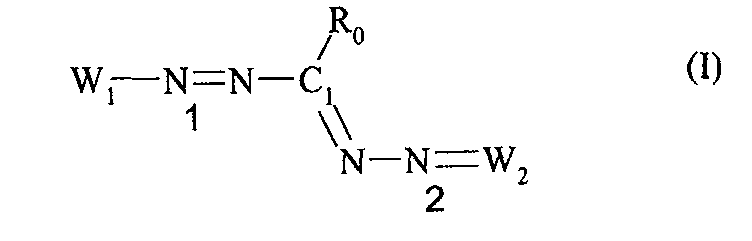
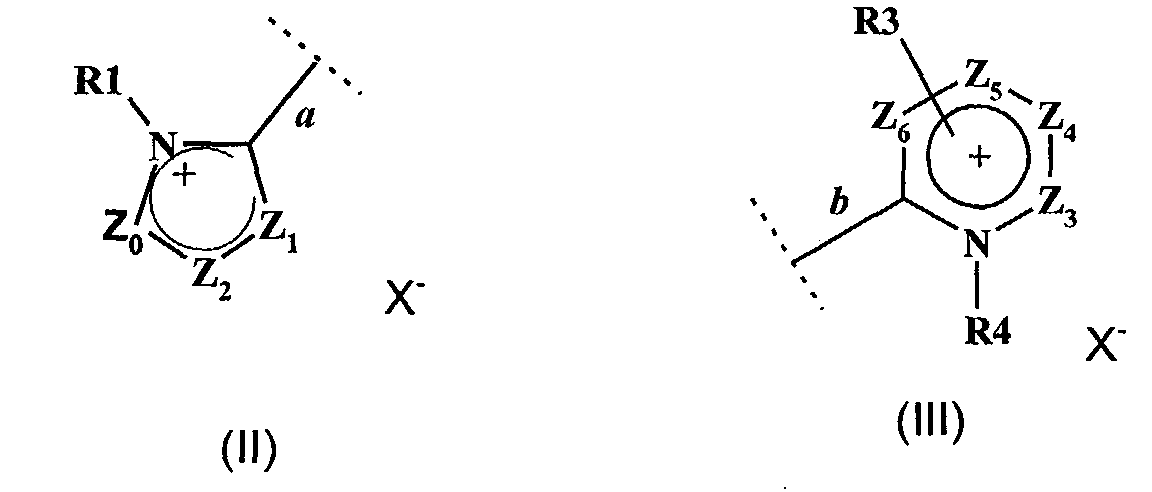
- W1 représente un radical hétéroaromatique cationique de formule (II) ou (III) :

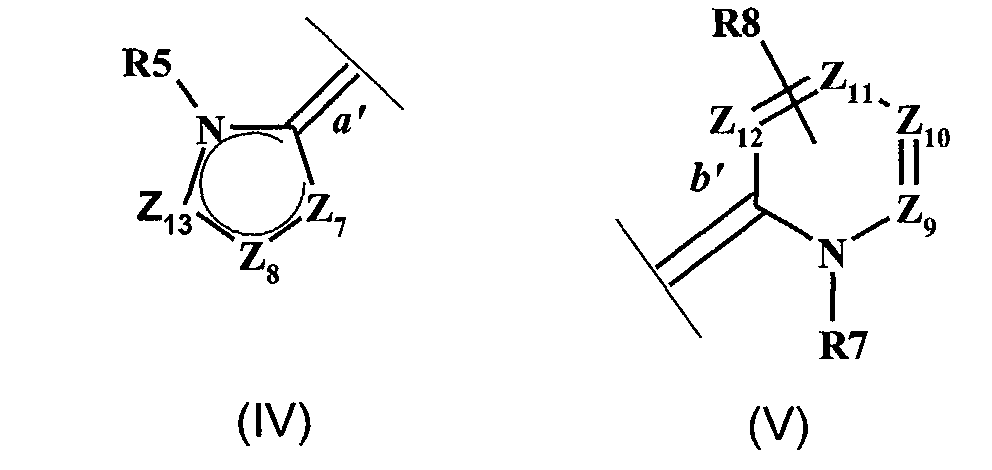
- W2 représente un radical hétéroaromatique de formule (IV) ou (V) :
dans lesquelles :
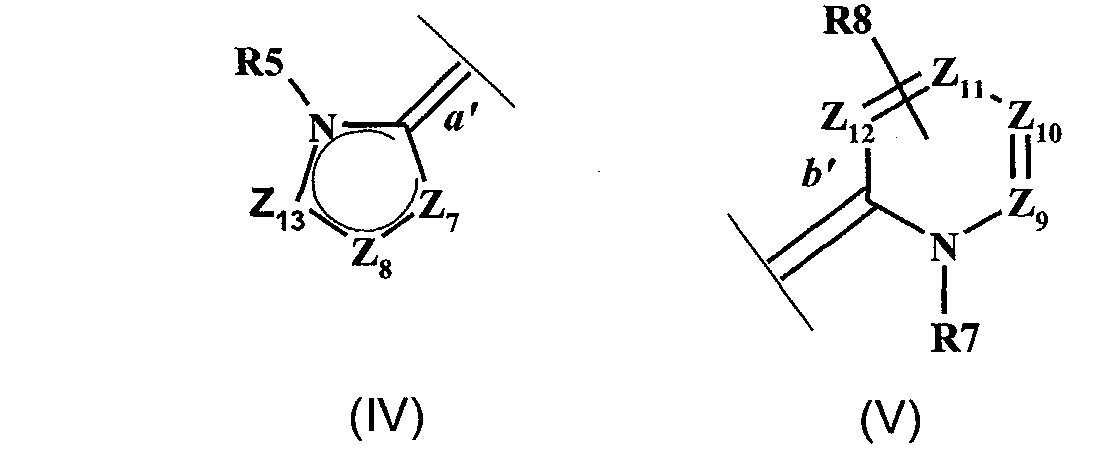
- Z0 représente un radical CR2, un atome d'azote ou un radical NR21,
- Z1 représente un atome d'oxygène, de soufre ou un radical NR9,
- Z2 représente un atome d'azote ou un radical CR10,
- Z3 représente un atome d'azote ou un radical CR11,
- Z4 représente un atome d'azote ou un radical CR12,
- Z5 représente un atome d'azote ou un radical CR13,
- Z6 représente un atome d'azote ou un radical CR14,
- Z7 représente un atome d'oxygène, de soufre ou un radical NR15,
- Z8 représente un atome d'azote ou un radical CR16,
- Z9 représente un atome d'azote ou un radical CR17,
- Z10 représente un atome d'azote ou un radical CR18,
- Z11 représente un atome d'azote ou un radical CR19,
- Z12 représente un atome d'azote ou un radical CR20,
- Z13 représente un radical CR6, un atome d'azote ou un radical NR22,
- étant entendu que chacun des cycles des formules (II), (III), (IV) et (V) ne comportent pas plus de trois atomes d'azote et que deux des trois atomes d'azote peuvent être contigus,
- la liaison a du radical hétéroaromatique cationique à 5 chaínons de la formule (II) étant reliée à l'atome d'azote N1 de la formule (I),
- la liaison b du radical hétéroaromatique cationique à 6 chaínons de la formule (III) étant reliée à l'atome d'azote N1 de la formule (I).
- la double liaison a' du radical hétéroaromatique à 5 chaínons de la formule (IV) étant reliée à l'atome d'azote N2 de la formule (I),
- la double liaison b' du radical hétéroaromatique à 6 chaínons de la formule (V) étant reliée à l'atome d'azote N2 de la formule (I),
- la liaison b, reliant le radical hétéroaromatique cationique de la formule III à l'atome d'azote N1 de la formule (I), étant située en position ortho ou para de l'atome d'azote portant le radical R4 lorsque Z5 représente un radical CR13 ; la liaison b étant située en position ortho de l'atome d'azote portant le radical R4 lorsque Z5 représente un atome d'azote,
- la liaison b', reliant le radical hétéroaromatique de la formule V à l'atome d'azote N2 de la formule (I), étant située en position ortho ou para de l'atome d'azote portant le radical R7 lorsque Z11 représente un radical CR19 ; la liaison b' étant située en position ortho de l'atome d'azote portant le radical R7 lorsque Z11 représente un atome d'azote,
- R2, R6, R10 et R16 représentent, indépendamment l'un de l'autre, un atome d'hydrogène ; un radical alkyle en C1-C4 linéaire ou ramifié, non substitué ou substitué par un à trois radicaux choisis parmi les radicaux hydroxy, alcoxy en C1-C2, (poly)-hydroxyalcoxy en C2-C4, amino, (di)alkylamino en C1-C2, carboxy ou sulfonique ; un radical phényle non substitué ou substitué par un ou deux radicaux choisis parmi les radicaux hydroxy, alcoxy en C1-C2, (poly)-hydroxyalcoxy en C2-C4, amino, (di)alkylamino en C1-C2 ; un radical carboxy ; un radical sulfonylamino,
- R1, R4, R5, R7, R9, R15, R21, et R22 représentent, indépendamment l'un de l'autre, un radical alkyle en C1-C8 linéaire ou ramifié, non substitué ou substitué par un à trois radicaux choisis parmi les radicaux hydroxy, alcoxy en C1-C2, (poly)-hydroxyalcoxy en C2-C4, amino, (di)alkylamino en C1-C2, carboxy ou sulfonique;
- R0, R3, R8, R11, R12, R13, R14, R17, R18, R19, et R20 représentent, indépendamment l'un de l'autre, un atome d'hydrogène, une chaíne hydrocarbonée en C1-C16 linéaire ou ramifiée, cette chaíne pouvant être saturée ou insaturée par une à trois insaturations, cette chaíne étant non substituée ou substituée par un à trois radicaux choisis parmi les radicaux hydroxy, alcoxy en C1-C2, (poly)-hydroxyalcoxy en C2-C4, amino, (di)alkylamino en C1-C2, carboxy, sulfonique, sulfonylamino, (poly)-hydroxyalkylamino en C2-C4 ou un atome d'halogène tel que chlore, fluor ou brome ; un radical phényle non substitué ou substitué par un à trois radicaux choisis parmi les radicaux hydroxy, alcoxy en C1-C2, (poly)-hydroxyalcoxy en C2-C4, amino, (di)alkylamino en C1-C2, carboxy, sulfonique, sulfonylamino, (poly)-hydroxyalkylamino en C2-C4 ou un atome d'halogène tel que chlore, fluor ou brome ; un radical hétéroaryle choisi parmi les radicaux pyrazolyle, pyrrolyle, imidazolyle, thiazolyle, oxazolyle, triazolyle, pyridinyle, pyrimidinyle, triazinyle, pyrazinyle, pyridazinyle, en outre cette chaíne hydrocarbonée peut être interrompue par un ou deux atomes d'oxygène, d'azote, de soufre ou par un radical SO2,
- étant entendu que R0, R3, R8, R11, R12, R13, R14, R17, R18, R19, et R20 ne comportent pas de liaison peroxyde, ni de radicaux diazo ou nitroso,
- R2 avec R10, R11 avec R12, R6 avec R16, et R17 avec R18 pouvant former indépendamment les uns des autres un cycle aromatique carboné à 5 ou 6 chaínons non substitué ou substitué par un ou deux radicaux hydroxy, amino, (di)alkyl (C1-C2) amino, alcoxy C1-C2, (poly)hydroxyalkyl C2-C4 amino,
- X est un anion organique ou minéral ;
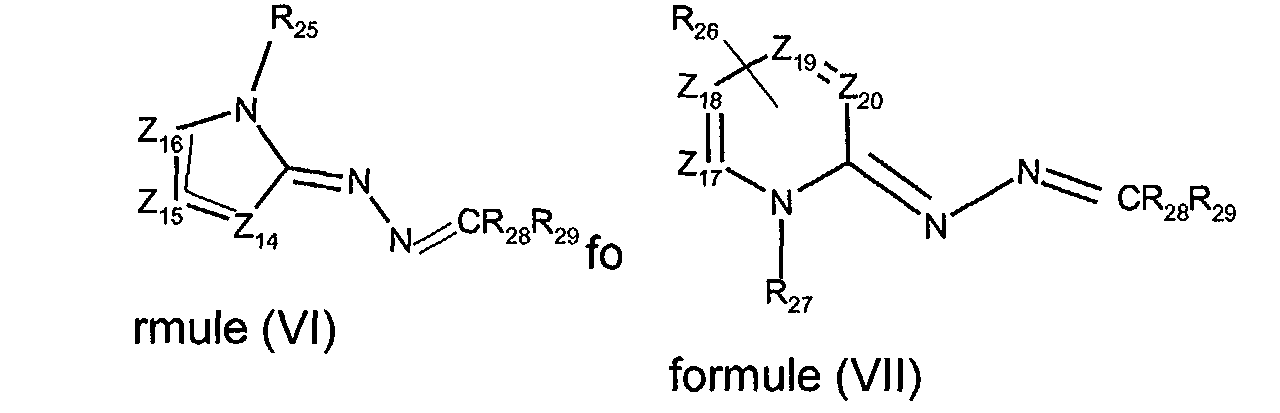
Le procédé selon l'invention consiste à faire réagir, en présence d'au moins un agent oxydant, au moins un composé azine de formule (VI) et/ou (VII) :dans lesquelles :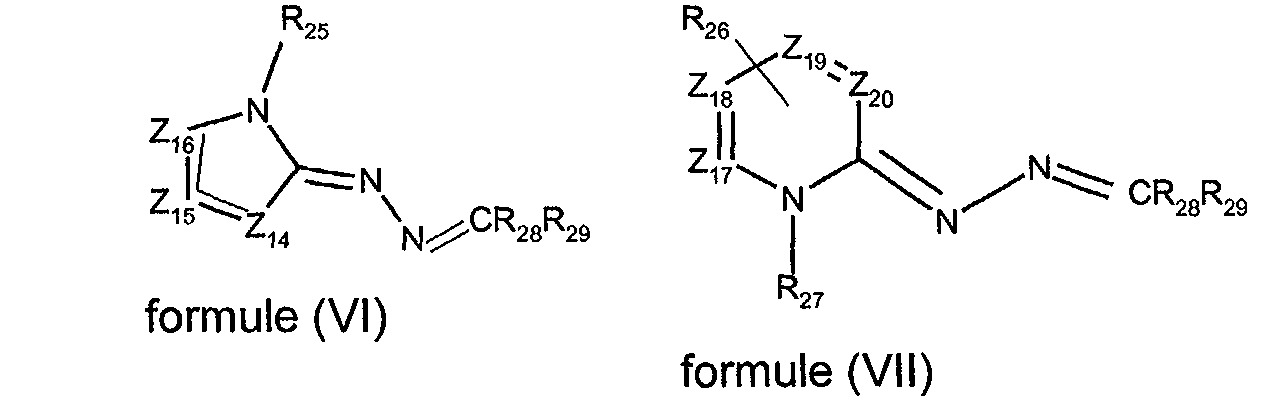
- Z14, Z15, Z16, R25 ont respectivement les mêmes significations que Z7, Z8, Z13, R5 de la formule (IV), ou que Z1, Z2, Z0, R1 de la formule (II), définies ci-dessus,
- Z17, Z18, Z19, Z20, R26, R27 ont respectivement les mêmes significations que Z9, Z10, Z11, Z12, R8, R7 de la formule (V), ou que Z3, Z4, Z5, Z6, R3, R4 de la formule (III), définies ci-dessus,
- R28, R29, indépendamment l'un de l'autre, représente un atome d'hydrogène, un radical alkyle en C1-C6, de préférence en C1-C4, un radical alcoxy, linéaire ou ramifié, en C1-C6, de préférence en C1-C4, à la condition que l'un au moins des deux radicaux soit différent de l'hydrogène.
- Chlorure de 2-[5-(N-methyl-2-pyridinylidène)-1-formazano]-N-méthylpyridinium
- Chlorure de 2-[5-(N-methyl-2-pyridinylidène)-3-méthyl-1-formazano]-N-méthyl pyridinium
- Chlorure de 2-[5-(N-methyl-2-pyridinylidène)-3-éthyl-1-formazano]-N-méthylpyridinium
- Chlorure de 2-[5-(N-méthyl-2-pyridinylidene)-3-isopropyl-1 -formazano]-N-méthyl pyridinium
- Chlorure de 2-[5-(N-methyl-2-pyridinylidène)-3-phényl-1-formazano]-N-méthyl pyridinium
- Chlorure de 2-[5-(N-méthyl-2-pyridinylidène)-3-(4'-methoxyphényl)-1-formazano]-N-méthylpyridinium
- Chlorure de 2-[5-(N-méthyl-2-pyridinylidène)-3-(4'-hydroxyphényl)-1-formazano]-N-méthylpyridinium
- Chlorure de 2-[5-(N-méthyl-2-pyridinylidène)-3-(4'-N,N-dimethylaminophényl)-1-formazano]-N-méthylpyridinium
- Chlorure de 2-[5-(4-pyrrolidino-N-méthyl-2-pyridinylidène)-1-formazano]-4-pyrrolidino-N-méthylpyridinium
- Chlorure de 2-[5-(4-pyrrolidino-N-méthyl-2-pyridinylidène)-3-méthyl-1-formazano]- 4-pyrrolidino-N-méthylpyridinium
- Chlorure de 2-[5-(4-pyrrolidino-N-méthyl-2-pyridinylidène)-3-éthyl-1-formazano]- 4-pyrrolidino-N-méthylpyridinium
- Chlorure de 2-[5-(4-pyrrolidino-N-méthyl-2-pyridinylidène)-3-isopropyl-1-formazano]- 4-pyrrolidino-N-méthylpyridinium
- Chlorure de 2-[5-(4-pyrrolidino-N-méthyl-2-pyridinylidène)-3-phenyl-1-formazano]- 4-pyrrolidino-N-méthylpyridinium
- Chlorure de 2-[5-(4-pyrrolidino-N-methyl-2-pyridinylidène)-3-(4'-methoxyphenyl)-1-formazano]- 4-pyrrolidino-N-méthylpyri-dinium
- Chlorure de 2-[5-(4-pyrrolidino-N-méthyl-2-pyridinylidène)-3-(4'-hydroxyphényl)-1-formazano]- 4-pyrrolidino-N-méthylpyridinium
- Chlorure de 2-[5-(4-pyrrolidino-N-méthyl-2-pyridinylidène)-3-(4'-N,N-diméthylamino phényl)-1-formazano]- 4-pyrrolidino-N-méthylpyridinium
- Chlorure de 2-[5-(N-hydroxyéthyl-2-pyridinylidène)-1-formazano]-N-hydroxyethyl pyridinium
- Chlorure de 2-[5-(N-hydroxyethyl-2-pyridinylidène)-3-méthyl-1-formazano]-N-hydroxy éthylpyridinium
- Chlorure de 2-[5-(N-hydroxyethyl-2-pyridinylidène)-3-éthyl-1-formazano]-N- hydroxy éthylpyridinium
- Chlorure de 2-[5-(N- hydroxyéthyl -2-pyridinylidène)-3-phényl-1-formazano]-N- hydroxy éthylpyridinium.
- Chlorure de 2-[5-(N- hydroxyéthyl -2-pyridinylidène)-3-isopropyl-1-formazano]-N-hydroxyéthylpyridinium
- Chlorure de 2-[5-(N- hydroxyéthyl-2-pyridinylidène)-3-(4'-méthoxyphényl)-1-formazano]-N- hydroxyéthyl -pyridinium
- Chlorure de 2-[5-(N- hydroxyéthyl -2-pyridinylidène)-3-(4'-hydroxyphényl)-1-formazano]-N- hydroxyéthyl -pyridinium
- Chlorure de 2-[5-(N- hydroxyéthyl -2-pyridinylidène)-3-(4'-N,N-diméthylaminophényl)-1-formazano]-N- hydroxyéthyl -pyridinium
- Chlorure de 2-[5-(N-carboxyéthyl-2-pyridinylidène)-1-formazano]-N- carboxyéthyl-pyridinium
- Chlorure de 2-[5-(N- carboxyéthyl -2-pyridinylidène)-3-méthyl-1-formazano]-N- carboxy éthyl -pyridinium
- Chlorure de 2-[5-(N- carboxyéthyl -2-pyridinylidène)-3-éthyl-1-formazano]-N- carboxy éthyl -pyridinium
- Chlorure de 2-[5-(N- carboxyéthyl -2-pyridinylidène)-3-phényl-1-formazano]-N- carboxy éthyl -pyridinium
- Chlorure de 2-[5-(N- carboxyéthyl -2-pyridinylidène)-3-isopropyl-1-formazano]-N-carboxyéthyl -pyridinium
- Chlorure de 2-[5-(N- carboxyéthyl -2-pyridinylidène)-3-(4'-méthoxyphényl)-1-formazano]-N- carboxyéthyl -pyridinium
- Chlorure de 2-[5-(N- carboxyéthyl -2-pyridinylidène)-3-(4'-hydroxyphényl)-1-formazano]-N- carboxyéthyl -pyridinium
- Chlorure de 2-[5-(N- carboxyéthyl -2-pyridinylidène)-3-(4'-N,N-diméthylaminophényl)-1-formazano]-N- carboxyéthyl -pyridinium.
- Chlorure de 4-[5-(N-méthyl-4-pyridinylidène)-1-formazano]-N-méthylpyridinium
- Chlorure de 4-[5-(N-méthyl-4-pyridinylidène)-3-méthyl-1-formazano]-N-méthyl pyridinium
- Chlorure de 4-[5-(N-méthyl-4-pyridinylidène)-3-éthyl-1-formazano]-N-méthylpyridinium
- Chlorure de 4-[5-(N-méthyl-4-pyridinylidène)-3-isopropyl-1-formazano]-N-méthyl pyridinium
- Chlorure de 4-[5-(N-méthyl-4-pyridinylidène)-3-phényl-1-formazano]-N-méthyl pyridinium
- Chlorure de 4-[5-(N-méthyl-4-pyridinylidène)-3-(4'-méthoxyphényl)-1-formazano]-N-méthylpyridinium
- Chlorure de 4-[5-(N-méthyl-4-pyridinylidène)-3-(4'-hydroxyphényl)-1-formazano]-N-méthylpyridinium
- Chlorure de 4-[5-(N-méthyl-4-pyridinylidène)-3-(4'-N,N-diméthylaminophényl)-1-formazano]-N-méthylpyridinium
- Chlorure de 4-[5-(N-hydroxyéthyl-4-pyridinylidène)-1-formazano]-N-hydroxyéthyl pyridinium
- Chlorure de 4-[5-(N-hydroxyéthyl-4-pyridinylidène)-3-méthyl-1-formazano]-N-hydroxy éthylpyridinium
- Chlorure de 4-[5-(N-hydroxyéthyl-4-pyridinylidène)-3-éthyl-1-formazano]-N- hydroxy éthylpyridinium
- Chlorure de 4-[5-(N- hydroxyéthyl -4-pyridinylidène)-3-phényl-1-formazano]-N- hydroxy éthylpyridinium
- Chlorure de 4-[5-(N- hydroxyéthyl -4-pyridinylidène)-3-isopropyl-1-formazano]-N-hydroxyéthylpyridinium
- Chlorure de 4-[5-(N- hydroxyéthyl-4-pyridinylidène)-3-(4'-méthoxyphényl)-1-formazano]-N- hydroxyéthyl -pyridinium
- Chlorure de 4-[5-(N- hydroxyéthyl -4-pyridinylidène)-3-(4'-hydroxyphényl)-1-formazano]-N- hydroxyéthyl -pyridinium
- Chlorure de 4-[5-(N- hydroxyéthyl -4-pyridinylidène)-3-(4'-N,N-diméthylaminophényl)-1-formazano]-N- hydroxyéthyl -pyridinium
- Chlorure de 4-[5-(N-carboxyéthyl-4-pyridinylidène)-1-formazano]-N- carboxyéthyl-pyridinium
- Chlorure de 4-[5-(N- carboxyéthyl -4-pyridinylidène)-3-méthyl-1-formazano]-N-carboxyéthyl -pyridinium
- Chlorure de 4-[5-(N- carboxyéthyl -4-pyridinylidène)-3-éthyl-1-formazano]-N-carboxyéthyl -pyridinium
- Chlorure de 4-[5-(N- carboxyéthyl -4-pyridinylidène)-3-phényl-1-formazano]-N-carboxyéthyl -pyridinium
- Chlorure de 4-[5-(N- carboxyéthyl -4-pyridinylidène)-3-isopropyl-1-formazano]-N-carboxyéthyl -pyridinium
- Chlorure de 4-[5-(N- carboxyéthyl -4-pyridinylidène)-3-(4'-méthoxyphényl)-1-formazano]-N- carboxyéthyl -pyridinium
- Chlorure de 4-[5-(N- carboxyéthyl -4-pyridinylidène)-3-(4'-hydroxyphényl)-1-formazano]-N- carboxyéthyl -pyridinium
- Chlorure de 4-[5-(N- carboxyéthyl -4-pyridinylidène)-3-(4'-N,N-diméthylaminophényl)-1-formazano]-N- carboxyéthyl -pyridinium.
- Chlorure de 2-[5-(1,3-diméthyl-2-imidazolidène)-1-formazano]-1,3-diméthyl-imidazolium
- Chlorure de 2-[5-(1,3-diméthyl-2-imidazolidène)-3-méthyl-1-formazano]-1,3-diméthyl-imidazolium
- Chlorure de 2-[5-(1,3-diméthyl-2-imidazolidène)-3-éthyl-1-formazano]-1,3-diméthyl-imidazolium
- Chlorure de 2-[5-(1,3-diméthyl-2-imidazolidène)-3-isopropyl-1-formazano]-1,3-diméthyl-imidazolium
- Chlorure de 2-[5-(1,3-diméthyl-2-imidazolidène)-3-phényl-1-formazano]-1,3-diméthyl-imidazolium
- Chlorure de 2-[5-(1,3-diméthyl-2-imidazolidène)-3-(4'-methoxyphenyl)-1-formazano]-1,3-diméthyl-imidazolium
- Chlorure de 2-[5-(1,3-diméthyl-2-imidazolidène)-3-(4'-hydroxyphényl)-1-formazano]-1,3-diméthyl-imidazolium
- Chlorure de 2-[5-(1,3-diméthyl-2-imidazolidène)-3-(4'-N,N-diméthylaminophényl)-1-formazano]-1,3-diméthyl-imidazolium
- Chlorure de 2-[5-(1,3-dihydroxyéthyl-2-imidazolidène)-1-formazano]-1,3-dihydroxyéthyl imidazolium
- Chlorure de 2-[5-(1,3-dihydroxyéthyl-2-imidazolidène)-3-méthyl-1-formazano]-1,3-dihydroxyéthylimidazolium
- Chlorure de 2-[5-(1,3-dihydroxyéthyl-2-imidazolidène)-3-éthyl-1-formazano]-1,3-dihydroxyéthyl -imidazolium
- Chlorure de 2-[5-(1,3-dihydroxyéthyl -2-imidazolidène)-3-phenyl-1-formazano]-1,3-dihydroxyéthyl -imidazolium
- Chlorure de 2-[5-(1,3-dihydroxyéthyl -2-imidazolidène)-3-isopropyl-1-formazano]-1,3-dihydroxyéthyl -imidazolium
- Chlorure de 2-[5-(1,3-dihydroxyéthyl-2-imidazolidène)-3-(4'-méthoxyphényl)-1-formazano]-1,3-dihydroxyéthyl -imidazolium
- Chlorure de 2-[5-(1,3-dihydroxyéthyl -2-imidazolidène)-3-(4'-hydroxyphényl)-1-formazano]-1,3-dihydroxyéthyl -imidazolium
- Chlorure de 2-[5-(1,3-dihydroxyéthyl -2-imidazolidène)-3-(4'-N,N-diméthylamino phényl)-1-formazano]-1,3-dihydroxyéthyl -imidazolium
- Chlorure de 2-[5-(1,3-dicarboxyéthyl-2-imidazolidène)-1-formazano]-1,3-dicarboxyéthyl imidazolium
- Chlorure de 2-[5-(1,3-dicarboxyéthyl -2-imidazolidène)-3-méthyl-1-formazano]-1,3-dicarboxyéthyl -imidazolium
- Chlorure de 2-[5-(1,3-dicarboxyéthyl -2-imidazolidène)-3-éthyl-1 -formazano]-1,3-dicarboxyéthyl -imidazolium
- Chlorure de 2-[5-(1,3-dicarboxyéthyl -2-imidazolidène)-3-phényl-1-formazano]-1,3-dicarboxyéthyl -imidazolium
- Chlorure de 2-[5-(1,3-dicarboxyéthyl -2-imidazolidène)-3-isopropyl-1-formazano]-1,3-dicarboxyéthyl -imidazolium
- Chlorure de 2-[5-(1,3-dicarboxyéthyl -2-imidazolidène)-3-(4'-méthoxyphényl)-1-formazano]-1,3-dicarboxyéthyl -imidazolium
- Chlorure de 2-[5-(1,3-dicarboxyéthyl -2-imidazolidène)-3-(4'-hydroxyphényl)-1-formazano]-1,3-dicarboxyéthyl -imidazolium
- Chlorure de 2-[5-(1,3-dicarboxyéthyl -2-imidazolidène)-3-(4'-N,N-diméthylamino phényl)-1-formazano]-1,3-dicarboxyéthyl -imidazolium.
- Chlorure de 5-[5-(1,2-diméthyl-5-pyrazolidène)-1-formazano]-1,2-diméthyl-pyrazolinium
- Chlorure de 5-[5-(1,2-diméthyl-5-pyrazolidène)-3-méthyl-1-formazano]-1,2-diméthyl-pyrazolinium
- Chlorure de 5-[5-(1,2-diméthyl-5-pyrazolidène)-3-éthyl-1-formazanol-1,2-diméthyl-pyrazolinium
- Chlorure de 5-[5-(1,2-diméthyl-5-pyrazolidène)-3-isopropyl-1-formazano]-1,2-diméthyl-pyrazolinium
- Chlorure de 5-[5-(1,2-diméthyl-5-pyrazolidene)-3-phényl-1-formazano]-1,2-diméthyl-pyrazolinium
- Chlorure de 5-[5-(1,2-diméthyl-5-pyrazolidène)-3-(4'-méthoxyphényl)-1-formazano]-1,2-diméthyl-pyrazolinium
- Chlorure de 5-[5-(1,2-diméthyl-5-pyrazolidène)-3-(4'-hydroxyphényl)-1-formazano]-1,2-diméthyl-pyrazolinium
- Chlorure de 5-[5-(1,2-diméthyl-5-pyrazolidène)-3-(4'-N,N-diméthylaminophényl)-1-formazano]-1,2-diméthyl-pyrazolinium
- Chlorure de 5-[5-(1,2-dihydroxyéthyl-5-pyrazolidène)-1-formazano]-1,2-dihydroxyéthyl pyrazolinium
- Chlorure de 5-[5-(1,2-dihydroxyéthyl-5-pyrazolidène)-3-méthyl-1-formazano]-1,2-dihydroxyéthylpyrazolinium
- Chlorure de 5-[5-(1,2-dihydroxyéthyl-5-pyrazolidène)-3-éthyl-1-formazano]-1,2-dihydroxyéthyl -pyrazolinium
- Chlorure de 5-[5-(1,2-dihydroxyéthyl -5-pyrazolidène)-3-phényl-1-formazano]-1,2-dihydroxyéthyl -pyrazolinium
- Chlorure de 5-[5-(1,2-dihydroxyéthyl -5-pyrazolidène)-3-isopropyl-1-formazano]-1,2-dihydroxyéthyl -pyrazolinium
- Chlorure de 5-(5-(1,2-dihydroxyéthyl-5-pyrazolidène)-3-(4'-méthoxyphényl)-1-formazano]-1,2-dihydroxyéthyl -pyrazolinium
- Chlorure de 5-[5-(1,2-dihydroxyéthyl -5-pyrazolidène)-3-(4'-hydroxyphényl)-1-formazano]-1,2-dihydroxyéthyl -pyrazolinium
- Chlorure de 5-[5-(1,2-dihydroxyéthyl -5-pyrazolidène)-3-(4'-N,N-diméthylaminophényl)-1-formazano]-1,2-dihydroxyéthyl -pyrazolinium
- Chlorure de 5-[5-(1,2-dicarboxyéthyl-5-pyrazolidène)-1-formazano]-1,2-dicarboxyéthyl-pyrazolinium
- Chlorure de 5-[5-(1,2-dicarboxyéthyl -5-pyrazolidène)-3-méthyl-1-formazano]-1,2-dicarboxyéthyl -pyrazolinium
- Chlorure de 5-[5-(1,2-dicarboxyéthyl -5-pyrazolidène)-3-éthyl-1-formazano]-1,2-dicarboxyéthyl -pyrazolinium
- Chlorure de 5-[5-(1,2-dicarboxyéthyl -5-pyrazolidène)-3-phényl-1-formazano]-1,2-dicarboxyéthyl -pyrazolinium
- Chlorure de 5-[5-(1,2-dicarboxyéthyl -5-pyrazolidène)-3-isopropyl-1-formazano]-1,2-dicarboxyéthyl -pyrazolinium
- Chlorure de 5-[5-(1,2-dicarboxyéthyl -5-pyrazolidène)-3-(4'-méthoxyphényl)-1-formazano]-1,2-dicarboxyéthyl -pyrazolinium
- Chlorure de 5-[5-(1,2-dicarboxyéthyl -5-pyrazolidène)-3-(4'-hydroxyphényl)-1-formazano]-1,2-dicarboxyéthyl -pyrazolinium
- Chlorure de 5-[5-(1,2-dicarboxyéthyl -5-pyrazolidène)-3-(4'-N,N-diméthylaminophényl)-1-formazano]-1,2-dicarboxyéthyl - pyrazolinium.
- Chlorure de 2-[5-(N-méthyl-2-pyridinylidène)-1-formazano]-1,3-diméthyl-benzimidazolium
- Chlorure de 2-[5-(N-méthyl-2-pyridinylidène)-3-méthyl-1-formazano]-1,3-diméthyl-benzimidazolium
- Chlorure de 2-[5-(N-méthyl-2-pyridinylidène)-3-éthyl-1-formazano]-1,3-diméthyl-benzimidazolium
- Chlorure de 2-[5-(N-méthyl-2-pyridinylidène)-3-isopropyl-1-formazano]-1,3-diméthyl-benzimidazolium
- Chlorure de 2-[5-(N-méthyl-2-pyridinylidène)-3-phényl-1-formazano]-1,3-diméthyl-benzimidazolium
- Chlorure de 2-[5-(N-méthyl-2-pyridinylidène)-3-(4'-méthoxyphényl)-1-formazano]-1,3-diméthyl-benzimidazolium
- Chlorure de 2-[5-(N-méthyl-2-pyridinylidène)-3-(4'-hydroxyphényl)-1-formazano]-1,3-diméthyl-benzimidazolium
- Chlorure de 2-[5-(N-méthyl-2-pyridinylidène)-3-(4'-N,N-diméthylaminophényl)-1-formazano]-1,3-diméthyl-benzimidazolium.
- Chlorure de 2-[5-(N-hydroxyéthyl-2-pyridinylidène)-1-formazano]-1,3-dihydroxyéthyl benzimidazolium
- Chlorure de 2-[5-(N-hydroxyéthyl-2-pyridinylidène)-3-méthyl-1-formazano]-1,3-dihydroxyéthylbenzimidazolium
- Chlorure de 2-[5-(N-hydroxyethyl-2-pyridinylidène)-3-éthyl-1-formazanol-1,3-dihydroxyéthyl -benzimidazolium
- Chlorure de 2-[5-(N-hydroxyéthyl-2-pyridinylidène)-3-phényl-1-formazano]-1,3-dihydroxyéthyl -benzimidazolium
- Chlorure de 2-[5-(N-hydroxyethyl-2-pyridinylidène)-3-isopropyl-1-formazano]-1,3-dihydroxyéthyl -benzimidazolium
- Chlorure de 2-[5-(N-hydroxyéthyl-2-pyridinylidène)-3-(4'-méthoxyphényl)-1-formazano]-1,3-dihydroxyéthyl -benzimidazolium
- Chlorure de 2-[5-(N-hydroxyéthyl-2-pyridinylidène)-3-(4'-hydroxyphényl)-1-formazano]-1,3-dihydroxyéthyl -benzimidazolium
- Chlorure de 2-[5-(N-hydroxyéthyl-2-pyridinylidène)-3-(4'-N,N-diméthylaminophényl)-1-formazano]-1,3-dihydroxyéthyl -benzimidazolium
- Chlorure de 2-[5-(N-carboxyéthyl-2-pyridinylidène)-1-formazano]-1,3-dicarboxyéthyl-benzimidazolium
- Chlorure de 2-[5-(N-carboxyéthyl-2-pyridinylidène)-3-méthyl-1-formazano]-1,3-dicarboxyéthyl -benzimidazolium
- Chlorure de 2-[5-(N-carboxyéthyl-2-pyridinylidène)-3-éthyl-1-formazano]-1,3-dicarboxyéthyl -benzimidazolium
- Chlorure de 2-[5-(N-carboxyéthyl-2-pyridinylidène)-3-phényl-1-formazano]-1,3-dicarboxyéthyl -benzimidazolium
- Chlorure de 2-[5-(N-carboxyéthyl-2-pyridinylidène)-3-isopropyl-1 -formazanol-1,3-dicarboxyéthyl -benzimidazolium
- Chlorure de 2-[5-(N-carboxyéthyl-2-pyridinylidène)-3-4'-méthoxyphényl)-1-formazano]-1,3-dicarboxyéthyl -benzimidazolium
- Chlorure de 2-[5-(N-carboxyéthyl-2-pyridinylidène)-3-(4'-hydroxyphényl)-1-formazano]-1,3-dicarboxyéthyl -benzimidazolium
- Chlorure de 2-[5-(N-carboxyéthyl-2-pyridinylidène)-3-(4'-N,N-diméthylaminophényl)-1-formazano]-1,3-dicarboxyéthyl -benzimidazolium.
- Chlorure de 2-[5-(N-methyl-4-pyridinylidène)-1-formazano]-1,3-diméthyl-benzimidazolium
- Chlorure de 2-[5-(N-méthyl-4-pyridinylidène)-3-méthyl-1-formazano]-1,3-diméthyl-benzimidazolium
- Chlorure de 2-[5-(N-méthyl-4-pyridinylidène)-3-éthyl-1-formazano]-1,3-diméthyl-benzimidazolium
- Chlorure de 2-[5-(N-methyl-4-pyridinylidène)-3-isopropyl-1-formazano]-1,3-diméthyl-benzimidazolium
- Chlorure de 2-[5-(N-méthyl-4-pyridinylidène)-3-phényl-1-formazano]-1,3-diméthyl-benzimidazolium
- Chlorure de 2-[5-(N-méthyl-4-pyridinylidène)-3-(4'-méthoxyphényl)-1-formazano]-1,3-diméthyl-benzimidazolium
- Chlorure de 2-[5-(N-méthyl-4-pyridinylidène)-3-(4'-hydroxyphényl)-1-formazano]-1,3-diméthyl-benzimidazolium
- Chlorure de 2-[5-(N-méthyl-4-pyridinylidène)-3-(4'-N,N-diméthylaminophényl)-1-formazano]-1,3-diméthyl-benzimidazolium
- Chlorure de 2-[5-(N-hydroxyéthyl-4-pyridinylidène)-1-formazano]-1,3-dihydroxyéthyl benzimidazolium
- Chlorure de 2-[5-(N-hydroxyethyl-4-pyridinylidène)-3-méthyl-1-formazano]-1,3-dihydroxyéthylbenzimidazolium
- Chlorure de 2-[5-(N-hydroxyéthyl-4-pyridinylidène)-3-éthyl-1-formazano]-1,3-dihydroxyéthyl -benzimidazolium
- Chlorure de 2-[5-(N-hydroxyéthyl-4-pyridinylidène)-3-phényl-1-formazano]-1,3-dihydroxyéthyl -benzimidazolium
- Chlorure de 2-[5-(N-hydroxyéthyl-4-pyridinylidène)-3-isopropyl-1-formazano]-1,3-dihydroxyéthyl -benzimidazolium
- Chlorure de 2-[5-(N-hydroxyéthyl-4-pyridinylidène)-3-(4'-méthoxyphényl)-1-formazano]-1,3-dihydroxyéthyl -benzimidazolium
- Chlorure de 2-[5-(N-hydroxyéthyl-4-pyridinylidène)-3-(4'-hydroxyphényl)-1-formazano]-1,3-dihydroxyéthyl -benzimidazolium
- Chlorure de 2-[5-(N-hydroxyéthyl-4-pyridinylidène)-3-(4'-N,N-diméthylaminophényl)-1-formazano]-1,3-dihydroxyéthyl -benzimidazolium
- Chlorure de 2-[5-(N-carboxyéthyl-4-pyridinylidène)-1-formazano]-1,3-dicarboxyéthyl-benzimidazolium
- Chlorure de 2-[5-(N-carboxyéthyl-4-pyridinylidène)-3-méthyl-1-formazanol-1,3-dicarboxyéthyl -benzimidazolium
- Chlorure de 2-[5-(N-carboxyéthyl-4-pyridinylidène)-3-éthyl-1-formazano]-1,3-dicarboxy éthyl -benzimidazolium
- Chlorure de 2-[5-(N-carboxyéthyl-4-pyridinylidène)-3-phényl-1-formazano]-1,3-dicarboxyéthyl -benzimidazolium
- Chlorure de 2-[5-(N-carboxyéthyl-4-pyridinylidène)-3-isopropyl-1-formazano]-1,3-dicarboxyéthyl -benzimidazolium
- Chlorure de 2-[5-(N-carboxyéthyl-4-pyridinylidène)-3-(4'-méthoxyphényl)-1-formazano]-1,3-dicarboxyéthyl -benzimidazolium
- Chlorure de 2-[5-(N-carboxyéthyl-4-pyridinylidène)-3-(4'-hydroxyphényl)-1-formazano]-1,3-dicarboxyéthyl -benzimidazolium.
- Chlorure de 2-[5-(N-carboxyéthyl-4-pyridinylidène)-3-(4'-N,N-diméthylaminophényl)-1-formazano]-1,3-dicarboxyéthyl -benzimidazolium
- Chlorure de 2-[5-(N-méthyl-2-pyridinylidène)-1-formazano]-1,3-diméthyl-imidazolium
- Chlorure de 2-[5-(N-méthyl-2-pyridinylidène)-3-méthyl-1-formazano]-1,3-diméthyl-imidazolium
- Chlorure de 2-[5-(N-méthyl-2-pyridinylidène)-3-éthyl-1-formazano]-1,3-diméthyl-imidazolium
- Chlorure de 2-[5-(N-méthyl-2-pyridinylidène)-3-isopropyl-1-formazano]-1,3-diméthyl-imidazolium
- Chlorure de 2-[5-(N-méthyl-2-pyridinylidène)-3-phényl-1-formazano]-1,3-diméthyl-imidazolium
- Chlorure de 2-[5-(N-méthyl-2-pyridinylidène)-3-(4'-méthoxyphényl)-1-formazano]-1,3-diméthyl-imidazolium
- Chlorure de 2-[5-(N-méthyl-2-pyridinylidène)-3-(4'-hydroxyphényl)-1-formazano]-1,3-diméthyl-imidazolium
- Chlorure de 2-[5-(N-méthyl-2-pyridinylidène)-3-(4'-N,N-diméthylaminophényl)-1-formazano]-1,3-diméthyl-imidazolium.
- Chlorure de 2-[5-(N-hydroxyéthyl-2-pyridinylidène)-1-formazano]-1,3-dihydroxyéthyl imidazolium
- Chlorure de 2-[5-(N-hydroxyéthyl-2-pyridinylidène)-3-méthyl-1-formazano]-1,3-dihydroxyéthylimidazolium
- Chlorure de 2-[5-(N-hydroxyéthyl-2-pyridinylidène)-3-éthyl-1-formazanol-1,3-dihydroxyéthyl -imidazolium
- Chlorure de 2-[5-(N-hydroxyéthyl-2-pyridinylidène)-3-phényl-1-formazano]-1,3-dihydroxyéthyl -imidazolium
- Chlorure de 2-[5-(N-hydroxyéthyl-2-pyridinylidène)-3-isopropyl-1-formazano]-1,3-dihydroxyéthyl -imidazolium
- Chlorure de 2-[5-(N-hydroxyéthyl-2-pyridinylidène)-3-(4'-méthoxyphényl)-1-formazano]-1,3-dihydroxyéthyl -imidazolium
- Chlorure de 2-[5-(N-hydroxyéthyl-2-pyridinylidène)-3-(4'-hydroxyphényl)-1-formazano]-1,3-dihydroxyéthyl -imidazolium
- Chlorure de 2-[5-(N-hydroxyéthyl-2-pyridinylidène)-3-(4'-N,N-diméthylaminophényl)-1-formazano]-1,3-dihydroxyéthyl -imidazolium
- Chlorure de 2-[5-(N-carboxyéthyl-2-pyridinylidène)-1-formazano]-1,3-dicarboxyéthyl-imidazolium
- Chlorure de 2-[5-(N-carboxyéthyl-2-pyridinylidène)-3-méthyl-1-formazano]-1,3-dicarboxyéthyl -imidazolium
- Chlorure de 2-[5-(N-carboxyéthyl-2-pyridinylidène)-3-éthyl-1-formazanol-1,3-dicarboxyéthyl -imidazolium
- Chlorure de 2-[5-(N-carboxyéthyl-2-pyridinylidène)-3-phényl-1-formazano]-1,3-dicarboxyéthyl -imidazolium
- Chlorure de 2-[5-(N-carboxyéthyl-2-pyridinylidène)-3-isopropyl-1-formazano]-1,3-dicarboxyéthyl -imidazolium
- Chlorure de 2-[5-(N-carboxyéthyl-2-pyridinylidène)-3-(4'-méthoxyphényl)-1-formazano]-1,3-dicarboxyéthyl -imidazolium
- Chlorure de 2-[5-(N-carboxyéthyl-2-pyridinylidène)-3-(4'-hydroxyphényl)-1-formazano]-1,3-dicarboxyéthyl -imidazolium
- Chlorure de 2-[5-(N-carboxyéthyl-2-pyridinylidène)-3-(4'-N,N-diméthylaminophényl)-1-formazano]-1,3-dicarboxyéthyl -imidazolium
- Chlorure de 2-[5-(N-méthyl-4-pyridinylidène)-1-formazano]-1,3-diméthyl-imidazolium
- Chlorure de 2-[5-(N-méthyl-4-pyridinylidène)-3-méthyl-1-formazano]-1,3-diméthyl-imidazolium
- Chlorure de 2-[5-(N-méthyl-4-pyridinylidène)-3-éthyl-1-formazano]-1,3-diméthyl-imidazolium
- Chlorure de 2-[5-(N-méthyl-4-pyridinylidène)-3-isopropyl-1-formazano]-1,3-diméthyl-imidazolium
- Chlorure de 2-[5-(N-méthyl-4-pyridinylidène)-3-phényl-1-formazano]-1,3-diméthyl-imidazolium
- Chlorure de 2-[5-(N-méthyl-4-pyridinylidène)-3-(4'-méthoxyphényl)-1-formazano]-1,3-diméthyl-imidazolium
- Chlorure de 2-[5-(N-méthyl-4-pyridinylidène)-3-(4'-hydroxyphényl)-1-formazano]-1,3-diméthyl-imidazolium
- Chlorure de 2-[5-(N-méthyl-4-pyridinylidène)-3-(4'-N,N-diméthylaminophényl)-1-formazano]-1,3-diméthyl-imidazolium
- Chlorure de 2-[5-(N-hydroxyéthyl-4-pyridinylidène)-1-formazano]-1,3-dihydroxyéthyl imidazolium
- Chlorure de 2-[5-(N-hydroxyéthyl-4-pyridinylidène)-3-méthyl-1-formazano]-1,3-dihydroxyéthylimidazolium
- Chlorure de 2-[5-(N-hydroxyeéhyl-4-pyridinylidène)-3-éthyl-1-formazano]-1,3-dihydroxyéthyl -imidazolium
- Chlorure de 2-[5-(N-hydroxyéthyl-4-pyridinylidène)-3-phényl-1-formazano]-1,3-dihydroxyéthyl -imidazolium
- Chlorure de 2-[5-(N-hydroxyéthyl-4-pyridinylidène)-3-isopropyl-1-formazano]-1,3-dihydroxyéthyl -imidazolium
- Chlorure de 2-[5-(N-hydroxyéthyl-4-pyridinylidène)-3-(4'-méthoxyphényl)-1-formazano]-1,3-dihydroxyéthyl -imidazolium
- Chlorure de 2-[5-(N-hydroxyéthyl-4-pyridinylidène)-3-(4'-hydroxyphényl)-1-formazano]-1,3-dihydroxyéthyl -imidazolium
- Chlorure de 2-[5-(N-hydroxyéthyl-4-pyridinylidène)-3-(4'-N,N-diméthylaminophényl)-1-formazano]-1,3-dihydroxyéthyl -imidazolium
- Chlorure de 2-[5-(N-carboxyéthyl-4-pyridinylidène)-1-formazano]-1,3-dicarboxyéthyl-imidazolium
- Chlorure de 2-[5-(N-carboxyéthyl-4-pyridinylidène)-3-méthyl-1-formazano]-1,3-dicarboxyéthyl -imidazolium
- Chlorure de 2-[5-(N-carboxyéthyl-4-pyridinylidène)-3-éthyl-1-formazanol-1,3-dicarboxyéthyl -imidazolium
- Chlorure de 2-[5-(N-carboxyéthyl-4-pyridinylidène)-3-phényl-1-formazano]-1,3-dicarboxyéthyl -imidazolium
- Chlorure de 2-[5-(N-carboxyéthyl-4-pyridinylidène)-3-isopropyl-1-formazano]-1,3-dicarboxyéthyl -imidazolium
- Chlorure de 2-[5-(N-carboxyéthyl-4-pyridinylidène)-3-(4'-méthoxyphényl)-1-formazano]-1,3-dicarboxyéthyl -imidazolium
- Chlorure de 2-[5-(N-carboxyéthyl-4-pyridinylidène)-3-(4'-hydroxyphényl)-1-formazano]-1,3-dicarboxyéthyl -imidazolium
- Chlorure de 2-[5-(N-carboxyéthyl-4-pyridinylidène)-3-(4'-N,N-diméthylaminophényl)-1-formazano]-1,3-dicarboxyéthyl-imidazolium.
- Chlorure de 2-[5-(1,3-diméthyl-2-benzimidazolidène)-1-formazano]-1,3-diméthyl-benzimidazolium
- Chlorure de 2-[5-(1,3-diméthyl-2-benzimidazolidène)-3-méthyl-1-formazano]-1,3-diméthyl-benzimidazolium
- Chlorure de 2-[5-(1,3-diméthyl-2-benzimidazolidène)-3-éthyl-1-formazano]-1,3-diméthyl-benzimidazolium
- Chlorure de 2-[5-(1,3-diméthyl-2-benzimidazolidène)-3-isopropyl-1-formazano]-1,3-diméthyl-benzimidazolium
- Chlorure de 2-[5-(1,3-diméthyl-2-benzimidazolidene)-3-phényl-1-formazano]-1,3-diméthyl-benzimidazolium
- Chlorure de 2-[5-(1,3-diméthyl-2-benzimidazolidène)-3-(4'-méthoxyphényl)-1-formazano]-1,3-diméthyl-benzimidazolium
- Chlorure de 2-[5-(1,3-diméthyl-2-benzimidazolidène)-3-(4'-hydroxyphényl)-1-formazano]-1,3-diméthyl-benzimidazolium
- Chlorure de 2-[5-(1,3-diméthyl-2-benzimidazolidène)-3-(4'-N,N-dimethylaminophényl)-1-formazano]-1,3-diméthyl-benzimidazotium
- Chlorure de 2-[5-(1,3-dihydroxyéthyl-2-benzimidazolidène)-1-formazano]-1,3-dihydroxyéthylbenzimidazolium
- Chlorure de 2-[5-(1,3-dihydroxyéthyl-2-benzimidazolidène)-3-méthyl-1-formazano]-1,3-dihydroxyéthylbenzimidazolium
- Chlorure de 2-[5-(1,3-dihydroxyéthyl-2-benzimidazolidène)-3-ethyl-1-formazano]-1,3-dihydroxyéthyl -benzimidazolium
- Chlorure de 2-[5-(1,3-dihydroxyéthyl -2-benzimidazolidène)-3-phenyl-1-formazano]-1,3-dihydroxyéthyl -benzimidazolium
- Chlorure de 2-[5-(1,3-dihydroxyéthyl -2-benzimidazolidène)-3-isopropyl-1-formazano]-1,3-dihydroxyéthyl -benzimidazolium
- Chlorure de 2-[5-(1,3-dihydroxyéthyl-2-benzimidazolidène)-3-(4'-methoxyphényl)-1-formazano]-1,3-dihydroxyéthyl -benzimidazolium
- Chlorure de 2-[5-(1,3-dihydroxyéthyl -2-benzimidazolidène)-3-(4'-hydroxyphényl)-1-formazano]-1,3-dihydroxyéthyl -benzimidazolium
- Chlorure de 2-[5-(1,3-dihydroxyéthyl -2-benzimidazolidène)-3-(4'-N,N-dimethylaminophenyl)-1-formazano]-1,3-dihydroxyéthyl -benzimidazolium
- Chlorure de 2-[5-(1,3-dicarboxyéthyl-2-benzimidazolidène)-1-formazano]-1,3-dicarboxyéthyl -benzimidazolium
- Chlorure de 2-[5-(1,3-dicarboxyéthyl -2-benzimidazolidène)-3-méthyl-1-formazano]-1,3-dicarboxyéthyl -benzimidazolium
- Chlorure de 2-[5-(1,3-dicarboxyéthyl -2-benzimidazolidène)-3-ethyl-1-formazano]-1,3-dicarboxyéthyl -benzimidazolium
- Chlorure de 2-[5-(1,3-dicarboxyéthyl -2-benzimidazolidène)-3-phenyl-1-formazano]-1,3-dicarboxyéthyl -benzimidazolium
- Chlorure de 2-[5-(1,3-dicarboxyéthyl -2-benzimidazolidène)-3-isopropyl-1-formazano]-1,3-dicarboxyéthyl -benzimidazolium
- Chlorure de 2-[5-(1,3-dicarboxyéthyl -2-benzimidazolidène)-3-(4'-methoxyphényl)-1-formazano]-1,3-dicarboxyéthyl -benzimidazolium
- Chlorure de 2-[5-(1,3-dicarboxyéthyl -2-benzimidazolidène)-3-(4'-hydroxyphényl)-1-formazano]-1,3-dicarboxyéthyl -benzimidazolium
- Chlorure de 2-[5-(1,3-dicarboxyéthyl -2-benzimidazolidène)-3-(4'-N,N-diméthylamino phényl)-1-formazano]-1,3-dicarboxyéthyl - benzimidazolium.
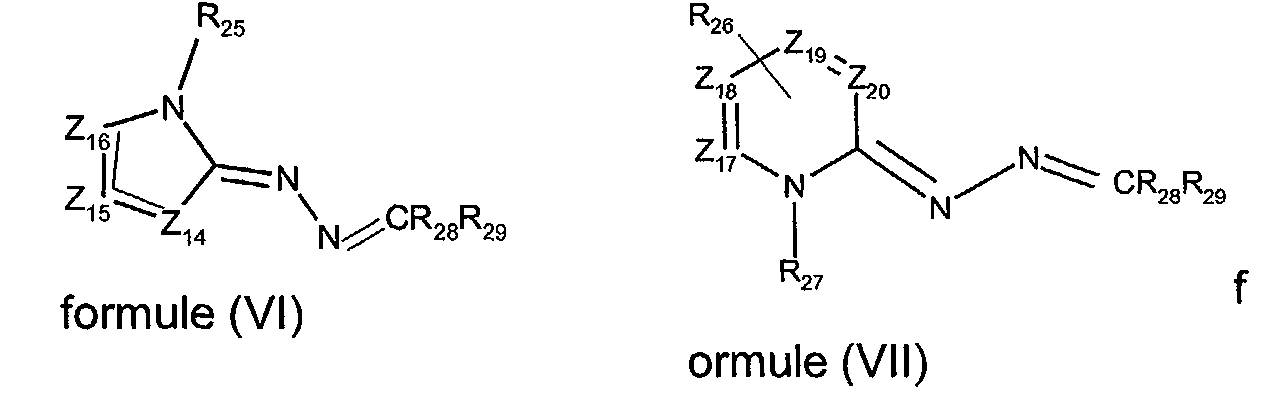
- Z14, Z15, Z16, R25 ont respectivement les mêmes significations que Z7, Z8, Z13, R5 de la formule (IV), ou que Z1, Z2, Z0, R1 de la formule (II), définies ci-dessus,
- Z17, Z18, Z19, Z20, R26, R27 ont respectivement les mêmes significations que Z9, Z10, Z11, Z12, R8, R7 de la formule (V), ou que Z3, Z4, Z5, Z6, R3, R4 de la formule (III), définies ci-dessus,
- R28, R29, indépendamment l'un de l'autre, représente un atome d'hydrogène, un radical alkyle en C1-C6, de préférence en C1-C4, un radical alcoxy, linéaire ou ramifié, en C1-C6, de préférence en C1-C4, à la condition que l'un au moins des deux radicaux soit différent de l'hydrogène.
| PYRANOSE OXIDASE | EC 1.1.3.10 |
| L-SORBOSE OXIDASE | EC 1.1.3.11 |
| PYRIDOXINE 4 - OXIDASE | EC 1.1.3.12 |
| ALCOHOL OXIDASE | EC 1.1.3.13 |
| CATECHOL OXIDASE (DIMERIZING). | EC 1.1.3.14 |
| (S)-2-HYDROXY-ACID OXIDASE. | EC 1.1.3.15 |
| ECDYSONE OXIDASE | EC 1.1.3.16 |
| CHOLINE OXIDASE | EC 1.1.3.17 |
| SEC - ALCOHOL OXIDASE | EC 1.1.3.18 |
| 4 - HYDROXYMANDALATE OXIDASE | EC 1.1.3.19 |
| LONG-CHAIN-ALCOHOL OXIDASE. | EC 1.1.3.20 |
| GLYCEROL-3-PHOSPHATE OXIDASE. | EC 1.1.3.21 |
| XANTHINE OXIDASE | EC 1.1.3.22 |
| THIAMIN OXIDASE | EC 1.1.3.23 |
| L - GALACTONOLACTONE OXIDASE | EC 1.1.3.24 |
| CELLOBIOSE OXIDASE | EC 1.1.3.25 |
| HYDROXYPHYTANATE OXIDASE | EC 1.1.3.27 |
| NUCLEOSIDE OXIDASE. | EC 1.1.3.28 |
| N-ACYLHEXOSAMINE OXIDASE | EC 1.1.3.29 |
| MALATE OXIDASE | EC 1.1.3.3 |
| POLYVINYL-ALCOHOL OXIDASE. | EC 1.1.3.30 |
| METHANOL OXIDASE. | EC 1.1.3.31 |
| D-ARABINONO-1,4-LACTONE OXIDASE. | EC 1.1.3.37 |
| VANILLYL-ALCOHOL OXIDASE. | EC 1.1.3.38 |
| NUCLEOSIDE OXIDASE (H(2)O(2)-FORMING). | EC 1.1.3.39 |
| GLUCOSE OXIDASE | EC 1.1.3.4 |
| D-MANNITOL OXIDASE. | EC 1.1.3.40 |
| XYLITOL OXIDASE. | EC 1.1.3.41 |
| HEXOSE OXIDASE | EC 1.1.3.5 |
| CHOLESTROL OXIDASE | EC 1.1.3.6 |
| ARYL ALCOHOL AOXIDASE | EC 1.1.3.7 |
| L-GULONOLACTONE OXIDASE. | EC 1.1.3.8 |
| GALACTOSE OXIDASE | EC 1.1.3.9 |
| PTERIDINE OXIDASE | EC 1.17.3.1 |
| RETINAL OXIDASE | EC 1.2.3.11 |
| ALDEHYDE OXIDASE. | EC 1.2.3.1 |
| CARBON MONOXIDE OXIDASE | EC 1.2.3.10 |
| VANILLATE DEMETHYLASE | EC 1.2.3.12 |
| 4-HYDROXYPHENYLPYRUVATE OXIDASE. | EC 1.2.3.13 |
| PYRUVATE OXIDASE | EC 1.2.3.3 |
| OXALATE OXIDASE | EC 1.2.3.4 |
| GLYOXALATE OXIDASE | EC 1.2.3.5 |
| PYRUVATE OXIDASE (CO-A ACETYLATING) | EC 1.2.3.6 |
| INDOLE-3-ACETALDEHYDE OXIDASE. | EC 1.2.3.7 |
| PYRIDOXAL OXIDASE. | EC 1.2.3.8 |
| ARYL ALDEHYDE OXIDASE | EC 1.2.3.9 |
| DUHYDROOROTATE OXIDASE | EC 1.3.3.1 |
| LATHOSTEROL OXIDASE | EC 1.3.3.2 |
| COPROPORPHYRINOGEN OXIDASE. | EC 1.3.3.3 |
| PROTOPORPHYRINOGEN OXIDASE. | EC 1.3.3.4 |
| BILIRUBIN OXIDASE. | EC 1.3.3.5 |
| ACYL CO-A OXIDASE | EC 1.3.3.6 |
| DIHYDROURACIL OXIDASE | EC 1.3.3.7 |
| TETRAHYDROBERBERINE OXIDASE | EC 1.3.3.8 |
| SECOLOGANIN SYNTHASE. | EC 1.3.3.9 |
| ASPARTATE OXIDASE | EC 1.4.3.1 |
| PUTRESCINE OXIDASE | EC 1.4.3.10 |
| L-GLUTAMATE OXIDASE | EC 1.4.3.11 |
| CYCLOHEXYLAMINE OXIDASE. | EC 1.4.3.12 |
| PROTEIN-LYSINE 6-OXIDASE | EC 1.4.3.13 |
| L-LYSINE OXIDASE | EC 1.4.3.14 |
| D-GLUTAMATE (D-ASPARTATE) OXIDASE | EC 1.4.3.15 |
| L-ASPARTATE OXIDASE | EC 1.4.3.16 |
| TRYPTOPHAN ALPHA,BETA-OXIDASE | EC 1.4.3.17 |
| GLYCINE OXIDASE. | EC 1.4.3.19 |
| L-AMINO ACID OXIDASE | EC 1.4.3.2 |
| D-AMINO ACID OXIDASE | EC 1.4.3.3 |
| AMINE OXIDASE (FLAVIN CONTAINING) | EC 1.4.3.4 |
| PYRIDOXAMINE PHOSPHATE OXIDASE | EC 1.4.3.5 |
| AMINE OXIDASE (COPPER CONTAINING) | EC 1.4.3.6 |
| D-GLUTAMATE OXIDASE | EC 1.4.3.7 |
| ETHANOLAMINE OXIDASE | EC 1.4.3.8 |
| SARCOSINE OXIDASE | EC 1.5.3.1 |
| DIMETHYLGLYCINE OXIDASE | EC 1.5.3.10 |
| POLYAMINE OXIDASE | EC 1.5.3.11 |
| DIHYDROBENZOPHENANTHRIDINE OXIDASE. | EC 1.5.3.12 |
| N-METHY-L-L-AMINO ACID OXIDASE | EC 1.5.3.2 |
| N-METHYL-LYSINE OXIDASE | EC 1.5.3.4 |
| (S)-6-HYDROXYNICOTINE OXIDASE | EC 1.5.3.5 |
| (R)-6-HYDROXYNICOTINE OXIDASE. | EC 1.5.3.6 |
| L-PIPECOLATE OXIDASE | EC 1.5.3.7 |
| RETICULATE OXIDASE | EC 1.5.3.9 |
| NITROETHANE OXIDASE | EC 1.7.3.1 |
| ACETYLINDOXYL OXIDASE. | EC 1.7.3.2 |
| URATE OXIDASE | EC 1.7.3.3 |
| HYDROXYLAMINE OXIDASE. | EC 1.7.3.4 |
| 3-ACYL-NITROPROPANOATE OXIDASE. | EC 1.7.3.5 |
| SULFITE OXIDASE | EC 1.8.3.1 |
| THIOL OXIDASE | EC 1.8.3.2 |
| GLUTATHIONE OXIDASE. | EC 1.8.3.3 |
| METHANETHIOL OXIDASE | EC 1.8.3.4 |
| PRENYLCYSTEINE OXIDASE. | EC 1.8.3.5 |
| NADH peroxidase. | E.C 1.11.1.1 |
| NADPH peroxidase. | E.C 1.11.1.2 |
| Fatty acid peroxidase. | E.C 1.11.1.3 |
| Cytochrome-c peroxidase. | E.C 1.11.1.5 |
| Peroxidase. | E.C 1.11.1.7 |
| lodide peroxidase. | E.C 1.11.1.8 |
| Glutathione peroxidase. | E.C 1.11.1.9 |
| Chloride peroxidase. | E.C 1.11.1.10 |
| L-ascorbate peroxidase. | E.C 1.11.1.11 |
| Phospholipid-hydroperoxide glutathione peroxidase. | E.C 1.11.1.12 |
| Manganese peroxidase. | E.C 1.11.1.13 |
| Diarylpropane peroxidase. | E.C 1.11.1.14 |
| Tryptophan 2,3-dioxygenase. | E.C 1.13.11.11 |
| Lipoxygenase. | E.C 1.13.11.12 |





Claims (34)
consistant à faire réagir, en présence d'au moins un agent oxydant, au moins un composé azine de formule (VI) et/ou (VII) :
en présence d'un agent oxydant ;
Applications Claiming Priority (2)
| Application Number | Priority Date | Filing Date | Title |
|---|---|---|---|
| FR0314655 | 2003-12-12 | ||
| FR0314655A FR2863487B1 (fr) | 2003-12-12 | 2003-12-12 | Synthese de composes tetraazapentamethiniques, procede de coloration de fibres keratiniques mettant en oeuvre cette synthese |
Publications (2)
| Publication Number | Publication Date |
|---|---|
| EP1548006A1 true EP1548006A1 (fr) | 2005-06-29 |
| EP1548006B1 EP1548006B1 (fr) | 2007-09-05 |
Family
ID=34531311
Family Applications (1)
| Application Number | Title | Priority Date | Filing Date |
|---|---|---|---|
| EP04292885A Expired - Lifetime EP1548006B1 (fr) | 2003-12-12 | 2004-12-06 | Synthèse de composés tétraazapentaméthiniques, procédé de coloration de fibres keratiniques mettant en oeuvre cette synthèse |
Country Status (5)
| Country | Link |
|---|---|
| EP (1) | EP1548006B1 (fr) |
| AT (1) | ATE372322T1 (fr) |
| DE (1) | DE602004008730T2 (fr) |
| ES (1) | ES2293186T3 (fr) |
| FR (1) | FR2863487B1 (fr) |
Families Citing this family (2)
| Publication number | Priority date | Publication date | Assignee | Title |
|---|---|---|---|---|
| WO2007071685A1 (fr) * | 2005-12-22 | 2007-06-28 | L'oréal | Formule de teinture de fibres de kératine avec un colorant direct cationique de type tétraazapentaméthine et un autre colorant direct spécifique |
| FR2895243B1 (fr) * | 2005-12-22 | 2008-02-15 | Oreal | Composition de teinture pour fibres keratiniques avec un colorant direct cationique tetraazapenta-methinique et un autre colorant direct particulier |
Citations (2)
| Publication number | Priority date | Publication date | Assignee | Title |
|---|---|---|---|---|
| FR1291555A (fr) * | 1960-10-21 | 1962-04-27 | Cfmc | Nouveaux colorants de la série de l'indazole |
| EP1378544A2 (fr) * | 2002-07-05 | 2004-01-07 | L'oreal | Composés tétraazapentaméthiniques et leur application pour la teinture des fibres kératiniques |
-
2003
- 2003-12-12 FR FR0314655A patent/FR2863487B1/fr not_active Expired - Fee Related
-
2004
- 2004-12-06 ES ES04292885T patent/ES2293186T3/es not_active Expired - Lifetime
- 2004-12-06 DE DE602004008730T patent/DE602004008730T2/de not_active Expired - Lifetime
- 2004-12-06 AT AT04292885T patent/ATE372322T1/de not_active IP Right Cessation
- 2004-12-06 EP EP04292885A patent/EP1548006B1/fr not_active Expired - Lifetime
Patent Citations (2)
| Publication number | Priority date | Publication date | Assignee | Title |
|---|---|---|---|---|
| FR1291555A (fr) * | 1960-10-21 | 1962-04-27 | Cfmc | Nouveaux colorants de la série de l'indazole |
| EP1378544A2 (fr) * | 2002-07-05 | 2004-01-07 | L'oreal | Composés tétraazapentaméthiniques et leur application pour la teinture des fibres kératiniques |
Non-Patent Citations (1)
| Title |
|---|
| HUENIG S ET AL: "TETRAAZA-PENTAMETHINFARBSTOFFE", JUSTUS LIEBIGS ANNALEN DER CHEMIE, VERLAG CHEMIE GMBH. WEINHEIM, DE, vol. 667, 1963, pages 72 - 85, XP002237035, ISSN: 0075-4617 * |
Also Published As
| Publication number | Publication date |
|---|---|
| FR2863487B1 (fr) | 2007-03-02 |
| DE602004008730T2 (de) | 2008-06-12 |
| EP1548006B1 (fr) | 2007-09-05 |
| DE602004008730D1 (de) | 2007-10-18 |
| FR2863487A1 (fr) | 2005-06-17 |
| ATE372322T1 (de) | 2007-09-15 |
| ES2293186T3 (es) | 2008-03-16 |
Similar Documents
| Publication | Publication Date | Title |
|---|---|---|
| FR2841901A1 (fr) | Utilisation d'un compose tetraazapentamethinique en tant que colorant direct et nouveaux composes tetraazapentamethiniques | |
| JP3609428B2 (ja) | ケラチン繊維を染色するための組成物、および該組成物を用いた染色方法 | |
| EP0749748B1 (fr) | Compositions pour la teinture des fibres kératiniques comprenant un ortho-diamino pyrazole et un sel de manganèse, procédé de teinture mettant en oeuvre ces compositions | |
| JP5925879B2 (ja) | ジスルフィド染料 | |
| JP2000516265A (ja) | ケラチン繊維染色用組成物及びこの組成物を用いた染色方法 | |
| EP1757660A1 (fr) | Colorants mixtes cationiques comprenant un chromophore anthraquinone et leur utilisation en colorant capillaire | |
| CH657607A5 (fr) | Derives nitres de la serie benzenique, leur procede de preparation et leur utilisation en teinture des fibres keratiniques. | |
| EP1702611B1 (fr) | Composition de teinture des fibres kératiniques comprenant un colorant direct sulfonamidoxanthenique et procédé de teinture la mettant en oeuvre | |
| WO2004031173A1 (fr) | Nouveaux colorants directs noirs a tri-noyaux heteroaromatiques. | |
| EP1548006B1 (fr) | Synthèse de composés tétraazapentaméthiniques, procédé de coloration de fibres keratiniques mettant en oeuvre cette synthèse | |
| FR2874178A1 (fr) | Procede de coloration de fibres keratiniques a partir d'une composition comprenant un colorant hydrophobe particulier | |
| EP0973489A1 (fr) | Composition de teinture d'oxydation des fibres keratiniques | |
| EP1274392A1 (fr) | Composition de teinture d'oxydation des fibres keratiniques et procede de teinture mettant en oeuvre cette composition | |
| US7288120B2 (en) | Synthesis of tetraazapentamethine compounds, and processes for dyeing keratin fibers using this synthesis | |
| EP1877142A2 (fr) | Composition tinctoriale cosmetique comprenant un colorant hydrophobe et un derive de propylene glycol | |
| FR2925846A1 (fr) | Composition de decoloration/coloration des fibres keratiniques avec un colorant direct cationique tetraazapentamethinique | |
| FR2861591A1 (fr) | Composition de teinture des fibres keratiniques contenant un precurseur de colorant azoique et une enzyme a activite nitrate reductase et procede mettant en oeuvre cette composition | |
| FR2925848A1 (fr) | Composition de teinture pour fibres keratiniques avec un colorant direct cationique tetraazapentamethinique, une base d'oxydation de type p-aminophenol et un coupleur non heterocyclique azote | |
| FR2925847A1 (fr) | Composition de teinture pour fibres keratiniques avec un colorant direct cationique tetraazapentamethinique, un coupleur resorcinique et une base d'oxydation | |
| FR2895246A1 (fr) | Composition de teinture pour fibres keratiniques avec un colorant direct cationique tetraazapenta-methinique et un autre colorant direct particulier | |
| FR2904771A1 (fr) | Composition tinctoriale comprenant un colorant direct et un polymere acrylamide, halogenure de dialkyldiallylammonium et acide carboxylique vinylique a fort taux d'acrylamide | |
| FR2907670A1 (fr) | Composition pour la teinture directe des fibres keratiniques comprenant au moins un sel d'ammonium du 18mea et au moins un colorant direct cationique, procede de coloration a partir de la composition. | |
| FR2895243A1 (fr) | Composition de teinture pour fibres keratiniques avec un colorant direct cationique tetraazapenta-methinique et un autre colorant direct particulier | |
| FR2904770A1 (fr) | Composition tinctoriale comprenant un colorant direct et un polymere acrylamide, halogenure de dialkyldiallylammonium et acide carboxylique vinylique a fort taux d'acide carboxylique vinylique | |
| CZ210799A3 (cs) | Prostředek pro barvení keratinových vláken a barvící způsob používající tento prostředek |
Legal Events
| Date | Code | Title | Description |
|---|---|---|---|
| PUAI | Public reference made under article 153(3) epc to a published international application that has entered the european phase |
Free format text: ORIGINAL CODE: 0009012 |
|
| AK | Designated contracting states |
Kind code of ref document: A1 Designated state(s): AT BE BG CH CY CZ DE DK EE ES FI FR GB GR HU IE IS IT LI LT LU MC NL PL PT RO SE SI SK TR |
|
| AX | Request for extension of the european patent |
Extension state: AL BA HR LV MK YU |
|
| 17P | Request for examination filed |
Effective date: 20051229 |
|
| AKX | Designation fees paid |
Designated state(s): AT BE BG CH CY CZ DE DK EE ES FI FR GB GR HU IE IS IT LI LT LU MC NL PL PT RO SE SI SK TR |
|
| 17Q | First examination report despatched |
Effective date: 20060726 |
|
| GRAP | Despatch of communication of intention to grant a patent |
Free format text: ORIGINAL CODE: EPIDOSNIGR1 |
|
| GRAS | Grant fee paid |
Free format text: ORIGINAL CODE: EPIDOSNIGR3 |
|
| GRAA | (expected) grant |
Free format text: ORIGINAL CODE: 0009210 |
|
| AK | Designated contracting states |
Kind code of ref document: B1 Designated state(s): AT BE BG CH CY CZ DE DK EE ES FI FR GB GR HU IE IS IT LI LT LU MC NL PL PT RO SE SI SK TR |
|
| REG | Reference to a national code |
Ref country code: GB Ref legal event code: FG4D Free format text: NOT ENGLISH |
|
| REG | Reference to a national code |
Ref country code: CH Ref legal event code: EP |
|
| REF | Corresponds to: |
Ref document number: 602004008730 Country of ref document: DE Date of ref document: 20071018 Kind code of ref document: P |
|
| REG | Reference to a national code |
Ref country code: IE Ref legal event code: FG4D Free format text: LANGUAGE OF EP DOCUMENT: FRENCH |
|
| GBT | Gb: translation of ep patent filed (gb section 77(6)(a)/1977) |
Effective date: 20071115 |
|
| PG25 | Lapsed in a contracting state [announced via postgrant information from national office to epo] |
Ref country code: FI Free format text: LAPSE BECAUSE OF FAILURE TO SUBMIT A TRANSLATION OF THE DESCRIPTION OR TO PAY THE FEE WITHIN THE PRESCRIBED TIME-LIMIT Effective date: 20070905 Ref country code: LT Free format text: LAPSE BECAUSE OF FAILURE TO SUBMIT A TRANSLATION OF THE DESCRIPTION OR TO PAY THE FEE WITHIN THE PRESCRIBED TIME-LIMIT Effective date: 20070905 |
|
| PG25 | Lapsed in a contracting state [announced via postgrant information from national office to epo] |
Ref country code: PL Free format text: LAPSE BECAUSE OF FAILURE TO SUBMIT A TRANSLATION OF THE DESCRIPTION OR TO PAY THE FEE WITHIN THE PRESCRIBED TIME-LIMIT Effective date: 20070905 Ref country code: AT Free format text: LAPSE BECAUSE OF FAILURE TO SUBMIT A TRANSLATION OF THE DESCRIPTION OR TO PAY THE FEE WITHIN THE PRESCRIBED TIME-LIMIT Effective date: 20070905 |
|
| NLV1 | Nl: lapsed or annulled due to failure to fulfill the requirements of art. 29p and 29m of the patents act | ||
| REG | Reference to a national code |
Ref country code: ES Ref legal event code: FG2A Ref document number: 2293186 Country of ref document: ES Kind code of ref document: T3 |
|
| REG | Reference to a national code |
Ref country code: IE Ref legal event code: FD4D |
|
| PG25 | Lapsed in a contracting state [announced via postgrant information from national office to epo] |
Ref country code: GR Free format text: LAPSE BECAUSE OF FAILURE TO SUBMIT A TRANSLATION OF THE DESCRIPTION OR TO PAY THE FEE WITHIN THE PRESCRIBED TIME-LIMIT Effective date: 20071206 Ref country code: NL Free format text: LAPSE BECAUSE OF FAILURE TO SUBMIT A TRANSLATION OF THE DESCRIPTION OR TO PAY THE FEE WITHIN THE PRESCRIBED TIME-LIMIT Effective date: 20070905 |
|
| PG25 | Lapsed in a contracting state [announced via postgrant information from national office to epo] |
Ref country code: CZ Free format text: LAPSE BECAUSE OF FAILURE TO SUBMIT A TRANSLATION OF THE DESCRIPTION OR TO PAY THE FEE WITHIN THE PRESCRIBED TIME-LIMIT Effective date: 20070905 Ref country code: SK Free format text: LAPSE BECAUSE OF FAILURE TO SUBMIT A TRANSLATION OF THE DESCRIPTION OR TO PAY THE FEE WITHIN THE PRESCRIBED TIME-LIMIT Effective date: 20070905 Ref country code: PT Free format text: LAPSE BECAUSE OF FAILURE TO SUBMIT A TRANSLATION OF THE DESCRIPTION OR TO PAY THE FEE WITHIN THE PRESCRIBED TIME-LIMIT Effective date: 20080206 Ref country code: IE Free format text: LAPSE BECAUSE OF FAILURE TO SUBMIT A TRANSLATION OF THE DESCRIPTION OR TO PAY THE FEE WITHIN THE PRESCRIBED TIME-LIMIT Effective date: 20070905 Ref country code: IS Free format text: LAPSE BECAUSE OF FAILURE TO SUBMIT A TRANSLATION OF THE DESCRIPTION OR TO PAY THE FEE WITHIN THE PRESCRIBED TIME-LIMIT Effective date: 20080105 |
|
| BERE | Be: lapsed |
Owner name: L'OREAL Effective date: 20071231 |
|
| PG25 | Lapsed in a contracting state [announced via postgrant information from national office to epo] |
Ref country code: SE Free format text: LAPSE BECAUSE OF FAILURE TO SUBMIT A TRANSLATION OF THE DESCRIPTION OR TO PAY THE FEE WITHIN THE PRESCRIBED TIME-LIMIT Effective date: 20071205 Ref country code: RO Free format text: LAPSE BECAUSE OF FAILURE TO SUBMIT A TRANSLATION OF THE DESCRIPTION OR TO PAY THE FEE WITHIN THE PRESCRIBED TIME-LIMIT Effective date: 20070905 |
|
| PLBE | No opposition filed within time limit |
Free format text: ORIGINAL CODE: 0009261 |
|
| STAA | Information on the status of an ep patent application or granted ep patent |
Free format text: STATUS: NO OPPOSITION FILED WITHIN TIME LIMIT |
|
| PG25 | Lapsed in a contracting state [announced via postgrant information from national office to epo] |
Ref country code: MC Free format text: LAPSE BECAUSE OF NON-PAYMENT OF DUE FEES Effective date: 20071231 Ref country code: DK Free format text: LAPSE BECAUSE OF FAILURE TO SUBMIT A TRANSLATION OF THE DESCRIPTION OR TO PAY THE FEE WITHIN THE PRESCRIBED TIME-LIMIT Effective date: 20070905 |
|
| 26N | No opposition filed |
Effective date: 20080606 |
|
| PG25 | Lapsed in a contracting state [announced via postgrant information from national office to epo] |
Ref country code: BE Free format text: LAPSE BECAUSE OF NON-PAYMENT OF DUE FEES Effective date: 20071231 |
|
| PG25 | Lapsed in a contracting state [announced via postgrant information from national office to epo] |
Ref country code: EE Free format text: LAPSE BECAUSE OF FAILURE TO SUBMIT A TRANSLATION OF THE DESCRIPTION OR TO PAY THE FEE WITHIN THE PRESCRIBED TIME-LIMIT Effective date: 20070905 |
|
| PG25 | Lapsed in a contracting state [announced via postgrant information from national office to epo] |
Ref country code: SI Free format text: LAPSE BECAUSE OF FAILURE TO SUBMIT A TRANSLATION OF THE DESCRIPTION OR TO PAY THE FEE WITHIN THE PRESCRIBED TIME-LIMIT Effective date: 20070905 |
|
| PG25 | Lapsed in a contracting state [announced via postgrant information from national office to epo] |
Ref country code: CY Free format text: LAPSE BECAUSE OF FAILURE TO SUBMIT A TRANSLATION OF THE DESCRIPTION OR TO PAY THE FEE WITHIN THE PRESCRIBED TIME-LIMIT Effective date: 20070905 |
|
| REG | Reference to a national code |
Ref country code: CH Ref legal event code: PL |
|
| PG25 | Lapsed in a contracting state [announced via postgrant information from national office to epo] |
Ref country code: BG Free format text: LAPSE BECAUSE OF FAILURE TO SUBMIT A TRANSLATION OF THE DESCRIPTION OR TO PAY THE FEE WITHIN THE PRESCRIBED TIME-LIMIT Effective date: 20071205 Ref country code: LU Free format text: LAPSE BECAUSE OF NON-PAYMENT OF DUE FEES Effective date: 20071206 |
|
| PG25 | Lapsed in a contracting state [announced via postgrant information from national office to epo] |
Ref country code: TR Free format text: LAPSE BECAUSE OF FAILURE TO SUBMIT A TRANSLATION OF THE DESCRIPTION OR TO PAY THE FEE WITHIN THE PRESCRIBED TIME-LIMIT Effective date: 20070905 Ref country code: HU Free format text: LAPSE BECAUSE OF FAILURE TO SUBMIT A TRANSLATION OF THE DESCRIPTION OR TO PAY THE FEE WITHIN THE PRESCRIBED TIME-LIMIT Effective date: 20080306 |
|
| PG25 | Lapsed in a contracting state [announced via postgrant information from national office to epo] |
Ref country code: CH Free format text: LAPSE BECAUSE OF NON-PAYMENT OF DUE FEES Effective date: 20081231 Ref country code: LI Free format text: LAPSE BECAUSE OF NON-PAYMENT OF DUE FEES Effective date: 20081231 |
|
| PGFP | Annual fee paid to national office [announced via postgrant information from national office to epo] |
Ref country code: ES Payment date: 20100113 Year of fee payment: 6 Ref country code: FR Payment date: 20091221 Year of fee payment: 6 Ref country code: GB Payment date: 20091202 Year of fee payment: 6 Ref country code: IT Payment date: 20091217 Year of fee payment: 6 |
|
| PGFP | Annual fee paid to national office [announced via postgrant information from national office to epo] |
Ref country code: DE Payment date: 20091203 Year of fee payment: 6 |
|
| GBPC | Gb: european patent ceased through non-payment of renewal fee |
Effective date: 20101206 |
|
| REG | Reference to a national code |
Ref country code: FR Ref legal event code: ST Effective date: 20110831 |
|
| PG25 | Lapsed in a contracting state [announced via postgrant information from national office to epo] |
Ref country code: FR Free format text: LAPSE BECAUSE OF NON-PAYMENT OF DUE FEES Effective date: 20110103 |
|
| REG | Reference to a national code |
Ref country code: DE Ref legal event code: R119 Ref document number: 602004008730 Country of ref document: DE Effective date: 20110701 |
|
| PG25 | Lapsed in a contracting state [announced via postgrant information from national office to epo] |
Ref country code: GB Free format text: LAPSE BECAUSE OF NON-PAYMENT OF DUE FEES Effective date: 20101206 Ref country code: DE Free format text: LAPSE BECAUSE OF NON-PAYMENT OF DUE FEES Effective date: 20110701 |
|
| PG25 | Lapsed in a contracting state [announced via postgrant information from national office to epo] |
Ref country code: IT Free format text: LAPSE BECAUSE OF NON-PAYMENT OF DUE FEES Effective date: 20101206 |
|
| REG | Reference to a national code |
Ref country code: ES Ref legal event code: FD2A Effective date: 20120206 |
|
| PG25 | Lapsed in a contracting state [announced via postgrant information from national office to epo] |
Ref country code: ES Free format text: LAPSE BECAUSE OF NON-PAYMENT OF DUE FEES Effective date: 20101207 |