BACKGROUND OF THE INVENTION
(Field of the Invention)
The present invention relates to a method of
producing a spirofluorenol compound useful as a
starting material for producing a photochromic
compound.
(Description of the Related Art)
Recently, the chromene derivatives, especially
spiroindenonaphthopyranes draw much attention as
photochromic compounds for their fast color
developing-fading rates, easy color tone
controllability and high color fastness. In these
spiroindenonaphthopyranes, spiroketal type compounds
(International Patent Publication No. 10-508031),
biphenyl type spiro-compounds and phenanthrene type
spiro-compounds (Japanese Unexamined Patent
Publication (Kokai) No. 2000-34418 and No. 2001-192378)
are known. In particular, the latter two
compounds feature high color-developing sensitivity,
fast fading rate and excellent color fastness.
It has been known that these compounds are
obtained by modifying the properly substituted
indenonaphthopyrane-one, prepared by several steps,
represented by the following formula (5) (Japanese
Unexamined Patent Publication (Kokai) No. 2000-34418
and No. 2001-192378). However, according to the above
method, a strict purification must be needed to obtain
desired developing color tone because a trace of
impurity may exhibits photochromic properties and may
developing undesired color tone when using the
indenonaphthopyrane-one, it exhibits photochromic
properties by itself, as the intermediate.
On the other hand, it has been known another
method, which is little likely to form photochromic
impurities, for producing desired chromene derivatives
from spirofluorenol (Japanese Unexamined Patent
Publication (Kokai) No. 2001-192378).
According to the above method, a
hydroxyfluorenone having a phenolic hydroxyl group is
reacted with a Grignard reagent, and then reacted
under acidic condition to form spirofluorenol. As a
result, excess amounts of Grignard reagent is required
to complete the former reaction.
SUMMARY OF THE INVENTION
Therefore, the present invention provides an
efficient method of producing a spirofluorenol which
is useful as a starting material for producing the
photochromic compounds.
By protecting a hydroxyl group of the
hydroxyfluorenone, the present inventors have
attempted to decrease the amount of organometal
reagents such as Grignard reagent used during the
course of producing the spirofluorenols, and have
studied the effect of various protecting groups, As a
result, the inventors have discovered that only a
particular protecting group can be introduced with a
high selectivity and a high conversion, and that the
particular protecting group is durable under the
condition of the next step, and that the particular
protecting group can be easily removed in good yield,
and have finished the invention.
According to the present invention, this is
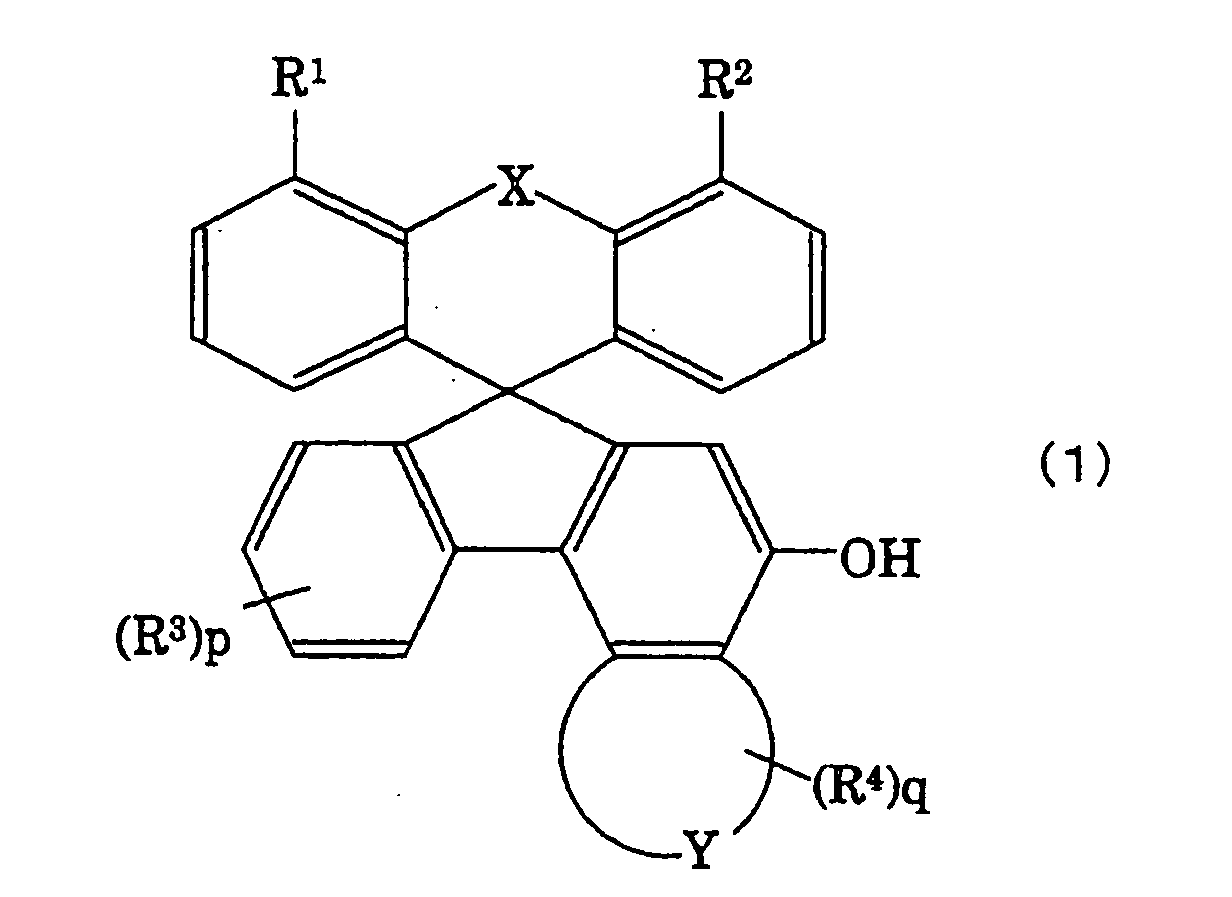
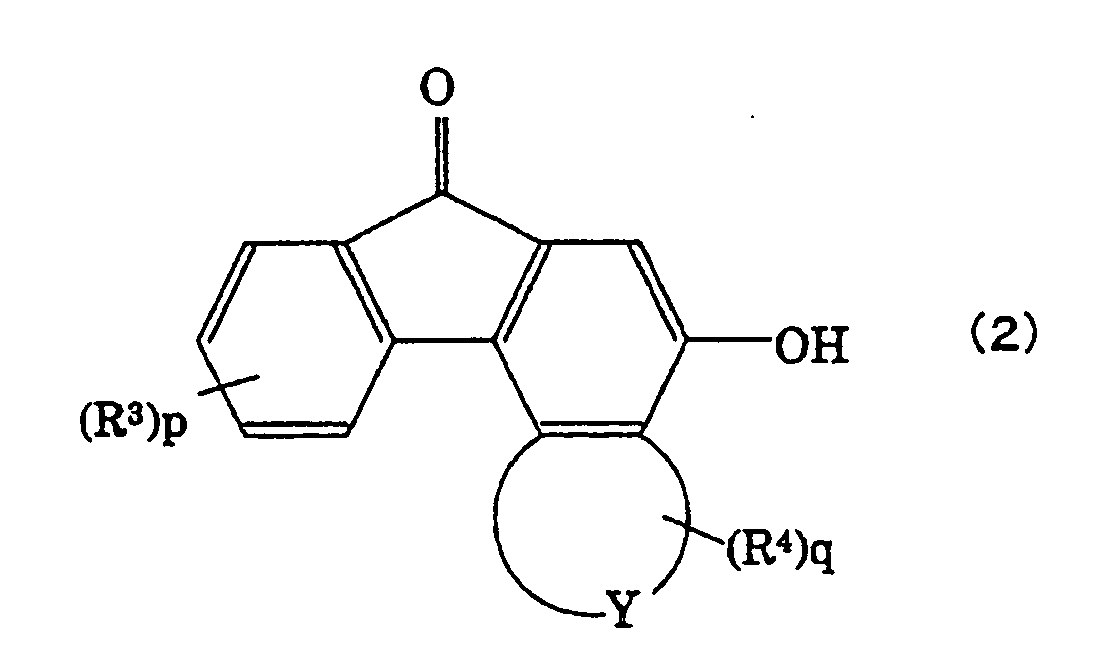
provided a method of producing a spirofluorenol
compound represented by the following formula (1),
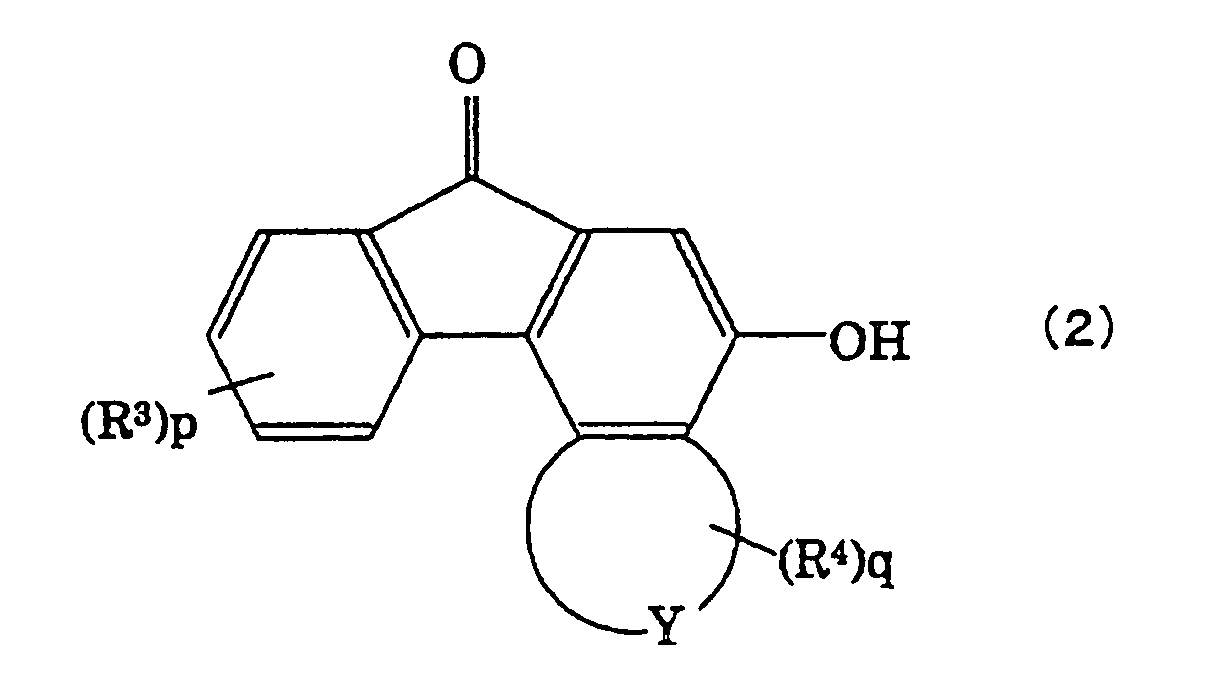
by protecting a hydroxyl group bonded to a fluorenone
compound represented by the following formula (2),
with a protecting group which is a substituted silyl
group in which the sum of carbon atoms of substituents
bonded to a silicon atom is 5 to 12, then, reacting
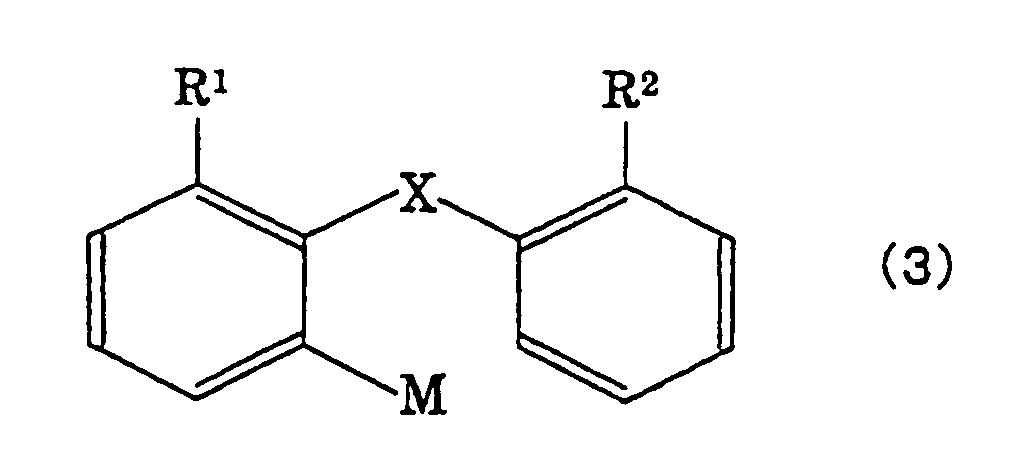
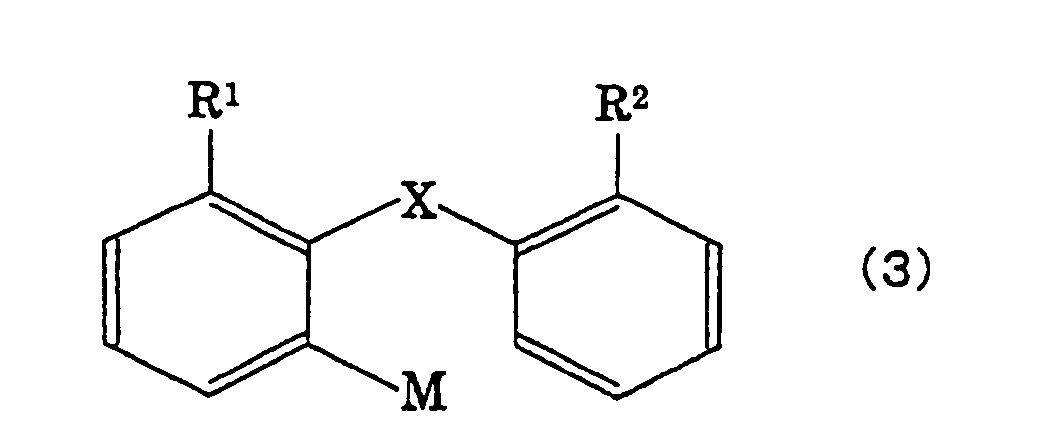
the fluorenone compound with an organometal compound
represented by the following formula (3),
wherein M is Li, MgCl, MgBr, MgI or CuLi,
to thereby obtain a hydroxy-arylfluorenol of which the
hydroxyl group is protected with said protecting
group, and transforming the obtained hydroxy-arylfluorenol
into a spiro form and removing the
protection therefrom, wherein in the above formulas
(1) to (3):
-Z-, -(CR5R6)n-, -(CR5R6)m-Z-, -Z-(CR5R6)1-Z-,
-(CR5R6)a-Z-(CR5R6)b-, -(CR5=CR6)k-, and CR5=N-
wherein -Z- is -O-, -S- or -NR5-, R5 and R6 are,
independently from each other, hydrogen atoms, or
monovalent groups selected from the following
group B, wherein when there are a plurality of
-Z-, R5 or R6 in one group, the plurality of -Z-,
R5 or R6 may be different from each other, and a,
b, k and l are, independently from each other,
integers of 1 to 4, and m and n are,
independently from each other, integers of 1 to
6; group B:
alkyl group, aralkyl group, substituted or
unsubstituted aryl group, hydroxy group, alkoxy
group, aralkoxy group, amino group,
monosubstituted amino group, disubstituted amino
group, cyano group, nitro group, halogen atom,
trufluoromethyl group, substituted or
unsubstituted heterocyclic group having a bond on
a carbon atom or on a nitrogen atom, and
substituted or unsubstituted condensed
heterocyclic group, aromatic hydrocarbon ring or
hetero ring in condensed thereto and having a
bond on a carbon atom or on a nitrogen atom.
DETAILED DESCRIPTION OF THE INVENTION
(Object product to be produced)
A spirofluorenol compound represented by the
above formula (1) produced by a production method of
the present invention is useful as a starting material
for the synthesis of a photochromic compound that
comprises a chromene derivative.
In the above formula (1), X is either a single
bond or a divalent group selected from the above group
A.
Further, groups in the above group B serve not
only as R5 or R6 in the group A but also as R1, R2, R3
or R4 in the above formula (1). Preferred examples of
the group in the group B include alkyl groups having 1
to 6 carbon atoms, such as methyl group, ethyl group,
isopropyl group, t-butyl group and cyclohexyl group;
aralkyl groups having 7 to 20 carbon atoms, such as
benzyl group, phenethyl group and trityl group;
substituted or unsubstituted aryl groups, such as
phenyl group, naphthyl group and alkoxyphenyl group;
hydroxyl group; alkoxy groups having 1 to 6 carbon
atoms, such as methoxy group and t-butoxy group;
aralkoxy groups having 7 to 20 carbon atoms, such as
benzyloxy group and trityloxy group; amino group;
monosubstituted amino groups having 1 to 6 carbon
atoms, such as methylamino group and cyclohexylamino
group; disubstituted amino groups having 1 up to 20
carbon atoms, such as dimethylamino group and
dicyclohexylamino group; cyano group; nitro group;
halogen atoms, such as chlorine atom and bromine atom;
trifluoromethyl group; substituted or unsubstituted
heterocyclic groups, such as 2-oxazolyl group, 4-morpholino
group, and 2,2,6,6-tetramethyl-1-piperidino
group; and substituted or unsubstituted condensed
heterocyclic groups, such as 2-benzoxazolyl group, 1-benzotriazolyl
group, 9-carbazolyl group and 8-quinolyl
group.
When X is a single bond in the above formula (1),
R1 and R2 are, respectively, hydrogen atoms, groups
selected from the group B, or groups that are bonded
together to form a group represented by the group A.
That is, when X is a single bond, the compound of the
above formula (1) possesses a 9,9'-spirobifluorene
skeleton. For example, when R1 and R2 are bonded
together, then, -CR5=CR6- that is formed, the compound
possesses a spiro[fluorene-9,1'-(1H-cyclopent[d,e,f]phenanthrene)]
skeleton. However, it
never takes place from the steric requirement that R1
and R2 are bonded together to form -Z- (i.e., -O-, -S-
or -NR5-) or -CR5R6-.
Further, when X is a divalent group selected from
the group A, R1 and R2 are, respectively, hydrogen
atoms or groups selected from the group B. In this
case, the compound represented by the above formula
(1) possesses a spiro[fluorene-9,9'- xanthene]
skeleton (when X is -O-), a spiro[fluorene-9,9'-(9,10-dihydroacridine]
skeleton (when X is -NH-), or a
spiro[fluorene-9,9'-(9,10-dihydroanthracene] skeleton
(when X is -CH2-). However, there is no particular
steric limitation on R1 and R2.
In the above formula (1), Y is a group that forms
an aromatic hydrocarbon group or an unsaturated
heterocyclic group together with two carbon atoms of a
benzo ring. When Y forms an aromatic hydrocarbon
group, the compound of the formula (1) possesses, for
example, a benzofluorenol skeleton or a
naphthofluorenol skeleton. When Y forms an
unsaturated heterocyclic group, the compound of the
formula (1) possesses, for example, a furofluorenol
skeleton or an indolofluorenol skeleton. Here, the
place and direction of ring condensation are quite
arbitrary.
In the above formula (1), further, R3 and R4 are
monovalent groups in the above group B, and p and q
representing the numbers of R3 and R4 are integers of 0
to 3, respectively. When p or q is 2 or 3, i.e., when
R3 or R4 is existing in a plural number, the plurality
of R3 or R4 may be different from each other.
(Production of the spirofluorenol compounds)
Starting materials:
To produce the spirofluorenol compound of the
above-mentioned formula (1) according to the present
invention, first, a hydroxyl group bonded to a
fluorenone compound represented by the formula (2),
wherein Y, R
3, R
4, p and q are as defined in the
formula (1),
is protected with a protecting group which is a
substituted silyl group. Here, when the compound of
the formula (2) contains an amino group or a
monosubstituted amino group, the amino group or the
monosubstituted amino group, too, is protected with
the substituted silyl group in addition to the
hydroxyl group. The hydroxyl group to be protected is
not limited to the one bonded to the 2- position of
the fluorenone ring but includes a hydroxyl group
bonded to any other position. When R
3 or R
4 is a
hydroxyl group, an amino group or a monosubstituted
amino group, then, the above group is protected with
the substituted silyl group in addition to the
hydroxyl group bonded to the 2- position of the
fluorenone ring. Hereinafter, the group that is to be
protected is often called to-be-protected functional
group.
There is no particular limitation on the
hydroxyfluorenone used as the starting material
provided it is the one represented by the above
formula (2). Desirably, however, the
hydroxyfluorenone used as the starting material is the
one in which Y is a condensed benzo ring (i.e., the
one having a hydroxybenzofluorenone skeleton) from the
standpoint of performance of the object photochromic
compound. From the standpoint of performance of the
object photochromic compound, further, it is desired
that R3 and R4 are alkyl groups having 1 to 6 carbon
atoms, such as methyl groups, ethyl groups, isopropyl
groups, t-butyl groups and cyclohexyl groups; aralkyl
groups having 7 to 20 carbon atoms, such as benzyl
groups, phenethyl groups and trityl groups;
substituted or unsubstituted aryl groups, such as
phenyl groups, naphthyl groups and alkoxyphenyl
groups; hydroxy groups; alkoxy groups having 1 to 6
carbon atoms, such as methoxy groups and t-butoxy
groups; or aralkoxy groups having 7 to 20 carbon
atoms, such as benzyloxy groups and trityloxy groups;
and p and q are 0 or 1.
Concrete examples of the hydroxyfluorenone of the
formula (2) that can be favorably used in the present
invention include 3-methoxy-5-hydroxybenzo[c]fluorene-7-one,
9-methoxy-5-hydroxybenzo[c]fluorene-7-one and
3,9-dimethoxy-5-hydroxybenzo[c]fluorene-7-one.
Introduction of protecting groups:
In the present invention, a substituted silyl
group is used as a protecting group for protecting the
above-mentioned to-be-protected functional group.
Here, the greatest feature resides in that the sum of
carbon atoms of three substituents bonded to a silicon
atom is 5 to 12. That is, by using the substituted
silyl group having a large steric hindrance as a
protecting agent, the selectivity and the conversion
are both maintained high at the time of introducing
the protecting group, the protecting group is not
removed in the next step of reaction, the yield is
improved at the time of removing the protection and,
as a result, a spirofluorenol which is a desired
compound is efficiently produced.
Various protecting groups have been proposed for
protecting the hydroxyl group, such as methyl group,
benzyl group, as well as methoxymethyl group and
tetrahydropyranyl group which are of the acetal type;
acetyl group and benzoyl group which are of the ester
type; benzyloxycarbonyl group and t-butoxycarbonyl
group which are of the carbonate type; and
trimethylsilyl group which is of the silyl ether type.
When the methyl group is used as the protecting group,
however, the alkoxy group is destroyed in the step of
removing the protecting group if R3 or R4 of
hydroxyfluorenone is an alkoxy group such as methoxy
group, which, therefore, cannot serve as a general
method of production. When the benzyl group is used
as the protecting group, the benzyl is introduced not
only to the hydroxyl group to which the protecting
group is to be introduced but also to the molecular
skeleton. In the step of removing the protecting
group (for removing protection), therefore, side
reactions take place much, such as destroying the
alkoxy group and reducing the molecular skeleton,
which is not efficient. The protection group of the
acetal type involves problems, too, in regard to
selectivity at the time of introducing the protecting
group. The protecting groups of the ester type and of
the carbonate type cannot withstand the reaction
condition in the next step. Even the protecting group
of the silyl ether type cannot withstand the reaction
of the next step if it has a sterically simple
structure like the trimethylsilyl group and cannot,
hence, be used.
There is no particular limitation on the
substituted sily group used as a protecting group in
the invention provided it satisfies a condition that
the sum of carbon atoms of three substituents is 5 to
12. It is, however, particularly desired to use t-butyldimethylsilyl
group, triisopropylsilyl group or
2-methyl-3,3-dimethyl-2-butyldimethylsilyl group from
such a standpoint that a silylating agent used for
introducing the protecting group is easily available
and is effective as will be described later.
The silylating agent used for introducing the
protecting group is a compound in which the
substituted silyl group is bonded to an eliminating
group, and is a compound represented by, for example,
the following formula (6),
E - SiR7R8R9
wherein E is an eliminating group, and R7, R8 and
R9 are alkyl groups, the sum of carbon atoms of
the alkyl groups being 5 to 12.
As the eliminating group, there can be
exemplified a halogen atom, an azide group, an alkoxy
group, an arylsulfonyloxy group and a
trialkylsilylamino group having the total number of
carbon atoms of not smaller than 5. Among the
silylating agents represented by the above formula
(6), it is desired to use chlorinated silicon compound
such as t-butyldimethylsilyl chloride,
triisopropylsilyl chloride, or 2-methyl-3,3-dimethyl-2-butyldimethylsilyl
chloride from the standpoint of
availability.
That is, upon reacting the above silylating agent
with the hydroxyfluorenone of the formula (2), a
protecting group which is the substituted silyl group
is introduced to protect the to-be-protected
functional group as represented by the hydroxyl group.
Though there is no particular limitation on the
reaction conditions at the time of protection, a
solvent is usually used, and a tertiary amine compound
is added to a mixed solution of the hydroxyfluorenone
and the silylating agent to conduct the reaction while
trapping the acid formed during the reaction thereby
to introduce the protecting group. Or, a hydroxyl
group of the hydroxyfluorenone is reacted with sodium
hydride, potassium t-butoxide, sodium hydroxide or
potassium hydroxide to form an alkali metal salt
thereof which is, then, reacted with the silylating
agent to introduce the protecting group. It is
allowable to use the above two methods in combination
to carry out the reaction, as a matter of course.
There is no particular limitation on the solvent
used here provided it does not react with the
silylating agent. Examples include aromatic
hydrocarbons such as toluene and xylene; chlorinated
hydrocarbons such as dichloromethane and chloroform;
acyclic or cyclic ethers such as diethyl ether and
tetrahydrofurane; nitriles such as acetonitrile and
butyronitrile; acyclic or cyclic amide such as
dimethylformamide and N-methylpyrrolidone; acyclic or
cyclic sulfoxide such as dimethyl sulfoxide and
sulforane; or a mixed solvent thereof.
As the tertiary amine compound, though there is
no particular limitation, there can be used acyclic or
cyclic aliphatic tertiary amines such as triethylamine
and n-methylmorpholine; aromatic tertiary amines such
as dimethyl aniline and methyl diphenylamine; and
heterocyclic tertiary amines such as pyridine and 4-dimethylaminopyridine.
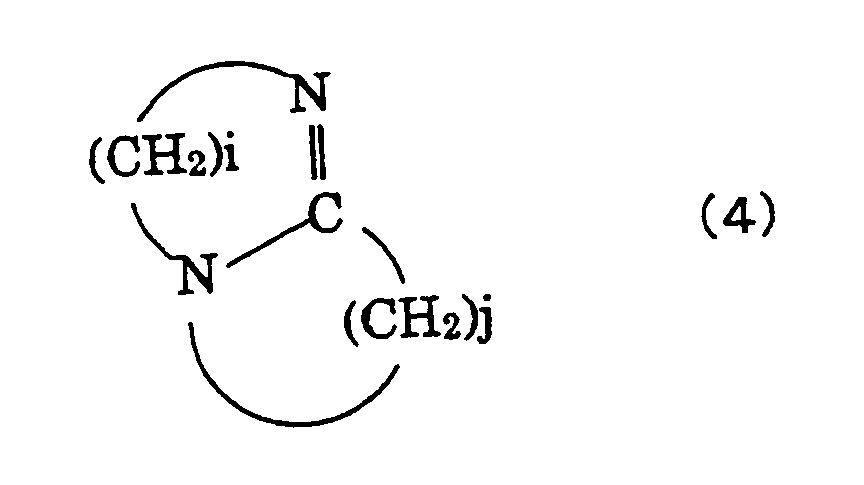
Among them, it is desired to
use a tertiary amine compound having a structure
represented by the following formula (4),
wherein i is an integer of 2 to 4, and j is an
integer of 3 to 6,
such as 1,8-diazabicyclo[5,4,0]undeca-7-ene or 1,7-diazabicyclo[4,3,0]nona-6-ene
from the standpoint of
high selectivity and high conversion. It is further
allowable to use the tertiary amine compound
represented by the above formula (4) in a catalytic
amount in combination with other tertiary amine
compounds.
There is thus obtained a hydroxyfluorenone of
which the to-be-protected functional group such as a
hydroxyl group is protected. This compound can be
isolated and refined according to conventional methods
but can also be directly used for the next reaction.
Reaction with an organometal compound:
According to the production method of the present
invention, the hydroxyfluorenone protected with the
substituted silyl group obtained above is reacted with
an organometal compound represented by the formula
(3),
wherein M is Li, MgCl, MgBr, MgI or CuLi, and X,
R
1 and R
2 are as defined in the formula (1),
to prepare a hydroxyl-protected-arylfluorenol. In
carrying out the reaction, the to-be-protected
functional group such as the hydroxyl group bonded to
the 2- position of the fluorenone ring has been
protected by the substituted silyl group, and does not
take part in the reaction with the organometal
compound, and only the carbonyl group (C=O) reacts
with the organometal compound. Therefore, the
obtained hydroxy-protected-arylfluorenol is expressed
by, for example, the following formula (7), and the
hydroxyl group and the like groups have been protected
by the substituted silyl groups.
In the above formula (7), when R3 or R4 is a
hydroxyl group, amino group or a monosubstituted amino
group, then, this group, too, is protected by the
protecting group (substituted silyl group, -SiR7R8R9).
The organometal compound used for the above
reaction is obtained by reacting a halogen compound
having a molecular structure corresponding to the
molecular skeleton of the formula (3) with an
organolithium compound such as butyl lithium, or with
lithium metal, magnesium metal or alkyl copper lithium
compound. The organometal compound can be further
produced even by reacting an organolithium compound
having a molecular structure corresponding to the
molecular skeleton of the formula (3) with a copper
compound.
The reaction of the hydroxyfluorenone of which
the hydroxyl group is protected with the organosilyl
compound is carried out by reacting the organometal
compound produced as described above with the
hydroxyfluorenone of which the hydroxyl group and the
like groups have been protected without isolating the
organometal compound. There is no particular
limitation on the solvent used for the reaction
provided it does not react with the organometal
compound, and there can be used acyclic or cyclic
aliphatic hydrocarbon such as hexane or cyclohexane;
aromatic hydrocarbon such as toluene or xylene; or
acyclic or cyclic ether such as diethylether or
tetrahydrofurane; or a mixed solvent thereof. Though
there is no particular limitation, the reaction
temperature may be from -10°C to about a boiling point
of the solvent, and the reaction time may be from 0.5
hours to about 10 hours, which may be determined while
making sure the progress of the reaction. After the
reaction, the reaction product is quenched with water
to obtain a hydroxy-arylfluorenol of which the
hydroxyl group and the like groups are protected. The
thus obtained hydroxy-arylfluorenol of which the
hydroxyl group and the like groups are protected can
be isolated and refined by conventional methods, but
can also be directly used for the next reaction.
Transforming into a spiro form and removing the
protection:
In the present invention, the "hydroxy-arylfluorenol
of which the hydroxyl group and the like
groups are protected" obtained as described above is
transformed into a spiro form under an acidic
condition to obtain a spirofluorenol of which the to-be-protected
functional group such as hydroxyl group
and the like groups are protected with the substituted
silyl groups.
An acid is used for establishing an acidic
condition. As the acid, there can be used known acids
without limitation, e.g., inorganic acids such as
sulfuric acid and phosphoric acid; organic acids such
as p-toluenesulfonic acid and trifluoroacetic acid;
inorganic Lewis acids such as aluminum chloride,
titanium tetrachloride, silicon tetrachloride, tin
chloride and iron chloride; and solid acids such as
acidic alumina and acidic ion-exchange resin. There
can be further used a dehydrating agent that forms an
acid upon reacting with water, such as phosphorus
pentoxide, phosphorus pentachloride, thionyl chloride
and sulfuryl chloride. The amount of the acid that is
used differs depending upon its kind and there is no
particular limitation. In general, however, the acid
is used in an amount of 0.01 to 1000 parts by weight
and, more preferably, 1 to 50 parts by weight per 100
parts by weight of the hydroxy-arylfluorenol.
The spiro-reaction is conducted under the acidic
condition usually in a solvent. There is no
particular limitation on the solvent used here
provided it does not react with the acid that is used,
and there can be desirably used an acyclic or cyclic
aliphatic hydrocarbon such as hexane or cyclohexane,
aromatic hydrocarbon such as toluene or xylene,
chlorinated hydrocarbon such as dichloromethane or
chloroform, cyclic ether such as tetrahydrofurane,
esters such as ethyl acetate or butyl acetate, or
nitriles such as acetonitrile. Though there is no
particular limitation, the reaction temperature may be
from room temperature to about a boiling point of the
solvent, and the reaction time may be from 0.5 hours
to about 10 hours, which may be determined while
making sure the progress of the reaction. Here, the
protection group (substituted silyl group) may be
removed depending upon the conditions, which, however,
does not affect the subsequent steps. The thus
obtained spirofluorenol of which the hydroxyl group is
protected can be isolated and refined by conventional
methods, but can also be directly used for the next
reaction.
In the production method of the present
invention, finally, the spirofluorenol of which the
hydroxyl group and the like groups are protected
obtained as described above is subjected to the
removal of protection (removal of the substituted
silyl group). Though there is no particular
limitation, the method of removing the protection is
easily conducted by the reaction with a protection-removing
agent containing fluorine anions in a
solvent.
As the protection-removing agent containing
fluorine anions, there can be used quaternary ammonium
fluorides such as tetrabutylammonium fluoride,
benzyltrimethylammonium fluoride; and alkali metal
fluorides such as sodium fluoride and potassium
fluoride. When an alkali metal fluoride is used as
the protection-removing agent, it is desired to also
use a quaternary ammonium salt such as
tetrabutylammonium bromide or benzyltrimethylammonium
chloride in combination. There is no particular
limitation on the solvent that is used provided it
does not impair the reaction. Examples include
acyclic or cyclic aliphatic hydrocarbons such as
hexane and cyclohexane; aromatic hydrocarbons such as
toluene and xylene; chlorinated hydrocarbons such as
dichloromethane and chloroform; acyclic or cyclic
ethers such as diethyl ether and tetrahydrofuran;
nitriles such as acetonitrile and butyronitrile;
alcohols such as methanol and ethanol; acyclic or
cyclic amides such as dimethylformamide and N-methylpyrrolidone;
acyclic or cyclic sulfoxide;
sulfone such as dimethylsulfoxide and sulforane; or a
mixed solvent thereof. These solvents may contain
water.
In order to remove the protection, further, there
can be easily employed a method of reacting the
spirofluorenol of which the hydroxyl group and the
like groups are protected with a compound of the above
formula (4) together with alcohols or water. The
solvent used here may be the above-mentioned solvent.
Desirably, however, alcohols are used as a solvent so
as to also serves as a reaction reagent.
It is also possible to remove the protection by
using a Lewis acid such as boron trifluoride. There
is no particular limitation on the solvent provided it
is not decomposed by acid. Chlorinated hydrocarbons
can be preferably used.
The spirofluorenol obtained by removing the
protection can be isolated and refined according to
conventional methods, but can also be directly used
for the reaction for synthesizing a photochromic
compound.
According to the production method of the present
invention, further, it is possible to conduct the
spiro-reaction and the protection-removing reaction in
a single step by using an acid. Employment of this
method is particularly preferred from the standpoint
of improving the efficiency. In this case, preferred
examples of the acid include organosulfonic acid,
organic acid or Lewis acid and, particularly, p-toluenesulfonic
acid, trifluoroacetic acid, boron
trifluoride (usually used as an ether complex),
magnesium bromide or aluminum chloride among the acids
exemplified above for being used for the spiro-reaction
and the protection-removing reaction. There
can be used any solvent without limitation provided it
can be used for the spiro-reaction or the protection-removing
reaction. From the standpoint of selectivity
of the reaction, however, acetonitrile is most
desired. After the reaction, the acid is inactivated
and is washed by adding water or a saline solution
thereto and, then, the solvent is removed from the
organic layer to thereby obtain an object product.
The production method of the present invention
makes it possible to efficiently produce the
spirofluorenol compound useful as a starting material
for producing a photochromic compound.
EXAMPLES
The present invention will now be described in
detail by way of Working Examples to which only,
however, the invention is in no way limited.
(Example 1)
2 Grams (6.5 mmols) of a 3,9-dimethoxy-5-hydroxybenzo[c]
fluorene-7-one was suspended in 10 ml
of a tetrahydrofuran (THF) followed by the addition of
a methanol solution (40 ml) containing 0.31 g (7.8
mmols) of sodium hydroxide, and the mixture was
stirred at room temperature for one hour. After 80 ml
of toluene was added, the solvent was all distilled
off under a reduced pressure to obtain a sodium salt.
The sodium salt was dissolved in 50 ml of the THF, and
a THF (20 ml) solution containing 1.2 g (7.8 mmols) of
a t-butyldimethylsilyl chloride was added dropwise
thereto to conduct the reaction at room temperature
for 2 hours. The conversion was 99%.
Then, the THF was distilled off under a reduced
pressure, and 2.4 g of a 3,9-dimethoxy-5-t-butyldimethylsilyloxybenzo
[c]fluorene-7-one (purity,
97%; yield, 87%)(abbreviated as DBBF) was crystallized
from 30 ml of methanol.
2.1 Grams (8.3 mmols) of a 1-bromophenanthrene
was dissolved in 43 ml of heptane, 5.3 ml(1.6 mols/l,
8.5 mmols) of butyl lithium was added thereto at room
temperature to obtain a 1-lithiophenanthrene, which
was cooled down to -5°C, followed by the addition of
2.2 g (5.2 mmols) of the above DBBF. The mixture was
stirred for one hour and to which was further added
the THF at a temperature of not higher than 0°C. The
mixture was stirred at this temperature for 2 hours.
The conversion was 99%.
After the reaction, the reaction product was
washed with 8.5 ml of 1N hydrochloric acid and 10 ml
of water, and the solvent was distilled off under a
reduced pressure. 2.5 Grams of a 3,9-dimethoxy-5-t-butyldimethylsilyloxy-7-hydroxy-7-phenanthrene-1-ylbenzo[c]fluorene
(purity, 97%; yield,
82%)(abbreviated as DBHPBF) was crystallized from 20
ml of methanol.
Of the obtained 2.5 g of DBHPBF, 1.0 g (1.7
mmols) thereof was suspended in 10 g of acetic acid
and was heated at 60°C. Here, a solution comprising
3.5 g of acetic acid, 0.7 g of concentrated sulfuric
acid and 2.1 g of water was added thereto, and the
mixture was stirred at 60°C for 3 hours. The
conversion was 99%.
The mixture was, then, cooled, adding 50 ml of
THF and washed with 46 ml of a 5N sodium hydroxide
aqueous solution, and was further washed two times
each with 20 ml of water, and the solvent was
distilled off under a reduced pressure. 0.87 Grams of
a 3',9'-dimethoxy-5'-t-butyldimethylsilyloxyspiro
[(1H-cyclopent[d,e,f]phenanthrene)-1,7'-benzo[c]fluorene]
(purity, 96%; yield,
90%)(abbreviated as DBCPBF) was crystallized from 30 ml
of methanol.
Of the obtained 0.87 g of DBCPBF, 0.58 g (1.0
mmol) thereof was dissolved in 30 ml of the THF,
followed by the addition of 1.3 g (4 mmols) of a
tetrabutylammonium bromide and 0.23 g (4 mmols) of
potassium fluoride, and the mixture was heated and
refluxed for 10 hours. The conversion was 98%. The
mixture was cooled and was washed three times each
with 10 ml of water, and the solvent was distilled off
under a reduced pressure. 0.47 Grams (yield, 100%) of
a 3',9'-dimethoxy-5'-hydroxyspiro[(1H-cyclopent[d,e,f]
phenanthrene)-1,7'-benzo[c]fluorene] having a purity
of 95% was obtained. The total yield was calculated
to be 64%.
(Comparative Example 1)
0.28 Grams (7 mmols) of sodium hydroxide was
dissolved in 20 ml of methanol, and to which were
added 2 g (6.6 mmols) of a 3,9-dimethoxy-5-hydroxybenzo[c]fluorene-7-one,
0.82 g (6.5 mmols) of a
benzyl chloride and 20 ml of the THF, and the mixture
was refluxed for 20 hours. The conversion was 90%. A
by-product was formed during the reaction presumably
due to the reaction of two benzyl groups. The solvent
was distilled off under a reduced pressure, and 1.4 g
of a 3,9-dimethoxy-5- benzyloxybenzo[c]fluorene-7-one
(purity, 97%; yield, 52%) was crystallized from 32 ml
of acetone.
The phenanthrene addition reaction and the
dehydration reaction were conducted in accordance with
Example 1 to obtain a 3',9'-dimethoxy-5'-benzyloxyspiro[(1H-cyclopent[d,e,f]
phenanthrene-1,7'-benzo[c]fluorene](abbreviated as
spirobenzofluorene). The purity and the yield were
85% and 90%, respectively.
0.67 Grams (1.2 mmols) of the obtained
spirobenzofluorene was dissolved in 30 ml of THF and
50 ml of methanol, and to which were added 0.27 g of
5% palladium on charcoal and 15.1 g (240 mmols) of
ammonium formate, to conduct the reaction at room
temperature for 2 hours. The conversion was 99%.
After the reaction, palladium on charcoal was
separated by filtration, washed with 20 ml of water,
and the solvent was distilled off under a reduced
pressure. 0.55 Grams (yield, 99%) of a 3',9'-dimethoxy-5'-hydroxyspiro[(1H-cyclopent[d,e,f])phenanthrene]-1,7'-benzo[c]fluorene]
having a purity of 98% was obtained. The total yield
was calculated to be 39%.
(Comparative Example 2)
10 Grams (32.6 mmols) of a 3,9-dimethoxy-5-hydroxybenzo
[c]fluorene-7-one was suspended in 500 ml
of the THF followed by the addition of 10.7 g (49
mmols) of a di-t-butyl dicarbonate and 0.04 g (0.3
mmols) of a 4-dimethylaminopyridine, and the mixture
was stirred at room temperature for 3 hours. The THF
was concentrated until crystals precipitated, and to
which was added 400 ml of heptane to crystallize 12.8
g of a 3,9-dimethoxy-5-t-butoxycarbonyloxybenzo[c]fluorene-7-one
(abbreviated
as benzofluorenone)(purity, 96%; yield 97%).
The above benzofluorenone was reacted with the 1-lithiophenanthrene
in the same manner as in Example 1,
whereby the t-butoxycarbonyl group has reacted and the
purity has dropped down to 61%. The dehydration
reaction was conducted in the same manner as in
Example 1, and it was found that the protection-removing
reaction has occurred simultaneously.
However, A 3',9'-dimethoxy-5'- hydroxyspiro[(1H-cyclopent[d,e,f]phenanthrene)-1,7'-benzo[c]fluorene]
having a purity of only 44% was obtained. This
compound could not be refined. Or, if it were refined
without loss, the whole yield was calculated to be
43%.
(Example 2)
10 Grams (36.2 mmols) of a 3-methoxy-5-hydroxybenzo
[c]fluorene-7-one was suspended in 150 ml
of the THF followed by the addition of 4.4 g (43.5
mmols) of a triethylamine. Then, a solution obtained
by dissolving 6.55 g (43.5 mmols) of a t-butyldimethylsilyl
chloride in 50 ml of the THF was
added thereto dropwise at room temperature, and the
mixture was stirred at 45°C for 6 hours. The
conversion was 98%. The THF was distilled off under a
reduced pressure and crystallize 12 g of a 3-methoxy-5-t-butyldimethylsilyloxybenzo
[c]fluorene-7-one
(abbreviated as MBBF)(purity, 98%; yield, 85%) from
230 ml of methanol.
10.9 Grams (38.9 mmols) of a 2-biphenyl iodide
was dissolved in 150 ml of heptane and was cooled down
to -5°C. 26.5 ml (1.6 mols/l, 42.4 mmols) of butyl
lithium was added thereto, and the mixture was stirred
at -5°C for one hour. 10.5 Grams (27 mmols) of MBBF
prepared above was added thereto, and the THF was
added thereto at a temperature of not higher than 0°C,
and the mixture was stirred at this temperature for 2
hours. The conversion was 99%. After the reaction,
200 ml of the THF was added to the reaction product
and obtained solution was washed with 42 ml of 1N
hydrochloric acid, and was further washed twice each
with 50 ml of water. The solvent was distilled off
under a reduced pressure to obtain 14 g of a 3-methoxy-5-t-butyldimethylsilyloxy-7-
hydroxy-7-(2-phenylphenyl)benzo[c]fluorene
(abbreviated as
MBHPBF)(purity, 95%; yield, 95%).
Of the obtained 14 g of MBHPBF, 10.9 g (20 mmols)
thereof was suspended in 115 g of acetic acid and was
heated at 60°C. Here, a solution comprising 55 g of
acetic acid, 10.9 g of concentrated sulfuric acid and
32.6 g of water was added thereto, and the mixture was
stirred at 60°C for 3 hours. The conversion was 99%.
The mixture was, then, cooled down to 30°C and 400 ml
of ethyl acetate was added thereto, and obtained
solution was washed with 740 ml of a 5N sodium
hydroxide aqueous solution, and was further washed 200
ml of a 10% saline solution. The solvent was
distilled off to obtain 10 g of a 3'-methoxy-5'-t-butyldimethylsilyloxyspiro
[fluorene-9,7'-benzo[c]fluorene](abbreviated
as MBSFBF)(purity, 95%;
yield, 95%).
Of the obtained 10 g of MBSFBF, 0.53 g (1 mmol)
thereof was dissolved in 30 ml of the THF, followed by
the addition of 1.52 g (10 mmols) of a 1,8-diazabicyclo[5,4,0]undeca-7-one,
and the mixture was
stirred at room temperature for 24 hours. The
conversion was 99%. The reaction product was, then,
washed with 10 ml of 1N hydrochloric acid and was
further washed three times each with 10 ml of water.
The THF was distilled off to obtain 0.41 g of a 3'-methoxy-5'-hydroxyspiro[fluorene-9,7'-benzo
[c]fluorene](purity, 96%; yield, 99%). The total
yield was calculated to be 76%.
(Example 3)
A 3'-methoxy-5'-t-butyldimethylsilyloxyspiro
[fluorene-9,7'-benzo[c]fluorene](abbreviated as
MBSFBF) was obtained in compliance with Example 2.
0.53 Grams (1 mmol) of the above MBSFBF was
dissolved in 30 ml of chloroform, cooled down to 5°C,
and to which was added 3.4 g (24 mmols) of a diethyl
ether complex of boron trifluoride to conduct the
reaction at 50°C for 20 hours. The conversion was
99%. Thereafter, the reaction product was cooled and
washed with 24 ml of 1N sodium hydroxide aqueous
solution and four times each with 50 ml of water.
The chloroform was distilled off to obtain 0.40 g
of a 3'-methoxy-5'-hydroxyspiro[fluorene-9,7'-benzo[c]fluorene](purity,
96%; yield 97%). The total
yield was calculated to be 74%.
(Comparative Example 3)
0.4 Grams (10 mmols) of sodium hydroxide was
dissolved in 10 ml of methanol, and to which were
added 2.5 g (9.1 mmols) a 3-methoxy-5-hydroxybenzo[c]fluorene-7-one,
30 ml of the THF and
3.7 g (29 mmols) of a benzyl chloride, and the mixture
was stirred at 60°C for 10 hours. The conversion was
95%.
Thereafter, the mixture was cooled down to 20°C,
and the precipitated crystals were filtered, washed
with 10 ml of water, and were dried to obtain 2.0 g of
a 3-methoxy-5-benzyloxybenzo [c]fluorene-7-one
(purity, 99%; yield, 61%).
The biphenyl addition reaction and the
dehydration reaction were conducted in accordance with
Example 2 to obtain 2.5 g of a 3'-methoxy-5'-benzyloxyspiro[fluorene-9,7'-benzo[c]fluorene](abbreviated
as MBOSFBF). The purity
and the yield were 97% and 95%, respectively.
0.5 Grams (1 mmol) of the above MBOSFBF was
dissolved in a mixed solvent of 50 ml of THF, 10 ml of
acetic acid, 5 ml of methanol and 1.5 ml of water, and
to which was added 0.05 g of 5% palladium on charcoal.
The mixture was stirred under hydrogen atmosphere by
using a hydrogen balloon at 40°C for 24 hours. The
conversion was 99%. After the reaction, the reaction
product was cooled, palladium on charcoal was
separated by filtration, and the solvent was removed
by distillation under a reduced pressure to obtain
0.41 g of a 3'-methoxy-5'-hydroxyspiro[fluorene- 9,7'-benzo[c]fluorene](purity,
98%; yield, 98%). The total
yield was calculated to be 55%.
(Example 4)
A 3,9-dimethoxy-5-t-butyldimethylsilyloxy-7-hydroxy-
7-phenanthrene-1-ylbenzo[c]fluorene](abbreviated
as DBHPBF) was
obtained in compliance with Example 1.
1.0 Gram (1.7 mmols) of the above DBHPBF was
dissolved in 70 ml of acetonitrile, and to which was
added 0.71 g (5 mmols) of an ether complex of boron
trifluoride, and the mixture was stirred at 50°C for 3
hours. 0.32 Grams (5.5 mmols) of potassium fluoride
was added to inactivate the ether complex of boron
trifluoride and, after 90 ml of THF was added, the
reaction product was washed three times each with 80
ml of a 10% of saline solution. The solvent was
distilled off under a reduced pressure to obtain 0.46
g (yield, 98%) of a 3',9'-dimethoxy-5'-hydroxyspiro[(1H-cyclopent[d,e,f]phenanthrene)-1,7'-benzo[c]fluorene]
having a purity of 98%. The total
yield was calculated to be 63%.
(Examples 5 to 11)
The 3,9-dimethoxy-5-t-butyldimethylsilyloxy-7-hydroxy-7-phenanthrene-1-ylbenzo[c]fluorene
was
subjected to the spiro-reaction and to the protection-removing
reaction in compliance with Example 4 under
the conditions shown in Table 1 to obtain the results
shown in Table 1.
(Comparative Example 4)
2.1 Grams (8.3 mmols) of a 1-bromophenanthrene
was dissolved in 43 ml of heptane, and to which was
added 5.3 ml (1.6 mols/l, 8.5 mmols) of butyllithium
to obtain a 1-lithiophenanthrene, which was, then,
cooled down to -5°C. 1.6 Grams (5.2 mmols) of the
3.9-dimethoxy-5-hydroxybenzo[c] fluorene-7-one was
added thereto, and the mixture was stirred for one
hour. Then, THF was added thereto at a temperature of
not higher than 0°C, and the mixture was stirred at
this temperature for 2 hours. The conversion was 40%.
The mixture was continuously stirred for another 20
hours, but the conversion remained to be 40%.
After the reaction, the reaction product was
washed with 8.5 ml of 1N hydrochloric acid and 10 ml
of water, and the solvent was distilled off under a
reduced pressure. 0.81 Grams of a 3,9-dimethoxy-5-hydroxy-7-hydroxy-7-phenanthrene-1-ilbenzo
[c]fluorene(abbreviated as DHHPBF)(purity, 92%; yield,
32%) was crystallized from 20 ml of methanol.
Of the obtained DHHPBF, 0.5 g (1.0 mmol) thereof
was suspended in 5.9 g of acetic acid, and was heated
at 60°C. A solution comprising 2.1 g of acetic acid,
0.4 g of concentrated sulfuric acid and 1.2 g of water
was added thereto, and the mixture was stirred at 60°C
for 3 hours. The conversion was 99%.
Then, the mixture was cooled and was washed with
27 ml of 5N sodium hydroxide and 30 ml of THF, and was
further washed twice each with 13 ml of water, and the
solvent was distilled off under a reduced pressure.
0.2 Grams of a 3',9'-dimethoxy-5'-hydroxyspiro[(1H-cyclopent[d,e,f]
phenanthrene)-1,7'-benzo[c]fluorene] was crystallized
from 17 ml of methanol (purity 95%; yield, 40%). The
total yield was calculated to be 13%.





 with a protecting group which is a substituted silyl group in which the sum of carbon atoms of substituents bonded to a silicon atom is 5 to 12, then, reacting the fluorenone compound with an organometal compound represented by the following formula (3),
 wherein M is Li, MgCl, MgBr, MgI or CuLi, to thereby obtain a hydroxy-arylfluorenol of which the hydroxyl group is protected with said protecting group, and transforming the obtained hydroxy-arylfluorenol into a spiro form and removing the protection therefrom, wherein in the above formulas (1) to (3):
 X is either a single bond or a divalent group selected from the following group A;Y is a group forming an aromatic hydrocarbon cyclic group or an unsaturated heterocyclic group together with two carbon atoms of a benzo ring;when X is a single bond, R1 and R2 are, respectively, hydrogen atoms or monovalent groups selected from the following group B, or are bonded together to form a divalent group selected from the following group A (except, -Z- and -CR5R6-);when X is a group selected from the group A, R1 and R2 are, respectively, hydrogen atoms or monovalent groups selected from the following group B;R3 and R4 are, respectively, hydrogen atoms or monovalent groups selected from the following group B; andp and q are, independently from each other, integers of 0 to 3;group A: