EP1545133A2 - Transkodierung mit geringer Komplexität zwischen Videoströmen verschiedener Entropiecodierung - Google Patents
Transkodierung mit geringer Komplexität zwischen Videoströmen verschiedener Entropiecodierung Download PDFInfo
- Publication number
- EP1545133A2 EP1545133A2 EP04017639A EP04017639A EP1545133A2 EP 1545133 A2 EP1545133 A2 EP 1545133A2 EP 04017639 A EP04017639 A EP 04017639A EP 04017639 A EP04017639 A EP 04017639A EP 1545133 A2 EP1545133 A2 EP 1545133A2
- Authority
- EP
- European Patent Office
- Prior art keywords
- codes
- entropy
- video stream
- circuit
- context adaptive
- Prior art date
- Legal status (The legal status is an assumption and is not a legal conclusion. Google has not performed a legal analysis and makes no representation as to the accuracy of the status listed.)
- Withdrawn
Links
Images



Classifications
-
- H—ELECTRICITY
- H03—ELECTRONIC CIRCUITRY
- H03M—CODING; DECODING; CODE CONVERSION IN GENERAL
- H03M7/00—Conversion of a code where information is represented by a given sequence or number of digits to a code where the same, similar or subset of information is represented by a different sequence or number of digits
- H03M7/30—Compression; Expansion; Suppression of unnecessary data, e.g. redundancy reduction
- H03M7/40—Conversion to or from variable length codes, e.g. Shannon-Fano code, Huffman code, Morse code
- H03M7/4006—Conversion to or from arithmetic code
-
- H—ELECTRICITY
- H04—ELECTRIC COMMUNICATION TECHNIQUE
- H04N—PICTORIAL COMMUNICATION, e.g. TELEVISION
- H04N19/00—Methods or arrangements for coding, decoding, compressing or decompressing digital video signals
- H04N19/40—Methods or arrangements for coding, decoding, compressing or decompressing digital video signals using video transcoding, i.e. partial or full decoding of a coded input stream followed by re-encoding of the decoded output stream
-
- H—ELECTRICITY
- H04—ELECTRIC COMMUNICATION TECHNIQUE
- H04N—PICTORIAL COMMUNICATION, e.g. TELEVISION
- H04N19/00—Methods or arrangements for coding, decoding, compressing or decompressing digital video signals
- H04N19/90—Methods or arrangements for coding, decoding, compressing or decompressing digital video signals using coding techniques not provided for in groups H04N19/10-H04N19/85, e.g. fractals
- H04N19/91—Entropy coding, e.g. variable length coding [VLC] or arithmetic coding
Definitions
- the present invention relates to video compression generally and, more particularly, to a method and/or apparatus for low complexity transcoding between video streams using different entropy coding.
- Digital video data is compressed for many applications. Transmission over limited bandwidth channels such as direct broadcast satellite (DBS) and storage on optical media (i.e., CD, DVD, etc.) are typical examples.
- DBS direct broadcast satellite
- optical media i.e., CD, DVD, etc.
- complex, computationally intensive processes are used for encoding (or compressing) and decoding (or decompressing) the digital video data.
- MPEG-2 One conventional standard for compressing video
- H.264 is being developed.
- H.264 compression obtains high efficiency in compression.
- H.264 compression uses only 50-60% of the bit rate used by MPEG-2 compression to provide the same quality of video.
- Video data compression methods use some form of entropy coding. Motion vectors and other overhead such as transform coefficients are compressed using entropy coding.
- entropy coding techniques including Huffman coding and Context-based Adaptive Binary Arithmetic Coding (CABAC) .
- Huffman coding Context-based Adaptive Binary Arithmetic Coding
- CABAC Context-based Adaptive Binary Arithmetic Coding
- CABAC encoding and decoding is a multi-step, serial process. It is difficult to speed up the CABAC encoding and decoding process with parallel hardware.
- an entire second of compressed video data can be concentrated in one frame (i.e., one-thirtieth of a second).
- the bit rate of the one second of compressed data is uneven. An uneven bit rate can make CABAC encoding and decoding difficult.
- One conventional approach to the problem includes running the encoding/decoding hardware at a high frequency to handle the uneven bit rate problem. Disadvantages of the conventional approaches include high power consumption associated with high speed hardware. Also, frames can be dropped if the processing hardware cannot handle the data burst. High power devices are often not suitable for consumer products. In order to achieve the increased compression offered by CABAC, many sophisticated, processing intensive tools are used. Additionally, the hardware for encoding and decoding can be very complicated if parallel processing structures are implemented.
- the H.264 standard allows transcoding a context adaptive variable length coded (CAVLC) entropy-encoded H.264 video stream to make a context adaptive binary arithmetic coded (CABAC) entropy-encoded H.264 video stream by entropy-decoding the CAVLC stream to get the syntax element values.
- CAVLC context adaptive variable length coded
- CABAC context adaptive binary arithmetic coded
- the syntax element values are entropy-encoded with the CABAC method of entropy coding.
- the present invention concerns a method for transcoding between video streams using different entropy coding, comprising the steps of (A) decoding a first video stream using a first set of entropy codes, and (B) generating a second video stream by entropy encoding the decoded first video stream using a second set of entropy codes.
- the first set of entropy codes and the second set of entropy codes are configured to represent all valid coefficient values of the first video stream.
- the objects, features and advantages of the present invention include providing low complexity transcoding between video streams using different entropy coding that may provide (i) an inexpensive CABAC-to-CAVLC transcoder using extended CAVLC codes, (ii) an inexpensive extended-CAVLC-to-CABAC transcoder using extended CAVLC codes, (iii) an inexpensive CABAC-to-CAVLC transcoder that clips coefficient values, (iv) a CABAC encoder that clips all coefficients to a range that is representable by CAVLC codes (e.g., approximately 12 bits for H.264, but may be different for each sample bit depth of the H.264/PExt standard) and/or (v) an extended set of CAVLC codes capable of representing larger coefficients.
- CAVLC codes e.g., approximately 12 bits for H.264, but may be different for each sample bit depth of the H.264/PExt standard
- the present invention may solve the problem of how to cheaply (e.g., cost effectively) transcode between two different types of H.264 bitstreams. Namely, how to economically transcode a context adaptive binary arithmetic coded (CABAC) entropy-encoded H.264 bitstream into a context adaptive variable length coded (CAVLC) entropy-encoded H.264 bitstream.
- CABAC context adaptive binary arithmetic coded
- CAVLC context adaptive variable length coded
- the present invention may also have a practical implication for encoders using CAVLC as an intermediate format during CABAC encoding.
- the present invention may be used in an encoder that (i) includes a low-cost CAVLC-to-CABAC transcoder to reduce the cost of a CABAC encoder, (ii) achieves very high bit rate CABAC encoding rates, and (iii) may be implemented without excessive silicon cost.
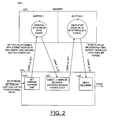
- the circuit 100 generally provides an encoder/decoder architecture for high quality video compression and decompression that may be configured to use context-based adaptive binary arithmetic coding (CABAC).
- CABAC context-based adaptive binary arithmetic coding
- the circuit 100 generally receives an input signal (e.g., DATA_IN) and generates an output signal (e.g., DATA_OUT).
- the signal DATA_IN may comprise uncompressed data (e.g., video, audio, etc.) to be compressed and the signal DATA_OUT may comprise a compressed data (or bit) stream (e.g., for transmission or storage) .
- the signal DATA_IN may comprise a compressed data (or bit) stream (e.g., MPEG-4, H.264, etc. compressed video) and the signal DATA_OUT may comprise an uncompressed data stream (e.g., video, audio, data, etc.).
- a compressed data (or bit) stream e.g., MPEG-4, H.264, etc. compressed video
- the signal DATA_OUT may comprise an uncompressed data stream (e.g., video, audio, data, etc.).
- the circuit 100 generally comprises a circuit 102 and a circuit 104.
- the circuit 102 may be implemented as a memory circuit.
- the circuit 104 may be implemented as an encoder, a decoder or an encoder/decoder (CODEC) circuit (or block).
- the circuit 102 may comprise a first portion (e.g., BUFFER1) and a second portion (e.g., BUFFER2).
- BUFFER1 and BUFFER2 may be implemented as sections of a single memory device.
- BUFFER1 and BUFFER2 may be implemented as individual memory devices.
- BUFFER1 and BUFFER2 may be implemented as first-in first-out (FIFO) memories.
- the circuit 102 may have an input 106 that may receive a signal (e.g., COMP_A_OUT), an output 108 that may present a signal (e.g., COMP_A_IN), an input 110 that may receive a signal (e.g., COMP_B_OUT), and an output 112 that may present a signal (e.g., COMP_B_IN).
- the signals COMP_A_OUT and COMP_A_IN may communicate a first representation of data compressed in a first format (e.g., Huffman coding, CABAC, H.264, etc.).
- the circuit 102 may be configured to receive the compressed data in the first format via the signal COMP_A_OUT, store the data, retrieve the data and present the compressed data via the signal COMP_A_IN.
- the circuit 102 may be configured to store the compressed data received via the signal COMP_A_OUT in BUFFER1.
- the signals COMP_B_OUT and COMP_B_IN may comprise a second representation of data, compressed using a second compression format (e.g., Huffman coding, CABAC, H.264, etc.).
- the circuit 102 may be configured to store the compressed data received via the signal COMP_B_OUT in BUFFER2.
- the circuit 102 may be configured to present the compressed data stored in BUFFER2 via the signal COMP_B_IN.
- the circuit 104 may have an input 114 that may receive the signal DATA_IN, an output 116 that may present the signal COMP_A_OUT, an input 118 that may receive the signal COMP_A_IN, an output 120 that may present the signal COMP_B_OUT, an input 122 that may receive the signal COMP_B_IN, and an output 124 that may present the signal DATA_OUT.
- the circuit 104 may be configured to generate the signal COMP_A_OUT in response to the signal DATA_IN.
- the circuit 104 may be configured to generate the signal COMP_B_OUT in response to the signal COMP_A_IN.
- the circuit 104 may be configured to generate the signal DATA_OUT in response to the signal COMP_B_IN.
- the circuit 104 may be configured to generate one or more control signals for controlling the data flow to and from the circuit 102.
- the circuit 104 generally comprises a circuit 130, a circuit 132 and a circuit 134.
- the circuit 130 may be implemented as an input circuit.
- the circuit 132 may be implemented as a transcoder circuit.
- the circuit 134 may be implemented as an output circuit.
- the circuit 130 may be implemented as a bitstream capture unit.
- the circuit 130 may be implemented as a video encoding circuit.
- the circuit 132 may be configured to translate data between a first representation of data (e.g., a context-based adaptive binary arithmetic coding scheme) and a second representation of the data (e.g., a simpler entropy coding scheme, such as Huffman, non-CABAC H.264, etc.).
- a simpler entropy coding scheme such as Huffman, non-CABAC H.264, etc.
- the circuit 132 may be configured to translate data from the simpler entropy coding scheme into the context-based adaptive binary arithmetic coding scheme.
- the circuit 132 may be configured to translate directly from the context-based adaptive binary arithmetic coding scheme to a simpler entropy coding scheme (e.g., Huffman coding or non-CABAC encoding scheme).
- two formats may be implemented for the simpler compressed format: a) binarized but not CABAC and/or b) Huffman for coefficients and binarized but not CABAC for the rest.
- the first format may be symbols that use the same variable-length binarization as H.264 CABAC but without arithmetic coding.
- the second format may be an H.264 representation using the Huffman (e.g., not CABAC) option for entropy encoding.
- the circuit 132 comprises a lossless entropy transcoder.
- Entropy encoding generally refers to representing a set of symbols in a way that the symbols can be exactly recovered from the representation. Furthermore, based on a statistical model, the representation generally uses, on average, fewer bits than the direct way of representing the data.
- the circuit 132 generally performs an entropy decode (e.g., a Huffman decode, a CABAC decode, etc.) on the signal COMP_A_IN and an entropy encode on the result of the decode operation (e.g., with a Huffman encode, CABAC encode, non-CABAC encode, etc.) for presentation as the signal COMP_B_OUT.
- an entropy decode e.g., a Huffman decode, a CABAC decode, etc.
- the circuit 134 may be implemented, in one example, as a real time video decoder circuit.
- the circuit 134 generally comprises a variable length code (VLC) decoder, dequantization unit, and inverse transform unit that can be used to reconstruct pictures from a compressed bitstream.
- VLC variable length code
- the circuit 134 may be implemented as video transmission unit.
- the circuit 100' may comprise a single integrated circuit (IC) decoder chip 104' and an external memory chip 102'.
- the circuit 102' may be implemented similarly to the circuit 102.
- the circuit 104' may comprise a circuit 130', a circuit 132' and a circuit 134'.
- the circuit 130' may be implemented as a bitstream capture unit.
- the circuit 132' may be implemented as a transcoder circuit.
- the circuit 134' may be implemented as a real-time video decoder circuit.
- the circuit 130' may be configured to receive a compressed data bitstream (e.g., a signal BITSTREAM) and store the bitstream in a first buffer implemented in the memory 102'.
- the circuit 132' may be configured to (i) retrieve the bitstream from the memory 102', (ii) convert encoded data (e.g., encoded with CABAC) into a simpler encoded bitstream (e.g., without CABAC) and (iii) store the simpler encoded bitstream into a second buffer implemented in the memory 102'.
- the circuit 134' may be configured to (i) retrieve the simpler encoded bitstream from the second buffer and (ii) decode the bitstream, in one example, into video stream (e.g., a signal VIDEO).
- the circuit 130' is generally configured to store the bitstream as fast as possible while the first buffer is non-empty and the second buffer is not full. Data is generally read from the second buffer while being reconstructed.
- the second buffer may be sized to hold approximately one second of video.
- the data from the second buffer may be bursty based on, for example, in-picture bit usage.
- the circuit 100' may comprise a single integrated circuit (IC) decoder chip 104" and an external memory chip 102''.
- the circuit 102" may be implemented similarly to the circuit 102.
- the circuit 104" may comprise a circuit 130", a circuit 132" and a circuit 134''.
- the circuit 130" may be implemented, in one example, as a real-time video encoder.
- the circuit 132" may be implemented as a transcoder circuit.
- the circuit 134" may be implemented as a bitstream transmission unit.
- the circuit 130" may be configured to (i) receive an uncompressed video stream, encode the video stream with, for example, entropy coding (e.g., Huffman, universal variable length code (UVLC), etc.), and (iii) store the encoded data stream in a first buffer implemented in the memory 102" .
- the circuit 132" may be configured to (i) retrieve the encoded data from the memory 102'', (ii) convert encoded data (e.g., with no CABAC) into a more compact encoded bitstream (e.g., with CABAC) and (iii) store the further compressed data stream into a second buffer implemented in the memory 102''.
- the circuit 134'' may be configured to (i) retrieve the compressed data stream from the second buffer and (ii) and transmit the compressed data bitstream (e.g., as the signal BITSTREAM).
- the present invention includes several implementations.
- an inexpensive transcoder may be implemented for CAVLC entropy-decoding followed by CABAC entropy-encoding.
- CABAC entropy-encoding For CAVLC-to-CABAC transcoding, none of the other standard blocks of an encoder or decoder are needed (e.g., (inverse)transform, (inverse)quantization, etc. may be skipped).
- CAVLC codes may either (a) represent all valid coefficient values that CABAC can (e.g., up to 15 bits for H.264 and for 8-bit video with H.264/PExt, up to (15+X) bits for (8+X) bit H.264/PExt sample bit depth video, where X is a positive integer) or (b) represent all coefficient values that can be produced from encoding of residuals that are one bit greater in size than the bit depth of the video format in use (e.g., for 8-bit video, 9-bit residuals are naturally the largest residuals that would be expected from standard encoding methods).
- the H.264 standard does not limit bitstreams to contain only 9-bit residuals, so that a pathological bitstream for 8-bit video may possibly contain larger residuals.
- a completely standard compliant CABAC-to-CAVLC transcoder may be cheaply implemented by CABAC entropy decoding followed by CAVLC entropy encoding.
- the present invention may implement both an inexpensive standard compliant transcoder, and the extended CAVLC codes that enable CAVLC to represent all CABAC coefficient values.
- the implementation as described above for (a) may be used in a transcoder that would be expected to be commercially very viable.
- a transcoder e.g., an inexpensive CABAC-to-CAVLC transcoder, and extended CAVLC codes
- such an implementation would be capable of perfectly transcoding all non-pathological bitstreams (e.g., all bitstream with residuals only 1 bit deeper than the samples of the original video).
- CABAC-to-CAVLC transcoder would simply clip transform coefficients from the CABAC stream that are too large to represent in the CAVLC bitstream.
- the frequency of occurrence of any minor mismatch introduced through such an implementation would be negligible.
- Such a transcoder would typically only exhibit observable mismatch between the original and transcoded video stream for either pathological bitstreams, or very infrequently for bitstreams used in professional applications that are very nearly lossless.
- part of the present invention presents an ECAVLC (e.g., a proposal to extend the CAVLC codes to be able to represent larger coefficients).
- One embodiment adds an additional level prefix code of "16" to the current level prefix codes in H.264 (e.g., a "0" through “15”) .
- the new level prefix code may comprise either a bit string "0000 0000 0000 0000", a bit string "0000 0000 0000 0" or a bit string "0000 0000 0000 0000 1".
- Decoding a particular bit string indicates that the size of the level suffix is some number bits (e.g., B) that is greater than 12.
- the number B may be different for each bit depth of video used in the H.264/PExt standard. For internal use in an encoder for H.264, the number B may be 14 bits (to be able to fully represent all possible coefficient values). For (8+X) bit video samples, the number B should typically be (14+X) bits, where X is a positive integer.
- a second embodiment may be to redefine the existing level prefix code of "15” (e.g., using bit string "0000 0000 0000 0001" in the H.264 standard).
- a level suffix of size B bits (as described above) may be implemented rather than the current 12 bits used by the current CAVLC.
- a third embodiment may be used to introduce the new level prefix code of "16" as defined above and to change the encoding of the suffix part of the code to be an exponential-Golomb code.
- the extended CAVLC code would be capable of representing coefficients with any number of bits and would be immediately applicable to a future standard defining a particular bit depth of samples.
- the circuit 132" generally comprises a block (or circuit) 150 and a block (or circuit) 152.
- the block 150 may be implemented as a CAVLC/ECAVLC decoder.
- a block 152 may be implemented as a CABAC encoder.
- the block 150 may parse coefficients from the input signal COMP_A_IN by performing a CAVLC or ECAVLC decoding operation.
- the block 152 may encode the parsed coefficients from the block 150 into the output signal COMP_B_OUT by performing a CABAC encoding operation.
- the block 132"' generally comprises a block (or circuit) 160, a block (or circuit) 162, and a block (or circuit) 164.
- the block 160 may be implemented as a CABAC decoder.
- the block 162 may be implemented as a CAVLC or ECAVLC encoder.
- the block 164 may be implemented as a coefficient clipping block.
- the block 160 may parse coefficients from the input signal COMP_A_IN by performing a CABAC decoding operation.
- the block 164 may clip the coefficients if block 162 implements a CAVLC encoding operation.
- the block 164 may be absent if the block 162 implements an ECAVLC encoding per the present invention.
- the block 162 may generate the output signal COMP_B_OUT using the parsed and optionally clipped coefficients from the block 160.
- a variable (e.g., OFFSET_FLAG) may be is true when a level value of a syntax element (e.g., LEVEL) is determined to have a value greater than one.
- the syntax element LEVEL is an output of the method 200 that may be a signed coefficient level.
- a syntax element (e.g., SUFFIXLENGTH) is an element that determines which adaptive code to use (e.g., code "0" through code "20")
- the method 200 may also determine two syntax elements (e.g., LEVEL_PREFIX and LEVEL_SUFFIX).
- the method 200 generally calculates the level value for the syntax element LEVEL based on the syntax elements LEVEL_PREFIX and LEVEL_SUFFIX.
- the element LEVEL_PREFIX is generally determined from a bit string in the received stream using TABLE I, TABLE II or a similar table, depending upon a particular implementation.
- the element LEVEL_PREFIX may convey a CAVLC/ECAVLC syntax element with the left bit first.
- the element LEVEL_SUFFIX may be an unsigned variable length integer generally conveying a length value calculated within the method 200.
- the method 200 generally comprises a state 202, a decision state 204, a decision state 206, a state 208, a state 210, a state 212, a state 214, a decision state 216, a decision state 218, a state 220, a state 222, a decision state 224, a state 226, a decision state 228, a state 230, and a state 232.
- the state 202 may decode the syntax element LEVEL_PREFIX from a received stream (e.g., COMP_A_IN) in accordance with TABLE I or TABLE II.
- the decision state 204 determines if both the value of the syntax element LEVEL_PREFIX equals 14 and whether a value of the syntax element SUFFIXLENGTH is equal to zero. If not, the method 200 moves to the decision state 206. If so, the method 200 moves to the state 208 which sets a level suffix size value of a syntax element (e.g., LEVELSUFFIXSIZE) equal to 4. The decision state 206 determines if the syntax element LEVEL_PREFIX has a value greater than or equal to 15. If not, the method 200 moves to the state 212. If so, the method 200 moves to the state 210 which sets the syntax element LEVELSUFFIXSIZE to a value equal to the syntax element LEVEL_PREFIX-3.
- a level suffix size value of a syntax element e.g., LEVELSUFFIXSIZE
- the state 212 decodes the syntax element LEVEL_SUFFIX as an integer having a length value corresponding to the syntax element LEVELSUFFIXSIZE.
- the state 214 sets the syntax element LEVELCODE to a value equal to a minimum of either (i) a value of 15 or (ii) the syntax element LEVEL_PREFIX value arithmetically left shifted by a number of binary digits determined by the syntax element SUFFIXLENGTH.
- the syntax element LEVEL_SUFFIX may subsequently be added to the syntax element LEVELCODE.
- Addition of the syntax element LEVEL_SUFFIX value to the syntax element LEVELCODE may be skipped if either the syntax element LEVEL_PREFIX has a value greater than 14 or the syntax element SUFFIXLENGTH has a value greater than zero.
- the decision state 216 determines if both the syntax element LEVEL_PREFIX have a value greater than or equal to 15 and whether the syntax element SUFFIXLENGTH has a value equal to zero. If not, the method 200 moves to the state 218. If so, the method moves to the state 220. The state 220 sets the syntax element LEVELCODE value equal to the syntax element LEVELCODE+15. Next, the decision state 218 determines whether the syntax element LEVEL_PREFIX has a value greater than or equal to 16. If not, the method 200 moves to the state 224. If so, the method 200 moves to the state 222.
- the state 222 sets the syntax element LEVELCODE to a value equal to the syntax element LEVELCODE+(1 arithmetically left shifted by (LEVEL_PREFIX-3) binary digits)-4096.
- the state 224 determines if the OFFSET_FLAG has a value equal to one. If not, the method 200 moves to the state 228. If so, the method 200 moves to the state 226.
- the state 226 sets the syntax element LEVELCODE to a value equal to the syntax element LEVELCODE+2.
- the decision state 228 determines if the syntax element LEVELCODE is an even number. If not (e.g., an odd number), the method 200 moves to the state 232.
- the method 200 moves to the state 230.
- the state 230 sets the syntax element LEVEL to a value equal to (LEVELCODE+2) ⁇ 2.
- the state 232 sets the syntax element LEVEL to a value equal to - (LEVELCODE+1) ⁇ 2.
- the syntax element LEVEL is normally a signed value.
- the state 230 and the state 232 generally calculate both the sign and the magnitude of the syntax element LEVEL.
- the method 200 may update the value for the syntax element SUFFIXLENGTH. If the syntax element SUFFIXLENGTH has a value equal to zero, the syntax element SUFFIXLENGTH may be set to a value of one. If both an absolute value of the syntax element LEVEL is greater than a value of 3 arithmetically left shifted by (SUFFIXLENGTH-1) binary digits and SUFFIXLENGTH has a value less than 6, then the syntax element SUFFIXLENGTH may be incremented by one.
- the present invention may be used internally in an encoder chip as a proprietary method for internally transcoding between ECAVLC (or CAVLC) and CABAC for H.264 streams.
- the present invention may be implemented with far less resources than the alternatives for transcoding both external and chip-internal streams from CAVLC-to-CABAC for H.264 and for H.264/PExt.
- the present invention may be implemented in an encoder to provide the ability to fully produce all valid coefficient values.
- the present invention may also be valuable as a CAVLC-to-CABAC transcoder for H.264/PExt (if the PExt adopts extended CAVLC codes).
- the present invention provides an encoder that has the ability to produce a CABAC bitstream that will be guaranteed to be easily transcodable by all cheap CABAC-to-CAVLC H.264 transcoders.
- the function performed by the flow diagram of FIG. 6 may be implemented using a conventional general purpose digital computer programmed according to the teachings of the present specification, as will be apparent to those skilled in the relevant art(s). Appropriate software coding can readily be prepared by skilled programmers based on the teachings of the present disclosure, as will also be apparent to those skilled in the relevant art(s).
- the present invention may also be implemented by the preparation of ASICs, FPGAs, or by interconnecting an appropriate network of conventional component circuits, as is described herein, modifications of which will be readily apparent to those skilled in the art(s).
- the present invention thus may also include a computer product which may be a storage medium including instructions which can be used to program a computer to perform a process in accordance with the present invention.
- the storage medium can include, but is not limited to, any type of disk including floppy disk, optical disk, CD-ROM, magneto-optical disks, ROMs, RAMS, EPROMs, EEPROMs, Flash memory, magnetic or optical cards, or any type of media suitable for storing electronic instructions.
Landscapes
- Engineering & Computer Science (AREA)
- Multimedia (AREA)
- Signal Processing (AREA)
- Theoretical Computer Science (AREA)
- Compression, Expansion, Code Conversion, And Decoders (AREA)
- Compression Or Coding Systems Of Tv Signals (AREA)
Applications Claiming Priority (4)
| Application Number | Priority Date | Filing Date | Title |
|---|---|---|---|
| US10/739,829 US7646814B2 (en) | 2003-12-18 | 2003-12-18 | Low complexity transcoding between videostreams using different entropy coding |
| US739829 | 2003-12-18 | ||
| US10/898,125 US7660355B2 (en) | 2003-12-18 | 2004-07-23 | Low complexity transcoding between video streams using different entropy coding |
| US898125 | 2004-07-23 |
Publications (2)
| Publication Number | Publication Date |
|---|---|
| EP1545133A2 true EP1545133A2 (de) | 2005-06-22 |
| EP1545133A3 EP1545133A3 (de) | 2009-09-09 |
Family
ID=34527198
Family Applications (1)
| Application Number | Title | Priority Date | Filing Date |
|---|---|---|---|
| EP04017639A Withdrawn EP1545133A3 (de) | 2003-12-18 | 2004-07-26 | Transkodierung mit geringer Komplexität zwischen Videoströmen verschiedener Entropiecodierung |
Country Status (2)
| Country | Link |
|---|---|
| US (1) | US7660355B2 (de) |
| EP (1) | EP1545133A3 (de) |
Cited By (7)
| Publication number | Priority date | Publication date | Assignee | Title |
|---|---|---|---|---|
| GB2434049A (en) * | 2005-12-07 | 2007-07-11 | Imagination Tech Ltd | Rate smoothing a context based adaptive entropy decoding scheme using a FIFO |
| EP2164176A1 (de) * | 2008-09-12 | 2010-03-17 | Thomson Licensing | Verfahren für verlustfreie komprimierte Präfix-Suffix-Codes, Verfahren zur Dekomprimierung von Bitsequenz darstellenden ganzen Zahlen oder Symbole, die in dem komprimierten Präfix-Suffix-Codes codiert sind, sowie Speichermedium oder Signal mit komprimierten Präfix-Suffix-Codes |
| CN101902639A (zh) * | 2009-05-27 | 2010-12-01 | 索尼公司 | 编码装置和编码方法以及解码装置和解码方法 |
| RU2413360C1 (ru) * | 2006-11-14 | 2011-02-27 | Квэлкомм Инкорпорейтед | Эффективное по использованию памяти адаптивное блочное кодирование |
| EP2847995A4 (de) * | 2012-05-09 | 2016-01-13 | Magnum Semiconductor Inc | Vorrichtungen und verfahren zur bestimmung von bitzahlen in einem bitstrom |
| WO2016033254A1 (en) * | 2014-08-30 | 2016-03-03 | Apple Inc. | Video encoder with context switching |
| US9479786B2 (en) | 2008-09-26 | 2016-10-25 | Dolby Laboratories Licensing Corporation | Complexity allocation for video and image coding applications |
Families Citing this family (17)
| Publication number | Priority date | Publication date | Assignee | Title |
|---|---|---|---|---|
| US7660355B2 (en) * | 2003-12-18 | 2010-02-09 | Lsi Corporation | Low complexity transcoding between video streams using different entropy coding |
| EP2346243B1 (de) * | 2004-08-31 | 2013-11-06 | Panasonic Corporation | Verfahren und Vorrichtung zur Kodierung bewegter Bilder |
| KR101147744B1 (ko) * | 2005-02-22 | 2012-05-25 | 엘지전자 주식회사 | 비디오 트랜스 코딩 방법 및 장치와 이를 이용한 pvr |
| JP4540585B2 (ja) * | 2005-10-20 | 2010-09-08 | パナソニック株式会社 | 符号化装置及び復号化装置 |
| US8767838B1 (en) * | 2008-09-05 | 2014-07-01 | Zenverge, Inc. | Cascading multiple video transcoders in a video processing system |
| US9083976B2 (en) | 2008-09-05 | 2015-07-14 | Freescale Semiconductor, Inc. | Processing a video stream in real time based on binary information of the video stream |
| JP5524072B2 (ja) * | 2008-10-10 | 2014-06-18 | 株式会社東芝 | 動画像符号化装置 |
| US20100127904A1 (en) * | 2008-11-26 | 2010-05-27 | Horizon Semiconductors Ltd. | Implementation of a rapid arithmetic binary decoding system of a suffix length |
| US8270495B2 (en) * | 2009-02-13 | 2012-09-18 | Cisco Technology, Inc. | Reduced bandwidth off-loading of entropy coding/decoding |
| JP2012124838A (ja) * | 2010-12-10 | 2012-06-28 | Sony Corp | 画像復号化装置と画像復号化方法および画像符号化装置と画像符号化方法並びにプログラム |
| WO2013086724A1 (en) | 2011-12-15 | 2013-06-20 | Mediatek Singapore Pte. Ltd. | Method of clippling transformed coefficients before de-quantization |
| US9942571B2 (en) * | 2012-05-29 | 2018-04-10 | Hfi Innovations Inc. | Method and apparatus for coding of sample adaptive offset information |
| US10341673B2 (en) * | 2013-05-08 | 2019-07-02 | Integrated Device Technology, Inc. | Apparatuses, methods, and content distribution system for transcoding bitstreams using first and second transcoders |
| GB2521828A (en) * | 2013-12-23 | 2015-07-08 | Sony Corp | Data encoding and decoding |
| EP3565259A4 (de) * | 2016-12-28 | 2019-11-06 | Panasonic Intellectual Property Corporation of America | Verteilungsverfahren für dreidimensionales modell, empfangsverfahren für dreidimensionales modell, verteilungsvorrichtung für dreidimensionales modell und empfangsvorrichtung für dreidimensionales modell |
| KR102432486B1 (ko) | 2017-11-22 | 2022-08-12 | 삼성전자주식회사 | 비디오 복호화 장치 및 이를 포함하는 컴퓨팅 시스템 및 비디오 복호화 방법 |
| JP2022523564A (ja) | 2019-03-04 | 2022-04-25 | アイオーカレンツ, インコーポレイテッド | 機械学習を使用するデータ圧縮および通信 |
Family Cites Families (13)
| Publication number | Priority date | Publication date | Assignee | Title |
|---|---|---|---|---|
| US4075622A (en) * | 1975-01-31 | 1978-02-21 | The United States Of America As Represented By The Secretary Of The Navy | Variable-to-block-with-prefix source coding technique |
| US5596376A (en) * | 1995-02-16 | 1997-01-21 | C-Cube Microsystems, Inc. | Structure and method for a multistandard video encoder including an addressing scheme supporting two banks of memory |
| US5850482A (en) * | 1996-04-17 | 1998-12-15 | Mcdonnell Douglas Corporation | Error resilient method and apparatus for entropy coding |
| AU6863998A (en) * | 1997-03-11 | 1998-09-29 | Computer Information And Sciences, Inc. | System and method for image compression and decompression |
| US6304607B1 (en) * | 1997-03-18 | 2001-10-16 | Texas Instruments Incorporated | Error resilient video coding using reversible variable length codes (RVLCS) |
| US7158684B2 (en) * | 2002-04-25 | 2007-01-02 | Texas Instruments Incoporated | Entropy coding scheme for video coding |
| DE50305419D1 (de) * | 2002-05-02 | 2006-11-30 | Fraunhofer Ges Forschung | Kodierung und Dekodierung von Transformationskoeffizienten in Bild- oder Videokodierern |
| US7469012B2 (en) * | 2002-05-14 | 2008-12-23 | Broadcom Corporation | System and method for transcoding entropy-coded bitstreams |
| US6744387B2 (en) | 2002-07-10 | 2004-06-01 | Lsi Logic Corporation | Method and system for symbol binarization |
| AU2003290536A1 (en) * | 2002-10-23 | 2004-05-13 | Divxnetworks, Inc. | Method and system for supercompression of compressed digital video |
| US6646578B1 (en) * | 2002-11-22 | 2003-11-11 | Ub Video Inc. | Context adaptive variable length decoding system and method |
| US7660355B2 (en) * | 2003-12-18 | 2010-02-09 | Lsi Corporation | Low complexity transcoding between video streams using different entropy coding |
| US7209059B2 (en) * | 2004-12-06 | 2007-04-24 | Matsushita Electric Industrial Co., Ltd. | Decoding method and encoding method |
-
2004
- 2004-07-23 US US10/898,125 patent/US7660355B2/en not_active Expired - Lifetime
- 2004-07-26 EP EP04017639A patent/EP1545133A3/de not_active Withdrawn
Cited By (15)
| Publication number | Priority date | Publication date | Assignee | Title |
|---|---|---|---|---|
| GB2434049B (en) * | 2005-12-07 | 2010-07-14 | Imagination Tech Ltd | Decoding Data |
| GB2434049A (en) * | 2005-12-07 | 2007-07-11 | Imagination Tech Ltd | Rate smoothing a context based adaptive entropy decoding scheme using a FIFO |
| US7796065B2 (en) | 2005-12-07 | 2010-09-14 | Imagination Technologies Limited | Method of decoding data and apparatus therefor |
| RU2413360C1 (ru) * | 2006-11-14 | 2011-02-27 | Квэлкомм Инкорпорейтед | Эффективное по использованию памяти адаптивное блочное кодирование |
| WO2010028967A1 (en) * | 2008-09-12 | 2010-03-18 | Thomson Licensing | Method for lossless compressing prefix-suffix-codes, method for decompressing a bit sequence representing integers or symbols encoded in compressed prefix-suffix-codes and storage medium or signal carrying compressed prefix-suffix-codes |
| EP2164176A1 (de) * | 2008-09-12 | 2010-03-17 | Thomson Licensing | Verfahren für verlustfreie komprimierte Präfix-Suffix-Codes, Verfahren zur Dekomprimierung von Bitsequenz darstellenden ganzen Zahlen oder Symbole, die in dem komprimierten Präfix-Suffix-Codes codiert sind, sowie Speichermedium oder Signal mit komprimierten Präfix-Suffix-Codes |
| US9479786B2 (en) | 2008-09-26 | 2016-10-25 | Dolby Laboratories Licensing Corporation | Complexity allocation for video and image coding applications |
| CN101902639A (zh) * | 2009-05-27 | 2010-12-01 | 索尼公司 | 编码装置和编码方法以及解码装置和解码方法 |
| EP2257069A3 (de) * | 2009-05-27 | 2012-09-05 | Sony Corporation | Kodierungsgerät und Kodierungsverfahren und Dekodierungsgerät und Dekodierungsverfahren |
| US8320447B2 (en) | 2009-05-27 | 2012-11-27 | Sony Corporation | Encoding apparatus and encoding method, and decoding apparatus and decoding method |
| EP2847995A4 (de) * | 2012-05-09 | 2016-01-13 | Magnum Semiconductor Inc | Vorrichtungen und verfahren zur bestimmung von bitzahlen in einem bitstrom |
| US10021409B2 (en) | 2012-05-09 | 2018-07-10 | Integrated Device Technology, Inc. | Apparatuses and methods for estimating bitstream bit counts |
| WO2016033254A1 (en) * | 2014-08-30 | 2016-03-03 | Apple Inc. | Video encoder with context switching |
| TWI583180B (zh) * | 2014-08-30 | 2017-05-11 | 蘋果公司 | 具有上下文切換之視訊編碼器 |
| US10313683B2 (en) | 2014-08-30 | 2019-06-04 | Apple Inc. | Video encoder with context switching |
Also Published As
| Publication number | Publication date |
|---|---|
| US7660355B2 (en) | 2010-02-09 |
| US20050147173A1 (en) | 2005-07-07 |
| EP1545133A3 (de) | 2009-09-09 |
Similar Documents
| Publication | Publication Date | Title |
|---|---|---|
| US7660355B2 (en) | Low complexity transcoding between video streams using different entropy coding | |
| US6927710B2 (en) | Context based adaptive binary arithmetic CODEC architecture for high quality video compression and decompression | |
| US6917310B2 (en) | Video decoder and encoder transcoder to and from re-orderable format | |
| US7646814B2 (en) | Low complexity transcoding between videostreams using different entropy coding | |
| KR0129558B1 (ko) | 적응적 가변길이 부호화 방법 및 장치 | |
| US6982663B2 (en) | Method and system for symbol binarization | |
| KR100801364B1 (ko) | 산술부호의 복호기 또는 부호화기와 역2치화 변환기 또는2치화 변환기의 사이에 중간 버퍼가 삽입된 복호장치 또는부호화 장치 | |
| AU2002318196B2 (en) | An apparatus and method for encoding digital image data in a lossless manner | |
| US20060126744A1 (en) | Two pass architecture for H.264 CABAC decoding process | |
| US20070009047A1 (en) | Method and apparatus for hybrid entropy encoding and decoding | |
| US8199820B2 (en) | Intermediate compression of reference frames for transcoding | |
| US20150245076A1 (en) | Multiple technique entropy coding system and method | |
| CN101904172A (zh) | Vlc方法和设备 | |
| JP5021167B2 (ja) | 複数記述符号化のための装置及び方法 | |
| US7379498B2 (en) | Reconstructing a compressed still image by transformation to a compressed moving picture image | |
| US7796825B2 (en) | Losslessly improving compression of compressed image data | |
| EP1333679B1 (de) | Datenkompression | |
| US7436329B2 (en) | Multiple technique entropy coding system and method | |
| KR101710619B1 (ko) | 단계적인 영상 부호화, 복호화 방법 및 장치 | |
| EP1173027B1 (de) | Verfahren und Vorrichtung für fast verlustfreie verkettete Blocktransformkodierung | |
| US20100002946A1 (en) | Method and apparatus for compressing for data relating to an image or video frame | |
| TW201014364A (en) | Method for transcoding a first codeword to a second codeword | |
| US20160360236A1 (en) | Method and Apparatus for Entropy Transcoding | |
| US5654704A (en) | Video variable length code encoder with EOB insertion responsive to word length | |
| KR20060027831A (ko) | 신호를 비트 스트림으로 인코딩하는 방법 |
Legal Events
| Date | Code | Title | Description |
|---|---|---|---|
| PUAI | Public reference made under article 153(3) epc to a published international application that has entered the european phase |
Free format text: ORIGINAL CODE: 0009012 |
|
| AK | Designated contracting states |
Kind code of ref document: A2 Designated state(s): AT BE BG CH CY CZ DE DK EE ES FI FR GB GR HU IE IT LI LU MC NL PL PT RO SE SI SK TR |
|
| AX | Request for extension of the european patent |
Extension state: AL HR LT LV MK |
|
| PUAL | Search report despatched |
Free format text: ORIGINAL CODE: 0009013 |
|
| AK | Designated contracting states |
Kind code of ref document: A3 Designated state(s): AT BE BG CH CY CZ DE DK EE ES FI FR GB GR HU IE IT LI LU MC NL PL PT RO SE SI SK TR |
|
| AX | Request for extension of the european patent |
Extension state: AL HR LT LV MK |
|
| AKX | Designation fees paid |
Designated state(s): DE FR GB |
|
| STAA | Information on the status of an ep patent application or granted ep patent |
Free format text: STATUS: THE APPLICATION IS DEEMED TO BE WITHDRAWN |
|
| 18D | Application deemed to be withdrawn |
Effective date: 20100310 |