EP1544978B1 - Axial gap electric motor - Google Patents
Axial gap electric motor Download PDFInfo
- Publication number
- EP1544978B1 EP1544978B1 EP04028377A EP04028377A EP1544978B1 EP 1544978 B1 EP1544978 B1 EP 1544978B1 EP 04028377 A EP04028377 A EP 04028377A EP 04028377 A EP04028377 A EP 04028377A EP 1544978 B1 EP1544978 B1 EP 1544978B1
- Authority
- EP
- European Patent Office
- Prior art keywords
- rotor
- stator
- axial gap
- electric motor
- magnets
- Prior art date
- Legal status (The legal status is an assumption and is not a legal conclusion. Google has not performed a legal analysis and makes no representation as to the accuracy of the status listed.)
- Expired - Lifetime
Links
Images


Classifications
-
- H—ELECTRICITY
- H02—GENERATION; CONVERSION OR DISTRIBUTION OF ELECTRIC POWER
- H02K—DYNAMO-ELECTRIC MACHINES
- H02K1/00—Details of the magnetic circuit
- H02K1/06—Details of the magnetic circuit characterised by the shape, form or construction
- H02K1/22—Rotating parts of the magnetic circuit
- H02K1/27—Rotor cores with permanent magnets
- H02K1/2793—Rotors axially facing stators
- H02K1/2795—Rotors axially facing stators the rotor consisting of two or more circumferentially positioned magnets
- H02K1/2796—Rotors axially facing stators the rotor consisting of two or more circumferentially positioned magnets where both axial sides of the rotor face a stator
-
- H—ELECTRICITY
- H02—GENERATION; CONVERSION OR DISTRIBUTION OF ELECTRIC POWER
- H02K—DYNAMO-ELECTRIC MACHINES
- H02K21/00—Synchronous motors having permanent magnets; Synchronous generators having permanent magnets
- H02K21/12—Synchronous motors having permanent magnets; Synchronous generators having permanent magnets with stationary armatures and rotating magnets
- H02K21/24—Synchronous motors having permanent magnets; Synchronous generators having permanent magnets with stationary armatures and rotating magnets with magnets axially facing the armatures, e.g. hub-type cycle dynamos
Definitions
- the present invention relates in general to electric motors and particularly to the motors of an axial gap type, which comprises a rotor shaft that is rotatable about its axis, at least one rotor that is fixed to the rotor shaft to rotate therewith and at least one stator that is disposed about the rotor shaft and axially spaced from the rotor.
- the axial gap motor 51 comprises a case 55, a rotor shaft 52 rotatably disposed in case 55, an annular rotor 53 fixed to rotor shaft 52 to rotate therewith and a stator 54 arranged about rotor shaft 52 at a position to face rotor 53.
- Axially spaced two bearings 56 are employed for rotatably supporting rotor shaft 52 relative to case 55.
- Rotor 53 comprises a rotor back core 57, twelve flat plate magnets 58 and a rotor core 59 which are assembled to constitute one unit.
- stator 54 comprises a stator back core 60, a stator core 61 and stator coils 62 which are assembled to constitute one unit. As shown, between stator 54 and rotor 53, there is defined a certain gap 63. Near one axial end of rotor shaft 52, there is arranged an encoder 64 that detects a rotation speed (or angular position) of rotor shaft 52.
- Case 55 is formed with a water jacket 65 through which cooling water flows to cool the motor 51.
- Rotor back core 57 functions to turn a looped magnetic flux about the axis X of rotor shaft 52. That is, for operating the motor 51, a looped magnetic flux that has passed through one group of flat plate magnets 58 is needed to turn in a circumferential direction for passing through the other group of flat plate magnets 58 and stator 54 next.
- Fig. 11 is an enlarged view of a part of rotor 53 taken from gap 63 between stator 54 and rotor 53 (see Fig. 10 ). As shown, with the presence of twelve flat plate magnets 58, rotor 53 has twelve poles, six N-poles and six S-poles alternately arranged. These flat plate magnets 58 are exposed at their main surfaces to gap 63 that is defined between stator 54 and rotor 53.
- axial gap motor 51 In axial gap motor 51 mentioned hereinabove, the output or power of the same depends substantially on quantity of magnetism possessed by rotor 53. Thus, when higher output is required, it is necessary to increase the number of flat plate magnets 58. However, due to the nature of the flat arrangement of flat plate magnets 58 that has been explained hereinabove, increasing the number of the magnets 58 directly brings about enlargement in size of rotor 53. Of course, in this case, the axial gap motor 51 becomes bulky. Furthermore, due to its inherent construction, the motor 51 tends to have even magnetic resistance and thus practical usage of a reluctance torque is poor. Furthermore, usage of rotor back core 57 increases the cost of motor 51.
- an object of the present invention is to provide an axial gap motor which is free of the above-mentioned drawbacks.
- an axial gap motor which can effectively use a reluctance torque and thus generate a higher power without increasing the size of the motor.
- an axial gap motor according to claim 1.
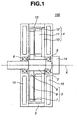
- FIG. 1 of the drawings there is shown in a sectional form an axial gap motor 100 of single rotor-single stator type, which is a first embodiment of the present invention.
- Axial gap motor 100 of this first embodiment comprises a case 5, a rotor shaft 2 rotatably installed in case 5, an annular rotor 3 concentrically disposed on rotor shaft 2 to rotate therewith and a stator 4 concentrically arranged about rotor shaft 52 at a position to coaxially face rotor 3.
- Two bearings 6 are held on axially spaced portions of case 5 to rotatably support rotor shaft 2 relative to case 5, as shown.
- Annular rotor 3 comprises a rotor ring 7, twelve magnets 8 and a rotor core 9 which are assembled to constitute one unit.
- Rotor core 9 is made of a pressed iron-powder, through which magnetism can penetrate. The detail of the annular rotor 3 will be described hereinafter.
- Stator 4 comprises a stator back core 10, a stator core 11 and stator coils 12 which are assembled to constitute one unit.
- Stator back core 10 is arranged to fix stator core 11 to case 5 and functions to turn a looped magnetic flux of stator core 11 about the axis X of rotor shaft 2.
- Stator coils 12 are arranged on equally spaced portions of a peripheral edge of stator core 11.
- stator 4 As shown, between stator 4 and rotor 3, there is defined a certain gap 13.
- an encoder 14 that detects a rotation speed (or angular position) of rotor shaft 2.
- Case 5 is formed with a water jacket 15 through which cooling water flows to cool entire construction of motor 100.
- the annular rotor 3 has a unique structure as will be described in the following.
- each of magnets 8 held by rotor ring 7 and rotor core 9 is shaped into a flat rectangular plate.
- the twelve flat plate magnets 8 are arranged about the axis X of rotor shaft 2 at evenly spaced intervals, and thus, the entire construction of annular rotor 3 is shaped like a water wheel. That is, in an assembled condition, opposed two major flat surfaces 8a and 8b (or pole faces) of each of the magnets 8 are perpendicular to an imaginary plane (not shown) that is perpendicular to the axis X of rotor shaft 2. In other words, the major flat surfaces 8a and 8b of the magnets 8 are perpendicular to an imaginary plane (not shown) that is substantially defined by the gap 13.
- adjacent two of the magnets 8 are all arranged in a reversed way regarding N-S position. That is, as shown, adjacent two of the magnets 8 are all arranged in such a manner that mutually facing major surfaces (or mutually facing pole faces) thereof have the same polarity for example, respective N-polarity or respective S-polarity.
- each of flat plate magnets 8 has two opposed major surfaces 8a and 8b.
- Fig. 4A shows the arrangement of the above-mentioned related art of Fig. 11
- Fig. 4B shows the arrangement in the first embodiment 100.
- the motor 100 of the first embodiment can exhibit the same quantity of magnetism as the axial gap motor 51 of Fig. 10 .
- Fig. 5A shows a positional relation between each magnet 58 of rotor 53 and stator core 61 of stator 54 (see Fig. 11 ), and Fig. 5B shows a positional relation between each magnet 8 of rotor 3 and stator core 11 of stator 4 (see Fig. 1 ).
- the magnetic fluxes (see Fig. 10 ) run axially from stator 54 toward rotor 53 passing through the perpendicularly facing flat plate magnets 58 and constitute looped magnetic fluxes.
- spaces defined between elements of stator core 61 face the pole faces of flat plate magnets 58, and thus, the gap 63 fails to have any portion through which Q-axis magnetic flux passes.
- the conventional axial gap motor 51 hardly produces a reluctance torque. While, in the unique positional relation shown in Fig.
- stator core 11 of stator 4 has two (viz., first and second) groups of paired elements of stator core 11, in which the paired elements of the first group are incorporated with one of the magnets 8 and those of the second group are incorporated with a part of rotor core 9 which is put between adjacent two magnets 8.
- the first group can produce a magnetic toque and the second group can produce a reluctance torque.
- Fig. 6 shows a first modification 3A of annular rotor 3 employed in the axial gap motor 100 of the first embodiment.
- each magnet 8A includes two mutually angled rectangular plate portions that have radially inner ends thereof integrated.
- each magnet 8A has a generally V-shaped cross section.
- the twelve magnets 8A are arranged about the axis X of rotor shaft 2 at evenly spaced intervals having the integrated bottom portions of the two rectangular plate portions of each magnet 8A directed toward the axis X of rotor shaft 2. Furthermore, the two mutually angled rectangular plate portions of each magnet 8A have mutually facing major surfaces that have the same polarity N (or S) and mutually opposed major surfaces that have the same polarity S (or N). Furthermore, as shown, adjacent two magnets 8A are so arranged that mutually closed rectangular plate portions of the two magnets 8A have mutually facing major surfaces that have different polarities S and N (or N and S).
- the quantity of magnetism can be increased without increasing the diameter of the motor 100, for the reason as has been mentioned hereinabove.
- the gap 13 faces rotor core 9 of rotor 3 (and 3A) that is constructed by pressed iron-powder, a reluctance torque is effectively produced by the motor 100, which promotes increase in power of the motor 100.
- Fig. 7 shows a second modification 3B of annular rotor employed in the axial gap motor 100 of the first embodiment.
- each flat plate magnet 8B is angled relative to an imaginary plane (not shown) that extends perpendicular to the axis X of rotor shaft 2. More specifically, as is understood from the drawing, adjacent two of the flat plate magnets 8B are angled to each other and angled with respect to an imaginary plane that extends in parallel with the axis X of rotor shaft 2 with one paired pole faces N-N (or S-S) facing forward and the other paired pole faces S-S (or N-N) facing rearward.
- the quantity of magnetism is much increased due to a three-dimensional arrangement of the magnets 8B in rotor 3B.
- the major surface of each magnet 8B can be much increased.
- the distance from the major surface of each magnet 8B to the stator 4 is reduced, and thus, the magnetic resistance is reduced increasing the quantity of magnetic fluxes.
- the thickness of rotor 3B is reduced, the volume of motor 100 is reduced and thus the power density of motor 100 is increased.
- FIG. 8 is a development elevation of the single rotor-single stator type axial gap motor 100 to which the modified rotor 3B of Fig. 7 is practically applied.
- stator 4 has stator teeth each having a V-shape coil, W-phase coil or U-phase coil mounted therearound.
- One unit including three types of coils V, W and U is in incorporation with paired magnets 8B that are angled to open toward the unit.
- each part of rotor core 9 that is substantially enclosed by paired magnets 8B and the unit of coils V, W and U is denoted by numeral 21(9).
- the paired magnets 8B that are angled to each other have mutually facing surfaces that carry the same polarity N (or S) and the other surfaces that carry the other same polarity S (or N).
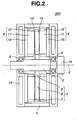
- FIG. 2 there is shown in a sectional form an axial gap motor 200 of single rotor-double stator type, which is a second embodiment of the present invention.
- axial gap motor 200 of this second embodiment is similar to the above-mentioned motor 100 of the first embodiment, only portions or parts that are different from those of the motor 100 will be described in detail in the following.
- an additional stator 4' is further employed, which is arranged at an axially opposite position of stator 4 with respect to rotor 3.
- these two stators 4 and 4' will be called first and second stators in the following description.
- First and second stators 4 and 4' are substantially the same in construction. That is, like stator 4, stator 4' comprises a stator back core 10', a stator core 11' and stator coils 12' which are assembled to constitute one unit. Stator back core 10' is arranged to fix stator core 11' to case 5 and functions to turn a looped magnetic flux of stator core 11' about the axis X of rotor shaft 2. Stator coils 12' are arranged on equally spaced portions of a peripheral edge of stator core 11'.
- first and second stators 4 and 4' are coaxially disposed about rotor shaft 2 having rotor 3 put therebetween.
- a certain gap 13 is defined between stator 4' and rotor 3, like the gap 13 between stator 4 and rotor 3.
- Fig. 9 is a development elevation of single rotor-double stator type axial gap motor 200 to which a third modification 3C of annular rotor is practically applied.
- the third modification 3C of rotor has, in addition to the group of the above-mentioned paired magnets 8B, another group of paired magnets 8B' that are incorporated with the additional stator 4'.
- the two groups of paired magnets 8B and 8B' are symmetrically arranged with respect to an imaginary plane Y that is perpendicular to the axis X of rotor shaft 2, and mutually facing major surfaces of the two groups of paired magnets 8B and 8B' have different polarities, that is, N-polarity and S-polarity or S-polarity and N-polarity, as shown.
- the quantity of magnetism produced by the motor 200 of this embodiment is increased as compared with the motor 100 and thus the motor 200 can generate a higher power than the motor 100.
- the motor 200 employing the third modification 3C of rotor can generate much high power due to employment of two groups of paired magnets 8B and 8B' in addition to the two stators 4 and 4'.
Landscapes
- Engineering & Computer Science (AREA)
- Power Engineering (AREA)
- Permanent Magnet Type Synchronous Machine (AREA)
- Permanent Field Magnets Of Synchronous Machinery (AREA)
- Iron Core Of Rotating Electric Machines (AREA)
Description
- The present invention relates in general to electric motors and particularly to the motors of an axial gap type, which comprises a rotor shaft that is rotatable about its axis, at least one rotor that is fixed to the rotor shaft to rotate therewith and at least one stator that is disposed about the rotor shaft and axially spaced from the rotor.
- Hitherto, various axial cap motors have been proposed and put into practical use particularly in the field of power generators that need high power density and low thermal generation. One of them is shown in Japanese Laid-open Patent Application (Tokkaihei)
11-187635 - In order to clarify the task of the present invention, one conventional axial gap motor will be briefly described with the aid of
Figs. 10 and11 of the accompanying drawings. - As is seen from
Fig. 10 , theaxial gap motor 51 comprises acase 55, arotor shaft 52 rotatably disposed incase 55, anannular rotor 53 fixed torotor shaft 52 to rotate therewith and astator 54 arranged aboutrotor shaft 52 at a position toface rotor 53. Axially spaced twobearings 56 are employed for rotatably supportingrotor shaft 52 relative tocase 55.Rotor 53 comprises arotor back core 57, twelveflat plate magnets 58 and arotor core 59 which are assembled to constitute one unit. - As is understood from
Fig. 11 , the twelveflat plate magnets 58 are of a flat plate type and are flatly held byrotor core 58 in such a manner that major flat surfaces offlat plate magnets 58 constitute an imaginary plane that is perpendicular to the axis X ofrotor shaft 52. As is seen fromFig. 10 ,stator 54 comprises astator back core 60, astator core 61 andstator coils 62 which are assembled to constitute one unit. As shown, betweenstator 54 androtor 53, there is defined acertain gap 63. Near one axial end ofrotor shaft 52, there is arranged anencoder 64 that detects a rotation speed (or angular position) ofrotor shaft 52.Case 55 is formed with awater jacket 65 through which cooling water flows to cool themotor 51. Rotor backcore 57 functions to turn a looped magnetic flux about the axis X ofrotor shaft 52. That is, for operating themotor 51, a looped magnetic flux that has passed through one group offlat plate magnets 58 is needed to turn in a circumferential direction for passing through the other group offlat plate magnets 58 andstator 54 next. -
Fig. 11 is an enlarged view of a part ofrotor 53 taken fromgap 63 betweenstator 54 and rotor 53 (seeFig. 10 ). As shown, with the presence of twelveflat plate magnets 58,rotor 53 has twelve poles, six N-poles and six S-poles alternately arranged. Theseflat plate magnets 58 are exposed at their main surfaces togap 63 that is defined betweenstator 54 androtor 53. - Another axial gap motor according to the prior art is known from document
FR-A-2606951 - In
axial gap motor 51 mentioned hereinabove, the output or power of the same depends substantially on quantity of magnetism possessed byrotor 53. Thus, when higher output is required, it is necessary to increase the number offlat plate magnets 58. However, due to the nature of the flat arrangement offlat plate magnets 58 that has been explained hereinabove, increasing the number of themagnets 58 directly brings about enlargement in size ofrotor 53. Of course, in this case, theaxial gap motor 51 becomes bulky. Furthermore, due to its inherent construction, themotor 51 tends to have even magnetic resistance and thus practical usage of a reluctance torque is poor. Furthermore, usage ofrotor back core 57 increases the cost ofmotor 51. - Accordingly, an object of the present invention is to provide an axial gap motor which is free of the above-mentioned drawbacks.
- That is, according to the present invention, there is provided an axial gap motor which can effectively use a reluctance torque and thus generate a higher power without increasing the size of the motor.
- In accordance with the present invention, there is provided an axial gap motor according to claim 1.
-
-
Fig. 1 is a sectional view of an axial gap motor of single rotor-single stator type, which is a first embodiment of the present invention; -
Fig. 2 is a sectional view of an axial gap motor of single rotor-double stator type, which is a second embodiment of the present invention; -
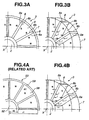
Figs. 3A and 3B are drawings showing one example of a rotor employable in the present invention, in whichFig. 3A is a front view of the rotor andFig. 3B is a perspective view of the rotor; -
Figs. 4A and 4B are drawings respectively showing a conventional rotor and the rotor ofFig. 3B ; -
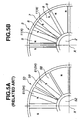
Figs. 5A and 5B are drawings similar toFigs. 4A and 4B , but each showing a positional relation between magnets of rotor and a stator core; -
Fig. 6 is a front view of a first modification of the rotor employable in the present invention; -
Fig. 7 is a perspective view of a second modification of the rotor employable in the present invention; -
Fig. 8 is a development elevation of the single rotor-single stator type axial gap motor to which the second modification of rotor ofFig. 7 is practically applied; -
Fig. 9 is a development elevation of the single rotor-double stator type axial gap motor to which a third modification of rotor is practically applied; -
Fig. 10 is a sectional view of a conventional axial gap motor; and -
Fig. 11 is an enlarged and partial plan view of a rotor employed in the conventional axial gap motor. - In the following, embodiments of the present invention will be described with reference to the accompanying drawings.
- For ease of understanding, various directional terms, such as, right, left, upper, lower, rightward and the like are used in the following explanation. However, such terms are to be understood with respect to a drawing or drawings on which corresponding portion or part is shown.
- Referring to
Fig. 1 of the drawings, there is shown in a sectional form anaxial gap motor 100 of single rotor-single stator type, which is a first embodiment of the present invention. -
Axial gap motor 100 of this first embodiment comprises acase 5, arotor shaft 2 rotatably installed incase 5, anannular rotor 3 concentrically disposed onrotor shaft 2 to rotate therewith and astator 4 concentrically arranged aboutrotor shaft 52 at a position tocoaxially face rotor 3. - Two
bearings 6 are held on axially spaced portions ofcase 5 to rotatably supportrotor shaft 2 relative tocase 5, as shown. -
Annular rotor 3 comprises arotor ring 7, twelvemagnets 8 and arotor core 9 which are assembled to constitute one unit.Rotor core 9 is made of a pressed iron-powder, through which magnetism can penetrate. The detail of theannular rotor 3 will be described hereinafter. -
Stator 4 comprises astator back core 10, astator core 11 andstator coils 12 which are assembled to constitute one unit. -
Stator back core 10 is arranged to fixstator core 11 tocase 5 and functions to turn a looped magnetic flux ofstator core 11 about the axis X ofrotor shaft 2. -
Stator coils 12 are arranged on equally spaced portions of a peripheral edge ofstator core 11. - As shown, between
stator 4 androtor 3, there is defined acertain gap 13. - Near a right axial end of
rotor shaft 2, there is arranged anencoder 14 that detects a rotation speed (or angular position) ofrotor shaft 2. -
Case 5 is formed with awater jacket 15 through which cooling water flows to cool entire construction ofmotor 100. - In
axial gap motor 100 of this first embodiment, theannular rotor 3 has a unique structure as will be described in the following. - As is seen from
Figs. 3A and 3B , especiallyFig. 3B , inannular rotor 3, each ofmagnets 8 held byrotor ring 7 androtor core 9 is shaped into a flat rectangular plate. - As is best understood from
Fig. 3B , the twelveflat plate magnets 8 are arranged about the axis X ofrotor shaft 2 at evenly spaced intervals, and thus, the entire construction ofannular rotor 3 is shaped like a water wheel. That is, in an assembled condition, opposed two majorflat surfaces magnets 8 are perpendicular to an imaginary plane (not shown) that is perpendicular to the axis X ofrotor shaft 2. In other words, the majorflat surfaces magnets 8 are perpendicular to an imaginary plane (not shown) that is substantially defined by thegap 13. - Furthermore, in the illustrated example, adjacent two of the
magnets 8 are all arranged in a reversed way regarding N-S position. That is, as shown, adjacent two of themagnets 8 are all arranged in such a manner that mutually facing major surfaces (or mutually facing pole faces) thereof have the same polarity for example, respective N-polarity or respective S-polarity. - As is seen from
Fig. 3B , in operation, flow of magnetic fluxes are produced, each flowing from N-pole to S-pole through thecorresponding magnet 8. - It is to be noted that in
annular rotor 3 ofFig. 3B , each offlat plate magnets 8 has two opposedmajor surfaces - The advantages of the
annular rotor 3 employed in thefirst embodiment 100 will be apparent from the following description when taken in conjunction withFigs. 4A and 4B andFigs. 5A and 5B . - Now, consideration will be directed to both the
rotor 53 ofFig. 4A and therotor 3 ofFig. 4B with respect to their sizes. -
Fig. 4A shows the arrangement of the above-mentioned related art ofFig. 11 , andFig. 4B shows the arrangement in thefirst embodiment 100. - Assuming that
rotor 53 ofFig. 4A is so sized that outer and inner radiuses r1 and r2 ofrotor core 59 are 100mm and 25mm respectively, each offlat plate magnets 58 has an area A1 of about 1472mm2. While, ifrotor 3 ofFig. 4B is needed to have the same quantity of magnetism asrotor 53 ofFig. 4A , the axial length L1 of eachflat pate magnet 8 ofrotor 3 is calculated to about 9.8mm from the following equation:
- That is, by increasing the axial length of the entire construction of
axial gap motor 100 by at most 9.8mm, themotor 100 of the first embodiment can exhibit the same quantity of magnetism as theaxial gap motor 51 ofFig. 10 . - Now, consideration will be directed to a produced torque on both the
conventional motor 51 withrotor 53 and themotor 100 withrotor 3 with reference toFigs. 5A and 5B . -
Fig. 5A shows a positional relation between eachmagnet 58 ofrotor 53 andstator core 61 of stator 54 (seeFig. 11 ), andFig. 5B shows a positional relation between eachmagnet 8 ofrotor 3 andstator core 11 of stator 4 (seeFig. 1 ). - In the conventional positional relation shown in
Fig. 5A , the magnetic fluxes (seeFig. 10 ) run axially fromstator 54 towardrotor 53 passing through the perpendicularly facingflat plate magnets 58 and constitute looped magnetic fluxes. In this conventional relation, spaces defined between elements ofstator core 61 face the pole faces offlat plate magnets 58, and thus, thegap 63 fails to have any portion through which Q-axis magnetic flux passes. Thus, the conventionalaxial gap motor 51 hardly produces a reluctance torque. While, in the unique positional relation shown inFig. 5B ,stator core 11 ofstator 4 has two (viz., first and second) groups of paired elements ofstator core 11, in which the paired elements of the first group are incorporated with one of themagnets 8 and those of the second group are incorporated with a part ofrotor core 9 which is put between adjacent twomagnets 8. As is known, the first group can produce a magnetic toque and the second group can produce a reluctance torque. -
Fig. 6 shows afirst modification 3A ofannular rotor 3 employed in theaxial gap motor 100 of the first embodiment. As shown from the drawing, in this modification, eachmagnet 8A includes two mutually angled rectangular plate portions that have radially inner ends thereof integrated. Thus, eachmagnet 8A has a generally V-shaped cross section. - As shown, upon assembly, the twelve
magnets 8A are arranged about the axis X ofrotor shaft 2 at evenly spaced intervals having the integrated bottom portions of the two rectangular plate portions of eachmagnet 8A directed toward the axis X ofrotor shaft 2. Furthermore, the two mutually angled rectangular plate portions of eachmagnet 8A have mutually facing major surfaces that have the same polarity N (or S) and mutually opposed major surfaces that have the same polarity S (or N). Furthermore, as shown, adjacent twomagnets 8A are so arranged that mutually closed rectangular plate portions of the twomagnets 8A have mutually facing major surfaces that have different polarities S and N (or N and S). - In this modification, the magnetism produced by
annular rotor 3A is much effectively used, particularly in single rotor-double stator type axial gap motor which will be described hereinafter. - It is to be noted that in both the
annular rotors motor 100, for the reason as has been mentioned hereinabove. Furthermore, the gap 13 (seeFig. 1 ) facesrotor core 9 of rotor 3 (and 3A) that is constructed by pressed iron-powder, a reluctance torque is effectively produced by themotor 100, which promotes increase in power of themotor 100. -
Fig. 7 shows asecond modification 3B of annular rotor employed in theaxial gap motor 100 of the first embodiment. In this modification, eachflat plate magnet 8B is angled relative to an imaginary plane (not shown) that extends perpendicular to the axis X ofrotor shaft 2. More specifically, as is understood from the drawing, adjacent two of theflat plate magnets 8B are angled to each other and angled with respect to an imaginary plane that extends in parallel with the axis X ofrotor shaft 2 with one paired pole faces N-N (or S-S) facing forward and the other paired pole faces S-S (or N-N) facing rearward. - In the
second modification 3B of annular rotor, the quantity of magnetism is much increased due to a three-dimensional arrangement of themagnets 8B inrotor 3B. Of course, in this modification, the major surface of eachmagnet 8B can be much increased. Furthermore, in this modification, the distance from the major surface of eachmagnet 8B to thestator 4 is reduced, and thus, the magnetic resistance is reduced increasing the quantity of magnetic fluxes. Furthermore, because the thickness ofrotor 3B is reduced, the volume ofmotor 100 is reduced and thus the power density ofmotor 100 is increased. - Advantages possessed by
motor 100 that employs thesecond modification 3B of rotor ofFig. 7 will be much easily understood fromFig. 8 . This drawing is a development elevation of the single rotor-single stator typeaxial gap motor 100 to which the modifiedrotor 3B ofFig. 7 is practically applied. - As is seen from this drawing,
stator 4 has stator teeth each having a V-shape coil, W-phase coil or U-phase coil mounted therearound. One unit including three types of coils V, W and U is in incorporation with pairedmagnets 8B that are angled to open toward the unit. In the drawing, each part ofrotor core 9 that is substantially enclosed by pairedmagnets 8B and the unit of coils V, W and U is denoted by numeral 21(9). As is understood from this drawing, the pairedmagnets 8B that are angled to each other have mutually facing surfaces that carry the same polarity N (or S) and the other surfaces that carry the other same polarity S (or N). - Referring to
Fig. 2 , there is shown in a sectional form anaxial gap motor 200 of single rotor-double stator type, which is a second embodiment of the present invention. - Since
axial gap motor 200 of this second embodiment is similar to the above-mentionedmotor 100 of the first embodiment, only portions or parts that are different from those of themotor 100 will be described in detail in the following. - That is, in the
second embodiment 200, an additional stator 4' is further employed, which is arranged at an axially opposite position ofstator 4 with respect torotor 3. For easy clarification, these twostators 4 and 4' will be called first and second stators in the following description. - First and
second stators 4 and 4' are substantially the same in construction. That is, likestator 4, stator 4' comprises a stator back core 10', a stator core 11' and stator coils 12' which are assembled to constitute one unit. Stator back core 10' is arranged to fix stator core 11' tocase 5 and functions to turn a looped magnetic flux of stator core 11' about the axis X ofrotor shaft 2. Stator coils 12' are arranged on equally spaced portions of a peripheral edge of stator core 11'. - As shown, first and
second stators 4 and 4' are coaxially disposed aboutrotor shaft 2 havingrotor 3 put therebetween. Acertain gap 13 is defined between stator 4' androtor 3, like thegap 13 betweenstator 4 androtor 3. - As
rotor 3, the above-mentionedrotors Figs. 3B ,6 and 7 are usable. -
Fig. 9 is a development elevation of single rotor-double stator typeaxial gap motor 200 to which athird modification 3C of annular rotor is practically applied. - As is understood from this drawing, the
third modification 3C of rotor has, in addition to the group of the above-mentioned pairedmagnets 8B, another group of pairedmagnets 8B' that are incorporated with the additional stator 4'. As shown, the two groups of pairedmagnets rotor shaft 2, and mutually facing major surfaces of the two groups of pairedmagnets - Because of employment of two
stators 4 and 4', the quantity of magnetism produced by themotor 200 of this embodiment is increased as compared with themotor 100 and thus themotor 200 can generate a higher power than themotor 100. Particularly, themotor 200 employing thethird modification 3C of rotor can generate much high power due to employment of two groups of pairedmagnets stators 4 and 4'.
Claims (8)
- An axial gap electric motor comprising:a rotor shaft (2) rotatable about an axis (X) thereof;a rotor (3) fixed to the rotor shaft (2) to rotate therewith, the rotor (3) including a plurality of magnets (8) that are arranged about the axis (X) of the rotor shaft (2) at evenly spaced intervals, each magnet (8) having opposed major surfaces (8a,8b) that act as opposed pole faces and extend in parallel with the axis (X) of the rotor shaft (2); anda stator (4) disposed about the rotor shaft (2) at a position to coaxially face the rotor (3), the stator (4) including a plurality of coils (12),characterized in thatthe magnets (8) are of a flat plate type.
- An axial gap electric motor according to claim 1, characterized in that adjacent two (8,8) of the magnets are arranged in such a manner that mutually facing major surfaces (8a,8a) (8b,8b) thereof bear the same polarity.
- An axial gap electric motor according to claim 1 or 2, characterized in that the magnets (8) are housed in a holder structure including a rotor core (9) and a rotor ring (7), so that the rotor is shaped like a water wheel.
- An axial gap electric motor according to one of claims 1 to 3, characterized in that the stator (4) comprises a stator back core (10), a stator core (11) and stator coils (12) which are assembled to constitute one unit, in which the stator coils (12) are arranged on equally spaced portions of a peripheral edge of the stator core, and in which the stator coils include a U-phase coil (U), a V-phase coil (V) and a W-phase coil (W).
- An axial gap electric motor according to one of claims 1 to 4, characterized in that an additional stator (4') is disposed about the rotor shaft (2) at a position opposite to said stator (4) with respect to the rotor (3).
- An axial gap electric motor according to claim 5, characterized in that the stator and the additional stator each comprise a stator back core (10,10'), a stator core (11,11') and stator coils (12,12') which are assembled to constitute one unit, in which the stator coils (12,12') are arranged on equally spaced portions of a peripheral edge of the stator core, and in which the stator coils include a U-phase coil (U), a V-phase coil (V) and a W-phase coil (W).
- An axial gap electric motor according to one of claims 1 to 6, characterized in that a case (5) is provided in which the rotor shaft (2) is rotatably installed.
- An axial gap electric motor according to one of claims 1 to 7, characterized in that the rotor (3) is annular.
Applications Claiming Priority (2)
| Application Number | Priority Date | Filing Date | Title |
|---|---|---|---|
| JP2003416591 | 2003-12-15 | ||
| JP2003416591A JP4193685B2 (en) | 2003-12-15 | 2003-12-15 | Axial gap motor structure |
Publications (3)
| Publication Number | Publication Date |
|---|---|
| EP1544978A2 EP1544978A2 (en) | 2005-06-22 |
| EP1544978A3 EP1544978A3 (en) | 2008-01-23 |
| EP1544978B1 true EP1544978B1 (en) | 2010-04-21 |
Family
ID=34510587
Family Applications (1)
| Application Number | Title | Priority Date | Filing Date |
|---|---|---|---|
| EP04028377A Expired - Lifetime EP1544978B1 (en) | 2003-12-15 | 2004-11-30 | Axial gap electric motor |
Country Status (5)
| Country | Link |
|---|---|
| US (1) | US7315102B2 (en) |
| EP (1) | EP1544978B1 (en) |
| JP (1) | JP4193685B2 (en) |
| CN (1) | CN1630170A (en) |
| DE (1) | DE602004026675D1 (en) |
Families Citing this family (49)
| Publication number | Priority date | Publication date | Assignee | Title |
|---|---|---|---|---|
| US8058762B2 (en) * | 2005-01-19 | 2011-11-15 | Daikin Industries, Ltd. | Rotor, axial gap type motor, method of driving motor, and compressor |
| FR2895844A1 (en) * | 2006-01-03 | 2007-07-06 | Leroy Somer Moteurs | Radial or disk shaped rotating electrical machine, has pole piece associated with permanent magnets to concentrate magnetic flux of magnets, where magnets define three different magnetization directions |
| WO2007141948A1 (en) * | 2006-06-06 | 2007-12-13 | Honda Motor Co., Ltd. | Motor and motor control device |
| JP4169055B2 (en) * | 2006-07-14 | 2008-10-22 | ダイキン工業株式会社 | Rotating electric machine |
| JP4816358B2 (en) * | 2006-09-19 | 2011-11-16 | ダイキン工業株式会社 | Motor and compressor |
| US7737594B2 (en) * | 2006-12-01 | 2010-06-15 | Honda Motor Co., Ltd. | Axial gap type motor |
| CN101548452B (en) * | 2006-12-06 | 2012-06-06 | 本田技研工业株式会社 | Axial Gap Motor |
| JP4394115B2 (en) * | 2006-12-26 | 2010-01-06 | 本田技研工業株式会社 | Axial gap type motor |
| DE102007007557A1 (en) * | 2007-02-15 | 2008-08-21 | Siemens Ag | Recycling machine, especially crusher |
| JP2008271640A (en) * | 2007-04-17 | 2008-11-06 | Honda Motor Co Ltd | Axial gap type motor |
| JP4707696B2 (en) * | 2007-06-26 | 2011-06-22 | 本田技研工業株式会社 | Axial gap type motor |
| JP4961302B2 (en) * | 2007-08-29 | 2012-06-27 | 本田技研工業株式会社 | Axial gap type motor |
| US7977843B2 (en) * | 2007-10-04 | 2011-07-12 | Honda Motor Co., Ltd. | Axial gap type motor |
| JP4729551B2 (en) * | 2007-10-04 | 2011-07-20 | 本田技研工業株式会社 | Axial gap type motor |
| GB0800225D0 (en) * | 2008-01-07 | 2008-02-13 | Evo Electric Ltd | A rotor for an electrical machine |
| CN101978579B (en) * | 2008-03-19 | 2013-12-11 | 霍加纳斯股份有限公司 | Permanent magnet rotor with flux concentrating pole pieces |
| US7906883B2 (en) * | 2008-06-02 | 2011-03-15 | Honda Motor Co., Ltd. | Axial gap motor |
| US8049389B2 (en) * | 2008-06-02 | 2011-11-01 | Honda Motor Co., Ltd. | Axial gap motor |
| JP4678549B2 (en) * | 2008-10-09 | 2011-04-27 | 本田技研工業株式会社 | Axial gap type motor |
| JP2011010375A (en) * | 2009-06-23 | 2011-01-13 | Hokkaido Univ | Axial motor |
| JP5440079B2 (en) * | 2009-10-01 | 2014-03-12 | 信越化学工業株式会社 | Rotor for axial gap type permanent magnet type rotating machine and axial gap type permanent magnet type rotating machine |
| US9270150B2 (en) | 2009-12-16 | 2016-02-23 | Clear Path Energy, Llc | Axial gap rotating electrical machine |
| US8373299B2 (en) * | 2009-12-16 | 2013-02-12 | Clear Path Energy, Llc | Axial gap rotating electrical machine |
| RU2427067C1 (en) * | 2009-12-25 | 2011-08-20 | Сергей Михайлович Есаков | Magnetoelectric generator |
| US8468898B2 (en) * | 2010-10-28 | 2013-06-25 | General Electric Company | Method and apparatus for continuous sectional magnetic encoding to measure torque on large shafts |
| JP5538448B2 (en) * | 2012-01-19 | 2014-07-02 | 富士重工業株式会社 | Axial gap type power generator |
| CN104704326B (en) * | 2012-08-08 | 2017-07-11 | 马维尔国际贸易有限公司 | Using Capacitive Sensing to Control Fan Motors |
| TWI483514B (en) * | 2012-11-09 | 2015-05-01 | Ind Tech Res Inst | Axial-flux halbach rotor |
| EP2869433B1 (en) * | 2013-10-30 | 2016-09-21 | SC BMEnergy SRL | Axial flux permanent magnet electrical machine with magnetic flux concentration |
| US10559864B2 (en) | 2014-02-13 | 2020-02-11 | Birmingham Technologies, Inc. | Nanofluid contact potential difference battery |
| US10298104B2 (en) * | 2014-04-16 | 2019-05-21 | Power It Perfect, Inc. | Electrical motor and electrical generator device |
| US10797573B2 (en) * | 2014-04-16 | 2020-10-06 | Power It Perfect, Inc. | Axial motor/generator having multiple inline stators and rotors with stacked/layered permanent magnets, coils, and a controller |
| US20160149467A1 (en) | 2014-11-25 | 2016-05-26 | Black & Decker Inc. | Brushless Motor for a Power Tool |
| US10328566B2 (en) | 2015-10-14 | 2019-06-25 | Black & Decker Inc. | Brushless motor system for power tools |
| GB201717871D0 (en) * | 2017-10-30 | 2017-12-13 | Romax Tech Limited | Motor |
| DE102017127157A1 (en) * | 2017-11-17 | 2019-05-23 | Gkn Sinter Metals Engineering Gmbh | Rotor for an axial flux motor |
| US10358039B1 (en) * | 2018-09-14 | 2019-07-23 | Edward Michael Frierman | Vehicle turbine system |
| US11264877B2 (en) * | 2018-10-02 | 2022-03-01 | The University Of Akron | Axial flux machine |
| GB2583974B (en) * | 2019-05-17 | 2023-12-06 | Time To Act Ltd | Improvements to the construction of axial flux rotary generators |
| TWI711246B (en) * | 2019-06-03 | 2020-11-21 | 威剛科技股份有限公司 | Axial rotor of axial gap type electrical rotation machine |
| US20210135525A1 (en) * | 2019-10-30 | 2021-05-06 | Maxxwell Motors, Inc. | Open stator for an axial flux rotating electrical machine |
| CN112910125A (en) * | 2019-11-19 | 2021-06-04 | 通用汽车环球科技运作有限责任公司 | Axial flux motor assembly with variable thickness rotor and rotor with built-in magnets |
| US11223249B2 (en) * | 2020-05-13 | 2022-01-11 | Kobe Steel, Ltd. | Electric motor |
| DE102020209436A1 (en) * | 2020-07-27 | 2022-01-27 | Robert Bosch Gesellschaft mit beschränkter Haftung | Rotor device and electric motor |
| CN114552815B (en) | 2020-11-26 | 2025-05-02 | 通用汽车环球科技运作有限责任公司 | Direct contact cooling of axial flux motor stators |
| US11424666B1 (en) | 2021-03-18 | 2022-08-23 | Maxxwell Motors, Inc. | Manufactured coil for an electrical machine |
| US20230067006A1 (en) * | 2021-07-27 | 2023-03-02 | Ramesh Chandra | Flat dc electric machine |
| EP4142125A1 (en) * | 2021-08-26 | 2023-03-01 | Universidad de Alcalá (UAH) | Miniaturized electromagnetic rotary actuator |
| JP7797948B2 (en) * | 2022-04-07 | 2026-01-14 | 株式会社明電舎 | Axial gap motor |
Family Cites Families (13)
| Publication number | Priority date | Publication date | Assignee | Title |
|---|---|---|---|---|
| US3688306A (en) * | 1970-03-18 | 1972-08-29 | Nippon Denso Co | Digital type rotational angle detector |
| US3633055A (en) * | 1970-06-22 | 1972-01-04 | Molon Motor & Coil Corp | Permanent magnet motor |
| DE2337905A1 (en) * | 1973-07-26 | 1975-02-13 | Gerhard Berger Fabrikation Ele | SELF-STARTING SYNCHRONOUS MOTOR WITH PERMANENT MAGNETIC RUNNING |
| US4814654A (en) * | 1984-10-12 | 1989-03-21 | Gerfast Sten R | Stator or rotor based on permanent magnet segments |
| JPS6181773U (en) | 1984-10-29 | 1986-05-30 | ||
| FR2606951A1 (en) * | 1986-11-13 | 1988-05-20 | Alsthom Cgee | Motor with magnets |
| JPH0349545A (en) | 1989-07-17 | 1991-03-04 | Toyota Motor Corp | Permanent magnet type synchronous motor |
| JPH03289342A (en) | 1990-04-05 | 1991-12-19 | Hitachi Metals Ltd | Flat brushless motor |
| US5245238A (en) * | 1991-04-30 | 1993-09-14 | Sundstrand Corporation | Axial gap dual permanent magnet generator |
| US5619087A (en) * | 1992-03-18 | 1997-04-08 | Kabushiki Kaisha Toshiba | Axial-gap rotary-electric machine |
| JP3630332B2 (en) | 1995-01-20 | 2005-03-16 | 株式会社Neomax | Permanent magnet rotor |
| US6411002B1 (en) * | 1996-12-11 | 2002-06-25 | Smith Technology Development | Axial field electric machine |
| JPH11187635A (en) | 1997-12-19 | 1999-07-09 | Sawafuji Electric Co Ltd | Flat rotating machine |
-
2003
- 2003-12-15 JP JP2003416591A patent/JP4193685B2/en not_active Expired - Fee Related
-
2004
- 2004-11-30 DE DE602004026675T patent/DE602004026675D1/en not_active Expired - Lifetime
- 2004-11-30 EP EP04028377A patent/EP1544978B1/en not_active Expired - Lifetime
- 2004-12-07 US US11/004,824 patent/US7315102B2/en not_active Expired - Lifetime
- 2004-12-14 CN CN200410102104.XA patent/CN1630170A/en active Pending
Also Published As
| Publication number | Publication date |
|---|---|
| US7315102B2 (en) | 2008-01-01 |
| JP4193685B2 (en) | 2008-12-10 |
| EP1544978A3 (en) | 2008-01-23 |
| DE602004026675D1 (en) | 2010-06-02 |
| JP2005176575A (en) | 2005-06-30 |
| US20050127769A1 (en) | 2005-06-16 |
| CN1630170A (en) | 2005-06-22 |
| EP1544978A2 (en) | 2005-06-22 |
Similar Documents
| Publication | Publication Date | Title |
|---|---|---|
| EP1544978B1 (en) | Axial gap electric motor | |
| US10644550B2 (en) | Rotor for rotating electric machine | |
| CN101779366B (en) | Axial gap type motor | |
| US8035266B2 (en) | Axial gap motor | |
| EP0581612B1 (en) | A multi-phase hybrid stepper motor | |
| JP2733824B2 (en) | Two-phase permanent magnet rotating electric machine | |
| EP1283581B1 (en) | Rotor for permanent magnet motor | |
| US7737594B2 (en) | Axial gap type motor | |
| US11799337B2 (en) | Rotating electric machine | |
| EP0163747B1 (en) | Rotor for synchronous electric motor | |
| US20060028082A1 (en) | Interior permanent magnet electric rotating machine | |
| EP2200154A1 (en) | Axial gap motor | |
| EP3118972B1 (en) | Annular magnetic pole member and magnetic wave gear device | |
| US5856714A (en) | Hybrid type stepping motor | |
| JP2014131376A (en) | Rotor, and dynamo-electric machine using the same | |
| KR101502115B1 (en) | Brushless motor | |
| US20220060070A1 (en) | Rotating electric machine | |
| US6236133B1 (en) | Three-phase brushless motor | |
| JP2001298922A (en) | Vernier motor | |
| JP5940354B2 (en) | Electric power steering system motor rotor and electric power steering system motor | |
| JP3410519B2 (en) | Three-phase claw-pole type permanent magnet type rotating electric machine | |
| JP2016178863A (en) | Brushless motor for vehicle | |
| JP2000125533A (en) | motor | |
| JPH07154935A (en) | Permanent magnet type rotating electric machine | |
| JP3466059B2 (en) | Hybrid type three-phase step motor |
Legal Events
| Date | Code | Title | Description |
|---|---|---|---|
| PUAI | Public reference made under article 153(3) epc to a published international application that has entered the european phase |
Free format text: ORIGINAL CODE: 0009012 |
|
| 17P | Request for examination filed |
Effective date: 20041130 |
|
| AK | Designated contracting states |
Kind code of ref document: A2 Designated state(s): AT BE BG CH CY CZ DE DK EE ES FI FR GB GR HU IE IS IT LI LU MC NL PL PT RO SE SI SK TR |
|
| AX | Request for extension of the european patent |
Extension state: AL HR LT LV MK YU |
|
| PUAL | Search report despatched |
Free format text: ORIGINAL CODE: 0009013 |
|
| AK | Designated contracting states |
Kind code of ref document: A3 Designated state(s): AT BE BG CH CY CZ DE DK EE ES FI FR GB GR HU IE IS IT LI LU MC NL PL PT RO SE SI SK TR |
|
| AX | Request for extension of the european patent |
Extension state: AL HR LT LV MK YU |
|
| 17Q | First examination report despatched |
Effective date: 20080722 |
|
| AKX | Designation fees paid |
Designated state(s): DE FR GB |
|
| RTI1 | Title (correction) |
Free format text: AXIAL GAP ELECTRIC MOTOR |
|
| GRAP | Despatch of communication of intention to grant a patent |
Free format text: ORIGINAL CODE: EPIDOSNIGR1 |
|
| GRAS | Grant fee paid |
Free format text: ORIGINAL CODE: EPIDOSNIGR3 |
|
| GRAA | (expected) grant |
Free format text: ORIGINAL CODE: 0009210 |
|
| AK | Designated contracting states |
Kind code of ref document: B1 Designated state(s): DE FR GB |
|
| REG | Reference to a national code |
Ref country code: GB Ref legal event code: FG4D |
|
| REF | Corresponds to: |
Ref document number: 602004026675 Country of ref document: DE Date of ref document: 20100602 Kind code of ref document: P |
|
| PLBE | No opposition filed within time limit |
Free format text: ORIGINAL CODE: 0009261 |
|
| STAA | Information on the status of an ep patent application or granted ep patent |
Free format text: STATUS: NO OPPOSITION FILED WITHIN TIME LIMIT |
|
| 26N | No opposition filed |
Effective date: 20110124 |
|
| REG | Reference to a national code |
Ref country code: FR Ref legal event code: PLFP Year of fee payment: 12 |
|
| REG | Reference to a national code |
Ref country code: FR Ref legal event code: PLFP Year of fee payment: 13 |
|
| REG | Reference to a national code |
Ref country code: FR Ref legal event code: PLFP Year of fee payment: 14 |
|
| REG | Reference to a national code |
Ref country code: FR Ref legal event code: PLFP Year of fee payment: 15 |
|
| REG | Reference to a national code |
Ref country code: FR Ref legal event code: PLFP Year of fee payment: 16 |
|
| PGFP | Annual fee paid to national office [announced via postgrant information from national office to epo] |
Ref country code: DE Payment date: 20191119 Year of fee payment: 16 |
|
| PGFP | Annual fee paid to national office [announced via postgrant information from national office to epo] |
Ref country code: FR Payment date: 20191014 Year of fee payment: 16 |
|
| PGFP | Annual fee paid to national office [announced via postgrant information from national office to epo] |
Ref country code: GB Payment date: 20191129 Year of fee payment: 16 |
|
| REG | Reference to a national code |
Ref country code: DE Ref legal event code: R119 Ref document number: 602004026675 Country of ref document: DE |
|
| GBPC | Gb: european patent ceased through non-payment of renewal fee |
Effective date: 20201130 |
|
| PG25 | Lapsed in a contracting state [announced via postgrant information from national office to epo] |
Ref country code: FR Free format text: LAPSE BECAUSE OF NON-PAYMENT OF DUE FEES Effective date: 20201130 |
|
| PG25 | Lapsed in a contracting state [announced via postgrant information from national office to epo] |
Ref country code: GB Free format text: LAPSE BECAUSE OF NON-PAYMENT OF DUE FEES Effective date: 20201130 Ref country code: DE Free format text: LAPSE BECAUSE OF NON-PAYMENT OF DUE FEES Effective date: 20210601 |