EP1544672A1 - Bildträger zur Speicherung von Röntgeninformation sowie System und Verfahren zur Bearbeitung eines solchen Bildträgers - Google Patents
Bildträger zur Speicherung von Röntgeninformation sowie System und Verfahren zur Bearbeitung eines solchen Bildträgers Download PDFInfo
- Publication number
- EP1544672A1 EP1544672A1 EP03104747A EP03104747A EP1544672A1 EP 1544672 A1 EP1544672 A1 EP 1544672A1 EP 03104747 A EP03104747 A EP 03104747A EP 03104747 A EP03104747 A EP 03104747A EP 1544672 A1 EP1544672 A1 EP 1544672A1
- Authority
- EP
- European Patent Office
- Prior art keywords
- data
- image carrier
- image
- electronic memory
- read
- Prior art date
- Legal status (The legal status is an assumption and is not a legal conclusion. Google has not performed a legal analysis and makes no representation as to the accuracy of the status listed.)
- Granted
Links
- 238000000034 method Methods 0.000 title claims abstract description 13
- 238000012545 processing Methods 0.000 title claims description 59
- 230000005855 radiation Effects 0.000 title description 6
- 230000035945 sensitivity Effects 0.000 claims abstract description 15
- NUHSROFQTUXZQQ-UHFFFAOYSA-N isopentenyl diphosphate Chemical compound CC(=C)CCO[P@](O)(=O)OP(O)(O)=O NUHSROFQTUXZQQ-UHFFFAOYSA-N 0.000 claims description 34
- OAICVXFJPJFONN-UHFFFAOYSA-N Phosphorus Chemical compound [P] OAICVXFJPJFONN-UHFFFAOYSA-N 0.000 claims description 20
- 238000012217 deletion Methods 0.000 claims description 8
- 230000037430 deletion Effects 0.000 claims description 8
- 230000005540 biological transmission Effects 0.000 claims description 7
- 230000007547 defect Effects 0.000 claims description 7
- 230000007246 mechanism Effects 0.000 claims description 4
- 230000003287 optical effect Effects 0.000 description 18
- 238000007781 pre-processing Methods 0.000 description 8
- 239000003550 marker Substances 0.000 description 6
- 230000002950 deficient Effects 0.000 description 5
- 230000000638 stimulation Effects 0.000 description 4
- 238000004519 manufacturing process Methods 0.000 description 3
- 230000008569 process Effects 0.000 description 3
- 230000008901 benefit Effects 0.000 description 2
- LYQFWZFBNBDLEO-UHFFFAOYSA-M caesium bromide Chemical compound [Br-].[Cs+] LYQFWZFBNBDLEO-UHFFFAOYSA-M 0.000 description 2
- 239000000969 carrier Substances 0.000 description 2
- 230000006378 damage Effects 0.000 description 2
- 230000006870 function Effects 0.000 description 2
- 230000004048 modification Effects 0.000 description 2
- 238000012986 modification Methods 0.000 description 2
- 238000002601 radiography Methods 0.000 description 2
- 238000012546 transfer Methods 0.000 description 2
- 239000000443 aerosol Substances 0.000 description 1
- 238000005452 bending Methods 0.000 description 1
- 238000007906 compression Methods 0.000 description 1
- 230000001419 dependent effect Effects 0.000 description 1
- 238000011156 evaluation Methods 0.000 description 1
- 239000004744 fabric Substances 0.000 description 1
- 230000036541 health Effects 0.000 description 1
- 230000006386 memory function Effects 0.000 description 1
- 230000002093 peripheral effect Effects 0.000 description 1
- 230000009467 reduction Effects 0.000 description 1
- 239000007787 solid Substances 0.000 description 1
- 238000001228 spectrum Methods 0.000 description 1
- 230000007723 transport mechanism Effects 0.000 description 1
Images
Classifications
-
- G—PHYSICS
- G01—MEASURING; TESTING
- G01T—MEASUREMENT OF NUCLEAR OR X-RADIATION
- G01T1/00—Measuring X-radiation, gamma radiation, corpuscular radiation, or cosmic radiation
- G01T1/16—Measuring radiation intensity
- G01T1/20—Measuring radiation intensity with scintillation detectors
- G01T1/2012—Measuring radiation intensity with scintillation detectors using stimulable phosphors, e.g. stimulable phosphor sheets
- G01T1/2014—Reading out of stimulable sheets, e.g. latent image
-
- A—HUMAN NECESSITIES
- A61—MEDICAL OR VETERINARY SCIENCE; HYGIENE
- A61B—DIAGNOSIS; SURGERY; IDENTIFICATION
- A61B6/00—Apparatus or devices for radiation diagnosis; Apparatus or devices for radiation diagnosis combined with radiation therapy equipment
- A61B6/44—Constructional features of apparatus for radiation diagnosis
- A61B6/4494—Means for identifying the diagnostic device
-
- G—PHYSICS
- G01—MEASURING; TESTING
- G01T—MEASUREMENT OF NUCLEAR OR X-RADIATION
- G01T1/00—Measuring X-radiation, gamma radiation, corpuscular radiation, or cosmic radiation
- G01T1/16—Measuring radiation intensity
- G01T1/20—Measuring radiation intensity with scintillation detectors
- G01T1/2012—Measuring radiation intensity with scintillation detectors using stimulable phosphors, e.g. stimulable phosphor sheets
-
- G—PHYSICS
- G01—MEASURING; TESTING
- G01T—MEASUREMENT OF NUCLEAR OR X-RADIATION
- G01T1/00—Measuring X-radiation, gamma radiation, corpuscular radiation, or cosmic radiation
- G01T1/16—Measuring radiation intensity
- G01T1/20—Measuring radiation intensity with scintillation detectors
- G01T1/2012—Measuring radiation intensity with scintillation detectors using stimulable phosphors, e.g. stimulable phosphor sheets
- G01T1/2016—Erasing of stimulable sheets, e.g. with light, heat or the like
-
- G—PHYSICS
- G03—PHOTOGRAPHY; CINEMATOGRAPHY; ANALOGOUS TECHNIQUES USING WAVES OTHER THAN OPTICAL WAVES; ELECTROGRAPHY; HOLOGRAPHY
- G03B—APPARATUS OR ARRANGEMENTS FOR TAKING PHOTOGRAPHS OR FOR PROJECTING OR VIEWING THEM; APPARATUS OR ARRANGEMENTS EMPLOYING ANALOGOUS TECHNIQUES USING WAVES OTHER THAN OPTICAL WAVES; ACCESSORIES THEREFOR
- G03B42/00—Obtaining records using waves other than optical waves; Visualisation of such records by using optical means
- G03B42/02—Obtaining records using waves other than optical waves; Visualisation of such records by using optical means using X-rays
- G03B42/04—Holders for X-ray films
Definitions
- the invention relates to an image carrier for storing X-ray information according to the preamble of claim 1 and a corresponding system and Method for processing such a picture carrier.
- Generic image carriers are, in particular for medical purposes, in Area of Computer Radiography (CR).
- X-rays recorded in a spoke-phosphor layer by passing through an object, for example a patient, passing X-ray radiation is stored as a latent image in the storage phosphor layer.
- For reading the stored X-ray information becomes the storage phosphor layer irradiated with stimulation light, whereby this to emit emission light which is detected by an optical detector and in electrical Signals is converted.
- the electrical signals can be further processed as needed and displayed on a monitor or at a corresponding one Output device, such as A printer. After a deletion, in the event of any remaining X-ray information completely from the Memory fabric layer is eliminated, is the storage phosphor layer available for further x-rays.
- prior art image carriers have an integrated one electronic circuit with a memory in which the image carrier and / or information to be assigned to an X-ray image can. This information will be in a subsequent processing the image carrier in a processing device, such as a read-out device for reading the storage phosphor layer, used.
- the image carrier according to the invention is characterized according to claim 1 by that it has a mark which at least part of the electronic Memory represents stored data.
- the marker is for example as a label carrying the represented data and attached to the image carrier is, or formed as a corresponding imprint on the image carrier.
- the invention ensures in a simple manner that the electronic Memory stored and contained in the mark portion of the data even in case of a defect of the memory is not lost.
- the defective electronic memory can easily be exchanged for a new one in which then the data taken from the mark is written can be. This data can thus be recovered from the now new - integrated circuit can be read out and stand with it for further processing of the image carrier further available.
- the electronic memory is preferably as an integrated electronic circuit formed with a non-volatile memory, for example as a ROM, PROM, EPROM or EEPROM.
- a non-volatile memory for example as a ROM, PROM, EPROM or EEPROM.
- the marker gives the data in plain text again, which is preferably readable by the naked eye.
- the mark includes in particular an alphanumeric string. hereby It can be easily perceived, read and deciphered by an operator without requiring additional means for reading or decoding would.
- the mark can also be used in machine-readable form Shape, preferably as a barcode play. This will be a quick and little error-prone reading of the represented by the mark Data guaranteed.
- the data in the electronic Memory are stored in different data groups and marking the data stored in the electronic memory of at least one represents these data groups. This will on the one hand a clear Dividing the memory contents into data, which additionally represents the marking and data that are not included in the marker. In addition, a simpler write and / or read access to the Data of a single data group.
- the tag represents the one stored in the electronic memory
- Image carrier data group data specific to the image carrier Includes data.
- the data of this data group are usually already written in the electronic memory during the production of the image carrier and contain, inter alia, information to uniquely identify the Image carrier. A loss of this data would cause the image carrier for Another use becomes unusable because the data is impossible because of Identification of the image carrier then no longer procured from the manufacturer can be.
- the harm reduction achievable by the marking in the With regard to data losses in this embodiment of the invention is characterized especially clear.
- the image carrier comprises an image plate for storing the x-ray information, wherein the mark on the image plate is appropriate.
- Storage phosphor layer includes and marking in a peripheral area the carrier layer, in particular outside the storage phosphor layer, and / or on the opposite front side of the back of the carrier layer is appropriate. This will affect the memory properties the storage phosphor layer avoided by the mark.
- the image carrier next to the image plate comprises a cassette which the Image plate under shielding from ambient light can record.
- the mark is on the cassette appropriate. It can then simply be externally, i. from the outside of the Cassette ago, be read without the cassette open and the image plate would have to be removed.
- a first electronic memory in particular at a defect, replaced by a second electronic memory and used in the Marker contained data that is part of the first electronic memory stored data in the second electronic memory written.
- the corresponding system according to the invention for processing an image carrier for storing X-ray information consists of an image carrier, which an electronic memory for storing data, and an ID station, which data is entered and written to the electronic memory can be, the ID station is also the one from a marker Write the data representing the image carrier in the electronic memory can.
- the data contained in the marking, the part of the data contained in the defective electronic memory represent, be written in the new electronic memory.
- the ID station for this purpose includes a suitable input device, such. a keyboard and / or a reader, via which or which by the mark entered data can be entered or read, as well as a Writing device, which the entered or read data in the can write electronic memory.
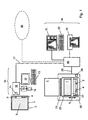
- Fig. 1 shows a system for processing an image carrier for x-ray information.
- the system comprises an identification station 10, which is also referred to below as ID station, a read-out device 20, a playback device 30 and a central memory 40th
- the image carrier for X-ray information consists of a cassette 2 with a therein
- the image plate 1 comprises a carrier layer with a Storage phosphor layer 5 applied thereto.
- the storage phosphor layer 5 preferably has a spoke aerosol based on BaFBr: Eu or CsBr: Eu on.
- the image plate 1 is provided with an integrated circuit 3 having a Read-write memory includes in which data is written and from which Data can be read.
- the integrated circuit 3 preferably becomes at the back or - as in the example shown - in the edge region of the image plate 1 arranged.
- the integrated circuit 3 on the cassette 2 to be appropriate.
- the image plate 1 contained in the cassette 2 becomes in whose spoke-phosphor layer 5 x-ray information is stored, for ID station 10 brought data to and from the integrated circuit 3 to read or write.
- the data transfer between the integrated Circuit 3 and the ID station 10 is preferably contactless. hereby can an exact positioning of the image plate 1 and the circuit 3rd relative to the ID station 10, as in a contact-based data transmission would be required.
- the contactless data transmission is preferably carried out by means of radio frequency waves (RF waves).
- RF waves radio frequency waves
- the ID station 10 a corresponding first read-write device 11 with a RF transmitter and an RF receiver on.
- the integrated circuit 3 is preferably in the form of a so-called RF label, which is also referred to as RF tag, attached to the image plate 1, glued, for example.
- RF tag includes besides the integrated one Circuit 3 an antenna designed as a transponder coil.
- the integrated circuit 3 in the form of a chip card in which an RF tag is inserted in a card-shaped plastic body at the Image plate 1 may be attached.
- the chip card is preferably detachable on the image plate 1 attached, e.g. by means of a simple plug connection in the edge area the image plate 1.
- a locking mechanism be provided, e.g. a snap mechanism in which the Chip card is locked by snapping.
- This attachment of the chip card the image plate 1 is both easy and safe and simplifies the other hand For example, in the case of a defect of the integrated circuit 3 required - Exchange of the chip card against another.
- the image plate 1 is provided with a mark 4 readable by the naked eye, which at least a part of the memory of the integrated circuit.
- 3 stored data, in particular for the optical disk 1 specific data represented and preferably formed as an alphanumeric string.
- This causes a defect of the integrated circuit 3, in which the data stored in it can generally no longer be read, the data contained in mark 4 remains accessible.
- the broken one integrated circuit 3 can be replaced in this case with a new one in which then the data contained in the mark 4 is written become.
- the data of the marking 4 are read by an operator, entered at the ID station 10 and finally in the new integrated circuit written. With the help of the marking 4 is thus ensured in a simple manner, that stored in the integrated circuit 3 and in the mark 3 contained part of the data even with a defect of the circuit 3 get lost.
- a mark 4 designed in this way can also be attached the cassette 2 may be attached.
- the procedure for a defect of the integrated Circuit is done in an analogous manner.
- the ID station 10 includes one or more input devices for input of data which, for example, for a patient to be examined, the Reading out the image plate 1 or the further processing of from the image plate. 1 read out image data is specific or required.
- the input devices comprise a keyboard 13 with display unit 12, such as As a monitor, and a card reader 15 for a card 14, on which
- the card 14 is the data to be entered a smart card, for example a health insurance card, on which patient-specific data, such as Name, address, date of birth and insurance number of a patient are stored.
- the card reader 15 reads this Data from the card 14 and passes them to a cache 16 the ID station 10. Also, the data entered via the keyboard 13 will be on pass the buffer 16.
- the display unit 12 may preferably be also act as a so-called. Touchscreen, in which displayed Functions and / or data by touching the corresponding areas of the Display can be selected.
- the input data is sent to the first one Read-write device 11 passed and integrated into the memory Circuit 3 written on the optical disk 1.
- the cassette 2 with the image plate 1 therein is the read-out device 20, where the cassette 2 is automatically opened, the image plate 1 is taken and fed into the interior of the read-out device 20.
- the image plate 1 is already completely out of the cassette pulled out and locked inside the read-out device 20.
- a scanner 21 which with a suitable transport mechanism 22 is moved in the transport direction T via the image plate 1, read.
- the scanner 21 is preferably designed as a so-called line scanner, which a line-shaped stimulation light source, preferably arranged in a row Laser diodes, and a line-shaped detector, preferably a linear one CCD array has.
- a line-shaped stimulation light source preferably arranged in a row Laser diodes
- a line-shaped detector preferably a linear one CCD array has.
- the scanner 21 may also be designed as a so-called flying spot scanner in which a single laser beam passes through a rotating polygon mirror is directed onto the storage phosphor layer 5, whereby these along individual Scanned lines point by point.
- the extinguishing device 23 comprises for this purpose a radiation source with a - compared to the stimulation light source - broadband spectrum and a suitable reflector for the reflection of erasing radiation on the storage phosphor layer 5 of the image plate 1.
- the read-out device 20 comprises a second read-write device 24, with which data read from or into the integrated circuit 3 or written can be.
- the second read-write device 24 preferably for contactless Data transmission, in particular by means of RF waves trained.
- the second read-write device 24 from the memory of the integrated Circuit 3 data read in particular to control the Reading out the image plate 1 with the scanner 21 and / or to control the deletion the image plate 1 with the extinguishing device 23 used.
- data can be integrated in the integrated circuit Circuit 3 are written to preferably data on the processing status the image plate 1 - for example, whether the image plate 1 already read or has been deleted - to update.
- image data which represent the X-ray information stored in the image plate 1.
- image data are transmitted via a first data bus 25, in particular a serial data bus, e.g. a so-called Fire Wire, to the central storage 40 transmitted and stored there.
- the image data stored in the central memory 40 may then be stored in the playback device 30 further processed and / or reproduced.
- the playback device 30 comprises a controllable by means of a keyboard 32 Monitor 31.
- a hard copy device 33 for example, a laser printer, provided for outputting the image data be.
- the central memory 40 can optionally be connected to a network 50, in particular to a local area network (LAN). This will enable that from other systems, especially from other ID stations and / or playback devices which are stored in the central memory 40 Data or image data can be accessed.
- LAN local area network
- the central memory 40 may be formed as a separate central unit, which e.g. can be integrated in a central file server. Alternatively, the Central memory 40 but also an integral part of the ID station 10, the read-out device 20 or the playback device 30 be.
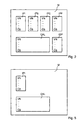
- Fig. 2 shows a first example of a structure of the memory M of the integrated Circuit 3 of the image carrier stored data. Based on this structure will below the data transmission within the system described in Fig. 1 explained in more detail. It should be noted that the representation chosen here is the Structure of the data reflects only highly schematized and not on a specific spatial arrangement or a particular order of data in memory M of the integrated circuit 3 is limited.
- the data stored in the memory M are in different data groups IPI, IPS, IPC, IPP, CAL and IDP summarized and there as each Filed ASCII string.
- Each data group is a version number VN as well assigned a checksum CS.
- the version number VN at the beginning of each data group indicates in which Data structure the data of a data group are stored. This will be the Possibility opens, different data structures of the same data group provided. This is always required if other or additional Data should be stored in the memory M, for example, a new one Image plate type or a new way of processing the image data.
- the version number VN of a data group can be the individual components of the system, e.g. the ID station 10, the read-out device 20 and the Playback device 30, recognize which data in the respective data group are contained and in which data length, sequence etc. these data are available.
- the check sum CS at the end of each data group is derived from the individual data in this data group. Based on the respective checksum CS can be determined whether the data of this data group have been stored or read without error.
- the content of the image carrier data group IPI is additionally applied to the image plate 1 and / or the cassette 2 as a visually readable marking 4 (see FIG. 1).
- This has the advantage that the data of the image carrier data group IPI specific to the image plate 1 or cassette 2 and required for its processing can not be lost even if the integrated circuit 3 is defective and can no longer be read out. In such a case, the defective integrated circuit 3 is simply replaced with a new integrated circuit, which is then described with the data taken from the tag 4.
- a mark 4 may be for example as follows: 301 - 6KBQMF0001 - 20030702 -1 - 1 - 0 - 1000 - 1000 - 123
- the first three (301) and the last three (123) characters contain the version number VN or the checksum CS.
- the version number VN follow the Optical disk serial number (6KBQMF0001), the initialization date (20030702), Values for the image plate size (1), the size (1) of the surface to be read Image plate and the image plate type (0), the image plate sensitivity (1000) and finally, the optical disk erase feature (1000).
- the data taken from the marker 4 can be at the ID station 10 to simple Way written in the memory of the new integrated circuit without a new initialization at the manufacturer of the image plate 1 or Cassette 2 would be required.
- the data of the mark 4 read by an operator, entered via the keyboard 13 of the ID station 10 and then into the memory of the new integrated circuit written.
- readable mark 4 provides a particularly simple way of additional assurance of in the integrated circuit 3 stored data.
- a machine readable mark (not shown) may be provided, for example in Shape of a barcode or magnetic stripe. To enter the in the machine readable marking is then a corresponding barcode or magnetic stripe reader required, which is the machine-readable data to ID station 10, where it then enters the new integrated circuit can be written.
- a processing data group IPP data stored for one Further processing of obtained from the X-ray information of the image plate 1 Image data are required. This data is used exclusively by the playback device 30, which a corresponding image processor for further processing the image data includes, accessed. The readout process in the readout device 20 is not affected by this data.
- the playback device 30 can then easily both on the image data to be processed as well as the required for this Access data from the processing data group IPP.
- the calibration data of the image plate 1 are in the read-out device 20 to a Pre-evaluation of the obtained when reading the optical disk 1 by means of scanner 21 Image signals used to locally different sensitivities of the image plate 1 for X-ray radiation.
- the calibration data become this read in the read-out device 20 from the integrated circuit 3 and the preprocessing of the image signals supplied.
- the calibration data can already be obtained from the integrated station at the ID station 10 Circuit 3 read, via a second data bus 17 to the central memory 40 transferred and stored there.
- a readout and transfer the calibration data to the central memory 40 during the first read operation in the read-out device 20 can then be omitted.
- the second data bus 17 is also preferably a serial data bus, e.g. as RS-232 data bus, formed.
- calibration data of the image plate 1 are in the central memory 40 or in Memory of the read-out device 20 also stored calibration data of the scanner 21, which reflect local differences in the sensitivity of the scanner 21 and preferably together with the calibration data of the image plate 1 for Preprocessing of the image signals are used. From preprocessing The image signals are finally image data stored in the optical disk 1 Radiograph obtained from which the influence of locally different sensitivities the image plate 1 and the scanner 21 has been eliminated.
- the two-dimensional data field includes the calibration data of the image plate 1 between about 30 and 40 columns and between about 40 and 50 rows on, wherein the length of each data is two bytes.
- the calibration data gives the sensitivity of individual areas of the storage phosphor layer 5, which are greater than the individual pixels obtained by reading the image plate 1 line by line (Pixel). In this way, the space requirement for the calibration data in the integrated circuit 3 are greatly reduced, at the same time locally different Sensitivity can be considered with a high accuracy.
- the calibration data but also the sensitivity of the optical disk 1 in individual Play back areas of the image panel that correspond to each pixel. This allows a pixel-accurate calibration that varies locally Sensitivity taken into account with even higher accuracy.
- the calibration data of the optical disk 1 are advantageously subjected to a compression process before this in the integrated circuit 3 are stored.
- a reference code IDP-Ref in the Memory M written which is a reference to the data of the patient data group IDP stored in the central memory 40.
- the reference code IDP-Ref which is also referred to as patient identification code and a unique identification of the patient is possible with the first Read-write device 11 of the ID station 10 in the memory M of the integrated Circuit 3 and written together with the data of the patient data group IDP in the buffer 16 of the ID station 10 and / or in the central memory 40 saved.
- patient identification code IDP-Ref On the basis of the patient identification code IDP-Ref can then on the in the cache 16 or central memory 40 stored patient-specific Data is accessed.
- the patient identification code IDP-Ref becomes this either in the ID station 10 or in the read-out device 20 from the integrated Circuit 3 is read and transmitted to the playback device 30 or together with the image data read from the image plate 1 to the reproducing apparatus 30 transmitted, which then based on the patient identification code IDP-Ref to the appropriate patient-specific Data in the buffer 16 or central memory 40 can access.
- the patient data group IDP can also be omitted if in the Processing data group IPP - as already described above - already reference codes intended for patient data, which u.a. to the corresponding ones Patient data, such as Name and / or date of birth and / or gender of the patient, in the central memory 40.
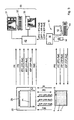
- FIG. 3 shows a schematic representation of a first variant of the data flow between the individual components of the invention shown in Fig. 1 System. The data flow is subsequently based on a complete radiography procedure explained in more detail.
- step h) additionally the data of the Schmtärger- and / or control data group IPI or IPC together with the image data IMD in the central memory 40 are stored.
- the ID station 10 instead of the data of the control, processing and patient data group IPC, IPP or IDP one or more reference codes IPC-Ref, IPP-Ref or IDP-Ref in the memory M of the integrated circuit 3 of the image plate 1 or cassette 2 written.
- the reference codes IPC-Ref, IPP-Ref or IDP-Ref together with the corresponding data of the control, processing and and patient data group IPC, IPP or IDP in the central memory 40 saved.
- the reference codes IPC-Ref, IPP-Ref or IDP-Ref can then the read-out device 20 to the data stored in the central memory 40 of the data corresponding data group IPC, IPP or IDP.
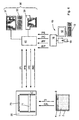
- FIG. 4 shows a schematic representation of a second variant of the data flow between the individual components of the system shown in FIG.
- this variant of the data flow are at the ID station 10 -as above described in more detail - data of the state, control, processing and patient data group IPS, IPC, IPP or IDP entered, but not in the memory M of the integrated circuit 3 located on the optical disk 1, but transferred to the central memory 40 and stored there.
- the Memory M of the integrated circuit 3 are only data in this variant the image carrier and calibration data group IPI or CAL.
- Corresponding are in the read-out device 20 only data of thessenhariund Calibration data group IPI or CAL, which is disk-specific data or the calibration data of the image plate 1, from the integrated circuit 3 read.
- the mark is 4, which are part of the memory M of the integrated circuit 3 stored Represents data, in particular data of the image carrier data group IPI, mounted on the back of the carrier layer of the image plate 1.
- the mark 4 is therefore shown in dashed lines.
- FIG. 5 shows a second example of a structure of the integrated circuit 3 of FIG Image carrier stored data in the variant of the data flow shown in Fig. 4.
- IPI or CAL data of the image carrier and calibration data group IPI or CAL stored in the memory M.
Landscapes
- Health & Medical Sciences (AREA)
- Life Sciences & Earth Sciences (AREA)
- Physics & Mathematics (AREA)
- General Physics & Mathematics (AREA)
- High Energy & Nuclear Physics (AREA)
- Molecular Biology (AREA)
- Spectroscopy & Molecular Physics (AREA)
- Medical Informatics (AREA)
- Engineering & Computer Science (AREA)
- Pathology (AREA)
- Surgery (AREA)
- Optics & Photonics (AREA)
- Biophysics (AREA)
- Radiology & Medical Imaging (AREA)
- Biomedical Technology (AREA)
- Heart & Thoracic Surgery (AREA)
- Nuclear Medicine, Radiotherapy & Molecular Imaging (AREA)
- Animal Behavior & Ethology (AREA)
- General Health & Medical Sciences (AREA)
- Public Health (AREA)
- Veterinary Medicine (AREA)
- Radiography Using Non-Light Waves (AREA)
- Apparatus For Radiation Diagnosis (AREA)
- Image Processing (AREA)
Abstract
Description
- eine Bildträger-Datengruppe mit für den Bildträger spezifischen Daten, z.B. zur Identifizierung sowie zu Eigenschaften des Bildträgers;
- eine Zustands-Datengruppe mit Daten zu einem Bearbeitungszustand des Bildträgers;
- eine Steuerungs-Datengruppe mit Daten zur Steuerung des Auslesens und/oder Löschens der im Bildträger gespeicherten Röntgeninformation in einer Auslesevorrichtung;
- eine Verarbeitungs-Datengruppe mit Daten zur Steuerung einer Weiterverarbeitung und/oder Wiedergabe der ausgelesenen Röntgeninformation des Bildträgers in einer Wiedergabevorrichtung;
- eine Kalibrierungs-Datengruppe mit Daten zur Kalibrierung des Bildträgers, welche für eine Vorverarbeitung der ausgelesenen Röntgeninformation des Bildträgers, insbesondere in einer Auslesevorrichtung, herangezogen werden;
- eine Patienten-Datengruppe mit Daten zu einem Patienten, dessen Röntgeninformation im Bildträger gespeichert ist, z.B. Daten zur Identifizierung des Patienten.
- Initialisierungsdatum, welches dem Datum entspricht, an dem die Daten der Bildträger-Datengruppe in den Speicher des Bildträgers geschrieben wurden;
- Bildträger-Seriennummer, welche eine eindeutige Identifizierung des Bildträgers erlaubt und sich vorzugsweise aus einem Code, der die Produktcharge des jeweiligen Bildträgers identifiziert, und einer laufenden Nummer zusammengesetzt;
- Größe des Bildträgers;
- Größe einer auszulesenden Fläche auf dem Bildträger;
- Typ des Bildträgers;
- Empfindlichkeit des Bildträgers;
- Löscheigenschaft des Bildträgers, insbesondere als Maß für die Dauer und/oder Intensität von von einer Löscheinrichtung abgegebenem Licht.
- Fig. 1
- ein System zur Bearbeitung eines Bildträgers für Röntgeninformation;
- Fig. 2
- ein erstes Beispiel einer Struktur der im integrierten Schaltkreis des Bildträgers gespeicherten Daten;
- Fig. 3
- eine schematische Darstellung einer ersten Variante des Datenflusses zwischen einzelnen Komponenten des in Fig. 1 dargestellten Systems;
- Fig. 4
- eine schematische Darstellung einer zweiten Variante des Datenflusses zwischen einzelnen Komponenten des in Fig. 1 dargestellten Systems; und
- Fig. 5
- ein zweites Beispiel einer Struktur der im integrierten Schaltkreis des Bildträgers gespeicherten Daten.
- Initialisierungsdatum: entspricht dem Datum, an welchem die Daten der Bildträger-Datengruppe IPI in den Speicher M der Bildplatte 1 geschrieben wurden;
- Bildplatten-Seriennummer: dient zur eindeutigen Identifizierung der Bildplatte 1 und ist vorzugsweise aus einem die jeweilige Produktcharge der Bildplatte 1 identifizierenden Code und einer laufenden Nummer zusammengesetzt;
- Bildplattengröße;
- Größe einer auszulesenden Fläche auf der Bildplatte 1;
- Bildplattentyp: z.B. Bildplatte auf der Basis von pulverförmigen oder nadelförmigen Speicherleuchtstoffen, wie z.B. sogenannte Powder-IP bzw. Needle-IP;
- Bildplatten-Empfindlichkeit;
- Bildplatten-Löscheigenschaft: z.B. als Maß für die Dauer und/oder Intensität des von einer Löscheinrichtung 23 abgegebenen Lichts.
301 - 6KBQMF0001 - 20030702 -1 - 1 - 0 - 1000 - 1000 - 123
- Bildplattenstatus: z.B. ob die Bildplatte 1 bereits initialisiert ist (d.h. Daten der Bildträger-Datengruppe IPI im Speicher M gespeichert sind) und/oder ein Röntgenbild bereits aufgenommen, gelöscht bzw. noch zu löschen ist;
- Bildplattenzyklen: Gesamtzahl von Röntgenaufnahmen mit dieser Bildplatte 1. Diese Gesamtzahl wird nach jedem Auslesevorgang oder Löschvorgang in der Auslesevorrichtung 20 um den Wert 1 erhöht;
- Auslesen unter Biegung: Anzahl der Bildplattenzyklen, in welchen die Bildplatte 1 während des Auslesevorgangs gekrümmt wird. Diese Zahl ist ein Maß für den Abnutzungs- und/oder Beschädigungsgrad einer Bildplatte 1. Dieser Eintrag kann beispielsweise bei Systemen entfallen, in welchen die Bildplatte während des Auslesens auf einer festen, ebenen Unterlage aufliegt und folglich nicht gebogen wird.
- Scannerempfindlichkeit: gibt die im Scanner 21 beim Auslesen der Bildplatte 1 einzustellende Empfindlichkeit an und ist abhängig von der Röntgendosis in Bereichen der Bildplatte 1, welche diagnostische Informationen enthalten;
- Röntgendosis: entspricht der maximalen Röntgendosis während einer Röntgenaufnahme und stellt ein Maß für die einzustellende Intensität der Löscheinrichtung 23 beim Löschen der Bildplatte 1 dar;
- Betriebsmodus: z.B. Weglassen oder Auslesen von Röntgeninformation aus bestimmten Randbereichen der Bildplatte 1.
- Referenzcode für die Art der durchzuführenden Weiterverarbeitung;
- Referenzcode für Aufnahme- und Patientendaten;
- Eindeutige Kennzeichnung des Zentralspeichers, auf welchen die Referenzcodes verweisen, wie z.B. der Name des Zentralspeichers in einem Netzwerk.
- Anzahl der Spalten des zweidimensionalen Datenfeldes der Kalibrierdaten;
- Anzahl der Zeilen des zweidimensionalen Datenfeldes der Kalibrierdaten;
- zweidimensionales Datenfeld der Kalibrierdaten.
- Name des Patienten;
- Geburtsdatum des Patienten;
- Geschlecht des Patienten.
Oder:
Claims (25)
- Bildträger (1, 2) zur Speicherung von Röntgeninformation, umfassend einen elektronischen Speicher (M), in welchem Daten gespeichert werden können, dadurch gekennzeichnet, dass der Bildträger (1, 2) eine Markierung (4) aufweist, welche zumindest einen Teil der im elektronischen Speicher (M) gespeicherten Daten repräsentiert.
- Bildträger (1, 2) nach Anspruch 1, dadurch gekennzeichnet, dass die Markierung (4) die Daten in Klarschrift oder maschinenlesbarer Form wiedergibt.
- Bildträger (1, 2) nach Anspruch 2, dadurch gekennzeichnet, dass die Markierung (4) eine alphanumerische Zeichenfolge umfasst.
- Bildträger (1, 2) nach einem der vorangehenden Ansprüche, dadurch gekennzeichnet, dass die Daten im elektronischen Speicher (M) in unterschiedlichen Datengruppen (IPI, IPS, IPC, IPP, CAL, IDP) gespeichert sind und die Markierung (4) die im elektronischen Speicher (M) gespeicherten Daten von zumindest einer Datengruppe (IPI, IPS, IPC, IPP, CAL, IDP) repräsentiert.
- Bildträger (1, 2) nach Anspruch 4, dadurch gekennzeichnet, dass die Markierung (4) die im elektronischen Speicher (M) gespeicherten Daten einer Bildträger-Datengruppe (IPI), welche für den Bildträger (1, 2) spezifische Daten umfasst, repräsentiert.
- Bildträger (1, 2) nach Anspruch 5, dadurch gekennzeichnet, dass die Bildträger-Datengruppe (IPI) eines oder mehrere der folgenden Daten umfasst:Initialisierungsdatum, welches dem Datum entspricht, an dem die Daten der Bildträger-Datengruppe (IPI) in den Speicher (M) des Bildträgers (1, 2) geschrieben wurden;Bildträger-Seriennummer, welche eine eindeutige Identifizierung des Bildträgers (1, 2) erlaubt und sich vorzugsweise aus einem Code, der die Produktcharge des jeweiligen Bildträgers (1, 2) identifiziert, und einer laufenden Nummer zusammengesetzt;Größe des Bildträgers (1, 2);Größe einer auszulesenden Fläche auf dem Bildträger (1);Typ des Bildträgers (1 );Empfindlichkeit des Bildträgers (1);Löscheigenschaft des Bildträgers (1), insbesondere als Maß für die Dauer und/oder Intensität von von einer Löscheinrichtung abgegebenem Licht.
- Bildträger (1, 2) nach einem der vorangehenden Ansprüche, dadurch gekennzeichnet, dass der Bildträger (1, 2) eine Bildplatte (1) zur Speicherung der Röntgeninformation umfasst.
- Bildträger (1, 2) nach Anspruch 7, dadurch gekennzeichnet, dass die Markierung (4) an der Bildplatte (1) angebracht ist.
- Bildträger (1, 2) nach Anspruch 8, dadurch gekennzeichnet, dass die Bildplatte (1) eine Trägerschicht mit einer auf der Vorderseite der Trägerschicht befindlichen Speicherleuchtstoff-Schicht (5) umfasst und die Markierung (4) in einem Randbereich der Trägerschicht, insbesondere außerhalb der Speicherleuchtstoff Schicht (5), und/oder an der der Vorderseite gegenüberliegenden Rückseite der Trägerschicht angebracht ist.
- Bildträger (1, 2) nach Anspruch 7, dadurch gekennzeichnet, dass der Bildträger (1, 2) eine Kassette (2) umfasst, welche die Bildplatte (1) aufnehmen kann.
- Bildträger (1, 2) nach Anspruch 10, dadurch gekennzeichnet, dass die Markierung (4) an der Kassette (2) angebracht ist.
- Bildträger (1, 2) nach einem der vorangehenden Ansprüche, dadurch gekennzeichnet, dass der elektronische Speicher (M) zur kontaktlosen Übertragung von Daten von und zu mindestens einer Bearbeitungsvorrichtung (10, 20) ausgebildet ist.
- Bildträger (1, 2) nach Anspruch 12, dadurch gekennzeichnet, dass der elektronische Speicher (M) als RF-Etikett ausgebildet ist, das den elektronischen Speicher (M) und eine Antenne, insbesondere eine Transponderspule, umfasst.
- Bildträger (1, 2) nach Anspruch 12, dadurch gekennzeichnet, dass der elektronische Speicher (M) als Chipkarte ausgebildet ist, die einen Kartenkörper umfasst, in welchen der elektronische Speicher (M) und eine Antenne, insbesondere eine Transponderspule, eingebracht sind.
- Bildträger (1, 2) nach Anspruch 14, dadurch gekennzeichnet, dass die Chipkarte lösbar an der Bildplatte (1) bzw. Kassette (2) befestigt ist.
- Bildträger (1, 2) nach Anspruch 15, dadurch gekennzeichnet, dass die Chipkarte mittels einer Steckverbindung an der Bildplatte (1) bzw. Kassette (2) befestigt ist.
- Bildträger (1, 2) nach Anspruch 16, dadurch gekennzeichnet, dass die Steckverbindung einen Mechanismus, insbesondere einen Schnappmechanismus, zum Arretieren der Chipkarte in der Steckverbindung aufweist.
- Bildträger (1, 2) nach einem der Ansprüche 4 bis 6, dadurch gekennzeichnet, dass die Daten mindestens einer Datengruppe (IPI, IPS, IPC, IPP, CAL, IDP) eine Versionsnummer (VN) umfassen, welche die Struktur, in welcher die Daten dieser Datengruppe (IPI, IPS, IPC, IPP, CAL, IDP) vorliegen, kennzeichnet.
- Bildträger (1, 2) nach einem der Ansprüche 4 bis 6, dadurch gekennzeichnet, dass mindestens eine Datengruppe (IPI, IPS, IPC, IPP, CAL, IDP) eine aus den Daten dieser Datengruppe (IPI, IPS, IPC, IPP, CAL, IDP) abgeleitete Prüfsumme (CS) umfasst, anhand welcher überprüft werden kann, ob die Daten dieser Datengruppe (IPI, IPS, IPC, IPP, CAL, IDP) fehlerfrei gespeichert und/oder gelesen worden sind.
- System zur Bearbeitung eines Bildträgers (1, 2) zur Speicherung von Röntgeninformation mitdadurch gekennzeichnet, dasseinem Bildträger (1, 2), welcher einen elektronischen Speicher (M) zur Speicherung von Daten umfasst, undeiner ID-Station (10), an welcher Daten eingegeben und in den elektronischen Speicher (M) geschrieben werden können,
die ID-Station (10) die von einer Markierung (4) auf dem Bildträger (1, 2) repräsentierten Daten in den elektronischen Speicher (M) schreiben kann. - System nach Anspruch 20, dadurch gekennzeichnet, dass die ID-Station (10) eine Tastatur (13) umfasst, über welche die durch die Markierung (4) repräsentierten Daten eingegeben werden können.
- System nach Anspruch 20, dadurch gekennzeichnet, dass die ID-Station (10) ein Lesegerät umfasst, über welches die durch die Markierung (4) repräsentierten Daten eingelesen werden können.
- System nach einem der Ansprüche 20 bis 22, dadurch gekennzeichnet, dass die ID-Station (10) eine Schreib-Lese-Einrichtung (11), insbesondere einen RF-Sender und einen RF-Empfänger, umfasst, welche zur kontaktlosen Übertragung von Daten zwischen der ID-Station (10) und dem elektronischen Speicher (M) ausgebildet ist.
- Verfahren zur Bearbeitung eines Bildträgers (1, 2) zur Speicherung von Röntgeninformation, welcher einen elektronischen Speicher (M) zur Speicherung von Daten umfasst, dadurch gekennzeichnet, dass die von einer Markierung (4) auf dem Bildträger (1, 2) repräsentierten Daten in den elektronischen Speicher (M) geschrieben werden.
- Verfahren nach Anspruch 24, dadurch gekennzeichnet, dass ein erster elektronischer Speicher (M), insbesondere bei einem Defekt, durch einen zweiten elektronischen Speicher ersetzt wird und die in der Markierung (4) enthaltenen Daten in den zweiten elektronischen Speicher geschrieben werden.
Priority Applications (4)
| Application Number | Priority Date | Filing Date | Title |
|---|---|---|---|
| EP03104747A EP1544672B1 (de) | 2003-12-17 | 2003-12-17 | Bildträger zur Speicherung von Röntgeninformation sowie System und Verfahren zur Bearbeitung eines solchen Bildträgers |
| DE50310811T DE50310811D1 (de) | 2003-12-17 | 2003-12-17 | Bildträger zur Speicherung von Röntgeninformation sowie System und Verfahren zur Bearbeitung eines solchen Bildträgers |
| AT03104747T ATE414931T1 (de) | 2003-12-17 | 2003-12-17 | Bildträger zur speicherung von röntgeninformation sowie system und verfahren zur bearbeitung eines solchen bildträgers |
| US11/010,749 US7095034B2 (en) | 2003-12-17 | 2004-12-13 | Image carrier for storing X-ray information, and a system and method for processing an image carrier |
Applications Claiming Priority (1)
| Application Number | Priority Date | Filing Date | Title |
|---|---|---|---|
| EP03104747A EP1544672B1 (de) | 2003-12-17 | 2003-12-17 | Bildträger zur Speicherung von Röntgeninformation sowie System und Verfahren zur Bearbeitung eines solchen Bildträgers |
Publications (2)
| Publication Number | Publication Date |
|---|---|
| EP1544672A1 true EP1544672A1 (de) | 2005-06-22 |
| EP1544672B1 EP1544672B1 (de) | 2008-11-19 |
Family
ID=34486394
Family Applications (1)
| Application Number | Title | Priority Date | Filing Date |
|---|---|---|---|
| EP03104747A Expired - Lifetime EP1544672B1 (de) | 2003-12-17 | 2003-12-17 | Bildträger zur Speicherung von Röntgeninformation sowie System und Verfahren zur Bearbeitung eines solchen Bildträgers |
Country Status (4)
| Country | Link |
|---|---|
| US (1) | US7095034B2 (de) |
| EP (1) | EP1544672B1 (de) |
| AT (1) | ATE414931T1 (de) |
| DE (1) | DE50310811D1 (de) |
Cited By (2)
| Publication number | Priority date | Publication date | Assignee | Title |
|---|---|---|---|---|
| EP2386904B1 (de) | 2010-05-13 | 2020-06-17 | Carestream Dental Technology Topco Limited | Computerunterstütztes Radiographieverfahren und -system |
| US11737720B2 (en) * | 2016-09-12 | 2023-08-29 | Dürr Dental SE | System and method for providing imaging parameters |
Families Citing this family (7)
| Publication number | Priority date | Publication date | Assignee | Title |
|---|---|---|---|---|
| SE522162C2 (sv) * | 2002-05-06 | 2004-01-20 | Goergen Nilsson | Metod att utföra in vivo-dosimetri vid IMRT-behandling |
| US7355195B2 (en) * | 2004-04-27 | 2008-04-08 | Agfa Healthcare | Method and apparatus for associating patient and exposure related data with a radiation image |
| DE502004010009D1 (de) * | 2004-12-20 | 2009-10-15 | Agfa Gevaert Healthcare Gmbh | System und Verfahren zum Auslesen von in einer Speicherleuchtstoffschicht gespeicherter Röntgeninformation |
| US20140191852A1 (en) * | 2010-05-13 | 2014-07-10 | Carestream Health, Inc. | Method and system for phosphor plate identification in computed radiography |
| EP2527874B1 (de) * | 2011-05-26 | 2017-10-11 | Agfa HealthCare NV | System, Vorrichtung und Verfahren zum Auslesen von in einer Speicherleuchtstoffplatte gespeicherten Röntgeninformationen |
| US8833647B2 (en) | 2011-08-08 | 2014-09-16 | Carestream Health, Inc. | Computed radiography license method and system |
| US9626613B2 (en) | 2014-05-12 | 2017-04-18 | Carestream Health, Inc. | System and method for computed radiography using near field communication technology |
Citations (5)
| Publication number | Priority date | Publication date | Assignee | Title |
|---|---|---|---|---|
| US4498005A (en) * | 1981-11-14 | 1985-02-05 | Fuji Photo Film Co., Ltd. | Cassette having radiation image storage medium |
| US4739480A (en) * | 1981-10-26 | 1988-04-19 | Fuji Photo Film Co., Ltd. | Radiation image reproducing apparatus with image storage ID code for identifying exposure data file |
| US5418355A (en) * | 1992-11-25 | 1995-05-23 | Eastman Kodak Company | Storage phosphor radiography patient identification system |
| EP0727696A1 (de) * | 1995-02-17 | 1996-08-21 | Agfa-Gevaert N.V. | System und Verfahren der Identifizierung zur Verwendung im Felde der digitalen Röntgenphotographie |
| EP1209517A2 (de) * | 2000-11-20 | 2002-05-29 | Konica Corporation | Röntgenkassette mit einem Speicherleuchtfolie und Auslesevorrichtung für diese |
Family Cites Families (5)
| Publication number | Priority date | Publication date | Assignee | Title |
|---|---|---|---|---|
| DE3731204A1 (de) * | 1987-09-17 | 1989-03-30 | Agfa Gevaert Ag | Roentgenaufnahmekassette fuer blattfoermiges aufnahmematerial und verfahren zu deren verwendung |
| DE3731203A1 (de) * | 1987-09-17 | 1989-03-30 | Agfa Gevaert Ag | Verfahren zur handhabung von roentgenaufnahmekassetten mit einer phosphorbeschichteten folie und zur durchfuehrung des verfahrens geeignete lesestation |
| DE4005218A1 (de) * | 1990-02-20 | 1991-08-22 | Kodak Ag | Verfahren zum kennzeichnen von roentgenfilmen mit patientendaten sowie roentgenfilmkassette und entlade-ladegeraet fuer roentgenfilmkassetten |
| EP0679909B1 (de) * | 1994-04-29 | 1998-03-18 | Agfa-Gevaert N.V. | System zur Wiedergabe eines individuell gestalteter Strahlungsbildes |
| US6271536B1 (en) * | 1997-10-08 | 2001-08-07 | Agfa-Gevaert | Radiographic image identification method |
-
2003
- 2003-12-17 EP EP03104747A patent/EP1544672B1/de not_active Expired - Lifetime
- 2003-12-17 DE DE50310811T patent/DE50310811D1/de not_active Expired - Lifetime
- 2003-12-17 AT AT03104747T patent/ATE414931T1/de not_active IP Right Cessation
-
2004
- 2004-12-13 US US11/010,749 patent/US7095034B2/en not_active Expired - Lifetime
Patent Citations (5)
| Publication number | Priority date | Publication date | Assignee | Title |
|---|---|---|---|---|
| US4739480A (en) * | 1981-10-26 | 1988-04-19 | Fuji Photo Film Co., Ltd. | Radiation image reproducing apparatus with image storage ID code for identifying exposure data file |
| US4498005A (en) * | 1981-11-14 | 1985-02-05 | Fuji Photo Film Co., Ltd. | Cassette having radiation image storage medium |
| US5418355A (en) * | 1992-11-25 | 1995-05-23 | Eastman Kodak Company | Storage phosphor radiography patient identification system |
| EP0727696A1 (de) * | 1995-02-17 | 1996-08-21 | Agfa-Gevaert N.V. | System und Verfahren der Identifizierung zur Verwendung im Felde der digitalen Röntgenphotographie |
| EP1209517A2 (de) * | 2000-11-20 | 2002-05-29 | Konica Corporation | Röntgenkassette mit einem Speicherleuchtfolie und Auslesevorrichtung für diese |
Cited By (4)
| Publication number | Priority date | Publication date | Assignee | Title |
|---|---|---|---|---|
| EP2386904B1 (de) | 2010-05-13 | 2020-06-17 | Carestream Dental Technology Topco Limited | Computerunterstütztes Radiographieverfahren und -system |
| EP2386904B2 (de) † | 2010-05-13 | 2023-08-16 | Carestream Dental LLC | Computerunterstütztes Radiographieverfahren |
| US11737720B2 (en) * | 2016-09-12 | 2023-08-29 | Dürr Dental SE | System and method for providing imaging parameters |
| US12029603B2 (en) | 2016-09-12 | 2024-07-09 | Dürr Dental SE | System and method for providing imaging parameters |
Also Published As
| Publication number | Publication date |
|---|---|
| DE50310811D1 (de) | 2009-01-02 |
| ATE414931T1 (de) | 2008-12-15 |
| US20050133730A1 (en) | 2005-06-23 |
| US7095034B2 (en) | 2006-08-22 |
| EP1544672B1 (de) | 2008-11-19 |
Similar Documents
| Publication | Publication Date | Title |
|---|---|---|
| DE69428834T2 (de) | System zum Sammeln von Untersuchungsdaten | |
| DE69530752T2 (de) | System und Verfahren der Identifizierung zur Verwendung im Felde der digitalen Röntgenphotographie | |
| EP1544673B1 (de) | Bildträger zur Speicherung von Röntgeninformation sowie System zur Bearbeitung eines solchen Bildträgers | |
| EP0307760B1 (de) | Röntgenaufnahmekassette für blattförmiges Aufnahmematerial und Verfahren zu deren Verwendung | |
| DE69331623T2 (de) | Automatische Leitwegsuche von digitalen Röntgenbildern zum gewählten Ziel | |
| DE69419984T2 (de) | Echtzeit-Einstellung von Fensterbreite und Pegel in einer radiographischen Arbeitsstation | |
| EP1544672B1 (de) | Bildträger zur Speicherung von Röntgeninformation sowie System und Verfahren zur Bearbeitung eines solchen Bildträgers | |
| DE3856230T2 (de) | Kassette, Vorrichtung und Wischverfahren für ein stimulierbares Phosphorblatt | |
| EP1544674B1 (de) | Verfahren zur Bearbeitung eines Bildträgers zur Speicherung von Röntgeninformation | |
| DE69322196T2 (de) | PSL Radiographie-Kassette | |
| US4507797A (en) | Data recording system using stimulable phosphor | |
| DE69118735T2 (de) | Verfahren zur Identifizierung eines Röntgenfilms mit Patientendaten | |
| US20050205813A1 (en) | Radiation image information recording and reading system | |
| EP0706280B1 (de) | Stimulierbare Phosphorfolie und Verfahren zum Testen einer digitalen Abtast-Vorrichtung für stimulierbare Phosphorfolien | |
| DE69307694T2 (de) | Verfahren und Vorrichtung zur Überwachung der wirklich aufgebrachteten Bestrahlung | |
| EP1653481A1 (de) | Speicherleuchtstoffplatte zur Speicherung von Röntgeninformationen und entsprechende Vorrichtung zum Auslesen der Röntgeninformationen | |
| DE19962773A1 (de) | Vorrichtung zum Auslesen von in einer Speicherschicht abgespeicherten Informationen sowie Röntgenkassette und Röntgentisch | |
| EP3509493B1 (de) | System und verfahren zur bereitstellung von aufnahmeparametern | |
| DE19646607C1 (de) | Verfahren und Vorrichtung zum lagerichtigen Verarbeiten von Röntgenkassetten | |
| DE19629299A1 (de) | Verfahren und Vorrichtung zum Aufnehmen einer Bildinformation | |
| DE69500229T2 (de) | Verfahren zur Qualitätssicherung von digitalen Röntgenaufnahmen | |
| EP1256017B1 (de) | Vorrichtung und verfahren zum auslesen von in einer speicherschicht abgespeicherten informationen sowie röntgenkassette | |
| EP1671587B1 (de) | System und Verfahren zum Auslesen von in einer Speicherleuchtstoffschicht gespeicherter Röntgeninformation | |
| DE19962774B4 (de) | Vorrichtung und Verfahren zum Auslesen von in einer Speicherschicht abgespeicherten Informationen |
Legal Events
| Date | Code | Title | Description |
|---|---|---|---|
| PUAI | Public reference made under article 153(3) epc to a published international application that has entered the european phase |
Free format text: ORIGINAL CODE: 0009012 |
|
| AK | Designated contracting states |
Kind code of ref document: A1 Designated state(s): AT BE BG CH CY CZ DE DK EE ES FI FR GB GR HU IE IT LI LU MC NL PT RO SE SI SK TR |
|
| AX | Request for extension of the european patent |
Extension state: AL LT LV MK |
|
| RAP1 | Party data changed (applicant data changed or rights of an application transferred) |
Owner name: AGFA-GEVAERT HEALTHCARE GMBH |
|
| 17P | Request for examination filed |
Effective date: 20051222 |
|
| AKX | Designation fees paid |
Designated state(s): AT BE BG CH CY CZ DE DK EE ES FI FR GB GR HU IE IT LI LU MC NL PT RO SE SI SK TR |
|
| 17Q | First examination report despatched |
Effective date: 20060124 |
|
| GRAP | Despatch of communication of intention to grant a patent |
Free format text: ORIGINAL CODE: EPIDOSNIGR1 |
|
| GRAS | Grant fee paid |
Free format text: ORIGINAL CODE: EPIDOSNIGR3 |
|
| GRAA | (expected) grant |
Free format text: ORIGINAL CODE: 0009210 |
|
| AK | Designated contracting states |
Kind code of ref document: B1 Designated state(s): AT BE BG CH CY CZ DE DK EE ES FI FR GB GR HU IE IT LI LU MC NL PT RO SE SI SK TR |
|
| REG | Reference to a national code |
Ref country code: GB Ref legal event code: FG4D Free format text: NOT ENGLISH |
|
| REG | Reference to a national code |
Ref country code: CH Ref legal event code: EP |
|
| REG | Reference to a national code |
Ref country code: IE Ref legal event code: FG4D Free format text: LANGUAGE OF EP DOCUMENT: GERMAN |
|
| REF | Corresponds to: |
Ref document number: 50310811 Country of ref document: DE Date of ref document: 20090102 Kind code of ref document: P |
|
| RAP2 | Party data changed (patent owner data changed or rights of a patent transferred) |
Owner name: AGFA-GEVAERT HEALTHCARE GMBH |
|
| PG25 | Lapsed in a contracting state [announced via postgrant information from national office to epo] |
Ref country code: ES Free format text: LAPSE BECAUSE OF FAILURE TO SUBMIT A TRANSLATION OF THE DESCRIPTION OR TO PAY THE FEE WITHIN THE PRESCRIBED TIME-LIMIT Effective date: 20090301 |
|
| NLV1 | Nl: lapsed or annulled due to failure to fulfill the requirements of art. 29p and 29m of the patents act | ||
| PG25 | Lapsed in a contracting state [announced via postgrant information from national office to epo] |
Ref country code: SI Free format text: LAPSE BECAUSE OF FAILURE TO SUBMIT A TRANSLATION OF THE DESCRIPTION OR TO PAY THE FEE WITHIN THE PRESCRIBED TIME-LIMIT Effective date: 20081119 Ref country code: FI Free format text: LAPSE BECAUSE OF FAILURE TO SUBMIT A TRANSLATION OF THE DESCRIPTION OR TO PAY THE FEE WITHIN THE PRESCRIBED TIME-LIMIT Effective date: 20081119 Ref country code: NL Free format text: LAPSE BECAUSE OF FAILURE TO SUBMIT A TRANSLATION OF THE DESCRIPTION OR TO PAY THE FEE WITHIN THE PRESCRIBED TIME-LIMIT Effective date: 20081119 |
|
| BERE | Be: lapsed |
Owner name: AGFA-GEVAERT HEALTHCARE G.M.B.H. Effective date: 20081231 |
|
| REG | Reference to a national code |
Ref country code: IE Ref legal event code: FD4D |
|
| PG25 | Lapsed in a contracting state [announced via postgrant information from national office to epo] |
Ref country code: RO Free format text: LAPSE BECAUSE OF FAILURE TO SUBMIT A TRANSLATION OF THE DESCRIPTION OR TO PAY THE FEE WITHIN THE PRESCRIBED TIME-LIMIT Effective date: 20081119 Ref country code: IE Free format text: LAPSE BECAUSE OF FAILURE TO SUBMIT A TRANSLATION OF THE DESCRIPTION OR TO PAY THE FEE WITHIN THE PRESCRIBED TIME-LIMIT Effective date: 20081119 Ref country code: BG Free format text: LAPSE BECAUSE OF FAILURE TO SUBMIT A TRANSLATION OF THE DESCRIPTION OR TO PAY THE FEE WITHIN THE PRESCRIBED TIME-LIMIT Effective date: 20090219 Ref country code: EE Free format text: LAPSE BECAUSE OF FAILURE TO SUBMIT A TRANSLATION OF THE DESCRIPTION OR TO PAY THE FEE WITHIN THE PRESCRIBED TIME-LIMIT Effective date: 20081119 Ref country code: MC Free format text: LAPSE BECAUSE OF NON-PAYMENT OF DUE FEES Effective date: 20081231 Ref country code: DK Free format text: LAPSE BECAUSE OF FAILURE TO SUBMIT A TRANSLATION OF THE DESCRIPTION OR TO PAY THE FEE WITHIN THE PRESCRIBED TIME-LIMIT Effective date: 20081119 |
|
| REG | Reference to a national code |
Ref country code: CH Ref legal event code: PL |
|
| PG25 | Lapsed in a contracting state [announced via postgrant information from national office to epo] |
Ref country code: PT Free format text: LAPSE BECAUSE OF FAILURE TO SUBMIT A TRANSLATION OF THE DESCRIPTION OR TO PAY THE FEE WITHIN THE PRESCRIBED TIME-LIMIT Effective date: 20090420 Ref country code: SE Free format text: LAPSE BECAUSE OF FAILURE TO SUBMIT A TRANSLATION OF THE DESCRIPTION OR TO PAY THE FEE WITHIN THE PRESCRIBED TIME-LIMIT Effective date: 20090219 Ref country code: CZ Free format text: LAPSE BECAUSE OF FAILURE TO SUBMIT A TRANSLATION OF THE DESCRIPTION OR TO PAY THE FEE WITHIN THE PRESCRIBED TIME-LIMIT Effective date: 20081119 |
|
| PLBE | No opposition filed within time limit |
Free format text: ORIGINAL CODE: 0009261 |
|
| STAA | Information on the status of an ep patent application or granted ep patent |
Free format text: STATUS: NO OPPOSITION FILED WITHIN TIME LIMIT |
|
| PG25 | Lapsed in a contracting state [announced via postgrant information from national office to epo] |
Ref country code: SK Free format text: LAPSE BECAUSE OF FAILURE TO SUBMIT A TRANSLATION OF THE DESCRIPTION OR TO PAY THE FEE WITHIN THE PRESCRIBED TIME-LIMIT Effective date: 20081119 Ref country code: BE Free format text: LAPSE BECAUSE OF NON-PAYMENT OF DUE FEES Effective date: 20081231 |
|
| 26N | No opposition filed |
Effective date: 20090820 |
|
| PG25 | Lapsed in a contracting state [announced via postgrant information from national office to epo] |
Ref country code: LI Free format text: LAPSE BECAUSE OF NON-PAYMENT OF DUE FEES Effective date: 20081231 Ref country code: CH Free format text: LAPSE BECAUSE OF NON-PAYMENT OF DUE FEES Effective date: 20081231 |
|
| REG | Reference to a national code |
Ref country code: FR Ref legal event code: CA |
|
| PG25 | Lapsed in a contracting state [announced via postgrant information from national office to epo] |
Ref country code: AT Free format text: LAPSE BECAUSE OF NON-PAYMENT OF DUE FEES Effective date: 20081217 |
|
| PG25 | Lapsed in a contracting state [announced via postgrant information from national office to epo] |
Ref country code: LU Free format text: LAPSE BECAUSE OF NON-PAYMENT OF DUE FEES Effective date: 20081217 Ref country code: CY Free format text: LAPSE BECAUSE OF FAILURE TO SUBMIT A TRANSLATION OF THE DESCRIPTION OR TO PAY THE FEE WITHIN THE PRESCRIBED TIME-LIMIT Effective date: 20081119 Ref country code: HU Free format text: LAPSE BECAUSE OF FAILURE TO SUBMIT A TRANSLATION OF THE DESCRIPTION OR TO PAY THE FEE WITHIN THE PRESCRIBED TIME-LIMIT Effective date: 20090520 |
|
| PG25 | Lapsed in a contracting state [announced via postgrant information from national office to epo] |
Ref country code: TR Free format text: LAPSE BECAUSE OF FAILURE TO SUBMIT A TRANSLATION OF THE DESCRIPTION OR TO PAY THE FEE WITHIN THE PRESCRIBED TIME-LIMIT Effective date: 20081119 |
|
| PG25 | Lapsed in a contracting state [announced via postgrant information from national office to epo] |
Ref country code: GR Free format text: LAPSE BECAUSE OF FAILURE TO SUBMIT A TRANSLATION OF THE DESCRIPTION OR TO PAY THE FEE WITHIN THE PRESCRIBED TIME-LIMIT Effective date: 20090220 |
|
| PG25 | Lapsed in a contracting state [announced via postgrant information from national office to epo] |
Ref country code: IT Free format text: LAPSE BECAUSE OF FAILURE TO SUBMIT A TRANSLATION OF THE DESCRIPTION OR TO PAY THE FEE WITHIN THE PRESCRIBED TIME-LIMIT Effective date: 20081119 |
|
| REG | Reference to a national code |
Ref country code: FR Ref legal event code: PLFP Year of fee payment: 13 |
|
| REG | Reference to a national code |
Ref country code: FR Ref legal event code: PLFP Year of fee payment: 14 |
|
| REG | Reference to a national code |
Ref country code: GB Ref legal event code: 732E Free format text: REGISTERED BETWEEN 20170824 AND 20170830 |
|
| REG | Reference to a national code |
Ref country code: FR Ref legal event code: PLFP Year of fee payment: 15 |
|
| REG | Reference to a national code |
Ref country code: FR Ref legal event code: TP Owner name: AGFA HEALTHCARE NV, BE Effective date: 20171114 |
|
| REG | Reference to a national code |
Ref country code: GB Ref legal event code: 732E Free format text: REGISTERED BETWEEN 20180816 AND 20180822 |
|
| REG | Reference to a national code |
Ref country code: DE Ref legal event code: R081 Ref document number: 50310811 Country of ref document: DE Owner name: AGFA NV, BE Free format text: FORMER OWNER: AGFA-GEVAERT HEALTHCARE GMBH, 50829 KOELN, DE |
|
| PGFP | Annual fee paid to national office [announced via postgrant information from national office to epo] |
Ref country code: DE Payment date: 20191030 Year of fee payment: 17 |
|
| PGFP | Annual fee paid to national office [announced via postgrant information from national office to epo] |
Ref country code: FR Payment date: 20191030 Year of fee payment: 17 |
|
| PGFP | Annual fee paid to national office [announced via postgrant information from national office to epo] |
Ref country code: GB Payment date: 20191030 Year of fee payment: 17 |
|
| REG | Reference to a national code |
Ref country code: DE Ref legal event code: R119 Ref document number: 50310811 Country of ref document: DE |
|
| GBPC | Gb: european patent ceased through non-payment of renewal fee |
Effective date: 20201217 |
|
| PG25 | Lapsed in a contracting state [announced via postgrant information from national office to epo] |
Ref country code: FR Free format text: LAPSE BECAUSE OF NON-PAYMENT OF DUE FEES Effective date: 20201231 |
|
| PG25 | Lapsed in a contracting state [announced via postgrant information from national office to epo] |
Ref country code: GB Free format text: LAPSE BECAUSE OF NON-PAYMENT OF DUE FEES Effective date: 20201217 Ref country code: DE Free format text: LAPSE BECAUSE OF NON-PAYMENT OF DUE FEES Effective date: 20210701 |