EP1544296A1 - Procédé de mutagenèse dirigée massive - Google Patents
Procédé de mutagenèse dirigée massive Download PDFInfo
- Publication number
- EP1544296A1 EP1544296A1 EP04292987A EP04292987A EP1544296A1 EP 1544296 A1 EP1544296 A1 EP 1544296A1 EP 04292987 A EP04292987 A EP 04292987A EP 04292987 A EP04292987 A EP 04292987A EP 1544296 A1 EP1544296 A1 EP 1544296A1
- Authority
- EP
- European Patent Office
- Prior art keywords
- oligonucleotides
- une
- gene
- les
- des
- Prior art date
- Legal status (The legal status is an assumption and is not a legal conclusion. Google has not performed a legal analysis and makes no representation as to the accuracy of the status listed.)
- Granted
Links
- 238000000034 method Methods 0.000 title claims abstract description 114
- 238000002703 mutagenesis Methods 0.000 title claims abstract description 86
- 231100000350 mutagenesis Toxicity 0.000 title claims abstract description 86
- 108090000623 proteins and genes Proteins 0.000 claims abstract description 336
- 108091034117 Oligonucleotide Proteins 0.000 claims abstract description 314
- JLCPHMBAVCMARE-UHFFFAOYSA-N [3-[[3-[[3-[[3-[[3-[[3-[[3-[[3-[[3-[[3-[[3-[[5-(2-amino-6-oxo-1H-purin-9-yl)-3-[[3-[[3-[[3-[[3-[[3-[[5-(2-amino-6-oxo-1H-purin-9-yl)-3-[[5-(2-amino-6-oxo-1H-purin-9-yl)-3-hydroxyoxolan-2-yl]methoxy-hydroxyphosphoryl]oxyoxolan-2-yl]methoxy-hydroxyphosphoryl]oxy-5-(5-methyl-2,4-dioxopyrimidin-1-yl)oxolan-2-yl]methoxy-hydroxyphosphoryl]oxy-5-(6-aminopurin-9-yl)oxolan-2-yl]methoxy-hydroxyphosphoryl]oxy-5-(6-aminopurin-9-yl)oxolan-2-yl]methoxy-hydroxyphosphoryl]oxy-5-(6-aminopurin-9-yl)oxolan-2-yl]methoxy-hydroxyphosphoryl]oxy-5-(6-aminopurin-9-yl)oxolan-2-yl]methoxy-hydroxyphosphoryl]oxyoxolan-2-yl]methoxy-hydroxyphosphoryl]oxy-5-(5-methyl-2,4-dioxopyrimidin-1-yl)oxolan-2-yl]methoxy-hydroxyphosphoryl]oxy-5-(4-amino-2-oxopyrimidin-1-yl)oxolan-2-yl]methoxy-hydroxyphosphoryl]oxy-5-(5-methyl-2,4-dioxopyrimidin-1-yl)oxolan-2-yl]methoxy-hydroxyphosphoryl]oxy-5-(5-methyl-2,4-dioxopyrimidin-1-yl)oxolan-2-yl]methoxy-hydroxyphosphoryl]oxy-5-(6-aminopurin-9-yl)oxolan-2-yl]methoxy-hydroxyphosphoryl]oxy-5-(6-aminopurin-9-yl)oxolan-2-yl]methoxy-hydroxyphosphoryl]oxy-5-(4-amino-2-oxopyrimidin-1-yl)oxolan-2-yl]methoxy-hydroxyphosphoryl]oxy-5-(4-amino-2-oxopyrimidin-1-yl)oxolan-2-yl]methoxy-hydroxyphosphoryl]oxy-5-(4-amino-2-oxopyrimidin-1-yl)oxolan-2-yl]methoxy-hydroxyphosphoryl]oxy-5-(6-aminopurin-9-yl)oxolan-2-yl]methoxy-hydroxyphosphoryl]oxy-5-(4-amino-2-oxopyrimidin-1-yl)oxolan-2-yl]methyl [5-(6-aminopurin-9-yl)-2-(hydroxymethyl)oxolan-3-yl] hydrogen phosphate Polymers Cc1cn(C2CC(OP(O)(=O)OCC3OC(CC3OP(O)(=O)OCC3OC(CC3O)n3cnc4c3nc(N)[nH]c4=O)n3cnc4c3nc(N)[nH]c4=O)C(COP(O)(=O)OC3CC(OC3COP(O)(=O)OC3CC(OC3COP(O)(=O)OC3CC(OC3COP(O)(=O)OC3CC(OC3COP(O)(=O)OC3CC(OC3COP(O)(=O)OC3CC(OC3COP(O)(=O)OC3CC(OC3COP(O)(=O)OC3CC(OC3COP(O)(=O)OC3CC(OC3COP(O)(=O)OC3CC(OC3COP(O)(=O)OC3CC(OC3COP(O)(=O)OC3CC(OC3COP(O)(=O)OC3CC(OC3COP(O)(=O)OC3CC(OC3COP(O)(=O)OC3CC(OC3COP(O)(=O)OC3CC(OC3COP(O)(=O)OC3CC(OC3CO)n3cnc4c(N)ncnc34)n3ccc(N)nc3=O)n3cnc4c(N)ncnc34)n3ccc(N)nc3=O)n3ccc(N)nc3=O)n3ccc(N)nc3=O)n3cnc4c(N)ncnc34)n3cnc4c(N)ncnc34)n3cc(C)c(=O)[nH]c3=O)n3cc(C)c(=O)[nH]c3=O)n3ccc(N)nc3=O)n3cc(C)c(=O)[nH]c3=O)n3cnc4c3nc(N)[nH]c4=O)n3cnc4c(N)ncnc34)n3cnc4c(N)ncnc34)n3cnc4c(N)ncnc34)n3cnc4c(N)ncnc34)O2)c(=O)[nH]c1=O JLCPHMBAVCMARE-UHFFFAOYSA-N 0.000 claims abstract description 254
- 230000035772 mutation Effects 0.000 claims abstract description 102
- 102000004169 proteins and genes Human genes 0.000 claims abstract description 86
- 238000003786 synthesis reaction Methods 0.000 claims abstract description 45
- 230000015572 biosynthetic process Effects 0.000 claims abstract description 42
- 239000007787 solid Substances 0.000 claims abstract description 31
- 230000000295 complement effect Effects 0.000 claims abstract description 14
- 239000000203 mixture Substances 0.000 claims description 169
- 239000013612 plasmid Substances 0.000 claims description 111
- 108020004705 Codon Proteins 0.000 claims description 91
- 235000018102 proteins Nutrition 0.000 claims description 76
- 239000011541 reaction mixture Substances 0.000 claims description 55
- 239000011159 matrix material Substances 0.000 claims description 52
- 102000004190 Enzymes Human genes 0.000 claims description 47
- 108090000790 Enzymes Proteins 0.000 claims description 47
- 230000014509 gene expression Effects 0.000 claims description 40
- 125000006850 spacer group Chemical group 0.000 claims description 30
- 238000006467 substitution reaction Methods 0.000 claims description 25
- 235000001014 amino acid Nutrition 0.000 claims description 24
- 150000001413 amino acids Chemical class 0.000 claims description 23
- 102000039446 nucleic acids Human genes 0.000 claims description 22
- 108020004707 nucleic acids Proteins 0.000 claims description 22
- 150000007523 nucleic acids Chemical class 0.000 claims description 22
- 230000008569 process Effects 0.000 claims description 20
- 150000001875 compounds Chemical class 0.000 claims description 19
- 238000002360 preparation method Methods 0.000 claims description 18
- 235000004279 alanine Nutrition 0.000 claims description 17
- QNAYBMKLOCPYGJ-REOHCLBHSA-N L-alanine Chemical compound C[C@H](N)C(O)=O QNAYBMKLOCPYGJ-REOHCLBHSA-N 0.000 claims description 15
- 108091008146 restriction endonucleases Proteins 0.000 claims description 8
- 108010014303 DNA-directed DNA polymerase Proteins 0.000 claims description 7
- 102000016928 DNA-directed DNA polymerase Human genes 0.000 claims description 7
- 230000002255 enzymatic effect Effects 0.000 claims description 7
- 238000009396 hybridization Methods 0.000 claims description 7
- 230000009471 action Effects 0.000 claims description 5
- 239000002253 acid Substances 0.000 claims description 4
- 238000003776 cleavage reaction Methods 0.000 claims description 2
- 230000003362 replicative effect Effects 0.000 claims description 2
- 230000007017 scission Effects 0.000 claims description 2
- 230000001976 improved effect Effects 0.000 abstract description 23
- 238000004519 manufacturing process Methods 0.000 abstract description 6
- 230000002194 synthesizing effect Effects 0.000 abstract description 4
- 230000003381 solubilizing effect Effects 0.000 abstract 1
- 108020004414 DNA Proteins 0.000 description 96
- 230000000694 effects Effects 0.000 description 64
- 238000013459 approach Methods 0.000 description 61
- 241000894006 Bacteria Species 0.000 description 59
- 229940088598 enzyme Drugs 0.000 description 46
- 238000006243 chemical reaction Methods 0.000 description 35
- 239000000243 solution Substances 0.000 description 34
- 210000004027 cell Anatomy 0.000 description 31
- 108090000364 Ligases Proteins 0.000 description 28
- 102000003960 Ligases Human genes 0.000 description 28
- 239000002609 medium Substances 0.000 description 26
- 239000000872 buffer Substances 0.000 description 25
- 238000012360 testing method Methods 0.000 description 25
- 230000010076 replication Effects 0.000 description 23
- 239000012634 fragment Substances 0.000 description 20
- 239000002773 nucleotide Substances 0.000 description 20
- 239000001226 triphosphate Substances 0.000 description 20
- 235000011178 triphosphate Nutrition 0.000 description 20
- 238000012216 screening Methods 0.000 description 18
- 230000001580 bacterial effect Effects 0.000 description 17
- FGUUSXIOTUKUDN-IBGZPJMESA-N C1(=CC=CC=C1)N1C2=C(NC([C@H](C1)NC=1OC(=NN=1)C1=CC=CC=C1)=O)C=CC=C2 Chemical compound C1(=CC=CC=C1)N1C2=C(NC([C@H](C1)NC=1OC(=NN=1)C1=CC=CC=C1)=O)C=CC=C2 FGUUSXIOTUKUDN-IBGZPJMESA-N 0.000 description 16
- AVKUERGKIZMTKX-NJBDSQKTSA-N ampicillin Chemical compound C1([C@@H](N)C(=O)N[C@H]2[C@H]3SC([C@@H](N3C2=O)C(O)=O)(C)C)=CC=CC=C1 AVKUERGKIZMTKX-NJBDSQKTSA-N 0.000 description 16
- 238000000338 in vitro Methods 0.000 description 15
- 238000013461 design Methods 0.000 description 14
- 230000009466 transformation Effects 0.000 description 14
- 239000003795 chemical substances by application Substances 0.000 description 13
- 230000000977 initiatory effect Effects 0.000 description 13
- XLYOFNOQVPJJNP-UHFFFAOYSA-N water Chemical compound O XLYOFNOQVPJJNP-UHFFFAOYSA-N 0.000 description 13
- 102000013142 Amylases Human genes 0.000 description 12
- 108010065511 Amylases Proteins 0.000 description 12
- 235000019418 amylase Nutrition 0.000 description 12
- 238000005516 engineering process Methods 0.000 description 12
- 125000003729 nucleotide group Chemical group 0.000 description 12
- -1 nucleotide phosphoramidite Chemical class 0.000 description 12
- 108010002747 Pfu DNA polymerase Proteins 0.000 description 11
- 238000002515 oligonucleotide synthesis Methods 0.000 description 11
- 238000012163 sequencing technique Methods 0.000 description 11
- 108091000080 Phosphotransferase Proteins 0.000 description 10
- 240000004808 Saccharomyces cerevisiae Species 0.000 description 10
- 239000003242 anti bacterial agent Substances 0.000 description 10
- 239000003446 ligand Substances 0.000 description 10
- 102000020233 phosphotransferase Human genes 0.000 description 10
- 238000012545 processing Methods 0.000 description 10
- 239000000047 product Substances 0.000 description 10
- 230000001225 therapeutic effect Effects 0.000 description 10
- 241001080024 Telles Species 0.000 description 9
- 238000002156 mixing Methods 0.000 description 9
- 238000002708 random mutagenesis Methods 0.000 description 9
- 238000002741 site-directed mutagenesis Methods 0.000 description 9
- 125000002264 triphosphate group Chemical class [H]OP(=O)(O[H])OP(=O)(O[H])OP(=O)(O[H])O* 0.000 description 9
- 108700023418 Amidases Proteins 0.000 description 8
- 229940126062 Compound A Drugs 0.000 description 8
- NLDMNSXOCDLTTB-UHFFFAOYSA-N Heterophylliin A Natural products O1C2COC(=O)C3=CC(O)=C(O)C(O)=C3C3=C(O)C(O)=C(O)C=C3C(=O)OC2C(OC(=O)C=2C=C(O)C(O)=C(O)C=2)C(O)C1OC(=O)C1=CC(O)=C(O)C(O)=C1 NLDMNSXOCDLTTB-UHFFFAOYSA-N 0.000 description 8
- CSNNHWWHGAXBCP-UHFFFAOYSA-L Magnesium sulfate Chemical compound [Mg+2].[O-][S+2]([O-])([O-])[O-] CSNNHWWHGAXBCP-UHFFFAOYSA-L 0.000 description 8
- 239000004098 Tetracycline Substances 0.000 description 8
- 102000005922 amidase Human genes 0.000 description 8
- 229960000723 ampicillin Drugs 0.000 description 8
- 229940088710 antibiotic agent Drugs 0.000 description 8
- 238000003780 insertion Methods 0.000 description 8
- 229960002180 tetracycline Drugs 0.000 description 8
- 229930101283 tetracycline Natural products 0.000 description 8
- 235000019364 tetracycline Nutrition 0.000 description 8
- 150000003522 tetracyclines Chemical class 0.000 description 8
- 238000013519 translation Methods 0.000 description 8
- 102000008070 Interferon-gamma Human genes 0.000 description 7
- 108010074328 Interferon-gamma Proteins 0.000 description 7
- 230000006978 adaptation Effects 0.000 description 7
- 230000003321 amplification Effects 0.000 description 7
- 238000010367 cloning Methods 0.000 description 7
- 238000012217 deletion Methods 0.000 description 7
- 230000037430 deletion Effects 0.000 description 7
- 230000004927 fusion Effects 0.000 description 7
- 230000037431 insertion Effects 0.000 description 7
- 230000004048 modification Effects 0.000 description 7
- 238000012986 modification Methods 0.000 description 7
- 238000003199 nucleic acid amplification method Methods 0.000 description 7
- 235000015097 nutrients Nutrition 0.000 description 7
- 238000011160 research Methods 0.000 description 7
- 108091032973 (ribonucleotides)n+m Proteins 0.000 description 6
- GNFTZDOKVXKIBK-UHFFFAOYSA-N 3-(2-methoxyethoxy)benzohydrazide Chemical compound COCCOC1=CC=CC(C(=O)NN)=C1 GNFTZDOKVXKIBK-UHFFFAOYSA-N 0.000 description 6
- 239000004382 Amylase Substances 0.000 description 6
- 241000588724 Escherichia coli Species 0.000 description 6
- 229940025131 amylases Drugs 0.000 description 6
- 230000001965 increasing effect Effects 0.000 description 6
- 229960003130 interferon gamma Drugs 0.000 description 6
- 239000000126 substance Substances 0.000 description 6
- 239000000725 suspension Substances 0.000 description 6
- 102000053642 Catalytic RNA Human genes 0.000 description 5
- 108090000994 Catalytic RNA Proteins 0.000 description 5
- 102000053602 DNA Human genes 0.000 description 5
- 238000000018 DNA microarray Methods 0.000 description 5
- 108090000172 Interleukin-15 Proteins 0.000 description 5
- 108020004682 Single-Stranded DNA Proteins 0.000 description 5
- 238000004458 analytical method Methods 0.000 description 5
- 230000004071 biological effect Effects 0.000 description 5
- 229960005091 chloramphenicol Drugs 0.000 description 5
- WIIZWVCIJKGZOK-RKDXNWHRSA-N chloramphenicol Chemical compound ClC(Cl)C(=O)N[C@H](CO)[C@H](O)C1=CC=C([N+]([O-])=O)C=C1 WIIZWVCIJKGZOK-RKDXNWHRSA-N 0.000 description 5
- 239000012153 distilled water Substances 0.000 description 5
- 230000000670 limiting effect Effects 0.000 description 5
- 239000007788 liquid Substances 0.000 description 5
- 230000035800 maturation Effects 0.000 description 5
- 238000005259 measurement Methods 0.000 description 5
- 108091092562 ribozyme Proteins 0.000 description 5
- 239000006152 selective media Substances 0.000 description 5
- KRQUFUKTQHISJB-YYADALCUSA-N 2-[(E)-N-[2-(4-chlorophenoxy)propoxy]-C-propylcarbonimidoyl]-3-hydroxy-5-(thian-3-yl)cyclohex-2-en-1-one Chemical compound CCC\C(=N/OCC(C)OC1=CC=C(Cl)C=C1)C1=C(O)CC(CC1=O)C1CCCSC1 KRQUFUKTQHISJB-YYADALCUSA-N 0.000 description 4
- QGZKDVFQNNGYKY-UHFFFAOYSA-N Ammonia Chemical compound N QGZKDVFQNNGYKY-UHFFFAOYSA-N 0.000 description 4
- 241000196324 Embryophyta Species 0.000 description 4
- 102000003812 Interleukin-15 Human genes 0.000 description 4
- QIVBCDIJIAJPQS-VIFPVBQESA-N L-tryptophane Chemical compound C1=CC=C2C(C[C@H](N)C(O)=O)=CNC2=C1 QIVBCDIJIAJPQS-VIFPVBQESA-N 0.000 description 4
- VYPSYNLAJGMNEJ-UHFFFAOYSA-N Silicium dioxide Chemical compound O=[Si]=O VYPSYNLAJGMNEJ-UHFFFAOYSA-N 0.000 description 4
- QIVBCDIJIAJPQS-UHFFFAOYSA-N Tryptophan Natural products C1=CC=C2C(CC(N)C(O)=O)=CNC2=C1 QIVBCDIJIAJPQS-UHFFFAOYSA-N 0.000 description 4
- 238000012867 alanine scanning Methods 0.000 description 4
- 239000011324 bead Substances 0.000 description 4
- 230000008901 benefit Effects 0.000 description 4
- 238000004422 calculation algorithm Methods 0.000 description 4
- 238000005119 centrifugation Methods 0.000 description 4
- 230000009089 cytolysis Effects 0.000 description 4
- 230000029087 digestion Effects 0.000 description 4
- 239000003814 drug Substances 0.000 description 4
- 108020001507 fusion proteins Proteins 0.000 description 4
- 102000037865 fusion proteins Human genes 0.000 description 4
- 230000002068 genetic effect Effects 0.000 description 4
- 230000006872 improvement Effects 0.000 description 4
- SBUJHOSQTJFQJX-NOAMYHISSA-N kanamycin Chemical compound O[C@@H]1[C@@H](O)[C@H](O)[C@@H](CN)O[C@@H]1O[C@H]1[C@H](O)[C@@H](O[C@@H]2[C@@H]([C@@H](N)[C@H](O)[C@@H](CO)O2)O)[C@H](N)C[C@@H]1N SBUJHOSQTJFQJX-NOAMYHISSA-N 0.000 description 4
- 229910052943 magnesium sulfate Inorganic materials 0.000 description 4
- 235000019341 magnesium sulphate Nutrition 0.000 description 4
- 238000013507 mapping Methods 0.000 description 4
- 230000002829 reductive effect Effects 0.000 description 4
- 230000035939 shock Effects 0.000 description 4
- 229960004799 tryptophan Drugs 0.000 description 4
- NLXLAEXVIDQMFP-UHFFFAOYSA-N Ammonium chloride Substances [NH4+].[Cl-] NLXLAEXVIDQMFP-UHFFFAOYSA-N 0.000 description 3
- VHUUQVKOLVNVRT-UHFFFAOYSA-N Ammonium hydroxide Chemical compound [NH4+].[OH-] VHUUQVKOLVNVRT-UHFFFAOYSA-N 0.000 description 3
- 240000005702 Galium aparine Species 0.000 description 3
- 235000014820 Galium aparine Nutrition 0.000 description 3
- 240000008042 Zea mays Species 0.000 description 3
- 235000011114 ammonium hydroxide Nutrition 0.000 description 3
- 230000003115 biocidal effect Effects 0.000 description 3
- 230000003197 catalytic effect Effects 0.000 description 3
- 230000001186 cumulative effect Effects 0.000 description 3
- 239000005547 deoxyribonucleotide Substances 0.000 description 3
- 229940079593 drug Drugs 0.000 description 3
- PGBHMTALBVVCIT-VCIWKGPPSA-N framycetin Chemical compound N[C@@H]1[C@@H](O)[C@H](O)[C@H](CN)O[C@@H]1O[C@H]1[C@@H](O)[C@H](O[C@H]2[C@@H]([C@@H](N)C[C@@H](N)[C@@H]2O)O[C@@H]2[C@@H]([C@@H](O)[C@H](O)[C@@H](CN)O2)N)O[C@@H]1CO PGBHMTALBVVCIT-VCIWKGPPSA-N 0.000 description 3
- 238000011990 functional testing Methods 0.000 description 3
- 238000001727 in vivo Methods 0.000 description 3
- 239000003262 industrial enzyme Substances 0.000 description 3
- 238000009630 liquid culture Methods 0.000 description 3
- 239000012528 membrane Substances 0.000 description 3
- 231100000219 mutagenic Toxicity 0.000 description 3
- 230000003505 mutagenic effect Effects 0.000 description 3
- 238000002823 phage display Methods 0.000 description 3
- 108090000765 processed proteins & peptides Proteins 0.000 description 3
- 230000006798 recombination Effects 0.000 description 3
- 238000005215 recombination Methods 0.000 description 3
- 238000002702 ribosome display Methods 0.000 description 3
- 238000010187 selection method Methods 0.000 description 3
- 239000000758 substrate Substances 0.000 description 3
- 239000006228 supernatant Substances 0.000 description 3
- 238000011222 transcriptome analysis Methods 0.000 description 3
- 238000001890 transfection Methods 0.000 description 3
- 238000011144 upstream manufacturing Methods 0.000 description 3
- 108700026220 vif Genes Proteins 0.000 description 3
- 102000040650 (ribonucleotides)n+m Human genes 0.000 description 2
- 108010078791 Carrier Proteins Proteins 0.000 description 2
- 108010017826 DNA Polymerase I Proteins 0.000 description 2
- 102000004594 DNA Polymerase I Human genes 0.000 description 2
- 241000206602 Eukaryota Species 0.000 description 2
- 101150039708 IL15 gene Proteins 0.000 description 2
- CKLJMWTZIZZHCS-REOHCLBHSA-N L-aspartic acid Chemical compound OC(=O)[C@@H](N)CC(O)=O CKLJMWTZIZZHCS-REOHCLBHSA-N 0.000 description 2
- 241000124008 Mammalia Species 0.000 description 2
- XZKQVQKUZMAADP-IMJSIDKUSA-N Ser-Ser Chemical compound OC[C@H](N)C(=O)N[C@@H](CO)C(O)=O XZKQVQKUZMAADP-IMJSIDKUSA-N 0.000 description 2
- MTCFGRXMJLQNBG-UHFFFAOYSA-N Serine Natural products OCC(N)C(O)=O MTCFGRXMJLQNBG-UHFFFAOYSA-N 0.000 description 2
- 229920002472 Starch Polymers 0.000 description 2
- NQIHMZLGCZNZBN-PXNSSMCTSA-N Trp-Trp Chemical compound C1=CC=C2C(C[C@H](NC(=O)[C@H](CC=3C4=CC=CC=C4NC=3)N)C(O)=O)=CNC2=C1 NQIHMZLGCZNZBN-PXNSSMCTSA-N 0.000 description 2
- 239000006035 Tryptophane Substances 0.000 description 2
- 150000001412 amines Chemical class 0.000 description 2
- 229910021529 ammonia Inorganic materials 0.000 description 2
- 230000008859 change Effects 0.000 description 2
- 230000003247 decreasing effect Effects 0.000 description 2
- 230000007850 degeneration Effects 0.000 description 2
- 230000001687 destabilization Effects 0.000 description 2
- 238000004520 electroporation Methods 0.000 description 2
- 230000007717 exclusion Effects 0.000 description 2
- 230000002349 favourable effect Effects 0.000 description 2
- 238000001943 fluorescence-activated cell sorting Methods 0.000 description 2
- 230000006698 induction Effects 0.000 description 2
- 230000001939 inductive effect Effects 0.000 description 2
- NOESYZHRGYRDHS-UHFFFAOYSA-N insulin Chemical compound N1C(=O)C(NC(=O)C(CCC(N)=O)NC(=O)C(CCC(O)=O)NC(=O)C(C(C)C)NC(=O)C(NC(=O)CN)C(C)CC)CSSCC(C(NC(CO)C(=O)NC(CC(C)C)C(=O)NC(CC=2C=CC(O)=CC=2)C(=O)NC(CCC(N)=O)C(=O)NC(CC(C)C)C(=O)NC(CCC(O)=O)C(=O)NC(CC(N)=O)C(=O)NC(CC=2C=CC(O)=CC=2)C(=O)NC(CSSCC(NC(=O)C(C(C)C)NC(=O)C(CC(C)C)NC(=O)C(CC=2C=CC(O)=CC=2)NC(=O)C(CC(C)C)NC(=O)C(C)NC(=O)C(CCC(O)=O)NC(=O)C(C(C)C)NC(=O)C(CC(C)C)NC(=O)C(CC=2NC=NC=2)NC(=O)C(CO)NC(=O)CNC2=O)C(=O)NCC(=O)NC(CCC(O)=O)C(=O)NC(CCCNC(N)=N)C(=O)NCC(=O)NC(CC=3C=CC=CC=3)C(=O)NC(CC=3C=CC=CC=3)C(=O)NC(CC=3C=CC(O)=CC=3)C(=O)NC(C(C)O)C(=O)N3C(CCC3)C(=O)NC(CCCCN)C(=O)NC(C)C(O)=O)C(=O)NC(CC(N)=O)C(O)=O)=O)NC(=O)C(C(C)CC)NC(=O)C(CO)NC(=O)C(C(C)O)NC(=O)C1CSSCC2NC(=O)C(CC(C)C)NC(=O)C(NC(=O)C(CCC(N)=O)NC(=O)C(CC(N)=O)NC(=O)C(NC(=O)C(N)CC=1C=CC=CC=1)C(C)C)CC1=CN=CN1 NOESYZHRGYRDHS-UHFFFAOYSA-N 0.000 description 2
- 229960000318 kanamycin Drugs 0.000 description 2
- 229930027917 kanamycin Natural products 0.000 description 2
- 229930182823 kanamycin A Natural products 0.000 description 2
- 238000007403 mPCR Methods 0.000 description 2
- 210000004962 mammalian cell Anatomy 0.000 description 2
- 238000002493 microarray Methods 0.000 description 2
- 239000011325 microbead Substances 0.000 description 2
- 150000008300 phosphoramidites Chemical class 0.000 description 2
- 102000054765 polymorphisms of proteins Human genes 0.000 description 2
- 108091033319 polynucleotide Proteins 0.000 description 2
- 102000040430 polynucleotide Human genes 0.000 description 2
- 239000002157 polynucleotide Substances 0.000 description 2
- 102000004196 processed proteins & peptides Human genes 0.000 description 2
- 230000012743 protein tagging Effects 0.000 description 2
- 238000007790 scraping Methods 0.000 description 2
- 239000000377 silicon dioxide Substances 0.000 description 2
- 241000894007 species Species 0.000 description 2
- 230000007480 spreading Effects 0.000 description 2
- 238000003892 spreading Methods 0.000 description 2
- 235000019698 starch Nutrition 0.000 description 2
- 239000008107 starch Substances 0.000 description 2
- 230000008685 targeting Effects 0.000 description 2
- 230000007704 transition Effects 0.000 description 2
- 108010045269 tryptophyltryptophan Proteins 0.000 description 2
- 229960005486 vaccine Drugs 0.000 description 2
- 210000005253 yeast cell Anatomy 0.000 description 2
- 101150029062 15 gene Proteins 0.000 description 1
- ZCYVEMRRCGMTRW-UHFFFAOYSA-N 7553-56-2 Chemical compound [I] ZCYVEMRRCGMTRW-UHFFFAOYSA-N 0.000 description 1
- 244000251953 Agaricus brunnescens Species 0.000 description 1
- 235000001674 Agaricus brunnescens Nutrition 0.000 description 1
- 241000270728 Alligator Species 0.000 description 1
- 108010063905 Ampligase Proteins 0.000 description 1
- 238000006677 Appel reaction Methods 0.000 description 1
- VUDQIZYGIBHRLD-UHFFFAOYSA-N CC(C)N(C(C)C)P(O)OCC#N Chemical compound CC(C)N(C(C)C)P(O)OCC#N VUDQIZYGIBHRLD-UHFFFAOYSA-N 0.000 description 1
- JVLAHLZRSWTKDE-UHFFFAOYSA-N CCCS(CCCOP(N(C(C)C)C(C)C)OCC#N)(=O)=O Chemical compound CCCS(CCCOP(N(C(C)C)C(C)C)OCC#N)(=O)=O JVLAHLZRSWTKDE-UHFFFAOYSA-N 0.000 description 1
- 0 C[*+][Si](C)(C)N(C)C Chemical compound C[*+][Si](C)(C)N(C)C 0.000 description 1
- 102000004127 Cytokines Human genes 0.000 description 1
- 108090000695 Cytokines Proteins 0.000 description 1
- 230000033616 DNA repair Effects 0.000 description 1
- 230000004543 DNA replication Effects 0.000 description 1
- 241001644893 Entandrophragma utile Species 0.000 description 1
- 241001524679 Escherichia virus M13 Species 0.000 description 1
- 241000192125 Firmicutes Species 0.000 description 1
- 241000233866 Fungi Species 0.000 description 1
- 241001415961 Gaviidae Species 0.000 description 1
- 108091027305 Heteroduplex Proteins 0.000 description 1
- 241000238631 Hexapoda Species 0.000 description 1
- 241000500891 Insecta Species 0.000 description 1
- 102000004877 Insulin Human genes 0.000 description 1
- 108090001061 Insulin Proteins 0.000 description 1
- 102000014150 Interferons Human genes 0.000 description 1
- 108010050904 Interferons Proteins 0.000 description 1
- 108010021466 Mutant Proteins Proteins 0.000 description 1
- 102000008300 Mutant Proteins Human genes 0.000 description 1
- 108091028043 Nucleic acid sequence Proteins 0.000 description 1
- 238000012408 PCR amplification Methods 0.000 description 1
- NBIIXXVUZAFLBC-UHFFFAOYSA-N Phosphoric acid Chemical class OP(O)(O)=O NBIIXXVUZAFLBC-UHFFFAOYSA-N 0.000 description 1
- 108010021757 Polynucleotide 5'-Hydroxyl-Kinase Proteins 0.000 description 1
- 102000008422 Polynucleotide 5'-hydroxyl-kinase Human genes 0.000 description 1
- 241000588769 Proteus <enterobacteria> Species 0.000 description 1
- 229920000297 Rayon Polymers 0.000 description 1
- 108020004511 Recombinant DNA Proteins 0.000 description 1
- 238000012300 Sequence Analysis Methods 0.000 description 1
- 108091081024 Start codon Proteins 0.000 description 1
- 108010006785 Taq Polymerase Proteins 0.000 description 1
- 230000002378 acidificating effect Effects 0.000 description 1
- 125000003295 alanine group Chemical group N[C@@H](C)C(=O)* 0.000 description 1
- 150000001295 alanines Chemical class 0.000 description 1
- 239000000427 antigen Substances 0.000 description 1
- 108091007433 antigens Proteins 0.000 description 1
- 102000036639 antigens Human genes 0.000 description 1
- 235000003704 aspartic acid Nutrition 0.000 description 1
- 230000002238 attenuated effect Effects 0.000 description 1
- 230000004888 barrier function Effects 0.000 description 1
- 235000013405 beer Nutrition 0.000 description 1
- OQFSQFPPLPISGP-UHFFFAOYSA-N beta-carboxyaspartic acid Natural products OC(=O)C(N)C(C(O)=O)C(O)=O OQFSQFPPLPISGP-UHFFFAOYSA-N 0.000 description 1
- 238000005251 capillar electrophoresis Methods 0.000 description 1
- 150000001720 carbohydrates Chemical group 0.000 description 1
- 210000000170 cell membrane Anatomy 0.000 description 1
- 238000001311 chemical methods and process Methods 0.000 description 1
- 239000003153 chemical reaction reagent Substances 0.000 description 1
- 238000004587 chromatography analysis Methods 0.000 description 1
- 238000013377 clone selection method Methods 0.000 description 1
- 239000002299 complementary DNA Substances 0.000 description 1
- 238000007796 conventional method Methods 0.000 description 1
- 238000012937 correction Methods 0.000 description 1
- 230000008878 coupling Effects 0.000 description 1
- 238000010168 coupling process Methods 0.000 description 1
- 238000005859 coupling reaction Methods 0.000 description 1
- 238000002447 crystallographic data Methods 0.000 description 1
- 235000018417 cysteine Nutrition 0.000 description 1
- 150000001945 cysteines Chemical class 0.000 description 1
- 230000002950 deficient Effects 0.000 description 1
- 230000008021 deposition Effects 0.000 description 1
- 238000010511 deprotection reaction Methods 0.000 description 1
- 238000009795 derivation Methods 0.000 description 1
- 238000001514 detection method Methods 0.000 description 1
- 239000003599 detergent Substances 0.000 description 1
- 230000001627 detrimental effect Effects 0.000 description 1
- 238000000502 dialysis Methods 0.000 description 1
- 230000008034 disappearance Effects 0.000 description 1
- 238000004090 dissolution Methods 0.000 description 1
- 230000008030 elimination Effects 0.000 description 1
- 238000003379 elimination reaction Methods 0.000 description 1
- 239000000839 emulsion Substances 0.000 description 1
- 230000006862 enzymatic digestion Effects 0.000 description 1
- 150000002148 esters Chemical class 0.000 description 1
- 238000001704 evaporation Methods 0.000 description 1
- 230000008020 evaporation Effects 0.000 description 1
- 238000002474 experimental method Methods 0.000 description 1
- 238000000605 extraction Methods 0.000 description 1
- 235000013305 food Nutrition 0.000 description 1
- 229940044627 gamma-interferon Drugs 0.000 description 1
- 239000011521 glass Substances 0.000 description 1
- 208000006454 hepatitis Diseases 0.000 description 1
- 231100000283 hepatitis Toxicity 0.000 description 1
- 238000013537 high throughput screening Methods 0.000 description 1
- 229940088597 hormone Drugs 0.000 description 1
- 239000005556 hormone Substances 0.000 description 1
- 125000001165 hydrophobic group Chemical group 0.000 description 1
- 230000005847 immunogenicity Effects 0.000 description 1
- 238000011065 in-situ storage Methods 0.000 description 1
- 230000002779 inactivation Effects 0.000 description 1
- 239000000411 inducer Substances 0.000 description 1
- 239000003112 inhibitor Substances 0.000 description 1
- 239000007924 injection Substances 0.000 description 1
- 238000002347 injection Methods 0.000 description 1
- 229940125396 insulin Drugs 0.000 description 1
- 230000003993 interaction Effects 0.000 description 1
- 229940047124 interferons Drugs 0.000 description 1
- 230000003834 intracellular effect Effects 0.000 description 1
- PNDPGZBMCMUPRI-UHFFFAOYSA-N iodine Chemical compound II PNDPGZBMCMUPRI-UHFFFAOYSA-N 0.000 description 1
- 229910052740 iodine Inorganic materials 0.000 description 1
- 239000011630 iodine Substances 0.000 description 1
- 238000002955 isolation Methods 0.000 description 1
- 238000007834 ligase chain reaction Methods 0.000 description 1
- 239000004973 liquid crystal related substance Substances 0.000 description 1
- 244000144972 livestock Species 0.000 description 1
- 230000004807 localization Effects 0.000 description 1
- 238000002824 mRNA display Methods 0.000 description 1
- 238000012423 maintenance Methods 0.000 description 1
- 230000000873 masking effect Effects 0.000 description 1
- 230000007246 mechanism Effects 0.000 description 1
- 230000011987 methylation Effects 0.000 description 1
- 238000007069 methylation reaction Methods 0.000 description 1
- 239000000178 monomer Substances 0.000 description 1
- 239000003471 mutagenic agent Substances 0.000 description 1
- 239000013642 negative control Substances 0.000 description 1
- 230000008520 organization Effects 0.000 description 1
- 230000003647 oxidation Effects 0.000 description 1
- 238000007254 oxidation reaction Methods 0.000 description 1
- 230000036961 partial effect Effects 0.000 description 1
- 238000002205 phenol-chloroform extraction Methods 0.000 description 1
- 125000002467 phosphate group Chemical class [H]OP(=O)(O[H])O[*] 0.000 description 1
- 238000006366 phosphorylation reaction Methods 0.000 description 1
- 238000000206 photolithography Methods 0.000 description 1
- 229920001184 polypeptide Polymers 0.000 description 1
- 230000009465 prokaryotic expression Effects 0.000 description 1
- 230000002035 prolonged effect Effects 0.000 description 1
- 230000004952 protein activity Effects 0.000 description 1
- 238000000746 purification Methods 0.000 description 1
- 239000002964 rayon Substances 0.000 description 1
- 230000008439 repair process Effects 0.000 description 1
- 239000011347 resin Substances 0.000 description 1
- 229920005989 resin Polymers 0.000 description 1
- 230000002441 reversible effect Effects 0.000 description 1
- 238000012552 review Methods 0.000 description 1
- 230000014639 sexual reproduction Effects 0.000 description 1
- 230000006641 stabilisation Effects 0.000 description 1
- 238000011105 stabilization Methods 0.000 description 1
- 238000003756 stirring Methods 0.000 description 1
- 235000000346 sugar Nutrition 0.000 description 1
- 150000008163 sugars Chemical class 0.000 description 1
- 239000013589 supplement Substances 0.000 description 1
- 230000008093 supporting effect Effects 0.000 description 1
- 230000004083 survival effect Effects 0.000 description 1
- 230000002195 synergetic effect Effects 0.000 description 1
- 238000001308 synthesis method Methods 0.000 description 1
- 230000009897 systematic effect Effects 0.000 description 1
- 101150065190 term gene Proteins 0.000 description 1
- 239000004753 textile Substances 0.000 description 1
- 238000002560 therapeutic procedure Methods 0.000 description 1
- 238000013518 transcription Methods 0.000 description 1
- 230000035897 transcription Effects 0.000 description 1
- UNXRWKVEANCORM-UHFFFAOYSA-N triphosphoric acid Chemical compound OP(O)(=O)OP(O)(=O)OP(O)(O)=O UNXRWKVEANCORM-UHFFFAOYSA-N 0.000 description 1
- 230000007306 turnover Effects 0.000 description 1
- 239000011782 vitamin Substances 0.000 description 1
- 229940088594 vitamin Drugs 0.000 description 1
- 235000013343 vitamin Nutrition 0.000 description 1
- 229930003231 vitamin Natural products 0.000 description 1
- 239000002699 waste material Substances 0.000 description 1
- 150000003952 β-lactams Chemical class 0.000 description 1
Images

Classifications
-
- C—CHEMISTRY; METALLURGY
- C12—BIOCHEMISTRY; BEER; SPIRITS; WINE; VINEGAR; MICROBIOLOGY; ENZYMOLOGY; MUTATION OR GENETIC ENGINEERING
- C12N—MICROORGANISMS OR ENZYMES; COMPOSITIONS THEREOF; PROPAGATING, PRESERVING, OR MAINTAINING MICROORGANISMS; MUTATION OR GENETIC ENGINEERING; CULTURE MEDIA
- C12N15/00—Mutation or genetic engineering; DNA or RNA concerning genetic engineering, vectors, e.g. plasmids, or their isolation, preparation or purification; Use of hosts therefor
- C12N15/09—Recombinant DNA-technology
- C12N15/10—Processes for the isolation, preparation or purification of DNA or RNA
- C12N15/102—Mutagenizing nucleic acids
Definitions
- the present invention relates to the field of molecular biology and more particularly that of mutagenesis. It relates to a method of mutagenesis directed at high speed, that is to say the constitution of many mutants directed in a time, a cost and a reduced number of steps.
- the invention also relates to double-stranded polynucleotides obtained and the peptides, polypeptides or proteins obtained having one or more improved properties and uses of the process.
- Mutagenesis is a technique designed to artificially modify the sequence nucleotide of a DNA fragment, with the aim of modifying the biological activity follows.
- Mutagenesis plays a central role in the field of proteins, and mainly enzymes and therapeutic proteins.
- enzymes are of major economic interest: indeed, very many industrial enzymes are used in different processes, such as synthesis of antibiotics or vitamins, beer making, textile processing - or in products as diverse as detergents or feed for livestock (Turner et al., Trends Biotechnol 2003 Nov; 21 (11): 474-8) Enzyme Enhancement reduces the costs of the corresponding processes, or makes it possible to new work.
- the parameters to be improved are varied: For example, and without being exhaustive, one can, by molecular evolution, obtain an enzyme which has an extremely high turn-over (Griffiths AD et al., EMBO J. 2003, 22 (1): 24-35); obtain an enzyme that has increased thermostability (Baik SH et al., Appl Microbiol Biotechnol 2003, 61 (4): 329-35); optimize a therapeutic protein (Vasserot AP et al., Drug Discov Today, 2003, 8 (3): 118-26); obtain a peptide that binds with high affinity to a given ligand (Lamla T et al., J Mol Biol 2003, 329 (2): 381-8); create in vitro an antibody against almost any ligand for diagnostic use (Azzazy HM et al., Clin Biochem 2002, 35 (6): 425-45); create a ribozyme with a new catalytic activity (McGinness KE et al.,
- the parameters to be improved can be multiple: for example, one can obtain, by molecular evolution, an enzyme that is both resistant to heat and to oxidation (Oh KH et al., Protein Eng., 2002, 15 (8): 689-95) or broaden the pH range in which the enzyme is effective while increasing its activity (Bessler C. et al., Protein Sci., 2003 Oct; 12 (10): 2141-9). Finally, enzymes can now replace some heavy chemical and polluting processes by much more environmentally friendly processes (we speak of green chemistry).
- mutant proteins having new properties is also of economic and therapeutic interest major: isolation of mutant EPO with prolonged life or insulin effect delay are examples of success in obtaining new generations of therapeutic proteins by mutagenesis.
- therapeutic proteins that it would be interesting to improve, we can mention hormones, cytokines, interferons, vaccines, and antibodies.
- mutagenesis is a first step and allows you to create diversity.
- this diversity is then screened using a functional test, in order to isolate a mutant molecule encoding a improved protein. This event is generally rare, and a significant number of mutant molecules must be analyzed before obtaining an improved molecule.
- RNAs or DNAs may have a biotechnological, diagnostic or therapeutic.
- Long degenerate oligonucleotide or mutagenesis approaches at random have produced promising first results, particularly in the field of "continuous evolution" (Mc Ginness KE et al., Chem Biol 2002 May; 9 (5): 585-96 ; Tsukiji S: Nat Struct Biol. 2003 Sep; 10 (9): 713-7; Ricca Bl et al.
- Mutagenesis also has an opposite interest and use: to create mutations associated with decreased biological activity. This step fits the more often in the context of upstream research on the relationship between structure and the function of proteins, and more particularly aims at the identification of residues directly involved in the activity of the protein studied. This approach is not most often not associated with immediate industrial application.
- amino acids are replaced systematically by cysteines and not by alanines (Tamura N et al., Curr Opin Chem Biol 2003 Oct; 7 (5): 570-9; Winkler HH et al. Biochemistry. Nov 2003; 42 (43): 12562-9). More generally, any type of systematic substitution by an acid amine given. In the same perspective of using molecular evolution not directly to improve proteins, but for the purpose of research to generate data to analyze the structure-function relationships in the protein, Christ D et al. have recently described an approach using semi-random mutagenesis (Proc Natl Acad Sci U S A. 2003 Oct 22).
- mutagenesis is a tool that makes it possible to obtain molecules having an economic interest, particularly in the field of biocatalysis (industrial enzymes) and in the field of medicine (proteins therapeutic). Mutagenesis is also an approach that can characterize proteins for research purposes, by identifying the amino acids of a protein directly related to its function.
- RNA endowed with catalytic properties can be interesting.
- Site mutagenesis Specific high-speed is also interesting in this context.
- Random mutagenesis aims at introducing into a DNA fragment substitutions of uncontrolled nature and position.
- a second approach to generating random mutants consists of transform the plasmid containing the gene of interest into bacterial strains so-called "mutators" (Giraud A et al., Curr Opin Microbiol, 2001 Oct; 4 (5): 582-5), deficient in some genes involved in DNA replication fidelity (irving RA et al. Methods Mol Biol. 2002; 178: 295-302).
- This approach is hardly used anymore today, particularly because of the problems related to genetic instability of this type of strains.
- the enzyme introduces mutations over cycles; at the end of the reaction, many copies of the initial molecule are obtained, each of these molecules having a or several different mutations.
- These molecules are present in the form of a bank, that is to say a mixture of molecules of different nature.
- the average number of mutations per molecule can be controlled by playing on the different parameters of the mutagenesis reaction.
- Random mutagenesis has significant limitations. Thus, the mutations introduced by the polymerase do not usually concern several nucleotides contiguous, but only one. Using the random mutagenesis approach, only a part possible 64 codons can be obtained from these simple substitutions and, in average, only 5 amino acids out of 19 possible can be obtained from the start codon. In addition, each base is not equiprobably substituted by each of the other bases, which introduces biases into the populations of DNA molecules created relative to ideal populations or any A, for example, would have the same probability of being replaced by a T, C or G.
- one of the limitations of random mutagenesis stems from the need to clone in a linearized vector the DNA fragment obtained when carrying out the mutagenic PCR.
- This cloning step is often the limiting factor when seeking to obtain a large number of mutant molecules. Indeed, the ligation step restricted to 10 6 about the size of the bank.
- Mutagenesis by DNA blending is inspired by the recombination process work in Darwinian evolution, especially during sexual reproduction.
- the mutagenesis by DNA blending involves recombining sequences partially homologues, isolated from different organisms.
- the first step of a DNA blending approach will be to isolate a large number of genes homologous to this enzyme, either from collections of strains, either from genes directly isolated from natural samples (by a approach now described under the term "metagenome”).
- Different approaches exist then to mix the domains of these homologous genes and generate a a bank of "chimeric" DNA molecules, that is to say composed of several domains with different origins ((Patent Maxygen US 6 132 970; Stemmer WP et al.
- thermostable the latter having, for example, been isolated from an organism thermophilic
- This recombinant DNA approach is based on the general idea that the new combination of natural mutations, having therefore been pre-screened by nature for the maintenance of the activity of the enzyme - is more likely to be carrier improvement than the introduction of mutations generated at random.
- site-directed mutagenesis is to introduce into a recombinant gene one or some mutations of known nature and position.
- An oligonucleotide is used to introduce this or these mutations.
- This oligonucleotide is conventionally constituted of twenty at thirty bases homologous to the targeted region and containing at its center the projected mutations.
- This oligonucleotide is used to initiate a replication reaction (or amplification, that is, multiple replications) using the DNA fragment as a matrix.
- the newly synthesized sequence then contains the modification sought.
- the first techniques of site-directed mutagenesis were based on amplification of a linear DNA fragment, which was then to be introduced into a plasmid by cloning using restriction enzymes.
- the mutant oligonucleotide has been used to initiate replication circular of the plasmid containing the DNA fragment of interest. The number of manipulations to achieve is thus minimized.
- a selection step is necessary to isolate the molecules that actually integrated the mutation of the DNA molecules from departure. This step of selecting the mutant molecules may be based on the use particular organisms, such as the bacterial strain ung- (Kunkel TA, Bebenek K, McClary J. Methods Enzymol. 1991: 204: 125-39.), Or phage M13.
- these enzymes digest the parental strands (produced in vivo by the bacteria, methylated), but not the strands synthesized during the mutagenesis reaction, unmethylated. Digestion using these enzymes therefore has the effect of increasing the frequency of mutant molecules by eliminating non-mutant parental strands.
- heteroduplex can not be efficiently digested by the enzymes DpnI, Nanll, NmuDl or NmuEl.
- heteroduplexes are supposed to constitute the majority group (the desired mutation is present on only one of the two strands). After digestion with one of the previously mentioned enzymes, one would expect to have a high frequency of mutagenesis (50%).
- This second oligonucleotide may be non-mutant, and localized at a region different from the region to be mutated (EP 96942905; WO 9935281).
- the second oligonucleotide can be a complementary reverse of the first, and then contain, also, the mutation. It is this last approach that gives the best yields of mutagenesis and is the basis of the process Quickchange (Stratagene 2003 reference # 200518). This process became these recent years the reference in terms of mutagenesis, because of its performance unmatched.
- Directed mutagenesis is a very powerful technological approach. Its limit The main factor is its speed: in fact, it is hardly possible to generate more than one some mutants headed by day and person.
- the fourth approach to generating diversity is "mutagenesis at saturation ".
- This approach consists in using oligonucleotides to generate at level of a codon targeted not a single substitution but a set of mutants containing the 64 possible codons, or a subset of these 64 codons.
- Saturation mutagenesis is based on the use of oligonucleotides degenerates: When synthesizing oligonucleotides, it is easy to create a degeneration at any point in the oligonucleotide sequence: at the of the desired position, then we use not a single base, but a mixture equimolar of several bases. In a sequence, we note conventionally N the equimolar mixture of the four bases. For example, ATN is 25% of ATA, 25% ATT, 25% ATG and 25% ATC. An oligonucleotide containing two positions degenerate is actually an equimolar mixture of 16 oligonucleotides.
- a oligonucleotide with three degenerate positions N consists of an equimolar mixture 64 oligonucleotides. These oligonucleotides including degenerate bases are generally sold by companies specializing in the synthesis of oligonucleotides without extra cost.
- Oligonucleotides containing a fully degenerate codon (NNN) to introduce at a point a maximum diversity, that is to say the 64 possible codons. AT from these 64 possible codons will be translated the 19 amino acids substituents possible.
- degenerate oligonucleotides can be achieved using by any technique of site-directed mutagenesis; however, it was noted that Quickchange technique did not fit well with this approach.
- oligonucleotides i.e., consisting of codons of the type NNG / T (still noted NNK) at the codon to be modified.
- NNK codons of the type NNG / T
- Several solutions have been described for large scale saturation mutagenesis: Savino et al, P.N.A.S 1993 90: 4067-71; Oins et al., Journal of Biological Chemistry 1995 270: 23754-60; patents US6,562,594 and US6,171,820 (Diversa); US6,180,341 (University of Texas); Maynard JA et al. Methods Mol Biol 2002 182: 149-63.
- This type of degeneration constitutes the codon minimum to introduce the 19 amino acids. Differences in representation from one amino acid to the other are attenuated (max. ratio 3 instead of 6 in the case of NNN codons). On the other hand, the frequency of the STOP codons is slightly increased (2 codons on 32 instead of 3 out of 64). The effect on the quality of codons in terms of expression is not general, and depends on the organism used to expression.
- oligonucleotides of the NNN or NNK type therefore remains very imperfect: the ideal would be to have 19 oligonucleotides corresponding to the 19 substitutions possible at a position. This approach would introduce the 19 possible substitutions at the same frequency, without introducing STOP codons, and fully respecting codon representation constraints of the chosen organization for the expression.
- oligonucleotide synthesizer (just like any other nucleotide phosphoramidite).
- US Pat. No. 5,869,644 describes the synthesis of such oligonucleotides for molecular biology.
- US Patent 6,436,675 describes the use of such oligonucleotides in a context of recombination by gene synthesis.
- the phosphoramidites-trinucleotides remain, however, very complex to synthesize, and are expensive. The extra cost varies by a factor of 3 to 10 compared to the cost a simple oligonucleotide, or degenerate NNN type. This extra cost is lower than associated with the independent synthesis of the 19 oligonucleotides, but remains open to criticism look at the resulting profit.
- oligonucleotides that is to say compounds actually composed of mixtures of 2 to 63 oligonucleotides differing only at the level of the mutant codon, and allowing to integrate a diversity composed of 2 to 18 different amino acids.
- the mutant codon is then composed of the combination of totally degenerate bases, simple, and / or semi-degenerate, that is to say composed of a mixture of two or three bases.
- Companies providing oligonucleotides all offer the possibility to incorporate semi-degenerate bases.
- This "tailor made" diversity can be less simple to introduce than total diversity: in some cases it is not possible to design a single partially degenerate oligonucleotide to introduce diversity desired, and two or three oligonucleotides must be synthesized and used complementary.
- these semi-degenerate mutations can also be introduced using the nucleotide triplet approach previously described.
- the fifth approach to generate diversity is Massive Mutagenesis (Delcourt and Blésa, WO / 0216606): this technique makes it possible to introduce mutations directed no longer in a unique way, but in a multiple and combinatorial way. These mutations Many of them have specific characteristics in relation to simple mutations: synergies between mutations can make a double mutant correspond to an activity improved compared to the wild-type molecule, whereas each of the two simple mutants shows no improvement.
- Massive Mutagenesis is a technique based on the simultaneous use of a a large number of oligonucleotides (greater than 5 and preferably between 50 and 5000), all oriented in the same direction, to initiate a replication reaction of a circular plasmid using a thermostable polymerase.
- a ligase thermostable can also be added in the reaction to increase the rate of mutation by actively ligation neosynthesized strands on the 5 'end hybridized oligonucleotides.
- This technique makes it possible to obtain a higher yield than 50% of molecules having incorporated at least one mutation.
- the average number of mutation mutant molecule can be modulated at leisure, or by changing the concentration of the various reagents either by performing the procedure several times successively.
- Massive Mutagenesis makes it possible to realize the set of Alanine mutants (or any other given amino acid of a gene), usable for the purpose of identifying the positions essential to the activity of a protein.
- this application we get a bank containing mutants having integrated either none mutation, one or a few substitutions of an Alanine codon. The activity of these mutants is measured individually, and a functional mapping of the protein can be established.
- Massive Mutagenesis makes it possible to generate a very large number of single or multiple mutants by introducing at certain sites of a gene a variable diversity.
- Massive Mutagenesis is the only that makes it possible to achieve a tailor-made diversity, that is, a large number of molecules containing combinations of defined mutations obtained in a single reaction and in a short time, without need to know sequences other than that of the gene to be mutated.
- this technology makes it possible to integrate rational elements into the diversity introduced, and allows to increase the frequency of positive mutants and thus to enlarge the space of sequences actually explored while decreasing screening costs.
- the subject of the invention is a process for producing, directly under form of libraries, mutant polynucleotides directed single or multiple of a better quality and / or at a reduced cost compared to the techniques according to the prior art.
- the oligonucleotides used to introduce the mutations are used in the form of bank, in very small quantities each. These oligonucleotides are synthesized and returned to solution individually then are mixed before being used for the mutagenesis reaction that consumes typically 0.1 to 10 picomoles of each oligonucleotide. But the scale of synthesis of these oligonucleotides, even if we choose the smallest possible on synthesizers commercial, represents several tens of nanomoles. Only a small proportion each of the oligonucleotides is used. This waste is to be compared with important cost that represents the individual synthesis of oligonucleotides in the setting implementation of Massive Mutagenesis technology.
- the present invention relates to a method of mutagenesis in particular characterized by the use of a large number of oligonucleotides synthesized on a solid support, more particularly on oligonucleotide chips.
- Oligonucleotide mixtures generated using DNA chips would correspond to a cost can be forty times lower than the same synthesized mixture using the classical approach of individual synthesis of oligonucleotides.
- the invention is further characterized by the use of a physical process and / or at the end of the oligonucleotide synthesis step on said solid support, to isolate these oligonucleotides from their support to put them in solution. More specifically, these oligonucleotides are obtained directly from the chip in the form of mixture.
- a chemical compound, labile under certain physico-chemical conditions is deposited on the solid support prior to the synthesis of oligonucleotides.
- the oligonucleotides are dissolved (in the form of a mixture) by subjecting the chip to the conditions associated with this lability.
- the matrix is a circular nucleic acid, more particularly a plasmid.
- the matrix may be a linear nucleic acid.
- the matrix contains the elements allowing the expression said target gene or genes.
- the oligonucleotides of said library synthesized on the solid support are linked to said solid support via a cleavable spacer molecule and said oligonucleotides are dissolved by subjecting the oligonucleotides bound to said solid support to the conditions associated with the cleavage of the spacer molecule.
- the spacer molecule can be cleavable in a basic medium, by the action of light or by enzymatic action.
- the present invention is not limited to this embodiment and considers any means of synthesis of a library of oligonucleotides on a solid support for later placing this oligonucleotide library in solution.
- the solid support is a DNA chip.
- said spacer molecule is cleavable in basic medium.
- the basic medium is an ammonia solution.
- said spacer molecule is the compound of formula (compound A):
- said spacer molecule is the compound of formula (compound B):
- each of the oligonucleotides of the library obtained in step b) is present in an amount between 1 femtomole and 1 picomole.
- step iv is carried out by means of a restriction enzyme specific for the methylated DNA strands, preferably belonging to the group of enzymes: DpnI, NanII, NmuDl or NmuEl.
- the oligonucleotides synthesized in step a) are all complementary to the same target gene.
- all the oligonucleotides complementary to the same target gene are complementary to the same strand of said target gene.
- the oligonucleotide library synthesized in step a) contains the oligonucleotides carrying the mutations allowing to introduce the set of possible substitutions on each codon of said one or more target genes.
- the oligonucleotide library synthesized in step a) contains the oligonucleotides carrying the mutations allowing to introduce the same amino acid, preferably an alanine, on each codon of said said target genes.
- the synthesis of the oligonucleotide library on the solid support is performed by any suitable methods of synthesis of oligonucleotides on chips well known to those skilled in the art, among which are the methods described previously.
- said organism of step v) is a bacterium or a yeast.
- the DNA polymerase is a polymerase thermosensitive.
- it may be selected from T4 DNA polymerase, E. coli, or the only Klenow fragment of E. coli polymerase. coli.
- the DNA polymerase is a thermostable polymerase. By for example, it can be selected from Taq, Pfu, Vent, Pfx or KOD polymerases.
- the invention further relates to a method of site-directed mutagenesis comprising steps of the method of producing a mutated gene library according to the present invention.
- the present invention also relates to a method of mutagenesis of a target protein or of several target proteins, characterized in that it comprises the preparation of a gene expression library mutated from a coding target gene for said protein, or of several target genes encoding said proteins, by the method of producing a mutated gene library according to the present invention, and expressing said mutated genes to produce a mutated protein library.
- the present invention relates to a method of evolution of a gene or a protein comprising the preparation of a mutated gene or protein library mutated according to the present invention and then the selection of mutated genes or proteins mutated with the desired property.
- the present invention relates to a solid support carrying a bank oligonucleotides comprising oligonucleotides complementary to one or more regions of one or more target genes and each comprising, preferably in their medium, one or more mutations with respect to the sequence of the target gene (s).
- the oligonucleotide library contains the oligonucleotides carrying the mutations making it possible to introduce all the substitutions possible on each codon of said target gene or genes.
- the oligonucleotide library contains the oligonucleotides bearing the mutations for introducing the same amino acid, preferably an alanine, onto each codon of said target gene or genes.
- the oligonucleotides of said bank are related to said solid support via a spacer molecule cleavable.
- the spacer molecule may, for example, be cleavable in a basic the action of light or by enzymatic action.
- said spacer molecule is cleavable in basic medium.
- the basic medium is an ammonia solution.
- said molecule spacer is compound A.
- said spacer molecule is preferably compound B.
- DNA chips consist of a solid support of a few millimeters or square centimeters on which are arranged, in an orderly fashion, a large number of different DNAs (Heller MJ et al Annu Rev Biomed Eng 2002; 4: 129-53).
- the first Functional DNA microarrays have been hand-made in molecular biology laboratories. In these early experiments, the DNAs attached to the fleas came from a biochemical synthesis, for example PCR fragments ORFs of the yeast genome (Schena M et al., Science, 1995. 270 (5235): 467-70; Spellman PT et al. Mol Biol Cell 1998. 9 (12): 3273-97).
- these DNAs are oligonucleotides, chemically synthesized, from 5 to 200 bases in length, typically from 15 to 100 bases.
- chips with oligonucleotides called indifferently "microchips” or simply “chips” in the following patent
- the hybridization of nucleic acids of various origins makes it possible to obtain information, particularly in the field of transcriptome analysis and detection of polymorphisms (see a set of complete journals in Nature Genetics volume 32 supplement pp 461 - 552).
- oligonucleotides are chemically synthesized using phosphoramidites and a conventional oligonucleotide synthesizer. These oligonucleotides are then deposited on a slide by, for example, spotter or microfluidic technologies comparable to those used in inkjet printers.
- a second approach is to make chips in synthesizing the oligonucleotides directly on the slide.
- oligonucleotides Parallel and in situ synthesis of a large number of oligonucleotides is made possible either by a particular chemistry of nucleotide coupling depending on the presence of light, either by a chemistry classic by addressing nucleotides well localized (by piezo, microvannes or any projection system) on defined areas (WO 95/35505, WO 02/26373).
- a selective lighting step of some of the "Pixels" composing the chip in the presence of one of the four bases, allows to hang, by a photoactivated reaction, said base on some only oligonucleotides being synthesized.
- the selective lighting of others pixels, in the presence of another base will lengthen another subset of these oligonucleotides. For example, see EP 619 321.
- oligonucleotide chips 10 2 to 10 6 (typically: 10 3 to 10 5 ) oligonucleotides of different sequence are thus synthesized in parallel, on a very small scale of synthesis (less than one picomole in most case).
- Several techniques make it possible to create selective lighting precisely.
- a first method uses masks manufactured by photolithography (Pease, AC et al Proc Natl Acad Sci USA, 91, 5022 5026 and Affymetrix patents Inc.) which are expensive but are useful when one wants to produce a large series. identical chips and offer an excellent contrast ratio.
- a second method uses digital micromirrors (DMD, Sangeet Singh-Gasson et al Nat Biotech 1999 17 (10): 974-978, LeProust E. et al J. Comb Chem, 2, 349-354 and WO9942813; WO0047548 US 6,271,957). Although the contrast ratio is lower, this type of technique has the advantage of a very high flexibility, which is particularly intended for the manufacture of small series of microchips for a reasonable price.
- Other techniques that dispense with the use of permanent masks, and for example using liquid crystal screens, have been described (US Pat. No. 5,424,186). Other methods are also described in WO 02 26373 and WO 95/35505.
- oligonucleotide mixtures that would be generated using fleas DNA would correspond to a cost that can be forty times lower than the same synthesized using the standard approach of individual synthesis of oligonucleotides.
- the oligonucleotides are designed, in step b), in such a way that all the homologous oligonucleotides of the same target gene are homologous to the same strand of said target gene.
- the oligonucleotide library is synthesized on the same support solid.
- the oligonucleotides of the library having an A in 3 'are synthesized on the same solid support those with a C in 3' are synthesized on another solid support, those with a G in 3 'are synthesized on another solid support, and finally those with a 3 'T are synthesized on another solid support.
- oligonucleotide library is understood a composition comprising at least 2, 10, 20 or 50 different oligonucleotides.
- This bank oligonucleotides preferably comprises more than 50, 100, 200, 500, 1000, or 5000 different oligonucleotides.
- the solid support is a chip. In a mode the solid support is glass.
- other types of media are also considered by the present invention.
- a chemical compound acting as a spacer between the solid support or the slide and the oligonucleotides is deposited on the solid support or the slide prior to the synthesis of the oligonucleotides as described. in step c).
- This spacer also has the characteristic of being labile under certain physicochemical conditions.
- this spacer may be cleavable in a basic medium, by the action of light or by enzymatic action.
- this chemical compound may be compound A of formula:
- This compound is sensitive to basic conditions.
- this chemical compound may be compound B of formula:
- the bond between the compound and the oligonucleotide is cleavable with ammonia.
- the dissolution of the oligonucleotides to step d) is carried out by applying the conditions of lability of the chemical spacer, by example of the basic conditions for the compound A or the compound B.
- the oligonucleotides obtained are phosphorylated in 3 '.
- the process optionally comprises a step of "deprotection", that is to say elimination of this phosphate group present at the 3 'end.
- the amount of matrix (preferably plasmid) of step e) is preferably between 10 ng and 100 ⁇ g, more preferably between 100 ng and 10 ⁇ g and even more preferably between 100 ng and 1 ⁇ g.
- the matrix is a plasmid.
- the reaction mixture of step i) contains a heat-sensitive polymerase.
- a heat-sensitive polymerase for example, and without this list being T4 DNA polymerase, E. coli, or only Klenow fragment of E. coli polymerase. coli.
- the reaction mixture of step i) contains a thermostable polymerase having or not a particular reading fidelity.
- a thermostable polymerase having or not a particular reading fidelity.
- the steps g), h) and i) are carried out several times to form several temperature cycles.
- polymerase used is preferably thermostable, so as not to make it necessary the addition of polymerase to each cycle.
- the reaction mixture is added to step i) a ligase, as well as the necessary buffers and cofactors.
- oligonucleotides of the mixture as described in d) integrate into 5 'an acidic group phosphoric. This phosphoric acid group may have been integrated directly during the synthesis of oligonucleotides.
- the oligonucleotides are synthesized normally then phosphorylated in 5 'thanks to a kinase (for example, the T4 polynucleotide kinase), after their synthesis.
- thermostable In the case where several temperature cycles g), h), i) are carried out, and where the polymerase used is thermostable, it is better to use a ligase also thermostable, so as not to make it necessary to add this enzyme to each cycle.
- a ligase also thermostable, so as not to make it necessary to add this enzyme to each cycle.
- a ligase that is also heat-sensitive, or less partially active at the same temperature as the polymerase used.
- step f) does not use the matrix prepared in e) but DNA, preferably plasmid, prepared from the cells transformed in step k) during a previous embodiment of the method.
- DNA preferably plasmid
- step f) does not use the matrix prepared in e) but DNA, preferably plasmid, prepared from cells which have expressed a protein activity considered improved in step p) during a previous realization of the process. Mutations to be introduced on these molecules already mutated and already improved, may or may not be identical to the mutations introduced in the first realization of the process. It is thus possible to carry out several rounds of molecular evolution by mutation - selection (or screening).
- the process is characterized by the evolution not proteins but one or more nucleic acids (DNA or RNA).
- the oligonucleotides are designed to way of introducing not point substitutions but deletions of some bases (1 to 20, typically 1 to 9) or insertions of some bases (1 to 20, typically 1 to 9).
- thermostable ligase is optionally added, as per for example Taq Ligase or Tth ligase.
- Oligonucleotides will have been phosphorylated in 5 'by means of a kinase prior to their usage.
- the invention according to this embodiment may further contain one or more steps l), m), n), o), or p) described above.
- the method of the invention is characterized by the succession of the following steps:
- a ligase which is preferably heat-sensitive, is optionally added and in any case active at the temperature of activity of the polymerase used, as per example the T4 ligase.
- the oligonucleotides will have been phosphorylated in 5 'by means of a kinase prior to their use.
- step f) does not use the matrix prepared in e) but DNA, preferably plasmid, prepared from the cells transformed in step k). It is thus possible to carry out two or more successive turns of mutagenesis; each turn, the percentage of mutant genes in the bank as well as the average number of mutations per molecule increases.
- the invention according to this embodiment may further contain one or more steps l, m, n, o, or p described above.
- oligonucleotides corresponding to several genes are simultaneously synthesized, then these oligonucleotides of which separate (for example, by chromatography or capillary electrophoresis, on the basis of their mass, if one chooses oligonucleotides of different length for each gene, by oligonucleotides of length 18 for gene 1, 20 for gene 2, 22 for gene 3, ..., 36 for gene 10). These different mixtures of oligonucleotides can then be normally used in one of the embodiments described above.
- thermostable ligase is optionally added, as per for example Taq Ligase or Tth ligase.
- Oligonucleotides will have been phosphorylated in 5 'by means of a kinase prior to their usage.
- the invention according to this embodiment also contains one or more steps of individualization of the different genes G i .
- One possibility is spreading on a culture dish containing a selective medium cells of step k), followed by subculture in liquid medium of these clones or a part of them followed by a PCR reaction on each of these cultures using a set of oligonucleotides designed so that the size of the product obtained indicates the gene carried by the plasmid of the corresponding clone.
- the cells of step k) are spread on a culture dish containing a selective medium, subcultured in a liquid medium and each of the cultures is subjected to a set of g PCR each using two oligonucleotides designed so that, for each clone, the existence of a product in one of g PCR reactions, and any product in the (g-1) other reactions indicates the gene carried by the plasmid of the corresponding clone.
- the cells of step k) are cultured all sets in a selective liquid medium, g PCR reactions PCR preparative type are then made from these cultures to amplify each time a portion of the sequence plasmids corresponding to only one of the g genes.
- the PCR products are then purified independently (e.g. with a kit using a column or gel after deposition using a suitable kit) and in linear form are obtained g banks each corresponding to one of g genes that have been mutated .
- These linear libraries are independently cloned by conventional methods in the initial plasmids or in other suitable plasmids then transformed, spread on solid medium so as to obtain independent clones are then subjected to screening.
- These linear libraries can alternatively be independently cloned and then transformed, expressed and subjected to selection.
- the cells of step k) are spread on g boxes of different cultures each containing a combination of selection agents making it possible to allow only the cells containing a particular combination of selection markers to grow and thus lead to the production in each box of clones containing only one of the G i genes.
- the cells of step k) are spread on a culture dish containing a selective medium, each of the independent clones obtained is subcultured to liquid medium, the plasmid DNA of each of these cultures is prepared and sequence. Thanks to the result of the sequencing, it is known for each clone which gene among g is present and we have information on all or part of the mutations introduced in the sequence of this gene.
- the cultures performed before the sequencing of each clone are then used for a screening test and so we have access to a set of type data (mutated gene, sequence, screening test result). Cultures performed before sequencing can also be mixed according to the gene that they contain as indicated by sequencing in order to retrieve banks corresponding to each of the genes, which can then be screened or a selection.
- Each reaction R i ( i- 1.2 ... g) is designed to linearize each time all the plasmids except the plasmids containing the gene G i .
- the plasmids are used to transform bacteria or yeast cells and only the circular plasmids, so only the plasmids containing versions of the gene G i are efficiently transformed. .
- This approach may or may not be possible depending on the type of plasmid and gene used. This approach is directly inspired by differential multiple digestion (WO9928451).
- step f) does not use the matrices prepared in e) but a mixture of DNA, preferably plasmid, prepared from the cells transformed in step k). It is thus possible successively two turns or more mutagenesis; at each turn, the percentage of each gene is increased by mutant genes in the corresponding library as well as the average number of mutations per molecule.
- oligonucleotides for introducing mutations into a set of g genes are synthesized simultaneously on the same chip.
- thermostable ligase is optionally added, as per for example Taq Ligase or Tth ligase.
- Oligonucleotides will have been phosphorylated in 5 'by means of a kinase prior to their usage.
- step f) does not use the matrices prepared in e) but DNAs, preferably plasmidic, prepared from the cells transformed in step k).
- DNAs preferably plasmidic, prepared from the cells transformed in step k.
- a combinatorial mutant library is created from a gene and this bank is selected by "plasmid display" (Speight RE et al. Chem Biol. 2001 8 (10): 951-65; Zhang Y and J Biochem (Tokyo). 2000 Jun; 127 (6): 1057-63; Cull MG et al. Proc Natl Acad Sci U S A. 1992 Mar 1; 89 (5): 1865-9).
- thermostable ligase is optionally added, as per for example Taq Ligase or Tth ligase.
- Oligonucleotides will have been phosphorylated in 5 'by means of a kinase prior to their usage.
- the method is obviously adapted for those skilled in the art so that the selection method used is one of the following methods: "phage display” (Smith GP Science 1985 228: 1315- 1317, Gupta A et al., J Mol Biol 2003 Nov 21, 334 (2): 241-54 and US6593081; US2003148372), the "cell-surface display” (Kretzzschmar T et al., Curr Opin Biotechnol, 2002 Dec; 13 (6): 598-602), compartmentalized self-replication (CSR; Ghadessy FH et al., Proc Natl Acad Sci US A 2001 Apr 10; 98 (8): 4552-7 and WO0222869), compartmentalization in vitro.
- phage display Smith GP Science 1985 228: 1315- 1317, Gupta A et al., J Mol Biol 2003 Nov 21, 334 (2): 241-54 and US6593081; US2003148372
- CSR compartmentalized self
- the method according to the invention is characterized by the molecular evolution of one or more different nucleic acids having new or improved properties.
- the translation stage is removed and obvious adaptations for the people of the art are made.
- steps a) to j) can be carried out without modifications (the term gene of interest then refers to a DNA complementary to the RNA of interest) and then replace the following steps by: in vitro transcription , placing the substrate in the presence and screening RNAs with new or improved catalytic activity.
- the gene therefore initially has the following sequence: and at the end of the mutagenesis reaction the three GAA bases are added (inserted) and the gene has the following sequence:
- thermostable ligase is optionally added, as per for example Taq Ligase or Tth ligase.
- Oligonucleotides will have been phosphorylated in 5 'by means of a kinase prior to their usage.
- the invention according to this embodiment may further contain one or more steps l, m, n, o, or p described above.
- Steps f), g), h) and i) are carried out in the same way as described previously.
- Step f) is carried out in the presence or absence of ligase, thermostable or thermosensitive.
- the invention according to this embodiment may further contain one or more steps l, m, n, o, or p described above.
- the invention also relates to a method for the mutagenesis of a target protein or several target proteins, characterized in that it comprises the preparation of a bank expressing mutated genes from a target gene encoding said protein, or several target genes encoding said proteins, according to the mutagenesis method described above, then the expression of said mutated genes to produce a bank mutated proteins, and optionally screening said mutated proteins for desired function, advantageously with respect to the target protein.
- the subject of the invention is also a mixture containing oligonucleotides mutated to one or more target gene (s) that have been produced as described in steps a), b), c), and d) previously detailed.
- the mixture contains all the oligonucleotides sufficient to generate the entirety possible substitutions at one or more target genes, i.e. number of oligonucleotides equal to nineteen times the number of codons encoded by said said target genes.
- the mixture contains all the oligonucleotides sufficient to generate the mutations of each codon to a Alanine at one or more target genes, i.e. as many oligonucleotides that there are codons on this or these target genes, once deduced codons encoding already an alanine.
- the subject of the invention is also a mutated gene bank capable of being obtained by one of the methods described above.
- Amylases are a family of enzymes with activity on starch, that they cleave in order to obtain carbohydrate chains of smaller size, or even monomers. Amylases are used in many industrial fields, and especially in the food industry and in the field of laundry.
- Example 4 Multiplex Massive Mutagenesis: Use of a Single Mixture of oligonucleotides synthesized on a chip to perform the Alanine Scanning of several genes simultaneously
- This example is close to the previous one but allows the simultaneous use of 6 different plasmids, and the individualisation of mutant banks corresponding to them, in end of experimentation, by means of a simple selection on selective media.
- each of the 6 matrices contains, in addition to the target gene, two genes of resistance (Amp - Kan, Amp - Tet, Amp - Cam, Tet - Kan, Tet - Cam, Kan - Cam).
- the protocol is conducted as in example 4. At the end of the protocol, the transformed bacteria are plated on selective media containing two antibiotics, so as to individualize each of the 6 mutant sub-libraries obtained.
- Example 6 Use of a single mixture of oligonucleotides synthesized on a chip for performing mutagenesis strategies on several genes sequentially.
- Example 4 This example is similar to Example 4 but allows the use of a number in infinite theory of different plasmids, each containing a different target gene.
- the plasmids are not used simultaneously, but sequentially, which allows to overcome the previously described difficulties of individualisation of sub-banks of mutants: a single mixture of oligonucleotides is synthesized as in the examples, and this mixture is then used in several reactions independent, each containing a different target gene. The approach is then conducted in a manner analogous to that described in Example 2.
- mutant banks on two genes simultaneously may be necessary to create mutant banks on two genes simultaneously, and perform simultaneous screening of both libraries of mutant genes.
- the starting point here is a plasmid containing not just one but two genes target, each being governed by a eukaryotic or prokaryotic expression promoter, according to the study model. (The arrangement of the two target genes on the same plasmid simplifies the subsequent processing or transfection steps. However, the alternative use of two plasmids each containing a target gene is also possible).
- a mixture of oligonucleotides is synthesized in the same way as what has been described in the previous examples: some of the oligonucleotides of this mixture are intended to introduce mutations on the first gene, the others on the second.
- This mixture of oligonucleotides is then used to generate a library of mutant plasmids, which could for example be synthesized and used as in example 4.
- Example 8 Use of a Mixture of Synthesized Oligonucleotides on a Chip to perform mutagenesis of IL15.
- the model chosen in this example is the IL15 gene (Interleukin 15) cloned into the pORF vector (IL sequence SEQ ID No. 1).
- the 296 oligonucleotides chosen modify 37 sites on the IL 15 gene, 18 of which correspond to destroyed restriction sites (Oligonucleotide sequences and modified sites: SEQ ID Nos. 3-298). Others relate to positions 157, 490, 205, 238, 265, 292, 175, 226, 250, 280, 301, 325, 346, 370, 391, 415, 433, 457, and 478 of the IL15 gene. Each site is mutated by the codons following: GCG; TTC; ATT; CTG; CGC; GTG; TGG; ATG.
- the 18 restriction sites are: Mixed restriction site of 296 oligonucleotides Position of mutations in Seq ID No 1 SEQ ID Nos Msll 220-222 3-10 XmnI 37-39 11-18 AluI 97-99 19-26 BsmI 100-102 27-34 BglII 196-198 35-42 smll 310-312 43-50 Nsil I 214-216 51-58 BsrDI 271-273 59-66 BspHI 334-336 67-74 BFAL 361-363 75-82 SspI 439-441 83-90 Rsa 466-468 91-98 BsrGI 469-471 99-106 BsaWl 316-318 107-114 tfil 400-402 115-122 MseI 445-447 123-130 Mlyl 313-315 131-138 TaqI 22-24 139-146 Restricted site changed Position of the mutation In SEQ ID No 1 SEQ ID Nos - 157-159 147-
- the oligonucleotides were synthesized on a porous silica support to which they are attached by a cleavable spacer.
- the method of functionalizing a support with such a spacer is described, for example, in WO03008360.
- the synthesis method is described in WO0226373. More particularly, the cleavable spacer is a t-butyl (dimethylaminodimethylsilyl) undecanoate which is grafted onto the silica support and whose ester is deprotected.
- the oligonucleotides were synthesized on a solid support according to the method described in WO0226373 (teaching thereof being incorporated by reference). They have were synthesized on 4 chips: 1 chip for the oligonucleotides having a 3 'A, 1 for a C at 3 ', 1 for a G at 3', and 1 for a T at 3 '. The oligonucleotides were then released by a basic pH treatment in ammonia solution.
- mutants can be prepared from a library of oligonucleotides synthesized on a DNA chip: the quality of the mixture of oligonucleotides synthesized on a chip is indeed sufficient, and the quality is comparable to that obtained by classical synthesis.
Landscapes
- Chemical & Material Sciences (AREA)
- Health & Medical Sciences (AREA)
- Life Sciences & Earth Sciences (AREA)
- Engineering & Computer Science (AREA)
- Genetics & Genomics (AREA)
- Organic Chemistry (AREA)
- Zoology (AREA)
- Biomedical Technology (AREA)
- Wood Science & Technology (AREA)
- Biotechnology (AREA)
- General Engineering & Computer Science (AREA)
- Bioinformatics & Cheminformatics (AREA)
- Plant Pathology (AREA)
- Molecular Biology (AREA)
- Microbiology (AREA)
- Biophysics (AREA)
- Physics & Mathematics (AREA)
- Biochemistry (AREA)
- General Health & Medical Sciences (AREA)
- Crystallography & Structural Chemistry (AREA)
- Micro-Organisms Or Cultivation Processes Thereof (AREA)
- Organic Low-Molecular-Weight Compounds And Preparation Thereof (AREA)
- Preparation Of Compounds By Using Micro-Organisms (AREA)
- Acyclic And Carbocyclic Compounds In Medicinal Compositions (AREA)
Abstract
Description
- la délétion, qui consiste à éliminer un ou plusieurs nucléotides du fragment d'ADN d'intérêt ;
- l'insertion, qui consiste à en rajouter ;
- la substitution, qui consiste à remplacer une ou plusieurs bases par un même nombre de bases de nature différente.


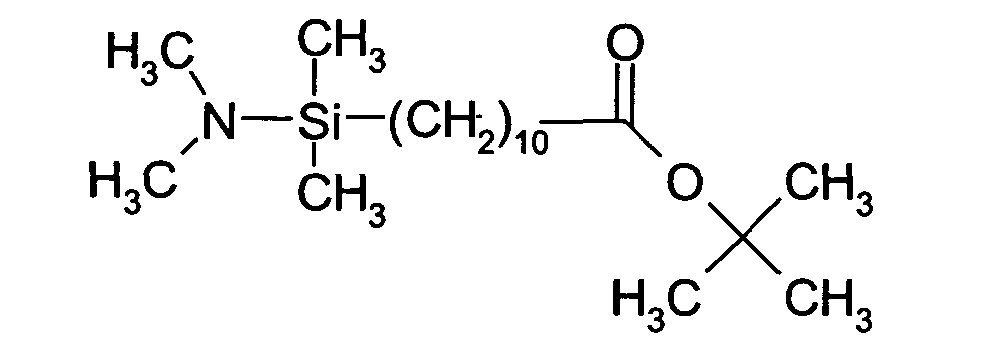




| Site de restriction modifiémélange de 296 oligonucléotides | Position de la mutations dans Seq ID No 1 | SEQ ID Nos |
| Msll | 220-222 | 3-10 |
| Xmnl | 37-39 | 11-18 |
| Alul | 97-99 | 19-26 |
| Bsml | 100-102 | 27-34 |
| BgIII | 196-198 | 35-42 |
| Smll | 310-312 | 43-50 |
| Nsil I | 214-216 | 51-58 |
| BsrDI | 271-273 | 59-66 |
| BspHI | 334-336 | 67-74 |
| Bfal | 361-363 | 75-82 |
| SSPl | 439-441 | 83-90 |
| Rsal | 466-468 | 91-98 |
| BsrGl | 469-471 | 99-106 |
| BsaWl | 316-318 | 107-114 |
| Tfil | 400-402 | 115-122 |
| Msel | 445-447 | 123-130 |
| Mlyl | 313-315 | 131-138 |
| Taql | 22-24 | 139-146 |
| Site de restriction modifé | Position de la mutation Dans SEQ ID No 1 | SEQ ID Nos |
| - | 157-159 | 147-154 |
| - | 490-492 | 155-162 |
| - | 205-207 | 156-170 |
| - | 238-240 | 171-178 |
| - | 265-267 | 179-186 |
| - | 292-294 | 187-194 |
| - | 175-177 | 195-202 |
| - | 226-228 | 203-210 |
| - | 250-252 | 211-218 |
| - | 280-282 | 219-226 |
| - | 301-303 | 227-234 |
| - | 325-327 | 235-242 |
| - | 346-348 | 243-250 |
| - | 370-372 | 251-258 |
| - | 391-393 | 259-266 |
| - | 415-417 | 267-274 |
| - | 433-435 | 275-282 |
| - | 457-459 | 283-290 |
| - | 478-480 | 291-298 |
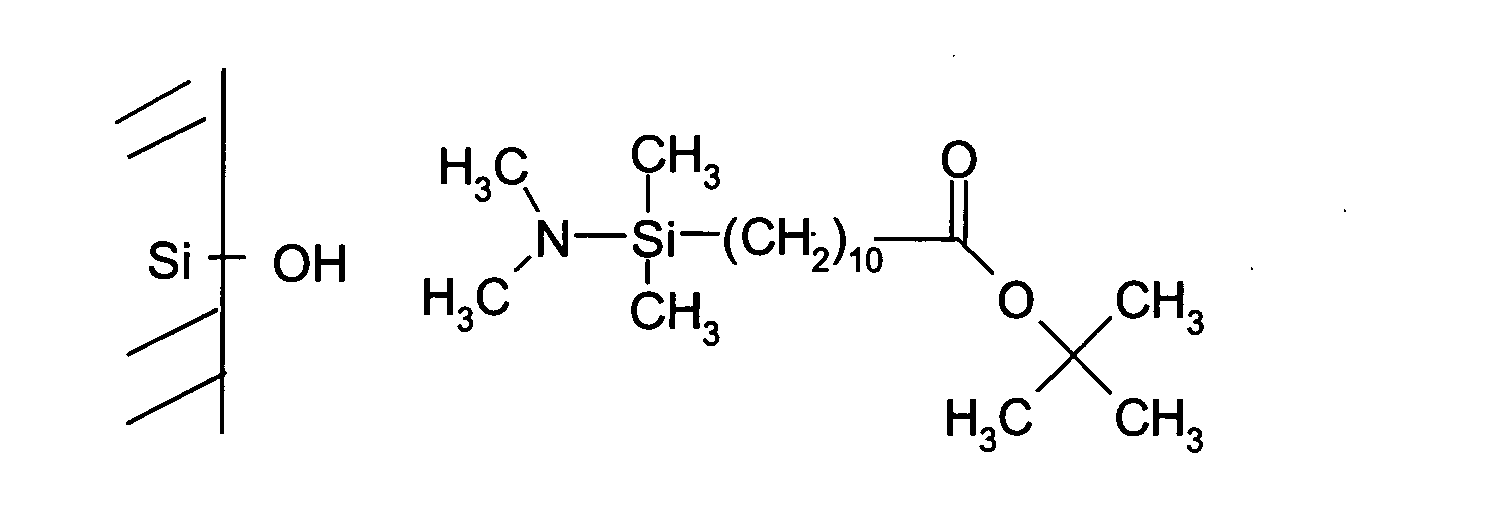

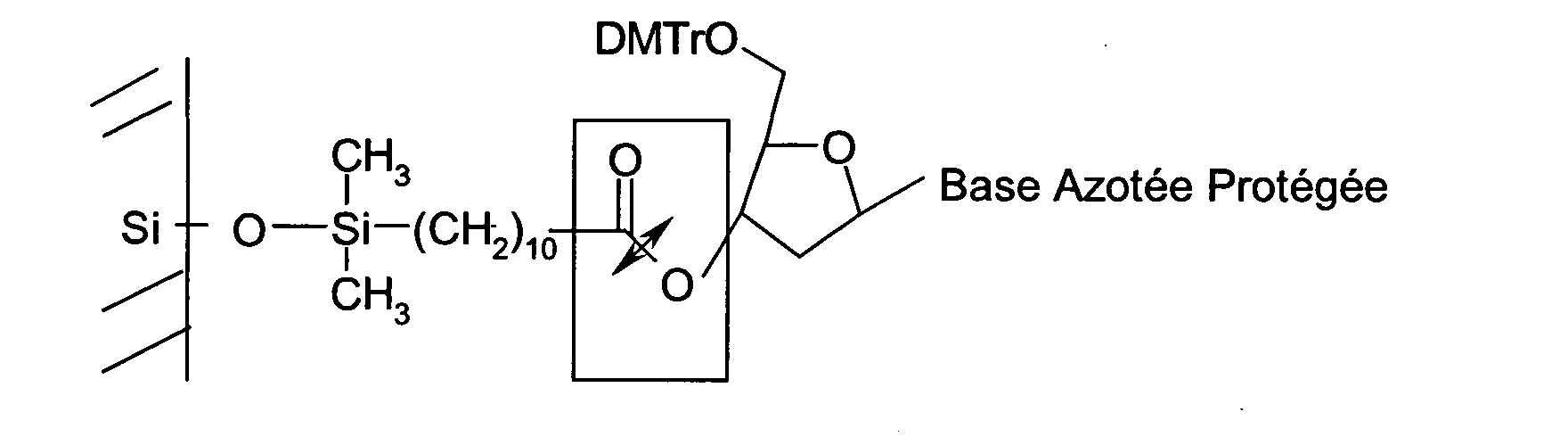
| 1 µl (200 ng de matrice pORF IL 15) | 1 µl d'ATP 10Mm |
| 1 µl de dNTP (25mM) | 0.2 µl de NAD (100 mM) |
| 1 µl de MgSO4 (100 mM) | 0.2 µl de dTT(1 M) |
| 3.5 µl de tampon 10X pfu pol | 0.8 µl de pfu pol |
| 0.8 µl de Tth ligase | 0.5 µl de Taq |
| Vf = 10 µl |
| CLONE | Tour de PLCR | MUTATION | SEQ ID No |
| 1 | 1er | BSRG I | 299 |
| 2 | 1er | BgI II | 300 |
| 3 | 1er | BsrG I | 301 |
| 4 | 2éme | BsrG I | 302 |
| 5 | 2ème | BsrG I | 303 |
| 6 | 2éme | position 251 / Tfi I /BsrG I | 304 |
| 7 | 2ème | WT IL15 | 305 |
| 8 | 2éme | WTIL15 | 306 |
| 9 | 2ème | BsrG I | 307 |
| 10 | 2ème | BgI II | 308 |
| 11 | 2ème | Bgl II | 309 |
| 12 | 3éme | WT IL15 | 310 |
| 13 | 3ème | position 237 / BsrG I/BsrD I | 311 |
| 14 | 3ème | BgI II | 312 |
| 15 | 3ème | BspH I / Mly I | 313 |
| 16 | 3ème | Ssp I | 314 |
| 17 | 3ème | Ssp I | 315 |
| 18 | 3ème | Ssp I | 316 |
| 19 | 3ème | Bfa I / Tfi I/SSp I | 317 |
| 20 | 3ème | BgI I | 318 |
| 21 | 3ème | BgI II | 319 |
| 22 | 3ème | Alu I / BgI II | 320 |
| 23 | 3ème | Tfi I /BsrG I | 321 |
| 24 | 3ème | position 478 | 322 |
| 25 | 3ème | BspH I | 323 |
| 26 | 3ème | position 292 | 324 |
| 27 | 3ème | Bfa I | 325 |

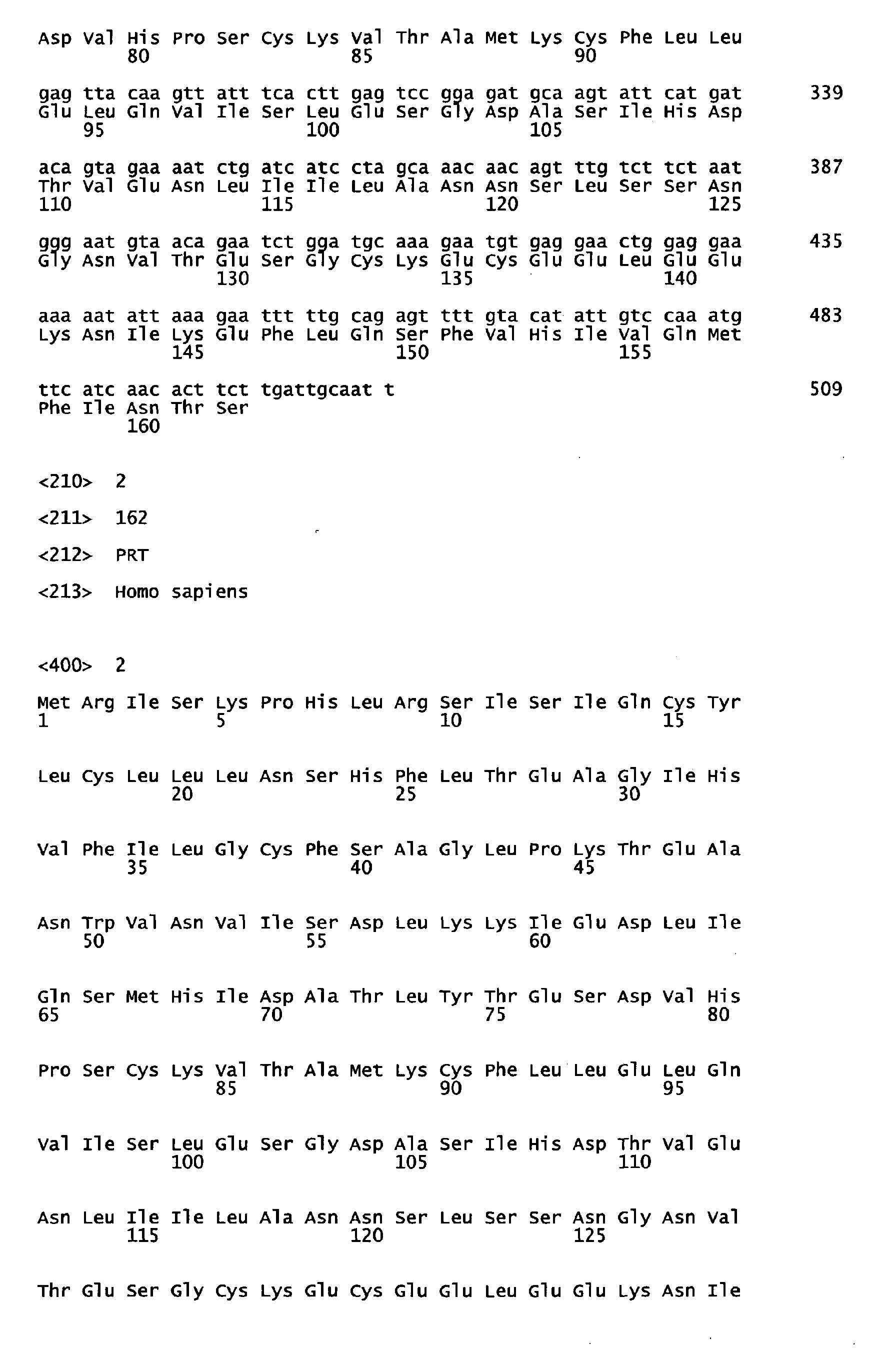
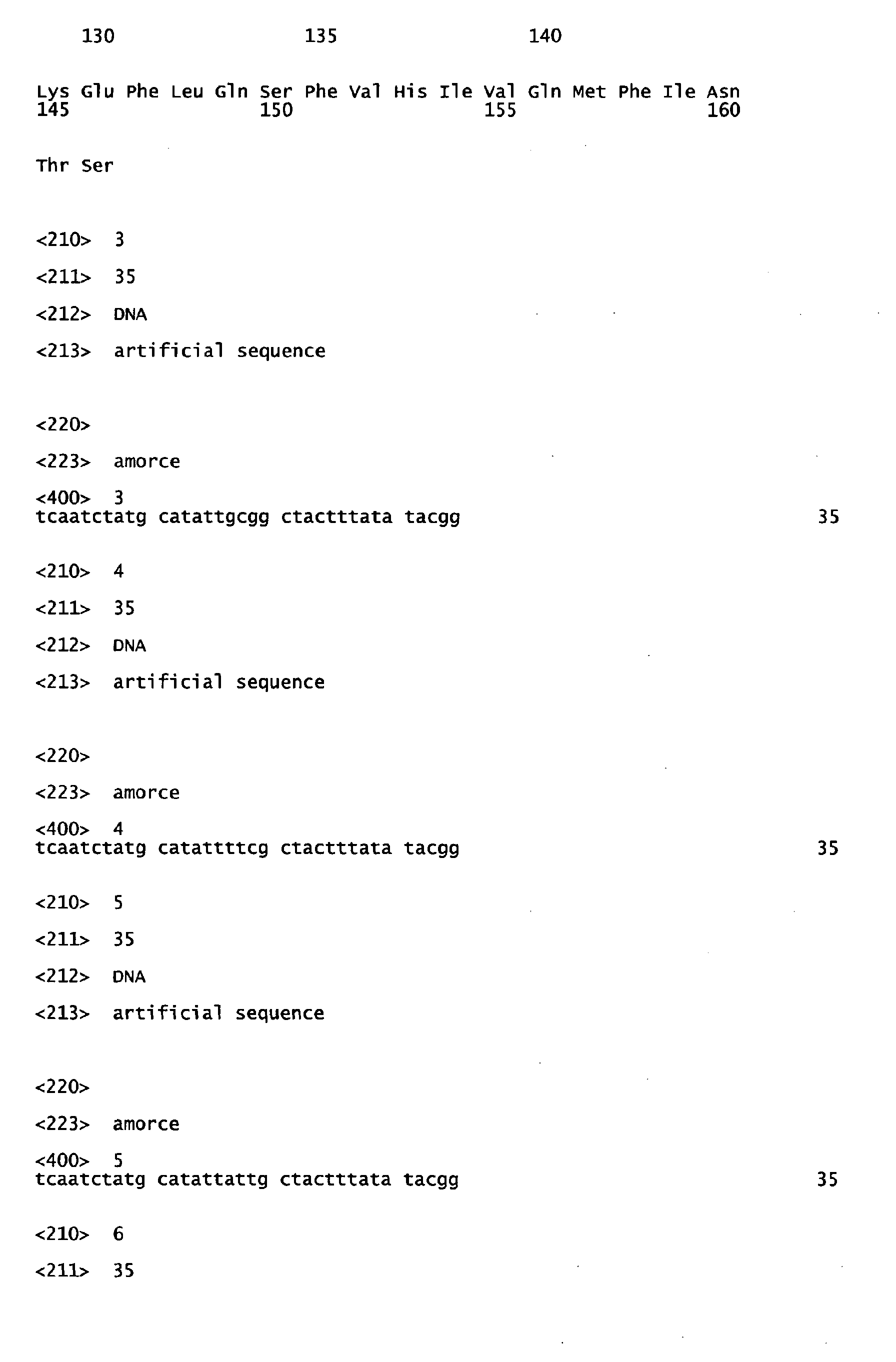


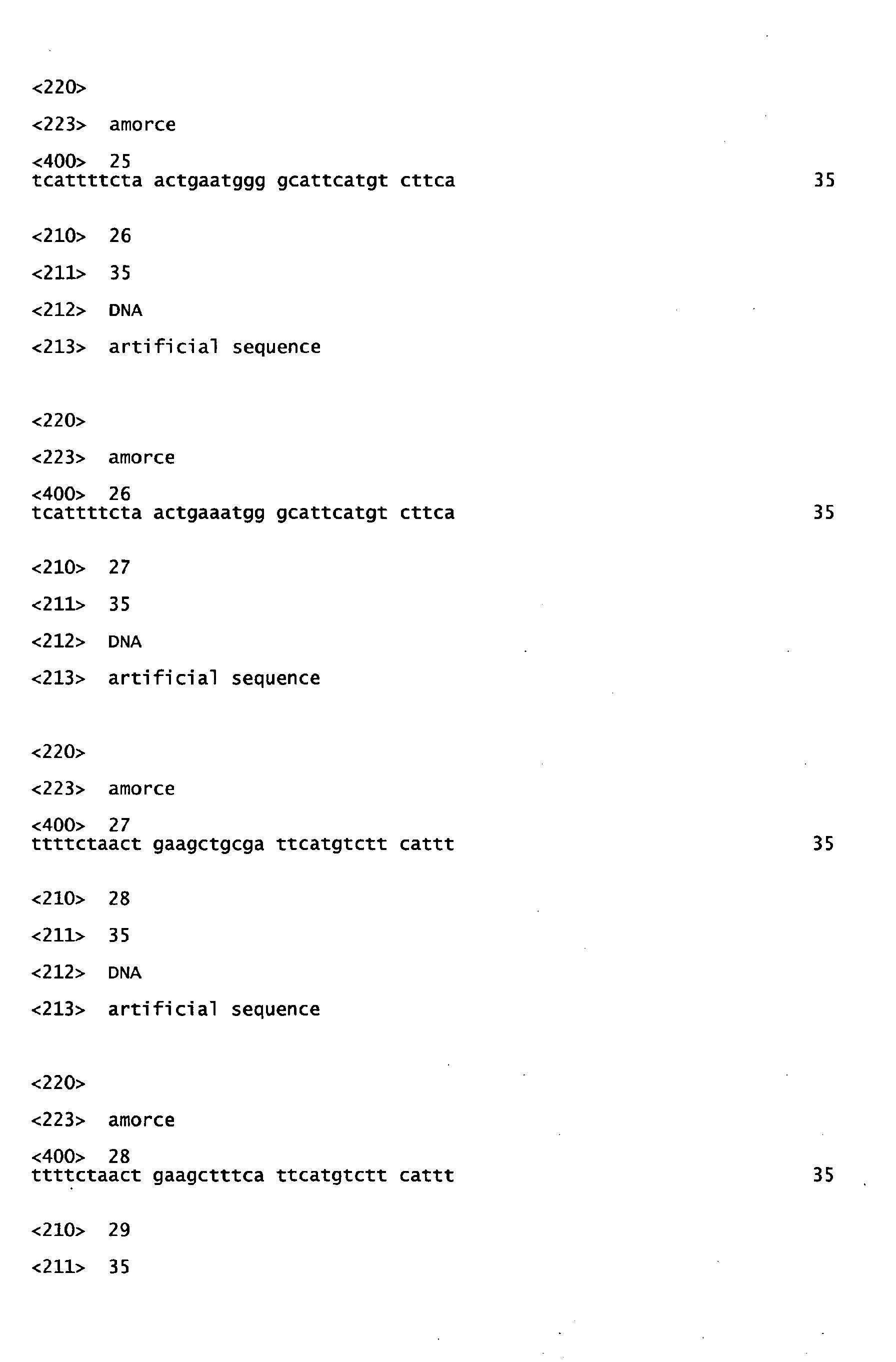
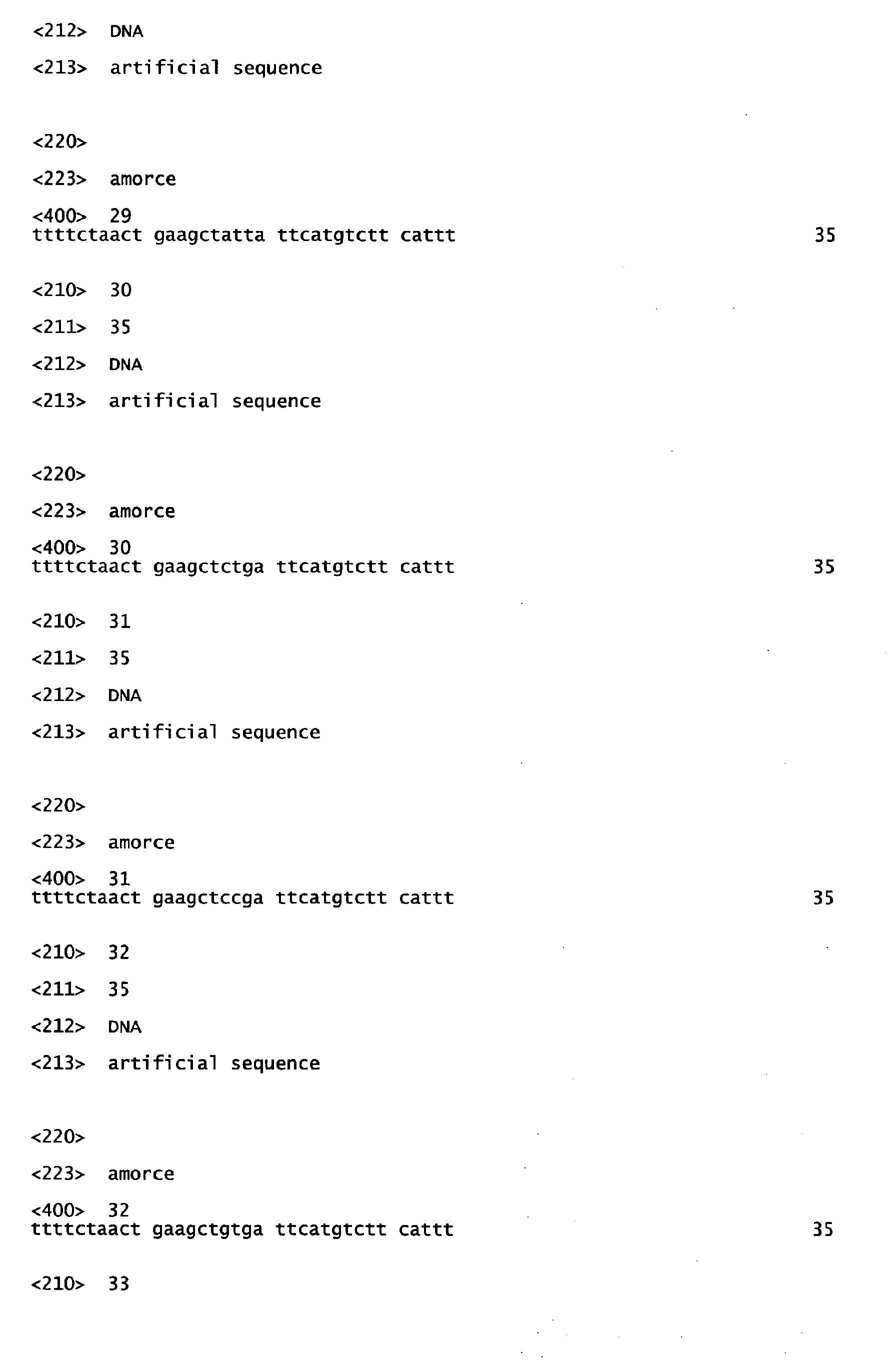

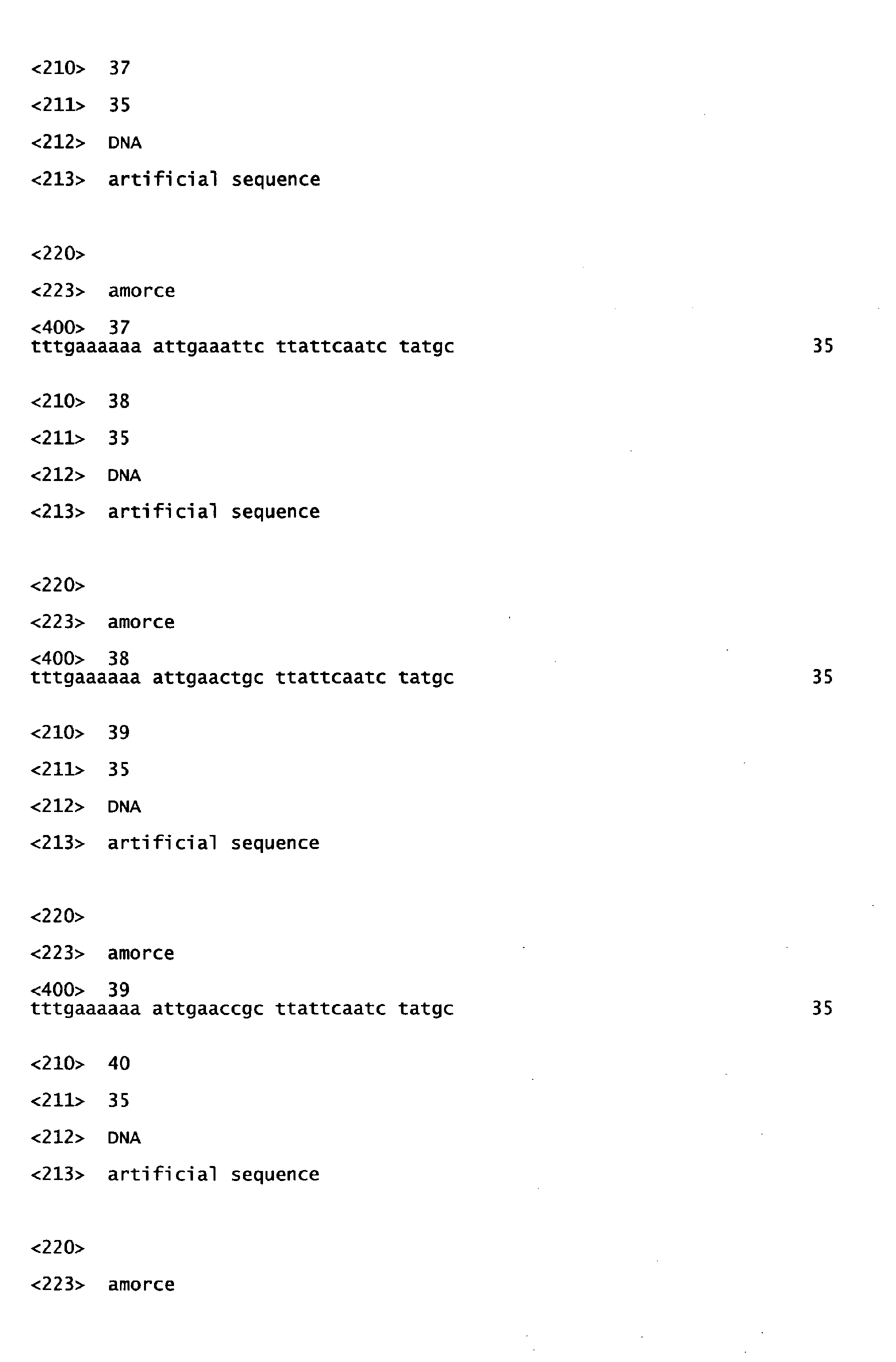


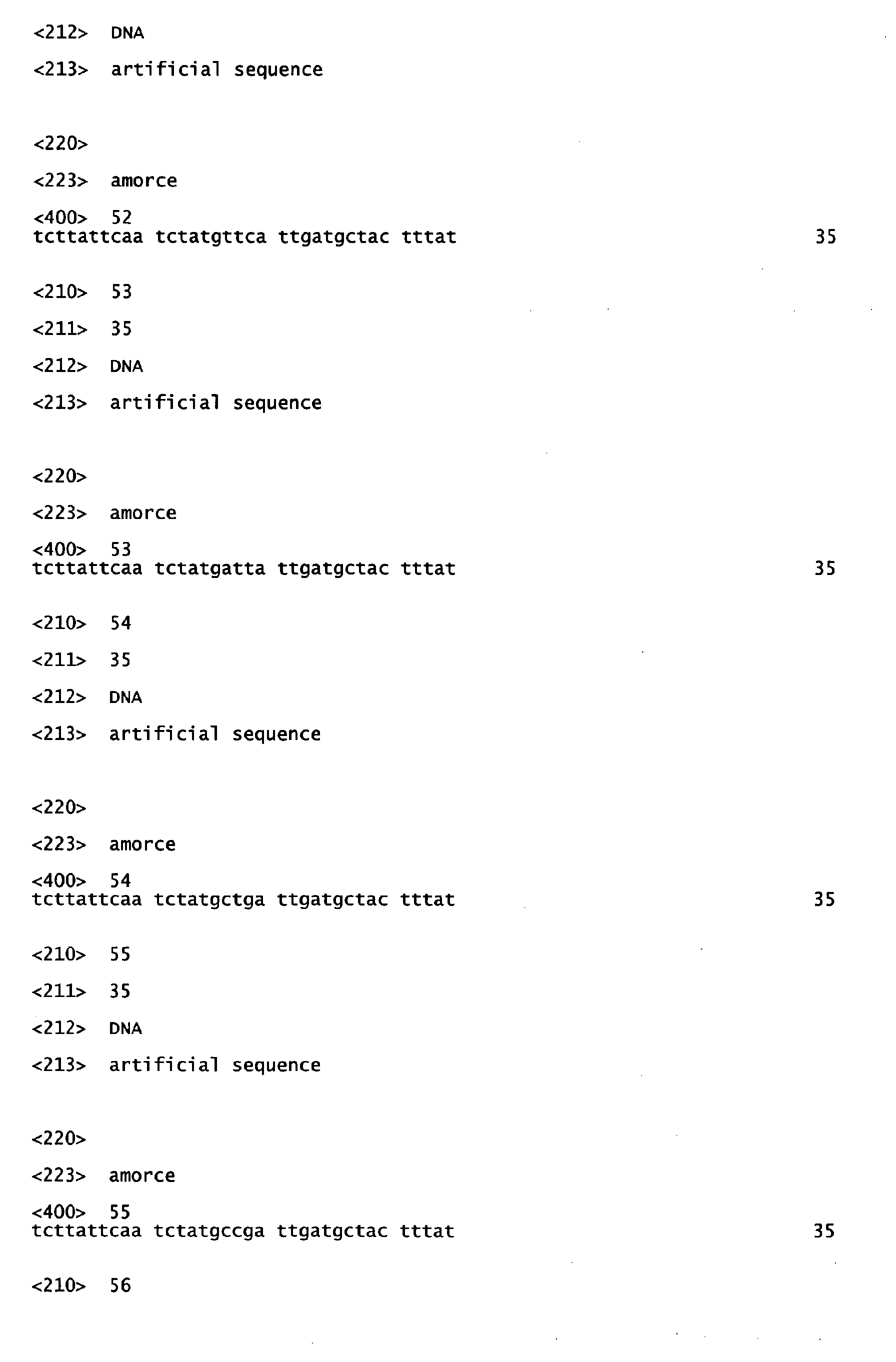


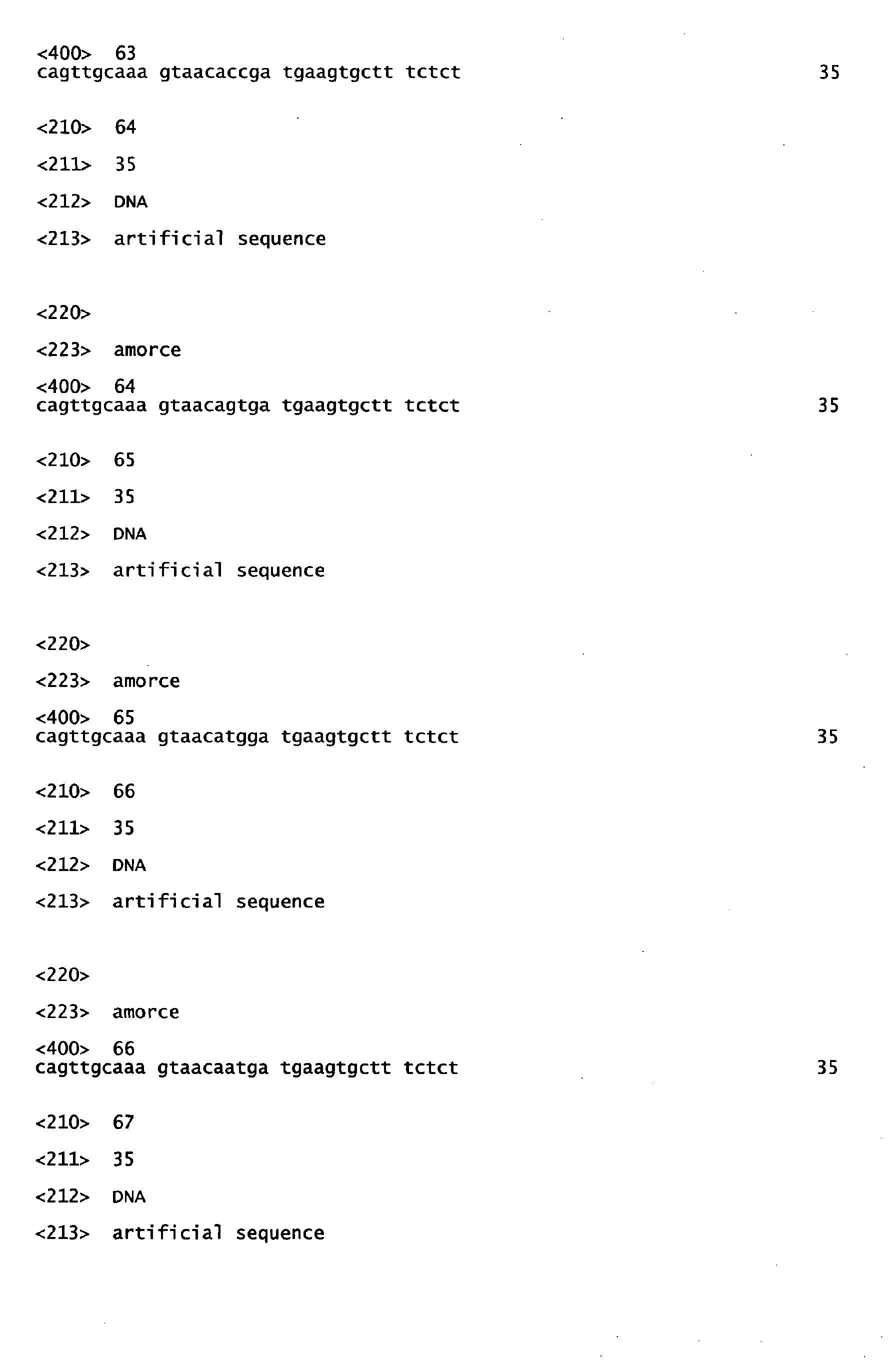
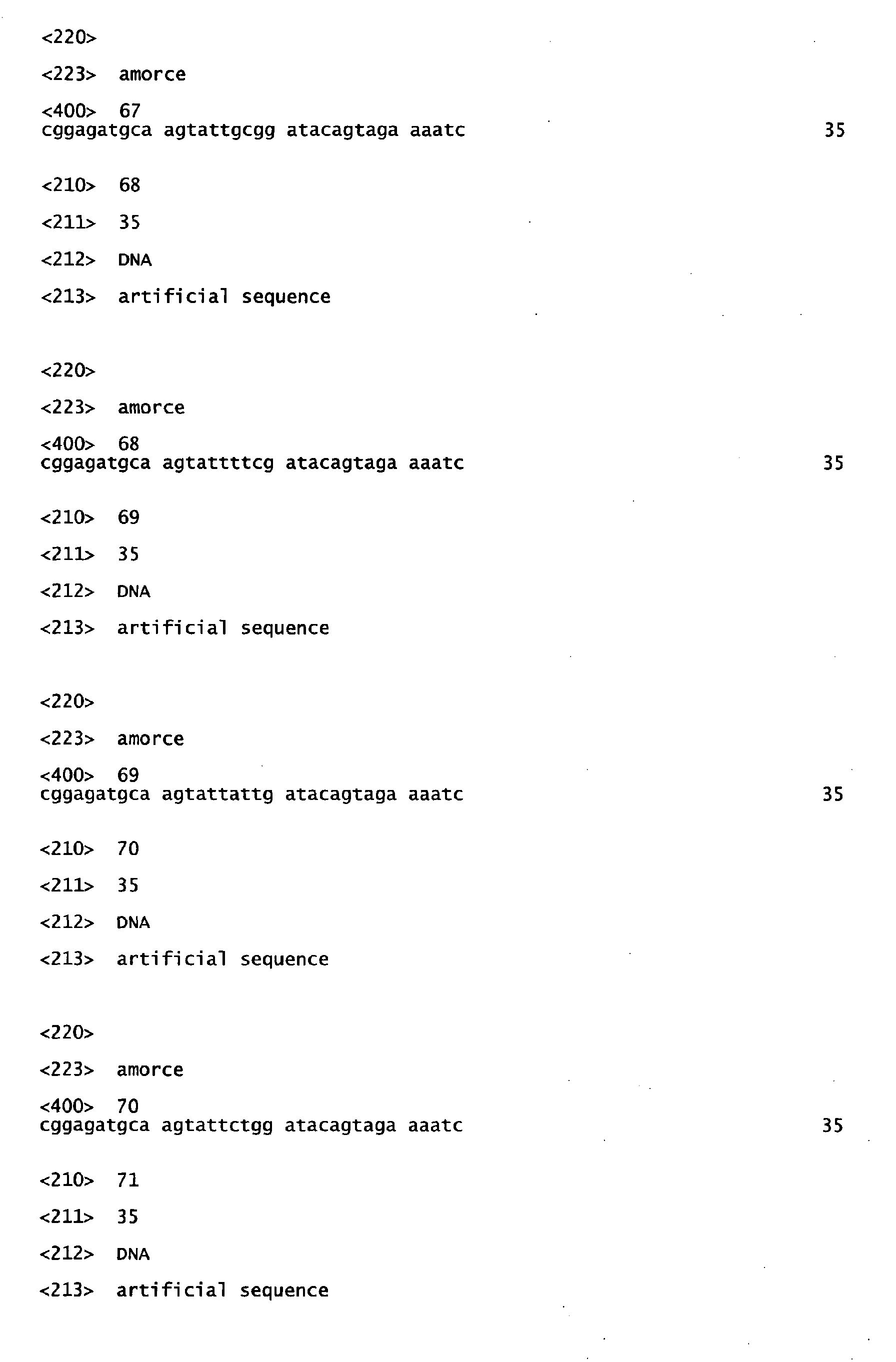


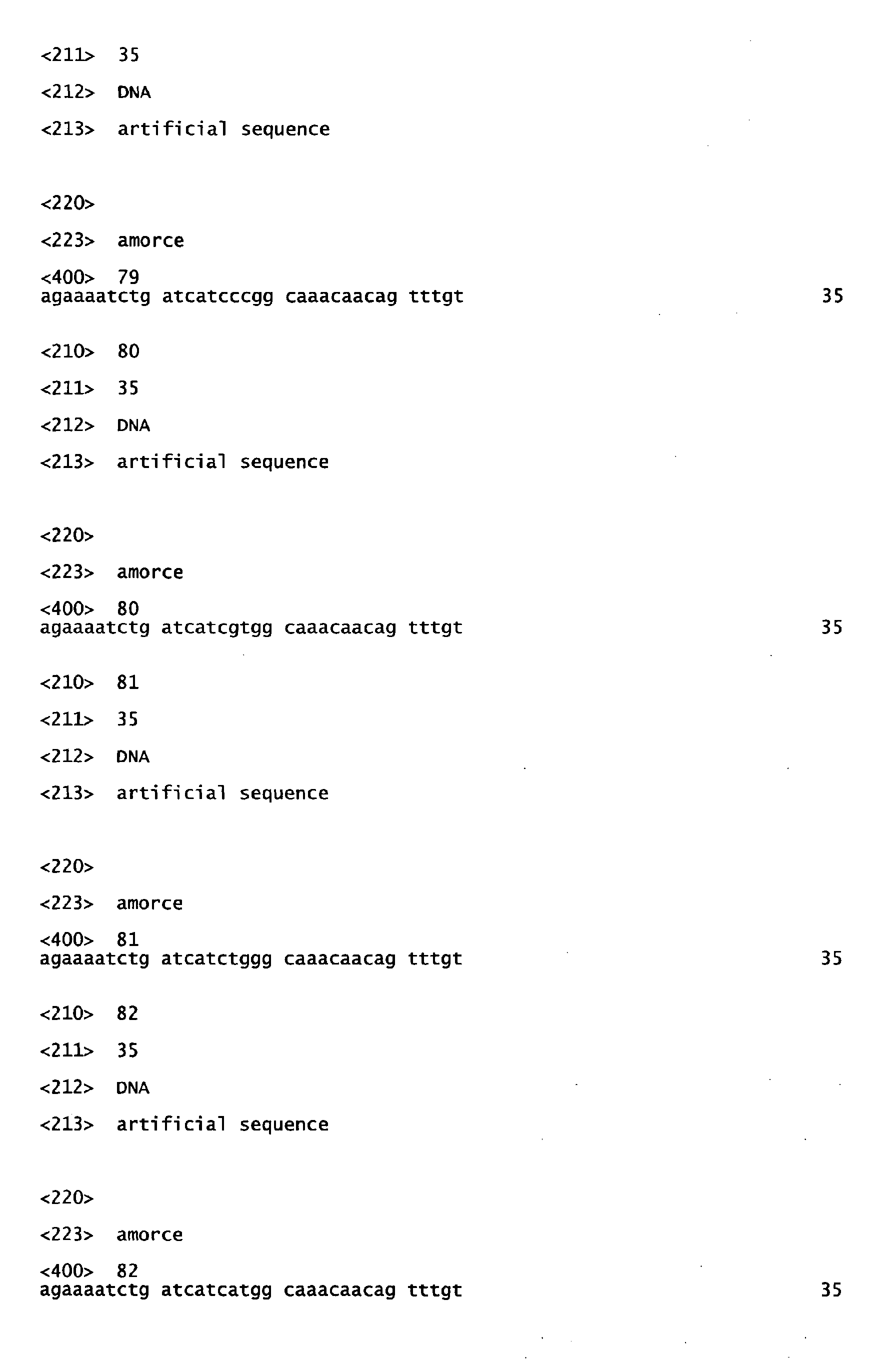
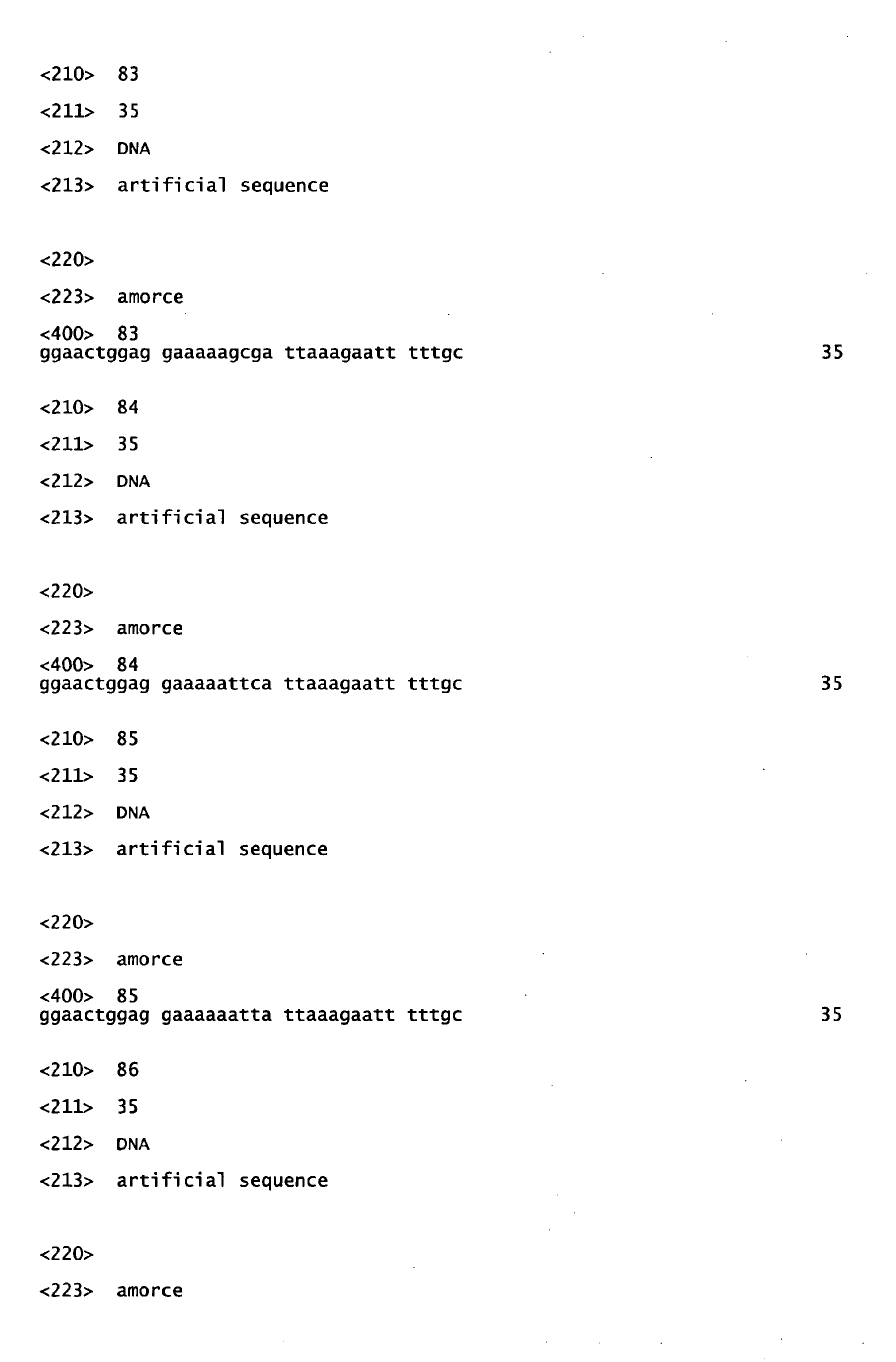

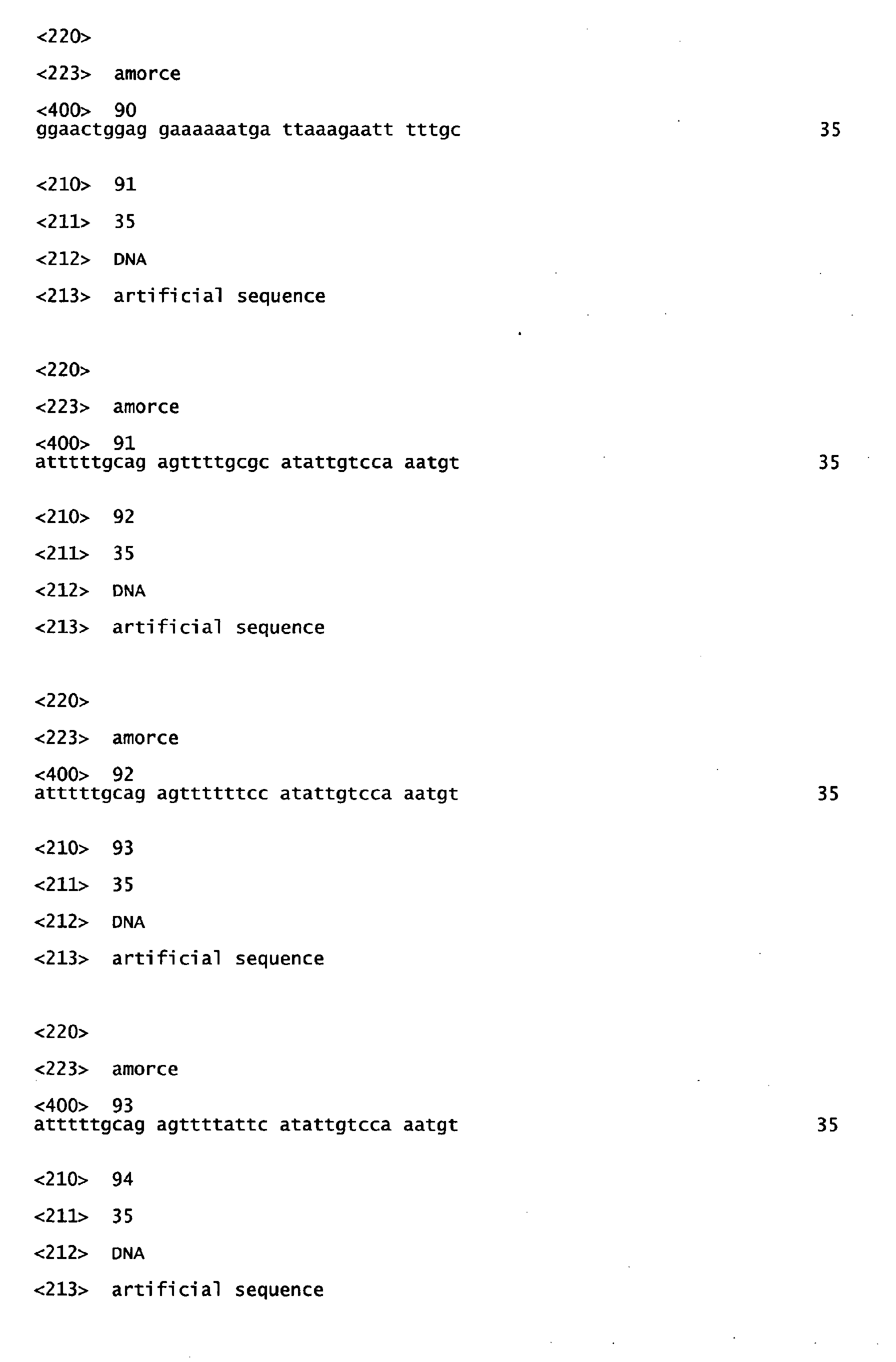
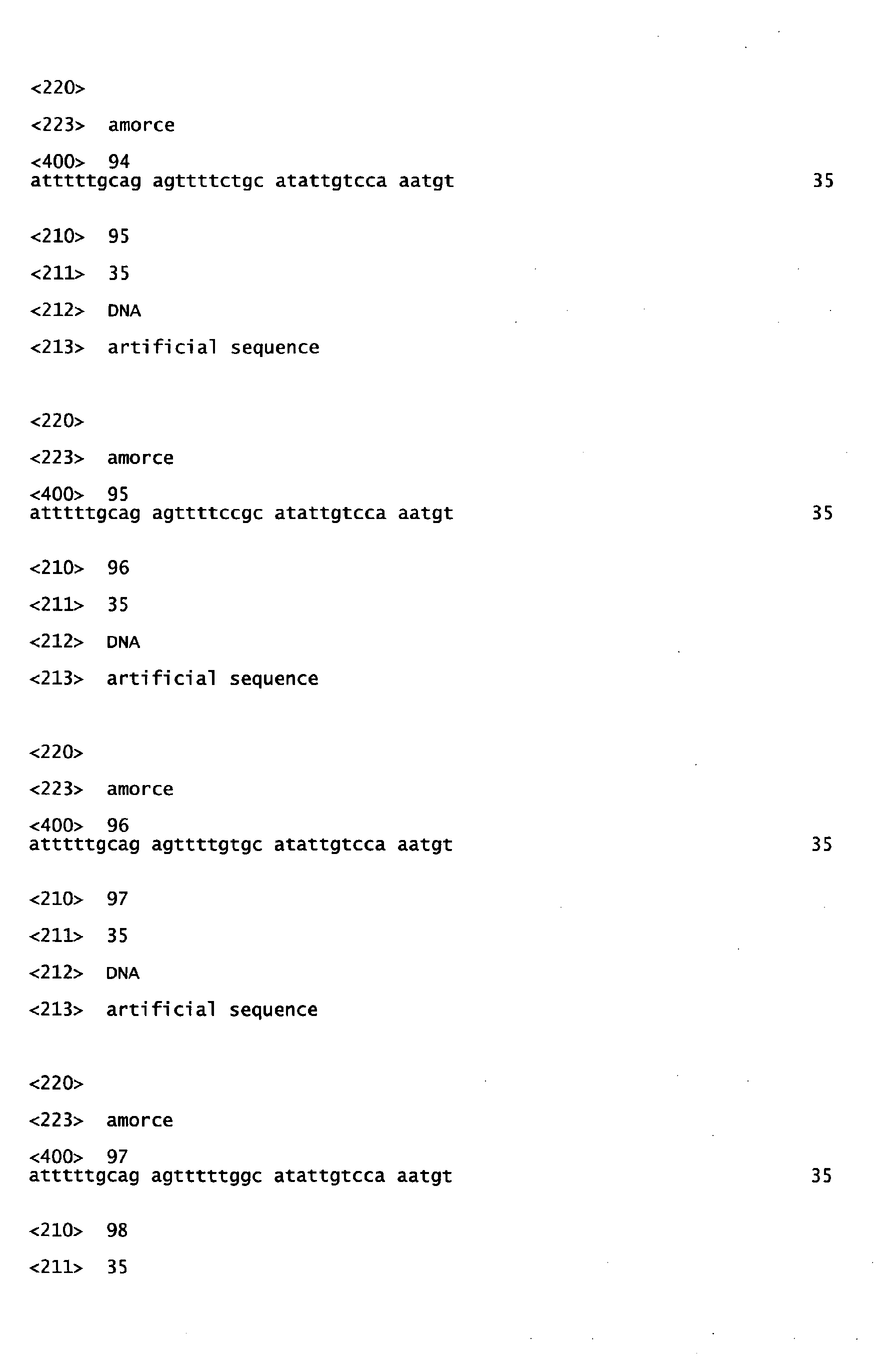
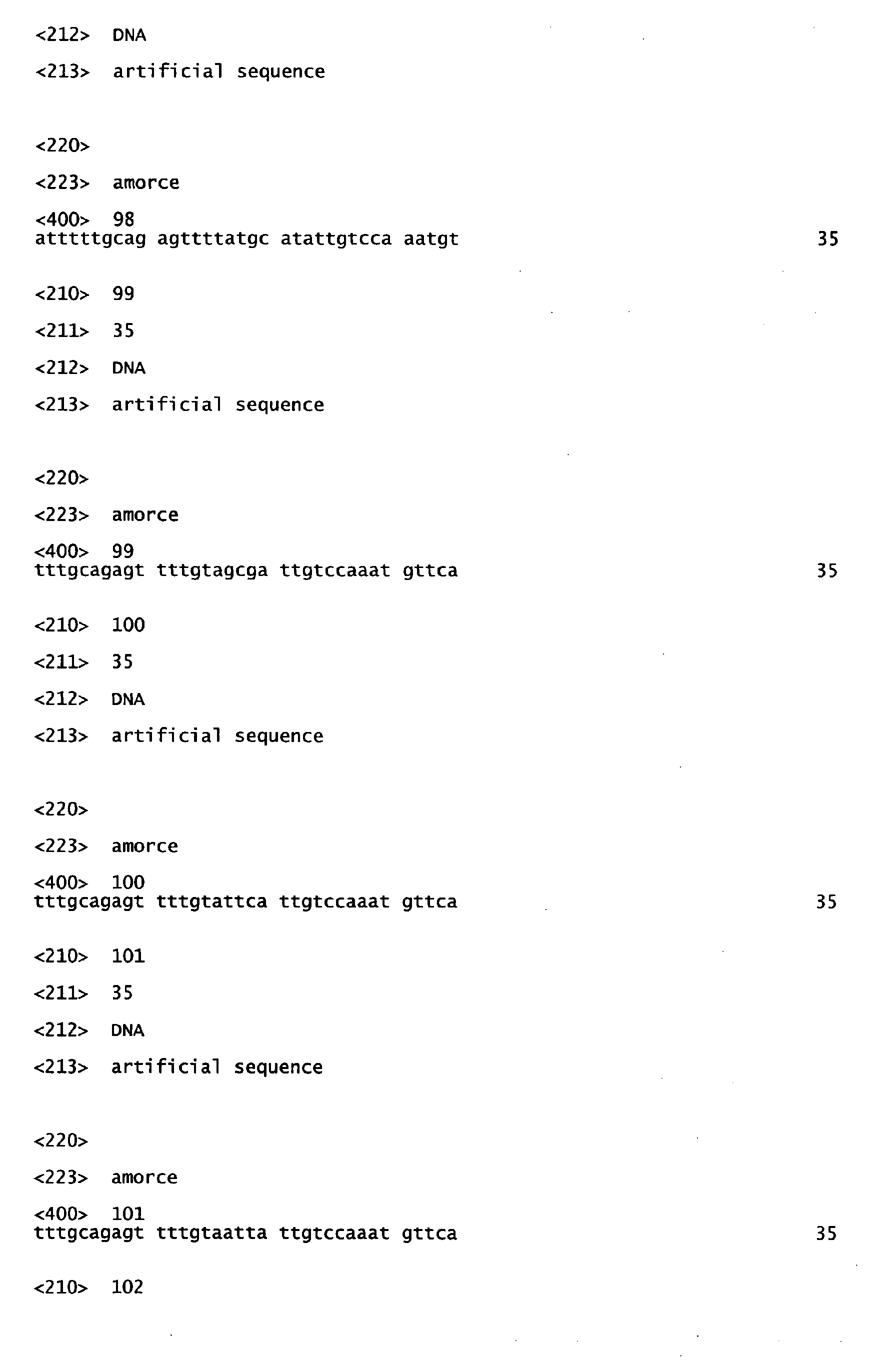


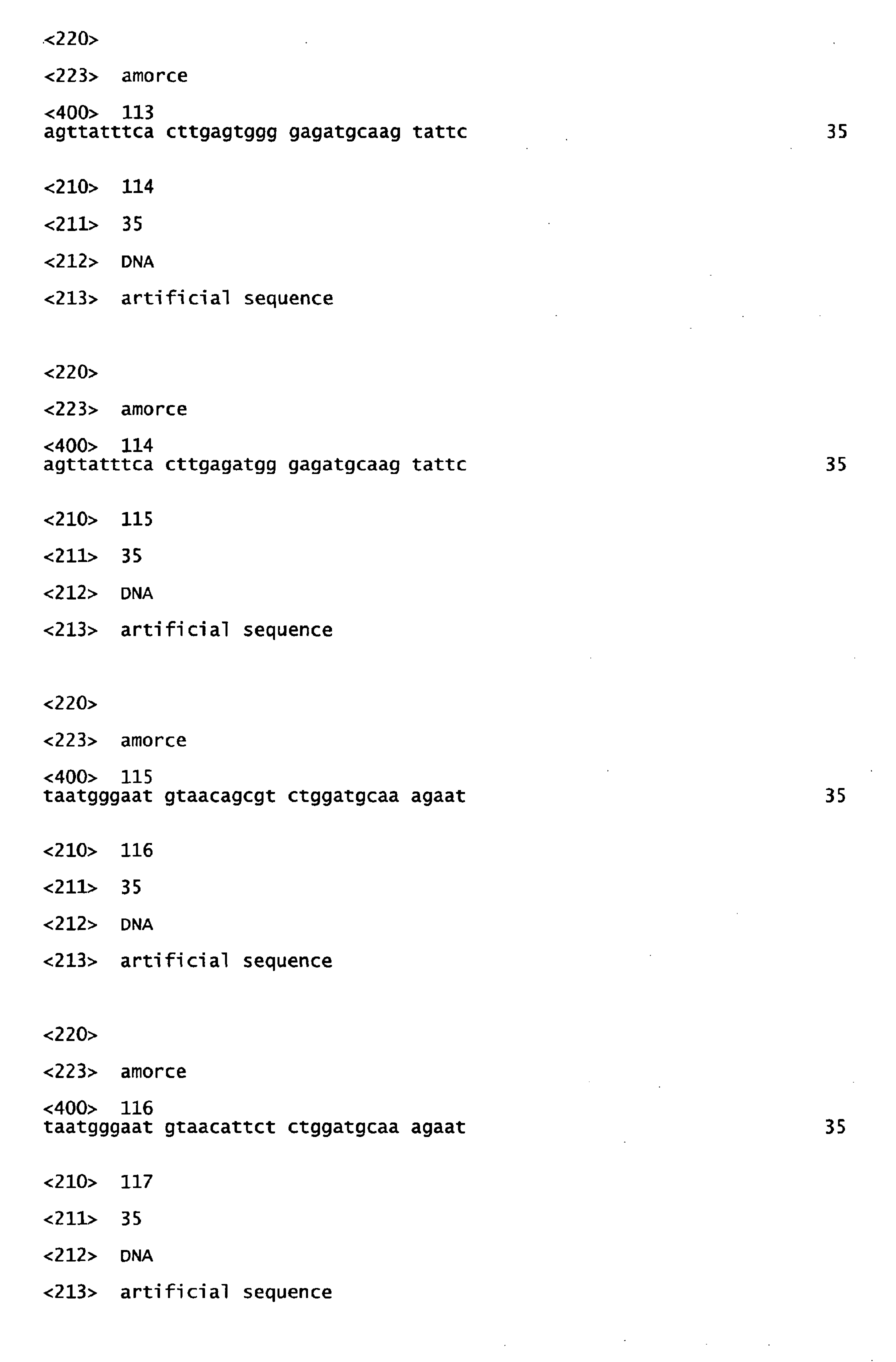

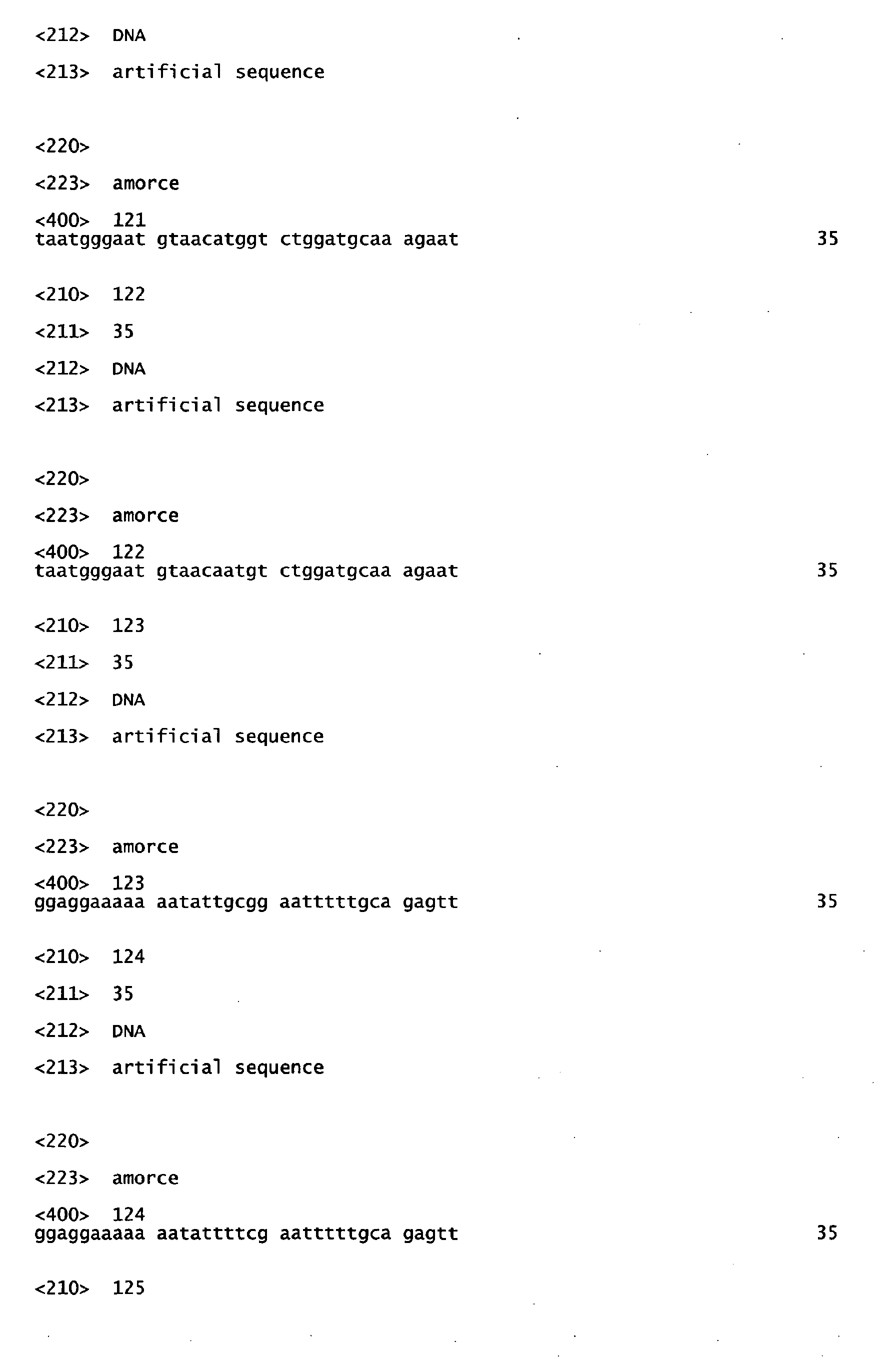


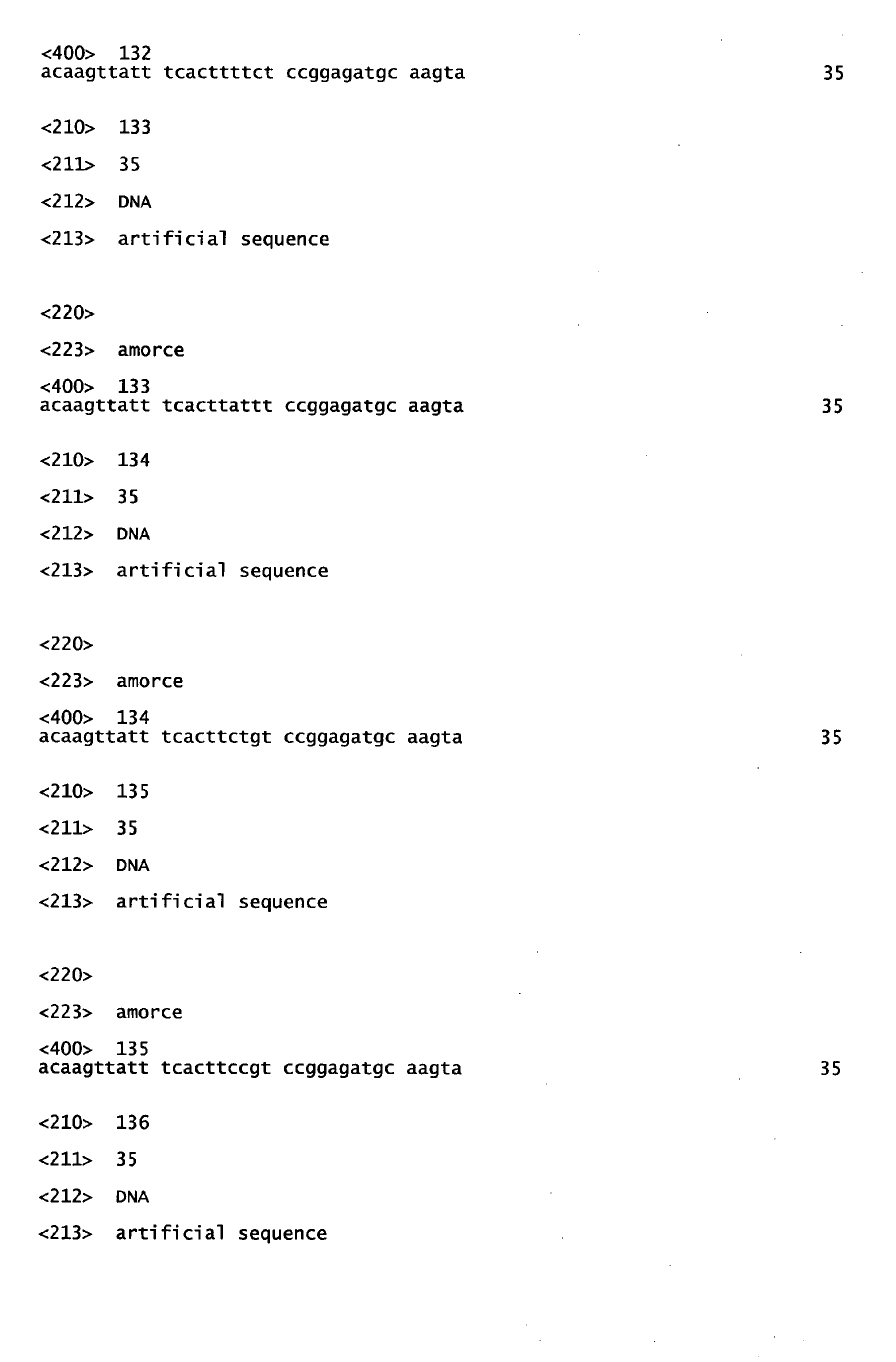


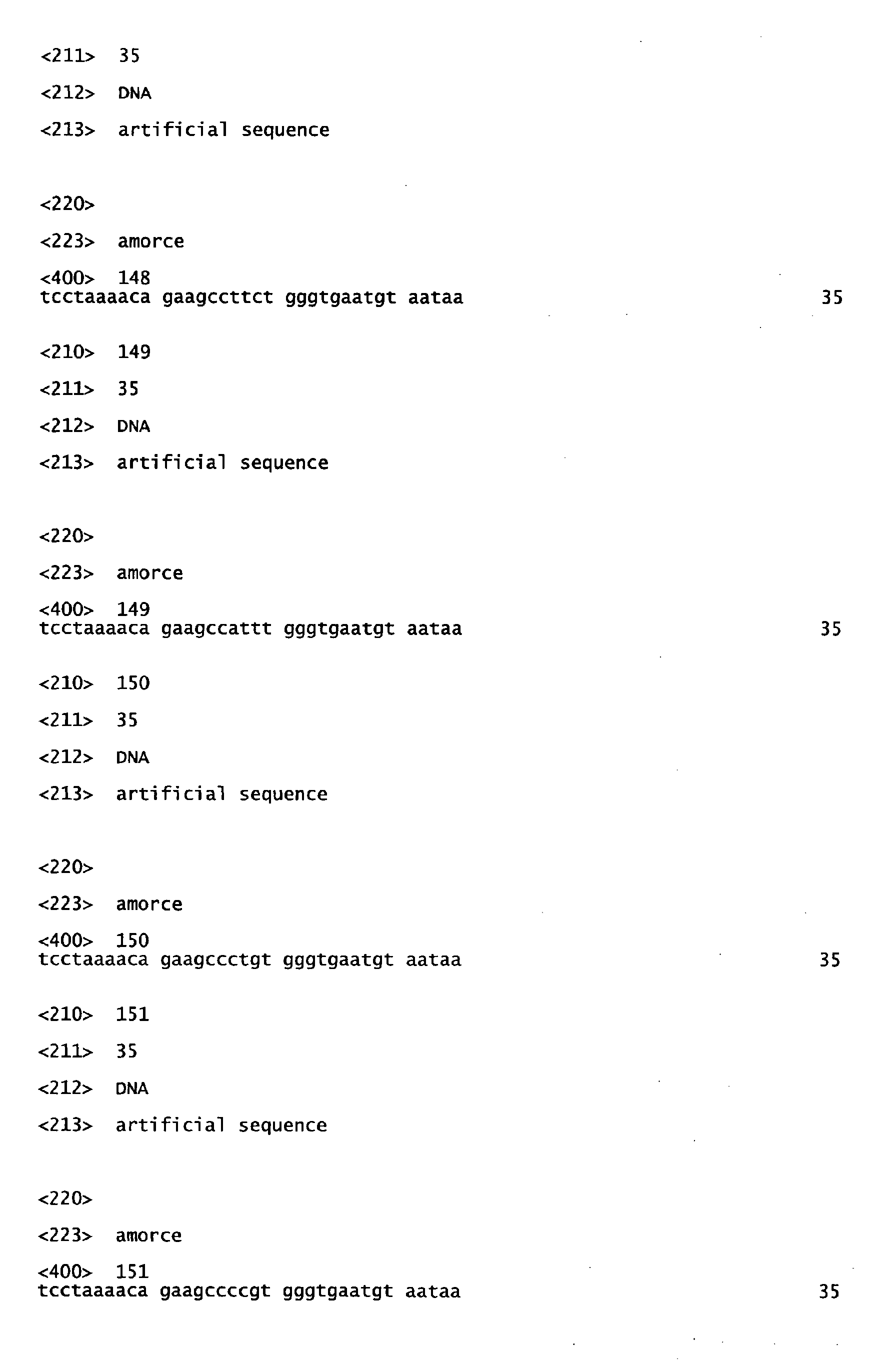
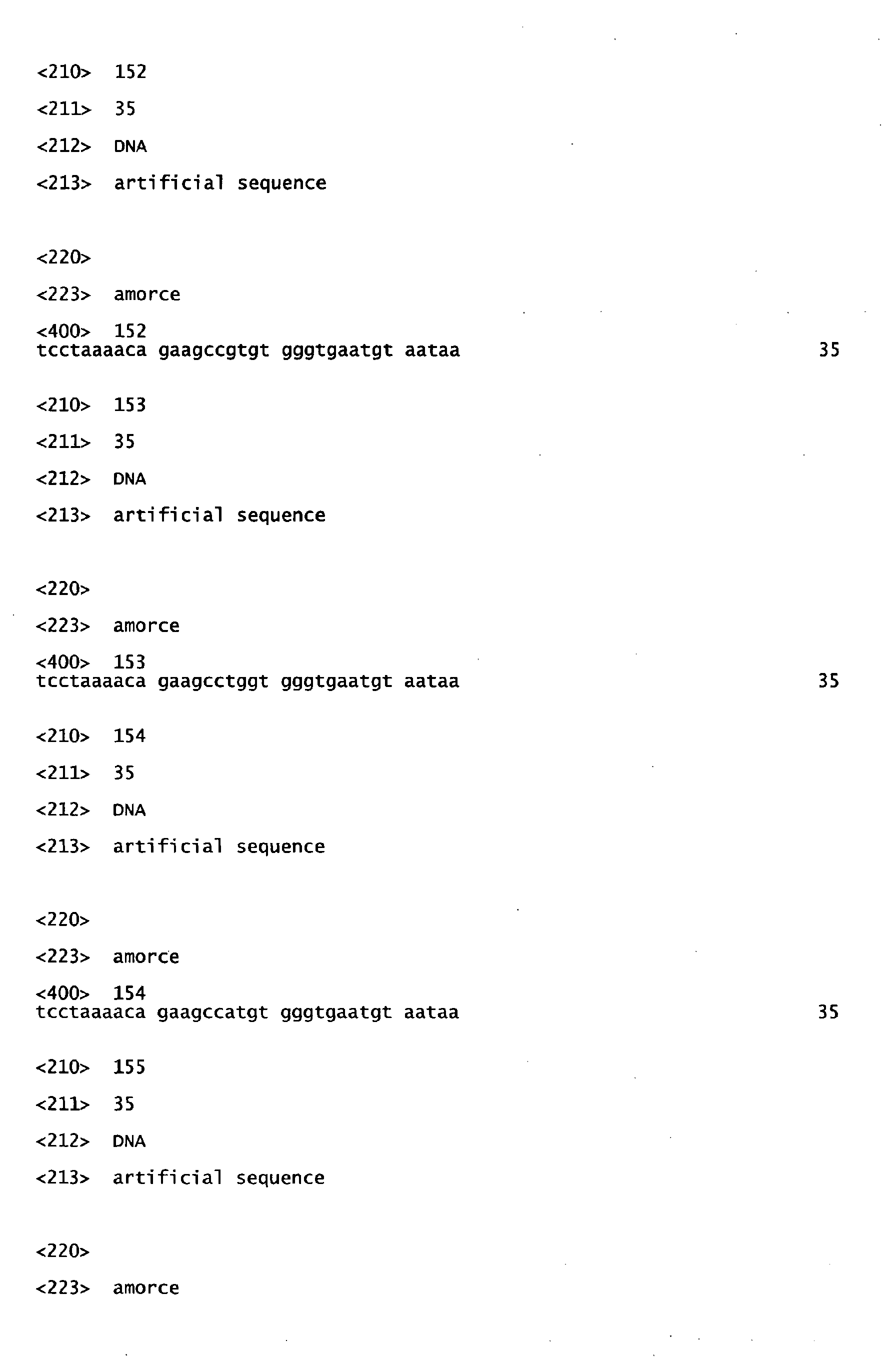
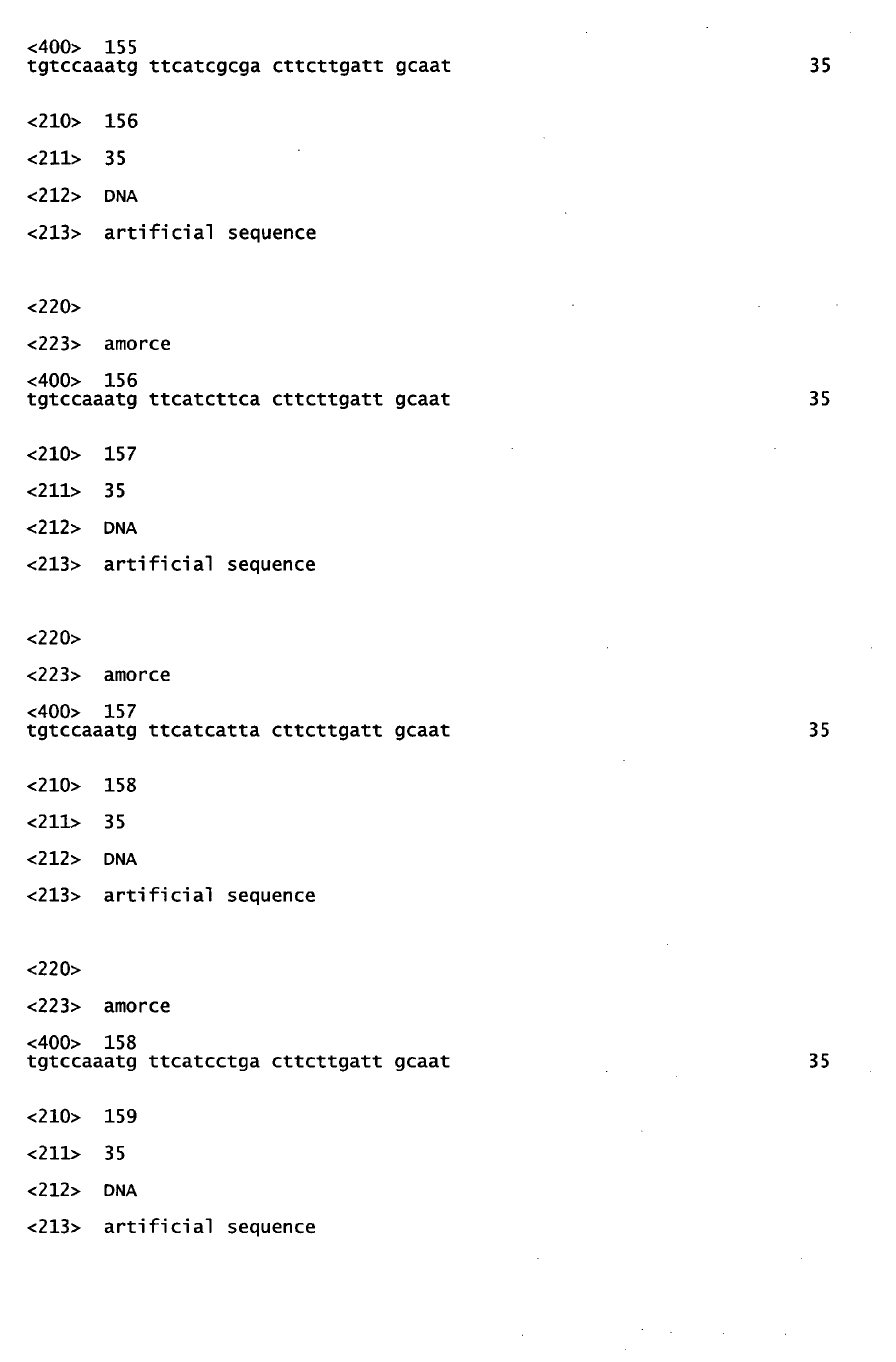
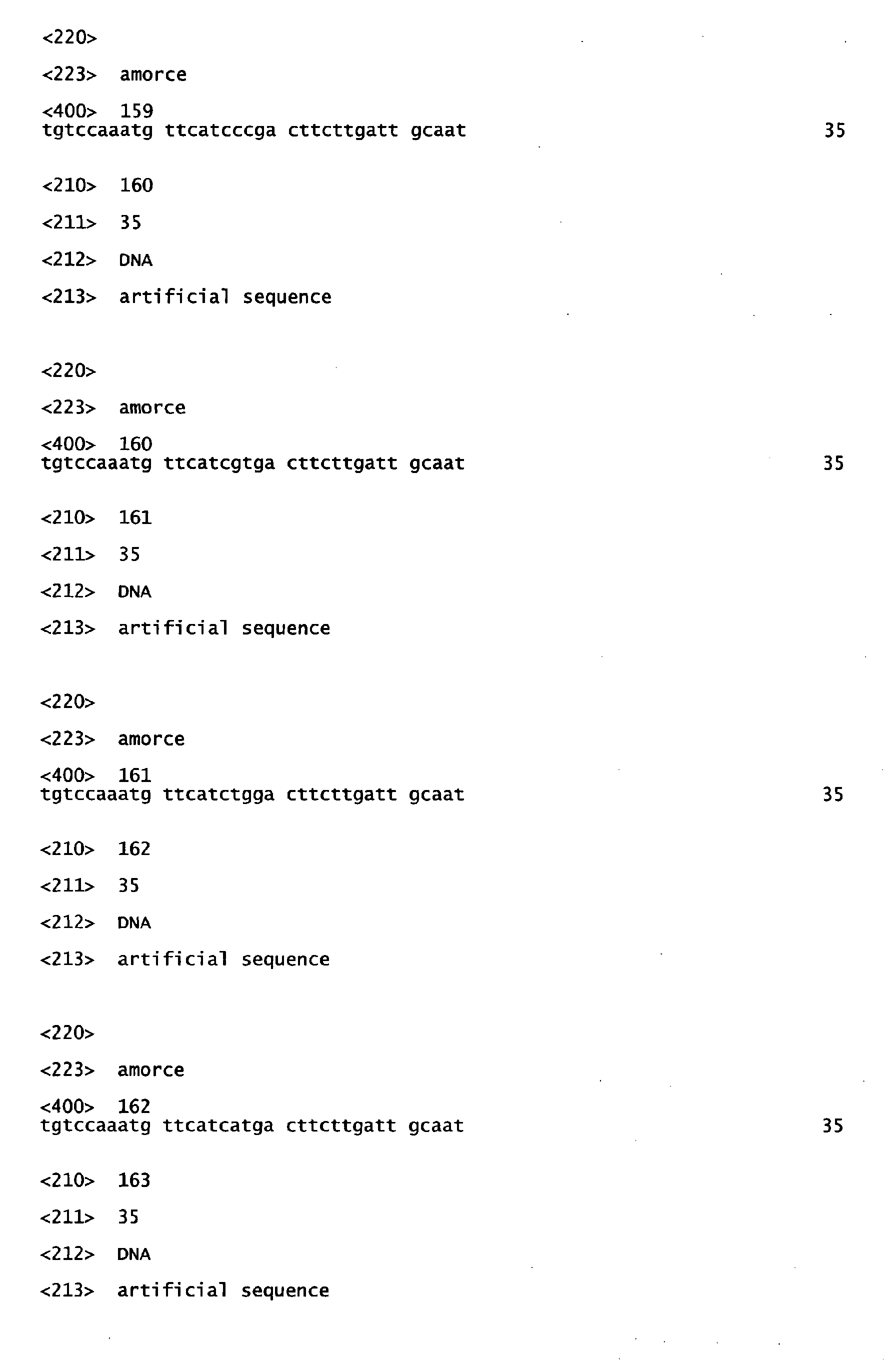
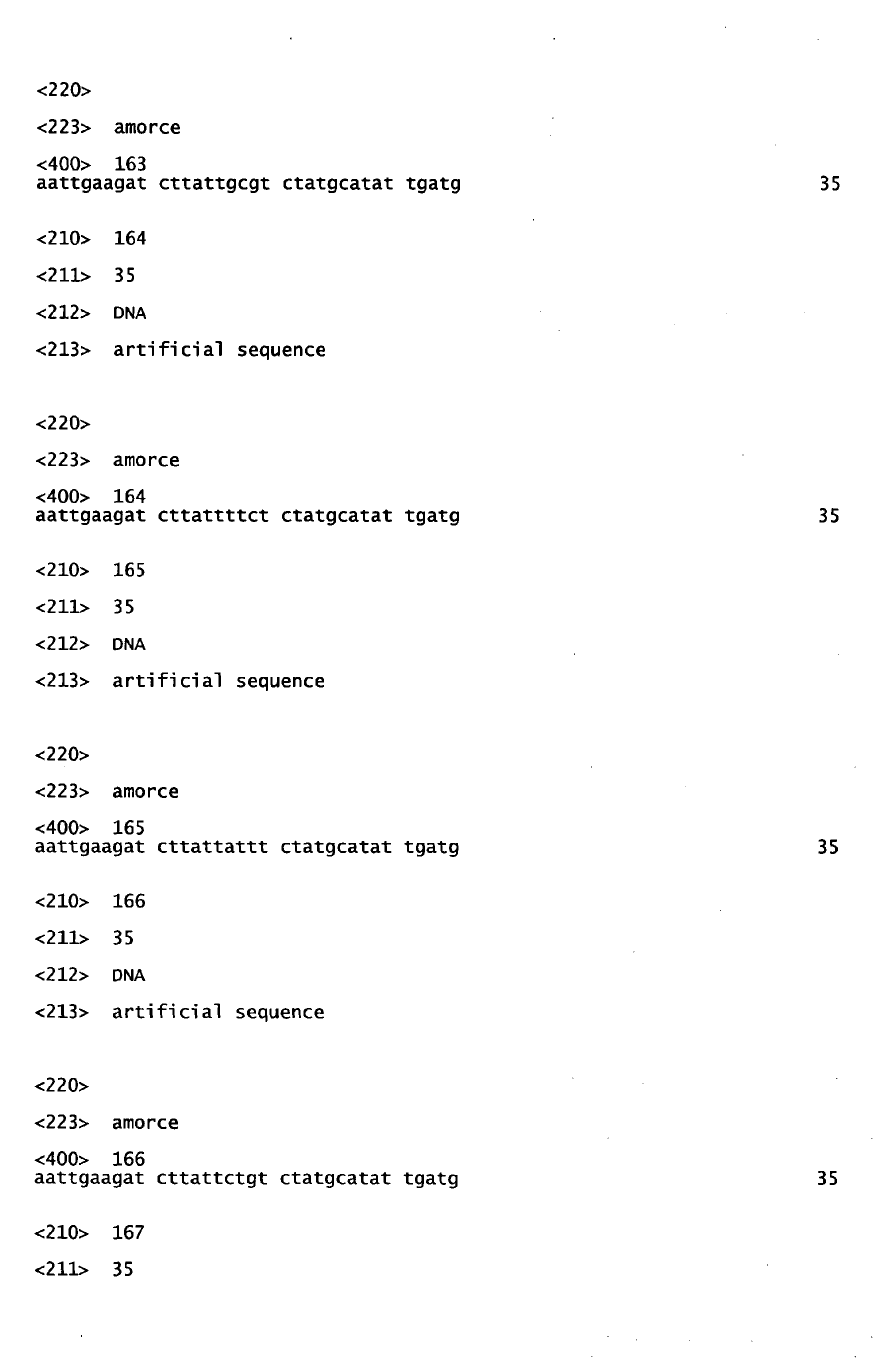
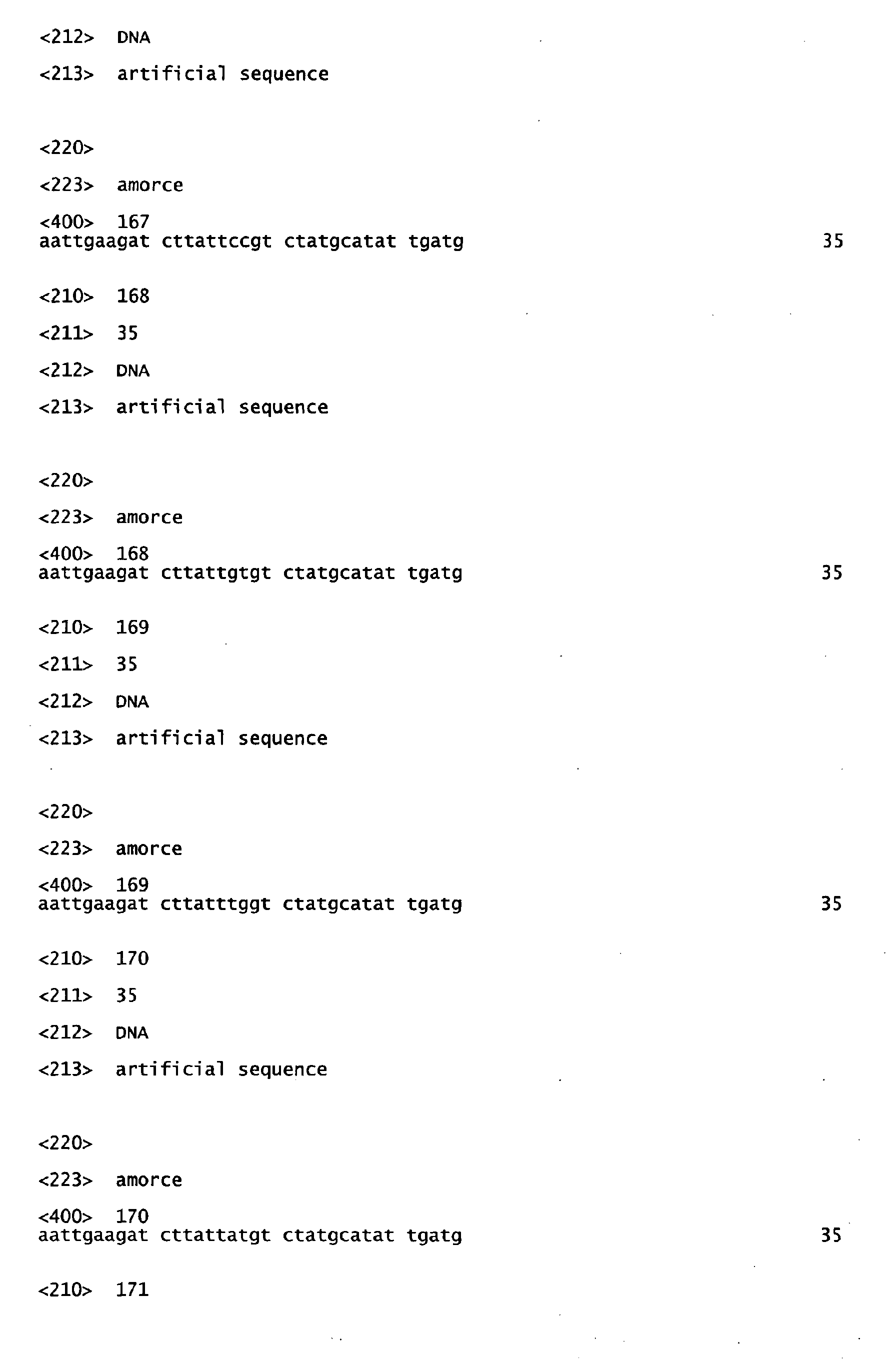
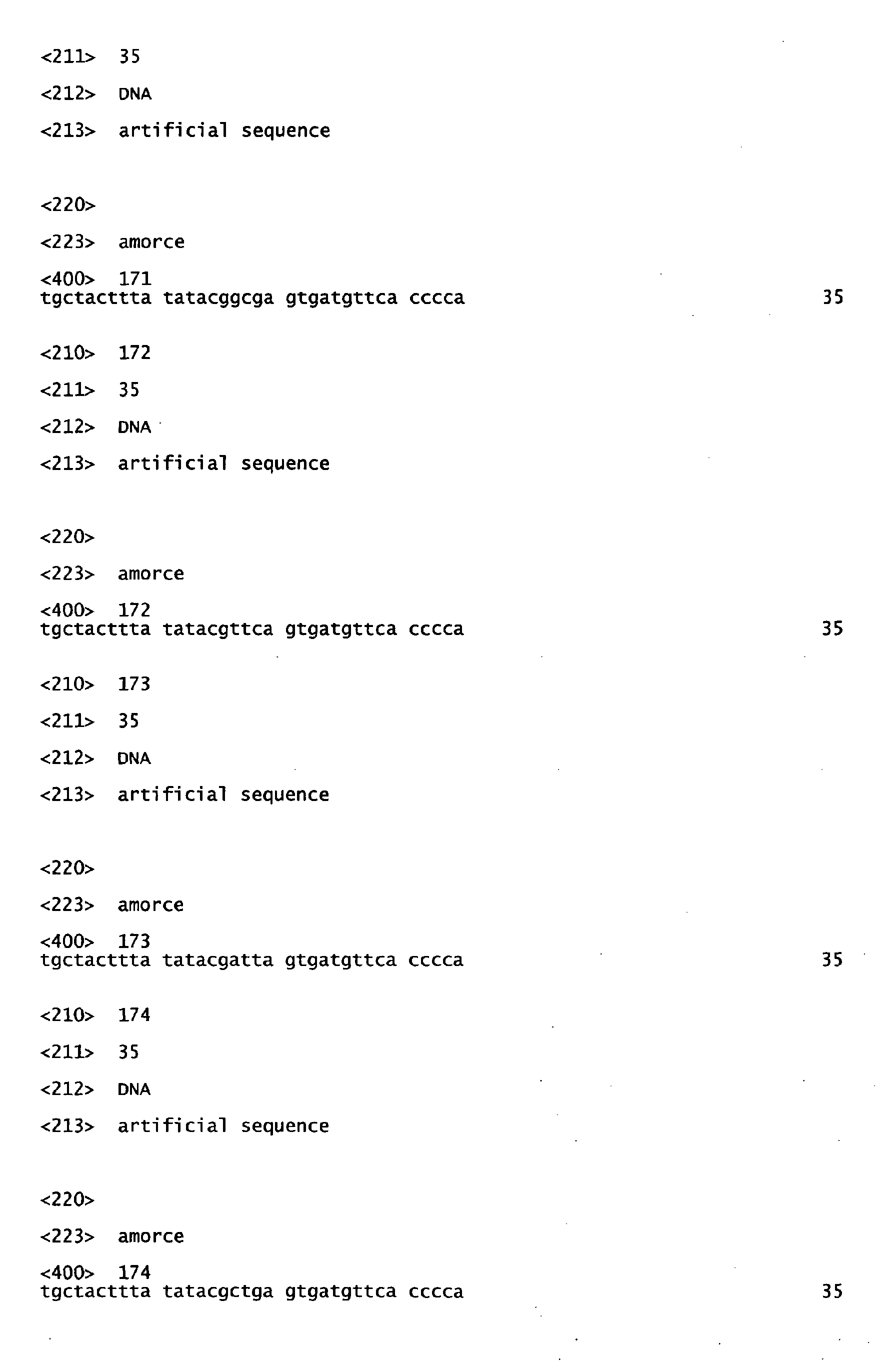

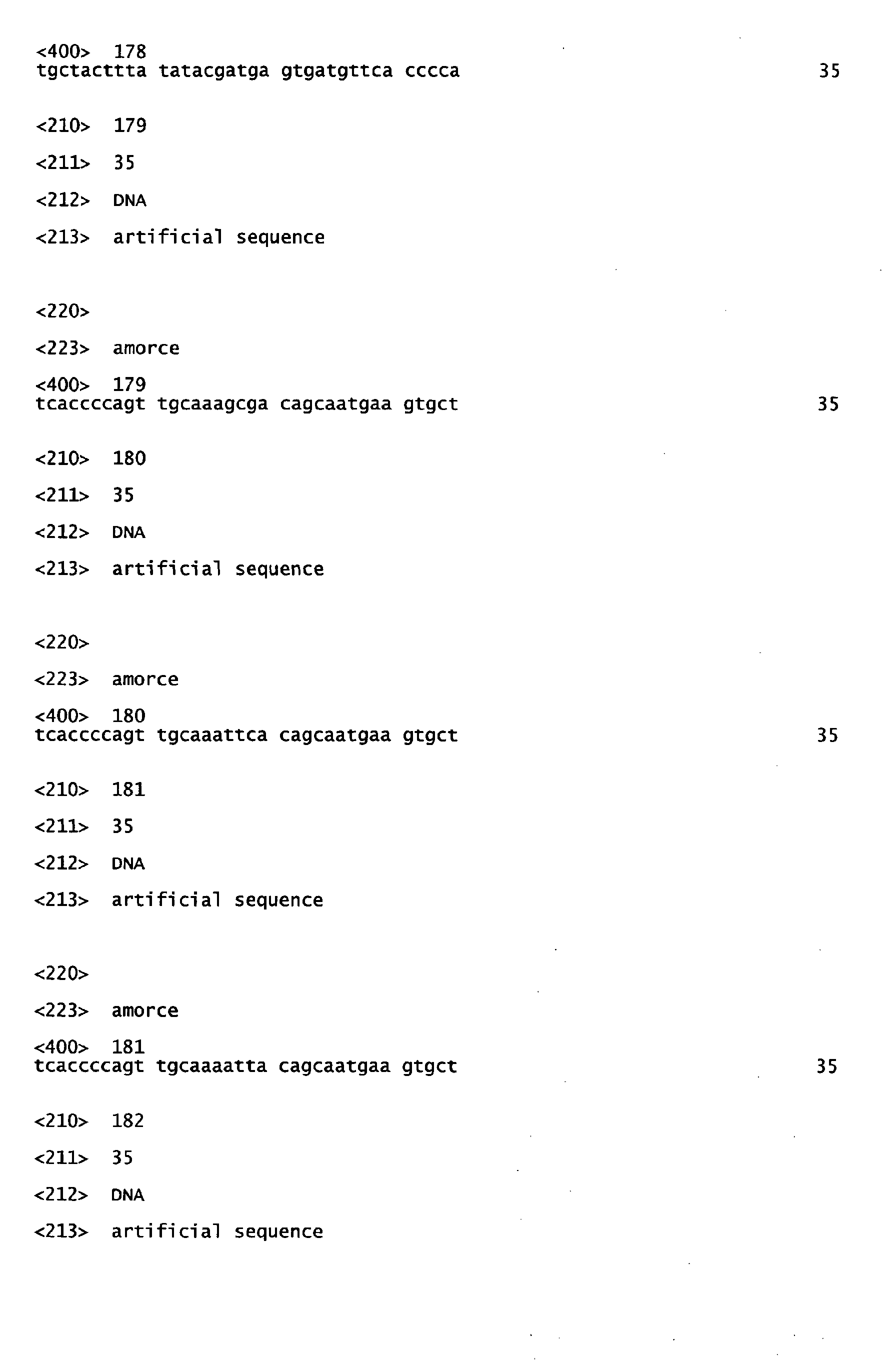


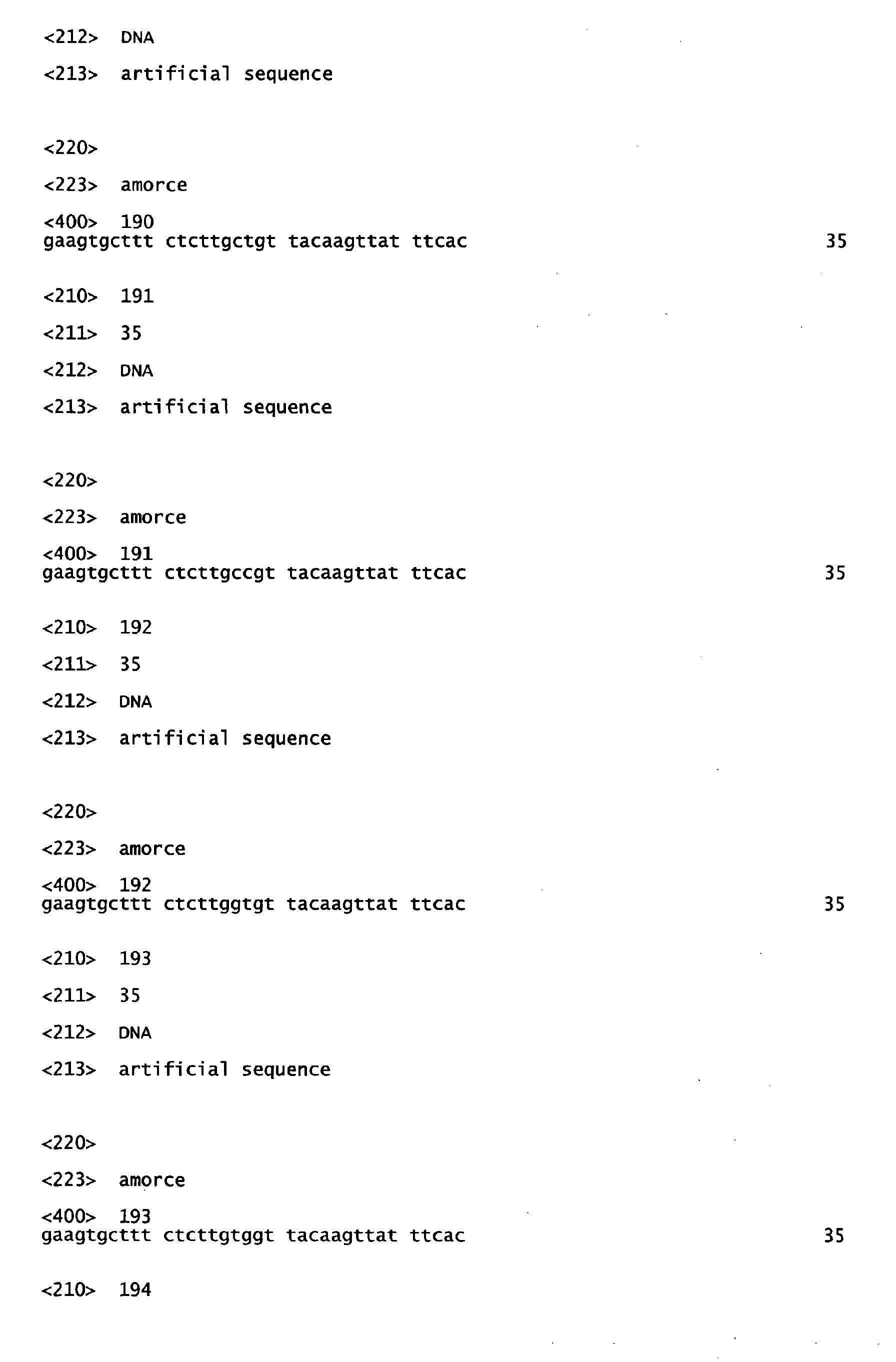


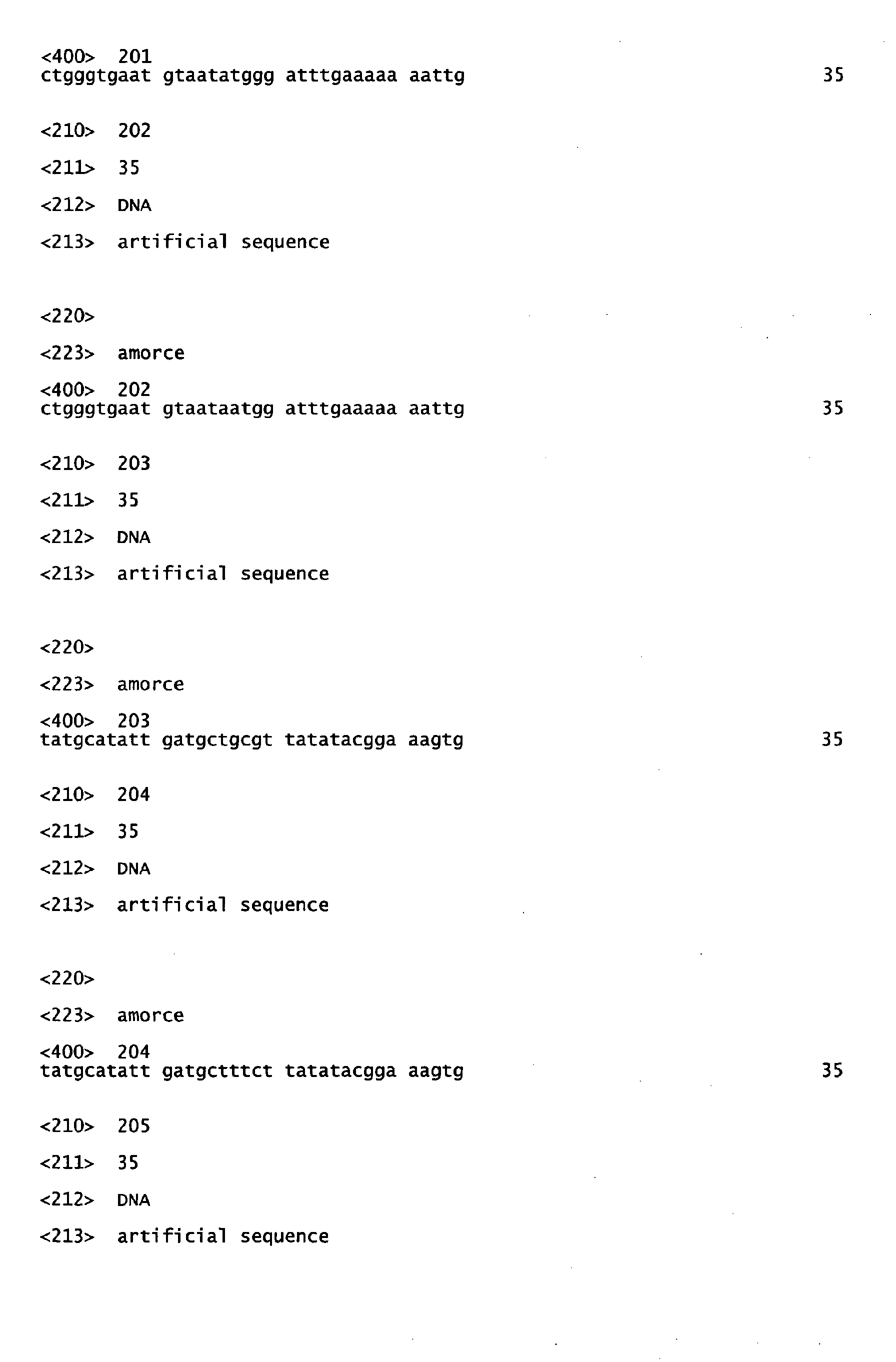
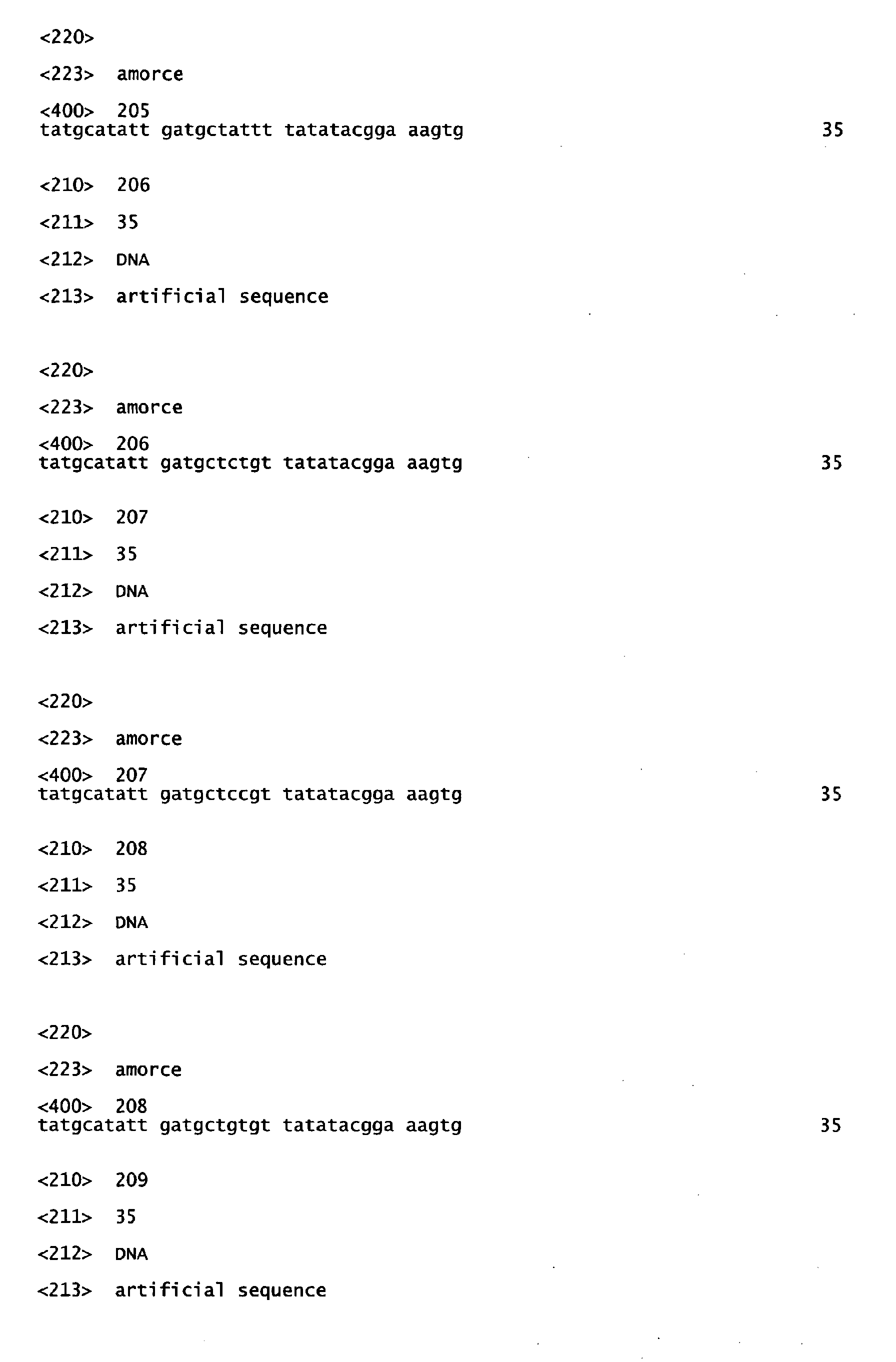
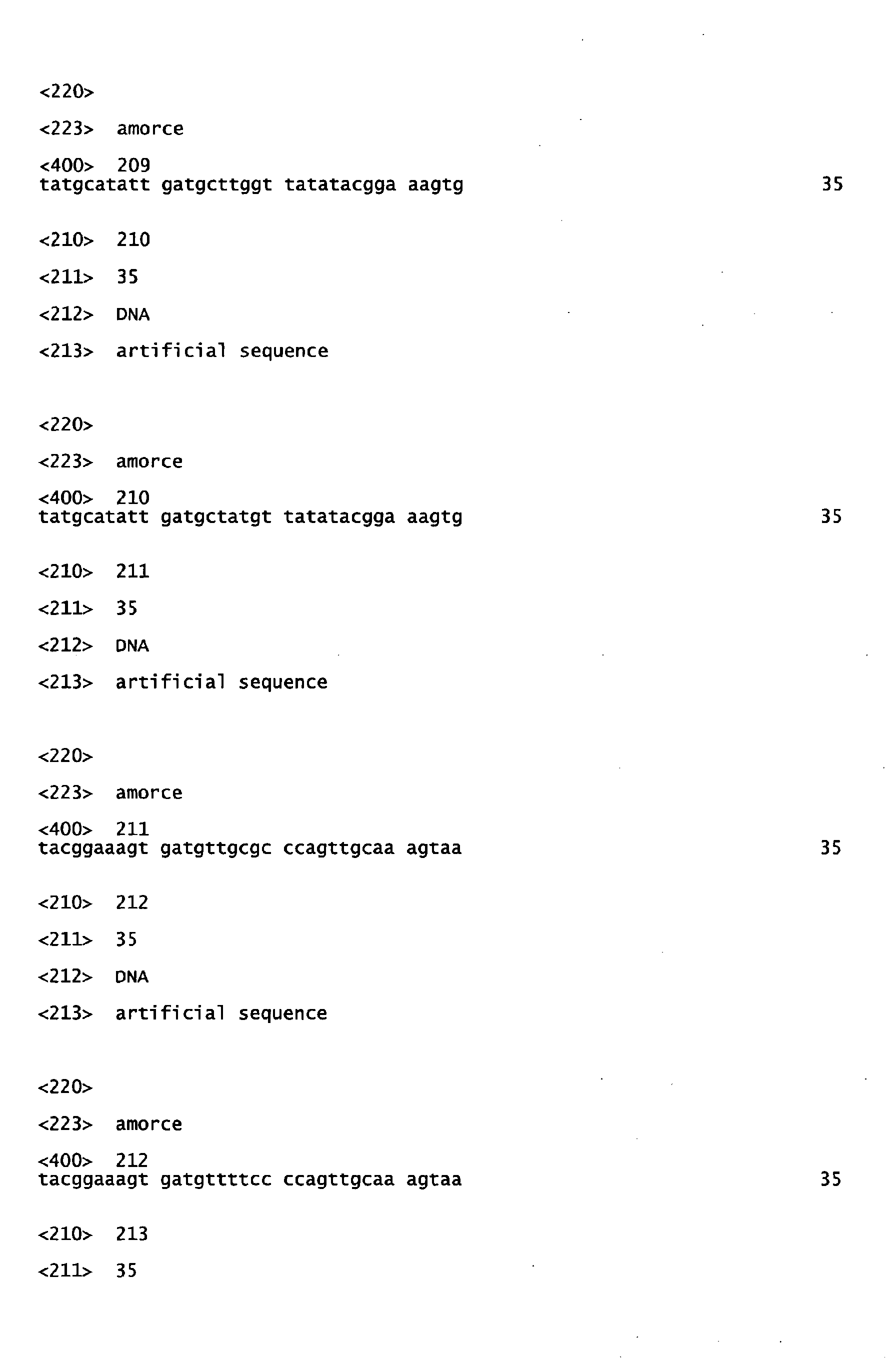
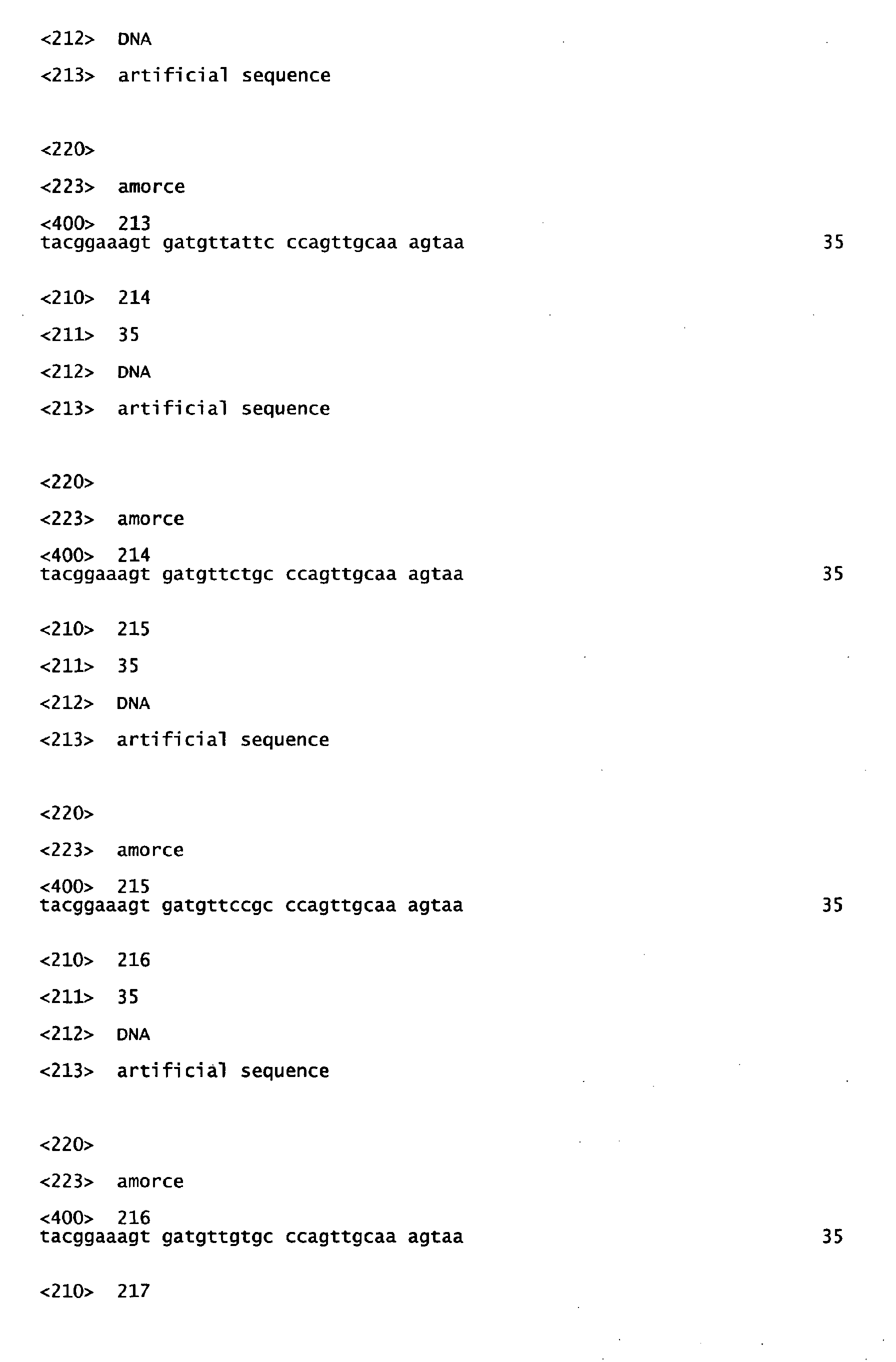

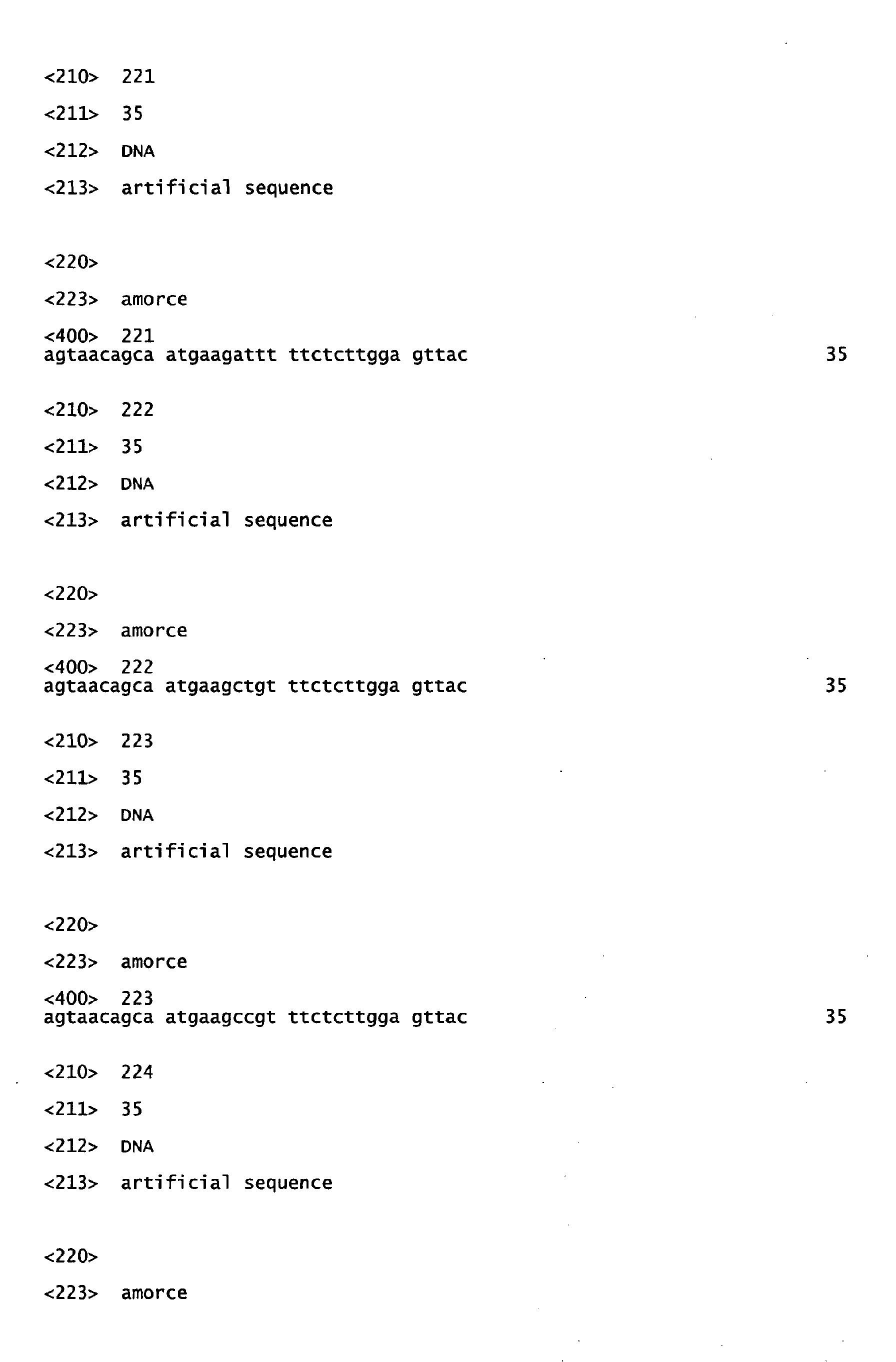


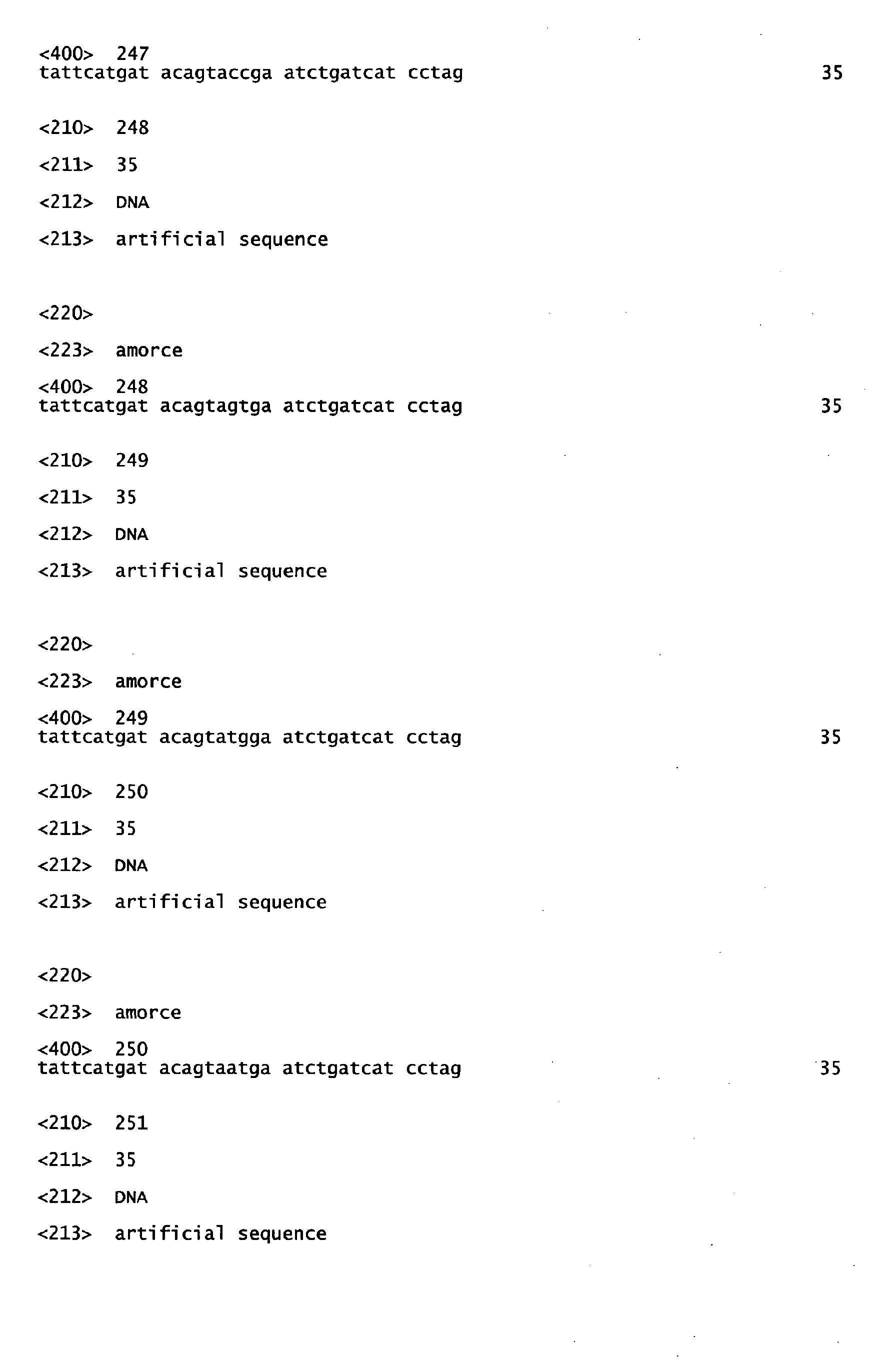
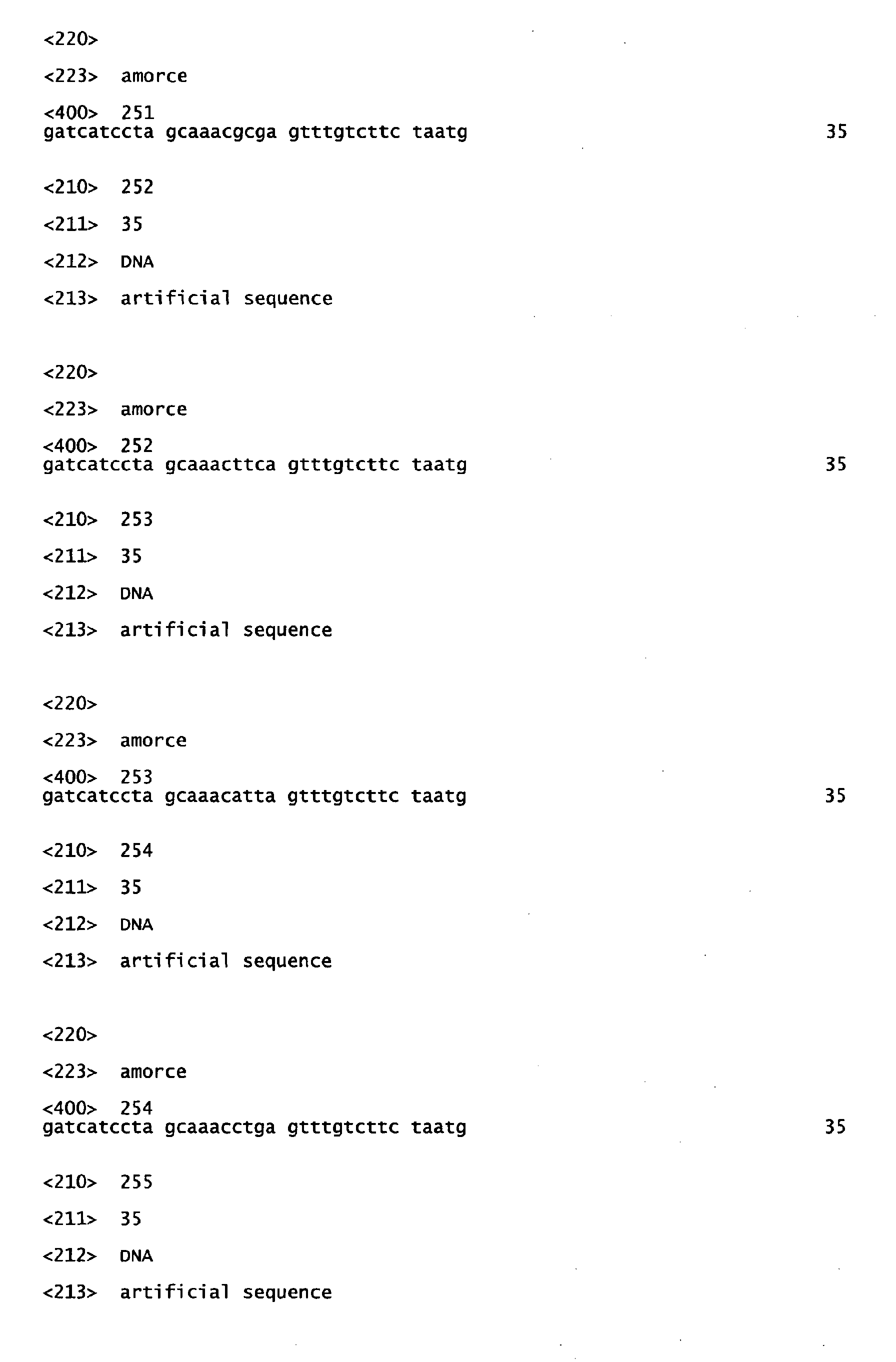

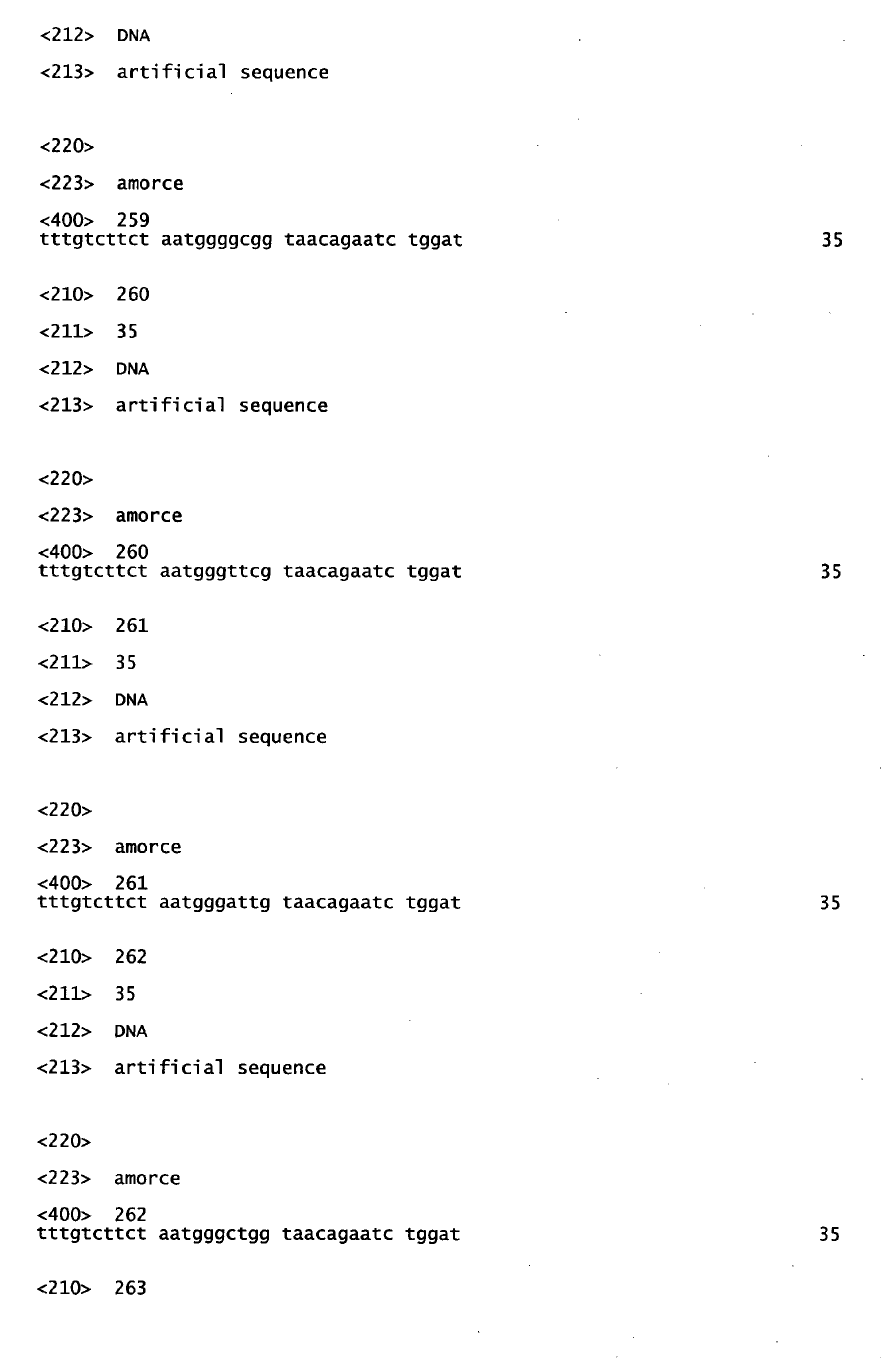
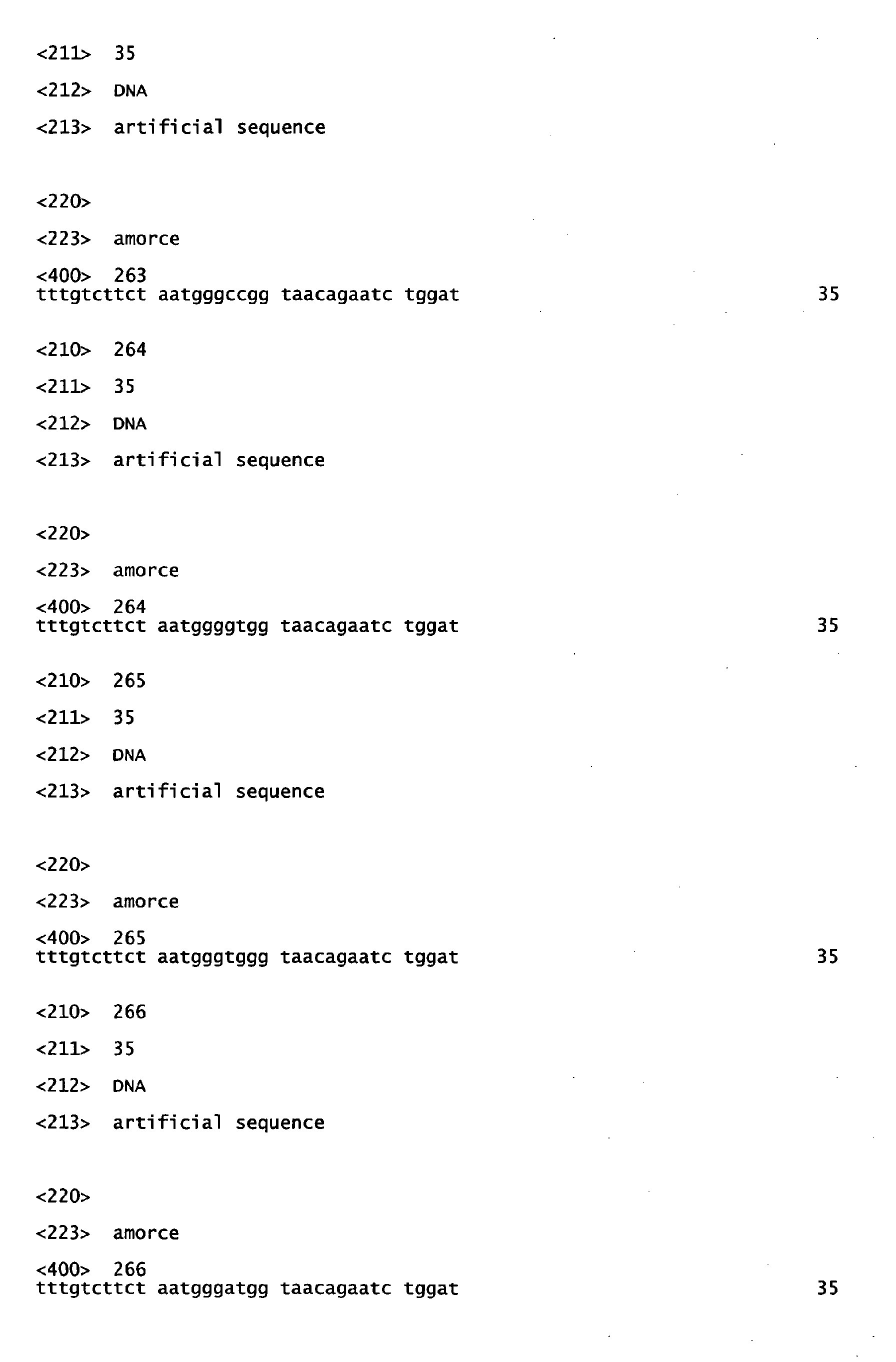


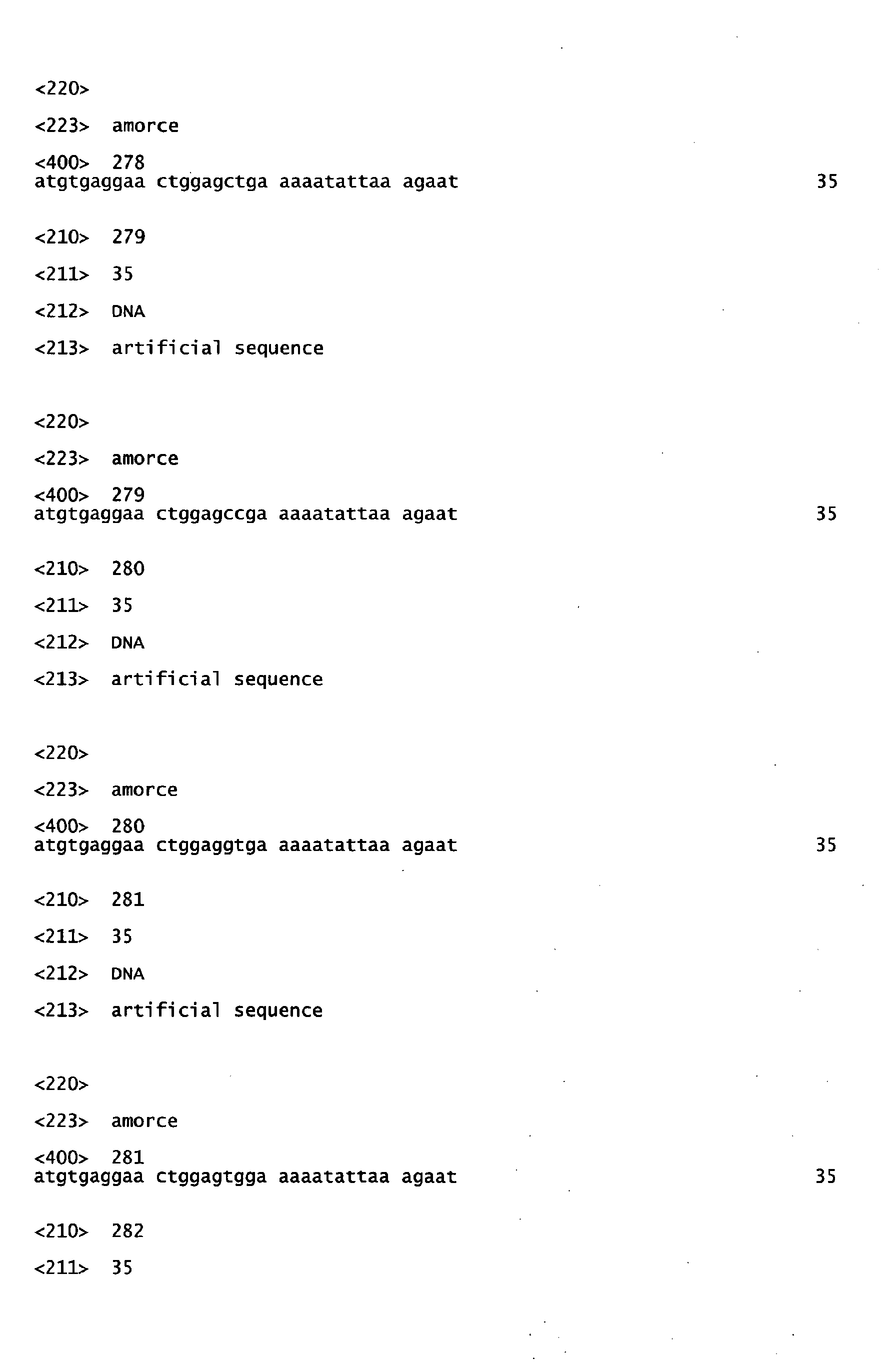

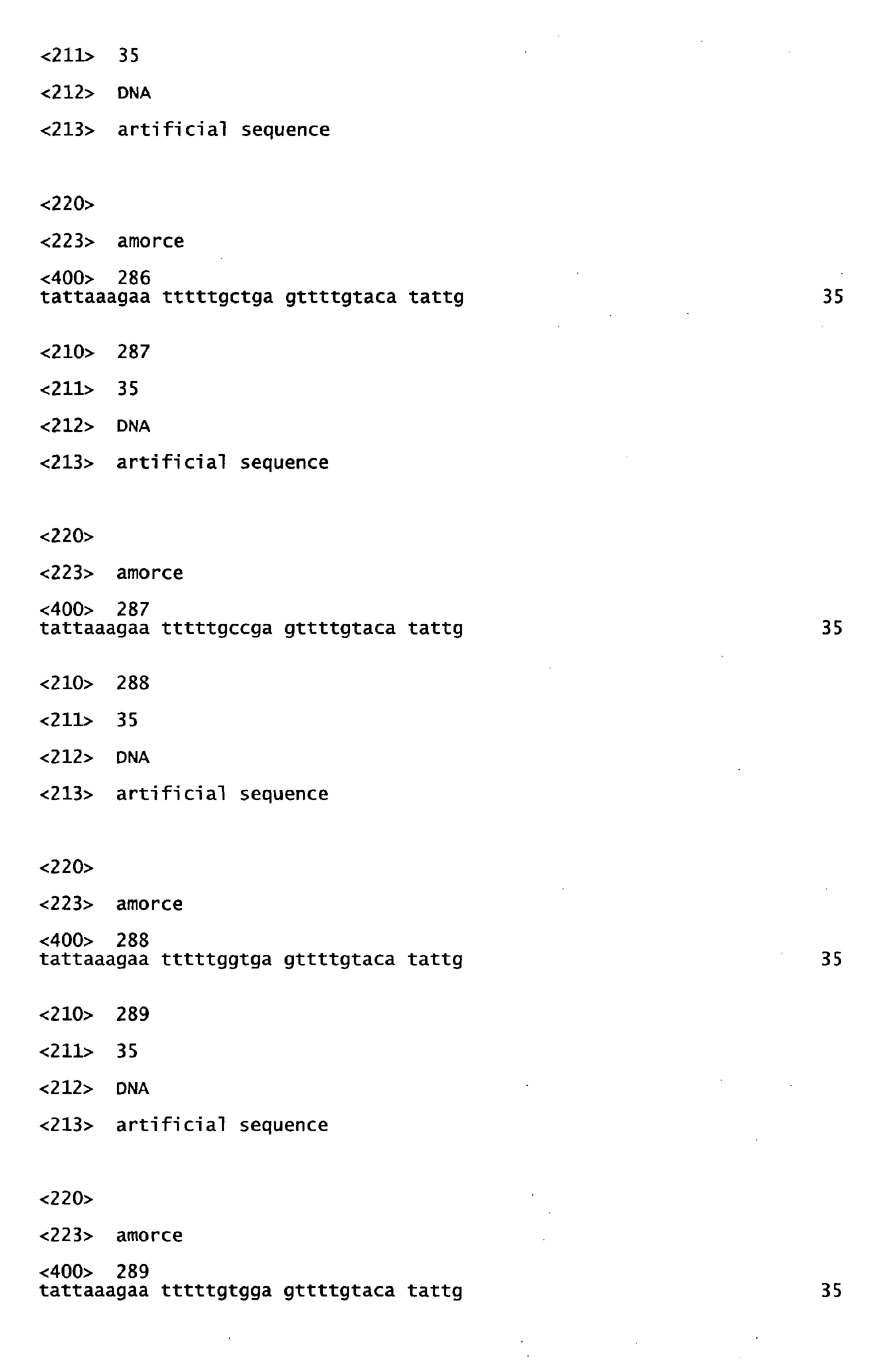
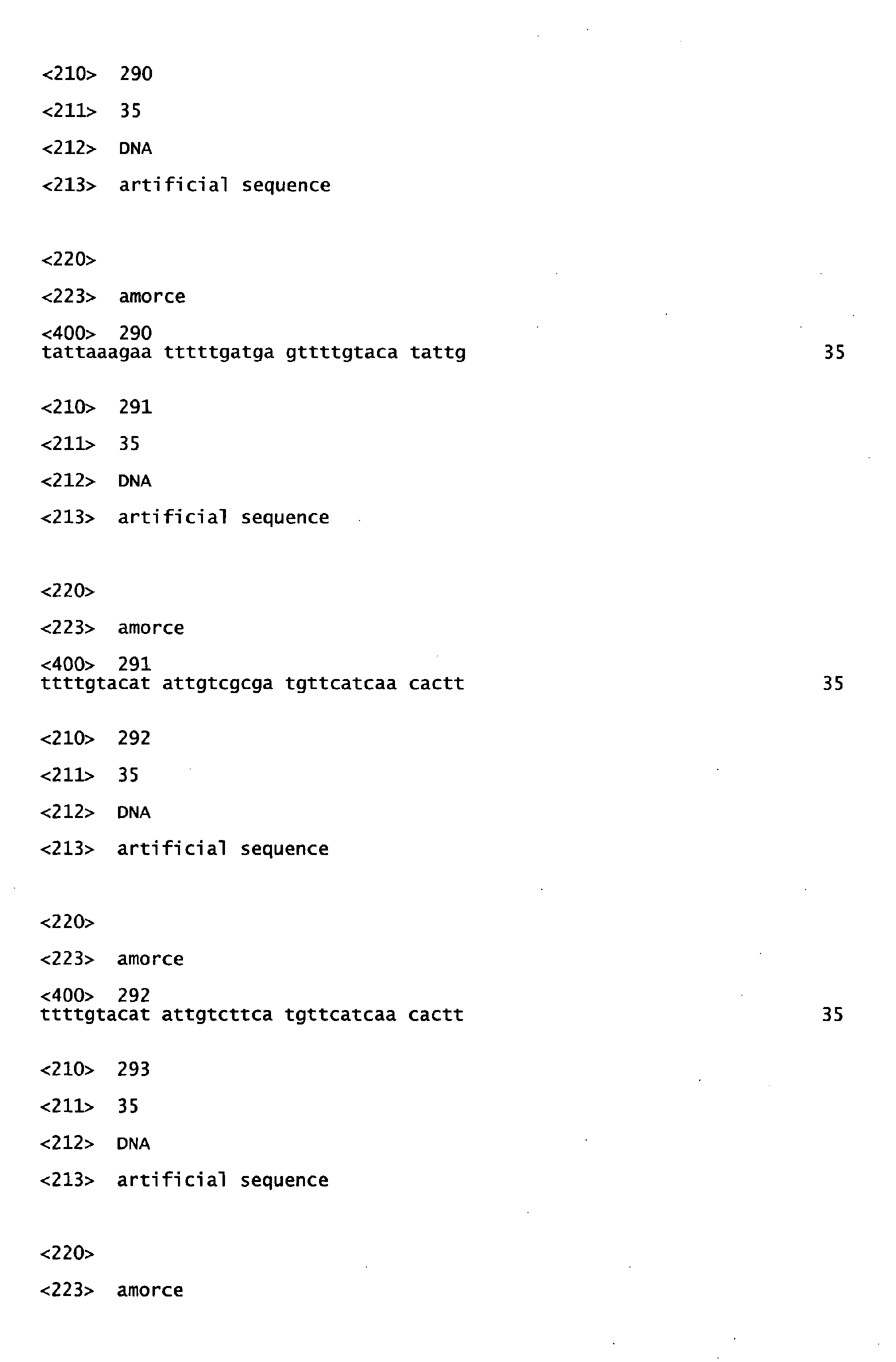

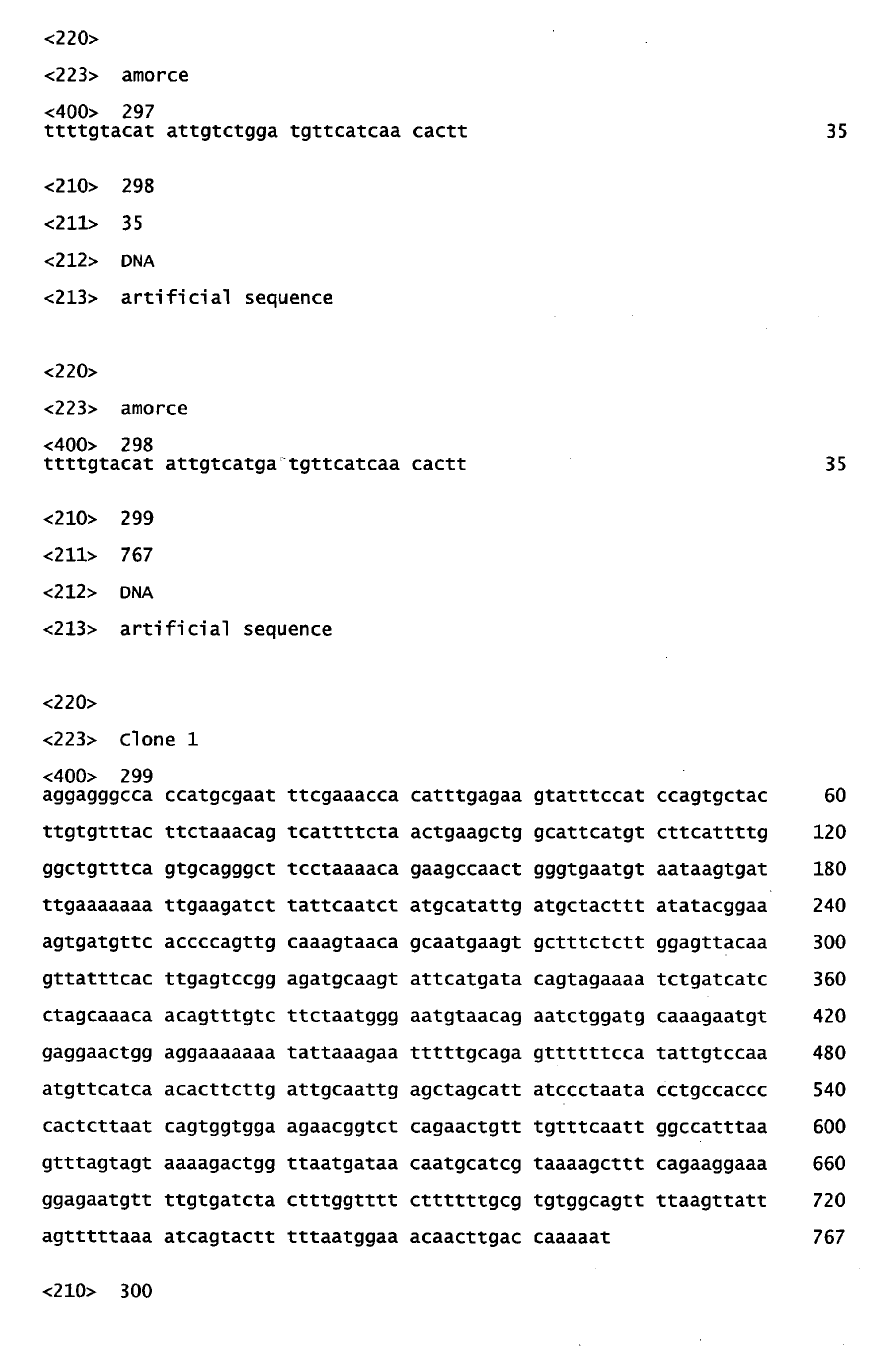
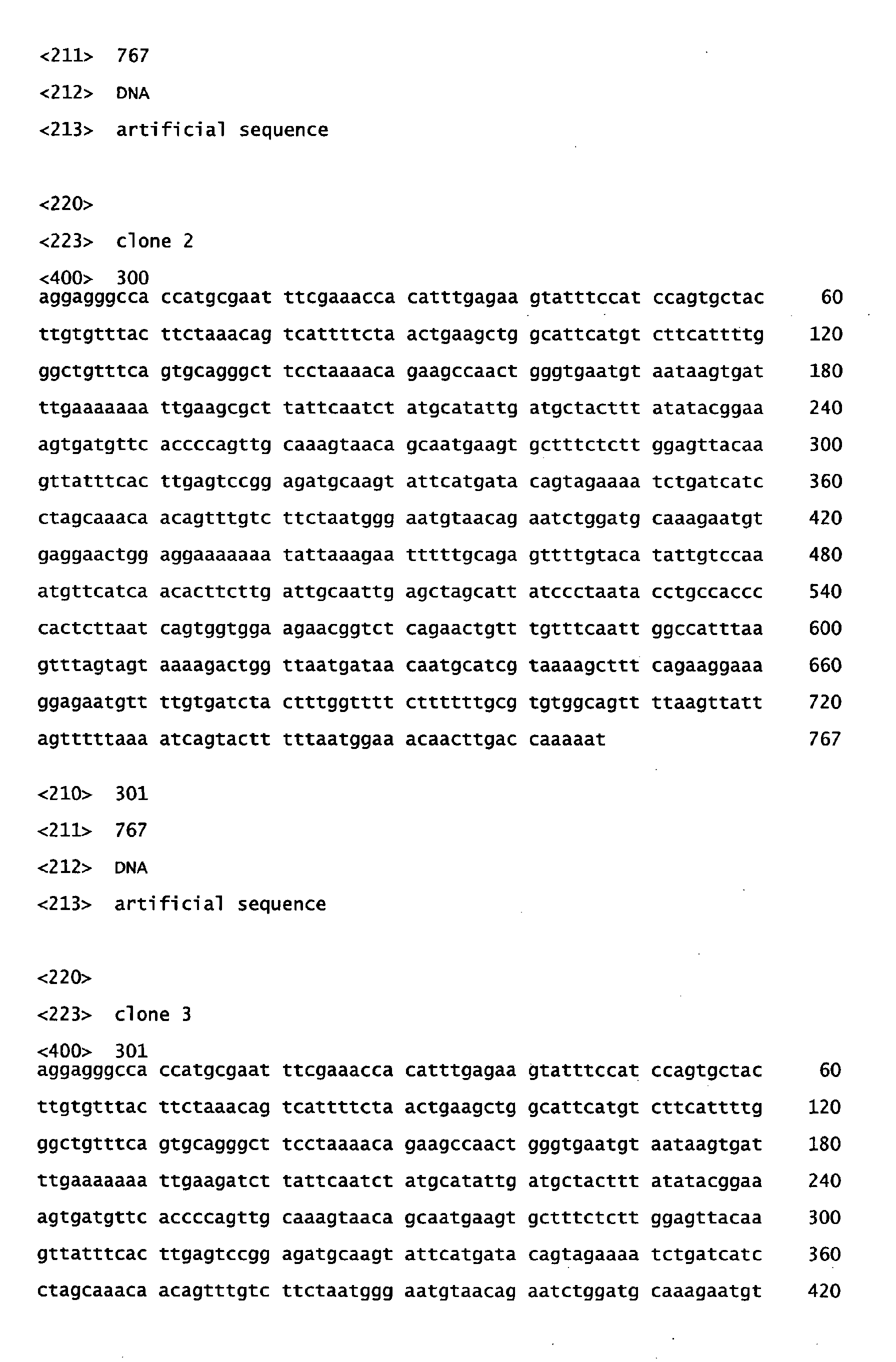


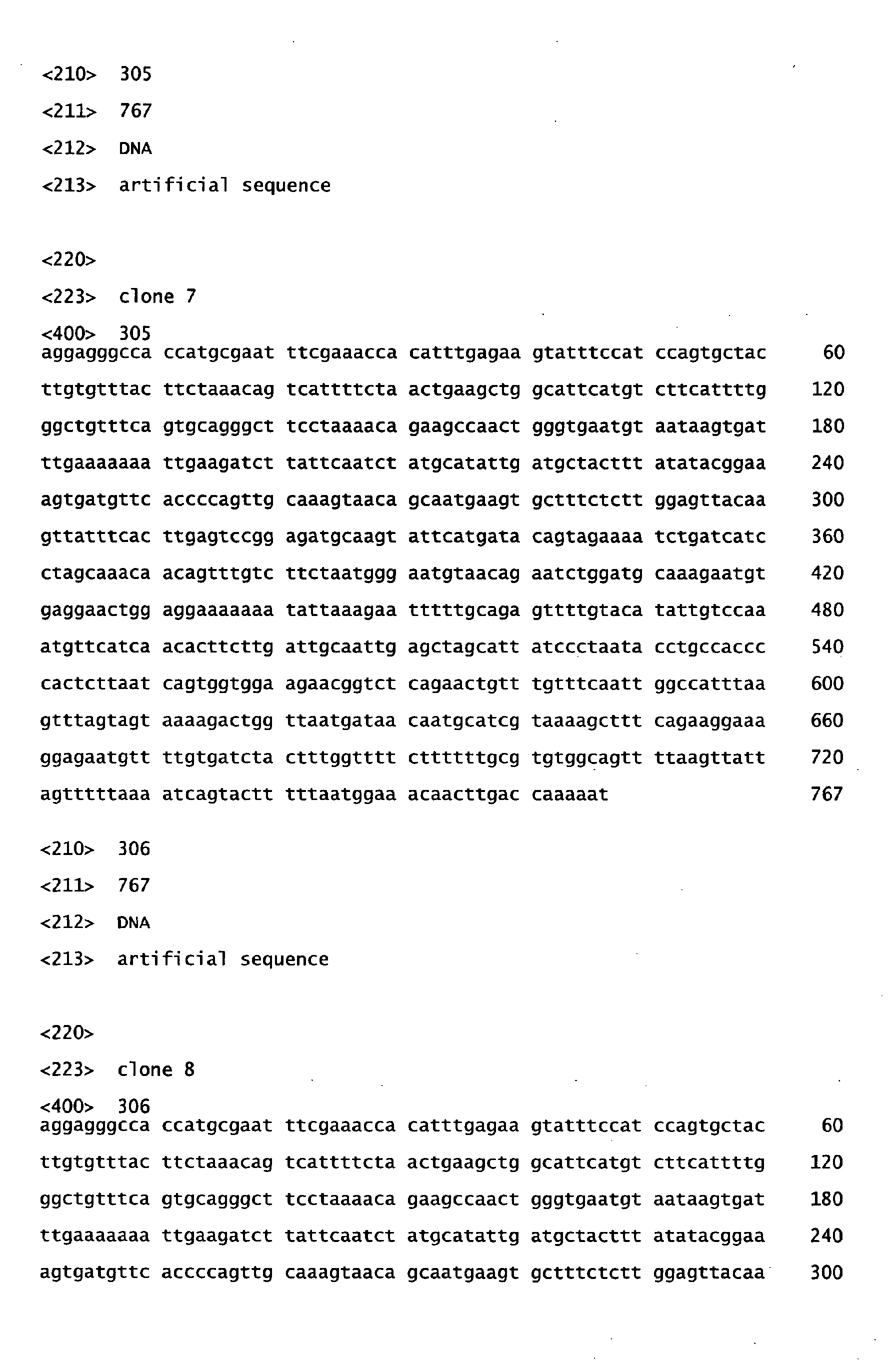

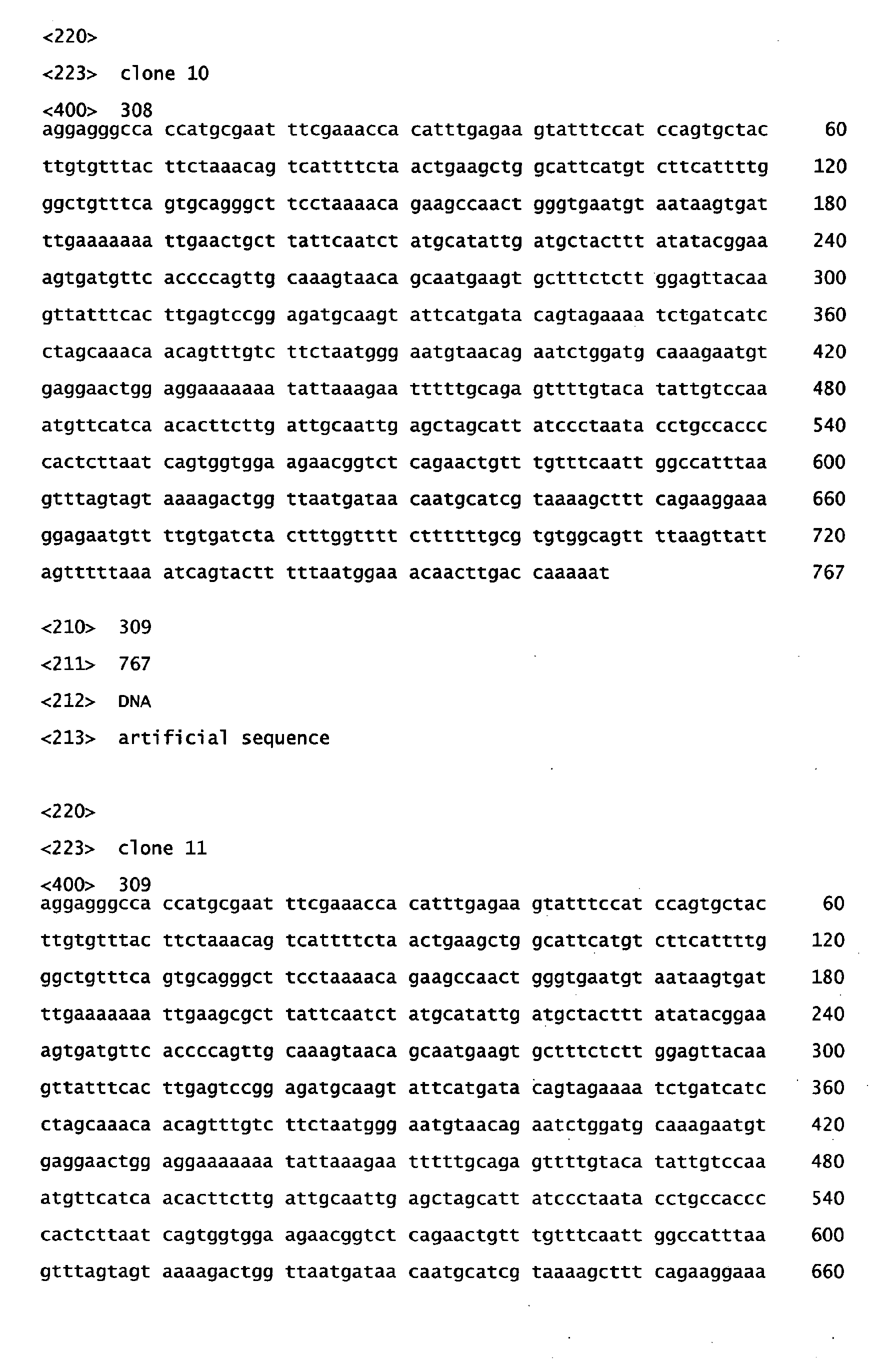

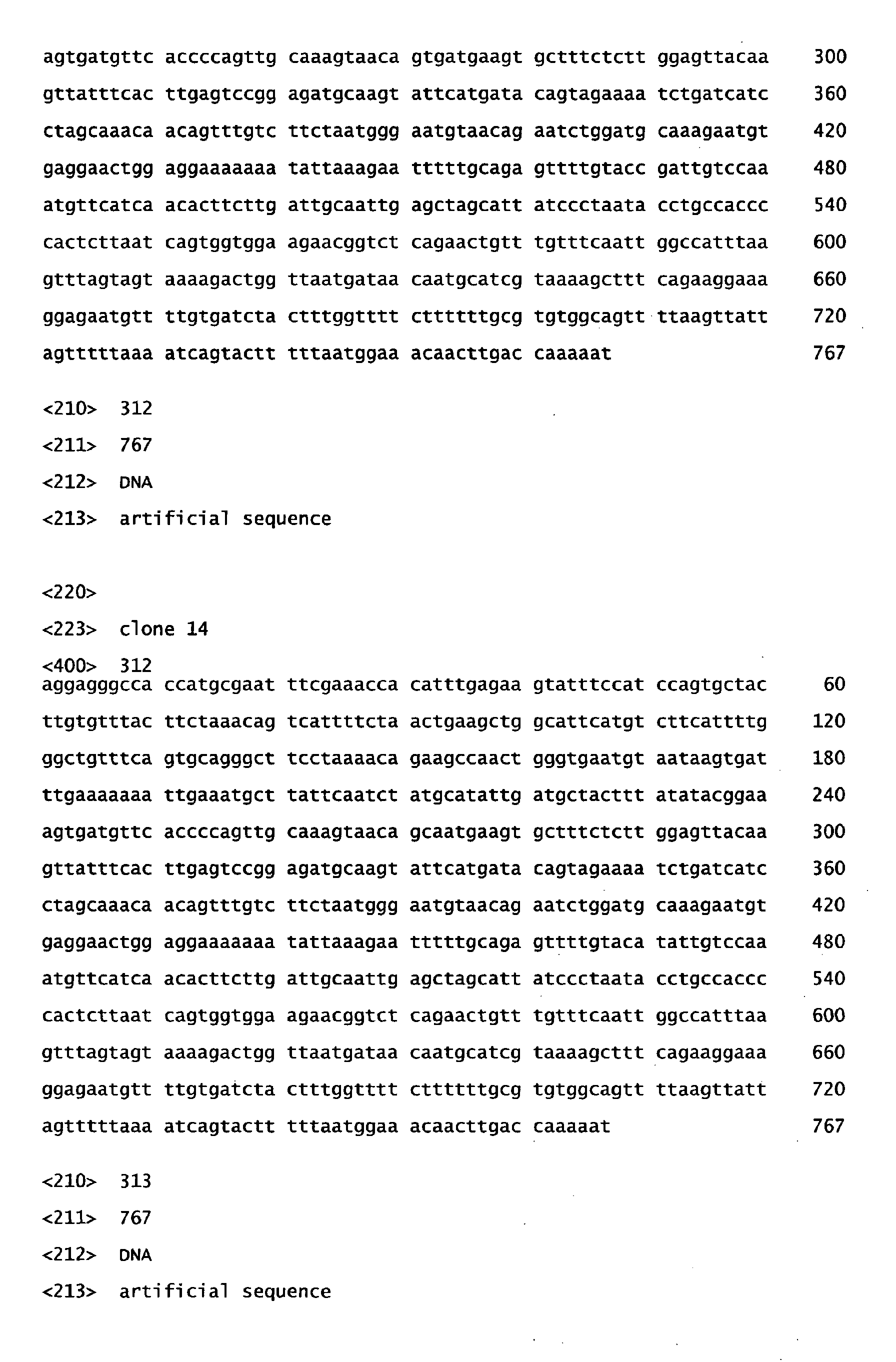
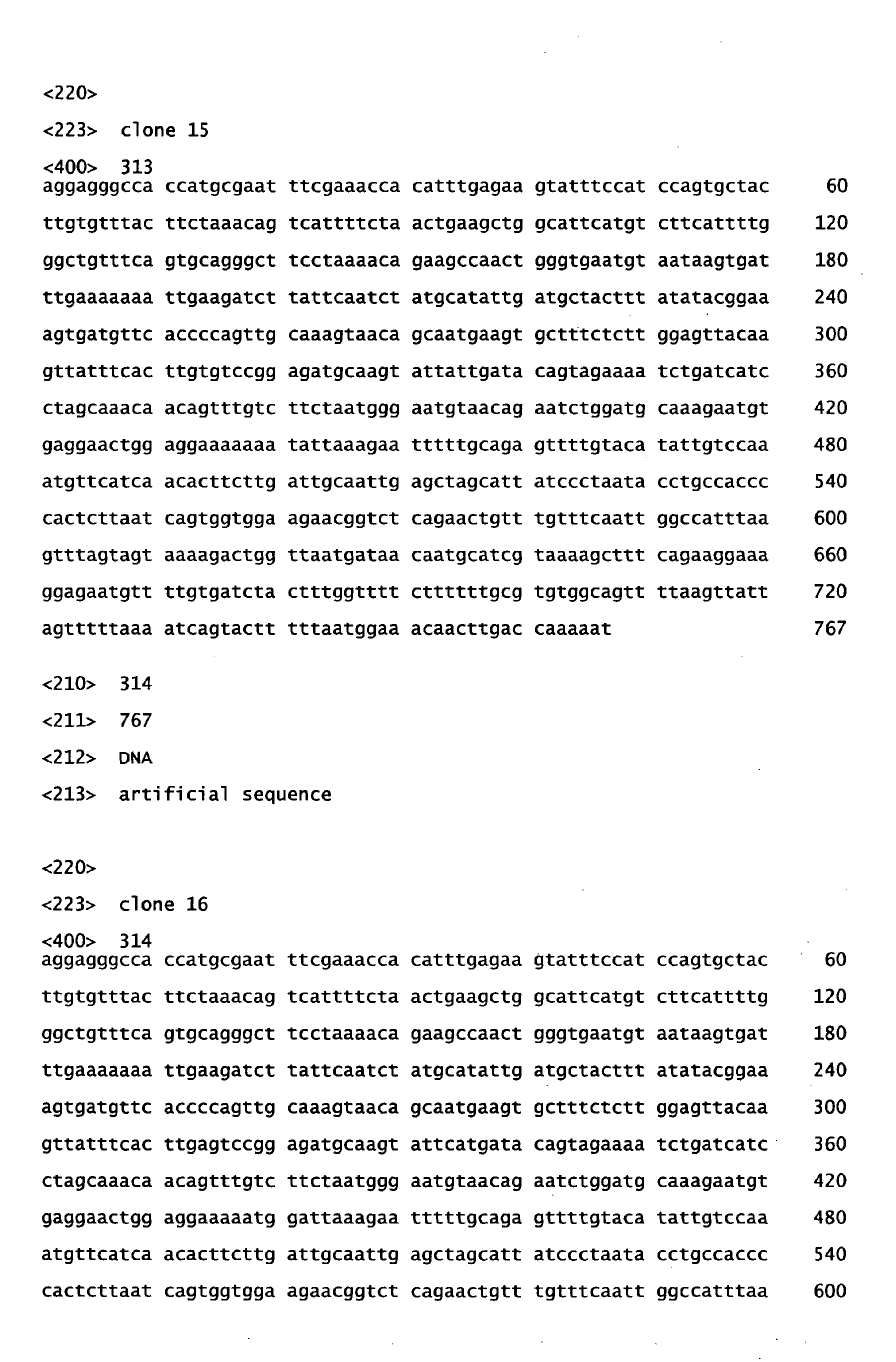
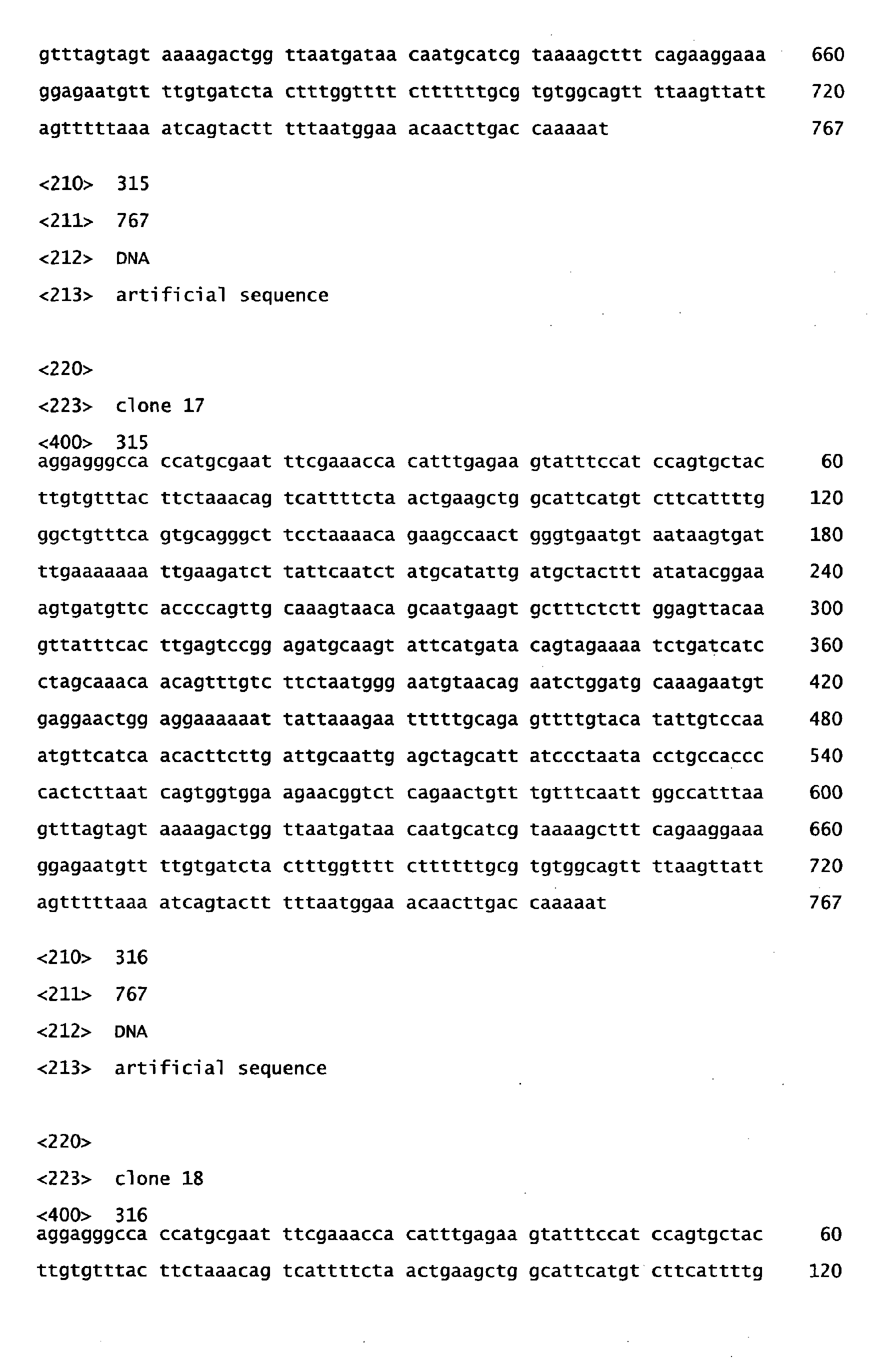
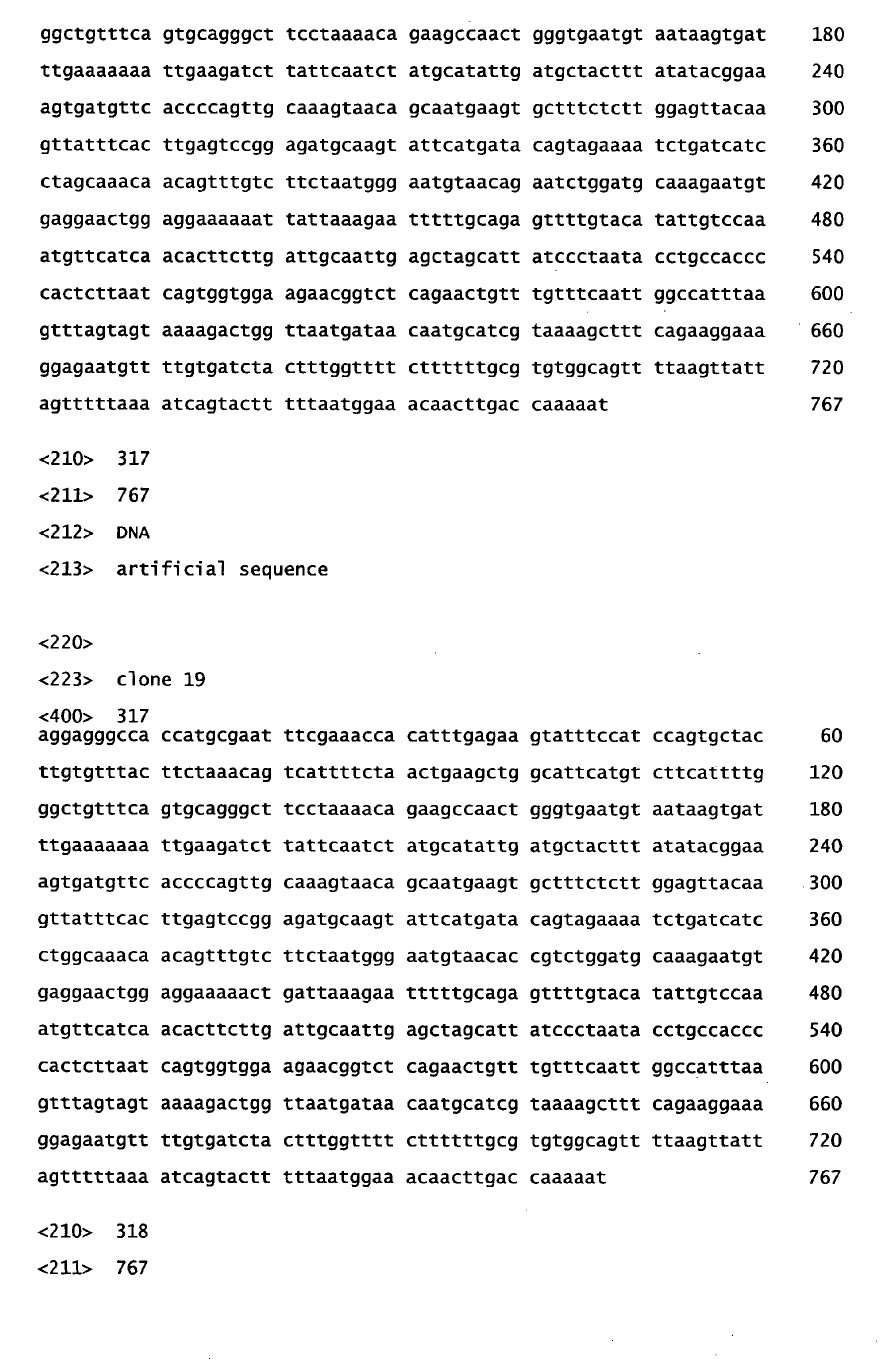
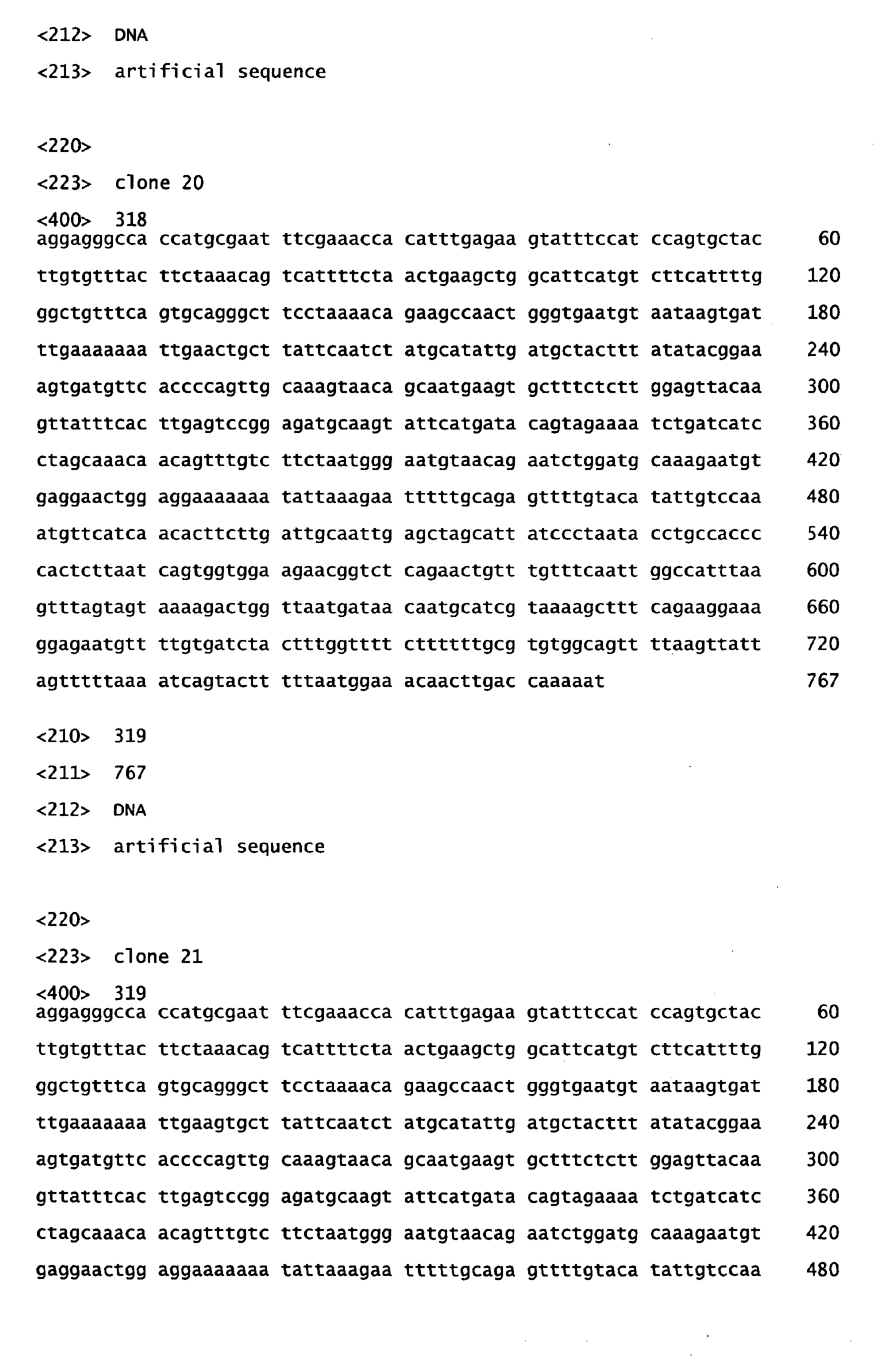
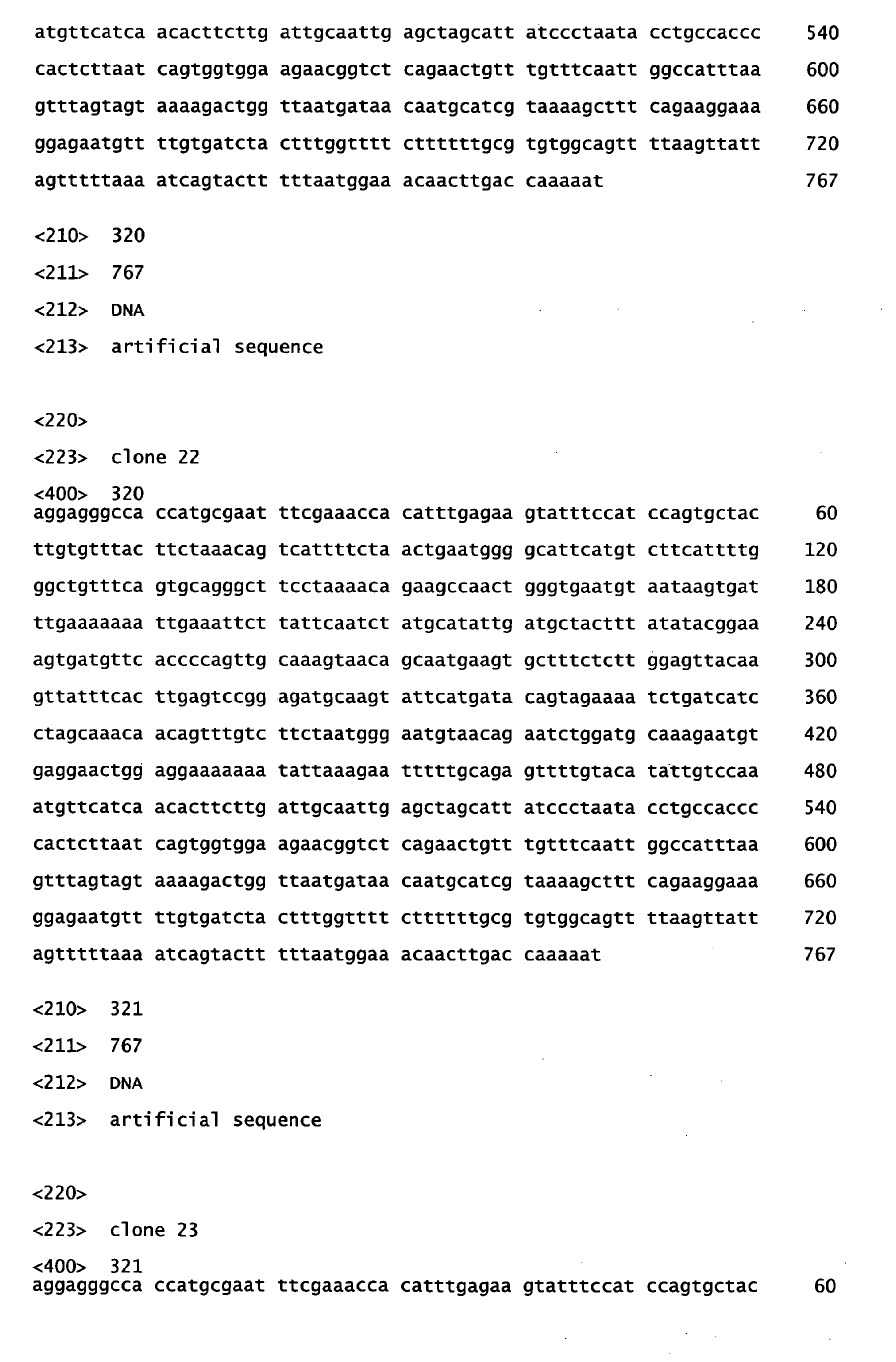


Claims (16)
- Procédé de production d'une banque de gènes mutés comprenant les étapes suivantes :a. Synthèse sur un support solide d'une banque d'oligonucléotides comprenant des oligonucléotides complémentaires d'une ou plusieurs régions d'un ou de plusieurs gènes cibles et comprenant chacun, de préférence en leur milieu, une ou plusieurs mutations par rapport à la séquence du ou des gènes cibles ;b. Mise en solution de la banque d'oligonucléotides synthétisée en a) ; et,c. Génération d'une banque de gènes mutés en utilisant la banque d'oligonucléotides en solution obtenue en b) et une ou plusieurs matrices contenant ledit ou lesdits gènes cibles.
- Procédé selon la revendication 1, dans lequel la banque de gènes mutés est générée dans l'étape c) par le procédé de Mutagenèse Massive.
- Procédé selon la revendication 1, dans lequel l'étape c) comprend les étapes suivantes :i. Fournir une ou plusieurs matrices contenant ledit ou lesdits gènes cibles;ii. Mettre en contact ladite ou lesdites matrices avec la banque d'oligonucléotides synthétisée en a) dans des conditions permettant l'hybridation des oligonucléotides de la banque sur ladite ou lesdites matrices pour produire un mélange réactionnel ;iii. Effectuer une réplication de ladite ou desdites matrices à partir du mélange réactionnel en utilisant une ADN polymérase ;iv. Eliminer la ou les matrices initiales du produit de l'étape iii) et ainsi sélectionner les brins d'ADN néosynthétisés ; et, éventuellement,v. Transformer un organisme avec le mélange d'ADN obtenu à l'étape iv).
- Procédé selon l'une des revendications 1-3, dans lequel la matrice est un acide nucléique circulaire, de préférence un plasmide.
- Procédé selon l'une des revendications 1-4, dans lequel la matrice contient les éléments permettant l'expression dudit ou desdits gènes cibles.
- Procédé selon l'une des revendications précédentes, dans lequel les oligonucléotides de ladite banque synthétisés sur le support solide sont liés au dit support solide par l'intermédiaire d'une molécule espaceur clivable et dans lequel lesdits oligonucléotides sont mis en solution en soumettant les oligonucléotides liés au dit support solide aux conditions associées au clivage de la molécule espaceur.
- Procédé selon la revendication 6, dans lequel ladite molécule espaceur est clivable en milieu basique, par l'action de la lumière ou par action enzymatique.
- Procédé selon la revendication 7, dans lequel ladite molécule espaceur est clivable en milieu basique.
- Procédé selon la revendication 8, dans lequel ladite molécule espaceur est le composé de formule :

- Procédé selon la revendication 8, dans lequel ladite molécule espaceur est le composé de formule :
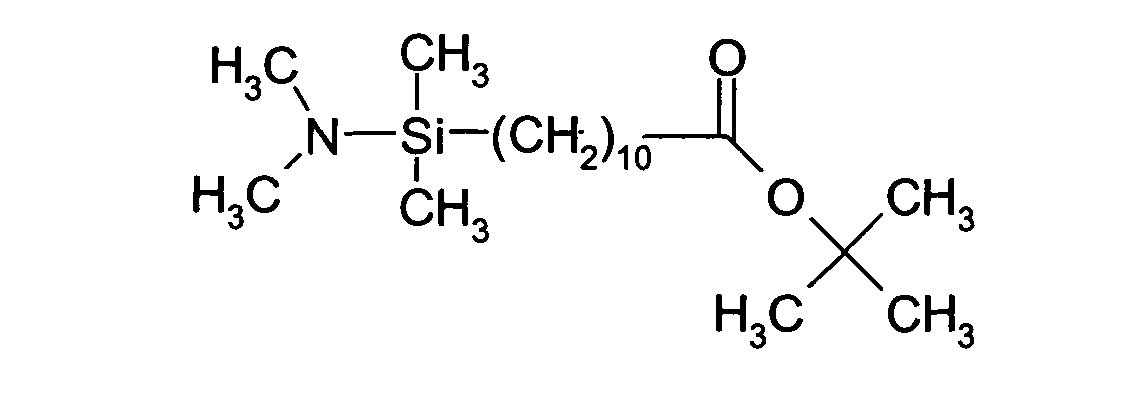
- Procédé selon l'une des revendications 3 à 10, dans lequel l'étape iv est réalisée au moyen d'une enzyme de restriction spécifique des brins d'ADN méthylés, de préférence appartenant au groupe des enzymes : Dpnl, Nanll, NmuDl ou NmuEl.
- Procédé selon l'une quelconque des revendications précédentes, dans lequel les oligonucléotides synthétisés à l'étape a) sont tous complémentaires d'un même gène cible.
- Procédé selon l'une quelconque des revendications précédentes, dans lequel tous les oligonucléotides complémentaires d'un même gène cible sont complémentaires du même brin dudit gène cible.
- Procédé selon l'une quelconque des revendications précédentes, dans lequel la banque d'oligonucléotides synthétisés à l'étape a) contient les oligonucléotides portant les mutations permettant d'introduire l'ensemble des substitutions possibles sur chaque codon dudit ou desdits gènes cibles.
- Procédé selon l'une des revendications 1 à 13, dans lequel la banque d'oligonucléotides synthétisés à l'étape a) contient les oligonucléotides portant les mutations permettant d'introduire un même acide aminé, de préférence une alanine, sur chaque codon dudit ou desdits gènes cibles.
- Procédé de mutagenèse d'une protéine cible ou de plusieurs protéines cibles, caractérisé en ce qu'il comprend la préparation d'une banque d'expression de gènes mutés à partir d'un gène cible codant pour ladite protéine, ou de plusieurs gènes cible codant pour lesdites protéines, par le procédé de production d'une banque de gènes mutés selon les revendications 1-14, puis l'expression desdits gènes mutés pour produire une banque de protéines mutées.
Applications Claiming Priority (2)
| Application Number | Priority Date | Filing Date | Title |
|---|---|---|---|
| FR0314892 | 2003-12-18 | ||
| FR0314892 | 2003-12-18 |
Publications (3)
| Publication Number | Publication Date |
|---|---|
| EP1544296A1 true EP1544296A1 (fr) | 2005-06-22 |
| EP1544296B1 EP1544296B1 (fr) | 2009-04-15 |
| EP1544296B8 EP1544296B8 (fr) | 2009-08-05 |
Family
ID=34508693
Family Applications (1)
| Application Number | Title | Priority Date | Filing Date |
|---|---|---|---|
| EP04292987A Expired - Lifetime EP1544296B8 (fr) | 2003-12-18 | 2004-12-14 | Procédé de mutagenèse dirigée massive |
Country Status (4)
| Country | Link |
|---|---|
| US (1) | US20050153343A1 (fr) |
| EP (1) | EP1544296B8 (fr) |
| AT (1) | ATE428779T1 (fr) |
| DE (1) | DE602004020570D1 (fr) |
Cited By (1)
| Publication number | Priority date | Publication date | Assignee | Title |
|---|---|---|---|---|
| WO2021136194A1 (fr) * | 2019-12-30 | 2021-07-08 | 南京金斯瑞生物科技有限公司 | Procédé de construction d'une bibliothèque de mutations géniques |
Families Citing this family (5)
| Publication number | Priority date | Publication date | Assignee | Title |
|---|---|---|---|---|
| US20060199250A1 (en) * | 2005-03-04 | 2006-09-07 | Huimin Zhao | Method for generating a mutant protein which efficiently binds a target molecule |
| EP1951890A4 (fr) * | 2005-11-16 | 2009-06-24 | Ambrx Inc | Procedes et compositions comprenant des acides amines non naturels |
| KR100784478B1 (ko) * | 2005-12-05 | 2007-12-11 | 한국과학기술원 | 기능요소의 동시 삽입에 의한 신기능을 갖는 단백질을제조하는 방법 |
| WO2008045380A2 (fr) * | 2006-10-04 | 2008-04-17 | Codon Devices, Inc. | Bibliothèques et leur conception et assemblage |
| CA2913127A1 (fr) * | 2012-12-10 | 2014-06-19 | Fred Hutchinson Cancer Research Center | Procedes de criblage |
Citations (1)
| Publication number | Priority date | Publication date | Assignee | Title |
|---|---|---|---|---|
| WO2002016606A2 (fr) * | 2000-08-25 | 2002-02-28 | Biomethodes | Procede de mutagenese dirigee massive |
Family Cites Families (4)
| Publication number | Priority date | Publication date | Assignee | Title |
|---|---|---|---|---|
| US6479258B1 (en) * | 1995-12-07 | 2002-11-12 | Diversa Corporation | Non-stochastic generation of genetic vaccines |
| EP1159285B1 (fr) * | 1999-03-08 | 2005-05-25 | Metrigen, Inc. | Techniques et compositions permettant d'effectuer la synthese et l'assemblage de sequences d'adn longues de maniere economique |
| FR2826957B1 (fr) * | 2001-07-09 | 2005-09-30 | Centre Nat Rech Scient | Procede de fonctionnalisation de supports solides, supports solides fonctionnalises et leurs utilisations |
| US20030219781A1 (en) * | 2002-01-14 | 2003-11-27 | Diversa Corporation | Compositions and methods for making polynucleotides by iterative assembly of codon building blocks |
-
2004
- 2004-12-14 DE DE602004020570T patent/DE602004020570D1/de not_active Expired - Lifetime
- 2004-12-14 EP EP04292987A patent/EP1544296B8/fr not_active Expired - Lifetime
- 2004-12-14 AT AT04292987T patent/ATE428779T1/de not_active IP Right Cessation
- 2004-12-15 US US11/012,068 patent/US20050153343A1/en not_active Abandoned
Patent Citations (1)
| Publication number | Priority date | Publication date | Assignee | Title |
|---|---|---|---|---|
| WO2002016606A2 (fr) * | 2000-08-25 | 2002-02-28 | Biomethodes | Procede de mutagenese dirigee massive |
Non-Patent Citations (6)
| Title |
|---|
| BEIER MARKUS ET AL: "Analysis of DNA-microarrays produced by inverse in situ oligonucleotide synthesis.", JOURNAL OF BIOTECHNOLOGY. NETHERLANDS 14 MAR 2002, vol. 94, no. 1, 14 March 2002 (2002-03-14), pages 15 - 22, XP002281008, ISSN: 0168-1656 * |
| HAAS S A ET AL: "Genome-scale design of PCR primers and long oligomers for DNA microarrays", NUCLEIC ACIDS RESEARCH, OXFORD UNIVERSITY PRESS, SURREY, GB, vol. 31, no. 19, 1 October 2003 (2003-10-01), pages 5576 - 5581, XP002260424, ISSN: 0305-1048 * |
| LASHKARI D A ET AL: "An automated multiplex oligonucleotide synthesizer: development of high-throughput, low-cost DNA synthesis.", PROCEEDINGS OF THE NATIONAL ACADEMY OF SCIENCES OF THE UNITED STATES OF AMERICA. UNITED STATES 15 AUG 1995, vol. 92, no. 17, 15 August 1995 (1995-08-15), pages 7912 - 7915, XP000611248, ISSN: 0027-8424 * |
| PON RICHARD T ET AL: "Tandem oligonucleotide synthesis on solid-phase supports for the production of multiple oligonucleotides.", THE JOURNAL OF ORGANIC CHEMISTRY. UNITED STATES 8 FEB 2002, vol. 67, no. 3, 8 February 2002 (2002-02-08), pages 856 - 864, XP002281009, ISSN: 0022-3263 * |
| RAMSAY G: "DNA CHIPS: STATE-OF-THE ART", NATURE BIOTECHNOLOGY, NATURE PUBLISHING, US, vol. 16, 1998, pages 40 - 44, XP000198575, ISSN: 1087-0156 * |
| WEILER J ET AL: "Combining the preparation of oligonucleotide arrays and synthesis of high-quality primers.", ANALYTICAL BIOCHEMISTRY. UNITED STATES 15 DEC 1996, vol. 243, no. 2, 15 December 1996 (1996-12-15), pages 218 - 227, XP000684351, ISSN: 0003-2697 * |
Cited By (3)
| Publication number | Priority date | Publication date | Assignee | Title |
|---|---|---|---|---|
| WO2021136194A1 (fr) * | 2019-12-30 | 2021-07-08 | 南京金斯瑞生物科技有限公司 | Procédé de construction d'une bibliothèque de mutations géniques |
| CN114901820A (zh) * | 2019-12-30 | 2022-08-12 | 南京金斯瑞生物科技有限公司 | 构建基因突变文库的方法 |
| CN114901820B (zh) * | 2019-12-30 | 2024-01-19 | 南京金斯瑞生物科技有限公司 | 构建基因突变文库的方法 |
Also Published As
| Publication number | Publication date |
|---|---|
| DE602004020570D1 (de) | 2009-05-28 |
| EP1544296B8 (fr) | 2009-08-05 |
| US20050153343A1 (en) | 2005-07-14 |
| ATE428779T1 (de) | 2009-05-15 |
| EP1544296B1 (fr) | 2009-04-15 |
Similar Documents
| Publication | Publication Date | Title |
|---|---|---|
| EP1366176B2 (fr) | Genes synthetiques et plasmides bacteriens depourvus de cpg | |
| Minshull et al. | Protein evolution by molecular breeding | |
| Sawitzke et al. | Probing cellular processes with oligo-mediated recombination and using the knowledge gained to optimize recombineering | |
| US7018793B1 (en) | Combinatorial screening of mixed populations of organisms | |
| EP1311670B1 (fr) | Procede de mutagenese dirigee massive | |
| HUE029938T2 (en) | Combined, automated parallel synthesis of polynucleotide variants | |
| CA2360750A1 (fr) | Criblage de prelevement a l'aide d'un systeme en rangees de capillaires | |
| EP1544296B1 (fr) | Procédé de mutagenèse dirigée massive | |
| AU782529C (en) | Sequence based screening | |
| JP2017514488A (ja) | 自然コンピテント細胞の形質転換のための方法および装置 | |
| EP3526327B1 (fr) | Acides nucléiques intracellulaires de mutagenèse | |
| US20030027175A1 (en) | Dynamic whole genome screening methodology and systems | |
| EP1299532B1 (fr) | Banques combinatoires ameliorees par recombinaison dans la levure et procede d'analyse | |
| FR2874620A1 (fr) | Procede de mutagenese dirigee systematique | |
| FR2785291A1 (fr) | Procede de production in vivo de proteines chimiquement diversifiees par incorporation d'acides amines non conventionnels | |
| CA2391626A1 (fr) | Criblage combinatoire de populations mixtes d'organismes | |
| US20020031771A1 (en) | Sequence based screening | |
| FR2789696A1 (fr) | Procede de mutagenese d'un fragment d'acide nucleique par clonage et polymerisation-ligation | |
| WO2006027471A1 (fr) | Procede de mutagenese dirigee systematique | |
| FR2883885A1 (fr) | Recombinaison in vitro circulaire | |
| Radko et al. | The synthesis of artificial genome as the basis of synthetic biology | |
| AU2007201249A1 (en) | Sequence based screening |
Legal Events
| Date | Code | Title | Description |
|---|---|---|---|
| PUAI | Public reference made under article 153(3) epc to a published international application that has entered the european phase |
Free format text: ORIGINAL CODE: 0009012 |
|
| AK | Designated contracting states |
Kind code of ref document: A1 Designated state(s): AT BE BG CH CY CZ DE DK EE ES FI FR GB GR HU IE IS IT LI LT LU MC NL PL PT RO SE SI SK TR |
|
| AX | Request for extension of the european patent |
Extension state: AL BA HR LV MK YU |
|
| 17P | Request for examination filed |
Effective date: 20051025 |
|
| AKX | Designation fees paid |
Designated state(s): AT BE BG CH CY CZ DE DK EE ES FI FR GB GR HU IE IS IT LI LT LU MC NL PL PT RO SE SI SK TR |
|
| 17Q | First examination report despatched |
Effective date: 20061026 |
|
| 17Q | First examination report despatched |
Effective date: 20061026 |
|
| GRAP | Despatch of communication of intention to grant a patent |
Free format text: ORIGINAL CODE: EPIDOSNIGR1 |
|
| GRAS | Grant fee paid |
Free format text: ORIGINAL CODE: EPIDOSNIGR3 |
|
| GRAA | (expected) grant |
Free format text: ORIGINAL CODE: 0009210 |
|
| AK | Designated contracting states |
Kind code of ref document: B1 Designated state(s): AT BE BG CH CY CZ DE DK EE ES FI FR GB GR HU IE IS IT LI LT LU MC NL PL PT RO SE SI SK TR |
|
| REG | Reference to a national code |
Ref country code: GB Ref legal event code: FG4D Free format text: NOT ENGLISH Ref country code: CH Ref legal event code: EP |
|
| RAP2 | Party data changed (patent owner data changed or rights of a patent transferred) |
Owner name: BIOMETHODES |
|
| REG | Reference to a national code |
Ref country code: IE Ref legal event code: FG4D |
|
| REF | Corresponds to: |
Ref document number: 602004020570 Country of ref document: DE Date of ref document: 20090528 Kind code of ref document: P |
|
| NLT2 | Nl: modifications (of names), taken from the european patent patent bulletin |
Owner name: BIOMETHODES Effective date: 20090513 |
|
| REG | Reference to a national code |
Ref country code: CH Ref legal event code: NV Representative=s name: PATENTANWAELTE SCHAAD, BALASS, MENZL & PARTNER AG |
|
| NLV1 | Nl: lapsed or annulled due to failure to fulfill the requirements of art. 29p and 29m of the patents act | ||
| PG25 | Lapsed in a contracting state [announced via postgrant information from national office to epo] |
Ref country code: FI Free format text: LAPSE BECAUSE OF FAILURE TO SUBMIT A TRANSLATION OF THE DESCRIPTION OR TO PAY THE FEE WITHIN THE PRESCRIBED TIME-LIMIT Effective date: 20090415 Ref country code: AT Free format text: LAPSE BECAUSE OF FAILURE TO SUBMIT A TRANSLATION OF THE DESCRIPTION OR TO PAY THE FEE WITHIN THE PRESCRIBED TIME-LIMIT Effective date: 20090415 Ref country code: ES Free format text: LAPSE BECAUSE OF FAILURE TO SUBMIT A TRANSLATION OF THE DESCRIPTION OR TO PAY THE FEE WITHIN THE PRESCRIBED TIME-LIMIT Effective date: 20090726 Ref country code: LT Free format text: LAPSE BECAUSE OF FAILURE TO SUBMIT A TRANSLATION OF THE DESCRIPTION OR TO PAY THE FEE WITHIN THE PRESCRIBED TIME-LIMIT Effective date: 20090415 Ref country code: PT Free format text: LAPSE BECAUSE OF FAILURE TO SUBMIT A TRANSLATION OF THE DESCRIPTION OR TO PAY THE FEE WITHIN THE PRESCRIBED TIME-LIMIT Effective date: 20090915 |
|
| PG25 | Lapsed in a contracting state [announced via postgrant information from national office to epo] |
Ref country code: IS Free format text: LAPSE BECAUSE OF FAILURE TO SUBMIT A TRANSLATION OF THE DESCRIPTION OR TO PAY THE FEE WITHIN THE PRESCRIBED TIME-LIMIT Effective date: 20090815 Ref country code: SI Free format text: LAPSE BECAUSE OF FAILURE TO SUBMIT A TRANSLATION OF THE DESCRIPTION OR TO PAY THE FEE WITHIN THE PRESCRIBED TIME-LIMIT Effective date: 20090415 Ref country code: PL Free format text: LAPSE BECAUSE OF FAILURE TO SUBMIT A TRANSLATION OF THE DESCRIPTION OR TO PAY THE FEE WITHIN THE PRESCRIBED TIME-LIMIT Effective date: 20090415 Ref country code: NL Free format text: LAPSE BECAUSE OF FAILURE TO SUBMIT A TRANSLATION OF THE DESCRIPTION OR TO PAY THE FEE WITHIN THE PRESCRIBED TIME-LIMIT Effective date: 20090415 Ref country code: SE Free format text: LAPSE BECAUSE OF FAILURE TO SUBMIT A TRANSLATION OF THE DESCRIPTION OR TO PAY THE FEE WITHIN THE PRESCRIBED TIME-LIMIT Effective date: 20090715 |
|
| REG | Reference to a national code |
Ref country code: IE Ref legal event code: FD4D |
|
| PG25 | Lapsed in a contracting state [announced via postgrant information from national office to epo] |
Ref country code: EE Free format text: LAPSE BECAUSE OF FAILURE TO SUBMIT A TRANSLATION OF THE DESCRIPTION OR TO PAY THE FEE WITHIN THE PRESCRIBED TIME-LIMIT Effective date: 20090415 Ref country code: IE Free format text: LAPSE BECAUSE OF FAILURE TO SUBMIT A TRANSLATION OF THE DESCRIPTION OR TO PAY THE FEE WITHIN THE PRESCRIBED TIME-LIMIT Effective date: 20090415 Ref country code: RO Free format text: LAPSE BECAUSE OF FAILURE TO SUBMIT A TRANSLATION OF THE DESCRIPTION OR TO PAY THE FEE WITHIN THE PRESCRIBED TIME-LIMIT Effective date: 20090415 Ref country code: CZ Free format text: LAPSE BECAUSE OF FAILURE TO SUBMIT A TRANSLATION OF THE DESCRIPTION OR TO PAY THE FEE WITHIN THE PRESCRIBED TIME-LIMIT Effective date: 20090415 Ref country code: DK Free format text: LAPSE BECAUSE OF FAILURE TO SUBMIT A TRANSLATION OF THE DESCRIPTION OR TO PAY THE FEE WITHIN THE PRESCRIBED TIME-LIMIT Effective date: 20090415 |
|
| PLBE | No opposition filed within time limit |
Free format text: ORIGINAL CODE: 0009261 |
|
| STAA | Information on the status of an ep patent application or granted ep patent |
Free format text: STATUS: NO OPPOSITION FILED WITHIN TIME LIMIT |
|
| PG25 | Lapsed in a contracting state [announced via postgrant information from national office to epo] |
Ref country code: SK Free format text: LAPSE BECAUSE OF FAILURE TO SUBMIT A TRANSLATION OF THE DESCRIPTION OR TO PAY THE FEE WITHIN THE PRESCRIBED TIME-LIMIT Effective date: 20090415 |
|
| 26N | No opposition filed |
Effective date: 20100118 |
|
| PG25 | Lapsed in a contracting state [announced via postgrant information from national office to epo] |
Ref country code: BG Free format text: LAPSE BECAUSE OF FAILURE TO SUBMIT A TRANSLATION OF THE DESCRIPTION OR TO PAY THE FEE WITHIN THE PRESCRIBED TIME-LIMIT Effective date: 20090715 |
|
| PG25 | Lapsed in a contracting state [announced via postgrant information from national office to epo] |
Ref country code: MC Free format text: LAPSE BECAUSE OF NON-PAYMENT OF DUE FEES Effective date: 20100701 |
|
| PG25 | Lapsed in a contracting state [announced via postgrant information from national office to epo] |
Ref country code: GR Free format text: LAPSE BECAUSE OF FAILURE TO SUBMIT A TRANSLATION OF THE DESCRIPTION OR TO PAY THE FEE WITHIN THE PRESCRIBED TIME-LIMIT Effective date: 20090716 |
|
| PGFP | Annual fee paid to national office [announced via postgrant information from national office to epo] |
Ref country code: FR Payment date: 20101221 Year of fee payment: 7 |
|
| PGFP | Annual fee paid to national office [announced via postgrant information from national office to epo] |
Ref country code: CH Payment date: 20101231 Year of fee payment: 7 |
|
| PG25 | Lapsed in a contracting state [announced via postgrant information from national office to epo] |
Ref country code: IT Free format text: LAPSE BECAUSE OF FAILURE TO SUBMIT A TRANSLATION OF THE DESCRIPTION OR TO PAY THE FEE WITHIN THE PRESCRIBED TIME-LIMIT Effective date: 20090415 |
|
| PGFP | Annual fee paid to national office [announced via postgrant information from national office to epo] |
Ref country code: GB Payment date: 20101230 Year of fee payment: 7 |
|
| PG25 | Lapsed in a contracting state [announced via postgrant information from national office to epo] |
Ref country code: LU Free format text: LAPSE BECAUSE OF NON-PAYMENT OF DUE FEES Effective date: 20091214 |
|
| PGFP | Annual fee paid to national office [announced via postgrant information from national office to epo] |
Ref country code: DE Payment date: 20110225 Year of fee payment: 7 |
|
| PG25 | Lapsed in a contracting state [announced via postgrant information from national office to epo] |
Ref country code: HU Free format text: LAPSE BECAUSE OF FAILURE TO SUBMIT A TRANSLATION OF THE DESCRIPTION OR TO PAY THE FEE WITHIN THE PRESCRIBED TIME-LIMIT Effective date: 20091016 |
|
| PGFP | Annual fee paid to national office [announced via postgrant information from national office to epo] |
Ref country code: BE Payment date: 20110120 Year of fee payment: 7 |
|
| PG25 | Lapsed in a contracting state [announced via postgrant information from national office to epo] |
Ref country code: TR Free format text: LAPSE BECAUSE OF FAILURE TO SUBMIT A TRANSLATION OF THE DESCRIPTION OR TO PAY THE FEE WITHIN THE PRESCRIBED TIME-LIMIT Effective date: 20090415 |
|
| PG25 | Lapsed in a contracting state [announced via postgrant information from national office to epo] |
Ref country code: CY Free format text: LAPSE BECAUSE OF FAILURE TO SUBMIT A TRANSLATION OF THE DESCRIPTION OR TO PAY THE FEE WITHIN THE PRESCRIBED TIME-LIMIT Effective date: 20090415 |
|
| BERE | Be: lapsed |
Owner name: BIOMETHODES Effective date: 20111231 |
|
| REG | Reference to a national code |
Ref country code: CH Ref legal event code: PL |
|
| GBPC | Gb: european patent ceased through non-payment of renewal fee |
Effective date: 20111214 |
|
| REG | Reference to a national code |
Ref country code: FR Ref legal event code: ST Effective date: 20120831 |
|
| REG | Reference to a national code |
Ref country code: DE Ref legal event code: R119 Ref document number: 602004020570 Country of ref document: DE Effective date: 20120703 |
|
| PG25 | Lapsed in a contracting state [announced via postgrant information from national office to epo] |
Ref country code: DE Free format text: LAPSE BECAUSE OF NON-PAYMENT OF DUE FEES Effective date: 20120703 Ref country code: LI Free format text: LAPSE BECAUSE OF NON-PAYMENT OF DUE FEES Effective date: 20111231 Ref country code: GB Free format text: LAPSE BECAUSE OF NON-PAYMENT OF DUE FEES Effective date: 20111214 Ref country code: CH Free format text: LAPSE BECAUSE OF NON-PAYMENT OF DUE FEES Effective date: 20111231 Ref country code: BE Free format text: LAPSE BECAUSE OF NON-PAYMENT OF DUE FEES Effective date: 20111231 |
|
| PG25 | Lapsed in a contracting state [announced via postgrant information from national office to epo] |
Ref country code: FR Free format text: LAPSE BECAUSE OF NON-PAYMENT OF DUE FEES Effective date: 20120102 |