EP1544284B1 - Composition and method for treating a semiconductor substrate - Google Patents
Composition and method for treating a semiconductor substrate Download PDFInfo
- Publication number
- EP1544284B1 EP1544284B1 EP04447282A EP04447282A EP1544284B1 EP 1544284 B1 EP1544284 B1 EP 1544284B1 EP 04447282 A EP04447282 A EP 04447282A EP 04447282 A EP04447282 A EP 04447282A EP 1544284 B1 EP1544284 B1 EP 1544284B1
- Authority
- EP
- European Patent Office
- Prior art keywords
- compound
- composition
- composition according
- complexing
- cleaning
- Prior art date
- Legal status (The legal status is an assumption and is not a legal conclusion. Google has not performed a legal analysis and makes no representation as to the accuracy of the status listed.)
- Expired - Lifetime
Links
Images


Classifications
-
- C—CHEMISTRY; METALLURGY
- C11—ANIMAL OR VEGETABLE OILS, FATS, FATTY SUBSTANCES OR WAXES; FATTY ACIDS THEREFROM; DETERGENTS; CANDLES
- C11D—DETERGENT COMPOSITIONS; USE OF SINGLE SUBSTANCES AS DETERGENTS; SOAP OR SOAP-MAKING; RESIN SOAPS; RECOVERY OF GLYCEROL
- C11D3/00—Other compounding ingredients of detergent compositions covered in group C11D1/00
- C11D3/02—Inorganic compounds ; Elemental compounds
- C11D3/04—Water-soluble compounds
- C11D3/044—Hydroxides or bases
-
- C—CHEMISTRY; METALLURGY
- C11—ANIMAL OR VEGETABLE OILS, FATS, FATTY SUBSTANCES OR WAXES; FATTY ACIDS THEREFROM; DETERGENTS; CANDLES
- C11D—DETERGENT COMPOSITIONS; USE OF SINGLE SUBSTANCES AS DETERGENTS; SOAP OR SOAP-MAKING; RESIN SOAPS; RECOVERY OF GLYCEROL
- C11D3/00—Other compounding ingredients of detergent compositions covered in group C11D1/00
- C11D3/16—Organic compounds
- C11D3/26—Organic compounds containing nitrogen
-
- C—CHEMISTRY; METALLURGY
- C11—ANIMAL OR VEGETABLE OILS, FATS, FATTY SUBSTANCES OR WAXES; FATTY ACIDS THEREFROM; DETERGENTS; CANDLES
- C11D—DETERGENT COMPOSITIONS; USE OF SINGLE SUBSTANCES AS DETERGENTS; SOAP OR SOAP-MAKING; RESIN SOAPS; RECOVERY OF GLYCEROL
- C11D3/00—Other compounding ingredients of detergent compositions covered in group C11D1/00
- C11D3/16—Organic compounds
- C11D3/26—Organic compounds containing nitrogen
- C11D3/30—Amines; Substituted amines ; Quaternized amines
-
- C—CHEMISTRY; METALLURGY
- C11—ANIMAL OR VEGETABLE OILS, FATS, FATTY SUBSTANCES OR WAXES; FATTY ACIDS THEREFROM; DETERGENTS; CANDLES
- C11D—DETERGENT COMPOSITIONS; USE OF SINGLE SUBSTANCES AS DETERGENTS; SOAP OR SOAP-MAKING; RESIN SOAPS; RECOVERY OF GLYCEROL
- C11D3/00—Other compounding ingredients of detergent compositions covered in group C11D1/00
- C11D3/16—Organic compounds
- C11D3/34—Organic compounds containing sulfur
- C11D3/3418—Toluene -, xylene -, cumene -, benzene - or naphthalene sulfonates or sulfates
-
- C—CHEMISTRY; METALLURGY
- C11—ANIMAL OR VEGETABLE OILS, FATS, FATTY SUBSTANCES OR WAXES; FATTY ACIDS THEREFROM; DETERGENTS; CANDLES
- C11D—DETERGENT COMPOSITIONS; USE OF SINGLE SUBSTANCES AS DETERGENTS; SOAP OR SOAP-MAKING; RESIN SOAPS; RECOVERY OF GLYCEROL
- C11D7/00—Compositions of detergents based essentially on non-surface-active compounds
- C11D7/22—Organic compounds
- C11D7/32—Organic compounds containing nitrogen
-
- C—CHEMISTRY; METALLURGY
- C11—ANIMAL OR VEGETABLE OILS, FATS, FATTY SUBSTANCES OR WAXES; FATTY ACIDS THEREFROM; DETERGENTS; CANDLES
- C11D—DETERGENT COMPOSITIONS; USE OF SINGLE SUBSTANCES AS DETERGENTS; SOAP OR SOAP-MAKING; RESIN SOAPS; RECOVERY OF GLYCEROL
- C11D7/00—Compositions of detergents based essentially on non-surface-active compounds
- C11D7/22—Organic compounds
- C11D7/34—Organic compounds containing sulfur
-
- C—CHEMISTRY; METALLURGY
- C11—ANIMAL OR VEGETABLE OILS, FATS, FATTY SUBSTANCES OR WAXES; FATTY ACIDS THEREFROM; DETERGENTS; CANDLES
- C11D—DETERGENT COMPOSITIONS; USE OF SINGLE SUBSTANCES AS DETERGENTS; SOAP OR SOAP-MAKING; RESIN SOAPS; RECOVERY OF GLYCEROL
- C11D2111/00—Cleaning compositions characterised by the objects to be cleaned; Cleaning compositions characterised by non-standard cleaning or washing processes
- C11D2111/10—Objects to be cleaned
- C11D2111/14—Hard surfaces
- C11D2111/22—Electronic devices, e.g. PCBs or semiconductors
Definitions
- the present invention relates to a composition for cleaning a substrate, in particular a semiconductor substrate.
- the present invention also relates to a method for cleaning a substrate.
- the conventional RCA cleaning of semiconductor substrates consists of two steps: (1) use of an alkaline solution, the so called SC1 solution, and (2) use of an acidic solution, SC2.
- the SC1 solution is composed of 1 part ammonia (NH 4 OH), 1 part hydrogen peroxide (H 2 O 2 ) and 5 parts ultra pure water (H 2 O) and is often referred to as APM-cleaning (i.e. Ammonia Peroxide Mixture). Originally it was used to remove organic residues by oxidation. Later it has been proven to be very efficient to remove particles.
- a drawback of the SC1 solution is that metallic contamination such as Fe and Cu are found to catalyze the decomposition reaction of the peroxide (see e.g. Mertens et al., Proc. of the 5th Internat. Symp. on Cleaning Technology in Semiconductor Device Manufacturing PV97-35 (1997)) leading to a decrease in the bath lifetime.
- Stabilizers can be e.g. a complexing compound, such that the complexing compound will bind to the metal and consequently, the metal is not available for reaction with the oxidizing compound. Thus, the decomposition of the oxidizing compound is substantially inhibited and the lifetime of the solution is increased.
- SC1 cleaning solutions Another problem associated with SC1 cleaning solutions is that metals precipitate on silicon surfaces; especially aluminum, iron and zinc have been shown to adsorb strongly on the wafer surface (see e.g. Mertens et al., Proc. of the 8th Internat. Symp. On Silicon Materials Science and Technology PV98-1 (1998 )).
- SC2 solution consisting of 1 part hydrochloric acid, 1 part hydrogen peroxide and 6 parts ultra-pure water is used.
- hydrochloric acid 1 part hydrochloric acid, 1 part hydrogen peroxide and 6 parts ultra-pure water
- an extra step in the cleaning cycle to remove residual metallic contamination implies extra hardware, e.g. a SC2-tank and a rinse tank need to be used, and more chemicals. Leaving out this extra step will results in a reduction of the hardware cost and a reduction of the amount of chemicals used in the cleaning cycle.
- US 5,885,362 describes a method for treating a surface of a substrate with a surface treatment composition.
- the surface treatment composition comprises a liquid medium containing a complexing agent as a metal deposition preventive.
- the surface treatment composition is improved by incorporating at least two complexing agents.
- a first complexing agent is preferably an aromatic hydrocarbon ring with at least an OH or O- group bonded to a carbon atom constituting the ring.
- a second complexing agent is compound having a donor atom, in the molecular structure.
- US 6,066,609 describes an aqueous cleaning solution comprising a base, hydrogen peroxide and a complexing agent being a crown ether with sidegroups able to complex metallic species.
- a complexing agent being a crown ether with sidegroups able to complex metallic species.
- the phosphonic acid side groups described in this patent may also contribute to unwanted P contamination on the wafer surface.
- these complexing agents show a limited stability and a lower metal removal performance (see comparative examples).
- US 4,210,498 describes a method of treating a semiconductor device comprising the step of dipping said semiconductor device into a solution of chelating agent selected from the group consisting of gamma-pyrones, nitrated catechols, flavones and combinations thereof.
- US 3,640,825 describes an aqueous drilling fluid dispersant and a method of drilling wells using said drilling fluid which contains a substituted dihydroxybenzene compound as the dispersant, selected from the group consisting of a 1,2-dihydroxybenzene containing as a substituent in the 4 position a nitro-, a chloro-, a formyl-, or a (2'-carboxyethenyl)-group and mixtures of said compounds.
- a substituted dihydroxybenzene compound as the dispersant, selected from the group consisting of a 1,2-dihydroxybenzene containing as a substituent in the 4 position a nitro-, a chloro-, a formyl-, or a (2'-carboxyethenyl)-group and mixtures of said compounds.
- EP 346 139 describes a method of removing iron contaminants in an aqueous system by introducing and maintaining within the system an ortho dihydroxylaromatic compound having at least one electron withdrawing group pendant from the aromatic ring and, further, a method of inhibiting calcium scale formation in the presence of iron contaminants by utilizing a dihydroxylaromatic compound in combination with a calcium scale inhibitor.
- JP 61 100 919 describes an electrolyte for aluminium electrolytic capacitor in which nitro-catechol is added to polyvalent alcohol type solvent to prevent corrosion due to chlorine ion.
- WO 30/068713 relates to a method for production of a liquid composition of an ortho-dihydroxybenzyl compound of high purity and to said composition, and particularly to the production of a liquid composition of pyrocatechol of high purity.
- EP 1 029 703 describes an ink jet recording material including a specific light fastness-enhancing agent coated on or impregnated in a support material and including at least one member selected from hydroquinone, hydroquinone derivatives, pyrocatechol derivatives, and phenol compounds having one or more sulfonate groups, the specific light fastness-enhancing agent enabling ink images recorded on the recording sheet to exhibit an enhanced light fastness.
- a further aim is to provide a new single-step method for cleaning semiconductor surfaces, i.e. to achieve removal of all kinds of contamination (particulate, metallic and organic) in one cleaning step.
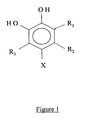
- Figure 1 molecular structure of the complexing compound.
- Figure 2 molecular structure of the complexing molecules according to the preferred embodiment of the present invention.
- Figure 3 Fe removal efficiency of different complexing agents as function of bath age.
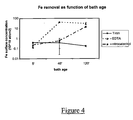
- Figure 4 Fe removal efficiency of different complexing agents as function of bath age.
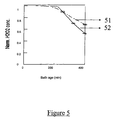
- Figure 5 Effect of EDTA and nitrocatechol on the decomposition reaction of peroxide in an APM cleaning mixture.
- composition is provided according to claim 1.
- composition as recited in any of the previous embodiments of the first aspect of this invention wherein SO 3 H is in the acidic form or in the form of a salt.
- compositions as recited in any of the previous embodiments of the first aspect of this invention wherein said composition is in the form of an aqueous composition.
- composition as recited in any of the previous embodiments of the first aspect of this invention is provided wherein R 1 , R 2 and R 3 are hydrogen.
- composition as recited in any of the previous embodiments of the first aspect of this invention wherein said hydrocarbon is an alkyl chain.
- composition as recited in any of the previous embodiments of the first aspect of this invention wherein said alkyl chain is selected from the group consisting of methyl, ethyl, (iso)propyl and butyl.
- composition as recited in any of the previous embodiments of the first aspect of this invention wherein said complexing compound has the chemical formula as represented in figure 2a.
- composition as recited in any of the previous embodiments of the first aspect of this invention wherein said complexing compound has the chemical formula as represented in figure 2b.
- composition as recited in any of the previous embodiments of the first aspect of this invention wherein said alkaline compound comprises an inorganic basic compound or organic basic compound.
- a composition as recited in any of the previous embodiments of the first aspect of this invention wherein said alkaline compound is preferably an organic amine chosen from the group consisting of tetraalkylammoniumhydroxide, alkanolamine, choline(hydroxyltrialkylammoniumhydroxide) and guanidine compounds.
- the amount of oxidizing compound is between 0.001 and 30 weight%.
- composition as recited in any of the previous embodiments of the first aspect of this invention wherein the amount of the complexing agent is between 0.001 and 10 weight%.
- composition as recited in any of the previous embodiments of the first aspect of this invention wherein the amount of the alkaline compound lies between 0.001 and 30 weight%.
- a method for treating a semiconductor substrate wherein said semiconductor substrate is treated (contacted) with a composition according to the invention.
- composition is an aqueous composition.
- a method as recited in any of the previous embodiments of the second aspect of this invention said method is for cleaning a semiconductor surface.
- alkyl chain is selected from the group consisting of methyl, ethyl, (iso)propyl and butyl.
- said alkaline compound comprises an inorganic or organic basic compound.
- said alkaline compound is preferably an organic amine chosen from the group consisting of tetraalkylammoniumhydroxide, alkanolamine, choline(hydroxyltrialkylammoniumhydroxide) and guanidine compounds.
- a method as recited in any of the previous embodiments of the second aspect of this invention wherein the amount of oxidizing compound is between 0.001 and 30 weight%.
- a method as recited in any of the previous embodiments of the second aspect of this invention wherein the amount of the complexing agent is between 0.001 and 10 weight%.
- a method as recited in any of the previous embodiments of the second aspect of this invention wherein the amount of the alkaline compound is between 0.001 and 30 weight%.
- a novel composition comprises a complexing compound having the formula of fig.1 and an alkaline compound.
- the composition further comprises an oxidizing compound.
- Said composition can be in the form of an aqueous solution.
- Said complexing compound has a chemical formula as given in figure 1, wherein X is selected from the group consisting of NO 2 or SO 3 H, and wherein R 1 , R 2 and R 3 are a hydrocarbon group or hydrogen.
- R 1 , R 2 and R 3 can be selected from the group consisting of methyl, ethyl, (iso)propyl and butyl.
- R 1 , R 2 and R 3 can be equal or different with any possible combination.
- R 1 , R 2 and R 3 are hydrogen.
- the complexing compound can be in acidic form or in the form of a salt.
- the salt is preferably an ammonium salt.
- R 1 , R 2 and R 3 are independently selected from the group comprising hydrogen (H) and any organic group.
- R 1 , R 2 and R 3 can have a different chemical structure.
- Said organic group can be every possible sequence of C, N, O or S atoms linked to each other by single, double or triple bonds such that the first compound complexes the desired metals.
- Said organic group can be selected from the group comprising aliphatic side chains, heterocycles and aromatic structures.
- Said organic side chain is every possible sequence of carbon atoms linked to each other by a single, double or triple bound and optionally characterised by the presence of functional groups linked to the carbon atoms.
- Functional groups can be alcohol, carboxyl, carbonyl, aldehyde, keton, ether, ester, amine, amide, and/or halogen containing groups.
- Said heterocycle can be one of the group comprising a crown ether, a cryptant, a calixarene, etc.
- the complexing compound has a chemical structure according to fig. 1 and such that at least aluminum is complexed. Furthermore, the chemical structure is such that Fe and Zn are complexed.
- the amount of the complexing compound is not particularly limited, it is determined by the degree of metal contamination and on the kind of other compounds being present in the solution.
- the amount of complexing compound is determined by the specific chemical structure of the complexing compound.
- the amount of the complexing agent in the composition can be between 10 -4 and 10 weight %, or between 10 -3 and 1 weight%.
- weight % should be understood as the percentage of weight of the specified compound in the composition.
- the complexing compound is represented in figure 2a or 2b.
- the complexing compound represented in figure 2a will be referred to as nitrocatechol, while the complexing compound as represented in figure 2b will be referred to as sulfocatechol.
- the complexing compound has a chemical composition according to figure 2a or 2b, and such that at least Aluminum is complexed. Moreover, iron, copper and Zinc are complexed.
- composition as recited in the first aspect of this invention can be used to reduce the concentration of the metals on the surface of the substrate or in a solution.
- the oxidizing compound is a chemical compound having oxidizing properties towards organic species, metallic compounds, inorganic particles, silicon, and the like.
- the oxidizing compound is a compound selected from the group comprising hydrogen peroxide or oxidizing anions.
- the oxidizing anions can be e.g. nitric acid and its salts, nitrate, persulfate, periodate, perbromate, perchlorate, iodate, bromate and chlorate salts of ammonium.
- the oxidizing compound is hydrogen peroxide.
- the concentration of the oxidizing compound can be, but is not limited hereto, between 0.0001 and 99 weight %, between 0.001 and 90 weight % and preferably between 0.001 to 30 weight%.
- the alkaline compound or base can be every chemical compound with a pH higher than 7.
- the alkaline compound can be an organic or inorganic compound.
- the alkaline compound can be an organic base, ammonia, ammoniumhydroxide, or an alkaline solution containing metal ions such as potassium or sodium.
- Said organic base can be a quaternary ammonium hydroxide such as tetraalkyl ammonium hydroxide in which the alkyl groups can contain hydroxy- and alkoxy-containing groups with 1 to 4 carbon atoms in the alkyl or alkoxy group.
- Said organic base can further be an organic amine such as an alkanol amine.
- Alkanol amines can be 2-aminoethanol, 1-amino 2-propanol, 1-amino 3-propanol.
- the alkaline compounds are tetramethyl ammonium hydroxide, and trimethyl 2-hydroxy ethyl ammonium hydroxide (choline) and ammonium hydroxide.
- the amount of the alkaline compound lies between 0.0001 and 90 weight %, between 0.001 and 50 weight %, between 0.001 and 30 weight%.
- Said composition can further comprise a surfactant.
- a surfactant is a surface-active agent comprising a lyophobic group and a lyophilic group.
- the lyophobic group can be a straight-chain alkyl group or a branched-chain alkyl group (C8 - C20), a long-chain (C8-C20) alkyl benzene residue, an alkylnaphtalene residue (C3 and greater-length alkyl groups), high-molecular-weight propylene oxide polymers (polyoxypropylene glycol derivatives), long-chain perfluoroalkyl or polysiloxane groups.
- the surfactant can be an anionic, cationic, nonionic or zwitterionic surfactant.
- Anionic surfactants can be carboxylic acids or carboxylic acid salts (such as sodium and potassium salts of straight-chain fatty acids), sulfonic acids or sulfonic acid salts (such as linear alkylbenzenesulfonates, higher alkylbenzenesulfonates, benzene-, toluene-, xylene- and cumenesulfonates, ligninsulfonates, petroleum sulfonates, N-acyl-n-alkyltaureates, paraffin sulfonates, secondary n-alkanesulfonates, ⁇ -olefin sulfonates, sulfosuccinate esters, alkylnaphtalenesulfonates or isethionates), sulfuric acid ester salts (such as sulfated linear primary alcohols, sulfated polyoxyethylenated straight-chain alcohols or sulfated trigly
- Cationic surfactants can be primary amines and their salts, diamines and polyamines and their salts, quaternary ammonium salts (such as tetralkylammonium salts or imidazolinium salts), polyoxyethylenated long-chain amines (RN(CH 2 CH 2 O)xH] 2 ), quaternized polyoxyethylenated long-chain amines or amine oxides (such as N-alkyldimethylamine oxides).
- quaternary ammonium salts such as tetralkylammonium salts or imidazolinium salts
- polyoxyethylenated long-chain amines RN(CH 2 CH 2 O)xH] 2
- quaternized polyoxyethylenated long-chain amines or amine oxides such as N-alkyldimethylamine oxides.
- Nonionic surfactants can be polyoxyethylenated alkylphenols, polyoxyethylenated straight-chain alcohols, polyoxyethylenated polyoxypropylene glycols, polyoxyethylenated mercaptans, long-chain carboxylic acid esters (such as glyceryl and polyglyceryl esters of natural fatty acids, propylene glycol, sorbitol or polyoxyethylenated sorbitol esters, polyoxyethylene glycol esters and polyoxyethylenated fatty acids), alkanolamides, tertiary acetylenic glycols, polyoxyethylenated silicones, N-alkylpyrrolidones or alkylpolyglycosides.
- carboxylic acid esters such as glyceryl and polyglyceryl esters of natural fatty acids, propylene glycol, sorbitol or polyoxyethylenated sorbi
- Zwitterionic surfactants have both anionic and cationic charges present in the lyophilic portion (such as ⁇ -N-alkylaminopropionic acids, N-alkyl- ⁇ -iminodipropionic acids, imidazoline carboxylates, N-alkylbetaines, amine oxides, sulfobetaines or sultaines) ( M.J. Rosen, Surfactants and Interfacial phenomena, 2nd Edition, John Wiley and Sons, New York, 1989 ])
- the composition comprises ammonium hydroxide, hydrogen peroxide, water (hereafter called APM mixtures) and a complexing compound, selected from the molecules described in figure 2.
- Said composition is particularly suitable for treating, particularly cleaning a semiconductor substrate.
- APM-cleaning mixtures comprising a complexing agent according to the present invention are robust with respect to metal contamination coming from the fresh chemicals as well as with respect to metal contamination introduced in the course of its use for cleaning.
- the robustness of the basic APM process can be improved by the addition of complexing agents that keep the metals in solution and prevent the catalysis of the peroxide decomposition.
- the volume mixing ratio of NH 4 OH(29%)/H 2 O 2 (30%)/H 2 O is typically, but not limited hereto, 0.25:1:5.
- a method for treating a semiconductor substrate is provided.
- Said semiconductor substrate is treated with a composition comprising a complexing compound having a formula of figure 1, wherein X is selected from the group consisting of NO 2 or SO 3 H, and wherein R 1 , R 2 and R 3 are any organic groups, in particular any hydrocarbon groups, or hydrogen.
- R 1 , R 2 and R 3 can be selected from the group consisting of methyl, ethyl, (iso)propyl and butyl.
- R 1 , R 2 and R 3 can be equal or different, with any possible combination.
- said composition further comprises an oxidizing compound.
- said composition further comprises an alkaline compound.
- said composition is an aqueous composition comprising a complexing compound, an oxidizing compound and an alkaline compound.
- the composition can be an APM cleaning composition.
- a composition of the invention can comprise an APM solution and a complexing compound having the formula of figure 2a, 2b, or 1, wherein X is selected from the group consisting of NO 2 or SO 3 H, and wherein R 1 , R 2 and R 3 are any organic groups, in particular any hydrocarbon groups, or hydrogen.
- R 1 , R 2 and R 3 can be selected from the group consisting of methyl, ethyl, (iso)propyl and butyl.
- R 1 , R 2 and R 3 can be equal or different, with any possible combination.
- Said composition can be, but is not limited hereto, the composition described in the first aspect of this invention. Said composition is particularly useful for cleaning a substrate such that particles are oxidized and metallic contamination is removed.
- the complexing compound is for complexing metals being present on the surface of the substrate and in the solution. Additionally, the lifetime of the solution is increased since de decomposition of the oxidizing compound is substantially inhibited.
- a substrate can be, but is not limited hereto, a substrate such as semiconducting material, glass, quartz, ceramics, metal, plastic, magnetic material, superconductor and the like.
- said substrate is a semiconductor substrate.
- Semiconductor substrate can be every possible substrate used in semiconductor processing.
- Said semiconductor substrate can be a substrate selected from the group, but not limited hereto, comprising a substrate made of silicon, germanium, gallium arsenide, indium phosphide and the like.
- the semiconductor substrate are e.g. the substrates as mentioned above, covered entirely or partially with a thin film of e.g. an oxide, a nitride, a metal, a polymeric insulating layer, an anti-reflecting coating, a barrier, a photoresist layer and the like.
- a thin film e.g. an oxide, a nitride, a metal, a polymeric insulating layer, an anti-reflecting coating, a barrier, a photoresist layer and the like.
- the present invention is particularly relevant for cleaning or etching a semiconductor substrate of which the surface should be highly clean.
- the weight concentration range of the alkaline compound in the cleaning solution are typically but not limited to 0.001-100 %, 0.1-20 % and preferably 0.1-5 % by weight.
- the weight concentration range of the alkaline compound in the cleaning solution are typically but not limited to 0.001-30 %, 0.1-20 % and preferably 0.1-5 % by weight.
- the weight concentration range is equivalent, and function of the strength of the alkaline compound.
- the weight concentration the hydrogenperoxide is typically but not limited to 0.001-100 %, 0.1-20 % and preferably 0.1-5 % by weight.
- a composition for treating a semiconductor surface comprises ammonium hydroxide, hydrogen peroxide, water (hereafter called APM mixtures) and additionally a complexing compound.
- APM mixtures ammonium hydroxide, hydrogen peroxide, water (hereafter called APM mixtures) and additionally a complexing compound.
- Said complexing compound is selected from the molecules described in figure 1.
- APM-cleaning mixtures comprising a complexing agent according to the present invention are robust with respect to metal contamination coming from the fresh chemicals as well as with respect to metal contamination introduced in the course of its use for cleaning.
- the robustness of the basic APM process can be improved by the addition of complexing agents that keep the metals in solution and prevent the above mentioned catalysis of the peroxide decomposition.
- the volume mixing ratio of NH 4 OH(29%)/H 2 O 2 (30%)/H 2 O is typically, but not limited hereto, 0.25:1:5.
- the cleaning solution is prepared with the amounts as described above and afterwards the semiconductor substrate is treated with the cleaning solution.
- the complexing agent can be added as the pure compound to the cleaning solution.
- the complexing agent can be dissolved in either water, ammonia or peroxide or a dilution of the two latter chemicals and added as such to the cleaning solution.
- An optional step of rinsing said semiconductor substrate can be performed after treating said semiconductor substrate with the cleaning solution as described above.
- the semiconductor substrate can be immersed in a bath containing the cleaning solution.
- the cleaning solution can be dispensed or sprayed onto the semiconductor substrate for instance by using a spray processor.
- the cleaning performance of the solution can be enhanced by using a megasonic transducer.
- the temperature range for treating the semiconductor substrate with the cleaning solution is typically but not limited to 0-95 degrees Celcius, 10-80 degrees Celcius and preferably between 20-70 degrees Celcius.
- composition is stable in this temperature range. This is an advantage compared to prior art solutions, where the metal-complexing compound complex becomes unstable due to an increase in temperature.
- the step of rinsing the semiconductor substrate comprises treating the semiconductor substrate with DI (deionized) water or treating the semiconductor substrate with a diluted acidic solution or with DI water containing both complexing agents wherein the total amount is 1 to 100000 ppm, 10 to 10000 ppm and by preference 100 to 1000 ppm.
- Said rinsing solution comprises said first compound and said second compound, as described in the first aspect of this invention.
- the amount of the complexing agent in the composition can be between 10 -4 and 10 weight %, preferably between 10 -3 and 1 weight%.
- This rinsing solution can also comprise a surfactant in an amount of 0.1 w% to 10 w%.
- the pH range of said rinsing solution can typically be, but not limited to, between 5 and 8.
- Said rinse solution can be dispensed or sprayed onto the semiconductor surface as described above. During rinsing the performance can also be enhanced by using a megasonic transducer.
- the process of treating a semiconductor substrate with a cleaning solution comprising the above mentioned steps can be performed for a predetermined number of semiconductor substrates.
- the composition of the gleaning solution can be modified by e.g. adding extra alkaline compound, adding extra complexing compound, adding oxidizing compound such that the initial composition of the cleaning solution is kept constant as function of the process time.
- Those complexing agents contain as functional groups either phosphonic acids, such as diethylene triamine penta-methylenephosphonic acid (DTPMP) and cyclo-triaminotriethylene-N,N',N"-tris(methylenephosphonic acid) (c-Tramp), carboxylic acids, such as ethylene diamino tetra acetic acid (EDTA), hydroxamates, such as Desferal, and other well known complexing agents as calmagite, pyrogallol, Erio T and acetylacetone.
- DTPMP diethylene triamine penta-methylenephosphonic acid
- c-Tramp cyclo-triaminotriethylene-N,N',N"-tris(methylenephosphonic acid)
- carboxylic acids such as ethylene diamino tetra acetic acid (EDTA)
- EDTA ethylene diamino tetra acetic acid
- hydroxamates such as Desferal
- other well known complexing agents
- Example 1 Metal deposition experiments from APM mixtures in presence of different complexing agents.
- the metal deposition experiments were performed in a static quartz tank with a quartz cover plate. This tank was not equipped with a megasonic transducer. APM mixtures were prepared containing 1 w-ppb of different metals of interest with and without the complexing agent. The metals spiked to the APM bath were added from AAS-standard solutions (Merck).
- the resulting metal contamination was measured with straight TXRF (Total X-Ray Fluorescence) or VPD-DSE-DC-TXRF (Vapor Phase Decomposition - Droplet Surface Etching - Droplet Collection - Total X-Ray Fluorescence). Determination of Al wafer surface concentration was done using VPD-DC GF-AAS (Graphite Furnace Atomic Absorption Spectroscopy).
- nitrocatechol and sulfocatechol are also compared with other complexing agents.
- different complexing agents for Al that are described in literature to be efficient complexants for Al are compared.
- Erio T, pyrogallol, EDTA, Desferal, and Tiron which are known to have a good ability to complex Al (see stability constants summarized in Table 3).
- the complexing agent Tiron which has a similar ring-structure as nitrocatechol and sulfocatechol but different sidegroups, shows a comparable effectiveness in preventing metal deposition from a contaminated bath.
- Table 3 Overview of bindings constants of different compounds for Al.
- Example 2 Removal of metallic contamination from silicon wafer surfaces using APM cleaning solutions with different metal complexing agents.
- the metal-contaminated wafers were prepared using standard spin contamination procedure.
- Tiron is known to be able to complex Al contamination in APM cleaning baths.
- Example 3 Decomposition of peroxide in APM cleaning mixtures in presence of trace metal contamination and metal complexing agents.
- the decay of the total peroxide concentration in the APM mixture can be monitored by measuring the time-dependent increase of the pressure due to the O 2 -evolution in a dedicated set-up as described by Schmidt.
- the decomposition rate as function of bath age is determined in APM mixtures (0.25:1:5 29% NH 4 OH/30% H 2 O 2 /H 2 O) spiked with 1 w-ppb of the metals of interest with and without different complexing agents.
- This graph shows the normalized H 2 O 2 concentration as function of bath age for an APM mixture at 50 oC spiked with nitrocatechol.
- the dotted line refers to EDTA (51), while the full line refers to nitrocatechol (52).
Landscapes
- Chemical & Material Sciences (AREA)
- Life Sciences & Earth Sciences (AREA)
- Engineering & Computer Science (AREA)
- Chemical Kinetics & Catalysis (AREA)
- Oil, Petroleum & Natural Gas (AREA)
- Wood Science & Technology (AREA)
- Organic Chemistry (AREA)
- Inorganic Chemistry (AREA)
- Cleaning Or Drying Semiconductors (AREA)
- Detergent Compositions (AREA)
- Liquid Deposition Of Substances Of Which Semiconductor Devices Are Composed (AREA)
Abstract
Description
- The present invention relates to a composition for cleaning a substrate, in particular a semiconductor substrate.
- The present invention also relates to a method for cleaning a substrate.
- The conventional RCA cleaning of semiconductor substrates consists of two steps: (1) use of an alkaline solution, the so called SC1 solution, and (2) use of an acidic solution, SC2. The SC1 solution is composed of 1 part ammonia (NH4OH), 1 part hydrogen peroxide (H2O2) and 5 parts ultra pure water (H2O) and is often referred to as APM-cleaning (i.e. Ammonia Peroxide Mixture). Originally it was used to remove organic residues by oxidation. Later it has been proven to be very efficient to remove particles.
- A drawback of the SC1 solution is that metallic contamination such as Fe and Cu are found to catalyze the decomposition reaction of the peroxide (see e.g. Mertens et al., Proc. of the 5th Internat. Symp. on Cleaning Technology in Semiconductor Device Manufacturing PV97-35 (1997)) leading to a decrease in the bath lifetime.
- Chemical solutions comprising an oxidizing compound have often problems related to the stability of the solution. In pure form, aqueous solutions are stable over extended periods of time. However, the presence of certain metal ions in the solution causes decomposition of the oxidizing compound. Consequently, stabilizers to prevent such decomposition should be added. Stabilizers can be e.g. a complexing compound, such that the complexing compound will bind to the metal and consequently, the metal is not available for reaction with the oxidizing compound. Thus, the decomposition of the oxidizing compound is substantially inhibited and the lifetime of the solution is increased.
- Very stringent specifications must be met by oxidizing solutions for specialized applications such as semiconductor applications or reagent chemicals.
- An overview of stabilizing oxidizing compound, and more specifically hydrogen peroxide solutions, is given in Kirk-Othmer Encyclopedia of Chemical Technology (4th edition), vol 13 pg 965.
- Another problem associated with SC1 cleaning solutions is that metals precipitate on silicon surfaces; especially aluminum, iron and zinc have been shown to adsorb strongly on the wafer surface (see e.g. Mertens et al., Proc. of the 8th Internat. Symp. On Silicon Materials Science and Technology PV98-1 (1998)). In order to remove the metallic surface contamination, the SC2 solution consisting of 1 part hydrochloric acid, 1 part hydrogen peroxide and 6 parts ultra-pure water is used. However, it is expensive to get hydrochloric acid of sufficient quality for the usage in SC2 solution. There is also a risk of re-contaminating the surface with particles. Problems also occur in spray tools due the corrosive behavior of hydrochloric acid.
- With the progress in semiconductor manufacturing the requirements concerning particle and metal contamination as well as roughness of the silicon surfaces became more stringent. This led to a number of variations of the RCA clean.
- The potential problems related to the SC2 and the consideration to reduce process time and equipment by leaving out this acidic step led to the development of single-stage cleaning procedures. This can be done by using chemicals with reduced amount of metallic impurities. For that purpose, advanced purification procedures are established for obtaining ultra-pure water, ammonia and hydrogen peroxide. However, these chemicals are very expensive and the purity is not always assured when they are used in a cleaning bath. Moreover, the cleaning solution is not very robust with respect to metal contamination from the semiconductor substrate and from the hardware.
- Besides this, an extra step in the cleaning cycle to remove residual metallic contamination implies extra hardware, e.g. a SC2-tank and a rinse tank need to be used, and more chemicals. Leaving out this extra step will results in a reduction of the hardware cost and a reduction of the amount of chemicals used in the cleaning cycle.
-
US 5,466,389 describes cleaning solutions containing a complexing agent such as EDTA in combination with a nonionic surfactant. However, these cleaning solutions suffer from the drawback of weak stability of EDTA in peroxide containing cleaning solutions. In addition, in general, nonionic surfactants cannot be rinsed off easily from the wafer surface and traces of organic contamination are left on the wafer surface. -
US 5,885,362 describes a method for treating a surface of a substrate with a surface treatment composition. The surface treatment composition comprises a liquid medium containing a complexing agent as a metal deposition preventive. The surface treatment composition is improved by incorporating at least two complexing agents. A first complexing agent is preferably an aromatic hydrocarbon ring with at least an OH or O- group bonded to a carbon atom constituting the ring. A second complexing agent is compound having a donor atom, in the molecular structure. This invention only focuses on Fe and Al and the combinations of chelating agents disclosed in this invention are not successful in preventing deposition of Zn which has a high tendency to precipitate from cleaning solutions which have an intrinsic high pH. -
US 5,290,361 andUS 5,302,311 describes an aqueous hydrogen peroxide solution further comprising a complexing compound containing phosphonic acid groups and showing complexing ability. Cleaning solution comprising phosphonic acid groups are not effective because enhanced deposition of Cu has been measured. In addition, there is always a risk of leaving P-contamination on the wafer surface which makes the cleaning solutions less suitable. -
US 5,820,746 andUS 5,840,127 describe the use of complexing agents with hydroxamate functional groups. However, these complexing agents have limited stability in cleaning solutions containing peroxide. -
US 6,066,609 describes an aqueous cleaning solution comprising a base, hydrogen peroxide and a complexing agent being a crown ether with sidegroups able to complex metallic species. However the phosphonic acid side groups described in this patent may also contribute to unwanted P contamination on the wafer surface. In addition, these complexing agents show a limited stability and a lower metal removal performance (see comparative examples). -
US 4,210,498 describes a method of treating a semiconductor device comprising the step of dipping said semiconductor device into a solution of chelating agent selected from the group consisting of gamma-pyrones, nitrated catechols, flavones and combinations thereof. -
US 3,640,825 describes an aqueous drilling fluid dispersant and a method of drilling wells using said drilling fluid which contains a substituted dihydroxybenzene compound as the dispersant, selected from the group consisting of a 1,2-dihydroxybenzene containing as a substituent in the 4 position a nitro-, a chloro-, a formyl-, or a (2'-carboxyethenyl)-group and mixtures of said compounds. -
EP 346 139 -
JP 61 100 919 -
WO 30/068713 -
EP 1 029 703 - In the present invention, the problems related to removal of metals as mentioned in the prior art, are avoided.
- It is an aim of the invention to provide a new solution for treating a surface which is stable and provokes less or no metal precipitation on the surface.
- It is a further aim of the invention to provide a new cleaning solution.
- A further aim is to provide a new single-step method for cleaning semiconductor surfaces, i.e. to achieve removal of all kinds of contamination (particulate, metallic and organic) in one cleaning step.
- Figure 1 : molecular structure of the complexing compound.
- Figure 2 : molecular structure of the complexing molecules according to the preferred embodiment of the present invention.
- Figure 3 : Fe removal efficiency of different complexing agents as function of bath age.
- Figure 4 : Fe removal efficiency of different complexing agents as function of bath age.
- Figure 5: Effect of EDTA and nitrocatechol on the decomposition reaction of peroxide in an APM cleaning mixture.
- In a first aspect of this invention, a composition is provided according to
claim 1. - In an embodiment of this invention, a composition as recited in any of the previous embodiments of the first aspect of this invention is provided wherein SO3H is in the acidic form or in the form of a salt.
- In an embodiment of this invention, a composition as recited in any of the previous embodiments of the first aspect of this invention is provided wherein said composition is in the form of an aqueous composition.
- In an embodiment of this invention, a composition as recited in any of the previous embodiments of the first aspect of this invention is provided wherein R1, R2 and R3 are hydrogen.
- In an embodiment of this invention, a composition as recited in any of the previous embodiments of the first aspect of this invention is provided wherein said hydrocarbon is an alkyl chain.
- In an embodiment of this invention, a composition as recited in any of the previous embodiments of the first aspect of this invention is provided wherein said alkyl chain is selected from the group consisting of methyl, ethyl, (iso)propyl and butyl.
- In an embodiment of this invention, a composition as recited in any of the previous embodiments of the first aspect of this invention is provided wherein said complexing compound has the chemical formula as represented in figure 2a.
- In an embodiment of this invention, a composition as recited in any of the previous embodiments of the first aspect of this invention is provided wherein said complexing compound has the chemical formula as represented in figure 2b.
- In an embodiment of this invention, a composition as recited in any of the previous embodiments of the first aspect of this invention is provided wherein said alkaline compound comprises an inorganic basic compound or organic basic compound.
- In an embodiment of this invention, a composition as recited in any of the previous embodiments of the first aspect of this invention is provided wherein said alkaline compound is preferably an organic amine chosen from the group consisting of tetraalkylammoniumhydroxide, alkanolamine, choline(hydroxyltrialkylammoniumhydroxide) and guanidine compounds.
- In any of the previous embodiments of the first aspect of this invention, the amount of oxidizing compound is between 0.001 and 30 weight%.
- In an embodiment of this invention, a composition as recited in any of the previous embodiments of the first aspect of this invention is provided wherein the amount of the complexing agent is between 0.001 and 10 weight%.
- In an embodiment of this invention, a composition as recited in any of the previous embodiments of the first aspect of this invention is provided wherein the amount of the alkaline compound lies between 0.001 and 30 weight%.
- In a second aspect of this invention, a method for treating a semiconductor substrate is provided wherein said semiconductor substrate is treated (contacted) with a composition according to the invention.
- In an embodiment of this invention, a method as recited in any of the previous embodiments of the second aspect of this invention is provided wherein said composition is an aqueous composition.
- In an embodiment of this invention, a method as recited in any of the previous embodiments of the second aspect of this invention said method is for cleaning a semiconductor surface.
- In an embodiment of this invention, a method as recited in any of the previous embodiments of the second aspect of this invention is provided wherein R1, R2 and R3 are hydrogen.
- In an embodiment of this invention, a method as recited in any of the previous embodiments of the second aspect of this invention is provided wherein said hydrocarbon is an alkyl chain.
- In an embodiment of this invention, a method as recited in any of the previous embodiments of the second aspect of this invention is provided wherein said alkyl chain is selected from the group consisting of methyl, ethyl, (iso)propyl and butyl.
- In an embodiment of this invention, a method as recited in any of the previous embodiments of the second aspect of this invention is provided wherein said complexing compound has the chemical formula as represented in figure 2a.
- In an embodiment of this invention, a method as recited in any of the previous embodiments of the second aspect of this invention is provided wherein said complexing compound has the chemical formula as represented in figure 2b.
- In an embodiment of this invention, a method as recited in any of the previous embodiments of the second aspect of this invention is provided wherein said alkaline compound comprises an inorganic or organic basic compound.
- In an embodiment of this invention, a method as recited in any of the previous embodiments of the second aspect of this invention is provided wherein said alkaline compound is preferably an organic amine chosen from the group consisting of tetraalkylammoniumhydroxide, alkanolamine, choline(hydroxyltrialkylammoniumhydroxide) and guanidine compounds.
- In an embodiment of this invention, a method as recited in any of the previous embodiments of the second aspect of this invention is provided wherein the amount of oxidizing compound is between 0.001 and 30 weight%.
- In an embodiment of this invention, a method as recited in any of the previous embodiments of the second aspect of this invention is provided wherein the amount of the complexing agent is between 0.001 and 10 weight%.
- In an embodiment of this invention, a method as recited in any of the previous embodiments of the second aspect of this invention is provided wherein the amount of the alkaline compound is between 0.001 and 30 weight%.
- In relation to the appended drawings the present invention is described in detail in the sequel. It is apparent however that a person skilled in the art can imagine several other equivalent embodiments or other ways of executing the present invention.
- In an aspect of this invention, a novel composition is disclosed. Said composition comprises a complexing compound having the formula of fig.1 and an alkaline compound. The composition further comprises an oxidizing compound. Said composition can be in the form of an aqueous solution.
- Said complexing compound has a chemical formula as given in figure 1, wherein X is selected from the group consisting of NO2 or SO3H, and wherein R1, R2 and R3 are a hydrocarbon group or hydrogen. R1, R2 and R3 can be selected from the group consisting of methyl, ethyl, (iso)propyl and butyl. R1, R2 and R3 can be equal or different with any possible combination.
- Most preferably, R1, R2 and R3 are hydrogen.
- When X is SO3H, the complexing compound can be in acidic form or in the form of a salt. The salt is preferably an ammonium salt.
- In another embodiment, R1, R2 and R3 are independently selected from the group comprising hydrogen (H) and any organic group. R1, R2 and R3 can have a different chemical structure. Said organic group can be every possible sequence of C, N, O or S atoms linked to each other by single, double or triple bonds such that the first compound complexes the desired metals. Said organic group can be selected from the group comprising aliphatic side chains, heterocycles and aromatic structures.
- Said organic side chain is every possible sequence of carbon atoms linked to each other by a single, double or triple bound and optionally characterised by the presence of functional groups linked to the carbon atoms. Functional groups can be alcohol, carboxyl, carbonyl, aldehyde, keton, ether, ester, amine, amide, and/or halogen containing groups.
- Said heterocycle can be one of the group comprising a crown ether, a cryptant, a calixarene, etc.
- The complexing compound has a chemical structure according to fig. 1 and such that at least aluminum is complexed. Furthermore, the chemical structure is such that Fe and Zn are complexed.
- Although the amount of the complexing compound is not particularly limited, it is determined by the degree of metal contamination and on the kind of other compounds being present in the solution.
- Furthermore, the amount of complexing compound is determined by the specific chemical structure of the complexing compound.
- In an embodiment, the amount of the complexing agent in the composition can be between 10-4 and 10 weight %, or between 10-3 and 1 weight%.
- For the purpose of this invention, weight % should be understood as the percentage of weight of the specified compound in the composition.
- In a preferred embodiment, the complexing compound is represented in figure 2a or 2b.
- For the purpose of this invention, the complexing compound represented in figure 2a will be referred to as nitrocatechol, while the complexing compound as represented in figure 2b will be referred to as sulfocatechol.
- The complexing compound has a chemical composition according to figure 2a or 2b, and such that at least Aluminum is complexed. Moreover, iron, copper and Zinc are complexed.
- The composition as recited in the first aspect of this invention can be used to reduce the concentration of the metals on the surface of the substrate or in a solution.
- The oxidizing compound is a chemical compound having oxidizing properties towards organic species, metallic compounds, inorganic particles, silicon, and the like.
- The oxidizing compound is a compound selected from the group comprising hydrogen peroxide or oxidizing anions. The oxidizing anions can be e.g. nitric acid and its salts, nitrate, persulfate, periodate, perbromate, perchlorate, iodate, bromate and chlorate salts of ammonium. Preferably, the oxidizing compound is hydrogen peroxide.
- The concentration of the oxidizing compound can be, but is not limited hereto, between 0.0001 and 99 weight %, between 0.001 and 90 weight % and preferably between 0.001 to 30 weight%.
- The alkaline compound or base can be every chemical compound with a pH higher than 7. The alkaline compound can be an organic or inorganic compound. The alkaline compound can be an organic base, ammonia, ammoniumhydroxide, or an alkaline solution containing metal ions such as potassium or sodium. Said organic base can be a quaternary ammonium hydroxide such as tetraalkyl ammonium hydroxide in which the alkyl groups can contain hydroxy- and alkoxy-containing groups with 1 to 4 carbon atoms in the alkyl or alkoxy group. Said organic base can further be an organic amine such as an alkanol amine. Alkanol amines can be 2-aminoethanol, 1-amino 2-propanol, 1-amino 3-propanol. Preferably, the alkaline compounds are tetramethyl ammonium hydroxide, and trimethyl 2-hydroxy ethyl ammonium hydroxide (choline) and ammonium hydroxide.
- The amount of the alkaline compound lies between 0.0001 and 90 weight %, between 0.001 and 50 weight %, between 0.001 and 30 weight%.
- Said composition can further comprise a surfactant.
- A surfactant is a surface-active agent comprising a lyophobic group and a lyophilic group.
- The lyophobic group can be a straight-chain alkyl group or a branched-chain alkyl group (C8 - C20), a long-chain (C8-C20) alkyl benzene residue, an alkylnaphtalene residue (C3 and greater-length alkyl groups), high-molecular-weight propylene oxide polymers (polyoxypropylene glycol derivatives), long-chain perfluoroalkyl or polysiloxane groups.
- Depending upon the lyophilic group, the surfactant can be an anionic, cationic, nonionic or zwitterionic surfactant.
- Anionic surfactants can be carboxylic acids or carboxylic acid salts (such as sodium and potassium salts of straight-chain fatty acids), sulfonic acids or sulfonic acid salts (such as linear alkylbenzenesulfonates, higher alkylbenzenesulfonates, benzene-, toluene-, xylene- and cumenesulfonates, ligninsulfonates, petroleum sulfonates, N-acyl-n-alkyltaureates, paraffin sulfonates, secondary n-alkanesulfonates, α-olefin sulfonates, sulfosuccinate esters, alkylnaphtalenesulfonates or isethionates), sulfuric acid ester salts (such as sulfated linear primary alcohols, sulfated polyoxyethylenated straight-chain alcohols or sulfated triglyceride oils), phosphoric and polyphosphoric acid esters.
- Cationic surfactants can be primary amines and their salts, diamines and polyamines and their salts, quaternary ammonium salts (such as tetralkylammonium salts or imidazolinium salts), polyoxyethylenated long-chain amines (RN(CH2CH2O)xH]2), quaternized polyoxyethylenated long-chain amines or amine oxides (such as N-alkyldimethylamine oxides).
- Nonionic surfactants can be polyoxyethylenated alkylphenols, polyoxyethylenated straight-chain alcohols, polyoxyethylenated polyoxypropylene glycols, polyoxyethylenated mercaptans, long-chain carboxylic acid esters (such as glyceryl and polyglyceryl esters of natural fatty acids, propylene glycol, sorbitol or polyoxyethylenated sorbitol esters, polyoxyethylene glycol esters and polyoxyethylenated fatty acids), alkanolamides, tertiary acetylenic glycols, polyoxyethylenated silicones, N-alkylpyrrolidones or alkylpolyglycosides.
- Zwitterionic surfactants have both anionic and cationic charges present in the lyophilic portion (such as β-N-alkylaminopropionic acids, N-alkyl-β-iminodipropionic acids, imidazoline carboxylates, N-alkylbetaines, amine oxides, sulfobetaines or sultaines) (M.J. Rosen, Surfactants and Interfacial phenomena, 2nd Edition, John Wiley and Sons, New York, 1989])
- In the preferred embodiment of this invention, the composition comprises ammonium hydroxide, hydrogen peroxide, water (hereafter called APM mixtures) and a complexing compound, selected from the molecules described in figure 2.
- Said composition is particularly suitable for treating, particularly cleaning a semiconductor substrate.
- APM-cleaning mixtures comprising a complexing agent according to the present invention are robust with respect to metal contamination coming from the fresh chemicals as well as with respect to metal contamination introduced in the course of its use for cleaning. The robustness of the basic APM process can be improved by the addition of complexing agents that keep the metals in solution and prevent the catalysis of the peroxide decomposition.
- The volume mixing ratio of NH4OH(29%)/H2O2(30%)/H2O is typically, but not limited hereto, 0.25:1:5.
- In a second aspect of this invention, a method for treating a semiconductor substrate is provided.
- Said semiconductor substrate is treated with a composition comprising a complexing compound having a formula of figure 1, wherein X is selected from the group consisting of NO2 or SO3H, and wherein R1, R2 and R3 are any organic groups, in particular any hydrocarbon groups, or hydrogen. In particular, R1, R2 and R3 can be selected from the group consisting of methyl, ethyl, (iso)propyl and butyl. R1, R2 and R3 can be equal or different, with any possible combination.
- In an embodiment, said composition further comprises an oxidizing compound.
- In another embodiment, said composition further comprises an alkaline compound.
- In a preferred embodiment, said composition is an aqueous composition comprising a complexing compound, an oxidizing compound and an alkaline compound.
- The composition can be an APM cleaning composition.
- A composition of the invention can comprise an APM solution and a complexing compound having the formula of figure 2a, 2b, or 1, wherein X is selected from the group consisting of NO2 or SO3H, and wherein R1, R2 and R3 are any organic groups, in particular any hydrocarbon groups, or hydrogen. In particular, R1, R2 and R3 can be selected from the group consisting of methyl, ethyl, (iso)propyl and butyl. R1, R2 and R3 can be equal or different, with any possible combination.
- Said composition can be, but is not limited hereto, the composition described in the first aspect of this invention. Said composition is particularly useful for cleaning a substrate such that particles are oxidized and metallic contamination is removed.
- The complexing compound is for complexing metals being present on the surface of the substrate and in the solution. Additionally, the lifetime of the solution is increased since de decomposition of the oxidizing compound is substantially inhibited.
- A substrate can be, but is not limited hereto, a substrate such as semiconducting material, glass, quartz, ceramics, metal, plastic, magnetic material, superconductor and the like.
- Preferably, said substrate is a semiconductor substrate. Semiconductor substrate can be every possible substrate used in semiconductor processing. Said semiconductor substrate can be a substrate selected from the group, but not limited hereto, comprising a substrate made of silicon, germanium, gallium arsenide, indium phosphide and the like.
- The semiconductor substrate are e.g. the substrates as mentioned above, covered entirely or partially with a thin film of e.g. an oxide, a nitride, a metal, a polymeric insulating layer, an anti-reflecting coating, a barrier, a photoresist layer and the like.
- The present invention is particularly relevant for cleaning or etching a semiconductor substrate of which the surface should be highly clean.
- When the composition is used for treating a substrate, the weight concentration range of the alkaline compound in the cleaning solution are typically but not limited to 0.001-100 %, 0.1-20 % and preferably 0.1-5 % by weight.
- For ammonium hydroxide, the weight concentration range of the alkaline compound in the cleaning solution are typically but not limited to 0.001-30 %, 0.1-20 % and preferably 0.1-5 % by weight. For other alkaline compounds, the weight concentration range is equivalent, and function of the strength of the alkaline compound.
- For peroxide, the weight concentration the hydrogenperoxide is typically but not limited to 0.001-100 %, 0.1-20 % and preferably 0.1-5 % by weight.
- In the preferred embodiment of this invention, a composition for treating a semiconductor surface comprises ammonium hydroxide, hydrogen peroxide, water (hereafter called APM mixtures) and additionally a complexing compound. Said complexing compound is selected from the molecules described in figure 1.
- APM-cleaning mixtures comprising a complexing agent according to the present invention are robust with respect to metal contamination coming from the fresh chemicals as well as with respect to metal contamination introduced in the course of its use for cleaning. The robustness of the basic APM process can be improved by the addition of complexing agents that keep the metals in solution and prevent the above mentioned catalysis of the peroxide decomposition.
- The volume mixing ratio of NH4OH(29%)/H2O2(30%)/H2O is typically, but not limited hereto, 0.25:1:5.
- The cleaning solution is prepared with the amounts as described above and afterwards the semiconductor substrate is treated with the cleaning solution.
- In the best mode known to the applicant, the molecule as described in figure 2b is selected and added in the amounts described above.
- The complexing agent can be added as the pure compound to the cleaning solution. Alternatively, the complexing agent can be dissolved in either water, ammonia or peroxide or a dilution of the two latter chemicals and added as such to the cleaning solution.
- It is a further aim of the invention to disclose a process for treating a semiconductor substrate comprising the steps of :
- treating said semiconductor substrate with the cleaning solution as described above, and
- drying said semiconductor substrate.
- An optional step of rinsing said semiconductor substrate can be performed after treating said semiconductor substrate with the cleaning solution as described above.
- In the step of treating said semiconductor substrate with said cleaning solution, the semiconductor substrate can be immersed in a bath containing the cleaning solution. Alternatively, the cleaning solution can be dispensed or sprayed onto the semiconductor substrate for instance by using a spray processor. In all cases, the cleaning performance of the solution can be enhanced by using a megasonic transducer.
- The temperature range for treating the semiconductor substrate with the cleaning solution is typically but not limited to 0-95 degrees Celcius, 10-80 degrees Celcius and preferably between 20-70 degrees Celcius.
- The composition is stable in this temperature range. This is an advantage compared to prior art solutions, where the metal-complexing compound complex becomes unstable due to an increase in temperature.
- In the step of drying the semiconductor substrate, several techniques known in the art can be used, e.g. spin-drying, Maragoni-drying, drying techniques using organic vapours.
- The step of rinsing the semiconductor substrate comprises treating the semiconductor substrate with DI (deionized) water or treating the semiconductor substrate with a diluted acidic solution or with DI water containing both complexing agents wherein the total amount is 1 to 100000 ppm, 10 to 10000 ppm and by
preference 100 to 1000 ppm. - It is a further aim of the invention to describe a process for treating a semiconductor substrate comprising the step of:
- treating said semiconductor substrate with any cleaning solution according to the invention, and/or
- treating said semiconductor substrate with any rinsing solution.
- Said rinsing solution comprises said first compound and said second compound, as described in the first aspect of this invention. The amount of the complexing agent in the composition can be between 10-4 and 10 weight %, preferably between 10-3 and 1 weight%.
- This rinsing solution can also comprise a surfactant in an amount of 0.1 w% to 10 w%.
- No additional alkaline compound should need to be added to the said rinsing solution. The pH range of said rinsing solution can typically be, but not limited to, between 5 and 8. Said rinse solution can be dispensed or sprayed onto the semiconductor surface as described above. During rinsing the performance can also be enhanced by using a megasonic transducer.
- The process of treating a semiconductor substrate with a cleaning solution comprising the above mentioned steps can be performed for a predetermined number of semiconductor substrates.
- After treating at least one substrate, but preferably after treating more substrates, the composition of the gleaning solution can be modified by e.g. adding extra alkaline compound, adding extra complexing compound, adding oxidizing compound such that the initial composition of the cleaning solution is kept constant as function of the process time.
- The present invention will be further described using non-limiting examples and drawings.
- The effectiveness of the new composition concerning the inhibition of metal catalyzed decomposition of peroxide, the prevention of metal outplating on silicon wafers in metal contaminated APM cleaning solutions and the removal of metallic contamination from silicon wafer surfaces using APM cleaning solutions is described.
- A comparison is made with other types of complexing agents.
- Those complexing agents contain as functional groups either phosphonic acids, such as diethylene triamine penta-methylenephosphonic acid (DTPMP) and cyclo-triaminotriethylene-N,N',N"-tris(methylenephosphonic acid) (c-Tramp), carboxylic acids, such as ethylene diamino tetra acetic acid (EDTA), hydroxamates, such as Desferal, and other well known complexing agents as calmagite, pyrogallol, Erio T and acetylacetone.
- An overview of the different chemicals used for the experiments is given in Table 1.
- All experiments were done in a
class 1000 clean room environment or better.Table 1: Chemicals used for preparation of APM baths. Chemical Vendor Grade H2O2 30 (w/w) % Ashland TB (*) NH4OH 29 (w/w)% Ashland TB(*) EDTA Merck DMHP Aldrich Tiron Aldrich acetylacetone Aldrich Calmagite Acros ErioT Acros nitrocatechol Acros sulfocatechol ** Pyrogallol Riedel-de-Haën Extra pure c-Tramp Desferal Novartis (*) TB-grade corresponds with a specification of maximal 100 ppt of metal ions in the chemical.
(**) prepared as mentioned in Beilsteins Handbuch der organischen Chemie, IV. Ausg.Grundwerk, Bd.11, S.294.Springer. Berlin 1928 - The efficiency of complexing agents to suppress the deposition of metallic contamination onto wafer surfaces was evaluated.
- This was done through intentionally spiking controlled trace amounts of metallic contamination to cleaning solutions. For these metal deposition tests, p-type monitor wafers with a diameter of 150 mm and <100> orientation were used. The wafers were pre-cleaned using
IMEC Clean ® 10 minutes H2O/O3 + 10 minutes OFR (Overflow Rinse) + 2 minutes 0.5% HF + 10 minutes OFR at pH 2 and O3 + marangoni drying, rendering a perfectly clean hydrophilic surface. - The metal deposition experiments were performed in a static quartz tank with a quartz cover plate. This tank was not equipped with a megasonic transducer. APM mixtures were prepared containing 1 w-ppb of different metals of interest with and without the complexing agent. The metals spiked to the APM bath were added from AAS-standard solutions (Merck).
- After a bath age of 5 minutes, three wafers were immersed for 10 minutes, rinsed for 10 minutes in an overflow rinse tank and dried with a commercially available Marangoni drier (STEAG).
- The resulting metal contamination was measured with straight TXRF (Total X-Ray Fluorescence) or VPD-DSE-DC-TXRF (Vapor Phase Decomposition - Droplet Surface Etching - Droplet Collection - Total X-Ray Fluorescence). Determination of Al wafer surface concentration was done using VPD-DC GF-AAS (Graphite Furnace Atomic Absorption Spectroscopy).
- In Table 2, an overview of the metal deposition from intentionally metal contaminated APM cleaning mixtures and the effect of different complexing agents upon preventing the metal deposition is summarized.
- It is shown that nitrocatechol and sulfocatechol are very effective to prevent deposition of Al.
Table 2: Metal surface concentration (1010 at/cm2) after 10 min dip in 0.25/1/5 APM at 50°C spiked with 1 w-ppb metals and different complexing agents followed by 10 min. OFR and MgDry. CA Conc (M) Fe Zn Al None - 129.7±3.4 46.82±1.28 299.6 ± 4.6 Tiron 1.3×10⁻³ 0.15±0.1 8.0±0.2 0.7 ± 0.04 DMHP 2.7×10⁻⁴ 0.21 22.26 99.9±1 EDTA (70 °C) 3.2×10⁻⁵ no data no data 272±16 EDTA (RT) 3.2×10⁻⁴ 2.7 27.7 NA ErioT 1.3x10⁻⁴ 3±1.5 0.5±0.09 513±32 Calmagite 1.3x10⁻⁴ 64±39 3.92±0.96 42±3 Nitrocatechol 1.3x10⁻³ no data available no data available <0.126 + EDTA 1.3x10⁻⁴ sulfocatechol 1.3x10⁻³ <1.2 13.7±0.4 <0.83 Acetylacetone 1.3x10⁻³ 140±6 41±3 319±14 Acetylacetone+ 1.3x10⁻³ <0.15 1.2±0.08 228±15 EDTA 1.3x10⁻⁴ c-tramp 2.7×10⁻⁵ 0.82 0.95 366±2.5 Desferal 2.7×10⁻⁵ 1.33±0.18 45.6±0.1 11.5±0.18 Pyrogallol 1.3×10⁻³ 80.7±2.4 30.8±0.3 327±18 - The performance of nitrocatechol and sulfocatechol is also compared with other complexing agents. In first instance, different complexing agents for Al that are described in literature to be efficient complexants for Al are compared. Erio T, pyrogallol, EDTA, Desferal, and Tiron which are known to have a good ability to complex Al (see stability constants summarized in Table 3).
- However, those complexants show a much lower efficiency to complex Al in the APM cleaning solution compared to nitrocatechol and sulfocatechol.
- It is shown that the commonly known complexant EDTA is not able to keep the Al in solution and has also no effect on preventing the outplating of Zn.
- The complexing agent Tiron which has a similar ring-structure as nitrocatechol and sulfocatechol but different sidegroups, shows a comparable effectiveness in preventing metal deposition from a contaminated bath.
Table 3 : Overview of bindings constants of different compounds for Al. (*) K1 B2 K3 Tiron 19.02 31.1 2.4 EDTA 16.95 25.04 - Pyrogallol 24.50 44.55 13.40 calmagite - - - erioT - - - nitrocatechol 13.75 25.44 Sulfocatechol** 16.6 29.9 9.3 acetylacetone 8.6 16.5 5.8 DMHP 12.20 23.25 9.37 Desferal 24.5 - - (*) Stability constants extracted from the SCQUERY database (2002, IUPAC and Academic Software) - SCQUERY version 5.15
(**) L.Havelkova and M.Bartusek Coll.Czech.Chem.Commun. vol 34 (1969 ) - The final metal surface concentration after cleaning intentionally metal contaminated wafers using a 0.25/1/5 APM clean with and without any complexing agent at 50° C is summarized in table 4.
- The metal-contaminated wafers were prepared using standard spin contamination procedure.
Table 4: Metal surface concentration (1010 at/cm2) after cleaning 1012 at/cm2 metal contaminated wafers with 10 min 0.25/1/5 APM at 50 °C with different complexing agents (bath age = 5') followed by 10 min. OFR and MgDry. CA Conc (M) Fe Zn Al No APM clean 98.75±0.84 91.13±3.03 177±14.1 None - 40.64 31.06 164 Tiron 1.3x10⁻³ 0.41±0.05 1.8±0.5 16.4±0.25 EDTA 1.3x10⁻³ 0.15±0.04 0.47±0.05 314±12 ErioT 1.3x10⁻⁴ 0.33±0.09 1.77±0.17 282±6 Calmagite 1.3x10⁻⁴ <0.14 1.22±0.15 120±4 Nitrocatechol 1.3x10⁻³ 0.2±0.1 18.37±0.04 2.9±0.5 sulfocatechol 1.3x10⁻³ <0.16 2.82±0.17 6±0.6 Acetylacetone 1.3x10⁻³ <0.08 1.62±0.06 139±12 + EDTA 1.3x10⁻⁴ - It can be concluded that nitro- and sulfocatechol can more efficiently clean Al from the wafer surface compared to the other complexing agents used.
- In Figures 3 and 4, the efficiency of nitrocatechol to remove metal contamination using APM mixtures is examined by investigating the removal efficiency as function of the lifetime of the complexing agents in the APM cleaning bath.
- A comparison is made with EDTA and Tiron. Tiron is known to be able to complex Al contamination in APM cleaning baths.
- These graphs show that nitrocatechol has a good performance concerning removal of Al from the wafer surface as a function of the bath lifetime.
- The effect of the addition of a complexing agent to APM cleaning solutions on the kinetics of the decomposition reaction of H2O2 has been investigated (figure 5). Well controlled amounts of metallic contamination were added to the cleaning mixture under study.
- As hydrogen peroxide decomposes, an amount of oxygen gas is liberated following the overall reaction:
2 H2O2 ↔ O2 + 2 H2O
- The decay of the total peroxide concentration in the APM mixture can be monitored by measuring the time-dependent increase of the pressure due to the O2-evolution in a dedicated set-up as described by Schmidt.
- Numerical integration over time yields the actual peroxide concentration in the bath. It is convenient to use peroxide concentrations normalized to its initial value [H2O2]i as

- Since the decomposition reaction is mainly catalyzed by Fe and in a lesser content Cu (Mertens et al. Proc. of the 5th Internat. Symp. on Cleaning Technology in Semiconductor Device Manufacturing PV97-35 (1997), the decay of peroxide concentration in a metal contaminated bath and in presence of a CA, illustrates the ability of complexing primarily Fe in the APM bath.
- The decomposition rate as function of bath age is determined in APM mixtures (0.25:1:5 29% NH4OH/30% H2O2/H2O) spiked with 1 w-ppb of the metals of interest with and without different complexing agents.
- The effect of different additives on the inhibition of the metal catalyzed decomposition reaction of peroxide in APM cleaning mixtures is shown in Figure 9.
- This graph shows the normalized H2O2 concentration as function of bath age for an APM mixture at 50 oC spiked with nitrocatechol.
- A comparison is also made with EDTA. Both complexing agents were use at a concentration of 1.3x10⁻³ M. The complexing agents are found to suppress to some extent the decomposition reaction, at least when the mixture is fresh. For EDTA the suppression action vanishes a little faster over time. This may be attributed to the destruction of the complexing agent or more specifically of the metal-complex in the hot APM. The lifetime of nitrocatechol amounts to 200 min. This value corresponds to acceptable bath lifetimes.
- In figure 5, the dotted line refers to EDTA (51), while the full line refers to nitrocatechol (52).
Claims (14)
- A composition comprising:- an alkaline compound selected from the group consisting of ammonia and organic amine,- an oxidizing compound selected from the group consisting of hydrogen peroxide and oxidizing anions, and- a complexing compound having the chemical formula :wherein X is selected from the group consisting of NO2 or SO3H, and wherein R1, R2 and R3 are independently from each other any organic groups or hydrogen.

- A composition according to claim 1 wherein R1, R2 and R3 are independently from each other any hydrocarbon groups or hydrogen.
- A composition according to claim 1 or 2 wherein said composition is in the form of an aqueous composition.
- A composition according to any of claims 1 to 3 wherein R1, R2 and R3 are hydrogen.
- A composition according to claim 2 or 3 wherein said hydrocarbon groups are alkyl chains.
- A composition according to claim 5 wherein said alkyl chains are selected from the group consisting of methyl, ethyl, (iso)propyl and butyl.
- A composition according to any of claims 1 to 6 wherein X is SO3H and wherein SO3H is in the acidic form or in the form of a salt.
- A composition according to claim 1, 3 or 7, wherein X is SO3H and R1, R2 and R3 are hydrogen.
- A composition according to claim 1 or 3 wherein X is NO2 and R1, R2 and R3 are hydrogen.
- A composition according to any of claims 1 to 9, wherein said organic amine is selected from the group consisting of tetraalkylammoniumhydroxide, alkanolamine, choline(hydroxyltrialkylammoniumhydroxide) and guanidine compounds.
- A composition according to any of claims 1 to 10 wherein the amount of oxidizing compound is comprised between 0.001 and 30 weight%.
- A composition according to any of claims 1 to 11, wherein the amount of said complexing compound is comprised between 0.001 and 10 weight%.
- A composition according to any of claims 1 to 12, wherein the amount of the alkaline compound lies between 0.001 and 30 weight%.
- A method for treating a semiconductor substrate wherein said semiconductor substrate is contacted with a composition according to any of claims 1 to 13.
Applications Claiming Priority (2)
| Application Number | Priority Date | Filing Date | Title |
|---|---|---|---|
| US53152603P | 2003-12-18 | 2003-12-18 | |
| US531526P | 2003-12-18 |
Publications (2)
| Publication Number | Publication Date |
|---|---|
| EP1544284A1 EP1544284A1 (en) | 2005-06-22 |
| EP1544284B1 true EP1544284B1 (en) | 2007-09-12 |
Family
ID=34520289
Family Applications (1)
| Application Number | Title | Priority Date | Filing Date |
|---|---|---|---|
| EP04447282A Expired - Lifetime EP1544284B1 (en) | 2003-12-18 | 2004-12-17 | Composition and method for treating a semiconductor substrate |
Country Status (4)
| Country | Link |
|---|---|
| US (2) | US7432233B2 (en) |
| EP (1) | EP1544284B1 (en) |
| AT (1) | ATE373071T1 (en) |
| DE (1) | DE602004008863T2 (en) |
Families Citing this family (11)
| Publication number | Priority date | Publication date | Assignee | Title |
|---|---|---|---|---|
| WO2005001016A1 (en) * | 2003-06-27 | 2005-01-06 | Interuniversitair Microelektronica Centrum (Imec) | Semiconductor cleaning solution |
| CN101270325A (en) * | 2007-03-23 | 2008-09-24 | 安集微电子(上海)有限公司 | A kind of cleaning solution and its application |
| US20120295447A1 (en) * | 2010-11-24 | 2012-11-22 | Air Products And Chemicals, Inc. | Compositions and Methods for Texturing of Silicon Wafers |
| JP6054736B2 (en) * | 2012-12-21 | 2016-12-27 | 花王株式会社 | Hydraulic composition |
| US10097521B2 (en) | 2015-11-20 | 2018-10-09 | Cisco Technology, Inc. | Transparent encryption in a content centric network |
| US11428482B2 (en) | 2016-04-12 | 2022-08-30 | Angara Global Ltd. | Industrial cleaning systems, including solutions for removing various types of deposits, and cognitive cleaning |
| RU2639433C2 (en) * | 2016-04-12 | 2017-12-21 | Общество с ограниченной ответственностью "АНГАРА ДЕВЕЛОПМЕНТ", ООО "АНГАРА ДЕВЕЛОПМЕНТ" | Solution for deleting deposits of different nature |
| US10122624B2 (en) | 2016-07-25 | 2018-11-06 | Cisco Technology, Inc. | System and method for ephemeral entries in a forwarding information base in a content centric network |
| RU2696990C2 (en) * | 2017-12-26 | 2019-08-08 | Общество с ограниченной ответственностью "АНГАРА ДЕВЕЛОПМЕНТ" (ООО "АНГАРА ДЕВЕЛОПМЕНТ") | Solution for cleaning of surface from sediments of various nature |
| CN114038736B (en) * | 2021-11-10 | 2022-06-21 | 重庆臻宝实业有限公司 | Cleaning method for semiconductor material |
| CN114574290B (en) * | 2022-01-21 | 2023-06-20 | 北京通美晶体技术股份有限公司 | A kind of cleaning solution for cleaning indium phosphide and its preparation method and cleaning method |
Family Cites Families (18)
| Publication number | Priority date | Publication date | Assignee | Title |
|---|---|---|---|---|
| DE264012C (en) | 1900-01-01 | |||
| US3640825A (en) * | 1970-04-27 | 1972-02-08 | Texaco Inc | Drilling fluid |
| US4210498A (en) * | 1974-11-20 | 1980-07-01 | Matsushita Electric Industrial Co., Ltd. | Method of increasing the amplification of a transistor through use of organic compounds |
| JPS594698B2 (en) | 1975-09-08 | 1984-01-31 | カブシキガイシヤ ケイアイピ− | Denshi Fukushi Yakiniokel Seigiyoshi Shingo Hatsuseisouchi |
| JPS61100919A (en) * | 1984-10-22 | 1986-05-19 | ニチコン株式会社 | Driving electrolytic liquid for aluminum electrolytic capacitor |
| US5022926A (en) | 1988-06-10 | 1991-06-11 | W. R. Grace & Co.-Conn. | Corrosion control |
| US5279771A (en) * | 1990-11-05 | 1994-01-18 | Ekc Technology, Inc. | Stripping compositions comprising hydroxylamine and alkanolamine |
| EP0496605B1 (en) * | 1991-01-24 | 2001-08-01 | Wako Pure Chemical Industries Ltd | Surface treating solutions for semiconductors |
| JP3075290B2 (en) * | 1991-02-28 | 2000-08-14 | 三菱瓦斯化学株式会社 | Cleaning liquid for semiconductor substrates |
| DE4136590A1 (en) * | 1991-11-07 | 1993-05-13 | Bosch Gmbh Robert | PUMP |
| TW274630B (en) * | 1994-01-28 | 1996-04-21 | Wako Zunyaku Kogyo Kk | |
| US5466389A (en) * | 1994-04-20 | 1995-11-14 | J. T. Baker Inc. | PH adjusted nonionic surfactant-containing alkaline cleaner composition for cleaning microelectronics substrates |
| US5885362A (en) * | 1995-07-27 | 1999-03-23 | Mitsubishi Chemical Corporation | Method for treating surface of substrate |
| US6066609A (en) | 1997-07-31 | 2000-05-23 | Siemens Aktiengesellschaft | Aqueous solution for cleaning a semiconductor substrate |
| DE60010542T2 (en) | 1999-02-16 | 2005-05-12 | Oji Paper Co., Ltd. | Ink jet recording material with improved light fastness |
| KR100360397B1 (en) * | 1999-11-26 | 2002-11-18 | 삼성전자 주식회사 | Resist removing composition and resist removing method using the same |
| US6599370B2 (en) * | 2000-10-16 | 2003-07-29 | Mallinckrodt Inc. | Stabilized alkaline compositions for cleaning microelectronic substrates |
| FR2836142A1 (en) | 2002-02-15 | 2003-08-22 | Rhodia Chimie Sa | PROCESS FOR THE PREPARATION OF A LIQUID COMPOSITION OF A HIGH PURITY DIPHENOLIC COMPOUND AND COMPOSITION OBTAINED |
-
2004
- 2004-12-16 US US11/015,483 patent/US7432233B2/en not_active Expired - Lifetime
- 2004-12-17 EP EP04447282A patent/EP1544284B1/en not_active Expired - Lifetime
- 2004-12-17 AT AT04447282T patent/ATE373071T1/en not_active IP Right Cessation
- 2004-12-17 DE DE602004008863T patent/DE602004008863T2/en not_active Expired - Lifetime
-
2006
- 2006-06-27 US US11/476,263 patent/US7422019B2/en not_active Expired - Lifetime
Non-Patent Citations (1)
| Title |
|---|
| None * |
Also Published As
| Publication number | Publication date |
|---|---|
| DE602004008863T2 (en) | 2008-06-12 |
| US20050159323A1 (en) | 2005-07-21 |
| EP1544284A1 (en) | 2005-06-22 |
| US7422019B2 (en) | 2008-09-09 |
| US20060247142A1 (en) | 2006-11-02 |
| DE602004008863D1 (en) | 2007-10-25 |
| US7432233B2 (en) | 2008-10-07 |
| ATE373071T1 (en) | 2007-09-15 |
Similar Documents
| Publication | Publication Date | Title |
|---|---|---|
| EP1345848B1 (en) | Composition comprising an oxidizing and complexing compound | |
| JP3061470B2 (en) | Surface treatment method and treatment agent | |
| KR100913557B1 (en) | Cleaning solution and cleaning method for substrate for semiconductor device | |
| US20100090158A1 (en) | Alkaline aqueous solution composition for treating a substrate | |
| US5962384A (en) | Method for cleaning semiconductor devices | |
| EP1648991B1 (en) | Semiconductor cleaning solution | |
| JP2003289060A (en) | Cleaning liquid and cleaning method for substrate for semiconductor device | |
| EP1544284B1 (en) | Composition and method for treating a semiconductor substrate | |
| TW200907048A (en) | Alkaline agueoussolution used for washing or etching substrutes | |
| EP0858102B1 (en) | Surface treatment composition and method for treating surface of substrate by using the same | |
| JPH05259140A (en) | Cleaning liquid for semiconductor substrate | |
| EP1567633B1 (en) | Semiconductor surface treatment and mixture used therein | |
| JP3228211B2 (en) | Surface treatment composition and substrate surface treatment method using the same | |
| EP1091395A1 (en) | A cleaning solution for treating a semiconductor substrate | |
| JP3422117B2 (en) | New surface treatment method and treatment agent | |
| KR20060102244A (en) | Semiconductor device cleaning composition | |
| JPH10321590A (en) | Surface treatment method and treatment agent | |
| JP2002114744A (en) | Surface treatment composition and method for surface treatment of substrate using the same |
Legal Events
| Date | Code | Title | Description |
|---|---|---|---|
| PUAI | Public reference made under article 153(3) epc to a published international application that has entered the european phase |
Free format text: ORIGINAL CODE: 0009012 |
|
| AK | Designated contracting states |
Kind code of ref document: A1 Designated state(s): AT BE BG CH CY CZ DE DK EE ES FI FR GB GR HU IE IS IT LI LT LU MC NL PL PT RO SE SI SK TR |
|
| AX | Request for extension of the european patent |
Extension state: AL BA HR LV MK YU |
|
| 17P | Request for examination filed |
Effective date: 20051103 |
|
| AKX | Designation fees paid |
Designated state(s): AT BE BG CH CY CZ DE DK EE ES FI FR GB GR HU IE IS IT LI LT LU MC NL PL PT RO SE SI SK TR |
|
| 17Q | First examination report despatched |
Effective date: 20060130 |
|
| GRAP | Despatch of communication of intention to grant a patent |
Free format text: ORIGINAL CODE: EPIDOSNIGR1 |
|
| GRAS | Grant fee paid |
Free format text: ORIGINAL CODE: EPIDOSNIGR3 |
|
| GRAA | (expected) grant |
Free format text: ORIGINAL CODE: 0009210 |
|
| AK | Designated contracting states |
Kind code of ref document: B1 Designated state(s): AT BE BG CH CY CZ DE DK EE ES FI FR GB GR HU IE IS IT LI LT LU MC NL PL PT RO SE SI SK TR |
|
| REG | Reference to a national code |
Ref country code: GB Ref legal event code: FG4D |
|
| REG | Reference to a national code |
Ref country code: CH Ref legal event code: EP |
|
| REF | Corresponds to: |
Ref document number: 602004008863 Country of ref document: DE Date of ref document: 20071025 Kind code of ref document: P |
|
| REG | Reference to a national code |
Ref country code: IE Ref legal event code: FG4D |
|
| PG25 | Lapsed in a contracting state [announced via postgrant information from national office to epo] |
Ref country code: FI Free format text: LAPSE BECAUSE OF FAILURE TO SUBMIT A TRANSLATION OF THE DESCRIPTION OR TO PAY THE FEE WITHIN THE PRESCRIBED TIME-LIMIT Effective date: 20070912 Ref country code: LT Free format text: LAPSE BECAUSE OF FAILURE TO SUBMIT A TRANSLATION OF THE DESCRIPTION OR TO PAY THE FEE WITHIN THE PRESCRIBED TIME-LIMIT Effective date: 20070912 |
|
| PG25 | Lapsed in a contracting state [announced via postgrant information from national office to epo] |
Ref country code: CH Free format text: LAPSE BECAUSE OF FAILURE TO SUBMIT A TRANSLATION OF THE DESCRIPTION OR TO PAY THE FEE WITHIN THE PRESCRIBED TIME-LIMIT Effective date: 20070912 Ref country code: PL Free format text: LAPSE BECAUSE OF FAILURE TO SUBMIT A TRANSLATION OF THE DESCRIPTION OR TO PAY THE FEE WITHIN THE PRESCRIBED TIME-LIMIT Effective date: 20070912 Ref country code: AT Free format text: LAPSE BECAUSE OF FAILURE TO SUBMIT A TRANSLATION OF THE DESCRIPTION OR TO PAY THE FEE WITHIN THE PRESCRIBED TIME-LIMIT Effective date: 20070912 Ref country code: LI Free format text: LAPSE BECAUSE OF FAILURE TO SUBMIT A TRANSLATION OF THE DESCRIPTION OR TO PAY THE FEE WITHIN THE PRESCRIBED TIME-LIMIT Effective date: 20070912 |
|
| NLV1 | Nl: lapsed or annulled due to failure to fulfill the requirements of art. 29p and 29m of the patents act | ||
| PG25 | Lapsed in a contracting state [announced via postgrant information from national office to epo] |
Ref country code: BE Free format text: LAPSE BECAUSE OF FAILURE TO SUBMIT A TRANSLATION OF THE DESCRIPTION OR TO PAY THE FEE WITHIN THE PRESCRIBED TIME-LIMIT Effective date: 20070912 |
|
| REG | Reference to a national code |
Ref country code: CH Ref legal event code: PL |
|
| PG25 | Lapsed in a contracting state [announced via postgrant information from national office to epo] |
Ref country code: GR Free format text: LAPSE BECAUSE OF FAILURE TO SUBMIT A TRANSLATION OF THE DESCRIPTION OR TO PAY THE FEE WITHIN THE PRESCRIBED TIME-LIMIT Effective date: 20071213 Ref country code: ES Free format text: LAPSE BECAUSE OF FAILURE TO SUBMIT A TRANSLATION OF THE DESCRIPTION OR TO PAY THE FEE WITHIN THE PRESCRIBED TIME-LIMIT Effective date: 20071223 Ref country code: NL Free format text: LAPSE BECAUSE OF FAILURE TO SUBMIT A TRANSLATION OF THE DESCRIPTION OR TO PAY THE FEE WITHIN THE PRESCRIBED TIME-LIMIT Effective date: 20070912 |
|
| ET | Fr: translation filed | ||
| PG25 | Lapsed in a contracting state [announced via postgrant information from national office to epo] |
Ref country code: CZ Free format text: LAPSE BECAUSE OF FAILURE TO SUBMIT A TRANSLATION OF THE DESCRIPTION OR TO PAY THE FEE WITHIN THE PRESCRIBED TIME-LIMIT Effective date: 20070912 Ref country code: IS Free format text: LAPSE BECAUSE OF FAILURE TO SUBMIT A TRANSLATION OF THE DESCRIPTION OR TO PAY THE FEE WITHIN THE PRESCRIBED TIME-LIMIT Effective date: 20080112 Ref country code: SK Free format text: LAPSE BECAUSE OF FAILURE TO SUBMIT A TRANSLATION OF THE DESCRIPTION OR TO PAY THE FEE WITHIN THE PRESCRIBED TIME-LIMIT Effective date: 20070912 Ref country code: PT Free format text: LAPSE BECAUSE OF FAILURE TO SUBMIT A TRANSLATION OF THE DESCRIPTION OR TO PAY THE FEE WITHIN THE PRESCRIBED TIME-LIMIT Effective date: 20080212 |
|
| PG25 | Lapsed in a contracting state [announced via postgrant information from national office to epo] |
Ref country code: RO Free format text: LAPSE BECAUSE OF FAILURE TO SUBMIT A TRANSLATION OF THE DESCRIPTION OR TO PAY THE FEE WITHIN THE PRESCRIBED TIME-LIMIT Effective date: 20070912 Ref country code: SE Free format text: LAPSE BECAUSE OF FAILURE TO SUBMIT A TRANSLATION OF THE DESCRIPTION OR TO PAY THE FEE WITHIN THE PRESCRIBED TIME-LIMIT Effective date: 20071212 |
|
| PLBE | No opposition filed within time limit |
Free format text: ORIGINAL CODE: 0009261 |
|
| STAA | Information on the status of an ep patent application or granted ep patent |
Free format text: STATUS: NO OPPOSITION FILED WITHIN TIME LIMIT |
|
| PG25 | Lapsed in a contracting state [announced via postgrant information from national office to epo] |
Ref country code: DK Free format text: LAPSE BECAUSE OF FAILURE TO SUBMIT A TRANSLATION OF THE DESCRIPTION OR TO PAY THE FEE WITHIN THE PRESCRIBED TIME-LIMIT Effective date: 20070912 Ref country code: MC Free format text: LAPSE BECAUSE OF NON-PAYMENT OF DUE FEES Effective date: 20071231 |
|
| 26N | No opposition filed |
Effective date: 20080613 |
|
| PG25 | Lapsed in a contracting state [announced via postgrant information from national office to epo] |
Ref country code: IE Free format text: LAPSE BECAUSE OF NON-PAYMENT OF DUE FEES Effective date: 20071217 |
|
| PG25 | Lapsed in a contracting state [announced via postgrant information from national office to epo] |
Ref country code: EE Free format text: LAPSE BECAUSE OF FAILURE TO SUBMIT A TRANSLATION OF THE DESCRIPTION OR TO PAY THE FEE WITHIN THE PRESCRIBED TIME-LIMIT Effective date: 20070912 |
|
| PG25 | Lapsed in a contracting state [announced via postgrant information from national office to epo] |
Ref country code: SI Free format text: LAPSE BECAUSE OF FAILURE TO SUBMIT A TRANSLATION OF THE DESCRIPTION OR TO PAY THE FEE WITHIN THE PRESCRIBED TIME-LIMIT Effective date: 20070912 |
|
| PG25 | Lapsed in a contracting state [announced via postgrant information from national office to epo] |
Ref country code: CY Free format text: LAPSE BECAUSE OF FAILURE TO SUBMIT A TRANSLATION OF THE DESCRIPTION OR TO PAY THE FEE WITHIN THE PRESCRIBED TIME-LIMIT Effective date: 20070912 |
|
| PG25 | Lapsed in a contracting state [announced via postgrant information from national office to epo] |
Ref country code: BG Free format text: LAPSE BECAUSE OF FAILURE TO SUBMIT A TRANSLATION OF THE DESCRIPTION OR TO PAY THE FEE WITHIN THE PRESCRIBED TIME-LIMIT Effective date: 20071212 Ref country code: LU Free format text: LAPSE BECAUSE OF NON-PAYMENT OF DUE FEES Effective date: 20071217 |
|
| PG25 | Lapsed in a contracting state [announced via postgrant information from national office to epo] |
Ref country code: TR Free format text: LAPSE BECAUSE OF FAILURE TO SUBMIT A TRANSLATION OF THE DESCRIPTION OR TO PAY THE FEE WITHIN THE PRESCRIBED TIME-LIMIT Effective date: 20070912 Ref country code: HU Free format text: LAPSE BECAUSE OF FAILURE TO SUBMIT A TRANSLATION OF THE DESCRIPTION OR TO PAY THE FEE WITHIN THE PRESCRIBED TIME-LIMIT Effective date: 20080313 |
|
| PG25 | Lapsed in a contracting state [announced via postgrant information from national office to epo] |
Ref country code: IT Free format text: LAPSE BECAUSE OF NON-PAYMENT OF DUE FEES Effective date: 20071231 |
|
| REG | Reference to a national code |
Ref country code: FR Ref legal event code: PLFP Year of fee payment: 12 |
|
| REG | Reference to a national code |
Ref country code: FR Ref legal event code: PLFP Year of fee payment: 13 |
|
| REG | Reference to a national code |
Ref country code: FR Ref legal event code: PLFP Year of fee payment: 14 |
|
| PGFP | Annual fee paid to national office [announced via postgrant information from national office to epo] |
Ref country code: DE Payment date: 20201119 Year of fee payment: 17 Ref country code: GB Payment date: 20201123 Year of fee payment: 17 Ref country code: FR Payment date: 20201120 Year of fee payment: 17 |
|
| REG | Reference to a national code |
Ref country code: DE Ref legal event code: R119 Ref document number: 602004008863 Country of ref document: DE |
|
| GBPC | Gb: european patent ceased through non-payment of renewal fee |
Effective date: 20211217 |
|
| PG25 | Lapsed in a contracting state [announced via postgrant information from national office to epo] |
Ref country code: GB Free format text: LAPSE BECAUSE OF NON-PAYMENT OF DUE FEES Effective date: 20211217 Ref country code: DE Free format text: LAPSE BECAUSE OF NON-PAYMENT OF DUE FEES Effective date: 20220701 |
|
| PG25 | Lapsed in a contracting state [announced via postgrant information from national office to epo] |
Ref country code: FR Free format text: LAPSE BECAUSE OF NON-PAYMENT OF DUE FEES Effective date: 20211231 |