EP1543763A1 - Ingredient dispenser for automatic dishwashers - Google Patents
Ingredient dispenser for automatic dishwashers Download PDFInfo
- Publication number
- EP1543763A1 EP1543763A1 EP04078346A EP04078346A EP1543763A1 EP 1543763 A1 EP1543763 A1 EP 1543763A1 EP 04078346 A EP04078346 A EP 04078346A EP 04078346 A EP04078346 A EP 04078346A EP 1543763 A1 EP1543763 A1 EP 1543763A1
- Authority
- EP
- European Patent Office
- Prior art keywords
- dishwashing
- dispenser
- dishwasher
- active ingredients
- perforations
- Prior art date
- Legal status (The legal status is an assumption and is not a legal conclusion. Google has not performed a legal analysis and makes no representation as to the accuracy of the status listed.)
- Granted
Links
- 239000004615 ingredient Substances 0.000 title description 8
- 238000004851 dishwashing Methods 0.000 claims abstract description 62
- 239000004480 active ingredient Substances 0.000 claims abstract description 37
- 239000000203 mixture Substances 0.000 claims abstract description 23
- 229920000098 polyolefin Polymers 0.000 claims abstract description 15
- 238000013270 controlled release Methods 0.000 claims abstract description 11
- 238000004891 communication Methods 0.000 claims abstract description 3
- 239000012530 fluid Substances 0.000 claims abstract description 3
- 239000003795 chemical substances by application Substances 0.000 claims description 25
- -1 builders Substances 0.000 claims description 21
- 239000007844 bleaching agent Substances 0.000 claims description 8
- 239000012190 activator Substances 0.000 claims description 7
- 238000000034 method Methods 0.000 claims description 7
- 239000002738 chelating agent Substances 0.000 claims description 5
- 229920003169 water-soluble polymer Polymers 0.000 claims description 5
- 238000005260 corrosion Methods 0.000 claims description 3
- 239000011521 glass Substances 0.000 claims description 3
- 238000004806 packaging method and process Methods 0.000 claims description 3
- 238000005237 degreasing agent Methods 0.000 claims description 2
- 230000000717 retained effect Effects 0.000 claims description 2
- 239000002736 nonionic surfactant Substances 0.000 description 28
- 239000004698 Polyethylene Substances 0.000 description 10
- 229920000573 polyethylene Polymers 0.000 description 10
- XLYOFNOQVPJJNP-UHFFFAOYSA-N water Substances O XLYOFNOQVPJJNP-UHFFFAOYSA-N 0.000 description 10
- 229920002125 Sokalan® Polymers 0.000 description 9
- 239000002253 acid Substances 0.000 description 9
- 239000000463 material Substances 0.000 description 9
- 150000007513 acids Chemical class 0.000 description 8
- 239000000178 monomer Substances 0.000 description 8
- 229920000642 polymer Polymers 0.000 description 7
- XQRLCLUYWUNEEH-UHFFFAOYSA-L diphosphonate(2-) Chemical compound [O-]P(=O)OP([O-])=O XQRLCLUYWUNEEH-UHFFFAOYSA-L 0.000 description 6
- 150000003839 salts Chemical class 0.000 description 6
- SMZOUWXMTYCWNB-UHFFFAOYSA-N 2-(2-methoxy-5-methylphenyl)ethanamine Chemical compound COC1=CC=C(C)C=C1CCN SMZOUWXMTYCWNB-UHFFFAOYSA-N 0.000 description 5
- NIXOWILDQLNWCW-UHFFFAOYSA-N 2-Propenoic acid Natural products OC(=O)C=C NIXOWILDQLNWCW-UHFFFAOYSA-N 0.000 description 5
- 229920001577 copolymer Polymers 0.000 description 5
- 239000000758 substrate Substances 0.000 description 5
- IMROMDMJAWUWLK-UHFFFAOYSA-N Ethenol Chemical group OC=C IMROMDMJAWUWLK-UHFFFAOYSA-N 0.000 description 4
- LYCAIKOWRPUZTN-UHFFFAOYSA-N Ethylene glycol Chemical compound OCCO LYCAIKOWRPUZTN-UHFFFAOYSA-N 0.000 description 4
- ABLZXFCXXLZCGV-UHFFFAOYSA-N Phosphorous acid Chemical class OP(O)=O ABLZXFCXXLZCGV-UHFFFAOYSA-N 0.000 description 4
- 230000015572 biosynthetic process Effects 0.000 description 4
- 150000001875 compounds Chemical class 0.000 description 4
- 238000002386 leaching Methods 0.000 description 4
- 239000002304 perfume Substances 0.000 description 4
- 229920001983 poloxamer Polymers 0.000 description 4
- BVKZGUZCCUSVTD-UHFFFAOYSA-L Carbonate Chemical compound [O-]C([O-])=O BVKZGUZCCUSVTD-UHFFFAOYSA-L 0.000 description 3
- OFOBLEOULBTSOW-UHFFFAOYSA-N Propanedioic acid Natural products OC(=O)CC(O)=O OFOBLEOULBTSOW-UHFFFAOYSA-N 0.000 description 3
- 125000001931 aliphatic group Chemical group 0.000 description 3
- 125000003368 amide group Chemical group 0.000 description 3
- 239000003205 fragrance Substances 0.000 description 3
- 239000004973 liquid crystal related substance Substances 0.000 description 3
- VZCYOOQTPOCHFL-UPHRSURJSA-N maleic acid Chemical compound OC(=O)\C=C/C(O)=O VZCYOOQTPOCHFL-UPHRSURJSA-N 0.000 description 3
- 239000011976 maleic acid Substances 0.000 description 3
- 229920000058 polyacrylate Polymers 0.000 description 3
- 235000019832 sodium triphosphate Nutrition 0.000 description 3
- 239000007787 solid Substances 0.000 description 3
- 239000004094 surface-active agent Substances 0.000 description 3
- KWXLCDNSEHTOCB-UHFFFAOYSA-J tetrasodium;1,1-diphosphonatoethanol Chemical compound [Na+].[Na+].[Na+].[Na+].[O-]P(=O)([O-])C(O)(C)P([O-])([O-])=O KWXLCDNSEHTOCB-UHFFFAOYSA-J 0.000 description 3
- 239000004753 textile Substances 0.000 description 3
- 239000002562 thickening agent Substances 0.000 description 3
- VZCYOOQTPOCHFL-UHFFFAOYSA-N trans-butenedioic acid Natural products OC(=O)C=CC(O)=O VZCYOOQTPOCHFL-UHFFFAOYSA-N 0.000 description 3
- 125000006022 2-methyl-2-propenyl group Chemical group 0.000 description 2
- SZHQPBJEOCHCKM-UHFFFAOYSA-N 2-phosphonobutane-1,2,4-tricarboxylic acid Chemical compound OC(=O)CCC(P(O)(O)=O)(C(O)=O)CC(O)=O SZHQPBJEOCHCKM-UHFFFAOYSA-N 0.000 description 2
- VDGFDTXXOJHDPC-UHFFFAOYSA-N C=C(OP(O)=O)OP(O)=O Chemical compound C=C(OP(O)=O)OP(O)=O VDGFDTXXOJHDPC-UHFFFAOYSA-N 0.000 description 2
- VTYYLEPIZMXCLO-UHFFFAOYSA-L Calcium carbonate Chemical compound [Ca+2].[O-]C([O-])=O VTYYLEPIZMXCLO-UHFFFAOYSA-L 0.000 description 2
- DBVJJBKOTRCVKF-UHFFFAOYSA-N Etidronic acid Chemical compound OP(=O)(O)C(O)(C)P(O)(O)=O DBVJJBKOTRCVKF-UHFFFAOYSA-N 0.000 description 2
- DGAQECJNVWCQMB-PUAWFVPOSA-M Ilexoside XXIX Chemical compound C[C@@H]1CC[C@@]2(CC[C@@]3(C(=CC[C@H]4[C@]3(CC[C@@H]5[C@@]4(CC[C@@H](C5(C)C)OS(=O)(=O)[O-])C)C)[C@@H]2[C@]1(C)O)C)C(=O)O[C@H]6[C@@H]([C@H]([C@@H]([C@H](O6)CO)O)O)O.[Na+] DGAQECJNVWCQMB-PUAWFVPOSA-M 0.000 description 2
- UJHYZJSRAHZNFM-UHFFFAOYSA-N O=P1OCCOP(=O)O1 Chemical compound O=P1OCCOP(=O)O1 UJHYZJSRAHZNFM-UHFFFAOYSA-N 0.000 description 2
- 239000008118 PEG 6000 Substances 0.000 description 2
- 229910019142 PO4 Inorganic materials 0.000 description 2
- ISWSIDIOOBJBQZ-UHFFFAOYSA-N Phenol Chemical compound OC1=CC=CC=C1 ISWSIDIOOBJBQZ-UHFFFAOYSA-N 0.000 description 2
- 229920002257 Plurafac® Polymers 0.000 description 2
- 229920002584 Polyethylene Glycol 6000 Polymers 0.000 description 2
- QQONPFPTGQHPMA-UHFFFAOYSA-N Propene Chemical compound CC=C QQONPFPTGQHPMA-UHFFFAOYSA-N 0.000 description 2
- VYPSYNLAJGMNEJ-UHFFFAOYSA-N Silicium dioxide Chemical compound O=[Si]=O VYPSYNLAJGMNEJ-UHFFFAOYSA-N 0.000 description 2
- XTXRWKRVRITETP-UHFFFAOYSA-N Vinyl acetate Chemical compound CC(=O)OC=C XTXRWKRVRITETP-UHFFFAOYSA-N 0.000 description 2
- 238000004061 bleaching Methods 0.000 description 2
- 150000001768 cations Chemical class 0.000 description 2
- MTHSVFCYNBDYFN-UHFFFAOYSA-N diethylene glycol Chemical compound OCCOCCO MTHSVFCYNBDYFN-UHFFFAOYSA-N 0.000 description 2
- 239000006260 foam Substances 0.000 description 2
- FUZZWVXGSFPDMH-UHFFFAOYSA-N hexanoic acid Chemical compound CCCCCC(O)=O FUZZWVXGSFPDMH-UHFFFAOYSA-N 0.000 description 2
- 125000002887 hydroxy group Chemical group [H]O* 0.000 description 2
- JGJLWPGRMCADHB-UHFFFAOYSA-N hypobromite Chemical compound Br[O-] JGJLWPGRMCADHB-UHFFFAOYSA-N 0.000 description 2
- QQVIHTHCMHWDBS-UHFFFAOYSA-N isophthalic acid Chemical compound OC(=O)C1=CC=CC(C(O)=O)=C1 QQVIHTHCMHWDBS-UHFFFAOYSA-N 0.000 description 2
- 229910021645 metal ion Inorganic materials 0.000 description 2
- 229910052760 oxygen Inorganic materials 0.000 description 2
- 125000000864 peroxy group Chemical group O(O*)* 0.000 description 2
- 235000021317 phosphate Nutrition 0.000 description 2
- 239000000047 product Substances 0.000 description 2
- 239000011734 sodium Substances 0.000 description 2
- 229910052708 sodium Inorganic materials 0.000 description 2
- CDBYLPFSWZWCQE-UHFFFAOYSA-L sodium carbonate Substances [Na+].[Na+].[O-]C([O-])=O CDBYLPFSWZWCQE-UHFFFAOYSA-L 0.000 description 2
- 159000000000 sodium salts Chemical class 0.000 description 2
- 239000000243 solution Substances 0.000 description 2
- 229920001897 terpolymer Polymers 0.000 description 2
- 229910052723 transition metal Inorganic materials 0.000 description 2
- 150000003624 transition metals Chemical class 0.000 description 2
- KEQGZUUPPQEDPF-UHFFFAOYSA-N 1,3-dichloro-5,5-dimethylimidazolidine-2,4-dione Chemical compound CC1(C)N(Cl)C(=O)N(Cl)C1=O KEQGZUUPPQEDPF-UHFFFAOYSA-N 0.000 description 1
- WREFNFTVBQKRGZ-UHFFFAOYSA-N 2-decylbutanediperoxoic acid Chemical compound CCCCCCCCCCC(C(=O)OO)CC(=O)OO WREFNFTVBQKRGZ-UHFFFAOYSA-N 0.000 description 1
- TYKPJLVEPXWTFW-UHFFFAOYSA-N 3,7,9-trichloro-1-isocyanopurine-2,6,8-trione Chemical compound ClN1C(=O)N([N+]#[C-])C(=O)C2=C1N(Cl)C(=O)N2Cl TYKPJLVEPXWTFW-UHFFFAOYSA-N 0.000 description 1
- LMYSNFBROWBKMB-UHFFFAOYSA-N 4-[2-(dipropylamino)ethyl]benzene-1,2-diol Chemical compound CCCN(CCC)CCC1=CC=C(O)C(O)=C1 LMYSNFBROWBKMB-UHFFFAOYSA-N 0.000 description 1
- XIMJDVAIOVLSON-UHFFFAOYSA-N 4-octoxycarbonyloxybenzenesulfonic acid;sodium Chemical compound [Na].CCCCCCCCOC(=O)OC1=CC=C(S(O)(=O)=O)C=C1 XIMJDVAIOVLSON-UHFFFAOYSA-N 0.000 description 1
- XSVSPKKXQGNHMD-UHFFFAOYSA-N 5-bromo-3-methyl-1,2-thiazole Chemical compound CC=1C=C(Br)SN=1 XSVSPKKXQGNHMD-UHFFFAOYSA-N 0.000 description 1
- WEVYAHXRMPXWCK-UHFFFAOYSA-N Acetonitrile Chemical compound CC#N WEVYAHXRMPXWCK-UHFFFAOYSA-N 0.000 description 1
- UIERETOOQGIECD-UHFFFAOYSA-N Angelic acid Natural products CC=C(C)C(O)=O UIERETOOQGIECD-UHFFFAOYSA-N 0.000 description 1
- KNMZUYRTYPXGDH-UHFFFAOYSA-N BrC12NC(NC1(NC(N(C2=O)[N+]#[C-])=O)Br)=O Chemical compound BrC12NC(NC1(NC(N(C2=O)[N+]#[C-])=O)Br)=O KNMZUYRTYPXGDH-UHFFFAOYSA-N 0.000 description 1
- LRRDOTYFRDWULQ-UHFFFAOYSA-N BrN1C(N(C=2N(C(N(C(C1=2)=O)[N+]#[C-])=O)Br)Br)=O Chemical compound BrN1C(N(C=2N(C(N(C(C1=2)=O)[N+]#[C-])=O)Br)Br)=O LRRDOTYFRDWULQ-UHFFFAOYSA-N 0.000 description 1
- ZKQDCIXGCQPQNV-UHFFFAOYSA-N Calcium hypochlorite Chemical compound [Ca+2].Cl[O-].Cl[O-] ZKQDCIXGCQPQNV-UHFFFAOYSA-N 0.000 description 1
- KXDHJXZQYSOELW-UHFFFAOYSA-N Carbamic acid Chemical class NC(O)=O KXDHJXZQYSOELW-UHFFFAOYSA-N 0.000 description 1
- ZAMOUSCENKQFHK-UHFFFAOYSA-N Chlorine atom Chemical compound [Cl] ZAMOUSCENKQFHK-UHFFFAOYSA-N 0.000 description 1
- 229920000742 Cotton Polymers 0.000 description 1
- VGGSQFUCUMXWEO-UHFFFAOYSA-N Ethene Chemical compound C=C VGGSQFUCUMXWEO-UHFFFAOYSA-N 0.000 description 1
- IAYPIBMASNFSPL-UHFFFAOYSA-N Ethylene oxide Chemical compound C1CO1 IAYPIBMASNFSPL-UHFFFAOYSA-N 0.000 description 1
- CWYNVVGOOAEACU-UHFFFAOYSA-N Fe2+ Chemical compound [Fe+2] CWYNVVGOOAEACU-UHFFFAOYSA-N 0.000 description 1
- 229910002547 FeII Inorganic materials 0.000 description 1
- SHBUUTHKGIVMJT-UHFFFAOYSA-N Hydroxystearate Chemical compound CCCCCCCCCCCCCCCCCC(=O)OO SHBUUTHKGIVMJT-UHFFFAOYSA-N 0.000 description 1
- WHXSMMKQMYFTQS-UHFFFAOYSA-N Lithium Chemical compound [Li] WHXSMMKQMYFTQS-UHFFFAOYSA-N 0.000 description 1
- CERQOIWHTDAKMF-UHFFFAOYSA-N Methacrylic acid Chemical compound CC(=C)C(O)=O CERQOIWHTDAKMF-UHFFFAOYSA-N 0.000 description 1
- 229910016887 MnIV Inorganic materials 0.000 description 1
- 239000002202 Polyethylene glycol Substances 0.000 description 1
- 239000004743 Polypropylene Substances 0.000 description 1
- 239000004372 Polyvinyl alcohol Substances 0.000 description 1
- ZLMJMSJWJFRBEC-UHFFFAOYSA-N Potassium Chemical compound [K] ZLMJMSJWJFRBEC-UHFFFAOYSA-N 0.000 description 1
- GOOHAUXETOMSMM-UHFFFAOYSA-N Propylene oxide Chemical compound CC1CO1 GOOHAUXETOMSMM-UHFFFAOYSA-N 0.000 description 1
- 239000004115 Sodium Silicate Substances 0.000 description 1
- BGRWYDHXPHLNKA-UHFFFAOYSA-N Tetraacetylethylenediamine Chemical compound CC(=O)N(C(C)=O)CCN(C(C)=O)C(C)=O BGRWYDHXPHLNKA-UHFFFAOYSA-N 0.000 description 1
- KIDJHPQACZGFTI-UHFFFAOYSA-N [6-[bis(phosphonomethyl)amino]hexyl-(phosphonomethyl)amino]methylphosphonic acid Chemical class OP(O)(=O)CN(CP(O)(O)=O)CCCCCCN(CP(O)(O)=O)CP(O)(O)=O KIDJHPQACZGFTI-UHFFFAOYSA-N 0.000 description 1
- YDONNITUKPKTIG-UHFFFAOYSA-N [Nitrilotris(methylene)]trisphosphonic acid Chemical class OP(O)(=O)CN(CP(O)(O)=O)CP(O)(O)=O YDONNITUKPKTIG-UHFFFAOYSA-N 0.000 description 1
- 150000001336 alkenes Chemical class 0.000 description 1
- 125000000217 alkyl group Chemical group 0.000 description 1
- QVGXLLKOCUKJST-UHFFFAOYSA-N atomic oxygen Chemical compound [O] QVGXLLKOCUKJST-UHFFFAOYSA-N 0.000 description 1
- 229920001400 block copolymer Polymers 0.000 description 1
- DLEPCXYNAPUMDZ-UHFFFAOYSA-N butan-2-ylphosphonic acid Chemical compound CCC(C)P(O)(O)=O DLEPCXYNAPUMDZ-UHFFFAOYSA-N 0.000 description 1
- 125000000484 butyl group Chemical group [H]C([*])([H])C([H])([H])C([H])([H])C([H])([H])[H] 0.000 description 1
- 229910000019 calcium carbonate Inorganic materials 0.000 description 1
- 150000004649 carbonic acid derivatives Chemical class 0.000 description 1
- 239000003054 catalyst Substances 0.000 description 1
- 239000000460 chlorine Substances 0.000 description 1
- 229910052801 chlorine Inorganic materials 0.000 description 1
- 125000002160 cholyl group Chemical group [H]C([H])([C@]1(C([C@@]2([H])O[H])([H])[H])[H])[C@@](O[H])([H])C([H])([H])C([H])([H])[C@]1(C([H])([H])[H])[C@]1([H])[C@]2([H])[C@]2([H])C([H])([H])C([H])([H])[C@@]([C@](C([H])([H])[H])(C(C(C(=O)[*])([H])[H])([H])[H])[H])([H])[C@@]2(C([H])([H])[H])[C@](O[H])([H])C1([H])[H] 0.000 description 1
- 238000004140 cleaning Methods 0.000 description 1
- JAWGVVJVYSANRY-UHFFFAOYSA-N cobalt(3+) Chemical compound [Co+3] JAWGVVJVYSANRY-UHFFFAOYSA-N 0.000 description 1
- 239000000084 colloidal system Substances 0.000 description 1
- 238000010276 construction Methods 0.000 description 1
- 230000007797 corrosion Effects 0.000 description 1
- UNWDCFHEVIWFCW-UHFFFAOYSA-N decanediperoxoic acid Chemical compound OOC(=O)CCCCCCCCC(=O)OO UNWDCFHEVIWFCW-UHFFFAOYSA-N 0.000 description 1
- 238000000354 decomposition reaction Methods 0.000 description 1
- 238000005238 degreasing Methods 0.000 description 1
- CEJLBZWIKQJOAT-UHFFFAOYSA-N dichloroisocyanuric acid Chemical class ClN1C(=O)NC(=O)N(Cl)C1=O CEJLBZWIKQJOAT-UHFFFAOYSA-N 0.000 description 1
- VTIIJXUACCWYHX-UHFFFAOYSA-L disodium;carboxylatooxy carbonate Chemical compound [Na+].[Na+].[O-]C(=O)OOC([O-])=O VTIIJXUACCWYHX-UHFFFAOYSA-L 0.000 description 1
- BRDYCNFHFWUBCZ-UHFFFAOYSA-N dodecaneperoxoic acid Chemical compound CCCCCCCCCCCC(=O)OO BRDYCNFHFWUBCZ-UHFFFAOYSA-N 0.000 description 1
- DUYCTCQXNHFCSJ-UHFFFAOYSA-N dtpmp Chemical class OP(=O)(O)CN(CP(O)(O)=O)CCN(CP(O)(=O)O)CCN(CP(O)(O)=O)CP(O)(O)=O DUYCTCQXNHFCSJ-UHFFFAOYSA-N 0.000 description 1
- 230000000694 effects Effects 0.000 description 1
- 150000002148 esters Chemical class 0.000 description 1
- 229940071087 ethylenediamine disuccinate Drugs 0.000 description 1
- 239000004744 fabric Substances 0.000 description 1
- 238000005562 fading Methods 0.000 description 1
- 125000000623 heterocyclic group Chemical group 0.000 description 1
- 229920001903 high density polyethylene Polymers 0.000 description 1
- 239000004700 high-density polyethylene Substances 0.000 description 1
- 229920001519 homopolymer Polymers 0.000 description 1
- 150000001469 hydantoins Chemical class 0.000 description 1
- 239000003999 initiator Substances 0.000 description 1
- 238000001746 injection moulding Methods 0.000 description 1
- 239000002198 insoluble material Substances 0.000 description 1
- 229910052744 lithium Inorganic materials 0.000 description 1
- 229920001684 low density polyethylene Polymers 0.000 description 1
- 239000004702 low-density polyethylene Substances 0.000 description 1
- 238000004519 manufacturing process Methods 0.000 description 1
- 229910052757 nitrogen Inorganic materials 0.000 description 1
- 150000004967 organic peroxy acids Chemical class 0.000 description 1
- 230000003647 oxidation Effects 0.000 description 1
- 238000007254 oxidation reaction Methods 0.000 description 1
- 230000001590 oxidative effect Effects 0.000 description 1
- 239000001301 oxygen Substances 0.000 description 1
- 230000002093 peripheral effect Effects 0.000 description 1
- XCRBXWCUXJNEFX-UHFFFAOYSA-N peroxybenzoic acid Chemical compound OOC(=O)C1=CC=CC=C1 XCRBXWCUXJNEFX-UHFFFAOYSA-N 0.000 description 1
- 125000000843 phenylene group Chemical group C1(=C(C=CC=C1)*)* 0.000 description 1
- NBIIXXVUZAFLBC-UHFFFAOYSA-K phosphate Chemical compound [O-]P([O-])([O-])=O NBIIXXVUZAFLBC-UHFFFAOYSA-K 0.000 description 1
- 239000010452 phosphate Substances 0.000 description 1
- UEZVMMHDMIWARA-UHFFFAOYSA-M phosphonate Chemical compound [O-]P(=O)=O UEZVMMHDMIWARA-UHFFFAOYSA-M 0.000 description 1
- 150000003013 phosphoric acid derivatives Chemical class 0.000 description 1
- 229910052698 phosphorus Inorganic materials 0.000 description 1
- 125000000612 phthaloyl group Chemical group C(C=1C(C(=O)*)=CC=CC1)(=O)* 0.000 description 1
- 229920003023 plastic Polymers 0.000 description 1
- 239000004033 plastic Substances 0.000 description 1
- 229920001223 polyethylene glycol Polymers 0.000 description 1
- 229920000193 polymethacrylate Polymers 0.000 description 1
- 229920001155 polypropylene Polymers 0.000 description 1
- 229920002451 polyvinyl alcohol Polymers 0.000 description 1
- 229910052700 potassium Inorganic materials 0.000 description 1
- 239000011591 potassium Substances 0.000 description 1
- 239000002243 precursor Substances 0.000 description 1
- 230000002028 premature Effects 0.000 description 1
- 150000003138 primary alcohols Chemical class 0.000 description 1
- 230000002035 prolonged effect Effects 0.000 description 1
- 229920006395 saturated elastomer Polymers 0.000 description 1
- 239000003352 sequestering agent Substances 0.000 description 1
- 239000000377 silicon dioxide Substances 0.000 description 1
- 229910000029 sodium carbonate Inorganic materials 0.000 description 1
- 239000001509 sodium citrate Substances 0.000 description 1
- NLJMYIDDQXHKNR-UHFFFAOYSA-K sodium citrate Chemical compound O.O.[Na+].[Na+].[Na+].[O-]C(=O)CC(O)(CC([O-])=O)C([O-])=O NLJMYIDDQXHKNR-UHFFFAOYSA-K 0.000 description 1
- 229940045872 sodium percarbonate Drugs 0.000 description 1
- NTHWMYGWWRZVTN-UHFFFAOYSA-N sodium silicate Chemical compound [Na+].[Na+].[O-][Si]([O-])=O NTHWMYGWWRZVTN-UHFFFAOYSA-N 0.000 description 1
- 229910052911 sodium silicate Inorganic materials 0.000 description 1
- SZHIIIPPJJXYRY-UHFFFAOYSA-M sodium;2-methylprop-2-ene-1-sulfonate Chemical compound [Na+].CC(=C)CS([O-])(=O)=O SZHIIIPPJJXYRY-UHFFFAOYSA-M 0.000 description 1
- IBDSNZLUHYKHQP-UHFFFAOYSA-N sodium;3-oxidodioxaborirane;tetrahydrate Chemical compound O.O.O.O.[Na+].[O-]B1OO1 IBDSNZLUHYKHQP-UHFFFAOYSA-N 0.000 description 1
- 239000002689 soil Substances 0.000 description 1
- 239000012265 solid product Substances 0.000 description 1
- 239000000126 substance Substances 0.000 description 1
- BDHFUVZGWQCTTF-UHFFFAOYSA-M sulfonate Chemical compound [O-]S(=O)=O BDHFUVZGWQCTTF-UHFFFAOYSA-M 0.000 description 1
- 229910052717 sulfur Inorganic materials 0.000 description 1
- UIERETOOQGIECD-ONEGZZNKSA-N tiglic acid Chemical compound C\C=C(/C)C(O)=O UIERETOOQGIECD-ONEGZZNKSA-N 0.000 description 1
- JOXIMZWYDAKGHI-UHFFFAOYSA-N toluene-4-sulfonic acid Chemical compound CC1=CC=C(S(O)(=O)=O)C=C1 JOXIMZWYDAKGHI-UHFFFAOYSA-N 0.000 description 1
- 150000003627 tricarboxylic acid derivatives Chemical class 0.000 description 1
- RYFMWSXOAZQYPI-UHFFFAOYSA-K trisodium phosphate Chemical class [Na+].[Na+].[Na+].[O-]P([O-])([O-])=O RYFMWSXOAZQYPI-UHFFFAOYSA-K 0.000 description 1
- 125000000391 vinyl group Chemical group [H]C([*])=C([H])[H] 0.000 description 1
- 230000000007 visual effect Effects 0.000 description 1
- 239000010457 zeolite Substances 0.000 description 1
Classifications
-
- A—HUMAN NECESSITIES
- A47—FURNITURE; DOMESTIC ARTICLES OR APPLIANCES; COFFEE MILLS; SPICE MILLS; SUCTION CLEANERS IN GENERAL
- A47L—DOMESTIC WASHING OR CLEANING; SUCTION CLEANERS IN GENERAL
- A47L15/00—Washing or rinsing machines for crockery or tableware
- A47L15/42—Details
- A47L15/44—Devices for adding cleaning agents; Devices for dispensing cleaning agents, rinsing aids or deodorants
- A47L15/4445—Detachable devices
-
- C—CHEMISTRY; METALLURGY
- C11—ANIMAL OR VEGETABLE OILS, FATS, FATTY SUBSTANCES OR WAXES; FATTY ACIDS THEREFROM; DETERGENTS; CANDLES
- C11D—DETERGENT COMPOSITIONS; USE OF SINGLE SUBSTANCES AS DETERGENTS; SOAP OR SOAP-MAKING; RESIN SOAPS; RECOVERY OF GLYCEROL
- C11D17/00—Detergent materials or soaps characterised by their shape or physical properties
- C11D17/04—Detergent materials or soaps characterised by their shape or physical properties combined with or containing other objects
- C11D17/041—Compositions releasably affixed on a substrate or incorporated into a dispensing means
-
- C—CHEMISTRY; METALLURGY
- C11—ANIMAL OR VEGETABLE OILS, FATS, FATTY SUBSTANCES OR WAXES; FATTY ACIDS THEREFROM; DETERGENTS; CANDLES
- C11D—DETERGENT COMPOSITIONS; USE OF SINGLE SUBSTANCES AS DETERGENTS; SOAP OR SOAP-MAKING; RESIN SOAPS; RECOVERY OF GLYCEROL
- C11D17/00—Detergent materials or soaps characterised by their shape or physical properties
- C11D17/04—Detergent materials or soaps characterised by their shape or physical properties combined with or containing other objects
- C11D17/041—Compositions releasably affixed on a substrate or incorporated into a dispensing means
- C11D17/046—Insoluble free body dispenser
Definitions
- This invention relates to a dispenser for use inside an automatic dishwasher to provide controlled release of dishwashing active ingredients into the dishwasher over multiple dishwashing cycles.
- EP 154421 describes a solid product formed from polyethylene glycol and nonionic surfactants which provides controlled release in the wash and rinse cycles for improved cleaning and reduced spotting and streaking.
- the product is placed inside a cylindrical dispenser having a top opening of 20 sq.cm in area and four side openings whose sizes can be adjustable according to water temperature and which range from 0.6 to 2.5 sq.cm in area.
- W096/38638 describes a dispenser for dispensing fragrance in the form of a waxy cake into a dishwasher during operation.
- the dispenser has a main body portion forming a cavity into which the waxy cake is secured by means of retaining pins, and a hinged lockable front plate having elongated openings through which water can pass to dissolve and release fragrance.
- the openings are large enough to provide a visual indication of the amount of fragrance cake remaining in the dispenser.
- a problem with dispensers such as those described above is their high unit cost and complexity to manufacture on a large scale, due to their multi-part construction and the requirement for injection moulding techniques.
- the present invention provides a solution to the problem of obtaining effective controlled release of dishwashing active ingredients into the interior of a dishwasher in a low cost and adaptable manner.
- a dispenser for use inside an automatic dishwasher to provide controlled release of one or more dishwashing active ingredients into the dishwasher over multiple dishwashing cycles, the dispenser comprising a perforated flexible polyolefin sheet which is in fluid communication with a composition having one or more dishwashing active ingredients, in which the perforation density of the polyolefin sheet ranges from 1 to 100 perforations per cm 2 of sheet and in which the perforations individually have an area ranging from 0.0004 to 0.01 mm 2 .
- multiple dishwashing cycles is meant at least two dishwashing cycles, and may conveniently be up to about 100 dishwashing cycles. Conveniently the controlled release may occur over a period of 2 to 60, preferably 30 to 60, dishwashing cycles.
- dishwashing cycle in this instance is meant a complete dishwashing cycle, including any pre wash, a wash at normal temperature (e.g. 50°C), and any rinses.
- a method of providing controlled release of one or more dishwashing active ingredients into the dishwasher over multiple dishwashing cycles comprising the steps of packaging a composition containing the one or more active ingredients into a dispenser as defined above, adding the dispenser to a dishwasher prior to the commencement of a dishwashing cycle, and leaving it in the dishwasher for multiple dishwashing cycles.
- the dispenser is in the form of a sachet comprised of two side walls sealed around the peripheral edges and enclosing the composition as defined above, in which at least one (but conveniently both) of the side walls comprises a perforated flexible polyolefin sheet as defined above.
- a sachet is simple and cost-effective to produce. It also enables improved tailoring and adaptability of dosage and ingredients, since the low unit cost means that such sachets can be used in multiples. In this way, the user can boost the dosage of a particular dishwashing active ingredient as and when required, or can provide a regime of different dishwashing active ingredients in individual sachets according to requirements.
- the packaging of different dishwashing active ingredients into separate individual sachets according to the invention also solves the problem of product stability in those instances where such ingredients may be chemically and/or physically incompatible (for example where oxidative materials such as bleaches are involved together with other oxidation-sensitive materials).
- Suitable flexible polyolefin materials used to form the perforated flexible polyolefin sheet in the dispenser of the invention will retain their integrity at the temperatures involved in dishwashing (e.g. 70 to 75degC) for prolonged periods.
- Examples include low density polyethylene, polypropylene, and high density polyethylene.
- the flexible polyolefin sheet can also be a laminate.
- the perforations of the flexible polyolefin sheet have individual areas ranging from 0.0007 mm 2 to 0.006 mm 2 , and a perforation density of from 1 to 10 perforations per cm 2 of sheet.
- the perforations are circular.
- the perforated flexible polyolefin sheet of the dispenser may be coated with a water soluble polymer such as polyvinyl alcohol to prevent egress of the contents of the dispenser prior to use.
- a water soluble polymer such as polyvinyl alcohol
- a device for use in a dishwasher may comprise a number (e.g. 1 to 5, preferably 2 to 5) of dispensers according to the invention retained in the device, with each dispenser containing different dishwashing active ingredients intended for use in the dishwashing cycle.
- One or more of the dispensers may be interchangeable in the device for a fresh dispenser, thereby enabling the device to be used for more than the lifetime of the individual dispensers.
- multiple dispensers containing the same dishwashing active ingredient can be used in such a device, so that the user can tailor the number used and hence the dosage provided into the dishwasher according to the prevailing conditions (such as water hardness or level of soiling).
- Dispensers according to the invention contain one or more dishwashing active ingredients.
- dishwashing active ingredient is meant an ingredient that enhances the end-results obtained after treatment of articles in the dishwasher. Such enhancement may occur by improved removal of soil, reduction of deposits such as films, spots or streaks left on the articles after they have been treated in the dishwasher, or reduction of negative effects associated with the dishwashing process such as glass corrosion and colour fading.
- Suitable dishwashing active ingredients include rinse-aids, anti-scaling agents, bleaches and bleach activators, builders, chelating agents, degreasing agents, anti-spotting agents and glass anti-corrosion agents (such as those described in WO00/39259 and WO01/64823).
- dishwashing active ingredients in the context of this invention are nonionic surfactants. These provide a rinse-aid functionality in the dishwasher, and may be used alone or in combination with other dishwashing active ingredients.
- the dishwashing active ingredient contains nonionic surfactant
- the nonionic surfactant is selected or prepared to have the desired leaching rate through the perforated flexible polyolefin sheet of the dispenser. This may be achieved by a number of technical routes.
- the nonionic surfactant is selected so as to be one which forms a thickened liquid crystal phase, such as a meso-phase on the addition of water.
- a meso-phase is a form of liquid crystal which can be formed by the addition of water to some nonionic surfactants, which liquid crystal form is relatively insoluble. It is this relative insolubility and the consequent leaching properties which make the selected nonionic surfactants particularly suitable for use in the dispenser of the invention.
- Suitable nonionic surfactants which provide such a relatively insoluble meso-phase on the addition of water include ethoxylated surfactants, ethylene oxide/propylene oxide block copolymer surfactants, and blends of these with ethoxylated surfactants.
- the nonionic surfactant is selected so as to be one which is a solid at room temperature, which dissolves slowly in water, and which typically has a cloud point in the range 12°C to 30°C.
- the cloud point may be less than 25°C, more preferably less than 20°C, and in some embodiments may preferably be less than 15°C.
- a suitable example of a nonionic surfactant having the above properties is POLYTERGENT SLF18B45, ex BASF.
- the nonionic surfactant can be prepared so as to have a suitable leaching rate in the dispenser of the invention.
- One way is to impregnate the nonionic surfactant onto an insoluble, preferably flexible textile substrate.
- the textile substrate may be woven or non-woven. Suitable textile substrates include cotton. However, other suitable substrates are inflexible hard solids, and include porous inorganic insoluble materials such as zeolites, silica, phosphates and carbonates, as well as clays.
- a further method of preparing a nonionic surfactant so as to have a suitable leaching rate includes combining it with a suitable thickener or structurant, to provide a gel.
- suitable thickeners or structurants for use according to the invention include cross linked polyacrylate materials such as the CARBOPOL series, ex B F Goodrich.
- Nonionic surfactant may typically be present in the composition for use with the dispenser of the invention at 5% to 100% by weight, more preferably from 50% to 100% by weight based on total weight.
- the nonionic surfactant may also contribute as a rinse aid.
- dishwashing active ingredient in the context of this invention are anti-scaling agents. These may be present in the composition contained in the dispenser as a suitable dishwashing active ingredient, either alone or in combination with other dishwashing active ingredients such as the nonionic surfactants described above. It is preferable if the level of anti-scaling agent is from 0.2 to 95%, preferably from 0.5 to 50% by total weight of anti-scaling agent based on the total weight of the composition in the dispenser.
- Suitable anti-scaling agents include water soluble polymers which reduce phosphate scale formation.
- Such a polymer often comprises at least one structural unit derived from a monomer having the formula: wherein R 3 is a group comprising at least one sp 2 bond, z is O, N, P, S, or an amido or ester link, A is a mono- or a polycyclic aromatic group or an aliphatic group and each p is independently 0 or 1 and B + is a monovalent cation.
- R 3 is a C 2 to C 6 alkene (most preferably ethene or propene).
- R 3 is ethenyl
- Z is preferably amido
- A is preferably a divalent butyl group
- each p is 1
- B + is Na + .
- Such a monomer is polymerized and sold as Acumer 3100 by Rohm & Haas.
- the water soluble polymer is derived from at least one monomer with R 3 as 2-methyl-2-propenyl, Z as oxygen, A as phenylene, each p as 1 and B + as Na + , and at least one monomer with R 3 as 2-methyl-2-propenyl, each p as 0 and B + as Na + .
- Such monomers are polymerized and sold under the name Alcosperse 240 by Alco Chemical.
- the polymers used may be homopolymers or copolymers, including terpolymers. Furthermore, the polymers may be terminated with conventional termination groups resulting from precursor monomers and/or initiators that are used.
- the water soluble polymers typically have a weight average molecular weight from about 1,000 to about 50,000.
- suitable polymers for use in this context are those sulfonated polymers which are described in WO02/04503 (Henkel).
- anti-scaling agents are compounds that may be used to reduce carbonate scale formation. These include polyacrylates (and copolymers thereof) having a weight average molecular weight from about 1,000 to about 400,000. Such compounds are supplied by Rohm and Haas, BASF, and Alco Corp. Preferred copolymers include those derived from acrylic acid and maleic acid monomers like Sokalan CP5 and CP7 supplied by BASF, and Acusol 479N, supplied by Rohm & Haas. Copolymers of acrylic acid and methacrylic acid (Colloid 226/35), as supplied by Rhone-Poulenc, may also be used.
- phosphonate functionalized acrylic acid (Casi 773 as supplied by Buckman laboratories); copolymers of maleic acid and vinyl acetate, and terpolymers of maleic acid, acrylic acid and vinyl acetate (made commercially by Huls); polymaleates (like Belclene 200, as supplied by FMC); polymethacrylates, (like Tomal 850, as supplied by Rohm & Haas); polyaspartates; ethylene diamine disuccinate, organopolyphosphonic acids (and salts thereof) such as sodium salts of amino tri(methylenephosphonic acid), diethylene triamine penta (methylene phosphonic acid); hexamethylene diamine tetramethylene phosphonic acid; ethane 1-hydroxy-1,1-diphosphonic acid (HEDP); organomonophosphonic acids (and salts thereof) such as the sodium salt of 2-phosphono-1,2,4-butane tricarboxylic acid, all of which are sold under
- Particularly preferred anti-scaling agents are organic phosphonates such as alpha-hydroxy-2 phenyl ethyl diphosphonate; ethylene diphosphonate; hydroxy 1,1-hexylidene, vinylidene 1,1 diphosphonate; 1,2 dihydroxyethane 1,1 diphosphonate and 1-hydroxy-ethylene 1,1 diphosphonate.
- organic phosphonates such as alpha-hydroxy-2 phenyl ethyl diphosphonate; ethylene diphosphonate; hydroxy 1,1-hexylidene, vinylidene 1,1 diphosphonate; 1,2 dihydroxyethane 1,1 diphosphonate and 1-hydroxy-ethylene 1,1 diphosphonate.
- 1-hydroxy-ethylene 1,1 diphosphonate commercially available as DEQUEST 2016 and DEQUEST 2016D, ex Solutia
- 2-phosphono-butane, 1,2,4 tricarboxylic acid commercially available as BAYHIBIT, ex Bayer.
- anti-scaling agents may be used; particularly useful are a mixture of organic phosphonates and polymers having as monomer units acrylic acid, methyl methacrylic acid, 4-sulfophenyl methylallyl ether or sodium methallyl sulfonate.
- the anti-scaling agent or agents may be combined with other materials such as a suitable thickener or structurant to provide a gel as described above, and/or other dishwashing active ingredients such as nonionic surfactants.
- the weight ratio of total anti-scaling agent to total nonionic surfactant in such a combination preferably ranges from 1:20 to 3:1, more preferably from 1:10 to 1:2, even more preferably from 1:1 to 1:2.
- dishwashing active ingredient in the context of this invention are bleaches and bleach activators.
- Suitable bleaches comprise one or more peroxy bleach compounds, for example, inorganic persalts or organic peroxyacids, which may be employed in conjunction with activators to improve bleaching action at low wash temperatures.
- peroxy bleach compounds for example, inorganic persalts or organic peroxyacids, which may be employed in conjunction with activators to improve bleaching action at low wash temperatures.
- Organic monoperoxy acids include alkyl peroxy acids and aryl peroxyacids such as peroxybenzoic acid and ring-substituted peroxybenzoic acids (e.g. peroxy-alpha-naphthoic acid); aliphatic and substituted aliphatic monoperoxy acids (e.g. peroxylauric acid and peroxystearic acid); and phthaloyl amido peroxy caproic acid (PAP).
- alkyl peroxy acids and aryl peroxyacids such as peroxybenzoic acid and ring-substituted peroxybenzoic acids (e.g. peroxy-alpha-naphthoic acid); aliphatic and substituted aliphatic monoperoxy acids (e.g. peroxylauric acid and peroxystearic acid); and phthaloyl amido peroxy caproic acid (PAP).
- aryl peroxyacids such as peroxybenzoic acid and ring-substitute
- Organic diperoxy acids include alkyl diperoxy acids and aryldiperoxy acids, such as 1,12-di-peroxy-dodecanedioic acid (DPDA); 1,9-diperoxyazelaic acid, diperoxybrassylic acid, diperoxysebacic acid and diperoxy isophthalic acid; and 2-decyldiperoxybutane-1,4-dioic acid.
- DPDA 1,12-di-peroxy-dodecanedioic acid
- 1,9-diperoxyazelaic acid diperoxybrassylic acid, diperoxysebacic acid and diperoxy isophthalic acid
- 2-decyldiperoxybutane-1,4-dioic acid 2-decyldiperoxybutane-1,4-dioic acid.
- Preferred inorganic persalts are sodium perborate monohydrate and tetrahydrate, and sodium percarbonate, advantageously employed together with an activator. Monopersulphate is a further possibility.
- Chlorine bleaches may also be used.
- suitable reactive chlorine-or bromine-oxidizing materials are heterocyclic N-bromo and N-chloro imides such as trichloroisocyanuric, tribromoisocyanuric, dibromoisocyanuric and dichloroisocyanuric acids, and salts thereof with water-solublising cations such as potassium and sodium.
- Hydantoin compounds such as 1,3-dichloro-5,5-dimethyl-hydantoin are also quite suitable.
- Particulate, water-soluble anhydrous inorganic salts are likewise suitable for use herein such as lithium, sodium or calcium hypochlorite and hypobromite.
- Chlorinated trisodium phosphate and chloroisocyanurates are also suitable bleaching materials.
- Suitable bleach activators include (6-nonamidocaproxyl) oxybenzene sulfonate (as described in EP 170,386) N,N,N',N'-tetraacetylethylenediamine, nonanoyloxybenzenesulfonate, cationic nitriles, cholyl(4-sulfophenyl)carbonate, and quaternary imine salts (e.g., N-methyl-3,4-dihydrooisoquinolinium p-toluenesulfonate) and salts of sulfophenyl alkyl carbonates such as sodium p-sulfophenyl octyl carbonate.
- 6-nonamidocaproxyl) oxybenzene sulfonate as described in EP 170,386
- N,N,N',N'-tetraacetylethylenediamine N,N,N',N'-
- bleach activators which may be used include transition metal-containing bleach catalysts such as [Mn IV 2 ( ⁇ -0) 3 (Me 3 TACN) 2 ](PF 6 ) 2 (as described in U.S. Patent Nos. 4,728,455, 5,114,606, 5,153,161, 5,194,416, 5,227,084, 5,244,594, 5,246,612, 5,246,621, 5,256,779, 5,274,147, 5,280,117), [Fe II (MeN4py)(MeCN)](CIO 4 ) 2 (as described in EP 0 909 809) and [Co III (NH 3 ) 5 (OAc) ] (OAc) 2 (as described in U.S. Patent No. 5,559,261, WO 96/23859, WO 96/23860, WO 96/23861).
- transition metal-containing bleach catalysts such as [Mn IV 2 ( ⁇ -0) 3 (Me 3 TACN) 2 ](PF 6 ) 2
- Preferred water-softening builders to include in the composition are sodium tripolyphosphate, sodium citrate, sodium carbonate and sodium silicate.
- a chelating agent for metal ions (often referred to as a metal ion sequestrant) may be present in the composition. It can function to stabilise bleach against premature decomposition catalysed by transition metals and/or to inhibit calcium carbonate scale formation.
- Preferred chelating agents include organic phosphonates, amino carboxylates, polyfunctionally-substituted compounds, and mixtures thereof.
- Particularly preferred chelating agents are organic phosphonates such as ⁇ -hydroxy-2 phenyl ethyl diphosphonate, ethylene diphosphonate, hydroxy 1,1-hexylidene, vinylidene 1,1 diphosphonate, 1,2 dihydroxyethane 1,1 diphosphonate and hydroxy-ethylene 1,1 diphosphonate. Most preferred is hydroxy-ethylene 1,1 diphosphonate, 2 phosphono-1,2,4 butanetricarboxylic acid or salts thereof.
- non ionic surfactants are also serving as degreasing and/or anti-spotting agents.
- a perfume may be incorporated as an optional adjunct ingredient in addition to the one or more dishwashing active ingredients in the composition for use in the dispenser of the invention.
- the perfume is preferably relatively substantive to provide the dishwasher with a pleasant aroma after successive washes over a prolonged period.
- the perfume may be included as a solid (e.g. porous) block, or may otherwise be provided on a substrate such as a plastic or fabric sheet. Examples of such perfume dispensing systems are described in FR2471929 and FR 2492776.
- Dispensers in the form of peripherally sealed perforated sachets were prepared containing a variety of dishwashing active ingredients and ingredient compositions.
- the dispensers were tested on a standard 55°C wash programme in a Miele G6905C automatic dishwasher.
- the dispensers were placed on a flat cutlery rack in the dishwasher. After each wash the weight increase or decrease of the sachet was measured. No dishwashing active ingredients were transferred through the sachet walls themselves; all transfer was through the perforations in the sachets.
- NORPORTM type 13 Ex NORDENIA International AG
- type M polyethylene polyethylene with circular perforations of 0.08mm diameter and a thickness of 0.15mm
- NORPORTM type 7 ex NORDENIA International AG
- type L polyethylene polyethylene with circular perforations of 0.03mm diameter and a thickness of 0.18mm
- Dishwashing active ingredients and ingredient compositions used were:
- Example 3 a dishwashing active ingredient composition was prepared by making a 5% CARBOPOL (cross-linked polyacrylate, ex BF Goodrich) solution in water and combining this with PLURAFAC LF 403 nonionic surfactant in the ratio 1:1 to provide a gel. 16g of gel was packaged in sachets made from both type L and type M film, each having a surface area of approximately 40cm 2 . The resulting sachets provided satisfactory dispensing of the nonionic surfactant over successive dishwashing cycles.
- CARBOPOL cross-linked polyacrylate, ex BF Goodrich
- a gelled anti-scaling agent composition was prepared containing 3% CARBOPOL polymer, 30% DEQUEST 2016D and the balance water. 25g of the gel was packaged into sachets made from both the L type and the M type polyethylene having a surface area of 70 to 80cm 2 . The resulting sachets provided satisfactory dispensing of the anti-scaling agent over successive dishwashing cycles.
Landscapes
- Chemical & Material Sciences (AREA)
- Life Sciences & Earth Sciences (AREA)
- Engineering & Computer Science (AREA)
- Chemical Kinetics & Catalysis (AREA)
- Oil, Petroleum & Natural Gas (AREA)
- Wood Science & Technology (AREA)
- Organic Chemistry (AREA)
- Detergent Compositions (AREA)
Abstract
Description
- This invention relates to a dispenser for use inside an automatic dishwasher to provide controlled release of dishwashing active ingredients into the dishwasher over multiple dishwashing cycles.
- It is known to provide devices inside an automatic dishwasher for the supply of ingredients. EP 154421 describes a solid product formed from polyethylene glycol and nonionic surfactants which provides controlled release in the wash and rinse cycles for improved cleaning and reduced spotting and streaking. The product is placed inside a cylindrical dispenser having a top opening of 20 sq.cm in area and four side openings whose sizes can be adjustable according to water temperature and which range from 0.6 to 2.5 sq.cm in area. W096/38638 describes a dispenser for dispensing fragrance in the form of a waxy cake into a dishwasher during operation. The dispenser has a main body portion forming a cavity into which the waxy cake is secured by means of retaining pins, and a hinged lockable front plate having elongated openings through which water can pass to dissolve and release fragrance. The openings are large enough to provide a visual indication of the amount of fragrance cake remaining in the dispenser.
- A problem with dispensers such as those described above is their high unit cost and complexity to manufacture on a large scale, due to their multi-part construction and the requirement for injection moulding techniques.
- The present invention provides a solution to the problem of obtaining effective controlled release of dishwashing active ingredients into the interior of a dishwasher in a low cost and adaptable manner.
- According to a first aspect of the invention, there is provided a dispenser for use inside an automatic dishwasher to provide controlled release of one or more dishwashing active ingredients into the dishwasher over multiple dishwashing cycles, the dispenser comprising a perforated flexible polyolefin sheet which is in fluid communication with a composition having one or more dishwashing active ingredients, in which the perforation density of the polyolefin sheet ranges from 1 to 100 perforations per cm2 of sheet and in which the perforations individually have an area ranging from 0.0004 to 0.01 mm2.
- By "multiple dishwashing cycles" is meant at least two dishwashing cycles, and may conveniently be up to about 100 dishwashing cycles. Conveniently the controlled release may occur over a period of 2 to 60, preferably 30 to 60, dishwashing cycles. By "dishwashing cycle" in this instance is meant a complete dishwashing cycle, including any pre wash, a wash at normal temperature (e.g. 50°C), and any rinses.
- According to a second aspect of the invention, there is provided a method of providing controlled release of one or more dishwashing active ingredients into the dishwasher over multiple dishwashing cycles, the method comprising the steps of packaging a composition containing the one or more active ingredients into a dispenser as defined above, adding the dispenser to a dishwasher prior to the commencement of a dishwashing cycle, and leaving it in the dishwasher for multiple dishwashing cycles.
- In a preferred embodiment, the dispenser is in the form of a sachet comprised of two side walls sealed around the peripheral edges and enclosing the composition as defined above, in which at least one (but conveniently both) of the side walls comprises a perforated flexible polyolefin sheet as defined above. Such a sachet is simple and cost-effective to produce. It also enables improved tailoring and adaptability of dosage and ingredients, since the low unit cost means that such sachets can be used in multiples. In this way, the user can boost the dosage of a particular dishwashing active ingredient as and when required, or can provide a regime of different dishwashing active ingredients in individual sachets according to requirements. The packaging of different dishwashing active ingredients into separate individual sachets according to the invention also solves the problem of product stability in those instances where such ingredients may be chemically and/or physically incompatible (for example where oxidative materials such as bleaches are involved together with other oxidation-sensitive materials).
- Suitable flexible polyolefin materials used to form the perforated flexible polyolefin sheet in the dispenser of the invention will retain their integrity at the temperatures involved in dishwashing (e.g. 70 to 75degC) for prolonged periods. Examples include low density polyethylene, polypropylene, and high density polyethylene. The flexible polyolefin sheet can also be a laminate.
- Preferably the perforations of the flexible polyolefin sheet have individual areas ranging from 0.0007 mm2 to 0.006 mm2, and a perforation density of from 1 to 10 perforations per cm2 of sheet. Conveniently, the perforations are circular.
- In a preferred embodiment, the perforated flexible polyolefin sheet of the dispenser may be coated with a water soluble polymer such as polyvinyl alcohol to prevent egress of the contents of the dispenser prior to use.
- In a particularly envisaged embodiment, a device (such as a cage structure) for use in a dishwasher may comprise a number (e.g. 1 to 5, preferably 2 to 5) of dispensers according to the invention retained in the device, with each dispenser containing different dishwashing active ingredients intended for use in the dishwashing cycle. One or more of the dispensers may be interchangeable in the device for a fresh dispenser, thereby enabling the device to be used for more than the lifetime of the individual dispensers. Alternatively, multiple dispensers containing the same dishwashing active ingredient can be used in such a device, so that the user can tailor the number used and hence the dosage provided into the dishwasher according to the prevailing conditions (such as water hardness or level of soiling).
- Dispensers according to the invention contain one or more dishwashing active ingredients. By "dishwashing active ingredient" is meant an ingredient that enhances the end-results obtained after treatment of articles in the dishwasher. Such enhancement may occur by improved removal of soil, reduction of deposits such as films, spots or streaks left on the articles after they have been treated in the dishwasher, or reduction of negative effects associated with the dishwashing process such as glass corrosion and colour fading.
- Suitable dishwashing active ingredients include rinse-aids, anti-scaling agents, bleaches and bleach activators, builders, chelating agents, degreasing agents, anti-spotting agents and glass anti-corrosion agents (such as those described in WO00/39259 and WO01/64823).
- Particularly preferred dishwashing active ingredients in the context of this invention are nonionic surfactants. These provide a rinse-aid functionality in the dishwasher, and may be used alone or in combination with other dishwashing active ingredients.
- It is important, when the dishwashing active ingredient contains nonionic surfactant, that the nonionic surfactant is selected or prepared to have the desired leaching rate through the perforated flexible polyolefin sheet of the dispenser. This may be achieved by a number of technical routes.
- In one embodiment, the nonionic surfactant is selected so as to be one which forms a thickened liquid crystal phase, such as a meso-phase on the addition of water. A meso-phase is a form of liquid crystal which can be formed by the addition of water to some nonionic surfactants, which liquid crystal form is relatively insoluble. It is this relative insolubility and the consequent leaching properties which make the selected nonionic surfactants particularly suitable for use in the dispenser of the invention.
- Suitable nonionic surfactants which provide such a relatively insoluble meso-phase on the addition of water include ethoxylated surfactants, ethylene oxide/propylene oxide block copolymer surfactants, and blends of these with ethoxylated surfactants.
- Preferred specific examples of nonionic surfactants which provide a relatively insoluble meso-phase on the addition of water include ethoxylates based on C13-15 fully saturated, branched primary alcohol, available as the SYNPERONIC A series, ex Uniqema. In some circumstances it may be desirable to use such materials in conjunction with a foam suppressor to ensure that unduly high levels of foam are not generated.
- In another embodiment, the nonionic surfactant is selected so as to be one which is a solid at room temperature, which dissolves slowly in water, and which typically has a cloud point in the range 12°C to 30°C. Preferably the cloud point may be less than 25°C, more preferably less than 20°C, and in some embodiments may preferably be less than 15°C. A suitable example of a nonionic surfactant having the above properties is POLYTERGENT SLF18B45, ex BASF.
- Alternatively, the nonionic surfactant can be prepared so as to have a suitable leaching rate in the dispenser of the invention. One way is to impregnate the nonionic surfactant onto an insoluble, preferably flexible textile substrate.
The textile substrate may be woven or non-woven. Suitable textile substrates include cotton. However, other suitable substrates are inflexible hard solids, and include porous inorganic insoluble materials such as zeolites, silica, phosphates and carbonates, as well as clays. - A further method of preparing a nonionic surfactant so as to have a suitable leaching rate includes combining it with a suitable thickener or structurant, to provide a gel.
Suitable thickeners or structurants for use according to the invention include cross linked polyacrylate materials such as the CARBOPOL series, ex B F Goodrich. - Nonionic surfactant may typically be present in the composition for use with the dispenser of the invention at 5% to 100% by weight, more preferably from 50% to 100% by weight based on total weight.
- The nonionic surfactant may also contribute as a rinse aid.
- Another preferred class of dishwashing active ingredient in the context of this invention are anti-scaling agents. These may be present in the composition contained in the dispenser as a suitable dishwashing active ingredient, either alone or in combination with other dishwashing active ingredients such as the nonionic surfactants described above. It is preferable if the level of anti-scaling agent is from 0.2 to 95%, preferably from 0.5 to 50% by total weight of anti-scaling agent based on the total weight of the composition in the dispenser.
- Suitable anti-scaling agents include water soluble polymers which reduce phosphate scale formation. Such a polymer often comprises at least one structural unit derived from a monomer having the formula:wherein R3 is a group comprising at least one sp2 bond, z is O, N, P, S, or an amido or ester link, A is a mono- or a polycyclic aromatic group or an aliphatic group and each p is independently 0 or 1 and B+ is a monovalent cation.
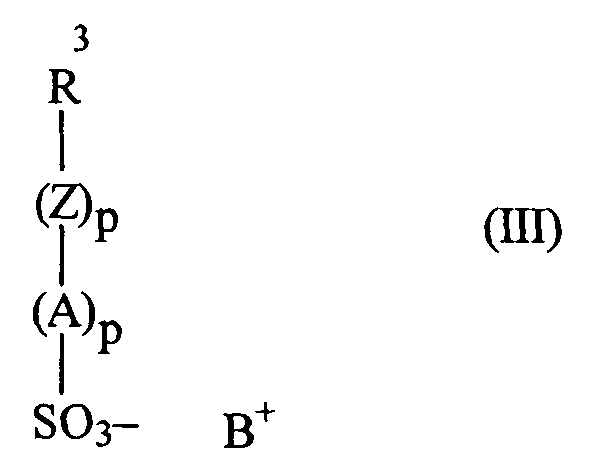
- Preferably, R3 is a C2 to C6 alkene (most preferably ethene or propene). When R3 is ethenyl, Z is preferably amido, A is preferably a divalent butyl group, each p is 1, and B+ is Na+. Such a monomer is polymerized and sold as Acumer 3100 by Rohm & Haas.
- Another preferred embodiment exists when the water soluble polymer is derived from at least one monomer with R3 as 2-methyl-2-propenyl, Z as oxygen, A as phenylene, each p as 1 and B+ as Na+, and at least one monomer with R3 as 2-methyl-2-propenyl, each p as 0 and B+ as Na+. Such monomers are polymerized and sold under the name Alcosperse 240 by Alco Chemical.
- The polymers used may be homopolymers or copolymers, including terpolymers. Furthermore, the polymers may be terminated with conventional termination groups resulting from precursor monomers and/or initiators that are used.
- The water soluble polymers typically have a weight average molecular weight from about 1,000 to about 50,000.
- Further suitable polymers for use in this context are those sulfonated polymers which are described in WO02/04503 (Henkel).
- Further suitable anti-scaling agents are compounds that may be used to reduce carbonate scale formation. These include polyacrylates (and copolymers thereof) having a weight average molecular weight from about 1,000 to about 400,000.
Such compounds are supplied by Rohm and Haas, BASF, and Alco Corp. Preferred copolymers include those derived from acrylic acid and maleic acid monomers like Sokalan CP5 and CP7 supplied by BASF, and Acusol 479N, supplied by Rohm & Haas. Copolymers of acrylic acid and methacrylic acid (Colloid 226/35), as supplied by Rhone-Poulenc, may also be used. - Other materials that may be used to reduce carbonate scale formation include phosphonate functionalized acrylic acid (Casi 773 as supplied by Buckman laboratories); copolymers of maleic acid and vinyl acetate, and terpolymers of maleic acid, acrylic acid and vinyl acetate (made commercially by Huls); polymaleates (like Belclene 200, as supplied by FMC); polymethacrylates, (like Tomal 850, as supplied by Rohm & Haas); polyaspartates; ethylene diamine disuccinate, organopolyphosphonic acids (and salts thereof) such as sodium salts of amino tri(methylenephosphonic acid), diethylene triamine penta (methylene phosphonic acid); hexamethylene diamine tetramethylene phosphonic acid; ethane 1-hydroxy-1,1-diphosphonic acid (HEDP); organomonophosphonic acids (and salts thereof) such as the sodium salt of 2-phosphono-1,2,4-butane tricarboxylic acid, all of which are sold under the DEQUEST line as supplied by Solutia.
- Particularly preferred anti-scaling agents are organic phosphonates such as alpha-hydroxy-2 phenyl ethyl diphosphonate; ethylene diphosphonate; hydroxy 1,1-hexylidene, vinylidene 1,1 diphosphonate; 1,2 dihydroxyethane 1,1 diphosphonate and 1-hydroxy-ethylene 1,1 diphosphonate. Most preferred is 1-hydroxy-ethylene 1,1 diphosphonate (commercially available as DEQUEST 2016 and DEQUEST 2016D, ex Solutia) and 2-phosphono-butane, 1,2,4 tricarboxylic acid (commercially available as BAYHIBIT, ex Bayer).
- Mixtures of anti-scaling agents may be used; particularly useful are a mixture of organic phosphonates and polymers having as monomer units acrylic acid, methyl methacrylic acid, 4-sulfophenyl methylallyl ether or sodium methallyl sulfonate.
- The anti-scaling agent or agents may be combined with other materials such as a suitable thickener or structurant to provide a gel as described above, and/or other dishwashing active ingredients such as nonionic surfactants. The weight ratio of total anti-scaling agent to total nonionic surfactant in such a combination preferably ranges from 1:20 to 3:1, more preferably from 1:10 to 1:2, even more preferably from 1:1 to 1:2.
- Another preferred class of dishwashing active ingredient in the context of this invention are bleaches and bleach activators.
- Suitable bleaches comprise one or more peroxy bleach compounds, for example, inorganic persalts or organic peroxyacids, which may be employed in conjunction with activators to improve bleaching action at low wash temperatures.
- Organic monoperoxy acids include alkyl peroxy acids and aryl peroxyacids such as peroxybenzoic acid and ring-substituted peroxybenzoic acids (e.g. peroxy-alpha-naphthoic acid); aliphatic and substituted aliphatic monoperoxy acids (e.g. peroxylauric acid and peroxystearic acid); and phthaloyl amido peroxy caproic acid (PAP). Organic diperoxy acids include alkyl diperoxy acids and aryldiperoxy acids, such as 1,12-di-peroxy-dodecanedioic acid (DPDA); 1,9-diperoxyazelaic acid, diperoxybrassylic acid, diperoxysebacic acid and diperoxy isophthalic acid; and 2-decyldiperoxybutane-1,4-dioic acid.
- Preferred inorganic persalts are sodium perborate monohydrate and tetrahydrate, and sodium percarbonate, advantageously employed together with an activator. Monopersulphate is a further possibility.
- Chlorine bleaches may also be used. Among suitable reactive chlorine-or bromine-oxidizing materials are heterocyclic N-bromo and N-chloro imides such as trichloroisocyanuric, tribromoisocyanuric, dibromoisocyanuric and dichloroisocyanuric acids, and salts thereof with water-solublising cations such as potassium and sodium. Hydantoin compounds such as 1,3-dichloro-5,5-dimethyl-hydantoin are also quite suitable.
- Particulate, water-soluble anhydrous inorganic salts are likewise suitable for use herein such as lithium, sodium or calcium hypochlorite and hypobromite. Chlorinated trisodium phosphate and chloroisocyanurates are also suitable bleaching materials.
- Suitable bleach activators include (6-nonamidocaproxyl) oxybenzene sulfonate (as described in EP 170,386) N,N,N',N'-tetraacetylethylenediamine, nonanoyloxybenzenesulfonate, cationic nitriles, cholyl(4-sulfophenyl)carbonate, and quaternary imine salts (e.g., N-methyl-3,4-dihydrooisoquinolinium p-toluenesulfonate) and salts of sulfophenyl alkyl carbonates such as sodium p-sulfophenyl octyl carbonate.
- Other bleach activators which may be used include transition metal-containing bleach catalysts such as [MnIV 2(µ-0)3(Me3TACN)2](PF6)2 (as described in U.S. Patent Nos. 4,728,455, 5,114,606, 5,153,161, 5,194,416, 5,227,084, 5,244,594, 5,246,612, 5,246,621, 5,256,779, 5,274,147, 5,280,117), [FeII(MeN4py)(MeCN)](CIO4)2 (as described in EP 0 909 809) and [CoIII (NH3)5(OAc) ] (OAc)2 (as described in U.S. Patent No. 5,559,261, WO 96/23859, WO 96/23860, WO 96/23861).
- Another active ingredient is a builder. Preferred water-softening builders to include in the composition are sodium tripolyphosphate, sodium citrate, sodium carbonate and sodium silicate.
- A chelating agent for metal ions (often referred to as a metal ion sequestrant) may be present in the composition. It can function to stabilise bleach against premature decomposition catalysed by transition metals and/or to inhibit calcium carbonate scale formation.
- Preferred chelating agents include organic phosphonates, amino carboxylates, polyfunctionally-substituted compounds, and mixtures thereof.
- Particularly preferred chelating agents are organic phosphonates such as α-hydroxy-2 phenyl ethyl diphosphonate, ethylene diphosphonate, hydroxy 1,1-hexylidene, vinylidene 1,1 diphosphonate, 1,2 dihydroxyethane 1,1 diphosphonate and hydroxy-ethylene 1,1 diphosphonate. Most preferred is hydroxy-ethylene 1,1 diphosphonate, 2 phosphono-1,2,4 butanetricarboxylic acid or salts thereof.
- Optionally non ionic surfactants are also serving as degreasing and/or anti-spotting agents.
- A perfume may be incorporated as an optional adjunct ingredient in addition to the one or more dishwashing active ingredients in the composition for use in the dispenser of the invention. Given the intended use of the dispenser of the invention, and in particular its residence in the dishwasher over repeated wash cycles, the perfume is preferably relatively substantive to provide the dishwasher with a pleasant aroma after successive washes over a prolonged period. The perfume may be included as a solid (e.g. porous) block, or may otherwise be provided on a substrate such as a plastic or fabric sheet. Examples of such perfume dispensing systems are described in FR2471929 and FR 2492776.
- The invention will now be further described by way of the following non-limiting examples, in which all percentages are by weight based on total weight unless otherwise specified.
- Dispensers in the form of peripherally sealed perforated sachets were prepared containing a variety of dishwashing active ingredients and ingredient compositions. The dispensers were tested on a standard 55°C wash programme in a Miele G6905C automatic dishwasher.
- The dispensers were placed on a flat cutlery rack in the dishwasher. After each wash the weight increase or decrease of the sachet was measured. No dishwashing active ingredients were transferred through the sachet walls themselves; all transfer was through the perforations in the sachets.
- Two types of film were used for making the sachets; the first was NORPOR™ type 13 (ex NORDENIA International AG), polyethylene with circular perforations of 0.08mm diameter and a thickness of 0.15mm (hereinafter designated as "type M polyethylene") and the second was NORPOR™ type 7 (ex NORDENIA International AG), polyethylene with circular perforations of 0.03mm diameter and a thickness of 0.18mm (hereinafter designated as "type L polyethylene"). Both films had a perforation density of 31250 perforations/m2.
- Dishwashing active ingredients and ingredient compositions used were:
- 1) PLURAFAC LF403, (ex BASF)
- 2) POLYTERGENT SLF18B45, (ex BASF)
- 3) SYNPERONIC A3 (ex Uniqema)
- 4) SYNPERONIC A7 (ex Uniqema)
- 5) A blend containing 50% sodium tripolyphosphate, 47.5% PEG6000 and 2.5% DEQUEST 2016, (ex Solutia)
- 6) DEQUEST 2016D, (ex Solutia)
- 7) SOKALAN PA25, (ex BASF)
-
- 35-40g POLYTERGENT SLF18B45 nonionic surfactant was packaged in a perforated sachet made of type L polyethylene having a total surface area of 100-120cm2. The release of the nonionic surfactant from the sachet was steady over multiple dishwashing cycles.
- 6-12g SYNPERONIC A3 nonionic surfactant was packaged in a perforated sachet made of type L polyethylene having a total surface area of 25-50cm2. The release of the nonionic surfactant from the sachet over successive washes was steady over multiple washes, and approximately half of the contents was dispensed after 25 dishwashing cycles.
- In Example 3, a dishwashing active ingredient composition was prepared by making a 5% CARBOPOL (cross-linked polyacrylate, ex BF Goodrich) solution in water and combining this with PLURAFAC LF 403 nonionic surfactant in the ratio 1:1 to provide a gel. 16g of gel was packaged in sachets made from both type L and type M film, each having a surface area of approximately 40cm2. The resulting sachets provided satisfactory dispensing of the nonionic surfactant over successive dishwashing cycles.
- Several KLEENEX (trade mark) wipes of dimensions 21cm x 20cm with a collective weight of 5g were impregnated with 20g of molten POLYTERGENT SLF18B45 nonionic surfactant. The wipes were folded and placed in sachets made from both L and M type polyethylene, the sachets having a surface area of approximately 80cm2. The resulting sachets provided satisfactory dispensing of the nonionic surfactant over successive dishwashing cycles.
- 25g tablets of a blend containing 50% sodium tripolyphosphate, 47.5% PEG6000 and 2.5% DEQUEST 2016, ex Solutia were pressed and packaged in sachets made from both L and M type films. The resulting sachets provided satisfactory dispensing of the dishwashing active ingredients over successive dishwashing cycles.
- 10g of DEQUEST 2016D anti-scaling agent, ex Solutia was packaged into sachets made from both L and M type polyethylene having a surface area of approximately 40cm2. The resulting sachets provided satisfactory dispensing of the anti-scaling agent over successive dishwashing cycles.
- A gelled anti-scaling agent composition was prepared containing 3% CARBOPOL polymer, 30% DEQUEST 2016D and the balance water. 25g of the gel was packaged into sachets made from both the L type and the M type polyethylene having a surface area of 70 to 80cm2. The resulting sachets provided satisfactory dispensing of the anti-scaling agent over successive dishwashing cycles.
- 12g of SOKALAN PA25 anti-scaling agent was packaged in sachets made from both L and M type polyethylene, the sachets having a surface area of 30cm2. The resulting sachets provided satisfactory dispensing of the anti-scaling agent over successive dishwashing cycles.
Claims (7)
- A dispenser for use inside an automatic dishwasher to provide controlled release of one or more dishwashing active ingredients into the dishwasher over multiple dishwashing cycles, the dispenser comprising a perforated flexible polyolefin sheet which is in fluid communication with a composition having one or more dishwashing active ingredients, in which the perforation density of the polyolefin sheet ranges from 1 to 100 perforations/cm2 and in which the perforations individually have an area ranging from 0.0004 to 0.01 mm2.
- A dispenser according to claim 1, in which the controlled release occurs over a period of 2 to 60 dishwashing cycles.
- A dispenser according to claim 1 or claim 2, in which the perforations of the flexible polyolefin sheet have individual areas ranging from 0.0007 mm2 to 0.006 mm2, and a perforation density of from 1 to 10 perforations per cm2 of sheet.
- A dispenser according to any of the preceding claims in which the dishwashing active ingredient is selected from rinse-aids, anti-scaling agents, bleaches and bleach activators, builders, chelating agents, degreasing agents, anti-spotting agents, glass anti-corrosion agents and mixtures thereof.
- A dispenser according to any of the preceding claims, wherein the perforated flexible polyolefin sheet is initially coated with a water-soluble polymer.
- A device for locating in an automatic dishwasher which comprises a number of dispensers according to any of the preceding claims retained in the device.
- A method of providing controlled release of one or more dishwashing active ingredients into the dishwasher over multiple dishwashing cycles, the method comprising the steps of packaging a composition containing the one or more active ingredients into a dispenser according to any one of claims 1 to 5, adding the dispenser to a dishwasher prior to the commencement of a dishwashing cycle, and leaving it in the dishwasher for multiple dishwashing cycles.
Priority Applications (2)
| Application Number | Priority Date | Filing Date | Title |
|---|---|---|---|
| PL04078346T PL1543763T3 (en) | 2003-12-16 | 2004-11-29 | Ingredient dispenser for automatic dishwashers |
| EP04078346A EP1543763B1 (en) | 2003-12-16 | 2004-11-29 | Ingredient dispenser for automatic dishwashers |
Applications Claiming Priority (3)
| Application Number | Priority Date | Filing Date | Title |
|---|---|---|---|
| EP03079096 | 2003-12-16 | ||
| EP03079096 | 2003-12-16 | ||
| EP04078346A EP1543763B1 (en) | 2003-12-16 | 2004-11-29 | Ingredient dispenser for automatic dishwashers |
Publications (2)
| Publication Number | Publication Date |
|---|---|
| EP1543763A1 true EP1543763A1 (en) | 2005-06-22 |
| EP1543763B1 EP1543763B1 (en) | 2012-03-14 |
Family
ID=34524741
Family Applications (1)
| Application Number | Title | Priority Date | Filing Date |
|---|---|---|---|
| EP04078346A Expired - Lifetime EP1543763B1 (en) | 2003-12-16 | 2004-11-29 | Ingredient dispenser for automatic dishwashers |
Country Status (2)
| Country | Link |
|---|---|
| EP (1) | EP1543763B1 (en) |
| PL (1) | PL1543763T3 (en) |
Cited By (9)
| Publication number | Priority date | Publication date | Assignee | Title |
|---|---|---|---|---|
| EP2380478A1 (en) * | 2010-04-23 | 2011-10-26 | The Procter & Gamble Company | Automatic dishwashing product |
| DE102013004367A1 (en) * | 2013-03-12 | 2014-09-18 | Comtag Ag | Additives for water for the treatment of objects |
| WO2015034976A1 (en) * | 2013-09-06 | 2015-03-12 | The Procter & Gamble Company | Pouches comprising apertured film wall materials and methods for making same |
| US10526570B2 (en) | 2013-09-06 | 2020-01-07 | The Procter & Gamble Company | Pouches comprising water-soluble fibrous wall materials and methods for making same |
| WO2021228961A1 (en) * | 2020-05-14 | 2021-11-18 | Reckitt Benckiser Finish B.V. | Solid composition |
| WO2024133097A1 (en) | 2022-12-19 | 2024-06-27 | Reckitt Benckiser Finish B.V. | Liquid rinse aid compositions |
| US12129594B2 (en) | 2017-01-27 | 2024-10-29 | The Procter & Gamble Company | Active agent-containing articles that exhibit consumer acceptable article in-use properties |
| US12139847B2 (en) | 2017-01-27 | 2024-11-12 | The Procter & Gamble Company | Active agent-containing articles and product-shipping assemblies for containing the same |
| US12157970B2 (en) | 2017-01-27 | 2024-12-03 | The Procter & Gamble Company | Active agent-containing articles that exhibit consumer acceptable article in-use properties |
Citations (9)
| Publication number | Priority date | Publication date | Assignee | Title |
|---|---|---|---|---|
| US3272899A (en) * | 1960-12-06 | 1966-09-13 | Hagan Chemicals & Controls Inc | Process for producing a solid rinse block |
| US4014432A (en) * | 1975-04-09 | 1977-03-29 | Lever Brothers Company | Product for treating fabric |
| EP0245760A2 (en) * | 1986-05-14 | 1987-11-19 | Henkel Kommanditgesellschaft auf Aktien | Stock supply of a cleaning agent for use in an industrial dish-washing machine |
| US4776455A (en) * | 1986-03-07 | 1988-10-11 | Lever Brothers Company | Compartmented product for dispensing treatment agents in a washing or dishwashing machine |
| EP0336488A2 (en) * | 1988-04-07 | 1989-10-11 | The Procter & Gamble Company | Pouched through the washer & dryer laundry additive product having at least one wall comprised of finely apertured polymeric film |
| US4969927A (en) * | 1988-05-18 | 1990-11-13 | The Procter & Gamble Company | Process and device for the machine-washing of fabrics with a particulate product |
| US5759501A (en) * | 1995-06-12 | 1998-06-02 | Diversey Lever, Inc. | Flexible walled container for tableted or pelleted ware washing detergents |
| EP1072715A1 (en) * | 1999-07-19 | 2001-01-31 | The Procter & Gamble Company | A dispensing device for a detergent tablet |
| US6523371B1 (en) * | 1998-09-18 | 2003-02-25 | Unilever Home & Personal Care Usa, Division Of Conopco, Inc. | Device for machine washing of clothes |
-
2004
- 2004-11-29 PL PL04078346T patent/PL1543763T3/en unknown
- 2004-11-29 EP EP04078346A patent/EP1543763B1/en not_active Expired - Lifetime
Patent Citations (9)
| Publication number | Priority date | Publication date | Assignee | Title |
|---|---|---|---|---|
| US3272899A (en) * | 1960-12-06 | 1966-09-13 | Hagan Chemicals & Controls Inc | Process for producing a solid rinse block |
| US4014432A (en) * | 1975-04-09 | 1977-03-29 | Lever Brothers Company | Product for treating fabric |
| US4776455A (en) * | 1986-03-07 | 1988-10-11 | Lever Brothers Company | Compartmented product for dispensing treatment agents in a washing or dishwashing machine |
| EP0245760A2 (en) * | 1986-05-14 | 1987-11-19 | Henkel Kommanditgesellschaft auf Aktien | Stock supply of a cleaning agent for use in an industrial dish-washing machine |
| EP0336488A2 (en) * | 1988-04-07 | 1989-10-11 | The Procter & Gamble Company | Pouched through the washer & dryer laundry additive product having at least one wall comprised of finely apertured polymeric film |
| US4969927A (en) * | 1988-05-18 | 1990-11-13 | The Procter & Gamble Company | Process and device for the machine-washing of fabrics with a particulate product |
| US5759501A (en) * | 1995-06-12 | 1998-06-02 | Diversey Lever, Inc. | Flexible walled container for tableted or pelleted ware washing detergents |
| US6523371B1 (en) * | 1998-09-18 | 2003-02-25 | Unilever Home & Personal Care Usa, Division Of Conopco, Inc. | Device for machine washing of clothes |
| EP1072715A1 (en) * | 1999-07-19 | 2001-01-31 | The Procter & Gamble Company | A dispensing device for a detergent tablet |
Cited By (17)
| Publication number | Priority date | Publication date | Assignee | Title |
|---|---|---|---|---|
| US8613891B2 (en) | 2010-04-23 | 2013-12-24 | The Procter & Gamble Company | Automatic dishwashing product |
| EP2380478A1 (en) * | 2010-04-23 | 2011-10-26 | The Procter & Gamble Company | Automatic dishwashing product |
| DE102013004367B4 (en) | 2013-03-12 | 2018-12-27 | Comtag Ag | Disposable container with additive for water for the treatment of objects |
| DE102013004367A1 (en) * | 2013-03-12 | 2014-09-18 | Comtag Ag | Additives for water for the treatment of objects |
| GB2531974B (en) * | 2013-09-06 | 2021-05-26 | Procter & Gamble | Pouches comprising apertured film wall materials and methods for making same |
| GB2531974A (en) * | 2013-09-06 | 2016-05-04 | Procter & Gamble | Pouches comprising apertured film wall materials and methods for making same |
| US10526570B2 (en) | 2013-09-06 | 2020-01-07 | The Procter & Gamble Company | Pouches comprising water-soluble fibrous wall materials and methods for making same |
| US10723983B2 (en) | 2013-09-06 | 2020-07-28 | The Procter & Gamble Company | Pouches comprising apertured film wall materials and methods for making same |
| WO2015034976A1 (en) * | 2013-09-06 | 2015-03-12 | The Procter & Gamble Company | Pouches comprising apertured film wall materials and methods for making same |
| US12234428B2 (en) | 2013-09-06 | 2025-02-25 | The Procter & Gamble Company | Pouches comprising water-soluble fibrous wall materials and methods for making same |
| US12129594B2 (en) | 2017-01-27 | 2024-10-29 | The Procter & Gamble Company | Active agent-containing articles that exhibit consumer acceptable article in-use properties |
| US12139847B2 (en) | 2017-01-27 | 2024-11-12 | The Procter & Gamble Company | Active agent-containing articles and product-shipping assemblies for containing the same |
| US12157970B2 (en) | 2017-01-27 | 2024-12-03 | The Procter & Gamble Company | Active agent-containing articles that exhibit consumer acceptable article in-use properties |
| WO2021228961A1 (en) * | 2020-05-14 | 2021-11-18 | Reckitt Benckiser Finish B.V. | Solid composition |
| CN115551981A (en) * | 2020-05-14 | 2022-12-30 | 雷克特本克斯尔菲尼施公司 | Solid composition |
| US11851632B2 (en) | 2020-05-14 | 2023-12-26 | Reckitt Benckiser Finish B.V. | Solid composition comprising an ethoxylated alcohol with from 30 to 40 ethoxy groups |
| WO2024133097A1 (en) | 2022-12-19 | 2024-06-27 | Reckitt Benckiser Finish B.V. | Liquid rinse aid compositions |
Also Published As
| Publication number | Publication date |
|---|---|
| EP1543763B1 (en) | 2012-03-14 |
| PL1543763T3 (en) | 2012-08-31 |
Similar Documents
| Publication | Publication Date | Title |
|---|---|---|
| US7078462B2 (en) | Cleaning product | |
| US6492312B1 (en) | Water soluble sachet with a dishwashing enhancing particle | |
| EP1478728B1 (en) | Textile articles for washing and cleaning applications | |
| EP3107987B2 (en) | Machine dishwash composition | |
| CN102892942B (en) | Gradual-release dosing device and seal of a domestic-use apparatus | |
| CA2395870C (en) | Composition for use in a dishwasher | |
| WO2009092699A1 (en) | Machine dishwash detergent compositions | |
| EP1591515B1 (en) | Unit dose granulated detergent for cleaning a coffee machine | |
| EP1543763B1 (en) | Ingredient dispenser for automatic dishwashers | |
| RU2533552C2 (en) | Purification with regulated acid release | |
| EP1499775B1 (en) | Cleaning method | |
| PT1543763E (en) | Ingredient dispenser for automatic dishwashers | |
| EP1239026B1 (en) | Detergent tablets | |
| CA2578875C (en) | Cleaning product | |
| WO2007007031A1 (en) | Cleaning article and cleaning method | |
| JPS61197698A (en) | Two-agent type flash toilet bowl cleanser composition | |
| GB2428245A (en) | Reduced mass detergent tablets | |
| GB2428248A (en) | Reduced mass detergent tablets |
Legal Events
| Date | Code | Title | Description |
|---|---|---|---|
| PUAI | Public reference made under article 153(3) epc to a published international application that has entered the european phase |
Free format text: ORIGINAL CODE: 0009012 |
|
| 17P | Request for examination filed |
Effective date: 20050310 |
|
| AK | Designated contracting states |
Kind code of ref document: A1 Designated state(s): AT BE BG CH CY CZ DE DK EE ES FI FR GB GR HU IE IS IT LI LU MC NL PL PT RO SE SI SK TR |
|
| AX | Request for extension of the european patent |
Extension state: AL HR LT LV MK YU |
|
| AKX | Designation fees paid |
Designated state(s): AT BE BG CH CY CZ DE DK EE ES FI FR GB GR HU IE IS IT LI LU MC NL PL PT RO SE SI SK TR |
|
| RAP1 | Party data changed (applicant data changed or rights of an application transferred) |
Owner name: UNILEVER N.V. Owner name: UNILEVER PLC |
|
| RAP1 | Party data changed (applicant data changed or rights of an application transferred) |
Owner name: UNILEVER PLC Owner name: UNILEVER N.V. |
|
| 17Q | First examination report despatched |
Effective date: 20101005 |
|
| GRAP | Despatch of communication of intention to grant a patent |
Free format text: ORIGINAL CODE: EPIDOSNIGR1 |
|
| GRAC | Information related to communication of intention to grant a patent modified |
Free format text: ORIGINAL CODE: EPIDOSCIGR1 |
|
| GRAS | Grant fee paid |
Free format text: ORIGINAL CODE: EPIDOSNIGR3 |
|
| GRAA | (expected) grant |
Free format text: ORIGINAL CODE: 0009210 |
|
| AK | Designated contracting states |
Kind code of ref document: B1 Designated state(s): AT BE BG CH CY CZ DE DK EE ES FI FR GB GR HU IE IS IT LI LU MC NL PL PT RO SE SI SK TR |
|
| REG | Reference to a national code |
Ref country code: GB Ref legal event code: FG4D |
|
| REG | Reference to a national code |
Ref country code: AT Ref legal event code: REF Ref document number: 548961 Country of ref document: AT Kind code of ref document: T Effective date: 20120315 Ref country code: CH Ref legal event code: EP |
|
| REG | Reference to a national code |
Ref country code: IE Ref legal event code: FG4D |
|
| REG | Reference to a national code |
Ref country code: CH Ref legal event code: NV Representative=s name: E. BLUM & CO. AG PATENT- UND MARKENANWAELTE VSP |
|
| REG | Reference to a national code |
Ref country code: DE Ref legal event code: R096 Ref document number: 602004036873 Country of ref document: DE Effective date: 20120510 |
|
| REG | Reference to a national code |
Ref country code: PT Ref legal event code: SC4A Free format text: AVAILABILITY OF NATIONAL TRANSLATION Effective date: 20120430 |
|
| REG | Reference to a national code |
Ref country code: NL Ref legal event code: T3 |
|
| REG | Reference to a national code |
Ref country code: RO Ref legal event code: EPE |
|
| PG25 | Lapsed in a contracting state [announced via postgrant information from national office to epo] |
Ref country code: FI Free format text: LAPSE BECAUSE OF FAILURE TO SUBMIT A TRANSLATION OF THE DESCRIPTION OR TO PAY THE FEE WITHIN THE PRESCRIBED TIME-LIMIT Effective date: 20120314 Ref country code: GR Free format text: LAPSE BECAUSE OF FAILURE TO SUBMIT A TRANSLATION OF THE DESCRIPTION OR TO PAY THE FEE WITHIN THE PRESCRIBED TIME-LIMIT Effective date: 20120615 |
|
| REG | Reference to a national code |
Ref country code: PL Ref legal event code: T3 |
|
| REG | Reference to a national code |
Ref country code: AT Ref legal event code: MK05 Ref document number: 548961 Country of ref document: AT Kind code of ref document: T Effective date: 20120314 |
|
| PG25 | Lapsed in a contracting state [announced via postgrant information from national office to epo] |
Ref country code: CY Free format text: LAPSE BECAUSE OF FAILURE TO SUBMIT A TRANSLATION OF THE DESCRIPTION OR TO PAY THE FEE WITHIN THE PRESCRIBED TIME-LIMIT Effective date: 20120314 |
|
| PG25 | Lapsed in a contracting state [announced via postgrant information from national office to epo] |
Ref country code: SI Free format text: LAPSE BECAUSE OF FAILURE TO SUBMIT A TRANSLATION OF THE DESCRIPTION OR TO PAY THE FEE WITHIN THE PRESCRIBED TIME-LIMIT Effective date: 20120314 Ref country code: CZ Free format text: LAPSE BECAUSE OF FAILURE TO SUBMIT A TRANSLATION OF THE DESCRIPTION OR TO PAY THE FEE WITHIN THE PRESCRIBED TIME-LIMIT Effective date: 20120314 Ref country code: SE Free format text: LAPSE BECAUSE OF FAILURE TO SUBMIT A TRANSLATION OF THE DESCRIPTION OR TO PAY THE FEE WITHIN THE PRESCRIBED TIME-LIMIT Effective date: 20120314 Ref country code: EE Free format text: LAPSE BECAUSE OF FAILURE TO SUBMIT A TRANSLATION OF THE DESCRIPTION OR TO PAY THE FEE WITHIN THE PRESCRIBED TIME-LIMIT Effective date: 20120314 Ref country code: IS Free format text: LAPSE BECAUSE OF FAILURE TO SUBMIT A TRANSLATION OF THE DESCRIPTION OR TO PAY THE FEE WITHIN THE PRESCRIBED TIME-LIMIT Effective date: 20120714 |
|
| PG25 | Lapsed in a contracting state [announced via postgrant information from national office to epo] |
Ref country code: SK Free format text: LAPSE BECAUSE OF FAILURE TO SUBMIT A TRANSLATION OF THE DESCRIPTION OR TO PAY THE FEE WITHIN THE PRESCRIBED TIME-LIMIT Effective date: 20120314 |
|
| PLBE | No opposition filed within time limit |
Free format text: ORIGINAL CODE: 0009261 |
|
| STAA | Information on the status of an ep patent application or granted ep patent |
Free format text: STATUS: NO OPPOSITION FILED WITHIN TIME LIMIT |
|
| PG25 | Lapsed in a contracting state [announced via postgrant information from national office to epo] |
Ref country code: AT Free format text: LAPSE BECAUSE OF FAILURE TO SUBMIT A TRANSLATION OF THE DESCRIPTION OR TO PAY THE FEE WITHIN THE PRESCRIBED TIME-LIMIT Effective date: 20120314 Ref country code: DK Free format text: LAPSE BECAUSE OF FAILURE TO SUBMIT A TRANSLATION OF THE DESCRIPTION OR TO PAY THE FEE WITHIN THE PRESCRIBED TIME-LIMIT Effective date: 20120314 |
|
| 26N | No opposition filed |
Effective date: 20121217 |
|
| REG | Reference to a national code |
Ref country code: DE Ref legal event code: R097 Ref document number: 602004036873 Country of ref document: DE Effective date: 20121217 |
|
| PG25 | Lapsed in a contracting state [announced via postgrant information from national office to epo] |
Ref country code: ES Free format text: LAPSE BECAUSE OF FAILURE TO SUBMIT A TRANSLATION OF THE DESCRIPTION OR TO PAY THE FEE WITHIN THE PRESCRIBED TIME-LIMIT Effective date: 20120625 |
|
| PG25 | Lapsed in a contracting state [announced via postgrant information from national office to epo] |
Ref country code: BG Free format text: LAPSE BECAUSE OF FAILURE TO SUBMIT A TRANSLATION OF THE DESCRIPTION OR TO PAY THE FEE WITHIN THE PRESCRIBED TIME-LIMIT Effective date: 20120614 |
|
| REG | Reference to a national code |
Ref country code: IE Ref legal event code: MM4A |
|
| PG25 | Lapsed in a contracting state [announced via postgrant information from national office to epo] |
Ref country code: IE Free format text: LAPSE BECAUSE OF NON-PAYMENT OF DUE FEES Effective date: 20121129 |
|
| PG25 | Lapsed in a contracting state [announced via postgrant information from national office to epo] |
Ref country code: MC Free format text: LAPSE BECAUSE OF NON-PAYMENT OF DUE FEES Effective date: 20121130 |
|
| PG25 | Lapsed in a contracting state [announced via postgrant information from national office to epo] |
Ref country code: HU Free format text: LAPSE BECAUSE OF FAILURE TO SUBMIT A TRANSLATION OF THE DESCRIPTION OR TO PAY THE FEE WITHIN THE PRESCRIBED TIME-LIMIT Effective date: 20041129 |
|
| REG | Reference to a national code |
Ref country code: FR Ref legal event code: PLFP Year of fee payment: 12 |
|
| REG | Reference to a national code |
Ref country code: FR Ref legal event code: PLFP Year of fee payment: 13 |
|
| PGFP | Annual fee paid to national office [announced via postgrant information from national office to epo] |
Ref country code: CH Payment date: 20161121 Year of fee payment: 13 Ref country code: GB Payment date: 20161122 Year of fee payment: 13 Ref country code: NL Payment date: 20161118 Year of fee payment: 13 Ref country code: DE Payment date: 20161121 Year of fee payment: 13 Ref country code: LU Payment date: 20161121 Year of fee payment: 13 Ref country code: FR Payment date: 20161118 Year of fee payment: 13 |
|
| PGFP | Annual fee paid to national office [announced via postgrant information from national office to epo] |
Ref country code: IT Payment date: 20161123 Year of fee payment: 13 Ref country code: PT Payment date: 20161128 Year of fee payment: 13 Ref country code: BE Payment date: 20161118 Year of fee payment: 13 Ref country code: RO Payment date: 20161027 Year of fee payment: 13 |
|
| PGFP | Annual fee paid to national office [announced via postgrant information from national office to epo] |
Ref country code: TR Payment date: 20161115 Year of fee payment: 13 |
|
| PGFP | Annual fee paid to national office [announced via postgrant information from national office to epo] |
Ref country code: PL Payment date: 20161125 Year of fee payment: 13 |
|
| REG | Reference to a national code |
Ref country code: DE Ref legal event code: R119 Ref document number: 602004036873 Country of ref document: DE |
|
| REG | Reference to a national code |
Ref country code: NL Ref legal event code: MM Effective date: 20171201 |
|
| GBPC | Gb: european patent ceased through non-payment of renewal fee |
Effective date: 20171129 |
|
| PG25 | Lapsed in a contracting state [announced via postgrant information from national office to epo] |
Ref country code: LI Free format text: LAPSE BECAUSE OF NON-PAYMENT OF DUE FEES Effective date: 20171130 Ref country code: CH Free format text: LAPSE BECAUSE OF NON-PAYMENT OF DUE FEES Effective date: 20171130 Ref country code: PT Free format text: LAPSE BECAUSE OF NON-PAYMENT OF DUE FEES Effective date: 20180529 |
|
| PG25 | Lapsed in a contracting state [announced via postgrant information from national office to epo] |
Ref country code: RO Free format text: LAPSE BECAUSE OF NON-PAYMENT OF DUE FEES Effective date: 20171129 Ref country code: LU Free format text: LAPSE BECAUSE OF NON-PAYMENT OF DUE FEES Effective date: 20171129 |
|
| REG | Reference to a national code |
Ref country code: FR Ref legal event code: ST Effective date: 20180731 Ref country code: BE Ref legal event code: MM Effective date: 20171130 |
|
| PG25 | Lapsed in a contracting state [announced via postgrant information from national office to epo] |
Ref country code: FR Free format text: LAPSE BECAUSE OF NON-PAYMENT OF DUE FEES Effective date: 20171130 Ref country code: IT Free format text: LAPSE BECAUSE OF NON-PAYMENT OF DUE FEES Effective date: 20171129 Ref country code: NL Free format text: LAPSE BECAUSE OF NON-PAYMENT OF DUE FEES Effective date: 20171201 Ref country code: DE Free format text: LAPSE BECAUSE OF NON-PAYMENT OF DUE FEES Effective date: 20180602 |
|
| PG25 | Lapsed in a contracting state [announced via postgrant information from national office to epo] |
Ref country code: BE Free format text: LAPSE BECAUSE OF NON-PAYMENT OF DUE FEES Effective date: 20171130 Ref country code: GB Free format text: LAPSE BECAUSE OF NON-PAYMENT OF DUE FEES Effective date: 20171129 |
|
| PG25 | Lapsed in a contracting state [announced via postgrant information from national office to epo] |
Ref country code: PL Free format text: LAPSE BECAUSE OF NON-PAYMENT OF DUE FEES Effective date: 20171129 |
|
| PG25 | Lapsed in a contracting state [announced via postgrant information from national office to epo] |
Ref country code: TR Free format text: LAPSE BECAUSE OF NON-PAYMENT OF DUE FEES Effective date: 20171129 |