EP1542306A1 - Method for testing precursor of secondary cell, its testing instrument, and method for manufacturing secondary cell using the method - Google Patents
Method for testing precursor of secondary cell, its testing instrument, and method for manufacturing secondary cell using the method Download PDFInfo
- Publication number
- EP1542306A1 EP1542306A1 EP03791215A EP03791215A EP1542306A1 EP 1542306 A1 EP1542306 A1 EP 1542306A1 EP 03791215 A EP03791215 A EP 03791215A EP 03791215 A EP03791215 A EP 03791215A EP 1542306 A1 EP1542306 A1 EP 1542306A1
- Authority
- EP
- European Patent Office
- Prior art keywords
- voltage
- secondary battery
- current
- electrodes
- battery precursor
- Prior art date
- Legal status (The legal status is an assumption and is not a legal conclusion. Google has not performed a legal analysis and makes no representation as to the accuracy of the status listed.)
- Withdrawn
Links
Images




Classifications
-
- H—ELECTRICITY
- H01—ELECTRIC ELEMENTS
- H01M—PROCESSES OR MEANS, e.g. BATTERIES, FOR THE DIRECT CONVERSION OF CHEMICAL ENERGY INTO ELECTRICAL ENERGY
- H01M10/00—Secondary cells; Manufacture thereof
- H01M10/42—Methods or arrangements for servicing or maintenance of secondary cells or secondary half-cells
- H01M10/4285—Testing apparatus
-
- H—ELECTRICITY
- H01—ELECTRIC ELEMENTS
- H01M—PROCESSES OR MEANS, e.g. BATTERIES, FOR THE DIRECT CONVERSION OF CHEMICAL ENERGY INTO ELECTRICAL ENERGY
- H01M10/00—Secondary cells; Manufacture thereof
- H01M10/05—Accumulators with non-aqueous electrolyte
- H01M10/058—Construction or manufacture
- H01M10/0587—Construction or manufacture of accumulators having only wound construction elements, i.e. wound positive electrodes, wound negative electrodes and wound separators
-
- G—PHYSICS
- G01—MEASURING; TESTING
- G01R—MEASURING ELECTRIC VARIABLES; MEASURING MAGNETIC VARIABLES
- G01R31/00—Arrangements for testing electric properties; Arrangements for locating electric faults; Arrangements for electrical testing characterised by what is being tested not provided for elsewhere
- G01R31/36—Arrangements for testing, measuring or monitoring the electrical condition of accumulators or electric batteries, e.g. capacity or state of charge [SoC]
-
- H—ELECTRICITY
- H01—ELECTRIC ELEMENTS
- H01M—PROCESSES OR MEANS, e.g. BATTERIES, FOR THE DIRECT CONVERSION OF CHEMICAL ENERGY INTO ELECTRICAL ENERGY
- H01M10/00—Secondary cells; Manufacture thereof
- H01M10/05—Accumulators with non-aqueous electrolyte
- H01M10/052—Li-accumulators
- H01M10/0525—Rocking-chair batteries, i.e. batteries with lithium insertion or intercalation in both electrodes; Lithium-ion batteries
-
- H—ELECTRICITY
- H01—ELECTRIC ELEMENTS
- H01M—PROCESSES OR MEANS, e.g. BATTERIES, FOR THE DIRECT CONVERSION OF CHEMICAL ENERGY INTO ELECTRICAL ENERGY
- H01M10/00—Secondary cells; Manufacture thereof
- H01M10/42—Methods or arrangements for servicing or maintenance of secondary cells or secondary half-cells
- H01M10/44—Methods for charging or discharging
- H01M10/446—Initial charging measures
-
- Y—GENERAL TAGGING OF NEW TECHNOLOGICAL DEVELOPMENTS; GENERAL TAGGING OF CROSS-SECTIONAL TECHNOLOGIES SPANNING OVER SEVERAL SECTIONS OF THE IPC; TECHNICAL SUBJECTS COVERED BY FORMER USPC CROSS-REFERENCE ART COLLECTIONS [XRACs] AND DIGESTS
- Y02—TECHNOLOGIES OR APPLICATIONS FOR MITIGATION OR ADAPTATION AGAINST CLIMATE CHANGE
- Y02E—REDUCTION OF GREENHOUSE GAS [GHG] EMISSIONS, RELATED TO ENERGY GENERATION, TRANSMISSION OR DISTRIBUTION
- Y02E60/00—Enabling technologies; Technologies with a potential or indirect contribution to GHG emissions mitigation
- Y02E60/10—Energy storage using batteries
-
- Y—GENERAL TAGGING OF NEW TECHNOLOGICAL DEVELOPMENTS; GENERAL TAGGING OF CROSS-SECTIONAL TECHNOLOGIES SPANNING OVER SEVERAL SECTIONS OF THE IPC; TECHNICAL SUBJECTS COVERED BY FORMER USPC CROSS-REFERENCE ART COLLECTIONS [XRACs] AND DIGESTS
- Y02—TECHNOLOGIES OR APPLICATIONS FOR MITIGATION OR ADAPTATION AGAINST CLIMATE CHANGE
- Y02P—CLIMATE CHANGE MITIGATION TECHNOLOGIES IN THE PRODUCTION OR PROCESSING OF GOODS
- Y02P70/00—Climate change mitigation technologies in the production process for final industrial or consumer products
- Y02P70/50—Manufacturing or production processes characterised by the final manufactured product
Definitions
- the present invention relates to a method and a device for inspecting a secondary battery precursor, and further to a method for manufacturing a secondary battery.
- the present invention particularly relates to, for example, a non-destructive inspection for detecting a secondary battery precursor with insufficient isolation between electrodes from a plurality of manufactured secondary battery precursors.
- the secondary battery manufacturing process it is required to detect products that are short-circuited between electrodes or products that may become short-circuited in the future.
- the detection is performed with respect to an electrode body including a positive electrode, a negative electrode, and a separator provided between the plates thereof, before an electrolyte solution is injected into a battery case.
- a method of such detection a method of measuring the insulation resistance of the electrode body when a voltage is applied between the positive and negative electrodes is disclosed (see JP 8(1996)-45538 A).
- a method of determining whether a product is non-defective or defective by applying between the positive and negative electrodes a voltage that causes no dielectric breakdown in non-defective products but causes dielectric breakdown in potentially short-circuited products, more specifically a voltage of 100-400 V, is disclosed (see JP 2000-195565 A).
- lithium ion secondary batteries use a separator with a thickness of 25 ⁇ m or less.
- the application of the inspection method disclosed in JP-2000-195565 A itself to such secondary batteries is not suitable.
- an object of the present invention is to provide a new inspection method for inspecting a secondary battery precursor (plate group), a method for manufacturing a secondary battery using the same, and an inspection device used for the inspection.
- a method for inspecting a secondary battery precursor of the present invention is a method for inspecting a secondary battery precursor including a pair of electrodes and a separator disposed between the pair of electrodes, including: applying a constant inspection voltage between the pair of electrodes before an electrolyte solution is injected between the pair of electrodes, and measuring a current flowing due to application of the inspection voltage; and determining the precursor to be defective if a current value exceeding a previously set reference current value is detected within a time period corresponding to a time period between starting of voltage application when a voltage is applied to a normal secondary battery precursor and obtaining of a constant current.
- the inspection can be completed before a constant current is obtained. Therefore, a short-circuited product or a potentially short-circuited product can be detected in a short time.
- the reference current value By setting the reference current value based on a current when a voltage is applied to a normal secondary battery precursor, an accurate inspection can be performed. Further, a plurality of reference current values may be set depending upon time. In this case, the reference current values may be set at intervals of 1 ms or less.
- the normal secondary battery precursor is, for example, a battery having no problem in initial battery characteristics and characteristics after 50 or more cycles of charge and discharge. Further, the reference current value is obtained as a result of averaging 100 charging current waveforms obtained by measuring 100 normal secondary battery precursors.
- a defective product is determined based on the change of a current over time (charging current waveform) when a voltage is applied to a normal secondary battery precursor.
- This inspection method is a method for inspecting a secondary battery precursor including a pair of electrodes and a separator disposed between the pair of electrodes, including: applying an inspection voltage between the pair of electrodes before an electrolyte solution is injected between the pair of electrodes, and measuring a current flowing due to application of the inspection voltage; and determining the precursor to be defective if the current has a value beyond a predetermined allowable range calculated based on a current waveform when a voltage is applied to a normal secondary battery precursor.
- a current supplied to charge a precursor to be measured is measured with reference to the change of a current over time when a non-defective product (normal secondary battery precursor) is charged. Therefore, a short-circuited product and a potentially short-circuited product can be detected accurately in a short time.
- the voltage to be applied may be a constant voltage or a voltage increased at a constant speed.
- a still further inspection method of the present invention is a method for inspecting a secondary battery precursor including a pair of electrodes and a separator disposed between the pair of electrodes, including: applying an inspection current between the pair of electrodes before an electrolyte solution is injected between the pair of electrodes, and measuring a voltage due to application of the inspection current; and determining the precursor to be defective if the voltage has a value beyond a predetermined allowable range calculated based on a voltage waveform when a current is applied to a normal secondary battery precursor.
- the inspection current may be a constant current, while it is not limited thereto.
- the measurement of a current when a voltage is increased at a constant speed, or the measurement of a voltage when a constant current is applied may be performed by measuring its change value with respect to time differential.
- the inspection methods of the present invention can be applied even when the distance between the positive electrode and the negative electrode is approximately 25 ⁇ m or less.
- the inspection voltage may be less than 75 V per 1 ⁇ m thickness of the separator, or less than 35 V per 1 ⁇ m thickness of the separator. Further, in the above-described inspection methods, the inspection voltage may be 420 V or more.
- the secondary battery precursor is a precursor of a lithium secondary battery.
- a method for manufacturing a secondary battery according to the present invention includes: manufacturing a secondary battery precursor including a pair of electrodes and a separator disposed between the pair of electrodes; and inspecting the secondary battery precursor by the above-described inspection methods of the present invention.
- An inspection device of the present invention is a device for inspecting a secondary battery precursor including a pair or electrodes, and a separator disposed between the pair of electrodes, including: voltage application means for applying a voltage between the pair of electrodes; current measurement means for measuring a current flowing due to application of the voltage; storage means for storing a reference current value set based on a current when a voltage is applied to a normal secondary battery precursor; and arithmetic operation means for performing a predetermined arithmetic operation using the reference current value stored in the storage means and a value of the current measured by the current measurement means, so as to determine whether the secondary battery precursor is defective or not.
- Another inspection device of the present invention is a device for inspecting a secondary battery precursor including a pair or electrodes, and a separator disposed between the pair of electrodes, including: current application means for applying a current between the pair of electrodes; voltage measurement means for measuring a voltage generated due to application of the current; storage means for storing a reference voltage value set based on a voltage when a current is applied to a normal secondary battery precursor; and arithmetic operation means for performing a predetermined arithmetic operation using the reference voltage value stored in the storage means and a value of the voltage measured by the voltage measurement means, so as to determine whether the secondary battery precursor is defective or not.
- the reference voltage value is obtained as a result of averaging 100 voltage waveforms obtained by measuring 100 normal secondary battery precursors.
- the "secondary battery precursor" is used as a term indicating an uncompleted secondary battery including at least a pair of electrodes and a separator, such as a semifinished product referred to as an electrode body.
- the secondary battery precursor may include or may not include a battery case.
- an internally short-circuited secondary battery precursor and a secondary battery precursor that may become short-circuited internally after a battery is configured can be screened effectively in a short time. According to the present invention, even when the secondary battery precursor has a thin separator, a short-circuited product and a potentially short-circuited product can be eliminated from a production line effectively.
- Embodiment 1 an inspection method and an inspection device of the present invention will be described.
- a foreign object is present between electrodes, or a separator is defective, an insulation distance between the positive and negative electrodes is reduced substantially.
- a discharge phenomenon (surface discharge) is likely to occur parallel to a surface of the separator as a porous material.
- the surface discharge can be detected even if the distance between the positive and negative electrodes is extremely short.
- the surface discharge phenomenon includes a partial discharge phenomenon caused locally in the separator, and an arc discharge phenomenon caused between the positive and negative electrodes.
- the inspection method is a method for inspecting a secondary battery precursor (plate group) including at least a pair of electrodes (positive and negative electrodes), and a separator disposed between the pair of electrodes.
- a constant inspection voltage is applied between the pair of electrodes before an electrolyte solution is injected between the pair of electrodes, and a current flowing due to the application of the inspection voltage is measured. Then, the precursor is determined to be defective if a current value exceeding a previously set reference current value is detected within a time period corresponding to a time period between starting of voltage application when a voltage is applied to a normal secondary battery precursor and obtaining of a constant current.
- a voltage When a voltage is applied to an electrode body in which the positive and negative electrodes are not short-circuited, the positive and negative electrodes are charged electrically, and a current flows. However, after a sufficient electrical charge, the flowing current converges on a minute constant current.
- a time period between starting of the application and obtaining of the constant current is approximately 5-60 milliseconds, for example.
- the inspection when a voltage is applied to a normal secondary battery precursor, the inspection can be completed within the time period before the constant current is obtained. This is because an abnormal current due to a surface discharge, which is characteristic in a short-circuited or potentially short-circuited product is observed in a time period during which a charge is given between the pair of electrodes.
- the inspection method allowing a short-time inspection is introduced to a mass production process advantageously.
- the reference current value can be set based on a current when a voltage is applied to a normal secondary battery precursor. It is preferable that a plurality of reference current values are set depending upon time. By setting a plurality of reference current values that differ depending upon time based on a charging current waveform when the voltage is applied to the normal secondary battery precursor, the accuracy of the inspection can be improved. It is preferable that the reference current value is set to be higher than the current waveform measured with respect to the normal precursor by a predetermined rate or value. In order to improve the accuracy of the inspection further, the reference current values may be set intermittently or continuously at intervals of 1 millisecond or less (e.g., 50-500 microseconds).
- a second inspection method of the present invention an inspection voltage is applied between the pair of electrodes before an electrolyte solution is injected between the pair of electrodes, and a current flowing due to the application of the inspection voltage is measured. Then, the precursor is determined to be defective if the measured current has a value beyond a predetermined allowable range calculated based on a current waveform (reference waveform) when a voltage is applied to a normal secondary battery precursor.
- the allowable range may be set as appropriate, it actually may be set so that the upper limit value thereof corresponds to the trajectory of a waveform that is 5-20% higher than the reference waveform. Also in this case, in order to improve the accuracy of the inspection, an interval of current measurement may be set as short as the above-described intervals. Further, in the second method, a constant voltage or a voltage increased at a constant speed may be used as the inspection voltage.
- an inspection current is applied between the pair of electrodes before an electrolyte solution is injected between the pair of electrodes, and a voltage due to the application of the inspection current is measured. Then, the precursor is determined to be defective if the measured voltage has a value beyond a predetermined allowable range calculated based on a voltage waveform when a current is applied to a normal secondary battery precursor.
- the inspection current may be a constant current.
- the voltage to be applied in order to realize a nondestructive inspection, may be less than 75 V, preferably 62.5 V or less, per 1 ⁇ m thickness of the separator.
- the voltage is 62.5 V or less, an arc discharge phenomenon in a non-defective product does not occur, whereby the possibility of damaging a product during the inspection can be prevented.
- the voltage to be applied when the separator has a thickness of 20 ⁇ m, the voltage to be applied is less than 1500 V, preferably 1250 V or less in particular.
- the voltage to be applied may be set less than 35 V per 1 ⁇ m thickness of the separator.
- the above-described value of the voltage to be applied indicates a maximum value, which should correspond to a set voltage value in the case of an inspection performed by the application of a constant voltage, or a voltage value obtained when the voltage application is finished in the case of an inspection with a voltage increased at a constant speed.
- the present invention achieves a remarkable effect when the separator has a thickness of 25 ⁇ m or less, while it is not limited particularly thereto.
- a kind of the secondary battery precursor to be applied is not limited, a precursor of a lithium ion secondary battery with a thin separator may be applied easily.
- a voltage of 20 V or more per 1 ⁇ m thickness of the separator is preferable.
- a voltage of 420 V or more is preferable.
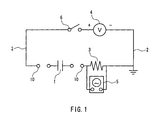
- an inspection device as schematically shown in Figure 1 may be used, for example.
- the inspection device includes a conductor 2, a resistance 3, a power source 4, an oscilloscope 5, a switch 6, and terminals 10.
- the two terminals 10 are connected with a pair of electrodes of a secondary battery precursor 1 to which an electrolyte solution is not injected yet.
- the power source 4 serves as voltage application means for applying a voltage to the pair of electrodes of the secondary battery precursor 1 via the conductor 2.
- the oscilloscope 5 is connected in parallel with the resistance 3, so as to convert a voltage at both ends of the resistance 3 to a current value.
- the oscilloscope 5 serves as current measurement means for measuring a current flowing due to the application of the voltage.
- the oscilloscope 5 one that is provided with a memory and an arithmetic processing unit may be used as the oscilloscope 5, one that is provided with a memory and an arithmetic processing unit may be used.
- the memory stores a reference current value set based on a current when a voltage is applied to a normal secondary battery precursor.
- the arithmetic processing unit performs a predetermined arithmetic operation using the reference current value stored in the memory and the measured current value, thereby determining whether the secondary battery precursor 1 is defective or non-defective.
- the memory and the arithmetic processing unit may be provided separately from the oscilloscope 5, for which a computer may be used, for example.
- the power source 4 serves as means for applying a predetermined current.
- the oscilloscope serves as means for measuring a voltage generated due to the application of the current.
- the memory stores a reference voltage value set based on a voltage when a current is applied to a normal secondary battery precursor.
- the arithmetic processing unit performs a predetermined arithmetic operation using the reference voltage value stored in the storage means and the voltage value measured by the voltage measurement means, thereby determining whether the precursor is defective or not.
- the two terminals 10 are connected electrically to the pair of electrodes of the secondary battery precursor 1, respectively. It does not matter which of the two terminals 10 is connected to a positive electrode of the secondary battery precursor 1.
- the switch 6 When the switch 6 is closed in the state where a voltage is applied from the power source 4, an abnormal waveform may be generated in consequence of chattering caused when the switch 6 comes into contact with the conductor 2.
- the application of the voltage may be started after the switch 6 is turned on.
- the switch 6 may be opened after the application of the voltage is finished.
- the oscilloscope 5 As the oscilloscope 5 as the current measurement means, one that has the function of previously storing a normal charging current waveform as a reference waveform may be used.
- the oscilloscope 5 converts a voltage at the both ends of the resistance 3 to a current value at predetermined time intervals, to draw a charging current waveform corresponding to the reference waveform, and performs a predetermined arithmetic operation on the charging current waveform based on the reference waveform. For example, the oscilloscope 5 calculates the difference between the measured current value and a current value on the reference waveform. Then, the oscilloscope 5 determines whether or not the calculation result is within a predetermined allowable range, and preferably outputs the result of the determination.
- the first waveform is a waveform of a non-defective product as exemplified in Figure 2. As shown in Figure 2, on this waveform, a peak appears immediately after the application of the voltage due to an inrush current to the secondary battery precursor, and thereafter, the current decreases with time.
- the second waveform is a waveform of an internally short-circuited product as exemplified in Figure 3. As shown in Figure 3, a peak due to the inrush current is not observed on this waveform, and a large current flows continuously from the start of the voltage application until the end of the measurement.
- the third waveform is a waveform of a potentially short-circuited product that may become short-circuited internally in the future.
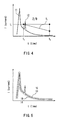
- a peak 11 due to the inrush current exists, and thereafter, the current decreases as on the waveform of the non-defective product.
- a discharge phenomenon due to a surface discharge which is not seen on the waveform of the normal product, is observed after the peak 11 due to the inrush current. In many cases, this discharge (electric leakage) occurs temporarily, and the current converges on the same value as that of the non-defective product again.
- the abnormal waveform suggesting a defect in an internal structure often appears on the waveform as a peak 12 smaller than the peak 11 due to the inrush current.
- a secondary battery precursor that may become short-circuited internally can be detected as well as a secondary battery precursor that already is short-circuited internally.
- the secondary battery precursor that may become short-circuited internally in the future may show the same behavior as that of the non-defective secondary battery precursor after a certain period of elapsed time (e.g., after T 2 in Figure 4).
- the potentially defective product cannot be detected by a conventional method of measuring a resistance value after the certain period of elapsed time.
- the method of the present invention allows detection of the potentially defective product by observing a surface discharge within a predetermined period of time.
- the reference waveform is set based on charging current waveforms obtained from at least 100 non-defective products.
- An average waveform of the charging current waveforms may be adopted as the reference waveform.
- the reference waveform for defining the upper limit value may be defined based on the maximum waveform, and the reference waveform for determining the lower limit value may be defined based on the minimum waveform. Then, the reference current value (upper limit value in the allowable range) is calculated from a current value on the reference waveform based on a predetermined relational expression.
- the upper limit value in the allowable range may be a value higher than the current value on the reference waveform by a predetermined rate or amount (e.g., a value higher than the average value of the normal waveforms by a value twice to ten times as high as the difference between the maximum value thereof and the average value).
- Figure 5 shows an exemplary relationship between the reference waveform and a reference current value 13.
- a reference value 14 also is set below the reference waveform based on the reference waveform.
- An abnormally low current value is obtained due to poor electrical contact between the terminals of the inspection device and an electrode body, for example.
- the reference current value (upper limit value) higher than the current and the reference value (lower limit value) lower than the current are set.
- the precursor is determined to be a defective product
- the precursor is determined to be a product to be inspected again or a defective product.
- the reference value determining the lower limit of the current value may be a value lower than the current value on the reference waveform by a predetermined rate or amount (e.g., a value lower than the average value of the normal waveforms by a value twice to ten times as high as the difference between the minimum value thereof and the average value).
- the value for comparison is set based on the charging current waveform obtained from a non-defective product.
- the predetermined value (I 1 ) it is possible to determine that the abnormal current is detected when a current value exceeding a previously set predetermined value (I 1 ) is measured in a predetermined time period (T 2 - T 1 ) between starting of the application of the voltage and obtaining of a constant current value.
- a value (I T ) set as a function of time may be used as the reference value.
- this inspection method has a lower accuracy than that of the method using the charging current waveform, it can be performed easily when the charging current waveform of the non-defective product can be estimated.
- the first waveform is a waveform of a non-defective product as exemplified in Figure 6. As shown in Figure 6, on this waveform, a behavior due to an increase in current is observed immediately after the application of the voltage, and while the voltage is increased, a constant current is observed continuously until the application of the voltage is finished.
- the second waveform is a waveform of an internally short-circuited product as exemplified in Figure 7. As shown in Figure 7, in this case, a large current flows continuously from the start of the voltage application until the end of the measurement.
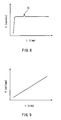
- the third waveform is a waveform of a potentially short-circuited product that may become short-circuited internally in the future as exemplified in Figure 8.
- an increase in current is observed immediately after the start of the voltage application as on the waveform of the non-defective product.
- a discharge phenomenon due to a surface discharge, which is not seen on the waveform of the normal product, is observed while the constant current flows.
- this discharge occurs temporarily, and the current converges on the same value as that of the non-defective product again.
- a secondary battery precursor that may become short-circuited internally can be detected as well as an internally short-circuited secondary battery precursor.
- the reference waveform is set based on charging current waveforms obtained from at least 100 non-defective products. An average waveform of the charging current waveforms may be adopted as the reference waveform. Further, the reference waveform for defining the upper limit value may be defined based on the maximum waveform, and the reference waveform for determining the lower limit value may be defined based on the minimum waveform. Then, the reference current value (upper limit value in the allowable range) is calculated from a current value on the reference waveform based on a predetermined relational expression.
- the reference current value may be a value higher than the current value on the reference waveform by a predetermined rate or amount (e.g., a value higher than the average value of the normal waveforms by a value twice to ten times as high as the difference between the maximum value thereof and the average value).
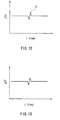
- Figure 9 shows an exemplary voltage waveform observed with respect to a non-defective electrode body.
- Figure 10 shows an exemplary voltage waveform observed with respect to an internally short-circuited electrode body.
- Figure 11 shows an exemplary voltage waveform observed with respect to an electrode body that may become short-circuited internally in the future. With respect to the potentially short-circuited product, a temporary voltage drop 16 as shown in Figure 11 is observed. Therefore, the method of monitoring the voltage waveform has the same effect as that of the method of monitoring the current waveform.
- a voltage is increased at a constant speed, or a charge is performed with a constant current.
- a voltage or a current with a complex pattern may be applied.
- the detection of a defective product can be performed similarly to the above-described method as long as the reference waveform can be determined and the allowable range thereof can be set.
- Embodiment 2 a description will be given of an exemplary method for manufacturing a secondary battery of the present invention.
- the secondary battery to be manufactured in the present invention is, for example, a nickel metal hydride battery, a lithium ion secondary battery, and the like.
- a lithium ion secondary battery with a thin separator e.g., 25 ⁇ m or less is particularly suitable.
- the manufacturing method of the present invention is characterized in that a secondary battery precursor before being brought into contact with an electrolyte solution is inspected by the inspection method of the present invention.
- Other manufacturing processes may be realized by well-known manufacturing methods.
- components of the battery may be formed with well-known components.
- an exemplary manufacture of a lithium ion secondary battery will be described.
- a secondary battery precursor including a pair of electrodes and a separator disposed between the pair of electrodes is manufactured.
- the secondary battery precursor can be formed by winding the positive electrode and the negative electrode with the separator sandwiched therebetween. Further, the secondary battery precursor also can be formed by alternately laminating a plurality of positive electrodes and negative electrodes with the separators sandwiched therebetween.
- the positive electrode, the negative electrode, and the separator may be formed with a well-known positive electrode, negative electrode, and separator, respectively. When the separator has a thickness of 25 ⁇ m or less, the effect of the present invention is particularly remarkable.
- the secondary battery precursor is inspected by the inspection method of Embodiment 1 so that a defective product is detected. This inspection may be performed before the secondary battery precursor is brought into contact with an electrolyte solution.
- a secondary battery precursor determined to be non-defective by the inspection is disposed in a battery case with a non-aqueous electrolyte solution. Then, the battery case is sealed. In this manner, the lithium ion secondary battery is manufactured. Further, the secondary battery precursor may be inspected after the secondary battery precursor is contained in the battery case before the electrolyte solution is injected into the battery case.
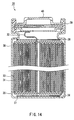
- FIG 14 is a diagram schematically showing a cross section of an exemplary lithium ion secondary battery to be manufactured by the above-described method.
- a lithium ion secondary battery 30 includes a positive electrode 31, a positive electrode lead 32, a negative electrode 33, a negative electrode lead 34, a separator 35, an upper insulating plate 36, a lower insulating plate 37, a battery case 38, an insulating gasket 39, a cover 40, and a non-aqueous electrolyte solution (not shown) sealed in the battery case 38.
- the positive electrode 31 and the negative electrode 33 are wound spirally with the separator 35 disposed therebetween, whereby a plate group (battery element) is configured.
- the plate group is contained in the battery case 38.
- the positive electrode 31 is connected with the positive electrode lead 32, which electrically connects the cover 40 serving also as a positive electrode terminal and the positive electrode 31.
- the negative electrode 33 is connected with the negative electrode lead 34.
- the negative electrode lead 34 electrically connects the battery case 38 serving also as a negative electrode terminal and the negative electrode 33.
- the battery case 38 is sealed with the insulating gasket 39 and the cover 40. Both the positive electrode 31 and the negative electrode 33 are plates that reversibly occlude and release lithium.
- the components of the lithium ion secondary battery 30 may be formed with conventionally used or proposed components.
- a positive active material a complex oxide (e.g., LiCoO 2 ) containing lithium can be used.
- a carbon material or an alloy material that occludes and releases lithium can be used, for example.
- a non-aqueous electrolyte solution an electrolyte solution obtained by dissolving a lithium salt in a non-aqueous solvent (e.g., ethylene carbonate or ethyl methyl carbonate) can be used.
- a non-aqueous solvent e.g., ethylene carbonate or ethyl methyl carbonate
- a secondary battery with high reliability can be manufactured in a highly productive manner.
- the battery described in Embodiment 2 is an exemplary battery to be manufactured by the method of the present invention, and the present invention is not limited thereto.
- an electrode body of a secondary battery (secondary battery precursor) was produced.
- a positive plate 51 was produced by applying a paste containing lithium cobaltate (main component) and acetylene black to both surfaces of an aluminum foil. At this time, a collector lead was welded to a part of the aluminum foil instead of applying the paste thereto.
- a negative plate 52 was produced by applying a paste containing graphite as a main component to both surfaces of a copper foil. At this time, a collector lead was welded to a part of the copper foil instead of applying the paste thereto.
- FIG. 13 schematically shows the structure of the electrode body. While the structure shown in Figure 13 differs from an actual structure, the positive plate 51 and the negative plate 52 are opposed to each other with the separator 53 sandwiched therebetween.
- a non-defective electrode body was produced.
- three kinds of defective electrode bodies were produced intentionally.
- One electrode body was produced using a separator cut for 5 mm.
- Another electrode body was produced by allowing 5 grains of stainless steel (SUS) abrasive powder, each having a grain diameter of 45 ⁇ m or more and less than 75 ⁇ m, to be mixed between the positive plate 51 and the separator 53.
- Still another electrode body was produced by allowing 5 grains of stainless steel abrasive powder, each having a grain diameter of 45 ⁇ m or more and less than 75 ⁇ m, to be mixed between the negative plate 52 and the separator 53.
- SUS stainless steel
- the number of these four kinds of electrode bodies produced was 100 each. Then, a charging current waveform was measured with respect to each of the four kinds of electrode bodies using an inspection device having the same circuit as shown in Figure 1. A resistance of 100 k ⁇ was used as the resistance 3, and TS-4262 produced by IWATSU was used as the oscilloscope 5. A DC voltage outputted from the power source was 250 V, 500 V, 750 V, 1000 V, 1250 V, or 1500V. A time period during which the voltage was applied, i.e., a time period for which the charging current waveform was monitored for determination as to whether the electrode body was defective was 0.5 second, and an interval of the measurement was 50 ⁇ s. If the electrode body is normal and non-defective, charging is completed and an almost constant current is measured in 0.5 second at the latest even with any of the above-described voltages applied.
- the reference waveform was set individually with respect to each voltage value. However, when a voltage of 1500 V was applied, an abnormal waveform due to an arc discharge was observed also with respect to the non-defective products (normal products), whereby the reference waveform was not set. An electrode body with respect to which a current value beyond the allowable range was measured even once within 0.5 second of measurement was determined to be defective, and an electrode body with respect to which no abnormal current value was measured was determined to be non-defective. The inspection was performed at a temperature 30°C lower than the dew point. The result of the inspection is shown in Table 1.
- the present invention can be applied to a method and a device for inspecting a precursor (plate group) of a secondary battery, and a method for manufacturing the secondary battery.
Landscapes
- Engineering & Computer Science (AREA)
- Manufacturing & Machinery (AREA)
- Chemical & Material Sciences (AREA)
- Chemical Kinetics & Catalysis (AREA)
- Electrochemistry (AREA)
- General Chemical & Material Sciences (AREA)
- Secondary Cells (AREA)
- Physics & Mathematics (AREA)
- General Physics & Mathematics (AREA)
- Fuel Cell (AREA)
- Tests Of Electric Status Of Batteries (AREA)
Abstract
(57) Abstract: A method for testing a precursor of a secondary
cell with high reliability and high efficiency to
judge the precursor to be acceptable or defective. The
current flowing when a test voltage is applied between
a pair of electrodes is measured before an electrolyte is
placed between the electrodes. If a current the current
value of which exceeds a predetermined reference current
value (13) is detected during the time from the start
of application of a voltage to a normal secondary cell precursor
until the current becomes constant, the precursor
is determined to be defective.
Description
The present invention relates to a method and a device for inspecting
a secondary battery precursor, and further to a method for manufacturing a
secondary battery. The present invention particularly relates to, for example,
a non-destructive inspection for detecting a secondary battery precursor with
insufficient isolation between electrodes from a plurality of manufactured
secondary battery precursors.
In the secondary battery manufacturing process, it is required to
detect products that are short-circuited between electrodes or products that
may become short-circuited in the future. The detection is performed with
respect to an electrode body including a positive electrode, a negative
electrode, and a separator provided between the plates thereof, before an
electrolyte solution is injected into a battery case. As a method of such
detection, a method of measuring the insulation resistance of the electrode
body when a voltage is applied between the positive and negative electrodes
is disclosed (see JP 8(1996)-45538 A). Further, a method of determining
whether a product is non-defective or defective by applying between the
positive and negative electrodes a voltage that causes no dielectric breakdown
in non-defective products but causes dielectric breakdown in potentially
short-circuited products, more specifically a voltage of 100-400 V, is disclosed
(see JP 2000-195565 A).
In the inspection method disclosed in JP 8(1996)-45538 A, it is
impossible to determine whether insulation is sufficient or not unless the
insulation resistance after a certain period of elapsed time is measured.
This is because the electrode body has a low resistance due to the flow of an
inrush current immediately after the application of the voltage. Further, in
this method, since the insulation resistance is merely measured, it may be
impossible to detect an electrode body that may become short-circuited in the
future in which, although the positive electrode and the negative electrode
are not in contact with each other, they are in close proximity to each other
due to a defect of the separator or the like.
In the inspection method disclosed in JP-2000-195565 A, air
discharge is used (see paragraph [0009], for example). In air discharge in an
atmospheric pressure environment, when the distance between the electrodes
is 25 µm or more, a discharging start voltage decreases with decreasing
distance. However, when the discharge distance is shorter than 25 µm, a
withstand voltage increases conversely, and discharge is not started until a
higher voltage is achieved (e.g., see The Institute of Electrical Engineers of
Japan, "Revised New Edition of Discharge Handbook", Ohmsha, Ltd.,
published on February 15, 1974, page 134). On this account, in the case
where a foreign object is present between the positive and negative electrodes,
so that a substantial insulation distance between the plates is approximately
25 µm or less, it is difficult to detect potentially short-circuited products even
though a short circuit is likely to occur after injection of an electrolyte
solution.
In recent years, lithium ion secondary batteries use a separator with
a thickness of 25 µm or less. The application of the inspection method
disclosed in JP-2000-195565 A itself to such secondary batteries is not
suitable.
In view of such a situation, an object of the present invention is to
provide a new inspection method for inspecting a secondary battery precursor
(plate group), a method for manufacturing a secondary battery using the
same, and an inspection device used for the inspection.
A method for inspecting a secondary battery precursor of the present
invention is a method for inspecting a secondary battery precursor including
a pair of electrodes and a separator disposed between the pair of electrodes,
including: applying a constant inspection voltage between the pair of
electrodes before an electrolyte solution is injected between the pair of
electrodes, and measuring a current flowing due to application of the
inspection voltage; and determining the precursor to be defective if a current
value exceeding a previously set reference current value is detected within a
time period corresponding to a time period between starting of voltage
application when a voltage is applied to a normal secondary battery precursor
and obtaining of a constant current. According to this inspection method,
the inspection can be completed before a constant current is obtained.
Therefore, a short-circuited product or a potentially short-circuited product
can be detected in a short time.
By setting the reference current value based on a current when a
voltage is applied to a normal secondary battery precursor, an accurate
inspection can be performed. Further, a plurality of reference current values
may be set depending upon time. In this case, the reference current values
may be set at intervals of 1 ms or less.
In the description, the normal secondary battery precursor is, for
example, a battery having no problem in initial battery characteristics and
characteristics after 50 or more cycles of charge and discharge. Further, the
reference current value is obtained as a result of averaging 100 charging
current waveforms obtained by measuring 100 normal secondary battery
precursors.
According to another inspection method of the present invention, a
defective product is determined based on the change of a current over time
(charging current waveform) when a voltage is applied to a normal secondary
battery precursor. This inspection method is a method for inspecting a
secondary battery precursor including a pair of electrodes and a separator
disposed between the pair of electrodes, including: applying an inspection
voltage between the pair of electrodes before an electrolyte solution is injected
between the pair of electrodes, and measuring a current flowing due to
application of the inspection voltage; and determining the precursor to be
defective if the current has a value beyond a predetermined allowable range
calculated based on a current waveform when a voltage is applied to a normal
secondary battery precursor. According to this inspection method, a current
supplied to charge a precursor to be measured is measured with reference to
the change of a current over time when a non-defective product (normal
secondary battery precursor) is charged. Therefore, a short-circuited
product and a potentially short-circuited product can be detected accurately
in a short time. The voltage to be applied may be a constant voltage or a
voltage increased at a constant speed.
A still further inspection method of the present invention is a method
for inspecting a secondary battery precursor including a pair of electrodes and
a separator disposed between the pair of electrodes, including: applying an
inspection current between the pair of electrodes before an electrolyte
solution is injected between the pair of electrodes, and measuring a voltage
due to application of the inspection current; and determining the precursor to
be defective if the voltage has a value beyond a predetermined allowable
range calculated based on a voltage waveform when a current is applied to a
normal secondary battery precursor. This method also has the same effect
as achieved by the above-described methods. The inspection current may be
a constant current, while it is not limited thereto.
The measurement of a current when a voltage is increased at a
constant speed, or the measurement of a voltage when a constant current is
applied may be performed by measuring its change value with respect to time
differential. By using this method, the level of resolution in the
measurement is improved, and a highly accurate inspection can be
performed.
The inspection methods of the present invention can be applied even
when the distance between the positive electrode and the negative electrode
is approximately 25 µm or less.
In the above-described inspection methods, the inspection voltage
may be less than 75 V per 1 µm thickness of the separator, or less than 35 V
per 1 µm thickness of the separator. Further, in the above-described
inspection methods, the inspection voltage may be 420 V or more.
In the above-described inspection methods, the secondary battery
precursor is a precursor of a lithium secondary battery.
A method for manufacturing a secondary battery according to the
present invention includes: manufacturing a secondary battery precursor
including a pair of electrodes and a separator disposed between the pair of
electrodes; and inspecting the secondary battery precursor by the
above-described inspection methods of the present invention.
An inspection device of the present invention is a device for inspecting
a secondary battery precursor including a pair or electrodes, and a separator
disposed between the pair of electrodes, including: voltage application means
for applying a voltage between the pair of electrodes; current measurement
means for measuring a current flowing due to application of the voltage;
storage means for storing a reference current value set based on a current
when a voltage is applied to a normal secondary battery precursor; and
arithmetic operation means for performing a predetermined arithmetic
operation using the reference current value stored in the storage means and a
value of the current measured by the current measurement means, so as to
determine whether the secondary battery precursor is defective or not.
Another inspection device of the present invention is a device for
inspecting a secondary battery precursor including a pair or electrodes, and a
separator disposed between the pair of electrodes, including: current
application means for applying a current between the pair of electrodes;
voltage measurement means for measuring a voltage generated due to
application of the current; storage means for storing a reference voltage value
set based on a voltage when a current is applied to a normal secondary
battery precursor; and arithmetic operation means for performing a
predetermined arithmetic operation using the reference voltage value stored
in the storage means and a value of the voltage measured by the voltage
measurement means, so as to determine whether the secondary battery
precursor is defective or not. Herein, the reference voltage value is obtained
as a result of averaging 100 voltage waveforms obtained by measuring 100
normal secondary battery precursors.
In the description, the "secondary battery precursor" is used as a term
indicating an uncompleted secondary battery including at least a pair of
electrodes and a separator, such as a semifinished product referred to as an
electrode body. The secondary battery precursor may include or may not
include a battery case.
According to the present invention, an internally short-circuited
secondary battery precursor and a secondary battery precursor that may
become short-circuited internally after a battery is configured can be screened
effectively in a short time. According to the present invention, even when
the secondary battery precursor has a thin separator, a short-circuited
product and a potentially short-circuited product can be eliminated from a
production line effectively.
Hereinafter, embodiments of the present invention will be described
with reference to the drawings.
In Embodiment 1, an inspection method and an inspection device of
the present invention will be described.
If a foreign object is present between electrodes, or a separator is
defective, an insulation distance between the positive and negative electrodes
is reduced substantially. In this case, when an electrode body is charged, a
discharge phenomenon (surface discharge) is likely to occur parallel to a
surface of the separator as a porous material. By using the inspection
method of the present invention, a current due to such a surface discharge
can be detected. The surface discharge can be detected even if the distance
between the positive and negative electrodes is extremely short. The surface
discharge phenomenon includes a partial discharge phenomenon caused
locally in the separator, and an arc discharge phenomenon caused between
the positive and negative electrodes.
Hereinafter, the inspection method of the present invention will be
described. The inspection method is a method for inspecting a secondary
battery precursor (plate group) including at least a pair of electrodes (positive
and negative electrodes), and a separator disposed between the pair of
electrodes.
In a first inspection method of the present invention, a constant
inspection voltage is applied between the pair of electrodes before an
electrolyte solution is injected between the pair of electrodes, and a current
flowing due to the application of the inspection voltage is measured. Then,
the precursor is determined to be defective if a current value exceeding a
previously set reference current value is detected within a time period
corresponding to a time period between starting of voltage application when a
voltage is applied to a normal secondary battery precursor and obtaining of a
constant current.
When a voltage is applied to an electrode body in which the positive
and negative electrodes are not short-circuited, the positive and negative
electrodes are charged electrically, and a current flows. However, after a
sufficient electrical charge, the flowing current converges on a minute
constant current. When the voltage is applied to a normal secondary battery
precursor, a time period between starting of the application and obtaining of
the constant current is approximately 5-60 milliseconds, for example.
According to the present invention, when a voltage is applied to a
normal secondary battery precursor, the inspection can be completed within
the time period before the constant current is obtained. This is because an
abnormal current due to a surface discharge, which is characteristic in a
short-circuited or potentially short-circuited product is observed in a time
period during which a charge is given between the pair of electrodes. The
inspection method allowing a short-time inspection is introduced to a mass
production process advantageously.
The reference current value can be set based on a current when a
voltage is applied to a normal secondary battery precursor. It is preferable
that a plurality of reference current values are set depending upon time. By
setting a plurality of reference current values that differ depending upon time
based on a charging current waveform when the voltage is applied to the
normal secondary battery precursor, the accuracy of the inspection can be
improved. It is preferable that the reference current value is set to be higher
than the current waveform measured with respect to the normal precursor by
a predetermined rate or value. In order to improve the accuracy of the
inspection further, the reference current values may be set intermittently or
continuously at intervals of 1 millisecond or less (e.g., 50-500 microseconds).
In a second inspection method of the present invention, an inspection
voltage is applied between the pair of electrodes before an electrolyte solution
is injected between the pair of electrodes, and a current flowing due to the
application of the inspection voltage is measured. Then, the precursor is
determined to be defective if the measured current has a value beyond a
predetermined allowable range calculated based on a current waveform
(reference waveform) when a voltage is applied to a normal secondary battery
precursor.
In the second method, while the allowable range may be set as
appropriate, it actually may be set so that the upper limit value thereof
corresponds to the trajectory of a waveform that is 5-20% higher than the
reference waveform. Also in this case, in order to improve the accuracy of
the inspection, an interval of current measurement may be set as short as the
above-described intervals. Further, in the second method, a constant voltage
or a voltage increased at a constant speed may be used as the inspection
voltage.
In a third inspection method of the present invention, an inspection
current is applied between the pair of electrodes before an electrolyte solution
is injected between the pair of electrodes, and a voltage due to the application
of the inspection current is measured. Then, the precursor is determined to
be defective if the measured voltage has a value beyond a predetermined
allowable range calculated based on a voltage waveform when a current is
applied to a normal secondary battery precursor. The inspection current
may be a constant current.
In the inspection methods of the present invention, in order to realize
a nondestructive inspection, the voltage to be applied may be less than 75 V,
preferably 62.5 V or less, per 1 µm thickness of the separator. When the
voltage is 62.5 V or less, an arc discharge phenomenon in a non-defective
product does not occur, whereby the possibility of damaging a product during
the inspection can be prevented. For example, when the separator has a
thickness of 20 µm, the voltage to be applied is less than 1500 V, preferably
1250 V or less in particular. In order to suppress a partial discharge
phenomenon reliably, the voltage to be applied may be set less than 35 V per
1 µm thickness of the separator. The above-described value of the voltage to
be applied indicates a maximum value, which should correspond to a set
voltage value in the case of an inspection performed by the application of a
constant voltage, or a voltage value obtained when the voltage application is
finished in the case of an inspection with a voltage increased at a constant
speed.
The present invention achieves a remarkable effect when the
separator has a thickness of 25 µm or less, while it is not limited particularly
thereto. In the present invention, while a kind of the secondary battery
precursor to be applied is not limited, a precursor of a lithium ion secondary
battery with a thin separator may be applied easily.
While the lower limit value of a preferable range of the voltage to be
applied differs depending upon a precursor to be inspected, a voltage of 20 V
or more per 1 µm thickness of the separator is preferable. For example,
when the separator has a design thickness of 20 µm ± 1 µm, a voltage of 420
V or more is preferable.
Hereinafter, an example of the present invention will be described
with reference to the drawings. To inspect a secondary battery precursor, an
inspection device as schematically shown in Figure 1 may be used, for
example.
The inspection device includes a conductor 2, a resistance 3, a power
source 4, an oscilloscope 5, a switch 6, and terminals 10. The two terminals
10 are connected with a pair of electrodes of a secondary battery precursor 1
to which an electrolyte solution is not injected yet.
The power source 4 serves as voltage application means for applying a
voltage to the pair of electrodes of the secondary battery precursor 1 via the
conductor 2. The oscilloscope 5 is connected in parallel with the resistance 3,
so as to convert a voltage at both ends of the resistance 3 to a current value.
The oscilloscope 5 serves as current measurement means for measuring a
current flowing due to the application of the voltage. As the oscilloscope 5,
one that is provided with a memory and an arithmetic processing unit may be
used. The memory stores a reference current value set based on a current
when a voltage is applied to a normal secondary battery precursor. The
arithmetic processing unit performs a predetermined arithmetic operation
using the reference current value stored in the memory and the measured
current value, thereby determining whether the secondary battery precursor
1 is defective or non-defective. The memory and the arithmetic processing
unit may be provided separately from the oscilloscope 5, for which a computer
may be used, for example.
In the case of performing an inspection by monitoring a voltage
waveform, the power source 4 serves as means for applying a predetermined
current. The oscilloscope serves as means for measuring a voltage generated
due to the application of the current. The memory stores a reference voltage
value set based on a voltage when a current is applied to a normal secondary
battery precursor. The arithmetic processing unit performs a predetermined
arithmetic operation using the reference voltage value stored in the storage
means and the voltage value measured by the voltage measurement means,
thereby determining whether the precursor is defective or not.
In the inspection, the two terminals 10 are connected electrically to
the pair of electrodes of the secondary battery precursor 1, respectively. It
does not matter which of the two terminals 10 is connected to a positive
electrode of the secondary battery precursor 1. When the switch 6 is closed
in the state where a voltage is applied from the power source 4, an abnormal
waveform may be generated in consequence of chattering caused when the
switch 6 comes into contact with the conductor 2. In view of this, to improve
the accuracy of the determination, the application of the voltage may be
started after the switch 6 is turned on. For the same reason, when the
inspection is completed, the switch 6 may be opened after the application of
the voltage is finished.
As the oscilloscope 5 as the current measurement means, one that
has the function of previously storing a normal charging current waveform as
a reference waveform may be used. When the secondary battery precursor 1
is charged, the oscilloscope 5 converts a voltage at the both ends of the
resistance 3 to a current value at predetermined time intervals, to draw a
charging current waveform corresponding to the reference waveform, and
performs a predetermined arithmetic operation on the charging current
waveform based on the reference waveform. For example, the oscilloscope 5
calculates the difference between the measured current value and a current
value on the reference waveform. Then, the oscilloscope 5 determines
whether or not the calculation result is within a predetermined allowable
range, and preferably outputs the result of the determination.
When a constant voltage is applied, roughly three kinds of charging
current waveforms are observed from the secondary battery precursor 1.
The first waveform is a waveform of a non-defective product as exemplified in
Figure 2. As shown in Figure 2, on this waveform, a peak appears
immediately after the application of the voltage due to an inrush current to
the secondary battery precursor, and thereafter, the current decreases with
time.
The second waveform is a waveform of an internally short-circuited
product as exemplified in Figure 3. As shown in Figure 3, a peak due to the
inrush current is not observed on this waveform, and a large current flows
continuously from the start of the voltage application until the end of the
measurement.
The third waveform is a waveform of a potentially short-circuited
product that may become short-circuited internally in the future. As shown
in Figure 4, on this waveform, a peak 11 due to the inrush current exists, and
thereafter, the current decreases as on the waveform of the non-defective
product. However, on this waveform, a discharge phenomenon due to a
surface discharge, which is not seen on the waveform of the normal product,
is observed after the peak 11 due to the inrush current. In many cases, this
discharge (electric leakage) occurs temporarily, and the current converges on
the same value as that of the non-defective product again. As described
above, the abnormal waveform suggesting a defect in an internal structure
often appears on the waveform as a peak 12 smaller than the peak 11 due to
the inrush current. By capturing the peak 12 due to the abnormal current, a
secondary battery precursor that may become short-circuited internally can
be detected as well as a secondary battery precursor that already is
short-circuited internally. As shown in Figure 4, the secondary battery
precursor that may become short-circuited internally in the future
(potentially defective product) may show the same behavior as that of the
non-defective secondary battery precursor after a certain period of elapsed
time (e.g., after T2 in Figure 4). In such a case, the potentially defective
product cannot be detected by a conventional method of measuring a
resistance value after the certain period of elapsed time. In contrast, the
method of the present invention allows detection of the potentially defective
product by observing a surface discharge within a predetermined period of
time.
To assure the accuracy of the inspection, it is preferable that the
reference waveform is set based on charging current waveforms obtained
from at least 100 non-defective products. An average waveform of the
charging current waveforms may be adopted as the reference waveform.
Further, the reference waveform for defining the upper limit value may be
defined based on the maximum waveform, and the reference waveform for
determining the lower limit value may be defined based on the minimum
waveform. Then, the reference current value (upper limit value in the
allowable range) is calculated from a current value on the reference waveform
based on a predetermined relational expression. For example, the upper
limit value in the allowable range may be a value higher than the current
value on the reference waveform by a predetermined rate or amount (e.g., a
value higher than the average value of the normal waveforms by a value
twice to ten times as high as the difference between the maximum value
thereof and the average value).
Figure 5 shows an exemplary relationship between the reference
waveform and a reference current value 13. In the example shown in Figure
5, a reference value 14 also is set below the reference waveform based on the
reference waveform. When a current value lower than the reference value
14 is detected, there is a need to consider the possibility of a failure of the
inspection itself. An abnormally low current value is obtained due to poor
electrical contact between the terminals of the inspection device and an
electrode body, for example.
As described above, according to one preferable embodiment of the
present invention, based on a current when a voltage is applied to a normal
secondary battery precursor, the reference current value (upper limit value)
higher than the current and the reference value (lower limit value) lower
than the current are set. When a current value higher than the upper limit
value is measured, the precursor is determined to be a defective product, and
when a current value lower than the lower limit value is set, the precursor is
determined to be a product to be inspected again or a defective product. The
reference value determining the lower limit of the current value may be a
value lower than the current value on the reference waveform by a
predetermined rate or amount (e.g., a value lower than the average value of
the normal waveforms by a value twice to ten times as high as the difference
between the minimum value thereof and the average value).
It is not necessarily required that the value for comparison is set
based on the charging current waveform obtained from a non-defective
product. As shown in Figure 4, for example, it is possible to determine that
the abnormal current is detected when a current value exceeding a previously
set predetermined value (I1) is measured in a predetermined time period (T2
- T1) between starting of the application of the voltage and obtaining of a
constant current value. Instead of the predetermined value (I1), a value (IT)
set as a function of time may be used as the reference value. Although this
inspection method has a lower accuracy than that of the method using the
charging current waveform, it can be performed easily when the charging
current waveform of the non-defective product can be estimated.
Also in the case where a voltage is increased at a constant speed,
three typical kinds of current waveforms are observed as in the case of
applying the constant voltage. The first waveform is a waveform of a
non-defective product as exemplified in Figure 6. As shown in Figure 6, on
this waveform, a behavior due to an increase in current is observed
immediately after the application of the voltage, and while the voltage is
increased, a constant current is observed continuously until the application of
the voltage is finished.
The second waveform is a waveform of an internally short-circuited
product as exemplified in Figure 7. As shown in Figure 7, in this case, a
large current flows continuously from the start of the voltage application
until the end of the measurement.
The third waveform is a waveform of a potentially short-circuited
product that may become short-circuited internally in the future as
exemplified in Figure 8. As shown in Figure 8, on this waveform, an
increase in current is observed immediately after the start of the voltage
application as on the waveform of the non-defective product. Thereafter,
although a constant current flows, a discharge phenomenon (peak 15) due to
a surface discharge, which is not seen on the waveform of the normal product,
is observed while the constant current flows. In many cases, this discharge
(electric leakage) occurs temporarily, and the current converges on the same
value as that of the non-defective product again. By capturing the abnormal
current (peak 15), a secondary battery precursor that may become
short-circuited internally can be detected as well as an internally
short-circuited secondary battery precursor.
Also in the inspection with a voltage increased at a constant speed, to
assure the accuracy of the inspection, it is preferable that the reference
waveform is set based on charging current waveforms obtained from at least
100 non-defective products. An average waveform of the charging current
waveforms may be adopted as the reference waveform. Further, the
reference waveform for defining the upper limit value may be defined based
on the maximum waveform, and the reference waveform for determining the
lower limit value may be defined based on the minimum waveform. Then,
the reference current value (upper limit value in the allowable range) is
calculated from a current value on the reference waveform based on a
predetermined relational expression. For example, the reference current
value may be a value higher than the current value on the reference
waveform by a predetermined rate or amount (e.g., a value higher than the
average value of the normal waveforms by a value twice to ten times as high
as the difference between the maximum value thereof and the average value).
At this time, considering the resolution level of the oscilloscope, a
differential change of a current with respect to time may be measured.
Consequently, as shown in Figure 12, an area 17 in which a differential value
fluctuates wildly is observed with respect to a potentially short-circuited
product that may become short-circuited internally in the future, resulting in
a highly accurate inspection.
In the inspection method performed by applying a constant current,
three typical kinds of voltage waveforms are observed. The three kinds of
voltage waveforms are exemplified in Figures 9-11. Figure 9 shows an
exemplary voltage waveform observed with respect to a non-defective
electrode body. Figure 10 shows an exemplary voltage waveform observed
with respect to an internally short-circuited electrode body. Figure 11 shows
an exemplary voltage waveform observed with respect to an electrode body
that may become short-circuited internally in the future. With respect to the
potentially short-circuited product, a temporary voltage drop 16 as shown in
Figure 11 is observed. Therefore, the method of monitoring the voltage
waveform has the same effect as that of the method of monitoring the current
waveform.
At this time, considering the resolution level of the oscilloscope, a
differential change of a voltage with respect to time may be measured.
Consequently, as shown in Figure 13, an area in which a differential value
fluctuates wildly is observed with respect to a potentially short-circuited
product that may become short-circuited internally in the future, resulting in
a highly accurate inspection.
Here, the description is given only of the case where a voltage is
increased at a constant speed, or a charge is performed with a constant
current. However, a voltage or a current with a complex pattern may be
applied. The detection of a defective product can be performed similarly to
the above-described method as long as the reference waveform can be
determined and the allowable range thereof can be set.
In Embodiment 2, a description will be given of an exemplary method
for manufacturing a secondary battery of the present invention.
The secondary battery to be manufactured in the present invention is,
for example, a nickel metal hydride battery, a lithium ion secondary battery,
and the like. Among them, a lithium ion secondary battery with a thin
separator (e.g., 25 µm or less) is particularly suitable.
The manufacturing method of the present invention is characterized
in that a secondary battery precursor before being brought into contact with
an electrolyte solution is inspected by the inspection method of the present
invention. Other manufacturing processes may be realized by well-known
manufacturing methods. Further, components of the battery may be formed
with well-known components. Hereinafter, an exemplary manufacture of a
lithium ion secondary battery will be described.
Initially, a secondary battery precursor including a pair of electrodes
and a separator disposed between the pair of electrodes is manufactured.
The secondary battery precursor can be formed by winding the positive
electrode and the negative electrode with the separator sandwiched
therebetween. Further, the secondary battery precursor also can be formed
by alternately laminating a plurality of positive electrodes and negative
electrodes with the separators sandwiched therebetween. The positive
electrode, the negative electrode, and the separator may be formed with a
well-known positive electrode, negative electrode, and separator, respectively.
When the separator has a thickness of 25 µm or less, the effect of the present
invention is particularly remarkable.
Next, the secondary battery precursor is inspected by the inspection
method of Embodiment 1 so that a defective product is detected. This
inspection may be performed before the secondary battery precursor is
brought into contact with an electrolyte solution.
Then, a secondary battery precursor determined to be non-defective
by the inspection is disposed in a battery case with a non-aqueous electrolyte
solution. Then, the battery case is sealed. In this manner, the lithium ion
secondary battery is manufactured. Further, the secondary battery
precursor may be inspected after the secondary battery precursor is contained
in the battery case before the electrolyte solution is injected into the battery
case.
Figure 14 is a diagram schematically showing a cross section of an
exemplary lithium ion secondary battery to be manufactured by the
above-described method. With reference to Figure 14, a lithium ion
secondary battery 30 includes a positive electrode 31, a positive electrode lead
32, a negative electrode 33, a negative electrode lead 34, a separator 35, an
upper insulating plate 36, a lower insulating plate 37, a battery case 38, an
insulating gasket 39, a cover 40, and a non-aqueous electrolyte solution (not
shown) sealed in the battery case 38.
The positive electrode 31 and the negative electrode 33 are wound
spirally with the separator 35 disposed therebetween, whereby a plate group
(battery element) is configured. The plate group is contained in the battery
case 38. The positive electrode 31 is connected with the positive electrode
lead 32, which electrically connects the cover 40 serving also as a positive
electrode terminal and the positive electrode 31. The negative electrode 33
is connected with the negative electrode lead 34. The negative electrode lead
34 electrically connects the battery case 38 serving also as a negative
electrode terminal and the negative electrode 33. The battery case 38 is
sealed with the insulating gasket 39 and the cover 40. Both the positive
electrode 31 and the negative electrode 33 are plates that reversibly occlude
and release lithium.
The components of the lithium ion secondary battery 30 may be
formed with conventionally used or proposed components. For example, as a
positive active material, a complex oxide (e.g., LiCoO2) containing lithium can
be used. As a negative active material, a carbon material or an alloy
material that occludes and releases lithium can be used, for example. As the
non-aqueous electrolyte solution, an electrolyte solution obtained by
dissolving a lithium salt in a non-aqueous solvent (e.g., ethylene carbonate or
ethyl methyl carbonate) can be used.
According to the manufacturing method of Embodiment 2, a
secondary battery with high reliability can be manufactured in a highly
productive manner. The battery described in Embodiment 2 is an exemplary
battery to be manufactured by the method of the present invention, and the
present invention is not limited thereto.
Hereinafter, the present invention will be described in further detail
by way of an example. However, the present invention is not limited to the
example described below.
Initially, an electrode body of a secondary battery (secondary battery
precursor) was produced. A positive plate 51 was produced by applying a
paste containing lithium cobaltate (main component) and acetylene black to
both surfaces of an aluminum foil. At this time, a collector lead was welded
to a part of the aluminum foil instead of applying the paste thereto. A
negative plate 52 was produced by applying a paste containing graphite as a
main component to both surfaces of a copper foil. At this time, a collector
lead was welded to a part of the copper foil instead of applying the paste
thereto.
The positive plate 51 and the negative plate 52 were laminated and
wound with a separator 53 sandwiched therebetween, whereby the electrode
body was obtained. A porous film (thickness of 20 µm) made of polyethylene
was used for the separator 53. Figure 13 schematically shows the structure
of the electrode body. While the structure shown in Figure 13 differs from
an actual structure, the positive plate 51 and the negative plate 52 are
opposed to each other with the separator 53 sandwiched therebetween.
In this manner, a non-defective electrode body was produced. In
addition, in this example, three kinds of defective electrode bodies were
produced intentionally. One electrode body was produced using a separator
cut for 5 mm. Another electrode body was produced by allowing 5 grains of
stainless steel (SUS) abrasive powder, each having a grain diameter of 45 µm
or more and less than 75 µm, to be mixed between the positive plate 51 and
the separator 53. Still another electrode body was produced by allowing 5
grains of stainless steel abrasive powder, each having a grain diameter of 45
µm or more and less than 75 µm, to be mixed between the negative plate 52
and the separator 53.
The number of these four kinds of electrode bodies produced was 100
each. Then, a charging current waveform was measured with respect to
each of the four kinds of electrode bodies using an inspection device having
the same circuit as shown in Figure 1. A resistance of 100 kΩ was used as
the resistance 3, and TS-4262 produced by IWATSU was used as the
oscilloscope 5. A DC voltage outputted from the power source was 250 V, 500
V, 750 V, 1000 V, 1250 V, or 1500V. A time period during which the voltage
was applied, i.e., a time period for which the charging current waveform was
monitored for determination as to whether the electrode body was defective
was 0.5 second, and an interval of the measurement was 50 µs. If the
electrode body is normal and non-defective, charging is completed and an
almost constant current is measured in 0.5 second at the latest even with any
of the above-described voltages applied.
On the other hand, with respect to 500 non-defective electrode bodies
produced in addition to the above, charging current waveforms were
measured, an average waveform thereof was obtained, and the maximum and
minimum waveforms were selected, respectively. Then, a waveform higher
than the maximum waveform by 20% of the difference between the average
waveform and the maximum waveform was set as a reference waveform
defining the upper limit value. Similarly, a waveform lower than the
minimum waveform by 20% of the difference between the average waveform
and the minimum waveform was set as a reference waveform defining the
lower limit value. The range between the upper limit value and the lower
limit value was considered as an allowable range for the measured charging
current waveforms, i.e., a range of a non-defective product.
The reference waveform was set individually with respect to each
voltage value. However, when a voltage of 1500 V was applied, an abnormal
waveform due to an arc discharge was observed also with respect to the
non-defective products (normal products), whereby the reference waveform
was not set. An electrode body with respect to which a current value beyond
the allowable range was measured even once within 0.5 second of
measurement was determined to be defective, and an electrode body with
respect to which no abnormal current value was measured was determined to
be non-defective. The inspection was performed at a temperature 30°C
lower than the dew point. The result of the inspection is shown in Table 1.
| Applied voltage | No processing (normal product) | Cut separator | Abrasive powder mixed (positive electrode/ separator) | Abrasive powder mixed (negative electrode/ separator) | ||||
| Determined to be defective | Determined to be non-defective | Determined to be defective | Determined to be non-defective | Determined to be defective | Determined to be non-defective | Determined to be defective | Determined to be non-defective | |
| 250 V | 0/100 | 100/100 | 100/100 | 0/100 | 48/100 | 52/100 | 3/100 | 97/100 |
| 500 V | 0/100 | 100/100 | 100/100 | 0/100 | 85/100 | 15/100 | 26/100 | 74/100 |
| 750 V | 0/100 | 100/100 | 100/100 | 0/100 | 100/100 | 0/100 | 53/100 | 47/100 |
| 1000 V | 0/100 | 100/100 | 100/100 | 0/100 | 100/100 | 0/100 | 81/100 | 19/100 |
| 1250 V | 0/100 | 100/100 | 100/100 | 0/100 | 100/100 | 0/100 | 100/100 | 0/100 |
In the present example, there was no electrode body with respect to
which a current value lower than the lower limit value was detected. When
a voltage of 1500 V was applied, an abnormal waveform was obtained with
respect to all the electrode bodies including the normal products, and thus
they were determined as defective.
When a voltage of 1250 V or less was applied, no abnormal waveform
was seen with respect to the normal products. With respect to the three
kinds of defective electrode bodies, a rate of detecting a defective product
increased as a higher voltage was applied. All the electrode bodies with a
separator cut for 5 mm were determined to be defective when any voltages
were applied. The electrode bodies in which the abrasive powder was mixed
between the negative plate and the separator were determined to be defective
at a relatively low rate. However, also in this case, all the electrode bodies
were determined to be defective by optimizing the set voltage. An optimum
voltage to be applied in the case of inspecting the electrode bodies in which
the abrasive powder was mixed was higher than an optimized voltage to be
applied in the case of inspecting the electrode bodies with a cut separator.
This is attributed to the fact that the separator with the abrasive powder was
less damaged than the cut separator, and has a longer distance of a surface
discharge occurring in the separator than that of the cut separator.
The present invention can be applied to a method and a device for
inspecting a precursor (plate group) of a secondary battery, and a method for
manufacturing the secondary battery.
Claims (19)
- A method for inspecting a secondary battery precursor including a pair of electrodes and a separator disposed between the pair of electrodes, comprising:applying a constant inspection voltage between the pair of electrodes before an electrolyte solution is injected between the pair of electrodes, and measuring a current flowing due to application of the inspection voltage; anddetermining the precursor to be defective if a current value exceeding a previously set reference current value is detected within a time period corresponding to a time period between starting of voltage application when a voltage is applied to a normal secondary battery precursor and obtaining of a constant current.
- The method for inspecting a secondary battery precursor according to claim 1, wherein the reference current value is set based on a current when a voltage is applied to a normal secondary battery precursor.
- The method for inspecting a secondary battery precursor according to claim 1, wherein a plurality of reference current values are set depending upon time.
- The method for inspecting a secondary battery precursor according to claim 3, wherein the reference current values are set at intervals of 1 ms or less.
- A method for inspecting a secondary battery precursor including a pair of electrodes and a separator disposed between the pair of electrodes, comprising:applying an inspection voltage between the pair of electrodes before an electrolyte solution is injected between the pair of electrodes, and measuring a current flowing due to application of the inspection voltage; anddetermining the precursor to be defective if the current has a value beyond a predetermined allowable range calculated based on a current waveform when a voltage is applied to a normal secondary battery precursor.
- The method for inspecting a secondary battery precursor according to claim 5, wherein the inspection voltage is a constant voltage.
- The method for inspecting a secondary battery precursor according to claim 5, wherein the inspection voltage is increased at a constant speed.
- A method for inspecting a secondary battery precursor including a pair of electrodes and a separator disposed between the pair of electrodes, comprising:applying an inspection current between the pair of electrodes before an electrolyte solution is injected between the pair of electrodes, and measuring a voltage due to application of the inspection current; anddetermining the precursor to be defective if the voltage has a value beyond a predetermined allowable range calculated based on a voltage waveform when a current is applied to a normal secondary battery precursor.
- The method for inspecting a secondary battery precursor according to claim 8, wherein the inspection current is a constant current.
- The method for inspecting a secondary battery precursor according to any one of claims 1 to 7, wherein the inspection voltage is less than 75 V per 1 µm thickness of the separator.
- The method for inspecting a secondary battery precursor according to any one of claims 1 to 7, wherein the inspection voltage is less than 35 V per 1 µm thickness of the separator.
- The method for inspecting a secondary battery precursor according to any one of claims 1 to 7, wherein the inspection voltage is 420 V or more.
- The method for inspecting a secondary battery precursor according to any one of claims 1 to 9, wherein the separator has a thickness of 25 µm or less.
- The method for inspecting a secondary battery precursor according to any one of claims 1 to 9, wherein the secondary battery precursor is a precursor of a lithium secondary battery.
- A method for manufacturing a secondary battery, comprising:manufacturing a secondary battery precursor including a pair of electrodes and a separator disposed between the pair of electrodes; andinspecting the secondary battery precursor by the inspection method according to any one of claims 1 to 9.
- A device for inspecting a secondary battery precursor including a pair or electrodes, and a separator disposed between the pair of electrodes, comprising:voltage application means for applying a voltage between the pair of electrodes;current measurement means for measuring a current flowing due to application of the voltage;storage means for storing a reference current value set based on a current when a voltage is applied to a normal secondary battery precursor; andarithmetic operation means for performing a predetermined arithmetic operation using the reference current value stored in the storage means and a value of the current measured by the current measurement means, so as to determine whether the secondary battery precursor is defective or not.
- The device for inspecting a secondary battery precursor according to claim 16, wherein the current measurement means is an oscilloscope.
- A device for inspecting a secondary battery precursor including a pair or electrodes, and a separator disposed between the pair of electrodes, comprising:current application means for applying a current between the pair of electrodes;voltage measurement means for measuring a voltage generated due to application of the current;storage means for storing a reference voltage value set based on a voltage when a current is applied to a normal secondary battery precursor; andarithmetic operation means for performing a predetermined arithmetic operation using the reference voltage value stored in the storage means and a value of the voltage measured by the voltage measurement means, so as to determine whether the secondary battery precursor is defective or not.
- The device for inspecting a secondary battery precursor according to claim 18, wherein the voltage measurement means is an oscilloscope.
Applications Claiming Priority (3)
| Application Number | Priority Date | Filing Date | Title |
|---|---|---|---|
| JP2002251928 | 2002-08-29 | ||
| JP2002251928 | 2002-08-29 | ||
| PCT/JP2003/010361 WO2004021498A1 (en) | 2002-08-29 | 2003-08-14 | Method for testing precursor of secondary cell, its testing instrument, and method for manufacturing secondary cell using the method |
Publications (2)
| Publication Number | Publication Date |
|---|---|
| EP1542306A1 true EP1542306A1 (en) | 2005-06-15 |
| EP1542306A4 EP1542306A4 (en) | 2007-08-08 |
Family
ID=31972715
Family Applications (1)
| Application Number | Title | Priority Date | Filing Date |
|---|---|---|---|
| EP03791215A Withdrawn EP1542306A4 (en) | 2002-08-29 | 2003-08-14 | METHOD OF TESTING A SECONDARY CELL PRECURSOR, TEST INSTRUMENT AND METHOD OF MANUFACTURING SECONDARY CELL USING THE SAME |
Country Status (6)
| Country | Link |
|---|---|
| US (1) | US7239147B2 (en) |
| EP (1) | EP1542306A4 (en) |
| KR (1) | KR100701525B1 (en) |
| CN (2) | CN101123316A (en) |
| AU (1) | AU2003255035A1 (en) |
| WO (1) | WO2004021498A1 (en) |
Cited By (1)
| Publication number | Priority date | Publication date | Assignee | Title |
|---|---|---|---|---|
| EP3255715A4 (en) * | 2015-02-03 | 2018-08-22 | J.E.T. Co., Ltd. | Electricity storage device production method, structure body inspection device |
Families Citing this family (21)
| Publication number | Priority date | Publication date | Assignee | Title |
|---|---|---|---|---|
| US7527894B2 (en) * | 2006-09-19 | 2009-05-05 | Caleb Technology Corporation | Identifying defective electrodes in lithium-ion polymer batteries |
| JP5148579B2 (en) * | 2009-09-29 | 2013-02-20 | 三菱重工業株式会社 | Secondary battery abnormality prediction system |
| EP2485313B1 (en) | 2009-09-30 | 2021-11-24 | Dai Nippon Printing Co., Ltd. | Insulation failure inspecting apparatus, insulation failure inspecting method using same, and method for manufacturing electrochemical cell |
| JP5945405B2 (en) * | 2011-12-05 | 2016-07-05 | オートモーティブエナジーサプライ株式会社 | Method for producing lithium ion secondary battery |
| JP5692183B2 (en) * | 2012-07-27 | 2015-04-01 | トヨタ自動車株式会社 | Secondary battery pre-shipment inspection method |
| JP5724980B2 (en) * | 2012-09-26 | 2015-05-27 | トヨタ自動車株式会社 | Sealed battery manufacturing method, inspection device, and inspection program |
| DE102015218326A1 (en) * | 2015-09-24 | 2017-03-30 | Robert Bosch Gmbh | Method for monitoring a battery |
| KR101755910B1 (en) * | 2015-12-02 | 2017-07-07 | 현대자동차주식회사 | Apparatus and method for detecting dielectric breakdown in eco-friendly vehicle |
| CN106772069B (en) * | 2016-11-30 | 2020-05-05 | 宁德时代新能源科技股份有限公司 | A kind of detection method and device of battery short circuit |
| TWI621866B (en) * | 2017-05-05 | 2018-04-21 | 致茂電子股份有限公司 | Test method for semi-finished product of battery core |
| CN108802617B (en) * | 2017-05-05 | 2020-12-01 | 致茂电子(苏州)有限公司 | Test method for semi-finished battery cell |
| JP6874544B2 (en) * | 2017-06-07 | 2021-05-19 | 株式会社デンソー | Monitoring device |
| JP6885236B2 (en) * | 2017-07-10 | 2021-06-09 | トヨタ自動車株式会社 | Short-circuit inspection method for power storage devices and manufacturing method for power storage devices |
| CN109709491A (en) * | 2017-10-26 | 2019-05-03 | 宁德新能源科技有限公司 | The method of discrimination of problem battery core |
| CN108279386A (en) * | 2018-02-05 | 2018-07-13 | 惠州亿纬锂能股份有限公司 | A kind of battery core screening technique |
| KR102043645B1 (en) * | 2018-04-03 | 2019-12-02 | 주식회사 엘지화학 | Method and System for Calculating Low Voltage Expression Level of a Secondary Battery |
| US12377731B2 (en) * | 2019-04-03 | 2025-08-05 | Transportation Ip Holdings, Llc | Deviation detection system for power circuit |
| US11327121B2 (en) * | 2019-04-03 | 2022-05-10 | Transportation Ip Holdings, Llc | Deviation detection system for energy storage system |
| KR102886225B1 (en) * | 2021-02-09 | 2025-11-13 | 주식회사 엘지에너지솔루션 | Electrode cell assembly defect inspection deviec and defect inspection method before electrolyte injection |
| WO2022265026A1 (en) * | 2021-06-14 | 2022-12-22 | 日置電機株式会社 | Short circuit detection device and short circuit detection method |
| US12553951B2 (en) | 2022-12-14 | 2026-02-17 | Keysight Technologies, Inc. | Partial discharge fault detector for battery testing |
Family Cites Families (15)
| Publication number | Priority date | Publication date | Assignee | Title |
|---|---|---|---|---|
| US5709962A (en) * | 1991-01-31 | 1998-01-20 | Eveready Battery Company, Inc. | Cell tester device employing spaced apart electrochromic electrodes |
| JP2921270B2 (en) * | 1992-07-16 | 1999-07-19 | 三菱電機株式会社 | Aging dielectric breakdown evaluation method and aged dielectric breakdown evaluation apparatus |
| JP2959967B2 (en) | 1994-07-28 | 1999-10-06 | 東芝電池株式会社 | Secondary battery insulation inspection device |
| FR2732464B1 (en) * | 1995-03-30 | 1997-04-30 | Alcatel Cable | METHOD AND DEVICE FOR VERIFYING THE CONFORMITY OF A GIVEN INSULATING ELEMENT WITH A REFERENCE INSULATING ELEMENT |
| US5563508A (en) * | 1995-03-31 | 1996-10-08 | Panasonic Technologies | Non-contact resistivity measurement apparatus and method using femtosecond laser pulses to create an electron flow |
| US5914605A (en) * | 1997-01-13 | 1999-06-22 | Midtronics, Inc. | Electronic battery tester |
| US5780994A (en) * | 1997-03-21 | 1998-07-14 | Securaplane Technologies, L.L.C. | Detection of inflection point in secondary-battery charging process by matching voltage response to first derivative of battery's characteristic curve |
| GB2333161B (en) * | 1997-12-24 | 2002-06-12 | Abb Kent Taylor Ltd | Electrode integrity checking |
| JP2000028690A (en) * | 1998-07-13 | 2000-01-28 | Mitsubishi Chemicals Corp | Secondary battery short-circuit inspection method and secondary battery manufacturing method including the inspection method |
| JP2000195565A (en) * | 1998-12-25 | 2000-07-14 | Sanyo Electric Co Ltd | Inspection method of secondary battery |
| JP2002110217A (en) * | 2000-09-27 | 2002-04-12 | Japan Storage Battery Co Ltd | Battery inspection method |
| JP2003157911A (en) * | 2001-11-20 | 2003-05-30 | Sony Corp | Battery voltage measuring device, battery voltage measuring method, and battery manufacturing method |
| DE10207070A1 (en) * | 2002-02-20 | 2003-08-28 | Varta Microbattery Gmbh | Process for the production of galvanic elements |
| JP2012195565A (en) * | 2011-02-28 | 2012-10-11 | Hitachi Kokusai Electric Inc | Substrate processing apparatus, substrate processing method, and manufacturing method of semiconductor device |
| JP6089646B2 (en) * | 2012-12-04 | 2017-03-08 | 富士通株式会社 | Electronic device and manufacturing method thereof |
-
2003
- 2003-08-14 EP EP03791215A patent/EP1542306A4/en not_active Withdrawn
- 2003-08-14 WO PCT/JP2003/010361 patent/WO2004021498A1/en not_active Ceased
- 2003-08-14 KR KR1020057003363A patent/KR100701525B1/en not_active Expired - Lifetime
- 2003-08-14 AU AU2003255035A patent/AU2003255035A1/en not_active Abandoned
- 2003-08-14 CN CNA2007100917595A patent/CN101123316A/en active Pending
- 2003-08-14 US US10/523,177 patent/US7239147B2/en not_active Expired - Lifetime
- 2003-08-14 CN CNB038207052A patent/CN100370646C/en not_active Expired - Lifetime
Cited By (2)
| Publication number | Priority date | Publication date | Assignee | Title |
|---|---|---|---|---|
| EP3255715A4 (en) * | 2015-02-03 | 2018-08-22 | J.E.T. Co., Ltd. | Electricity storage device production method, structure body inspection device |
| US10444294B2 (en) | 2015-02-03 | 2019-10-15 | J.E.T. Co., Ltd. | Electricity storage device production method and structure body inspection device |
Also Published As
| Publication number | Publication date |
|---|---|
| US7239147B2 (en) | 2007-07-03 |
| KR20050057001A (en) | 2005-06-16 |
| CN1679199A (en) | 2005-10-05 |
| WO2004021498A1 (en) | 2004-03-11 |
| US20050242820A1 (en) | 2005-11-03 |
| AU2003255035A1 (en) | 2004-03-19 |
| KR100701525B1 (en) | 2007-03-29 |
| EP1542306A4 (en) | 2007-08-08 |
| CN100370646C (en) | 2008-02-20 |
| CN101123316A (en) | 2008-02-13 |
Similar Documents
| Publication | Publication Date | Title |
|---|---|---|
| US7239147B2 (en) | Method and device for inspecting secondary battery precursor and method for manufacturing secondary battery using the inspection method | |
| JP7111235B2 (en) | Lithium-ion battery evaluation method, lithium-ion battery manufacturing method, and test system | |
| KR102408132B1 (en) | Method for testing pressure short defect by jig pressing | |
| CN102590623B (en) | Secondary battery tester, secondary battery testing method, and manufacturing method of secondary battery | |
| US12181534B2 (en) | Method and device for testing a battery state in at least one battery | |
| JP4887581B2 (en) | Battery inspection method and inspection apparatus | |
| US10718816B2 (en) | Method of evaluating power storage device, evaluation jig, and method of manufacturing power storage device | |
| US20240319125A1 (en) | Method for inspecting state of welds in battery | |
| EP4306258A1 (en) | Welding quality inspection device and welding quality inspection method | |
| JP3677993B2 (en) | Battery electrode group short circuit inspection method and short circuit inspection apparatus therefor | |
| JP7364605B2 (en) | Battery condition determination method and battery condition determination device | |
| JP4313625B2 (en) | Secondary battery manufacturing method and secondary battery precursor inspection apparatus | |
| JP2000195565A (en) | Inspection method of secondary battery | |
| JP7011782B2 (en) | Secondary battery inspection method | |
| KR20180001351A (en) | Method of the electrical and physical defect inspection between Lead-acid battery cell | |
| EP4032655B1 (en) | Welding failure inspection method | |
| JP2002313435A (en) | Battery inspection method | |
| EP4120428B1 (en) | Device for inspecting for electrode assembly defects before electrolyte injection and defect inspection method therefor | |
| JP2024019967A (en) | Battery short circuit inspection method | |
| CN119674167B (en) | Preparation method of cylindrical battery and cylindrical battery | |
| JP2005019241A (en) | Method for producing non-aqueous electrolyte secondary battery | |
| JP2009129674A (en) | Electrode body inspection method and electrode body inspection apparatus | |
| KR20240169592A (en) | Insulation test method and device | |
| JP2023152252A (en) | Inspection method for secondary battery and inspection device | |
| JP2023103117A (en) | Method for manufacturing all-solid-state battery |
Legal Events
| Date | Code | Title | Description |
|---|---|---|---|
| PUAI | Public reference made under article 153(3) epc to a published international application that has entered the european phase |
Free format text: ORIGINAL CODE: 0009012 |
|
| 17P | Request for examination filed |
Effective date: 20050316 |
|
| AK | Designated contracting states |
Kind code of ref document: A1 Designated state(s): AT BE BG CH CY CZ DE DK EE ES FI FR GB GR HU IE IT LI LU MC NL PT RO SE SI SK TR |
|
| AX | Request for extension of the european patent |
Extension state: AL LT LV MK |
|
| DAX | Request for extension of the european patent (deleted) | ||
| RBV | Designated contracting states (corrected) |
Designated state(s): DE FR GB |
|
| STAA | Information on the status of an ep patent application or granted ep patent |
Free format text: STATUS: THE APPLICATION HAS BEEN WITHDRAWN |
|
| A4 | Supplementary search report drawn up and despatched |
Effective date: 20070705 |
|
| 18W | Application withdrawn |
Effective date: 20070713 |