EP1537296B1 - Gas turbine sealing air supply system - Google Patents
Gas turbine sealing air supply system Download PDFInfo
- Publication number
- EP1537296B1 EP1537296B1 EP03751268.8A EP03751268A EP1537296B1 EP 1537296 B1 EP1537296 B1 EP 1537296B1 EP 03751268 A EP03751268 A EP 03751268A EP 1537296 B1 EP1537296 B1 EP 1537296B1
- Authority
- EP
- European Patent Office
- Prior art keywords
- sealing
- disk
- sealing air
- stage
- air
- Prior art date
- Legal status (The legal status is an assumption and is not a legal conclusion. Google has not performed a legal analysis and makes no representation as to the accuracy of the status listed.)
- Revoked
Links
Images


Classifications
-
- F—MECHANICAL ENGINEERING; LIGHTING; HEATING; WEAPONS; BLASTING
- F01—MACHINES OR ENGINES IN GENERAL; ENGINE PLANTS IN GENERAL; STEAM ENGINES
- F01D—NON-POSITIVE DISPLACEMENT MACHINES OR ENGINES, e.g. STEAM TURBINES
- F01D5/00—Blades; Blade-carrying members; Heating, heat-insulating, cooling or antivibration means on the blades or the members
- F01D5/02—Blade-carrying members, e.g. rotors
- F01D5/08—Heating, heat-insulating or cooling means
- F01D5/081—Cooling fluid being directed on the side of the rotor disc or at the roots of the blades
- F01D5/082—Cooling fluid being directed on the side of the rotor disc or at the roots of the blades on the side of the rotor disc
-
- F—MECHANICAL ENGINEERING; LIGHTING; HEATING; WEAPONS; BLASTING
- F01—MACHINES OR ENGINES IN GENERAL; ENGINE PLANTS IN GENERAL; STEAM ENGINES
- F01D—NON-POSITIVE DISPLACEMENT MACHINES OR ENGINES, e.g. STEAM TURBINES
- F01D11/00—Preventing or minimising internal leakage of working-fluid, e.g. between stages
- F01D11/02—Preventing or minimising internal leakage of working-fluid, e.g. between stages by non-contact sealings, e.g. of labyrinth type
-
- F—MECHANICAL ENGINEERING; LIGHTING; HEATING; WEAPONS; BLASTING
- F02—COMBUSTION ENGINES; HOT-GAS OR COMBUSTION-PRODUCT ENGINE PLANTS
- F02C—GAS-TURBINE PLANTS; AIR INTAKES FOR JET-PROPULSION PLANTS; CONTROLLING FUEL SUPPLY IN AIR-BREATHING JET-PROPULSION PLANTS
- F02C7/00—Features, components parts, details or accessories, not provided for in, or of interest apart form groups F02C1/00 - F02C6/00; Air intakes for jet-propulsion plants
- F02C7/12—Cooling of plants
- F02C7/16—Cooling of plants characterised by cooling medium
- F02C7/18—Cooling of plants characterised by cooling medium the medium being gaseous, e.g. air
Definitions
- the present invention relates to a gas turbine according to the preamble portion of claim 1 that is rotationally driven using combusted gas from a combustor, and more specifically, to a gas turbine in which power is effectively increased by bleeding from tangential on board injection (TOBI) nozzles to rotor disks.
- TOBI tangential on board injection
- compressed air from a compressor is guided into a combustor, and the high-temperature gas generated when this compressed air is combusted along with a fuel is guided into the gas turbine to drive it.
- a typical design is one in which a portion of the compressed air is introduced into a cooling device as bleed air and cooled. The cooled bleed air is subsequently guided to stationary and moving blades on the gas turbine side, and used as cooling for these blades and as sealing air between the moving and stationary blades.
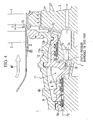
- Fig. 4 is a partial cross-sectional view showing the flow path of bleed air to the first stage unit.
- a compressor which would be to the left on the page but is not shown in the figure, is coaxially disposed to the gas turbine.
- the numerals 1 and 2 indicate first stage moving blades and first stage stationary blades, respectively.
- a plurality of first stage moving blades 1 are disposed in a circle around rotor disk 3 which is coaxial to the compressor.
- First stage moving blades 1 receive combustion gas HF from the compressor, and thereby turn first stage rotor disk 3.
- a plurality of first stage stationary blades 2 are disposed in a circle on the interior side of a vehicle so as to be coaxial to first stage rotor disk 3.
- First stage moving blades 1, first stage rotor disk 3 and first stage stationary blades 2 are provided in this way to form a first stage unit 4.
- a seal disk 7 is connected to the same shaft upstream from first stage unit 4.
- a plurality of disk holes 7a which are penetrating holes through which bleed air from upstream passes to first stage unit 4, are formed centered about this shaft and at equal angle intervals from one another.
- the numeral 5 in Fig. 4 is a bleeding chamber that takes up cooled bleed air f1 from the cooling device.
- Bleed air f1 which has been taken up into bleed air chamber 5 passes through disk holes 7a in seal disk 7, and is supplied into first stage rotor disk 3. This bleed air f1 is guided into each first stage moving blade and cools these blades from the inside.
- a plurality of tangential on board injection (TOBI) nozzles 10 are formed centered around the aforementioned shaft at the discharge port of bleeding chamber 5.
- Bleed air f1 is ejected along the direction of rotation of seal disk 7.
- the symbol f2 in Fig. 4 is sealing air from the compressor. After passing through labyrinths 8a, 8b, 8c and brass seal 9, this sealing air f2 crosses in front of the discharge port of each TOBI nozzle 10, passes through brass seal 12 and labyrinths 13a, 13b, and is supplied into space interval C between first stage moving blades 1 and first stage stationary blades 2.
- the sealing air f2 supplied to space interval C prevents combustion gas HF from leaking inside via this space interval C.
- sealing air f2 on its way from the compressor to space interval C interferes with the swirling flow of bleed air f1 discharged from each TOBI nozzle 10 toward seal disk 7. For this reason, the circumferential speed component is reduced. The reduction in this circumferential speed component invites an increase in pumping losses. As a result, the effect of providing the TOBI nozzles 10 is lost. In other words, the gas turbine looses power.
- the present invention was conceived in view of the above-described circumstances and has as its objective the provision of a gas turbine for a design in which bleed air is supplied in a swirling flow from tangential on board injection (TOBI) nozzles to a seal disk, wherein this gas turbine can effectively improve power from the swirling flow.
- TOBI tangential on board injection
- the present invention employs a gas turbine comprising the features of claim 1 to resolve the above-described problems.
- the above-described gas turbine is designed so that the sealing air which is directed toward the area between the stationary blades and the moving blades flows through the sealing air bypass flow path.
- the swirling flow which was discharged from the first TOBI nozzle is not subject to interference from the sealing air.
- the swirling flow is supplied to the disk holes with its circumferential speed component maintained, so that the rotational power of the seal disk is assisted by the swirling flow and the rotation of the seal disk is accelerated.
- the gas turbine's power can be increased.
- a second TOBI nozzle is provided which takes up a portion of the bleed air to form swirling flow, and controls the flow rate of sealing air to the sealing air bypass flow path.
- the swirling flow by the first TOBI nozzle decreases the static pressure at the discharge port of the first TOBI nozzie and reduces the flow rate at which the sealing air is provided.
- the gas turbine of the present embodiment is equipped with a first stage unit 30 which has first stage stationary blades 31 (stationary blades) disposed in a circle on the interior side of a casing; first stage rotor disk 32 (rotor disk) adjacent to these first stage stationary blades 31; and first stage moving blades 33 (moving blades) disposed in a circle around first stage rotor disk 32.
- first stage stationary blades 31 stationary blades
- first stage rotor disk 32 rotor disk
- first stage moving blades 33 moving blades
- a plurality of first stage moving blades 33 are disposed around first stage rotor disk 32. By receiving the combustion gas from a combustion chamber, not pictured in the figures, this first stage rotor disk 33 undergoes rotational driving. Furthermore, a plurality of first stage stationary blades 31 are disposed internally on the interior side of a casing so as to be coaxial to first stage rotor disk 32.
- each stage including first stage rotor disk 32, are coaxially stacked to form a single rotor, which is coaxially connected via seal disk 34 and connecting rotor 35 to the rotor for the compressor (not shown) that is disposed upstream.
- the numeral 36 in Fig. 1 indicates a bleeding chamber for taking up bleed air discharged from the compressor after its been cooled by passing through a cooling device (not shown).
- Bleeding chamber 36 is formed as a circular space between a first partitioning wall 37, which is fixed to the inner peripheral side of inner shroud 31a of each first stage stationary blade 31, and a second partitioning wall 38 which is further held by the inner peripheral side of first partitioning wall 37.
- a plurality of bleed air introducing holes are formed in first partitioning wall 37 centered about the axis of rotation of each rotor disk. These bleed air introducing holes are for introducing bleed air F1 from the cooling device into bleeding chamber 36.
- Second partitioning wall 38 is a circular component coaxially disposed around seal disk 34 and connecting rotor 35. This second partitioning wall 38 maintains the inside of first partitioning wall 37 in a stationary state.
- a plurality of tangential on board injection (TOBI) nozzles 39 are disposed in a circle centered along the width direction (axial direction) of the inner peripheral surface of second partitioning wall 38.
- Brass seals 40, 41 and labyrinth seal 42 are fixed in place at positions further upstream than the position of each TOBI nozzle 39 on the inner peripheral surface of second partitioning wall 38.
- TOBI nozzle 43 (second TOBI nozzle) is fixed in place at a position further upstream than TOBI nozzle 39 for taking up a portion of the bleed air F1 inside bleeding chamber 36 and forming swirling flow and blowing it toward the outer peripheral surface of connecting rotor 35.
- brass seal 44 and a pair of labyrinth seals 45, 46 are fixed in place to positions further downstream than each TOBI nozzle 39 on the inner peripheral surface of second partitioning wall 38.
- Seal disk 34 is a rotor disk that is provided and connected between first stage rotor disk 32 and connecting rotor 35.
- a plurality of disk holes 34a are formed in a circumferential direction centered on the rotor disk's axis of rotation at equal angular distances from one another. The position of these disk holes 34a in the radial direction centered on the axis of rotation coincides with the center of the discharge port of each TOBI nozzle 39, with disk holes 34a forming penetrating holes which are parallel to the axis of rotation.
- Bleed air F1 which has passed through these disk holes 34a passes through the disk holes formed in the rotor disks of each subsequent stage beyond first stage unit 30, and then passes through the moving blades of these later stages, cooling them from the inside.
- a portion of bleed air F1 which has passed through disk holes 34a passes through radial holes 32a in first stage rotor disk 32, and is then guided into the flow path (not shown) that is formed inside first stage moving blades 33, cooling first stage moving blades 33.
- a portion of the bleed air F1 after passing through each disk hole 34a is passed though disk hole 32b of first stage rotor disk 32 and employed in the cooling of the second and subsequent stage units (not shown).
- Radial holes 32a are a plurality of flow paths formed in the radial direction of first stage rotor disk 32. Radial holes 32a are formed centered about the axis of first stage rotor disk 32 at equal angle intervals from one another. Furthermore, the flow rate of bleed air F1 that passes through radial holes 32a and is directed at each of first stage moving blades 33 is adjusted to a constant rate using orifice plates 32c provided to the first stage rotor disk 32. A plurality of orifices, not shown, are provided in orifice plate 32c and are for carrying out flow rate adjustment. In this embodiment, since bleed air F1 is provided as a swirling flow, supply pressure of bleed air F1 is low.
- the diameter of the orifice openings is made larger than that of the conventional designs (as necessary, orifice plate 32c may be omitted).
- the hole diameter of radial holes 32a may be made larger than that of the conventional designs.
- each disk hole 32b in the radial direction centered on the axis of rotation of first stage rotor disk 32 coincides with the center of each radial hole 32a, with disk holes 32b forming penetrating holes that are parallel to the axis of rotation. Similar disk holes are formed in the rotor disks of subsequent stages, with the hole diameters differing at each stage. As a result, the air bleed F1 flow rate for cooling which is supplied to the moving blades is automatically adjusted.
- the symbol S indicates sealing air which is used to prevent combustion gas from entering internally via the space interval between first stage moving blades 33 and first stage stationary blades 31.
- Sealing air S is supplied from a compressor. Sealing air S traverses a sealing air supply flow path 50 which communicates with the discharge port of each TOBI nozzle 39 and is for supplying sealing air S to the aforementioned space interval.
- This sealing air supply flow path 50 is formed by providing a space interval flow path formed between the outer peripheral surface of sealing disk 34 and the inner peripheral surface of second partitioning wall 38, and a space interval flow path formed between first stage rotor disk 32 and first stage partitioning wall 37.
- the gas turbine according to this embodiment is characterized in the provision of a sealing air bypass flow path 55, which provides sealing air S to sealing air supply flow path 50 by bypassing the flow path between the discharge port of each TOBI nozzle 39 and each disk hole 32b opposite these discharge ports; and a double layer sealing structure 56 that is disposed to the space between first stage moving blades 33 and first stage stationary blades 31.
- Sealing air bypass flow path 55 is a pipe for taking up sealing air S, supplied from the compressor, after it has passed through TOBI nozzle 43, brass seal 40 and labyrinth seal 42, and guiding it though sealing air supply flow path 50.
- a plurality of sealing air bypass flow paths 55 are disposed centered about the axis of rotation of seal disk 34 at equal angle intervals from one another.
- double layer sealing structure 56 is formed by providing two projections 56a, 56b that are formed to the upstream edge of inner shroud 33a on the first stage moving blades 33, and two sealing members 56c, 56d that slide against projections 56a, 56b respectively and are fixed in place on the first stage partitioning wall 37 side.
- Sealing member 56c is fixed in place to the downstream edge of inner shroud 31 a.
- Sealing member 56d is fixed in place to the downstream edge of first partitioning wall 37. and are fixed in place on the first stage space 37 side.
- Sealing members 56c, 56d and projections 56a, 56b are alternately disposed so as to engage with one another, to form a plurality of curved flow paths.
- These curved flow paths are double layer structures consisting of a first stage sealing structure formed of projection 56b and sealing member 56d and a second stage sealing structure formed of projection 56a and sealing member 56c. As compared to a single layer sealing structure, this double layer sealing structure can effectively seal a space interval even with sealing air S which has a low flow rate.
- the gas turbine according to this embodiment is also characterized in the provision of a TOBI nozzle 43.
- this TOBI nozzle 43 is provided in second partitioning wall 38 so as to connect bleed air chamber 36 and a sealing air S bypass flow path formed between the outer peripheral surface of connecting rotor 35 and the inner peripheral surface of second partitioning wall 38.
- a plurality of TOBI nozzles 43 are disposed at equal angle intervals from one another centered on the axis of rotation of connecting rotor 35.
- a portion of the bleed air F1 taken up inside bleed air chamber 36 is accelerated by reducing its area, and is ejected toward the outer peripheral surface of connecting rotor 35.
- Bleed air F1 ejected in this way forms a ring-shaped swirling flow around connecting rotor 35.
- the flow rate of sealing air S which comes from the compressor, passes through this swirling flow and is directed toward sealing air bypass flow paths 55, can be controlled and prevented from becoming excessively large.
- bleed air F1 The flow of bleed air F1 will first be explained.
- Bleed air F1 which has been taken up inside bleed air chamber 36 forms a swirling flow by traveling through TOBI nozzles 39, and is ejected to sealing disk 34 in this state.
- Bleed air F1 ejected in this way forms a swirling flow that rotates in the same direction as the direction of rotation of sealing disk 34.
- sealing air S assists and accelerates the rotating power of sealing disk 34 when it passes through disk holes 34a.
- the flow area of a portion of the bleed air F1 that has passed through each disk hole 34a is reduced when traveling through orifice plate 32c after passing through radial holes 32a, and is supplied inside first stage moving blades 33 as cooling flow.
- the flow of bleed air F1 that has passed through disk holes 32b is supplied for cooling of moving blades in subsequent stages.
- the bleed air F1 that was ejected from each TOBI nozzle 43 after being taken up inside bleed air chamber 36 forms a swirling flow that turns in the same direction around connecting rotor 35 and prevents the flow rate of sealing air S from becoming too large.
- sealing air S Once sealing air S from the compressor has been held to a suitable rate using the swirling flow ejected from each TOBI nozzle 43, it passes through brass seal 40 and labyrinth seal 42, and is guided into sealing air bypass flow paths 55.
- Sealing air S ejected from these sealing air bypass flow paths 55 passes through brass seal 44 and labyrinths 45, 46, is introduced into sealing air supply flow path 50, and is supplied to the space interval between first stage moving blades 33 and first stage stationary blades 31, thereby sealing the space.
- a design is employed that is provided with sealing air bypass flow paths 55, for supplying sealing air S to sealing air supply flow path 50 by bypassing the flow paths between TOBI nozzles 39 and disk holes 34a, and a double sealing structure 56 which is disposed in the space interval between first stage stationary blades 31 and first stage moving blades 33.
- the swirling flow which is ejected from TOBI nozzles 39 at disk holes 34a does not experience interference from sealing air S.
- the swirling flow's circumferential speed component is maintained.
- the swirling flow effectively functions as a drive source for turning seal disk 34 even faster, so that the gas turbine's power can be increased.
- the gas turbine according to this embodiment employs a design in which TOBI nozzles 43 are provided which take up a portion of bleed air F1, form it into swirling flow, and control the flow rate of sealing air S at sealing air bypass flow path 55.
- TOBI nozzles 43 are provided which take up a portion of bleed air F1, form it into swirling flow, and control the flow rate of sealing air S at sealing air bypass flow path 55.
- the flow rate of sealing air S can be prevented from becoming excessively large. Accordingly, the rotating efficiency of the gas turbine can be even further improved.
Landscapes
- Engineering & Computer Science (AREA)
- Mechanical Engineering (AREA)
- General Engineering & Computer Science (AREA)
- Chemical & Material Sciences (AREA)
- Combustion & Propulsion (AREA)
- Turbine Rotor Nozzle Sealing (AREA)
Description
- The present invention relates to a gas turbine according to the preamble portion of claim 1 that is rotationally driven using combusted gas from a combustor, and more specifically, to a gas turbine in which power is effectively increased by bleeding from tangential on board injection (TOBI) nozzles to rotor disks.
- In a gas turbine plant, compressed air from a compressor is guided into a combustor, and the high-temperature gas generated when this compressed air is combusted along with a fuel is guided into the gas turbine to drive it. A typical design is one in which a portion of the compressed air is introduced into a cooling device as bleed air and cooled. The cooled bleed air is subsequently guided to stationary and moving blades on the gas turbine side, and used as cooling for these blades and as sealing air between the moving and stationary blades.
- An example of a design for bleeding to the first stage unit of the moving and stationary blades in a conventional gas turbine will be explained below with reference to
Fig. 4. Fig. 4 is a partial cross-sectional view showing the flow path of bleed air to the first stage unit. A compressor, which would be to the left on the page but is not shown in the figure, is coaxially disposed to the gas turbine. - In
Fig. 4 , thenumerals 1 and 2 indicate first stage moving blades and first stage stationary blades, respectively. A plurality of first stage moving blades 1 are disposed in a circle around rotor disk 3 which is coaxial to the compressor. First stage moving blades 1 receive combustion gas HF from the compressor, and thereby turn first stage rotor disk 3. A plurality of first stagestationary blades 2 are disposed in a circle on the interior side of a vehicle so as to be coaxial to first stage rotor disk 3. First stage moving blades 1, first stage rotor disk 3 and first stagestationary blades 2 are provided in this way to form a first stage unit 4. A seal disk 7 is connected to the same shaft upstream from first stage unit 4. A plurality ofdisk holes 7a, which are penetrating holes through which bleed air from upstream passes to first stage unit 4, are formed centered about this shaft and at equal angle intervals from one another. - The
numeral 5 inFig. 4 is a bleeding chamber that takes up cooled bleed air f1 from the cooling device. Bleed air f1 which has been taken up intobleed air chamber 5 passes throughdisk holes 7a in seal disk 7, and is supplied into first stage rotor disk 3. This bleed air f1 is guided into each first stage moving blade and cools these blades from the inside. A plurality of tangential on board injection (TOBI)nozzles 10 are formed centered around the aforementioned shaft at the discharge port ofbleeding chamber 5. Bleed air f1 is ejected along the direction of rotation of seal disk 7. By providing eachTOBI nozzle 10 to impart swirling flow to bleed air f1 in this way, it is possible to reduce pumping losses. - The symbol f2 in
Fig. 4 is sealing air from the compressor. After passing throughlabyrinths TOBI nozzle 10, passes throughbrass seal 12 andlabyrinths stationary blades 2. The sealing air f2 supplied to space interval C prevents combustion gas HF from leaking inside via this space interval C. - However, this conventional gas turbine has the problems explained below
- Namely, sealing air f2 on its way from the compressor to space interval C interferes with the swirling flow of bleed air f1 discharged from each
TOBI nozzle 10 toward seal disk 7. For this reason, the circumferential speed component is reduced. The reduction in this circumferential speed component invites an increase in pumping losses. As a result, the effect of providing theTOBI nozzles 10 is lost. In other words, the gas turbine looses power. - If the reduction in this circumferential speed component is anticipated from the beginning, however, one might consider increasing this component by increasing the tilt angle of the TOBI nozzles. However, the delivery pressure from TOBI
nozzles 10 is reduced when the circumferential speed component is increased. In this case, the difference between the delivery pressure of eachTOBI nozzle 10 and the pressure of combustion gas HF becomes smaller, and the flow rate of sealing air f2 decreases. The sealing structure in space interval C may not function normally as a result. Infiltration of combustion gas HF from space interval C is linked to a reduction in the power for rotating each first stage moving blade 1. Thus, the turbine also looses power. - As explained above, when a circumferential speed component is added to the flow passing through seal disk 7 in order to increase the power of the gas turbine, then, conversely, the power drops.
US-A-3989410 andUS-A-4466239 disclose gas turbines according to the preamble portion of claim 1. - The present invention was conceived in view of the above-described circumstances and has as its objective the provision of a gas turbine for a design in which bleed air is supplied in a swirling flow from tangential on board injection (TOBI) nozzles to a seal disk, wherein this gas turbine can effectively improve power from the swirling flow.
- The present invention employs a gas turbine comprising the features of claim 1 to resolve the above-described problems.
- The above-described gas turbine is designed so that the sealing air which is directed toward the area between the stationary blades and the moving blades flows through the sealing air bypass flow path. Thus, the swirling flow which was discharged from the first TOBI nozzle is not subject to interference from the sealing air. As a result, the swirling flow is supplied to the disk holes with its circumferential speed component maintained, so that the rotational power of the seal disk is assisted by the swirling flow and the rotation of the seal disk is accelerated. As a result, the gas turbine's power can be increased. In the above-described gas turbine, a second TOBI nozzle is provided which takes up a portion of the bleed air to form swirling flow, and controls the flow rate of sealing air to the sealing air bypass flow path.
- In this gas turbine, when passing through the swirling flow formed by the second TOBI nozzle, the flow rate of sealing air which flows from upstream to the sealing air bypass flow path on the downstream side, is held constant on the downstream side of the swirling flow. Since the rate of flow of the sealing air is prevented from becoming excessively great, the rotating efficiency of the gas turbine can be further improved.
- In the above-described gas turbine, it is also acceptable to provide a double sealing structure between the stationary blades and the moving blades.
- The swirling flow by the first TOBI nozzle decreases the static pressure at the discharge port of the first TOBI nozzie and reduces the flow rate at which the sealing air is provided. By providing a double layer sealing structure between the stationary blades and the moving blades in this gas turbine, however, it is possible to securely prevent introduction of combustion gas from this space interval even at low sealing air flow rates.
-
-
Fig. 1 shows an embodiment of a gas turbine according to the present invention, and is a partial cross-sectional view showing a flow path of bleed air to the first stage unit. -
Fig. 2 shows the essential parts of this same component in the same gas turbine, and is an enlarged view of part A inFig. 1 . -
Fig. 3 shows other essential parts of this same component in the same gas turbine, and is a perspective view along the line B-B inFig. 1 . -
Fig. 4 shows an embodiment of a conventional gas turbine, and is a partial cross-sectional view showing a flow path of bleed air to the first stage unit. - An embodiment of a gas turbine of the present invention will be explained with reference to
Figs. 1~3 . The present invention is of course not limited thereto. - Note that in the following discussion, the flow directions of sealing air S and bleed air F1 on the upstream side (i.e., left side of the paper in
Fig. 1 ) and the flow directions of sealing air S and bleed air F1 on the downstream side (i.e., right side of the paper inFig. 1 ) will be referred to as "upstream side" and "downstream side" respectively. Furthermore, the direction of the axis of rotation (to the left and right inFig. 1 ) of the rotating member that includesseal disk 34 and firststage rotor disk 32 will be referred to as "axial direction" in the discussion. - As shown in
Fig. 1 , the gas turbine of the present embodiment is equipped with afirst stage unit 30 which has first stage stationary blades 31 (stationary blades) disposed in a circle on the interior side of a casing; first stage rotor disk 32 (rotor disk) adjacent to these first stagestationary blades 31; and first stage moving blades 33 (moving blades) disposed in a circle around firststage rotor disk 32. Note that a second stage unit, third stage unit, etc. (not shown) having the same structure are coaxially connected on the downstream side offirst stage unit 30. As a result, stationary blades and moving blades are alternately disposed in the axial direction. - A plurality of first
stage moving blades 33 are disposed around firststage rotor disk 32. By receiving the combustion gas from a combustion chamber, not pictured in the figures, this firststage rotor disk 33 undergoes rotational driving. Furthermore, a plurality of first stagestationary blades 31 are disposed internally on the interior side of a casing so as to be coaxial to firststage rotor disk 32. - The rotor disks of each stage, including first
stage rotor disk 32, are coaxially stacked to form a single rotor, which is coaxially connected viaseal disk 34 and connectingrotor 35 to the rotor for the compressor (not shown) that is disposed upstream. - The numeral 36 in
Fig. 1 indicates a bleeding chamber for taking up bleed air discharged from the compressor after its been cooled by passing through a cooling device (not shown). Bleedingchamber 36 is formed as a circular space between afirst partitioning wall 37, which is fixed to the inner peripheral side ofinner shroud 31a of each first stagestationary blade 31, and asecond partitioning wall 38 which is further held by the inner peripheral side offirst partitioning wall 37. - A plurality of bleed air introducing holes (not shown) are formed in
first partitioning wall 37 centered about the axis of rotation of each rotor disk. These bleed air introducing holes are for introducing bleed air F1 from the cooling device into bleedingchamber 36. -
Second partitioning wall 38 is a circular component coaxially disposed aroundseal disk 34 and connectingrotor 35. Thissecond partitioning wall 38 maintains the inside offirst partitioning wall 37 in a stationary state. A plurality of tangential on board injection (TOBI)nozzles 39 are disposed in a circle centered along the width direction (axial direction) of the inner peripheral surface ofsecond partitioning wall 38. Brass seals 40, 41 and labyrinth seal 42 are fixed in place at positions further upstream than the position of eachTOBI nozzle 39 on the inner peripheral surface ofsecond partitioning wall 38. TOBI nozzle 43 (second TOBI nozzle) is fixed in place at a position further upstream thanTOBI nozzle 39 for taking up a portion of the bleed air F1 inside bleedingchamber 36 and forming swirling flow and blowing it toward the outer peripheral surface of connectingrotor 35. On the other hand,brass seal 44 and a pair of labyrinth seals 45, 46 are fixed in place to positions further downstream than eachTOBI nozzle 39 on the inner peripheral surface ofsecond partitioning wall 38. -
Seal disk 34 is a rotor disk that is provided and connected between firststage rotor disk 32 and connectingrotor 35. A plurality ofdisk holes 34a are formed in a circumferential direction centered on the rotor disk's axis of rotation at equal angular distances from one another. The position of thesedisk holes 34a in the radial direction centered on the axis of rotation coincides with the center of the discharge port of eachTOBI nozzle 39, withdisk holes 34a forming penetrating holes which are parallel to the axis of rotation. - Bleed air F1 which has passed through these
disk holes 34a passes through the disk holes formed in the rotor disks of each subsequent stage beyondfirst stage unit 30, and then passes through the moving blades of these later stages, cooling them from the inside. In other words, in the case offirst stage unit 30, for example, a portion of bleed air F1 which has passed throughdisk holes 34a passes throughradial holes 32a in firststage rotor disk 32, and is then guided into the flow path (not shown) that is formed inside firststage moving blades 33, cooling firststage moving blades 33. At the same time, a portion of the bleed air F1 after passing through eachdisk hole 34a is passed thoughdisk hole 32b of firststage rotor disk 32 and employed in the cooling of the second and subsequent stage units (not shown). -
Radial holes 32a are a plurality of flow paths formed in the radial direction of firststage rotor disk 32.Radial holes 32a are formed centered about the axis of firststage rotor disk 32 at equal angle intervals from one another. Furthermore, the flow rate of bleed air F1 that passes throughradial holes 32a and is directed at each of firststage moving blades 33 is adjusted to a constant rate usingorifice plates 32c provided to the firststage rotor disk 32. A plurality of orifices, not shown, are provided inorifice plate 32c and are for carrying out flow rate adjustment. In this embodiment, since bleed air F1 is provided as a swirling flow, supply pressure of bleed air F1 is low. To improve low supply pressure, the diameter of the orifice openings is made larger than that of the conventional designs (as necessary,orifice plate 32c may be omitted). For the same reason, the hole diameter ofradial holes 32a may be made larger than that of the conventional designs. - The position of each
disk hole 32b in the radial direction centered on the axis of rotation of firststage rotor disk 32 coincides with the center of eachradial hole 32a, withdisk holes 32b forming penetrating holes that are parallel to the axis of rotation. Similar disk holes are formed in the rotor disks of subsequent stages, with the hole diameters differing at each stage. As a result, the air bleed F1 flow rate for cooling which is supplied to the moving blades is automatically adjusted. - The symbol S indicates sealing air which is used to prevent combustion gas from entering internally via the space interval between first
stage moving blades 33 and first stagestationary blades 31. Sealing air S is supplied from a compressor. Sealing air S traverses a sealing airsupply flow path 50 which communicates with the discharge port of eachTOBI nozzle 39 and is for supplying sealing air S to the aforementioned space interval. This sealing airsupply flow path 50 is formed by providing a space interval flow path formed between the outer peripheral surface of sealingdisk 34 and the inner peripheral surface ofsecond partitioning wall 38, and a space interval flow path formed between firststage rotor disk 32 and firststage partitioning wall 37. - The gas turbine according to this embodiment is characterized in the provision of a sealing air
bypass flow path 55, which provides sealing air S to sealing airsupply flow path 50 by bypassing the flow path between the discharge port of eachTOBI nozzle 39 and eachdisk hole 32b opposite these discharge ports; and a doublelayer sealing structure 56 that is disposed to the space between firststage moving blades 33 and first stagestationary blades 31. - Sealing air
bypass flow path 55 is a pipe for taking up sealing air S, supplied from the compressor, after it has passed throughTOBI nozzle 43,brass seal 40 and labyrinth seal 42, and guiding it though sealing airsupply flow path 50. A plurality of sealing airbypass flow paths 55 are disposed centered about the axis of rotation ofseal disk 34 at equal angle intervals from one another. - As shown in
Fig. 2 , doublelayer sealing structure 56 is formed by providing twoprojections inner shroud 33a on the firststage moving blades 33, and two sealingmembers projections stage partitioning wall 37 side. - Sealing
member 56c is fixed in place to the downstream edge ofinner shroud 31 a. Sealingmember 56d is fixed in place to the downstream edge offirst partitioning wall 37. and are fixed in place on thefirst stage space 37 side.Sealing members projections projection 56b and sealingmember 56d and a second stage sealing structure formed ofprojection 56a and sealingmember 56c. As compared to a single layer sealing structure, this double layer sealing structure can effectively seal a space interval even with sealing air S which has a low flow rate. - The gas turbine according to this embodiment is also characterized in the provision of a
TOBI nozzle 43. As shown inFig. 3 , thisTOBI nozzle 43 is provided insecond partitioning wall 38 so as to connect bleedair chamber 36 and a sealing air S bypass flow path formed between the outer peripheral surface of connectingrotor 35 and the inner peripheral surface ofsecond partitioning wall 38. - A plurality of
TOBI nozzles 43 are disposed at equal angle intervals from one another centered on the axis of rotation of connectingrotor 35. As a result of theseTOBI nozzles 43, a portion of the bleed air F1 taken up inside bleedair chamber 36 is accelerated by reducing its area, and is ejected toward the outer peripheral surface of connectingrotor 35. Bleed air F1 ejected in this way forms a ring-shaped swirling flow around connectingrotor 35. As a result, the flow rate of sealing air S which comes from the compressor, passes through this swirling flow and is directed toward sealing airbypass flow paths 55, can be controlled and prevented from becoming excessively large. - The flow of bleed air F1 and sealing air S inside the gas turbine according to this embodiment having the above-described structure will be explained.
- The flow of bleed air F1 will first be explained. Bleed air F1 which has been taken up inside bleed
air chamber 36 forms a swirling flow by traveling throughTOBI nozzles 39, and is ejected to sealingdisk 34 in this state. Bleed air F1 ejected in this way forms a swirling flow that rotates in the same direction as the direction of rotation of sealingdisk 34. As a result, sealing air S assists and accelerates the rotating power of sealingdisk 34 when it passes throughdisk holes 34a. There is no interference from sealing air S on the swirling flow from each ofTOBI nozzles 39 at this time, so that the circumferential speed component of the swirling flow can be maintained. - The formation of swirling flow by
TOBI nozzles 39 results in a decrease in static pressure at the discharge ports ofTOBI nozzles 39. However, as explained above, adouble sealing structure 56 is employed in this embodiment between first stagestationary blades 31 and firststage moving blades 33. As a result, it is possible to securely prevent the introduction of combustion gas even at a low sealing air flow rate. - The flow area of a portion of the bleed air F1 that has passed through each
disk hole 34a is reduced when traveling throughorifice plate 32c after passing throughradial holes 32a, and is supplied inside firststage moving blades 33 as cooling flow. The flow of bleed air F1 that has passed throughdisk holes 32b is supplied for cooling of moving blades in subsequent stages. - On the other hand, the bleed air F1 that was ejected from each
TOBI nozzle 43 after being taken up inside bleedair chamber 36, forms a swirling flow that turns in the same direction around connectingrotor 35 and prevents the flow rate of sealing air S from becoming too large. - Next, the flow of sealing air S will be explained. Once sealing air S from the compressor has been held to a suitable rate using the swirling flow ejected from each
TOBI nozzle 43, it passes throughbrass seal 40 and labyrinth seal 42, and is guided into sealing airbypass flow paths 55. - Sealing air S ejected from these sealing air
bypass flow paths 55 passes throughbrass seal 44 and labyrinths 45, 46, is introduced into sealing airsupply flow path 50, and is supplied to the space interval between firststage moving blades 33 and first stagestationary blades 31, thereby sealing the space. - In the gas turbine according to the embodiment described above, a design is employed that is provided with sealing air
bypass flow paths 55, for supplying sealing air S to sealing airsupply flow path 50 by bypassing the flow paths betweenTOBI nozzles 39 anddisk holes 34a, and adouble sealing structure 56 which is disposed in the space interval between first stagestationary blades 31 and firststage moving blades 33. As a result of this design, the swirling flow which is ejected fromTOBI nozzles 39 atdisk holes 34a does not experience interference from sealing air S. Thus, the swirling flow's circumferential speed component is maintained. As a result, the swirling flow effectively functions as a drive source for turningseal disk 34 even faster, so that the gas turbine's power can be increased. Furthermore, by providing adouble sealing structure 56 in the space interval between first stagestationary blades 31 and firststage moving blades 33, it is possible to securely prevent introduction of combustion gas via this space. Thus, the drop in the flow rate of sealing air S due to the decrease in static pressure at the exit ofTOBI nozzles 39 can be compensated. - Accordingly, since power loss does not occur, concern over causing a reduction in the energy generating capacity of the generator (not shown) connected to the gas turbine can be avoided.
- The gas turbine according to this embodiment employs a design in which TOBI nozzles 43 are provided which take up a portion of bleed air F1, form it into swirling flow, and control the flow rate of sealing air S at sealing air
bypass flow path 55. In this design as a result, the flow rate of sealing air S can be prevented from becoming excessively large. Accordingly, the rotating efficiency of the gas turbine can be even further improved.
Claims (2)
- A gas turbine comprising:a plurality of stationary blades (31) disposed in a circle on an interior side of a casing;a plurality of moving blades (33) disposed in a circle on a side of a rotor disk (32) adjacent to these stationary blades (31);a seal disk (34) coaxially connected to the upstream side of the rotor disk (32);a first tangential on board injection (TOBI) nozzle (39) arranged to supply bleed air (F1) taken up to the seal disk (34) as swirling flow which rotates in the same direction as the seal disk (34);a sealing air supply flow path (50) that communicates with a discharge port of the first TOBI nozzle (39) for supplying sealing air (S) to a space between the stationary blades (31) and the moving blades (33);a disk hole (34a) provided in the seal disk (34) for flowing the swirling flow from the first TOBI nozzle (39); anda sealing air bypass flow path (55) provided for supplying the sealing air (S) to the sealing air supply flow path (50) by bypassing a section of the sealing air supply flow path (50) between the first TOBI nozzle (39) and the disk hole (34a);characterized in thata second TOBI nozzle (43) is provided on an upstream side of the sealing air bypass flow path (55) and arranged so as to take up a portion of the bleed air (F1) and eject the bleed air (F1) into the sealing air supply flow path (50) to form a swirling flow, thereby controlling a rate of flow of the sealing air (S) passing through the swirling flow and directing it toward the sealing air bypass flow path (55).
- The gas turbine according to claim 1, further comprising a double sealing structure (56) provided between the stationary blades (31) and the moving blades (33), wherein said double sealing structure (56) includes a first stage sealing structure (56d,56b) provided between the stationary blades (31) and the moving blades (33) and a second stage sealing structure (56c,56a) downstream of the first stage sealing structure (56d,56b).
Applications Claiming Priority (3)
| Application Number | Priority Date | Filing Date | Title |
|---|---|---|---|
| US238651 | 1988-08-30 | ||
| US10/238,651 US6837676B2 (en) | 2002-09-11 | 2002-09-11 | Gas turbine |
| PCT/JP2003/011657 WO2004025086A1 (en) | 2002-09-11 | 2003-09-11 | Gas turbine sealing air supply system |
Publications (2)
| Publication Number | Publication Date |
|---|---|
| EP1537296A1 EP1537296A1 (en) | 2005-06-08 |
| EP1537296B1 true EP1537296B1 (en) | 2013-06-05 |
Family
ID=31991008
Family Applications (1)
| Application Number | Title | Priority Date | Filing Date |
|---|---|---|---|
| EP03751268.8A Revoked EP1537296B1 (en) | 2002-09-11 | 2003-09-11 | Gas turbine sealing air supply system |
Country Status (6)
| Country | Link |
|---|---|
| US (1) | US6837676B2 (en) |
| EP (1) | EP1537296B1 (en) |
| JP (1) | JP4146257B2 (en) |
| CN (1) | CN100381677C (en) |
| CA (1) | CA2498057C (en) |
| WO (1) | WO2004025086A1 (en) |
Cited By (2)
| Publication number | Priority date | Publication date | Assignee | Title |
|---|---|---|---|---|
| EP3006668A1 (en) | 2014-10-07 | 2016-04-13 | Siemens Aktiengesellschaft | Gas turbine with two vortex feeds for cooling the rotor |
| US11421597B2 (en) | 2019-10-18 | 2022-08-23 | Pratt & Whitney Canada Corp. | Tangential on-board injector (TOBI) assembly |
Families Citing this family (55)
| Publication number | Priority date | Publication date | Assignee | Title |
|---|---|---|---|---|
| DE10318852A1 (en) * | 2003-04-25 | 2004-11-11 | Rolls-Royce Deutschland Ltd & Co Kg | Main gas duct inner seal of a high pressure turbine |
| US7341429B2 (en) * | 2005-11-16 | 2008-03-11 | General Electric Company | Methods and apparatuses for cooling gas turbine engine rotor assemblies |
| US20070271930A1 (en) * | 2006-05-03 | 2007-11-29 | Mitsubishi Heavy Industries, Ltd. | Gas turbine having cooling-air transfer system |
| US7591631B2 (en) * | 2006-06-30 | 2009-09-22 | United Technologies Corporation | Flow delivery system for seals |
| US7500824B2 (en) * | 2006-08-22 | 2009-03-10 | General Electric Company | Angel wing abradable seal and sealing method |
| JP2008057416A (en) * | 2006-08-31 | 2008-03-13 | Hitachi Ltd | Axial flow turbine |
| US20080061515A1 (en) * | 2006-09-08 | 2008-03-13 | Eric Durocher | Rim seal for a gas turbine engine |
| US8167534B2 (en) * | 2006-09-14 | 2012-05-01 | Solar Turbines Inc. | Seal for a turbine engine |
| GB0620430D0 (en) * | 2006-10-14 | 2006-11-22 | Rolls Royce Plc | A flow cavity arrangement |
| JP2008180149A (en) * | 2007-01-24 | 2008-08-07 | Mitsubishi Heavy Ind Ltd | Vane structure of gas turbine and gas turbine |
| IL181439A0 (en) * | 2007-02-20 | 2007-07-04 | Medic Nrg Ltd | An endodontic file member |
| US8562285B2 (en) * | 2007-07-02 | 2013-10-22 | United Technologies Corporation | Angled on-board injector |
| US20090074589A1 (en) * | 2007-09-18 | 2009-03-19 | Biao Fang | Cooling Circuit for Enhancing Turbine Performance |
| US20090110548A1 (en) * | 2007-10-30 | 2009-04-30 | Pratt & Whitney Canada Corp. | Abradable rim seal for low pressure turbine stage |
| KR100911765B1 (en) | 2008-01-07 | 2009-08-10 | 더블유비엠과학기술 주식회사 | Nozzle Plates for Steam Turbines |
| JP4981709B2 (en) * | 2008-02-28 | 2012-07-25 | 三菱重工業株式会社 | Gas turbine, disk and method for forming radial passage of disk |
| US8079803B2 (en) * | 2008-06-30 | 2011-12-20 | Mitsubishi Heavy Industries, Ltd. | Gas turbine and cooling air supply structure thereof |
| GB0818047D0 (en) * | 2008-10-03 | 2008-11-05 | Rolls Royce Plc | Turbine cooling system |
| JP5134570B2 (en) * | 2009-02-23 | 2013-01-30 | 三菱重工業株式会社 | Turbine cooling structure and gas turbine |
| JP5502340B2 (en) * | 2009-02-25 | 2014-05-28 | 三菱重工業株式会社 | Turbine cooling structure and gas turbine |
| US9039375B2 (en) * | 2009-09-01 | 2015-05-26 | General Electric Company | Non-axisymmetric airfoil platform shaping |
| US8578720B2 (en) | 2010-04-12 | 2013-11-12 | Siemens Energy, Inc. | Particle separator in a gas turbine engine |
| US8677766B2 (en) | 2010-04-12 | 2014-03-25 | Siemens Energy, Inc. | Radial pre-swirl assembly and cooling fluid metering structure for a gas turbine engine |
| US8613199B2 (en) | 2010-04-12 | 2013-12-24 | Siemens Energy, Inc. | Cooling fluid metering structure in a gas turbine engine |
| US8584469B2 (en) | 2010-04-12 | 2013-11-19 | Siemens Energy, Inc. | Cooling fluid pre-swirl assembly for a gas turbine engine |
| CH703827A1 (en) * | 2010-09-20 | 2012-03-30 | Alstom Technology Ltd | Gas turbine arrangement with an annular seal assembly for an annular space between at least a stationary component and a rotor unit. |
| US9068461B2 (en) | 2011-08-18 | 2015-06-30 | Siemens Aktiengesellschaft | Turbine rotor disk inlet orifice for a turbine engine |
| US9181815B2 (en) | 2012-05-02 | 2015-11-10 | United Technologies Corporation | Shaped rim cavity wing surface |
| US9115587B2 (en) * | 2012-08-22 | 2015-08-25 | Siemens Energy, Inc. | Cooling air configuration in a gas turbine engine |
| JP5567077B2 (en) | 2012-08-23 | 2014-08-06 | 三菱重工業株式会社 | Rotating machine |
| US9435206B2 (en) * | 2012-09-11 | 2016-09-06 | General Electric Company | Flow inducer for a gas turbine system |
| US20140130478A1 (en) * | 2012-11-09 | 2014-05-15 | General Electric Company | Gas turbomachine including a fuel pre-heat system |
| CN103899364B (en) * | 2012-12-26 | 2015-12-02 | 中航商用航空发动机有限责任公司 | The wheel rim sealing configuration of aeroengine high-pressure turbine, high-pressure turbine and motor |
| EP2754858B1 (en) | 2013-01-14 | 2015-09-16 | Alstom Technology Ltd | Arrangement for sealing an open cavity against hot gas entrainment |
| CN103206270A (en) * | 2013-04-25 | 2013-07-17 | 北京华清燃气轮机与煤气化联合循环工程技术有限公司 | Method for cooling turbine disc and moving blade of combustion gas turbine |
| WO2015160403A2 (en) | 2014-01-20 | 2015-10-22 | United Technologies Corporation | Additive manufactured non-round, septum tied, conformal high pressure tubing |
| CA2878645C (en) | 2014-01-22 | 2017-02-21 | Alfa Wassermann, Inc. | Centrifugation systems with non-contact seal assemblies |
| EP2942483B2 (en) | 2014-04-01 | 2022-09-28 | Raytheon Technologies Corporation | Vented tangential on-board injector for a gas turbine engine |
| US10167723B2 (en) | 2014-06-06 | 2019-01-01 | United Technologies Corporation | Thermally isolated turbine section for a gas turbine engine |
| CN105525992B (en) | 2014-10-21 | 2020-04-14 | 联合工艺公司 | Additively manufactured tubular heat exchanger system with additively manufactured fairing |
| US10634054B2 (en) | 2014-10-21 | 2020-04-28 | United Technologies Corporation | Additive manufactured ducted heat exchanger |
| JP6484430B2 (en) | 2014-11-12 | 2019-03-13 | 三菱重工業株式会社 | Turbine cooling structure and gas turbine |
| CN104564174B (en) * | 2014-12-29 | 2017-01-18 | 北京华清燃气轮机与煤气化联合循环工程技术有限公司 | Elastic sealing structure for turbine fixed blades of gas turbine |
| DE112015006063B4 (en) * | 2015-01-27 | 2023-01-19 | Mitsubishi Heavy Industries, Ltd. | rotary machine |
| CN104632413B (en) * | 2015-01-30 | 2018-05-01 | 北京华清燃气轮机与煤气化联合循环工程技术有限公司 | A kind of gas turbine combustion cylinder pressure turns static seal structure |
| CN104675447A (en) * | 2015-01-30 | 2015-06-03 | 北京华清燃气轮机与煤气化联合循环工程技术有限公司 | Turbine cooling gas circuit of gas turbine |
| WO2016143103A1 (en) * | 2015-03-11 | 2016-09-15 | 株式会社 東芝 | Turbine |
| RU2614909C1 (en) * | 2015-12-17 | 2017-03-30 | Открытое акционерное общество "Уфимское моторостроительное производственное объединение" ОАО "УМПО" | Cooled high-pressure turbine |
| EP3214266A1 (en) * | 2016-03-01 | 2017-09-06 | Siemens Aktiengesellschaft | Rotor of a gas turbine with cooling air path |
| US10633992B2 (en) | 2017-03-08 | 2020-04-28 | Pratt & Whitney Canada Corp. | Rim seal |
| CN108060979B (en) * | 2017-12-19 | 2024-04-26 | 中国联合重型燃气轮机技术有限公司 | Gas turbine and swirling device thereof |
| US10982546B2 (en) | 2018-09-19 | 2021-04-20 | General Electric Company | Flow-diverting systems for gas turbine air separator |
| CN109458229A (en) * | 2018-12-20 | 2019-03-12 | 中国航发四川燃气涡轮研究院 | A kind of turbine disk chamber seal structure of band bypass bleed |
| CN114320489A (en) * | 2022-01-11 | 2022-04-12 | 永旭腾风新能源动力科技(北京)有限公司 | Gas turbine with gas seal component |
| KR102918123B1 (en) | 2024-02-15 | 2026-01-27 | 두산에너빌리티 주식회사 | Turbine blade having non-axisymmetric endwall contour and Gas turbine comprising the same |
Family Cites Families (15)
| Publication number | Priority date | Publication date | Assignee | Title |
|---|---|---|---|---|
| CH487337A (en) * | 1968-01-10 | 1970-03-15 | Sulzer Ag | Arrangement for the passage of gas through the shell of a hollow rotor |
| GB1268301A (en) * | 1970-01-13 | 1972-03-29 | Rolls Royce | Improvements in or relating to gas turbine engines |
| GB1381481A (en) * | 1971-08-26 | 1975-01-22 | Rolls Royce | Aerofoil-shaped blades |
| US3989410A (en) * | 1974-11-27 | 1976-11-02 | General Electric Company | Labyrinth seal system |
| DE2941866C2 (en) * | 1978-10-26 | 1982-08-19 | Rolls-Royce Ltd., London | Turbine for a gas turbine engine with air-cooled turbine blades |
| US4466239A (en) * | 1983-02-22 | 1984-08-21 | General Electric Company | Gas turbine engine with improved air cooling circuit |
| US4708588A (en) * | 1984-12-14 | 1987-11-24 | United Technologies Corporation | Turbine cooling air supply system |
| JPH03165611A (en) | 1989-11-24 | 1991-07-17 | Matsushita Electric Ind Co Ltd | Two-way amplifier |
| GB2251040B (en) * | 1990-12-22 | 1994-06-22 | Rolls Royce Plc | Seal arrangement |
| US5282719A (en) * | 1991-05-13 | 1994-02-01 | Alliedsignal Inc. | Quad mode fan pitch actuation system for a gas turbine engine |
| US5402636A (en) * | 1993-12-06 | 1995-04-04 | United Technologies Corporation | Anti-contamination thrust balancing system for gas turbine engines |
| JP3510320B2 (en) | 1994-05-31 | 2004-03-29 | 三菱重工業株式会社 | Cooling air supply device for gas turbine rotor |
| JPH10252412A (en) | 1997-03-12 | 1998-09-22 | Mitsubishi Heavy Ind Ltd | Gas turbine sealing device |
| JP4067709B2 (en) * | 1999-08-23 | 2008-03-26 | 三菱重工業株式会社 | Rotor cooling air supply device |
| US6773225B2 (en) * | 2002-05-30 | 2004-08-10 | Mitsubishi Heavy Industries, Ltd. | Gas turbine and method of bleeding gas therefrom |
-
2002
- 2002-09-11 US US10/238,651 patent/US6837676B2/en not_active Expired - Lifetime
-
2003
- 2003-03-12 JP JP2003066968A patent/JP4146257B2/en not_active Expired - Lifetime
- 2003-09-11 CA CA002498057A patent/CA2498057C/en not_active Expired - Lifetime
- 2003-09-11 CN CNB038213079A patent/CN100381677C/en not_active Expired - Lifetime
- 2003-09-11 WO PCT/JP2003/011657 patent/WO2004025086A1/en not_active Ceased
- 2003-09-11 EP EP03751268.8A patent/EP1537296B1/en not_active Revoked
Cited By (5)
| Publication number | Priority date | Publication date | Assignee | Title |
|---|---|---|---|---|
| EP3006668A1 (en) | 2014-10-07 | 2016-04-13 | Siemens Aktiengesellschaft | Gas turbine with two vortex feeds for cooling the rotor |
| WO2016055354A1 (en) | 2014-10-07 | 2016-04-14 | Siemens Aktiengesellschaft | Gas turbine with two swirl supply lines for cooling the rotor |
| US10036256B2 (en) | 2014-10-07 | 2018-07-31 | Siemens Aktiengesellschaft | Gas turbine with two swirl supply lines for cooling the rotor |
| US11421597B2 (en) | 2019-10-18 | 2022-08-23 | Pratt & Whitney Canada Corp. | Tangential on-board injector (TOBI) assembly |
| US11815020B2 (en) | 2019-10-18 | 2023-11-14 | Pratt & Whitney Canada Corp. | Tangential on-board injector (TOBI) assembly |
Also Published As
| Publication number | Publication date |
|---|---|
| WO2004025086A1 (en) | 2004-03-25 |
| CN1682012A (en) | 2005-10-12 |
| JP2004100686A (en) | 2004-04-02 |
| CN100381677C (en) | 2008-04-16 |
| EP1537296A1 (en) | 2005-06-08 |
| CA2498057C (en) | 2008-09-30 |
| US6837676B2 (en) | 2005-01-04 |
| US20040046326A1 (en) | 2004-03-11 |
| CA2498057A1 (en) | 2004-03-25 |
| JP4146257B2 (en) | 2008-09-10 |
Similar Documents
| Publication | Publication Date | Title |
|---|---|---|
| EP1537296B1 (en) | Gas turbine sealing air supply system | |
| CN1322226C (en) | Gas turbine and method for discharging gas from gas turbine | |
| US6585482B1 (en) | Methods and apparatus for delivering cooling air within gas turbines | |
| US8381533B2 (en) | Direct transfer axial tangential onboard injector system (TOBI) with self-supporting seal plate | |
| JP4602518B2 (en) | Apparatus and method for cooling rotating parts in a turbine | |
| JP4610710B2 (en) | Method and apparatus for purging turbine wheel cavities | |
| US7140174B2 (en) | Methods and apparatus for assembling a gas turbine engine | |
| US7017349B2 (en) | Gas turbine and bleeding method thereof | |
| JP2015040566A (en) | Method and system for cooling rotor blade angelwings | |
| JP2016121690A (en) | Engine and method for operating the engine | |
| US10619490B2 (en) | Turbine rotor blade arrangement for a gas turbine and method for the provision of sealing air in a turbine rotor blade arrangement | |
| JP2017089626A (en) | Gas turbine engine with a vane having a cooling air turning nozzle | |
| EP3358142B1 (en) | Turbine tip shroud leakage flow control | |
| EP3044440B1 (en) | Fluid injector for cooling a gas turbine engine component | |
| JP3977780B2 (en) | gas turbine | |
| EP3486438A1 (en) | Gas turbine including external cooling system and method of cooling the same | |
| EP4421389B1 (en) | Fuel injector air swirler structure with canted flow guide surface | |
| JP6961340B2 (en) | Rotating machine | |
| EP3653839A1 (en) | Turbine aerofoil | |
| JP2004197696A (en) | Gas turbine with swirl nozzle | |
| KR200345962Y1 (en) | Air cooling apparatus for turbo engine | |
| CA2568692A1 (en) | Vane platform tangential injection | |
| WO2018022059A1 (en) | Turbine engine cooling fluid feed system with fluid channels accelerating coolant tangentially to supply turbine airfoils |
Legal Events
| Date | Code | Title | Description |
|---|---|---|---|
| PUAI | Public reference made under article 153(3) epc to a published international application that has entered the european phase |
Free format text: ORIGINAL CODE: 0009012 |
|
| 17P | Request for examination filed |
Effective date: 20050309 |
|
| AK | Designated contracting states |
Kind code of ref document: A1 Designated state(s): AT BE BG CH CY CZ DE DK EE ES FI FR GB GR IE IT LI LU MC NL PT SE SI SK TR |
|
| RBV | Designated contracting states (corrected) |
Designated state(s): CH DE FR GB LI |
|
| GRAP | Despatch of communication of intention to grant a patent |
Free format text: ORIGINAL CODE: EPIDOSNIGR1 |
|
| GRAS | Grant fee paid |
Free format text: ORIGINAL CODE: EPIDOSNIGR3 |
|
| GRAA | (expected) grant |
Free format text: ORIGINAL CODE: 0009210 |
|
| RIN1 | Information on inventor provided before grant (corrected) |
Inventor name: YURI, MASANORI, C/O MITSUBISHI HEAVY INDUSTRIES, L Inventor name: LAURELLO, VINCENT, C/O MITSUBISHI POWER SYSTEMS, I Inventor name: HADA SATOSHI, C/O MITSUBISHI HEAVY INDUSTRIES, LTD |
|
| AK | Designated contracting states |
Kind code of ref document: B1 Designated state(s): CH DE FR GB LI |
|
| REG | Reference to a national code |
Ref country code: GB Ref legal event code: FG4D |
|
| REG | Reference to a national code |
Ref country code: DE Ref legal event code: R081 Ref document number: 60344225 Country of ref document: DE Owner name: MITSUBISHI HITACHI POWER SYSTEMS, LTD., YOKOHA, JP Free format text: FORMER OWNER: MITSUBISHI HEAVY INDUSTRIES, LTD., TOKYO, JP |
|
| REG | Reference to a national code |
Ref country code: CH Ref legal event code: EP |
|
| REG | Reference to a national code |
Ref country code: DE Ref legal event code: R096 Ref document number: 60344225 Country of ref document: DE Effective date: 20130801 |
|
| PLBI | Opposition filed |
Free format text: ORIGINAL CODE: 0009260 |
|
| 26 | Opposition filed |
Opponent name: SIEMENS AKTIENGESELLSCHAFT Effective date: 20140304 |
|
| PLAX | Notice of opposition and request to file observation + time limit sent |
Free format text: ORIGINAL CODE: EPIDOSNOBS2 |
|
| REG | Reference to a national code |
Ref country code: CH Ref legal event code: PL |
|
| REG | Reference to a national code |
Ref country code: DE Ref legal event code: R026 Ref document number: 60344225 Country of ref document: DE Effective date: 20140304 |
|
| GBPC | Gb: european patent ceased through non-payment of renewal fee |
Effective date: 20130911 |
|
| REG | Reference to a national code |
Ref country code: FR Ref legal event code: ST Effective date: 20140530 |
|
| PG25 | Lapsed in a contracting state [announced via postgrant information from national office to epo] |
Ref country code: LI Free format text: LAPSE BECAUSE OF NON-PAYMENT OF DUE FEES Effective date: 20130930 Ref country code: GB Free format text: LAPSE BECAUSE OF NON-PAYMENT OF DUE FEES Effective date: 20130911 Ref country code: CH Free format text: LAPSE BECAUSE OF NON-PAYMENT OF DUE FEES Effective date: 20130930 |
|
| PG25 | Lapsed in a contracting state [announced via postgrant information from national office to epo] |
Ref country code: FR Free format text: LAPSE BECAUSE OF NON-PAYMENT OF DUE FEES Effective date: 20130930 |
|
| PLAF | Information modified related to communication of a notice of opposition and request to file observations + time limit |
Free format text: ORIGINAL CODE: EPIDOSCOBS2 |
|
| PLBB | Reply of patent proprietor to notice(s) of opposition received |
Free format text: ORIGINAL CODE: EPIDOSNOBS3 |
|
| REG | Reference to a national code |
Ref country code: DE Ref legal event code: R082 Ref document number: 60344225 Country of ref document: DE Representative=s name: PATENTANWAELTE HENKEL, BREUER & PARTNER, DE Ref country code: DE Ref legal event code: R081 Ref document number: 60344225 Country of ref document: DE Owner name: MITSUBISHI HITACHI POWER SYSTEMS, LTD., YOKOHA, JP Free format text: FORMER OWNER: MITSUBISHI HEAVY INDUSTRIES, LTD., TOKYO, JP Ref country code: DE Ref legal event code: R082 Ref document number: 60344225 Country of ref document: DE Representative=s name: PATENTANWAELTE HENKEL, BREUER & PARTNER MBB, DE |
|
| PLCK | Communication despatched that opposition was rejected |
Free format text: ORIGINAL CODE: EPIDOSNREJ1 |
|
| APAH | Appeal reference modified |
Free format text: ORIGINAL CODE: EPIDOSCREFNO |
|
| APBM | Appeal reference recorded |
Free format text: ORIGINAL CODE: EPIDOSNREFNO |
|
| APBP | Date of receipt of notice of appeal recorded |
Free format text: ORIGINAL CODE: EPIDOSNNOA2O |
|
| APBQ | Date of receipt of statement of grounds of appeal recorded |
Free format text: ORIGINAL CODE: EPIDOSNNOA3O |
|
| PLAB | Opposition data, opponent's data or that of the opponent's representative modified |
Free format text: ORIGINAL CODE: 0009299OPPO |
|
| R26 | Opposition filed (corrected) |
Opponent name: SIEMENS AKTIENGESELLSCHAFT Effective date: 20140304 |
|
| REG | Reference to a national code |
Ref country code: DE Ref legal event code: R064 Ref document number: 60344225 Country of ref document: DE Ref country code: DE Ref legal event code: R103 Ref document number: 60344225 Country of ref document: DE |
|
| APBU | Appeal procedure closed |
Free format text: ORIGINAL CODE: EPIDOSNNOA9O |
|
| RDAF | Communication despatched that patent is revoked |
Free format text: ORIGINAL CODE: EPIDOSNREV1 |
|
| RDAG | Patent revoked |
Free format text: ORIGINAL CODE: 0009271 |
|
| PGFP | Annual fee paid to national office [announced via postgrant information from national office to epo] |
Ref country code: DE Payment date: 20200901 Year of fee payment: 18 |
|
| 27W | Patent revoked |
Effective date: 20200818 |