EP1536291A1 - Removing solution - Google Patents
Removing solution Download PDFInfo
- Publication number
- EP1536291A1 EP1536291A1 EP03792757A EP03792757A EP1536291A1 EP 1536291 A1 EP1536291 A1 EP 1536291A1 EP 03792757 A EP03792757 A EP 03792757A EP 03792757 A EP03792757 A EP 03792757A EP 1536291 A1 EP1536291 A1 EP 1536291A1
- Authority
- EP
- European Patent Office
- Prior art keywords
- mass
- acid
- group
- ether
- solvents
- Prior art date
- Legal status (The legal status is an assumption and is not a legal conclusion. Google has not performed a legal analysis and makes no representation as to the accuracy of the status listed.)
- Withdrawn
Links
Classifications
-
- H—ELECTRICITY
- H10—SEMICONDUCTOR DEVICES; ELECTRIC SOLID-STATE DEVICES NOT OTHERWISE PROVIDED FOR
- H10P—GENERIC PROCESSES OR APPARATUS FOR THE MANUFACTURE OR TREATMENT OF DEVICES COVERED BY CLASS H10
- H10P70/00—Cleaning of wafers, substrates or parts of devices
- H10P70/20—Cleaning during device manufacture
- H10P70/23—Cleaning during device manufacture during, before or after processing of insulating materials
- H10P70/234—Cleaning during device manufacture during, before or after processing of insulating materials the processing being the formation of vias or contact holes
-
- G—PHYSICS
- G03—PHOTOGRAPHY; CINEMATOGRAPHY; ANALOGOUS TECHNIQUES USING WAVES OTHER THAN OPTICAL WAVES; ELECTROGRAPHY; HOLOGRAPHY
- G03F—PHOTOMECHANICAL PRODUCTION OF TEXTURED OR PATTERNED SURFACES, e.g. FOR PRINTING, FOR PROCESSING OF SEMICONDUCTOR DEVICES; MATERIALS THEREFOR; ORIGINALS THEREFOR; APPARATUS SPECIALLY ADAPTED THEREFOR
- G03F7/00—Photomechanical, e.g. photolithographic, production of textured or patterned surfaces, e.g. printing surfaces; Materials therefor, e.g. comprising photoresists; Apparatus specially adapted therefor
- G03F7/26—Processing photosensitive materials; Apparatus therefor
- G03F7/42—Stripping or agents therefor
-
- C—CHEMISTRY; METALLURGY
- C11—ANIMAL OR VEGETABLE OILS, FATS, FATTY SUBSTANCES OR WAXES; FATTY ACIDS THEREFROM; DETERGENTS; CANDLES
- C11D—DETERGENT COMPOSITIONS; USE OF SINGLE SUBSTANCES AS DETERGENTS; SOAP OR SOAP-MAKING; RESIN SOAPS; RECOVERY OF GLYCEROL
- C11D7/00—Compositions of detergents based essentially on non-surface-active compounds
- C11D7/02—Inorganic compounds
- C11D7/04—Water-soluble compounds
- C11D7/08—Acids
-
- C—CHEMISTRY; METALLURGY
- C11—ANIMAL OR VEGETABLE OILS, FATS, FATTY SUBSTANCES OR WAXES; FATTY ACIDS THEREFROM; DETERGENTS; CANDLES
- C11D—DETERGENT COMPOSITIONS; USE OF SINGLE SUBSTANCES AS DETERGENTS; SOAP OR SOAP-MAKING; RESIN SOAPS; RECOVERY OF GLYCEROL
- C11D7/00—Compositions of detergents based essentially on non-surface-active compounds
- C11D7/22—Organic compounds
- C11D7/26—Organic compounds containing oxygen
- C11D7/265—Carboxylic acids or salts thereof
-
- C—CHEMISTRY; METALLURGY
- C11—ANIMAL OR VEGETABLE OILS, FATS, FATTY SUBSTANCES OR WAXES; FATTY ACIDS THEREFROM; DETERGENTS; CANDLES
- C11D—DETERGENT COMPOSITIONS; USE OF SINGLE SUBSTANCES AS DETERGENTS; SOAP OR SOAP-MAKING; RESIN SOAPS; RECOVERY OF GLYCEROL
- C11D7/00—Compositions of detergents based essentially on non-surface-active compounds
- C11D7/22—Organic compounds
- C11D7/34—Organic compounds containing sulfur
-
- G—PHYSICS
- G03—PHOTOGRAPHY; CINEMATOGRAPHY; ANALOGOUS TECHNIQUES USING WAVES OTHER THAN OPTICAL WAVES; ELECTROGRAPHY; HOLOGRAPHY
- G03F—PHOTOMECHANICAL PRODUCTION OF TEXTURED OR PATTERNED SURFACES, e.g. FOR PRINTING, FOR PROCESSING OF SEMICONDUCTOR DEVICES; MATERIALS THEREFOR; ORIGINALS THEREFOR; APPARATUS SPECIALLY ADAPTED THEREFOR
- G03F7/00—Photomechanical, e.g. photolithographic, production of textured or patterned surfaces, e.g. printing surfaces; Materials therefor, e.g. comprising photoresists; Apparatus specially adapted therefor
- G03F7/26—Processing photosensitive materials; Apparatus therefor
- G03F7/42—Stripping or agents therefor
- G03F7/422—Stripping or agents therefor using liquids only
-
- G—PHYSICS
- G03—PHOTOGRAPHY; CINEMATOGRAPHY; ANALOGOUS TECHNIQUES USING WAVES OTHER THAN OPTICAL WAVES; ELECTROGRAPHY; HOLOGRAPHY
- G03F—PHOTOMECHANICAL PRODUCTION OF TEXTURED OR PATTERNED SURFACES, e.g. FOR PRINTING, FOR PROCESSING OF SEMICONDUCTOR DEVICES; MATERIALS THEREFOR; ORIGINALS THEREFOR; APPARATUS SPECIALLY ADAPTED THEREFOR
- G03F7/00—Photomechanical, e.g. photolithographic, production of textured or patterned surfaces, e.g. printing surfaces; Materials therefor, e.g. comprising photoresists; Apparatus specially adapted therefor
- G03F7/26—Processing photosensitive materials; Apparatus therefor
- G03F7/42—Stripping or agents therefor
- G03F7/422—Stripping or agents therefor using liquids only
- G03F7/423—Stripping or agents therefor using liquids only containing mineral acids or salts thereof, containing mineral oxidizing substances, e.g. peroxy compounds
-
- G—PHYSICS
- G03—PHOTOGRAPHY; CINEMATOGRAPHY; ANALOGOUS TECHNIQUES USING WAVES OTHER THAN OPTICAL WAVES; ELECTROGRAPHY; HOLOGRAPHY
- G03F—PHOTOMECHANICAL PRODUCTION OF TEXTURED OR PATTERNED SURFACES, e.g. FOR PRINTING, FOR PROCESSING OF SEMICONDUCTOR DEVICES; MATERIALS THEREFOR; ORIGINALS THEREFOR; APPARATUS SPECIALLY ADAPTED THEREFOR
- G03F7/00—Photomechanical, e.g. photolithographic, production of textured or patterned surfaces, e.g. printing surfaces; Materials therefor, e.g. comprising photoresists; Apparatus specially adapted therefor
- G03F7/26—Processing photosensitive materials; Apparatus therefor
- G03F7/42—Stripping or agents therefor
- G03F7/422—Stripping or agents therefor using liquids only
- G03F7/425—Stripping or agents therefor using liquids only containing mineral alkaline compounds; containing organic basic compounds, e.g. quaternary ammonium compounds; containing heterocyclic basic compounds containing nitrogen
-
- G—PHYSICS
- G03—PHOTOGRAPHY; CINEMATOGRAPHY; ANALOGOUS TECHNIQUES USING WAVES OTHER THAN OPTICAL WAVES; ELECTROGRAPHY; HOLOGRAPHY
- G03F—PHOTOMECHANICAL PRODUCTION OF TEXTURED OR PATTERNED SURFACES, e.g. FOR PRINTING, FOR PROCESSING OF SEMICONDUCTOR DEVICES; MATERIALS THEREFOR; ORIGINALS THEREFOR; APPARATUS SPECIALLY ADAPTED THEREFOR
- G03F7/00—Photomechanical, e.g. photolithographic, production of textured or patterned surfaces, e.g. printing surfaces; Materials therefor, e.g. comprising photoresists; Apparatus specially adapted therefor
- G03F7/26—Processing photosensitive materials; Apparatus therefor
- G03F7/42—Stripping or agents therefor
- G03F7/422—Stripping or agents therefor using liquids only
- G03F7/426—Stripping or agents therefor using liquids only containing organic halogen compounds; containing organic sulfonic acids or salts thereof; containing sulfoxides
-
- G—PHYSICS
- G03—PHOTOGRAPHY; CINEMATOGRAPHY; ANALOGOUS TECHNIQUES USING WAVES OTHER THAN OPTICAL WAVES; ELECTROGRAPHY; HOLOGRAPHY
- G03F—PHOTOMECHANICAL PRODUCTION OF TEXTURED OR PATTERNED SURFACES, e.g. FOR PRINTING, FOR PROCESSING OF SEMICONDUCTOR DEVICES; MATERIALS THEREFOR; ORIGINALS THEREFOR; APPARATUS SPECIALLY ADAPTED THEREFOR
- G03F7/00—Photomechanical, e.g. photolithographic, production of textured or patterned surfaces, e.g. printing surfaces; Materials therefor, e.g. comprising photoresists; Apparatus specially adapted therefor
- G03F7/26—Processing photosensitive materials; Apparatus therefor
- G03F7/42—Stripping or agents therefor
- G03F7/428—Stripping or agents therefor using ultrasonic means only
-
- H—ELECTRICITY
- H10—SEMICONDUCTOR DEVICES; ELECTRIC SOLID-STATE DEVICES NOT OTHERWISE PROVIDED FOR
- H10P—GENERIC PROCESSES OR APPARATUS FOR THE MANUFACTURE OR TREATMENT OF DEVICES COVERED BY CLASS H10
- H10P50/00—Etching of wafers, substrates or parts of devices
- H10P50/20—Dry etching; Plasma etching; Reactive-ion etching
- H10P50/28—Dry etching; Plasma etching; Reactive-ion etching of insulating materials
- H10P50/286—Dry etching; Plasma etching; Reactive-ion etching of insulating materials of organic materials
- H10P50/287—Dry etching; Plasma etching; Reactive-ion etching of insulating materials of organic materials by chemical means
-
- H—ELECTRICITY
- H10—SEMICONDUCTOR DEVICES; ELECTRIC SOLID-STATE DEVICES NOT OTHERWISE PROVIDED FOR
- H10P—GENERIC PROCESSES OR APPARATUS FOR THE MANUFACTURE OR TREATMENT OF DEVICES COVERED BY CLASS H10
- H10P70/00—Cleaning of wafers, substrates or parts of devices
- H10P70/20—Cleaning during device manufacture
- H10P70/27—Cleaning during device manufacture during, before or after processing of conductive materials, e.g. polysilicon or amorphous silicon layers
- H10P70/273—Cleaning during device manufacture during, before or after processing of conductive materials, e.g. polysilicon or amorphous silicon layers the processing being a delineation of conductive layers, e.g. by RIE
-
- C—CHEMISTRY; METALLURGY
- C11—ANIMAL OR VEGETABLE OILS, FATS, FATTY SUBSTANCES OR WAXES; FATTY ACIDS THEREFROM; DETERGENTS; CANDLES
- C11D—DETERGENT COMPOSITIONS; USE OF SINGLE SUBSTANCES AS DETERGENTS; SOAP OR SOAP-MAKING; RESIN SOAPS; RECOVERY OF GLYCEROL
- C11D2111/00—Cleaning compositions characterised by the objects to be cleaned; Cleaning compositions characterised by non-standard cleaning or washing processes
- C11D2111/10—Objects to be cleaned
- C11D2111/14—Hard surfaces
- C11D2111/22—Electronic devices, e.g. PCBs or semiconductors
-
- C—CHEMISTRY; METALLURGY
- C11—ANIMAL OR VEGETABLE OILS, FATS, FATTY SUBSTANCES OR WAXES; FATTY ACIDS THEREFROM; DETERGENTS; CANDLES
- C11D—DETERGENT COMPOSITIONS; USE OF SINGLE SUBSTANCES AS DETERGENTS; SOAP OR SOAP-MAKING; RESIN SOAPS; RECOVERY OF GLYCEROL
- C11D7/00—Compositions of detergents based essentially on non-surface-active compounds
- C11D7/22—Organic compounds
- C11D7/24—Hydrocarbons
-
- C—CHEMISTRY; METALLURGY
- C11—ANIMAL OR VEGETABLE OILS, FATS, FATTY SUBSTANCES OR WAXES; FATTY ACIDS THEREFROM; DETERGENTS; CANDLES
- C11D—DETERGENT COMPOSITIONS; USE OF SINGLE SUBSTANCES AS DETERGENTS; SOAP OR SOAP-MAKING; RESIN SOAPS; RECOVERY OF GLYCEROL
- C11D7/00—Compositions of detergents based essentially on non-surface-active compounds
- C11D7/22—Organic compounds
- C11D7/26—Organic compounds containing oxygen
- C11D7/263—Ethers
-
- C—CHEMISTRY; METALLURGY
- C11—ANIMAL OR VEGETABLE OILS, FATS, FATTY SUBSTANCES OR WAXES; FATTY ACIDS THEREFROM; DETERGENTS; CANDLES
- C11D—DETERGENT COMPOSITIONS; USE OF SINGLE SUBSTANCES AS DETERGENTS; SOAP OR SOAP-MAKING; RESIN SOAPS; RECOVERY OF GLYCEROL
- C11D7/00—Compositions of detergents based essentially on non-surface-active compounds
- C11D7/22—Organic compounds
- C11D7/26—Organic compounds containing oxygen
- C11D7/264—Aldehydes; Ketones; Acetals or ketals
-
- C—CHEMISTRY; METALLURGY
- C11—ANIMAL OR VEGETABLE OILS, FATS, FATTY SUBSTANCES OR WAXES; FATTY ACIDS THEREFROM; DETERGENTS; CANDLES
- C11D—DETERGENT COMPOSITIONS; USE OF SINGLE SUBSTANCES AS DETERGENTS; SOAP OR SOAP-MAKING; RESIN SOAPS; RECOVERY OF GLYCEROL
- C11D7/00—Compositions of detergents based essentially on non-surface-active compounds
- C11D7/22—Organic compounds
- C11D7/28—Organic compounds containing halogen
-
- C—CHEMISTRY; METALLURGY
- C11—ANIMAL OR VEGETABLE OILS, FATS, FATTY SUBSTANCES OR WAXES; FATTY ACIDS THEREFROM; DETERGENTS; CANDLES
- C11D—DETERGENT COMPOSITIONS; USE OF SINGLE SUBSTANCES AS DETERGENTS; SOAP OR SOAP-MAKING; RESIN SOAPS; RECOVERY OF GLYCEROL
- C11D7/00—Compositions of detergents based essentially on non-surface-active compounds
- C11D7/22—Organic compounds
- C11D7/32—Organic compounds containing nitrogen
-
- C—CHEMISTRY; METALLURGY
- C11—ANIMAL OR VEGETABLE OILS, FATS, FATTY SUBSTANCES OR WAXES; FATTY ACIDS THEREFROM; DETERGENTS; CANDLES
- C11D—DETERGENT COMPOSITIONS; USE OF SINGLE SUBSTANCES AS DETERGENTS; SOAP OR SOAP-MAKING; RESIN SOAPS; RECOVERY OF GLYCEROL
- C11D7/00—Compositions of detergents based essentially on non-surface-active compounds
- C11D7/22—Organic compounds
- C11D7/32—Organic compounds containing nitrogen
- C11D7/3263—Amides or imides
-
- H—ELECTRICITY
- H05—ELECTRIC TECHNIQUES NOT OTHERWISE PROVIDED FOR
- H05K—PRINTED CIRCUITS; CASINGS OR CONSTRUCTIONAL DETAILS OF ELECTRIC APPARATUS; MANUFACTURE OF ASSEMBLAGES OF ELECTRICAL COMPONENTS
- H05K3/00—Apparatus or processes for manufacturing printed circuits
- H05K3/22—Secondary treatment of printed circuits
- H05K3/26—Cleaning or polishing of the conductive pattern
-
- H—ELECTRICITY
- H10—SEMICONDUCTOR DEVICES; ELECTRIC SOLID-STATE DEVICES NOT OTHERWISE PROVIDED FOR
- H10W—GENERIC PACKAGES, INTERCONNECTIONS, CONNECTORS OR OTHER CONSTRUCTIONAL DETAILS OF DEVICES COVERED BY CLASS H10
- H10W20/00—Interconnections in chips, wafers or substrates
- H10W20/01—Manufacture or treatment
- H10W20/031—Manufacture or treatment of conductive parts of the interconnections
-
- H—ELECTRICITY
- H10—SEMICONDUCTOR DEVICES; ELECTRIC SOLID-STATE DEVICES NOT OTHERWISE PROVIDED FOR
- H10W—GENERIC PACKAGES, INTERCONNECTIONS, CONNECTORS OR OTHER CONSTRUCTIONAL DETAILS OF DEVICES COVERED BY CLASS H10
- H10W20/00—Interconnections in chips, wafers or substrates
- H10W20/01—Manufacture or treatment
- H10W20/071—Manufacture or treatment of dielectric parts thereof
- H10W20/081—Manufacture or treatment of dielectric parts thereof by forming openings in the dielectric parts
Definitions
- the present invention relates to a resist-removing solution for low-k film and a cleaning solution for via holes or capacitors.
- low-k film low dielectric constant film
- SiO 2 film silicon dioxide
- resist-removing solutions proposed heretofore cannot be used for such a purpose because they fail to remove the resist (for example, KRF (Krypton F) resist) itself formed on low-k film while they etch the low-k film.
- titanium compounds and/or polymers may remain on the sidewalls and/or the bottoms of the via holes.
- the development of a composition is therefore desired that can be used to remove such titanium compounds and/or polymers from via holes.
- polymers, resist residue, and titanium compounds may remain after the dry etching of an upper or lower electrode metal film (TiN, Ti, etc.) of the metal capacitor.
- TiN, Ti, etc. an upper or lower electrode metal film
- semiconductor devices with an Al/SiO 2 multilevel interconnection structure have mainly been produced, which use aluminum, aluminum alloy or the like as a wiring material, and a SiO 2 film as an interlayer dielectric.
- semiconductor devices with a Cu/low-k multilevel interconnection structure are now being developed, which use Cu as a wiring material having low resistance; and low-k film (low dielectric constant film) as an interlayer dielectric having low interconnect capacitance, in place of the SiO 2 film.
- wiring layers and via layers are separately formed; the wiring layers supplying electric current horizontally to a processed wafer; and the via layers forming the wiring through vertical holes that connect the wiring layers.
- Each wiring layer is formed by producing convex metal wiring (such as Al) by metal dry etching, and depositing an interlayer dielectric such as SiO 2 film to embed the wiring.
- the via layer is formed by subjecting the interlayer dielectric to dry etching to form a hole (via hole), and filling the hole with a metal such as Al or W.
- the Cu/low-k multilevel interconnection structure is produced by a process called damascene, wherein the wiring structure is obtained by forming a trench or a hole (via hole) in low-k film by dry etching, and then filling the trench or hole with a wiring material such as copper.
- damascene trenches for wiring and via holes are formed in low-k film at the same time, and then filled with a wiring material such as copper.
- a dual damascene structure can be formed by a via-first process, wherein the via holes are formed prior to the trenches for wiring; or conversely, by a trench-first process, wherein the trenches for wiring are formed prior to the via holes; or by other processes such as a middle-first process or a dual hard mask process.
- a filling material is used in many cases.
- via-first process for example, via holes are formed by dry etching and then filled with a filling material, followed by lithography and etching for the formation of trenches. Thereafter the filling material must be selectively removed.
- the metal etching for the formation of wiring uses a gas such as chlorine or hydrogen bromide
- the via etching for the formation of via holes uses a mixed gas of fluorocarbon gas, hydrofluorocarbon gas, an inert gas such as Ar, oxygen, an oxygen-containing gas such as carbon monoxide, etc.
- ashing is performed using an oxygen-containing plasma to remove unnecessary substances such as resist and etching residues.
- the residue remaining after ashing is removed using a removing solution.
- the residue consists of oxides of aluminum, etc., that contain a small amount of organic substances such as resist.
- this residue is formed on the sidewalls of aluminum wiring, it may be referred to as "sidewall polymer,” “rabbit ear,” and so on.
- the residue consists of oxides or fluorides of Ti, TiN, or other metal barrier films that contain a small amount of organic substances such as resist and fluorocarbon polymers.
- This residue may also be referred to as "sidewall polymer.”
- the residue after metal or via hole etching is subjected to an ashing treatment until the resist is removed using oxygen plasma, with the result that the principal component of the etching residue is an oxide that has been made inorganic.
- the damascene structure of a trench or a via hole in low-k film is formed by dry etching using a fluorocarbon gas mixed with nitrogen, etc.
- a fluorocarbon gas mixed with nitrogen etc.
- nitrogen in the dry etching gas enhances processing accuracy.
- reaction of the gas with low-k film containing silicon forms a residue of nonvolatile nitrided silicon. If ashing is completely performed using an oxygen-containing plasma to remove the resist and residue after etching, the low-k film will be damaged, causing a change in dielectric constant.
- ashing may be carried out with a plasma of hydrogen, nitrogen, noble gas, a mixture of these gases, or the like, or light ashing may be carried out with an oxygen-containing plasma.
- the resist and filling material are not completely removed by ashing. If a nitrogen-containing gas is used for plasma ashing, the residue contains further nitrided silicon in a large amount. In such a case, even after ashing, a relatively large amount of resist, antireflection coating, filling material, and nitrogen-containing etching residue such as silicone nitride are present.
- the principal component of the residue present after etching in the damascene process is an organic substance that originates in the resist, antireflection coating, filling material, and fluorocarbon polymer, and contains an inorganic substance such as silicon nitride.
- Japanese Unexamined Patent Publication No. 1989-146331 discloses a cleaning solution obtained by mixing hydrofluoric acid with an organic solvent such as isopropanol, and mentions that this cleaning solution enhances wettability and uniformity in cleaning. However, it does not refer to the removal of dry etching residue or resist, which the present invention deals with. Japanese Patent No.
- 3255551 discloses a resist-removing composition that contains at least one anticorrosive selected from the group consisting of HF, water-soluble organic solvents, aromatic hydroxy compounds, acetylene alcohols, carboxyl-containing organic compounds and anhydrides thereof, and triazole compounds. It mentions sulfoxides, amides, polyhydric alcohols, etc., as effective organic solvents.
- the contact hole is cleaned by carefully etching the native oxide at the bottom of the contact hole and the oxide on the sidewalls thereof containing pollutants such as etching residues and metal substances.
- Japanese Unexamined Patent Publication No. 1999-340183 discloses a cleaning solution containing 20% or less by weight of hydrogen fluoride, an alcohol with a dielectric constant of 10 or more, etc., which can be used for cleaning after via hole etching or for removing sidewall polymers after the dry etching of metal wiring while inhibiting the corrosion of the metal wiring of aluminum, etc.
- the above inventions do not consider the use of low-k film as an interlayer dielectric, and copper as a wiring material. They are intended to remove inorganic residue after dry etching or to clean the formed pattern, in the formation of an Al/SiO 2 multilevel interconnection structure.
- a principal object of the present invention is to provide a resist-removing solution for low-k film, a cleaning solution for via holes, and a cleaning solution for metal capacitors.
- the present invention is aimed at removing or stripping resist, antireflection coatings, filling materials, and etching residues including these, after dry etching for the formation of a Cu/low-k multilevel interconnection structure.
- the object to be removed in the present invention differs from that in the case of the Al/SiO 2 multilevel interconnection structure.
- the etching residue contains a high proportion of organic substances such as resist, an antireflection coating, and a filling material, and also contains the residue of nitrided silicon such as SiN. In order to remove such residue, a removing solution that contains a large amount of organic compounds and that selectively dissolves silicon nitrides is required.
- the present inventors have confirmed that the effect of selectively dissolving silicon nitrides in the removing solution can be evaluated based on the effect of selectively etching silicon nitride (SiN) films. That is, a removing solution that is more capable of selectively etching silicon nitride (SiN) films, can better dissolve silicon nitrides in etching residue, thus removing the residue more effectively. Moreover, copper is used as a wiring material in low-k film. Therefore, the removing solution must not etch copper. No removing solutions have ever been developed that meet these demands.
- the removing solution of the present invention comprises a mixed solution of hydrogen fluoride, an organic acid and/or an organic solvent, and is capable of controlling the etching of wiring metals such as copper, insulating film barriers, low-k film, and etching residue.
- the removing solution of the invention has the following features:
- a removing solution composed of hydrogen fluoride, isopropanol, and water shows its greatest effects when the weight ratio of hydrogen fluoride/isopropanol/water is in the range of 1.00-5.00 mass %/87.00-98.5 mass %/0.50-8.00 mass %.
- Japanese Unexamined Patent Publications No. 1989-146331 and No. 1998-50647 disclose similar cleaning solutions of hydrogen fluoride, isopropanol, and water. In these, however, the hydrogen fluoride concentration is 0.5% or less by weight, and they cannot selectively etch an insulating film barrier nor a silicon nitride (SiN) film, so that they have a poor ability to remove resist, antireflection coatings, filling materials, and etching residue.
- 1998-50647 is intended to provide a uniform profile without level differences when cleaning a contact hole, and it is characterized by almost the same etching speeds for the plasma silicon oxide film, low-pressure chemical vapor deposition silicon oxide film, and BPSG film that are used in the invention.
- the present invention is characterized by selectively etching an insulating film barrier and a silicon nitride (SiN) film over low-k film.
- SiN silicon nitride
- the composition of US Patent No. 6150282 contains substantially no water, thus causing little metal corrosion.
- silicon nitride (SiN) when silicon nitride (SiN) is contained in etching residue, water is required. This is because without water, silicon nitride (SiN) cannot be selectively removed over low-k film.
- the organic solvents used in the present invention cause little corrosion of copper even when the amount of water is not minimized. Isopropanol, which was previously mentioned, is one example of such organic solvents.
- the amount of water must be reduced in order to prevent the corrosion of the metals used for the formation of an Al/SiO 2 multilevel interconnection structure, such as aluminum.
- the composition of US Patent No. 6150282 is not intended as a removing solution for forming a Cu/low-k multilevel interconnection structure.
- US Patent No. 6150282 discloses the use of oxolanes, sulfolanes, esters, ketones, aldehydes, lactones, halogenated hydrocarbons, alcohols, amines, imides, etc., as organic solvents.
- water-soluble organic solvents which is important for a removing solution used for forming a Cu/low-k multilevel interconnection structure.
- the removing solution remaining on the substance that has been treated with the solution can be removed by simply using pure water without intermediate rinsing.
- the removing solution of the present invention removes resist, antireflection coatings, filling materials, and etching residues including these, it also slightly and uniformly etches the insulating film barriers and low-k film that are in contact with them.
- the organic solvent is water-insoluble, the surface of an insulating film barrier or low-k film becomes rough, resulting in an undesirable form after removal treatment. It is thus desirable that the organic solvent used in a removing solution for forming a Cu/low-k multilevel interconnection structure be water-soluble.
- halogenated hydrocarbons which are nonaqueous solvents; and water-insoluble oxolanes, sulfolanes, esters, ketones, aldehydes, lactones, alcohols, amines, and imides, are difficult to use in a removing solution for the formation of a Cu/low-k multilevel interconnection structure.
- sulfolanes amines, and imides causes copper corrosion.
- alcohols although alcohols having one OH group are considered to be desirable, methanol corrodes copper. Ethanol corrodes copper more heavily than isopropanol does.
- methanol and ethanol are not used singly, but they can be used in combination with other organic solvents.
- water-soluble alcohols having three or more carbon atoms such as propanol and t-butanol
- cause little corrosion of copper and allow the removal of the remaining removing solution after the removal treatment, simply by rinsing with pure water, thus achieving an efficient removal treatment with a small number of steps.
- US Patent No. 6150282 does not mention such a fact, and includes many removing solutions that are unsuitable for forming Cu/low-k multilevel interconnection structures.
- the present invention also discloses that preferable esters and ketones are water-soluble, and that methyl acetate, ethyl acetate, butyl acetate, acetone, etc. are highly effective in selectively etching silicon nitride (SiN) over low-k film, and are therefore the most suitable esters and ketones for effectively removing resist, antireflection coatings, and etching residues including these for forming a Cu/low-k multilevel interconnection structure.
- US Patent No. 6150282 does not mention any specific organic solvents that are useful in a removing solution for forming a Cu/low-k multilevel interconnection structure.
- the invention of Japanese Unexamined Patent Publication No. 1998-340183 is characterized by using a cleaning solution containing 20% or less by weight of hydrogen fluoride, an alcohol (R-OH) with a dielectric constant of 10 or more, etc., to provide a sidewall polymer removing solution that causes little metal corrosion.
- R-OH+2HF ⁇ (R-OH)H + +HF 2 - HF is slightly dissociated, generating a small amount of HF 2 - ions.
- the resulting small amount of HF 2 - ions function to remove sidewall polymers and inhibit a reaction with aluminum.
- an organic solvent such as an alcohol dissociates a hydrogen bond polymer (HF) n , allowing HF and the proton H + supplied from HF and (HF) n (wherein n is 2 or more) to selectively etch an insulating film barrier and a silicon nitride (SiN) film over low-k film, thus removing etching residue.
- HF hydrogen bond polymer
- SiN silicon nitride
- Japanese Unexamined Patent Publication No. 1999-340183 discloses methanol as an organic solvent that is effective as a sidewall polymer removing solution in its examples.
- the sidewall polymer produced in the formation of aluminum wiring in an Al/SiO 2 multilevel interconnection structure is made inorganic by ashing.
- the speed of etching an alumina film Al 2 O 3 film
- Al 2 O 3 film can be used as an index for the removal of this polymer.
- Al 2 O 3 etching speed is higher, and the effect of removing the sidewall polymer of aluminium wiring is greater, than when isopropanol is used.
- the silicon nitride (SiN) film can be more selectively etched with methanol than with isopropanol.
- copper is much more heavily corroded with methanol than with isopropanol.
- Japanese Unexamined Patent Publication No. 1999-340183 does not disclose that other solvents such as isopropanol are effective for inhibiting copper corrosion.
- the resist, antireflection coating, etching residues including these, etc., removed in the formation of the Cu/low-k multilevel interconnection structure contains organic substances in a large amount.
- Japanese Unexamined Patent Publication No. 1999-340183 does not disclose that these organic substances can be more easily dissolved and removed, using isopropanol rather than methanol. These indicate that Japanese Unexamined Patent Publication No. 1999-340183 does not provide a removing solution used for the formation of a Cu/low-k multilevel interconnection structure.
- the present invention uses an organic acid and/or an organic solvent (such as isopropanol and acetic acid) that cause little corrosion of copper and that selectively etch a silicon nitride (SiN) film over low-k film, thus providing a useful removing solution for the formation of a Cu/low-k multilevel interconnection structure.
- an organic acid and/or an organic solvent such as isopropanol and acetic acid
- the present invention relates to the following removing solutions and removing methods, cleaning solutions and cleaning methods, etc.
- Item 1 A resist-removing solution for low-k film comprising hydrogen fluoride (HF) and at least one member selected from the group consisting of organic acids and organic solvents.
- HF hydrogen fluoride
- Item 2 A resist-removing solution according to item 1, further comprising at least one member selected from the group consisting of ammonia and amines.
- Item 3 A removing solution according to item 1, wherein the solution is used for ultrasonic cleaning.
- Item 4 A removing solution according to item 1, wherein the low-k film has a dielectric constant greater than 1 but not greater than 3.
- Item 5 A removing solution according to item 1, whereby a SiN film can be etched to a depth of at least 1 ⁇ .
- Item 6 A removing solution according to item 1, wherein the organic acids or organic solvents have an SP value of 7 to 17.
- Item 7 A removing solution according to item 1, wherein the concentration of HF is in the range of 0.01 to 10 mass %.
- Item 8 A removing solution according to item 1, wherein said at least one member selected from the group consisting of organic acids and organic solvents is organic acid(s) or a mixture of organic acid(s) and organic solvent(s); and the concentration of HF is in the range of 0.01 to 5 mass %.
- Item 9 A removing solution according to item 1, wherein said at least one member selected from the group consisting of organic acids and organic solvents is organic solvent(s); and the concentration of HF is in the range of 0.01 to 10 mass %.
- Item 10 A removing solution according to item 1, further comprising water, wherein the weight ratio of HF/organic acid/water is in the range of 0.01 to 5 mass %/49 to 99.9 mass %/0 to 50 mass %; and the organic acid is at least one member selected from the group consisting of monocarboxylic acids, sulfonic acids, and polycarboxylic acids.
- Item 11 A removing solution according to item 10, wherein the monocarboxylic acids are at least one member selected from the group consisting of acetic acid, propionic acid, butyric acid, isobutyric acid, valeric acid, caproic acid, caprylic acid, monochloroacetic acid, dichloroacetic acid, trichloroacetic acid, monofluoroacetic acid, difluoroacetic acid, trifluoroacetic acid, ⁇ -chlorobutyric acid, ⁇ -chlorobutyric acid, ⁇ -chlorobutyric acid, lactic acid, glycolic acid, pyruvic acid, glyoxalic acid, methacrylic acid, and acrylic acid; the sulfonic acids are at least one member selected from the group consisting of methanesulfonic acid, benzenesulfonic acid, trifluoromethanesulfonic acid, and toluenesulfonic acid; and the polycarboxylic acids are
- Item 12 A removing solution according to item 9, further comprising water, wherein the weight ratio of HF/organic solvent/water is in the range of 0.01 to 10 mass %/49 to 99.9 mass %/0 to 50 mass %; and the organic solvent is at least one member selected from the group consisting of monohydric alcohols, polyols, ketones, amides, nitriles, aldehydes, alkylene glycol monoalkyl ethers, ethers, esters, hydrocarbons, halogen compounds, fluorinated alcohols, phosphate esters, and nitrogen-containing compounds.
- the organic solvent is at least one member selected from the group consisting of monohydric alcohols, polyols, ketones, amides, nitriles, aldehydes, alkylene glycol monoalkyl ethers, ethers, esters, hydrocarbons, halogen compounds, fluorinated alcohols, phosphate esters, and nitrogen-containing compounds.
- Item 13 A removing solution according to item 2, wherein the weight ratio of HF/said at least one member selected from the group consisting of ammonia and amines/organic solvents/water is in the range of 0.01 to 10 mass %/0.01 to 30 mass %/49 to 99.9 mass %/0 to 50 mass %; and the organic solvent is at least one member selected from the group consisting of monohydric alcohols, polyols, ketones, amides, nitriles, aldehydes, alkylene glycol monoalkyl ethers, ethers, esters, hydrocarbons, halogen compounds, fluorinated alcohols, phosphate esters, and nitrogen-containing compounds.
- the organic solvent is at least one member selected from the group consisting of monohydric alcohols, polyols, ketones, amides, nitriles, aldehydes, alkylene glycol monoalkyl ethers, ethers, esters, hydrocarbons, halogen compounds,
- Item 14 A removing solution according to item 12, wherein the monohydric alcohols are at least one member selected from the group consisting of methanol, ethanol, isopropanol (IPA), 1-propanol, 1-butanol, 2-butanol, t-butanol, 2-methyl-1-propanol, 1-pentanol, 1-hexanol, 1-heptanol, 4-heptanol, 1-octanol, 1-nonyl alcohol, 1-decanol, 1-dodecanol, lauryl alcohol, and cyclohexanol, with the proviso that methanol and ethanol are used in combination with other organic solvent(s) or organic acid(s); the polyols are at least one member selected from the group consisting of ethylene glycol, diethylene glycol, 1,2-propanediol, propylene glycol, 2,3-butanediol, and glycerin; the ketones are at least one member selected from
- Item 15 A method of removing resist, comprising treating an object having resist on the surface of a low-k film or on an antireflection coating (BARC) over a low-k film, by the use of the removing solution of item 1 under temperature and time conditions such that the resist can be removed without substantially damaging the low-k film.
- BARC antireflection coating
- Item 16 A method according to item 15, comprising an ashing treatment for the resist without substantially damaging the low-k film, before treating the object using the removing solution.
- Item 17 A method according to item 15, wherein the low-k film is substantially undamaged because the low-k film is substantially unetched and/or the dielectric constant of the low-k film is substantially unchanged before and after the treatment.
- Item 18 A method according to item 15, comprising treating the object while performing ultrasonic cleaning.
- Item 19 A resist-removed object that can be obtained according to the method of item 15.
- Item 20 A cleaning solution for a via hole or a capacitor comprising hydrogen fluoride (HF) and at least one member selected from the group consisting of organic acids and organic solvents.
- HF hydrogen fluoride
- Item 21 A cleaning solution according to item 20, further comprising at least one member selected from the group consisting of ammonia and amines.
- Item 22 A removing solution according to item 20, wherein the solution is used for ultrasonic cleaning.
- Item 23 A cleaning solution according to item 20, whereby a TiN film can be etched to a depth of at least 0.01 ⁇ .
- Item 24 A cleaning solution according to item 20, further comprising water, wherein the weight ratio of HF/organic acid/water is in the range of 0.01 to 5 mass %/49 to 99.9 mass %/0 to 50 mass %; and the organic acid is at least one member selected from the group consisting of monocarboxylic acids, sulfonic acids, and polycarboxylic acids.
- Item 25 A cleaning solution according to item 24, wherein the monocarboxylic acids are at least one member selected from the group consisting of acetic acid, propionic acid, butyric acid, isobutyric acid, valeric acid, caproic acid, caprylic acid, monochloroacetic acid, dichloroacetic acid, trichloroacetic acid, monofluoroacetic acid, difluoroacetic acid, trifluoroacetic acid, ⁇ -chlorobutyric acid, ⁇ -chlorobutyric acid, ⁇ -chlorobutyric acid, lactic acid, glycolic acid, pyruvic acid, glyoxalic acid, methacrylic acid, and acrylic acid; the sulfonic acids are at least one member selected from the group consisting of methanesulfonic acid, benzenesulfonic acid, trifluoromethanesulfonic acid, and toluenesulfonic acid; and the polycarboxylic acids are at
- Item 26 A cleaning solution according to item 20, further comprising water, wherein the weight ratio of HF/organic solvent/water is in the range of 0.01 to 10 mass %/49 to 99.9 mass %/0 to 50 mass %; and the organic solvent is at least one member selected from the group consisting of monohydric alcohols, polyols, ketones, amides, nitriles, aldehydes, alkylene glycol monoalkyl ethers, ethers, esters, hydrocarbons, halogen compounds, fluorinated alcohols, phosphate esters, and nitrogen-containing compounds.
- the organic solvent is at least one member selected from the group consisting of monohydric alcohols, polyols, ketones, amides, nitriles, aldehydes, alkylene glycol monoalkyl ethers, ethers, esters, hydrocarbons, halogen compounds, fluorinated alcohols, phosphate esters, and nitrogen-containing compounds.
- Item 27 A cleaning solution according to item 21, wherein the weight ratio of HF/said at least one member selected from the group consisting of ammonia and amines/organic solvent/water is in the range of 0.01 to 10 mass %/0.01 to 30 mass %/49 to 99.9 mass %/0 to 50 mass %; and the organic solvent is at least one member selected from the group consisting of monohydric alcohols, polyols, ketones, amides, nitriles, aldehydes, alkylene glycol monoalkyl ethers, ethers, esters, hydrocarbons, halogen compounds, fluorinated alcohols, phosphate esters, and nitrogen-containing compounds.
- the weight ratio of HF/said at least one member selected from the group consisting of ammonia and amines/organic solvent/water is in the range of 0.01 to 10 mass %/0.01 to 30 mass %/49 to 99.9 mass %/0 to 50 mass %
- the organic solvent is at
- Item 28 A cleaning solution according to item 26, wherein the monohydric alcohols are at least one member selected from the group consisting of methanol, ethanol, isopropanol (IPA), 1-propanol, 1-butanol, 2-butanol, t-butanol, 2-methyl-1-propanol, 1-pentanol, 1-hexanol, 1-heptanol, 4-heptanol, 1-octanol, 1-nonyl alcohol, 1-decanol, 1-dodecanol, lauryl alcohol, and cyclohexanol; the polyols are at least one member selected from the group consisting of ethylene glycol, diethylene glycol, 1,2-propanediol, propylene glycol, 2,3-butanediol, and glycerin; the ketones are at least one member selected from the group consisting of acetone, acetylacetone, methyl ethyl ketone, methyl is
- Item 29 A method of cleaning a via hole, comprising cleaning an object that has a via hole, with at least one member selected from the group consisting of titanium compounds and polymers adhering to at least one member selected from the group consisting of the sidewall and the bottom of the via hole, by the use of the cleaning solution of item 20.
- Item 30 A method according to item 29, comprising treating the object while performing ultrasonic cleaning.
- Item 31 A cleaned object that can be obtained according to the method of item 29.
- Item 32 A method of cleaning a capacitor, comprising cleaning an object that has a metal capacitor upper electrode or lower electrode, with at least one member selected from the group consisting of resist residue, polymers, and titanium compounds adhering to at least one member selected from the group consisting of the sidewall, the bottom, and the surface of the electrode, by the use of the cleaning solution of item 20.
- Item 33 A method according to item 32, comprising treating the object while performing ultrasonic cleaning.
- Item 34 A cleaned object that can be obtained according to the method of item 32.
- Item 35 A resist-removing solution according to item 1, wherein the solution etches, in a treatment time of 0.1 to 120 minutes, (1) an insulating film barrier to a depth of 1 to 200 ⁇ , (2) low-k film to a depth of 1 to 200 ⁇ , and (3) Cu at an etching rate of no more than 5 ⁇ /min; and the solution removes resist, antireflection coating, filling material, and etching residue including these, after dry etching in the formation of damascene and dual damascene structures for Cu/low-k multilevel interconnection.
- Item 36 A removing solution according to item 35, wherein the insulating film barrier and the low-k film are Si-containing compounds such as SiN, SiC, SiCN, SiOC, and SiO 2 .
- Item 37 A removing solution according to item 35, wherein the solution removes resist, antireflection coating, filling material, and etching residue including these after etching with a nitrogen-containing gas or an etching gas mixed with nitrogen, regardless of whether plasma ashing is conducted or not.
- Item 38 A removing solution according to item 35, wherein the solution removes resist, antireflection coating, filling material, and etching residue including these after ashing with a nitrogen-containing gas or an etching gas mixed with nitrogen.
- Item 39 A removing solution according to item 35, wherein one or more inert gases are dissolved in the solution such that the oxygen partial pressure in the solution is below the oxygen partial pressure in air-saturated solution.
- Item 40 A removing solution according to item 35, comprising (i) HF, (ii) a protogenic solvent, and (iii) at least one organic compound selected from the group consisting of polar aprotic solvents having a donor number of no more than 24 and neutral solvents; wherein the weight ratio of (i) HF (hydrogen fluoride)/(ii) protogenic solvent/(iii) said at least one organic compound selected from the group consisting of polar aprotic solvents having a donor number of no more than 24 and neutral solvents is in the range of (i) 0.05 to 5 mass %/(ii) 1 to 98.95 mass %/(iii) 1 to 98.95 mass %.
- Item 41 A removing solution according to item 35, comprising (i) HF, (ii) a protogenic solvent, and (iii) at least one organic compound selected from the group consisting of polar aprotic solvents having a donor number of no more than 24 and neutral solvents, and further comprising (iv) water; wherein the weight ratio of (i) HF (hydrogen fluoride)/(ii) protogenic solvent/(iii) said at least one organic compound selected from the group consisting of polar aprotic solvents having a donor number of no more than 24 and neutral solvents/(iv) water is in the range of (i) 0.05 to 5 mass %/(ii) 1 to 98.93 mass %/(iii) 1 to 98.93 mass %/(iv) 0.02 to 90 mass %.
- Item 42 A removing solution according to item 35, comprising (i) HF, (ii) a protogenic solvent, (iii) at least one organic compound selected from the group consisting of polar aprotic solvents having a donor number of no more than 24 and neutral solvents, and (iv) water, and further comprising at least one member selected from the group consisting of (v) acids, (vi) polar protophilic solvents having a donor number of at least 25, and (vii) fluorine-containing organic compounds; wherein the weight ratio of (i) HF/(ii) protogenic solvent/(iii) said at least one organic compound selected from the group consisting of polar aprotic solvents having a donor number of no more than 24 and neutral solvents/(iv) water/(v) acid/(vi) polar protophilic solvent/(vii) fluorine-containing organic compound is in the range of (i) 0.05 to 5 mass %/(ii) 1 to 98.83 mass %/(iii
- Item 43 A removing solution according to item 35, comprising (i) HF, (ii) a protogenic solvent, (iii) at least one organic compound selected from the group consisting of polar aprotic solvents having a donor number of no more than 24 and neutral solvents, (iv) water, and at least one member selected from the group consisting of (v) acids, (vi) polar protophilic solvents having a donor number of at least 25, and (vii) fluorine-containing organic compounds, and further comprising ammonia and/or amine(s); wherein the weight ratio of (i) HF/(ii) protogenic solvent/(iii) said at least one organic compound selected from the group consisting of polar aprotic solvents having a donor number of no more than 24 and neutral solvents/(iv) water/(v) acid/(vi) polar protophilic solvent/(vii) fluorine-containing organic compound/(viii) ammonia and/or amine is in the range of (i) 0.05
- Item 44 A removing solution according to item 35, comprising (i) HF, (ii) at least one organic compound selected from the group consisting of polar aprotic solvents having a donor number of no more than 24, neutral solvents, and protogenic solvents, and (iii) water; wherein the weight ratio of (i) HF (hydrogen fluoride)/(ii) said at least one organic compound selected from the group consisting of polar aprotic solvents having a donor number of no more than 24, neutral solvents, and protogenic solvents/(iii) water is in the range of (i) 0.05 to 5 mass %/(ii) 85 to 99.93 mass %/(iii) 0.02 to 10 mass %.
- Item 45 A removing solution according to item 35, comprising (i) HF, (ii) at least one organic compound selected from the group consisting of polar aprotic solvents having a donor number of no more than 24, neutral solvents, and protogenic solvents, and (iii) water, and further comprising at least one member selected from the group consisting of acids, polar protophilic solvents having a donor number of at least 25, and fluorine-containing organic compounds; wherein the weight ratio of (i) HF/(ii) said at least one organic compound selected from the group consisting of polar aprotic solvents having a donor number of no more than 24, neutral solvents, and protogenic solvents/(iii) water/(iv) acid/(v) polar protophilic solvent having a donor number of at least 25/(vi) fluorine-containing organic compound is in the range of (i) 0.05 to 5 mass %/(ii) 25 to 99.83 mass %/(iii) 0.02 to 10 mass %
- Item 46 A removing solution according to item 35, comprising (i) HF, (ii) at least one organic compound selected from the group consisting of polar aprotic solvents having a donor number of no more than 24, neutral solvents, and protogenic solvents, (iii) water, and at least one member selected from the group consisting of (iv) acids, (v) polar protophilic solvents having a donor number of at least 25, and (vi) fluorine-containing organic compounds, and further comprising (vii) ammonia and/or amine(s); wherein the weight ratio of (i) HF/(ii) said at least one organic compound selected from the group consisting of polar aprotic solvents having a donor number of no more than 24, neutral solvents, and protogenic solvents/(iii) water/(iv) acid/(v) polar protophilic solvent/(vi) fluorine-containing organic compound/(viii) ammonia and/or amine is in the range of (i) 0.05 to 5 mass
- Item 47 A removing solution according to item 40, wherein the neutral solvents are alcohols; the protogenic solvent is at least one member selected from the group consisting of monocarboxylic acids, polycarboxylic acids, and sulfonic acids; and the polar aprotic solvents having a donor number of no more than 24 are at least one member selected from the group consisting of esters, ethers, ketones, and acid anhydrides.
- Item 48 A removing solution according to item 47, wherein (I) as the neutral solvents, the alcohols are methyl alcohol, ethyl alcohol, propanol, isopropanol, t-butanol, allyl alcohol, ethylene glycol, propylene glycol, ethylene glycol monomethyl ether, ethylene glycol monoethyl ether, ethylene glycol monopropyl ether, ethylene glycol monoisopropyl ether, ethylene glycol monobutyl ether, ethylene glycol monoisobutyl ether, diethylene glycol monomethyl ether, diethylene glycol monoethyl ether, diethylene glycol monopropyl ether, diethylene glycol monoisopropyl ether, diethylene glycol monobutyl ether, diethylene glycol monoisobutyl ether, triethylene glycol monomethyl ether, triethylene glycol monoethyl ether, triethylene glycol monopropyl ether, triethylene glycol monoisopropyl
- Item 49 A removing solution according to item 42, 43, 45, or 46, wherein the acids are at least one member selected from the group consisting of hydrogen chloride, hydrogen bromide, hydrogen iodide, aqueous solutions thereof, sulfuric acid, nitric acid, phosphoric acid, and carboxylic acid.
- Item 50 A removing solution according to item 42, 43, 45, or 46, wherein the fluorine-containing organic compounds are fluorine-containing ethers such as CHF2CF2OCH2CF3 and CHF2CF2OCH4; and hydrochlorofluorocarbons (HCFCs) such as CH3CCl2F and CClF2CF2CHClF.
- fluorine-containing organic compounds are fluorine-containing ethers such as CHF2CF2OCH2CF3 and CHF2CF2OCH4; and hydrochlorofluorocarbons (HCFCs) such as CH3CCl2F and CClF2CF2CHClF.
- HCFCs hydrochlorofluorocarbons
- Item 51 A removing solution according to item 42, 43, 45, or 46, wherein the polar protophilic solvents having a donor number of at least 25 are at least one member selected from the group consisting of amides such as dimethylformamide, dimethylacetamide, hexamethylphosphoric triamide, N-methyl-2-pyrrolidone, 1,1,3,3-tetramethylurea, N-methylpropionamide, and dimethyl imidazolidinone; and sulfur compounds such as dimethyl sulfoxide, sulfolane, dimethylthioformamide, and N-methylthiopyrrolidone.
- amides such as dimethylformamide, dimethylacetamide, hexamethylphosphoric triamide, N-methyl-2-pyrrolidone, 1,1,3,3-tetramethylurea, N-methylpropionamide, and dimethyl imidazolidinone
- sulfur compounds such as dimethyl sulfoxide, sulfolane, dimethylthioformamide, and N-methyl
- Item 52 A removing solution according to any of items 40 to 46, wherein the solution comprises a carboxylic acid as a protogenic solvent; and at least one member selected from the group consisting of alcohols as neutral solvents, and esters and ethers as polar aprotic solvents having a donor number of no more than 24.
- Item 53 A removing solution according to item 52, wherein the carboxylic acid is acetic acid.
- Item 54 A removing solution according to item 47, wherein the solution comprises an alcohol as a neutral solvent; and at least one member selected from the group consisting of esters and ethers as polar aprotic solvents having a donor number of no more than 24.
- Item 55 A removing solution according to item 47, wherein the alcohols are at least one member selected from the group consisting of propanol, isopropanol, t-butanol, allyl alcohol, ethylene glycol, ethylene glycol monomethyl ether, ethylene glycol monoethyl ether, ethylene glycol monopropyl ether, ethylene glycol monoisopropyl ether, ethylene glycol monobutyl ether, ethylene glycol monoisobutyl ether, diethylene glycol monomethyl ether, diethylene glycol monoethyl ether, diethylene glycol monopropyl ether, diethylene glycol monoisopropyl ether, diethylene glycol monobutyl ether, diethylene glycol monoisobutyl ether, triethylene glycol monomethyl ether, triethylene glycol monoethyl ether, triethylene glycol monopropyl ether, triethylene glycol monoisopropyl ether, triethylene glycol monobutyl ether, tri
- Item 56 A removing solution according to any of items 40 to 46, wherein the solution comprises at least one member selected from the group consisting of esters and ethers as polar aprotic solvents having a donor number of no more than 24.
- Item 57 A removing solution according to any of items 40 to 46, wherein the esters are at least one member selected from the group consisting of methyl acetate, ethyl acetate, butyl acetate, propylene carbonate, and ethylene carbonate; and the ethers are at least one member selected from the group consisting of 1,2-dimethoxyethane, tetrahydrofuran, dioxane, trioxane, diglyme, ethylene glycol methyl ethyl ether, ethylene glycol diethyl ether, diethylene glycol dimethyl ether, diethylene glycol methyl ethyl ether, diethylene glycol diethyl ether, triethylene glycol dimethyl ether, triethylene glycol ethyl methyl ether, triethylene glycol diethyl ether, tetraethylene glycol dimethyl ether, tetraethylene glycol diethyl ether, polyethylene glycol dimethyl ether, ethylene glycol monomethyl
- Item 58 A removing solution according to item 44, comprising HF, acetic acid, and water; wherein the weight ratio of HF/acetic acid/water is in the range of 0.05 to 5 mass %/85 to 99.93 mass %/0.02 to 10 mass %.
- Item 59 A removing solution according to item 44, comprising HF, isopropanol, and water; wherein the weight ratio of HF/isopropanol/water is in the range of 1 to 7 mass %/88 to 98.5 mass %/0.5 to 5 mass %.
- Item 60 A removing solution according to item 44, comprising HF, acetic acid, isopropanol, and water; wherein the weight ratio of HF/acetic acid/isopropanol/water is in the range of 0.05 to 6 mass %/1 to 98.93 mass %/1 to 98.93 mass %/0.02 to 12 mass %.
- Item 61 A removing solution according to item 44, comprising HF, 1,2-dimethoxyethane, and water; wherein the weight ratio of HF/1,2-dimethoxyethane/water is in the range of 0.50 to 5 mass %/85.00 to 99.3 mass %/0.02 to 10 mass %.
- Item 62 A removing solution according to item 44, comprising HF; at least one member selected from the group consisting of methyl acetate, ethyl acetate, and butyl acetate; and water; wherein the weight ratio of HF/said at least one member selected from the group consisting of methyl acetate, ethyl acetate, and butyl acetate/water is in the range of 0.50 to 5 mass %/85.00 to 99.30 mass %/0.02 to 10 mass %.
- Item 63 A removing solution according to item 44, comprising HF, 1,4-dioxane, and water; wherein the weight ratio of HF/1,4-dioxane/water is in the range of 0.50 to 5 mass %/85.00 to 99.3 mass %/0.2 to 10 mass %.
- Item 64 A removing solution according to item 44, comprising HF; 1,4-dioxane and at least one member selected from the group consisting of acetic anhydride and acetic acid; and water; wherein the weight ratio of HF/1,4-dioxane and said at least one member selected from the group consisting of acetic anhydride and acetic acid/water is in the range of 0.50 to 6 mass %/82.00 to 99.30 mass %/0.2 to 12 mass %.
- Item 65 A removing solution according to item 44, comprising HF; at least one member selected from the group consisting of ethylene glycol monomethyl ether, ethylene glycol diethyl ether, diethylene glycol methyl ethyl ether, tetraethylene glycol dimethyl ether, polyethylene glycol dimethyl ether, ethylene glycol monoallyl ether, diethylene glycol monobutyl ether, ethylene glycol butyl ether, triethylene glycol monobutyl ether, diethylene glycol diethyl ether, diethylene glycol dimethyl ether, triethylene glycol dimethyl ether, diethylene glycol monoisobutyl ether, ethylene glycol monoisobutyl ether, ethylene glycol monoisopropyl ether, diethylene glycol monomethyl ether, dipropylene glycol monomethyl ether, propylene glycol monomethyl ether, tripropylene glycol monomethyl ether, ethylene glycol monoethyl ether, polyethylene glycol monomethyl ether
- Item 66 A removing solution according to item 35, comprising HF, methanesulfonic acid, and water; wherein the weight ratio of HF/methanesulfonic acid/water is in the range of more than 0 and not more than 5 mass %/at least 45 and less than 100 mass %/more than 0 and not more than 50 mass %.
- Item 67 A removing method comprising removing etching residue while leaving low-k film that has been damaged by a plasma process, by the use of the removing solution of item 1 or 35.
- Item 68 A method according to item 15 or 67, comprising performing a removal treatment under an atmosphere (substantially in inert gas) wherein one or more inert gases are mixed such that the atmosphere has an oxygen partial pressure below the oxygen partial pressure in air.
- Item 69 A rinse treatment method for removing a removing solution from an object treated by the method of item 15 or 67, comprising performing a rinse treatment using water wherein one or more inert gases are dissolved such that the oxygen partial pressure in the water is below the oxygen partial pressure in air-saturated solution, under an atmosphere (substantially in inert gas) wherein one or more inert gases are mixed such that the atmosphere has an oxygen partial pressure below the oxygen partial pressure in air.
- Item 70 A removal-treated object that can be obtained by treatment according to the removing method of item 67 or 68 and the rinse treatment method of item 69.
- Item 71 A cleaning solution for a via hole or a capacitor according to item 20, wherein the removing solution of item 35 is used to clean the via hole or the capacitor.
- Item 72 A method of cleaning a via hole according to item 29 or a method of cleaning a capacitor according to item 32, comprising using the cleaning solution for a via hole or a capacitor of item 71.
- Item 73 A cleaned object that can be obtained by cleaning treatment using the cleaning solution for a via hole or a capacitor of item 71.
- the present invention relates to a resist-removing solution and a resist-removing method for low-k film; a cleaning solution and a cleaning method for via holes; and a cleaning solution and a cleaning method for capacitors.
- the removing solution and the cleaning solution of the invention are compositions comprising hydrogen fluoride (HF) and at least one member selected from the group consisting of organic acids and organic solvents.
- HF hydrogen fluoride
- organic acids examples include monocarboxylic acids such as acetic acid, propionic acid, butyric acid, isobutyric acid, valeric acid, caproic acid, caprylic acid, monochloroacetic acid, dichloroacetic acid, trichloroacetic acid, monofluoroacetic acid, difluoroacetic acid, trifluoroacetic acid, ⁇ -chlorobutyric acid, ⁇ -chlorobutyric acid, ⁇ -chlorobutyric acid, lactic acid, glycolic acid, pyruvic acid, glyoxalic acid, and acrylic acid; sulfonic acids such as methanesulfonic acid and toluenesulfonic acid; and polycarboxylic acids such as oxalic acid, succinic acid, adipic acid, tartaric acid, and citric acid.
- acetic acid is especially preferable.
- organic solvents examples include:
- IPA isopropanol
- 2-butanol 2-butanol
- t-butanol 2-methyl-1-propanol
- 1-pentanol 1-hexanol
- ethylene glycol diethylene glycol, 1,2-propanediol, cyclohexanol
- propylene glycol glycerin
- dibutyl ether N-methylformamide, N,N-dimethylformamide, N-methylacetamide, N,N-dimethylacetamide, N-methyl-2-pyrrolidone, tetrahydrofuran, dioxane, methyl acetate, ethyl acetate, propyl acetate, isopropyl acetate, butyl acetate, isobutyl acetate, pentyl acetate, hexyl acetate, dimethyl sulfoxide, sulfolane
- organic solvents are IPA, hexanol, cyclohexanol, lauryl alcohol, propylene glycol, diethylene glycol, ethylene glycol, glycerin, dibutyl ether, butyl acetate, octane, cyclohexane, benzene, and toluene.
- Methanol and ethanol can be additionally used in an amount that does not corrode wiring materials such as Cu.
- the organic solvent is preferably at least one member selected from the group consisting of esters, ketones, monohydric alcohols, polyhydric alcohols, amides, ethers, alkylene glycol monoalkyl ethers, phosphate esters, and nitrogen-containing compounds.
- organic acids or organic solvents preferably have an SP value of about 7 to about 17, more preferably about 8 to about 17, and even more preferably about 9 to about 17.
- the amount of HF is not limited and can be suitably set according to the kind of other components.
- the amount of HF is about 0.01 to about 5 mass %, preferably about 0.05 to about 3 mass %, and more preferably about 0.1 to about 1 mass %, based on the total amount of the removing solution/cleaning solution (hereinafter, the amount of each component is indicated based on the total amount of the removing solution/cleaning solution).
- the amount of HF is about 0.01 to about 10 mass %, preferably about 0.05 to about 5 mass %, and more preferably about 0.1 to about 3 mass %.
- the amount of water is no more than about 70 mass %, preferably no more than about 50 mass %, and more preferably no more than about 5 mass %.
- the amount of said at least one member selected from the group consisting of organic acids and organic solvents is about 30 to about 99.99 mass %, preferably about 50 to about 99.9 mass %, more preferably about 90 to about 99.9 mass %, and even more preferably about 95 to about 99.9 mass %.
- HF is used in the form of dilute hydrofluoric acid (50 mass % aqueous solution); however, without water, 100% HF may be used.
- HF means the amount of anhydrous HF unless otherwise indicated.
- HF/organic acid/water 0.01-5 mass %/49-99.9 mass %/0-50 mass %
- HF/organic solvent/water 0.01-10 mass %/49-99.9 mass %/0-50 mass %
- HF/acetic acid/water 0.1-3 mass %/94-99.99 mass %/0-3 mass %
- HF/IPA/water 0.1-5 mass %/90-99.9 mass %/0-5 mass %
- HF/hexanol/water 0.1-5 mass %/90-99.9 mass %/0-5 mass %
- HF/lauryl alcohol/water 0.1-5 mass %/90-99.9 mass %/0-5 mass %
- HF/propylene glycol/water 0.1-5 mass %/90-99.9 mass %/0-5 mass %
- HF/diethylene glycol/water 0.1-5 mass %/90-99.9 mass %/0-5 mass %
- the removing solution and the cleaning solution of the present invention can be used for ultrasonic cleaning.
- the solution it is desirable that the solution contain at least one member selected from the group consisting of ammonia and amines.
- amines are hydroxylamines; alkanolamines; primary, secondary, and tertiary amines represented by NR 3 ; alicyclic amines; heterocyclic amines; etc.
- hydroxylamines include hydroxylamine and N,N-diethylhydroxylamine.
- alkanolamines examples include monoethanolamine, diethanolamine, and triethanolamine.
- the three Rs may be the same or different and each individually represents a hydrogen atom or a hydrocarbon group optionally substituted with fluorine, provided that the three Rs are not all hydrogen atoms.
- hydrocarbon groups optionally substituted with fluorine include linear and branched C 1 to C 18 , preferably C 1 to C 12 , alkyl groups; and phenyl groups optionally substituted with fluorine. Among such examples, unsubstituted C 1 to C 18 alkyl groups are preferable.
- the compounds represented by NR 3 are, for example, aliphatic amines, including primary amines such as methylamine and ethylamine, secondary amines such as dimethylamine and diethylamine, and tertiary amines such as trimethylamine and triethylamine.
- primary amines such as methylamine and ethylamine
- secondary amines such as dimethylamine and diethylamine
- tertiary amines such as trimethylamine and triethylamine.
- aromatic amines are aniline and methylaniline.
- Examples of alicyclic amines are cyclohexylamine and dicyclohexylamine; and examples of heterocyclic amines are pyrrole, pyrrolidine, pyrrolidone, pyridine, morpholine, pyrazine, piperidine, N-hydroxyethylpiperidine, oxazole, and thiazole.
- hydrofluoric acid, and ammonia and/or amines may be present as salts.
- the molar ratio of ammonia and amines is preferably lower than that of hydrofluoric acid.
- the molar ratio of hydrofluoric acid/ammonia and amines is about 1/0.01 to 1/1.
- HF/ammonia and/or amines/organic solvent/water 0.01-10 mass %/0.01-30 mass %/49-99.9 mass %/0-50 mass %
- the removing solution and the cleaning solution of the present invention may contain at least one surfactant selected from the group consisting of anionic surfactants, cationic surfactants, and nonionic surfactants.
- the amount of surfactant is not limited as long as the effects of the present invention can be achieved, it is usually about 0.0001 to about 10 mass %, preferably about 0.001 to about 5 mass %, and especially preferably about 0.01 to about 1 mass %.
- the resist-removing solution of the invention is preferably a composition that can etch a SiN film to a depth of at least 1 ⁇ .
- the cleaning solution of the invention is preferably a composition that can etch a TiN film to a depth of at least 0.01 ⁇ .
- the removing solution of the invention can be advantageously used for resists (including negative and positive resists) used in the etching of low-k films and modified resists.
- the resists removed by the method of the present invention are those known resists, such as KrF (Krypton F), ArF, and F 2 resists, that have been subjected to an etching treatment with an etching gas such as C4F8.
- resist includes modified resist, which has all or part of the resist surface modified by the etching process.
- the resist-removing solution of the present invention can remove such modified resist.
- the polymer produced by the polymerization of etching gas in the etching process is present in a trench or a hole formed by etching, the polymer may be removed at the same time as resist.
- low-k film is a film that can be damaged by O 2 plasma ashing. Specifically, it is an insulating film having a dielectric constant greater than 1 but not greater than about 4, preferably not greater than about 3, more preferably not greater than about 2.8, and even more preferably not greater than about 2.6.
- low-k film examples include "Black Diamond” (trade name, product of Applied Materials, Inc.), “CORAL” (trade name, product of Novellus Systems, Inc.), “LKD” series (trade name, product of JSR Corporation), “Aurora” (trade name, product of ASM), “HSG” series (trade name, product of Hitachi Chemical Co., Ltd.), “Nanoglass” (trade name, product of Honewell), “IPS” (trade name, product of Catalysts & Chemicals Industries Co., Ltd.), “Z 3 M” (trade name, product of Dow Corning Corporation), “XLK” (trade name, product of Dow Corning Corporation), and “FOx” (trade name, product of Dow Corning Corporation).
- resists examples include KrF (Krypton F), ArF, and F 2 resists; however, the resist is not limited to these.
- the resist for example, after forming a low-k film on a semiconductor substrate (such as SiN, copper, TaN, and SiC), forming resist, followed by photolithography for forming patterns, and etching the low-k film according to the patterns, the resist (including modified resist) can be removed by bringing it into contact with the removing solution of the present invention.
- the removing solution of the invention is a liquid used to treat an object having resist (including modified resist) adhering to a hole or a trench formed in the low-k film and resist, and thereby to remove the resist (and the modified resist).
- the object may have polymers (polymerization products of etching gas) adhering to the sidewall and/or the bottom of a hole formed in the low-k film by etching.
- films such as SiN, SiC, and TaN films may be formed on the low-k film and etched together with the low-k film, if necessary.
- An antireflection coating may be formed on the resist and then removed together with the resist.
- Low-k film and resist usually have a thickness of about 0.01 to about 2 ⁇ m, and about 0.01 to about 10 ⁇ m, respectively.
- Optional SiN film, SiC film, TaN film, and antireflection coatings usually have a thickness of about 0.01 to about 2 ⁇ m, about 0.001 to about 0.2 ⁇ m, about 0.01 to about 10 ⁇ m, and about 0.01 to about 0.1 ⁇ m, respectively.
- light O 2 plasma ashing for example, O 2 plasma ashing such that the change in dielectric constant before and after the ashing is preferably no more than about 20%, more preferably no more than about 10%, and even more preferably no more than about 5%
- light H 2 plasma ashing may be performed between etching and contact with the removing solution of the invention, to an extent such that the low-k film is not damaged.
- light O 2 plasma ashing or light H 2 plasma ashing is performed as pretreatment, even if the same removing solution is used, the optimum conditions with respect to temperature, time, etc. may differ from those when resist is removed without such ashing after etching.
- the method of removing resist using the removing solution of the present invention enables the removal of resist (including modified resist) under temperature and time conditions such that low-k film is substantially undamaged.
- Low-k film is substantially undamaged means, for example, that the change in the physical properties of the low-k film before and after the treatment using the removing solution is such that the performance of the film when used in a semiconductor substrate is not affected; that the low-k film is substantially unetched at the interface between the resist and the film, so that the cross-sectional profile of a treated object with film layers is substantially unchanged; and/or that the dielectric constant of the low-k film is substantially unchanged before and after the treatment using the removing solution.
- Low-k film is substantially unetched means that the low-k film is etched to a depth of preferably no more than about 200 nm, more preferably no more than about 100 nm, and even more preferably no more than about 50 nm.
- Dielectric constant of the low-k film is substantially unchanged before and after the treatment using the removing solution means that the change in the dielectric constant is preferably no more than about 20%, more preferably no more than about 10%, and even more preferably no more than about 5%.
- Treatment with the removing solution can be conducted by, for example, after etching, immersing a substrate in the removing solution of the present invention.
- the immersion conditions are not limited as long as they can remove resist and substantially do not damage low-k film; they can be suitably set according to the temperature and kind of removing solution.
- the immersion time may be about 0.1 to about 20 minutes.
- the solution for example, may be supplied from above an object that is rotated while being cleaned; or the solution may be sprayed over an object for cleaning.
- the treatment with the removing solution of the invention may be conducted by, for example, immersing the object to be treated in the solution and performing ultrasonic cleaning.
- the conditions for ultrasonic cleaning are not limited as long as they can remove resist.
- the temperature of a removing solution is about 23°C
- ultrasonic cleaning is usually carried out at 20 to 1200 kHz and 50 to 3000 W for about 0.1 to about 20 minutes.
- ultrasonic cleaning may be carried out at 20 to 1200 kHz and 50 to 3000 W for about 0.1 to about 20 minutes.
- ultrasonic cleaning may be carried out at 20 to 1200 kHz and 50 to 3000 W for about 0.1 to about 20 minutes.
- the semiconductor substrate from which resist has been removed using the removing solution of the invention may be, for example, provided with copper or aluminum wiring. It can be used to produce various semiconductor devices according to conventional methods (such as those mentioned in Toshiroh Doi, ed., Shousetsu Handoutai CMP Gijutsu (2001)).
- the cleaning solution of the present invention is capable of removing titanium compounds (such as titanium fluorides and titanium oxides) and/or polymers generated by dry etching.
- the cleaning solution of the invention therefore, can be used as a via hole cleaning solution, for example, to remove titanium fluorides, polymers, or the like remaining on the sidewalls and/or the bottoms of via holes, etc. after dry etching treatment in semiconductor production processes.
- the cleaning solution of the invention can be used, for example, to clean via holes, etc. by removing titanium compounds and/or polymers (such as titanium fluorides and titanium oxides) generated in the formation of via holes, etc.
- the cleaning solution of the invention is capable of cleaning via holes at low temperature and in a short time.
- the removing solution of the invention is capable of removing resist residue, titanium compounds, polymers, etc. generated by dry etching.
- the removing solution of the invention therefore, can be used as a capacitor cleaning solution in semiconductor production processes, for example, to remove resist residue, polymers, and titanium compounds remaining after the dry etching (and ashing) of an upper or lower electrode metal film (TiN, Ti, etc.) of a metal capacitor.
- the cleaning solution of the invention can be used, for example, to clean via holes, etc., by removing at least one member selected from the group consisting of resist residue, titanium compounds, and polymers that are generated in the formation of the metal capacitor, etc., and that adhere to at least one member selected from the group consisting of the sidewall, the bottom, and the surface of an upper or lower electrode.
- Titanium compounds are generated when the etching process of semiconductor production uses a fluorine-containing gas (such as C 4 F 8 , etc.) as a dry etching gas, and a titanium-containing substrate (such as TiN, etc.).
- a fluorine-containing gas such as C 4 F 8 , etc.
- a titanium-containing substrate such as TiN, etc.
- a "polymer” means a polymerization product of an etching gas in etching.
- resist residue means residue generated in ashing after an etching process.
- the treatment using the cleaning solution of the present invention can be conducted by immersing an object to be treated in the solution (the object being a semiconductor substrate having at least one member selected from the group consisting of a via hole and a metal capacitor upper or lower electrode, wherein polymers and/or titanium compounds adhere to the sidewall and/or the bottom of the via hole or wherein resist residue and/or polymers and/or titanium compounds adhere to the upper or lower electrode metal film (TiN, Ti, etc.) of the metal capacitor).
- the immersion conditions can be suitably set according to the kind of cleaning solution. For example, immersion may be carried out under the conditions of about 15°C to about 60°C, and preferably about room temperature, for about 0.1 to about 20 minutes. In this case, since cleaning can be conducted if the cleaning solution is brought into contact with an object to be treated, the solution, for example, may be supplied from above an object that is rotated while being cleaned; or the solution may be sprayed over an object.
- the treatment with the cleaning solution of the present invention may be conducted by, for example, immersing the object to be treated in the solution and performing ultrasonic cleaning.
- the conditions for ultrasonic cleaning are not limited.
- ultrasonic cleaning may be carried out at 20 to 1200 kHz and 50 to 3000 W for about 0.1 to about 30 minutes.
- ultrasonic cleaning may be carried out at 20 to 1200 kHz and 50 to 3000 W for about 0.5 to about 20 minutes.
- ultrasonic cleaning may be carried out at 20 to 1200 kHz and 50 to 3000 W for about 0.5 to about 20 minutes.
- a semiconductor substrate wherein via holes and capacitors have been cleaned using the composition of the invention can be adopted to produce various semiconductor devices according to conventional methods (W. Maly, Atlas of IC Technologies: An Introduction to VLSI Processes (1987), The Benjamin/Cummings Publishing Company Inc.).
- a composition comprising as essential components, hydrogen fluoride (HF); and, among organic acids and organic solvents, at least one member selected from the group consisting of polar aprotic solvents having a donor number of no more than 24, neutral solvents, and protogenic solvents is especially effective for removing resist for low-k film, antireflection coatings, filling materials, and etching residues including these, and for cleaning via holes and capacitors.
- HF hydrogen fluoride
- the removing solution of the invention is a composition for removing the etching residues under the conditions of (1) etching an insulating film barrier to a depth of 1 to 200 ⁇ , (2) etching low-k film to a depth of 1 to 200 ⁇ , and (3) etching Cu at an etching rate of no more than 5 ⁇ /min.
- the removal treatment time is 0.1 to 120 minutes, and particularly 1 to 60 minutes.
- the etching depth of the insulating film barrier and the low-k film can be controlled within the above range by the treatment time.
- insulating film barriers There are two kinds of insulating film barriers: those in which etching continues, and those in which etching tends to stop with the passage of time. Films in which etching continues are, for example, SiN, SiO2, and SiOC. Films in which etching tends to stop are, for example, SiC and SiCN.
- the etching depth of low-k film is 5 to 190 ⁇ , and that of Cu is 0.02 to 2 ⁇ .
- the etching depth of low-k film is 35 to 195 ⁇ , and that of Cu is 0.02 to 2 ⁇ .
- An insulating film barrier is an insulating film used in the production of a Cu/low-k multilevel interconnection structure for wiring in a semiconductor device, (1) to provide a hard mask for low-k film patterning, (2) to provide a barrier for preventing the diffusion of copper, (3) to provide an etch stopper to prevent the etching of low-k film, (4) to protect low-k film and improve its adhesion to a base (a lower layer film), and (5) to protect low-k film in a copper CMP process (as a cap film), etc. In order to maintain these functions and not to damage the dielectric constant of the low-k film, it is desired that the insulating film has a low dielectric constant.
- Examples of insulating film barriers include silicon (Si)-containing compounds such as silicon nitride (SiN), silicon carbide (SiC), and silicon carbide nitride (SiCN).
- low-k film may also be a newly formed film having a dielectric constant not greater than 2.4, such as "Orion” (trade name, product of Tricon).
- Low-k film is mainly formed by coating or by organic plasma CVD. Low-k film formed by coating is named after its material, and the low-k film formed by organic plasma CVD is named after its material and device. "Orion” is a film formed by organic plasma CVD.
- the removing solution of the present invention comprises hydrogen fluoride and at least one member selected from the group consisting of polar aprotic solvents having a donor number of no more than 24, neutral solvents, and protogenic solvents.
- This removing solution is capable of controlling the etching of wiring metals such as copper; insulating film barriers and low-k film; and resist, antireflection coatings, filling materials, and etching residues including these.
- the removing solution of the invention has the following features: (1) it inhibits the corrosion of metals such as copper; (2) it selectively etches insulating film barriers to separate etching residue from the insulating film barriers or low-k film; (3) it selectively dissolves silicon nitride (SiN), etc., contained in etching residue; and (4) with an organic solvent, it dissolves organic components in resist, antireflection coatings, and etching residues including these, thus removing resist, antireflection coatings, filling materials, and etching residues including these.
- metals such as copper
- SiN silicon nitride
- Etching residues include auxiliary materials such as resist, antireflection coatings, and filling materials, which are used in the production of semiconductor devices; adhered or deposited substances such as reaction products and sputtering products in the processes of dry etching and of ashing after dry etching; and other residues that need to be removed.
- auxiliary materials such as resist, antireflection coatings, and filling materials, which are used in the production of semiconductor devices; adhered or deposited substances such as reaction products and sputtering products in the processes of dry etching and of ashing after dry etching; and other residues that need to be removed.
- Adhered or deposited substances are formed of substances such as fluorocarbon-containing polymers that are generated from the etching gas plasma itself; reaction products that are generated when device materials such as resist, antireflection coatings, filling materials, insulating film barriers, low-k film, wiring metals, etc., are exposed to plasma in the etching process; substances that are generated in the process of sputtering by plasma ions; etc.
- Residues that need to be removed are composed of resist including resist modified by etching and ashing, antireflection coating, filling material, etc., which have to be removed and are not needed in processes subsequent to etching.
- the treatment time for removal and cleaning is 0.1 to 120 minutes, using the removing solution of the invention.
- the treatment time generally varies according to treatment method, and is determined by the effects of equipment and treatment solution. For example, with single-wafer processing equipment, it is no more than 10 minutes, and with batch processing equipment, it is no more than 60 minutes.
- the removing solution of the present invention can be used with a wide range of treatment times from 0.1 to 120 minutes.
- the ratio of the etching amount of the insulating film barrier to that of the low-k film is preferably at least 0.3, and is more preferably at least 1.0. If the etching amount ratio is low, the low-k film is more deeply etched than the insulating film barrier, causing differences in level at the interface between the insulating film barrier and the low-k film. When embedding a barrier metal or embedding wiring copper, the differences in level conceal the low-k film behind the insulating film barrier, causing imperfect embedding.
- etching gas for dry etching silicon (Si)-containing low-k film
- the silicon in the low-k film and nitrogen react together to form a compound having a Si-N bond which is similar to silicon nitride (SiN) in composition, giving an etching residue containing this compound.
- a nitrogen-containing gas is used for the ashing of etching residue
- silicon in the low-k film and nitrogen react together to form a compound having a Si-N bond which is similar to silicon nitride (SiN) in composition.
- the hydrogen fluoride-containing removing solution according to the present invention can remove etching residue having this Si-N bond selectively and effectively.
- the removing solution can also selectively remove etching residue remaining after the ashing process in which a plasma treatment is conducted to remove part of the residue after etching by ashing, reaction, etc.
- Plasmas such as oxygen, hydrogen, nitrogen, helium, argon, neon, krypton, xenon, and other noble gases; water; and alcohols are used in such plasma treatments.
- the organic acid or organic solvent in the invention is at least one member selected from the group consisting of polar aprotic solvents having a donor number of no more than 24, neutral solvents, and protogenic solvents.
- Neutral solvents and protogenic solvents are classified as amphiprotic solvents, while polar aprotic solvents having a donor number of no more than 24 are generally classified as aprotic solvents.
- Aprotic solvents that have a comparatively high dipole moment and dielectric constant are referred to as polar aprotic solvents, and other aprotic solvents which have a very low dipole moment and dielectric constant and have very low acidity and basicity are referred to as inert solvents.
- Polar aprotic solvents can be further classified into polar protophilic solvents and polar protophobic solvents. Polar protophilic solvents have higher basicity than water, and polar protophobic solvents have lower basicity than water.
- Preferable neutral solvents are alcohols; preferable protogenic solvents are monocarboxylic acids, polycarboxylic acids, and sulfonic acids; and preferable polar aprotic solvents having a donor number of no more than 24 are esters, ethers, ketones, and acid anhydrides.
- a solvent with which the organic components can be easily dissolved is preferable.
- the alcohols for example, ethanol is more preferable than methanol, and isopropanol is even more preferable than ethanol.
- carboxylic acids ethylene glycol monomethyl ether, ethylene glycol monoethyl ether, ethylene glycol monopropyl ether, ethylene glycol monoisopropyl ether, ethylene glycol monobutyl ether, ethylene glycol monoisobutyl ether, diethylene glycol monomethyl ether, diethylene glycol monoethyl ether, diethylene glycol monopropyl ether, diethylene glycol monoisopropyl ether, diethylene glycol monobutyl ether, diethylene glycol monoisobutyl ether, triethylene glycol monomethyl ether
- organic solvents that are effective for selectively etching an insulating film barrier, separating etching residue from an insulating film barrier or low-k film, and dissolving silicon nitride (SiN), etc. contained in the etching residue, are neutral solvents and protogenic solvents, which are amphiprotic solvents; and polar aprotic solvents having a donor number of no more than 24, which are aprotic solvents.
- neutral solvents and protogenic solvents those having a large acceptor number are more effective for this purpose.
- polar aprotic solvents those having a smaller donor number are more effective.
- concentration of HF is increased, such effects can be enhanced.
- the corrosion of copper, which is a wiring material, is reduced when using an amphiprotic solvent that has a large autoprotolysis constant and a large donor number, and when using an aprotic solvent that has a small donor number.
- Solvents that have a large donor number and a large autoprotolysis constant are, for example, alcohols such as isopropanol (IPA), 1-propanol, and t-butanol.
- Aprotic solvents that have a small donor number are polar aprotic solvents having a donor number of no more than 24, such as esters, ethers, ketones, and acid anhydrides.
- amphiprotic solvents that have a small autoprotolysis constant and a small donor number are, for example, alcohols such as methanol and ethanol.
- Polar protophilic solvents having a donor number of at least 24 are, for example, amides such as dimethylformamide, and sulfur-containing compounds such as dimethyl sulfoxide.
- the amount of copper corrosion is also related to the speed of removing a native copper oxide film.
- the oxide film as a protective film is diminished, so that the amount of copper corrosion is increased.
- Native copper oxide films have to be removed at some stage in the production of semiconductor devices. It is desirable to remove the native copper oxide films at the same time as resist, antireflection coatings, filling materials, and etching residue, using a removing solution. There is correlation between the above-mentioned copper corrosivity and the removal of native copper oxide film. A solvent that readily corrodes copper easily removes a native oxide film.
- the removal of a native oxide film can be completed within the time for removal treatment.
- the speed of removing native copper oxide film can be controlled by, for example, adding an appropriate amount of methanol to isopropanol.
- the removing solution can remove the native copper oxide film while removing resist, antireflection coatings, filling materials, and etching residue.
- Autoprotolysis is a reaction in which proton transfer occurs between amphiprotic solvents, such as neutral solvents and protogenic solvents. These solvents have a low autoprotolysis constant pK SH .
- Autoprotolysis: SH+SH ⁇ > SH 2+ +S 2- (SH: amphiprotic solvent)
- Autoprotolysis constant: pK SH [SH 2+ ]*[S 2- ]/[SH] 2
- Acceptor number AN is a measure proposed by Mayer-Gutmann of acceptor property, i.e. a measure of a solvent as a Lewis acid. Taking the 31 P-NMR chemical shift value of (C2F5)3PO dissolved in n-hexane as 0, and the 31 P-NMR chemical shift value of (C2F5)3PO ⁇ SbCl 5 complex in 1,2-dichloroethane as 100, AN is defined as the 31 P-NMR chemical shift value of (C2F5)3PO dissolved in the pure solvent.
- a N 100 ⁇ (solvent)/[ ⁇ ((C2F5)3PO ⁇ SbCl 5 in 1,2-dichloroethane)- ⁇ ((C2F5)3PO dissolved in n-hexane)]
- Donor number D N is a measure proposed by Gutmann of donor property, i.e. the measure of a solvent as a Lewis base.
- D N is defined as the absolute value of the value that expresses the enthalpy of the reaction between SbCl 5 (10 -3 moldm -3 ) in 1,2-dichloroethane and a solvent (10 -3 moldm -3 ) in terms of kcal mol -1 .
- D N - ⁇ H (SbCl 5 ) /kcal mol -1
- Organic solvents have an acceptor number and a donor number based on the above, even though many of them may not have been reported as measured values.
- the reason for this may be that a larger alkyl group provides a greater electron-donating I effect (Inductive Effect), increasing the electron density of the H in the hydroxy group -OH, and weakening the electron-accepting property.
- the donor and acceptor properties of another substance can be estimated in consideration of the change in the electron density of the atom that exhibits the donor and acceptor properties; and measured values such as those reported in the literature are not necessary.
- a strong acceptor property means high Lewis acidity.
- solvents with an acceptor number of 20 or more are amphiprotic solvents, which are classified into neutral, protogenic, and protophilic solvents. Frequent transfer of a proton, i.e. a hydrogen ion, promotes etching in which hydrogen ions are involved.
- a strong donor property means high Lewis basicity.
- a weak donor property means low Lewis basicity; therefore, as when the acceptor number is large, etching in which hydrogen ions are involved is promoted.
- Si silicon
- SiC silicon carbide
- SiCN silicon carbide nitride
- silicon (Si)-containing compounds such as SiN, SiC, and SiCN can be more easily etched than other silicon (Si)-containing compounds such as a low dielectric constant film (low-k film, which may be expressed in terms of its components such as SiOC and SiOC:H) containing silicon oxide (SiO 2 ) used as low-k film; silicon oxide (SiO2), which may be called BPSG, doped with phosphorus (P), arsenic (As), antimony (Sb), boron (B), etc.; organic components such as methyl groups (-CH 3 ); hydrogen; etc. Therefore, etching residue can be removed without etching the low-k film more than is necessary. There arise very few differences in level that conceal the low-k film behind the insulating film barrier, and the removal of residue causes little damage.
- low-k film which may be expressed in terms of its components such as SiOC and SiOC:H
- silicon oxide (SiO2) which may be called BPSG, doped with phosphorus (
- polar protophilic solvents having a donor number of at least 25, acids, fluorine-containing organic compounds, etc. may be added.
- a polar protophilic solvent having a donor number of at least 25 reduces the capability for removing antireflection coatings and filling materials; however, it provides the effect of increasing the speed of removal of oxide films formed on wiring copper. If any copper oxide film remains, it may cause insulation failure. Therefore, copper oxide films as well as antireflection coatings and filling materials can be effectively removed.
- Examples of polar protophilic solvents having a donor number of at least 25 include amides such as dimethylformamide, dimethylacetamide, hexamethylphosphoric triamide, N-methyl-2-pyrrolidone, 1,1,3,3-tetramethylurea, N-methylpropionamide, and dimethyl imidazolidinone; and sulfur compounds such as dimethyl sulfoxide, sulfolane, dimethylthioformamide, N-methylthiopyrrolidone, dimethyl sulfone, diethyl sulfone, bis(2-hydroxyethyl)sulfone, and tetramethylene sulfone.
- amides such as dimethylformamide, dimethylacetamide, hexamethylphosphoric triamide, N-methyl-2-pyrrolidone, 1,1,3,3-tetramethylurea, N-methylpropionamide, and dimethyl imidazolidinone
- sulfur compounds such as dimethyl sulfoxide, sulfo
- Such acids are, for example, hydrogen chloride, hydrogen bromide, hydrogen iodide, and aqueous solutions thereof; sulfuric acid, nitric acid, phosphoric acid, and carboxylic acid.
- fluorine-containing organic compound enhances the permeability of the removal solution for antireflection coatings and filling materials. It becomes easy for the solution to permeate the interface between an antireflection coating or a filling material and other materials such as low-k film and stopper film, and as a result, its removing properties are enhanced.
- fluorine-containing organic compounds include hydrofluoroethers (HFE) such as CHF2CF2OCH2CF3 and CHF2CF2OCH3; and hydrochlorofluorocarbons (HCFC) such as CH3CCl2F.
- the removing solution/cleaning solution of the present invention it is desirable for the removing solution/cleaning solution of the present invention to contain hydrogen fluoride or a combination of hydrogen fluoride with ammonia and/or amines as a source for generating etching species.
- the etching species herein are active species effective for etching, such as active species that etch an insulating film barrier and low-k film or active species for dissolving a compound that has a Si-N bond in etching residue.
- the etching residue contains organic components, it is preferable to use a large amount of organic acid and organic solvent to enhance the solubility of the residue.
- Hydrogen fluoride may be introduced as a gas, or may be added as 100% hydrogen fluoride liquid or as hydrofluoric acid (hydrogen fluoride diluted with water). Similarly, ammonia and amines may be added as gases or liquids.
- the amount of hydrogen fluoride in the removing solution and the cleaning solution of the present invention is determined based on the desired effect of removing etching residue in consideration of the etching amount of an insulating film barrier and low-k film, and also of the etching amount of etching residue having Si-N bonds.
- dilute hydrofluoric acid 50 wt. % aqueous solution
- 100% hydrogen fluoride can also be used when the removing solution does not contain water.
- the amount of hydrogen fluoride is in the range of 0% to 10% by weight, based on the total amount of the removing solution/cleaning solution (hereinafter, the amount of each component is indicated based on the total amount of the removing solution/cleaning solution).
- the amount of hydrogen fluoride is about 0.05% to about 5% by weight, preferably about 0.1% to about 3% by weight, and more preferably about 0.5% to 3% by weight.
- the amount of hydrogen fluoride is about 0.05% to about 10% by weight, preferably about 0.1% to about 5% by weight, and more preferably about 0.5% to 5% by weight.
- the amount of hydrogen fluoride is about 0.1% to about 10% by weight, preferably about 0.5% to about 7% by weight, and more preferably about 1% to about 5% by weight.
- the amount of water is no more than about 90 mass %, preferably no more than about 10 mass %, and more preferably no more than about 5%.
- the amount of said at least one member selected from the group consisting of polar aprotic solvents having a donor number of no more than 24, neutral solvents, and protogenic solvents is about 25 to about 99.99 mass %, preferably about 50 to about 99.99 mass %, more preferably about 85 to about 99.99 mass %, and even more preferably about 95 to about 99.99 mass %.
- HF/protogenic solvent/water 0.05-5 mass %/89.95-99.95 mass %/0-10 mass %
- HF/polar aprotic solvent having a donor number of no more than 24/water 0.5-5 mass %/89.5-99.5 mass %/0-10 mass %
- HF/neutral solvent/water 0.5-5 mass %/89.5-99.5 mass %/0-10 mass %
- HF/acetic acid/water 0.05-5 mass %/85-99.95 mass%/0-10 mass %
- HF/isopropanol/water 0.5-5 mass %/85-99.5 mass %/0-10 mass %
- HF/acetic acid/IPA/water 0.1-5 mass %/1-98.9 mass%/1-98.9 mass%/0-10 mass %
- HF/acetic acid/water 0.1-5 mass %/85-99.88 mass %/0.02-10 mass %
- HF/IPA/water 1-4 mass %/88-98.5 mass %/0.5-8 mass %
- HF/acetic acid/IPA/water 0.1-5 mass %/1-98.85 mass %/1-98.85 mass %/0.05-10 mass %
- ammonia and/or amines polar protophilic solvents having a donor number of at least 25, acids, fluorine-containing organic compounds, etc.
- the weight ratio of HF (hydrogen fluoride)/ammonia and/or amine/at least one organic acid and/or organic solvent/water/acid/polar protophilic solvent having a donor number of at least 25/fluorine-containing organic compound is preferably in the range of 0.05-5 mass %/0.05-10 mass %/50-99.83 mass %/0.02-10 mass %/0.05-50 mass %/0-70 mass %.
- antireflection coatings and filling materials can be removed separately from or simultaneously with low-k film damaged by dry etching and by subsequent plasma ashing with oxygen, hydrogen, nitrogen, noble gas, etc. (removal of resist and polymers by a plasma process).
- oxygen, hydrogen, nitrogen, noble gas, etc. removal of resist and polymers by a plasma process.
- a removing solution contains a large amount of dissolved oxygen, hydrogen ions, etc.
- the amount of dissolved oxygen is an important factor in controlling copper corrosion. If the amount of dissolved oxygen in a removing solution can be reduced, copper corrosion can be greatly inhibited.
- a metal such as wiring copper
- corrosion can be inhibited by using a removing solution wherein one or more inert gases are dissolved such that the oxygen partial pressure of the solution is below the oxygen partial pressure in air-saturated solution, under an atmosphere (substantially in inert gas) wherein one or more inert gases are mixed such that the atmosphere has an oxygen partial pressure below the oxygen partial pressure in air, for removing resist, antireflection coatings, and etching residues including these.
- rinsing off the removing solution by the use of water wherein one or more inert gases are dissolved such that the oxygen partial pressure in the water is below the oxygen partial pressure in air-saturated solution is further effective in that corrosion in the rinsing process can also be inhibited.
- inert gases include noble gases such as nitrogen (N2), helium, neon, and argon.
- usable additives are, for example, deoxidizers such as sulfurous acid and sulfites (such as ammonium sulfite); and generally used anticorrosives such as pyrogallol, phthalic acid, benzotriazol, and D-sorbitol. These are effective for the inhibition of copper corrosion.
- the present invention provides a resist-removing solution that can be used to remove resist without damaging low-k film.
- the invention also provides a cleaning solution for removing titanium compounds remaining in via holes, capacitors, etc.; and a cleaning solution for via holes, capacitors, etc. that can be used to remove titanium compounds, etc.
- etching amounts shown below were obtained by etching each film at 23°C using each composition and calculating the difference in film thickness between before and after etching.
- the SiN film etching rates below were obtained by measuring film thickness before and after etching, using a "NanoSpec 3000 AF-T” (product of Nanometrics Japan Ltd.).
- the metal [TiN film] etching rates were obtained by measuring resistivity before and after etching, using a resistivity meter "K-705RS” (product of Kyowariken, Inc.), and calculating film thickness based on the measured resistivity.
- Resist removability and cross-sectional profile were observed by micrography using a scanning electron microscope "S-5000" (product of Hitachi, Ltd.).
- Test Example 1 Resist removability
- a low-k film porous MSQ
- SiN film SiN film
- BARC antireflection coating
- KrF resist
- Light O 2 plasma ashing was conducted by carrying out O 2 plasma ashing for a shorter time than usual such that the low-k film was substantially not damaged.
- the resist was completely removed from the substrates treated with the removing solutions of Examples 1 to 46.
- the antireflection coating was also removed.
- the SiN film with antireflection coating adhering thereto was etched to a depth of at least 1 ⁇ .
- the resist was not removed in the substrates treated with the solutions of Comparative Examples 1 to 3.
- each treated substrate was observed by SEM in comparison with that of the untreated substrate to check the effects of the removing solutions on low-k film in Examples 1, 5, 6, 7, 11, 12, 14, 15, 19, 20, 24, 25, 29, 30, 33, 34, 36, 37, and 42.
- the profile of the substrate was substantially unchanged before and after the treatment with the removing solutions in Examples 1, 5, 6, 7, 11, 12, 14, 15, 19, 20, 24, 25, 29, 30, 33, 34, 36, 37, and 42. It was thus confirmed that the low-k film was not damaged.
- the removing solution of the present invention was found to be capable of removing resist without substantially damaging low-k film.
- Test Example 3 Polymer/titanium compound removability
- a resist film was formed over a Si wafer having an oxide film with an underlying TiN film, subjected to dry etching and O 2 plasma ashing, thus giving an object to be treated that had via holes. Polymers and titanium compounds remained on the sidewalls and the bottoms of the via holes.
- the object was immersed in the following cleaning solution (Example 44) with stirring at 23°C for a predetermined period of time.
- Example 44 The treatment with the cleaning solution of Example 44 removed the polymers and titanium compounds remaining in the via holes, thus cleaning the via holes.
- the TiN film was etched to a depth of 2.4 ⁇ .
- a resist film was formed over a Si wafer having TiN (upper layer)/Ta 2 O 5 (lower layer) with an underlying silicon oxide film, subjected to dry etching of TiN (upper layer)/Ta 2 O 5 (lower layer) and O 2 plasma ashing, thus giving an object to be treated that had metal capacitor electrodes. Resist residue remained on the surface of the electrodes.
- Each such object was immersed in one of the following cleaning solutions (Examples 45 and 46) with stirring at 23°C for a predetermined period of time.
- Example 45 and 46 The treatments with the cleaning solutions of Example 45 and 46 removed the resist residue remaining on the surface of the metal capacitor electrodes, thus cleaning the capacitors.
- the TiN film was etched to a depth of 6.2 ⁇ in Example 45, and to a depth of 12 ⁇ in Example 46.
- resist residue on the surface of capacitor electrodes can be removed, and polymers and titanium compounds remaining in via holes can be removed, then it is expected that polymers and titanium compounds on the surface of capacitor electrodes can also be removed.
- a Si substrate with a low-k film [CVD] and a resist film [KrF] formed thereover was subjected to etching, giving an object to be treated that had resist (including resist modified by etching) on the surface of the low-k film and had polymers in the resulting holes. Ashing of the resist was not performed.
- the removing solutions of Examples 47 to 50 were prepared, using the components shown below. Each object to be treated was immersed in one of the removing solutions, and cleaning was performed with ultrasonic irradiation [950 kHz, 600 W] for the lengths of time shown in Table 5.
- the equipment used for ultrasonic cleaning was a "HI MEGASONIC" high-frequency ultrasonic cleaning system (generator: model 6848; vibrator: model 7857S) produced by Kaijo Corporation.
- the resist was completely removed from the substrates treated with the removing solutions of Examples 47 to 50.
- the polymers were also removed.
- Removing solutions containing hydrofluoric acid and amine were prepared using the organic solvents shown in Table 6 below, and ultrasonic cleaning was performed. It was possible to remove the resist and the polymers.
- compositions shown in Tables 5 and 6 remove polymers in via holes
- the compositions are expected to be capable of removing titanium compounds remaining in via holes. These compositions are also expected to be capable of removing resist residue, polymers, and titanium compounds on the surface of capacitor electrodes.
- a Si substrate with a porous low-k film (porous MSQ), a SiC film, a silicon-containing antireflection coating (BARC), and a resist (KrF) film formed thereover was subjected to via etching, giving an object to be treated with a damascene structure before the formation of copper wiring, the object having the resist (including resist surface modified by etching) and antireflection coating on the surface of the SiN film, and having etching residue in via holes.
- Each such object was immersed in one of the cleaning solutions shown in Table 7 at 23°C with stirring for a predetermined period of time.
- Examples 67 to 83 after producing the above object to be treated, plasma treatment such as oxygen ashing was not performed for removing the resist, antireflection coating, and etching residue.
- plasma treatment such as oxygen ashing was not performed for removing the resist, antireflection coating, and etching residue.
- SiC was etched to a depth of at least 1 ⁇
- SiN was etched to a depth of at least 12 ⁇ .
- the resist, antireflection coating, and etching residue were all completely removed from the substrates that were treated with these removing solutions.
- Solvents that are effective for etching SiN, i.e., for dissolving etching residue containing silicon nitrides such as SiN are, as shown here, amphiprotic solvents such as neutral solvents (methanol, ethanol, isopropanol) and protogenic solvents (trifluoroacetic acid, acetic acid, formic acid); and aprotic solvents such as polar aprotic solvents having a donor number of no more than 24 (1,2-dimethoxyethane, tetrahydrofuran, methyl acetate, ethyl acetate, 1,4-dioxane, propylene carbonate, and acetone).
- amphiprotic solvents such as neutral solvents (methanol, ethanol, isopropanol) and protogenic solvents (trifluoroacetic acid, acetic acid, formic acid)
- aprotic solvents such as polar aprotic solvents having a donor number of no more than 24
- Example 71 When a higher concentration of HF than shown in Example 71 is used in combination with ethanol, copper corrosion occurs. In the other Examples in Table 7, almost no copper corrosion occurs, therefore causing substantially no problems.
- the resist, antireflection coating, and etching residue were not removed from the substrates treated with the solutions of Comparative Examples 5 to 9 in Table 8.
- Etching of SiC to a depth of at least 1 ⁇ is not sufficient for effectively removing resist, antireflection coating, and etching residue. To remove these, the etching of both SiN and SiC is required.
- the solutions of Comparative Examples 5 to 9 readily corrode copper, and when a single solvent such as shown in the examples is used, they are not suitable as removing solutions.
- Examples 67 to 83 and Comparative Examples 5 to 9 prove that when using an amphiprotic solvent with a large autoprotolysis constant and a large donor number, and when using an aprotic solvent with a small donor number, the corrosion of copper is reduced.
- Solvents that have a large autoprotolysis constant and a large donor number are, for example, among alcohols, isopropanol (IPA), 1-propanol, and t-butanol.
- Aprotic solvents that have a small donor number are polar aprotic solvents having a donor number of no more than 24, such as esters, ethers, ketones, and acid anhydrides.
- amphiprotic solvents that have a small autoprotolysis constant and a small donor number are, for example, among alcohols, methanol, ethanol, etc.
- Polar protophilic solvents having a donor number of at least 25 are, for example, amides such as dimethylformamide and sulfur-containing compounds such as dimethyl sulfoxide.
- Comparative Examples 5 to 9 if the concentration of HF is increased, removability can be somewhat improved; however, it does not bring about any great effect. Also, in those portions where copper wiring is exposed, the corrosion of copper is accelerated, making the use of such solutions difficult.
- the organic solvents used in Comparative Examples 5 to 9 are effective for removing native copper oxide films. It is desirable to remove native copper oxide films because these increase wiring resistance and may cause poor contact.
- the organic solvents used in Comparative Examples 5 to 9 can be mixed into the solutions of Examples 67 to 83 to remove only the native oxide films of copper while removing resist, antireflection coating, and etching residue in a length of treatment time that causes little copper corrosion.
- Comparative Examples 11 and 12 are examples of treatment with chemical solutions of typical composition used as polymer removing solutions for forming an Al/SiO2 multilevel interconnection structure.
- the resist, antireflection coating, and etching residue were not removed. If treatment time is lengthened, removability can be somewhat improved; however, the corrosion of copper is promoted, and the amount of etched low-k film is increased, thus making accurate processing difficult.
- Comparative Examples 13 to 43 show the results of treating an object to be treated in the present invention, using the compositions, etc. for removing solutions or cleaning solutions described in the examples of other patent applications that have been filed. Most of the removing solutions and cleaning solutions shown in these Comparative Examples were developed for use in the formation of an Al/SiO2 multilevel interconnection structure.
- Comparative Examples 13 to 16 show the results of treating an object to be treated in the present invention, using the composition described in the examples of Japanese Unexamined Patent Publication No. 1989-146331.
- the composition is a cleaning solution composed of hydrogen fluoride, isopropanol, and water, wherein the concentration of hydrogen fluoride is 0.5% or less by weight.
- This cleaning solution cannot selectively etch an insulating film barrier or a silicon nitride (SiN) film, so that it has a poor capability for removing resist, antireflection coating, and etching residue.
- the results also show that when the cleaning solution has a high water content, the resist and antireflection coating (BARC), which are organic compositions, cannot be removed, reducing etching residue removability, and that copper is heavily corroded.
- BARC resist and antireflection coating
- Comparative Examples 17 to 19 also show the results of treating an object to be treated in the present invention, using the composition described in the examples of Japanese Unexamined Patent Publication No. 1989-146331. These are examples in which the cleaning solution, when using acetic acid as the organic solvent, has a high or very high water content. Since the cleaning solution has a high water content as compared to HF concentration, it cannot remove resist, antireflection coating (BARC), and etching residue. As the content of water increases, the amount of etched SiC decreases, and the amount of etched SiN and low-k film increases, thus making accurate processing difficult.
- BARC antireflection coating
- Comparative Examples 20 and 21 show the results of treating an object to be treated in the present invention, using the composition described in the examples of Japanese Unexamined Patent Publication No. 1996-202052.
- Comparative Example 20 since the amount of etched SiC is small, resist and antireflection coating (BARC) cannot be removed.
- Comparative Example 21 since the effect of selectively etching silicon nitride (SiN) over low-k film is low, the etching residue cannot be removed.
- the selective etching ratio of SiN to Low-k film is so low that if treatment time is lengthened to remove resist, antireflection coating (BARC), and etching residue, the amount of etched low-k film will be increased, thus making accurate processing difficult.
- Comparative Example 22 shows the results of treating an object to be treated in the present invention, using the composition described in the examples of Japanese Unexamined Patent Publication No. 1998-50647.
- This composition can etch SiC and SiN only in small amounts, and cannot remove any of resist, antireflection coating (BARC), and etching residue.
- the selective etching ratio of SiN to the Low-k film is so low that if treatment time is lengthened for the removal of resist, antireflection coating (BARC), and etching residue, the amount of etched low-k film will be increased, thus making accurate processing difficult.
- Comparative Examples 23 to 25 and Comparative Examples 26 show the results of treating an object to be treated in the present invention, using the compositions described in the examples of US Patent No. 6150282 and US Patent No. 6150282, respectively.
- Comparative Examples 23 to 25 when propylene carbonate is used as a solvent, little copper corrosion occurs, and etching residue removability is not poor. However, the removability for BARC and resist is poor, so that they cannot be completely removed. In addition, processing accuracy is not high.
- Comparative Example 26 the composition contains substantially no water, causing little metal corrosion. Without water, silicon nitride (SiN) cannot be selectively removed over low-k film; therefore, etching residue removability becomes particularly poor. In this case, resist and antireflection coating (BARC) cannot be removed, either.
- SiN silicon nitride
- BARC resist and antireflection coating
- Comparative Examples 26 to 35 show the results of treating an object to be treated in the present invention, using the composition described in the examples of Japanese Unexamined Patent Publication No. 1999-340183.
- concentration of HF is low, the etching rate of SiC and SiN is low, so that resist, antireflection coating (BARC), and etching residue cannot be removed.
- concentration of HF is increased, heavy copper corrosion occurs since methanol is used as a solvent. Therefore, the composition is not suitable as a removing solution used for a Cu/low-k multilevel interconnection structure.
- Comparative Examples 36 to 41 show the results of treating an object to be treated in the present invention, using a composition as in the examples of Japanese Unexamined Patent Publication No. 1999-340183, except that isopropanol (IPA) was used as the organic solvent in place of methanol. Even with the use of isopropanol, when the concentration of HF is low or when the concentration of HF is high but the content of water is low, resist, antireflection coating (BARC), and etching residue cannot be removed.
- IPA isopropanol
- Comparative Examples 42 and 43 show the results of using acetic acid as the organic solvent, with a high concentration of HF and with a low concentration of HF, respectively.
- HF concentration is low, none of the resist, antireflection coating, and etching residue can be removed.
- HF concentration is high, all of the resist, antireflection coating, and etching residue can be removed; however, stripping occurs at the interface between the SiC insulating film barrier and low-k film, promoting the side etching of the low-k film. As a result, the intended profile cannot be achieved.
- each treated substrate was observed by SEM in comparison with that of the untreated substrate to check the effects of the removing solutions on low-k film in Examples 67 to 83 and Comparative Examples 5 to 43.
- the profile of the substrate was substantially unchanged before and after the treatment with the removing solutions in Examples 67 to 83. It was thus confirmed that the low-k film was not damaged.
- the removing solution of the present invention was found to be capable of removing resist, antireflection coating, and etching residues including these, without substantially damaging low-k film.
Landscapes
- Chemical & Material Sciences (AREA)
- General Physics & Mathematics (AREA)
- Physics & Mathematics (AREA)
- Oil, Petroleum & Natural Gas (AREA)
- Organic Chemistry (AREA)
- Life Sciences & Earth Sciences (AREA)
- Engineering & Computer Science (AREA)
- Chemical Kinetics & Catalysis (AREA)
- Wood Science & Technology (AREA)
- Health & Medical Sciences (AREA)
- Emergency Medicine (AREA)
- Inorganic Chemistry (AREA)
- Cleaning Or Drying Semiconductors (AREA)
- Detergent Compositions (AREA)
- Photosensitive Polymer And Photoresist Processing (AREA)
- Exposure Of Semiconductors, Excluding Electron Or Ion Beam Exposure (AREA)
- Internal Circuitry In Semiconductor Integrated Circuit Devices (AREA)
Abstract
The present invention provides a resist-removing
solution for low-k film and a cleaning solution for via
holes or capacitors, the solutions comprising hydrogen
fluoride (HF) and at least one member selected from the
group consisting of organic acids and organic solvents.
The invention also provides a method of removing resist
and a method of cleaning via holes or capacitors by the
use of the solutions.
Description
The present invention relates to a resist-removing
solution for low-k film and a cleaning solution
for via holes or capacitors.
In recent years a technology has been developed
to use low-k film (low dielectric constant film), which
exhibits a low relative dielectric constant, in place of
SiO2 film in semiconductor devices. With this
technological development, it has become necessary to etch
low-k film in the production process of semiconductor
devices. Conventionally, after the film is subjected to
dry etching, O2 plasma ashing is performed to remove the
resist; however, such a treatment may damage low-k film.
It is, therefore, desirable to remove resist with a
chemical solution, without O2 plasma ashing (or after
carrying out H2 plasma ashing or light O2 plasma ashing).
However, the resist-removing solutions proposed heretofore
cannot be used for such a purpose because they fail to
remove the resist (for example, KRF (Krypton F) resist)
itself formed on low-k film while they etch the low-k film.
In the production process of a semiconductor
device, after forming via holes, titanium compounds and/or
polymers may remain on the sidewalls and/or the bottoms of
the via holes. The development of a composition is
therefore desired that can be used to remove such titanium
compounds and/or polymers from via holes.
Furthermore, in the formation of a metal
capacitor in the semiconductor device production process,
polymers, resist residue, and titanium compounds may
remain after the dry etching of an upper or lower
electrode metal film (TiN, Ti, etc.) of the metal
capacitor. The development of a composition is therefore
desired that can be used to remove such polymers, resist
residue, and titanium compounds.
Until recently, semiconductor devices with an
Al/SiO2 multilevel interconnection structure have mainly
been produced, which use aluminum, aluminum alloy or the
like as a wiring material, and a SiO2 film as an
interlayer dielectric. In order to reduce the wiring
delay caused by the microminiaturization of devices,
semiconductor devices with a Cu/low-k multilevel
interconnection structure are now being developed, which
use Cu as a wiring material having low resistance; and
low-k film (low dielectric constant film) as an interlayer
dielectric having low interconnect capacitance, in place
of the SiO2 film.
In the Al/SiO2 multilevel interconnection
structure, wiring layers and via layers are separately
formed; the wiring layers supplying electric current
horizontally to a processed wafer; and the via layers
forming the wiring through vertical holes that connect the
wiring layers. Each wiring layer is formed by producing
convex metal wiring (such as Al) by metal dry etching, and
depositing an interlayer dielectric such as SiO2 film to
embed the wiring. After the deposition of an interlayer
dielectric such as SiO2 film, the via layer is formed by
subjecting the interlayer dielectric to dry etching to
form a hole (via hole), and filling the hole with a metal
such as Al or W.
The Cu/low-k multilevel interconnection
structure is produced by a process called damascene,
wherein the wiring structure is obtained by forming a
trench or a hole (via hole) in low-k film by dry etching,
and then filling the trench or hole with a wiring material
such as copper. In the method called dual damascene,
trenches for wiring and via holes are formed in low-k film
at the same time, and then filled with a wiring material
such as copper. A dual damascene structure can be formed
by a via-first process, wherein the via holes are formed
prior to the trenches for wiring; or conversely, by a
trench-first process, wherein the trenches for wiring are
formed prior to the via holes; or by other processes such
as a middle-first process or a dual hard mask process. In
the dual damascene process or the like, a filling material
is used in many cases. In the via-first process, for
example, via holes are formed by dry etching and then
filled with a filling material, followed by lithography
and etching for the formation of trenches. Thereafter the
filling material must be selectively removed.
In the Al/SiO2 multilevel interconnection
structure, the metal etching for the formation of wiring
uses a gas such as chlorine or hydrogen bromide, and the
via etching for the formation of via holes uses a mixed
gas of fluorocarbon gas, hydrofluorocarbon gas, an inert
gas such as Ar, oxygen, an oxygen-containing gas such as
carbon monoxide, etc. After metal etching or the via
etching of the interlayer dielectric for via hole
formation, ashing is performed using an oxygen-containing
plasma to remove unnecessary substances such as resist and
etching residues. The residue remaining after ashing is
removed using a removing solution. In the case of metal
etching, the residue consists of oxides of aluminum, etc.,
that contain a small amount of organic substances such as
resist. Since this residue is formed on the sidewalls of
aluminum wiring, it may be referred to as "sidewall
polymer," "rabbit ear," and so on. In the case of via
etching, the residue consists of oxides or fluorides of Ti,
TiN, or other metal barrier films that contain a small
amount of organic substances such as resist and
fluorocarbon polymers. This residue may also be referred
to as "sidewall polymer." In many cases the residue after
metal or via hole etching is subjected to an ashing
treatment until the resist is removed using oxygen plasma,
with the result that the principal component of the
etching residue is an oxide that has been made inorganic.
In the Cu/low-k multilevel interconnection
structure, by contrast, the damascene structure of a
trench or a via hole in low-k film is formed by dry
etching using a fluorocarbon gas mixed with nitrogen, etc.
The use of nitrogen in the dry etching gas enhances
processing accuracy. However, reaction of the gas with
low-k film containing silicon forms a residue of
nonvolatile nitrided silicon. If ashing is completely
performed using an oxygen-containing plasma to remove the
resist and residue after etching, the low-k film will be
damaged, causing a change in dielectric constant. This
kind of plasma ashing, therefore, is not performed in many
cases; instead, ashing may be carried out with a plasma of
hydrogen, nitrogen, noble gas, a mixture of these gases,
or the like, or light ashing may be carried out with an
oxygen-containing plasma. Also, in many cases, to
minimize the damage to the low-k film, the resist and
filling material are not completely removed by ashing. If
a nitrogen-containing gas is used for plasma ashing, the
residue contains further nitrided silicon in a large
amount. In such a case, even after ashing, a relatively
large amount of resist, antireflection coating, filling
material, and nitrogen-containing etching residue such as
silicone nitride are present. Even if ashing is carried
out to a considerable extent, it is difficult to remove
all of the resist, antireflection coating, and filling
material. As a result, the principal component of the
residue present after etching in the damascene process is
an organic substance that originates in the resist,
antireflection coating, filling material, and fluorocarbon
polymer, and contains an inorganic substance such as
silicon nitride.
There have been many patent applications filed
for removing solutions that can be used to remove the
mineralized residue produced by dry etching in the process
of forming an Al/SiO2 multilevel interconnection
structure; and for cleaning solutions that can be used to
clean the formed pattern. Japanese Unexamined Patent
Publication No. 1989-146331 discloses a cleaning solution
obtained by mixing hydrofluoric acid with an organic
solvent such as isopropanol, and mentions that this
cleaning solution enhances wettability and uniformity in
cleaning. However, it does not refer to the removal of
dry etching residue or resist, which the present invention
deals with. Japanese Patent No. 3255551 discloses a
resist-removing composition that contains at least one
anticorrosive selected from the group consisting of HF,
water-soluble organic solvents, aromatic hydroxy compounds,
acetylene alcohols, carboxyl-containing organic compounds
and anhydrides thereof, and triazole compounds. It
mentions sulfoxides, amides, polyhydric alcohols, etc., as
effective organic solvents. According to Japanese
Unexamined Patent Publication No. 1998-50647, after the
formation of a contact hole, the contact hole is cleaned
by carefully etching the native oxide at the bottom of the
contact hole and the oxide on the sidewalls thereof
containing pollutants such as etching residues and metal
substances. It discloses that when a contact hole formed
by penetrating three kinds of films, i.e., a plasma
silicon oxide film, a low-pressure chemical vapor
deposition silicon oxide film, and a BPSG film, is cleaned
in a mixed solution of a low concentration (about 0.25% to
about 0.5% by weight) of hydrogen fluoride, isopropanol,
and DIW (deionized water), the contact hole obtains an
uniform profile without level differences. US Patent No.
6150282 discloses the use of hydrogen fluoride and an
organic solvent for providing a cleaning solution and a
cleaning method for etching residue after the formation of
a via hole in a silicon oxide film. It discloses a method
of removing and etching at least one of a mask, an etching
residue, a silicon oxide film, and a silicon nitride film,
using a removing solution containing hydrogen fluoride, an
organic solvent, and water. Japanese Unexamined Patent
Publication No. 1999-340183 discloses a cleaning solution
containing 20% or less by weight of hydrogen fluoride, an
alcohol with a dielectric constant of 10 or more, etc.,
which can be used for cleaning after via hole etching or
for removing sidewall polymers after the dry etching of
metal wiring while inhibiting the corrosion of the metal
wiring of aluminum, etc.
The above inventions, however, do not consider
the use of low-k film as an interlayer dielectric, and
copper as a wiring material. They are intended to remove
inorganic residue after dry etching or to clean the formed
pattern, in the formation of an Al/SiO2 multilevel
interconnection structure.
A principal object of the present invention is
to provide a resist-removing solution for low-k film, a
cleaning solution for via holes, and a cleaning solution
for metal capacitors.
The present invention is aimed at removing or
stripping resist, antireflection coatings, filling
materials, and etching residues including these, after dry
etching for the formation of a Cu/low-k multilevel
interconnection structure. The object to be removed in
the present invention differs from that in the case of the
Al/SiO2 multilevel interconnection structure. When using
low-k film as an interlayer dielectric, the etching
residue contains a high proportion of organic substances
such as resist, an antireflection coating, and a filling
material, and also contains the residue of nitrided
silicon such as SiN. In order to remove such residue, a
removing solution that contains a large amount of organic
compounds and that selectively dissolves silicon nitrides
is required. The present inventors have confirmed that
the effect of selectively dissolving silicon nitrides in
the removing solution can be evaluated based on the effect
of selectively etching silicon nitride (SiN) films. That
is, a removing solution that is more capable of
selectively etching silicon nitride (SiN) films, can
better dissolve silicon nitrides in etching residue, thus
removing the residue more effectively. Moreover, copper
is used as a wiring material in low-k film. Therefore,
the removing solution must not etch copper. No removing
solutions have ever been developed that meet these demands.
The removing solution of the present invention
comprises a mixed solution of hydrogen fluoride, an
organic acid and/or an organic solvent, and is capable of
controlling the etching of wiring metals such as copper,
insulating film barriers, low-k film, and etching residue.
Specifically, the removing solution of the invention has
the following features:
These features allow the etching solution of the
present invention to remove etching residue.
In the present invention, for example, a
removing solution composed of hydrogen fluoride,
isopropanol, and water shows its greatest effects when the
weight ratio of hydrogen fluoride/isopropanol/water is in
the range of 1.00-5.00 mass %/87.00-98.5 mass %/0.50-8.00
mass %.
There have been many patent applications filed
for cleaning solutions and removing solutions containing
hydrogen fluoride, an organic solvent such as isopropanol,
and water. The solutions disclosed in these applications
are not used to form a Cu/low-k multilevel interconnection
structure, but to form an Al/SiO2 multilevel
interconnection structure; and they are intended to remove
different objects from that of the present invention.
Such solutions are described below.
Japanese Unexamined Patent Publications No.
1989-146331 and No. 1998-50647 disclose similar cleaning
solutions of hydrogen fluoride, isopropanol, and water.
In these, however, the hydrogen fluoride concentration is
0.5% or less by weight, and they cannot selectively etch
an insulating film barrier nor a silicon nitride (SiN)
film, so that they have a poor ability to remove resist,
antireflection coatings, filling materials, and etching
residue. In particular, the invention of Japanese
Unexamined Patent Publication No. 1998-50647 is intended
to provide a uniform profile without level differences
when cleaning a contact hole, and it is characterized by
almost the same etching speeds for the plasma silicon
oxide film, low-pressure chemical vapor deposition silicon
oxide film, and BPSG film that are used in the invention.
In clear contrast to this, the present invention
is characterized by selectively etching an insulating film
barrier and a silicon nitride (SiN) film over low-k film.
When the removing solution of the present invention is
used to etch a plasma silicon oxide film, a low-pressure
chemical vapor deposition silicon oxide film, and a BPSG
film, an extremely large amount of the BPSG film is etched
in the same manner as silicon nitride is etched.
According to Japanese Patent No. 3255551,
effective organic solvents are sulfoxides, amides,
polyhydric alcohols, etc. However, polyhydric alcohols do
not have much effect on selectively etching silicon
nitride (SiN) over low-k film. Sulfoxides and amides tend
to heavily corrode copper, and particularly dimethyl
sulfoxide, which is used in the examples, causes extremely
heavy corrosion of copper. From the use of anticorrosives,
it is obvious that copper is not intended as a wiring
material. In the present invention, by contrast, an
organic solvent that does not need any anticorrosives is
used. The removing solution of Japanese Patent No.
3255551 is not used to form a Cu/low-k multilevel
interconnection structure.
The composition of US Patent No. 6150282
contains substantially no water, thus causing little metal
corrosion. In the present invention, by contrast, when
silicon nitride (SiN) is contained in etching residue,
water is required. This is because without water, silicon
nitride (SiN) cannot be selectively removed over low-k
film. Moreover, the organic solvents used in the present
invention cause little corrosion of copper even when the
amount of water is not minimized. Isopropanol, which was
previously mentioned, is one example of such organic
solvents. In US Patent No. 6150282, the amount of water
must be reduced in order to prevent the corrosion of the
metals used for the formation of an Al/SiO2 multilevel
interconnection structure, such as aluminum. Obviously,
the composition of US Patent No. 6150282 is not intended
as a removing solution for forming a Cu/low-k multilevel
interconnection structure.
US Patent No. 6150282 discloses the use of
oxolanes, sulfolanes, esters, ketones, aldehydes, lactones,
halogenated hydrocarbons, alcohols, amines, imides, etc.,
as organic solvents. However, it does not disclose the
use of water-soluble organic solvents, which is important
for a removing solution used for forming a Cu/low-k
multilevel interconnection structure. In the case of a
water-soluble organic solvent, the removing solution
remaining on the substance that has been treated with the
solution can be removed by simply using pure water without
intermediate rinsing. When the removing solution of the
present invention removes resist, antireflection coatings,
filling materials, and etching residues including these,
it also slightly and uniformly etches the insulating film
barriers and low-k film that are in contact with them. In
this case, when the organic solvent is water-insoluble,
the surface of an insulating film barrier or low-k film
becomes rough, resulting in an undesirable form after
removal treatment. It is thus desirable that the organic
solvent used in a removing solution for forming a Cu/low-k
multilevel interconnection structure be water-soluble.
However, this is not disclosed in US Patent No. 6150282.
For these reasons, halogenated hydrocarbons, which are
nonaqueous solvents; and water-insoluble oxolanes,
sulfolanes, esters, ketones, aldehydes, lactones, alcohols,
amines, and imides, are difficult to use in a removing
solution for the formation of a Cu/low-k multilevel
interconnection structure.
The use of sulfolanes, amines, and imides causes
copper corrosion. When alcohols are used, although
alcohols having one OH group are considered to be
desirable, methanol corrodes copper. Ethanol corrodes
copper more heavily than isopropanol does. In the present
invention, methanol and ethanol are not used singly, but
they can be used in combination with other organic
solvents.
On the other hand, water-soluble alcohols having
three or more carbon atoms, such as propanol and t-butanol,
cause little corrosion of copper, and allow the removal of
the remaining removing solution after the removal
treatment, simply by rinsing with pure water, thus
achieving an efficient removal treatment with a small
number of steps. The present inventors found that water-soluble
alcohols having three or more carbon atoms, such
as propanol and t-butanol, are useful for forming Cu/low-k
multilevel interconnection structures. US Patent No.
6150282 does not mention such a fact, and includes many
removing solutions that are unsuitable for forming Cu/low-k
multilevel interconnection structures. The present
invention also discloses that preferable esters and
ketones are water-soluble, and that methyl acetate, ethyl
acetate, butyl acetate, acetone, etc. are highly effective
in selectively etching silicon nitride (SiN) over low-k
film, and are therefore the most suitable esters and
ketones for effectively removing resist, antireflection
coatings, and etching residues including these for forming
a Cu/low-k multilevel interconnection structure. US
Patent No. 6150282, however, does not mention any specific
organic solvents that are useful in a removing solution
for forming a Cu/low-k multilevel interconnection
structure.
The invention of Japanese Unexamined Patent
Publication No. 1998-340183 is characterized by using a
cleaning solution containing 20% or less by weight of
hydrogen fluoride, an alcohol (R-OH) with a dielectric
constant of 10 or more, etc., to provide a sidewall
polymer removing solution that causes little metal
corrosion. Based on R-OH+2HF→(R-OH)H++HF2 -, HF is
slightly dissociated, generating a small amount of HF2 - ions.
The resulting small amount of HF2 - ions function to
remove sidewall polymers and inhibit a reaction with
aluminum. In the present invention, by contrast, an
organic solvent such as an alcohol dissociates a hydrogen
bond polymer (HF)n, allowing HF and the proton H+ supplied
from HF and (HF)n (wherein n is 2 or more) to selectively
etch an insulating film barrier and a silicon nitride
(SiN) film over low-k film, thus removing etching residue.
Japanese Unexamined Patent Publication No. 1999-340183
discloses methanol as an organic solvent that is
effective as a sidewall polymer removing solution in its
examples. In many cases, the sidewall polymer produced in
the formation of aluminum wiring in an Al/SiO2 multilevel
interconnection structure is made inorganic by ashing.
The speed of etching an alumina film (Al2O3 film) can be
used as an index for the removal of this polymer. The
faster this film is etched, the more easily the sidewall
polymer can be removed. As shown in the examples, when
methanol is used, the Al2O3 etching speed is higher, and
the effect of removing the sidewall polymer of aluminium
wiring is greater, than when isopropanol is used. The
silicon nitride (SiN) film can be more selectively etched
with methanol than with isopropanol. However, copper is
much more heavily corroded with methanol than with
isopropanol.
Japanese Unexamined Patent Publication No. 1999-340183
does not disclose that other solvents such as
isopropanol are effective for inhibiting copper corrosion.
The resist, antireflection coating, etching residues
including these, etc., removed in the formation of the
Cu/low-k multilevel interconnection structure contains
organic substances in a large amount. Furthermore,
Japanese Unexamined Patent Publication No. 1999-340183
does not disclose that these organic substances can be
more easily dissolved and removed, using isopropanol
rather than methanol. These indicate that Japanese
Unexamined Patent Publication No. 1999-340183 does not
provide a removing solution used for the formation of a
Cu/low-k multilevel interconnection structure.
In a removing solution comprising hydrogen
fluoride, an organic solvent, and water, the present
invention uses an organic acid and/or an organic solvent
(such as isopropanol and acetic acid) that cause little
corrosion of copper and that selectively etch a silicon
nitride (SiN) film over low-k film, thus providing a
useful removing solution for the formation of a Cu/low-k
multilevel interconnection structure.
The present invention relates to the following
removing solutions and removing methods, cleaning
solutions and cleaning methods, etc.
Item 1: A resist-removing solution for low-k
film comprising hydrogen fluoride (HF) and at least one
member selected from the group consisting of organic acids
and organic solvents.
Item 2: A resist-removing solution according to
item 1, further comprising at least one member selected
from the group consisting of ammonia and amines.
Item 3: A removing solution according to item 1,
wherein the solution is used for ultrasonic cleaning.
Item 4: A removing solution according to item 1,
wherein the low-k film has a dielectric constant greater
than 1 but not greater than 3.
Item 5: A removing solution according to item 1,
whereby a SiN film can be etched to a depth of at least 1
Å.
Item 6: A removing solution according to item 1,
wherein the organic acids or organic solvents have an SP
value of 7 to 17.
Item 7: A removing solution according to item 1,
wherein the concentration of HF is in the range of 0.01 to
10 mass %.
Item 8: A removing solution according to item 1,
wherein said at least one member selected from the group
consisting of organic acids and organic solvents is
organic acid(s) or a mixture of organic acid(s) and
organic solvent(s); and the concentration of HF is in the
range of 0.01 to 5 mass %.
Item 9: A removing solution according to item 1,
wherein said at least one member selected from the group
consisting of organic acids and organic solvents is
organic solvent(s); and the concentration of HF is in the
range of 0.01 to 10 mass %.
Item 10: A removing solution according to item
1, further comprising water, wherein the weight ratio of
HF/organic acid/water is in the range of 0.01 to 5
mass %/49 to 99.9 mass %/0 to 50 mass %; and the organic
acid is at least one member selected from the group
consisting of monocarboxylic acids, sulfonic acids, and
polycarboxylic acids.
Item 11: A removing solution according to item
10, wherein the monocarboxylic acids are at least one
member selected from the group consisting of acetic acid,
propionic acid, butyric acid, isobutyric acid, valeric
acid, caproic acid, caprylic acid, monochloroacetic acid,
dichloroacetic acid, trichloroacetic acid,
monofluoroacetic acid, difluoroacetic acid,
trifluoroacetic acid, α-chlorobutyric acid, β-chlorobutyric
acid, γ-chlorobutyric acid, lactic acid,
glycolic acid, pyruvic acid, glyoxalic acid, methacrylic
acid, and acrylic acid;
the sulfonic acids are at least one member selected from the group consisting of methanesulfonic acid, benzenesulfonic acid, trifluoromethanesulfonic acid, and toluenesulfonic acid; and
the polycarboxylic acids are at least one member selected from the group consisting of oxalic acid, succinic acid, adipic acid, tartaric acid, and citric acid.
the sulfonic acids are at least one member selected from the group consisting of methanesulfonic acid, benzenesulfonic acid, trifluoromethanesulfonic acid, and toluenesulfonic acid; and
the polycarboxylic acids are at least one member selected from the group consisting of oxalic acid, succinic acid, adipic acid, tartaric acid, and citric acid.
Item 12: A removing solution according to item
9, further comprising water, wherein the weight ratio of
HF/organic solvent/water is in the range of 0.01 to 10
mass %/49 to 99.9 mass %/0 to 50 mass %; and the organic
solvent is at least one member selected from the group
consisting of monohydric alcohols, polyols, ketones,
amides, nitriles, aldehydes, alkylene glycol monoalkyl
ethers, ethers, esters, hydrocarbons, halogen compounds,
fluorinated alcohols, phosphate esters, and nitrogen-containing
compounds.
Item 13: A removing solution according to item
2, wherein the weight ratio of HF/said at least one member
selected from the group consisting of ammonia and
amines/organic solvents/water is in the range of 0.01 to
10 mass %/0.01 to 30 mass %/49 to 99.9 mass %/0 to 50
mass %; and the organic solvent is at least one member
selected from the group consisting of monohydric alcohols,
polyols, ketones, amides, nitriles, aldehydes, alkylene
glycol monoalkyl ethers, ethers, esters, hydrocarbons,
halogen compounds, fluorinated alcohols, phosphate esters,
and nitrogen-containing compounds.
Item 14: A removing solution according to item
12, wherein the monohydric alcohols are at least one
member selected from the group consisting of methanol,
ethanol, isopropanol (IPA), 1-propanol, 1-butanol, 2-butanol,
t-butanol, 2-methyl-1-propanol, 1-pentanol, 1-hexanol,
1-heptanol, 4-heptanol, 1-octanol, 1-nonyl
alcohol, 1-decanol, 1-dodecanol, lauryl alcohol, and
cyclohexanol, with the proviso that methanol and ethanol
are used in combination with other organic solvent(s) or
organic acid(s);
the polyols are at least one member selected from the group consisting of ethylene glycol, diethylene glycol, 1,2-propanediol, propylene glycol, 2,3-butanediol, and glycerin;
the ketones are at least one member selected from the group consisting of acetone, acetylacetone, methyl ethyl ketone, methyl isobutyl ketone, cyclohexanone, diethyl ketone, and diisobutyl ketone;
the amides are at least one member selected from the group consisting of N-methylformamide, N,N-dimethylformamide, N-methylacetamide, and N,N-dimethylacetamide;
the nitriles are at least one member selected from the group consisting of acetonitrile, propionitrile, butyronitrile, isobutyronitrile, and benzonitrile;
the aldehydes are at least one member selected from the group consisting of formaldehyde, acetaldehyde, and propionaldehyde;
the alkylene glycol monoalkyl ethers are at least one member selected from the group consisting of ethylene glycol monomethyl ether and ethylene glycol monoethyl ether;
the ethers are at least one member selected from the group consisting of tetrahydrofuran, dioxane, diisopropyl ether, dibutyl ether, tetrahydropyran, anisole, 1,2-dimethoxyethane, and diethylene glycol dimethyl ether;
the esters are at least one member selected from the group consisting of methyl acetate, ethyl acetate, propyl acetate, isopropyl acetate, butyl acetate, isobutyl acetate, pentyl acetate, hexyl acetate, methyl propionate, ethyl propionate, propyl propionate, isopropyl propionate, butyl propionate, isobutyl propionate, pentyl propionate, hexyl propionate, methyl butyrate, ethyl butyrate, propyl butyrate, isopropyl butyrate, butyl butyrate, isobutyl butyrate, pentyl butyrate, hexyl butyrate, methyl isobutyrate, ethyl isobutyrate, propyl isobutyrate, isopropyl isobutyrate, butyl isobutyrate, isobutyl isobutyrate, pentyl isobutyrate, hexyl isobutyrate, methyl valerate, ethyl valerate, propyl valerate, isopropyl valerate, butyl valerate, isobutyl valerate, pentyl valerate, hexyl valerate, methyl isovalerate, ethyl isovalerate, propyl isovalerate, isopropyl isovalerate, butyl isovalerate, isobutyl isovalerate, pentyl isovalerate, hexyl isovalerate, methyl caproate, ethyl caproate, propyl caproate, isopropyl caproate, butyl caproate, isobutyl caproate, pentyl caproate, hexyl caproate, methyl caprylate, ethyl caprylate, propyl caprylate, isopropyl caprylate, butyl caprylate, isobutyl caprylate, pentyl caprylate, hexyl caprylate, methyl octanoate, ethyl octanoate, propyl octanoate, isopropyl octanoate, butyl octanoate, isobutyl octanoate, pentyl octanoate, hexyl octanoate, methyl nonanoate, ethyl nonanoate, propyl nonanoate, isopropyl nonanoate, butyl nonanoate, isobutyl nonanoate, pentyl nonanoate, hexyl nonanoate, methyl decanoate, ethyl decanoate, propyl decanoate, isopropyl decanoate, butyl decanoate, isobutyl decanoate, pentyl decanoate, hexyl decanoate, methyl dodecanoate, ethyl dodecanoate, propyl dodecanoate, isopropyl dodecanoate, butyl dodecanoate, isobutyl dodecanoate, pentyl dodecanoate, hexyl dodecanoate, methyl laurate, ethyl laurate, propyl laurate, isopropyl laurate, butyl laurate, isobutyl laurate, pentyl laurate, hexyl laurate, methyl acrylate, ethyl acrylate, propyl acrylate, isopropyl acrylate, butyl acrylate, isobutyl acrylate, pentyl acrylate, hexyl acrylate, monomethyl oxalate, dimethyl oxalate, monoethyl oxalate, diethyl oxalate, monopropyl oxalate, dipropyl oxalate, monobutyl oxalate, dibutyl oxalate, monomethyl succinate, dimethyl succinate, monoethyl succinate, diethyl succinate, monopropyl succinate, dipropyl succinate, monobutyl succinate, dibutyl succinate, monomethyl adipate, dimethyl adipate, monoethyl adipate, diethyl adipate, monopropyl adipate, dipropyl adipate, monobutyl adipate, dibutyl adipate, monomethyl tartrate, dimethyl tartrate, monoethyl tartrate, diethyl tartrate, monopropyl tartrate, dipropyl tartrate, monobutyl tartrate, dibutyl tartrate, monomethyl citrate, dimethyl citrate, monoethyl citrate, diethyl citrate, monopropyl citrate, dipropyl citrate, monobutyl citrate, dibutyl citrate, dimethyl phthalate, diethyl phthalate, dipropyl phthalate, dibutyl phthalate, dipentyl phthalate, dihexyl phthalate, diheptyl phthalate, dioctyl phthalate, dinonyl phthalate, didecyl phthalate, didodecyl phthalate, dimethyl terephthalate, diethyl terephthalate, dipropyl terephthalate, dibutyl terephthalate, dipentyl terephthalate, dihexyl terephthalate, diheptyl terephthalate, dioctyl terephthalate, dinonyl terephthalate, didecyl terephthalate, didodecyl terephthalate, propylene carbonate, and γ-butyrolactone;
the hydrocarbons are at least one member selected from the group consisting of hexane, cyclohexane, octane, isooctane, benzene, and toluene;
the halogen compounds are at least one member selected from the group consisting of chloroform, o-dichlorobenzene, perfluorohexane, and perfluoromethylcyclohexane;
the fluorinated alcohols are at least one member selected from the group consisting of trifluoroethanol, pentafluoropropanol, and 2,2,3,3-tetrafluoropropanol;
the phosphate esters are at least one member selected from the group consisting of dimethyl phosphate, dibutyl phosphate, diphenyl phosphate, dibenzyl phosphate, trimethyl phosphate, triethyl phosphate, tripropyl phosphate, tributyl phosphate, and triphenyl phosphate; and
the nitrogen-containing compounds are at least one member selected from the group consisting of tetramethylurea and N-methyl-2-pyrrolidone.
the polyols are at least one member selected from the group consisting of ethylene glycol, diethylene glycol, 1,2-propanediol, propylene glycol, 2,3-butanediol, and glycerin;
the ketones are at least one member selected from the group consisting of acetone, acetylacetone, methyl ethyl ketone, methyl isobutyl ketone, cyclohexanone, diethyl ketone, and diisobutyl ketone;
the amides are at least one member selected from the group consisting of N-methylformamide, N,N-dimethylformamide, N-methylacetamide, and N,N-dimethylacetamide;
the nitriles are at least one member selected from the group consisting of acetonitrile, propionitrile, butyronitrile, isobutyronitrile, and benzonitrile;
the aldehydes are at least one member selected from the group consisting of formaldehyde, acetaldehyde, and propionaldehyde;
the alkylene glycol monoalkyl ethers are at least one member selected from the group consisting of ethylene glycol monomethyl ether and ethylene glycol monoethyl ether;
the ethers are at least one member selected from the group consisting of tetrahydrofuran, dioxane, diisopropyl ether, dibutyl ether, tetrahydropyran, anisole, 1,2-dimethoxyethane, and diethylene glycol dimethyl ether;
the esters are at least one member selected from the group consisting of methyl acetate, ethyl acetate, propyl acetate, isopropyl acetate, butyl acetate, isobutyl acetate, pentyl acetate, hexyl acetate, methyl propionate, ethyl propionate, propyl propionate, isopropyl propionate, butyl propionate, isobutyl propionate, pentyl propionate, hexyl propionate, methyl butyrate, ethyl butyrate, propyl butyrate, isopropyl butyrate, butyl butyrate, isobutyl butyrate, pentyl butyrate, hexyl butyrate, methyl isobutyrate, ethyl isobutyrate, propyl isobutyrate, isopropyl isobutyrate, butyl isobutyrate, isobutyl isobutyrate, pentyl isobutyrate, hexyl isobutyrate, methyl valerate, ethyl valerate, propyl valerate, isopropyl valerate, butyl valerate, isobutyl valerate, pentyl valerate, hexyl valerate, methyl isovalerate, ethyl isovalerate, propyl isovalerate, isopropyl isovalerate, butyl isovalerate, isobutyl isovalerate, pentyl isovalerate, hexyl isovalerate, methyl caproate, ethyl caproate, propyl caproate, isopropyl caproate, butyl caproate, isobutyl caproate, pentyl caproate, hexyl caproate, methyl caprylate, ethyl caprylate, propyl caprylate, isopropyl caprylate, butyl caprylate, isobutyl caprylate, pentyl caprylate, hexyl caprylate, methyl octanoate, ethyl octanoate, propyl octanoate, isopropyl octanoate, butyl octanoate, isobutyl octanoate, pentyl octanoate, hexyl octanoate, methyl nonanoate, ethyl nonanoate, propyl nonanoate, isopropyl nonanoate, butyl nonanoate, isobutyl nonanoate, pentyl nonanoate, hexyl nonanoate, methyl decanoate, ethyl decanoate, propyl decanoate, isopropyl decanoate, butyl decanoate, isobutyl decanoate, pentyl decanoate, hexyl decanoate, methyl dodecanoate, ethyl dodecanoate, propyl dodecanoate, isopropyl dodecanoate, butyl dodecanoate, isobutyl dodecanoate, pentyl dodecanoate, hexyl dodecanoate, methyl laurate, ethyl laurate, propyl laurate, isopropyl laurate, butyl laurate, isobutyl laurate, pentyl laurate, hexyl laurate, methyl acrylate, ethyl acrylate, propyl acrylate, isopropyl acrylate, butyl acrylate, isobutyl acrylate, pentyl acrylate, hexyl acrylate, monomethyl oxalate, dimethyl oxalate, monoethyl oxalate, diethyl oxalate, monopropyl oxalate, dipropyl oxalate, monobutyl oxalate, dibutyl oxalate, monomethyl succinate, dimethyl succinate, monoethyl succinate, diethyl succinate, monopropyl succinate, dipropyl succinate, monobutyl succinate, dibutyl succinate, monomethyl adipate, dimethyl adipate, monoethyl adipate, diethyl adipate, monopropyl adipate, dipropyl adipate, monobutyl adipate, dibutyl adipate, monomethyl tartrate, dimethyl tartrate, monoethyl tartrate, diethyl tartrate, monopropyl tartrate, dipropyl tartrate, monobutyl tartrate, dibutyl tartrate, monomethyl citrate, dimethyl citrate, monoethyl citrate, diethyl citrate, monopropyl citrate, dipropyl citrate, monobutyl citrate, dibutyl citrate, dimethyl phthalate, diethyl phthalate, dipropyl phthalate, dibutyl phthalate, dipentyl phthalate, dihexyl phthalate, diheptyl phthalate, dioctyl phthalate, dinonyl phthalate, didecyl phthalate, didodecyl phthalate, dimethyl terephthalate, diethyl terephthalate, dipropyl terephthalate, dibutyl terephthalate, dipentyl terephthalate, dihexyl terephthalate, diheptyl terephthalate, dioctyl terephthalate, dinonyl terephthalate, didecyl terephthalate, didodecyl terephthalate, propylene carbonate, and γ-butyrolactone;
the hydrocarbons are at least one member selected from the group consisting of hexane, cyclohexane, octane, isooctane, benzene, and toluene;
the halogen compounds are at least one member selected from the group consisting of chloroform, o-dichlorobenzene, perfluorohexane, and perfluoromethylcyclohexane;
the fluorinated alcohols are at least one member selected from the group consisting of trifluoroethanol, pentafluoropropanol, and 2,2,3,3-tetrafluoropropanol;
the phosphate esters are at least one member selected from the group consisting of dimethyl phosphate, dibutyl phosphate, diphenyl phosphate, dibenzyl phosphate, trimethyl phosphate, triethyl phosphate, tripropyl phosphate, tributyl phosphate, and triphenyl phosphate; and
the nitrogen-containing compounds are at least one member selected from the group consisting of tetramethylurea and N-methyl-2-pyrrolidone.
Item 15: A method of removing resist,
comprising treating an object having resist on the surface
of a low-k film or on an antireflection coating (BARC)
over a low-k film, by the use of the removing solution of
item 1 under temperature and time conditions such that the
resist can be removed without substantially damaging the
low-k film.
Item 16: A method according to item 15,
comprising an ashing treatment for the resist without
substantially damaging the low-k film, before treating the
object using the removing solution.
Item 17: A method according to item 15, wherein
the low-k film is substantially undamaged because the low-k
film is substantially unetched and/or the dielectric
constant of the low-k film is substantially unchanged
before and after the treatment.
Item 18: A method according to item 15,
comprising treating the object while performing ultrasonic
cleaning.
Item 19: A resist-removed object that can be
obtained according to the method of item 15.
Item 20: A cleaning solution for a via hole or
a capacitor comprising hydrogen fluoride (HF) and at least
one member selected from the group consisting of organic
acids and organic solvents.
Item 21: A cleaning solution according to item
20, further comprising at least one member selected from
the group consisting of ammonia and amines.
Item 22: A removing solution according to item
20, wherein the solution is used for ultrasonic cleaning.
Item 23: A cleaning solution according to item
20, whereby a TiN film can be etched to a depth of at
least 0.01 Å.
Item 24: A cleaning solution according to item
20, further comprising water, wherein the weight ratio of
HF/organic acid/water is in the range of 0.01 to 5 mass %/49
to 99.9 mass %/0 to 50 mass %; and the organic acid is
at least one member selected from the group consisting of
monocarboxylic acids, sulfonic acids, and polycarboxylic
acids.
Item 25: A cleaning solution according to item
24, wherein the monocarboxylic acids are at least one
member selected from the group consisting of acetic acid,
propionic acid, butyric acid, isobutyric acid, valeric
acid, caproic acid, caprylic acid, monochloroacetic acid,
dichloroacetic acid, trichloroacetic acid,
monofluoroacetic acid, difluoroacetic acid,
trifluoroacetic acid, α-chlorobutyric acid, β-chlorobutyric
acid, γ-chlorobutyric acid, lactic acid,
glycolic acid, pyruvic acid, glyoxalic acid, methacrylic
acid, and acrylic acid;
the sulfonic acids are at least one member selected from the group consisting of methanesulfonic acid, benzenesulfonic acid, trifluoromethanesulfonic acid, and toluenesulfonic acid; and
the polycarboxylic acids are at least one member selected from the group consisting of oxalic acid, succinic acid, adipic acid, tartaric acid, and citric acid.
the sulfonic acids are at least one member selected from the group consisting of methanesulfonic acid, benzenesulfonic acid, trifluoromethanesulfonic acid, and toluenesulfonic acid; and
the polycarboxylic acids are at least one member selected from the group consisting of oxalic acid, succinic acid, adipic acid, tartaric acid, and citric acid.
Item 26: A cleaning solution according to item
20, further comprising water, wherein the weight ratio of
HF/organic solvent/water is in the range of 0.01 to 10
mass %/49 to 99.9 mass %/0 to 50 mass %; and the organic
solvent is at least one member selected from the group
consisting of monohydric alcohols, polyols, ketones,
amides, nitriles, aldehydes, alkylene glycol monoalkyl
ethers, ethers, esters, hydrocarbons, halogen compounds,
fluorinated alcohols, phosphate esters, and nitrogen-containing
compounds.
Item 27: A cleaning solution according to item
21, wherein the weight ratio of HF/said at least one
member selected from the group consisting of ammonia and
amines/organic solvent/water is in the range of 0.01 to 10
mass %/0.01 to 30 mass %/49 to 99.9 mass %/0 to 50 mass %;
and the organic solvent is at least one member selected
from the group consisting of monohydric alcohols, polyols,
ketones, amides, nitriles, aldehydes, alkylene glycol
monoalkyl ethers, ethers, esters, hydrocarbons, halogen
compounds, fluorinated alcohols, phosphate esters, and
nitrogen-containing compounds.
Item 28: A cleaning solution according to item
26, wherein the monohydric alcohols are at least one
member selected from the group consisting of methanol,
ethanol, isopropanol (IPA), 1-propanol, 1-butanol, 2-butanol,
t-butanol, 2-methyl-1-propanol, 1-pentanol, 1-hexanol,
1-heptanol, 4-heptanol, 1-octanol, 1-nonyl
alcohol, 1-decanol, 1-dodecanol, lauryl alcohol, and
cyclohexanol;
the polyols are at least one member selected from the group consisting of ethylene glycol, diethylene glycol, 1,2-propanediol, propylene glycol, 2,3-butanediol, and glycerin;
the ketones are at least one member selected from the group consisting of acetone, acetylacetone, methyl ethyl ketone, methyl isobutyl ketone, cyclohexanone, diethyl ketone, and diisobutyl ketone;
the amides are at least one member selected from the group consisting of N-methylformamide, N,N-dimethylformamide, N-methylacetamide, and N,N-dimethylacetamide;
the nitriles are at least one member selected from the group consisting of acetonitrile, propionitrile, butyronitrile, isobutyronitrile, and benzonitrile;
the aldehydes are at least one member selected from the group consisting of formaldehyde, acetaldehyde, and propionaldehyde;
the alkylene glycol monoalkyl ethers are at least one member selected from the group consisting of ethylene glycol monomethyl ether and ethylene glycol monoethyl ether;
the ethers are at least one member selected from the group consisting of tetrahydrofuran, dioxane, diisopropyl ether, dibutyl ether, tetrahydropyran, anisole, 1,2-dimethoxyethane, and diethylene glycol dimethyl ether;
the esters are at least one member selected from the group consisting of methyl acetate, ethyl acetate, propyl acetate, isopropyl acetate, butyl acetate, isobutyl acetate, pentyl acetate, hexyl acetate, methyl propionate, ethyl propionate, propyl propionate, isopropyl propionate, butyl propionate, isobutyl propionate, pentyl propionate, hexyl propionate, methyl butyrate, ethyl butyrate, propyl butyrate, isopropyl butyrate, butyl butyrate, isobutyl butyrate, pentyl butyrate, hexyl butyrate, methyl isobutyrate, ethyl isobutyrate, propyl isobutyrate, isopropyl isobutyrate, butyl isobutyrate, isobutyl isobutyrate, pentyl isobutyrate, hexyl isobutyrate, methyl valerate, ethyl valerate, propyl valerate, isopropyl valerate, butyl valerate, isobutyl valerate, pentyl valerate, hexyl valerate, methyl isovalerate, ethyl isovalerate, propyl isovalerate, isopropyl isovalerate, butyl isovalerate, isobutyl isovalerate, pentyl isovalerate, hexyl isovalerate, methyl caproate, ethyl caproate, propyl caproate, isopropyl caproate, butyl caproate, isobutyl caproate, pentyl caproate, hexyl caproate, methyl caprylate, ethyl caprylate, propyl caprylate, isopropyl caprylate, butyl caprylate, isobutyl caprylate, pentyl caprylate, hexyl caprylate, methyl octanoate, ethyl octanoate, propyl octanoate, isopropyl octanoate, butyl octanoate, isobutyl octanoate, pentyl octanoate, hexyl octanoate, methyl nonanoate, ethyl nonanoate, propyl nonanoate, isopropyl nonanoate, butyl nonanoate, isobutyl nonanoate, pentyl nonanoate, hexyl nonanoate, methyl decanoate, ethyl decanoate, propyl decanoate, isopropyl decanoate, butyl decanoate, isobutyl decanoate, pentyl decanoate, hexyl decanoate, methyl dodecanoate, ethyl dodecanoate, propyl dodecanoate, isopropyl dodecanoate, butyl dodecanoate, isobutyl dodecanoate, pentyl dodecanoate, hexyl dodecanoate, methyl laurate, ethyl laurate, propyl laurate, isopropyl laurate, butyl laurate, isobutyl laurate, pentyl laurate, hexyl laurate, methyl acrylate, ethyl acrylate, propyl acrylate, isopropyl acrylate, butyl acrylate, isobutyl acrylate, pentyl acrylate, hexyl acrylate, monomethyl oxalate, dimethyl oxalate, monoethyl oxalate, diethyl oxalate, monopropyl oxalate, dipropyl oxalate, monobutyl oxalate, dibutyl oxalate, monomethyl succinate, dimethyl succinate, monoethyl succinate, diethyl succinate, monopropyl succinate, dipropyl succinate, monobutyl succinate, dibutyl succinate, monomethyl adipate, dimethyl adipate, monoethyl adipate, diethyl adipate, monopropyl adipate, dipropyl adipate, monobutyl adipate, dibutyl adipate, monomethyl tartrate, dimethyl tartrate, monoethyl tartrate, diethyl tartrate, monopropyl tartrate, dipropyl tartrate, monobutyl tartrate, dibutyl tartrate, monomethyl citrate, dimethyl citrate, monoethyl citrate, diethyl citrate, monopropyl citrate, dipropyl citrate, monobutyl citrate, dibutyl citrate, dimethyl phthalate, diethyl phthalate, dipropyl phthalate, dibutyl phthalate, dipentyl phthalate, dihexyl phthalate, diheptyl phthalate, dioctyl phthalate, dinonyl phthalate, didecyl phthalate, didodecyl phthalate, dimethyl terephthalate, diethyl terephthalate, dipropyl terephthalate, dibutyl terephthalate, dipentyl terephthalate, dihexyl terephthalate, diheptyl terephthalate, dioctyl terephthalate, dinonyl terephthalate, didecyl terephthalate, didodecyl terephthalate, propylene carbonate, and γ-butyrolactone;
the hydrocarbons are at least one member selected from the group consisting of hexane, cyclohexane, octane, isooctane, benzene, and toluene;
the halogen compounds are at least one member selected from the group consisting of chloroform, o-dichlorobenzene, perfluorohexane, and perfluoromethylcyclohexane;
the fluorinated alcohols are at least one member selected from the group consisting of trifluoroethanol, pentafluoropropanol, and 2,2,3,3-tetrafluoropropanol;
the phosphate esters are at least one member selected from the group consisting of dimethyl phosphate, dibutyl phosphate, diphenyl phosphate, dibenzyl phosphate, trimethyl phosphate, triethyl phosphate, tripropyl phosphate, tributyl phosphate, and triphenyl phosphate; and
the nitrogen-containing compounds are at least one member selected from the group consisting of tetramethylurea and N-methyl-2-pyrrolidone.
the polyols are at least one member selected from the group consisting of ethylene glycol, diethylene glycol, 1,2-propanediol, propylene glycol, 2,3-butanediol, and glycerin;
the ketones are at least one member selected from the group consisting of acetone, acetylacetone, methyl ethyl ketone, methyl isobutyl ketone, cyclohexanone, diethyl ketone, and diisobutyl ketone;
the amides are at least one member selected from the group consisting of N-methylformamide, N,N-dimethylformamide, N-methylacetamide, and N,N-dimethylacetamide;
the nitriles are at least one member selected from the group consisting of acetonitrile, propionitrile, butyronitrile, isobutyronitrile, and benzonitrile;
the aldehydes are at least one member selected from the group consisting of formaldehyde, acetaldehyde, and propionaldehyde;
the alkylene glycol monoalkyl ethers are at least one member selected from the group consisting of ethylene glycol monomethyl ether and ethylene glycol monoethyl ether;
the ethers are at least one member selected from the group consisting of tetrahydrofuran, dioxane, diisopropyl ether, dibutyl ether, tetrahydropyran, anisole, 1,2-dimethoxyethane, and diethylene glycol dimethyl ether;
the esters are at least one member selected from the group consisting of methyl acetate, ethyl acetate, propyl acetate, isopropyl acetate, butyl acetate, isobutyl acetate, pentyl acetate, hexyl acetate, methyl propionate, ethyl propionate, propyl propionate, isopropyl propionate, butyl propionate, isobutyl propionate, pentyl propionate, hexyl propionate, methyl butyrate, ethyl butyrate, propyl butyrate, isopropyl butyrate, butyl butyrate, isobutyl butyrate, pentyl butyrate, hexyl butyrate, methyl isobutyrate, ethyl isobutyrate, propyl isobutyrate, isopropyl isobutyrate, butyl isobutyrate, isobutyl isobutyrate, pentyl isobutyrate, hexyl isobutyrate, methyl valerate, ethyl valerate, propyl valerate, isopropyl valerate, butyl valerate, isobutyl valerate, pentyl valerate, hexyl valerate, methyl isovalerate, ethyl isovalerate, propyl isovalerate, isopropyl isovalerate, butyl isovalerate, isobutyl isovalerate, pentyl isovalerate, hexyl isovalerate, methyl caproate, ethyl caproate, propyl caproate, isopropyl caproate, butyl caproate, isobutyl caproate, pentyl caproate, hexyl caproate, methyl caprylate, ethyl caprylate, propyl caprylate, isopropyl caprylate, butyl caprylate, isobutyl caprylate, pentyl caprylate, hexyl caprylate, methyl octanoate, ethyl octanoate, propyl octanoate, isopropyl octanoate, butyl octanoate, isobutyl octanoate, pentyl octanoate, hexyl octanoate, methyl nonanoate, ethyl nonanoate, propyl nonanoate, isopropyl nonanoate, butyl nonanoate, isobutyl nonanoate, pentyl nonanoate, hexyl nonanoate, methyl decanoate, ethyl decanoate, propyl decanoate, isopropyl decanoate, butyl decanoate, isobutyl decanoate, pentyl decanoate, hexyl decanoate, methyl dodecanoate, ethyl dodecanoate, propyl dodecanoate, isopropyl dodecanoate, butyl dodecanoate, isobutyl dodecanoate, pentyl dodecanoate, hexyl dodecanoate, methyl laurate, ethyl laurate, propyl laurate, isopropyl laurate, butyl laurate, isobutyl laurate, pentyl laurate, hexyl laurate, methyl acrylate, ethyl acrylate, propyl acrylate, isopropyl acrylate, butyl acrylate, isobutyl acrylate, pentyl acrylate, hexyl acrylate, monomethyl oxalate, dimethyl oxalate, monoethyl oxalate, diethyl oxalate, monopropyl oxalate, dipropyl oxalate, monobutyl oxalate, dibutyl oxalate, monomethyl succinate, dimethyl succinate, monoethyl succinate, diethyl succinate, monopropyl succinate, dipropyl succinate, monobutyl succinate, dibutyl succinate, monomethyl adipate, dimethyl adipate, monoethyl adipate, diethyl adipate, monopropyl adipate, dipropyl adipate, monobutyl adipate, dibutyl adipate, monomethyl tartrate, dimethyl tartrate, monoethyl tartrate, diethyl tartrate, monopropyl tartrate, dipropyl tartrate, monobutyl tartrate, dibutyl tartrate, monomethyl citrate, dimethyl citrate, monoethyl citrate, diethyl citrate, monopropyl citrate, dipropyl citrate, monobutyl citrate, dibutyl citrate, dimethyl phthalate, diethyl phthalate, dipropyl phthalate, dibutyl phthalate, dipentyl phthalate, dihexyl phthalate, diheptyl phthalate, dioctyl phthalate, dinonyl phthalate, didecyl phthalate, didodecyl phthalate, dimethyl terephthalate, diethyl terephthalate, dipropyl terephthalate, dibutyl terephthalate, dipentyl terephthalate, dihexyl terephthalate, diheptyl terephthalate, dioctyl terephthalate, dinonyl terephthalate, didecyl terephthalate, didodecyl terephthalate, propylene carbonate, and γ-butyrolactone;
the hydrocarbons are at least one member selected from the group consisting of hexane, cyclohexane, octane, isooctane, benzene, and toluene;
the halogen compounds are at least one member selected from the group consisting of chloroform, o-dichlorobenzene, perfluorohexane, and perfluoromethylcyclohexane;
the fluorinated alcohols are at least one member selected from the group consisting of trifluoroethanol, pentafluoropropanol, and 2,2,3,3-tetrafluoropropanol;
the phosphate esters are at least one member selected from the group consisting of dimethyl phosphate, dibutyl phosphate, diphenyl phosphate, dibenzyl phosphate, trimethyl phosphate, triethyl phosphate, tripropyl phosphate, tributyl phosphate, and triphenyl phosphate; and
the nitrogen-containing compounds are at least one member selected from the group consisting of tetramethylurea and N-methyl-2-pyrrolidone.
Item 29: A method of cleaning a via hole,
comprising cleaning an object that has a via hole, with at
least one member selected from the group consisting of
titanium compounds and polymers adhering to at least one
member selected from the group consisting of the sidewall
and the bottom of the via hole, by the use of the cleaning
solution of item 20.
Item 30: A method according to item 29,
comprising treating the object while performing ultrasonic
cleaning.
Item 31: A cleaned object that can be obtained
according to the method of item 29.
Item 32: A method of cleaning a capacitor,
comprising cleaning an object that has a metal capacitor
upper electrode or lower electrode, with at least one
member selected from the group consisting of resist
residue, polymers, and titanium compounds adhering to at
least one member selected from the group consisting of the
sidewall, the bottom, and the surface of the electrode, by
the use of the cleaning solution of item 20.
Item 33: A method according to item 32,
comprising treating the object while performing ultrasonic
cleaning.
Item 34: A cleaned object that can be obtained
according to the method of item 32.
Item 35: A resist-removing solution according
to item 1, wherein the solution etches, in a treatment
time of 0.1 to 120 minutes, (1) an insulating film barrier
to a depth of 1 to 200 Å, (2) low-k film to a depth of 1
to 200 Å, and (3) Cu at an etching rate of no more than 5
Å/min; and the solution removes resist, antireflection
coating, filling material, and etching residue including
these, after dry etching in the formation of damascene and
dual damascene structures for Cu/low-k multilevel
interconnection.
Item 36: A removing solution according to item
35, wherein the insulating film barrier and the low-k film
are Si-containing compounds such as SiN, SiC, SiCN, SiOC,
and SiO2.
Item 37: A removing solution according to item
35, wherein the solution removes resist, antireflection
coating, filling material, and etching residue including
these after etching with a nitrogen-containing gas or an
etching gas mixed with nitrogen, regardless of whether
plasma ashing is conducted or not.
Item 38: A removing solution according to item
35, wherein the solution removes resist, antireflection
coating, filling material, and etching residue including
these after ashing with a nitrogen-containing gas or an
etching gas mixed with nitrogen.
Item 39: A removing solution according to item
35, wherein one or more inert gases are dissolved in the
solution such that the oxygen partial pressure in the
solution is below the oxygen partial pressure in air-saturated
solution.
Item 40: A removing solution according to item
35, comprising (i) HF, (ii) a protogenic solvent, and
(iii) at least one organic compound selected from the
group consisting of polar aprotic solvents having a donor
number of no more than 24 and neutral solvents; wherein
the weight ratio of (i) HF (hydrogen fluoride)/(ii)
protogenic solvent/(iii) said at least one organic
compound selected from the group consisting of polar
aprotic solvents having a donor number of no more than 24
and neutral solvents is in the range of (i) 0.05 to 5
mass %/(ii) 1 to 98.95 mass %/(iii) 1 to 98.95 mass %.
Item 41: A removing solution according to item
35, comprising (i) HF, (ii) a protogenic solvent, and
(iii) at least one organic compound selected from the
group consisting of polar aprotic solvents having a donor
number of no more than 24 and neutral solvents, and
further comprising (iv) water; wherein the weight ratio of
(i) HF (hydrogen fluoride)/(ii) protogenic solvent/(iii)
said at least one organic compound selected from the group
consisting of polar aprotic solvents having a donor number
of no more than 24 and neutral solvents/(iv) water is in
the range of (i) 0.05 to 5 mass %/(ii) 1 to 98.93
mass %/(iii) 1 to 98.93 mass %/(iv) 0.02 to 90 mass %.
Item 42: A removing solution according to item
35, comprising (i) HF, (ii) a protogenic solvent, (iii) at
least one organic compound selected from the group
consisting of polar aprotic solvents having a donor number
of no more than 24 and neutral solvents, and (iv) water,
and further comprising at least one member selected from
the group consisting of (v) acids, (vi) polar protophilic
solvents having a donor number of at least 25, and (vii)
fluorine-containing organic compounds; wherein the weight
ratio of (i) HF/(ii) protogenic solvent/(iii) said at
least one organic compound selected from the group
consisting of polar aprotic solvents having a donor number
of no more than 24 and neutral solvents/(iv) water/(v)
acid/(vi) polar protophilic solvent/(vii) fluorine-containing
organic compound is in the range of (i) 0.05 to
5 mass %/(ii) 1 to 98.83 mass %/(iii) 1 to 98.83
mass %/(iv) 0.02 to 90 mass %/(v) 0 to 10 mass %/(vi) 0 to
50 mass %/(vii) 0 to 70 mass % (with the total amount of
acid, polar protophilic solvent having a donor number of
at least 25, and fluorine-containing organic compound
being 0.1 to 74.93 mass %).
Item 43: A removing solution according to item
35, comprising (i) HF, (ii) a protogenic solvent, (iii) at
least one organic compound selected from the group
consisting of polar aprotic solvents having a donor number
of no more than 24 and neutral solvents, (iv) water, and
at least one member selected from the group consisting of
(v) acids, (vi) polar protophilic solvents having a donor
number of at least 25, and (vii) fluorine-containing
organic compounds, and further comprising ammonia and/or
amine(s); wherein the weight ratio of (i) HF/(ii)
protogenic solvent/(iii) said at least one organic
compound selected from the group consisting of polar
aprotic solvents having a donor number of no more than 24
and neutral solvents/(iv) water/(v) acid/(vi) polar
protophilic solvent/(vii) fluorine-containing organic
compound/(viii) ammonia and/or amine is in the range of
(i) 0.05 to 5 mass %/(ii) 1 to 98.73 mass %/(iii) 1 to
98.73 mass %/(iv) 0.02 to 90 mass %/(v) 0 to 10
mass %/(vi) 0 to 50 mass %/(vii) 0 to 70 mass %/(viii)
0.05 to 10 mass % (with the total amount of acid, polar
protophilic solvent having a donor number of at least 25,
and fluorine-containing organic compound being 0.1 to
74.83 mass %).
Item 44: A removing solution according to item
35, comprising (i) HF, (ii) at least one organic compound
selected from the group consisting of polar aprotic
solvents having a donor number of no more than 24, neutral
solvents, and protogenic solvents, and (iii) water;
wherein the weight ratio of (i) HF (hydrogen
fluoride)/(ii) said at least one organic compound selected
from the group consisting of polar aprotic solvents having
a donor number of no more than 24, neutral solvents, and
protogenic solvents/(iii) water is in the range of (i)
0.05 to 5 mass %/(ii) 85 to 99.93 mass %/(iii) 0.02 to 10
mass %.
Item 45: A removing solution according to item
35, comprising (i) HF, (ii) at least one organic compound
selected from the group consisting of polar aprotic
solvents having a donor number of no more than 24, neutral
solvents, and protogenic solvents, and (iii) water, and
further comprising at least one member selected from the
group consisting of acids, polar protophilic solvents
having a donor number of at least 25, and fluorine-containing
organic compounds; wherein the weight ratio of
(i) HF/(ii) said at least one organic compound selected
from the group consisting of polar aprotic solvents having
a donor number of no more than 24, neutral solvents, and
protogenic solvents/(iii) water/(iv) acid/(v) polar
protophilic solvent having a donor number of at least
25/(vi) fluorine-containing organic compound is in the
range of (i) 0.05 to 5 mass %/(ii) 25 to 99.83 mass %/(iii)
0.02 to 10 mass %/(iv) 0 to 10 mass %/(v) 0 to 50
mass %/(vi) 0 to 70 mass % (with the total amount of acid,
polar protophilic solvent having a donor number of at
least 25, and fluorine-containing organic compound being
0.1 to 74.93 mass %).
Item 46: A removing solution according to item
35, comprising (i) HF, (ii) at least one organic compound
selected from the group consisting of polar aprotic
solvents having a donor number of no more than 24, neutral
solvents, and protogenic solvents, (iii) water, and at
least one member selected from the group consisting of
(iv) acids, (v) polar protophilic solvents having a donor
number of at least 25, and (vi) fluorine-containing
organic compounds, and further comprising (vii) ammonia
and/or amine(s); wherein the weight ratio of (i) HF/(ii)
said at least one organic compound selected from the group
consisting of polar aprotic solvents having a donor number
of no more than 24, neutral solvents, and protogenic
solvents/(iii) water/(iv) acid/(v) polar protophilic
solvent/(vi) fluorine-containing organic compound/(viii)
ammonia and/or amine is in the range of (i) 0.05 to 5
mass %/(ii) 25 to 99.78 mass %/(iii) 0.02 to 10
mass %/(iv) 0 to 10 mass %/(v) 0 to 50 mass %/(vi) 0 to 70
mass %/(vii) 0.05 to 10 mass % (with the total amount of
said at least one member selected from the group
consisting of acids, polar protophilic solvents having a
donor number of at least 25, and fluorine-containing
organic compounds being 0.1 to 74.88 mass %).
Item 47: A removing solution according to item
40, wherein the neutral solvents are alcohols; the
protogenic solvent is at least one member selected from
the group consisting of monocarboxylic acids,
polycarboxylic acids, and sulfonic acids; and the polar
aprotic solvents having a donor number of no more than 24
are at least one member selected from the group consisting
of esters, ethers, ketones, and acid anhydrides.
Item 48: A removing solution according to item
47, wherein (I) as the neutral solvents, the alcohols are
methyl alcohol, ethyl alcohol, propanol, isopropanol, t-butanol,
allyl alcohol, ethylene glycol, propylene glycol,
ethylene glycol monomethyl ether, ethylene glycol
monoethyl ether, ethylene glycol monopropyl ether,
ethylene glycol monoisopropyl ether, ethylene glycol
monobutyl ether, ethylene glycol monoisobutyl ether,
diethylene glycol monomethyl ether, diethylene glycol
monoethyl ether, diethylene glycol monopropyl ether,
diethylene glycol monoisopropyl ether, diethylene glycol
monobutyl ether, diethylene glycol monoisobutyl ether,
triethylene glycol monomethyl ether, triethylene glycol
monoethyl ether, triethylene glycol monopropyl ether,
triethylene glycol monoisopropyl ether, triethylene glycol
monobutyl ether, triethylene glycol monoisobutyl ether,
polyethylene glycol monomethyl ether, propylene glycol
monomethyl ether, propylene glycol monoethyl ether,
propylene glycol monopropyl ether, propylene glycol
monoisopropyl ether, propylene glycol monoisobutyl ether,
propylene glycol monobutyl ether, dipropylene glycol
monomethyl ether, dipropylene glycol monoethyl ether,
dipropylene glycol monopropyl ether, dipropylene glycol
monoisopropyl ether, tripropylene glycol monomethyl ether,
and ethylene glycol monoallyl ether; (II) as the
protogenic solvents, the monocarboxylic acids are formic
acid, acetic acid, propionic acid, butyric acid,
isobutyric acid, monochloroacetic acid, dichloroacetic
acid, trichloroacetic acid, monofluoroacetic acid,
difluoroacetic acid, trifluoroacetic acid, α-chlorobutyric
acid, β-chlorobutyric acid, γ-chlorobutyric acid, lactic
acid, glycolic acid, pyruvic acid, glyoxalic acid,
methacrylic acid, and acrylic acid; the polycarboxylic
acids are oxalic acid, succinic acid, adipic acid, and
citric acid; and the sulfonic acids are methanesulfonic
acid, benzenesulfonic acid, toluenesulfonic acid, and
trifluoromethanesulfonic acid; (III) as the polar aprotic
solvents having a donor number of no more than 24, the
esters are methyl acetate, ethyl acetate, butyl acetate,
propylene carbonate, ethylene carbonate, ethylene sulfite,
lactone, tributyl phosphate, and trimethyl phosphate; the
ethers are dioxane, trioxane, diglyme, 1,2-dimethoxyethane,
tetrahydrofuran, diethyl ether, dimethoxymethane,
dimethoxypropane, diethoxymethane, 1,1-dimethoxyethane,
ethylene glycol methyl ethyl ether, ethylene glycol
diethyl ether, diethylene glycol dimethyl ether,
diethylene glycol methyl ethyl ether, diethylene glycol
diethyl ether, triethylene glycol dimethyl ether,
triethylene glycol ethyl methyl ether, triethylene glycol
diethyl ether, tetraethylene glycol dimethyl ether,
tetraethylene glycol diethyl ether, polyethylene glycol
dimethyl ether, ethylene glycol monomethyl ether acetate,
ethylene glycol monoethyl ether acetate, diethylene glycol
monomethyl ether acetate, and diethylene glycol monoethyl
ether acetate; the ketones are acetone; and the acid
anhydrides are acetic anhydride.
Item 49: A removing solution according to item
42, 43, 45, or 46, wherein the acids are at least one
member selected from the group consisting of hydrogen
chloride, hydrogen bromide, hydrogen iodide, aqueous
solutions thereof, sulfuric acid, nitric acid, phosphoric
acid, and carboxylic acid.
Item 50: A removing solution according to item
42, 43, 45, or 46, wherein the fluorine-containing organic
compounds are fluorine-containing ethers such as
CHF2CF2OCH2CF3 and CHF2CF2OCH4; and
hydrochlorofluorocarbons (HCFCs) such as CH3CCl2F and
CClF2CF2CHClF.
Item 51: A removing solution according to item
42, 43, 45, or 46, wherein the polar protophilic solvents
having a donor number of at least 25 are at least one
member selected from the group consisting of amides such
as dimethylformamide, dimethylacetamide,
hexamethylphosphoric triamide, N-methyl-2-pyrrolidone,
1,1,3,3-tetramethylurea, N-methylpropionamide, and
dimethyl imidazolidinone; and sulfur compounds such as
dimethyl sulfoxide, sulfolane, dimethylthioformamide, and
N-methylthiopyrrolidone.
Item 52: A removing solution according to any
of items 40 to 46, wherein the solution comprises a
carboxylic acid as a protogenic solvent; and at least one
member selected from the group consisting of alcohols as
neutral solvents, and esters and ethers as polar aprotic
solvents having a donor number of no more than 24.
Item 53: A removing solution according to item
52, wherein the carboxylic acid is acetic acid.
Item 54: A removing solution according to item
47, wherein the solution comprises an alcohol as a neutral
solvent; and at least one member selected from the group
consisting of esters and ethers as polar aprotic solvents
having a donor number of no more than 24.
Item 55: A removing solution according to item
47, wherein the alcohols are at least one member selected
from the group consisting of propanol, isopropanol, t-butanol,
allyl alcohol, ethylene glycol, ethylene glycol
monomethyl ether, ethylene glycol monoethyl ether,
ethylene glycol monopropyl ether, ethylene glycol
monoisopropyl ether, ethylene glycol monobutyl ether,
ethylene glycol monoisobutyl ether, diethylene glycol
monomethyl ether, diethylene glycol monoethyl ether,
diethylene glycol monopropyl ether, diethylene glycol
monoisopropyl ether, diethylene glycol monobutyl ether,
diethylene glycol monoisobutyl ether, triethylene glycol
monomethyl ether, triethylene glycol monoethyl ether,
triethylene glycol monopropyl ether, triethylene glycol
monoisopropyl ether, triethylene glycol monobutyl ether,
triethylene glycol monoisobutyl ether, polyethylene glycol
monomethyl ether, propylene glycol monomethyl ether,
propylene glycol monoethyl ether, propylene glycol
monopropyl ether, propylene glycol monoisopropyl ether,
propylene glycol monoisobutyl ether, propylene glycol
monobutyl ether, dipropylene glycol monomethyl ether,
dipropylene glycol monoethyl ether, dipropylene glycol
monopropyl ether, dipropylene glycol monoisopropyl ether,
tripropylene glycol monomethyl ether, and ethylene glycol
monoallyl ether.
Item 56: A removing solution according to any
of items 40 to 46, wherein the solution comprises at least
one member selected from the group consisting of esters
and ethers as polar aprotic solvents having a donor number
of no more than 24.
Item 57: A removing solution according to any
of items 40 to 46, wherein the esters are at least one
member selected from the group consisting of methyl
acetate, ethyl acetate, butyl acetate, propylene carbonate,
and ethylene carbonate; and the ethers are at least one
member selected from the group consisting of 1,2-dimethoxyethane,
tetrahydrofuran, dioxane, trioxane,
diglyme, ethylene glycol methyl ethyl ether, ethylene
glycol diethyl ether, diethylene glycol dimethyl ether,
diethylene glycol methyl ethyl ether, diethylene glycol
diethyl ether, triethylene glycol dimethyl ether,
triethylene glycol ethyl methyl ether, triethylene glycol
diethyl ether, tetraethylene glycol dimethyl ether,
tetraethylene glycol diethyl ether, polyethylene glycol
dimethyl ether, ethylene glycol monomethyl ether acetate,
ethylene glycol monoethyl ether acetate, diethylene glycol
monomethyl ether acetate, and diethylene glycol monoethyl
ether acetate.
Item 58: A removing solution according to item
44, comprising HF, acetic acid, and water; wherein the
weight ratio of HF/acetic acid/water is in the range of
0.05 to 5 mass %/85 to 99.93 mass %/0.02 to 10 mass %.
Item 59: A removing solution according to item
44, comprising HF, isopropanol, and water; wherein the
weight ratio of HF/isopropanol/water is in the range of 1
to 7 mass %/88 to 98.5 mass %/0.5 to 5 mass %.
Item 60: A removing solution according to item
44, comprising HF, acetic acid, isopropanol, and water;
wherein the weight ratio of HF/acetic acid/isopropanol/water
is in the range of 0.05 to 6 mass %/1 to 98.93
mass %/1 to 98.93 mass %/0.02 to 12 mass %.
Item 61: A removing solution according to item
44, comprising HF, 1,2-dimethoxyethane, and water; wherein
the weight ratio of HF/1,2-dimethoxyethane/water is in the
range of 0.50 to 5 mass %/85.00 to 99.3 mass %/0.02 to 10
mass %.
Item 62: A removing solution according to item
44, comprising HF; at least one member selected from the
group consisting of methyl acetate, ethyl acetate, and
butyl acetate; and water; wherein the weight ratio of HF/said
at least one member selected from the group
consisting of methyl acetate, ethyl acetate, and butyl
acetate/water is in the range of 0.50 to 5 mass %/85.00 to
99.30 mass %/0.02 to 10 mass %.
Item 63: A removing solution according to item
44, comprising HF, 1,4-dioxane, and water; wherein the
weight ratio of HF/1,4-dioxane/water is in the range of
0.50 to 5 mass %/85.00 to 99.3 mass %/0.2 to 10 mass %.
Item 64: A removing solution according to item
44, comprising HF; 1,4-dioxane and at least one member
selected from the group consisting of acetic anhydride and
acetic acid; and water; wherein the weight ratio of HF/1,4-dioxane
and said at least one member selected from the
group consisting of acetic anhydride and acetic acid/water
is in the range of 0.50 to 6 mass %/82.00 to 99.30 mass %/0.2
to 12 mass %.
Item 65: A removing solution according to item
44, comprising HF; at least one member selected from the
group consisting of ethylene glycol monomethyl ether,
ethylene glycol diethyl ether, diethylene glycol methyl
ethyl ether, tetraethylene glycol dimethyl ether,
polyethylene glycol dimethyl ether, ethylene glycol
monoallyl ether, diethylene glycol monobutyl ether,
ethylene glycol butyl ether, triethylene glycol monobutyl
ether, diethylene glycol diethyl ether, diethylene glycol
dimethyl ether, triethylene glycol dimethyl ether,
diethylene glycol monoisobutyl ether, ethylene glycol
monoisobutyl ether, ethylene glycol monoisopropyl ether,
diethylene glycol monomethyl ether, dipropylene glycol
monomethyl ether, propylene glycol monomethyl ether,
tripropylene glycol monomethyl ether, ethylene glycol
monoethyl ether, polyethylene glycol monomethyl ether,
triethylene glycol monomethyl ether, propylene glycol
monopropyl ether, and ethylene glycol methyl ethyl ether;
and water; wherein the weight ratio of HF/said at least
one member selected from the group consisting of ethylene
glycol monomethyl ether, ethylene glycol diethyl ether,
diethylene glycol methyl ethyl ether, tetraethylene glycol
dimethyl ether, polyethylene glycol dimethyl ether,
ethylene glycol monoallyl ether, diethylene glycol
monobutyl ether, ethylene glycol butyl ether, triethylene
glycol monobutyl ether, diethylene glycol diethyl ether,
diethylene glycol dimethyl ether, triethylene glycol
dimethyl ether, diethylene glycol monoisobutyl ether,
ethylene glycol monoisobutyl ether, ethylene glycol
monoisopropyl ether, diethylene glycol monomethyl ether,
dipropylene glycol monomethyl ether, propylene glycol
monomethyl ether, tripropylene glycol monomethyl ether,
ethylene glycol monoethyl ether, polyethylene glycol
monomethyl ether, triethylene glycol monomethyl ether,
propylene glycol monopropyl ether, and ethylene glycol
methyl ethyl ether/water is in the range of 0.50 to 5
mass %/85.00 to 99.30 mass %/0.20 to 10 mass %.
Item 66: A removing solution according to item
35, comprising HF, methanesulfonic acid, and water;
wherein the weight ratio of HF/methanesulfonic acid/water
is in the range of more than 0 and not more than 5
mass %/at least 45 and less than 100 mass %/more than 0
and not more than 50 mass %.
Item 67: A removing method comprising removing
etching residue while leaving low-k film that has been
damaged by a plasma process, by the use of the removing
solution of item 1 or 35.
Item 68: A method according to item 15 or 67,
comprising performing a removal treatment under an
atmosphere (substantially in inert gas) wherein one or
more inert gases are mixed such that the atmosphere has an
oxygen partial pressure below the oxygen partial pressure
in air.
Item 69: A rinse treatment method for removing
a removing solution from an object treated by the method
of item 15 or 67, comprising performing a rinse treatment
using water wherein one or more inert gases are dissolved
such that the oxygen partial pressure in the water is
below the oxygen partial pressure in air-saturated
solution, under an atmosphere (substantially in inert gas)
wherein one or more inert gases are mixed such that the
atmosphere has an oxygen partial pressure below the oxygen
partial pressure in air.
Item 70: A removal-treated object that can be
obtained by treatment according to the removing method of
item 67 or 68 and the rinse treatment method of item 69.
Item 71: A cleaning solution for a via hole or
a capacitor according to item 20, wherein the removing
solution of item 35 is used to clean the via hole or the
capacitor.
Item 72: A method of cleaning a via hole
according to item 29 or a method of cleaning a capacitor
according to item 32, comprising using the cleaning
solution for a via hole or a capacitor of item 71.
Item 73: A cleaned object that can be obtained
by cleaning treatment using the cleaning solution for a
via hole or a capacitor of item 71.
The present invention relates to a resist-removing
solution and a resist-removing method for low-k
film; a cleaning solution and a cleaning method for via
holes; and a cleaning solution and a cleaning method for
capacitors.
The removing solution and the cleaning solution
of the invention are compositions comprising hydrogen
fluoride (HF) and at least one member selected from the
group consisting of organic acids and organic solvents.
Examples of organic acids include monocarboxylic
acids such as acetic acid, propionic acid, butyric acid,
isobutyric acid, valeric acid, caproic acid, caprylic acid,
monochloroacetic acid, dichloroacetic acid,
trichloroacetic acid, monofluoroacetic acid,
difluoroacetic acid, trifluoroacetic acid, α-chlorobutyric
acid, β-chlorobutyric acid, γ-chlorobutyric acid, lactic
acid, glycolic acid, pyruvic acid, glyoxalic acid, and
acrylic acid; sulfonic acids such as methanesulfonic acid
and toluenesulfonic acid; and polycarboxylic acids such as
oxalic acid, succinic acid, adipic acid, tartaric acid,
and citric acid. Among these organic acids, acetic acid
is especially preferable.
Examples of organic solvents include:
Among these organic solvents, preferable
examples are isopropanol (IPA), 1-propanol, 1-butanol, 2-butanol,
t-butanol, 2-methyl-1-propanol, 1-pentanol, 1-hexanol,
ethylene glycol, diethylene glycol, 1,2-propanediol,
cyclohexanol, propylene glycol, glycerin,
dibutyl ether, N-methylformamide, N,N-dimethylformamide,
N-methylacetamide, N,N-dimethylacetamide, N-methyl-2-pyrrolidone,
tetrahydrofuran, dioxane, methyl acetate,
ethyl acetate, propyl acetate, isopropyl acetate, butyl
acetate, isobutyl acetate, pentyl acetate, hexyl acetate,
dimethyl sulfoxide, sulfolane, octane, cyclohexane,
benzene, and toluene. Especially preferable organic
solvents are IPA, hexanol, cyclohexanol, lauryl alcohol,
propylene glycol, diethylene glycol, ethylene glycol,
glycerin, dibutyl ether, butyl acetate, octane,
cyclohexane, benzene, and toluene. Methanol and ethanol
can be additionally used in an amount that does not
corrode wiring materials such as Cu.
When the removing solution of the present
invention is used for ultrasonic cleaning, the organic
solvent is preferably at least one member selected from
the group consisting of esters, ketones, monohydric
alcohols, polyhydric alcohols, amides, ethers, alkylene
glycol monoalkyl ethers, phosphate esters, and nitrogen-containing
compounds.
In view of properties for removing resist or
cleaning via holes and contact holes, organic acids or
organic solvents preferably have an SP value of about 7 to
about 17, more preferably about 8 to about 17, and even
more preferably about 9 to about 17.
In the removing solution and the cleaning
solution of the invention, the amount of HF is not limited
and can be suitably set according to the kind of other
components. When the removing solution/cleaning solution
contains organic acid(s) (i.e. when it contains organic
acid(s) but no organic solvent, or when it contains
organic acid(s) and organic solvent(s)), the amount of HF
is about 0.01 to about 5 mass %, preferably about 0.05 to
about 3 mass %, and more preferably about 0.1 to about 1
mass %, based on the total amount of the removing
solution/cleaning solution (hereinafter, the amount of
each component is indicated based on the total amount of
the removing solution/cleaning solution). When the
solution does not contain any organic acid (i.e. when it
contains organic solvent(s) but no organic acid), the
amount of HF is about 0.01 to about 10 mass %, preferably
about 0.05 to about 5 mass %, and more preferably about
0.1 to about 3 mass %.
When the removing solution/cleaning solution
contains water, the amount of water is no more than about
70 mass %, preferably no more than about 50 mass %, and
more preferably no more than about 5 mass %.
The amount of said at least one member selected
from the group consisting of organic acids and organic
solvents is about 30 to about 99.99 mass %, preferably
about 50 to about 99.9 mass %, more preferably about 90 to
about 99.9 mass %, and even more preferably about 95 to
about 99.9 mass %.
Usually HF is used in the form of dilute
hydrofluoric acid (50 mass % aqueous solution); however,
without water, 100% HF may be used.
Preferable examples of removing solutions,
cleaning solutions, and amounts of components in the
present invention are given below.
In this specification, the amount of "HF" means
the amount of anhydrous HF unless otherwise indicated.
HF/organic acid/water = 0.01-5 mass %/49-99.9 mass %/0-50
mass %
HF/organic solvent/water = 0.01-10 mass %/49-99.9 mass %/0-50 mass %
HF/organic solvent/water = 0.01-10 mass %/49-99.9 mass %/0-50 mass %
The following are more preferable examples of
removing solutions, cleaning solutions, and amounts of
components in the invention.
HF/acetic acid/water = 0.05-5 mass %/90-99.95 mass %/0-5 mass %
HF/IPA/water = 0.1-10 mass %/80-99.9 mass %/0-10 mass % HF/hexanol/water = 0.1-10 mass %/80-99.9 mass %/0-10 mass %
HF/lauryl alcohol/water = 0.1-10 mass %/80-99.9 mass%/0-10 mass %
HF/propylene glycol/water = 0.1-10 mass %/80-99.9 mass %/0-10 mass %
HF/diethylene glycol/water = 0.1-10 mass %/80-99.9 mass %/0-10 mass %
HF/ethylene glycol/water = 0.1-10 mass %/80-99.9 mass %/0-10 mass %
HF/glycerin/water = 0.1-10 mass %/80-99.9 mass %/0-10 mass %
HF/cyclohexanol/water = 0.1-10 mass %/80-99.9 mass %/0-10 mass %
HF/dibutyl ether/water = 0.1-10 mass %/80-99.9 mass %/0-10 mass %
HF/butyl acetate/water = 0.1-10 mass %/80-99.9 mass %/0-10 mass %
HF/octane/water = 0.1-10 mass %/80-99.9 mass %/0-10 mass %
HF/cyclohexane/water = 0.1-10 mass %/80-99.9 mass %/0-10 mass %
HF/benzene/water = 0.1-10 mass %/80-99.9 mass %/0-10 mass% HF/toluene/water = 0.1-10 mass %/80-99.9 mass%/0-10 mass %
HF/acetic acid/water = 0.05-5 mass %/90-99.95 mass %/0-5 mass %
HF/IPA/water = 0.1-10 mass %/80-99.9 mass %/0-10 mass % HF/hexanol/water = 0.1-10 mass %/80-99.9 mass %/0-10 mass %
HF/lauryl alcohol/water = 0.1-10 mass %/80-99.9 mass%/0-10 mass %
HF/propylene glycol/water = 0.1-10 mass %/80-99.9 mass %/0-10 mass %
HF/diethylene glycol/water = 0.1-10 mass %/80-99.9 mass %/0-10 mass %
HF/ethylene glycol/water = 0.1-10 mass %/80-99.9 mass %/0-10 mass %
HF/glycerin/water = 0.1-10 mass %/80-99.9 mass %/0-10 mass %
HF/cyclohexanol/water = 0.1-10 mass %/80-99.9 mass %/0-10 mass %
HF/dibutyl ether/water = 0.1-10 mass %/80-99.9 mass %/0-10 mass %
HF/butyl acetate/water = 0.1-10 mass %/80-99.9 mass %/0-10 mass %
HF/octane/water = 0.1-10 mass %/80-99.9 mass %/0-10 mass %
HF/cyclohexane/water = 0.1-10 mass %/80-99.9 mass %/0-10 mass %
HF/benzene/water = 0.1-10 mass %/80-99.9 mass %/0-10 mass% HF/toluene/water = 0.1-10 mass %/80-99.9 mass%/0-10 mass %
The following are even more preferable examples
of removing solutions, cleaning solutions, and amounts of
components in the invention.
HF/acetic acid/water = 0.1-3 mass %/94-99.99 mass %/0-3 mass %
HF/IPA/water = 0.1-5 mass %/90-99.9 mass %/0-5 mass %
HF/hexanol/water = 0.1-5 mass %/90-99.9 mass %/0-5 mass % HF/lauryl alcohol/water = 0.1-5 mass %/90-99.9 mass %/0-5 mass %
HF/propylene glycol/water = 0.1-5 mass %/90-99.9 mass %/0-5 mass %
HF/diethylene glycol/water = 0.1-5 mass %/90-99.9 mass %/0-5 mass %
HF/ethylene glycol/water = 0.1-5 mass %/90-99.9 mass %/0-5 mass %
HF/glycerin/water = 0.1-5 mass %/90-99.9 mass %/0-5 mass %
HF/cyclohexanol/water = 0.1-5 mass %/90-99.9 mass %/0-5 mass %
HF/dibutyl ether/water = 0.1-5 mass %/90-99.9 mass %/0-5 mass %
HF/butyl acetate/water = 0.1-5 mass %/90-99.9 mass %/0-5 mass %
HF/octane/water = 0.1-5 mass %/90-99.9 mass %/0-5 mass %
HF/cyclohexane/water = 0.1-5 mass %/90-99.9 mass %/0-5 mass %
HF/benzene/water = 0.1-5 mass %/90-99.9 mass %/0-5 mass %
HF/toluene/water = 0.1-5 mass %/90-99.9 mass %/0-5 mass %
HF/acetic acid/water = 0.1-3 mass %/94-99.99 mass %/0-3 mass %
HF/IPA/water = 0.1-5 mass %/90-99.9 mass %/0-5 mass %
HF/hexanol/water = 0.1-5 mass %/90-99.9 mass %/0-5 mass % HF/lauryl alcohol/water = 0.1-5 mass %/90-99.9 mass %/0-5 mass %
HF/propylene glycol/water = 0.1-5 mass %/90-99.9 mass %/0-5 mass %
HF/diethylene glycol/water = 0.1-5 mass %/90-99.9 mass %/0-5 mass %
HF/ethylene glycol/water = 0.1-5 mass %/90-99.9 mass %/0-5 mass %
HF/glycerin/water = 0.1-5 mass %/90-99.9 mass %/0-5 mass %
HF/cyclohexanol/water = 0.1-5 mass %/90-99.9 mass %/0-5 mass %
HF/dibutyl ether/water = 0.1-5 mass %/90-99.9 mass %/0-5 mass %
HF/butyl acetate/water = 0.1-5 mass %/90-99.9 mass %/0-5 mass %
HF/octane/water = 0.1-5 mass %/90-99.9 mass %/0-5 mass %
HF/cyclohexane/water = 0.1-5 mass %/90-99.9 mass %/0-5 mass %
HF/benzene/water = 0.1-5 mass %/90-99.9 mass %/0-5 mass %
HF/toluene/water = 0.1-5 mass %/90-99.9 mass %/0-5 mass %
The removing solution and the cleaning solution
of the present invention can be used for ultrasonic
cleaning. When the solution is used for this purpose, it
is desirable that the solution contain at least one member
selected from the group consisting of ammonia and amines.
Examples of amines are hydroxylamines;
alkanolamines; primary, secondary, and tertiary amines
represented by NR3; alicyclic amines; heterocyclic amines;
etc.
Specifically, examples of hydroxylamines include
hydroxylamine and N,N-diethylhydroxylamine.
Examples of alkanolamines include
monoethanolamine, diethanolamine, and triethanolamine.
In NR3, the three Rs may be the same or
different and each individually represents a hydrogen atom
or a hydrocarbon group optionally substituted with
fluorine, provided that the three Rs are not all hydrogen
atoms.
Examples of hydrocarbon groups optionally
substituted with fluorine include linear and branched C1
to C18, preferably C1 to C12, alkyl groups; and phenyl
groups optionally substituted with fluorine. Among such
examples, unsubstituted C1 to C18 alkyl groups are
preferable.
The compounds represented by NR3 are, for
example, aliphatic amines, including primary amines such
as methylamine and ethylamine, secondary amines such as
dimethylamine and diethylamine, and tertiary amines such
as trimethylamine and triethylamine. Examples of aromatic
amines are aniline and methylaniline.
Examples of alicyclic amines are cyclohexylamine
and dicyclohexylamine; and examples of heterocyclic amines
are pyrrole, pyrrolidine, pyrrolidone, pyridine,
morpholine, pyrazine, piperidine, N-hydroxyethylpiperidine,
oxazole, and thiazole.
When ammonia and/or amines are present, mixing
of the solution forms salts with the ratio of hydrofluoric
acid to ammonia/amine being either 1 to 1 or 1 to 2. In
the removing solution/cleaning solution of the present
invention, hydrofluoric acid, and ammonia and/or amines
may be present as salts.
When the solution contains ammonia and/or amines,
the molar ratio of ammonia and amines is preferably lower
than that of hydrofluoric acid. For example, in the
removing solution/cleaning solution that contains these
two kinds of components, the molar ratio of hydrofluoric
acid/ammonia and amines is about 1/0.01 to 1/1.
When the removing solution/cleaning solution
contains an amine, a preferable example of the solution
and its components is as follows:
HF/ammonia and/or amines/organic solvent/water = 0.01-10 mass %/0.01-30 mass %/49-99.9 mass %/0-50 mass %
HF/ammonia and/or amines/organic solvent/water = 0.01-10 mass %/0.01-30 mass %/49-99.9 mass %/0-50 mass %
The removing solution and the cleaning solution
of the present invention may contain at least one
surfactant selected from the group consisting of anionic
surfactants, cationic surfactants, and nonionic
surfactants. Although the amount of surfactant is not
limited as long as the effects of the present invention
can be achieved, it is usually about 0.0001 to about 10
mass %, preferably about 0.001 to about 5 mass %, and
especially preferably about 0.01 to about 1 mass %.
The resist-removing solution of the invention is
preferably a composition that can etch a SiN film to a
depth of at least 1 Å. The cleaning solution of the
invention is preferably a composition that can etch a TiN
film to a depth of at least 0.01 Å.
The removing solution of the invention can be
advantageously used for resists (including negative and
positive resists) used in the etching of low-k films and
modified resists.
The resists removed by the method of the present
invention are those known resists, such as KrF (Krypton F),
ArF, and F2 resists, that have been subjected to an
etching treatment with an etching gas such as C4F8.
In this specification, "resist" includes
modified resist, which has all or part of the resist
surface modified by the etching process. The resist-removing
solution of the present invention can remove such
modified resist.
When the polymer produced by the polymerization
of etching gas in the etching process is present in a
trench or a hole formed by etching, the polymer may be
removed at the same time as resist.
In this specification, low-k film is a film that
can be damaged by O2 plasma ashing. Specifically, it is
an insulating film having a dielectric constant greater
than 1 but not greater than about 4, preferably not
greater than about 3, more preferably not greater than
about 2.8, and even more preferably not greater than about
2.6. Examples of low-k film include "Black Diamond"
(trade name, product of Applied Materials, Inc.), "CORAL"
(trade name, product of Novellus Systems, Inc.), "LKD"
series (trade name, product of JSR Corporation), "Aurora"
(trade name, product of ASM), "HSG" series (trade name,
product of Hitachi Chemical Co., Ltd.), "Nanoglass" (trade
name, product of Honewell), "IPS" (trade name, product of
Catalysts & Chemicals Industries Co., Ltd.), "Z3M" (trade
name, product of Dow Corning Corporation), "XLK" (trade
name, product of Dow Corning Corporation), and "FOx"
(trade name, product of Dow Corning Corporation).
Examples of the above-mentioned resist include
KrF (Krypton F), ArF, and F2 resists; however, the resist
is not limited to these.
In the method of the present invention, for
example, after forming a low-k film on a semiconductor
substrate (such as SiN, copper, TaN, and SiC), forming
resist, followed by photolithography for forming patterns,
and etching the low-k film according to the patterns, the
resist (including modified resist) can be removed by
bringing it into contact with the removing solution of the
present invention. The removing solution of the invention
is a liquid used to treat an object having resist
(including modified resist) adhering to a hole or a trench
formed in the low-k film and resist, and thereby to remove
the resist (and the modified resist). The object may have
polymers (polymerization products of etching gas) adhering
to the sidewall and/or the bottom of a hole formed in the
low-k film by etching.
After forming a low-k film on a substrate, films
such as SiN, SiC, and TaN films may be formed on the low-k
film and etched together with the low-k film, if necessary.
An antireflection coating may be formed on the
resist and then removed together with the resist.
Low-k film and resist usually have a thickness
of about 0.01 to about 2 µm, and about 0.01 to about 10 µm,
respectively. Optional SiN film, SiC film, TaN film, and
antireflection coatings usually have a thickness of about
0.01 to about 2 µm, about 0.001 to about 0.2 µm, about
0.01 to about 10 µm, and about 0.01 to about 0.1 µm,
respectively.
In the method of the present invention, if
necessary, light O2 plasma ashing (for example, O2 plasma
ashing such that the change in dielectric constant before
and after the ashing is preferably no more than about 20%,
more preferably no more than about 10%, and even more
preferably no more than about 5%) or light H2 plasma
ashing may be performed between etching and contact with
the removing solution of the invention, to an extent such
that the low-k film is not damaged. When light O2 plasma
ashing or light H2 plasma ashing is performed as
pretreatment, even if the same removing solution is used,
the optimum conditions with respect to temperature, time,
etc. may differ from those when resist is removed without
such ashing after etching.
The method of removing resist using the removing
solution of the present invention enables the removal of
resist (including modified resist) under temperature and
time conditions such that low-k film is substantially
undamaged. "Low-k film is substantially undamaged" means,
for example, that the change in the physical properties of
the low-k film before and after the treatment using the
removing solution is such that the performance of the film
when used in a semiconductor substrate is not affected;
that the low-k film is substantially unetched at the
interface between the resist and the film, so that the
cross-sectional profile of a treated object with film
layers is substantially unchanged; and/or that the
dielectric constant of the low-k film is substantially
unchanged before and after the treatment using the
removing solution. "Low-k film is substantially unetched"
means that the low-k film is etched to a depth of
preferably no more than about 200 nm, more preferably no
more than about 100 nm, and even more preferably no more
than about 50 nm. "Dielectric constant of the low-k film
is substantially unchanged before and after the treatment
using the removing solution" means that the change in the
dielectric constant is preferably no more than about 20%,
more preferably no more than about 10%, and even more
preferably no more than about 5%.
Treatment with the removing solution can be
conducted by, for example, after etching, immersing a
substrate in the removing solution of the present
invention. The immersion conditions are not limited as
long as they can remove resist and substantially do not
damage low-k film; they can be suitably set according to
the temperature and kind of removing solution. For
example, when the temperature of a removing solution is
about 15°C to about 60°C, the immersion time may be about
0.1 to about 30 minutes, and preferably about 0.5 to about
20 minutes. More specifically, when the removing solution
is composed of HF/acetic acid/water = 0.05-1 mass %/98-99.5
mass %/0-1 mass %, and its temperature is about 23°C,
immersion time may be about 0.1 to about 20 minutes. When
the removing solution is composed of HF/ethylamine/ethylene
glycol/water = 0.05-2 mass %/0.01-2 mass %/94-99.5
mass %/0-2 mass %, the immersion time may be about
0.1 to about 20 minutes.
Furthermore, since resist can be removed if the
removing solution is brought into contact with an object
to be treated, the solution, for example, may be supplied
from above an object that is rotated while being cleaned;
or the solution may be sprayed over an object for cleaning.
When resist cannot be easily removed due to
conditions such as the kind of resist and etching, the
treatment with the removing solution of the invention may
be conducted by, for example, immersing the object to be
treated in the solution and performing ultrasonic cleaning.
The conditions for ultrasonic cleaning are not
limited as long as they can remove resist. When the
temperature of a removing solution is about 23°C,
ultrasonic cleaning is usually carried out at 20 to 1200
kHz and 50 to 3000 W for about 0.1 to about 20 minutes.
More specifically, when the removing solution is
composed of HF/acetic acid/water = 0.05-1 mass %/98-99.5
mass %/0-1 mass %, and its temperature is about 23°C,
ultrasonic cleaning may be carried out at 20 to 1200 kHz
and 50 to 3000 W for about 0.1 to about 20 minutes. When
the removing solution is composed of
HF/ethylamine/ethylene glycol/water = 0.05-2 mass %/0.05-2
mass %/94-99.5 mass %/0-2 mass %, ultrasonic cleaning may
be carried out at 20 to 1200 kHz and 50 to 3000 W for
about 0.1 to about 20 minutes.
The semiconductor substrate from which resist
has been removed using the removing solution of the
invention may be, for example, provided with copper or
aluminum wiring. It can be used to produce various
semiconductor devices according to conventional methods
(such as those mentioned in Toshiroh Doi, ed., Shousetsu
Handoutai CMP Gijutsu (2001)).
The cleaning solution of the present invention
is capable of removing titanium compounds (such as
titanium fluorides and titanium oxides) and/or polymers
generated by dry etching. The cleaning solution of the
invention, therefore, can be used as a via hole cleaning
solution, for example, to remove titanium fluorides,
polymers, or the like remaining on the sidewalls and/or
the bottoms of via holes, etc. after dry etching treatment
in semiconductor production processes. The cleaning
solution of the invention can be used, for example, to
clean via holes, etc. by removing titanium compounds
and/or polymers (such as titanium fluorides and titanium
oxides) generated in the formation of via holes, etc. The
cleaning solution of the invention is capable of cleaning
via holes at low temperature and in a short time.
Furthermore, the removing solution of the
invention is capable of removing resist residue, titanium
compounds, polymers, etc. generated by dry etching. The
removing solution of the invention, therefore, can be used
as a capacitor cleaning solution in semiconductor
production processes, for example, to remove resist
residue, polymers, and titanium compounds remaining after
the dry etching (and ashing) of an upper or lower
electrode metal film (TiN, Ti, etc.) of a metal capacitor.
The cleaning solution of the invention can be used, for
example, to clean via holes, etc., by removing at least
one member selected from the group consisting of resist
residue, titanium compounds, and polymers that are
generated in the formation of the metal capacitor, etc.,
and that adhere to at least one member selected from the
group consisting of the sidewall, the bottom, and the
surface of an upper or lower electrode.
Titanium compounds are generated when the
etching process of semiconductor production uses a
fluorine-containing gas (such as C4F8, etc.) as a dry
etching gas, and a titanium-containing substrate (such as
TiN, etc.). In the present invention, a "polymer" means a
polymerization product of an etching gas in etching.
Furthermore, in the present invention, "resist residue"
means residue generated in ashing after an etching process.
The treatment using the cleaning solution of the
present invention can be conducted by immersing an object
to be treated in the solution (the object being a
semiconductor substrate having at least one member
selected from the group consisting of a via hole and a
metal capacitor upper or lower electrode, wherein polymers
and/or titanium compounds adhere to the sidewall and/or
the bottom of the via hole or wherein resist residue
and/or polymers and/or titanium compounds adhere to the
upper or lower electrode metal film (TiN, Ti, etc.) of the
metal capacitor). The immersion conditions can be
suitably set according to the kind of cleaning solution.
For example, immersion may be carried out under the
conditions of about 15°C to about 60°C, and preferably
about room temperature, for about 0.1 to about 20 minutes.
In this case, since cleaning can be conducted if the
cleaning solution is brought into contact with an object
to be treated, the solution, for example, may be supplied
from above an object that is rotated while being cleaned;
or the solution may be sprayed over an object.
When a polymer that is difficult to remove
arises due to the etching conditions, etc., the treatment
with the cleaning solution of the present invention may be
conducted by, for example, immersing the object to be
treated in the solution and performing ultrasonic cleaning.
The conditions for ultrasonic cleaning are not limited.
For example, when the temperature of the removing solution
is about 15°C to about 60°C, ultrasonic cleaning may be
carried out at 20 to 1200 kHz and 50 to 3000 W for about
0.1 to about 30 minutes.
More specifically, when the removing solution is
composed of HF/acetic acid/water = 0.05-1 mass %/98-99.5
mass %/0-1 mass %, and its temperature is about 23°C,
ultrasonic cleaning may be carried out at 20 to 1200 kHz
and 50 to 3000 W for about 0.5 to about 20 minutes. When
the removing solution is composed of HF/amine or
ammonia/ethylene glycol/water = 0.05-2 mass %/0.05-2
mass %/94-99.5 mass %/0-2 mass %, ultrasonic cleaning may
be carried out at 20 to 1200 kHz and 50 to 3000 W for
about 0.5 to about 20 minutes.
A semiconductor substrate wherein via holes and
capacitors have been cleaned using the composition of the
invention can be adopted to produce various semiconductor
devices according to conventional methods (W. Maly, Atlas
of IC Technologies: An Introduction to VLSI Processes
(1987), The Benjamin/Cummings Publishing Company Inc.).
Furthermore, in the present invention, a
composition comprising as essential components, hydrogen
fluoride (HF); and, among organic acids and organic
solvents, at least one member selected from the group
consisting of polar aprotic solvents having a donor number
of no more than 24, neutral solvents, and protogenic
solvents is especially effective for removing resist for
low-k film, antireflection coatings, filling materials,
and etching residues including these, and for cleaning via
holes and capacitors.
In the treatment for removing etching residues
including resist, etc., after dry etching, the removing
solution of the invention is a composition for removing
the etching residues under the conditions of (1) etching
an insulating film barrier to a depth of 1 to 200 Å, (2)
etching low-k film to a depth of 1 to 200 Å, and (3)
etching Cu at an etching rate of no more than 5 Å/min.
Using this composition, the removal treatment time is 0.1
to 120 minutes, and particularly 1 to 60 minutes. The
etching depth of the insulating film barrier and the low-k
film can be controlled within the above range by the
treatment time.
There are two kinds of insulating film barriers:
those in which etching continues, and those in which
etching tends to stop with the passage of time. Films in
which etching continues are, for example, SiN, SiO2, and
SiOC. Films in which etching tends to stop are, for
example, SiC and SiCN.
When an insulating film barrier such as SiC and
SiCN, in which etching tends to stop, is etched to a depth
of 5 Å, the etching depth of low-k film is 5 to 190 Å, and
that of Cu is 0.02 to 2 Å.
When an insulating film barrier such as SiN,
SiO2, and SiOC, in which etching continues, is etched to a
depth of 50 Å, the etching depth of low-k film is 35 to
195 Å, and that of Cu is 0.02 to 2 Å.
An insulating film barrier is an insulating film
used in the production of a Cu/low-k multilevel
interconnection structure for wiring in a semiconductor
device, (1) to provide a hard mask for low-k film
patterning, (2) to provide a barrier for preventing the
diffusion of copper, (3) to provide an etch stopper to
prevent the etching of low-k film, (4) to protect low-k
film and improve its adhesion to a base (a lower layer
film), and (5) to protect low-k film in a copper CMP
process (as a cap film), etc. In order to maintain these
functions and not to damage the dielectric constant of the
low-k film, it is desired that the insulating film has a
low dielectric constant. Examples of insulating film
barriers include silicon (Si)-containing compounds such as
silicon nitride (SiN), silicon carbide (SiC), and silicon
carbide nitride (SiCN).
In addition to the low-k film already described,
low-k film may also be a newly formed film having a
dielectric constant not greater than 2.4, such as "Orion"
(trade name, product of Tricon). Low-k film is mainly
formed by coating or by organic plasma CVD. Low-k film
formed by coating is named after its material, and the
low-k film formed by organic plasma CVD is named after its
material and device. "Orion" is a film formed by organic
plasma CVD.
The removing solution of the present invention
comprises hydrogen fluoride and at least one member
selected from the group consisting of polar aprotic
solvents having a donor number of no more than 24, neutral
solvents, and protogenic solvents. This removing solution
is capable of controlling the etching of wiring metals
such as copper; insulating film barriers and low-k film;
and resist, antireflection coatings, filling materials,
and etching residues including these. Specifically, the
removing solution of the invention has the following
features: (1) it inhibits the corrosion of metals such as
copper; (2) it selectively etches insulating film barriers
to separate etching residue from the insulating film
barriers or low-k film; (3) it selectively dissolves
silicon nitride (SiN), etc., contained in etching residue;
and (4) with an organic solvent, it dissolves organic
components in resist, antireflection coatings, and etching
residues including these, thus removing resist,
antireflection coatings, filling materials, and etching
residues including these. Etching residues include
auxiliary materials such as resist, antireflection
coatings, and filling materials, which are used in the
production of semiconductor devices; adhered or deposited
substances such as reaction products and sputtering
products in the processes of dry etching and of ashing
after dry etching; and other residues that need to be
removed.
Adhered or deposited substances are formed of
substances such as fluorocarbon-containing polymers that
are generated from the etching gas plasma itself; reaction
products that are generated when device materials such as
resist, antireflection coatings, filling materials,
insulating film barriers, low-k film, wiring metals, etc.,
are exposed to plasma in the etching process; substances
that are generated in the process of sputtering by plasma
ions; etc.
Residues that need to be removed are composed of
resist including resist modified by etching and ashing,
antireflection coating, filling material, etc., which have
to be removed and are not needed in processes subsequent
to etching. The treatment time for removal and cleaning
is 0.1 to 120 minutes, using the removing solution of the
invention. The treatment time generally varies according
to treatment method, and is determined by the effects of
equipment and treatment solution. For example, with
single-wafer processing equipment, it is no more than 10
minutes, and with batch processing equipment, it is no
more than 60 minutes. The removing solution of the
present invention can be used with a wide range of
treatment times from 0.1 to 120 minutes.
If the etching amount of an insulating film
barrier and low-k film is small, it becomes difficult to
remove etching residue. If the etching amount thereof is
large, the resulting pattern becomes larger than it is
designed to be, thus causing problems. The ratio of the
etching amount of the insulating film barrier to that of
the low-k film is preferably at least 0.3, and is more
preferably at least 1.0. If the etching amount ratio is
low, the low-k film is more deeply etched than the
insulating film barrier, causing differences in level at
the interface between the insulating film barrier and the
low-k film. When embedding a barrier metal or embedding
wiring copper, the differences in level conceal the low-k
film behind the insulating film barrier, causing imperfect
embedding.
When a nitrogen-containing gas or an etching gas
mixed with nitrogen is used as the etching gas for dry
etching silicon (Si)-containing low-k film, the silicon in
the low-k film and nitrogen react together to form a
compound having a Si-N bond which is similar to silicon
nitride (SiN) in composition, giving an etching residue
containing this compound. Similarly, when a nitrogen-containing
gas is used for the ashing of etching residue,
silicon in the low-k film and nitrogen react together to
form a compound having a Si-N bond which is similar to
silicon nitride (SiN) in composition. The hydrogen
fluoride-containing removing solution according to the
present invention can remove etching residue having this
Si-N bond selectively and effectively. Moreover, the
removing solution can also selectively remove etching
residue remaining after the ashing process in which a
plasma treatment is conducted to remove part of the
residue after etching by ashing, reaction, etc. Plasmas
such as oxygen, hydrogen, nitrogen, helium, argon, neon,
krypton, xenon, and other noble gases; water; and alcohols
are used in such plasma treatments.
The organic acid or organic solvent in the
invention is at least one member selected from the group
consisting of polar aprotic solvents having a donor number
of no more than 24, neutral solvents, and protogenic
solvents. Neutral solvents and protogenic solvents are
classified as amphiprotic solvents, while polar aprotic
solvents having a donor number of no more than 24 are
generally classified as aprotic solvents. Aprotic
solvents that have a comparatively high dipole moment and
dielectric constant are referred to as polar aprotic
solvents, and other aprotic solvents which have a very low
dipole moment and dielectric constant and have very low
acidity and basicity are referred to as inert solvents.
Polar aprotic solvents can be further classified into
polar protophilic solvents and polar protophobic solvents.
Polar protophilic solvents have higher basicity than water,
and polar protophobic solvents have lower basicity than
water.
Preferable neutral solvents are alcohols;
preferable protogenic solvents are monocarboxylic acids,
polycarboxylic acids, and sulfonic acids; and preferable
polar aprotic solvents having a donor number of no more
than 24 are esters, ethers, ketones, and acid anhydrides.
When large amounts of organic substances are
present in etching residues including resist,
antireflection coatings, and filling materials, a solvent
with which the organic components can be easily dissolved
is preferable. Of the alcohols, for example, ethanol is
more preferable than methanol, and isopropanol is even
more preferable than ethanol.
Of the polar aprotic solvents having a donor
number of no more than 24, neutral solvents, and
protogenic solvents, preferable are carboxylic acids,
alcohols, esters, and ethers. Further, of these, an
especially preferable monocarboxylic acid is acetic acid;
especially preferable alcohols are isopropanol (IPA), 1-propanol,
t-butanol, allyl alcohol, ethylene glycol,
ethylene glycol monomethyl ether, ethylene glycol
monoethyl ether, ethylene glycol monopropyl ether,
ethylene glycol monoisopropyl ether, ethylene glycol
monobutyl ether, ethylene glycol monoisobutyl ether,
diethylene glycol monomethyl ether, diethylene glycol
monoethyl ether, diethylene glycol monopropyl ether,
diethylene glycol monoisopropyl ether, diethylene glycol
monobutyl ether, diethylene glycol monoisobutyl ether,
triethylene glycol monomethyl ether, triethylene glycol
monoethyl ether, triethylene glycol monopropyl ether,
triethylene glycol monoisopropyl ether, triethylene glycol
monobutyl ether, triethylene glycol monoisobutyl ether,
polyethylene glycol monomethyl ether, propylene glycol
monomethyl ether, propylene glycol monoethyl ether,
propylene glycol monopropyl ether, propylene glycol
monoisopropyl ether, propylene glycol monoisobutyl ether,
propylene glycol monobutyl ether, dipropylene glycol
monomethyl ether, dipropylene glycol monoethyl ether,
dipropylene glycol monopropyl ether, dipropylene glycol
monoisopropyl ether, tripropylene glycol monomethyl ether,
and ethylene glycol monoallyl ether; especially preferable
esters are methyl acetate, ethyl acetate, butyl acetate,
propylene carbonate, ethylene carbonate; and especially
preferable ethers are 1,2-dimethoxyethane, tetrahydrofuran,
dioxane, trioxane, diglyme, ethylene glycol methyl ethyl
ether, ethylene glycol diethyl ether, diethylene glycol
dimethyl ether, diethylene glycol methyl ethyl ether,
diethylene glycol diethyl ether, triethylene glycol
dimethyl ether, triethylene glycol ethyl methyl ether,
triethylene glycol diethyl ether, tetraethylene glycol
dimethyl ether, tetraethylene glycol diethyl ether,
polyethylene glycol dimethyl ether, ethylene glycol
monomethyl ether acetate, ethylene glycol monoethyl ether
acetate, diethylene glycol monomethyl ether acetate, and
diethylene glycol monoethyl ether acetate.
In the removing solution comprising HF, an
organic solvent and/or an organic acid, and water, organic
solvents that are effective for selectively etching an
insulating film barrier, separating etching residue from
an insulating film barrier or low-k film, and dissolving
silicon nitride (SiN), etc. contained in the etching
residue, are neutral solvents and protogenic solvents,
which are amphiprotic solvents; and polar aprotic solvents
having a donor number of no more than 24, which are
aprotic solvents. Among neutral solvents and protogenic
solvents, those having a large acceptor number are more
effective for this purpose. Among polar aprotic solvents,
those having a smaller donor number are more effective.
Moreover, when the concentration of HF is increased, such
effects can be enhanced.
The corrosion of copper, which is a wiring
material, is reduced when using an amphiprotic solvent
that has a large autoprotolysis constant and a large donor
number, and when using an aprotic solvent that has a small
donor number. Solvents that have a large donor number and
a large autoprotolysis constant are, for example, alcohols
such as isopropanol (IPA), 1-propanol, and t-butanol.
Aprotic solvents that have a small donor number are polar
aprotic solvents having a donor number of no more than 24,
such as esters, ethers, ketones, and acid anhydrides. In
contrast, when an amphiprotic solvent that has a small
autoprotolysis constant and a small donor number is used
or when a polar protophilic solvent having a donor number
of at least 24 is used, copper is readily corroded.
Amphiprotic solvents that have a small autoprotolysis
constant and a small donor number are, for example,
alcohols such as methanol and ethanol. Polar protophilic
solvents having a donor number of at least 24 are, for
example, amides such as dimethylformamide, and sulfur-containing
compounds such as dimethyl sulfoxide.
The amount of copper corrosion is also related
to the speed of removing a native copper oxide film. When
the removal of a native copper oxide film is fast, the
oxide film as a protective film is diminished, so that the
amount of copper corrosion is increased. Native copper
oxide films have to be removed at some stage in the
production of semiconductor devices. It is desirable to
remove the native copper oxide films at the same time as
resist, antireflection coatings, filling materials, and
etching residue, using a removing solution. There is
correlation between the above-mentioned copper corrosivity
and the removal of native copper oxide film. A solvent
that readily corrodes copper easily removes a native oxide
film. Therefore, by adding a solvent that readily
corrodes copper to one that does not, the removal of a
native oxide film can be completed within the time for
removal treatment. The speed of removing native copper
oxide film can be controlled by, for example, adding an
appropriate amount of methanol to isopropanol. By
adjusting the amount of solvent to remove all of the
native copper oxide film within the time for removal
treatment, the removing solution can remove the native
copper oxide film while removing resist, antireflection
coatings, filling materials, and etching residue.
Autoprotolysis is a reaction in which proton
transfer occurs between amphiprotic solvents, such as
neutral solvents and protogenic solvents. These solvents
have a low autoprotolysis constant pKSH.
Autoprotolysis: SH+SH <=> SH2++S2-(SH: amphiprotic solvent)
Autoprotolysis constant: pKSH = [SH2+]*[S2-]/[SH]2
Autoprotolysis: SH+SH <=> SH2++S2-(SH: amphiprotic solvent)
Autoprotolysis constant: pKSH = [SH2+]*[S2-]/[SH]2
Acceptor number AN is a measure proposed by
Mayer-Gutmann of acceptor property, i.e. a measure of a
solvent as a Lewis acid. Taking the 31P-NMR chemical shift
value of (C2F5)3PO dissolved in n-hexane as 0, and the
31P-NMR chemical shift value of (C2F5)3PO·SbCl5 complex in
1,2-dichloroethane as 100, AN is defined as the 31P-NMR
chemical shift value of (C2F5)3PO dissolved in the pure
solvent.
AN = 100δ(solvent)/[δ((C2F5)3PO·SbCl5 in 1,2-dichloroethane)-δ((C2F5)3PO dissolved in n-hexane)]
AN = 100δ(solvent)/[δ((C2F5)3PO·SbCl5 in 1,2-dichloroethane)-δ((C2F5)3PO dissolved in n-hexane)]
Donor number DN is a measure proposed by Gutmann
of donor property, i.e. the measure of a solvent as a
Lewis base. DN is defined as the absolute value of the
value that expresses the enthalpy of the reaction between
SbCl5 (10-3moldm-3) in 1,2-dichloroethane and a solvent
(10-3moldm-3) in terms of kcal mol-1.
DN=-ΔH (SbCl5) /kcal mol-1
DN=-ΔH (SbCl5) /kcal mol-1
Organic solvents have an acceptor number and a
donor number based on the above, even though many of them
may not have been reported as measured values. The
acceptor and donor properties of an organic solvent can be
estimated to some extent. For example, as alkyl groups
become larger, acceptor numbers tend to become smaller, as
in the following: AN(HOH)=54.8, AN(CH3OH)=41.3,
AN(C2H5OH)=37.1, AN (C3H7OH)=33.5. The reason for this may
be that a larger alkyl group provides a greater electron-donating
I effect (Inductive Effect), increasing the
electron density of the H in the hydroxy group -OH, and
weakening the electron-accepting property. The AN of
C4H9OH, although not reported, can be estimated to be 24
or more, based on AN(CHCl3)=23.1. In this manner, by
comparison with a substance whose donor number and
acceptor number are known, the donor and acceptor
properties of another substance can be estimated in
consideration of the change in the electron density of the
atom that exhibits the donor and acceptor properties; and
measured values such as those reported in the literature
are not necessary. In an organic solvent, a strong
acceptor property means high Lewis acidity.
Generally, solvents with an acceptor number of
20 or more are amphiprotic solvents, which are classified
into neutral, protogenic, and protophilic solvents.
Frequent transfer of a proton, i.e. a hydrogen ion,
promotes etching in which hydrogen ions are involved.
In an organic solvent, a strong donor property
means high Lewis basicity. In other words, a weak donor
property means low Lewis basicity; therefore, as when the
acceptor number is large, etching in which hydrogen ions
are involved is promoted.
Hydrogen ions are deeply involved in the etching
of silicon (Si)-containing compounds such as silicon
nitride (SiN), silicon carbide (SiC), and silicon carbide
nitride (SiCN), which are used as insulating film barriers.
For the above-mentioned reasons, silicon (Si)-containing
compounds such as SiN, SiC, and SiCN can be more easily
etched than other silicon (Si)-containing compounds such
as a low dielectric constant film (low-k film, which may
be expressed in terms of its components such as SiOC and
SiOC:H) containing silicon oxide (SiO2) used as low-k
film; silicon oxide (SiO2), which may be called BPSG,
doped with phosphorus (P), arsenic (As), antimony (Sb),
boron (B), etc.; organic components such as methyl groups
(-CH3); hydrogen; etc. Therefore, etching residue can be
removed without etching the low-k film more than is
necessary. There arise very few differences in level that
conceal the low-k film behind the insulating film barrier,
and the removal of residue causes little damage.
Furthermore, when at least one of the above
organic acids and organic solvents is used, polar
protophilic solvents having a donor number of at least 25,
acids, fluorine-containing organic compounds, etc. may be
added.
The addition of a polar protophilic solvent
having a donor number of at least 25 reduces the
capability for removing antireflection coatings and
filling materials; however, it provides the effect of
increasing the speed of removal of oxide films formed on
wiring copper. If any copper oxide film remains, it may
cause insulation failure. Therefore, copper oxide films
as well as antireflection coatings and filling materials
can be effectively removed. Examples of polar protophilic
solvents having a donor number of at least 25 include
amides such as dimethylformamide, dimethylacetamide,
hexamethylphosphoric triamide, N-methyl-2-pyrrolidone,
1,1,3,3-tetramethylurea, N-methylpropionamide, and
dimethyl imidazolidinone; and sulfur compounds such as
dimethyl sulfoxide, sulfolane, dimethylthioformamide, N-methylthiopyrrolidone,
dimethyl sulfone, diethyl sulfone,
bis(2-hydroxyethyl)sulfone, and tetramethylene sulfone.
With the addition of an acid, the effects of
hydrogen ions enable more selective removal of
antireflection coatings and filling materials over low-k
film and stopper film. Such acids are, for example,
hydrogen chloride, hydrogen bromide, hydrogen iodide, and
aqueous solutions thereof; sulfuric acid, nitric acid,
phosphoric acid, and carboxylic acid.
The addition of a fluorine-containing organic
compound enhances the permeability of the removal solution
for antireflection coatings and filling materials. It
becomes easy for the solution to permeate the interface
between an antireflection coating or a filling material
and other materials such as low-k film and stopper film,
and as a result, its removing properties are enhanced.
Examples of fluorine-containing organic compounds include
hydrofluoroethers (HFE) such as CHF2CF2OCH2CF3 and
CHF2CF2OCH3; and hydrochlorofluorocarbons (HCFC) such as
CH3CCl2F.
It is desirable for the removing solution/cleaning
solution of the present invention to contain
hydrogen fluoride or a combination of hydrogen fluoride
with ammonia and/or amines as a source for generating
etching species. The etching species herein are active
species effective for etching, such as active species that
etch an insulating film barrier and low-k film or active
species for dissolving a compound that has a Si-N bond in
etching residue. When the etching residue contains
organic components, it is preferable to use a large amount
of organic acid and organic solvent to enhance the
solubility of the residue. Hydrogen fluoride may be
introduced as a gas, or may be added as 100% hydrogen
fluoride liquid or as hydrofluoric acid (hydrogen fluoride
diluted with water). Similarly, ammonia and amines may be
added as gases or liquids.
However, when adding hydrogen fluoride, and
ammonia and/or amines to a solution with a high content of
organic solvent, it is undesirable to previously mix
ammonia and/or amines with hydrogen fluoride, generating
salts. This makes it difficult to dissolve them in the
organic solvent. Usually, either hydrogen fluoride or
ammonia and/or amines are previously added to an organic
solvent, sufficiently mixed, and then the other is added
thereto. Such a method can prevent the generation and
crystallization of salts from the solution, and can
dissolve them not as completely dissociated ions in an
electrolytic solution of salts but as solvated ion pairs.
One ion in the ion pair functions as an etching species.
The amount of hydrogen fluoride in the removing
solution and the cleaning solution of the present
invention is determined based on the desired effect of
removing etching residue in consideration of the etching
amount of an insulating film barrier and low-k film, and
also of the etching amount of etching residue having Si-N
bonds. Although dilute hydrofluoric acid (50 wt. %
aqueous solution) is usually used to supply hydrogen
fluoride, 100% hydrogen fluoride can also be used when the
removing solution does not contain water. The amount of
hydrogen fluoride is in the range of 0% to 10% by weight,
based on the total amount of the removing solution/cleaning
solution (hereinafter, the amount of each
component is indicated based on the total amount of the
removing solution/cleaning solution).
When only protogenic solvents are used in the
removing solution/cleaning solution, the amount of
hydrogen fluoride is about 0.05% to about 5% by weight,
preferably about 0.1% to about 3% by weight, and more
preferably about 0.5% to 3% by weight.
When the removing solution/cleaning solution
contains a protogenic solvent, and a polar aprotic solvent
having a donor number of no more than 24 and/or a neutral
solvent, the amount of hydrogen fluoride is about 0.05% to
about 10% by weight, preferably about 0.1% to about 5% by
weight, and more preferably about 0.5% to 5% by weight.
When the removing solution/cleaning solution
contains a neutral solvent and/or a polar aprotic solvent,
the amount of hydrogen fluoride is about 0.1% to about 10%
by weight, preferably about 0.5% to about 7% by weight,
and more preferably about 1% to about 5% by weight.
When the removing solution/cleaning solution
contains water, the amount of water is no more than about
90 mass %, preferably no more than about 10 mass %, and
more preferably no more than about 5%.
The amount of said at least one member selected
from the group consisting of polar aprotic solvents having
a donor number of no more than 24, neutral solvents, and
protogenic solvents is about 25 to about 99.99 mass %,
preferably about 50 to about 99.99 mass %, more preferably
about 85 to about 99.99 mass %, and even more preferably
about 95 to about 99.99 mass %.
Preferable examples of removing solutions,
cleaning solutions, and amounts of components in the
present invention are given below.
HF/protogenic solvent/water = 0.05-5 mass %/89.95-99.95 mass %/0-10 mass %
HF/polar aprotic solvent having a donor number of no more than 24/water = 0.5-5 mass %/89.5-99.5 mass %/0-10 mass % HF/neutral solvent/water = 0.5-5 mass %/89.5-99.5 mass %/0-10 mass %
HF/protogenic solvent/water = 0.05-5 mass %/89.95-99.95 mass %/0-10 mass %
HF/polar aprotic solvent having a donor number of no more than 24/water = 0.5-5 mass %/89.5-99.5 mass %/0-10 mass % HF/neutral solvent/water = 0.5-5 mass %/89.5-99.5 mass %/0-10 mass %
The following are more preferable examples of
removing solutions, cleaning solutions, and amounts of
components in the invention.
HF/acetic acid/water = 0.05-5 mass %/85-99.95 mass%/0-10 mass %
HF/isopropanol/water = 0.5-5 mass %/85-99.5 mass %/0-10 mass %
HF/acetic acid/IPA/water = 0.1-5 mass %/1-98.9 mass%/1-98.9 mass%/0-10 mass %
HF/methanol/isopropanol/water = 0.1-5 mass %/1-80 mass %/1-98.9 mass %/0-10 mass %
HF/1,2-dimethoxyethane/water = 0.5-5 mass %/85-99.5 mass %/0-10 mass %
HF/at least one member selected from the group consisting of methyl acetate, ethyl acetate and butyl acetate/water = 0.5-5 mass %/85-99.5 mass %/0-10 mass %
HF/1,4-dioxane/water = 0.5-5 mass %/85-99.5 mass %/0-10 mass %
HF/propylene carbonate/water = 0.5-5 mass %/85-99.5 mass %/0-10 mass %
HF/1,4-dioxane and at least one member selected from the group consisting of acetic acid and acetic anhydride/water = 0.1-5 mass %/85-99.9 mass %/0-10 mass %
HF/ethylene glycol monomethyl ether/water = 0.5-5 mass %/85-99.5 mass %/0-10 mass %
HF/methanesulfonic acid/water = 0.001-5 mass %/85-99.999 mass %/0-10 mass %
HF/acetic acid/water = 0.05-5 mass %/85-99.95 mass%/0-10 mass %
HF/isopropanol/water = 0.5-5 mass %/85-99.5 mass %/0-10 mass %
HF/acetic acid/IPA/water = 0.1-5 mass %/1-98.9 mass%/1-98.9 mass%/0-10 mass %
HF/methanol/isopropanol/water = 0.1-5 mass %/1-80 mass %/1-98.9 mass %/0-10 mass %
HF/1,2-dimethoxyethane/water = 0.5-5 mass %/85-99.5 mass %/0-10 mass %
HF/at least one member selected from the group consisting of methyl acetate, ethyl acetate and butyl acetate/water = 0.5-5 mass %/85-99.5 mass %/0-10 mass %
HF/1,4-dioxane/water = 0.5-5 mass %/85-99.5 mass %/0-10 mass %
HF/propylene carbonate/water = 0.5-5 mass %/85-99.5 mass %/0-10 mass %
HF/1,4-dioxane and at least one member selected from the group consisting of acetic acid and acetic anhydride/water = 0.1-5 mass %/85-99.9 mass %/0-10 mass %
HF/ethylene glycol monomethyl ether/water = 0.5-5 mass %/85-99.5 mass %/0-10 mass %
HF/methanesulfonic acid/water = 0.001-5 mass %/85-99.999 mass %/0-10 mass %
The following are even more preferable examples
of removing solutions, cleaning solutions, and amounts of
components in the invention.
HF/acetic acid/water = 0.1-5 mass %/85-99.88 mass %/0.02-10 mass %
HF/IPA/water = 1-4 mass %/88-98.5 mass %/0.5-8 mass % HF/acetic acid/IPA/water = 0.1-5 mass %/1-98.85 mass %/1-98.85 mass %/0.05-10 mass %
HF/methanol/IPA/water = 0.1-5 mass %/1-80 mass %/1-98.85 mass %/0.05-10 mass %
HF/1,2-dimethoxyethane/water = 0.5-5 mass %/85-99.3 mass %/0.2-10 mass %
HF/at least one member selected from the group consisting of methyl acetate, ethyl acetate and butyl acetate/water = 0.5-5 mass %/85-99.3 mass %/0.2-10 mass %
HF/1,4-dioxane/water = 0.5-5 mass %/85-99.3 mass %/0.2-10 mass %
HF/propylene carbonate/water = 0.5-5 mass %/85-99.3 mass %/0.2-10 mass %
HF/1,4-dioxane and at least one member selected from the group consisting of acetic acid and acetic anhydride/water = 0.1-5 mass %/85-99.9 mass %/0-10 mass %
HF/ethylene glycol monomethyl ether/water = 0.5-5 mass %/85-99.3 mass %/0.2-10 mass %
HF/methanesulfonic acid/water = 0.001-5 mass %/85-99.998 mass %/0.001-10 mass %
HF/acetic acid/water = 0.1-5 mass %/85-99.88 mass %/0.02-10 mass %
HF/IPA/water = 1-4 mass %/88-98.5 mass %/0.5-8 mass % HF/acetic acid/IPA/water = 0.1-5 mass %/1-98.85 mass %/1-98.85 mass %/0.05-10 mass %
HF/methanol/IPA/water = 0.1-5 mass %/1-80 mass %/1-98.85 mass %/0.05-10 mass %
HF/1,2-dimethoxyethane/water = 0.5-5 mass %/85-99.3 mass %/0.2-10 mass %
HF/at least one member selected from the group consisting of methyl acetate, ethyl acetate and butyl acetate/water = 0.5-5 mass %/85-99.3 mass %/0.2-10 mass %
HF/1,4-dioxane/water = 0.5-5 mass %/85-99.3 mass %/0.2-10 mass %
HF/propylene carbonate/water = 0.5-5 mass %/85-99.3 mass %/0.2-10 mass %
HF/1,4-dioxane and at least one member selected from the group consisting of acetic acid and acetic anhydride/water = 0.1-5 mass %/85-99.9 mass %/0-10 mass %
HF/ethylene glycol monomethyl ether/water = 0.5-5 mass %/85-99.3 mass %/0.2-10 mass %
HF/methanesulfonic acid/water = 0.001-5 mass %/85-99.998 mass %/0.001-10 mass %
To the above solutions may be added ammonia
and/or amines, polar protophilic solvents having a donor
number of at least 25, acids, fluorine-containing organic
compounds, etc. The weight ratio of HF (hydrogen
fluoride)/ammonia and/or amine/at least one organic acid
and/or organic solvent/water/acid/polar protophilic
solvent having a donor number of at least 25/fluorine-containing
organic compound is preferably in the range of
0.05-5 mass %/0.05-10 mass %/50-99.83 mass %/0.02-10
mass %/0.05-50 mass %/0-70 mass %.
Furthermore, in the removal of etching residues,
antireflection coatings and filling materials can be
removed separately from or simultaneously with low-k film
damaged by dry etching and by subsequent plasma ashing
with oxygen, hydrogen, nitrogen, noble gas, etc. (removal
of resist and polymers by a plasma process). Depending on
the chemical composition of the solution, it is also
possible to remove antireflection coatings and filling
materials without removing damaged low-k film.
In wiring materials such as copper and copper
alloys, corrosion is accelerated when a removing solution
contains a large amount of dissolved oxygen, hydrogen ions,
etc. In particular, the amount of dissolved oxygen is an
important factor in controlling copper corrosion. If the
amount of dissolved oxygen in a removing solution can be
reduced, copper corrosion can be greatly inhibited. In
this manner, when a metal such as wiring copper is present,
corrosion can be inhibited by using a removing solution
wherein one or more inert gases are dissolved such that
the oxygen partial pressure of the solution is below the
oxygen partial pressure in air-saturated solution, under
an atmosphere (substantially in inert gas) wherein one or
more inert gases are mixed such that the atmosphere has an
oxygen partial pressure below the oxygen partial pressure
in air, for removing resist, antireflection coatings, and
etching residues including these. In this case, rinsing
off the removing solution by the use of water wherein one
or more inert gases are dissolved such that the oxygen
partial pressure in the water is below the oxygen partial
pressure in air-saturated solution is further effective in
that corrosion in the rinsing process can also be
inhibited. Examples of inert gases include noble gases
such as nitrogen (N2), helium, neon, and argon.
Furthermore, usable additives are, for example,
deoxidizers such as sulfurous acid and sulfites (such as
ammonium sulfite); and generally used anticorrosives such
as pyrogallol, phthalic acid, benzotriazol, and D-sorbitol.
These are effective for the inhibition of copper corrosion.
The present invention provides a resist-removing
solution that can be used to remove resist without
damaging low-k film. The invention also provides a
cleaning solution for removing titanium compounds
remaining in via holes, capacitors, etc.; and a cleaning
solution for via holes, capacitors, etc. that can be used
to remove titanium compounds, etc.
The present invention is described below in more
detail with reference to Examples. However, the present
invention is not limited to these examples.
The etching amounts shown below were obtained by
etching each film at 23°C using each composition and
calculating the difference in film thickness between
before and after etching.
The SiN film etching rates below were obtained
by measuring film thickness before and after etching,
using a "NanoSpec 3000 AF-T" (product of Nanometrics Japan
Ltd.). The metal [TiN film] etching rates were obtained
by measuring resistivity before and after etching, using a
resistivity meter "K-705RS" (product of Kyowariken, Inc.),
and calculating film thickness based on the measured
resistivity.
Resist removability and cross-sectional profile
were observed by micrography using a scanning electron
microscope "S-5000" (product of Hitachi, Ltd.).
A Si substrate, with a low-k film (porous MSQ),
a SiN film, an antireflection coating (BARC), and a resist
(KrF) film formed over it, was subjected to etching,
giving an object to be treated that had resist (including
resist surface modified by etching) on the surface of the
SiN film.
Each such object was immersed in one of the
removing solutions shown below in Tables 1 to 4 at 23°C,
with stirring for a predetermined period of time. The SP
values of the organic acids and organic solvents that were
used are as follows:
Light O2 plasma ashing was conducted by carrying
out O2 plasma ashing for a shorter time than usual such
that the low-k film was substantially not damaged.
In the "resist removability" columns of the
tables, "A," "B," and "C" mean excellent, good, and poor,
respectively.
or H2O is the balance obtained by subtracting the amounts
of HF and H2O from the total amount.
| Components (mass%) | time (min) | Immersion Light O2 plasma ashing | Resist removability | Etching amount of SiN film (Å) | |||
| HF | Water | Acetic acid | |||||
| Ex.1 | 0.05 | 0.05 | 99.9 | 30 | Not conducted | A | 39 |
| Ex.2 | 0.05 | 0.05 | 99.9 | 40 | Not conducted | A | 52 |
| Ex.3 | 0.1 | 0.1 | 99.8 | 20 | Not conducted | A | 56 |
| Ex.4 | 0.15 | 0.15 | 99.7 | 15 | Not conducted | A | 51 |
| Ex.5 | 0.2 | 0.2 | 99.6 | 3 | Not conducted | A | 15 |
| Ex.6 | 0.2 | 0.2 | 99.6 | 6 | Not conducted | A | 30 |
| Ex.7 | 0.25 | 0.25 | 99.5 | 5 | Not conducted | A | 35 |
| Ex.8 | 0.25 | 0.25 | 99.5 | 10 | Not conducted | A | 62 |
| Ex.9 | 04 | 04 | 99.2 | 10 | Not conducted | A | 60 |
| Ex.10 | 0.5 | 0.5 | 99.0 | 10 | Not conducted | A | 75 |
| Ex.11 | 0.75 | 0.75 | 98.5 | 0.5 | Not conducted | A | 10 |
| Ex.12 | 0.75 | 0.75 | 98.5 | 1 | Not conducted | A | 20 |
| Ex.13 | 0.75 | 0.75 | 98.5 | 3 | Not conducted | A | 60 |
| Ex.14 | 0.05 | 0.05 | 99.9 | 15 | Conducted | A | 20 |
| Ex.15 | 0.05 | 0.05 | 99.9 | 25 | Conducted | A | 53 |
| Ex.16 | 0.1 | 0.1 | 99.8 | 20 | Conducted | A | 56 |
| Ex.17 | 0.15 | 0.15 | 99.7 | 15 | Conducted | A | 51 |
| Ex.18 | 0.2 | 0.2 | 99.6 | 10 | Conducted | A | 47 |
| Ex.19 | 0.25 | 0.25 | 99.5 | 3 | Conducted | A | 21 |
| Ex.20 | 0.25 | 0.25 | 99.5 | 5 | Conducted | A | 35 |
| Ex.21 | 0.25 | 0.25 | 99.5 | 10 | Conducted | A | 62 |
| Ex.22 | 0.4 | 0.4 | 99.2 | 10 | Conducted | A | 60 |
| Ex.23 | 0.5 | 0.5 | 99.0 | 10 | Conducted | A | 75 |
| Ex.24 | 0.75 | 0.75 | 98.5 | 0.5 | Conducted | A | 10 |
| Ex.25 | 0.75 | 0.75 | 98.5 | 1 | Conducted | A | 20 |
| Ex.26 | 0.75 | 0.75 | 98.5 | 3 | Conducted | A | 60 |
| Components | Immersion time (min) | Light O2 plasma ashing | Resist removability | Etching amount of SiN film (Å) | |
| Ex.27 | 1 mass% HF + 1 mass% H2O + hexanol | 10 | Not conducted | A | 251 |
| Ex.28 | 0.4 mass% HF + 0.4 mass% H2O + lauryl alcohol | 10 | Not conducted | A | 283 |
| Ex.29 | 1.5 mass% HF + 1.5 mass% H2O + propylene glycol | 5 | Not conducted | A | 22 |
| Ex.29 | 1.5 mass% HF + 1.5 mass% H2O + propylene glycol | 10 | Not conducted | A | 48 |
| Ex.30 | 1.5 mass% HF + 1.5 mass% H2O + propylene glycol | 15 | Not conducted | A | 72 |
| Ex.31 | 2.5 mass% HF + 2.5 mass% H2O + propylene glycol | 10 | Not conducted | A | 203 |
| Ex.32 | 1.5 mass% HF + 1.5 mass% H2O + ethylene glycol | 10 | Not conducted | A | 180 |
| Ex.33 | 2 mass% HF + 2 mass% H2O + diethylene glycol | 7.5 | Not conducted | A | 40 |
| Ex.34 | 2 mass% HF + 2 mass% H2O + diethylene glycol | 10 | Not conducted | A | 87 |
| Ex.35 | 3 mass% HF + 3 mass% H2O + glycerin | 10 | Not conducted | A | 480 |
| Ex.36 | 1.5 mass% HF + 1.5 mass% H2O + IPA | 10 | Not conducted | A | 41 |
| Ex.37 | 1.5 mass% HF + 1.5 mass% H2O + IPA | 15 | Not conducted | A | 62 |
| Ex.38 | 1 mass% HF + 1 mass% H2O + hexanol | 10 | Conducted | A | 251 |
| Ex.39 | 0.4 mass% HF + 0.4 mass% H2O + lauryl alcohol | 10 | Conducted | A | 283 |
| Ex.40 | 2.5 mass% HF + 2.5 mass% H2O + propylene glycol | 10 | Conducted | A | 203 |
| Ex.41 | 1.5 mass% HF + 1.5 mass% H2O + ethylene glycol | 10 | Conducted | A | 180 |
| Ex.42 | 2 mass% HF + 2 mass% H2O + diethylene glycol | 10 | Conducted | A | 40 |
| Ex.43 | 3 mass% HF + 3 mass% H2O + glycerin | 10 | Conducted | A | 480 |
| * In Table 2, the amount of the component that is not HF |
| Components (mass%) | Immersion time (min) | Light O2 plasma ashing | Resist removability | |||
| NH4F | Water | Acetic Acid | ||||
| Comp. Ex.1 | 0 | 0 | 100 | 10 | Not conducted | C |
| Comp. Ex.2 | 0 | 0 | 100 | 10 | Conducted | C |
| Component | Immersion Time (min) | Light O2 plasma ashing | Resist removability | ||
| Comp. Ex.3 | IPA | 10 | Not | conducted C | |
| Comp. Ex.4 | IPA | 10 | Conducted | C | |
| ** In Table 4, concentration is expressed as the number of moles per kg of the total composition. |
The resist was completely removed from the
substrates treated with the removing solutions of Examples
1 to 46. The antireflection coating was also removed. In
all these substrates, the SiN film with antireflection
coating adhering thereto was etched to a depth of at least
1 Å. On the other hand, the resist was not removed in the
substrates treated with the solutions of Comparative
Examples 1 to 3.
The vertical cross-section of each treated
substrate was observed by SEM in comparison with that of
the untreated substrate to check the effects of the
removing solutions on low-k film in Examples 1, 5, 6, 7,
11, 12, 14, 15, 19, 20, 24, 25, 29, 30, 33, 34, 36, 37,
and 42.
The profile of the substrate was substantially
unchanged before and after the treatment with the removing
solutions in Examples 1, 5, 6, 7, 11, 12, 14, 15, 19, 20,
24, 25, 29, 30, 33, 34, 36, 37, and 42. It was thus
confirmed that the low-k film was not damaged.
The removing solution of the present invention
was found to be capable of removing resist without
substantially damaging low-k film.
In Comparative Example 4, although it was
possible to remove the resist, the low-k film was damaged,
being removed together with the resist.
A resist film was formed over a Si wafer having
an oxide film with an underlying TiN film, subjected to
dry etching and O2 plasma ashing, thus giving an object to
be treated that had via holes. Polymers and titanium
compounds remained on the sidewalls and the bottoms of the
via holes.
The object was immersed in the following
cleaning solution (Example 44) with stirring at 23°C for a
predetermined period of time.
The treatment with the cleaning solution of
Example 44 removed the polymers and titanium compounds
remaining in the via holes, thus cleaning the via holes.
The TiN film was etched to a depth of 2.4 Å.
A resist film was formed over a Si wafer having
TiN (upper layer)/Ta2O5 (lower layer) with an underlying
silicon oxide film, subjected to dry etching of TiN (upper
layer)/Ta2O5 (lower layer) and O2 plasma ashing, thus
giving an object to be treated that had metal capacitor
electrodes. Resist residue remained on the surface of the
electrodes.
Each such object was immersed in one of the
following cleaning solutions (Examples 45 and 46) with
stirring at 23°C for a predetermined period of time.
The treatments with the cleaning solutions of
Example 45 and 46 removed the resist residue remaining on
the surface of the metal capacitor electrodes, thus
cleaning the capacitors. The TiN film was etched to a
depth of 6.2 Å in Example 45, and to a depth of 12 Å in
Example 46.
If resist residue on the surface of capacitor
electrodes can be removed, and polymers and titanium
compounds remaining in via holes can be removed, then it
is expected that polymers and titanium compounds on the
surface of capacitor electrodes can also be removed.
A Si substrate with a low-k film [CVD] and a
resist film [KrF] formed thereover was subjected to
etching, giving an object to be treated that had resist
(including resist modified by etching) on the surface of
the low-k film and had polymers in the resulting holes.
Ashing of the resist was not performed.
The removing solutions of Examples 47 to 50 were
prepared, using the components shown below. Each object
to be treated was immersed in one of the removing
solutions, and cleaning was performed with ultrasonic
irradiation [950 kHz, 600 W] for the lengths of time shown
in Table 5. The equipment used for ultrasonic cleaning
was a "HI MEGASONIC" high-frequency ultrasonic cleaning
system (generator: model 6848; vibrator: model 7857S)
produced by Kaijo Corporation.
The resist was completely removed from the
substrates treated with the removing solutions of Examples
47 to 50. The polymers were also removed.
Removing solutions containing hydrofluoric acid
and amine were prepared using the organic solvents shown
in Table 6 below, and ultrasonic cleaning was performed.
It was possible to remove the resist and the polymers.
Since the above test example confirmed that the
compositions shown in Tables 5 and 6 remove polymers in
via holes, the compositions are expected to be capable of
removing titanium compounds remaining in via holes. These
compositions are also expected to be capable of removing
resist residue, polymers, and titanium compounds on the
surface of capacitor electrodes.
| Solvent | HF | Amine | Ultrasonic Irradiation time | Resist Removability | ||
| Polyhydric alcohol | Ex.47 | Ethylene glycol | 1 mol/kg | Monoethanolamine 0.5 mol/kg | 10 min | A |
| Amide | Ex.48 | N,N-dimethylformamide | 0.02 mol/kg | Monoethanolamine 0.01 mol/kg | 20 min | A |
| Ex.49 | N,N-dimethylformamide | 0.02 mol/kg | Ethylamine 0.01 mol/kg | 20 min | A | |
| Ex.50 | N-methylformamide | 0.5 mol/kg | Monoethanolamine 0.25 mol/kg | 10 min | A |
| Solvent | ||
| Ester | Ex.51 | Butyl acetate |
| Ex.52 | Dimethyl phthalate | |
| Ex.53 | Propylene carbonate | |
| Ketone | Ex.54 | Methyl isobutyl ketone |
| Ex.55 | Cyclohexanone | |
| Alcohol | Ex.56 | 1-dodecanol |
| Ex.57 | 1-hexanol | |
| Ex.58 | 1-butanol | |
| Ex.59 | Isopropyl alcohol | |
| Ex.60 | 1-propanol | |
| Polyhydric alcohol | Ex.61 | Propylene glycol |
| Nitrogen-containing compound | Ex.62 | N-methyl-2-pyrrolidone |
| Ex.63 | Tetramethylurea | |
| Phosphate ester | Ex.64 | Trimethyl phosphate |
| Ex.65 | Triethyl phosphate | |
| Alkylene glycol monoalkyl ether | Ex.66 | 2-ethoxyethanol |
A Si substrate with a porous low-k film (porous
MSQ), a SiC film, a silicon-containing antireflection
coating (BARC), and a resist (KrF) film formed thereover
was subjected to via etching, giving an object to be
treated with a damascene structure before the formation of
copper wiring, the object having the resist (including
resist surface modified by etching) and antireflection
coating on the surface of the SiN film, and having etching
residue in via holes. Each such object was immersed in
one of the cleaning solutions shown in Table 7 at 23°C
with stirring for a predetermined period of time.
In Examples 67 to 83, after producing the above
object to be treated, plasma treatment such as oxygen
ashing was not performed for removing the resist,
antireflection coating, and etching residue. When the
removing solutions of Examples 67 to 83 shown in Table 7
were used, in the treatment time, SiC was etched to a
depth of at least 1 Å, and SiN was etched to a depth of at
least 12 Å. The resist, antireflection coating, and
etching residue were all completely removed from the
substrates that were treated with these removing solutions.
Solvents that are effective for etching SiN, i.e., for
dissolving etching residue containing silicon nitrides
such as SiN are, as shown here, amphiprotic solvents such
as neutral solvents (methanol, ethanol, isopropanol) and
protogenic solvents (trifluoroacetic acid, acetic acid,
formic acid); and aprotic solvents such as polar aprotic
solvents having a donor number of no more than 24 (1,2-dimethoxyethane,
tetrahydrofuran, methyl acetate, ethyl
acetate, 1,4-dioxane, propylene carbonate, and acetone).
The examples show that when these solvents are used, the
removing solutions are highly effective for removing
resist, antireflection coating, and etching residue.
These examples confirm that when the concentration of HF
is increased, the removing solution becomes more effective
for the removal of resist, antireflection coating, and
etching residue. Moreover, etching of SiC to a depth of
at least 1 Å enhances the effect of stripping resist,
antireflection coating, and etching residue at each
interface, thus removing them.
When a higher concentration of HF than shown in
Example 71 is used in combination with ethanol, copper
corrosion occurs. In the other Examples in Table 7,
almost no copper corrosion occurs, therefore causing
substantially no problems.
On the other hand, the resist, antireflection
coating, and etching residue were not removed from the
substrates treated with the solutions of Comparative
Examples 5 to 9 in Table 8. Etching of SiC to a depth of
at least 1 Å is not sufficient for effectively removing
resist, antireflection coating, and etching residue. To
remove these, the etching of both SiN and SiC is required.
The solutions of Comparative Examples 5 to 9 readily
corrode copper, and when a single solvent such as shown in
the examples is used, they are not suitable as removing
solutions.
Furthermore, Examples 67 to 83 and Comparative
Examples 5 to 9 prove that when using an amphiprotic
solvent with a large autoprotolysis constant and a large
donor number, and when using an aprotic solvent with a
small donor number, the corrosion of copper is reduced.
Solvents that have a large autoprotolysis constant and a
large donor number are, for example, among alcohols,
isopropanol (IPA), 1-propanol, and t-butanol. Aprotic
solvents that have a small donor number are polar aprotic
solvents having a donor number of no more than 24, such as
esters, ethers, ketones, and acid anhydrides. In contrast,
copper is readily corroded when using an amphiprotic
solvent that has a small autoprotolysis constant and a
small donor number, and when using a polar protophilic
solvent having a donor number of at least 24. Amphiprotic
solvents that have a small autoprotolysis constant and a
small donor number are, for example, among alcohols,
methanol, ethanol, etc. Polar protophilic solvents having
a donor number of at least 25 are, for example, amides
such as dimethylformamide and sulfur-containing compounds
such as dimethyl sulfoxide.
In Comparative Examples 5 to 9, if the
concentration of HF is increased, removability can be
somewhat improved; however, it does not bring about any
great effect. Also, in those portions where copper wiring
is exposed, the corrosion of copper is accelerated, making
the use of such solutions difficult. However, the organic
solvents used in Comparative Examples 5 to 9 are effective
for removing native copper oxide films. It is desirable
to remove native copper oxide films because these increase
wiring resistance and may cause poor contact. The organic
solvents used in Comparative Examples 5 to 9 can be mixed
into the solutions of Examples 67 to 83 to remove only the
native oxide films of copper while removing resist,
antireflection coating, and etching residue in a length of
treatment time that causes little copper corrosion. In
Table 9, Comparative Examples 11 and 12 are examples of
treatment with chemical solutions of typical composition
used as polymer removing solutions for forming an Al/SiO2
multilevel interconnection structure. In these examples,
although there was not much copper corrosion, the resist,
antireflection coating, and etching residue were not
removed. If treatment time is lengthened, removability
can be somewhat improved; however, the corrosion of copper
is promoted, and the amount of etched low-k film is
increased, thus making accurate processing difficult.
In addition, the results in the Examples and the
Comparative Examples were almost the same as those
obtained when ashing treatment was performed by plasmas
such as oxygen plasma, hydrogen plasma, or water plasma.


In Table 10, Comparative Examples 13 to 43 show
the results of treating an object to be treated in the
present invention, using the compositions, etc. for
removing solutions or cleaning solutions described in the
examples of other patent applications that have been filed.
Most of the removing solutions and cleaning solutions
shown in these Comparative Examples were developed for use
in the formation of an Al/SiO2 multilevel interconnection
structure.
Comparative Examples 13 to 16 show the results
of treating an object to be treated in the present
invention, using the composition described in the examples
of Japanese Unexamined Patent Publication No. 1989-146331.
The composition is a cleaning solution composed of
hydrogen fluoride, isopropanol, and water, wherein the
concentration of hydrogen fluoride is 0.5% or less by
weight. This cleaning solution cannot selectively etch an
insulating film barrier or a silicon nitride (SiN) film,
so that it has a poor capability for removing resist,
antireflection coating, and etching residue. The results
also show that when the cleaning solution has a high water
content, the resist and antireflection coating (BARC),
which are organic compositions, cannot be removed,
reducing etching residue removability, and that copper is
heavily corroded.
Comparative Examples 17 to 19 also show the
results of treating an object to be treated in the present
invention, using the composition described in the examples
of Japanese Unexamined Patent Publication No. 1989-146331.
These are examples in which the cleaning solution, when
using acetic acid as the organic solvent, has a high or
very high water content. Since the cleaning solution has
a high water content as compared to HF concentration, it
cannot remove resist, antireflection coating (BARC), and
etching residue. As the content of water increases, the
amount of etched SiC decreases, and the amount of etched
SiN and low-k film increases, thus making accurate
processing difficult.
Comparative Examples 20 and 21 show the results
of treating an object to be treated in the present
invention, using the composition described in the examples
of Japanese Unexamined Patent Publication No. 1996-202052.
In Comparative Example 20, since the amount of etched SiC
is small, resist and antireflection coating (BARC) cannot
be removed. In Comparative Example 21, since the effect
of selectively etching silicon nitride (SiN) over low-k
film is low, the etching residue cannot be removed. The
selective etching ratio of SiN to Low-k film is so low
that if treatment time is lengthened to remove resist,
antireflection coating (BARC), and etching residue, the
amount of etched low-k film will be increased, thus making
accurate processing difficult. Japanese Unexamined Patent
Publication No. 1996-202052 mentions sulfoxides, amides,
polyhydric alcohols, etc. as effective organic solvents.
Sulfoxides and amides readily corrode copper, and
particularly dimethyl sulfoxide, which is mentioned in the
examples, heavily corrodes copper. Since anticorrosives
are used, it is clear that copper is not intended as a
wiring material. In contrast, the present invention uses
organic solvents that do not require any anticorrosives.
It is thus clear that the composition disclosed in
Japanese Unexamined Patent Publication No. 1996-202052 is
not suitable as a removing solution used in the formation
of a Cu/low-k multilevel interconnection structure.
Comparative Example 22 shows the results of
treating an object to be treated in the present invention,
using the composition described in the examples of
Japanese Unexamined Patent Publication No. 1998-50647.
This composition can etch SiC and SiN only in small
amounts, and cannot remove any of resist, antireflection
coating (BARC), and etching residue. The selective
etching ratio of SiN to the Low-k film is so low that if
treatment time is lengthened for the removal of resist,
antireflection coating (BARC), and etching residue, the
amount of etched low-k film will be increased, thus making
accurate processing difficult.
Comparative Examples 23 to 25 and Comparative
Examples 26 show the results of treating an object to be
treated in the present invention, using the compositions
described in the examples of US Patent No. 6150282 and US
Patent No. 6150282, respectively.
In Comparative Examples 23 to 25, when propylene
carbonate is used as a solvent, little copper corrosion
occurs, and etching residue removability is not poor.
However, the removability for BARC and resist is poor, so
that they cannot be completely removed. In addition,
processing accuracy is not high.
In Comparative Example 26, the composition
contains substantially no water, causing little metal
corrosion. Without water, silicon nitride (SiN) cannot be
selectively removed over low-k film; therefore, etching
residue removability becomes particularly poor. In this
case, resist and antireflection coating (BARC) cannot be
removed, either.
Comparative Examples 26 to 35 show the results
of treating an object to be treated in the present
invention, using the composition described in the examples
of Japanese Unexamined Patent Publication No. 1999-340183.
When the concentration of HF is low, the etching rate of
SiC and SiN is low, so that resist, antireflection coating
(BARC), and etching residue cannot be removed. When the
concentration of HF is increased, heavy copper corrosion
occurs since methanol is used as a solvent. Therefore,
the composition is not suitable as a removing solution
used for a Cu/low-k multilevel interconnection structure.
Comparative Examples 36 to 41 show the results
of treating an object to be treated in the present
invention, using a composition as in the examples of
Japanese Unexamined Patent Publication No. 1999-340183,
except that isopropanol (IPA) was used as the organic
solvent in place of methanol. Even with the use of
isopropanol, when the concentration of HF is low or when
the concentration of HF is high but the content of water
is low, resist, antireflection coating (BARC), and etching
residue cannot be removed.
Comparative Examples 42 and 43 show the results
of using acetic acid as the organic solvent, with a high
concentration of HF and with a low concentration of HF,
respectively. When HF concentration is low, none of the
resist, antireflection coating, and etching residue can be
removed. When HF concentration is high, all of the resist,
antireflection coating, and etching residue can be
removed; however, stripping occurs at the interface
between the SiC insulating film barrier and low-k film,
promoting the side etching of the low-k film. As a result,
the intended profile cannot be achieved.

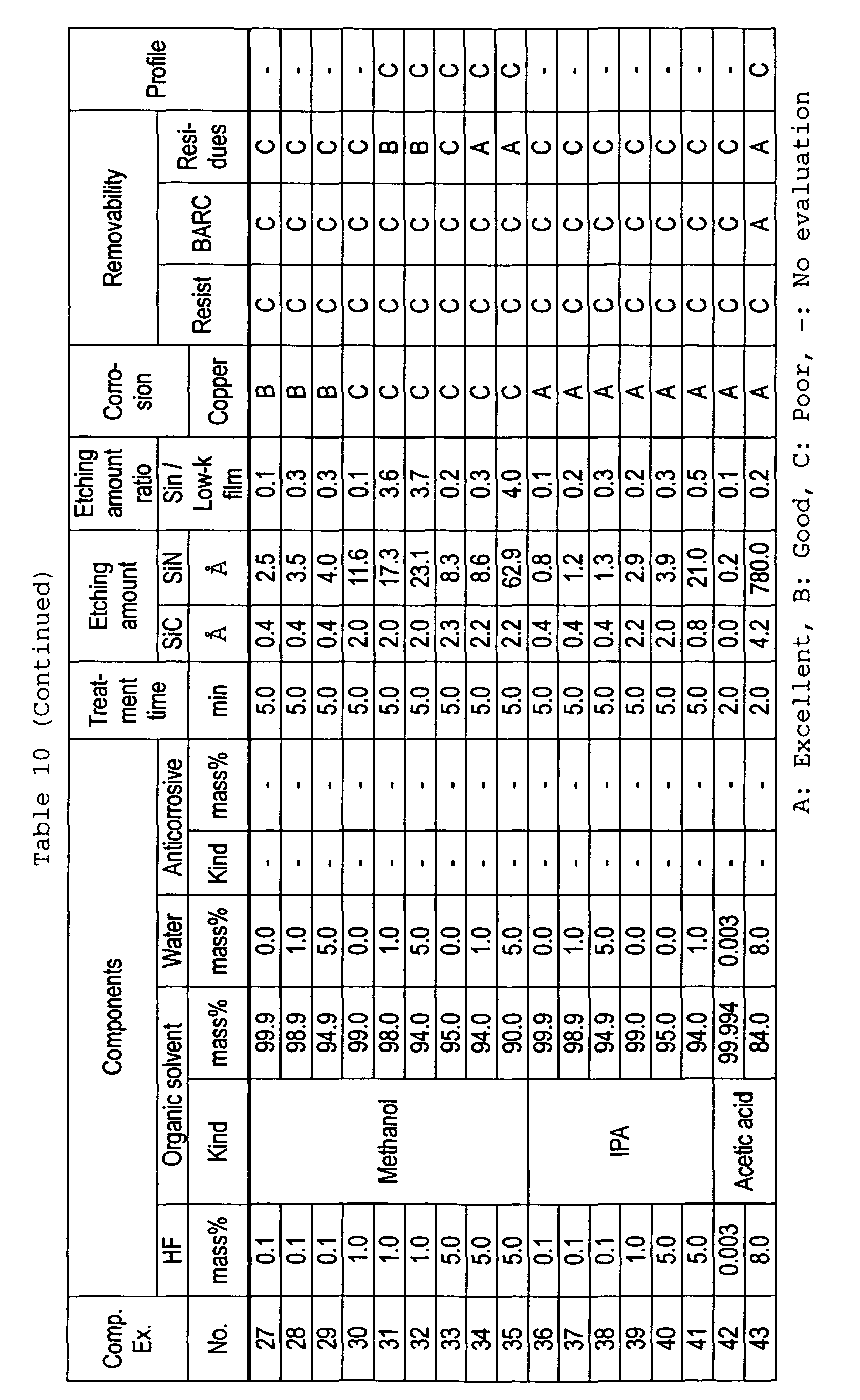
The vertical cross-section of each treated
substrate was observed by SEM in comparison with that of
the untreated substrate to check the effects of the
removing solutions on low-k film in Examples 67 to 83 and
Comparative Examples 5 to 43. The profile of the
substrate was substantially unchanged before and after the
treatment with the removing solutions in Examples 67 to 83.
It was thus confirmed that the low-k film was not damaged.
The removing solution of the present invention
was found to be capable of removing resist, antireflection
coating, and etching residues including these, without
substantially damaging low-k film.
In Comparative Example 10, although it was
possible to remove the resist and antireflection coating,
the low-k film was damaged, being removed together with
the resist and antireflection coating.
In Comparative Examples 5 to 9, 11, and 12,
since the resist, antireflection coating, and etching
residues including these were not removed, no evaluation
was made in terms of profile. If treatment time is
lengthened until they have been removed, the amount of
etched low-k film will be increased. Since accurate
processing cannot be performed as intended, the obtained
profile becomes extremely poor.
In Comparative Examples 13 to 43, there were
some cases where since the resist, antireflection coating,
and etching residues including these were not removed, no
evaluation was made in terms of profile. In other cases,
even when the resist or antireflection coating or etching
residues including these were removed, the obtained
profile was extremely poor.
Claims (73)
- A resist-removing solution for low-k film comprising hydrogen fluoride (HF) and at least one member selected from the group consisting of organic acids and organic solvents.
- A resist-removing solution according to claim 1, further comprising at least one member selected from the group consisting of ammonia and amines.
- A removing solution according to claim 1, wherein the solution is used for ultrasonic cleaning.
- A removing solution according to claim 1, wherein the low-k film has a dielectric constant greater than 1 but not greater than 3.
- A removing solution according to claim 1, whereby a SiN film can be etched to a depth of at least 1 Å.
- A removing solution according to claim 1, wherein the organic acids or organic solvents have an SP value of 7 to 17.
- A removing solution according to claim 1, wherein the concentration of HF is in the range of 0.01 to 10 mass %.
- A removing solution according to claim 1, wherein said at least one member selected from the group consisting of organic acids and organic solvents is organic acid(s) or a mixture of organic acid(s) and organic solvent(s); and the concentration of HF is in the range of 0.01 to 5 mass %.
- A removing solution according to claim 1, wherein said at least one member selected from the group consisting of organic acids and organic solvents is organic solvent(s); and the concentration of HF is in the range of 0.01 to 10 mass %.
- A removing solution according to claim 1, further comprising water, wherein the weight ratio of HF/organic acid/water is in the range of 0.01 to 5 mass %/49 to 99.9 mass %/0 to 50 mass %; and the organic acid is at least one member selected from the group consisting of monocarboxylic acids, sulfonic acids, and polycarboxylic acids.
- A removing solution according to claim 10, wherein the monocarboxylic acids are at least one member selected from the group consisting of acetic acid, propionic acid, butyric acid, isobutyric acid, valeric acid, caproic acid, caprylic acid, monochloroacetic acid, dichloroacetic acid, trichloroacetic acid, monofluoroacetic acid, difluoroacetic acid, trifluoroacetic acid, α-chlorobutyric acid, β-chlorobutyric acid, γ-chlorobutyric acid, lactic acid, glycolic acid, pyruvic acid, glyoxalic acid, methacrylic acid, and acrylic acid;
the sulfonic acids are at least one member selected from the group consisting of methanesulfonic acid, benzenesulfonic acid, trifluoromethanesulfonic acid, and toluenesulfonic acid; and
the polycarboxylic acids are at least one member selected from the group consisting of oxalic acid, succinic acid, adipic acid, tartaric acid, and citric acid. - A removing solution according to claim 1, further comprising water, wherein the weight ratio of HF/organic solvent/water is in the range of 0.01 to 10 mass %/49 to 99.9 mass %/0 to 50 mass %; and the organic solvent is at least one member selected from the group consisting of monohydric alcohols, polyols, ketones, amides, nitriles, aldehydes, alkylene glycol monoalkyl ethers, ethers, esters, hydrocarbons, halogen compounds, fluorinated alcohols, phosphate esters, and nitrogen-containing compounds.
- A removing solution according to claim 2, wherein the weight ratio of HF/said at least one member selected from the group consisting of ammonia and amines/organic solvent/water is in the range of 0.01 to 10 mass %/0.01 to 30 mass %/49 to 99.9 mass %/0 to 50 mass %; and the organic solvent is at least one member selected from the group consisting of monohydric alcohols, polyols, ketones, amides, nitriles, aldehydes, alkylene glycol monoalkyl ethers, ethers, esters, hydrocarbons, halogen compounds, fluorinated alcohols, phosphate esters, and nitrogen-containing compounds.
- A removing solution according to claim 12, wherein the monohydric alcohols are at least one member selected from the group consisting of methanol, ethanol, isopropanol (IPA), 1-propanol, 1-butanol, 2-butanol, t-butanol, 2-methyl-1-propanol, 1-pentanol, 1-hexanol, 1-heptanol, 4-heptanol, 1-octanol, 1-nonyl alcohol, 1-decanol, 1-dodecanol, lauryl alcohol, and cyclohexanol, with the proviso that methanol and ethanol are used in combination with other organic solvent(s) or organic acid(s);
the polyols are at least one member selected from the group consisting of ethylene glycol, diethylene glycol, 1,2-propanediol, propylene glycol, 2,3-butanediol, and glycerin;
the ketones are at least one member selected from the group consisting of acetone, acetylacetone, methyl ethyl ketone, methyl isobutyl ketone, cyclohexanone, diethyl ketone, and diisobutyl ketone;
the amides are at least one member selected from the group consisting of N-methylformamide, N,N-dimethylformamide, N-methylacetamide, and N,N-dimethylacetamide;
the nitriles are at least one member selected from the group consisting of acetonitrile, propionitrile, butyronitrile, isobutyronitrile, and benzonitrile;
the aldehydes are at least one member selected from the group consisting of formaldehyde, acetaldehyde, and propionaldehyde;
the alkylene glycol monoalkyl ethers are at least one member selected from the group consisting of ethylene glycol monomethyl ether and ethylene glycol monoethyl ether;
the ethers are at least one member selected from the group consisting of tetrahydrofuran, dioxane, diisopropyl ether, dibutyl ether, tetrahydropyran, anisole, 1,2-dimethoxyethane, and diethylene glycol dimethyl ether;
the esters are at least one member selected from the group consisting of methyl acetate, ethyl acetate, propyl acetate, isopropyl acetate, butyl acetate, isobutyl acetate, pentyl acetate, hexyl acetate, methyl propionate, ethyl propionate, propyl propionate, isopropyl propionate, butyl propionate, isobutyl propionate, pentyl propionate, hexyl propionate, methyl butyrate, ethyl butyrate, propyl butyrate, isopropyl butyrate, butyl butyrate, isobutyl butyrate, pentyl butyrate, hexyl butyrate, methyl isobutyrate, ethyl isobutyrate, propyl isobutyrate, isopropyl isobutyrate, butyl isobutyrate, isobutyl isobutyrate, pentyl isobutyrate, hexyl isobutyrate, methyl valerate, ethyl valerate, propyl valerate, isopropyl valerate, butyl valerate, isobutyl valerate, pentyl valerate, hexyl valerate, methyl isovalerate, ethyl isovalerate, propyl isovalerate, isopropyl isovalerate, butyl isovalerate, isobutyl isovalerate, pentyl isovalerate, hexyl isovalerate, methyl caproate, ethyl caproate, propyl caproate, isopropyl caproate, butyl caproate, isobutyl caproate, pentyl caproate, hexyl caproate, methyl caprylate, ethyl caprylate, propyl caprylate, isopropyl caprylate, butyl caprylate, isobutyl caprylate, pentyl caprylate, hexyl caprylate, methyl octanoate, ethyl octanoate, propyl octanoate, isopropyl octanoate, butyl octanoate, isobutyl octanoate, pentyl octanoate, hexyl octanoate, methyl nonanoate, ethyl nonanoate, propyl nonanoate, isopropyl nonanoate, butyl nonanoate, isobutyl nonanoate, pentyl nonanoate, hexyl nonanoate, methyl decanoate, ethyl decanoate, propyl decanoate, isopropyl decanoate, butyl decanoate, isobutyl decanoate, pentyl decanoate, hexyl decanoate, methyl dodecanoate, ethyl dodecanoate, propyl dodecanoate, isopropyl dodecanoate, butyl dodecanoate, isobutyl dodecanoate, pentyl dodecanoate, hexyl dodecanoate, methyl laurate, ethyl laurate, propyl laurate, isopropyl laurate, butyl laurate, isobutyl laurate, pentyl laurate, hexyl laurate, methyl acrylate, ethyl acrylate, propyl acrylate, isopropyl acrylate, butyl acrylate, isobutyl acrylate, pentyl acrylate, hexyl acrylate, monomethyl oxalate, dimethyl oxalate, monoethyl oxalate, diethyl oxalate, monopropyl oxalate, dipropyl oxalate, monobutyl oxalate, dibutyl oxalate, monomethyl succinate, dimethyl succinate, monoethyl succinate, diethyl succinate, monopropyl succinate, dipropyl succinate, monobutyl succinate, dibutyl succinate, monomethyl adipate, dimethyl adipate, monoethyl adipate, diethyl adipate, monopropyl adipate, dipropyl adipate, monobutyl adipate, dibutyl adipate, monomethyl tartrate, dimethyl tartrate, monoethyl tartrate, diethyl tartrate, monopropyl tartrate, dipropyl tartrate, monobutyl tartrate, dibutyl tartrate, monomethyl citrate, dimethyl citrate, monoethyl citrate, diethyl citrate, monopropyl citrate, dipropyl citrate, monobutyl citrate, dibutyl citrate, dimethyl phthalate, diethyl phthalate, dipropyl phthalate, dibutyl phthalate, dipentyl phthalate, dihexyl phthalate, diheptyl phthalate, dioctyl phthalate, dinonyl phthalate, didecyl phthalate, didodecyl phthalate, dimethyl terephthalate, diethyl terephthalate, dipropyl terephthalate, dibutyl terephthalate, dipentyl terephthalate, dihexyl terephthalate, diheptyl terephthalate, dioctyl terephthalate, dinonyl terephthalate, didecyl terephthalate, didodecyl terephthalate, propylene carbonate, and γ-butyrolactone;
the hydrocarbons are at least one member selected from the group consisting of hexane, cyclohexane, octane, isooctane, benzene, and toluene;
the halogen compounds are at least one member selected from the group consisting of chloroform, o-dichlorobenzene, perfluorohexane, and perfluoromethylcyclohexane;
the fluorinated alcohols are at least one member selected from the group consisting of trifluoroethanol, pentafluoropropanol, and 2,2,3,3-tetrafluoropropanol;
the phosphate esters are at least one member selected from the group consisting of dimethyl phosphate, dibutyl phosphate, diphenyl phosphate, dibenzyl phosphate, trimethyl phosphate, triethyl phosphate, tripropyl phosphate, tributyl phosphate, and triphenyl phosphate; and
the nitrogen-containing compounds are at least one member selected from the group consisting of tetramethylurea and N-methyl-2-pyrrolidone. - A method of removing resist, comprising treating an object having resist on the surface of a low-k film or on an antireflection coating (BARC) over a low-k film, by the use of the removing solution of claim 1 under temperature and time conditions such that the resist can be removed without substantially damaging the low-k film.
- A method according to claim 15, comprising an ashing treatment for the resist without substantially damaging the low-k film, before treating the object using the removing solution.
- A method according to claim 15, wherein the low-k film is substantially undamaged because the low-k film is substantially unetched and/or the dielectric constant of the low-k film is substantially unchanged before and after the treatment.
- A method according to claim 15, comprising treating the object while performing ultrasonic cleaning.
- A resist-removed object that can be obtained according to the method of claim 15.
- A cleaning solution for a via hole or a capacitor comprising hydrogen fluoride (HF) and at least one member selected from the group consisting of organic acids and organic solvents.
- A cleaning solution according to claim 20, further comprising at least one member selected from the group consisting of ammonia and amines.
- A removing solution according to claim 20, wherein the solution is used for ultrasonic cleaning.
- A cleaning solution according to claim 20, whereby a TiN film can be etched to a depth of at least 0.01 Å.
- A cleaning solution according to claim 20, further comprising water, wherein the weight ratio of HF/organic acid/water is in the range of 0.01 to 5 mass %/49 to 99.9 mass %/0 to 50 mass %; and the organic acid is at least one member selected from the group consisting of monocarboxylic acids, sulfonic acids, and polycarboxylic acids.
- A cleaning solution according to claim 24, wherein the monocarboxylic acids are at least one member selected from the group consisting of acetic acid, propionic acid, butyric acid, isobutyric acid, valeric acid, caproic acid, caprylic acid, monochloroacetic acid, dichloroacetic acid, trichloroacetic acid, monofluoroacetic acid, difluoroacetic acid, trifluoroacetic acid, α-chlorobutyric acid, β-chlorobutyric acid, γ-chlorobutyric acid, lactic acid, glycolic acid, pyruvic acid, glyoxalic acid, methacrylic acid, and acrylic acid;
the sulfonic acids are at least one member selected from the group consisting of methanesulfonic acid, benzenesulfonic acid, trifluoromethanesulfonic acid, and toluenesulfonic acid; and
the polycarboxylic acids are at least one member selected from the group consisting of oxalic acid, succinic acid, adipic acid, tartaric acid, and citric acid. - A cleaning solution according to claim 20, further comprising water, wherein the weight ratio of HF/organic solvent/water is in the range of 0.01 to 10 mass %/49 to 99.9 mass %/0 to 50 mass %; and the organic solvent is at least one member selected from the group consisting of monohydric alcohols, polyols, ketones, amides, nitriles, aldehydes, alkylene glycol monoalkyl ethers, ethers, esters, hydrocarbons, halogen compounds, fluorinated alcohols, phosphate esters, and nitrogen-containing compounds.
- A cleaning solution according to claim 21, wherein the weight ratio of HF/said at least one member selected from the group consisting of ammonia and amines/organic solvent/water is in the range of 0.01 to 10 mass %/0.01 to 30 mass %/49 to 99.9 mass %/0 to 50 mass %; and the organic solvent is at least one member selected from the group consisting of monohydric alcohols, polyols, ketones, amides, nitriles, aldehydes, alkylene glycol monoalkyl ethers, ethers, esters, hydrocarbons, halogen compounds, fluorinated alcohols, phosphate esters, and nitrogen-containing compounds.
- A cleaning solution according to claim 26, wherein the monohydric alcohols are at least one member selected from the group consisting of methanol, ethanol, isopropanol (IPA), 1-propanol, 1-butanol, 2-butanol, t-butanol, 2-methyl-1-propanol, 1-pentanol, 1-hexanol, 1-heptanol, 4-heptanol, 1-octanol, 1-nonyl alcohol, 1-decanol, 1-dodecanol, lauryl alcohol, and cyclohexanol;
the polyols are at least one member selected from the group consisting of ethylene glycol, diethylene glycol, 1,2-propanediol, propylene glycol, 2,3-butanediol, and glycerin;
the ketones are at least one member selected from the group consisting of acetone, acetylacetone, methyl ethyl ketone, methyl isobutyl ketone, cyclohexanone, diethyl ketone, and diisobutyl ketone;
the amides are at least one member selected from the group consisting of N-methylformamide, N,N-dimethylformamide, N-methylacetamide, and N,N-dimethylacetamide;
the nitriles are at least one member selected from the group consisting of acetonitrile, propionitrile, butyronitrile, isobutyronitrile, and benzonitrile;
the aldehydes are at least one member selected from the group consisting of formaldehyde, acetaldehyde, and propionaldehyde;
the alkylene glycol monoalkyl ethers are at least one member selected from the group consisting of ethylene glycol monomethyl ether and ethylene glycol monoethyl ether;
the ethers are at least one member selected from the group consisting of tetrahydrofuran, dioxane, diisopropyl ether, dibutyl ether, tetrahydropyran, anisole, 1,2-dimethoxyethane, and diethylene glycol dimethyl ether;
the esters are at least one member selected from the group consisting of methyl acetate, ethyl acetate, propyl acetate, isopropyl acetate, butyl acetate, isobutyl acetate, pentyl acetate, hexyl acetate, methyl propionate, ethyl propionate, propyl propionate, isopropyl propionate, butyl propionate, isobutyl propionate, pentyl propionate, hexyl propionate, methyl butyrate, ethyl butyrate, propyl butyrate, isopropyl butyrate, butyl butyrate, isobutyl butyrate, pentyl butyrate, hexyl butyrate, methyl isobutyrate, ethyl isobutyrate, propyl isobutyrate, isopropyl isobutyrate, butyl isobutyrate, isobutyl isobutyrate, pentyl isobutyrate, hexyl isobutyrate, methyl valerate, ethyl valerate, propyl valerate, isopropyl valerate, butyl valerate, isobutyl valerate, pentyl valerate, hexyl valerate, methyl isovalerate, ethyl isovalerate, propyl isovalerate, isopropyl isovalerate, butyl isovalerate, isobutyl isovalerate, pentyl isovalerate, hexyl isovalerate, methyl caproate, ethyl caproate, propyl caproate, isopropyl caproate, butyl caproate, isobutyl caproate, pentyl caproate, hexyl caproate, methyl caprylate, ethyl caprylate, propyl caprylate, isopropyl caprylate, butyl caprylate, isobutyl caprylate, pentyl caprylate, hexyl caprylate, methyl octanoate, ethyl octanoate, propyl octanoate, isopropyl octanoate, butyl octanoate, isobutyl octanoate, pentyl octanoate, hexyl octanoate, methyl nonanoate, ethyl nonanoate, propyl nonanoate, isopropyl nonanoate, butyl nonanoate, isobutyl nonanoate, pentyl nonanoate, hexyl nonanoate, methyl decanoate, ethyl decanoate, propyl decanoate, isopropyl decanoate, butyl decanoate, isobutyl decanoate, pentyl decanoate, hexyl decanoate, methyl dodecanoate, ethyl dodecanoate, propyl dodecanoate, isopropyl dodecanoate, butyl dodecanoate, isobutyl dodecanoate, pentyl dodecanoate, hexyl dodecanoate, methyl laurate, ethyl laurate, propyl laurate, isopropyl laurate, butyl laurate, isobutyl laurate, pentyl laurate, hexyl laurate, methyl acrylate, ethyl acrylate, propyl acrylate, isopropyl acrylate, butyl acrylate, isobutyl acrylate, pentyl acrylate, hexyl acrylate, monomethyl oxalate, dimethyl oxalate, monoethyl oxalate, diethyl oxalate, monopropyl oxalate, dipropyl oxalate, monobutyl oxalate, dibutyl oxalate, monomethyl succinate, dimethyl succinate, monoethyl succinate, diethyl succinate, monopropyl succinate, dipropyl succinate, monobutyl succinate, dibutyl succinate, monomethyl adipate, dimethyl adipate, monoethyl adipate, diethyl adipate, monopropyl adipate, dipropyl adipate, monobutyl adipate, dibutyl adipate, monomethyl tartrate, dimethyl tartrate, monoethyl tartrate, diethyl tartrate, monopropyl tartrate, dipropyl tartrate, monobutyl tartrate, dibutyl tartrate, monomethyl citrate, dimethyl citrate, monoethyl citrate, diethyl citrate, monopropyl citrate, dipropyl citrate, monobutyl citrate, dibutyl citrate, dimethyl phthalate, diethyl phthalate, dipropyl phthalate, dibutyl phthalate, dipentyl phthalate, dihexyl phthalate, diheptyl phthalate, dioctyl phthalate, dinonyl phthalate, didecyl phthalate, didodecyl phthalate, dimethyl terephthalate, diethyl terephthalate, dipropyl terephthalate, dibutyl terephthalate, dipentyl terephthalate, dihexyl terephthalate, diheptyl terephthalate, dioctyl terephthalate, dinonyl terephthalate, didecyl terephthalate, didodecyl terephthalate, propylene carbonate, and γ-butyrolactone;
the hydrocarbons are at least one member selected from the group consisting of hexane, cyclohexane, octane, isooctane, benzene, and toluene;
the halogen compounds are at least one member selected from the group consisting of chloroform, o-dichlorobenzene, perfluorohexane, and perfluoromethylcyclohexane;
the fluorinated alcohols are at least one member selected from the group consisting of trifluoroethanol, pentafluoropropanol, and 2,2,3,3-tetrafluoropropanol;
the phosphate esters are at least one member selected from the group consisting of dimethyl phosphate, dibutyl phosphate, diphenyl phosphate, dibenzyl phosphate, trimethyl phosphate, triethyl phosphate, tripropyl phosphate, tributyl phosphate, and triphenyl phosphate; and
the nitrogen-containing compounds are at least one member selected from the group consisting of tetramethylurea and N-methyl-2-pyrrolidone. - A method of cleaning a via hole, comprising cleaning an object that has a via hole, with at least one member selected from the group consisting of titanium compounds and polymers adhering to at least one member selected from the group consisting of the sidewall and the bottom of the via hole, by the use of the cleaning solution of claim 20.
- A method according to claim 29, comprising treating the object while performing ultrasonic cleaning.
- A cleaned object that can be obtained according to the method of claim 29.
- A method of cleaning a capacitor, comprising cleaning an object that has a metal capacitor upper electrode or lower electrode, with at least one member selected from the group consisting of resist residue, polymers, and titanium compounds adhering to at least one member selected from the group consisting of the sidewall, the bottom, and the surface of the electrode, by the use of the cleaning solution of claim 20.
- A method according to claim 32, comprising treating the object while performing ultrasonic cleaning.
- A cleaned object that can be obtained according to the method of claim 32.
- A resist-removing solution according to claim 1, wherein the solution etches, in a treatment time of 0.1 to 120 minutes, (1) an insulating film barrier to a depth of 1 to 200 Å, (2) low-k film to a depth of 1 to 200 Å, and (3) Cu at an etching rate of no more than 10 Å/min; and the solution removes resist, antireflection coating, filling material, and etching residue including these, after dry etching in the formation of damascene and dual damascene structures for Cu/low-k multilevel interconnection.
- A removing solution according to claim 35, wherein the insulating film barrier and the low-k film are Si-containing compounds such as SiN, SiC, SiCN, SiOC, and SiO2.
- A removing solution according to claim 35, wherein the solution removes residue resulting from etching with a nitrogen-containing etching gas, regardless of whether plasma ashing is conducted or not.
- A removing solution according to claim 35, wherein the solution removes residue after ashing with a nitrogen-containing gas.
- A removing solution according to claim 35, wherein one or more inert gases are dissolved in the solution such that the oxygen partial pressure in the solution is below the oxygen partial pressure in air-saturated solution.
- A removing solution according to claim 35, comprising (i) HF, (ii) a protogenic solvent, and (iii) at least one organic compound selected from the group consisting of polar protophilic solvents and polar protophobic solvents having a donor number of no more than 24, and neutral solvents; wherein the weight ratio of (i) HF (hydrogen fluoride)/(ii) protogenic solvent/(iii) said at least one organic compound selected from the group consisting of polar protophilic solvents and polar protophobic solvents having a donor number of no more than 24, and neutral solvents is in the range of (i) 0.05 to 5 mass %/(ii) 1 to 98.95 mass %/(iii) 1 to 98.95 mass %.
- A removing solution according to claim 35, comprising (i) HF, (ii) a protogenic solvent, and (iii) at least one organic compound selected from the group consisting of polar protophilic solvents and polar protophobic solvents having a donor number of no more than 24, and neutral solvents, and further comprising (iv) water; wherein the weight ratio of (i) HF (hydrogen fluoride)/(ii) protogenic solvent/(iii) said at least one organic compound selected from the group consisting of polar protophilic solvents and polar protophobic solvents having a donor number of no more than 24, and neutral solvents/(iv) water is in the range of (i) 0.05 to 5 mass %/(ii) 1 to 98.93 mass %/(iii) 1 to 98.93 mass %/(iv) 0.02 to 90 mass %.
- A removing solution according to claim 35, comprising (i) HF, (ii) a protogenic solvent, (iii) at least one organic compound selected from the group consisting of polar protophilic solvents and polar protophobic solvents having a donor number of no more than 24, and neutral solvents, and (iv) water, and further comprising at least one member selected from the group consisting of (v) acids, (vi) polar protophilic solvents having a donor number of at least 25, and (vii) fluorine-containing organic compounds; wherein the weight ratio of (i) HF/(ii) protogenic solvent/(iii) said at least one organic compound selected from the group consisting of polar protophilic solvents and polar protophobic solvents having a donor number of no more than 24, and neutral solvents/(iv) water/(v) acid/(vi) polar protophilic solvent having a donor number of at least 25/(vii) fluorine-containing organic compound is in the range of (i) 0.05 to 5 mass %/(ii) 1 to 98.83 mass %/ (iii) 1 to 98.83 mass %/(iv) 0.02 to 90 mass %/(v) 0 to 10 mass %/(vi) 0 to 50 mass %/(vii) 0 to 70 mass %, with the total amount of acid, polar protophilic solvent having a donor number of at least 25, and fluorine-containing organic compound being 0.1 to 74.93 mass %.
- A removing solution according to claim 35, comprising (i) HF, (ii) a protogenic solvent, (iii) at least one organic compound selected from the group consisting of polar protophilic solvents and polar protophobic solvents having a donor number of no more than 24, and neutral solvents, (iv) water, and at least one member selected from the group consisting of (v) acids, (vi) polar protophilic solvents having a donor number of at least 25, and (vii) fluorine-containing organic compounds, and further comprising ammonia and/or amine(s); wherein the weight ratio of (i) HF/(ii) protogenic solvent/(iii) said at least one organic compound selected from the group consisting of polar protophilic solvents and polar protophobic solvents having a donor number of no more than 24, and neutral solvents/(iv) water/(v) acid/(vi) polar protophilic solvent having a donor number of at least 25/(vii) fluorine-containing organic compound/(viii) ammonia and/or amine is in the range of (i) 0.05 to 5 mass %/(ii) 1 to 98.73 mass %/(iii) 1 to 98.73 mass %/(iv) 0.02 to 90 mass %/(v) 0 to 10 mass %/(vi) 0 to 50 mass %/(vii) 0 to 70 mass %/(viii) 0.05 to 10 mass %, with the total amount of acid, polar protophilic solvent having a donor number of at least 25, and fluorine-containing organic compound being 0.1 to 74.83 mass %.
- A removing solution according to claim 35, comprising (i) HF, (ii) at least one organic compound selected from the group consisting of polar protophilic solvents and polar protophobic solvents having a donor number of no more than 24, neutral solvents, and protogenic solvents, and (iii) water; wherein the weight ratio of (i) HF (hydrogen fluoride)/(ii) said at least one organic compound selected from the group consisting of polar protophilic solvents and polar protophobic solvents having a donor number of no more than 24, neutral solvents, and protogenic solvents/(iii) water is in the range of (i) 0.05 to 5 mass %/(ii) 85 to 99.93 mass %/(iii) 0.02 to 10 mass %.
- A removing solution according to claim 35, comprising (i) HF, (ii) at least one organic compound selected from the group consisting of polar protophilic solvents and polar protophobic solvents having a donor number of no more than 24, neutral solvents, and protogenic solvents, and (iii) water, and further comprising at least one member selected from the group consisting of acids, polar protophilic solvents having a donor number of at least 25, and fluorine-containing organic compounds; wherein the weight ratio of (i) HF/(ii) said at least one organic compound selected from the group consisting of polar protophilic solvents and polar protophobic solvents having a donor number of no more than 24, neutral solvents, and protogenic solvents/(iii) water/(iv) acid/(v) polar protophilic solvent having a donor number of at least 25/(vi) fluorine-containing organic compound is in the range of (i) 0.05 to 5 mass %/(ii) 25 to 99.83 mass %/(iii) 0.02 to 10 mass %/(iv) 0 to 10 mass %/(v) 0 to 50 mass %/(vi) 0 to 70 mass %, with the total amount of acid, polar protophilic solvent having a donor number of at least 25, and fluorine-containing organic compound being 0.1 to 74.93 mass %.
- A removing solution according to claim 35, comprising (i) HF, (ii) at least one organic compound selected from the group consisting of polar protophilic solvents and polar protophobic solvents having a donor number of no more than 24, neutral solvents, and protogenic solvents, (iii) water, and at least one member selected from the group consisting of (iv) acids, (v) polar protophilic solvents having a donor number of at least 25, and (vi) fluorine-containing organic compounds, and further comprising (vii) ammonia and/or amine(s); wherein the weight ratio of (i) HF/(ii) said at least one organic compound selected from the group consisting of polar protophilic solvents and polar protophobic solvents having a donor number of no more than 24, neutral solvents, and protogenic solvents/(iii) water/(iv) acid/(v) polar protophilic solvent having a donor number of at least 25/(vi) fluorine-containing organic compound/(viii) ammonia and/or amine is in the range of (i) 0.05 to 5 mass %/(ii) 25 to 99.78 mass %/(iii) 0.02 to 10 mass %/(iv) 0 to 10 mass %/(v) 0 to 10 mass %/(vi) 0 to 70 mass %/(vii) 0.05 to 10 mass %, with the total amount of said at least one member selected from the group consisting of acids, polar protophilic solvents having a donor number of at least 25, and fluorine-containing organic compounds being 0.1 to 74.88 mass %.
- A removing solution according to claim 40, wherein the neutral solvents are alcohols; the protogenic solvents are monocarboxylic acids, polycarboxylic acids, and sulfonic acids; and the polar aprotoic solvents having a donor number of no more than 24 are esters and ethers; and the polar protophilic solvents having a donor number of at least 25 are esters, ethers, ketones, and acid anhydrides.
- A removing solution according to claim 47, wherein (I) as the neutral solvents, the alcohols are methyl alcohol, ethyl alcohol, propanol, isopropanol, t-butanol, allyl alcohol, and ethylene glycol;(II) as the protogenic solvents, the monocarboxylic acids are formic acid, acetic acid, propionic acid, butyric acid, isobutyric acid, monochloroacetic acid, dichloroacetic acid, trichloroacetic acid, monofluoroacetic acid, difluoroacetic acid, trifluoroacetic acid, α-chlorobutyric acid, β-chlorobutyric acid, γ-chlorobutyric acid, lactic acid, glycolic acid, pyruvic acid, glyoxalic acid, methacrylic acid, and acrylic acid; the polycarboxylic acids are oxalic acid, succinic acid, adipic acid, and citric acid; and the sulfonic acids are methanesulfonic acid, benzenesulfonic acid, toluenesulfonic acid, and trifluoromethanesulfonic acid;(III) as the polar protophilic solvents having a donor number of no more than 24, the esters are tributyl phosphate and trimethyl phosphate; the ethers are 1,2-dimethoxyethane, tetrahydrofuran, diethyl ether, ethylene glycol monomethyl ether, ethylene glycol monoethyl ether, dimethoxymethane, dimethoxypropane, diethoxymethane, and 1,1-dimethoxyethane;(IV) as the polar protophobic solvents, the esters are methyl acetate, ethyl acetate, butyl acetate, propylene carbonate, ethylene carbonate, ethylene sulfite, and lactone; the ethers are dioxane, trioxane, and diglyme; the ketones are acetone; and the acid anhydrides are acetic anhydride.
- A removing solution according to claim 42, 43, 45, or 46, wherein the acids are at least one member selected from the group consisting of hydrogen chloride, hydrogen bromide, hydrogen iodide, aqueous solutions thereof, sulfuric acid, nitric acid, phosphoric acid, and carboxylic acid.
- A removing solution according to claim 42, 43, 45, or 46, wherein the fluorine-containing organic compounds are fluorine-containing ethers such as CHF2CF2OCH2CF3 and CHF2CF2OCH4; and hydrochlorofluorocarbons (HCFCs) such as CH3CCl2F and CClF2CF2CHClF.
- A removing solution according to claim 42, 43, 45, or 46, wherein the polar protophilic solvents having a donor number of at least 25 are at least one member selected from the group consisting of amides such as dimethylformamide, dimethylacetamide, hexamethylphosphoric triamide, N-methyl-2-pyrrolidone, 1,1,3,3-tetramethylurea, N-methylpropionamide, and dimethyl imidazolidinone; and sulfur compounds such as dimethyl sulfoxide, sulfolane, dimethylthioformamide, and N-methylthiopyrrolidone.
- A removing solution according to any of claims 40 to 46, wherein the solution comprises a carboxylic acid as a protogenic solvent; and at least one member selected from the group consisting of alcohols as neutral solvents, and esters and ethers as polar aprotic solvents having a donor number of no more than 24.
- A removing solution according to claim 52, wherein the carboxylic acid is acetic acid.
- A removing solution according to claim 47, wherein the solution comprises an alcohol as a neutral solvent; and at least one member selected from the group consisting of esters and ethers as polar aprotic solvents having a donor number of no more than 24.
- A removing solution according to claim 47, wherein the alcohols are at least one member selected from the group consisting of propanol, isopropanol, t-butanol, allyl alcohol, and ethylene glycol.
- A removing solution according to any of claims 40 to 46, wherein the solution comprises at least one member selected from the group consisting of esters and ethers as polar aprotic solvents having a donor number of no more than 24.
- A removing solution according to any of claims 40 to 46, wherein the esters are at least one member selected from the group consisting of methyl acetate, ethyl acetate, butyl acetate, propylene carbonate, and ethylene carbonate; and the ethers are at least one member selected from the group consisting of 1,2-dimethoxyethane, tetrahydrofuran, dioxane, trioxane, diglyme, ethylene glycol monomethyl ether, ethylene glycol diethyl ether, diethylene glycol methyl ethyl ether, tetraethylene glycol dimethyl ether, polyethylene glycol dimethyl ether, ethylene glycol monoallyl ether, diethylene glycol monobutyl ether, ethylene glycol butyl ether, triethylene glycol monobutyl ether, diethylene glycol diethyl ether, diethylene glycol dimethyl ether, triethylene glycol dimethyl ether, diethylene glycol monoisobutyl ether, ethylene glycol monoisobutyl ether, ethylene glycol monoisopropyl ether, diethylene glycol monomethyl ether, dipropylene glycol monomethyl ether, propylene glycol monomethyl ether, tripropylene glycol monomethyl ether, ethylene glycol monoethyl ether, polyethylene glycol monomethyl ether, triethylene glycol monomethyl ether, propylene glycol monopropyl ether, and ethylene glycol methyl ethyl ether.
- A removing solution according to claim 44, comprising HF, acetic acid, and water; wherein the weight ratio of HF/acetic acid/water is in the range of 0.05 to 5 mass %/85 to 99.93 mass %/0.02 to 10 mass %.
- A removing solution according to claim 44, comprising HF, isopropanol, and water; wherein the weight ratio of HF/isopropanol/water is in the range of 1 to 7 mass %/88 to 98.5 mass %/0.5 to 5 mass %.
- A removing solution according to claim 44, comprising HF, acetic acid, isopropanol, and water; wherein the weight ratio of HF/acetic acid/isopropanol/water is in the range of 0.05 to 6 mass %/1 to 98.93 mass %/1 to 98.85 mass %/0.02 to 12 mass %.
- A removing solution according to claim 44, comprising HF, 1,2-dimethoxyethane, and water; wherein the weight ratio of HF/1,2-dimethoxyethane/water is in the range of 0.50 to 5 mass %/85.00 to 99.3 mass %/0.02 to 10 mass %.
- A removing solution according to claim 44, comprising HF; at least one member selected from the group consisting of methyl acetate, ethyl acetate, and butyl acetate; and water; wherein the weight ratio of HF/said at least one member selected from the group consisting of methyl acetate, ethyl acetate, and butyl acetate/water is in the range of 0.50 to 5 mass %/85.00 to 99.30 mass %/0.02 to 10 mass %.
- A removing solution according to claim 44, comprising HF, 1,4-dioxane, and water; wherein the weight ratio of HF/1,4-dioxane/water is in the range of 0.50 to 5 mass %/85.00 to 99.3 mass %/0.2 to 10 mass %.
- A removing solution according to claim 44, comprising HF; 1,4-dioxane and at least one member selected from the group consisting of acetic anhydride and acetic acid; and water; wherein the weight ratio of HF/1,4-dioxane and said at least one member selected from the group consisting of acetic anhydride and acetic acid/water is in the range of 0.50 to 6 mass %/82.00 to 99.30 mass %/0.2 to 12 mass %.
- A removing solution according to claim 44, comprising HF; at least one member selected from the group consisting of ethylene glycol monomethyl ether, ethylene glycol diethyl ether, diethylene glycol methyl ethyl ether, tetraethylene glycol dimethyl ether, polyethylene glycol dimethyl ether, ethylene glycol monoallyl ether, diethylene glycol monobutyl ether, ethylene glycol butyl ether, triethylene glycol monobutyl ether, diethylene glycol diethyl ether, diethylene glycol dimethyl ether, triethylene glycol dimethyl ether, diethylene glycol monoisobutyl ether, ethylene glycol monoisobutyl ether, ethylene glycol monoisopropyl ether, diethylene glycol monomethyl ether, dipropylene glycol monomethyl ether, propylene glycol monomethyl ether, tripropylene glycol monomethyl ether, ethylene glycol monoethyl ether, polyethylene glycol monomethyl ether, triethylene glycol monomethyl ether, propylene glycol monopropyl ether, and ethylene glycol methyl ethyl ether; and water; wherein the weight ratio of HF/said at least one member selected from the group consisting ofethylene glycol monomethyl ether, ethylene glycol diethyl ether, diethylene glycol methyl ethyl ether, tetraethylene glycol dimethyl ether, polyethylene glycol dimethyl ether, ethylene glycol monoallyl ether, diethylene glycol monobutyl ether, ethylene glycol butyl ether, triethylene glycol monobutyl ether, diethylene glycol diethyl ether, diethylene glycol dimethyl ether, triethylene glycol dimethyl ether, diethylene glycol monoisobutyl ether, ethylene glycol monoisobutyl ether, ethylene glycol monoisopropyl ether, diethylene glycol monomethyl ether, dipropylene glycol monomethyl ether, propylene glycol monomethyl ether, tripropylene glycol monomethyl ether, ethylene glycol monoethyl ether, polyethylene glycol monomethyl ether, triethylene glycol monomethyl ether, propylene glycol monopropyl ether, and ethylene glycol methyl ethyl ether/ water is in the range of 0.50 to 5 mass %/85.00 to 99.30 mass %/0.20 to 10 mass %.
- A removing solution according to claim 35, comprising HF, methanesulfonic acid, and water; wherein the weight ratio of HF/methanesulfonic acid/water is in the range of more than 0 and not more than 5 mass %/at least 45 and less than 100 mass %/more than 0 and not more than 50 mass %.
- A removing method comprising removing etching residue while leaving low-k film that has been damaged by a plasma process, by the use of the removing solution of claim 1 or 35.
- A method according to claim 15 or 67, comprising performing a removal treatment under an atmosphere (substantially in inert gas) wherein one or more inert gases are mixed such that the atmosphere has an oxygen partial pressure below the oxygen partial pressure in air.
- A rinse treatment method for removing a removing solution from an object treated by the method of claim 15 or 67, comprising performing a rinse treatment using water wherein one or more inert gases are dissolved such that the oxygen partial pressure in the water is below the oxygen partial pressure in air-saturated solution, under an atmosphere (substantially in inert gas) wherein one or more inert gases are mixed such that the atmosphere has an oxygen partial pressure below the oxygen partial pressure in air.
- A removal-treated object that can be obtained by treatment according to the removing method of claim 67 or 68, and the rinse treatment method of claim 69.
- A cleaning solution for a via hole or a capacitor according to claim 20, wherein the removing solution of claim 35 is used to clean the via hole or the capacitor.
- A method of cleaning a via hole according to claim 29 or a method of cleaning a capacitor according to claim 32, comprising using the cleaning solution for a via hole or a capacitor of claim 71.
- A cleaned object that can be obtained by cleaning treatment using the cleaning solution for a via hole or a capacitor of claim 71.
Applications Claiming Priority (5)
| Application Number | Priority Date | Filing Date | Title |
|---|---|---|---|
| JP2002242392 | 2002-08-22 | ||
| JP2002242392 | 2002-08-22 | ||
| JP2002299657 | 2002-10-11 | ||
| JP2002299657 | 2002-10-11 | ||
| PCT/JP2003/010547 WO2004019134A1 (en) | 2002-08-22 | 2003-08-21 | Removing solution |
Publications (2)
| Publication Number | Publication Date |
|---|---|
| EP1536291A1 true EP1536291A1 (en) | 2005-06-01 |
| EP1536291A4 EP1536291A4 (en) | 2008-08-06 |
Family
ID=31949564
Family Applications (1)
| Application Number | Title | Priority Date | Filing Date |
|---|---|---|---|
| EP03792757A Withdrawn EP1536291A4 (en) | 2002-08-22 | 2003-08-21 | DISTANCE SOLUTION |
Country Status (8)
| Country | Link |
|---|---|
| US (1) | US7833957B2 (en) |
| EP (1) | EP1536291A4 (en) |
| JP (1) | JP4434950B2 (en) |
| KR (1) | KR100649418B1 (en) |
| CN (1) | CN1678961B (en) |
| AU (1) | AU2003257636A1 (en) |
| TW (1) | TWI266969B (en) |
| WO (1) | WO2004019134A1 (en) |
Cited By (8)
| Publication number | Priority date | Publication date | Assignee | Title |
|---|---|---|---|---|
| WO2006124261A1 (en) * | 2005-05-11 | 2006-11-23 | Micron Technology, Inc. | Methods of etching oxide, reducing roughness, and forming capacitor constructions |
| WO2007045269A1 (en) * | 2005-10-21 | 2007-04-26 | Freescale Semiconductor, Inc. | Method for cleaning a semiconductor structure and chemistry thereof |
| EP1612858A3 (en) * | 2004-07-01 | 2007-06-27 | Air Products And Chemicals, Inc. | Composition for stripping and cleaning and use thereof |
| EP1903400A1 (en) * | 2006-09-20 | 2008-03-26 | Interuniversitair Microelektronica Centrum | A method to remove resist layers from a substrate |
| EP2434004A4 (en) * | 2009-05-21 | 2012-11-28 | Stella Chemifa Corp | CLEANING LIQUID AND CLEANING METHOD |
| EP2542709A4 (en) * | 2010-03-03 | 2014-08-06 | L Air Liquide Société Anonyme Pour L Etude Et L Expl Des Procédés Georges Claude | CLEANING SOLVENT AND CLEANING METHOD FOR METAL COMPOUND |
| US9613808B1 (en) | 2016-01-19 | 2017-04-04 | United Microelectronics Corp. | Method of forming multilayer hard mask with treatment for removing impurities and forming dangling bonds |
| US20210062088A1 (en) * | 2019-08-29 | 2021-03-04 | Sk Innovation Co., Ltd. | Etching composition, method for etching insulating film of semiconductor devices using the same and method for preparing semiconductor devices |
Families Citing this family (119)
| Publication number | Priority date | Publication date | Assignee | Title |
|---|---|---|---|---|
| US7390755B1 (en) | 2002-03-26 | 2008-06-24 | Novellus Systems, Inc. | Methods for post etch cleans |
| JP2005203429A (en) * | 2004-01-13 | 2005-07-28 | Semiconductor Leading Edge Technologies Inc | Manufacturing method of semiconductor device |
| JP2005277375A (en) * | 2004-02-27 | 2005-10-06 | Nec Electronics Corp | Manufacturing method of semiconductor device |
| US7288484B1 (en) | 2004-07-13 | 2007-10-30 | Novellus Systems, Inc. | Photoresist strip method for low-k dielectrics |
| US9217929B2 (en) | 2004-07-22 | 2015-12-22 | Air Products And Chemicals, Inc. | Composition for removing photoresist and/or etching residue from a substrate and use thereof |
| JP2006072083A (en) * | 2004-09-03 | 2006-03-16 | Mitsubishi Electric Corp | Resist removing composition |
| US7658288B2 (en) * | 2004-11-08 | 2010-02-09 | Applied Biosystems, Llc | Bisulfite conversion reagent |
| KR100669866B1 (en) | 2004-12-06 | 2007-01-16 | 삼성전자주식회사 | Composition for removing photoresist, method for removing photoresist using same, and method for manufacturing semiconductor device |
| US8193096B2 (en) | 2004-12-13 | 2012-06-05 | Novellus Systems, Inc. | High dose implantation strip (HDIS) in H2 base chemistry |
| JP4988165B2 (en) * | 2005-03-11 | 2012-08-01 | 関東化学株式会社 | Photoresist stripping composition and method for stripping photoresist |
| US7288488B2 (en) * | 2005-05-10 | 2007-10-30 | Lam Research Corporation | Method for resist strip in presence of regular low k and/or porous low k dielectric materials |
| US8129281B1 (en) * | 2005-05-12 | 2012-03-06 | Novellus Systems, Inc. | Plasma based photoresist removal system for cleaning post ash residue |
| TWI408212B (en) * | 2005-06-07 | 2013-09-11 | 尖端科技材料公司 | Metal and dielectric compatible sacrificial anti-reflective coating for cleaning and removal of components |
| US7279427B2 (en) * | 2005-08-03 | 2007-10-09 | Tokyo Electron, Ltd. | Damage-free ashing process and system for post low-k etch |
| US20070043290A1 (en) * | 2005-08-03 | 2007-02-22 | Goepp Julius G | Method and apparatus for the detection of a bone fracture |
| JP4588590B2 (en) * | 2005-09-09 | 2010-12-01 | ダイセル化学工業株式会社 | Lithographic cleaning agent or rinse agent |
| JP4758187B2 (en) * | 2005-09-26 | 2011-08-24 | 関東化学株式会社 | Photoresist residue and polymer residue remover |
| US7632796B2 (en) * | 2005-10-28 | 2009-12-15 | Dynaloy, Llc | Dynamic multi-purpose composition for the removal of photoresists and method for its use |
| US20070243773A1 (en) * | 2005-10-28 | 2007-10-18 | Phenis Michael T | Dynamic multi-purpose composition for the removal of photoresists and method for its use |
| US9329486B2 (en) | 2005-10-28 | 2016-05-03 | Dynaloy, Llc | Dynamic multi-purpose composition for the removal of photoresists and method for its use |
| US8263539B2 (en) | 2005-10-28 | 2012-09-11 | Dynaloy, Llc | Dynamic multi-purpose composition for the removal of photoresists and methods for its use |
| AU2006340825A1 (en) * | 2005-11-09 | 2007-10-04 | Advanced Technology Materials, Inc. | Composition and method for recycling semiconductor wafers having low-k dielectric materials thereon |
| JP2007142335A (en) * | 2005-11-22 | 2007-06-07 | Dainippon Screen Mfg Co Ltd | High pressure processing method |
| KR100778851B1 (en) * | 2005-12-28 | 2007-11-22 | 동부일렉트로닉스 주식회사 | MIM capacitor formation method of semiconductor device |
| JP4828451B2 (en) * | 2006-03-27 | 2011-11-30 | 東京エレクトロン株式会社 | Substrate processing method, semiconductor device manufacturing method, and substrate processing apparatus |
| US7585782B2 (en) * | 2006-04-11 | 2009-09-08 | Micron Technology, Inc. | Methods of forming semiconductor constructions, and methods of selectively removing metal-containing materials relative to oxide |
| KR100753038B1 (en) * | 2006-06-29 | 2007-08-30 | 주식회사 하이닉스반도체 | Method of forming contact plug of semiconductor device |
| US7740768B1 (en) | 2006-10-12 | 2010-06-22 | Novellus Systems, Inc. | Simultaneous front side ash and backside clean |
| US20080096785A1 (en) * | 2006-10-19 | 2008-04-24 | Air Products And Chemicals, Inc. | Stripper Containing an Acetal or Ketal for Removing Post-Etched Photo-Resist, Etch Polymer and Residue |
| US20100104824A1 (en) * | 2006-10-23 | 2010-04-29 | Phenis Michael T | Dynamic multi-purpose composition for the removal of photoresists |
| JP4642001B2 (en) | 2006-10-24 | 2011-03-02 | 関東化学株式会社 | Composition for removing photoresist residue and polymer residue |
| US7977121B2 (en) * | 2006-11-17 | 2011-07-12 | Air Products And Chemicals, Inc. | Method and composition for restoring dielectric properties of porous dielectric materials |
| US8021490B2 (en) * | 2007-01-04 | 2011-09-20 | Eastman Chemical Company | Substrate cleaning processes through the use of solvents and systems |
| FR2912151B1 (en) * | 2007-02-05 | 2009-05-08 | Arkema France | FORMULATION OF DIMETHYLSULFOXIDE MIXED WITH AN ADDITIVE FOR LOWERING THE CRYSTALLIZATION POINT OF THE SAME, AND APPLICATIONS OF SAID MIXTURE |
| KR101294019B1 (en) * | 2007-02-20 | 2013-08-16 | 주식회사 동진쎄미켐 | Composition for stripping photoresist and method of stripping photoresist using the same |
| US8435895B2 (en) | 2007-04-04 | 2013-05-07 | Novellus Systems, Inc. | Methods for stripping photoresist and/or cleaning metal regions |
| KR101403827B1 (en) * | 2007-08-10 | 2014-06-09 | 동우 화인켐 주식회사 | Stripper composition for removal photoresist residue and stripping method of photoresists using the same |
| US7851374B2 (en) * | 2007-10-31 | 2010-12-14 | Taiwan Semiconductor Manufacturing Co., Ltd. | Silicon wafer reclamation process |
| KR101359919B1 (en) * | 2007-11-01 | 2014-02-11 | 주식회사 동진쎄미켐 | Composition for stripping photoresist, method of stripping photoresist and method of manufacturing display device using the same |
| TWI460557B (en) * | 2008-03-07 | 2014-11-11 | 和光純藥工業股份有限公司 | Semiconductor surface treatment composition and semiconductor surface treatment method using semiconductor surface treatment composition |
| EP2268765A4 (en) * | 2008-03-07 | 2011-10-26 | Advanced Tech Materials | MOISTURE CLEANING COMPOSITION BY ATTACKING NON-SELECTIVE OXIDE AND METHOD OF USE |
| US20090253268A1 (en) * | 2008-04-03 | 2009-10-08 | Honeywell International, Inc. | Post-contact opening etchants for post-contact etch cleans and methods for fabricating the same |
| US20090291562A1 (en) * | 2008-05-20 | 2009-11-26 | Lam Research Corporation | Helium descumming |
| US8183156B2 (en) * | 2008-06-06 | 2012-05-22 | Infineon Technologies Ag | Method of etching a material surface |
| TWI450052B (en) * | 2008-06-24 | 2014-08-21 | 黛納羅伊有限責任公司 | Stripping solution for efficient post-stage process |
| WO2010039936A2 (en) * | 2008-10-02 | 2010-04-08 | Advanced Technology Materials, Inc. | Use of surfactant/defoamer mixtures for enhanced metals loading and surface passivation of silicon substrates |
| US8591661B2 (en) | 2009-12-11 | 2013-11-26 | Novellus Systems, Inc. | Low damage photoresist strip method for low-K dielectrics |
| JP4903242B2 (en) * | 2008-10-28 | 2012-03-28 | アバントール パフォーマンス マテリアルズ, インコーポレイテッド | Gluconic acid-containing photoresist cleaning composition for multi-metal device processing |
| KR101022671B1 (en) * | 2008-11-20 | 2011-03-22 | 주식회사 하이닉스반도체 | Capacitor Formation Method of Semiconductor Device |
| US8052800B2 (en) * | 2008-12-04 | 2011-11-08 | General Electric Company | Method for the removal of an insulative coating using an aqueous solution comprising dimethyl formamide |
| US8497233B2 (en) | 2009-02-25 | 2013-07-30 | Avantor Performance Materials, Inc. | Stripping compositions for cleaning ion implanted photoresist from semiconductor device wafers |
| KR101092317B1 (en) | 2009-04-10 | 2011-12-09 | 주식회사 하이닉스반도체 | Method of manufacturing semiconductor device |
| JP5535583B2 (en) * | 2009-05-25 | 2014-07-02 | AzエレクトロニックマテリアルズIp株式会社 | Method for forming trench isolation structure |
| JP2011039339A (en) * | 2009-08-13 | 2011-02-24 | Canon Inc | Method of regenerating peeling liquid |
| CN102484057B (en) * | 2009-09-02 | 2015-10-14 | 和光纯药工业株式会社 | Treating agent composition for semiconductor surface and method for treating semiconductor surface using same |
| CN102024562B (en) * | 2009-09-17 | 2016-03-09 | 大赛璐化学工业株式会社 | For the manufacture of solvent or the solvent compositions of laminated ceramic component |
| WO2011037008A1 (en) * | 2009-09-24 | 2011-03-31 | Semiconductor Energy Laboratory Co., Ltd. | Method for manufacturing oxide semiconductor film and method for manufacturing semiconductor device |
| WO2011043163A1 (en) * | 2009-10-05 | 2011-04-14 | Semiconductor Energy Laboratory Co., Ltd. | Semiconductor device and manufacturing method thereof |
| KR101928402B1 (en) | 2009-10-30 | 2018-12-12 | 가부시키가이샤 한도오따이 에네루기 켄큐쇼 | Semiconductor device and method for manufacturing the same |
| WO2011072061A2 (en) * | 2009-12-11 | 2011-06-16 | Novellus Systems, Inc. | Enhanced passivation process to protect silicon prior to high dose implant strip |
| US20110143548A1 (en) | 2009-12-11 | 2011-06-16 | David Cheung | Ultra low silicon loss high dose implant strip |
| SG183510A1 (en) * | 2010-03-05 | 2012-09-27 | Lam Res Corp | Cleaning solution for sidewall polymer of damascene processes |
| TWI539493B (en) | 2010-03-08 | 2016-06-21 | 黛納羅伊有限責任公司 | Method and composition for doping a germanium substrate having a molecular monolayer |
| JP5519402B2 (en) * | 2010-05-24 | 2014-06-11 | 日本電信電話株式会社 | Manufacturing method of fine structure |
| JP5719698B2 (en) | 2010-06-30 | 2015-05-20 | 富士フイルム株式会社 | Pattern forming method and developer used for the pattern forming method |
| JP2012058273A (en) * | 2010-09-03 | 2012-03-22 | Kanto Chem Co Inc | Photoresist residue and polymer residue removing liquid composition |
| US20120090648A1 (en) * | 2010-10-15 | 2012-04-19 | United Microelectronics Corp. | Cleaning method for semiconductor wafer and cleaning device for semiconductor wafer |
| CN102468223A (en) * | 2010-11-16 | 2012-05-23 | 中芯国际集成电路制造(上海)有限公司 | Method for forming contact hole |
| CN102569202B (en) * | 2010-12-16 | 2014-07-30 | 中芯国际集成电路制造(北京)有限公司 | Manufacturing method of static random access memory |
| JP2012252070A (en) * | 2011-06-01 | 2012-12-20 | Panasonic Corp | Stripping agent composition |
| US9613825B2 (en) | 2011-08-26 | 2017-04-04 | Novellus Systems, Inc. | Photoresist strip processes for improved device integrity |
| JP2014529665A (en) * | 2011-08-29 | 2014-11-13 | ローム アンド ハース カンパニーRohm And Haas Company | Bio-renewable solvents and cleaning methods |
| US8530356B2 (en) | 2011-10-07 | 2013-09-10 | Applied Materials, Inc. | Method of BARC removal in semiconductor device manufacturing |
| US20130220159A1 (en) * | 2012-02-28 | 2013-08-29 | Sony Corporation | Offset printing blanket cleaning liquid, method of cleaning offset printing blanket, method of manufacturing display unit, method of manufacturing printed material, and ink composition and printing method using the same |
| JP5952613B2 (en) * | 2012-03-30 | 2016-07-13 | 富士フイルム株式会社 | Resist developing method, resist pattern forming method, mold manufacturing method, and developer used therefor |
| JP6151484B2 (en) * | 2012-06-11 | 2017-06-21 | 東京応化工業株式会社 | Lithographic cleaning liquid and wiring forming method |
| CN102880017B (en) * | 2012-09-28 | 2014-07-23 | 京东方科技集团股份有限公司 | Stripping liquid composition for photoresist and preparation and applications of stripping liquid composition |
| US9158202B2 (en) | 2012-11-21 | 2015-10-13 | Dynaloy, Llc | Process and composition for removing substances from substrates |
| WO2014104192A1 (en) * | 2012-12-27 | 2014-07-03 | 富士フイルム株式会社 | Resist-removing liquid and resist-stripping method |
| US9263348B2 (en) | 2013-01-10 | 2016-02-16 | International Business Machines Corporation | Film thickness metrology |
| KR101790090B1 (en) * | 2013-05-02 | 2017-10-25 | 후지필름 가부시키가이샤 | Etching method, etching liquid and etching liquid kit to be used in said method, and semiconductor substrate product manufacturing method |
| JP2015005660A (en) * | 2013-06-21 | 2015-01-08 | 東京エレクトロン株式会社 | Method and apparatus for removing tantalum oxide film |
| CN103396695B (en) * | 2013-07-01 | 2014-07-30 | 华南理工大学 | Electrophoretic paint removing liquid, and preparation method and applications thereof |
| WO2015095726A1 (en) | 2013-12-20 | 2015-06-25 | Entegris, Inc. | Use of non-oxidizing strong acids for the removal of ion-implanted resist |
| WO2015154613A1 (en) * | 2014-04-09 | 2015-10-15 | 中国科学院上海硅酸盐研究所 | Surface modification method for polyether-ether-ketone material |
| JP2017513988A (en) * | 2014-04-16 | 2017-06-01 | エコラボ ユーエスエー インコーポレイティド | Compositions and methods useful for removing tablet coatings |
| US9514954B2 (en) | 2014-06-10 | 2016-12-06 | Lam Research Corporation | Peroxide-vapor treatment for enhancing photoresist-strip performance and modifying organic films |
| US20160020246A1 (en) * | 2014-07-15 | 2016-01-21 | United Microelectronics Corporation | Method for fabricating cmos image sensors and surface treating process thereof |
| KR102392062B1 (en) * | 2014-09-11 | 2022-04-29 | 동우 화인켐 주식회사 | Resist stripper composition |
| KR102392027B1 (en) * | 2014-09-17 | 2022-04-29 | 동우 화인켐 주식회사 | A resist stripper composition, a method of manufacturing flat panel displays, and flat panel displays manufactured by the same |
| CN104614954A (en) * | 2015-01-09 | 2015-05-13 | 苏州瑞红电子化学品有限公司 | Photoresist-removing water-based stripping liquid composition |
| US10538718B2 (en) | 2015-04-13 | 2020-01-21 | Mitsubishi Gas Chemical Company, Inc. | Cleaning solution and cleaning method for material comprising carbon-incorporated silicon oxide for use in recycling wafer |
| WO2016179023A1 (en) * | 2015-05-01 | 2016-11-10 | Adarza Biosystems, Inc. | Methods and devices for the high-volume production of silicon chips with uniform anti-reflective coatings |
| CN106298441B (en) * | 2015-05-18 | 2020-03-27 | 盛美半导体设备(上海)股份有限公司 | Method for removing residual substance in semiconductor process |
| TWI819694B (en) | 2015-07-14 | 2023-10-21 | 美商富士軟片電子材料美國股份有限公司 | Cleaning compositions and methods of use therefor |
| JP6552931B2 (en) * | 2015-09-18 | 2019-07-31 | 東京エレクトロン株式会社 | Substrate processing apparatus and substrate processing method |
| CN105218364B (en) * | 2015-10-27 | 2017-09-01 | 诺泰生物科技(合肥)有限公司 | A kind of synthetic method of isopropyl fatty acid ester and its application in extraordinary oil |
| FR3046179A1 (en) * | 2015-12-23 | 2017-06-30 | Oleon Nv | DISPERSING COMPOSITION |
| CN106519783A (en) * | 2016-11-11 | 2017-03-22 | 太原市塑料研究所 | Environmentally friendly aqueous coating remover and preparation method thereof |
| US11186771B2 (en) * | 2017-06-05 | 2021-11-30 | Versum Materials Us, Llc | Etching solution for selectively removing silicon nitride during manufacture of a semiconductor device |
| KR102311328B1 (en) * | 2017-08-18 | 2021-10-14 | 오씨아이 주식회사 | Silicon nitride film etching method and manufacturing method of semiconductor device using the same |
| CN107653098A (en) * | 2017-10-30 | 2018-02-02 | 苏州林恩色谱科技有限公司 | Evaporate photodetector cleaning agent |
| JP7177344B2 (en) * | 2017-11-14 | 2022-11-24 | セントラル硝子株式会社 | Dry etching method |
| JP2018121077A (en) * | 2018-04-19 | 2018-08-02 | 東京エレクトロン株式会社 | Method and device for removing titanium oxide film |
| CN108803262A (en) * | 2018-07-03 | 2018-11-13 | 昆山欣谷微电子材料有限公司 | A kind of acidity photoresist lift off liquid |
| US11094527B2 (en) * | 2018-10-10 | 2021-08-17 | International Business Machines Corporation | Wet clean solutions to prevent pattern collapse |
| KR102195007B1 (en) * | 2018-10-11 | 2020-12-29 | 세메스 주식회사 | Substrate cleaning compositions, substrate cleaning method and substrate treating apparatus |
| CN110047735A (en) * | 2019-04-02 | 2019-07-23 | 深圳市华星光电技术有限公司 | Metal structure wet process processing method, TFT preparation method, TFT and display device |
| US11164780B2 (en) * | 2019-06-07 | 2021-11-02 | Applied Materials, Inc. | Process integration approach for selective metal via fill |
| KR20210069469A (en) * | 2019-12-03 | 2021-06-11 | 삼성전자주식회사 | Surface pattern forming method for aluminium product |
| CN111050478B (en) * | 2019-12-25 | 2021-03-02 | 浙江振有电子股份有限公司 | Method for removing slag from micron-sized pores of epoxy substrate |
| US20230235252A1 (en) * | 2020-05-27 | 2023-07-27 | Basf Se | Use of a Composition Consisting of Ammonia and an Alkanol for Avoiding Pattern Collapse When Treating Patterned Materials with Line-Space Dimensions of 50 NM or Below |
| CN112495916A (en) * | 2020-11-04 | 2021-03-16 | 上海江丰平芯电子科技有限公司 | Cleaning method of chemical mechanical polishing retaining ring |
| TW202235605A (en) * | 2020-11-17 | 2022-09-16 | 日商東京應化工業股份有限公司 | Membrane cleaning solution and membrane cleaning method |
| JP2023004989A (en) * | 2021-06-25 | 2023-01-17 | 神東塗料株式会社 | Agent for peeling coating, and method for peeling coating using the same |
| CN115820257B (en) * | 2021-09-16 | 2024-04-30 | 苏州阿特斯阳光电力科技有限公司 | Groove liquid and method for single-sided removal of phosphosilicate glass of monocrystalline silicon solar cell |
| JP7407324B1 (en) | 2023-06-15 | 2023-12-28 | 東京応化工業株式会社 | Processing liquid for semiconductor devices, substrate processing method, and semiconductor device manufacturing method |
| CN117417795B (en) * | 2023-09-27 | 2026-04-28 | 华阳新兴科技(天津)集团有限公司 | A microwave component chip cleaning agent for dual-solvent vapor phase cleaning and its preparation method |
| KR102897387B1 (en) * | 2023-11-30 | 2025-12-05 | 앱솔릭스 인코포레이티드 | Manufacturing method for packaging substrate |
Family Cites Families (36)
| Publication number | Priority date | Publication date | Assignee | Title |
|---|---|---|---|---|
| JPH01146331A (en) | 1987-12-03 | 1989-06-08 | Matsushita Electric Ind Co Ltd | Surface treatment method for plane type object to be treated |
| JPH07216392A (en) | 1994-01-26 | 1995-08-15 | Daikin Ind Ltd | Cleaning agent and cleaning method |
| JPH07302744A (en) | 1994-05-09 | 1995-11-14 | Toshiba Corp | Chemical treatment method for semiconductor wafer and chemical treatment apparatus therefor |
| JPH08195369A (en) * | 1995-01-13 | 1996-07-30 | Daikin Ind Ltd | Substrate cleaning method |
| JP3255551B2 (en) | 1995-01-31 | 2002-02-12 | 東京応化工業株式会社 | Stripper composition for resist |
| JP3236220B2 (en) * | 1995-11-13 | 2001-12-10 | 東京応化工業株式会社 | Stripper composition for resist |
| KR100269013B1 (en) | 1995-11-15 | 2000-11-01 | 이노우에 노리유끼 | Wafer-cleaning solution and process for the production thereof |
| JPH1050647A (en) | 1996-05-14 | 1998-02-20 | Samsung Electron Co Ltd | Cleaning solution and cleaning method using the same |
| JPH1055993A (en) | 1996-08-09 | 1998-02-24 | Hitachi Ltd | Cleaning solution for manufacturing semiconductor device and method for manufacturing semiconductor device using the same |
| US6296714B1 (en) * | 1997-01-16 | 2001-10-02 | Mitsubishi Materials Silicon Corporation | Washing solution of semiconductor substrate and washing method using the same |
| JPH10219156A (en) * | 1997-02-12 | 1998-08-18 | Kansai Paint Co Ltd | Method for removing coating film |
| US6500605B1 (en) * | 1997-05-27 | 2002-12-31 | Tokyo Electron Limited | Removal of photoresist and residue from substrate using supercritical carbon dioxide process |
| US6815151B2 (en) * | 1997-09-05 | 2004-11-09 | Tokyo Ohika Kogyo Co., Ltd. | Rinsing solution for lithography and method for processing substrate with the use of the same |
| US6033993A (en) | 1997-09-23 | 2000-03-07 | Olin Microelectronic Chemicals, Inc. | Process for removing residues from a semiconductor substrate |
| US6150282A (en) | 1997-11-13 | 2000-11-21 | International Business Machines Corporation | Selective removal of etching residues |
| JPH11323394A (en) * | 1998-05-14 | 1999-11-26 | Texas Instr Japan Ltd | Cleaning agent for semiconductor device manufacturing and method for manufacturing semiconductor device using the same |
| JPH11340183A (en) | 1998-05-27 | 1999-12-10 | Morita Kagaku Kogyo Kk | Cleaning solution for semiconductor device and method for manufacturing semiconductor device using the same |
| JP2000056479A (en) | 1998-08-07 | 2000-02-25 | Showa Denko Kk | How to remove the sidewall |
| JP3903215B2 (en) * | 1998-11-24 | 2007-04-11 | ダイキン工業株式会社 | Etching solution |
| JP2000164586A (en) * | 1998-11-24 | 2000-06-16 | Daikin Ind Ltd | Etching liquid |
| KR100319881B1 (en) * | 1999-02-03 | 2002-01-10 | 윤종용 | Aqueous cleaning solution for removing contaminants from surface of integrated circuit substrate and cleaning method using thereof |
| US6562726B1 (en) * | 1999-06-29 | 2003-05-13 | Micron Technology, Inc. | Acid blend for removing etch residue |
| US6361712B1 (en) | 1999-10-15 | 2002-03-26 | Arch Specialty Chemicals, Inc. | Composition for selective etching of oxides over metals |
| KR100677782B1 (en) * | 2000-01-17 | 2007-02-05 | 제이에스알 가부시끼가이샤 | Manufacturing method of material for forming insulating film |
| MY129673A (en) | 2000-03-20 | 2007-04-30 | Avantor Performance Mat Inc | Method and composition for removing sodium-containing material from microcircuit substrates |
| US6372700B1 (en) | 2000-03-31 | 2002-04-16 | 3M Innovative Properties Company | Fluorinated solvent compositions containing ozone |
| JP2001330970A (en) | 2000-05-23 | 2001-11-30 | Daikin Ind Ltd | Polymer stripper composition for fine patterns |
| US6831048B2 (en) | 2000-04-26 | 2004-12-14 | Daikin Industries, Ltd. | Detergent composition |
| KR100363092B1 (en) * | 2000-06-27 | 2002-12-05 | 삼성전자 주식회사 | Cleaning solution for removing damaged layer of ferroelectric layer and cleaning method using the same |
| JP4415480B2 (en) | 2000-09-26 | 2010-02-17 | ソニー株式会社 | Structure substrate and method for manufacturing semiconductor device |
| US6967173B2 (en) | 2000-11-15 | 2005-11-22 | Texas Instruments Incorporated | Hydrogen plasma photoresist strip and polymeric residue cleanup processs for low dielectric constant materials |
| JP2002169305A (en) | 2000-12-04 | 2002-06-14 | Dainippon Screen Mfg Co Ltd | Polymer removal liquid and polymer removal equipment |
| JP2003115479A (en) * | 2001-10-03 | 2003-04-18 | Toshiba Corp | Semiconductor device manufacturing method and wet processing apparatus |
| JP2003129089A (en) * | 2001-10-24 | 2003-05-08 | Daikin Ind Ltd | Cleaning composition |
| JP2004045774A (en) * | 2002-07-11 | 2004-02-12 | Mitsubishi Gas Chem Co Inc | Resist stripper composition |
| JP2004277576A (en) * | 2003-03-17 | 2004-10-07 | Daikin Ind Ltd | Method of producing solution for etching or cleaning |
-
2003
- 2003-08-21 EP EP03792757A patent/EP1536291A4/en not_active Withdrawn
- 2003-08-21 JP JP2004530588A patent/JP4434950B2/en not_active Expired - Fee Related
- 2003-08-21 KR KR1020057003010A patent/KR100649418B1/en not_active Expired - Fee Related
- 2003-08-21 WO PCT/JP2003/010547 patent/WO2004019134A1/en not_active Ceased
- 2003-08-21 CN CN038198762A patent/CN1678961B/en not_active Expired - Fee Related
- 2003-08-21 US US10/525,249 patent/US7833957B2/en not_active Expired - Fee Related
- 2003-08-21 AU AU2003257636A patent/AU2003257636A1/en not_active Abandoned
- 2003-08-22 TW TW092123211A patent/TWI266969B/en not_active IP Right Cessation
Cited By (11)
| Publication number | Priority date | Publication date | Assignee | Title |
|---|---|---|---|---|
| EP1612858A3 (en) * | 2004-07-01 | 2007-06-27 | Air Products And Chemicals, Inc. | Composition for stripping and cleaning and use thereof |
| WO2006124261A1 (en) * | 2005-05-11 | 2006-11-23 | Micron Technology, Inc. | Methods of etching oxide, reducing roughness, and forming capacitor constructions |
| US8124545B2 (en) | 2005-05-11 | 2012-02-28 | Micron Technology, Inc. | Methods of etching oxide, reducing roughness, and forming capacitor constructions |
| WO2007045269A1 (en) * | 2005-10-21 | 2007-04-26 | Freescale Semiconductor, Inc. | Method for cleaning a semiconductor structure and chemistry thereof |
| US8211844B2 (en) | 2005-10-21 | 2012-07-03 | Freescale Semiconductor, Inc. | Method for cleaning a semiconductor structure and chemistry thereof |
| EP1903400A1 (en) * | 2006-09-20 | 2008-03-26 | Interuniversitair Microelektronica Centrum | A method to remove resist layers from a substrate |
| EP2434004A4 (en) * | 2009-05-21 | 2012-11-28 | Stella Chemifa Corp | CLEANING LIQUID AND CLEANING METHOD |
| EP2542709A4 (en) * | 2010-03-03 | 2014-08-06 | L Air Liquide Société Anonyme Pour L Etude Et L Expl Des Procédés Georges Claude | CLEANING SOLVENT AND CLEANING METHOD FOR METAL COMPOUND |
| US9613808B1 (en) | 2016-01-19 | 2017-04-04 | United Microelectronics Corp. | Method of forming multilayer hard mask with treatment for removing impurities and forming dangling bonds |
| US20210062088A1 (en) * | 2019-08-29 | 2021-03-04 | Sk Innovation Co., Ltd. | Etching composition, method for etching insulating film of semiconductor devices using the same and method for preparing semiconductor devices |
| US12146092B2 (en) * | 2019-08-29 | 2024-11-19 | Sk Innovation Co., Ltd. | Etching composition, method for etching insulating film of semiconductor devices using the same and method for preparing semiconductor devices |
Also Published As
| Publication number | Publication date |
|---|---|
| EP1536291A4 (en) | 2008-08-06 |
| US20060138399A1 (en) | 2006-06-29 |
| JP4434950B2 (en) | 2010-03-17 |
| TW200411326A (en) | 2004-07-01 |
| US7833957B2 (en) | 2010-11-16 |
| KR100649418B1 (en) | 2006-11-27 |
| KR20050058448A (en) | 2005-06-16 |
| AU2003257636A1 (en) | 2004-03-11 |
| TWI266969B (en) | 2006-11-21 |
| JPWO2004019134A1 (en) | 2005-12-15 |
| WO2004019134A1 (en) | 2004-03-04 |
| CN1678961B (en) | 2010-05-05 |
| CN1678961A (en) | 2005-10-05 |
Similar Documents
| Publication | Publication Date | Title |
|---|---|---|
| US7833957B2 (en) | Removing solution | |
| KR102266832B1 (en) | TiN HARD MASK AND ETCH RESIDUE REMOVAL | |
| KR101382998B1 (en) | Solution for removal of residue after semiconductor dry processing, and residue removal method using the same | |
| US8759268B2 (en) | Solution for removing residue after semiconductor dry process and method of removing the residue using the same | |
| EP1612858B1 (en) | Composition for stripping and cleaning and use thereof | |
| EP1612611B1 (en) | Composition and process for removing photoresist residue and polymer residue | |
| CN1802731A (en) | Removal of post-etch residues in semiconductor processing | |
| WO2004005211A1 (en) | Compositions for removing etching residue and use thereof | |
| JP4776191B2 (en) | Photoresist residue and polymer residue removal composition, and residue removal method using the same | |
| CN109642159B (en) | Non-aqueous tungsten compatible metal nitride selective etchants and cleaners | |
| TWI534261B (en) | Cleaning solution for sidewall polymer of metal damascene process and use method thereof | |
| KR101354419B1 (en) | Solution for removal of residue after semiconductor dry processing and residue removal method using same | |
| WO2004112115A1 (en) | Remover liquid and removing method for antireflective film and buried material containing silicon | |
| US20060091355A1 (en) | Solution and method for removing ashing residue in Cu/low-k multilevel interconnection structure | |
| JP4758187B2 (en) | Photoresist residue and polymer residue remover | |
| KR20150096126A (en) | Composition for cleaning semiconductor device |
Legal Events
| Date | Code | Title | Description |
|---|---|---|---|
| PUAI | Public reference made under article 153(3) epc to a published international application that has entered the european phase |
Free format text: ORIGINAL CODE: 0009012 |
|
| 17P | Request for examination filed |
Effective date: 20050318 |
|
| AK | Designated contracting states |
Kind code of ref document: A1 Designated state(s): AT BE BG CH CY CZ DE DK EE ES FI FR GB GR HU IE IT LI LU MC NL PT RO SE SI SK TR |
|
| AX | Request for extension of the european patent |
Extension state: AL LT LV MK |
|
| DAX | Request for extension of the european patent (deleted) | ||
| A4 | Supplementary search report drawn up and despatched |
Effective date: 20080704 |
|
| 17Q | First examination report despatched |
Effective date: 20080915 |
|
| STAA | Information on the status of an ep patent application or granted ep patent |
Free format text: STATUS: THE APPLICATION IS DEEMED TO BE WITHDRAWN |
|
| 18D | Application deemed to be withdrawn |
Effective date: 20090127 |