EP1535947B1 - 4,4-Diarylbutadien enthaltende Diorganopolysiloxan-Derivate, diese enthaltende Lichtschutzzusammensetzungen und deren Verwendungen - Google Patents
4,4-Diarylbutadien enthaltende Diorganopolysiloxan-Derivate, diese enthaltende Lichtschutzzusammensetzungen und deren Verwendungen Download PDFInfo
- Publication number
- EP1535947B1 EP1535947B1 EP04292615A EP04292615A EP1535947B1 EP 1535947 B1 EP1535947 B1 EP 1535947B1 EP 04292615 A EP04292615 A EP 04292615A EP 04292615 A EP04292615 A EP 04292615A EP 1535947 B1 EP1535947 B1 EP 1535947B1
- Authority
- EP
- European Patent Office
- Prior art keywords
- formula
- radical
- derivatives
- alkyl
- composition
- Prior art date
- Legal status (The legal status is an assumption and is not a legal conclusion. Google has not performed a legal analysis and makes no representation as to the accuracy of the status listed.)
- Expired - Lifetime
Links
- 0 *CC(N(*)I)=O Chemical compound *CC(N(*)I)=O 0.000 description 4
- ZNKKYYNWFKHNHZ-UHFFFAOYSA-N CC1C=CC=CC1 Chemical compound CC1C=CC=CC1 ZNKKYYNWFKHNHZ-UHFFFAOYSA-N 0.000 description 1
- GJESSJRINKLHMG-QFYPEMSYSA-N CCOC(/C(/C(OCC(C)C[Si](C)(O[Si+](C)(C)C)O[Si+](C)(C)C)=O)=C/C=C(/C1(C)C=CC=CC1)\c1ccccc1)=O Chemical compound CCOC(/C(/C(OCC(C)C[Si](C)(O[Si+](C)(C)C)O[Si+](C)(C)C)=O)=C/C=C(/C1(C)C=CC=CC1)\c1ccccc1)=O GJESSJRINKLHMG-QFYPEMSYSA-N 0.000 description 1
- VPABGOQFEUICNU-XHPQRKPJSA-O C[Si](C)(C)O[Si](C)(CCCOC(/C(/C#N)=C\C=C(c1ccccc1)c1ccccc1)=O)O[SH+](C)(C)C Chemical compound C[Si](C)(C)O[Si](C)(CCCOC(/C(/C#N)=C\C=C(c1ccccc1)c1ccccc1)=O)O[SH+](C)(C)C VPABGOQFEUICNU-XHPQRKPJSA-O 0.000 description 1
Classifications
-
- C—CHEMISTRY; METALLURGY
- C08—ORGANIC MACROMOLECULAR COMPOUNDS; THEIR PREPARATION OR CHEMICAL WORKING-UP; COMPOSITIONS BASED THEREON
- C08G—MACROMOLECULAR COMPOUNDS OBTAINED OTHERWISE THAN BY REACTIONS ONLY INVOLVING UNSATURATED CARBON-TO-CARBON BONDS
- C08G77/00—Macromolecular compounds obtained by reactions forming a linkage containing silicon with or without sulfur, nitrogen, oxygen or carbon in the main chain of the macromolecule
- C08G77/04—Polysiloxanes
- C08G77/045—Polysiloxanes containing less than 25 silicon atoms
-
- A—HUMAN NECESSITIES
- A61—MEDICAL OR VETERINARY SCIENCE; HYGIENE
- A61K—PREPARATIONS FOR MEDICAL, DENTAL OR TOILETRY PURPOSES
- A61K8/00—Cosmetics or similar toiletry preparations
- A61K8/18—Cosmetics or similar toiletry preparations characterised by the composition
- A61K8/30—Cosmetics or similar toiletry preparations characterised by the composition containing organic compounds
- A61K8/58—Cosmetics or similar toiletry preparations characterised by the composition containing organic compounds containing atoms other than carbon, hydrogen, halogen, oxygen, nitrogen, sulfur or phosphorus
- A61K8/585—Organosilicon compounds
-
- A—HUMAN NECESSITIES
- A61—MEDICAL OR VETERINARY SCIENCE; HYGIENE
- A61K—PREPARATIONS FOR MEDICAL, DENTAL OR TOILETRY PURPOSES
- A61K8/00—Cosmetics or similar toiletry preparations
- A61K8/18—Cosmetics or similar toiletry preparations characterised by the composition
- A61K8/72—Cosmetics or similar toiletry preparations characterised by the composition containing organic macromolecular compounds
- A61K8/84—Cosmetics or similar toiletry preparations characterised by the composition containing organic macromolecular compounds obtained by reactions otherwise than those involving only carbon-carbon unsaturated bonds
- A61K8/89—Polysiloxanes
- A61K8/895—Polysiloxanes containing silicon bound to unsaturated aliphatic groups, e.g. vinyl dimethicone
-
- A—HUMAN NECESSITIES
- A61—MEDICAL OR VETERINARY SCIENCE; HYGIENE
- A61K—PREPARATIONS FOR MEDICAL, DENTAL OR TOILETRY PURPOSES
- A61K8/00—Cosmetics or similar toiletry preparations
- A61K8/18—Cosmetics or similar toiletry preparations characterised by the composition
- A61K8/72—Cosmetics or similar toiletry preparations characterised by the composition containing organic macromolecular compounds
- A61K8/84—Cosmetics or similar toiletry preparations characterised by the composition containing organic macromolecular compounds obtained by reactions otherwise than those involving only carbon-carbon unsaturated bonds
- A61K8/89—Polysiloxanes
- A61K8/896—Polysiloxanes containing atoms other than silicon, carbon, oxygen and hydrogen, e.g. dimethicone copolyol phosphate
- A61K8/898—Polysiloxanes containing atoms other than silicon, carbon, oxygen and hydrogen, e.g. dimethicone copolyol phosphate containing nitrogen, e.g. amodimethicone, trimethyl silyl amodimethicone or dimethicone propyl PG-betaine
-
- A—HUMAN NECESSITIES
- A61—MEDICAL OR VETERINARY SCIENCE; HYGIENE
- A61Q—SPECIFIC USE OF COSMETICS OR SIMILAR TOILETRY PREPARATIONS
- A61Q17/00—Barrier preparations; Preparations brought into direct contact with the skin for affording protection against external influences, e.g. sunlight, X-rays or other harmful rays, corrosive materials, bacteria or insect stings
- A61Q17/04—Topical preparations for affording protection against sunlight or other radiation; Topical sun tanning preparations
-
- C—CHEMISTRY; METALLURGY
- C07—ORGANIC CHEMISTRY
- C07F—ACYCLIC, CARBOCYCLIC OR HETEROCYCLIC COMPOUNDS CONTAINING ELEMENTS OTHER THAN CARBON, HYDROGEN, HALOGEN, OXYGEN, NITROGEN, SULFUR, SELENIUM OR TELLURIUM
- C07F7/00—Compounds containing elements of Groups 4 or 14 of the Periodic Table
- C07F7/02—Silicon compounds
- C07F7/08—Compounds having one or more C—Si linkages
- C07F7/0834—Compounds having one or more O-Si linkage
- C07F7/0838—Compounds with one or more Si-O-Si sequences
-
- C—CHEMISTRY; METALLURGY
- C07—ORGANIC CHEMISTRY
- C07F—ACYCLIC, CARBOCYCLIC OR HETEROCYCLIC COMPOUNDS CONTAINING ELEMENTS OTHER THAN CARBON, HYDROGEN, HALOGEN, OXYGEN, NITROGEN, SULFUR, SELENIUM OR TELLURIUM
- C07F7/00—Compounds containing elements of Groups 4 or 14 of the Periodic Table
- C07F7/02—Silicon compounds
- C07F7/21—Cyclic compounds having at least one ring containing silicon, but no carbon in the ring
-
- C—CHEMISTRY; METALLURGY
- C08—ORGANIC MACROMOLECULAR COMPOUNDS; THEIR PREPARATION OR CHEMICAL WORKING-UP; COMPOSITIONS BASED THEREON
- C08G—MACROMOLECULAR COMPOUNDS OBTAINED OTHERWISE THAN BY REACTIONS ONLY INVOLVING UNSATURATED CARBON-TO-CARBON BONDS
- C08G77/00—Macromolecular compounds obtained by reactions forming a linkage containing silicon with or without sulfur, nitrogen, oxygen or carbon in the main chain of the macromolecule
- C08G77/04—Polysiloxanes
-
- A—HUMAN NECESSITIES
- A61—MEDICAL OR VETERINARY SCIENCE; HYGIENE
- A61K—PREPARATIONS FOR MEDICAL, DENTAL OR TOILETRY PURPOSES
- A61K2800/00—Properties of cosmetic compositions or active ingredients thereof or formulation aids used therein and process related aspects
- A61K2800/40—Chemical, physico-chemical or functional or structural properties of particular ingredients
- A61K2800/52—Stabilizers
-
- A—HUMAN NECESSITIES
- A61—MEDICAL OR VETERINARY SCIENCE; HYGIENE
- A61K—PREPARATIONS FOR MEDICAL, DENTAL OR TOILETRY PURPOSES
- A61K2800/00—Properties of cosmetic compositions or active ingredients thereof or formulation aids used therein and process related aspects
- A61K2800/40—Chemical, physico-chemical or functional or structural properties of particular ingredients
- A61K2800/57—Compounds covalently linked to a(n inert) carrier molecule, e.g. conjugates, pro-fragrances
Definitions
- the invention relates to novel 4,4-diarylbutadiene diorganosiloxane compounds.
- the invention relates to the use of 4,4-diarylbutadiene diorganosiloxane compounds in cosmetic compositions as a UV-A filtering agent.
- the invention relates to photoprotective compositions comprising diorganosiloxane compounds 4,4-diarylbutadiene function as sunscreens active in the field of UV radiation and more particularly in the field of UV-A radiation.
- wavelength radiations of between 280 nm and 400 nm allow the browning of the human epidermis, and that the radiations of wavelengths between 280 and 320 nm known under the name of UV-B radiation. , cause erythema and skin burns that can affect the development of natural tanning. For these reasons as well as for aesthetic reasons, there is a growing demand for means of control of this natural tan. It is therefore necessary to filter this UV-B radiation.
- UV-A rays of wavelengths between 320 and 400 nm, causing browning of the skin are capable of inducing an alteration thereof, particularly in the case of sensitive skin. and / or continuously exposed to solar radiation.
- UV-A rays cause in particular a loss of elasticity of the skin and the appearance of wrinkles leading to premature cutaneous aging. They promote the triggering of the erythematous reaction or amplify this reaction in some subjects and may even be the cause of phototoxic or photoallergic reactions.
- UV-A radiation For aesthetic and cosmetic reasons such as the preservation of the natural elasticity of the skin, more and more people want to control the effect of UV-A on their skin. It is therefore desirable to also filter the UV-A radiation.
- UV-A filters preferably have good cosmetic properties, good solubility in the usual solvents and in particular in the fatty substances such as oils and greases, good resistance to abrasion. water and perspiration (remanence) as well as satisfactory photostability.
- UV filters There are currently on the market of UV filters a limited number of organic compounds effective against UV-A and in particular long UV-A.
- a family of UV-A filters that is particularly effective in the UV-A range is currently constituted by the dibenzoylmethane derivatives, and in particular 4-tert-butyl-4'-methoxydibenzoyl methane, which in fact have a strong intrinsic absorption power.
- the dibenzoylmethane derivatives are relatively photosensitive products to UV-A radiation, that is to say, more specifically, that they have an unfortunate tendency to degrade more or less quickly under the action of the last.
- this substantial lack of photochemical stability of the dibenzoylmethane derivatives against the ultraviolet radiation to which they are inherently intended to be subjected does not guarantee a constant protection during prolonged exposure to the sun, so that repeated applications at intervals of time Regular and close-ups must be performed by the user to achieve effective protection of the skin against UV rays.
- silicone filters are known such as in the application WO03 / 027168 silicones with cinnamate ester function, in the application EP0712855 linear or cyclic short chain diorganosiloxanes having sulfonamide functional filter units selected from benzylidenecamphor derivatives, benzotriazole, benzophenones or benzidazoles; in the request EP845466 silicone cinnamamide function filters, benzalmalonamide or benzalmalonate.
- sulfonamide functional filter units selected from benzylidenecamphor derivatives, benzotriazole, benzophenones or benzidazoles
- silicone cinnamamide function filters benzalmalonamide or benzalmalonate.
- the Applicant has surprisingly discovered a new family of diorganosiloxane compounds 4,4-diarylbutadiene function to achieve these objectives.
- An object of the present invention is a new family of 4,4-diarylbutadiene-functional diorganosiloxane compounds of the general formula (1) or (2) which will be defined in detail below.
- the invention relates to the use of at least one 4,4-diarylbutadiene-functional diorganosiloxane compound of general formula (1) or (2) which will be defined in detail below, in the preparation of cosmetic or dermatological compositions. as a filtering agent for wavelength rays between 320 and 400 nm.
- the invention relates to photoprotective compositions, comprising at least one diorganosiloxane compound 4,4-diarylbutadiene function of general formula (1) which will be defined in detail below.
- the alkyl radicals may be linear or branched, saturated or unsaturated and chosen in particular from methyl, ethyl, n-propyl, isopropyl, n-butyl and isobutyl radicals. n-butyl, n-amyl, isoamyl, neopentyl, n-hexyl, n-heptyl, n-octyl, 2-ethylhexyl and ter-octyl.
- the particularly preferred alkyl radical is the methyl radical.
- the alkoxy radicals may be linear or branched and chosen in particular from methoxy, ethoxy, n-propoxy, isopropoxy, n-butoxy and isobutoxy radicals.
- the most preferred alkoxy radical is the methoxy radical.
- the aryl radicals are preferably phenyl.
- a family of 4,4-diaryl-butadiene diorganosiloxane compounds of formula (1) or (2) which are particularly preferred are those for which Z denotes CN. These particular compounds are effective in the range of long UVA rays (340-400nm).
- SiH groups may be present in the chain and / or at the ends of the chain. These SiH derivatives are well known products in the silicone industry and are generally commercially available. They are for example described in US patents US Patent 3220972 , US Patent 3697473 and US Patent 4340709 .
- the hydrosilylation reaction is therefore carried out according to one of the following two reactions: or
- the derivatives of formula (6) are obtained by Knoevenagel condensation of a ⁇ -phenyl cinnamaldehyde derivative on a derivative of formula (7) as described in patent EP 916335 : wherein the radicals R 1 , Z, X, L 'and n have the same meaning as in formulas (3) and (6) above.
- the derivatives of formula (7) are obtained by alkylation of the corresponding acid derivatives with halides of alkenes or corresponding alkynes.
- diallyl malonate (RN 1797-75-7), allyl cyanoacetate (RN 13361-32-5) or 2-propenylacetoacetate (RN 1118-84-9) which are commercial products.
- Z-CH 2 -COCl type Derivatives of the Z-CH 2 -COCl type that may be mentioned are cyanoacetic acid chloride or monoethyl malonic acid chloride, which are commercial products.
- aminosiloxanes of formula (9) is for example described in GB 2,185,984 .
- aminosiloxanes that are particularly suitable for the preparation of the compounds according to the invention mention may be made of aminopropylheptamethyltrisiloxane, aminoisobutylheptamethyltrisiloxane or else trimethylsilylamodimethicone, such as: the product sold under the trade name "X2-8260 By Dow Corning, with an amine value of 2.8 meq / gram; the product sold under the trade name "SLM 55051/3" by the company Wacker, with an amine number of 0.47 meq / gram; C 12 dimethylalkyl PDMSs, such as the product sold under the trade name "SLM 23046/1" by the company Wacker, with an amine number of 1.2 meq / gram; ⁇ , ⁇ trimethylated polymethylalkyl (fatty) arylalkylsiloxane, such as the product sold under the
- the compounds of formula (1) are generally present in the composition of the invention in proportions of between 0.01% and 20% by weight, preferably between 0.1% and 10% by weight, relative to the total weight of the composition.
- compositions in accordance with the invention may further comprise other organic UV or inorganic UV-screening agents that are water-soluble, liposoluble or insoluble in the commonly used cosmetic solvents.
- the complementary organic screening agents are chosen in particular from anthranilates; cinnamic derivatives; dibenzoylmethane derivatives; salicylic derivatives, camphor derivatives; triazine derivatives such as those described in the US Patent 4367390 , EP863145 , EP517104 , EP570838 , EP796851 , EP775698 , EP878469 , EP933376 , EP507691 , EP507692 , EP790243 , EP944624 ; benzophenone derivatives; derivatives of ⁇ , ⁇ -diphenylacrylate; benzotriazole derivatives; benzalmalonate derivatives; benzimidazole derivatives; imidazolines; bis-benzoazolyl derivatives as described in the patents EP669323 and US 2,463,264 ; p-aminobenzoic acid derivatives (PABA); methylene bis (hydroxyphenyl benzotriazole) derivatives as described in the applications US5,
- Polyorganosiloxane containing a benzalmalonate function such as the product Polysilicone-15 sold under the trade name "Parsol SLX" by Hoffmann La Roche
- Non-siliceous 4,4-diarylbutadiene derivatives are non-siliceous 4,4-diarylbutadiene derivatives:
- the inorganic complementary filters are chosen from pigments or even nanopigments (average size of the primary particles: generally between 5 nm and 100 nm, preferably between 10 nm and 50 nm) of coated or uncoated metal oxides such as, for example, nanopigments titanium oxide (amorphous or crystallized in rutile and / or anatase form), iron, zinc, zirconium or cerium or mixtures thereof which are all UV photoprotective agents well known per se.
- Conventional coating agents are, moreover, alumina and / or aluminum stearate.
- Such nanopigments of metal oxides, coated or uncoated, are in particular described in the patent applications 518,772 and EP518773 .
- the complementary UV filters according to the invention are generally present in the compositions according to the invention in proportions ranging from 0.01% to 20% by weight relative to the total weight of the composition, and preferably ranging from 0.1% to 10% by weight relative to the total weight of the composition.
- the cosmetic compositions according to the invention may also contain agents for tanning and / or artificial browning of the skin (self-tanning agents) such as dihydroxyacetone (DHA). They are present preferably in amounts ranging from 0.1 to 10% and more preferably from 0.2 to 8% by weight relative to the total weight of the composition.
- self-tanning agents such as dihydroxyacetone (DHA).
- DHA dihydroxyacetone
- compositions in accordance with the present invention may furthermore comprise conventional cosmetic adjuvants, chosen especially from fatty substances, organic solvents, ionic or nonionic thickeners, softeners, humectants, antioxidants, moisturizers, desquamants, agents and the like.
- conventional cosmetic adjuvants chosen especially from fatty substances, organic solvents, ionic or nonionic thickeners, softeners, humectants, antioxidants, moisturizers, desquamants, agents and the like.
- anti-free radicals antipollution agents, antibacterials, anti-inflammatory agents, depigmentants, pro-pigmentants, opacifiers, stabilizers, emollients, silicones, anti-foam agents, insect repellents, perfumes, preservatives, anionic, cationic, nonionic, zwitterionic or amphoteric surfactants, substance P antagonists, CGRP substance antagonists, fillers, pigments, polymers, propellants, alkalizing or acidifying agents or any other ingredient usually used in the cosmetic and / or dermatological field.
- the fatty substances may consist of an oil or a wax or mixtures thereof.
- oil is meant a liquid compound at room temperature.
- wax is meant a compound that is solid or substantially solid at room temperature and whose melting point is generally greater than 35 ° C.
- oils mention may be made of mineral oils (paraffin); vegetable (sweet almond oil, macadamia oil, blackcurrant seed oil, jojoba oil); synthetic such as perhydrosqualene, alcohols, acids or fatty esters (such as the C 12 -C 15 alcohols benzoate sold under the trade name "Finsolv TN" by the company WITCO, octyl palmitate, lanolate d isopropyl, triglycerides including those of capric / caprylic acids), oxyethylenated esters or fatty ethers or oxypropylene; silicone oils (cyclomethicone, polydimethylsiloxane or PDMS) or fluorinated oils, polyalkylenes.
- mineral oils paraffin
- vegetable sweet almond oil, macadamia oil, blackcurrant seed oil, jojoba oil
- synthetic such as perhydrosqualene, alcohols, acids or fatty esters (such as the C 12 -C 15 alcohols
- Waxy compounds that may be mentioned include paraffin wax, carnauba wax, beeswax and hydrogenated castor oil.
- organic solvents mention may be made of lower alcohols and polyols. These can be selected from glycols and glycol ethers such as ethylene glycol, propylene glycol, butylene glycol, dipropylene glycol or diethylene glycol.
- the thickeners may be chosen in particular from crosslinked acrylic polymers such as Carbomer, crosslinked acrylate / C 10 -C 30 alkylacrylate polymers of the Pemulen type or polyacrylate-3 sold under the name VISCOPHOBE DB 1000 by Amerchol; polyacrylamides such as polyacrylamide emulsion, C 13 -C 14 isoparraffine and laureth-7 sold under the name SEPIGEL 305 by SEPPIC, homopolymers or copolymers of AMPS such as HOSTACERIN AMPS sold by CLARIANT, guar gums and celluloses modified or not, such as hydroxypropyl guar gum, methylhydroxyethylcellulose and hydroxypropylmethylcellulose, xanthan gum, nanoscale silica of the Aerosil type.
- crosslinked acrylic polymers such as Carbomer, crosslinked acrylate / C 10 -C 30 alkylacrylate polymers of the Pemulen type or polyacrylate-3 sold under the name
- compositions according to the invention can be prepared according to the techniques well known to those skilled in the art, in particular those intended for the preparation of oil-in-water or water-in-oil type emulsions.
- This composition may be in particular in the form of an emulsion, simple or complex (O / W, W / O, O / W / H or W / O / W) such as a cream, a milk, or in the form a gel or a cream gel, in the form of a lotion, an oil, a powder, a solid stick and optionally be packaged in an aerosol and be in the form of a mousse or a spray.
- an emulsion simple or complex
- W simple or complex
- compositions according to the invention are in the form of an oil-in-water or water-in-oil emulsion.
- the aqueous phase thereof may comprise a nonionic vesicular dispersion prepared according to known methods (Bangham, Standish and Watkins, J. Mol Biol 13, 238 (1965)). FR 2 315 991 and FR 2 416 008 ).
- the cosmetic composition according to the invention when used for the care of the human epidermis, it may be in the form of a suspension or dispersion in solvents or fatty substances, in the form of a nonionic vesicular dispersion or in the form of a emulsion, preferably of the oil-in-water type, such as a cream or a milk, in the form of an ointment, a gel, a cream gel, a solar oil, a solid stick, a powder, an aerosol foam or of spray.
- a suspension or dispersion in solvents or fatty substances in the form of a nonionic vesicular dispersion or in the form of a emulsion, preferably of the oil-in-water type, such as a cream or a milk, in the form of an ointment, a gel, a cream gel, a solar oil, a solid stick, a powder, an aerosol foam or of spray.
- the cosmetic composition according to the invention when used for hair care, it may be in the form of a shampoo, a lotion, a gel, an emulsion or a nonionic vesicle dispersion and may constitute, for example, a composition for rinsing, before or after shampooing, before or after coloring or bleaching, before, during or after permanent or straightening, a styling or treatment lotion or gel, a lotion or a gel for blow-drying or setting, a composition of perm or straightening, coloring or discoloration of hair.
- composition when used as a makeup product for nails, lips, eyelashes, eyebrows or skin, such as epidermis treatment cream, foundation, lipstick stick, eye shadow, makeup with cheeks, mascara or liner also called “eyeliner", it can be in solid or pasty, anhydrous or aqueous, such as oil in water or water in oil emulsions, nonionic vesicular dispersions or suspensions.
- Another subject of the invention is the use of a compound of formula (1) as defined above in a cosmetic composition as a control agent for the variation of the color of the skin due to UV-A radiation.
- Another subject of the invention is the use of a compound of formula (1) as defined above as a light stabilizing agent for synthetic polymers such as plastics or glasses, in particular spectacle lenses or contact lenses.
- a mixture of the potassium salt of monoethyl malonic acid (17 g, 0.1 mole) and methallyl chloride (9.8 ml, 0.1 mole) is heated at 50 ° C. for 4 hours in a reactor.
- 150 ml of DMF The inorganic salts are filtered on sintered glass and the DMF is evaporated under reduced pressure.
- the mixture is taken up in 100 ml of ethyl acetate.
- the organic phase is washed 3 times with water.
- the organic phase is dried over sodium sulfate and concentrated under reduced pressure. 16 g of a pale yellow oil are obtained which is purified by fractional distillation.
- the fractions which distill at 58 ° C. under a vacuum of 0.1 hPa are recovered in the form of a colorless oil (8 g, yield 40%) of the monoethyl maltheate mono-malalyl diester used as it is in the step next.
- Second step Preparation of monoethyl methalyl mono-ethyl diester of 2- (3,3-diphenylprop-2-enylene) malonic acid
- ⁇ -phenyl cinnamaldehyde (4 g, 0.0192 mol) is solubilized in 100 ml of isopropanol. 0.5 ml of piperidine and allyl cyanoacetate (2.64 g, 0.021 mol) are added thereto. The reaction mixture is heated at 60 ° C for 2 hours and 30 minutes. The solution is concentrated under reduced pressure. The excess malonate is removed by distillation under a vacuum of 0.02 hPa.
- a solution of dimethallyl malonate (10 g, 0.047 mol) and catalyst (complex with 3-3.5 wt% Pt in Hull Petrarch PC085 cyclovinylmethylsiloxane: 200 ⁇ l) in 30 ml of toluene is heated to 80 ° C.
- 23 g (0.104 mol) of heptamethyltrisiloxane are added dropwise thereto over 20 minutes.
- the mixture is heated at 80 ° C for 16 hours.
- the solvent and the excess of heptamethyltrisiloxane are evaporated under vacuum.
- composition A Composition A
- the fatty phase (A) is weighed and heated in a water bath at 70 ° C.
- the aqueous phase (B) is weighed into the final beaker and heated in a water bath at 70 ° C. While stirring Rotor / Stator type MORITZ, the fatty phase is dispersed in the aqueous phase (approximately 1000 rpm).
- the mixture of thickeners (C) is incorporated and allowed to return to room temperature with stirring. At 30 ° C., the formula is neutralized and packaged.
- the fatty phase (A) is weighed and heated in a water bath at 70 ° C.
- the aqueous phase (B) is weighed into the final beaker and heated in a water bath at 70 ° C.
- stirring Rotor / Stator type MORITZ While stirring Rotor / Stator type MORITZ, the fatty phase is dispersed in the aqueous phase (approximately 1000 rpm).
- the mixture of thickeners (C) is incorporated and allowed to return to ambient temperature with stirring. Around 30 ° C, the formula is neutralized and conditioned.
Landscapes
- Health & Medical Sciences (AREA)
- Chemical & Material Sciences (AREA)
- Life Sciences & Earth Sciences (AREA)
- Organic Chemistry (AREA)
- Veterinary Medicine (AREA)
- Public Health (AREA)
- General Health & Medical Sciences (AREA)
- Animal Behavior & Ethology (AREA)
- Epidemiology (AREA)
- Birds (AREA)
- Polymers & Plastics (AREA)
- Medicinal Chemistry (AREA)
- Chemical Kinetics & Catalysis (AREA)
- Dermatology (AREA)
- Cosmetics (AREA)
- Compositions Of Macromolecular Compounds (AREA)
- Silicon Polymers (AREA)
- Macromonomer-Based Addition Polymer (AREA)
Claims (21)
- Diorganosiloxan-Verbindung mit 4,4-Diarylbutadien-Funktion in isolierter Form oder in Form von Gemischen entsprechend einer der nachstehenden allgemeinen Formeln (1) oder (2):

 - A eine Gruppe der nachstehenden Formel (3) darstellt,in der bedeuten:
 - die Gruppen R1, die gleich oder verschieden sind, eine Hydroxylgruppe, geradkettiges oder verzweigtes, gesättigtes oder ungesättigtes C1-C10-Alkyl, geradkettiges oder verzweigtes, gesättigtes oder ungesättigtes C1-C10-Alkoxy, wobei zwei benachbarte Gruppen R1 zusammen einen C1-C3-Alkylendioxy-Ring bilden können;- n eine ganze Zahl von 0 bis 2;- Z Wasserstoff; -(C=O)OR2, -(C=O)R3, -(C=O)NR4R5, -SO2R6, -CN oder -(C=O)-X-L-,- X -O- oder -NR4-;- L eine zweiwertige Gruppe, welche die Verknüpfung der Gruppe A mit der Siliconkette erlaubt und einer der nachstehenden Formeln (a), (a') oder (a") entspricht,in denen bedeuten: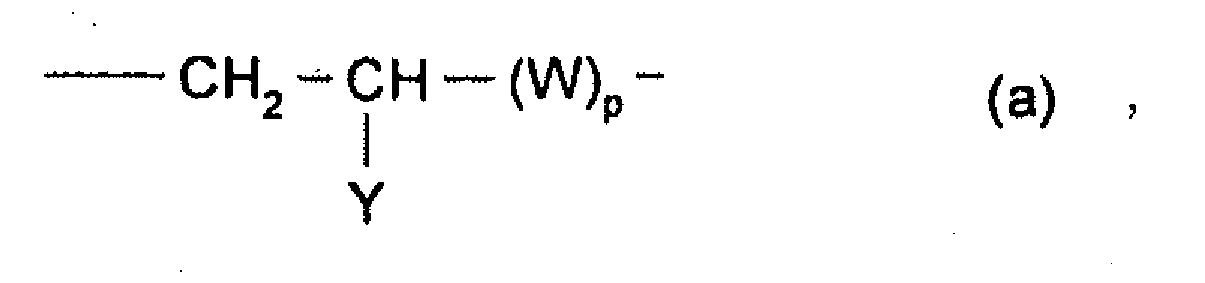
-CH=CH-(W)p- (a'),
 - W eine geradkettige oder verzweigte, gesättigte oder ungesättigte C1-C6 Alkylgruppe, die gegebenenfalls mit einer Hydroxylgruppe oder einer geradkettigen oder verzweigten, gesättigten oder ungesättigten C1-C8 Alkylgruppe substituiert ist,- Y ein Wasserstoffatom; eine Hydroxylgruppe oder eine geradkettige oder verzweigte, gesättigte oder ungesättigte C1-C8-Alkylgruppe,- p 0 oder 1,- die Gruppen R, die gleich oder verschieden sind, geradkettiges oder verzweigtes, gesättigtes oder ungesättigtes C1-C20-Alkyl, eine Phenylgruppe, 3,3,3-Trifluorpropyl oder Trimethylsilyloxy bedeuten, wobei mindestens 80 % der Gruppen R, bezogen auf ihre Anzahl, Methyl darstellen,- B, die gleich oder verschieden sind, unter den Gruppen R und der Gruppe A ausgewählt sind,- r eine Zahl von 0 bis 50 ist,- s eine Zahl von 0 bis 20 ist,
wobei, wenn s gleich Null ist, mindestens eine der beiden Gruppen B gleich A ist,- u eine ganze Zahl von 1 bis einschließlich 6 ist,- t eine Zahl von 0 bis 10 ist,- wobei t + u mindestens gleich 3 ist,wobei- der Substituent R2 Wasserstoff oder geradkettiges oder verzweigtes, gesättigtes oder ungesättigtes C1-C20-Alkyl bedeutet,- die Gruppe R3 geradkettiges oder verzweigtes, gesättigtes oder ungesättigtes C1- C20-Alkyl bedeutet,- die Substituenten R4 und R5, die gleich oder verschieden sind, Wasserstoff oder geradkettiges oder verzweigtes, gesättigtes oder ungesättigtes C1-C20-Alkyl bedeuten,- die Gruppe R6 geradkettiges oder verzweigtes, gesättigtesoder ungesättigtes C1-C20-Alkyl oder C6-C12-Aryl bedeutet, mit der Maßgabe, dass, wenn zwei Gruppen (C=O)-X-L-vorliegen, L nur an eine einzige Gruppe A oder B der Formeln (1) oder (2) gebunden ist, was bedeutet: s = 1, wobei B von A verschieden ist, oder s = 0, wobei ein einziges B gleich A bei Formel (1) und u = 1 bei Formel (2) ist. - Diorganosiloxan-Verbindung nach Anspruch 1, die mindestens eine der nachstehenden Eigenschaften und noch bevorzugter sämtliche nachstehenden Eigenschaften aufweist:- Der Substituent Z bezeichnet -(C=O)R3, -CN oder -(C=O)-X-L-,- R3 ist C1-C4-Alkyl und noch bevorzugter Ethyl,- R ist C1-C4-Alkyl und noch bevorzugter Methyl,- B ist C1-C4-Alkyl und noch bevorzugter Methyl (wenn die Verbindung die Formel (1) besitzt),- r liegt im Bereich von 0 bis einschließlich 10,- s liegt im Bereich von 0 bis einschließlich 6 (wenn die Verbindung die Formel (1) besitzt),- t+u liegt im Bereich von 3 bis 5 (wenn die Verbindung die Formel (2) besitzt),- n = 0,- W bezeichnet CH2,- p = 1,- Y bezeichnet H oder CH3.
- Diorganosiloxan-Verbindung mit 4,4-Diarylbutadien-Funktion der Formel (1) nach Anspruch 1 oder 2, die aus der Gruppe ausgewählt ist, die aus den nachstehenden Verbindungen A, B, C, D und E besteht:


- Diorganosiloxan-Verbindung mit 4,4-Diarylbutadien-Funktion der Formel (1) oder (2) nach Anspruch 1 oder 2, worin Z -CN bezeichnet.
- Diorganosiloxan-Verbindung mit 4,4-Diarylbutadien-Funktion der Formel (1) oder (2) nach Anspruch 4, die mindestens eine der nachstehenden Eigenschaften und noch bevorzugter sämtliche nachstehenden Eigenschaften aufweist:- R ist C1-C4-Alkyl und noch bevorzugter Methyl,- B ist C1-C4-Alkyl und noch bevorzugter Methyl (wenn die Verbindung die Formel (1) besitzt),- r liegt im Bereich von 0 bis einschließlich 10; s liegt im Bereich von 0 bis einschließlich 6 (wenn die Verbindung die Formel (1) besitzt),- t + u liegt im Bereich von 3 bis 5 (wenn die Verbindung die Formel (2) besitzt),- n = 0,- W bezeichnet CH2,- p = 1,- Y bezeichnet H oder CH3.
- Diorganosiloxan-Verbindung mit 4,4-Diarylbutadien-Funktion nach Anspruch 1 oder 2, die aus der Gruppe ausgewählt ist, die aus den nachstehenden Verbindungen F, G, H, I, J besteht:


- Verwendung mindestens einer Diorganosiloxan-Verbindung mit 4,4-Diarylbutadien-Funktion der Formel (1) oder (2) nach einem der Ansprüche 1 bis 6 bei der Herstellung einer kosmetischen oder dermatologischen Zusammensetzung als Filter für UV-Strahlung mit Wellenlängen im Bereich von 320 bis 400 nm.
- Kosmetische oder dermatologische Zusammensetzung zum Lichtschutz von Keratinmaterialien, dadurch gekennzeichnet, dass sie in einem kosmetisch akzeptablen Träger mindestens eine Diorganosiloxan-Verbindung mit 4,4-Diarylbutadien-Funktion der Formel (1) oder (2) nach einem der Ansprüche 1 bis 6 enthält.
- Zusammensetzung nach Anspruch 8, dadurch gekennzeichnet, dass die Verbindung der Formel (1) oder (2) in der Zusammensetzung in einem Mengenanteil von 0,01 bis 20 Gew.-%, bezogen auf das Gesamtgewicht der Zusammensetzung, und vorzugsweise in einem Mengenanteil von 0,1 bis 10 Gew.-% vorliegt, bezogen auf das Gesamtgewicht der Zusammensetzung.
- Zusammensetzung nach Anspruch 8 oder 9, dadurch gekennzeichnet, dass sie ferner ein oder mehrere zusätzliche organische oder anorganische Filter enthält, die im UV-A-Bereich und/oder im UV-B-Bereich wirksam sind.
- Zusammensetzung nach Anspruch 10, dadurch gekennzeichnet, dass die zusätzlichen organischen Filter ausgewählt sind unter: Anthranilaten; Zimtsäurederivaten; Derivaten von Dibenzoylmethan; Salicylsäurederivaten, Campherderivaten; Triazinderivaten; Derivaten von Benzophenon; Derivaten von β,β-Diphenylacrylat, Benzotriazolderivaten; Benzalmalonat-Derivaten; Benzimidazolderivaten, Imidazolinen; Bis-Benzoazolylderivaten; Derivaten von p-Aminobenzosäure (PABA) ; Derivaten von Methylen-bis(hydroxyphenylbenzotriazol); Benzoxazolderivaten; polymeren Filtern und Silicon-Filtern, die von den Filtern der Formel (1) oder (2) verschieden sind; von α-Alkylstyrol abgeleiteten Dimeren; 4,4-Diarylbutadienen, die kein Silicium enthalten, sowie Gemischen dieser Verbindungen.
- Zusammensetzung nach Anspruch 11, dadurch gekennzeichnet, dass die zusätzlichen organischen Filter ausgewählt sind unter
Ethylhexyl Salicylate,
Ethylhexyl Methoxycinnamate
Butyl Methoxydibenzoylmethane
Octocrylene,
Phenylbenzimidazole Sulfonic Acid,
Benzophenone-3,
Benzophenone-4,
Benzophenone-5,
2-(4-Diethylamino-2-hydroxybenzoyl)-benzoesäure-n-hexylester,
4-Methylbenzylidene Camphor,
Terephthalylidene Dicamphor Sulfonic Acid,
Disodium Phenyl Dibenzimidazole Tetra-sulfonate,
2,4,6-Tris(4'-aminobenzalmalonsäurediisobutylester)-s-triazin,
Anisotriazine,
Ethylhexyl Triazone,
Diethylhexyl Butamido Triazone,
Methylene bis-Benzotriazolyl Tetramethylbutylphenol,
Drometrizole Trisiloxane,
Polysilicone-15,
1,1-Dicarboxy-(2,2'-dimethylpropyl)-4,4-diphenylbutadien,
2,4-Bis[5-1(dimethylpropyl)-benzoxazol-2-yl-(4-phenyl)-imino]-6-(2-ethylhexyl)-imino-1,3,5-triazin
sowie Gemischen dieser Verbindungen. - Zusammensetzung nach Anspruch 10, dadurch gekennzeichnet, dass die zusätzlichen anorganischen Filter Pigmente oder Nanopigmente von Metalloxiden sind, die gegebenenfalls ummantelt sind.
- Zusammensetzung nach Anspruch 13, dadurch gekennzeichnet, dass die Pigmente oder Nanopigmente ausgewählt sind unter den Oxiden von Titan, Zink, Eisen, Zirkonium, Cer sowie Gemischen davon, wobei die Pigmente oder Nanopigmente gegebenenfalls ummantelt sind.
- Zusammensetzung nach einem der Ansprüche 8 bis 14, dadurch gekennzeichnet, dass sie ferner mindestens ein Mittel zur künstlichen Bräunung und/oder ein Mittel zur künstlichen Braunfärbung der Haut enthält.
- Zusammensetzung nach einem der Ansprüche 8 bis 15, dadurch gekennzeichnet, dass sie ferner mindestens einen Hilfsstoff enthält, der ausgewählt ist unter Fettstoffen, organischen Lösungsmitteln, ionischen oder nichtionischen Verdickungsmitteln, reizlindernden Mitteln, Befeuchtungsmitteln, Antioxidationsmitteln, Hydratisierungsmitteln, Desquamationsmitteln, Mitteln gegen freie Radikale, Mitteln gegen Verschmutzung, antibakteriellen Mitteln, entzündungshemmenden Mitteln, Depigmentierungsmitteln, die Pigmentierung fördernden Mitteln, Trübungsmitteln, Stabilisierungsmitteln, Emollientien, Siliconen, Antischaummitteln, Insektenrepellents, Parfums, Konservierungsmitteln, anionischen, kationischen, nicht-ionischen, zwitterionischen oder amphoteren Tensiden, Antagonisten der Substanz P, Antagonisten der Substanz CGRP, Füllstoffen, Pigmenten, Polymeren, Treibmitteln, Mitteln zum Alkalischmachen oder Mitteln zum Ansäuern.
- Zusammensetzung nach einem der Ansprüche 8 bis 16, dadurch gekennzeichnet, dass es sich um eine Zusammensetzung zum Schutz der menschlichen Epidermis oder eine Zusammensetzung zum Sonnenschutz handelt und sie vorliegt in Form einer nichtionischen Vesikeldispersion, einer Emulsion, einer Creme, einer Milch, eines Gels, einer Gelcreme, einer Suspension, einer Dispersion, eines Öls, eines Puders, eines festen Sticks, eines Schaums oder eines Sprays.
- Zusammensetzung nach einem der Ansprüche 8 bis 16, dadurch gekennzeichnet, dass es sich um eine Zusammensetzung zum Schminken der Wimpern, der Augenbrauen, der Nägel oder der Haut handelt und sie in wasserfreier oder wässeriger, fester oder pastoser Form, in Form einer Emulsion, in Form einer Suspension oder in Form einer Dispersion vorliegt.
- Zusammensetzung nach einem der Ansprüche 8 bis 16, dadurch gekennzeichnet, dass es sich um eine Zusammensetzung zum Schutz der Haare gegen Ultraviolettstrahlung handelt und sie in Form eines Shampoos, einer Lotion, eines Gels, einer Emulsion oder einer nichtionischen Vesikeldispersion vorliegt.
- Verwendung mindestens einer Diorganosiloxan-Verbindung der Formel (1) oder (2) nach einem der Ansprüche 1 bis 6 in einer kosmetischen Zusammensetzung als Mittel zur Kontrolle der Farbänderung der Haut durch UV-Strahlung im Wellenlängenbereich von 320 bis 400 nm.
- Verwendung mindestens einer Diorganosiloxan-Verbindung der Formel (1) oder (2) nach einem der Ansprüche 1 bis 6 als Mittel zur Lichtstabilisierung von synthetischen Polymeren oder von Gläsern.
Applications Claiming Priority (2)
| Application Number | Priority Date | Filing Date | Title |
|---|---|---|---|
| FR0350900 | 2003-11-25 | ||
| FR0350900A FR2862641B1 (fr) | 2003-11-25 | 2003-11-25 | Composes diorganopolysiloxaniques a fonction 4,4-diarylbutadiene compositions photoprotectrices les contenant; utilisations |
Publications (2)
| Publication Number | Publication Date |
|---|---|
| EP1535947A1 EP1535947A1 (de) | 2005-06-01 |
| EP1535947B1 true EP1535947B1 (de) | 2010-01-06 |
Family
ID=34451744
Family Applications (1)
| Application Number | Title | Priority Date | Filing Date |
|---|---|---|---|
| EP04292615A Expired - Lifetime EP1535947B1 (de) | 2003-11-25 | 2004-11-04 | 4,4-Diarylbutadien enthaltende Diorganopolysiloxan-Derivate, diese enthaltende Lichtschutzzusammensetzungen und deren Verwendungen |
Country Status (6)
| Country | Link |
|---|---|
| EP (1) | EP1535947B1 (de) |
| JP (1) | JP4467003B2 (de) |
| AT (1) | ATE454417T1 (de) |
| DE (1) | DE602004024950D1 (de) |
| ES (1) | ES2338323T3 (de) |
| FR (1) | FR2862641B1 (de) |
Families Citing this family (5)
| Publication number | Priority date | Publication date | Assignee | Title |
|---|---|---|---|---|
| US7915330B2 (en) * | 2007-09-06 | 2011-03-29 | Hallstar Innovations Corp. | Photostabilizing silicone fluids |
| FR2939309B1 (fr) | 2008-12-08 | 2010-12-17 | Oreal | Utilisation d'un derive ester de 2-pyrrolidinone 4-carboxy comme solvant dans les compositions cosmetiques ; compositions cosmetiques les contenant |
| FR2947174B1 (fr) | 2009-06-24 | 2011-07-15 | Oreal | Composition cosmetique comprenant un polymere superabsorbant et un filtre uv organique |
| FR2956579B1 (fr) | 2010-02-24 | 2012-02-10 | Oreal | Composition comprenant un polymere superabsorbant et tensioactif gemine |
| FR2972346B1 (fr) | 2011-03-09 | 2013-11-08 | Oreal | Utilisation d'un derive diester d'acide 2-methyl succinique comme solvant dans les compositions cosmetiques ; compositions cosmetiques les contenant |
Family Cites Families (4)
| Publication number | Priority date | Publication date | Assignee | Title |
|---|---|---|---|---|
| FR2727115B1 (fr) * | 1994-11-17 | 1996-12-27 | Oreal | Nouveaux filtres solaires, compositions cosmetiques photoprotectrices les contenant et utilisations |
| FR2756288B1 (fr) * | 1996-11-28 | 1998-12-24 | Oreal | Nouveaux derives de filtres silicies sur leur partie ester, compositions cosmetiques photoprotectrices les contenant et utilisations |
| JP2002053527A (ja) * | 2000-08-10 | 2002-02-19 | Takasago Internatl Corp | 5,5−ジアリール−2,4−ペンタジエン酸エステル系化合物および該化合物を有効成分とする紫外線吸収剤 |
| WO2003027168A1 (en) * | 2001-09-25 | 2003-04-03 | Silver Michael E | Silicone based ultraviolet absorbing and/or scattering compounds and associated formulations comprising the same |
-
2003
- 2003-11-25 FR FR0350900A patent/FR2862641B1/fr not_active Expired - Fee Related
-
2004
- 2004-11-04 ES ES04292615T patent/ES2338323T3/es not_active Expired - Lifetime
- 2004-11-04 EP EP04292615A patent/EP1535947B1/de not_active Expired - Lifetime
- 2004-11-04 DE DE602004024950T patent/DE602004024950D1/de not_active Expired - Lifetime
- 2004-11-04 AT AT04292615T patent/ATE454417T1/de not_active IP Right Cessation
- 2004-11-25 JP JP2004339777A patent/JP4467003B2/ja not_active Expired - Lifetime
Also Published As
| Publication number | Publication date |
|---|---|
| DE602004024950D1 (de) | 2010-02-25 |
| FR2862641A1 (fr) | 2005-05-27 |
| ES2338323T3 (es) | 2010-05-06 |
| FR2862641B1 (fr) | 2006-03-03 |
| ATE454417T1 (de) | 2010-01-15 |
| EP1535947A1 (de) | 2005-06-01 |
| JP4467003B2 (ja) | 2010-05-26 |
| JP2005213245A (ja) | 2005-08-11 |
Similar Documents
| Publication | Publication Date | Title |
|---|---|---|
| FR2886143A1 (fr) | Photostabilisation d'un dibenzoylmethane par une s-triazine siliciee et substituee par deux groupes aminobenzoates ou aminobenzamides ; compositions photoprotectrices. nouveaux composes silicies s-triazine | |
| EP1885730A1 (de) | Silanmerocyaninsulphonderivate, photoprotektive zusammensetzungen damit, verwendung davon als uv-filter | |
| EP1269979B1 (de) | Aromatische Amid-, Sulfonamid- oder Karbamatderivate des Acrylsäurenitrils und diese enthaltende kosmetische Lichtschutzzusammensetzungen | |
| FR2886144A1 (fr) | Procede de photostabilisation d'un derive de dibenzoylmethane par un derive sulfone de merocyanine ; compositions cosmetiques photoprotectrices contenant cette associaton. | |
| EP1471059B1 (de) | 2,4,6-tris(4'aminobenzaldineopentylmalonat)-s-triazin, dieser enthaltenden Sonnenschutzzusammensetzungen und dessen Verwendungen | |
| EP1815884A2 (de) | Zusammensetzung enthaltend einen UV-B-Filter des Zimtsäureestertyps, einen UV-A-Filter des Dibenzoylmethantyps und ein Derivat des S-Triazins; Prozess zur Photostabilisierung | |
| EP1568700B1 (de) | Zumindest zwei p-Aminobenzalmalonatsilangruppen enthaltende s-Triazinderivate, und diese Derivate-enthaltende Sonnenschutzzusammensetzungen, sowie Verwendung dieser s-Triazinderivate | |
| EP1594880B1 (de) | Auf methyltrialkylsilanen mit einer zimtsäureester-, zimtsäureamid-, benzalmalonsäureamid- oder benzalmalonsäureesterfunktion basierende lichtschützende zusammensetzung | |
| EP1535925B1 (de) | 4,4-Diarylbutadien-funktionalisierte Methyltrialkylsilane und diese enthaltende kosmetische oder dermatologische Lichtschutzzusammensetzungen | |
| US7432386B2 (en) | Diarylbutadiene-substituted methyltrialkylsilanes and photoprotective compositions comprised thereof | |
| EP1535947A1 (de) | 4,4-Diarylbutadien enthaltende Diorganopolysiloxan-Derivate, diese enthaltende Lichtschutzzusammensetzungen und deren Verwendungen | |
| EP1815886A2 (de) | Zusammensetzung enthaltend einen UV-A-Filter vom Dibenzoylmethantyp und ein Derivat des S-Triazins; Prozess zur Photostabilisierung | |
| WO2002049594A2 (fr) | Compositions cosmetiques antisolaires a base d'un melange synergique de filtres et utilisations | |
| US7439380B2 (en) | Diarylbutadiene-substituted diorganopolysiloxanes and photoprotective compositions comprised thereof | |
| EP1371654B1 (de) | Silan- oder Siloxan-Phenylsulfonacrylonitrilderivat-enthaltende Lichtschutzzusammensetzungen, Phenylsulfonacrylonitrilderivate und deren Verwendung als UV Filter | |
| EP1454896A1 (de) | Amine-, Amid-, Sulfonamid- oder Karbamatderivate von Benzylmalonsäuresalzen und diese enthaltende kosmetische Lichtschutzzusammensetzungen | |
| FR2756288A1 (fr) | Nouveaux derives de filtres silicies sur leur partie ester, compositions cosmetiques photoprotectrices les contenant et utilisations | |
| FR2867188A1 (fr) | Derives de s-triazine possedant un groupement para-alcoxyphenyle et au moins un groupement aminobenzalmaloniques greffes ; compositions cosmetiques contenant ces derives; utilisations desdits derives de s-tri | |
| FR2896988A1 (fr) | Compositions contenant un filtre uv-b du type ester de l'acide cinnamique et un derive de s-triazine ; procede de photostabilisation d'un filtre uv-b du type ester de l'acide cinnamique | |
| EP1424062A1 (de) | Mindestens ein Dibenzoylmethanderivat und 3-(2-Azacycloalkyliden)-1,3-dihydro-indol-2-on enthaltende Filterzusammensetzung und Verfahren zur Photostabilisierung | |
| FR2850382A1 (fr) | Compositions photoprotectrices a base de methyltrialkylsilanes a fonction cinnamate, cinnamamide, benzalmalonamide ou benzalmalonate | |
| EP1424063A1 (de) | Lichtschutzformulierungen mit einem Gehalt an 3-(2-Azacycloalkyliden)-1,3-dihydro-indol-2-on-Derivaten und deren Verwendung |
Legal Events
| Date | Code | Title | Description |
|---|---|---|---|
| PUAI | Public reference made under article 153(3) epc to a published international application that has entered the european phase |
Free format text: ORIGINAL CODE: 0009012 |
|
| AK | Designated contracting states |
Kind code of ref document: A1 Designated state(s): AT BE BG CH CY CZ DE DK EE ES FI FR GB GR HU IE IS IT LI LU MC NL PL PT RO SE SI SK TR |
|
| AX | Request for extension of the european patent |
Extension state: AL HR LT LV MK YU |
|
| 17P | Request for examination filed |
Effective date: 20051201 |
|
| AKX | Designation fees paid |
Designated state(s): AT BE BG CH CY CZ DE DK EE ES FI FR GB GR HU IE IS IT LI LU MC NL PL PT RO SE SI SK TR |
|
| 17Q | First examination report despatched |
Effective date: 20070330 |
|
| GRAP | Despatch of communication of intention to grant a patent |
Free format text: ORIGINAL CODE: EPIDOSNIGR1 |
|
| GRAS | Grant fee paid |
Free format text: ORIGINAL CODE: EPIDOSNIGR3 |
|
| RIC1 | Information provided on ipc code assigned before grant |
Ipc: A61K 8/89 20060101ALI20090604BHEP Ipc: C07F 7/08 20060101ALI20090604BHEP Ipc: C08G 77/04 20060101AFI20090604BHEP |
|
| GRAA | (expected) grant |
Free format text: ORIGINAL CODE: 0009210 |
|
| AK | Designated contracting states |
Kind code of ref document: B1 Designated state(s): AT BE BG CH CY CZ DE DK EE ES FI FR GB GR HU IE IS IT LI LU MC NL PL PT RO SE SI SK TR |
|
| REG | Reference to a national code |
Ref country code: GB Ref legal event code: FG4D Free format text: NOT ENGLISH |
|
| REG | Reference to a national code |
Ref country code: CH Ref legal event code: EP |
|
| REG | Reference to a national code |
Ref country code: IE Ref legal event code: FG4D |
|
| REF | Corresponds to: |
Ref document number: 602004024950 Country of ref document: DE Date of ref document: 20100225 Kind code of ref document: P |
|
| REG | Reference to a national code |
Ref country code: SE Ref legal event code: TRGR |
|
| REG | Reference to a national code |
Ref country code: NL Ref legal event code: VDEP Effective date: 20100106 Ref country code: ES Ref legal event code: FG2A Ref document number: 2338323 Country of ref document: ES Kind code of ref document: T3 |
|
| PG25 | Lapsed in a contracting state [announced via postgrant information from national office to epo] |
Ref country code: SI Free format text: LAPSE BECAUSE OF FAILURE TO SUBMIT A TRANSLATION OF THE DESCRIPTION OR TO PAY THE FEE WITHIN THE PRESCRIBED TIME-LIMIT Effective date: 20100106 |
|
| PG25 | Lapsed in a contracting state [announced via postgrant information from national office to epo] |
Ref country code: AT Free format text: LAPSE BECAUSE OF FAILURE TO SUBMIT A TRANSLATION OF THE DESCRIPTION OR TO PAY THE FEE WITHIN THE PRESCRIBED TIME-LIMIT Effective date: 20100106 |
|
| PG25 | Lapsed in a contracting state [announced via postgrant information from national office to epo] |
Ref country code: PT Free format text: LAPSE BECAUSE OF FAILURE TO SUBMIT A TRANSLATION OF THE DESCRIPTION OR TO PAY THE FEE WITHIN THE PRESCRIBED TIME-LIMIT Effective date: 20100506 Ref country code: IS Free format text: LAPSE BECAUSE OF FAILURE TO SUBMIT A TRANSLATION OF THE DESCRIPTION OR TO PAY THE FEE WITHIN THE PRESCRIBED TIME-LIMIT Effective date: 20100506 Ref country code: NL Free format text: LAPSE BECAUSE OF FAILURE TO SUBMIT A TRANSLATION OF THE DESCRIPTION OR TO PAY THE FEE WITHIN THE PRESCRIBED TIME-LIMIT Effective date: 20100106 |
|
| REG | Reference to a national code |
Ref country code: IE Ref legal event code: FD4D |
|
| PG25 | Lapsed in a contracting state [announced via postgrant information from national office to epo] |
Ref country code: PL Free format text: LAPSE BECAUSE OF FAILURE TO SUBMIT A TRANSLATION OF THE DESCRIPTION OR TO PAY THE FEE WITHIN THE PRESCRIBED TIME-LIMIT Effective date: 20100106 Ref country code: FI Free format text: LAPSE BECAUSE OF FAILURE TO SUBMIT A TRANSLATION OF THE DESCRIPTION OR TO PAY THE FEE WITHIN THE PRESCRIBED TIME-LIMIT Effective date: 20100106 |
|
| PG25 | Lapsed in a contracting state [announced via postgrant information from national office to epo] |
Ref country code: IE Free format text: LAPSE BECAUSE OF FAILURE TO SUBMIT A TRANSLATION OF THE DESCRIPTION OR TO PAY THE FEE WITHIN THE PRESCRIBED TIME-LIMIT Effective date: 20100106 Ref country code: RO Free format text: LAPSE BECAUSE OF FAILURE TO SUBMIT A TRANSLATION OF THE DESCRIPTION OR TO PAY THE FEE WITHIN THE PRESCRIBED TIME-LIMIT Effective date: 20100106 Ref country code: CY Free format text: LAPSE BECAUSE OF FAILURE TO SUBMIT A TRANSLATION OF THE DESCRIPTION OR TO PAY THE FEE WITHIN THE PRESCRIBED TIME-LIMIT Effective date: 20100106 Ref country code: EE Free format text: LAPSE BECAUSE OF FAILURE TO SUBMIT A TRANSLATION OF THE DESCRIPTION OR TO PAY THE FEE WITHIN THE PRESCRIBED TIME-LIMIT Effective date: 20100106 Ref country code: GR Free format text: LAPSE BECAUSE OF FAILURE TO SUBMIT A TRANSLATION OF THE DESCRIPTION OR TO PAY THE FEE WITHIN THE PRESCRIBED TIME-LIMIT Effective date: 20100407 |
|
| PLBE | No opposition filed within time limit |
Free format text: ORIGINAL CODE: 0009261 |
|
| STAA | Information on the status of an ep patent application or granted ep patent |
Free format text: STATUS: NO OPPOSITION FILED WITHIN TIME LIMIT |
|
| PG25 | Lapsed in a contracting state [announced via postgrant information from national office to epo] |
Ref country code: SK Free format text: LAPSE BECAUSE OF FAILURE TO SUBMIT A TRANSLATION OF THE DESCRIPTION OR TO PAY THE FEE WITHIN THE PRESCRIBED TIME-LIMIT Effective date: 20100106 Ref country code: BG Free format text: LAPSE BECAUSE OF FAILURE TO SUBMIT A TRANSLATION OF THE DESCRIPTION OR TO PAY THE FEE WITHIN THE PRESCRIBED TIME-LIMIT Effective date: 20100406 Ref country code: CZ Free format text: LAPSE BECAUSE OF FAILURE TO SUBMIT A TRANSLATION OF THE DESCRIPTION OR TO PAY THE FEE WITHIN THE PRESCRIBED TIME-LIMIT Effective date: 20100106 |
|
| 26N | No opposition filed |
Effective date: 20101007 |
|
| PG25 | Lapsed in a contracting state [announced via postgrant information from national office to epo] |
Ref country code: DK Free format text: LAPSE BECAUSE OF FAILURE TO SUBMIT A TRANSLATION OF THE DESCRIPTION OR TO PAY THE FEE WITHIN THE PRESCRIBED TIME-LIMIT Effective date: 20100106 |
|
| BERE | Be: lapsed |
Owner name: L'OREAL Effective date: 20101130 |
|
| REG | Reference to a national code |
Ref country code: SE Ref legal event code: EUG |
|
| PG25 | Lapsed in a contracting state [announced via postgrant information from national office to epo] |
Ref country code: MC Free format text: LAPSE BECAUSE OF NON-PAYMENT OF DUE FEES Effective date: 20101130 |
|
| REG | Reference to a national code |
Ref country code: CH Ref legal event code: PL |
|
| GBPC | Gb: european patent ceased through non-payment of renewal fee |
Effective date: 20101104 |
|
| PG25 | Lapsed in a contracting state [announced via postgrant information from national office to epo] |
Ref country code: CH Free format text: LAPSE BECAUSE OF NON-PAYMENT OF DUE FEES Effective date: 20101130 Ref country code: LI Free format text: LAPSE BECAUSE OF NON-PAYMENT OF DUE FEES Effective date: 20101130 |
|
| REG | Reference to a national code |
Ref country code: FR Ref legal event code: ST Effective date: 20110801 |
|
| PG25 | Lapsed in a contracting state [announced via postgrant information from national office to epo] |
Ref country code: BE Free format text: LAPSE BECAUSE OF NON-PAYMENT OF DUE FEES Effective date: 20101130 |
|
| REG | Reference to a national code |
Ref country code: DE Ref legal event code: R119 Ref document number: 602004024950 Country of ref document: DE Effective date: 20110601 Ref country code: DE Ref legal event code: R119 Ref document number: 602004024950 Country of ref document: DE Effective date: 20110531 |
|
| PG25 | Lapsed in a contracting state [announced via postgrant information from national office to epo] |
Ref country code: SE Free format text: LAPSE BECAUSE OF NON-PAYMENT OF DUE FEES Effective date: 20101105 |
|
| PG25 | Lapsed in a contracting state [announced via postgrant information from national office to epo] |
Ref country code: FR Free format text: LAPSE BECAUSE OF NON-PAYMENT OF DUE FEES Effective date: 20101130 |
|
| PG25 | Lapsed in a contracting state [announced via postgrant information from national office to epo] |
Ref country code: GB Free format text: LAPSE BECAUSE OF NON-PAYMENT OF DUE FEES Effective date: 20101104 |
|
| PG25 | Lapsed in a contracting state [announced via postgrant information from national office to epo] |
Ref country code: IT Free format text: LAPSE BECAUSE OF NON-PAYMENT OF DUE FEES Effective date: 20101104 |
|
| REG | Reference to a national code |
Ref country code: ES Ref legal event code: FD2A Effective date: 20120110 |
|
| PG25 | Lapsed in a contracting state [announced via postgrant information from national office to epo] |
Ref country code: ES Free format text: LAPSE BECAUSE OF NON-PAYMENT OF DUE FEES Effective date: 20101105 |
|
| PG25 | Lapsed in a contracting state [announced via postgrant information from national office to epo] |
Ref country code: HU Free format text: LAPSE BECAUSE OF FAILURE TO SUBMIT A TRANSLATION OF THE DESCRIPTION OR TO PAY THE FEE WITHIN THE PRESCRIBED TIME-LIMIT Effective date: 20100707 Ref country code: LU Free format text: LAPSE BECAUSE OF NON-PAYMENT OF DUE FEES Effective date: 20101104 |
|
| PG25 | Lapsed in a contracting state [announced via postgrant information from national office to epo] |
Ref country code: TR Free format text: LAPSE BECAUSE OF FAILURE TO SUBMIT A TRANSLATION OF THE DESCRIPTION OR TO PAY THE FEE WITHIN THE PRESCRIBED TIME-LIMIT Effective date: 20100106 |
|
| PG25 | Lapsed in a contracting state [announced via postgrant information from national office to epo] |
Ref country code: DE Free format text: LAPSE BECAUSE OF NON-PAYMENT OF DUE FEES Effective date: 20110531 |