EP1535901A1 - Process for producing 4'-bromomethyl-2-cyanobiphenyl - Google Patents
Process for producing 4'-bromomethyl-2-cyanobiphenyl Download PDFInfo
- Publication number
- EP1535901A1 EP1535901A1 EP02788757A EP02788757A EP1535901A1 EP 1535901 A1 EP1535901 A1 EP 1535901A1 EP 02788757 A EP02788757 A EP 02788757A EP 02788757 A EP02788757 A EP 02788757A EP 1535901 A1 EP1535901 A1 EP 1535901A1
- Authority
- EP
- European Patent Office
- Prior art keywords
- cyanobiphenyl
- bromine
- mol
- reaction
- bromomethyl
- Prior art date
- Legal status (The legal status is an assumption and is not a legal conclusion. Google has not performed a legal analysis and makes no representation as to the accuracy of the status listed.)
- Granted
Links
Classifications
-
- C—CHEMISTRY; METALLURGY
- C07—ORGANIC CHEMISTRY
- C07C—ACYCLIC OR CARBOCYCLIC COMPOUNDS
- C07C253/00—Preparation of carboxylic acid nitriles
- C07C253/30—Preparation of carboxylic acid nitriles by reactions not involving the formation of cyano groups
-
- C—CHEMISTRY; METALLURGY
- C07—ORGANIC CHEMISTRY
- C07C—ACYCLIC OR CARBOCYCLIC COMPOUNDS
- C07C255/00—Carboxylic acid nitriles
- C07C255/49—Carboxylic acid nitriles having cyano groups bound to carbon atoms of six-membered aromatic rings of a carbon skeleton
- C07C255/50—Carboxylic acid nitriles having cyano groups bound to carbon atoms of six-membered aromatic rings of a carbon skeleton to carbon atoms of non-condensed six-membered aromatic rings
Definitions
- the present invention relates to a method of producing 4'-bromomethyl-2-cyanobiphenyl, which is useful as a synthetic intermediate for a pharmaceutical product, industrially advantageously.
- 4'-Bromomethyl-2-cyanobiphenyl is useful as a synthetic intermediate for a pharmaceutical product such as a compound having an angiotensin II antagonistic action as disclosed in JP-A-63-23868.
- a pharmaceutical product such as a compound having an angiotensin II antagonistic action as disclosed in JP-A-63-23868.
- JP-A-6-192170 describes a method of brominating a 4-methylbiphenyl compound using a brominating agent such as N-bromosuccinimide and the like in a halogenated hydrocarbon solvent in the presence of an azobis compound.
- a brominating agent such as N-bromosuccinimide and the like
- this method uses expensive N-bromosuccinimide and the like as a brominating agent and is industrially disadvantageous.
- JP-A-8-127562 describes a method of producing 4'-bromomethyl-2-cyanobiphenyl by way of a reaction with economical bromine as a brominating agent in the presence of a radical initiator.
- this method uses an equimolar amount of bromine and by-produces hydrogen bromide. Since the by-produced hydrogen bromide inhibits the reaction, a radical initiator needs to be supplemented to complete the reaction.
- the method is defective in that further purification is necessary for industrial use because bromine remaining in the reaction system causes coloration of the resulting product.
- JP-A-2002-88044 describes a method of removing by-produced hydrogen bromide from the system by conducting the reaction described in the above-mentioned JP-A-8-127562 under reduced pressure.
- this method needs to be performed under reduced pressure and requires a special facility.
- a facility for treating hydrogen bromide, which is a strong acidic gas, is necessary, this is not an industrially advantageous method.
- half of the bromine atoms contained in bromine does not contribute to the reaction, this method is also economically disadvantageous.
- WO99/33788 discloses a method comprising use of bromine produced by a reaction of an aqueous hydrobromic acid solution with hydrogen peroxide as a brominating agent, and reproducing bromine from hydrogen bromide by-produced by bromination by the action of hydrogen peroxide.
- this method requires use of a 48% aqueous hydrobromic acid solution and a 50% aqueous hydrogen peroxide solution, the water content in the system increases and the volume efficiency becomes degraded.
- highly concentrated aqueous hydrogen peroxide solution which is dangerous to handle, needs to be used, this method is not an industrially advantageous method.
- An object of the present invention is to provide a method capable of producing 4'-bromomethyl-2-cyanobiphenyl industrially advantageously.
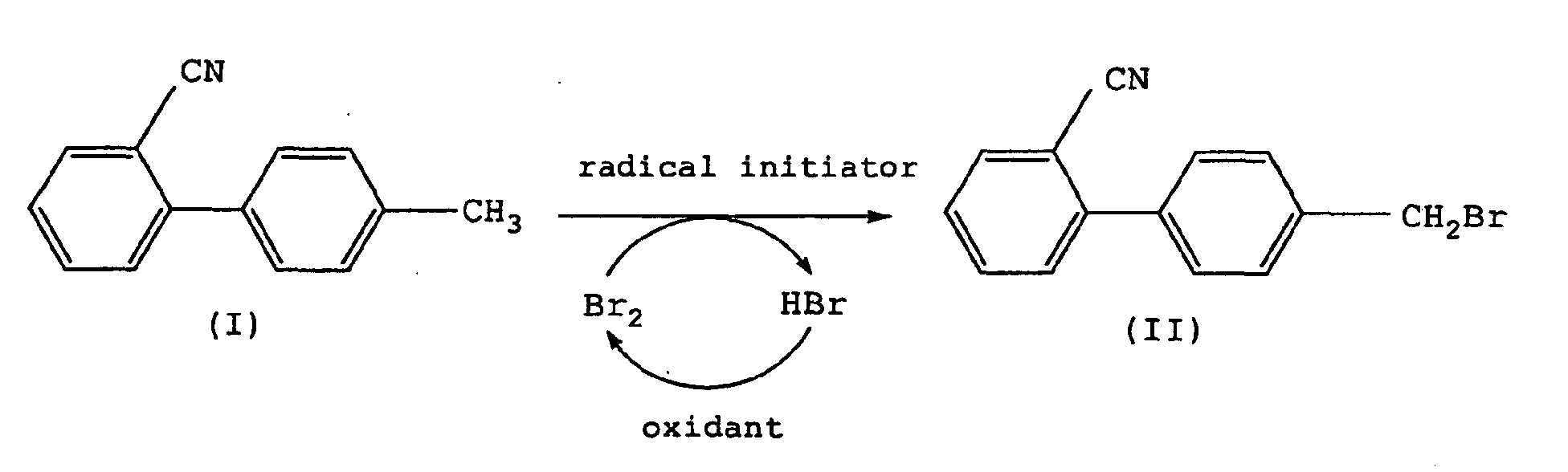
- the present inventors have conducted intensive studies in an attempt to solve the aforementioned problems and found that the coexistence of an oxidant in the reaction of 4'-methyl-2-cyanobiphenyl with bromine in the presence of a radical initiator enables progress of the reaction without inhibition by hydrogen bromide, because by-produced hydrogen bromide is converted to bromine. Furthermore, they have found that the reaction completes with 0.5 equivalent amount of bromine and 4'-bromomethyl-2-cyanobiphenyl can be produced economically, which resulted in the completion of the present invention. Accordingly, the present invention provides the following.
- the present invention can be achieved by, for example, reacting 4'-methyl-2-cyanobiphenyl represented by the formula (I) with bromine in a solvent in the presence of a radical initiator and an oxidant. While the order of the addition of the reagents is not particularly limited, it is preferable from the aspect of operability to add bromine or a solution thereof to a mixture of 4'-methyl-2-cyanobiphenyl, a radical initiator and an oxidant, which has been charged in advance in a solvent. Alternatively, bromine and a radical initiator or a solution thereof may be simultaneously added. For smooth progress of the reaction, the reaction mixture is preferably stirred during the reaction.
- the amount of bromine used is 0.4-0.7 mol, preferably 0.45-0.60 mol, more preferably 0.52-0.58 mol, per 1 mol of 4'-methyl-2-cyanobiphenyl, which is a starting material.
- the amount of bromine used is less than 0.4 mol per 1 mol of 4'-methyl-2-cyanobiphenyl, unreacted starting material tends to remain easily, and when it exceeds 0.7 mol, the by-produced dibromo form tends to increase.
- 4'-Methyl-2-cyanobiphenyl which is a starting material in the present invention, can be produced by a known method, such as the methods described in J. Med. Chem. 1991, 34, 2525-2547, JP-A-4-244080, JP-A-4-253949, JP-A-6-9536 and the like.
- azobis compounds As a radical initiator, azobis compounds, peroxide and the like are used.
- the azobis compound includes 2,2'-azobis(4-methoxy-2,4-dimethylvaleronitrile), 2,2'-azobisisobutyronitrile, 2,2'-azobis(2-methylbutyronitrile), 2,2'-azobis(2,4-dimethylvaleronitrile);
- peroxide includes dibenzoyl peroxide, di-t-butyl peroxide and the like, preferably 2,2'-azobis(2-methylbutyronitrile), 2,2'-azobis(2,4-dimethylvaleronitrile), particularly preferably 2,2'-azobis(2-methylbutyronitrile).
- the amount of the radical initiator to be used is 0.1-10 mol%, preferably 1-4 mol%, relative to 4'-methyl-2-cyanobiphenyl, which is a starting material.
- the amount of a radical initiator to be used is less than 0.1 mol% relative to 4'-methyl-2-cyanobiphenyl, the reaction tends to be slow and when it exceeds 10 mol%, the effect comparable thereto becomes small, which is industrially disadvantageous.
- an oxidant comparatively safe to handle such as bromates (e.g., sodium bromate, potassium bromate and the like); chlorates (e.g., sodium chlorate, potassium chlorate and the like) can be mentioned, with preference given to sodium bromate.
- bromates e.g., sodium bromate, potassium bromate and the like
- chlorates e.g., sodium chlorate, potassium chlorate and the like
- the amount of the oxidant to be used only needs to be a theoretical amount necessary for reproducing bromine from by-produced hydrogen bromide or a slightly excess amount thereof, which is 9-20 mol%, preferably 12-17 mol%, relative to 4'-methyl-2-cyanobiphenyl, which is a starting material.
- the amount of the oxidant to be used is less than 9 mol% relative to 4'-methyl-2-cyanobiphenyl, bromine is not sufficiently reproduced, and the yield tends to decrease, and when it exceeds 20 mol%, the effect comparable thereto becomes small, which is industrially disadvantageous.
- halogenated hydrocarbon alkane having 5 to 7 carbon atoms, aliphatic ester and the like
- specific examples thereof include methylene chloride, ethylene dichloride, carbon tetrachloride, monochlorobenzene, o-dichlorobenzene, bromobenzene, hexane, heptane, cyclohexane, methyl acetate, ethyl acetate, methyl propionate, ethyl propionate and the like.
- monochlorobenzene and ethyl acetate preferred are monochlorobenzene and ethyl acetate.
- the amount of the solvent to be used is generally 0.5 to 20-fold weight, preferably 1 to 20-fold weight, more preferably 1 to 15-fold weight, still more preferably 3 to 15-fold weight, relative to 4'-methyl-2-cyanobiphenyl, which is the starting material.
- An amount smaller than this range is industrially disadvantageous because the stirring efficiency tends to be poor, and an amount greater than this range is industrially disadvantageous because the reaction tends to be slow and the like.
- water it is preferable to contain water to the reaction system. Presence of water strikingly increases stirring efficiency and enables smooth progress of the reaction.
- the water content is 0.01-50% (w/w), preferably 0.05-30% (w/w), of the solvent to be used. Even when the amount of water contained is about the catalytic amount (0.01-2.0% (w/w), preferably 0.05-0.5% (w/w), of the solvent used), the reaction proceeds sufficiently.
- a water content smaller than 0.01% (w/w) of the solvent to be used is not preferable for industrial production because the stirring efficiency tends to not increase sufficiently, and a water content exceeding 50% (w/w) is not preferable for industrial production because the productivity tends to decrease.
- reaction temperature varies depending on the radical initiator and the like, it is generally 50-100°C, preferably 50-85°C, more preferably 60-85°C, still more preferably 60-70°C.
- a reaction temperature lower than this range is industrially insignificant because the reaction tends to be slow and a reaction temperature higher than this range is industrially insignificant because a radical initiator tends to be unstable and the like.
- the radicals can be also radically produced by photoirradiation of radical initiator. In this case, a mercury lamp and the like can be used.
- the reaction time can be appropriately determined according to the above-mentioned various reaction conditions (e.g., about 3-10 hr).
- 4'-Bromomethyl-2-cyanobiphenyl obtained by the above reaction is isolated and purified from a reaction mixture.
- the method includes, but not limited to, removal of inorganic salt by means of filtration and the like, evaporation of the solvent as necessary, recrystallization from a different suitable solvent and the like according to a conventional method.
- 4'-Bromomethyl-2-cyanobiphenyl obtained by the present invention can be led to a compound having an angiotensin II antagonistic action by a method described in, for example, JP-A-63-23868, JP-A-6-298684 and the like.
- bromination can be performed using bromine in an amount slightly excess over 0.5 equivalent amount of 4'-methyl-2-cyanobiphenyl, which is a starting material, by the co-presence of sodium bromate as an oxidant.
- 4'-bromomethyl-2-cyanobiphenyl useful as a starting material of a pharmaceutical product can be produced industrially advantageously.
- the reaction since the reaction is not inhibited by hydrogen bromide by-produced with the progress of the bromination reaction, the reaction is promoted and can be completed without supplementation of a radical initiator. As a result, only an ultra-trace amount of bromine remains in the reaction system, which in turn affords an advantage in that the resulting product is not colored.
Landscapes
- Chemical & Material Sciences (AREA)
- Organic Chemistry (AREA)
- Chemical Kinetics & Catalysis (AREA)
- Organic Low-Molecular-Weight Compounds And Preparation Thereof (AREA)
Abstract
Description
Claims (5)
- A method of producing 4'-bromomethyl-2-cyanobiphenyl, which comprises reacting 4'-methyl-2-cyanobiphenyl with bromine in the presence of a radical initiator and an oxidant.
- The production method of claim 1, wherein the oxidant is bromate or chlorate.
- The production method of claim 1, wherein the oxidant is sodium bromate.
- The production method of any of claims 1 to 3, wherein the reaction system contains water.
- The production method of claim 4, wherein the amount of water contained is a catalytic amount.
Priority Applications (1)
| Application Number | Priority Date | Filing Date | Title |
|---|---|---|---|
| SI200230683T SI1535901T1 (en) | 2002-06-12 | 2002-12-09 | Process for producing 4'-bromomethyl-2-cyanobiphenyl |
Applications Claiming Priority (3)
| Application Number | Priority Date | Filing Date | Title |
|---|---|---|---|
| JP2002172016 | 2002-06-12 | ||
| JP2002172016 | 2002-06-12 | ||
| PCT/JP2002/012847 WO2003106406A1 (en) | 2002-06-12 | 2002-12-09 | Process for producing 4'-bromomethyl-2-cyanobiphenyl |
Publications (4)
| Publication Number | Publication Date |
|---|---|
| EP1535901A1 true EP1535901A1 (en) | 2005-06-01 |
| EP1535901A4 EP1535901A4 (en) | 2006-04-12 |
| EP1535901B1 EP1535901B1 (en) | 2008-03-05 |
| EP1535901B8 EP1535901B8 (en) | 2008-09-24 |
Family
ID=29727838
Family Applications (1)
| Application Number | Title | Priority Date | Filing Date |
|---|---|---|---|
| EP02788757A Expired - Lifetime EP1535901B8 (en) | 2002-06-12 | 2002-12-09 | Process for producing 4'-bromomethyl-2-cyanobiphenyl |
Country Status (12)
| Country | Link |
|---|---|
| US (1) | US6861549B2 (en) |
| EP (1) | EP1535901B8 (en) |
| JP (1) | JPWO2003106406A1 (en) |
| KR (1) | KR100885148B1 (en) |
| CN (1) | CN1285570C (en) |
| AT (1) | ATE388136T1 (en) |
| AU (1) | AU2002354446A1 (en) |
| DE (1) | DE60225486T2 (en) |
| DK (1) | DK1535901T3 (en) |
| ES (1) | ES2299616T3 (en) |
| PT (1) | PT1535901E (en) |
| WO (1) | WO2003106406A1 (en) |
Families Citing this family (9)
| Publication number | Priority date | Publication date | Assignee | Title |
|---|---|---|---|---|
| WO2004103947A1 (en) * | 2003-05-20 | 2004-12-02 | Sumitomo Chemical Company, Limited | Process for producing bromomethyl-substituted aromatic carboxylic ester compound |
| KR20090102883A (en) * | 2004-09-02 | 2009-09-30 | 테바 파마슈티컬 인더스트리즈 리미티드 | Purification of olmesartan medoxomil |
| US20070054948A1 (en) * | 2004-09-02 | 2007-03-08 | Lilach Hedvati | Purification of olmesartan medoxomil |
| WO2006029056A1 (en) * | 2004-09-02 | 2006-03-16 | Teva Pharmaceutical Industries Ltd. | Preparation of olmesartan medoxomil |
| US20060258727A1 (en) * | 2005-01-03 | 2006-11-16 | Lilach Hedvati | Olmesartan medoxomil with reduced levels of impurities |
| JP2006206446A (en) * | 2005-01-25 | 2006-08-10 | Sumitomo Chemical Co Ltd | Arhalohalide compound dehalogenation method and aralkyl compound recovery method using the same |
| CN101597243B (en) * | 2009-06-26 | 2012-11-21 | 凯莱英生命科学技术(天津)有限公司 | Synthesis method of 4'-Bromomethyl-2-cyanobiphenyl |
| HUP0900788A2 (en) * | 2009-12-16 | 2011-11-28 | Sanofi Aventis | Process for producing 4-bromomethyl-biphenyl derivatives |
| CN108947870B (en) * | 2018-07-23 | 2021-03-19 | 湖北宇阳药业有限公司 | A kind of preparation method of bromosartan biphenyl |
Family Cites Families (15)
| Publication number | Priority date | Publication date | Assignee | Title |
|---|---|---|---|---|
| CA1334092C (en) | 1986-07-11 | 1995-01-24 | David John Carini | Angiotensin ii receptor blocking imidazoles |
| GB8806584D0 (en) * | 1988-03-19 | 1988-04-20 | Interox Chemicals Ltd | Bromination |
| GB9017480D0 (en) | 1990-08-09 | 1990-09-26 | Ici Plc | Chemical process |
| GB9017482D0 (en) | 1990-08-09 | 1990-09-26 | Ici Plc | Manufacturing process |
| JP2859791B2 (en) | 1992-01-31 | 1999-02-24 | 吉富製薬株式会社 | Method for producing 4-bromomethylbiphenyl compound |
| FR2689887B1 (en) * | 1992-04-13 | 1995-06-23 | Sanofi Elf | PROCESS FOR THE PREPARATION OF A BIPHENYL DERIVATIVE. |
| JPH06298684A (en) | 1993-04-15 | 1994-10-25 | Sankyo Co Ltd | Production of new 4-(2-substituted)-phenylbenzyl bromide |
| JP2928982B2 (en) * | 1994-10-27 | 1999-08-03 | 住化ファインケム株式会社 | Method for producing 4'-bromomethyl-2-cyanobiphenyl |
| US5892094A (en) * | 1997-01-08 | 1999-04-06 | Sumika Fine Chemicals Co., Ltd. | Process for preparing 4'-methyl-2-cyanobiphenyl |
| DE19712339C1 (en) * | 1997-03-25 | 1998-04-09 | Clariant Gmbh | Preparation of 2'-substituted 4-bromo-methyl-bi:phenyl compounds |
| IT1291551B1 (en) * | 1997-04-11 | 1999-01-11 | Luso Farmaco Inst | PROCESS FOR THE PREPARATION OF 4-BROMOMETHL BIPHENYL COMPOUNDS |
| FR2771090B1 (en) | 1997-11-17 | 2000-02-04 | Sanofi Sa | PROCESS FOR THE PREPARATION OF BROMOMETHYL-BIPHENYL DERIVATIVES |
| DE19757995A1 (en) * | 1997-12-29 | 1999-07-08 | Great Lakes Chem Konstanz Gmbh | Process for the preparation of aromatic bromomethyl compounds |
| JP2000256298A (en) * | 1999-03-05 | 2000-09-19 | Sumika Fine Chemicals Co Ltd | Production of aromatic alpha-bromoalkyl compound |
| JP2002088044A (en) * | 2000-09-14 | 2002-03-27 | Sumitomo Seika Chem Co Ltd | Method for producing 4'-bromomethyl-2-cyanobiphenyl |
-
2002
- 2002-12-09 AU AU2002354446A patent/AU2002354446A1/en not_active Abandoned
- 2002-12-09 JP JP2004513240A patent/JPWO2003106406A1/en active Pending
- 2002-12-09 PT PT02788757T patent/PT1535901E/en unknown
- 2002-12-09 DK DK02788757T patent/DK1535901T3/en active
- 2002-12-09 ES ES02788757T patent/ES2299616T3/en not_active Expired - Lifetime
- 2002-12-09 KR KR1020047020182A patent/KR100885148B1/en not_active Expired - Fee Related
- 2002-12-09 DE DE60225486T patent/DE60225486T2/en not_active Expired - Lifetime
- 2002-12-09 AT AT02788757T patent/ATE388136T1/en active
- 2002-12-09 WO PCT/JP2002/012847 patent/WO2003106406A1/en not_active Ceased
- 2002-12-09 CN CNB028291190A patent/CN1285570C/en not_active Expired - Fee Related
- 2002-12-09 EP EP02788757A patent/EP1535901B8/en not_active Expired - Lifetime
- 2002-12-17 US US10/322,017 patent/US6861549B2/en not_active Expired - Lifetime
Also Published As
| Publication number | Publication date |
|---|---|
| KR20050010046A (en) | 2005-01-26 |
| DE60225486T2 (en) | 2009-04-02 |
| KR100885148B1 (en) | 2009-02-23 |
| JPWO2003106406A1 (en) | 2005-10-13 |
| EP1535901B1 (en) | 2008-03-05 |
| DK1535901T3 (en) | 2008-04-07 |
| EP1535901B8 (en) | 2008-09-24 |
| ES2299616T3 (en) | 2008-06-01 |
| DE60225486D1 (en) | 2008-04-17 |
| US20030233009A1 (en) | 2003-12-18 |
| PT1535901E (en) | 2008-04-10 |
| WO2003106406A1 (en) | 2003-12-24 |
| EP1535901A4 (en) | 2006-04-12 |
| AU2002354446A1 (en) | 2003-12-31 |
| ATE388136T1 (en) | 2008-03-15 |
| CN1285570C (en) | 2006-11-22 |
| CN1628094A (en) | 2005-06-15 |
| US6861549B2 (en) | 2005-03-01 |
Similar Documents
| Publication | Publication Date | Title |
|---|---|---|
| EP1535901B1 (en) | Process for producing 4'-bromomethyl-2-cyanobiphenyl | |
| US20060167301A1 (en) | Process for producing an aralkyl compound, a dehalogenation method of an aralkyl halide compound and a method for recovering an aralkyl compound | |
| JP7718088B2 (en) | Method for producing 3-(meth)acryloyl sulfolane | |
| EP0849253B1 (en) | Process for producing benzoyl chlorides | |
| JP2859791B2 (en) | Method for producing 4-bromomethylbiphenyl compound | |
| US7199260B2 (en) | Process for reductive dehalogenation | |
| JP4303685B2 (en) | Method for producing 2-cyclopenten-1-one | |
| WO2005014531A1 (en) | Process for production of n-methacryloyl-4-cyano-3- trifluoromethylaniline, method for stabilization of the same, and process for production of bicalutamide | |
| JPWO2004103947A1 (en) | Process for producing bromomethyl-substituted aromatic carboxylic acid ester compound | |
| JP2002088044A (en) | Method for producing 4'-bromomethyl-2-cyanobiphenyl | |
| JP2005082496A (en) | 2 '-(1H-tetrazol-5-yl) biphenyl-4-carbaldehyde crystal and method for producing the same | |
| JP2001199943A (en) | Method for producing 2,6-dibromo-4-trifluoromethoxyaniline | |
| JP2003183233A (en) | Method for producing N- (adamantyl) amide compound | |
| JP2008074722A (en) | Process for producing 2-amino-5-iodobenzoic acid | |
| WO2026013665A1 (en) | Purification of cis-2-alkenoic acids | |
| JP2001039904A (en) | Method for producing bromoalkylnaphthalene | |
| JP3439797B2 (en) | Method for producing amine derivative | |
| JP2010150211A (en) | Method for producing 1-aralkyl-3-pyrroline compound | |
| JP2009067710A (en) | Process for producing N-methacryloyl-4-cyano-3-trifluoromethylaniline | |
| JP2008247746A (en) | Method for producing haloiodoaniline | |
| JPS6317853A (en) | Production of 2-methoxymethylene-3,3-dimethoxypropanenitrile | |
| JPH03232843A (en) | Purification of alkylallylamine | |
| JP2001114743A (en) | Method for producing cyanobenzaldehyde compound | |
| JP2000281600A (en) | Production of 4-bromo-2-fluorobenzyl bromide | |
| JPH0791246B2 (en) | Purification method of dimethylformamide |
Legal Events
| Date | Code | Title | Description |
|---|---|---|---|
| PUAI | Public reference made under article 153(3) epc to a published international application that has entered the european phase |
Free format text: ORIGINAL CODE: 0009012 |
|
| 17P | Request for examination filed |
Effective date: 20050107 |
|
| AK | Designated contracting states |
Kind code of ref document: A1 Designated state(s): AT BE BG CH CY CZ DE DK EE ES FI FR GB GR IE IT LI LU MC NL PT SE SI SK TR |
|
| AX | Request for extension of the european patent |
Extension state: AL LT LV MK RO |
|
| DAX | Request for extension of the european patent (deleted) | ||
| A4 | Supplementary search report drawn up and despatched |
Effective date: 20060227 |
|
| 17Q | First examination report despatched |
Effective date: 20070423 |
|
| GRAP | Despatch of communication of intention to grant a patent |
Free format text: ORIGINAL CODE: EPIDOSNIGR1 |
|
| GRAS | Grant fee paid |
Free format text: ORIGINAL CODE: EPIDOSNIGR3 |
|
| GRAA | (expected) grant |
Free format text: ORIGINAL CODE: 0009210 |
|
| AK | Designated contracting states |
Kind code of ref document: B1 Designated state(s): AT BE BG CH CY CZ DE DK EE ES FI FR GB GR IE IT LI LU MC NL PT SE SI SK TR |
|
| REG | Reference to a national code |
Ref country code: GB Ref legal event code: FG4D |
|
| REG | Reference to a national code |
Ref country code: CH Ref legal event code: EP |
|
| REG | Reference to a national code |
Ref country code: DK Ref legal event code: T3 |
|
| REG | Reference to a national code |
Ref country code: PT Ref legal event code: SC4A Free format text: AVAILABILITY OF NATIONAL TRANSLATION Effective date: 20080328 |
|
| REG | Reference to a national code |
Ref country code: IE Ref legal event code: FG4D |
|
| REF | Corresponds to: |
Ref document number: 60225486 Country of ref document: DE Date of ref document: 20080417 Kind code of ref document: P |
|
| REG | Reference to a national code |
Ref country code: SE Ref legal event code: TRGR |
|
| REG | Reference to a national code |
Ref country code: CH Ref legal event code: NV Representative=s name: BOHEST AG |
|
| REG | Reference to a national code |
Ref country code: ES Ref legal event code: FG2A Ref document number: 2299616 Country of ref document: ES Kind code of ref document: T3 |
|
| RIN2 | Information on inventor provided after grant (corrected) |
Inventor name: NAKAMATSU, TOSHIO,C/O SUMITOMO CHEMICAL CO., LTD Inventor name: ISHIHARA, KEN,C/O SUMITOMO CHEMICAL CO., LTD Inventor name: YAMADA, SEIJI,C/O SUMITOMO CHEMICAL CO.,LTD |
|
| ET | Fr: translation filed | ||
| PG25 | Lapsed in a contracting state [announced via postgrant information from national office to epo] |
Ref country code: SK Free format text: LAPSE BECAUSE OF FAILURE TO SUBMIT A TRANSLATION OF THE DESCRIPTION OR TO PAY THE FEE WITHIN THE PRESCRIBED TIME-LIMIT Effective date: 20080305 |
|
| PLBE | No opposition filed within time limit |
Free format text: ORIGINAL CODE: 0009261 |
|
| STAA | Information on the status of an ep patent application or granted ep patent |
Free format text: STATUS: NO OPPOSITION FILED WITHIN TIME LIMIT |
|
| 26N | No opposition filed |
Effective date: 20081208 |
|
| PG25 | Lapsed in a contracting state [announced via postgrant information from national office to epo] |
Ref country code: EE Free format text: LAPSE BECAUSE OF FAILURE TO SUBMIT A TRANSLATION OF THE DESCRIPTION OR TO PAY THE FEE WITHIN THE PRESCRIBED TIME-LIMIT Effective date: 20080305 |
|
| PG25 | Lapsed in a contracting state [announced via postgrant information from national office to epo] |
Ref country code: MC Free format text: LAPSE BECAUSE OF NON-PAYMENT OF DUE FEES Effective date: 20081231 |
|
| PG25 | Lapsed in a contracting state [announced via postgrant information from national office to epo] |
Ref country code: CY Free format text: LAPSE BECAUSE OF FAILURE TO SUBMIT A TRANSLATION OF THE DESCRIPTION OR TO PAY THE FEE WITHIN THE PRESCRIBED TIME-LIMIT Effective date: 20080305 |
|
| PG25 | Lapsed in a contracting state [announced via postgrant information from national office to epo] |
Ref country code: LU Free format text: LAPSE BECAUSE OF NON-PAYMENT OF DUE FEES Effective date: 20081209 |
|
| PG25 | Lapsed in a contracting state [announced via postgrant information from national office to epo] |
Ref country code: TR Free format text: LAPSE BECAUSE OF FAILURE TO SUBMIT A TRANSLATION OF THE DESCRIPTION OR TO PAY THE FEE WITHIN THE PRESCRIBED TIME-LIMIT Effective date: 20080305 |
|
| PG25 | Lapsed in a contracting state [announced via postgrant information from national office to epo] |
Ref country code: GR Free format text: LAPSE BECAUSE OF FAILURE TO SUBMIT A TRANSLATION OF THE DESCRIPTION OR TO PAY THE FEE WITHIN THE PRESCRIBED TIME-LIMIT Effective date: 20080606 |
|
| REG | Reference to a national code |
Ref country code: CH Ref legal event code: PCAR Free format text: NEW ADDRESS: HOLBEINSTRASSE 36-38, 4051 BASEL (CH) |
|
| REG | Reference to a national code |
Ref country code: FR Ref legal event code: PLFP Year of fee payment: 14 |
|
| REG | Reference to a national code |
Ref country code: FR Ref legal event code: PLFP Year of fee payment: 15 |
|
| PGFP | Annual fee paid to national office [announced via postgrant information from national office to epo] |
Ref country code: FI Payment date: 20161212 Year of fee payment: 15 Ref country code: DK Payment date: 20161212 Year of fee payment: 15 Ref country code: FR Payment date: 20161111 Year of fee payment: 15 Ref country code: IE Payment date: 20161209 Year of fee payment: 15 Ref country code: DE Payment date: 20161206 Year of fee payment: 15 Ref country code: CH Payment date: 20161213 Year of fee payment: 15 Ref country code: NL Payment date: 20161212 Year of fee payment: 15 Ref country code: CZ Payment date: 20161110 Year of fee payment: 15 Ref country code: GB Payment date: 20161207 Year of fee payment: 15 |
|
| PGFP | Annual fee paid to national office [announced via postgrant information from national office to epo] |
Ref country code: ES Payment date: 20161111 Year of fee payment: 15 Ref country code: IT Payment date: 20161221 Year of fee payment: 15 Ref country code: SI Payment date: 20161102 Year of fee payment: 15 Ref country code: PT Payment date: 20161207 Year of fee payment: 15 Ref country code: AT Payment date: 20161125 Year of fee payment: 15 Ref country code: BE Payment date: 20161024 Year of fee payment: 15 Ref country code: SE Payment date: 20161213 Year of fee payment: 15 |
|
| PGFP | Annual fee paid to national office [announced via postgrant information from national office to epo] |
Ref country code: BG Payment date: 20171027 Year of fee payment: 16 |
|
| REG | Reference to a national code |
Ref country code: DE Ref legal event code: R119 Ref document number: 60225486 Country of ref document: DE |
|
| REG | Reference to a national code |
Ref country code: DK Ref legal event code: EBP Effective date: 20171231 |
|
| PG25 | Lapsed in a contracting state [announced via postgrant information from national office to epo] |
Ref country code: CZ Free format text: LAPSE BECAUSE OF NON-PAYMENT OF DUE FEES Effective date: 20171209 Ref country code: PT Free format text: LAPSE BECAUSE OF NON-PAYMENT OF DUE FEES Effective date: 20180611 Ref country code: FI Free format text: LAPSE BECAUSE OF NON-PAYMENT OF DUE FEES Effective date: 20171209 |
|
| REG | Reference to a national code |
Ref country code: CH Ref legal event code: PL |
|
| REG | Reference to a national code |
Ref country code: NL Ref legal event code: MM Effective date: 20180101 |
|
| REG | Reference to a national code |
Ref country code: AT Ref legal event code: MM01 Ref document number: 388136 Country of ref document: AT Kind code of ref document: T Effective date: 20171209 |
|
| GBPC | Gb: european patent ceased through non-payment of renewal fee |
Effective date: 20171209 |
|
| PG25 | Lapsed in a contracting state [announced via postgrant information from national office to epo] |
Ref country code: SE Free format text: LAPSE BECAUSE OF NON-PAYMENT OF DUE FEES Effective date: 20171210 |
|
| REG | Reference to a national code |
Ref country code: IE Ref legal event code: MM4A |
|
| PG25 | Lapsed in a contracting state [announced via postgrant information from national office to epo] |
Ref country code: NL Free format text: LAPSE BECAUSE OF NON-PAYMENT OF DUE FEES Effective date: 20180101 |
|
| REG | Reference to a national code |
Ref country code: SI Ref legal event code: KO00 Effective date: 20180806 Ref country code: FR Ref legal event code: ST Effective date: 20180831 |
|
| REG | Reference to a national code |
Ref country code: BE Ref legal event code: MM Effective date: 20171231 |
|
| PG25 | Lapsed in a contracting state [announced via postgrant information from national office to epo] |
Ref country code: DE Free format text: LAPSE BECAUSE OF NON-PAYMENT OF DUE FEES Effective date: 20180703 Ref country code: FR Free format text: LAPSE BECAUSE OF NON-PAYMENT OF DUE FEES Effective date: 20180102 Ref country code: IE Free format text: LAPSE BECAUSE OF NON-PAYMENT OF DUE FEES Effective date: 20171209 Ref country code: IT Free format text: LAPSE BECAUSE OF NON-PAYMENT OF DUE FEES Effective date: 20171209 |
|
| PG25 | Lapsed in a contracting state [announced via postgrant information from national office to epo] |
Ref country code: AT Free format text: LAPSE BECAUSE OF NON-PAYMENT OF DUE FEES Effective date: 20171209 Ref country code: CH Free format text: LAPSE BECAUSE OF NON-PAYMENT OF DUE FEES Effective date: 20171231 Ref country code: SI Free format text: LAPSE BECAUSE OF NON-PAYMENT OF DUE FEES Effective date: 20171210 Ref country code: BE Free format text: LAPSE BECAUSE OF NON-PAYMENT OF DUE FEES Effective date: 20171231 Ref country code: GB Free format text: LAPSE BECAUSE OF NON-PAYMENT OF DUE FEES Effective date: 20171209 Ref country code: LI Free format text: LAPSE BECAUSE OF NON-PAYMENT OF DUE FEES Effective date: 20171231 |
|
| PG25 | Lapsed in a contracting state [announced via postgrant information from national office to epo] |
Ref country code: DK Free format text: LAPSE BECAUSE OF NON-PAYMENT OF DUE FEES Effective date: 20171231 |
|
| REG | Reference to a national code |
Ref country code: ES Ref legal event code: FD2A Effective date: 20190702 |
|
| PG25 | Lapsed in a contracting state [announced via postgrant information from national office to epo] |
Ref country code: ES Free format text: LAPSE BECAUSE OF NON-PAYMENT OF DUE FEES Effective date: 20171210 |
|
| PG25 | Lapsed in a contracting state [announced via postgrant information from national office to epo] |
Ref country code: BG Free format text: LAPSE BECAUSE OF NON-PAYMENT OF DUE FEES Effective date: 20190630 |