EP1534741B1 - Peptides permettant de modifier la morphologie de fibres et pouvant interagir avec des peptides a autoassemblage - Google Patents
Peptides permettant de modifier la morphologie de fibres et pouvant interagir avec des peptides a autoassemblage Download PDFInfo
- Publication number
- EP1534741B1 EP1534741B1 EP03793920A EP03793920A EP1534741B1 EP 1534741 B1 EP1534741 B1 EP 1534741B1 EP 03793920 A EP03793920 A EP 03793920A EP 03793920 A EP03793920 A EP 03793920A EP 1534741 B1 EP1534741 B1 EP 1534741B1
- Authority
- EP
- European Patent Office
- Prior art keywords
- peptides
- self
- fibre
- saf
- peptide
- Prior art date
- Legal status (The legal status is an assumption and is not a legal conclusion. Google has not performed a legal analysis and makes no representation as to the accuracy of the status listed.)
- Expired - Lifetime
Links
Images



Classifications
-
- C—CHEMISTRY; METALLURGY
- C07—ORGANIC CHEMISTRY
- C07K—PEPTIDES
- C07K14/00—Peptides having more than 20 amino acids; Gastrins; Somatostatins; Melanotropins; Derivatives thereof
- C07K14/001—Peptides having more than 20 amino acids; Gastrins; Somatostatins; Melanotropins; Derivatives thereof by chemical synthesis
-
- A—HUMAN NECESSITIES
- A61—MEDICAL OR VETERINARY SCIENCE; HYGIENE
- A61K—PREPARATIONS FOR MEDICAL, DENTAL OR TOILETRY PURPOSES
- A61K47/00—Medicinal preparations characterised by the non-active ingredients used, e.g. carriers or inert additives; Targeting or modifying agents chemically bound to the active ingredient
- A61K47/50—Medicinal preparations characterised by the non-active ingredients used, e.g. carriers or inert additives; Targeting or modifying agents chemically bound to the active ingredient the non-active ingredient being chemically bound to the active ingredient, e.g. polymer-drug conjugates
- A61K47/51—Medicinal preparations characterised by the non-active ingredients used, e.g. carriers or inert additives; Targeting or modifying agents chemically bound to the active ingredient the non-active ingredient being chemically bound to the active ingredient, e.g. polymer-drug conjugates the non-active ingredient being a modifying agent
- A61K47/62—Medicinal preparations characterised by the non-active ingredients used, e.g. carriers or inert additives; Targeting or modifying agents chemically bound to the active ingredient the non-active ingredient being chemically bound to the active ingredient, e.g. polymer-drug conjugates the non-active ingredient being a modifying agent the modifying agent being a protein, peptide or polyamino acid
-
- B—PERFORMING OPERATIONS; TRANSPORTING
- B82—NANOTECHNOLOGY
- B82Y—SPECIFIC USES OR APPLICATIONS OF NANOSTRUCTURES; MEASUREMENT OR ANALYSIS OF NANOSTRUCTURES; MANUFACTURE OR TREATMENT OF NANOSTRUCTURES
- B82Y5/00—Nanobiotechnology or nanomedicine, e.g. protein engineering or drug delivery
Definitions
- the present invention relates to fibre-shaping peptides that are capable of interacting with self-assembling peptides to form protein structures.
- the present invention also relates to methods of forming protein structures using the fibre-shaping peptides of the present invention.
- SAF self-assembling peptide fibre
- the system comprises two short peptides (SAF-pl and SAF-p2) of de novo design.
- SAF-p1 and SAF-p2 sequences were based on accepted design principles for parallel, hetero-dimeric coiled coils, namely leucine zippers ( Harbury et al., Science, 262, 1401-1407, 1993 ; O'Shea et al., Curr.
- US Patent No. US-A-5,229,490 and International Patent Application No. WO 92/18528 are directed to branched peptides; however, the branched peptides do not interact with self-assembling peptides for form protein structures.
- the branched polypeptides are used to display antigens.
- fibre-shaping peptides that complement and assemble with the straight SAF building blocks (self-assembling peptides), but introduce discontinuities into the regularly repeating linear structure.
- the present invention provides a fibre-shaping peptide as defined in the appended claims.
- the fibre-shaping peptide comprises a hub and a plurality of peptide monomer units each being attached at one end thereof to the hub, wherein the free ends of at least 2 peptide monomer units are N-termini or C-termini, and each of the at least 2 peptide monomer units is capable of interacting with a subunit of a self-assembling peptide to form an overlapping staggered structure.
- the fibre-shaping peptides of the present invention allow morphological changes to be made to protein fibres comprising self-assembling peptides.
- the fibre-shaping peptides allow one to incorporate branches, splits, kinks and bends in the protein fibres.
- By being able to incorporate such morphological changes in the protein fibres it is possible to generate a variety of protein structures, such as assemblies in general, including matrices, filters, networks, grids, scaffolds, etc.
- the fibre-shaping peptide of the present invention comprises a hub to which peptide monomer units are attached.
- the peptide monomer units are attached covalently to the hub.
- the hub is lysine or glutamic acid.
- the hub is lysine, it is possible to attach 2 peptide monomer units via their C-terminus ends to the amino groups.
- a further peptide monomer unit or an active molecule can be attached to the carboxylic acid group.
- the hub is glutamic acid
- a further peptide monomer unit or an active molecule can be attached to the amino group.
- the peptide monomer units are linked to the hub via flexible linkers.
- the flexible linker is a poly- ⁇ -alanine peptide comprising 3 residues. The flexible linker assists in allowing the peptide monomer units to easily interact with the self-assembling peptides and allows any functional molecules to exert their function.
- a peptide monomer unit refers to a peptide that can interact with a sub-unit of a self-assembling peptide.
- the peptide monomer unit is complementary to a sub-unit of a self-assembling peptide.
- the peptide monomer units of the fibre-shaping peptide interact with self-assembling peptides to form overlapping staggered structures which then self-assemble into a protein structure as described in WO 01/21646 , and as shown in Figure 1 .
- the sub-unit of the self-assembling peptide is a region that specifically interacts with the peptide monomer unit.
- the sub-unit is at one end of the self-assembling peptides so that on interaction an overlapping staggered structure is formed.
- the peptide monomer units of the fibre-shaping peptide and the self-assembling peptides comprise a heptad and/or a hendecad repeat motif.
- At least one of the peptide monomer units comprises an amino acid residue which is complementary to a residue in a sub-unit of the self-assembling peptide to encourage the fibre-shaping peptide and the self-assembling peptide to form a staggered parallel heterodimer.
- the amino acid residue in the peptide monomer unit may be any residue which can pair with a complementary amino acid in the sub-unit of the self-assembling peptide.
- the complementary amino acids are pairs of asparagines, arginines or lysines. It is also preferred that the complementary amino acids are at interfacial sites on the peptides. Preferably the complementary amino acids are in the "a" position within the heptad or hendecad repeat motif on the peptide monomer unit and in the sub-unit of the self-assembling peptide.
- the peptide monomer units must have either free N-terminal ends or free C-terminal ends.
- the fibre-shaping peptide comprises 2 peptide monomer units having the same free ends (i.e. both C-terminal or both N-terminal ends)
- 2 self-assembling peptides are forced to converge leading to a discontinuity in the protein structure formed by the self-assembling peptides (see Figure 1c and d ).
- self-asssembling peptide refers to a peptide that can interact with other self-assembling peptides to form a substantially linear structure, preferably a straight protein fibre.
- the self-assembling peptides preferably associate in a parallel and contiguous manner. Suitable self-assembling peptides are described in WO 01/21646 .
- the self-assembling peptide comprises a heptad or hendecad repeat motif, wherein a pair of complementary amino acids residues on different self-assembling peptides encourage the self-assembling peptides to form a staggered parallel heterodimer coiled-coil.
- the complementary amino acid residues may be any residues which can form a pair.
- the complementary amino acids are pairs of asparagines, arginines or lysines. It is also preferred that the complementary amino acids are at interfacial sites on the peptides. Preferably the complementary amino acids are in the "a" position within the heptad or hendecad repeat motif in the self-assembling peptide.
- the self-assembling peptide has the sequence NH 3 -KIAALKQKIASLKQEIDALEYENDALEQ-COOH (SAF-p1) or the sequence NH 3 -KIRRLKQKNARLKQEIAALEYEIAALEQ-COOH (SAF-p2a).
- overhanging staggered structure refers to a structure in which 2 peptides assemble to form a heterodimer having overhanging ends that are not interacting within the heterodimer.
- fibre refers to a protein structure assembled from overlapping staggered structures interacting through the overhanging ends. A number of fibres may interact laterally thereby forming thicker fibres. It is particularly preferred that the term refers to a hetero-dimeric coiled coil structure.
- amino acid refers to naturally occurring amino acids, synthetic amino acids and naturally occurring amino acids that have been modified.
- the present invention provides a fibre-shaping peptide having the sequence: (NH 3 -KIRRLKQKNARLK ( ⁇ A) 3 ) 2 -K
- the present invention provides a fibre-shaping peptide having the sequence: E-(( ⁇ A) 3 ELAALEYELAALEQ-COOH) 2
- ⁇ A as used in the above sequences represents ⁇ -alanine.
- the present invention also provides a protein structure comprising the fibre-shaping peptide of the present invention.
- the protein structure comprises a plurality of fibre-shaping peptides according to the present invention and a plurality of self assembling peptides as defined above which can self-assemble to form a linear protein structure, wherein the fibre-shaping peptides and the self-assembling peptides self-assemble to form a protein structure, and the protein structure comprises kinked, waved, split and branched protein fibres.
- the plurality for self assembling peptides will comprise a first set of self-assembling peptides and a second set of self-assembling peptides which interact to form a substantially linear structure.
- the ratio of fibre-shaping peptides: first set of self-assembling pepetides: second set of self-assembling peptides comprised in the protein structure of the present invention is from about 1 x 10 -6 :1:1 to 10:1:1, more preferably from about 1 x 10 -4 :1:1 to 2:1:1.
- protein structure refers to any combination of secondary protein structures, such as helices and ⁇ strands. It is particularly preferred that the protein structure is or comprises one or more protein fibres, wherein the protein fibres are as defined above.
- the present invention also provides a method for producing the protein structure of the present invention, comprising mixing a plurality of fibre-shaping peptides of the present invention and a plurality of self-assembling peptides under conditions so that the peptides associate to form a protein structure.
- the present invention also provides a kit for producing the protein structure of the present invention, wherein the kit comprises a plurality of the fibre-shaping peptides of the present invention and a plurality of self-assembling peptides, wherein the fibre-shaping peptides and the self-assembling peptides can associate to form a protein structure.
- protein fibres can be arranged to form 2 and 3 dimensional assemblies such as grids, scaffolds, filters, networks and matrices.
- Such protein structures can be used in a number of applications such as in the purification of biological fluids such as blood, or the assembly of cells for cell and tissue engineering purposes.
- the protein structures may also be used for surface engineering (see Zhang et al., Biomaterials, 16,1385-1393, 1995 ).
- the fibre-shaping peptides can comprise functional molecules the protein structure can be functionalised.
- the matrix can be used as an affinity matrix for isolating a desired component or for removing a contaminant.
- a binder for the target contaminant e.g a peptide or protein with natural or engineered affinities for a viral coat protein
- the matrix can then be removed from blood along with any bound contaminants by light centrifugation.
- the protein structures of the present application have a number of other applications including:
- fibre-shaping peptide of the present invention may comprise one or more functional molecules
- additional functional molecules can be attached to the protein structure of the present invention at any appropriate site using standard coupling techniques.
- Figure 1 illustrates the design principles and sequences for the self-assembling fibre (SAF) and fibre-shaping (FiSh) peptides: a .
- SAF self-assembling fibre
- FiSh fibre-shaping
- a The standard SAF peptide sequences each shown divided into two blocks: A and B for SAF-p1; C and D for SAF-p2a. a & b .
- Block A complements D and B complements C. This leads to sticky-ended dimers that assemble further into fibres.
- the register of the assembly is partly maintained by the key asparagine residues highlighted by the asterisks.
- c & d The discontinuities designed to be introduced by the FiSh peptides CC NN and DD CC , respectively.
- the direction of the polypeptide chain (N- to the C-termini) is shown by the arrowheads.
- This relates to the nomenclature of the FiSh peptides; for example, CC NN is so-named because it comprises two copies of the block C from SAF-p2a linked through their C-termini, which leaves both N-termini free at the ends of the construct.
- the FiSh peptides are shown kinked rather than straight as the linkers contain flexible b-alanine residues.
- Figure 2 shows uranyl-acetate stained TEM images of fibres formed from the SAF and SAF-FiSh systems.
- a straight fibres formed from mixing SAF-p1 and SAF-p2a in a 1:1 ratio.
- b-d kinked and waved fibres formed by adding the CC NN FiSh peptide to fresh SAF-p1/SAF-p2 mixtures in 1:1:1 ( b ), 0.1:1:1 ( c ), and ⁇ 0.1:1:1 ( d ) (FiSh:SAF-p1 :SAF-p2a) ratios.
- e&f split and branched (bounded by the box in f ) fibres formed by adding the DD CC FiSh peptide to fresh SAF-p1/SAF-p2a mixtures in 0.01:1:1 ratios.
- Figure 3 shows the results of an analysis of the morphological changes introduced into the self-assembling fibres: a , shows the average number of features (kinks or splits) per 10 ⁇ m length of fibres. b , shows the average length of the mature fibres as functions of the ratio of FiSh to SAF peptides. Data points for CC NN -containing fibres are shown as circles, whereas those for DD CC -containing fibres are shown as squares. In panel a the numbers of kinks and splits produced by DD CC are distinguished by solid and broken lines, respectively. Analysis: the numbers given are averages measured over 80-100 fibres.
- Standard deviations on the measurements in a were: 2.6 (for 0.01:1:1) and 0.2 (for ⁇ 0.01:1:1 ) for the CC NN -containing fibres; 0.4 (for 0.01:1:1) and 0.1 (for ⁇ 0.01:1:1) for the DD CC -containing split fibres, and 0.4 (for 0.01:1:1) and 0.1 for (>0.01:1:1) for the kinked fibres.
- Standard deviations on the measurements in b were 5.6 ⁇ m (for 0:01:1:1) and 1.6 ⁇ m (for >0.01:1:1) for data from both FiSh peptides.
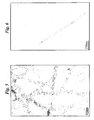
- Figure 4 shows transmission electron microscopy images of the original SAF-p1 : :SAF-p2-based fibres without (a) and with (b) CC NN .
- Figure 5 shows a transmission electron microscopy image of a straight peptide fibre matrix having recruited gold peptides via streptavidin, which in turn was recruited to the fibres by biotin incorporated into the self-assembling peptides.
- Figure 6 shows a transmission electron microscopy image of a single straight peptide fibre having recruited gold peptides via streptavidin, which in turn was recruited to the fibres by biotin incorporated into the self-assembling peptides.
- Figure 7 shows a high magnification transmission electron microscopy image of a single straight peptide fibre having recruited gold peptides via streptavidin, which in turn was recruited to the fibres by biotin incorporated into the self-assembling peptides.
- Figure 8 shows a transmission electron microscopy image of a kinked peptide fibre having a gold particle specifically recruited at the hub of the particle.
- Peptides were synthesized using standard solid-phase Fmoc chemistry, purified by RP-HPLC and confirmed by MALDI-TOF mass spectrometry.
- Fibre suspensions were dried onto carbon grids and stained with uranyl acetate for electron microscopy as described previously in Pandya et al., 2000 (supra).
- Streptavidin nanogold conjugate (streptavidin labeled with colloidal gold nanoparticles (5 or 10 nm)) were obtained from SIGMA. All the peptide synthesis reagents including biotinylated Fmoc-lysine were purchased from Merck Biosciences (Novabiochem). Peptides were synthesized on a Pioneer Peptide Synthesis System using standard Fmoc-chemistry as described above.
- the streptavidin nanogold conjugate was 2-10 times diluted with 10 mM MOPS, pH 7 as the diluent buffer containing 0.05% TWEEN 20 to minimise background.
- the diluted conjugate was allowed to equilibrate for 30 min in this lower glycerol content at room temperature.
- Fibre samples were prepared as indicated above (except biotinylated Fmoc-lysine was used to incorporate biotin into the peptides).
- a commercial Fmoc-lysine which had biotin attached the side-chain (epsilon) amino group was used to biotin into the synthesis of both straight and fibre shaping peptides.
- For straight peptides standard linear synthesis was used.
- Fibre shaping peptides incorporating biotin were created using a di-lysine hub, that is Lys-Lys (biotin). The first lysine acted as the hub from which the two peptide arms were grown. The alpha and epsilon amino acid groups of this lysine were used to initiate peptide synthesis.
- the alpha carboxy group of the first lysine was coupled to the second lysine, which contained the biotin.
- a designated amount (2 ⁇ L) of SNC was then added to the fibre preparations.
- higher volumes (up to 20 ⁇ L) or concentrations (up to 2 times dilution) were used.
- novel protein structures described herein were made by combining SAF-p1 and SAF-p2a in the presence of fibre-shaping peptides based on the SAF-p2a sequence following the technique described in Pandya et al., 2000 ( supra ).
- the present invention is demonstrated, by way of example only, with two novel peptides, CC NN and DD cc , which introduce kinks/waves and splits/branches into the
- CC NN and DD cc peptides are shown schematically in Figs. 1c &d.
- the peptides were based on the SAF-p2a sequence, Fig. 1a .
- the N-terminal "C" subunit of SAF-p2a was duplicated in a tail-to-tail fashion; i.e., two copies of the C sequence (hence the "CC” term) were linked through their C-termini leaving the N-termini free at the ends of the construct (hence the "NN” superscript).
- Samples were prepared by incubating SAF-p1 and SAF-p2 with or without CC NN (each peptide was at 100 ⁇ M concentration) at 5°C for 1 hour before the standard preparation for electron microscopy. Without CC NN , SAF-p1 + SAF-p2 produced extended linear fibres, Fig. 4a , but with the FiSh peptide multiple kinks were apparent, Fig. 4b .
- CC NN is more selective in the interactions it makes. This, combined with the presumed lower stability of B:C interactions compared with A:D interactions, leads to fewer and more-easily rectified imperfections (such as splitting and thickening).
- CD NC was simply the SAF-p2a sequence with a spacer inserted between the C and D subunits; in CC NC two successive copies of C were separated by the spacer; in both cases the spacer comprised three ⁇ -alanine residues, a central ⁇ -aminohexanoic acid residue (as a substitute for the L-lysine and L-glutamic acid hubs used in CC NN and DD cc ), followed by three further B-alanine residues.
- CD NC nor CC NC caused kinking, waving, splitting or branching of the matured fibres as observed for CC NN and DD cc .
- both CD NC and CC NC inhibited fibre assembly completely; mixtures with smaller amounts of control peptide did produce fibres, but these were short ( ⁇ 20 mm) and rare (500 times less abundant than in mixtures containing the FiSh peptides CC NN and DD CC ).
- CD NC and CC NC acted as terminators in fibrillogenesis.
- Fibre-shaping (FiSh) peptides were added to mixtures of peptides that would otherwise have formed linear assemblies.
- the two FiSh peptides tested influenced fibres morphology differently: one kinked the fibres, whereas the other split, or branched them.
- the ratio of FiSh to standards peptide determined the number of kinked and branched features observed.
- the ability to alter fibre morphologies can be used in the development of biomaterials that respond to cues provided by their environment. Such cues might be presented as a pattern on a surface. This could lead to surfaces functionalised with proteins for the applications in protein-array technology and the development of new protein-based diagnostic/sensor devices.
- Another possibility is for the assembly of networks that might be used as scaffolds in cell and tissue engineering. In this case the self-assembly fibres could be induced to respond to, and so support cell growth.
- FiSh peptides may comprise other functional molecules.
- the FiSh peptides could be used to recruit bioactive peptides, proteins and small molecules to assembled fibres.
- the additional moiety could be a peptide antigen, which once incorporated into the fibre could be used to pull-down ( i.e . recruit) a specific antibody to the fibre surface.
- the functional molecule is a nucleic acid sequence, transcription factors that interact with the nucleic acid sequence may be isolated. In these respects, the FiSh peptides should be considered as nodes at which functional groups could be located.
- 10nm gold particles were recruited to both straight fibres and the kinked fibres of the present invention using standard biotin/streptavidin chemistry as described above.
- biotin was incorporated into the self-assembling peptides during synthesis and the gold particles were coated with streptavidin. It was found that the gold particles were randomly distributed on the straight fibres (see Figures 5 to 7 ) but were specifically recruited at the hub of the kinked fibres (see Figure 8 ).
- one of the amino acids in the "f" position of the heptad was derivatised with biotin.
- the hub was derivatised with biotin. It is advantageous to be able to specifically recruit functional molecules such as gold particles to specific sites within the kinked fibres of the present invention.
Landscapes
- Chemical & Material Sciences (AREA)
- Health & Medical Sciences (AREA)
- Life Sciences & Earth Sciences (AREA)
- Engineering & Computer Science (AREA)
- General Health & Medical Sciences (AREA)
- Medicinal Chemistry (AREA)
- Organic Chemistry (AREA)
- Nanotechnology (AREA)
- Bioinformatics & Cheminformatics (AREA)
- Proteomics, Peptides & Aminoacids (AREA)
- Biophysics (AREA)
- Molecular Biology (AREA)
- Pharmacology & Pharmacy (AREA)
- Genetics & Genomics (AREA)
- Epidemiology (AREA)
- Chemical Kinetics & Catalysis (AREA)
- General Chemical & Material Sciences (AREA)
- Gastroenterology & Hepatology (AREA)
- Biochemistry (AREA)
- General Engineering & Computer Science (AREA)
- Medical Informatics (AREA)
- Biotechnology (AREA)
- Crystallography & Structural Chemistry (AREA)
- Animal Behavior & Ethology (AREA)
- Public Health (AREA)
- Veterinary Medicine (AREA)
- Peptides Or Proteins (AREA)
- Micro-Organisms Or Cultivation Processes Thereof (AREA)
- Immobilizing And Processing Of Enzymes And Microorganisms (AREA)
- Multicomponent Fibers (AREA)
- Treatments For Attaching Organic Compounds To Fibrous Goods (AREA)
Claims (12)
- Peptide en forme de fibre ayant la séquence :
(NH3-KIRRLKQKNARLK(βA)3)2-K. - Peptide en forme de fibre ayant la séquence :
E-((βA)3EIAALEYEIAALEQ-COOH)2. - Structure protéique comprenant un peptide en forme de fibre selon l'une quelconque des revendications précédentes, dans laquelle la structure protéique comprend des fibres protéiques en boucles, ondulées, dédoublées et réticulées.
- Structure protéique comprenant une pluralité de peptides en forme de fibre selon l'une quelconque des revendications 1 à 2 et une pluralité de peptides à auto-assemblage, dans laquelle les premier et second monomères peptidiques s'auto-assemblent pour former une structure protéique non linéaire, et dans laquelle la structure protéique comprend des fibres protéiques en boucles, ondulées, dédoublées et réticulées.
- Structure protéique selon la revendication 4, dans laquelle le rapport des peptides en forme de fibre : premiers peptides à auto-assemblage : seconds peptides à auto-assemblage est d'environ 1 x 10⁻⁶:1:1 à 10 :1 :1.
- Structure protéique selon la revendication 4, qui est une matrice, une grille, un niveau, un filtre ou un réseau.
- Structure protéique selon l'une quelconque des revendications 4 à 6, dans laquelle la pluralité de peptides d'auto-assemblage comprend des peptides ayant la séquence NH3KIAALKQKIASLKQEIDALEYENDALEQ-COOH et des peptides ayant la séquence NH3-KIRRLKQKNARLKQEIAALEYEIAALEQ-COOH.
- Procédé de production d'une structure protéique selon l'une quelconque des revendications 4 à 7, comprenant le mélange d'une pluralité de peptides en forme de fibre selon l'une quelconque des revendications 1 à 2 et d'une pluralité de peptides à auto-assemblage, dans des conditions permettant que les peptides s'associent pour former une structure protéique.
- Kit destiné à la production d'une structure protéique selon l'une quelconque des revendications 4 à 7, dans lequel le kit comprend une pluralité de peptides en forme de fibre selon l'une quelconque des revendications 1 à 2 et une pluralité de peptides à auto-assemblage, dans laquelle les premier et second monomères peptidiques peuvent s'associer pour former une structure protéique.
- Utilisation de la structure protéique selon l'une quelconque des revendications 3 à 7 dans la purification de liquides biologiques.
- Utilisation de la structure protéique selon l'une quelconque des revendications 3 à 7 pour l'assemblage de cellules dans le génie cellulaire et tissulaire.
- Utilisation de la structure protéique selon l'une quelconque des revendications 3 à 7 dans les procédures de génie de surface.
Applications Claiming Priority (3)
| Application Number | Priority Date | Filing Date | Title |
|---|---|---|---|
| GBGB0220805.6A GB0220805D0 (en) | 2002-09-06 | 2002-09-06 | Peptide monomers and protein structures |
| GB0220805 | 2002-09-06 | ||
| PCT/GB2003/003900 WO2004022584A1 (fr) | 2002-09-06 | 2003-09-08 | Peptides permettant de modifier la morphologie de fibres et pouvant interagir avec des peptides a autoassemblage |
Publications (2)
| Publication Number | Publication Date |
|---|---|
| EP1534741A1 EP1534741A1 (fr) | 2005-06-01 |
| EP1534741B1 true EP1534741B1 (fr) | 2008-08-13 |
Family
ID=9943665
Family Applications (1)
| Application Number | Title | Priority Date | Filing Date |
|---|---|---|---|
| EP03793920A Expired - Lifetime EP1534741B1 (fr) | 2002-09-06 | 2003-09-08 | Peptides permettant de modifier la morphologie de fibres et pouvant interagir avec des peptides a autoassemblage |
Country Status (9)
| Country | Link |
|---|---|
| US (1) | US7507790B2 (fr) |
| EP (1) | EP1534741B1 (fr) |
| JP (1) | JP4544997B2 (fr) |
| AT (1) | ATE404581T1 (fr) |
| AU (1) | AU2003264736A1 (fr) |
| DE (1) | DE60322913D1 (fr) |
| DK (1) | DK1534741T3 (fr) |
| GB (1) | GB0220805D0 (fr) |
| WO (1) | WO2004022584A1 (fr) |
Families Citing this family (2)
| Publication number | Priority date | Publication date | Assignee | Title |
|---|---|---|---|---|
| GB201306634D0 (en) | 2013-04-11 | 2013-05-29 | Univ Bristol | Cage-like particles |
| WO2016129656A1 (fr) * | 2015-02-12 | 2016-08-18 | 国立大学法人岩手大学 | Agent pour améliorer l'efficacité du transfert de gène exogène à des cellules de mammifère |
Family Cites Families (2)
| Publication number | Priority date | Publication date | Assignee | Title |
|---|---|---|---|---|
| US5955343A (en) * | 1992-12-28 | 1999-09-21 | Massachusetts Institute Of Technology | Stable macroscopic membranes formed by self-assembly of amphiphilic peptides and uses therefor |
| GB9922013D0 (en) * | 1999-09-17 | 1999-11-17 | Univ Sussex | Peptides |
-
2002
- 2002-09-06 GB GBGB0220805.6A patent/GB0220805D0/en not_active Ceased
-
2003
- 2003-09-08 AU AU2003264736A patent/AU2003264736A1/en not_active Abandoned
- 2003-09-08 US US10/526,367 patent/US7507790B2/en not_active Expired - Fee Related
- 2003-09-08 WO PCT/GB2003/003900 patent/WO2004022584A1/fr not_active Ceased
- 2003-09-08 DK DK03793920T patent/DK1534741T3/da active
- 2003-09-08 JP JP2004533672A patent/JP4544997B2/ja not_active Expired - Fee Related
- 2003-09-08 EP EP03793920A patent/EP1534741B1/fr not_active Expired - Lifetime
- 2003-09-08 AT AT03793920T patent/ATE404581T1/de not_active IP Right Cessation
- 2003-09-08 DE DE60322913T patent/DE60322913D1/de not_active Expired - Lifetime
Also Published As
| Publication number | Publication date |
|---|---|
| WO2004022584A1 (fr) | 2004-03-18 |
| AU2003264736A1 (en) | 2004-03-29 |
| JP2006513985A (ja) | 2006-04-27 |
| DK1534741T3 (da) | 2008-12-15 |
| DE60322913D1 (de) | 2008-09-25 |
| EP1534741A1 (fr) | 2005-06-01 |
| ATE404581T1 (de) | 2008-08-15 |
| GB0220805D0 (en) | 2002-10-16 |
| US7507790B2 (en) | 2009-03-24 |
| US20060155112A1 (en) | 2006-07-13 |
| JP4544997B2 (ja) | 2010-09-15 |
Similar Documents
| Publication | Publication Date | Title |
|---|---|---|
| CN100586959C (zh) | 具有与钛、银、硅结合能力的肽 | |
| US20240083957A1 (en) | Self-assembly of protein-based biomaterials with multiple morphologies | |
| KR20070089236A (ko) | 나노흑연 구조체-금속 나노입자 복합체 | |
| EP2844360B1 (fr) | Structures de protéines de fusion de soie d'araignée sans fragment répétitif pour liaison à une cible organique | |
| WO2005111068A2 (fr) | Procede de purification et de recuperation de proteines de soie au moyen d'une separation par affinite magnetique | |
| Daube et al. | Cell-free co-synthesis of protein nanoassemblies: tubes, rings, and doughnuts | |
| EP1534741B1 (fr) | Peptides permettant de modifier la morphologie de fibres et pouvant interagir avec des peptides a autoassemblage | |
| EP0825997A1 (fr) | Identification de ligands enantiomeres | |
| EP2283032A1 (fr) | Protéines d'échafaudage artificielles | |
| JP4448947B2 (ja) | ナノファイバー形成能を有するペプチド、及びペプチドナノファイバー | |
| US20230193291A1 (en) | Method for producing blockpoymers by means of linking blocks by a transpeptidase, and block polymers obtained by transpeptidase linking | |
| WO2023048262A1 (fr) | Ligature de peptide à l'aide d'une enzyme | |
| EP1185638A1 (fr) | Gene et sequences de proteines du gene 35 de phage t4 | |
| WO2005056589A1 (fr) | Peptide presentant une propriete d'autoassemblage induite a une concentration de sel donnee et materiau auto-assemble associe | |
| JP7045166B2 (ja) | コラーゲン結合材、その製造方法、ドラッグデリバリーシステム、および担持体 | |
| RU2522833C2 (ru) | Способ получения наноструктурированного материала на основе рекомбинантных жгутиков архей | |
| RU2526514C2 (ru) | СПОСОБ ПОЛУЧЕНИЯ НАНОМАТЕРИАЛА НА ОСНОВЕ РЕКОМБИНАНТНЫХ ЖГУТИКОВ АРХЕИ Halobacterium salinarum | |
| WO1999032513A1 (fr) | Polypeptides de liaison de proteines | |
| JP2001517201A (ja) | 溶解性ペプチド | |
| JPH115800A (ja) | ポリペプチドヘリックスバンドル |
Legal Events
| Date | Code | Title | Description |
|---|---|---|---|
| PUAI | Public reference made under article 153(3) epc to a published international application that has entered the european phase |
Free format text: ORIGINAL CODE: 0009012 |
|
| 17P | Request for examination filed |
Effective date: 20050304 |
|
| AK | Designated contracting states |
Kind code of ref document: A1 Designated state(s): AT BE BG CH CY CZ DE DK EE ES FI FR GB GR HU IE IT LI LU MC NL PT RO SE SI SK TR |
|
| AX | Request for extension of the european patent |
Extension state: AL LT LV MK |
|
| 17Q | First examination report despatched |
Effective date: 20050530 |
|
| DAX | Request for extension of the european patent (deleted) | ||
| RIN1 | Information on inventor provided before grant (corrected) |
Inventor name: WOOLFSON, DEREK,SCHOOL OF CHEMISTRY Inventor name: RYADNOV, MAXIM, G.,SCHOOL OF LIFE SCIENCES |
|
| 17Q | First examination report despatched |
Effective date: 20050530 |
|
| GRAP | Despatch of communication of intention to grant a patent |
Free format text: ORIGINAL CODE: EPIDOSNIGR1 |
|
| GRAS | Grant fee paid |
Free format text: ORIGINAL CODE: EPIDOSNIGR3 |
|
| GRAA | (expected) grant |
Free format text: ORIGINAL CODE: 0009210 |
|
| AK | Designated contracting states |
Kind code of ref document: B1 Designated state(s): AT BE BG CH CY CZ DE DK EE ES FI FR GB GR HU IE IT LI LU MC NL PT RO SE SI SK TR |
|
| REG | Reference to a national code |
Ref country code: GB Ref legal event code: FG4D |
|
| REG | Reference to a national code |
Ref country code: CH Ref legal event code: EP |
|
| REG | Reference to a national code |
Ref country code: IE Ref legal event code: FG4D |
|
| REF | Corresponds to: |
Ref document number: 60322913 Country of ref document: DE Date of ref document: 20080925 Kind code of ref document: P |
|
| REG | Reference to a national code |
Ref country code: CH Ref legal event code: NV Representative=s name: AMMANN PATENTANWAELTE AG BERN |
|
| REG | Reference to a national code |
Ref country code: DK Ref legal event code: T3 |
|
| PG25 | Lapsed in a contracting state [announced via postgrant information from national office to epo] |
Ref country code: NL Free format text: LAPSE BECAUSE OF FAILURE TO SUBMIT A TRANSLATION OF THE DESCRIPTION OR TO PAY THE FEE WITHIN THE PRESCRIBED TIME-LIMIT Effective date: 20080813 Ref country code: ES Free format text: LAPSE BECAUSE OF FAILURE TO SUBMIT A TRANSLATION OF THE DESCRIPTION OR TO PAY THE FEE WITHIN THE PRESCRIBED TIME-LIMIT Effective date: 20081124 |
|
| PG25 | Lapsed in a contracting state [announced via postgrant information from national office to epo] |
Ref country code: SI Free format text: LAPSE BECAUSE OF FAILURE TO SUBMIT A TRANSLATION OF THE DESCRIPTION OR TO PAY THE FEE WITHIN THE PRESCRIBED TIME-LIMIT Effective date: 20080813 Ref country code: AT Free format text: LAPSE BECAUSE OF FAILURE TO SUBMIT A TRANSLATION OF THE DESCRIPTION OR TO PAY THE FEE WITHIN THE PRESCRIBED TIME-LIMIT Effective date: 20080813 Ref country code: FI Free format text: LAPSE BECAUSE OF FAILURE TO SUBMIT A TRANSLATION OF THE DESCRIPTION OR TO PAY THE FEE WITHIN THE PRESCRIBED TIME-LIMIT Effective date: 20080813 |
|
| PG25 | Lapsed in a contracting state [announced via postgrant information from national office to epo] |
Ref country code: BE Free format text: LAPSE BECAUSE OF FAILURE TO SUBMIT A TRANSLATION OF THE DESCRIPTION OR TO PAY THE FEE WITHIN THE PRESCRIBED TIME-LIMIT Effective date: 20080813 |
|
| PG25 | Lapsed in a contracting state [announced via postgrant information from national office to epo] |
Ref country code: MC Free format text: LAPSE BECAUSE OF NON-PAYMENT OF DUE FEES Effective date: 20080930 Ref country code: BG Free format text: LAPSE BECAUSE OF FAILURE TO SUBMIT A TRANSLATION OF THE DESCRIPTION OR TO PAY THE FEE WITHIN THE PRESCRIBED TIME-LIMIT Effective date: 20081113 |
|
| PG25 | Lapsed in a contracting state [announced via postgrant information from national office to epo] |
Ref country code: SK Free format text: LAPSE BECAUSE OF FAILURE TO SUBMIT A TRANSLATION OF THE DESCRIPTION OR TO PAY THE FEE WITHIN THE PRESCRIBED TIME-LIMIT Effective date: 20080813 Ref country code: PT Free format text: LAPSE BECAUSE OF FAILURE TO SUBMIT A TRANSLATION OF THE DESCRIPTION OR TO PAY THE FEE WITHIN THE PRESCRIBED TIME-LIMIT Effective date: 20090113 Ref country code: CZ Free format text: LAPSE BECAUSE OF FAILURE TO SUBMIT A TRANSLATION OF THE DESCRIPTION OR TO PAY THE FEE WITHIN THE PRESCRIBED TIME-LIMIT Effective date: 20080813 Ref country code: RO Free format text: LAPSE BECAUSE OF FAILURE TO SUBMIT A TRANSLATION OF THE DESCRIPTION OR TO PAY THE FEE WITHIN THE PRESCRIBED TIME-LIMIT Effective date: 20080813 |
|
| PLBE | No opposition filed within time limit |
Free format text: ORIGINAL CODE: 0009261 |
|
| STAA | Information on the status of an ep patent application or granted ep patent |
Free format text: STATUS: NO OPPOSITION FILED WITHIN TIME LIMIT |
|
| 26N | No opposition filed |
Effective date: 20090514 |
|
| PG25 | Lapsed in a contracting state [announced via postgrant information from national office to epo] |
Ref country code: EE Free format text: LAPSE BECAUSE OF FAILURE TO SUBMIT A TRANSLATION OF THE DESCRIPTION OR TO PAY THE FEE WITHIN THE PRESCRIBED TIME-LIMIT Effective date: 20080813 Ref country code: IE Free format text: LAPSE BECAUSE OF NON-PAYMENT OF DUE FEES Effective date: 20080908 |
|
| PG25 | Lapsed in a contracting state [announced via postgrant information from national office to epo] |
Ref country code: IT Free format text: LAPSE BECAUSE OF FAILURE TO SUBMIT A TRANSLATION OF THE DESCRIPTION OR TO PAY THE FEE WITHIN THE PRESCRIBED TIME-LIMIT Effective date: 20080813 |
|
| PG25 | Lapsed in a contracting state [announced via postgrant information from national office to epo] |
Ref country code: SE Free format text: LAPSE BECAUSE OF FAILURE TO SUBMIT A TRANSLATION OF THE DESCRIPTION OR TO PAY THE FEE WITHIN THE PRESCRIBED TIME-LIMIT Effective date: 20081113 |
|
| PG25 | Lapsed in a contracting state [announced via postgrant information from national office to epo] |
Ref country code: CY Free format text: LAPSE BECAUSE OF FAILURE TO SUBMIT A TRANSLATION OF THE DESCRIPTION OR TO PAY THE FEE WITHIN THE PRESCRIBED TIME-LIMIT Effective date: 20080813 Ref country code: HU Free format text: LAPSE BECAUSE OF FAILURE TO SUBMIT A TRANSLATION OF THE DESCRIPTION OR TO PAY THE FEE WITHIN THE PRESCRIBED TIME-LIMIT Effective date: 20090214 Ref country code: LU Free format text: LAPSE BECAUSE OF NON-PAYMENT OF DUE FEES Effective date: 20080908 |
|
| PG25 | Lapsed in a contracting state [announced via postgrant information from national office to epo] |
Ref country code: TR Free format text: LAPSE BECAUSE OF FAILURE TO SUBMIT A TRANSLATION OF THE DESCRIPTION OR TO PAY THE FEE WITHIN THE PRESCRIBED TIME-LIMIT Effective date: 20080813 |
|
| PG25 | Lapsed in a contracting state [announced via postgrant information from national office to epo] |
Ref country code: GR Free format text: LAPSE BECAUSE OF FAILURE TO SUBMIT A TRANSLATION OF THE DESCRIPTION OR TO PAY THE FEE WITHIN THE PRESCRIBED TIME-LIMIT Effective date: 20081114 |
|
| PGFP | Annual fee paid to national office [announced via postgrant information from national office to epo] |
Ref country code: CH Payment date: 20100923 Year of fee payment: 8 |
|
| PGFP | Annual fee paid to national office [announced via postgrant information from national office to epo] |
Ref country code: FR Payment date: 20101005 Year of fee payment: 8 |
|
| PGFP | Annual fee paid to national office [announced via postgrant information from national office to epo] |
Ref country code: GB Payment date: 20100910 Year of fee payment: 8 |
|
| PGFP | Annual fee paid to national office [announced via postgrant information from national office to epo] |
Ref country code: DK Payment date: 20100913 Year of fee payment: 8 |
|
| PGFP | Annual fee paid to national office [announced via postgrant information from national office to epo] |
Ref country code: DE Payment date: 20100922 Year of fee payment: 8 |
|
| REG | Reference to a national code |
Ref country code: DK Ref legal event code: EBP Ref country code: CH Ref legal event code: PL |
|
| GBPC | Gb: european patent ceased through non-payment of renewal fee |
Effective date: 20110908 |
|
| REG | Reference to a national code |
Ref country code: FR Ref legal event code: ST Effective date: 20120531 |
|
| REG | Reference to a national code |
Ref country code: DE Ref legal event code: R119 Ref document number: 60322913 Country of ref document: DE Effective date: 20120403 |
|
| PG25 | Lapsed in a contracting state [announced via postgrant information from national office to epo] |
Ref country code: DE Free format text: LAPSE BECAUSE OF NON-PAYMENT OF DUE FEES Effective date: 20120403 Ref country code: CH Free format text: LAPSE BECAUSE OF NON-PAYMENT OF DUE FEES Effective date: 20110930 Ref country code: LI Free format text: LAPSE BECAUSE OF NON-PAYMENT OF DUE FEES Effective date: 20110930 |
|
| PG25 | Lapsed in a contracting state [announced via postgrant information from national office to epo] |
Ref country code: GB Free format text: LAPSE BECAUSE OF NON-PAYMENT OF DUE FEES Effective date: 20110908 Ref country code: FR Free format text: LAPSE BECAUSE OF NON-PAYMENT OF DUE FEES Effective date: 20110930 |
|
| PG25 | Lapsed in a contracting state [announced via postgrant information from national office to epo] |
Ref country code: DK Free format text: LAPSE BECAUSE OF NON-PAYMENT OF DUE FEES Effective date: 20110930 |