EP1531644A2 - Drahtlose Kommunikationsgerät und Verfahren zur Berücksichtigung der Dienstqualitätklasse in der Zufallszugriffsprozedur - Google Patents
Drahtlose Kommunikationsgerät und Verfahren zur Berücksichtigung der Dienstqualitätklasse in der Zufallszugriffsprozedur Download PDFInfo
- Publication number
- EP1531644A2 EP1531644A2 EP04026922A EP04026922A EP1531644A2 EP 1531644 A2 EP1531644 A2 EP 1531644A2 EP 04026922 A EP04026922 A EP 04026922A EP 04026922 A EP04026922 A EP 04026922A EP 1531644 A2 EP1531644 A2 EP 1531644A2
- Authority
- EP
- European Patent Office
- Prior art keywords
- random access
- mobile communication
- user class
- communication network
- time
- Prior art date
- Legal status (The legal status is an assumption and is not a legal conclusion. Google has not performed a legal analysis and makes no representation as to the accuracy of the status listed.)
- Withdrawn
Links
Images


Classifications
-
- H—ELECTRICITY
- H04—ELECTRIC COMMUNICATION TECHNIQUE
- H04W—WIRELESS COMMUNICATION NETWORKS
- H04W74/00—Wireless channel access
- H04W74/08—Non-scheduled access, e.g. ALOHA
- H04W74/0866—Non-scheduled access, e.g. ALOHA using a dedicated channel for access
- H04W74/0875—Non-scheduled access, e.g. ALOHA using a dedicated channel for access with assigned priorities based access
-
- H—ELECTRICITY
- H04—ELECTRIC COMMUNICATION TECHNIQUE
- H04B—TRANSMISSION
- H04B1/00—Details of transmission systems, not covered by a single one of groups H04B3/00 - H04B13/00; Details of transmission systems not characterised by the medium used for transmission
- H04B1/38—Transceivers, i.e. devices in which transmitter and receiver form a structural unit and in which at least one part is used for functions of transmitting and receiving
- H04B1/40—Circuits
-
- H—ELECTRICITY
- H04—ELECTRIC COMMUNICATION TECHNIQUE
- H04W—WIRELESS COMMUNICATION NETWORKS
- H04W74/00—Wireless channel access
- H04W74/08—Non-scheduled access, e.g. ALOHA
-
- H—ELECTRICITY
- H04—ELECTRIC COMMUNICATION TECHNIQUE
- H04W—WIRELESS COMMUNICATION NETWORKS
- H04W28/00—Network traffic management; Network resource management
- H04W28/16—Central resource management; Negotiation of resources or communication parameters, e.g. negotiating bandwidth or QoS [Quality of Service]
- H04W28/18—Negotiating wireless communication parameters
-
- H—ELECTRICITY
- H04—ELECTRIC COMMUNICATION TECHNIQUE
- H04W—WIRELESS COMMUNICATION NETWORKS
- H04W28/00—Network traffic management; Network resource management
- H04W28/16—Central resource management; Negotiation of resources or communication parameters, e.g. negotiating bandwidth or QoS [Quality of Service]
- H04W28/24—Negotiating SLA [Service Level Agreement]; Negotiating QoS [Quality of Service]
-
- H—ELECTRICITY
- H04—ELECTRIC COMMUNICATION TECHNIQUE
- H04W—WIRELESS COMMUNICATION NETWORKS
- H04W72/00—Local resource management
- H04W72/12—Wireless traffic scheduling
Definitions
- the present invention relates to a mobile communication terminal, and more particularly to a mobile communication terminal and method for providing differential services based on a unique QoS (Quality of Service) set for each mobile communication terminal.
- QoS Quality of Service
- GSM Global System for Mobile communications
- mobile communication terminals supporting the GSM access a mobile communication network and are assigned channels on a first-access first-assigned priority order as there is no QoS concept in the GSM service.
- GPRS General Packet Radio System
- GPRS mobile terminals are provided with various QoS classes: delay, reliability, precedence, peak throughput and mean throughput.
- Such a QoS is assigned to the mobile communication terminals after they have successfully performed a random access process to access a mobile communication network.
- the random access process or stage is a process in which a mobile communication terminal transmits a random access burst to a mobile communication network in order to gain access to the network, and the terminal receives an access grant from the network when the network successfully receives a collision-free random access burst.
- the preset QoS may be of no use if the terminal has not succeeded in gaining access to the network. For example, if a mobile communication terminal is located in the service area of a base station where there is a high possibility of collision between random access bursts from different terminals during peak usage hours when there are a large number of calls, it is highly unlikely that the terminal will successfully pass the random access stage and thus may fail to gain access to the network even though the mobile communication terminal has been assigned a high QoS.
- the present invention solves the above problem.
- At least one random access parameter which is to be used at a random access stage, is set to a value corresponding to a user class of QoS set for a mobile terminal.
- the random access stage is based on the random access parameters when a request is made to access a mobile communication network. Accordingly, as the user class QoS increases, an increase in the success rate of access to the mobile communication network is guaranteed, thereby improving the guarantee of the QoS set for the terminal.
- the definitions of random access parameters used in the random access stage described above are first described with reference to Fig. 1.
- the random access parameters include 3 parameters: ID (Initial Delay), RD (Repeat Delay) and RC (Repeat Count) as shown in Fig. 1.
- ID defines a time interval from a time T0, when a request is made to access a mobile communication network, to a time T1, when the first transmission of a random access burst is performed.
- the repeat delay (RD) defines a time interval from the time T1, when the previous transmission of the random access burst is performed, to a time T2, when the random access burst transmission is repeated.
- the repeat count defines the number of repetitions of the random access burst transmission, i.e., the number of times the random access burst transmission can be repeated, in the case where an access grant is not received from the mobile communication network even if the random access burst transmission has been performed.
- the upward pointing arrows " ⁇ " represent the transmission of the random access burst.
- a mobile communication terminal For example, if a mobile communication terminal is requested to access a mobile communication network at time T0 in Fig. 1, the terminal transmits a random access burst to the mobile communication network at time T1 after the initial delay time ID has passed. If the terminal succeeds in accessing the mobile communication network by receiving an access grant from the network after transmitting the random access burst, the terminal completes the random access stage, and the network then assigns a call channel to the terminal. On the other hand, if the terminal fails to receive an access grant from the network, even after transmitting the random access burst, the terminal retransmits the random access burst at time T2 after the repeat delay time RD has passed from time T1.
- the random access burst transmission is again repeated at a time after the repeat delay time RD has passed from time T2. As reception of an access grant from the mobile communication network is unsuccessful, the random access burst transmission is repeated for a number of times based on the repeat count RC.
- a mobile communication terminal sets at least one of the random access parameters to a value corresponding to a user class of a QoS set for the terminal. Then, if a request is made to access the mobile communication network, the random access stage is performed based on the random access parameters, at least one of which is set to the value corresponding to the user class.
- the user class of QoS is set differently for each terminal according to each user's profile. Information representing the set user class of QoS is recorded in an SIM (Subscriber Identification Module) card mounted in each terminal.
- SIM Subscriber Identification Module
- Fig. 2 is a block diagram illustrating the configuration of a mobile communication terminal according to an embodiment of the present invention.
- information representing a user class of QoS set for a corresponding user on a user-by-user basis according to the embodiment of the present invention is recorded in a SIM card 112 in a conventional GPRS mobile communication terminal.
- a controller 100 handles general telephone communication, data communication, various additional functions, etc, and also performs a random access stage on the basis of random access parameters set to values corresponding to the user class of QoS recorded in the SIM card 112 according to the present invention.
- a program memory 102 stores various reference data and a microcode of a program for implementing the operation of the controller 100.
- a data memory 104 is provided as a working memory for the controller 100.
- An LCD (Liquid Crystal Display) controller 106 operates an LCD 108, a display device, under the control of the controller 100 to allow the LCD 108 to display various kinds of image information.
- a keypad 110 includes dialing keys such as 0 - 9, *, #, etc., and a number of function keys, for example, menu, message, select, send, delete, power on/off, volume, etc.
- the keypad 110 provides key input data, corresponding to a key pressed by the user, to the controller 100.
- the SIM card 112 stores an SIM having a field in which information representing a user class of QoS set for the corresponding user on a user-by-user basis is recorded.
- a speaker 114 and a microphone 116 connected to the controller 100 are used in telephone communication and audio recording.
- An RF (Radio Frequency) module 118 transmits and receives RF or wireless signals to and from a mobile communication base station via an antenna.
- the RF module 118 modulates a signal for transmission, received from the controller 100 through a baseband processor 120, and transmits the modulated RF signal through the antenna.
- the RF module 118 demodulates an RF signal received through the antenna, and transfers it to the controller 100 through the baseband processor 120.
- the baseband processor 120 processes baseband signals communicated between the RF module 118 and the controller 100.
- Fig. 3 is a flow chart illustrating showing the procedure performed by the controller 100 according to an embodiment of the present invention. An example of the QoS at the random access stage according to the embodiment of the present invention will now be described with reference to Fig. 3.
- the controller 100 recognizes an SIM in the SIM card 112 at step 200.
- the controller 100 retrieves information of a user class of QoS from the SIM card 112 at step 202.
- the controller 100 selects a random access parameter set corresponding to the user class from the random access parameter sets in a random access parameter table.
- a random access parameter table is shown in Table 1, which is stored in the program memory 102.
- the selected random access parameter set is set as the random access parameters to use in the random access stage.
- User_QoS_Level ID RD RC 1 20 ⁇ 50 ms 20 ⁇ 50 ms 7 2 50 ⁇ 100 ms 50 ⁇ 100 ms 6 . . . . . . . . N Max. delay Max. delay 0
- 'User_QoS_Level' represents the user class of QoS
- 'ID', 'RD' and 'RC' represent the initial delay, the repeat delay and the repeat count, respectively, as shown in Fig. 1.
- random access parameter sets having different parameter values according to user classes are provided correspondening to the user classes. It can be seen that a shorter initial delay ID, a shorter repeat delay RD, and a higher repeat count RC (or a larger number of repetitions) are set for a user of a higher user class, whereas a longer initial delay ID, a longer repeat delay RD, and a smaller repeat count RC are set for a user of a lower user class.
- the controller 100 sets the initial delay ID and the repeat delay RD to 20 ⁇ 50 ms, and sets the repeat count RC to 7.
- the controller 100 performs the random access stage based on random access parameters corresponding to the user class as described above, at steps 208 and 210.
- the terminal is set to a higher user class, the terminal has shorter initial delays ID and repeat delays RD, and a higher repeat count RC, and thus will have a greater success rate of access to the mobile communication network.
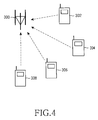
- the terminal is set to a lower user class, the terminal has a lesser success rate of access to the network.
- the terminal 302 has the highest success rate of access to the mobile communication network
- the terminal 306 has the lowest success rate of access to the network.
- Terminal User_QoS_Level ID RD RC Order of Success Rate 302 1 20 ⁇ 50 ms 20 ⁇ 50 ms 7 1 304 3 100 ⁇ 150 ms 100 ⁇ 150 ms 5 2 306 5 200 ⁇ 250 ms 200 ⁇ 250 ms 3 3 308 3 100 ⁇ 150 ms 100 ⁇ 150 ms 5 2
- the present invention can thus provide a QoS guarantee so that the success rate of access to the mobile communication network varies depending on user classes of QoS set for the terminals. This makes it possible to provide a service that guarantees a higher call success rate to users that pay for a higher QoS.
- the initial delay ID, the repeat delay RD and the repeat count RC may be calculated based on the corresponding user class, and the calculated values can be set as the random access parameters to be used at the random access stage.
- each of the initial and repeat delays can be obtained by multiplying the corresponding user class by a predetermined time constant, and the repeat count can be obtained by subtracting a corresponding user class number from the maximum repeat count and then subtracting a predetermined count number from the resulting value.
- the controller 100 may perform the random access stage on the basis of random access parameter values corresponding to the highest user class or a user class that is higher than the user class recorded in the SIM card 112 by a predetermined level.
- the present invention as described above may be applied not only to GPRS mobile terminals but also to any mobile terminal that performs a random access stage for accessing the mobile communication network.
Landscapes
- Engineering & Computer Science (AREA)
- Computer Networks & Wireless Communication (AREA)
- Signal Processing (AREA)
- Quality & Reliability (AREA)
- Mobile Radio Communication Systems (AREA)
Applications Claiming Priority (2)
| Application Number | Priority Date | Filing Date | Title |
|---|---|---|---|
| KR2003079871 | 2003-11-12 | ||
| KR1020030079871A KR100605800B1 (ko) | 2003-11-12 | 2003-11-12 | 랜덤 액세스 단계의 서비스 품질을 구현하는이동통신단말과 그 방법 |
Publications (1)
| Publication Number | Publication Date |
|---|---|
| EP1531644A2 true EP1531644A2 (de) | 2005-05-18 |
Family
ID=34431757
Family Applications (1)
| Application Number | Title | Priority Date | Filing Date |
|---|---|---|---|
| EP04026922A Withdrawn EP1531644A2 (de) | 2003-11-12 | 2004-11-12 | Drahtlose Kommunikationsgerät und Verfahren zur Berücksichtigung der Dienstqualitätklasse in der Zufallszugriffsprozedur |
Country Status (4)
| Country | Link |
|---|---|
| US (1) | US20050099944A1 (de) |
| EP (1) | EP1531644A2 (de) |
| KR (1) | KR100605800B1 (de) |
| CN (1) | CN100394821C (de) |
Cited By (4)
| Publication number | Priority date | Publication date | Assignee | Title |
|---|---|---|---|---|
| WO2007049204A1 (en) | 2005-10-28 | 2007-05-03 | Koninklijke Philips Electronics N.V. | Radio communication apparatus and method of control |
| WO2008042967A3 (en) * | 2006-10-03 | 2009-03-12 | Qualcomm Inc | Random access signaling transmission for system access in wireless communication |
| WO2008041828A3 (en) * | 2006-10-04 | 2009-09-03 | Lg Electronics Inc. | Methods for transmitting control signal and methods for allocating communication resource to do the same |
| AU2011203130B2 (en) * | 2006-10-03 | 2013-12-05 | Qualcomm Incorporated | Random access signaling transmission for system access in wireless communication |
Families Citing this family (11)
| Publication number | Priority date | Publication date | Assignee | Title |
|---|---|---|---|---|
| CN100355305C (zh) * | 2005-10-13 | 2007-12-12 | 中国移动通信集团公司 | 移动终端的服务质量参数配置方法 |
| CN100349491C (zh) * | 2005-10-14 | 2007-11-14 | 中国移动通信集团公司 | 移动终端的服务质量参数映射的方法 |
| CN100550905C (zh) * | 2005-11-25 | 2009-10-14 | 华为技术有限公司 | 具有分级服务功能的通信系统和方法 |
| US9232537B2 (en) * | 2006-02-07 | 2016-01-05 | Qualcomm Incorporated | Apparatus and method for fast access in a wireless communication system |
| CN101132622B (zh) * | 2006-08-20 | 2010-05-12 | 华为技术有限公司 | 一种随机接入时的服务质量控制方法 |
| CN110087317B (zh) * | 2007-09-28 | 2021-01-05 | 无线创新信号信任公司 | Wtru、wtru执行的方法、基站执行的方法以及装置 |
| US8161515B2 (en) * | 2009-05-13 | 2012-04-17 | Alcatel Lucent | Fast channel change handling of late multicast join |
| US9585083B2 (en) * | 2011-06-17 | 2017-02-28 | Samsung Electronics Co., Ltd. | Apparatus and method for supporting network entry in a millimeter-wave mobile broadband communication system |
| US9480000B2 (en) | 2012-04-17 | 2016-10-25 | Telefonaktiebolaget Lm Ericsson (Publ) | Method and communication device for controlling access to a wireless access network |
| CN107295693B (zh) * | 2016-04-13 | 2020-02-21 | 中国移动通信有限公司研究院 | 一种随机接入方法、基站和终端 |
| MX2019008091A (es) | 2017-01-05 | 2019-09-04 | Guangdong Oppo Mobile Telecommunications Corp Ltd | Metodo y dispositivo para acceso aleatorio. |
Family Cites Families (5)
| Publication number | Priority date | Publication date | Assignee | Title |
|---|---|---|---|---|
| US5729542A (en) * | 1995-06-28 | 1998-03-17 | Motorola, Inc. | Method and apparatus for communication system access |
| US5752193A (en) * | 1995-09-01 | 1998-05-12 | Motorola, Inc. | Method and apparatus for communicating in a wireless communication system |
| CA2374854C (en) * | 1999-05-26 | 2008-02-05 | Nokia Networks Oy | Random access control method and system |
| US6807426B2 (en) * | 2001-04-12 | 2004-10-19 | Qualcomm Incorporated | Method and apparatus for scheduling transmissions in a communication system |
| US6791968B2 (en) * | 2002-10-24 | 2004-09-14 | Motorola, Inc. | Method and apparatus for wirelessly communicating different information streams |
-
2003
- 2003-11-12 KR KR1020030079871A patent/KR100605800B1/ko not_active Expired - Fee Related
-
2004
- 2004-08-27 US US10/928,394 patent/US20050099944A1/en not_active Abandoned
- 2004-11-11 CN CNB2004100929550A patent/CN100394821C/zh not_active Expired - Fee Related
- 2004-11-12 EP EP04026922A patent/EP1531644A2/de not_active Withdrawn
Cited By (8)
| Publication number | Priority date | Publication date | Assignee | Title |
|---|---|---|---|---|
| WO2007049204A1 (en) | 2005-10-28 | 2007-05-03 | Koninklijke Philips Electronics N.V. | Radio communication apparatus and method of control |
| WO2008042967A3 (en) * | 2006-10-03 | 2009-03-12 | Qualcomm Inc | Random access signaling transmission for system access in wireless communication |
| AU2007303199B2 (en) * | 2006-10-03 | 2011-04-14 | Qualcomm Incorporated | Random access signaling transmission for system access in wireless communication |
| US8599706B2 (en) | 2006-10-03 | 2013-12-03 | Qualcomm Incorporated | Random access signaling transmission for system access in wireless communication |
| AU2011203130B2 (en) * | 2006-10-03 | 2013-12-05 | Qualcomm Incorporated | Random access signaling transmission for system access in wireless communication |
| WO2008041828A3 (en) * | 2006-10-04 | 2009-09-03 | Lg Electronics Inc. | Methods for transmitting control signal and methods for allocating communication resource to do the same |
| KR101319872B1 (ko) | 2006-10-04 | 2013-10-29 | 엘지전자 주식회사 | 제어 신호 송신 방법 및 이를 위한 통신 자원 할당 방법 |
| US8644227B2 (en) | 2006-10-04 | 2014-02-04 | Lg Electronics Inc. | Method for transmitting control signal and method for allocating communication resource to do the same |
Also Published As
| Publication number | Publication date |
|---|---|
| KR20050045706A (ko) | 2005-05-17 |
| CN1617625A (zh) | 2005-05-18 |
| KR100605800B1 (ko) | 2006-07-31 |
| US20050099944A1 (en) | 2005-05-12 |
| CN100394821C (zh) | 2008-06-11 |
Similar Documents
| Publication | Publication Date | Title |
|---|---|---|
| US7239884B2 (en) | Method for providing improved access times for a communication device | |
| US5774805A (en) | Multi-mode communication network with handset-selected channel assignments | |
| US6522877B1 (en) | Methods and apparatus for providing an interactive cell broadcast service | |
| US20050099944A1 (en) | Mobile communication terminal and method for implementing quality of service at a random access stage | |
| US6836647B2 (en) | Device and method for CDMA-signal power estimation | |
| EP1590987B1 (de) | Prioritäts-e911-rückruf während zugriffsklasseneinschränkungen | |
| US6484022B1 (en) | Wireless communications device having externally controlled transmission of identity | |
| US7164930B2 (en) | Switching a call from a network assisted communication mode to a direct communication mode | |
| US20030161343A1 (en) | Transmission procedures | |
| EP0700225A2 (de) | Schnurloser Verbindungsaufbau über Schmalbandnetz zur Auswahl eines Breitband-Datenkanals in einem anderen Netz für Datenübertragung | |
| US6745043B1 (en) | Priorty communication system and method of operation | |
| RU2206959C2 (ru) | Способ и устройство передачи сообщения в мобильной системе связи | |
| EP1718087A1 (de) | Gerät und Verfahren zum automatischen Auswählen eines von mehreren in einem Kommunikationsgerät enthaltenen SIM-Kartenlesern zum Aufbau eines abgehenden Rufes | |
| CN100355297C (zh) | 在无线通信系统中提高紧急呼叫接入速度的系统与方法 | |
| AU2001266263A1 (en) | Transmission procedures | |
| AU5339800A (en) | System and method for wireless local calling | |
| US7174187B1 (en) | Multimodal wireless communication device with user selection of transceiver mode via dialing string | |
| EP1188253B1 (de) | Verfahren und gerät zur zuteilung einer mobilstation an ein kommunikationsbetriebsmittel | |
| US7877107B2 (en) | Method for transmitting message during PTT call service in mobile communication terminal | |
| US20040082310A1 (en) | Method of controlling a switch device using a mobile terminal in a wireless communications network | |
| US20030125047A1 (en) | Method of updating a set of candidate frequency channels during wireless communications between a radio port and a mobile communications device | |
| JP2869271B2 (ja) | ディジタルコードレス電話装置 | |
| CN100367812C (zh) | 无线通讯方法及其系统 | |
| EP1463349B1 (de) | Verfahren zur Kontrolle einer Schaltvorrichtung unter Verwendung eines mobilen Endgerätes in einem drahtlosen Kommunikationsnetzwerk | |
| KR100703679B1 (ko) | 복수 개의 통신방식을 구비한 통신단말장치를 이용한 데이터 송/수신 방법 |
Legal Events
| Date | Code | Title | Description |
|---|---|---|---|
| PUAI | Public reference made under article 153(3) epc to a published international application that has entered the european phase |
Free format text: ORIGINAL CODE: 0009012 |
|
| 17P | Request for examination filed |
Effective date: 20041112 |
|
| AK | Designated contracting states |
Kind code of ref document: A2 Designated state(s): AT BE BG CH CY CZ DE DK EE ES FI FR GB GR HU IE IS IT LI LU MC NL PL PT RO SE SI SK TR |
|
| AX | Request for extension of the european patent |
Extension state: AL HR LT LV MK YU |
|
| STAA | Information on the status of an ep patent application or granted ep patent |
Free format text: STATUS: THE APPLICATION HAS BEEN WITHDRAWN |
|
| 18W | Application withdrawn |
Effective date: 20080912 |