EP1531550A1 - Method of converting digital data - Google Patents
Method of converting digital data Download PDFInfo
- Publication number
- EP1531550A1 EP1531550A1 EP05002304A EP05002304A EP1531550A1 EP 1531550 A1 EP1531550 A1 EP 1531550A1 EP 05002304 A EP05002304 A EP 05002304A EP 05002304 A EP05002304 A EP 05002304A EP 1531550 A1 EP1531550 A1 EP 1531550A1
- Authority
- EP
- European Patent Office
- Prior art keywords
- block
- data
- modulation
- bytes
- unit
- Prior art date
- Legal status (The legal status is an assumption and is not a legal conclusion. Google has not performed a legal analysis and makes no representation as to the accuracy of the status listed.)
- Ceased
Links
Images




Classifications
-
- G—PHYSICS
- G11—INFORMATION STORAGE
- G11B—INFORMATION STORAGE BASED ON RELATIVE MOVEMENT BETWEEN RECORD CARRIER AND TRANSDUCER
- G11B20/00—Signal processing not specific to the method of recording or reproducing; Circuits therefor
- G11B20/10—Digital recording or reproducing
-
- H—ELECTRICITY
- H03—ELECTRONIC CIRCUITRY
- H03M—CODING; DECODING; CODE CONVERSION IN GENERAL
- H03M5/00—Conversion of the form of the representation of individual digits
- H03M5/02—Conversion to or from representation by pulses
- H03M5/04—Conversion to or from representation by pulses the pulses having two levels
- H03M5/14—Code representation, e.g. transition, for a given bit cell depending on the information in one or more adjacent bit cells, e.g. delay modulation code, double density code
- H03M5/145—Conversion to or from block codes or representations thereof
-
- G—PHYSICS
- G11—INFORMATION STORAGE
- G11B—INFORMATION STORAGE BASED ON RELATIVE MOVEMENT BETWEEN RECORD CARRIER AND TRANSDUCER
- G11B20/00—Signal processing not specific to the method of recording or reproducing; Circuits therefor
- G11B20/10—Digital recording or reproducing
- G11B20/14—Digital recording or reproducing using self-clocking codes
- G11B20/1403—Digital recording or reproducing using self-clocking codes characterised by the use of two levels
- G11B20/1423—Code representation depending on subsequent bits, e.g. delay modulation, double density code, Miller code
- G11B20/1426—Code representation depending on subsequent bits, e.g. delay modulation, double density code, Miller code conversion to or from block codes or representations thereof
-
- H—ELECTRICITY
- H03—ELECTRONIC CIRCUITRY
- H03M—CODING; DECODING; CODE CONVERSION IN GENERAL
- H03M7/00—Conversion of a code where information is represented by a given sequence or number of digits to a code where the same, similar or subset of information is represented by a different sequence or number of digits
- H03M7/30—Compression; Expansion; Suppression of unnecessary data, e.g. redundancy reduction
- H03M7/46—Conversion to or from run-length codes, i.e. by representing the number of consecutive digits, or groups of digits, of the same kind by a code word and a digit indicative of that kind
-
- G—PHYSICS
- G11—INFORMATION STORAGE
- G11B—INFORMATION STORAGE BASED ON RELATIVE MOVEMENT BETWEEN RECORD CARRIER AND TRANSDUCER
- G11B20/00—Signal processing not specific to the method of recording or reproducing; Circuits therefor
- G11B20/10—Digital recording or reproducing
- G11B20/14—Digital recording or reproducing using self-clocking codes
- G11B20/1403—Digital recording or reproducing using self-clocking codes characterised by the use of two levels
- G11B20/1423—Code representation depending on subsequent bits, e.g. delay modulation, double density code, Miller code
- G11B20/1426—Code representation depending on subsequent bits, e.g. delay modulation, double density code, Miller code conversion to or from block codes or representations thereof
- G11B2020/1461—8 to 14 modulation, e.g. the EFM code used on CDs or mini-discs
-
- G—PHYSICS
- G11—INFORMATION STORAGE
- G11B—INFORMATION STORAGE BASED ON RELATIVE MOVEMENT BETWEEN RECORD CARRIER AND TRANSDUCER
- G11B20/00—Signal processing not specific to the method of recording or reproducing; Circuits therefor
- G11B20/10—Digital recording or reproducing
- G11B20/14—Digital recording or reproducing using self-clocking codes
- G11B20/1403—Digital recording or reproducing using self-clocking codes characterised by the use of two levels
- G11B20/1423—Code representation depending on subsequent bits, e.g. delay modulation, double density code, Miller code
- G11B20/1426—Code representation depending on subsequent bits, e.g. delay modulation, double density code, Miller code conversion to or from block codes or representations thereof
- G11B2020/1465—8 to 16 modulation, e.g. the EFM+ code used on DVDs
-
- G—PHYSICS
- G11—INFORMATION STORAGE
- G11B—INFORMATION STORAGE BASED ON RELATIVE MOVEMENT BETWEEN RECORD CARRIER AND TRANSDUCER
- G11B20/00—Signal processing not specific to the method of recording or reproducing; Circuits therefor
- G11B20/10—Digital recording or reproducing
- G11B20/14—Digital recording or reproducing using self-clocking codes
- G11B20/1403—Digital recording or reproducing using self-clocking codes characterised by the use of two levels
- G11B20/1423—Code representation depending on subsequent bits, e.g. delay modulation, double density code, Miller code
- G11B20/1426—Code representation depending on subsequent bits, e.g. delay modulation, double density code, Miller code conversion to or from block codes or representations thereof
- G11B2020/1469—Code representation depending on subsequent bits, e.g. delay modulation, double density code, Miller code conversion to or from block codes or representations thereof modulation code with one or more merging bits between consecutive codewords
Definitions
- the present invention relates to a method of modulation and demodulation for recording digital data to a recording or reproducing medium that can record or reproduce the digital data.
- the present invention relates to a method of data conversion suitable for recording the digital data to an optical record medium in high or low density, a method of record reproduction using the same, and an optical record medium recorded with the modulated data.
- a method of EFM (8/17 modulation) coding is provided as a method for recording digital data through encoding.
- a method of digital data modulation such as EFM or EFM plus is applied to record data, in particular, to an optical record medium or disk including CD, CD-R, CD-RW, DVD and so on.
- a recording capacity is an important item to be considered.
- a recording density of digital data is determined according to the method of modulation.
- RLL Run Length Limited
- an eight bit source code is converted to a fourteen bit d-restraint code word, which is attached with a three bit merging word.
- the three bit merging word is selected by an encoder to satisfy the minimum and maximum run lengths, the inherent codes for satisfying the maximum and minimum run lengths are not uniquely determined. Further, the merging word is selected so that power density is minimized in low frequency.
- Fig. 1 shows an example of a merging processor, in which eight user data bits are converted to fourteen channel bits using a look-up table, and to the end of the fourteen bits is attached with a merging bit satisfying three run length limitations.
- the merging bits can exist in three cases such as 000, 010 and 001.
- the encoder is adapted to select a merging bit having the lowest absolute value for a Running Digital Sum (RDS) at the end of a new code word, and accordingly 000 in the above situation.
- RDS Running Digital Sum
- CD when only two merging bits are used, compression of low frequency components (DC compression) is not sufficiently efficient. Therefore, when the number of merging bits is increased to three, margin of transition setting or omission in the merging bits is increased more.
- a good method of compression about the low frequency components by a compensated merging method without providing a certain standard about a CD system.
- compression can be executed through a look-ahead method since the minimization about the low frequency components in a short term does not always influence the minimization in a longer term. In this case, it is reported that performance improvement of 6 to 10dB is obtained.
- the EFM plus code used in DVDs is a sliding block code capable of restraining the low frequency components in which the code rate is 8/16 and the RLL is (2, 10).
- the EFM plus code which has the code rate higher than the previous EFM code about 6% as an advantage, is re-designed from the EFM code by replacing the 8/17 code rate with the 8/16 code rate and has the two merging bits instead of the merging bits of three bit.
- the CD, CD-ROM, CD-V and the like are proposed as very successful media for storing MPEG video data and other various digital information.
- the storage capacity of about 680 Mbytes is not sufficient for the operation of a graphic-based computer or to store high-definition digital video programs.
- a DVD which can be an expansion of the CDs, is a novel optical record medium with a storage capacity of at least 7 times of a typical CD. The increase of storage capacity is made through the quality elevation of a light source and an object lens.
- the code rate and the DC compression are very important factors in the high-density record of data and the reliability thereof when recording the digital data to the record medium, for example the optical record medium, and accordingly more various and improved methods are continuously required to satisfy the factors.
- the present invention has been made to solve the foregoing problems of the related art, and it is an object of the invention to provide a method of digital data conversion, comprising the following steps of: binding input digital data into unit blocks constituted by a plurality of bytes; modulation-coding each byte of the input data blocks by using a code conversion table; and allocating a merging bit in block unit for the modulation-coded input data in block unit.
- the present invention further provides a method of digital data conversion, comprising the following steps of: performing 8/15 modulation-coding to an input data block in the unit of m byte and simultaneously producing an RDS of the block in the corresponding order; considering the RDS of the block in the corresponding order and an RDS of the previous block to select a merging bit; and outputting the selected merging bit, following by outputting the encoded block in the corresponding order, and updating the RDS for selection of a merging bit in the next block in order.
- the present invention provides a method of recording and reproducing digital data, comprising the following steps of: binding input digital data into unit blocks constituted by a plurality of bytes and modulation-coding the bytes; allocating a merging bit in block unit for the modulation-coded input data in block unit; recording a byte-unit information expressing the number of the bytes constituting each of the data blocks together with data added with the merging bit after modulation-coding; and performing data decoding for the corresponding block by using the recorded byte-unit information.
- a method of converting digital data of the invention comprises the following steps of: binding input digital data into unit blocks constituted by a plurality of bytes; modulation-coding each byte of the input data blocks by using a code conversion table; and allocating a merging bit in block unit for the modulation-coded input data in block unit.
- the method of converting digital data of the invention is characterized in that the each of the input data block is bound in the unit of 3 to 7 bytes.
- the method of converting digital data of the invention is characterized in that the merging bit allocate in a block unit is constituted by 3 bits.
- the method of converting digital data of the invention is also characterized in that each of the modulation-coded input data block is encoded into a code word of a 15 bits length by an 8/15 conversion table.
- the method of converting digital data of the invention is characterized in that an RDS of the present input data block is compared to an RDS of the previous input data block to select the merging bit so that the RDS has the minimum value without violating RLL restraints when the present input data block is produced.
- the method of converting digital data of the invention is characterized in that the selected merging bit is primarily outputted, and then the encoded present input data block is outputted and simultaneously an RDS up to the present block is updated to prepare merging bit selection of the next block.
- Another method of converting digital data of the invention comprises the following steps of: performing 8/15 modulation-coding to an input data block in the unit of m (wherein m is 3 to 7) byte and simultaneously producing an RDS of the block in the corresponding order; considering the RDS of the block in the corresponding order and an RDS of the previous block to select a merging bit; and outputting the selected merging bit, following by outputting the encoded block in the corresponding order, and updating the RDS for selection of a merging bit in the next block in order.
- a method of recording and reproducing digital data of the invention comprises the following steps of: binding input digital data into unit blocks constituted by a plurality of bytes and modulation-coding the bytes; allocating a merging bit in block unit for the modulation-coded input data in block unit; recording a byte-unit information expressing the number of the bytes constituting each of the data blocks together with data added with the merging bit after modulation-coding; and performing data decoding for the corresponding block by using the recorded byte-unit information.
- each of the input data blocks is modulation-coded and decoded in the unit of 3 to 7 bytes.
- the method of recording and reproducing digital data of the invention is characterized in that the merging bit is selected from the merging bits of 3 bit so that the RDS value may not be the minimum while violating RLL restraints.
- Fig. 2 is a block diagram for illustrating a method of digital data modulation of the invention.
- m bytes are bound as one unit block.
- m means an input data bundle of at least 2 bytes, preferably 3 to 7 bytes.
- Each byte of the input data block is inputted into a modulation encoder 202 and encoded into a code word of 15 bit length by using an 8/15 conversion table (refer to Fig. 4).
- the result of encoding forms a data block of m X 15bit length (kth block).
- the 8/15 conversion table is used to convert the input data, in which the 8/15 conversion table is constituted to have the value of RDS variation as small as possible.
- Running Digital Sum 1 (RDS1) of the kth block is produced simultaneously with encoding each byte of the input data block.
- a merging bit selector 203 compares RDS1 of the kth block like this to RDS0 of the k-1th block to select the merging bit.
- the merging bit is selected from 000, 001, 010 and 100 so that RDS has the minimum value while the RLL does not violate run-length constraints.
- a merging bit of three bit is used, which is selected taking account of the RDSs of the present block and the next block.
- the encoded kth block is outputted (204) after previously outputting the merging bit selected like this, and simultaneously RDS0 up to the kth block is updated to prepare merging bit selection of the k+1th block.
- the modulated digital data are modulated in such a manner that the input data are bound to blocks with the minimum two bytes in unit, and a merging bit is added in a channel data block unit corresponding to each of the input blocks.
- the input data can be bound in three to seven byte unit to execute a merging process in block unit. Then, a modulation code having 0.5 to 0.5185 code rate can be obtained according to the block size (3 to 7 bytes) of the input data.
- Fig. 3 shows a DC control ability when varying the unit m of one block from three to seven. This shows a result (45:3 merging) in which the three bit input (24 bits) is 8/15 modulation-coded (45 bits) and then added with the merging bit, and the ability is -32dB at the frequency of 0.0001f c .
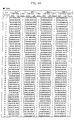
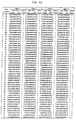
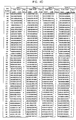
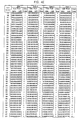
- Figs. 4A to 4F show an example of the 8/15(2,15) modulation table used in the method of digital data modulation of the invention, in which one conversion table is used for 256 inputs (1 byte) with a status number of four.
- the merging bit is added in block unit in modulating the digital data thereby incurring improvement of the DC compression ability and the code rate.
- one block is preferably constituted by binding three to seven bytes. Therefore, the block is necessarily defined in byte number suitable for the environment of data processing.
- an information expressing the number of bytes constituting one block or the number of data constituting a unit block of the added merging bits is recorded together in recording the modulation data, a merging process and a data decoding can be executed correctly for a corresponding block in decoding by using this recorded information.
- n is an integer at least 2, for example 3 to 7
- a decoder can judge how many bytes constitute a corresponding block by using the information in block unit and accordingly perform data decoding and reproduction suitable thereto.
- the modulated code of the 0.5 to 0.5185 code rate can be obtained according to the block size (3 to 7 bytes) of the input data.
Landscapes
- Engineering & Computer Science (AREA)
- Theoretical Computer Science (AREA)
- Signal Processing (AREA)
- Signal Processing For Digital Recording And Reproducing (AREA)
Abstract
Description
- The present invention relates to a method of modulation and demodulation for recording digital data to a recording or reproducing medium that can record or reproduce the digital data. In particular, the present invention relates to a method of data conversion suitable for recording the digital data to an optical record medium in high or low density, a method of record reproduction using the same, and an optical record medium recorded with the modulated data.
- A method of EFM (8/17 modulation) coding is provided as a method for recording digital data through encoding. A method of digital data modulation such as EFM or EFM plus is applied to record data, in particular, to an optical record medium or disk including CD, CD-R, CD-RW, DVD and so on.
- In recording the digital data to a recording medium such as optical record medium, a recording capacity is an important item to be considered. In other words, since the same disk can contain more information when information is recorded in high density, a recording density of digital data is determined according to the method of modulation.
- The EFM code in use for recording the digital data on a CD-type optical record medium has a Run Length Limited (RLL), in which d is 2 and k is 10, and a code rate corresponding to R=8/17. Referring to a coding method using the EFM code, an eight bit source code is converted to a fourteen bit d-restraint code word, which is attached with a three bit merging word. The three bit merging word is selected by an encoder to satisfy the minimum and maximum run lengths, the inherent codes for satisfying the maximum and minimum run lengths are not uniquely determined. Further, the merging word is selected so that power density is minimized in low frequency.
- Fig. 1 shows an example of a merging processor, in which eight user data bits are converted to fourteen channel bits using a look-up table, and to the end of the fourteen bits is attached with a merging bit satisfying three run length limitations.
- Since two zeros are necessarily present between two ones, '0' is necessarily present in the first merging bit position in the foregoing situation. Therefore, the merging bits can exist in three cases such as 000, 010 and 001. In this case, the encoder is adapted to select a merging bit having the lowest absolute value for a Running Digital Sum (RDS) at the end of a new code word, and accordingly 000 in the above situation. In an experiment about CD, when only two merging bits are used, compression of low frequency components (DC compression) is not sufficiently efficient. Therefore, when the number of merging bits is increased to three, margin of transition setting or omission in the merging bits is increased more.
- In general, a good method of compression about the low frequency components by a compensated merging method without providing a certain standard about a CD system. For example, compression can be executed through a look-ahead method since the minimization about the low frequency components in a short term does not always influence the minimization in a longer term. In this case, it is reported that performance improvement of 6 to 10dB is obtained.
- Meanwhile, the EFM plus code used in DVDs is a sliding block code capable of restraining the low frequency components in which the code rate is 8/16 and the RLL is (2, 10). The EFM plus code, which has the code rate higher than the previous EFM code about 6% as an advantage, is re-designed from the EFM code by replacing the 8/17 code rate with the 8/16 code rate and has the two merging bits instead of the merging bits of three bit.
- As described hereinbefore, the CD, CD-ROM, CD-V and the like are proposed as very successful media for storing MPEG video data and other various digital information. However, the storage capacity of about 680 Mbytes is not sufficient for the operation of a graphic-based computer or to store high-definition digital video programs. A DVD, which can be an expansion of the CDs, is a novel optical record medium with a storage capacity of at least 7 times of a typical CD. The increase of storage capacity is made through the quality elevation of a light source and an object lens. Besides, the storage capacity of the DVD is increased by totally re-designing a logical mode of the disk through use of more enhanced RS-PC and a record code called the EFM plus, in which the EFM plus has a code rate of 8/16 with (d,k)=(2,10) and is constituted by sliding-block codes for restraining low-frequency components.
- As described above, the code rate and the DC compression are very important factors in the high-density record of data and the reliability thereof when recording the digital data to the record medium, for example the optical record medium, and accordingly more various and improved methods are continuously required to satisfy the factors.
- Accordingly, the present invention has been made to solve the foregoing problems of the related art, and it is an object of the invention to provide a method of digital data conversion, comprising the following steps of: binding input digital data into unit blocks constituted by a plurality of bytes; modulation-coding each byte of the input data blocks by using a code conversion table; and allocating a merging bit in block unit for the modulation-coded input data in block unit.
- The present invention further provides a method of digital data conversion, comprising the following steps of: performing 8/15 modulation-coding to an input data block in the unit of m byte and simultaneously producing an RDS of the block in the corresponding order; considering the RDS of the block in the corresponding order and an RDS of the previous block to select a merging bit; and outputting the selected merging bit, following by outputting the encoded block in the corresponding order, and updating the RDS for selection of a merging bit in the next block in order.
- Further, the present invention provides a method of recording and reproducing digital data, comprising the following steps of: binding input digital data into unit blocks constituted by a plurality of bytes and modulation-coding the bytes; allocating a merging bit in block unit for the modulation-coded input data in block unit; recording a byte-unit information expressing the number of the bytes constituting each of the data blocks together with data added with the merging bit after modulation-coding; and performing data decoding for the corresponding block by using the recorded byte-unit information.
- The above objects, features and advantages of the present invention will become more apparent from the following detailed description when taken in conjunction with the accompanying drawings, in which:
- Fig. 1 illustrates a merging process in the EFM coding;
- Fig. 2 is a block diagram for illustrating a method of digital data modulation according to the invention;
- Fig. 3 is a graph for showing a DC compression when the unit m of one block is varied from 3 to 7 according to the invention; and
- Figs. 4A to 4F show digital data modulation code tables according to the invention.
-
- A method of converting digital data of the invention comprises the following steps of: binding input digital data into unit blocks constituted by a plurality of bytes; modulation-coding each byte of the input data blocks by using a code conversion table; and allocating a merging bit in block unit for the modulation-coded input data in block unit.
- The method of converting digital data of the invention is characterized in that the each of the input data block is bound in the unit of 3 to 7 bytes.
- Also, the method of converting digital data of the invention is characterized in that the merging bit allocate in a block unit is constituted by 3 bits.
- The method of converting digital data of the invention is also characterized in that each of the modulation-coded input data block is encoded into a code word of a 15 bits length by an 8/15 conversion table.
- Further, Also, the method of converting digital data of the invention is characterized in that an RDS of the present input data block is compared to an RDS of the previous input data block to select the merging bit so that the RDS has the minimum value without violating RLL restraints when the present input data block is produced.
- Also, the method of converting digital data of the invention is characterized in that the selected merging bit is primarily outputted, and then the encoded present input data block is outputted and simultaneously an RDS up to the present block is updated to prepare merging bit selection of the next block.
- Another method of converting digital data of the invention comprises the following steps of: performing 8/15 modulation-coding to an input data block in the unit of m (wherein m is 3 to 7) byte and simultaneously producing an RDS of the block in the corresponding order; considering the RDS of the block in the corresponding order and an RDS of the previous block to select a merging bit; and outputting the selected merging bit, following by outputting the encoded block in the corresponding order, and updating the RDS for selection of a merging bit in the next block in order.
- A method of recording and reproducing digital data of the invention comprises the following steps of: binding input digital data into unit blocks constituted by a plurality of bytes and modulation-coding the bytes; allocating a merging bit in block unit for the modulation-coded input data in block unit; recording a byte-unit information expressing the number of the bytes constituting each of the data blocks together with data added with the merging bit after modulation-coding; and performing data decoding for the corresponding block by using the recorded byte-unit information.
- Also, the method of recording and reproducing digital data of the invention is characterized in that each of the input data blocks is modulation-coded and decoded in the unit of 3 to 7 bytes.
- Further, the method of recording and reproducing digital data of the invention is characterized in that the merging bit is selected from the merging bits of 3 bit so that the RDS value may not be the minimum while violating RLL restraints.
- Hereinafter more detailed description will be made for embodiments of the invention in reference to the accompanying drawings.
- Fig. 2 is a block diagram for illustrating a method of digital data modulation of the invention.
- First, merging bits are added in block unit in the invention, in which the blocks are defined as follows.
- In defining one
input data block 201, m bytes are bound as one unit block. - Herein, m means an input data bundle of at least 2 bytes, preferably 3 to 7 bytes.
- Each byte of the input data block is inputted into a
modulation encoder 202 and encoded into a code word of 15 bit length by using an 8/15 conversion table (refer to Fig. 4). The result of encoding forms a data block of m X 15bit length (kth block). - The 8/15 conversion table is used to convert the input data, in which the 8/15 conversion table is constituted to have the value of RDS variation as small as possible.
- As described before, Running Digital Sum 1 (RDS1) of the kth block is produced simultaneously with encoding each byte of the input data block. A merging
bit selector 203 compares RDS1 of the kth block like this to RDS0 of the k-1th block to select the merging bit. - In other words, when the kth block is produced in comparing
RDS 1 of the kth block to RDS0 of the k-1th block, the merging bit is selected from 000, 001, 010 and 100 so that RDS has the minimum value while the RLL does not violate run-length constraints. - In this case, a merging bit of three bit is used, which is selected taking account of the RDSs of the present block and the next block.
- The encoded kth block is outputted (204) after previously outputting the merging bit selected like this, and simultaneously RDS0 up to the kth block is updated to prepare merging bit selection of the k+1th block.
- A series of processes like this are repeated to obtain modulated digital data.
- The modulated digital data are modulated in such a manner that the input data are bound to blocks with the minimum two bytes in unit, and a merging bit is added in a channel data block unit corresponding to each of the input blocks.
- In this case, the input data can be bound in three to seven byte unit to execute a merging process in block unit. Then, a modulation code having 0.5 to 0.5185 code rate can be obtained according to the block size (3 to 7 bytes) of the input data.
- Fig. 3 shows a DC control ability when varying the unit m of one block from three to seven. This shows a result (45:3 merging) in which the three bit input (24 bits) is 8/15 modulation-coded (45 bits) and then added with the merging bit, and the ability is -32dB at the frequency of 0.0001fc.
- Figs. 4A to 4F show an example of the 8/15(2,15) modulation table used in the method of digital data modulation of the invention, in which one conversion table is used for 256 inputs (1 byte) with a status number of four.
- As described before, the merging bit is added in block unit in modulating the digital data thereby incurring improvement of the DC compression ability and the code rate.
- When the merging bit is added in block unit in modulating the digital data, one block is preferably constituted by binding three to seven bytes. Therefore, the block is necessarily defined in byte number suitable for the environment of data processing. When an information expressing the number of bytes constituting one block or the number of data constituting a unit block of the added merging bits is recorded together in recording the modulation data, a merging process and a data decoding can be executed correctly for a corresponding block in decoding by using this recorded information.
- In other words, when the digital data are recorded through modulation encoding, n (n is an integer at least 2, for example 3 to 7) byte unit of process data or information is recorded together, a decoder can judge how many bytes constitute a corresponding block by using the information in block unit and accordingly perform data decoding and reproduction suitable thereto.
- According to the present invention as described hereinbefore, several input data are bound to define the block unit and the method of adding the merging bits in block unit is used in modulation of the digital data thereby improving the code rate and DC compression ability.
- According to the method of data modulation of the invention, the modulated code of the 0.5 to 0.5185 code rate can be obtained according to the block size (3 to 7 bytes) of the input data.
- While the invention has been shown and described with reference to certain preferred embodiments thereof, it will be understood by those skilled in the art that various changes in form and details may be made therein without departing from the spirit and scope of the invention.
Claims (10)
- A method of recording digital data, comprising the steps of:characterized by the further steps ofbinding input digital data into unit blocks constituted by a plurality of bytes; modulation-coding each byte of the input data blocks by using a code conversion table;
producing a digital sum value for each encoded block,
allocating a DC control bit for a present block by evaluating the digital sum value of the present block and the digital sum value of the previous block for selection of the DC control bit,
wherein the digital sum value of the present block is compared to the digital sum value of the previous block to select the DC control bit, so that the digital sum value of the present block has the minimum value without violating RLL (Run Length Limited) constrains when the present input data block is produced, and
recording data added with the DC control bit after modulation-coding. - The method of claim 1, characterized in, that each of the input data block is bound in the unit of at least two bytes.
- The method of claim 1, characterized in, that each of the modulation-coded input data block is encoded into a code word of a fifteen bit length by an 8/15 conversion table.
- The method of claim 1, further comprising outputting the selected merging bit primarily.
- The method of claim 4, characterized in, that simultaneously the digital sum value up to the current block is updated to prepare merging bit selection of the next block.
- A method of recording digital data, comprising the steps of:binding input digital data into unit blocks constituted by a plurality of bytes and modulation-coding the bytes;allocating a DC control bit in block unit for the modulation-coded input data in the block unit; andrecording an indication information indicating the number of the bytes constituting each of the data blocks together with data added with the merging bit after modulation-coding.
- The method of claim 6, wherein the indication information indicates that the number of bytes is two.
- The method of claim 6, wherein the DC control bit is selected so that the digital sum value may be minimum while not violating the RLL (Run Length Limited) constraints.
- The method of reproducing digital data, wherein the reproduction performs a decoding of data for the corresponding block by using the indication information recorded by the method according to claim 6.
- The method of claim 9, wherein each of the modulation-coded data blocks is decoded in the unit of at least two bytes based on the indication information.
Applications Claiming Priority (3)
| Application Number | Priority Date | Filing Date | Title |
|---|---|---|---|
| KR2001012638 | 2001-03-12 | ||
| KR1020010012638A KR100669623B1 (en) | 2001-03-12 | 2001-03-12 | How to convert digital data |
| EP01124798A EP1241792B1 (en) | 2001-03-12 | 2001-10-17 | Method of converting digital data |
Related Parent Applications (1)
| Application Number | Title | Priority Date | Filing Date |
|---|---|---|---|
| EP01124798A Division EP1241792B1 (en) | 2001-03-12 | 2001-10-17 | Method of converting digital data |
Publications (1)
| Publication Number | Publication Date |
|---|---|
| EP1531550A1 true EP1531550A1 (en) | 2005-05-18 |
Family
ID=36915026
Family Applications (2)
| Application Number | Title | Priority Date | Filing Date |
|---|---|---|---|
| EP01124798A Expired - Lifetime EP1241792B1 (en) | 2001-03-12 | 2001-10-17 | Method of converting digital data |
| EP05002304A Ceased EP1531550A1 (en) | 2001-03-12 | 2001-10-17 | Method of converting digital data |
Family Applications Before (1)
| Application Number | Title | Priority Date | Filing Date |
|---|---|---|---|
| EP01124798A Expired - Lifetime EP1241792B1 (en) | 2001-03-12 | 2001-10-17 | Method of converting digital data |
Country Status (5)
| Country | Link |
|---|---|
| US (1) | US7379502B2 (en) |
| EP (2) | EP1241792B1 (en) |
| JP (1) | JP3856700B2 (en) |
| KR (1) | KR100669623B1 (en) |
| DE (1) | DE60116250T2 (en) |
Families Citing this family (4)
| Publication number | Priority date | Publication date | Assignee | Title |
|---|---|---|---|---|
| KR100424483B1 (en) * | 2001-05-14 | 2004-03-24 | 엘지전자 주식회사 | Method and apparatus of converting a series of data words into a modulated signal |
| JP4143330B2 (en) * | 2002-05-14 | 2008-09-03 | ソニー株式会社 | Data recording medium, data recording method and apparatus |
| TWI277064B (en) * | 2003-09-29 | 2007-03-21 | Mediatek Inc | A method of determining a merging bit in an optical storage device |
| CN100468551C (en) * | 2005-09-02 | 2009-03-11 | 上海乐金广电电子有限公司 | DVD Modulation Desktop Compression Method |
Citations (5)
| Publication number | Priority date | Publication date | Assignee | Title |
|---|---|---|---|---|
| US4675650A (en) * | 1985-04-22 | 1987-06-23 | Ibm Corporation | Run-length limited code without DC level |
| US5151699A (en) * | 1990-09-05 | 1992-09-29 | Pioneer Electronic Corporation | Data converting apparatus |
| EP0655850A2 (en) * | 1993-10-28 | 1995-05-31 | Koninklijke Philips Electronics N.V. | Transmission and reception of a digital information signal |
| US5990899A (en) * | 1995-10-27 | 1999-11-23 | Microsoft Corporation | Method for compressing journal streams |
| WO2001095495A1 (en) * | 2000-06-02 | 2001-12-13 | Koninklijke Philips Electronics N.V. | Device for encoding a stream of databits of a binary source signal into a stream of databits of a binary channel signal, memory means, device for recording information, record carrier, device for coding and device for playing back |
Family Cites Families (33)
| Publication number | Priority date | Publication date | Assignee | Title |
|---|---|---|---|---|
| DE3587535T2 (en) * | 1984-10-01 | 1994-01-20 | Matsushita Electric Ind Co Ltd | Method and device for numerical data coding. |
| NL8702903A (en) * | 1987-12-03 | 1989-07-03 | Philips Nv | METHOD AND APPARATUS FOR RECORDING INFORMATION ON A RECORD CARRIER, AND AN APPARATUS FOR READING THE RECORDED INFORMATION. |
| JP2974678B2 (en) * | 1988-06-23 | 1999-11-10 | ソニー株式会社 | Data error detection method |
| KR910013186A (en) * | 1989-12-29 | 1991-08-08 | 강진구 | EFM Modulation Circuit |
| BR9506787A (en) * | 1994-02-15 | 1997-09-16 | Philips Electronics Nv | Processes for converting a series of words of m-bit information into a modulated signal and for producing a recording medium encoder devices recording decoder and reading signal and recording medium |
| JP3541439B2 (en) * | 1994-07-08 | 2004-07-14 | ソニー株式会社 | Signal modulation method and apparatus, and signal demodulation apparatus and method |
| US5870037A (en) * | 1994-07-08 | 1999-02-09 | Sony Corporation | Method and apparatus, demodulating method and signal demodulating apparatus |
| CA2182584A1 (en) * | 1994-12-12 | 1996-06-20 | Yoshihide Shimpuku | Data encoding method and data decoding method |
| ES2159727T3 (en) * | 1995-04-03 | 2001-10-16 | Matsushita Electric Industrial Co Ltd | SUPPORT FOR REGISTRATION, PROCEDURES AND APPLIANCES FOR TRANSMISSION AND DATA REPRODUCTION. |
| WO1996032780A1 (en) | 1995-04-12 | 1996-10-17 | Kabushiki Kaisha Toshiba | Device and method for converting/decoding code and recording medium |
| JP3457093B2 (en) * | 1995-04-14 | 2003-10-14 | 松下電器産業株式会社 | Recording medium, digital modulation / demodulation method and device therefor |
| PL183099B1 (en) * | 1995-09-01 | 2002-05-31 | Koninkl Philips Electronics Nv | Method of converting a sequence of m-bit words into a modulated signal form, method of creating a carrier, encoding device, recording device, signal and record carrier |
| KR0165441B1 (en) * | 1995-09-18 | 1999-03-20 | 김광호 | Digital data channel encoding and decoding method and its apparatus |
| JPH09135172A (en) * | 1995-11-08 | 1997-05-20 | Sony Corp | Code conversion method |
| JP3394127B2 (en) * | 1995-12-05 | 2003-04-07 | 株式会社東芝 | Digital data transmission method |
| US5969651A (en) * | 1996-03-08 | 1999-10-19 | Sony Corporation | Signal modulating method, signal modulating apparatus, signal demodulating method and signal demodulating apparatus |
| JP3666109B2 (en) | 1996-03-21 | 2005-06-29 | ソニー株式会社 | Recording medium reproducing apparatus, recording medium reproducing method, and optical disc |
| US5974013A (en) * | 1996-11-20 | 1999-10-26 | Sony Corporation | Disc reproducing apparatus and head position calculating method |
| US5940585A (en) * | 1997-06-17 | 1999-08-17 | Hewlett-Packard Company | Data merge unit |
| KR100257538B1 (en) * | 1997-07-14 | 2000-06-01 | 구자홍 | Method for record and protect copy of optical disc |
| US6265994B1 (en) * | 1998-01-09 | 2001-07-24 | U.S. Philips Corporation | Device for encoding/decoding n-bit source words into corresponding m-bit channel words, and vice versa |
| US6002814A (en) * | 1998-04-14 | 1999-12-14 | Hewlett-Packard Company | Means and method for configuring a data processing pipeline |
| US6748079B1 (en) * | 1998-10-14 | 2004-06-08 | Macrovision Corporation | Method and system for recording data on and reading data from an optical medium |
| AU1559800A (en) * | 1998-12-21 | 2000-07-12 | Koninklijke Philips Electronics N.V. | Device for encoding n-bit source words into corresponding m-bit channel words and decoding m-bit channel words into corresponding n-bit source words |
| IL137950A0 (en) * | 1998-12-21 | 2001-10-31 | Koninkl Philips Electronics Nv | Device for encoding a stream of databits |
| US6297753B1 (en) * | 1999-01-29 | 2001-10-02 | Victor Company Of Japan, Ltd. | Eight-to-fifteen modulation using no merging bit and optical disc recording or reading systems based thereon |
| JP2000286709A (en) | 1999-01-29 | 2000-10-13 | Victor Co Of Japan Ltd | Modulation method, modulation device, demodulation method, demodulation device and recording medium |
| KR100294893B1 (en) * | 1999-03-09 | 2001-07-12 | 윤종용 | Method for generating RLL code having enhanced DC suppression capability, and modulation method and demodulation method of the generated RLL code |
| KR100565046B1 (en) * | 1999-04-21 | 2006-03-30 | 삼성전자주식회사 | RL code placement method, modified demodulation method and demodulation device with improved DC suppression capability |
| US6483882B1 (en) * | 1999-05-24 | 2002-11-19 | O'dea James Orrin | EFM demodulation circuit and method |
| JP4384772B2 (en) * | 2000-01-31 | 2009-12-16 | インターナショナル・ビジネス・マシーンズ・コーポレーション | Code modulation apparatus and modulation method |
| US6445313B2 (en) * | 2000-02-07 | 2002-09-03 | Lg Electronics Inc. | Data modulating/demodulating method and apparatus for optical recording medium |
| US6507545B2 (en) * | 2000-12-12 | 2003-01-14 | Tri D Store Ip Llc | Method for data reading/writing using an optical carrier with pattern information pits |
-
2001
- 2001-03-12 KR KR1020010012638A patent/KR100669623B1/en not_active Expired - Fee Related
- 2001-10-17 DE DE60116250T patent/DE60116250T2/en not_active Expired - Fee Related
- 2001-10-17 EP EP01124798A patent/EP1241792B1/en not_active Expired - Lifetime
- 2001-10-17 EP EP05002304A patent/EP1531550A1/en not_active Ceased
- 2001-10-19 US US10/039,794 patent/US7379502B2/en not_active Expired - Fee Related
-
2002
- 2002-01-11 JP JP2002004333A patent/JP3856700B2/en not_active Expired - Fee Related
Patent Citations (5)
| Publication number | Priority date | Publication date | Assignee | Title |
|---|---|---|---|---|
| US4675650A (en) * | 1985-04-22 | 1987-06-23 | Ibm Corporation | Run-length limited code without DC level |
| US5151699A (en) * | 1990-09-05 | 1992-09-29 | Pioneer Electronic Corporation | Data converting apparatus |
| EP0655850A2 (en) * | 1993-10-28 | 1995-05-31 | Koninklijke Philips Electronics N.V. | Transmission and reception of a digital information signal |
| US5990899A (en) * | 1995-10-27 | 1999-11-23 | Microsoft Corporation | Method for compressing journal streams |
| WO2001095495A1 (en) * | 2000-06-02 | 2001-12-13 | Koninklijke Philips Electronics N.V. | Device for encoding a stream of databits of a binary source signal into a stream of databits of a binary channel signal, memory means, device for recording information, record carrier, device for coding and device for playing back |
Non-Patent Citations (2)
| Title |
|---|
| COENE W: "COMBI-CODES FOR DC-FREE RUNLENGTH-LIMITED CODING", IEEE TRANSACTIONS ON CONSUMER ELECTRONICS, IEEE INC. NEW YORK, US, vol. 46, no. 4, November 2000 (2000-11-01), pages 1082 - 1087, XP001197671, ISSN: 0098-3063 * |
| SCHOUHAMER IMMINK: "EFMPlus: The coding format of the multimedia compact disc", IEEE TRANSACTIONS ON CONSUMER ELECTRONICS, vol. 41, no. 3, 1 August 1995 (1995-08-01), NEW YORK, US, pages 491 - 497, XP000539497 * |
Also Published As
| Publication number | Publication date |
|---|---|
| DE60116250D1 (en) | 2006-02-02 |
| JP2002269923A (en) | 2002-09-20 |
| DE60116250T2 (en) | 2006-09-14 |
| KR20020072680A (en) | 2002-09-18 |
| US20020126765A1 (en) | 2002-09-12 |
| EP1241792B1 (en) | 2005-12-28 |
| EP1241792A1 (en) | 2002-09-18 |
| US7379502B2 (en) | 2008-05-27 |
| KR100669623B1 (en) | 2007-01-15 |
| JP3856700B2 (en) | 2006-12-13 |
Similar Documents
| Publication | Publication Date | Title |
|---|---|---|
| US6268810B1 (en) | Method of generating run length limited (RLL) code having improved DC suppression capability and modulation/demodulation method of the generated RLL code | |
| US6297753B1 (en) | Eight-to-fifteen modulation using no merging bit and optical disc recording or reading systems based thereon | |
| KR100370416B1 (en) | Encoding / Decoding Method for Recording / Reproducing High Density Data and Its Apparatus | |
| JPH09181609A (en) | Digital data channel encoding and decoding apparatus and method thereof | |
| JP2000286709A (en) | Modulation method, modulation device, demodulation method, demodulation device and recording medium | |
| US5892467A (en) | Signal modulation method employing multilevel run length limit coding scheme | |
| US6188335B1 (en) | Method and apparatus having cascaded decoding for multiple runlength-limited channel codes | |
| KR100274213B1 (en) | 7/13 Channel Coding and Channel Decoding Using RLL (2,25) Code | |
| US7016287B2 (en) | Method and apparatus of modulating/demodulating data for an optical recording medium | |
| WO2001058102A1 (en) | Dc control of a multilevel signal | |
| EP1241792B1 (en) | Method of converting digital data | |
| KR0183722B1 (en) | Digital Signal Modulator and Decoder | |
| US6157325A (en) | Encoding of an input information signal | |
| CN1108013C (en) | Modulation method, recording method, reproducing method, recording and reproducing apparatus, recording and reproducing method, and reproducing apparatus | |
| JP4169279B2 (en) | MTR code encoding / decoding method and apparatus having a code rate of 7/8 | |
| CN1258884C (en) | Method for encoding and decoding data by using modulation with finite run length | |
| JP3273580B2 (en) | Data modulation method, data modulation device, recording medium, data demodulation method, and data demodulation device | |
| JP4095440B2 (en) | Apparatus and method for encoding information, apparatus and method for decoding the encoded information, modulation signal, and recording medium manufacturing method | |
| KR100908763B1 (en) | How to code a data stream | |
| JP4826888B2 (en) | DEMODULATION TABLE, DEMODULATION DEVICE, DEMODULATION METHOD, PROGRAM, AND RECORDING MEDIUM | |
| JP2003198377A (en) | Modulating device and method, demodulating device and method, recording medium, and program | |
| Katayama et al. | Rate 8/14 asymmetrical DC control code for optical disks | |
| Ko et al. | A new highly efficient efm compatible modulation code for optical disc storage | |
| JP2006236440A (en) | State coding method and apparatus for state control code insertion | |
| JP2002237137A (en) | Optical disk device and run length limited code for optical disk device |
Legal Events
| Date | Code | Title | Description |
|---|---|---|---|
| PUAI | Public reference made under article 153(3) epc to a published international application that has entered the european phase |
Free format text: ORIGINAL CODE: 0009012 |
|
| 17P | Request for examination filed |
Effective date: 20050203 |
|
| AC | Divisional application: reference to earlier application |
Ref document number: 1241792 Country of ref document: EP Kind code of ref document: P |
|
| AK | Designated contracting states |
Kind code of ref document: A1 Designated state(s): DE FR GB IT NL |
|
| AKX | Designation fees paid |
Designated state(s): DE FR GB IT NL |
|
| 17Q | First examination report despatched |
Effective date: 20060123 |
|
| STAA | Information on the status of an ep patent application or granted ep patent |
Free format text: STATUS: THE APPLICATION HAS BEEN REFUSED |
|
| 18R | Application refused |
Effective date: 20071213 |