EP1530299A1 - Kommunikationsverfahren, Empfänger und Basisstation - Google Patents
Kommunikationsverfahren, Empfänger und Basisstation Download PDFInfo
- Publication number
- EP1530299A1 EP1530299A1 EP04105519A EP04105519A EP1530299A1 EP 1530299 A1 EP1530299 A1 EP 1530299A1 EP 04105519 A EP04105519 A EP 04105519A EP 04105519 A EP04105519 A EP 04105519A EP 1530299 A1 EP1530299 A1 EP 1530299A1
- Authority
- EP
- European Patent Office
- Prior art keywords
- whitening
- antenna
- user receiver
- signals
- combining
- Prior art date
- Legal status (The legal status is an assumption and is not a legal conclusion. Google has not performed a legal analysis and makes no representation as to the accuracy of the status listed.)
- Withdrawn
Links
- 238000000034 method Methods 0.000 title claims description 31
- 238000004891 communication Methods 0.000 title description 6
- 230000002087 whitening effect Effects 0.000 claims abstract description 124
- 239000011159 matrix material Substances 0.000 claims abstract description 89
- 238000001914 filtration Methods 0.000 claims abstract description 13
- 238000005070 sampling Methods 0.000 claims abstract description 13
- 238000011045 prefiltration Methods 0.000 claims description 8
- 238000000354 decomposition reaction Methods 0.000 claims description 3
- 230000002452 interceptive effect Effects 0.000 description 2
- 238000012935 Averaging Methods 0.000 description 1
- 238000003491 array Methods 0.000 description 1
- 230000005540 biological transmission Effects 0.000 description 1
- 238000011161 development Methods 0.000 description 1
- 238000005516 engineering process Methods 0.000 description 1
- 238000010295 mobile communication Methods 0.000 description 1
- 238000012545 processing Methods 0.000 description 1
Images

Classifications
-
- H—ELECTRICITY
- H04—ELECTRIC COMMUNICATION TECHNIQUE
- H04B—TRANSMISSION
- H04B7/00—Radio transmission systems, i.e. using radiation field
- H04B7/02—Diversity systems; Multi-antenna system, i.e. transmission or reception using multiple antennas
- H04B7/04—Diversity systems; Multi-antenna system, i.e. transmission or reception using multiple antennas using two or more spaced independent antennas
- H04B7/08—Diversity systems; Multi-antenna system, i.e. transmission or reception using multiple antennas using two or more spaced independent antennas at the receiving station
- H04B7/0837—Diversity systems; Multi-antenna system, i.e. transmission or reception using multiple antennas using two or more spaced independent antennas at the receiving station using pre-detection combining
- H04B7/0842—Weighted combining
- H04B7/0848—Joint weighting
- H04B7/0857—Joint weighting using maximum ratio combining techniques, e.g. signal-to- interference ratio [SIR], received signal strenght indication [RSS]
Definitions
- the invention relates to a method for reducing the influence of interference in a multi-user receiver, when the multi-user receiver receives signals from users having different data rates using at least two antenna elements.
- the invention also relates to a multi-user receiver and a base station.
- IRC interference rejection combining
- the IRC is carried out at symbol level after despreading operations. This requires that the IRC operations need to be implemented separately for each user, thus increasing the complexity of a receiver.
- the IRC technique is combined with a maximal ratio combining (MRC) technique, whereupon an IRC filter acts as a pre-whitening filter in WO 02/075950.
- MRC maximal ratio combining
- the IRC technique is also examined in Esa Tiirola, Juha Ylitalo: Performance of Smart Antenna Receivers in WCDMA Uplink with Spatially Coloured Interference, IST Mobile Communications Summit 2001, Barcelona, Spain, 9. - 12.9.2001, which is incorporated herein by reference. While the IRC technique is used in a pre-whitening filter, the pre-whitening is carried out by antenna weighting, which is performed on all users. Thus there arises a problem: the high bit rate users are seen as relatively high level interferers to low bit rate users and therefore taken into account when determining whitening weights. As a consequence of this, in whitening, the combining of antenna signals is not optimal from the high data rate user's point of view. The use of a non-optimal solution will diminish the uplink coverage of high data rate users and at the same time increase the user terminal's battery consumption for the high bit rate users.
- the invention provides an improved method, receiver and base station.
- a method for reducing the influence of interference in a multi-user receiver when the multi-user receiver receives signals from users having different data rates using at least two antenna elements, the method comprises: creating a spatial covariance matrix estimate from wideband antenna signals by sampling, arranging sampled values into a signal vector and by multiplying the signal vector by its conjugate transpose vector, determining a whitening filter on the basis of the spatial covariance matrix estimate, whitening received signals by using the whitening filter, removing the whitening from signals of predetermined users by using an inverse matrix of the matrix used in the whitening filter, conveying whitened signals and the signals from which the whitening has been removed to a receiver element, which carries out multi-path combining and multi-antenna combining.
- a multi-user receiver which uses at least two antenna elements and in which the influence of interference is reduced, the receiver comprises: means for pre-filtering a wideband antenna signal, the pre-filtering means being determined on the basis of a spatial covariance matrix estimate, which spatial covariance matrix estimate is obtained from wideband antenna signals by sampling, arranging sampled values into a signal vector and by multiplying the signal vector by its conjugate transpose vector, means for removing the whitening from signals of predetermined users by using an inverse matrix of the matrix used in the whitening filter, means for performing multi-path combining and multi-antenna combining.
- a multi-user receiver which uses at least two antenna elements and in which the influence of interference is reduced, the receiver comprises: one branch with a whitening arrangement, another branch without a whitening arrangement and a switching arrangement conveying received signals to the branch with the whitening arrangement or to the branch without the whitening arrangement depending on the used bit rate, a receiver element performing multi-path combining and multi-antenna combining.
- a multi-user receiver in which the influence of interference is reduced, comprising: a pre-filter whitening a wideband antenna signal, the pre-filter being determined on the basis of a spatial covariance matrix estimate which spatial covariance matrix estimate is obtained from wideband antenna signals by sampling, arranging sampled values into a signal vector and by multiplying the signal vector by its conjugate transpose vector, a whitening removing arrangement removing the whitening from signals of predetermined users by using an inverse matrix of the matrix used in the whitening filter, a receiver element performing multi-path combining and multi-antenna combining.
- a base station comprising a multi-user receiver which receiver uses at least two antenna elements and in which base station the influence of the interference is reduced, the base station comprises: means for pre-filtering a wideband antenna signal, the pre-filtering means being determined on the basis of a spatial covariance matrix estimate, which spatial covariance matrix estimate is obtained from wideband antenna signals by sampling, arranging sampled values into a signal vector and by multiplying the signal vector by its conjugate transpose vector, means for removing the whitening from signals of predetermined users by using an inverse matrix of the matrix used in the whitening filter, means for performing multi-path combining and multi-antenna combining.
- a base station comprising a multi-user receiver which uses at least two antenna elements and in which base station the influence of the interference is reduced, the base station comprises: one branch with a whitening arrangement, another branch without a whitening arrangement and a switching arrangement conveying received signals to the branch with the whitening arrangement or to the branch without the whitening arrangement depending on the used bit rate, an element performing multi-path combining and multi-antenna combining.
- a base station comprising a multi-user receiver which uses at least two antenna elements and in which base station the influence of the interference is reduced, the receiver comprises: a pre-filter whitening a wideband antenna signal, the pre-filter being determined on the basis of a spatial covariance matrix estimate, which spatial covariance matrix estimate is obtained from wideband antenna signals by sampling, arranging sampled values into a signal vector and by multiplying the signal vector by its conjugate transpose vector, a whitening removing arrangement removing the whitening from signals of predetermined users by using an inverse matrix of the matrix used in the whitening filter, an element performing multi-path combining and multi-antenna combining.
- the whitening performed by a pre-whitening filter can be removed from predetermined users and therefore the signals can be combined optimally.
- the predetermined users are conveyed to by-pass a pre-whitening filter, thus preventing disadvantages caused by whitening.
- the method may be used in several kinds of radio receivers, such as a base station of a communication system, for instance a base station used in a wideband code division multiple access system (WCDMA), such as UMTS (universal mobile telecommunications system).
- WCDMA wideband code division multiple access system
- UMTS universal mobile telecommunications system
- the receiver may, for example, be a Rake receiver or a receiver having diversity antennas.
- the embodiment is directed to a receiver having a pre-whitening filter in the front-end of an MRC receiver.
- the embodiment is especially suitable for systems where there are users having different bit rates, for example, the majority of users use low bit rate services and some users use high bit rate services and the receiver uses several antenna elements.
- Data rates which are classified as low or high, vary according to the current system; the data rates tend to increase due to technology development.
- the concept of high bit rate users means users having a relatively high bit rate and low bit rate users mean users having a relatively low bit rate. It is possible to set a bit rate threshold and classify users exceeding it as high bit rate users.
- a covariance matrix estimate is created from wideband antenna signals by sampling, arranging sampled values into a signal vector and by multiplying the signal vector by its conjugate transpose vector.
- the signals received by different antennas are preferably sampled simultaneously, for which reason sampled values are arranged into a vector format.
- the size of the vector depends on the number of antennas.
- the wideband antenna signal vector representing the desired signal of a single user, related interference and noise can be defined as wherein
- the signal spatial covariance matrix is then calculated by multiplying the signal vector (1) by its conjugate transpose (Hermitian) vector x i ( j ) H .
- the spatial covariance estimate matrix is typically averaged over a selected period of time, for instance, the averaging length can be chosen to be a time slot or a fraction of it.
- the spatial covariance estimate matrix averaged over a time slot having 2560 chips can be expressed as follows wherein
- a whitening filter is determined on the basis of the covariance matrix estimate.
- the whitening filter is typically implemented by using a whitening filter matrix.
- the whitening filter matrix can be solved by using Cholesky decomposition, because matrix R and xx , i is a symmetric and positive definite matrix.
- received signals are whitened by using the whitening filter.
- the whitening may be carried out by a complex matrix multiplication.
- the purpose of whitening is to whiten coloured noise or interference, which means that the powers of interfering signals are transformed by filtering to be similar to that of white Gaussian noise.
- the whitening adjusts signals for the MRC (maximal ratio combining) because the MRC performance is optimal in case that noise or interference is spatially white Gaussian.
- the assumption of spatially white Gaussian noise is valid for the interference scenario with a large number of low bit rate users.
- the whitening is removed from signals of predetermined users by using an inverse matrix of the matrix used in the whitening filter.
- Removing is typically carried out by matrix multipl ication.
- the removing may be carried out in different places in a reception chain: if the whitening is removed from channel estimates, the channel impulse response matrix is multiplied by the inverse matrix of the whitening matrix, or if the whitening is removed from despread data, the despread data arranged in a matrix format is multiplied by the inverse matrix of the whitening matrix, for example.
- the whitening is removed from predetermined signals, which in practice can be implemented, for instance, by using a bit rate threshold: the whitening is removed from signals exceeding the threshold.
- the whitening is preferably carried out before a prior art MRC (maximal ratio combining) receiver.
- the removing of the whitening may also be carried out before the MRC receiver or it may be incorporated in it.
- the principle of the MRC is that different phase offsets of each received signal are estimated and compensated for after demodulation, the power level of each received signal is estimated and the phase-corrected demodulator outputs are weighted in direct proportion of the received signal strength, the phase-corrected and weighted signals are summed and fed to the detector.
- the MRC technique is known in the art and is therefore not explained here in greater detail.
- whitened signals and the signals from which the whitening has been removed are conveyed to a receiver element, which carries out multi-path combining and multi-antenna combining.
- the element performing multi-path combining and multi-antenna combining may be a maximum ratio combiner.
- the multi-path combining and the multi-antenna combining are carried out according to the Rake principle.
- Arrow 116 depicts that both whitened signals and signals from which the whitening has been removed are conveyed to the multi-path combining and multi-antenna combining.
- the embodiment ends in block 112.
- Arrow 114 depicts one possibility for repeating the embodiment.
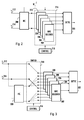
- a generalised example of a part of a receiver depicted by Figure 2 is now examined. It is obvious to a person skilled in the art that the receiver may also include elements other than those illustrated in Figure 2.
- the receiver may be located in several kinds of communication units, such as a base station of a communication system, for instance a base station used in a wideband code division multiple access system (WCDMA), such as UMTS (universal mobile telecommunications system).
- WCDMA wideband code division multiple access system
- UMTS universal mobile telecommunications system
- the receiver may, for example, be a Rake receiver.
- the receiver includes an antenna array or diversity antennas 212, 214.
- the number of antennas may vary according to the implementation.
- the IRC block 200 is a pre-whitening filter carrying out whitening operation.
- the pre-whitening filter is determined on the basis of a spatial covariance matrix estimate, which is obtained from the sampled antenna signals. The pre-whitening filter determination is explained above with the aid of the embodiment depicted in Figure 1.
- the MRC receiver structure 216 includes in this embodiment one receiver element 202, 204, 206, 208, 210 per each user. Some of them 202, 204, 206, 208 are for low bit rate users and one 210 for a high bit rate user.
- the number of MRC receiver elements may vary according to the implementation. In this embodiment, the MRC receiver elements use the Rake principle for multi-path combining and multi-antenna combining.
- the MRC process includes estimation and compensation for phase offsets of each received signal after demodulation, power level estimation of each received signal, weighting of phase-corrected demodulator outputs in direct proportion of the received signal strength and summation of the phase-corrected and weighted signals.
- the output of each MRC receiver element is then conveyed to the detector 220.
- the MRC technique is known in the art and is therefore not explained here in greater detail.
- the predetermined user is conveyed to its MRC element, where the whitening carried out by a pre-whitening filter 200 is removed by using an inverse matrix W -1 / i of the matrix used in the whitening filter.
- Removing is typically carried out by matrix multiplication.
- the removing may be carried out in different points of a transmission chain: if the whitening is removed from channel estimates, the estimate channel impulse response matrix is multiplied by the inverse matrix of the whitening matrix, or if the whitening is removed from despread data, the despread data arranged in a matrix format is multiplied by the inverse matrix of the whitening matrix, for example.
- the whitening is removed from predetermined signals, which in practice can be implemented, for instance, by using a bit rate threshold: the whitening is removed from signals exceeding the threshold.
- the removing may also be carried out in a separate removing block in the front end of a MRC receiver or receiver element.
- the control block 218 controls the function of the MRC receiver and also the removing of whitening.
- the whitening and the removing of whitening are typically implemented according to the present embodiment as a processor and software, but different hardware implementations are also feasible, e.g. a circuit built of separate logic components or one or more client-specific integrated circuits (Application-Specific Integrated Circuit, ASIC). A hybrid of these implementations is also feasible.
- the receiver of this embodiment includes one branch with a whitening procedure and another branch without a whitening procedure. Received signals are conveyed to the branch with the whitening procedure or to the branch without the whitening procedure depending on the used bit rate.
- the receiver may also include elements other than illustrated in Figure 3.
- the receiver may be located in several kinds of communication units, such as a base station of a communication system, for instance a base station used in a wideband code division multiple access system (WCDMA), such as UMTS (universal mobile telecommunications system).
- WCDMA wideband code division multiple access system
- UMTS universal mobile telecommunications system
- the receiver may, for example, be a Rake receiver.
- the receiver includes an antenna array or diversity antennas 312, 314.
- the number of antennas may vary according to the implementation.
- the IRC block 300 is a pre-whitening filter carrying out whitening operation.
- the pre-whitening filter is determined on the basis of a spatial covariance matrix estimate, which is obtained from the sampled antenna signals. The pre-whitening filter determination is explained above with the aid of the embodiment depicted in Figure 1.
- the receiver also includes logical MRC receivers 302, 304, 306, 308 for low bit rate users and one 310 for a high bit rate user.
- the MRC receiver elements use the Rake principle for multi-path combining and multi-antenna combining.
- the MRC process includes estimation and compensation for phase offsets of each received signal after demodulation, power level estimation of each received signal, weighting of phase-corrected demodulator outputs in direct proportion of the received signal strength and summation of the phase-corrected and weighted signals.
- the output of each MRC receiver element is then conveyed to the detector 320.
- the MRC technique is known in the art and is therefore not explained here in greater detail.
- the control block 316 controls the function of the switching block 318 according to the user's bit rate conveying the high bit rate users to by-pass the pre-whitening filter 300.
- the switching is typically implemented as a hardware implementation.
Landscapes
- Engineering & Computer Science (AREA)
- Computer Networks & Wireless Communication (AREA)
- Signal Processing (AREA)
- Radio Transmission System (AREA)
- Mobile Radio Communication Systems (AREA)
- Noise Elimination (AREA)
Applications Claiming Priority (2)
| Application Number | Priority Date | Filing Date | Title |
|---|---|---|---|
| FI20031609 | 2003-11-06 | ||
| FI20031609A FI20031609A0 (fi) | 2003-11-06 | 2003-11-06 | Viestintämenetelmä, vastaanotin ja tukiasema |
Publications (1)
| Publication Number | Publication Date |
|---|---|
| EP1530299A1 true EP1530299A1 (de) | 2005-05-11 |
Family
ID=29558585
Family Applications (1)
| Application Number | Title | Priority Date | Filing Date |
|---|---|---|---|
| EP04105519A Withdrawn EP1530299A1 (de) | 2003-11-06 | 2004-11-04 | Kommunikationsverfahren, Empfänger und Basisstation |
Country Status (4)
| Country | Link |
|---|---|
| US (2) | US7299017B2 (de) |
| EP (1) | EP1530299A1 (de) |
| CN (1) | CN1614913A (de) |
| FI (1) | FI20031609A0 (de) |
Cited By (2)
| Publication number | Priority date | Publication date | Assignee | Title |
|---|---|---|---|---|
| WO2006063273A1 (en) * | 2004-12-07 | 2006-06-15 | Intel Corporation | System and method capable of implicit feeback for the devices with an unequal number of transmitter and receiver chains in a wireless local area network |
| WO2011005564A3 (en) * | 2009-06-24 | 2011-04-28 | Qualcomm Incorporated | Enhanced interference nulling equalization |
Families Citing this family (39)
| Publication number | Priority date | Publication date | Assignee | Title |
|---|---|---|---|---|
| US7352825B2 (en) * | 2003-12-01 | 2008-04-01 | Lucent Technologies Inc. | Method and apparatus for providing random access detection in a communication system |
| US20050232174A1 (en) * | 2004-04-19 | 2005-10-20 | Texas Instruments Incorporated | Linear interference cancellation receiver for edge systems |
| US20060269024A1 (en) * | 2005-05-27 | 2006-11-30 | Francis Dominique | Initial multi-path acquisition of random access channels |
| WO2006136052A1 (fr) * | 2005-06-21 | 2006-12-28 | Zte Corporation | Procede de reception et de transmission amrs de prefiltrage, systeme et filtre associes |
| FI20055347A0 (fi) * | 2005-06-23 | 2005-06-23 | Nokia Corp | Menetelmä kohinan ja häiriön kovarianssimatriisin estimoimiseksi, vastaanotin ja radiojärjestelmä |
| US7929499B2 (en) * | 2005-07-13 | 2011-04-19 | Alcatel-Lucent Usa Inc. | Methods of multipath acquisition for dedicated traffic channels |
| US7764656B2 (en) | 2005-07-13 | 2010-07-27 | Alcatel-Lucent Usa Inc. | Methods of multipath acquisition for dedicated traffic channels |
| US7856071B2 (en) * | 2005-07-26 | 2010-12-21 | Alcatel-Lucent Usa Inc. | Multi-path acquisition in the presence of very high data rate users |
| CN101005302B (zh) * | 2006-01-18 | 2013-02-13 | 上海原动力通信科技有限公司 | 时隙码分多址系统进行干扰抑制的下行波束赋形方法 |
| JP4991870B2 (ja) * | 2006-10-27 | 2012-08-01 | テレフオンアクチーボラゲット エル エム エリクソン(パブル) | G−rake受信機内の白色化計算を簡略化する方法および受信機 |
| US20080112517A1 (en) * | 2006-11-06 | 2008-05-15 | Nokia Corporation | Apparatus, methods, and computer program products providing reduced interference in a multi-antenna system |
| KR100946197B1 (ko) * | 2007-01-29 | 2010-03-08 | 삼성전자주식회사 | 다중 입출력 무선통신 시스템에서 신호 검출 장치 및 방법 |
| US7948436B2 (en) * | 2007-03-09 | 2011-05-24 | Telefonaktiebolaget L M Ericsson (Publ) | Array antenna arrangement |
| US20080298480A1 (en) * | 2007-05-31 | 2008-12-04 | Qiang Li | Asynchronous MIMO-OFDM spatial covariance estimation |
| US20090103488A1 (en) * | 2007-06-28 | 2009-04-23 | University Of Maryland | Practical method for resource allocation for qos in ofdma-based wireless systems |
| US7929629B2 (en) * | 2008-02-07 | 2011-04-19 | Telefonaktiebolaget Lm Ericsson (Publ) | Method and apparatus for improved channel estimation for communications signal processing |
| WO2009105418A1 (en) | 2008-02-20 | 2009-08-27 | Hobbit Wave | Beamforming devices and methods |
| US8150345B2 (en) * | 2008-03-31 | 2012-04-03 | Qualcomm Incorporated | Simplified interference suppression in multi-antenna receivers |
| US20090312043A1 (en) * | 2008-06-13 | 2009-12-17 | Silvus Technologies, Inc. | Interference mitigation for devices with multiple receivers |
| KR101568717B1 (ko) * | 2009-02-10 | 2015-11-12 | 삼성전자주식회사 | 다중 안테나 시스템에서 적응적인 화이트닝 장치 및 방법 |
| US8798654B2 (en) * | 2009-04-22 | 2014-08-05 | Nokia Siemens Networks Oy | Selective interference rejection combining |
| US8488724B2 (en) * | 2009-05-14 | 2013-07-16 | Silvus Technologies, Inc. | Wideband interference mitigation for devices with multiple receivers |
| CN102347784B (zh) * | 2010-08-03 | 2014-01-01 | 鼎桥通信技术有限公司 | 联合检测方法及联合检测接收机 |
| US8885567B2 (en) * | 2011-11-02 | 2014-11-11 | Qualcomm Incorporated | Reducing complexity for implementing interference cancellation applied to physical channels of a wireless network |
| IL218047A (en) * | 2012-02-12 | 2017-09-28 | Elta Systems Ltd | Devices and methods are added, for spatial suppression of interference in wireless networks |
| US9154353B2 (en) | 2012-03-07 | 2015-10-06 | Hobbit Wave, Inc. | Devices and methods using the hermetic transform for transmitting and receiving signals using OFDM |
| US8948718B2 (en) | 2012-03-07 | 2015-02-03 | Hobbit Wave, Inc. | Devices and methods using the Hermetic Transform |
| CN103379078B (zh) * | 2012-04-27 | 2016-07-06 | 电信科学技术研究院 | 一种频域均衡检测的方法和设备 |
| US8879657B2 (en) * | 2012-09-07 | 2014-11-04 | Samsung Electronics Co., Ltd. | Communication system with whitening feedback mechanism and method of operation thereof |
| US9762344B2 (en) * | 2013-01-22 | 2017-09-12 | Lg Electronics Inc. | Method for transmitting and receiving signal in multi-cell cooperative communication system and apparatus therefor |
| WO2015061709A1 (en) | 2013-10-25 | 2015-04-30 | HOBBIT, Wave | Devices and methods employing hermetic transforms for encoding and decoding digital information in spread-spectrum communication systems |
| US9829568B2 (en) | 2013-11-22 | 2017-11-28 | VertoCOMM, Inc. | Radar using hermetic transforms |
| US11304661B2 (en) | 2014-10-23 | 2022-04-19 | VertoCOMM, Inc. | Enhanced imaging devices, and image construction methods and processes employing hermetic transforms |
| US9871684B2 (en) | 2014-11-17 | 2018-01-16 | VertoCOMM, Inc. | Devices and methods for hermetic transform filters |
| US20170170998A1 (en) * | 2015-12-11 | 2017-06-15 | Nokia Solutions And Networks Oy | Pre-combiner interference removal |
| US10305717B2 (en) | 2016-02-26 | 2019-05-28 | VertoCOMM, Inc. | Devices and methods using the hermetic transform for transmitting and receiving signals using multi-channel signaling |
| US10651951B2 (en) * | 2018-05-01 | 2020-05-12 | Cavium, Llc. | Methods and apparatus for sub-block based architecture of cholesky decomposition and channel whitening |
| EP3896860B1 (de) * | 2020-03-27 | 2023-10-11 | Mavenir Systems, Inc. | Uplink-decodierung in einem massiven mimo-drahtloskommunikationssystem für ein offenes funkzugangsnetzwerk |
| US12136979B2 (en) * | 2022-09-26 | 2024-11-05 | Samsung Electronics Co. Ltd | Method and apparatus for matrix enhancement in MIMO receiver with deep learning |
Citations (1)
| Publication number | Priority date | Publication date | Assignee | Title |
|---|---|---|---|---|
| WO1998053560A1 (en) * | 1997-05-21 | 1998-11-26 | Telefonaktiebolaget Lm Ericsson | Selective diversity combining |
Family Cites Families (5)
| Publication number | Priority date | Publication date | Assignee | Title |
|---|---|---|---|---|
| ES2264586T3 (es) * | 1999-11-26 | 2007-01-01 | Nokia Corporation | Receptor rake. |
| GB0107113D0 (en) * | 2001-03-21 | 2001-05-09 | Nokia Networks Oy | Interference rejection in a receiver |
| US7359466B2 (en) * | 2001-08-24 | 2008-04-15 | Lucent Technologies Inc. | Signal detection by a receiver in a multiple antenna time-dispersive system |
| EP1481482B1 (de) * | 2002-02-28 | 2012-05-23 | TELEFONAKTIEBOLAGET LM ERICSSON (publ) | Signalempfängereinrichtungen und -verfahren |
| GB0222046D0 (en) * | 2002-09-23 | 2002-10-30 | Nokia Corp | Receiving method and receiver |
-
2003
- 2003-11-06 FI FI20031609A patent/FI20031609A0/fi unknown
-
2004
- 2004-01-21 US US10/760,532 patent/US7299017B2/en not_active Expired - Fee Related
- 2004-10-13 CN CNA200410085013XA patent/CN1614913A/zh active Pending
- 2004-11-04 EP EP04105519A patent/EP1530299A1/de not_active Withdrawn
-
2006
- 2006-11-29 US US11/605,324 patent/US20070072551A1/en not_active Abandoned
Patent Citations (1)
| Publication number | Priority date | Publication date | Assignee | Title |
|---|---|---|---|---|
| WO1998053560A1 (en) * | 1997-05-21 | 1998-11-26 | Telefonaktiebolaget Lm Ericsson | Selective diversity combining |
Cited By (7)
| Publication number | Priority date | Publication date | Assignee | Title |
|---|---|---|---|---|
| WO2006063273A1 (en) * | 2004-12-07 | 2006-06-15 | Intel Corporation | System and method capable of implicit feeback for the devices with an unequal number of transmitter and receiver chains in a wireless local area network |
| GB2437192A (en) * | 2004-12-07 | 2007-10-17 | Intel Corp | System and method capable of implicit feeback for the devices with an unequal number of transmitter and receiver chains in a wireless local area network |
| GB2437192B (en) * | 2004-12-07 | 2009-09-02 | Intel Corp | System and method capable of implicit feedback for the devices with an unequal number of transmitter and receiver chains in a wireless local area network |
| US7830980B2 (en) | 2004-12-07 | 2010-11-09 | Intel Corporation | System and method capable of implicit feedback for the devices with an unequal number of transmitter and receiver chains in a wireless local area network |
| US8279972B2 (en) | 2004-12-07 | 2012-10-02 | Intel Corporation | System and method capable of implicit feedback for the devices with an unequal number of transmitter and receiver chains in a wireless local area network |
| WO2011005564A3 (en) * | 2009-06-24 | 2011-04-28 | Qualcomm Incorporated | Enhanced interference nulling equalization |
| US8396438B2 (en) | 2009-06-24 | 2013-03-12 | Qualcomm Incorporated | Enhanced interference nulling equalization |
Also Published As
| Publication number | Publication date |
|---|---|
| US20070072551A1 (en) | 2007-03-29 |
| FI20031609A0 (fi) | 2003-11-06 |
| US20050101253A1 (en) | 2005-05-12 |
| US7299017B2 (en) | 2007-11-20 |
| CN1614913A (zh) | 2005-05-11 |
Similar Documents
| Publication | Publication Date | Title |
|---|---|---|
| US7299017B2 (en) | Communication method, receiver and base station | |
| US7266355B2 (en) | Low complexity equalizer for radio receiver | |
| US6658047B1 (en) | Adaptive channel equalizer | |
| EP1252728B1 (de) | Lineare signaltrennung durch polarisations-diversität | |
| EP1197006B1 (de) | Mehrstufiges rake kombinierungsverfahren und einrichtung | |
| CA2258890C (en) | Adaptive communication system and method using unequal weighting of interference and noise | |
| EP1858175B1 (de) | Verfahren und geräte zum realisieren einer intelligenten antenne in einem wcdma-system | |
| EP1639725B1 (de) | Verbesserter whitener-rake-empfänger für ein wcdma-endgerät | |
| EP2162994B1 (de) | Effizientes verfahren zur herstellung und gemeinsamen nutzung einer störungskovarianzmatrix | |
| US20070110200A1 (en) | Equalizer for a receiver in a wireless communication system | |
| AU725732B2 (en) | Method and apparatus for interference decorrelation in time and space | |
| US8351488B2 (en) | Diversity receiver | |
| US20070177658A1 (en) | Method for 2D antenna rake combining in a code division multiplication access system | |
| KR20010062214A (ko) | 개선된 신호 포착과 프로세싱을 지닌 코드분할 다중접속시스템 및 오퍼레이션 방법 | |
| AU1660400A (en) | Rake receiver | |
| KR100818465B1 (ko) | 다중 수신기 안테나용 레이크 기반 cdma 수신기 | |
| US20100020853A1 (en) | Spread spectrum modulator and demodulator | |
| JP2002539666A (ja) | Cdma端末のための無監督適応チップ分離フィルタ | |
| US20040097204A1 (en) | Multi-subscriber detection using a rake receiver structure | |
| KR100306168B1 (ko) | 직접확산 코드분할다중접속 복조 방식 이동통신시스템의무선신호 수신 장치 및 그 방법 | |
| KR100333821B1 (ko) | 다중경로최대비결합을적용하는간섭제거시스템 | |
| Gajbhiye et al. | Performance comparison of MMSE-based adaptive multiuser detection of DS-CDMA signals | |
| Kopsa et al. | Performance of multiple antenna combining algorithms in the uplink of UTRA/FDD | |
| Lin et al. | A low complexity partially adaptive CDMA receiver for downlink mobile satellite communications |
Legal Events
| Date | Code | Title | Description |
|---|---|---|---|
| PUAI | Public reference made under article 153(3) epc to a published international application that has entered the european phase |
Free format text: ORIGINAL CODE: 0009012 |
|
| AK | Designated contracting states |
Kind code of ref document: A1 Designated state(s): AT BE BG CH CY CZ DE DK EE ES FI FR GB GR HU IE IS IT LI LU MC NL PL PT RO SE SI SK TR |
|
| AX | Request for extension of the european patent |
Extension state: AL HR LT LV MK YU |
|
| 17P | Request for examination filed |
Effective date: 20050608 |
|
| AKX | Designation fees paid |
Designated state(s): AT BE BG CH CY CZ DE DK EE ES FI FR GB GR HU IE IS IT LI LU MC NL PL PT RO SE SI SK TR |
|
| 17Q | First examination report despatched |
Effective date: 20061020 |
|
| RAP1 | Party data changed (applicant data changed or rights of an application transferred) |
Owner name: NOKIA SIEMENS NETWORKS OY |
|
| STAA | Information on the status of an ep patent application or granted ep patent |
Free format text: STATUS: THE APPLICATION IS DEEMED TO BE WITHDRAWN |
|
| 18D | Application deemed to be withdrawn |
Effective date: 20090603 |