EP1530038A1 - Method of measuring concentration of silanol group and cell for measurement - Google Patents
Method of measuring concentration of silanol group and cell for measurement Download PDFInfo
- Publication number
- EP1530038A1 EP1530038A1 EP03784604A EP03784604A EP1530038A1 EP 1530038 A1 EP1530038 A1 EP 1530038A1 EP 03784604 A EP03784604 A EP 03784604A EP 03784604 A EP03784604 A EP 03784604A EP 1530038 A1 EP1530038 A1 EP 1530038A1
- Authority
- EP
- European Patent Office
- Prior art keywords
- cell
- measurement
- silanol group
- silicon compound
- sample
- Prior art date
- Legal status (The legal status is an assumption and is not a legal conclusion. Google has not performed a legal analysis and makes no representation as to the accuracy of the status listed.)
- Granted
Links
Images



Classifications
-
- G—PHYSICS
- G01—MEASURING; TESTING
- G01N—INVESTIGATING OR ANALYSING MATERIALS BY DETERMINING THEIR CHEMICAL OR PHYSICAL PROPERTIES
- G01N21/00—Investigating or analysing materials by the use of optical means, i.e. using sub-millimetre waves, infrared, visible or ultraviolet light
- G01N21/17—Systems in which incident light is modified in accordance with the properties of the material investigated
- G01N21/25—Colour; Spectral properties, i.e. comparison of effect of material on the light at two or more different wavelengths or wavelength bands
- G01N21/31—Investigating relative effect of material at wavelengths characteristic of specific elements or molecules, e.g. atomic absorption spectrometry
- G01N21/35—Investigating relative effect of material at wavelengths characteristic of specific elements or molecules, e.g. atomic absorption spectrometry using infrared light
-
- G—PHYSICS
- G01—MEASURING; TESTING
- G01N—INVESTIGATING OR ANALYSING MATERIALS BY DETERMINING THEIR CHEMICAL OR PHYSICAL PROPERTIES
- G01N21/00—Investigating or analysing materials by the use of optical means, i.e. using sub-millimetre waves, infrared, visible or ultraviolet light
- G01N21/17—Systems in which incident light is modified in accordance with the properties of the material investigated
- G01N21/25—Colour; Spectral properties, i.e. comparison of effect of material on the light at two or more different wavelengths or wavelength bands
- G01N21/31—Investigating relative effect of material at wavelengths characteristic of specific elements or molecules, e.g. atomic absorption spectrometry
- G01N21/35—Investigating relative effect of material at wavelengths characteristic of specific elements or molecules, e.g. atomic absorption spectrometry using infrared light
- G01N21/3504—Investigating relative effect of material at wavelengths characteristic of specific elements or molecules, e.g. atomic absorption spectrometry using infrared light for analysing gases, e.g. multi-gas analysis
-
- G—PHYSICS
- G01—MEASURING; TESTING
- G01N—INVESTIGATING OR ANALYSING MATERIALS BY DETERMINING THEIR CHEMICAL OR PHYSICAL PROPERTIES
- G01N21/00—Investigating or analysing materials by the use of optical means, i.e. using sub-millimetre waves, infrared, visible or ultraviolet light
- G01N21/01—Arrangements or apparatus for facilitating the optical investigation
- G01N21/03—Cuvette constructions
-
- G—PHYSICS
- G01—MEASURING; TESTING
- G01N—INVESTIGATING OR ANALYSING MATERIALS BY DETERMINING THEIR CHEMICAL OR PHYSICAL PROPERTIES
- G01N21/00—Investigating or analysing materials by the use of optical means, i.e. using sub-millimetre waves, infrared, visible or ultraviolet light
- G01N21/01—Arrangements or apparatus for facilitating the optical investigation
- G01N21/03—Cuvette constructions
- G01N21/05—Flow-through cuvettes
-
- G—PHYSICS
- G01—MEASURING; TESTING
- G01N—INVESTIGATING OR ANALYSING MATERIALS BY DETERMINING THEIR CHEMICAL OR PHYSICAL PROPERTIES
- G01N21/00—Investigating or analysing materials by the use of optical means, i.e. using sub-millimetre waves, infrared, visible or ultraviolet light
- G01N21/01—Arrangements or apparatus for facilitating the optical investigation
- G01N21/11—Filling or emptying of cuvettes
- G01N2021/115—Washing; Purging
-
- G—PHYSICS
- G01—MEASURING; TESTING
- G01N—INVESTIGATING OR ANALYSING MATERIALS BY DETERMINING THEIR CHEMICAL OR PHYSICAL PROPERTIES
- G01N21/00—Investigating or analysing materials by the use of optical means, i.e. using sub-millimetre waves, infrared, visible or ultraviolet light
- G01N21/01—Arrangements or apparatus for facilitating the optical investigation
- G01N21/03—Cuvette constructions
- G01N21/0317—High pressure cuvettes
Definitions
- Silicon halide compounds such as silicon tetrachloride and the like are highly reactive with water and react easily with a very small amount of water in the air to form hydrogen chloride gas and a silanol group.
- infrared absorption spectrum is utilized for quantitative determination of a very small amount of silanol group contained in a silicon compound.
- a pressure-resistant cell for measurement of infrared absorption spectrum is used, enabling a rapid and highly accurate measurement of silanol group concentration.
- Silicon halide compounds suitably used as a material for formation of silicon nitride film, undergo hydrolysis by mere contact with a slight amount of water vapor contained in the air, to form hydrogen chloride gas and a silanol group. It is known that the thus-formed silanol group gives an adverse effect on the property of the silicon nitride film formed from a silicon halide compound. Therefore, it is necessary to quantitatively determine the silanol group of a silicon halide compound for quality control of the compound.
- infrared spectrophotometry In order to quantitatively determine a very small amount of the silanol group present in a silicon compound, infrared spectrophotometry is known. For example, in JP-A-9-318525 is described an infrared spectrophotometry wherein an optical path length, i.e. a length of sample layer through which an infrared light is transmitted, is set at 50 to 150 mm in order to measure a silanol group of about 0.1 ppm.
- an optical path length i.e. a length of sample layer through which an infrared light is transmitted
- silanol group of a very small amount for example, 0.1 ppm or less
- the present invention is intended to provide a method which can measure a silanol group of very small amount (0.05 to 0.1 ppm level) rapidly and easily, and a cell for measurement of infrared absorption spectrum, used in the method.
- the present inventors made a study in order to achieve the above-mentioned tasks. As a result, by using a cell for measurement of infrared absorption spectrum, which can withstand a reduced pressure and also an applied pressure, and repeatedly conducting pressure reduction of cell inside and pressure application of cell inside using a dry inert gas, water removal from cell inside has been made possible in very short time.
- the first aspect of the present invention lies in:
- the second aspect of the present invention lies in:
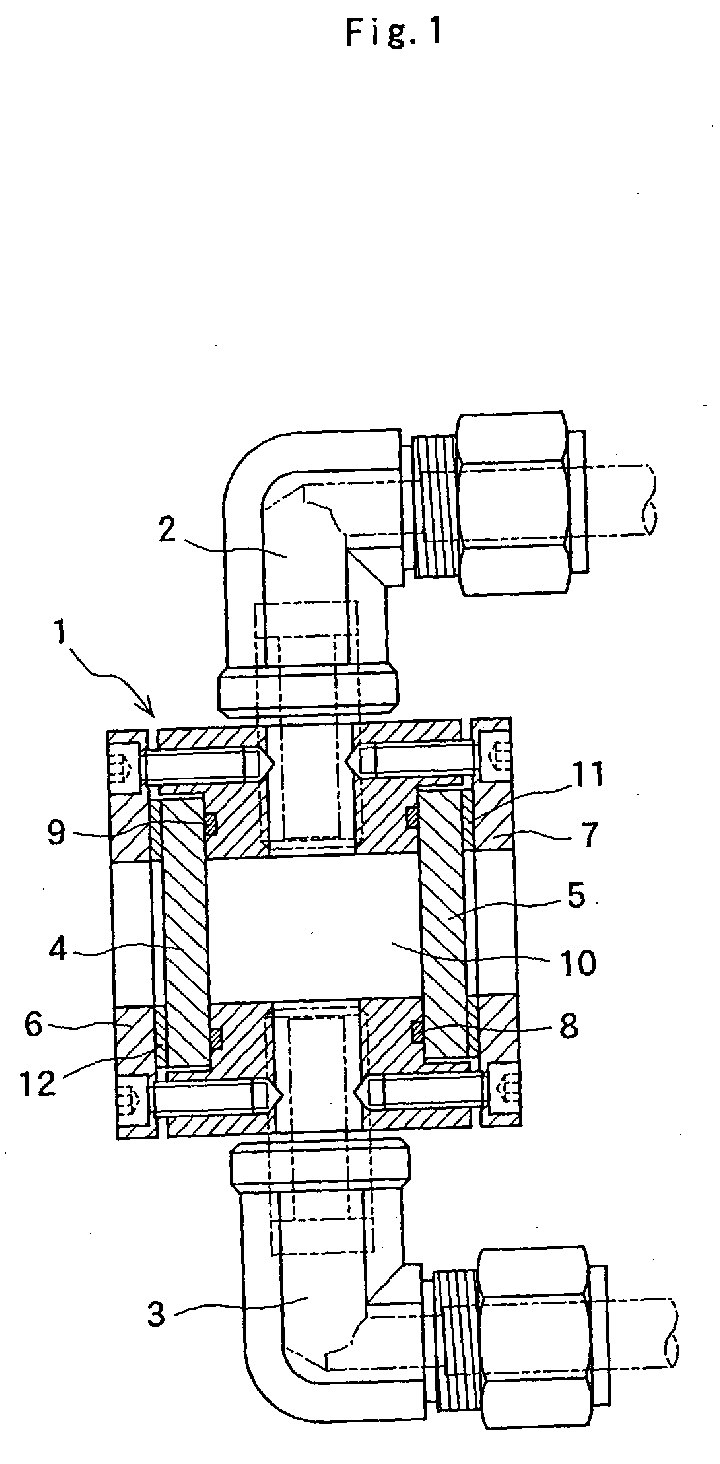
- Fig. 1 is a vertical sectional view showing an example of the cell for measurement of infrared absorption spectrum (this cell is hereinafter referred to simply as cell), used in the present invention.
- Fig. 2 is a front view of the cell of Fig. 1.
- Fig. 3 shows vertical sectional views of the parts obtained by disassembling the cell of Fig. 1.
- Fig. 4 is a conceptual view indicating the connections between a cell and pipes running in the vicinity of the cell, which are necessary for feeding a sample into the cell.
- a trunk 1 has a cylindrical or rectangular prism shape and can transmit an infrared light in the axial direction.
- the trunk 1 has one pair of openings at the top and bottom of the central portion of the cylindrical or rectangular prism shape, and is connected, at these openings, to a pipe 2 and a pipe 3.
- the pipe 2 present above the cell is connected to an outside vacuum system and the pipe 3 present below the cell is connected to an outside sample system.
- window panels 4 and 5 each made of a material superior in infrared transmittance.
- O-rings 8 and 9 are placed between the window panels 4 and 5 and the trunk 1; gaskets 11 and 12 are placed between the window panels 4 and 5 and window panel holders 6 and 7; in this state, the window panel holders 6 and 7 are tightened using bolts, whereby the window panels 4 and 5 are fixed to the trunk 1.
- the central portion of the window panel holders 6 and 7 are made into a hole so as to allow passing of an infrared light therethrough.
- Preferred shape of the trunk 1 is cylindrical, because the shape can withstand a high pressure.
- a liquid sample is filled in a space 10 formed by the trunk 1 and the infrared-transmitting window panels 4 and 5; and an infrared light coming into the space 10 from one window panel, passes through the liquid sample, leaves the space 10 from other window panel, and reaches an infrared light detection section.
- the distance sandwiched by the window panels 4 and 5, i.e. the length in which an infrared light enters the liquid sample and leaves it, is called optical path length.
- the preferred optical path length changes depending upon the concentration of silanol groups in silicon compounds to be measured. A large optical path length enables measurement of a silanol group of low concentration, however reduces the strength of cell structure.
- the present invention aims at measurement of silanol group of 0.05 to 0.1 ppm level. Further in the present invention, rapid measurement of silanol group is made possible by using a pressure-resistant cell.
- the optical path length is preferred to be 5 to 40 mm.
- Two thin window panels 4 and 5 are inferior in pressure resistance and the thickness of the window panels 4 and 5 are preferred to be 2 to 8 mm.
- the window diameter is preferred to be 5 to 20 mm.
- the material constituting the trunk 1 is preferably Hastelloy or stainless steel because they are superior in corrosion resistance to silicon compounds, hydrogen chloride, etc.
- the base material used for the infrared-transmitting window panels 4 and 5 may be a material which can transmit an infrared light of 4,000 to 3,000 cm -1 at which silanol group is measured, and for example, potassium bromide, potassium chloride, sodium chloride, calcium fluoride, germanium, silicon, zinc selenide, sapphire and quartz can be used. Of these, preferred are germanium, silicon, zinc selenide, sapphire and quartz because they are superior in strength and hardly give rise to breakage; more preferred are zinc selenide, sapphire and quartz.
- the material for the O-rings 8 and 9 and the gaskets 11 and 12 is preferably, for example, Viton, Karlez or Teflon.
- the procedure of once reducing the cell-inside pressure to 20 Pa or lower and then increasing the cell-inside pressure to 0.2 to 1 MPa using a dry inert gas, specifically, for example, nitrogen gas having a water content of 0.1 ppm or less, is repeated at least twice prior to filling a sample into the cell.
- the cell of the present invention is connected to a vacuum system and a sample system via a pipe 2 and a pipe 3, as shown in Fig. 4.
- the pressure of the cell inside is reduced to 20 Pa or lower using a vacuum pump, then, a dry inert gas is introduced by pressurization.
- the pressure for the gas introduction is at least 0.2 MPa, however, the upper limit is 1 MPa because too high a pressure causes cell breakage.
- a cell having an optical path length of 4 to 50 mm and a window diameter of 5 to 20 mm and wherein each window panel has thickness of 2 to 8 mm and the trunk is made of a metal such as stainless steel, Hastelloy or the like can be used, for example.
- a cell using quartz or sapphire as the material for window panel can withstand a pressure of 3 MPa.
- feeding of the sample into cell can be conducted through a pipe without having sample contact with atmosphere.
- a liquid sample can be sent into a cell from a sample container via the pipe, by utilizing a pressure difference between the sample container and the inside of the cell.
- measurement of infrared absorption spectrum is conducted.
- an inert gas is introduced to discharge the sample from the cell into a sample-collecting container.
- a very small amount of silanol group can be measured at a high accuracy without using an operation of passing an inert gas for a long time and cleaning the inside of cell with a large amount of a sample. Further in the present invention, since the feeding of sample into cell is conducted in a closed system, there is no need of using a glove box.
- the cell of the present invention may be used per se. However, in order to avoid a danger when breakage of window panel has occurred, the cell may be used in a state that the whole cell is covered with a protective case having one pair of windows for infrared transmittance.
- the sample to be measured in the present invention is a liquid, organic or inorganic silicon compound, or a silicon compound which is gaseous at ordinary temperature, such as hexachlorodisilane or the like.
- a silicon compound may be a single compound or a mixture.
- a solid silicon compound soluble in organic solvents, etc. allows for measurement of infrared absorption spectrum when made into a solution; therefore, the solid silicon compound is included in the sample to be measured in the present invention.
- particularly preferred as the sample to be measured are silicon halides (such as silicon tetrachloride, hexachlorodisilane and the like), alkoxysilanes, etc.
- a cell for measurement there was used a cell having a structure of Fig. 1 and the following specification.
- the cell of the present invention was fitted to the infrared spectrometer.
- the cell was connected to a vacuum system and a sample system in position relationships shown in Fig. 4.
- First, the inside of the cell was degassed for about 1 minutes using a vacuum pump until a pressure of 20 Pa or lower was reached; then, a dry nitrogen gas was introduced until a pressure of 0.5 MPa was reached; this operation of degassing and gas-introduction was repeated five times.
- hexachlorodisilane (a product of Toagosei Co., Ltd.) was introduced into the cell from a sample container via a pipe to carry out the first operation of the spectral measurement.
- the hexachlorodisilane sample after measurement was discharged from the cell into a sample-collecting container.
- degassing was conducted for 10 minutes using the vacuum pump; then, nitrogen gas was introduced until a pressure of 0.5 MPa was reached. Thereafter, 1-minute pressure reduction and pressure application was repeated 5 times. As a result, the remaining sample was removed and the pressure came down to 20 Pa or lower, and, in the same operation as in the first time, hexachlorodisilane was filled in the cell and spectral measurement was made.
- the method for measurement of silanol group concentration in silicon compound, according to the present invention can be used for quality control of the silicon compounds used in electronic material such as silicon nitride film.
- the pressure-resistant cell for measurement of infrared absorption spectrum, according to the present invention can be used for measurement of infrared absorption spectra of not only silicon compounds but also of various other compounds, and is most suitable for compressed and liquefied gases.
Landscapes
- Physics & Mathematics (AREA)
- Health & Medical Sciences (AREA)
- Life Sciences & Earth Sciences (AREA)
- Chemical & Material Sciences (AREA)
- Analytical Chemistry (AREA)
- Biochemistry (AREA)
- General Health & Medical Sciences (AREA)
- General Physics & Mathematics (AREA)
- Immunology (AREA)
- Pathology (AREA)
- Spectroscopy & Molecular Physics (AREA)
- Investigating Or Analysing Materials By Optical Means (AREA)
- Optical Measuring Cells (AREA)
Abstract
Description
- Explanation of the symbols used in Fig. 1 to Fig. 3.
- 1:
- Cell trunk (hereinafter referred to simply as trunk)
- 2:
- Pipe for connection to vacuum system
- 3:
- Pipe for connection to sample system
- 4,5:
- Infrared-transmitting window panels
- 6,7:
- Holders for window panel
- 8,9:
- O-rings
- 10:
- Sample space
- 11,12:
- Gaskets
- Explanation of the symbols used in Fig. 4.
- 13:
- Cell
- 14:
- Container for sample
- 15:
- Container for recovered sample
- 16:
- Vacuum gauge
- 17:
- Nitrogen gas
- 18:
- Vacuum pump ahead of the arrow
Claims (4)
- A method for measurement of silanol group concentration in silicon compound by infrared spectrophotometry, which comprises:conducting, prior to filling of a silicon compound in a cell, at least twice each of a step of keeping the cell inside at 20 Pa or lower and a step of keeping the cell inside at 0.2 to 1 MPa,then, introducing the silicon compound into the cell and measuring the infrared absorption spectrum thereof, to measure the concentration of the silanol group in the silicon compound.
- A cell used for measurement of infrared absorption spectrum, which can withstand a reduced pressure of 20 Pa or lower and a pressure of 0.2 to 1 MPa.
- A cell used for measurement of infrared absorption spectrum according to Claim 2, which is constituted by a trunk made of stainless steel or Hastelloy and infrared-transmitting window panels and has an optical path length of 5 to 40 mm, wherein each window panel has a thickness of 2 to 8 mm.
- A cell used for measurement of infrared absorption spectrum, capable of withstanding an applied pressure of 3 MPa or lower, which is constituted by a trunk made of stainless steel or Hastelloy and infrared-transmitting window panels made of quartz or sapphire and has an optical path length of 5 to 40 mm, wherein each window panel has a thickness of 2 to 8 mm.
Applications Claiming Priority (3)
| Application Number | Priority Date | Filing Date | Title |
|---|---|---|---|
| JP2002233192 | 2002-08-09 | ||
| JP2002233192 | 2002-08-09 | ||
| PCT/JP2003/010124 WO2004015401A1 (en) | 2002-08-09 | 2003-08-08 | Method of measuring concentration of silanol group and cell for measurement |
Publications (3)
| Publication Number | Publication Date |
|---|---|
| EP1530038A1 true EP1530038A1 (en) | 2005-05-11 |
| EP1530038A4 EP1530038A4 (en) | 2007-09-12 |
| EP1530038B1 EP1530038B1 (en) | 2010-10-13 |
Family
ID=31711856
Family Applications (1)
| Application Number | Title | Priority Date | Filing Date |
|---|---|---|---|
| EP03784604A Expired - Lifetime EP1530038B1 (en) | 2002-08-09 | 2003-08-08 | Method of measuring concentration of silanol group |
Country Status (9)
| Country | Link |
|---|---|
| US (1) | US7193213B2 (en) |
| EP (1) | EP1530038B1 (en) |
| JP (1) | JP3998018B2 (en) |
| KR (1) | KR100842703B1 (en) |
| CN (1) | CN100424496C (en) |
| AT (1) | ATE484740T1 (en) |
| AU (1) | AU2003254893A1 (en) |
| DE (1) | DE60334544D1 (en) |
| WO (1) | WO2004015401A1 (en) |
Families Citing this family (11)
| Publication number | Priority date | Publication date | Assignee | Title |
|---|---|---|---|---|
| WO2006109427A1 (en) * | 2005-04-07 | 2006-10-19 | Toagosei Co., Ltd. | Method for purification of disilicon hexachloride and high purity disilicon hexachloride |
| FR2903775B1 (en) * | 2006-07-12 | 2009-01-16 | Tethys Instr Soc Par Actions S | FLUID FLOW DEVICE AND OPTICAL MEASURING APPARATUS USING SUCH A DEVICE. |
| WO2008030386A1 (en) * | 2006-09-01 | 2008-03-13 | Dow Global Technologies Inc. | Improved control and optimization of process for making ethylene oxide |
| DE102009025677A1 (en) * | 2009-06-17 | 2010-12-23 | Bayer Technology Services Gmbh | Pressure-resistant probe |
| JP6443619B2 (en) * | 2014-11-26 | 2018-12-26 | 横河電機株式会社 | Sample measuring device |
| US9500638B2 (en) * | 2015-02-11 | 2016-11-22 | Spectro Scientific, Inc. | Method of measuring water contamination in turbine and other industrial oils |
| US11054364B2 (en) | 2018-12-17 | 2021-07-06 | Thermo Finnigan Llc | Apparatus and methods for handling and spectrophotometry of small liquid samples |
| US11953434B2 (en) | 2019-02-22 | 2024-04-09 | Shell Oil Compny | Spectroscopic devices, systems, and methods for optical sensing of molecular species |
| CN112326554B (en) * | 2019-08-05 | 2023-11-07 | 上海科技大学 | An in-situ infrared micro-reaction cell that controls medium and high temperature and pressure |
| CN110327996B (en) * | 2019-09-03 | 2019-12-24 | 中国科学院上海高等研究院 | Microfluidic chip, microfluidic system and infrared microfluidic analysis method |
| WO2022113719A1 (en) * | 2020-11-30 | 2022-06-02 | 昭和電工株式会社 | Gas analyzing method |
Family Cites Families (24)
| Publication number | Priority date | Publication date | Assignee | Title |
|---|---|---|---|---|
| US3177706A (en) * | 1963-01-24 | 1965-04-13 | Hughes Aircraft Co | Fluid inspection device |
| US3886364A (en) | 1973-06-19 | 1975-05-27 | Union Carbide Corp | High pressure infrared cell |
| DE3822445A1 (en) * | 1988-07-02 | 1990-01-04 | Bruker Analytische Messtechnik | OPTICAL HIGH PRESSURE TRANSMISSION CELL |
| JPH06105220B2 (en) * | 1991-08-23 | 1994-12-21 | 近藤フィリップスライティング株式会社 | Apparatus and method for nondestructive quantitative analysis of coagulating gas phase substances using high sensitivity infrared spectroscopy |
| CN1034610C (en) * | 1992-06-25 | 1997-04-16 | 厦门大学 | In-situ infrared spectrum specimen chamber |
| JPH07104283B2 (en) * | 1993-05-28 | 1995-11-13 | 和夫 天谷 | Air pollutant automatic measuring machine |
| JPH07120362A (en) * | 1993-10-26 | 1995-05-12 | Fuji Electric Co Ltd | Water sampling device |
| JPH07209158A (en) * | 1994-01-13 | 1995-08-11 | Rikagaku Kenkyusho | High pressure equipment |
| MY124445A (en) * | 1995-10-12 | 2006-06-30 | Ono Foods Ind Co Ltd | Method of drying foods by using far infrared rays at reduced pressure and temperature |
| AR003846A1 (en) * | 1995-10-18 | 1998-09-09 | Shell Int Research | A TRANSMISSION CELL SUITABLE FOR USE IN A DEVICE TO MEASURE INFRARED (NEARBY) SPECTRUMS OF A HYDROCARBONACEOUS MATERIAL, A SPECTROMETER THAT UNDERSTANDS IT, USE OF THE SAME, A PHYSICAL PROPERTY OF SUCH MATERIAL PROCEDURE TO PREPARE A BETUM COMPOSITION USING SUCH METHOD WITH SUCH SPECTOMETER |
| JPH09318525A (en) | 1996-05-29 | 1997-12-12 | Shin Etsu Chem Co Ltd | Infrared absorption spectrum measuring cell for determining silanol in chlorosilane and method for determining silanol in chlorosilane using the cell |
| JPH09325114A (en) * | 1996-06-03 | 1997-12-16 | Asahi Denka Kogyo Kk | Device for measuring trace moisture in gas and method for measuring trace moisture in gas |
| US5705928A (en) * | 1996-06-14 | 1998-01-06 | Varian Associates, Inc. | Sample delivery system used in chemical analysis methods which employs pressurized gas for sample conveyance |
| JPH10176988A (en) * | 1996-12-18 | 1998-06-30 | Terametsukusu Kk | High pressure optical measurement cell |
| JPH10221253A (en) * | 1997-02-07 | 1998-08-21 | Fuji Electric Co Ltd | Infrared gas analyzer and gas concentration measurement method |
| JPH11183366A (en) | 1997-12-25 | 1999-07-09 | Nippon Sanso Kk | Measurement cell for spectroscopic analysis |
| JP3007966B1 (en) * | 1999-01-21 | 2000-02-14 | 工業技術院長 | Reaction cell for photochemical reaction observation |
| JP2001108610A (en) * | 1999-10-14 | 2001-04-20 | Apurikusu:Kk | Optical analysis cell and optical analyzer |
| JP4036416B2 (en) * | 2000-01-31 | 2008-01-23 | 東亞合成株式会社 | Measuring method of silanol group concentration |
| JP4435385B2 (en) * | 2000-07-03 | 2010-03-17 | 三菱レイヨン株式会社 | Method for evaluating weather resistance of resin molded article on which resin film is formed and molded article made of polycarbonate |
| JP4542682B2 (en) * | 2000-08-11 | 2010-09-15 | 三菱化工機株式会社 | Sample preparation device for measuring particles in oil |
| JP3534055B2 (en) * | 2000-08-30 | 2004-06-07 | 独立行政法人 科学技術振興機構 | Flow-through sample holder that can measure high temperature and high pressure samples |
| JP2003035667A (en) * | 2001-07-25 | 2003-02-07 | Toagosei Co Ltd | Method for measuring silanol group concentration |
| JP4317089B2 (en) * | 2004-07-16 | 2009-08-19 | 大塚電子株式会社 | Equipment for quantitative determination of impurities in gas |
-
2003
- 2003-08-08 AU AU2003254893A patent/AU2003254893A1/en not_active Abandoned
- 2003-08-08 JP JP2004527374A patent/JP3998018B2/en not_active Expired - Lifetime
- 2003-08-08 CN CNB038173026A patent/CN100424496C/en not_active Expired - Lifetime
- 2003-08-08 EP EP03784604A patent/EP1530038B1/en not_active Expired - Lifetime
- 2003-08-08 WO PCT/JP2003/010124 patent/WO2004015401A1/en not_active Ceased
- 2003-08-08 AT AT03784604T patent/ATE484740T1/en not_active IP Right Cessation
- 2003-08-08 US US10/523,597 patent/US7193213B2/en not_active Expired - Lifetime
- 2003-08-08 KR KR20057000188A patent/KR100842703B1/en not_active Expired - Lifetime
- 2003-08-08 DE DE60334544T patent/DE60334544D1/en not_active Expired - Lifetime
Also Published As
| Publication number | Publication date |
|---|---|
| CN1668912A (en) | 2005-09-14 |
| AU2003254893A1 (en) | 2004-02-25 |
| US20060118723A1 (en) | 2006-06-08 |
| EP1530038A4 (en) | 2007-09-12 |
| US7193213B2 (en) | 2007-03-20 |
| JP3998018B2 (en) | 2007-10-24 |
| WO2004015401A1 (en) | 2004-02-19 |
| DE60334544D1 (en) | 2010-11-25 |
| EP1530038B1 (en) | 2010-10-13 |
| JPWO2004015401A1 (en) | 2005-12-02 |
| CN100424496C (en) | 2008-10-08 |
| KR100842703B1 (en) | 2008-07-01 |
| KR20050032569A (en) | 2005-04-07 |
| ATE484740T1 (en) | 2010-10-15 |
Similar Documents
| Publication | Publication Date | Title |
|---|---|---|
| EP1530038B1 (en) | Method of measuring concentration of silanol group | |
| US20030098419A1 (en) | On-line UV-Visible light halogen gas analyzer for semiconductor processing effluent monitoring | |
| Kawakami et al. | Micro-Raman Densimeter for CO_2 Inclusions in Mantle-Derived Minerals | |
| NO824027L (en) | MEASUREMENT OF THE GAS-HYDROGEN FLUORIDE CONCENTRATION | |
| EP1693665B1 (en) | Method and apparatus for trace gas detection | |
| US5835230A (en) | Method for calibration of a spectroscopic sensor | |
| AU743724B2 (en) | Apparatus and method for sampling and IR-spectroscopic analysis of high-purity, hygroscopic liquids | |
| CN105765381A (en) | Method and system for gas concentration measurement of gas dissolved in liquids | |
| Wu et al. | Spectroscopic study of perchlorates and other oxygen chlorides in a Martian environmental chamber | |
| KR101030405B1 (en) | Analytical Sensitivity Enhancement Methods by Catalytic Modification | |
| JPWO2014119690A1 (en) | Water vapor permeability measuring unit and water vapor permeability measuring method | |
| EP1068515B1 (en) | Method and apparatus for analysis of gas compositions | |
| JP3889817B2 (en) | Method for determining moisture in gas and sample container | |
| JP2005241249A (en) | Method for measuring concentration of f2 gas and measuring instrument therefor | |
| US12510482B2 (en) | Gas analyzing method | |
| Meller et al. | CF3C (O) C1: Temperature-dependent (223–298 K) absorption cross-sections and quantum yields at 254 nm | |
| Brown et al. | Novel sampling device for obtaining process near-infrared spectra of high-pressure gases | |
| CN112213278A (en) | Analysis device and analysis method for trace water in hydrogen fluoride gas | |
| CN111781166A (en) | Simultaneous analysis of H in natural gas2O and H2Laser detection method for S content | |
| WO2018139845A2 (en) | Production method, production device, and container for cell-type gas certified reference material | |
| JP2003035667A (en) | Method for measuring silanol group concentration | |
| Meng | Incoherent Broadband Cavity-Enhanced Absorption Spectroscopy for NO3 Radical and Aerosol Measurements: Application to Field and Chamber Studies | |
| US20090116021A1 (en) | Method and apparatus for determining composition and concentration of contaminants on a film encapsulated in a plasma display panel | |
| JPH09318525A (en) | Infrared absorption spectrum measuring cell for determining silanol in chlorosilane and method for determining silanol in chlorosilane using the cell | |
| SU1363034A1 (en) | Method of spectrum analysis |
Legal Events
| Date | Code | Title | Description |
|---|---|---|---|
| PUAI | Public reference made under article 153(3) epc to a published international application that has entered the european phase |
Free format text: ORIGINAL CODE: 0009012 |
|
| 17P | Request for examination filed |
Effective date: 20050202 |
|
| AK | Designated contracting states |
Kind code of ref document: A1 Designated state(s): AT BE BG CH CY CZ DE DK EE ES FI FR GB GR HU IE IT LI LU MC NL PT RO SE SI SK TR |
|
| A4 | Supplementary search report drawn up and despatched |
Effective date: 20070810 |
|
| 17Q | First examination report despatched |
Effective date: 20071011 |
|
| RTI1 | Title (correction) |
Free format text: METHOD OF MEASURING CONCENTRATION OF SILANOL GROUP |
|
| GRAP | Despatch of communication of intention to grant a patent |
Free format text: ORIGINAL CODE: EPIDOSNIGR1 |
|
| GRAS | Grant fee paid |
Free format text: ORIGINAL CODE: EPIDOSNIGR3 |
|
| GRAA | (expected) grant |
Free format text: ORIGINAL CODE: 0009210 |
|
| AK | Designated contracting states |
Kind code of ref document: B1 Designated state(s): AT BE BG CH CY CZ DE DK EE ES FI FR GB GR HU IE IT LI LU MC NL PT RO SE SI SK TR |
|
| REG | Reference to a national code |
Ref country code: GB Ref legal event code: FG4D |
|
| REG | Reference to a national code |
Ref country code: CH Ref legal event code: EP |
|
| REG | Reference to a national code |
Ref country code: IE Ref legal event code: FG4D |
|
| REF | Corresponds to: |
Ref document number: 60334544 Country of ref document: DE Date of ref document: 20101125 Kind code of ref document: P |
|
| REG | Reference to a national code |
Ref country code: NL Ref legal event code: VDEP Effective date: 20101013 |
|
| PG25 | Lapsed in a contracting state [announced via postgrant information from national office to epo] |
Ref country code: PT Free format text: LAPSE BECAUSE OF FAILURE TO SUBMIT A TRANSLATION OF THE DESCRIPTION OR TO PAY THE FEE WITHIN THE PRESCRIBED TIME-LIMIT Effective date: 20110214 Ref country code: AT Free format text: LAPSE BECAUSE OF FAILURE TO SUBMIT A TRANSLATION OF THE DESCRIPTION OR TO PAY THE FEE WITHIN THE PRESCRIBED TIME-LIMIT Effective date: 20101013 Ref country code: FI Free format text: LAPSE BECAUSE OF FAILURE TO SUBMIT A TRANSLATION OF THE DESCRIPTION OR TO PAY THE FEE WITHIN THE PRESCRIBED TIME-LIMIT Effective date: 20101013 Ref country code: SI Free format text: LAPSE BECAUSE OF FAILURE TO SUBMIT A TRANSLATION OF THE DESCRIPTION OR TO PAY THE FEE WITHIN THE PRESCRIBED TIME-LIMIT Effective date: 20101013 Ref country code: BG Free format text: LAPSE BECAUSE OF FAILURE TO SUBMIT A TRANSLATION OF THE DESCRIPTION OR TO PAY THE FEE WITHIN THE PRESCRIBED TIME-LIMIT Effective date: 20110113 Ref country code: NL Free format text: LAPSE BECAUSE OF FAILURE TO SUBMIT A TRANSLATION OF THE DESCRIPTION OR TO PAY THE FEE WITHIN THE PRESCRIBED TIME-LIMIT Effective date: 20101013 Ref country code: SE Free format text: LAPSE BECAUSE OF FAILURE TO SUBMIT A TRANSLATION OF THE DESCRIPTION OR TO PAY THE FEE WITHIN THE PRESCRIBED TIME-LIMIT Effective date: 20101013 |
|
| PG25 | Lapsed in a contracting state [announced via postgrant information from national office to epo] |
Ref country code: GR Free format text: LAPSE BECAUSE OF FAILURE TO SUBMIT A TRANSLATION OF THE DESCRIPTION OR TO PAY THE FEE WITHIN THE PRESCRIBED TIME-LIMIT Effective date: 20110114 Ref country code: BE Free format text: LAPSE BECAUSE OF FAILURE TO SUBMIT A TRANSLATION OF THE DESCRIPTION OR TO PAY THE FEE WITHIN THE PRESCRIBED TIME-LIMIT Effective date: 20101013 |
|
| PG25 | Lapsed in a contracting state [announced via postgrant information from national office to epo] |
Ref country code: EE Free format text: LAPSE BECAUSE OF FAILURE TO SUBMIT A TRANSLATION OF THE DESCRIPTION OR TO PAY THE FEE WITHIN THE PRESCRIBED TIME-LIMIT Effective date: 20101013 Ref country code: CZ Free format text: LAPSE BECAUSE OF FAILURE TO SUBMIT A TRANSLATION OF THE DESCRIPTION OR TO PAY THE FEE WITHIN THE PRESCRIBED TIME-LIMIT Effective date: 20101013 Ref country code: ES Free format text: LAPSE BECAUSE OF FAILURE TO SUBMIT A TRANSLATION OF THE DESCRIPTION OR TO PAY THE FEE WITHIN THE PRESCRIBED TIME-LIMIT Effective date: 20110124 |
|
| PLBE | No opposition filed within time limit |
Free format text: ORIGINAL CODE: 0009261 |
|
| STAA | Information on the status of an ep patent application or granted ep patent |
Free format text: STATUS: NO OPPOSITION FILED WITHIN TIME LIMIT |
|
| PG25 | Lapsed in a contracting state [announced via postgrant information from national office to epo] |
Ref country code: SK Free format text: LAPSE BECAUSE OF FAILURE TO SUBMIT A TRANSLATION OF THE DESCRIPTION OR TO PAY THE FEE WITHIN THE PRESCRIBED TIME-LIMIT Effective date: 20101013 Ref country code: RO Free format text: LAPSE BECAUSE OF FAILURE TO SUBMIT A TRANSLATION OF THE DESCRIPTION OR TO PAY THE FEE WITHIN THE PRESCRIBED TIME-LIMIT Effective date: 20101013 Ref country code: DK Free format text: LAPSE BECAUSE OF FAILURE TO SUBMIT A TRANSLATION OF THE DESCRIPTION OR TO PAY THE FEE WITHIN THE PRESCRIBED TIME-LIMIT Effective date: 20101013 |
|
| 26N | No opposition filed |
Effective date: 20110714 |
|
| REG | Reference to a national code |
Ref country code: DE Ref legal event code: R097 Ref document number: 60334544 Country of ref document: DE Effective date: 20110714 |
|
| PG25 | Lapsed in a contracting state [announced via postgrant information from national office to epo] |
Ref country code: IT Free format text: LAPSE BECAUSE OF FAILURE TO SUBMIT A TRANSLATION OF THE DESCRIPTION OR TO PAY THE FEE WITHIN THE PRESCRIBED TIME-LIMIT Effective date: 20101013 |
|
| PG25 | Lapsed in a contracting state [announced via postgrant information from national office to epo] |
Ref country code: MC Free format text: LAPSE BECAUSE OF NON-PAYMENT OF DUE FEES Effective date: 20110831 |
|
| REG | Reference to a national code |
Ref country code: CH Ref legal event code: PL |
|
| GBPC | Gb: european patent ceased through non-payment of renewal fee |
Effective date: 20110808 |
|
| PG25 | Lapsed in a contracting state [announced via postgrant information from national office to epo] |
Ref country code: LI Free format text: LAPSE BECAUSE OF NON-PAYMENT OF DUE FEES Effective date: 20110831 Ref country code: CH Free format text: LAPSE BECAUSE OF NON-PAYMENT OF DUE FEES Effective date: 20110831 |
|
| REG | Reference to a national code |
Ref country code: FR Ref legal event code: ST Effective date: 20120430 |
|
| REG | Reference to a national code |
Ref country code: IE Ref legal event code: MM4A |
|
| PG25 | Lapsed in a contracting state [announced via postgrant information from national office to epo] |
Ref country code: IE Free format text: LAPSE BECAUSE OF NON-PAYMENT OF DUE FEES Effective date: 20110808 |
|
| PG25 | Lapsed in a contracting state [announced via postgrant information from national office to epo] |
Ref country code: GB Free format text: LAPSE BECAUSE OF NON-PAYMENT OF DUE FEES Effective date: 20110808 Ref country code: FR Free format text: LAPSE BECAUSE OF NON-PAYMENT OF DUE FEES Effective date: 20110831 |
|
| PG25 | Lapsed in a contracting state [announced via postgrant information from national office to epo] |
Ref country code: LU Free format text: LAPSE BECAUSE OF NON-PAYMENT OF DUE FEES Effective date: 20110808 Ref country code: CY Free format text: LAPSE BECAUSE OF EXPIRATION OF PROTECTION Effective date: 20101013 |
|
| PG25 | Lapsed in a contracting state [announced via postgrant information from national office to epo] |
Ref country code: TR Free format text: LAPSE BECAUSE OF FAILURE TO SUBMIT A TRANSLATION OF THE DESCRIPTION OR TO PAY THE FEE WITHIN THE PRESCRIBED TIME-LIMIT Effective date: 20101013 |
|
| PG25 | Lapsed in a contracting state [announced via postgrant information from national office to epo] |
Ref country code: HU Free format text: LAPSE BECAUSE OF FAILURE TO SUBMIT A TRANSLATION OF THE DESCRIPTION OR TO PAY THE FEE WITHIN THE PRESCRIBED TIME-LIMIT Effective date: 20101013 |
|
| PGFP | Annual fee paid to national office [announced via postgrant information from national office to epo] |
Ref country code: DE Payment date: 20220629 Year of fee payment: 20 |
|
| REG | Reference to a national code |
Ref country code: DE Ref legal event code: R071 Ref document number: 60334544 Country of ref document: DE |