EP1528729B1 - Abstandempfindliche Ablauffolgeplanung von TDM-Paketverkehr in einem VPLS-Netz - Google Patents
Abstandempfindliche Ablauffolgeplanung von TDM-Paketverkehr in einem VPLS-Netz Download PDFInfo
- Publication number
- EP1528729B1 EP1528729B1 EP04024583.9A EP04024583A EP1528729B1 EP 1528729 B1 EP1528729 B1 EP 1528729B1 EP 04024583 A EP04024583 A EP 04024583A EP 1528729 B1 EP1528729 B1 EP 1528729B1
- Authority
- EP
- European Patent Office
- Prior art keywords
- priority
- switch
- packet
- queue
- delay
- Prior art date
- Legal status (The legal status is an assumption and is not a legal conclusion. Google has not performed a legal analysis and makes no representation as to the accuracy of the status listed.)
- Expired - Lifetime
Links
- 238000000034 method Methods 0.000 claims description 28
- 235000008694 Humulus lupulus Nutrition 0.000 claims description 22
- 230000001419 dependent effect Effects 0.000 claims 4
- 230000005540 biological transmission Effects 0.000 description 13
- 230000001934 delay Effects 0.000 description 8
- 239000000872 buffer Substances 0.000 description 5
- 239000000243 solution Substances 0.000 description 5
- 238000012913 prioritisation Methods 0.000 description 3
- 230000000903 blocking effect Effects 0.000 description 2
- 238000005516 engineering process Methods 0.000 description 2
- 230000007246 mechanism Effects 0.000 description 2
- 101150032799 PE15 gene Proteins 0.000 description 1
- 238000003491 array Methods 0.000 description 1
- 239000003637 basic solution Substances 0.000 description 1
- 230000003139 buffering effect Effects 0.000 description 1
- 238000010276 construction Methods 0.000 description 1
- 230000001627 detrimental effect Effects 0.000 description 1
- 238000010586 diagram Methods 0.000 description 1
- 238000005538 encapsulation Methods 0.000 description 1
- 239000004744 fabric Substances 0.000 description 1
- 238000012986 modification Methods 0.000 description 1
- 230000004048 modification Effects 0.000 description 1
- 230000011664 signaling Effects 0.000 description 1
Images


Classifications
-
- H—ELECTRICITY
- H04—ELECTRIC COMMUNICATION TECHNIQUE
- H04L—TRANSMISSION OF DIGITAL INFORMATION, e.g. TELEGRAPHIC COMMUNICATION
- H04L49/00—Packet switching elements
- H04L49/25—Routing or path finding in a switch fabric
- H04L49/253—Routing or path finding in a switch fabric using establishment or release of connections between ports
- H04L49/254—Centralised controller, i.e. arbitration or scheduling
-
- H—ELECTRICITY
- H04—ELECTRIC COMMUNICATION TECHNIQUE
- H04L—TRANSMISSION OF DIGITAL INFORMATION, e.g. TELEGRAPHIC COMMUNICATION
- H04L45/00—Routing or path finding of packets in data switching networks
- H04L45/02—Topology update or discovery
- H04L45/10—Routing in connection-oriented networks, e.g. X.25 or ATM
-
- H—ELECTRICITY
- H04—ELECTRIC COMMUNICATION TECHNIQUE
- H04L—TRANSMISSION OF DIGITAL INFORMATION, e.g. TELEGRAPHIC COMMUNICATION
- H04L45/00—Routing or path finding of packets in data switching networks
- H04L45/20—Hop count for routing purposes, e.g. TTL
-
- H—ELECTRICITY
- H04—ELECTRIC COMMUNICATION TECHNIQUE
- H04L—TRANSMISSION OF DIGITAL INFORMATION, e.g. TELEGRAPHIC COMMUNICATION
- H04L45/00—Routing or path finding of packets in data switching networks
- H04L45/50—Routing or path finding of packets in data switching networks using label swapping, e.g. multi-protocol label switch [MPLS]
- H04L45/502—Frame based
-
- H—ELECTRICITY
- H04—ELECTRIC COMMUNICATION TECHNIQUE
- H04L—TRANSMISSION OF DIGITAL INFORMATION, e.g. TELEGRAPHIC COMMUNICATION
- H04L47/00—Traffic control in data switching networks
- H04L47/10—Flow control; Congestion control
- H04L47/24—Traffic characterised by specific attributes, e.g. priority or QoS
- H04L47/2416—Real-time traffic
-
- H—ELECTRICITY
- H04—ELECTRIC COMMUNICATION TECHNIQUE
- H04L—TRANSMISSION OF DIGITAL INFORMATION, e.g. TELEGRAPHIC COMMUNICATION
- H04L47/00—Traffic control in data switching networks
- H04L47/10—Flow control; Congestion control
- H04L47/24—Traffic characterised by specific attributes, e.g. priority or QoS
- H04L47/2425—Traffic characterised by specific attributes, e.g. priority or QoS for supporting services specification, e.g. SLA
- H04L47/2433—Allocation of priorities to traffic types
-
- H—ELECTRICITY
- H04—ELECTRIC COMMUNICATION TECHNIQUE
- H04L—TRANSMISSION OF DIGITAL INFORMATION, e.g. TELEGRAPHIC COMMUNICATION
- H04L47/00—Traffic control in data switching networks
- H04L47/10—Flow control; Congestion control
- H04L47/28—Flow control; Congestion control in relation to timing considerations
-
- H—ELECTRICITY
- H04—ELECTRIC COMMUNICATION TECHNIQUE
- H04L—TRANSMISSION OF DIGITAL INFORMATION, e.g. TELEGRAPHIC COMMUNICATION
- H04L47/00—Traffic control in data switching networks
- H04L47/10—Flow control; Congestion control
- H04L47/28—Flow control; Congestion control in relation to timing considerations
- H04L47/286—Time to live
-
- H—ELECTRICITY
- H04—ELECTRIC COMMUNICATION TECHNIQUE
- H04L—TRANSMISSION OF DIGITAL INFORMATION, e.g. TELEGRAPHIC COMMUNICATION
- H04L47/00—Traffic control in data switching networks
- H04L47/50—Queue scheduling
-
- H—ELECTRICITY
- H04—ELECTRIC COMMUNICATION TECHNIQUE
- H04L—TRANSMISSION OF DIGITAL INFORMATION, e.g. TELEGRAPHIC COMMUNICATION
- H04L47/00—Traffic control in data switching networks
- H04L47/50—Queue scheduling
- H04L47/56—Queue scheduling implementing delay-aware scheduling
- H04L47/564—Attaching a deadline to packets, e.g. earliest due date first
- H04L47/566—Deadline varies as a function of time spent in the queue
-
- H—ELECTRICITY
- H04—ELECTRIC COMMUNICATION TECHNIQUE
- H04L—TRANSMISSION OF DIGITAL INFORMATION, e.g. TELEGRAPHIC COMMUNICATION
- H04L49/00—Packet switching elements
- H04L49/20—Support for services
- H04L49/205—Quality of Service based
-
- H—ELECTRICITY
- H04—ELECTRIC COMMUNICATION TECHNIQUE
- H04L—TRANSMISSION OF DIGITAL INFORMATION, e.g. TELEGRAPHIC COMMUNICATION
- H04L49/00—Packet switching elements
- H04L49/30—Peripheral units, e.g. input or output ports
- H04L49/3027—Output queuing
-
- H—ELECTRICITY
- H04—ELECTRIC COMMUNICATION TECHNIQUE
- H04L—TRANSMISSION OF DIGITAL INFORMATION, e.g. TELEGRAPHIC COMMUNICATION
- H04L49/00—Packet switching elements
- H04L49/35—Switches specially adapted for specific applications
- H04L49/351—Switches specially adapted for specific applications for local area network [LAN], e.g. Ethernet switches
Definitions
- the present invention generally relates to transmission of Time Division Multiplex (“TDM”) traffic over packet switched networks in Virtual Private LAN Service (“VPLS"). More particularly, and not by way of any limitation, the present invention is directed to method and apparatus for distance-sensitive scheduling of such high-priority traffic.
- TDM Time Division Multiplex
- VPLS Virtual Private LAN Service
- Time Division Multiplex (“TDM”) technology has been prevalent for a long time; however, the technology for transmitting TDM traffic over packet networks is relatively new. Accordingly, there are few solutions that address the problem of delay for TDM traffic when it is sent over a packet network.
- One solution addresses the delay that results from sending a large TDM packet over a packet network using a common switch fabric resource for TDM and packet switching.
- large packets or data streams are divided into smaller portions upon entering a switch. Each portion is assigned a high priority for transmission and a tracking header for tracking it through the switch. Prior to exiting the switch, the portions are reassembled into the data stream.
- This technique of providing "cut-through” using a store-and-forward switch mechanism reduces transmission delay and buffer over-runs that would otherwise occur in transmitting large packets or data streams.
- This solution strictly addresses the problem of sending only large TDM packets and does not address the specific problem of prioritizing between traffic from multiple TDM streams in a VPLS network.
- Another solution involves the use of a multi-port link interface module that terminates two or more high-speed TDM links and generates internal data. Data received on one high-speed communications link is combined with the internal data used to fill outbound time slots in an outgoing high-speed link. This solution fails to address the issues of delay when sending TDM traffic over a packet network.
- TDM traffic such as voice
- voice when sent over a packet network may suffer unacceptable delay and jitter due to multiplexing with packet data.
- the benefits of low cost and high bandwidth utilization of packet data networks may be offset by the poor performance of TDM traffic when sent over packet networks.
- US 2003/154328 A1 discloses a services processor wherein a queue operations unit controls the output of processed data packets from the services processor.
- the queue operations unit uses a unique data structure comprising a tree of calendar arrays and queue lists to schedule the data packets for output.
- XP010254727 discloses cell discarding policies supporting multiple delay and loss requirements in ATM networks.
- One embodiment is a method of scheduling high-priority packets in a metro Ethernet switch.
- the method comprises the steps of determining a maximum queuing delay allowed for at least two high-priority packets in an output queue in the switch; determining which one of the at least two high-priority packets has the smallest maximum queuing delay allowed; and scheduling the one of the at least two high-priority packets determined to have the smallest maximum queuing delay allowed before the remaining ones of the at least two high-priority packets.
- Another embodiment is a method of scheduling high-priority packets in a metro Ethernet switch.
- the method comprises the steps of creating a first table that lists, for each high-priority packet that has entered the switch, a position of the high-priority packet in a queue of the switch, a time the high-priority packet entered the queue, and an intended destination of the high-priority packet; creating a second table for storing a maximum allowed queuing delay for each of several possible intended destinations; and using the first and second tables to determine the maximum queuing delay allowed for each of the high-priority packets in the queue of the switch.
- Another embodiment is an apparatus for scheduling high-priority packets in a metro Ethernet switch.
- the apparatus comprises means for determining a maximum queuing delay allowed for at least two high-priority packets in a queue in the switch; means for determining which one of the at least two high-priority packets has the smallest maximum queuing delay allowed; and means for scheduling the one of the at least two high-priority packets determined to have the smallest maximum queuing delay allowed before the remaining ones of the at least two high-priority packets.
- Another embodiment is a packet switch comprising a queue containing a plurality of packets received at the switch; and a scheduler for scheduling transmission of the packets in the queue, wherein when the queue contains at least two high-priority packets, the scheduler schedules the one of the at least two high-priority packets determined to have a smallest maximum queuing delay allowed before the remaining ones of the at least two high-priority packets.
- FIG. 1 illustrates a VPLS network with a fully connected LSP mesh, designated in FIG. 1 by a reference numeral 100.
- the VPLS network 100 comprises N provider edge ("PE") nodes, represented by five nodes PE1-PE5, fully interconnected by an LSP mesh comprising N X( N -1) point-to-point LSPs 104(1)-104(20).
- PE provider edge
- TDM traffic may be carried on one or more of the LSPs 104(1)-104(20) as a component of high-priority traffic. The actual values for the delay requirements of such traffic may vary.
- packets destined for different destinations will have to go through a number of hops from ingress PE node to egress PE node.
- a packet from the node PE1 to the node PE2 may traverse three intermediate P nodes, making the LSP 104(2) a three-hop path; a packet from the node PE1 to the node PE3 may traverse seven intermediate nodes, making the LSP 104(14) a seven-hop path.
- packets will undergo different delays depending on which LSP 104(1)-104(20) they traverse through the network 100. This situation could be detrimental in the case of packetized TDM traffic or any traffic that is highly sensitive to delay and jitter.
- CE nodes 106 Customer edge (“CE”) nodes, represented in FIG. 1 by CE nodes 106, are connected to PE nodes for connecting end users to the network 100.
- a high-priority queue at the node PE1 will have TDM packets that are destined for the node PE2 via the LSP 104(2) (a three-hop path) and packets that are destined for the node PE3 via the LSP 104(14) (a seven-hop path).
- the two packets will experience different delays from network ingress to network egress.
- each queue at a node PE1-PE5 is capable of performing an n -packet look-ahead to schedule the packets that may be blocked behind another packet.
- this architecture is implemented at the Ethernet switch and n is equal to four. The packetized TDM traffic will be treated as high-priority traffic and will be placed into a high-priority queue.
- relative prioritization refers to the number of hops the packet will traverse and hence the delay that the packet will incur. For instance, packets that are destined for nodes that are many hops away will be given priority in transporting them through the high-priority input queue. The information concerning the number of hops is readily available through the VPLS model. Accordingly, this technique should enable equalization of the delay among packets going to different destinations and therefore will enable packets that need to travel many hops to meet their delay and jitter specifications. It should be emphasized that the implementation is pertinent only to the Ethernet switch and since there is no signaling or encapsulation involved, it does not require standardization efforts.
- T es is the time at which a high-priority packet 206 enters an ingress buffer 208 of the sending node, e.g., the PE node 200; T s is the time at which the packet 206 is serviced by a scheduler 210 of the sending node 200; T er is the time at which the packet 206 enters an ingress buffer 212 of the receiving PE node 202; and T r is the time at which the packet 206 is serviced by a scheduler 214 of the receiving node 202.
- T t the total delay experienced by a packet 206 from ingress to egress
- T r ⁇ T es T r ⁇ T er + T er ⁇ T s + T s ⁇ T es
- (T r - T er ) is the queuing delay at the receiving node 202
- (T er - T s ) is the transmission plus propagation delay via the link 204
- (T s - T es ) is the queuing delay at the sending node 200.
- Each node 200, 202 also includes a state machine 216, 218, respectively, for maintaining the state of two tables, i.e., a POS table and a Qmax table, which are described in detail below.
- the queuing delay is calculated by subtracting the transmission delay and the propagation delay from the total allowed delay estimate. This calculation is performed just once at the time of VPLS setup and is a simple calculation to perform.
- the end-to-end maximum delay allowed for TDM traffic is 15 ms. This includes CE-PE, PE-PE, and PE-CE delays.
- the CE-PE and PE-CE delays will simply be propagation delays; that is, 5 ⁇ s/km.
- the PE-PE delays are as described above and will consist of queuing delays and transmission and propagation delays. Of these, the transmission and propagation delay can be estimated with close accuracy for a given point-to-point link with a given number of hops in between. Thus, the total end-to-end delay is known for each LSP.
- TDM traffic is carried on point-to-point LSPs.
- each PE node such as the nodes PE1-PE5
- each queue at a node is capable of an n -packet look-ahead to schedule packets that may be blocked behind a packet. Look-ahead is performed only when needed.
- the distance between PEs is proportional to the number of hops in between, although any other measure of distance, such as a knowledge of the actual distance, might be used.
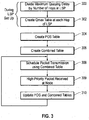
- FIG. 3 is a flowchart of the operation of one embodiment.
- the maximum queuing delay allowed for a high-priority packet is divided into the number of hops the packet must traverse through the network. For example, assuming the total maximum queuing delay allowed is 12 ms, based on a total end-to-end delay allowed of 15 ms less 3 ms for the propagation and transmission delay for an average size packet. Assuming further that the packet will traverse three hops from source PE to destination (egress) PE, the total number of hops is equal to the number of P hops plus the ingress PE plus the egress PE, or five.
- the maximum queuing delay, on average, at each hop should not exceed 12 ms/5, or 2.4 ms; that is, the average queuing delay for the packet at each node should not exceed 2.4 ms.
- the method illustrated in FIG. 3 will ensure that this maximum delay at each node is not exceeded.
- a Qmax table indicating the maximum queuing delay allowed at each hop for each of the destinations.
- the maximum queuing delay allowed at each hop is determined by taking the maximum end-to-end queuing delay allowed (i.e., maximum end-to-end delay allowed less some amount for propagation and transmission delay (e.g., 3 ms)) and dividing it by the total number of hops along the way for that LSP, as determined in step 300.
- An exemplary Qmax table for the node PE1 of the network 100 is illustrated below in Table I. TABLE I Destination PE Maximum Queuing Delay Allowed at Each Hop PE2 .2 PE3 .3 PE4 .4 PE5 .5 Qmax Table Steps 300 and 302 are performed for each hop only once during LSP setup.
- a POS table is constructed.
- the POS table includes two values for every packet entering the ingress queue, including the time the packet entered the queue and the intended destination of the packet.
- the metro Ethernet switch permits an n -packet look-ahead in its high-priority ingress queue.
- Table II illustrates an exemplary POS table.
- POS Table TABLE II Queue Position Time of Packet Entry Packet Destination Position 1 t1 PE4 Position 2 t2 PE7 Position 3 t3 PE12 Position 4 t4 PE15
- the POS table of a node is updated each time a high-priority packet is added to its high-priority ingress queue.
- step 308 the packet in whichever position has the lowest, i.e., the first to occur, time in the third column of the combined table at the node is scheduled for transmission.
- a determination is made which of the times (t1 + .4 ), (t2 + .7 ), (t3 + .12 ), and (t4 + .15 ) is the lowest and the packet corresponding thereto is scheduled by the scheduler through a four-packet look-ahead in order to meet the queuing delay constraint at that node.
- the total end-to-end delay criterion will be met.
- step 309 the POS table and combined table are updated in step 310 and execution returns to step 308.
Landscapes
- Engineering & Computer Science (AREA)
- Computer Networks & Wireless Communication (AREA)
- Signal Processing (AREA)
- Data Exchanges In Wide-Area Networks (AREA)
Claims (10)
- Verfahren für die Ablauffolgeplanung von Hochprioritätspaketen in einem Metro-Ethernet-Switch, wobei das Verfahren die folgenden Schritte umfasst: Bestimmen einer maximalen Queuing-Verzögerung pro Weiterleitung, die zulässig ist für mindestens zwei Hochprioritätspakete in einem Queue in dem Switch, wobei die maximale Queuing-Verzögerung pro Weiterleitung für ein konkretes Hochprioritätspaket besagter Hochprioritätspakete eine respektive maximale Queuing-Verzögerung pro Weiterleitung ist, die errechnet wurde in Abhängigkeit von einer Anzahl von Weiterleitungen auf einem labelvermittelten Pfad (Label Switched Path, LSP) zwischen dem Switch und einer zugewiesenen Destination des konkreten Hochprioritätspakets besagter Hochprioritätspakete, und wobei besagte respektive maximale Queuing-Verzögerung pro Weiterleitung nur während des Einrichtens des LPS und in Abhängigkeit von einer spezifizierten maximalen End-to-End-Verzögerung berechnet wird; Bestimmen, welches der mindestens zwei Hochprioritätspakete über eine geringste Knotenausgabe-Verzögerungsanforderung verfügt, wobei eine Knotenausgabe-Verzögerungsanforderung für ein zugewiesenes Hochprioritätspaket sich zusammensetzt aus der maximalen für das zugewiesene Hochprioritätspaket zugelassenen Queuing-Verzögerung pro Weiterleitung und einem Einstiegszeitpunkt am Switch für das zugewiesene Hochprioritätspaket; und das Einplanen desjenigen einen der mindestens zwei Hochprioritätspakete vor den übrigen der mindestens zwei Hochprioritätspakete, für welches bestimmt wurde, dass es die geringste Knotenausgabe-Verzögerungsanforderung hat.
- Verfahren nach Anspruch 1, wobei der Schritt des Bestimmens, welches der mindestens zwei Hochprioritätspakete die geringste Knotenausgabe-Verzögerungsanforderung hat, die folgenden Schritte umfasst: das Erstellen einer POS-Liste, die für jedes Hochprioritätspaket, welches beim Switch eingegangen ist, eine Position des Hochprioritätspakets in einem Queue des Switches, einen Zeitpunkt des Eintritts des Hochprioritätspakets in den Switch und eine intendierte Destination auflistet, an die das Hochprioritätspaket gerichtet ist; das Erstellen einer Qmax-Liste für das Speichern einer maximal zulässigen Queuing-Verzögerung pro Weiterleitung für jede von mehreren möglichen intendierten Destinationen; und die Verwendung der Qmax-Tabelle und der POS-Tabelle zum Bestimmen einer Knotenausgabe-Verzögerungsanforderung für jedes der Hochprioritätspakete im Queue des Switches.
- Verfahren nach Anspruch 2, wobei der Schritt des Erstellens einer Qmax-Tabelle für jeden labelvermittelten Pfad (LSP) die folgenden Schritte umfasst: das Bestimmen einer Anzahl von Weiterleitungen auf dem LSP; das Teilen einer maximal für den LSP zugelassenen Queuing-Verzögerung durch die Anzahl der Weiterleitungen auf dem LSP zwecks Bestimmung der maximal zulässigen Queuing-Verzögerung pro Weiterleitung.
- Verfahren nach Anspruch 2, wobei der Schritt des Erstellens einer Qmax-Tabelle nur während der Einrichtung des LSP durchgeführt wird.
- Verfahren nach Anspruch 2, weiterhin den Schritt des Aktualisierens der POS-Tabelle jedes Mal dann umfassend, wenn ein neues Hochprioritätspaket in das Queue eintritt.
- Verfahren nach Anspruch 1, wobei die Schritte des Bestimmens einer maximal zulässigen Queuing-Verzögerung pro Weiterleitung, des Bestimmens, welches der mindestens zwei Hochprioritätspakete die geringste Knotenausgabe-Verzögerungsanforderung hat und des Einplanens desjenigen einen der mindestens zwei Hochprioritätspakete vor den übrigen der mindestens zwei Hochprioritätspakete, für welches bestimmt wurde, dass es die geringste Knotenausgabe-Verzögerungsanforderung hat, jedes Mal dann durchgeführt werden, wenn ein neues Hochprioritätspaket in das Queue eintritt.
- Verfahren nach Anspruch 1, wobei die Queue ausgelegt ist für die Durchführung eines N-Paket-Lookaheads.
- Vorrichtung für die Ablauffolgeplanung von Hochprioritätspaketen in einem Metro-Ethernet-Switch, wobei die Vorrichtung Mittel für Folgendes umfasst: das Bestimmen einer maximalen Queuing-Verzögerung pro Weiterleitung, die zulässig ist für mindestens zwei Hochprioritätspakete in einem Queue in dem Switch, wobei die maximale Queuing-Verzögerung pro Weiterleitung für ein konkretes Hochprioritätspaket besagter Hochprioritätspakete eine respektive maximale Queuing-Verzögerung pro Weiterleitung ist, die errechnet wurde in Abhängigkeit von einer Anzahl von Weiterleitungen auf einem labelvermittelten Pfad (Label Switched Path, LSP) zwischen dem Switch und einer zugewiesenen Destination des konkreten Hochprioritätspakets besagter Hochprioritätspaicete, und wobei besagte respektive maximale Queuing-Verzögerung pro Weiterleitung nur während des Einrichtens des LPS und in Abhängigkeit von einer spezifizierten maximalen End-to-End-Verzögerung berechnet wird; das Bestimmen, welches der mindestens zwei Hochprioritätspakete über eine geringste Knotenausgabe-Verzögerungsanforderung verfügt, wobei eine Knotenausgabe-Verzögerungsanforderung für ein zugewiesenes Hochprioritätspaket sich zusammensetzt aus der maximalen für das zugewiesene Hochprioritätspaket zugelassenen Queuing-Verzögerung pro Weiterleitung und einem Einstiegszeitpunkt am Switch für das zugewiesene Hochprioritätspaket; und für das Einplanen desjenigen einen der mindestens zwei Hochprioritätspakete vor den übrigen der mindestens zwei Hochprioritätspakete, für welches bestimmt wurde, dass es die geringste Knotenausgabe-Verzögerungsanforderung hat.
- Vorrichtung nach Anspruch 8, wobei das Mittel zum Bestimmen, welches der mindestens zwei Hochprioritätspakete die geringste Knotenausgabe-Verzögerungsanforderung hat, Folgendes umfasst: eine POS-Liste, die für jedes Hochprioritätspaket, welches beim Switch eingegangen ist, eine Position des Hochprioritätspakets in einem Queue des Switches, einen Zeitpunkt des Eintritts des Hochprioritätspakets in den Switch und eine intendierte Destination auflistet, an die das Hochprioritätspaket gerichtet ist; Mittel für das Erstellen einer Qmax-Liste für das Speichern einer maximal zulässigen Queuing-Verzögerung pro Weiterleitung für jede von mehreren möglichen intendierten Destinationen; und Mittel für die Verwendung der Qmax-Tabelle und der POS-Tabelle zum Bestimmen einer Knotenausgabe-Verzögerungsanforderung für jedes der Hochprioritätspakete im Queue des Switches.
- Vorrichtung nach Anspruch 9, wobei die Mittel für das Erstellen einer Qmax-Tabelle für jeden labelvermittelten Pfad (LSP) umfassen: Mittel für das Bestimmen einer Anzahl von Weiterleitungen auf dem LSP; Mittel für das Teilen einer maximal für den LSP zugelassenen Queuing-Verzögerung durch die Anzahl der Weiterleitungen auf dem LSP zwecks Bestimmung der maximal zulässigen Queuing-Verzögerung pro Weiterleitung.
Applications Claiming Priority (2)
| Application Number | Priority Date | Filing Date | Title |
|---|---|---|---|
| US700023 | 1991-05-14 | ||
| US10/700,023 US7391777B2 (en) | 2003-11-03 | 2003-11-03 | Distance-sensitive scheduling of TDM-over-packet traffic in VPLS |
Publications (3)
| Publication Number | Publication Date |
|---|---|
| EP1528729A2 EP1528729A2 (de) | 2005-05-04 |
| EP1528729A3 EP1528729A3 (de) | 2006-11-08 |
| EP1528729B1 true EP1528729B1 (de) | 2016-04-13 |
Family
ID=34423461
Family Applications (1)
| Application Number | Title | Priority Date | Filing Date |
|---|---|---|---|
| EP04024583.9A Expired - Lifetime EP1528729B1 (de) | 2003-11-03 | 2004-10-15 | Abstandempfindliche Ablauffolgeplanung von TDM-Paketverkehr in einem VPLS-Netz |
Country Status (3)
| Country | Link |
|---|---|
| US (1) | US7391777B2 (de) |
| EP (1) | EP1528729B1 (de) |
| CN (1) | CN1614956B (de) |
Families Citing this family (20)
| Publication number | Priority date | Publication date | Assignee | Title |
|---|---|---|---|---|
| US7813348B1 (en) * | 2004-11-03 | 2010-10-12 | Extreme Networks, Inc. | Methods, systems, and computer program products for killing prioritized packets using time-to-live values to prevent head-of-line blocking |
| US8072887B1 (en) | 2005-02-07 | 2011-12-06 | Extreme Networks, Inc. | Methods, systems, and computer program products for controlling enqueuing of packets in an aggregated queue including a plurality of virtual queues using backpressure messages from downstream queues |
| US7724733B2 (en) * | 2005-03-31 | 2010-05-25 | International Business Machines Corporation | Interconnecting network for switching data packets and method for switching data packets |
| US7583662B1 (en) * | 2005-04-12 | 2009-09-01 | Tp Lab, Inc. | Voice virtual private network |
| US8054826B2 (en) * | 2005-07-29 | 2011-11-08 | Alcatel Lucent | Controlling service quality of voice over Internet Protocol on a downlink channel in high-speed wireless data networks |
| US9125092B2 (en) | 2005-12-22 | 2015-09-01 | Qualcomm Incorporated | Methods and apparatus for reporting and/or using control information |
| US9338767B2 (en) * | 2005-12-22 | 2016-05-10 | Qualcomm Incorporated | Methods and apparatus of implementing and/or using a dedicated control channel |
| US20070149132A1 (en) | 2005-12-22 | 2007-06-28 | Junyl Li | Methods and apparatus related to selecting control channel reporting formats |
| US20070147435A1 (en) * | 2005-12-23 | 2007-06-28 | Bruce Hamilton | Removing delay fluctuation in network time synchronization |
| DE102006035098A1 (de) * | 2006-07-28 | 2008-01-31 | Siemens Ag | Verfahren zur Übertragung eines Datenpakets und Netzwerkknoten |
| CN101542985B (zh) * | 2006-12-21 | 2011-03-02 | 中兴通讯股份有限公司 | 分组交换装置及方法 |
| DE102008008881A1 (de) * | 2008-02-13 | 2009-08-20 | Bayerische Motoren Werke Aktiengesellschaft | Kommunikationssystem |
| US7710976B2 (en) * | 2008-07-08 | 2010-05-04 | International Business Machines Corporation | Methods, systems and computer program products for packet prioritization based on delivery time expectation |
| US8223641B2 (en) * | 2008-07-28 | 2012-07-17 | Cellco Partnership | Dynamic setting of optimal buffer sizes in IP networks |
| SG11201502244WA (en) * | 2012-09-21 | 2015-05-28 | Agency Science Tech & Res | A circuit arrangement and method of determining a priority of packet scheduling |
| WO2017137098A1 (en) * | 2016-02-08 | 2017-08-17 | Telefonaktiebolaget Lm Ericsson (Publ) | Method and switch for managing traffic in transport network |
| WO2019231453A1 (en) * | 2018-05-31 | 2019-12-05 | Hewlett-Packard Development Company, L.P. | Packets transmissions based on priority levels |
| EP3857830B1 (de) * | 2018-10-30 | 2025-10-01 | Huawei Technologies Co., Ltd. | Verfahren und vorrichtungen zur terminbewussten flussablaufplanung in zeitsensiblen netzwerken |
| CN114079628B (zh) * | 2020-08-20 | 2025-09-09 | 深圳市中兴微电子技术有限公司 | 报文转发方法、装置、设备及存储介质 |
| CN117955928A (zh) * | 2022-10-20 | 2024-04-30 | 中兴通讯股份有限公司 | 报文调度方法、网络设备、存储介质及计算机程序产品 |
Family Cites Families (18)
| Publication number | Priority date | Publication date | Assignee | Title |
|---|---|---|---|---|
| US5793976A (en) * | 1996-04-01 | 1998-08-11 | Gte Laboratories Incorporated | Method and apparatus for performance monitoring in electronic communications networks |
| US6226266B1 (en) * | 1996-12-13 | 2001-05-01 | Cisco Technology, Inc. | End-to-end delay estimation in high speed communication networks |
| US6546013B1 (en) * | 1997-03-21 | 2003-04-08 | Scientific-Atlanta, Inc. | Method and apparatus for delivering reference signal information within a specified time interval |
| US6233429B1 (en) * | 1998-11-03 | 2001-05-15 | Gilat Satellite Networks Ltd. | VSAT satellite telecommunications system |
| US6594268B1 (en) * | 1999-03-11 | 2003-07-15 | Lucent Technologies Inc. | Adaptive routing system and method for QOS packet networks |
| IL142504A0 (en) * | 2000-04-16 | 2002-03-10 | Hughes Electronics Corp | An approach to minimize worst-case queueing delay for a switching communication system with transmission constraints |
| JP3511988B2 (ja) * | 2000-08-10 | 2004-03-29 | 日本電気株式会社 | フレーム転送装置、フレーム転送方法、フレーム転送システム |
| US20020085565A1 (en) | 2000-12-28 | 2002-07-04 | Maple Optical Systems, Inc. | Technique for time division multiplex forwarding of data streams |
| US6956821B2 (en) * | 2001-01-30 | 2005-10-18 | Telefonaktiebolaget L M Ericsson (Publ) | Path determination in a data network |
| EP1239637B1 (de) * | 2001-03-09 | 2006-07-12 | Vitesse Semiconductor Corporation | Zeitabhängige Planung für Datenpakete und Verfahren zur Sortierung |
| WO2003019873A1 (en) | 2001-08-22 | 2003-03-06 | Tekelec | Methods and systems for improving utilization of high-speed time division multiplexed communications links at signal transfer point |
| US7120120B2 (en) * | 2001-11-29 | 2006-10-10 | Ipsum Networks, Inc. | Method and system for topology construction and path identification in a two-level routing domain operated according to a simple link state routing protocol |
| EP1461914B1 (de) * | 2001-12-28 | 2009-09-16 | Nokia Corporation | Verfahren und Vorrichtung zur Paketablaufsteuerung |
| WO2003067383A2 (en) * | 2002-02-04 | 2003-08-14 | Intel Corporation | Services processor having a packet editing unit |
| JP3872716B2 (ja) * | 2002-04-30 | 2007-01-24 | 富士通株式会社 | パケット出力制御装置 |
| JP2003338837A (ja) * | 2002-05-22 | 2003-11-28 | Fujitsu Ltd | パケット通信システムにおける通信品質保証方法及び転送遅延保証機能付きパケット通信装置 |
| US7292537B2 (en) * | 2002-11-29 | 2007-11-06 | Alcatel Lucent | Measurement architecture to obtain per-hop one-way packet loss and delay in multi-class service networks |
| US9399535B2 (en) * | 2013-02-11 | 2016-07-26 | Newterra Ltd. | Support arrangements for water treatment tank |
-
2003
- 2003-11-03 US US10/700,023 patent/US7391777B2/en not_active Expired - Fee Related
-
2004
- 2004-10-15 EP EP04024583.9A patent/EP1528729B1/de not_active Expired - Lifetime
- 2004-11-02 CN CN200410086874XA patent/CN1614956B/zh not_active Expired - Fee Related
Also Published As
| Publication number | Publication date |
|---|---|
| US7391777B2 (en) | 2008-06-24 |
| CN1614956B (zh) | 2010-05-05 |
| CN1614956A (zh) | 2005-05-11 |
| EP1528729A3 (de) | 2006-11-08 |
| EP1528729A2 (de) | 2005-05-04 |
| US20050094645A1 (en) | 2005-05-05 |
Similar Documents
| Publication | Publication Date | Title |
|---|---|---|
| US7391777B2 (en) | Distance-sensitive scheduling of TDM-over-packet traffic in VPLS | |
| US6553030B2 (en) | Technique for forwarding multi-cast data packets | |
| US6832261B1 (en) | Method and apparatus for distributed resequencing and reassembly of subdivided packets | |
| US7042883B2 (en) | Pipeline scheduler with fairness and minimum bandwidth guarantee | |
| US8441931B2 (en) | Method and device for managing priority during the transmission of a message | |
| Hahne et al. | DQDB networks with and without bandwidth balancing | |
| US20020085567A1 (en) | Metro switch and method for transporting data configured according to multiple different formats | |
| US20020085565A1 (en) | Technique for time division multiplex forwarding of data streams | |
| US20020085548A1 (en) | Quality of service technique for a data communication network | |
| US6934760B1 (en) | Method and apparatus for resequencing of packets into an original ordering using multiple resequencing components | |
| JP2001168920A (ja) | 可変長パケットの輸送用ネットワークのパケットの流れをトラフィック契約に一致させる方法 | |
| US20020085507A1 (en) | Address learning technique in a data communication network | |
| US7391787B1 (en) | System and method for opportunistic request-grant switching | |
| US20020085545A1 (en) | Non-blocking virtual switch architecture | |
| CN119011502A (zh) | 一种确定性网络动态带宽预留方法及装置 | |
| US8542691B2 (en) | Classes of service for network on chips | |
| US8107372B1 (en) | Collision compensation in a scheduling system | |
| CN119788185A (zh) | 一种低轨星座时敏业务跨距传输方法 | |
| US7602797B2 (en) | Method and apparatus for request/grant priority scheduling | |
| Cobb et al. | A theory of multi‐channel schedulers for quality of service | |
| JP4118824B2 (ja) | 優先パケットの遅延を最小化するシェーピング装置 | |
| Sun et al. | Coordinated aggregate scheduling for improving end-to-end delay performance | |
| JP3634992B2 (ja) | 可変長パケットスイッチ | |
| US20040063461A1 (en) | Proactive burst contention avoidance scheduling algorithms for labelled optical burst switching networks | |
| Li et al. | Enhanced Switch Design Supporting Dual Preemption Under Real-Time Ethernet |
Legal Events
| Date | Code | Title | Description |
|---|---|---|---|
| PUAI | Public reference made under article 153(3) epc to a published international application that has entered the european phase |
Free format text: ORIGINAL CODE: 0009012 |
|
| AK | Designated contracting states |
Kind code of ref document: A2 Designated state(s): AT BE BG CH CY CZ DE DK EE ES FI FR GB GR HU IE IT LI LU MC NL PL PT RO SE SI SK TR |
|
| AX | Request for extension of the european patent |
Extension state: AL HR LT LV MK |
|
| PUAL | Search report despatched |
Free format text: ORIGINAL CODE: 0009013 |
|
| AK | Designated contracting states |
Kind code of ref document: A3 Designated state(s): AT BE BG CH CY CZ DE DK EE ES FI FR GB GR HU IE IT LI LU MC NL PL PT RO SE SI SK TR |
|
| AX | Request for extension of the european patent |
Extension state: AL HR LT LV MK |
|
| RAP1 | Party data changed (applicant data changed or rights of an application transferred) |
Owner name: ALCATEL LUCENT |
|
| 17P | Request for examination filed |
Effective date: 20070508 |
|
| AKX | Designation fees paid |
Designated state(s): AT BE BG CH CY CZ DE DK EE ES FI FR GB GR HU IE IT LI LU MC NL PL PT RO SE SI SK TR |
|
| 17Q | First examination report despatched |
Effective date: 20090616 |
|
| RAP1 | Party data changed (applicant data changed or rights of an application transferred) |
Owner name: ALCATEL LUCENT |
|
| 111Z | Information provided on other rights and legal means of execution |
Free format text: AT BE BG CH CY CZ DE DK EE ES FI FR GB GR HU IE IT LI LU MC NL PL PT RO SE SI SK TR Effective date: 20130410 |
|
| RAP1 | Party data changed (applicant data changed or rights of an application transferred) |
Owner name: ALCATEL LUCENT |
|
| D11X | Information provided on other rights and legal means of execution (deleted) | ||
| REG | Reference to a national code |
Ref country code: DE Ref legal event code: R079 Ref document number: 602004049021 Country of ref document: DE Free format text: PREVIOUS MAIN CLASS: H04L0012560000 Ipc: H04L0012540000 |
|
| GRAP | Despatch of communication of intention to grant a patent |
Free format text: ORIGINAL CODE: EPIDOSNIGR1 |
|
| RIC1 | Information provided on ipc code assigned before grant |
Ipc: H04L 12/54 20130101AFI20151001BHEP |
|
| INTG | Intention to grant announced |
Effective date: 20151030 |
|
| GRAS | Grant fee paid |
Free format text: ORIGINAL CODE: EPIDOSNIGR3 |
|
| GRAA | (expected) grant |
Free format text: ORIGINAL CODE: 0009210 |
|
| AK | Designated contracting states |
Kind code of ref document: B1 Designated state(s): AT BE BG CH CY CZ DE DK EE ES FI FR GB GR HU IE IT LI LU MC NL PL PT RO SE SI SK TR |
|
| REG | Reference to a national code |
Ref country code: GB Ref legal event code: FG4D |
|
| REG | Reference to a national code |
Ref country code: AT Ref legal event code: REF Ref document number: 791145 Country of ref document: AT Kind code of ref document: T Effective date: 20160415 Ref country code: CH Ref legal event code: EP |
|
| REG | Reference to a national code |
Ref country code: IE Ref legal event code: FG4D |
|
| REG | Reference to a national code |
Ref country code: DE Ref legal event code: R096 Ref document number: 602004049021 Country of ref document: DE |
|
| REG | Reference to a national code |
Ref country code: AT Ref legal event code: MK05 Ref document number: 791145 Country of ref document: AT Kind code of ref document: T Effective date: 20160413 |
|
| REG | Reference to a national code |
Ref country code: NL Ref legal event code: MP Effective date: 20160413 |
|
| REG | Reference to a national code |
Ref country code: FR Ref legal event code: PLFP Year of fee payment: 13 |
|
| PG25 | Lapsed in a contracting state [announced via postgrant information from national office to epo] |
Ref country code: NL Free format text: LAPSE BECAUSE OF FAILURE TO SUBMIT A TRANSLATION OF THE DESCRIPTION OR TO PAY THE FEE WITHIN THE PRESCRIBED TIME-LIMIT Effective date: 20160413 Ref country code: FI Free format text: LAPSE BECAUSE OF FAILURE TO SUBMIT A TRANSLATION OF THE DESCRIPTION OR TO PAY THE FEE WITHIN THE PRESCRIBED TIME-LIMIT Effective date: 20160413 Ref country code: PL Free format text: LAPSE BECAUSE OF FAILURE TO SUBMIT A TRANSLATION OF THE DESCRIPTION OR TO PAY THE FEE WITHIN THE PRESCRIBED TIME-LIMIT Effective date: 20160413 |
|
| PG25 | Lapsed in a contracting state [announced via postgrant information from national office to epo] |
Ref country code: AT Free format text: LAPSE BECAUSE OF FAILURE TO SUBMIT A TRANSLATION OF THE DESCRIPTION OR TO PAY THE FEE WITHIN THE PRESCRIBED TIME-LIMIT Effective date: 20160413 Ref country code: SE Free format text: LAPSE BECAUSE OF FAILURE TO SUBMIT A TRANSLATION OF THE DESCRIPTION OR TO PAY THE FEE WITHIN THE PRESCRIBED TIME-LIMIT Effective date: 20160413 Ref country code: GR Free format text: LAPSE BECAUSE OF FAILURE TO SUBMIT A TRANSLATION OF THE DESCRIPTION OR TO PAY THE FEE WITHIN THE PRESCRIBED TIME-LIMIT Effective date: 20160714 Ref country code: PT Free format text: LAPSE BECAUSE OF FAILURE TO SUBMIT A TRANSLATION OF THE DESCRIPTION OR TO PAY THE FEE WITHIN THE PRESCRIBED TIME-LIMIT Effective date: 20160816 Ref country code: ES Free format text: LAPSE BECAUSE OF FAILURE TO SUBMIT A TRANSLATION OF THE DESCRIPTION OR TO PAY THE FEE WITHIN THE PRESCRIBED TIME-LIMIT Effective date: 20160413 |
|
| PG25 | Lapsed in a contracting state [announced via postgrant information from national office to epo] |
Ref country code: BE Free format text: LAPSE BECAUSE OF FAILURE TO SUBMIT A TRANSLATION OF THE DESCRIPTION OR TO PAY THE FEE WITHIN THE PRESCRIBED TIME-LIMIT Effective date: 20160413 Ref country code: IT Free format text: LAPSE BECAUSE OF FAILURE TO SUBMIT A TRANSLATION OF THE DESCRIPTION OR TO PAY THE FEE WITHIN THE PRESCRIBED TIME-LIMIT Effective date: 20160413 |
|
| REG | Reference to a national code |
Ref country code: DE Ref legal event code: R097 Ref document number: 602004049021 Country of ref document: DE |
|
| PG25 | Lapsed in a contracting state [announced via postgrant information from national office to epo] |
Ref country code: EE Free format text: LAPSE BECAUSE OF FAILURE TO SUBMIT A TRANSLATION OF THE DESCRIPTION OR TO PAY THE FEE WITHIN THE PRESCRIBED TIME-LIMIT Effective date: 20160413 Ref country code: CZ Free format text: LAPSE BECAUSE OF FAILURE TO SUBMIT A TRANSLATION OF THE DESCRIPTION OR TO PAY THE FEE WITHIN THE PRESCRIBED TIME-LIMIT Effective date: 20160413 Ref country code: RO Free format text: LAPSE BECAUSE OF FAILURE TO SUBMIT A TRANSLATION OF THE DESCRIPTION OR TO PAY THE FEE WITHIN THE PRESCRIBED TIME-LIMIT Effective date: 20160413 Ref country code: DK Free format text: LAPSE BECAUSE OF FAILURE TO SUBMIT A TRANSLATION OF THE DESCRIPTION OR TO PAY THE FEE WITHIN THE PRESCRIBED TIME-LIMIT Effective date: 20160413 Ref country code: SK Free format text: LAPSE BECAUSE OF FAILURE TO SUBMIT A TRANSLATION OF THE DESCRIPTION OR TO PAY THE FEE WITHIN THE PRESCRIBED TIME-LIMIT Effective date: 20160413 |
|
| PLBE | No opposition filed within time limit |
Free format text: ORIGINAL CODE: 0009261 |
|
| STAA | Information on the status of an ep patent application or granted ep patent |
Free format text: STATUS: NO OPPOSITION FILED WITHIN TIME LIMIT |
|
| 26N | No opposition filed |
Effective date: 20170116 |
|
| PG25 | Lapsed in a contracting state [announced via postgrant information from national office to epo] |
Ref country code: SI Free format text: LAPSE BECAUSE OF FAILURE TO SUBMIT A TRANSLATION OF THE DESCRIPTION OR TO PAY THE FEE WITHIN THE PRESCRIBED TIME-LIMIT Effective date: 20160413 |
|
| REG | Reference to a national code |
Ref country code: CH Ref legal event code: PL |
|
| REG | Reference to a national code |
Ref country code: IE Ref legal event code: MM4A |
|
| PG25 | Lapsed in a contracting state [announced via postgrant information from national office to epo] |
Ref country code: CH Free format text: LAPSE BECAUSE OF NON-PAYMENT OF DUE FEES Effective date: 20161031 Ref country code: LI Free format text: LAPSE BECAUSE OF NON-PAYMENT OF DUE FEES Effective date: 20161031 |
|
| PG25 | Lapsed in a contracting state [announced via postgrant information from national office to epo] |
Ref country code: LU Free format text: LAPSE BECAUSE OF NON-PAYMENT OF DUE FEES Effective date: 20161015 |
|
| REG | Reference to a national code |
Ref country code: FR Ref legal event code: PLFP Year of fee payment: 14 |
|
| PG25 | Lapsed in a contracting state [announced via postgrant information from national office to epo] |
Ref country code: IE Free format text: LAPSE BECAUSE OF NON-PAYMENT OF DUE FEES Effective date: 20161015 |
|
| PG25 | Lapsed in a contracting state [announced via postgrant information from national office to epo] |
Ref country code: HU Free format text: LAPSE BECAUSE OF FAILURE TO SUBMIT A TRANSLATION OF THE DESCRIPTION OR TO PAY THE FEE WITHIN THE PRESCRIBED TIME-LIMIT; INVALID AB INITIO Effective date: 20041015 Ref country code: CY Free format text: LAPSE BECAUSE OF FAILURE TO SUBMIT A TRANSLATION OF THE DESCRIPTION OR TO PAY THE FEE WITHIN THE PRESCRIBED TIME-LIMIT Effective date: 20160413 |
|
| PG25 | Lapsed in a contracting state [announced via postgrant information from national office to epo] |
Ref country code: TR Free format text: LAPSE BECAUSE OF FAILURE TO SUBMIT A TRANSLATION OF THE DESCRIPTION OR TO PAY THE FEE WITHIN THE PRESCRIBED TIME-LIMIT Effective date: 20160413 Ref country code: MC Free format text: LAPSE BECAUSE OF FAILURE TO SUBMIT A TRANSLATION OF THE DESCRIPTION OR TO PAY THE FEE WITHIN THE PRESCRIBED TIME-LIMIT Effective date: 20160413 |
|
| PG25 | Lapsed in a contracting state [announced via postgrant information from national office to epo] |
Ref country code: BG Free format text: LAPSE BECAUSE OF FAILURE TO SUBMIT A TRANSLATION OF THE DESCRIPTION OR TO PAY THE FEE WITHIN THE PRESCRIBED TIME-LIMIT Effective date: 20160413 |
|
| REG | Reference to a national code |
Ref country code: FR Ref legal event code: PLFP Year of fee payment: 15 |
|
| PGFP | Annual fee paid to national office [announced via postgrant information from national office to epo] |
Ref country code: FR Payment date: 20180913 Year of fee payment: 15 |
|
| PGFP | Annual fee paid to national office [announced via postgrant information from national office to epo] |
Ref country code: DE Payment date: 20181002 Year of fee payment: 15 |
|
| PGFP | Annual fee paid to national office [announced via postgrant information from national office to epo] |
Ref country code: GB Payment date: 20181010 Year of fee payment: 15 |
|
| REG | Reference to a national code |
Ref country code: DE Ref legal event code: R119 Ref document number: 602004049021 Country of ref document: DE |
|
| PG25 | Lapsed in a contracting state [announced via postgrant information from national office to epo] |
Ref country code: DE Free format text: LAPSE BECAUSE OF NON-PAYMENT OF DUE FEES Effective date: 20200501 |
|
| GBPC | Gb: european patent ceased through non-payment of renewal fee |
Effective date: 20191015 |
|
| PG25 | Lapsed in a contracting state [announced via postgrant information from national office to epo] |
Ref country code: GB Free format text: LAPSE BECAUSE OF NON-PAYMENT OF DUE FEES Effective date: 20191015 Ref country code: FR Free format text: LAPSE BECAUSE OF NON-PAYMENT OF DUE FEES Effective date: 20191031 |