EP1528693A2 - Rahmensynchronisation für ein mobiles Kommunikationssystem - Google Patents
Rahmensynchronisation für ein mobiles Kommunikationssystem Download PDFInfo
- Publication number
- EP1528693A2 EP1528693A2 EP04025425A EP04025425A EP1528693A2 EP 1528693 A2 EP1528693 A2 EP 1528693A2 EP 04025425 A EP04025425 A EP 04025425A EP 04025425 A EP04025425 A EP 04025425A EP 1528693 A2 EP1528693 A2 EP 1528693A2
- Authority
- EP
- European Patent Office
- Prior art keywords
- sequence
- sub
- frames
- phase
- frame
- Prior art date
- Legal status (The legal status is an assumption and is not a legal conclusion. Google has not performed a legal analysis and makes no representation as to the accuracy of the status listed.)
- Ceased
Links
- 238000010295 mobile communication Methods 0.000 title claims abstract description 19
- 238000000819 phase cycle Methods 0.000 claims abstract description 54
- 238000000034 method Methods 0.000 claims abstract description 36
- 230000005540 biological transmission Effects 0.000 claims description 39
- 238000012549 training Methods 0.000 claims description 33
- 238000004891 communication Methods 0.000 claims description 10
- 230000010363 phase shift Effects 0.000 claims description 7
- 230000008569 process Effects 0.000 claims description 4
- 238000012545 processing Methods 0.000 description 16
- 238000010586 diagram Methods 0.000 description 4
- 230000006870 function Effects 0.000 description 4
- 238000004519 manufacturing process Methods 0.000 description 4
- 230000001360 synchronised effect Effects 0.000 description 4
- 108010076504 Protein Sorting Signals Proteins 0.000 description 3
- 102100026758 Serine/threonine-protein kinase 16 Human genes 0.000 description 3
- 101710184778 Serine/threonine-protein kinase 16 Proteins 0.000 description 3
- 230000000694 effects Effects 0.000 description 2
- 238000005562 fading Methods 0.000 description 2
- 238000012986 modification Methods 0.000 description 2
- 230000004048 modification Effects 0.000 description 2
- 230000003287 optical effect Effects 0.000 description 2
- 101100521334 Mus musculus Prom1 gene Proteins 0.000 description 1
- 230000004913 activation Effects 0.000 description 1
- 230000008859 change Effects 0.000 description 1
- 238000010276 construction Methods 0.000 description 1
- 230000003111 delayed effect Effects 0.000 description 1
- 239000000284 extract Substances 0.000 description 1
- 229920001690 polydopamine Polymers 0.000 description 1
- 230000001902 propagating effect Effects 0.000 description 1
Images



Classifications
-
- H—ELECTRICITY
- H04—ELECTRIC COMMUNICATION TECHNIQUE
- H04L—TRANSMISSION OF DIGITAL INFORMATION, e.g. TELEGRAPHIC COMMUNICATION
- H04L7/00—Arrangements for synchronising receiver with transmitter
- H04L7/04—Speed or phase control by synchronisation signals
- H04L7/10—Arrangements for initial synchronisation
-
- H—ELECTRICITY
- H04—ELECTRIC COMMUNICATION TECHNIQUE
- H04B—TRANSMISSION
- H04B7/00—Radio transmission systems, i.e. using radiation field
- H04B7/24—Radio transmission systems, i.e. using radiation field for communication between two or more posts
- H04B7/26—Radio transmission systems, i.e. using radiation field for communication between two or more posts at least one of which is mobile
- H04B7/2662—Arrangements for Wireless System Synchronisation
- H04B7/2671—Arrangements for Wireless Time-Division Multiple Access [TDMA] System Synchronisation
- H04B7/2678—Time synchronisation
- H04B7/2681—Synchronisation of a mobile station with one base station
-
- H—ELECTRICITY
- H04—ELECTRIC COMMUNICATION TECHNIQUE
- H04B—TRANSMISSION
- H04B1/00—Details of transmission systems, not covered by a single one of groups H04B3/00 - H04B13/00; Details of transmission systems not characterised by the medium used for transmission
- H04B1/69—Spread spectrum techniques
- H04B1/707—Spread spectrum techniques using direct sequence modulation
- H04B1/7073—Synchronisation aspects
- H04B1/70735—Code identification
-
- H—ELECTRICITY
- H04—ELECTRIC COMMUNICATION TECHNIQUE
- H04W—WIRELESS COMMUNICATION NETWORKS
- H04W56/00—Synchronisation arrangements
- H04W56/0055—Synchronisation arrangements determining timing error of reception due to propagation delay
- H04W56/0065—Synchronisation arrangements determining timing error of reception due to propagation delay using measurement of signal travel time
- H04W56/007—Open loop measurement
- H04W56/0075—Open loop measurement based on arrival time vs. expected arrival time
- H04W56/0085—Open loop measurement based on arrival time vs. expected arrival time detecting a given structure in the signal
-
- H—ELECTRICITY
- H04—ELECTRIC COMMUNICATION TECHNIQUE
- H04J—MULTIPLEX COMMUNICATION
- H04J3/00—Time-division multiplex systems
- H04J3/02—Details
- H04J3/06—Synchronising arrangements
- H04J3/0602—Systems characterised by the synchronising information used
- H04J3/0605—Special codes used as synchronising signal
-
- H—ELECTRICITY
- H04—ELECTRIC COMMUNICATION TECHNIQUE
- H04L—TRANSMISSION OF DIGITAL INFORMATION, e.g. TELEGRAPHIC COMMUNICATION
- H04L7/00—Arrangements for synchronising receiver with transmitter
- H04L7/04—Speed or phase control by synchronisation signals
- H04L7/041—Speed or phase control by synchronisation signals using special codes as synchronising signal
- H04L7/042—Detectors therefor, e.g. correlators, state machines
Definitions
- the invention relates for frame synchronization of a mobile communication system and, more particularly, to frame synchronization between a mobile terminal and a base station terminal.
- TDMA Time Division Multiple Access
- CDMA Code Division Multiple Access
- TDSCMA Time Division Multiple Access
- a transmitter system uses phase modulation, such as QPSK (Quadrature Phase Shift Keying) of a downlink pilot signal for synchronization of a transmission frame.
- phase modulation such as QPSK (Quadrature Phase Shift Keying) of a downlink pilot signal for synchronization of a transmission frame.
- QPSK modulation is a method of transmitting 2 bits of information per symbol that have a phase shift of a carrier wave at an interval of 90.
- the QPSK modulation divides an input signal into two signal sequences (signals of I, Q channels) by a serial/parallel converter, and modulates each channel signals (I, Q channel signals) by MPSK.
- the MPSK multiplies the channel signals by two carrier waves (cosine wave and sine wave) having a phase difference of 90 (with each other).
- the MPSK sends the signals through an adder for combining in one signal.
- BPSK Binary Phase Shift Keying modulation transmits 1 bit information in each symbol.
- the binary signal is transmitted corresponding to 0 degree phase shift and 180 degree phase shift of a carrier wave.
- a receiver of a TD-SCDMA system uses both a training sequence (midamble sequence) and a downlink pilot signal, and performs a phase demodulation to determine the time duration a receiving frame has been delayed due to signal distortions from a communication channel.
- the receiver of a TD-SCDMA system detects a downlink pilot signal and predicts a midamble distance as being a pre-determined time interval from the detected downlink pilot signal. Frame synchronization is performed using the detected downlink pilot signal and the predicted midamble.
- the midamble sequence and the downlink pilot signal are positioned within a predetermined time interval.
- the predetermined time interval that previously existed between the midamble sequence and the downlink pilot signal may have changed (its position) from that of transmission. This change in position causes increased channel phase error resulting in degraded predictability of the midamble sequence, thereby increasing the probability of frame synchronization failure.
- the invention is directed to a frame synchronization system and method for mobile communication systems.
- the frame synchronization system detects a downlink synchronization signal. Multiple sub-frames of the synchronization signal are stored. An optimum position for a midamble sequence is detected utilizing a correlation of the multiple sub-frames. A phase sequence of the multiple sub-frames is calculated using a correlation value of the optimum position of the midamble sequence and a maximum correlation value of the detected synchronization signal.
- Frame synchronization is obtained on the basis of a phase position of a sub-frame having the maximum correlation value.
- the maximum correlation value is calculated from periodically correlating the calculated phase sequence and a defined phase sequence such as a transmission phase sequence. Thereby, the influence of distance between the midamble sequence and the synchronization signal is minimized, increasing the success rate of frame synchronization.
- the method comprises providing a transmission synchronization signal having a pre-determined number of sub-frames and a training signal for correlating communication of a connection.
- the method further comprises calculating a first phase sequence from an optimum position for the training sequence and for the synchronization signal by a number of the sub-frame, calculating a maximum correlation value between the first phase sequence and a second phase sequence comprising a defined phase sequence, and obtaining a frame synchronization at a phase position of the pre-determined number of sub-frames having the maximum correlation value.
- the training sequence includes a midamble of a first time slot of an arbitrary sub-frame.
- the predetermined number is 4.
- the sub-frames are successively connected.
- the step of detecting the optimum position of the training sequence by sub-frames comprises calculating a correlation value between a defined transmission training sequence and the stored training sequence; and detecting a position of the stored training sequence having a maximum correlation value.
- the step of calculating the first phase sequence comprises compensating a phase of a synchronous signal of the optimum position as much as the phase of the training sequence of the optimum position; performing the compensation process on the predetermined number of every sub-frame; and generating the first phase sequence by arranging phases compensated for every sub-frame.
- the second phase sequence includes information indicating a synchronization position of a frame.
- the method comprises detecting a synchronization signal having a plurality of sub-frames transmitted from one terminal to another terminal; storing successive sub-frames of the plurality of sub-frames from the synchronization signal at the other terminal; and detecting an optimum position of a midamble sequence to insert into the plurality of sub-frames according to a frame number.
- the method further comprises calculating a phase sequence utilizing a correlation value of the optimum position of the midamble sequence and a correlation value of the synchronization signal in accordance with the plurality of sub-frames; and obtaining frame synchronization of the transmitted signal on the basis of a phase position of a sub-frame having the maximum correlation value.
- the phase sequence between the midamble and the transmission sequence is periodically calculated for updating the frame synchronization.
- the step of detecting the optimum position of the midamble sequence comprises calculating a correlation value between an arbitrary receiving sequence having a predetermined length and a transmission midamble sequence by the stored sub-frames; and detecting a position of the receiving sequence having the maximum correlation value as the optimum position of the midamble sequence.
- the transmission midamble sequence is a sequence that a transmitter and a receiver know.
- the maximum correlation value of the synchronization signal is a correlation value between the synchronization signal detected by each sub-frame and the transmission synchronization signal in which the transmission synchronization signal is the reference signal known to both a transmitter and a receiver.
- the transmission phase sequence includes starting positional information for decoding of a P-CCPCH.
- Fig. 1 illustrates a structure of a frame used in a TD-SCDMA system.
- Fig. 2 illustrates a phase sequence for a phase modulation of a downlink synchronization signal for indicating existence or non-existence of a P-CCPCH.
- Fig. 3 is a flow chart of a frame synchronization method in a TD-SCDMA system in accordance with an embodiment of the invention.
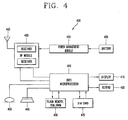
- Fig. 4 is a block diagram illustrating a mobile communication device in accordance with an embodiment of the invention.
- Fig. 5 is a block diagram illustrating a UTRAN in accordance with an embodiment of the invention.
- the invention relates to an apparatus and method for frame synchronization of one station with another station, such as a mobile terminal to a base station terminal.
- another station such as a mobile terminal to a base station terminal.
- the invention is illustrated with respect to a mobile communication system, it is contemplated that the invention may be utilized anytime it is desired for transmitting or receiving signals from one location to another location.
- Well-known functions or constructions are not described in detail since they would obscure the invention in unnecessary detail.
- one radio frame consists of two sub-frames and one sub-frame consists of seven normal time slots (TS0 ⁇ TS6) and three special time slots which are DwPTS (Downlink Pilot Time Slot), a GP and an UpPTS (Uplink Pilot Time Slot).
- TS0, TS4, TS5 and TS6 can be used for downlink while TS1, TS2 and TS3 can be used for uplink.
- the first time slot TS0 of the sub-frame includes a data field, a midamble field to be used as a training sequence, and a data field.
- the DWPTS includes a downlink synchronization signal (SYNC_DL).
- the UbPTS includes an uplink synchronization signal (SYNC_UL).
- a guard period (not shown) exists between time slots, and 16 chips, for example, can be used for the guard period.
- a mobile terminal uses phase modulation of the downlink synchronization signal (SYNC_DL) sequence to adjust a frame synchronization.
- SYNC_DL downlink synchronization signal
- two radio frames are basic blocks for interleaving, so commonly the radio frame synchronization is made by using the phase modulation of the downlink synchronization signal (SYNC_DL).
- the P-CCPCH Primary Common Control Physical Channel: a primary common control channel
- the P-CCPCH has a data field of the first time slot (TS0) of each sub-frame among the four sub-frames.
- the P-CCPCH includes a broadcast channel (BCH).
- downlink synchronization signals (SYNC_DL) of the four sub-frames have a S1 phase sequence, that is, for example, 135, 45, 225, 135, signifying that the P-CCPCH exists in the next four sub-frames.
- S1 phase sequence that is, for example, 135, 45, 225, 135, signifying that the P-CCPCH exists in the next four sub-frames.
- the S2 sequence signifies that the P-CCPCH does not exist in the next four sub-frames.
- the transmitter of the TD-SCDMA system phase-modulates a downlink synchronization signal (SYNC_DL) sequence on the basis of the midamble sequence of the first time slot (TS0) of the sub-frame, so that the downlink synchronization signal (SYNC_DL) sequence of the four sub-frames has the corresponding phase sequence (see Figure 2).
- SYNC_DL downlink synchronization signal
- the receiver of the TD-SCDMA system detects a phase sequence of the downlink synchronization signal (SYNC_DL) and obtains synchronization of the two radio frames, that is, the synchronization of the P-CCPCH.
- SYNC_DL downlink synchronization signal
- the mobile terminal detects the phase of the downlink synchronization signal (SYNC_DL), the mobile terminal cannot determine if this is the phase of the transmitted downlink synchronization signal (SYNC_DL) because the channel has distorted the transmitted downlink synchronization signal.
- SYNC_DL the phase of the transmitted downlink synchronization signal
- the mobile terminal detects the phase of the downlink synchronization signal (SYNC_DL) sequence using the midamble sequence in the TS0.
- the mobile terminal compensates the phase of the received downlink synchronization signal (SYNC_DL) using the phase of the midamble sequence to remove the phase influence introduced by the channel.
- the mobile terminal detects synchronization of the received sub-frame (S11), and stores four successive sub-frames on the basis of the detected synchronization (S13).
- the mobile terminal detects an optimum position of each midamble of the stored four sub-frames by using a correlation (S15), and detects an optimum position of each downlink synchronization signal of four sub-frames by using the correlation (S17).
- the mobile terminal calculates phase sequences of four elements by using the optimum position of each midamble and the optimum position of each downlink synchronization signal (S19).
- the mobile terminal detects an optimum phase position where a correlation value is maximized.
- the mobile terminal correlates the calculated phase sequence, and a defined phase sequence (transmission phase sequence), and performs frame synchronization on the basis of the optimum phase position that is detected (S21 and S23).
- the mobile terminal detects the midamble sequence independently from the downlink synchronization signal and unconditionally obtains a position of the midamble sequence distanced at a predetermined interval from the downlink synchronization signal.
- the mobile terminal detects the synchronization of the sub-frame by detecting the downlink synchronization signal (S11) and stores the four successive sub-frames on the basis of the detected downlink synchronization signal (S13).
- a position of the receiving midamble sequence is basically known.
- the position of the receiving midamble sequence is searched one more time by using a correlation with the transmission midamble sequence (transmission phase sequence).
- Bellow is an example illustrating the method for detecting a midamble sequence of a first time slot (TS0) of the first stored sub-frame.
- the midamble sequence has a predetermined pattern as a training sequence, and the number of elements of the midamble sequence is 144. If a transmission midamble sequence having a specific pattern is m T , the transmission midamble sequence can be expressed by equation (1) shown below. The mobile terminal either knows or easily obtain the transmission midamble sequence.
- the mobile terminal In order to detect an accurate position of the receiving midamble sequence, such as an optimum position, the mobile terminal correlates the transmission midamble sequence m T and the receiving midamble sequence m R .
- the mobile terminal searches a position of the receiving midamble sequence m R having a maximum correlation value, and in this respect, if a correlation value at the searched optimum position is Max_corr Mid , it can be expressed by equation (3) shown below: wherein 'L' indicates a guard period between time slots, which can have 16 as a maximum value (step S15).
- An arbitrary sequence having 144 elements from the first time slot of the first stored sub-frame can be the receiving midamble sequence.
- the mobile terminal calculates a correlation value between the arbitrary sequence and the transmission midamble sequence having a specific pattern, and extracts the arbitrary sequence having a maximum correlation value.
- the mobile terminal since the sub-frame is in a synchronized state, the mobile terminal knows or substantially knows the exact position of the downlink synchronization signal (SYNC_DL) of the first stored sub-frame.
- the mobile terminal can calculate a correlation value between the transmitted downlink synchronization signal sequence and the receiving downlink synchronization signal (SYNC_DL) sequence.
- the calculated correlation value becomes the maximum value, which is called Max-corr SYNC_DL (S17).
- the mobile terminal knows the transmission downlink synchronization signal sequence.
- the mobile terminal calculates a phase of the received downlink synchronization signal by using the Max_Corr Mid and Max_corr SYNC_DL . And then, the mobile terminal calculates a phase of the downlink synchronization signal of the first stored sub-frame on the basis of the phase of the midamble sequence of the first stored sub-frame.
- the phase of the downlink synchronization signal of the first sub-frame is called P 1 .
- the mobile terminal calculates phases of downlink synchronization signals of the second, third and fourth sub-frames, and obtains a phase sequence having a length of 4 (S19).
- the mobile terminal obtains synchronization of the radio frame by using the obtained phase sequence ⁇ P 1 , P 2 , P 3 , P 4 ] and a transmission phase sequence [ ⁇ 1 , ⁇ 2 , ⁇ 3 , ⁇ 4 ⁇ as shown in Figure 2.
- the mobile terminal should know the transmission phase sequence ⁇ 1 , ⁇ 2 , ⁇ 3 , ⁇ 4 ⁇ .
- the mobile terminal periodically correlates the obtained phase sequence ⁇ P 1 , P 2 , P 3 , P 4 ⁇ and the transmission phase sequence ⁇ 1 , ⁇ 2 , ⁇ 3 , ⁇ 4 ⁇ .
- the mobile terminal arranges the obtained phase sequence in ⁇ P 1 , P 2 , P 3 , P 4 ⁇ , ⁇ P 2 , P 3 , P 4 , P 1 ⁇ , ⁇ P 3 , P 4 , P 1 , P 2 ⁇ , ⁇ P 4 , P 1 , P 2 , P 3 ⁇ , calculates a correlation value between each arranged phase sequence and the transmission phase sequence ⁇ 1 , ⁇ 2 , ⁇ 3 , ⁇ 4 ⁇ , and detects a phase position of a sub-frame corresponding a phase sequence having a maximum value as a boundary position of two radio frames.
- a frame synchronization is obtained (S21 and S23).
- the mobile terminal By detecting the frame synchronization, the mobile terminal detects the midamble sequence to compensate for channel phase shift separately from the downlink synchronization signal, therefore, the influence of the distance (effects of signal distortion and multipath effects) existing between the downlink synchronization signal and the midamble sequence is minimized.
- the frame synchronization method in a mobile communication system (such as a TD-SCDMA system) has many advantages including:
- the midamble sequence and the downlink synchronization signal are independently detected, even though the downlink synchronization signal and the midamble sequence are received with a distance changed from a defined distance for the reason of instability of a device of the TD-SCDMA system, the midamble sequence can be accurately detected.
- the midamble sequence can be accurately detected, even in a serious fading channel, so that a phase of the downlink synchronization signal can be accurately detected.
- FIG.. 4 a block diagram of a mobile communication device 400 of the invention such as a mobile phone for performing the methods of the invention.
- the mobile communication device 400 includes a processing unit 410 such as a microprocessor or digital signal processor, an RF module 435, a power management module 406, an antenna 440, a battery 455, a display 415, a keypad 420, a storage unit 430 such as flash memory, ROM or SRAM, a speaker 445 and a microphone 450.
- a user enters instructional information, such as a telephone number, for example, by pushing the buttons of a keypad 420 or by voice activation using the microphone 450.
- the processing unit 410 receives and processes the instructional information to perform the appropriate function, such as dialing a telephone number. Operational data may be retrieved from the storage unit 430 to perform the function. Furthermore, the processing unit 410 may display the instructional and operational information on the display 415 for the user's reference and convenience.
- the processing unit 410 issues instructional information to the RF module 435, to initiate communication, for example, transmit radio signals comprising voice communication data.
- the RF module 435 comprises a receiver and a transmitter to receive and transmit radio signals.
- the antenna 440 facilitates the transmission and reception of radio signals.
- the RF module 435 may forward and convert the signals to baseband frequency for processing by the processing unit 410.
- the processed signals would be transformed into audible or readable information outputted via the speaker 445.
- the processing unit 410 is adapted to perform the methods as illustrated in Figures 1-3.
- the processing unit 410 is adapted for storing a predetermined number of successive sub-frames; detecting an optimum position of a training sequence by sub-frames; detecting an optimum position of a synchronization signal by sub-frames; calculating a first phase sequence by using the optimum position of the training sequence and the optimum position of the synchronization signal by sub-frames; calculating a maximum correlation value between the first phase sequence and a second phase sequence as defined; and obtaining a frame synchronization on the basis of a phase position of a sub-frame having the maximum correlation value.
- the processing unit 410 has the training sequence including a midamble of a first time slot of an arbitrary sub-frame.
- the pre-determined number of sub-frames are input by a user.
- the predetermined number of sub-frames is 4.
- the step of detecting the optimum position of the training sequence comprises calculating a correlation value between a defined transmission training sequence and the stored training sequence; and detecting a position of the stored training sequence having a maximum correlation value.
- the processing unit 410 stores the messages received from and messages transmitted to other users in the storage unit 430, receive a conditional request for message input by the user, process the conditional request to read data corresponding to the conditional request from the storage unit.
- the processing unit 410 outputs the message data to the display unit 415.
- the storage unit 430 is adapted to store message data of the messages both received and transmitted.
- FIG. 5 illustrates a block diagram of a UTRAN 500 according to the preferred embodiment of the invention.
- the UTRAN 500 includes one or more radio network sub-systems (RNS) 525.
- RNS 525 includes a radio network controller (RNC) 523 and a plurality of Node-Bs (base stations) 521 managed by the RNC.
- RNC radio network controller
- the RNC 523 handles the assignment and management of radio resources and operates as an access point with respect to the core network.
- the RNC 523 is adapted to perform the methods of the invention.
- the Node-Bs 521 receive information sent by the physical layer of the terminal 510 through an uplink, and transmit data to the terminal through a downlink.
- the Node-Bs 621 operate as access points, or as a transmitter and receiver, of the UTRAN 500 for the terminal. It will be apparent to one skilled in the art that the mobile communication device 400 may be readily implemented using, for example, the processing unit 410 (of Figure 4) or other data or digital processing device, either alone or in combination with external support logic.
- the user of a mobile communication device may store multimedia data as described above in Figures 1-3.
- the controller 510 is adapted to detecting a synchronization signal having a plurality of sub-frames transmitted from one terminal to another terminal; storing successive sub-frames of the plurality of sub-frames from the synchronization signal at the other terminal; detecting an optimum position of a midamble sequence to insert into the plurality of sub-frames according to a frame number; calculating a phase sequence utilizing a correlation value of the optimum position of the midamble sequence and a correlation value of the synchronization signal in accordance with the plurality of sub-frames; obtaining frame synchronization of the transmitted signal on the basis of a phase position of a sub-frame having the maximum correlation value; and calculating periodically the phase sequence between the midamble and the transmission sequence for updating frame synchronization.
- the invention is described in the context of mobile communication, the invention may also be used in any wireless communication systems using mobile devices, such as PDAs and laptop computers equipped with wireless communication capabilities. Moreover, the use of certain terms to describe the invention should not limit the scope of the invention to certain type of wireless communication system, such as UMTS. The invention is also applicable to other wireless communication systems using different air interfaces and/or physical layers, for example, TDMA, CDMA, FDMA, WCDMA, etc.
- the preferred embodiments may be implemented as a method, apparatus or article of manufacture using standard programming and/or engineering techniques to produce software, firmware, hardware, or any combination thereof.
- article of manufacture refers to code or logic implemented in hardware logic (e.g., an integrated circuit chip, Field Programmable Gate Array (FPGA), Application Specific Integrated Circuit (ASIC), etc.) or a computer readable medium (e.g., magnetic storage medium (e.g., hard disk drives, floppy disks, tape, etc.), optical storage (CD-ROMs, optical disks, etc.), volatile and non-volatile memory devices (e.g., EEPROMs, ROMs, PROMs, RAMs, DRAMs, SRAMs, firmware, programmable logic, etc.).
- FPGA Field Programmable Gate Array
- ASIC Application Specific Integrated Circuit
- Code in the computer readable medium is accessed and executed by a processor.
- the code in which preferred embodiments are implemented may further be accessible through a transmission media or from a file server over a network.
- the article of manufacture in which the code is implemented may comprise a transmission media, such as a network transmission line, wireless transmission media, signals propagating through space, radio waves, infrared signals, etc.
- a transmission media such as a network transmission line, wireless transmission media, signals propagating through space, radio waves, infrared signals, etc.
Landscapes
- Engineering & Computer Science (AREA)
- Computer Networks & Wireless Communication (AREA)
- Signal Processing (AREA)
- Mobile Radio Communication Systems (AREA)
- Synchronisation In Digital Transmission Systems (AREA)
Applications Claiming Priority (2)
| Application Number | Priority Date | Filing Date | Title |
|---|---|---|---|
| KR1020030075593A KR100548416B1 (ko) | 2003-10-28 | 2003-10-28 | 무선 프레임 동기화 방법 |
| KR2003075593 | 2003-10-28 |
Publications (2)
| Publication Number | Publication Date |
|---|---|
| EP1528693A2 true EP1528693A2 (de) | 2005-05-04 |
| EP1528693A3 EP1528693A3 (de) | 2007-08-22 |
Family
ID=34420677
Family Applications (1)
| Application Number | Title | Priority Date | Filing Date |
|---|---|---|---|
| EP04025425A Ceased EP1528693A3 (de) | 2003-10-28 | 2004-10-26 | Rahmensynchronisation für ein mobiles Kommunikationssystem |
Country Status (4)
| Country | Link |
|---|---|
| US (1) | US7466684B2 (de) |
| EP (1) | EP1528693A3 (de) |
| KR (1) | KR100548416B1 (de) |
| CN (1) | CN100356714C (de) |
Cited By (3)
| Publication number | Priority date | Publication date | Assignee | Title |
|---|---|---|---|---|
| WO2008087599A3 (en) * | 2007-01-16 | 2008-12-31 | Koninkl Philips Electronics Nv | System and method for efficient transmission of multimedia and data |
| CN101888267A (zh) * | 2010-04-14 | 2010-11-17 | 东方通信股份有限公司 | 基于tdma技术的数字无线集群通信系统中基站的基带接收机的信号处理方法及基带接收机 |
| EP2779761A3 (de) * | 2013-03-11 | 2016-10-19 | Samsung Electronics Co., Ltd | Verfahren und Gerät zur Erfassung der Synchronization in einem system mit Mehrfachzugriff durch Kodeverschatelung. |
Families Citing this family (16)
| Publication number | Priority date | Publication date | Assignee | Title |
|---|---|---|---|---|
| CN1841966A (zh) * | 2005-04-01 | 2006-10-04 | 展讯通信(上海)有限公司 | 小区搜索中下行同步码调制相位序列的判定方法 |
| CN1941669B (zh) * | 2005-09-29 | 2012-07-25 | 上海原动力通信科技有限公司 | 一种下行公共导频的插入方法 |
| KR101137344B1 (ko) * | 2006-01-20 | 2012-04-19 | 엘지전자 주식회사 | 프레임 동기 추정 방법 및 그 장치 |
| CN101594175B (zh) * | 2008-05-27 | 2012-12-26 | 电信科学技术研究院 | 一种波束赋型传输的方法、系统及装置 |
| FR2938990B1 (fr) * | 2008-11-27 | 2011-01-21 | Canon Kk | Procede et dispositif de pointage d'antenne |
| KR101754667B1 (ko) * | 2009-08-28 | 2017-07-06 | 엘지전자 주식회사 | 무선 통신 시스템에서 단말이 소정의 tdd 프레임 구조를 이용하여 신호를 송수신하는 방법 |
| CN102204370B (zh) * | 2009-12-01 | 2015-07-08 | 高通股份有限公司 | 在td-scdma上行链路同步中处理同步移位命令的方法和装置 |
| CN102255651B (zh) * | 2010-05-17 | 2014-07-02 | 中兴通讯股份有限公司 | 一种复帧同步的接收端及方法 |
| CN102546086B (zh) * | 2010-12-31 | 2015-05-20 | 中兴通讯股份有限公司 | 微波通信数据传输方法及微波通信节点 |
| CN102510575B (zh) * | 2011-12-09 | 2014-05-14 | 浙江宏睿通信技术有限公司 | 一种基于tdma的多级中继同步实现方法 |
| US9191953B2 (en) * | 2012-09-21 | 2015-11-17 | Qualcomm Incorporated | Frequency tracking loops in wireless network |
| US20160197755A1 (en) * | 2015-01-07 | 2016-07-07 | Qualcomm Incorporated | Deferral Information in Postambles and Midambles |
| US9800825B2 (en) * | 2015-03-02 | 2017-10-24 | Chih-Ta Star Sung | Semiconductor display driver device, mobile multimedia apparatus and method for frame rate conversion |
| CN108737074B (zh) * | 2017-04-13 | 2021-04-06 | 科大国盾量子技术股份有限公司 | 一种信息同步方法和装置 |
| MX2022011343A (es) | 2020-03-18 | 2022-10-10 | Ericsson Telefon Ab L M | Transmision y recepcion de un paquete de capa fisica con secuencias de entrenamiento. |
| CN113890812B (zh) * | 2021-10-26 | 2023-07-07 | 武汉邮电科学研究院有限公司 | 一种基于dqpsk同步序列的帧同步方法及系统 |
Citations (1)
| Publication number | Priority date | Publication date | Assignee | Title |
|---|---|---|---|---|
| US20070098116A1 (en) * | 2005-10-31 | 2007-05-03 | Lg Electronics Inc. | Apparatus for performing initial synchronization and frame synchronization in mobile communications system and method thereof |
Family Cites Families (16)
| Publication number | Priority date | Publication date | Assignee | Title |
|---|---|---|---|---|
| JP2003163650A (ja) * | 1996-05-30 | 2003-06-06 | Ntt Docomo Inc | 無線伝送方式におけるインターリービング方法 |
| JP2916457B1 (ja) * | 1998-02-24 | 1999-07-05 | 株式会社ワイ・アール・ピー移動通信基盤技術研究所 | スペクトラム拡散通信装置 |
| DE10008653A1 (de) * | 2000-02-24 | 2001-09-06 | Siemens Ag | Verbesserungen an einem Funkkommunikationssystem |
| US6424637B1 (en) * | 2000-06-23 | 2002-07-23 | Motorola, Inc. | Method for synchronizing a mobile station to UMTS while operating in GSM dedicated mode |
| TW532041B (en) * | 2000-08-04 | 2003-05-11 | Interdigital Tech Corp | Cell search |
| US6775802B2 (en) * | 2000-08-08 | 2004-08-10 | Qualcomm Incorporated | Method, apparatus, and system for signal prediction |
| US6894995B2 (en) * | 2001-06-22 | 2005-05-17 | Interdigital Technology Corporation | Apparatus and method for performing initial cell search in wireless communication systems |
| US6760365B2 (en) * | 2001-10-11 | 2004-07-06 | Interdigital Technology Corporation | Acquisition circuit for low chip rate option for mobile telecommunication system |
| EP1436916B1 (de) * | 2001-10-16 | 2005-01-19 | Telefonaktiebolaget Lm Ericsson | Synchronisation von mobilen geräten in einem zeitmultiplex duplex (tdd) cdma system |
| KR100421585B1 (ko) * | 2001-10-25 | 2004-03-09 | 한국전자통신연구원 | 시간분할 듀플렉스 시스템에서 이동국의 셀 탐색 시스템및 그 방법 |
| WO2003063538A1 (en) * | 2002-01-21 | 2003-07-31 | Siemens Mobile Communications S.P.A. | Method and mobile station to perform the initial cell search in time slotted systems |
| JP3581357B2 (ja) * | 2002-05-22 | 2004-10-27 | 松下電器産業株式会社 | 通信端末装置及び拡散コード推定方法 |
| JP3581356B2 (ja) * | 2002-05-22 | 2004-10-27 | 松下電器産業株式会社 | 通信端末装置及び拡散コード推定方法 |
| DE60221992T2 (de) * | 2002-11-29 | 2008-05-15 | Siemens S.P.A. | Synchronisierung von Basisstationen in einem zellularen Kommunikationssystem |
| EP1475899B1 (de) * | 2003-05-07 | 2006-07-19 | STMicroelectronics S.r.l. | Verfahren und Vorrichtung zur Zellensuche in zellularen Kommunikationssystemen |
| CN1622653A (zh) * | 2003-11-28 | 2005-06-01 | 皇家飞利浦电子股份有限公司 | 一种用于对td-scdma系统下行链路进行频率估测的装置和方法 |
-
2003
- 2003-10-28 KR KR1020030075593A patent/KR100548416B1/ko not_active Expired - Fee Related
-
2004
- 2004-10-26 EP EP04025425A patent/EP1528693A3/de not_active Ceased
- 2004-10-28 CN CNB200410102400XA patent/CN100356714C/zh not_active Expired - Fee Related
- 2004-10-28 US US10/977,234 patent/US7466684B2/en not_active Expired - Fee Related
Patent Citations (1)
| Publication number | Priority date | Publication date | Assignee | Title |
|---|---|---|---|---|
| US20070098116A1 (en) * | 2005-10-31 | 2007-05-03 | Lg Electronics Inc. | Apparatus for performing initial synchronization and frame synchronization in mobile communications system and method thereof |
Cited By (5)
| Publication number | Priority date | Publication date | Assignee | Title |
|---|---|---|---|---|
| WO2008087599A3 (en) * | 2007-01-16 | 2008-12-31 | Koninkl Philips Electronics Nv | System and method for efficient transmission of multimedia and data |
| US8902928B2 (en) | 2007-01-16 | 2014-12-02 | Koninklijke Philips N.V. | System and method for efficient transmission of multimedia and data |
| CN101888267A (zh) * | 2010-04-14 | 2010-11-17 | 东方通信股份有限公司 | 基于tdma技术的数字无线集群通信系统中基站的基带接收机的信号处理方法及基带接收机 |
| CN101888267B (zh) * | 2010-04-14 | 2013-11-06 | 东方通信股份有限公司 | 基于tdma技术的数字无线集群通信系统中基站的基带接收机的信号处理方法及基带接收机 |
| EP2779761A3 (de) * | 2013-03-11 | 2016-10-19 | Samsung Electronics Co., Ltd | Verfahren und Gerät zur Erfassung der Synchronization in einem system mit Mehrfachzugriff durch Kodeverschatelung. |
Also Published As
| Publication number | Publication date |
|---|---|
| EP1528693A3 (de) | 2007-08-22 |
| US20050153721A1 (en) | 2005-07-14 |
| US7466684B2 (en) | 2008-12-16 |
| KR20050040399A (ko) | 2005-05-03 |
| CN100356714C (zh) | 2007-12-19 |
| CN1619982A (zh) | 2005-05-25 |
| KR100548416B1 (ko) | 2006-02-02 |
Similar Documents
| Publication | Publication Date | Title |
|---|---|---|
| US7466684B2 (en) | Frame synchronization for a mobile communication system | |
| US20210289459A1 (en) | Method and apparatus for synchronization in an ofdm wireless communication network | |
| KR100585980B1 (ko) | 1.28 mcps 칩 속도 모바일 전기통신 시스템의 인식회로를 구비하는 사용자 장치 | |
| CN101009513B (zh) | 宽带时分双工蜂窝系统的小区同步方法及小区初搜方法 | |
| US8576869B2 (en) | Simultaneous cell group and cyclic prefix detection method, apparatus and system | |
| KR20100075933A (ko) | 멀티미디어 브로드캐스트 멀티캐스트 서비스 전용 캐리어의 액세스 방법 및 장치 | |
| EP0863686B1 (de) | Zugriffssystem für sektorisierte Funknetze | |
| CN115102661A (zh) | 用于建立与一个或多个通信目标一起使用的多个同步信号序列的集合的方法和装备 | |
| JP2010056740A (ja) | 通信システム、通信装置、通信制御方法、及び通信制御プログラム | |
| EP4187837A1 (de) | Vorrichtung und verfahren zur hochgeschwindigkeitssynchronisation in der drahtlosen kommunikation | |
| KR100593328B1 (ko) | 독립적으로 트랙킹된 복조 파라미터를 갖는 tdma 무선 전화 시스템 및 방법 | |
| CN109274619B (zh) | 一种频率偏移确定方法及装置 | |
| US20100054216A1 (en) | Wireless Communication Terminal and Base Station Selection Method | |
| JP3455996B2 (ja) | 移動体通信端末装置及び基地局選択方法 | |
| CN101630961A (zh) | 频偏估计设备、方法和通信装置 | |
| CN101232364B (zh) | 近似相位角计算器及近似相位角计算方法 | |
| JP5803566B2 (ja) | 無線通信システム、移動局、基地局及び通信制御方法 | |
| JP2003134033A (ja) | 移動体間通信方式 | |
| US9161358B2 (en) | Method and apparatus for synchronizing timing of a first station to timing of a second station for transmission of data in sequential slots of a time division multiple access channel | |
| US8130743B2 (en) | Cellular radiotelephone signal permitting synchronization of a supplementary channel by means of a principal channel and corresponding method, terminal and base station | |
| TWI922766B (zh) | 用於無線通信中的高速同步的設備以及方法 | |
| CN100468995C (zh) | 一种连续相位序列的检测装置与方法 | |
| JPWO2011007414A1 (ja) | 無線通信システム、基地局、移動局および無線通信方法 | |
| EP1318625A1 (de) | Verfahren und Vorrichtung zur Rückgewinnung einer unbekannten Frequenz in einem digitalen zellularen Kommunikationssystem | |
| CN101674103A (zh) | 自动频率校正设备、方法和无线通信装置 |
Legal Events
| Date | Code | Title | Description |
|---|---|---|---|
| PUAI | Public reference made under article 153(3) epc to a published international application that has entered the european phase |
Free format text: ORIGINAL CODE: 0009012 |
|
| AK | Designated contracting states |
Kind code of ref document: A2 Designated state(s): AT BE BG CH CY CZ DE DK EE ES FI FR GB GR HU IE IT LI LU MC NL PL PT RO SE SI SK TR |
|
| AX | Request for extension of the european patent |
Extension state: AL HR LT LV MK |
|
| PUAL | Search report despatched |
Free format text: ORIGINAL CODE: 0009013 |
|
| AK | Designated contracting states |
Kind code of ref document: A3 Designated state(s): AT BE BG CH CY CZ DE DK EE ES FI FR GB GR HU IE IT LI LU MC NL PL PT RO SE SI SK TR |
|
| AX | Request for extension of the european patent |
Extension state: AL HR LT LV MK |
|
| RIC1 | Information provided on ipc code assigned before grant |
Ipc: H04L 7/10 20060101ALI20070717BHEP Ipc: H04J 3/06 20060101ALI20070717BHEP Ipc: H04B 7/26 20060101AFI20041206BHEP |
|
| RIN1 | Information on inventor provided before grant (corrected) |
Inventor name: CHANG, SEOK II |
|
| 17P | Request for examination filed |
Effective date: 20071206 |
|
| 17Q | First examination report despatched |
Effective date: 20080122 |
|
| AKX | Designation fees paid |
Designated state(s): DE FR GB |
|
| STAA | Information on the status of an ep patent application or granted ep patent |
Free format text: STATUS: THE APPLICATION HAS BEEN REFUSED |
|
| 18R | Application refused |
Effective date: 20090731 |