EP1528486A2 - Classification evaluation system, method, and program - Google Patents
Classification evaluation system, method, and program Download PDFInfo
- Publication number
- EP1528486A2 EP1528486A2 EP04256655A EP04256655A EP1528486A2 EP 1528486 A2 EP1528486 A2 EP 1528486A2 EP 04256655 A EP04256655 A EP 04256655A EP 04256655 A EP04256655 A EP 04256655A EP 1528486 A2 EP1528486 A2 EP 1528486A2
- Authority
- EP
- European Patent Office
- Prior art keywords
- document
- class
- training
- similarity
- classification
- Prior art date
- Legal status (The legal status is an assumption and is not a legal conclusion. Google has not performed a legal analysis and makes no representation as to the accuracy of the status listed.)
- Withdrawn
Links
Images

Classifications
-
- G—PHYSICS
- G06—COMPUTING OR CALCULATING; COUNTING
- G06F—ELECTRIC DIGITAL DATA PROCESSING
- G06F17/00—Digital computing or data processing equipment or methods, specially adapted for specific functions
-
- G—PHYSICS
- G06—COMPUTING OR CALCULATING; COUNTING
- G06F—ELECTRIC DIGITAL DATA PROCESSING
- G06F16/00—Information retrieval; Database structures therefor; File system structures therefor
- G06F16/30—Information retrieval; Database structures therefor; File system structures therefor of unstructured textual data
- G06F16/35—Clustering; Classification
- G06F16/353—Clustering; Classification into predefined classes
-
- G—PHYSICS
- G06—COMPUTING OR CALCULATING; COUNTING
- G06F—ELECTRIC DIGITAL DATA PROCESSING
- G06F18/00—Pattern recognition
- G06F18/20—Analysing
- G06F18/21—Design or setup of recognition systems or techniques; Extraction of features in feature space; Blind source separation
- G06F18/217—Validation; Performance evaluation; Active pattern learning techniques
-
- G—PHYSICS
- G06—COMPUTING OR CALCULATING; COUNTING
- G06F—ELECTRIC DIGITAL DATA PROCESSING
- G06F18/00—Pattern recognition
- G06F18/20—Analysing
- G06F18/22—Matching criteria, e.g. proximity measures
Definitions
- the present invention relates to a technology for classifying documents and other patterns. More particularly, the present invention has an object to improve operational efficiencyby enabling proper evaluation of the appropriateness of class models according to each occasion.
- Document classificaticn is a technology for classifying documents into predetermined groups, and has become more important with an increase in the circulation of information.
- various methods such as the vector space model, the k nearest neighbor method (kNN method), the naive Bayes method, the decision tree method, the support vector machines method, and the boosting method, have heretofore been studied and developed.
- kNN method k nearest neighbor method
- naive Bayes method the decision tree method
- the support vector machines method the boosting method
- a recent trend in document classification processing has been detailed in "Text Classification-Showcase of Learning Theories" by Masaaki Nagata and Hirotoshi Taira, contained in the Information Processing Society of Japan (IPSJ) magazine, Vol. 42, No. 1 (January 2001).
- IPSJ Information Processing Society of Japan
- the class model is expressed by, for example, an average vector of documents belonging to each class in the vector space model, a seL of the vectors of documents belonging to each class in the kNN method, and a set of simple hypotheses in the boosting method. In order to achieve precise classification, the class model must precisely describe each class.
- the class model is normally constructed using large-volume documents as training data for each class.
- Document classification is based on recognition technologies, just as character recognition and speech recognition are. However, as compared to character recognition and speech recognition, document classification is unique in the following ways.
- reason (1) requires frequent reconstruction of the class models in order to precisely classify the documents according to each occasion during actual operation.
- reconstruction of the class models is not easy because of reason (2).
- reason (3) In order to alleviate the burden involved in reconstructing the class models, it is preferable not to reconstruct all the classes. Rather, it is preferable to reconstruct only those classes in which the class model has deteriorated.
- reason (3) also makes it difficult to detect the classes in which deterioration has occurred. For these reasons, costs of actual operation in the document classification are not inexpensive.
- An object of the present invention is to enable easy detection of topically close class-pairs and classes where a class model has deteriorated, to thereby reduce the burden involved in designing a document classification system and the burden involved in reconstructing class models.
- class model deterioration The deterioration of the class model for a class "A" can manifest its influence in two ways. One is a case where an input document belonging to class A can no longer be detected as belonging to class A. The other is a case where the document is misclassified into a class "B" instead of class A.
- "recall" for class A is defined as the ratio of the number of documents judged to belong to class A to the number of documents belonging to class A
- "precision" for class A is defined as the ratio of the number of documents actually belonging to class A among the documents judged to belong to class A.
- the influence of the class model deterioration manifests itself in a drop in the recall or in the precision. Therefore, the problem is how to detect the classes where the recall and the precision have decreased.
- the present invention employs the following approach. (It is assumed here that even when the recall and precision drop in a given class, there still exist many documents classified correctly into corresponding classes.)
- class A actual document set The set of documents classified in class A during the actual operation of the document classification system. Whether or not the above-mentioned mismatch has occurred is determined by the closeness (i.e., "similarity") between the class A actual document set and the training document set used for constructing the class model of class A. If the similarity is high, then the content of the class A actual document set and the training document set used for constructing the class model are close to each other.
- class-pairs which are topically close to each other.
- the similarly between the document sets of the classes must be high. Therefore, by obtaining the similarities between all class-pairs and selecting those class-pairs with similarities that are higher than a given value, these class-pairs are judged to be those having topics that are close to each other. For these kinds of class-pairs it is necessary to reconsider whether or not the class settings are made appropriately, whether the definitions of the classes are appropriate, and the like.
- the present invention collects not only the training document set for each class, but also the actual document set for each class, and then obtains the similarities between training document sets for all the class-pairs, the similarities between the training document sets and the actual document sets for all the classes, and the similarities between the training document sets and the actual document sets for all the class-pairs. This enables detection of classes where reconstruction and reconsideration are necessary, thus enabling extremely easy modification of the document classification system design, and reconstruction of the class models.
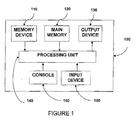
- Fig. 1 is a diagram including housing 100 containing a processor arrangement including a memory device 110, a main memory 120, an output device 130, a central processing unit (CPU) 140, a console 150 and an input device 160.
- the central processing unit (CPU) 140 reads a control program from the main memory 120, and follows instructions inputted from the console 150 to perform information processing using document data inputted from the input device 160 and information on a training document and an actual document stored in the memory device 110 to detect a close topic class-pair, a deteriorated document class, etc. and output these to the output device 130.
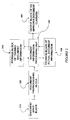
- Fig. 2 is a block diagram including a document input block 210; a document preprocessing block 220; a document information processing unit 230; a storage block 240 of training document information; a storage block 250 of actual document information; an output block 260 of an improper document class(es).
- a set of documents which auser wishes to process are inputted into the document input block 210.
- term extraction, morphological analysis, document vector construction and the like are performed on the inputted document. values for each component of the document vector are determined based on the frequency with which a corresponding term occurs within the text, and based on other information.
- the storage block of training document information 240 stores training document information for each class, which is prepared in advance.
- the storage block 250 of actual document information stores actual document information for each class, which is obtained based on classification results.
- the document information processing unit 230 calculates similarities among all class-pairs for the training document set, and calculates the similarity between a training document set in each class and the actual document set in the same class, and calculates similarities between a training document set in each class and the actual document set in all other classes, for example, to obtain a close topic pair and a deteriorated class.
- the output block 260 of an improper document class(es) outputs the results obtained by the document information processing unit 230 to an output device such as a display.
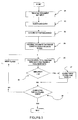
- Fig. 3 is a flowchart of Embodiment 1 of operations performed by the processor of Fig. 1 for detecting a close topic pair in a given training document set.
- the method of Fig. 3 is typically practiced on a general-purpose computer by running a program that incorporates.
- Fig. 3 is a flowchart of operation by a computer running such a program.
- Block 21 represents input of the training document set.
- Block 22 represents class labeling.
- Block 23 represents document preprocessing.
- Block 24 represents construction of a training document database for each class.
- Block 25 represents calculation of the class-pair similarity for the training document sets.
- Block 26 represents a comparison made between the similarity and a threshold value.
- Block 27 represents output of a class-pair having a similarity that exceeds the threshold value.
- Block 28 represents processing to check whether processing is completed for all class-pairs.
- Embodiment 1 is described using an English text document as an example.
- document sets for building the document classification system are inputted.
- class labeling names of classes to which the documents belong are assigned to each document according to definitions of classes in advance. In some cases, 2 or more class names are assigned to one document.
- preprocessing is performed on each of the input documents, which includes term extraction, morphological analysis, construction of the document vectors, and the like. In some instances, a document is divided into segments and document segment vectors are constructed, so that the document is expressed by a set of document segment vectors.
- the term extraction involves searching for words, numerical formulae, a series of symbols, and the like in each of the input documents.
- words", “series of symbols”, and the like are referred to collectively as "terms”. In English text documents, it is easy to extract terms because a notation method in which the words are separately written has been established.
- the document vectors are constructed first by determining the number of dimensions of the vectors which are to be created from the terms occurring in the overall documents, and determining correspondence between each dimension and each term.
- Vector components do not have to correspond to every term occurring in the document. Rather, it suffices to use the results of the parts of speech tagging to construct the vectors using, for example, only those terms that are judged to be nouns or verbs.
- the frequency values of the terms occurring in each of the documents, or values obtained fromprocessing those values are assigned to vector components of the corresponding document.
- Each of the input documents may be divided into document segments.
- the document segments are the elements that constitute the document, and their most basic units are sentences. In the case of English text documents, the sentences end with a period and a space follows thereafter, thus enabling easy extraction of the sentence.
- Other methods of dividing the documents into document segments include a method of dividing a complex sentence into principal clause and at least one subordinate clause, a method in which plural sentences are collected into the document segments so that the number of the terms of the document segments are substantially equal, and a method in which the document is divided from its head irrespective of sentences so that the numbers of terms included in the document segments are substantially equal.
- the document segment vectors are constructed similarly to the construction cf the document vectors. That is, either the frequency values of the terms occurring in each of the document segments, or values obtained from processing those values, are assigned to vector components of the corresponding document segment. As an example, it is assumed that the number of kinds of terms to be used in the classification is M, and M-dimension vectors are used to express the document vectors.
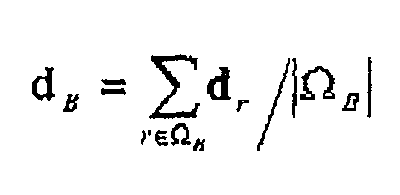
- d r be the vector for a given document. Assume that "0" indicates non-existence of a term and "1" indicates existence of a term.
- the preprocessing results for each document are sorted on a class basis and are stored in the databases based on the results from block 22.
- the training document sets are used to calculate similarities for designated class-pairs. For the first repetition, the class-pair is predetermined; from the second time onward, the class-pair is designated according to instructions from block 28.
- the matrices are derived as follows :
- the similarity sim( ⁇ A , ⁇ B ) between the training document sets in class A and class B is defined by the following formula using the components of the matrix S A and the matrix S°:
- 5 A mn represents a component value of the m-th row and the n-th column in the matrix S A .
- M indicates the dimension of the document segment vector, i.e., the number of types of terms occurring in the document. If the components of the document segment vector are binary (i.e., if "1" indicates existence of the m-th term and "0" non-existence) , then S A mn and S B mn represent the number of document segments where the m-th term and the n-th term co-occur in the training document sets in class A and class B, respectively.
- This is clear from Formula (2) and Formula (3).
- the similarity of the training document sets between the designated classes does exceed the threshold value that has been designated in advance, then the class-pair concerned is detected as a close topic class-pair. More specifically, with the proviso that a represents a threshold value, if the relationship sim( ⁇ A , ⁇ B ) > ⁇ is satisfied, the topic is considered to be close (similar) between the classes A and B.
- the value of a can be set easily by experiments using a training document set having known topical content.
- the class definitions have to be then reviewed with respect to that pair, reconsideration should given to whether or not to create those classes, and the appropriateness of the labeling of those training documents is verified.
- a check is performed to verify whether or not the processing of blocks 25, 26, and 27 was performed for all the class-pairs. If there are no un-processed class-pair, then the processing ends. If there is an un-processed class-pair, then the next class-pair is designated and the processing returns to block 25.
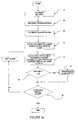
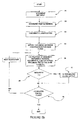
- Fig. 5A and Fig. 5B are flow diagrams of operations performed by the processor of Fig. 1 for Embodiment 2 and Embodiment 3.
- Figs. 8A and 5B are operations for detecting the deteriorated class, as applied in an actual document classification system. The method can also be practiced on a general-purpose computer by running a program that runs the programs of Fig. 5A and Fig. 5B.
- Block 31 represents document set input.
- Block 32 represents document preprocessing.
- Block 33 represents document classification processing.
- Block 34 represents construction of an actual document database for each class.
- Block 35 represents calculation of the similarity between a training document set and the actual document set in the same class.
- Block 36 represents a comparison between the similarity and a threshold value.
- Block 37 represents processing that is performed in a csae where the similarity between the training document set in each class and the actual document set in the same class exceeds the threshold value.
- Block 38 represents processing to check whether processing is complete for all classes.
- the document to be actually classified is supplied to the document classification system which is in a state of operation.
- the same document preprocessing is performed as in block 23 in Fig. 2, and aL block 33, document classification processing is performed on the inputted document.
- Various methods have already been developed for classifying documents, including: vector space model, the k nearest neighbor (kNN) method, the naive Bayes method, the decision tree method, the support vector machines method, the boosting method, etc. Any of these methods can be used in block 33.
- the actual document database is constructed for each class using the results from the document classification processing performed at block 33.
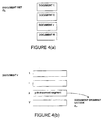
- the actual document sets that are classified into class A and class B are represented as ⁇ ' A and ⁇ ' B , respectively.
- the similarity between the training document set in a designated class and the actual document set in the same class is calculated.
- the class is designated in advance; from the second repetition onward, the designation of the class-pair is done according to instructions from block 38.
- the similarity sim( ⁇ A , ⁇ ' A ) between the training document set ⁇ A in class A and the actual document set ⁇ ' A in the same class is obtained similarly to Formula (1) and Formula (4).
- the similarity is compared against the threshold value, and then at block 37, detection is performed to find a deteriorated class.
- the threshold value used at this time is defined as ⁇ , when the following relationship of: sim( ⁇ A , ⁇ ' A ) ⁇ ⁇ is satisfied, the topic of the actual document which should be in class A is considered to be shifted, and the class model for class A is judged to be deteriorated.
- a check is performed to verify whether the processing of blocks 35, 36, and 37 has been performed on all the classes. If there are no un-processed classes, then the processing ends. If there is an unprocessed class, then the next class is designated and the processing returns to block 35.
- Blocks 31 through 34 are similar to those of Fig. 5A, so explanations thereof are omitted here.
- Block 40 and block 41 correspond to processing performed in a case where the similarity of the training document set in each class and the actual document set in the other classes exceeds a threshold value.
- Block 42 represents processing to check whether the processing is completed for all class-pairs.
- the similarity sim ( ⁇ A , ⁇ ' B ) between the training document set ⁇ A of class A and the actual document set ⁇ ' B of class B (the third similarity) are obtained blocks 40 and 41 by using Formula (1) and Formula (4).
- the class-pair is designated in advance; from the second repetition onward, the class-pair is designated according to instructions from block 42.
- the threshold value in block 40 and block 41 is defined as y, when the following relationship of: sim( ⁇ A , ⁇ ' B ) > ⁇ is satisfied, the topic of the document in class B is close to class A and the class models of both class A and class B are judged to be deteriorated.
- Block 42 is the ending processing.
- a check is performed to verify whether or not the processing of blocks 39, 40, and 41 has been performed for all the class-pairs. If there are no un-processed class-pairs, then the processing ends. If there is an un-processed class-pair, then the next class-pair is designated and the processing returns to block 39.
- the values of ⁇ and y, which are used in embodiment 2 and Embodiment 3, must be set in advance by way of experiment using training document sets having known topical content.
- FIG. 1 is a diagram of the relationship between the degree of topical closeness in each class-pair and an error rate. Each point corresponds to a specific class-pair.
- the horizontal axis Figure 6 represents the similarity of the training document sets between classes in percentage.
- the vertical axis represents the error rate for the test document sets between two classes in percentage.
- the training document set and the test document set are designated in the Reuters-21578 document corpus, and therefore the test document set is treated as the actual document set.
- the error rate between class A and class B is a value which is derived by dividing the sum of the number of the class A documents misclassified into class B documents and the number of the class B documents misclassified into class A documents by the sum of the documents in class A and class B.
- Fig. 6 indicates that class-pairs with a high similarity (i.e., close topic class-pairs) for the training document set have a high error rate for the test document set.
- Fig. 6 proves that embodiments 2 and 3 can easily detect close topic class-pairs.
- Fig. 7 is a diagram indicating detection of the deteriorated class as an example.
- the horizontal axis represents, in percentage, the similarity of training document set and the test document set in the same class.
- the vertical axis represents, in percentage, a recall with respect to the test document set.
- Fig. 7 indicates the relationship between the similarity and the recall. Each point corresponds to a single class.
- the recall is low
- the similarity between the training document set and the test document set is also low. Therefore, by selecting classes with the lower similarities than the threshold, deteriorated classes can be easily detected. Class models only need to be updated for those deteriorated. This can reduce costs significantly as compared to when the class models must be updated for all the classes.
Landscapes
- Engineering & Computer Science (AREA)
- Theoretical Computer Science (AREA)
- Data Mining & Analysis (AREA)
- Physics & Mathematics (AREA)
- General Physics & Mathematics (AREA)
- General Engineering & Computer Science (AREA)
- Bioinformatics & Cheminformatics (AREA)
- Evolutionary Biology (AREA)
- Evolutionary Computation (AREA)
- Computer Vision & Pattern Recognition (AREA)
- Bioinformatics & Computational Biology (AREA)
- Artificial Intelligence (AREA)
- Life Sciences & Earth Sciences (AREA)
- Databases & Information Systems (AREA)
- Mathematical Physics (AREA)
- Software Systems (AREA)
- Information Retrieval, Db Structures And Fs Structures Therefor (AREA)
Abstract
Description



Claims (18)
- A document classification evaluation system having a unit to perform classification of an input document by matching the input document to class models for classes based on training document information for each class, the system comprising:(a) a first calculator to calculate a similarity with respect to all class-pairs using a training document set for each class; and(b) a detector to detect a class-pair where the similarity is greater than a threshold value.
- A document classification evaluation system according to claim 1, wherein the first calculator comprises:(a) a first selector to detect and select terms used for detecting a class-pair from each training document;(b) a first divider to divide each training document into document segments;(c) a first vector generator to generate, for each training document, a document segment vector having a corresponding component with a value relevant to an occurrence frequency of a term occurring in the document segment; and(d) a second calculator to calculaLe similarities between training document sets for all the class-pairs based on the document segment vector of each training document.
- A document classification evaluation system having a unit to perform classification of an input document by matching the input document to class models for classes based on training document information for each class, the system comprising:(a) a first constructor to construct a class model for each document class based on a training document set;(b) a second constructor to construct an actual document set bymatching the input document to the class models for classification and sorting the input document into the document class to which the input document belongs;(c) a calculator to calculate a similarity between the training document set and the actual document set in the same class with respect to all document classes; and(d) a detector to detect a class where the similarity is smaller than a threshold value.
- A document classification evaluation system having a unit to perform classification of an input document by matching the input document to class models for classes based on training document information for each class, the system comprising:(a) a first constructor to construct a class model for each document class based on a training document set;(b) a second constructor to construct an actual document set by matching the input document to the class models for classification and sorting the input document into the document class to which the input document belongs;(c) a calculator to calculate a similarity between the training document set in each individual document class and the actual document set in all other document classes; and(d) a detector to detect a class-pair where the similarity is greater than a third threshold value.
- A document classification evaluation system according to claim 3 or 4, wherein the calculator comprises:(a) a selector to detect and select terms used for detecting one of a class and a class-pair from each training document and each actual document;(b) a divider to divide each training document and each actual document into document segments;(c) a vector generator to generate, for each training document and each actual document, a document segment vector having a corresponding component with a value relevant to an occurrence frequency of a term occurring in the document segment; and(d) another calculator to calculate the similarity based on the document segment vector of each training document and each actual document.
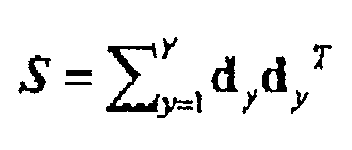
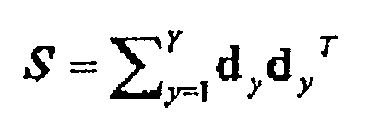
- A document classification evaluation system according to any preceding claim, comprising a further calculator to calculate the similarity based on a product sum of corresponding components between two total matrices each of which is obtained as the sum of co-occurring matrices S of all documents in each document set, wherein a co-occurring matrix S in a document is defined as;where the number of types of terms is M, there are Y document segments, and the vector of the y-th document segment is defined as dy = (dy1,...,dyM)T (where T represents a vector transpose).
- A storage medium or storage device storing a document classification evaluation program which causes a computer to operate a unit to perform classification of an input document by matching the input document to class models for classes constructed based on training document information for each class, the program further causing the computer to operate as:(a) a calculator to calculate a similarity with respect to all class-pairs using a training document set for each class; and(b) a detector to detect a class-pair where the similarity is greater than a threshold value.
- A storage medium or storage device storing a document classification evaluation program which causes a computer to operate a unit to perform classification of an input document by matching the input document to class models for classes constructed based on training document information for each class, the program further causing the computer to operate as:(a) a first constructor to construct a class model for each document class based on a training document set;(b) a second constructor to construct an actual document set by matching the input document to the class models for classification and sorting the input document into the document class to which the input document belongs;(c) a calculator to calculate a similarity between the training document set and the actual document set in the same class with respect to all document classes; and(d) a detector to detect a class where the similarity is smaller than a threshold value.
- A storage medium or storage device storing a document classification evaluation program which causes a computer to operate a unit to perform classification of an input document by matching the input document to class models for classes constructed based on training document information for each class, the program further causing the computer to operate as:(a) a first constructor to construct a class model for each document class based on a training document set;(b) a second constructor to construct an actual document set by matching the input document to the class models for classification and sorting the input document into the document class to which the input document belongs;(c) a calculator to calculate a similarity between the training document set in each individual document class and the actual document set in all other document classes; and(d) a detector to detect a class-pair where the similarity is greater than a threshold value.
- A document classification evaluation method that performs classification of an input document by matching the input document to class models for classes constructed based on training document information for each class, the method comprising the steps of:(a) calculating a similarity with respect to all class-pairs using a training document set for each class; and(b) detecting a class-pair where the similarity is greater than a threshold value.
- A document classification evaluation method according to claim 10, wherein the step of calculating the similarity comprises the steps of:(a) detecting and selecting terms used for detecting a class-pair from each training document;(b) dividing each training document into document segments;(c) generating, for each training document, a document segment vector whose corresponding component has a value relevant to an occurrence frequency of a term occurring in the document segment; and(d) calculating similarities between training document sets for all the class-pairs based on the document segment vector of each training document.
- A document classification evaluation method that performs classification of an input document by matching the input document to class models for classes constructed based on training document information for each class, the method comprising the steps of:(a) constructing a class model for each document class based on a training document set;(b) constructing an actual document set by matching the input document to the class models for classification and sorting the input document into the document class to which the input document belongs;(c) calculating a similarity between the training document set and the actual document set in the same class with respect to all document classes; and(d) detecting a class where the similarity is smaller than a threshold value.
- A document classification evaluation method that performs classification of an input document by matching the input document to class models for classes constructed based on training document information for each class, the method comprising the steps of:(a) constructing a class model for each document class based on a training document set;(b) constructing an actual document set by matching the input document to the class models for classification and sorting the input document into the document class to which the input document belongs;(c) calculating a similarity between the training document set in each individual document class and the actual document set in all other document classes; and(d) detecting a class-pair where the similarity is greater than a threshold value.
- A document classification evaluation method according to claim 12 or 13, wherein the step of calculating the similarity comprises the steps of:a class and a class-pair from each training document and each actual document;(b) dividing each training document and each actual document into document segments;(c) generating, for each training document and each actual document, a document segment vector whose corresponding component has a value relevant to an occurrence frequency of a term occurring in the document segment; and(d) calculating the similarity based on the document segment vector of each training document and each actual document.
- A document classification evaluation method according to any one of claims 10 to 14, comprising the step of calculating the similarity based on a product sum of corresponding components between two total matrices each of which is obtained as the sum of co-occurring matrices S of all documents in each document set, wherein a co-occurring matrix S in a document is defined as:where the number of types of terms occurring is M, there are Y document segments, and the vector of the y-th document segment is defined as dy = (dy1,...,dyM)T (where T represents a vector transpose).
- A storage medium or storage device storing a pattern classification evaluation program which causes a computer to operate a unit to perform classification of an inputted pattern by matching the inputted pattern to class models for classes constructed based on training pattern information for each class, the program further causing the computer to operate as:(a) a calculator to calculate a similarity with respect to all class-pairs using a training pattern set for each class; and(b) a detector to detect a class-pair where the similarity is greater than a threshold value.
- A pattern classification evaluation program which causes a computer to operate a unit to perform classification of an inputted pattern by matching the inputted pattern to class models for classes constructed based on training pattern information for each class, the program further causing the computer to operate as:(a) a first constructor to construct a class model for each pattern class based on a training pattern set;(b) a second constructor to construct an actual pattern set by matching the inputted pattern to the class models for classification and sorting the inputted pattern into the pattern class to which the inputted pattern belongs;(c) a calculator to calculate a second similarity between the training pattern set and the actual pattern seL in the same class with respect to all pattern classes; and(d) a detector to detect a class where the second similarity is smaller than a second threshold value.
- A storage medium or storage device storing pattern classification evaluation program which causes a computer to operate a unit to perform classification of an inputted pattern by matching the inputted pattern to class models for classes constructed based on training pattern information for each class, the program further causing the computer to operate as:(a) a first constructor to construct a class model for each pattern class based on a training pattern set;(b) a second constructor to construct an actual pattern set by matching the inputted pattern to the class models for classification and sorting the inputted pattern into the pattern class to which the inputted pattern belongs;(c) a calculator to calculate a similarity between the training pattern set in each individual pattern class and the actual pattern set in all other pattern classes; and(d) a detector to detect a class-pair where the similarity is greater than a threshold value.
Applications Claiming Priority (4)
| Application Number | Priority Date | Filing Date | Title |
|---|---|---|---|
| JP2003371881 | 2003-10-31 | ||
| JP2003371881 | 2003-10-31 | ||
| JP2004034729A JP2005158010A (en) | 2003-10-31 | 2004-02-12 | Apparatus, method and program for classification evaluation |
| JP2004034729 | 2004-02-12 |
Publications (2)
| Publication Number | Publication Date |
|---|---|
| EP1528486A2 true EP1528486A2 (en) | 2005-05-04 |
| EP1528486A3 EP1528486A3 (en) | 2006-12-20 |
Family
ID=34425419
Family Applications (1)
| Application Number | Title | Priority Date | Filing Date |
|---|---|---|---|
| EP04256655A Withdrawn EP1528486A3 (en) | 2003-10-31 | 2004-10-28 | Classification evaluation system, method, and program |
Country Status (5)
| Country | Link |
|---|---|
| US (1) | US20050097436A1 (en) |
| EP (1) | EP1528486A3 (en) |
| JP (1) | JP2005158010A (en) |
| KR (1) | KR20050041944A (en) |
| CN (1) | CN1612134A (en) |
Families Citing this family (37)
| Publication number | Priority date | Publication date | Assignee | Title |
|---|---|---|---|---|
| US7475335B2 (en) * | 2004-11-03 | 2009-01-06 | International Business Machines Corporation | Method for automatically and dynamically composing document management applications |
| US7716169B2 (en) * | 2005-12-08 | 2010-05-11 | Electronics And Telecommunications Research Institute | System for and method of extracting and clustering information |
| KR100822376B1 (en) | 2006-02-23 | 2008-04-17 | 삼성전자주식회사 | Method and System of Music Subject Classification Using Song Name |
| US9015569B2 (en) * | 2006-08-31 | 2015-04-21 | International Business Machines Corporation | System and method for resource-adaptive, real-time new event detection |
| JP5011947B2 (en) * | 2006-10-19 | 2012-08-29 | オムロン株式会社 | FMEA sheet creation method and FMEA sheet automatic creation apparatus |
| JP5012078B2 (en) * | 2007-02-16 | 2012-08-29 | 大日本印刷株式会社 | Category creation method, category creation device, and program |
| US8073682B2 (en) | 2007-10-12 | 2011-12-06 | Palo Alto Research Center Incorporated | System and method for prospecting digital information |
| US8671104B2 (en) | 2007-10-12 | 2014-03-11 | Palo Alto Research Center Incorporated | System and method for providing orientation into digital information |
| US8165985B2 (en) * | 2007-10-12 | 2012-04-24 | Palo Alto Research Center Incorporated | System and method for performing discovery of digital information in a subject area |
| JP5075566B2 (en) * | 2007-10-15 | 2012-11-21 | 株式会社東芝 | Document classification apparatus and program |
| US7996390B2 (en) * | 2008-02-15 | 2011-08-09 | The University Of Utah Research Foundation | Method and system for clustering identified forms |
| US8965865B2 (en) * | 2008-02-15 | 2015-02-24 | The University Of Utah Research Foundation | Method and system for adaptive discovery of content on a network |
| US8209616B2 (en) * | 2008-08-28 | 2012-06-26 | Palo Alto Research Center Incorporated | System and method for interfacing a web browser widget with social indexing |
| US20100057577A1 (en) * | 2008-08-28 | 2010-03-04 | Palo Alto Research Center Incorporated | System And Method For Providing Topic-Guided Broadening Of Advertising Targets In Social Indexing |
| US8010545B2 (en) * | 2008-08-28 | 2011-08-30 | Palo Alto Research Center Incorporated | System and method for providing a topic-directed search |
| US20100057536A1 (en) * | 2008-08-28 | 2010-03-04 | Palo Alto Research Center Incorporated | System And Method For Providing Community-Based Advertising Term Disambiguation |
| US8549016B2 (en) * | 2008-11-14 | 2013-10-01 | Palo Alto Research Center Incorporated | System and method for providing robust topic identification in social indexes |
| US8452781B2 (en) * | 2009-01-27 | 2013-05-28 | Palo Alto Research Center Incorporated | System and method for using banded topic relevance and time for article prioritization |
| US8239397B2 (en) * | 2009-01-27 | 2012-08-07 | Palo Alto Research Center Incorporated | System and method for managing user attention by detecting hot and cold topics in social indexes |
| US8356044B2 (en) * | 2009-01-27 | 2013-01-15 | Palo Alto Research Center Incorporated | System and method for providing default hierarchical training for social indexing |
| US8868402B2 (en) * | 2009-12-30 | 2014-10-21 | Google Inc. | Construction of text classifiers |
| US9031944B2 (en) | 2010-04-30 | 2015-05-12 | Palo Alto Research Center Incorporated | System and method for providing multi-core and multi-level topical organization in social indexes |
| CN102214246B (en) * | 2011-07-18 | 2013-01-23 | 南京大学 | Method for grading Chinese electronic document reading on the Internet |
| CN103577462B (en) * | 2012-08-02 | 2018-10-16 | 北京百度网讯科技有限公司 | A kind of Document Classification Method and device |
| US10803358B2 (en) | 2016-02-12 | 2020-10-13 | Nec Corporation | Information processing device, information processing method, and recording medium |
| CN110147443B (en) * | 2017-08-03 | 2021-04-27 | 北京国双科技有限公司 | Topic classification judging method and device |
| CN108573031A (en) * | 2018-03-26 | 2018-09-25 | 上海万行信息科技有限公司 | A kind of complaint sorting technique and system based on content |
| KR102410237B1 (en) * | 2019-02-12 | 2022-06-20 | 주식회사 자이냅스 | A method for providing an efficient learning process using a variable classifier |
| KR102408628B1 (en) * | 2019-02-12 | 2022-06-15 | 주식회사 자이냅스 | A method for learning documents using a variable classifier with artificial intelligence technology |
| KR102408637B1 (en) * | 2019-02-12 | 2022-06-15 | 주식회사 자이냅스 | A recording medium on which a program for providing an artificial intelligence conversation service is recorded |
| KR102410239B1 (en) * | 2019-02-12 | 2022-06-20 | 주식회사 자이냅스 | A recording medium recording a document learning program using a variable classifier |
| KR102408636B1 (en) * | 2019-02-12 | 2022-06-15 | 주식회사 자이냅스 | A program for learning documents using a variable classifier with artificial intelligence technology |
| KR102410238B1 (en) * | 2019-02-12 | 2022-06-20 | 주식회사 자이냅스 | A document learning program using variable classifier |
| KR102375877B1 (en) * | 2019-02-12 | 2022-03-18 | 주식회사 자이냅스 | A device for efficiently learning documents based on big data and deep learning technology |
| US12099572B2 (en) * | 2020-04-07 | 2024-09-24 | Technext Inc. | Systems and methods to estimate rate of improvement for all technologies |
| CN112579729B (en) * | 2020-12-25 | 2024-05-21 | 百度(中国)有限公司 | Training method and device for document quality evaluation model, electronic equipment and medium |
| JP2023121908A (en) * | 2022-02-22 | 2023-09-01 | 富士フイルムビジネスイノベーション株式会社 | Information processing device and program |
Family Cites Families (5)
| Publication number | Priority date | Publication date | Assignee | Title |
|---|---|---|---|---|
| US6734880B2 (en) * | 1999-11-24 | 2004-05-11 | Stentor, Inc. | User interface for a medical informatics systems |
| JP2002169834A (en) * | 2000-11-20 | 2002-06-14 | Hewlett Packard Co <Hp> | Computer and method for making vector analysis of document |
| CA2437726A1 (en) * | 2001-02-15 | 2002-08-22 | Suffix Mail Inc. | E-mail messaging system |
| US7359936B2 (en) * | 2001-11-27 | 2008-04-15 | International Business Machines Corporation | Method and apparatus for electronic mail interaction with grouped message types |
| JP3726263B2 (en) * | 2002-03-01 | 2005-12-14 | ヒューレット・パッカード・カンパニー | Document classification method and apparatus |
-
2004
- 2004-02-12 JP JP2004034729A patent/JP2005158010A/en active Pending
- 2004-10-28 EP EP04256655A patent/EP1528486A3/en not_active Withdrawn
- 2004-10-29 CN CNA2004100981935A patent/CN1612134A/en active Pending
- 2004-10-29 KR KR1020040087035A patent/KR20050041944A/en not_active Ceased
- 2004-10-29 US US10/975,535 patent/US20050097436A1/en not_active Abandoned
Also Published As
| Publication number | Publication date |
|---|---|
| EP1528486A3 (en) | 2006-12-20 |
| CN1612134A (en) | 2005-05-04 |
| JP2005158010A (en) | 2005-06-16 |
| US20050097436A1 (en) | 2005-05-05 |
| KR20050041944A (en) | 2005-05-04 |
Similar Documents
| Publication | Publication Date | Title |
|---|---|---|
| EP1528486A2 (en) | Classification evaluation system, method, and program | |
| CN101305370B (en) | Information classification paradigm | |
| JP3726263B2 (en) | Document classification method and apparatus | |
| US6654744B2 (en) | Method and apparatus for categorizing information, and a computer product | |
| US20040049499A1 (en) | Document retrieval system and question answering system | |
| EP1323078A1 (en) | A document categorisation system | |
| WO2009154570A1 (en) | System and method for aligning and indexing multilingual documents | |
| KR102373146B1 (en) | Device and Method for Cluster-based duplicate document removal | |
| CN115062148B (en) | Risk control method based on database | |
| CN111241813B (en) | Corpus expansion method, apparatus, device and medium | |
| CN110688593A (en) | Social media account identification method and system | |
| CN113468339A (en) | Label extraction method, system, electronic device and medium based on knowledge graph | |
| KR20160149050A (en) | Apparatus and method for selecting a pure play company by using text mining | |
| Gopan et al. | Comparative study on different approaches in keyword extraction | |
| Wu et al. | Extracting summary knowledge graphs from long documents | |
| Palliyali et al. | Comparative study of extractive text summarization techniques | |
| CN111898375B (en) | Automatic detection and division method for article discussion data based on word vector sentence chain | |
| CN115935983A (en) | Event extraction method and device, electronic equipment and storage medium | |
| Tsarev et al. | Supervised and unsupervised text classification via generic summarization | |
| Tschuggnall et al. | Automatic Decomposition of Multi-Author Documents Using Grammar Analysis. | |
| Khomytska et al. | Automated Identification of Authorial Styles. | |
| KR20050033852A (en) | Apparatus, method, and program for text classification using frozen pattern | |
| CN112949287A (en) | Hot word mining method, system, computer device and storage medium | |
| Silva et al. | A Statistical Approach for Multilingual Document Clustering and Topic Extraction from Clusters | |
| Sigletos et al. | Role identification from free text using hidden Markov models |
Legal Events
| Date | Code | Title | Description |
|---|---|---|---|
| PUAI | Public reference made under article 153(3) epc to a published international application that has entered the european phase |
Free format text: ORIGINAL CODE: 0009012 |
|
| AK | Designated contracting states |
Kind code of ref document: A2 Designated state(s): AT BE BG CH CY CZ DE DK EE ES FI FR GB GR HU IE IT LI LU MC NL PL PT RO SE SI SK TR |
|
| AX | Request for extension of the european patent |
Extension state: AL HR LT LV MK |
|
| PUAL | Search report despatched |
Free format text: ORIGINAL CODE: 0009013 |
|
| AK | Designated contracting states |
Kind code of ref document: A3 Designated state(s): AT BE BG CH CY CZ DE DK EE ES FI FR GB GR HU IE IT LI LU MC NL PL PT RO SE SI SK TR |
|
| AX | Request for extension of the european patent |
Extension state: AL HR LT LV MK |
|
| 17P | Request for examination filed |
Effective date: 20070416 |
|
| AKX | Designation fees paid |
Designated state(s): DE FR GB |
|
| 17Q | First examination report despatched |
Effective date: 20080310 |
|
| STAA | Information on the status of an ep patent application or granted ep patent |
Free format text: STATUS: THE APPLICATION IS DEEMED TO BE WITHDRAWN |
|
| 18D | Application deemed to be withdrawn |
Effective date: 20110503 |