EP1526366A1 - Method for detecting strain state of tire, device for detecting the strain state, sensor unit for the method and device, and tire provided with the sensor unit - Google Patents
Method for detecting strain state of tire, device for detecting the strain state, sensor unit for the method and device, and tire provided with the sensor unit Download PDFInfo
- Publication number
- EP1526366A1 EP1526366A1 EP03741491A EP03741491A EP1526366A1 EP 1526366 A1 EP1526366 A1 EP 1526366A1 EP 03741491 A EP03741491 A EP 03741491A EP 03741491 A EP03741491 A EP 03741491A EP 1526366 A1 EP1526366 A1 EP 1526366A1
- Authority
- EP
- European Patent Office
- Prior art keywords
- tire
- frequency
- electromagnetic wave
- distortion
- sensor unit
- Prior art date
- Legal status (The legal status is an assumption and is not a legal conclusion. Google has not performed a legal analysis and makes no representation as to the accuracy of the status listed.)
- Withdrawn
Links
Images









Classifications
-
- B—PERFORMING OPERATIONS; TRANSPORTING
- B60—VEHICLES IN GENERAL
- B60C—VEHICLE TYRES; TYRE INFLATION; TYRE CHANGING; CONNECTING VALVES TO INFLATABLE ELASTIC BODIES IN GENERAL; DEVICES OR ARRANGEMENTS RELATED TO TYRES
- B60C19/00—Tyre parts or constructions not otherwise provided for
-
- B—PERFORMING OPERATIONS; TRANSPORTING
- B60—VEHICLES IN GENERAL
- B60C—VEHICLE TYRES; TYRE INFLATION; TYRE CHANGING; CONNECTING VALVES TO INFLATABLE ELASTIC BODIES IN GENERAL; DEVICES OR ARRANGEMENTS RELATED TO TYRES
- B60C23/00—Devices for measuring, signalling, controlling, or distributing tyre pressure or temperature, specially adapted for mounting on vehicles; Arrangement of tyre inflating devices on vehicles, e.g. of pumps or of tanks; Tyre cooling arrangements
- B60C23/02—Signalling devices actuated by tyre pressure
- B60C23/04—Signalling devices actuated by tyre pressure mounted on the wheel or tyre
- B60C23/0491—Constructional details of means for attaching the control device
- B60C23/0493—Constructional details of means for attaching the control device for attachment on the tyre
-
- B—PERFORMING OPERATIONS; TRANSPORTING
- B60—VEHICLES IN GENERAL
- B60T—VEHICLE BRAKE CONTROL SYSTEMS OR PARTS THEREOF; BRAKE CONTROL SYSTEMS OR PARTS THEREOF, IN GENERAL; ARRANGEMENT OF BRAKING ELEMENTS ON VEHICLES IN GENERAL; PORTABLE DEVICES FOR PREVENTING UNWANTED MOVEMENT OF VEHICLES; VEHICLE MODIFICATIONS TO FACILITATE COOLING OF BRAKES
- B60T8/00—Arrangements for adjusting wheel-braking force to meet varying vehicular or ground-surface conditions, e.g. limiting or varying distribution of braking force
- B60T8/17—Using electrical or electronic regulation means to control braking
- B60T8/172—Determining control parameters used in the regulation, e.g. by calculations involving measured or detected parameters
- B60T8/1725—Using tyre sensors, e.g. Sidewall Torsion sensors [SWT]
-
- B—PERFORMING OPERATIONS; TRANSPORTING
- B60—VEHICLES IN GENERAL
- B60T—VEHICLE BRAKE CONTROL SYSTEMS OR PARTS THEREOF; BRAKE CONTROL SYSTEMS OR PARTS THEREOF, IN GENERAL; ARRANGEMENT OF BRAKING ELEMENTS ON VEHICLES IN GENERAL; PORTABLE DEVICES FOR PREVENTING UNWANTED MOVEMENT OF VEHICLES; VEHICLE MODIFICATIONS TO FACILITATE COOLING OF BRAKES
- B60T2240/00—Monitoring, detecting wheel/tyre behaviour; counteracting thereof
- B60T2240/04—Tyre deformation
Definitions
- the present invention relates to a tire distortion detecting method for detecting a distortion of a tire during the running of a vehicle, a distortion detector, a sensor unit thereof, and a tire having the same.
- ABS Anti-Lock Brake System
- a traction control system In order to prevent accidents caused by skids and a fast start, Anti-Lock Brake System (hereinafter referred to as ABS) and a traction control system are developed, and a stability control system having a YAW sensor is also developed in addition to these systems.
- ABS Anti-Lock Brake System
- a stability control system having a YAW sensor is also developed in addition to these systems.
- ABS is a system of detecting a rotating state of each tire and controlling a braking force based on detection results so as to prevent the tires from locking.
- the number of revolutions, an air pressure, a distortion, and so forth of each tire are detected as a rotating state of the tire and detection results can be used for control.
- a detector for automatically detecting an air pressure of a tire uses a so-called “indirect” method of detecting an air pressure of a tire. In this method, data is inputted from an ABS speed sensor to estimate an air pressure of a tire.
- a method of detecting an air pressure of a tire that is used for the detector, the following methods are known: (a) a method of calculating a change (distortion) in the rolling radius of a tire from an angular speed of rotation of a wheel, the change being caused by a reduced air pressure, and (b) a method of performing FFT (Fast Fourier Transform) on an input signal and performing calculations using a change in the natural frequency of a tire.
- FFT Fast Fourier Transform
- magnetic bar codes are provided which are arranged in lines in the circumferential direction of the side wall of a tire with adjacent parts alternately changed in polarity, and the bar codes are read by a sensor fixed on a chassis and a wheel shaft. Thus, the rotating speed of the tire can be detected. Further, the magnetic bar codes are provided in two or more lines in the radius direction of the tire, thereby calculating a force and a deformation in the radius direction of the tire based on a phase difference between the detection results of the inner and outer magnetic bar codes.
- conventional example 2 reduces the difficulty and discloses a tire improved in the resolution of magnetic bar codes arranged in lines in the circumferential direction of the side wall of the tire with adjacent parts alternately changed in polarity.
- the magnetic bands may gradually decrease in magnetization due to heat generated on the tire during the running of a vehicle and the detection of the sensor may become more difficult as running time increases.
- an object of the present invention is to provide a tire distortion detecting method for detecting a distortion of the tire during the running of a vehicle, a distortion detector, a sensor unit thereof, and a tire having the same that can reduce the occurrence of a deterioration and can be used for a control system such as a stability control system.
- a tire distortion detecting method of the present invention when a distortion of a tire is detected by using a plurality of sensor units which are embedded in the tire at predetermined intervals in the circumferential direction of the tire and each have a conductor pattern changed in shape according to a distortion of the tire, and a monitoring device having a radiation unit provided in a tire house of a vehicle, an electromagnetic wave of a first frequency is radiated from the radiation unit to the sensor unit.
- the sensor unit having received the electromagnetic wave of the first frequency converts the energy of the electromagnetic wave of the first frequency into electric energy and uses the electric energy to drive electromagnetic wave radiating means.
- the electromagnetic wave radiating means changes a resonance frequency in a frequency band having a predetermined width including a second frequency, which serves as a fundamental frequency, and the electromagnetic wave radiating means radiates an electromagnetic wave.
- the monitoring device receives the electromagnetic wave having been radiated from the electromagnetic wave radiating means of the sensor unit, detects at least one of the intensity, phase, and frequency of the received electromagnetic wave, and detects a distortion of the tire by comparing the detection result and a detection result stored when no distortion occurs on the tire.
- the sensor unit having received the electromagnetic wave of the first frequency converts the energy of the electromagnetic wave of the first frequency into electric energy, the electromagnetic wave being radiated from the radiation unit provided in the tire house to the sensor unit embedded in the tire, and the sensor unit drives the electromagnetic wave radiating means by using the electric energy to radiate an electromagnetic wave.
- the electromagnetic wave radiating means of the sensor unit changes a resonance frequency in a frequency band having the predetermined width including the second frequency, which serves as the fundamental frequency, and the electromagnetic wave radiating means radiates the electromagnetic wave. Since the conductor pattern is embedded in the tire, the conductor pattern is deformed according to a distortion of the tire. As a result, changes are made on an electrical resonance frequency of the conductor pattern, a phase of an electromagnetic wave when the conductor pattern is used as an antenna, and so on.
- the monitoring device receives an electromagnetic wave having been radiated from the sensor unit. At this point, the received electromagnetic wave is changed in phase, field intensity, frequency, and so on according to a deformation of the conductor pattern.
- the monitoring device detects at least one of the phase, field intensity, and frequency of the electromagnetic wave having been received from the sensor unit when no distortion occurs on the tire, e.g., at the start of the vehicle, and the monitoring device stores the detection result.
- the monitoring device detects at least one of the phase, field intensity, and frequency of the electromagnetic wave having been received from the sensor unit, e.g., during the running of the vehicle, and the monitoring device detects a distortion of the tire by comparing the detection result and a stored value of the detection result obtained when no distortion occurs on the tire.
- the radiation unit radiates an electromagnetic wave to the one or more sensor units of the tire within a predetermined distance from a position where the radiation unit is attached.
- a distortion of the tire can be detected within the predetermined distance by receiving an electromagnetic wave radiated from the one or more sensor units within the predetermined distance from the position where the radiation unit is attached.
- an electromagnetic wave is radiated in a time sharing manner from the radiation units disposed on two or more different positions of the tire house, so that a distortion in a different part of one tire can be detected for each of the radiation units.
- the tire distortion detecting method of the present invention by setting the first frequency and the second frequency at a frequency of 1 GHz or higher, the influence of a reinforcing metal provided in the tire is reduced and large changes are obtained in the phase, field intensity, frequency, and so on of the electromagnetic wave. Such changes are resulted from a deformation of the conductor pattern.
- the sensor unit transmits identification information specific to the sensor unit by using the electromagnetic wave, and the monitoring device identifies the sensor unit based on the identification information received from the sensor unit.
- the tire distortion detecting method of the present invention each of the sensor units can be identified by the identification information. Thus, even when the sensor units are provided in two or more tires attached to the vehicle, a distortion can be detected for each of the tires.
- a tire distortion detector for detecting a distortion of a tire during the running of a vehicle is constituted of a plurality of sensor units embedded in the tire at predetermined intervals in the circumferential direction of the tire, and a monitoring device including a radiation unit provided in a tire house of the vehicle.
- the sensor unit comprises a conductor pattern of a predetermined shape on a surface of a sheet which is flexible and electrically insulative with a predetermined area, means for receiving an electromagnetic wave of a first frequency from the radiation unit and converting the high frequency energy of the electromagnetic wave into electric energy, and means which is operated by the electric energy, is connected to the conductor pattern, changes a resonance frequency, according to a distortion of the conductor pattern, in a frequency band having a predetermined width including a second frequency serving as a fundamental frequency, and radiates an electromagnetic wave.
- the monitoring device comprises means for radiating the electromagnetic wave of the first frequency from the radiation unit to the sensor unit, means for receiving an electromagnetic wave radiated from the sensor unit, means for detecting at least one of the intensity, phase, and frequency of the received electromagnetic wave, means for storing a detection result obtained when no distortion occurs on the tire, and means for detecting a distortion of the tire by comparing the detection result and the detection result obtained when no distortion occurs on the tire.
- the tire distortion detector of the present invention when the electromagnetic wave of the first frequency is radiated from the radiation unit provided in the tire house to the sensor unit embedded in the tire, the energy of the electromagnetic wave of the first frequency is converted into electric energy in the sensor unit having received the electromagnetic wave of the first frequency and an electromagnetic wave of the second frequency is radiated from the sensor unit by the electric energy.
- the electromagnetic wave radiated from the sensor unit is changed in resonance frequency in the frequency band having the predetermined width including the second frequency, which serves as the fundamental frequency. Since the conductor pattern is embedded in the tire, the conductor pattern is deformed according to a distortion of the tire. As a result, according to a distortion of the tire, changes are made on an electrical resonance frequency of the conductor pattern, a phase of an electromagnetic wave when the conductor pattern is used as an antenna.
- the electromagnetic wave radiated from the sensor unit is received by the monitoring device and an electromagnetic wave received by an external device is changed in phase, field intensity, frequency and so on according to a deformation of the conductor pattern.
- the monitoring device detects at least one of the phase, field intensity, and frequency of the received electromagnetic wave, compares the detection result and a stored value of a detection result obtained when no distortion occurs on the tire, and detects a distortion of the tire based on the comparison result.
- the tire distortion detector of the present invention at least a part of the conductor pattern is shaped like a rectangular wave and thus the positional relationship of the adjacent parts in the conductor pattern is readily changed according to a distortion of the tire.
- an electrical characteristic such as a resonance frequency of the conductor pattern is readily changed according to a distortion of the tire. Therefore, it is possible to obtain large changes in the phase, field intensity, frequency and so on of an electromagnetic wave radiated from the sensor unit, according to a distortion of the tire.
- the tire distortion detector of the present invention by setting the first frequency and the second frequency at a frequency of 1 GHz or higher, the influence of a reinforcing metal provided in the tire is reduced and large changes are obtained in the phase, field intensity, frequency, and so on of the electromagnetic wave. Such changes are resulted from a deformation of the conductor pattern.
- the first frequency and the second frequency are set at the same frequency and the monitoring device comprises means for alternately repeats the radiation of an electromagnetic wave of the first frequency and the reception of an electromagnetic wave radiated from the sensor unit.
- the monitoring device comprises means for alternately repeats the radiation of an electromagnetic wave of the first frequency and the reception of an electromagnetic wave radiated from the sensor unit.
- the monitoring device comprises a plurality of radiation units provided on two or more different position of the tire house and means for radiating an electromagnetic wave in a time sharing manner from each of the radiation units. Moreover, each of the radiation units radiates an electromagnetic wave to the one or more sensor units of the tire within a predetermined distance from a position where the scanner unit is attached. According to the tire distortion detector of the present invention, a distortion in a different part of one tire can be detected for each of the radiation units.
- the sensor unit has means for switching the use of the conductor pattern serving as an antenna between the reception of an electromagnetic wave of the first frequency and the radiation of an electromagnetic wave of the second frequency.
- the conductor pattern can be used as an antenna for receiving an electromagnetic wave of the first frequency or radiating an electromagnetic wave of the second frequency, thereby reducing the shape of the sensor unit.
- the sensor unit comprises means for storing identification information specific to the sensor unit and means for transmitting the stored identification information by using an electromagnetic wave.
- the monitoring device comprises means for receiving the identification information transmitted from the sensor unit and means for identifying the sensor unit based on the received identification information.
- each of the sensor units can be identified by the identification information.
- the identification information can be identified by the sensor units.
- the sensor units of the present invention in the tire distortion detector are embedded in the tire at predetermined intervals in the circumferential direction of the tire.
- the sensor unit of the present invention comprises a conductor pattern of a predetermined shape on a surface of a sheet which is flexible and electrically insulative with a predetermined area, means for receiving an electromagnetic wave of a first frequency from the radiation unit and converting the high frequency energy of the electromagnetic wave into electric energy, and means which is operated by the electric energy, is connected to the conductor pattern, changes a resonance frequency, according to a distortion of the conductor pattern, in a frequency band having a predetermined width including a second frequency serving as a fundamental frequency, and radiates an electromagnetic wave.
- the energy of the electromagnetic wave of the first frequency is converted into electric energy in the sensor unit having received the electromagnetic wave of the first frequency and an electromagnetic wave of the second frequency is radiated from the sensor unit by the electric energy.
- the electromagnetic wave radiated from the sensor unit is changed in resonance frequency in the frequency band having the predetermined width including the second frequency, which serves as the fundamental frequency. Since the conductor pattern is embedded in the tire, the conductor pattern is deformed according to a distortion of the tire. As a result, according to a distortion of the tire, changes are made on an electrical resonance frequency of the conductor pattern and a phase or frequency of an electromagnetic wave radiated when the conductor pattern is used as an antenna.
- the electromagnetic wave radiated from the sensor unit is received by the monitoring device and an electromagnetic wave received by an external device is changed in phase, field intensity, frequency and so on according to a deformation of the conductor pattern.
- the monitoring device detects at least one of the phase, field intensity, and frequency of the received electromagnetic wave and detects a distortion of the tire by comparing the detection result and a stored value of a detection result obtained when no distortion occurs on the tire.
- the sensor unit of the present invention at least a part of the conductor pattern is shaped like a rectangular wave and thus the positional relationship of the adjacent parts in the conductor pattern is readily changed according to a distortion of the tire.
- an electrical characteristic of the conductor pattern is readily changed according to a distortion of the tire. Therefore, it is possible to obtain large changes in the phase, field intensity, frequency and so on of an electromagnetic wave radiated from the sensor unit, according to a distortion of the tire.
- the first frequency and the second frequency are set at a frequency of 1 GHz or higher.
- the sensor unit of the present invention has means for switching the use of the conductor pattern serving as an antenna between the reception of an electromagnetic wave of the first frequency and the radiation of an electromagnetic wave of the second frequency. Therefore, according to the sensor unit of the present invention, the conductor pattern is used as an antenna both for radiating an electromagnetic wave and receiving an electromagnetic wave, thereby miniaturizing the sensor unit.
- the sensor unit of the present invention comprises means for storing identification information specific to the sensor unit and means for transmitting the stored identification information by using the electromagnetic wave. According to the sensor unit of the present invention, each of the sensor units can be identified by the identification information. Thus, even when the sensor units are provided in two or more tires attached to the vehicle, a distortion can be detected for each of the tires.
- the plurality of sensor units are embedded in the tire at predetermined intervals in the circumferential direction of the tire.
- the energy of the electromagnetic wave of the first frequency is converted into electric energy in the sensor unit having received the electromagnetic wave of the first frequency and an electromagnetic wave of the second frequency is radiated from the sensor unit by the electric energy.
- the electromagnetic wave radiated from the sensor unit is changed in resonance frequency in the frequency band having the predetermined width including the second frequency, which serves as the fundamental frequency. Since the conductor pattern is embedded in the tire, the conductor pattern is deformed according to a distortion of the tire. As a result, according to a distortion of the tire, changes are made on an electrical resonance frequency of the conductor pattern and a phase of an electromagnetic wave radiated when the conductor pattern is used as an antenna.
- the electromagnetic wave radiated from the sensor unit is received by the monitoring device and an electromagnetic wave received by an external device is changed in phase, field intensity, frequency and so on according to a deformation of the conductor pattern.
- the monitoring device detects at least one of the phase, field intensity, and frequency of the received electromagnetic wave and detects a distortion of the tire by comparing the detection result and a stored value of a detection result obtained when no distortion occurs on the tire.
- At least a part of the conductor pattern is shaped like a rectangular wave and thus the positional relationship of the adjacent parts in the conductor pattern is readily changed according to a distortion of the tire.
- an electrical characteristic of the conductor pattern is readily changed according to a distortion of the tire. Therefore, it is possible to obtain large changes in the phase, field intensity, frequency and so on of an electromagnetic wave radiated from the sensor unit, according to a distortion of the tire.
- the first frequency and the first frequency are set at a frequency of 1 GHz or higher.
- the influence of a reinforcing metal provided in the tire is reduced and large changes are obtained in the phase, field intensity, frequency, and so on of the electromagnetic wave. Such changes are resulted from a deformation of the conductor pattern.
- the plurality of sensor units are disposed in the same layer of the tire.
- At least the four or more sensor units are embedded at regular intervals. Hence, it is possible to detect a distortion substantially around the perimeter of the tire. Further, when at least four sensor units are provided at regular intervals, a distortion occurring on a part between the adjacent sensor units propagates through the constituent elements of the tire to the sensor unit, thereby detecting a distortion substantially around the perimeter of the tire.
- Figure 1 is a schematic view showing a state of mounting a tire distortion detector in a vehicle according to Embodiment 1 of the present invention.
- Figure 2 is a schematic structural diagram showing an electric circuit of the tire distortion detector according to Embodiment 1.
- reference numeral 100 denotes a plurality of sensor units embedded in a tire 300.
- Reference numeral 200 denotes a monitoring device which is disposed in a tire house 400 so as to correspond with the top of the tire 300.
- the tire distortion detector of the present embodiment is constituted of the plurality of sensor units 100 and the monitoring device 200.
- the sensor unit 100 is constituted of an antenna 110 for receiving an electromagnetic wave having a predetermined frequency (first frequency) of 2.45 GHz band, an energy conversion section 120 for converting the energy of a received electromagnetic wave into electric energy, an oscillation section 130 operated by electric energy supplied from the energy conversion section 120, and an antenna 140 which is connected to the oscillation section 130 and radiates an electromagnetic wave having a predetermined frequency (second frequency) of 2.45 GHz band.
- first frequency and the second frequency are both set at 2.45 GHz.
- the sensor unit 100 is configured so that an IC chip constituting the energy conversion section 120, an IC chip constituting the oscillation section 130, the antenna 110 shaped like a loop, and the antenna 140 are sandwiched between two films 150.
- the antenna 140 is composed of a conductor pattern 140a shaped like a rectangular wave and a conductor pattern 140b shaped like a straight line.
- the film 150 is composed of, for example, a polyimide film which is electrically insulative with a width (W2) of 5 mm and a length (L2) of 20 mm. Further, the antennas 110 and 140 are formed on the lower film by printing. The loop antenna 110 is disposed on the periphery of the film 150. Moreover, the conductor pattern 140a shaped like a rectangular wave and the conductor pattern 140b shaped like a straight line are disposed in such a manner as to stretch along the length (L2) of the film 150. The film 150 is flexible enough to be bent along the width, the length, and the thickness thereof.
- the conductor patterns 140a and 140b and other printed wiring patterns are made of a material which hardly enables cutting even when the film 150 is bent according to a distortion of the tire.
- the IC chip constituting the energy conversion section 120 and the IC chip constituting the oscillation section 130 are bonded to the two films 150 via a flexible resin.
- the two or more sensor units 100 configured thus are embedded at regular intervals in the circumferential direction of the tire 300.
- the sensor units 100 are embedded between a cap tread 301 and an under tread 302 so as to stretch in the circumferential direction of the tire.
- the sensor units 100 may be embedded between the under tread 302 and a belt 303A, between the belt 303A and a belt 303B, or between the belt 303B and a carcass 304.
- the influence of the belts 303A and 303B, which have reinforcing metal wires woven therein, is reduced by using a frequency of 2.45 GHz as the first and second frequencies.
- the sensor units 100 can be disposed in any layers of the tire. In this way, in order to reduce the influence of metals such as the reinforcing metal wires in the tire, it is preferable to use a frequency of 1 GHz or higher as the first and second frequencies.
- At least four sensor units 100 are preferably embedded in the tire 300 when being disposed at regular intervals in the circumferential direction of the tire 300. According to experimental results, a distortion of the tire can be sufficiently detected by using four to eight sensor units 100.
- the energy conversion section 120 is constituted of a known rectifier circuit 125 which is composed of diodes 121 and 122, a capacitor 123, and a resistor 124.
- the loop antenna 110 is connected to the input of the rectifier circuit 125, the rectifier circuit 125 rectifies high frequency current having been induced in the antenna 110 and converts the current into direct current acting as electric energy, and the direct current is charged in the capacitor 123 used for smoothing and storage.
- a capacitor of 0.001 to 0.003 F (farad) is used as the capacitor 123 in the present embodiment.
- the oscillation section 130 is constituted of an oscillator circuit 131, a power amplifier circuit 132, a control circuit 133, and an electronic switch 134.
- the oscillator circuit 131 is constituted of a known PLL circuit and so on and outputs a carrier wave having a frequency of 2.45 GHz when power is supplied from the energy conversion section 120 via the electronic switch 134.
- the power amplifier circuit 132 is operated by power supplied from the energy conversion section 120, amplifies a carrier wave outputted from the oscillator circuit 131, and feeds the carrier wave to the antenna 140. Hence, an electromagnetic wave of 2.45 GHz is radiated from the antenna 140.
- an electromagnetic wave of 2.45 GHz is radiated from the antenna 140.
- the antenna 140 is changed in resonance frequency and an electromagnetic wave radiated from the antenna 140 is changed in center frequency, phase, intensity, and so on.
- the control circuit 133 switches the electronic switch 134 from an off state to an on state when a voltage outputted from the energy conversion section 120 reaches a predetermined voltage or higher, e.g., 3 V or higher, so that power is supplied from the energy conversion section 120 to the oscillator circuit 131 and the power amplifier circuit 132.
- a predetermined voltage or higher e.g. 3 V or higher
- the sensor units 100 are embedded in the tire 300 during the manufacturing of the tire 300 and thus the IC chips and other constituent elements are so designed as to be sufficiently resistant to the heat of vulcanization.
- the monitoring device 200 is constituted of a radiation unit 210, a receiving unit 220, a control section 230, an operation section 240, and an arithmetic section 250.
- the radiation unit 210 is constituted of an antenna 211, which radiates an electromagnetic wave having the predetermined frequency (the first frequency) of 2.45 GHz and an oscillation section 212. In response to an instruction from the control section 230, the radiation unit 210 radiate an electromagnetic wave of the first frequency from the antenna 211.
- Figure 6 shows the oscillation section 212 constituted of an oscillator circuit 213 and a power amplifier circuit 214.
- the oscillator circuit 213 is constituted of a known PLL circuit and so on and outputs a carrier wave of 2.45 GHz in response to an instruction from the control section 230.
- the power amplifier circuit 214 amplifies a carrier wave having been outputted from the oscillator circuit 213 and feeds the carrier wave to the antenna 211.
- an electromagnetic wave of 2.45 GHz is radiated from the antenna 211.
- high frequency power outputted from the power amplifier circuit 214 is set at a value enabling the supply of electric energy to the sensor units 100 in the range of a distance L1, the range being formed around the monitoring device 200 (the antenna 211 for radiating an electromagnetic wave) as shown in Figure 1.
- the receiving unit 220 is constituted of an antenna 221, which receives an electromagnetic wave having the predetermined frequency (the second frequency) of 2.45 GHz, and a detecting section 222. In response to an instruction from the control section 230, the receiving unit 220 converts the high frequency energy of the electromagnetic wave, which is received by the antenna 221 and has a frequency band with a predetermined width including the second frequency, into electric energy and outputs the energy as a detection voltage Vout.
- Figure 6 shows the detecting section 222 constituted of a turned circuit 223 and a detector circuit 224.
- the tuned circuit 223 is tuned to an electromagnetic wave in a frequency band of ⁇ f1 having its center at the second frequency (2.45 GHz in the present embodiment), and the turned circuit 223 converts the high frequency energy of the electromagnetic wave into electric energy, e.g., alternating voltage and outputs the voltage.
- the detector circuit 224 converts the alternating voltage having been outputted from the tuned circuit 223 into direct-current voltage and outputs the voltage as the detection voltage Vout.
- the control section 230 drives the oscillation section 212 and radiates an electromagnetic wave for a predetermined time t1 when receiving an initial setting instruction from the operation section 240. Thereafter, the control section 230 drives the detecting section 222 to output the detection voltage Vout during a predetermined time t2, and the control section 230 causes the arithmetic section 250 to store the value of the detection voltage Vout as a reference voltage Vstd.
- the radiation time t1 of the monitoring device 200 is set at 0.15 ms and the receiving time t2 is set at 0.30 ms.
- an electromagnetic wave is radiated from the radiation unit 210 for the time t1, so that a voltage of 3 V or higher can be stored in the energy conversion section 120 of the sensor unit 100 provided within the distance L1.
- the operation section 240 it is enough for the operation section 240 to output a signal for providing the control section 230 with an initial setting instruction.
- the operation section 240 is constituted of a momentary switch.
- control section 230 similarly drives the oscillation section 212 to radiate an electromagnetic wave and outputs the detection voltage Vout to the detecting section 222. Moreover, the control section 230 repeats an operation of calculating a difference between the stored reference voltage Vstd and the detection voltage Vout and outputting the difference to a host device (not shown).
- the amount of energy of an electromagnetic wave is changed according to a distortion of the tire 300.
- the detection voltage Vout has the maximum value when the tire has the minimum distortion, i.e., when the reference voltage Vstd is detected.
- the detection voltage Vout decreases as the tire 300 has a larger distortion.
- a difference (Vstd - Vout) between the reference voltage Vstd and the detection Vout, which is outputted from the operation section 250, is changed according to a distortion of the tire 300, so that a distortion of the tire 300 can be detected by the difference (Vstd - Vout).
- the sensor units 100 are embedded in the tire 300 during the manufacturing of the tire 300 and thus the IC chips and the other constituent elements are so designed as to be sufficiently resistant to the heat of vulcanization.
- the IC chips and the other constituent elements are so designed as to be sufficiently resistant to the heat of vulcanization.
- the tire distortion detector is applicable to, for example, a stability controller 500 shown in Figure 8.
- a conventional and typical stability controller captures detection results outputted from sensors 510 and 520, which detect the number of revolutions of the tire 300 attached to the vehicle, to perform stability control.
- the stability controller 500 comprises the monitoring device 200 and the tire 300 having the sensor units 100 and performs stability control by capturing detection results on a distortion of the tire 300 that are outputted from the monitoring device 200.
- the operation section 240 of the monitoring device 200 may be interlocked with the ignition key of the vehicle and the reference voltage Vstd may be detected at the start of the vehicle.
- the present embodiment enables the detection of a partial distortion of the tire 300 in the range of the distance L1, the range being formed around the antenna 211 for radiating an electromagnetic wave of the monitoring device 200.
- most members constituting the tire 300 are made of a rubber and thus from a portion making contact with a road surface with the largest distortion, a distortion propagates through the constituent elements of the tire to the upper part of the tire 300.
- the sensor units 100 are embedded so as to stretch in the circumferential direction of the tire.
- a distortion of the tire can be detected as in the present embodiment also by using a tire 310 configured as shown in Figure 9, in which the sensor units 100 are embedded so as to stretch in the width direction of the tire.
- two monitoring devices 200A and 200B may be provided at the front and back of the upper part of the tire house 400.
- an electromagnetic wave is radiated and received in a time-sharing manner by the monitoring devices 200A and 200B.
- the monitoring device 200A can detect a distortion of the tire in the range of the angle ⁇ (e.g., 90°) from a horizontal position of the upper front part, the range being formed around the axis of rotation of the tire 300.
- the other monitoring device 200B detects a distortion of the tire in the range of the angle ⁇ (e.g., 90°) from a horizontal position of the upper rear part, the range being formed around the axis of rotation of the tire 300.
- the distance L1 can be changed by varying the high frequency power and the phase of an electromagnetic wave radiated from the monitoring device 200.
- Embodiment 2 of the present invention will be described below.
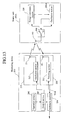
- FIG 11 is a structural diagram showing an electric circuit of a monitoring device according to Embodiment 2 of the present invention.
- the same constituent elements as Embodiment 1 are indicated by the same reference numerals and the explanation thereof is omitted.
- Embodiment 2 the arrangement of a monitoring device 200 and the configurations of a sensor unit 100 and a tire 300 are similar to those of Embodiment 1.
- a receiving unit 220 comprises three antennas 221A to 221C and three detecting sections 222A to 222C respectively connected to the antennas.
- a distortion of the tire 300 is detected by capturing detection voltages Vout-A to Vout-C which are outputted from the detecting sections 222A to 222C by an arithmetic section 250.
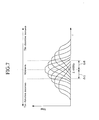
- the first antenna 221A and the first detecting section 222A are similar to those of Embodiment 1 and a frequency band at which the tuned circuit 223A is tuned is a frequency band f A shown in Figure 12.
- a frequency band f B at which the tuned circuit 223B is tuned is shifted by ⁇ f1 to the lower side as shown in Figure 12.
- a frequency band f c at which the tuned circuit 223C is tuned is shifted by ⁇ f1 to the higher side as shown in Figure 12.
- detector circuits 224A to 224C have similar configurations.
- An arithmetic section 250 simultaneously captures detection voltages Vout-A to Vout-C outputted from the detecting sections 222A to 222C and calculates a difference (Vstd - Vout) between a reference voltage Vstd and the detection voltage Vout outputted from the first detecting section 222A as in the case of Embodiment 1. Moreover, by comparing the detection voltages Vout-A to Vout-C outputted from the detecting sections 222A to 222C, the arithmetic section 250 detects whether the frequency of a received electromagnetic wave is shifted to the lower side or the higher side. A change in the distortion of the tire can be detected according to the shift of the frequency.
- a known AFC circuit is also applicable as a method of more specifically detecting a change in the frequency of an electromagnetic wave radiated from the sensor unit 100.
- Embodiment 3 of the present invention will be described below.
- Figure 13 is a structural diagram showing a tire distortion detector according to Embodiment 3 of the present invention.
- Figure 14 is a plan view showing a sensor unit according to Embodiment 3 of the present invention.
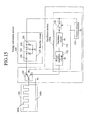
- Figure 15 is a structural diagram showing an example of an electric circuit of the sensor unit according to Embodiment 3.
- the same constituent elements as Embodiment 1 are indicated by the same reference numerals and the explanation thereof is omitted.
- Embodiment 3 comprises sensor units 100A instead of the sensor units 100 of Embodiment 1.
- the loop antenna 110 of Embodiment 1 is omitted and an electromagnetic wave is radiated and received by an antenna 140.
- the sensor unit 100A is constituted of an energy conversion section 120, an oscillation section 130A, the antenna 140, and an electronic switch 160 for connecting the antenna 140 with the energy conversion section 120 or the oscillation section 130A.
- the electronic switch 160 connects the antenna 140 to the energy conversion section 120 in the initial state, and connects the antenna 140 to the oscillation section 130A when the energy conversion section 120 stores electric energy of a predetermined value or higher.
- the sensor unit 100A is configured so that two IC chips 170 and 180 and the antenna 140 are sandwiched between two films 150.
- the antenna 140 is composed of a conductor pattern 140a shaped like a rectangular wave and a conductor pattern 140b shaped like a straight line.
- the film 150 is composed of, for example, a polyimide film having a width (W3) of 3 mm and a length (L3) of 16 mm.
- the antenna 140 is formed on the lower film by printing.
- the conductor pattern 140a shaped like a rectangular wave and the conductor pattern 140b shaped like a straight line are disposed in such a manner as to stretch along the length (L3) of the film 150.
- the IC chip 170 constitutes the energy conversion section 120 and the other IC chip 180 constitutes the oscillation section 130A and the electronic switch 160.
- the IC chip 180 constituting the oscillation section 130A and the electronic switch 160 is disposed between the antenna 140 and the IC chip 170 and is connected to both of the antenna 140 and the IC chip 170.
- FIG. 15 A specific example of the electric circuit of the sensor unit 100A is shown in Figure 15.
- the same constituent elements as the sensor unit 100 of Embodiment 1 are indicated by the same reference numerals and the explanation thereof is omitted.
- an on/off switching control signal of an electronic switch 134 is used as a switching control signal of the electronic switch 160 in the oscillation section 130A.
- the control circuit 133 switches the electronic switch 134 from an off state to an on state to supply power from the energy conversion section 120 to an oscillation circuit 131 and a power amplifier circuit 132, and the control circuit 133 switches the electronic switch 160 to connect the antenna 140 and the output of a power amplifier circuit 132.
- a voltage of a predetermined value or higher e.g., a voltage of 3 V or higher
- the shape of the sensor unit 100 can be reduced.
- Embodiment 4 of the present invention will be described below.
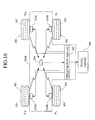
- FIG 16 is a structural diagram showing a tire distortion detector according to Embodiment 4 of the present invention.
- Figure 17 is a structural diagram showing a specific example of an electric circuit of a sensor unit.
- an oscillation section 130B of a sensor unit 100B comprises a modulator circuit 135 and a memory circuit 136 and a monitoring device 200B comprises four radiation units 210A to 210D in Embodiment 4.
- the modulator circuit 135 connects an oscillator circuit 131 and a power amplifier circuit 132.
- the modulator circuit 135 modulates a carrier wave, which is outputted from the modulator circuit 131, in response to a signal (a signal indicating identification information) inputted from a control circuit 133.
- the memory circuit 136 is connected to the control circuit 133 and stores identification information specific to each of the sensor units 100B. The identification information is stored when the sensor units 100B are manufactured.
- control circuit 133 when an electromagnetic wave is radiated from an oscillation section 130B, the control circuit 133 outputs the signal indicating identification information stored in the memory circuit 136 to the modulator circuit 135, modulates the electromagnetic wave in response to the signal indicating the identification information, and radiates the modulated electromagnetic wave.
- the sensor unit 100B transmits identification information specific to the sensor unit 100B at two or more times when an electromagnetic wave is radiated.
- the sensor units 100B are embedded in a tire 300 in the same manner as the foregoing specific example.
- the monitoring device 200B is constituted of the four radiation units 210A to 210D, a receiving unit 220, and a monitoring device main unit 260.
- the four radiation units 210A to 210D are each similar to the radiation unit 210 of Embodiment 1 in circuit configuration. As shown in Figure 18, each of the four radiation units 210A to 210D is provided on the same position as the mounting position of the monitoring device 200, in a tire house 400 for each of the tires 300.
- the receiving unit 220 of the monitoring device 200B is disposed on a position for receiving electromagnetic waves radiated from the sensor units 100B in the tires 300 of a vehicle.
- the monitoring device main unit 260 is constituted of a control section 230B, an operation section 240, and an arithmetic section 250B. Moreover, the control section 230B and the arithmetic section 250B are composed of a single CPU and a single program.
- the control section 230B radiates an electromagnetic wave from an oscillation section 212 of each of the radiation units 210A to 210D for a predetermined time t1 when receiving an initial setting instruction from the operation section 240 (S1). Thereafter, for a predetermined time t2, the control section 230B repeats at two or more times (N std) an operation of driving a detecting section 222 to output a detection voltage Vout in a time sharing manner for each of the radiation units 210A to 210D (S2 to S12).
- the arithmetic section 250B detects the identification information of all the sensor units 100B, which are embedded in the tires 300, according to a change in the value of the detection voltage Vout, and the arithmetic section 250B stores the detected identification information in the radiation units 210A to 210D. Moreover, the arithmetic section 150B detects a reference voltage Vstd for each of the radiation units 210A to 210D and stores the reference voltage Vstd (S13).
- control section 230B repeatedly radiates electromagnetic waves from the first to fourth radiation units 210A to 210D and receives electromagnetic waves by using the receiving unit 220 in the same manner. Further, the control section 230B repeatedly causes the arithmetic section 250B to calculate a difference between the stored reference voltage Vstd and the detection voltage Vout, match the difference with the information indicating the radiation units 210A to 210D, and outputs the difference to a host device such as a stability controller together with the information (S14 to S25).
- a difference between the reference voltage Vstd and the detection voltage Vout that is outputted from the arithmetic section 250B is changed according to a distortion of the tire 300 as in the case of Embodiment 1. Therefore, a difference (Vstd - Vout) between the reference voltage Vstd for each of the radiation units 210A to 210D and the detection voltage Vout is changed according to a distortion of the tire 300, the difference being outputted from the arithmetic section 250B, so that a distortion of the tire 300 can be detected by a difference (Vstd - Vout).
- configurations of the embodiments may be combined or some of the constituent elements may be replaced in the tire distortion detector.
- a distortion of the tire is mainly detected by a change in the intensity of an electromagnetic wave radiated from the sensor unit 100. It is apparent from these embodiments that a distortion of the tire may be detected by a change in the phase or frequency of an electromagnetic wave.
- the first and second frequencies are both set at 2.45 GHz but are not particularly limited. As described above, a frequency of 1 GHz or higher can considerably reduce the influence of the reflection and interruption of an electromagnetic wave due to a metal in the tire, and thus a distortion of the tire can be detected with high accuracy.
- the first and second frequencies may be different from each other. It is preferable to properly set the first and second frequencies in designing. Further, it is needless to say that the first and second frequencies may be properly set according to the shape and size of the conductor pattern 140a, which is changed in shape according to a distortion of the tire to change the resonance frequency of a radiated electromagnetic wave.
- the conductor pattern 140a is a rectangular wave in these embodiments.
- the conductor pattern 140a is changed in shape according to a distortion of the tire to change the resonance frequency of a radiated electromagnetic wave.
- a person skilled in the art would sufficiently understand from the contents of these embodiments that the shape of the conductor pattern 140a is not particularly limited.
- a distortion is detected in a predetermined order for two or more tires attached to a vehicle.
- a detection is made in the predetermined order, there is a possibility that a distortion cannot be detected in some regions of the tire due to the number of revolutions of the tire.
- a distortion of the tire may be detected at random.
- the conductor pattern 140a is used as an antenna for radiating an electromagnetic wave in the sensor unit 100. It is needless to say that the same effect can be achieved by providing another antenna for radiating an electromagnetic wave or using the antenna 110 for radiation and reception, and using the conductor pattern 140a as an inductor for determining the resonance frequency of the oscillator circuit 131.
- a workload for manufacturing a tire can be reduced as compared with the conventional art, applicability is widened to a control system such as a stability control system, a deterioration and a damage in a sensor unit can be reduced that are caused by heat generated on the tire during the running of a vehicle, and a distortion of the tire can be detected with high accuracy.
- a control system such as a stability control system
- a deterioration and a damage in a sensor unit can be reduced that are caused by heat generated on the tire during the running of a vehicle, and a distortion of the tire can be detected with high accuracy.
Landscapes
- Engineering & Computer Science (AREA)
- Mechanical Engineering (AREA)
- Transportation (AREA)
- Tires In General (AREA)
- Measuring Fluid Pressure (AREA)
- Arrangements For Transmission Of Measured Signals (AREA)
- Measurement Of Length, Angles, Or The Like Using Electric Or Magnetic Means (AREA)
Abstract
The present invention provides a tire distortion detecting method
for detecting a detection of the tire during the running of a vehicle,
a distortion detector, a sensor unit thereof, and a tire having the
same whereby the occurrence of a deterioration can be reduced and
applicability is widened to a control system such as a stability control
system. Sensor units 100 are embedded at some intervals in the
circumferential direction of the tire. In the sensor unit 100, a
conductor pattern is changed in shape according to a distortion of a
tire 300 so as to change the resonance frequency of a radiated
electromagnetic wave. An electromagnetic wave is radiated from a
monitoring device 200 provided in a tire house 400 of the vehicle to
the sensor unit 100, an electromagnetic wave radiated from the sensor
unit 100, at least one of the intensity, phase, frequency of the received
electromagnetic wave is detected, and the detection result is compared
with a detection result stored when no distortion occurs on the tire
300, so that a distortion of the tire 300 is detected.
Description
The present invention relates to a tire distortion detecting
method for detecting a distortion of a tire during the running of a
vehicle, a distortion detector, a sensor unit thereof, and a tire having
the same.
Conventionally cautions for the safe driving of a vehicle include
a proper setting of an air pressure in a tire of the vehicle and attention
to the wear of the tire. For example, a reduced air pressure in a tire
increases the occurrence of flat tires and causes a burst at high speed,
resulting in a serious accident. Therefore, drivers have to check tires
on a daily basis.
However, even if tires are checked and preferred conditions are
maintained for the tires, when a friction between a road surface and
the tires decreases, for example, when a road surface is wet on a rainy
day, skids occur under braking and move a vehicle in an unexpected
direction, resulting in an accident.
In order to prevent accidents caused by skids and a fast start,
Anti-Lock Brake System (hereinafter referred to as ABS) and a traction
control system are developed, and a stability control system having
a YAW sensor is also developed in addition to these systems.
For example, ABS is a system of detecting a rotating state of
each tire and controlling a braking force based on detection results
so as to prevent the tires from locking.
The number of revolutions, an air pressure, a distortion, and
so forth of each tire are detected as a rotating state of the tire and
detection results can be used for control.
For example, a detector for automatically detecting an air
pressure of a tire is known. Such a detector uses a so-called "indirect"
method of detecting an air pressure of a tire. In this method, data
is inputted from an ABS speed sensor to estimate an air pressure of
a tire.
As a method of detecting an air pressure of a tire that is used
for the detector, the following methods are known: (a) a method of
calculating a change (distortion) in the rolling radius of a tire from
an angular speed of rotation of a wheel, the change being caused by
a reduced air pressure, and (b) a method of performing FFT (Fast Fourier
Transform) on an input signal and performing calculations using a
change in the natural frequency of a tire.
On the other hand, as examples of a sensor and a tire that are
used for the ABS, the traction control system, and the stability control
system, U.S.P. No. 5,895,854 (hereinafter referred to as conventional
example 1) and U.S.P. No. 6,308,758 (hereinafter referred to as
conventional example 2) are known.
In conventional example 1, magnetic bar codes are provided which
are arranged in lines in the circumferential direction of the side wall
of a tire with adjacent parts alternately changed in polarity, and the
bar codes are read by a sensor fixed on a chassis and a wheel shaft.
Thus, the rotating speed of the tire can be detected. Further, the
magnetic bar codes are provided in two or more lines in the radius
direction of the tire, thereby calculating a force and a deformation
in the radius direction of the tire based on a phase difference between
the detection results of the inner and outer magnetic bar codes.
In contrast to conventional example 1 having difficulty in forming
magnetic bands at small intervals, conventional example 2 reduces the
difficulty and discloses a tire improved in the resolution of magnetic
bar codes arranged in lines in the circumferential direction of the
side wall of the tire with adjacent parts alternately changed in
polarity.
However, in conventional examples 1 and 2, since the magnetic
bands are formed on the side wall when the tire is manufactured, it
is quite troublesome to set the magnetic force of the magnetic band
at the optimum value. That is, when the magnetic force of the magnetic
band is much higher than the optimum value, a magnetic substance such
as iron sand and an iron piece on a road surface may be adsorbed. Further,
when the magnetic force of the magnetic band is lower than the optimum
value, the detection of the sensor becomes difficult.
Moreover, the magnetic bands may gradually decrease in
magnetization due to heat generated on the tire during the running of
a vehicle and the detection of the sensor may become more difficult
as running time increases.
In view of the above problems, an object of the present invention
is to provide a tire distortion detecting method for detecting a
distortion of the tire during the running of a vehicle, a distortion
detector, a sensor unit thereof, and a tire having the same that can
reduce the occurrence of a deterioration and can be used for a control
system such as a stability control system.
In a tire distortion detecting method of the present invention,
when a distortion of a tire is detected by using a plurality of sensor
units which are embedded in the tire at predetermined intervals in the
circumferential direction of the tire and each have a conductor pattern
changed in shape according to a distortion of the tire, and a monitoring
device having a radiation unit provided in a tire house of a vehicle,
an electromagnetic wave of a first frequency is radiated from the
radiation unit to the sensor unit.
The sensor unit having received the electromagnetic wave of the
first frequency converts the energy of the electromagnetic wave of the
first frequency into electric energy and uses the electric energy to
drive electromagnetic wave radiating means. According to a distortion
of the conductor pattern, the electromagnetic wave radiating means
changes a resonance frequency in a frequency band having a
predetermined width including a second frequency, which serves as a
fundamental frequency, and the electromagnetic wave radiating means
radiates an electromagnetic wave.
The monitoring device receives the electromagnetic wave having
been radiated from the electromagnetic wave radiating means of the
sensor unit, detects at least one of the intensity, phase, and frequency
of the received electromagnetic wave, and detects a distortion of the
tire by comparing the detection result and a detection result stored
when no distortion occurs on the tire.
According to the tire distortion detecting method, the sensor
unit having received the electromagnetic wave of the first frequency
converts the energy of the electromagnetic wave of the first frequency
into electric energy, the electromagnetic wave being radiated from the
radiation unit provided in the tire house to the sensor unit embedded
in the tire, and the sensor unit drives the electromagnetic wave
radiating means by using the electric energy to radiate an
electromagnetic wave.
At this point, according to a distortion of the conductor pattern,
the electromagnetic wave radiating means of the sensor unit changes
a resonance frequency in a frequency band having the predetermined
width including the second frequency, which serves as the fundamental
frequency, and the electromagnetic wave radiating means radiates the
electromagnetic wave. Since the conductor pattern is embedded in the
tire, the conductor pattern is deformed according to a distortion of
the tire. As a result, changes are made on an electrical resonance
frequency of the conductor pattern, a phase of an electromagnetic wave
when the conductor pattern is used as an antenna, and so on.
The monitoring device receives an electromagnetic wave having
been radiated from the sensor unit. At this point, the received
electromagnetic wave is changed in phase, field intensity, frequency,
and so on according to a deformation of the conductor pattern.
Further, the monitoring device detects at least one of the phase,
field intensity, and frequency of the electromagnetic wave having been
received from the sensor unit when no distortion occurs on the tire,
e.g., at the start of the vehicle, and the monitoring device stores
the detection result.
Moreover, the monitoring device detects at least one of the phase,
field intensity, and frequency of the electromagnetic wave having been
received from the sensor unit, e.g., during the running of the vehicle,
and the monitoring device detects a distortion of the tire by comparing
the detection result and a stored value of the detection result obtained
when no distortion occurs on the tire.
Besides, according to the tire distortion detecting method of
the present invention, the radiation unit radiates an electromagnetic
wave to the one or more sensor units of the tire within a predetermined
distance from a position where the radiation unit is attached.
According to the tire distortion detecting method of the present
invention, a distortion of the tire can be detected within the
predetermined distance by receiving an electromagnetic wave radiated
from the one or more sensor units within the predetermined distance
from the position where the radiation unit is attached.
Further, according to the tire distortion detecting method of
the present invention, an electromagnetic wave is radiated in a time
sharing manner from the radiation units disposed on two or more
different positions of the tire house, so that a distortion in a
different part of one tire can be detected for each of the radiation
units.
Moreover, according to the tire distortion detecting method of
the present invention, by setting the first frequency and the second
frequency at a frequency of 1 GHz or higher, the influence of a
reinforcing metal provided in the tire is reduced and large changes
are obtained in the phase, field intensity, frequency, and so on of
the electromagnetic wave. Such changes are resulted from a deformation
of the conductor pattern.
Further, according to the tire distortion detecting method of
the present invention, the sensor unit transmits identification
information specific to the sensor unit by using the electromagnetic
wave, and the monitoring device identifies the sensor unit based on
the identification information received from the sensor unit.
According to the tire distortion detecting method of the present
invention, each of the sensor units can be identified by the
identification information. Thus, even when the sensor units are
provided in two or more tires attached to the vehicle, a distortion
can be detected for each of the tires.
Moreover, a tire distortion detector for detecting a distortion
of a tire during the running of a vehicle according to the present
invention is constituted of a plurality of sensor units embedded in
the tire at predetermined intervals in the circumferential direction
of the tire, and a monitoring device including a radiation unit provided
in a tire house of the vehicle.
The sensor unit comprises a conductor pattern of a predetermined
shape on a surface of a sheet which is flexible and electrically
insulative with a predetermined area, means for receiving an
electromagnetic wave of a first frequency from the radiation unit and
converting the high frequency energy of the electromagnetic wave into
electric energy, and means which is operated by the electric energy,
is connected to the conductor pattern, changes a resonance frequency,
according to a distortion of the conductor pattern, in a frequency band
having a predetermined width including a second frequency serving as
a fundamental frequency, and radiates an electromagnetic wave.
Further, the monitoring device comprises means for radiating the
electromagnetic wave of the first frequency from the radiation unit
to the sensor unit, means for receiving an electromagnetic wave
radiated from the sensor unit, means for detecting at least one of the
intensity, phase, and frequency of the received electromagnetic wave,
means for storing a detection result obtained when no distortion occurs
on the tire, and means for detecting a distortion of the tire by
comparing the detection result and the detection result obtained when
no distortion occurs on the tire.
According to the tire distortion detector of the present invention,
when the electromagnetic wave of the first frequency is radiated from
the radiation unit provided in the tire house to the sensor unit embedded
in the tire, the energy of the electromagnetic wave of the first
frequency is converted into electric energy in the sensor unit having
received the electromagnetic wave of the first frequency and an
electromagnetic wave of the second frequency is radiated from the
sensor unit by the electric energy.
At this point, according to a distortion of the conductor pattern
that occurs according to a distortion of the tire, the electromagnetic
wave radiated from the sensor unit is changed in resonance frequency
in the frequency band having the predetermined width including the
second frequency, which serves as the fundamental frequency. Since
the conductor pattern is embedded in the tire, the conductor pattern
is deformed according to a distortion of the tire. As a result,
according to a distortion of the tire, changes are made on an electrical
resonance frequency of the conductor pattern, a phase of an
electromagnetic wave when the conductor pattern is used as an antenna.
The electromagnetic wave radiated from the sensor unit is received
by the monitoring device and an electromagnetic wave received by an
external device is changed in phase, field intensity, frequency and
so on according to a deformation of the conductor pattern.
The monitoring device detects at least one of the phase, field
intensity, and frequency of the received electromagnetic wave,
compares the detection result and a stored value of a detection result
obtained when no distortion occurs on the tire, and detects a distortion
of the tire based on the comparison result.
Moreover, according to the tire distortion detector of the present
invention, at least a part of the conductor pattern is shaped like a
rectangular wave and thus the positional relationship of the adjacent
parts in the conductor pattern is readily changed according to a
distortion of the tire. Thus, an electrical characteristic such as
a resonance frequency of the conductor pattern is readily changed
according to a distortion of the tire. Therefore, it is possible to
obtain large changes in the phase, field intensity, frequency and so
on of an electromagnetic wave radiated from the sensor unit, according
to a distortion of the tire.
Further, according to the tire distortion detector of the present
invention, by setting the first frequency and the second frequency at
a frequency of 1 GHz or higher, the influence of a reinforcing metal
provided in the tire is reduced and large changes are obtained in the
phase, field intensity, frequency, and so on of the electromagnetic
wave. Such changes are resulted from a deformation of the conductor
pattern.
Besides, according to the tire distortion detector of the present
invention, the first frequency and the second frequency are set at the
same frequency and the monitoring device comprises means for
alternately repeats the radiation of an electromagnetic wave of the
first frequency and the reception of an electromagnetic wave radiated
from the sensor unit. Thus, an antenna for radiating an electromagnetic
wave and an antenna for receiving an electromagnetic wave can be shared
in the monitoring device or the sensor unit. Additionally, a distortion
can be readily recognized for each of the plurality of tires attached
to the vehicle.
Further, according to the tire distortion detector of the present
invention, the monitoring device comprises a plurality of radiation
units provided on two or more different position of the tire house and
means for radiating an electromagnetic wave in a time sharing manner
from each of the radiation units. Moreover, each of the radiation units
radiates an electromagnetic wave to the one or more sensor units of
the tire within a predetermined distance from a position where the
scanner unit is attached. According to the tire distortion detector
of the present invention, a distortion in a different part of one tire
can be detected for each of the radiation units.
Additionally, according to the tire distortion detector of the
present invention, the sensor unit has means for switching the use of
the conductor pattern serving as an antenna between the reception of
an electromagnetic wave of the first frequency and the radiation of
an electromagnetic wave of the second frequency. According to the tire
distortion detector of the present invention, the conductor pattern
can be used as an antenna for receiving an electromagnetic wave of the
first frequency or radiating an electromagnetic wave of the second
frequency, thereby reducing the shape of the sensor unit.
Further, according to the tire distortion detector of the present
invention, the sensor unit comprises means for storing identification
information specific to the sensor unit and means for transmitting the
stored identification information by using an electromagnetic wave.
Moreover, the monitoring device comprises means for receiving the
identification information transmitted from the sensor unit and means
for identifying the sensor unit based on the received identification
information.
According to the tire distortion detector of the present invention,
each of the sensor units can be identified by the identification
information. Thus, even when the sensor units are provided in two or
more tires attached to the vehicle, a distortion can be detected for
each of the tires.
The sensor units of the present invention in the tire distortion
detector are embedded in the tire at predetermined intervals in the
circumferential direction of the tire. Further, the sensor unit of
the present invention comprises a conductor pattern of a predetermined
shape on a surface of a sheet which is flexible and electrically
insulative with a predetermined area, means for receiving an
electromagnetic wave of a first frequency from the radiation unit and
converting the high frequency energy of the electromagnetic wave into
electric energy, and means which is operated by the electric energy,
is connected to the conductor pattern, changes a resonance frequency,
according to a distortion of the conductor pattern, in a frequency band
having a predetermined width including a second frequency serving as
a fundamental frequency, and radiates an electromagnetic wave.
According to the sensor unit of the present invention, when the
electromagnetic wave of the first frequency is radiated from the
radiation unit to the sensor unit, the energy of the electromagnetic
wave of the first frequency is converted into electric energy in the
sensor unit having received the electromagnetic wave of the first
frequency and an electromagnetic wave of the second frequency is
radiated from the sensor unit by the electric energy.
At this point, according to a distortion of the conductor pattern
that occurs according to a distortion of the tire, the electromagnetic
wave radiated from the sensor unit is changed in resonance frequency
in the frequency band having the predetermined width including the
second frequency, which serves as the fundamental frequency. Since
the conductor pattern is embedded in the tire, the conductor pattern
is deformed according to a distortion of the tire. As a result,
according to a distortion of the tire, changes are made on an electrical
resonance frequency of the conductor pattern and a phase or frequency
of an electromagnetic wave radiated when the conductor pattern is used
as an antenna.
The electromagnetic wave radiated from the sensor unit is received
by the monitoring device and an electromagnetic wave received by an
external device is changed in phase, field intensity, frequency and
so on according to a deformation of the conductor pattern.
The monitoring device detects at least one of the phase, field
intensity, and frequency of the received electromagnetic wave and
detects a distortion of the tire by comparing the detection result and
a stored value of a detection result obtained when no distortion occurs
on the tire.
Further, according to the sensor unit of the present invention,
at least a part of the conductor pattern is shaped like a rectangular
wave and thus the positional relationship of the adjacent parts in the
conductor pattern is readily changed according to a distortion of the
tire. Thus, an electrical characteristic of the conductor pattern is
readily changed according to a distortion of the tire. Therefore, it
is possible to obtain large changes in the phase, field intensity,
frequency and so on of an electromagnetic wave radiated from the sensor
unit, according to a distortion of the tire.
Moreover, according to the sensor unit of the present invention,
the first frequency and the second frequency are set at a frequency
of 1 GHz or higher. Hence, the influence of a reinforcing metal provided
in the tire is reduced and large changes are obtained in the phase,
field intensity, frequency, and so on of the electromagnetic wave. Such
changes are resulted from a deformation of the conductor pattern.
Further, the sensor unit of the present invention has means for
switching the use of the conductor pattern serving as an antenna between
the reception of an electromagnetic wave of the first frequency and
the radiation of an electromagnetic wave of the second frequency.
Therefore, according to the sensor unit of the present invention, the
conductor pattern is used as an antenna both for radiating an
electromagnetic wave and receiving an electromagnetic wave, thereby
miniaturizing the sensor unit.
Moreover, the sensor unit of the present invention comprises means
for storing identification information specific to the sensor unit and
means for transmitting the stored identification information by using
the electromagnetic wave. According to the sensor unit of the present
invention, each of the sensor units can be identified by the
identification information. Thus, even when the sensor units are
provided in two or more tires attached to the vehicle, a distortion
can be detected for each of the tires.
According to the tire of the present invention, the plurality
of sensor units are embedded in the tire at predetermined intervals
in the circumferential direction of the tire. According to the tire
of the present invention, the energy of the electromagnetic wave of
the first frequency is converted into electric energy in the sensor
unit having received the electromagnetic wave of the first frequency
and an electromagnetic wave of the second frequency is radiated from
the sensor unit by the electric energy.
At this point, according to a distortion of the conductor pattern
that occurs according to a distortion of the tire, the electromagnetic
wave radiated from the sensor unit is changed in resonance frequency
in the frequency band having the predetermined width including the
second frequency, which serves as the fundamental frequency. Since
the conductor pattern is embedded in the tire, the conductor pattern
is deformed according to a distortion of the tire. As a result,
according to a distortion of the tire, changes are made on an electrical
resonance frequency of the conductor pattern and a phase of an
electromagnetic wave radiated when the conductor pattern is used as
an antenna.
The electromagnetic wave radiated from the sensor unit is received
by the monitoring device and an electromagnetic wave received by an
external device is changed in phase, field intensity, frequency and
so on according to a deformation of the conductor pattern.
Therefore, the monitoring device detects at least one of the phase,
field intensity, and frequency of the received electromagnetic wave
and detects a distortion of the tire by comparing the detection result
and a stored value of a detection result obtained when no distortion
occurs on the tire.
Further, according to the tire of the present invention, at least
a part of the conductor pattern is shaped like a rectangular wave and
thus the positional relationship of the adjacent parts in the conductor
pattern is readily changed according to a distortion of the tire. Thus,
an electrical characteristic of the conductor pattern is readily
changed according to a distortion of the tire. Therefore, it is
possible to obtain large changes in the phase, field intensity,
frequency and so on of an electromagnetic wave radiated from the sensor
unit, according to a distortion of the tire.
Moreover, according to the tire of the present invention, the
first frequency and the first frequency are set at a frequency of 1
GHz or higher. Hence, the influence of a reinforcing metal provided
in the tire is reduced and large changes are obtained in the phase,
field intensity, frequency, and so on of the electromagnetic wave. Such
changes are resulted from a deformation of the conductor pattern.
Further, according to the tire of the present invention, the
plurality of sensor units are disposed in the same layer of the tire.
Thus, it is possible to simplify the step of manufacturing the tire
and readily set the positional relationship of the sensor units.
Moreover, according to the tire of the present invention, at least
the four or more sensor units are embedded at regular intervals. Hence,
it is possible to detect a distortion substantially around the
perimeter of the tire. Further, when at least four sensor units are
provided at regular intervals, a distortion occurring on a part between
the adjacent sensor units propagates through the constituent elements
of the tire to the sensor unit, thereby detecting a distortion
substantially around the perimeter of the tire.
The following will describe an embodiment of the present invention
in accordance with the accompanying drawings.
Figure 1 is a schematic view showing a state of mounting a tire
distortion detector in a vehicle according to Embodiment 1 of the
present invention. Figure 2 is a schematic structural diagram showing
an electric circuit of the tire distortion detector according to
Embodiment 1. In Figures 1 and 2, reference numeral 100 denotes a
plurality of sensor units embedded in a tire 300. Reference numeral
200 denotes a monitoring device which is disposed in a tire house 400
so as to correspond with the top of the tire 300. The tire distortion
detector of the present embodiment is constituted of the plurality of
sensor units 100 and the monitoring device 200.
The sensor unit 100 is constituted of an antenna 110 for receiving
an electromagnetic wave having a predetermined frequency (first
frequency) of 2.45 GHz band, an energy conversion section 120 for
converting the energy of a received electromagnetic wave into electric
energy, an oscillation section 130 operated by electric energy supplied
from the energy conversion section 120, and an antenna 140 which is
connected to the oscillation section 130 and radiates an
electromagnetic wave having a predetermined frequency (second
frequency) of 2.45 GHz band. In the present embodiment, the first
frequency and the second frequency are both set at 2.45 GHz.
As shown in Figure 3, the sensor unit 100 is configured so that
an IC chip constituting the energy conversion section 120, an IC chip
constituting the oscillation section 130, the antenna 110 shaped like
a loop, and the antenna 140 are sandwiched between two films 150. The
antenna 140 is composed of a conductor pattern 140a shaped like a
rectangular wave and a conductor pattern 140b shaped like a straight
line.
The film 150 is composed of, for example, a polyimide film which
is electrically insulative with a width (W2) of 5 mm and a length (L2)
of 20 mm. Further, the antennas 110 and 140 are formed on the lower
film by printing. The loop antenna 110 is disposed on the periphery
of the film 150. Moreover, the conductor pattern 140a shaped like a
rectangular wave and the conductor pattern 140b shaped like a straight
line are disposed in such a manner as to stretch along the length (L2)
of the film 150. The film 150 is flexible enough to be bent along the
width, the length, and the thickness thereof. The conductor patterns
140a and 140b and other printed wiring patterns are made of a material
which hardly enables cutting even when the film 150 is bent according
to a distortion of the tire.
Further, the IC chip constituting the energy conversion section
120 and the IC chip constituting the oscillation section 130 are bonded
to the two films 150 via a flexible resin. As shown in Figure 4, the
two or more sensor units 100 configured thus are embedded at regular
intervals in the circumferential direction of the tire 300.
In the present embodiment, the sensor units 100 are embedded
between a cap tread 301 and an under tread 302 so as to stretch in the
circumferential direction of the tire. The sensor units 100 may be
embedded between the under tread 302 and a belt 303A, between the belt
303A and a belt 303B, or between the belt 303B and a carcass 304.
As described above, in the present embodiment, the influence of
the belts 303A and 303B, which have reinforcing metal wires woven
therein, is reduced by using a frequency of 2.45 GHz as the first and
second frequencies. Thus, the sensor units 100 can be disposed in any
layers of the tire. In this way, in order to reduce the influence of
metals such as the reinforcing metal wires in the tire, it is preferable
to use a frequency of 1 GHz or higher as the first and second frequencies.
Further, at least four sensor units 100 are preferably embedded
in the tire 300 when being disposed at regular intervals in the
circumferential direction of the tire 300. According to experimental
results, a distortion of the tire can be sufficiently detected by using
four to eight sensor units 100.
A specific example of the electric circuit of the sensor unit
100 is shown in Figure 5. In the example of Figure 5, the energy
conversion section 120 is constituted of a known rectifier circuit 125
which is composed of diodes 121 and 122, a capacitor 123, and a resistor
124. The loop antenna 110 is connected to the input of the rectifier
circuit 125, the rectifier circuit 125 rectifies high frequency current
having been induced in the antenna 110 and converts the current into
direct current acting as electric energy, and the direct current is
charged in the capacitor 123 used for smoothing and storage. A
capacitor of 0.001 to 0.003 F (farad) is used as the capacitor 123 in
the present embodiment.
Moreover, the oscillation section 130 is constituted of an
oscillator circuit 131, a power amplifier circuit 132, a control
circuit 133, and an electronic switch 134.
The oscillator circuit 131 is constituted of a known PLL circuit
and so on and outputs a carrier wave having a frequency of 2.45 GHz
when power is supplied from the energy conversion section 120 via the
electronic switch 134.
The power amplifier circuit 132 is operated by power supplied
from the energy conversion section 120, amplifies a carrier wave
outputted from the oscillator circuit 131, and feeds the carrier wave
to the antenna 140. Hence, an electromagnetic wave of 2.45 GHz is
radiated from the antenna 140. As will be described later, when a
distortion occurs on the conductor pattern 140a like a rectangular wave
that constitutes the antenna 140, the antenna 140 is changed in
resonance frequency and an electromagnetic wave radiated from the
antenna 140 is changed in center frequency, phase, intensity, and so
on.
The control circuit 133 switches the electronic switch 134 from
an off state to an on state when a voltage outputted from the energy
conversion section 120 reaches a predetermined voltage or higher, e.g.,
3 V or higher, so that power is supplied from the energy conversion
section 120 to the oscillator circuit 131 and the power amplifier
circuit 132.
Besides, it is needless to say that the sensor units 100 are
embedded in the tire 300 during the manufacturing of the tire 300 and
thus the IC chips and other constituent elements are so designed as
to be sufficiently resistant to the heat of vulcanization.
As shown in Figure 2, the monitoring device 200 is constituted
of a radiation unit 210, a receiving unit 220, a control section 230,
an operation section 240, and an arithmetic section 250.
The radiation unit 210 is constituted of an antenna 211, which
radiates an electromagnetic wave having the predetermined frequency
(the first frequency) of 2.45 GHz and an oscillation section 212. In
response to an instruction from the control section 230, the radiation
unit 210 radiate an electromagnetic wave of the first frequency from
the antenna 211.
As an example of the oscillation section 212, Figure 6 shows the
oscillation section 212 constituted of an oscillator circuit 213 and
a power amplifier circuit 214.
The oscillator circuit 213 is constituted of a known PLL circuit
and so on and outputs a carrier wave of 2.45 GHz in response to an
instruction from the control section 230.
The power amplifier circuit 214 amplifies a carrier wave having
been outputted from the oscillator circuit 213 and feeds the carrier
wave to the antenna 211. Thus, an electromagnetic wave of 2.45 GHz
is radiated from the antenna 211. Additionally, high frequency power
outputted from the power amplifier circuit 214 is set at a value enabling
the supply of electric energy to the sensor units 100 in the range of
a distance L1, the range being formed around the monitoring device 200
(the antenna 211 for radiating an electromagnetic wave) as shown in
Figure 1. Thus, it is possible to detect a partial distortion of the
tire 300 in the range of the distance L1, the range being formed around
the antenna 211 for radiating an electromagnetic wave of the monitoring
device 200, for example, in the range of an upper angle (e.g. 90°)
that is formed around the axis of rotation of the tire 300.
The receiving unit 220 is constituted of an antenna 221, which
receives an electromagnetic wave having the predetermined frequency
(the second frequency) of 2.45 GHz, and a detecting section 222. In
response to an instruction from the control section 230, the receiving
unit 220 converts the high frequency energy of the electromagnetic wave,
which is received by the antenna 221 and has a frequency band with a
predetermined width including the second frequency, into electric
energy and outputs the energy as a detection voltage Vout.
As an example of the detecting section 222, Figure 6 shows the
detecting section 222 constituted of a turned circuit 223 and a detector
circuit 224.
As shown in Figure 7, the tuned circuit 223 is tuned to an
electromagnetic wave in a frequency band of ±Δf1 having its center at
the second frequency (2.45 GHz in the present embodiment), and the
turned circuit 223 converts the high frequency energy of the
electromagnetic wave into electric energy, e.g., alternating voltage
and outputs the voltage.
The detector circuit 224 converts the alternating voltage having
been outputted from the tuned circuit 223 into direct-current voltage
and outputs the voltage as the detection voltage Vout.
The control section 230 drives the oscillation section 212 and
radiates an electromagnetic wave for a predetermined time t1 when
receiving an initial setting instruction from the operation section
240. Thereafter, the control section 230 drives the detecting section
222 to output the detection voltage Vout during a predetermined time
t2, and the control section 230 causes the arithmetic section 250 to
store the value of the detection voltage Vout as a reference voltage
Vstd.
In the present embodiment, the radiation time t1 of the monitoring
device 200 is set at 0.15 ms and the receiving time t2 is set at 0.30
ms. In the present embodiment, an electromagnetic wave is radiated
from the radiation unit 210 for the time t1, so that a voltage of 3
V or higher can be stored in the energy conversion section 120 of the
sensor unit 100 provided within the distance L1. Further, it is enough
for the operation section 240 to output a signal for providing the
control section 230 with an initial setting instruction. In the present
embodiment, the operation section 240 is constituted of a momentary
switch.
Thereafter, the control section 230 similarly drives the
oscillation section 212 to radiate an electromagnetic wave and outputs
the detection voltage Vout to the detecting section 222. Moreover,
the control section 230 repeats an operation of calculating a
difference between the stored reference voltage Vstd and the detection
voltage Vout and outputting the difference to a host device (not shown).
A difference between the reference voltage Vstd and the detection
voltage Vout, which is outputted from the operation section 250, is
changed according to a distortion of the tire 300. That is, as described
above, the conductor pattern 140a of the sensor unit 100 is distorted
according to a distortion of the tire 300 and thus the shape of the
conductor pattern 140a is changed, so that an electromagnetic wave
radiated from the conductor pattern 140a is changed in phase, intensity,
and frequency. For example, as shown in Figure 7, an electromagnetic
wave radiated from the sensor unit 100 is changed in frequency. Hence,
in a frequency band from (2.45 GHz - Δf1) to (2.45 GHz + Δf1) that is
set for the tuned circuit 223 of the monitoring device 200, the amount
of energy of an electromagnetic wave is changed according to a
distortion of the tire 300. The detection voltage Vout has the maximum
value when the tire has the minimum distortion, i.e., when the reference
voltage Vstd is detected. The detection voltage Vout decreases as the
tire 300 has a larger distortion. Therefore, a difference (Vstd - Vout)
between the reference voltage Vstd and the detection Vout, which is
outputted from the operation section 250, is changed according to a
distortion of the tire 300, so that a distortion of the tire 300 can
be detected by the difference (Vstd - Vout).
As described above, the sensor units 100 are embedded in the tire
300 during the manufacturing of the tire 300 and thus the IC chips and
the other constituent elements are so designed as to be sufficiently
resistant to the heat of vulcanization. Thus, there is quite a low
probability that a deterioration and a damage are caused by heat
generated on the tire during the running of a vehicle, thereby achieving
high reliability and durability.
The tire distortion detector is applicable to, for example, a
stability controller 500 shown in Figure 8. A conventional and typical
stability controller captures detection results outputted from sensors
510 and 520, which detect the number of revolutions of the tire 300
attached to the vehicle, to perform stability control. By adding the
stability controller 500 to the conventional configuration, it is
possible to perform control with higher accuracy. The stability
controller 500 comprises the monitoring device 200 and the tire 300
having the sensor units 100 and performs stability control by capturing
detection results on a distortion of the tire 300 that are outputted
from the monitoring device 200. In this case, the operation section
240 of the monitoring device 200 may be interlocked with the ignition
key of the vehicle and the reference voltage Vstd may be detected at
the start of the vehicle.
Additionally, as described above, the present embodiment enables
the detection of a partial distortion of the tire 300 in the range of
the distance L1, the range being formed around the antenna 211 for
radiating an electromagnetic wave of the monitoring device 200.
However, most members constituting the tire 300 are made of a rubber
and thus from a portion making contact with a road surface with the
largest distortion, a distortion propagates through the constituent
elements of the tire to the upper part of the tire 300. Hence, it is
also possible to estimate a distortion of the tire 300 on a part where
the tire 300 and the road surface make contact with each other, according
to the detection results on a distortion in the range of the distance
L1.
In the present embodiment, the sensor units 100 are embedded so
as to stretch in the circumferential direction of the tire. A
distortion of the tire can be detected as in the present embodiment
also by using a tire 310 configured as shown in Figure 9, in which the
sensor units 100 are embedded so as to stretch in the width direction
of the tire.
Further, as shown in Figure 10, two monitoring devices 200A and
200B may be provided at the front and back of the upper part of the
tire house 400. In this case, an electromagnetic wave is radiated and
received in a time-sharing manner by the monitoring devices 200A and
200B. Thus, the monitoring device 200A can detect a distortion of the
tire in the range of the angle (e.g., 90°) from a horizontal position
of the upper front part, the range being formed around the axis of
rotation of the tire 300. Moreover, the other monitoring device 200B
detects a distortion of the tire in the range of the angle (e.g.,
90°) from a horizontal position of the upper rear part, the range being
formed around the axis of rotation of the tire 300.
Further, it is needless to say that the distance L1 can be changed
by varying the high frequency power and the phase of an electromagnetic
wave radiated from the monitoring device 200.
Embodiment 2 of the present invention will be described below.
Figure 11 is a structural diagram showing an electric circuit
of a monitoring device according to Embodiment 2 of the present
invention. In Figure 11, the same constituent elements as Embodiment
1 are indicated by the same reference numerals and the explanation
thereof is omitted. In Embodiment 2, the arrangement of a monitoring
device 200 and the configurations of a sensor unit 100 and a tire 300
are similar to those of Embodiment 1.
In the monitoring device 200 of Embodiment 2, a receiving unit
220 comprises three antennas 221A to 221C and three detecting sections
222A to 222C respectively connected to the antennas. A distortion of
the tire 300 is detected by capturing detection voltages Vout-A to
Vout-C which are outputted from the detecting sections 222A to 222C
by an arithmetic section 250.
The first antenna 221A and the first detecting section 222A are
similar to those of Embodiment 1 and a frequency band at which the tuned
circuit 223A is tuned is a frequency band fA shown in Figure 12.
Regarding the second antenna 221B and the second detecting section
222B, a frequency band fB at which the tuned circuit 223B is tuned is
shifted by Δf1 to the lower side as shown in Figure 12.
Regarding the third antenna 221C and the third detecting section
222C, a frequency band fc at which the tuned circuit 223C is tuned is
shifted by Δf1 to the higher side as shown in Figure 12.
Further, the detector circuits 224A to 224C have similar
configurations.
An arithmetic section 250 simultaneously captures detection
voltages Vout-A to Vout-C outputted from the detecting sections 222A
to 222C and calculates a difference (Vstd - Vout) between a reference
voltage Vstd and the detection voltage Vout outputted from the first
detecting section 222A as in the case of Embodiment 1. Moreover, by
comparing the detection voltages Vout-A to Vout-C outputted from the
detecting sections 222A to 222C, the arithmetic section 250 detects
whether the frequency of a received electromagnetic wave is shifted
to the lower side or the higher side. A change in the distortion of
the tire can be detected according to the shift of the frequency.
Further, a known AFC circuit is also applicable as a method of
more specifically detecting a change in the frequency of an
electromagnetic wave radiated from the sensor unit 100.
Embodiment 3 of the present invention will be described below.
Figure 13 is a structural diagram showing a tire distortion
detector according to Embodiment 3 of the present invention. Figure
14 is a plan view showing a sensor unit according to Embodiment 3 of
the present invention. Figure 15 is a structural diagram showing an
example of an electric circuit of the sensor unit according to
Embodiment 3. In Figures 13 to 15, the same constituent elements as
Embodiment 1 are indicated by the same reference numerals and the
explanation thereof is omitted. A difference between Embodiment 1 and
Embodiment 3 is that Embodiment 3 comprises sensor units 100A instead
of the sensor units 100 of Embodiment 1. In the sensor unit 100A of
Embodiment 3, the loop antenna 110 of Embodiment 1 is omitted and an
electromagnetic wave is radiated and received by an antenna 140.
The sensor unit 100A is constituted of an energy conversion
section 120, an oscillation section 130A, the antenna 140, and an
electronic switch 160 for connecting the antenna 140 with the energy
conversion section 120 or the oscillation section 130A.
The electronic switch 160 connects the antenna 140 to the energy
conversion section 120 in the initial state, and connects the antenna
140 to the oscillation section 130A when the energy conversion section
120 stores electric energy of a predetermined value or higher.
As shown in Figure 14, the sensor unit 100A is configured so that
two IC chips 170 and 180 and the antenna 140 are sandwiched between
two films 150. The antenna 140 is composed of a conductor pattern 140a
shaped like a rectangular wave and a conductor pattern 140b shaped like
a straight line.
The film 150 is composed of, for example, a polyimide film having
a width (W3) of 3 mm and a length (L3) of 16 mm. The antenna 140 is
formed on the lower film by printing. The conductor pattern 140a shaped
like a rectangular wave and the conductor pattern 140b shaped like a
straight line are disposed in such a manner as to stretch along the
length (L3) of the film 150.
The IC chip 170 constitutes the energy conversion section 120
and the other IC chip 180 constitutes the oscillation section 130A and
the electronic switch 160.
The IC chip 180 constituting the oscillation section 130A and
the electronic switch 160 is disposed between the antenna 140 and the
IC chip 170 and is connected to both of the antenna 140 and the IC chip
170.
A specific example of the electric circuit of the sensor unit
100A is shown in Figure 15. In Figure 15, the same constituent elements
as the sensor unit 100 of Embodiment 1 are indicated by the same
reference numerals and the explanation thereof is omitted. In the
sensor unit 100A of Embodiment 3, an on/off switching control signal
of an electronic switch 134 is used as a switching control signal of
the electronic switch 160 in the oscillation section 130A.
When the energy conversion section 120 outputs a voltage of a
predetermined value or higher, e.g., a voltage of 3 V or higher, the
control circuit 133 switches the electronic switch 134 from an off state
to an on state to supply power from the energy conversion section 120
to an oscillation circuit 131 and a power amplifier circuit 132, and
the control circuit 133 switches the electronic switch 160 to connect
the antenna 140 and the output of a power amplifier circuit 132.
With the sensor unit 100A configured thus, the shape of the sensor
unit 100 can be reduced.
Embodiment 4 of the present invention will be described below.
Figure 16 is a structural diagram showing a tire distortion
detector according to Embodiment 4 of the present invention. Figure
17 is a structural diagram showing a specific example of an electric
circuit of a sensor unit. In Figures 16 and 17, the same constituent
elements as Embodiment 1 are indicated by the same reference numerals
and the explanation thereof is omitted. A difference between
Embodiment 1 and Embodiment 4 is that an oscillation section 130B of
a sensor unit 100B comprises a modulator circuit 135 and a memory circuit
136 and a monitoring device 200B comprises four radiation units 210A
to 210D in Embodiment 4.
As shown in Figure 17, in the sensor unit 100B, the modulator
circuit 135 connects an oscillator circuit 131 and a power amplifier
circuit 132. The modulator circuit 135 modulates a carrier wave, which
is outputted from the modulator circuit 131, in response to a signal
(a signal indicating identification information) inputted from a
control circuit 133.
The memory circuit 136 is connected to the control circuit 133
and stores identification information specific to each of the sensor
units 100B. The identification information is stored when the sensor
units 100B are manufactured.
Further, when an electromagnetic wave is radiated from an
oscillation section 130B, the control circuit 133 outputs the signal
indicating identification information stored in the memory circuit 136
to the modulator circuit 135, modulates the electromagnetic wave in
response to the signal indicating the identification information, and
radiates the modulated electromagnetic wave.
Therefore, the sensor unit 100B transmits identification
information specific to the sensor unit 100B at two or more times when
an electromagnetic wave is radiated.
The sensor units 100B are embedded in a tire 300 in the same manner
as the foregoing specific example.
The monitoring device 200B is constituted of the four radiation
units 210A to 210D, a receiving unit 220, and a monitoring device main
unit 260.
The four radiation units 210A to 210D are each similar to the
radiation unit 210 of Embodiment 1 in circuit configuration. As shown
in Figure 18, each of the four radiation units 210A to 210D is provided
on the same position as the mounting position of the monitoring device
200, in a tire house 400 for each of the tires 300.
Further, the receiving unit 220 of the monitoring device 200B
is disposed on a position for receiving electromagnetic waves radiated
from the sensor units 100B in the tires 300 of a vehicle.
As shown in Figure 16, the monitoring device main unit 260 is
constituted of a control section 230B, an operation section 240, and
an arithmetic section 250B. Moreover, the control section 230B and
the arithmetic section 250B are composed of a single CPU and a single
program.
As shown in the flowcharts of Figures 19 and 20, the control section
230B radiates an electromagnetic wave from an oscillation section 212
of each of the radiation units 210A to 210D for a predetermined time
t1 when receiving an initial setting instruction from the operation
section 240 (S1). Thereafter, for a predetermined time t2, the control
section 230B repeats at two or more times (N std) an operation of driving
a detecting section 222 to output a detection voltage Vout in a time
sharing manner for each of the radiation units 210A to 210D (S2 to S12).
Thus, the arithmetic section 250B detects the identification
information of all the sensor units 100B, which are embedded in the
tires 300, according to a change in the value of the detection voltage
Vout, and the arithmetic section 250B stores the detected
identification information in the radiation units 210A to 210D.
Moreover, the arithmetic section 150B detects a reference voltage Vstd
for each of the radiation units 210A to 210D and stores the reference
voltage Vstd (S13).
Thereafter, the control section 230B repeatedly radiates
electromagnetic waves from the first to fourth radiation units 210A
to 210D and receives electromagnetic waves by using the receiving unit
220 in the same manner. Further, the control section 230B repeatedly
causes the arithmetic section 250B to calculate a difference between
the stored reference voltage Vstd and the detection voltage Vout, match
the difference with the information indicating the radiation units 210A
to 210D, and outputs the difference to a host device such as a stability
controller together with the information (S14 to S25).
Also in the above configuration, a difference between the
reference voltage Vstd and the detection voltage Vout that is outputted
from the arithmetic section 250B is changed according to a distortion
of the tire 300 as in the case of Embodiment 1. Therefore, a difference
(Vstd - Vout) between the reference voltage Vstd for each of the
radiation units 210A to 210D and the detection voltage Vout is changed
according to a distortion of the tire 300, the difference being
outputted from the arithmetic section 250B, so that a distortion of
the tire 300 can be detected by a difference (Vstd - Vout).
Moreover, it is needless to say that these embodiments are
applicable to sensors for a traction controller or a device which
performs active control on a suspension, a stabilizer in the suspension,
and so on.
Additionally, the configurations of the embodiments may be
combined or some of the constituent elements may be replaced in the
tire distortion detector.
In these embodiments, a distortion of the tire is mainly detected
by a change in the intensity of an electromagnetic wave radiated from
the sensor unit 100. It is apparent from these embodiments that a
distortion of the tire may be detected by a change in the phase or
frequency of an electromagnetic wave.
In these embodiments, the first and second frequencies are both
set at 2.45 GHz but are not particularly limited. As described above,
a frequency of 1 GHz or higher can considerably reduce the influence
of the reflection and interruption of an electromagnetic wave due to
a metal in the tire, and thus a distortion of the tire can be detected
with high accuracy. The first and second frequencies may be different
from each other. It is preferable to properly set the first and second
frequencies in designing. Further, it is needless to say that the first
and second frequencies may be properly set according to the shape and
size of the conductor pattern 140a, which is changed in shape according
to a distortion of the tire to change the resonance frequency of a
radiated electromagnetic wave.
Moreover, the conductor pattern 140a is a rectangular wave in
these embodiments. The conductor pattern 140a is changed in shape
according to a distortion of the tire to change the resonance frequency
of a radiated electromagnetic wave. A person skilled in the art would
sufficiently understand from the contents of these embodiments that
the shape of the conductor pattern 140a is not particularly limited.
Further, it is needless to say that the same effect can be obtained
also by embedding the sensor units 100 in the side wall of the tire.
In these embodiments, a distortion is detected in a predetermined
order for two or more tires attached to a vehicle. However, when a
detection is made in the predetermined order, there is a possibility
that a distortion cannot be detected in some regions of the tire due
to the number of revolutions of the tire. In order to avoid such a
problem, a distortion of the tire may be detected at random.
In these embodiments, the conductor pattern 140a is used as an
antenna for radiating an electromagnetic wave in the sensor unit 100.
It is needless to say that the same effect can be achieved by providing
another antenna for radiating an electromagnetic wave or using the
antenna 110 for radiation and reception, and using the conductor
pattern 140a as an inductor for determining the resonance frequency
of the oscillator circuit 131.
As described above, according to the present invention, a workload
for manufacturing a tire can be reduced as compared with the
conventional art, applicability is widened to a control system such
as a stability control system, a deterioration and a damage in a sensor
unit can be reduced that are caused by heat generated on the tire during
the running of a vehicle, and a distortion of the tire can be detected
with high accuracy.
Claims (22)
- A tire distortion detecting method using a plurality of sensor units which are embedded in a tire at predetermined intervals in a circumferential direction of the tire and each have a conductor pattern changed in shape according to a distortion of the tire, and a monitoring device having a radiation unit provided in a tire house of a vehicle,
characterized in that an electromagnetic wave of a first frequency is radiated from the radiation unit to the sensor unit,the sensor unit having received the electromagnetic wave of the first frequency converts energy of the electromagnetic wave of the first frequency into electric energy and uses the electric energy to drive electromagnetic wave radiating means,according to a distortion of the conductor pattern, the electromagnetic wave radiating means changes a resonance frequency in a frequency band having a predetermined width including a second frequency, which serves as a fundamental frequency, and the electromagnetic wave radiating means radiates the electromagnetic wave, andthe monitoring device receives the electromagnetic wave having been radiated from the electromagnetic wave radiating means of the sensor unit, detects at least one of an intensity, phase, and frequency of the received electromagnetic wave, and detects a distortion of the tire by comparing the detection result and a detection result stored when no distortion occurs on the tire. - The tire distortion detecting method according to claim 1, characterized in that the radiation unit radiates an electromagnetic wave to the one or more sensor units of the tire within a predetermined distance from a position where the radiation unit is attached.
- The tire distortion detecting method according to claim 2, characterized in that an electromagnetic wave is radiated in a time sharing manner from the radiation units disposed on two or more different positions of the tire house.
- The tire distortion detecting method according to claim 1, characterized in that the first frequency and the second frequency are set at a frequency of 1 GHz or higher.
- The tire distortion detecting method according to claim 1, characterized in that the sensor unit transmits identification information specific to the sensor unit by using the electromagnetic wave, and
the monitoring device identifies the sensor unit based on the identification information received from the sensor unit. - A tire distortion detector for detecting a distortion of a tire during running of a vehicle,
characterized in that the detector is constituted of a plurality of sensor units embedded in the tire at predetermined intervals in a circumferential direction of the tire, and a monitoring device including a radiation unit provided in a tire house of the vehicle,
the sensor unit comprises:the monitoring device comprises:a conductor pattern of a predetermined shape on a surface of a sheet which is flexible and electrically insulative with a predetermined area,means for receiving an electromagnetic wave of a first frequency from the radiation unit and converting high frequency energy of the electromagnetic wave into electric energy, andmeans which is operated by the electric energy, is connected to the conductor pattern, changes a resonance frequency, according to a distortion of the conductor pattern, in a frequency band having a predetermined width including a second frequency serving as a fundamental frequency, and radiates an electromagnetic wave, andmeans for radiating the electromagnetic wave of the first frequency from the radiation unit to the sensor unit,means for receiving an electromagnetic wave radiated from the sensor unit,means for detecting at least one of an intensity, phase, and frequency of the received electromagnetic wave,means for storing a detection result obtained when no distortion occurs on the tire, andmeans for detecting a distortion of the tire by comparing the detection result and the detection result obtained when no distortion occurs on the tire. - The tire distortion detector according to claim 6, characterized in that at least a part of the conductor pattern is shaped like a rectangular wave.
- The tire distortion detector according to claim 6, characterized in that the first frequency and the second frequency are set at a frequency of 1 GHz or higher.
- The tire distortion detector according to claim 6, characterized in that the first frequency and the second frequency are set at the same frequency, and
the monitoring device comprises means for alternately repeats radiation of an electromagnetic wave of the first frequency and reception of an electromagnetic wave radiated from the sensor unit. - The tire distortion detector according to claim 6, characterized in that the monitoring device comprises a plurality of radiation units provided on two or more different position of the tire house and means for radiating an electromagnetic wave in a time sharing manner from each of the radiation units, and
each of the radiation units radiates an electromagnetic wave to the one or more sensor units of the tire within a predetermined distance from a position where the radiation unit is attached. - The tire distortion detector according to claim 6, characterized in that the sensor unit has means for switching use of the conductor pattern serving as an antenna between reception of an electromagnetic wave of the first frequency and radiation of an electromagnetic wave of the second frequency.
- The tire distortion detector according to claim 6, characterized in that the sensor unit comprises:means for storing identification information specific to the sensor unit, andmeans for transmitting the stored identification information by using an electromagnetic wave, andthe monitoring device comprises:means for receiving the identification information transmitted from the sensor unit, andmeans for identifying the sensor unit based on the received identification information.
- A sensor unit for a tire distortion detector comprising a plurality of sensor units embedded in the tire at predetermined intervals in a circumferential direction of a tire and a monitoring device having a radiation unit provided in a tire house of a vehicle,
characterized in that the sensor unit comprises:a conductor pattern of a predetermined shape on a surface of a sheet which is flexible and electrically insulative with a predetermined area,means for receiving an electromagnetic wave of a first frequency from the radiation unit and converting high frequency energy of the electromagnetic wave into electric energy, andmeans which is operated by the electric energy, is connected to the conductor pattern, changes a resonance frequency, according to a distortion of the conductor pattern, in a frequency band having a predetermined width including a second frequency serving as a fundamental frequency, and radiates an electromagnetic wave. - The sensor unit according to claim 13, characterized in that at least a part of the conductor pattern is shaped like a rectangular wave.
- The sensor unit according to claim 13, characterized in that the first frequency is set at a frequency of 1 GHz or higher.
- The sensor unit according to claim 13, characterized by further comprising means for switching use of the conductor pattern serving as an antenna between reception of an electromagnetic wave of the first frequency and radiation of an electromagnetic wave of the second frequency.
- The sensor unit according to claim 13, characterized by further comprising means for storing identification information specific to the sensor unit, and
means for transmitting the stored identification information by using the electromagnetic wave. - A tire, characterized by comprising a plurality of sensor units embedded in the tire at predetermined intervals in a circumferential direction of the tire,
the sensor unit comprising:a conductor pattern of a predetermined shape on a surface of a sheet which is flexible and electrically insulative with a predetermined area,means for receiving an electromagnetic wave of a first frequency from the radiation unit and converting high frequency energy of the electromagnetic wave into electric energy, andmeans which is operated by the electric energy, is connected to the conductor pattern, changes a resonance frequency, according to a distortion of the conductor pattern, in a frequency band having a predetermined width including a second frequency serving as a fundamental frequency, and radiates an electromagnetic wave. - The tire according to claim 18, characterized in that at least a part of the conductor pattern is shaped like a rectangular wave.
- The tire according to claim 18, characterized in that the first frequency is set at a frequency of 1 GHz or higher.
- The tire according to claim 18, characterized in that the plurality of sensor units are disposed in the same layer of the tire.
- The tire according to claim 18, characterized in that at least the four or more sensor units are embedded at regular intervals.
Applications Claiming Priority (3)
| Application Number | Priority Date | Filing Date | Title |
|---|---|---|---|
| JP2002226041A JP4255048B2 (en) | 2002-08-02 | 2002-08-02 | Tire strain state detection method, strain state detection device, sensor unit thereof, and tire including the same |
| JP2002226041 | 2002-08-02 | ||
| PCT/JP2003/009168 WO2004013595A1 (en) | 2002-08-02 | 2003-07-18 | Method for detecting strain state of tire, device for detecting the strain state, sensor unit for the method and device, and tire provided with the sensor unit |
Publications (2)
| Publication Number | Publication Date |
|---|---|
| EP1526366A1 true EP1526366A1 (en) | 2005-04-27 |
| EP1526366A4 EP1526366A4 (en) | 2006-07-26 |
Family
ID=31492176
Family Applications (1)
| Application Number | Title | Priority Date | Filing Date |
|---|---|---|---|
| EP03741491A Withdrawn EP1526366A4 (en) | 2002-08-02 | 2003-07-18 | Method for detecting strain state of tire, device for detecting the strain state, sensor unit for the method and device, and tire provided with the sensor unit |
Country Status (4)
| Country | Link |
|---|---|
| US (1) | US7385492B2 (en) |
| EP (1) | EP1526366A4 (en) |
| JP (1) | JP4255048B2 (en) |
| WO (1) | WO2004013595A1 (en) |
Cited By (4)
| Publication number | Priority date | Publication date | Assignee | Title |
|---|---|---|---|---|
| EP1742013A1 (en) * | 2005-07-06 | 2007-01-10 | Nederlandse Organisatie voor Toegepast-Natuuurwetenschappelijk Onderzoek TNO | System for measuring length and/or shape variations of an object |
| WO2007127220A3 (en) * | 2006-04-25 | 2008-04-03 | Bridgestone Firestone North Am | Elastomeric article with wireless micro and nano sensor system |
| EP1674301A3 (en) * | 2004-12-23 | 2010-04-28 | Société de Technologie Michelin | System for wireless data communication between a vehicle and its tires |
| WO2012064625A3 (en) * | 2010-11-11 | 2012-07-26 | Bridgestone Americas Tire Operations, Llc | Air spring having wireless micro and nano sensors |
Families Citing this family (24)
| Publication number | Priority date | Publication date | Assignee | Title |
|---|---|---|---|---|
| JP4231254B2 (en) * | 2002-08-02 | 2009-02-25 | 横浜ゴム株式会社 | Tire distortion state detection method, distortion state detection apparatus, and tire |
| JP2004233331A (en) * | 2002-12-04 | 2004-08-19 | Sumitomo Rubber Ind Ltd | Wheel force detecting device and wheel force detecting method |
| JP4617732B2 (en) * | 2004-06-17 | 2011-01-26 | 株式会社日立製作所 | Mechanical quantity measuring device |
| JP2006029931A (en) * | 2004-07-15 | 2006-02-02 | Hitachi Ltd | Building structure damage detection device |
| JP4713863B2 (en) * | 2004-08-27 | 2011-06-29 | 住友電気工業株式会社 | TIRE SENSOR UNIT, TIRE STATE DETECTION DEVICE, AND TIRE |
| JP5075623B2 (en) * | 2005-04-26 | 2012-11-21 | 三洋電機株式会社 | Tire sensor system and body mounted with the same |
| US7284417B2 (en) * | 2005-07-28 | 2007-10-23 | Reynolds Charles W | Tire monitor |
| FR2891770B1 (en) | 2005-10-06 | 2007-12-07 | Michelin Soc Tech | METHOD AND DEVICE FOR INFLATION PRESSURE MEASUREMENT OF A TIRE BY MEANS OF A STRAIN SENSOR |
| JP2007331659A (en) * | 2006-06-16 | 2007-12-27 | Bridgestone Corp | Method and device for estimating tire traveling condition and tire with sensor |
| JP2008249567A (en) * | 2007-03-30 | 2008-10-16 | Yokohama Rubber Co Ltd:The | Deformation measuring method for pneumatic tire |
| CN101855645A (en) * | 2007-11-16 | 2010-10-06 | Nxp股份有限公司 | Radio Frequency Transponders and RFID Systems |
| DE102010007008B4 (en) * | 2010-02-05 | 2017-08-10 | Huf Hülsbeck & Fürst Gmbh & Co. Kg | Method for monitoring the load of vehicle tires |
| KR102022322B1 (en) | 2013-10-01 | 2019-09-18 | 엘지디스플레이 주식회사 | Flexible device and method for detecting bending of the same |
| US20150097662A1 (en) * | 2013-10-08 | 2015-04-09 | Cub Elecparts Inc. | Flexible board type tire pressure sensor device |
| US10460226B2 (en) | 2014-12-23 | 2019-10-29 | Bridgestone Americas Tire Operations, Llc | Tire having radio frequency identification device for monitoring structural health |
| BR112017013646A2 (en) * | 2014-12-31 | 2018-03-06 | Bridgestone Americas Tire Operations Llc | Radar wear detection for tire applications |
| US11487985B2 (en) | 2016-12-14 | 2022-11-01 | Trackonomy Systems, Inc. | Vehicle centric logistics management |
| CN108356035B (en) * | 2018-04-11 | 2024-06-11 | 陕西理工大学 | Device and method for detecting and removing foreign matters in longitudinal grooves of tires by utilizing laser |
| JP7255162B2 (en) * | 2018-12-17 | 2023-04-11 | 住友ゴム工業株式会社 | Tire metal wire detection system and metal wire detection method |
| AU2020368350A1 (en) | 2019-10-13 | 2022-05-12 | Trackonomy Systems, Inc. | Systems and methods for monitoring loading of cargo onto a transport vehicle |
| US12080108B1 (en) * | 2021-02-11 | 2024-09-03 | Trackonomy Systems, Inc. | System for monitoring vehicles for wear and anomalous events using wireless sensing devices |
| FR3126038B1 (en) * | 2021-08-06 | 2023-07-21 | Michelin & Cie | METHOD FOR OBTAINING DEFORMATION OF A TIRE subjected to an external force while driving |
| US12409936B2 (en) | 2022-07-22 | 2025-09-09 | Trackonomy Systems, Inc. | Detection system, apparatus, user interface for aircraft galley assets and method thereof |
| US12363507B2 (en) | 2023-02-03 | 2025-07-15 | Trackonomy Systems, Inc. | Wireless tracking device for air cargo containers and assets loaded onto aircraft |
Family Cites Families (13)
| Publication number | Priority date | Publication date | Assignee | Title |
|---|---|---|---|---|
| US4953393A (en) * | 1986-07-04 | 1990-09-04 | Philip Elliot Galasko | Transducer |
| SE9201816D0 (en) * | 1992-06-11 | 1992-06-11 | Saab Scania Combitech Ab | POWER AND INSTRUCTION METERS BY DAECK |
| DE59706501D1 (en) * | 1996-05-29 | 2002-04-04 | Iq Mobil Electronics Gmbh | DEVICE FOR WIRELESS TRANSMISSION FROM MOVING PARTS |
| JP3604509B2 (en) | 1996-07-02 | 2004-12-22 | 横浜ゴム株式会社 | Vehicle tire pressure monitoring system |
| EP0832765B1 (en) | 1996-09-27 | 2003-05-28 | Motorola, Inc. | Tyre pressure monitoring system |
| WO1998040930A1 (en) * | 1997-03-10 | 1998-09-17 | Precision Dynamics Corporation | Reactively coupled elements in circuits on flexible substrates |
| JPH10302187A (en) | 1997-04-25 | 1998-11-13 | Yokohama Rubber Co Ltd:The | Method and device for accessing information of transponder for tire |
| US5949383A (en) * | 1997-10-20 | 1999-09-07 | Ericsson Inc. | Compact antenna structures including baluns |
| DE19807004A1 (en) * | 1998-02-19 | 1999-09-09 | Siemens Ag | Sensor system and method for monitoring / measuring the adhesion of a vehicle tire to the road and other physical data of the tire |
| US6285342B1 (en) * | 1998-10-30 | 2001-09-04 | Intermec Ip Corp. | Radio frequency tag with miniaturized resonant antenna |
| DE10025502A1 (en) * | 2000-05-23 | 2001-11-29 | Bosch Gmbh Robert | Sensor system for recording measured variables on a rotating object |
| DE10057059C2 (en) * | 2000-11-17 | 2003-12-24 | Transense Technologies Plc | Method and device for monitoring measured values by frequency analysis of modulated backscattering |
| JP4152595B2 (en) * | 2001-01-11 | 2008-09-17 | 横浜ゴム株式会社 | Transponder and its system |
-
2002
- 2002-08-02 JP JP2002226041A patent/JP4255048B2/en not_active Expired - Fee Related
-
2003
- 2003-07-18 WO PCT/JP2003/009168 patent/WO2004013595A1/en not_active Ceased
- 2003-07-18 US US10/505,009 patent/US7385492B2/en not_active Expired - Fee Related
- 2003-07-18 EP EP03741491A patent/EP1526366A4/en not_active Withdrawn
Cited By (13)
| Publication number | Priority date | Publication date | Assignee | Title |
|---|---|---|---|---|
| EP1674301A3 (en) * | 2004-12-23 | 2010-04-28 | Société de Technologie Michelin | System for wireless data communication between a vehicle and its tires |
| EP1742013A1 (en) * | 2005-07-06 | 2007-01-10 | Nederlandse Organisatie voor Toegepast-Natuuurwetenschappelijk Onderzoek TNO | System for measuring length and/or shape variations of an object |
| CN102343773B (en) * | 2006-04-25 | 2015-02-04 | 普利司通美国轮胎运营有限责任公司 | Elastomeric article with wireless micro and nano sensor system |
| US7581439B2 (en) | 2006-04-25 | 2009-09-01 | Bridgestone Americas Tire Operatons, Llc | Elastomeric article with wireless micro and nano sensor system |
| US7832263B2 (en) | 2006-04-25 | 2010-11-16 | Bridgestone Americas Tire Operations, Llc | Tire having wireless micro and nano sensors |
| CN101460321B (en) * | 2006-04-25 | 2011-07-20 | 普利司通美国轮胎运营有限责任公司 | Elastomers with wireless micro and nano sensor systems |
| US8286473B2 (en) | 2006-04-25 | 2012-10-16 | Bridgestone Americas Tire Operations, Llc | Air spring having wireless micro and nano sensors |
| WO2007127220A3 (en) * | 2006-04-25 | 2008-04-03 | Bridgestone Firestone North Am | Elastomeric article with wireless micro and nano sensor system |
| CN104589928A (en) * | 2006-04-25 | 2015-05-06 | 普利司通美国轮胎运营有限责任公司 | Pneumatic tire |
| CN104589928B (en) * | 2006-04-25 | 2017-11-07 | 普利司通美国轮胎运营有限责任公司 | Pneumatic tire |
| WO2012064625A3 (en) * | 2010-11-11 | 2012-07-26 | Bridgestone Americas Tire Operations, Llc | Air spring having wireless micro and nano sensors |
| CN103260915A (en) * | 2010-11-11 | 2013-08-21 | 普利司通美国轮胎运营有限责任公司 | Air spring having wireless micro and nano sensors |
| CN103260915B (en) * | 2010-11-11 | 2016-05-25 | 普利司通美国轮胎运营有限责任公司 | There is the air spring of radio micro and nano-sensor |
Also Published As
| Publication number | Publication date |
|---|---|
| WO2004013595A1 (en) | 2004-02-12 |
| JP2004069358A (en) | 2004-03-04 |
| EP1526366A4 (en) | 2006-07-26 |
| JP4255048B2 (en) | 2009-04-15 |
| US7385492B2 (en) | 2008-06-10 |
| US20050146423A1 (en) | 2005-07-07 |
Similar Documents
| Publication | Publication Date | Title |
|---|---|---|
| US7385492B2 (en) | Tire distortion detecting method, distortion detector, sensor unit thereof, and tire having the same | |
| EP2368724B1 (en) | Tire wear detection device | |
| US6591671B2 (en) | Monitoring pneumatic tire conditions | |
| US20080029192A1 (en) | Tire distortion detecting method, distortion detector, and tire thereof | |
| US10406866B2 (en) | Tire sensor for a tire monitoring system | |
| US5181975A (en) | Integrated circuit transponder with coil antenna in a pneumatic tire for use in tire identification | |
| EP0505906A1 (en) | Pneumatic tire having an integrated circuit transponder and pressure transducer | |
| JP2005335692A (en) | System and method for generating electricity from mechanical energy of rotating tire | |
| US7091841B2 (en) | Tire electronics assembly having a multi-frequency antenna | |
| JP2004082775A (en) | Pneumatic tire | |
| US20050068161A1 (en) | Tire sensor unit | |
| TW200821185A (en) | In-tire multi-element piezoelectric sensor | |
| EP1214208A1 (en) | Monitoring a dynamic condition of a rotary element, particularly a pneumatic tire | |
| JPWO2007086390A1 (en) | Pressure sensor attaching method, tire and wheel attached with pressure sensor, and tire pressure detecting device | |
| KR20010020632A (en) | Tire inflation pressure monitor and monitoring method | |
| WO2006118011A1 (en) | Tire information system and tire used for the same | |
| EP1615784B1 (en) | Tire electronics assembly having a multi-frequency antenna | |
| JP2021022109A (en) | Transmitter | |
| US6842151B2 (en) | Apparatus for transmitting and/or receiving data, tire for a motor vehicle, transmitting and/or receiving device and system for the wireless transmission of data | |
| US6307518B1 (en) | Antenna configuration of an apparatus for detecting a child safety seat placed on a seat of a motor vehicle | |
| US20060170281A1 (en) | Anti-lock brake system and sensor unit for the same | |
| JP2003511286A (en) | Equipment to monitor tire condition | |
| JP3960855B2 (en) | Tires with information acquisition function | |
| US20260091623A1 (en) | Powering and illuminating a tire of a vehicle | |
| JP4133144B2 (en) | Tire state detection device, sensor unit and tire thereof, and vehicle braking control device |
Legal Events
| Date | Code | Title | Description |
|---|---|---|---|
| PUAI | Public reference made under article 153(3) epc to a published international application that has entered the european phase |
Free format text: ORIGINAL CODE: 0009012 |
|
| 17P | Request for examination filed |
Effective date: 20040914 |
|
| AK | Designated contracting states |
Kind code of ref document: A1 Designated state(s): AT BE BG CH CY CZ DE DK EE ES FI FR GB GR HU IE IT LI LU MC NL PT RO SE SI SK TR |
|
| RBV | Designated contracting states (corrected) |
Designated state(s): AT DE FR GB IT NL |
|
| A4 | Supplementary search report drawn up and despatched |
Effective date: 20060628 |
|
| 17Q | First examination report despatched |
Effective date: 20061106 |
|
| STAA | Information on the status of an ep patent application or granted ep patent |
Free format text: STATUS: THE APPLICATION IS DEEMED TO BE WITHDRAWN |
|
| 18D | Application deemed to be withdrawn |
Effective date: 20070317 |