EP1525551B1 - Verfahren zur übereinstimmenden vorwarnung kritischer ereignisse über multiple datenwege - Google Patents
Verfahren zur übereinstimmenden vorwarnung kritischer ereignisse über multiple datenwege Download PDFInfo
- Publication number
- EP1525551B1 EP1525551B1 EP03764331A EP03764331A EP1525551B1 EP 1525551 B1 EP1525551 B1 EP 1525551B1 EP 03764331 A EP03764331 A EP 03764331A EP 03764331 A EP03764331 A EP 03764331A EP 1525551 B1 EP1525551 B1 EP 1525551B1
- Authority
- EP
- European Patent Office
- Prior art keywords
- data
- dissimilarity
- forewarning
- channel
- renormalized
- Prior art date
- Legal status (The legal status is an assumption and is not a legal conclusion. Google has not performed a legal analysis and makes no representation as to the accuracy of the status listed.)
- Expired - Lifetime
Links
Images


Classifications
-
- A—HUMAN NECESSITIES
- A61—MEDICAL OR VETERINARY SCIENCE; HYGIENE
- A61B—DIAGNOSIS; SURGERY; IDENTIFICATION
- A61B5/00—Measuring for diagnostic purposes; Identification of persons
- A61B5/72—Signal processing specially adapted for physiological signals or for diagnostic purposes
- A61B5/7271—Specific aspects of physiological measurement analysis
- A61B5/7275—Determining trends in physiological measurement data; Predicting development of a medical condition based on physiological measurements, e.g. determining a risk factor
-
- A—HUMAN NECESSITIES
- A61—MEDICAL OR VETERINARY SCIENCE; HYGIENE
- A61B—DIAGNOSIS; SURGERY; IDENTIFICATION
- A61B5/00—Measuring for diagnostic purposes; Identification of persons
- A61B5/40—Detecting, measuring or recording for evaluating the nervous system
- A61B5/4076—Diagnosing or monitoring particular conditions of the nervous system
- A61B5/4094—Diagnosing or monitoring seizure diseases, e.g. epilepsy
-
- G—PHYSICS
- G16—INFORMATION AND COMMUNICATION TECHNOLOGY [ICT] SPECIALLY ADAPTED FOR SPECIFIC APPLICATION FIELDS
- G16H—HEALTHCARE INFORMATICS, i.e. INFORMATION AND COMMUNICATION TECHNOLOGY [ICT] SPECIALLY ADAPTED FOR THE HANDLING OR PROCESSING OF MEDICAL OR HEALTHCARE DATA
- G16H10/00—ICT specially adapted for the handling or processing of patient-related medical or healthcare data
- G16H10/60—ICT specially adapted for the handling or processing of patient-related medical or healthcare data for patient-specific data, e.g. for electronic patient records
-
- G—PHYSICS
- G16—INFORMATION AND COMMUNICATION TECHNOLOGY [ICT] SPECIALLY ADAPTED FOR SPECIFIC APPLICATION FIELDS
- G16H—HEALTHCARE INFORMATICS, i.e. INFORMATION AND COMMUNICATION TECHNOLOGY [ICT] SPECIALLY ADAPTED FOR THE HANDLING OR PROCESSING OF MEDICAL OR HEALTHCARE DATA
- G16H50/00—ICT specially adapted for medical diagnosis, medical simulation or medical data mining; ICT specially adapted for detecting, monitoring or modelling epidemics or pandemics
- G16H50/50—ICT specially adapted for medical diagnosis, medical simulation or medical data mining; ICT specially adapted for detecting, monitoring or modelling epidemics or pandemics for simulation or modelling of medical disorders
-
- G—PHYSICS
- G06—COMPUTING OR CALCULATING; COUNTING
- G06F—ELECTRIC DIGITAL DATA PROCESSING
- G06F2218/00—Aspects of pattern recognition specially adapted for signal processing
- G06F2218/12—Classification; Matching
Definitions
- the field of the invention is methods of computer analysis for forewarning of critical events, such as epileptic seizures in human medical patients, and mechanical failures in machines and other physical processes.
- U.S. Pat. Nos. 5,743,860 and 5,857,978 disclose methods for detecting and predicting epileptic seizures by acquiring brain wave data from a patient, and analyzing the data with traditional nonlinear methods.
- WO 01/67288 A discloses a method for processing data to provide a forewarning of a critical event like a epileptic seizure or a machine failure.
- the present invention uses prior advances in the application of phase space dissimilarity measures to provide forewarning indications.
- a renormalized measure of dissimilarity e.g., U( ⁇ 2 ) or U(L)
- U c a threshold value
- N occ a sequential number of occurrences
- Forewarning indications are further resolved into true positives, true negatives, false positives and false negatives in multiple data sets taken from the same patient over multiple channels, where it is known whether the patients experienced biomedical events or did not experience such events.
- the results are then used to calculate a channel-consistent total true rate ( f T ).
- f T channel-consistent total true rate
- Forewarning indications are used to forewarn of critical events, such as various biomedical events.
- Typical biomedical events and sources of data include, but are not limited to, epileptic seizures from EEG, cardiac fibrillation from EKG, and breathing difficulty from lung sounds.
- the methods of the present invention also include determining a trend in renormalized measures, e.g., U( ⁇ 2 ) or U(L), based on phase space dissimilarity measures ( ⁇ 2 ,L) for data sets collected during increasing fault conditions in machines or other physical processes.
- the invention uses a "least squares" analysis to fit a straight line to the sum of the renormalized measures in order to forewarn of a critical event, such as a machine or process failure.
- Typical machines include, but are not limited to, motors, pumps, turbines, and metal cutting.
- Typical time-serial machine data include, but are not limited to, electrical current, voltage, and power; position, velocity, and acceleration; and temperature and pressure. Other physical processes capable of being monitored by sensors can also be observed to forewarn of malfunctions or failures.
- the data can also be analyzed to determine values for specific parameters that maximize the total true rate for one or more respective channels.
- a further aspect of the invention enhances techniques by utilizing equiprobable symbols for computing the distribution functions from a connected or unconnected phase space.
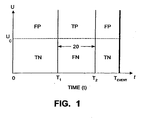
- Fig. 1 is a graph of renormalized dissimilarity as a function of forewarning time (t) for determining true positive (TP), true negative (TN), false positive (FP) and false negative (FN) forewarning indications.
- Figs. 3a-3d are semi-log 10 plots of the four nonlinear dissimilarity measures for a set of broken-rotor seeded-fault power data.
- Dataset #1 is for the nominal (no fault) state.
- Dataset #2 is for the 50% cut in one rotor bar.
- Dataset #3 is for the 100% cut in one rotor bar.
- Dataset #4 is for two cut rotor bars.
- Dataset #5 is for four cut rotor bars.
- the exponential rise in the severity of the seeded faults is shown as an almost linear rise (solid line) in the logarithm of all four dissimilarity measures (*) for the chosen set of phase-space parameters.
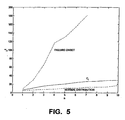
- Fig. 5 is a plot of the maximum value of the ⁇ 2 statistic versus the number (n) of sequential points from the sample distribution for (bottom) a normal distribution with zero mean and unity sample standard deviation; (middle) composite measure, C i , of condition change from the 200 datasets that span the straight-line fit; (top) composite measure, C i , of condition change during failure onset (datasets #394-400).
- the middle and top curves use the same analysis parameters as in Fig. 4.
- a database of forty (40) data sets were collected, each with at least one electrographic temporal lobe (TL) event, as well as twenty (20) data sets without epileptic events, as controls.
- Data sets were obtained from forty-one (41) different patients with ages between 4 and 57 years. This data included multiple data sets from eleven (11) patients (for a total of 30 events), which were used for the channel consistency analysis.
- Such data can be collected (for example) with a 32-channel EEG instrument (Nicolet-BMSI, Madison, Wisconsin) with 19 scalp electrodes in the International 10-20 system of placement as referenced to the ear on the opposing hemisphere.
- Each channel of scalp potential was amplified separately, band-pass filtered between 0.5-99 Hz, and digitized at 250 Hz.
- the 19 EEG channels in each of these data sets had lengths between 5,016 seconds (1 hour and 23 minutes) and 29,656 seconds (8 hours and 14 minutes).
- eye blink artifacts from scalp EEG are removed with a zero-phase quadratic filter that is more efficient than conventional linear filters.
- This filter uses a moving window of data points, e i , with the same number of data points, w , on either side of a central point.
- a quadratic curve is fitted to these 2 w +1 data points, taking the central point of the fit as the low-frequency artifact, f i .
- Expression (1) creates symbols that are uniformly spaced between the minimum and maximum in signal amplitude (uniform symbols). Alternatively, one can use equiprobable symbols, by ordering all N base case data points from the smallest to the largest value. The first N / S of these ordered data values correspond to the first symbol, 0.
- Critical parameters in this approach are the time delay, ⁇ , and system dimensionality, d , and the type and number of symbols, S.
- Symbolization divides the phase space into S d bins.
- the resulting distribution function (DF) is a discretized density on the attractor, which is obtained by counting the number of points that occur in each phase space bin.
- the population of the ith bin of the distribution function is denoted Q i , for the base case, and R i for a test case, respectively.
- the ⁇ 2 measure is one of the most powerful, robust, and widely used statistics for comparison between observed and expected frequencies.
- ⁇ 2 is a relative measure of dissimilarity, rather than an unbiased statistic for accepting or rejecting a null statistical hypothesis.
- the L distance is the natural metric for distribution functions by its direct relation to the total invariant measure on the attractor and defines a bona fide distance. Consistent calculations of these measures obviously require the same number of points in both the base case and test case distribution functions, identically sampled; otherwise, the distribution functions must be properly rescaled.
- the connected PS is constructed by connecting successive PS points as prescribed by the underlying dynamics, y ( i ) ⁇ y ( i + 1).
- Y ( i ) is a vector for the connected phase space (CPS).
- Q and R denote the CPS distribution functions for the base case and test case, respectively.
- the first subscript in Eqs. (4)-(5) denotes the initial PS point, and the second subscript denotes the sequel PS point in the PS pair.
- These CPS measures have higher discriminating power than unconnected PS measures of dissimilarity.
- the measures defined in Eqs. (4)-(5) satisfy the following inequalities: ⁇ 2 ⁇ L, ⁇ c 2 ⁇ L c , L ⁇ L c , and ⁇ 2 ⁇ ⁇ c 2 , where ⁇ c 2 and L c are dissimilarity measures for connected phase space and ⁇ 2 and L are dissimilarity measures for unconnected PS.
- the base case cutsets are tested for outliers as follows. A comparison of the B(B - 1) / 2 unique pairs among the B base case cutsets via Eqs.
- the index j is fixed, to test the j th cutset against the other B - 1 cutsets, thereby giving B - 1 degrees of freedom in the ⁇ j 2 statistic.
- B 9 for the remaining base case cutsets to identify any additional outliers.
- Their presence is indicated by the largest ⁇ j 2 statistic exceeding the new threshold of 17.24, corresponding to a random probability larger than 1/36, as interpolated from standard statistical tables for 8 degrees of freedom.
- the disparate range and variability of these measures are difficult to interpret for noisy EEG, so a consistent method of comparison is needed.
- the dissimilarity measures are renormalized, as described below.
- the B non-outlier base case cutsets are compared to each test case cutset, to obtain the corresponding average dissimilarity value, V i , of the ith cutset for each dissimilarity measure.
- the mean value, V , and the standard deviation, ⁇ , of the dissimilarity measure V are calculated using the remaining base case cutsets, after the outliers have been eliminated, as discussed above.
- a threshold, U C is selected for each renormalized measure U to distinguish between normal (base) and possibly abnormal (test) regimes.
- the choice of a reasonable threshold is critical for obtaining robust, accurate, and timely results.
- a forewarning indication is obtained when a renormalized measure of dissimilarity exceeds the threshold, U ⁇ U C , for a specified number, N OCC , of sequential occurrences within a preset forewarning window.
- N OCC sequential occurrences above the threshold are interpreted as a forewarning indication.
- Such forewarning indications are true positives, TP, if they occur within a forewarning window 20.
- Other performance metrics include true negatives, TN , false positives, FP , and false negatives, FN , also defined with respect to the same preset forewarning window, as shown in Fig. 1.
- the horizontal axis represents time, t .
- the thick vertical line at T EVENT denotes an event onset time.
- the thin vertical lines delimit the forewarning-time window 20, during which T 1 ⁇ t ⁇ T 2 ⁇ T EVENT .
- a typical forewarning window for machine failure is on the order of either hours or days.
- the vertical axis corresponds to a renormalized measure of dissimilarity, U , as discussed above.
- the horizontal dashed line (--) shows the threshold, U C .
- the algorithm then obtains the forewarning statistics by an ordered sequence of logical tests for each channel:
- the i-th dataset is referred to as TP if at least one channel shows forewarning within the desired window, T 1 ⁇ T FW ⁇ T 2 .
- This approach allows selection of an appropriate channel for subsequent real-time forewarning, consistent with the previous characterization of the data.
- Improvement in the channel-consistent total-true rate is carried out by maximizing an objective function that measures the total true rate for any one channel, as well as channel consistency.
- 30 data sets were used from 11 different patients with multiple data sets as follows: 7 patients with 2 data sets, one patient with 3 data sets, 2 patients with 4 data sets, and one patient with 5 data sets.
- the following notation and definitions are used:
- the parameters e.g., N , w, S, d
- Figs. 2a-2d illustrate a series of single parameter searches to maximize the channel-consistent total-true rate for forewarning of epileptic seizures.
- the value of one parameter is systematically changed, while the others are fixed.
- the first-round optimization uses the parameter pair, ⁇ S, d ⁇ , constrained by a computational limit on the numeric labels for the CPS bins using modular arithmetic. This limit arises from the largest double-precision real number 2 52 that can be distinguished from one unit larger: S 2d ⁇ 2 52 , or d ⁇ INT (26 ln 2/ lnS ).
- the largest value of f T was obtained over all of the possible equiprobable symbols for each value of PS dimension in the range, 2 ⁇ d ⁇ 26.
- This plot shows that f T rises non-monotonically with increasing cutset length to a noisy plateau for N > 21,000.
- the best choice of the parameter set for analyzing the dissimilarity measures for each channel depends not only on the system, but also on the specific data under consideration.
- This method of the present invention involves: selecting the parameters to be included in a parameter set, such as ⁇ N, w, S, and d ⁇ , finding specific values for the parameters that maximize the objective function for the respective channels, computing the renormalized measures of PS dissimilarity for the specific data sets with the parameters set to their best values, and systematically searching over the values of N OCC and U C to find the best channel for forewarning indication.
- a parameter set such as ⁇ N, w, S, and d ⁇
- the above methods can be applied to detect condition change in patients having cardiac or breathing difficulties.
- the test sequence began with the motor running in its nominal state (first dataset), followed by progressively more severe broken rotor bars.
- the second dataset involved a simulated failure that was one rotor bar cross section cut through by 50%.
- the third dataset was for the same rotor bar now cut through 100%.
- the fourth dataset was for a second rotor bar cut 100%, exactly 180° from and in addition to the first rotor fault.
- the fifth dataset was for two additional rotor bars cut adjacent to the first rotor bar, with one bar cut on each side of the original, yielding four bars completely open.
- the PS reconstruction parameters were systematically varied, as before, to obtain the most linear increase in the logarithm of condition change, in a least-squares sense, for the broken-rotor test sequence.
- Fig. 3 shows that the phase-space dissimilarity measures rise by ten-fold over the test sequence.
- the exponential rise in the severity of the broken-rotor faults (doubling from 0.5 to 1.0 to 2.0 to 4.0) is mirrored in Figs. 3a-3d by a linear rise (solid line) in the logarithm of all four dissimilarity measures (*) for the chosen set of analysis parameters.
- the present invention not only responds to the problem of false positives and false negatives in forewarning of events from biomedical data, but also is also applicable to forewarning of machine failures and even failures in other physical processes capable of being measured through sensors and transducers.
- a third example involves tri-axial acceleration data from a motor connected to a mechanical load via a gearbox. Application of excess load causes accelerated failure of the gears.
- the data were obtained at ten-minute intervals through the test sequence, sampled at 102.4 kHz.
- the total amount of data was 4.5 GB (three accelerometer channels, times 401 snapshots for a total of 1203 files).
- the 100,000 data points were serially concatenated from each of the data files into a single three-channel dataset for ease of analysis (1.6 GB).
- Each 100,000-point snapshot was divided into ten 10,000-point subsets for this analysis; the results were then averaged over these ten cutsets to obtain a typical value for the entire snapshot.
- the accelerometer data shows quasi-periodic, complex, nonlinear features.
- tri-axial acceleration has an important advantage, which can be explained as follows. Acceleration is a three-dimensional vector that can be integrated once in time to give velocity (vector). Mass times acceleration (vector) is force (vector). The vector dot-product of force and velocity is power (scalar). Thus, three-dimensional acceleration data can be converted directly into a scalar power (within a proportionality constant), which captures the relevant dynamics and has more information about the process than any single accelerometer channel. The resulting accelerometer power also has very complex, nonlinear features.
- Fig. 4 shows a systematic rise in a composite PS dissimilarity of accelerometer power as the test progresses, with an additional abrupt rise at the onset of failure, which occurs at dataset #394.
- This result was obtained by constructing a composite measure, C i , of condition change, namely the sum of the four renormalized measures of dissimilarity in accelerometer power for each of the datasets in the test sequence. The following method was used to obtain this result:
- the variance, ⁇ 1 2 , in step 3 measures the variability of C i about the straight-line fit over the window of m datasets (#194-393).
- the statistic, ⁇ 2 in step 4 measures the variability of datasets #394-400 from the straight-line fit.
- Fig. 5 shows a clear statistical indication of failure onset.
- the bottom plot (labeled "normal distribution") in Fig. 5 depicts the maximum value of the ⁇ 2 statistic for n sequential values out of 200 samples from a Gaussian (normal) distribution with zero mean and a unity sample standard deviation.
- the upper curve in Fig. 5 is the ⁇ 2 statistic, also using step 4 above, for n sequential values from datasets #394-400.
- This upper curve (labeled "failure onset”) deviates markedly from the lower curves after two datasets (#394-395), with overwhelming indication for three and more datasets.
- the composite PS dissimilarity measure provides an objective function that shows consistent indication of condition change, as well as clear indication of the failure onset.
- the fourth and final example used the same overloaded gearbox test bed, as in the third example.
- a separate test sequence acquired load torque that was sampled at 1 kHz.
- Each ten-second dataset had 10,000 data points, all of which were concatenated serially into a single data file for ease of analysis. These data are quasi-periodic with complex, nonlinear features.
- Typical biomedical events and data include, but are not limited to, epileptic seizures from EEG, cardiac fibrillation from EKG, and breathing difficulty from lung sounds.
- Typical machines include, but are not limited to, motors, pumps, turbines, and metal cutting.
- Typical time-serial machine data include, but are not limited to, electrical current, voltage, and power; position, velocity, and acceleration; and temperature and pressure.
Landscapes
- Health & Medical Sciences (AREA)
- Life Sciences & Earth Sciences (AREA)
- Engineering & Computer Science (AREA)
- Public Health (AREA)
- Medical Informatics (AREA)
- General Health & Medical Sciences (AREA)
- Biomedical Technology (AREA)
- Neurology (AREA)
- Pathology (AREA)
- Epidemiology (AREA)
- Heart & Thoracic Surgery (AREA)
- Biophysics (AREA)
- Molecular Biology (AREA)
- Surgery (AREA)
- Animal Behavior & Ethology (AREA)
- Physics & Mathematics (AREA)
- Physiology (AREA)
- Veterinary Medicine (AREA)
- Neurosurgery (AREA)
- Primary Health Care (AREA)
- Psychiatry (AREA)
- Artificial Intelligence (AREA)
- Signal Processing (AREA)
- Data Mining & Analysis (AREA)
- Databases & Information Systems (AREA)
- Computer Vision & Pattern Recognition (AREA)
- Measurement And Recording Of Electrical Phenomena And Electrical Characteristics Of The Living Body (AREA)
- Measuring And Recording Apparatus For Diagnosis (AREA)
- Complex Calculations (AREA)
- Tests Of Electronic Circuits (AREA)
- Ultra Sonic Daignosis Equipment (AREA)
- Measurement Of The Respiration, Hearing Ability, Form, And Blood Characteristics Of Living Organisms (AREA)
- Measuring Pulse, Heart Rate, Blood Pressure Or Blood Flow (AREA)
- Apparatus For Radiation Diagnosis (AREA)
- For Increasing The Reliability Of Semiconductor Memories (AREA)
- Testing Of Devices, Machine Parts, Or Other Structures Thereof (AREA)
Claims (12)
- Computergestütztes Verfahren zur Verarbeitung von Daten, die von einer physikalischen Vorrichtung bereitgestellt sind, zur Bereitstellung einer Vorwarnung eines kritischen Ereignisses, umfassend:Erfassen einer Mehrzahl von Datensätzen mit einer Mehrzahl von Datenkanälen;Berechnen eines renormalisierten Dissimilaritätsmaßes


 Vergleichen des renormalisierten Dissimilaritätsmaßes mit einem Schwellenwert (Uc) für eine Zahl von Vorfällen (NOCC) zur Anzeige einer Zustandsänderung im renormalisierten Dissimilaritätsmaß;Erfassen einer gleichzeitigen Zustandsänderung in einer Mehrzahl (NSIM) von renormalisierten Dissimilaritätsmaßen zum Bestimmen einer Vorwarnung des kritischen Ereignisses;gekennzeichnet durch die Schritte
Bestimmen richtig positiver, richtig negativer, falsch positiver und falsch negativer Anzeigen von Zustandsänderungsvorwarnungen des kritischen Ereignisses für jeden Datenkanal in der Mehrzahl von Datensätzen;
Berechnen einer Gesamtrichtigrate für Vorwarnanzeigen für jeden Datenkanal, worin die Gesamtrichtigrate als
Vergleichen der Gesamtrichtigraten für jeweilige Kanäle, zum Bestimmen mindestens eines Kanals mit der höchsten kanalkonsistenten Gesamtrichtigrate in dem mindestens einen Kanal. - Verfahren nach Anspruch 1, worin die physikalische Vorrichtung ein EEG oder EKG ist.
- Verfahren nach Anspruch 1, worin die physikalische Vorrichtung eine mechanische Vorrichtung oder ein physikalischer Prozess ist.
- Verfahren nach Anspruch 1, ferner umfassend:Prüfen einer Mehrzahl von Parametern für jeden Kanal zum Bestimmen optimaler Werte für die Parameter, die einer höchsten kanalkonsistenten Gesamtrichtigrate für einen jeweiligen Kanal entsprechen; undEinstellen der Mehrzahl von Parametern auf die Optimalwerte zur Verarbeitung von Daten von anderen Datenkanälen.
- Verfahren nach Anspruch 1, worin der Anschlussphasenraum durch Berechnen gleichwahrscheinlicher Symbole für die Daten in den Datensätzen konstruiert wird.
- Verfahren nach Anspruch 1, ferner umfassend:Bestimmen einer Sequenz von renormalisierten Phasenraumdissimilaritätsmaßen aus Datensätzen, die bei zunehmend schwereren Störungszuständen aufgenommen sind; Summieren der renormalisierten Maße in ein Kompositmaß, Ci, für den i-ten Datensatz, Durchführen eine Analyse der kleinsten Quadrate über ein Fenster von m Punkten des Kompositmaßes, so dass eine Gerade erhalten wird, yi=ai+b, die die Kompositdaten am besten im Sinne kleinster Quadrate annähert; Bestimmen der Varianz, σ1 2 = Σi (yi - Ci)2/(m-1), des Kompositmaßes in Bezug auf die Geradenannäherung; Ermitteln der Varianz eines folgenden Fensters von n sequentiellen Punkten über die Statistik, χ2 = Σi (yi - Ci)2/σ1 2; Vergleichen des Werts von χ2 mit dem Maximalwert der selben Statistik, χ2(Ci) für ein Fenster von n sequentiellen Punkten aus den Ci Werten; und Bestimmen des Einsetzens eines kritischen Ereignisses, wie ein Maschinenausfall, wenn χ2 signifikant höher ist als χ2(Ci).
- Verfahren nach Anspruch 1, ferner umfassend:Auswählen eines Satzes Parameterwerte (N, w, S und d) zum Berechnen von Dissimilaritätsmaßen für Verteilungsfunktionen im Anschlussphasenraum für die zu verarbeitenden Datensätze; undDurchsuchen der Werte der Vorwarnschwelle (Uc) und einer entsprechenden Zahl von Vorfällen (NOCC) für jeden Kanal, um den besten Kanal zur Vorwarnanzeige zu finden.
- Verfahren nach Anspruch 7, worin der Anschlussphasenraum durch Berechnen gleichwahrscheinlicher Symbole für die Daten in den Datensätzen konstruiert wird.
- Verfahren nach Anspruch 1, worin
eine Mehrzahl von renormalisierten Dissimilaritätsmaßen für Verteilungsfunktionen berechnet wird, die von einem Anschlussphasenraum für jeden entsprechenden Datenkanal abgeleitet sind; und
worin die Mehrzahl von renormalisierten Dissimilaritätsmaßen mit jeweiligen Schwellenwerten verglichen wird, so dass entsprechende Zustandsänderungsvorwarnung des kritischen Ereignisses angezeigt wird. - Verfahren nach Anspruch 9, worin
eine zweite Mehrzahl von renormalisierten Dissimilaritätsmaßen für Verteilungsfunktionen ebenso berechnet wird, die von einem getrennten Phasenraum für jeden jeweiligen Datenkanal abgeleitet sind; und
worin die zweite Mehrzahl von renormalisierten Dissimilaritätsmaßen mit jeweiligen Schwellenwerten verglichen wird, so dass entsprechende Zustandsänderungsvorwarnung des kritischen Ereignisses angezeigt wird. - Verfahren nach Anspruch 1, worin
eine Mehrzahl von renormalisierten Dissimilaritätsmaßen für Verteilungsfunktionen berechnet wird, die von einem Anschlussphasenraum für jeden entsprechenden Datenkanal abgeleitet sind;
worin die renormalisierten Dissimilaritätsmaße summiert werden, um ein Kompositmaß der Dissimilarität zu erhalten; und
worin das Kompositmaß der Dissimilarität mit einem Schwellenwert verglichen wird, um eine entsprechende Zustandsänderungsvorwarnung des kritischen Ereignisses anzuzeigen. - Verfahren nach Anspruch 11, ferner umfassend:Berechnen einer Chi-Quadrat-Statistik, χ2 = Σi (yi - Ci)2/σ1 2, für das Kompositdissimilaritätsmaß;Prüfen einer Mehrzahl von Parametern für jeden Kanal zum Bestimmen optimaler Werte für die Parameter, die einem höchsten Wert von χ2 für einen jeweiligen Kanal entsprechen; undEinstellen der Mehrzahl von Parametern auf die Optimalwerte zur Verarbeitung von Daten von anderen Datenkanälen.
Applications Claiming Priority (3)
| Application Number | Priority Date | Filing Date | Title |
|---|---|---|---|
| US195626 | 2002-07-12 | ||
| US10/195,626 US7139677B2 (en) | 2002-07-12 | 2002-07-12 | Methods for consistent forewarning of critical events across multiple data channels |
| PCT/US2003/020700 WO2004008373A2 (en) | 2002-07-12 | 2003-07-01 | Methods for consistent forewarning of critical events across multiple data channels |
Publications (2)
| Publication Number | Publication Date |
|---|---|
| EP1525551A2 EP1525551A2 (de) | 2005-04-27 |
| EP1525551B1 true EP1525551B1 (de) | 2007-01-24 |
Family
ID=30114984
Family Applications (1)
| Application Number | Title | Priority Date | Filing Date |
|---|---|---|---|
| EP03764331A Expired - Lifetime EP1525551B1 (de) | 2002-07-12 | 2003-07-01 | Verfahren zur übereinstimmenden vorwarnung kritischer ereignisse über multiple datenwege |
Country Status (10)
| Country | Link |
|---|---|
| US (1) | US7139677B2 (de) |
| EP (1) | EP1525551B1 (de) |
| JP (1) | JP2005533313A (de) |
| CN (1) | CN1679042A (de) |
| AT (1) | ATE352820T1 (de) |
| AU (1) | AU2003258981A1 (de) |
| CA (1) | CA2491987A1 (de) |
| DE (1) | DE60311471D1 (de) |
| MX (1) | MXPA05000564A (de) |
| WO (1) | WO2004008373A2 (de) |
Cited By (22)
| Publication number | Priority date | Publication date | Assignee | Title |
|---|---|---|---|---|
| US7209787B2 (en) | 1998-08-05 | 2007-04-24 | Bioneuronics Corporation | Apparatus and method for closed-loop intracranial stimulation for optimal control of neurological disease |
| US7231254B2 (en) | 1998-08-05 | 2007-06-12 | Bioneuronics Corporation | Closed-loop feedback-driven neuromodulation |
| US7242984B2 (en) | 1998-08-05 | 2007-07-10 | Neurovista Corporation | Apparatus and method for closed-loop intracranial stimulation for optimal control of neurological disease |
| US7277758B2 (en) | 1998-08-05 | 2007-10-02 | Neurovista Corporation | Methods and systems for predicting future symptomatology in a patient suffering from a neurological or psychiatric disorder |
| US7324851B1 (en) | 1998-08-05 | 2008-01-29 | Neurovista Corporation | Closed-loop feedback-driven neuromodulation |
| US7403820B2 (en) | 1998-08-05 | 2008-07-22 | Neurovista Corporation | Closed-loop feedback-driven neuromodulation |
| US7623928B2 (en) | 1998-08-05 | 2009-11-24 | Neurovista Corporation | Controlling a subject's susceptibility to a seizure |
| US7676263B2 (en) | 2006-06-23 | 2010-03-09 | Neurovista Corporation | Minimally invasive system for selecting patient-specific therapy parameters |
| US7747325B2 (en) | 1998-08-05 | 2010-06-29 | Neurovista Corporation | Systems and methods for monitoring a patient's neurological disease state |
| US8036736B2 (en) | 2007-03-21 | 2011-10-11 | Neuro Vista Corporation | Implantable systems and methods for identifying a contra-ictal condition in a subject |
| US8295934B2 (en) | 2006-11-14 | 2012-10-23 | Neurovista Corporation | Systems and methods of reducing artifact in neurological stimulation systems |
| US8588933B2 (en) | 2009-01-09 | 2013-11-19 | Cyberonics, Inc. | Medical lead termination sleeve for implantable medical devices |
| US8725243B2 (en) | 2005-12-28 | 2014-05-13 | Cyberonics, Inc. | Methods and systems for recommending an appropriate pharmacological treatment to a patient for managing epilepsy and other neurological disorders |
| US8762065B2 (en) | 1998-08-05 | 2014-06-24 | Cyberonics, Inc. | Closed-loop feedback-driven neuromodulation |
| US8786624B2 (en) | 2009-06-02 | 2014-07-22 | Cyberonics, Inc. | Processing for multi-channel signals |
| US8849390B2 (en) | 2008-12-29 | 2014-09-30 | Cyberonics, Inc. | Processing for multi-channel signals |
| US8868172B2 (en) | 2005-12-28 | 2014-10-21 | Cyberonics, Inc. | Methods and systems for recommending an appropriate action to a patient for managing epilepsy and other neurological disorders |
| US9042988B2 (en) | 1998-08-05 | 2015-05-26 | Cyberonics, Inc. | Closed-loop vagus nerve stimulation |
| US9259591B2 (en) | 2007-12-28 | 2016-02-16 | Cyberonics, Inc. | Housing for an implantable medical device |
| US9375573B2 (en) | 1998-08-05 | 2016-06-28 | Cyberonics, Inc. | Systems and methods for monitoring a patient's neurological disease state |
| US9415222B2 (en) | 1998-08-05 | 2016-08-16 | Cyberonics, Inc. | Monitoring an epilepsy disease state with a supervisory module |
| US11406317B2 (en) | 2007-12-28 | 2022-08-09 | Livanova Usa, Inc. | Method for detecting neurological and clinical manifestations of a seizure |
Families Citing this family (44)
| Publication number | Priority date | Publication date | Assignee | Title |
|---|---|---|---|---|
| US9050469B1 (en) | 2003-11-26 | 2015-06-09 | Flint Hills Scientific, Llc | Method and system for logging quantitative seizure information and assessing efficacy of therapy using cardiac signals |
| US7657310B2 (en) * | 2006-01-26 | 2010-02-02 | Cyberonics, Inc. | Treatment of reproductive endocrine disorders by vagus nerve stimulation |
| WO2008092133A2 (en) | 2007-01-25 | 2008-07-31 | Neurovista Corporation | Methods and systems for measuring a subject's susceptibility to a seizure |
| EP2126785A2 (de) | 2007-01-25 | 2009-12-02 | NeuroVista Corporation | Systeme und verfahren zur identifikation des kontra-iktalen zustands eines patienten |
| WO2008121635A2 (en) * | 2007-03-30 | 2008-10-09 | Ut-Battelle, Llc | Method and system for knowledge discovery |
| US7962214B2 (en) | 2007-04-26 | 2011-06-14 | Cyberonics, Inc. | Non-surgical device and methods for trans-esophageal vagus nerve stimulation |
| US7904175B2 (en) | 2007-04-26 | 2011-03-08 | Cyberonics, Inc. | Trans-esophageal vagus nerve stimulation |
| US7869884B2 (en) | 2007-04-26 | 2011-01-11 | Cyberonics, Inc. | Non-surgical device and methods for trans-esophageal vagus nerve stimulation |
| US8065529B2 (en) * | 2007-05-21 | 2011-11-22 | Ut-Battelle, Llc | Methods for using a biometric parameter in the identification of persons |
| US9788744B2 (en) | 2007-07-27 | 2017-10-17 | Cyberonics, Inc. | Systems for monitoring brain activity and patient advisory device |
| US8571643B2 (en) | 2010-09-16 | 2013-10-29 | Flint Hills Scientific, Llc | Detecting or validating a detection of a state change from a template of heart rate derivative shape or heart beat wave complex |
| US8382667B2 (en) | 2010-10-01 | 2013-02-26 | Flint Hills Scientific, Llc | Detecting, quantifying, and/or classifying seizures using multimodal data |
| US8337404B2 (en) | 2010-10-01 | 2012-12-25 | Flint Hills Scientific, Llc | Detecting, quantifying, and/or classifying seizures using multimodal data |
| US8417344B2 (en) | 2008-10-24 | 2013-04-09 | Cyberonics, Inc. | Dynamic cranial nerve stimulation based on brain state determination from cardiac data |
| CN101754241B (zh) * | 2008-12-18 | 2012-12-19 | 中兴通讯股份有限公司 | 一种用于无线通信的预警系统及方法 |
| US8827912B2 (en) | 2009-04-24 | 2014-09-09 | Cyberonics, Inc. | Methods and systems for detecting epileptic events using NNXX, optionally with nonlinear analysis parameters |
| US8239028B2 (en) | 2009-04-24 | 2012-08-07 | Cyberonics, Inc. | Use of cardiac parameters in methods and systems for treating a chronic medical condition |
| US20120283526A1 (en) * | 2009-12-16 | 2012-11-08 | Ictalcare A/S | Method and a System for the Prediction of Epileptic Seizures |
| US9643019B2 (en) | 2010-02-12 | 2017-05-09 | Cyberonics, Inc. | Neurological monitoring and alerts |
| US8296108B2 (en) * | 2010-04-02 | 2012-10-23 | Yugen Kaisha Suwa Torasuto | Time series data analyzer, and a computer-readable recording medium recording a time series data analysis program |
| US8649871B2 (en) | 2010-04-29 | 2014-02-11 | Cyberonics, Inc. | Validity test adaptive constraint modification for cardiac data used for detection of state changes |
| US8562536B2 (en) | 2010-04-29 | 2013-10-22 | Flint Hills Scientific, Llc | Algorithm for detecting a seizure from cardiac data |
| US8831732B2 (en) | 2010-04-29 | 2014-09-09 | Cyberonics, Inc. | Method, apparatus and system for validating and quantifying cardiac beat data quality |
| US8679009B2 (en) | 2010-06-15 | 2014-03-25 | Flint Hills Scientific, Llc | Systems approach to comorbidity assessment |
| US8641646B2 (en) | 2010-07-30 | 2014-02-04 | Cyberonics, Inc. | Seizure detection using coordinate data |
| GB2483108A (en) * | 2010-08-27 | 2012-02-29 | Walid Juffali | Monitoring neurological electrical signals to detect the onset of a neurological episode |
| US8416086B2 (en) * | 2010-08-31 | 2013-04-09 | Ut-Battelle, Llc | Methods for improved forewarning of condition changes in monitoring physical processes |
| US8684921B2 (en) | 2010-10-01 | 2014-04-01 | Flint Hills Scientific Llc | Detecting, assessing and managing epilepsy using a multi-variate, metric-based classification analysis |
| US8562524B2 (en) | 2011-03-04 | 2013-10-22 | Flint Hills Scientific, Llc | Detecting, assessing and managing a risk of death in epilepsy |
| US12383190B2 (en) | 2011-03-04 | 2025-08-12 | Flint Hills Scientific, Llc | Detecting, assessing and managing extreme seizure events |
| US8562523B2 (en) | 2011-03-04 | 2013-10-22 | Flint Hills Scientific, Llc | Detecting, assessing and managing extreme epileptic events |
| US8410952B2 (en) | 2010-12-08 | 2013-04-02 | Ut-Battelle, Llc | Methods for forewarning of critical condition changes in monitoring civil structures |
| US9504390B2 (en) | 2011-03-04 | 2016-11-29 | Globalfoundries Inc. | Detecting, assessing and managing a risk of death in epilepsy |
| US9498162B2 (en) | 2011-04-25 | 2016-11-22 | Cyberonics, Inc. | Identifying seizures using heart data from two or more windows |
| US9402550B2 (en) | 2011-04-29 | 2016-08-02 | Cybertronics, Inc. | Dynamic heart rate threshold for neurological event detection |
| US10206591B2 (en) | 2011-10-14 | 2019-02-19 | Flint Hills Scientific, Llc | Seizure detection methods, apparatus, and systems using an autoregression algorithm |
| US10448839B2 (en) | 2012-04-23 | 2019-10-22 | Livanova Usa, Inc. | Methods, systems and apparatuses for detecting increased risk of sudden death |
| EP2846684B1 (de) * | 2012-05-09 | 2021-11-03 | CardioInsight Technologies, Inc. | Kanalintegritätsnachweis |
| US9482084B2 (en) * | 2012-09-06 | 2016-11-01 | Exxonmobil Upstream Research Company | Drilling advisory systems and methods to filter data |
| US10220211B2 (en) | 2013-01-22 | 2019-03-05 | Livanova Usa, Inc. | Methods and systems to diagnose depression |
| US10874318B2 (en) | 2018-03-06 | 2020-12-29 | Cardioinsight Technologies, Inc. | Channel integrity detection and reconstruction of electrophysiological signals |
| WO2021034351A1 (en) * | 2019-08-22 | 2021-02-25 | Hecox Kurt E | Systems and methods for seizure detection based on changes in electroencephalogram (eeg) non-linearities |
| CN114615924B (zh) | 2019-08-22 | 2023-04-11 | 全球先进临床解决方案有限公司 | 基于脑电图(eeg)非线性变化的用于癫痫发作检测的系统和方法 |
| CN113346621B (zh) * | 2021-06-16 | 2023-03-07 | 贵州电网有限责任公司 | 一种电力监控系统设备告警信号变化预警方法 |
Family Cites Families (6)
| Publication number | Priority date | Publication date | Assignee | Title |
|---|---|---|---|---|
| US5857978A (en) * | 1996-03-20 | 1999-01-12 | Lockheed Martin Energy Systems, Inc. | Epileptic seizure prediction by non-linear methods |
| US5743860A (en) | 1996-03-20 | 1998-04-28 | Lockheed Martin Energy Systems, Inc. | Apparatus and method for epileptic seizure detection using non-linear techniques |
| US5626145A (en) | 1996-03-20 | 1997-05-06 | Lockheed Martin Energy Systems, Inc. | Method and apparatus for extraction of low-frequency artifacts from brain waves for alertness detection |
| US5815413A (en) * | 1997-05-08 | 1998-09-29 | Lockheed Martin Energy Research Corporation | Integrated method for chaotic time series analysis |
| US6484132B1 (en) | 2000-03-07 | 2002-11-19 | Lockheed Martin Energy Research Corporation | Condition assessment of nonlinear processes |
| US6678548B1 (en) * | 2000-10-20 | 2004-01-13 | The Trustees Of The University Of Pennsylvania | Unified probabilistic framework for predicting and detecting seizure onsets in the brain and multitherapeutic device |
-
2002
- 2002-07-12 US US10/195,626 patent/US7139677B2/en not_active Expired - Fee Related
-
2003
- 2003-07-01 CN CNA038209195A patent/CN1679042A/zh active Pending
- 2003-07-01 EP EP03764331A patent/EP1525551B1/de not_active Expired - Lifetime
- 2003-07-01 JP JP2004521508A patent/JP2005533313A/ja active Pending
- 2003-07-01 WO PCT/US2003/020700 patent/WO2004008373A2/en not_active Ceased
- 2003-07-01 MX MXPA05000564A patent/MXPA05000564A/es unknown
- 2003-07-01 AT AT03764331T patent/ATE352820T1/de not_active IP Right Cessation
- 2003-07-01 AU AU2003258981A patent/AU2003258981A1/en not_active Abandoned
- 2003-07-01 CA CA002491987A patent/CA2491987A1/en not_active Abandoned
- 2003-07-01 DE DE60311471T patent/DE60311471D1/de not_active Expired - Lifetime
Cited By (35)
| Publication number | Priority date | Publication date | Assignee | Title |
|---|---|---|---|---|
| US8762065B2 (en) | 1998-08-05 | 2014-06-24 | Cyberonics, Inc. | Closed-loop feedback-driven neuromodulation |
| US8781597B2 (en) | 1998-08-05 | 2014-07-15 | Cyberonics, Inc. | Systems for monitoring a patient's neurological disease state |
| US7242984B2 (en) | 1998-08-05 | 2007-07-10 | Neurovista Corporation | Apparatus and method for closed-loop intracranial stimulation for optimal control of neurological disease |
| US7277758B2 (en) | 1998-08-05 | 2007-10-02 | Neurovista Corporation | Methods and systems for predicting future symptomatology in a patient suffering from a neurological or psychiatric disorder |
| US7324851B1 (en) | 1998-08-05 | 2008-01-29 | Neurovista Corporation | Closed-loop feedback-driven neuromodulation |
| US7403820B2 (en) | 1998-08-05 | 2008-07-22 | Neurovista Corporation | Closed-loop feedback-driven neuromodulation |
| US7623928B2 (en) | 1998-08-05 | 2009-11-24 | Neurovista Corporation | Controlling a subject's susceptibility to a seizure |
| US9421373B2 (en) | 1998-08-05 | 2016-08-23 | Cyberonics, Inc. | Apparatus and method for closed-loop intracranial stimulation for optimal control of neurological disease |
| US7747325B2 (en) | 1998-08-05 | 2010-06-29 | Neurovista Corporation | Systems and methods for monitoring a patient's neurological disease state |
| US7853329B2 (en) | 1998-08-05 | 2010-12-14 | Neurovista Corporation | Monitoring efficacy of neural modulation therapy |
| US7930035B2 (en) | 1998-08-05 | 2011-04-19 | Neurovista Corporation | Providing output indicative of subject's disease state |
| US9415222B2 (en) | 1998-08-05 | 2016-08-16 | Cyberonics, Inc. | Monitoring an epilepsy disease state with a supervisory module |
| US9375573B2 (en) | 1998-08-05 | 2016-06-28 | Cyberonics, Inc. | Systems and methods for monitoring a patient's neurological disease state |
| US9320900B2 (en) | 1998-08-05 | 2016-04-26 | Cyberonics, Inc. | Methods and systems for determining subject-specific parameters for a neuromodulation therapy |
| US9113801B2 (en) | 1998-08-05 | 2015-08-25 | Cyberonics, Inc. | Methods and systems for continuous EEG monitoring |
| US9042988B2 (en) | 1998-08-05 | 2015-05-26 | Cyberonics, Inc. | Closed-loop vagus nerve stimulation |
| US7231254B2 (en) | 1998-08-05 | 2007-06-12 | Bioneuronics Corporation | Closed-loop feedback-driven neuromodulation |
| US7209787B2 (en) | 1998-08-05 | 2007-04-24 | Bioneuronics Corporation | Apparatus and method for closed-loop intracranial stimulation for optimal control of neurological disease |
| US8725243B2 (en) | 2005-12-28 | 2014-05-13 | Cyberonics, Inc. | Methods and systems for recommending an appropriate pharmacological treatment to a patient for managing epilepsy and other neurological disorders |
| US9592004B2 (en) | 2005-12-28 | 2017-03-14 | Cyberonics, Inc. | Methods and systems for managing epilepsy and other neurological disorders |
| US9044188B2 (en) | 2005-12-28 | 2015-06-02 | Cyberonics, Inc. | Methods and systems for managing epilepsy and other neurological disorders |
| US8868172B2 (en) | 2005-12-28 | 2014-10-21 | Cyberonics, Inc. | Methods and systems for recommending an appropriate action to a patient for managing epilepsy and other neurological disorders |
| US7676263B2 (en) | 2006-06-23 | 2010-03-09 | Neurovista Corporation | Minimally invasive system for selecting patient-specific therapy parameters |
| US9480845B2 (en) | 2006-06-23 | 2016-11-01 | Cyberonics, Inc. | Nerve stimulation device with a wearable loop antenna |
| US8855775B2 (en) | 2006-11-14 | 2014-10-07 | Cyberonics, Inc. | Systems and methods of reducing artifact in neurological stimulation systems |
| US8295934B2 (en) | 2006-11-14 | 2012-10-23 | Neurovista Corporation | Systems and methods of reducing artifact in neurological stimulation systems |
| US8543199B2 (en) | 2007-03-21 | 2013-09-24 | Cyberonics, Inc. | Implantable systems and methods for identifying a contra-ictal condition in a subject |
| US8036736B2 (en) | 2007-03-21 | 2011-10-11 | Neuro Vista Corporation | Implantable systems and methods for identifying a contra-ictal condition in a subject |
| US9445730B2 (en) | 2007-03-21 | 2016-09-20 | Cyberonics, Inc. | Implantable systems and methods for identifying a contra-ictal condition in a subject |
| US9259591B2 (en) | 2007-12-28 | 2016-02-16 | Cyberonics, Inc. | Housing for an implantable medical device |
| US11406317B2 (en) | 2007-12-28 | 2022-08-09 | Livanova Usa, Inc. | Method for detecting neurological and clinical manifestations of a seizure |
| US8849390B2 (en) | 2008-12-29 | 2014-09-30 | Cyberonics, Inc. | Processing for multi-channel signals |
| US8588933B2 (en) | 2009-01-09 | 2013-11-19 | Cyberonics, Inc. | Medical lead termination sleeve for implantable medical devices |
| US9289595B2 (en) | 2009-01-09 | 2016-03-22 | Cyberonics, Inc. | Medical lead termination sleeve for implantable medical devices |
| US8786624B2 (en) | 2009-06-02 | 2014-07-22 | Cyberonics, Inc. | Processing for multi-channel signals |
Also Published As
| Publication number | Publication date |
|---|---|
| WO2004008373A3 (en) | 2004-12-09 |
| AU2003258981A1 (en) | 2004-02-02 |
| US7139677B2 (en) | 2006-11-21 |
| US20040087835A1 (en) | 2004-05-06 |
| MXPA05000564A (es) | 2005-04-28 |
| CN1679042A (zh) | 2005-10-05 |
| WO2004008373A2 (en) | 2004-01-22 |
| JP2005533313A (ja) | 2005-11-04 |
| DE60311471D1 (de) | 2007-03-15 |
| CA2491987A1 (en) | 2004-01-22 |
| ATE352820T1 (de) | 2007-02-15 |
| EP1525551A2 (de) | 2005-04-27 |
Similar Documents
| Publication | Publication Date | Title |
|---|---|---|
| EP1525551B1 (de) | Verfahren zur übereinstimmenden vorwarnung kritischer ereignisse über multiple datenwege | |
| US7209861B2 (en) | Methods for improved forewarning of critical events across multiple data channels | |
| US6484132B1 (en) | Condition assessment of nonlinear processes | |
| Xiang et al. | The detection of epileptic seizure signals based on fuzzy entropy | |
| Hively et al. | Channel-consistent forewarning of epileptic events from scalp EEG | |
| US11317840B2 (en) | Method for real time analyzing stress using deep neural network algorithm | |
| Lu et al. | Detection and classification of epileptic EEG signals by the methods of nonlinear dynamics | |
| Hively et al. | Timely detection of dynamical change in scalp EEG signals | |
| EP1017313A1 (de) | Integriertes verfahren zur chaotische zeitreihendatenanalyse | |
| CN102397069A (zh) | 用于自动癫痫监测的方法、设备和计算机程序产品 | |
| US8416086B2 (en) | Methods for improved forewarning of condition changes in monitoring physical processes | |
| Olamat et al. | Synchronization analysis in epileptic EEG signals via state transfer networks based on visibility graph technique | |
| JP2015112423A (ja) | てんかん性発作兆候検知装置、てんかん性発作兆候検知モデル生成装置、てんかん性発作兆候検知方法、てんかん性発作兆候検知モデル生成方法、てんかん性発作兆候検知プログラムおよびてんかん性発作兆候検知モデル生成プログラム | |
| US20020156392A1 (en) | Method and apparatus for inspecting biological rhythms | |
| Garg et al. | Detection of depression using weighted spectral graph clustering with EEG biomarkers | |
| Yang et al. | Fusion of eyes-open and eyes-closed electroencephalography in resting state for classification of major depressive disorder | |
| Fujita et al. | Characterization of cardiovascular diseases using wavelet packet decomposition and nonlinear measures of electrocardiogram signal | |
| CN121034650A (zh) | 一种融合多源数据的蛛网膜下腔出血病程趋势建模系统 | |
| CN112545528B (zh) | 基于分数阶傅里叶变换和张量分解的心电t波特征提取方法 | |
| Protopopescu et al. | Phase-space dissimilarity measures of nonlinear dynamics: Industrial and biomedical applications | |
| JP7806507B2 (ja) | 設備診断装置、設備診断方法 | |
| Lachtar et al. | Drowsiness detection with a limited number of EEG physiological signals | |
| Mondal et al. | Detection of cardiac abnormalities from 12-lead ecg using complex wavelet sub-band features | |
| Ghezala et al. | Ictal onset zone localization by using ECOG signals | |
| Hadj Ahmed et al. | Robust detection of CHF through new time–frequency features within HRV signals |
Legal Events
| Date | Code | Title | Description |
|---|---|---|---|
| PUAI | Public reference made under article 153(3) epc to a published international application that has entered the european phase |
Free format text: ORIGINAL CODE: 0009012 |
|
| 17P | Request for examination filed |
Effective date: 20050127 |
|
| AK | Designated contracting states |
Kind code of ref document: A2 Designated state(s): AT BE BG CH CY CZ DE DK EE ES FI FR GB GR HU IE IT LI LU MC NL PT RO SE SI SK TR |
|
| AX | Request for extension of the european patent |
Extension state: AL LT LV MK |
|
| 17Q | First examination report despatched |
Effective date: 20050502 |
|
| DAX | Request for extension of the european patent (deleted) | ||
| GRAP | Despatch of communication of intention to grant a patent |
Free format text: ORIGINAL CODE: EPIDOSNIGR1 |
|
| GRAS | Grant fee paid |
Free format text: ORIGINAL CODE: EPIDOSNIGR3 |
|
| GRAA | (expected) grant |
Free format text: ORIGINAL CODE: 0009210 |
|
| AK | Designated contracting states |
Kind code of ref document: B1 Designated state(s): AT BE BG CH CY CZ DE DK EE ES FI FR GB GR HU IE IT LI LU MC NL PT RO SE SI SK TR |
|
| PG25 | Lapsed in a contracting state [announced via postgrant information from national office to epo] |
Ref country code: NL Free format text: LAPSE BECAUSE OF FAILURE TO SUBMIT A TRANSLATION OF THE DESCRIPTION OR TO PAY THE FEE WITHIN THE PRESCRIBED TIME-LIMIT Effective date: 20070124 Ref country code: AT Free format text: LAPSE BECAUSE OF FAILURE TO SUBMIT A TRANSLATION OF THE DESCRIPTION OR TO PAY THE FEE WITHIN THE PRESCRIBED TIME-LIMIT Effective date: 20070124 Ref country code: FI Free format text: LAPSE BECAUSE OF FAILURE TO SUBMIT A TRANSLATION OF THE DESCRIPTION OR TO PAY THE FEE WITHIN THE PRESCRIBED TIME-LIMIT Effective date: 20070124 Ref country code: SI Free format text: LAPSE BECAUSE OF FAILURE TO SUBMIT A TRANSLATION OF THE DESCRIPTION OR TO PAY THE FEE WITHIN THE PRESCRIBED TIME-LIMIT Effective date: 20070124 Ref country code: DK Free format text: LAPSE BECAUSE OF FAILURE TO SUBMIT A TRANSLATION OF THE DESCRIPTION OR TO PAY THE FEE WITHIN THE PRESCRIBED TIME-LIMIT Effective date: 20070124 |
|
| REG | Reference to a national code |
Ref country code: GB Ref legal event code: FG4D |
|
| REG | Reference to a national code |
Ref country code: CH Ref legal event code: EP |
|
| REG | Reference to a national code |
Ref country code: IE Ref legal event code: FG4D |
|
| REF | Corresponds to: |
Ref document number: 60311471 Country of ref document: DE Date of ref document: 20070315 Kind code of ref document: P |
|
| PG25 | Lapsed in a contracting state [announced via postgrant information from national office to epo] |
Ref country code: SE Free format text: LAPSE BECAUSE OF FAILURE TO SUBMIT A TRANSLATION OF THE DESCRIPTION OR TO PAY THE FEE WITHIN THE PRESCRIBED TIME-LIMIT Effective date: 20070424 |
|
| PG25 | Lapsed in a contracting state [announced via postgrant information from national office to epo] |
Ref country code: BG Free format text: LAPSE BECAUSE OF EXPIRATION OF PROTECTION Effective date: 20070425 |
|
| PG25 | Lapsed in a contracting state [announced via postgrant information from national office to epo] |
Ref country code: ES Free format text: LAPSE BECAUSE OF FAILURE TO SUBMIT A TRANSLATION OF THE DESCRIPTION OR TO PAY THE FEE WITHIN THE PRESCRIBED TIME-LIMIT Effective date: 20070505 |
|
| REG | Reference to a national code |
Ref country code: CH Ref legal event code: NV Representative=s name: ZIMMERLI, WAGNER & PARTNER AG |
|
| PG25 | Lapsed in a contracting state [announced via postgrant information from national office to epo] |
Ref country code: PT Free format text: LAPSE BECAUSE OF FAILURE TO SUBMIT A TRANSLATION OF THE DESCRIPTION OR TO PAY THE FEE WITHIN THE PRESCRIBED TIME-LIMIT Effective date: 20070625 |
|
| NLV1 | Nl: lapsed or annulled due to failure to fulfill the requirements of art. 29p and 29m of the patents act | ||
| EN | Fr: translation not filed | ||
| PG25 | Lapsed in a contracting state [announced via postgrant information from national office to epo] |
Ref country code: SK Free format text: LAPSE BECAUSE OF FAILURE TO SUBMIT A TRANSLATION OF THE DESCRIPTION OR TO PAY THE FEE WITHIN THE PRESCRIBED TIME-LIMIT Effective date: 20070124 |
|
| PLBE | No opposition filed within time limit |
Free format text: ORIGINAL CODE: 0009261 |
|
| STAA | Information on the status of an ep patent application or granted ep patent |
Free format text: STATUS: NO OPPOSITION FILED WITHIN TIME LIMIT |
|
| 26N | No opposition filed |
Effective date: 20071025 |
|
| PG25 | Lapsed in a contracting state [announced via postgrant information from national office to epo] |
Ref country code: BE Free format text: LAPSE BECAUSE OF FAILURE TO SUBMIT A TRANSLATION OF THE DESCRIPTION OR TO PAY THE FEE WITHIN THE PRESCRIBED TIME-LIMIT Effective date: 20070124 Ref country code: CZ Free format text: LAPSE BECAUSE OF FAILURE TO SUBMIT A TRANSLATION OF THE DESCRIPTION OR TO PAY THE FEE WITHIN THE PRESCRIBED TIME-LIMIT Effective date: 20070124 Ref country code: RO Free format text: LAPSE BECAUSE OF FAILURE TO SUBMIT A TRANSLATION OF THE DESCRIPTION OR TO PAY THE FEE WITHIN THE PRESCRIBED TIME-LIMIT Effective date: 20070124 |
|
| PG25 | Lapsed in a contracting state [announced via postgrant information from national office to epo] |
Ref country code: DE Free format text: LAPSE BECAUSE OF FAILURE TO SUBMIT A TRANSLATION OF THE DESCRIPTION OR TO PAY THE FEE WITHIN THE PRESCRIBED TIME-LIMIT Effective date: 20070425 |
|
| PG25 | Lapsed in a contracting state [announced via postgrant information from national office to epo] |
Ref country code: FR Free format text: LAPSE BECAUSE OF FAILURE TO SUBMIT A TRANSLATION OF THE DESCRIPTION OR TO PAY THE FEE WITHIN THE PRESCRIBED TIME-LIMIT Effective date: 20070914 Ref country code: GR Free format text: LAPSE BECAUSE OF FAILURE TO SUBMIT A TRANSLATION OF THE DESCRIPTION OR TO PAY THE FEE WITHIN THE PRESCRIBED TIME-LIMIT Effective date: 20070425 Ref country code: MC Free format text: LAPSE BECAUSE OF NON-PAYMENT OF DUE FEES Effective date: 20070731 Ref country code: IT Free format text: LAPSE BECAUSE OF FAILURE TO SUBMIT A TRANSLATION OF THE DESCRIPTION OR TO PAY THE FEE WITHIN THE PRESCRIBED TIME-LIMIT Effective date: 20070124 |
|
| PG25 | Lapsed in a contracting state [announced via postgrant information from national office to epo] |
Ref country code: IE Free format text: LAPSE BECAUSE OF NON-PAYMENT OF DUE FEES Effective date: 20070702 |
|
| PG25 | Lapsed in a contracting state [announced via postgrant information from national office to epo] |
Ref country code: FR Free format text: LAPSE BECAUSE OF FAILURE TO SUBMIT A TRANSLATION OF THE DESCRIPTION OR TO PAY THE FEE WITHIN THE PRESCRIBED TIME-LIMIT Effective date: 20070124 |
|
| PG25 | Lapsed in a contracting state [announced via postgrant information from national office to epo] |
Ref country code: EE Free format text: LAPSE BECAUSE OF FAILURE TO SUBMIT A TRANSLATION OF THE DESCRIPTION OR TO PAY THE FEE WITHIN THE PRESCRIBED TIME-LIMIT Effective date: 20070124 |
|
| PG25 | Lapsed in a contracting state [announced via postgrant information from national office to epo] |
Ref country code: CY Free format text: LAPSE BECAUSE OF FAILURE TO SUBMIT A TRANSLATION OF THE DESCRIPTION OR TO PAY THE FEE WITHIN THE PRESCRIBED TIME-LIMIT Effective date: 20070124 |
|
| PG25 | Lapsed in a contracting state [announced via postgrant information from national office to epo] |
Ref country code: LU Free format text: LAPSE BECAUSE OF NON-PAYMENT OF DUE FEES Effective date: 20070701 |
|
| PG25 | Lapsed in a contracting state [announced via postgrant information from national office to epo] |
Ref country code: TR Free format text: LAPSE BECAUSE OF FAILURE TO SUBMIT A TRANSLATION OF THE DESCRIPTION OR TO PAY THE FEE WITHIN THE PRESCRIBED TIME-LIMIT Effective date: 20070124 Ref country code: HU Free format text: LAPSE BECAUSE OF FAILURE TO SUBMIT A TRANSLATION OF THE DESCRIPTION OR TO PAY THE FEE WITHIN THE PRESCRIBED TIME-LIMIT Effective date: 20070725 |
|
| REG | Reference to a national code |
Ref country code: CH Ref legal event code: PFA Owner name: UT-BATTELLE, LLC Free format text: UT-BATTELLE, LLC#111-B UNION VALLEY ROAD, P.O. BOX 2008, MS 6498#OAK RIDGE, TN 37831-6498 (US) -TRANSFER TO- UT-BATTELLE, LLC#111-B UNION VALLEY ROAD, P.O. BOX 2008, MS 6498#OAK RIDGE, TN 37831-6498 (US) |
|
| PGFP | Annual fee paid to national office [announced via postgrant information from national office to epo] |
Ref country code: CH Payment date: 20110725 Year of fee payment: 9 |
|
| PGFP | Annual fee paid to national office [announced via postgrant information from national office to epo] |
Ref country code: GB Payment date: 20120719 Year of fee payment: 10 |
|
| REG | Reference to a national code |
Ref country code: CH Ref legal event code: PL |
|
| PG25 | Lapsed in a contracting state [announced via postgrant information from national office to epo] |
Ref country code: CH Free format text: LAPSE BECAUSE OF NON-PAYMENT OF DUE FEES Effective date: 20120731 Ref country code: LI Free format text: LAPSE BECAUSE OF NON-PAYMENT OF DUE FEES Effective date: 20120731 |
|
| GBPC | Gb: european patent ceased through non-payment of renewal fee |
Effective date: 20130701 |
|
| PG25 | Lapsed in a contracting state [announced via postgrant information from national office to epo] |
Ref country code: GB Free format text: LAPSE BECAUSE OF NON-PAYMENT OF DUE FEES Effective date: 20130701 |